US8062767B2 - Organic light emitting diode containing a Ir complex having a novel ligand as a phosphorescent emitter - Google Patents
Organic light emitting diode containing a Ir complex having a novel ligand as a phosphorescent emitter Download PDFInfo
- Publication number
- US8062767B2 US8062767B2 US11/682,864 US68286407A US8062767B2 US 8062767 B2 US8062767 B2 US 8062767B2 US 68286407 A US68286407 A US 68286407A US 8062767 B2 US8062767 B2 US 8062767B2
- Authority
- US
- United States
- Prior art keywords
- light emitting
- emitting diode
- organic light
- diode according
- hole
- Prior art date
- Legal status (The legal status is an assumption and is not a legal conclusion. Google has not performed a legal analysis and makes no representation as to the accuracy of the status listed.)
- Expired - Fee Related, expires
Links
- 0 *C1=C([2*])N2=C(C(C)=C(C)[Ir]2C)N1[1*].*N1C([1*])=C([2*])N2=C1C(C)=C(C)[Ir]2C.C.C.C.C.C.CC.CC.CC.CC.CC.CC.CC.CC.CC.C[Ir]1C2=C(C3=C(C=CC=C3)C=C2)C2=C/C=C3\C=CC=C\C3=N\21.C[Ir]1C2=C(C=CC=C2)C2=C/C=C/C=N\21.C[Ir]1C2=C(C=CC=C2)C2=C3\C=CC=C\C3=C\C=N\21 Chemical compound *C1=C([2*])N2=C(C(C)=C(C)[Ir]2C)N1[1*].*N1C([1*])=C([2*])N2=C1C(C)=C(C)[Ir]2C.C.C.C.C.C.CC.CC.CC.CC.CC.CC.CC.CC.CC.C[Ir]1C2=C(C3=C(C=CC=C3)C=C2)C2=C/C=C3\C=CC=C\C3=N\21.C[Ir]1C2=C(C=CC=C2)C2=C/C=C/C=N\21.C[Ir]1C2=C(C=CC=C2)C2=C3\C=CC=C\C3=C\C=N\21 0.000 description 6
- AQPDBSVNSVTEPY-UHFFFAOYSA-N C.C1=CC2=C(C=C1)N(C1=CC=C(N(C3=CC=C(N4C5=C(C=CC=C5)C5=C4C=CC=C5)C=C3)C3=CC=C(N4C5=C(C=CC=C5)C5=C4C=CC=C5)C=C3)C=C1)C1=C2C=CC=C1 Chemical compound C.C1=CC2=C(C=C1)N(C1=CC=C(N(C3=CC=C(N4C5=C(C=CC=C5)C5=C4C=CC=C5)C=C3)C3=CC=C(N4C5=C(C=CC=C5)C5=C4C=CC=C5)C=C3)C=C1)C1=C2C=CC=C1 AQPDBSVNSVTEPY-UHFFFAOYSA-N 0.000 description 2
- PLVZVAXONYSQFX-UHFFFAOYSA-N C.C1=CC=C(N2C(C3=CC(C4=NC5=C(C=CC=C5)N4C4=CC=CC=C4)=CC(C4=NC5=C(C=CC=C5)N4C4=CC=CC=C4)=C3)=NC3=C2C=CC=C3)C=C1 Chemical compound C.C1=CC=C(N2C(C3=CC(C4=NC5=C(C=CC=C5)N4C4=CC=CC=C4)=CC(C4=NC5=C(C=CC=C5)N4C4=CC=CC=C4)=C3)=NC3=C2C=CC=C3)C=C1 PLVZVAXONYSQFX-UHFFFAOYSA-N 0.000 description 2
- DOVLCMRUYCYNTC-UHFFFAOYSA-N C1=CC=C(N2C3=C(C=CC=C3)N3=C2C2=C(C=CC=C2)[Ir]32N3N=NC=C3C3=CC=CC=N32)C=C1 Chemical compound C1=CC=C(N2C3=C(C=CC=C3)N3=C2C2=C(C=CC=C2)[Ir]32N3N=NC=C3C3=CC=CC=N32)C=C1 DOVLCMRUYCYNTC-UHFFFAOYSA-N 0.000 description 2
- QJTYLTMFUQIMEZ-UHFFFAOYSA-N CC1=CC2=N(C3=C1C=CC=C3)[Ir]1(C3=C2C2=C(C=CC=C2)C=C3)N2N=NC=C2C2=CC=CC=N21 Chemical compound CC1=CC2=N(C3=C1C=CC=C3)[Ir]1(C3=C2C2=C(C=CC=C2)C=C3)N2N=NC=C2C2=CC=CC=N21 QJTYLTMFUQIMEZ-UHFFFAOYSA-N 0.000 description 2
- DIVZFUBWFAOMCW-UHFFFAOYSA-N CC1=CC=CC(N(C2=CC=CC=C2)C2=CC=C(N(C3=CC=C(N(C4=CC=CC=C4)C4=CC(C)=CC=C4)C=C3)C3=CC=C(N(C4=CC=CC=C4)C4=CC(C)=CC=C4)C=C3)C=C2)=C1 Chemical compound CC1=CC=CC(N(C2=CC=CC=C2)C2=CC=C(N(C3=CC=C(N(C4=CC=CC=C4)C4=CC(C)=CC=C4)C=C3)C3=CC=C(N(C4=CC=CC=C4)C4=CC(C)=CC=C4)C=C3)C=C2)=C1 DIVZFUBWFAOMCW-UHFFFAOYSA-N 0.000 description 2
- FFNVQNRYTPFDDP-UHFFFAOYSA-N N#Cc1ccccn1 Chemical compound N#Cc1ccccn1 FFNVQNRYTPFDDP-UHFFFAOYSA-N 0.000 description 2
- GEQBRULPNIVQPP-UHFFFAOYSA-N c(cc1)ccc1-[n]1c(-c2cc(-c3nc4ccccc4[n]3-c3ccccc3)cc(-c3nc4ccccc4[n]3-c3ccccc3)c2)nc2c1cccc2 Chemical compound c(cc1)ccc1-[n]1c(-c2cc(-c3nc4ccccc4[n]3-c3ccccc3)cc(-c3nc4ccccc4[n]3-c3ccccc3)c2)nc2c1cccc2 GEQBRULPNIVQPP-UHFFFAOYSA-N 0.000 description 2
- ABDNHPKBPAJJQW-UHFFFAOYSA-N B=NS.C1=CC=C(C2=NCCN2)N=C1.NCCN.[H]C(=O)C1=CC=CC=N1 Chemical compound B=NS.C1=CC=C(C2=NCCN2)N=C1.NCCN.[H]C(=O)C1=CC=CC=N1 ABDNHPKBPAJJQW-UHFFFAOYSA-N 0.000 description 1
- LYXPGFMIANSMML-DXLKATCSSA-N BC#N.BN=P.BPP.C1=CC=C(N(C2=CC=C(C3=CC=C(N(C4=CC=CC=C4)C4=C5C=CC=CC5=C5C=CC=CC5=C4)C=C3)C=C2)C2=C3C=CC=CC3=C3C=CC=CC3=C2)C=C1.C1=CC=C(N(C2=CC=C(C3=CC=C(N(C4=CC=CC=C4)C4=C5C=CC=CC5=CC=C4)C=C3)C=C2)C2=C3C=CC=CC3=CC=C2)C=C1.C1=CC=C(N(C2=CC=C(C3=CC=C(N4C5=CC=CC=C5C5=C4C=CC=C5)C=C3)C=C2)C2=C3C=CC=CC3=CC=C2)C=C1.CC1=CC=CC(N(C2=CC=CC=C2)C2=CC=C(C3=CC=C(N(C4=CC=CC=C4)C4=CC(C)=CC=C4)C=C3)C=C2)=C1.[2H]P[3H] Chemical compound BC#N.BN=P.BPP.C1=CC=C(N(C2=CC=C(C3=CC=C(N(C4=CC=CC=C4)C4=C5C=CC=CC5=C5C=CC=CC5=C4)C=C3)C=C2)C2=C3C=CC=CC3=C3C=CC=CC3=C2)C=C1.C1=CC=C(N(C2=CC=C(C3=CC=C(N(C4=CC=CC=C4)C4=C5C=CC=CC5=CC=C4)C=C3)C=C2)C2=C3C=CC=CC3=CC=C2)C=C1.C1=CC=C(N(C2=CC=C(C3=CC=C(N4C5=CC=CC=C5C5=C4C=CC=C5)C=C3)C=C2)C2=C3C=CC=CC3=CC=C2)C=C1.CC1=CC=CC(N(C2=CC=CC=C2)C2=CC=C(C3=CC=C(N(C4=CC=CC=C4)C4=CC(C)=CC=C4)C=C3)C=C2)=C1.[2H]P[3H] LYXPGFMIANSMML-DXLKATCSSA-N 0.000 description 1
- RUHRVZFMHDXEBR-FLCFRILYSA-N BCP.C#CP.C1=CC(N2C3=C(C=CC=C3)C3=C2C=CC=C3)=CC(N2C3=C(C=CC=C3)C3=C2C=CC=C3)=C1.C1=CC2=C(C=C1)N(C1=CC(N3C4=C(C=CC=C4)C4=C3C=CC=C4)=CC(N3C4=C(C=CC=C4)C4=C3C=CC=C4)=C1)C1=C2C=CC=C1.C1=CC2=C(C=C1)N(C1=CC=C(C3=CC=C(N4C5=C(C=CC=C5)C5=C4C=CC=C5)C=C3)C=C1)C1=C2C=CC=C1.C1=CC2=C(C=C1)N(C1=CC=C(N3C4=C(C=CC=C4)C4=C3C=CC=C4)C=C1)C1=C2C=CC=C1.[3H]CB Chemical compound BCP.C#CP.C1=CC(N2C3=C(C=CC=C3)C3=C2C=CC=C3)=CC(N2C3=C(C=CC=C3)C3=C2C=CC=C3)=C1.C1=CC2=C(C=C1)N(C1=CC(N3C4=C(C=CC=C4)C4=C3C=CC=C4)=CC(N3C4=C(C=CC=C4)C4=C3C=CC=C4)=C1)C1=C2C=CC=C1.C1=CC2=C(C=C1)N(C1=CC=C(C3=CC=C(N4C5=C(C=CC=C5)C5=C4C=CC=C5)C=C3)C=C1)C1=C2C=CC=C1.C1=CC2=C(C=C1)N(C1=CC=C(N3C4=C(C=CC=C4)C4=C3C=CC=C4)C=C1)C1=C2C=CC=C1.[3H]CB RUHRVZFMHDXEBR-FLCFRILYSA-N 0.000 description 1
- RBGCTASINLLXCM-UHFFFAOYSA-N BPI.C1=CC=C(C2=NC3=C(C=CC=C3)N2C2=CC=CC=C2)C=C1.NC1=C(NC2=CC=CC=C2)C=CC=C1.[H]C(=O)C1=CC=CC=C1 Chemical compound BPI.C1=CC=C(C2=NC3=C(C=CC=C3)N2C2=CC=CC=C2)C=C1.NC1=C(NC2=CC=CC=C2)C=CC=C1.[H]C(=O)C1=CC=CC=C1 RBGCTASINLLXCM-UHFFFAOYSA-N 0.000 description 1
- KFWAMNUKGYTXNJ-UHFFFAOYSA-N BrC1=CC=CC2=CC=CC=C12.CC1=C2C=CC=CC2=NC(C2=C3/C=C\C=C/C3=CC=C2)=C1.CC1=C2C=CC=CC2=NC=C1 Chemical compound BrC1=CC=CC2=CC=CC=C12.CC1=C2C=CC=CC2=NC(C2=C3/C=C\C=C/C3=CC=C2)=C1.CC1=C2C=CC=CC2=NC=C1 KFWAMNUKGYTXNJ-UHFFFAOYSA-N 0.000 description 1
- LMNVLOWRMOUSAD-UHFFFAOYSA-M BrCC1=CC=CC=C1.C1=CC=C(C2=CNC=N2)C=C1.C1=CC=C(CN2C=NC(C3=CC=CC=C3)=C2)C=C1.PBI.[Na]I Chemical compound BrCC1=CC=CC=C1.C1=CC=C(C2=CNC=N2)C=C1.C1=CC=C(CN2C=NC(C3=CC=CC=C3)=C2)C=C1.PBI.[Na]I LMNVLOWRMOUSAD-UHFFFAOYSA-M 0.000 description 1
- ASKDWACXHYUYPY-UHFFFAOYSA-N C.C1=CC(N2C3=C(C=CC=C3)C3=C2C=CC=C3)=CC(N2C3=C(C=CC=C3)C3=C2C=CC=C3)=C1 Chemical compound C.C1=CC(N2C3=C(C=CC=C3)C3=C2C=CC=C3)=CC(N2C3=C(C=CC=C3)C3=C2C=CC=C3)=C1 ASKDWACXHYUYPY-UHFFFAOYSA-N 0.000 description 1
- SZIVVYDVECCDBA-SNIRAERTSA-N C.C1=CC2=C(C=C1)C1=N3C2=NC2=N4/C(=N\C5=N6/C(=N\C7=N(/C(=N\1)C1=C7C=CC=C1)[Cu]346)C1=C5C=CC=C1)C1=C2C=CC=C1 Chemical compound C.C1=CC2=C(C=C1)C1=N3C2=NC2=N4/C(=N\C5=N6/C(=N\C7=N(/C(=N\1)C1=C7C=CC=C1)[Cu]346)C1=C5C=CC=C1)C1=C2C=CC=C1 SZIVVYDVECCDBA-SNIRAERTSA-N 0.000 description 1
- YZLPBBJTLWVWBN-UHFFFAOYSA-N C.C1=CC2=C(C=C1)N(C1=CC(N3C4=C(C=CC=C4)C4=C3C=CC=C4)=CC(N3C4=C(C=CC=C4)C4=C3C=CC=C4)=C1)C1=C2C=CC=C1 Chemical compound C.C1=CC2=C(C=C1)N(C1=CC(N3C4=C(C=CC=C4)C4=C3C=CC=C4)=CC(N3C4=C(C=CC=C4)C4=C3C=CC=C4)=C1)C1=C2C=CC=C1 YZLPBBJTLWVWBN-UHFFFAOYSA-N 0.000 description 1
- UGDZSQVVIMJNHG-UHFFFAOYSA-N C.C1=CC2=C(C=C1)N(C1=CC=C(C3=CC=C(N4C5=C(C=CC=C5)C5=C4C=CC=C5)C=C3)C=C1)C1=C2C=CC=C1 Chemical compound C.C1=CC2=C(C=C1)N(C1=CC=C(C3=CC=C(N4C5=C(C=CC=C5)C5=C4C=CC=C5)C=C3)C=C1)C1=C2C=CC=C1 UGDZSQVVIMJNHG-UHFFFAOYSA-N 0.000 description 1
- LJMASXKIUJDDHT-UHFFFAOYSA-N C.C1=CC2=C(C=C1)N(C1=CC=C(N3C4=C(C=CC=C4)C4=C3C=CC=C4)C=C1)C1=C2C=CC=C1 Chemical compound C.C1=CC2=C(C=C1)N(C1=CC=C(N3C4=C(C=CC=C4)C4=C3C=CC=C4)C=C1)C1=C2C=CC=C1 LJMASXKIUJDDHT-UHFFFAOYSA-N 0.000 description 1
- WRAWCQSNEDEZMR-UHFFFAOYSA-N C.C1=CC=C(CN2C=CN=C2)C=C1.C1=CC=C(CN2C=CN=C2C2=CC=NC2)C=C1.CC(=O)N(C)C Chemical compound C.C1=CC=C(CN2C=CN=C2)C=C1.C1=CC=C(CN2C=CN=C2C2=CC=NC2)C=C1.CC(=O)N(C)C WRAWCQSNEDEZMR-UHFFFAOYSA-N 0.000 description 1
- ULLHVNAYUCAOSQ-UHFFFAOYSA-N C.CC(=O)N(C)C.CN1C=CN=C1.CN1C=CN=C1C1=CC=NC1 Chemical compound C.CC(=O)N(C)C.CN1C=CN=C1.CN1C=CN=C1C1=CC=NC1 ULLHVNAYUCAOSQ-UHFFFAOYSA-N 0.000 description 1
- NUXZRKOODZAKKV-MYVCTZIBSA-N C.CC.CC.CC1=C(C)[Ir](C)N=C1 Chemical compound C.CC.CC.CC1=C(C)[Ir](C)N=C1 NUXZRKOODZAKKV-MYVCTZIBSA-N 0.000 description 1
- CUZZOJKARKQPGV-RCGGEOFASA-N C1=CC2=C(C=C1)C(C1=CC=C(C3=CC(C4=CC=C(N5C6=C(C=CC=C6)C6=C5C=CC=C6)C=C4)=CC(C4=CC=C(N5C6=C(C=CC=C6)C6=C5C=CC=C6)C=C4)=C3)C=C1)C1=C2C=CC=C1.C1=CC=C(C2=NN=C(C3=CC=CC=C3)N2C2=C3C=CC=CC3=CC=C2)C=C1.C1=CC=C(C2=NN=C(C3=CC=CC=C3)N2C2=CC=CC=C2)C=C1.C1=CC=C(N2C(C3=CC(C4=NC5=C(C=CC=C5)N4C4=CC=CC=C4)=CC(C4=NC5=C(C=CC=C5)N4C4=CC=CC=C4)=C3)=NC3=C2C=CC=C3)C=C1.[3H]C(B)P.[3H]P(B)I Chemical compound C1=CC2=C(C=C1)C(C1=CC=C(C3=CC(C4=CC=C(N5C6=C(C=CC=C6)C6=C5C=CC=C6)C=C4)=CC(C4=CC=C(N5C6=C(C=CC=C6)C6=C5C=CC=C6)C=C4)=C3)C=C1)C1=C2C=CC=C1.C1=CC=C(C2=NN=C(C3=CC=CC=C3)N2C2=C3C=CC=CC3=CC=C2)C=C1.C1=CC=C(C2=NN=C(C3=CC=CC=C3)N2C2=CC=CC=C2)C=C1.C1=CC=C(N2C(C3=CC(C4=NC5=C(C=CC=C5)N4C4=CC=CC=C4)=CC(C4=NC5=C(C=CC=C5)N4C4=CC=CC=C4)=C3)=NC3=C2C=CC=C3)C=C1.[3H]C(B)P.[3H]P(B)I CUZZOJKARKQPGV-RCGGEOFASA-N 0.000 description 1
- QNKIUYJIZGDFRR-CGXAFDKDSA-N C1=CC2=C(C=C1)C1=N3C2=NC2=N4/C(=N\C5=N6/C(=N\C7=N(/C(=N\1)C1=C7C=CC=C1)[Cu@]346)C1=C5C=CC=C1)C1=C2C=CC=C1.C1=CC=C(N(C2=CC=C(N(C3=CC=C(N(C4=CC=CC=C4)C4=CC5=C(C=CC=C5)C=C4)C=C3)C3=CC=C(N(C4=CC=CC=C4)C4=CC5=C(C=CC=C5)C=C4)C=C3)C=C2)C2=CC=C3C=CC=CC3=C2)C=C1.CC1=CC=CC(N(C2=CC=CC=C2)C2=CC=C(N(C3=CC=C(N(C4=CC=CC=C4)C4=CC(C)=CC=C4)C=C3)C3=CC=C(N(C4=CC=CC=C4)C4=CC(C)=CC=C4)C=C3)C=C2)=C1 Chemical compound C1=CC2=C(C=C1)C1=N3C2=NC2=N4/C(=N\C5=N6/C(=N\C7=N(/C(=N\1)C1=C7C=CC=C1)[Cu@]346)C1=C5C=CC=C1)C1=C2C=CC=C1.C1=CC=C(N(C2=CC=C(N(C3=CC=C(N(C4=CC=CC=C4)C4=CC5=C(C=CC=C5)C=C4)C=C3)C3=CC=C(N(C4=CC=CC=C4)C4=CC5=C(C=CC=C5)C=C4)C=C3)C=C2)C2=CC=C3C=CC=CC3=C2)C=C1.CC1=CC=CC(N(C2=CC=CC=C2)C2=CC=C(N(C3=CC=C(N(C4=CC=CC=C4)C4=CC(C)=CC=C4)C=C3)C3=CC=C(N(C4=CC=CC=C4)C4=CC(C)=CC=C4)C=C3)C=C2)=C1 QNKIUYJIZGDFRR-CGXAFDKDSA-N 0.000 description 1
- KZHMVZCFWLFIIO-UHFFFAOYSA-N C1=CC2=C(C=C1)N(C1=CC=C(N(C3=CC=C(N4C5=C(C=CC=C5)C5=C4C=CC=C5)C=C3)C3=CC=C(N4C5=C(C=CC=C5)C5=C4C=CC=C5)C=C3)C=C1)C1=C2C=CC=C1.CC1=CC=CC(N(C2=CC=CC(C)=C2)C2=CC=C(C3=CC=C(N(C4=CC=CC(C)=C4)C4=CC(C)=CC=C4)C(C)=C3)C=C2C)=C1.CCN(CC)C1=CC=C(C(C2=CC=C(C)C=C2)C2=C(C)C=C(N(CC)CC)C=C2)C(C)=C1 Chemical compound C1=CC2=C(C=C1)N(C1=CC=C(N(C3=CC=C(N4C5=C(C=CC=C5)C5=C4C=CC=C5)C=C3)C3=CC=C(N4C5=C(C=CC=C5)C5=C4C=CC=C5)C=C3)C=C1)C1=C2C=CC=C1.CC1=CC=CC(N(C2=CC=CC(C)=C2)C2=CC=C(C3=CC=C(N(C4=CC=CC(C)=C4)C4=CC(C)=CC=C4)C(C)=C3)C=C2C)=C1.CCN(CC)C1=CC=C(C(C2=CC=C(C)C=C2)C2=C(C)C=C(N(CC)CC)C=C2)C(C)=C1 KZHMVZCFWLFIIO-UHFFFAOYSA-N 0.000 description 1
- TVIVIEFSHFOWTE-UHFFFAOYSA-K C1=CC2=C3C(=C1)O[Al]14(OC5=CC=CC6=C5/N1=C\C=C/6)(OC1=CC=CC5=C1/N4=C\C=C/5)N3=CC=C2 Chemical compound C1=CC2=C3C(=C1)O[Al]14(OC5=CC=CC6=C5/N1=C\C=C/6)(OC1=CC=CC5=C1/N4=C\C=C/5)N3=CC=C2 TVIVIEFSHFOWTE-UHFFFAOYSA-K 0.000 description 1
- ITBSCPAOQLSXOX-UHFFFAOYSA-C C1=CC2=C3C(=C1)O[Al]14(OC5=CC=CC6=C5N1=CC=C6)(OC1=CC=CC5=C1N4=CC=C5)N3=CC=C2.CBP.CC1=N2C3=C(C=CC=C3O[AlH]23(OC2=CC=C(C4=CC=CC=C4)C=C2)OC2=CC=CC4=C2N3=C(C)C=C4)C=C1.CC1=N2C3=C(C=CC=C3O[AlH]23(OC2=CC=CC=C2)OC2=CC=CC4=C2N3=C(C)C=C4)C=C1.CC1=N2C3=C(C=CC=C3O[AlH]23(O[Si](C2=CC=CC=C2)(C2=CC=CC=C2)C2=CC=CC=C2)OC2=CC=CC4=C2N3=C(C)C=C4)C=C1.CC1=NC2=C(/C=C\C3=C2\N=C(C)\C=C3/C2=CC=CC=C2)C(C2=CC=CC=C2)=C1 Chemical compound C1=CC2=C3C(=C1)O[Al]14(OC5=CC=CC6=C5N1=CC=C6)(OC1=CC=CC5=C1N4=CC=C5)N3=CC=C2.CBP.CC1=N2C3=C(C=CC=C3O[AlH]23(OC2=CC=C(C4=CC=CC=C4)C=C2)OC2=CC=CC4=C2N3=C(C)C=C4)C=C1.CC1=N2C3=C(C=CC=C3O[AlH]23(OC2=CC=CC=C2)OC2=CC=CC4=C2N3=C(C)C=C4)C=C1.CC1=N2C3=C(C=CC=C3O[AlH]23(O[Si](C2=CC=CC=C2)(C2=CC=CC=C2)C2=CC=CC=C2)OC2=CC=CC4=C2N3=C(C)C=C4)C=C1.CC1=NC2=C(/C=C\C3=C2\N=C(C)\C=C3/C2=CC=CC=C2)C(C2=CC=CC=C2)=C1 ITBSCPAOQLSXOX-UHFFFAOYSA-C 0.000 description 1
- DHDHJYNTEFLIHY-UHFFFAOYSA-N C1=CC=C(C2=CC=NC3=C2C=CC2=C3/N=C\C=C/2C2=CC=CC=C2)C=C1 Chemical compound C1=CC=C(C2=CC=NC3=C2C=CC2=C3/N=C\C=C/2C2=CC=CC=C2)C=C1 DHDHJYNTEFLIHY-UHFFFAOYSA-N 0.000 description 1
- GHSSMTKPFCFIJD-UHFFFAOYSA-N C1=CC=C(C2=CNC=N2)C=C1.CN1C=NC(C2=CC=CC=C2)=C1 Chemical compound C1=CC=C(C2=CNC=N2)C=C1.CN1C=NC(C2=CC=CC=C2)=C1 GHSSMTKPFCFIJD-UHFFFAOYSA-N 0.000 description 1
- WAENLEMHZOHENM-UHFFFAOYSA-N C1=CC=C(C2=NC=CC2)N=C1.[H]C(=O)C([H])=O.[H]C(=O)C1=CC=CC=N1 Chemical compound C1=CC=C(C2=NC=CC2)N=C1.[H]C(=O)C([H])=O.[H]C(=O)C1=CC=CC=N1 WAENLEMHZOHENM-UHFFFAOYSA-N 0.000 description 1
- PYIWPJOEQKSCQM-UHFFFAOYSA-N C1=CC=C(CN2C=C3C4=C(C=CC=C4)[Ir]4(N5N=NC=C5C5=CC=CC=N54)N3=C2)C=C1 Chemical compound C1=CC=C(CN2C=C3C4=C(C=CC=C4)[Ir]4(N5N=NC=C5C5=CC=CC=N54)N3=C2)C=C1 PYIWPJOEQKSCQM-UHFFFAOYSA-N 0.000 description 1
- BJCRAYCDBTUIHL-UHFFFAOYSA-N C1=CC=C(CN2C=C3C4=C(C=CC=C4)[Ir]4(N5N=NC=C5C5=CC=CC=N54)N3=C2)C=C1.C1=CC=N2C(=C1)C1=CN=NN1[Ir]21C2=C(C=CC=C2)C2=N1C=CC=C2.CN1C=C2C3=C(C=CC=C3)[Ir]3(N4N=NC=C4C4=CC=CC=N43)N2=C1 Chemical compound C1=CC=C(CN2C=C3C4=C(C=CC=C4)[Ir]4(N5N=NC=C5C5=CC=CC=N54)N3=C2)C=C1.C1=CC=N2C(=C1)C1=CN=NN1[Ir]21C2=C(C=CC=C2)C2=N1C=CC=C2.CN1C=C2C3=C(C=CC=C3)[Ir]3(N4N=NC=C4C4=CC=CC=N43)N2=C1 BJCRAYCDBTUIHL-UHFFFAOYSA-N 0.000 description 1
- WTOOGXCADVFPAT-UHFFFAOYSA-N C1=CC=C(CN2C=CN=C2)C=C1.CC(=O)N(C)C.CC1=NNC(C2=NC=CN2CC2=CC=CC=C2)=C1 Chemical compound C1=CC=C(CN2C=CN=C2)C=C1.CC(=O)N(C)C.CC1=NNC(C2=NC=CN2CC2=CC=CC=C2)=C1 WTOOGXCADVFPAT-UHFFFAOYSA-N 0.000 description 1
- ISUCGRGICPDIPX-UHFFFAOYSA-N C1=CC=C(CN2C=CN=C2)C=C1.CC1=C(C2=NC=CN2CC2=CC=CC=C2)NN=C1.CCOC(=O)OC Chemical compound C1=CC=C(CN2C=CN=C2)C=C1.CC1=C(C2=NC=CN2CC2=CC=CC=C2)NN=C1.CCOC(=O)OC ISUCGRGICPDIPX-UHFFFAOYSA-N 0.000 description 1
- KDOQMLIRFUVJNT-UHFFFAOYSA-N C1=CC=C(N(C2=CC=C(N(C3=CC=C(N(C4=CC=CC=C4)C4=CC5=C(C=CC=C5)C=C4)C=C3)C3=CC=C(N(C4=CC=CC=C4)C4=CC5=C(C=CC=C5)C=C4)C=C3)C=C2)C2=CC=C3C=CC=CC3=C2)C=C1 Chemical compound C1=CC=C(N(C2=CC=C(N(C3=CC=C(N(C4=CC=CC=C4)C4=CC5=C(C=CC=C5)C=C4)C=C3)C3=CC=C(N(C4=CC=CC=C4)C4=CC5=C(C=CC=C5)C=C4)C=C3)C=C2)C2=CC=C3C=CC=CC3=C2)C=C1 KDOQMLIRFUVJNT-UHFFFAOYSA-N 0.000 description 1
- BWNIJTRPRDPEIE-UHFFFAOYSA-N C1=CC=C(N2C=CN=C2)C=C1.C1=CC=C(N2C=CN=C2C2=CC=NN2)C=C1.CC(=O)N(C)C Chemical compound C1=CC=C(N2C=CN=C2)C=C1.C1=CC=C(N2C=CN=C2C2=CC=NN2)C=C1.CC(=O)N(C)C BWNIJTRPRDPEIE-UHFFFAOYSA-N 0.000 description 1
- QYNMDENSTQQSGJ-UHFFFAOYSA-N C1=CC=C(N2C=CN=C2)C=C1.CC(=O)N(C)C.CC1=NNC(C2=NC=CN2C2=CC=CC=C2)=C1 Chemical compound C1=CC=C(N2C=CN=C2)C=C1.CC(=O)N(C)C.CC1=NNC(C2=NC=CN2C2=CC=CC=C2)=C1 QYNMDENSTQQSGJ-UHFFFAOYSA-N 0.000 description 1
- RBYOMKYNYBGFAV-UHFFFAOYSA-N C1=CC=N2C(=C1)C1=CN=NN1[Ir]21C2=C(C=CC=C2)C2=N1C=CC1=C2C=CC=C1 Chemical compound C1=CC=N2C(=C1)C1=CN=NN1[Ir]21C2=C(C=CC=C2)C2=N1C=CC1=C2C=CC=C1 RBYOMKYNYBGFAV-UHFFFAOYSA-N 0.000 description 1
- RMHUPGTUPXLRPV-UHFFFAOYSA-N C1=CC=N2C(=C1)C1=CN=NN1[Ir]21C2=C(C=CC=C2)C2=N1C=CC=C2 Chemical compound C1=CC=N2C(=C1)C1=CN=NN1[Ir]21C2=C(C=CC=C2)C2=N1C=CC=C2 RMHUPGTUPXLRPV-UHFFFAOYSA-N 0.000 description 1
- NMFYXOCLQLMSNG-UHFFFAOYSA-N C1=CN=C(C2=CC=NN2)C=N1.CC(=O)C1=NC=CN=C1 Chemical compound C1=CN=C(C2=CC=NN2)C=N1.CC(=O)C1=NC=CN=C1 NMFYXOCLQLMSNG-UHFFFAOYSA-N 0.000 description 1
- DCHCAFYWHUKAJU-UHFFFAOYSA-N C1=CN=C(C2=CN=NN2)C=C1.C[Si](C)(C)C=[N+]=[N-].N#CC1=NC=CC=C1 Chemical compound C1=CN=C(C2=CN=NN2)C=C1.C[Si](C)(C)C=[N+]=[N-].N#CC1=NC=CC=C1 DCHCAFYWHUKAJU-UHFFFAOYSA-N 0.000 description 1
- YVYDJTFDLNSZSI-UHFFFAOYSA-N CC(=O)C(C)=O.CC1=C(C)NC(C2=NC=CC=C2)=N1.[H]C(=O)C1=CC=CC=N1 Chemical compound CC(=O)C(C)=O.CC1=C(C)NC(C2=NC=CC=C2)=N1.[H]C(=O)C1=CC=CC=N1 YVYDJTFDLNSZSI-UHFFFAOYSA-N 0.000 description 1
- HCVLNFFZFMZTQM-UHFFFAOYSA-N CC(=O)C1=NC=CN1C.CCOC(=O)C(F)(F)F.CN1C=CN=C1C1=CC(C(F)(F)F)=NN1 Chemical compound CC(=O)C1=NC=CN1C.CCOC(=O)C(F)(F)F.CN1C=CN=C1C1=CC(C(F)(F)F)=NN1 HCVLNFFZFMZTQM-UHFFFAOYSA-N 0.000 description 1
- DLPPPGPXBJVCFR-UHFFFAOYSA-N CC(=O)C1=NC=CN1C1=CC=CC=C1.CCOC(=O)C(F)(F)F.FC(F)(F)C1=NNC(C2=NC=CN2C2=CC=CC=C2)=C1 Chemical compound CC(=O)C1=NC=CN1C1=CC=CC=C1.CCOC(=O)C(F)(F)F.FC(F)(F)C1=NNC(C2=NC=CN2C2=CC=CC=C2)=C1 DLPPPGPXBJVCFR-UHFFFAOYSA-N 0.000 description 1
- AHWSNCOFLBWUTN-UHFFFAOYSA-N CC(=O)C1=NC=CN1CC1=CC=CC=C1.CCOC(=O)C(F)(F)F.FC(F)(F)C1=NNC(C2=NC=CN2CC2=CC=CC=C2)=C1 Chemical compound CC(=O)C1=NC=CN1CC1=CC=CC=C1.CCOC(=O)C(F)(F)F.FC(F)(F)C1=NNC(C2=NC=CN2CC2=CC=CC=C2)=C1 AHWSNCOFLBWUTN-UHFFFAOYSA-N 0.000 description 1
- UVPJUXRILBVGHL-UHFFFAOYSA-N CC(=O)C1=NC=CN=C1.CC1=NNC(C2=NC=CN=C2)=C1 Chemical compound CC(=O)C1=NC=CN=C1.CC1=NNC(C2=NC=CN=C2)=C1 UVPJUXRILBVGHL-UHFFFAOYSA-N 0.000 description 1
- NGTVMUWGMIGLGN-UHFFFAOYSA-N CC(=O)N(C)C.CC1=NNC(C2=NC=CN2C)=C1.CN1C=CN=C1 Chemical compound CC(=O)N(C)C.CC1=NNC(C2=NC=CN2C)=C1.CN1C=CN=C1 NGTVMUWGMIGLGN-UHFFFAOYSA-N 0.000 description 1
- VKUNBUCPJJEFAK-MIUPMUDXSA-N CC(C)(C)C1=CC=C(C2=NN=C(C3=CC=C(C4=CC=CC=C4)C=C3)N2C2=CC=CC=C2)C=C1.CC(C)(C)C1=CC=C(C2=NN=C(C3=CC=C(C4=CC=CC=C4)C=C3)O2)C=C1.[2H]PB Chemical compound CC(C)(C)C1=CC=C(C2=NN=C(C3=CC=C(C4=CC=CC=C4)C=C3)N2C2=CC=CC=C2)C=C1.CC(C)(C)C1=CC=C(C2=NN=C(C3=CC=C(C4=CC=CC=C4)C=C3)O2)C=C1.[2H]PB VKUNBUCPJJEFAK-MIUPMUDXSA-N 0.000 description 1
- DBZAKQWXICEWNW-UHFFFAOYSA-N CC(c1nccnc1)=O Chemical compound CC(c1nccnc1)=O DBZAKQWXICEWNW-UHFFFAOYSA-N 0.000 description 1
- QJXKHCKQUJTGIM-UHFFFAOYSA-N CC1=C(C)N2C(=N1)C1=CC=CC=N1[Ir]21C2=C(C=CC=C2)C2=N1C1=C(C=CC=C1)N2C1=CC=CC=C1 Chemical compound CC1=C(C)N2C(=N1)C1=CC=CC=N1[Ir]21C2=C(C=CC=C2)C2=N1C1=C(C=CC=C1)N2C1=CC=CC=C1 QJXKHCKQUJTGIM-UHFFFAOYSA-N 0.000 description 1
- IWSIGDMZEXWQPO-UHFFFAOYSA-N CC1=C(C)N2C(=N1)C1=CC=CC=N1[Ir]21C2=C(C=CC=C2)C2=N1C=CC=C2 Chemical compound CC1=C(C)N2C(=N1)C1=CC=CC=N1[Ir]21C2=C(C=CC=C2)C2=N1C=CC=C2 IWSIGDMZEXWQPO-UHFFFAOYSA-N 0.000 description 1
- IYYQXEXXWOJJSX-UHFFFAOYSA-N CC1=C(C2=NC=CN2C)NN=C1.CCOC(=O)OC.CN1C=CN=C1 Chemical compound CC1=C(C2=NC=CN2C)NN=C1.CCOC(=O)OC.CN1C=CN=C1 IYYQXEXXWOJJSX-UHFFFAOYSA-N 0.000 description 1
- RXUKDKVMPHWFIL-UHFFFAOYSA-N CC1=CC2=N(C3=C1C=CC=C3)[Ir]1(C3=C2C2=C(C=CC=C2)C=C3)N2C(=NC(C)=C2C)C2=CC=CC=N21 Chemical compound CC1=CC2=N(C3=C1C=CC=C3)[Ir]1(C3=C2C2=C(C=CC=C2)C=C3)N2C(=NC(C)=C2C)C2=CC=CC=N21 RXUKDKVMPHWFIL-UHFFFAOYSA-N 0.000 description 1
- ZEPQLBNXOXQERV-UHFFFAOYSA-N CC1=CC2=N(C3=C1C=CC=C3)[Ir]1(C3=C2C2=C(C=CC=C2)C=C3)N2N=C(C(F)(F)F)N=C2C2=CC=CC=N21 Chemical compound CC1=CC2=N(C3=C1C=CC=C3)[Ir]1(C3=C2C2=C(C=CC=C2)C=C3)N2N=C(C(F)(F)F)N=C2C2=CC=CC=N21 ZEPQLBNXOXQERV-UHFFFAOYSA-N 0.000 description 1
- UFVXQDWNSAGPHN-UHFFFAOYSA-K CC1=N2C3=C(C=CC=C3O[AlH]23(OC2=CC=C(C4=CC=CC=C4)C=C2)O/C2=C/C=C\C4=C2N3=C(C)C=C4)C=C1 Chemical compound CC1=N2C3=C(C=CC=C3O[AlH]23(OC2=CC=C(C4=CC=CC=C4)C=C2)O/C2=C/C=C\C4=C2N3=C(C)C=C4)C=C1 UFVXQDWNSAGPHN-UHFFFAOYSA-K 0.000 description 1
- QTIGVFQFTPHUDM-UHFFFAOYSA-N CN1C=C2C3=C(C=CC=C3)[Ir]3(N4N=C(C(F)(F)F)N=C4C4=CC=CC=N43)N2=C1 Chemical compound CN1C=C2C3=C(C=CC=C3)[Ir]3(N4N=C(C(F)(F)F)N=C4C4=CC=CC=N43)N2=C1 QTIGVFQFTPHUDM-UHFFFAOYSA-N 0.000 description 1
- PCDLGLXXKGDWKN-UHFFFAOYSA-N CN1C=C2C3=C(C=CC=C3)[Ir]3(N4N=NC=C4C4=CC=CC=N43)N2=C1 Chemical compound CN1C=C2C3=C(C=CC=C3)[Ir]3(N4N=NC=C4C4=CC=CC=N43)N2=C1 PCDLGLXXKGDWKN-UHFFFAOYSA-N 0.000 description 1
- XNDQRIIOZMSTLV-UHFFFAOYSA-N Cc1n[nH]c(-c2cnccn2)c1 Chemical compound Cc1n[nH]c(-c2cnccn2)c1 XNDQRIIOZMSTLV-UHFFFAOYSA-N 0.000 description 1
- PHQSBFFYPHKCMB-UHFFFAOYSA-N FC(F)(F)C1=NN2C(=N1)C1=CC=CC=N1[Ir]21C2=C(C=CC=C2)C2=CN(CC3=CC=CC=C3)C=N21 Chemical compound FC(F)(F)C1=NN2C(=N1)C1=CC=CC=N1[Ir]21C2=C(C=CC=C2)C2=CN(CC3=CC=CC=C3)C=N21 PHQSBFFYPHKCMB-UHFFFAOYSA-N 0.000 description 1
- IACIRVXKRLNAHP-UHFFFAOYSA-N FC(F)(F)C1=NN2C(=N1)C1=CC=CC=N1[Ir]21C2=C(C=CC=C2)C2=N1C1=C(C=CC=C1)N2C1=CC=CC=C1 Chemical compound FC(F)(F)C1=NN2C(=N1)C1=CC=CC=N1[Ir]21C2=C(C=CC=C2)C2=N1C1=C(C=CC=C1)N2C1=CC=CC=C1 IACIRVXKRLNAHP-UHFFFAOYSA-N 0.000 description 1
- VEBRQWBHAVCSOT-UHFFFAOYSA-N FC(F)(F)C1=NN=C(C2=NC=CC=C2)C1.N#CC1=NC=CC=C1 Chemical compound FC(F)(F)C1=NN=C(C2=NC=CC=C2)C1.N#CC1=NC=CC=C1 VEBRQWBHAVCSOT-UHFFFAOYSA-N 0.000 description 1
- MOGTVLAYAVGOJK-UHFFFAOYSA-N FC(c1nnc(-c2ccccn2)[nH]1)(F)F Chemical compound FC(c1nnc(-c2ccccn2)[nH]1)(F)F MOGTVLAYAVGOJK-UHFFFAOYSA-N 0.000 description 1
- AWXGSYPUMWKTBR-UHFFFAOYSA-N c(cc1)cc(c2ccccc22)c1[n]2-c(cc1)ccc1N(c(cc1)ccc1-[n]1c2ccccc2c2c1cccc2)c(cc1)ccc1-[n]1c(cccc2)c2c2c1cccc2 Chemical compound c(cc1)cc(c2ccccc22)c1[n]2-c(cc1)ccc1N(c(cc1)ccc1-[n]1c2ccccc2c2c1cccc2)c(cc1)ccc1-[n]1c(cccc2)c2c2c1cccc2 AWXGSYPUMWKTBR-UHFFFAOYSA-N 0.000 description 1
- PRQUBDQDCAULSW-UHFFFAOYSA-N c1c(-c2ccccn2)[nH]nn1 Chemical compound c1c(-c2ccccn2)[nH]nn1 PRQUBDQDCAULSW-UHFFFAOYSA-N 0.000 description 1
Images


Classifications
-
- C—CHEMISTRY; METALLURGY
- C09—DYES; PAINTS; POLISHES; NATURAL RESINS; ADHESIVES; COMPOSITIONS NOT OTHERWISE PROVIDED FOR; APPLICATIONS OF MATERIALS NOT OTHERWISE PROVIDED FOR
- C09K—MATERIALS FOR MISCELLANEOUS APPLICATIONS, NOT PROVIDED FOR ELSEWHERE
- C09K11/00—Luminescent materials, e.g. electroluminescent or chemiluminescent
- C09K11/06—Luminescent materials, e.g. electroluminescent or chemiluminescent containing organic luminescent materials
-
- H—ELECTRICITY
- H10—SEMICONDUCTOR DEVICES; ELECTRIC SOLID-STATE DEVICES NOT OTHERWISE PROVIDED FOR
- H10K—ORGANIC ELECTRIC SOLID-STATE DEVICES
- H10K85/00—Organic materials used in the body or electrodes of devices covered by this subclass
- H10K85/30—Coordination compounds
- H10K85/341—Transition metal complexes, e.g. Ru(II)polypyridine complexes
- H10K85/342—Transition metal complexes, e.g. Ru(II)polypyridine complexes comprising iridium
-
- C—CHEMISTRY; METALLURGY
- C09—DYES; PAINTS; POLISHES; NATURAL RESINS; ADHESIVES; COMPOSITIONS NOT OTHERWISE PROVIDED FOR; APPLICATIONS OF MATERIALS NOT OTHERWISE PROVIDED FOR
- C09K—MATERIALS FOR MISCELLANEOUS APPLICATIONS, NOT PROVIDED FOR ELSEWHERE
- C09K2211/00—Chemical nature of organic luminescent or tenebrescent compounds
- C09K2211/10—Non-macromolecular compounds
- C09K2211/1003—Carbocyclic compounds
- C09K2211/1007—Non-condensed systems
-
- C—CHEMISTRY; METALLURGY
- C09—DYES; PAINTS; POLISHES; NATURAL RESINS; ADHESIVES; COMPOSITIONS NOT OTHERWISE PROVIDED FOR; APPLICATIONS OF MATERIALS NOT OTHERWISE PROVIDED FOR
- C09K—MATERIALS FOR MISCELLANEOUS APPLICATIONS, NOT PROVIDED FOR ELSEWHERE
- C09K2211/00—Chemical nature of organic luminescent or tenebrescent compounds
- C09K2211/10—Non-macromolecular compounds
- C09K2211/1003—Carbocyclic compounds
- C09K2211/1011—Condensed systems
-
- C—CHEMISTRY; METALLURGY
- C09—DYES; PAINTS; POLISHES; NATURAL RESINS; ADHESIVES; COMPOSITIONS NOT OTHERWISE PROVIDED FOR; APPLICATIONS OF MATERIALS NOT OTHERWISE PROVIDED FOR
- C09K—MATERIALS FOR MISCELLANEOUS APPLICATIONS, NOT PROVIDED FOR ELSEWHERE
- C09K2211/00—Chemical nature of organic luminescent or tenebrescent compounds
- C09K2211/10—Non-macromolecular compounds
- C09K2211/1018—Heterocyclic compounds
- C09K2211/1025—Heterocyclic compounds characterised by ligands
- C09K2211/1029—Heterocyclic compounds characterised by ligands containing one nitrogen atom as the heteroatom
-
- C—CHEMISTRY; METALLURGY
- C09—DYES; PAINTS; POLISHES; NATURAL RESINS; ADHESIVES; COMPOSITIONS NOT OTHERWISE PROVIDED FOR; APPLICATIONS OF MATERIALS NOT OTHERWISE PROVIDED FOR
- C09K—MATERIALS FOR MISCELLANEOUS APPLICATIONS, NOT PROVIDED FOR ELSEWHERE
- C09K2211/00—Chemical nature of organic luminescent or tenebrescent compounds
- C09K2211/10—Non-macromolecular compounds
- C09K2211/1018—Heterocyclic compounds
- C09K2211/1025—Heterocyclic compounds characterised by ligands
- C09K2211/1029—Heterocyclic compounds characterised by ligands containing one nitrogen atom as the heteroatom
- C09K2211/1037—Heterocyclic compounds characterised by ligands containing one nitrogen atom as the heteroatom with sulfur
-
- C—CHEMISTRY; METALLURGY
- C09—DYES; PAINTS; POLISHES; NATURAL RESINS; ADHESIVES; COMPOSITIONS NOT OTHERWISE PROVIDED FOR; APPLICATIONS OF MATERIALS NOT OTHERWISE PROVIDED FOR
- C09K—MATERIALS FOR MISCELLANEOUS APPLICATIONS, NOT PROVIDED FOR ELSEWHERE
- C09K2211/00—Chemical nature of organic luminescent or tenebrescent compounds
- C09K2211/10—Non-macromolecular compounds
- C09K2211/1018—Heterocyclic compounds
- C09K2211/1025—Heterocyclic compounds characterised by ligands
- C09K2211/1044—Heterocyclic compounds characterised by ligands containing two nitrogen atoms as heteroatoms
-
- C—CHEMISTRY; METALLURGY
- C09—DYES; PAINTS; POLISHES; NATURAL RESINS; ADHESIVES; COMPOSITIONS NOT OTHERWISE PROVIDED FOR; APPLICATIONS OF MATERIALS NOT OTHERWISE PROVIDED FOR
- C09K—MATERIALS FOR MISCELLANEOUS APPLICATIONS, NOT PROVIDED FOR ELSEWHERE
- C09K2211/00—Chemical nature of organic luminescent or tenebrescent compounds
- C09K2211/10—Non-macromolecular compounds
- C09K2211/1018—Heterocyclic compounds
- C09K2211/1025—Heterocyclic compounds characterised by ligands
- C09K2211/1059—Heterocyclic compounds characterised by ligands containing three nitrogen atoms as heteroatoms
-
- C—CHEMISTRY; METALLURGY
- C09—DYES; PAINTS; POLISHES; NATURAL RESINS; ADHESIVES; COMPOSITIONS NOT OTHERWISE PROVIDED FOR; APPLICATIONS OF MATERIALS NOT OTHERWISE PROVIDED FOR
- C09K—MATERIALS FOR MISCELLANEOUS APPLICATIONS, NOT PROVIDED FOR ELSEWHERE
- C09K2211/00—Chemical nature of organic luminescent or tenebrescent compounds
- C09K2211/18—Metal complexes
- C09K2211/185—Metal complexes of the platinum group, i.e. Os, Ir, Pt, Ru, Rh or Pd
-
- H—ELECTRICITY
- H10—SEMICONDUCTOR DEVICES; ELECTRIC SOLID-STATE DEVICES NOT OTHERWISE PROVIDED FOR
- H10K—ORGANIC ELECTRIC SOLID-STATE DEVICES
- H10K2101/00—Properties of the organic materials covered by group H10K85/00
- H10K2101/10—Triplet emission
-
- H—ELECTRICITY
- H10—SEMICONDUCTOR DEVICES; ELECTRIC SOLID-STATE DEVICES NOT OTHERWISE PROVIDED FOR
- H10K—ORGANIC ELECTRIC SOLID-STATE DEVICES
- H10K50/00—Organic light-emitting devices
- H10K50/10—OLEDs or polymer light-emitting diodes [PLED]
- H10K50/11—OLEDs or polymer light-emitting diodes [PLED] characterised by the electroluminescent [EL] layers
-
- H—ELECTRICITY
- H10—SEMICONDUCTOR DEVICES; ELECTRIC SOLID-STATE DEVICES NOT OTHERWISE PROVIDED FOR
- H10K—ORGANIC ELECTRIC SOLID-STATE DEVICES
- H10K50/00—Organic light-emitting devices
- H10K50/10—OLEDs or polymer light-emitting diodes [PLED]
- H10K50/18—Carrier blocking layers
-
- H—ELECTRICITY
- H10—SEMICONDUCTOR DEVICES; ELECTRIC SOLID-STATE DEVICES NOT OTHERWISE PROVIDED FOR
- H10K—ORGANIC ELECTRIC SOLID-STATE DEVICES
- H10K85/00—Organic materials used in the body or electrodes of devices covered by this subclass
- H10K85/60—Organic compounds having low molecular weight
- H10K85/631—Amine compounds having at least two aryl rest on at least one amine-nitrogen atom, e.g. triphenylamine
-
- H—ELECTRICITY
- H10—SEMICONDUCTOR DEVICES; ELECTRIC SOLID-STATE DEVICES NOT OTHERWISE PROVIDED FOR
- H10K—ORGANIC ELECTRIC SOLID-STATE DEVICES
- H10K85/00—Organic materials used in the body or electrodes of devices covered by this subclass
- H10K85/60—Organic compounds having low molecular weight
- H10K85/631—Amine compounds having at least two aryl rest on at least one amine-nitrogen atom, e.g. triphenylamine
- H10K85/633—Amine compounds having at least two aryl rest on at least one amine-nitrogen atom, e.g. triphenylamine comprising polycyclic condensed aromatic hydrocarbons as substituents on the nitrogen atom
-
- H—ELECTRICITY
- H10—SEMICONDUCTOR DEVICES; ELECTRIC SOLID-STATE DEVICES NOT OTHERWISE PROVIDED FOR
- H10K—ORGANIC ELECTRIC SOLID-STATE DEVICES
- H10K85/00—Organic materials used in the body or electrodes of devices covered by this subclass
- H10K85/60—Organic compounds having low molecular weight
- H10K85/631—Amine compounds having at least two aryl rest on at least one amine-nitrogen atom, e.g. triphenylamine
- H10K85/636—Amine compounds having at least two aryl rest on at least one amine-nitrogen atom, e.g. triphenylamine comprising heteroaromatic hydrocarbons as substituents on the nitrogen atom
-
- H—ELECTRICITY
- H10—SEMICONDUCTOR DEVICES; ELECTRIC SOLID-STATE DEVICES NOT OTHERWISE PROVIDED FOR
- H10K—ORGANIC ELECTRIC SOLID-STATE DEVICES
- H10K85/00—Organic materials used in the body or electrodes of devices covered by this subclass
- H10K85/60—Organic compounds having low molecular weight
- H10K85/649—Aromatic compounds comprising a hetero atom
- H10K85/657—Polycyclic condensed heteroaromatic hydrocarbons
-
- H—ELECTRICITY
- H10—SEMICONDUCTOR DEVICES; ELECTRIC SOLID-STATE DEVICES NOT OTHERWISE PROVIDED FOR
- H10K—ORGANIC ELECTRIC SOLID-STATE DEVICES
- H10K85/00—Organic materials used in the body or electrodes of devices covered by this subclass
- H10K85/60—Organic compounds having low molecular weight
- H10K85/649—Aromatic compounds comprising a hetero atom
- H10K85/657—Polycyclic condensed heteroaromatic hydrocarbons
- H10K85/6572—Polycyclic condensed heteroaromatic hydrocarbons comprising only nitrogen in the heteroaromatic polycondensed ring system, e.g. phenanthroline or carbazole
-
- Y—GENERAL TAGGING OF NEW TECHNOLOGICAL DEVELOPMENTS; GENERAL TAGGING OF CROSS-SECTIONAL TECHNOLOGIES SPANNING OVER SEVERAL SECTIONS OF THE IPC; TECHNICAL SUBJECTS COVERED BY FORMER USPC CROSS-REFERENCE ART COLLECTIONS [XRACs] AND DIGESTS
- Y10—TECHNICAL SUBJECTS COVERED BY FORMER USPC
- Y10S—TECHNICAL SUBJECTS COVERED BY FORMER USPC CROSS-REFERENCE ART COLLECTIONS [XRACs] AND DIGESTS
- Y10S428/00—Stock material or miscellaneous articles
- Y10S428/917—Electroluminescent
Definitions
- the present invention is generally related to an organic light-emitting diode (OLED), and more particularly to an OLED containing an Ir (iridium) complex as a phosphorescent emitter where pyridyl triazole or pyridyl imidazole is used as an auxiliary mono-anionic bichelate ligand for the Ir complex.
- OLED organic light-emitting diode
- Ir iridium
- phosphorescent metal complex has been utilized as a phosphorescent dopant for organic light-emitting diodes (OLEDs).
- OLEDs organic light-emitting diodes
- Ir complexes used in the emitter of OLEDs, Ir complexes have been comprehensively studied because of its strong spin-orbital coupling property in the electron configuration. Since the spin-orbital coupling causes mixing between the singlet state and the triplet state, the lifetime of the triplet state is thus reduced to thereby increase phosphorescence efficiency.
- these Ir complexes have regular octahedron structures containing positive trivalent oxidation states. The light emitting mechanism comes from emission of the triplet metal-to-ligand charge-transfer transition state ( 3 MLCT state) or the ligand triplet state ( 3 ⁇ - ⁇ ).
- Taiwan patent application no. 93137789 applied by the assignee of the present invention discloses an Ir complex as phosphorescent emitters in OLEDs, using benzoimidazole as mono-anionic bichelate ligands.
- One major object of the present invention is to provide an Ir (iridium) complex used as a phosphorescent emitter for OLEDs.
- the organic light emitting diodes prepared according to the invention has the characteristics of high brightness, high external quantum efficiency, high current efficiency, and excellent CIE coordinates.
- Another object of the present invention is to provide an Ir complex used as a phosphorescent emitter for OLEDs emitting green to red lights.
- the Ir complex according to the present invention comprises the following octahedron six-coordinated complexes I, II, III, IV, V, or VI having the structure shown in the following:
- R, R 1 , R 2 , or R 3 independently represents a hydrogen atom, halogen atom (such as F, Cl, Br, or I), aryl, C1 ⁇ C20 alkyl (such as methyl, ethyl, butyl, or cyclohexyl), aryl substituted C1 ⁇ C20 alkyl (such as benzyl), C2 ⁇ C20 alkenyl, C2-C20 alkynyl, halogen substituted C1 ⁇ C20 alkyl (such as trifluoromethyl), C1 ⁇ C20 alkoxyl, C1 ⁇ C20 substituted amino, C1 ⁇ C20 acyl, C1-C20 ester, C1 ⁇ C20 amido, halogen substituted aryl, halogen substituted aralkyl, haloalkyl group substituted aryl, haloalkyl group substituted aralkyl, cyano, or nitro group;
- halogen atom
- Z is any atomic group that comprises aryl, cyclene or heterocyclic ring group
- Z 1 is any atomic group that comprises a nitrogen containing herterocyclic ring group
- a is 0 or any positive integer that depends on the Z containing aryl, cyclene or heterocyclic ring group;
- b is 0 or any positive integer that depends on the N (nitrogen atom) and Z 1 containing herterocyclic ring;
- d is a positive integer from 0 to 4.
- e is a positive integer from 0 to 2;
- f is a positive integer from 0 to 4.
- X is L 1 , L 2 , L 3 , or L 4 having the following structure:
- R 4 and R 6 have the same definition as R 2
- R 5 has the same definition as R 3
- Y is any atomic group that comprises a nitrogen containing herterocyclic ring group (hereinafter referred to as N containing herterocyclic ring group) and c is 0 or any positive integer that depends on the N (nitrogen atom) and Y containing herterocyclic ring group;
- the aryl group comprises phenyl, naphthyl, diphenyl, anthryl, pyrenyl, phenanthryl, fluorenyl, or other multiple phenyl substituted group;
- the cyclene group comprises cyclohexene, cyclohexadiene, cyclopentene, cyclopentadiene, or other cyclene;
- the herterocyclic ring group is pyrane, pyrroline, furan, benzofuran, thiophene, benzothiophene, pyridine, quinoline, isoquinoline, pyrazine, pyrimidine, pyrrole, pyrazole, imidazole, indole, thiazole, isothiazole, oxazole, isoxazole, benzothiazole, benzoxazole, phenanthroline or other herterocyclic ring; and
- the N containing herterocyclic ring group comprises pyridine, quinoline, isoquinoline, pyrazine, pyrimidine, pyrrole, pyrazole, imidazole, indole, thiazole, isothiazole, oxazole, isoxazole, benzothiazole, benzoxazole, or phenanthroline or other herterocyclic ring.
- the N (nitrogen atom) and Y containing herterocyclic ring group is pyridine. More preferably, c is zero.
- the complex comprises the structure having the L 1 ligand.
- the complex comprises the structure having the L 2 ligand.
- the complex comprises the structure having the L 3 ligand.
- n is 1.
- FIG. 1 shows a schematic diagram illustrating the structure of a multi-layered OLED device
- FIG. 2 shows the ultraviolet absorption spectrum and emission spectrum of the synthesized Ir complex dissolved in methylene chloride according to the example 24 of the present invention
- FIG. 3 shows the ultraviolet absorption spectrum and emission spectrum of the synthesized Ir complex dissolved in methylene chloride according to the example 25 of the present invention
- FIG. 4 shows the ultraviolet absorption spectrum and emission spectrum of the synthesized Ir complex dissolved in methylene chloride according to the example 26 of the present invention
- FIG. 5 shows the ultraviolet absorption spectrum and emission spectrum of the synthesized Ir complex dissolved in methylene chloride according to the example 27 of the present invention
- FIG. 6 shows the ultraviolet absorption spectrum and emission spectrum of the synthesized Ir complex dissolved in methylene chloride according to the example 29 of the present invention
- FIG. 7 shows the ultraviolet absorption spectrum and emission spectrum of the synthesized Ir complex dissolved in methylene chloride according to the example 30 of the present invention
- FIG. 8 shows the ultraviolet absorption spectrum and emission spectrum of the synthesized Ir complex dissolved in methylene chloride according to the example 31 of the present invention
- FIG. 9 shows the ultraviolet absorption spectrum and emission spectrum of the synthesized Ir complex dissolved in methylene chloride according to the example 32 of the present invention.
- FIG. 10 shows the ultraviolet absorption spectrum and emission spectrum of the synthesized Ir complex dissolved in methylene chloride according to the example 33 of the present invention
- FIG. 11 shows the ultraviolet absorption spectrum and emission spectrum of the synthesized Ir complex dissolved in methylene chloride according to the example 35 of the present invention
- FIG. 12 shows the ultraviolet absorption spectrum and emission spectrum of the synthesized Ir complex dissolved in methylene chloride according to the example 36 of the present invention.
- FIG. 13 shows the ultraviolet absorption spectrum and emission spectrum of the synthesized Ir complex dissolved in methylene chloride according to the example 37 of the present invention.
- FIG. 1 shows a schematic diagram illustrating the structure of a multi-layered OLED device. The actual thickness of each layer is not related to the size shown in the figure.
- the device comprises a substrate 100 , a positive electrode (+), a hole-injection layer 10 , a hole-transporting layer 20 , an electron-blocking layer (not shown in the figure), an emitter 30 , a hole-blocking layer 40 , an electron-transporting layer 50 , and a negative electrode ( ⁇ ).
- the electron-blocking layer, hole-blocking layer 40 and hole-injection layer 10 can be included or excluded in the structure, depending on the devices.
- the elements between the positive and negative electrodes comprise the electroluminescent medium 400 of the device.
- the emitter is formed by doping the phosphorescent materials as a dopant into the host compound.
- 2-cyanopyridine (1.04 g, 10.0 mmol) is placed in a 25 ml round-bottomed flask and ethanol is added into 2-cyanopyridine. After completly dissolved, hydrazine (0.96 g, 30.0 mmol) is added. At the room temperature, the reaction is carried out for 12 hrs. White solids are obtained. Ether is used to rinse the solids in order to remove the unreacted hydrazine. The white solids are placed in a 25 ml round-bottomed flask and added with ethyl 2,2,2-trifluoroacetate (1.42 g, 10.0 mmol). 5.0 ml of ethanol is added and then hot reflux is performed for 12 hrs.
- a 250 ml reaction flask is dried under vacuum and baked by fire and then cooled by nitrogen gas flow.
- 50 ml of anhydrous ether is added into the flask and (trimethylsilyl)diazomethane (6 ml, 12.0 mmol) is also added.
- n-butyl lithium agent (6 ml, 14.4 mmol) is added.
- 2-cyanopyridine (1.04 g, 10.0 mmol) is added.
- the reaction is then carried out for 12 hrs.
- ether extraction is carried out and the organic layer is collected and then concentrated to obtained white solids.
- the white solids are placed in a 50 ml reaction flask, potassium fluoride (0.58 g, 10.0 mmol) is added, 10 ml of ethanol is added, and a few drops of hydrochloride are added. Hot reflux is carried out for 2 hrs. After the reaction is finished, the reaction solution is neutralized by saturated sodium bicarbonate solution. Ether extraction is carried out and the organic layer is collected and then concentrated to obtain white solids. After purified by silicone chromatographic column, the product pytz is obtained. The yield is about 60%.
- Ammonium acetate 12 g (excess amount) is added to a 250 ml two-necked flask. The flask is filled with nitrogen and the vacuumed for three times. Butanedione (2.12 ml, 20.0 mmol) and pyridinecarboxaldehyde (1.68 ml, 20.0 mmol) are added and then 40 ml of ethanol is added. After reacting for 12 hrs, extraction with a small amount of methylene chloride is carried out for three times. The water layer is collected, added with saturated sodium bicarbonate solution, and then stirred for 1 hr. White solids are precipitated and the precipitation is collected to be dried and weighted. The product is pydmi.
- a 100 ml two-necked reaction flask is dried under vacuum and baked by fire and then cooled by nitrogen gas flow.
- 50 ml of anhydrous tetrahydrofuran and 1-Methylimidazole (10 mmol, 0.8 ml) are added.
- n-Butyl lithium agent (12 mmol, 4.8 ml) is slowly added at ⁇ 78° C.
- N,N-Dimethylacetamide (12 mmole, 1.12 ml) is added into the flask to react at the room temperature. Extraction with ether and water is carried out and the organic layer is concentrated to obtain a liquid product. The yield is 83%.
- the obtained product is then reacted with N,N-Dimethylformamide dimethyl acetal (12.45 mmol, 1.65 ml) without any solvent at 100° C. for 10 hrs. Extraction with methylene chloride and water is carried out and the organic layer is concentrated to obtain solids. The yield is 93%.
- the obtained product is dissolved in ethanol and then added with hydrazine (28.95 mmol, 1.40 ml). The reaction is carried out for 3 hrs at 90° C. The reaction solution is concentrated and extracted by methylene chloride and water. The organic layer is concentrated and separated by n-hexane and ethyl acetate through chromatographic column. The product mip is thus obtained and the yield is 71%.
- a 100 ml two-necked reaction flask is dried under vacuum and baked by fire and then cooled by nitrogen gas flow.
- 50 ml of anhydrous tetrahydrofuran and 1-Methylimidazole (10 mmol, 0.8 ml) are added.
- n-Butyl lithium agent (12 mmol, 4.8 ml) is slowly added at ⁇ 78° C.
- N,N-Dimethylacetamide (12 mmole, 1.12 ml) is added into the flask to react at the room temperature. Extraction with ether and water is carried out and the organic layer is concentrated to obtain a liquid product. The yield is 83%.
- the obtained product is then reacted with N,N-Dimethylacetamide dimethyl acetal (12.45 mmol, 1.82 ml) without any solvent at 100° C. for 10 hrs. Extraction with methylene chloride and water is carried out and the organic layer is concentrated to obtain solids. The yield is 90%.
- the obtained product is dissolved in ethanol and then added with hydrazine (28.01 mmol, 1.36 ml). The reaction is carried out for 3 hrs at 90° C. The reaction solution is concentrated and extracted by methylene chloride and water. The organic layer is concentrated and separated by n-hexane and ethyl acetate through chromatographic column. The product mimp is thus obtained and the yield is 75%.
- 1 H NMR 400 MHz, CD 2 Cl 2 ): ⁇ 7.04 (s, 1 H), 6.94 (s, 1 H), 6.74 (s, 1 H), 3.91 (s, 3 H), 2.34 (s, 3 H).
- a 100 ml two-necked reaction flask is dried under vacuum and baked by fire and then cooled by nitrogen gas flow.
- 50 ml of anhydrous tetrahydrofuran and 1-Methylimidazole (10 mmol, 0.8 ml) are added.
- n-Butyl lithium agent (12 mmol, 4.8 ml) is slowly added at ⁇ 78° C.
- ethyl methyl carbonate (12 mmol, 1.25 g) is added into the flask to react at the room temperature. Extraction with ether and water is carried out and the organic layer is concentrated to obtain a liquid product. The yield is 95%.
- the obtained product is then reacted with N,N-Dimethylformamide dimethyl acetal (14.25 mmol, 1.89 ml) without any solvent at 100° C. for 10 hrs. Extraction with methylene chloride and water is carried out and the organic layer is concentrated to obtain solids. The yield is 93%.
- the obtained product is dissolved in ethanol and then added with hydrazine (33.13 mmol, 1.61 ml). The reaction is carried out for 3 hrs at 90° C. The reaction solution is concentrated and extracted by methylene chloride and water. The organic layer is concentrated and separated by n-hexane and ethyl acetate through chromatographic column. The product 4mimp is thus obtained and the yield is 68%.
- FIG. 2 shows the ultraviolet absorption spectrum and emission spectrum of the II-1 dissolved in methylene chloride. The emitting light is green and its wavelength is 518 nm.
- FIG. 3 shows the ultraviolet absorption spectrum and emission spectrum of the II-2 dissolved in methylene chloride. The emitting light is green and its wavelength is 514 nm.
- Ir Complex I-1 pbi 2 Ir(tfpytz)
- FIG. 4 shows the ultraviolet absorption spectrum and emission spectrum of the I-1 dissolved in methylene chloride. The emitting light is green and its wavelength is 496, 525 nm.
- FIG. 5 shows the ultraviolet absorption spectrum and emission spectrum of the V-1 dissolved in methylene chloride. The emitting light is red and its wavelength is 616 nm.
- MPI in example 1 is used as the ligand (L).
- the complex II-3 is prepared according to the steps in example 28. The yield is 70%.
- FIG. 6 shows the ultraviolet absorption spectrum and emission spectrum of the II-3 dissolved in methylene chloride. The emitting light is green and its wavelength is 518 nm.
- FIG. 7 shows the ultraviolet absorption spectrum and emission spectrum of the II-4 dissolved in methylene chloride. The emitting light is green and its wavelength is 506 nm.
- Ir Complex I-2 pbi 2 Ir(pytz)
- FIG. 8 shows the ultraviolet absorption spectrum and emission spectrum of the I-2 dissolved in methylene chloride. The emitting light is green and its wavelength is 498 nm.
- FIG. 9 shows the ultraviolet absorption spectrum and emission spectrum of the V-2 dissolved in methylene chloride. The emitting light is red and its wavelength is 616 nm.
- Phenylpyridine (PPY) is used as the ligand (L).
- the complex III-1 is prepared according to the steps in example 28. The yield is 80%.
- FIG. 10 shows the ultraviolet absorption spectrum and emission spectrum of the III-1 dissolved in methylene chloride. The emitting light is green and its wavelength is 488 nm.
- Ir Complex I-3 pbi 2 Ir(pydmi)
- FIG. 11 shows the ultraviolet absorption spectrum and emission spectrum of the I-3 dissolved in methylene chloride. The emitting light is green and its wavelength is 510 nm.
- FIG. 12 shows the ultraviolet absorption spectrum and emission spectrum of the V-3 dissolved in methylene chloride. The emitting light is red and its wavelength is 634 nm.
- Phenylpyridine (ppy) is used as the ligand (L).
- the complex III-2 is prepared according to the steps in example 34. The yield is 80%.
- FIG. 13 shows the ultraviolet absorption spectrum and emission spectrum of the III-2 dissolved in methylene chloride. The emitting light is green and its wavelength is 500 nm.
- OLED devices are fabricated by using the Ir complex synthesized according to the above examples of the present invention.
- the device is fabricated by the following method. Glass is used as the substrate.
- a positive electrode, a hole-injection layer (maybe omitted), a hole-transporting layer, an emitter, a hole-blocking layer (maybe omitted), an electron-transporting layer, an electron-injection layer (KF; or maybe omitted), and a negative electrode are sequentially formed.
- the positive electrode is conducting indium-tin-oxide (ITO) and its thickness is about 100 nm.
- the emitter is formed by doping the phosphorescent Ir complex as a dopant into a host compound. Before depositing these organic layers, the ITO glass is cleaned by detergent and organic solvent and treated by a UV-ozone cleaner.
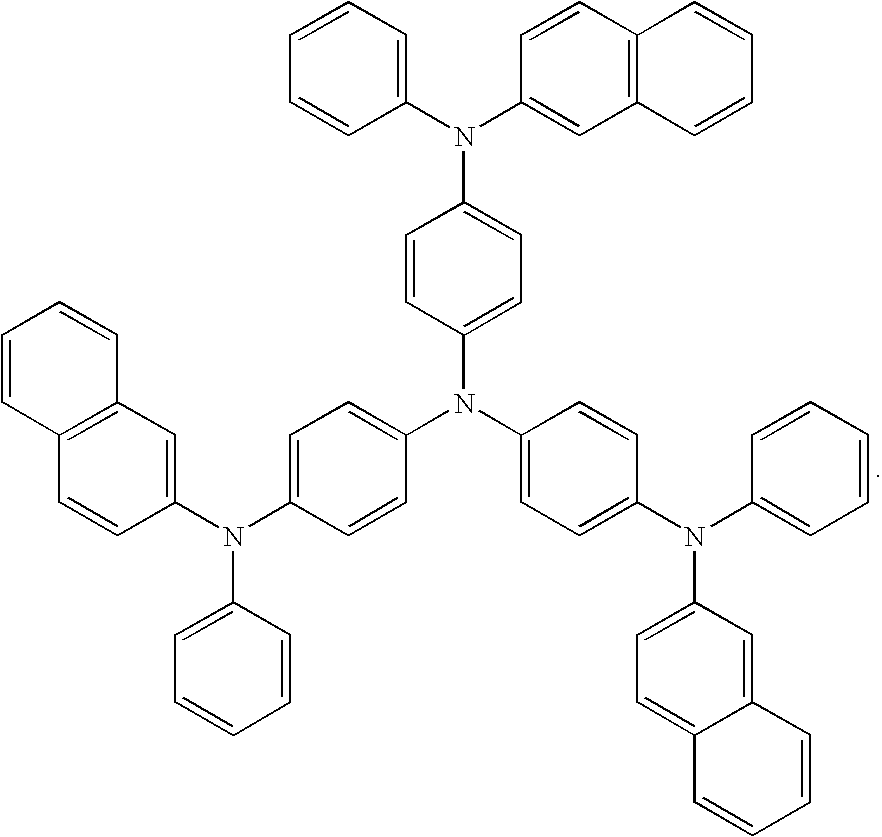
- the material for the hole-injection layer used in the device according to the present invention can have the following structural formula group G1, comprising CuPc, m-MTDATA, and 2-TNATA.
- the material for the hole-transporting layer used in the device according to the present invention is of aniline compound and can have the following structural formula group G2, comprising NPB, TPD, NCB, PPB, TCTA, MPMP, and HMTPD.
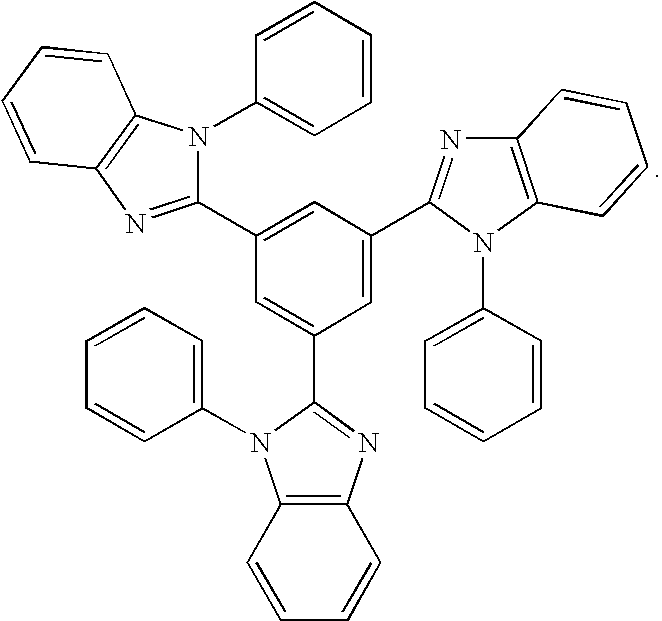
- the host compound can be TCTA in the above structural formula group G2 or CBP, CCP, mCP, TCB, TCPB in the following structural formula group G3 with the hole transporting capability, or TPBI, TAZ-1, TAZ-2, TAZ-3, PBD in the following structural formula group G3 with the electron transporting capability.
- the hole-blocking layer can be TPBI in the above structural formula group G3 or BCP, BAlq, PAlq, and SAlq in the following structural formula group G4.
- the material for the electron-transporting layer can be TPBI, TAZ-1, TAZ-2, TAZ-3, PBD in the above structural formula group G3, or Alq 3 or DPA in the following structural formula group G4.
- the pressure of the chamber is about less than 5 ⁇ 10 ⁇ 6 torr.
- the deposition rate for the organic compounds is about 1.5 ⁇ 2.5 ⁇ /sec.
- the deposition rate for the phosphorescent Ir complexes is about 0.05 ⁇ 0.2 ⁇ /sec.
- the deposition rate for potassium fluoride is about 0.5 ⁇ /sec.
- the thickness of the hole-injection layer is about 10 ⁇ 15 nm.
- the thickness of the hole-transporting layer is between 25 ⁇ 50 nm.
- the thickness of the hole-blocking layer is between 10 ⁇ 20 nm.
- the thickness of the electron-transporting layer is between 10 ⁇ 50 nm.
- the thickness of the electron-injection layer (KF) is about 0.5 nm.
- the negative electrode is Mg—Ag alloy.
- the deposition rate for Mg is 5 ⁇ /sec.
- the deposition rate for Ag is 0.5 ⁇ /sec.
- Mg and Ag with a ratio of 10:1 are co-deposited and the thickness of the film is 55 nm.
- Ag is deposited as a protection layer and its thickness is about 100 ⁇ 150 nm.
- the phosphorescent Ir complexes according to the present invention as phosphorescent materials can be applied in the OLEDs.
- the device using these Ir complexes can emit green to red phosphorescence.
- the device has the characteristics of high brightness, high current efficiency, and excellent CIE coordinates.
Landscapes
- Chemical & Material Sciences (AREA)
- Engineering & Computer Science (AREA)
- Materials Engineering (AREA)
- Crystallography & Structural Chemistry (AREA)
- Inorganic Chemistry (AREA)
- Organic Chemistry (AREA)
- Plural Heterocyclic Compounds (AREA)
Abstract
Description
- 1. C. H. Yang, S. W. Li, Y. Chi, Y. M. Cheng, Y. S. Yeh, P. T. Chou, G. H. Lee, C. H. Wang, C. F. Shu, Inorg. Chem. 2005, 44, 7770-7780.
- 2. S. J. Yeh, M. F. Wu, C. T. Chen, Y. H. Song, Y. Chi, M. H. Ho, S. F. Hsu, C. H. Chen, Adv. Mater. 2005, 17, 3, 285-289.
- 3. Chris S. K. Mak, Anna Hayer, Sofia I. Pascu, Scott E. Watkinsc, Andrew B. Holmes, Anna Köhler, Richard H. Friend, Chem. Commun. 2005, 4708-4710.


in which


Synthesis is carried out according the above reaction formula. 1H NMR (CDCl3, δ): δ 7.75 (d, J=5.8 Hz, 2 H), 7.45 (s, 1 H), 7.35 (t, J=6.0 Hz, 2 H), 7.21 (t, J=5.8 Hz, 1 H), 7.15 (d, J=1.2 Hz, 1H), 3.70 (s, 3 H).

Synthesis is carried out according the above reaction formula. 1H NMR (CDCl3, δ): δ 7.74 (d, J=6.4 Hz, 2 H), 7.57 (s, 1 H), 7.35˜7.32 (m, 5 H), 7.21˜7.16 (m, 4 H), 5.12 (s, 2 H).

Synthesis is carried out according the above reaction formula. 1H NMR (400 MHz, CDCl3): δ 7.90 (d, 1 H, J=8.0 Hz), 7.58 (d, 2 H, J=6.8 Hz), 7.52˜7.46 (m, 3 H), 7.37˜7.27 (m, 8 H).

Synthesis is carried out according the above reaction formula. 1H NMR (400 MHz, CDCl3): δ 7.90 (d, 1 H, J=8.0 Hz), 7.58 (d, 2 H, J=6.8 Hz), 7.52˜7.46 (m, 3 H), 7.37˜7.27 (m, 8 H).

2-cyanopyridine (1.04 g, 10.0 mmol) is placed in a 25 ml round-bottomed flask and ethanol is added into 2-cyanopyridine. After completly dissolved, hydrazine (0.96 g, 30.0 mmol) is added. At the room temperature, the reaction is carried out for 12 hrs. White solids are obtained. Ether is used to rinse the solids in order to remove the unreacted hydrazine. The white solids are placed in a 25 ml round-bottomed flask and added with ethyl 2,2,2-trifluoroacetate (1.42 g, 10.0 mmol). 5.0 ml of ethanol is added and then hot reflux is performed for 12 hrs. After the reaction is finished, ether extraction is carried out and the organic layer is collected and then concentrated to obtain white solids. After purified by silicone chromatographic column, the product tfpytz is obtained. The yield is about 50%. 1H NMR (500 MHz, CDCl3): δ 8.78 (m, 1 H), 8.31 (d, 1 H, J=8.0 Hz), 7.97˜7.94 (m, 1 H), 7.53˜7.50 (m, 1 H). HRMS (EI) m/z:calculated value C8H5F3N4 214.0466; experimental value 214.0469.

A 250 ml reaction flask is dried under vacuum and baked by fire and then cooled by nitrogen gas flow. 50 ml of anhydrous ether is added into the flask and (trimethylsilyl)diazomethane (6 ml, 12.0 mmol) is also added. At −78° C., n-butyl lithium agent (6 ml, 14.4 mmol) is added. After reacting for 0.5 hrs, 2-cyanopyridine (1.04 g, 10.0 mmol) is added. The reaction is then carried out for 12 hrs. After the reaction is finished, ether extraction is carried out and the organic layer is collected and then concentrated to obtained white solids. The white solids are placed in a 50 ml reaction flask, potassium fluoride (0.58 g, 10.0 mmol) is added, 10 ml of ethanol is added, and a few drops of hydrochloride are added. Hot reflux is carried out for 2 hrs. After the reaction is finished, the reaction solution is neutralized by saturated sodium bicarbonate solution. Ether extraction is carried out and the organic layer is collected and then concentrated to obtain white solids. After purified by silicone chromatographic column, the product pytz is obtained. The yield is about 60%. 1H NMR (500 MHz, CDCl3): δ 8.70 (s, 1 H), 8.36 (s, 1 H), 7.99 (s, 1 H), 7.82 (t, 1 H, J=8.0 Hz), 7.32-7.29 (m, 1 H). HRMS (EI) m/z:calculated value C7H6N4 146.0592; experimental value 146.0593.

Ammonium acetate 12 g (excess amount) is added to a 250 ml two-necked flask. The flask is filled with nitrogen and the vacuumed for three times. Butanedione (2.12 ml, 20.0 mmol) and pyridinecarboxaldehyde (1.68 ml, 20.0 mmol) are added and then 40 ml of ethanol is added. After reacting for 12 hrs, extraction with a small amount of methylene chloride is carried out for three times. The water layer is collected, added with saturated sodium bicarbonate solution, and then stirred for 1 hr. White solids are precipitated and the precipitation is collected to be dried and weighted. The product is pydmi. The yield is about 50%. 1H NMR (400 MHz, CDCl3): δ 10.37 (br, 1 H), 8.44-8.43 (m, 1 H), 8.07 (d, 1 H, J=7.2 Hz), 7.72-7.67 (m, 1 H), 7.16-7.13 (m, 1 H), 2.20 (s, 3 H), 2.19 (s, 3 H). 13C NMR (100 MHz, CDCl3): δ 148.67, 148.38, 143.25, 137.08, 135.08, 123.45, 122.33, 119.45, 12.27, 9.42. HRMS (EI) m/z: calculated value C10H11N3 173.0953; experimental value 173.0956.

Pyridinecarboxaldehyde (1.07 g, 10 mmol) and 10 ml of glyoxal are separately added into a reaction flask containing 5 ml of ethanol. Under ice bath, the two solutions are then mixed together and added with 15 ml of ammonia water. At 0° C., the reaction is carried out for 30 minutes. Returned to the room temperature, the reaction is further carried out for 2 hrs. After the reaction is finished, extraction with methylene chloride is carried out and the organic layer is collected and concentrated to obtain yellow solids. After recrystallization by ethyl acetate, the product pyi is obtained. The yield is about 30%. 1H NMR (500 MHz, CDCl3): δ 8.53-8.52 (m, 1 H), 8.35 (d, 1 H, J=7.5 Hz), 7.80 (q, 1 H, J=1.2 Hz), 7.30-7.28 (m, 1 H), 7.27 (s, 2 H).

Pyridinecarboxaldehyde (0.95 ml, 10 mmol) is added into a reaction flask containing 20 ml of methylene chloride and ethylene diamine (0.78 ml, 10.5 mmol) is added. After the reaction is carried out at 0° C. for 20 minutes, N-bromosuccinimide (1.87 g, 10.5 mmol) is added. The reaction temperature is slowly raised from 0° C. to the room temperature and the reaction is further carried out for 24 hrs at the room temperature. 10% sodium hydroxide solution is added to have the solution become alkaline. After extraction with a small amount of methylene chloride is carried out for 2 times, the organic layer is collected and concentrated to obtain white solids. After purified by silicone chromatographic column, the product pyil is obtained. The yield is about 90%. 1H NMR (400 MHz, CDCl3): δ 8.55-8.54 (m, 1 H), 8.11 (d, 1 H, J=7.6 Hz), 7.76-7.71 (m, 1 H), 7.34-7.21 (m, 1 H), 3.82 (s, 4 H).

A 100 ml two-necked reaction flask is dried under vacuum and baked by fire and then cooled by nitrogen gas flow. 50 ml of anhydrous tetrahydrofuran and 1-Methylimidazole (10 mmol, 0.8 ml) are added. n-Butyl lithium agent (12 mmol, 4.8 ml) is slowly added at −78° C. After the reaction has been taken place for 15 minutes, N,N-Dimethylacetamide (12 mmole, 1.12 ml) is added into the flask to react at the room temperature. Extraction with ether and water is carried out and the organic layer is concentrated to obtain a liquid product. The yield is 83%. The obtained product is then reacted with N,N-Dimethylformamide dimethyl acetal (12.45 mmol, 1.65 ml) without any solvent at 100° C. for 10 hrs. Extraction with methylene chloride and water is carried out and the organic layer is concentrated to obtain solids. The yield is 93%. The obtained product is dissolved in ethanol and then added with hydrazine (28.95 mmol, 1.40 ml). The reaction is carried out for 3 hrs at 90° C. The reaction solution is concentrated and extracted by methylene chloride and water. The organic layer is concentrated and separated by n-hexane and ethyl acetate through chromatographic column. The product mip is thus obtained and the yield is 71%. 1H NMR (400 MHz, CD2Cl2): δ 7.63 (d, 1 H, J=2 Hz), 7.09 (br, 1 H), 6.98 (s, 1 H), 6.71 (br, 1 H), 3.928 (s, 3 H).

According to the steps in example 10 except that 1-benzylimidazole is used as the starting material, the product bip is obtained and the yield is 70-80%, under the same reaction conditions. 1H NMR (400 MHz, CD2Cl2): δ 7.57 (d, 1H, J=2.4 Hz), 7.34-7.25 (m, 3 H), 7.17-7.13 (m, 3 H), 6.98 (s, 1 H), 6.71 (br, 1 H), 5.62 (br, 2 H).

According to the steps in example 10 except that 1-phenylimidazole is used as the starting material, the product pip is obtained and the yield is 70-80%, under the same reaction conditions. 1H NMR (400 MHz, CD2Cl2): δ 7.53-7.52 (m, 4 H), 7.40-7.37 (m, 3 H), 7.31 (br, 1 H), 7.17 (s, 1 H).

A 100 ml two-necked reaction flask is dried under vacuum and baked by fire and then cooled by nitrogen gas flow. 50 ml of anhydrous tetrahydrofuran and 1-Methylimidazole (10 mmol, 0.8 ml) are added. n-Butyl lithium agent (12 mmol, 4.8 ml) is slowly added at −78° C. After the reaction has been taken place for 15 minutes, N,N-Dimethylacetamide (12 mmole, 1.12 ml) is added into the flask to react at the room temperature. Extraction with ether and water is carried out and the organic layer is concentrated to obtain a liquid product. The yield is 83%. The obtained product is then reacted with N,N-Dimethylacetamide dimethyl acetal (12.45 mmol, 1.82 ml) without any solvent at 100° C. for 10 hrs. Extraction with methylene chloride and water is carried out and the organic layer is concentrated to obtain solids. The yield is 90%. The obtained product is dissolved in ethanol and then added with hydrazine (28.01 mmol, 1.36 ml). The reaction is carried out for 3 hrs at 90° C. The reaction solution is concentrated and extracted by methylene chloride and water. The organic layer is concentrated and separated by n-hexane and ethyl acetate through chromatographic column. The product mimp is thus obtained and the yield is 75%. 1H NMR (400 MHz, CD2Cl2): δ 7.04 (s, 1 H), 6.94 (s, 1 H), 6.74 (s, 1 H), 3.91 (s, 3 H), 2.34 (s, 3 H).

According to the steps in example 13 except that 1-benzylimidazole is used as the starting material, the product bimp is obtained and the yield is 70˜80%, under the same reaction conditions. 1H NMR (400 MHz, CD2Cl2): δ 7.33-7.25 (m, 3 H), 7.16-7.08 (m, 2 H), 6.94 (s, 1 H), 6.48 (d, 1 H, J=10.2 Hz), 6.47 (br, 1 H), 5.63 (br, 2 H), 2.30 (s, 3 H).

According to the steps in example 13 except that 1-phenylimidazole is used as the starting material, the product pimp is obtained and the yield is 70˜80%, under the same reaction conditions. 1H NMR (400 MHz, CD2Cl2): δ 7.52-7.51 (m, 3 H), 7.42 (s, 1 H), 7.38-7.36(m, 2 H), 7.24 (s, 1 H), 7.13 (d, 1 H, J=1.2 Hz), 2.15 (s, 3 H).

Sodium hydride (23 mmol, 0.552 g) from a glove box is placed in a 150 ml two-necked reaction flask and added with anhydrous tetrahydrofuran and ethyl trifluoroacetate (12 mmol, 2.04 ml). The reaction is taken placed for 15 minutes under ice bath. 1-(1-methyl-1H-2-imidazolyl)-1-ethanone (10 mmol, 1.32 g) is then slowly added. After the reaction is carried out for 3 hrs, water is added to terminate the reaction and acid is added to have the solution become acidic. After concentrated, the reaction solution is extracted by methylene chloride and water. The organic layer is concentrated to obtain brown viscous solids. The obtained solids are dissolved in ethanol and added with 10% sulfuric acid to carry out refluxing for 8 hrs. After concentrated, the product micfp is rinsed by n-hexane and the yield is 74%. 1H NMR (400 MHz, CD2Cl2): δ 7.30 (d, 1 H, J=1.2 Hz), 7.10 (d, 1 H, J=1.2 Hz), 6.83 (s, 1 H), 3.89 (s, 3 H).

According to the steps in example 16 except that 1-(1-benzyl-1H-2-imidazolyl)-1-ethanone is used as the starting material, the product bicfp is obtained and the yield is 65˜70%, under the same reaction conditions. 1H NMR (400 MHz, CD2Cl2): δ 7.43-7.35 (m, 4 H), 7.15 (d, 2 H, J=6.8 Hz), 7.11 (d, 1 H, J=1.2 Hz), 6.58 (s, 1 H), 5.41 (s, 2 H).

According to the steps in example 16 except that 1-(1-phenyl-1H-2-imidazolyl)-1-ethanone is used as the starting material, the product picfp is obtained and the yield is 65˜70%, under the same reaction conditions. 1H NMR (400 MHz, CD2Cl2): δ 7.63-7.57 (m, 3 H), 7.47 (d, 1 H, J=1.2 Hz), 7.47-7.41 (m, 2 H), 7.26 (d, 1 H, J=1.2 Hz), 5.70 (s, 1 H).
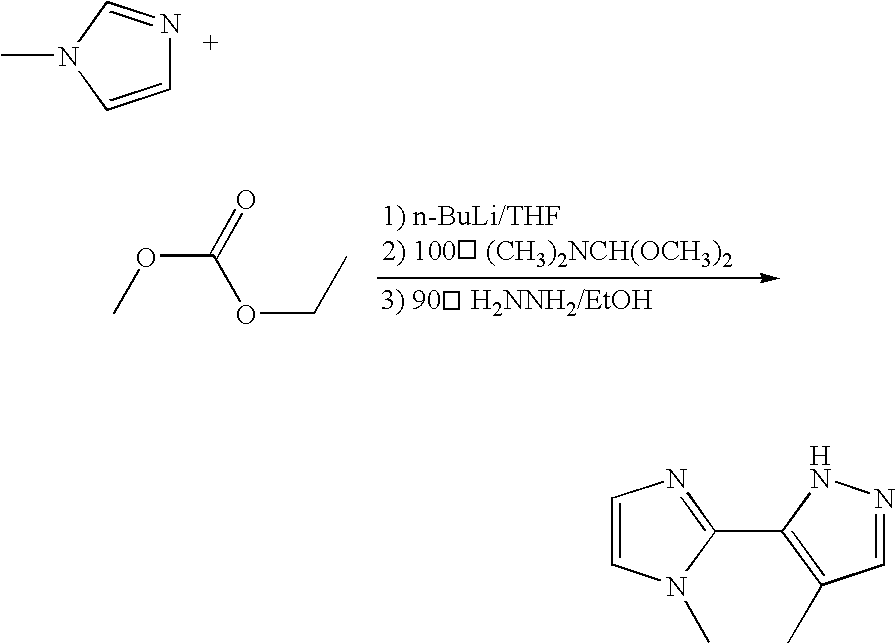
A 100 ml two-necked reaction flask is dried under vacuum and baked by fire and then cooled by nitrogen gas flow. 50 ml of anhydrous tetrahydrofuran and 1-Methylimidazole (10 mmol, 0.8 ml) are added. n-Butyl lithium agent (12 mmol, 4.8 ml) is slowly added at −78° C. After the reaction has been taken place for 15 minutes, ethyl methyl carbonate (12 mmol, 1.25 g) is added into the flask to react at the room temperature. Extraction with ether and water is carried out and the organic layer is concentrated to obtain a liquid product. The yield is 95%. The obtained product is then reacted with N,N-Dimethylformamide dimethyl acetal (14.25 mmol, 1.89 ml) without any solvent at 100° C. for 10 hrs. Extraction with methylene chloride and water is carried out and the organic layer is concentrated to obtain solids. The yield is 93%. The obtained product is dissolved in ethanol and then added with hydrazine (33.13 mmol, 1.61 ml). The reaction is carried out for 3 hrs at 90° C. The reaction solution is concentrated and extracted by methylene chloride and water. The organic layer is concentrated and separated by n-hexane and ethyl acetate through chromatographic column. The product 4mimp is thus obtained and the yield is 68%. 1H NMR (400 MHz, CD2Cl2): δ 7.44 (d, 1 H, J=0.8 Hz), 7.05 (d, 1 H, J=1.2 Hz), 6.95 (d, 1 H, J=1.2 Hz), 3.87 (s, 3 H), 2.29 (d, J=0.8 z, 3H).

According to the steps in example 19 except that 1-benzylimidazole is used as the starting material, the product 4bimp is obtained and the yield is 53%, under the same reaction conditions. 1H NMR (400 MHz, CD2Cl2): δ 7.42(d, 1 H, J=0.8 Hz), 7.31-7.24 (m, 3 H), 7.13 (s, 1 H), 7.12-7.10 (m, 2 H), 6.96 (d, 1 H, J=1.2 Hz), 5.57 (s, 2 H), 2.39 (s, 3 H).

2-Acetylpyrazine (10 mmol, 1.22 g) is reacted with N,N-Dimethylformamide dimethyl acetal (15 mmol, 1.99 ml) without any solvent at 100° C. for 10 hrs. Extraction with methylene chloride and water is carried out and the organic layer is concentrated to obtain solids. The yield is 94%. The obtained product is dissolved in ethanol and then added with hydrazine (23.5 mmol, 1.14 ml). The reaction is carried out for 3 hrs at 90° C. The reaction solution is concentrated and extracted by methylene chloride and water. The product is rinsed by n-hexane and some ethanol. The product pzp is thus obtained and the yield is 83%. 1H NMR (400 MHz, CDCl3): δ 9.11 (s, 1 H), 8.55 (s, 1 H), 8.50 (d, 1 H, J=2.8 Hz), 7.69 (d, 1 H, J=1.6 Hz), 6.93 (d, 1 H, J=2.0 Hz).

According to the steps in example 21 except that N,N-Dimethylacetamide dimethyl acetal (1.5 eq) is used as the starting material, the product pzmp is obtained and the yield is 76%, under the same reaction conditions. 1H NMR (400 MHz, CDCl3): δ 9.07 (d, 1 H, J=1.2 Hz), 8.53 (t, 1 H, J=1.2 Hz), 8.46 (d, 1 H, J=2.8 Hz), 6.66 (s, 1 H), 2.38 (s, 3 H).

MPI in example 1 is used as the ligand (L). The complex II-1 is prepared according to the steps in example 23. The yield is 61%.

BPI in example 2 is used as the ligand (L). The complex II-2 is prepared according to the steps in example 23. The yield is 68%.

PBI in example 3 is used as the ligand (L). The complex I-1 is prepared according to the steps in example 23. The yield is 69%.

mnq in example 4 is used as the ligand (L). The complex V-1 is prepared according to the steps in example 23. The yield is 75%.

MPI in example 1 is used as the ligand (L). The complex II-3 is prepared according to the steps in example 28. The yield is 70%.

BPI in example 2 is used as the ligand (L). The complex II-4 is prepared according to the steps in example 28. The yield is 75%.

PBI in example 3 is used as the ligand (L). The complex I-2 is prepared according to the steps in example 28. The yield is 69%.

mnq in example 4 is used as the ligand (L). The complex V-2 is prepared according to the steps in example 28. The yield is 74%.

Phenylpyridine (PPY) is used as the ligand (L). The complex III-1 is prepared according to the steps in example 28. The yield is 80%.

PBI in example 3 is used as the ligand (L). The complex I-3 is prepared according to the steps in example 34. The yield is 72%.

mnq in example 4 is used as the ligand (L). The complex V-3 is prepared according to the steps in example 34. The yield is 75%.

Phenylpyridine (ppy) is used as the ligand (L). The complex III-2 is prepared according to the steps in example 34. The yield is 80%.


- example 38: TCTA (40)/mpi2Ir(tfpytz):CBP (6%)(30)/BCP (15)/Alq (30)/Mg:Ag;
- example 39: TCTA (40)/bpi2Ir(tfpytz):CBP (3.67%)(30)/BCP (15)/Alq;
- example 40: NPB (40)/pbi2Ir(pytz):CBP (5.98%)(30)/BCP (15)/Alq (30)/Mg:Ag;
- example 41: TCTA (40)/pbi2Ir(pytz):CBP (5%)(30)/BCP (15)/Alq (30)/Mg:Ag;
- example 42: TCTA (40)/pbi2Ir(pytz):CBP (2.66%)(30)/BCP (15)/Alq (30)/Mg:Ag;
- example 43: TCTA (40)/pbi2Ir(tfpytz):CBP (6%)(30)/BCP (15)/Alq (30)/Mg:Ag;
- example 44: TCTA (40)/pbi2Ir(tfpytz):CBP (3%)(30)/BCP (15)/Alq (30)/Mg:Ag;
- example 45: TCTA (40)/pbi2Ir(tfpytz):CBP (8.63%)(30)/BCP (15)/Alq (30)/Mg:Ag;
- example 46: TCTA (40)/pbi2Ir(pydmi):CBP (7%)(30)/BCP (15)/Alq (30)/Mg:Ag;
- example 47: TCTA (40)/pbi2Ir(pydmi):CBP (5.67%)(30)/BCP (10)/Alq (40)/Mg:Ag;
- example 48: TCTA (40)/pbi2Ir(pydmi):CBP (6.31%)(30)/TPBI (40)/Mg:Ag;
- example 49: TCTA (40)/mnq2Ir(pydmi):CBP (5.33%)(30)/BCP (15)/Alq (30)/Mg:Ag;
- example 50: TCTA (40)/ppy2Ir(pytz):CBP (5%)(30)/BCP (15)/Alq (30)/Mg:Ag; and
- example 51: TCTA (40)/ppy2Ir(pydmi):CBP (5.67%)(30)/BCP (15)/Alq (30)/Mg:Ag.
| TABLE 1 | ||||||
| Maximum | ||||||
| external | ||||||
| quantum | Wavelength | |||||
| efficiency | Maximum | Maximum | at the | |||
| Threshold | (%) | luminance | efficiency | CIE | maximum | |
| Example | voltage | (voltage/ | (cd/m2) | (cd/A) | (8 V) | emission |
| No. | (V) | Volt) | (voltage/Volt) | (voltage/Volt) | (x, y) | (nm) |
| 38 | 3.0 | 6.33 (14.0) | 20903 (8.0) | 15.9 (8.0) | (0.20, 0.513) | 502 |
| 39 | 4.7 | 5.66 (9.0) | 12790 (14.0) | 12.6 (9.5) | (0.18, 0.46) | 498 |
| 40 | 3.2 | 5.12 (6.0) | 44109 (12.5) | 14.81 (6.0) | (0.21, 0.58) | 504 |
| 41 | 2.8 | 12.8 (6.0) | 63814 (11.0) | 38.71 (6.0) | (0.25, 0.61) | 504 |
| 42 | 4.3 | 8.54 (6.5) | 45770 (12.0) | 25.84 (4.5) | (0.26, 0.60) | 504 |
| 43 | 4.2 | 3.84 (6.5) | 24710 (11.0) | 10.55 (6.5) | (0.23, 0.58) | 498 |
| 44 | 3.3 | 2.13 (7.0) | 16992 (11.0) | 5.74 (7.0) | (0.22, 0.57) | 498 |
| 45 | 3.6 | 5.05 (7.0) | 29302 (11.0) | 13.84 (7.0) | (0.23, 0.58) | 498 |
| 46 | 3.6 | 12.41 (7.5) | 49395 (14.5) | 40.03 (7.5) | (0.26, 0.64) | 510 |
| 47 | 3.0 | 18.36 (7.0) | 75917 (14.5) | 60.38 (7.0) | (0.27, 0.64) | 512 |
| 48 | 2.7 | 7.96 (5.0) | 53884 (13.5) | 25.9 (5.0) | (0.30, 0.62) | 510 |
| 49 | 5.2 | 7.02 (8.5) | 15222 (15.5) | 10.33 (8.5) | (0.64, 0.34) | 616 |
| 50 | 3.2 | 13.36 (7.0) | 7.2206 (14.5) | 43.65 (6.5) | (0.22, 0.61) | 508 |
| 51 | 3.1 | 15.54 (6.5) | 38202 (16.5) | 5.56 (8.5) | (0.66, 0.33) | 500 |
Claims (25)






Priority Applications (1)
| Application Number | Priority Date | Filing Date | Title |
|---|---|---|---|
| US11/682,864 US8062767B2 (en) | 2007-03-06 | 2007-03-06 | Organic light emitting diode containing a Ir complex having a novel ligand as a phosphorescent emitter |
Applications Claiming Priority (1)
| Application Number | Priority Date | Filing Date | Title |
|---|---|---|---|
| US11/682,864 US8062767B2 (en) | 2007-03-06 | 2007-03-06 | Organic light emitting diode containing a Ir complex having a novel ligand as a phosphorescent emitter |
Publications (2)
| Publication Number | Publication Date |
|---|---|
| US20080217606A1 US20080217606A1 (en) | 2008-09-11 |
| US8062767B2 true US8062767B2 (en) | 2011-11-22 |
Family
ID=39740732
Family Applications (1)
| Application Number | Title | Priority Date | Filing Date |
|---|---|---|---|
| US11/682,864 Expired - Fee Related US8062767B2 (en) | 2007-03-06 | 2007-03-06 | Organic light emitting diode containing a Ir complex having a novel ligand as a phosphorescent emitter |
Country Status (1)
| Country | Link |
|---|---|
| US (1) | US8062767B2 (en) |
Cited By (4)
| Publication number | Priority date | Publication date | Assignee | Title |
|---|---|---|---|---|
| US20130046096A1 (en) * | 2010-01-25 | 2013-02-21 | Osram Opto Semiconductors Gmbh | Phosphorescent Metal Complex, Process for Production and Light-Emitting Component |
| US20150194613A1 (en) * | 2012-06-19 | 2015-07-09 | Hitachi, Ltd. | Organic light-emitting layer material, coating liquid for use in forming organic light-emitting layer with organic material, organic light-emitting device produced with coating liquid, light source apparatus with organic light-emitting device, and methods for manufacture thereof |
| CN104797587A (en) * | 2012-08-02 | 2015-07-22 | 霍夫曼-拉罗奇有限公司 | Novel iridium-based complexes for ECL |
| CN104822696A (en) * | 2012-08-02 | 2015-08-05 | 霍夫曼-拉罗奇有限公司 | New iridium-based complexes for ECL |
Families Citing this family (14)
| Publication number | Priority date | Publication date | Assignee | Title |
|---|---|---|---|---|
| KR101919207B1 (en) * | 2008-11-11 | 2018-11-15 | 유니버셜 디스플레이 코포레이션 | Phosphorescent emitters |
| US20120025177A1 (en) | 2009-02-06 | 2012-02-02 | Solvay Sa | Phosphorescent light-emitting iridium complex containing pyridyltriazole ligand |
| WO2012107420A1 (en) * | 2011-02-09 | 2012-08-16 | Roche Diagnostics Gmbh | New iridium-based complexes for ecl |
| CN102206235A (en) * | 2011-03-18 | 2011-10-05 | 南京邮电大学 | Phosphorescent iridium complex capable of dissolving in water system, and preparation method thereof |
| CN102391308B (en) * | 2011-08-05 | 2014-03-19 | 长沙理工大学 | Dendritic iridium coordination compound with double-carrier transport property, application and prepared organic electrophosphorescent device |
| KR102082111B1 (en) | 2012-05-24 | 2020-02-27 | 메르크 파텐트 게엠베하 | Metal complexes comprising condensed heteroaromatic rings |
| CA2879221C (en) | 2012-08-02 | 2021-05-04 | F. Hoffmann-La Roche Ag | Iridium-based complexes for ecl |
| ES2605384T3 (en) | 2012-08-02 | 2017-03-14 | F. Hoffmann-La Roche Ag | New iridium-based complexes for ECL |
| CN104903335B (en) | 2012-08-02 | 2018-05-18 | 霍夫曼-拉罗奇有限公司 | Novel bis-iridium-complexes for the manufacture of ECL-labels |
| CN103408599B (en) * | 2013-08-08 | 2015-09-23 | 南京邮电大学 | Dendroid ionic type iridium complex containing Subjective and Objective structure and preparation method and application |
| WO2015057559A1 (en) * | 2013-10-14 | 2015-04-23 | Board Of Supervisors Of Louisiana State University And Agricultural And Mechanical College | Copper complex for capturing carbon dioxide |
| KR102199210B1 (en) * | 2014-03-20 | 2021-01-07 | 삼성디스플레이 주식회사 | Organometallic compound and organic light emitting diode comprising the same |
| ES2642114B1 (en) * | 2016-05-11 | 2018-05-22 | Universidad De Castilla La Mancha | IRIDIO COMPLEXES (III) OF GENERAL FORMULA [Go (C ^ N) 2 (N ^ O)] or [Go (C ^ N) 2 (N ^ N ')] A |
| CN108299510B (en) * | 2018-02-22 | 2020-06-05 | 南京工业大学 | A class of iridium complexes containing azaarenes auxiliary ligands and their preparation methods and applications |
Citations (7)
| Publication number | Priority date | Publication date | Assignee | Title |
|---|---|---|---|---|
| US20040091738A1 (en) * | 2002-11-08 | 2004-05-13 | Jui-Yi Psai | Organic light emitting materials and devices |
| US20050116626A1 (en) * | 2003-11-18 | 2005-06-02 | Chien-Hong Cheng | Iridium complexes as light emitting materials and organic light emitting diode device |
| US20050227109A1 (en) * | 2003-07-24 | 2005-10-13 | Chien-Hong Cheng | Organic light emitting diode containing a novel Ir complex as a phosphorescent emitter |
| US20060286404A1 (en) * | 2005-06-15 | 2006-12-21 | Au Optronics Corp. | Light emission material and organic electroluminescent device using the same |
| US20070048546A1 (en) * | 2005-08-31 | 2007-03-01 | Eastman Kodak Company | Organic phosphorescent light emitting device |
| US20070087221A1 (en) * | 2005-10-19 | 2007-04-19 | Au Optronics Corp. | Metal complex and organic electroluminescent device using the same |
| US20070141394A1 (en) * | 2005-11-25 | 2007-06-21 | Chi Mei Optoelectronics Corp. | Light-emitting element and iridium complex |
-
2007
- 2007-03-06 US US11/682,864 patent/US8062767B2/en not_active Expired - Fee Related
Patent Citations (7)
| Publication number | Priority date | Publication date | Assignee | Title |
|---|---|---|---|---|
| US20040091738A1 (en) * | 2002-11-08 | 2004-05-13 | Jui-Yi Psai | Organic light emitting materials and devices |
| US20050227109A1 (en) * | 2003-07-24 | 2005-10-13 | Chien-Hong Cheng | Organic light emitting diode containing a novel Ir complex as a phosphorescent emitter |
| US20050116626A1 (en) * | 2003-11-18 | 2005-06-02 | Chien-Hong Cheng | Iridium complexes as light emitting materials and organic light emitting diode device |
| US20060286404A1 (en) * | 2005-06-15 | 2006-12-21 | Au Optronics Corp. | Light emission material and organic electroluminescent device using the same |
| US20070048546A1 (en) * | 2005-08-31 | 2007-03-01 | Eastman Kodak Company | Organic phosphorescent light emitting device |
| US20070087221A1 (en) * | 2005-10-19 | 2007-04-19 | Au Optronics Corp. | Metal complex and organic electroluminescent device using the same |
| US20070141394A1 (en) * | 2005-11-25 | 2007-06-21 | Chi Mei Optoelectronics Corp. | Light-emitting element and iridium complex |
Non-Patent Citations (4)
| Title |
|---|
| Coppo et al. Chem. Commun. 2004, 1774-1775. * |
| Liang et al. J. Mater. Chem. 2006, 16, 1281-1286. * |
| Yang et al. Inorg. Chem. 2005, 44, 7770-7780. * |
| Yeh et al. Adv. Mater. 2005, 17, 285-289. * |
Cited By (8)
| Publication number | Priority date | Publication date | Assignee | Title |
|---|---|---|---|---|
| US20130046096A1 (en) * | 2010-01-25 | 2013-02-21 | Osram Opto Semiconductors Gmbh | Phosphorescent Metal Complex, Process for Production and Light-Emitting Component |
| US9169434B2 (en) * | 2010-01-25 | 2015-10-27 | Osram Ag | Phosphorescent metal complex, process for production and light-emitting component |
| US20150194613A1 (en) * | 2012-06-19 | 2015-07-09 | Hitachi, Ltd. | Organic light-emitting layer material, coating liquid for use in forming organic light-emitting layer with organic material, organic light-emitting device produced with coating liquid, light source apparatus with organic light-emitting device, and methods for manufacture thereof |
| US9306177B2 (en) * | 2012-06-19 | 2016-04-05 | Hitachi, Ltd. | Organic light-emitting layer material, coating liquid for use in forming organic light-emitting layer with organic material, organic light-emitting device produced with coating liquid, light source apparatus with organic light-emitting device, and methods for manufacture thereof |
| CN104797587A (en) * | 2012-08-02 | 2015-07-22 | 霍夫曼-拉罗奇有限公司 | Novel iridium-based complexes for ECL |
| CN104822696A (en) * | 2012-08-02 | 2015-08-05 | 霍夫曼-拉罗奇有限公司 | New iridium-based complexes for ECL |
| CN104822696B (en) * | 2012-08-02 | 2017-09-22 | 霍夫曼-拉罗奇有限公司 | Novel iridium basigamy compound for ECL |
| CN104797587B (en) * | 2012-08-02 | 2017-10-10 | 霍夫曼-拉罗奇有限公司 | Novel iridium-based complexes for ECL |
Also Published As
| Publication number | Publication date |
|---|---|
| US20080217606A1 (en) | 2008-09-11 |
Similar Documents
| Publication | Publication Date | Title |
|---|---|---|
| US8062767B2 (en) | Organic light emitting diode containing a Ir complex having a novel ligand as a phosphorescent emitter | |
| US11600791B2 (en) | Organic electroluminescent materials and devices | |
| US10700293B2 (en) | Organic electroluminescent materials and devices | |
| US8999522B2 (en) | 6H-indolo[2,3-b]quinoxaline derivatives and organic light emitting diode using the same | |
| US10084143B2 (en) | Phosphorescent materials | |
| US9224963B2 (en) | Stable emitters | |
| TWI245068B (en) | Iridium complex as light emitting material and organic light emitting diode device | |
| US9520574B2 (en) | Electroluminescent devices based on phosphorescent iridium and related group VIII metal multicyclic compounds | |
| US8603645B2 (en) | Stable and efficient electroluminescent materials | |
| US20150243910A1 (en) | Transition metal complexes comprising asymmetric tetradentate ligands | |
| US8980440B2 (en) | Light-emitting material | |
| US20110220880A1 (en) | m-TERPHENYL COMPOUND DERIVATIVES AND APPLICATION FOR ORGANIC LIGHT EMITTING DIODE | |
| CN103097395A (en) | Platinum (II) tetradentate ONCN complex for organic light-emitting diode | |
| US20150221877A1 (en) | Transition metal complexes comprising symmetric tetradentate ligands | |
| US12382824B2 (en) | Organic electroluminescence device and organometallic compound for organic electroluminescence device | |
| US7320834B2 (en) | Organic light emitting diode containing a novel Ir complex as a phosphorescent emitter | |
| US7960547B2 (en) | Transition metal complexes with carbene ligands and their application | |
| US7728138B2 (en) | Bis-triphenylsilyl compounds and their application on organic electronic device | |
| US20070111024A1 (en) | Metal complex compound and organic electroluminescence device containing the same | |
| KR20160109596A (en) | Metal complex for dopant of a light emitting layer and blue phosphorescent organic light emitting device comprising the same | |
| US20140346446A1 (en) | Iridium complex and organic light emitting diode using the same | |
| TW200814848A (en) | Organic light emitting diode containing an Ir complex having a novel ligand as a phosphorescent emitter | |
| KR101945753B1 (en) | Metal complex for dopant of a light emitting layer and blue phosphorescent organic light emitting device comprising the same | |
| KR20080037302A (en) | Novel compounds, luminescent materials comprising the same, and organic electroluminescent devices | |
| KR101705066B1 (en) | Novel Iridium complexes containing perfluoroalkyl group and organic electroluminescent devices using the same |
Legal Events
| Date | Code | Title | Description |
|---|---|---|---|
| AS | Assignment |
Owner name: CHENG, CHIEN-HONG, TAIWAN Free format text: ASSIGNMENT OF ASSIGNORS INTEREST;ASSIGNORS:CHENG, CHIEN-HONG;LIAO, WEI-HSIEN;SHIH, HUNG-HSIN;AND OTHERS;REEL/FRAME:018969/0542 Effective date: 20070202 |
|
| FEPP | Fee payment procedure |
Free format text: PAYOR NUMBER ASSIGNED (ORIGINAL EVENT CODE: ASPN); ENTITY STATUS OF PATENT OWNER: SMALL ENTITY |
|
| ZAAA | Notice of allowance and fees due |
Free format text: ORIGINAL CODE: NOA |
|
| ZAAB | Notice of allowance mailed |
Free format text: ORIGINAL CODE: MN/=. |
|
| STCF | Information on status: patent grant |
Free format text: PATENTED CASE |
|
| AS | Assignment |
Owner name: NATIONAL TSING HUA UNIVERSITY, TAIWAN Free format text: ASSIGNMENT OF ASSIGNORS INTEREST;ASSIGNOR:CHENG, CHIEN-HONG;REEL/FRAME:027325/0283 Effective date: 20111017 |
|
| AS | Assignment |
Owner name: E-RAY OPTOELECTRONICS TECHNOLOGY CO., LTD., TAIWAN Free format text: ASSIGNMENT OF ASSIGNORS INTEREST;ASSIGNOR:NATIONAL TSING HUA UNIVERSITY;REEL/FRAME:031205/0126 Effective date: 20130904 |
|
| FPAY | Fee payment |
Year of fee payment: 4 |
|
| MAFP | Maintenance fee payment |
Free format text: PAYMENT OF MAINTENANCE FEE, 8TH YR, SMALL ENTITY (ORIGINAL EVENT CODE: M2552); ENTITY STATUS OF PATENT OWNER: SMALL ENTITY Year of fee payment: 8 |
|
| FEPP | Fee payment procedure |
Free format text: MAINTENANCE FEE REMINDER MAILED (ORIGINAL EVENT CODE: REM.); ENTITY STATUS OF PATENT OWNER: SMALL ENTITY |
|
| LAPS | Lapse for failure to pay maintenance fees |
Free format text: PATENT EXPIRED FOR FAILURE TO PAY MAINTENANCE FEES (ORIGINAL EVENT CODE: EXP.); ENTITY STATUS OF PATENT OWNER: SMALL ENTITY |
|
| STCH | Information on status: patent discontinuation |
Free format text: PATENT EXPIRED DUE TO NONPAYMENT OF MAINTENANCE FEES UNDER 37 CFR 1.362 |
|
| FP | Lapsed due to failure to pay maintenance fee |
Effective date: 20231122 |