US8058002B2 - Method of immobilizing and stretching a nucleic acid on a substrate - Google Patents
Method of immobilizing and stretching a nucleic acid on a substrate Download PDFInfo
- Publication number
- US8058002B2 US8058002B2 US10/942,713 US94271304A US8058002B2 US 8058002 B2 US8058002 B2 US 8058002B2 US 94271304 A US94271304 A US 94271304A US 8058002 B2 US8058002 B2 US 8058002B2
- Authority
- US
- United States
- Prior art keywords
- nucleic acid
- solution
- dna
- silicon substrate
- substrate
- Prior art date
- Legal status (The legal status is an assumption and is not a legal conclusion. Google has not performed a legal analysis and makes no representation as to the accuracy of the status listed.)
- Expired - Fee Related, expires
Links
Images



Classifications
-
- C—CHEMISTRY; METALLURGY
- C12—BIOCHEMISTRY; BEER; SPIRITS; WINE; VINEGAR; MICROBIOLOGY; ENZYMOLOGY; MUTATION OR GENETIC ENGINEERING
- C12Q—MEASURING OR TESTING PROCESSES INVOLVING ENZYMES, NUCLEIC ACIDS OR MICROORGANISMS; COMPOSITIONS OR TEST PAPERS THEREFOR; PROCESSES OF PREPARING SUCH COMPOSITIONS; CONDITION-RESPONSIVE CONTROL IN MICROBIOLOGICAL OR ENZYMOLOGICAL PROCESSES
- C12Q1/00—Measuring or testing processes involving enzymes, nucleic acids or microorganisms; Compositions therefor; Processes of preparing such compositions
- C12Q1/68—Measuring or testing processes involving enzymes, nucleic acids or microorganisms; Compositions therefor; Processes of preparing such compositions involving nucleic acids
- C12Q1/6806—Preparing nucleic acids for analysis, e.g. for polymerase chain reaction [PCR] assay
-
- B—PERFORMING OPERATIONS; TRANSPORTING
- B82—NANOTECHNOLOGY
- B82Y—SPECIFIC USES OR APPLICATIONS OF NANOSTRUCTURES; MEASUREMENT OR ANALYSIS OF NANOSTRUCTURES; MANUFACTURE OR TREATMENT OF NANOSTRUCTURES
- B82Y30/00—Nanotechnology for materials or surface science, e.g. nanocomposites
-
- C—CHEMISTRY; METALLURGY
- C07—ORGANIC CHEMISTRY
- C07H—SUGARS; DERIVATIVES THEREOF; NUCLEOSIDES; NUCLEOTIDES; NUCLEIC ACIDS
- C07H21/00—Compounds containing two or more mononucleotide units having separate phosphate or polyphosphate groups linked by saccharide radicals of nucleoside groups, e.g. nucleic acids
-
- B—PERFORMING OPERATIONS; TRANSPORTING
- B01—PHYSICAL OR CHEMICAL PROCESSES OR APPARATUS IN GENERAL
- B01J—CHEMICAL OR PHYSICAL PROCESSES, e.g. CATALYSIS OR COLLOID CHEMISTRY; THEIR RELEVANT APPARATUS
- B01J2219/00—Chemical, physical or physico-chemical processes in general; Their relevant apparatus
- B01J2219/00274—Sequential or parallel reactions; Apparatus and devices for combinatorial chemistry or for making arrays; Chemical library technology
- B01J2219/00277—Apparatus
- B01J2219/00497—Features relating to the solid phase supports
- B01J2219/00527—Sheets
-
- B—PERFORMING OPERATIONS; TRANSPORTING
- B01—PHYSICAL OR CHEMICAL PROCESSES OR APPARATUS IN GENERAL
- B01J—CHEMICAL OR PHYSICAL PROCESSES, e.g. CATALYSIS OR COLLOID CHEMISTRY; THEIR RELEVANT APPARATUS
- B01J2219/00—Chemical, physical or physico-chemical processes in general; Their relevant apparatus
- B01J2219/00274—Sequential or parallel reactions; Apparatus and devices for combinatorial chemistry or for making arrays; Chemical library technology
- B01J2219/00583—Features relative to the processes being carried out
- B01J2219/00603—Making arrays on substantially continuous surfaces
- B01J2219/00605—Making arrays on substantially continuous surfaces the compounds being directly bound or immobilised to solid supports
- B01J2219/00608—DNA chips
-
- B—PERFORMING OPERATIONS; TRANSPORTING
- B01—PHYSICAL OR CHEMICAL PROCESSES OR APPARATUS IN GENERAL
- B01J—CHEMICAL OR PHYSICAL PROCESSES, e.g. CATALYSIS OR COLLOID CHEMISTRY; THEIR RELEVANT APPARATUS
- B01J2219/00—Chemical, physical or physico-chemical processes in general; Their relevant apparatus
- B01J2219/00274—Sequential or parallel reactions; Apparatus and devices for combinatorial chemistry or for making arrays; Chemical library technology
- B01J2219/00583—Features relative to the processes being carried out
- B01J2219/00603—Making arrays on substantially continuous surfaces
- B01J2219/00605—Making arrays on substantially continuous surfaces the compounds being directly bound or immobilised to solid supports
- B01J2219/00612—Making arrays on substantially continuous surfaces the compounds being directly bound or immobilised to solid supports the surface being inorganic
-
- B—PERFORMING OPERATIONS; TRANSPORTING
- B01—PHYSICAL OR CHEMICAL PROCESSES OR APPARATUS IN GENERAL
- B01J—CHEMICAL OR PHYSICAL PROCESSES, e.g. CATALYSIS OR COLLOID CHEMISTRY; THEIR RELEVANT APPARATUS
- B01J2219/00—Chemical, physical or physico-chemical processes in general; Their relevant apparatus
- B01J2219/00274—Sequential or parallel reactions; Apparatus and devices for combinatorial chemistry or for making arrays; Chemical library technology
- B01J2219/00583—Features relative to the processes being carried out
- B01J2219/00603—Making arrays on substantially continuous surfaces
- B01J2219/00659—Two-dimensional arrays
-
- B—PERFORMING OPERATIONS; TRANSPORTING
- B01—PHYSICAL OR CHEMICAL PROCESSES OR APPARATUS IN GENERAL
- B01J—CHEMICAL OR PHYSICAL PROCESSES, e.g. CATALYSIS OR COLLOID CHEMISTRY; THEIR RELEVANT APPARATUS
- B01J2219/00—Chemical, physical or physico-chemical processes in general; Their relevant apparatus
- B01J2219/00274—Sequential or parallel reactions; Apparatus and devices for combinatorial chemistry or for making arrays; Chemical library technology
- B01J2219/00583—Features relative to the processes being carried out
- B01J2219/00603—Making arrays on substantially continuous surfaces
- B01J2219/00677—Ex-situ synthesis followed by deposition on the substrate
-
- B—PERFORMING OPERATIONS; TRANSPORTING
- B01—PHYSICAL OR CHEMICAL PROCESSES OR APPARATUS IN GENERAL
- B01J—CHEMICAL OR PHYSICAL PROCESSES, e.g. CATALYSIS OR COLLOID CHEMISTRY; THEIR RELEVANT APPARATUS
- B01J2219/00—Chemical, physical or physico-chemical processes in general; Their relevant apparatus
- B01J2219/00274—Sequential or parallel reactions; Apparatus and devices for combinatorial chemistry or for making arrays; Chemical library technology
- B01J2219/00718—Type of compounds synthesised
- B01J2219/0072—Organic compounds
- B01J2219/00722—Nucleotides
-
- C—CHEMISTRY; METALLURGY
- C07—ORGANIC CHEMISTRY
- C07B—GENERAL METHODS OF ORGANIC CHEMISTRY; APPARATUS THEREFOR
- C07B2200/00—Indexing scheme relating to specific properties of organic compounds
- C07B2200/11—Compounds covalently bound to a solid support
-
- C—CHEMISTRY; METALLURGY
- C40—COMBINATORIAL TECHNOLOGY
- C40B—COMBINATORIAL CHEMISTRY; LIBRARIES, e.g. CHEMICAL LIBRARIES
- C40B40/00—Libraries per se, e.g. arrays, mixtures
- C40B40/04—Libraries containing only organic compounds
- C40B40/06—Libraries containing nucleotides or polynucleotides, or derivatives thereof
Definitions
- the present invention relates to a method of immobilizing and stretching a nucleic acid on a silicon substrate, to nucleic acids and substrates prepared according to this method, to uses of the method and to uses of the nucleic acid and the substrate.
- the stretching of DNA during molecular combing occurs by a “moving meniscus” mechanism.
- the mechanism by which DNA binds to the hydrophobic surface is uncertain, but it is believed to involve the denaturation of the DNA ends, which exposes the hydrophobic bases and allows them to interact with the surface. This interaction is strong enough to prevent the DNA from being removed during stretching as well as subsequent treatments such as exposure to solutions of DNA-binding molecules.
- Molecular combing usually causes double-stranded DNA molecules to elongate approximately 50% beyond their B-form contour lengths. This overstretching may result in a transition of the secondary structure from B-form to S-form, or it may result in strand dissociation. In either case, overstretching can affect the ability of combed DNA to interact with DNA-binding proteins. Gueroui et al. (2002) recently developed a simple way to avoid DNA overstretching during the combing process by using 1-dodecanol to lower the surface tension of the air-water interface.
- the principal application of molecular combing and related processes is DNA analysis, including genome sequencing and genetic disease screening. Analysis of stretched and immobilized DNA usually relies on fluorescence labeling and detection by optical microscopy (including scanning near-field optical microscopy (SNOM) or use of zero-mode waveguides), but newer methods such as atomic force microscopy (AFM), scanning tunneling microscopy (STM), and scanning electrochemical microscopy (SECM) have also been used. Other applications of molecular combing and related processes include DNA archiving and metallization.
- optical microscopy including scanning near-field optical microscopy (SNOM) or use of zero-mode waveguides
- AFM atomic force microscopy
- STM scanning tunneling microscopy
- SECM scanning electrochemical microscopy
- Other applications of molecular combing and related processes include DNA archiving and metallization.
- Etching with aqueous HF is a key step in producing Si surfaces that are free of contaminants and chemically stable for subsequent processing in the semiconductor industry.
- Treatment with HF removes the native or thermally grown oxide layer and leaves the surface terminated by silicon hydride (Si—H) groups.
- Si—H silicon hydride
- the exact nature of the surface generated on single crystal Si wafers depends on the crystal orientation as well as the etching conditions. Dilute (1-2%) aqueous HF treatment of Si(100) provides a dihydride-terminated ( ⁇ SiH 2 ) surface, while aqueous NH 4 F treatment of Si(111) provides a monohydride-terminated ( ⁇ SiH) surface.
- the latter is terraced, but the terraces are atomically flat (Higashi et al. (1990)).
- the H-terminated Si(100) surface is less stable than the Si(111) because the two H atoms in the ⁇ SiH 2 group are close enough to cause a strong static repulsion force between them. This makes the dihydride-terminated surface more susceptible towards chemical reaction with H 2 O (OH ⁇ ) and the formation of steps or defects. Furthermore, some F-terminating groups are usually also formed during HF treatment, and these are readily hydrolyzed. Morita and Tokumoto (1995) found that hydrolysis could be suppressed by adding HCl to reduce the pH of the HF solution, however the resulting surface was still terraced. Luo et al.
- said silicon substrate is derived from a single crystal of doped or undoped silicon, wherein preferably, said single crystal of silicon has a (100) or (111) surface orientation.
- said silicon substrate has a silicon oxide layer on said surface, wherein preferably, said oxide layer is native or thermally grown.
- said oxide layer has a thickness between 1 nm and 15 ⁇ m.
- said silicon substrate is patterned with metal electrodes, wherein preferably, said metal electrodes are made of a material comprising gold.
- said solution of ammonium fluoride is an aqueous solution of NH 4 F (ammonium fluoride), preferably with a concentration of 0.1-11 M, more preferably 0.5-5 M, even more preferably 2 M of ammonium fluoride.
- said aqueous solution of NH 4 F additionally contains NH 4 OH at a concentration sufficient to adjust the pH of said aqueous solution to 9-10.
- said solution of hydrogen fluoride is an aqueous solution of HF (hydrogen fluoride), preferably with a concentration of 0.06-6 M, more preferably 0.2-2 M, even more preferably 0.6 M.
- said aqueous solution of HF additionally contains HCl, preferably at a concentration of 0.01-10 M, preferably 0.03-3 M, more preferably 0.3 M of HCl (final concentration of HCl).
- said defined period of time for which said solution of ammonium fluoride or hydrogen fluoride is allowed to remain on said surface of said silicon substrate is 0.1-60 min, preferably 0.1-30 min, more preferably 0.1-20 min and most preferably 0.1-10 min.
- the optimal time depends on the thickness of the oxide layer and can readily be determined by someone skilled in the art.
- said nucleic acid is DNA, preferably double-stranded or single-stranded DNA, RNA or PNA, which nucleic acid is alone or in complex with a protein or several proteins, further characterized in that said solution of said nucleic acid is an aqueous solution of nucleic acid.
- steps d) and e) occur concomitantly.
- step e) occurs after step d).
- step e) is performed in the presence of a surface-active agent.
- said surface-active agent is selected from the group comprising long-chained alcohols, preferably 1-octanol, 1-decanol, or 1-dodecanol.
- said solution of ammonium fluoride or said solution of hydrogen fluoride is removed from said surface of said silicon substrate before step d).
- the objects of the present invention are solved by a nucleic acid on a silicon substrate, which nucleic acid has been prepared according to the method of the present invention.
- the objects of the present invention are also solved by a silicon substrate having a nucleic acid immobilized and stretched on one of its surfaces, which substrate has been prepared according to the method of the present invention.
- nucleic acid according to the present invention is solved by a combination of nucleic acid according to the present invention and of a substrate according to the present invention.
- nucleic acid according to the present invention a silicon substrate according to the present invention and/or a combination of said nucleic acid and said substrate according to the present invention, for the analysis of nucleic acids, in particular sequencing, transcription studies and screening for genetic polymorphisms and/or genetic aberrations, wherein preferably, said nucleic acid analysis is performed by optical microscopy, including fluorescence microscopy, scanning near-field optical microscopy (SNOM), use of zero-mode waveguides, atomic force microscopy (AFM), scanning tunneling microscopy (STM), and scanning electrochemical microscopy (SECM).
- optical microscopy including fluorescence microscopy, scanning near-field optical microscopy (SNOM), use of zero-mode waveguides, atomic force microscopy (AFM), scanning tunneling microscopy (STM), and scanning electrochemical microscopy (SECM).
- optical microscopy including fluorescence microscopy, scanning near-field optical microscopy (SNOM), use of zero-mode waveguides, atomic force microscopy (AFM), scanning tunneling microscopy (STM), and scanning electrochemical microscopy (SECM).
- SNOM scanning near-field optical microscopy
- AFM atomic force microscopy
- STM scanning tunneling microscopy
- SECM scanning electrochemical microscopy
- orientations are meant to designate specific orientations in a single crystal of silicon, which orientations are well known in the art.
- silicon substrate is meant to designate any substrate, wherein a major component is elemental silicon.
- the substrate is easily prepared and requires no chemical reagents to bind nucleic acid except for the treatment with ammonium fluoride or hydrogen fluoride, in particular solutions, preferably aqueous solutions of HF or NH 4 F. No chemical modification of the nucleic acid is required.
- Flatness of the substrate Most substrates used for nucleic acid immobilization are too rough for high resolution imaging of nucleic acid by scanning probe or scanning near-field optical techniques.
- the method according to the present invention allows the fabrication of flat substrates.
- Flat substrates are defined as having a mean surface roughness of typically 0.1 nm or less over an area of (1-5) ⁇ m 2 ((100) surface orientation), or typically 0.1 n or less on a terrace ((111) surface orientation).
- nucleic acid is expected to include its serving as a template for nanoparticle catalysts for the directed growth of nanowires.
- the growth conditions are likely to involve high temperatures, so it will be advantageous to avoid using organic films such as polystyrene, polymethacrylate, and/or polycarbonate.
- Doped Si is conductive enough to serve as an electrode for electroanalysis and as a substrate for STM. It also allows for electrical gating of nucleic acid-based nanoelectronic devices. Conductive substrates currently used for nucleic acid immobilization require special surface modification processes.
- Si(100) Aqueous HF (0.6 M [0.06-6 M]) that may contain HCl (0.01-10 M) for 0.1-10 min at 0-100° C.
- Si(111) Aqueous NH 4 F (2 M [0.1-11M]) that may contain NH 4 OH (0.01-10 M) for 0.1-10 min at 0-100° C.
- DNA double- or single-stranded
- RNA double- or single-stranded
- PNA nucleic acid-protein complexes dissolved in aqueous solution (pH 4-10) with concentration of 1 ng/L to 1 g/L.
- FIG. 1 shows an AFM image of H-terminated Si(100) as prepared according to the method of the present invention.
- the surface is flat with a roughness similar to the original Si substrate terminated with native oxide.
- FIG. 2 shows an AFM image of calf thymus DNA immobilized on H-terminated Si(100) according to the Example given below, showing numerous stretched DNA molecules on the surface.
- FIG. 3 shows a height profile of the image in FIG. 2 .
- the heights indicate that the DNA molecules occur predominantly as individual and pairs of molecules.
- FIG. 4 shows an AFM image of a ca 30-nm thick polystyrene film on mica.
- the surface roughness is 4-5 times greater than that of the H-terminated Si(100) substrate in FIG. 1 .
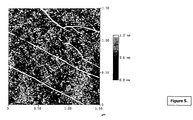
- FIG. 5 shows an AFM image of calf thymus DNA immobilized on ca 30-nm thick polystyrene on mica, wherein the nucleic acid has been immobilized by means of molecular combing.
- FIG. 6 shows a height profile of the image in FIG. 5 .
- the heights indicate that the DNA molecules occur predominantly as bundles and associations of molecules.
- DNA (Type I, sodium salt, “highly polymerized”, from calf thymus, Sigma product number D-1501) is dissolved in an aqueous buffer containing 0.010 M sodium phosphate, pH 7.0. The concentration of DNA is 10 mg/L. Concentrated (48 wt-%) aqueous HF is diluted to 1 wt-% with water.
- the substrate (5 mm ⁇ 5 mm) is cut from a microelectronic grade n-type Si(100) wafer covered with ⁇ 2 nm of native oxide on its polished surface. After cleaning the substrate with an oxygen plasma (3 mbar pressure for 10 minutes), it is immersed into 1 wt-% HF for 1 minute and then dried with compressed air (see FIG.
- FIGS. 2 & 3 AFM images ( FIGS. 2 & 3 ) of the sample show individual stretched molecules of DNA (height ⁇ 1 nm) on a flat surface. In contrast thereto a polystyrene film on mica is 4-5 times rougher, and the nucleic acid immobilized thereon mainly occurs as bundles, judging by the height of the DNA (see FIGS. 4 - 6 ).
Landscapes
- Chemical & Material Sciences (AREA)
- Engineering & Computer Science (AREA)
- Organic Chemistry (AREA)
- Life Sciences & Earth Sciences (AREA)
- Health & Medical Sciences (AREA)
- Biochemistry (AREA)
- Molecular Biology (AREA)
- Wood Science & Technology (AREA)
- Analytical Chemistry (AREA)
- Biotechnology (AREA)
- Nanotechnology (AREA)
- Genetics & Genomics (AREA)
- General Health & Medical Sciences (AREA)
- Physics & Mathematics (AREA)
- Proteomics, Peptides & Aminoacids (AREA)
- Zoology (AREA)
- General Engineering & Computer Science (AREA)
- Bioinformatics & Cheminformatics (AREA)
- Chemical Kinetics & Catalysis (AREA)
- Biophysics (AREA)
- Microbiology (AREA)
- Composite Materials (AREA)
- Condensed Matter Physics & Semiconductors (AREA)
- General Physics & Mathematics (AREA)
- Materials Engineering (AREA)
- Crystallography & Structural Chemistry (AREA)
- Immunology (AREA)
- Apparatus Associated With Microorganisms And Enzymes (AREA)
- Measuring Or Testing Involving Enzymes Or Micro-Organisms (AREA)
Abstract
Description
-
- a) providing a silicon substrate
- b) applying a solution of ammonium fluoride or of hydrogen fluoride onto a surface of said silicon substrate
- c) allowing said solution of ammonium fluoride or hydrogen fluoride to remain on said surface of said silicon substrate for a defined period of time
- d) applying a solution of a nucleic acid onto said surface
- e) immobilizing and elongating said nucleic acid by a process selected from the group comprising molecular combing, spin-coating, application of a fluid flow, application of an electric field, application of convective forces in an evaporating droplet of said solution of said nucleic acid, and any combination of the aforementioned processes.
Claims (18)
Priority Applications (1)
| Application Number | Priority Date | Filing Date | Title |
|---|---|---|---|
| US13/243,573 US8299227B2 (en) | 2003-09-18 | 2011-09-23 | Method of immobilizing and stretching a nucleic acid on a substrate |
Applications Claiming Priority (3)
| Application Number | Priority Date | Filing Date | Title |
|---|---|---|---|
| EP03021204A EP1516665A1 (en) | 2003-09-18 | 2003-09-18 | A method of immobilizing and stretching a nucleic acid on a substrate |
| EP03021204 | 2003-09-18 | ||
| EP03021204.7 | 2003-09-18 |
Related Child Applications (1)
| Application Number | Title | Priority Date | Filing Date |
|---|---|---|---|
| US13/243,573 Division US8299227B2 (en) | 2003-09-18 | 2011-09-23 | Method of immobilizing and stretching a nucleic acid on a substrate |
Publications (2)
| Publication Number | Publication Date |
|---|---|
| US20050064487A1 US20050064487A1 (en) | 2005-03-24 |
| US8058002B2 true US8058002B2 (en) | 2011-11-15 |
Family
ID=34178441
Family Applications (2)
| Application Number | Title | Priority Date | Filing Date |
|---|---|---|---|
| US10/942,713 Expired - Fee Related US8058002B2 (en) | 2003-09-18 | 2004-09-15 | Method of immobilizing and stretching a nucleic acid on a substrate |
| US13/243,573 Expired - Fee Related US8299227B2 (en) | 2003-09-18 | 2011-09-23 | Method of immobilizing and stretching a nucleic acid on a substrate |
Family Applications After (1)
| Application Number | Title | Priority Date | Filing Date |
|---|---|---|---|
| US13/243,573 Expired - Fee Related US8299227B2 (en) | 2003-09-18 | 2011-09-23 | Method of immobilizing and stretching a nucleic acid on a substrate |
Country Status (4)
| Country | Link |
|---|---|
| US (2) | US8058002B2 (en) |
| EP (1) | EP1516665A1 (en) |
| JP (1) | JP2005087213A (en) |
| CN (1) | CN100467595C (en) |
Cited By (1)
| Publication number | Priority date | Publication date | Assignee | Title |
|---|---|---|---|---|
| WO2015017759A1 (en) * | 2013-08-02 | 2015-02-05 | Stc.Unm | Dna sequencing and epigenome analysis |
Families Citing this family (5)
| Publication number | Priority date | Publication date | Assignee | Title |
|---|---|---|---|---|
| WO2006108188A2 (en) * | 2005-04-07 | 2006-10-12 | Reveo, Inc. | Probes, methods of making probes and applications of probes |
| US8975216B2 (en) * | 2006-03-30 | 2015-03-10 | Pacific Biosciences Of California | Articles having localized molecules disposed thereon and methods of producing same |
| TW200912307A (en) * | 2007-06-25 | 2009-03-16 | Z S Genetics Inc | High density molecular alignment of nucleic acid molecules |
| EP2805281A4 (en) * | 2012-01-18 | 2015-09-09 | Singular Bio Inc | METHODS FOR MAPPING BARCODE MOLECULES FOR DETECTION AND SEQUENCING OF A STRUCTURAL VARIATION |
| CN109929748A (en) * | 2019-03-08 | 2019-06-25 | 东南大学 | The instrument platform of DNA sequencing is realized based on pinpoint enhanced Raman scattering spectrum technology |
Citations (8)
| Publication number | Priority date | Publication date | Assignee | Title |
|---|---|---|---|---|
| WO1997006278A1 (en) | 1995-08-09 | 1997-02-20 | Simon Adam J | Molecular combing of macromolecules through the action of a meniscus on hihgly specific surfaces |
| US5661028A (en) * | 1995-09-29 | 1997-08-26 | Lockheed Martin Energy Systems, Inc. | Large scale DNA microsequencing device |
| US5840862A (en) * | 1994-02-11 | 1998-11-24 | Institut Pasteur | Process for aligning, adhering and stretching nucleic acid strands on a support surface by passage through a meniscus |
| US6060327A (en) * | 1997-05-14 | 2000-05-09 | Keensense, Inc. | Molecular wire injection sensors |
| US6248539B1 (en) * | 1997-09-05 | 2001-06-19 | The Scripps Research Institute | Porous semiconductor-based optical interferometric sensor |
| US6576478B1 (en) * | 1998-07-14 | 2003-06-10 | Zyomyx, Inc. | Microdevices for high-throughput screening of biomolecules |
| US6677163B1 (en) * | 2000-11-16 | 2004-01-13 | National Research Council Of Canada | Functionalized silicon surfaces, and method for their production |
| US20040156108A1 (en) * | 2001-10-29 | 2004-08-12 | Chou Stephen Y. | Articles comprising nanoscale patterns with reduced edge roughness and methods of making same |
Family Cites Families (1)
| Publication number | Priority date | Publication date | Assignee | Title |
|---|---|---|---|---|
| US6683056B2 (en) | 2000-03-30 | 2004-01-27 | Bristol-Myers Squibb Company | O-aryl glucoside SGLT2 inhibitors and method |
-
2003
- 2003-09-18 EP EP03021204A patent/EP1516665A1/en not_active Withdrawn
-
2004
- 2004-09-15 US US10/942,713 patent/US8058002B2/en not_active Expired - Fee Related
- 2004-09-15 JP JP2004268847A patent/JP2005087213A/en active Pending
- 2004-09-17 CN CNB2004100787795A patent/CN100467595C/en not_active Expired - Fee Related
-
2011
- 2011-09-23 US US13/243,573 patent/US8299227B2/en not_active Expired - Fee Related
Patent Citations (8)
| Publication number | Priority date | Publication date | Assignee | Title |
|---|---|---|---|---|
| US5840862A (en) * | 1994-02-11 | 1998-11-24 | Institut Pasteur | Process for aligning, adhering and stretching nucleic acid strands on a support surface by passage through a meniscus |
| WO1997006278A1 (en) | 1995-08-09 | 1997-02-20 | Simon Adam J | Molecular combing of macromolecules through the action of a meniscus on hihgly specific surfaces |
| US5661028A (en) * | 1995-09-29 | 1997-08-26 | Lockheed Martin Energy Systems, Inc. | Large scale DNA microsequencing device |
| US6060327A (en) * | 1997-05-14 | 2000-05-09 | Keensense, Inc. | Molecular wire injection sensors |
| US6248539B1 (en) * | 1997-09-05 | 2001-06-19 | The Scripps Research Institute | Porous semiconductor-based optical interferometric sensor |
| US6576478B1 (en) * | 1998-07-14 | 2003-06-10 | Zyomyx, Inc. | Microdevices for high-throughput screening of biomolecules |
| US6677163B1 (en) * | 2000-11-16 | 2004-01-13 | National Research Council Of Canada | Functionalized silicon surfaces, and method for their production |
| US20040156108A1 (en) * | 2001-10-29 | 2004-08-12 | Chou Stephen Y. | Articles comprising nanoscale patterns with reduced edge roughness and methods of making same |
Non-Patent Citations (15)
| Title |
|---|
| Carl J. Barrelet, et al., "Surface Characterization and Electrochemical Properties of Alkyl, Fluorinated Alkyl, and Alkoxy Monolayers on Silicon", Langmuir, 2001, 17, 3460-3465. |
| Dongsheng Xu, et al., "Hydrolysis and silanization of the hydrosilicon surface of freshly prepared porous silicon by an amine catalytic reaction", New J. Chem., 2003, 27, 300-306. |
| Foll H et al: "Formation and application of porous silicon" Materials Science and Engineering R: Reports, Elsevier Sequoia S.A., Lausanne, CH. vol. 39, No. 4, Nov. 1, 2002, pp. 93-141, XP004386810. |
| Gu-Bo, Li, et al., "Stable and intense blue-green emission in porous silicon achieved by amine immersion and rapid thermal oxidation", Appl. Phys. Lett., 70(10), Mar. 10, 1997. |
| Gueroui et al. ("Observation by fluorescence microscopy of transcription on single combed DNA" Proc Natl Acad Sci U S A. Apr. 30, 2002;99(9):6005-10). * |
| Higashi G S et al: "Ideal Hydrogen Termination of the Si (111) Surface" Applied Physics Letters, American Institute of Physics, New York, US, vol. 56, No. 7, Feb. 12, 1990, pp. 656-658, XP000126693. |
| J.E. Bateman, et al., "A Deuterium Labeling, FTIR, and Ab Initio Investigation of the Solution-Phase Thermal Reactions of Alcohols and Alkenes with Hydrogen-Terminated Silicon Surfaces", J. Phys. Chem. B 2000, 104, 5557-5565. |
| Klein D C G et al: "Ordered stretching of single molecules of deoxyribose nucleic acid between microfabricated polystyrene lines" Applied Physics Letters, American Institute of Physics. New York, US, vol. 78, No. 16, Apr. 16, 2001, pp. 2396-2398, XP002266390. |
| Kristian M. Roth, et al., "Measurements of Electron-Transfer Rates of Charge-Storage Molecular Monolayers on Si(100). Toward Hybrid Molecular/Semiconductor Information Storage Devices", J. Am. Chem. Soc., 2003, 125, 505-517. |
| Lagally E T et al: "Monolithic integrated microfluidic DNA amplification and capillary electrophoresis analysis system" Sensors and Actuators B, Elsevier Sequoia S.A., Lausanne, CH, vol. 63, No. 3, May 2000, pp. 138-146, XP004198332. |
| Lin R et al: "Selective extraction of size-fractioned DNA samples in microfabricated electrophoresis devices" Journal of Chromatography A, Elsevier Science, NL, vol. 1010, No. 2, Aug. 29, 2003, pp. 255-268, XP004447879. |
| Morita et al. ("Ideal hydrogen termination of Si(001) surface by wet-chemical preperation" Applied Physics Letters. 1995; vol. 67, Issue 18, pp. 2654-2656). * |
| Namyong Y. Kim, et al., "Thermal Derivatization of Porous Silicon with Alcohols", J. Am. Chem. Soc., 1997, 119, 2297-2298. |
| Sakaue H. et al: "Scanning tunneling microscopy observation on the atomic structures of step edges and etch pits on a NH4F-treated Si(111) surface" JPN. J. Appl. Phys., vol. 36, 1997, pp. 1420-1423, XP002272281. |
| Takahagi T et al: "Control of the chemical reactivity of a silicon single-crystal surface using the chemical modification technique" Journal of Applied Physics, Sep. 1, 1990, USA, vol. 68, No. 5, pp. 2187-2191, XP002272280. |
Cited By (2)
| Publication number | Priority date | Publication date | Assignee | Title |
|---|---|---|---|---|
| WO2015017759A1 (en) * | 2013-08-02 | 2015-02-05 | Stc.Unm | Dna sequencing and epigenome analysis |
| US10329614B2 (en) | 2013-08-02 | 2019-06-25 | Stc.Unm | DNA sequencing and epigenome analysis |
Also Published As
| Publication number | Publication date |
|---|---|
| US20120016110A1 (en) | 2012-01-19 |
| JP2005087213A (en) | 2005-04-07 |
| CN100467595C (en) | 2009-03-11 |
| CN1609211A (en) | 2005-04-27 |
| EP1516665A1 (en) | 2005-03-23 |
| US8299227B2 (en) | 2012-10-30 |
| US20050064487A1 (en) | 2005-03-24 |
Similar Documents
| Publication | Publication Date | Title |
|---|---|---|
| US8299227B2 (en) | Method of immobilizing and stretching a nucleic acid on a substrate | |
| US8735077B2 (en) | FET-type biosensor with surface modification | |
| US11923197B2 (en) | Methods of forming nanostructures utilizing self-assembled nucleic acids | |
| Kumar et al. | Formation of nanometer domains of one chemical functionality in a continuous matrix of a second chemical functionality by sequential adsorption of silane self-assembled monolayers | |
| US20080280099A1 (en) | Silicon Substrates with Thermal Oxide Windows for Transmission Electron Microscopy | |
| Fukidome et al. | In Situ Atomic Force Microscopy Observation of Dissolution Process of Si (111) in Oxygen‐Free Water at Room Temperature | |
| US20070082352A1 (en) | Microscopy tip | |
| JP4118857B2 (en) | DNA probe chip and DNA hybridization control method | |
| Sarveswaran et al. | Nanometer scale rafts built from DNA tiles | |
| Bashir et al. | BASIC: Bio-Inspired Assembly of Semiconductor Integrated Circuits• | |
| Pedemonte et al. | Morphology changes of Si (0 0 1) surfaces during wet chemical halogenation | |
| JP4194987B2 (en) | Polynucleotide probe chip | |
| JP4194989B2 (en) | DNA hybridization chip and DNA hybridization method | |
| Mehta et al. | Rapid extension of single and double stranded DNA on atomically flat conductive surfaces | |
| CN103738916B (en) | A kind of low damage processing method of gallium arsenide surface quantum dot nucleation site | |
| Melvin et al. | DNA, nanoparticles and photons-new approaches for clinical diagnostics | |
| Dai et al. | Improvement of DNA Origami's adsorption on silicon substrate | |
| Guan et al. | Nanowire fabrication by DNA metallization and positioning | |
| Carlsson et al. | Self-Organisation of Self-Complementary DNA Molecules Covalently Attached to Silicon Surfaces | |
| JP2001085666A (en) | Microstructure and manufacturing method thereof | |
| Tully et al. | Toward individually addressable nanometer-size surface pixels: ultrathin dendrimer films as resists for scanning probe lithography | |
| CN1529169A (en) | Manufacturing method of biological protein molecular chip |
Legal Events
| Date | Code | Title | Description |
|---|---|---|---|
| AS | Assignment |
Owner name: SONY INTERNATIONAL (EUROPE) GMBH, GERMANY Free format text: ASSIGNMENT OF ASSIGNORS INTEREST;ASSIGNORS:FORD, WILLIAM E.;WESSELS, JURINA;YASUDA, AKIO;REEL/FRAME:015803/0761;SIGNING DATES FROM 20040525 TO 20040614 Owner name: SONY INTERNATIONAL (EUROPE) GMBH, GERMANY Free format text: ASSIGNMENT OF ASSIGNORS INTEREST;ASSIGNORS:FORD, WILLIAM E.;WESSELS, JURINA;YASUDA, AKIO;SIGNING DATES FROM 20040525 TO 20040614;REEL/FRAME:015803/0761 |
|
| AS | Assignment |
Owner name: SONY DEUTSCHLAND GMBH,GERMANY Free format text: MERGER;ASSIGNOR:SONY INTERNATIONAL (EUROPE) GMBH;REEL/FRAME:017746/0583 Effective date: 20041122 Owner name: SONY DEUTSCHLAND GMBH, GERMANY Free format text: MERGER;ASSIGNOR:SONY INTERNATIONAL (EUROPE) GMBH;REEL/FRAME:017746/0583 Effective date: 20041122 |
|
| AS | Assignment |
Owner name: SONY DEUTSCHLAND GMBH, GERMANY Free format text: ASSIGNMENT OF ASSIGNORS INTEREST;ASSIGNOR:SONY INTERNATIONAL (EUROPE) GMBH;REEL/FRAME:018054/0014 Effective date: 20060524 |
|
| FEPP | Fee payment procedure |
Free format text: PAYOR NUMBER ASSIGNED (ORIGINAL EVENT CODE: ASPN); ENTITY STATUS OF PATENT OWNER: LARGE ENTITY |
|
| REMI | Maintenance fee reminder mailed | ||
| LAPS | Lapse for failure to pay maintenance fees | ||
| STCH | Information on status: patent discontinuation |
Free format text: PATENT EXPIRED DUE TO NONPAYMENT OF MAINTENANCE FEES UNDER 37 CFR 1.362 |
|
| STCH | Information on status: patent discontinuation |
Free format text: PATENT EXPIRED DUE TO NONPAYMENT OF MAINTENANCE FEES UNDER 37 CFR 1.362 |
|
| FP | Lapsed due to failure to pay maintenance fee |
Effective date: 20151115 |