US8049785B2 - Optimum image selection method and system - Google Patents
Optimum image selection method and system Download PDFInfo
- Publication number
- US8049785B2 US8049785B2 US12/239,121 US23912108A US8049785B2 US 8049785 B2 US8049785 B2 US 8049785B2 US 23912108 A US23912108 A US 23912108A US 8049785 B2 US8049785 B2 US 8049785B2
- Authority
- US
- United States
- Prior art keywords
- image
- vibration amount
- optimum
- selection method
- optimum image
- Prior art date
- Legal status (The legal status is an assumption and is not a legal conclusion. Google has not performed a legal analysis and makes no representation as to the accuracy of the status listed.)
- Expired - Fee Related, expires
Links
- 238000010187 selection method Methods 0.000 title claims abstract description 27
- 230000000977 initiatory effect Effects 0.000 claims description 4
- 238000001514 detection method Methods 0.000 abstract description 10
- 230000000717 retained effect Effects 0.000 abstract description 5
- 238000000034 method Methods 0.000 description 25
- 238000013459 approach Methods 0.000 description 9
- 238000010586 diagram Methods 0.000 description 3
- 238000010191 image analysis Methods 0.000 description 3
- 230000000694 effects Effects 0.000 description 2
- 230000001413 cellular effect Effects 0.000 description 1
- 230000006837 decompression Effects 0.000 description 1
- 238000012986 modification Methods 0.000 description 1
- 230000004048 modification Effects 0.000 description 1
- 230000003287 optical effect Effects 0.000 description 1
- 238000006467 substitution reaction Methods 0.000 description 1
Images


Classifications
-
- H—ELECTRICITY
- H04—ELECTRIC COMMUNICATION TECHNIQUE
- H04N—PICTORIAL COMMUNICATION, e.g. TELEVISION
- H04N5/00—Details of television systems
- H04N5/76—Television signal recording
- H04N5/765—Interface circuits between an apparatus for recording and another apparatus
- H04N5/77—Interface circuits between an apparatus for recording and another apparatus between a recording apparatus and a television camera
- H04N5/772—Interface circuits between an apparatus for recording and another apparatus between a recording apparatus and a television camera the recording apparatus and the television camera being placed in the same enclosure
-
- H—ELECTRICITY
- H04—ELECTRIC COMMUNICATION TECHNIQUE
- H04N—PICTORIAL COMMUNICATION, e.g. TELEVISION
- H04N23/00—Cameras or camera modules comprising electronic image sensors; Control thereof
- H04N23/60—Control of cameras or camera modules
- H04N23/68—Control of cameras or camera modules for stable pick-up of the scene, e.g. compensating for camera body vibrations
-
- H—ELECTRICITY
- H04—ELECTRIC COMMUNICATION TECHNIQUE
- H04N—PICTORIAL COMMUNICATION, e.g. TELEVISION
- H04N23/00—Cameras or camera modules comprising electronic image sensors; Control thereof
- H04N23/60—Control of cameras or camera modules
- H04N23/68—Control of cameras or camera modules for stable pick-up of the scene, e.g. compensating for camera body vibrations
- H04N23/681—Motion detection
- H04N23/6812—Motion detection based on additional sensors, e.g. acceleration sensors
Definitions
- the present invention relates to an optimum image selection method and system, in particular, to an optimum image selection method and system in a digital photograph device.
- a conventional digital photograph device e.g. digital camera (hereunder taking digital camera for example)
- the objective is all to obtain images with clear and high quality.
- it is generally by means of improving optical, mechanical and electrical elements therein.
- continuous photography mode it is also possible to use continuous photography mode to further select clearer images from a series of continually captured images.
- the digital camera currently available on the market when operating in optimum selection continuous photography, mostly compresses the captured images then saves them continually in memory so as to efficiently use the storage space. Upon the end of photography process, it then takes the captured images from the memory, and after decompression process, proceeds to analyze image clarity, compares these images, then saves the image of highest clarity and deletes the remaining ones with less satisfactory quality.
- the present inventor For achieving the objective of images with high quality, in view of the issues concerning design complexity and high cost in prior art; as well as the unnecessary time consumption and storage space occupation caused by the collective processes on images with less satisfactory quality in continuous photography mode, the present inventor employs the amount of vibration during the capture of each image to determine whether the image is to be saved or not for acquiring the optimum image, so as to create the advantages of lower cost and time/space saving, meanwhile the performance thereof can also be maintained.
- the objective of the present invention is to provide an optimum image selection method and system applicable to a digital photograph device in continuous photography mode, so that it saves time in image analysis during the optimum image selection process.
- Another objective of the present invention is to provide an optimum image selection method and system applicable to a digital photograph device in continuous photography mode, so that it requires less memory capacity during the optimum image selection process.
- the present invention discloses an optimum image selection method for a digital photograph device in continuous photography mode, wherein it is possible to freely determine the quantity of optimum image selection and whose steps include: initially, detecting whether a trigger signal is input, in which the trigger signal is input to the digital photography device by a user; afterwards, detecting periodically in intervals at least one vibration amount, such that each vibration amount corresponds to each captured image during continuous photography mode, comparing the value of vibration amount obtained in each detection with at least one base vibration amount, and if the value is smaller than the base vibration amount, then the value of the base vibration amount is replaced and an image capture signal is accordingly generated to capture the captured image which corresponds to the said vibration amount and is stored as the presently optimum image, and clearing the intermediate image to which the replaced base vibration amount corresponds; finally, repeating the last step, until that the continuous photography process ends and the last stored captured image is the optimum image.
- the present invention further discloses an optimum image selection method for a digital photograph device in continuous photography mode, wherein it is possible to freely determine the quantity of optimum image selection and whose steps include: initially, detecting whether a trigger signal is input, in which the trigger signal is input to the digital photography device by a user; afterwards, generating periodically in intervals an image capture signal, and at the same time, detecting a vibration amount corresponding to each image capture signal, then performing vibration amount comparison process, wherein the value of vibration amount obtained in each detection is compared with at least one base vibration amount, and if the value is smaller than the base vibration amount, then the value of the base vibration amount is replaced and the captured image generated by the image capture signal to which the vibration amount corresponds is stored as the presently optimum image, and clearing the captured image to which the replaced base vibration amount corresponds, otherwise interrupting the image capture signal; finally, repeating the last step, until that the continuous photography process ends and the last stored captured image is the optimum image.
- the present invention yet further discloses an optimum image selection method for a digital photograph device in continuous photography mode, wherein it is possible to freely determine the quantity of optimum image selection and whose steps include: initially, detecting whether a trigger signal is input, in which the trigger signal is input to the digital photography device by a user; afterwards, storing the captured image of each capture during continuous photography mode, and detecting and recording the vibration amount in each image capture; finally, until that continuous photography mode ends, selecting an captured image to which the value of at least one smallest vibration amount corresponds as the optimum image intended to be retained, while that the rest captured images are cleared.
- the present invention still yet further discloses an optimum image selection system, which is applicable for selecting at least one optimum image from a digital photograph device in continuous photography mode.
- the said system includes a vibration detection module, a control module, an image capture module and a storage module, wherein the vibration detection module is coupled with the control module for detecting a vibration amount; the control module is used to receive a trigger signal, so as to generate at least an image capture signal, each image capture signal corresponding to a vibration amount, and the control module determines, based on the vibration amount, whether the at least one image generated by the driving of the image capture signal is to be stored as the optimum image; the image capture module is coupled with the control module, which is used to receive the image capture signal to generate images; and the storage module is coupled with the control module, which is used to store captured images.
- control module controls the image capture module to capture a plurality of images, and, through the vibration detection module, respectively records the vibration amount in each photograph action of the image capture module, and then based on these vibration amounts, determines the said at least one captured images as the optimum image.
- FIG. 1 is a diagram of a digital photograph device disclosed by the present invention and an embodiment of the system architecture of the optimum image selection system thereof;
- FIG. 2 is a stepwise flowchart of an embodiment of the optimum image selection method in a digital photograph device disclosed by the present invention
- FIG. 3 is a stepwise flowchart of another embodiment of the optimum image selection method in a digital photograph device disclosed by the present invention.
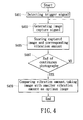
- FIG. 4 is a stepwise flowchart of yet another embodiment of the optimum image selection method in a digital photograph device disclosed by the present invention.
- the vibration amount generated during photograph process directly impacts the clarity of image, and usually the smaller the vibration amount is, the clearer the image taken becomes. Therefore, for the application of digital photograph device, the present invention, in a continuous photography mode, particularly records the vibration amount during the process, and afterwards, based on such vibration amount, quickly and conveniently determines which of the images taken in this continuous photography mode can be rated as an optimum image.
- the digital photograph device 10 illustrated by the depicted embodiment includes an input module 101 and an optimum image selection system 20 .
- the input module 101 is coupled with the optimum image selection system 20 for receiving the control from a user, as so to generate a trigger signal, in which, in the present embodiment, the said trigger signal is used, for example, to initiate continuous photography mode of the digital photograph device; upon initiation of continuous photography mode, it is to execute a series of image capture actions, there between spaced with a fixed time interval, and the quantity of image taken in continuous photography mode can be set by the optimum image selection system 20 .
- the optimum image selection system 20 further includes a vibration detection module 201 , a control module 203 , an image capture module 205 and a storage module 207 .
- the vibration detection module 201 is coupled with the control module 203 , detecting the vibration amount of each image capture action during continuous photography mode; the control module 203 , after reception of the trigger signal, generates at least an image capture signal, and when each image capture signal is outputted to the image capture module 205 , the control module 203 responds and records a vibration amount through the vibration detection module 201 .
- the image capture module 205 is coupled with the control module 203 , which is used to receive the image capture signal for the execution of image capture action so as to generate image.
- the control module 203 further, based on the determination of the vibration amount, decides whether to store the at least one image generated by the image capture module 205 driven by the image capture signal as the optimum image, and saves the said optimum image to the storage module 207 .
- the optimum image selection system 20 can be employed to select at least one optimum image in the digital photograph device 10 under continuous photography mode, wherein the digital photograph device 10 may be a cellular phone, digital camera or digital cam recorder.
- the above-mentioned optimum image selection system may further include a display module (not shown), so as to display the captured images.
- FIG. 2 a stepwise flowchart of an embodiment of the optimum image selection method in a digital photograph device disclosed by the present invention is shown.
- the related system architecture can be referred collectively to FIG. 1 .
- the optimum image selection method includes the following steps:
- the control module 203 detects the trigger signal (S 201 )
- the control module 203 generates an image capture signal, and at the same time as the image capture signal generated detects a corresponding vibration amount (S 203 ).
- step S 205 comparing the said vibration amount with a base vibration amount in the control module 203 (S 205 ), wherein the initial value of the base vibration amount may be set as the maximum of vibration amount detectable in the digital photograph device 10 or set by the user, and the base vibration amount may be also prescribed in the control module 203 for comparison. If the comparison in step S 205 shows that the vibration amount is smaller than the base vibration amount, then the current base vibration amount will be replaced by the current vibration amount (S 207 ); then, the image capture module 205 further takes an image according to the received image capture image, and saves the captured image in the storage module 207 (S 209 ). If a captured image is already saved there in the storage module 207 , then the new captured image will replace the old one. Otherwise, if the determination in step S 205 is negative, then the control module 203 interrupts the output of the image capture signal to the image capture module 205 , so as to stop the present photography action (S 211 ).
- step S 213 the process will continue to determine if the continuous photography ends (S 213 ), and if the continuous photography is still effective, meaning it is required to perform next image capture action, then the process returns to step S 203 to carry on, wherein the image capture signal will be output periodically in intervals.
- step S 203 the image saved in the storage module 207 is the optimum image intended to be retained.
- the process will compare the vibration amount generated in each photography action with a base vibration amount, and according to the comparison, determine whether the vibration amount should replace the base vibration amount, and whether the captured image should be stored, so as to locate the smaller vibration amount during continuous photography mode.
- the image to which the said smaller vibration amount corresponds is the optimum image, and the storage module 207 stores only the said optimum image.
- the storage module 207 is relatively not required to provide bigger space to store all images captured during continuous photography mode.
- FIG. 3 for another embodiment of the present invention, therein a stepwise flowchart of an embodiment of the optimum image selection method in a digital photograph device disclosed by the present invention is shown.
- the related system architecture can be referred collectively to FIG. 1 .
- the said optimum image selection method includes the following steps:
- detecting whether a trigger signal is input wherein the trigger signal is input to the digital photograph device 10 by a user.
- the control module 203 detects the trigger signal (S 301 )
- continuous photography mode is initiated and the vibration detection module 201 detects a vibration amount thereof (S 303 ).
- step S 305 comparing the said vibration amount with a base vibration amount in the control module 203 (S 305 ), wherein the initial value of the base vibration amount may be set as the maximum of vibration amount detectable in the digital photograph device 10 or set by the user, and if the vibration amount is smaller than the base vibration amount, then the current base vibration amount will be replaced by the vibration amount (S 307 ); afterwards, the control module 203 generates an image capture signal to the image capture module 205 to take an image and saves it in the storage module 207 (S 309 ). If a captured image is already saved there in the storage module 207 , then the new captured image will replace the old one. Otherwise, if the determination in step S 305 is negative, then the process jumps to step S 311 and proceeds.
- step S 311 the process continues to determine whether continuous photography mode ends (S 311 ), and if continuous photography mode is still effective, then it returns to step S 300 and carries on.
- the method depicted in FIG. 2 is essentially that, upon each photography action taken during continuous photography mode, a present vibration amount is detected at the same time as the output of the image capture signal, and then the comparison action of vibration amount determination is performed; as for the method process illustrated in FIG. 3 , it, upon each photography action taken during continuous photography mode, detects first the vibration amount, subsequently performs vibration amount comparison, and afterwards determines the output image capture signal based on the comparison result.
- the approach shown in FIG. 3 can avoid the occurrence of a situation that, in FIG. 2 , after the generation of an image capture signal, it may be required to be interrupted due to the determination result of vibration amount.
- FIG. 4 for yet another embodiment of the present invention, therein a stepwise flowchart of an embodiment of the optimum image selection method in a digital photograph device disclosed by the present invention is shown.
- the related system architecture can be referred collectively to FIG. 1 .
- the said optimum image selection method includes the following steps:
- detecting whether a trigger signal is input wherein the trigger signal is input to the digital photograph device 10 by a user.
- the control module 203 detects the trigger signal (S 401 )
- the control module 203 generates an image capture signal so as to output to the image capture module 205 , and at the time when the image capture signal is generated detects a corresponding vibration amount (S 403 ).
- the image capture module 205 performs capture action to take an image according to the image capture signal, and the captured image as well as the corresponding vibration amount are stored in the storage module 207 (s 405 ).
- step S 407 determining whether continuous photography mode ends (S 407 ); if the determination is negative, then the process returns to step S 403 to continue.
- the control module 203 compares the vibration amounts stored in the storage module 207 and locates the smallest vibration amount.
- the captured image to which the smallest vibration amount corresponds is the optimum image (S 409 ), and the control module 203 retains only the optimum image in the storage module 207 , while the rest ones will be deleted, so as not to occupy the storage space available in the storage module 207 .
- control module 203 may compare all vibration amounts stored in the storage module 207 with a base vibration amount, and locates the captured image to which the vibration amount being smaller then the base vibration amount corresponds as the optimum image. In this way of selection, it is possible to obtain one or more optimum images.
- FIGS. 2 and 3 describe that, in each image capture action during continuous photography mode, it is through the approach of vibration amount comparison to immediately determined that whether the captured image should be stored or not, and such an approach, in terms of the digital photograph device with limited storage capacity, can avoid saving images of less satisfactory quality taken during continuous photography mode in the storage module 207 .
- it first saves all captured images and, through the approach of vibration amount comparison, determines the optimum image as continuous photography mode ends.
- Such an approach can perform the vibration amount comparison action once when continuous photography mode ends, instead of doing the vibration amount comparison action each time when an image is captured.
- FIGS. 2 , 3 and 4 disclose methods for selecting only one optimum image.
- N optimum images i.e., providing N base vibration amounts for comparison
- the vibration amount generated in each image capture action will be compared with the N base vibration amounts, and at last only N smallest vibration amounts and the corresponding captured images will be retained, saving these captured images as the optimum images.
- the optimum image selection method and system disclosed in the present invention is, by means of determining the value of vibration amount in each image capture, to decide whether an optimum image should be stored.
- a user performs optimum selection continuous photography, it is to use the control module 203 for recording the vibration amount of the digital photograph device 10 during the capture, and the smaller the vibration amount is, the clearer the captured image can become.
- FIGS. 2 and 3 before the next image is stored, it will be compared with the previously saved image in terms of vibration amount, and if the vibration amount thereof is smaller than the previous one, then the previously stored image will be deleted and the currently one retained; otherwise, the image capture process will be directly interrupted.
Landscapes
- Engineering & Computer Science (AREA)
- Multimedia (AREA)
- Signal Processing (AREA)
- Studio Devices (AREA)
Abstract
Description
Claims (8)
Applications Claiming Priority (3)
| Application Number | Priority Date | Filing Date | Title |
|---|---|---|---|
| TW96136140 | 2007-09-28 | ||
| TW096136140A TW200915856A (en) | 2007-09-28 | 2007-09-28 | Optimum image selection method and system |
| TW96136140A | 2007-09-28 |
Publications (2)
| Publication Number | Publication Date |
|---|---|
| US20090086057A1 US20090086057A1 (en) | 2009-04-02 |
| US8049785B2 true US8049785B2 (en) | 2011-11-01 |
Family
ID=40507782
Family Applications (1)
| Application Number | Title | Priority Date | Filing Date |
|---|---|---|---|
| US12/239,121 Expired - Fee Related US8049785B2 (en) | 2007-09-28 | 2008-09-26 | Optimum image selection method and system |
Country Status (2)
| Country | Link |
|---|---|
| US (1) | US8049785B2 (en) |
| TW (1) | TW200915856A (en) |
Cited By (2)
| Publication number | Priority date | Publication date | Assignee | Title |
|---|---|---|---|---|
| US20130215283A1 (en) * | 2012-02-22 | 2013-08-22 | Samsung Electronics Co., Ltd. | Method and device for correcting user's hand tremor in imaging device |
| CN106161909A (en) * | 2014-12-03 | 2016-11-23 | 大通电子股份有限公司 | image shooting system |
Families Citing this family (6)
| Publication number | Priority date | Publication date | Assignee | Title |
|---|---|---|---|---|
| KR20090124319A (en) * | 2008-05-29 | 2009-12-03 | 삼성디지털이미징 주식회사 | Recording medium storing digital photographing device, control method and program for executing control method |
| JP2010226453A (en) * | 2009-03-24 | 2010-10-07 | Toshiba Corp | Still image storage device and lighting apparatus |
| CN101860680B (en) | 2009-04-08 | 2011-12-21 | 鸿富锦精密工业(深圳)有限公司 | Image processing device and image processing method thereof |
| JP6190236B2 (en) * | 2013-10-10 | 2017-08-30 | キヤノン株式会社 | Image display device, imaging device, and image display method |
| KR102229152B1 (en) * | 2014-10-16 | 2021-03-19 | 삼성전자주식회사 | Image photographing appratus |
| CN117437157A (en) * | 2023-10-16 | 2024-01-23 | 无锡远传融创科技有限公司 | An image processing method based on surveillance video data |
Citations (1)
| Publication number | Priority date | Publication date | Assignee | Title |
|---|---|---|---|---|
| JP2002112100A (en) * | 2000-09-28 | 2002-04-12 | Nikon Corp | Image pickup apparatus |
-
2007
- 2007-09-28 TW TW096136140A patent/TW200915856A/en unknown
-
2008
- 2008-09-26 US US12/239,121 patent/US8049785B2/en not_active Expired - Fee Related
Patent Citations (1)
| Publication number | Priority date | Publication date | Assignee | Title |
|---|---|---|---|---|
| JP2002112100A (en) * | 2000-09-28 | 2002-04-12 | Nikon Corp | Image pickup apparatus |
Cited By (3)
| Publication number | Priority date | Publication date | Assignee | Title |
|---|---|---|---|---|
| US20130215283A1 (en) * | 2012-02-22 | 2013-08-22 | Samsung Electronics Co., Ltd. | Method and device for correcting user's hand tremor in imaging device |
| US8928764B2 (en) * | 2012-02-22 | 2015-01-06 | Samsung Electronics Co., Ltd | Method and device for correcting user's hand tremor in imaging device |
| CN106161909A (en) * | 2014-12-03 | 2016-11-23 | 大通电子股份有限公司 | image shooting system |
Also Published As
| Publication number | Publication date |
|---|---|
| US20090086057A1 (en) | 2009-04-02 |
| TW200915856A (en) | 2009-04-01 |
Similar Documents
| Publication | Publication Date | Title |
|---|---|---|
| US8049785B2 (en) | Optimum image selection method and system | |
| US10681262B2 (en) | Digital image photographing apparatus and method of controlling the same | |
| JP5246275B2 (en) | Imaging apparatus and program | |
| JP4022828B2 (en) | Imaging apparatus, autofocus control method, and autofocus control program | |
| US7835636B2 (en) | Camera apparatus having auto focus function | |
| JP4200574B2 (en) | Electronic still camera | |
| US20020057847A1 (en) | Image-capturing device | |
| JP6824664B2 (en) | Imaging device and its control method, program | |
| JP2012058439A (en) | Digital camera | |
| CN101431607B (en) | Method and system for selecting better shot image | |
| EP1860871A1 (en) | Image pickup apparatus and image pickup control method | |
| JP2016177597A (en) | Recording apparatus, recording method, and program | |
| US8077221B2 (en) | Image capturing apparatus and control method therefor with determination whether storage medium is limited-rewriteable storage medium | |
| US7475266B2 (en) | Image capturing apparatus that performs dynamic frequency control of buffer memory during moving image capture | |
| US7777800B2 (en) | Digital still camera and image processing system | |
| JP2005151374A (en) | Imaging apparatus, imaging method, and recording medium | |
| CN112601016A (en) | Shooting processing method based on high-speed shooting instrument and related equipment | |
| JP2011139123A (en) | Image processor and image processing program | |
| JP2012039570A (en) | Imaging device and image processing program | |
| JP2005341244A (en) | Imaging device, defective pixel detection method and program | |
| JP2010257041A (en) | Subject tracking device and camera | |
| JP2010183145A (en) | Photographing device and program | |
| JP4933347B2 (en) | IMAGING DEVICE, ITS CONTROL METHOD, PROGRAM, AND STORAGE MEDIUM | |
| JP2005039353A (en) | Digital camera | |
| US12323698B2 (en) | Electronic device and control method thereof |
Legal Events
| Date | Code | Title | Description |
|---|---|---|---|
| AS | Assignment |
Owner name: ALTEK CORPORATION, TAIWAN Free format text: ASSIGNMENT OF ASSIGNORS INTEREST;ASSIGNORS:HAN, SHIH-CHANG;YANG, CHIN-LUNG;LI, YUN-CHIN;REEL/FRAME:021609/0723 Effective date: 20080926 |
|
| ZAAA | Notice of allowance and fees due |
Free format text: ORIGINAL CODE: NOA |
|
| ZAAB | Notice of allowance mailed |
Free format text: ORIGINAL CODE: MN/=. |
|
| STCF | Information on status: patent grant |
Free format text: PATENTED CASE |
|
| FPAY | Fee payment |
Year of fee payment: 4 |
|
| MAFP | Maintenance fee payment |
Free format text: PAYMENT OF MAINTENANCE FEE, 8TH YEAR, LARGE ENTITY (ORIGINAL EVENT CODE: M1552); ENTITY STATUS OF PATENT OWNER: LARGE ENTITY Year of fee payment: 8 |
|
| FEPP | Fee payment procedure |
Free format text: MAINTENANCE FEE REMINDER MAILED (ORIGINAL EVENT CODE: REM.); ENTITY STATUS OF PATENT OWNER: LARGE ENTITY |
|
| LAPS | Lapse for failure to pay maintenance fees |
Free format text: PATENT EXPIRED FOR FAILURE TO PAY MAINTENANCE FEES (ORIGINAL EVENT CODE: EXP.); ENTITY STATUS OF PATENT OWNER: LARGE ENTITY |
|
| STCH | Information on status: patent discontinuation |
Free format text: PATENT EXPIRED DUE TO NONPAYMENT OF MAINTENANCE FEES UNDER 37 CFR 1.362 |
|
| FP | Lapsed due to failure to pay maintenance fee |
Effective date: 20231101 |