US8045728B2 - Conference audio system - Google Patents

Conference audio system Download PDF

Info

Publication number
US8045728B2
US8045728B2 US11/996,697 US99669705A US8045728B2 US 8045728 B2 US8045728 B2 US 8045728B2 US 99669705 A US99669705 A US 99669705A US 8045728 B2 US8045728 B2 US 8045728B2
Authority
US
United States
Prior art keywords
audio
audio data
microphone
analog
level detector
Prior art date
Legal status (The legal status is an assumption and is not a legal conclusion. Google has not performed a legal analysis and makes no representation as to the accuracy of the status listed.)
Active, expires
Application number
US11/996,697
Other versions
US20100142721A1 (en
Inventor
Ariisa Wada
Tatsuji Harima
Current Assignee (The listed assignees may be inaccurate. Google has not performed a legal analysis and makes no representation or warranty as to the accuracy of the list.)
Audio Technica KK
Original Assignee
Audio Technica KK
Priority date (The priority date is an assumption and is not a legal conclusion. Google has not performed a legal analysis and makes no representation as to the accuracy of the date listed.)
Filing date
Publication date
Application filed by Audio Technica KK filed Critical Audio Technica KK
Assigned to KABUSHIKI KAISHA AUDIO-TECHNICA reassignment KABUSHIKI KAISHA AUDIO-TECHNICA ASSIGNMENT OF ASSIGNORS INTEREST (SEE DOCUMENT FOR DETAILS). Assignors: HARIMA, TATSUJI, WADA, ARIISA
Publication of US20100142721A1 publication Critical patent/US20100142721A1/en
Application granted granted Critical
Publication of US8045728B2 publication Critical patent/US8045728B2/en
Active legal-status Critical Current
Adjusted expiration legal-status Critical

Links

Images

Classifications

    • HELECTRICITY
    • H04ELECTRIC COMMUNICATION TECHNIQUE
    • H04RLOUDSPEAKERS, MICROPHONES, GRAMOPHONE PICK-UPS OR LIKE ACOUSTIC ELECTROMECHANICAL TRANSDUCERS; DEAF-AID SETS; PUBLIC ADDRESS SYSTEMS
    • H04R3/00Circuits for transducers, loudspeakers or microphones
    • HELECTRICITY
    • H04ELECTRIC COMMUNICATION TECHNIQUE
    • H04RLOUDSPEAKERS, MICROPHONES, GRAMOPHONE PICK-UPS OR LIKE ACOUSTIC ELECTROMECHANICAL TRANSDUCERS; DEAF-AID SETS; PUBLIC ADDRESS SYSTEMS
    • H04R3/00Circuits for transducers, loudspeakers or microphones
    • H04R3/005Circuits for transducers, loudspeakers or microphones for combining the signals of two or more microphones
    • HELECTRICITY
    • H04ELECTRIC COMMUNICATION TECHNIQUE
    • H04RLOUDSPEAKERS, MICROPHONES, GRAMOPHONE PICK-UPS OR LIKE ACOUSTIC ELECTROMECHANICAL TRANSDUCERS; DEAF-AID SETS; PUBLIC ADDRESS SYSTEMS
    • H04R27/00Public address systems
    • HELECTRICITY
    • H04ELECTRIC COMMUNICATION TECHNIQUE
    • H04RLOUDSPEAKERS, MICROPHONES, GRAMOPHONE PICK-UPS OR LIKE ACOUSTIC ELECTROMECHANICAL TRANSDUCERS; DEAF-AID SETS; PUBLIC ADDRESS SYSTEMS
    • H04R2201/00Details of transducers, loudspeakers or microphones covered by H04R1/00 but not provided for in any of its subgroups
    • H04R2201/40Details of arrangements for obtaining desired directional characteristic by combining a number of identical transducers covered by H04R1/40 but not provided for in any of its subgroups
    • H04R2201/403Linear arrays of transducers
    • HELECTRICITY
    • H04ELECTRIC COMMUNICATION TECHNIQUE
    • H04RLOUDSPEAKERS, MICROPHONES, GRAMOPHONE PICK-UPS OR LIKE ACOUSTIC ELECTROMECHANICAL TRANSDUCERS; DEAF-AID SETS; PUBLIC ADDRESS SYSTEMS
    • H04R2420/00Details of connection covered by H04R, not provided for in its groups
    • H04R2420/07Applications of wireless loudspeakers or wireless microphones

Definitions

  • the present invention relates to a conference audio system and, more particularly, to a conference audio system capable of avoiding front-end-clipping of delayed speech in a cordless audio conferencing system using infrared light.
  • a conference audio system When a conference attended by many persons is held, a conference audio system is used, in which speaker's utterance is picked up by a microphone, amplified by an amplifier, and output from a speaker in a conference hall so that the speaker's utterance can be heard by all attendees.
  • many microphones are used. If many microphones are being turned on at the same time, that is, in an active state, audios picked up by these microphones are amplified and output from the speaker, and therefore, audios other than those of the speaker are heard as noises and the audio of the speaker cannot be heard clearly. In addition, a howl becomes more likely to occur. Because of this, a system has been widely used, in which an attendee turns on a microphone switch at hand when making a statement and turns off the switch after completing the statement.
  • FIG. 6 shows a concept of the system.
  • FIG. 6 on a table 1 in a conference hall, many microphones 11 , 12 , . . . , and in are arranged erectly on microphone stands 21 , 22 , . . . , and 2 n . There are cases where each person uses each microphone and where two or more persons share one microphone.
  • the microphone stands 21 , 22 , . . . , and 2 n are each provided with a switch with which each microphone is turned on or off by the operation of an attendee. Audio signals from a microphone that has been turned on by the switch operation are input to a mixer 2 and the audio signals mixed in the mixer 2 are amplified by an amplifier 3 and the audios are output toward the attendees from a speaker 4 installed in the conference hall.
  • FIG. 7 shows the time delay.
  • a waveform a represented by the solid line shows an attendee's utterance signal and a waveform b represented by the dotted line shows an audio signal from the speaker 4 .
  • a time delay ⁇ t between the waveform a and the waveform b.
  • the time delay ⁇ t is about 10 ms and there will arise no auditory problem because there is no auditorily uncomfortable feeling.
  • FIG. 8 a conference audio system of cordless type as shown in FIG. 8 is proposed.
  • the microphones 11 , 12 , . . . , and 1 n stand respectively on microphone stands 31 , 32 , . . . , and 3 n placed on the table.
  • Each of the microphone stands 31 , 32 , . . . , and 3 n incorporates a transmitter and transmits an audio signal converted in the microphone to a receiver 5 .
  • This transmission/reception system may be an optical communication system that uses infrared light etc., or a communication system that uses radio waves.
  • the receiver 5 demodulates the received signal into an audio signal and the amplifier 3 amplifies the demodulated signal, and thus the audio is output from the speaker 4 installed in the conference hall toward the attendees.
  • an on/off switch is attached to each microphone and an attendee needs to operate this switch, it may be troublesome to operate the switch and there may be a case where the attendee forgets to turn on the switch when making a statement or to turn off after his/her statement.
  • a conference audio system equipped with an automatic mute release device is proposed.
  • an audio level detector is provided, which detects utterance or silence depending on whether or not the output level of each microphone exceeds a predetermined level, and normally, the microphone is put in an off state, that is, in a state of mute, and the audio level detector, when detecting utterance, turns on the microphone, that is, the mute is released.
  • the automatic mute release device can also be applied to a wired system shown in FIG. 6 and a cordless system shown in FIG. 8 .
  • an audio level picked up by a microphone is detected and when the audio level becomes equal to or exceeds a predetermined threshold level (hereinafter, referred to as a “threshold”), the audio signal converted in the microphone is turned on.
  • a predetermined threshold level hereinafter, referred to as a “threshold”
  • the audio signal converted in the microphone is turned on.
  • a method of automatically detecting beginning of speech in which when an analog audio signal level from a microphone is equal to or greater than a threshold, a voice switch is turned on and while the voice switch is on, a digital recording circuit is activated and at the same time, the analog audio signal is input to a digital recording circuit for digital recording with a delay by a delay circuit corresponding to the maximum operation delay time when the voice switch is switched from the off-state to on-state (for example, refer to Patent document 1).
  • the application of the technique described in Patent document 1 to a conference audio system will result in always causing a fixed time delay between when voice utterance is picked up by a microphone and when the audio is output from a speaker.
  • a recording device based on the same concept as that of the invention described in Patent document 1 is also known, which uses a tape recorder by an endless tape in place of a digital recording circuit (for example, refer to Patent document 2).
  • the application of the invention described in Patent document 2 to a conference audio system will also result in the same problem as that encountered when the invention described in Patent document 1 is applied to a conference audio system.
  • an audio communication recording device in which an audio signal input from a microphone is converted into a digital signal and when the quantity of data stored in an FIFO buffer reaches a predetermined quantity, if there is no audio signal, the data is discarded and if there is an audio signal, the data is stored in the buffer or transmitted (refer to Patent document 3).
  • the invention described in Patent document 3 states that it is possible to realize a natural conversation because a delay time between when the audio signal is received and when the audio is heard is short.
  • the present invention has been achieved in order to eliminate the problems of the prior art as described above, and an object thereof is to provide a conference audio system capable of eliminating an uncomfortable feeling by reducing the delay time between the utterance toward a microphone and the output of the audio from a speaker even in a system including an automatic mute release device that automatically turns on only the microphone that has picked up the audio when the audio is uttered.
  • the present invention includes a plurality of microphones, an analog/digital converter that converts an audio signal from each microphone into a digital signal, an audio level detector that detects utterance or silence depending on whether or not the level of the converted digital signal exceeds a predetermined level, an audio data storage unit that temporarily stores the digital signal detected its utterance by the audio level detector and converted by the analog/digital converter, a controller that controls the storage of audio data to the audio data storage unit and the reading of the stored audio data, and a digital/analog converter that converts the read audio data into an analog audio signal, and the reading controller hastens a read timing of the audio data in accordance with a time period of silent portion when the audio level detector detects silence in a series of the audio data.
  • the audio level detector detects the utterance and the audio data storage unit stores audio data picked up by the microphone and converted digitally.
  • the stored audio data is read under the control of the controller and converted into an analog signal. If the utterance toward the microphone is interrupted temporarily due to breathing etc., the audio level detector determines the state as silence and hastens the read timing of the audio data by the time period corresponding to the silent time.
  • the audio is converted into an analog signal with a delay from the time point of utterance, however, when the utterance is interrupted temporarily, the audio is converted into an analog signal with a delay time reduced by the time period of interrupt, and then, the audio is converted into an analog signal substantially in synchronization with the utterance. If, for example, the speaker is driven by the analog signal, although there occurs a time delay only at the beginning of the utterance, soon the audio is output from the speaker without time delay, and it is possible to obtain a conference audio system without an uncomfortable feeling.
  • FIG. 1 is a block diagram showing essential parts in an embodiment of a conference audio system according to the present invention.
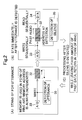
  • FIGS. 2(A) to 2(C) are block diagrams showing the operation in the embodiment: FIG. 2(A) shows a standby state for utterance; FIG. 2(B) shows a state immediately after utterance is detected; and FIG. 2(C) shows a state immediately after silence is detected.
  • FIGS. 3( a ) and 3 ( b ) are waveform diagrams showing the operation in the embodiment.
  • FIGS. 4( a ) to 4 ( c ) are conceptual diagrams sequentially showing an example of the operation of an audio data storage unit in the embodiment.
  • FIG. 5 is a schematic diagram showing an example of the operation of the audio data storage unit in the embodiment.
  • FIG. 6 is a conceptual diagram showing an example of a conventional wired audio conferencing system.
  • FIG. 7 is a waveform diagram showing a delay in audio in a conference audio system.
  • FIG. 8 is a conceptual diagram showing an example of a conventional cordless audio conferencing system.
  • FIG. 1 shows essential parts in the embodiment of the conference audio system according to the present invention, however, a microphone which is an entrance of an audio signal, a speaker which is an outlet of an audio, an amplifier provided before the speaker, etc., are not shown schematically.
  • the constitutional parts shown in FIG. 1 are arranged in accordance with each microphone.
  • an analog/digital converter 33 is arranged, which converts an audio signal, which is an analog signal converted by each microphone, into a digital signal.
  • the digital audio signal converted by the analog/digital converter 33 is input to a central processing unit (hereinafter, referred to as “CPU”) 31 in a microcomputer 30 .
  • the microcomputer includes a read-only-memory (ROM), a random-access-memory (RAM), etc., with the CPU 31 as a controller as the central component.
  • the RAM is used as an audio data storage unit 32 .
  • the CPU 31 as a controller carries out the control to store the audio data in the audio data storage unit 32 and the control to read the audio data from the audio data storage unit 32 .
  • the digital audio data read from the audio data storage unit 32 is converted into an analog audio signal by a digital/analog converter 34 and a speaker is driven by the analog audio signal via an amplifier not shown schematically and the audio is output from the speaker.
  • the analog signal converted by the digital/analog converter 34 in each microphone is input to the mixer as described with reference to FIG. 6 via, for example, a cable, or the analog signal is transmitted from the cordless signal transmitter as described with reference to FIG. 8 and received by the receiver to drive the speaker via the amplifier.
  • audio signals from a number of microphones, or light signals or radio waves modulated by the audio signal are sent.
  • the automatic mute is released by an automatic mute release device and the audio signal, light signal, or radio wave is sent to the mixer or receiver, and the audio signal or demodulated audio signal is output from the speaker.
  • FIG. 2(A) shows an image of a standby state for utterance by the audio level detector.
  • the audio level detector detects utterance or silence depending on whether or not the level of the digital audio signal picked up by the microphone and converted by the analog/digital converter 33 exceeds a predetermined level, that is, a threshold, and the detector itself is a well-known technique.
  • the block denoted by “detection of utterance” corresponds to an audio level detector 35 .
  • the audio level detector 35 detects the level of the digital audio signal and stores the digital audio signal in the audio data storage unit 32 when the level exceeds the threshold.
  • the audio data storage unit 32 uses a memory with a fixed amount of capacity in the form of a ring and always increments the memory address regardless of the detection by the audio data storage unit. In other words, the digital audio data is stored sequentially in each address and rewritten.
  • the control of the memory is carried out by the controller 31 .
  • FIG. 2(B) shows an image of a state immediately after the audio level detector 35 detects utterance.
  • the controller 31 sequentially writes the digital audio data in the audio data storage unit 32 . Further, the controller 31 causes the digital audio data to be read sequentially from the audio data storage unit 32 with a predetermined time delayed from the point of time of the detection of utterance, for example, of about 100 to 200 ms, which will occur inevitably. As a result, the writing to the audio data storage unit 32 and the reading from the audio data storage unit 32 are carried out at the same time.
  • a predetermined time delayed from the point of time of the detection of utterance for example, of about 100 to 200 ms
  • the audio data stored in the audio data storage unit 32 is represented by “past audio”, however, the wording “past” used here means “immediately before” and therefore the “past audio” means the audio immediately before the data is read. In this manner, immediately after the audio level detector 35 detects the utterance, the audio is output from the speaker with a fixed time delay. In this operation mode, the audio level detector 35 is ready to detect silence.
  • FIG. 2(C) shows this operation.
  • the controller 31 causes the reading to continue.
  • the time delay of the audio output from the speaker is shortened by the time period corresponding to the above silent time.
  • the controller 31 stops the writing to the audio data storage unit 32 , however, causes the reading from the audio data storage unit 32 to continue. Then, at the point of time when the audio level detector 35 detects utterance again, the time delay is further shortened by the time period corresponding to the above silent time and then the audio is output from the speaker.
  • the maximum value of the time delay to be shortened is the predetermined time of about 100 to 200 ms as described above, however, when the total of the time delays to be shortened several times reaches the above predetermined time, there is no time delay afterward and therefore the audio is output from the speaker in real time.
  • the first silent time is the same as the predetermined time or longer than that, the audio is output from the speaker in real time immediately after that.
  • FIG. 3( a ) to FIG. 5 show images of the operation in the embodiment.
  • FIGS. 3( a ) and 3 ( b ) show the operation with an example of an audio signal waveform: FIG. 3( a ) shows an analog audio signal converted by a microphone; and FIG. 3( b ) shows an audio signal that is read from the audio data storage unit, converted into an analog signal, and output from a speaker.
  • FIG. 3( a ) shows an analog audio signal converted by a microphone
  • FIG. 3( b ) shows an audio signal that is read from the audio data storage unit, converted into an analog signal, and output from a speaker.
  • the utterance or silence of the analog audio signal converted in the microphone is detected by the audio level detector depending on whether or not the predetermined threshold SL is exceeded.
  • the audio is output from the speaker with a delay of ⁇ t from the analog audio signal converted in the microphone.
  • FIG. 4( a ) shows an image of the audio data storage unit at this time, showing that
  • the analog audio signal converted in the microphone is interrupted temporarily and ⁇ t 1 , the period of silent time at this time, is shorter than ⁇ t, the time delay is shortened by ⁇ t 1 and the audio is output from the speaker with a time delay corresponding to ⁇ t ⁇ t 1 (refer to FIG. 4( b )).
  • the analog audio signal converted in the microphone is temporarily interrupted again and ⁇ t 2 , the period of silent time at this time, is longer than ⁇ t ⁇ t 1 , in other words, ⁇ t 1 + ⁇ t 2 is longer than ⁇ t, there is no time delay afterward, and the audio signal converted in the microphone is output from the speaker in real time (refer to FIG. 4( c )).
  • FIG. 5 is a conceptual diagram showing an example of the operation of writing and reading by the audio data storage unit 32 .
  • the audio data storage unit 32 has addresses from 0 to n. It is assumed that digital audio data, such as “A”, “B”, “C”, “D”, “E”, . . . , converted into an electric signal in the microphone and converted by the analog/digital converter, are written in the order of the addresses. There is a limit to the number of addresses of the audio data storage unit 32 and when audio data are recorded up to the last address n, the order returns to the first in the form of a ring and the data are replaced with new data from address 0, 1, 2, . . . .
  • the controller specifies the pointer of the audio data storage unit 32 with a delay of the addresses corresponding to the time delay ⁇ t as described earlier, and reads the digital audio data.
  • the controller specifies the pointer of the audio data storage unit 32 with a delay of the addresses corresponding to the time delay ⁇ t as described earlier, and reads the digital audio data.
  • the audio level detector detects a temporary silence, the read address is put nearer to the write address by the amount of addresses corresponding to the period of silent time and then the read address matches with the write address and the reading is carried out in real time.
  • a digital/analog converter that converts read audio data into an analog audio signal can constitute a conference audio system by driving a speaker with its analog-converted output, and, the analog-converted output of the digital/analog converter can be input to recorders, communication devices, and other devices for recording, communication, etc.

Landscapes

  • Physics & Mathematics (AREA)
  • Engineering & Computer Science (AREA)
  • Acoustics & Sound (AREA)
  • Signal Processing (AREA)
  • Health & Medical Sciences (AREA)
  • General Health & Medical Sciences (AREA)
  • Otolaryngology (AREA)
  • Telephonic Communication Services (AREA)
  • Circuit For Audible Band Transducer (AREA)
  • Telephone Function (AREA)
  • Two-Way Televisions, Distribution Of Moving Picture Or The Like (AREA)

Abstract

It is possible to shorten a delay time from utterance to output from a speaker even in a conference audio system including an automatic mute release device. An A/D converter that converts audio signals from a plurality of microphones into digital signals, an audio level detector that detects utterance or silence depending on the level of the converted digital signal, an audio data storage unit that temporarily stores the digital signal for which the audio level detector detected utterance, a controller that controls the storage of audio data in the audio data storage unit and the reading of the audio data, and a D/A converter that converts the read audio data into analog audio signals are provided. The controller hastens read timing of the audio data in accordance with a time period of silent portion when the audio level detector detects silence in a series of the audio data.

Description

TECHNICAL FIELD
The present invention relates to a conference audio system and, more particularly, to a conference audio system capable of avoiding front-end-clipping of delayed speech in a cordless audio conferencing system using infrared light.
BACKGROUND ART
When a conference attended by many persons is held, a conference audio system is used, in which speaker's utterance is picked up by a microphone, amplified by an amplifier, and output from a speaker in a conference hall so that the speaker's utterance can be heard by all attendees. In such a conference that uses a conference audio system, many microphones are used. If many microphones are being turned on at the same time, that is, in an active state, audios picked up by these microphones are amplified and output from the speaker, and therefore, audios other than those of the speaker are heard as noises and the audio of the speaker cannot be heard clearly. In addition, a howl becomes more likely to occur. Because of this, a system has been widely used, in which an attendee turns on a microphone switch at hand when making a statement and turns off the switch after completing the statement. FIG. 6 shows a concept of the system.
In FIG. 6, on a table 1 in a conference hall, many microphones 11, 12, . . . , and in are arranged erectly on microphone stands 21, 22, . . . , and 2 n. There are cases where each person uses each microphone and where two or more persons share one microphone. The microphone stands 21, 22, . . . , and 2 n are each provided with a switch with which each microphone is turned on or off by the operation of an attendee. Audio signals from a microphone that has been turned on by the switch operation are input to a mixer 2 and the audio signals mixed in the mixer 2 are amplified by an amplifier 3 and the audios are output toward the attendees from a speaker 4 installed in the conference hall.
According to the above audio system, there occurs a time delay from when an attendee utters until the audio is converted into a signal in the microphone, mixed in the mixer 2, amplified by the amplifier 3, and output from the speaker 4. FIG. 7 shows the time delay. A waveform a represented by the solid line shows an attendee's utterance signal and a waveform b represented by the dotted line shows an audio signal from the speaker 4. As shown in FIG. 7, there occurs a time delay Δt between the waveform a and the waveform b. However, in a wired system as shown in FIG. 6, in which the microphone is turned on/off by manual operation, the time delay Δt is about 10 ms and there will arise no auditory problem because there is no auditorily uncomfortable feeling.
However, in the wired audio system as described above, it is necessary to connect all of the microphones with the mixer 2 by cables, and therefore, many cables are laid and it will be troublesome to handle the cables physically and to put them in order, and further, it will also be troublesome to identify the correspondence relationship between microphones and cables. The installation cost also becomes high.
Because of this, a conference audio system of cordless type as shown in FIG. 8 is proposed. In FIG. 8, the microphones 11, 12, . . . , and 1 n stand respectively on microphone stands 31, 32, . . . , and 3 n placed on the table. Each of the microphone stands 31, 32, . . . , and 3 n incorporates a transmitter and transmits an audio signal converted in the microphone to a receiver 5. This transmission/reception system may be an optical communication system that uses infrared light etc., or a communication system that uses radio waves. The receiver 5 demodulates the received signal into an audio signal and the amplifier 3 amplifies the demodulated signal, and thus the audio is output from the speaker 4 installed in the conference hall toward the attendees.
On the other hand, in a system in which an on/off switch is attached to each microphone and an attendee needs to operate this switch, it may be troublesome to operate the switch and there may be a case where the attendee forgets to turn on the switch when making a statement or to turn off after his/her statement. Because of this, a conference audio system equipped with an automatic mute release device is proposed. In this system, an audio level detector is provided, which detects utterance or silence depending on whether or not the output level of each microphone exceeds a predetermined level, and normally, the microphone is put in an off state, that is, in a state of mute, and the audio level detector, when detecting utterance, turns on the microphone, that is, the mute is released. The automatic mute release device can also be applied to a wired system shown in FIG. 6 and a cordless system shown in FIG. 8.
In an elementary technique of an automatic mute release device, an audio level picked up by a microphone is detected and when the audio level becomes equal to or exceeds a predetermined threshold level (hereinafter, referred to as a “threshold”), the audio signal converted in the microphone is turned on. However, such an elementary technique of an automatic mute release device has a problem in that it takes time from when voice utterance enters the microphone until an audio signal is turned on, and the time delay Δt shown in FIG. 7 is about 100 to 200 ms and the beginning of speech may be lost.
As a technique to eliminate such a time delay, a method of automatically detecting beginning of speech is proposed, in which when an analog audio signal level from a microphone is equal to or greater than a threshold, a voice switch is turned on and while the voice switch is on, a digital recording circuit is activated and at the same time, the analog audio signal is input to a digital recording circuit for digital recording with a delay by a delay circuit corresponding to the maximum operation delay time when the voice switch is switched from the off-state to on-state (for example, refer to Patent document 1). The application of the technique described in Patent document 1 to a conference audio system will result in always causing a fixed time delay between when voice utterance is picked up by a microphone and when the audio is output from a speaker. Owing to this, there is no problem relating to the loss of beginning of speech. However, since both the words uttered directly by the speaker him/herself and the words of his/her own output from the speaker delayed in time are heard at the same time, the speaker will have an uncomfortable feeling. Further, since there is a discrepancy with respect to time between the movement of the lip of the speaker and the audio output from the speaker, the attendees other than the speaker also have an uncomfortable feeling. As described above, the time delay is always about 100 to 200 ms, and therefore, it is desired to solve this problem technically.
A recording device based on the same concept as that of the invention described in Patent document 1 is also known, which uses a tape recorder by an endless tape in place of a digital recording circuit (for example, refer to Patent document 2). The application of the invention described in Patent document 2 to a conference audio system will also result in the same problem as that encountered when the invention described in Patent document 1 is applied to a conference audio system.
Further, an audio communication recording device is proposed, in which an audio signal input from a microphone is converted into a digital signal and when the quantity of data stored in an FIFO buffer reaches a predetermined quantity, if there is no audio signal, the data is discarded and if there is an audio signal, the data is stored in the buffer or transmitted (refer to Patent document 3). The invention described in Patent document 3 states that it is possible to realize a natural conversation because a delay time between when the audio signal is received and when the audio is heard is short. However, when the invention described in Patent document 3 is applied to a conference audio system, if the audio signal is interrupted and it is determined that there is no audio signal, the audio data stored in the buffer is discarded, and when it is determined that there is an audio signal next time, the audio signal is stored sequentially from scratch and read out in order, and therefore, the effect to eliminate the delay in audio cannot be expected.
  • Patent document 1 Japanese Unexamined Patent Application Publication No. 60-163250
  • Patent document 2 Japanese Unexamined Utility Model Application Publication No. 60-142805
  • Patent document 3 Japanese Unexamined Patent Application Publication No. 8-265337
DISCLOSURE OF THE INVENTION
The present invention has been achieved in order to eliminate the problems of the prior art as described above, and an object thereof is to provide a conference audio system capable of eliminating an uncomfortable feeling by reducing the delay time between the utterance toward a microphone and the output of the audio from a speaker even in a system including an automatic mute release device that automatically turns on only the microphone that has picked up the audio when the audio is uttered.
The present invention includes a plurality of microphones, an analog/digital converter that converts an audio signal from each microphone into a digital signal, an audio level detector that detects utterance or silence depending on whether or not the level of the converted digital signal exceeds a predetermined level, an audio data storage unit that temporarily stores the digital signal detected its utterance by the audio level detector and converted by the analog/digital converter, a controller that controls the storage of audio data to the audio data storage unit and the reading of the stored audio data, and a digital/analog converter that converts the read audio data into an analog audio signal, and the reading controller hastens a read timing of the audio data in accordance with a time period of silent portion when the audio level detector detects silence in a series of the audio data.
According to the present invention, when a word is uttered toward a microphone, the audio level detector detects the utterance and the audio data storage unit stores audio data picked up by the microphone and converted digitally. The stored audio data is read under the control of the controller and converted into an analog signal. If the utterance toward the microphone is interrupted temporarily due to breathing etc., the audio level detector determines the state as silence and hastens the read timing of the audio data by the time period corresponding to the silent time. As a result, at the beginning of the utterance, the audio is converted into an analog signal with a delay from the time point of utterance, however, when the utterance is interrupted temporarily, the audio is converted into an analog signal with a delay time reduced by the time period of interrupt, and then, the audio is converted into an analog signal substantially in synchronization with the utterance. If, for example, the speaker is driven by the analog signal, although there occurs a time delay only at the beginning of the utterance, soon the audio is output from the speaker without time delay, and it is possible to obtain a conference audio system without an uncomfortable feeling.
BRIEF DESCRIPTION OF THE DRAWINGS
FIG. 1 is a block diagram showing essential parts in an embodiment of a conference audio system according to the present invention.
FIGS. 2(A) to 2(C) are block diagrams showing the operation in the embodiment: FIG. 2(A) shows a standby state for utterance; FIG. 2(B) shows a state immediately after utterance is detected; and FIG. 2(C) shows a state immediately after silence is detected.
FIGS. 3( a) and 3(b) are waveform diagrams showing the operation in the embodiment.
FIGS. 4( a) to 4(c) are conceptual diagrams sequentially showing an example of the operation of an audio data storage unit in the embodiment.
FIG. 5 is a schematic diagram showing an example of the operation of the audio data storage unit in the embodiment.
FIG. 6 is a conceptual diagram showing an example of a conventional wired audio conferencing system.
FIG. 7 is a waveform diagram showing a delay in audio in a conference audio system.
FIG. 8 is a conceptual diagram showing an example of a conventional cordless audio conferencing system.
DESCRIPTION OF SYMBOLS
    • 31 CPU as a controller
    • 32 audio data storage unit
    • 33 analog/digital converter
    • 34 digital/analog converter
    • 35 audio level detector
DESCRIPTION OF THE PREFERRED EMBODIMENT
An embodiment of a conference audio system according to the present invention will be described below with reference to the drawings. FIG. 1 shows essential parts in the embodiment of the conference audio system according to the present invention, however, a microphone which is an entrance of an audio signal, a speaker which is an outlet of an audio, an amplifier provided before the speaker, etc., are not shown schematically. The constitutional parts shown in FIG. 1 are arranged in accordance with each microphone.
In FIG. 1, in accordance with each microphone, an analog/digital converter 33 is arranged, which converts an audio signal, which is an analog signal converted by each microphone, into a digital signal. The digital audio signal converted by the analog/digital converter 33 is input to a central processing unit (hereinafter, referred to as “CPU”) 31 in a microcomputer 30. The microcomputer includes a read-only-memory (ROM), a random-access-memory (RAM), etc., with the CPU 31 as a controller as the central component. In the present embodiment, the RAM is used as an audio data storage unit 32. The CPU 31 as a controller carries out the control to store the audio data in the audio data storage unit 32 and the control to read the audio data from the audio data storage unit 32. The digital audio data read from the audio data storage unit 32 is converted into an analog audio signal by a digital/analog converter 34 and a speaker is driven by the analog audio signal via an amplifier not shown schematically and the audio is output from the speaker.
Although not shown in FIG. 1, the analog signal converted by the digital/analog converter 34 in each microphone is input to the mixer as described with reference to FIG. 6 via, for example, a cable, or the analog signal is transmitted from the cordless signal transmitter as described with reference to FIG. 8 and received by the receiver to drive the speaker via the amplifier. To the mixer or receiver, audio signals from a number of microphones, or light signals or radio waves modulated by the audio signal are sent. However, in a state in which there is no utterance toward the microphone, there is no transmission of the audio signal, light signal, or radio wave to the mixer or receiver because of automatic mute. When there is utterance toward the microphone, the automatic mute is released by an automatic mute release device and the audio signal, light signal, or radio wave is sent to the mixer or receiver, and the audio signal or demodulated audio signal is output from the speaker.
The embodiment of the present invention is characterized by the audio data storage unit 32 and the control of the audio data storage unit by the CPU 31 as s controller. The configuration and operation of the characteristic parts are described below. FIG. 2(A) shows an image of a standby state for utterance by the audio level detector. The audio level detector detects utterance or silence depending on whether or not the level of the digital audio signal picked up by the microphone and converted by the analog/digital converter 33 exceeds a predetermined level, that is, a threshold, and the detector itself is a well-known technique. In FIG. 2(A), the block denoted by “detection of utterance” corresponds to an audio level detector 35. The audio level detector 35 detects the level of the digital audio signal and stores the digital audio signal in the audio data storage unit 32 when the level exceeds the threshold. The audio data storage unit 32 uses a memory with a fixed amount of capacity in the form of a ring and always increments the memory address regardless of the detection by the audio data storage unit. In other words, the digital audio data is stored sequentially in each address and rewritten. The control of the memory is carried out by the controller 31.
FIG. 2(B) shows an image of a state immediately after the audio level detector 35 detects utterance. When the audio level detector 35 detects utterance, the controller 31 sequentially writes the digital audio data in the audio data storage unit 32. Further, the controller 31 causes the digital audio data to be read sequentially from the audio data storage unit 32 with a predetermined time delayed from the point of time of the detection of utterance, for example, of about 100 to 200 ms, which will occur inevitably. As a result, the writing to the audio data storage unit 32 and the reading from the audio data storage unit 32 are carried out at the same time. In FIG. 2(B), the audio data stored in the audio data storage unit 32 is represented by “past audio”, however, the wording “past” used here means “immediately before” and therefore the “past audio” means the audio immediately before the data is read. In this manner, immediately after the audio level detector 35 detects the utterance, the audio is output from the speaker with a fixed time delay. In this operation mode, the audio level detector 35 is ready to detect silence.
In the above operation mode, when the audio level detector 35 detects silence, the controller 31 stops the writing to the audio data storage unit 32 at that point of time, however, causes the reading from the audio data storage unit 32 to continue. FIG. 2(C) shows this operation. When the period of time of silence is a comparatively brief time about the same as that of breathing and the time required for the audio level detector 35 to detect utterance again is shorter than the fixed time of about 100 to 200 ms, the controller 31 causes the reading to continue. As a result, at this point of time, the time delay of the audio output from the speaker is shortened by the time period corresponding to the above silent time. When the audio level detector 35 detects silence due to the temporary interrupt of audio again, the controller 31 stops the writing to the audio data storage unit 32, however, causes the reading from the audio data storage unit 32 to continue. Then, at the point of time when the audio level detector 35 detects utterance again, the time delay is further shortened by the time period corresponding to the above silent time and then the audio is output from the speaker. The maximum value of the time delay to be shortened is the predetermined time of about 100 to 200 ms as described above, however, when the total of the time delays to be shortened several times reaches the above predetermined time, there is no time delay afterward and therefore the audio is output from the speaker in real time. When the first silent time is the same as the predetermined time or longer than that, the audio is output from the speaker in real time immediately after that.
FIG. 3( a) to FIG. 5 show images of the operation in the embodiment. FIGS. 3( a) and 3(b) show the operation with an example of an audio signal waveform: FIG. 3( a) shows an analog audio signal converted by a microphone; and FIG. 3( b) shows an audio signal that is read from the audio data storage unit, converted into an analog signal, and output from a speaker. As shown in FIG. 3( a), the utterance or silence of the analog audio signal converted in the microphone is detected by the audio level detector depending on whether or not the predetermined threshold SL is exceeded. At the beginning of utterance, the audio is output from the speaker with a delay of Δt from the analog audio signal converted in the microphone. FIG. 4( a) shows an image of the audio data storage unit at this time, showing that the reading is carried out with a delay corresponding to the capacity of memory corresponding to Δt1 of the limited amount of memory capacity.
When the analog audio signal converted in the microphone is interrupted temporarily and Δt1, the period of silent time at this time, is shorter than Δt, the time delay is shortened by Δt1 and the audio is output from the speaker with a time delay corresponding to Δt−Δt1 (refer to FIG. 4( b)). When the analog audio signal converted in the microphone is temporarily interrupted again and Δt2, the period of silent time at this time, is longer than Δt−Δt1, in other words, Δt1+Δt2 is longer than Δt, there is no time delay afterward, and the audio signal converted in the microphone is output from the speaker in real time (refer to FIG. 4( c)).
FIG. 5 is a conceptual diagram showing an example of the operation of writing and reading by the audio data storage unit 32. The audio data storage unit 32 has addresses from 0 to n. It is assumed that digital audio data, such as “A”, “B”, “C”, “D”, “E”, . . . , converted into an electric signal in the microphone and converted by the analog/digital converter, are written in the order of the addresses. There is a limit to the number of addresses of the audio data storage unit 32 and when audio data are recorded up to the last address n, the order returns to the first in the form of a ring and the data are replaced with new data from address 0, 1, 2, . . . . When the audio level detector detects utterance, at first, the controller specifies the pointer of the audio data storage unit 32 with a delay of the addresses corresponding to the time delay Δt as described earlier, and reads the digital audio data. In the example in FIG. 5, when “E” is written to the address 4, “A” in the address 1 written Δt earlier than “E” is read. When the audio level detector detects a temporary silence, the read address is put nearer to the write address by the amount of addresses corresponding to the period of silent time and then the read address matches with the write address and the reading is carried out in real time.
As described above, according to the embodiment shown schematically, there occurs a time delay until the audio is output from the speaker at the start point of utterance, however, each time an instantaneous silent state occurs, the time delay is shortened and then the time delay is eliminated, and therefore, it is possible to prevent an uncomfortable feeling from occurring, which would occur in a conventional audio conferencing system having an automatic mute release device, and to obtain a conference audio system in which a speech can be easily heard by attendees.
INDUSTRIAL APPLICABILITY
A digital/analog converter that converts read audio data into an analog audio signal can constitute a conference audio system by driving a speaker with its analog-converted output, and, the analog-converted output of the digital/analog converter can be input to recorders, communication devices, and other devices for recording, communication, etc.
Claims (12)

1. A conference audio system comprising:
a plurality of microphones;
an analog/digital converter converting an audio signal from each microphone into a digital signal;
an audio level detector detecting utterance or silence depending on whether or not the level of the converted digital signal exceeds a predetermined level;
an audio data storage unit temporarily storing the digital signal which the corresponding utterance is detected by the audio level detector and the analog/digital converter converts;
a controller controlling the storage of audio data to the audio data storage unit and the reading of the stored audio data; and
a digital/analog converter converting the read audio data into an analog audio signal,
wherein the controller hastens read timing of the audio data in accordance with a time period of silent portion when the audio level detector detects silence in a series of the audio data.
2. The conference audio system according to claim 1,
wherein the audio data storage unit stores past audio data by a predetermined amount while updating the audio data by using a memory in a form of a ring.
3. The conference audio system according to claim 1,
wherein the analog/digital converter, the audio level detector, the audio data storage unit, the controller, and the digital/analog converter are arranged in accordance with each microphone.
4. The conference audio system according to claim 1,
wherein the audio signal output from the microphone side is transmitted to a receiver via a cordless signal transmitter and a speaker is driven by the audio signal received by the receiver.
5. The conference audio system according to claim 1,
wherein the controller keeps a microphone in an on state after the microphone for which the audio level detector detects utterance is turned on, until the detection of silence by the audio level detector continues for a predetermined time period.
6. The conference audio system according to claim 4,
wherein the cordless signal transmitter and the receiver are a transmitter and a receiver using infrared light.
7. A conference audio system comprising:
a plurality of microphones;
an analog/digital converter converting an audio signal from each microphone into a digital signal;
an audio level detector detecting utterance or silence depending on whether or not the level of the converted digital signal exceeds a predetermined level;
an audio data storage unit temporarily storing the digital signal which the corresponding utterance is detected by the audio level detector and the analog/digital converter converts;
a controller controlling the storage of audio data to the audio data storage unit and the reading of the stored audio data; and
a digital/analog converter converting the read audio data into an analog audio signal,
wherein the controller controls read timing of the audio data.
8. The conference audio system according to claim 7,
wherein the audio data storage unit stores past audio data by a predetermined amount while updating the audio data by using a memory in a form of a ring.
9. The conference audio system according to claim 7,
wherein the analog/digital converter, the audio level detector, the audio data storage unit, the controller, and the digital/analog converter are arranged in accordance with each microphone.
10. The conference audio system according to claim 7,
wherein the audio signal output from the microphone side is transmitted to a receiver via a cordless signal transmitter and a speaker is driven by the audio signal received by the receiver.
11. The conference audio system according to claim 7,
wherein the controller keeps a microphone in an on state after the microphone for which the audio level detector detects utterance is turned on, until the detection of silence by the audio level detector continues for a predetermined time period.
12. The conference audio system according to claim 10,
wherein the cordless signal transmitter and the receiver are a transmitter and a receiver using infrared light.
US11/996,697 2005-07-27 2005-07-27 Conference audio system Active 2027-10-25 US8045728B2 (en)

Applications Claiming Priority (1)

Application Number Priority Date Filing Date Title
PCT/JP2005/014145 WO2007013180A1 (en) 2005-07-27 2005-07-27 Conference audio system

Publications (2)

Publication Number Publication Date
US20100142721A1 US20100142721A1 (en) 2010-06-10
US8045728B2 true US8045728B2 (en) 2011-10-25

Family

ID=37683088

Family Applications (1)

Application Number Title Priority Date Filing Date
US11/996,697 Active 2027-10-25 US8045728B2 (en) 2005-07-27 2005-07-27 Conference audio system

Country Status (8)

Country Link
US (1) US8045728B2 (en)
EP (1) EP1909532B1 (en)
JP (1) JP4137176B2 (en)
KR (1) KR101121231B1 (en)
CN (1) CN101228810B (en)
AU (1) AU2005334879B2 (en)
CA (1) CA2616305C (en)
WO (1) WO2007013180A1 (en)

Cited By (2)

* Cited by examiner, † Cited by third party
Publication number Priority date Publication date Assignee Title
US20100220844A1 (en) * 2005-10-31 2010-09-02 Rogier Noldus Method and arrangement for capturing of voice during a telephone conference
US12176967B2 (en) 2021-07-01 2024-12-24 Shure Acquisition Holdings, Inc. Scalable multiuser audio system and method

Families Citing this family (37)

* Cited by examiner, † Cited by third party
Publication number Priority date Publication date Assignee Title
JP5076974B2 (en) * 2008-03-03 2012-11-21 ヤマハ株式会社 Sound processing apparatus and program
US8712362B2 (en) * 2008-07-26 2014-04-29 Enforcement Video, Llc Method and system of extending battery life of a wireless microphone unit
CN102025972A (en) * 2010-12-16 2011-04-20 中兴通讯股份有限公司 Mute indication method and device applied for video conference
US9288331B2 (en) * 2011-08-16 2016-03-15 Cisco Technology, Inc. System and method for muting audio associated with a source
US20130156204A1 (en) * 2011-12-14 2013-06-20 Mitel Networks Corporation Visual feedback of audio input levels
US9319513B2 (en) 2012-07-12 2016-04-19 International Business Machines Corporation Automatic un-muting of a telephone call
US9607630B2 (en) * 2013-04-16 2017-03-28 International Business Machines Corporation Prevention of unintended distribution of audio information
US10720153B2 (en) 2013-12-13 2020-07-21 Harman International Industries, Incorporated Name-sensitive listening device
EP3079278B1 (en) * 2015-04-07 2018-01-03 Televic Conference NV Method and system for transmitting a plurality of audio channels over frequency modulated infrared bands
US9565493B2 (en) 2015-04-30 2017-02-07 Shure Acquisition Holdings, Inc. Array microphone system and method of assembling the same
US9554207B2 (en) 2015-04-30 2017-01-24 Shure Acquisition Holdings, Inc. Offset cartridge microphones
JP6519336B2 (en) * 2015-06-16 2019-05-29 ヤマハ株式会社 Audio apparatus and synchronized playback method
AU2016306786B2 (en) * 2015-08-13 2022-03-17 Bluebeam, Inc. Method for archiving a collaboration session with a multimedia data stream and view parameters
US10367948B2 (en) 2017-01-13 2019-07-30 Shure Acquisition Holdings, Inc. Post-mixing acoustic echo cancellation systems and methods
JP6846753B2 (en) * 2017-06-28 2021-03-24 株式会社オプティム Computer system, web conferencing audio assistance methods and programs
WO2019232235A1 (en) * 2018-05-31 2019-12-05 Shure Acquisition Holdings, Inc. Systems and methods for intelligent voice activation for auto-mixing
CN112335261B (en) 2018-06-01 2023-07-18 舒尔获得控股公司 patterned microphone array
US11297423B2 (en) 2018-06-15 2022-04-05 Shure Acquisition Holdings, Inc. Endfire linear array microphone
WO2020061353A1 (en) 2018-09-20 2020-03-26 Shure Acquisition Holdings, Inc. Adjustable lobe shape for array microphones
CN113841419B (en) 2019-03-21 2024-11-12 舒尔获得控股公司 Ceiling array microphone enclosure and associated design features
US11438691B2 (en) 2019-03-21 2022-09-06 Shure Acquisition Holdings, Inc. Auto focus, auto focus within regions, and auto placement of beamformed microphone lobes with inhibition functionality
US11558693B2 (en) 2019-03-21 2023-01-17 Shure Acquisition Holdings, Inc. Auto focus, auto focus within regions, and auto placement of beamformed microphone lobes with inhibition and voice activity detection functionality
TW202101422A (en) 2019-05-23 2021-01-01 美商舒爾獲得控股公司 Steerable speaker array, system, and method for the same
JP7731292B2 (en) 2019-05-31 2025-08-29 シュアー アクイジッション ホールディングス インコーポレイテッド Integrated low latency automixer with voice and noise activity detection
WO2021041275A1 (en) 2019-08-23 2021-03-04 Shore Acquisition Holdings, Inc. Two-dimensional microphone array with improved directivity
WO2021087377A1 (en) 2019-11-01 2021-05-06 Shure Acquisition Holdings, Inc. Proximity microphone
US11552611B2 (en) 2020-02-07 2023-01-10 Shure Acquisition Holdings, Inc. System and method for automatic adjustment of reference gain
WO2021243368A2 (en) 2020-05-29 2021-12-02 Shure Acquisition Holdings, Inc. Transducer steering and configuration systems and methods using a local positioning system
CN116918351A (en) 2021-01-28 2023-10-20 舒尔获得控股公司 Hybrid Audio Beamforming System
US12452584B2 (en) 2021-01-29 2025-10-21 Shure Acquisition Holdings, Inc. Scalable conferencing systems and methods
US11670317B2 (en) * 2021-02-23 2023-06-06 Kyndryl, Inc. Dynamic audio quality enhancement
JP7694217B2 (en) * 2021-07-15 2025-06-18 沖電気工業株式会社 COMMUNICATIONS TERMINAL, DETECTION METHOD, AND PROGRAM
US12542123B2 (en) 2021-08-31 2026-02-03 Shure Acquisition Holdings, Inc. Mask non-linear processor for acoustic echo cancellation
CN118216161A (en) 2021-10-04 2024-06-18 舒尔获得控股公司 Networked automatic mixer system and method
US12525083B2 (en) 2021-11-05 2026-01-13 Shure Acquisition Holdings, Inc. Distributed algorithm for automixing speech over wireless networks
WO2023133513A1 (en) 2022-01-07 2023-07-13 Shure Acquisition Holdings, Inc. Audio beamforming with nulling control system and methods
JP7404568B1 (en) 2023-01-18 2023-12-25 Kddi株式会社 Program, information processing device, and information processing method

Citations (11)

* Cited by examiner, † Cited by third party
Publication number Priority date Publication date Assignee Title
JPS60142805A (en) 1983-12-29 1985-07-29 ワイケイケイ株式会社 Manufacturing method and manufacturing device for fastener elements for slide fasteners
JPS60163250A (en) 1984-02-03 1985-08-26 Japan Radio Co Ltd Automatic program searching method in digital sound recording
JPH07170334A (en) 1993-12-14 1995-07-04 Ricoh Co Ltd Remote conference communication terminal control method
JPH08265337A (en) 1995-03-27 1996-10-11 Kyocera Corp Voice communication recorder
US6094213A (en) * 1997-04-12 2000-07-25 Samsung Electronics Co., Ltd. Computer conference system with video phone connecting function
JP2001333402A (en) 2000-05-19 2001-11-30 Canon Inc Video conference system, information processing method and apparatus, and storage medium
US20030220971A1 (en) * 2002-05-23 2003-11-27 International Business Machines Corporation Method and apparatus for video conferencing with audio redirection within a 360 degree view
JP2005057402A (en) 2003-07-31 2005-03-03 Sony Corp Microphone / speaker integrated configuration / communication device
US20050152561A1 (en) * 2002-01-18 2005-07-14 Spencer Michael E. Modulator - amplifier
US20050271220A1 (en) * 2004-06-02 2005-12-08 Bathurst Tracy A Virtual microphones in electronic conferencing systems
US7650285B2 (en) * 2004-06-25 2010-01-19 Numerex Corporation Method and system for adjusting digital audio playback sampling rate

Family Cites Families (5)

* Cited by examiner, † Cited by third party
Publication number Priority date Publication date Assignee Title
US4090032A (en) * 1976-05-05 1978-05-16 Wm. A. Holmin Corporation Control system for audio amplifying system having multiple microphones
JPS60142805U (en) 1984-02-29 1985-09-21 富士通株式会社 magnetic tape recording device
US5157728A (en) * 1990-10-01 1992-10-20 Motorola, Inc. Automatic length-reducing audio delay line
US5404397A (en) * 1992-04-16 1995-04-04 U.S. Phillips Corporation Conference system with automatic speaker detection and speaker unit
US20030059061A1 (en) * 2001-09-14 2003-03-27 Sony Corporation Audio input unit, audio input method and audio input and output unit

Patent Citations (11)

* Cited by examiner, † Cited by third party
Publication number Priority date Publication date Assignee Title
JPS60142805A (en) 1983-12-29 1985-07-29 ワイケイケイ株式会社 Manufacturing method and manufacturing device for fastener elements for slide fasteners
JPS60163250A (en) 1984-02-03 1985-08-26 Japan Radio Co Ltd Automatic program searching method in digital sound recording
JPH07170334A (en) 1993-12-14 1995-07-04 Ricoh Co Ltd Remote conference communication terminal control method
JPH08265337A (en) 1995-03-27 1996-10-11 Kyocera Corp Voice communication recorder
US6094213A (en) * 1997-04-12 2000-07-25 Samsung Electronics Co., Ltd. Computer conference system with video phone connecting function
JP2001333402A (en) 2000-05-19 2001-11-30 Canon Inc Video conference system, information processing method and apparatus, and storage medium
US20050152561A1 (en) * 2002-01-18 2005-07-14 Spencer Michael E. Modulator - amplifier
US20030220971A1 (en) * 2002-05-23 2003-11-27 International Business Machines Corporation Method and apparatus for video conferencing with audio redirection within a 360 degree view
JP2005057402A (en) 2003-07-31 2005-03-03 Sony Corp Microphone / speaker integrated configuration / communication device
US20050271220A1 (en) * 2004-06-02 2005-12-08 Bathurst Tracy A Virtual microphones in electronic conferencing systems
US7650285B2 (en) * 2004-06-25 2010-01-19 Numerex Corporation Method and system for adjusting digital audio playback sampling rate

Cited By (4)

* Cited by examiner, † Cited by third party
Publication number Priority date Publication date Assignee Title
US20100220844A1 (en) * 2005-10-31 2010-09-02 Rogier Noldus Method and arrangement for capturing of voice during a telephone conference
US8270587B2 (en) * 2005-10-31 2012-09-18 Telefonaktiebolaget Lm Ericsson (Publ) Method and arrangement for capturing of voice during a telephone conference
US12176967B2 (en) 2021-07-01 2024-12-24 Shure Acquisition Holdings, Inc. Scalable multiuser audio system and method
US12231188B2 (en) 2021-07-01 2025-02-18 Shure Acquisition Holdings, Inc. Scalable multiuser audio system and method

Also Published As

Publication number Publication date
US20100142721A1 (en) 2010-06-10
EP1909532A1 (en) 2008-04-09
EP1909532B1 (en) 2019-06-26
EP1909532A4 (en) 2011-03-30
AU2005334879A1 (en) 2007-02-01
KR20080049707A (en) 2008-06-04
CA2616305C (en) 2013-12-31
JPWO2007013180A1 (en) 2009-02-05
CN101228810B (en) 2011-06-08
KR101121231B1 (en) 2012-03-23
CA2616305A1 (en) 2007-02-01
CN101228810A (en) 2008-07-23
HK1117324A1 (en) 2009-01-09
AU2005334879B2 (en) 2009-11-26
JP4137176B2 (en) 2008-08-20
WO2007013180A1 (en) 2007-02-01

Similar Documents

Publication Publication Date Title
US8045728B2 (en) Conference audio system
JPH06501597A (en) Audio delay line that automatically reduces length
JP2017216603A (en) Telephone
US6205217B1 (en) Portable telephone set
US7908617B2 (en) Broadcast receiving system responsive to ambient conditions
US5940486A (en) Two-way communication system with selective muting
JP6798399B2 (en) Wireless communication device
JPH08279845A (en) Answering machine
HK1117324B (en) Conference audio system
JPH11239093A (en) Mobile radio communication device
JP3420725B2 (en) Audio cancellation system and broadcast receiver using the same
US20230209239A1 (en) Wireless headphone system with standalone microphone functionality
JP6675079B2 (en) Telephone equipment
US8666087B2 (en) Integrated audio/communication system for use in a motor vehicle
JPH10322232A (en) Sound output control method for radio receiver
JPS6223836B2 (en)
CN110324760B (en) Audio processor and control method thereof
JP3125632B2 (en) Signal detecting apparatus and method
JP2000227799A (en) Voice recognition device, voice recognition system, and communication device
JP2005086361A (en) Mobile terminal device
JPS63215248A (en) Sound volume automatic control system for acoustic equipment
JPH07131541A (en) Voice switch
JPH06120854A (en) Simplex radio
JP2005217544A (en) Intercom master unit
JPS6354050A (en) Remote controller

Legal Events

Date Code Title Description
AS Assignment

Owner name: KABUSHIKI KAISHA AUDIO-TECHNICA,JAPAN

Free format text: ASSIGNMENT OF ASSIGNORS INTEREST;ASSIGNORS:WADA, ARIISA;HARIMA, TATSUJI;REEL/FRAME:021001/0438

Effective date: 20080118

Owner name: KABUSHIKI KAISHA AUDIO-TECHNICA, JAPAN

Free format text: ASSIGNMENT OF ASSIGNORS INTEREST;ASSIGNORS:WADA, ARIISA;HARIMA, TATSUJI;REEL/FRAME:021001/0438

Effective date: 20080118

STCF Information on status: patent grant

Free format text: PATENTED CASE

FPAY Fee payment

Year of fee payment: 4

MAFP Maintenance fee payment

Free format text: PAYMENT OF MAINTENANCE FEE, 8TH YEAR, LARGE ENTITY (ORIGINAL EVENT CODE: M1552); ENTITY STATUS OF PATENT OWNER: LARGE ENTITY

Year of fee payment: 8

MAFP Maintenance fee payment

Free format text: PAYMENT OF MAINTENANCE FEE, 12TH YEAR, LARGE ENTITY (ORIGINAL EVENT CODE: M1553); ENTITY STATUS OF PATENT OWNER: LARGE ENTITY

Year of fee payment: 12