US8044068B2 - Aminopyrrolidine compound - Google Patents
Aminopyrrolidine compound Download PDFInfo
- Publication number
- US8044068B2 US8044068B2 US12/296,082 US29608207A US8044068B2 US 8044068 B2 US8044068 B2 US 8044068B2 US 29608207 A US29608207 A US 29608207A US 8044068 B2 US8044068 B2 US 8044068B2
- Authority
- US
- United States
- Prior art keywords
- group
- alkyl
- compound
- substituted
- phenyl
- Prior art date
- Legal status (The legal status is an assumption and is not a legal conclusion. Google has not performed a legal analysis and makes no representation as to the accuracy of the status listed.)
- Expired - Fee Related, expires
Links
- JUXFXYQUXNXVAA-UHFFFAOYSA-N CC1=CC=C(OC(F)(F)F)C=C1 Chemical compound CC1=CC=C(OC(F)(F)F)C=C1 JUXFXYQUXNXVAA-UHFFFAOYSA-N 0.000 description 283
- ALLIZEAXNXSFGD-UHFFFAOYSA-N CC1=CC=CC=C1C1=CC=CC=C1 Chemical compound CC1=CC=CC=C1C1=CC=CC=C1 ALLIZEAXNXSFGD-UHFFFAOYSA-N 0.000 description 99
- HXJHQHHJIQEZLD-PHDIDXHHSA-N C[C@@H]1CN(C)C[C@H]1O Chemical compound C[C@@H]1CN(C)C[C@H]1O HXJHQHHJIQEZLD-PHDIDXHHSA-N 0.000 description 76
- OTMSDBZUPAUEDD-UHFFFAOYSA-N CC Chemical compound CC OTMSDBZUPAUEDD-UHFFFAOYSA-N 0.000 description 73
- 0 CNC1(C)CN(*CC[Ar])C(C)C1(C)C Chemical compound CNC1(C)CN(*CC[Ar])C(C)C1(C)C 0.000 description 72
- GETQZCLCWQTVFV-UHFFFAOYSA-N CN(C)C Chemical compound CN(C)C GETQZCLCWQTVFV-UHFFFAOYSA-N 0.000 description 54
- YXFVVABEGXRONW-UHFFFAOYSA-N CC1=CC=CC=C1 Chemical compound CC1=CC=CC=C1 YXFVVABEGXRONW-UHFFFAOYSA-N 0.000 description 53
- SJRJJKPEHAURKC-UHFFFAOYSA-N CN1CCOCC1 Chemical compound CN1CCOCC1 SJRJJKPEHAURKC-UHFFFAOYSA-N 0.000 description 39
- PVOAHINGSUIXLS-UHFFFAOYSA-N CN1CCNCC1 Chemical compound CN1CCNCC1 PVOAHINGSUIXLS-UHFFFAOYSA-N 0.000 description 33
- NPDACUSDTOMAMK-UHFFFAOYSA-N CC1=CC=C(Cl)C=C1 Chemical compound CC1=CC=C(Cl)C=C1 NPDACUSDTOMAMK-UHFFFAOYSA-N 0.000 description 30
- PBIJFSCPEFQXBB-UHFFFAOYSA-N CC1(C)CC1 Chemical compound CC1(C)CC1 PBIJFSCPEFQXBB-UHFFFAOYSA-N 0.000 description 29
- KVIZTDNKHOCNAM-UHFFFAOYSA-N CN1CCNC(=O)C1 Chemical compound CN1CCNC(=O)C1 KVIZTDNKHOCNAM-UHFFFAOYSA-N 0.000 description 21
- YSDBJKNOEWSFGA-UHFFFAOYSA-N CC(=O)N1CCN(C)CC1 Chemical compound CC(=O)N1CCN(C)CC1 YSDBJKNOEWSFGA-UHFFFAOYSA-N 0.000 description 19
- NNPPMTNAJDCUHE-UHFFFAOYSA-N CC(C)C Chemical compound CC(C)C NNPPMTNAJDCUHE-UHFFFAOYSA-N 0.000 description 18
- LCGLNKUTAGEVQW-UHFFFAOYSA-N COC Chemical compound COC LCGLNKUTAGEVQW-UHFFFAOYSA-N 0.000 description 18
- WYUIWKFIFOJVKW-UHFFFAOYSA-N CC1=CC=C(Cl)C(Cl)=C1 Chemical compound CC1=CC=C(Cl)C(Cl)=C1 WYUIWKFIFOJVKW-UHFFFAOYSA-N 0.000 description 16
- KFZMGEQAYNKOFK-UHFFFAOYSA-N CC(C)O Chemical compound CC(C)O KFZMGEQAYNKOFK-UHFFFAOYSA-N 0.000 description 14
- WRWPPGUCZBJXKX-UHFFFAOYSA-N CC1=CC=C(F)C=C1 Chemical compound CC1=CC=C(F)C=C1 WRWPPGUCZBJXKX-UHFFFAOYSA-N 0.000 description 12
- QEGNUYASOUJEHD-UHFFFAOYSA-N CC1(C)CCCCC1 Chemical compound CC1(C)CCCCC1 QEGNUYASOUJEHD-UHFFFAOYSA-N 0.000 description 11
- VTSUBOKMHFKQAN-ZCFIWIBFSA-N CN[C@@H]1CCN(S(C)(=O)=O)C1 Chemical compound CN[C@@H]1CCN(S(C)(=O)=O)C1 VTSUBOKMHFKQAN-ZCFIWIBFSA-N 0.000 description 11
- RBRIVPKBTYDNPW-RNFRBKRXSA-N CO[C@@H]1CN(C)C[C@H]1C Chemical compound CO[C@@H]1CN(C)C[C@H]1C RBRIVPKBTYDNPW-RNFRBKRXSA-N 0.000 description 11
- ZBTMRBYMKUEVEU-UHFFFAOYSA-N CC1=CC=C(Br)C=C1 Chemical compound CC1=CC=C(Br)C=C1 ZBTMRBYMKUEVEU-UHFFFAOYSA-N 0.000 description 10
- URLKBWYHVLBVBO-UHFFFAOYSA-N CC1=CC=C(C)C=C1 Chemical compound CC1=CC=C(C)C=C1 URLKBWYHVLBVBO-UHFFFAOYSA-N 0.000 description 10
- MORFIZKYBRXBGO-UHFFFAOYSA-N CN1CCC(C(=O)N(C)C)CC1 Chemical compound CN1CCC(C(=O)N(C)C)CC1 MORFIZKYBRXBGO-UHFFFAOYSA-N 0.000 description 10
- FTCJGEIGEPIDKT-UHFFFAOYSA-N CCCN(C)CC1CC1 Chemical compound CCCN(C)CC1CC1 FTCJGEIGEPIDKT-UHFFFAOYSA-N 0.000 description 9
- KHMVSJKIXGNZTN-UHFFFAOYSA-N CN1CCC(S(C)(=O)=O)CC1 Chemical compound CN1CCC(S(C)(=O)=O)CC1 KHMVSJKIXGNZTN-UHFFFAOYSA-N 0.000 description 9
- QWHNJUXXYKPLQM-UHFFFAOYSA-N CC1(C)CCCC1 Chemical compound CC1(C)CCCC1 QWHNJUXXYKPLQM-UHFFFAOYSA-N 0.000 description 8
- QIMMUPPBPVKWKM-UHFFFAOYSA-N CC1=CC2=C(C=CC=C2)C=C1 Chemical compound CC1=CC2=C(C=CC=C2)C=C1 QIMMUPPBPVKWKM-UHFFFAOYSA-N 0.000 description 8
- QPUYECUOLPXSFR-UHFFFAOYSA-N CC1=CC=CC2=C1C=CC=C2 Chemical compound CC1=CC=CC2=C1C=CC=C2 QPUYECUOLPXSFR-UHFFFAOYSA-N 0.000 description 8
- XIBQLIMGKZSYQQ-UHFFFAOYSA-N CC1=CC=CC=C1C1=CC=C(OC(F)(F)F)C=C1 Chemical compound CC1=CC=CC=C1C1=CC=C(OC(F)(F)F)C=C1 XIBQLIMGKZSYQQ-UHFFFAOYSA-N 0.000 description 8
- WWYVZTLIFYLZFM-UHFFFAOYSA-N CN1CCC1 Chemical compound CN1CCC1 WWYVZTLIFYLZFM-UHFFFAOYSA-N 0.000 description 8
- YDOGEBDDNZDNJY-UHFFFAOYSA-N CN1CCN(S(C)(=O)=O)CC1 Chemical compound CN1CCN(S(C)(=O)=O)CC1 YDOGEBDDNZDNJY-UHFFFAOYSA-N 0.000 description 8
- CHLICZRVGGXEOD-UHFFFAOYSA-N COC1=CC=C(C)C=C1 Chemical compound COC1=CC=C(C)C=C1 CHLICZRVGGXEOD-UHFFFAOYSA-N 0.000 description 8
- XQQBUAPQHNYYRS-UHFFFAOYSA-N CC1=CC=CS1 Chemical compound CC1=CC=CS1 XQQBUAPQHNYYRS-UHFFFAOYSA-N 0.000 description 7
- CSCPPACGZOOCGX-UHFFFAOYSA-N CC(C)=O Chemical compound CC(C)=O CSCPPACGZOOCGX-UHFFFAOYSA-N 0.000 description 6
- SIBLCLDNTGUERI-ULUSZKPHSA-N CC1CN(C)C[C@H]1C Chemical compound CC1CN(C)C[C@H]1C SIBLCLDNTGUERI-ULUSZKPHSA-N 0.000 description 6
- RXYPXQSKLGGKOL-UHFFFAOYSA-N CN1CCN(C)CC1 Chemical compound CN1CCN(C)CC1 RXYPXQSKLGGKOL-UHFFFAOYSA-N 0.000 description 6
- IGNGFGXAWDQJGP-LURJTMIESA-N C[C@H]1CCN(C)C1 Chemical compound C[C@H]1CCN(C)C1 IGNGFGXAWDQJGP-LURJTMIESA-N 0.000 description 6
- CRSOQBOWXPBRES-UHFFFAOYSA-N CC(C)(C)C Chemical compound CC(C)(C)C CRSOQBOWXPBRES-UHFFFAOYSA-N 0.000 description 5
- FZMPLKVGINKUJZ-UHFFFAOYSA-N CC1=CC(F)=C(F)C=C1 Chemical compound CC1=CC(F)=C(F)C=C1 FZMPLKVGINKUJZ-UHFFFAOYSA-N 0.000 description 5
- ZPTVNYMJQHSSEA-UHFFFAOYSA-N CC1=CC=C([N+](=O)[O-])C=C1 Chemical compound CC1=CC=C([N+](=O)[O-])C=C1 ZPTVNYMJQHSSEA-UHFFFAOYSA-N 0.000 description 5
- ATUOYWHBWRKTHZ-UHFFFAOYSA-N CCC Chemical compound CCC ATUOYWHBWRKTHZ-UHFFFAOYSA-N 0.000 description 5
- PAMIQIKDUOTOBW-UHFFFAOYSA-N CN1CCCCC1 Chemical compound CN1CCCCC1 PAMIQIKDUOTOBW-UHFFFAOYSA-N 0.000 description 5
- JWXYEXKKOMBZBH-UHFFFAOYSA-N COC1=CC2=C(C=C1)C=C(C)C=C2 Chemical compound COC1=CC2=C(C=C1)C=C(C)C=C2 JWXYEXKKOMBZBH-UHFFFAOYSA-N 0.000 description 5
- XNWFRZJHXBZDAG-UHFFFAOYSA-N COCCO Chemical compound COCCO XNWFRZJHXBZDAG-UHFFFAOYSA-N 0.000 description 5
- HGVMMXPFXSHEKH-ZCFIWIBFSA-N CO[C@@H]1CCN(C)C1 Chemical compound CO[C@@H]1CCN(C)C1 HGVMMXPFXSHEKH-ZCFIWIBFSA-N 0.000 description 5
- OFZYBEBWCZBCPM-UHFFFAOYSA-N CC1(C)CCC1 Chemical compound CC1(C)CCC1 OFZYBEBWCZBCPM-UHFFFAOYSA-N 0.000 description 4
- QSSXJPIWXQTSIX-UHFFFAOYSA-N CC1=C(Br)C=CC=C1 Chemical compound CC1=C(Br)C=CC=C1 QSSXJPIWXQTSIX-UHFFFAOYSA-N 0.000 description 4
- FJYWQZHPTCPATB-UHFFFAOYSA-N CC1=C(C2=CC=C(F)C=C2)C=CC=C1 Chemical compound CC1=C(C2=CC=C(F)C=C2)C=CC=C1 FJYWQZHPTCPATB-UHFFFAOYSA-N 0.000 description 4
- OSOUNOBYRMOXQQ-UHFFFAOYSA-N CC1=CC(Cl)=CC=C1 Chemical compound CC1=CC(Cl)=CC=C1 OSOUNOBYRMOXQQ-UHFFFAOYSA-N 0.000 description 4
- BTQZKHUEUDPRST-UHFFFAOYSA-N CC1=CC(F)=CC=C1 Chemical compound CC1=CC(F)=CC=C1 BTQZKHUEUDPRST-UHFFFAOYSA-N 0.000 description 4
- GHPODDMCSOYWNE-UHFFFAOYSA-N CC1=CC=C2OCOC2=C1 Chemical compound CC1=CC=C2OCOC2=C1 GHPODDMCSOYWNE-UHFFFAOYSA-N 0.000 description 4
- UNHOPMIDKWXFMF-UHFFFAOYSA-N CN1CCC(N)C1 Chemical compound CN1CCC(N)C1 UNHOPMIDKWXFMF-UHFFFAOYSA-N 0.000 description 4
- AVFZOVWCLRSYKC-UHFFFAOYSA-N CN1CCCC1 Chemical compound CN1CCCC1 AVFZOVWCLRSYKC-UHFFFAOYSA-N 0.000 description 4
- ULZCOWMSBOJCLT-UHFFFAOYSA-N CN1CCS(=O)(=O)CC1 Chemical compound CN1CCS(=O)(=O)CC1 ULZCOWMSBOJCLT-UHFFFAOYSA-N 0.000 description 4
- VTSUBOKMHFKQAN-LURJTMIESA-N CN[C@H]1CCN(S(C)(=O)=O)C1 Chemical compound CN[C@H]1CCN(S(C)(=O)=O)C1 VTSUBOKMHFKQAN-LURJTMIESA-N 0.000 description 4
- LIIOYWQAVSZLFG-KNVOCYPGSA-N CO[C@H]1CN(C)C[C@H]1OC Chemical compound CO[C@H]1CN(C)C[C@H]1OC LIIOYWQAVSZLFG-KNVOCYPGSA-N 0.000 description 4
- CSARJIQZOSVYHA-UHFFFAOYSA-N CC1=C(Cl)C=C(F)C=C1 Chemical compound CC1=C(Cl)C=C(F)C=C1 CSARJIQZOSVYHA-UHFFFAOYSA-N 0.000 description 3
- IBSQPLPBRSHTTG-UHFFFAOYSA-N CC1=C(Cl)C=CC=C1 Chemical compound CC1=C(Cl)C=CC=C1 IBSQPLPBRSHTTG-UHFFFAOYSA-N 0.000 description 3
- MPXDAIBTYWGBSL-UHFFFAOYSA-N CC1=C(F)C=C(F)C=C1 Chemical compound CC1=C(F)C=C(F)C=C1 MPXDAIBTYWGBSL-UHFFFAOYSA-N 0.000 description 3
- MMZYCBHLNZVROM-UHFFFAOYSA-N CC1=C(F)C=CC=C1 Chemical compound CC1=C(F)C=CC=C1 MMZYCBHLNZVROM-UHFFFAOYSA-N 0.000 description 3
- FNPVYRJTBXHIPB-UHFFFAOYSA-N CC1=C(F)C=CC=C1Cl Chemical compound CC1=C(F)C=CC=C1Cl FNPVYRJTBXHIPB-UHFFFAOYSA-N 0.000 description 3
- PLAZTCDQAHEYBI-UHFFFAOYSA-N CC1=C([N+](=O)[O-])C=CC=C1 Chemical compound CC1=C([N+](=O)[O-])C=CC=C1 PLAZTCDQAHEYBI-UHFFFAOYSA-N 0.000 description 3
- VJYXZJGDFJJDGF-UHFFFAOYSA-N CC1=CC(C(F)(F)F)=CC=C1 Chemical compound CC1=CC(C(F)(F)F)=CC=C1 VJYXZJGDFJJDGF-UHFFFAOYSA-N 0.000 description 3
- LRLRAYMYEXQKID-UHFFFAOYSA-N CC1=CC=C(C(F)(F)F)C=C1 Chemical compound CC1=CC=C(C(F)(F)F)C=C1 LRLRAYMYEXQKID-UHFFFAOYSA-N 0.000 description 3
- DJDQNISEJVPQCS-UHFFFAOYSA-N CC1=CC=C(OC(F)F)C=C1 Chemical compound CC1=CC=C(OC(F)F)C=C1 DJDQNISEJVPQCS-UHFFFAOYSA-N 0.000 description 3
- IAOHBKBYKBEMSM-UHFFFAOYSA-N CC1=CC=C(SC(F)(F)F)C=C1 Chemical compound CC1=CC=C(SC(F)(F)F)C=C1 IAOHBKBYKBEMSM-UHFFFAOYSA-N 0.000 description 3
- QWTDNUCVQCZILF-UHFFFAOYSA-N CCC(C)C Chemical compound CCC(C)C QWTDNUCVQCZILF-UHFFFAOYSA-N 0.000 description 3
- XOBKSJJDNFUZPF-UHFFFAOYSA-N CCOC Chemical compound CCOC XOBKSJJDNFUZPF-UHFFFAOYSA-N 0.000 description 3
- NEHMKBQYUWJMIP-UHFFFAOYSA-N CCl Chemical compound CCl NEHMKBQYUWJMIP-UHFFFAOYSA-N 0.000 description 3
- BTVJTKWOCSGJDQ-UHFFFAOYSA-N CN1CCC(C(N)=O)CC1 Chemical compound CN1CCC(C(N)=O)CC1 BTVJTKWOCSGJDQ-UHFFFAOYSA-N 0.000 description 3
- SKAGMIKIHFHLJW-UHFFFAOYSA-N CN1CCC(N2CCOCC2)CC1 Chemical compound CN1CCC(N2CCOCC2)CC1 SKAGMIKIHFHLJW-UHFFFAOYSA-N 0.000 description 3
- MDHKWAZLVNUABG-UHFFFAOYSA-N CN1CCN(C2=NC=CC=C2)CC1 Chemical compound CN1CCN(C2=NC=CC=C2)CC1 MDHKWAZLVNUABG-UHFFFAOYSA-N 0.000 description 3
- QHTUMQYGZQYEOZ-UHFFFAOYSA-N CN1CCN(CCO)CC1 Chemical compound CN1CCN(CCO)CC1 QHTUMQYGZQYEOZ-UHFFFAOYSA-N 0.000 description 3
- OPKOKAMJFNKNAS-UHFFFAOYSA-N CNCCO Chemical compound CNCCO OPKOKAMJFNKNAS-UHFFFAOYSA-N 0.000 description 3
- GYPMBQZAVBFUIZ-UHFFFAOYSA-N COC1=C(OC)C=C(C)C=C1 Chemical compound COC1=C(OC)C=C(C)C=C1 GYPMBQZAVBFUIZ-UHFFFAOYSA-N 0.000 description 3
- DMMPXYIWWNSUFY-UHFFFAOYSA-N C/C1=C/NC2=C1C(F)=C(F)C(F)=C2F Chemical compound C/C1=C/NC2=C1C(F)=C(F)C(F)=C2F DMMPXYIWWNSUFY-UHFFFAOYSA-N 0.000 description 2
- KWROLBRNWODZPK-LBPSVBMUSA-N C1=CC2=C(C=C1)C(N1CCNCC1)=NC(NC1CCCC1)=N2.CC(C)(C)OC(=O)N1CCN(C2=NC(NC3CCCC3)=NC3=C2C=CC=C3)CC1.CC(C)(C)OC(=O)N1CCN(C2=NC(N[C@H]3CCNC3)=NC3=C2C=CC=C3)CC1 Chemical compound C1=CC2=C(C=C1)C(N1CCNCC1)=NC(NC1CCCC1)=N2.CC(C)(C)OC(=O)N1CCN(C2=NC(NC3CCCC3)=NC3=C2C=CC=C3)CC1.CC(C)(C)OC(=O)N1CCN(C2=NC(N[C@H]3CCNC3)=NC3=C2C=CC=C3)CC1 KWROLBRNWODZPK-LBPSVBMUSA-N 0.000 description 2
- BVYURCFIUPFFDK-UHFFFAOYSA-N CC(=O)C(C)(C)C1=CC=C(Cl)C=C1 Chemical compound CC(=O)C(C)(C)C1=CC=C(Cl)C=C1 BVYURCFIUPFFDK-UHFFFAOYSA-N 0.000 description 2
- ASFHBXWIBSPACX-UHFFFAOYSA-N CC(=O)C1(C2=CC=C(Cl)C=C2)CC1 Chemical compound CC(=O)C1(C2=CC=C(Cl)C=C2)CC1 ASFHBXWIBSPACX-UHFFFAOYSA-N 0.000 description 2
- WTQJZABJODIJOW-UHFFFAOYSA-N CC(=O)N1CCCN(C)CC1 Chemical compound CC(=O)N1CCCN(C)CC1 WTQJZABJODIJOW-UHFFFAOYSA-N 0.000 description 2
- WHTUWYBGTLLCKF-UHFFFAOYSA-N CC(=O)NC1CCN(C)CC1 Chemical compound CC(=O)NC1CCN(C)CC1 WHTUWYBGTLLCKF-UHFFFAOYSA-N 0.000 description 2
- MSFNHNJJLZRLEX-UHFFFAOYSA-N CC1=C(C2=C(F)C=CC=C2)C=CC=C1 Chemical compound CC1=C(C2=C(F)C=CC=C2)C=CC=C1 MSFNHNJJLZRLEX-UHFFFAOYSA-N 0.000 description 2
- LGPAPPMVPUDXKJ-UHFFFAOYSA-N CC1=C(C2=CC(F)=C(F)C=C2)C=CC=C1 Chemical compound CC1=C(C2=CC(F)=C(F)C=C2)C=CC=C1 LGPAPPMVPUDXKJ-UHFFFAOYSA-N 0.000 description 2
- YHPKHHOPOKDWSV-UHFFFAOYSA-N CC1=C(C2=CC(F)=CC=C2)C=CC=C1 Chemical compound CC1=C(C2=CC(F)=CC=C2)C=CC=C1 YHPKHHOPOKDWSV-UHFFFAOYSA-N 0.000 description 2
- FLOWAYYOKMXTAH-UHFFFAOYSA-N CC1=C(C2=CC([N+](=O)[O-])=CC=C2)C=CC=C1 Chemical compound CC1=C(C2=CC([N+](=O)[O-])=CC=C2)C=CC=C1 FLOWAYYOKMXTAH-UHFFFAOYSA-N 0.000 description 2
- RMESIKIOAHNIGO-UHFFFAOYSA-N CC1=C(C2=CC=C(Cl)C=C2)C=CC=C1 Chemical compound CC1=C(C2=CC=C(Cl)C=C2)C=CC=C1 RMESIKIOAHNIGO-UHFFFAOYSA-N 0.000 description 2
- ACXWIHOVLRFGMO-UHFFFAOYSA-N CC1=C(C2=CC=C(Cl)C=C2)N=C(C2=CC=CC=C2)S1 Chemical compound CC1=C(C2=CC=C(Cl)C=C2)N=C(C2=CC=CC=C2)S1 ACXWIHOVLRFGMO-UHFFFAOYSA-N 0.000 description 2
- JXWCOCIEGOAZOG-UHFFFAOYSA-N CC1=C(Cl)C=C(Cl)C(F)=C1 Chemical compound CC1=C(Cl)C=C(Cl)C(F)=C1 JXWCOCIEGOAZOG-UHFFFAOYSA-N 0.000 description 2
- ZKQAUOHPYCDCKN-UHFFFAOYSA-N CC1=C(F)SC=C1 Chemical compound CC1=C(F)SC=C1 ZKQAUOHPYCDCKN-UHFFFAOYSA-N 0.000 description 2
- NLZUEZXRPGMBCV-UHFFFAOYSA-N CC1=CC(C(C)(C)C)=C(O)C(C(C)(C)C)=C1 Chemical compound CC1=CC(C(C)(C)C)=C(O)C(C(C)(C)C)=C1 NLZUEZXRPGMBCV-UHFFFAOYSA-N 0.000 description 2
- IKNQPNLSEBWZKX-UHFFFAOYSA-N CC1=CC(Cl)=C(F)C=C1 Chemical compound CC1=CC(Cl)=C(F)C=C1 IKNQPNLSEBWZKX-UHFFFAOYSA-N 0.000 description 2
- QZYHIOPPLUPUJF-UHFFFAOYSA-N CC1=CC([N+](=O)[O-])=CC=C1 Chemical compound CC1=CC([N+](=O)[O-])=CC=C1 QZYHIOPPLUPUJF-UHFFFAOYSA-N 0.000 description 2
- LZQKARVGXYAKEN-UHFFFAOYSA-N CC1=CC=C(C2=C(Cl)C=CC=C2)C=C1 Chemical compound CC1=CC=C(C2=C(Cl)C=CC=C2)C=C1 LZQKARVGXYAKEN-UHFFFAOYSA-N 0.000 description 2
- AEOBYRQZIYMCPZ-UHFFFAOYSA-N CC1=CC=C(C2=CC(Cl)=CC(Cl)=C2)C=C1 Chemical compound CC1=CC=C(C2=CC(Cl)=CC(Cl)=C2)C=C1 AEOBYRQZIYMCPZ-UHFFFAOYSA-N 0.000 description 2
- ISXHZIQXRZTNKT-UHFFFAOYSA-N CC1=CC=C(C2=CC=CC=C2)C(F)=C1 Chemical compound CC1=CC=C(C2=CC=CC=C2)C(F)=C1 ISXHZIQXRZTNKT-UHFFFAOYSA-N 0.000 description 2
- VCGBZXLLPCGFQM-UHFFFAOYSA-N CC1=CC=C(CC(C)C)C=C1 Chemical compound CC1=CC=C(CC(C)C)C=C1 VCGBZXLLPCGFQM-UHFFFAOYSA-N 0.000 description 2
- FUNUTBJJKQIVSY-UHFFFAOYSA-N CC1=CC=C(Cl)C=C1Cl Chemical compound CC1=CC=C(Cl)C=C1Cl FUNUTBJJKQIVSY-UHFFFAOYSA-N 0.000 description 2
- QLRKALMVPCQTMU-UHFFFAOYSA-N CC1=CC=C(F)C(Br)=C1 Chemical compound CC1=CC=C(F)C(Br)=C1 QLRKALMVPCQTMU-UHFFFAOYSA-N 0.000 description 2
- YYDNBUBMBZRNQQ-UHFFFAOYSA-N CC1=CC=C(S(C)(=O)=O)C=C1 Chemical compound CC1=CC=C(S(C)(=O)=O)C=C1 YYDNBUBMBZRNQQ-UHFFFAOYSA-N 0.000 description 2
- VLHHRFAANFDHFC-UHFFFAOYSA-N CC1=CC=C2OCCCOC2=C1 Chemical compound CC1=CC=C2OCCCOC2=C1 VLHHRFAANFDHFC-UHFFFAOYSA-N 0.000 description 2
- WRNXOOXIPSTAGJ-UHFFFAOYSA-N CC1=CC=CC(OC(F)(F)F)=C1 Chemical compound CC1=CC=CC(OC(F)(F)F)=C1 WRNXOOXIPSTAGJ-UHFFFAOYSA-N 0.000 description 2
- UDONPJKEOAWFGI-UHFFFAOYSA-N CC1=CC=CC(OC2=CC=CC=C2)=C1 Chemical compound CC1=CC=CC(OC2=CC=CC=C2)=C1 UDONPJKEOAWFGI-UHFFFAOYSA-N 0.000 description 2
- ITQTTZVARXURQS-UHFFFAOYSA-N CC1=CC=CN=C1 Chemical compound CC1=CC=CN=C1 ITQTTZVARXURQS-UHFFFAOYSA-N 0.000 description 2
- UWCOXYYPAUZJPX-UHFFFAOYSA-N CC1=NC(N2CCC(N)C2)=C2/C=C\C=C/C2=N1 Chemical compound CC1=NC(N2CCC(N)C2)=C2/C=C\C=C/C2=N1 UWCOXYYPAUZJPX-UHFFFAOYSA-N 0.000 description 2
- YSIQEDGYIBDSSH-UHFFFAOYSA-N CC1=NC(N2CCNCC2)=C2/C=C\C=C/C2=N1 Chemical compound CC1=NC(N2CCNCC2)=C2/C=C\C=C/C2=N1 YSIQEDGYIBDSSH-UHFFFAOYSA-N 0.000 description 2
- UAEPNZWRGJTJPN-UHFFFAOYSA-N CC1CCCCC1 Chemical compound CC1CCCCC1 UAEPNZWRGJTJPN-UHFFFAOYSA-N 0.000 description 2
- CLPZHEDSMNQBPP-UHFFFAOYSA-N CC1CN(C)CC(C)N1 Chemical compound CC1CN(C)CC(C)N1 CLPZHEDSMNQBPP-UHFFFAOYSA-N 0.000 description 2
- GNVRJGIVDSQCOP-UHFFFAOYSA-N CCN(C)CC Chemical compound CCN(C)CC GNVRJGIVDSQCOP-UHFFFAOYSA-N 0.000 description 2
- OTVUVNOLMPUDGH-UHFFFAOYSA-N CCN1CCN(C)CC1=O Chemical compound CCN1CCN(C)CC1=O OTVUVNOLMPUDGH-UHFFFAOYSA-N 0.000 description 2
- JWXOOQCMGJBSML-UHFFFAOYSA-N CCOC(=O)C1CCN(C)CC1 Chemical compound CCOC(=O)C1CCN(C)CC1 JWXOOQCMGJBSML-UHFFFAOYSA-N 0.000 description 2
- HNAKTMSXYZOSTP-UHFFFAOYSA-N CN1CCC(C#N)CC1 Chemical compound CN1CCC(C#N)CC1 HNAKTMSXYZOSTP-UHFFFAOYSA-N 0.000 description 2
- KYXSVGVQGFPNRQ-UHFFFAOYSA-N CN1CCC2=C(C=CC=C2)C1 Chemical compound CN1CCC2=C(C=CC=C2)C1 KYXSVGVQGFPNRQ-UHFFFAOYSA-N 0.000 description 2
- GHJMFLHSVUMQMV-MRVPVSSYSA-N CN1CCC[C@@H](C(=O)N(C)C)C1 Chemical compound CN1CCC[C@@H](C(=O)N(C)C)C1 GHJMFLHSVUMQMV-MRVPVSSYSA-N 0.000 description 2
- SNEVDKGEMJSGQL-UHFFFAOYSA-N CN1CCN(C(=O)C2CC2)CC1 Chemical compound CN1CCN(C(=O)C2CC2)CC1 SNEVDKGEMJSGQL-UHFFFAOYSA-N 0.000 description 2
- NFTWWHSKWXOTLL-UHFFFAOYSA-N CN1CCN(C)C(=O)C1 Chemical compound CN1CCN(C)C(=O)C1 NFTWWHSKWXOTLL-UHFFFAOYSA-N 0.000 description 2
- WQDDXVGJRSTLED-UHFFFAOYSA-N CN1CCN(C2=CC=CC=C2)CC1 Chemical compound CN1CCN(C2=CC=CC=C2)CC1 WQDDXVGJRSTLED-UHFFFAOYSA-N 0.000 description 2
- UNHOPMIDKWXFMF-YFKPBYRVSA-N CN1CC[C@H](N)C1 Chemical compound CN1CC[C@H](N)C1 UNHOPMIDKWXFMF-YFKPBYRVSA-N 0.000 description 2
- ROSDSFDQCJNGOL-UHFFFAOYSA-N CNC Chemical compound CNC ROSDSFDQCJNGOL-UHFFFAOYSA-N 0.000 description 2
- UUBORRNHRKSVNH-UHFFFAOYSA-N CNC(C1CC1)C1CC1 Chemical compound CNC(C1CC1)C1CC1 UUBORRNHRKSVNH-UHFFFAOYSA-N 0.000 description 2
- VCBIBMMEIOUYBB-UHFFFAOYSA-N CNC1CCN(S(C)(=O)=O)CC1 Chemical compound CNC1CCN(S(C)(=O)=O)CC1 VCBIBMMEIOUYBB-UHFFFAOYSA-N 0.000 description 2
- CAGXPPQTXUCBOY-UHFFFAOYSA-N CNCC(=O)N(C)C Chemical compound CNCC(=O)N(C)C CAGXPPQTXUCBOY-UHFFFAOYSA-N 0.000 description 2
- UUQMNUMQCIQDMZ-UHFFFAOYSA-N CNCCC1=CC=CC=N1 Chemical compound CNCCC1=CC=CC=N1 UUQMNUMQCIQDMZ-UHFFFAOYSA-N 0.000 description 2
- YUXOAERUWGWJON-ZCFIWIBFSA-N CN[C@@H](CN)CCS(C)(=O)=O Chemical compound CN[C@@H](CN)CCS(C)(=O)=O YUXOAERUWGWJON-ZCFIWIBFSA-N 0.000 description 2
- QZMBUDHSQIZKPE-SSDOTTSWSA-N CN[C@@H]1CCN(C(C)=O)C1 Chemical compound CN[C@@H]1CCN(C(C)=O)C1 QZMBUDHSQIZKPE-SSDOTTSWSA-N 0.000 description 2
- BZLVMXJERCGZMT-UHFFFAOYSA-N COC(C)(C)C Chemical compound COC(C)(C)C BZLVMXJERCGZMT-UHFFFAOYSA-N 0.000 description 2
- RMGHERXMTMUMMV-UHFFFAOYSA-N COC(C)C Chemical compound COC(C)C RMGHERXMTMUMMV-UHFFFAOYSA-N 0.000 description 2
- UJCFZCTTZWHRNL-UHFFFAOYSA-N COC1=C(C)C=C(C)C=C1 Chemical compound COC1=C(C)C=C(C)C=C1 UJCFZCTTZWHRNL-UHFFFAOYSA-N 0.000 description 2
- RIZBLVRXRWHLFA-UHFFFAOYSA-N COC1=CC(C)=CC(OC)=C1 Chemical compound COC1=CC(C)=CC(OC)=C1 RIZBLVRXRWHLFA-UHFFFAOYSA-N 0.000 description 2
- QFCDAYJDYTVMSZ-UHFFFAOYSA-N COC1=CC=C(C)C(OC)=C1OC Chemical compound COC1=CC=C(C)C(OC)=C1OC QFCDAYJDYTVMSZ-UHFFFAOYSA-N 0.000 description 2
- GNYJFZNIMOMCCF-UHFFFAOYSA-N COC1=CC=C(C2=C(C)C=CC=C2)C=C1 Chemical compound COC1=CC=C(C2=C(C)C=CC=C2)C=C1 GNYJFZNIMOMCCF-UHFFFAOYSA-N 0.000 description 2
- IQISOVKPFBLQIQ-UHFFFAOYSA-N COC1=CC=C(OC)C(C)=C1 Chemical compound COC1=CC=C(OC)C(C)=C1 IQISOVKPFBLQIQ-UHFFFAOYSA-N 0.000 description 2
- VJHGDOJCOLDXHP-UHFFFAOYSA-N COCC1CCN(C)CC1 Chemical compound COCC1CCN(C)CC1 VJHGDOJCOLDXHP-UHFFFAOYSA-N 0.000 description 2
- HXJHQHHJIQEZLD-RITPCOANSA-N C[C@@H]1CN(C)C[C@@H]1O Chemical compound C[C@@H]1CN(C)C[C@@H]1O HXJHQHHJIQEZLD-RITPCOANSA-N 0.000 description 2
- PXHHIBMOFPCBJQ-LURJTMIESA-N C[C@H]1CCCN1C Chemical compound C[C@H]1CCCN1C PXHHIBMOFPCBJQ-LURJTMIESA-N 0.000 description 2
- PYFVEIDRTLBMHG-UHFFFAOYSA-N C/C1=C(\C)C2=C(C=CC=C2)N1 Chemical compound C/C1=C(\C)C2=C(C=CC=C2)N1 PYFVEIDRTLBMHG-UHFFFAOYSA-N 0.000 description 1
- NAPPMSNSLWACIV-UHFFFAOYSA-N C/C1=C/N(C)C2=C1C=CC=C2 Chemical compound C/C1=C/N(C)C2=C1C=CC=C2 NAPPMSNSLWACIV-UHFFFAOYSA-N 0.000 description 1
- SKPMKIYBFWTDRP-UHFFFAOYSA-N C/C1=C/N(CC2=CC=C(F)C=C2)C2=C1C=CC=C2 Chemical compound C/C1=C/N(CC2=CC=C(F)C=C2)C2=C1C=CC=C2 SKPMKIYBFWTDRP-UHFFFAOYSA-N 0.000 description 1
- YSAFCQXCCPCUDY-UHFFFAOYSA-N C/C1=C/NC2=C1C=C(OCC1=CC=CC=C1)C=C2 Chemical compound C/C1=C/NC2=C1C=C(OCC1=CC=CC=C1)C=C2 YSAFCQXCCPCUDY-UHFFFAOYSA-N 0.000 description 1
- ZIMDFNSSSFQCJX-UHFFFAOYSA-N C/C1=C/NC2=C1C=CC(OCC1=CC=CC=C1)=C2 Chemical compound C/C1=C/NC2=C1C=CC(OCC1=CC=CC=C1)=C2 ZIMDFNSSSFQCJX-UHFFFAOYSA-N 0.000 description 1
- UIXDMRGBQZCQET-FHWYJIIFSA-N C1=CCNC1.CC1=NC(N[C@@H]2CN(C(=O)OCC3=CC=CC=C3)C[C@H]2F)=NC(N2CCOCC2)=C1.CC1=NC(N[C@@H]2CNC[C@H]2F)=NC(N2CCOCC2)=C1.N[C@@H]1CN(C(=O)OCC2=CC=CC=C2)C[C@H]1F.O=C(OCC1=CC=CC=C1)N1CC2OC2C1.O=C(OCC1=CC=CC=C1)N1CC=CC1.[N-]=[N+]=N[C@@H]1CN(C(=O)OCC2=CC=CC=C2)C[C@H]1F.[N-]=[N+]=N[C@@H]1CN(C(=O)OCC2=CC=CC=C2)C[C@H]1O Chemical compound C1=CCNC1.CC1=NC(N[C@@H]2CN(C(=O)OCC3=CC=CC=C3)C[C@H]2F)=NC(N2CCOCC2)=C1.CC1=NC(N[C@@H]2CNC[C@H]2F)=NC(N2CCOCC2)=C1.N[C@@H]1CN(C(=O)OCC2=CC=CC=C2)C[C@H]1F.O=C(OCC1=CC=CC=C1)N1CC2OC2C1.O=C(OCC1=CC=CC=C1)N1CC=CC1.[N-]=[N+]=N[C@@H]1CN(C(=O)OCC2=CC=CC=C2)C[C@H]1F.[N-]=[N+]=N[C@@H]1CN(C(=O)OCC2=CC=CC=C2)C[C@H]1O UIXDMRGBQZCQET-FHWYJIIFSA-N 0.000 description 1
- FLELXSOKUUPTHA-UHFFFAOYSA-N CC(=O)C(C)C1=CC=C(Cl)C=C1 Chemical compound CC(=O)C(C)C1=CC=C(Cl)C=C1 FLELXSOKUUPTHA-UHFFFAOYSA-N 0.000 description 1
- RXPFAOJTEMYTFI-UHFFFAOYSA-N CC(=O)CC(=O)NC1=CC=C(OC(F)(F)F)C=C1.CC1=CC(=O)NC2=C1C=C(OC(F)(F)F)C=C2.CC1=CC(Cl)=NC2=C1C=C(OC(F)(F)F)C=C2.NC1=CC=C(OC(F)(F)F)C=C1 Chemical compound CC(=O)CC(=O)NC1=CC=C(OC(F)(F)F)C=C1.CC1=CC(=O)NC2=C1C=C(OC(F)(F)F)C=C2.CC1=CC(Cl)=NC2=C1C=C(OC(F)(F)F)C=C2.NC1=CC=C(OC(F)(F)F)C=C1 RXPFAOJTEMYTFI-UHFFFAOYSA-N 0.000 description 1
- NZGGNGXWHDSNJI-UHFFFAOYSA-N CC(=O)CCC1=C(C2=CC=CC=C2)C=CC=C1 Chemical compound CC(=O)CCC1=C(C2=CC=CC=C2)C=CC=C1 NZGGNGXWHDSNJI-UHFFFAOYSA-N 0.000 description 1
- FXHOOIRPVKKKFG-UHFFFAOYSA-N CC(=O)N(C)C Chemical compound CC(=O)N(C)C FXHOOIRPVKKKFG-UHFFFAOYSA-N 0.000 description 1
- XPDADYMVZJOYBJ-IMPDQWSRSA-N CC(=O)N1CCCN(C2=NC(N[C@H]3CCN(C(=O)CC4=C(C5=CC=CC=C5)C=CC=C4)C3)=NC3=C2C=CC=C3)CC1.CC(C)(C)OC(=O)N1CCCN(C2=NC(N[C@H]3CCN(C(=O)CC4=C(C5=CC=CC=C5)C=CC=C4)C3)=NC3=C2C=CC=C3)CC1.Cl.Cl.Cl.O=C(CC1=C(C2=CC=CC=C2)C=CC=C1)N1CC[C@H](NC2=NC3=C(C=CC=C3)C(N3CCCNCC3)=N2)C1 Chemical compound CC(=O)N1CCCN(C2=NC(N[C@H]3CCN(C(=O)CC4=C(C5=CC=CC=C5)C=CC=C4)C3)=NC3=C2C=CC=C3)CC1.CC(C)(C)OC(=O)N1CCCN(C2=NC(N[C@H]3CCN(C(=O)CC4=C(C5=CC=CC=C5)C=CC=C4)C3)=NC3=C2C=CC=C3)CC1.Cl.Cl.Cl.O=C(CC1=C(C2=CC=CC=C2)C=CC=C1)N1CC[C@H](NC2=NC3=C(C=CC=C3)C(N3CCCNCC3)=N2)C1 XPDADYMVZJOYBJ-IMPDQWSRSA-N 0.000 description 1
- PDUSWJORWQPNRP-UHFFFAOYSA-N CC(=O)NC(C)C Chemical compound CC(=O)NC(C)C PDUSWJORWQPNRP-UHFFFAOYSA-N 0.000 description 1
- YJKPIKTXJCGEJS-SSDOTTSWSA-N CC(=O)N[C@@H]1CCN(C)C1 Chemical compound CC(=O)N[C@@H]1CCN(C)C1 YJKPIKTXJCGEJS-SSDOTTSWSA-N 0.000 description 1
- YJKPIKTXJCGEJS-ZETCQYMHSA-N CC(=O)N[C@H]1CCN(C)C1 Chemical compound CC(=O)N[C@H]1CCN(C)C1 YJKPIKTXJCGEJS-ZETCQYMHSA-N 0.000 description 1
- JMMWKPVZQRWMSS-UHFFFAOYSA-N CC(=O)OC(C)C Chemical compound CC(=O)OC(C)C JMMWKPVZQRWMSS-UHFFFAOYSA-N 0.000 description 1
- LKIJFRADJZUTQA-XDPJIOPTSA-N CC(=O)O[C@@H]1CN(C(=O)OC(C)(C)C)C[C@H]1NC(=O)OCC1=CC=CC=C1.CC(C)(C)OC(=O)N1C[C@@H](O)[C@H](NC(=O)OCC2=CC=CC=C2)C1.CC(C)(C)OC(=O)N1C[C@H](N=[N+]=[N-])[C@@H](O[Si](C)(C)C(C)(C)C)C1.CC(C)(C)OC(=O)N1C[C@H](O)[C@@H](O[Si](C)(C)C(C)(C)C)C1.CC(C)(C)OC(=O)N1C[C@H](O)[C@H](NC(=O)OCC2=CC=CC=C2)C1.CC(C)(C)OC(=O)N1C[C@H](OS(C)(=O)=O)[C@H](NC(=O)OCC2=CC=CC=C2)C1.CC(C)(C)OC(=O)N1C[C@H](O[Si](C)(C)C(C)(C)C)[C@@H](OS(C)(=O)=O)C1.CC(C)(C)OC(=O)N1C[C@H](O[Si](C)(C)C(C)(C)C)[C@H](NC(=O)OCC2=CC=CC=C2)C1.N[C@@H]1CN(C(=O)CC2=CC=C(OC(F)(F)F)C=C2)C[C@H]1O.O=C(N[C@@H]1CCC[C@H]1O)OCC1=CC=CC=C1.O=C(N[C@@H]1CN(C(=O)CC2=CC=C(OC(F)(F)F)C=C2)C[C@H]1O)OCC1=CC=CC=C1 Chemical compound CC(=O)O[C@@H]1CN(C(=O)OC(C)(C)C)C[C@H]1NC(=O)OCC1=CC=CC=C1.CC(C)(C)OC(=O)N1C[C@@H](O)[C@H](NC(=O)OCC2=CC=CC=C2)C1.CC(C)(C)OC(=O)N1C[C@H](N=[N+]=[N-])[C@@H](O[Si](C)(C)C(C)(C)C)C1.CC(C)(C)OC(=O)N1C[C@H](O)[C@@H](O[Si](C)(C)C(C)(C)C)C1.CC(C)(C)OC(=O)N1C[C@H](O)[C@H](NC(=O)OCC2=CC=CC=C2)C1.CC(C)(C)OC(=O)N1C[C@H](OS(C)(=O)=O)[C@H](NC(=O)OCC2=CC=CC=C2)C1.CC(C)(C)OC(=O)N1C[C@H](O[Si](C)(C)C(C)(C)C)[C@@H](OS(C)(=O)=O)C1.CC(C)(C)OC(=O)N1C[C@H](O[Si](C)(C)C(C)(C)C)[C@H](NC(=O)OCC2=CC=CC=C2)C1.N[C@@H]1CN(C(=O)CC2=CC=C(OC(F)(F)F)C=C2)C[C@H]1O.O=C(N[C@@H]1CCC[C@H]1O)OCC1=CC=CC=C1.O=C(N[C@@H]1CN(C(=O)CC2=CC=C(OC(F)(F)F)C=C2)C[C@H]1O)OCC1=CC=CC=C1 LKIJFRADJZUTQA-XDPJIOPTSA-N 0.000 description 1
- KVYOPNCSUHUBNP-UHFFFAOYSA-N CC(=S)CC1=CC=C(OC(F)(F)F)C=C1 Chemical compound CC(=S)CC1=CC=C(OC(F)(F)F)C=C1 KVYOPNCSUHUBNP-UHFFFAOYSA-N 0.000 description 1
- DKGAVHZHDRPRBM-UHFFFAOYSA-N CC(C)(C)O Chemical compound CC(C)(C)O DKGAVHZHDRPRBM-UHFFFAOYSA-N 0.000 description 1
- VDKNXNDEPFGJLU-LTVBCNPBSA-N CC(C)(C)OC(=O)N1CCN(C2=NC(Cl)=NC3=C2C=CC=C3)CC1.CC(C)(C)OC(=O)N1CCN(C2=NC(N[C@H]3CCN(CC4=CC=CC=C4)C3)=NC3=C2C=CC=C3)CC1.CC(C)(C)OC(=O)N1CCN(C2=NC(N[C@H]3CCNC3)=NC3=C2C=CC=C3)CC1 Chemical compound CC(C)(C)OC(=O)N1CCN(C2=NC(Cl)=NC3=C2C=CC=C3)CC1.CC(C)(C)OC(=O)N1CCN(C2=NC(N[C@H]3CCN(CC4=CC=CC=C4)C3)=NC3=C2C=CC=C3)CC1.CC(C)(C)OC(=O)N1CCN(C2=NC(N[C@H]3CCNC3)=NC3=C2C=CC=C3)CC1 VDKNXNDEPFGJLU-LTVBCNPBSA-N 0.000 description 1
- UWTZPWAYPCYFCS-HOTIJJHOSA-N CC(C)(C)OC(=O)N1CCN(C2=NC(N[C@H]3CCN(C(=O)CC4=CC=C(Cl)C=C4)C3)=NC3=C2C=CC=C3)CC1.CC(C)(C)OC(=O)N1CCN(C2=NC(N[C@H]3CCNC3)=NC3=C2C=CC=C3)CC1.Cl.Cl.O=C(CC1=CC=C(Cl)C=C1)N1CC[C@H](NC2=NC3=C(C=CC=C3)C(N3CCNCC3)=N2)C1 Chemical compound CC(C)(C)OC(=O)N1CCN(C2=NC(N[C@H]3CCN(C(=O)CC4=CC=C(Cl)C=C4)C3)=NC3=C2C=CC=C3)CC1.CC(C)(C)OC(=O)N1CCN(C2=NC(N[C@H]3CCNC3)=NC3=C2C=CC=C3)CC1.Cl.Cl.O=C(CC1=CC=C(Cl)C=C1)N1CC[C@H](NC2=NC3=C(C=CC=C3)C(N3CCNCC3)=N2)C1 UWTZPWAYPCYFCS-HOTIJJHOSA-N 0.000 description 1
- VLJVIPORSYVZFI-HOTIJJHOSA-N CC(C)(C)OC(=O)N1CCN(C2=NC(N[C@H]3CCN(C(=O)CC4=CC=CC=C4)C3)=NC3=C2C=CC=C3)CC1.CC(C)(C)OC(=O)N1CCN(C2=NC(N[C@H]3CCNC3)=NC3=C2C=CC=C3)CC1.O=C(CC1=CC=CC=C1)N1CC[C@H](NC2=NC3=C(C=CC=C3)C(N3CCNCC3)=N2)C1 Chemical compound CC(C)(C)OC(=O)N1CCN(C2=NC(N[C@H]3CCN(C(=O)CC4=CC=CC=C4)C3)=NC3=C2C=CC=C3)CC1.CC(C)(C)OC(=O)N1CCN(C2=NC(N[C@H]3CCNC3)=NC3=C2C=CC=C3)CC1.O=C(CC1=CC=CC=C1)N1CC[C@H](NC2=NC3=C(C=CC=C3)C(N3CCNCC3)=N2)C1 VLJVIPORSYVZFI-HOTIJJHOSA-N 0.000 description 1
- GKLIGCOHXZZXJR-IWYXBRTKSA-N CC(C)(C)OC(=O)N1C[C@@H](O)[C@H](NCC2=CC=CC=C2)C1.CC(C)(C)OC(=O)N1C[C@@H](O)[C@H](NCC2=CC=CC=C2)C1 Chemical compound CC(C)(C)OC(=O)N1C[C@@H](O)[C@H](NCC2=CC=CC=C2)C1.CC(C)(C)OC(=O)N1C[C@@H](O)[C@H](NCC2=CC=CC=C2)C1 GKLIGCOHXZZXJR-IWYXBRTKSA-N 0.000 description 1
- QRYYQNQNQUGNCY-DEOMHUIPSA-N CC(C)(C)OC(=O)N[C@H]1CCN(C(=O)CC2=CC=C(OC(F)(F)F)C=C2)C1.CC(C)(C)OC(=O)N[C@H]1CCNC1.Cl.N[C@H]1CCN(C(=O)CC2=CC=C(OC(F)(F)F)C=C2)C1 Chemical compound CC(C)(C)OC(=O)N[C@H]1CCN(C(=O)CC2=CC=C(OC(F)(F)F)C=C2)C1.CC(C)(C)OC(=O)N[C@H]1CCNC1.Cl.N[C@H]1CCN(C(=O)CC2=CC=C(OC(F)(F)F)C=C2)C1 QRYYQNQNQUGNCY-DEOMHUIPSA-N 0.000 description 1
- QHIOWMJYUVDMDG-ZDUSSCGKSA-N CC(C)(C)OC(N[C@@H](CC1)CN1C(Cc(cc1)ccc1OC(F)(F)F)=O)=O Chemical compound CC(C)(C)OC(N[C@@H](CC1)CN1C(Cc(cc1)ccc1OC(F)(F)F)=O)=O QHIOWMJYUVDMDG-ZDUSSCGKSA-N 0.000 description 1
- DQQJBEAXSOOCPG-ZETCQYMHSA-N CC(C)(C)OC(N[C@@H]1CNCC1)=O Chemical compound CC(C)(C)OC(N[C@@H]1CNCC1)=O DQQJBEAXSOOCPG-ZETCQYMHSA-N 0.000 description 1
- XVOCZBPSPXMFPW-UHFFFAOYSA-N CC(C)(O)C1CCC1 Chemical compound CC(C)(O)C1CCC1 XVOCZBPSPXMFPW-UHFFFAOYSA-N 0.000 description 1
- PEYUSJVZHOLNDG-UHFFFAOYSA-N CC(C)(O)C1CCCC1 Chemical compound CC(C)(O)C1CCCC1 PEYUSJVZHOLNDG-UHFFFAOYSA-N 0.000 description 1
- RWGFKTVRMDUZSP-UHFFFAOYSA-N CC(C)C1=CC=CC=C1 Chemical compound CC(C)C1=CC=CC=C1 RWGFKTVRMDUZSP-UHFFFAOYSA-N 0.000 description 1
- TVSBRLGQVHJIKT-UHFFFAOYSA-N CC(C)C1CCCC1 Chemical compound CC(C)C1CCCC1 TVSBRLGQVHJIKT-UHFFFAOYSA-N 0.000 description 1
- GWESVXSMPKAFAS-UHFFFAOYSA-N CC(C)C1CCCCC1 Chemical compound CC(C)C1CCCCC1 GWESVXSMPKAFAS-UHFFFAOYSA-N 0.000 description 1
- NGZAKKLYXPQJTQ-UHFFFAOYSA-N CC(C)CC(=O)N1CCN(C)CC1 Chemical compound CC(C)CC(=O)N1CCN(C)CC1 NGZAKKLYXPQJTQ-UHFFFAOYSA-N 0.000 description 1
- KXUHSQYYJYAXGZ-UHFFFAOYSA-N CC(C)CC1=CC=CC=C1 Chemical compound CC(C)CC1=CC=CC=C1 KXUHSQYYJYAXGZ-UHFFFAOYSA-N 0.000 description 1
- ZXEKIIBDNHEJCQ-UHFFFAOYSA-N CC(C)CO Chemical compound CC(C)CO ZXEKIIBDNHEJCQ-UHFFFAOYSA-N 0.000 description 1
- VTIIVLSJEXKCQD-UHFFFAOYSA-N CC(C)OC1=CC2=C(C=CC=C2)C=C1 Chemical compound CC(C)OC1=CC2=C(C=CC=C2)C=C1 VTIIVLSJEXKCQD-UHFFFAOYSA-N 0.000 description 1
- SNOAHAUUBQMVGW-UHFFFAOYSA-N CC(C)SC1=CC=CC=C1 Chemical compound CC(C)SC1=CC=CC=C1 SNOAHAUUBQMVGW-UHFFFAOYSA-N 0.000 description 1
- UJPMYEOUBPIPHQ-UHFFFAOYSA-N CC(F)(F)F Chemical compound CC(F)(F)F UJPMYEOUBPIPHQ-UHFFFAOYSA-N 0.000 description 1
- RTIPTGMVQIIMKL-UHFFFAOYSA-N CC1=C(Br)C=CC(Cl)=C1 Chemical compound CC1=C(Br)C=CC(Cl)=C1 RTIPTGMVQIIMKL-UHFFFAOYSA-N 0.000 description 1
- RWXLVNJPMZXECS-UHFFFAOYSA-N CC1=C(C(F)(F)F)C=CC(Cl)=C1 Chemical compound CC1=C(C(F)(F)F)C=CC(Cl)=C1 RWXLVNJPMZXECS-UHFFFAOYSA-N 0.000 description 1
- XBUKSKTZQURUDT-UHFFFAOYSA-N CC1=C(C(F)(F)F)C=CC(F)=C1 Chemical compound CC1=C(C(F)(F)F)C=CC(F)=C1 XBUKSKTZQURUDT-UHFFFAOYSA-N 0.000 description 1
- DVFVNJHIVAPTMS-UHFFFAOYSA-N CC1=C(C(F)(F)F)C=CC=C1 Chemical compound CC1=C(C(F)(F)F)C=CC=C1 DVFVNJHIVAPTMS-UHFFFAOYSA-N 0.000 description 1
- WYHBENDEZDFJNU-UHFFFAOYSA-N CC1=C(C)C=C(F)C=C1 Chemical compound CC1=C(C)C=C(F)C=C1 WYHBENDEZDFJNU-UHFFFAOYSA-N 0.000 description 1
- CTQNGGLPUBDAKN-UHFFFAOYSA-N CC1=C(C)C=CC=C1 Chemical compound CC1=C(C)C=CC=C1 CTQNGGLPUBDAKN-UHFFFAOYSA-N 0.000 description 1
- WPEBMUGUTWAODF-UHFFFAOYSA-N CC1=C(C)OC(C2=CC=CC=C2)=N1 Chemical compound CC1=C(C)OC(C2=CC=CC=C2)=N1 WPEBMUGUTWAODF-UHFFFAOYSA-N 0.000 description 1
- PVWPTIHMZICPQL-UHFFFAOYSA-N CC1=C(C)SC(C2=CC=CC=C2)=N1 Chemical compound CC1=C(C)SC(C2=CC=CC=C2)=N1 PVWPTIHMZICPQL-UHFFFAOYSA-N 0.000 description 1
- SZGFJKZNNBMNDA-UHFFFAOYSA-N CC1=C(C2=CC(Cl)=C(F)C=C2)C=CC=C1 Chemical compound CC1=C(C2=CC(Cl)=C(F)C=C2)C=CC=C1 SZGFJKZNNBMNDA-UHFFFAOYSA-N 0.000 description 1
- DTMTXWRDLKYYPS-UHFFFAOYSA-N CC1=C(C2=CC(Cl)=CC=C2)C=CC=C1 Chemical compound CC1=C(C2=CC(Cl)=CC=C2)C=CC=C1 DTMTXWRDLKYYPS-UHFFFAOYSA-N 0.000 description 1
- BABBFAFDXFTGFE-UHFFFAOYSA-N CC1=C(C2=CC(F)=CC(F)=C2)C=CC=C1 Chemical compound CC1=C(C2=CC(F)=CC(F)=C2)C=CC=C1 BABBFAFDXFTGFE-UHFFFAOYSA-N 0.000 description 1
- UBTSZISDJIMIDF-UHFFFAOYSA-N CC1=C(C2=CC=C(C(F)(F)F)C=C2)C=CC=C1 Chemical compound CC1=C(C2=CC=C(C(F)(F)F)C=C2)C=CC=C1 UBTSZISDJIMIDF-UHFFFAOYSA-N 0.000 description 1
- WLVBVFQWNJRVMR-UHFFFAOYSA-N CC1=C(C2=CC=CC=C2)N=C(C2=CC=CC=C2)S1 Chemical compound CC1=C(C2=CC=CC=C2)N=C(C2=CC=CC=C2)S1 WLVBVFQWNJRVMR-UHFFFAOYSA-N 0.000 description 1
- UJXJOVMQUWMGQB-UHFFFAOYSA-N CC1=C(C2=CC=CC=C2Cl)C=CC=C1 Chemical compound CC1=C(C2=CC=CC=C2Cl)C=CC=C1 UJXJOVMQUWMGQB-UHFFFAOYSA-N 0.000 description 1
- HVRIMJZAAPPLII-UHFFFAOYSA-N CC1=C(Cl)C(C)=C(F)C=C1 Chemical compound CC1=C(Cl)C(C)=C(F)C=C1 HVRIMJZAAPPLII-UHFFFAOYSA-N 0.000 description 1
- RCTKUIOMKBEGTG-UHFFFAOYSA-N CC1=C(Cl)C=C(Cl)C=C1Cl Chemical compound CC1=C(Cl)C=C(Cl)C=C1Cl RCTKUIOMKBEGTG-UHFFFAOYSA-N 0.000 description 1
- ZIWHJZAPIYYSPN-UHFFFAOYSA-N CC1=C(Cl)C=CC(C(F)(F)F)=C1 Chemical compound CC1=C(Cl)C=CC(C(F)(F)F)=C1 ZIWHJZAPIYYSPN-UHFFFAOYSA-N 0.000 description 1
- UZYYBZNZSSNYSA-UHFFFAOYSA-N CC1=C(Cl)C=CC(Cl)=C1Cl Chemical compound CC1=C(Cl)C=CC(Cl)=C1Cl UZYYBZNZSSNYSA-UHFFFAOYSA-N 0.000 description 1
- JQJROTAJVIREBJ-UHFFFAOYSA-N CC1=C(F)C(C(F)(F)F)=CC=C1 Chemical compound CC1=C(F)C(C(F)(F)F)=CC=C1 JQJROTAJVIREBJ-UHFFFAOYSA-N 0.000 description 1
- LAUYJJNZYZBNHB-UHFFFAOYSA-N CC1=C(F)C(C)=C(F)C=C1 Chemical compound CC1=C(F)C(C)=C(F)C=C1 LAUYJJNZYZBNHB-UHFFFAOYSA-N 0.000 description 1
- GHNWKTJBZLBIEH-UHFFFAOYSA-N CC1=C(F)C(Cl)=CC(C(F)(F)F)=C1 Chemical compound CC1=C(F)C(Cl)=CC(C(F)(F)F)=C1 GHNWKTJBZLBIEH-UHFFFAOYSA-N 0.000 description 1
- LHPJOUKIBAEPMW-UHFFFAOYSA-N CC1=C(F)C(Cl)=CC=C1 Chemical compound CC1=C(F)C(Cl)=CC=C1 LHPJOUKIBAEPMW-UHFFFAOYSA-N 0.000 description 1
- SXPRVMIZFRCAGC-UHFFFAOYSA-N CC1=C(F)C(F)=C(F)C(F)=C1F Chemical compound CC1=C(F)C(F)=C(F)C(F)=C1F SXPRVMIZFRCAGC-UHFFFAOYSA-N 0.000 description 1
- ZNEHIDGAPGVZSA-UHFFFAOYSA-N CC1=C(F)C(F)=CC=C1 Chemical compound CC1=C(F)C(F)=CC=C1 ZNEHIDGAPGVZSA-UHFFFAOYSA-N 0.000 description 1
- MOTVIUSOANTTID-UHFFFAOYSA-N CC1=C(F)C=C(C(F)(F)F)C=C1 Chemical compound CC1=C(F)C=C(C(F)(F)F)C=C1 MOTVIUSOANTTID-UHFFFAOYSA-N 0.000 description 1
- MKFCYQTVSDCXAQ-UHFFFAOYSA-N CC1=C(F)C=C(Cl)C=C1 Chemical compound CC1=C(F)C=C(Cl)C=C1 MKFCYQTVSDCXAQ-UHFFFAOYSA-N 0.000 description 1
- HZCVONJWZPKKBI-UHFFFAOYSA-N CC1=C(F)C=C(F)C=C1F Chemical compound CC1=C(F)C=C(F)C=C1F HZCVONJWZPKKBI-UHFFFAOYSA-N 0.000 description 1
- JOXXHDGUTVUBDL-UHFFFAOYSA-N CC1=C(F)C=CC(Cl)=C1 Chemical compound CC1=C(F)C=CC(Cl)=C1 JOXXHDGUTVUBDL-UHFFFAOYSA-N 0.000 description 1
- ZQRFUKLYOPSDEN-UHFFFAOYSA-N CC1=C(F)C=CC(Cl)=C1F Chemical compound CC1=C(F)C=CC(Cl)=C1F ZQRFUKLYOPSDEN-UHFFFAOYSA-N 0.000 description 1
- YSNVKDGEALPJGC-UHFFFAOYSA-N CC1=C(F)C=CC(F)=C1 Chemical compound CC1=C(F)C=CC(F)=C1 YSNVKDGEALPJGC-UHFFFAOYSA-N 0.000 description 1
- FKMLOQCUFPXYLI-UHFFFAOYSA-N CC1=C(F)C=CC(F)=C1Cl Chemical compound CC1=C(F)C=CC(F)=C1Cl FKMLOQCUFPXYLI-UHFFFAOYSA-N 0.000 description 1
- VLXRWIKZIXEYRM-UHFFFAOYSA-N CC1=C(F)C=CC(F)=C1F Chemical compound CC1=C(F)C=CC(F)=C1F VLXRWIKZIXEYRM-UHFFFAOYSA-N 0.000 description 1
- YUCGIKTVAIPINQ-UHFFFAOYSA-N CC1=C(F)C=CC=C1C(F)(F)F Chemical compound CC1=C(F)C=CC=C1C(F)(F)F YUCGIKTVAIPINQ-UHFFFAOYSA-N 0.000 description 1
- MZLSNIREOQCDED-UHFFFAOYSA-N CC1=C(F)C=CC=C1F Chemical compound CC1=C(F)C=CC=C1F MZLSNIREOQCDED-UHFFFAOYSA-N 0.000 description 1
- QWVGKYWNOKOFNN-UHFFFAOYSA-N CC1=C(O)C=CC=C1 Chemical compound CC1=C(O)C=CC=C1 QWVGKYWNOKOFNN-UHFFFAOYSA-N 0.000 description 1
- WCOYPFBMFKXWBM-UHFFFAOYSA-N CC1=C(OC2=CC=CC=C2)C=CC=C1 Chemical compound CC1=C(OC2=CC=CC=C2)C=CC=C1 WCOYPFBMFKXWBM-UHFFFAOYSA-N 0.000 description 1
- JEVKYCOVKKYWNL-UHFFFAOYSA-N CC1=C(OCC2=CC=CC=C2)C=CC=C1 Chemical compound CC1=C(OCC2=CC=CC=C2)C=CC=C1 JEVKYCOVKKYWNL-UHFFFAOYSA-N 0.000 description 1
- QECFPFZIFALPKP-UHFFFAOYSA-N CC1=CC(=O)OC2=C1C=CC=C2C Chemical compound CC1=CC(=O)OC2=C1C=CC=C2C QECFPFZIFALPKP-UHFFFAOYSA-N 0.000 description 1
- ADCLTLQMVAEBLB-UHFFFAOYSA-N CC1=CC(Br)=CN=C1 Chemical compound CC1=CC(Br)=CN=C1 ADCLTLQMVAEBLB-UHFFFAOYSA-N 0.000 description 1
- WGUXTQDCAZNJIF-UHFFFAOYSA-N CC1=CC(C(F)(F)F)=CC(C(F)(F)F)=C1 Chemical compound CC1=CC(C(F)(F)F)=CC(C(F)(F)F)=C1 WGUXTQDCAZNJIF-UHFFFAOYSA-N 0.000 description 1
- IBWWGXOPRZQOGU-NTISSMGPSA-N CC1=CC(C(F)(F)F)=CC(Cl)=N1.CC1=CC(C(F)(F)F)=CC(N[C@H]2CCN(CC3=CC=CC=C3)C2)=N1 Chemical compound CC1=CC(C(F)(F)F)=CC(Cl)=N1.CC1=CC(C(F)(F)F)=CC(N[C@H]2CCN(CC3=CC=CC=C3)C2)=N1 IBWWGXOPRZQOGU-NTISSMGPSA-N 0.000 description 1
- UWBNDZJSKMKSOD-UHFFFAOYSA-N CC1=CC(C(F)(F)F)=CC(F)=C1 Chemical compound CC1=CC(C(F)(F)F)=CC(F)=C1 UWBNDZJSKMKSOD-UHFFFAOYSA-N 0.000 description 1
- SWMJCGNEIHSSAW-UHFFFAOYSA-N CC1=CC(C(F)(F)F)=CC=C1C(F)(F)F Chemical compound CC1=CC(C(F)(F)F)=CC=C1C(F)(F)F SWMJCGNEIHSSAW-UHFFFAOYSA-N 0.000 description 1
- BFIMMTCNYPIMRN-UHFFFAOYSA-N CC1=CC(C)=C(C)C(C)=C1 Chemical compound CC1=CC(C)=C(C)C(C)=C1 BFIMMTCNYPIMRN-UHFFFAOYSA-N 0.000 description 1
- AUHZEENZYGFFBQ-UHFFFAOYSA-N CC1=CC(C)=CC(C)=C1 Chemical compound CC1=CC(C)=CC(C)=C1 AUHZEENZYGFFBQ-UHFFFAOYSA-N 0.000 description 1
- QZYOVDIFTJNVQC-UHFFFAOYSA-N CC1=CC(C2=CC(Cl)=CC(Cl)=C2)=CC=C1 Chemical compound CC1=CC(C2=CC(Cl)=CC(Cl)=C2)=CC=C1 QZYOVDIFTJNVQC-UHFFFAOYSA-N 0.000 description 1
- MWQYOCIYXJKSRO-UHFFFAOYSA-N CC1=CC(C2=CC(F)=CC(F)=C2)=CC=C1 Chemical compound CC1=CC(C2=CC(F)=CC(F)=C2)=CC=C1 MWQYOCIYXJKSRO-UHFFFAOYSA-N 0.000 description 1
- BCORLVMDRPJPNI-UHFFFAOYSA-N CC1=CC(C2=CC=C(F)C(F)=C2)=CC=C1 Chemical compound CC1=CC(C2=CC=C(F)C(F)=C2)=CC=C1 BCORLVMDRPJPNI-UHFFFAOYSA-N 0.000 description 1
- DCOJTADDBPCOQO-UHFFFAOYSA-N CC1=CC(C2=CC=C(F)C=C2)=CC=C1 Chemical compound CC1=CC(C2=CC=C(F)C=C2)=CC=C1 DCOJTADDBPCOQO-UHFFFAOYSA-N 0.000 description 1
- UVXXXPUFDFKYEE-UHFFFAOYSA-N CC1=CC(C2=CC=CC(Cl)=C2)=CC=C1 Chemical compound CC1=CC(C2=CC=CC(Cl)=C2)=CC=C1 UVXXXPUFDFKYEE-UHFFFAOYSA-N 0.000 description 1
- SNPGMCLEHULHFI-UHFFFAOYSA-N CC1=CC(C2=CC=CC(F)=C2)=CC=C1 Chemical compound CC1=CC(C2=CC=CC(F)=C2)=CC=C1 SNPGMCLEHULHFI-UHFFFAOYSA-N 0.000 description 1
- OTURWOJHHUBNBL-UHFFFAOYSA-N CC1=CC(C2=CC=CC=C2Cl)=CC=C1 Chemical compound CC1=CC(C2=CC=CC=C2Cl)=CC=C1 OTURWOJHHUBNBL-UHFFFAOYSA-N 0.000 description 1
- LONDBHTYIYKOCM-UHFFFAOYSA-N CC1=CC(C2=CC=CN=C2)=CC=C1 Chemical compound CC1=CC(C2=CC=CN=C2)=CC=C1 LONDBHTYIYKOCM-UHFFFAOYSA-N 0.000 description 1
- XXAZUFDKBMFAAP-NXZMCLSESA-N CC1=CC(Cl)=CC(Cl)=N1O.CC1=CC(Cl)=CC(N[C@@H]2CN(C(=O)CC3=CC=C(OC(F)(F)F)C=C3)C[C@H]2O)=N1.CC1=CC(N2CCOCC2)=CC(N[C@@H]2CN(C(=O)CC3=CC=C(OC(F)(F)F)C=C3)C[C@H]2O)=N1 Chemical compound CC1=CC(Cl)=CC(Cl)=N1O.CC1=CC(Cl)=CC(N[C@@H]2CN(C(=O)CC3=CC=C(OC(F)(F)F)C=C3)C[C@H]2O)=N1.CC1=CC(N2CCOCC2)=CC(N[C@@H]2CN(C(=O)CC3=CC=C(OC(F)(F)F)C=C3)C[C@H]2O)=N1 XXAZUFDKBMFAAP-NXZMCLSESA-N 0.000 description 1
- YXFJRNJIMARDAZ-ROGYZIFSSA-N CC1=CC(Cl)=CC(Cl)=N1O.CC1=CC(Cl)=CC(N[C@H]2CCN(C(=O)CC3=CC=C(OC(F)(F)F)C=C3)C2)=N1O.CC1=CC(N2CCC(C)CC2)=CC(N[C@H]2CCN(C(=O)CC3=CC=C(OC(F)(F)F)C=C3)C2)=N1.CC1=CC(N2CCC(C)CC2)=CC(N[C@H]2CCN(C(=O)CC3=CC=C(OC(F)(F)F)C=C3)C2)=N1O Chemical compound CC1=CC(Cl)=CC(Cl)=N1O.CC1=CC(Cl)=CC(N[C@H]2CCN(C(=O)CC3=CC=C(OC(F)(F)F)C=C3)C2)=N1O.CC1=CC(N2CCC(C)CC2)=CC(N[C@H]2CCN(C(=O)CC3=CC=C(OC(F)(F)F)C=C3)C2)=N1.CC1=CC(N2CCC(C)CC2)=CC(N[C@H]2CCN(C(=O)CC3=CC=C(OC(F)(F)F)C=C3)C2)=N1O YXFJRNJIMARDAZ-ROGYZIFSSA-N 0.000 description 1
- YUTKCKSWEMNHQY-PKTMEMHPSA-N CC1=CC(Cl)=CC(Cl)=N1O.CC1=CC(Cl)=CC(N[C@H]2CCN(CC3=CC=CC=C3)C2)=N1O.CC1=CC(N(C)C)=CC(N[C@H]2CCN(C(=O)CC3=CC=C(OC(F)(F)F)C=C3)C2)=N1.CC1=CC(N(C)C)=CC(N[C@H]2CCN(CC3=CC=CC=C3)C2)=N1O.CC1=CC(N(C)C)=CC(N[C@H]2CCNC2)=N1 Chemical compound CC1=CC(Cl)=CC(Cl)=N1O.CC1=CC(Cl)=CC(N[C@H]2CCN(CC3=CC=CC=C3)C2)=N1O.CC1=CC(N(C)C)=CC(N[C@H]2CCN(C(=O)CC3=CC=C(OC(F)(F)F)C=C3)C2)=N1.CC1=CC(N(C)C)=CC(N[C@H]2CCN(CC3=CC=CC=C3)C2)=N1O.CC1=CC(N(C)C)=CC(N[C@H]2CCNC2)=N1 YUTKCKSWEMNHQY-PKTMEMHPSA-N 0.000 description 1
- PPMMNAJTIKWHMY-MUCZFFFMSA-N CC1=CC(Cl)=NC2=C1C=C(O)C=C2.CO[C@@H]1CN(C(=O)CC2=CC=C(OC(F)(F)F)C=C2)C[C@H]1NC1=NC2=C(C=C(O)C=C2)C(C)=C1 Chemical compound CC1=CC(Cl)=NC2=C1C=C(O)C=C2.CO[C@@H]1CN(C(=O)CC2=CC=C(OC(F)(F)F)C=C2)C[C@H]1NC1=NC2=C(C=C(O)C=C2)C(C)=C1 PPMMNAJTIKWHMY-MUCZFFFMSA-N 0.000 description 1
- PAHWBMHQHJLIBC-LMOVPXPDSA-N CC1=CC(Cl)=NC2=C1C=CC=C2.CC1=CC(N[C@H]2CCN(C(=O)CC3=CC=C(OC(F)(F)F)C=C3)C2)=NC2=C1C=CC=C2.Cl Chemical compound CC1=CC(Cl)=NC2=C1C=CC=C2.CC1=CC(N[C@H]2CCN(C(=O)CC3=CC=C(OC(F)(F)F)C=C3)C2)=NC2=C1C=CC=C2.Cl PAHWBMHQHJLIBC-LMOVPXPDSA-N 0.000 description 1
- YXDGCXYNSCZIAF-UHFFFAOYSA-N CC1=CC(Cl)=NC2=CC=C(CBr)C=C12.CC1=CC(Cl)=NC2=CC=C(CO)C=C12 Chemical compound CC1=CC(Cl)=NC2=CC=C(CBr)C=C12.CC1=CC(Cl)=NC2=CC=C(CO)C=C12 YXDGCXYNSCZIAF-UHFFFAOYSA-N 0.000 description 1
- MNFDIMORARXYID-UHFFFAOYSA-N CC1=CC(Cl)=NC2=CC=C(CBr)C=C12.CC1=CC=C2N=C(Cl)C=C(C)C2=C1.COCC1=CC=C2N=C(Cl)C=C(C)C2=C1 Chemical compound CC1=CC(Cl)=NC2=CC=C(CBr)C=C12.CC1=CC=C2N=C(Cl)C=C(C)C2=C1.COCC1=CC=C2N=C(Cl)C=C(C)C2=C1 MNFDIMORARXYID-UHFFFAOYSA-N 0.000 description 1
- LSEBTYBOUPDVLG-UHFFFAOYSA-N CC1=CC(Cl)=NC2=CC=C(O)C=C12.COC1=CC=C2N=C(Cl)C=C(C)C2=C1 Chemical compound CC1=CC(Cl)=NC2=CC=C(O)C=C12.COC1=CC=C2N=C(Cl)C=C(C)C2=C1 LSEBTYBOUPDVLG-UHFFFAOYSA-N 0.000 description 1
- QJWFUDRWIAHLMO-RSAXXLAASA-N CC1=CC(Cl)=NC2=CSC=C12.CC1=CC(N[C@H]2CCN(C(=O)CC3=CC=C(OC(F)(F)F)C=C3)C2)=NC2=CSC=C12 Chemical compound CC1=CC(Cl)=NC2=CSC=C12.CC1=CC(N[C@H]2CCN(C(=O)CC3=CC=C(OC(F)(F)F)C=C3)C2)=NC2=CSC=C12 QJWFUDRWIAHLMO-RSAXXLAASA-N 0.000 description 1
- WNTAVXYSZBWFCO-UHFFFAOYSA-N CC1=CC(Cl)=NC2=CSC=C12.ClC1=CC(Cl)=NC2=CSC=C12 Chemical compound CC1=CC(Cl)=NC2=CSC=C12.ClC1=CC(Cl)=NC2=CSC=C12 WNTAVXYSZBWFCO-UHFFFAOYSA-N 0.000 description 1
- UHIGHLGTNVYXOP-UHFFFAOYSA-N CC1=CC(F)=C(F)C(F)=C1 Chemical compound CC1=CC(F)=C(F)C(F)=C1 UHIGHLGTNVYXOP-UHFFFAOYSA-N 0.000 description 1
- ZGEAYXBIJAYBKA-UHFFFAOYSA-N CC1=CC(F)=C(F)C=C1F Chemical compound CC1=CC(F)=C(F)C=C1F ZGEAYXBIJAYBKA-UHFFFAOYSA-N 0.000 description 1
- YISYUYYETHYYMD-UHFFFAOYSA-N CC1=CC(F)=CC(F)=C1 Chemical compound CC1=CC(F)=CC(F)=C1 YISYUYYETHYYMD-UHFFFAOYSA-N 0.000 description 1
- RJPNVPITBYXBNB-UHFFFAOYSA-N CC1=CC(F)=CC=C1Br Chemical compound CC1=CC(F)=CC=C1Br RJPNVPITBYXBNB-UHFFFAOYSA-N 0.000 description 1
- TVMFNHFCOMXSTK-UHFFFAOYSA-N CC1=CC(F)=CC=C1C1=CC=C(OC(F)(F)F)C=C1 Chemical compound CC1=CC(F)=CC=C1C1=CC=C(OC(F)(F)F)C=C1 TVMFNHFCOMXSTK-UHFFFAOYSA-N 0.000 description 1
- FMVYSWWKEZGOTG-RSAXXLAASA-N CC1=CC(N(C)C)=NC(Cl)=N1.CC1=CC(N(C)C)=NC(N[C@H]2CCN(C(=O)CC3=CC=C(OC(F)(F)F)C=C3)C2)=N1.Cl Chemical compound CC1=CC(N(C)C)=NC(Cl)=N1.CC1=CC(N(C)C)=NC(N[C@H]2CCN(C(=O)CC3=CC=C(OC(F)(F)F)C=C3)C2)=N1.Cl FMVYSWWKEZGOTG-RSAXXLAASA-N 0.000 description 1
- ASZADZCSORHLFG-SIEDUORISA-N CC1=CC(N(C)C)=NC(N[C@@H]2CN(C(=O)OC(C)(C)C)C[C@H]2O)=N1.CC1=CC(N(C)C)=NC(N[C@@H]2CNC[C@H]2O)=N1.CC1=NC(Cl)=NC(N(C)C)=C1.Cl.Cl Chemical compound CC1=CC(N(C)C)=NC(N[C@@H]2CN(C(=O)OC(C)(C)C)C[C@H]2O)=N1.CC1=CC(N(C)C)=NC(N[C@@H]2CNC[C@H]2O)=N1.CC1=NC(Cl)=NC(N(C)C)=C1.Cl.Cl ASZADZCSORHLFG-SIEDUORISA-N 0.000 description 1
- KYGIOFVXEBSOMR-UHFFFAOYSA-N CC1=CC(N)=NC(C)=C1.CC1=CC(NC2CCN(C(=O)CC3=CC=C(OC(F)(F)F)C=C3)C2)=NC(C)=C1.CC1=CC(NC2CCN(CC3=CC=CC=C3)C2)=NC(C)=C1.CC1=CC(NC2CCNC2)=NC(C)=C1 Chemical compound CC1=CC(N)=NC(C)=C1.CC1=CC(NC2CCN(C(=O)CC3=CC=C(OC(F)(F)F)C=C3)C2)=NC(C)=C1.CC1=CC(NC2CCN(CC3=CC=CC=C3)C2)=NC(C)=C1.CC1=CC(NC2CCNC2)=NC(C)=C1 KYGIOFVXEBSOMR-UHFFFAOYSA-N 0.000 description 1
- ZVBDWJKJMAMETQ-TXEPZDRESA-N CC1=CC(N2CCOCC2)=C(C)C(N[C@H]2CCN(C(=O)CC3=CC=C(OC(F)(F)F)C=C3)C2)=N1.CC1=CC(N2CCOCC2)=C(C)C(OS(=O)(=O)C(F)(F)F)=N1.CC1=NC(OS(=O)(=O)C(F)(F)F)=C(C)C(OS(=O)(=O)C(F)(F)F)=C1 Chemical compound CC1=CC(N2CCOCC2)=C(C)C(N[C@H]2CCN(C(=O)CC3=CC=C(OC(F)(F)F)C=C3)C2)=N1.CC1=CC(N2CCOCC2)=C(C)C(OS(=O)(=O)C(F)(F)F)=N1.CC1=NC(OS(=O)(=O)C(F)(F)F)=C(C)C(OS(=O)(=O)C(F)(F)F)=C1 ZVBDWJKJMAMETQ-TXEPZDRESA-N 0.000 description 1
- NIXAJWQIIYFPQG-NTEVMMBTSA-N CC1=CC(N2CCS(=O)(=O)CC2)=CC(Br)=N1.CC1=CC(N2CCS(=O)(=O)CC2)=CC(N[C@H]2CCN(C(=O)CC3=CC=C(OC(F)(F)F)C=C3)C2)=N1.CC1=NC(Br)=CC(Br)=C1 Chemical compound CC1=CC(N2CCS(=O)(=O)CC2)=CC(Br)=N1.CC1=CC(N2CCS(=O)(=O)CC2)=CC(N[C@H]2CCN(C(=O)CC3=CC=C(OC(F)(F)F)C=C3)C2)=N1.CC1=NC(Br)=CC(Br)=C1 NIXAJWQIIYFPQG-NTEVMMBTSA-N 0.000 description 1
- YVZYWSYESRUBRS-UHFFFAOYSA-N CC1=CC(N2CCS(=O)(=O)CC2)=CC(C)=N1 Chemical compound CC1=CC(N2CCS(=O)(=O)CC2)=CC(C)=N1 YVZYWSYESRUBRS-UHFFFAOYSA-N 0.000 description 1
- LAECCOPAWQIOAE-HQTWJGKRSA-N CC1=CC(N[C@H]2CCN(C(=O)C(=O)C3=CC=C(Cl)C=C3)C2)=NC2=C1C=C(O)C=C2.COC1=CC2=C(C=C1)N=C(N[C@H]1CCN(C(=O)C(=O)C3=CC=C(Cl)C=C3)C1)C=C2C.COC1=CC2=C(C=C1)N=C(N[C@H]1CCNC1)C=C2C Chemical compound CC1=CC(N[C@H]2CCN(C(=O)C(=O)C3=CC=C(Cl)C=C3)C2)=NC2=C1C=C(O)C=C2.COC1=CC2=C(C=C1)N=C(N[C@H]1CCN(C(=O)C(=O)C3=CC=C(Cl)C=C3)C1)C=C2C.COC1=CC2=C(C=C1)N=C(N[C@H]1CCNC1)C=C2C LAECCOPAWQIOAE-HQTWJGKRSA-N 0.000 description 1
- HIQUQOSPDRXUNI-VPRRGWHLSA-N CC1=CC(N[C@H]2CCN(C(=O)C3(C4=CC=C(Cl)C=C4)CCC3)C2)=NC2=C1C=C(O)C=C2.COC1=CC2=C(C=C1)N=C(N[C@H]1CCN(C(=O)C3(C4=CC=C(Cl)C=C4)CCC3)C1)C=C2C Chemical compound CC1=CC(N[C@H]2CCN(C(=O)C3(C4=CC=C(Cl)C=C4)CCC3)C2)=NC2=C1C=C(O)C=C2.COC1=CC2=C(C=C1)N=C(N[C@H]1CCN(C(=O)C3(C4=CC=C(Cl)C=C4)CCC3)C1)C=C2C HIQUQOSPDRXUNI-VPRRGWHLSA-N 0.000 description 1
- QLXXEPOXXDDOFU-RGFLYJQISA-N CC1=CC2=C(C=C1)N=C(Cl)C=C2C.CC1=CC2=C(C=C1)N=C(N[C@@H]1CN(C(=O)OC(C)(C)C)C[C@H]1O)C=C2C.CC1=CC2=C(C=C1)N=C(N[C@@H]1CNC[C@H]1O)C=C2C.Cl.Cl Chemical compound CC1=CC2=C(C=C1)N=C(Cl)C=C2C.CC1=CC2=C(C=C1)N=C(N[C@@H]1CN(C(=O)OC(C)(C)C)C[C@H]1O)C=C2C.CC1=CC2=C(C=C1)N=C(N[C@@H]1CNC[C@H]1O)C=C2C.Cl.Cl QLXXEPOXXDDOFU-RGFLYJQISA-N 0.000 description 1
- GTLBQAGVOAULQP-FERBBOLQSA-N CC1=CC2=C(C=C1)N=C(Cl)C=C2C.CC1=CC2=C(C=C1)N=C(N[C@H]1CCN(C(=O)CC3=CC=C(OC(F)(F)F)C=C3)C1)C=C2C Chemical compound CC1=CC2=C(C=C1)N=C(Cl)C=C2C.CC1=CC2=C(C=C1)N=C(N[C@H]1CCN(C(=O)CC3=CC=C(OC(F)(F)F)C=C3)C1)C=C2C GTLBQAGVOAULQP-FERBBOLQSA-N 0.000 description 1
- AOJOBZQLBHYHJC-OZXLREAFSA-N CC1=CC2=C(C=C1)N=C(N[C@@H]1CN(C(=O)C3(C4=CC=C(OC(F)(F)F)C=C4)CC3)C[C@H]1O)C=C2C.CC1=CC2=C(C=C1)N=C(N[C@@H]1CNC[C@H]1O)C=C2C.Cl.Cl Chemical compound CC1=CC2=C(C=C1)N=C(N[C@@H]1CN(C(=O)C3(C4=CC=C(OC(F)(F)F)C=C4)CC3)C[C@H]1O)C=C2C.CC1=CC2=C(C=C1)N=C(N[C@@H]1CNC[C@H]1O)C=C2C.Cl.Cl AOJOBZQLBHYHJC-OZXLREAFSA-N 0.000 description 1
- VSJIOUYKBDADGR-HVQSJCEUSA-N CC1=CC2=C(C=C1)N=C(N[C@H]1CCN(C(=O)C3(C4=CC=C(Cl)C=C4)CCC3)C1)C=C2C.COC1=CC2=C(C=C1)N=C(N[C@H]1CCNC1)C=C2C Chemical compound CC1=CC2=C(C=C1)N=C(N[C@H]1CCN(C(=O)C3(C4=CC=C(Cl)C=C4)CCC3)C1)C=C2C.COC1=CC2=C(C=C1)N=C(N[C@H]1CCNC1)C=C2C VSJIOUYKBDADGR-HVQSJCEUSA-N 0.000 description 1
- OLHBKXYPKCHVNW-UHFFFAOYSA-N CC1=CC2=C(C=C1)OCC2 Chemical compound CC1=CC2=C(C=C1)OCC2 OLHBKXYPKCHVNW-UHFFFAOYSA-N 0.000 description 1
- WIWDXASOKNVAQX-QAPNYFPESA-N CC1=CC2=C(S1)C(Cl)=NC(Cl)=N2.CC1=CC2=C(S1)C(N(C)C)=NC(Cl)=N2.CC1=CC2=C(S1)C(N(C)C)=NC(N[C@@H]1CN(C(=O)CC3=CC=C(OC(F)(F)F)C=C3)C[C@H]1O)=N2 Chemical compound CC1=CC2=C(S1)C(Cl)=NC(Cl)=N2.CC1=CC2=C(S1)C(N(C)C)=NC(Cl)=N2.CC1=CC2=C(S1)C(N(C)C)=NC(N[C@@H]1CN(C(=O)CC3=CC=C(OC(F)(F)F)C=C3)C[C@H]1O)=N2 WIWDXASOKNVAQX-QAPNYFPESA-N 0.000 description 1
- SEQQNPQRYUZCSQ-UHFFFAOYSA-N CC1=CC2=C(S1)C(Cl)=NC(Cl)=N2.CC1=CC2N=C(O)N=C(O)C2S1.COC(=O)C1=C(N)C=C(C)S1 Chemical compound CC1=CC2=C(S1)C(Cl)=NC(Cl)=N2.CC1=CC2N=C(O)N=C(O)C2S1.COC(=O)C1=C(N)C=C(C)S1 SEQQNPQRYUZCSQ-UHFFFAOYSA-N 0.000 description 1
- IKWYWMSVSMGHEU-UHFFFAOYSA-N CC1=CC=C(C(=O)C2=CC=CS2)C=C1 Chemical compound CC1=CC=C(C(=O)C2=CC=CS2)C=C1 IKWYWMSVSMGHEU-UHFFFAOYSA-N 0.000 description 1
- GWWHXSLLCSBGRO-UHFFFAOYSA-N CC1=CC=C(C(F)(F)F)C(F)=C1 Chemical compound CC1=CC=C(C(F)(F)F)C(F)=C1 GWWHXSLLCSBGRO-UHFFFAOYSA-N 0.000 description 1
- ZBIUGZLUAUOIRQ-UHFFFAOYSA-N CC1=CC=C(C(F)(F)F)C=C1C(F)(F)F Chemical compound CC1=CC=C(C(F)(F)F)C=C1C(F)(F)F ZBIUGZLUAUOIRQ-UHFFFAOYSA-N 0.000 description 1
- VFERJFHPHSUIHY-UHFFFAOYSA-N CC1=CC=C(C(F)(F)F)C=C1[N+](=O)[O-] Chemical compound CC1=CC=C(C(F)(F)F)C=C1[N+](=O)[O-] VFERJFHPHSUIHY-UHFFFAOYSA-N 0.000 description 1
- GWHJZXXIDMPWGX-UHFFFAOYSA-N CC1=CC=C(C)C(C)=C1 Chemical compound CC1=CC=C(C)C(C)=C1 GWHJZXXIDMPWGX-UHFFFAOYSA-N 0.000 description 1
- WJAVYWPXOXAOBS-UHFFFAOYSA-N CC1=CC=C(C)C(F)=C1 Chemical compound CC1=CC=C(C)C(F)=C1 WJAVYWPXOXAOBS-UHFFFAOYSA-N 0.000 description 1
- DYSJQUQJVBYIOT-UHFFFAOYSA-N CC1=CC=C(C)C(F)=C1F Chemical compound CC1=CC=C(C)C(F)=C1F DYSJQUQJVBYIOT-UHFFFAOYSA-N 0.000 description 1
- SHMKKPZGLDISGT-UHFFFAOYSA-N CC1=CC=C(C2=C(C)C=CC=C2)C=C1 Chemical compound CC1=CC=C(C2=C(C)C=CC=C2)C=C1 SHMKKPZGLDISGT-UHFFFAOYSA-N 0.000 description 1
- GQEKCTAHFDPTQJ-UHFFFAOYSA-N CC1=CC=C(C2=CC(F)=CC(F)=C2)C=C1 Chemical compound CC1=CC=C(C2=CC(F)=CC(F)=C2)C=C1 GQEKCTAHFDPTQJ-UHFFFAOYSA-N 0.000 description 1
- XYOKCUNCQZYSPK-UHFFFAOYSA-N CC1=CC=C(C2=CC=C(Cl)C=C2)C=C1 Chemical compound CC1=CC=C(C2=CC=C(Cl)C=C2)C=C1 XYOKCUNCQZYSPK-UHFFFAOYSA-N 0.000 description 1
- LZFVBOHSKRRDEL-UHFFFAOYSA-N CC1=CC=C(C2=CC=C(F)C(F)=C2)C=C1 Chemical compound CC1=CC=C(C2=CC=C(F)C(F)=C2)C=C1 LZFVBOHSKRRDEL-UHFFFAOYSA-N 0.000 description 1
- WAEKCHUPDOGQJY-UHFFFAOYSA-N CC1=CC=C(C2=CC=CC(Cl)=C2)C=C1 Chemical compound CC1=CC=C(C2=CC=CC(Cl)=C2)C=C1 WAEKCHUPDOGQJY-UHFFFAOYSA-N 0.000 description 1
- BGVOIDLAUFLERQ-UHFFFAOYSA-N CC1=CC=C(C2=CC=CC(F)=C2)C=C1 Chemical compound CC1=CC=C(C2=CC=CC(F)=C2)C=C1 BGVOIDLAUFLERQ-UHFFFAOYSA-N 0.000 description 1
- ZZLCFHIKESPLTH-UHFFFAOYSA-N CC1=CC=C(C2=CC=CC=C2)C=C1 Chemical compound CC1=CC=C(C2=CC=CC=C2)C=C1 ZZLCFHIKESPLTH-UHFFFAOYSA-N 0.000 description 1
- KUZNURGIXXKBEJ-UHFFFAOYSA-N CC1=CC=C(C2=CC=CN=C2)C=C1 Chemical compound CC1=CC=C(C2=CC=CN=C2)C=C1 KUZNURGIXXKBEJ-UHFFFAOYSA-N 0.000 description 1
- RCMIVPNJRBRFCM-UHFFFAOYSA-N CC1=CC=C(F)C(C(F)(F)F)=C1 Chemical compound CC1=CC=C(F)C(C(F)(F)F)=C1 RCMIVPNJRBRFCM-UHFFFAOYSA-N 0.000 description 1
- LRQPEHJWTXCLQY-UHFFFAOYSA-N CC1=CC=C(F)C(F)=C1F Chemical compound CC1=CC=C(F)C(F)=C1F LRQPEHJWTXCLQY-UHFFFAOYSA-N 0.000 description 1
- SFGFOJPGCOYQJK-UHFFFAOYSA-N CC1=CC=C(F)C=C1Br Chemical compound CC1=CC=C(F)C=C1Br SFGFOJPGCOYQJK-UHFFFAOYSA-N 0.000 description 1
- XXLNKGOPDHIOCS-UHFFFAOYSA-N CC1=CC=C(F)C=C1C(F)(F)F Chemical compound CC1=CC=C(F)C=C1C(F)(F)F XXLNKGOPDHIOCS-UHFFFAOYSA-N 0.000 description 1
- VVKPMOUBAVNLSK-UHFFFAOYSA-N CC1=CC=C(F)C=C1C1=CC=C(OC(F)(F)F)C=C1 Chemical compound CC1=CC=C(F)C=C1C1=CC=C(OC(F)(F)F)C=C1 VVKPMOUBAVNLSK-UHFFFAOYSA-N 0.000 description 1
- UDHAWRUAECEBHC-UHFFFAOYSA-N CC1=CC=C(I)C=C1 Chemical compound CC1=CC=C(I)C=C1 UDHAWRUAECEBHC-UHFFFAOYSA-N 0.000 description 1
- GYVGXEWAOAAJEU-UHFFFAOYSA-N CC1=CC=C(N(C)C)C=C1 Chemical compound CC1=CC=C(N(C)C)C=C1 GYVGXEWAOAAJEU-UHFFFAOYSA-N 0.000 description 1
- CBGADMUBWIWKMW-UHFFFAOYSA-N CC1=CC=C(NC(=O)C2=C(C)C=CO2)C=C1 Chemical compound CC1=CC=C(NC(=O)C2=C(C)C=CO2)C=C1 CBGADMUBWIWKMW-UHFFFAOYSA-N 0.000 description 1
- UKZCQNUSSCDZFJ-UHFFFAOYSA-N CC1=CC=C(NC(=O)C2=CC=CC=C2C)C=C1 Chemical compound CC1=CC=C(NC(=O)C2=CC=CC=C2C)C=C1 UKZCQNUSSCDZFJ-UHFFFAOYSA-N 0.000 description 1
- WJKISRFVKIOBCQ-UHFFFAOYSA-N CC1=CC=C(O)C(F)=C1 Chemical compound CC1=CC=C(O)C(F)=C1 WJKISRFVKIOBCQ-UHFFFAOYSA-N 0.000 description 1
- SYDNSSSQVSOXTN-UHFFFAOYSA-N CC1=CC=C(O)C([N+](=O)[O-])=C1 Chemical compound CC1=CC=C(O)C([N+](=O)[O-])=C1 SYDNSSSQVSOXTN-UHFFFAOYSA-N 0.000 description 1
- SSTNIXFHCIOCJI-UHFFFAOYSA-N CC1=CC=C(OC2=CC=CC=C2)C=C1 Chemical compound CC1=CC=C(OC2=CC=CC=C2)C=C1 SSTNIXFHCIOCJI-UHFFFAOYSA-N 0.000 description 1
- CHBXCQHBCCLICW-UHFFFAOYSA-N CC1=CC=C(OCC2=CC=CC=C2)C=C1 Chemical compound CC1=CC=C(OCC2=CC=CC=C2)C=C1 CHBXCQHBCCLICW-UHFFFAOYSA-N 0.000 description 1
- AYTGARGOCPEHGL-UHFFFAOYSA-N CC1=CC=C2OCCOC2=C1 Chemical compound CC1=CC=C2OCCOC2=C1 AYTGARGOCPEHGL-UHFFFAOYSA-N 0.000 description 1
- WJIFKOVZNJTSGO-UHFFFAOYSA-N CC1=CC=CC(Br)=C1 Chemical compound CC1=CC=CC(Br)=C1 WJIFKOVZNJTSGO-UHFFFAOYSA-N 0.000 description 1
- URBLVRAVOIVZFJ-UHFFFAOYSA-N CC1=CC=CC(C(=O)C2=CC=CC=C2)=C1 Chemical compound CC1=CC=CC(C(=O)C2=CC=CC=C2)=C1 URBLVRAVOIVZFJ-UHFFFAOYSA-N 0.000 description 1
- IVSZLXZYQVIEFR-UHFFFAOYSA-N CC1=CC=CC(C)=C1 Chemical compound CC1=CC=CC(C)=C1 IVSZLXZYQVIEFR-UHFFFAOYSA-N 0.000 description 1
- VNISPNIAJIWJSK-UHFFFAOYSA-N CC1=CC=CC(C2=CC=C(Cl)C=C2)=C1 Chemical compound CC1=CC=CC(C2=CC=C(Cl)C=C2)=C1 VNISPNIAJIWJSK-UHFFFAOYSA-N 0.000 description 1
- GWLKCPXYBLCEKC-UHFFFAOYSA-N CC1=CC=CC(Cl)=C1Cl Chemical compound CC1=CC=CC(Cl)=C1Cl GWLKCPXYBLCEKC-UHFFFAOYSA-N 0.000 description 1
- VLCPISYURGTGLP-UHFFFAOYSA-N CC1=CC=CC(I)=C1 Chemical compound CC1=CC=CC(I)=C1 VLCPISYURGTGLP-UHFFFAOYSA-N 0.000 description 1
- HWCMIABYHBVAJW-UHFFFAOYSA-N CC1=CC=CC(S(C)(=O)=O)=C1 Chemical compound CC1=CC=CC(S(C)(=O)=O)=C1 HWCMIABYHBVAJW-UHFFFAOYSA-N 0.000 description 1
- OLDRIRCHGCKATA-UHFFFAOYSA-N CC1=CC=CC=C1C(=O)NC1=C(Cl)C=C(Cl)C=C1 Chemical compound CC1=CC=CC=C1C(=O)NC1=C(Cl)C=C(Cl)C=C1 OLDRIRCHGCKATA-UHFFFAOYSA-N 0.000 description 1
- ONSTZSBMSARXFC-UHFFFAOYSA-N CC1=CC=CC=C1C(=O)NC1=C(F)C=C(F)C=C1 Chemical compound CC1=CC=CC=C1C(=O)NC1=C(F)C=C(F)C=C1 ONSTZSBMSARXFC-UHFFFAOYSA-N 0.000 description 1
- QETRKTOGERPVGI-UHFFFAOYSA-N CC1=CC=CC=C1C(=O)NC1=CC=C(OC(F)(F)F)C=C1 Chemical compound CC1=CC=CC=C1C(=O)NC1=CC=C(OC(F)(F)F)C=C1 QETRKTOGERPVGI-UHFFFAOYSA-N 0.000 description 1
- FMDYTDLTFURXTN-UHFFFAOYSA-N CC1=CC=CC=C1C(=O)NC1=CC=CC(Br)=C1 Chemical compound CC1=CC=CC=C1C(=O)NC1=CC=CC(Br)=C1 FMDYTDLTFURXTN-UHFFFAOYSA-N 0.000 description 1
- ZNBNLMVCJLGUKS-UHFFFAOYSA-N CC1=CC=CC=C1C(=O)NC1=CC=CC(Cl)=C1 Chemical compound CC1=CC=CC=C1C(=O)NC1=CC=CC(Cl)=C1 ZNBNLMVCJLGUKS-UHFFFAOYSA-N 0.000 description 1
- NPTGEEBUWFEACF-UHFFFAOYSA-N CC1=CC=CC=C1C(=O)NC1=CC=CC([N+](=O)[O-])=C1 Chemical compound CC1=CC=CC=C1C(=O)NC1=CC=CC([N+](=O)[O-])=C1 NPTGEEBUWFEACF-UHFFFAOYSA-N 0.000 description 1
- RINOYHWVBUKAQE-UHFFFAOYSA-N CC1=CC=CC=C1I Chemical compound CC1=CC=CC=C1I RINOYHWVBUKAQE-UHFFFAOYSA-N 0.000 description 1
- DHYBZJWRKXTOEP-UHFFFAOYSA-N CC1=CC=CC=C1NC1=C(Cl)C=CC=C1Cl Chemical compound CC1=CC=CC=C1NC1=C(Cl)C=CC=C1Cl DHYBZJWRKXTOEP-UHFFFAOYSA-N 0.000 description 1
- JTMODJXOTWYBOZ-UHFFFAOYSA-N CC1=CC=CC=C1NC1=CC=CC=C1 Chemical compound CC1=CC=CC=C1NC1=CC=CC=C1 JTMODJXOTWYBOZ-UHFFFAOYSA-N 0.000 description 1
- YFKPBFKOUVIQTN-UHFFFAOYSA-N CC1=CC=CC=C1OC(F)(F)F Chemical compound CC1=CC=CC=C1OC(F)(F)F YFKPBFKOUVIQTN-UHFFFAOYSA-N 0.000 description 1
- LDOBUJQKSMQKPK-UHFFFAOYSA-N CC1=CC=CC=C1SC(F)(F)F Chemical compound CC1=CC=CC=C1SC(F)(F)F LDOBUJQKSMQKPK-UHFFFAOYSA-N 0.000 description 1
- BSKHPKMHTQYZBB-UHFFFAOYSA-N CC1=CC=CC=N1 Chemical compound CC1=CC=CC=N1 BSKHPKMHTQYZBB-UHFFFAOYSA-N 0.000 description 1
- FKNQCJSGGFJEIZ-UHFFFAOYSA-N CC1=CC=NC=C1 Chemical compound CC1=CC=NC=C1 FKNQCJSGGFJEIZ-UHFFFAOYSA-N 0.000 description 1
- XLSZMDLNRCVEIJ-UHFFFAOYSA-N CC1=CNC=N1 Chemical compound CC1=CNC=N1 XLSZMDLNRCVEIJ-UHFFFAOYSA-N 0.000 description 1
- KJRRQXYWFQKJIP-UHFFFAOYSA-N CC1=COC=C1 Chemical compound CC1=COC=C1 KJRRQXYWFQKJIP-UHFFFAOYSA-N 0.000 description 1
- BOLUTFLCJITYBW-UHFFFAOYSA-N CC1=CSC(C2=CC=C(Cl)C=C2)=N1 Chemical compound CC1=CSC(C2=CC=C(Cl)C=C2)=N1 BOLUTFLCJITYBW-UHFFFAOYSA-N 0.000 description 1
- IPOHWQDCODUHTD-UHFFFAOYSA-N CC1=CSC(C2=CC=CC=C2)=N1 Chemical compound CC1=CSC(C2=CC=CC=C2)=N1 IPOHWQDCODUHTD-UHFFFAOYSA-N 0.000 description 1
- SEBRPHZZSLCDRQ-UHFFFAOYSA-N CC1=CSC2=C1/C=C\C=C/2 Chemical compound CC1=CSC2=C1/C=C\C=C/2 SEBRPHZZSLCDRQ-UHFFFAOYSA-N 0.000 description 1
- JOIHWOXYBJITPK-UHFFFAOYSA-N CC1=NC(Br)=CC(Br)=C1.CC1=NC(O)=CC(O)=C1 Chemical compound CC1=NC(Br)=CC(Br)=C1.CC1=NC(O)=CC(O)=C1 JOIHWOXYBJITPK-UHFFFAOYSA-N 0.000 description 1
- BAMPVSWRQZNDQC-UHFFFAOYSA-N CC1=NC(C)=C(C)S1 Chemical compound CC1=NC(C)=C(C)S1 BAMPVSWRQZNDQC-UHFFFAOYSA-N 0.000 description 1
- HECQGWJVEJENJZ-UHFFFAOYSA-N CC1=NC(C)=NC(N2CCC(N)C2)=C1 Chemical compound CC1=NC(C)=NC(N2CCC(N)C2)=C1 HECQGWJVEJENJZ-UHFFFAOYSA-N 0.000 description 1
- CDTNBUKDYQLEGG-UHFFFAOYSA-N CC1=NC(N2CC(C)NC(C)C2)=C2/C=C\C=C/C2=N1 Chemical compound CC1=NC(N2CC(C)NC(C)C2)=C2/C=C\C=C/C2=N1 CDTNBUKDYQLEGG-UHFFFAOYSA-N 0.000 description 1
- QMTYKJBTKATURF-UHFFFAOYSA-N CC1=NC(N2CCC(N)C2)=C(C)C=N1 Chemical compound CC1=NC(N2CCC(N)C2)=C(C)C=N1 QMTYKJBTKATURF-UHFFFAOYSA-N 0.000 description 1
- LYHILGNPPGCHSA-UHFFFAOYSA-N CC1=NC(N2CCC(N)C2)=C2/C=C(F)\C(F)=C/C2=N1 Chemical compound CC1=NC(N2CCC(N)C2)=C2/C=C(F)\C(F)=C/C2=N1 LYHILGNPPGCHSA-UHFFFAOYSA-N 0.000 description 1
- DSWFTYHKSAYEQJ-UHFFFAOYSA-N CC1=NC(N2CCC(N)C2)=C2CCCCC2=N1 Chemical compound CC1=NC(N2CCC(N)C2)=C2CCCCC2=N1 DSWFTYHKSAYEQJ-UHFFFAOYSA-N 0.000 description 1
- VCJHXBCQLNIPIQ-UHFFFAOYSA-N CC1=NC(N2CCCC(N)C2)=C2/C=C\C=C/C2=N1 Chemical compound CC1=NC(N2CCCC(N)C2)=C2/C=C\C=C/C2=N1 VCJHXBCQLNIPIQ-UHFFFAOYSA-N 0.000 description 1
- YCMSXXQWIZOLGP-UHFFFAOYSA-N CC1=NC(N2CCN(C)CC2)=C2/C=C\C=C/C2=N1 Chemical compound CC1=NC(N2CCN(C)CC2)=C2/C=C\C=C/C2=N1 YCMSXXQWIZOLGP-UHFFFAOYSA-N 0.000 description 1
- NNZLNTZXGIOLND-UHFFFAOYSA-N CC1=NC(N2CCNC(=O)C2)=C2/C=C\C(F)=C/C2=N1 Chemical compound CC1=NC(N2CCNC(=O)C2)=C2/C=C\C(F)=C/C2=N1 NNZLNTZXGIOLND-UHFFFAOYSA-N 0.000 description 1
- HEVUNHIGINHJKO-UHFFFAOYSA-N CC1=NC(O)=C(C)C(O)=C1.CC1=NC(OS(=O)(=O)C(F)(F)F)=C(C)C(OS(=O)(=O)C(F)(F)F)=C1 Chemical compound CC1=NC(O)=C(C)C(O)=C1.CC1=NC(OS(=O)(=O)C(F)(F)F)=C(C)C(OS(=O)(=O)C(F)(F)F)=C1 HEVUNHIGINHJKO-UHFFFAOYSA-N 0.000 description 1
- KRSRVXUZEMNIED-UHFFFAOYSA-N CC1=NC2=C(S/C=C\2)C(N(C)C)=N1 Chemical compound CC1=NC2=C(S/C=C\2)C(N(C)C)=N1 KRSRVXUZEMNIED-UHFFFAOYSA-N 0.000 description 1
- SRSFLGLHEDQYED-UHFFFAOYSA-N CC1C(C)C(C)(C)CN1C Chemical compound CC1C(C)C(C)(C)CN1C SRSFLGLHEDQYED-UHFFFAOYSA-N 0.000 description 1
- IGJDIGJIINCEDE-UHFFFAOYSA-N CC1CC(C)CN(C)C1 Chemical compound CC1CC(C)CN(C)C1 IGJDIGJIINCEDE-UHFFFAOYSA-N 0.000 description 1
- TVSMLBGFGKLKOO-UHFFFAOYSA-N CC1CCN(C)CC1 Chemical compound CC1CCN(C)CC1 TVSMLBGFGKLKOO-UHFFFAOYSA-N 0.000 description 1
- FMMUNDXXVADKHS-UHFFFAOYSA-N CC1CN(C)CCN1 Chemical compound CC1CN(C)CCN1 FMMUNDXXVADKHS-UHFFFAOYSA-N 0.000 description 1
- APPOKADJQUIAHP-UHFFFAOYSA-N CC=CC=CC Chemical compound CC=CC=CC APPOKADJQUIAHP-UHFFFAOYSA-N 0.000 description 1
- NLJRUIFSCOUFTJ-UHFFFAOYSA-N CCC(=O)C1=C(N)C=CC=C1.CCC(=O)C1=C(NC(=O)CC(=O)OCC2=CC=CC=C2)C=CC=C1.CCC1=C(C(=O)O)C(O)=NC2=C1C=CC=C2.CCC1=C(C(=O)OCC2=CC=CC=C2)C(O)=NC2=C1C=CC=C2.CCC1=CC(O)=NC2=C1C=CC=C2 Chemical compound CCC(=O)C1=C(N)C=CC=C1.CCC(=O)C1=C(NC(=O)CC(=O)OCC2=CC=CC=C2)C=CC=C1.CCC1=C(C(=O)O)C(O)=NC2=C1C=CC=C2.CCC1=C(C(=O)OCC2=CC=CC=C2)C(O)=NC2=C1C=CC=C2.CCC1=CC(O)=NC2=C1C=CC=C2 NLJRUIFSCOUFTJ-UHFFFAOYSA-N 0.000 description 1
- WZHVLILJVZZLNS-UHFFFAOYSA-N CCC(=O)N1CCN(C)CC1 Chemical compound CCC(=O)N1CCN(C)CC1 WZHVLILJVZZLNS-UHFFFAOYSA-N 0.000 description 1
- WGECXQBGLLYSFP-UHFFFAOYSA-N CCC(C)C(C)C Chemical compound CCC(C)C(C)C WGECXQBGLLYSFP-UHFFFAOYSA-N 0.000 description 1
- FVNIMHIOIXPIQT-UHFFFAOYSA-N CCC(C)OC Chemical compound CCC(C)OC FVNIMHIOIXPIQT-UHFFFAOYSA-N 0.000 description 1
- IFFVNFLXNMUQEL-UHFFFAOYSA-N CCC(CC)NC Chemical compound CCC(CC)NC IFFVNFLXNMUQEL-UHFFFAOYSA-N 0.000 description 1
- BKMKXTRNAQAFFC-NTEVMMBTSA-N CCC1=CC(N[C@H]2CCN(C(=O)CC3=CC=C(OC(F)(F)F)C=C3)C2)=NC2=C1C=CC=C2.CCC1=CC(O)=NC2=C1C=CC=C2.O=S(=O)(O)C1=CC=CC=C1 Chemical compound CCC1=CC(N[C@H]2CCN(C(=O)CC3=CC=C(OC(F)(F)F)C=C3)C2)=NC2=C1C=CC=C2.CCC1=CC(O)=NC2=C1C=CC=C2.O=S(=O)(O)C1=CC=CC=C1 BKMKXTRNAQAFFC-NTEVMMBTSA-N 0.000 description 1
- HRHQKLSNSIXRHV-UHFFFAOYSA-N CCC1=NC(Cl)=NC(N(C)C)=C1.CCC1=NC(N(C)C)=CC(Cl)=N1.CN(C)C1=CC(Cl)=NC(Cl)=N1.ClC1=CC(Cl)=NC(Cl)=N1 Chemical compound CCC1=NC(Cl)=NC(N(C)C)=C1.CCC1=NC(N(C)C)=CC(Cl)=N1.CN(C)C1=CC(Cl)=NC(Cl)=N1.ClC1=CC(Cl)=NC(Cl)=N1 HRHQKLSNSIXRHV-UHFFFAOYSA-N 0.000 description 1
- KZGIXRKCQDHVIX-UHFFFAOYSA-N CCCC(=O)N1CCN(C)CC1 Chemical compound CCCC(=O)N1CCN(C)CC1 KZGIXRKCQDHVIX-UHFFFAOYSA-N 0.000 description 1
- WOLFCKKMHUVEPN-UHFFFAOYSA-N CCCCN(C)CC Chemical compound CCCCN(C)CC WOLFCKKMHUVEPN-UHFFFAOYSA-N 0.000 description 1
- AGARRLZBNOJWLG-UHFFFAOYSA-N CCCCOC1=CC=C(C)C=C1 Chemical compound CCCCOC1=CC=C(C)C=C1 AGARRLZBNOJWLG-UHFFFAOYSA-N 0.000 description 1
- UVBMZKBIZUWTLV-UHFFFAOYSA-N CCCN(C)CCC Chemical compound CCCN(C)CCC UVBMZKBIZUWTLV-UHFFFAOYSA-N 0.000 description 1
- RXVGQIBJNXFOOI-UHFFFAOYSA-N CCCN1CCN(C)CC1 Chemical compound CCCN1CCN(C)CC1 RXVGQIBJNXFOOI-UHFFFAOYSA-N 0.000 description 1
- DAZXVJBJRMWXJP-UHFFFAOYSA-N CCN(C)C Chemical compound CCN(C)C DAZXVJBJRMWXJP-UHFFFAOYSA-N 0.000 description 1
- ABRGFZIXRKAUJS-UHFFFAOYSA-N CCN(C)CC1=CC=CC=C1 Chemical compound CCN(C)CC1=CC=CC=C1 ABRGFZIXRKAUJS-UHFFFAOYSA-N 0.000 description 1
- GLOXJMLMKNPSTH-UHFFFAOYSA-N CCN(C)CCOC Chemical compound CCN(C)CCOC GLOXJMLMKNPSTH-UHFFFAOYSA-N 0.000 description 1
- WHNXCJSXUVRCGD-UHFFFAOYSA-N CCN(C)CCOC1=CC=CC=C1 Chemical compound CCN(C)CCOC1=CC=CC=C1 WHNXCJSXUVRCGD-UHFFFAOYSA-N 0.000 description 1
- TXIOGJHPPVXTOY-UHFFFAOYSA-N CCN1CCN(C)CC1 Chemical compound CCN1CCN(C)CC1 TXIOGJHPPVXTOY-UHFFFAOYSA-N 0.000 description 1
- LFQSCWFLJHTTHZ-UHFFFAOYSA-N CCO Chemical compound CCO LFQSCWFLJHTTHZ-UHFFFAOYSA-N 0.000 description 1
- VZGDYSVMIHXWFH-UHFFFAOYSA-N CCOC(=O)C1=C(O)C2=CSC=C2NC1=O.CCOC(=O)CC(=O)NC1=CSC=C1C(=O)OC.COC(=O)C1=C(O)C2=CSC=C2NC1=O.COC(=O)C1=CSC=C1N.Cl.ClC1=CC(Cl)=NC2=CSC=C12.O=C1C=C(O)C2=CSC=C2N1 Chemical compound CCOC(=O)C1=C(O)C2=CSC=C2NC1=O.CCOC(=O)CC(=O)NC1=CSC=C1C(=O)OC.COC(=O)C1=C(O)C2=CSC=C2NC1=O.COC(=O)C1=CSC=C1N.Cl.ClC1=CC(Cl)=NC2=CSC=C12.O=C1C=C(O)C2=CSC=C2N1 VZGDYSVMIHXWFH-UHFFFAOYSA-N 0.000 description 1
- AVNTYFWNEZMCEM-AVEWFSQTSA-N CCOC(=O)C1CCN(C2=NC(N[C@H]3CCN(C(=O)CC4=CC=CC=C4C4=CC=CC=C4)C3)=NC3=C2C=CC=C3)CC1.NC(=O)C1CCN(C2=NC(N[C@H]3CCN(C(=O)CC4=CC=CC=C4C4=CC=CC=C4)C3)=NC3=C2C=CC=C3)CC1.O=C(O)C1CCN(C2=NC(N[C@H]3CCN(C(=O)CC4=CC=CC=C4C4=CC=CC=C4)C3)=NC3=C2C=CC=C3)CC1 Chemical compound CCOC(=O)C1CCN(C2=NC(N[C@H]3CCN(C(=O)CC4=CC=CC=C4C4=CC=CC=C4)C3)=NC3=C2C=CC=C3)CC1.NC(=O)C1CCN(C2=NC(N[C@H]3CCN(C(=O)CC4=CC=CC=C4C4=CC=CC=C4)C3)=NC3=C2C=CC=C3)CC1.O=C(O)C1CCN(C2=NC(N[C@H]3CCN(C(=O)CC4=CC=CC=C4C4=CC=CC=C4)C3)=NC3=C2C=CC=C3)CC1 AVNTYFWNEZMCEM-AVEWFSQTSA-N 0.000 description 1
- JWMKUKRBNODZFA-UHFFFAOYSA-N CCOC1=C(C)C=CC=C1 Chemical compound CCOC1=C(C)C=CC=C1 JWMKUKRBNODZFA-UHFFFAOYSA-N 0.000 description 1
- BYRJLBCRXDEVNF-UHFFFAOYSA-N CCOC1=CC(C2=CC=C(C)C=C2)=CC=C1 Chemical compound CCOC1=CC(C2=CC=C(C)C=C2)=CC=C1 BYRJLBCRXDEVNF-UHFFFAOYSA-N 0.000 description 1
- LBAHVJYNKBMGNK-UHFFFAOYSA-N CCOC1=CC(C2=CC=CC(C)=C2)=CC=C1 Chemical compound CCOC1=CC(C2=CC=CC(C)=C2)=CC=C1 LBAHVJYNKBMGNK-UHFFFAOYSA-N 0.000 description 1
- WSWPHHNIHLTAHB-UHFFFAOYSA-N CCOC1=CC=C(C)C=C1 Chemical compound CCOC1=CC=C(C)C=C1 WSWPHHNIHLTAHB-UHFFFAOYSA-N 0.000 description 1
- QOFRRWWZQIIACS-UHFFFAOYSA-N CCOC1=CC=C(C)C=C1OC Chemical compound CCOC1=CC=C(C)C=C1OC QOFRRWWZQIIACS-UHFFFAOYSA-N 0.000 description 1
- IISWZMYFJXYREE-UHFFFAOYSA-N CCOC1=CC=CC(C2=C(C)C=CC=C2)=C1 Chemical compound CCOC1=CC=CC(C2=C(C)C=CC=C2)=C1 IISWZMYFJXYREE-UHFFFAOYSA-N 0.000 description 1
- VBJAYKYMWRGZLF-UHFFFAOYSA-N CCOC1=NC(Cl)=NC2=C1SC=C2.ClC1=NC2=C(SC=C2)C(Cl)=N1 Chemical compound CCOC1=NC(Cl)=NC2=C1SC=C2.ClC1=NC2=C(SC=C2)C(Cl)=N1 VBJAYKYMWRGZLF-UHFFFAOYSA-N 0.000 description 1
- ZORMGGQFTJBQFQ-UHFFFAOYSA-N CCS(=O)(=O)N1CCN(C)CC1 Chemical compound CCS(=O)(=O)N1CCN(C)CC1 ZORMGGQFTJBQFQ-UHFFFAOYSA-N 0.000 description 1
- BAVYZALUXZFZLV-UHFFFAOYSA-N CN Chemical compound CN BAVYZALUXZFZLV-UHFFFAOYSA-N 0.000 description 1
- AJQXAWUFEGUIFM-LMOVPXPDSA-N CN(C)C(=O)C1=CC(Cl)=NC2=C1C=CC=C2.CN(C)C(=O)C1=CC(N[C@H]2CCN(C(=O)CC3=CC=C(OC(F)(F)F)C=C3)C2)=NC2=C1C=CC=C2.Cl Chemical compound CN(C)C(=O)C1=CC(Cl)=NC2=C1C=CC=C2.CN(C)C(=O)C1=CC(N[C@H]2CCN(C(=O)CC3=CC=C(OC(F)(F)F)C=C3)C2)=NC2=C1C=CC=C2.Cl AJQXAWUFEGUIFM-LMOVPXPDSA-N 0.000 description 1
- VWSUJPBUEVIBHQ-UHFFFAOYSA-N CN(C)C(=O)C1=CC(Cl)=NC2=C1C=CC=C2.O=C(O)C1=CC(Cl)=NC2=C1C=CC=C2 Chemical compound CN(C)C(=O)C1=CC(Cl)=NC2=C1C=CC=C2.O=C(O)C1=CC(Cl)=NC2=C1C=CC=C2 VWSUJPBUEVIBHQ-UHFFFAOYSA-N 0.000 description 1
- FJEVKYZLIRAAKE-UHFFFAOYSA-N CN(C)C(=O)C1=CC=CN=C1 Chemical compound CN(C)C(=O)C1=CC=CN=C1 FJEVKYZLIRAAKE-UHFFFAOYSA-N 0.000 description 1
- ORMCRDHKQGUOFI-FGJQBABTSA-N CN(C)C(=O)C1CCN(C2=NC(Cl)=NC3=C2C=CC(F)=C3)CC1.CN(C)C(=O)C1CCN(C2=NC(N[C@H]3CCN(C(=O)CC4=CC=C(OC(F)(F)F)C=C4)C3)=NC3=C2C=CC(F)=C3)CC1.Cl.FC1=CC2=C(C=C1)C(Cl)=NC(Cl)=N2 Chemical compound CN(C)C(=O)C1CCN(C2=NC(Cl)=NC3=C2C=CC(F)=C3)CC1.CN(C)C(=O)C1CCN(C2=NC(N[C@H]3CCN(C(=O)CC4=CC=C(OC(F)(F)F)C=C4)C3)=NC3=C2C=CC(F)=C3)CC1.Cl.FC1=CC2=C(C=C1)C(Cl)=NC(Cl)=N2 ORMCRDHKQGUOFI-FGJQBABTSA-N 0.000 description 1
- RCIRTKHQGURBKQ-ZETCQYMHSA-N CN(C)C(=O)[C@@H]1CCCN1C Chemical compound CN(C)C(=O)[C@@H]1CCCN1C RCIRTKHQGURBKQ-ZETCQYMHSA-N 0.000 description 1
- SKLCQWMSRRRKAQ-URZKPGAQSA-N CN(C)C1=NC(Cl)=NC2=C1SC1=C2C=CC=C1.CN(C)C1=NC(N[C@H]2CCN(C(=O)CC3=CC=C(OC(F)(F)F)C=C3)C2)=NC2=C1SC1=C2C=CC=C1.CN(C)C1=NC(N[C@H]2CCN(C(=O)OC(C)(C)C)C2)=NC2=C1SC1=C2C=CC=C1.CN(C)C1=NC(N[C@H]2CCNC2)=NC2=C1SC1=C2C=CC=C1.ClC1=NC2=C(SC3=C2C=CC=C3)C(Cl)=N1 Chemical compound CN(C)C1=NC(Cl)=NC2=C1SC1=C2C=CC=C1.CN(C)C1=NC(N[C@H]2CCN(C(=O)CC3=CC=C(OC(F)(F)F)C=C3)C2)=NC2=C1SC1=C2C=CC=C1.CN(C)C1=NC(N[C@H]2CCN(C(=O)OC(C)(C)C)C2)=NC2=C1SC1=C2C=CC=C1.CN(C)C1=NC(N[C@H]2CCNC2)=NC2=C1SC1=C2C=CC=C1.ClC1=NC2=C(SC3=C2C=CC=C3)C(Cl)=N1 SKLCQWMSRRRKAQ-URZKPGAQSA-N 0.000 description 1
- ACVMFCRNPAKBTA-UTLKBRERSA-N CN(C)C1=NC(Cl)=NC2=C1SC=C2.CN(C)C1=NC(N[C@H]2CCN(C(=O)CC3=CC=C(OC(F)(F)F)C=C3)C2)=NC2=C1SC=C2.ClC1=NC2=C(SC=C2)C(Cl)=N1 Chemical compound CN(C)C1=NC(Cl)=NC2=C1SC=C2.CN(C)C1=NC(N[C@H]2CCN(C(=O)CC3=CC=C(OC(F)(F)F)C=C3)C2)=NC2=C1SC=C2.ClC1=NC2=C(SC=C2)C(Cl)=N1 ACVMFCRNPAKBTA-UTLKBRERSA-N 0.000 description 1
- SBJFQHWFHKNFEW-FXKISCCRSA-N CN(C)C1=NC(Cl)=NC2=CSC=C21.CN(C)C1=NC(N[C@@H]2CN(C(=O)CC3=CC=C(OC(F)(F)F)C=C3)C[C@H]2O)=NC2=CSC=C21.ClC1=NC2=CSC=C2C(Cl)=N1 Chemical compound CN(C)C1=NC(Cl)=NC2=CSC=C21.CN(C)C1=NC(N[C@@H]2CN(C(=O)CC3=CC=C(OC(F)(F)F)C=C3)C[C@H]2O)=NC2=CSC=C21.ClC1=NC2=CSC=C2C(Cl)=N1 SBJFQHWFHKNFEW-FXKISCCRSA-N 0.000 description 1
- RNQSISKZTWJUSH-DXZWIFNPSA-N CN(C)C1=NC(N[C@H]2CCN(C(=O)CC3=CC=C(OC(F)(F)F)C=C3)C2)=NC2=C1SC=C2.CN(C)C1=NC(N[C@H]2CCN(C(=S)CC3=CC=C(OC(F)(F)F)C=C3)C2)=NC2=C1SC=C2 Chemical compound CN(C)C1=NC(N[C@H]2CCN(C(=O)CC3=CC=C(OC(F)(F)F)C=C3)C2)=NC2=C1SC=C2.CN(C)C1=NC(N[C@H]2CCN(C(=S)CC3=CC=C(OC(F)(F)F)C=C3)C2)=NC2=C1SC=C2 RNQSISKZTWJUSH-DXZWIFNPSA-N 0.000 description 1
- SLZCOYDOFRTTHF-UHFFFAOYSA-N CN(C)CC1=CC=CN=C1 Chemical compound CN(C)CC1=CC=CN=C1 SLZCOYDOFRTTHF-UHFFFAOYSA-N 0.000 description 1
- TXOFSCODFRHERQ-UHFFFAOYSA-N CN(C)CCC1=CC=CC=C1 Chemical compound CN(C)CCC1=CC=CC=C1 TXOFSCODFRHERQ-UHFFFAOYSA-N 0.000 description 1
- HUQJQCTUZVXFMX-UHFFFAOYSA-N CN(C)c1nc(Cl)nc2c[s]cc12 Chemical compound CN(C)c1nc(Cl)nc2c[s]cc12 HUQJQCTUZVXFMX-UHFFFAOYSA-N 0.000 description 1
- SFHJGHLHHWKYDY-NVXWUHKLSA-N CN(C)c1nc(N[C@H](CN(C2)C(Cc(cc3)ccc3OC(F)(F)F)=O)[C@@H]2O)nc2c[s]cc12 Chemical compound CN(C)c1nc(N[C@H](CN(C2)C(Cc(cc3)ccc3OC(F)(F)F)=O)[C@@H]2O)nc2c[s]cc12 SFHJGHLHHWKYDY-NVXWUHKLSA-N 0.000 description 1
- CYZLEECFDOGHJE-UHFFFAOYSA-N CN(CC1CC1)C1=CC=CC=C1 Chemical compound CN(CC1CC1)C1=CC=CC=C1 CYZLEECFDOGHJE-UHFFFAOYSA-N 0.000 description 1
- PZNQMJBVNDWXDY-UHFFFAOYSA-N CN(CCN1c2ccccc2)CC1=O Chemical compound CN(CCN1c2ccccc2)CC1=O PZNQMJBVNDWXDY-UHFFFAOYSA-N 0.000 description 1
- MCTWTZJPVLRJOU-UHFFFAOYSA-N CN1C=CN=C1 Chemical compound CN1C=CN=C1 MCTWTZJPVLRJOU-UHFFFAOYSA-N 0.000 description 1
- IVVNPYFQUBPSOL-UHFFFAOYSA-N CN1CC=C(C2=NC=CC=C2)CC1 Chemical compound CN1CC=C(C2=NC=CC=C2)CC1 IVVNPYFQUBPSOL-UHFFFAOYSA-N 0.000 description 1
- ISGZTZNRWOQFNW-UHFFFAOYSA-N CN1CCC(C(=O)C2=CC=C(F)C=C2)CC1 Chemical compound CN1CCC(C(=O)C2=CC=C(F)C=C2)CC1 ISGZTZNRWOQFNW-UHFFFAOYSA-N 0.000 description 1
- VNXBMAJAOYPLGV-UHFFFAOYSA-N CN1CCC(C(=O)N2CCCC2)CC1 Chemical compound CN1CCC(C(=O)N2CCCC2)CC1 VNXBMAJAOYPLGV-UHFFFAOYSA-N 0.000 description 1
- WKDZWOWUGBWEDF-UHFFFAOYSA-N CN1CCC(C(=O)N2CCOCC2)CC1 Chemical compound CN1CCC(C(=O)N2CCOCC2)CC1 WKDZWOWUGBWEDF-UHFFFAOYSA-N 0.000 description 1
- HCKNAJXCHMACDN-UHFFFAOYSA-N CN1CCC(C(=O)O)CC1 Chemical compound CN1CCC(C(=O)O)CC1 HCKNAJXCHMACDN-UHFFFAOYSA-N 0.000 description 1
- GENRMUUSRZVCQV-UHFFFAOYSA-N CN1CCC(C(F)(F)F)CC1 Chemical compound CN1CCC(C(F)(F)F)CC1 GENRMUUSRZVCQV-UHFFFAOYSA-N 0.000 description 1
- WACYTCDCBQXUAW-UHFFFAOYSA-N CN1CCC(C)(C)C1 Chemical compound CN1CCC(C)(C)C1 WACYTCDCBQXUAW-UHFFFAOYSA-N 0.000 description 1
- ZETXHVRPKUXQIT-UHFFFAOYSA-N CN1CCC(C2=CC=CC=C2)CC1 Chemical compound CN1CCC(C2=CC=CC=C2)CC1 ZETXHVRPKUXQIT-UHFFFAOYSA-N 0.000 description 1
- VIPMWEOMYMZBAQ-UHFFFAOYSA-N CN1CCC(C2=NC=CC=C2)CC1 Chemical compound CN1CCC(C2=NC=CC=C2)CC1 VIPMWEOMYMZBAQ-UHFFFAOYSA-N 0.000 description 1
- CQGLYACIZMXCQF-UHFFFAOYSA-N CN1CCC(CCN)C1 Chemical compound CN1CCC(CCN)C1 CQGLYACIZMXCQF-UHFFFAOYSA-N 0.000 description 1
- BAOBZCAXECCBQL-UHFFFAOYSA-N CN1CCC(CN)C1 Chemical compound CN1CCC(CN)C1 BAOBZCAXECCBQL-UHFFFAOYSA-N 0.000 description 1
- NWYOJIKLPHZQAA-UHFFFAOYSA-N CN1CCC(CNS(C)(=O)=O)CC1 Chemical compound CN1CCC(CNS(C)(=O)=O)CC1 NWYOJIKLPHZQAA-UHFFFAOYSA-N 0.000 description 1
- IWNBQXFSYAIRCJ-UHFFFAOYSA-N CN1CCC(N(C)C)C1 Chemical compound CN1CCC(N(C)C)C1 IWNBQXFSYAIRCJ-UHFFFAOYSA-N 0.000 description 1
- ALOCUZOKRULSAA-UHFFFAOYSA-N CN1CCC(N)CC1 Chemical compound CN1CCC(N)CC1 ALOCUZOKRULSAA-UHFFFAOYSA-N 0.000 description 1
- HVPYAOGTVCJYFS-UHFFFAOYSA-N CN1CCC(N2C=CN=C2)CC1 Chemical compound CN1CCC(N2C=CN=C2)CC1 HVPYAOGTVCJYFS-UHFFFAOYSA-N 0.000 description 1
- BUHRTPXALUXAGG-UHFFFAOYSA-N CN1CCC(N2CCCC2)CC1 Chemical compound CN1CCC(N2CCCC2)CC1 BUHRTPXALUXAGG-UHFFFAOYSA-N 0.000 description 1
- GPASDLXNNAPVRX-UHFFFAOYSA-N CN1CCC(N2CCCCC2)CC1 Chemical compound CN1CCC(N2CCCCC2)CC1 GPASDLXNNAPVRX-UHFFFAOYSA-N 0.000 description 1
- WWRHBQHLQUOKQV-UHFFFAOYSA-N CN1CCC(NC2=CC=C(F)C=C2)CC1 Chemical compound CN1CCC(NC2=CC=C(F)C=C2)CC1 WWRHBQHLQUOKQV-UHFFFAOYSA-N 0.000 description 1
- OAIMPIBWVYTJBB-UHFFFAOYSA-N CN1CCC(NS(C)(=O)=O)CC1 Chemical compound CN1CCC(NS(C)(=O)=O)CC1 OAIMPIBWVYTJBB-UHFFFAOYSA-N 0.000 description 1
- FLVFPAIGVBQGET-UHFFFAOYSA-N CN1CCC(O)C1 Chemical compound CN1CCC(O)C1 FLVFPAIGVBQGET-UHFFFAOYSA-N 0.000 description 1
- BAUWRHPMUVYFOD-UHFFFAOYSA-N CN1CCC(O)CC1 Chemical compound CN1CCC(O)CC1 BAUWRHPMUVYFOD-UHFFFAOYSA-N 0.000 description 1
- MXCKSFSVDGBZDF-UHFFFAOYSA-N CN1CCC(OC2=CC=C(F)C=C2)CC1 Chemical compound CN1CCC(OC2=CC=C(F)C=C2)CC1 MXCKSFSVDGBZDF-UHFFFAOYSA-N 0.000 description 1
- YQWYNMOCRRYVCE-UHFFFAOYSA-N CN1CCCN(C)CC1 Chemical compound CN1CCCN(C)CC1 YQWYNMOCRRYVCE-UHFFFAOYSA-N 0.000 description 1
- JTAHMWUUOAQMAF-BDQAORGHSA-N CN1CCCN(C2=NC(Cl)=NC3=C2C=CC=C3)CC1.CN1CCCN(C2=NC(N[C@H]3CCN(C(=O)CC4=CC=C(OC(F)(F)F)C=C4)C3)=NC3=C2C=CC=C3)CC1 Chemical compound CN1CCCN(C2=NC(Cl)=NC3=C2C=CC=C3)CC1.CN1CCCN(C2=NC(N[C@H]3CCN(C(=O)CC4=CC=C(OC(F)(F)F)C=C4)C3)=NC3=C2C=CC=C3)CC1 JTAHMWUUOAQMAF-BDQAORGHSA-N 0.000 description 1
- HYGSEIWJLXRXBB-UHFFFAOYSA-N CN1CCCN(S(=O)(=O)C(F)(F)F)CC1 Chemical compound CN1CCCN(S(=O)(=O)C(F)(F)F)CC1 HYGSEIWJLXRXBB-UHFFFAOYSA-N 0.000 description 1
- LGZLSDGLOQOTPZ-UHFFFAOYSA-N CN1CCCN(S(C)(=O)=O)CC1 Chemical compound CN1CCCN(S(C)(=O)=O)CC1 LGZLSDGLOQOTPZ-UHFFFAOYSA-N 0.000 description 1
- FXHRAKUEZPSMLJ-UHFFFAOYSA-N CN1CCCNCC1 Chemical compound CN1CCCNCC1 FXHRAKUEZPSMLJ-UHFFFAOYSA-N 0.000 description 1
- XTGCJRCYGWLUHJ-UHFFFAOYSA-N CN1CCCOCC1 Chemical compound CN1CCCOCC1 XTGCJRCYGWLUHJ-UHFFFAOYSA-N 0.000 description 1
- GHJMFLHSVUMQMV-QMMMGPOBSA-N CN1CCC[C@H](C(=O)N(C)C)C1 Chemical compound CN1CCC[C@H](C(=O)N(C)C)C1 GHJMFLHSVUMQMV-QMMMGPOBSA-N 0.000 description 1
- GPYZMRYSJRWUDT-UHFFFAOYSA-N CN1CCN(C(=O)C2=CN=CC=C2)CC1 Chemical compound CN1CCN(C(=O)C2=CN=CC=C2)CC1 GPYZMRYSJRWUDT-UHFFFAOYSA-N 0.000 description 1
- OUVVCIBIGUCHRM-UHFFFAOYSA-N CN1CCN(C(=O)N(C)C)CC1 Chemical compound CN1CCN(C(=O)N(C)C)CC1 OUVVCIBIGUCHRM-UHFFFAOYSA-N 0.000 description 1
- JSLQKSWCXGAHKQ-UHFFFAOYSA-N CN1CCN(C(=O)N2CCOCC2)CC1 Chemical compound CN1CCN(C(=O)N2CCOCC2)CC1 JSLQKSWCXGAHKQ-UHFFFAOYSA-N 0.000 description 1
- CJDYFMIDIQXELO-UHFFFAOYSA-N CN1CCN(C(=O)OC(C)(C)C)CC1 Chemical compound CN1CCN(C(=O)OC(C)(C)C)CC1 CJDYFMIDIQXELO-UHFFFAOYSA-N 0.000 description 1
- SNEQGKPWXUJUIG-UHFFFAOYSA-N CN1CCN(C2CC2)CC1 Chemical compound CN1CCN(C2CC2)CC1 SNEQGKPWXUJUIG-UHFFFAOYSA-N 0.000 description 1
- XJLVGFOHCRZCAB-UHFFFAOYSA-N CN1CCN(C2CCCC2)CC1 Chemical compound CN1CCN(C2CCCC2)CC1 XJLVGFOHCRZCAB-UHFFFAOYSA-N 0.000 description 1
- IIGMTDRGVBXSMW-UHFFFAOYSA-N CN1CCN(S(=O)(=O)C(F)(F)F)CC1 Chemical compound CN1CCN(S(=O)(=O)C(F)(F)F)CC1 IIGMTDRGVBXSMW-UHFFFAOYSA-N 0.000 description 1
- IRMBVBDXXYXPEW-UHFFFAOYSA-N CN1CCNC(C2=CC=CC=C2)C1 Chemical compound CN1CCNC(C2=CC=CC=C2)C1 IRMBVBDXXYXPEW-UHFFFAOYSA-N 0.000 description 1
- KDTVWEHAAISPNW-UHFFFAOYSA-N CN1CCSCC1 Chemical compound CN1CCSCC1 KDTVWEHAAISPNW-UHFFFAOYSA-N 0.000 description 1
- UNHOPMIDKWXFMF-RXMQYKEDSA-N CN1CC[C@@H](N)C1 Chemical compound CN1CC[C@@H](N)C1 UNHOPMIDKWXFMF-RXMQYKEDSA-N 0.000 description 1
- MXEGZHFAGSMGAJ-ZCFIWIBFSA-N CN1CC[C@@H](NS(C)(=O)=O)C1 Chemical compound CN1CC[C@@H](NS(C)(=O)=O)C1 MXEGZHFAGSMGAJ-ZCFIWIBFSA-N 0.000 description 1
- HXVMPFXVHMWHJM-ZETCQYMHSA-N CN1CC[C@H](C(=O)N(C)C)C1 Chemical compound CN1CC[C@H](C(=O)N(C)C)C1 HXVMPFXVHMWHJM-ZETCQYMHSA-N 0.000 description 1
- MXEGZHFAGSMGAJ-LURJTMIESA-N CN1CC[C@H](NS(C)(=O)=O)C1 Chemical compound CN1CC[C@H](NS(C)(=O)=O)C1 MXEGZHFAGSMGAJ-LURJTMIESA-N 0.000 description 1
- QTTGZZSIPYFKEX-UHFFFAOYSA-N CNC1CCN(C(=O)C[Ar])C1 Chemical compound CNC1CCN(C(=O)C[Ar])C1 QTTGZZSIPYFKEX-UHFFFAOYSA-N 0.000 description 1
- RSEPODZAQBVPOS-UHFFFAOYSA-N CNC1CCN(C(C)=O)CC1 Chemical compound CNC1CCN(C(C)=O)CC1 RSEPODZAQBVPOS-UHFFFAOYSA-N 0.000 description 1
- MCSAQVGDZLPTBS-UHFFFAOYSA-N CNCC1=CN=CC=C1 Chemical compound CNCC1=CN=CC=C1 MCSAQVGDZLPTBS-UHFFFAOYSA-N 0.000 description 1
- RGJYOABHJQLZFV-UHFFFAOYSA-N CNCC1CCN(C(C)=O)CC1 Chemical compound CNCC1CCN(C(C)=O)CC1 RGJYOABHJQLZFV-UHFFFAOYSA-N 0.000 description 1
- QKASHKOIRMYLGS-UHFFFAOYSA-N CNCC1CCN(S(C)(=O)=O)CC1 Chemical compound CNCC1CCN(S(C)(=O)=O)CC1 QKASHKOIRMYLGS-UHFFFAOYSA-N 0.000 description 1
- UNIJBMUBHBAUET-UHFFFAOYSA-N CNCCC#N Chemical compound CNCCC#N UNIJBMUBHBAUET-UHFFFAOYSA-N 0.000 description 1
- WKRUEUNOCVALAM-UHFFFAOYSA-N CNCCC1=CC=CN=C1 Chemical compound CNCCC1=CC=CN=C1 WKRUEUNOCVALAM-UHFFFAOYSA-N 0.000 description 1
- QZBUGNURVLWJPK-UHFFFAOYSA-N CNCCC1=CC=NC=C1 Chemical compound CNCCC1=CC=NC=C1 QZBUGNURVLWJPK-UHFFFAOYSA-N 0.000 description 1
- WWXPJKGWWPWBTB-UHFFFAOYSA-N CNCCN1CCOCC1 Chemical compound CNCCN1CCOCC1 WWXPJKGWWPWBTB-UHFFFAOYSA-N 0.000 description 1
- RIUXWVNHMYQLQY-YFKPBYRVSA-N CN[C@@H](C)C(=O)N(C)C Chemical compound CN[C@@H](C)C(=O)N(C)C RIUXWVNHMYQLQY-YFKPBYRVSA-N 0.000 description 1
- VZTIYTPPSJNLHA-NSHDSACASA-N CN[C@@H](CC1=CC=CC=C1)C(=O)N(C)C Chemical compound CN[C@@H](CC1=CC=CC=C1)C(=O)N(C)C VZTIYTPPSJNLHA-NSHDSACASA-N 0.000 description 1
- RIUXWVNHMYQLQY-RXMQYKEDSA-N CN[C@H](C)C(=O)N(C)C Chemical compound CN[C@H](C)C(=O)N(C)C RIUXWVNHMYQLQY-RXMQYKEDSA-N 0.000 description 1
- VZTIYTPPSJNLHA-LLVKDONJSA-N CN[C@H](CC1=CC=CC=C1)C(=O)N(C)C Chemical compound CN[C@H](CC1=CC=CC=C1)C(=O)N(C)C VZTIYTPPSJNLHA-LLVKDONJSA-N 0.000 description 1
- OKKJLVBELUTLKV-UHFFFAOYSA-N CO Chemical compound CO OKKJLVBELUTLKV-UHFFFAOYSA-N 0.000 description 1
- QVRJKIZKUDPFEG-UHFFFAOYSA-N COC(=O)C1=C(N)C=CC(Cl)=C1.COC(=O)C1=C(NC(=O)C=P(C2=CC=CC=C2)(C2=CC=CC=C2)C2=CC=CC=C2)C=CC(Cl)=C1.COC1=CC(=O)NC2=C1C=C(Cl)C=C2.COC1=CC(Cl)=NC2=C1C=C(Cl)C=C2 Chemical compound COC(=O)C1=C(N)C=CC(Cl)=C1.COC(=O)C1=C(NC(=O)C=P(C2=CC=CC=C2)(C2=CC=CC=C2)C2=CC=CC=C2)C=CC(Cl)=C1.COC1=CC(=O)NC2=C1C=C(Cl)C=C2.COC1=CC(Cl)=NC2=C1C=C(Cl)C=C2 QVRJKIZKUDPFEG-UHFFFAOYSA-N 0.000 description 1
- DMYHWHLIWWHGOR-UHFFFAOYSA-N COC(=O)C1=CSC=C1N.Cl.ClC1=NC2=CSC=C2C(Cl)=N1.OC1=NC2=CSC=C2C(O)=N1 Chemical compound COC(=O)C1=CSC=C1N.Cl.ClC1=NC2=CSC=C2C(Cl)=N1.OC1=NC2=CSC=C2C(O)=N1 DMYHWHLIWWHGOR-UHFFFAOYSA-N 0.000 description 1
- PWPJWHXPIKDVAY-UHFFFAOYSA-N COC(=O)N1CCN(C)CC1 Chemical compound COC(=O)N1CCN(C)CC1 PWPJWHXPIKDVAY-UHFFFAOYSA-N 0.000 description 1
- LMCGBAHDXDQWLF-BQBZGAKWSA-N COC(=O)[C@@H]1C[C@H](C)CN1C Chemical compound COC(=O)[C@@H]1C[C@H](C)CN1C LMCGBAHDXDQWLF-BQBZGAKWSA-N 0.000 description 1
- DTFKRVXLBCAIOZ-UHFFFAOYSA-N COC1=C(C)C=CC=C1 Chemical compound COC1=C(C)C=CC=C1 DTFKRVXLBCAIOZ-UHFFFAOYSA-N 0.000 description 1
- PKYZPSIOVXTELQ-UHFFFAOYSA-N COC1=C(C2=CC(C)=CC=C2)C=CC=C1 Chemical compound COC1=C(C2=CC(C)=CC=C2)C=CC=C1 PKYZPSIOVXTELQ-UHFFFAOYSA-N 0.000 description 1
- OMYVQMNBUXUYLM-UHFFFAOYSA-N COC1=C(OC(C)=O)C=CC(C)=C1 Chemical compound COC1=C(OC(C)=O)C=CC(C)=C1 OMYVQMNBUXUYLM-UHFFFAOYSA-N 0.000 description 1
- WMXFNCKPYCAIQW-UHFFFAOYSA-N COC1=C(OC)C(C)=CC=C1 Chemical compound COC1=C(OC)C(C)=CC=C1 WMXFNCKPYCAIQW-UHFFFAOYSA-N 0.000 description 1
- BNJRARLHTLUQCH-UHFFFAOYSA-N COC1=C(OC)C=C([N+](=O)[O-])C(C)=C1 Chemical compound COC1=C(OC)C=C([N+](=O)[O-])C(C)=C1 BNJRARLHTLUQCH-UHFFFAOYSA-N 0.000 description 1
- ZFBNNSOJNZBLLS-UHFFFAOYSA-N COC1=CC(C)=CC(OC)=C1O Chemical compound COC1=CC(C)=CC(OC)=C1O ZFBNNSOJNZBLLS-UHFFFAOYSA-N 0.000 description 1
- KCIZTNZGSBSSRM-UHFFFAOYSA-N COC1=CC(C)=CC(OC)=C1OC Chemical compound COC1=CC(C)=CC(OC)=C1OC KCIZTNZGSBSSRM-UHFFFAOYSA-N 0.000 description 1
- OSIGJGFTADMDOB-UHFFFAOYSA-N COC1=CC(C)=CC=C1 Chemical compound COC1=CC(C)=CC=C1 OSIGJGFTADMDOB-UHFFFAOYSA-N 0.000 description 1
- BLYBSGZCQHWMMJ-UHFFFAOYSA-N COC1=CC(C2=CC=C(C)C=C2)=CC=C1 Chemical compound COC1=CC(C2=CC=C(C)C=C2)=CC=C1 BLYBSGZCQHWMMJ-UHFFFAOYSA-N 0.000 description 1
- NRGRNDDCMMAYPV-UHFFFAOYSA-N COC1=CC(C2=CC=CC(C)=C2)=CC=C1 Chemical compound COC1=CC(C2=CC=CC(C)=C2)=CC=C1 NRGRNDDCMMAYPV-UHFFFAOYSA-N 0.000 description 1
- SKRATSHGFUOPQX-GZJHNZOKSA-N COC1=CC(Cl)=NC2=C1C=C(C)C=C2.COC1=CC(N[C@@H]2CN(C(=O)CC3=CC=C(OC(F)(F)F)C=C3)C[C@H]2O)=NC2=C1C=C(C)C=C2 Chemical compound COC1=CC(Cl)=NC2=C1C=C(C)C=C2.COC1=CC(N[C@@H]2CN(C(=O)CC3=CC=C(OC(F)(F)F)C=C3)C[C@H]2O)=NC2=C1C=C(C)C=C2 SKRATSHGFUOPQX-GZJHNZOKSA-N 0.000 description 1
- TZPKFPYZCMHDHL-UHFFFAOYSA-N COC1=CC(OC)=C(C)C(OC)=C1 Chemical compound COC1=CC(OC)=C(C)C(OC)=C1 TZPKFPYZCMHDHL-UHFFFAOYSA-N 0.000 description 1
- DDZKXTFBNJQQGP-UHFFFAOYSA-N COC1=CC2=C(C=C1)/C(C)=C\O2 Chemical compound COC1=CC2=C(C=C1)/C(C)=C\O2 DDZKXTFBNJQQGP-UHFFFAOYSA-N 0.000 description 1
- GZSTUEGIANKNTE-UHFFFAOYSA-N COC1=CC2=C(C=C1)N/C(C)=C\2C Chemical compound COC1=CC2=C(C=C1)N/C(C)=C\2C GZSTUEGIANKNTE-UHFFFAOYSA-N 0.000 description 1
- YSOFHURJVUIKMU-UHFFFAOYSA-N COC1=CC2=C(C=C1)N/C=C\2C Chemical compound COC1=CC2=C(C=C1)N/C=C\2C YSOFHURJVUIKMU-UHFFFAOYSA-N 0.000 description 1
- VIIWLJZQNRJQSD-UCNZBORXSA-N COC1=CC2=C(C=C1)N=C(Cl)C=C2C.COC1=CC2=C(C=C1)N=C(N[C@H]1CCN(CC3=CC=CC=C3)C1)C=C2C.COC1=CC2=C(C=C1)N=C(N[C@H]1CCNC1)C=C2C Chemical compound COC1=CC2=C(C=C1)N=C(Cl)C=C2C.COC1=CC2=C(C=C1)N=C(N[C@H]1CCN(CC3=CC=CC=C3)C1)C=C2C.COC1=CC2=C(C=C1)N=C(N[C@H]1CCNC1)C=C2C VIIWLJZQNRJQSD-UCNZBORXSA-N 0.000 description 1
- AXTAZEQPEKLFSG-TXEPZDRESA-N COC1=CC2=C(C=C1)N=C(Cl)C=C2Cl.COC1=CC2=C(C=C1)N=C(Cl)C=C2N1CCOCC1.COC1=CC2=C(C=C1)N=C(N[C@H]1CCN(C(=O)CC3=CC=C(OC(F)(F)F)C=C3)C1)C=C2N1CCOCC1 Chemical compound COC1=CC2=C(C=C1)N=C(Cl)C=C2Cl.COC1=CC2=C(C=C1)N=C(Cl)C=C2N1CCOCC1.COC1=CC2=C(C=C1)N=C(N[C@H]1CCN(C(=O)CC3=CC=C(OC(F)(F)F)C=C3)C1)C=C2N1CCOCC1 AXTAZEQPEKLFSG-TXEPZDRESA-N 0.000 description 1
- LPSKRWAOXJOHKF-UHFFFAOYSA-N COC1=CC2=C(C=C1)N=C(Cl)C=C2Cl.COC1=CC2=C(C=C1)N=C(Cl)C=C2OC Chemical compound COC1=CC2=C(C=C1)N=C(Cl)C=C2Cl.COC1=CC2=C(C=C1)N=C(Cl)C=C2OC LPSKRWAOXJOHKF-UHFFFAOYSA-N 0.000 description 1
- OSNMRWURXNWCGA-UHFFFAOYSA-N COC1=CC=C(C)C(OC)=C1 Chemical compound COC1=CC=C(C)C(OC)=C1 OSNMRWURXNWCGA-UHFFFAOYSA-N 0.000 description 1
- DHPUIKWBNXTXOB-UHFFFAOYSA-N COC1=CC=C(C)C=C1Br Chemical compound COC1=CC=C(C)C=C1Br DHPUIKWBNXTXOB-UHFFFAOYSA-N 0.000 description 1
- FOVXANGOLMXKES-UHFFFAOYSA-N COC1=CC=C(C)C=C1F Chemical compound COC1=CC=C(C)C=C1F FOVXANGOLMXKES-UHFFFAOYSA-N 0.000 description 1
- PGEFXSPLFJLFBA-UHFFFAOYSA-N COC1=CC=C(C2=CC(C)=CC=C2)C=C1 Chemical compound COC1=CC=C(C2=CC(C)=CC=C2)C=C1 PGEFXSPLFJLFBA-UHFFFAOYSA-N 0.000 description 1
- ASKBXZKXIBPNRA-UHFFFAOYSA-N COC1=CC=C(C2=CC=C(C)C=C2)C=C1 Chemical compound COC1=CC=C(C2=CC=C(C)C=C2)C=C1 ASKBXZKXIBPNRA-UHFFFAOYSA-N 0.000 description 1
- FKBRRGQXYZMUNC-UHFFFAOYSA-N COC1=CC=C(I)C=C1C Chemical compound COC1=CC=C(I)C=C1C FKBRRGQXYZMUNC-UHFFFAOYSA-N 0.000 description 1
- KOICZLHETAONTQ-UHFFFAOYSA-N COC1=CC=C2N=C(Cl)N=C(C)C2=C1.COC1=CC=C2N=C(Cl)N=C(Cl)C2=C1 Chemical compound COC1=CC=C2N=C(Cl)N=C(C)C2=C1.COC1=CC=C2N=C(Cl)N=C(Cl)C2=C1 KOICZLHETAONTQ-UHFFFAOYSA-N 0.000 description 1
- WNZJVMBCDJJJLD-UHFFFAOYSA-N COC1=CC=C2N=C(Cl)N=C(Cl)C2=C1.COC1=CC=C2N=C(Cl)N=C(OC)C2=C1 Chemical compound COC1=CC=C2N=C(Cl)N=C(Cl)C2=C1.COC1=CC=C2N=C(Cl)N=C(OC)C2=C1 WNZJVMBCDJJJLD-UHFFFAOYSA-N 0.000 description 1
- VFBNCHIKVGMGHL-UHFFFAOYSA-N COC1=CC=CC(C2=C(C)C=CC=C2)=C1 Chemical compound COC1=CC=CC(C2=C(C)C=CC=C2)=C1 VFBNCHIKVGMGHL-UHFFFAOYSA-N 0.000 description 1
- YDOGLCXULALGJP-UHFFFAOYSA-N COC1=CC=CC=C1C1=C(C)C=CC=C1 Chemical compound COC1=CC=CC=C1C1=C(C)C=CC=C1 YDOGLCXULALGJP-UHFFFAOYSA-N 0.000 description 1
- PNWKXOLTCMKUJZ-UHFFFAOYSA-N COC1=CC=CC=C1C1=CC=C(C)C=C1 Chemical compound COC1=CC=CC=C1C1=CC=C(C)C=C1 PNWKXOLTCMKUJZ-UHFFFAOYSA-N 0.000 description 1
- HEGZLQZTHBUIFX-CKUXDGONSA-N COC1=NC(Cl)=NC2=C1C=CC=C2.COC1=NC(N[C@H]2CCN(C(=O)CC3=CC=C(OC(F)(F)F)C=C3)C2)=NC2=C1C=CC=C2.ClC1=NC2=C(C=CC=C2)C(Cl)=N1 Chemical compound COC1=NC(Cl)=NC2=C1C=CC=C2.COC1=NC(N[C@H]2CCN(C(=O)CC3=CC=C(OC(F)(F)F)C=C3)C2)=NC2=C1C=CC=C2.ClC1=NC2=C(C=CC=C2)C(Cl)=N1 HEGZLQZTHBUIFX-CKUXDGONSA-N 0.000 description 1
- YZMIRCBSCFJIFB-UHFFFAOYSA-N COC1CCN(C)CC1 Chemical compound COC1CCN(C)CC1 YZMIRCBSCFJIFB-UHFFFAOYSA-N 0.000 description 1
- WOMNOVKEEOBOTB-UHFFFAOYSA-N COCCN(C)CCOC Chemical compound COCCN(C)CCOC WOMNOVKEEOBOTB-UHFFFAOYSA-N 0.000 description 1
- ILPXTSGXWUVTIH-QXASUQDUSA-N CO[C@@H]1CN(C(=O)CC2=CC=C(OC(F)(F)F)C=C2)C[C@H]1C.CO[C@@H]1CN(C(=O)CC2=CC=C(OC(F)(F)F)C=C2)C[C@H]1N.C[C@@H]1CN(C(=O)CC2=CC=C(OC(F)(F)F)C=C2)C[C@H]1O.N[C@@H]1CN(C(=O)CC2=CC=C(OC(F)(F)F)C=C2)C[C@H]1O Chemical compound CO[C@@H]1CN(C(=O)CC2=CC=C(OC(F)(F)F)C=C2)C[C@H]1C.CO[C@@H]1CN(C(=O)CC2=CC=C(OC(F)(F)F)C=C2)C[C@H]1N.C[C@@H]1CN(C(=O)CC2=CC=C(OC(F)(F)F)C=C2)C[C@H]1O.N[C@@H]1CN(C(=O)CC2=CC=C(OC(F)(F)F)C=C2)C[C@H]1O ILPXTSGXWUVTIH-QXASUQDUSA-N 0.000 description 1
- HGVMMXPFXSHEKH-LURJTMIESA-N CO[C@H]1CCN(C)C1 Chemical compound CO[C@H]1CCN(C)C1 HGVMMXPFXSHEKH-LURJTMIESA-N 0.000 description 1
- ZHNAPOGGYNHSKT-NTEVMMBTSA-N CS(=O)(=O)C1CCN(C2=CC(Cl)=NC3=C2SC=C3)CC1.CS(=O)(=O)C1CCN(C2=CC(N[C@H]3CCN(C(=O)CC4=CC=C(OC(F)(F)F)C=C4)C3)=NC3=C2SC=C3)CC1.ClC1=CC(Cl)=NC2=C1SC=C2 Chemical compound CS(=O)(=O)C1CCN(C2=CC(Cl)=NC3=C2SC=C3)CC1.CS(=O)(=O)C1CCN(C2=CC(N[C@H]3CCN(C(=O)CC4=CC=C(OC(F)(F)F)C=C4)C3)=NC3=C2SC=C3)CC1.ClC1=CC(Cl)=NC2=C1SC=C2 ZHNAPOGGYNHSKT-NTEVMMBTSA-N 0.000 description 1
- VHILIAIEEYLJNA-UHFFFAOYSA-N CSC1=CC=C(C)C=C1 Chemical compound CSC1=CC=C(C)C=C1 VHILIAIEEYLJNA-UHFFFAOYSA-N 0.000 description 1
- HCQVSQDSAZSABA-UHFFFAOYSA-N CSC1=CC=CC(C)=C1 Chemical compound CSC1=CC=CC(C)=C1 HCQVSQDSAZSABA-UHFFFAOYSA-N 0.000 description 1
- MKGGUZOMCLLTSS-PHDIDXHHSA-N C[C@@H]1CN(C)C[C@H]1F Chemical compound C[C@@H]1CN(C)C[C@H]1F MKGGUZOMCLLTSS-PHDIDXHHSA-N 0.000 description 1
- COSHJOZVKGAYBP-OCAPTIKFSA-N C[C@H]1CCC[C@@H](C)N1C Chemical compound C[C@H]1CCC[C@@H](C)N1C COSHJOZVKGAYBP-OCAPTIKFSA-N 0.000 description 1
- APOJIILNJVLCQE-KNVOCYPGSA-N C[C@H]1CN(C)C[C@@H](C)O1 Chemical compound C[C@H]1CN(C)C[C@@H](C)O1 APOJIILNJVLCQE-KNVOCYPGSA-N 0.000 description 1
- AZWOGEVJHMMXTB-YUMQZZPRSA-N C[C@H]1C[C@@H](C(=O)N(C)C)N(C)C1 Chemical compound C[C@H]1C[C@@H](C(=O)N(C)C)N(C)C1 AZWOGEVJHMMXTB-YUMQZZPRSA-N 0.000 description 1
- LXGFXAQAIRZORU-FGZHOGPDSA-N Cc(cc1c(C)c2)ccc1nc2N[C@H](CN(C1)C(C2(CC2)c(cc2)ccc2OC(F)(F)F)=O)[C@@H]1O Chemical compound Cc(cc1c(C)c2)ccc1nc2N[C@H](CN(C1)C(C2(CC2)c(cc2)ccc2OC(F)(F)F)=O)[C@@H]1O LXGFXAQAIRZORU-FGZHOGPDSA-N 0.000 description 1
- CBFSKJSSXFFHHO-ZIAGYGMSSA-N Cc(cc1c(C)c2)ccc1nc2N[C@H](CNC1)[C@@H]1O Chemical compound Cc(cc1c(C)c2)ccc1nc2N[C@H](CNC1)[C@@H]1O CBFSKJSSXFFHHO-ZIAGYGMSSA-N 0.000 description 1
- UPMJOZIDQGBLDI-UHFFFAOYSA-N Cc(ccc1n2)cc1c(C)cc2Cl Chemical compound Cc(ccc1n2)cc1c(C)cc2Cl UPMJOZIDQGBLDI-UHFFFAOYSA-N 0.000 description 1
- AHXOJPDFZMIBIF-UHFFFAOYSA-N Cc1c(cc(CBr)cc2)c2nc(Cl)c1 Chemical compound Cc1c(cc(CBr)cc2)c2nc(Cl)c1 AHXOJPDFZMIBIF-UHFFFAOYSA-N 0.000 description 1
- QTHGIHRFXLXMEE-UHFFFAOYSA-N Cc1c(cc(COC)cc2)c2nc(Cl)c1 Chemical compound Cc1c(cc(COC)cc2)c2nc(Cl)c1 QTHGIHRFXLXMEE-UHFFFAOYSA-N 0.000 description 1
- SXLBWNSGCIEART-UHFFFAOYSA-N Cc1cc(C(F)(F)F)cc(Cl)n1 Chemical compound Cc1cc(C(F)(F)F)cc(Cl)n1 SXLBWNSGCIEART-UHFFFAOYSA-N 0.000 description 1
- MZCJBAAJZNQIAV-UHFFFAOYSA-N ClC1=CC2=C(C=C1)N=C(Cl)N=C2Cl.NC1=C(C(=O)O)C=C(Cl)C=C1.OC1=NC2=C(C=C(Cl)C=C2)C(O)=N1 Chemical compound ClC1=CC2=C(C=C1)N=C(Cl)N=C2Cl.NC1=C(C(=O)O)C=C(Cl)C=C1.OC1=NC2=C(C=C(Cl)C=C2)C(O)=N1 MZCJBAAJZNQIAV-UHFFFAOYSA-N 0.000 description 1
- UQDLBROJWNQURG-FJSYBICCSA-N ClC1=NC2=C(C=CC=C2)C(C2CCCCC2)=N1.ClC1=NC2=C(C=CC=C2)C(Cl)=N1.O=C(CC1=CC=C(OC(F)(F)F)C=C1)N1CC[C@H](NC2=NC3=C(C=CC=C3)C(C3CCCCC3)=N2)C1 Chemical compound ClC1=NC2=C(C=CC=C2)C(C2CCCCC2)=N1.ClC1=NC2=C(C=CC=C2)C(Cl)=N1.O=C(CC1=CC=C(OC(F)(F)F)C=C1)N1CC[C@H](NC2=NC3=C(C=CC=C3)C(C3CCCCC3)=N2)C1 UQDLBROJWNQURG-FJSYBICCSA-N 0.000 description 1
- FUFRGBBMQQJFMJ-UHFFFAOYSA-N Clc1nc(Cl)nc2c[s]cc12 Chemical compound Clc1nc(Cl)nc2c[s]cc12 FUFRGBBMQQJFMJ-UHFFFAOYSA-N 0.000 description 1
- TUQSVSYUEBNNKQ-UHFFFAOYSA-N Clc1nc(Cl)nc2ccccc12 Chemical compound Clc1nc(Cl)nc2ccccc12 TUQSVSYUEBNNKQ-UHFFFAOYSA-N 0.000 description 1
- CDTQVDZNATTYTR-UHFFFAOYSA-N Clc1nc2ccccc2c(C2CCCCC2)n1 Chemical compound Clc1nc2ccccc2c(C2CCCCC2)n1 CDTQVDZNATTYTR-UHFFFAOYSA-N 0.000 description 1
- GRGXCEFOMAVOMK-UHFFFAOYSA-N FC1=CC2=C(C=C1)C(Cl)=NC(Cl)=N2.NC1=C(C(=O)O)C=CC(F)=C1.OC1=NC2=C(C=CC(F)=C2)C(O)=N1 Chemical compound FC1=CC2=C(C=C1)C(Cl)=NC(Cl)=N2.NC1=C(C(=O)O)C=CC(F)=C1.OC1=NC2=C(C=CC(F)=C2)C(O)=N1 GRGXCEFOMAVOMK-UHFFFAOYSA-N 0.000 description 1
- PNSBHWKDXXBFGO-UHFFFAOYSA-N NC(=O)C1(C2=CC=C(OC(F)(F)F)C=C2)CC1.O=C(O)C1(C2=CC=C(OC(F)(F)F)C=C2)CC1.[C-]#[N+]C1(C2=CC=C(OC(F)(F)F)C=C2)CC1.[C-]#[N+]CC1=CC=C(OC(F)(F)F)C=C1 Chemical compound NC(=O)C1(C2=CC=C(OC(F)(F)F)C=C2)CC1.O=C(O)C1(C2=CC=C(OC(F)(F)F)C=C2)CC1.[C-]#[N+]C1(C2=CC=C(OC(F)(F)F)C=C2)CC1.[C-]#[N+]CC1=CC=C(OC(F)(F)F)C=C1 PNSBHWKDXXBFGO-UHFFFAOYSA-N 0.000 description 1
- YCCRAQHZHCSANB-UHFFFAOYSA-N NC1CCCN(C2=NC(NC3CCN(C(=O)CC4=CC=CC=C4C4=CC=CC=C4)C3)=NC3=C2C=CC=C3)C1.O=C(NC1CCCN(C2=NC(NC3CCN(C(=O)CC4=CC=CC=C4C4=CC=CC=C4)C3)=NC3=C2C=CC=C3)C1)OCC1=CC=CC=C1 Chemical compound NC1CCCN(C2=NC(NC3CCN(C(=O)CC4=CC=CC=C4C4=CC=CC=C4)C3)=NC3=C2C=CC=C3)C1.O=C(NC1CCCN(C2=NC(NC3CCN(C(=O)CC4=CC=CC=C4C4=CC=CC=C4)C3)=NC3=C2C=CC=C3)C1)OCC1=CC=CC=C1 YCCRAQHZHCSANB-UHFFFAOYSA-N 0.000 description 1
- ZETVUCLGYSRTFM-JTQLQIEISA-N N[C@@H](CC1)CN1C(Cc(cc1)ccc1OC(F)(F)F)=O Chemical compound N[C@@H](CC1)CN1C(Cc(cc1)ccc1OC(F)(F)F)=O ZETVUCLGYSRTFM-JTQLQIEISA-N 0.000 description 1
- JAJFYTVGEQHZBQ-YCSFYALYSA-N O=C(CC1=CC=CC=C1C1=CC=CC=C1)N1CC[C@H](NC2=NC3=C(C=CC=C3)C(Cl)=C2)C1.O=C(CC1=CC=CC=C1C1=CC=CC=C1)N1CC[C@H](NC2=NC3=C(C=CC=C3)C(N3CCNCC3)=C2)C1 Chemical compound O=C(CC1=CC=CC=C1C1=CC=CC=C1)N1CC[C@H](NC2=NC3=C(C=CC=C3)C(Cl)=C2)C1.O=C(CC1=CC=CC=C1C1=CC=CC=C1)N1CC[C@H](NC2=NC3=C(C=CC=C3)C(N3CCNCC3)=C2)C1 JAJFYTVGEQHZBQ-YCSFYALYSA-N 0.000 description 1
- HIBKGAOPETWMAS-AWEZNQCLSA-N O=C(CC[Ar])N1CC[C@H](NC2=NC(N3CCNCC3)=C3C=CC=CC3=N2)C1 Chemical compound O=C(CC[Ar])N1CC[C@H](NC2=NC(N3CCNCC3)=C3C=CC=CC3=N2)C1 HIBKGAOPETWMAS-AWEZNQCLSA-N 0.000 description 1
- TUULLOIKTZZYHH-FQEVSTJZSA-N O=C(Cc(cc1)ccc1OC(F)(F)F)N(CC1)C[C@H]1Nc1nc2ccccc2c(C2CCCCC2)n1 Chemical compound O=C(Cc(cc1)ccc1OC(F)(F)F)N(CC1)C[C@H]1Nc1nc2ccccc2c(C2CCCCC2)n1 TUULLOIKTZZYHH-FQEVSTJZSA-N 0.000 description 1
- UHZDJSKSUALVDV-GXDILZNISA-N O=C1CN(C2=NC(N[C@H]3CCN(C(=O)CC4=CC=CC=C4)C3)=NC3=C2C=CC(F)=C3)CCN1.O=C1CN(C2=NC(N[C@H]3CCN(C(=O)CC4=CC=CC=C4Br)C3)=NC3=C2C=CC(F)=C3)CCN1.O=C1CN(C2=NC(N[C@H]3CCN(C(=O)CC4=CC=CC=C4C4=CC=C(OC(F)(F)F)C=C4)C3)=NC3=C2C=CC(F)=C3)CCN1 Chemical compound O=C1CN(C2=NC(N[C@H]3CCN(C(=O)CC4=CC=CC=C4)C3)=NC3=C2C=CC(F)=C3)CCN1.O=C1CN(C2=NC(N[C@H]3CCN(C(=O)CC4=CC=CC=C4Br)C3)=NC3=C2C=CC(F)=C3)CCN1.O=C1CN(C2=NC(N[C@H]3CCN(C(=O)CC4=CC=CC=C4C4=CC=C(OC(F)(F)F)C=C4)C3)=NC3=C2C=CC(F)=C3)CCN1 UHZDJSKSUALVDV-GXDILZNISA-N 0.000 description 1
Classifications
-
- C—CHEMISTRY; METALLURGY
- C07—ORGANIC CHEMISTRY
- C07D—HETEROCYCLIC COMPOUNDS
- C07D401/00—Heterocyclic compounds containing two or more hetero rings, having nitrogen atoms as the only ring hetero atoms, at least one ring being a six-membered ring with only one nitrogen atom
- C07D401/02—Heterocyclic compounds containing two or more hetero rings, having nitrogen atoms as the only ring hetero atoms, at least one ring being a six-membered ring with only one nitrogen atom containing two hetero rings
- C07D401/12—Heterocyclic compounds containing two or more hetero rings, having nitrogen atoms as the only ring hetero atoms, at least one ring being a six-membered ring with only one nitrogen atom containing two hetero rings linked by a chain containing hetero atoms as chain links
-
- A—HUMAN NECESSITIES
- A61—MEDICAL OR VETERINARY SCIENCE; HYGIENE
- A61P—SPECIFIC THERAPEUTIC ACTIVITY OF CHEMICAL COMPOUNDS OR MEDICINAL PREPARATIONS
- A61P1/00—Drugs for disorders of the alimentary tract or the digestive system
- A61P1/14—Prodigestives, e.g. acids, enzymes, appetite stimulants, antidyspeptics, tonics, antiflatulents
-
- A—HUMAN NECESSITIES
- A61—MEDICAL OR VETERINARY SCIENCE; HYGIENE
- A61P—SPECIFIC THERAPEUTIC ACTIVITY OF CHEMICAL COMPOUNDS OR MEDICINAL PREPARATIONS
- A61P25/00—Drugs for disorders of the nervous system
- A61P25/04—Centrally acting analgesics, e.g. opioids
-
- A—HUMAN NECESSITIES
- A61—MEDICAL OR VETERINARY SCIENCE; HYGIENE
- A61P—SPECIFIC THERAPEUTIC ACTIVITY OF CHEMICAL COMPOUNDS OR MEDICINAL PREPARATIONS
- A61P25/00—Drugs for disorders of the nervous system
- A61P25/22—Anxiolytics
-
- A—HUMAN NECESSITIES
- A61—MEDICAL OR VETERINARY SCIENCE; HYGIENE
- A61P—SPECIFIC THERAPEUTIC ACTIVITY OF CHEMICAL COMPOUNDS OR MEDICINAL PREPARATIONS
- A61P25/00—Drugs for disorders of the nervous system
- A61P25/24—Antidepressants
-
- A—HUMAN NECESSITIES
- A61—MEDICAL OR VETERINARY SCIENCE; HYGIENE
- A61P—SPECIFIC THERAPEUTIC ACTIVITY OF CHEMICAL COMPOUNDS OR MEDICINAL PREPARATIONS
- A61P25/00—Drugs for disorders of the nervous system
- A61P25/30—Drugs for disorders of the nervous system for treating abuse or dependence
-
- A—HUMAN NECESSITIES
- A61—MEDICAL OR VETERINARY SCIENCE; HYGIENE
- A61P—SPECIFIC THERAPEUTIC ACTIVITY OF CHEMICAL COMPOUNDS OR MEDICINAL PREPARATIONS
- A61P25/00—Drugs for disorders of the nervous system
- A61P25/30—Drugs for disorders of the nervous system for treating abuse or dependence
- A61P25/36—Opioid-abuse
-
- A—HUMAN NECESSITIES
- A61—MEDICAL OR VETERINARY SCIENCE; HYGIENE
- A61P—SPECIFIC THERAPEUTIC ACTIVITY OF CHEMICAL COMPOUNDS OR MEDICINAL PREPARATIONS
- A61P35/00—Antineoplastic agents
-
- A—HUMAN NECESSITIES
- A61—MEDICAL OR VETERINARY SCIENCE; HYGIENE
- A61P—SPECIFIC THERAPEUTIC ACTIVITY OF CHEMICAL COMPOUNDS OR MEDICINAL PREPARATIONS
- A61P43/00—Drugs for specific purposes, not provided for in groups A61P1/00-A61P41/00
Definitions
- the present invention relates to a novel aminopyrrolidine compound having an antagonistic action on the MC 4 receptor.
- melanocortins ( ⁇ , ⁇ , ⁇ -MSH, ACTH) are biosynthesized in the brain by processing pro-opiomelanocortin (POMC), a precursor thereof and involved in various physiological functions.
- POMC pro-opiomelanocortin
- Melanocortins express their physiological functions by binding to their specific receptors.
- MC receptors melanocortin receptors
- MC 1 to MC 5 the melanocortin receptors
- the MC 4 receptor is expressed specifically in the brain and extensively distributed in the brain.
- Non-Patent Document 1 Animal experiments using peptide agonists and antagonists selective to the MC 4 and MC 3 receptors show a potent inhibitory action on appetite in fasting mice and various obesity model animals.
- the MC 4 receptor is widely distributed in the limbic system such as the hippocampus and the amygdala as well as raphe nuclei, the nuclei of origin of serotonin neurons, in addition to the hypothalamus, which is closely related to eating behavior. Furthermore, animal experiments have shown that ACTH and ⁇ -MSH act on regulation of body temperature, blood pressure, the neuroendocrine system, learning, memory, and arousal. Furthermore, it has been reported that they cause anxiety-like symptoms and activation of the hypothalamus-pituitary gland-adrenal gland system.
- Non-Patent Document 2 Recent reports have shown that MC 4 receptor antagonists exhibit anxiolytic-like and antidepressant-like effects (refer to Non-Patent Document 2). Furthermore, since it has been suggested that HS014, an MC 4 receptor antagonist, has efficacy in the stress-induced anorexia animal model (refer to Non-Patent Document 3), and the MC 4 receptor is associated with functions regulating eating behavior and body weight, it is thought that MC 4 receptor antagonists are effective for the treatment of cachexia in patients with cancer or AIDS or eating disorders such as stress-induced anorexia.
- Non-Patent Document 4 Furthermore, there have also been reports suggesting an association of the MC 4 receptor with drug dependence (refer to Non-Patent Document 4) and pain (refer to Non-Patent Document 5).
- MC 4 receptor antagonists are expected to be used as anxiolytic agents and antidepressants as well as therapeutic agents for eating disorders such as cachexia and anorexia or prophylactic or therapeutic agents for pain, drug dependence, and the like.
- aminopyrrolidine derivatives have been reported in Patent Documents 3 and 4.
- aminopyrrolidine compounds encompassed in the technical scope of the present invention have not been reported, and relations between these compounds and the MC 4 receptor have not been reported.
- An object of the present invention is to provide a novel aminopyrrolidine compound or a salt thereof which is useful as a prophylactic or therapeutic agent for mood disorders such as depression, anxiety, anorexia, cachexia, pain, drug dependence, and the like based on an antagonistic action on the MC 4 receptor.
- the present inventors made intensive studies on novel aminopyrrolidine compounds having an antagonistic action on the MC 4 receptor. As a result, the inventors found that a compound represented by the following formula (I) is an excellent MC 4 antagonist, and accomplished the present invention.
- the present invention provides the following.
- Het represents an aromatic heterocyclic group represented by the following formula [II], [III], or [IV]:
- E 1 , E 2 , and E 3 represent a nitrogen atom or a group represented by formula CR 1 (wherein, R 1 represents a hydrogen atom or a C 1-6 alkyl group),
- —A—B—D— represents —S—C ⁇ C—, ⁇ C—S—C ⁇ , —C ⁇ C—S—, —SO 2 —C ⁇ C—, ⁇ C—SO 2 —C ⁇ , —C ⁇ C—SO 2 —, —O—C ⁇ C—, ⁇ C—O—C ⁇ , or —C ⁇ C—O—,
- R 1a , R 1b , and R 1c represent a group selected from the group consisting of a hydroxy group, a C 1-6 alkyl group, a C 3-8 cycloalkyl group, a C 1-6 alkoxy group, a hydroxyC 2-6 alkoxy group, a C 3-8 cycloalkoxy group, a halogen atom, a trifluoromethyl group, a phenyl group, a C 1-9 heteroaryl group, a di(C 1-6 alkyl)aminocarbonyl group, and a group represented by —NR 2 R 3 (wherein, R 2 and R 3 may be the same or different and represent a hydrogen atom, a C 1-6 alkyl group (the C 1-6 alkyl group is unsubstituted or substituted with one or two substituents selected from the group consisting of a hydroxy group, a carboxy group, a carbamoyl group, a cyano group, a C 1-6 al
- Q 3 represents —O—, —NR 4 —, —CHR 5 —, —NR 6 CO—, —CHR 7 CHR 8 —, —CR 9 ⁇ CR 10 —, —S—, —SO—, —SO 2 —, or a single bond,
- X a and X b may be the same or different and represent a straight C 1-3 alkylene group (wherein the alkylene group is unsubstituted or substituted with one to three substituents selected from the group consisting of a C 1-6 alkyl group, a cyano group, a carboxy group, a carbamoyl group, a (C 1-6 alkyl)aminocarbonyl group, a di(C 1-6 alkyl)aminocarbonyl group, a morpholinocarbonyl group, a pyrrolidin-1-ylcarbonyl group, a piperidin-1-ylcarbonyl group, a trifluoromethyl group, an aminoC 1-6 alkyl group, a di(C 1-6 alkyl)aminoC 1-6 alkyl group, a C 1-6 alkoxycarbonyl group, a C 1-6 alkoxyC 1-6 alkyl group, a C 1-6 alkylsulfonyl group
- R 4 represents a hydrogen atom, a C 1-6 alkyl group, a C 3-8 cycloalkyl group, a phenyl group, a C 1-9 heteroaryl group, a C 1-6 acyl group, a C 3-8 cycloalkylcarbonyl group, a C 1-6 alkoxycarbonyl group, a morpholinocarbonyl group, a C 1-6 alkylsulfonyl group, a trifluoromethylsulfonyl group, a hydroxyC 1-6 alkyl group, a carbamoyl group, a (C 1-6 alkyl)aminocarbonyl group, a di(C 1-6 alkyl)aminocarbonyl group, a C 1-9 heteroarylcarbonyl group, a pyrrolidylcarbonyl group, or a C 1-6 alkoxyC 2-6 alkyl group,
- R 5 represents a hydrogen atom, a hydroxy group, a C 1-6 alkoxy group, an amino group, a (C 1-6 alkyl)amino group, a di(C 1-6 alkyl)amino group, a C 1-6 acylamino group, a C 1-6 alkylsulfonylamino group, a pyrrolidin-1-yl group, a piperidin-1-yl group, a morpholino group, a C 1-9 heteroaryl group, a phenylamino group, or a phenoxy group (wherein the phenylamino group and the phenoxy group are unsubstituted or substituted with one to three substituents selected from the substituent group A defined below),
- R 6 represents a hydrogen atom or a C 1-6 alkyl group
- R 7 and R 8 may be the same or different and represent a group selected from the group consisting of a hydrogen atom, a C 1-6 alkyl group, and a C 1-6 alkoxy group,
- R 9 represents a phenyl group or a C 1-9 heteroaryl group (wherein the phenyl group and the C 1-9 heteroaryl group are unsubstituted or substituted with one to three substituents selected from the substituent group A defined below),
- R 10 represents a hydrogen atom, or R 10 forms a benzene ring together with R 9 and the carbon atoms to which they bond),
- X 1 , X 2 , X 3 , X 4 , X 5 , and X 6 may be the same or different and represent a group selected from the group consisting of a hydrogen atom, a C 1-6 alkyl group, a C 1-6 alkoxy group, a halogen atom, a phenyl group, a trifluoromethyl group, a hydroxy group, a C 3-8 cycloalkyl group, a C 3-8 cycloalkoxy group, a (C 1-6 alkyl)amino group, a di(C 1-6 alkyl)amino group, a hydroxylC 1-6 alkyl group, a C 1-6 alkoxyC 1-6 alkyl group, and a methoxy group substituted with one to three fluorine atoms, or
- X 3 and X 4 form —(CH 2 ) 3 — or —(CH 2 ) 4 — together, or
- X 5 and X 6 form —CH ⁇ CH—CH ⁇ CH— together when they are substituted on the adjacent carbon atoms
- L represents a group represented by —CO— or —CS—
- Ar represents a phenyl group, a naphthyl group, or a C 1-9 heteroaryl group (wherein the phenyl group, the naphthyl group, and the C 1-9 heteroaryl group are unsubstituted or substituted with one to five substituents selected from the substituent group B defined below or one substituent selected from the substituent group C defined below),
- Z 1 , Z 2 , Z 3 , and Z 4 may be the same or different and represent a group selected from the group consisting of a hydrogen atom, a hydroxy group, a C 1-6 alkyl group, a C 1-6 alkoxy group, a halogen atom, a C 1-6 alkoxycarbonyl group, and a di(C 1-6 alkyl)aminocarbonyl group, or Z 4 forms C 3-8 cycloalkane together with Z 1 ,
- Q 1 represents a single bond or —(CH 2 ) n — (wherein, n is an integer of 1 to 10),
- Q 2 represents —(CR 11 R 12 )—, —CO—, —NR 13 —, —O—, —S—, —CR 14 ⁇ CR 15 —, —OCH 2 —, —SCH 2 —, or —(CR 16 R 17 )O—,
- R 11 and R 12 may be the same or different and represent a group selected from the group consisting of a hydrogen atom, a C 1-6 alkyl group, a C 3-8 cycloalkyl group, a hydroxy group, a hydroxyC 1-6 alkyl group, a C 1-6 acyloxy group, a C 1-6 alkoxy group, a C 1-6 acylamino group, a phenyl group, a benzyl group, a phenyloxy group, a naphthyloxy group, and a phenylthio group, or R 11 and R 12 form C 3-8 cycloalkane together,
- R 13 represents a hydrogen atom or a C 1-6 alkyl group
- R 14 and R 15 may be the same or different and represent a hydrogen atom or a C 1-6 alkyl group
- R 16 and R 17 may be the same or different and represent a hydrogen atom or a C 1-6 alkyl group
- the substituent group A includes a halogen atom, a C 1-6 alkyl group, a C 1-6 alkoxy group, a C 1-6 alkylthio group, a trifluoromethyl group, a C 1-6 alkylsulfonyl group, a methoxy group substituted with one to three fluorine atoms, a methylthio group substituted with one to three fluorine atoms, a methylsulfonyl group substituted with one to three fluorine atoms, and a nitro group,
- the substituent group B includes a halogen atom, a C 1-6 alkyl group, a hydroxy group, a C 1-6 alkoxy group, a C 1-6 alkylthio group, a C 1-6 alkylsulfonyl group, a trifluoromethyl group, a methoxy group substituted with one to three fluorine atoms, a methylthio group substituted with one to three fluorine atoms, a methylsulfonyl group substituted with one to three fluorine atoms, a nitro group, a phenoxy group, a benzyloxy group, a (C 1-6 acyl)oxy group, an amino group, a carboxy group, a C 3-8 cycloalkyl group, a C 3-8 cycloalkoxy group, a (C 1-6 alkyl)amino group, a di(C 1-6 alkyl)amino group, a hydroxyC 1-6 alkyl group,
- the substituent group C includes a methylenedioxy group, an ethylenedioxy group, a trimethylenedioxy group, and an ethyleneoxy group.
- Het represents an aromatic heterocyclic group represented by the following formula [VI]:
- R 1a , X 1 , and X 2 have the same meanings as defined in the above (1),
- L represents —CO—
- Ar and Q 2 have the same meanings as defined in the above (1) (provided that when R 1a is a hydroxy group, a C 1-6 alkyl group, a C 1-6 alkoxy group, a halogen atom, a trifluoromethyl group, or a group represented by —NR 2 R 3 (wherein, R 2 and R 3 may be the same or different and represent a hydrogen atom or a C 1-6 alkyl group), (i) Ar represents a phenyl group, a naphthyl group, or a C 1-9 heteroaryl group (wherein the phenyl group, the naphthyl group, and the C 1-9 heteroaryl group are substituted with one substituent selected from the group consisting of a hydroxy group, a C 1-6 alkylthio group, a C 1-6 alkylsulfonyl group, a methoxy group substituted with one to three fluorine atoms, a methylthio group substituted with one to three fluorine
- Het represents an aromatic heterocyclic group represented by the following formula [VI]:
- R 1a represents a C 1-6 alkyl group, a C 1-6 alkoxy group, or a group represented by the formula —NR 2 R 3 (wherein, R 2 and R 3 may be the same or different and represent a hydrogen atom or a C 1-6 alkyl group), and X 1 and X 2 have the same meanings as defined in the above (1),
- L represents —CO—
- Ar represents a phenyl group (wherein the phenyl group is substituted with one substituent selected from the group consisting of a hydroxy group, a C 1-6 alkylthio group, a C 1-6 alkylsulfonyl group, a methoxy group substituted with one to three fluorine atoms, a methylthio group substituted with one to three fluorine atoms, a methylsulfonyl group substituted with one to three fluorine atoms, a nitro group, a phenoxy group, a benzyloxy group, an amino group, a carboxy group, a C 3-8 cycloalkoxy group, a (C 1-6 alkyl)amino group, a di(C 1-6 alkyl)amino group, a hydroxyC 1-6 alkyl group, a C 1-6 alkoxycarbonyl group, a carbamoyl group, a sulfamoyl group, a
- Het represents an aromatic heterocyclic group represented by the following formula [VI]:
- R 1a represents a C 1-6 alkyl group, a C 1-6 alkoxy group, or a group represented by formula —NR 2 R 3 (wherein, R 2 and R 3 may be the same or different and represent a hydrogen atom or a C 1-6 alkyl group), and X 1 and X 2 have the same meanings as defined in the above (1),
- L represents —CO—
- Q 2 represents —(CR 11 R 12 )— (wherein, R 11 and R 12 form C 3-8 cycloalkane together).
- R 1a represents a C 1-6 alkyl group or a C 1-6 alkoxy group.
- Het represents an aromatic heterocyclic group represented by the following formula [VI]:
- R 1a represents a group represented by the formula —NR 2 R 3 (wherein, R 2 and R 3 , together with the nitrogen atom to which they bond, represents a cyclic amino group represented by the formula [V]:
- L represents —CO—.
- Z 1 represent a hydrogen atom, a hydroxy group, a halogen atom, or a C 1-6 alkoxy group
- Z 2 , Z 3 , and Z 4 represent a hydrogen atom
- Q 1 represents a single bond
- Q 2 represents —(CR 11 R 12 )— (wherein, R 11 and R 12 both represent a hydrogen atom, or one of them is a methyl group and the other is a hydrogen atom, or R 11 and R 12 form cyclopropane together).
- Het represents an aromatic heterocyclic group represented by the following formula [VI]:
- R 1a has the same meaning as defined in the above (1), X 1 represents a hydroxy group, a C 1-6 alkyl group, or a C 1-6 alkoxy group, and X 2 represents a halogen atom, and
- L represents —CO—.
- X 1 represents a hydrogen atom, a hydroxy group, a C 1-6 alkyl group, or a C 1-6 alkoxy group
- X 2 represents a hydrogen atom or a halogen atom
- Het represents an aromatic heterocyclic group represented by the following formula [VII]:
- L represents —CO—
- Ar, Z 1 , and Q 2 have the same meanings as defined in the above (1) (provided that when R 1a is a hydroxy group, a C 1-6 alkyl group, a C 1-6 alkoxy group, a halogen atom, a trifluoromethyl group, or a group represented by —NR 2 R 3 (wherein, R 2 and R 3 may be the same or different and represent a hydrogen atom or a C 1-6 alkyl group, or R 2 and R 3 form a morpholino group, a 4-acetylpiperazino group, or a 4-phenylpiperazino group together), (i) Ar represents a phenyl group, a naphthyl group, or a C 1-9 heteroaryl group (the phenyl group, the naphthyl group, and the C 1-9 heteroaryl group are substituted with one substituent selected from the group consisting of a hydroxy group, a C 1-6 alkylthio group, a C 1-6 al
- Het represents an aromatic heterocyclic group represented by the following formula [VII]:
- R 1a represents a C 1-6 alkyl group, a C 1-6 alkoxy group, or a group represented by formula —NR 2 R 3 (wherein, R 2 and R 3 may be the same or different and represent a hydrogen atom or a C 1-6 alkyl group, or R 2 and R 3 form a morpholino group, a 4-acetylpiperazino group, or a 4-phenylpiperazino group together),
- X 1 represents a group selected from the group consisting of a C 1-6 alkyl group, a C 1-6 alkoxy group, a halogen atom, a phenyl group, a trifluoromethyl group, a hydroxy group, a C 3-8 cycloalkyl group, a C 3-8 cycloalkoxy group, a (C 1-6 alkyl)amino group, a di(C 1-6 alkyl)amino group, a hydroxyC 1-6 alkyl group, and a methoxy
- L represents —CO—
- Ar represents a phenyl group, a naphthyl group, or a C 1-9 heteroaryl group (wherein the phenyl group, the naphthyl group, and the C 1-9 heteroaryl group are substituted with one substituent selected from the group consisting of a hydroxy group, a C 1-6 alkylthio group, a C 1-6 alkylsulfonyl group, a methoxy group substituted with one to three fluorine atoms, a methylthio group substituted with one to three fluorine atoms, a methylsulfonyl group substituted with one to three fluorine atoms, a nitro group, a phenoxy group, a benzyloxy group, an amino group, a carboxy group, a C 3-8 cycloalkoxy group, a (C 1-6 alkyl)amino group, a di(C 1-6 alkyl)amino group, a hydroxyC 1-6 alkyl group
- Het represents an aromatic heterocyclic group represented by the following formula [VII]:
- R 1a represents a C 1-6 alkyl group, a C 1-6 alkoxy group, or a group represented by —NR 2 R 3 (wherein, R 2 and R 3 may be the same or different and represent a hydrogen atom or a C 1-6 alkyl group, or R 2 and R 3 form a morpholino group, a 4-acetylpiperazino group, or a 4-phenylpiperazino group together), and X 1 and X 2 have the same meanings as defined in the above (1),
- Z 1 represents a group selected from the group consisting of a hydrogen atom, a hydroxy group, a C 1-6 alkoxy group, and a halogen atom,
- L represents —CO—
- Ar represents a phenyl group, a naphthyl group, or a C 1-9 heteroaryl group (wherein the phenyl group, the naphthyl group, and the C 1-9 heteroaryl group are substituted with one substituent selected from the group consisting of a hydroxy group, a C 1-6 alkylthio group, a C 1-6 alkylsulfonyl group, a methoxy group substituted with one to three fluorine atoms, a methylthio group substituted with one to three fluorine atoms, a methylsulfonyl group substituted with one to three fluorine atoms, a nitro group, a phenoxy group, a benzyloxy group, an amino group, a carboxy group, a C 3-8 cycloalkoxy group, a (C 1-6 alkyl)amino group, a di(C 1-6 alkyl)amino group, a hydroxyC 1-6 alkyl group
- Het represents an aromatic heterocyclic group represented by the following formula [VII]:
- R 1a represents a C 1-6 alkyl group, a C 1-6 alkoxy group, or a group represented by formula —NR 2 R 3 (wherein, R 2 and R 3 may be the same or different and represent a hydrogen atom or a C 1-6 alkyl group, or R 2 and R 3 form a morpholino group, a 4-acetylpiperazino group, or a 4-phenylpiperazino group together), and X 1 represents a group selected from the group consisting of a C 1-6 alkyl group, a C 1-6 alkoxy group, a halogen atom, a phenyl group, a trifluoromethyl group, a hydroxy group, a C 3-8 cycloalkyl group, a C 3-8 cycloalkoxy group, a (C 1-6 alkyl)amino group, a di(C 1-6 alkyl)amino group, a hydroxyC 1-6 alkyl group, and a methoxy
- L represents —CO—
- Q 2 represents —(CR 11 R 12 )— (wherein, R 11 and R 12 form C 3-8 cycloalkane together).
- Het represents an aromatic heterocyclic group represented by the following formula [VII]:
- R 1a represents a C 1-6 alkyl group, a C 1-6 alkoxy group, or a group represented by the formula —NR 2 R 3 (wherein, R 2 and R 3 may be the same or different and represent a hydrogen atom or a C 1-6 alkyl group, or R 2 and R 3 form a morpholino group, a 4-acetylpiperazino group, or a 4-phenylpiperazino group together), and X 1 and X 2 have the same meanings as defined in the above (1),
- Z 1 represents a group selected from the group consisting of a hydrogen atom, a hydroxy group, a C 1-6 alkoxy group, and a halogen atom,
- L represents —CO—
- Q 2 represents —(CR 11 R 12 )— (wherein, R 11 and R 12 form a C 3-8 cycloalkane together).
- Het represents an aromatic heterocyclic group represented by the following formula [VII]:
- R 1a represents a group represented by formula —NR 2 R 3 (wherein, R 2 represents a pyrrolidin-3-yl group, a piperidin-3-yl group, or a piperidin-4-yl group (wherein the pyrrolidin-3-yl group, the piperidin-3-yl group, and the piperidin-4-yl group are unsubstituted or substituted with a C 1-6 alkyl group, a C 1-6 alkylsulfonyl group, or a C 1-6 acyl group)), and X 1 and X 2 have the same meanings as defined in the above (1), and L represents —CO—.
- L represents —CO—.
- Het represents an aromatic heterocyclic group represented by the following formula [VII]:
- R 1a represents a group represented by formula —NR 2 R 3 (wherein, R 2 and R 3 , together with the nitrogen atom to which they bond, represent a cyclic amino group represented by the formula [V]:
- X 1 represents a group selected from the group consisting of a C 1-6 alkyl group, a C 1-6 alkoxy group, a halogen atom, a phenyl group, a trifluoromethyl group, a hydroxy group, a C 3-8 cycloalkyl group, a C 3-8 cycloalkoxy group, a (C 1-6 alkyl)amino group, a di(C 1-6 alkyl)amino group, a hydroxyC 1-6 alkyl group, and a me
- Z 1 represents a hydrogen atom, a hydroxy group, a halogen atom, or a C 1-6 alkoxy group
- Z 2 , Z 3 , and Z 4 represent a hydrogen atom
- Q 1 represents a single bond
- Q 2 represents —(CR 11 R 12 )— (wherein, R 11 and R 12 both represent a hydrogen atom or one of them is a methyl group and the other is a hydrogen atom, or R 11 and R 12 form cyclopropane together).
- X 1 represents a hydrogen atom, a hydroxy group, a C 1-6 alkyl group, a C 1-6 alkoxy group, or a halogen atom
- X 2 represents a hydrogen atom or a halogen atom
- Het represents an aromatic heterocyclic group represented by the following formula [III]:
- R 1b , X 3 , X 4 , and E 2 have the same meanings as defined in the above (1),
- L represents —CO—
- Ar and Q 2 have the same meanings as defined in the above (1) (provided that when R 1b represents a hydroxy group, a C 1-6 alkyl group, a C 1-6 alkoxy group, halogen atom, a trifluoromethyl group, or a group represented by —NR 2 R 3 (wherein, R 2 and R 3 may be the same or different and represent a hydrogen atom or a C 1-6 alkyl group), (i) Ar represents a phenyl group, a naphthyl group, or a C 1-9 heteroaryl group (wherein the phenyl group, the naphthyl group, and the C 1-9 heteroaryl group are substituted with one substituent selected from the group consisting of a hydroxy group, a C 1-6 alkylthio group, a C 1-6 alkylsulfonyl group, a methoxy group substituted with one to three fluorine atoms, a methylthio group substituted with one to three fluorine atom
- Het represents an aromatic heterocyclic group represented by the following formula [III]:
- R 1b represents a C 1-6 alkyl group, a C 1-6 alkoxy group, or a group represented by formula —NR 2 R 3 (wherein, R 2 and R 3 may be the same or different and represent a hydrogen atom or a C 1-6 alkyl group), and E 2 , X 3 , and X 4 have the same meanings as defined in the above (1),
- L represents —CO—
- Ar represents a phenyl group (wherein the phenyl group is substituted with one substituent selected from the group consisting of a hydroxy group, a C 1-6 alkylthio group, a C 1-6 alkylsulfonyl group, a methoxy group substituted with one to three fluorine atoms, a methylthio group substituted with one to three fluorine atoms, a methylsulfonyl group substituted with one to three fluorine atoms, a nitro group, a phenoxy group, a benzyloxy group, an amino group, a carboxy group, a C 3-8 cycloalkoxy group, a (C 1-6 alkyl)amino group, a di(C 1-6 alkyl)amino group, a hydroxyC 1-6 alkyl group, a C 1-6 alkoxycarbonyl group, a carbamoyl group, a sulfamoyl group, a
- Het represents an aromatic heterocyclic group represented by the following formula [III]:
- R 1b represents a C 1-6 alkyl group, a C 1-6 alkoxy group, or a group represented by formula —NR 2 R 3 (wherein, R 2 and R 3 may be the same or different and represent a hydrogen atom or a C 1-6 alkyl group), and E 2 , X 3 , and X 4 have the same meanings as defined in the above (1),
- L represents —CO—
- Q 2 represents —(CR 11 R 12 )— (wherein, R 11 and R 12 form C 3-8 cycloalkane together).
- Het represents an aromatic heterocyclic group represented by the following formula [III]:
- R 1b represents a group represented by formula —NR 2 R 3 (wherein, R 2 and R 3 , together with the nitrogen atom to which they bond, represent a cyclic amino group represented by the formula [V]:
- E 2 represents a nitrogen atom.
- E 2 represents CH.
- Z 1 represents a hydrogen atom, a hydroxy group, a halogen atom, or a C 1-6 alkoxy group
- Z 2 , Z 3 , and Z 4 represent a hydrogen atom
- Het represents an aromatic heterocyclic group represented by the following formula [IV]:
- R 1c , X 5 , X 6 , and A—B—D have the same meanings as defined in the above (1), and E 3 represents a nitrogen atom or CH, and
- L represents —CO—.
- Het represents an aromatic heterocyclic group represented by the following formula [VIII]:
- Het represents an aromatic heterocyclic group represented by the following formula [IX]:
- R 1c , X 5 , and X 6 have the same meanings as defined in the above (1), and E 3 represents a nitrogen atom or CH.
- E 3 represents a nitrogen atom or CH.
- Q 1 represents a single bond
- Q 2 represents —(CR 11 R 12 )— (wherein, R 11 and R 12 may be the same or different and represent a hydrogen atom or a methyl group, or R 11 and R 12 form a cyclopropane together).
- the present invention can provide anxiolytic agents, antidepressants, therapeutic agent for eating disorder such as cachexia and anorexia which have antagonistic effects on the MC 4 receptor and enables prophylactic and therapeutic treatment of pain and drug dependence.
- n means normal, “i” means iso, “s” means secondary, “t” means tertiary, “c” means cyclo, “o” means ortho, “m” means metha, “p” means para, “Ph” means phenyl, “Py” means pyridyl, “Bn” means benzyl, “Me” means methyl, “Et” means ethyl, “Pr” means propyl, and “Bu” means butyl.
- C 1-6 alkyl group means straight or branched alkyl groups having 1 to 6 carbon atoms, and examples thereof include a methyl group, an ethyl group, an n-propyl group, an i-propyl group, an n-butyl group, an i-butyl group, a t-butyl group, an n-pentyl group, an i-pentyl group, and an n-hexyl group.
- C 3-8 cycloalkyl group examples include a c-propyl group, a c-butyl group, a c-pentyl group, a c-hexyl group, a c-heptyl group, and a c-octyl group.
- C 1-6 alkoxy group means straight or branched alkoxy groups having 1 to 6 carbon atoms, and examples thereof include a methoxy group, an ethoxy group, an n-propoxy group, an i-propoxy group, an n-butoxy group, an i-butyloxy group, an n-pentyloxy group, an i-pentyloxy group, and an n-hexyloxy group.
- “HydroxyC 2-6 alkoxy group” means C 2-6 alkoxy groups having a hydroxy group as a substituent, and examples thereof include a 2-hydroxyethoxy group, a 3-hydroxy-n-propoxy group, and a 2-hydroxy-n-propoxy group.
- C 3-8 cycloalkoxy group examples include a c-propyloxy group, a c-butyloxy group, a c-pentyloxy group, a c-hexyloxy group, a c-heptyloxy group, and a c-octyloxy group.
- Halogen atom means a fluorine atom, a chlorine atom, a bromine atom, or an iodine atom.
- Di(C 1-6 alkyl)aminocarbonyl group means aminocarbonyl groups having 2 C 1-6 alkyl groups as substituents, and examples thereof include a dimethylaminocarbonyl group and a diethylaminocarbonyl group.
- (C 1-6 alkyl)aminocarbonyl group means aminocarbonyl groups having 1 C 1-6 alkyl group as a substituent, and examples thereof include a methylaminocarbonyl group and an ethylaminocarbonyl group.
- (C 1-6 alkyl)amino group means amino groups having 1 C 1-6 alkyl group as a substituent, and examples thereof include a methylamino group and an ethylamino group.
- Di(C 1-6 alkyl)amino group means amino groups having 2 C 1-6 alkyl groups as substituents, and examples thereof include a dimethylamino group and a diethylamino group.
- HaldroxyC 1-6 alkyl group means C 1-6 alkyl groups having a hydroxy group as a substituent, and examples thereof include a hydroxymethyl group, a 2-hydroxyethyl group, and a 3-hydroxypropyl group.
- C 1-6 alkylthio group means straight or branched alkylthio groups having 1 to 6 carbon atoms, and examples thereof include a methylthio group, an ethylthio group, an n-propylthio group, an i-propylthio group, an n-butylthio group, an i-butylthio group, an n-pentylthio group, an i-pentylthio group, and an n-hexylthio group.
- C 1-6 alkylsulfonyl group means straight or branched alkylsulfonyl groups having 1 to 6 carbon atoms, and examples thereof include a methanesulfonyl group, an ethylsulfonyl group, a propane-1-sulfonyl group, a 2-methylpropane-1-sulfonyl group, a butane-1-sulfonyl group, a 2-methylpropane-1-sulfonyl group, a pentane-1-sulfonyl group, a 3-methylbutane-1-sulfonyl group, and a hexane-1-sulfonyl group.
- C 1-9 heteroaryl group means monocyclic or bicyclic heteroaryl groups having 1 to 9 carbon atoms which have 1 to 4 hetero atoms selected from the group consisting of a nitrogen atom, a sulfur atom, and an oxygen atom, and examples thereof include a thienyl group, a furyl group, a thiazolyl group, an oxazolyl group, an isooxazolyl group, an imidazolyl group, a pyrazolyl group, a triazolyl group, a tetrazolyl group, a pyridyl group, a pyrimidyl group, a pyrazinyl group, a pyridazinyl group, a benzofuranyl group, a benzothienyl group, an indolyl group, an isoindolyl group, a benzoimidazolyl group, a quinolyl group, a quinoxalinyl group, a
- C 1-9 heteroarylcarbonyl group means carbonyl groups having a C 1-9 heteroaryl group, and examples thereof include a pyridylcarbonyl group, a pyrimidylcarbonyl group, an imidazolylcarbonyl group, and a pyrazylcarbonyl group.
- C 1-6 alkoxycarbonyl group means carbonyl groups having a C 1-6 alkoxy group, and examples thereof include a methoxycarbonyl group and an ethoxycarbonyl group.
- C 3-8 cycloalkane examples include c-propane, c-butane, c-pentane, c-hexane, c-heptane, and c-octane.
- C 1-6 acyl group means straight or branched acyl groups having 1 to 6 carbon atoms, and examples thereof include a formyl group, an acetyl group, a propionyl group, an n-butyryl group, an i-butyryl group, an n-varelyl group, an i-varelyl group, and a pivaloyl group
- AminoC 1-6 alkyl group means C 1-6 alkyl groups having an amino group as a substituent, and examples thereof include an aminomethyl group, a 2-aminoethyl group, and a 3-aminopropyl group.
- “DiC 1-6 alkylaminoC 1-6 alkyl group” means C 1-6 alkyl groups having a diC 1-6 alkyl amino group as a substituent, and examples thereof include a dimethylaminomethyl group, a 2-(dimethylamino)ethyl group, and a 3-(dimethylamino)propyl group.
- C 1-6 alkoxyC 1-6 alkyl group means C 1-6 alkyl groups having a C 1-6 alkoxy group as a substituent, and examples thereof include a methoxymethyl group, a 2-methoxyethyl group and 3-methoxypropyl group.
- C 1-6 alkylsulfonylamino group means amino groups having a C 1-6 alkylsulfonyl group as a substituent, and examples thereof include a methanesulfonylamino group and an ethanesulfonylamino group.
- C 1-6 alkylsulfonylaminoC 1-6 alkyl group means C 1-6 alkyl groups substituted by a C 1-6 alkylsulfonylamino group, and examples thereof include a methanesulfonylaminomethyl group and a 2-(methanesulfonylamino)ethyl group.
- C 3-8 cycloalkylcarbonyl group means carbonyl groups having a C 3-8 cycloalkyl group, and examples thereof include a c-propylcarbonyl group, a c-butylcarbonyl group, a c-pentylcarbonyl group, and a c-hexylcarbonyl group.
- C 1-6 acylamino group means amino groups having a C 1-6 acyl group as a substituent, and examples thereof include a formyl amino group, an acetyl amino group, and a propionylamino group.
- C 1-6 acyloxy group means straight or branched acyloxy groups having 1 to 6 carbon atoms, and examples thereof include an acetoxy group, a propionyloxy group, and a butyryloxy group.
- straight C 1-3 alkylene group examples include a methylene group, an ethylene group, or a trimethylene group.
- phenylC 1-6 alkyl group examples include a benzyl group and a 2-phenylethyl group.
- Preferred embodiments of the compounds of the present invention are as follows.
- preferred E 1 is a nitrogen atom or CH.
- Preferred E 2 is a nitrogen atom or CH.
- Preferred E 3 is a nitrogen atom or CH.
- R 1a , R 1b , and R 1c are a C 1-6 alkyl group or a C 1-6 alkoxy group. More preferred R 1a is a methyl group or a methoxy group.
- R 1a , R 1b , and R 1c are a group represented by —NR 2 R 3 (where, R 2 and R 3 may be the same or different and represent a hydrogen atom, a C 1-6 alkyl group (the C 1-6 alkyl group is unsubstituted or substituted with one or two substituents selected from the group consisting of a hydroxy group, a carboxy group, a carbamoyl group, a cyano group, a C 1-6 alkoxy group, a C 3-8 cycloalkyl group, a morpholino group, a phenyl group, a C 1-9 heteroaryl group, a phenoxy group, a di(C 1-6 alkyl)aminocarbonyl group, a C 1-6 alkoxycarbonyl group, a 1-(C 1-6 alkylsulfonyl)piperidin-4-yl group, and a 1-(C 1-6 acyl)piperidin-4-yl group),
- R 1a , R 1b , and R 1c are a group represented by the —NR 2 R 3 (where, R 2 and R 3 may be the same or different and represent a hydrogen atom, a C 1-6 alkyl group (the C 1-6 alkyl group is unsubstituted or substituted with one or two substituents selected from the group consisting of a hydroxy group, a cyano group, a C 1-6 alkoxy group, a morpholino group, a phenyl group, a C 1-9 heteroaryl group, a di(C 1-6 alkyl)aminocarbonyl group, a 1-(C 1-6 alkylsulfonyl)piperidin-4-yl group, and a 1-(C 1-6 acyl)piperidin-4-yl group), a pyrrolidin-3-yl group, a piperidin-3-yl group, or piperidin-4-yl group (the pyrrolidin-3-yl group, the
- R 1a , R 1b , and R 1c are a group represented by —NR 2 R 3 (the R 2 and R 3 , together with an adjacent nitrogen atom, form a cyclic amino group represented by the formula [V]:
- Q 3 represents —O—, —NR 4 —, —CHR 5 —, —NR 6 CO—, —CHR 7 CHR 8 —, —CR 9 ⁇ CR 10 —, —S—, —SO—, —SO 2 —, or a single bond,
- X a and X b may be the same or different and represent a straight C 1-3 alkylene group (the alkylene group is unsubstituted or substituted with one to three substituents selected from the group consisting of a C 1-6 alkyl group, a cyano group, a carboxy group, a carbamoyl group, a (C 1-6 alkyl)aminocarbonyl group, a di(C 1-6 alkyl)aminocarbonyl group, a morpholinocarbonyl group, a pyrrolidin-1-ylcarbonyl group, a piperidin-1-ylcarbonyl group, an aminoC 1-6 alkyl group, a di(C 1-6 alkyl)aminoC 1-6 alkyl group, a C 1-6 alkoxycarbonyl group, a C 1-6 alkoxyC 1-6 alkyl group, a C 1-6 alkylsulfonyl group, a C 1-6 alkylsul
- R 4 represents a hydrogen atom, a C 1-6 alkyl group, a C 3-8 cycloalkyl group, a phenyl group, a C 1-9 heteroaryl group, a C 1-6 acyl group, a C 3-8 cycloalkylcarbonyl group, a C 1-6 alkoxycarbonyl group, a morpholinocarbonyl group, a C 1-6 alkylsulfonyl group, a trifluoromethylsulfonyl group, a hydroxyC 1-6 alkyl group, a carbamoyl group, a (C 1-6 alkyl)aminocarbonyl group, a di(C 1-6 alkyl)aminocarbonyl group, a C 1-9 heteroarylcarbonyl group, a pyrrolidylcarbonyl group, or a C 1-6 alkoxyC 2-6 alkyl group,
- R 5 represents a hydrogen atom, a hydroxy group, a C 1-6 alkoxy group, an amino group, a (C 1-6 alkyl)amino group, a di(C 1-6 alkyl)amino group, a C 1-6 acylamino group, a C 1-6 alkylsulfonylamino group, a pyrrolidin-1-yl group, a piperidin-1-yl group, a morpholino group, an imidazol-1-yl group, a phenylamino group, or a phenoxy group (the phenylamino group and the phenoxy group are unsubstituted or substituted with one to three substituents selected from the above-mentioned substituent group A),
- R 6 represents a hydrogen atom or a C 1-6 alkyl group
- R 7 and R 8 may be the same or different and represent a group selected from the group consisting of a hydrogen atom, a C 1-6 alkyl group, and a C 1-6 alkoxy group,
- R 9 represents a phenyl group or a C 3-7 heteroaryl group (the phenyl group and the C 3-7 heteroaryl group are unsubstituted or substituted with one to three substituents selected from the above-mentioned substituent group A), and
- R 10 represents a hydrogen atom, or R 10 forms a benzene ring with a substituted carbon together with R 9 ).
- Preferred X 1 is a hydrogen atom, a C 1-6 alkyl group, a C 1-6 alkoxy group, a halogen atom, or a hydroxy group. More preferred X 1 is a hydrogen atom, a methyl group, a methoxy group, an ethyl group, an ethoxy group, or a hydroxy group. Preferred X 1 is substituted at the 6 position.
- Preferred X 2 is a hydrogen atom or a halogen atom.
- Preferred X 3 is a hydrogen atom.
- Preferred X 4 is a C 1-6 alkyl group. More preferred X 4 is a methyl group.
- Preferred X 5 is a hydrogen atom.
- Preferred X 6 is a hydrogen atom.
- Preferred L is —CO—.
- Preferred Q 1 is a single bond or —(CH 2 ) n — (where, n is an integer of 1 or 2). More preferred Q 1 is a single bond.
- Preferred Q 2 is a group represented by —(CR 11 R 12 )— (where, R 11 and R 12 may be the same or different and represent a hydrogen atom or a C 1-6 alkyl group, or R 11 and R 12 form C 3-8 cycloalkane together). More preferred Q 2 is a methylene group or a group represented by —(CR 11 R 12 )— (where, R 11 and R 12 form a cyclopropane together).
- Preferred Z 1 is a hydrogen atom, a hydroxy group, a C 1-6 alkoxy group, or a fluorine atom. More preferred Z 1 is a hydrogen atom, a hydroxy group, a methoxy group, or a fluorine atom.
- Preferred Z 2 is a hydrogen atom.
- Preferred Z 3 is a hydrogen atom.
- Preferred Z 4 is a hydrogen atom.
- Preferred Ar is a phenyl group (where, the phenyl group is substituted with one to three substituents selected from the group consisting of a halogen atom, a C 1-6 alkyl group, a C 1-6 alkoxy group, a C 1-6 alkylthio group, a trifluoromethyl group, a trifluoromethoxy group, a trifluoromethylthio group, and a phenyl group (the phenyl group is unsubstituted or substituted with one to three substituents selected from the group consisting of a halogen atom, a C 1-6 alkyl group, a C 1-6 alkoxy group, a C 1-6 alkylthio group, a trifluoromethyl group, a trifluoromethoxy group, and a trifluoromethylthio group)).
- More preferred Ar is a phenyl group (where, the phenyl group is substituted with 1 or 2 substituents selected from the group consisting of a halogen atom, a trifluoromethyl group, a trifluoromethoxy group, a trifluoromethylthio group, and a phenyl group (the phenyl group is unsubstituted or substituted with one to three substituents selected from the group consisting of a halogen atom, a C 1-6 alkyl group, a C 1-6 alkoxy group, a trifluoromethyl group, and a trifluoromethoxy group)).
- preferred Ar is a 4-trifluoromethoxyphenyl group, a 4-trifluoromethylphenyl group, a 4-trifluoromethylthio group, a 4-fluorophenyl group, a 4-chlorophenyl group, a 4-bromophenyl group, a 3,4-difluorophenyl group, a 3,4-dichlorophenyl group, or a biphenyl group (the biphenyl group is substituted with 1 to 2 groups selected from the group consisting of a fluorine atom, a chlorine atom, a bromine atom, a trifluoromethyl group, and a trifluoromethoxy group).
- tautomers, stereoisomer, and optical isomers of the aminopyrrolidine compound of the present invention may exist, and these are also included in the scope of the present invention.
- examples of pharmaceutically acceptable salts in the present invention include salts with mineral acids such as sulfuric acid, hydrochloric acid, and phosphoric acid and salts with organic acids such as acetic acid, oxalic acid, lactic acid, tartaric acid, fumaric acid, maleic acid, methanesulfonic acid, and benzenesulfonic acid.
- mineral acids such as sulfuric acid, hydrochloric acid, and phosphoric acid
- organic acids such as acetic acid, oxalic acid, lactic acid, tartaric acid, fumaric acid, maleic acid, methanesulfonic acid, and benzenesulfonic acid.
- prodrugs include derivatives of the present invention having a group or groups that can be chemically or metabolically degraded, which are compounds that form pharmacologically active compounds of the present invention by solvolysis or in vivo under a physiological condition. Methods of selecting and producing suitable prodrug derivatives are described in, for example, DESIGN OF PRODRUG (Elsevier, Amsterdam, 1985).
- prodrugs of the compound of the present invention having a hydroxy group include acyloxy derivatives produced by reacting the compound and a suitable acyl halide or a suitable acid anhydride.
- Examples of particularly preferred acyloxy groups as prodrugs include —OCOC 2 H 5 , —OCO(t-Bu), —OCOC 15 H 31 , —OCO(m-CO 2 Na-Ph), —OCOCH 2 CH 2 CO 2 Na, —OCOCH(NH 2 )CH 3 , and —OCOCH 2 N(CH 3 ) 2 .
- examples of prodrugs thereof include amide derivatives produced by reacting the compound having an amino group and a suitable acid halide or a suitable mixed acid anhydride.
- Examples of particularly preferred amides as prodrugs include —NHCOCH(NH 2 )CH 3 .
- examples of prodrugs thereof include carboxylic acid esters synthesized by reacting with an aliphatic alcohol or with free alcohol hydroxy group of 1,2- or 1,3-diglyceride.
- examples of particularly preferred carboxylic acid esters as prodrugs include methyl esters, and ethyl esters.
- the compound represented by the formula [I] can be produced by the following general production methods. However, the methods for producing the compound of the present invention are not limited to the following methods.
- R 1a , R 1b , R 1c , R 1 , —A—B—D—, Z 1 , Z 2 , Z 3 , Z 4 , X 1 , X 2 , X 3 , X 4 , X 5 , X 6 , L, Q 1 , Q 2 , and Ar have the same meanings as defined above
- T 1 represents a chlorine atom, a bromine atom, an iodine atom, a methanesulfonyloxy group, a trifluoromethanesulfonyloxy group, a benzenesulfonyloxy group, a methanesulfonyl group, or a toluenesulfonyloxy group
- T 2 represents a chlorine atom, a bromine atom, or a hydroxy group
- P represents common protection groups of an amino group described in PROTECTIVE GROUPS IN ORGANIC SYNTHESIS
- WUTS such as a t-butoxycarbonyl group, a benzyloxycarbonyl group, and a benzyl group
- R x represents a hydrogen atom or a C 1-6 alkyl group
- R y represents a C 1-6 alkyl group.
- an “inactive solvent” examples include alcohols such as methanol, ethanol, isopropanol, n-butanol, and ethylene glycol, ethers such as diethyl ether, tetrahydrofuran, 1,4-dioxane, and 1,2-dimethoxyethane, hydrocarbons such as toluene, benzene, and xylene, esters such as ethyl acetate and ethyl formate, ketones such as acetone and methyl ethyl ketone, halogenated carbon solvents such as chloroform and dichloromethane, amides such as N,N-dimethylformamide and N-methylpyrrolidone, acetonitrile, dimethyl sulfoxide, water, and mixed solvents thereof.
- alcohols such as methanol, ethanol, isopropanol, n-butanol, and ethylene glycol
- ethers such as diethyl
- Examples of a “base” include amines such as triethylamine, N,N-diisopropylethylamine, pyridine, 1,8-diazabicyclo[5.4.0]undec-7-ene, N,N-dimethylaniline, N,N-diethylaniline, and 4-dimethylaminopyridine, inorganic bases such as sodium carbonate, potassium carbonate, sodium hydrogencarbonate, potassium hydrogencarbonate, sodium hydroxide, potassium hydroxide, barium hydroxide, and sodium hydride, metal alcholates such as sodium methoxide, sodium ethoxide, and potassium t-butoxide, metal amides such as sodium amide, lithium diisopropyl amide, lithium hexamethyl disilazanide, sodium hexamethyl disilazanide, and potassium hexamethyl disilazanide, alkyllithiums such as n-butyllithium, s-butyllithium, t-but
- an “acid” examples include inorganic acids such as hydrochloric acid, hydrobromic acid, sulfuric acid, nitric acid, phosphoric acid, and polyphosphoric acid and organic acids such as p-toluenesulfonic acid, methanesulfonic acid, trifluoroacetic acid, formic acid, and acetic acid.
- Step 1 Compound (2) can be obtained by heating a mixture of compound (1) and urea.
- compound (2) can also be obtained by reacting compound (1) and potassium cyanate in an inactive solvent in the presence of an acid and then treating with a base followed by treatment with an acid.
- Step 2 Compound (3) can be obtained by reacting compound (2) with a halogenating agent such as phosphorus oxychloride, phosphorus oxybromide, phenylphosphoric dichloride (phenylphosphonic acid dichloride), or thionyl chloride, a sulfonylating agent such as methanesulfonylchloride, benzenesulfonylchloride, p-toluenesulfonylchloride, methanesulfonic acid anhydride, benzenesulfonic acid anhydride, p-toluenesulfonic acid anhydride, trifluoromethanesulfonic acid anhydride, or N-phenyl trifluoromethane sulfonimide in an inactive solvent or in the absence of a solvent in the presence or absence of a base.
- a halogenating agent such as phosphorus oxychloride, phosphorus oxybromid
- Step 3 When R 1a is a group represented by —NR 2 R 3 , compound (4) can be obtained by reacting a corresponding amine with compound (3) in an inactive solvent in the presence or absence of a base.
- R 1a is a C 1-6 alkoxy group, a hydroxyC 2-6 alkoxy group, or a C 3-8 cycloalkoxy group
- compound (4) can be obtained by reacting compound (3) with a corresponding alcohol, potassium alkoxide, or sodium alkoxide in an inactive solvent in the presence or absence of a base.
- compound (4) can be obtained by reacting compound (3) with a corresponding Grignard reagent, an alkyllithium reagent, or an alkyl zinc reagent in an inactive solvent in the presence of a palladium catalyst such as Pd(P t Bu 3 ) 2 or an iron catalyst such as Fe(III) acetyl acetonate, as required.
- a palladium catalyst such as Pd(P t Bu 3 ) 2
- an iron catalyst such as Fe(III) acetyl acetonate
- Step 4 Compound (6) can be obtained by reacting compound (4) with compound (5) in an inactive solvent in the presence or absence of a palladium catalyst such as Pd(OAc) 2 , Pd 2 (dba) 3 , or Pd(PPh 3 ) 4 , and a ligand such as BINAP, 2-(di-t-butylphosphino)biphenyl, 9,9-dimethyl-4,5-bis(diphenylphosphino)xanthene (Xantphos), or triphenylphosphine and in the presence of a base.
- a palladium catalyst such as Pd(OAc) 2 , Pd 2 (dba) 3 , or Pd(PPh 3 ) 4
- a ligand such as BINAP, 2-(di-t-butylphosphino)biphenyl, 9,9-dimethyl-4,5-bis(diphenylphosphino)xanthene (Xantphos
- Step 5 Compound (8) of the present invention can be obtained by deprotecting compound (6) by the method described in PROTECTIVE GROUPS IN ORGANIC SYNTHESIS, THEODORA W. GREENE and PETER G. M. WUTS and then (i) when T 2 is a chlorine atom or a bromine atom, reacting it with compound (7) in an inactive solvent in the presence or absence of a base, or (ii) when T 2 is a hydroxy group, amidating it with compound (7) in an inactive solvent in the presence or absence of a base.
- amidating means an amidation reaction via a mixed acid anhydride using ethyl chlorocarbonate, isobutyl chlorocarbonate, or the like, or a common amidation reaction of a carboxyl group using a condensing agent such as 1-(3,3-dimethylaminopropyl)-3-ethylcarbodiimide, 1,3-dicyclohexylcarbodiimide, diphenylphosphoryl azide, diethyl cyanophosphate, or carbonyldiimidazole, and additives such as 1-hydroxy benzotriazole (HOBt) can be used as required.
- a condensing agent such as 1-(3,3-dimethylaminopropyl)-3-ethylcarbodiimide, 1,3-dicyclohexylcarbodiimide, diphenylphosphoryl azide, diethyl cyanophosphate, or carbonyldiimidazole, and additives such as 1-hydroxy benzotri
- Step 7 Compound (10) can be converted to compound (11) by the same method as in Step 2 in [General production method 1].
- Step 8 Compound (11) can be converted to compound (12) by the same method as in Step 3 in [General production method 1].
- Step 9 Compound (12) can be converted to compound (13) by the same method as in Step 4 in [General production method 1].
- Step 10 Compound (13) can be converted to compound (14) of the present invention by the same method as in Step 5 in [General production method 1].
- Step 11 Compound (12) can be converted to compound (14) of the present invention by the same method as in Step 4 in [General production method 1].
- Step 12 Compound (15) can be converted to compound (16) by the same method as in Step 2 in [General production method 1].
- Step 13 Compound (17) can be obtained by oxidizing compound (16) in an inactive solvent in the presence or absence of an acid or a base.
- oxidizing means to carry out a reaction using oxidizing agent such as peracetic acid, trifluoroperacetic acid, m-chloroperbenzoic acid (mCPBA), a peracid such as monoperoxyphthalic acid, hydrogen peroxide, dimethyl dioxolane, methyl trifluoromethyl dioxolane, ditrifluorodioxolane, a peroxide such as t-butyl hydroperoxide, or oxone.
- oxidizing agent such as peracetic acid, trifluoroperacetic acid, m-chloroperbenzoic acid (mCPBA), a peracid such as monoperoxyphthalic acid, hydrogen peroxide, dimethyl dioxolane, methyl tri
- Step 14 Compound (17) can be converted to compound (18) by the same method as in Step 4 in [General production method 1].
- Step 15 Compound (18) can be converted to compound (19) by the same method as in Step 3 in [General production method 1].
- Step 16 The compound (20) of the present invention can be obtained by reducing compound (19) in an inactive solvent in the presence or absence of an acid or a base.
- reducing means a reduction reaction using a metal such as iron, zinc, or titanium or hydrogenation using a catalyst such as palladium carbon, palladium black, palladium hydroxide, platinum dioxide, or Raney nickel.
- Step 17 Compound (17) can be converted to compound (21) by the same method as in Step 4 in [General production method 1].
- Step 18 Compound (21) can be converted to compound (22) by introducing R 1b into compound (21) by the same method as in Step 3 in [General production method 1] and then reducing the compound by the same method as in Step 16.
- compound (22) when R 1b is a group represented by —NR 2 R 3 , compound (22) can also be directly obtained by reacting a corresponding amine and compound (21) heating them in an inactive solvent in the presence of a base such as triethylamine or N,N-diisopropylethylamine.
- Step 19 Compound (22) can be converted to compound (20) of the present invention by the same method as in Step 5 in [General production method 1].
- Step 20 Compound (16) can be converted to compound (23) by the same method as in Step 3 in [General production method 1].
- Step 21 Compound (23) can be converted to compound (22) by the same method as in Step 4 in [General production method 1].
- Step 22 Compound (23) can be converted to compound (20) of the present invention by the same method as in Step 4 in [General production method 1].
- Step 23 Compound (26) can be obtained by reducing a mixture of compound (24) and compound (25) in an inactive solvent in the presence or absence of an acid.
- “reducing” means hydrogenation using a catalyst such as palladium carbon, palladium black, palladium hydroxide, platinum dioxide, or Raney nickel or a reduction reaction under an acidic, neutral, or basic condition using a boron reducing agent such as diborane, sodium borohydride, sodium triacetoxyborohydride, and cyanotrihydrosodium borate, an aluminium reducing agent such as lithium aluminium hydride, bis(2-methoxyethoxy)aluminium hydride sodium (Red-Al), or diisobutyl aluminium hydride, or the like.
- a catalyst such as palladium carbon, palladium black, palladium hydroxide, platinum dioxide, or Raney nickel
- a reduction reaction under an acidic, neutral, or basic condition using a boron reducing agent such as diborane,
- Step 24 Compound (27) can be obtained by deprotecting compound (26) by the method described in PROTECTIVE GROUPS IN ORGANIC SYNTHESIS, THEODORA W. GREENE and PETER G. M. WUTS.
- Step 25 Compound (27) can be converted to the compound (28) of the present invention by the same method as the amidation reaction in Step 5 in [General production method 1].
- Step 26 The compound (28) of the present invention can be obtained by reducing a mixture of compound (24) and compound (29) in the same manner as in Step 23.
- Step 27 Compound (31) can be obtained by heating a mixture of compound (30), malonic acid and a halogenating agent such as phosphorus oxychloride.
- Step 28 Compound (31) can be converted to compound (32) by the same method as in Step 3 in [General production method 1].
- Step 29 Compound (32) can be converted to compound (33) by the same method as in Step 4 in [General production method 1].
- Step 30 Compound (33) can be converted to compound (34) of the present invention by the same method as in Step 5 in [General production method 1].
- Step 31 Compound (32) can be converted to compound (34) of the present invention by the same method as in Step 4 in [General production method 1].
- Step 32 When R 1a is a C 1-6 alkyl group, compound (35) can be obtained by heating a mixture of compound (30) and a corresponding acylacetate ester such as ethyl acetoacetate in an inactive solvent or in the absence of a solvent.
- Step 33 Compound (36) can be obtained by heating compound (35) in an inactive solvent or in the absence of a solvent in the presence of an acid.
- Step 34 Compound (36) can be converted to compound (32) by the same method as in Step 2 in [General production method 1].
- Step 35 When R 1a is a C 1-6 alkoxy group, compound (38) can be obtained by reacting a mixture of a corresponding anthranilate ester compound (37) and chloroacetyl chloride in an inactive solvent in the presence or absence of a base.
- Step 36 Compound (39) can be obtained by reacting compound (38) with triphenylphosphine in an inactive solvent in the presence or absence of a base and then further treating the reaction mixture with a base.
- Step 37 Compound (36) can be obtained by heating compound (39) in an inactive solvent or in the absence of a solvent in the presence or absence of a base.
- Step 38 Compound (41) can be obtained by the same method as in Step 1 in [General production method 1] using compound (40).
- Step 40 Compound (42) can be converted to compound (43) by the same method as in Step 3 in [General production method 1].
- Step 42 Compound (44) can be converted to the compound (45) of the present invention by the same method as in Step 5 in [General production method 1].
- Step 44 Compound (48) can be obtained by reacting a mixture of compound (46) and compound (47) in an inactive solvent in the presence or absence of a base.
- Step 45 Compound (49) can be obtained by reacting compound (48) in an inactive solvent in the presence of a base at room temperature or with heating.
- Step 46 Compound (50) can be obtained by reacting compound (49) in water or an inactive solvent at room temperature or with heating in the presence of a base and then reacting in water or an inactive solvent under an acidic condition at room temperature or with heating.
- Step 47 Compound (50) can be converted to compound (51) by the same method as in Step 2 in [General production method 1].
- Step 48 Compound (51) can be converted to compound (52) by the same method as in Step 3 in [General production method 1].
- Step 49 Compound (52) can be converted to compound (53) by the same method as in Step 4 in [General production method 1].
- Step 50 Compound (53) can be converted to the compound (54) of the present invention by the same method as in Step 5 in [General production method 1].
- Step 51 Compound (52) can be converted to the compound (54) of the present invention by the same method as in Step 4 in [General production method 1].
- R 1a , R 1b , and R 1c in the compound of the present invention obtained by the methods described above include an amino group, a hydroxy group, or a carboxy group protected by the protection group described in PROTECTIVE GROUPS IN ORGANIC SYNTHESIS, THEODORA W. GREENE and PETER G. M. WUTS, these compounds can be converted to the compound of the present invention including an amino group or a hydroxy group by deprotecting them by the method described in this document.
- the obtained compound of the present invention having a amino group or a hydroxy group can be converted to the compound of the present invention whose amino group or hydroxy group is acylated or sulfonylated by performing an acylation reaction or a sulfonylation reaction.
- Z 2 in the compound of the present invention synthesized by the methods described above is a C 1-6 alkoxycarbonyl group
- this substituent can be converted to a carboxyl group by performing a common hydrolysis reaction using an acid or a base.
- the carboxyl group obtained here can be converted to a di(C 1-6 alkyl)aminocarbonyl group by performing an amidation reaction similar to the method described in Step 5 in General production method 1.
- X 1 , X 2 , X 3 , X 4 , X 5 , and X 6 obtained by the methods described above are a hydroxy group or a hydroxyC 1-6 alkyl group protected by the protection group described in PROTECTIVE GROUPS IN ORGANIC SYNTHESIS, THEODORA W. GREENE and PETER G. M. WUTS, they can be converted to the compound of the present invention whose X 1 , X 2 , X 3 , X 4 , X 5 , and X 6 are a hydroxy group or a hydroxyC 1-6 alkyl group by performing deprotection by the method described in this document.
- the compound of the present invention can be orally or parenterally administered.
- the dosage forms thereof include tablet, capsule, granule, powder, dust formulation, lozenge, ointment, cream, emulsion, suspension, suppository, injection etc., all of which can be produced by commonly used formulation techniques (for example, methods specified in The Japanese Pharmacopoeia 14th Edition). These dosage forms can be suitably selected depending on the patient's symptom, age, and purpose of treatment.
- excipients for example, crystalline cellulose, starch, lactose, and mannitol
- binders for example, hydroxypropyl cellulose and polyvinylpyrrolidone
- lubricants for example, magnesium stearate and talc
- disintegrating agents for example, carboxymethylcellulose calcium
- the doses of the compound of the present invention for treatment of adults are 1 to 2000 mg per day, which are administered once daily or divided into several doses per day. These doses can be suitably adjusted depending on the patient's age, body weight, and symptom.
- Pr n-propyl Ms: methanesulfonyl Ac: acetyl Ph: phenyl Et: ethyl Boc: t-butoxycarbonyl iPr: i-propyl tBu: t-butyl Bu: n-butyl Bn: benzyl BINAP: 2,2′-bis(diphenylphosphino)-1,1-binaphthyl PVP: poly(4-vinylpyridine)
- PS-DCC carbodiimide binding to a polymer
- DMF N,N-dimethylformamide
- THF tetrahydrofuran
- HOBt hydroxybenzotriazole
- EDC 1-ethyl-3-(3-dimethylaminopropyl)carbodiimide
- Cbz benzyloxycarbonyl
- SCX BONDESIL-SCX (Varian)
- dba bis(dibenzylidene
- the resulting purification product was dissolved in ethyl acetate (2.0 mL), followed by addition of a solution (0.1 mL) of 4 M HCl in ethyl acetate, and the mixture was stirred at room temperature for 3.5 h. The solvent was evaporated under reduced pressure to obtain the amorphous title compound (110 mg).
- the reaction mixture was diluted with ethyl acetate and water, then the interlayer was removed by Celite filtration, and the organic layer was washed with saturated brine.
- reaction mixture was diluted with ethyl acetate and then washed with saturated aqueous sodium hydrogencarbonate and saturated brine.
- the reaction mixture was purified by silica gel column chromatography (NH silica gel, ethyl acetate).
- a mixture solution 600 ⁇ L
- chloroform and trifluoromethanesulfonic acid 10:1
- chloroform 300 ⁇ L
- 1 M aqueous sodium hydroxide 300 ⁇ L
- the aqueous layer was extracted with chloroform and ethyl acetate, and the organic layer was dried with anhydrous magnesium sulfate.
- N 2 -((S)-1-Benzylpyrrolidin-3-yl)-6,N 4 ,N 4 -trimethyl-1-oxypyridine-2,4-diamine (0.70 g) was dissolved in methanol (7.0 mL), followed by addition of 10% Pd—C (70 mg), and the mixture was stirred at 50° C. under hydrogen atmosphere for 1 day.
- the catalyst was removed by Celite filtration, then the filtrate was concentrated under reduced pressure, the residue was dissolved in methanol (7.0 mL) again, followed by addition of 10% Pd—C (70 mg), and the mixture was stirred at 50° C. under hydrogen atmosphere for 1 day.
- reaction mixture was poured into saturated aqueous sodium hydrogencarbonate and extracted with chloroform.
- reaction mixture was diluted with chloroform and washed with 1 M aqueous sodium hydroxide and brine.
- the reaction mixture was diluted with ethyl acetate and water, the interlayer was removed by Celite filtration, and the organic layer was washed with saturated brine.
- the organic layer was dried with anhydrous magnesium sulfate, the desiccant was removed by filtration, the filtrate was concentrated under reduced pressure, and the residue was purified by silica gel column chromatography (silica gel, chloroform/methanol, and NH silica gel, ethyl acetate/hexane) to obtain light yellow amorphous (S)-1-(3-(6-methoxy-4-morpholinoquinolin-2-ylamino)pyrrolidin-1-yl)-2-(4-trifluoromethoxyphenyl)ethanone (0.081 g).
- the reaction mixture was diluted with ethyl acetate and water, then the interlayer was removed by Celite filtration, and the organic layer was washed with saturated brine.
- the organic layer was dried with anhydrous magnesium sulfate, then the desiccant was removed by filtration, the filtrate was concentrated under reduced pressure, and the residue was purified by silica gel column chromatography (silica gel, chloroform/methanol, and NH silica gel, ethyl acetate) to obtain colorless amorphous (S)-1-(3-(4,6-dimethylquinolin-2-ylamino)pyrrolidin-1-yl)-2-(4-trifluoromethoxyphenyl)ethanone (0.30 g).
- the aqueous layer was reextracted with a mixed solution of ethyl acetate and n-butanol, then the organic layer was combined and concentrated under reduced pressure, and the residue was purified by silica gel column chromatography (silica gel, chloroform/methanol, and NH silica gel, chloroform/methanol) and crystallized with ethyl acetate to obtain white solid (S)-(1-(4-chlorophenyl)cyclobutyl)-(3-(6-hydroxy-4-methylquinolin-2-ylamino)pyrrolidin-1-yl)methanone (0.278 g).
- the reaction mixture was diluted with ethyl acetate and water, then the interlayer was removed by Celite filtration, and the organic layer was washed with saturated brine.
- the organic layer was dried with anhydrous magnesium sulfate, the desiccant was removed by filtration, the filtrate was concentrated under reduced pressure, and the residue was purified by silica gel column chromatography (silica gel, ethyl acetate, and NH silica gel, ethyl acetate/chloroform) to obtain white solid 1-((3R,4R)-3-hydroxy-4-(4-methoxy-6-methylquinolin-2-ylamino)pyrrolidin-1-yl)-2-(4-trifluoromethoxyphenyl)ethanone (0.16 g).
- the aqueous layer was reextracted with a mixed solution of ethyl acetate and n-butanol, then the organic layer was combined, the filtrate was concentrated under reduced pressure, and the residue was purified by silica gel column chromatography (silica gel, chloroform/methanol, and NH silica gel, chloroform/methanol) to obtain light yellow amorphous (S)-1-(4-chlorophenyl)-2-(3-(6-hydroxy-4-methylquinolin-2-ylamino)pyrrolidin-1-yl)ethane-1,2-dione (0.068 g).
- the reaction mixture was diluted with ethyl acetate and water, the interlayer was removed by Celite filtration, and the organic layer was washed with saturated brine.
- the organic layer was dried with anhydrous magnesium sulfate, then the desiccant was removed by filtration, the filtrate was concentrated under reduced pressure, and the residue was purified by silica gel column chromatography (silica gel, chloroform/methanol, and NH silica gel, ethyl acetate) to obtain light yellow amorphous 1-((3R,4R)-3-(4-dimethylaminothieno[3,4-d]pyrimidin-2-ylamino)-4-hydroxypyrrolidin-1-yl)-2-(4-trifluoromethoxyphenyl)ethanone (0.037 g).
- the reaction mixture was diluted with ethyl acetate and water, then the interlayer was removed by Celite filtration, and the organic layer was washed with saturated brine.
- the organic layer was dried with anhydrous magnesium sulfate, then the desiccant was removed by filtration, the filtrate was concentrated under reduced pressure, and the residue was purified by silica gel column chromatography (silica gel, chloroform/methanol, and NH silica gel, ethyl acetate) to obtain light yellow amorphous 1-((3R,4R)-3-(4-dimethylamino-6-methylthieno[3,2-d]pyrimidin-2-ylamino)-4-hydroxypyrrolidin-1-yl)-2-(4-trifluoromethoxyphenyl)ethanone (0.097 g).
- the reaction mixture was diluted with ethyl acetate and water, and then the organic layer was washed with water.
- the reaction mixture was diluted with ethyl acetate and water, then the interlayer was removed by Celite filtration, and the organic layer was washed with saturated brine.
- reaction mixture was diluted with ethyl acetate and water, then the interlayer was removed by Celite filtration, and the organic layer was washed with saturated brine.
- Benzyl (1-(2-(1-(2-biphenyl-2-ylacetyl)pyrrolidin-3-ylamino)quinazolin-4-yl)piperidin-3-yl)carbamate (570 mg) synthesized in the same manner as the method described in Example 1 was dissolved in methanol (6 mL), followed by addition of a solution (0.25 mL) of 4 M HCl in ethyl acetate and 10% Pd—C (100 mg), and the mixture was stirred at room temperature under hydrogen atmosphere for 3 days.
- the catalyst was removed by filtration, then the filtrate was concentrated, made basic with saturated aqueous sodium hydrogencarbonate, and then extracted with chloroform, and the organic layer was dried with anhydrous magnesium sulfate.
- the reaction mixture was diluted with chloroform, washed with 1 M aqueous sodium hydroxide, and then dried with anhydrous magnesium sulfate.
- the reaction mixture was cooled to room temperature, followed by addition of ethyl acetate and saturated aqueous sodium hydrogencarbonate to separate the layers, and then the organic layer was washed with water and saturated brine and dried with anhydrous sodium sulfate.
- 3,6-Dimethylpyridine-2,4-diol (1.0 g) was suspended in chloroform (15 mL), followed by addition of triethylamine (3.2 mL) and trifluoromethanesulfonic acid anhydride (2.8 mL) with ice cooling, and then the mixture was stirred for 1.5 h.
- the reaction solution was added dropwise to water with ice cooling, and the precipitated crystals were collected by filtration.
- the resulting crystals were suspended in water, the suspension was made basic with aqueous ammonia, and the precipitated crystals were collected by filtration to obtain 4-methyl-6-(trifluoromethoxy)quinoline-2(1H)-one (1.87 g).
- a mixture of 4-methyl-6-(trifluoromethoxy)quinoline-2(1H)-one (1.87 g) and phosphorus oxychloride (19 mL) was stirred at 105° C. for 2.5 h.
- the reaction solution was added dropwise to water with ice cooling, and the precipitated crystals were collected by filtration to obtain 2-chloro-4-methyl-6-trifluoromethoxyquinoline (1.98 g).
- reaction solution was added dropwise to ice water and extracted with chloroform.
- the organic layer was dried with anhydrous magnesium sulfate, followed by addition of silica gel.
- the desiccant and silica gel were removed by filtration, and the filtrate was concentrated under reduced pressure to obtain 2,6-dichloro-4-methoxyquinoline (1.2 g) as pale yellow crystals.
- the MC 4 receptor binding experiment was performed according to the method described in Pharmacology & Toxicology, 79, 161-165, 1996.
- the human MC 4 receptor expressing-cell membrane obtained by expressing the human MC 4 receptor in a HEK-293 cell was purchased from Biolinks K.K.
- the cell membrane was homogenized with 50 mM tris hydrochloride buffer (pH 7.4) containing 2 mM ethylenediaminetetraacetic acid, 10 mM calcium chloride, and 100 ⁇ M phenylmethylsulfonyl fluoride.
- the homogenate was centrifuged at 48,000 ⁇ g at 4° C. for 20 min.
- the sediment obtained by centrifugation was rehomogenized with the same buffer, and the homogenate was centrifuged at 48,000 ⁇ g at 4° C. for 20 min. This procedure was repeated twice.
- the sediment was suspended in 50 mM tris hydrochloride buffer (pH 7.4) containing 2 mM ethylenediaminetetraacetic acid, 10 mM calcium chloride, 100 ⁇ M phenylmethylsulfonyl fluoride, and 0.1% bovine serum albumin at a protein concentration of 100 ⁇ g/ml, and the suspension was used as a crude membrane preparation for the binding experiment.
- the crude membrane preparation (0.25 ml, 25 ⁇ g protein) was reacted with [ 125 I]Nle 4 -D-Phe 7 - ⁇ -MSH (final concentration, 0.2 nM) at 25° C. for 120 min.
- the reaction solution was filtered by suction, using a cell harvester for the receptor binding experiment, onto a GF/C glass fiber filter paper immersed in 50 mM tris hydrochloride buffer (pH 7.4) containing 0.5% bovine serum for 2 h. Radioactivity on the filter paper was measured using a ⁇ counter.
- the quantity of binding in the presence of 1 ⁇ M Nle 4 -D-Phe 7 - ⁇ -MSH was obtained as nonspecific binding, and specific binding was obtained by deducting the nonspecific binding from the total quantity, binding in the absence of 1 ⁇ M Nle 4 -D-Phe 7 - ⁇ -MSH.
- the test drug was dissolved in 100% DMSO solution and added to the membrane preparation at the same time as [ 125 I]Nle 4 -D-Phe 7 - ⁇ -MSH.
- the IC 50 value was obtained from the inhibition curve in the range of 10 ⁇ 10 to 10 ⁇ 5 M.
- the binding test results of representative compounds are shown in Table 21 as examples.
- a granule containing the following components is produced.
- Components Compound represented by formula (1) 10 mg Lactose 700 mg Corn starch 274 mg HPC-L 16 mg 1000 mg Compound represented by formula (1) and lactose are passed through a 60-mesh sieve. Corn starch is passed through a 120-mesh sieve. These components are mixed using a V-type blender. To the mixture powder added a low-viscosity aqueous hydroxypropyl cellulose (HPC-L) solution, and the mixture is kneaded, granulated (granulation by extrusion: pore size, 0.5 to 1 mm), and then dried. The resulting dry granule is passed through a vibration sieve (12/60 mesh) to obtain a granule.
- HPC-L low-viscosity aqueous hydroxypropyl cellulose
- a powder for filling a capsule containing the following components is produced.
- Components Compound represented by formula (1) 10 mg Lactose 79 mg Corn starch 10 mg Magnesium stearate 1 mg 100 mg A compound represented by formula (1) and lactose are passed through a 60-mesh sieve. Corn starch is passed through a 120-mesh sieve. These components and magnesium stearate are mixed using a V-type blender. 100 mg of 10 ⁇ powder is filled in a No. 5 hard gelatin capsule.
- a granule for filling a capsule containing the following components is produced.
- Components Compound represented by formula (1) 15 mg Lactose 90 mg Corn starch 42 mg HPC-L 3 mg 150 mg Compound represented by formula (1) and lactose are passed through a 60-mesh sieve. Corn starch is passed through 120-mesh sieve. These components are mixed using a V-type blender. To the mixture powder is added a low-viscosity aqueous hydroxypropyl cellulose (HPC-L) solution, and the mixture is kneaded, granulated, and then dried. The resulting dry granule is passed through a shaking sieve (12/60 mesh) to be sized, and 150 mg of the sieved granule is filled in a No. 4 hard gelatin capsule.
- HPC-L low-viscosity aqueous hydroxypropyl cellulose
- a tablet containing the following components is produced.
- Components Compound represented by formula (1) 10 mg Lactose 90 mg Microcrystalline cellulose 30 mg Magnesium stearate 5 mg CMC-Na 15 mg 150 mg Compound represented by formula (1), lactose, microcrystalline cellulose, and CMC-Na (carboxymethylcellulose sodium salt) are passed through a 60-mesh sieve and mixed. Magnesium stearate is added to the mixture powder to obtain a mixture powder for formulation. This mixture powder is directly tableted to obtain a 150-mg tablet.
- a formulation for intravenous infusion is produced as follows.
- Compound represented by formula (1) 100 mg Saturated fatty acid glyceride 1000 ml A solution of the above-mentioned components is intravenously infused to a patient usually at a rate of 1 ml per min.
- the compound of the present invention has an antagonistic action on the MC 4 receptor and can be used as therapeutic agents for MC 4 -related diseases, specifically, as prophylactic or therapeutic agents for mood disorders such as depression, anxiety, anorexia, cachexia, pain, drug dependence, and the like.
Landscapes
- Health & Medical Sciences (AREA)
- Organic Chemistry (AREA)
- Chemical & Material Sciences (AREA)
- Veterinary Medicine (AREA)
- Medicinal Chemistry (AREA)
- Nuclear Medicine, Radiotherapy & Molecular Imaging (AREA)
- General Chemical & Material Sciences (AREA)
- Pharmacology & Pharmacy (AREA)
- Life Sciences & Earth Sciences (AREA)
- Animal Behavior & Ethology (AREA)
- General Health & Medical Sciences (AREA)
- Public Health (AREA)
- Chemical Kinetics & Catalysis (AREA)
- Bioinformatics & Cheminformatics (AREA)
- Engineering & Computer Science (AREA)
- Biomedical Technology (AREA)
- Neurology (AREA)
- Neurosurgery (AREA)
- Addiction (AREA)
- Psychiatry (AREA)
- Pain & Pain Management (AREA)
- Nutrition Science (AREA)
- Pharmaceuticals Containing Other Organic And Inorganic Compounds (AREA)
- Plural Heterocyclic Compounds (AREA)
- Heterocyclic Carbon Compounds Containing A Hetero Ring Having Oxygen Or Sulfur (AREA)
Abstract
Description
- [Patent Document 1] WO02/00259
- [Patent Document 2] WO03/053927
- [Patent Document 3] WO03/028641
- [Patent Document 4] WO02/068409
- [Non-Patent Document 1] Nature, 385, 165, 1997
- [Non-Patent Document 2] J. Pharmacol. Exp. Ther., 04(2), 818, 2003
- [Non-Patent Document 3] Eur. J. Pharmacol., 369, 11, 1999
- [Non-Patent Document 4] Eur. J. Neurosci., 21(8), 2233, 2005
- [Non-Patent Document 5] Anesth. Analg., 93, 1572, 2001

wherein

wherein E1, E2, and E3 represent a nitrogen atom or a group represented by formula CR1 (wherein, R1 represents a hydrogen atom or a C1-6alkyl group),

wherein Q3 represents —O—, —NR4—, —CHR5—, —NR6CO—, —CHR7CHR8—, —CR9═CR10—, —S—, —SO—, —SO2—, or a single bond,

wherein R1a, X1, and X2 have the same meanings as defined in the above (1),

wherein R1a represents a C1-6alkyl group, a C1-6alkoxy group, or a group represented by the formula —NR2R3 (wherein, R2 and R3 may be the same or different and represent a hydrogen atom or a C1-6alkyl group), and X1 and X2 have the same meanings as defined in the above (1),

wherein R1a represents a C1-6alkyl group, a C1-6alkoxy group, or a group represented by formula —NR2R3 (wherein, R2 and R3 may be the same or different and represent a hydrogen atom or a C1-6alkyl group), and X1 and X2 have the same meanings as defined in the above (1),

wherein R1a represents a group represented by the formula —NR2R3 (wherein, R2 and R3, together with the nitrogen atom to which they bond, represents a cyclic amino group represented by the formula [V]:

wherein Xa, Xb, and Q3 have the same meanings as defined in the above (1)), and X1 and X2 have the same meanings as defined in the above (1), and

wherein R1a has the same meaning as defined in the above (1), X1 represents a hydroxy group, a C1-6alkyl group, or a C1-6alkoxy group, and X2 represents a halogen atom, and

wherein R1a, X1 and X2 have the same meanings as defined in the above (1),

wherein R1a represents a C1-6alkyl group, a C1-6alkoxy group, or a group represented by formula —NR2R3 (wherein, R2 and R3 may be the same or different and represent a hydrogen atom or a C1-6alkyl group, or R2 and R3 form a morpholino group, a 4-acetylpiperazino group, or a 4-phenylpiperazino group together), X1 represents a group selected from the group consisting of a C1-6alkyl group, a C1-6alkoxy group, a halogen atom, a phenyl group, a trifluoromethyl group, a hydroxy group, a C3-8cycloalkyl group, a C3-8cycloalkoxy group, a (C1-6alkyl)amino group, a di(C1-6alkyl)amino group, a hydroxyC1-6alkyl group, and a methoxy group substituted with one to three fluorine atoms, and X2 has the same meanings as defined in the above (1),

wherein R1a represents a C1-6alkyl group, a C1-6alkoxy group, or a group represented by —NR2R3 (wherein, R2 and R3 may be the same or different and represent a hydrogen atom or a C1-6alkyl group, or R2 and R3 form a morpholino group, a 4-acetylpiperazino group, or a 4-phenylpiperazino group together), and X1 and X2 have the same meanings as defined in the above (1),

wherein R1a represents a C1-6alkyl group, a C1-6alkoxy group, or a group represented by formula —NR2R3 (wherein, R2 and R3 may be the same or different and represent a hydrogen atom or a C1-6alkyl group, or R2 and R3 form a morpholino group, a 4-acetylpiperazino group, or a 4-phenylpiperazino group together), and X1 represents a group selected from the group consisting of a C1-6alkyl group, a C1-6alkoxy group, a halogen atom, a phenyl group, a trifluoromethyl group, a hydroxy group, a C3-8cycloalkyl group, a C3-8cycloalkoxy group, a (C1-6alkyl)amino group, a di(C1-6alkyl)amino group, a hydroxyC1-6alkyl group, and a methoxy group substituted with one to three fluorine atoms),

wherein R1a represents a C1-6alkyl group, a C1-6alkoxy group, or a group represented by the formula —NR2R3 (wherein, R2 and R3 may be the same or different and represent a hydrogen atom or a C1-6alkyl group, or R2 and R3 form a morpholino group, a 4-acetylpiperazino group, or a 4-phenylpiperazino group together), and X1 and X2 have the same meanings as defined in the above (1),

wherein R1a represents a group represented by formula —NR2R3 (wherein, R2 represents a pyrrolidin-3-yl group, a piperidin-3-yl group, or a piperidin-4-yl group (wherein the pyrrolidin-3-yl group, the piperidin-3-yl group, and the piperidin-4-yl group are unsubstituted or substituted with a C1-6alkyl group, a C1-6alkylsulfonyl group, or a C1-6acyl group)), and X1 and X2 have the same meanings as defined in the above (1), and L represents —CO—.
(17) The aminopyrrolidine compound, a tautomer, a stereoisomer, a prodrug, or a pharmaceutically acceptable salt of the compound, or a solvate thereof according to the above (1) or (11), wherein

wherein R1a represents a group represented by formula —NR2R3 (wherein, R2 and R3, together with the nitrogen atom to which they bond, represent a cyclic amino group represented by the formula [V]:

wherein Xa, Xb, and Q3 have the same meanings as defined in the above (1)), and X1 and X2 have the same meanings as defined in the above (1), Z1 has the same meaning as defined in the above (1) (provided that when the cyclic amino group represented by the formula (V) represents a morpholino group, a 4-acetylpiperazino group, or a 4-phenylpiperazino group, (i) X1 represents a group selected from the group consisting of a C1-6alkyl group, a C1-6alkoxy group, a halogen atom, a phenyl group, a trifluoromethyl group, a hydroxy group, a C3-8cycloalkyl group, a C3-8cycloalkoxy group, a (C1-6alkyl)amino group, a di(C1-6alkyl)amino group, a hydroxyC1-6alkyl group, and a methoxy group substituted with one to three fluorine atoms, and/or (ii) Z1 represents a group selected from the group consisting of a hydrogen atom, a hydroxy group, a C1-6alkoxy group, or a halogen atom), and L represents —CO—.
(18) The aminopyrrolidine compound, a tautomer, a stereoisomer, a prodrug, or a pharmaceutically acceptable salt of the compound, or a solvate thereof according to any one of the above (11) to (17), wherein

wherein R1b, X3, X4, and E2 have the same meanings as defined in the above (1),

wherein R1b represents a C1-6alkyl group, a C1-6alkoxy group, or a group represented by formula —NR2R3 (wherein, R2 and R3 may be the same or different and represent a hydrogen atom or a C1-6alkyl group), and E2, X3, and X4 have the same meanings as defined in the above (1),

wherein R1b represents a C1-6alkyl group, a C1-6alkoxy group, or a group represented by formula —NR2R3 (wherein, R2 and R3 may be the same or different and represent a hydrogen atom or a C1-6alkyl group), and E2, X3, and X4 have the same meanings as defined in the above (1),

wherein R1b represents a group represented by formula —NR2R3 (wherein, R2 and R3, together with the nitrogen atom to which they bond, represent a cyclic amino group represented by the formula [V]:

wherein Xa, Xb, and Q3 have the same meanings as defined in the above (1), and E2, X3, and X4 have the same meanings as defined in the above (1)), and L represents —CO—.
(26) The aminopyrrolidine compound, a tautomer, a stereoisomer, a prodrug, or a pharmaceutically acceptable salt of the compound, or a solvate thereof according to any one of the above (22) to (25), wherein
-
- Q1 represents a single bond, and Q2 represents —(CR11R12)— (wherein, R11 and R12 both represent a hydrogen atom or one of them is a methyl group and the other is a hydrogen atom, or R11 and R12 form a cyclopropane together).
(30) The aminopyrrolidine compound, a tautomer, a stereoisomer, a prodrug, or a pharmaceutically acceptable salt of the compound, or a solvate thereof according to the above (24), wherein
- Q1 represents a single bond, and Q2 represents —(CR11R12)— (wherein, R11 and R12 both represent a hydrogen atom or one of them is a methyl group and the other is a hydrogen atom, or R11 and R12 form a cyclopropane together).
-
- X3 represents a hydrogen atom, and X4 represents a methyl group.
(32) The aminopyrrolidine compound, a tautomer, a stereoisomer, a prodrug, or a pharmaceutically acceptable salt of the compound, or a solvate thereof according to the above (1), wherein
- X3 represents a hydrogen atom, and X4 represents a methyl group.

wherein R1c, X5, X6, and A—B—D have the same meanings as defined in the above (1), and E3 represents a nitrogen atom or CH, and

wherein R1c, X5, and X6 have the same meanings as defined in the above (1), E3 represents a nitrogen atom or CH.
(34) The aminopyrrolidine compound, a tautomer, a stereoisomer, a prodrug, or a pharmaceutically acceptable salt of the compound, or a solvate thereof according to the above (1) or (32), wherein

wherein R1c, X5, and X6 have the same meanings as defined in the above (1), and E3 represents a nitrogen atom or CH.
(35) The aminopyrrolidine compound, a tautomer, a stereoisomer, a prodrug, or a pharmaceutically acceptable salt of the compound, or a solvate thereof according to any one of the above (32) to (34), wherein
-
- Z1 represents a hydrogen atom, a hydroxy group, a halogen atom, or a C1-6alkoxy group, and Z2, Z3, and Z4 represent a hydrogen atom.
(36) The aminopyrrolidine compound, a tautomer, a stereoisomer, a prodrug, or a pharmaceutically acceptable salt of the compound, or a solvate thereof according to any one of the above (32) to (34), wherein
- Z1 represents a hydrogen atom, a hydroxy group, a halogen atom, or a C1-6alkoxy group, and Z2, Z3, and Z4 represent a hydrogen atom.
-
- X5 and X6 represent a hydrogen atom.
(38) An MC4 receptor antagonist, containing the aminopyrrolidine compound, a tautomer, a stereoisomer, a prodrug, or a pharmaceutically acceptable salt of the compound, or a solvate thereof according to any one of the above (1) to (37) as an active ingredient.
(39) A prophylactic or therapeutic agent for depression, anxiety, anorexia, cachexia, pain, and drug dependence, containing the aminopyrrolidine compound, a tautomer, a stereoisomer, a prodrug, or a pharmaceutically acceptable salt of the compound, or a solvate thereof according to any one of the above (1) to (37) as an active ingredient.
- X5 and X6 represent a hydrogen atom.

wherein Q3 represents —O—, —NR4—, —CHR5—, —NR6CO—, —CHR7CHR8—, —CR9═CR10—, —S—, —SO—, —SO2—, or a single bond,

Step 1: Compound (2) can be obtained by heating a mixture of compound (1) and urea. In addition, compound (2) can also be obtained by reacting compound (1) and potassium cyanate in an inactive solvent in the presence of an acid and then treating with a base followed by treatment with an acid.
Step 2: Compound (3) can be obtained by reacting compound (2) with a halogenating agent such as phosphorus oxychloride, phosphorus oxybromide, phenylphosphoric dichloride (phenylphosphonic acid dichloride), or thionyl chloride, a sulfonylating agent such as methanesulfonylchloride, benzenesulfonylchloride, p-toluenesulfonylchloride, methanesulfonic acid anhydride, benzenesulfonic acid anhydride, p-toluenesulfonic acid anhydride, trifluoromethanesulfonic acid anhydride, or N-phenyl trifluoromethane sulfonimide in an inactive solvent or in the absence of a solvent in the presence or absence of a base.
Step 3: When R1a is a group represented by —NR2R3, compound (4) can be obtained by reacting a corresponding amine with compound (3) in an inactive solvent in the presence or absence of a base. When R1a is a C1-6alkoxy group, a hydroxyC2-6alkoxy group, or a C3-8cycloalkoxy group, compound (4) can be obtained by reacting compound (3) with a corresponding alcohol, potassium alkoxide, or sodium alkoxide in an inactive solvent in the presence or absence of a base. When R1a is a C1-6alkyl group or a C3-8cycloalkyl group, compound (4) can be obtained by reacting compound (3) with a corresponding Grignard reagent, an alkyllithium reagent, or an alkyl zinc reagent in an inactive solvent in the presence of a palladium catalyst such as Pd(PtBu3)2 or an iron catalyst such as Fe(III) acetyl acetonate, as required.
Step 4: Compound (6) can be obtained by reacting compound (4) with compound (5) in an inactive solvent in the presence or absence of a palladium catalyst such as Pd(OAc)2, Pd2(dba)3, or Pd(PPh3)4, and a ligand such as BINAP, 2-(di-t-butylphosphino)biphenyl, 9,9-dimethyl-4,5-bis(diphenylphosphino)xanthene (Xantphos), or triphenylphosphine and in the presence of a base.
Step 5: Compound (8) of the present invention can be obtained by deprotecting compound (6) by the method described in PROTECTIVE GROUPS IN ORGANIC SYNTHESIS, THEODORA W. GREENE and PETER G. M. WUTS and then (i) when T2 is a chlorine atom or a bromine atom, reacting it with compound (7) in an inactive solvent in the presence or absence of a base, or (ii) when T2 is a hydroxy group, amidating it with compound (7) in an inactive solvent in the presence or absence of a base. Here, “amidating” means an amidation reaction via a mixed acid anhydride using ethyl chlorocarbonate, isobutyl chlorocarbonate, or the like, or a common amidation reaction of a carboxyl group using a condensing agent such as 1-(3,3-dimethylaminopropyl)-3-ethylcarbodiimide, 1,3-dicyclohexylcarbodiimide, diphenylphosphoryl azide, diethyl cyanophosphate, or carbonyldiimidazole, and additives such as 1-hydroxy benzotriazole (HOBt) can be used as required.
Step 6: The compound (8) of the present invention can also be obtained by reacting compound (4) with compound (9) by the same method as in Step 4.

Step 7: Compound (10) can be converted to compound (11) by the same method as in Step 2 in [General production method 1].
Step 8: Compound (11) can be converted to compound (12) by the same method as in Step 3 in [General production method 1].
Step 9: Compound (12) can be converted to compound (13) by the same method as in Step 4 in [General production method 1].
Step 10: Compound (13) can be converted to compound (14) of the present invention by the same method as in Step 5 in [General production method 1].
Step 11: Compound (12) can be converted to compound (14) of the present invention by the same method as in Step 4 in [General production method 1].

Step 12: Compound (15) can be converted to compound (16) by the same method as in Step 2 in [General production method 1].
Step 13: Compound (17) can be obtained by oxidizing compound (16) in an inactive solvent in the presence or absence of an acid or a base. Here, “oxidizing” means to carry out a reaction using oxidizing agent such as peracetic acid, trifluoroperacetic acid, m-chloroperbenzoic acid (mCPBA), a peracid such as monoperoxyphthalic acid, hydrogen peroxide, dimethyl dioxolane, methyl trifluoromethyl dioxolane, ditrifluorodioxolane, a peroxide such as t-butyl hydroperoxide, or oxone.
Step 14: Compound (17) can be converted to compound (18) by the same method as in Step 4 in [General production method 1].
Step 15: Compound (18) can be converted to compound (19) by the same method as in Step 3 in [General production method 1].
Step 16: The compound (20) of the present invention can be obtained by reducing compound (19) in an inactive solvent in the presence or absence of an acid or a base. Here, “reducing” means a reduction reaction using a metal such as iron, zinc, or titanium or hydrogenation using a catalyst such as palladium carbon, palladium black, palladium hydroxide, platinum dioxide, or Raney nickel. Furthermore, this step can be omitted by reacting compound (18) and a corresponding amine by heating them in an inactive solvent in the presence of a base such as triethylamine or N,N-diisopropylethylamine in Step 15.
Step 17: Compound (17) can be converted to compound (21) by the same method as in Step 4 in [General production method 1].
Step 18: Compound (21) can be converted to compound (22) by introducing R1b into compound (21) by the same method as in Step 3 in [General production method 1] and then reducing the compound by the same method as in Step 16. In addition, when R1b is a group represented by —NR2R3, compound (22) can also be directly obtained by reacting a corresponding amine and compound (21) heating them in an inactive solvent in the presence of a base such as triethylamine or N,N-diisopropylethylamine.
Step 19: Compound (22) can be converted to compound (20) of the present invention by the same method as in Step 5 in [General production method 1].
Step 20: Compound (16) can be converted to compound (23) by the same method as in Step 3 in [General production method 1].
Step 21: Compound (23) can be converted to compound (22) by the same method as in Step 4 in [General production method 1].
Step 22: Compound (23) can be converted to compound (20) of the present invention by the same method as in Step 4 in [General production method 1].

Step 23: Compound (26) can be obtained by reducing a mixture of compound (24) and compound (25) in an inactive solvent in the presence or absence of an acid. Here, “reducing” means hydrogenation using a catalyst such as palladium carbon, palladium black, palladium hydroxide, platinum dioxide, or Raney nickel or a reduction reaction under an acidic, neutral, or basic condition using a boron reducing agent such as diborane, sodium borohydride, sodium triacetoxyborohydride, and cyanotrihydrosodium borate, an aluminium reducing agent such as lithium aluminium hydride, bis(2-methoxyethoxy)aluminium hydride sodium (Red-Al), or diisobutyl aluminium hydride, or the like.
Step 24: Compound (27) can be obtained by deprotecting compound (26) by the method described in PROTECTIVE GROUPS IN ORGANIC SYNTHESIS, THEODORA W. GREENE and PETER G. M. WUTS.
Step 25: Compound (27) can be converted to the compound (28) of the present invention by the same method as the amidation reaction in Step 5 in [General production method 1].
Step 26: The compound (28) of the present invention can be obtained by reducing a mixture of compound (24) and compound (29) in the same manner as in Step 23.

Step 27: Compound (31) can be obtained by heating a mixture of compound (30), malonic acid and a halogenating agent such as phosphorus oxychloride.
Step 28: Compound (31) can be converted to compound (32) by the same method as in Step 3 in [General production method 1].
Step 29: Compound (32) can be converted to compound (33) by the same method as in Step 4 in [General production method 1].
Step 30: Compound (33) can be converted to compound (34) of the present invention by the same method as in Step 5 in [General production method 1].
Step 31: Compound (32) can be converted to compound (34) of the present invention by the same method as in Step 4 in [General production method 1].
Step 32: When R1a is a C1-6alkyl group, compound (35) can be obtained by heating a mixture of compound (30) and a corresponding acylacetate ester such as ethyl acetoacetate in an inactive solvent or in the absence of a solvent.
Step 33: Compound (36) can be obtained by heating compound (35) in an inactive solvent or in the absence of a solvent in the presence of an acid.
Step 34: Compound (36) can be converted to compound (32) by the same method as in Step 2 in [General production method 1].
Step 35: When R1a is a C1-6alkoxy group, compound (38) can be obtained by reacting a mixture of a corresponding anthranilate ester compound (37) and chloroacetyl chloride in an inactive solvent in the presence or absence of a base.
Step 36: Compound (39) can be obtained by reacting compound (38) with triphenylphosphine in an inactive solvent in the presence or absence of a base and then further treating the reaction mixture with a base.
Step 37: Compound (36) can be obtained by heating compound (39) in an inactive solvent or in the absence of a solvent in the presence or absence of a base.

Step 38: Compound (41) can be obtained by the same method as in Step 1 in [General production method 1] using compound (40).
Step 39: Compound (41) can be converted to compound (42) by the same method as in Step 2 in [General production method 1].
Step 40: Compound (42) can be converted to compound (43) by the same method as in Step 3 in [General production method 1].
Step 41: Compound (43) can be converted to compound (44) by the same method as in Step 4 in [General production method 1].
Step 42: Compound (44) can be converted to the compound (45) of the present invention by the same method as in Step 5 in [General production method 1].
Step 43: Compound (43) can be converted to the compound (45) of the present invention by the same method as in Step 4 in [General production method 1].

Step 44: Compound (48) can be obtained by reacting a mixture of compound (46) and compound (47) in an inactive solvent in the presence or absence of a base.
Step 45: Compound (49) can be obtained by reacting compound (48) in an inactive solvent in the presence of a base at room temperature or with heating.
Step 46: Compound (50) can be obtained by reacting compound (49) in water or an inactive solvent at room temperature or with heating in the presence of a base and then reacting in water or an inactive solvent under an acidic condition at room temperature or with heating.
Step 47: Compound (50) can be converted to compound (51) by the same method as in Step 2 in [General production method 1].
Step 48: Compound (51) can be converted to compound (52) by the same method as in Step 3 in [General production method 1].
Step 49: Compound (52) can be converted to compound (53) by the same method as in Step 4 in [General production method 1].
Step 50: Compound (53) can be converted to the compound (54) of the present invention by the same method as in Step 5 in [General production method 1].
Step 51: Compound (52) can be converted to the compound (54) of the present invention by the same method as in Step 4 in [General production method 1].
| Pr: | n-propyl |
| Ms: | methanesulfonyl |
| Ac: | acetyl |
| Ph: | phenyl |
| Et: | ethyl |
| Boc: | t-butoxycarbonyl |
| iPr: | i-propyl |
| tBu: | t-butyl |
| Bu: | n-butyl |
| Bn: | benzyl |
| BINAP: | 2,2′-bis(diphenylphosphino)-1,1-binaphthyl |
| PVP: | poly(4-vinylpyridine) |
| PS-DCC: | carbodiimide binding to a polymer |
| DMF: | N,N-dimethylformamide |
| THF: | tetrahydrofuran |
| HOBt: | hydroxybenzotriazole |
| EDC: | 1-ethyl-3-(3-dimethylaminopropyl)carbodiimide |
| Cbz: | benzyloxycarbonyl |
| SCX: | BONDESIL-SCX (Varian) |
| dba: | bis(dibenzylideneacetone) |
| PSA: | BONDESIL-PSA (Varian) |
| Lowesson's reagent: | 2,4-bis(4-methoxypheny1)-1,3- |
| dithia-2,4-diphosphetane-2,4-disulfide | |
| TLC: | thin layer chromatography |
| SDS: | sodium dodecyl sulfate |
| Tr: | trityl |
| Tf: | trifluoromethanesulfonyl |
| TBS: | t-butyldimethylsilyl |

(1) A mixture of 2,4-dichloro-7-fluoroquinazoline (250 mg), piperidine-4-carboxylic acid dimethylamide (189 mg), triethylamine (0.24 mL), THF (6 mL), and DMF (4 mL) was stirred at room temperature for 13 h. The reaction mixture was diluted with a mixture of chloroform and saturated aqueous sodium hydrogencarbonate, and then the aqueous layer was extracted 3 times with chloroform. The organic layer was dried with anhydrous sodium sulfate, the desiccant was removed by filtration, the filtrate was concentrated under reduced pressure, and the residue was purified by silica gel column chromatography (hexane/ethyl acetate=7:3) to obtain colorless solid 1-(2-chloro-7-fluoroquinazolin-4-yl)piperidine-4-carboxylic acid dimethylamide (407 mg).
(2) A mixture of 1-(2-chloro-7-fluoroquinazolin-4-yl)piperidine-4-carboxylic acid dimethylamide (250 mg), 1-((S)-3-aminopyrrolidin-1-yl)-2-(4-trifluoromethoxyphenyl)ethanone mono hydrochloride (265 mg), N,N-diisopropylethylamine (0.32 mL), and n-butanol (1.2 mL) was heated at 120° C. for 57 h with stirring. The reaction mixture was diluted with a mixture of chloroform and saturated aqueous sodium hydrogencarbonate, and then the aqueous layer was extracted with chloroform. The organic layer was dried with anhydrous sodium sulfate, the desiccant was removed by filtration, the filtrate was concentrated under reduced pressure, and the residue was purified by silica gel column chromatography (NH silica gel, hexane/ethyl acetate=4:1−ethyl acetate, and silica gel, chloroform/methanol=95:5). The resulting purification product was dissolved in ethyl acetate (2.0 mL), followed by addition of a solution (0.1 mL) of 4 M HCl in ethyl acetate, and the mixture was stirred at room temperature for 3.5 h. The solvent was evaporated under reduced pressure to obtain the amorphous title compound (110 mg).


(1) t-Butyl 4-(2-((S)-1-(2-biphenyl-2-ylethanoyl)pyrrolidin-3-ylamino)quinazolin-4-yl)-[1,4]diazepane-1-carboxylate (0.53 g) synthesized in the same manner as in Example 1 was dissolved in ethyl acetate (3 mL), followed by addition of a solution (2.2 mL) of 4 M HCl in ethyl acetate, and the mixture was stirred overnight. Precipitated solids were collected by filtration and then washed with hexane to obtain 2-biphenyl-2-yl-1-((S)-3-(4-[1,4]diazepan-1-ylquinazolin-2-ylamino)pyrrolidin-1-yl)ethanone dihydrochloride (0.15 g).
(2) 2-Biphenyl-2-yl-1-((S)-3-(4-[1,4]diazepan-1-ylquinazolin-2-ylamino)pyrrolidin-1-yl)ethanone di hydrochloride (40 mg) was suspended in chloroform (3 mL), followed by addition of pyridine (12 mg) and acetic anhydride (8.5 mg), and the mixture was stirred at room temperature for 3 h. The reaction solution was concentrated under reduced pressure and purified by silica gel column chromatography (chloroform/methanol=10:1) to obtain the title compound (compound 1-210) (46 mg). The resulting purification product was dissolved in ethyl acetate (1.0 mL), followed by addition of a solution (0.015 mL) of 4 M HCl in ethyl acetate, and the mixture was stirred to obtain the title compound (compound 1-212) (12 mg).

(1) To a mixture of t-butyl 4-(2-((S)-pyrrolidin-3-ylamino)quinazolin-4-yl)piperazine-1-carboxylate (0.30 g), p-chlorophenylacetic acid (0.13 g), and chloroform (5 mL) were added HOBt.H2O (0.18 g) and EDC.HCl (0.18 g), and the mixture was stirred at room temperature for 2 days. To the reaction mixture was added saturated aqueous sodium hydrogencarbonate, and the mixture was extracted with chloroform. The organic layer was dried with anhydrous sodium sulfate, the desiccant was removed by filtration, the filtrate was concentrated under reduced pressure, and the residue was purified by silica gel column chromatography (NH silica gel, hexane/ethyl acetate=3:2) to obtain t-butyl 4-(2-((S)-1-(2-(4-chlorophenyl)ethanoyl)pyrrolidin-3-ylamino)quinazolin-4-yl)piperazine-1-carboxylate (0.29 g).
(2) To a solution of t-butyl 4-(2-((S)-1-(2-(4-chlorophenyl)ethanoyl)pyrrolidin-3-ylamino)quinazolin-4-yl)piperazine-1-carboxylate (0.28 g) in methanol (5 mL) was added a solution (1.3 mL) of 4 M HCl in ethyl acetate, and the mixture was stirred overnight. The solvent was evaporated under reduced pressure, and the residue was crystallized in diethyl ether to obtain the title compound (0.15 g).


(1) To PVP (150 μL) were added chloroform (200 μL), a solution of 0.15 M t-butyl (S)-4-(2-(pyrrolidin-3-ylamino)quinazolin-4-yl)piperazine-1-carboxylate in chloroform (200 μL), and a solution of 0.3 M Cl—L—Q1—Q2—Ar (where, L represents —CO—) in chloroform (200 μL), and the mixture was stirred overnight. PVP was removed by filtration, PSA (300 μL) and a chloroform solution (700 μL) were added to the filtrate, and the mixture was stirred overnight. The reaction mixture was purified by silica gel column chromatography (NH silica gel, ethyl acetate).
(2) To the compound obtained in (1) was added a mixture solution (600 μL) of chloroform and trifluoromethanesulfonic acid (10:1), and the mixture was stirred overnight. To the reaction mixture were added chloroform (300 μL) and 1 M aqueous sodium hydroxide (300 μL) to separate the layers. The aqueous layer was extracted with chloroform and ethyl acetate, and the organic layer was dried with anhydrous magnesium sulfate. The residue was charged to SCX and eluted with a solution of chloroform and 2 M ammonia in methanol (=1:1), and the eluent was evaporated under reduced pressure to obtain a compound listed in Table 2.

(1) To PS-DCC (150 μL) were added a solution of 1.2 M HOBt in chloroform (200 μL), a solution of 0.15 M t-butyl (S)-4-(2-(pyrrolidin-3-ylamino)quinazolin-4-yl)piperazine-1-carboxylate in chloroform (200 μL), and a solution of 0.3 M HO—L—Q1—Q2—Ar (where, L represents —CO—)carboxylic acid in DMF (200 μL), and the mixture was stirred overnight. PS-DCC was removed by filtration, and the solvent was evaporated under reduced pressure. The residue was purified by silica gel column chromatography (NH silica gel, ethyl acetate).
(2) A compound listed in Table 2 was obtained in the same manner as in Example 7 (2).

(1) To a solution of 2 M cyclohexylmagnesium bromide in diethyl ether (3.3 mL) was added a solution of 0.5 M zinc chloride in THF (14 mL) under nitrogen atmosphere, and the mixture was stirred at room temperature for 20 min. N-methylpyrrolidine (10 mL) was added, the mixture was stirred for 5 min, followed by addition of Pd(PtBu3)2 (0.13 g) and 2,4-dichloroquinoline (1.0 g), and the mixture was stirred at room temperature for 4 h. Water was added to the reaction mixture, and the mixture was extracted with chloroform. The organic layer was dried with anhydrous sodium sulfate, the desiccant was removed by filtration, the filtrate was concentrated under reduced pressure, and the residue was purified by silica gel column chromatography (hexane/ethyl acetate=6:1) to obtain 2-chloro-4-cyclohexylquinazoline (1.1 g).

(1) A mixture of 2-chloro-4-methylquinoline (0.30 g), 1-((S)-3-aminopyrrolidin-1-yl)-2-(4-trifluoromethoxyphenyl)ethanone mono hydrochloride (0.60 g), N,N-diisopropylethylamine (0.74 mL), and n-butanol (1.5 mL) was heated at 140° C. in a sealed tube for 23 h. The reaction mixture was diluted with chloroform and saturated aqueous sodium hydrogencarbonate, and then the aqueous layer was extracted with chloroform. The organic layer was dried with anhydrous sodium sulfate, the desiccant was removed by filtration, the filtrate was concentrated under reduced pressure, and the residue was purified by silica gel column chromatography (NH silica gel, hexane/ethyl acetate=1:1) to obtain 1-((S)-3-(4-methylquinolin-2-ylamino)pyrrolidin-1-yl)-2-(4-trifluoromethoxyphenyl)ethanone (0.24 g).
(2) 1-((S)-3-(4-Methylquinolin-2-ylamino)pyrrolidin-1-yl)-2-(4-trifluoromethoxyphenyl)ethanone (0.24 g) was dissolved in ethyl acetate (2.5 mL), followed by addition of a solution (0.28 mL) of 4 M HCl in ethyl acetate, the mixture was stirred at room temperature for 2 h, concentrated under reduced pressure, and then solidified with diethyl ether to obtain the title compound (0.24 g).

(1) A mixture of 2-chloro-4-dimethylamino-6-methylpyrimidine (0.20 g), 1-((S)-3-aminopyrrolidin-1-yl)-2-(4-trifluoromethoxyphenyl)ethanone mono hydrochloride (0.38 g), triethylamine (0.30 g), and isopropanol (2.9 mL) was heated at 160° C. in a microwave reaction apparatus for 3.5 h. The reaction mixture was concentrated under reduced pressure, and the residue was purified by silica gel column chromatography (chloroform/methanol=95:5) to obtain 1-((S)-3-(4-dimethylamino-6-methylpyrimidin-2-ylamino)pyrrolidin-1-yl)-2-(4-trifluoromethoxyphenyl)ethanone (0.43 g).
(2) 1-((S)-3-(4-Dimethylamino-6-methylpyrimidin-2-ylamino)pyrrolidin-1-yl)-2-(4-trifluoromethoxyphenyl)ethanone obtained in (1) was dissolved in ethyl acetate (2.0 mL), followed by addition of a solution (0.58 mL) of 4 M HCl in ethyl acetate, and the mixture was stirred at room temperature for 5 min. The reaction mixture was concentrated under reduced pressure, and the residue was solidified with diisopropyl ether to obtain the title compound (0.10 g).

(1) 1-t-Butyl 2-methyl (2S,4S)-4-(4-Dimethylamino-6-methylpyrimidin-2-ylamino)pyrrolidine-1,2-dicarboxylate (1.2 g) synthesized in the same manner as the method described in Example 11 was dissolved in chloroform (12 mL), followed by addition of a solution (8 mL) of 4 M HCl in ethyl acetate, and the mixture was stirred for 18 h. The solvent was evaporated under reduced pressure, the residue was dissolved in chloroform (12 mL), followed by addition of 4-trifluoromethoxyphenylacetic acid (0.77 g), triethylamine (0.48 g), HOBt.H2O (0.73 g), and EDC.HCl (0.73 g), and the mixture was stirred for 18 h. To the reaction mixture was added saturated aqueous sodium hydrogencarbonate to separate the layers, the aqueous layer was extracted with chloroform, the organic layer was dried with anhydrous magnesium sulfate, the desiccant was removed by filtration, the filtrate was concentrated under reduced pressure, and the residue was purified by silica gel column chromatography (NH silica gel, hexane/ethyl acetate=1:2) to obtain methyl (2S,4S)-4-(4-dimethylamino-6-methylpyrimidin-2-amino)-1-(2-(4-trifluoromethoxyphenyl)ethanoyl)pyrrolidine-2-carboxylate (0.86 g).
(2) Methyl (2S,4S)-4-(4-dimethylamino-6-methylpyrimidin-2-amino)-1-(2-(4-trifluoromethoxyphenyl)ethanoyl)pyrrolidine-2-carboxylate (0.20 g) was dissolved in methanol (2.0 mL), followed by addition an aqueous solution (0.5 mL) of sodium hydroxide (18 mg), and the mixture was stirred at room temperature for 2 h. The solvent was evaporated under reduced pressure, the residue was suspended in THF (2 mL), followed by addition of HOBt.H2O (93 mg), EDC.HCl (93 mg), and 50% aqueous dimethyl amine (44 mg), and the mixture was stirred for 2 h. The solvent was evaporated under reduced pressure, followed by addition of chloroform and saturated aqueous sodium hydrogencarbonate to separate the layers. The organic layer was dried with anhydrous magnesium sulfate, the desiccant was removed by filtration, then the filtrate was concentrated under reduced pressure, and the residue was purified by silica gel column chromatography (NH silica gel, ethyl acetate) to obtain (2S,4S)-4-(4-dimethylamino-6-methylpyrimidin-2-ylamino)-1-(2-(4-trifluoromethoxyphenyl)ethanoyl)pyrrolidine-2-carboxylic acid dimethylamide (0.18 g).
(3) (2S,4S)-4-(4-Dimethylamino-6-methylpyrimidin-2-ylamino)-1-(2-(4-trifluoromethoxyphenyl)ethanoyl)pyrrolidine-2-carboxylic acid dimethylamide (70 mg) was dissolved in ethyl acetate (2 mL), followed by addition of a solution (0.07 mL) of 4 M HCl in ethyl acetate, and the mixture was stirred at room temperature for 2.5 h. Diethyl ether was added, and the precipitated crystals were collected by filtration to obtain the title compound (61 mg).

(1) A mixture of 2,4-dichloro-6-methylpyridin-1-oxide (3.0 g) synthesized in the same manner as the method described in WO9533750, (S)-1-benzyl-3-aminopyrrolidine (4.5 g), and n-butanol (9.0 mL) was heated to reflux for 10.5 h. After cooled to room temperature, the reaction mixture was diluted with a mixture solution of chloroform and saturated aqueous sodium hydrogencarbonate, and then the aqueous layer was extracted with chloroform. The organic layer was dried with anhydrous sodium sulfate, then the desiccant was removed by filtration, the filtrate was concentrated under reduced pressure, and the residue was purified by silica gel column chromatography (NH silica gel, hexane/ethyl acetate=2:1) to obtain ((S)-1-benzylpyrrolidin-3-yl)(4-chloro-6-methyl-1-oxypyridin-2-yl)amine (4.8 g).
(2) ((S)-1-Benzylpyrrolidin-3-yl)(4-chloro-6-methyl-1-oxypyridin-2-yl)amine (1.0 g), 50% aqueous dimethyl amine (1.7 mL), and n-butanol (0.5 mL) were heated at 160° C. in a microwave reaction apparatus for 1 h and 40 min. The reaction mixture was diluted with a mixture solution of chloroform and saturated aqueous sodium hydrogencarbonate, and then the aqueous layer was extracted 3 times with chloroform. The organic layer was dried with anhydrous sodium sulfate, then the desiccant was removed by filtration, the filtrate was concentrated under reduced pressure, and the residue was purified by silica gel column chromatography (chloroform/methanol=95:5) to obtain N2-((S)-1-benzylpyrrolidin-3-yl)-6,N4,N4-trimethyl-1-oxypyridine-2,4-diamine (0.76 g).
(3) N2-((S)-1-Benzylpyrrolidin-3-yl)-6,N4,N4-trimethyl-1-oxypyridine-2,4-diamine (0.70 g) was dissolved in methanol (7.0 mL), followed by addition of 10% Pd—C (70 mg), and the mixture was stirred at 50° C. under hydrogen atmosphere for 1 day. The catalyst was removed by Celite filtration, then the filtrate was concentrated under reduced pressure, the residue was dissolved in methanol (7.0 mL) again, followed by addition of 10% Pd—C (70 mg), and the mixture was stirred at 50° C. under hydrogen atmosphere for 1 day. The catalyst was removed by Celite filtration, and then the filtrate was concentrated under reduced pressure to obtain 6,N4,N4-trimethyl-N2-(S)-pyrrolidin-3-yl-pyridine-2,4-diamine (0.52 g). This compound was used for the subsequent reaction without further purification.
(4) A mixture solution of 6,N4,N4-trimethyl-N2-(S)-pyrrolidin-3-yl-pyridine-2,4-diamine (0.30 g), 4-trifluoromethoxyphenylacetic acid (0.36 g), EDC.HCl (0.31 g), HOBt.H2O (0.28 g), and chloroform (9 mL) was stirred at room temperature for 34 h. After completion of the reaction, the reaction mixture was poured into saturated aqueous sodium hydrogencarbonate and extracted with chloroform. The organic layer was dried with anhydrous sodium sulfate, then the desiccant was removed by filtration, the filtrate was concentrated under reduced pressure, and the residue was purified by silica gel column chromatography (NH silica gel, chloroform/methanol=98:2-1:1) to obtain the title compound (0.22 g).

(1) In the same manner as in Example 13 (1), 1-((S)-3-(4-chloro-6-methyl-1-oxypyridin-2-ylamino)pyrrolidin-1-yl)-2-(4-trifluoromethoxyphenyl)ethanone (0.64 g) was obtained from 2,4-dichloro-6-methylpyridin-1-oxide (0.50 g) and 1-((S)-3-aminopyrrolidin-1-yl)-2-(4-trifluoromethoxyphenyl)ethanone mono hydrochloride (1.1 g).
(2) A mixture of 1-((S)-3-(4-chloro-6-methyl-1-oxypyridin-2-ylamino)pyrrolidin-1-yl)-2-(4-trifluoromethoxyphenyl)ethanone (300 mg), 4-methylpiperidine (0.30 g), N,N-diisopropylethylamine (0.40 mL), and n-butanol (0.60 mL) was heated at 110° C. for 15 h. The mixture was cooled to room temperature, then the solvent was evaporated under reduced pressure, and the residue was purified by silica gel column chromatography (NH silica gel, ethyl acetate−ethyl acetate/methanol=10:1) to obtain the title compound (40 mg) and 1-((S)-3-(4,6′-dimethyl-1′-oxy-3,4,5,6-tetrahydro-2H-[1,4′]bipyridinyl-2′-ylamino)pyrrolidin-1-yl)-2-(4-trifluoromethoxyphenyl)ethanone (200 mg).
(3) 1-((S)-3-(4,6′-Dimethyl-1′-oxy-3,4,5,6-tetrahydro-2H-[1,4′]bipyridinyl-2′-ylamino)pyrrolidin-1-yl)-2-(4-trifluoromethoxyphenyl)ethanone (200 mg) was dissolved in methanol (6 mL), followed by addition of 10% Pd—C (200 mg), and the mixture stirred overnight at 40° C. under hydrogen atmosphere. The catalyst was removed by Celite filtration, then the filtrate was concentrated under reduced pressure, and the residue was purified by silica gel column chromatography (NH silica gel, chloroform/methanol=10:1) to obtain the title compound (64 mg).

(1) A mixture of 2,4-dichloro-6-methylpyridine 1-oxide (200 mg), 1-((3R,4R)-3-amino-4-hydroxypyrrolidin-1-yl)-2-(4-trifluoromethoxyphenyl)ethanone (340 mg), and n-butanol (0.6 mL) was stirred at 130° C. for 10 h. The reaction mixture was concentrated under reduced pressure, the residue was purified by silica gel column chromatography (NH silica gel, ethyl acetate−ethyl acetate/methanol=20:1), and then the resulting solids were washed with hexane and diethyl ether to obtain 1-((3R,4R)-3-(4-chloro-6-methylpyridin-2-ylamino)-4-hydroxypyrrolidin-1-yl)-2-(4-trifluoromethoxyphenyl)ethanone (75 mg).
(2) A mixture of 1-((3R,4R)-3-(4-chloro-6-methylpyridin-2-ylamino)-4-hydroxypyrrolidin-1-yl)-2-(4-trifluoromethoxyphenyl)ethanone (68 mg), morpholine (0.02 mL), sodium t-butoxide (42 mg), Pd(OAc)2 (1 mg), 2-(di-t-butylphosphino)biphenyl (3 mg), and toluene (1 mL) was heated at 100° C. for 10 h. The mixture was cooled to room temperature, then the reaction mixture was diluted with chloroform, insoluble matters were removed by Celite filtration, and then the filtrate was concentrated under reduced pressure. The residue was purified by preparative TLC (NH silica gel, ethyl acetate, and silica gel, hexane/acetone=1:1) to obtain the title compound (8 mg).

(1) A mixture of 3,6-dimethyl-2,4-bistrifluoromethanesulfonyloxypyridine (0.50 g), morpholine (0.12 g), N,N-diisopropylethylamine (0.34 mL), and N-methylpyrrolidone (2.0 mL) was stirred at 60° C. for 2.5 h. The reaction mixture was cooled to room temperature, followed by addition of water, and the mixture was extracted with ethyl acetate. The organic layer was dried with anhydrous sodium sulfate, the desiccant was removed by filtration, the filtrate was concentrated under reduced pressure, and the residue was purified by silica gel column chromatography (hexane/ethyl acetate=1:1) to obtain 3,6-dimethyl-4-morpholin-1-yl-2-trifluoromethanesulfonyloxypyridine (0.15 g).
(2) To a mixture of 3,6-dimethyl-4-morpholin-1-yl-2-trifluoromethanesulfonyloxypyridine (0.13 g), 1-((S)-3-aminopyrrolidin-1-yl)-2-(4-trifluoromethoxyphenyl)ethanone mono hydrochloride (0.15 g), and toluene (2.0 mL) were added Pd2(dba)3 (52 mg), 2-(di-t-butylphosphino)biphenyl (34 mg), and potassium phosphate (0.40 g), and the mixture was stirred at 105° C. under nitrogen atmosphere for 22 h. Water was added to the reaction mixture, the mixture was extracted with chloroform, the organic layer was dried with anhydrous sodium sulfate, then the desiccant was removed by filtration, the filtrate was concentrated under reduced pressure, and the residue was purified by silica gel column chromatography (NH silica gel, ethyl acetate, and silica gel, ethyl acetate) to obtain the title compound (30 mg).

(1) A mixture of 2,4-dibromo-6-methylpyridine (0.50 g), thiomorpholine 1,1-dioxide (0.32 g), N,N-diisopropylethylamine (0.70 mL), and N-methylpyrrolidone (2.0 mL) was stirred at 135° C. for 27 h. The reaction mixture was cooled to room temperature, followed by addition of water, and the mixture was extracted with ethyl acetate. The organic layer was dried with anhydrous sodium sulfate, then the desiccant was removed by filtration, the filtrate was concentrated under reduced pressure, and the residue was purified by silica gel column chromatography (NH silica gel, hexane/ethyl acetate=1:1−ethyl acetate) to obtain 4-(2-bromo-6-methylpyridin-4-yl)thiomorpholine 1,1-oxide (0.11 g).
(2) To a mixture of 4-(2-bromo-6-methylpyridin-4-yl)thiomorpholine 1,1-oxide (0.11 g), 1-((S)-3-aminopyrrolidin-1-yl)-2-(4-trifluoromethoxyphenyl)ethanone mono hydrochloride (0.14 g), and toluene (1 mL) were added Pd(OAc)2 (12 mg), 2-(di-t-butylphosphino)biphenyl (32 mg), and sodium t-butoxide (0.14 g), and the mixture was heated at 105° C. under nitrogen atmosphere for 21 h with stirring. Water was added to the reaction mixture, the mixture was extracted with chloroform, the organic layer was dried with anhydrous sodium sulfate, then the desiccant was removed by filtration, the filtrate was concentrated under reduced pressure, and the residue was purified by silica gel column chromatography (NH silica gel, ethyl acetate−ethyl acetate/methanol=9:1) to obtain the title compound (40 mg).

(1) A mixture of 2-amino-4,6-dimethylpyridine (2.0 g), 1-benzylpyrrolidin-3-one (2.9 g), acetic acid (2.9 mL), and chloroform (34 mL) was ice-cooled, followed by addition of sodium triacetoxyborohydride (4.9 g), and the mixture was stirred for 18 h while heating slowly to room temperature. To the reaction mixture was added 1 M aqueous sodium hydroxide to make it basic, and then the mixture was extracted with chloroform. The organic layer was dried with anhydrous magnesium sulfate, then the desiccant was removed by filtration, the filtrate was concentrated under reduced pressure, and the residue was purified by silica gel column chromatography (NH silica gel, hexane/ethyl acetate=65:35) to obtain 1-benzyl-3-(4,6-dimethylpyridin-2-ylamino)pyrrolidine (1.3 g).
(2) 1-Benzyl-3-(4,6-dimethylpyridin-2-ylamino)pyrrolidine (1.3 g) was dissolved in methanol (13 mL), followed by addition of 20% Pd(OH)2/C (0.26 g), and the mixture was stirred at room temperature for 20 h under hydrogen atmosphere. The catalyst was removed by Celite filtration, then the filtrate was concentrated under reduced pressure, and the residue was purified by silica gel column chromatography (NH silica gel, chloroform/methanol=19:1) to obtain 3-(4,6-dimethylpyridin-2-ylamino)pyrrolidine (0.10 g).
(3) A mixture solution of 3-(4,6-dimethylpyridin-2-ylamino)pyrrolidine (0.73 g), 4-trifluoromethoxyphenylacetic acid (0.12 g), EDC.HCl (0.12 g), HOBt.H2O (0.12 g), and chloroform (1.0 mL) was stirred at room temperature. After completion of the reaction, the reaction mixture was diluted with chloroform and washed with 1 M aqueous sodium hydroxide and brine. The organic layer was dried with anhydrous magnesium sulfate, then the desiccant was removed by filtration, the filtrate was concentrated under reduced pressure, and the residue was purified by silica gel column chromatography (chloroform/methanol=19:1) and then crystallized with hexane and diethyl ether to obtain the title compound (0.14 g).

(1) A mixture of 2,4-dichloro-6-methoxyquinoline (0.228 g), morpholine (262 μL), N,N-diisopropylethylamine (348 μL), and ethylene glycol (4 mL) was heated with microwave (145° C.) for 75 min with stirring. The reaction mixture was cooled to room temperature, followed by addition of water, the mixture was extracted with chloroform and washed with saturated brine, and the organic layer was dried with anhydrous sodium sulfate. The desiccant was removed by filtration, the residue concentrated under reduced pressure was purified by silica gel column chromatography (chloroform/hexane=1/1) to obtain 2-chloro-6-methoxy-4-morpholinoquinoline (0.182 g).
(2) To a mixture of 2-chloro-6-methoxy-4-morpholinoquinoline (0.160 g), Pd2(dba)3 (0.026 g), (±)-BINAP (0.054 g), (S)-1-(3-aminopyrrolidin-1-yl)-2-(4-trifluoromethoxyphenyl)ethanone mono hydrochloride (0.210 g), and 1,4-dioxane (3 mL) was added sodium t-butoxide (0.111 g) under nitrogen atmosphere, and the mixture was stirred at 70° C. for 1.5 h. After cooled to room temperature, the reaction mixture was diluted with ethyl acetate and water, the interlayer was removed by Celite filtration, and the organic layer was washed with saturated brine. The organic layer was dried with anhydrous magnesium sulfate, the desiccant was removed by filtration, the filtrate was concentrated under reduced pressure, and the residue was purified by silica gel column chromatography (silica gel, chloroform/methanol, and NH silica gel, ethyl acetate/hexane) to obtain light yellow amorphous (S)-1-(3-(6-methoxy-4-morpholinoquinolin-2-ylamino)pyrrolidin-1-yl)-2-(4-trifluoromethoxyphenyl)ethanone (0.081 g).


A solution of (S)-(1-(4-chlorophenyl)cyclobutyl)-(3-(6-methoxy-4-methylquinolin-2-ylamino)pyrrolidin-1-yl)methanone (0.60 g) in dichloromethane (50 mL) was cooled to −78° C., followed by addition of a solution of 1 M boron tribromide in dichloromethane (7.3 mL), and the mixture was stirred for 12 h while slowly heating to room temperature. To the reaction mixture was added a saturated sodium hydrogencarbonate solution to make it basic, and the mixture was extracted with chloroform. The aqueous layer was reextracted with a mixed solution of ethyl acetate and n-butanol, then the organic layer was combined and concentrated under reduced pressure, and the residue was purified by silica gel column chromatography (silica gel, chloroform/methanol, and NH silica gel, chloroform/methanol) and crystallized with ethyl acetate to obtain white solid (S)-(1-(4-chlorophenyl)cyclobutyl)-(3-(6-hydroxy-4-methylquinolin-2-ylamino)pyrrolidin-1-yl)methanone (0.278 g).


(1) To a mixture of (S)-6-methoxy-4-methyl-N-(pyrrolidin-3-yl)quinolin-2-amine (0.773 g), 2-(4-chlorophenyl)-2-oxoacetic acid (0.544 g), and DMF (10 mL) were added HOBt (0.609 g) and EDC.HCl (0.864 g), and the mixture was stirred at room temperature for 12 h. The reaction mixture was diluted with ethyl acetate and water, followed by addition of saturated sodium hydrogencarbonate solution, and the mixture was extracted with ethyl acetate.

(1) To a solution of 50% aqueous dimethyl amine (0.77 g) in ethanol (30 mL) was added 2,4-dichlorothieno[3,2-d]pyrimidine (1.00 g) with ice cooling, and the mixture was stirred for 12 h while heating to room temperature. The reaction mixture was concentrated under reduced pressure and diluted with chloroform and water, and then the aqueous layer was extracted with chloroform. The organic layer was washed with 1 M hydrochloric acid and saturated brine, then the organic layer was dried with anhydrous magnesium sulfate, then the desiccant was removed by filtration, the filtrate was concentrated under reduced pressure, and the residue was crystallized with diethyl ether to obtain 2-chloro-N,N-dimethylthieno[3,2-d]pyrimidin-4-amine (0.90 g).
(2) A mixture of 2-chloro-N,N-dimethylthieno[3,2-d]pyrimidin-4-amine (0.60 g), (S)-1-(3-aminopyrrolidin-1-yl)-2-(4-trifluoromethoxyphenyl)ethanone mono hydrochloride (2.70 g), N,N-diisopropylethylamine (1.80 g), and ethylene glycol (18 mL) was heated at 110° C. for 20 h with stirring. The reaction mixture was diluted with chloroform and water, and then the aqueous layer was extracted with chloroform. The organic layer was concentrated under reduced pressure, and the residue was purified by silica gel column chromatography (silica gel, chloroform/methanol, and NH silica gel, chloroform/methanol) and crystallized with diethyl ether to obtain white solid (S)-1-(3-(4-dimethylaminothieno[3,2-d]pyrimidin-2-ylamino)pyrrolidin-1-yl)-2-(4-trifluoromethoxyphenyl)ethanone (0.16 g).

(1) To a solution of 50% aqueous dimethyl amine (0.13 g) in ethanol (5 mL) were added 2,4-dichlorothieno[3,4-d]pyrimidine (0.20 g) and triethylamine (0.10 g) at room temperature, and the mixture was stirred for 2 h. The reaction mixture was concentrated under reduced pressure and diluted with chloroform and water, and then the aqueous layer was extracted with chloroform. The organic layer was washed with 1 M hydrochloric acid and saturated brine, then the organic layer was dried with anhydrous magnesium sulfate, then the desiccant was removed by filtration, the filtrate was concentrated under reduced pressure, and the residue was crystallized with diethyl ether to obtain 2-chloro-N,N-dimethylthieno[3,4-d]pyrimidin-4-amine (0.16 g).
(2) To a mixture of 2-chloro-N,N-dimethylthieno[3,4-d]pyrimidin-4-amine (0.156 g), Pd2(dba)3 (0.033 g), (±)-BINAP (0.068 g), 1-((3R,4R)-3-amino-4-hydroxypyrrolidin-1-yl)-2-(4-trifluoromethoxyphenyl)ethanone (0.27 g), and 1,4-dioxane (8 mL) was added sodium t-butoxide (0.21 g) under nitrogen atmosphere, and the mixture was stirred at room temperature for 12 h. The reaction mixture was diluted with ethyl acetate and water, the interlayer was removed by Celite filtration, and the organic layer was washed with saturated brine. The organic layer was dried with anhydrous magnesium sulfate, then the desiccant was removed by filtration, the filtrate was concentrated under reduced pressure, and the residue was purified by silica gel column chromatography (silica gel, chloroform/methanol, and NH silica gel, ethyl acetate) to obtain light yellow amorphous 1-((3R,4R)-3-(4-dimethylaminothieno[3,4-d]pyrimidin-2-ylamino)-4-hydroxypyrrolidin-1-yl)-2-(4-trifluoromethoxyphenyl)ethanone (0.037 g).

(1) To a solution of 50% aqueous dimethyl amine (0.15 g) in ethanol (5 mL) were added 2,4-dichloro-6-methylthieno[3,2-d]pyrimidine (0.25 g) and triethylamine (0.12 g) at room temperature, and the mixture was stirred for 2 h. The reaction mixture was concentrated under reduced pressure and diluted with chloroform and water, and then the aqueous layer was extracted with chloroform. The organic layer was washed with 1 M hydrochloric acid and saturated brine and then dried with anhydrous magnesium sulfate, the desiccant was removed by filtration, and the filtrate was concentrated under reduced pressure and crystallized with diethyl ether to obtain 2-chloro-N,N,6-trimethylthieno[3,2-d]pyrimidin-4-amine (0.16 g).
(2) To a mixture of 2-chloro-N,N,6-trimethylthieno[3,2-d]pyrimidin-4-amine (0.150 g), Pd2(dba)3 (0.033 g), (±)-BINAP (0.067 g), 1-((3R,4R)-3-amino-4-hydroxypyrrolidin-1-yl)-2-(4-trifluoromethoxyphenyl)ethanone (0.26 g), and 1,4-dioxane (8 mL) was added sodium t-butoxide (0.21 g) under nitrogen atmosphere, and the mixture was stirred at 60° C. for 5 h. The reaction mixture was diluted with ethyl acetate and water, then the interlayer was removed by Celite filtration, and the organic layer was washed with saturated brine. The organic layer was dried with anhydrous magnesium sulfate, then the desiccant was removed by filtration, the filtrate was concentrated under reduced pressure, and the residue was purified by silica gel column chromatography (silica gel, chloroform/methanol, and NH silica gel, ethyl acetate) to obtain light yellow amorphous 1-((3R,4R)-3-(4-dimethylamino-6-methylthieno[3,2-d]pyrimidin-2-ylamino)-4-hydroxypyrrolidin-1-yl)-2-(4-trifluoromethoxyphenyl)ethanone (0.097 g).

(1) A mixture of 5,7-dichlorothieno[3,2-b]pyridine (0.52 g), triethylamine (0.90 mL), 4-(methylsulfonyl)piperidine mono hydrochloride (0.62 g), and ethylene glycol (1.1 mL) was stirred at 120° C. for 6 h. Ethylene glycol (4.0 mL) and 1,4-dioxane (4.0 mL) were added, and the mixture was further stirred at room temperature for 16 h. The reaction mixture was diluted with ethyl acetate and washed with saturated brine. The organic layer was dried with anhydrous magnesium sulfate, and then silica gel was added to the organic layer. Silica gel and the desiccant were removed by filtration, the filtrate was concentrated under reduced pressure, and the resulting solids were washed with a mixture solution of ethyl acetate and diisopropyl ether. The resulting solids were purified by silica gel column chromatography (ethyl acetate/hexane=1:1-1:0) to obtain 5-chloro-7-(4-(methylsulfonyl)piperidin-1-yl)thieno[3,2-b]pyridine (0.11 g).
(2) To a mixture of 5-chloro-7-(4-(methylsulfonyl)piperidin-1-yl)thieno[3,2-b]pyridine (0.11 g), Pd2(dba)3 (0.016 g), (±)-BINAP (0.032 g), 1-((S)-3-aminopyrrolidin-1-yl)-2-(4-trifluoromethoxyphenyl)ethanone mono hydrochloride (0.13 g), and 1,4-dioxane (2.2 mL) was added sodium t-butoxide (0.099 g) under nitrogen atmosphere, and the mixture was stirred at room temperature for 20 h. The mixture was further stirred at 70° C. for 2 h and 30 min. The reaction mixture was diluted with ethyl acetate and water, and then the organic layer was washed with water. The organic layer was dried with anhydrous magnesium sulfate, then the desiccant was removed by filtration, the filtrate was concentrated under reduced pressure, and the residue was purified by silica gel column chromatography (NH silica gel, ethyl acetate/hexane=2:1−ethyl acetate/methanol=10:1, and silica gel, chloroform/methanol=50:1-10:1) to obtain colorless amorphous (S)-1-(3-(7-(4-methylsulfonylpiperidin-1-yl)thieno[3,2-b]pyridin-5-ylamino)pyrrolidin-1-yl)-2-(4-trifluoromethoxyphenyl)ethanone (0.074 g).


(1) A mixture of 2,4-dichlorobenzo[4,5]thieno[3,2-d]pyrimidine (1.0 g), 50% aqueous dimethyl amine (2 mL), ethanol (10 mL), and 1,4-dioxane (10 mL) was stirred at 40° C. for 1 h. Water was added to the reaction mixture, the resulting solids were collected by filtration and washed with water to obtain 2-chloro-4-dimethylamino-benzo[4,5]thieno[3,2-d]pyrimidine (0.98 g).
(2) To a mixture of 2-chloro-4-dimethylamino-benzo[4,5]thieno[3,2-d]pyrimidine (0.10 g), Pd2(dba)3 (0.035 g), Xantphos (0.066 g), (S)-t-butyl 3-aminopyrrolidine-1-carboxylate (0.071 mL), and 1,4-dioxane (1 mL) was added sodium t-butoxide (0.11 g) under nitrogen atmosphere, and the mixture was stirred at 60° C. for 6 h and then at room temperature for 15 h. The reaction mixture was diluted with ethyl acetate and water, then the interlayer was removed by Celite filtration, and the organic layer was washed with saturated brine. The organic layer was dried with anhydrous magnesium sulfate, then the desiccant was removed by filtration, the filtrate was concentrated under reduced pressure, and the residue was purified by silica gel column chromatography (ethyl acetate/hexane=2:1) to obtain t-butyl (S)-3-(4-dimethylamino-benzo[4,5]thieno[3,2-d]pyrimidin-2-ylamino)pyrrolidine-1-carboxylate (0.13 g).
(3) To a solution of t-butyl (S)-3-(4-dimethylamino-benzo[4,5]thieno[3,2-d]pyrimidin-2-ylamino)pyrrolidine-1-carboxylate (0.13 g) in 1,4-dioxane (1 mL) were added several drops of a solution (1 mL) of 4 M HCl in 1,4-dioxane and concentrated hydrochloric acid, and the mixture was stirred at room temperature for 3 h. To the reaction suspension was added a small amount of methanol, the mixture was stirred, followed by addition of ethyl acetate, and the solids were collected by filtration. The resulting solids were dissolved in ethyl acetate and 1 M aqueous sodium hydroxide, and the aqueous layer was extracted with ethyl acetate. The organic layer was dried with anhydrous magnesium sulfate, then the desiccant was removed by filtration, and the filtrate was concentrated under reduced pressure to obtain (S)-3-(4-dimethylamino-benzo[4,5]thieno[3,2-d]pyrimidin-2-ylamino)pyrrolidine (0.092 g).
(4) To a solution of (S)-3-(4-dimethylamino-benzo[4,5]thieno[3,2-d]pyrimidin-2-ylamino)pyrrolidine (0.091 g) in DMF (2 mL) were added 4-trifluoromethoxyphenylacetic acid (0.096 g), HOBt (0.039 g), and EDC.HCl (0.17 g), and the mixture was stirred at room temperature for 1 h. The reaction solution was diluted with ethyl acetate, and then the organic layer was washed with saturated aqueous sodium hydrogencarbonate and saturated brine and dried with anhydrous magnesium sulfate. The desiccant was removed by filtration, and the filtrate was concentrated under reduced pressure. The residue was purified by silica gel column chromatography (chloroform/methanol=40:1) to obtain white solid 1-((S)-3-(4-dimethylamino-benzo[4,5]thieno[3,2-d]pyrimidin-2-ylamino)pyrrolidin-1-yl)-2-(4-trifluoromethoxy-phenyl)ethanone (0.024 g).


(1) To a mixture of t-butyl 4-(2-((S)-pyrrolidin-3-ylamino)quinazolin-4-yl)piperazine-1-carboxylate (0.15 g), pyridine (60 mg), and chloroform was added phenylacetic acid chloride (87 mg), and the mixture was stirred at room temperature for 16 h. To the reaction mixture was added saturated aqueous sodium hydrogencarbonate, the mixture was extracted with chloroform, and the organic layer was dried with anhydrous magnesium sulfate. The desiccant was removed by filtration, the filtrate was concentrated under reduced pressure, and then the residue was purified by silica gel column chromatography (NH silica gel, hexane/ethyl acetate=2:1−ethyl acetate) to obtain t-butyl 4-(2-((S)-1-(2-phenylethanoyl)pyrrolidin-3-ylamino)quinazolin-4-yl)piperazine-1-carboxylate (0.12 g).
(2) To t-butyl 4-(2-((S)-1-(2-phenylethanoyl)pyrrolidin-3-ylamino)quinazolin-4-yl)piperazine-1-carboxylate (0.12 g) was added a mixed solution (7.5 mL) of chloroform and trifluoroacetic acid (10:1), and the mixture was stirred overnight at room temperature. To the reaction mixture was added 1 M aqueous sodium hydroxide, the mixture was extracted with chloroform, and the organic layer was dried with anhydrous magnesium sulfate. The desiccant was removed by filtration, then the solvent was evaporated, and the residue was purified by preparative TLC to obtain title compound (69 mg).

(1) A mixture of 2-chloroquinoline-4-carboxylic acid dimethylamide (0.20 g), 1-((S)-3-aminopyrrolidin-1-yl)-2-(4-trifluoromethoxyphenyl)ethanone mono hydrochloride (0.13 g), triethylamine (95 mg), and isopropanol (0.85 mL) was heated at 130° C. in a microwave reaction apparatus for 1.5 h. The reaction mixture was diluted with chloroform, washed with 1 M aqueous sodium hydroxide, and then dried with anhydrous magnesium sulfate. The desiccant was removed by filtration, the filtrate was concentrated under reduced pressure, and then the residue was purified by silica gel column chromatography (NH silica gel, hexane/ethyl acetate=1:3−ethyl acetate) to obtain 2-((S)-1-(2-(4-trifluoromethoxyphenyl)ethanoyl)pyrrolidin-3-ylamino)quinoline-4-carboxylic acid dimethylamide (36 mg).
(2) 2-((S)-1-(2-(4-Trifluoromethoxyphenyl)ethanoyl)pyrrolidin-3-ylamino)quinoline-4-carboxylic acid dimethylamide (36 mg) was dissolved in ethyl acetate, followed by addition of a solution (0.046 mL) of 4 M HCl in ethyl acetate. The mixture was concentrated under reduced pressure, and then the resulting residue was solidified with a mixed solvent of diisopropyl ether and chloroform to obtain the title compound (21 mg).

(1) Metal sodium (35 mg) was added to methanol (1.5 mL) to prepare a solution, and the solution was concentrated under reduced pressure, followed by addition of THF (1.5 mL). This suspension was added to a solution of 2,4-dichloroquinazoline (0.30 g) in THF (1.5 mL), and the mixture was stirred at room temperature for 2 h. To the reaction mixture was added saturated brine, the mixture was extracted with chloroform, and the organic layer was dried with anhydrous magnesium sulfate. The desiccant was removed by filtration, the filtrate was concentrated under reduced pressure, and then the residue was purified by silica gel column chromatography (hexane/ethyl acetate=9:1) to obtain 2-chloro-4-methoxyquinazoline (0.27 g).
(2) A mixture of 2-chloro-4-methoxyquinazoline (0.25 g), 1-((S)-3-aminopyrrolidin-1-yl)-2-(4-trifluoromethoxyphenyl)ethanone mono hydrochloride (0.42 g), triethylamine (0.33 g), and THF (3.2 mL) was heated at 100° C. in a microwave reaction apparatus for 3 h. The reaction mixture was diluted with chloroform, washed with 1 M aqueous sodium hydroxide, and then dried with anhydrous magnesium sulfate. The desiccant was removed by filtration, the filtrate was concentrated under reduced pressure, and then the residue was purified by silica gel column chromatography (chloroform-chloroform/methanol=95:5, and silica gel, hexane/ethyl acetate=1:2−ethyl acetate) to obtain the title compound (37 mg).

(1) Ethyl 1-(2-((S)-1-(2-biphenyl-1-ylethanoyl)pyrrolidin-3-ylamino)quinazolin-4-yl)piperidine-4-carboxylate (0.59 g) synthesized in the same manner as the method described in Example 1 was dissolved in methanol (4.5 mL), followed by addition of 2.2 M aqueous sodium hydroxide (1.3 mL), and the mixture was stirred at room temperature for 1 day. 1 M hydrochloric acid was added until the reaction solution became pH 7, the mixture was stirred at room temperature for 2 days, and then the precipitated solids were collected by filtration to obtain 1-(2-((S)-1-(2-biphenyl-2-ylethanoyl)pyrrolidin-3-ylamino)quinazolin-4-yl)piperidine-4-carboxylic acid (0.30 g).
(2) To a mixture of 1-(2-((S)-1-(2-biphenyl-2-ylethanoyl)pyrrolidin-3-ylamino)quinazolin-4-yl)piperidine-4-carboxylic acid (0.17 g) and DMF (5.0 mL) were added EDC.HCl (85 mg) and HOBt.H2O (77 mg), followed by addition of 28% aqueous NH3 (0.023 mL), and the mixture was stirred at room temperature for 17 h. The reaction solution was diluted with ethyl acetate and then washed with saturated aqueous sodium hydrogencarbonate, water, and saturated brine, and the organic layer was dried with anhydrous sodium sulfate. The desiccant was removed by filtration, the filtrate was concentrated under reduced pressure, then the residue was purified by silica gel column chromatography (NH silica gel, chloroform/methanol=10:1), and then the resulting compound was crystallized in diethyl ether to obtain 1-(2-((S)-1-(2-biphenyl-2-ylethanoyl)pyrrolidin-3-ylamino)quinazolin-4-yl)piperidine-4-carboxylic acid amide (160 mg).


(1) To a mixture of (3R,4R)-4-(4,6-dimethylquinolin-2-ylamino)pyrrolidin-3-ol dihydrochloride (0.043 g) and DMF (1.5 mL) was added triethylamine (0.027 g). To the mixture were added 1-(4-(trifluoromethoxy)phenyl)cyclopropanecarboxylic acid (0.032 g), HOBt (0.018 g), and EDC.HCl (0.038 g), and the mixture was stirred at room temperature for 2 h. The reaction mixture was diluted with ethyl acetate and water, followed by addition of a saturated sodium hydrogencarbonate solution, and the mixture was extracted with ethyl acetate. The organic layer was dried with anhydrous magnesium sulfate, then the desiccant was removed by filtration, the filtrate was concentrated under reduced pressure, and the residue was purified by silica gel column chromatography (silica gel, chloroform/methanol=50:1, and NH silica gel, ethyl acetate). The residue was crystallized in diethyl ether to obtain white solid (3R,4R)-(3-(4,6-dimethylquinolin-2-ylamino)-4-hydroxypyrrolidin-1-yl)-(1-(4-trifluoromethoxyphenyl)cyclopropionyl)methanone (0.035 g).

(1) A mixture of 2-amino-4-fluorobenzoic acid (25.3 g) and urea (48.9 g) was gradually added to a flask heated at 160° C. and then heated to 245° C. over 30 min. Light yellow solids were precipitated. The reaction mixture was cooled to room temperature, then methanol (250 mL) was added to the reaction mixture, the mixture was heated to reflux for 30 min, the solids were washed and cooled to room temperature, and then the precipitated solids were collected by filtration. The resulting solids were washed again with methanol (300 mL) to obtain 7-fluoroquinazoline-2,4-diol (26.3 g).
- 2,4-Dichloro-5-methylquinazoline (CAS78052-20-7)
- 2,4-Dichloro-6-methylquinazoline (CAS39576-82-4)
- 2,4-Dichloro-6-methoxyquinazoline (CAS105763-77-7)
- 2,4-Dichloro-7-trifluoromethylquinazoline (CAS864291-30-5)
- 2,4-Dichloro-6-fluoroquinazoline (CAS134517-57-0)
- 2,4-Dichloro-7-methylquinazoline (CAS25171-19-1)
- 2,4-Dichloro-6,7-dimethoxyquinazoline (CAS27631-29-4)

(1) To a mixture of 2-amino-5-chlorobenzoic acid (25.3 g), acetic acid (9.0 mL), and water (650 mL) was added an aqueous solution (130 mL) of potassium cyanate (15.5 g), and the mixture was stirred at room temperature for 2 days. Sodium hydroxide (59 g) was added over 30 min. Water (100 mL) was added, and then the precipitated solids were collected by filtration. The resulting solids were suspended in water (700 mL), followed by addition of 4 M hydrochloric acid (55 mL), and then the precipitated solids were collected by filtration to obtain 6-chloroquinazoline-2,4-diol (19.1 g).
- 2,4-Dichloro-6,7-difluoroquinazoline (CAS774212-69-0)
- 2,4-Dichloro-7-trifluoromethylquinazoline (CAS396-02-1)

(1) A mixture of t-butyl 4-(2-chloroquinazolin-4-yl)piperazine-1-carboxylate (30 g) synthesized in the same manner as in Example 1, (S)-1-benzyl-3-aminopyrrolidine (15 g), triethylamine (8.7 g), and isopropyl alcohol (43 mL) was heated to reflux for 40 h. The reaction mixture was concentrated under reduced pressure, then water was added to the residue, and the mixture was extracted with chloroform. The organic layer was dried with anhydrous magnesium sulfate, concentrated, and then purified by silica gel column chromatography (NH silica gel, hexane/ethyl acetate=4:1) to obtain t-butyl 4-(2-((S)-1-benzylpyrrolidin-3-ylamino)quinazolin-4-yl)piperazine-1-carboxylate (26 g).


(1) 4-(Trifluoromethoxy)aniline (10 mL) was added dropwise to ethyl acetoacetate (44 mL) at 160° C., and the mixture was stirred at the same temperature for 1 h. The mixture was left stand for cooling to room temperature and crystallized with hexane to obtain 3-oxo-N-(4-(trifluoromethoxy)phenyl)butane amide (6.5 g).
(2) To concentrated sulfuric acid (32.5 mL) was added 3-oxo-N-(4-(trifluoromethoxy)phenyl)butane amide (6.5 g), and the mixture was stirred at 95° C. for 3 h. The reaction solution was added dropwise to water with ice cooling, and the precipitated crystals were collected by filtration. The resulting crystals were suspended in water, the suspension was made basic with aqueous ammonia, and the precipitated crystals were collected by filtration to obtain 4-methyl-6-(trifluoromethoxy)quinoline-2(1H)-one (1.87 g).
(3) A mixture of 4-methyl-6-(trifluoromethoxy)quinoline-2(1H)-one (1.87 g) and phosphorus oxychloride (19 mL) was stirred at 105° C. for 2.5 h. The reaction solution was added dropwise to water with ice cooling, and the precipitated crystals were collected by filtration to obtain 2-chloro-4-methyl-6-trifluoromethoxyquinoline (1.98 g).
- 2-Chloro-6-methoxy-4-methylquinoline (CAS6340-55-2)
- 2,6-Dichloro-4-methylquinoline (CAS90723-71-0)
- 2-Chloro-4,6-dimethylquinoline (CAS3913-18-6)
- 2-Chloro-6-isopropyl-4-methylquinoline
- 2-Chloro-6-fluoro-4-methylquinoline (CAS18529-12-9)
- 2-Chloro-6-ethyl-4-methylquinoline (CAS35213-56-0)
- 2-Chloro-6-ethoxy-4-methylquinoline (CAS857801-72-0)
- 2-Chloro-7-fluoro-4,6-dimethylquinoline
- 2-Chloro-7-fluoro-6-methoxy-4-methylquinoline
- 2-Chloro-4-ethyl-7-fluoro-6-methoxyquinoline

(1) To a solution of methyl 2-amino-5-chlorobenzoate (2.5 g) in DMF (25 mL) was added chloroacetyl chloride (1.4 mL) with ice cooling. The resulting white crystals were collected by filtration and washed with water. The resulting white crystals were dried to obtain methyl 5-chloro-2-(2-chloroacetamide)benzoate (5.4 g).
(3) A mixture of 6-chloro-4-methoxyquinoline-2(1H)-one (1.1 g), N,N-dimethylaniline (1 mL), and phosphorus oxychloride (4 mL) was stirred at 80° C. to 90° C. for 10 h. The reaction solution was added dropwise to ice water and extracted with chloroform. The organic layer was dried with anhydrous magnesium sulfate, followed by addition of silica gel. The desiccant and silica gel were removed by filtration, and the filtrate was concentrated under reduced pressure to obtain 2,6-dichloro-4-methoxyquinoline (1.2 g) as pale yellow crystals.
- 2-Chloro-6-fluoro-4-methoxyquinoline (CAS860296-85-1)
- 2-Chloro-4-methoxyquinoline (CAS4295-09-4)

- 2-Chloro-4-methoxy-6-methylquinoline (CAS123637-53-6)
- 2,4,6-Trichloroquinoline (CAS1677-50-5)

(1) To a mixture of 2-chloro-6-methoxy-4-methylquinoline (1.1 g), Pd2(dba)3 (0.242 g), (±)-BINAP (0.495 g), (S)-1-benzyl-3-aminopyrrolidine (1.1 g), and 1,4-dioxane (88 mL) was added sodium t-butoxide (1.65 g) under nitrogen atmosphere, and the mixture was stirred at 65° C. for 3 h. The reaction mixture was diluted with ethyl acetate and water, then the interlayer was removed by Celite filtration, and the organic layer was washed with saturated brine. The organic layer was dried with anhydrous magnesium sulfate, then the desiccant was removed by filtration, the filtrate was concentrated under reduced pressure, and the residue was purified by silica gel column chromatography (NH silica gel, hexane/ethyl acetate=10:1) to obtain (S)-N-(1-benzylpyrrolidin-3-yl)-6-methoxy-4-methylquinolin-2-amine (1.1 g).
(2) (S)-N-(1-Benzylpyrrolidin-3-yl)-6-methoxy-4-methylquinolin-2-amine (1.1 g) was dissolved in methanol (25 mL), followed by addition of 20% Pd(OH)2/C (0.20 g), and the mixture was stirred at 45° C. under hydrogen atmosphere for 5 h. The catalyst was removed by Celite filtration, and then the filtrate was concentrated under reduced pressure to obtain (S)-6-methoxy-4-methyl-N-(pyrrolidin-3-yl)quinolin-2-amine (0.81 g).


(1) A mixture of methyl 3-amino-5-methylthiophene-2-carboxylic acid (1.2 g) and urea (2.2 g) was stirred at 180° C. for 2.5 h. The mixture was left stand for cooling to room temperature, followed by 1 M aqueous sodium hydroxide (20 mL), the solids were dissolved, and the mixture was neutralized with acetic acid. The precipitated crystals were collected by filtration to obtain 6-methylthieno[3,2-d]pyrimidine-2,4-diol (0.77 g).
(2) To a mixture of 6-methylthieno[3,2-d]pyrimidine-2,4-diol (0.77 g) and phosphorus oxychloride (8 mL) was added N,N-dimethylaniline (1.6 mL) at room temperature, and the mixture was stirred at 100° C. for 2 h. The reaction solution was added dropwise to water with ice cooling, and the aqueous layer was extracted with chloroform. The organic layer was concentrated under reduced pressure, and the residue was purified by silica gel column chromatography (silica gel, chloroform) to obtain 2,4-dichloro-6-methylthieno[3,2-d]pyrimidine (0.50 g).

(1) A mixture of methyl 4-aminothiophene-3-carboxylic acid mono hydrochloride (1.00 g) and urea (1.8 g) was stirred at 180° C. for 1.5 h. The mixture was left stand for cooling to room temperature, followed by addition of 1 M aqueous sodium hydroxide to dissolve the solids, and the mixture was neutralized with 1 M hydrochloric acid. The precipitated crystals were collected by filtration to obtain thieno[3,4-d]pyrimidine-2,4-diol (1.0 g).
(2) To a mixture of thieno[3,4-d]pyrimidine-2,4-diol (1.00 g) and phosphorus oxychloride (10 mL) was added N,N-dimethylaniline (2.0 mL) at room temperature, and the mixture was stirred at 100° C. for 2.5 h. The reaction solution was added dropwise to water (30 g) with ice cooling, and the aqueous layer was extracted with chloroform. The organic layer was concentrated under reduced pressure, and the residue was purified by silica gel column chromatography (silica gel, chloroform) to obtain 2,4-dichlorothieno[3,4-d]pyrimidine (0.52 g).
- 2,4-Dichloro-thieno[3,2-d]pyrimidine (CAS16234-14-3)
- 2,4-Dichloro-7-methylthieno[3,2-d]pyrimidine (CAS35265-83-9)
- 2,4-Dichloro-5-methylthieno[2,3-d]pyrimidine (CAS56844-38-3)
- 2,4-Dichloro-thieno[2,3-d]pyrimidine (CAS56844-38-3)

(1) Ethylmalonyl monochloride (4.6 mL) was added dropwise to a solution of methyl 4-aminothiophene-3-carboxylate mono hydrochloride (5.1 g) in DMF (50 mL), and the mixture was stirred at room temperature for 2.5 h. The reaction mixture was diluted with ethyl acetate and washed with saturated aqueous sodium hydrogencarbonate and saturated aqueous ammonium chloride. The organic layer was dried with anhydrous magnesium sulfate, followed by addition of silica gel. The desiccant and silica gel were removed by filtration, and the filtrate was concentrated under reduced pressure to obtain methyl 4-(3-ethoxy-3-oxopropanamide)thiophene-3-carboxylate (7.0 g).
(2) To a solution of methyl 4-(3-ethoxy-3-oxopropanamide)thiophene-3-carboxylate (7.0 g) in DMF (60 mL) was added sodium methoxide (5.6 g) with ice cooling, and the mixture was stirred at room temperature for 30 min. Water was added to the reaction mixture with water cooling, and the mixture was neutralized with 1 M hydrochloric acid (pH 4). The resulting white solids were collected by filtration to obtain a mixture of ethyl and methyl esters (3.1 g).
(3) To a suspension of a mixture of ethyl and methyl esters (3.1 g) in water was added potassium hydroxide (3.9 g), and the mixture was stirred at 80° C. for 5 h. Concentrated hydrochloric acid was slowly added dropwise to the reaction solution at room temperature until the reaction solution became pH 1. Subsequently, the reaction solution was stirred at 80° C. for 1 h, and then the solids were collected by filtration to obtain 4-hydroxythieno[3,4-b]pyridine-2(1H)-one (2.1 g).
(4) A mixture of 4-hydroxythieno[3,4-b]pyridine-2(1H)-one (2.1 g), N,N-dimethylaniline (2 mL), and phosphorus oxychloride (12 mL) was stirred at 95° C. for 1 h. The reaction solution was added dropwise to ice water and extracted with chloroform. The organic layer was dried with anhydrous magnesium sulfate, followed by addition of silica gel. The desiccant and silica gel were removed by filtration, and the filtrate was concentrated under reduced pressure to obtain 2,4-dichlorothieno[3,4-b]pyridine (2.3 g) as orange solids.
- 5,7-Dichloro-thieno[3,2-b]pyridine (CAS74695-44-6)
- 5,7-Dichloro-2-methylthieno[3,2-b]pyridine
- 5,7-Dichloro-3-methylthieno[3,2-b]pyridine

- 5-Chloro-7-methylthieno[3,2-b]pyridine
- 2-Chloro-4-methylthieno[3,2-d]pyrimidine


(1) To a mixed solution of t-butyl (S)pyrrolidin-3-ylcarbamate (93 g), 4-trifluoromethoxyphenylacetic acid (112 g), and THF (550 mL) were added EDC.HCl (114 g) and HOBt-1H2O (114 g), and the mixture was stirred at room temperature for 3 days. The reaction solution was concentrated under reduced pressure, then diluted with chloroform, and washed with saturated aqueous sodium hydrogencarbonate, water, and brine. The organic layer was dried with anhydrous magnesium sulfate, then the desiccant was removed by filtration, and the filtrate was concentrated under reduced pressure. The resulting solids were washed with chloroform to obtain t-butyl ((S)-1-(2-(4-trifluoromethoxyphenyl)ethanoyl)pyrrolidin-3-yl)carbamate (144 g).

(1) t-Butyl (3S,4S)-3-(t-butyldimethylsilanyloxy)-4-hydroxypyrrolidine-1-carboxylic acid (67.6 g) obtained by the same method as described in Tetrahedron: Asymmetry 12, 1793-1799 (2001) and triethylamine (41.5 mL) were dissolved in chloroform (1.0 L) under nitrogen atmosphere and ice-cooled, then a solution of methane sulfonylchloride (19.8 mL) in chloroform (65 mL) was added dropwise, and the mixture was stirred at room temperature for 1 h. Water was added to separate the layers, then the organic layer was washed with water and dried with anhydrous sodium sulfate, and the solvent was evaporated under reduced pressure to obtain crude t-butyl (3S,4S)-3-(t-butyldimethylsilanyloxy)-4-methanesulfonyloxypyrrolidine-1-carboxylate. This compound was used in the subsequent step without purification.

(1) t-Butyl (3RS,4RS)-3-benzylamino-4-hydroxypyrrolidine-1-carboxylate (1.0 g) in the racemic form obtained by the same method as described in Tetrahedron: Asymmetry 12, 2989-2997 (2001) was suspended in a mixed solvent of acetonitrile (10 mL) and water (0.09 mL), followed by addition of (−)-mandelic acid (572 mg), the mixture was stirred at 70° C. for 45 min and then at room temperature for 3 days. The precipitates were collected by filtration to obtain t-butyl (3RS,4RS)-3-benzylamino-4-hydroxypyrrolidine-1-carboxylate (−)-mandelate racemate (1.2 g).

(1) 1-((3R,4R)-3-Amino-4-hydroxypyrrolidin-1-yl)-2-(4-trifluoromethoxyphenyl)ethanone (1.0 g) was dissolved in chloroform (30 mL) and THF (10 mL), followed by addition of triethylamine (0.55 mL) and triphenylmethyl chloride (1.4 g), and the mixture was stirred at room temperature for 4 days. The reaction mixture was concentrated under reduced pressure, and the residue was purified by column chromatography (silica gel, hexane/ethyl acetate=4:1-2:1) to obtain 1-((3R,4R)-3-hydroxy-4-(tritylamino)pyrrolidin-1-yl)-2-(4-trifluoromethoxyphenyl)ethanone (1.1 g).

(1) A mixture of 2,4,6-trichloropyrimidine (10 g), N,N-diisopropylethylamine (8.5 g), and THF (50 mL) was ice-cooled, and a solution of 50% aqueous dimethyl amine (4.9 g) in THF (10 mL) was added dropwise. The mixture was stirred at room temperature for 1 day, then the reaction mixture was concentrated, and the residue was diluted with chloroform and then washed with saturated aqueous sodium hydrogencarbonate. The organic layer was dried with anhydrous sodium sulfate, the desiccant was removed by filtration, and then the filtrate was concentrated under reduced pressure. The residue was purified by column chromatography (silica gel, hexane/ethyl acetate=4:1-1:1) to obtain (2,6-dichloropyrimidin-4-yl)dimethylamine (9.9 g).

(1) To a mixture of 1-(2-aminophenyl)propan-1-one (CAS1196-28-7) (4.6 g), monobenzyl malonate (7.2 g), and THF (46 mL) were added EDC.HCl (7.1 g) and HOBt.H2O (7.1 g), and the mixture was stirred at room temperature for 14 h and then heated to reflux for 8 h. The solvent was evaporated under reduced pressure, and the residue was diluted with ethyl acetate and then washed with saturated aqueous sodium hydrogencarbonate and saturated brine. The organic layer was dried with anhydrous sodium sulfate, the desiccant was removed by filtration, then the filtrate was concentrated under reduced pressure, and the residue was purified by silica gel column chromatography (hexane/ethyl acetate=9:1) to obtain benzyl N-(2-propionylphenyl)malonamate (1.8 g).
- 4-Isopropylquinoline-2-ol (CAS328956-40-7)


(1) 2-Chloro-4-dimethylamino-6-methylpyrimidine (3.5 g), t-butyl (3RS,4RS)-3-amino-4-hydroxypyrrolidine-1-carboxylate (4.5 g), N,N-diisopropylethylamine (5.3 mL), and n-butanol (10 mL) were stirred at 120° C. for 8 days. To the reaction mixture were added chloroform and saturated aqueous sodium hydrogencarbonate to separate the layers. The aqueous layer was extracted with chloroform, then the organic layer was dried with anhydrous sodium sulfate, the desiccant was removed by filtration, and then the filtrate was concentrated under reduced pressure. The residue was purified by silica gel column chromatography (chloroform/methanol=9:1) to obtain t-butyl (3RS,4RS)-3-(4-dimethylamino-6-methylpyrimidin-2-ylamino)-4-hydroxypyrrolidine-1-carboxylate (5.9 g).

(1) A mixture of 3-pyrroline (9.1 g), N,N-diisopropylethylamine (28 mL), and chloroform (46 mL) was ice-cooled, benzyl chloroformate (26 g) was added dropwise, and then the mixture was stirred at room temperature for 15 h. The reaction solution was diluted with chloroform, washed with saturated aqueous sodium hydrogencarbonate, saturated aqueous ammonium chloride, and saturated brine, and then dried with anhydrous sodium sulfate. The desiccant was removed by filtration, then the filtrate was concentrated under reduced pressure, and the residue was purified by silica gel column chromatography (hexane/ethyl acetate=7:3) to obtain benzyl 2,5-dihydropyrrole-1-carboxylate (26 g).

(1) To a mixture of 2-chloro-4,6-dimethylquinoline (0.40 g), Pd2(dba)3 (0.095 g), (±)-BINAP (0.20 g), (S)-t-butyl 3-amino-4-hydroxypyrrolidine-1-carboxylate (0.51 g), and 1,4-dioxane (8 mL) was added sodium t-butoxide (0.60 g) under nitrogen atmosphere, and the mixture was stirred at 70° C. for 1 h. The reaction mixture was diluted with ethyl acetate and water, the interlayer was removed by Celite filtration, and the organic layer was washed with saturated brine. The organic layer was dried with anhydrous magnesium sulfate, then the desiccant was removed by filtration, the filtrate was concentrated under reduced pressure, and the solids were washed with ethyl acetate and diisopropyl ether to obtain (3R,4R)-t-butyl 3-(4,6-dimethylquinolin-2-ylamino)-4-hydroxypyrrolidine-1-carboxylate (0.39 g).
(2) (3R,4R)-t-Butyl 3-(4,6-dimethylquinolin-2-ylamino)-4-hydroxypyrrolidine-1-carboxylate (0.39 g) was dissolved in 4 M HCl in 1,4-dioxane (5 mL), and the mixture was stirred at room temperature for 2 h. To the reaction suspension was added diisopropyl ether, the mixture was stirred, and then the solids were collected by filtration to obtain (3R,4R)-4-(4,6-dimethylquinolin-2-ylamino)pyrrolidin-3-ol di hydrochloride (0.32 g).
- (3R,4R)-4-(6-Ethyl-4-methylquinolin-2-ylamino)pyrrolidin-3-ol dihydrochloride
- (3R,4R)-4-(6-Ethoxy-4-methylquinolin-2-ylamino)pyrrolidin-3-ol dihydrochloride

(1) 50% aqueous sodium hydroxide (250 g) was slowly added dropwise to a mixture of 1-bromo-2-chloroethane (250 mL), 4-(trifluoromethoxy)phenylacetonitrile (5.0 g), and benzyltriethylammonium chloride (4.6 g) with stirring at 50° C., and the mixture was stirred at 65° C. for 1 h. After the reaction mixture was left stand for cooling, water was added to separate the organic layer, and the organic layer was washed with 1 M hydrochloric acid and water.
(3) A mixture of 1-(4-trifluoromethoxyphenyl)cyclopropanecarbamide (4.5 g), 15% aqueous sodium hydroxide (150 mL), and methanol (60 mL) was heated at 78° C. for 18 h with stirring. The reaction mixture was left stand for cooling, then the reaction solution was adjusted to pH 2 using 15% hydrochloric acid and concentrated under reduced pressure. The precipitated crystals were collected by filtration to obtain white solid 1-(4-(trifluoromethoxy)phenyl)cyclopropanecarboxylic acid (4.5 g).
- 1-(4-(Difluoromethoxy)phenyl)cyclopropanecarboxylic acid (CAS869969-80-2)
- 1-(4-Fluorophenyl)cyclopropanecarboxylic acid (CAS773100-29-1)
- 1-(3,4-Difluorophenyl)cyclopropanecarboxylic acid (CAS186347-67-1)
- 1-(4-Chlorophenyl)cyclopropanecarboxylic acid (CAS72934-37-3)


(1) To a solution of 2-chloro-4,6-dimethylquinoline (1.31 g) in chloroform (20 mL) was added N-bromosuccinimide (1.24 g) at room temperature. The reaction solution was heated at 70° C., and benzoyl peroxide (0.25 g) was divided into 5 portions and added at intervals of a few tens of min. The mixture was stirred at the same temperature for 1 h. The reaction solution was cooled to room temperature and diluted with ethyl acetate, then the organic layer was washed with a mixed solution of saturated aqueous sodium thiosulfate and saturated brine and saturated brine. The organic layer was dried with anhydrous magnesium sulfate, then the desiccant was removed by filtration, and the filtrate was concentrated under reduced pressure. The resulting residue was purified by silica gel column chromatography (ethyl acetate/hexane=10:1) to obtain 6-bromomethyl-2-chloro-4-methylquinoline (0.79 g).

| TABLE 1 |
 |
| Retention | |||||||
| time | |||||||
| MS*1 | (min) | ||||||
| Compound | Example | [Ionization | [Mobile | ||||
| No. | No. | R1a | X1 | X2 | —Ar | method] | phase] |
| 1-001*2 | 1 |
 |
H | H |
 |
460(M+ + 1) [ESI(Pos.)] | 18.7 [E] |
| 1-002 | 1 |
 |
5-Me | H |
 |
474(M+ + 1) [ESI(Pos.)] | 9.5 [C] |
| 1-003 | 1 |
 |
6-Me | H |
 |
474(M+ + 1) [ESI(Pos.)] | 10.4 [C] |
| 1-004 | 1 |
 |
7-Me | H |
 |
474(M+ + 1) [ESI(Pos.)] | 9.9 [C] |
| 1-005 | 1 |
 |
6-OMe | H |
 |
490(M+ + 1) [ESI(Pos.)] | 11.1 [C] |
| 1-006 | 1 |
 |
6-OMe | 7-OMe |
 |
520(M+ + 1) [ESI(Pos.)] | 7.9 [C] |
| 1-007*2 | 1 |
 |
6-F | H |
 |
478(M+ + 1) [ESI(Pos.)] | 9.0 [C] |
| 1-008*2 | 1 |
 |
7-F | H |
 |
478(M+ + 1) [ESI(Pos.)] | 8.5 [C] |
| 1-009*2 | 1 |
 |
6-F | 7-F |
 |
496(M+ + 1) [ESI(Pos.)] | 7.6 [C] |
| 1-010 | 1 |
 |
6-Cl | H |
 |
494(M+ + 1) [ESI(Pos.)] | 13.8 [C] |
| 1-011*2 | 1 |
 |
7-Cl | H |
 |
494(M+ + 1) [ESI(Pos.)] | 11.4 [C] |
| 1-012 | 1 |
 |
H | H |
 |
548(M+ + 1) [ESI(Pos.)] | 9.5 [C] |
| 1-013 | 1 |
 |
6-F | H |
 |
546(M+ + 1) [ESI(Pos.)] | 5.2 [A] |
| 1-014*2 | 1 |
 |
7-F | H |
 |
546(M+ + 1) [ESI(Pos.)] | 18.7 [A] |
| 1-015 | 1 |
 |
6-Cl | H |
 |
562(M+ + 1) [ESI(Pos.)] | 12.3 [A] |
| 1-016 | 1 |
 |
H | H |
 |
526(M+ + 1) [ESI(Pos.)] | 9.0 [B] |
| 1-017 | 1 |
 |
H | H |
 |
485(M+ + 1) [ESI(Pos.)] | 6.0 [C] |
| 1-018 | 1 |
 |
6-Me | H |
 |
559(M+ + 1) [ESI(Pos.)] | 7.0 [F] |
| 1-019 | 1 |
 |
6-Me | H |
 |
551(M+ + 1) [ESI(Pos.)] | 5.0 [E] |
| 1-020 | 1 |
 |
H | H |
 |
517(M+ + 1) [ESI(Pos.)] | 7.7 [E] |
| 1-021 | 1 |
 |
6-Me | H |
 |
531(M+ + 1) [ESI(Pos.)] | 14.2 [E] |
| 1-022 | 1 |
 |
H | H |
 |
607(M+ + 1) [ESI(Pos.)] | 8.8 [C] |
| 1-023 | 1 |
 |
6-Me | H |
 |
585(M+ + 1) [ESI(Pos.)] | 22.1 [E] |
| 1-024 | 1 |
 |
H | H |
 |
531(M+ + 1) [ESI(Pos.)] | 5.8 [C] |
| 1-025 | 1 |
 |
H | H |
 |
531(M+ + 1) [ESI(Pos.)] | 6.0 [C] |
| 1-026 | 1 |
 |
H | H |
 |
607(M+ + 1) [ESI(Pos.)] | 4.8 [A] |
| 1-027 | 1 |
 |
H | H |
 |
607(M+ + 1) [ESI(Pos.)] | 5.1 [A] |
| 1-028 | 1 |
 |
6-OMe | H |
 |
587(M+ + 1) [ESI(Pos.)] | 16.1 [C] |
| 1-029 | 1 |
 |
H | H |
 |
593(M+ + 1) [ESI(Pos.)] | 7.0 [C] |
| 1-030 | 1 |
 |
6-Me | H |
 |
607(M+ + 1) [ESI(Pos.)] | 7.6 [B] |
| 1-031 | 1 |
 |
6-Cl | H |
 |
577(M+ + 1) [ESI(Pos.)] | 13.5 [E] |
| 1-032 | 1 |
 |
6-OMe | H |
 |
573(M+ + 1) [ESI(Pos.)] | 12.2 [E] |
| 1-033 | 1 |
 |
H | H |
 |
571(M+ + 1) [ESI(Pos.)] | 5.9 [C] |
| 1-034 | 1 |
 |
H | H |
 |
655(M+ + 1) [ESI(Pos.)] | 7.9 [B] |
| 1-035 | 1 |
 |
H | H |
 |
563(M+ + 1) [ESI(Pos.)] | 10.6 [E] |
| 1-036 | 1 |
 |
H | H |
 |
579(M+ + 1) [ESI(Pos.)] | 7.1 [C] |
| 1-037 | 1 |
 |
6-F | 7-F |
 |
615(M+ + 1) [ESI(Pos.)] | 8.0 [C] |
| 1-038 | 1 |
 |
6-Cl | H |
 |
613(M+ + 1) [ESI(Pos.)] | 7.2 [C] |
| 1-039 | 1 |
 |
6-Me | H |
 |
593(M+ + 1) [ESI(Pos.)] | 8.8 [C] |
| 1-040 | 1 |
 |
6-OMe | H |
 |
609(M+ + 1) [ESI(Pos.)] | 7.0 [C] |
| 1-041 | 1 |
 |
H | H |
 |
579(M+ + 1) [ESI(Pos.)] | 5.8 [C] |
| 1-042 | 1 |
 |
6-Me | H |
 |
593(M+ + 1) [ESI(Pos.)] | 6.6 [B] |
| 1-043*2,4 | 1 |
 |
H | H |
 |
516(M+ + Na) [ESI(Pos.)] | 7.4 [R] |
| 1-044 | 1 |
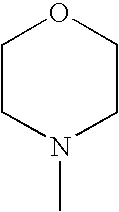 |
6-F | H |
 |
520(M+ + 1) [ESI(Pos.)] | 5.2 [C] |
| 1-045*2 | 1 |
 |
7-F | H |
 |
520(M+ + 1) [ESI(Pos.)] | 7.2 [C] |
| 1-046 | 1 |
 |
6-F | 7-F |
 |
538(M+ + 1) [ESI(Pos.)] | 8.8 [C] |
| 1-047 | 1 |
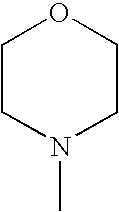 |
6-Cl | H |
 |
536(M+ + 1) [ESI(Pos.)] | 7.7 [B] |
| 1-048 | 1 |
 |
5-Me | H |
 |
516(M+ + 1) [ESI(Pos.)] | 6.8 [C] |
| 1-049 | 1 |
 |
6-Me | H |
 |
516(M+ + 1) [ESI(Pos.)] | 7.3 [C] |
| 1-050 | 1 |
 |
7-Me | H |
 |
516(M+ + 1) [ESI(Pos.)] | 6.9 [C] |
| 1-051 | 1 |
 |
6-OMe | H |
 |
532(M+ + 1) [ESI(Pos.)] | 9.9 [C] |
| 1-052 | 1 |
 |
6-OMe | 7-OMe |
 |
562(M+ + 1) [ESI(Pos.)] | 8.1 [C] |
| 1-053 | 1 |
 |
7-CF3 | H |
 |
570(M+ + 1) [ESI(Pos.)] | 15.3 [C] |
| 1-054 | 1 |
 |
H | H |
 |
522(M+ + 1) [ESI(Pos.)] | 5.4 [B] |
| 1-055*2,4 | 1 |
 |
H | H |
 |
478(M+ + 1) [ESI(Pos.)] | 5.5 [Q] |
| 1-056*2,4 | 1 |
 |
H | H |
 |
492(M+ + 1) [ESI(Pos.)] | 12.8 [Q] |
| 1-057*2,5 | 1 |
 |
H | H |
 |
520(M+ + 1) [ESI(Pos.)] | |
| 1-058*2 | 1 |
 |
H | H |
 |
520(M+ + 1) [ESI(Pos.)] | |
| 1-059 | 1 |
 |
H | H |
 |
568(M+ + 1) [ESI(Pos.)] | 6.0 [A] |
| 1-060*2 | 1 |
 |
H | H |
 |
568(M+ + 1) [ESI(Pos.)] | |
| 1-061 | 38 |
 |
H | H |
 |
536(M+ + 1) [ESI(Pos.)] | |
| 1-062 | 1 |
 |
H | H |
 |
564(M+ + 1) [ESI(Pos.)] | |
| 1-063 | 38 |
 |
H | H |
 |
535(M+ + 1) [ESI(Pos.)] | 5.7 [L] |
| 1-064 | 11 |
 |
7-Cl | H |
 |
653(M+ + 1) [ESI(Pos.)] | |
| 1-065 | 1 |
 |
H | H |
 |
571(M+ + 1) [ESI(Pos.)] | 6.0 [C] |
| 1-066 | 1 |
 |
6-F | H |
 |
589(M+ + 1) [ESI(Pos.)] | 5.3 [C] |
| 1-067*2 | 1 |
 |
7-F | H |
 |
589(M+ + 1) [ESI(Pos.)] | 7.5 [C] |
| 1-068 | 1 |
 |
6-Cl | H |
 |
605(M+ + 1) [ESI(Pos.)] | 11.8 [C] |
| 1-069 | 1 |
 |
6-Me | H |
 |
585(M+ + 1) [ESI(Pos.)] | 10.3 [C] |
| 1-070 | 1 |
 |
6-OMe | H |
 |
601(M+ + 1) [ESI(Pos.)] | 8.5 [C] |
| 1-071 | 1 |
 |
6-OMe | H |
 |
627(M+ + 1) [ESI(Pos.)] | 13.0 [C] |
| 1-072 | 1 |
 |
6-OMe | H |
 |
643(M+ + 1) [ESI(Pos.)] | 7.2 [C] |
| 1-073 | 1 |
 |
H | H |
 |
614(M+ + 1) [ESI(Pos.)] | 12.7 [J] |
| 1-074*3,4 | 3 |
 |
H | H |
 |
507(M+ + 1) [ESI(Pos.)] | 5.5 [F] |
| 1-075 | 1 |
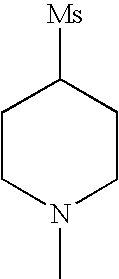 |
H | H |
 |
578(M+ + 1) [ESI(Pos.)] | 8.1 [C] |
| 1-076 | 1 |
 |
6-Cl | H |
 |
612(M+ + 1) [ESI(Pos.)] | 6.9 [C] |
| 1-077 | 1 |
 |
6-Me | H |
 |
592(M+ + 1) [ESI(Pos.)] | 21.0 [E] |
| 1-078 | 1 |
 |
6-OMe | H |
 |
608(M+ + 1) [ESI(Pos.)] | 6.2 [C] |
| 1-079*2 | 1 |
 |
H | H |
 |
508(M+ + 1) [ESI(Pos.)] | 10.1 [E] |
| 1-080 | 1 |
 |
H | H |
 |
530(M+ + 1) [ESI(Pos.)] | 13.3 [C] |
| 1-081*2 | 1 |
 |
H | H |
 |
602(M+ + 1) [ESI(Pos.)] | |
| 1-082 | 1 |
 |
H | H |
 |
544(M+ + 1) [ESI(Pos.)] | 12.7 [B] |
| 1-083*2 | 1 |
 |
H | H |
 |
517(M+ + 1) [ESI(Pos.)] | 5.3 [J] |
| 1-084 | 1 |
 |
H | H |
 |
525(M+ + 1) [ESI(Pos.)] | 6.7 [C] |
| 1-085 | 1 |
 |
H | H |
 |
607(M+ + 1) [ESI(Pos.)] | 9.3 [C] |
| 1-086*4 | 4 |
 |
H | H |
 |
549(M+ + 1) [ESI(Pos.)] | 3.7 [J] |
| 1-087 | 1 |
 |
H | H |
 |
557(M+ + 1) [ESI(Pos.)] | 10.2 [E] |
| 1-088 | 1 |
 |
H | H |
 |
593(M+ + 1) [ESI(Pos.)] | 5.6 [C] |
| 1-089 | 1 |
 |
H | H |
 |
601(M+ + 1) [ESI(Pos.)] | 12.1 [J] |
| 1-090 | 1 |
 |
H | H |
 |
585(M+ + 1) [ESI(Pos.)] | 7.9 [F] |
| 1-091 | 1 |
 |
6-F | H |
 |
603(M+ + 1) [ESI(Pos.)] | 8.3 [F] |
| 1-092 | 1 |
 |
7-F | H |
 |
603(M+ + 1) [ESI(Pos.)] | 8.6 [F] |
| 1-093 | 1 |
 |
H | H |
 |
561(M+ + 1) [ESI(Pos.)] | 7.3 [J] |
| 1-094 | 1 |
 |
H | H |
 |
575(M+ + 1) [ESI(Pos.)] | 7.6 [J] |
| 1-095 | 1 |
 |
H | H |
 |
558(M+ + 1) [ESI(Pos.)] | 6.1 [J] |
| 1-096 | 1 |
 |
H | H |
 |
577(M+ + 1) [ESI(Pos.)] | 6.7 [E] |
| 1-097 | 1 |
 |
H | H |
 |
571(M+ + 1) [ESI(Pos.)] | 6.0 [C] |
| 1-098 | 1 |
 |
6-Me | H |
 |
585(M+ + 1) [ESI(Pos.)] | 12.9 [C] |
| 1-099 | 1 |
 |
H | H |
 |
571(M+ + 1) [ESI(Pos.)] | 5.8 [C] |
| 1-100 | 1 |
 |
H | H |
 |
575(M+ + 1) [ESI(Pos.)] | 4.3 [C] |
| 1-101 | 1 |
 |
7-F | H |
 |
558(M+ + 1) [ESI(Pos.)] | 6.2 [I] |
| 1-102*3 | 3 |
 |
H | H |
 |
493(M+ + 1) [ESI(Pos.)] | 3.5 [F] |
| 1-103*3 | 6 |
 |
H | H |
 |
507(M+ + 1) [ESI(Pos.)] | 7.5 [J] |
| 1-104*3 | 6 |
 |
H | H |
 |
511(M+ + 1) [ESI(Pos.)] | 6.3 [J] |
| 1-105*3 | 6 |
 |
H | H |
 |
523(M+ + 1) [ESI(Pos.)] | 5.9 [J] |
| 1-106*3 | 6 |
 |
H | H |
 |
577(M+ + 1) [ESI(Pos.)] | 10.3 [J] |
| 1-107*3 | 6 |
 |
H | H |
 |
511(M+ + 1) [ESI(Pos.)] | 6.3 [J] |
| 1-108*3 | 6 |
 |
H | H |
 |
538(M+ + 1) [ESI(Pos.)] | 6.1 [J] |
| 1-109*3 | 6 |
 |
H | H |
 |
511(M+ + 1) [ESI(Pos.)] | 5.7 [J] |
| 1-110*3 | 6 |
 |
H | H |
 |
529(M+ + 1) [ESI(Pos.)] | 7.1 [J] |
| 1-111*3 | 6 |
 |
H | H |
 |
545(M+ + 1) [ESI(Pos.)] | 8.4 [J] |
| 1-112*3 | 6 |
 |
H | H |
 |
561(M+ + 1) [ESI(Pos.)] | 9.5 [J] |
| 1-113 | 35 |
 |
H | H |
 |
417(M+ + 1) [ESI(Pos.)] | 5.4 [K] |
| 1-114*3 | 5 |
 |
H | H |
 |
451(M+ + 1) [ESI(Pos.)] | 6.6 [K] |
| 1-115 | 35 |
 |
H | H |
 |
447(M+ + 1) [ESI(Pos.)] | 5.3 [K] |
| 1-116*3 | 3 |
 |
H | H |
 |
501(M+ + 1) [ESI(Pos.)] | |
| 1-117 | 35 |
 |
H | H |
 |
495(M+ + 1) [ESI(Pos.)] | 6.8 [K] |
| 1-118*3 | 3 |
 |
6-F | H |
 |
511(M+ + 1) [ESI(Pos.)] | 6.3 [J] |
| 1-119*3 | 3 |
 |
7-F | H |
 |
511(M+ + 1) [ESI(Pos.)] | 5.2 [F] |
| 1-120*3,4 | 3 |
 |
6-F | 7-F |
 |
529(M+ + 1) [ESI(Pos.)] | 4.7 [J] |
| 1-121*3 | 3 |
 |
7-Cl | H |
 |
527(M+ + 1) [ESI(Pos.)] | 7.1 [F] |
| 1-122*3 | 3 |
 |
7-Me | H |
 |
507(M+ + 1) [ESI(Pos.)] | 7.1 [F] |
| 1-123*3 | 3 |
 |
7-CF3 | H |
 |
561(M+ + 1) [ESI(Pos.)] | |
| 1-124*3 | 3 |
 |
6-OMe | 7-OMe |
 |
553(M+ + 1) [ESI(Pos.)] | 4.9 [F] |
| 1-125 | 1 |
 |
H | H |
 |
593(M+ + 1) [ESI(Pos.)] | |
| 1-126*3,5 | 1 |
 |
H | H |
 |
507(M+ + 1) [ESI(Pos.)] | 4.4 10.5 [J] |
| 1-127*3,5 | 1 |
 |
H | H |
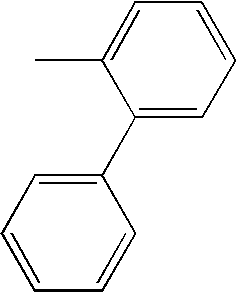 |
521(M+ + 1) [ESI(Pos.)] | 4.0 [F] |
| 1-128 | 1 |
 |
H | H |
 |
507(M+ + 1) [ESI(Pos.)] | 4.4 [L] |
| 1-129 | 6 |
 |
H | H |
 |
613(M+ + Na) [ESI(Pos.)] | 7.4 [K] |
| 1-130 | 1 |
 |
H | H |
 |
509(M+ + 1) [ESI(Pos.)] | 4.4 [L] |
| 1-131 | 1 |
 |
7-F | H |
 |
547(M+ + Na) [ESI(Pos.)] | 4.8 [K] |
| 1-132 | 1, 6 |
 |
7-F | H |
 |
631(M+ + Na) [ESI(Pos.)] | 8.4 [K] |
| 1-133 | 6 |
 |
7-F | H |
 |
627(M+ + 1) [ESI(Pos.)] | |
| 1-134 | 6 |
 |
7-F | H |
 |
627(M+ + 1) [ESI(Pos.)] | |
| 1-135 | 6 |
 |
7-F | H |
 |
449(M+ + 1) [ESI(Pos.)] | 5.1 [M] |
| 1-136 | 1 |
 |
7-F | H |
 |
549(M+ + Na) [ESI(Pos.)] | 4.8 [L] |
| 1-137 | 1 |
 |
7-F | H |
 |
567(M+ + Na) [ESI(Pos.)] | 5.5 [L] |
| 1-138 | 1 |
 |
7-F | H |
 |
567(M+ + Na) [ESI(Pos.)] | 5.3 [L] |
| 1-139 | 1 |
 |
7-F | H |
 |
517(M+ + 1) [ESI(Pos.)] | 6.4 [L] |
| 1-140 | 1 |
 |
7-F | H |
 |
533(M+ + 1) [ESI(Pos.)] | 6.9 [L] |
| 1-141 | 1 |
 |
7-F | H |
 |
549(M+ + 1) [ESI(Pos.)] | 8.6 [L] |
| 1-142 | 1 |
 |
7-Cl | H |
 |
647(M+ + Na) [ESI(Pos.)] | 6.4 [J] |
| 1-143 | 1 |
 |
7-CF3 | H |
 |
575(M+ + 1) [ESI(Pos.)] | |
| 1-144 | 1 |
 |
7-F | H |
 |
561(M+ + Na) [ESI(Pos.)] | 5.8 [K] |
| 1-145 | 1 |
 |
7-F | H |
 |
575(M+ + Na) [ESI(Pos.)] | 6.9 [K] |
| 1-146 | 1 |
 |
7-F | H |
 |
589(M+ + Na) [ESI(Pos.)] | 8.3 [K] |
| 1-147*3,5 | 1 |
 |
H | H |
 |
569(M+ + 1) [ESI(Pos.)] | 5.7 6.1 [J] |
| 1-148*3,4 | 1 |
 |
H | H |
 |
529(M+ + Na) [ESI(Pos.)] | 5.5 [R] |
| 1-149*3,4 | 1 |
 |
H | H |
 |
543(M+ + Na) [ESI(Pos.)] | 7.0 [R] |
| 1-150*3,4 | 1 |
 |
H | H |
 |
535(M+ + 1) [ESI(Pos.)] | 6.4 [P] |
| 1-151 | 1 |
 |
H | H |
 |
549(M+ + 1) [ESI(Pos.)] | 5.1 [J] |
| 1-152 | 1 |
 |
H | H |
 |
545(M+ + 1) [ESI(Pos.)] | 5.4 [F] |
| 1-153 | 1 |
 |
6-F | H |
 |
563(M+ + 1) [ESI(Pos.)] | 5.6 [F] |
| 1-154 | 1 |
 |
7-F | H |
 |
563(M+ + 1) [ESI(Pos.)] | 6.1 [F] |
| 1-155*3,4 | 1 |
 |
H | H |
 |
535(M+ + 1) [ESI(Pos.)] | 7.4 [J] |
| 1-156*4 | 1 |
 |
H | H |
 |
509(M+ + 1) [ESI(Pos.)] | 5.9 [J] |
| 1-157*3,4 | 1 |
 |
H | H |
 |
509(M+ + 1) [ESI(Pos.)] | 5.9 [J] |
| 1-158*4 | 1 |
 |
H | H |
 |
537(M+ + 1) [ESI(Pos.)] | 6.1 [J] |
| 1-159*3,4 | 1 |
 |
H | H |
 |
533(M+ + 1) [ESI(Pos.)] | 7.0 [P] |
| 1-160*3,4 | 1 |
 |
H | H |
 |
561(M+ + 1) [ESI(Pos.)] | 7.9 [P] |
| 1-161*2 | 4 |
 |
H | H |
 |
535(M+ + 1) [ESI(Pos.)] | 5.2 [L] |
| 1-162 | 1 |
 |
6-F | H |
 |
561(M+ + 1) [ESI(Pos.)] | 14.7 [E] |
| 1-163*2 | 1 |
 |
7-F | H |
 |
561(M+ + 1) [ESI(Pos.)] | 4.4 [C] |
| 1-164 | 1 |
 |
6-Cl | H |
 |
577(M+ + 1) [ESI(Pos.)] | 17.8 [E] |
| 1-165 | 1 |
 |
6-Me | H |
 |
557(M+ + 1) [ESI(Pos.)] | 8.3 [C] |
| 1-166 | 1 |
 |
7-Me | H |
 |
557(M+ + 1) [ESI(Pos.)] | 5.7 [C] |
| 1-167 | 1 |
 |
6-OMe | H |
 |
573(M+ + 1) [ESI(Pos.)] | 12.5 [E] |
| 1-168 | 1 |
 |
H | H |
 |
549(M+ + 1) [ESI(Pos.)] | 6.0 [K] |
| 1-169 | 1 |
 |
H | H |
 |
563(M+ + 1) [ESI(Pos.)] | 7.4 [K] |
| 1-170 | 1 |
 |
H | H |
 |
577(M+ + 1) [ESI(Pos.)] | 9.2 [K] |
| 1-171 | 1 |
 |
H | H |
 |
569(M+ + 1) [ESI(Pos.)] | 7.1 [C] |
| 1-172 | 1 |
 |
6-OMe | H |
 |
599(M+ + 1) [ESI(Pos.)] | 9.1 [C] |
| 1-173 | 1 |
 |
H | H |
 |
551(M+ + 1) [ESI(Pos.)] | 7.2 [K] |
| 1-174 | 1 |
 |
H | H |
 |
572(M+ + 1) [ESI(Pos.)] | 18.5 [E] |
| 1-175 | 1 |
 |
6-OMe | H |
 |
644(M+ + 1) [ESI(Pos.)] | 7.1 [C] |
| 1-176 | 1 |
 |
6-OMe | H |
 |
636(M+ + 1) [ESI(Pos.)] | 10.1 [E] |
| 1-177 | 1 |
 |
H | H |
 |
579(M+ + 1) [ESI(Pos.)] | 6.1 [C] |
| 1-178 | 1 |
 |
6-F | H |
 |
597(M+ + 1) [ESI(Pos.)] | 13.5 [C] |
| 1-179 | 1 |
 |
7-F | H |
 |
597(M+ + 1) [ESI(Pos.)] | 6.6 [C] |
| 1-180 | 1 |
 |
6-Cl | H |
 |
613(M+ + 1) [ESI(Pos.)] | 12.0 [C] |
| 1-181 | 1 |
 |
6-Me | H |
 |
593(M+ + 1) [ESI(Pos.)] | 7.4 [B] |
| 1-182 | 1 |
 |
6-OMe | H |
 |
609(M+ + 1) [ESI(Pos.)] | 9.4 [C] |
| 1-183 | 1 |
 |
H | H |
 |
593(M+ + 1) [ESI(Pos.)] | 9.8 [C] |
| 1-184 | 1 |
 |
H | H |
 |
633(M+ + 1) [ESI(Pos.)] | 6.4 [A] |
| 1-185*3 | 1 |
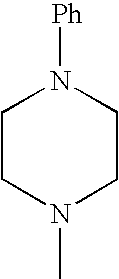 |
H | H |
 |
569(M+ + 1) [ESI(Pos.)] | 9.7 [J] |
| 1-186 | 1 |
 |
H | H |
 |
578(M+ + 1) [ESI(Pos.)] | 5.5 [E] |
| 1-187 | 1 |
 |
6-F | H |
 |
596(M+ + 1) [ESI(Pos.)] | 5.8 [E] |
| 1-188 | 1 |
 |
7-F | H |
 |
596(M+ + 1) [ESI(Pos.)] | 5.8 [E] |
| 1-189 | 1 |
 |
H | H |
 |
557(M+ + 1) [ESI(Pos.)] | 4.7 [C] |
| 1-190 | 1 |
 |
H | H |
 |
557(M+ + 1) [ESI(Pos.)] | 4.2 [C] |
| 1-191 | 1 |
 |
6-Me | H |
 |
571(M+ + 1) [ESI(Pos.)] | 6.1 [B] |
| 1-192*3,5 | 3 |
 |
H | H |
 |
493(M+ + 1) [ESI(Pos.)] | |
| 1-193*3,5 | 3 |
 |
H | H |
 |
501(M+ + 1) [ESI(Pos.)] | |
| 1-194*3 | 3 |
 |
H | H |
 |
493(M+ + 1) [ESI(Pos.)] | 3.6 [F] |
| 1-195*3 | 3 |
 |
H | H |
 |
493(M+ + 1) [ESI(Pos.)] | 3.9 [F] |
| 1-196 | 1 |
 |
H | H |
 |
543(M+ + 1) [ESI(Pos.)] | 9.5 [E] |
| 1-197 | 1 |
 |
H | H |
 |
543(M+ + 1) [ESI(Pos.)] | 13.0 [E] |
| 1-198 | 1 |
 |
H | H |
 |
579(M+ + 1) [ESI(Pos.)] | 13.8 [E] |
| 1-199 | 1 |
 |
H | H |
 |
579(M+ + 1) [ESI(Pos.)] | 5.1 [C] |
| 1-200 | 1 |
 |
H | H |
 |
557(M+ + 1) [ESI(Pos.)] | 7.7 [C] |
| 1-201*3,5 | 3 |
 |
H | H |
 |
507(M+ + 1) [ESI(Pos.)] | 5.7 [F] |
| 1-202*3,5 | 3 |
 |
H | H |
 |
521(M+ + 1) [ESI(Pos.)] | 5.7 [F] |
| 1-203*5 | 1 |
 |
H | H |
 |
494(M+ + 1) [ESI(Pos.)] | 4.0 [J] |
| 1-204 | 1 |
 |
H | H |
 |
516(M+ + 1) [ESI(Pos.)] | 10.8 [C] |
| 1-205 | 1 |
 |
H | H |
 |
516(M+ + 1) [ESI(Pos.)] | 11.2 [C] |
| 1-206 | 1 |
 |
H | H |
 |
546(M+ + 1) [ESI(Pos.)] | 5.9 [B] |
| 1-207 | 1 |
 |
6-Me | H |
 |
560(M+ + 1) [ESI(Pos.)] | 8.3 [B] |
| 1-208 | 1 |
 |
6-OMe | H |
 |
576(M+ + 1) [ESI(Pos.)] | 10.7 [C] |
| 1-209 | 1 |
 |
H | H |
 |
497(M+ + Na) [ESI(Pos.)] | |
| 1-210*3 | 3 |
 |
H | H |
 |
507(M+ + 1) [ESI(Pos.)] | 4.1 [F] |
| 1-211 | 2 |
 |
H | H |
 |
529(M+ + 1) [ESI(Pos.)] | 6.6 [F] |
| 1-212*2 | 4 |
 |
H | H |
 |
549(M+ + 1) [ESI(Pos.)] | 3.9 [J] |
| 1-213 | 1 |
 |
H | H |
 |
557(M+ + 1) [ESI(Pos.)] | 5.2 [C] |
| 1-214 | 1 |
 |
H | H |
 |
593(M+ + 1) [ESI(Pos.)] | 5.7 [C] |
| 1-215 | 1 |
 |
H | H |
 |
647(M+ + 1) [ESI(Pos.)] | 5.4 [A] |
| 1-216 | 1 |
 |
6-OMe | H |
 |
461(M+ + 1) [ESI(Pos.)] | 5.4 [B] |
| 1-217 | 37 |
 |
H | H |
 |
447(M+ + 1) [ESI(Pos.)] | |
| 1-218 | 1 |
 |
6-OMe | H |
 |
447(M+ + 1) [ESI(Pos.)] | 4.5 [B] |
| 1-219 | 9 |
 |
H | H |
 |
499(M+ + 1) [ESI(Pos.)] | 9.9 [A] |
| 1-220*2,4 | 9 |
 |
H | H |
 |
507(M+ + Na) [ESI(Pos.)] | |
| *1ESI: electronspray ionization | |||||||
| *2Mono-HCl salt | |||||||
| *3Di-HCl salt | |||||||
| *4Racemic mixtuer | |||||||
| *5Diastereomer mixture | |||||||
| TABLE 2 |
 |
| MS*1 | |||||
| Compound | Example | [Ionization | |||
| No. | No. | Q1 | Q2 | —Ar | method] |
| 2-001 | 7 | Single bond | —CH2— |
 |
467 (M+ + 1) [ESI(Pos.)] |
| 2-002 | 7 | Single bond | —CH2— |
 |
417 (M+ + 1) [ESI(Pos.)] |
| 2-003 | 8 | Single bond | —CH2— |
 |
431 (M+ + 1) [ESI(Pos.)] |
| 2-004 | 8 | Single bond | —CH2— |
 |
431 (M+ + 1) [ESI(Pos.)] |
| 2-005 | 8 | Single bond | —CH2— |
 |
431 (M+ + 1) [ESI(Pos.)] |
| 2-006 | 8 | Single bond | —CH2— |
 |
435 (M+ + 1) [ESI(Pos.)] |
| 2-007 | 8 | Single bond | —CH2— |
 |
435 (M+ + 1) [ESI(Pos.)] |
| 2-008 | 7 | Single bond | —CH2— |
 |
435 (M+ + 1) [ESI(Pos.)] |
| 2-009 | 8 | Single bond | —CH2— |
 |
451 (M+ + 1) [ESI(Pos.)] |
| 2-010 | 8 | Single bond | —CH2— |
 |
451 (M+ + 1) [ESI(Pos.)] |
| 2-011 | 7 | Single bond | —CH2— |
 |
451 (M+ + 1) [ESI(Pos.)] |
| 2-012 | 7 | Single bond | —CH2— |
 |
495 (M+ + 1) [ESI(Pos.)] |
| 2-013 | 8 | Single bond | —CH2— |
 |
495 (M+ + 1) [ESI(Pos.)] |
| 2-014 | 8 | Single bond | —CH2— |
 |
495 (M+ + 1) [ESI(Pos.)] |
| 2-015 | 8 | Single bond | —CH2— |
 |
543 (M+ + 1) [ESI(Pos.)] |
| 2-016 | 8 | Single bond | —CH2— |
 |
543 (M+ + 1) [ESI(Pos.)] |
| 2-017 | 8 | Single bond | —CH2— |
 |
543 (M+ + 1) [ESI(Pos.)] |
| 2-018 | 8 | Single bond | —CH2— |
 |
447 (M+ + 1) [ESI(Pos.)] |
| 2-019 | 7 | Single bond | —CH2— |
 |
447 (M+ + 1) [ESI(Pos.)] |
| 2-020 | 7 | Single bond | —CH2— |
 |
447 (M+ + 1) [ESI(Pos.)] |
| 2-021 | 8 | Single bond | —CH2— |
 |
501 (M+ + 1) [ESI(Pos.)] |
| 2-022 | 8 | Single bond | —CH2— |
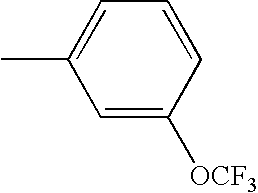 |
501 (M+ + 1) [ESI(Pos.)] |
| 2-023 | 8 | Single bond | —CH2— |
 |
501 (M+ + 1) [ESI(Pos.)] |
| 2-024 | 8 | Single bond | —CH2— |
 |
461 (M+ + 1) [ESI(Pos.)] |
| 2-025 | 8 | Single bond | —CH2— |
 |
461 (M+ + 1) [ESI(Pos.)] |
| 2-026 | 8 | Single bond | —CH2— |
 |
489 (M+ + 1) [ESI(Pos.)] |
| 2-027 | 8 | Single bond | —CH2— |
 |
509 (M+ + 1) [ESI(Pos.)] |
| 2-028 | 8 | Single bond | —CH2— |
 |
509 (M+ + 1) [ESI(Pos.)] |
| 2-029 | 8 | Single bond | —CH2— |
 |
523 (M+ + 1) [ESI(Pos.)] |
| 2-030 | 7 | Single bond | —CH2— |
 |
523 (M+ + 1) [ESI(Pos.)] |
| 2-031 | 8 | Single bond | —CH2— |
 |
459 (M+ + 1) [ESI(Pos.)] |
| 2-032 | 8 | Single bond | —CH2— |
 |
473 (M+ + 1) [ESI(Pos.)] |
| 2-033 | 8 | Single bond | —CH2— |
 |
493 (M+ + 1) [ESI(Pos.)] |
| 2-034 | 8 | Single bond | —CH2— |
 |
511 (M+ + 1) [ESI(Pos.)] |
| 2-035 | 8 | Single bond | —CH2— |
 |
511 (M+ + 1) [ESI(Pos.)] |
| 2-036 | 8 | Single bond | —CH2— |
 |
511 (M+ + 1) [ESI(Pos.)] |
| 2-037 | 8 | Single bond | —CH2— |
 |
511 (M+ + 1) [ESI(Pos.)] |
| 2-038 | 8 | Single bond | —CH2— |
 |
511 (M+ + 1) [ESI(Pos.)] |
| 2-039 | 8 | Single bond | —CH2— |
 |
527 (M+ + 1) [ESI(Pos.)] |
| 2-040 | 8 | Single bond | —CH2— |
 |
527 (M+ + 1) [ESI(Pos.)] |
| 2-041 | 8 | Single bond | —CH2— |
 |
527 (M+ + 1) [ESI(Pos.)] |
| 2-042 | 8 | Single bond | —CH2— |
 |
527 (M+ + 1) [ESI(Pos.)] |
| 2-043 | 8 | Single bond | —CH2— |
 |
527 (M+ + 1) [ESI(Pos.)] |
| 2-044 | 8 | Single bond | —CH2— |
 |
527 (M+ + 1) [ESI(Pos.)] |
| 2-045 | 8 | Single bond | —CH2— |
 |
527 (M+ + 1) [ESI(Pos.)] |
| 2-046 | 8 | Single bond | —CH2— |
 |
527 (M+ + 1) [ESI(Pos.)] |
| 2-047 | 8 | Single bond | —CH2— |
 |
527 (M+ + 1) [ESI(Pos.)] |
| 2-048 | 8 | Single bond | —CH2— |
 |
561 (M+ + 1) [ESI(Pos.)] |
| 2-049 | 8 | Single bond | —CH2— |
 |
561 (M+ + 1) [ESI(Pos.)] |
| 2-050 | 8 | Single bond | —CH2— |
 |
529 (M+ + 1) [ESI(Pos.)] |
| 2-051 | 8 | Single bond | —CH2— |
 |
529 (M+ + 1) [CI(Pos.)] |
| 2-052 | 8 | Single bond | —CH2— |
 |
529 (M+ + 1) [ESI(Pos.)] |
| 2-053 | 8 | Single bond | —CH2— |
 |
529 (M+ + 1) [ESI(Pos.)] |
| 2-054 | 8 | Single bond | —CH2— |
 |
529 (M+ + 1) [ESI(Pos.)] |
| 2-055 | 8 | Single bond | —CH2— |
 |
529 (M+ + 1) [ESI(Pos.)] |
| 2-056 | 8 | Single bond | —CH2— |
 |
523 (M+ + 1) [ESI(Pos.)] |
| 2-057 | 8 | Single bond | —CH2— |
 |
523 (M+ + 1) [ESI(Pos.)] |
| 2-058 | 8 | Single bond | —CH2— |
 |
523 (M+ + 1) [ESI(Pos.)] |
| 2-059 | 8 | Single bond | —CH2— |
 |
523 (M+ + 1) [ESI(Pos.)] |
| 2-060 | 8 | Single bond | —CH2— |
 |
523 (M+ + 1) [ESI(Pos.)] |
| 2-061 | 8 | Single bond | —CH2— |
 |
523 (M+ + 1) [ESI(Pos.)] |
| 2-062 | 8 | Single bond | —CH2— |
 |
523 (M+ + 1) [ESI(Pos.)] |
| 2-063 | 8 | Single bond | —CH2— |
 |
523 (M+ + 1) [ESI(Pos.)] |
| 2-064 | 8 | Single bond | —CH2— |
 |
523 (M+ + 1) [ESI(Pos.)] |
| 2-065 | 8 | Single bond | —CH2— |
 |
537 (M+ + 1) [ESI(Pos.)] |
| 2-066 | 8 | Single bond | —CH2— |
 |
537 (M+ + 1) [ESI(Pos.)] |
| 2-067 | 8 | Single bond | —CH2— |
 |
537 (M+ + 1) [ESI(Pos.)] |
| 2-068 | 8 | Single bond | —CH2— |
 |
485 (M+ + 1) [ESI(Pos.)] |
| 2-069 | 8 | Single bond | —CH2— |
 |
485 (M+ + 1) [ESI(Pos.)] |
| 2-070 | 8 | Single bond | —CH2— |
 |
460 (M+ + 1) [ESI(Pos.)] |
| 2-071 | 8 | Single bond | —CH2— |
 |
508 (M+ + 1) [ESI(Pos.)] |
| 2-072 | 8 | Single bond | —CH2— |
 |
576 (M+ + 1) [ESI(Pos.)] |
| 2-073 | 8 | Single bond | —CH2— |
 |
578 (M+ + 1) [ESI(Pos.)] |
| 2-074 | 8 | Single bond | —CH2— |
 |
581 (M+ + 1) [ESI(Pos.)] |
| 2-075 | 8 | Single bond | —CH2— |
 |
620 (M+ + 1) [ESI(Pos.)] |
| 2-076 | 8 | Single bond | —CH2— |
 |
572 (M+ + 1) [ESI(Pos.)] |
| 2-077 | 8 | Single bond | —CH2— |
 |
570 (M+ + 1) [ESI(Pos.)] |
| 2-078 | 8 | Single bond | —CH2— |
 |
604 (M+ + 1) [ESI(Pos.)] |
| 2-079 | 8 | Single bond | —CH2— |
 |
614 (M+ + 1) [ESI(Pos.)] |
| 2-080 | 8 | Single bond | —CH2— |
 |
540 (M+ + 1) [ESI(Pos.)] |
| 2-081 | 8 | Single bond | —CH2— |
 |
462 (M+ + 1) [ESI(Pos.)] |
| 2-082 | 8 | Single bond | —CH2— |
 |
462 (M+ + 1) [ESI(Pos.)] |
| 2-083 | 8 | Single bond | —CH2— |
 |
462 (M+ + 1) [ESI(Pos.)] |
| 2-084 | 8 | Single bond | —CH2— |
 |
463 (M+ + 1) [ESI(Pos.)] |
| 2-085 | 8 | Single bond | —CH2— |
 |
463 (M+ + 1) [ESI(Pos.)] |
| 2-086 | 8 | Single bond | —CH2— |
 |
517 (M+ + 1) [ESI(Pos.)] |
| 2-087 | 8 | Single bond | —CH2— |
 |
517 (M+ + 1) [ESI(Pos.)] |
| 2-088 | 8 | Single bond | —CH2— |
 |
495 (M+ + 1) [ESI(Pos.)] |
| 2-089 | 8 | Single bond | —CH2— |
 |
495 (M+ + 1) [ESI(Pos.)] |
| 2-090 | 8 | Single bond | —CH2— |
 |
494 (M+ + 1) [ESI(Pos.)] |
| 2-091 | 8 | Single bond | —CH2— |
 |
494 (M+ + 1) [ESI(Pos.)] |
| 2-092 | 8 | Single bond | —CH2— |
 |
453 (M+ + 1) [ESI(Pos.)] |
| 2-093 | 8 | Single bond | —CH2— |
 |
453 (M+ + 1) [ESI(Pos.)] |
| 2-094 | 8 | Single bond | —CH2— |
 |
453 (M+ + 1) [ESI(Pos.)] |
| 2-095 | 8 | Single bond | —CH2— |
 |
453 (M+ + 1) [ESI(Pos.)] |
| 2-096 | 8 | Single bond | —CH2— |
 |
453 (M+ + 1) [ESI(Pos.)] |
| 2-097 | 8 | Single bond | —CH2— |
 |
453 (M+ + 1) [ESI(Pos.)] |
| 2-098 | 8 | Single bond | —CH2— |
 |
469 (M+ + 1) [ESI(Pos.)] |
| 2-099 | 8 | Single bond | —CH2— |
 |
469 (M+ + 1) [ESI(Pos.)] |
| 2-100 | 8 | Single bond | —CH2— |
 |
469 (M+ + 1) [ESI(Pos.)] |
| 2-101 | 8 | Single bond | —CH2— |
 |
469 (M+ + 1) [ESI(Pos.)] |
| 2-102 | 8 | Single bond | —CH2— |
 |
469 (M+ + 1) [ESI(Pos.)] |
| 2-103 | 8 | Single bond | —CH2— |
 |
469 (M+ + 1) [ESI(Pos.)] |
| 2-104 | 8 | Single bond | —CH2— |
 |
485 (M+ + 1) [ESI(Pos.)] |
| 2-105 | 8 | Single bond | —CH2— |
 |
485 (M+ + 1) [ESI(Pos.)] |
| 2-106 | 8 | Single bond | —CH2— |
 |
485 (M+ + 1) [ESI(Pos.)] |
| 2-107 | 8 | Single bond | —CH2— |
 |
513 (M+ + 1) [ESI(Pos.)] |
| 2-108 | 8 | Single bond | —CH2— |
 |
529 (M+ + 1) [ESI(Pos.)] |
| 2-109 | 8 | Single bond | —CH2— |
 |
449 (M− − 1) [ESI(Neg.)] |
| 2-110 | 8 | Single bond | —CH2— |
 |
465 (M+ + 1) [ESI(Pos.)] |
| 2-111 | 8 | Single bond | —CH2— |
 |
573 (M+ + 1) [ESI(Pos.)] |
| 2-112 | 8 | Single bond | —CH2— |
 |
525 (M+ + 1) [ESI(Pos.)] |
| 2-113 | 8 | Single bond | —CH2— |
 |
449 (M+ + 1) [ESI(Pos.)] |
| 2-114 | 8 | Single bond | —CH2— |
 |
449 (M+ + 1) [ESI(Pos.)] |
| 2-115 | 8 | Single bond | —CH2— |
 |
503 (M+ + 1) [ESI(Pos.)] |
| 2-116 | 8 | Single bond | —CH2— |
 |
503 (M+ + 1) [ESI(Pos.)] |
| 2-117 | 8 | Single bond | —CH2— |
 |
503 (M+ + 1) [ESI(Pos.)] |
| 2-118 | 8 | Single bond | —CH2— |
 |
503 (M+ + 1) [ESI(Pos.)] |
| 2-119 | 8 | Single bond | —CH2— |
 |
503 (M+ + 1) [ESI(Pos.)] |
| 2-120 | 8 | Single bond | —CH2— |
 |
503 (M+ + 1) [ESI(Pos.)] |
| 2-121 | 8 | Single bond | —CH2— |
 |
503 (M+ + 1) [ESI(Pos.)] |
| 2-122 | 8 | Single bond | —CH2— |
 |
503 (M+ + 1) [ESI(Pos.)] |
| 2-123 | 8 | Single bond | —CH2— |
 |
519 (M+ + 1) [ESI(Pos.)] |
| 2-124 | 8 | Single bond | —CH2— |
 |
519 (M+ + 1) [ESI(Pos.)] |
| 2-125 | 8 | Single bond | —CH2— |
 |
553 (M+ + 1) [ESI(Pos.)] |
| 2-126 | 8 | Single bond | —CH2— |
 |
553 (M+ + 1) [ESI(Pos.)] |
| 2-127 | 8 | Single bond | —CH2— |
 |
553 (M+ + 1) [ESI(Pos.)] |
| 2-128 | 8 | Single bond | —CH2— |
 |
530 (M+ + 1) [ESI(Pos.)] |
| 2-129 | 8 | Single bond | —CH2— |
 |
478 (M+ + 1) [ESI(Pos.)] |
| 2-130 | 7 | Single bond | —CH2— |
 |
477 (M+ + 1) [ESI(Pos.)] |
| 2-131 | 7 | Single bond | —CH2— |
 |
477 (M+ + 1) [ESI(Pos.)] |
| 2-132 | 8 | Single bond | —CH2— |
 |
477 (M+ + 1) [ESI(Pos.)] |
| 2-133 | 8 | Single bond | —CH2— |
 |
477 (M+ + 1) [ESI(Pos.)] |
| 2-134 | 8 | Single bond | —CH2— |
 |
477 (M+ + 1) [ESI(Pos.)] |
| 2-135 | 8 | Single bond | —CH2— |
 |
491 (M+ + 1) [ESI(Pos.)] |
| 2-136 | 8 | Single bond | —CH2— |
 |
505 (M+ + 1) [ESI(Pos.)] |
| 2-137 | 8 | Single bond | —CH2— |
 |
461 (M+ + 1) [ESI(Pos.)] |
| 2-138 | 8 | Single bond | —CH2— |
 |
445 (M+ + 1) [ESI(Pos.)] |
| 2-139 | 8 | Single bond | —CH2— |
 |
445 (M+ + 1) [ESI(Pos.)] |
| 2-140 | 8 | Single bond | —CH2— |
 |
519 (M+ + 1) [ESI(Pos.)] |
| 2-141 | 8 | Single bond | —CH2— |
 |
487 (M+ + 1) [ESI(Pos.)] |
| 2-142 | 8 | Single bond | —CH2— |
 |
487 (M+ + 1) [ESI(Pos.)] |
| 2-143 | 8 | Single bond | —CH2— |
 |
503 (M+ + 1) [ESI(Pos.)] |
| 2-144 | 8 | Single bond | —CH2— |
 |
471 (M+ + 1) [ESI(Pos.)] |
| 2-145 | 8 | Single bond | —CH2— |
 |
471 (M+ + 1) [ESI(Pos.)] |
| 2-146 | 8 | Single bond | —CH2— |
 |
471 (M+ + 1) [ESI(Pos.)] |
| 2-147 | 8 | Single bond | —CH2— |
 |
471 (M+ + 1) [ESI(Pos.)] |
| 2-148 | 8 | Single bond | —CH2— |
 |
471 (M+ + 1) [ESI(Pos.)] |
| 2-149 | 8 | Single bond | —CH2— |
 |
467 (M+ + 1) [ESI(Pos.)] |
| 2-150 | 8 | Single bond | —CH2— |
 |
467 (M+ + 1) [ESI(Pos.)] |
| 2-151 | 8 | Single bond | —CH2— |
 |
483 (M+ + 1) [ESI(Pos.)] |
| 2-152 | 8 | Single bond | —CH2— |
 |
537 (M+ + 1) [ESI(Pos.)] |
| 2-153 | 8 | Single bond | —CH2— |
 |
545 (M+ + 1) [ESI(Pos.)] |
| 2-154 | 8 | Single bond | —CH2— |
 |
493 (M+ + 1) [ESI(Pos.)] |
| 2-155 | 8 | Single bond | —CH2— |
 |
507 (M+ + 1) [ESI(Pos.)] |
| 2-156 | 8 | Single bond | —CH2— |
 |
507 (M+ + 1) [ESI(Pos.)] |
| 2-157 | 8 | Single bond | —CH2— |
 |
507 (M+ + 1) [ESI(Pos.)] |
| 2-158 | 8 | Single bond | —CH2— |
 |
522 (M+ + 1) [ESI(Pos.)] |
| 2-159 | 8 | Single bond | —CH2— |
 |
459 (M+ + 1) [ESI(Pos.)] |
| 2-160 | 8 | Single bond | —CH2— |
 |
467 (M+ + 1) [ESI(Pos.)] |
| 2-161 | 8 | Single bond | —CH2— |
 |
467 (M+ + 1) [ESI(Pos.)] |
| 2-162 | 8 | Single bond | —CH2— |
 |
459 (M+ + 1) [ESI(Pos.)] |
| 2-163 | 8 | Single bond | —CH2— |
 |
461 (M+ + 1) [ESI(Pos.)] |
| 2-164 | 8 | Single bond | —CH2— |
 |
407 (M+ + 1) [ESI(Pos.)] |
| 2-165 | 8 | Single bond | —CH2— |
 |
487 (M+ + 1) [ESI(Pos.)] |
| 2-166 | 8 | Single bond | —CH2— |
 |
470 (M+ + 1) [ESI(Pos.)] |
| 2-167 | 8 | Single bond | —CH2— |
 |
526 (M− − 1) [ESI(Neg.)] |
| 2-168 | 8 | Single bond | —CH2— |
 |
486 (M+ + 1) [ESI(Pos.)] |
| 2-169 | 8 | Single bond | —CH2— |
 |
562 (M+ + 1) [ESI(Pos.)] |
| 2-170 | 8 | Single bond | —CH2— |
 |
470 (M+ + 1) [ESI(Pos.)] |
| 2-171 | 8 | Single bond | —CH2— |
 |
564 (M+ + 1) [ESI(Pos.)] |
| 2-172 | 8 | Single bond | —CH2— |
 |
500 (M+ + 1) [ESI(Pos.)] |
| 2-173 | 8 | Single bond | —CH2— |
 |
562 (M+ + 1) [ESI(Pos.)] |
| 2-174 | 8 | Single bond | —CH2— |
 |
407 (M+ + 1) [ESI(Pos.)] |
| 2-175 | 7 | Single bond | —CH2— |
 |
423 (M+ + 1) [ESI(Pos.)] |
| 2-176 | 8 | Single bond | —CH2— |
 |
452 (M+ + 1) [ESI(Pos.)] |
| 2-177 | 8 | Single bond | —CH2— |
 |
500 (M+ + 1) [ESI(Pos.)] |
| 2-178 | 8 | Single bond | —CH2— |
 |
514 (M+ + 1) [ESI(Pos.)] |
| 2-179 | 8 | Single bond | —CH2— |
 |
534 (M+ + 1) [ESI(Pos.)] |
| 2-180 | 8 | Single bond | —CH2— |
 |
576 (M+ + 1) [ESI(Pos.)] |
| 2-181 | 8 | Single bond | —CH2— |
 |
610 (M+ + 1) [ESI(Pos.)] |
| 2-182 | 8 | Single bond | —CH2— |
 |
473 (M+ + 1) [ESI(Pos.)] |
| 2-183 | 8 | Single bond | —CH2— |
 |
498 (M+ + 1) [ESI(Pos.)] |
| 2-184 | 8 | Single bond | —CH2— |
 |
418 (M+ + 1) [ESI(Pos.)] |
| 2-185 | 8 | Single bond | —CH2— |
 |
418 (M+ + 1) [ESI(Pos.)] |
| 2-186 | 8 | Single bond | —CH2— |
 |
418 (M+ + 1) [ESI(Pos.)] |
| 2-187 | 8 | Single bond | —CH2— |
 |
496 (M+ + 1) [ESI(Pos.)] |
| 2-188 | 7 | —CH2— | —O— |
 |
489 (M+ + 1) [ESI(Pos.)] |
| 2-189 | 7 | —CH2— | —O— |
 |
478 (M+ + 1) [ESI(Pos.)] |
| 2-190 | 8 | —CH2— | —O— |
 |
535 (M+ + 1) [ESI(Pos.)] |
| 2-191 | 7 | —CH2— | —O— |
 |
523 (M+ + 1) [ESI(Pos.)] |
| 2-192 | 7 | —CH2— | —O— |
 |
515 (M+ + 1) [ESI(Pos.)] |
| 2-193 | 7 | —CH2— | —S— |
 |
449 (M+ + 1) [ESI(Pos.)] |
| 2-194*2 | 8 | Single bond |
 |
 |
431 (M+ + 1) [ESI(Pos.)] |
| 2-195*2 | 8 | Single bond |
 |
 |
465 (M+ + 1) [ESI(Pos.)] |
| 2-196*2 | 8 | Single bond |
 |
 |
445 (M+ + 1) [ESI(Pos.)] |
| 2-197*2 | 8 | Single bond |
 |
 |
487 (M+ + 1) [ESI(Pos.)] |
| 2-198*2 | 8 | Single bond |
 |
 |
525 (M+ + 1) [ESI(Pos.)] |
| 2-199*2 | 8 | Single bond |
 |
 |
535 (M+ + 1) [ESI(Pos.)] |
| 2-200*2 | 8 | Single bond |
 |
 |
476 (M+ + 1) [ESI(Pos.)] |
| 2-201*2 | 8 | Single bond |
 |
 |
511 (M+ + 1) [ESI(Pos.)] |
| 2-202*2 | 8 | Single bond |
 |
 |
541 (M+ + 1) [ESI(Pos.)] |
| 2-203 | 8 | Single bond |
 |
 |
431 (M+ + 1) [ESI(Pos.)] |
| 2-204 | 8 | Single bond |
 |
 |
487 (M+ + 1) [ESI(Pos.)] |
| 2-205 | 8 | Single bond |
 |
 |
525 (M+ + 1) [ESI(Pos.)] |
| 2-206 | 8 | Single bond |
 |
 |
511 (M+ + 1) [ESI(Pos.)] |
| 2-207 | 8 | Single bond |
 |
 |
431 (M+ + 1) [ESI(Pos.)] |
| 2-208 | 8 | Single bond |
 |
 |
525 (M+ + 1) [ESI(Pos.)] |
| 2-209 | 8 | Single bond |
 |
 |
511 (M+ + 1) [ESI(Pos.)] |
| 2-210*2 | 7 | Single bond |
 |
 |
447 (M+ + 1) [ESI(Pos.)] |
| 2-211*2 | 7 | Single bond |
 |
 |
445 (M+ + 1) [ESI(Pos.)] |
| 2-212 | 8 | Single bond |
 |
 |
445 (M+ + 1) [ESI(Pos.)] |
| 2-213 | 8 | Single bond |
 |
 |
445 (M+ + 1) [ESI(Pos.)] |
| 2-214*2 | 7 | Single bond |
 |
 |
461 (M+ + 1) [ESI(Pos.)] |
| 2-215*2 | 8 | Single bond |
 |
 |
459 (M+ + 1) [ESI(Pos.)] |
| 2-216*2 | 8 | Single bond |
 |
 |
493 (M+ + 1) [ESI(Pos.)] |
| 2-217 | 8 | Single bond |
 |
 |
445 (M+ + 1) [ESI(Pos.)] |
| 2-218 | 8 | Single bond |
 |
 |
479 (M+ + 1) [ESI(Pos.)] |
| 2-219 | 7 | Single bond |
 |
 |
495 (M+ + 1) [ESI(Pos.)] |
| 2-220 | 8 | Single bond |
 |
 |
443 (M+ + 1) [ESI(Pos.)] |
| 2-221 | 8 | Single bond |
 |
 |
457 (M+ + 1) [ESI(Pos.)] |
| 2-222 | 8 | Single bond |
 |
 |
477 (M+ + 1) [ESI(Pos.)] |
| 2-223 | 8 | Single bond |
 |
 |
473 (M+ + 1) [ESI(Pos.)] |
| 2-224 | 8 | Single bond |
 |
 |
511 (M+ + 1) [ESI(Pos.)] |
| 2-225*2 | 8 | Single bond |
 |
 |
473 (M+ + 1) [ESI(Pos.)] |
| 2-226 | 8 | Single bond |
 |
 |
491 (M+ + 1) [ESI(Pos.)] |
| 2-227*2 | 8 | Single bond |
 |
 |
485 (M+ + 1) [ESI(Pos.)] |
| 2-228 | 8 | Single bond |
 |
 |
471 (M+ + 1) [ESI(Pos.)] |
| 2-229 | 8 | Single bond |
 |
 |
485 (M+ + 1) [ESI(Pos.)] |
| 2-230 | 8 | Single bond |
 |
 |
489 (M+ + 1) [ESI(Pos.)] |
| 2-231 | 8 | Single bond |
 |
 |
489 (M+ + 1) [ESI(Pos.)] |
| 2-232 | 8 | Single bond |
 |
 |
489 (M+ + 1) [ESI(Pos.)] |
| 2-233 | 8 | Single bond |
 |
 |
501 (M+ + 1) [ESI(Pos.)] |
| 2-234 | 8 | Single bond |
 |
 |
523 (M+ + 1) [ESI(Pos.)] |
| 2-235 | 8 | Single bond |
 |
 |
523 (M+ + 1) [ESI(Pos.)] |
| 2-236*2 | 8 | Single bond |
 |
 |
499 (M+ + 1) [ESI(Pos.)] |
| 2-237 | 8 | Single bond |
 |
 |
485 (M+ + 1) [ESI(Pos.)] |
| 2-238 | 8 | Single bond |
 |
 |
499 (M+ + 1) [ESI(Pos.)] |
| 2-239 | 8 | Single bond |
 |
 |
503 (M+ + 1) [ESI(Pos.)] |
| 2-240 | 8 | Single bond |
 |
 |
503 (M+ + 1) [ESI(Pos.)] |
| 2-241 | 8 | Single bond |
 |
 |
503 (M+ + 1) [ESI(Pos.)] |
| 2-242 | 8 | Single bond |
 |
 |
519 (M+ + 1) [ESI(Pos.)] |
| 2-243 | 8 | Single bond |
 |
 |
515 (M+ + 1) [ESI(Pos.)] |
| 2-244 | 8 | Single bond |
 |
 |
537 (M+ + 1) [ESI(Pos.)] |
| 2-245 | 8 | Single bond |
 |
 |
537 (M+ + 1) [ESI(Pos.)] |
| 2-246 | 8 | Single bond |
 |
 |
491 (M+ + 1) [ESI(Pos.)] |
| 2-247*2 | 7 | Single bond |
 |
 |
493 (M+ + 1) [ESI(Pos.)] |
| 2-248*2 | 8 | Single bond |
 |
 |
559 (M+ + 1) [ESI(Pos.)] |
| 2-249*2 | 8 | Single bond |
 |
 |
525 (M+ + 1) [ESI(Pos.)] |
| 2-250*2 | 8 | Single bond |
 |
 |
433 (M+ + 1) [ESI(Pos.)] |
| 2-251*2 | 8 | Single bond |
 |
 |
451 (M+ + 1) [ESI(Pos.)] |
| 2-252*2 | 8 | Single bond |
 |
 |
467 (M+ + 1) [ESI(Pos.)] |
| 2-253*2 | 8 | Single bond |
 |
 |
467 (M+ + 1) [ESI(Pos.)] |
| 2-254*2 | 8 | Single bond |
 |
 |
467 (M+ + 1) [ESI(Pos.)] |
| 2-255*2 | 8 | Single bond |
 |
 |
511 (M+ + 1) [ESI(Pos.)] |
| 2-256*2 | 8 | Single bond |
 |
 |
463 (M+ + 1) [ESI(Pos.)] |
| 2-257*2 | 8 | Single bond |
 |
 |
501 (M+ + 1) [ESI(Pos.)] |
| 2-258*2 | 8 | Single bond |
 |
 |
469 (M+ + 1) [ESI(Pos.)] |
| 2-259*2 | 8 | Single bond |
 |
 |
477 (M+ + 1) [ESI(Pos.)] |
| 2-260 | 8 | Single bond |
 |
 |
433 (M+ + 1) [ESI(Pos.)] |
| 2-261 | 8 | Single bond |
 |
 |
433 (M+ + 1) [ESI(Pos.)] |
| 2-262 | 8 | Single bond |
 |
 |
467 (M+ + 1) [ESI(Pos.)] |
| 2-263 | 8 | Single bond |
 |
 |
467 (M+ + 1) [ESI(Pos.)] |
| 2-264*2 | 8 | Single bond |
 |
 |
447 (M+ + 1) [ESI(Pos.)] |
| 2-265*2 | 8 | Single bond |
 |
 |
487 (M+ + 1) [ESI(Pos.)] |
| 2-266*2 | 8 | Single bond |
 |
 |
501 (M+ + 1) [ESI(Pos.)] |
| 2-267*2 | 8 | Single bond |
 |
 |
471 (M+ + 1) [ESI(Pos.)] |
| 2-268*2 | 8 | Single bond |
 |
 |
511 (M+ + 1) [ESI(Pos.)] |
| 2-269 | 8 | Single bond |
 |
 |
475 (M+ + 1) [ESI(Pos.)] |
| 2-270*2 | 8 | Single bond |
 |
 |
507 (M+ + 1) [ESI(Pos.)] |
| 2-271*2 | 8 | Single bond |
 |
 |
447 (M+ + 1) [ESI(Pos.)] |
| 2-272*2 | 8 | Single bond |
 |
 |
474 (M+ + 1) [ESI(Pos.)] |
| 2-273 | 7 | —CH2— | —CH2— |
 |
431 (M+ + 1) [ESI(Pos.)] |
| 2-274 | 8 | —CH2— | —CH2— |
 |
465 (M+ + 1) [ESI(Pos.)] |
| 2-275 | 8 | —CH2— | —CH2— |
 |
461 (M+ + 1) [ESI(Pos.)] |
| 2-276 | 8 | —CH2— | —CH2— |
 |
447 (M+ + 1) [ESI(Pos.)] |
| 2-277 | 8 | —CH2— | —CH2— |
 |
499 (M+ + 1) [ESI(Pos.)] |
| 2-278 | 8 | —CH2— | —CH2— |
 |
491 (M+ + 1) [ESI(Pos.)] |
| 2-279 | 8 | —CH2— | —CH2— |
 |
491 (M+ + 1) [ESI(Pos.)] |
| 2-280 | 8 | —CH2— | —CH2— |
 |
559 (M+ + 1) [ESI(Pos.)] |
| 2-281 | 8 | —CH2— | —CPh2— |
 |
583 (M+ + 1) [ESI(Pos.)] |
| 2-282 | 8 | —CH2— | —NH— |
 |
432 (M+ + 1) [ESI(Pos.)] |
| 2-283 | 7 | —CH2— | —O— |
 |
433 (M+ + 1) [ESI(Pos.)] |
| 2-284 | 7 | —CH2— | —O— |
 |
467 (M+ + 1) [ESI(Pos.)] |
| 2-285 | 7 | —CH2— | —O—CH2— |
 |
447 (M+ + 1) [ESI(Pos.)] |
| 2-286 | 8 | —CH2— | —S—CH2— |
 |
463 (M+ + 1) [ESI(Pos.)] |
| 2-287 | 8 | —(CH2)2— |
 |
 |
459 (M+ + 1) [ESI(Pos.)] |
| 2-288 | 8 | —(CH2)2— |
 |
 |
531 (M+ + 1) [ESI(Pos.)] |
| 2-289 | 8 | —(CH2)2— |
 |
 |
465 (M+ + 1) [ESI(Pos.)] |
| 2-290 | 8 | —(CH2)2— | —CH2— |
 |
445 (M+ + 1) [ESI(Pos.)] |
| 2-291 | 8 | —(CH2)2— | —CH2— |
 |
490 (M+ + 1) [ESI(Pos.)] |
| 2-292 | 8 | —(CH2)2— | —CH2— |
 |
505 (M+ + 1) [ESI(Pos.)] |
| 2-293 | 8 | —(CH2)2— | —CH2— |
 |
503 (M+ + 1) [ESI(Pos.)] |
| 2-294 | 8 | —(CH2)2— | —CH2— |
 |
451 (M+ + 1) [ESI(Pos.)] |
| 2-295 | 7 | —(CH2)3— | —O— |
 |
461 (M+ + 1) [ESI(Pos.)] |
| 2-296 | 8 | —(CH2)3— | —CH2— |
 |
465 (M+ + 1) [ESI(Pos.)] |
| 2-297 | 8 | —(CH2)9— | —CH2— |
 |
543 (M+ + 1) [ESI(Pos.)] |
| 2-298 | 7 | —CH═CH2— |
 |
429 (M+ + 1) [ESI(Pos.)] |
| 2-299 | 7 | —CH═CH2— |
 |
497 (M+ + 1) [ESI(Pos.)] |
| 2-300 | 7 | —CH═CH2— |
 |
474 (M+ + 1) [ESI(Pos.)] |
| 2-301 | 8 | —CH═CH2— |
 |
474 (M+ + 1) [ESI(Pos.)] |
| 2-302 | 8 | —CH═CH2— |
 |
474 (M+ + 1) [ESI(Pos.)] |
| 2-303 | 7 | —C(CH3)═CH2— |
 |
443 (M+ + 1) [ESI(Pos.)] |
| *1ESI: electronspray ionization | ||||
| *2Diastereomer mixture | ||||
| TABLE 3 |
 |
| Retention | ||||||||
| time | ||||||||
| MS*1 | (min) | |||||||
| Compound | Example | [Ionization | [Mobile | |||||
| No. | No. | R1a | X1 | X2 | —Q2— | —Ar | method] | phase] |
| 3-001*2 | 1 |
 |
H | H | CH2 |
 |
459(M+ + 1) [ESI(Pos.)] | 8.4 [C] |
| 3-002*5 | 1 |
 |
H | H | CH2 |
 |
451(M+ + 1) [ESI(Pos.)] | |
| 3-003*2,5 | 1 |
 |
H | H | CH2 |
 |
451(M+ + 1) [ESI(Pos.)] | 5.7 [J] |
| 3-004*5 | 1 |
 |
H | H | CH2 |
 |
425(M+ + 1) [ESI(Pos.)] | |
| 3-005*5 | 1 |
 |
H | H | CH2 |
 |
425(M+ + 1) [ESI(Pos.)] | |
| 3-006*6 | 1 |
 |
H | H | CH2 |
 |
425(M+ + 1) [ESI(Pos.)] | 4.6 [J] |
| 3-007*5 | 1 |
 |
H | H | CH2 |
 |
491(M+ + 1) [ESI(Pos.)] | 5.1 [O] |
| 3-008*5 | 1 |
 |
H | H | CH2 |
 |
477(M+ + 1) [ESI(Pos.)] | 5.6 [R] |
| 3-009*5 | 1 |
 |
H | H | CH2 |
 |
493(M+ + 1) [ESI(Pos.)] | |
| 3-010 | 1 |
 |
H | H | CH2 |
 |
493(M+ + 1) [ESI(Pos.)] | 6.8 [C] |
| 3-011 | 19 |
 |
6-OMe | H | CH2 |
 |
531(M+ + 1) [ESI(Pos.)] | 6.2 [C] |
| 3-012 | 34 |
 |
H | H | CH2 |
 |
492(M+ + 1) [ESI(Pos.)] | 5.8 [J] |
| 3-013 | 20 |
 |
6-OMe | H | CH2 |
 |
480(M+ + 1) [ESI(Pos.)] | 5.9 [B] |
| 3-014*2 | 10 |
 |
H | H | CH2 |
 |
430(M+ + 1) [ESI(Pos.)] | 6.0 [C] |
| 3-015*5 | 10 |
 |
H | H | CH2 |
 |
422(M+ + 1) [ESI(Pos.)] | 4.8 [J] |
| 3-016*5 | 10 |
 |
H | H | CH2 |
 |
396(M+ + 1) [ESI(Pos.)] | |
| 3-017*5 | 10 |
 |
H | H | CH2 |
 |
396(M+ + 1) [ESI(Pos.)] | |
| 3-018*5 | 10 |
 |
H | H | CH2 |
 |
424(M+ + 1) [ESI(Pos.)] | 6.3 [Q] |
| 3-019 | 20 |
 |
6-F | H | CH2 |
 |
448(M+ + 1) [ESI(Pos.)] | 5.5 [C] |
| 3-020 | 20 |
 |
6-Cl | H | CH2 |
 |
464(M+ + 1) [ESI(Pos.)] | 8.3 [C] |
| 3-021 | 20 |
 |
6-Me | H | CH2 |
 |
444(M+ + 1) [ESI(Pos.)] | 7.4 [C] |
| 3-022 | 22 |
 |
6-OH | H | CH2 |
 |
446(M+ + 1) [ESI(Pos.)] | 8.3 [E] |
| 3-023 | 20 |
 |
6-OMe | H | CH2 |
 |
460(M+ + 1) [ESI(Pos.)] | 7.4 [C] |
| 3-024 | 21 |
 |
6-OMe | H | CH2 |
 |
444(M+ + 1) [ESI(Pos.)] | 14.7 [E] |
| 3-025 | 21 |
 |
6-OMe | H | CH2 |
 |
444(M+ + 1) [ESI(Pos.)] | 5.4 [C] |
| 3-026 | 20 |
 |
6-OCF3 | H | CH2 |
 |
514(M+ + 1) [ESI(Pos.)] | 7.1 [B] |
| 3-027 | 20 |
 |
6-OH | 7-iPr | CH2 |
 |
488(M+ + 1) [ESI(Pos.)] | 5.8 [B] |
| 3-028 | 20 |
 |
6-iPr | H | CH2 |
 |
472(M+ + 1) [ESI(Pos.)] | 8.1 [B] |
| 3-029*4 | 39 |
 |
H | H | CH2 |
 |
444(M+ + 1) [ESI(Pos.)] | |
| 3-030*4 | 39 |
 |
H | H | CH2 |
 |
458(M+ + 1) [ESI(Pos.)] | |
| 3-031 | 24 |
 |
H | H | CH2 |
 |
446(M+ + 1) [ESI(Pos.)] | 6.4 [C] |
| 3-032 | 24 |
 |
6-F | H | CH2 |
 |
464(M+ + 1) [ESI(Pos.)] | 6.5 [C] |
| 3-033 | 24 |
 |
6-Cl | H | CH2 |
 |
480(M+ + 1) [ESI(Pos.)] | 10.2 [C] |
| 3-034 | 24 |
 |
6-Me | H | CH2 |
 |
460(M+ + 1) [ESI(Pos.)] | 9.1 [C] |
| 3-035 | 24 |
 |
6-OMe | H | CH2 |
 |
476(M+ + 1) [ESI(Pos.)] | 6.6 [C] |
| 3-036*2 | 36 |
 |
H | H | CH2 |
 |
487(M+ + 1) [ESI(Pos.)] | |
| 3-037 | 22 |
 |
6-OH | H |
 |
 |
424(M+ + 1) [ESI(Pos.)] | 5.9 [E] |
| 3-038 | 22 | Me | 6-OH | H |
 |
 |
422(M+ + 1) [ESI(Pos.)] | 5.3 [E] |
| 3-039 | 22 |
 |
6-OH | H |
 |
 |
436(M+ + 1) [ESI(Pos.)] | 5.3 [E] |
| 3-040 | 26 |
 |
6-OH | H |
 |
 |
410(M+ + 1) [ESI(Pos.)] | 5.5 [E] |
| 3-041 | 21 |
 |
6-OMe | H |
 |
 |
438(M+ + 1) [ESI(Pos.)] | 6.6 [C] |
| 3-042 | 21 |
 |
6-OMe | H |
 |
 |
436(M+ + 1) [ESI(Pos.)] | 10.7 [E] |
| 3-043 | 21 |
 |
6-OMe | H |
 |
 |
450(M+ + 1) [ESI(Pos.)] | 8.3 [C] |
| 3-044 | 25 |
 |
6-OMe | H |
 |
 |
424(M+ + 1) [ESI(Pos.)] | 5.0 [C] |
| 3-045 | 21 |
 |
6-Me | H |
 |
 |
438(M+ + 1) [ESI(Pos.)] | 12.2 [C] |
| 3-046 | 21 |
 |
6-Me | H |
 |
 |
436(M+ + 1) [ESI(Pos.)] | 9.9 [C] |
| 3-047 | 21 |
 |
6-Me | H |
 |
 |
450(M+ + 1) [ESI(Pos.)] | 6.0 [B] |
| 3-048 | 25 |
 |
6-Me | H |
 |
 |
424(M+ + 1) [ESI(Pos.)] | 8.9 [C] |
| 3-049 | 20 |
 |
6-OEt | H | CH2 |
 |
474(M+ + 1) [ESI(Pos.)] | 6.6 [J] |
| 3-050 | 21 |
 |
6-OMe | H |
 |
 |
486(M+ + 1) [ESI(Pos.)] | 7.8 [C] |
| *1ESI: electronspray ionization | ||||||||
| *2Mono-HCl salt | ||||||||
| *3Di-HCl salt | ||||||||
| *4Mono-PhSO3H salt | ||||||||
| *5Racemic mixtuer | ||||||||
| TABLE 4 |
 |
| Retention | |||||||
| time | |||||||
| MS*1 | (min) | ||||||
| Compound | Example | [Ionization | [Mobile | ||||
| No. | No. | R1b | X3 | X4 | —Ar | method] | phase] |
| 4-001*2,6 | 1 |
 |
H | H |
 |
402(M+ + 1) [ESI(Pos.)] | |
| 4-002*2,6 | 1 |
 |
H | H |
 |
376(M+ + 1) [ESI(Pos.)] | |
| 4-003*6 | 1 |
 |
H | H |
 |
376(M+ + 1) [ESI(Pos.)] | |
| 4-004*6 | 1 |
 |
H | H |
 |
426(M+ + Na) [ESI(Pos.)] | |
| 4-005*2 | 1 |
 |
H | Me |
 |
416(M+ + 1) [ESI(Pos.)] | 7.0 [E] |
| 4-006*2 | 11 |
 |
H | Me |
 |
424(M+ + 1) [ESI(Pos.)] | 6.9 [K] |
| 4-007*4 | 5-1 |
 |
H | Me |
 |
432(M+ + 1) [ESI(Pos.)] | 7.1 [C] |
| 4-008*4 | 5-1 |
 |
H | Me |
 |
400(M+ + 1) [ESI(Pos.)] | 6.8 [F] |
| 4-009*2 | 11 |
 |
H | Me |
 |
408(M+ + 1) [ESI(Pos.)] | 6.3 [K] |
| 4-010 | 11 |
 |
H | Et |
 |
438(M+ + 1) [ESI(Pos.)] | |
| 4-011*2,6 | 1 |
 |
H | Ph |
 |
478(M+ + 1) [ESI(Pos.)] | |
| 4-012 | 11 |
 |
Me | H |
 |
424(M+ + 1) [ESI(Pos.)] | |
| 4-013 | 11 |
 |
H | Me |
 |
396(M+ + 1) [ESI(Pos.)] | |
| 4-014 | 11 |
 |
H | Me |
 |
410(M+ + 1) [ESI(Pos.)] | |
| 4-015*3 | 1 |
 |
H | Me |
 |
394(M+ + 1) [ESI(Pos.)] | 5.4 [K] |
| 4-016*4 | 1 |
 |
H | Me |
 |
440(M+ + 1) [ESI(Pos.)] | 8.5 [M] |
| 4-017 | 11 |
 |
H | Me |
 |
466(M+ + 1) [ESI(Pos.)] | |
| 4-018 | 1 |
 |
H | Me |
 |
487(M+ + 1) [ESI(Pos.)] | 6.3 [J] |
| 4-019*4 | 1 |
 |
H | Me |
 |
501(M+ + 1) [ESI(Pos.)] | 11.0 [G] |
| 4-020 | 1 |
 |
H | Me |
 |
501(M+ + 1) [ESI(Pos.)] | |
| 4-021 | 5-1 |
 |
H | Me |
 |
501(M+ + 1) [ESI(Pos.)] | |
| 4-022 | 1 |
 |
H | Me |
 |
543(M+ + 1) [ESI(Pos.)] | 7.1 [E] |
| 4-023 | 1 |
 |
H | Me |
 |
543(M+ + 1) [ESI(Pos.)] | 6.9 [E] |
| 4-024 | 11 |
 |
H | Me |
 |
438(M+ + 1) [ESI(Pos.)] | |
| 4-025 | 5 |
 |
H | Me |
 |
452(M+ + 1) [ESI(Pos.)] | |
| 4-026*5 | 5 |
 |
H | Me |
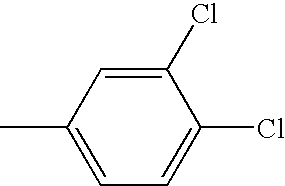 |
436(M+ + 1) [ESI(Pos.)] | |
| 4-027 | 11 |
 |
H | Me |
 |
480(M+ + 1) [ESI(Pos.)] | |
| 4-028 | 11 |
 |
H | Me |
 |
480(M+ + 1) [ESI(Pos.)] | |
| 4-029 | 11 |
 |
H | Me |
 |
514(M+ + 1) [ESI(Pos.)] | |
| 4-030 | 11 |
 |
H | Me |
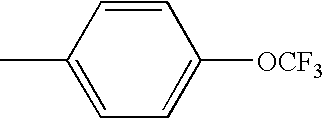 |
514(M+ + 1) [ESI(Pos.)] | |
| 4-031 | 1 |
 |
H | Me |
 |
501(M+ + 1) [ESI(Pos.)] | 6.1 [F] |
| 4-032 | 1 |
 |
H | Me |
 |
515(M+ + 1) [ESI(Pos.)] | 7.1 [C] |
| 4-033 | 11 |
 |
H | Me |
 |
482(M+ + 1) [ESI(Pos.)] | 8.9 [K] |
| 4-034 | 11 |
 |
H | Me |
 |
544(M+ + 1) [ESI(Pos.)] | |
| 4-035 | 11 |
 |
H | Me |
 |
492(M+ + 1) [ESI(Pos.)] | 5.6 [I] |
| 4-036 | 11 |
 |
Me | Me |
 |
506(M+ + 1) [ESI(Pos.)] | |
| 4-037 | 5 |
 |
F | Me |
 |
510(M+ + 1) [ESI(Pos.)] | |
| 4-038 | 11 |
 |
H | Pr |
 |
520(M+ + 1) [ESI(Pos.)] | |
| 4-039 | 11 |
 |
H | Me |
 |
450(M+ + 1) [ESI(Pos.)] | |
| 4-040 | 11 |
 |
H | Me |
 |
464(M+ + 1) [ESI(Pos.)] | |
| 4-041 | 11 |
 |
H | Me |
 |
583(M+ + 1) [ESI(Pos.)] | |
| 4-042*4 | 11 |
 |
H | Me |
 |
507(M+ + 1) [ESI(Pos.)] | 7.8 [K] |
| 4-043*2 | 1 |
 |
H | Me |
 |
535(M+ + 1) [ESI(Pos.)] | 11.0 [E] |
| 4-044 | 11 |
 |
H | Me |
 |
466(M+ + 1) [ESI(Pos.)] | 14.0 [M] |
| 4-045*3,6 | 3 |
 |
Me | H |
 |
457(M+ + 1) [ESI(Pos.)] | |
| 4-046*3,6 | 3 |
 |
H | Me |
 |
457(M+ + 1) [ESI(Pos.)] | 3.1 [F] |
| 4-047*3 | 3 |
 |
H | Me |
 |
465(M+ + 1) [ESI(Pos.)] | 4.9 [J] |
| 4-048 | 1 |
 |
H | Me |
 |
499(M+ + 1) [ESI(Pos.)] | 9.1 [M] |
| 4-049*4 | 11 |
 |
H | Me |
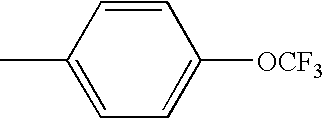 |
507(M+ + 1) [ESI(Pos.)] | 9.0 [K] |
| 4-050*4 | 11 |
 |
H | Me |
 |
543(M+ + 1) [ESI(Pos.)] | 13.8 [K] |
| 4-051 | 1 |
 |
H | Me |
 |
533(M+ + 1) [ESI(Pos.)] | 10.1 [J] |
| 4-052 | 11 |
 |
H | Me |
 |
471(M+ + 1) [ESI(Pos.)] | 6.8 [M] |
| 4-053 | 11 |
 |
H | Me |
 |
479(M+ + 1) [ESI(Pos.)] | 11.6 [N] |
| 4-054 | 1 |
 |
H | Me |
 |
514(M+ + 1) [ESI(Pos.)] | 6.4 [E] |
| 4-055*3,7 | 3 |
 |
H | Me |
 |
465(M+ + 1) [ESI(Pos.)] | |
| 4-056*4,7 | 1 |
 |
H | Me |
 |
493(M+ + 1) [ESI(Pos.)] | 27.9 [H] |
| 4-057 | 1 |
 |
H | Me |
 |
480(M− + 1) [ESI(Pos.)] | 4.9 [C] |
| 4-058 | 2 |
 |
H | Me |
 |
480(M− + 1) [ESI(Pos.)] | 9.4 [E] |
| 4-059*2,6 | 1 |
 |
—(CH2)4— |
 |
456(M− + 1) [ESI(Pos.)] | |
| 4-060*2,6 | 1 |
 |
—(CH2)4— |
 |
430(M+ + 1) [ESI(Pos.)] | |
| 4-061*2,6 | 1 |
 |
—(CH2)4— |
 |
430(M+ + 1) [ESI(Pos.)] | |
| 4-062*2,6 | 1 |
 |
—(CH2)4— |
 |
458(M+ + 1) [ESI(Pos.)] | |
| 4-063 | 11 |
 |
—(CH2)3— |
 |
518(M+ + 1) [ESI(Pos.)] | 5.9 [I] |
| 4-064 | 11 |
 |
—(CH2)4— |
 |
532(M+ + 1) [ESI(Pos.)] | |
| 4-065*6 | 3 |
 |
—(CH2)4— |
 |
497(M+ + 1) [ESI(Pos.)] | 16.0 [G] |
| *1ESI: electronspray ionization | ||||||
| *2Mono-HCl salt | ||||||
| *3Di-HCl salt | ||||||
| *4Mono-maleate | ||||||
| *5Mono-benzenesulfonate | ||||||
| *6Racemic mixture | ||||||
| *7Diastereomer mixture | ||||||
| TABLE 5 |
 |
| Retention | ||||||||
| time | ||||||||
| MS*1 | (min) | |||||||
| Compound | Example | [Ionization | [Mobile | |||||
| No. | No. | R1b | X3 | X4 | R1 | —Ar | method] | phase] |
| 5-001 | 13 |
 |
H | Me | H |
 |
423(M+ + 1) [ESI(Pos.)] | 6.3 [K] |
| 5-002 | 16 |
 |
H | Me | Me |
 |
437(M+ + 1) [ESI(Pos.)] | 5.0 [C] |
| 5-003 | 14 |
 |
H | Me | H |
 |
465(M+ + 1) [ESI(Pos.)] | 7.3 [E] |
| 5-004 | 16 |
 |
H | Me | Me |
 |
479(M+ + 1) [ESI(Pos.)] | 11.0 [E] |
| 5-005 | 16 |
 |
H | Me | H |
 |
481(M+ + 1) [ESI(Pos.)] | 9.4 [C] |
| 5-006 | 17 |
 |
H | Me | H |
 |
513(M+ + 1) [ESI(Pos.)] | 6.0 [E] |
| 5-007 | 14 |
 |
H | Me | H |
 |
449(M+ + 1) [ESI(Pos.)] | 8.3 [C] |
| 5-008 | 16 |
 |
H | Me | H |
 |
463(M+ + 1) [ESI(Pos.)] | 12.3 [C] |
| 5-009 | 14 |
 |
H | Me | H |
 |
477(M+ + 1) [ESI(Pos.)] | 7.5 [B] |
| 5-010 | 14 |
 |
H | Me | H |
 |
534(M+ + 1) [ESI(Pos.)] | 8.5 [E] |
| 5-011 | 14 |
 |
H | Me | H |
 |
541(M+ + 1) [ESI(Pos.)] | 7.1 [E] |
| 5-012 | 14 |
 |
H | Me | H |
 |
506(M+ + 1) [ESI(Pos.)] | 4.8 [E] |
| 5-013 | 14 |
 |
H | Me | H |
 |
542(M+ + 1) [ESI(Pos.)] | 8.2 [E] |
| 5-014 | 14 |
 |
H | Me | H |
 |
479(M+ + 1) [FAB(Pos.)] | 5.0 [C] |
| 5-015*2 | 18 |
 |
H | Me | H |
 |
394(M+ + 1) [ESI(Pos.)] | |
| 5-016*2 | 18 |
 |
H | Me | H |
 |
378(M+ + 1) [ESI(Pos.)] | |
| 5-017 | 21 |
 |
H | Me | H |
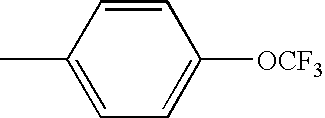 |
448(M+ + 1) [ESI(Pos.)] | |
| 5-018 | 15 |
 |
H | Me | H |
 |
414(M+ + 1) [ESI(Pos.)] | 6.9 [C] |
| 5-019 | 16 |
 |
H | Me | H |
 |
457(M+ + 1) [ESI(Pos.)] | |
| 5-020 | 13 |
 |
H | Me | H |
 |
473(M+ + 1) [ESI(Pos.)] | |
| 5-021 | 13 |
 |
H | Me | H |
 |
395(M+ + 1) [ESI(Pos.)] | |
| 5-022 | 13 |
 |
H | Me | H |
 |
449(M+ + 1) [ESI(Pos.)] | |
| 5-023 | 13 |
 |
H | Me | H |
 |
411(M+ + 1) [ESI(Pos.)] | |
| *1ESI: electronspray ionization, FAB: fast atom bombardment | ||||||||
| *2Racemic mixtuer | ||||||||
| TABLE 6 |
 |
| Retention | ||||||||
| time | ||||||||
| MS*1 | (min) | |||||||
| Compound | Example | [Ionization | [Mobile | |||||
| No. | No. | R1c | X5 | X6 | Z1 | —Ar | method] | phase] |
| 6-001*2 | 27 |
 |
H | H | H |
 |
466(M+ + 1) [ESI(Pos.)] | 6.5 [C] |
| 6-002 | 27 |
 |
H | H | H |
 |
534(M+ + 1) [ESI(Pos.)] | |
| 6-003*2 | 27 |
 |
H | H | H |
 |
508(M+ + 1) [ESI(Pos.)] | 7.8 [C] |
| 6-004 | 27 |
 |
H | Me | H |
 |
480(M+ + 1) [ESI(Pos.)] | 13.0 [C] |
| 6-005 | 27 |
 |
H | H | H |
 |
437(M+ + 1) [ESI(Pos.)] | 7.9 [A] |
| 6-006 | 27 |
 |
H | H | H |
 |
467(M+ + 1) [ESI(Pos.)] | 9.1 [B] |
| 6-007 | 27 |
 |
H | H | H |
 |
483(M+ + 1) [ESI(Pos.)] | 9.5 [E] |
| 6-008 | 27 |
 |
H | H | H |
 |
439(M+ + 1) [ESI(Pos.)] | 7.4 [B] |
| 6-009 | 27 |
 |
H | H | H |
 |
549(M+ + 1) [ESI(Pos.)] | |
| 6-010*2 | 27 |
 |
H | H | H |
 |
482(M+ + 1) [ESI(Pos.)] | |
| 6-011 | 29 |
 |
Me | H | H |
 |
480(M+ + 1) [ESI(Pos.)] | 6.9 [C] |
| 6-012 | 29 |
 |
Me | H | OH |
 |
496(M+ + 1) [ESI(Pos.)] | 9.1 [E] |
| 6-013 | 32 |
 |
 |
H |
 |
516(M+ + 1) [ESI(Pos.)] | |
| *1ESI: electronspray ionization | |||||||
| *2Mono-maleate | |||||||
| TABLE 7 |
 |
| Retention | ||||||||
| time | ||||||||
| MS*1 | (min) | |||||||
| Compound | Example | [Ionization | [Mobile | |||||
| No. | No. | R1c | X5 | X6 | Z1 | —Ar | method] | phase] |
| 7-001 | 30 |
 |
Me | H | H |
 |
479(M+ + 1) [ESI(Pos.)] | 8.0 [C] |
| 7-002 | 30 |
 |
H | H | H |
 |
583(M+ + 1) [ESI(Pos.)] | 10.2 [E] |
| 7-003 | 30 |
 |
H | H | H |
 |
507(M− + 1) [ESI(Pos.)] | 5.5 [C] |
| 7-004 | 30 |
 |
H | H | H |
 |
548(M− + 1) [ESI(Pos.)] | 8.1 [E] |
| 7-005 | 32 |
 |
H | H | H |
 |
465(M− + 1) [ESI(Pos.)] | |
| 7-006 | 31 |
 |
H | H | H |
 |
436(M+ + 1) [ESI(Pos.)] | 5.6 [C] |
| 7-007 | 30 |
 |
H | H | OH |
 |
523(M+ + 1) [ESI(Pos.)] | 10.6 [E] |
| 7-008 | 30 |
 |
H | H | OH |
 |
564(M+ + 1) [ESI(Pos.)] | 6.3 [E] |
| 7-009 | 30 |
 |
H | H | H |
 |
584(M+ + 1) [ESI(Pos.)] | 11.4 [E] |
| 7-010 | 30 |
 |
Me | H | OH |
 |
495(M+ + 1) [ESI(Pos.)] | 9.1 [C] |
| *1ESI: electronspray ionization | ||||||||
| TABLE 8 |
 |
| Retention | ||||||||
| time | ||||||||
| MS*1 | (min) | |||||||
| Compound | Example | [Ionization | [Mobile | |||||
| No. | No. | R1c | X5 | X6 | Z1 | —Ar | method] | phase] |
| 8-001 | 27 |
 |
H | H | H |
 |
466(M+ + 1) [ESI(Pos.)] | 15.3 [E] |
| 8-002*2 | 27 |
 |
H | H | H |
 |
482(M+ + 1) [ESI(Pos.)] | |
| 8-003 | 28 |
 |
H | H | H |
 |
508(M+ + 1) [ESI(Pos.)] | 9.2 [E] |
| 8-004 | 28 |
 |
H | H | H |
 |
549(M+ + 1) [ESI(Pos.)] | 5.5 [E] |
| 8-005 | 28 |
 |
H | H | H |
 |
584(M+ + 1) [ESI(Pos.)] | 8.4 [E] |
| 8-006 | 28 |
 |
H | H | OH |
 |
524(M+ + 1) [ESI(Pos.)] | 7.5 [E] |
| 8-007 | 28 |
 |
H | H | OH |
 |
565(M+ + 1) [ESI(Pos.)] | 5.0 [E] |
| 8-008 | 28 |
 |
H | H | OH |
 |
482(M+ + 1) [ESI(Pos.)] | 7.2 [E] |
| *1ESI: electronspray ionization | ||||||||
| *2Mono-maleate | ||||||||
| TABLE 9 |
 |
| Retention | ||||||||
| time | ||||||||
| MS*1 | (min) | |||||||
| Compound | Example | [Ionization | [Mobile | |||||
| No. | No. | R1c | X5 | X6 | Z1 | —Ar | method] | phase] |
| 9-001 | 32 |
 |
H | H | H |
 |
465(M+ + 1) [ESI(Pos.)] | |
| 9-002 | 30 |
 |
H | H | H |
 |
507(M+ + 1) [ESI(Pos.)] | 14.2 [E] |
| 9-003 | 30 |
 |
H | H | OH |
 |
523(M+ + 1) [ESI(Pos.)] | 9.8 [E] |
| 9-004 | 31 |
 |
H | H | H |
 |
436(M+ + 1) [ESI(Pos.)] | 11.2 [E] |
| *1ESI: electronspray ionization | ||||||||
| TABLE 10 |
 |
| Retention | ||||||||
| time | ||||||||
| MS*1 | (min) | |||||||
| Compound | Example | [Ionization | [Mobile | |||||
| No. | No. | R1c | X5 | X6 | Z1 | —Ar | method] | phase] |
| 10-001 | 27 |
 |
Me | H | H |
 |
480(M+ + 1) [ESI(Pos.)] | 7.3 [E] |
| 10-002 | 27 |
 |
H | H | H |
 |
466(M+ + 1) [ESI(Pos.)] | 15.3 [C] |
| *1ESI: electronspray ionization | ||||||||
| TABLE 11 |
 |
| Compound No. | Example No. | R1a | X1 |
 |
MS*1 [Ionization method] | Retention time (min) [Mobile phase] |
| 11-001 | 1 |
 |
H |
 |
476(M+ + 1) [ESI(Pos.)] | 4.4 [C] |
| 11-002 | 1 |
 |
H |
 |
476(M+ + 1) [ESI(Pos.)] | 4.4 [C] |
| 11-003 | 1 |
 |
H |
 |
587(M+ + 1) [ESI(Pos.)] | 11.8 [E] |
| 11-004 | 1 |
 |
H |
 |
559(M+ + 1) [ESI(Pos.)] | 6.5 [C] |
| 11-005 | 1 |
 |
H |
 |
518(M+ + 1) [ESI(Pos.)] | 4.2 [C] |
| 11-006 | 1 |
 |
6-F |
 |
605(M+ + 1) [ESI(Pos.)] | 5.1 [C] |
| 11-007 | 1 |
 |
6-F |
 |
577(M+ + 1) [ESI(Pos.)] | 7.1 [E] |
| 11-008 | 1 |
 |
6-Cl |
 |
629(M+ + 1) [ESI(Pos.)] | 5.9 [C] |
| 11-009 | 1 |
 |
6-Cl |
 |
552(M+ + 1) [ESI(Pos.)] | 7.1 [C] |
| 11-010 | 1 |
 |
6-Cl |
 |
628(M+ + 1) [ESI(Pos.)] | 13.9 [E] |
| 11-011 | 1 |
 |
6-Cl |
 |
593(M+ + 1) [ESI(Pos.)] | 11.5 [E] |
| 11-012 | 1 |
 |
6-OMe |
 |
625(M+ + 1) [ESI(Pos.)] | 15.6 [E] |
| 11-013 | 1 |
 |
6-OMe |
 |
548(M+ + 1) [ESI(Pos.)] | 15.3 [C] |
| 11-014 | 1 |
 |
6-OMe |
 |
624(M+ + 1) [ESI(Pos.)] | 12.1 [E] |
| 11-015 | 1 |
 |
6-OMe |
 |
589(M+ + 1) [ESI(Pos.)] | 9.1 [E] |
| 11-016 | 9 |
 |
H |
 |
515(M+ + 1) [ESI(Pos.)] | 7.8 [A] |
| *1ESI: electronspray ionization | ||||||
| TABLE 12 |
 |
| Compound No. | Example No. | R1a | X1 |
 |
MS*1 [Ionization method] | Retention time (min) [Mobile phase] |
| 12-001 | 19 |
 |
6-OMe |
 |
547(M+ + 1) [ESI(Pos.)] | 5.8 [C] |
| 12-002 | 20 |
 |
H |
 |
446(M+ + 1) [ESI(Pos.)] | 10.5 [E] |
| 12-003 | 20 |
 |
6-Cl |
 |
480(M+ + 1) [ESI(Pos.)] | 6.9 [C] |
| 12-004 | 20 |
 |
6-Me |
 |
460(M+ + 1) [ESI(Pos.)] | 6.4 [C] |
| 12-005 | 20 |
 |
6-Me |
 |
474(M+ + 1) [ESI(Pos.)] | 5.9 [B] |
| 12-006 | 20 |
 |
6-iPr |
 |
488(M+ + 1) [ESI(Pos.)] | 6.2 [B] |
| 12-007 | 22 |
 |
6-OH |
 |
462(M+ + 1) [ESI(Pos.)] | 8.8 [E] |
| 12-008 | 23 |
 |
6-OH |
 |
476(M+ + 1) [ESI(Pos.)] | 5.8 [C] |
| 12-009 | 20 |
 |
6-OMe |
 |
476(M+ + 1) [ESI(Pos.)] | 13.6 [E] |
| 12-010 | 20 |
 |
6-OMe |
 |
490(M+ + 1) [ESI(Pos.)] | 6.8 [C] |
| 12-011 | 20 |
 |
6-OCF3 |
 |
530(M+ + 1) [ESI(Pos.)] | 6.2 [B] |
| 12-012 | 24 |
 |
H |
 |
462(M+ + 1) [ESI(Pos.)] | 12.9 [E] |
| 12-013 | 24 |
 |
6-F |
 |
480(M+ + 1) [ESI(Pos.)] | 5.2 [C] |
| 12-014 | 24 |
 |
6-Cl |
 |
496(M+ + 1) [ESI(Pos.)] | 7.9 [C] |
| 12-015 | 24 |
 |
6-Me |
 |
476(M+ + 1) [ESI(Pos.)] | 6.8 [C] |
| 12-016 | 24 |
 |
6-Me |
 |
490(M+ + 1) [ESI(Pos.)] | 6.8 [B] |
| 12-017 | 24 |
 |
6-OMe |
 |
492(M+ + 1) [ESI(Pos.)] | 16.5 [E] |
| 12-018 | 24 |
 |
6-OMe |
 |
506(M+ + 1) [ESI(Pos.)] | 5.3 [B] |
| *1ESI: electronspray ionization | ||||||
| TABLE 13 |
 |
| Compound No. | Example No. | R1b |
 |
MS*1 [Ionization method] | Retention time (min) [Mobile phase] |
| 13-001*2,3 | 5 |
 |
 |
440(M+ + 1) [ESI(Pos.)] | 4.0 [E] |
| 13-002 | 1 |
 |
 |
559(M+ + 1) [ESI(Pos.)] | 4.8 [E] |
| 13-003 | 1 |
 |
 |
559(M+ + 1) [ESI(Pos.)] | 5.1 [E] |
| 13-004 | 2 |
 |
 |
496(M+ + 1) [ESI(Pos.)] | 8.0 [E] |
| 13-005 | 2 |
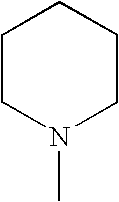 |
 |
480(M+ + 1) [ESI(Pos.)] | 5.4 [C] |
| 13-006 | 2 |
 |
 |
482(M+ + 1) [ESI(Pos.)] | 5.2 [E] |
| 13-007 | 1 |
 |
 |
530(M+ + 1) [ESI(Pos.)] | 4.5 [E] |
| 13-008 | 2 |
 |
 |
496(M+ + 1) [ESI(Pos.)] | 11.0 [E] |
| 13-009 | 12 |
 |
 |
482(M+ + 1) [ESI(Pos.)] | |
| 13-010*2 | 12 |
 |
 |
495(M+ + 1) [ESI(Pos.)] | |
| 13-011*3 | 5 |
 |
 |
438(M+ + 1) [ESI(Pos.)] | |
| 13-012*3 | 5 |
 |
 |
484(M+ + 1) [ESI(Pos.)] | 5.2 [J] |
| *1ESI: electronspray ionization | |||||
| *2Mono-HCl salt | |||||
| *3Racemic mixtue | |||||
| TABLE 14 |
 |
| Compound No. | Example No. | R1b |
 |
MS*1 [Ionization method] | Retention time (min) [Mobile phase] |
| 14-001 | 15 |
 |
 |
481(M+ + 1) [ESI(Pos.)] | 6.0 [E] |
| 14-002 | 16 |
 |
 |
495(M+ + 1) [ESI(Pos.)] | 6.0 [C] |
| 14-003 | 16 |
 |
 |
543(M+ + 1) [ESI(Pos.)] | 4.7 [C] |
| 14-004 | 15 |
 |
 |
430(M+ + 1) [ESI(Pos.)] | 5.3 [C] |
| *1ESI: electronspray ionization | |||||
| TABLE 15 |
 |
| Compound No. | Example No. | Het— | —L—Q1—Q2—Ar | MS*1 [Ionization method] | Retention time (min) [Mobile phase] |
| 15-001*2,3 | 5 |
 |
 |
465(M+ + 1) [ESI(Pos.)] | 7.2 8.2 [K] |
| 15-002*2 | 5 |
 |
 |
479(M+ + 1) [ESI(Pos.)] | 7.2 [K] |
| 15-003 | 5 |
 |
 |
509(M+ + 1) [ESI(Pos.)] | |
| 15-004 | 16 |
 |
 |
489(M+ + 1) [ESI(Pos.)] | 8.0 [F] |
| 15-005*2,4 | 1 |
 |
 |
549(M+ + 1) [ESI(Pos.)] | 8.2 [Q] |
| 15-006 | 40 |
 |
 |
482(M+ + 1) [ESI(Pos.)] | |
| *1ESI: electronspray ionization | |||||
| *2Di-HC1 salt | |||||
| *3Diastereomer mixture | |||||
| *4Racemic mixture | |||||
| TABLE 16*1 |
 |
| Compound No. | Example No. | Het— | —Ar | MS*2 [Ionization method] | Retention time (min) [Mobile phase] |
| 16-001*3,4 | 3 |
 |
 |
515(M+ + Na) [ESI(Pos.)] | 5.5 [F] |
| 16-023*3,4 | 3 |
 |
 |
495(M+ + 1) [ESI(Pos.)] | 5.1 [G] |
| 16-003*3,4 | 3 |
 |
 |
529(M+ + 1) [ESI(Pos.)] | 5.6 [F] |
| 16-004*3,4 | 3 |
 |
 |
457(M+ + 1) [ESI(Pos.)] | |
| 16-005*3,4 | 3 |
 |
 |
457(M+ + 1) [ESI(Pos.)] | 3.4 [F] |
| 16-006*4 | 3 |
 |
 |
497(M+ + 1) [ESI(Pos.)] | 4.7 [F] |
| 16-007*4 | 33 |
 |
 |
507(M+ + 1) [ESI(Pos.)] | 5.6 [F] |
| 16-008*3,4 | 1 |
 |
 |
521(M+ + 1) [ESI(Pos.)] | 4.1 [R] |
| *1Diastereomer mixture | |||||
| *2ESI: electronspray ionization | |||||
| *3Di-HCl salt | |||||
| *4Racemic mixture | |||||
| TABLE 17 |
 |
| Compound No. | Example No. | R1a | X1 | X2 | —Ar | MS*1 [Ionization method] |
| 17-001*2,3 | 3 |
 |
H | H |
 |
493(M+ + 1) [ESI(Pos.)] |
| 17-002*2,3 | 1 |
 |
H | H |
 |
521(M+ + 1) [ESI(Pos.)] |
| *1ESI: electronspray ionization | ||||||
| *2Di-HCl salt | ||||||
| *3Diastereomer mixture | ||||||
| TABLE 18 |
 |
| Compound No. | Example No. | R1a | X1 |
 |
Q2 | Ar | MS*1 [Ionization method] | Retention time (min) [Mobile phase] |
| 18-001 | 41 |
 |
Me |
 |
CH2 |
 |
454(M+ + 1) [ESI(Pos.)] | 6.1 [M] |
| 18-002 | 41 |
 |
Me |
 |
CH2 |
 |
476(M+ + 1) [ESI(Pos.)] | 6.3 [J] |
| 18-003 | 41 |
 |
Me |
 |
CH2 |
 |
420(M+ + 1) [ESI(Pos.)] | 4.1 [K] |
| 18-004 | 41 |
 |
Et |
 |
CH2 |
 |
474(M+ + 1) [ESI(Pos.)] | 6.5 [J] |
| 18-005 | 41 |
 |
OEt |
 |
CH2 |
 |
490(M+ + 1) [ESI(Pos.)] | 5.8 [J] |
| 18-006 | 41 |
 |
Me |
 |
 |
 |
486(M+ + 1) [ESI(Pos.)] | 8.1 [B] |
| 18-007 | 41 |
 |
Me |
 |
 |
 |
436(M+ + 1) [ESI(Pos.)] | 6.6 [K] |
| 18-008 | 41 |
 |
Me |
 |
CH2 |
 |
377(M+ + 1) [ESI(Pos.)] | 5.7 [K] |
| 18-009 | 41 |
 |
Me |
 |
CH2 |
 |
426(M+ + 1) [ESI(Pos.)] | 5.9 [K] |
| *1ESI: electronspray ionization | ||||||||
| TABLE 19 |
 |
| Compound No. | Example No. | R1a | X1 |
 |
—Q2— | —Ar | MS*1 [Ionization method] | Retention time (min) [Mobile phase] |
| 19-001 | 41 |
 |
Me |
 |
 |
 |
438(M+ + 1) [ESI(Pos.)] | 6.2 [J] |
| 19-002 | 41 |
 |
Me |
 |
 |
 |
420(M+ + 1) [ESI(Pos.)] | 5.7 [J] |
| 19-003 | 41 |
 |
Me |
 |
 |
 |
468(M+ + 1) [ESI(Pos.)] | 6.3 [J] |
| 19-004 | 41 |
 |
Me |
 |
 |
 |
472(M+ + 1) [ESI(Pos.)] | 8.1 [J] |
| 19-005 | 41 |
 |
Me |
 |
 |
 |
450(M+ + 1) [ESI(Pos.)] | 8.1 [J] |
| 19-006 | 41 |
 |
Me |
 |
 |
 |
458(M+ + 1) [ESI(Pos.)] | 8.9 [J] |
| 19-007 | 21 |
 |
Me |
 |
 |
 |
450(M+ + 1) [ESI(Pos.)] | 5.2 [J] |
| 19-008 | 21 |
 |
Me |
 |
 |
 |
468(M+ + 1) [ESI(Pos.)] | 5.5 [J] |
| 19-009 | 21 |
 |
Me |
 |
 |
 |
501(M+ + 1) [ESI(Pos.)] | 6.9 [J] |
| 19-010 | 21 |
 |
Me |
 |
CH2 |
 |
490(M+ + 1) [ESI(Pos.)] | 6.9 [J] |
| 19-011 | 21 |
 |
Me |
 |
 |
 |
498(M+ + 1) [ESI(Pos.)] | 5.7 [J] |
| 19-012 | 21 |
 |
 |
 |
CH2 |
 |
490(M+ + 1) [ESI(Pos.)] | 6.9 [J] |
| 19-013 | 41 |
 |
 |
 |
 |
 |
450(M+ + 1) [ESI(Pos.)] | 5.3 [J] |
| 19-014 | 41 |
 |
 |
 |
 |
 |
436(M+ + 1) [ESI(Pos.)] | 4.0 [J] |
| *1ESI: electronspray ionization | ||||||||
| TABLE 20 |
 |
| Compound No. | Example No. | R1a | X1 | X2 |
 |
—Q2— | —Ar | MS*1 [Ionization method] | Retention time (min) [Mobile phase] |
| 20-001 | 41 |
 |
Me | F |
 |
 |
 |
454(M+ + 1) [ESI(Pos.)] | 7.2 [J] |
| 20-002 | 41 |
 |
Me | F |
 |
CH2 |
 |
462(M+ + 1) [ESI(Pos.)] | 8.0 [J] |
| 20-003 | 41 |
 |
OMe | F |
 |
 |
 |
470(M+ + 1) [ESI(Pos.)] | 6.2 [J] |
| 20-004 | 41 |
 |
OMe | F |
 |
CH2 |
 |
478(M+ + 1) [ESI(Pos.)] | 6.9 [J] |
| 20-005 | 41 |
 |
OMe | F |
 |
CH2 |
 |
494(M+ + 1) [ESI(Pos.)] | 7.6 [J] |
| 20-006 | 41 |
 |
OMe | F |
 |
CH2 |
 |
428(M+ + 1) [ESI(Pos.)] | 5.2 [J] |
| 20-007 | 41 |
 |
OMe | F |
 |
CH2 |
 |
446(M+ + 1) [ESI(Pos.)] | 5.7 [J] |
| 20-008 | 41 |
 |
OMe | F |
 |
CH2 |
 |
428(M+ + 1) [ESI(Pos.)] | 5.3 [J] |
| 20-009 | 41 |
 |
OMe | F |
 |
CH2 |
 |
446(M+ + 1) [ESI(Pos.)] | 5.6 [J] |
| 20-010 | 41 |
 |
OMe | F |
 |
 |
 |
454(M+ + 1) [ESI(Pos.)] | 5.6 [J] |
| 20-011 | 41 |
 |
OMe | F |
 |
 |
 |
472(M+ + 1) [ESI(Pos.)] | 6.0 [J] |
| 20-012 | 41 |
 |
OMe | F |
 |
 |
 |
502(M+ + 1) [ESI(Pos.)] | 6.2 [J] |
| 20-013 | 41 |
 |
OMe | F |
 |
CH2 |
 |
442(M+ + 1) [ESI(Pos.)] | 6.3 [J] |
| 20-014 | 41 |
 |
OMe | F |
 |
CH2 |
 |
508(M+ + 1) [ESI(Pos.)] | 9.5 [J] |
| 20-015 | 41 |
 |
OMe | F |
 |
CH2 |
 |
442(M+ + 1) [ESI(Pos.)] | 5.9 [J] |
| 20-016 | 41 |
 |
OMe | F |
 |
CH2 |
 |
508(M+ + 1) [ESI(Pos.)] | 8.9 [J] |
| 20-017 | 22 |
 |
OH | F |
 |
 |
 |
456(M+ + 1) [ESI(Pos.)] | 4.9 [J] |
| 20-018 | 22 |
 |
OH | F |
 |
CH2 |
 |
466(M+ + 1) [ESI(Pos.)] | 5.4 [J] |
| *1ESI: electronspray ionization | |||||||||
| TABLE 21 | |||
| Compound | |||
| No. | IC50 (nM) | ||
| 1-003 | 18 | ||
| 1-005 | 2.8 | ||
| 1-019 | 10 | ||
| 1-032 | 0.4 | ||
| 1-040 | 0.4 | ||
| 1-045 | 21 | ||
| 1-058 | 180 | ||
| 1-073 | 39 | ||
| 1-078 | 1.5 | ||
| 1-092 | 37 | ||
| 1-095 | 22 | ||
| 1-101 | 68 | ||
| 1-110 | 5.1 | ||
| 1-111 | 3.8 | ||
| 1-116 | 6.7 | ||
| 1-128 | 7.3 | ||
| 1-133 | 4.4 | ||
| 1-174 | 21 | ||
| 1-176 | 1.0 | ||
| 1-206 | 2.3 | ||
| 3-001 | 28 | ||
| 3-011 | 6.8 | ||
| 3-019 | 78 | ||
| 3-022 | 9.5 | ||
| 3-023 | 2.4 | ||
| 3-034 | 16 | ||
| 3-038 | 20 | ||
| 3-041 | 46 | ||
| 4-016 | 60 | ||
| 4-022 | 30 | ||
| 4-035 | 52 | ||
| 4-042 | 30 | ||
| 4-043 | 66 | ||
| 4-044 | 56 | ||
| 4-054 | 39 | ||
| 4-055 | 2.3 | ||
| 4-058 | 28 | ||
| 5-003 | 26 | ||
| 5-006 | 9.3 | ||
| 5-011 | 30 | ||
| 5-014 | 32 | ||
| 6-001 | 71 | ||
| 6-010 | 66 | ||
| 7-001 | 74 | ||
| 7-002 | 94 | ||
| 7-009 | 23 | ||
| 7-010 | 52 | ||
| 8-001 | 35 | ||
| 8-002 | 24 | ||
| 8-004 | 11 | ||
| 8-005 | 12 | ||
| 8-006 | 10 | ||
| 8-007 | 10 | ||
| 9-001 | 49 | ||
| 11-008 | 1.3 | ||
| 11-009 | 6.1 | ||
| 11-012 | 0.3 | ||
| 11-014 | 1.4 | ||
| 11-015 | 1.0 | ||
| 12-001 | 2.9 | ||
| 12-004 | 13 | ||
| 12-007 | 14 | ||
| 12-008 | 12 | ||
| 12-010 | 3.0 | ||
| 12-017 | 3.3 | ||
| 12-018 | 3.4 | ||
| 13-001 | 99 | ||
| 13-002 | 25 | ||
| 13-004 | 46 | ||
| 13-005 | 21 | ||
| 13-008 | 36 | ||
| 14-001 | 16 | ||
| 14-002 | 19 | ||
| 14-003 | 7.4 | ||
| 15-001 | 16 | ||
| 15-003 | 26 | ||
| Components |
| Compound represented by formula (1) | 10 mg | ||
| Lactose | 700 mg | ||
| Corn starch | 274 mg | ||
| HPC-L | 16 mg | ||
| 1000 mg | |||
Compound represented by formula (1) and lactose are passed through a 60-mesh sieve. Corn starch is passed through a 120-mesh sieve. These components are mixed using a V-type blender. To the mixture powder added a low-viscosity aqueous hydroxypropyl cellulose (HPC-L) solution, and the mixture is kneaded, granulated (granulation by extrusion: pore size, 0.5 to 1 mm), and then dried. The resulting dry granule is passed through a vibration sieve (12/60 mesh) to obtain a granule.
| Components |
| Compound represented by formula (1) | 10 mg | ||
| Lactose | 79 mg | ||
| Corn starch | 10 mg | ||
| Magnesium stearate | 1 mg | ||
| 100 mg | |||
A compound represented by formula (1) and lactose are passed through a 60-mesh sieve. Corn starch is passed through a 120-mesh sieve. These components and magnesium stearate are mixed using a V-type blender. 100 mg of 10× powder is filled in a No. 5 hard gelatin capsule.
| Components |
| Compound represented by formula (1) | 15 mg | ||
| Lactose | 90 mg | ||
| Corn starch | 42 mg | ||
| HPC-L | 3 mg | ||
| 150 mg | |||
Compound represented by formula (1) and lactose are passed through a 60-mesh sieve. Corn starch is passed through 120-mesh sieve. These components are mixed using a V-type blender. To the mixture powder is added a low-viscosity aqueous hydroxypropyl cellulose (HPC-L) solution, and the mixture is kneaded, granulated, and then dried. The resulting dry granule is passed through a shaking sieve (12/60 mesh) to be sized, and 150 mg of the sieved granule is filled in a No. 4 hard gelatin capsule.
| Components |
| Compound represented by formula (1) | 10 mg | ||
| Lactose | 90 mg | ||
| Microcrystalline cellulose | 30 mg | ||
| Magnesium stearate | 5 mg | ||
| CMC-Na | 15 mg | ||
| 150 mg | |||
Compound represented by formula (1), lactose, microcrystalline cellulose, and CMC-Na (carboxymethylcellulose sodium salt) are passed through a 60-mesh sieve and mixed. Magnesium stearate is added to the mixture powder to obtain a mixture powder for formulation. This mixture powder is directly tableted to obtain a 150-mg tablet.
| Compound represented by formula (1) | 100 mg | ||
| Saturated fatty acid glyceride | 1000 ml | ||
A solution of the above-mentioned components is intravenously infused to a patient usually at a rate of 1 ml per min.
Claims (23)


Applications Claiming Priority (3)
| Application Number | Priority Date | Filing Date | Title |
|---|---|---|---|
| JP2006-102744 | 2006-04-04 | ||
| JP2006102744 | 2006-04-04 | ||
| PCT/JP2007/057054 WO2007114323A1 (en) | 2006-04-04 | 2007-03-30 | Aminopyrrolidine compound |
Publications (2)
| Publication Number | Publication Date |
|---|---|
| US20090291940A1 US20090291940A1 (en) | 2009-11-26 |
| US8044068B2 true US8044068B2 (en) | 2011-10-25 |
Family
ID=38563590
Family Applications (1)
| Application Number | Title | Priority Date | Filing Date |
|---|---|---|---|
| US12/296,082 Expired - Fee Related US8044068B2 (en) | 2006-04-04 | 2007-03-30 | Aminopyrrolidine compound |
Country Status (4)
| Country | Link |
|---|---|
| US (1) | US8044068B2 (en) |
| EP (1) | EP2003131A4 (en) |
| JP (1) | JPWO2007114323A1 (en) |
| WO (1) | WO2007114323A1 (en) |
Cited By (4)
| Publication number | Priority date | Publication date | Assignee | Title |
|---|---|---|---|---|
| US20190144437A1 (en) * | 2016-05-04 | 2019-05-16 | Genoscience Pharma | Substituted 2, 4-diamino-quinoline derivatives for use in the treatment of proliferative diseases |
| US10662177B2 (en) * | 2016-03-21 | 2020-05-26 | Council Of Scientific & Industrial Research | Blocking toll-like receptor 9 signaling with small molecule antagonist |
| WO2021250541A1 (en) | 2020-06-09 | 2021-12-16 | Pfizer Inc. | Spiro compounds as melanocortin 4 receptor antagonists and uses thereof |
| WO2023105387A1 (en) | 2021-12-06 | 2023-06-15 | Pfizer Inc. | Melanocortin 4 receptor antagonists and uses thereof |
Families Citing this family (11)
| Publication number | Priority date | Publication date | Assignee | Title |
|---|---|---|---|---|
| WO2008023159A1 (en) | 2006-08-24 | 2008-02-28 | Astrazeneca Ab | Morpholino pyrimidine derivatives useful in the treatment of proliferative disorders |
| WO2009007750A1 (en) | 2007-07-09 | 2009-01-15 | Astrazeneca Ab | Morpholino pyrimidine derivatives used in diseases linked to mtor kinase and/or pi3k |
| EP2072050A1 (en) * | 2007-12-21 | 2009-06-24 | Santhera Pharmaceuticals (Schweiz) AG | Compounds with anti-emetic effect |
| SA111320519B1 (en) | 2010-06-11 | 2014-07-02 | Astrazeneca Ab | Pyrimidinyl compounds for use as ATR inhibitors |
| RU2013120966A (en) | 2010-10-08 | 2014-11-20 | Эббви Инк. | FURO [3,2-d] Pyrimidine Compounds |
| ES2587304T3 (en) * | 2011-02-25 | 2016-10-21 | Yuhan Corporation | Diaminopyrimidine derivatives and procedures for their preparation |
| WO2013019966A1 (en) * | 2011-08-04 | 2013-02-07 | Allergan, Inc. | Aromatic bycyclic derivatives as cxcr4 receptor modulators |
| CN102875558A (en) * | 2012-11-05 | 2013-01-16 | 贵州大学 | 2-chloro-4-substituted-8-nitrobenzofuran [3,2-d] miazines compound, preparation method of compound and application of compound |
| US12486274B2 (en) | 2020-01-13 | 2025-12-02 | Verge Analytics, Inc. | Substituted pyrazolo-pyrimidines and uses thereof |
| WO2024104452A1 (en) * | 2022-11-17 | 2024-05-23 | 长春金赛药业有限责任公司 | Mc4r antagonist compound, pharmaceutical composition and pharmaceutical use thereof |
| CN122459298A (en) * | 2024-05-17 | 2026-07-24 | 长春金赛药业有限责任公司 | A compound, its preparation method and application |
Citations (5)
| Publication number | Priority date | Publication date | Assignee | Title |
|---|---|---|---|---|
| WO2003028641A2 (en) | 2001-10-01 | 2003-04-10 | Taisho Pharmaceutical Co., Ltd. | Mch receptor antagonists |
| WO2004052862A1 (en) * | 2002-12-10 | 2004-06-24 | Ono Pharmaceutical Co., Ltd. | Nitrogen-containing heterocyclic compounds and medicinal use thereof |
| WO2005047251A1 (en) | 2003-11-12 | 2005-05-26 | Lg Life Sciences Ltd. | Melanocortin receptor agonists |
| WO2006021656A2 (en) | 2004-07-29 | 2006-03-02 | Sanofi-Aventis | Aminopiperidine derivatives, preparation thereof and use thereof as melanocortin receptor agonists |
| US20100261701A1 (en) * | 2008-10-02 | 2010-10-14 | Asahi Kasei Pharma Corporation | 8-Substituted isoquinoline derivative and the use thereof |
Family Cites Families (3)
| Publication number | Priority date | Publication date | Assignee | Title |
|---|---|---|---|---|
| TW574214B (en) | 1994-06-08 | 2004-02-01 | Pfizer | Corticotropin releasing factor antagonists |
| GB0023918D0 (en) | 2000-09-29 | 2000-11-15 | King S College London | Antiparasitic compounds |
| KR20040083472A (en) | 2001-12-21 | 2004-10-02 | 다이쇼 세이야꾸 가부시끼가이샤 | Piperazine derivatives |
-
2007
- 2007-03-30 EP EP07740490A patent/EP2003131A4/en not_active Withdrawn
- 2007-03-30 WO PCT/JP2007/057054 patent/WO2007114323A1/en not_active Ceased
- 2007-03-30 JP JP2008508647A patent/JPWO2007114323A1/en not_active Abandoned
- 2007-03-30 US US12/296,082 patent/US8044068B2/en not_active Expired - Fee Related
Patent Citations (8)
| Publication number | Priority date | Publication date | Assignee | Title |
|---|---|---|---|---|
| WO2003028641A2 (en) | 2001-10-01 | 2003-04-10 | Taisho Pharmaceutical Co., Ltd. | Mch receptor antagonists |
| JP2005523237A (en) | 2001-10-01 | 2005-08-04 | 大正製薬株式会社 | MCH receptor antagonist |
| WO2004052862A1 (en) * | 2002-12-10 | 2004-06-24 | Ono Pharmaceutical Co., Ltd. | Nitrogen-containing heterocyclic compounds and medicinal use thereof |
| US7759336B2 (en) * | 2002-12-10 | 2010-07-20 | Ono Pharmaceutical Co., Ltd. | Nitrogen-containing heterocyclic compounds and medicinal use thereof |
| WO2005047251A1 (en) | 2003-11-12 | 2005-05-26 | Lg Life Sciences Ltd. | Melanocortin receptor agonists |
| WO2006021656A2 (en) | 2004-07-29 | 2006-03-02 | Sanofi-Aventis | Aminopiperidine derivatives, preparation thereof and use thereof as melanocortin receptor agonists |
| US20070191364A1 (en) | 2004-07-29 | 2007-08-16 | Sanofi-Aventis | Aminopiperidine derivatives, preparation thereof and therapeutic use thereof |
| US20100261701A1 (en) * | 2008-10-02 | 2010-10-14 | Asahi Kasei Pharma Corporation | 8-Substituted isoquinoline derivative and the use thereof |
Non-Patent Citations (1)
| Title |
|---|
| Caprathe et al., 2005, CAS: 142:430293. * |
Cited By (5)
| Publication number | Priority date | Publication date | Assignee | Title |
|---|---|---|---|---|
| US10662177B2 (en) * | 2016-03-21 | 2020-05-26 | Council Of Scientific & Industrial Research | Blocking toll-like receptor 9 signaling with small molecule antagonist |
| US20190144437A1 (en) * | 2016-05-04 | 2019-05-16 | Genoscience Pharma | Substituted 2, 4-diamino-quinoline derivatives for use in the treatment of proliferative diseases |
| US10577362B2 (en) * | 2016-05-04 | 2020-03-03 | Genoscience Pharma | Substituted 2, 4-diamino-quinoline derivatives for use in the treatment of proliferative diseases |
| WO2021250541A1 (en) | 2020-06-09 | 2021-12-16 | Pfizer Inc. | Spiro compounds as melanocortin 4 receptor antagonists and uses thereof |
| WO2023105387A1 (en) | 2021-12-06 | 2023-06-15 | Pfizer Inc. | Melanocortin 4 receptor antagonists and uses thereof |
Also Published As
| Publication number | Publication date |
|---|---|
| US20090291940A1 (en) | 2009-11-26 |
| EP2003131A1 (en) | 2008-12-17 |
| EP2003131A4 (en) | 2009-12-16 |
| WO2007114323A1 (en) | 2007-10-11 |
| JPWO2007114323A1 (en) | 2009-08-20 |
Similar Documents
| Publication | Publication Date | Title |
|---|---|---|
| US20090291940A1 (en) | Aminopyrrolidine compound | |
| KR101744607B1 (en) | Novel nicotinamide derivative or salt thereof | |
| JP6909729B2 (en) | ERK1 and ERK2 heterocyclic inhibitors and their use in cancer treatment | |
| WO2020216190A1 (en) | Quinazoline compound and pharmaceutical application thereof | |
| WO2006043490A1 (en) | Pyrimidine derivative fused with nonaromatic ring | |
| CN102307868B (en) | Indole derivatives as anticarcinogen | |
| KR20110018366A (en) | Glucokinase Activators | |
| CA2812667A1 (en) | Triazole derivatives and their use for neurological disorders | |
| US8906921B2 (en) | 4-alkoxypyridazine derivatives as fast dissociating dopamine 2 receptor antagonists | |
| TW201800395A (en) | Sulfonamide compound or salt thereof | |
| US9527832B2 (en) | Substituted condensed pyrimidine compounds | |
| WO2010007944A1 (en) | Nitrogenated bicyclic heterocyclic compound | |
| WO2015169180A1 (en) | Substituted piperazine compounds and methods and use thereof | |
| JP5255568B2 (en) | Piperidinylamino-pyridazines and their use as rapidly dissociating dopamine 2 receptor antagonists | |
| US20240409530A1 (en) | Disubstituted Pyrimidine Compounds for Ketohexokinase Inhibition | |
| US12612384B2 (en) | Heterocyclic CYP4A inhibitor compounds and compositions thereof | |
| JP6098001B2 (en) | Novel piperidine derivatives, pharmaceutical compositions and uses thereof | |
| JP7781074B2 (en) | CGAS-inhibiting triazolopyrimidone derivatives | |
| US10399949B2 (en) | NK1 receptor antagonist | |
| US20260109702A1 (en) | Novel gspt protein degrader and application thereof | |
| CN107709316A (en) | The benzodioxan derivative of 2 (base of 1 heteroaryl piperazine 4) methyl 1,4 as α 2C antagonists | |
| WO2016021562A1 (en) | Cyanothiophene derivative |
Legal Events
| Date | Code | Title | Description |
|---|---|---|---|
| AS | Assignment |
Owner name: TAISHO PHARMACEUTICAL CO., LTD., JAPAN Free format text: ASSIGNMENT OF ASSIGNORS INTEREST;ASSIGNORS:OKUBO, TAKETOSHI;KUMAGAI, TOSHIHITO;ISHII, TAKAAKI;AND OTHERS;REEL/FRAME:021632/0596;SIGNING DATES FROM 20080828 TO 20080911 Owner name: NISSAN CHEMICAL INDUSTRIES, LTD., JAPAN Free format text: ASSIGNMENT OF ASSIGNORS INTEREST;ASSIGNORS:OKUBO, TAKETOSHI;KUMAGAI, TOSHIHITO;ISHII, TAKAAKI;AND OTHERS;REEL/FRAME:021632/0596;SIGNING DATES FROM 20080828 TO 20080911 Owner name: TAISHO PHARMACEUTICAL CO., LTD., JAPAN Free format text: ASSIGNMENT OF ASSIGNORS INTEREST;ASSIGNORS:OKUBO, TAKETOSHI;KUMAGAI, TOSHIHITO;ISHII, TAKAAKI;AND OTHERS;SIGNING DATES FROM 20080828 TO 20080911;REEL/FRAME:021632/0596 Owner name: NISSAN CHEMICAL INDUSTRIES, LTD., JAPAN Free format text: ASSIGNMENT OF ASSIGNORS INTEREST;ASSIGNORS:OKUBO, TAKETOSHI;KUMAGAI, TOSHIHITO;ISHII, TAKAAKI;AND OTHERS;SIGNING DATES FROM 20080828 TO 20080911;REEL/FRAME:021632/0596 |
|
| FEPP | Fee payment procedure |
Free format text: PAYOR NUMBER ASSIGNED (ORIGINAL EVENT CODE: ASPN); ENTITY STATUS OF PATENT OWNER: LARGE ENTITY |
|
| FEPP | Fee payment procedure |
Free format text: PAYER NUMBER DE-ASSIGNED (ORIGINAL EVENT CODE: RMPN); ENTITY STATUS OF PATENT OWNER: LARGE ENTITY |
|
| REMI | Maintenance fee reminder mailed | ||
| LAPS | Lapse for failure to pay maintenance fees | ||
| STCH | Information on status: patent discontinuation |
Free format text: PATENT EXPIRED DUE TO NONPAYMENT OF MAINTENANCE FEES UNDER 37 CFR 1.362 |
|
| STCH | Information on status: patent discontinuation |
Free format text: PATENT EXPIRED DUE TO NONPAYMENT OF MAINTENANCE FEES UNDER 37 CFR 1.362 |
|
| FP | Lapsed due to failure to pay maintenance fee |
Effective date: 20151025 |