US8043854B2 - Method of decellularizing tissues - Google Patents
Method of decellularizing tissues Download PDFInfo
- Publication number
- US8043854B2 US8043854B2 US10/556,400 US55640005A US8043854B2 US 8043854 B2 US8043854 B2 US 8043854B2 US 55640005 A US55640005 A US 55640005A US 8043854 B2 US8043854 B2 US 8043854B2
- Authority
- US
- United States
- Prior art keywords
- cell
- flow
- blood
- living organism
- tissue
- Prior art date
- Legal status (The legal status is an assumption and is not a legal conclusion. Google has not performed a legal analysis and makes no representation as to the accuracy of the status listed.)
- Active, expires
Links
Images




Classifications
-
- A—HUMAN NECESSITIES
- A61—MEDICAL OR VETERINARY SCIENCE; HYGIENE
- A61K—PREPARATIONS FOR MEDICAL, DENTAL OR TOILETRY PURPOSES
- A61K35/00—Medicinal preparations containing materials or reaction products thereof with undetermined constitution
- A61K35/12—Materials from mammals; Compositions comprising non-specified tissues or cells; Compositions comprising non-embryonic stem cells; Genetically modified cells
- A61K35/34—Muscles; Smooth muscle cells; Heart; Cardiac stem cells; Myoblasts; Myocytes; Cardiomyocytes
-
- A—HUMAN NECESSITIES
- A61—MEDICAL OR VETERINARY SCIENCE; HYGIENE
- A61F—FILTERS IMPLANTABLE INTO BLOOD VESSELS; PROSTHESES; DEVICES PROVIDING PATENCY TO, OR PREVENTING COLLAPSING OF, TUBULAR STRUCTURES OF THE BODY, e.g. STENTS; ORTHOPAEDIC, NURSING OR CONTRACEPTIVE DEVICES; FOMENTATION; TREATMENT OR PROTECTION OF EYES OR EARS; BANDAGES, DRESSINGS OR ABSORBENT PADS; FIRST-AID KITS
- A61F2/00—Filters implantable into blood vessels; Prostheses, i.e. artificial substitutes or replacements for parts of the body; Appliances for connecting them with the body; Devices providing patency to, or preventing collapsing of, tubular structures of the body, e.g. stents
- A61F2/02—Prostheses implantable into the body
- A61F2/24—Heart valves ; Vascular valves, e.g. venous valves; Heart implants, e.g. passive devices for improving the function of the native valve or the heart muscle; Transmyocardial revascularisation [TMR] devices; Valves implantable in the body
- A61F2/2412—Heart valves ; Vascular valves, e.g. venous valves; Heart implants, e.g. passive devices for improving the function of the native valve or the heart muscle; Transmyocardial revascularisation [TMR] devices; Valves implantable in the body with soft flexible valve members, e.g. tissue valves shaped like natural valves
- A61F2/2415—Manufacturing methods
-
- Y—GENERAL TAGGING OF NEW TECHNOLOGICAL DEVELOPMENTS; GENERAL TAGGING OF CROSS-SECTIONAL TECHNOLOGIES SPANNING OVER SEVERAL SECTIONS OF THE IPC; TECHNICAL SUBJECTS COVERED BY FORMER USPC CROSS-REFERENCE ART COLLECTIONS [XRACs] AND DIGESTS
- Y10—TECHNICAL SUBJECTS COVERED BY FORMER USPC
- Y10S—TECHNICAL SUBJECTS COVERED BY FORMER USPC CROSS-REFERENCE ART COLLECTIONS [XRACs] AND DIGESTS
- Y10S623/00—Prosthesis, i.e. artificial body members, parts thereof, or aids and accessories therefor
- Y10S623/901—Method of manufacturing prosthetic device
Definitions
- This invention relates to a cell-removing method, and more particularly, to a cell-removing method enhanced in cell removing effect from a living organism tissue in transplanting a living organism tissue.
- a heart valve of a human body When a heart valve of a human body does not normally work, causing embarrassments as constriction of the opening of the heart valve and reflux of blood, the heart valve must be replaced by a substitute valve.
- a substitute valve As the substitute valve presently used, mention may be made of a mechanical valve formed of a artificial material, a xenogenic bioprosthetic valve taken from an animal such as a pig, and an allogeneic bioprosthetic valve donated from another human body, etc.
- These valves have the following problems. Although the mechanical valve is durable, the recipient must take an anticoagulant for the entire lifetime.
- the recipient needs not to take an anticoagulant for the lifetime; however deposition of calcium and the like takes place for a long time, causing malfunction in the valve, with the result that the valve must be exchanged with a new substitute valve at an interval of about 15 years.
- the allogeneic bioprosthetic valve because the number of donors is limited, a sufficiently large number of allogeneic bioprosthetic valves are not easily obtained.
- the xenogenic bioprosthetic valve is prospective for the reasons that a sufficient number of valves can be provided and patients are not necessary to take an anticoagulant for their lifetime after transplant. Therefore, the xenogenic bioprosthetic valve is expected to be more useful than other substitute valves only if the drawback of poor durability is overcome.
- a xenogenic bioprosthetic valve taken from an animal such as a pig (for example, see Japanese Publication No. 6-261933).
- a xenogenic bioprosthetic valve is first immersed in a cell-removing solution such as bile acid or a surfactant, thereby removing cells originated from the animal such as endothelial cells and fibroblast cells (cell-removing process).
- the xenogenic bioprosthetic valve from which original cells have been removed is immersed in a cell-containing solution containing autologous cells, such as endothelial cells and fibroblast cells, taken from a recipient human body (to which the xenogenic bioprosthetic valve is to be transplanted), thereby seeding the autologous cells in the xenogenic bioprosthetic valve (cell-seeding process).
- autologous cells such as endothelial cells and fibroblast cells
- the this inventors have intensively conducted experimental studies with the view toward over coming the aforementioned problems. They devised a method of supplying the cell-removing solution for immersing a xenogenic bioprosthetic valve at a flow rate virtually corresponding to the human blood flow and/or irradiating the xenogenic bioprosthetic valve immersed in the cell-removing solution with microwave. As a result, they found that the number of remaining original cells significantly decreases by this method.
- An object of the invention is to provide a method of efficiently removing original cells present in the living organism tissue such as a xenogenic bioprosthetic valve, thereby enhancing the biocompatibility of the living organism tissue after transplant.
- the present invention is directed to a cell-removing method for removing original cells from a predetermined living organism tissue when the living organism tissue is transplanted, comprising immersing the living organism tissue in a predetermined cell-removing solution,
- the cell-removing solution is allowed to flow in a state of a pulsatile flow by applying a predetermined pulse to the cell-removing solution and the living organism tissue is placed in the pulsatile flow.
- the present invention is directed to a cell-removing method for removing original cells from a predetermined living organism tissue when the living organism tissue is transplanted, comprising immersing the living organism tissue in a cell-removing solution,
- the (latter) method may be preferably performed simultaneously with the method in which the cell-removing solution is allowed to flow in a state of pulsatile flow by applying a predetermined pulse to the cell-removing solution and the living organism tissue is placed in the pulsatile flow.
- Microwave is applied while rotating the living organism tissue relative to a microwave irradiation site.
- microwave can be applied to the living organism tissue virtually uniformly along the rotation circumference direction, with the result that cells can be removed virtually uniformly from almost the entire region of the living organism tissue along the rotation circumference direction.
- FIG. 1 is a view showing the schematic structure of the living organism tissue processing apparatus to be applied to this invention
- FIG. 2 is a schematic longitudinal sectional view of a driving pump
- FIG. 3 is a schematic front view of a retention unit constituting the living organism tissue processing apparatus
- FIG. 4 is an exploded perspective view of a cover of the retention unit
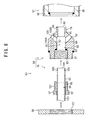
- FIG. 5 is a schematic sectional view of the retention member
- FIG. 6 is an exploded sectional view of the right-hand side of the structure in FIG. 5 ;
- FIG. 7 is a schematic exploded perspective view of a channel formation member of a flow-in port
- FIG. 8 is an exploded sectional view of the left-hand side of the structure in FIG. 5 ;
- FIG. 9 is a schematic exploded perspective view of a channel formation member of a flow-out port
- FIG. 10(A) is a view of a part extracted from the structure of FIG. 3 including the retention member;
- FIG. 10(B) is the same structure shown in FIG. 10(A) in the state of rotating by 180° about a support shaft from the state shown in FIG. 10(A) ;
- FIG. 11 is a Table showing the number of remaining original cells per unit area in Example 1, 2 in comparison with Comparative Example 1;
- FIG. 12 is a magnified photomicrograph of the living organism tissue obtained in Example 3.
- FIG. 13 is a magnified photomicrograph of the living organism tissue obtained in Example 4.
- FIG. 1 is a view showing the schematic structure of a living organism tissue processing apparatus according to this invention.
- the living organism tissue processing apparatus 10 shown in the figure is used in a cell-removing process and a cell-seeding process of a living organism tissue of a xenogenic bioprosthetic valve.
- the cell-removing process is performed before a xenogenic bioprosthetic valve, which is taken from an animal such as a pig, is transplanted to a human body.
- the cell-removing process is performed by immersing the xenogenic bioprosthetic valve in a cell-removing solution such as bile acid, thereby removing the animal cells (hereinafter referred to as “original cells”) to obtain only a substrate formed of collagen, etc.
- original cells animal cells
- the cell-seeding process is performed by immersing the xenogenic bioprosthetic valve from which the original cells have been removed in a cell-containing solution containing the cells (hereinafter referred to as “autologous cells”) of a recipient's human body (to which the xenogenic bioprosthetic valve is to be transplanted), thereby adhering the autologous cells to the substrate.
- autologous cells a cell-containing solution containing the cells
- the living organism tissue processing apparatus 10 comprises a circulation apparatus 10 A for circulating the cell-removing solution and the cell-containing solution through a predetermined circuit, and a retention unit 10 B attached to the circulation apparatus 10 A for retaining a xenogenic bioprosthetic valve. Note that, if not otherwise specified, the cell-removing solution and the cell-containing solution are collectively referred to as “the solution”.
- the circulation apparatus 10 A comprises a known air suction/supply unit 11 , a driving pump 12 formed of polyurethane and connected to the air suction/supply unit 11 , and a circulation channel 13 arranged such that the solution discharged from the driving pump 12 returns to the driving pump 12 .
- the air suction/supply unit 11 has a known structure capable of suctioning air out from the driving pump 12 and supplying air into the driving pump 12 .
- the detail description of the structure is omitted herein.
- the driving pump 12 is a pulsating pump capable of ejecting a pulsatile flow by generating a spiral vortex flow within the pump. More specifically, the driving pump 12 , which is shown in FIG. 2 , employs the structure that has been already proposed by the present applicant (Japanese Patent Publication No. 2002-167836). To explain more specifically, the driving pump 12 comprises a hollow upper construct 17 of virtually a conical outer shape having a flow-in port 15 and flow-out port 16 , a hollow lower construct 18 of virtually a domical outer shape positioned under the upper construct 17 , and a flexible diaphragm 20 which partitions the space formed of the constructs 17 and 18 into two, inner spaces S 1 and S 2 .
- the flow-in port 15 which is shown at the right-end side of FIG. 2 , is formed so as to thread through the peripheral wall of the upper construct 17 , whereas the flow-out port 16 is provided at the top of the upper construct 17 , as shown at the upper end-side of FIG. 2 .
- the lower construct 18 has a vent hole 22 communicating with the air suction/supply unit 11 .
- Compression air is alternately supplied into and out from the lower inner space S 2 on a predetermined timing.
- the diaphragm 20 is displaced, increasing or decreasing the volume of the upper inner space S 1 .
- the solution supplied from the flow-out port 16 becomes a pulsatile flow.
- a spiral vortex flow is generated in the upper space S 1 , as indicated by a broken line in FIG. 2 . In this state, it is not easy to find a standstill region.
- the pressure (positive pressure) of the air supplied to the inner space S 2 is set at about 140 mmHg to 260 mmHg, whereas the pressure (negative pressure) of the air suctioned from the inner space S 2 is set at about ⁇ 30 mmHg to ⁇ 50 mmHg, however, they are not limited to these values.
- the circulation channel 13 is formed of a closed loop in such a manner that the solution flows out from the flow-out port 16 of the driving pump 12 and flows in the flow-in port 15 without being exposed to the outside air.
- the flow channel 13 comprises a resistance imparting means 23 , which imparts flow resistance to the solution supplied from the flow-out port 16 , an upstream-side tube 24 connected to the flow-out port 16 , a control tube 25 serving as an amplitude controlling means and connected to the downstream-side end of the upstream-side tube 24 , a connection tube 26 connected to the downstream-side end of the control tube 25 , a downstream-side tube 27 arranged downstream of the connection tube 26 and connected to the flow-in port 15 of the driving pump 12 , and a connection pump 28 provided between the connection tube 26 and the downstream-side tube 27 .
- the members 24 to 28 are connected by known connectors 29 .
- the portion of the circulation channel 13 upstream of the resistance imparting means 23 is referred to as an “upper line L 1 ” and that downstream of the resistance imparting means 23 is referred to as a “downstream line L 2 ”, for convenience's sake.
- the resistance imparting means 23 is provided alone in the middle of the connection tube 26 on the assumption of the peripheral resistance of a human body, and constructed of a pinch-form member (not shown) for fastening the connection tube 26 . Since the connection tube 26 is fastened by the resistance imparting means 23 , if the driving pump 12 pulses, the lowermost blood pressure of the upper line L 1 would not reach 0 mm Hg. In this manner, the arterial blood flow of a human body is simulated.
- the average pulse pressure of the upper line L 1 can be adjusted at a predetermined value by controlling the degree of fastening the connection tube 26 . In this embodiment, the average pulse pressure is set at about 100 mmHg, which virtually corresponds to the average pulse pressure of a human body. Note that, as the resistance imparting means 23 , any type of member including a variable aperture other than the pinch-form member may be used as long as it has the same effect as mentioned above.
- the upstream-side tube 24 , the connecting tube 26 and the downstream-side tube 27 are formed of vinyl chloride, but not particularly limited thereto.
- the retention unit 10 B is provided in the middle of the upstream-side tube 24 . Since a xenogenic bioprosthetic valve is placed in the retention unit 10 B and a check valve 30 is provided in the downstream-side tube 27 , the solution can be circulated without a backward flow in the direction indicated by the arrow in the FIG. 1 .
- the control tube 25 is arranged upstream of the resistant imparting means 23 and serves as a controller for the amplitude of the pulse pressure of the upstream line L 1 . More specifically, the control tube 25 is formed of a soft material such as segmented polyurethane or silicone, can control the amplitude of the pulse pressure of the upstream line L 1 by changing the tube-wall thickness. Note that the amplitude of the pulse pressure of the upstream line L 1 is set at, for example, 100 mmHg (average pulse pressure) ⁇ 20 mm Hg to approximate a human body in this embodiment.
- connection pump 28 is a pulsatile-flow formation pump having the same structure as the driving pump 12 . Like reference numerals are used to designate like structural elements corresponding to those of the driving pump 12 and any further explanation is omitted. Note that the connection pump 28 is fitted in such an orientation that the solution flows in through the flow-in port 15 and flows out though the flow-out port 16 . The vent hole 22 of the connection pump 28 is open to the outside. The diaphragm 20 is displaced depending upon the solution flow. The solution is loaded in the circulation apparatus 10 A in an amount slightly lower than a maximum permissible loading amount of the apparatus 10 A. The displacement amount of the diaphragm 20 of the connection pump 28 is slightly lower than a maximum physically permissible displacement amount.
- connection pump 28 gives the damper effect. More specifically, when the solution passes through the connection pump, the diaphragm 20 is displaced, thereby reducing the blood pressure. Accordingly, the connection pump 28 is arranged downstream of the resistance imparting means 23 and serves as a pulse-pressure attenuation means for attenuating the liquid pressure of the solution of the downstream line L 2 . In this embodiment, the pressure of the solution passed through the connection pump 28 is set at about 10 mm Hg so as to correspond to the pressure of the human left atria.
- connection pump 28 may be interposed between the control tube 25 and the connection tube 26 .
- the retention unit 10 B in which the solution flowing through the circulation apparatus 10 A is introduced, retains a xenogenic bioprosthetic valve immersed in the solution.
- a swine aortic valve is used as the xenogenic bioprosthetic valve to be subjected to the cell-removing process and cell-seeding process.
- the retention unit 10 B is positioned at a site of the circulation channel 13 having a blood-flow state close to that of the human aortic valve portion.
- the retention unit 10 B is connected to the middle of the upstream-side tube 24 .
- the portion of the upstream-side tube 24 upstream of the retention unit 10 B is referred to as an inlet-side tube 24 A, whereas the portion downstream of the retention unit 10 B is referred to as an outlet-side tube 24 B.
- the retention unit 10 B may be freely connected to any site of the circulating channel 13 by appropriately selecting the site of the circulation channel 13 whose state (such as pressure) is close to that of the blood flowing through a target living organism tissue.
- the retention unit 10 B comprises a tabular base 33 capable of being placed on a predetermined surface F, a main body 35 positioned above the base 33 , and support members 36 , 36 standing at the right and left sides of the base 33 for supporting the main body 35 .
- the main body 35 comprises a box-form cover 38 having a hexagonal shape as seen from the front, a retention member 39 , which is provided within the cover 38 , for retaining xenogenic bioprosthetic valve V, a frame member 40 having an octagonal shape (viewed from the front) supporting the retention member 39 and arranged along the inner wall of the cover 38 , an irradiation unit 42 (irradiation means), which is provided behind the cover 38 , for applying microwave to xenogenic bioprosthetic valve V retained in the retention member 39 , supporting shafts 44 , 44 respectively extending from the right and left sides of the frame member 40 toward the supporting members 36 , 36 through the cover 38 , and two tubes, namely, an introduction tube 46 and discharge tube 47 , connecting to the retention member 39 .
- a box-form cover 38 having a hexagonal shape as seen from the front
- a retention member 39 which is provided within the cover 38 , for retaining xenogenic bioprosthetic valve V
- a frame member 40 having
- the cover 38 has a box-form structure consisting of two portions longitudinally divided, more specifically composed of a front cover 51 positioned in the front side and a rear cover 52 positioned in the rear side.
- the butting portion of the front cover 51 and the rear cover 52 is formed at the position crossing with the support shafts 44 , 44 .
- flange planes 54 , 54 are formed, virtually along the outer edge portion.
- numerous through-holes 55 for volts (not shown) are formed.
- the front cover 51 When the volts are removed from the integrated construct, the front cover 51 can be separated and detached from the rear cover 52 . Furthermore, a microwave irradiation port 57 having a square-shape which is open forward is formed around the center of the inside of the rear cover 52 . The irradiation port 57 is formed so as to virtually correspond to xenogenic bioprosthetic valve V retained by the retention member 39 frontward (see FIG. 3 ). With the arrangement, microwave, which is supplied from the irradiation unit 42 rearward, passes through the irradiation port 57 and is applied to xenogenic bioprosthetic valve V within the retention member 39 frontward.
- the front cover 51 and the rear cover 52 have shapes and structures capable of preventing leakage of the microwave to the outside, when it is applied from the irradiation port 57 toward the retention member 39 .
- a doorplate 59 is provided at the front end of the front cover 51 .
- the doorplate 59 is formed of a known material through which the state of the retention member 39 can be seen and by which leakage of microwave to the outside can be prevented.
- the retention member 39 comprises an acrylic cylindrical member 61 extended in right and left directions in the figure, a flow-in portion 62 positioned at the right end side of the cylindrical member 61 , a flow-out portion 63 positioned at the left end side thereof, and an installation space 64 for xenogenic bioprosthetic valve V between the flow-in portion 62 and the flow-out portion 63 .
- the solution flows into the cylindrical member 61 from the flow-in portion 62 , passes through the installation space 64 and flows out from the flow-out portion 63 to the outside, as described later.
- the cylindrical member 61 has open each ends in the extending direction. At the open ends, the flow-in portion 62 and the flow-out portion 63 are set. A thin aluminium plate 66 is adhered to the entire outer circumferential surface of the cylindrical member 61 except for the center portion virtually corresponding to the installation space 64 .
- microwave supplied from the irradiation unit 42 transmits only through the center circumferential-wall region of the cylindrical member 61 virtually corresponding to the installation space 64 . As a result, the microwave can be converged to the center region; at the same time, an increase in temperature of the outside portion of the installation space 64 can be prevented.
- the flow-in portion 62 comprises an end member 68 engaged with the outer circumferential surface of the cylindrical member 61 , and a channel formation member 69 positioned within the end member 68 .
- the end member 68 is formed like a container with the bottom having an opening at the left side in the FIG. 6 . More specifically, the end member 68 has a bottom wall 71 positioned at the right side of the figure and a side wall 72 continuously formed to the circumferential edge side of the bottom wall 71 and extending virtually perpendicularly (toward the left in FIG. 6 ) to the bottom wall 71 .
- the bottom wall 71 has a through-hole 73 at about the center.
- the sidewall 72 has a screw thread 74 formed in the inner circumferential of the opening side. The screw thread 74 is to be engaged with a screw thread 75 formed in the outer circumferential of the cylindrical member 61 .
- the channel formation member 69 comprises a hollow conical pipe 77 having an analogous shape to a cone, and an insertion pipe 78 to be inserted into the conical pipe 77 .
- the conical pipe 77 comprises a cylindrical top portion 79 positioned near the installation space 64 , a skirt-form portion 80 which gradually expands outwardly from the top portion 79 to the right side of the FIG. 6 and starts, at the middle, extending linearly from the right and left direction in the figure, and a flange-form hem portion 81 continuously formed at the right end side of FIG. 6 of the skirt-form portion 80 , and inner space 83 formed within the portions 79 to 81 and communicating with the outside at the right and left side in the FIG. 6 .
- leading edge side refers to the side of the conical pipe 77 close to the top portion 79 and the term “back end side” refers to the side of the conical pipe 77 close to the hem portion 81 .
- a stopper groove 85 is formed along the circumference.
- the outer diameter of the hem portion 81 is set equal to the inner diameter of the cylindrical member 61 such that the hem portion 81 can be just fit within the cylindrical member 61 .
- the hem portion 81 is formed in a ring form.
- the outer diameter of the hem portion 81 is set equal to the inner diameter of the sidewall 72 of the end member 68 . With this structure, the hem portion 81 can be just fit within the end member 68 .
- a screw thread 87 is formed in the inner circumferential surface of the hem portion 81 .
- the inner space 83 has an opening portion at the right-end side in the FIG. 6 .
- the inner space 83 comprises a basal space 89 to which the tip portion of the insertion pipe 78 is to be inserted through the opening portion, a main channel 91 communicating with the basal space 89 and extending toward an opening portion 90 formed at the leading edge side, and four side channels 92 provided around the main channel 91 and communicating with the basal space 89 .
- the basal space 89 has the inner space whose shape agrees with the top portion of the insertion pipe 78 , can just fit the insertion pipe 78 .
- the main channel 91 is formed like a taper-hole whose inner diameter is reduced inward from the top portion 79 , but not limited to this.
- the side channel 92 is formed in the inclined surface of the skirt-form portion 80 , as shown in FIG. 7 . More specifically, four side channels 92 are arranged at equal intervals along circumference direction in the skirt portion 80 . It should be noted that the total area of the opening portions of the side channels 92 is set equal to that of the main channel 91 , in this embodiment.
- the insertion pipe 78 comprises a spherical portion 94 having a spherical outer shape at the leading edge side, a cylindrical portion 95 having a smaller outer diameter than that of the spherical portion 94 and continuously formed to the spherical portion 94 via a step portion, an external cylinder portion 96 fitting around the outer circumferential surface of the cylindrical portion 95 so as to be mutually rotatable, a ring-form collar portion 97 continuously formed to the back end side of the external cylinder portion 96 and having an outer diameter smaller than the inner diameter of the through hole 73 of the end member 68 , and an inner space 99 formed within the spherical portion 94 and the cylinder portion 95 .
- a screw thread 101 is formed in the outer circumferential surface of the external cylinder portion 96 .
- the screw thread 101 is engaged with the screw thread 87 formed in the inner portion of the hem portion 81 .
- the insertion pipe 78 can be attached to the conical pipe 77 .
- the inner space 99 comprises a basal channel 103 through which the solution flows, a top hole 104 communicating with the basal channel 103 and opened at the leading edge side of the spherical portion 94 , and four side holes 105 formed around the top hole 104 and communicating with the basal channel 103 .
- the leading edge side of the insertion pipe 78 is fit in the inner space 83 of the conical pipe 77 , the top hole 104 comes to constantly communicate with the main channel 91 .
- the side holes 105 are arranged virtually at equal intervals along the circumference direction in the surface of the spherical portion 94 .
- the side holes 105 can rotatably change the positions from a maximum communication position at which they can completely communicate with all side channels 92 to a shut-off position at which the communication with all side channels 92 is completely shut off by mutually rotating the pipes 78 and 77 .
- the insertion pipe 78 thus controls a flow amount by changing its position from the site at which the total flow amount of the solution flowing out from all side channels 92 is equal to that flowing out from the main channel 91 , to the site at which the total flow amount of the solution flowing out from all of the side channels 92 is virtually zero. In this sense, the insertion pipe 78 acts like a variable throttle, which controls the flow amount of the solution flowing out from the side channels 92 .
- the flow-out portion 63 partly differs in shape from the flow-in portion 62 ; however, has substantially the same structural elements and functions in a virtually similar manner.
- the end member 68 of the flow-out portion 63 is formed like a nut. Virtually at the center of the end member 68 , a screw hole 107 is provided so as to extend in the right and left direction in the FIG. 8 .
- the conical pipe 77 of the flow-out portion 63 differs from that of the flow-in portion 62 in shape of the hem portion 81 continuously formed to the skirt-form portion 80 .
- the hem portion 81 is formed like a screw cylinder having an outer diameter smaller than the largest outer diameter of the skirt-form portion 80 .
- the outer circumferential portion of the hem portion 81 is engaged with the screw hole 107 of the end member 68 .
- the conical pipe 77 has a guide channel 109 for inserting a thermo-sensor (not shown) therein.
- the guide channel 109 is formed outside the inner space 83 .
- the channel 109 comprises a first guide channel 109 A extending from the back end side of the hem portion 81 to the inclined surface the skirt-form portion 80 and a second guide channel 109 B branched in the middle of the first guide channel 109 A and extending toward the main channel 91 . Note that two or either one of the guide channels 109 A and 109 B may be omitted.
- the insertion pipe 78 of the flow-out portion 63 differs from that of the flow-in portion 62 in its entire shape.
- the cylindrical portion 95 is extended toward the leading edge side in place of the spherical portion 94 .
- the top hole 104 is formed at the leading edge side of the cylindrical portion 95 .
- Four side holes 105 are provided virtually at equal intervals along the circumference direction in the outer circumferential surface of the leading edge side of the cylindrical portion 95 .
- blacked out members in FIGS. 5 , 6 and 8 are O rings for sealing.
- the frame member 40 supports the retention member 39 so as to rotate therein. More specifically, the insertion pipes 78 , 78 protruding outward virtually from the center of the end members 68 , 68 are connected to rotation pipes 112 , 112 via pipe nuts 111 , 111 .
- the rotation pipes 112 , 112 pass through bearings (not shown) each attached to part of the frame member 40 and protrude out of the frame member 40 .
- the retention member 39 is fit within the frame member 40 such that the rotation pipes 112 , 112 can obliquely extend at an angle of 45°, as shown in the FIG. 3 .
- the retention member 39 can be rotated (self-rotated) around on the rotation pipes 112 , 112 .
- a self-rotation driving means 114 having a motor and gear, etc.
- the retention member 39 is rotated within the frame member 40 by actuating the self-rotation driving means 114 .
- the rotation pipes 112 , 112 are connected to the introduction tube 46 and discharge tube 47 , respectively, via rotation joints 115 fixed to the structure placed near the frame-member 40 .
- the rotation joint 115 a known joint is used which connects two types of pipe-form members (rotation pipes 112 , 112 and tubes 46 , 47 ) while allowing mutual rotation and mutual communication.
- the irradiation unit 42 is a known unit using a magnetron (not shown) as a source of microwave. Detailed explanation of the unit is omitted herein.
- the support shaft 44 is a hollow pipe and houses the end portions of the introduction tube 46 and the discharge tube 47 therein.
- a slot hole 117 is formed at a position of the outer circumferential surface of each of the support shafts 44 , 44 within and in the vicinity of the support members 36 , 36 .
- the tubes 46 and 47 extending from the rotation pipes 112 , 112 are inserted.
- the support member 36 comprises a first support portion 120 arranged at the inner side for rotatably supporting the support shafts 44 , 44 , and a joint support portion 122 arranged outside the first support portion 120 for supporting a rotation joint 121 having the same structure as that of the rotation joint 115 mentioned above.
- the rotation joint 121 supported by the support member 36 (at the left side in FIG. 3 ) connects the discharge tube 47 inserted in the support shaft 44 at the left side and the outlet-side tube 24 B, mutually rotatably.
- the rotation joint 121 supported by the support member 36 (at the right side in FIG. 3 ) connects the introduction tube 46 inserted in the support shaft 44 at the right side and the inlet-side tube 24 A, mutually rotatably.
- a revolution driving means 124 having a motor and a gear, etc.
- the support shafts 44 , 44 can be rotated by operating the revolution driving means 124 .
- the frame member 40 and the retention member 39 simultaneously rotate (revolve) around on the support shafts 44 , 44 .
- the introduction tube 46 and the discharge tube 47 inserted in the support shaft 44 each are designed not to interfere with the base 33 during the revolution. More specifically, they have an appropriate length and are arranged so as to pass through the space between the base 33 and the support shaft 44 . As shown in FIG.
- the frame member 40 is rotated.
- up/down and right/left of the retention member 39 are inverted, as shown in FIG. 10(B) .
- the retention member 39 can be not only self-rotated by the self-rotation driving means 114 but also revolved by the revolution driving means 124 .
- the up/down and right/left of blood-vessel tissue B are inverted.
- reference numeral 125 in FIG. 3 indicates a switch for the revolution driving means 124 .
- a cooling means may be provided for cooling the periphery of the introduction tube 46 to prevent the temperature of the solution from increasing.
- the rotation pipe 112 is released from the rotation joint 115 .
- the pipe nut 111 is loosen by turning it and removed from the retention member 39 , thereby removing the retention member 39 from the rotation pipes 112 , 112 .
- the end members 68 , 68 are removed, and then the flow-in portion 62 and flow-out portion 63 are removed from the cylindrical member 61 .
- the top portion 79 , 79 of the flow-in portion 62 and the top portion 79 of the flow-out portion 63 are allowed to face as shown in FIG.
- both ends of swine blood-vessel tissue B containing aortic valve V are inserted to the top portions 79 , 79 , respectively and then, clamped by binding members (not shown) on the stopper grooves 85 , 85 , respectively.
- Blood-vessel tissue B is set in such an orientation that the solution is allowed to flow through aortic valve V (uni-direction valve) from the right side to the left side in FIG. 5 .
- the cell-removing solution is supplied from the introduction tube 46 to the insertion pipe 78 of the flow-in portion 62 by way of the rotation pipe 112 .
- the insertion pipes 78 , 78 of the flow-in portion 62 and flow-out portion 63 are set at the positions where the side holes 105 and the side channels 92 of conical pipe 77 are completely communicable, as shown in FIG. 5 .
- the cell-removing solution supplied to the flow-in portion 62 enters blood-vessel tissue B by ways of the top hole 104 and the main channel 91 of the flow-in portion 62 , passes through aortic valve V, and goes to the main channel 91 of the flow-out portion 63 .
- the same amount of the solution flows through the side holes 105 and sub channels 92 of the flow-in portion 62 , passes through the inner space of the cylindrical member 61 and goes into the side channel 92 of the flow-out portion 63 , so as to detour blood-vessel tissue B.
- the cell-removing solution passed through the main channel 91 and the side channels 92 of the flow-out portion 63 flows out from the insertion pipe 78 of the flow-out portion 63 and is discharged to the discharge tube 47 through the rotation pipe 112 , as shown in FIG. 3 .
- the main channel 91 and the top hole 104 provided in each of the flow-in portion 62 and flow-out portion 63 constitute a first channel mutually communicating through the tubular living organism tissue (blood-vessel tissue B), whereas the side channels 92 and the side holes 105 provided in each of the flow-in portion 62 and the flow-out portion 63 constitute a second flow channel mutually communicating through the detour root formed outside of the living organism tissue (blood-vessel tissue B).
- the irradiation unit 42 and the self-rotation driving means 114 are operated.
- the retention member 39 is self-rotated while applying microwave to blood-vessel tissue B retained in the retention member 39 .
- the cell removing operation can be applied uniformly in the entire circumference direction of blood-vessel tissue B.
- the cell removing operation is preferably performed while checking the temperature of the solution in and out of blood-vessel tissue B by using thermo-sensors (not shown) inserted in the first and second guide channels 109 A, 109 B (see FIG. 5 ). In this case, the cell-removing solution is allowed to flow virtually at the same flow rate inside and outside the blood-vessel tissue B so that there is no temperature difference between them.
- thermo sensors (not shown) inserted in the first and second guide channels 109 A and 109 B.
- the irradiation unit 42 automatically stops irradiation of microwave, whereas it automatically starts irradiation of microwave when the temperatures become lower than the body temperature.
- the irradiation unit 42 of this embodiment can apply a microwave having a frequency of 2.45 GHz and a power of about 0 to 1200 W.
- the temperature sensor may be introduced into the first channel from a hole formed in the middle of the discharge tube 47 .
- the cell-containing solution then passes through the top hole 104 of the flow-in portion 62 and the main channel 91 , reaches blood-vessel tissue B, passes through aortic valve V, flows into the main channel 91 of the flow-out portion 63 , and is then discharged from the insertion pipe 78 of the flow-out portion 63 .
- the insertion pipes 78 , 78 are placed in the position at which communication between the side channels are shut off. Therefore, the cell-containing solution would not flow outside blood-vessel tissue B, unlike the case of cell-removing process mentioned above.
- the revolution driving means 124 shown in FIG. 3 is actuated.
- the retention member 39 rotates together with the frame member 40 around on the support shafts 44 , 44 , with the result that the retention member 39 is rotated upside down in the direction indicated in FIG. 10 . Since the retention member 39 revolves, the autologous cells of the cell-containing solution can be attached uniformly to blood-vessel tissue B without gravitational effect.
- blood-vessel tissue B including aortic valve V is taken from an animal such as a pig.
- Blood-vessel tissue B is set in the retention unit 10 B in the manner as mentioned above.
- the cell-removing solution is injected into the living organism tissue processing apparatus 10 , and then circulated.
- a surfactant such as deoxycholic acid (bile acid), sodium dodecyl sulfate (SDS), or Triton X-100 were used.
- the cell-removing solution is circulated in the living organism tissue processing apparatus 10 while keeping the state of the solution close to that of the human blood flow, in the manner mentioned below.
- the suction/supply unit 11 shown in FIG. 1 When a switch (not shown) is pressed, the suction/supply unit 11 shown in FIG. 1 is actuated. Then, the cell-removing solution is circulated through the circulation channel 13 by pulsation of the driving pump 12 . More specifically, the cell-removing solution ejected from the driving pump 12 flows through the upstream line L 1 at the pressure virtually corresponding to a general aortic pressure of a human body, passes through the retention unit 10 B arranged in the middle of the upstream line L 1 , and reaches to the resistance imparting means 23 for imparting the resistance corresponding to the peripheral resistance of a human body. The cell-removing solution coming out of the resistance imparting means 23 passes through the connection pump 28 and flows into the driving pump 12 at a pressure of about 10 mm Hg virtually corresponding to left atrial pressure.
- the cell-removing solution flows through both inside and outside of blood-vessel tissue B retained in the retention member 39 at the flow state corresponding to the blood flow flowing through the aorta of a human body; at the same time, microwave is applied to blood-vessel tissue B which is being rotated by self-rotation of the retention member 39 as mentioned above.
- various types of original cells endothelial cells, fibroblast cells, smooth muscle cells
- the microwave is specified to have a frequency of 2.45 GHz, and a power of about 100 W to 500 W, but not limited to these conditions.
- the power of the microwave can be changed within a predetermined range as long as the microwave does not produce any denaturation (harmful a human body) of blood-vessel tissue B and can produce a predetermined cell-removing effect.
- electromagnetic wave different in frequency and acoustic wave may be applied.
- the flow of the cell-removing solution may well if it is not analogous to the blood flow. In other words, a pulsatile flow may be accepted.
- normal saline solution is injected into the living organism tissue processing apparatus 10 .
- the normal saline solution is discharged from the living organism tissue processing apparatus 10 .
- a binder such as fibronectin is directly injected into the first channel of the retention member 39 to block the open ends of the flow-in portion 62 and the flow-out portion 63 . In this manner, blood-vessel tissue B from which cells have been removed and retained in the retention member 39 is immersed in the binder for a predetermined time.
- the cell-containing solution is prepared by taking autologous cells (endothelial cells, fibroblast cells and/or smooth muscle cells) of a recipient, culturing for a predetermined time, and adding to a predetermined culture solution.
- autologous cells endothelial cells, fibroblast cells and/or smooth muscle cells
- any culture solution may be used as long as it can be used for the cell-seeding process. Examples of such a culture solution include M199 (Medium 199, manufactured by the company Life Technologies).
- blood-vessel tissue B from which cells have been removed is immersed in the cell-containing solution for a predetermined time, and then, the circulation apparatus 10 A is actuated to circulate the cell-containing solution in the living organism tissue processing apparatus 10 at the flow state corresponding to the blood flow of a human body.
- the circulation apparatus 10 A is actuated to circulate the cell-containing solution in the living organism tissue processing apparatus 10 at the flow state corresponding to the blood flow of a human body.
- blood-vessel tissue B from which cells have been removed is placed in the cell-containing solution flowing at the flow state corresponding to the blood flow through the human aorta, autologous cells are seeded in the blood vessel tissue B.
- the revolution driving means 124 (see FIG. 3 ) is actuated before the pulsatile flow is generated by the circulation apparatus 10 A.
- the cell-removing effect and the cell-seeding effect can be significantly enhanced; at the same time, the cell-removing process and the cell-seeding process can be performed in a sequence of operations while retaining blood-vessel tissue B in the retention member 39 .
- the processing of a xenogenic bioprosthetic valve involved in transplant can be simply performed in a short time.
- the xenogenic bioprosthetic valve can be kept clean while preventing pollution.
- Example 1 bile acid of 37° C. was used as a cell-removing solution.
- the bile acid was injected into the circulation apparatus 10 A and allowed to flow so as to correspond to the human blood (pulsatile flow) in the aorta.
- a swine blood-vessel tissue containing the aortic valve was allowed to leave alone in the flow for 24 hours.
- the circulation apparatus 10 A was operated under conditions: an average flow rate: 5 L/minute, a pulsating rate (beating rate) of the driving pump 12 : 70 times/minute, an average liquid pressure of the bile acid: about 90 mmHg where the maximum and minimum pressures of the liquid were allowed to correspond to the maximum and minimum pulse pressures of a typical person, respectively.
- Example 2 a predetermined microwave was applied to a blood-vessel tissue while rotating by the retention unit 10 B in addition to the conditions of Example 1.
- the microwave having a frequency of 2.45 GHz was used herein and applied under the following three different conditions by varying power and irradiation time: a power of 100 W for 8 hours, a power of 500 W for 12 hours, and a power of 500 W for 24 hours.
- the blood-vessel tissue was rotated 4 times per minute in a self-rotation manner.
- Original cells remaining in the blood-vessel tissue were counted in the same manner as in Example 1 and an average cell number per unit area (1 mm 2 ) was obtained.
- Example 1 An experiment was performed as a Comparative Example to Examples 1 and 2.
- a blood-vessel tissue as used in Example 1 was immersed in bile acid standing still in a container for 24 hours.
- Original cells remaining in the blood-vessel tissue were counted to obtain an average number of original cells per unit area (1 mm 2 ) in the same manner as in Example 1.
- Example 3 after the cell-removing process, the blood-vessel tissue was washed with normal saline solution for about one hour and immersed in fibronectin for 4 hours.
- autologous cells endothelial cells
- the cell-containing solution used herein was prepared by culturing the autologous cells thus taken in a culture plate containing M199 for 5 days, removing the autologous cells cultured from the culture plate with trypsin, and adding to M199.
- the cells were cultured in M199 supplemented with FBS (Fetal Bovine Serum IWK-500, manufactured by Iwaki), antibiotics (penicillin/streptomycin mixed solution) and FGF-2 (manufactured by Pepro Tech Ec Ltd.).
- FBS Fetal Bovine Serum IWK-500, manufactured by Iwaki
- antibiotics penicillin/streptomycin mixed solution
- FGF-2 manufactured by Pepro Tech Ec Ltd.
- the blood-vessel tissue was immersed in the cell-containing solution for about 4 hours while rotating the blood-vessel tissue up and down. After the cell-seeding process, the blood-vessel tissue was observed under a microscope and a magnified view of the blood-vessel tissue was taken by a camera. The state of the autologous cells (endothelial cells) seeded in the blood-vessel tissue was observed.
- Example 4 after the blood-vessel tissue was treated in the same steps as in Example 3, the cell-containing solution was circulated in the circulation apparatus 10 A under the same flow conditions as in Example 1.
- the blood-vessel tissue was immersed in the cell-containing solution maintained to stand still for about 48 hours, it was rotated up and down for about 4 hours. Then, the cell-containing solution was allowed to flow so as to correspond to the blood flow in the human aorta. The blood-vessel tissue was left alone in the flow for one hour. Thereafter, the state of the autologous cells seeded in the blood-vessel tissue was observed in the same manner as in Example 3.
- the autologous cells were seeded uniformly in virtually the entire area of the blood-vessel tissue and that the autologous cells are aligned in the direction of the flow of the cell-containing solution, as shown in FIG. 13 .
- the density of cells increased since the autologous cells proliferated.
- the number of autologous cells attached to the blood-vessel tissue per unit area (1 mm 2 ) was about 2170 in average.
- the ratio (density) of the area occupied by the autologous cells per unit area (1 mm 2 ) of the blood-vessel tissue was about 63% in average.
- Example 5 was performed in the same manner as in Example 4 except that a step of maintaining the blood-vessel tissue to stand still in the cell-containing solution and a step of rotating the blood-vessel tissue up and down, were performed in reverse order.
- the blood-vessel tissue immersed in the cell-containing solution was rotated up and down for about 4 hours and then, the blood-vessel tissue was immersed in the cell-containing solution in a standstill state for 48 hours. Then, the cell-containing solution was allowed to flow so as to correspond to the human blood flow in the aorta and the blood-vessel tissue was left alone in the flow for one hour.
- the other conditions were the same as in Example 4. Thereafter, the state of the autologous cells seeded in the blood-vessel tissue was observed in the same manner as in Example 4.
- the autologous cells are proliferated and increased in density in the same as in Example 4.
- the autologous cells are seeded more uniformly in the entire area than in Example 4.
- Example 6 was performed in the same manner as in Example 5 except that the time for leaving a blood-vessel tissue in the flow of the cell-containing solution prepared in the same conditions as in Example 5 was set at 48 hours.
- the seeded cells proliferated and covered over virtually the entire surface of the blood-vessel tissue.
- Example 7 was performed in the same manner as in Example 6 except that the flow conditions of the cell-containing solution were changed. To explain more specifically, the average flow rate of the cell-containing solution was set at 2 L per minute and the average liquid pressure of the cell-containing solution was set at about 20 mmHg.
- bioprosthetic valves can be prepared to meet the conditions for heart valves from those of adults to those of children who differ in amount of blood circulating in body, and those who differ in blood pressure.
- the autologous cells were seeded but non-uniformly in the blood-vessel tissue. Accordingly, the number of autologous cells seeded in the blood-vessel tissue was significantly reduced compared to Examples 3 to 7.
- the number of autologous cells attached to the tissue in Examples 3 to 7 is significantly larger than in Comparative Example 2. That is, a high cell-seeding effect was obtained.
- the orientation of cells is improved.
- the cells are activated and the function of cells is improved, with the result that a larger number of cells can be seeded.
- the present invention is applicable to a cell-removing process for other living organism tissues which blood is in contact with other than the blood-vessel tissue containing the aortic valve as explained in the embodiment. Furthermore, the present invention is applicable to a process for an allogeneic bioprosthetic valve other than a xenogenic bioprosthetic valve.
- the living organism tissue processing apparatus 10 explained in the embodiment is not essentially used.
- Various apparatuses and means may be used as long as they can remove cells.
- any apparatuses can be used as long as it can provide a predetermined pulsatile flow of a solution for use in immersing a living organism tissue during the cell-removing process and/or it can apply microwave to the living organism tissue.
- original cells present in a living organism tissue such as a xenogenic bioprosthetic valve can be removed and the biocompatibility of the living organism tissue after transplant can be enhanced.
- the present invention can be used in processing a bioprosthetic valve taken from an animal including a human to a state capable of being transplanted in a human body.
Landscapes
- Health & Medical Sciences (AREA)
- Life Sciences & Earth Sciences (AREA)
- Developmental Biology & Embryology (AREA)
- Cell Biology (AREA)
- Chemical & Material Sciences (AREA)
- Medicinal Chemistry (AREA)
- Engineering & Computer Science (AREA)
- Biomedical Technology (AREA)
- Biotechnology (AREA)
- Immunology (AREA)
- Virology (AREA)
- Zoology (AREA)
- Cardiology (AREA)
- Vascular Medicine (AREA)
- Pharmacology & Pharmacy (AREA)
- Epidemiology (AREA)
- Animal Behavior & Ethology (AREA)
- General Health & Medical Sciences (AREA)
- Public Health (AREA)
- Veterinary Medicine (AREA)
- External Artificial Organs (AREA)
- Apparatus Associated With Microorganisms And Enzymes (AREA)
- Prostheses (AREA)
- Materials For Medical Uses (AREA)
Abstract
Description
Claims (2)
Applications Claiming Priority (3)
| Application Number | Priority Date | Filing Date | Title |
|---|---|---|---|
| JP2003-138015 | 2003-05-15 | ||
| JP2003138015 | 2003-05-15 | ||
| PCT/JP2004/006662 WO2004100831A1 (en) | 2003-05-15 | 2004-05-12 | Method of removing cell |
Publications (2)
| Publication Number | Publication Date |
|---|---|
| US20060212074A1 US20060212074A1 (en) | 2006-09-21 |
| US8043854B2 true US8043854B2 (en) | 2011-10-25 |
Family
ID=33447280
Family Applications (1)
| Application Number | Title | Priority Date | Filing Date |
|---|---|---|---|
| US10/556,400 Active 2029-02-24 US8043854B2 (en) | 2003-05-15 | 2004-05-12 | Method of decellularizing tissues |
Country Status (6)
| Country | Link |
|---|---|
| US (1) | US8043854B2 (en) |
| EP (1) | EP1625832B1 (en) |
| JP (1) | JP4444918B2 (en) |
| CN (1) | CN100544685C (en) |
| AU (1) | AU2004238128B2 (en) |
| WO (1) | WO2004100831A1 (en) |
Families Citing this family (27)
| Publication number | Priority date | Publication date | Assignee | Title |
|---|---|---|---|---|
| DE10064948C1 (en) * | 2000-12-20 | 2002-07-11 | Auto Tissue Gmbh | Process for decellularizing foreign material for the production of bioprostheses and device for carrying out the process |
| JP2009508596A (en) | 2005-09-19 | 2009-03-05 | ヒストジェニックス コーポレイション | Cell support substrate and preparation method thereof |
| AU2007204815A1 (en) | 2006-01-12 | 2007-07-19 | Histogenics Corporation | Method for repair and reconstruction of ruptured ligaments or tendons and for treatment of ligament and tendon injuries |
| JP2007301262A (en) * | 2006-05-15 | 2007-11-22 | Univ Waseda | Living tissue for transplantation |
| JP5136977B2 (en) * | 2007-10-16 | 2013-02-06 | 学校法人早稲田大学 | Biological tissue formation maintenance device |
| US8579964B2 (en) | 2010-05-05 | 2013-11-12 | Neovasc Inc. | Transcatheter mitral valve prosthesis |
| JP2013165740A (en) * | 2010-05-14 | 2013-08-29 | Waseda Univ | Decellularization method and artificial tissue for implantation into the human body |
| WO2012147889A1 (en) * | 2011-04-27 | 2012-11-01 | 日本電信電話株式会社 | Optical communication device, optical path switching device, and network |
| US9554897B2 (en) | 2011-04-28 | 2017-01-31 | Neovasc Tiara Inc. | Methods and apparatus for engaging a valve prosthesis with tissue |
| US9308087B2 (en) | 2011-04-28 | 2016-04-12 | Neovasc Tiara Inc. | Sequentially deployed transcatheter mitral valve prosthesis |
| EP2752192B1 (en) * | 2011-09-02 | 2019-06-26 | Adeka Corporation | Method for preparing decellularized tissue product, and graft provided with decellularized tissue product |
| US9345573B2 (en) | 2012-05-30 | 2016-05-24 | Neovasc Tiara Inc. | Methods and apparatus for loading a prosthesis onto a delivery system |
| US9572665B2 (en) | 2013-04-04 | 2017-02-21 | Neovasc Tiara Inc. | Methods and apparatus for delivering a prosthetic valve to a beating heart |
| GB201310773D0 (en) * | 2013-06-17 | 2013-07-31 | Northwick Park Inst For Medcal Res Ltd | Implant and method of producing an implant |
| ES3036002T3 (en) * | 2014-03-26 | 2025-09-11 | Transmedics Inc | Apparatus for maintenance of harvested hearts for transplanting |
| US10077420B2 (en) | 2014-12-02 | 2018-09-18 | Histogenics Corporation | Cell and tissue culture container |
| WO2017100927A1 (en) | 2015-12-15 | 2017-06-22 | Neovasc Tiara Inc. | Transseptal delivery system |
| JP7006940B2 (en) | 2016-01-29 | 2022-01-24 | ニオバスク ティアラ インコーポレイテッド | Artificial valve to avoid blockage of outflow |
| WO2018090148A1 (en) | 2016-11-21 | 2018-05-24 | Neovasc Tiara Inc. | Methods and systems for rapid retraction of a transcatheter heart valve delivery system |
| CN111263622A (en) | 2017-08-25 | 2020-06-09 | 内奥瓦斯克迪亚拉公司 | Sequentially deployed transcatheter mitral valve prosthesis |
| AU2019374743B2 (en) | 2018-11-08 | 2022-03-03 | Neovasc Tiara Inc. | Ventricular deployment of a transcatheter mitral valve prosthesis |
| JP7430732B2 (en) | 2019-03-08 | 2024-02-13 | ニオバスク ティアラ インコーポレイテッド | Retrievable prosthesis delivery system |
| EP3946163B1 (en) | 2019-04-01 | 2025-08-20 | Neovasc Tiara Inc. | Controllably deployable prosthetic valve |
| US11491006B2 (en) | 2019-04-10 | 2022-11-08 | Neovasc Tiara Inc. | Prosthetic valve with natural blood flow |
| EP4729110A2 (en) | 2019-05-20 | 2026-04-22 | Neovasc Tiara Inc. | Introducer with hemostasis mechanism |
| WO2020257643A1 (en) | 2019-06-20 | 2020-12-24 | Neovasc Tiara Inc. | Low profile prosthetic mitral valve |
| EP4052734B1 (en) * | 2021-03-02 | 2024-04-24 | Solidified Inc. | Immunocompatible tissue scaffold and methods of forming the same |
Citations (6)
| Publication number | Priority date | Publication date | Assignee | Title |
|---|---|---|---|---|
| US4250139A (en) * | 1979-02-01 | 1981-02-10 | Collagen Corporation | Microwave sterilization of dry protein |
| JPH04288165A (en) | 1991-03-18 | 1992-10-13 | Terumo Corp | Organ implant and manufacture thereof |
| JPH06261933A (en) | 1992-02-12 | 1994-09-20 | Lifecell Corp | Method for processing and storing collagen-based tissue for transplantation |
| WO2000047131A1 (en) | 1999-02-11 | 2000-08-17 | Crosscart, Inc. | Proteoglycan-reduced soft tissue xenografts |
| US20040052830A1 (en) * | 2000-12-20 | 2004-03-18 | Wolfgang Konertz | Method for decellularising foreign material for the production of bioprostheses |
| JP2004187952A (en) | 2002-12-12 | 2004-07-08 | National Cardiovascular Center | Treatment of living tissue by microwave irradiation |
Family Cites Families (3)
| Publication number | Priority date | Publication date | Assignee | Title |
|---|---|---|---|---|
| US5192312A (en) * | 1991-03-05 | 1993-03-09 | Colorado State University Research Foundation | Treated tissue for implantation and methods of treatment and use |
| US5899937A (en) * | 1997-03-05 | 1999-05-04 | Cryolife, Inc. | Pulsatile flow system for developing heart valves |
| AU755316B2 (en) * | 1998-03-16 | 2002-12-12 | Crosscart, Inc. | Bone xenografts |
-
2004
- 2004-05-12 US US10/556,400 patent/US8043854B2/en active Active
- 2004-05-12 EP EP04732472A patent/EP1625832B1/en not_active Expired - Lifetime
- 2004-05-12 JP JP2005506214A patent/JP4444918B2/en not_active Expired - Lifetime
- 2004-05-12 AU AU2004238128A patent/AU2004238128B2/en not_active Expired
- 2004-05-12 WO PCT/JP2004/006662 patent/WO2004100831A1/en not_active Ceased
- 2004-05-12 CN CNB2004800131981A patent/CN100544685C/en not_active Expired - Lifetime
Patent Citations (8)
| Publication number | Priority date | Publication date | Assignee | Title |
|---|---|---|---|---|
| US4250139A (en) * | 1979-02-01 | 1981-02-10 | Collagen Corporation | Microwave sterilization of dry protein |
| JPH04288165A (en) | 1991-03-18 | 1992-10-13 | Terumo Corp | Organ implant and manufacture thereof |
| JPH06261933A (en) | 1992-02-12 | 1994-09-20 | Lifecell Corp | Method for processing and storing collagen-based tissue for transplantation |
| WO2000047131A1 (en) | 1999-02-11 | 2000-08-17 | Crosscart, Inc. | Proteoglycan-reduced soft tissue xenografts |
| JP2002536109A (en) | 1999-02-11 | 2002-10-29 | クロスカート インコーポレイテッド | Soft tissue xenografts with reduced proteoglycans |
| US20040052830A1 (en) * | 2000-12-20 | 2004-03-18 | Wolfgang Konertz | Method for decellularising foreign material for the production of bioprostheses |
| JP2004187952A (en) | 2002-12-12 | 2004-07-08 | National Cardiovascular Center | Treatment of living tissue by microwave irradiation |
| US20060115900A1 (en) * | 2002-12-12 | 2006-06-01 | Toshiya Fujisato | Method of treating biological tissue by microwave-irradiation |
Non-Patent Citations (2)
| Title |
|---|
| C. E. Visser et al.; "Microwave treatment of xenogeneic cartilage transplants", Biomaterials, vol. 10, 1989, pp. 507-510. |
| Kiyotaka Iwasaki et al.; "Development of two types of novel bioreactors for decellularization and in vitro pulsatile conditioning of endothelial cells cultured on the porcine aortic valves", The Japan Society of Mechanical Engineers, Mar. 13, 2003, pp. 83-84. |
Also Published As
| Publication number | Publication date |
|---|---|
| EP1625832B1 (en) | 2011-09-21 |
| AU2004238128B2 (en) | 2008-10-30 |
| WO2004100831A1 (en) | 2004-11-25 |
| AU2004238128A1 (en) | 2004-11-25 |
| EP1625832A4 (en) | 2008-10-01 |
| US20060212074A1 (en) | 2006-09-21 |
| JP4444918B2 (en) | 2010-03-31 |
| CN1787792A (en) | 2006-06-14 |
| EP1625832A1 (en) | 2006-02-15 |
| JPWO2004100831A1 (en) | 2006-07-13 |
| CN100544685C (en) | 2009-09-30 |
Similar Documents
| Publication | Publication Date | Title |
|---|---|---|
| US8043854B2 (en) | Method of decellularizing tissues | |
| US4265694A (en) | Method of making unitized three leaflet heart valve | |
| US4222126A (en) | Unitized three leaflet heart valve | |
| US20200222182A1 (en) | Method of treating endocartitis | |
| US7326564B2 (en) | Flow system for medical device evaluation and production | |
| US11773362B2 (en) | Modular bioreactor, compliance chamber for a bioreactor, and cell seeding apparatus | |
| US20090018386A1 (en) | Seeding Implantable Medical Devices with Cells | |
| US7759120B2 (en) | Seeding implantable medical devices with cells | |
| JP2006223101A (en) | Biological tissue holding device and biological tissue processing apparatus using the same | |
| US12343254B2 (en) | Prosthetic heart valves | |
| WO2004100833A1 (en) | Method of sowing cell | |
| KR20140145954A (en) | Extracellular matrix material conduits and methods of making and using same | |
| US12053372B2 (en) | Prosthetic heart valves | |
| IL292995A (en) | Systems and methods producing seeded grafts | |
| US20240180695A1 (en) | Prosthetic heart valves | |
| Bhat | Cardiovascular implants and extracorporeal devices | |
| Park et al. | Soft Tissue Replacement II: Blood-Interfacing Implants |
Legal Events
| Date | Code | Title | Description |
|---|---|---|---|
| AS | Assignment |
Owner name: WASEDA UNIVERSITY, JAPAN Free format text: ASSIGNMENT OF ASSIGNORS INTEREST;ASSIGNORS:UMEZU, MITSUO;IWASAKI, KIYOTAKA;OZAKI, SHIGEYUKI;AND OTHERS;SIGNING DATES FROM 20051017 TO 20051101;REEL/FRAME:017929/0001 Owner name: AUBEX CORPORATION, JAPAN Free format text: ASSIGNMENT OF ASSIGNORS INTEREST;ASSIGNORS:UMEZU, MITSUO;IWASAKI, KIYOTAKA;OZAKI, SHIGEYUKI;AND OTHERS;SIGNING DATES FROM 20051017 TO 20051101;REEL/FRAME:017929/0001 Owner name: AUBEX CORPORATION, JAPAN Free format text: ASSIGNMENT OF ASSIGNORS INTEREST;ASSIGNORS:UMEZU, MITSUO;IWASAKI, KIYOTAKA;OZAKI, SHIGEYUKI;AND OTHERS;REEL/FRAME:017929/0001;SIGNING DATES FROM 20051017 TO 20051101 Owner name: WASEDA UNIVERSITY, JAPAN Free format text: ASSIGNMENT OF ASSIGNORS INTEREST;ASSIGNORS:UMEZU, MITSUO;IWASAKI, KIYOTAKA;OZAKI, SHIGEYUKI;AND OTHERS;REEL/FRAME:017929/0001;SIGNING DATES FROM 20051017 TO 20051101 |
|
| AS | Assignment |
Owner name: CELL REMOVER COMPANY LIMITED, JAPAN Free format text: ASSIGNMENT OF ASSIGNORS INTEREST;ASSIGNOR:AUBEX CORPORATION;REEL/FRAME:018672/0801 Effective date: 20061020 Owner name: WASEDA UNIVERSITY, JAPAN Free format text: ASSIGNMENT OF ASSIGNORS INTEREST;ASSIGNOR:AUBEX CORPORATION;REEL/FRAME:018672/0801 Effective date: 20061020 |
|
| AS | Assignment |
Owner name: SELFUSION INC., JAPAN Free format text: ASSIGNMENT OF ASSIGNORS INTEREST;ASSIGNOR:CELL REMOVER COMPANY LIMITED;REEL/FRAME:023710/0812 Effective date: 20091120 Owner name: WASEDA UNIVERSITY, JAPAN Free format text: ASSIGNMENT OF ASSIGNORS INTEREST;ASSIGNOR:CELL REMOVER COMPANY LIMITED;REEL/FRAME:023710/0812 Effective date: 20091120 |
|
| STCF | Information on status: patent grant |
Free format text: PATENTED CASE |
|
| FEPP | Fee payment procedure |
Free format text: PAYOR NUMBER ASSIGNED (ORIGINAL EVENT CODE: ASPN); ENTITY STATUS OF PATENT OWNER: LARGE ENTITY |
|
| FPAY | Fee payment |
Year of fee payment: 4 |
|
| AS | Assignment |
Owner name: CORETISSUE BIOENGINEERING INC., JAPAN Free format text: ASSIGNMENT OF ASSIGNORS INTEREST;ASSIGNOR:SELFUSION INC.;REEL/FRAME:043123/0384 Effective date: 20170701 Owner name: WASEDA UNIVERSITY, JAPAN Free format text: ASSIGNMENT OF ASSIGNORS INTEREST;ASSIGNOR:SELFUSION INC.;REEL/FRAME:043123/0384 Effective date: 20170701 |
|
| MAFP | Maintenance fee payment |
Free format text: PAYMENT OF MAINTENANCE FEE, 8TH YEAR, LARGE ENTITY (ORIGINAL EVENT CODE: M1552); ENTITY STATUS OF PATENT OWNER: LARGE ENTITY Year of fee payment: 8 |
|
| MAFP | Maintenance fee payment |
Free format text: PAYMENT OF MAINTENANCE FEE, 12TH YEAR, LARGE ENTITY (ORIGINAL EVENT CODE: M1553); ENTITY STATUS OF PATENT OWNER: LARGE ENTITY Year of fee payment: 12 |