US8041906B2 - Notification processing - Google Patents
Notification processing Download PDFInfo
- Publication number
- US8041906B2 US8041906B2 US11/590,498 US59049806A US8041906B2 US 8041906 B2 US8041906 B2 US 8041906B2 US 59049806 A US59049806 A US 59049806A US 8041906 B2 US8041906 B2 US 8041906B2
- Authority
- US
- United States
- Prior art keywords
- blocks
- state
- entries
- state change
- block
- Prior art date
- Legal status (The legal status is an assumption and is not a legal conclusion. Google has not performed a legal analysis and makes no representation as to the accuracy of the status listed.)
- Expired - Fee Related, expires
Links
Images


Classifications
-
- G—PHYSICS
- G06—COMPUTING OR CALCULATING; COUNTING
- G06F—ELECTRIC DIGITAL DATA PROCESSING
- G06F12/00—Accessing, addressing or allocating within memory systems or architectures
- G06F12/02—Addressing or allocation; Relocation
- G06F12/0223—User address space allocation, e.g. contiguous or non contiguous base addressing
- G06F12/023—Free address space management
Definitions
- queues responsible for holding items, such as packets of information, and other types of information that are used in the network computing device's global operation.
- a queue is used during the routing of information to hold information until a forwarding resource is available.
- queues are used to hold information, such as computer executable instructions and/or data, waiting to be processed by a processor.
- a queue can be used to hold information associated with variables such as global variables that may be shared by multiple software modules and/or processes thereof.
- variables such as global variables that may be shared by multiple software modules and/or processes thereof.
- two processes may share a number (e.g., tens, hundreds, or thousands) of variables that can have changeable states.
- it can be beneficial to notify a process when one of the shared variables changes states so the process maintains an updated state of the variable.
- the variables can change states frequently.
- various computing devices such as routers, switches, hubs, servers, desktop PCs, laptops, and workstations, or peripheral devices (e.g., printing devices, facsimile devices, and scanning devices) can be networked together across a local area network (LAN) and/or wide area network (WAN).
- LAN local area network
- WAN wide area network
- Such devices can have numerous ports to which other devices can be physically connected and/or disconnected.
- networks can also form virtual connections (e.g., logical).
- a virtual LAN (VLAN) is a logical subgroup within a LAN that is created via executable instructions (e.g., software) rather than manually moving cables in the wiring closet. It combines user stations and network devices into a single unit regardless of the physical LAN segment to which they are attached and can allow traffic to flow more efficiently within populations of mutual interest.
- Queue overflow can occur when many variables are changing state and the state change information is added to the queue. In such cases, some state change information in the queue can be lost which can result in a process receiving incorrect state information which can lead to slow and/or erroneous processing. Furthermore, processing state change information associated with numerous variables can affect other processes being executed by a computing system. For instance, a system can expend a significant amount of processor resources processing queued state change information, leaving less processor resource availability for executing other processes.
- FIG. 1 is an embodiment of a computing device network of the present disclosure.
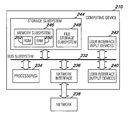
- FIG. 2 is a block diagram of a computing device that can be utilized with the embodiments of the present disclosure.
- FIG. 3 is a block diagram illustrating a system for notification processing according to an embodiment of the present disclosure.
- FIG. 4 is a block diagram illustrating a method for notification processing according to an embodiment of the present disclosure.
- Embodiments of the present disclosure provide methods and systems for processing state change notifications associated with variables shared by system processes.
- An embodiment for processing notifications can include creating an array having a number of data entries (e.g., array elements) that utilize a variable having a changeable state.
- the number of data entries and/or variables can be 10, 100, 1,000, or 10,000, among various other values.
- a variable can include various types of information and/or data that can be shared by processes.
- a variable can change state.
- a variable can be a port that can have an active/inactive state, a switch that can have an on/off state, or a cable that can have a connected/disconnected state.
- embodiments may include variables that have more than two possible states or the variable may be a value added to a data storage position that did not previously have a value therein.
- the data entries of the array can be divided into a number of blocks.
- the array entries can be partitioned in various manners.
- the number of blocks can each include the same number of array entries. For instance, if the total number of array entries were 1,000, then each of ten blocks could include 100 entries.
- the blocks can include a flag, such as a dirty bit, for example, which can be used to indicate whether a block has entries which have been modified (e.g., whether one or more entries in the block corresponds to a variable that has changed state).
- a flag such as a dirty bit
- the dirty bit of the block can be set (e.g., to a logic “1”) to indicate that the block includes modified entries (e.g., entries having a state change notification that a state of a variable has been updated).
- instructions can be executed by a processor to modify the number of entries that correspond to a variable having a changeable state when the state of the variable changes. That is, instructions can be executed to update the entries in the number of array blocks when corresponding state changes occur (e.g., when a switch is turned on/off, etc).
- instructions can be executed to overwrite the block entries when a corresponding variable state change occurs such that an entry contains information about a most recent state change (e.g., the entry indicates a current state of the corresponding variable and not a prior state or states).
- a most recent state change e.g., the entry indicates a current state of the corresponding variable and not a prior state or states.
- instructions can be executed to identify blocks that have modified entries (e.g., state change notifications) by checking the flag.
- one or more of the identified blocks e.g., blocks having the flag set
- blocks whose flag is not set are not processed.
- not processing unflagged blocks can conserve processor resources, which can be used to execute various other tasks and processes.
- processing of the blocks is performed by a background process.
- the background process can wake up periodically to check the flags of the blocks. That is, the process can cycle through the flags to determine which, if any, of the blocks include state change notifications.
- the timing of when the background process runs, the rate at which the process checks the flags, and/or the number of block entries processed by the process can be configurable. For example, instructions can be executed to cause a background process to check flags at a rate of one flag per clock cycle, two flags per clock cycle, or one flag per 50 clock cycles, among other rates. In various embodiments, controlling the rate at which the block processing occurs can reduce and/or prevent processor resources from becoming overloaded and can conserve the processor resources which can reduce and/or prevent the likelihood of other processes from being starved.
- FIG. 1 is an embodiment of a computing device network 100 in which embodiments of the present disclosure can be implemented.
- a number of devices e.g., PCs, servers, peripherals, etc.
- FIG. 1 illustrates clients and servers in a LAN.
- the embodiment of FIG. 1 shows various servers for various types of service on a LAN.
- embodiments of the present disclosure are not so limited.
- the example network of FIG. 1 illustrates a print server 110 - 1 , a mail server 110 - 2 , a web server 110 - 3 , a proxy server (e.g., firewall) 110 - 4 , a database server 110 - 5 , intranet server 110 - 6 , an application server 110 - 7 , a file server 110 - 8 , and a remote access server (e.g., dial up) 110 - 9 .
- a print server 110 - 1 e.g., a mail server 110 - 2 , a web server 110 - 3 , a proxy server (e.g., firewall) 110 - 4 , a database server 110 - 5 , intranet server 110 - 6 , an application server 110 - 7 , a file server 110 - 8 , and a remote access server (e.g., dial up) 110 - 9 .
- the examples provided here do not provide an exhaustive list of devices that can be part of a network.
- FIG. 1 further illustrates a network management server 112 (e.g., a PC or workstation), a number of “fat” clients 114 - 1 , . . . , 114 -N which can also include PCs and workstations and/or laptops, and a number of “thin” clients 115 - 1 , . . . , 115 -M which can include terminals and/or peripherals such as scanners, facsimile devices, handheld multifunction device, and the like.
- the designators “N” and “M” are used to indicate that a number of fat or thin clients can be attached to the network 100 .
- the number that N represents can be the same or different from the number represented by M.
- all of these example network devices can be connected to one another and/or to other networks via routers, 116 - 1 , 116 - 2 , 116 - 3 , and 116 - 4 , and hubs and/or switches 118 - 1 , 118 - 2 , 118 - 3 , 118 - 4 , and 118 - 5 .
- routers 116 - 1 , 116 - 2 , 116 - 3 , and 116 - 4
- hubs and/or switches 118 - 1 , 118 - 2 , 118 - 3 , 118 - 4 , and 118 - 5 are not limited to the number and/or type of network devices in FIG. 1 's illustration.
- the network management server 112 can include a processor and memory.
- the network devices of routers, 116 - 1 , 116 - 2 , 116 - 3 , and 116 - 4 , and hubs and/or switches 118 - 1 , 118 - 2 , 118 - 3 , 118 - 4 , and 118 - 5 may include processor and memory resources.
- Embodiments of the disclosure are not limited to the number, type, or size of processor and memory resources of the various devices in the network.
- Instructions can reside on the various network devices.
- computer executable instructions in the form of firmware, software, etc. can be resident on the network 100 in the memory of a network management server 112 and/or one or more routers, 116 - 1 , 116 - 2 , 116 - 3 , and 116 - 4 , and hubs and/or switches 118 - 1 , 118 - 2 , 118 - 3 , 118 - 4 , and 118 - 5 , and can be executable by the processor(s) thereon.
- instructions can be resident in a number of locations on various network devices in the network 100 as employed in a distributed computing network.
- each network device in a network is associated with a port of a switch to which it is connected.
- Data frames, or packets can be transferred between network devices by means of a switch's logic link control (LLC)/media access control (MAC) circuitry, or “engines”, associated with each switch port.
- LLC logic link control
- MAC media access control
- the network switch passes data frames received from a transmitting network device to a destination network device based, for example, on the header information in the received data frame.
- the switch can also link a given network to other networks through one or more pre-designated switch ports.
- FIG. 2 is a block diagram of a computing device that can be utilized with the embodiments of the present disclosure.
- computing device 210 includes one or more processors 234 that communicate with a number of other computing components via bus subsystem 232 .
- These other computing components may, for example, include a storage subsystem 244 having a memory subsystem 246 and a file storage subsystem 248 , user interface input devices 242 , user interface output devices 240 , and a network interface subsystem 236 , to name a few.
- the input and output devices allow user interaction with computing device 210 .
- Network interface subsystem 236 provides an interface to outside networks, including an interface to network 238 (e.g., a LAN, WAN, Internet, and/or wireless network, among others), and is coupled via network 238 to corresponding interface devices in other computer systems or devices.
- Network 238 may itself include many interconnected computer systems and communication links. Communication links as used herein may be hardwire links, optical links, satellite, or other wireless communications links, wave propagation links, or any other mechanisms for communication of information.
- User interface input devices 242 may include a keyboard; pointing devices such as a mouse, trackball, touchpad, or graphics tablet, a scanner, a touchscreen incorporated into a display; audio input devices such as voice recognition systems, microphones, and other types of input devices.
- pointing devices such as a mouse, trackball, touchpad, or graphics tablet
- audio input devices such as voice recognition systems, microphones, and other types of input devices.
- use of the term “input device” is intended to include all possible types of devices and ways to input information into computer system 210 or onto computer network 238 .
- User interface output devices 240 may include a display subsystem, a printing device, a facsimile device, or non-visual displays such as audio output devices.
- output device is intended to include all possible types of devices and ways to output information from computer system 210 to a user or to another machine or computer system 210 .
- Storage subsystem 244 can include the operating system “kernel” layer and an application layer to enable the device to perform various functions, tasks, or roles.
- File storage subsystem 248 can provide persistent (e.g., non-volatile) storage for additional program and data files, and may include a hard disk drive, a floppy disk drive along with associated removable media, a Compact Digital Read Only Memory (CD-ROM) drive, an optical drive, or removable media cartridges, among others.
- Memory subsystem 246 typically includes a number of memory components including a main Random Access Memory (RAM) 250 for storage of executable instructions and data (e.g., application programs) during program execution, and a Read Only Memory (ROM) 252 in which fixed instructions (e.g., operating system and associated kernel) are stored.
- RAM main Random Access Memory
- ROM Read Only Memory
- memory subsystem 246 can be used to store instructions that can be executed by processor 234 to create an array that includes a number of entries that correspond to information that can change state.
- information can include status information, e.g., variables, such as whether various input devices 242 and/or output devices 240 are connected, or whether a network connection is established, among various other status information.
- executable instructions storable in memory subsystem 246 can be executed by processor 234 to partition the number of entries of the array into a number of blocks.
- the number of blocks have an associated flag that indicates whether at least one of the number of entries in the block has been modified.
- the instructions can be executed to modify the number of entries that correspond to information that can change state when the state of the information changes such that the modified entries include a state change notification that indicates a current state of the information.
- the instructions can also be executed to identify at least one of the number of blocks that has a modified entry by checking the associated flag and process at least one state change notification of the at least one identified block.
- a computer readable medium is intended to include the types of memory described above, among others. Method embodiments, as will be described further herein, can be included with a computer readable medium and may also be provided using a carrier wave over a communications network such as the Internet, among others.
- Bus subsystem 232 provides a mechanism for letting the various components and subsystems of computer system 210 communicate with each other as intended.
- Program embodiments according to the present disclosure can be stored in the memory subsystem 246 , the file storage subsystem 248 , and/or elsewhere in a distributed computing environment. Due to the ever-changing nature of computing devices and networks, the description of computing device 210 depicted in FIG. 2 is intended only as one example of a computing environment suitable for implementing embodiments of the present disclosure. Many other configurations of computer system 210 are possible having more or less components than the computing device depicted in FIG. 2 .
- FIG. 3 is a block diagram illustrating a system 300 for notification processing according to an embodiment of the present disclosure.
- the system 300 illustrated in FIG. 3 , includes a first process 360 (shown as P 1 ) and a second process 380 (shown as P 2 ).
- process 360 represents a process that includes a number of variables, e.g., data that have a changeable state.
- the variables can include global variables that can be shared by multiple software modules and/or processes associated therewith (e.g., processes 360 and 380 in the embodiment of FIG. 3 ).
- the first process 360 represents a sending process (e.g., a process that sends state change notifications to another process).
- process 360 can be a process of a software module that includes a set of executable instructions that are executed to monitor a number of variables having a changeable state.
- process 360 can be used to monitor a number of internet switches, ports, or various other functions having a changeable state.
- changeable state variables can change state numerous times as various switches, ports, and/or cables are turned on/off, activated/inactivated, plugged in/out, etc.
- process 380 represents a receiving process (e.g., a process that receives state change notifications).
- process 380 can be a process of a software module that includes a set of executable instructions that are executed to process state change notifications.
- Embodiments are not limited to the example processes 360 and 380 described in connection with FIG. 3 . That is, process P 1 and P 2 can be various other processes having shared variables.
- the embodiment illustrated in FIG. 3 includes an array 365 that can be used to process state change notifications associated with variables shared by system processes (e.g., processes 360 and 380 ).
- the array 365 can be a byte array or other data structure suitable for representing state change notifications.
- executable instructions storable on a memory resource can be executed by a processor resource to divide or partition the entries (e.g., array elements) of array 365 into a number of blocks.
- the entries of array 365 are divided into a number of blocks 372 - 1 , 372 - 2 , . . . 372 -N.
- the number of blocks include a number of array entries 376 - 1 , 376 - 2 , . . . , 376 -M.
- Embodiments are not limited to blocks having the same number of array entries.
- the array entries 376 - 1 , 376 - 2 , . . . , 376 -M of the blocks 372 - 1 , 372 - 2 , . . . , 372 -N can correspond to variables having a changeable state.
- a variable can be a port that can have an active/inactive state, a switch that can have an on/off state, or a cable that can have a connected/disconnected state.
- Embodiments are not so limited.
- embodiments may include variables that have more than two possible states or embodiments having no value and a value is subsequently added or vice versa.
- the blocks 372 - 1 , 372 - 2 , . . . , 372 -N can include an associated flag (e.g., 374 - 1 , 374 - 2 , and 374 -N).
- the flags can be used to indicate whether a block has entries which have been modified (e.g., whether one or more entries in the block corresponds to a variable that has changed state).
- the flag can be a dirty bit as is known in the art.
- the dirty bit of the block can be set (e.g., to a logic “1”) to indicate that the block includes modified entries (e.g., entries having a state change notification that a state of a variable has been updated).
- the flags 374 - 1 , 374 - 2 , . . . , 374 -N can be included in a separate block (e.g., in a block separate from blocks 372 - 1 , 372 - 2 , . . . , 372 -N).
- the array 365 includes processing information 368 which can include various information, such as instructions, which can be executed to perform tasks including configuring the array elements into blocks, overwriting array entries, and setting and/or resetting the flags, among other tasks as described below. It is noted that processing information 368 can be contained in locations other than the array 365 (e.g., elsewhere in RAM).
- instructions can be executed by a processor to modify the number of entries 376 - 1 , 376 - 2 , . . . , 376 -M that correspond to a variable having a changeable state when the state of the variable changes. That is, instructions can be executed to update the entries in the number of array blocks when corresponding state changes occur (e.g., when a switch is turned on/off, etc.).
- process 360 e.g., a sending process
- instructions can be executed to overwrite the block entries when a corresponding variable state change occurs such that an entry only contains information about a most recent state change (e.g., the entry indicates a current state of the corresponding variable and not a prior state or states).
- a prior state change notification can be overwritten with a subsequent state change notification such that the prior state change notification is removed from the modified entry.
- Embodiments in which only the most recent state change information is stored can provide benefits such as reduced processing time and/or reduced memory resource usage, among others.
- instructions can be executed to identify blocks that have modified entries (e.g., state change notifications) by checking the associated flag 374 - 1 , 374 - 2 , . . . , 374 -N.
- one or more of the identified blocks are processed to determine a current state of at least one of the variables whose corresponding data entry has been modified.
- process 380 e.g., a receiving process
- can access the array 365 e.g., the blocks 372 - 1 , 372 - 2 , . . . , 372 -N) and can be used to process the identified blocks.
- blocks whose flag is not set are not processed.
- not processing unflagged blocks can conserve processor resources, which can be used to execute various other tasks and processes.
- the flags 374 - 1 , 374 - 2 , . . . , 374 -N are checked in a sequential order. Such checking arrangements can reduce processing time and organization of the flags, in some embodiments.
- processing of the blocks is performed by a background process.
- the background process can be a timer driven process that can wake up periodically to check the flags 374 - 1 , 374 - 2 , . . . , 374 -N of the blocks 372 - 1 , 372 - 2 , . . . , 372 -N. That is, the process can cycle through the flags to determine which, if any, of the blocks include state change notifications.
- the background timer process can run as a part of process 380 .
- the timer driven process can be configured to process a predetermined number of state change notifications, which correspond to a predetermined number of variables.
- the predetermined number of state change notifications that can be processed can depend on factors including the time period in which the background process is run and/or the number of clock cycles used to process a notification, among other factors.
- Embodiments in which the background process runs periodically can reduce and/or prevent a processing resource (e.g., a processor) from becoming overloaded due to processing numerous state changes.
- the timing of when the background process runs, the rate at which the process checks the flags, and/or the number of block entries processed by the process can be configurable. For example, instructions can be executed to cause a background process to check flags at a rate of one flag per clock cycle, two flags per clock cycle, or one flag per 50 clock cycles, among other rates. In various embodiments, controlling the rate at which the block processing occurs can reduce and/or prevent processor resources from becoming overloaded and can conserve the processor resources which can reduce and/or prevent the other processes from being starved (e.g., from lacking adequate processor resources).
- FIG. 4 is a block diagram illustrating a method for notification processing according to an embodiment of the present disclosure.
- the method includes dividing the number of data entries of an array, having a number of data entries that each utilize a variable having a changeable state, into a number of blocks, wherein the number of blocks include a flag indicating whether at least one of the number of entries in the block has been modified.
- the state changeable variable can be a variable shared by multiple software modules (e.g., programs and/or processes associated therewith).
- the flag can be a dirty bit or other suitable indicator.
- the method includes identifying at least one of the number blocks that has at least one modified entry by checking the flag.
- Modifying the data entries can include overwriting a prior state change notification with a current state change notification.
- a background process can execute to cycle through the flags periodically in order to determine which blocks, if any, have current state change notifications to be processed.
- the method includes processing the at least one identified block to determine a current state of at least one the variables having a changeable state whose corresponding data entry has been modified.
- blocks that do not have entries containing state change notifications are not processed. Therefore, processor resources can be conserved and used for executing various other instructions, e.g., programs.
Landscapes
- Engineering & Computer Science (AREA)
- Theoretical Computer Science (AREA)
- Physics & Mathematics (AREA)
- General Engineering & Computer Science (AREA)
- General Physics & Mathematics (AREA)
- Debugging And Monitoring (AREA)
Abstract
Description
Claims (22)
Priority Applications (1)
| Application Number | Priority Date | Filing Date | Title |
|---|---|---|---|
| US11/590,498 US8041906B2 (en) | 2006-10-31 | 2006-10-31 | Notification processing |
Applications Claiming Priority (1)
| Application Number | Priority Date | Filing Date | Title |
|---|---|---|---|
| US11/590,498 US8041906B2 (en) | 2006-10-31 | 2006-10-31 | Notification processing |
Publications (2)
| Publication Number | Publication Date |
|---|---|
| US20080104342A1 US20080104342A1 (en) | 2008-05-01 |
| US8041906B2 true US8041906B2 (en) | 2011-10-18 |
Family
ID=39331771
Family Applications (1)
| Application Number | Title | Priority Date | Filing Date |
|---|---|---|---|
| US11/590,498 Expired - Fee Related US8041906B2 (en) | 2006-10-31 | 2006-10-31 | Notification processing |
Country Status (1)
| Country | Link |
|---|---|
| US (1) | US8041906B2 (en) |
Families Citing this family (1)
| Publication number | Priority date | Publication date | Assignee | Title |
|---|---|---|---|---|
| CN108564981B (en) * | 2018-03-27 | 2021-10-01 | 深圳忆联信息系统有限公司 | Dynamic monitoring method for data security of storage device |
Citations (5)
| Publication number | Priority date | Publication date | Assignee | Title |
|---|---|---|---|---|
| US20020091965A1 (en) * | 2000-12-22 | 2002-07-11 | Mark Moshayedi | System and method for early detection of impending failure of a data storage system |
| US20020124137A1 (en) * | 2001-01-29 | 2002-09-05 | Ulrich Thomas R. | Enhancing disk array performance via variable parity based load balancing |
| US20030065886A1 (en) * | 2001-09-29 | 2003-04-03 | Olarig Sompong P. | Dynamic cache partitioning |
| US20030196031A1 (en) * | 2000-10-30 | 2003-10-16 | Chen Jack Yajie | Storage controller with the disk drive and the RAM in a hybrid architecture |
| US20060090045A1 (en) * | 1999-06-30 | 2006-04-27 | Computer Sciences Corporation | System and method for synchronizing copies of data in a computer system |
-
2006
- 2006-10-31 US US11/590,498 patent/US8041906B2/en not_active Expired - Fee Related
Patent Citations (5)
| Publication number | Priority date | Publication date | Assignee | Title |
|---|---|---|---|---|
| US20060090045A1 (en) * | 1999-06-30 | 2006-04-27 | Computer Sciences Corporation | System and method for synchronizing copies of data in a computer system |
| US20030196031A1 (en) * | 2000-10-30 | 2003-10-16 | Chen Jack Yajie | Storage controller with the disk drive and the RAM in a hybrid architecture |
| US20020091965A1 (en) * | 2000-12-22 | 2002-07-11 | Mark Moshayedi | System and method for early detection of impending failure of a data storage system |
| US20020124137A1 (en) * | 2001-01-29 | 2002-09-05 | Ulrich Thomas R. | Enhancing disk array performance via variable parity based load balancing |
| US20030065886A1 (en) * | 2001-09-29 | 2003-04-03 | Olarig Sompong P. | Dynamic cache partitioning |
Also Published As
| Publication number | Publication date |
|---|---|
| US20080104342A1 (en) | 2008-05-01 |
Similar Documents
| Publication | Publication Date | Title |
|---|---|---|
| US8726093B2 (en) | Method and system for maintaining direct hardware access in the event of network interface card failure | |
| KR101941416B1 (en) | Networking Technologies | |
| US9846576B2 (en) | Technologies for reprogramming network interface cards over a network | |
| JP5988621B2 (en) | Scalability of high-load business processes | |
| US9921868B2 (en) | Cooperated interrupt moderation for a virtualization environment | |
| US20070168525A1 (en) | Method for improved virtual adapter performance using multiple virtual interrupts | |
| AU2014215935B2 (en) | A system and method for managing message queues in a peer-to-peer communication network | |
| US8151026B2 (en) | Method and system for secure communication between processor partitions | |
| US20120002535A1 (en) | Method and system for distributing network traffic among multiple direct hardware access datapaths | |
| CN110915173A (en) | Data processing unit for computing nodes and storage nodes | |
| US20140059195A1 (en) | System and method for centralized virtual interface card driver logging in a network environment | |
| US20180375889A1 (en) | Mitigating security risks utilizing continuous device image reload with data integrity | |
| US11347594B2 (en) | Inter-processor communications fault handling in high performance computing networks | |
| US20230297358A1 (en) | Hitless upgrade of a network device | |
| US20070271401A1 (en) | Techniques to moderate interrupt transfer | |
| US7814182B2 (en) | Ethernet virtualization using automatic self-configuration of logic | |
| US8041906B2 (en) | Notification processing | |
| EP4524683A1 (en) | Application and traffic aware machine learning-based power manager | |
| US12137155B2 (en) | Analyzing network data for debugging, performance, and identifying protocol violations using parallel multi-threaded processing | |
| US20030023775A1 (en) | Efficient notification of multiple message completions in message passing multi-node data processing systems | |
| US11228552B1 (en) | Automatically handling messages of a non-operational mail transfer agent within a virtualization container | |
| JP2006092212A (en) | Data processing system and data processing method | |
| US10534744B2 (en) | Efficient means of combining network traffic for 64Bit and 31Bit workloads | |
| US12393258B1 (en) | Wake-up management circuit for multiple processors | |
| US20120259956A1 (en) | System and method for implementing a dynamic change in server operating condition in a secured server network |
Legal Events
| Date | Code | Title | Description |
|---|---|---|---|
| AS | Assignment |
Owner name: HEWLETT-PACKARD DEVELOPMENT COMPANY, L.P., TEXAS Free format text: ASSIGNMENT OF ASSIGNORS INTEREST;ASSIGNOR:PATIL, DEEPAK S.;REEL/FRAME:018487/0513 Effective date: 20061030 |
|
| AS | Assignment |
Owner name: HEWLETT-PACKARD DEVELOPMENT COMPANY, L.P., TEXAS Free format text: ASSIGNMENT OF ASSIGNORS INTEREST;ASSIGNOR:PINIO, LISA;REEL/FRAME:018782/0780 Effective date: 20061228 |
|
| STCF | Information on status: patent grant |
Free format text: PATENTED CASE |
|
| FPAY | Fee payment |
Year of fee payment: 4 |
|
| AS | Assignment |
Owner name: HEWLETT PACKARD ENTERPRISE DEVELOPMENT LP, TEXAS Free format text: ASSIGNMENT OF ASSIGNORS INTEREST;ASSIGNOR:HEWLETT-PACKARD DEVELOPMENT COMPANY, L.P.;REEL/FRAME:037079/0001 Effective date: 20151027 |
|
| FEPP | Fee payment procedure |
Free format text: MAINTENANCE FEE REMINDER MAILED (ORIGINAL EVENT CODE: REM.); ENTITY STATUS OF PATENT OWNER: LARGE ENTITY |
|
| LAPS | Lapse for failure to pay maintenance fees |
Free format text: PATENT EXPIRED FOR FAILURE TO PAY MAINTENANCE FEES (ORIGINAL EVENT CODE: EXP.); ENTITY STATUS OF PATENT OWNER: LARGE ENTITY |
|
| STCH | Information on status: patent discontinuation |
Free format text: PATENT EXPIRED DUE TO NONPAYMENT OF MAINTENANCE FEES UNDER 37 CFR 1.362 |
|
| FP | Lapsed due to failure to pay maintenance fee |
Effective date: 20191018 |