US8041756B1 - Method and apparatus for high speed calculation of non-linear functions and networks using non-linear function calculations for digital signal processing - Google Patents
Method and apparatus for high speed calculation of non-linear functions and networks using non-linear function calculations for digital signal processing Download PDFInfo
- Publication number
- US8041756B1 US8041756B1 US11/856,737 US85673707A US8041756B1 US 8041756 B1 US8041756 B1 US 8041756B1 US 85673707 A US85673707 A US 85673707A US 8041756 B1 US8041756 B1 US 8041756B1
- Authority
- US
- United States
- Prior art keywords
- value
- create
- higher order
- shift
- offset
- Prior art date
- Legal status (The legal status is an assumption and is not a legal conclusion. Google has not performed a legal analysis and makes no representation as to the accuracy of the status listed.)
- Expired - Fee Related, expires
Links
Images




Classifications
-
- G—PHYSICS
- G06—COMPUTING OR CALCULATING; COUNTING
- G06F—ELECTRIC DIGITAL DATA PROCESSING
- G06F7/00—Methods or arrangements for processing data by operating upon the order or content of the data handled
- G06F7/38—Methods or arrangements for performing computations using exclusively denominational number representation, e.g. using binary, ternary, decimal representation
- G06F7/48—Methods or arrangements for performing computations using exclusively denominational number representation, e.g. using binary, ternary, decimal representation using non-contact-making devices, e.g. tube, solid state device; using unspecified devices
- G06F7/57—Arithmetic logic units [ALU], i.e. arrangements or devices for performing two or more of the operations covered by groups G06F7/483 – G06F7/556 or for performing logical operations
-
- G—PHYSICS
- G06—COMPUTING OR CALCULATING; COUNTING
- G06F—ELECTRIC DIGITAL DATA PROCESSING
- G06F1/00—Details not covered by groups G06F3/00 - G06F13/00 and G06F21/00
- G06F1/02—Digital function generators
- G06F1/03—Digital function generators working, at least partly, by table look-up
- G06F1/0307—Logarithmic or exponential functions
-
- G—PHYSICS
- G06—COMPUTING OR CALCULATING; COUNTING
- G06F—ELECTRIC DIGITAL DATA PROCESSING
- G06F7/00—Methods or arrangements for processing data by operating upon the order or content of the data handled
- G06F7/38—Methods or arrangements for performing computations using exclusively denominational number representation, e.g. using binary, ternary, decimal representation
- G06F7/48—Methods or arrangements for performing computations using exclusively denominational number representation, e.g. using binary, ternary, decimal representation using non-contact-making devices, e.g. tube, solid state device; using unspecified devices
- G06F7/4806—Computations with complex numbers
-
- G—PHYSICS
- G06—COMPUTING OR CALCULATING; COUNTING
- G06F—ELECTRIC DIGITAL DATA PROCESSING
- G06F7/00—Methods or arrangements for processing data by operating upon the order or content of the data handled
- G06F7/38—Methods or arrangements for performing computations using exclusively denominational number representation, e.g. using binary, ternary, decimal representation
- G06F7/48—Methods or arrangements for performing computations using exclusively denominational number representation, e.g. using binary, ternary, decimal representation using non-contact-making devices, e.g. tube, solid state device; using unspecified devices
- G06F7/52—Multiplying; Dividing
- G06F7/523—Multiplying only
- G06F7/5235—Multiplying only using indirect methods, e.g. quarter square method, via logarithmic domain
Definitions
- This invention relates to non-linear function calculation and instruction processing as applied to Digital Signal Processing (DSP).
- DSP Digital Signal Processing
- DSP Digital Signal Processing
- FIG. 1A illustrates a simplified block diagram of a DSP system applicable to cellular base station, medical imaging and instrumentation system applications as found in the prior art.
- sensors 1 and 2 provide samples 10 and 12 to DSP Processor, which after performing one or more DSP tasks, generates DSP results.
- the samples and results are usually in the form of words composed of bits, and are often treated as numbers by DSP processors.
- the invention is focused on numerical processing, and from hereon, the discussion will assume that the samples and results are to be treated as numbers.
- the DSP Processor today is typically controlled by an internal processor clock.
- the sensors typically sample on a regular basis, which will be referred to herein as the sampling rate.
- processor clock rates There is a large disparity today between processor clock rates and sensor sampling rates. Often sensors only generate between 20 million and 64 million samples per second, while the clock frequencies of processors are often between 300 and 1000 MHz. While DSP processors can run this fast, there are serious questions as to how to feed enough data into these engines to justify these clock speeds.
- DSP Processors can typically perform one or more numeric operations such as adds/subtracts, multiplies and shifts per instruction cycle.
- a shift of a word of bits moves the bits up or down, effecting division or multiplication by powers of two.
- Continuous processing means that samples enter the DSP processor continuous. In a clocked system, this means at least one sample enters the system during every clock cycle.
- a complex number is composed of two numeric components, one called the real numeric component and the other the imaginary numeric component.
- the mathematical extension of numeric multiplication is called complex multiplication.
- a second complex number A 2 A 2 R+j A 2 I.
- Complex multiplication of A 1 by A 2 gives a complex number with a real component of A 1 R*A 2 R ⁇ A 1 I*A 2 I and an imaginary component of A 1 R*A 2 I+A 1 I*A 2 R.
- FIG. 1B illustrates a prior art complex multiplier multiplying A 1 by A 2 including four multipliers Mult RR, Mult RI, Mult IR and Mult II and two adders.
- DSP tasks There are a number of common DSP tasks, which will be referred to throughout this patent application and to which the invention offers advantages. Many of these tasks are best seen as linear transformations from an input sample vector to a result vector.
- a vector is an ordered sequence of numbers, which may also be complex numbers.
- a linear transformation acts upon an input sample vector by performing adds/subtracts, and multiplications on the numbers in the sample vector to generate the result vector.
- linear transformations include Fast Fourier Transforms (FFTs), Discrete Cosine Transforms (DCTs), Discrete Wavelet Transforms (DWT), Finite Impulse Response (FIR) filters and Infinite Impulse Response (IIR) filters.
- FFTs Fast Fourier Transforms
- DCTs Discrete Cosine Transforms
- DWT Discrete Wavelet Transforms
- FIR Finite Impulse Response
- IIR Infinite Impulse Response
- Each of these linear transformations can be defined in terms of a matrix operating upon the sample vector to generate the result vector.
- FFTs and DCT's tend to be used on sample vectors containing a finite length sequence of samples.
- DWT's, FIR's, and IIR's operate on sample vectors of unlimited length.
- the matrices that define these linear transformations are finite in size, possessing a finite number of row and a finite number of columns, with a numeric entry at each row and column.
- the numeric entries are the coefficients, the A 2 R's by which the samples A 1 R are multiplied, with the products then summed to form the result vector components.
- FFT's are extremely important. Typically, Fast Fourier Transform implementations focus on complex sample vectors whose sequence length is a power of two, such as 16 to 4,096, generating result vectors of the same sequence length as the sample vector. Without some of the amazing properties of the FFT matrix, computing an FFT of 64 complex samples, also known as points, would require up to 64 complex multiplications, and then summing those complex products to generate each of the complex vector results.
- Matrix arithmetic supports multiplicative inverses and factors, in the case of the FFT matrices.
- the inventors are aware of four distinct factoring products that equal the FFT matrix.
- One of these is known as the Cooley-Tukey Factorization in honor of the two individuals credited with its discovery. While the other three methods of factoring the FFT are valid and important, the discussion from hereon will focus exclusively on the Cooley-Tukey. This decision is not meant to imply any limitation to the scope of the claims, but is done only for the sake of keeping the discussion as simple as possible.
- the Cooley-Tukey Factorization for an FFT matrix is a collection of Radix 2 matrices, often called steps, which are performed in a specific sequence, the first acting upon the sample vector, generating a first result vector.
- the second Radix 2 matrix acts upon the first result vector to generate a second result vector, and so on until the last factor's result vector is essentially the same as the result vector of the FFT matrix acting upon the sample vector.
- These Radix 2 steps involve no more than two complex multiplications of an input to calculate the effect of that complex input on the complex components of the result vector.
- a Radix operation will refer to the actions necessary to modify the current complex values of a result vector for a given complex input, which for the sake of consistency will be called the complex input A 1 .
- the radix operation of a Radix 4 step will modify four complex components of the result vector for each complex input A 1 I of that steps's input vector.
- the radix operation of a Radix 8 step will modify eight complex components of the result vector for each complex input A 1 of that step's input vector.
- FIG. 1C illustrates multiplier Mult RR of FIG. 1B , containing two log calculators receiving A 1 R and A 2 R, generating Log A 1 R and Log A 2 R, which Add R receives to generate Log A 1 RA 2 R, which Exp Calc receives to generate A 1 RA 2 R, as found in the prior art.
- DSP solutions have limited arithmetic operational flexibility. Typically, only the operations of addition, subtraction, multiplication and shifting can be done during every instruction cycle. Even a slide rule has some form of divide, square root, logarithm and exponentiation. But today's DSP solutions cannot deliver these operations at anywhere near the rate of adds, subtracts and multiplications, if they can deliver them at all in a real-time effective manner.
- DSP solutions face another set of problems, based upon the need for continuous processing of deep filters which may involve multi-dimensional FFT's, DCT's and DWT's.
- processor clock rates There is a large disparity today between processor clock rates and sensor sampling rates. Often sensors only generate between 20 million and 64 million samples per second, while the clock frequencies of processors are often between 300 and 1000 MHz. While DSP processors can run this fast, there are serious questions as to how to feed enough data into these engines to justify these clock speeds.
- the invention addresses at least all the above mentioned problems found in the prior art.
- the invention includes apparatus and methods for high-speed calculation of non-linear functions based upon an arithmetic cell and a table collection.
- Each member of the table collection is driven by a first part of an input number, the arithmetic cell receives the entries of each table collection member at the first part, as well as a collection of remaining parts of the input number.
- the remaining part collection members effect small shifts and sometimes sign control of corresponding table entries to create effected table entries.
- the effected table entries are then added to a base table entry, which is not affected by the remaining part collection members, to generate the output of the arithmetic circuit.
- the invention includes apparatus and methods for high-speed calculation of non-linear functions based upon a shifted adder and a offset generator.
- the offset generator is driven by a first order fraction of an input number, the shifted adder receives a collection of values, as well as a collection of successive higher fractions of the input number.
- the successive higher order fractions effect small shifts and sometimes sign control of corresponding value collection which are then added to a base value, to generate the output of the arithmetic circuit.
- Various implementations may preferably include an input preprocessor and/or an output post processor.
- logarithms are preferably calculated base 2 , with the most significant bit being one, mapping the calculation into the interval between one half and one.
- Logarithms preferably use a preprocessor to convert fixed point numbers into this range limited version, before the actual non-linear function calculation is performed.
- the inventors have found it often preferable for the log domain numbers to include indications of zero detection and sign detection of the input. Zero detection will be referred to herein as a negative infinity indication.
- Multiplication and division can both result in numbers larger than the numeric domain can support. It is often preferable when translating these operations to adds and subtracts in the log domain for the log domain notation to support a positive infinity. Further, the normal arithmetic fact that zero multiplied by anything is zero leads to preferring that negative infinity indicated log domain numbers, when added to anything, including positive infinity, result in negative infinity being indicated.
- Exponentiation is also preferably performed base 2 .
- Exponentiation resulting in fixed point output preferably calculates the fractional part to a range between zero and one, and then shifts the result based upon the integer part of the input, which is preferably done with an output post processor.
- Post processor exponentiation often preferably includes forcing zeros, and negation, based upon negative infinity and sign indications.
- sine/cosine often involve both an input preprocessor to range limit the input, often to the first quadrant of 90 E, as well as an output post processor to control the sign of the output result.
- the calculators can support varying input/output configurations using a shared data path partition control signal(s).
- Relatively small tables and arithmetic circuits can provide excellent accuracy, sufficient to handle at least single precision floating point calculations of exponentiation and logarithms, sine and cosine, etc. for continuous throughput, real-time DSP applications, which is a capability unavailable today.
- the invention includes a family of core cells built from instances of these calculators providing an upward, functionally compatible, extension to a family of Application Specific Integrated Circuit (ASIC) core cells. All of these core cells consistently provide the ability to perform high speed DSP tasks including Fast Fourier Transforms (FFTs), Finite Impulse Response (FIR) filters and Infinite Impulse Response (IIR) filters.
- FFTs Fast Fourier Transforms
- FIR Finite Impulse Response
- IIR Infinite Impulse Response
- the core cells built from the calculators can concurrently perform many non-linear function calculations.
- the core cells can switch between tasks every clock cycle.
- the Radix 4 engine of FIG. 12 essentially equals the FFT performance of the Texas Instruments 6415, which is the fastest DSP engines in production known to the inventors, as of the filing of this patent. This comparison is in terms of cycle counts.
- this engine is intended to be used in multiple instance networks to provide continuous FFT processing, so that the number of FFT's per second becomes the input clock frequency divided by the number of these engines applied to each Radix 4 Step. Assuming a 512 MHz clock cycle, one Radix 4 engine wide network, using five of these core cells provide 500,000 1 K point complex FFT's per second. According to Texas Instrument's web site documentation, the 6415 provides 100,000 at 600 MHz clock frequency.
- the inventors have found, again with 16 bit inputs and outputs, that the Radix 8 engine of FIG. 14 can be instantiated and configured to provide either reduced latency at continuous processing rates, or concurrently act as two Radix 4 engines.
- the inventors know of no DSP engine which can be reconfigured at run time to give the systems engineering community control over both processing rates and latency.
- the Radix 8 engine delivers twice the performance of the Radix 4 engine.
- Five Radix 8 engines can be configured to deliver 1 million 1 K point complex FFTs per second, which can readily fit into typical medium to small digital integrated circuits today.
- Both the Radix 4 engine of FIG. 12 and the Radix 8 engine of FIG. 14 can continuously provide multiple logarithms, exponentials, square roots, divisions, unavailable in contemporary solutions.
- the invention includes an apparatus and method performing crucial DSP operations based upon using non-linear function calculators.
- Basic to these DSP operations is the continuous performance of a complex multiplication, which is preferably extended to include at least Radix 4, and Radix 8 steps required by various FFT's.
- This method provides an opportunity for not only efficiently performing the primary tasks of contemporary DSP, but also adding support for the real-time use of additional functions and operations including, but not limited to, division, square roots, logarithms, exponentiation, sine, cosine and many other functions.
- FIG. 1A illustrates a simplified block diagram of a DSP system applicable to cellular base station, medical imaging and instrumentation system applications as found in the prior art
- FIG. 1B illustrates a prior art complex multiplier multiplying A 1 by A 2 including four multipliers Mult RR, Mult RI, Mult IR and Mult II and two adders;
- FIG. 1C illustrates multiplier Mult RR of FIG. 1B , containing two log calculators receiving A 1 R and A 2 R, generating Log A 1 R and Log A 2 R, which Add R receives to generate Log A 1 RA 2 R, which Exp Calc receives to generate A 1 RA 2 R, as found in the prior art;
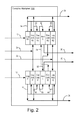
- FIGS. 2 , 3 , and 4 A illustrate apparatus for a complex multiplier 100 providing a complex product of a first complex input with components A 1 R 10 and A 1 I 12 , and a second complex number defined by a Log A 2 R 24 and an Log A 2 I 26 ;
- FIG. 4B illustrates a more detailed view of the logarithm calculator collection, or the means for receiving 60 of FIG. 4A ;
- FIG. 4C illustrates a more detailed view of the first adder collection, providing a means for adding 70 of FIG. 4A ;
- FIG. 5A illustrates a more detailed view of the exponential calculator collection, providing the means for exponentiating 80 of FIG. 4A ;
- FIG. 5B illustrates a more detailed view of the second adder collection, providing a means for creating 90 of FIG. 4A ;
- FIG. 5C illustrates complex multiplier 100 further including at least one of circuitry supporting a means 110 for providing at least one member of the log value collection, and circuitry supporting a means 112 for providing each of the complex numeric component members;
- FIG. 5D further illustrates the circuitry supporting a means 110 for providing at least one member of the log value collection of FIG. 5C ;
- FIG. 6A illustrates a refinement of the complex multiplier 100 of FIG. 4A further including a second collection of logarithm calculators supporting a second means 62 of receiving the second complex input A 2 R 20 and A 2 I 22 to create log A 2 R 24 and log A 2 I 26 ;
- FIG. 6B illustrates a refinement of the complex multiplier 100 of FIG. 2 further including a second collection of logarithm calculators supporting a second means 62 of receiving the second complex input A 2 R 20 and A 2 I 22 to create Log A 2 R 24 and Log A 2 I 26 , as well as providing Log A 2 R 24 for potential output 34 and Log A 2 I 26 for potential output 36 ;
- FIG. 7A illustrates a refinement of the complex multiplier 100 of FIG. 4A further including input generator 140 providing Log A 2 R 24 and Log A 2 I 26 ;
- FIG. 7B illustrates an FFT radix engine 200 for performing at least an FFT radix operation based upon the first complex input A 1 R 10 and A 1 I 12 , including complex multiplier 100 of FIGS. 2 , 3 , 4 A, further including at least two (four illustrated) circuitry supporting means for creating new complex values based upon the complex input 10 and 12 , complex product 30 and 32 , current complex values, and corresponding controls;
- FIG. 8 illustrates a refinement of the FFT radix engine 200 of FIG. 7B further providing at least one member of the log-value collection 34 to at least one of the circuits 210 , 220 , 230 , and/or 240 ;
- FIG. 9 illustrates a refinement 300 of the FFT radix engine of FIG. 7B including 8 circuits supporting creating new complex values and a second complex multiplier 100 receiving the complex input 10 and 12 to generate a second complex product 332 and 334 ;
- FIG. 10 illustrates a refinement 302 of the FFT radix engine of FIG. 7B including 8 circuits supporting creating new complex values and a second complex multiplier 100 receiving the complex product 30 and 32 to generate a second complex product 332 and 334 ;
- FIG. 11 illustrates a refinement 304 of the FFT radix engine of FIG. 7B including 8 circuits supporting creating new complex values and a fixed multiplier 320 receiving the complex product 10 and 12 to generate a second complex product 332 and 334 ;
- FIG. 12 illustrates a refinement of the FFT radix engine 202 of FIG. 8 further providing at least one member of the log-value collection 34 to at least one of the circuits 210 , 220 , 230 , and/or 240 ;
- FIG. 13A illustrates a refinement 306 of the FFT radix engines of FIGS. 9 and 10 organized as two instances of Radix 4 engines of FIG. 12 ;
- FIG. 13B illustrates an embodiment of Log R 1 , a logarithm calculator found in FIGS. 2 , 3 , 4 B, 6 B, 12 and 14 ;
- FIG. 13C illustrates an embodiment of Exp Calc R 1 , an exponential calculator found in FIGS. 2 , 3 , 5 A, 6 B, 12 and 14 ;
- FIG. 14 illustrates a further refinement 306 of the FFT radix engines of FIGS. 9 , 10 and 13 A capable of operating as two instances of Radix 4 engines of FIG. 12 ;
- FIG. 15A illustrates a non-linear function calculator 700 in accord with certain aspects of the invention
- FIG. 15B illustrates a more detailed view of the shifted adder 710 of FIG. 15A ;
- FIGS. 16A to 17B illustrates a variety of embodiments of offset generator 720 of FIG. 15A ;
- FIG. 18A illustrates a refinement of the non-linear function calculator 700 of FIG. 15A using four successive higher order fractions
- FIG. 18B illustrates a refinement of the offset generator 720 for FIG. 18A ;
- FIG. 19 illustrates a refinement of the non-linear function calculator 700 of FIG. 18A using secondary offset collection members
- FIG. 20A illustrates a more detailed view of adder 734 of FIG. 15B using a local carry propagate adder tree 800 feeding a global carry propagate adder 810 ;
- FIG. 20B illustrates a more detailed view of adder 734 of FIG. 15B using a global carry propagate adder tree 820 ;
- FIG. 21A illustrates a more detailed view of the local carry propagate adder tree 800 of FIG. 20A ;
- FIG. 21B illustrates a more detailed view of the global carry propagate adder tree 820 of FIG. 20B ;
- FIG. 22A illustrates a preferred embodiment of Log R 1 , a logarithm calculator found in FIGS. 2 , 3 , 4 B, 6 B, 12 and 14 ;
- FIG. 22B illustrates a preferred embodiments of Exp Calc R 1 , an exponential calculator found in FIGS. 2 , 3 , 5 A, 6 B, 12 and 14 ;
- FIG. 22C illustrates a preferred embodiment of Log R 1 , a logarithm calculator found in FIGS. 2 , 3 , 4 B, 6 B, 12 and 14 ;
- FIG. 22D illustrates a preferred embodiment of Exp Calc R 1 , an exponential calculator found in FIGS. 2 , 3 , 5 A, 6 B, 12 and 14 ;
- FIG. 22E illustrates a preferred refinement of the circuitry supporting the logic for asserting negation and zero 550 found in FIGS. 13C and 22D .
- the invention includes an apparatus and method performing crucial DSP operations based upon using non-linear function calculators.
- Basic to these DSP operations is the continuous performance of a complex multiplication, which is preferably extended to include at least Radix 4, and Radix 8 steps required by various FFT's.
- This method provides an opportunity for not only efficiently performing the primary tasks of contemporary DSP, but also adding support for the real-time use of additional functions and operations including, but not limited to, division, square roots, logarithms, exponentiation, sine, cosine and many other functions.
- a 1 A 1 R+A 2 I*j, where A 1 R 10 and A 1 I 12 .
- the second complex input A 2 A 2 R+A 2 I*j is defined by Log A 2 R 24 and Log A 2 I 26 .
- FIGS. 2 , 3 , and 4 A illustrate apparatus for a complex multiplier 100 providing a complex product of a first complex input with components A 1 R 10 and A 1 I 12 , and a second complex number defined by a Log A 2 R 24 and an Log A 2 I 26 .
- FIG. 4B illustrates a more detailed view of the logarithm calculator collection, or the means for receiving 60 of FIG. 4A .
- FIG. 4C illustrates a more detailed view of the first adder collection, providing a means for adding 70 of FIG. 4A .
- FIG. 5A illustrates a more detailed view of the exponential calculator collection, providing the means for exponentiating 80 of FIG. 4A .
- FIG. 5B illustrates a more detailed view of the second adder collection, providing a means for creating 90 of FIG. 4A .
- FIGS. 2 and 3 also illustrate preferably providing at least a version 34 and/or 36 of the logarithmic value of at least one component A 1 R 10 and/or A 1 I 12 of the first complex input.
- logarithmic values are defined only for positive real-valued number inputs.
- logarithmic values preferably define inputs anywhere on the real number line, indicating the value of zero, as well as negative numbers, and include a non-trivial logarithm of the absolute value of the input whenever zero is not indicated.
- the complex multiplier 100 of FIGS. 2 , 3 , and 4 A provide a complex product by essentially the same method of operation.
- the first complex input includes a A 1 R 10 and a A 1 I 12 .
- the first complex log version number includes a Log A 1 R 14 and a Log A 1 I 16 .
- the first complex input is received to create a first complex log version number.
- a logarithm of the A 1 R 10 is calculated to create the Log A 1 R 14 .
- a logarithm the A 1 I 12 is calculated to create the Log A 1 I 16 .
- Log R 1 provides Log A 1 R 14 to both Log Add R 1 and Log Add R 2 .
- Log R 1 provides Log A 1 R 14 to Log Add R 1 and Log R 2 provides Log A 1 R 14 to Log Add R 2 .
- Log I 1 provides Log A 1 I 16 to both Log Add I 1 and Log Add 12 .
- Log I 1 provides Log A 1 I 16 to Log Add I 1 and Log 12 provides Log A 1 I 16 to Log Add 12 .
- FIG. 3 the second pair of logarithmic calculators is shown to provide outputs. This has been done strictly for clarity of the Figure, and is not intended to limit the scope of the claimed invention. Aspects of the invention include providing the output of all logarithmic calculators outside the complex multiplier 100 .
- the first complex log version number 14 , Log A 1 R, and 16 , Log A 1 I is added to the Log A 2 R 24 to create a Log A 1 RA 2 R 42 , and a Log A 1 IA 2 R 46 .
- Log A 1 R 14 , and Log A 1 I 16 is added to the Log A 2 I 26 to create Log A 1 RA 2 I 40 , and Log A 1 IA 2 I 44 .
- Addition in the log domain is sufficient to define a multiplication.
- Log A 1 RA 2 R Log A 1 R+Log A 2 R.
- Subtraction in the log domain is sufficient to define division
- Log A 1 R/A 2 R Log A 1 R ⁇ Log A 2 R.
- Dividing by two which is a shifting down by one bit, is sufficient in the log domain to define a square root. The shifting can be upon the inputs of a log adder circuit such as Log Add R 1 , and/or upon the output of the adder.
- a complex log component collection includes the Log A 1 RA 2 R 42 , the Log A 1 IA 2 R 46 , the Log A 1 RA 2 I 40 , and the Log A 1 IA 2 I 44 .
- a complex numeric component collection includes A 1 RA 2 R 52 , A 1 IA 2 R 56 , A 1 RA 2 I 50 , and A 1 IA 2 I 54 .
- each member of the complex log component collection is translated to create a corresponding member of the complex numeric component collection.
- An exponentiation of the Log A 1 RA 2 R 42 is calculated to create the A 1 RA 2 R 52 .
- An exponentiation of the Log A 1 IA 2 R 46 is calculated to create the A 1 IA 2 R 56 .
- An exponentiation of the Log A 1 RA 2 I 40 is calculated to create the A 1 RA 2 I 50 .
- An exponentiation of the Log A 1 IA 2 I 44 is calculated to create the A 1 IA 2 I 54 .
- the complex product includes A 12 R 30 and A 12 I 32 .
- a second collection of adders providing a means 90 for creating the complex product 30 and 32 from the complex numeric component collection 50 to 56 .
- a 1 IA 2 I 54 is subtracted by Add R 1 from A 1 RA 2 R 52 to create A 12 R 30 .
- the A 1 RA 2 I 50 is added by Add I 1 to A 1 IA 2 R 56 to create the A 12 I 32 .
- FIG. 5C illustrates complex multiplier 100 further including at least one of circuitry supporting a means 110 for providing at least one member of the log value collection, and circuitry supporting a means 112 for providing each of the complex numeric component members.
- FIG. 5D further illustrates the circuitry supporting a means 110 for providing at least one member of the log value collection of FIG. 5C .
- version 34 of the logarithmic value of component 10 , A 1 R includes at least one of Log A 1 R 14 , Log A 1 R, Log A 1 RA 2 R 42 , Log A 1 RA 2 R, and Log A 1 RA 2 I 40 , Log A 1 RA 2 I.
- Version 36 of the logarithmic value of component 12 , A 1 I includes at least one of Log A 1 I 16 , Log A 1 I, Log A 1 IA 2 I 44 , Log A 1 IA 2 I, and Log A 1 IA 2 R 46 , Log A 1 IA 2 R.
- version 34 is preferably the logarithmic value of A 1 R 10 , which is Log A 1 R 14 .
- Version 36 is preferably the logarithmic value of A 1 I 12 , which is Log A 1 I 16 .
- FIG. 6A illustrates a refinement of the complex multiplier 100 of FIG. 4A further including a second collection of logarithm calculators supporting a second means 62 of receiving the second complex input A 2 R 20 and A 2 I 22 to create log A 2 R 24 and log A 2 I 26 .
- FIG. 6B illustrates a refinement of the complex multiplier 100 of FIG. 2 further including a second collection of logarithm calculators supporting a second means 62 of receiving the second complex input A 2 R 20 and A 2 I 22 to create Log A 2 R 24 and Log A 2 I 26 , as well as providing Log A 2 R 24 for potential output 34 and Log A 2 I 26 for potential output 36 .
- Log R 2 receives A 2 R 20 and generates Log A 2 R 24 , which is provided to Log Add R 1 and Log Add I 1
- Log 12 receives A 2 I 22 and generates Log A 2 I 26 , which is provided to Log Add R 2 and Log Add 12 .
- FIG. 7A illustrates a refinement of the complex multiplier 100 of FIG. 4A further including input generator 140 providing Log A 2 R 24 and Log A 2 I 26 .
- input generator 140 may include at least one of the following: a memory, a combinatorial logic network, a finite state machine, or as a network including at least two instance of these three elements: memories, combinatorial logic networks and finite state machines.
- each operation involved a single complex product, which was used in either its original form, or in the other three quadrant phase shifted versions.
- Each component of these quadrant shifted forms amounted to selecting either the real or imaginary component of the complex product, and then possibly negating it.
- dual arithmetic logic units each able to select from the complex product components could use that selected component to either add or subtract it either from the current complex value component or zero to establish the new complex value component.
- Cooley-Tukey Radix 8 operations involve the original complex product and half quadrant phase shifted versions of the complex product.
- the half quadrant phase shifted version of the complex product amounted to multiplying the complex product by the square root of one half, which is the value of both the cosine and sine of the half quadrant, also known as 45 E.
- the Radix 4 engine of FIG. 12 essentially the FFT performance of the Texas Instruments 6415, which is the fastest DSP engine in production known to the inventors, as of the time of the filing of this patent. This comparison is in terms of cycle counts.
- this engine is intended to be used in multiple instance network to provide continuous FFT processing, so that the number of FFT's per second becomes the input clock frequency divided by the number of these engines applied to each Radix 4 Step. Assuming a 512 MHz clock cycle, one Radix 4 engine wide network, using five of these core cells provide 500,000 1 K point complex FFT's per second. According to Texas Instrument's web site documentation, the 6415 provides 100,000 at 600 MHz.
- the inventors have found, again with 16 bit inputs and outputs, that the Radix 8 engine of FIG. 14 can be instantiated and configured to provide either reduced latency at continuous processing rates, or act as two Radix 4 engines.
- the inventors know of no DSP engine which can be reconfigured at run time to give the systems engineering community control over both processing rates and latency.
- the Radix 8 engine delivers twice the performance of the Radix 4 engine.
- Five Radix 8 engines can be configured to deliver 1 million 1 K point complex FFTs per second, which can readily fit into typical medium to small digital integrated circuits today.
- FIG. 7B illustrates an FFT radix engine 200 for performing at least an FFT radix operation based upon the first complex input A 1 R 10 and A 1 I 12 , including complex multiplier 100 of FIGS. 2 , 3 , 4 A, further including at least two (four illustrated) circuitry supporting means for creating new complex values based upon the complex input 10 and 12 , complex product 30 and 32 , current complex values, and corresponding controls.
- FIG. 8 illustrates a refinement of the FFT radix engine 200 of FIG. 7B further providing at least one member of the log-value collection 34 to at least one of the circuits 210 , 220 , 230 , and/or 240 .
- FIG. 9 illustrates a refinement 300 of the FFT radix engine of FIG. 7B including 8 circuits supporting creating new complex values and a second complex multiplier 100 receiving the complex input 10 and 12 to generate a second complex product 332 and 334 .
- FIG. 10 illustrates a refinement 302 of the FFT radix engine of FIG. 7B including 8 circuits supporting creating new complex values and a second complex multiplier 100 receiving the complex product 30 and 32 to generate a second complex product 332 and 334 .
- FIG. 11 illustrates a refinement 304 of the FFT radix engine of FIG. 7B including 8 circuits supporting creating new complex values and a fixed multiplier 320 receiving the complex product 10 and 12 to generate a second complex product 332 and 334 .
- FIG. 12 illustrates a refinement of the FFT radix engine 202 of FIG. 8 further providing at least one member of the log-value collection 34 to at least one of the circuits 210 , 220 , 230 , and/or 240 .
- FIG. 13A illustrates a refinement 306 of the FFT radix engines of FIGS. 9 and 10 organized as two instances of Radix 4 engines of FIG. 12 .
- FIG. 13B illustrates an embodiment of Log R 1 , a logarithm calculator found in FIGS. 2 , 3 , 4 B, 6 B, 12 and 14 , including at least one of a logic circuit 500 supporting means for aligning the component input A 1 R 10 to access 504 a table 510 and drive 502 an arithmetic circuit 520 fed 512 by the table 510 .
- FIG. 13C illustrates an embodiment of Exp Calc R 1 , an exponential calculator found in FIGS. 2 , 3 , 5 A, 6 B, 12 and 14 , including at least one of a table 530 , an arithmetic circuit 540 fed by table 530 , and a logic circuit 550 operating upon an output 534 of the arithmetic circuit 540 to establish at least negation and zero for the exponentiation.
- Tables 510 and 530 may be implemented as at least a memory, a combinatorial logic network, and a second combinatorial logic network feed by at least one of the memory and the combinatorial logic network.
- FIG. 14 illustrates a further refinement 306 of the FFT radix engines of FIGS. 9 , 10 and 13 A capable of operating as two instances of Radix 4 engines of FIG. 12 .
- the radix engine includes at least one complex multiplier 100 providing complex product 30 and 32 using Log A 2 R 24 and Log A 2 I 26 to define the second complex input.
- the radix engine includes at least two circuits supporting means for creating a new complex value based upon the current complex value, a control for the current complex value, the complex input, and the complex product.
- circuitry 210 creating a new complex value 216 based upon the current complex value 212 , a control 214 for the current complex value 212 , the complex input 10 - 12 , and the complex product 30 - 32 .
- quadrant phase shifted versions of a complex product are that creating the real and imaginary components of new complex values amount to adding or subtracting the real and imaginary components of the complex input or the complex product to a current complex value's real and imaginary component, respectively.
- FIGS. 12 and 14 illustrate this preferred approach by corresponding accumulators in the top row and the bottom row sharing the same circuitry reference number for creating the new complex values. See for example Acc R 0 210 and Acc 10 210 in FIGS. 12 and 14 .
- Each component of these quadrant shifted complex numbers amounts to selecting either the real or imaginary component of the complex product, or the complex input, and then possibly negating it. This meant that dual arithmetic logic units, each able to select from the complex product or input components could use that selected component to either add or subtract it either from the current complex value component or zero to establish the new complex value component.
- Cooley-Tukey Radix 8 operations involve the original complex product and half quadrant phase shifted versions of the complex product.
- the half quadrant phase shifted version of the complex product amounted to multiplying the complex product by the square root of one half, which is the value of both the cosine and sine of the half quadrant, also known as 45 E.
- the radix engine includes exactly four circuits supporting means for creating a new complex value based upon the current complex value, a control for the current complex value, the complex input, and the complex product.
- the radix engine includes eight circuits supporting means for creating a new complex value based upon the current complex value, a control for the current complex value, the complex input, and the complex product.
- the complex multiplier includes circuitry providing at least one member of the log-value collection, as well as at least one of the circuitry creating the new complex values includes means for creating at least a component of the current complex value based upon the current complex value, the control, the complex input, the complex product and the provided log-value collection member.
- the FFT radix operation includes at least an FFT Radix 2 operation and further includes at least an FFT Radix 4 operation.
- the radix engine can perform an FFT Radix 8 operations and includes circuitry calculating a second complex product 334 and 336 based upon at least one the first complex input 10 - 12 and the complex product 30 - 32 .
- the radix engine includes circuitry capable of calculating the second complex product as a multiple of the complex product.
- the radix engine includes a second of the complex multipliers capable of providing the second complex product 334 - 336 from the complex input 30 - 32
- the radix engine includes circuitry capable of calculating a fixed multiple of the complex product 30 - 32 to create the second complex product 334 - 336 .
- the radix engine includes another complex multiplier capable of receiving the complex input as the complex product 30 - 32 and the second complex input approximating the fixed multiple.
- FIGS. 15A to 22E illustrate various aspects of the invention including apparatus and methods for high-speed calculation of non-linear functions based upon a shifted adder 710 and a offset generator 720 .
- the offset generator 720 is driven by a first order fraction In 0 704 of an input number 702 , the shifted adder 710 receives a collection of values, as well as a collection of successive higher fractions In 1 706 - 1 to at least In 3 706 - 3 of the input number 702 .
- the successive higher order fractions effect small shifts and sometimes sign control of corresponding value collection which are then added to a base value, to generate the output of the arithmetic circuit.
- Various implementations may preferably include a input preprocessor and/or an output post processor.
- logarithms are preferably calculated base 2 , with the most significant bit being one, mapping the calculation into the interval between one half and one.
- Logarithms preferably use a preprocessor to convert fixed point numbers into this range limited version, before the actual non-linear function calculation is performed.
- the inventors have found it often preferable for the log domain numbers to include indications of zero detection and sign detection of the input. Zero detection will be referred to herein as a negative infinity indication.
- Multiplication and division can both result in numbers larger the a numeric domain can support. It is often preferable when translating these operations to adds and subtracts in the log domain for the log domain notation to support a positive infinity. Further, the normal arithmetic fact that zero multiplied by anything is zero leads to preferring that negative infinity indicated log domain numbers, when added to anything, including positive infinity, result in negative infinity being indicated.
- Exponentiation is also preferably performed base 2 .
- Exponentiation resulting in fixed point output preferably calculates the fractional part to a range between zero and one, and then shifts the result based upon the integer part of the input, which is preferably done with an output post processor.
- Post processor exponentiation often preferably includes forcing zeros, and negation, based upon negative infinity and sign indications.
- sine/cosine often involve both an input preprocessor to range limit the input, often to the first quadrant of 90 E, as well as an output post processor to control the sign of the output result.
- the non-linear function is a version of exponentiation, a version of logarithm, or a version of a trigonometric function, where the trigonometric function is a sine, cosine, or any linear combination of said sine and said cosine.
- the version of exponentiation may include, but is not limited to, at least a full-range version of exponentiation, a range-limited version exponentiation over a limited range, a binary-base version of exponentiation, a decimal-base version of exponentiation, and a natural-base version of exponentiation.
- the version of logarithm may include, but is not limited to, at least one of: a full-range version logarithm, a range-limited version logarithm over a limited range, a binary-base version of logarithm, a decimal-base version of logarithm, and a natural-base version of logarithm.
- the version of the trigonometric function may include, but is not limited to, at least one of a full-range version of the trigonometric function, a range-limited version of the trigonometric function, a linear transformed range version of the trigonometric function, and a linear transformed, range-limited version of the trigonometric function.
- Input In 702 represents at least one of the following in various preferred embodiments: an unsigned integer range of K bits, a signed integer range of K bits, a fixed point range of K bits, a mantissa of K bits, a leading bit mantissa of K bits, a floating point number of L bits with a mantissa of K bits, an extended number including a K bit fraction, and an extended number including floating point number of L bits with a mantissa of K bits.
- K is preferred to be at least 12
- L is preferred to be greater than K.
- the extended number may include at least one negative infinity indication and/or at least one sign indication.
- the calculators can support varying input/output configurations using a shared data path partition control signal(s).
- Relatively small tables and arithmetic circuits can provide excellent accuracy, sufficient to handle at least single precision floating point calculations of exponentiation and logarithms, sine and cosine, etc. for continuous throughput, real-time DSP applications, which is a capability unavailable today.
- FIG. 15A illustrates a non-linear function calculator 700 in accord with certain aspects of the invention.
- FIG. 15B illustrates a more detailed view of the shifted adder 710 of FIG. 15A .
- FIGS. 16A to 17B illustrates a variety of embodiments of offset generator 720 of FIG. 15A .
- FIG. 18A illustrates a refinement of the non-linear function calculator 700 of FIG. 15A using four successive higher order fractions.
- FIG. 18B illustrates a refinement of the offset generator 720 for FIG. 18A .
- FIG. 19 illustrates a refinement of the non-linear function calculator 700 of FIG. 18A using secondary offset collection members.
- FIG. 20A illustrates a more detailed view of adder 734 of FIG. 15B using a local carry propagate adder tree 800 feeding a global carry propagate adder 810 .
- FIG. 20B illustrates a more detailed view of adder 734 of FIG. 15B using a global carry propagate adder tree 820 .
- FIG. 21A illustrates a more detailed view of the local carry propagate adder tree 800 of FIG. 20A .
- FIG. 21B illustrates a more detailed view of the global carry propagate adder tree 820 of FIG. 20B .
- FIGS. 22A and 22C illustrate two preferred embodiments implementing an embodiment of Log R 1 , a logarithm calculator found in FIGS. 2 , 3 , 4 B, 6 B, 12 and 14 .
- FIGS. 22B and 22D illustrate two preferred embodiments of Exp Calc R 1 , an exponential calculator found in FIGS. 2 , 3 , 5 A, 6 B, 12 and 14 .
- FIG. 22E illustrates a preferred refinement of the circuitry supporting the logic for asserting negation and zero 550 found in FIGS. 13C and 22D .
- a shifted-input adder 710 receives a base value V 0 722 , an offset collection comprising an offset value V 1 724 - 1 to V 3 724 - 3 corresponding to each of the successive higher order fractions In 1 706 - 1 to In 3 706 - 3 , and receiving the higher order fractions In 1 706 - 1 to In 3 706 - 3 to create an approximate value 708 of the non-linear function applied to the input 702 .
- Offset generator 720 receives at least the first order fraction In 0 704 to create the base value V 0 722 and to create each of the offset collection members V 1 724 - 1 to at least V 3 724 - 3 .
- FIG. 18B is a refinement of FIG. 15A , further including successive higher order fraction In 4 706 - 4 , with corresponding offset collection member V 4 724 - 4 , generated by offset generator 720 .
- the offset generator 720 further receives In 1 706 - 1 and In 2 706 - 2 , which are used to generate at least one of the offset collection members.
- FIG. 19 is a refinement of FIG. 15A , further including successive higher order fraction In 4 706 - 4 , with corresponding offset collection member V 4 724 - 4 , generated by offset generator 720 .
- the shifted-input adder 710 further receives at least one secondary offset corresponding to at least two of the successive higher order fractions.
- V 5 724 - 5 to V 9 724 - 9 corresponding to the pairs In 1 *In 1 , In 1 *In 2 , In 1 *In 3 , In 1 *In 4 , and In 2 *In 2 .
- FIGS. 15B , and 19 illustrate two embodiments of shifted adders 710 .
- FIG. 15B illustrates a shifted adder 710 includes a shift-converter Sh 1 730 - 1 to Sh 3 730 - 3 receiving the successive higher order fraction In 1 706 - 1 to In 3 706 - 3 and the corresponding offset value V 1 724 - 1 to V 3 724 - 3 to create a shift-result, for each of the successive higher order fractions In 1 706 - 1 to In 3 706 - 3 .
- FIG. 19 further includes secondary-shift-converters Sh 5 730 - 5 to Sh 5 730 - 9 receiving the secondary offset collection member V 5 724 - 5 to V 9 724 - 9 and each of the successive higher order fractions corresponding to the pairs In 1 *In 1 , In 1 *In 2 , In 1 *In 3 , In 1 *In 4 , and In 2 *In 2 to create a secondary-shift-result Shr 5 732 - 5 to Shr 5 732 - 9 .
- the secondary shift converters Shr 5 732 - 5 to Shr 5 732 - 9 are acting on at least twice the control data as the shift converters Shr 1 732 - 1 to Shr 4 732 - 4 .
- the successive higher order fraction has values exactly spanning the set of exactly four elements. It is further the case that it is often preferred if all of the successive higher order fractions span a set of four elements.
- a shift-converter may include any of the following.
- down shift two bit multiplication creates the shift result as one of zero, the corresponding value shifted down one bit, the corresponding value, and the one and a half times the corresponding value.
- offset down shift two bit multiplication creates the shift result as one of a negation of the corresponding value shifted down one bit, zero, the corresponding value shifted down one bit, and the corresponding value.
- the precision of the result is never diminished.
- Secondary shift converters preferably implement a concatenated multiplication scheme using the number of bits of their successive higher order fractions to implement one of these schemes. Concatenating the offset down shift two bit multiplication schemes result in needing only one input to adder 734 , which may be preferred in some situations to concatenating down shift two bit multiplication schemes, which require four inputs to adder 734 , or else requires adding the four inputs within the secondary shifted converter.
- FIGS. 16A , 16 B, 16 C, 16 D, 17 A, 17 B, and 18 B implement various offset generators of the invention.
- the offset generator 720 includes a collection of tables 740 , 742 - 1 to 742 - 3 , each receiving the first order fraction In 0 704 to create each of the value collection member V 0 722 , and V 1 724 - 1 to V 3 724 - 3 .
- the offset generator 720 includes a merged table 750 receiving the first order fraction In 0 704 to create each of the value collection members V 0 722 , and V 1 724 - 1 to V 3 724 - 3 .
- the offset generator may be preferred in situations when the physical alignment of corresponding bit of the V 0 722 , and V 1 724 - 1 to V 3 724 - 3 is advantageous.
- the offset generator 720 includes a combinatorial logic network 760 , emulating one the merged table 750 of FIG. 16B and the table collection 740 , 742 - 1 to 742 - 3 , of FIG. 16B , by receiving the first order fraction In 0 704 to create each of the value collection members V 0 722 , and V 1 724 - 1 to V 3 724 - 3 .
- the offset generator 720 includes a circuit including a memory 770 receiving at least part 772 of the first order fraction In 0 704 to generate a memory value 774 and a second combinatorial logic network 708 receiving at least one of at least part of the first order fraction In 0 704 and the memory value 774 , to create each of the value collection members V 0 722 , and V 1 724 - 1 to V 3 724 - 3 .
- the offset generator 720 includes a table driven shifted adder 750 - 3 receiving the first order fraction In 0 704 and at least one of the received higher order fractions In 1 706 - 1 to create one of the value collection members V 3 723 - 3 .
- the offset generator 720 includes a table driven shifted adder 750 - 0 to 750 - 3 receiving the first order fraction In 0 704 and at least one of the received higher order fractions In 1 706 - 1 to create each of the value collection members V 0 722 , and V 1 724 - 1 to V 3 724 - 3 .
- Offset generator 720 additionally receives In 2 706 - 2 and additionally generates V 4 724 - 4 .
- an offset generator 720 for FIG. 18A is similar to FIG. 17B , except that a second table driven shifted adder 750 - 2 receives the first order fraction In 0 704 and all of the received higher order fractions In 1 706 - 1 and In 2 706 - 2 to create one of the value collection members, V 2 724 - 2 .
- FIGS. 20A to 20D illustrate alternative detailed views of adder 734 of FIG. 15B using local carry propagate adders and global carry propagate adders.
- Each of the local carry propagate adders implements a local carry propagating addition scheme.
- Each of the global carry propagate adders implements a global carry propagating addition scheme.
- the inventors tend to prefer carry save adders built from full adder cells in implementing local carry propagate adders.
- Such local carry propagate adders receive three inputs and generate two redundant numeric outputs as illustrated in FIG. 21A .
- Some other local carry propagating addition schemes may receive four numeric inputs and generate two numeric outputs.
Landscapes
- Engineering & Computer Science (AREA)
- Physics & Mathematics (AREA)
- General Physics & Mathematics (AREA)
- Theoretical Computer Science (AREA)
- Computational Mathematics (AREA)
- Computing Systems (AREA)
- Mathematical Analysis (AREA)
- Mathematical Optimization (AREA)
- Pure & Applied Mathematics (AREA)
- General Engineering & Computer Science (AREA)
- Complex Calculations (AREA)
Abstract
The invention includes apparatus and methods for high-speed calculation of non-linear functions based upon a shifted adder and a offset generator. Various implementations may preferably include a input preprocessor and/or an output post processor. The invention includes a family of core cells built from instances of these calculators providing an upward, functionally compatible, extension to a family of Application Specific Integrated Circuit (ASIC) core cells. All of these core cells consistently provide the ability to perform high speed DSP tasks including Fast Fourier Transforms (FFTs), Finite Impulse Response (FIR) filters and Infinite Impulse Response (IIR) filters. The core cells built from the calculators can concurrently perform many non-linear function calculations. The core cells can switch between tasks every clock cycle.
Description
This application is related to the following provisional applications filed with the United States Patent and Trademark Office:
Ser. No. 60/204,113, entitled “Method and apparatus of a digital arithmetic and memory circuit with coupled control system and arrays thereof”, filed May 15, 2000 by Jennings;
Ser. No. 60/215,894, entitled “Method and apparatus of a digital arithmetic and memory circuit with coupled control system and arrays thereof”, filed Jul. 5, 2000 by Jennings;
Ser. No. 60/217,353, entitled “Method and apparatus of a digital arithmetic and memory circuit with coupled control system and arrays thereof”, filed Jul. 11, 2000 by Jennings;
Ser. No. 60/231,873, entitled “Method and apparatus of a digital arithmetic and memory circuit with coupled control system and arrays thereof”, filed Sep. 12, 2000 by Jennings;
Ser. No. 60/261,066, entitled “Method and apparatus of a DSP resource circuit”, filed Jan. 11, 2001 by Jennings; and
Ser. No. 60/282,093, entitled “Method and apparatus of a DSP resource circuit”, filed Apr. 6, 2001 by Jennings.
This application claims priority from the following provisional applications filed with the United States Patent and Trademark Office:
Ser. No. 60/314,411, entitled “Method and apparatus for high speed calculation of non-linear functions”, filed Aug. 22, 2001 by Jennings;
Ser. No. 60/325,093, entitled “A 64 point FFT Engine”, filed Sep. 25, 2001 by Jennings;
Ser. No. 60/365,416, entitled “Methods and apparatus compiling non-linear functions, matrices and instruction memories and the apparatus resulting therefrom”, filed Mar. 18, 2002 by Jennings and Landers; and
Ser. No. 60/402,346, entitled “Method and apparatus providing time division multiplexed arithmetic resources for digital signal processing and emulation of instruction memories”, filed Aug. 9, 2002 by Jennings and Landers.
This application claims priority as a continuation in part from the following application filed with the United States Patent and Trademark Office:
Serial number PCT/US 01/15,541, entitled “Method and apparatus of DSP resource allocation and use”, filed May 14, 2001 by Jennings; and
Ser. No. 10/155,512, entitled “Method and apparatus emulating read only memories with combinatorial logic networks, methods and apparatus generating read only memory emulator combinatorial logic networks”, filed May 24, 2002 now U.S. Pat. No. 6,903,598 by Landers and Jennings.
This application is a divisional of Ser. No. 10/226,735, entitled “Method and apparatus for high speed calculation of non-linear functions and networks using non-linear function calculations for digital signal processing”, filed Aug. 22, 2002 now U.S. Pat. No. 7,284,027.
This invention relates to non-linear function calculation and instruction processing as applied to Digital Signal Processing (DSP).
Digital Signal Processing (DSP) is one of the most widely used digital technologies today. It is at the heart of audio and image compression innovations which have, and are, rapidly changing the world we live in. While the basic approach has been very successful, there are several problems the inventors have found to significantly limit use of its advantages.
In FIG. 1A , sensors 1 and 2 provide samples 10 and 12 to DSP Processor, which after performing one or more DSP tasks, generates DSP results. The samples and results are usually in the form of words composed of bits, and are often treated as numbers by DSP processors. The invention is focused on numerical processing, and from hereon, the discussion will assume that the samples and results are to be treated as numbers. The DSP Processor today is typically controlled by an internal processor clock. The sensors typically sample on a regular basis, which will be referred to herein as the sampling rate.
There is a large disparity today between processor clock rates and sensor sampling rates. Often sensors only generate between 20 million and 64 million samples per second, while the clock frequencies of processors are often between 300 and 1000 MHz. While DSP processors can run this fast, there are serious questions as to how to feed enough data into these engines to justify these clock speeds.
DSP Processors can typically perform one or more numeric operations such as adds/subtracts, multiplies and shifts per instruction cycle. A shift of a word of bits moves the bits up or down, effecting division or multiplication by powers of two.
The time between from the receipt of the last sample of a signal or message until the start (sometimes the end) of receiving the result is referred to as latency. Continuous processing means that samples enter the DSP processor continuous. In a clocked system, this means at least one sample enters the system during every clock cycle.
In many cellular base station, medical imaging and instrumentation system applications, there are excellent reasons to treat samples 10 and 12 as a single complex number. A complex number is composed of two numeric components, one called the real numeric component and the other the imaginary numeric component. The mathematical extension of numeric multiplication is called complex multiplication.
A complex number A1 will include a real component A1R 10 and an imaginary component A1I 12 and be denoted by A1=A1R+j A1I, where j refers to the square root of −1. A second complex number A2=A2R+j A2I. Complex multiplication of A1 by A2 gives a complex number with a real component of A1R*A2R−A1I*A2I and an imaginary component of A1R*A2I+A1I*A2R.
There are a number of common DSP tasks, which will be referred to throughout this patent application and to which the invention offers advantages. Many of these tasks are best seen as linear transformations from an input sample vector to a result vector. A vector is an ordered sequence of numbers, which may also be complex numbers.
A linear transformation acts upon an input sample vector by performing adds/subtracts, and multiplications on the numbers in the sample vector to generate the result vector. Examples of linear transformations include Fast Fourier Transforms (FFTs), Discrete Cosine Transforms (DCTs), Discrete Wavelet Transforms (DWT), Finite Impulse Response (FIR) filters and Infinite Impulse Response (IIR) filters.
Each of these linear transformations can be defined in terms of a matrix operating upon the sample vector to generate the result vector. FFTs and DCT's tend to be used on sample vectors containing a finite length sequence of samples. DWT's, FIR's, and IIR's operate on sample vectors of unlimited length. However, the matrices that define these linear transformations are finite in size, possessing a finite number of row and a finite number of columns, with a numeric entry at each row and column. The numeric entries are the coefficients, the A2R's by which the samples A1R are multiplied, with the products then summed to form the result vector components.
FFT's are extremely important. Typically, Fast Fourier Transform implementations focus on complex sample vectors whose sequence length is a power of two, such as 16 to 4,096, generating result vectors of the same sequence length as the sample vector. Without some of the amazing properties of the FFT matrix, computing an FFT of 64 complex samples, also known as points, would require up to 64 complex multiplications, and then summing those complex products to generate each of the complex vector results.
Matrix arithmetic, as with regular arithmetic, supports multiplicative inverses and factors, in the case of the FFT matrices. For a given 2^N point complex FFT matrix, the inventors are aware of four distinct factoring products that equal the FFT matrix. One of these is known as the Cooley-Tukey Factorization in honor of the two individuals credited with its discovery. While the other three methods of factoring the FFT are valid and important, the discussion from hereon will focus exclusively on the Cooley-Tukey. This decision is not meant to imply any limitation to the scope of the claims, but is done only for the sake of keeping the discussion as simple as possible.
The Cooley-Tukey Factorization for an FFT matrix is a collection of Radix 2 matrices, often called steps, which are performed in a specific sequence, the first acting upon the sample vector, generating a first result vector. The second Radix 2 matrix acts upon the first result vector to generate a second result vector, and so on until the last factor's result vector is essentially the same as the result vector of the FFT matrix acting upon the sample vector. These Radix 2 steps involve no more than two complex multiplications of an input to calculate the effect of that complex input on the complex components of the result vector. As used herein, a Radix operation will refer to the actions necessary to modify the current complex values of a result vector for a given complex input, which for the sake of consistency will be called the complex input A1.
Two adjacent Radix 2 steps in that sequence can be merged to form a Radix 4 step. Three adjacent Radix 2 steps in that sequence can be merged to form a Radix 8 step, and so on. The radix operation of a Radix 4 step will modify four complex components of the result vector for each complex input A1I of that steps's input vector. The radix operation of a Radix 8 step will modify eight complex components of the result vector for each complex input A1 of that step's input vector.
The last several hundred years have seen the emergence of the modern physical sciences and engineering as we know it today. That emergence has been fundamentally aided by the use and availability of a collection of non-linear functions and operations. The most common of these arithmetic tools of technology include division, square root, logarithms, exponentiation, sine and cosine.
These operations became the standard functions of the early scientific calculators, known as slide rules. Slide rules were in widespread use for the last several hundred years until the production of portable digital calculators, which replaced them as the tool of choice among scientists and engineers. These scientific calculators also incorporated at least this basic list of functions.
The following disclosure will make use of some basic facts regarding logarithms and exponentiation and their application to simplify the calculation of division and square roots in particular. Denote the logarithm of A1R by Log A1R, and the logarithm of A2R by Log A2R. The logarithm of the product of A1R and A2R, Log A1RA2R, is the sum of Log A1R and Log A2R. Exponentiation of Log X results in X.
Summary of Some Basic Problems of DSP:
Today, DSP solutions have limited arithmetic operational flexibility. Typically, only the operations of addition, subtraction, multiplication and shifting can be done during every instruction cycle. Even a slide rule has some form of divide, square root, logarithm and exponentiation. But today's DSP solutions cannot deliver these operations at anywhere near the rate of adds, subtracts and multiplications, if they can deliver them at all in a real-time effective manner.
Today, DSP solutions face another set of problems, based upon the need for continuous processing of deep filters which may involve multi-dimensional FFT's, DCT's and DWT's.
There is a large disparity today between processor clock rates and sensor sampling rates. Often sensors only generate between 20 million and 64 million samples per second, while the clock frequencies of processors are often between 300 and 1000 MHz. While DSP processors can run this fast, there are serious questions as to how to feed enough data into these engines to justify these clock speeds.
Often systems require real-time processing of many sensors. Today this is done by buffering each sensor cluster and then bursting these sensor clusters through the DSP resources. There are two separate, consequent problems. First, the system now has to manage the scheduling, storage and communication resources required to buffer the data, setup its transmission to the DSP resources, and then act upon the results. Second, these activities lead, almost inevitably, to differing latency for data from differing, equally valued, sensors, creating further scheduling and resource problems in handling the results.
The invention addresses at least all the above mentioned problems found in the prior art.
The invention includes apparatus and methods for high-speed calculation of non-linear functions based upon an arithmetic cell and a table collection. Each member of the table collection is driven by a first part of an input number, the arithmetic cell receives the entries of each table collection member at the first part, as well as a collection of remaining parts of the input number. The remaining part collection members effect small shifts and sometimes sign control of corresponding table entries to create effected table entries. The effected table entries are then added to a base table entry, which is not affected by the remaining part collection members, to generate the output of the arithmetic circuit.
The invention includes apparatus and methods for high-speed calculation of non-linear functions based upon a shifted adder and a offset generator. The offset generator is driven by a first order fraction of an input number, the shifted adder receives a collection of values, as well as a collection of successive higher fractions of the input number. The successive higher order fractions effect small shifts and sometimes sign control of corresponding value collection which are then added to a base value, to generate the output of the arithmetic circuit.
Various implementations may preferably include an input preprocessor and/or an output post processor.
By way of example, logarithms are preferably calculated base 2, with the most significant bit being one, mapping the calculation into the interval between one half and one. Logarithms preferably use a preprocessor to convert fixed point numbers into this range limited version, before the actual non-linear function calculation is performed. The inventors have found it often preferable for the log domain numbers to include indications of zero detection and sign detection of the input. Zero detection will be referred to herein as a negative infinity indication.
Multiplication and division can both result in numbers larger than the numeric domain can support. It is often preferable when translating these operations to adds and subtracts in the log domain for the log domain notation to support a positive infinity. Further, the normal arithmetic fact that zero multiplied by anything is zero leads to preferring that negative infinity indicated log domain numbers, when added to anything, including positive infinity, result in negative infinity being indicated.
Exponentiation is also preferably performed base 2. Exponentiation resulting in fixed point output preferably calculates the fractional part to a range between zero and one, and then shifts the result based upon the integer part of the input, which is preferably done with an output post processor. Post processor exponentiation often preferably includes forcing zeros, and negation, based upon negative infinity and sign indications.
Note that there are substantial reasons why a user of this arithmetic circuitry may prefer to perform calculations in the log domain of the log domain, which may further lead specific implementations to prefer two levels of sign indication and/or negative infinity indication.
Note sine/cosine often involve both an input preprocessor to range limit the input, often to the first quadrant of 90E, as well as an output post processor to control the sign of the output result.
These high speed calculators have a number of advantages. The calculators can support varying input/output configurations using a shared data path partition control signal(s). Relatively small tables and arithmetic circuits can provide excellent accuracy, sufficient to handle at least single precision floating point calculations of exponentiation and logarithms, sine and cosine, etc. for continuous throughput, real-time DSP applications, which is a capability unavailable today.
The invention includes a family of core cells built from instances of these calculators providing an upward, functionally compatible, extension to a family of Application Specific Integrated Circuit (ASIC) core cells. All of these core cells consistently provide the ability to perform high speed DSP tasks including Fast Fourier Transforms (FFTs), Finite Impulse Response (FIR) filters and Infinite Impulse Response (IIR) filters. The core cells built from the calculators can concurrently perform many non-linear function calculations. The core cells can switch between tasks every clock cycle.
The inventors have found that with 16 bit inputs and outputs, the Radix 4 engine of FIG. 12 essentially equals the FFT performance of the Texas Instruments 6415, which is the fastest DSP engines in production known to the inventors, as of the filing of this patent. This comparison is in terms of cycle counts. However, it should be noted that this engine is intended to be used in multiple instance networks to provide continuous FFT processing, so that the number of FFT's per second becomes the input clock frequency divided by the number of these engines applied to each Radix 4 Step. Assuming a 512 MHz clock cycle, one Radix 4 engine wide network, using five of these core cells provide 500,000 1 K point complex FFT's per second. According to Texas Instrument's web site documentation, the 6415 provides 100,000 at 600 MHz clock frequency.
Additionally, the inventors have found, again with 16 bit inputs and outputs, that the Radix 8 engine of FIG. 14 can be instantiated and configured to provide either reduced latency at continuous processing rates, or concurrently act as two Radix 4 engines. The inventors know of no DSP engine which can be reconfigured at run time to give the systems engineering community control over both processing rates and latency. The Radix 8 engine delivers twice the performance of the Radix 4 engine. Five Radix 8 engines can be configured to deliver 1 million 1K point complex FFTs per second, which can readily fit into typical medium to small digital integrated circuits today.
Both the Radix 4 engine of FIG. 12 and the Radix 8 engine of FIG. 14 can continuously provide multiple logarithms, exponentials, square roots, divisions, unavailable in contemporary solutions.
The invention includes an apparatus and method performing crucial DSP operations based upon using non-linear function calculators. Basic to these DSP operations is the continuous performance of a complex multiplication, which is preferably extended to include at least Radix 4, and Radix 8 steps required by various FFT's. This method provides an opportunity for not only efficiently performing the primary tasks of contemporary DSP, but also adding support for the real-time use of additional functions and operations including, but not limited to, division, square roots, logarithms, exponentiation, sine, cosine and many other functions.
These and many other advantages will become apparent to those skilled in the art upon considering the Figures, their description and the claim.
The invention includes an apparatus and method performing crucial DSP operations based upon using non-linear function calculators. Basic to these DSP operations is the continuous performance of a complex multiplication, which is preferably extended to include at least Radix 4, and Radix 8 steps required by various FFT's. This method provides an opportunity for not only efficiently performing the primary tasks of contemporary DSP, but also adding support for the real-time use of additional functions and operations including, but not limited to, division, square roots, logarithms, exponentiation, sine, cosine and many other functions.
In what follows the first complex input can be described as A1=A1R+A2I*j, where A1R 10 and A1I 12. The second complex input A2=A2R+A2I*j is defined by Log A2R 24 and Log A2I 26.
By way of clarifying the invention, recall that prior art logarithms are defined only for positive real-valued number inputs. As used herein, logarithmic values preferably define inputs anywhere on the real number line, indicating the value of zero, as well as negative numbers, and include a non-trivial logarithm of the absolute value of the input whenever zero is not indicated.
The complex multiplier 100 of FIGS. 2 , 3, and 4A provide a complex product by essentially the same method of operation.
In FIGS. 2 , 3, and 4A, the first complex input includes a A1R 10 and a A1I 12. The first complex log version number includes a Log A1R 14 and a Log A1I 16.
In FIGS. 2 , 3, 4A, and 4B, the first complex input is received to create a first complex log version number. A logarithm of the A1R 10 is calculated to create the Log A1R 14. A logarithm the A1I 12 is calculated to create the Log A1I 16.
In FIG. 2 , Log R1 provides Log A1R 14 to both Log Add R1 and Log Add R2. In FIG. 3 , Log R1 provides Log A1R 14 to Log Add R1 and Log R2 provides Log A1R 14 to Log Add R2.
In FIG. 2 , Log I1 provides Log A1I 16 to both Log Add I1 and Log Add 12. In FIG. 3 , Log I1 provides Log A1I 16 to Log Add I1 and Log 12 provides Log A1I 16 to Log Add 12.
Note that in FIG. 3 , the second pair of logarithmic calculators is shown to provide outputs. This has been done strictly for clarity of the Figure, and is not intended to limit the scope of the claimed invention. Aspects of the invention include providing the output of all logarithmic calculators outside the complex multiplier 100.
In FIGS. 2 , 3, 4A, and 4C, the first complex log version number 14, Log A1R, and 16, Log A1I, is added to the Log A2R 24 to create a Log A1RA2R 42, and a Log A1IA2R 46. Meanwhile, Log A1R 14, and Log A1I 16, is added to the Log A2I 26 to create Log A1RA2I 40, and Log A1IA2I 44.
Addition in the log domain is sufficient to define a multiplication. By way of example, Log A1RA2R=Log A1R+Log A2R. Subtraction in the log domain is sufficient to define division, Log A1R/A2R=Log A1R−Log A2R. Dividing by two, which is a shifting down by one bit, is sufficient in the log domain to define a square root. The shifting can be upon the inputs of a log adder circuit such as Log Add R1, and/or upon the output of the adder.
When negative infinities are supported in the log domain, adding negative infinity to anything preferably yields negative infinity. Subtracting negative infinity from anything but negative infinity preferably results in positive infinity. Shifting negative infinity preferably results in negative infinity remaining indicated.
A complex log component collection includes the Log A1RA2R 42, the Log A1IA2R 46, the Log A1RA2I 40, and the Log A1IA2I 44.
A complex numeric component collection includes A1RA2R 52, A1IA2R 56, A1RA2I 50, and A1IA2I 54.
In FIGS. 2 , 3, 4A, and 5A, each member of the complex log component collection is translated to create a corresponding member of the complex numeric component collection. An exponentiation of the Log A1RA2R 42, is calculated to create the A1RA2R 52. An exponentiation of the Log A1IA2R 46, is calculated to create the A1IA2R 56. An exponentiation of the Log A1RA2I 40, is calculated to create the A1RA2I 50. An exponentiation of the Log A1IA2I 44, is calculated to create the A1IA2I 54.
The complex product includes A12R 30 and A12I 32.
In FIGS. 2 , 3, 4A, and 5B, a second collection of adders providing a means 90 for creating the complex product 30 and 32 from the complex numeric component collection 50 to 56. A1IA2I 54, is subtracted by Add R1 from A1RA2R 52 to create A12R 30. The A1RA2I 50 is added by Add I1 to A1IA2R 56 to create the A12I 32.
In FIGS. 2 , 3, version 34 of the logarithmic value of component 10, A1R, includes at least one of Log A1R 14, Log A1R, Log A1RA2R 42, Log A1RA2R, and Log A1RA2I 40, Log A1RA2I. Version 36 of the logarithmic value of component 12, A1I, includes at least one of Log A1I 16, Log A1I, Log A1IA2I 44, Log A1IA2I, and Log A1IA2R 46, Log A1IA2R.
In FIG. 5D , version 34 is preferably the logarithmic value of A1R 10, which is Log A1R 14. Version 36 is preferably the logarithmic value of A1I 12, which is Log A1I 16.
In FIG. 6B , Log R2 receives A2R 20 and generates Log A2R 24, which is provided to Log Add R1 and Log Add I1 Log 12 receives A2I 22 and generates Log A2I 26, which is provided to Log Add R2 and Log Add 12.
In various situations, input generator 140 may include at least one of the following: a memory, a combinatorial logic network, a finite state machine, or as a network including at least two instance of these three elements: memories, combinatorial logic networks and finite state machines.
The inventors realized after examining the Cooley-Tukey Radix 4 operations, that each operation involved a single complex product, which was used in either its original form, or in the other three quadrant phase shifted versions. Each component of these quadrant shifted forms amounted to selecting either the real or imaginary component of the complex product, and then possibly negating it. This meant that dual arithmetic logic units, each able to select from the complex product components could use that selected component to either add or subtract it either from the current complex value component or zero to establish the new complex value component.
The inventors also discovered that Cooley-Tukey Radix 8 operations involve the original complex product and half quadrant phase shifted versions of the complex product. The half quadrant phase shifted version of the complex product amounted to multiplying the complex product by the square root of one half, which is the value of both the cosine and sine of the half quadrant, also known as 45E.
These insights lead them to develop FFT radix engines with a minimum of one full complex multiplier feeding anywhere from 4 to 8 circuits creating new complex values in a variety of ways, each possessing advantages over all other known approaches which will be summarized in the following text and illustrated in FIGS. 7B to 13A , and 14.
In particular, the inventors have found that with 16 bit inputs and outputs, the Radix 4 engine of FIG. 12 essentially the FFT performance of the Texas Instruments 6415, which is the fastest DSP engine in production known to the inventors, as of the time of the filing of this patent. This comparison is in terms of cycle counts. However, it should be noted that this engine is intended to be used in multiple instance network to provide continuous FFT processing, so that the number of FFT's per second becomes the input clock frequency divided by the number of these engines applied to each Radix 4 Step. Assuming a 512 MHz clock cycle, one Radix 4 engine wide network, using five of these core cells provide 500,000 1 K point complex FFT's per second. According to Texas Instrument's web site documentation, the 6415 provides 100,000 at 600 MHz.
Additionally, the inventors have found, again with 16 bit inputs and outputs, that the Radix 8 engine of FIG. 14 can be instantiated and configured to provide either reduced latency at continuous processing rates, or act as two Radix 4 engines. The inventors know of no DSP engine which can be reconfigured at run time to give the systems engineering community control over both processing rates and latency. The Radix 8 engine delivers twice the performance of the Radix 4 engine. Five Radix 8 engines can be configured to deliver 1 million 1K point complex FFTs per second, which can readily fit into typical medium to small digital integrated circuits today.
Tables 510 and 530 may be implemented as at least a memory, a combinatorial logic network, and a second combinatorial logic network feed by at least one of the memory and the combinatorial logic network.
In FIGS. 7B , 8, 9, 10, 11, 12, 13A, and 14, the radix engine includes at least one complex multiplier 100 providing complex product 30 and 32 using Log A2R 24 and Log A2I 26 to define the second complex input.
In FIGS. 7B , 8, 9, 10, 11, 12, 13A, and 14, the radix engine includes at least two circuits supporting means for creating a new complex value based upon the current complex value, a control for the current complex value, the complex input, and the complex product. By way of example, circuitry 210 creating a new complex value 216 based upon the current complex value 212, a control 214 for the current complex value 212, the complex input 10-12, and the complex product 30-32.
The implications of quadrant phase shifted versions of a complex product are that creating the real and imaginary components of new complex values amount to adding or subtracting the real and imaginary components of the complex input or the complex product to a current complex value's real and imaginary component, respectively.
The inventors also discovered that Cooley-Tukey Radix 8 operations involve the original complex product and half quadrant phase shifted versions of the complex product. The half quadrant phase shifted version of the complex product amounted to multiplying the complex product by the square root of one half, which is the value of both the cosine and sine of the half quadrant, also known as 45E.
In FIGS. 7B , 8, and 12, the radix engine includes exactly four circuits supporting means for creating a new complex value based upon the current complex value, a control for the current complex value, the complex input, and the complex product.
In FIGS. 9 , 10, 11, and 14, the radix engine includes eight circuits supporting means for creating a new complex value based upon the current complex value, a control for the current complex value, the complex input, and the complex product.
In FIGS. 8 , 12, and 14, the complex multiplier includes circuitry providing at least one member of the log-value collection, as well as at least one of the circuitry creating the new complex values includes means for creating at least a component of the current complex value based upon the current complex value, the control, the complex input, the complex product and the provided log-value collection member.
In FIGS. 7B , 8, 9, 10, 11, 12, 13A, and 14, the FFT radix operation includes at least an FFT Radix 2 operation and further includes at least an FFT Radix 4 operation.
In FIGS. 9 , 10, 11, 13A, and 14, the radix engine can perform an FFT Radix 8 operations and includes circuitry calculating a second complex product 334 and 336 based upon at least one the first complex input 10-12 and the complex product 30-32.
In FIGS. 10 , 11, and 14, the radix engine includes circuitry capable of calculating the second complex product as a multiple of the complex product.
In FIGS. 9 , 13A, and 14, the radix engine includes a second of the complex multipliers capable of providing the second complex product 334-336 from the complex input 30-32
In FIGS. 10 , 11, 13A, and 14, the radix engine includes circuitry capable of calculating a fixed multiple of the complex product 30-32 to create the second complex product 334-336.
In FIGS. 10 , 13A, and 14, the radix engine includes another complex multiplier capable of receiving the complex input as the complex product 30-32 and the second complex input approximating the fixed multiple.
Various implementations may preferably include a input preprocessor and/or an output post processor.
By way of example, logarithms are preferably calculated base 2, with the most significant bit being one, mapping the calculation into the interval between one half and one. Logarithms preferably use a preprocessor to convert fixed point numbers into this range limited version, before the actual non-linear function calculation is performed. The inventors have found it often preferable for the log domain numbers to include indications of zero detection and sign detection of the input. Zero detection will be referred to herein as a negative infinity indication.
Multiplication and division can both result in numbers larger the a numeric domain can support. It is often preferable when translating these operations to adds and subtracts in the log domain for the log domain notation to support a positive infinity. Further, the normal arithmetic fact that zero multiplied by anything is zero leads to preferring that negative infinity indicated log domain numbers, when added to anything, including positive infinity, result in negative infinity being indicated.
Exponentiation is also preferably performed base 2. Exponentiation resulting in fixed point output preferably calculates the fractional part to a range between zero and one, and then shifts the result based upon the integer part of the input, which is preferably done with an output post processor. Post processor exponentiation often preferably includes forcing zeros, and negation, based upon negative infinity and sign indications.
Note that there are substantial reasons why a user of this arithmetic circuitry may prefer to perform calculations in the log domain of the log domain, which may further lead specific implementations to prefer two levels of sign indication and/or negative infinity indication.
Note sine/cosine often involve both an input preprocessor to range limit the input, often to the first quadrant of 90E, as well as an output post processor to control the sign of the output result.
It is often preferred that the non-linear function is a version of exponentiation, a version of logarithm, or a version of a trigonometric function, where the trigonometric function is a sine, cosine, or any linear combination of said sine and said cosine.
The version of exponentiation may include, but is not limited to, at least a full-range version of exponentiation, a range-limited version exponentiation over a limited range, a binary-base version of exponentiation, a decimal-base version of exponentiation, and a natural-base version of exponentiation.
The version of logarithm may include, but is not limited to, at least one of: a full-range version logarithm, a range-limited version logarithm over a limited range, a binary-base version of logarithm, a decimal-base version of logarithm, and a natural-base version of logarithm.
The version of the trigonometric function may include, but is not limited to, at least one of a full-range version of the trigonometric function, a range-limited version of the trigonometric function, a linear transformed range version of the trigonometric function, and a linear transformed, range-limited version of the trigonometric function.
Input In 702 represents at least one of the following in various preferred embodiments: an unsigned integer range of K bits, a signed integer range of K bits, a fixed point range of K bits, a mantissa of K bits, a leading bit mantissa of K bits, a floating point number of L bits with a mantissa of K bits, an extended number including a K bit fraction, and an extended number including floating point number of L bits with a mantissa of K bits. K is preferred to be at least 12, and L is preferred to be greater than K. the extended number may include at least one negative infinity indication and/or at least one sign indication.
Note that there are situations contemplated by the invention in which the fractional parts In0 704 and In1 706-1 to In3 706-3 of In 702 may overlap. Such conditions may be preferred when a redundant, possibly error control coding scheme is used in a quantum calculator or other very small infrastructure environment.
These high speed calculators have a number of advantages. The calculators can support varying input/output configurations using a shared data path partition control signal(s). Relatively small tables and arithmetic circuits can provide excellent accuracy, sufficient to handle at least single precision floating point calculations of exponentiation and logarithms, sine and cosine, etc. for continuous throughput, real-time DSP applications, which is a capability unavailable today.
In FIGS. 15A , 18A, and 19, a shifted-input adder 710 receives a base value V0 722, an offset collection comprising an offset value V1 724-1 to V3 724-3 corresponding to each of the successive higher order fractions In1 706-1 to In3 706-3, and receiving the higher order fractions In1 706-1 to In3 706-3 to create an approximate value 708 of the non-linear function applied to the input 702. Offset generator 720 receives at least the first order fraction In0 704 to create the base value V0 722 and to create each of the offset collection members V1 724-1 to at least V3 724-3.
In FIGS. 15B , and 19, illustrate two embodiments of shifted adders 710. FIG. 15B illustrates a shifted adder 710 includes a shift-converter Sh1 730-1 to Sh3 730-3 receiving the successive higher order fraction In1 706-1 to In3 706-3 and the corresponding offset value V1 724-1 to V3 724-3 to create a shift-result, for each of the successive higher order fractions In1 706-1 to In3 706-3.
It is often preferred that for at least one of the successive higher order fractions, the successive higher order fraction has values exactly spanning the set of exactly four elements. It is further the case that it is often preferred if all of the successive higher order fractions span a set of four elements.
In such situations, a shift-converter may include any of the following.
-
- The shift-converter performing a down-shift two bit multiplication of the successive higher order fraction and the corresponding offset value to create the shift-result.
- The shift-converter performing an offset down-shift two bit multiplication of the successive higher order fraction and the corresponding offset value to create the shift-result.
- The shift-converter performing a multiplication of the successive higher order fraction and the corresponding offset value to create the shift-result.
As used herein, down shift two bit multiplication creates the shift result as one of zero, the corresponding value shifted down one bit, the corresponding value, and the one and a half times the corresponding value.
As used herein, offset down shift two bit multiplication creates the shift result as one of a negation of the corresponding value shifted down one bit, zero, the corresponding value shifted down one bit, and the corresponding value.
There are numerical analytic reasons to prefer the first two down shifting multiplication schemes, in that the precision of the result is never diminished. In certain logic design situations, it is preferred to use the down-shift two bit multiplication over the offset down-shift two bit multiplication in that the logic required in the shifted adder 710 can be minimized due to never having to sign propagate a small offset value to the height of the base value, which tends to be several bits larger the offset value.
However, in implementations based around existing programmable logic and reconfigurable arithmetic resource circuits, standard two bit multiplications are often preferred.
Secondary shift converters preferably implement a concatenated multiplication scheme using the number of bits of their successive higher order fractions to implement one of these schemes. Concatenating the offset down shift two bit multiplication schemes result in needing only one input to adder 734, which may be preferred in some situations to concatenating down shift two bit multiplication schemes, which require four inputs to adder 734, or else requires adding the four inputs within the secondary shifted converter.
Note that in certain preferred implementations of circuits such as FIG. 19 , there may be a combination of down shifted two bit multiplications implemented in Sh1 730-1 to Sh4 730-4 and concatenated, offset down-shift two bit multiplications implemented in Sh5 730-5 to Sh9 730-9.
In FIGS. 16A , 16B, 16C, 16D, 17A, 17B, and 18B, implement various offset generators of the invention.
In FIG. 16A , the offset generator 720 includes a collection of tables 740, 742-1 to 742-3, each receiving the first order fraction In0 704 to create each of the value collection member V0 722, and V1 724-1 to V3 724-3.
In FIG. 16B , the offset generator 720 includes a merged table 750 receiving the first order fraction In0 704 to create each of the value collection members V0 722, and V1 724-1 to V3 724-3. The offset generator may be preferred in situations when the physical alignment of corresponding bit of the V0 722, and V1 724-1 to V3 724-3 is advantageous.
In FIG. 16C , the offset generator 720 includes a combinatorial logic network 760, emulating one the merged table 750 of FIG. 16B and the table collection 740, 742-1 to 742-3, of FIG. 16B , by receiving the first order fraction In0 704 to create each of the value collection members V0 722, and V1 724-1 to V3 724-3.
In FIG. 16D , the offset generator 720 includes a circuit including a memory 770 receiving at least part 772 of the first order fraction In0 704 to generate a memory value 774 and a second combinatorial logic network 708 receiving at least one of at least part of the first order fraction In0 704 and the memory value 774, to create each of the value collection members V0 722, and V1 724-1 to V3 724-3.
In FIG. 17A , the offset generator 720 includes a table driven shifted adder 750-3 receiving the first order fraction In0 704 and at least one of the received higher order fractions In1 706-1 to create one of the value collection members V3 723-3.
In FIG. 17B , the offset generator 720 includes a table driven shifted adder 750-0 to 750-3 receiving the first order fraction In0 704 and at least one of the received higher order fractions In1 706-1 to create each of the value collection members V0 722, and V1 724-1 to V3 724-3.
In FIG. 18A , four higher order factions In1 706-1 to In4 706-4 feed shifted adder 710. Offset generator 720 additionally receives In2 706-2 and additionally generates V4 724-4.
In FIG. 18B , an offset generator 720 for FIG. 18A , is similar to FIG. 17B , except that a second table driven shifted adder 750-2 receives the first order fraction In0 704 and all of the received higher order fractions In1 706-1 and In2 706-2 to create one of the value collection members, V2 724-2.
Each of the local carry propagate adders implements a local carry propagating addition scheme. Each of the global carry propagate adders implements a global carry propagating addition scheme.
The inventors tend to prefer carry save adders built from full adder cells in implementing local carry propagate adders. Such local carry propagate adders receive three inputs and generate two redundant numeric outputs as illustrated in FIG. 21A . Some other local carry propagating addition schemes may receive four numeric inputs and generate two numeric outputs.
The inventors tend to prefer carry look ahead adders in implementing global carry propagating addition schemes. However, many other global carry propagating addition schemes may be preferred in other circumstances, including, but not limited to, ripple carry, carry completion, carry skip, conditional sum and carry selection addition schemes.
The preceding embodiments of the invention have been provided by way of example and are not meant to constrain the scope of the following claims.
Claims (19)
1. An apparatus, comprising:
a core cell configured to approximate a non-linear function applied to an input comprising a first order fraction and at least three successive higher order fractions, comprising:
an offset generator configured to respond to said first order fraction to create a base value and to create each member of an offset collection comprising an offset value corresponding to each of said successive higher order fractions; and
a shifted-input adder configured for shifted-input adding of a base value, based upon said offset collection, and based upon said higher order fractions to create an approximate value of said non-linear function applied to said input, further comprising:
a shift-converter configured to receive said successive higher order fraction and said corresponding offset value to create a shift-result, for each of said successive higher order fractions; and
said shifted adder configured for adding said base value and, for each of said successive higher order fractions, said shift result, to create said approximate value.
2. The apparatus of claim 1 , wherein each of said higher order fractions has a value spanning a set of at least four elements.
3. The apparatus of claim 1 , wherein a value collection comprises said base value and said offset value corresponding to said successive higher order fraction, for each of said successive higher order fractions;
wherein said offset generator comprises at least one of:
each of at least two tables, configured for access at said first order fraction to create each of said value collection member;
a merged table configured for access at said first order fraction to create each of said value collection members;
a combinatorial logic configured to respond to receiving said first order fraction to create each of said value collection members;
a memory configured to be stimulated with at least part of said first order fraction to create a memory value while performing a second combinatorial logic acting upon at least one of at least part of said first order fraction and said memory value to create each of said value collection members.
4. The apparatus of claim 3 , wherein said offset generator is further configured for
receiving at least one of said successive higher order fractions to create a received higher order fractions; and further comprises at least one of
a first table driven shifted adder configured for receiving said first order fraction and at least one of said received higher order fractions to create one of said value collection members;
a second table driven shifted adder configured for receiving said first order fraction and all of said received higher order fractions to create one of said value collection members; and
a third table driven shifted adder configured for receiving said first order fraction and two of said received higher order fractions to create one of said value collection members.
5. The apparatus of claim 1 , wherein said shifted-input adder is further configured for
receiving a secondary offset collection comprising at least one member corresponding to at least a first and a second of said successive higher order fractions and further
creating each of said secondary offset collection members;
wherein said shifted-input adder further comprises
a secondary-shift-converter configured for receiving said secondary offset collection member and each of said successive higher order fractions to create a secondary-shift-result, for each of said secondary offset collection members;
wherein said sifted input adder is further configured for
receiving, for each of said secondary offset collection members, said secondary-shift-result, to create said approximate value.
6. The apparatus of claim 1 ,
wherein said shifted input adder further comprises one of:
a local carry propagate adder tree for receiving said shifted-results to provide a redundant partial result to a global carry propagate adder further receiving said base value to create said approximate value,
said local carry propagate adder tree includes at least one local carry propagate adder implementing a local carry propagating addition scheme; and
an global carry propagate adder tree for receiving said shift-results and said base value to create said approximate value, said global carry propagate adder tree includes at least one global carry propagate adder implementing a global carry propagating addition scheme.
7. The apparatus of claim 6 ,
wherein said local carry propagate adder tree is a combinatorial logic function consisting essentially of at least one local carry propagate adders implementing a local carry propagating addition scheme; and
wherein said global carry propagate adder tree is a combinatorial logic function consisting essentially of at least one global carry propagate adders implementing a global carry propagating addition scheme.
8. The apparatus of claim 1 ,
wherein said non-linear function is one of a version of exponentiation, a version of logarithm;
wherein said version of exponentiation includes at least one member of the collection comprising: a full-range version of exponentiation;
a range-limited version exponentiation over a limited range;
a binary-base version of exponentiation;
a decimal-base version of exponentiation; and
a natural-base version of exponentiation;
wherein said version of logarithm includes at least one member of the collection comprising:
a full-range version logarithm;
a range-limited version logarithm over a limited range;
a binary-base version of logarithm;
a decimal-base version of logarithm; and
a natural-base version of logarithm.
9. The apparatus of claim 1 ,
wherein, for at least one of said successive higher order fractions, said successive higher order fraction has values exactly spanning said set of exactly four elements, and the step said core cell shift-converting is further comprised of at least one of the steps of:
down-shift two bit multiplying said successive higher order fraction and said corresponding offset value to create said shift-result;
offset down-shift two bit multiplying said successive higher order fraction and said corresponding offset value to create said shift-result; and
multiplying said successive higher order fraction and said corresponding offset value to create said shift-result;
wherein the step down shift two bit multiplying creates said shift result as a member of the group consisting essentially of zero, said corresponding value shifted down one bit, said corresponding value, and said corresponding value plus said corresponding value shifted down one bit;
wherein the step offset down shift two bit multiplying creates said shift result as a member of the group consisting essentially of a negation of said corresponding value shifted down one bit, zero, said corresponding value shifted down one bit, and said corresponding value.
10. An integrated circuit, comprising: means for approximating a non-linear function applied to an input comprising a first order fraction and at least three successive higher order fractions, comprising:
means for offset generating based upon said first order fraction to create said base value and to create each of member of an offset collection comprising an offset value corresponding to each of said successive higher order fractions; and
means for shifted-input adding of a base value, based upon said offset collection, and based upon said higher order fractions to create an approximate value of said non-linear function applied to said input, comprising
means for shift-converting said successive higher order fraction and said corresponding offset value to create a shift-result, for each of said successive higher order fractions;
means for adding said base value and, for each of said successive higher order fractions, said shift result, to create said approximate value.
11. The integrated circuit of claim 10 , wherein each of said higher order fractions has a value spanning a set of at least four elements.
12. The integrated circuit of claim 10 ,
wherein a value collection is comprised of said base value and said offset value corresponding to said successive higher order fraction, for each of said successive higher order fractions;
wherein the means for offset generating is comprised of one of:
means for accessing a collection of at least tables, at said first order fraction to create each of said value collection member;
means for accessing a merged table at said first order fraction to create each of said value collection members;
means for performing combinatorial logic emulating said merged table at said first order fraction to create each of said value collection members; and
means for stimulating a memory with at least part of said first order fraction to create a memory value while performing a second combinatorial logic acting upon at least one member of a collection comprising at least part of said first order fraction and said memory value to create each of said value collection members.
13. The integrated circuit of claim 12 ,
wherein the means for offset generating is further comprised of:
means for receiving at least one of said successive higher order fractions to create a received higher order fractions; and
wherein the means for offset generating further comprises at least one of:
means for operating a first table driven shifted adder receiving said first order fraction and at least one of said received higher order fractions to create one of said value collection members;
means for operating a second table driven shifted adder receiving said first order fraction and all of said received higher order fractions to create one of said value collection members; and
means for operating a third table driven shifted adder receiving said first order fraction and two of said received higher order fractions to create one of said value collection members.
14. The integrated circuit of claim 10 ,
wherein the means for shifted-input adding further comprises:
means for receiving a secondary offset collection comprising at least one member corresponding to at least a first and a second of said successive higher order fractions; and
wherein the means for offset generating further comprises:
means for creating each of said secondary offset collection members;
wherein the means for shifted input adding is further comprises:
means for operating a secondary-shift-converter receiving said secondary offset collection member and each of said successive higher order fractions to create a secondary-shift-result, for each of said secondary offset collection members;
wherein the means for adding further comprises:
means for receiving, for each of said secondary offset collection members, said secondary-shift-result, to create said approximate value.
15. The integrated circuit of claim 10 ,
wherein the means for adding comprises one of:
means for operating a local carry propagate adder tree receiving said shifted-results to provide a redundant partial result to a global carry propagate adder further receiving said base value to create said approximate value, said local carry propagate adder tree includes at least one local carry propagate adder implementing a local carry propagating addition scheme; and
means for operating an global carry propagate adder tree receiving said shift-results and said base value to create said approximate value, said global carry propagate adder tree includes at least one global carry propagate adder implementing a global carry propagating addition scheme.
16. The integrated circuit of claim 15 ,
wherein said local carry propagate adder tree is a combinatorial logic function consisting essentially of at least one local carry propagate adders implementing a local carry propagating addition scheme; and
wherein said global carry propagate adder tree is a combinatorial logic function consisting essentially of at least one global carry propagate adders implementing a global carry propagating addition scheme.
17. The integrated circuit of claim 10 ,
wherein said non-linear function is a member of a collection comprising a version of exponentiation, a version of logarithm;
wherein said version of exponentiation includes at least one member of:
a full-range version of exponentiation;
a range-limited version exponentiation over a limited range;
a binary-base version of exponentiation;
a decimal-base version of exponentiation; and
a natural-base version of exponentiation;
wherein said version of logarithm includes at least one member of the collection comprising:
a full-range version logarithm;
a range-limited version logarithm over a limited range;
a binary-base version of logarithm;
a decimal-base version of logarithm; and
a natural-base version of logarithm.
18. The integrated circuit of claim 10 ,
wherein said input represents a member of a representation collection comprising an unsigned integer range of K bits, a signed integer range of K bits, a fixed point range of K bits, a mantissa of K bits, a leading bit mantissa of K bits, a floating point number of L bits with a mantissa of K bits, an extended number including a K bit fraction, and an extended number including floating point number of L bits with a mantissa of K bits;
wherein K is at least 12;
wherein L is greater than K;
wherein an extended number includes at least one member of a special part collection including a negative-infinity indication and a negation indication.
19. The integrated circuit of claim 10 ,
wherein, for at least one of said successive higher order fractions, said successive higher order fraction has values exactly spanning said set of exactly four elements, and the means for shift-converting is further comprised of at least one of:
means for down-shift two bit multiplying said successive higher order fraction and said corresponding offset value to create said shift-result;
means for offset down-shift two bit multiplying said successive higher order fraction and said corresponding offset value to create said shift-result; and
means for multiplying said successive higher order fraction and said corresponding offset value to create said shift-result;
wherein the means for down shift two bit multiplying creates said shift result as a member of the collection consisting essentially of zero, said corresponding value shifted down one bit, said corresponding value, and said corresponding value plus said corresponding value shifted down one bit;
wherein the means for offset down shift two bit multiplying creates said shift result as a member of the collection consisting essentially of a negation of said corresponding value shifted down one bit, zero, said corresponding value shifted down one bit, and said corresponding value.
Priority Applications (1)
| Application Number | Priority Date | Filing Date | Title |
|---|---|---|---|
| US11/856,737 US8041756B1 (en) | 2000-05-15 | 2007-09-18 | Method and apparatus for high speed calculation of non-linear functions and networks using non-linear function calculations for digital signal processing |
Applications Claiming Priority (14)
| Application Number | Priority Date | Filing Date | Title |
|---|---|---|---|
| US20411300P | 2000-05-15 | 2000-05-15 | |
| US21589400P | 2000-07-05 | 2000-07-05 | |
| US21735300P | 2000-07-11 | 2000-07-11 | |
| US23187300P | 2000-09-12 | 2000-09-12 | |
| US26106601P | 2001-01-11 | 2001-01-11 | |
| US28209301P | 2001-04-06 | 2001-04-06 | |
| PCT/US2001/015541 WO2001088691A2 (en) | 2000-05-15 | 2001-05-14 | Method and apparatus of dsp resource allocation and use |
| US31441101P | 2001-08-22 | 2001-08-22 | |
| US32509301P | 2001-09-25 | 2001-09-25 | |
| US36541602P | 2002-03-18 | 2002-03-18 | |
| US10/155,502 US20030233219A1 (en) | 2002-05-23 | 2002-05-23 | Method and apparatus emulating read only memories with combinatorial logic networks, and methods and apparatus generating read only memory emulator combinatorial logic networks |
| US40234602P | 2002-08-09 | 2002-08-09 | |
| US10/226,735 US7284027B2 (en) | 2000-05-15 | 2002-08-22 | Method and apparatus for high speed calculation of non-linear functions and networks using non-linear function calculations for digital signal processing |
| US11/856,737 US8041756B1 (en) | 2000-05-15 | 2007-09-18 | Method and apparatus for high speed calculation of non-linear functions and networks using non-linear function calculations for digital signal processing |
Related Parent Applications (1)
| Application Number | Title | Priority Date | Filing Date |
|---|---|---|---|
| PCT/US2001/015541 Continuation-In-Part WO2001088691A2 (en) | 2000-05-15 | 2001-05-14 | Method and apparatus of dsp resource allocation and use |
Publications (1)
| Publication Number | Publication Date |
|---|---|
| US8041756B1 true US8041756B1 (en) | 2011-10-18 |
Family
ID=27538506
Family Applications (1)
| Application Number | Title | Priority Date | Filing Date |
|---|---|---|---|
| US11/856,737 Expired - Fee Related US8041756B1 (en) | 2000-05-15 | 2007-09-18 | Method and apparatus for high speed calculation of non-linear functions and networks using non-linear function calculations for digital signal processing |
Country Status (1)
| Country | Link |
|---|---|
| US (1) | US8041756B1 (en) |
Cited By (2)
| Publication number | Priority date | Publication date | Assignee | Title |
|---|---|---|---|---|
| US10474822B2 (en) | 2017-10-08 | 2019-11-12 | Qsigma, Inc. | Simultaneous multi-processor (SiMulPro) apparatus, simultaneous transmit and receive (STAR) apparatus, DRAM interface apparatus, and associated methods |
| CN116644328A (en) * | 2023-06-16 | 2023-08-25 | 中国工商银行股份有限公司 | Kmeans Log Classification Method Based on Adaptive Radius Center Selection |
Citations (3)
| Publication number | Priority date | Publication date | Assignee | Title |
|---|---|---|---|---|
| US20040142663A1 (en) * | 2002-02-20 | 2004-07-22 | Roberts Richard D. | Method for operating multiple overlapping wireless networks |
| US6922711B2 (en) * | 2001-01-23 | 2005-07-26 | Denso Corporation | Approximate calculator for non-linear function and map decoder using same |
| US7584234B2 (en) * | 2002-05-23 | 2009-09-01 | Qsigma, Inc. | Method and apparatus for narrow to very wide instruction generation for arithmetic circuitry |
-
2007
- 2007-09-18 US US11/856,737 patent/US8041756B1/en not_active Expired - Fee Related
Patent Citations (3)
| Publication number | Priority date | Publication date | Assignee | Title |
|---|---|---|---|---|
| US6922711B2 (en) * | 2001-01-23 | 2005-07-26 | Denso Corporation | Approximate calculator for non-linear function and map decoder using same |
| US20040142663A1 (en) * | 2002-02-20 | 2004-07-22 | Roberts Richard D. | Method for operating multiple overlapping wireless networks |
| US7584234B2 (en) * | 2002-05-23 | 2009-09-01 | Qsigma, Inc. | Method and apparatus for narrow to very wide instruction generation for arithmetic circuitry |
Cited By (2)
| Publication number | Priority date | Publication date | Assignee | Title |
|---|---|---|---|---|
| US10474822B2 (en) | 2017-10-08 | 2019-11-12 | Qsigma, Inc. | Simultaneous multi-processor (SiMulPro) apparatus, simultaneous transmit and receive (STAR) apparatus, DRAM interface apparatus, and associated methods |
| CN116644328A (en) * | 2023-06-16 | 2023-08-25 | 中国工商银行股份有限公司 | Kmeans Log Classification Method Based on Adaptive Radius Center Selection |
Similar Documents
| Publication | Publication Date | Title |
|---|---|---|
| US7284027B2 (en) | Method and apparatus for high speed calculation of non-linear functions and networks using non-linear function calculations for digital signal processing | |
| Xu et al. | Design of low-complexity FIR filters based on signed-powers-of-two coefficients with reusable common subexpressions | |
| Wefers | Partitioned convolution algorithms for real-time auralization | |
| Taylor | A single modulus complex ALU for signal processing | |
| Hatai et al. | An efficient constant multiplier architecture based on vertical-horizontal binary common sub-expression elimination algorithm for reconfigurable FIR filter synthesis | |
| JP2004511046A (en) | Method and apparatus for efficiently performing a linear transformation | |
| JP3938238B2 (en) | Fast Fourier transform processor | |
| Garrido et al. | Hardware architectures for the fast Fourier transform | |
| Ray et al. | Efficient shift-add implementation of FIR filters using variable partition hybrid form structures | |
| Maamoun et al. | Efficient FPGA based architecture for high‐order FIR filtering using simultaneous DSP and LUT reduced utilization | |
| Taylor | An extended precision logarithmic number system | |
| Sadaghiani et al. | Low complexity multiplierless welch estimator based on memory-based FFT | |
| Qureshi et al. | Multiplierless unified architecture for mixed radix-2/3/4 FFTs | |
| EP0474246A2 (en) | Image signal processor | |
| CN113556101B (en) | IIR filter and data processing method thereof | |
| Rahmani et al. | Designing of an 8× 8 multiplier with new inexact 4: 2 compressors for image processing applications | |
| CN119829005A (en) | Butterfly computing unit, butterfly computing unit array, reconfigurable array and chip | |
| JPH09212485A (en) | Two-dimensional idct circuit | |
| Bouguezel et al. | A new split-radix FHT algorithm for length-q* 2/sup m/DHTs | |
| Kallapu et al. | DRRA-based reconfigurable architecture for mixed-radix FFT | |
| Johansson | Low power and low complexity shift-and-add based computations | |
| JP3361309B2 (en) | Digital channelizer with efficient architecture for selective presumed discrete Fourier transform of real or complex data and method of operation thereof | |
| US10061559B2 (en) | Apparatus and method for controlling operation | |
| Das et al. | Area–time–energy efficient architecture of CBNS‐based fast Fourier transform | |
| CN101031910A (en) | Method and apparatus for implementing fast orthogonal transforms of variable size |
Legal Events
| Date | Code | Title | Description |
|---|---|---|---|
| REMI | Maintenance fee reminder mailed | ||
| LAPS | Lapse for failure to pay maintenance fees | ||
| STCH | Information on status: patent discontinuation |
Free format text: PATENT EXPIRED DUE TO NONPAYMENT OF MAINTENANCE FEES UNDER 37 CFR 1.362 |
|
| STCH | Information on status: patent discontinuation |
Free format text: PATENT EXPIRED DUE TO NONPAYMENT OF MAINTENANCE FEES UNDER 37 CFR 1.362 |
|
| FP | Lapsed due to failure to pay maintenance fee |
Effective date: 20151018 |
|
| AS | Assignment |
Owner name: QSIGMA INC, TEXAS Free format text: ASSIGNMENT OF ASSIGNORS INTEREST;ASSIGNOR:QSIGMA INC. (CA);REEL/FRAME:062214/0202 Effective date: 20220923 |