US8030486B2 - Succinic acid diester derivative, process for production thereof, and use of the derivative in the production of pharmaceutical preparation - Google Patents
Succinic acid diester derivative, process for production thereof, and use of the derivative in the production of pharmaceutical preparation Download PDFInfo
- Publication number
- US8030486B2 US8030486B2 US12/938,618 US93861810A US8030486B2 US 8030486 B2 US8030486 B2 US 8030486B2 US 93861810 A US93861810 A US 93861810A US 8030486 B2 US8030486 B2 US 8030486B2
- Authority
- US
- United States
- Prior art keywords
- group
- tert
- compound
- ethyl
- benzyloxycarbonylamino
- Prior art date
- Legal status (The legal status is an assumption and is not a legal conclusion. Google has not performed a legal analysis and makes no representation as to the accuracy of the status listed.)
- Expired - Fee Related
Links
- 0 [1*][C@](CC(OO)[C@@H]1C[C@H](C)CC[C@H]1C(C)C)(C(N)=O)C(=O)O[2*].[1*][C@]1(C(=O)O[2*])CC(=O)NC1=O Chemical compound [1*][C@](CC(OO)[C@@H]1C[C@H](C)CC[C@H]1C(C)C)(C(N)=O)C(=O)O[2*].[1*][C@]1(C(=O)O[2*])CC(=O)NC1=O 0.000 description 12
- PICOFZMWSZCIEC-PUJVXQIJSA-N CCOC(=O)C(CC(=O)O[C@@H]1C[C@@H]2CC[C@@]1(C)C2(C)C)(NC(=O)OCC1=CC=CC=C1)C(N)=O Chemical compound CCOC(=O)C(CC(=O)O[C@@H]1C[C@@H]2CC[C@@]1(C)C2(C)C)(NC(=O)OCC1=CC=CC=C1)C(N)=O PICOFZMWSZCIEC-PUJVXQIJSA-N 0.000 description 1
- JYSPTHIOLKDDPF-KEGPJITMSA-N CCOC(=O)C(CC(=O)O[C@H]1C[C@@H]2CC([C@@H]1C)C2(C)C)(NC(=O)OCC1=CC=CC=C1)C(N)=O Chemical compound CCOC(=O)C(CC(=O)O[C@H]1C[C@@H]2CC([C@@H]1C)C2(C)C)(NC(=O)OCC1=CC=CC=C1)C(N)=O JYSPTHIOLKDDPF-KEGPJITMSA-N 0.000 description 1
Classifications
-
- C—CHEMISTRY; METALLURGY
- C07—ORGANIC CHEMISTRY
- C07D—HETEROCYCLIC COMPOUNDS
- C07D207/00—Heterocyclic compounds containing five-membered rings not condensed with other rings, with one nitrogen atom as the only ring hetero atom
- C07D207/02—Heterocyclic compounds containing five-membered rings not condensed with other rings, with one nitrogen atom as the only ring hetero atom with only hydrogen or carbon atoms directly attached to the ring nitrogen atom
- C07D207/30—Heterocyclic compounds containing five-membered rings not condensed with other rings, with one nitrogen atom as the only ring hetero atom with only hydrogen or carbon atoms directly attached to the ring nitrogen atom having two double bonds between ring members or between ring members and non-ring members
- C07D207/34—Heterocyclic compounds containing five-membered rings not condensed with other rings, with one nitrogen atom as the only ring hetero atom with only hydrogen or carbon atoms directly attached to the ring nitrogen atom having two double bonds between ring members or between ring members and non-ring members with hetero atoms or with carbon atoms having three bonds to hetero atoms with at the most one bond to halogen, e.g. ester or nitrile radicals, directly attached to ring carbon atoms
- C07D207/36—Oxygen or sulfur atoms
- C07D207/40—2,5-Pyrrolidine-diones
- C07D207/416—2,5-Pyrrolidine-diones with hetero atoms or with carbon atoms having three bonds to hetero atoms with at the most one bond to halogen, e.g. ester or nitrile radicals, directly attached to other ring carbon atoms
-
- C—CHEMISTRY; METALLURGY
- C07—ORGANIC CHEMISTRY
- C07B—GENERAL METHODS OF ORGANIC CHEMISTRY; APPARATUS THEREFOR
- C07B53/00—Asymmetric syntheses
-
- C—CHEMISTRY; METALLURGY
- C07—ORGANIC CHEMISTRY
- C07C—ACYCLIC OR CARBOCYCLIC COMPOUNDS
- C07C269/00—Preparation of derivatives of carbamic acid, i.e. compounds containing any of the groups, the nitrogen atom not being part of nitro or nitroso groups
- C07C269/06—Preparation of derivatives of carbamic acid, i.e. compounds containing any of the groups, the nitrogen atom not being part of nitro or nitroso groups by reactions not involving the formation of carbamate groups
-
- C—CHEMISTRY; METALLURGY
- C07—ORGANIC CHEMISTRY
- C07C—ACYCLIC OR CARBOCYCLIC COMPOUNDS
- C07C271/00—Derivatives of carbamic acids, i.e. compounds containing any of the groups, the nitrogen atom not being part of nitro or nitroso groups
- C07C271/06—Esters of carbamic acids
- C07C271/08—Esters of carbamic acids having oxygen atoms of carbamate groups bound to acyclic carbon atoms
- C07C271/10—Esters of carbamic acids having oxygen atoms of carbamate groups bound to acyclic carbon atoms with the nitrogen atoms of the carbamate groups bound to hydrogen atoms or to acyclic carbon atoms
- C07C271/22—Esters of carbamic acids having oxygen atoms of carbamate groups bound to acyclic carbon atoms with the nitrogen atoms of the carbamate groups bound to hydrogen atoms or to acyclic carbon atoms to carbon atoms of hydrocarbon radicals substituted by carboxyl groups
-
- C—CHEMISTRY; METALLURGY
- C07—ORGANIC CHEMISTRY
- C07C—ACYCLIC OR CARBOCYCLIC COMPOUNDS
- C07C2601/00—Systems containing only non-condensed rings
- C07C2601/12—Systems containing only non-condensed rings with a six-membered ring
- C07C2601/14—The ring being saturated
Definitions
- the present invention is related to a derivative of succinic acid diester and a process of preparing the derivative, which is useful for synthesizing [(3R)-2′-(4-bromo-2-fluorobenzyl)spiro[pyrrolidine-3,4′(1′H)-pyrrolo[1,2-a]pyrazin e]-1′,2,3′,5(2′H)-tetraone: AS-3201] (ranirestat) and a key intermediate thereof (an optically active succinimide derivative).
- Ranirestat is now under development as an agent for treating diabetes complications.
- a sole process for preparing an optically active intermediate of ranirestat disclosed in JP1994-192222A and J. Med. Chem., 41, 4118 (1998) is an optical resolution method, in which a salt of racemic succinimide derivative with cinchonidine is crystallized.
- JP1993-186472A discloses a process for preparing ranirestat shown in the scheme below,
- R is a ( ⁇ )-menthyl group.
- the optically active intermediate (a compound of Reference Example 16 in JP1993-186472A) was prepared from ethyl ( ⁇ )-menthyl 2-(pyrrol-1-yl)malonate (a compound of Reference Example 2 in the said patent literature) through three steps.
- Each compound of the Reference Example 2 (oily product), the Reference Example 9 (oily product) and the Reference Example 12 (crystalline product) in JP1993-186472A is a diastereomeric mixture having ( ⁇ )-menthyl ester as a partial structure, but all the ( ⁇ )-menthyl ester are not always crystalline products or separation of the diastereomer is not always successful even if a crystalline product was obtained.
- R 1 is an amino group protected with a group removed by hydrogenolysis or a tert-butoxycarbonylamino group
- R 2 is an ethyl group optionally substituted with one or two methyl group(s) at ⁇ -position
- R 3 is a cyano or carbamoyl group, provided that R 2 is not a tert-butyl group when R 1 is a tert-butoxycarbonylamino group; can solve the above mentioned problem; the compound (1) can be easily prepared from ( ⁇ )-menthol which is commercially available in a large volume at low cost.
- R 1 is an amino group protected with a group removed by hydrogenolysis or a tert-butoxycarbonylamino group
- R 2 is an ethyl group optionally substituted with one or two methyl group(s) at ⁇ -position, provided that R 2 is not a tert-butyl group when R 1 is a tert-butoxycarbonylamino group; can be isolated as a crystal from the diastereomeric mixture (1a) if the cyano group of R 3 is converted to a carbamoyl group in the diastereomeric mixture.
- the present invention also provides with a process for producing a succinimide derivative of the formula (3);
- R 1 is an amino group protected with a group removed by hydrogenolysis or a tert-butoxycarbonylamino group
- R 2 is an ethyl group optionally substituted with one or two methyl group(s) at ⁇ -position, provided that R 2 is not a tert-butyl group when R 1 is a tert-butoxycarbonylamino group, through an intramolecular cyclization reaction of the compound (2) under the presence of alkali metal alkoxide.
- alkali metal alkoxide sodium ethoxide is preferred and ethanol is preferably used as a reaction solvent.
- the present invention provides with a process for producing ranirestat using the succinimide derivative (3) prepared by the method described above as a synthetic intermediate or a starting compound.
- the present invention provides with a process for producing a succinic acid diester derivative of the formula (1b), which is a compound of the formula (1) wherein R 3 is a cyano group, by reacting a compound of the formula (5):
- R 1 is an amino group protected with a group removed by hydrogenolysis or a tert-butoxycarbonylamino group
- R 2 is an ethyl group optionally substituted with one or two methyl group(s) at ⁇ -position, provided that R 2 is not a tert-butyl group when R 1 is a tert-butoxycarbonylamino group, with ( ⁇ )-menthyl chloroacetate.
- the present invention also provides with a process for producing a succinic acid diester derivative of the formula (1a), which is a compound of the formula (1) wherein R 3 is a carbamoyl group, comprising a step of converting a cyano group of the succinic acid diester derivative (1b), which is a compound (1) wherein R 3 is a cyano group, into a carbamoyl group.
- the present invention also provides with a process for producing a succinic acid diester derivative of the formula (2), comprising a step of recrystallizing a succinic acid diester derivative (1a), which is a compound (1) wherein R 3 is a carbamoyl group, from acetone.
- the present invention also provides with a novel process for producing a ranirestat, comprising a step of preparing a succinimide derivative of the formula (3) by reacting a compound of the formula (2) with a base, and a step of converting the succinimide derivative into ranirestat.
- the present invention also provides with a process for producing a ranirestat using the compound of the formula (1) or (2) as a synthetic intermediate or a starting compound.
- the present invention also provides with a use of the compound of the formula (1) or (2) as a synthetic intermediate or a starting compound for producing a ranirestat.
- the process of the present invention is cost effective and suitable for production in manufacturing scale since a special kind of starting material or solvent is unnecessary.
- a compound of the present invention may exist as a hydrate and/or a solvate and these hydrate and/or solvate are also included in the compounds of the present invention. Moreover, there are one or more asymmetric carbon(s) in a molecule and various stereoisomers may exist in the compound of the present invention. Accordingly each stereoisomer, a mixture of stereoisomers and a racemic mixture thereof are also included in the present invention unless the stereochemistry is clearly specified.
- amino group protected with a group removed by hydrogenolysis is an amino group protected with a protecting group which is commonly used in the field of peptide synthesis and removed by hydrogenolysis and for example, a benzyloxycarbonylamino group a benzene ring of which is optionally substituted, a benzylamino group a benzene ring of which is optionally substituted, a benzhydrylamino group a benzene ring of which is optionally substituted, and a tritylamino group a benzene ring of which is optionally substituted are exemplified.
- Moieties of benzene rings in these benzyloxycarbonylamino group, benzylamino group, benzhydrylamino group and tritylamino group may be substituted with one to three atom(s) or group(s) selected from halogen, C 1-6 alkyl, C 1-6 alkoxy and a nitro group.
- a benzyloxycarbonylamino group, a 4-nitrobenzyloxycarbonyl group, a 4-chloro benzyloxycarbonylamino group, a benzylamino group, a 4-methylbenzylamino group, a 4-methoxybenzylamino group, a 2,4-dimethoxybenzylamino group, a benzhydrylamino group and a tritylamino group are exemplified.
- Examples of the preferred groups include a benzyloxycarbonylamino group a benzene ring of which is optionally substituted (e.g., a benzyloxycarbonylamino group, 4-nitrobenzyloxycarbonylamino group and 4-chlorobenzyloxycarbonylamino group) and the benzyloxycarbonylamino group is most preferred.
- Ethyl group optionally substituted with one or two methyl group(s) at ⁇ -position includes an alkyl group wherein one or two methyl group(s) are substituted at ⁇ -position of the said ethyl group as well as an ethyl group, and specifically an ethyl group, an isopropyl group and a tert-butyl group are included.
- an ethyl group and a tert-butyl group are preferred.
- a combination wherein R 1 is an amino group protected with a group removed by hydrogenolysis or a tert-butoxycarbonylamino group, and R 2 is an ethyl group or a tert-butyl group is preferred, and a combination wherein R 1 is a benzyloxycarbonylamino group or a tert-butoxycarbonylamino group and R 2 is an ethyl group or a tert-butyl group is more preferred.
- R 2 cannot be a tert-butyl group when R 1 is a tert-butoxycarbonylamino group in every preferable case.
- alkali metal alkoxide examples include sodium methoxide, sodium ethoxide, sodium isopropoxide, sodium tert-butoxide, sodium tert-pentoxide, potassium tert-butoxide, lithium tert-butoxide and the like.
- succinic acid diester and succinimide derivatives can be prepared according to a method shown in the reaction scheme below:
- a compound of the formula (5) can be prepared by protecting an amino group of 2-amino-2-cyanoacetic acid ester, which is prepared according to a method described in Chem. Ind. (London), 1980, 541-542, by a common method.
- ( ⁇ )-Menthyl chloroacetate can be prepared by reacting monochloroacetic acid with ( ⁇ )-menthol under the presence of an acid catalyst in a solvent such as toluene and removing water through azeotropic distillation using a Dean-Stark apparatus.
- the reaction of the compound of the formula (5) with MCA is usually carried out under the presence of a base in a suitable solvent.
- a suitable solvent include toluene, tetrahydrofuran, dioxane, acetone, dimethylformamide and the like.
- the base include sodium carbonate, potassium carbonate, sodium bicarbonate, potassium bicarbonate, sodium methoxide, sodium ethoxide, potassium tert-butoxide and the like.
- the reaction temperature is usually at ⁇ 10° C. to 100° C.
- a conversion of the compound of the formula (1b) to the compound of the formula (1a) is usually carried out under the presence of a base and hydrogen peroxide in a suitable solvent.
- a suitable solvent include acetone, methanol, ethanol, dimethylsulfoxide, water and a mixture thereof.
- the base include sodium carbonate, potassium carbonate, sodium bicarbonate, potassium bicarbonate and the like, and a reaction temperature is at about ⁇ 10° C. to about 80° C., preferably at 30° C. to 50° C.
- the compound of the formula (1a) is a diastereomeric mixture of the objective compound [(2-R)-derivative] and the other diastereomer [(2-S)-derivative] of the formula (2).
- One recrystallization of the mixture (1a) from acetone gives the objective compound (2) in good yield.
- An optical purity of the product is also excellent.
- a conversion of the compound of the formula (2) to the compound of the formula (3) is carried out under the presence of sodium alkoxide in a lower alcohol at ⁇ 30° C. to 0° C.
- a compound of the formula (3) [a compound of the formula (3a) in the reaction scheme below] can be converted to a compound of the formula (4) shown in the scheme below:
- R 4 is an amino group protected with a group removed by hydrogenolysis or a tert-butoxycarbonyl group
- R 2 is an ethyl group optionally substituted with one or two methyl group(s) at ⁇ -position, provided that R 2 is not a tert-butyl group when R 4 is a tert-butoxycarbonyl group
- a conversion of the compound of the formula (3a) to the compound of the formula (4) can be carried out by reacting the compound (3a) with hydrogen gas under the presence of a catalyst such as Raney-Ni or palladium-carbon etc. in a suitable solvent, or by reacting the compound (3a) with a hydrogen donor (e.g., ammonium formate) under the presence of a catalyst such as palladium-carbon etc.
- a catalyst such as Raney-Ni or palladium-carbon etc.
- a hydrogen donor e.g., ammonium formate
- the solvent include water, methanol, ethanol, acetic acid, dioxane, tetrahydrofuran and the like.
- the reaction temperature is usually at about 25° C. to about 80° C. and the reaction is performed under a normal or increased pressure.
- the compound of the formula (4) can be prepared by treating the compound of the formula (3a) with an acid such as trifluoroacetic acid or hydrochloric acid etc. in a suitable solvent.
- Hexane:ethyl acetate:acetic acid 50:50:1, detected by iodine.
- reaction solution was neutralized by adding 10% NaOH aqueous solution (18 g), the organic layer was separated and washed with water three times, dried over sodium sulfate, insoluble materials were filtered and the filtrate was condensed to give t-butyl 2-benzyloxycarbonylamino-2-cyanoacetate (1.67 g, yield 67.4%) as a pale yellow oil.
- reaction solution was cooled to room temperature, washed with water (250 ml ⁇ 2), a saturated aqueous solution of sodium bicarbonate (200 ml) and a saturated brine (200 ml). The organic layer was dried over sodium sulfate, insoluble materials were filtered and the filtrate was concentrated in vacuo to give menthyl 2-chloroacetate (129.8 g) as a pale yellow liquid.
- reaction solution was cooled to room temperature and water (248 ml) was added.
- the precipitated crystals were filtered, washed with water (700 filtered again and washed with sprayed water (160 ml).
- the crystals were washed with hexane (1100 ml), filtered and washed with sprayed hexane (300 ml).
- Acetone 750 g was added to ethyl 2-benzyloxycarbonylamino-2-carbamoyl-3-[( ⁇ )-menthyloxycarbonyl]propionate (150 g, 0.315 mol) and the mixture was heated to 40° C., the solid was dissolved and then the solution was gradually cooled. It was placed to be matured at 10° C. overnight and then stirred at 5° C. for about an hour. The crystals were filtered, washed with sprayed cold acetone (50 ml ⁇ 2) and dried in airflow at 60° C.
- optical purity and related products were analyzed by HPLC under the following condition;
- Mobile phase aqueous perchloric acid solution, pH 1.0
- Range of Analyzed Area about three times as long as the retention time of (2R)-2-amino-2-ethoxycarbonylsuccinimide
- Mobile phase mobile phase A: phosphate buffer
- concentration gradient was controlled by mixing the mobile phase A and B in the following ratio
- the reaction solution was cooled, ethyl acetate (134 ml) was added thereto and it was washed with brine, aqueous solution of sodium bicarbonate, 5% aqueous sulfuric acid and brine successively.
- the organic layer was concentrated in vacuo, N-methylpyrrolidone (26 ml) and ethyl acetate (6.7 ml) were added and the residue was dissolved.
- the solution was cooled and diisopropylamine (9 g) was added thereto and the mixture was stirred. 4-Bromo-2-fluorobenzylamine (24.2 g) was added dropwise under ice-cooling and the mixture was stirred at 0-5° C. for 18 hours.
- (+)-Bornyl chloroacetate obtained from (+)-borneol in the same manner as Reference Example 3 above
- ethyl 2-benzyloxycarbonylamino-2-cyanoacetate were reacted in acetone as a solvent in the same manner as Example 1 to give ethyl 2-benzyloxycarbonylamino-3-[2-(+)-bornyloxycarbonyl]-2-cyanopropionate.
- the resulting diester of the cyano derivative was converted to an amido derivative using hydrogen peroxide in the same manner as Example 2 to give ethyl 2-benzyloxycarbonylamino-3-[2-(+)-bornyloxycarbonyl]-2-carbamoylpropionate as a white crystal. mp. 105-106° C.
- (+)-Isopinocamphenyl chloroacetate [obtained from (+)-isopinocampheol in the same manner as Reference Example 3 before] and ethyl 2-benzyloxycarbonylamino-2-cyanoacetate were reacted in acetone as a solvent in the same manner as Example 1 to give ethyl 2-benzyloxycarbonylamino-2-cyano-3-[3-(+)-isopinocampheyloxycarbonyl]propionate.
- the resulting diester of the cyano derivative was converted to an amido derivative using hydrogen peroxide in the same manner as Example 2 to give ethyl 2-benzyloxycarbonylamino-2-carbamoyl-3-[3-(+)-isopinocampheyloxycarbonyl]propionate as a white crystal. mp. 89-96° C.
- the recrystallization solvent of Example 3 was changed from acetone to toluene, ethyl acetate, tetrahydrofuran, ethanol, isopropyl ether, methyl ethyl ketone or cyclohexyl methyl ether and ethyl 2-benzyloxycarbonylamino-2-carbamoyl-3-[( ⁇ )-menthyloxycarbonyl]propionate (a compound of Example 2) was recrystallized but it was unsuccessful to separate a compound of (2R) derivative of Example 3 in each case.
- the intermediates and method for preparing the same can be used for producing ranirestat which is now under development as an agent for treating diabetes complications.
Landscapes
- Chemical & Material Sciences (AREA)
- Organic Chemistry (AREA)
- Chemical Kinetics & Catalysis (AREA)
- Organic Low-Molecular-Weight Compounds And Preparation Thereof (AREA)
- Pyrrole Compounds (AREA)
- Pharmaceuticals Containing Other Organic And Inorganic Compounds (AREA)
- Nitrogen Condensed Heterocyclic Rings (AREA)
Abstract
The present invention provides with a process of preparing an optically active succinimide derivative, which is a key intermediate for production of ranirestat. A compound (3) is easily prepared by treating the derivative of succinic acid diester of the formula (2):

wherein R1 is an amino group protected with a group removed by hydrogenolysis or a tert-butoxycarbonylamino group and R2 is an ethyl group optionally substituted with one or two methyl group(s) at α-position, provided that R2 is not a tert-butyl group when R1 is a tert-butoxycarbonylamino group; with alkali metal alkoxide and the compound (3) can be an important intermediate for production of ranirestat.
Description
This application is a Divisional of U.S. application Ser. No. 12/310,524, filed Feb. 27, 2009, which is a national stage application of International application No. PCT/JP2007/066862, filed Aug. 30, 2007.
The present invention is related to a derivative of succinic acid diester and a process of preparing the derivative, which is useful for synthesizing [(3R)-2′-(4-bromo-2-fluorobenzyl)spiro[pyrrolidine-3,4′(1′H)-pyrrolo[1,2-a]pyrazin e]-1′,2,3′,5(2′H)-tetraone: AS-3201] (ranirestat) and a key intermediate thereof (an optically active succinimide derivative). Ranirestat is now under development as an agent for treating diabetes complications.
Process for preparing an optically active succinimide derivative, one of the key intermediate for ranirestat, is disdosed in JP 1994-192222A and J. Med. Chem., 41, 4118 (1998). The process is shown in the scheme below, wherein R is a benzyloxycarbonylamino group or a pyrrol-1-yl group:

A sole process for preparing an optically active intermediate of ranirestat disclosed in JP1994-192222A and J. Med. Chem., 41, 4118 (1998) is an optical resolution method, in which a salt of racemic succinimide derivative with cinchonidine is crystallized.
JP1993-186472A discloses a process for preparing ranirestat shown in the scheme below,

wherein R is a (−)-menthyl group.
In the process above, the optically active intermediate (a compound of Reference Example 16 in JP1993-186472A) was prepared from ethyl (−)-menthyl 2-(pyrrol-1-yl)malonate (a compound of Reference Example 2 in the said patent literature) through three steps. Each compound of the Reference Example 2 (oily product), the Reference Example 9 (oily product) and the Reference Example 12 (crystalline product) in JP1993-186472A is a diastereomeric mixture having (−)-menthyl ester as a partial structure, but all the (−)-menthyl ester are not always crystalline products or separation of the diastereomer is not always successful even if a crystalline product was obtained.
In the above patent literature for example, a diastereomer of (−)-menthyl ester is not isolated except the compound of Reference Example 16.
In order to reduce the production costs of an optically active compound, it is preferred to carry out a procedure of optical resolution in an early process if possible.
Moreover, it would be a serious problem to utilize cinchonidine as an agent of optical resolution in a manufacturing process since it is a natural product obtained in an area with political instability, and stable price and/or supply are questionable. Utilization of an agent of optical resolution, which is available other than cinchonidine is extensively studied but successful reports could not be found at present. A new process for manufacturing a succinimide derivative without use of cinchonidine was therefore expected.
The inventors have extensively studied synthetic intermediates which are suitable for production of the optically active succinimide derivative in a manufacturing scale and finally found a novel succinic acid diester derivative of the formula (1)(a compound of the present invention):

wherein R1 is an amino group protected with a group removed by hydrogenolysis or a tert-butoxycarbonylamino group, R2 is an ethyl group optionally substituted with one or two methyl group(s) at α-position, and R3 is a cyano or carbamoyl group, provided that R2 is not a tert-butyl group when R1 is a tert-butoxycarbonylamino group; can solve the above mentioned problem; the compound (1) can be easily prepared from (−)-menthol which is commercially available in a large volume at low cost.
Specifically the inventors have found that the objective diastereomer could be preferentially produced when a compound of the formula (5) is reacted with (−)-menthyl chloroacetate, and that a diastereomer (2) having the preferred stereochemistry as an intermediate of ranirestat;

wherein R1 is an amino group protected with a group removed by hydrogenolysis or a tert-butoxycarbonylamino group, and R2 is an ethyl group optionally substituted with one or two methyl group(s) at α-position, provided that R2 is not a tert-butyl group when R1 is a tert-butoxycarbonylamino group; can be isolated as a crystal from the diastereomeric mixture (1a) if the cyano group of R3 is converted to a carbamoyl group in the diastereomeric mixture.
In a compound wherein R2 is a methyl or propyl group, an objective diastereomer is difficult to be isolated as a crystal and these are not practical intermediates of ranirestat.
The present invention also provides with a process for producing a succinimide derivative of the formula (3);

wherein R1 is an amino group protected with a group removed by hydrogenolysis or a tert-butoxycarbonylamino group, and R2 is an ethyl group optionally substituted with one or two methyl group(s) at α-position, provided that R2 is not a tert-butyl group when R1 is a tert-butoxycarbonylamino group, through an intramolecular cyclization reaction of the compound (2) under the presence of alkali metal alkoxide.
As the alkali metal alkoxide, sodium ethoxide is preferred and ethanol is preferably used as a reaction solvent.
In addition, the present invention provides with a process for producing ranirestat using the succinimide derivative (3) prepared by the method described above as a synthetic intermediate or a starting compound.
The present invention provides with a process for producing a succinic acid diester derivative of the formula (1b), which is a compound of the formula (1) wherein R3 is a cyano group, by reacting a compound of the formula (5):

wherein R1 is an amino group protected with a group removed by hydrogenolysis or a tert-butoxycarbonylamino group, and R2 is an ethyl group optionally substituted with one or two methyl group(s) at α-position, provided that R2 is not a tert-butyl group when R1 is a tert-butoxycarbonylamino group, with (−)-menthyl chloroacetate.
The present invention also provides with a process for producing a succinic acid diester derivative of the formula (1a), which is a compound of the formula (1) wherein R3 is a carbamoyl group, comprising a step of converting a cyano group of the succinic acid diester derivative (1b), which is a compound (1) wherein R3 is a cyano group, into a carbamoyl group.

-
- (1a): R3=carbamoyl
- (1b): R3=cyano
The present invention also provides with a process for producing a succinic acid diester derivative of the formula (2), comprising a step of recrystallizing a succinic acid diester derivative (1a), which is a compound (1) wherein R3 is a carbamoyl group, from acetone.
The present invention also provides with a novel process for producing a ranirestat, comprising a step of preparing a succinimide derivative of the formula (3) by reacting a compound of the formula (2) with a base, and a step of converting the succinimide derivative into ranirestat.
In detail, a novel process for producing a ranirestat, comprising
1) a step of preparing a succinimide derivative of the formula (3) by reacting a compound of the formula (2) with a base;
2) a step of converting R1 (an amino group protected with a group removed by hydrogenolysis or a tert-butoxycarbonylamino group) of the succinimide derivative (3) into an amino group;
3) a step of converting the amino group of the product in the above step 2) into a pyrrol-1-yl group;
4) a step of converting the pyrrol-1-yl group of the product in the above step 3) into a 2-trichloroacetylpyrrol-1-yl group; and
5) a step of preparing ranirestat by reacting the product of the above step 4) with 4-bromo-2-fluorobenzylamine,
is provided.
The present invention also provides with a process for producing a ranirestat using the compound of the formula (1) or (2) as a synthetic intermediate or a starting compound.
The present invention also provides with a use of the compound of the formula (1) or (2) as a synthetic intermediate or a starting compound for producing a ranirestat.
According to the present invention, it is possible to synthesize the optically active succinimide derivative of the formula (3) without using cinchonidine as an agent of optical resolution. Further, the process of the present invention is cost effective and suitable for production in manufacturing scale since a special kind of starting material or solvent is unnecessary.
A compound of the present invention may exist as a hydrate and/or a solvate and these hydrate and/or solvate are also included in the compounds of the present invention. Moreover, there are one or more asymmetric carbon(s) in a molecule and various stereoisomers may exist in the compound of the present invention. Accordingly each stereoisomer, a mixture of stereoisomers and a racemic mixture thereof are also included in the present invention unless the stereochemistry is clearly specified.
Terms in the present specification are explained below.
“Amino group protected with a group removed by hydrogenolysis” is an amino group protected with a protecting group which is commonly used in the field of peptide synthesis and removed by hydrogenolysis and for example, a benzyloxycarbonylamino group a benzene ring of which is optionally substituted, a benzylamino group a benzene ring of which is optionally substituted, a benzhydrylamino group a benzene ring of which is optionally substituted, and a tritylamino group a benzene ring of which is optionally substituted are exemplified. Moieties of benzene rings in these benzyloxycarbonylamino group, benzylamino group, benzhydrylamino group and tritylamino group may be substituted with one to three atom(s) or group(s) selected from halogen, C1-6 alkyl, C1-6 alkoxy and a nitro group. For example, a benzyloxycarbonylamino group, a 4-nitrobenzyloxycarbonyl group, a 4-chloro benzyloxycarbonylamino group, a benzylamino group, a 4-methylbenzylamino group, a 4-methoxybenzylamino group, a 2,4-dimethoxybenzylamino group, a benzhydrylamino group and a tritylamino group are exemplified.
Examples of the preferred groups include a benzyloxycarbonylamino group a benzene ring of which is optionally substituted (e.g., a benzyloxycarbonylamino group, 4-nitrobenzyloxycarbonylamino group and 4-chlorobenzyloxycarbonylamino group) and the benzyloxycarbonylamino group is most preferred.
“Ethyl group optionally substituted with one or two methyl group(s) at α-position” includes an alkyl group wherein one or two methyl group(s) are substituted at α-position of the said ethyl group as well as an ethyl group, and specifically an ethyl group, an isopropyl group and a tert-butyl group are included.
Among them, an ethyl group and a tert-butyl group are preferred.
Also in a compound of the formula (1), (2) or (3), a combination wherein R1 is an amino group protected with a group removed by hydrogenolysis or a tert-butoxycarbonylamino group, and R2 is an ethyl group or a tert-butyl group is preferred, and a combination wherein R1 is a benzyloxycarbonylamino group or a tert-butoxycarbonylamino group and R2 is an ethyl group or a tert-butyl group is more preferred. However, R2 cannot be a tert-butyl group when R1 is a tert-butoxycarbonylamino group in every preferable case.
Examples of “alkali metal alkoxide” include sodium methoxide, sodium ethoxide, sodium isopropoxide, sodium tert-butoxide, sodium tert-pentoxide, potassium tert-butoxide, lithium tert-butoxide and the like.
The succinic acid diester and succinimide derivatives can be prepared according to a method shown in the reaction scheme below:

wherein R1 and R2 are the same as described above.
(Step 1)
A compound of the formula (5) can be prepared by protecting an amino group of 2-amino-2-cyanoacetic acid ester, which is prepared according to a method described in Chem. Ind. (London), 1980, 541-542, by a common method.
(−)-Menthyl chloroacetate (MCA) can be prepared by reacting monochloroacetic acid with (−)-menthol under the presence of an acid catalyst in a solvent such as toluene and removing water through azeotropic distillation using a Dean-Stark apparatus.
The reaction of the compound of the formula (5) with MCA is usually carried out under the presence of a base in a suitable solvent. Examples of the solvent include toluene, tetrahydrofuran, dioxane, acetone, dimethylformamide and the like. Examples of the base include sodium carbonate, potassium carbonate, sodium bicarbonate, potassium bicarbonate, sodium methoxide, sodium ethoxide, potassium tert-butoxide and the like. The reaction temperature is usually at −10° C. to 100° C.
(Step 2)
A conversion of the compound of the formula (1b) to the compound of the formula (1a) is usually carried out under the presence of a base and hydrogen peroxide in a suitable solvent. Examples of the solvent include acetone, methanol, ethanol, dimethylsulfoxide, water and a mixture thereof. Examples of the base include sodium carbonate, potassium carbonate, sodium bicarbonate, potassium bicarbonate and the like, and a reaction temperature is at about −10° C. to about 80° C., preferably at 30° C. to 50° C.
(Step 3)
The compound of the formula (1a) is a diastereomeric mixture of the objective compound [(2-R)-derivative] and the other diastereomer [(2-S)-derivative] of the formula (2). One recrystallization of the mixture (1a) from acetone gives the objective compound (2) in good yield. An optical purity of the product is also excellent.
(Step 4)
A conversion of the compound of the formula (2) to the compound of the formula (3) is carried out under the presence of sodium alkoxide in a lower alcohol at −30° C. to 0° C.
A compound of the formula (3) [a compound of the formula (3a) in the reaction scheme below] can be converted to a compound of the formula (4) shown in the scheme below:

wherein R4 is an amino group protected with a group removed by hydrogenolysis or a tert-butoxycarbonyl group, and R2 is an ethyl group optionally substituted with one or two methyl group(s) at α-position, provided that R2 is not a tert-butyl group when R4 is a tert-butoxycarbonyl group;
When R4 is a group removed by hydrogenolysis, a conversion of the compound of the formula (3a) to the compound of the formula (4) can be carried out by reacting the compound (3a) with hydrogen gas under the presence of a catalyst such as Raney-Ni or palladium-carbon etc. in a suitable solvent, or by reacting the compound (3a) with a hydrogen donor (e.g., ammonium formate) under the presence of a catalyst such as palladium-carbon etc. Examples of the solvent include water, methanol, ethanol, acetic acid, dioxane, tetrahydrofuran and the like. The reaction temperature is usually at about 25° C. to about 80° C. and the reaction is performed under a normal or increased pressure. When R4 is a tert-butoxycarbonyl group or a trityl group, the compound of the formula (4) can be prepared by treating the compound of the formula (3a) with an acid such as trifluoroacetic acid or hydrochloric acid etc. in a suitable solvent.
In a patent or non-patent literature [JP 1993-186472A or J. Med. Chem., 41, 4118 (1998)], it is described that the compounds of the formula (3) and (4) are synthetic intermediates of ranirestat, and the compound of the formula (1) or (2) of the present invention can be utilized as a intermediate or a starting material of ranirestat since the compounds of the formula (3) and (4) can be prepared from the compound of the formula (1) or (2).
The present invention is illustrated more in detail below by examples and reference examples, but not construed to be limited to these examples.
Each compound was identified by NMR (400 MHz) spectra and an optical purity was determined by HPLC.
To a mixture of ethyl 2-cyano-2-hydroxyiminoacetate (100 g, 0.704 mol) and water (600 ml), were added a saturated aqueous solution of sodium bicarbonate (200 ml) and sodium hydrosulfite (340 g, 1.96 mol) under ice-cooling, and then benzyloxycarbonyl chloride (144 g, 0.848 mol) was added dropwise under ice-cooling. After the addition was completed, the reaction solution was stirred at 20-30° C. for about 4 hours. Completion of the reaction was confirmed using TLC shown below, precipitated crystals were collected by filtration and washed with sprayed water (50 ml×3). The obtained crystals were recrystallized from ethanol (600 ml), filtered and washed with sprayed ethanol (50 ml×3), dried in airflow at 40° C. to give ethyl 2-benzyloxycarbonylamino-2-cyanoacetate (118.7 g, yield 64.2%).
TLC condition:
Hexane:ethyl acetate:acetic acid=50:50:1, detected by iodine.
To a mixture of 2-benzyloxycarbonylamino-2-cyanoacetic acid (2.00 g, 8.54 mmol), toluene (20 ml) and t-butyl alcohol (6.33 g, 85.4 mmol), was added trifluoroacetic acid anhydride (7.17 g, 34.2 mmol) dropwise and the solution was stirred for half an hour. The reaction solution was neutralized by adding 10% NaOH aqueous solution (18 g), the organic layer was separated and washed with water three times, dried over sodium sulfate, insoluble materials were filtered and the filtrate was condensed to give t-butyl 2-benzyloxycarbonylamino-2-cyanoacetate (1.67 g, yield 67.4%) as a pale yellow oil.
1H-NMR (CDCl3/ppm, TMS): 1.53 (9H, s), 5.18-5.12 (3H, m), 5.60 (1H, br s), 7.40-7.32 (5H, m).
A mixture of 1-(−)-menthol (100 g, 0.640 mol), chloroacetic acid (72.8 g, 0.768 mol), p-toluenesulfonic acid (4.81 g, 0.025 mol) and cyclohexane (480 ml) was heated to 80-85° C. of inner temperature and refluxed for about three hours, while water was azeotropically distilled using Dean-Stark dehydrating apparatus.
When completion of the reaction was confirmed by TLC shown below, the reaction solution was cooled to room temperature, washed with water (250 ml×2), a saturated aqueous solution of sodium bicarbonate (200 ml) and a saturated brine (200 ml). The organic layer was dried over sodium sulfate, insoluble materials were filtered and the filtrate was concentrated in vacuo to give menthyl 2-chloroacetate (129.8 g) as a pale yellow liquid.
TLC condition:
Hexane:ethyl acetate=1:1, detected by phosphomolybdic acid
To a mixture of ethyl 2-benzyloxycarbonylamino-2-cyanoacetate (213 g, 0.812 mol), acetone (316 g), powdered potassium carbonate (135 g, 0.974 mol) and potassium iodide (27.0 g, 0.162 mol), was added a solution of MCA (189 g, 0.812 mol) in acetone (160 g) dropwise at 10-20° C. and the mixture was stirred at the same temperature overnight. The reaction solution was concentrated in vacuo and the residue was diluted with 3M-HCl (500 ml). It was extracted with toluene (639 ml×2) and the organic layer was washed with water (639 ml×2) and concentrated in vacuo to give ethyl 2-benzyloxycarbonylamino-2-cyano-3-[(−)-menthyloxycarbonyl]propionate (373 g, yield 100%) as a red brown oil. Optical purity of (2R)-derivative: 10.5% d.e.
1H-NMR (CDCl3, δ/ppm, TMS): 0.70-1.93 (21H, m), 3.18 (1H, dd, J=16.3, 6.1 Hz), 3:59 (1H, d, J=15.9 Hz), 4.37 (2H, m), 4.70 (1H, dq, J=16.6, 4.4 Hz), 5.16 (2H, m), 6.36 (1H, s), 7.34-7.39 (5H, m).
A mixture of sodium carbonate (80.1 g, 0.756 mol), water (1010 ml), ethyl 2-benzyloxycarbonylamino-2-cyano-3-[(−)-menthyloxycarbonyl]propionate (192 g, 0.420 mol) and acetone (963 ml) was stirred at 13° C. 30% Hydrogen peroxide solution (300 ml) was added dropwise under cooling with water, and the mixture was heated to 38-42° C. (inner temperature) and stirred for about four hours.
When completion of the reaction was confirmed by TLC shown below, the reaction solution was cooled to room temperature and water (248 ml) was added. The precipitated crystals were filtered, washed with water (700 filtered again and washed with sprayed water (160 ml). The crystals were washed with hexane (1100 ml), filtered and washed with sprayed hexane (300 ml).
The crystals were dried at 60° C. to give ethyl 2-benzyloxycarbonylamino-2-carbanmoyl-3-[(−)-menthyloxycarbonyl]propionate (177 g) as a white crystal. mp. 139° C. yield 88.4%, HPLC (area) 97.2%. Optical purity of (2R)-derivative: 12.2% d.e.
1H-NMR (CDCl3, δ/ppm, TMS): 0.69-1.92 (21H, m), 3.43-3.54 (2H, m), 4.24 (2H, q, J=6.8 Hz), 4.65 (1H, tt, J=10.9, 4.7), 5.05-5.16 (2H, m), 5.57 (1H, s br), 6.33 (1H, s br), 6.52 (1H, s br), 7.32-7.36 (5H, m).
TLC condition:
Ethyl acetate:toluene=1:3, detected by phosphomolybdic acid
HPLC condition:
Column: CAPCELL PAK C18 UG120(4.6 mm I.D.×250 mm)
Mobile phase:acetnitrile:0.05% TFA aq.=3:2
Detection: UV 215 nm
Range of Analyzed Area: 40 min
Acetone (750 g) was added to ethyl 2-benzyloxycarbonylamino-2-carbamoyl-3-[(−)-menthyloxycarbonyl]propionate (150 g, 0.315 mol) and the mixture was heated to 40° C., the solid was dissolved and then the solution was gradually cooled. It was placed to be matured at 10° C. overnight and then stirred at 5° C. for about an hour. The crystals were filtered, washed with sprayed cold acetone (50 ml×2) and dried in airflow at 60° C. to give ethyl (2R)-2-benzyloxycarbonylamino-2-carbamoyl-3-[(−)-menthyloxycarbonyl]propionate (57.9 g). mp. 124° C., yield 38.6%: optical purity (HPLC) 98.8% d.e.
About 200 g of acetone was evaporated from the mother liquid, the residue was placed at room temperature (about 10° C.) for two days and nights and the precipitated crystals were filtered and dried to give 2-benzyloxycarbonylamino-2-carbamoyl-3-[(−)-menthyloxycarbonyl]propionate (44.8 g), optical purity of which was 2.3% d.e.
The recovered 2-benzyloxycarbonylamino-2-carbamoyl-3-[(−)-menthyloxycarbonyl]propionate can be used as a material for recrystallization and the yield will be 57.9/(150-44.8)×100=55.0% if the recovery is taken into consideration.
The mother liquid was concentrated to give (2S)-2-benzyloxycarbonylamino-2-carbamoyl-3-[(−)-menthyloxycarbonyl]propionate (42.2 g), the optical purity of which was 80.3% d.e.
HPLC condition:
Column: DAICEL Chiralpak AD 250 mm×4.6 mm I.D.
Mobile phase:n-Hexane:IPA=8:2
Column temperature: constant temperature at about 30° C.
Flow rate: 1 ml/min
Detection: UV 210 nm
Range of Analyzed Area: 30 min
20% Ethanol solution of sodium ethoxide (40.5 g, 119 mmol) was diluted with ethanol (377 ml) and cooled to −4° C. to −7° C. (2R)-2-Benzyloxycarbonylamino-2-carbamoyl-3-[(−)-menthyloxycarbonyl]propionate (optical purity: 98.8% d.e., 47.1 g, 98.8 mmol) was added at the same temperature and the mixture was stirred at the same temperature for 3.5 hours.
When completion of the reaction was confirmed by TLC shown below, concentrated hydrochloric acid (19.4 g) was added and the solution was adjusted to about pH 2. After evaporation of ethanol in vacuo from the reaction solution, water (184 ml) was added to the residue, the solution was extracted with ethyl acetate (141 ml) and the organic layer was washed with saturated brine (141 ml), dried over sodium sulfate and ethyl acetate was evaporated in vacuo. The residue was crystallized by addition of hexane (141 ml) and the crystals were filtered and dried to give (2R)-2-benzyloxycarbonylamino-2-ethoxycarbonylsuccinimide (27.4 g). yield 86.6%, optical purity: 99.4% e.e.
TLC condition:
Ethyl acetate:toluene=1:3, detected by phosphomolybdic acid
HPLC condition (optical purity):
Column: Chiralpak AS 250 mm×4.6 mm I.D.
Mobile phase: hexane:ethanol=8:2
Column temperature: constant temperature at about 40° C.
Flow rate: 1 ml/min
Detection: UV 215 nm
Range of Analyzed Area 30 min
(2R)-2-Benzyloxycarbonylamino-2-ethoxycarbonylsuccinimide (24.4 g, 76.2 mmol) in ethanol (73.2 ml) was heated at 60° C. to be dissolved and 5% Pd—C (2.71 g) and water (2.17 g) were added at 30-40° C. of inner temperature. After the atmosphere was substituted with nitrogen gas, hydrogen gas was introduced and the mixture was stirred at 30-40° C. for about 33 hours. When completion of the reaction was confirmed by HPLC, the reaction solution was filtered, the insoluble materials were washed with sprayed ethanol (20 ml×2) and the filtrate was concentrated. The resulting crystals were recrystallized from ethanol (24.4 ml) and the precipitated crystals were filtered, washed with sprayed ethanol (15 ml) and dried in vacuo at room temperature to give (2R)-2-amino-2-ethoxycarbonylsuccinimide (12.3 g). Yield 86.7%, HPLC 99.7%, Optical purity 100% e.e.
The optical purity and related products were analyzed by HPLC under the following condition;
HPLC condition (optical purity)
Column: CROWNPAK CR(+), 4.6 mm I.D×15 cm (Daicel Chemical Industries, LTD)
Mobile phase: aqueous perchloric acid solution, pH 1.0
Column temperature: constant temperature at about 40° C.
Flow rate: 0.45 ml/min
Detection: UV 196 nm
Range of Analyzed Area: about three times as long as the retention time of (2R)-2-amino-2-ethoxycarbonylsuccinimide
HPLC condition (related product)
Column: Xterra MS C18, Waters Co., Ltd.
Mobile phase: mobile phase A: phosphate buffer
-
- mobile phase B: methanol
Elution condition: concentration gradient was controlled by mixing the mobile phase A and B in the following ratio;
| lapse time after | mobile phase | mobile phase |
| injection (min.) | A (%) | B (%) |
| 0-10 | 85 | 15 |
| 10-20 | 85→60 | 15→40 |
| 20-40 | 60 | 40 |
| 40-45 | 60→85 | 40→15 |
| 45-60 | 85 | 15 |
Column temperature: constant temperature at about 40° C.
Flow rate: 0.6 ml/min
Detection: UV 218 nm
Range of Analyzed Area: about 40 min
Ethyl 2-(tert-butoxycarbonylamino)-2-cyanoacetate (1.20 g, 526 mmol) prepared in the same manner as Reference Example 1, acetone (2.3 ml), powdered potassium carbonate (872 mg, 6.31 mmol) and potassium iodide (175 mg, 1.05 mmol) were mixed, a solution of menthyl chloroacetate (1.22 g, 5.26 mmol) dissolved in acetone (1.1 ml) was added dropwise thereto at 10-20° C., and the mixture was stirred at the same temperature overnight. Insoluble materials were removed by filtration, the filtrate was concentrated in vacuo and toluene was added to the residue. The organic layer was washed with water and concentrated in vacuo to give ethyl 2-(tert-butoxycarbonylamino)-2-cyano-3-[(−)menthyloxycarbonyl]propionate (1.10 g, yield 49.3%) as a yellow oil.
1H-NMR (CDCl3, δ/ppm, TMS): 1.48 (9H, s), 0.73-1.98 (21H, m), 3.14 (1H, dd, J=15.9, 6.3 Hz), 3.50 (1H, s br), 4.38 (2H, tt, J=8.4, 2.8 Hz), 4.72 (1H, td, J=11.0, 4.4 Hz), 6.08 (1H, s br).
Potassium carbonate (586 mg, 4.24 mmol), water (2.5 ml), ethyl 2-(tert-butoxycarbonylamino)-2-cyano-3-[(−)-menthyloxycarbonyl]propionate (1.00 g, 2.46 mmol) and acetone (5 ml) were mixed and 30% aqueous hydrogen peroxide solution (0.8 ml) was added dropwise under cooling with water. Then the mixture was heated at 10-30° C. of inner temperature and stirred for about 4 hours. The precipitated crystals were filtered and washed with sprayed water.
It was dried in airflow at 60° C. overnight to give ethyl 2-(tert-butoxycarbonylamino)-2-carbamoyl-3-[(−)-menthyloxycarbonyl]propionate (802 mg, yield 73.3%). Optical purity was 10.7% d.e.
1H-NMR (CDCl3, δ/ppm, TMS): 1.43 (9H,$), 0.72-1.93 (21H, m), 3.45 (2H,$), 4.26 (2H, m), 4.68 (1H, tt, J=10.9, 3.9 Hz), 5.51 (1H, s br), 6.25 (1H, s br), 6.41 (1H, s br).
Ethyl 2-(tert-butoxycarbonylamino)-2-carbamoyl-3-[(−)-menthyloxycarbonyl]propionate (737 mg, 1.67 mmol) was dissolved in acetone (3.69 g) and the solution was placed at 5-10° C. The precipitated crystals were filtered to give ethyl (2R)-2-(tert-butoxycarbonylamino)-2-carbamoyl-3-[(−)-menthyloxycarbonyl]propionate (88 mg) as a white crystal. mp. 176° C., optical purity: 82.6% d.e.
1H-NMR (CDCl3, δ/ppm, TMS): 1.43 (9H, s), 0.73-1.94 (21H, m), 3.45 (2H, s), 4.27 (2H, q, J=6.9 Hz), 4.68 (1H, td, J=11.0, 4.3 Hz), 6.22 (1H, s br), 5.38 (1H, s br), 6.34 (1H, s br).
t-Butyl 2-benzyloxycarbonylamino-2-cyanoacetate (1.65 g, 5.68 mmol), powdered potassium carbonate (943 mg, 6.82 mmol), potassium iodide (189 mg, 1.14 mmol) and acetone (5.0 ml) were mixed, MCA (1.32 g, 5.68 mmol) was added under ice-cooling and the mixture was stirred at room temperature. When completion of the reaction was confirmed, the reaction solution was concentrated, 3N—HCl was added thereto and extracted with toluene. The organic layer was washed with water (×2), dried over sodium sulfate and insoluble materials were filtered. The organic layer was concentrated to give t-butyl 2-benzyloxycarbonylamino-2-cyano-3-[(−)-menthyloxycarbonyl]propionate (2.18 g, yield 78.9%) as a red-brown oil.
1H-NMR (CDCl3/ppm, TMS): 1.92-0.69 (27H, m), 3.13 (1H, d, J=16.6 Hz), 3.59 (1H, t, J=15.2 Hz), 4.70 (1H, tdd, J=10.9, 4.5, 2.1 Hz), 5.22-5.09 (2H, m), 6.30 (1H, br s), 7.38-7.34 (5H, m).
t-Butyl 2-benzyloxycarbonylamino-2-cyano-3-[(−)-menthyloxycarbonyl]propionate (2.00 g, 4.11 mmol) and acetone (10 ml) were mixed and an aqueous solution of potassium carbonate (566 mg, 5.34 mmol) in water (5.0 ml) was added thereto. Further, 30% aqueous hydrogen peroxide solution (1.6 ml) was added dropwise and the mixture was stirred for about 6 hours. When completion of the reaction was confirmed, water was added and the precipitated crystals were filtered, washed with sprayed water and hexane to give t-butyl 2-benzyloxycarbonylamino-2-carbamoyl-3-[(−)-menthyloxycarbonyl]propionate (950 mg, yield 45.8%) as a pale yellow crystal. Optical purity of (2R)-derivative was 7.4% d.e.
1H-NMR (CDCl3/ppm, TMS): 1.94-0.70 (27H, m), 3.45 (2H, d, J=10.7 Hz), 4.67 (1H, tdd, J=10.9, 4.3, 1.7 Hz), 5.14-5.07 (2H, m), 5.41 (1H, br s), 6.22 (1H, br s), 6.48 (1H, br s), 7.38-7.30 (5H, m).
t-Butyl 2-benzyloxycarbonylamino-2-carbamoyl-3-[(−)-menthyloxycarbonyl]propionate (500 mg) was dissolved in acetone (2.5 g) under heating and placed in a freezer overnight. The precipitated crystals were filtered and dried to give t-butyl (2R)-2-benzyloxycarbonylamino-2-carbamoyl-3-[(−)-menthyloxycarbonyl]propionate (44 mg, yield 8.8%) as a white crystal. Optical purity of (2R)-derivative: 79.1% d.e.
1H-NMR (CDCl3/ppm, TMS): 1.93-0.69 (27H, m), 3.43 (2H, s), 4.66 (1H, td, J=10.9, 4.3, Hz), 5.14-5.05 (2H, m), 5.41 (1H, br s), 6.21 (1H, br s), 6.47 (1H, br s), 7.34-7.32 (5H, m).
2,5-Dimethoxytetrahydrofuran (7.4 g) and 2.5% aqueous acetic acid (50 g) were added to ethyl (2R)-2-amino-2-ethoxycarbonylsuccinimide (10 g) and the mixture was stirred at 70° C. for 1.5 hours. The reaction solution was cooled and insoluble materials were dissolved by addition of ethyl acetate (50 ml) and stirring. The mixture was placed for a while and the organic layer was separated from the aqueous layer, washed with brine, dried over magnesium sulfate and filtered. The filtrate was concentrated in vacuo, diisopropylether (37 g) and ethyl acetate (9.2 g) were added to the residue and diisopropylamine (6.2 g) was added and the mixture was stirred at 0-5° C. of inner temperature. The precipitated crystals were filtered, washed with diisopropylether and dried to give (2R)-2-ethoxycarbonyl-2-(pyrrol-1-yl)succinimide diisopropylamine salt (yield 88%).
To a suspension of (2R)-2-ethoxycarbonyl-2-(pyrrol-1-yl)succinimide diisopropylamine salt (20.0 g) in ethyl acetate (100 ml), was added 20% aqueous sulfuric acid (16 ml) and the salt was dissolved. The solution was placed after stirring and the organic layer was separated with the aqueous layer. The organic layer was separated with the aqueous layer again after brine was added to the organic solution, and the mixture was stirred and placed. The organic layer was concentrated in vacuo, ethyl acetate (50 ml) and trichloroacetyl chloride (32.3 g) were added to the residue and the mixture was stirred under reflux for 6 hours. The reaction solution was cooled, ethyl acetate (134 ml) was added thereto and it was washed with brine, aqueous solution of sodium bicarbonate, 5% aqueous sulfuric acid and brine successively. The organic layer was concentrated in vacuo, N-methylpyrrolidone (26 ml) and ethyl acetate (6.7 ml) were added and the residue was dissolved. The solution was cooled and diisopropylamine (9 g) was added thereto and the mixture was stirred. 4-Bromo-2-fluorobenzylamine (24.2 g) was added dropwise under ice-cooling and the mixture was stirred at 0-5° C. for 18 hours. Ethyl acetate (266 ml) was added to the reaction solution and it was washed with 5% aqueous sulfuric acid, aqueous solution of sodium bicarbonate, 5% aqueous sulfuric acid and brine successively. The organic layer was concentrated in vacuo, ethanol (100 ml) was added to the residue and it was dissolved under heating to reflux. Ethanol (33 ml) was evaporated, the concentrated solution was cooled with ice-water and the precipitated crystals were filtered and washed with ethanol The resulting wet crystals were recrystallized from isopropanol (124 ml and 180 ml) twice to give (3R)-2′-(4-bromo-2-fluorobenzyl)spiro[pyrrolidin-3,4′(1′H)-pyrrolo[1,2-a]pyrazin]-1′,2,3′,5(2H)-tetraone (yield 58%).
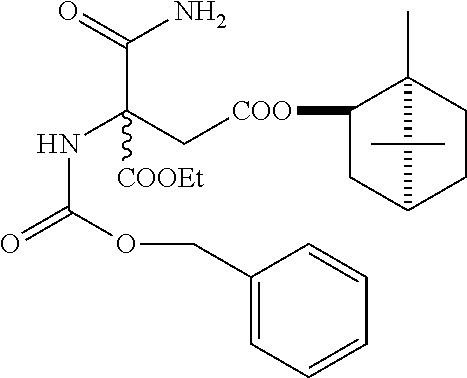
(+)-Bornyl chloroacetate [obtained from (+)-borneol in the same manner as Reference Example 3 above] and ethyl 2-benzyloxycarbonylamino-2-cyanoacetate were reacted in acetone as a solvent in the same manner as Example 1 to give ethyl 2-benzyloxycarbonylamino-3-[2-(+)-bornyloxycarbonyl]-2-cyanopropionate. The resulting diester of the cyano derivative was converted to an amido derivative using hydrogen peroxide in the same manner as Example 2 to give ethyl 2-benzyloxycarbonylamino-3-[2-(+)-bornyloxycarbonyl]-2-carbamoylpropionate as a white crystal. mp. 105-106° C.
1H-NMR (CDCl3, δ/ppm, TMS): 0.75-1.91 (19H, m), 3.49-3.54 (2H, m), 4.27 (2H, m), 4.88 (1H, tt, J=10.9, 4.6 Hz), 5.11 (2H, s), 5.56 (1H, s br), 6.34 (1H, s br), 6.52 (1H, s br), 7.32-7.35 (5H, m).

(+)-Isopinocamphenyl chloroacetate [obtained from (+)-isopinocampheol in the same manner as Reference Example 3 before] and ethyl 2-benzyloxycarbonylamino-2-cyanoacetate were reacted in acetone as a solvent in the same manner as Example 1 to give ethyl 2-benzyloxycarbonylamino-2-cyano-3-[3-(+)-isopinocampheyloxycarbonyl]propionate.
The resulting diester of the cyano derivative was converted to an amido derivative using hydrogen peroxide in the same manner as Example 2 to give ethyl 2-benzyloxycarbonylamino-2-carbamoyl-3-[3-(+)-isopinocampheyloxycarbonyl]propionate as a white crystal. mp. 89-96° C.
1H-NMR (CDCl3, δ/ppm, TMS): 0.87-2.55 (19H, m), 3.44-3.55 (2H, m), 4.23-4.32 (2H, m), 5.02 (1H, dt, J=12.6, 4.8 Hz), 5.11 (2H, s), 5.69 (1H, s br), 6.39 (1H, s br), 6.54 (1H, s br), 7.31-7.36 (5H, m).
Comparative Test
(1) Solvent Effects
The recrystallization solvent of Example 3 was changed from acetone to toluene, ethyl acetate, tetrahydrofuran, ethanol, isopropyl ether, methyl ethyl ketone or cyclohexyl methyl ether and ethyl 2-benzyloxycarbonylamino-2-carbamoyl-3-[(−)-menthyloxycarbonyl]propionate (a compound of Example 2) was recrystallized but it was unsuccessful to separate a compound of (2R) derivative of Example 3 in each case.
(2) Recrystallization of ethyl 2-benzyloxycarbonylamino-3-[2-(+)-bornyloxycarbonyl]-2-carbamoylpropionate (Comparative Example 1)
In order to separate a diastereomer of the Comparative Example, recrystallization was carried out in acetone, aqueous acetone, methanol, aqueous methanol, acetonitrile, aqueous acetonitrile or ethyl acetate but an optical purity of the resulting diester was about 0% d.e. in each case.
(3) Recrystallization of ethyl 2-benzyloxycarbonylamino-2-carbamoyl-3-[4-(+)-isopinocampheyloxycarbonyl]propionate (Comparative Example 2)
In order to separate a diastereomer of the Comparative Example, recrystallization was carried out in acetone, aqueous acetone, methanol, aqueous methanol, acetonitrile or aqueous acetonitrile but an optical purity of the resulting diester was about 0% d.e. in each case.
As described above, effect of the compounds and methods in the present invention is remarkably characteristic.
The intermediates and method for preparing the same can be used for producing ranirestat which is now under development as an agent for treating diabetes complications.
Claims (2)
1. A process for preparing (3R)-2′-(4-bromo-2-fluorobenzyl)spiro[pyrrolidin-3,4′(1′H)-pyrrolo[1,2-a]pyrazin]-1′,2,3′,5(2′H)-tetraone comprising the following steps:
1) a step in which a compound of the formula (2):

wherein R′ is a) an amino group having a protecting group which can be removed by hydrogenolysis or b) a tert-butoxycarbonylamino group, and R2 is an ethyl group optionally substituted with one or two methyl group(s) at α-position, provided that R2 is not a tert-butyl group when R′ is a tert-butoxycarbonylamino group,
is reacted with a base to prepare a succinimide derivative of the formula (3):

wherein R′ is a) an amino group having a protecting group which can be removed by hydrogenolysis or b) a tert-butoxycarbonylamino group, and R2 is an ethyl group optionally substituted with one or two methyl group(s) at α-position, provided that R2 is not a tert-butyl group when R1 is a tert-butoxycarbonylamino group;
2) a step of converting R1 (an amino group having a protecting group which can be removed by hydrogenolysis or a tert-butoxycarbonylamino group) of the succinimide derivative (3) into an amino group;
3) a step of converting the amino group of the product resulting from the above step 2) into a pyrrol-1-yl group;
4) a step of converting the pyrrol-1-yl group of the product resulting from the above step 3) into a 2-trichloroacetylpyrrol-1-yl group; and
(5) a step of preparing (3R)-2′-(4-bromo-2-fluorobenzyl)spiro[pyrrolidin-3,4′ (1′H)-pyrrolo[1,2-a]pyrazin]-1′,2,3′,5(2′H)-tetraone by reacting the product resulting from the above step 4) with 4-bromo-2-fluorobenzylamine.
2. The process according to claim 1 , wherein R1 is a benzyloxycarbonylamino group or a tert-butoxycarbonylamino group, and R2 is an ethyl group.
Priority Applications (1)
| Application Number | Priority Date | Filing Date | Title |
|---|---|---|---|
| US12/938,618 US8030486B2 (en) | 2006-08-31 | 2010-11-03 | Succinic acid diester derivative, process for production thereof, and use of the derivative in the production of pharmaceutical preparation |
Applications Claiming Priority (5)
| Application Number | Priority Date | Filing Date | Title |
|---|---|---|---|
| JP2006234777 | 2006-08-31 | ||
| JP2006-234777 | 2006-08-31 | ||
| PCT/JP2007/066862 WO2008026678A1 (en) | 2006-08-31 | 2007-08-30 | Succinic acid diester derivative, process for production thereof, and use of the derivative in the production of pharmaceutical preparation |
| US31052409A | 2009-02-27 | 2009-02-27 | |
| US12/938,618 US8030486B2 (en) | 2006-08-31 | 2010-11-03 | Succinic acid diester derivative, process for production thereof, and use of the derivative in the production of pharmaceutical preparation |
Related Parent Applications (3)
| Application Number | Title | Priority Date | Filing Date |
|---|---|---|---|
| PCT/JP2007/066862 Division WO2008026678A1 (en) | 2006-08-31 | 2007-08-30 | Succinic acid diester derivative, process for production thereof, and use of the derivative in the production of pharmaceutical preparation |
| US12/310,524 Division US8106230B2 (en) | 2006-08-31 | 2007-08-30 | Succinic acid diester derivative, process for production thereof, and use of the derivative in the production of pharmaceutical preparation |
| US31052409A Division | 2006-08-31 | 2009-02-27 |
Publications (2)
| Publication Number | Publication Date |
|---|---|
| US20110046373A1 US20110046373A1 (en) | 2011-02-24 |
| US8030486B2 true US8030486B2 (en) | 2011-10-04 |
Family
ID=39135960
Family Applications (2)
| Application Number | Title | Priority Date | Filing Date |
|---|---|---|---|
| US12/310,524 Expired - Fee Related US8106230B2 (en) | 2006-08-31 | 2007-08-30 | Succinic acid diester derivative, process for production thereof, and use of the derivative in the production of pharmaceutical preparation |
| US12/938,618 Expired - Fee Related US8030486B2 (en) | 2006-08-31 | 2010-11-03 | Succinic acid diester derivative, process for production thereof, and use of the derivative in the production of pharmaceutical preparation |
Family Applications Before (1)
| Application Number | Title | Priority Date | Filing Date |
|---|---|---|---|
| US12/310,524 Expired - Fee Related US8106230B2 (en) | 2006-08-31 | 2007-08-30 | Succinic acid diester derivative, process for production thereof, and use of the derivative in the production of pharmaceutical preparation |
Country Status (4)
| Country | Link |
|---|---|
| US (2) | US8106230B2 (en) |
| EP (1) | EP2058300B1 (en) |
| JP (1) | JP5191385B2 (en) |
| WO (1) | WO2008026678A1 (en) |
Families Citing this family (2)
| Publication number | Priority date | Publication date | Assignee | Title |
|---|---|---|---|---|
| JP2011026201A (en) * | 2007-10-17 | 2011-02-10 | Mitsubishi Tanabe Pharma Corp | Stereo-selective method of producing optically active pyrrolyl-succinimide derivative |
| CN114315585B (en) | 2022-03-04 | 2022-05-13 | 中国医学科学院药用植物研究所 | Hydroxypentyl benzoic acid diester compound, and preparation method and pharmaceutical application thereof |
Citations (3)
| Publication number | Priority date | Publication date | Assignee | Title |
|---|---|---|---|---|
| JPH05186472A (en) | 1991-06-26 | 1993-07-27 | Dainippon Pharmaceut Co Ltd | Tetrahydropyrrolo [1,2-a] pyrazine-4-spiro-3'-pyrrolidine derivative and therapeutic agent for diabetic complications containing the same |
| JPH06192222A (en) | 1992-12-25 | 1994-07-12 | Dainippon Pharmaceut Co Ltd | Succinic acid imide derivative |
| JPH08176105A (en) | 1994-12-27 | 1996-07-09 | Dainippon Pharmaceut Co Ltd | 2-carboxysuccinimide derivative |
-
2007
- 2007-08-30 EP EP07806339A patent/EP2058300B1/en not_active Not-in-force
- 2007-08-30 US US12/310,524 patent/US8106230B2/en not_active Expired - Fee Related
- 2007-08-30 JP JP2008532107A patent/JP5191385B2/en not_active Expired - Fee Related
- 2007-08-30 WO PCT/JP2007/066862 patent/WO2008026678A1/en not_active Ceased
-
2010
- 2010-11-03 US US12/938,618 patent/US8030486B2/en not_active Expired - Fee Related
Patent Citations (4)
| Publication number | Priority date | Publication date | Assignee | Title |
|---|---|---|---|---|
| JPH05186472A (en) | 1991-06-26 | 1993-07-27 | Dainippon Pharmaceut Co Ltd | Tetrahydropyrrolo [1,2-a] pyrazine-4-spiro-3'-pyrrolidine derivative and therapeutic agent for diabetic complications containing the same |
| US5258382A (en) | 1991-06-26 | 1993-11-02 | Dainippon Pharmaceutical Co., Ltd. | Tetrahydropyrrolo[1,2-a]pyrazine-4-spiro-3'-pyrrolidine derivatives, processes for the preparation thereof and pharmaceutical compositions containing the same |
| JPH06192222A (en) | 1992-12-25 | 1994-07-12 | Dainippon Pharmaceut Co Ltd | Succinic acid imide derivative |
| JPH08176105A (en) | 1994-12-27 | 1996-07-09 | Dainippon Pharmaceut Co Ltd | 2-carboxysuccinimide derivative |
Non-Patent Citations (6)
| Title |
|---|
| International Search Report dated Oct. 16, 2007 in the International (PCT) Application PCT/JP2007/066862 of which the parent application is the U.S. National Stage. |
| Mashiko et al. J. Am. Chem. Soc. (2007), vol. 129, pp. 11342-11343. * |
| Supplementary European Search Report issued Mar. 4, 2010 in corresponding European Application No. 07 80 6339, in the English language. |
| Toshiyuki Negoro et al., "Novel, Highly Potent Aldose Reductase Inhibitors: (R)-(—)-2-(4-Bromo-2-fluorobenzyl)-1,2,3,4-tetrahydropyrrolo[1,2-a]pyrrazine-4-spiro-3′-pyrrolidine-1,2′,3,5′-tetrone (AS-3201) and Its Congeners", J. Med. Chem., 41, pp. 4118-4129, 1998. |
| Toshiyuki Negoro et al., "Novel, Highly Potent Aldose Reductase Inhibitors: (R)-(-)-2-(4-Bromo-2-fluorobenzyl)-1,2,3,4-tetrahydropyrrolo[1,2-a]pyrrazine-4-spiro-3'-pyrrolidine-1,2',3,5'-tetrone (AS-3201) and Its Congeners", J. Med. Chem., 41, pp. 4118-4129, 1998. |
| XP-002568212, "AS-3201 Aldose Reductase Inhibitor", Drugs of the Future, 25 (2), pp. 131-136 (2000). |
Also Published As
| Publication number | Publication date |
|---|---|
| US20100076203A1 (en) | 2010-03-25 |
| US8106230B2 (en) | 2012-01-31 |
| EP2058300A4 (en) | 2010-04-07 |
| EP2058300B1 (en) | 2013-01-09 |
| EP2058300A1 (en) | 2009-05-13 |
| JPWO2008026678A1 (en) | 2010-01-21 |
| JP5191385B2 (en) | 2013-05-08 |
| US20110046373A1 (en) | 2011-02-24 |
| WO2008026678A1 (en) | 2008-03-06 |
Similar Documents
| Publication | Publication Date | Title |
|---|---|---|
| DK2121578T3 (en) | A process for the preparation of 4-biphenyl-4-amino-2-methylpentanoic acid | |
| EP2025672B1 (en) | Process for producing 1-carbamoyl-3,7-dioxo-1,4-diazepane compounds | |
| EP2938616A1 (en) | The present invention relates to process for the preparation of tofacitinib and intermediates thereof. | |
| Banerjee et al. | Novel synthesis of various orthogonally protected C α-methyllysine analogues and biological evaluation of a Vapreotide analogue containing (S)-α-methyllysine | |
| BG66126B1 (en) | Process for the preparation of high purity perindopril and intermediates useful in the synthesis | |
| US8030486B2 (en) | Succinic acid diester derivative, process for production thereof, and use of the derivative in the production of pharmaceutical preparation | |
| WO2024092892A1 (en) | Edoxaban intermediate and preparation method therefor | |
| JP5548129B2 (en) | Asymmetric organic catalyst | |
| AU2005329763A1 (en) | A novel process for preparation of substantially pure Glimepiride | |
| WO2012165607A1 (en) | Method for producing proline compound | |
| RU2362766C2 (en) | Method of obtaining benzylamine derivative and acylbenzylamine derivative | |
| KR20010042750A (en) | Method for producing enantiomer-free n-methyl-n-[(1s)-1-phenyl-2-((3s)-3-hydroxypyrrolidine-1-yl)ethyl]-2,2-diphenyl acetamide | |
| EP3360865A1 (en) | Process for the preparation of cyclopropyldiketopiperazines, and of a key intermediate of ds-5272 | |
| US6531594B2 (en) | Process for producing 1H-3-aminopyrrolidine and derivatives thereof | |
| US9067868B2 (en) | Chemical process for opening ring compounds | |
| GB2359552A (en) | Preparation of Oxazoline Compounds | |
| KR102152445B1 (en) | Production method of intermediate compound for synthesizing medicament | |
| KR101896349B1 (en) | Process for the preparation of dimiracetam | |
| US20140228592A1 (en) | Arylated beta-dicarbonyl compounds and process for the preparation thereof | |
| KR20130086532A (en) | Process for preparation of 3-substituted-4-fluoropyrrolidine derivatives | |
| JP2002316977A (en) | Method for producing optically active 1H-3-aminopyrrolidine compound | |
| US20080242861A1 (en) | Synthesis of amino-protected cyclohexane-1,4-diyldimethanamine and its derivatives | |
| JP5313174B2 (en) | Transbound rearrangement of activated lactam. | |
| CN117720540A (en) | Sitagliptin intermediates and preparation methods of sitagliptin | |
| WO2007099894A1 (en) | General-purpose deprotecting method using sulfur oxide |
Legal Events
| Date | Code | Title | Description |
|---|---|---|---|
| STCF | Information on status: patent grant |
Free format text: PATENTED CASE |
|
| FPAY | Fee payment |
Year of fee payment: 4 |
|
| FEPP | Fee payment procedure |
Free format text: MAINTENANCE FEE REMINDER MAILED (ORIGINAL EVENT CODE: REM.); ENTITY STATUS OF PATENT OWNER: LARGE ENTITY |
|
| LAPS | Lapse for failure to pay maintenance fees |
Free format text: PATENT EXPIRED FOR FAILURE TO PAY MAINTENANCE FEES (ORIGINAL EVENT CODE: EXP.); ENTITY STATUS OF PATENT OWNER: LARGE ENTITY |
|
| STCH | Information on status: patent discontinuation |
Free format text: PATENT EXPIRED DUE TO NONPAYMENT OF MAINTENANCE FEES UNDER 37 CFR 1.362 |
|
| FP | Lapsed due to failure to pay maintenance fee |
Effective date: 20191004 |