US8014650B1 - Feedback of out-of-range signals - Google Patents
Feedback of out-of-range signals Download PDFInfo
- Publication number
- US8014650B1 US8014650B1 US11/338,950 US33895006A US8014650B1 US 8014650 B1 US8014650 B1 US 8014650B1 US 33895006 A US33895006 A US 33895006A US 8014650 B1 US8014650 B1 US 8014650B1
- Authority
- US
- United States
- Prior art keywords
- composited signal
- composited
- signal
- range
- edited portion
- Prior art date
- Legal status (The legal status is an assumption and is not a legal conclusion. Google has not performed a legal analysis and makes no representation as to the accuracy of the status listed.)
- Active, expires
Links
Images


Classifications
-
- G—PHYSICS
- G11—INFORMATION STORAGE
- G11B—INFORMATION STORAGE BASED ON RELATIVE MOVEMENT BETWEEN RECORD CARRIER AND TRANSDUCER
- G11B27/00—Editing; Indexing; Addressing; Timing or synchronising; Monitoring; Measuring tape travel
- G11B27/02—Editing, e.g. varying the order of information signals recorded on, or reproduced from, record carriers
- G11B27/031—Electronic editing of digitised analogue information signals, e.g. audio or video signals
- G11B27/034—Electronic editing of digitised analogue information signals, e.g. audio or video signals on discs
-
- G—PHYSICS
- G11—INFORMATION STORAGE
- G11B—INFORMATION STORAGE BASED ON RELATIVE MOVEMENT BETWEEN RECORD CARRIER AND TRANSDUCER
- G11B27/00—Editing; Indexing; Addressing; Timing or synchronising; Monitoring; Measuring tape travel
- G11B27/10—Indexing; Addressing; Timing or synchronising; Measuring tape travel
- G11B27/19—Indexing; Addressing; Timing or synchronising; Measuring tape travel by using information detectable on the record carrier
- G11B27/28—Indexing; Addressing; Timing or synchronising; Measuring tape travel by using information detectable on the record carrier by using information signals recorded by the same method as the main recording
Definitions
- Some processes for editing video and/or audio compilations may be inefficient.
- a user may have to view and/or review an entire composited group to determine if audio and/or video signals are out of a predefined range.
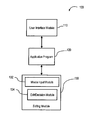
- FIG. 1 is a block diagram of a system capable of executing feedback for editing in accordance with one or more embodiments
- FIG. 2 is a diagram of a file illustrating a program, and objects in accordance with one or more embodiments
- FIG. 3 is a diagram of a file illustrating a program, and objects in accordance with one or more embodiments
- FIG. 4 is a flow diagram of a process for feedback for out of range signals in accordance with one or more embodiments.
- FIG. 5 is a block diagram of a computing platform capable of executing feedback for out of range signals in accordance with one or more embodiments.
- a process may be generally considered to be a self-consistent sequence of acts and/or operations leading to a desired result.
- These include physical manipulations of physical quantities.
- these quantities take the form of electrical and/or magnetic signals capable of being stored, transferred, combined, compared, and/or otherwise manipulated. It may be convenient at times, principally for reasons of common usage, to refer to these signals as bits, values, elements, symbols, characters, terms, numbers and/or the like. However, these and/or similar terms may be associated with the appropriate physical quantities, and are merely convenient labels applied to these quantities.
- Embodiments claimed may include one or more apparatuses for performing the operations herein.
- Such an apparatus may be specially constructed for the desired purposes, or it may comprise a general purpose computing device selectively activated and/or reconfigured by a program stored in the device.
- a program may be stored on a storage medium, such as, but not limited to, any type of disk including floppy disks, optical disks, CD-ROMs, magnetic-optical disks, read-only memories (ROMs), random access memories (RAMs), electrically programmable read-only memories (EPROMs), electrically erasable and/or programmable read-only memories (EEPROMs), flash memory, magnetic and/or optical cards, and/or any other type of media suitable for storing electronic instructions, and/or capable of being coupled to a system bus for a computing device, computing platform, and/or other information handling system.
- the computer program product may also be capable of being downloaded directly to the computing device, such as, but not limited to, a download over the Internet. This disclosure is intended to
- Coupled may mean that two or more elements are in direct physical and/or electrical contact.
- coupled may also mean that two or more elements may not be in direct contact with each other, but yet may still cooperate and/or interact with each other.
- couple and/or coupled may mean that two objects are in communication with each other, and/or communicate with each other, such as two pieces of software, and/or hardware, or combinations thereof.
- an object may refer to an item that may be selected and/or manipulated, for example, shapes, pictures, images, text, and/or text boxes that may appear on a display as rendered by a computing platform coupled to the display.
- the term render and/or raster may refer to displaying an object on a display coupled to a computing platform, and/or to manipulating the object on the display.
- graphic may refer to a pictorial and/or image representation of an object, and in one or more alternative embodiments may refer to an object itself.
- a graphic element may comprise a single and/or fundamental graphic object, and/or a portion thereof.
- a letterform may comprise a shape and/or design of a letter of an alphabet.
- a font may refer to a design for a set of characters and/or letters for printing and/or displaying.
- text may refer to letters and/or characters that may be manipulated and/or combined as words, lines, and/or pages.
- to parse may refer to dividing computer code into elements that can be analyzed and/or identified.
- file may refer to a collection of data, code, instructions, and/or other information that may be readable, accessible, and/or able to be acted on by a computing platform and/or the like.
- a format may refer to a predefined organizational structure for data, code, instructions, and/or other information that may be readable, accessible, and/or able to be acted on by a computing platform and/or the like.
- a graphical user interface may refer to a program interface that utilizes displayed graphical information to allow a user to control and/or operate a computing platform and/or the like.
- a pointer may refer to a cursor and/or other symbol that appears on a display screen that may be moved and/or controlled with a pointing device to select objects, and/or input commands via a graphical user interface of a computing platform and/or the like.
- a pointing device may refer to a device used to control a cursor, to select objects, and/or input commands via a graphical user interface of a computing platform and/or the like.
- Pointing devices may include, for example, a mouse, a trackball, a track pad, a track stick, a keyboard, a stylus, a digitizing tablet, and/or similar types of devices.
- a cursor may refer to a symbol and/or a pointer where an input selection and/or actuation may be made with respect to a region of/in a graphical user interface.
- transient may refer to being in a state for a brief and/or temporary period of time, and/or passing with time and/or a temporary state of being.
- these are merely example definitions of terms relating to graphical user interfaces and/or computing platforms and/or the like, and the scope of claimed subject matter is not limited in this respect.
- system 100 may include a user interface module 110 .
- User interface module 110 may be capable of receiving inputs from a user and providing outputs to the user.
- system 100 may include an application program 120 .
- Objects and/or indicators and/or other data may be rendered by application program 120 utilizing user interface module 110 .
- User interface module 110 may be utilized by application program 120 to indicate to a user that a received signal may be outside a predefined range, such as when a user is editing audio and/or video signals, and/or combinations thereof, among others.
- a current process may include compositing audio, video, and/or audio/video signals.
- a user may then view and/or perceive the entire composition to determine if any signal is out of a predefined range, such as out of the audible and/or visual range of a human.
- this process may increase time utilized in the editing process.
- a way to decrease editing time may comprise allowing an editing module 130 , which may have more information as to the composited signals, to analyze the signal to determine if any portion of the composition is outside of a predefined range.
- the editing module 130 may also determine if there are disjointed and/or uneven portions of the composition, and alert the user of these abnormalities.
- editing module 130 may be capable of receiving one or more signals, compositing the signals, and analyzing the received signals, and/or the composited signal, and/or combinations thereof, to determine if the signal is outside a predefined range. Editing module 130 may also be configured to indicate that the signal is outside a predefined range, as well as where the signal is outside the predefined range. Edit module 130 may also be capable of parsing the signal. Parsing may include parsing the signal in audio, video, and other components, among many others, and/or combinations thereof.
- Editing module 130 may also be capable of editing the composited signal.
- the composited signal may be displayed in a time-line format. This format may also include a graphical representation of the composited signal, as well as the predefined range. If the signal is outside of the predefined range, the user may be alerted. Furthermore, the exact location of the signal outside range may be indicated.
- the signals received may be audio/visual signals, other types of signals, and/or combinations thereof.
- the indication of a signal outside range may be audio, visual, graphical, and/or other indications, and/or combinations thereof.
- the indications may also include the use of colors of the out of range signals, among many others.
- editing module 130 may include a media input module 132 .
- Media input module 132 may be capable of receiving signals, and transmitting signals to an edit/decision module 134 .
- Edit/decision module 134 may be capable of receiving signals, and analyzing the signal to determine if the signals are within a predefined range.
- Edit/decision module 134 may also be capable of editing the signal to alleviate out of range signals, among many other possible editing functions.
- file 200 may comprise a document capable of being displayed in and/or controlled by program 210 .
- program 210 may comprise an Adobe® Encore DVD® type program, Adobe® After Effects® type program, Adobe® Audition® type program, Adobe® Premiere® type program, and/or Adobe® Photoshop® type program, and/or combinations thereof, available from Adobe Systems Incorporated of San Jose, Calif., USA
- file 200 may comprise an Adobe® Portable Document Format (PDF) type file, among many others, although the scope of claimed subject matter is not limited in these respects.
- PDF Adobe® Portable Document Format
- document 200 may be authored and/or created in a page description language (PDL), which refers to a language for describing a layout and/or contents of a page to be displayed and/or printed.
- PDL page description language
- Such a page description language may comprise, for example, Adobe® PostScript® program available from Adobe Systems Incorporated.
- PostScript® for example, describes a page in terms of page objects including textual objects and/or graphical objects such as lines, arcs, and/or circles.
- PostScript® program may be used, for example, to create Portable Document Format type files, although the scope of claimed subject matter is not limited in this respect.
- program 210 may comprise a word processor and/or a text processor, for example Microsoft® Word available from Microsoft Corporation of Redmond, Wash., USA, and file 200 may comprise a Microsoft® Word type file, although the scope of claimed subject matter is not limited in this respect.
- program 210 may comprise a web browser to open and/or display web pages, and file 200 may comprise a Hyper Text Markup Language (HTML) type file.
- program 210 may comprise, for example, a Microsoft® Internet Explorer web browser available from Microsoft Corporation, or alternatively may comprise, for example, a Firefox web browser available from the Mozilla Foundation of Mountain View, Calif., USA, although the scope of claimed subject matter is not limited in this respect.
- program 210 may comprise a signal editing and/or analyzing program capable of editing audio, visual, and/or other signals, and/or combinations thereof.
- Program 210 and file 200 may comprise many other types and formats including, but not limited to, many other types of graphical or any other type of program that displays objects and/or other data. This disclosure is not limited with respect to the program or file.
- a file 200 may include information capable of being displayed by an object 212 .
- object 212 may be a graphical display, however, other types of objects are intended to be encompassed by the scope of the present disclosure.
- Displayed within object 212 may be a representation of a signal 214 .
- Signal 214 may be an incoming signal and/or a composited signal, and/or combinations thereof.
- the signal may correspond to an audio, video, audio/video, image, or other type of signal, and/or combinations thereof.
- signal 214 is shown as a function of time, in a time-line type manner.
- the scope of this disclosure is not limited in this respect. Many other display types and/or formats may be utilized without straying from the spirit and scope of this disclosure.
- Object 212 may also be capable of displaying a predefined range 216 .
- Predefined range 216 may be previously determined by a user or in another manner.
- Predefined range 216 may be entered by a user, and/or a default range, and/or other methods, and/or combinations thereof. With this configuration, out of range signals 218 may be easily indicated.
- Many different variables may be utilized as the predefined range, such as but not limited to, frequency, amplitude, intensity, saturation, and/or many other variable, and/or combinations thereof.
- many variables may be considered when determining the range. These variables may be, but are not limited to, the capability of the hardware and/or software, government regulations, computing and/or memory capacity, visual and/or audible ranges perceivable by a human, color among many other variables, and/or combinations thereof.
- Signal 214 may not be a portion of a file and may be received through an input device.
- object 212 may be configured to display an entire signal such that the user may ensure that the entire signal is within range 216 .
- Object 212 may be configured to display a portion of the signal, and be capable of editing the signal.
- Predefined range 216 may also depend, at least partially, upon National Television System Committee (NTSC) video standards.
- NTSC standards may be very strict, and may limit the number and type of colors that may be used. These standards may not allow highly saturated colors, as distortion may occur. There may be no way for a user to know they have colors outside the NTSC's standards, as the compilation may look fine on a particular monitor, but still exceed the acceptable range.
- predefined range 216 may also depend, at least in part upon Institute of Radio Engineers (IRE) units.
- IRE units may be the scale defined by the Institute of Radio Engineers to measure the amplitude of a video signal.
- the acceptable broadcast range for IRE units may be between 7.5 IRE units and 100 IRE units.
- predefined range 216 may also depend, at least in part upon an acceptable audio range.
- the audio range may include, but is not limited to, audio amplitude and frequency, among many others, and/or combinations thereof. These limitations may not be apparent to a user.
- a user may have to view and/or listen to the entire compilation to determine if any out of range signals exist.
- Signal 214 may include out of range signals 218 that are outside predefined range 216 .
- the predetermined range may include no signal.
- the user may be alerted to signals outside of predefined range 216 visually, as in this embodiment, or many other ways, including but not limited to, audio, graphical, and/or combinations thereof.
- the indication of an out of range signal may occur relatively immediately, as the range is predefined, and may be applied fairly rapidly to determine if a portion of a signal is out of range. Relatively immediately may be within a certain amount of time that is less than viewing the entire compilation. Furthermore, this time period may be, but is not limited to , 30 seconds or less.
- Out of range signals 218 may rise above and/or drop below predefined range 216 , as shown in FIG. 2 .
- a file 300 may include an object 312 .
- object 312 may be a graphical display, however, other types of objects are intended to be encompassed by the scope of the present disclosure.
- Displayed within object 312 may be a representation of a signal 314 .
- Signal 314 may be an incoming signal and/or a composited signal, and/or combinations thereof.
- signal 314 is shown as a function of time, in a time-line type manner.
- the scope of this disclosure is not limited in this respect. Many other display types and/or formats may be utilized without straying from the spirit and scope of this disclosure.
- Object 312 may also be capable of displaying a predefined range 316 .
- Predefined range 316 may be previously determined by a user or in another manner. With this configuration, out of range signals 318 may be easily indicated. Out of range signals 318 and 319 may exceed and/or drop below predefined range 316 , as well as disjoints and/or non-continuous, at 319 .
- Non-contiguous signals may cause the video, audio, and/or other type of signals to be disjointed, which may cause irregular and/or disjointed when viewed, heard, and/or other perceptions.
- indications 320 and 322 may alert the user to out of range signals 318 .
- Indications may include, but are not limited to, the portion of the signal out of range may appear as a dashed signal, a different color signal, above and/or below the predefined range flashing and/or different color, and audio indication, and/or other indications, and/or combinations thereof.
- One type of indication may show the out of range signal 320 differently than an in range signal.
- another type of indication may show the area above or below the predefined range that an out of range signal occurs, such as 322 .
- Many other indications may be used either alone, and/or in combinations, without straying from the spirit and scope of the present disclosure.
- the application program may also suggest and/or automatically correct the out of range signals.
- the correcting may be accomplished at least in part automatically, and may be based at least in part upon the predefined algorithm.
- out of range colors may be automatically corrected to the closest possible legal color.
- Other out of range signals may be similarly autocorrected to the nearest, best, and/or closest allowable signal, and/or combinations thereof.
- process 400 may include blocks 410 through 420 , more blocks and/or fewer blocks than shown in FIG. 4 .
- the order of blocks 410 through 420 is merely one order of blocks, wherein process 400 may include one or more alternative orders of blocks 410 through 420 , and the scope of claimed subject matter is not limited in this respect.
- Receiving a signal may be accomplished at block 410 .
- Editing module 130 may receive one or more signals.
- the one or more signals may be composited at 412 .
- Compositing the signals 412 may include, but is not limited to, ordering the signals, adding, overlapping, and/or many other types of compositing, and/or combinations thereof.
- compositing the one or more signals may include only one signal, such as but not limited to, the first signal received, among many other one signal compositions, and/or combinations thereof.
- the signals may be analyzed at 414 .
- the signals analyzed may include the individual signals as they are received, as well as the composited signal, and/or combinations thereof. This may alert a user if an incoming signal is outside of a predefined range, at 416 .
- the status of the individual signals may or may not be of concern to the user as the user may only be concerned with the final compilation.
- an incoming signal may be within the predefined range, but when composited with other signals, may create an out of range signal within the compilation. As described above, the indication to the user of an out of range signal may be of many different means.
- the process then continues at 420 .
- computing platform 500 of FIG. 5 is merely one type of computing platform, and other computing platforms having more and/or fewer and/or different components than shown in FIG. 5 may be implemented, and the scope of claimed subject matter is not limited in this respect.
- computing platform 500 may be utilized to implement process 400 in whole and/or using more and/or fewer blocks than shown in FIG. 4 , and the scope of claimed subject matter is not limited in this respect.
- Computing platform 500 may include processor 510 coupled to cache random access memory (RAM) 512 via back side bus 511 .
- RAM cache random access memory
- Processor 510 may also couple to a chipset that includes Northbridge chip 516 via front side bus 514 , and also to Southbridge chip 518 via bus 520 .
- Northbridge chip 516 in general may be utilized to connect a processor to memory, to an input/output bus, to a video bus, and to Level 2 cache, although the scope of claimed subject matter is not limited in this respect.
- Southbridge chip 518 may be utilized to control input/output functions, the basic input/out system (BIOS), and interrupt control functions of Integrated Drive Electronics (IDE) devices, such as hard disks or compact disk read-only memory (CD-ROM) devices or the like, although the scope of claimed subject matter is not limited in this respect.
- RAM random access memory
- I/O controller 526 may also couple to Northbridge chip 516 via I/O bus 528 .
- I/O controller 526 and I/O bus 528 may be in compliance with a Small Computer Systems Interface (SCSI) specification such as the American National Standards Institute (ANSI) X3.131-1994 SCSI-2 specification, although the scope of claimed subject matter is not limited in this respect.
- SCSI Small Computer Systems Interface
- I/O controller 526 and I/O bus 528 may be in compliance with a Peripheral Component Interconnect (PCI) bus, although the scope of claimed subject matter is not limited in this respect.
- PCI Peripheral Component Interconnect
- Video controller 530 may couple to Northbridge chip 516 via video bus 532 , which in one embodiment may comprise an Accelerated Graphics Port (AGP) bus, although the scope of claimed subject matter is not limited in this respect.
- Video controller 530 may provide video signals to an optionally coupled display 534 via display interface 536 which in one embodiment may comprise a Digital Visual Interface (DVI) in compliance with a standard promulgated by the Digital Display Working Group, although the scope of claimed subject matter is not limited in this respect.
- DVI Digital Visual Interface
- Southbridge chip 518 may couple to a peripheral component interconnect to peripheral component interconnect (PCI-PCI) bridge 538 via input/output bus 540 , which may in turn couple to I/O controller 542 to control various peripheral devices such as Universal Serial Bus (USB) devices, or devices compatible with an Institute of Electrical and Electronics Engineers (IEEE) 1394 specification, although the scope of claimed subject matter is not limited in this respect.
- PCI-PCI peripheral component interconnect
- I/O controller 542 to control various peripheral devices such as Universal Serial Bus (USB) devices, or devices compatible with an Institute of Electrical and Electronics Engineers (IEEE) 1394 specification, although the scope of claimed subject matter is not limited in this respect.
Landscapes
- Engineering & Computer Science (AREA)
- Multimedia (AREA)
- Television Signal Processing For Recording (AREA)
Abstract
Description
Claims (30)
Priority Applications (1)
| Application Number | Priority Date | Filing Date | Title |
|---|---|---|---|
| US11/338,950 US8014650B1 (en) | 2006-01-24 | 2006-01-24 | Feedback of out-of-range signals |
Applications Claiming Priority (1)
| Application Number | Priority Date | Filing Date | Title |
|---|---|---|---|
| US11/338,950 US8014650B1 (en) | 2006-01-24 | 2006-01-24 | Feedback of out-of-range signals |
Publications (1)
| Publication Number | Publication Date |
|---|---|
| US8014650B1 true US8014650B1 (en) | 2011-09-06 |
Family
ID=44513615
Family Applications (1)
| Application Number | Title | Priority Date | Filing Date |
|---|---|---|---|
| US11/338,950 Active 2030-06-08 US8014650B1 (en) | 2006-01-24 | 2006-01-24 | Feedback of out-of-range signals |
Country Status (1)
| Country | Link |
|---|---|
| US (1) | US8014650B1 (en) |
Citations (5)
| Publication number | Priority date | Publication date | Assignee | Title |
|---|---|---|---|---|
| US5687733A (en) * | 1995-10-26 | 1997-11-18 | Baxter International Inc. | System and method for estimating cardiac output |
| US5861882A (en) * | 1994-11-03 | 1999-01-19 | Motorola, Inc. | Integrated test and measurement means employing a graphical user interface |
| US20040240856A1 (en) * | 2001-07-23 | 2004-12-02 | Hiroshi Yahata | Information recording medium, and apparatus and method for recording information on information recording medium |
| US7054541B2 (en) * | 1998-07-14 | 2006-05-30 | Koninklijke Philips Electronics N.V. | Editing of digital video information signals |
| US7617106B2 (en) * | 2003-11-05 | 2009-11-10 | Koninklijke Philips Electronics N.V. | Error detection for speech to text transcription systems |
-
2006
- 2006-01-24 US US11/338,950 patent/US8014650B1/en active Active
Patent Citations (5)
| Publication number | Priority date | Publication date | Assignee | Title |
|---|---|---|---|---|
| US5861882A (en) * | 1994-11-03 | 1999-01-19 | Motorola, Inc. | Integrated test and measurement means employing a graphical user interface |
| US5687733A (en) * | 1995-10-26 | 1997-11-18 | Baxter International Inc. | System and method for estimating cardiac output |
| US7054541B2 (en) * | 1998-07-14 | 2006-05-30 | Koninklijke Philips Electronics N.V. | Editing of digital video information signals |
| US20040240856A1 (en) * | 2001-07-23 | 2004-12-02 | Hiroshi Yahata | Information recording medium, and apparatus and method for recording information on information recording medium |
| US7617106B2 (en) * | 2003-11-05 | 2009-11-10 | Koninklijke Philips Electronics N.V. | Error detection for speech to text transcription systems |
Similar Documents
| Publication | Publication Date | Title |
|---|---|---|
| US10162804B2 (en) | Object resizing with content reflow | |
| US7752566B1 (en) | Transparent overlays for predictive interface drag and drop | |
| US5930813A (en) | Method and system for designating objects | |
| EP2343670B1 (en) | Apparatus and method for digitizing documents | |
| US8675012B2 (en) | Selective display of OCR'ed text and corresponding images from publications on a client device | |
| US20080028304A1 (en) | Method and apparatus for font subsetting | |
| US8494280B2 (en) | Automated method for extracting highlighted regions in scanned source | |
| US8700984B2 (en) | Computerized method and computer program for displaying and printing markup | |
| US8952985B2 (en) | Digital comic editor, method and non-transitory computer-readable medium | |
| JP2021111157A (en) | Information processing equipment and information processing programs | |
| CN112800373B (en) | Webpage resource data generation method and device, computer equipment and storage medium | |
| CN111915705B (en) | Picture visual editing method, device, equipment and medium | |
| US8793565B2 (en) | File format conversion of an interactive element in a graphical user interface | |
| US20140006936A1 (en) | Responsive document breakpoints systems and methods | |
| CN111724455A (en) | Image processing method and electronic device | |
| US7408556B2 (en) | System and method for using device dependent fonts in a graphical display interface | |
| CN110633251B (en) | File conversion method and equipment | |
| US8014650B1 (en) | Feedback of out-of-range signals | |
| US7870478B1 (en) | Repurposing subsections and/or objects | |
| US8559725B2 (en) | Method and apparatus for extracting raster images from portable electronic document | |
| US20170212870A1 (en) | Method and System to Display Content from a PDF Document on a Small Screen | |
| US20160042545A1 (en) | Display controller, information processing apparatus, display control method, computer-readable storage medium, and information processing system | |
| US9075776B2 (en) | Document processing apparatus, document processing method, and program | |
| US20130326408A1 (en) | Electronic apparatus, control method of an electronic apparatus, and control program of an electronic apparatus | |
| US20130104014A1 (en) | Viewer unit, server unit, display control method, digital comic editing method and non-transitory computer-readable medium |
Legal Events
| Date | Code | Title | Description |
|---|---|---|---|
| AS | Assignment |
Owner name: ADOBE SYSTEMS INCORPORATED, CALIFORNIA Free format text: ASSIGNMENT OF ASSIGNORS INTEREST;ASSIGNOR:SANSONE, PHILIP;REEL/FRAME:017504/0468 Effective date: 20060124 |
|
| STCF | Information on status: patent grant |
Free format text: PATENTED CASE |
|
| FPAY | Fee payment |
Year of fee payment: 4 |
|
| MAFP | Maintenance fee payment |
Free format text: PAYMENT OF MAINTENANCE FEE, 8TH YEAR, LARGE ENTITY (ORIGINAL EVENT CODE: M1552); ENTITY STATUS OF PATENT OWNER: LARGE ENTITY Year of fee payment: 8 |
|
| AS | Assignment |
Owner name: ADOBE INC., CALIFORNIA Free format text: CHANGE OF NAME;ASSIGNOR:ADOBE SYSTEMS INCORPORATED;REEL/FRAME:048867/0882 Effective date: 20181008 |
|
| MAFP | Maintenance fee payment |
Free format text: PAYMENT OF MAINTENANCE FEE, 12TH YEAR, LARGE ENTITY (ORIGINAL EVENT CODE: M1553); ENTITY STATUS OF PATENT OWNER: LARGE ENTITY Year of fee payment: 12 |