US7968712B2 - Process for the resolution of zopiclone and intermediate compounds - Google Patents
Process for the resolution of zopiclone and intermediate compounds Download PDFInfo
- Publication number
- US7968712B2 US7968712B2 US12/830,147 US83014710A US7968712B2 US 7968712 B2 US7968712 B2 US 7968712B2 US 83014710 A US83014710 A US 83014710A US 7968712 B2 US7968712 B2 US 7968712B2
- Authority
- US
- United States
- Prior art keywords
- acetyl
- formula
- zopiclone
- diastereoisomeric salt
- process according
- Prior art date
- Legal status (The legal status is an assumption and is not a legal conclusion. Google has not performed a legal analysis and makes no representation as to the accuracy of the status listed.)
- Expired - Fee Related
Links
- 238000000034 method Methods 0.000 title claims abstract description 50
- 150000001875 compounds Chemical class 0.000 title claims abstract description 37
- GBBSUAFBMRNDJC-MRXNPFEDSA-N (5R)-zopiclone Chemical class C1CN(C)CCN1C(=O)O[C@@H]1C2=NC=CN=C2C(=O)N1C1=CC=C(Cl)C=N1 GBBSUAFBMRNDJC-MRXNPFEDSA-N 0.000 title claims description 49
- 229960000820 zopiclone Drugs 0.000 title description 18
- 150000003839 salts Chemical class 0.000 claims abstract description 52
- 239000000203 mixture Substances 0.000 claims abstract description 29
- 150000001413 amino acids Chemical class 0.000 claims abstract description 25
- HBAQYPYDRFILMT-UHFFFAOYSA-N 8-[3-(1-cyclopropylpyrazol-4-yl)-1H-pyrazolo[4,3-d]pyrimidin-5-yl]-3-methyl-3,8-diazabicyclo[3.2.1]octan-2-one Chemical class C1(CC1)N1N=CC(=C1)C1=NNC2=C1N=C(N=C2)N1C2C(N(CC1CC2)C)=O HBAQYPYDRFILMT-UHFFFAOYSA-N 0.000 claims abstract description 16
- GBBSUAFBMRNDJC-INIZCTEOSA-N eszopiclone Chemical compound C1CN(C)CCN1C(=O)O[C@H]1C2=NC=CN=C2C(=O)N1C1=CC=C(Cl)C=N1 GBBSUAFBMRNDJC-INIZCTEOSA-N 0.000 claims description 62
- OKKJLVBELUTLKV-UHFFFAOYSA-N Methanol Chemical compound OC OKKJLVBELUTLKV-UHFFFAOYSA-N 0.000 claims description 36
- YXFVVABEGXRONW-UHFFFAOYSA-N Toluene Chemical compound CC1=CC=CC=C1 YXFVVABEGXRONW-UHFFFAOYSA-N 0.000 claims description 33
- CSCPPACGZOOCGX-UHFFFAOYSA-N Acetone Chemical compound CC(C)=O CSCPPACGZOOCGX-UHFFFAOYSA-N 0.000 claims description 30
- OTCCIMWXFLJLIA-BYPYZUCNSA-N N-acetyl-L-aspartic acid Chemical compound CC(=O)N[C@H](C(O)=O)CC(O)=O OTCCIMWXFLJLIA-BYPYZUCNSA-N 0.000 claims description 26
- 229940024606 amino acid Drugs 0.000 claims description 24
- XEKOWRVHYACXOJ-UHFFFAOYSA-N Ethyl acetate Chemical compound CCOC(C)=O XEKOWRVHYACXOJ-UHFFFAOYSA-N 0.000 claims description 21
- RFMMMVDNIPUKGG-YFKPBYRVSA-N N-acetyl-L-glutamic acid Chemical compound CC(=O)N[C@H](C(O)=O)CCC(O)=O RFMMMVDNIPUKGG-YFKPBYRVSA-N 0.000 claims description 21
- RFMMMVDNIPUKGG-RXMQYKEDSA-N (2r)-2-acetamidopentanedioic acid Chemical compound CC(=O)N[C@@H](C(O)=O)CCC(O)=O RFMMMVDNIPUKGG-RXMQYKEDSA-N 0.000 claims description 18
- YMWUJEATGCHHMB-UHFFFAOYSA-N Dichloromethane Chemical compound ClCCl YMWUJEATGCHHMB-UHFFFAOYSA-N 0.000 claims description 18
- OTCCIMWXFLJLIA-SCSAIBSYSA-N (2r)-2-acetamidobutanedioic acid Chemical compound CC(=O)N[C@@H](C(O)=O)CC(O)=O OTCCIMWXFLJLIA-SCSAIBSYSA-N 0.000 claims description 15
- 238000002425 crystallisation Methods 0.000 claims description 12
- 230000008025 crystallization Effects 0.000 claims description 12
- 239000003960 organic solvent Substances 0.000 claims description 11
- 125000000217 alkyl group Chemical group 0.000 claims description 7
- 238000002955 isolation Methods 0.000 claims description 7
- 125000004169 (C1-C6) alkyl group Chemical group 0.000 claims description 6
- WEVYAHXRMPXWCK-UHFFFAOYSA-N Acetonitrile Chemical compound CC#N WEVYAHXRMPXWCK-UHFFFAOYSA-N 0.000 claims description 6
- WYURNTSHIVDZCO-UHFFFAOYSA-N Tetrahydrofuran Chemical compound C1CCOC1 WYURNTSHIVDZCO-UHFFFAOYSA-N 0.000 claims description 6
- 125000003118 aryl group Chemical group 0.000 claims description 6
- 125000001072 heteroaryl group Chemical group 0.000 claims description 6
- XUYPXLNMDZIRQH-ZCFIWIBFSA-N N-acetyl-D-methionine Chemical compound CSCC[C@H](C(O)=O)NC(C)=O XUYPXLNMDZIRQH-ZCFIWIBFSA-N 0.000 claims description 5
- WHZRCUIISKRTJL-UHFFFAOYSA-N [2-(6-fluoro-11-hydroxy-10,13,16-trimethyl-3-oxo-6,7,8,9,11,12,14,15,16,17-decahydrocyclopenta[a]phenanthren-17-yl)-2-oxoethyl] hexanoate Chemical compound C1C(F)C2=CC(=O)C=CC2(C)C2C1C1CC(C)C(C(=O)COC(=O)CCCCC)C1(C)CC2O WHZRCUIISKRTJL-UHFFFAOYSA-N 0.000 claims description 5
- 125000003917 carbamoyl group Chemical group [H]N([H])C(*)=O 0.000 claims description 5
- YLQBMQCUIZJEEH-UHFFFAOYSA-N tetrahydrofuran Natural products C=1C=COC=1 YLQBMQCUIZJEEH-UHFFFAOYSA-N 0.000 claims description 5
- BZLVMXJERCGZMT-UHFFFAOYSA-N Methyl tert-butyl ether Chemical compound COC(C)(C)C BZLVMXJERCGZMT-UHFFFAOYSA-N 0.000 claims description 4
- XUYPXLNMDZIRQH-LURJTMIESA-N N-acetyl-L-methionine Chemical compound CSCC[C@@H](C(O)=O)NC(C)=O XUYPXLNMDZIRQH-LURJTMIESA-N 0.000 claims description 4
- CTQNGGLPUBDAKN-UHFFFAOYSA-N O-Xylene Chemical compound CC1=CC=CC=C1C CTQNGGLPUBDAKN-UHFFFAOYSA-N 0.000 claims description 4
- MVPPADPHJFYWMZ-UHFFFAOYSA-N chlorobenzene Chemical compound ClC1=CC=CC=C1 MVPPADPHJFYWMZ-UHFFFAOYSA-N 0.000 claims description 4
- 239000008096 xylene Substances 0.000 claims description 4
- 239000012452 mother liquor Substances 0.000 claims description 3
- 239000002904 solvent Substances 0.000 claims description 3
- OIFBSDVPJOWBCH-UHFFFAOYSA-N Diethyl carbonate Chemical compound CCOC(=O)OCC OIFBSDVPJOWBCH-UHFFFAOYSA-N 0.000 claims description 2
- 150000001298 alcohols Chemical group 0.000 claims description 2
- 239000003849 aromatic solvent Substances 0.000 claims description 2
- 150000002148 esters Chemical class 0.000 claims description 2
- 150000002170 ethers Chemical class 0.000 claims description 2
- WBJINCZRORDGAQ-UHFFFAOYSA-N formic acid ethyl ester Natural products CCOC=O WBJINCZRORDGAQ-UHFFFAOYSA-N 0.000 claims description 2
- JMMWKPVZQRWMSS-UHFFFAOYSA-N isopropanol acetate Natural products CC(C)OC(C)=O JMMWKPVZQRWMSS-UHFFFAOYSA-N 0.000 claims description 2
- 229940011051 isopropyl acetate Drugs 0.000 claims description 2
- GWYFCOCPABKNJV-UHFFFAOYSA-N isovaleric acid Chemical compound CC(C)CC(O)=O GWYFCOCPABKNJV-UHFFFAOYSA-N 0.000 claims description 2
- 150000002576 ketones Chemical class 0.000 claims description 2
- 150000002825 nitriles Chemical class 0.000 claims description 2
- 125000000896 monocarboxylic acid group Chemical group 0.000 claims 3
- ASNHGEVAWNWCRQ-UHFFFAOYSA-N 4-(hydroxymethyl)oxolane-2,3,4-triol Chemical compound OCC1(O)COC(O)C1O ASNHGEVAWNWCRQ-UHFFFAOYSA-N 0.000 claims 1
- XBDQKXXYIPTUBI-UHFFFAOYSA-M Propionate Chemical compound CCC([O-])=O XBDQKXXYIPTUBI-UHFFFAOYSA-M 0.000 claims 1
- 238000006243 chemical reaction Methods 0.000 abstract description 5
- 239000000543 intermediate Substances 0.000 abstract description 4
- IAZDPXIOMUYVGZ-WFGJKAKNSA-N Dimethyl sulfoxide Chemical compound [2H]C([2H])([2H])S(=O)C([2H])([2H])[2H] IAZDPXIOMUYVGZ-WFGJKAKNSA-N 0.000 description 42
- 239000000047 product Substances 0.000 description 21
- XLYOFNOQVPJJNP-UHFFFAOYSA-N water Substances O XLYOFNOQVPJJNP-UHFFFAOYSA-N 0.000 description 21
- 239000007787 solid Substances 0.000 description 19
- GBBSUAFBMRNDJC-UHFFFAOYSA-N zopiclone Chemical compound C1CN(C)CCN1C(=O)OC1C2=NC=CN=C2C(=O)N1C1=CC=C(Cl)C=N1 GBBSUAFBMRNDJC-UHFFFAOYSA-N 0.000 description 18
- 238000002360 preparation method Methods 0.000 description 15
- 239000000243 solution Substances 0.000 description 15
- 238000004296 chiral HPLC Methods 0.000 description 14
- 229960001578 eszopiclone Drugs 0.000 description 13
- ZWEHNKRNPOVVGH-UHFFFAOYSA-N 2-Butanone Chemical compound CCC(C)=O ZWEHNKRNPOVVGH-UHFFFAOYSA-N 0.000 description 12
- 238000001914 filtration Methods 0.000 description 12
- 238000002844 melting Methods 0.000 description 12
- 230000008018 melting Effects 0.000 description 12
- 238000005160 1H NMR spectroscopy Methods 0.000 description 11
- 238000001644 13C nuclear magnetic resonance spectroscopy Methods 0.000 description 10
- 238000000634 powder X-ray diffraction Methods 0.000 description 10
- BWHMMNNQKKPAPP-UHFFFAOYSA-L potassium carbonate Chemical compound [K+].[K+].[O-]C([O-])=O BWHMMNNQKKPAPP-UHFFFAOYSA-L 0.000 description 8
- -1 tranquilizing Substances 0.000 description 7
- 0 [1*]CC(NC(C)=O)C(=O)O Chemical compound [1*]CC(NC(C)=O)C(=O)O 0.000 description 6
- 239000006185 dispersion Substances 0.000 description 6
- 238000010992 reflux Methods 0.000 description 6
- 230000003287 optical effect Effects 0.000 description 5
- 239000002253 acid Substances 0.000 description 4
- 229910000027 potassium carbonate Inorganic materials 0.000 description 4
- 239000012265 solid product Substances 0.000 description 4
- NTIZESTWPVYFNL-UHFFFAOYSA-N Methyl isobutyl ketone Chemical compound CC(C)CC(C)=O NTIZESTWPVYFNL-UHFFFAOYSA-N 0.000 description 3
- UIHCLUNTQKBZGK-UHFFFAOYSA-N Methyl isobutyl ketone Natural products CCC(C)C(C)=O UIHCLUNTQKBZGK-UHFFFAOYSA-N 0.000 description 3
- 229910052799 carbon Inorganic materials 0.000 description 3
- 125000004432 carbon atom Chemical group C* 0.000 description 3
- 125000005842 heteroatom Chemical group 0.000 description 3
- RAXXELZNTBOGNW-UHFFFAOYSA-N imidazole Natural products C1=CNC=N1 RAXXELZNTBOGNW-UHFFFAOYSA-N 0.000 description 3
- 239000011541 reaction mixture Substances 0.000 description 3
- 239000002002 slurry Substances 0.000 description 3
- NTOIKDYVJIWVSU-UHFFFAOYSA-N 2,3-dihydroxy-2,3-bis(4-methylbenzoyl)butanedioic acid Chemical compound C1=CC(C)=CC=C1C(=O)C(O)(C(O)=O)C(O)(C(O)=O)C(=O)C1=CC=C(C)C=C1 NTOIKDYVJIWVSU-UHFFFAOYSA-N 0.000 description 2
- KDCGOANMDULRCW-UHFFFAOYSA-N 7H-purine Chemical compound N1=CNC2=NC=NC2=C1 KDCGOANMDULRCW-UHFFFAOYSA-N 0.000 description 2
- OKTJSMMVPCPJKN-UHFFFAOYSA-N Carbon Chemical compound [C] OKTJSMMVPCPJKN-UHFFFAOYSA-N 0.000 description 2
- SIKJAQJRHWYJAI-UHFFFAOYSA-N Indole Chemical compound C1=CC=C2NC=CC2=C1 SIKJAQJRHWYJAI-UHFFFAOYSA-N 0.000 description 2
- GLUUGHFHXGJENI-UHFFFAOYSA-N Piperazine Chemical compound C1CNCCN1 GLUUGHFHXGJENI-UHFFFAOYSA-N 0.000 description 2
- NQRYJNQNLNOLGT-UHFFFAOYSA-N Piperidine Chemical compound C1CCNCC1 NQRYJNQNLNOLGT-UHFFFAOYSA-N 0.000 description 2
- SMWDFEZZVXVKRB-UHFFFAOYSA-N Quinoline Chemical compound N1=CC=CC2=CC=CC=C21 SMWDFEZZVXVKRB-UHFFFAOYSA-N 0.000 description 2
- IOJUPLGTWVMSFF-UHFFFAOYSA-N benzothiazole Chemical compound C1=CC=C2SC=NC2=C1 IOJUPLGTWVMSFF-UHFFFAOYSA-N 0.000 description 2
- 125000003178 carboxy group Chemical group [H]OC(*)=O 0.000 description 2
- 125000000623 heterocyclic group Chemical group 0.000 description 2
- 239000010410 layer Substances 0.000 description 2
- 239000012044 organic layer Substances 0.000 description 2
- 125000001997 phenyl group Chemical group [H]C1=C([H])C([H])=C(*)C([H])=C1[H] 0.000 description 2
- 239000000725 suspension Substances 0.000 description 2
- 231100000419 toxicity Toxicity 0.000 description 2
- 230000001988 toxicity Effects 0.000 description 2
- BJEPYKJPYRNKOW-REOHCLBHSA-N (S)-malic acid Chemical compound OC(=O)[C@@H](O)CC(O)=O BJEPYKJPYRNKOW-REOHCLBHSA-N 0.000 description 1
- HYZJCKYKOHLVJF-UHFFFAOYSA-N 1H-benzimidazole Chemical compound C1=CC=C2NC=NC2=C1 HYZJCKYKOHLVJF-UHFFFAOYSA-N 0.000 description 1
- YBYIRNPNPLQARY-UHFFFAOYSA-N 1H-indene Chemical group C1=CC=C2CC=CC2=C1 YBYIRNPNPLQARY-UHFFFAOYSA-N 0.000 description 1
- 241000907661 Pieris rapae Species 0.000 description 1
- NINIDFKCEFEMDL-UHFFFAOYSA-N Sulfur Chemical group [S] NINIDFKCEFEMDL-UHFFFAOYSA-N 0.000 description 1
- 150000007513 acids Chemical class 0.000 description 1
- 239000004480 active ingredient Substances 0.000 description 1
- BJEPYKJPYRNKOW-UHFFFAOYSA-N alpha-hydroxysuccinic acid Natural products OC(=O)C(O)CC(O)=O BJEPYKJPYRNKOW-UHFFFAOYSA-N 0.000 description 1
- 230000001773 anti-convulsant effect Effects 0.000 description 1
- 239000002249 anxiolytic agent Substances 0.000 description 1
- 230000000949 anxiolytic effect Effects 0.000 description 1
- 239000007864 aqueous solution Substances 0.000 description 1
- 238000011914 asymmetric synthesis Methods 0.000 description 1
- QVGXLLKOCUKJST-UHFFFAOYSA-N atomic oxygen Chemical group [O] QVGXLLKOCUKJST-UHFFFAOYSA-N 0.000 description 1
- 150000001538 azepines Chemical class 0.000 description 1
- 230000015572 biosynthetic process Effects 0.000 description 1
- 150000001721 carbon Chemical group 0.000 description 1
- 125000005708 carbonyloxy group Chemical group [*:2]OC([*:1])=O 0.000 description 1
- 238000006555 catalytic reaction Methods 0.000 description 1
- 239000003795 chemical substances by application Substances 0.000 description 1
- 238000004587 chromatography analysis Methods 0.000 description 1
- 239000013065 commercial product Substances 0.000 description 1
- 239000012141 concentrate Substances 0.000 description 1
- 230000005595 deprotonation Effects 0.000 description 1
- 238000010537 deprotonation reaction Methods 0.000 description 1
- 230000000694 effects Effects 0.000 description 1
- 230000002255 enzymatic effect Effects 0.000 description 1
- 125000001495 ethyl group Chemical group [H]C([H])([H])C([H])([H])* 0.000 description 1
- 125000004435 hydrogen atom Chemical group [H]* 0.000 description 1
- 230000000147 hypnotic effect Effects 0.000 description 1
- 125000003454 indenyl group Chemical group C1(C=CC2=CC=CC=C12)* 0.000 description 1
- PZOUSPYUWWUPPK-UHFFFAOYSA-N indole Natural products CC1=CC=CC2=C1C=CN2 PZOUSPYUWWUPPK-UHFFFAOYSA-N 0.000 description 1
- RKJUIXBNRJVNHR-UHFFFAOYSA-N indolenine Natural products C1=CC=C2CC=NC2=C1 RKJUIXBNRJVNHR-UHFFFAOYSA-N 0.000 description 1
- 125000001449 isopropyl group Chemical group [H]C([H])([H])C([H])(*)C([H])([H])[H] 0.000 description 1
- ZLTPDFXIESTBQG-UHFFFAOYSA-N isothiazole Chemical compound C=1C=NSC=1 ZLTPDFXIESTBQG-UHFFFAOYSA-N 0.000 description 1
- 231100001231 less toxic Toxicity 0.000 description 1
- 239000001630 malic acid Substances 0.000 description 1
- 235000011090 malic acid Nutrition 0.000 description 1
- 125000002496 methyl group Chemical group [H]C([H])([H])* 0.000 description 1
- 244000005700 microbiome Species 0.000 description 1
- 238000003801 milling Methods 0.000 description 1
- 239000003158 myorelaxant agent Substances 0.000 description 1
- 125000004108 n-butyl group Chemical group [H]C([H])([H])C([H])([H])C([H])([H])C([H])([H])* 0.000 description 1
- 125000000740 n-pentyl group Chemical group [H]C([H])([H])C([H])([H])C([H])([H])C([H])([H])C([H])([H])* 0.000 description 1
- 125000004123 n-propyl group Chemical group [H]C([H])([H])C([H])([H])C([H])([H])* 0.000 description 1
- 125000001624 naphthyl group Chemical group 0.000 description 1
- 229910052757 nitrogen Inorganic materials 0.000 description 1
- IJGRMHOSHXDMSA-UHFFFAOYSA-N nitrogen Substances N#N IJGRMHOSHXDMSA-UHFFFAOYSA-N 0.000 description 1
- QJGQUHMNIGDVPM-UHFFFAOYSA-N nitrogen group Chemical group [N] QJGQUHMNIGDVPM-UHFFFAOYSA-N 0.000 description 1
- 229910052760 oxygen Inorganic materials 0.000 description 1
- 239000001301 oxygen Chemical group 0.000 description 1
- 239000008194 pharmaceutical composition Substances 0.000 description 1
- 238000001556 precipitation Methods 0.000 description 1
- 238000001953 recrystallisation Methods 0.000 description 1
- 239000000932 sedative agent Substances 0.000 description 1
- 230000001624 sedative effect Effects 0.000 description 1
- 238000000926 separation method Methods 0.000 description 1
- 239000007858 starting material Substances 0.000 description 1
- 230000000707 stereoselective effect Effects 0.000 description 1
- 239000011593 sulfur Chemical group 0.000 description 1
- 229910052717 sulfur Chemical group 0.000 description 1
- 125000000999 tert-butyl group Chemical group [H]C([H])([H])C(*)(C([H])([H])[H])C([H])([H])[H] 0.000 description 1
- VLLMWSRANPNYQX-UHFFFAOYSA-N thiadiazole Chemical compound C1=CSN=N1.C1=CSN=N1 VLLMWSRANPNYQX-UHFFFAOYSA-N 0.000 description 1
- 231100000331 toxic Toxicity 0.000 description 1
- 230000002588 toxic effect Effects 0.000 description 1
- 230000002936 tranquilizing effect Effects 0.000 description 1
- 238000010626 work up procedure Methods 0.000 description 1
Classifications
-
- C—CHEMISTRY; METALLURGY
- C07—ORGANIC CHEMISTRY
- C07B—GENERAL METHODS OF ORGANIC CHEMISTRY; APPARATUS THEREFOR
- C07B57/00—Separation of optically-active compounds
-
- C—CHEMISTRY; METALLURGY
- C07—ORGANIC CHEMISTRY
- C07D—HETEROCYCLIC COMPOUNDS
- C07D487/00—Heterocyclic compounds containing nitrogen atoms as the only ring hetero atoms in the condensed system, not provided for by groups C07D451/00 - C07D477/00
- C07D487/02—Heterocyclic compounds containing nitrogen atoms as the only ring hetero atoms in the condensed system, not provided for by groups C07D451/00 - C07D477/00 in which the condensed system contains two hetero rings
- C07D487/04—Ortho-condensed systems
Definitions
- the present invention refers to a new process for the resolution into one of its enantiomers of the racemic mixture of the compound zopiclone, 6-(5-chloro-2-pyridyl)-5-[(4-methyl-1-piperazinyl)carbonyloxy]-7-oxo-6,7-dihydro-5H-pyrrolo[3,4-b]pyrazine, and to intermediate compounds useful for carrying out said process.
- zopiclone also known by the name zopiclone, is a commercial product characterized for its hypnotic, sedative, tranquilizing, anxiolytic, muscle-relaxant and anticonvulsant properties. This compound was described for the first time in French patent document FR2166314, which also describes a process for obtaining it as well as pharmaceutical compositions comprising said active ingredient.
- the compound of formula (I) has an asymmetric carbon atom at the 5-position of the 5H-pyrrolo[3,4-b]pyrazine ring-system and, as a result, it must be considered, in racemic form, to consist of an equimolecular mixture of the laevorotatory and dextrorotatory forms.
- racemic product it is widely known that, often, one of the two enantiomers is active and that an enhancement of the toxicity may be linked to this activity, the other enantiomer being both markedly less active or inactive and less toxic.
- the dextrorotatory isomer of zopiclone also known as eszopiclone
- eszopiclone may be prepared from the corresponding racemate according to usual methods, such as chiral-phase chromatography, resolution of an optically active salt, stereoselective enzymatic catalysis by means of an appropriate microorganism, or asymmetric synthesis.
- the first reference describing a process for obtaining the different enantiomers of zopiclone is EP0609210. More specifically, this document refers to a process for obtaining the dextrorotatory isomer of zopiclone by resolution of racemic zopiclone by using an optically active acid, namely D-(+)-O,O′-dibenzoyl-tartaric acid, working in the presence of an appropriate organic solvent, isolating the salt of the dextrorotatory isomer, displacing this isomer from its salt and optionally, the conversion of said isomer into a pharmaceutically acceptable salt.
- an optically active acid namely D-(+)-O,O′-dibenzoyl-tartaric acid
- the American patent application US2007/054914 refers to a method for the resolution of the racemic mixture of zopiclone by using di-p-toluoyl tartaric acid as optically active acid.
- the authors of the present invention have surprisingly found that the resolution of the racemic mixture of the compound zopiclone can be achieved enantioselectively by reacting it with an optically acetylated amino acid. This process provides excellent diastereoisomeric excess and yields even in the first crystallization.
- Another advantage derived from using said acetylated amino acid is that the eszopiclone salts obtained in the process of the invention are water soluble, which makes easier the work-up when isolating the desired enantiomer.
- an object of the present invention refers to a process (hereinafter referred as to the process of the invention) for the resolution into one of its enantiomers of the racemate of compound of formula (I):
- HX is an optically active acetylated amino acid of formula (III):
- Another object of the invention refers to a process for the resolution into one of the enantiomers of the racemate of the compound of formula (I):
- Another object of the present invention relates to the diastereoisomeric salts of formula (II) constituting the intermediate compounds useful for carrying out the process described in the present invention.
- said salts are (S)-zopiclone N-acetyl-D-glutamate, (S)-zopiclone N-acetyl-D-aspartate, (S)-zopiclone N-acetyl-D-methionate, (S)-zopiclone N-acetyl-L-glutamate, (S)-zopiclone N-acetyl-L-aspartate or (S)-zopiclone N-acetyl-L-methionate.
- Alkyl refers to a straight or branched hydrocarbon chain radical consisting of carbon and hydrogen atoms, containing no unsaturation, having one to eight carbon atoms, and which is attached to the rest of the molecule by a single bond, e.g., methyl, ethyl, n-propyl, i-propyl, n-butyl, t-butyl, n-pentyl, etc.
- C 1 -C 6 alkyl is as defined for alkyl but having one to six carbon atoms.
- Aryl refers to a phenyl, naphthyl, indenyl, fenanthryl or anthracyl radical, preferably phenyl or naphthyl radical.
- Heteroaryl refers to an aromatic heterocyclic radical.
- the heterocycle refers to a stable 3- to 15-membered ring which consists of carbon atoms and from one to five heteroatoms selected from the group consisting of nitrogen, oxygen, and sulfur, preferably a 4- to 8-membered ring with one or more heteroatoms, more preferably a 5- or 6-membered ring with one or more heteroatoms.
- Examples of such heterocycles include, but are not limited to, azepines, benzimidazole, benzothiazole, furan, isothiazole, imidazole, indole, piperidine, piperazine, purine, quinoline, thiadiazole, tetrahydrofuran.
- the present invention describes a new, effective and simple process for the resolution into one of the enantiomers of the racemate of the compound 6-(5-chloro-2-pyridyl)-5-[(4-methyl-1-piperazinyl)carbonyloxy]-7-oxo-6,7-dihydro-5H-pyrrolo[3,4-b] pyrazine by means of fractionated crystallization of new intermediates corresponding to pure diastereoisomeric salts.
- the optically active acetylated amino acid of formula (III), also defined as HX is selected from N-acetyl-D-glutamic acid, N-acetyl-L-glutamic acid, N-acetyl-D-aspartic acid, N-acetyl-L-aspartic acid, N-acetyl-D-methionine and N-acetyl-L-methionine.
- the enantiomer obtained according to the process of the invention is the (S)-enantiomer.
- the diastereoisomeric salt of formula (II) is selected from (S)-zopiclone N-acetyl-D-glutamate, (S)-zopiclone N-acetyl-D-aspartate, (S)-zopiclone N-acetyl-D-methionate, (S)-zopiclone N-acetyl-L-glutamate, (S)-zopiclone N-acetyl-L-aspartate and (S)-zopiclone N-acetyl-L-methionate.
- the enantiomer obtained according to the process of the invention is the (R)-enantiomer.
- the diastereoisomeric salt of formula (II) is selected from (R)-zopiclone N-acetyl-L-glutamate, (R)-zopiclone N-acetyl-L-aspartate, (R)-zopiclone N-acetyl-L-methionate, (R)-zopiclone N-acetyl-D-glutamate, (R)-zopiclone N-acetyl-D-aspartate and (R)-zopiclone N-acetyl-D-methionate.
- racemic compound base used as the starting material for the resolution proposed in this document can be obtained by any process known in the state of the art.
- said racemate can be obtained by a process such as described in French patent application FR2166314.
- n 0, 1, 2 or 3
- R 1 is H, an alkyl group, an aryl group, a heteroaryl group, CONH 2 , COOH, SR 2 or OR 2 , wherein R 2 is a C 1 -C 6 alkyl, in an organic solvent or in a mixture of said organic solvents.
- HX is the acetylated amino acid of formula (III) which, by means of fractionated crystallization, is split into its pure diastereoisomeric salts.
- the formation of the diastereoisomeric salts from racemic mixtures of the compound of formula (I) with any of the enantiomers of acetylated amino acids of formula (III) is carried out in the presence of an organic solvent or in a mixture of organic solvents.
- the organic solvent is selected from alcohols, ethers, esters, ketones, nitriles, halogenated solvents, aromatic solvents and mixtures thereof.
- the organic solvent is selected form methanol, toluene, xylene, acetone, ethyl acetate, acetonitrile, tetrahydrofuran, isopropyl acetate, ethyl formiate, methyl tertbutyl ether, diethylcarbonate, chlorobenzene, dichloromethane and mixtures thereof.
- Another aspect of the invention refers to an additional isolation step of the other optically pure diastereoisomeric salt of formula (II).
- This additional isolation step of the other diastereoisomeric salt comprises the concentration of the mother liquor generated upon isolating the first diastereoisomeric salt and the subsequent crystallization so as to cause precipitation of the said other diastereoisomeric salt.
- the salts obtained in any of the cases described above can be purified for the purpose of increasing their optical purity by simple resuspension or recrystallization in a suitable solvent.
- the (R)-enantiomer obtained from the process of the invention may be recycled in order to prepare the (S)-enantiomer.
- the process of the invention may further comprise an additional step of racemisation of the (R)-enantiomer to prepare the racemate of compound of formula (I). This step can be carried out by deprotonation of the chiral carbon of the (R)-enantiomer, thus obtaining a planar molecule which is susceptible to be converted again in a racemic compound.
- this compound is subjected to the steps a) to c) described above in order to isolate the (S)-enantiomer.
- Another aspect of the present invention refers to an optically pure diastereoisomeric salt of formula (II):
- HX is as defined above.
- said salt of formula (II) is (S)-zopiclone N-acetyl-D-glutamate, (S)-zopiclone N-acetyl-D-aspartate, (S)-zopiclone N-acetyl-D-methionate, (S)-zopiclone N-acetyl-L-glutamate, (S)-zopiclone N-acetyl-L-aspartate or (S)-zopiclone N-acetyl-L-methionate.
- Diastereoisomeric excess (d.e.): 99.5% by chiral HPLC. Water content: 0.6% w/w. Melting point: 186-189° C. [ ⁇ ] D 20 : +55° (c 1% w/w water). IR (KBr, cm ⁇ 1 ): 3433, 1741, 1731, 1720, 1675, 1575, 1460, 1373, 1279, 1255, 1031.
- Enantiomeric excess (e.e.): 99.3% by chiral HPLC. Water content: 0.02% w/w. Melting point: 190-192° C. [ ⁇ ] D 20 : +115° (c 1% w/w acetone). IR (KBr, cm ⁇ 1 ): 2942, 2790, 1730, 1715, 1470, 1463, 1372, 1086.
Landscapes
- Chemical & Material Sciences (AREA)
- Organic Chemistry (AREA)
- Pharmaceuticals Containing Other Organic And Inorganic Compounds (AREA)
- Organic Low-Molecular-Weight Compounds And Preparation Thereof (AREA)
- Nitrogen Condensed Heterocyclic Rings (AREA)
- Indole Compounds (AREA)
- Plural Heterocyclic Compounds (AREA)
- Heterocyclic Carbon Compounds Containing A Hetero Ring Having Nitrogen And Oxygen As The Only Ring Hetero Atoms (AREA)
Abstract
The present invention refers to a process for the resolution into one of its enantiomers of the racemate of compound of formula (I):

which comprises separating said one of its enantiomers from a diastereoisomeric salt of formula (II), which is formed by reaction of the racemic mixture with an optically active acetylated amino acid of formula (III). The invention also refers to new intermediates which are useful to carry out the process of the invention.
Description
This application claims priority from EP07380226.6, filed on Aug. 2, 2007 and as a divisional of U.S. Pat. No. 7,772,396, filed on Oct. 3, 2007 as U.S. application Ser. No. 11/866,584.
The present invention refers to a new process for the resolution into one of its enantiomers of the racemic mixture of the compound zopiclone, 6-(5-chloro-2-pyridyl)-5-[(4-methyl-1-piperazinyl)carbonyloxy]-7-oxo-6,7-dihydro-5H-pyrrolo[3,4-b]pyrazine, and to intermediate compounds useful for carrying out said process.
The compound 6-(5-chloro-2-pyridyl)-5-[(4-methyl-1-iperazinyl)carbonyloxy]-7-oxo-6,7-dihydro-5H-pyrrolo[3,4-b]pyrazine of general formula (I):

also known by the name zopiclone, is a commercial product characterized for its hypnotic, sedative, tranquilizing, anxiolytic, muscle-relaxant and anticonvulsant properties. This compound was described for the first time in French patent document FR2166314, which also describes a process for obtaining it as well as pharmaceutical compositions comprising said active ingredient.
The compound of formula (I) has an asymmetric carbon atom at the 5-position of the 5H-pyrrolo[3,4-b]pyrazine ring-system and, as a result, it must be considered, in racemic form, to consist of an equimolecular mixture of the laevorotatory and dextrorotatory forms. In a racemic product, it is widely known that, often, one of the two enantiomers is active and that an enhancement of the toxicity may be linked to this activity, the other enantiomer being both markedly less active or inactive and less toxic.
In the case of zopiclone, it was found that the dextrorotatory enantiomer (S-enantiomer) is approximately twice active as the racemate, while having a lower toxicity than that of the racemate, but that the laevorotatory isomer is both almost inactive and more toxic than the racemate.
The dextrorotatory isomer of zopiclone, also known as eszopiclone, may be prepared from the corresponding racemate according to usual methods, such as chiral-phase chromatography, resolution of an optically active salt, stereoselective enzymatic catalysis by means of an appropriate microorganism, or asymmetric synthesis.
The first reference describing a process for obtaining the different enantiomers of zopiclone is EP0609210. More specifically, this document refers to a process for obtaining the dextrorotatory isomer of zopiclone by resolution of racemic zopiclone by using an optically active acid, namely D-(+)-O,O′-dibenzoyl-tartaric acid, working in the presence of an appropriate organic solvent, isolating the salt of the dextrorotatory isomer, displacing this isomer from its salt and optionally, the conversion of said isomer into a pharmaceutically acceptable salt.
The scientific publication Chirality, 5, 419 (1993) and international applications WO2005/079851, WO2005/060968 and WO2005/097132 describe the resolution of the racemic mixture of zopiclone to afford eszopiclone by using malic acid as optically active acid in the presence of a mixture of acetone and methanol as organic solvents. The resulting (S)-zopiclone D-malate salt is converted to optically pure eszopiclone by treatment with aqueous potassium carbonate and ethyl acetate, followed by separation, crystallization and milling to the desired size.
The American patent application US2007/054914 refers to a method for the resolution of the racemic mixture of zopiclone by using di-p-toluoyl tartaric acid as optically active acid.
However, in spite of the existence of processes allowing the resolution of racemic zopiclone by fractionated crystallization using classic resolving agents, more specifically chiral acids, such as malic, dibenzoyltartaric and di-p-toluoyl tartaric acids, in organic solvents, these lead to compounds with low optical purity in a single crystallization and little reproducibility, what it makes necessary further crystallization processes to obtain high optical purities. Consequently, there is a serious need to develop improved processes which allows obtaining enantiomers of a higher optical purity.
The authors of the present invention have surprisingly found that the resolution of the racemic mixture of the compound zopiclone can be achieved enantioselectively by reacting it with an optically acetylated amino acid. This process provides excellent diastereoisomeric excess and yields even in the first crystallization. Another advantage derived from using said acetylated amino acid, is that the eszopiclone salts obtained in the process of the invention are water soluble, which makes easier the work-up when isolating the desired enantiomer.
Therefore, an object of the present invention refers to a process (hereinafter referred as to the process of the invention) for the resolution into one of its enantiomers of the racemate of compound of formula (I):

which comprises separating said one of its enantiomers from a diastereoisomeric salt of formula (II):

wherein HX is an optically active acetylated amino acid of formula (III):

-
- wherein:
- n is 0, 1, 2 or 3,
- R1 is H, an alkyl group, an aryl group, a heteroaryl group, CONH2, COOH, SR2 or
- OR2, wherein R2 is a C1-C6 alkyl.
Another object of the invention refers to a process for the resolution into one of the enantiomers of the racemate of the compound of formula (I):

-
- comprising the following steps:
- a) reacting said racemate with any of the enantiomers of an optically active acetylated amino acid of formula (III):

-
-
- wherein n and R1 are as defined above;
- b) isolating an optically pure diastereoisomeric salt of formula (II):
-

-
-
- wherein HX is the optically active acetylated amino acid of formula (III); and
- c) separating an enantiomer of formula (I) from its diastereoisomeric salt of formula (II).
-
Finally, another object of the present invention relates to the diastereoisomeric salts of formula (II) constituting the intermediate compounds useful for carrying out the process described in the present invention. In a preferred aspect, said salts are (S)-zopiclone N-acetyl-D-glutamate, (S)-zopiclone N-acetyl-D-aspartate, (S)-zopiclone N-acetyl-D-methionate, (S)-zopiclone N-acetyl-L-glutamate, (S)-zopiclone N-acetyl-L-aspartate or (S)-zopiclone N-acetyl-L-methionate.
In the above definition of compounds of formula (I) used in the present invention, the following terms have the meaning indicated:
“Alkyl” refers to a straight or branched hydrocarbon chain radical consisting of carbon and hydrogen atoms, containing no unsaturation, having one to eight carbon atoms, and which is attached to the rest of the molecule by a single bond, e.g., methyl, ethyl, n-propyl, i-propyl, n-butyl, t-butyl, n-pentyl, etc. The term “C1-C6 alkyl” is as defined for alkyl but having one to six carbon atoms.
“Aryl” refers to a phenyl, naphthyl, indenyl, fenanthryl or anthracyl radical, preferably phenyl or naphthyl radical.
“Heteroaryl” refers to an aromatic heterocyclic radical. The heterocycle refers to a stable 3- to 15-membered ring which consists of carbon atoms and from one to five heteroatoms selected from the group consisting of nitrogen, oxygen, and sulfur, preferably a 4- to 8-membered ring with one or more heteroatoms, more preferably a 5- or 6-membered ring with one or more heteroatoms. Examples of such heterocycles include, but are not limited to, azepines, benzimidazole, benzothiazole, furan, isothiazole, imidazole, indole, piperidine, piperazine, purine, quinoline, thiadiazole, tetrahydrofuran.
The present invention describes a new, effective and simple process for the resolution into one of the enantiomers of the racemate of the compound 6-(5-chloro-2-pyridyl)-5-[(4-methyl-1-piperazinyl)carbonyloxy]-7-oxo-6,7-dihydro-5H-pyrrolo[3,4-b] pyrazine by means of fractionated crystallization of new intermediates corresponding to pure diastereoisomeric salts.
In a preferred embodiment of the invention, the optically active acetylated amino acid of formula (III), also defined as HX, is selected from N-acetyl-D-glutamic acid, N-acetyl-L-glutamic acid, N-acetyl-D-aspartic acid, N-acetyl-L-aspartic acid, N-acetyl-D-methionine and N-acetyl-L-methionine.
In a particular embodiment of the invention, the enantiomer obtained according to the process of the invention is the (S)-enantiomer. In this case, the diastereoisomeric salt of formula (II) is selected from (S)-zopiclone N-acetyl-D-glutamate, (S)-zopiclone N-acetyl-D-aspartate, (S)-zopiclone N-acetyl-D-methionate, (S)-zopiclone N-acetyl-L-glutamate, (S)-zopiclone N-acetyl-L-aspartate and (S)-zopiclone N-acetyl-L-methionate.
In another particular embodiment of the invention, the enantiomer obtained according to the process of the invention is the (R)-enantiomer. In this case, the diastereoisomeric salt of formula (II) is selected from (R)-zopiclone N-acetyl-L-glutamate, (R)-zopiclone N-acetyl-L-aspartate, (R)-zopiclone N-acetyl-L-methionate, (R)-zopiclone N-acetyl-D-glutamate, (R)-zopiclone N-acetyl-D-aspartate and (R)-zopiclone N-acetyl-D-methionate.
The racemic compound base used as the starting material for the resolution proposed in this document can be obtained by any process known in the state of the art. For example, said racemate can be obtained by a process such as described in French patent application FR2166314.
The resolution of the compound of formula (I):

is carried out by means of reacting the racemate or any mixture of enantiomers of compound (I) with an optically pure acetylated amino acid of general formula (III):

wherein n is 0, 1, 2 or 3, and R1 is H, an alkyl group, an aryl group, a heteroaryl group, CONH2, COOH, SR2 or OR2, wherein R2 is a C1-C6 alkyl, in an organic solvent or in a mixture of said organic solvents. Thus obtained are salts of formula (II):

wherein HX is the acetylated amino acid of formula (III) which, by means of fractionated crystallization, is split into its pure diastereoisomeric salts.
The formation of the diastereoisomeric salts from racemic mixtures of the compound of formula (I) with any of the enantiomers of acetylated amino acids of formula (III) is carried out in the presence of an organic solvent or in a mixture of organic solvents. In a preferred embodiment of the invention, the organic solvent is selected from alcohols, ethers, esters, ketones, nitriles, halogenated solvents, aromatic solvents and mixtures thereof. Even in a more preferred embodiment, the organic solvent is selected form methanol, toluene, xylene, acetone, ethyl acetate, acetonitrile, tetrahydrofuran, isopropyl acetate, ethyl formiate, methyl tertbutyl ether, diethylcarbonate, chlorobenzene, dichloromethane and mixtures thereof.
In a variant of the process, if the dextrorotatory enantiomer of the acetylated amino acid is used, then the (S)-zopiclone N-acetyl-D-amino acid diastereoisomeric salt is firstly obtained. On the contrary, when the laevorotatory enantiomer of the acetylated amino acid is used, then the (R)-zopiclone N-acetyl-L-amino acid diastereoisomeric salt is firstly obtained.
Thus, in a particular embodiment of the invention, when N-acetyl-D-glutamic acid is used as optically active amino acid of formula (III), then (S)-zopiclone N-acetyl-D-glutamate is isolated in the step b) of the process. In another particular embodiment, when N-acetyl-L-glutamic acid is used as optically active amino acid of formula (III), then (R)-zopiclone N-acetyl-L-glutamate is isolated in step b). In another particular embodiment, when N-acetyl-D-aspartic acid is used as optically active amino acid of formula (III), then (S)-zopiclone N-acetyl-D-aspartate is isolated in step b). In another particular embodiment, when N-acetyl-L-aspartic acid is used as optically active amino acid of formula (III), then (R)-zopiclone N-acetyl-L-aspartate is isolated in step b). In another particular embodiment, when N-acetyl-D-methionine is used as optically active amino acid of formula (III), then (S)-zopiclone N-acetyl-D-methionate is isolated in step b). In another particular embodiment, when N-acetyl-L-methionine is used as optically active amino acid of formula (III), then (R)-zopiclone N-acetyl-L-methionate is isolated in step b).
Therefore, depending on the choice of the acetylated amino acid enantiomer of formula (III), one of the two possible diastereoisomeric salts is split in a first crystallization, the other diastereoisomeric salt remaining dissolved in the mother liquor, which could be also isolated. Therefore, another aspect of the invention refers to an additional isolation step of the other optically pure diastereoisomeric salt of formula (II). This additional isolation step of the other diastereoisomeric salt comprises the concentration of the mother liquor generated upon isolating the first diastereoisomeric salt and the subsequent crystallization so as to cause precipitation of the said other diastereoisomeric salt.
The salts obtained in any of the cases described above can be purified for the purpose of increasing their optical purity by simple resuspension or recrystallization in a suitable solvent.
In a particular embodiment of the invention, the (R)-enantiomer obtained from the process of the invention may be recycled in order to prepare the (S)-enantiomer. Thus, the process of the invention may further comprise an additional step of racemisation of the (R)-enantiomer to prepare the racemate of compound of formula (I). This step can be carried out by deprotonation of the chiral carbon of the (R)-enantiomer, thus obtaining a planar molecule which is susceptible to be converted again in a racemic compound. Once the racemate of formula (I) is obtained, then this compound is subjected to the steps a) to c) described above in order to isolate the (S)-enantiomer.
Another aspect of the present invention refers to an optically pure diastereoisomeric salt of formula (II):
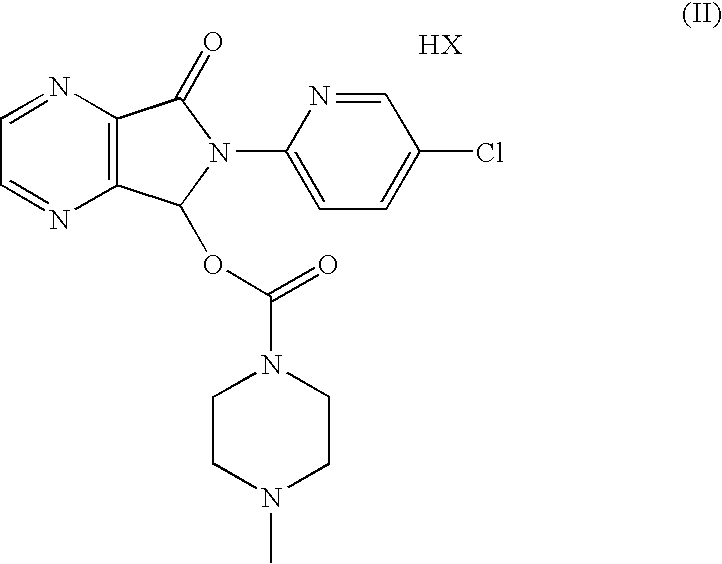
wherein HX is as defined above.
In a preferred embodiment, said salt of formula (II) is (S)-zopiclone N-acetyl-D-glutamate, (S)-zopiclone N-acetyl-D-aspartate, (S)-zopiclone N-acetyl-D-methionate, (S)-zopiclone N-acetyl-L-glutamate, (S)-zopiclone N-acetyl-L-aspartate or (S)-zopiclone N-acetyl-L-methionate.
The previously described process allows resolving the racemic mixture of the compound of formula (I) by obtaining any of the two enantiomers. The yields and optical purity of the obtained products, the simplicity of the operations and the reproducibility of the process make it applicable from the industrial point of view.
The following examples are provided only as an additional illustration of the invention and must not be taken as a definition of the limits thereof.
A three-neck 500 ml flask was charged with 25 g of (±)-zopiclone (1 eq) and 11.3 g of N-acetyl-D-aspartic acid (1 eq). 363 ml of a mixture of methanol/toluene (1/1) were added. The reaction mixture was stirred for 10 minutes at room temperature, then heated and maintained for 30 minutes at reflux. The dispersion was slowly cooled and maintained for over 30 minutes at room temperature. The solid product was isolated by filtration and washed with 10 ml of methanol and 10 ml of toluene. The solid was dried under vacuum to obtain 15.6 g of (S)-zopiclone N-acetyl-D-aspartate (43%) as a white product.
Diastereoisomeric excess (d.e.): 99.5% by chiral HPLC. Water content: 0.6% w/w. Melting point: 186-189° C. [α]D 20: +55° (c 1% w/w water). IR (KBr, cm−1): 3433, 1741, 1731, 1720, 1675, 1575, 1460, 1373, 1279, 1255, 1031. 1H-NMR (DMSO-d6, 400 MHz) δ (ppm): 8.96 (1H, d, 2.4 Hz), 8.93 (1H, d, 2.4 Hz), 8.53 (1H, d, 2.4 Hz), 8.36 (1H, d, 9.2 Hz), 8.14 (1H, wide signal), 8.09 (1H, dd, 9.2 Hz, 2.4 Hz), 7.78 (1H, s), 4.47-4.41 (1H, m), 3.47 (1H, wide signal), 3.31 (1H, wide signal), 3.14 (2H, wide signal), 2.62 (1H, dd, 16.4 Hz, 6.4 Hz), 2.50 (1H, dd, 16.4 Hz, 6.4 Hz), 2.35 (1H, wide signal), 2.32 (1H, wide signal), 2.19 (1H, wide signal), 2.18 (3H, s), 1.89 (1H, wide signal), 1.81 (3H, s). 13C-NMR (DMSO-d6, 100 MHz) δ (ppm): 172.7, 171.8, 169.0, 163.1, 155.4, 152.8, 148.6, 148.0, 147.8, 146.6, 143.4, 138.6, 127.1, 116.1, 79.1, 53.7, 48.6, 45.2, 43.2, 36.6, 22.4. XRPD (2θ): main peaks at 14.7, 14.8, 17.7, 18.3, 18.7, 19.2, 19.8, 21.5, 24.4, 25.1, 25.9, 26.2, 27.3, 33.1±0.2.
160 ml of a mixture of methanol/toluene at atmospheric pressure were distilled from the mother liquors of the preparation of the example 1. A light brown solid crystallized from the resulting mixture. The dispersion was cooled at room temperature. The solid was isolated by filtration and washed with 10 ml of methanol and 10 ml of toluene. The product was dried under vacuum to obtain 15.8 g of white solid (R)-zopiclone N-acetyl-D-aspartate (44%) as an off-white solid.
d.e.: 86.3% by chiral HPLC. Water content: 6.3% w/w. Melting point: 176-177° C. [α]D 20: −72.5° (c 1% w/w water). IR (KBr, cm−1): 3433, 3068, 2860, 1741, 1732, 1720, 1675, 1577, 1461, 1373, 1255, 1144, 1052, 975. 1H-NMR (DMSO-d6, 400 MHz) δ (ppm): 8.96 (1H, d, 2.8 Hz), 8.93 (1H, d, 2.8 Hz), 8.52 (1H, d, 2.8 Hz), 8.36 (1H, d, 9.2 Hz), 8.10 (1H, wide signal), 8.09 (1H, dd, 9.2 Hz, 2.8 Hz), 7.76 (1H, s), 4.46-4.41 (1H, m), 3.47 (1H, wide signal), 3.31 (1H, wide signal), 3.14 (2H, wide signal), 2.62 (1H, dd, 16.4 Hz, 6.0 Hz), 2.50 (1H, dd, 16.4 Hz, 6.4 Hz), 2.40 (1H, wide signal), 2.32 (1H, wide signal), 2.19 (1H, wide signal), 2.16 (3H, s), 1.88 (1H, wide signal), 1.81 (3H, s). 13C-NMR (DMSO-d6, 100 MHz) δ (ppm): 172.7, 171.8, 169.0, 163.1, 155.4, 152.8, 148.6, 148.0, 147.8, 146.6, 143.4, 138.6, 127.1, 116.1, 79.1, 53.7, 48.6, 45.2, 43.3, 36.6, 22.4. XRPD (2θ): main peaks at 5.3, 8.0, 10.6, 12.7, 14.1, 15.8, 15.9, 17.1, 21.3, 24.2, 24.8, 25.5, 25.8±0.2.
A three-neck 100 ml flask was charged with 2 g of (±)-zopiclone (1 eq) and 0.9 g of N-acetyl-L-aspartic acid (1 eq), and a mixture of 29 ml of methanol/xylene (1/1) were added. The reaction mixture was stirred for 10 minutes at room temperature, then heated and maintained for 30 minutes at reflux, and then was cooled and the dispersion was maintained for over 30 minutes at room temperature. The solid product was isolated by filtration and washed with 0.8 ml of methanol and 0.8 ml of xylene. The product was dried under vacuum to obtain 1.18 g of (R)-zopiclone N-acetyl-L-aspartate (41%) as a white solid.
d.e.: 91.8% by chiral HPLC. Water content: 0.6% w/w. Melting point: 184-186° C. [α]D 20: −57.5° (c 1% w/w water). IR (KBr, cm−1): 3413, 3060, 2964, 1732, 1720, 1661, 1467, 1376, 1258, 1169, 1079. 1H-NMR (DMSO-d6, 400 MHz) δ (ppm): 8.96 (1H, d, 2.4 Hz), 8.93 (1H, d, 2.4 Hz), 8.52 (1H, d, 2.4 Hz), 8.36 (1H, d, 9.2 Hz), 8.10 (1H, wide signal), 8.09 (1H, dd, 9.2 Hz, 2.4 Hz), 7.76 (1H, s), 4.46-4.40 (1H, m), 3.47 (1H, wide signal), 3.31 (1H, wide signal), 3.14 (2H, wide signal), 2.62 (1H, dd, 16.4 Hz, 6.4 Hz), 2.50 (1H, dd, 16.4 Hz, 6.4 Hz), 2.39 (1H, wide signal), 2.31 (1H, wide signal), 2.19 (1H, wide signal), 2.15 (3H, s), 1.85 (1H, wide signal), 1.81 (3H, s). 13C-NMR (DMSO-d6, 100 MHz) δ (ppm): 172.7, 171.9, 169.0, 163.1, 155.4, 152.8, 148.6, 148.0, 147.8, 146.6, 143.4, 138.6, 127.1, 116.1, 79.1, 53.8, 48.6, 45.2, 43.3, 36.7, 22.4. XRPD (2θ): main peaks at 14.7, 14.8, 18.3, 18.7, 19.2, 19.8, 21.5, 21.5, 24.4, 25.1, 25.9, 26.2, 27.3±0.2.
A three-neck 250 ml flask was charged with 10 g of (±)-zopiclone (1 eq) and 4.5 g of N-acetyl-L-aspartic acid (1 eq). 87 ml of a mixture of methanol/toluene (1/1) were added. The reaction mixture was stirred for 3 minutes at room temperature, then heated and maintained for 10 minutes at reflux temperature. The dispersion was slowly cooled and maintained for over 1 hour at room temperature. The solid product was isolated by filtration and washed with 10 ml of methanol and 10 ml of toluene. The product was dried under vacuum to obtain 6.7 g of (R)-zopiclone N-acetyl-L-aspartate (46%) as a white solid.
d.e.: 96.6% by chiral HPLC. Water content: 0.2% w/w. Melting point: 181-186° C. [α]D 20: −62.5° (c 1% w/w water). IR (KBr, cm−1): 3433, 3067, 3006, 2860, 1740, 1731, 1720, 1675, 1576, 1460, 1373. 1H-NMR (DMSO-d6, 400 MHz) δ (ppm): 8.98 (1H, d, 2.8 Hz), 8.95 (1H, d, 2.8 Hz), 8.54 (1H, d, 2.4 Hz), 8.38 (1H, d, 8.4 Hz), 8.14 (1H, wide signal), 8.11 (1H, dd, 8.4 Hz, 2.4 Hz), 7.79 (1H, s), 4.49-4.43 (1H, m), 3.48 (1H, wide signal), 3.32 (1H, wide signal), 3.10 (2H, wide signal), 2.63 (1H, dd, 16.4 Hz, 6.0 Hz), 2.52 (1H, dd, 16.4 Hz, 6.4 Hz), 2.42 (1H, wide signal), 2.33 (1H, wide signal), 2.195 (1H, wide signal), 2.18 (s, 3H), 1.91 (1H, wide signal), 1.83 (3H, s). 13C-NMR (DMSO-d6, 100 MHz) δ (ppm): 172.7, 171.8, 169.0, 163.1, 155.4, 152.8, 148.6, 148.0, 147.8, 146.6, 143.4, 138.6, 127.0, 116.1, 79.1, 53.7, 48.6, 45.2, 43.2, 36.6, 22.4. XRPD (2θ): main peaks at 14.7, 18.3, 18.7, 19.2, 19.8, 21.4, 21.5, 25.1, 25.9, 26.2, 27.3±0.2.
80 ml of methanol/toluene of mother liquors of the preparation of (R)-zopiclone N-acetyl-L-aspartate of the example 4 were distilled at atmospheric pressure and white solid crystallized from the resulting mixture. 20 ml of fresh toluene were added. The mixture was cooled to room temperature and maintained for over 30 minutes at this temperature. The product was isolated by filtration, washed twice with 10 ml of toluene and dried under vacuum to obtain 6.2 g of (S)-zopiclone N-acetyl-L-aspartate (43%) as a white solid.
d.e.: 92.3% by chiral HPLC. Water content: 4.3% w/w. Melting point: 173-179° C. [α]D 20: +93° (c 0.4% w/w acetone). IR (KBr, cm−1): 3436, 3059, 3025, 2968, 1743, 1732, 1724, 1660, 1470, 1377, 1079. 1H-NMR (DMSO-d6, 400 MHz), δ (ppm): 8.98 (1H, d, 2.8 Hz), 8.95 (1H, d, 2.8 Hz), 8.54 (1H, d, 2.8 Hz), 8.38 (1H, d, 9.2 Hz), 8.14 (1H, wide signal), 8.11 (1H, dd, 9.2 Hz, 2.8 Hz), 7.84 (1H, s), 4.48-4.43 (1H, m), 3.48 (1H, wide signal), 3.33 (1H, wide signal) 3.16 (2H, wide signal), 2.63 (1H, dd, 16.4 Hz, 6.4 Hz), 2.52 (1H, dd, 16.4 Hz, 6.8 Hz), 2.41 (1H, wide signal), 2.333 (1H, wide signal), 2.18 (s, 3H), 2.17 (1H, wide signal), 1.91 (1H, wide signal), 1.83 (3H, s). 13C-NMR (DMSO-d6, 100 MHz), δ (ppm): 172.7, 171.8, 169.0, 163.1, 155.4, 152.8, 148.6, 148.0, 147.8, 146.6, 143.4, 138.6, 127.0, 116.1, 79.1, 53.7, 48.6, 45.2, 43.3, 36.6, 22.4. XRPD (2θ): main peaks at 5.3, 7.9, 10.6, 12.7, 15.7, 17.0, 17.1, 17.3, 18.8, 21.3, 24.3, 24.8, 25.6, 26.4, 29.1±0.2.
A reaction flask was charged with 11.2 g of (±)-zopiclone (1 eq), 4.9 g of N-acetyl-D-glutamic acid (0.9 eq) and 830 ml of acetone. The mixture was heated to reflux and the dispersion was maintained for 1 hour at this temperature. The warm solution was filtered to obtain a clear solution. The solution was concentrated to one half at atmospheric pressure. The solution was cooled and at about 46° C. white solid crystallizes. The slurry was cooled at room temperature and maintained for 30 minutes. The solid product was isolated by filtration and washed with 2 ml of acetone. The product was dried under vacuum to obtain 5.9 g of (S)-zopiclone N-acetyl-D-glutamate (40%) as a white solid.
d.e.: 89.7% by chiral HPLC. Water content: 0.75% w/w. Melting point: 169-171° C. [α]D 20: +60° (c 1% w/w water). IR (KBr, cm−1): 3422, 3334, 3003, 2941, 2875, 1758, 1724, 1670, 1578, 14601, 1374, 1086. 1H-NMR (DMSO-d6, 400 MHz) δ (ppm): 8.98 (1H, d, 2.4 Hz), 8.95 (1H, d, 2.4 Hz), 8.54 (1Hd, 2.8 Hz), 8.38 (1H, d, 9.2 Hz), 8.11 (1H, dd, 9.2 Hz, 2.8 Hz), 8.10 (1H, wide signal) 7.79 (1H, s), 4.20-4.15 (1H, m), 3.48 (1H, wide signal), 3.29 (1H, wide signal), 3.13 (2H, wide signal), 2.40-2.20 (4H, m), 2.11 (3H, s), 2.08 (1H, wide signal), 1.94 (1H, m), 1.84 (3H, s), 1.81-1.71 (2H, m). 13C-NMR (DMSO-d6, 100 MHz), δ (ppm): 173.7, 173.5, 169.3, 163.1, 155.4, 152.8, 148.6, 148.0, 147.7, 146.6, 143.4, 138.6, 127.0, 116.1, 79.1, 53.9, 51.2, 45.5, 43.5, 30.2, 26.4, 22.3. XRPD (2θ): main peaks at 3.4, 12.1, 13.6, 17.0, 18.4, 18.9, 19.1, 19.2, 19.8, 20.08, 20.4, 22.0, 22.9, 24.1, 24.5, 25.4, 26.5, 27.3±0.2.
A reaction flask was charged with 5 g of (±)-zopiclone (1 eq), 2.4 g of N-acetyl-L-glutamic acid (1 eq) and 186 ml of acetone. The mixture was heated to reflux and the dispersion was maintained for 30 min at this temperature. The solution was cooled at 35-37° C. and maintained 30 min. The suspension was cooled at room temperature. The product was isolated by filtration and washed twice with 5 ml of acetone. The product was dried under vacuum to obtain 3.6 g of (R)-zopiclone N-acetyl-L-glutamate (48%) as a white solid.
d.e.: 89.2% by chiral HPLC. 1H-NMR (DMSO-d6, 400 MHz) δ (ppm): 8.96 (1H, d, 2.4 Hz), 8.93 (1H, d, 2.4 Hz), 8.52 (1H, d, 2.8 Hz), 8.36 (1H, d, 8.8 Hz), 8.10 (1H, dd, 8.8 Hz, 2.8 Hz), 8.08 (1H, wide signal) 7.76 (1H, s), 4.18-4.13 (1H, m), 3.46 (1H, wide signal), 3.28 (1H, wide signal), 3.11 (2H, wide signal), 2.31-2.20 (4H, m), 2.10 (3H, s), 2.07 (1H, wide signal), 1.96-1.89 (1H, m), 1.82 (3H, s), 1.80-1.70 (2H, m).
A reaction flask was charged with 10.2 g of (±)-zopiclone (1 eq), 5 g of N-acetyl-D-methionine (1 eq) and 300 ml of ethyl acetate. The mixture was heated to reflux and the solution was maintained for 30 min at this temperature. The solution was cooled and at about 66° C. solid crystallized. The suspension was cooled and maintained for 1 hour at room temperature. The product was isolated by filtration and washed twice with 3 ml of ethyl acetate. The product was dried under vacuum to obtain 6.9 g of (S)-zopiclone N-acetyl-D-methionate (46%) as a white solid.
d.e.: 98.4% by chiral HPLC. Water content: 0.09% w/w. Melting point: 171-172° C. [α]D 20: +77.5° (c 1% w/w acetone). IR (KBr, cm−1): 3292, 3064, 2915, 1740, 1731, 1720, 1668, 1461, 1373, 1090. 1H-NMR (DMSO-d6, 400 MHz) δ (ppm): 8.98 (1H, d, 2.8 Hz), 8.95 (1H, d, 2.8 Hz), 8.54 (1H, d, 2.8 Hz), 8.37 (1H, d, 9.2 Hz), 8.13 (1H, wide signal), 8.11 (1H, dd, 9.2 Hz, 2.8 Hz), 7.79 (1H, s), 4.30-4.24 (1H, m), 3.47 (1H, wide signal), 3.28 (1H, wide signal), 3.13 (2H, wide signal), 2.51-2.43 (2H, m), 2.31 (1H, wide signal), 2.22 (1H, wide signal), 2.11 (3H, s), 2.06 (1H, wide signal), 2.03 (3H, s), 1.95-1.93 (1H, m), 1.84 (3H, s), 1.81-1.71 (2H, m). 13C-NMR (DMSO-d6, 100 MHz), δ (ppm): 173.5, 169.4, 163.1, 155.4, 152.8, 148.6, 148.0, 147.7, 146.6, 143.4, 138.6, 127.0, 116.1, 79.1, 54.0, 51.0, 45.6, 43.6, 30.7, 29.7, 22.4, 14.5. XRPD (2θ): main peaks at 3.3, 6.5, 11.8, 13.0, 13.9, 18.5, 18.7, 19.0, 19.1, 19.3, 19.8, 20.0, 22.0, 22.2, 26.4, 27.1±0.2.
290 ml of ethyl acetate at atmospheric pressure were distilled from the mother liquors of the preparation of (S)-zopiclone N-acetyl-D-methionate of the example 8. The product crystallized from the concentrate solution at about 32° C. The mixture was cooled to room temperature and maintained for over 30 minutes. The product was isolated by filtration and washed twice with 3 ml of ethyl acetate. The product was dried under vacuum obtaining 4.2 g of (R)-zopiclone N-acetyl-D-methionate (28%) as an off-white solid.
d.e.: 82.6% by chiral HPLC. Water content: 1.7% w/w. Melting point: 162-164° C. [α]D 20: −95° (c 1% w/w water). IR (KBr, cm−1): 3447, 3305, 2942, 2790, 1740, 1730, 1716, 1668, 1659, 1655, 1462, 1372, 1143, 1046. 1H-NMR (DMSO-d6, 400 MHz) δ (ppm): 8.96 (1H, d, 2.8 Hz), 8.93 (1H, d, 2.8 Hz), 8.5 (1H, d, 2.8 Hz), 8.36 (1H, d, 9.2 Hz), 8.11 (1H, wide signal), 8.09 (1H, dd, 9.2 Hz, 2.8 Hz), 7.77 (1H, s), 4.27-4.22 (1H, m), 3.45 (1H, wide signal), 3.26 (1H, wide signal), 3.11 (2H, wide signal), 2.49-2.30 (2H, m), 2.30 (1H, wide signal), 2.19 (1H, wide signal), 2.08 (3H, s), 2.04 (1H, wide signal), 2.01 (3H, s), 1.92-1.89 (1H, m), 1.82 (3H, s), 1.79-1.69 (2H, m). 13C-NMR (DMSO-d6, 100 MHz), δ (ppm): 173.5, 169.4, 163.1, 155.4, 152.8, 148.6, 148.0, 147.7, 146.6, 143.4, 138.6, 127.0, 116.1, 79.1, 54.0, 51.0, 45.6, 43.6, 30.7, 29.7, 22.4, 14.5. XRPD (2θ): main peaks at 3.3, 3.4, 11.9, 16.0, 16.7, 18.2, 18.8, 18.9, 20.0, 20.7, 21.3, 21.6, 25.3, 25.6, 25.8, 26.1, 26.9, 27.6±0.2.
45 ml of dichloromethane were added to a solution of 3 g of (S)-zopiclone N-acetyl-L-aspartate in 6 ml of water at room temperature. The mixture is basified to pH 10 with a solution of 40% aqueous potassium carbonate. The aqueous layer is decanted and extracted with 45 ml of dichloromethane. Organic layers were joined together and concentrated under vacuum until dryness obtaining 2.04 g of eszopiclone (100%) as a white solid.
Enantiomeric excess (e.e.): 99.3% by chiral HPLC. Water content: 0.02% w/w. Melting point: 190-192° C. [α]D 20: +115° (c 1% w/w acetone). IR (KBr, cm−1): 2942, 2790, 1730, 1715, 1470, 1463, 1372, 1086. 1H-NMR (DMSO-d6, 400 MHz) δ (ppm): 8.98 (1H, d, 2.8 Hz), 8.95 (1H, d, 2.8 Hz), 8.53 (1H, d, 2.8 Hz), 8.37 (1H, d, 9.2 Hz), 8.10 (1H, dd, 9.2 Hz, 2.8 Hz), 7.79 (1H, s), 3.47 (1H, wide signal), 3.26 (1H, wide signal), 3.12 (2H, wide signal), 2.30 (1H, wide signal), 2.20 (1H, wide signal), 2.09 (3H, s), 2.04 (1H, wide signal), 1.76 (1H, wide signal). 13C-NMR (DMSO-d6, 100 MHz), δ (ppm): 163.1, 155.4, 152.8, 148.6, 148.0, 147.8, 146.6, 143.4, 138.6, 127.0, 116.1, 79.1, 54.0, 45.7, 43.6. XRPD (2θ): main peaks at 9.9, 12.5, 16.0, 16.1, 18.0, 19.0, 20.1, 21.3, 25.6, 25.8, 27.6, 29.8±0.2.
6 ml of water and 45 ml of dichloromethane were added to 3 g of (R)-zopiclone N-acetyl-L-aspartate at room temperature. The mixture is basified to pH 10 with a solution of 40% aqueous potassium carbonate. The aqueous layer is decanted and extracted with 45 ml of dichloromethane. The combined organic layers were concentrated under vacuum until dryness obtaining 2.15 g of (R)-zopiclone (100%) as a white solid. e.e.: 100% by chiral HPLC. [α]D 20: −125° (c 1% w/w acetone). IR (KBr, cm−1): 2942, 2790, 1730, 1715, 1462, 1371, 1086. 1H-NMR (DMSO-d6, 400 MHz) δ (ppm): 8.98 (1H, d, 2.4 Hz), 8.95 (1H, d, 2.4 Hz), 8.53 (1H, d, 2.8 Hz), 8.37 (1H, d, 9.2 Hz), 8.11 (1H, dd, 9.2 Hz, 2.8 Hz), 7.79 (1H, s), 3.50 (1H, wide signal), 3.26 (1H, wide signal), 3.12 (2H, wide signal), 2.30 (1H, wide signal), 2.20 (1H, wide signal), 2.09 (3H, s), 2.04 (1H, wide signal), 1.76 (1H, wide signal). 13C-NMR (DMSO-d6, 100 MHz), δ (ppm): 163.0, 155.4, 152.8, 148.6, 148.0, 147.7, 146.6, 143.4, 138.6, 127.0, 116.1, 79.1, 54.0, 45.7, 43.6. XRPD (2θ): main peaks at 5.0, 9.9, 12.5, 16.0, 16.1, 18.0, 19.0, 20.0, 21.3, 25.6, 27.6, 29.7±0.2.
2.7 ml of a 40% aqueous solution of potassium carbonate were added to a solution of 2 g of (S)-zopiclone N-acetyl-D-aspartate in 18 ml of water in about 30 minutes at room temperature. The slurry was maintained for 1.5 hours at this temperature. The product was isolated by filtration and washed twice with 1.4 ml of water. The product was dried under vacuum at room temperature obtaining 1.29 g of eszopiclone (94%) as a white solid. e.e.: 99.8% by chiral HPLC. Water content: 0.9% w/w. Melting point: 198-201° C. [α]D 20: +145° (c 1% w/w acetone).
1 g of crude eszopiclone was dissolved in 15 ml of methyl isobutyl ketone (MIBK) at about 114° C. The solution was cooled and seeded. The solid crystallized at about 98-100° C., the slurry was maintained for 30 minutes at this temperature. Then it was cooled at room temperature. The product was isolated by filtration and washed twice with 0.4 ml MIBK. The product was dried under vacuum obtaining 0.85 g of eszopiclone (85%). e.e.: 100% by chiral HPLC. Melting point: 195-198° C. [α]D 20: +140° (c 1% w/w acetone).
2.2 g of crude eszopiclone were dissolved in 44 ml of methyl ethyl ketone (MEK) at about 76° C. The warm solution was filtered and 23 ml of MEK were distilled. The solution was cooled at −5° C. and maintained for 30 minutes at this temperature. The product was isolated by filtration and washed twice with 0.4 ml MEK. The product was dried under vacuum obtaining 2.0 g of eszopiclone (91%). e.e.: 100% by chiral HPLC. Melting point: 202-204° C. [α]D 20: +135° (c 1% w/w acetone).
Claims (20)
1. A process for the racemic resolution of a compound of formula (I):

which comprises resolving a diastereoisomeric salt of formula (II):

wherein HX is an optically active acetylated amino acid of formula (III):

wherein:
n is 0, 1, 2 or 3,
R1 is H, an alkyl group, an aryl group, a heteroaryl group, CONH2, COOH, SR2 or OR2,
wherein R2 is a C1-C6 alkyl.
2. The process according to claim 1 wherein the optically active acetylated amino acid of formula (III) is selected from N-acetyl-D-glutamic acid, N-acetyl-L-glutamic acid, N-acetyl-D-aspartic acid, N-acetyl-L-aspartic acid, N-acetyl-D-methionine and N-acetyl-L-methionine.
3. The process according to claim 1 wherein the compound of formula (I) is the (S)-enantiomer.
4. The process according to claim 3 wherein the diastereoisomeric salt of formula (II) is (S)-zopiclone N-acetyl-D-glutamate, (S)-zopiclone N-acetyl-D-aspartate, (S)-zopiclone N-acetyl-D-methionate, (S)-zopiclone N-acetyl-L-glutamate, (S)-zopiclone N-acetyl-L-aspartate or (S)-zopiclone N-acetyl-L-methionate.
5. The process according to claim 1 wherein the compound of formula (I) is the (R)-enantiomer.
6. The process according to claim 5 wherein the diastereoisomeric salt of formula (II) is (R)-zopiclone N-acetyl-L-glutamate, (R)-zopiclone N-acetyl-L-aspartate or (R)-zopiclone N-acetyl-L-methionate, (R)-zopiclone N-acetyl-D-glutamate, (R)-zopiclone N-acetyl-D-aspartate or (R)-zopiclone N-acetyl-D-methionate.
7. A process for the racemic resolution of a compound of formula (I):

comprising the following steps:
a) reacting said racemate with any of the enantiomers of an optically active acetylated amino acid of formula (III):

wherein:
n is 0, 1, 2 or 3,
R1 is H, an alkyl group, an aryl group, a heteroaryl group, CONH2, COOH, SR2 or OR2,
wherein R2 is a C1-C6 alkyl;
b) isolating an optically pure diastereoisomeric salt of formula (II):

wherein HX is the optically active acetylated amino acid of formula (III); and
c) separating an enantiomer of formula (I) from its diastereoisomeric salt of formula (II).
8. The process according to claim 7 wherein the organic solvent is selected from alcohols, ethers, esters, ketones, nitriles, halogenated solvents, aromatic solvents and mixtures thereof.
9. The process according to claim 8 wherein the organic solvent is selected form methanol, toluene, xylene, acetone, ethyl acetate, acetonitrile, tetrahydrofuran, isopropyl acetate, ethyl formate, methyl tert-butyl ether, diethylcarbonate, chlorobenzene, dichloromethane and mixtures thereof.
10. The process according to claim 7 wherein the optically pure diastereoisomeric salt of formula (II) isolated in step b) is (S)-zopiclone N-acetyl-D-glutamate when the compound of formula (III) is N-acetyl-D-glutamic acid.
11. The process according to claim 7 wherein the optically pure diastereoisomeric salt of formula (II) isolated in step b) is (S)-zopiclone N-acetyl-D-glutamate when the compound of formula (III) is N-acetyl-D-glutamic acid, or (R)-zopiclone N-acetyl-L-glutamate when the compound of formula (III) is N-acetyl-L-glutamic acid.
12. The process according to claim 7 wherein the optically pure diastereoisomeric salt of formula (II) isolated in step b) is (S)-zopiclone N-acetyl-D-aspartate when the compound of formula (III) is N-acetyl-D-aspartic acid.
13. The process according to claim 7 wherein the optically pure diastereoisomeric salt of formula (II) isolated in step b) is (R)-zopiclone N-acetyl-L-aspartate when the compound of formula (III) is N-acetyl-L-aspartic acid.
14. The process according to claim 7 wherein the optically pure diastereoisomeric salt of formula (II) isolated in step b) is (S)-zopiclone N-acetyl-D-methionate when the compound of formula (III) is N-acetyl-D-methionine.
15. The process according to claim 7 wherein the optically pure diastereoisomeric salt of formula (II) isolated in step b) is (R)-zopiclone N-acetyl-L-methionate when the compound of formula (III) is N-acetyl-L-methionine.
16. The process according to claim 7 comprising an additional isolation step of the other optically pure diastereoisomeric salt of formula (II), wherein the other optically pure diastereoisomeric salt is the second diastereoisomeric salt that is left after the isolation of the first diastereoisomeric salt from the racemate.
17. The process according to claim 16 wherein the additional isolation step of the other diastereoisomeric salt of formula (II) comprises the concentration of the mother liquor generated upon isolating the first diastereoisomeric salt and subsequent crystallization to obtain the other diastereoisomeric salt.
18. The process according to claim 17 wherein the other diastereoisomeric salt is (S)-zopiclone N-acetyl-L-glutamate, (S)-zopiclone N-acetyl-L-aspartate, (S)-zopiclone N-acetyl-L-methionate, (R)-zopiclone N-acetyl-D-glutamate, (R)-zopiclone N-acetyl-D-aspartate or (R)-zopiclone N-acetyl-D-methionate.
19. The process according to claim 1 which further comprises the racemisation of the (R)-enantiomer of the compound of formula (I) to prepare the racemate of the compound of formula (I) and subsequently the isolation of the (S)-enantiomer of the compound of formula (I) by:
a) reacting said racemate with any of the enantiomers of an optically active acetylated amino acid of formula (III):

wherein:
n is 0, 1, 2 or 3,
R1 is H, an alkyl group, an aryl group, a heteroaryl group, CONH2, COOH, SR2 or
OR2, wherein R2 is a C1-C6 alkyl;
b) isolating an optically pure diastereoisomeric salt of formula (II):

wherein HX is the optically active acetylated amino acid of formula (III); and
c) separating the (S)-enantiomer of the compound of formula (I) from its diastereoisomeric salt of formula (II); and optionally
d) isolating the pure (R)-form of the diastereoisomeric salt of formula (II).
20. The process according to claim 16 , wherein the other optically pure diastereoisomeric salt is the second diastereoisomeric salt that is left after the isolation of the first diastereoisomeric salt from the racemate.
Priority Applications (1)
| Application Number | Priority Date | Filing Date | Title |
|---|---|---|---|
| US12/830,147 US7968712B2 (en) | 2007-08-02 | 2010-07-02 | Process for the resolution of zopiclone and intermediate compounds |
Applications Claiming Priority (5)
| Application Number | Priority Date | Filing Date | Title |
|---|---|---|---|
| EP07380226 | 2007-08-02 | ||
| EP07380226A EP2020403A1 (en) | 2007-08-02 | 2007-08-02 | Process for the resolution of zopiclone and intermediate compounds |
| EPEP07380226.6 | 2007-08-02 | ||
| US11/866,584 US7772396B2 (en) | 2007-08-02 | 2007-10-03 | Process for the resolution of zopiclone and intermediate compounds |
| US12/830,147 US7968712B2 (en) | 2007-08-02 | 2010-07-02 | Process for the resolution of zopiclone and intermediate compounds |
Related Parent Applications (1)
| Application Number | Title | Priority Date | Filing Date |
|---|---|---|---|
| US11/866,584 Division US7772396B2 (en) | 2007-08-02 | 2007-10-03 | Process for the resolution of zopiclone and intermediate compounds |
Publications (2)
| Publication Number | Publication Date |
|---|---|
| US20100274018A1 US20100274018A1 (en) | 2010-10-28 |
| US7968712B2 true US7968712B2 (en) | 2011-06-28 |
Family
ID=38871700
Family Applications (2)
| Application Number | Title | Priority Date | Filing Date |
|---|---|---|---|
| US11/866,584 Expired - Fee Related US7772396B2 (en) | 2007-08-02 | 2007-10-03 | Process for the resolution of zopiclone and intermediate compounds |
| US12/830,147 Expired - Fee Related US7968712B2 (en) | 2007-08-02 | 2010-07-02 | Process for the resolution of zopiclone and intermediate compounds |
Family Applications Before (1)
| Application Number | Title | Priority Date | Filing Date |
|---|---|---|---|
| US11/866,584 Expired - Fee Related US7772396B2 (en) | 2007-08-02 | 2007-10-03 | Process for the resolution of zopiclone and intermediate compounds |
Country Status (17)
| Country | Link |
|---|---|
| US (2) | US7772396B2 (en) |
| EP (2) | EP2020403A1 (en) |
| JP (1) | JP2010535177A (en) |
| KR (1) | KR20100044241A (en) |
| CN (1) | CN101772475B (en) |
| AT (1) | ATE551312T1 (en) |
| AU (1) | AU2008281717A1 (en) |
| CA (1) | CA2695254A1 (en) |
| ES (1) | ES2385120T3 (en) |
| HR (1) | HRP20120306T1 (en) |
| IL (1) | IL203557A (en) |
| MX (1) | MX2010001229A (en) |
| NZ (1) | NZ583097A (en) |
| PL (1) | PL2183201T3 (en) |
| RU (1) | RU2010107453A (en) |
| SI (1) | SI2183201T1 (en) |
| WO (1) | WO2009016251A1 (en) |
Cited By (1)
| Publication number | Priority date | Publication date | Assignee | Title |
|---|---|---|---|---|
| US20120165364A1 (en) * | 2005-12-19 | 2012-06-28 | Sicor Inc. | Novel forms of tiotropium bromide and processes for preparation thereof |
Families Citing this family (7)
| Publication number | Priority date | Publication date | Assignee | Title |
|---|---|---|---|---|
| US7476737B2 (en) * | 2005-09-05 | 2009-01-13 | Dr. Reddy's Laboratories Limited | Eszopiclone process |
| CN101607961B (en) | 2008-06-18 | 2011-08-10 | 天津天士力集团有限公司 | Eszopiclone crystal and composition thereof |
| EP2345654A1 (en) * | 2010-01-05 | 2011-07-20 | LEK Pharmaceuticals d.d. | Eszopiclone particles and a process for their preparation |
| CN103193779B (en) * | 2012-01-05 | 2016-04-20 | 成都弘达药业有限公司 | A kind of preparation method of Lunesta |
| US9643921B2 (en) | 2014-02-06 | 2017-05-09 | Ube Industries, Ltd. | Method for producing indoline compound |
| DE102020205560B4 (en) | 2020-04-30 | 2022-05-25 | Zettl Interieur Gmbh | FLEXIBLE RESPIRATOR AND THEIR USE |
| CN113214267B (en) * | 2021-05-08 | 2022-06-28 | 上海中西三维药业有限公司 | Refining method for preparing pure and optically enriched eszopiclone |
Family Cites Families (12)
| Publication number | Priority date | Publication date | Assignee | Title |
|---|---|---|---|---|
| OA04285A (en) | 1972-01-07 | 1979-12-31 | Rhone Poulenc Sa | New derivatives of pyrrolo (3,4-b) pyrazine and their preparation. |
| FR2671800B1 (en) | 1991-01-17 | 1993-03-12 | Rhone Poulenc Rorer Sa | OPTICALLY ACTIVE 5H-PYRROLO [3,4-B] PYRAZINE DERIVATIVE, ITS PREPARATION AND THE PHARMACEUTICAL COMPOSITIONS CONTAINING IT. |
| ES2203319B1 (en) | 2002-04-03 | 2005-03-01 | Universidad De Oviedo | NEW OPTICALLY ACTIVE CARBONATES AS INTERMEDIATES IN THE SYNTHESIS OF (+) - ZOPICLONA. |
| PL1691811T3 (en) | 2003-12-11 | 2014-12-31 | Sunovion Pharmaceuticals Inc | Combination of a sedative and a neurotransmitter modulator, and methods for improving sleep quality and treating depression |
| DK1742624T3 (en) | 2004-02-18 | 2010-03-08 | Sepracor Inc | Dopamine agonist combination therapy with sedatives to improve sleep quality |
| JP4970244B2 (en) | 2004-04-05 | 2012-07-04 | サノビオン ファーマシューティカルズ インク | Treatment with eszopiclone |
| EP1919912A1 (en) | 2005-06-21 | 2008-05-14 | Merck Generics (UK) Limited | Process for enantiomeric separation of zopiclone |
| US7476737B2 (en) | 2005-09-05 | 2009-01-13 | Dr. Reddy's Laboratories Limited | Eszopiclone process |
| CA2637542A1 (en) | 2006-01-17 | 2007-07-26 | Glenmark Pharmaceuticals Limited | Improved process for the preparation of an optically active 5h-pyrrolo [3,4-b] pyrazine derivative |
| AR059296A1 (en) | 2006-02-03 | 2008-03-26 | Synthon Bv | S-ZOPICLONE L-TARTRATE COMPOSITE AND PROCESS TO RESOLVE ZOPICLONA ENANTIOMERS. |
| US20080027223A1 (en) | 2006-03-23 | 2008-01-31 | Teva Pharmaceutical Industries Ltd. | Polymorphs of eszopiclone malate |
| JP2008543953A (en) | 2006-04-20 | 2008-12-04 | テバ ファーマシューティカル インダストリーズ リミティド | Process for preparing eszopiclone crystalline form A, substantially pure eszopiclone and optically enriched eszopiclone |
-
2007
- 2007-08-02 EP EP07380226A patent/EP2020403A1/en not_active Withdrawn
- 2007-10-03 US US11/866,584 patent/US7772396B2/en not_active Expired - Fee Related
-
2008
- 2008-08-01 SI SI200830601T patent/SI2183201T1/en unknown
- 2008-08-01 KR KR1020107004730A patent/KR20100044241A/en not_active Withdrawn
- 2008-08-01 AT AT08786735T patent/ATE551312T1/en active
- 2008-08-01 EP EP08786735A patent/EP2183201B1/en active Active
- 2008-08-01 CN CN200880101463XA patent/CN101772475B/en not_active Expired - Fee Related
- 2008-08-01 ES ES08786735T patent/ES2385120T3/en active Active
- 2008-08-01 NZ NZ583097A patent/NZ583097A/en not_active IP Right Cessation
- 2008-08-01 JP JP2010518689A patent/JP2010535177A/en not_active Withdrawn
- 2008-08-01 RU RU2010107453/04A patent/RU2010107453A/en not_active Application Discontinuation
- 2008-08-01 WO PCT/EP2008/060115 patent/WO2009016251A1/en not_active Ceased
- 2008-08-01 AU AU2008281717A patent/AU2008281717A1/en not_active Abandoned
- 2008-08-01 HR HR20120306T patent/HRP20120306T1/en unknown
- 2008-08-01 PL PL08786735T patent/PL2183201T3/en unknown
- 2008-08-01 CA CA2695254A patent/CA2695254A1/en not_active Abandoned
- 2008-08-01 MX MX2010001229A patent/MX2010001229A/en active IP Right Grant
-
2010
- 2010-01-27 IL IL203557A patent/IL203557A/en not_active IP Right Cessation
- 2010-07-02 US US12/830,147 patent/US7968712B2/en not_active Expired - Fee Related
Cited By (1)
| Publication number | Priority date | Publication date | Assignee | Title |
|---|---|---|---|---|
| US20120165364A1 (en) * | 2005-12-19 | 2012-06-28 | Sicor Inc. | Novel forms of tiotropium bromide and processes for preparation thereof |
Also Published As
| Publication number | Publication date |
|---|---|
| MX2010001229A (en) | 2010-03-04 |
| CN101772475A (en) | 2010-07-07 |
| AU2008281717A1 (en) | 2009-02-05 |
| IL203557A (en) | 2014-11-30 |
| JP2010535177A (en) | 2010-11-18 |
| PL2183201T3 (en) | 2012-09-28 |
| US20090036681A1 (en) | 2009-02-05 |
| EP2020403A1 (en) | 2009-02-04 |
| HRP20120306T1 (en) | 2012-04-30 |
| KR20100044241A (en) | 2010-04-29 |
| WO2009016251A1 (en) | 2009-02-05 |
| SI2183201T1 (en) | 2012-05-31 |
| CA2695254A1 (en) | 2009-02-05 |
| ATE551312T1 (en) | 2012-04-15 |
| US7772396B2 (en) | 2010-08-10 |
| ES2385120T3 (en) | 2012-07-18 |
| RU2010107453A (en) | 2011-09-10 |
| CN101772475B (en) | 2013-11-06 |
| US20100274018A1 (en) | 2010-10-28 |
| EP2183201A1 (en) | 2010-05-12 |
| EP2183201B1 (en) | 2012-03-28 |
| NZ583097A (en) | 2011-03-31 |
Similar Documents
| Publication | Publication Date | Title |
|---|---|---|
| US7968712B2 (en) | Process for the resolution of zopiclone and intermediate compounds | |
| US8969558B2 (en) | Processes for the preparation of sitagliptin and pharmaceutically acceptable salts thereof | |
| US6580003B2 (en) | Catalytic asymmetric desymmetrization of meso compounds | |
| CA2961984C (en) | Novel chiral synthesis of n-acyl-(3-substituted)-(8-substituted)-5,6-dihydro-[1,2,4]triazolo[4,3-a]pyrazines | |
| US11897843B2 (en) | Process for the preparation of enantiomerically enriched 3-aminopiperidine | |
| US20120165525A1 (en) | Process for the preparation of linagliptin | |
| WO2010128517A1 (en) | Improved process for the preparation of d-threo-ritalinic acid hydrochloride by resolution of dl-threo-ritalinic acid using chiral carboxylic acid | |
| US20160002158A1 (en) | Asymmetric synthesis of a substituted pyrrolidine-2-carboxamide | |
| US20110172444A1 (en) | Method for purifying aminoacetylpyrrolidinecarbonitrile derivative and salt thereof | |
| US6632942B2 (en) | Asymmetric synthesis of piperazic acid and derivatives thereof | |
| JP2006503011A5 (en) | ||
| EP3242879B1 (en) | Novel process for the preparation of dipeptidyl peptidase-4 (dpp-4) enzyme inhibitor | |
| EP2058313A2 (en) | Process for synthesis and purification of anhydrous crystalline S-zopiclone | |
| FI109902B (en) | New cardiotonic agent, hypotensive and vasodilator - is optically pure (-)enantiomer of ((4-(1,4,5,6-tetra:hydro-4-methyl-6-oxo-3-pyridazinyl)phenyl)hydrazono)propane:di:nitrile | |
| JP2002193901A (en) | Optical resolution of (1S *, 4R *)-4-amino-2-cyclopentene-1-carboxylic acid esters | |
| KR20030016288A (en) | Enantiomer separation of piperidone derivatives with simultaneous in situ racemization of the unwanted enantiomer |
Legal Events
| Date | Code | Title | Description |
|---|---|---|---|
| STCF | Information on status: patent grant |
Free format text: PATENTED CASE |
|
| FPAY | Fee payment |
Year of fee payment: 4 |
|
| FEPP | Fee payment procedure |
Free format text: MAINTENANCE FEE REMINDER MAILED (ORIGINAL EVENT CODE: REM.); ENTITY STATUS OF PATENT OWNER: LARGE ENTITY |
|
| LAPS | Lapse for failure to pay maintenance fees |
Free format text: PATENT EXPIRED FOR FAILURE TO PAY MAINTENANCE FEES (ORIGINAL EVENT CODE: EXP.); ENTITY STATUS OF PATENT OWNER: LARGE ENTITY |
|
| STCH | Information on status: patent discontinuation |
Free format text: PATENT EXPIRED DUE TO NONPAYMENT OF MAINTENANCE FEES UNDER 37 CFR 1.362 |
|
| FP | Lapsed due to failure to pay maintenance fee |
Effective date: 20190628 |