US7939621B2 - Oligocarbonate molecular transporters - Google Patents
Oligocarbonate molecular transporters Download PDFInfo
- Publication number
- US7939621B2 US7939621B2 US12/433,693 US43369309A US7939621B2 US 7939621 B2 US7939621 B2 US 7939621B2 US 43369309 A US43369309 A US 43369309A US 7939621 B2 US7939621 B2 US 7939621B2
- Authority
- US
- United States
- Prior art keywords
- group
- monomer
- compound
- oligomer
- substituted
- Prior art date
- Legal status (The legal status is an assumption and is not a legal conclusion. Google has not performed a legal analysis and makes no representation as to the accuracy of the status listed.)
- Active - Reinstated, expires
Links
- 0 [1*]C1([H])OC(=O)OC([2*])([H])C1([3*])[4*]C(=O)C[10*]C(P)P Chemical compound [1*]C1([H])OC(=O)OC([2*])([H])C1([3*])[4*]C(=O)C[10*]C(P)P 0.000 description 11
- HWTTUTRMPUJPHZ-UHFFFAOYSA-N O=C(O)C(F)(F)F.[H]OCC(C)(COC(=O)OCCNS(=O)(=O)C1=CC=CC2=C1C=CC=C2N(C)C)C(=O)OCCNC(=N)N Chemical compound O=C(O)C(F)(F)F.[H]OCC(C)(COC(=O)OCCNS(=O)(=O)C1=CC=CC2=C1C=CC=C2N(C)C)C(=O)OCCNC(=N)N HWTTUTRMPUJPHZ-UHFFFAOYSA-N 0.000 description 2
- VUKIPHNWDQHTBO-IIRQBUAXSA-N C.C.C1CCC2=NCCN2CC1.CC(C)(C)OC(=O)NC(=NCCO)NC(=O)OC(C)(C)C.CC(C)(C)OC(=O)NC(=NCCOC(=O)C1(C)COC(=O)OC1)NC(=O)OC(C)(C)C.CC1(C(=O)Cl)COC(=O)OC1.CN(C)C1=C2C=CC=C(S(=O)(=O)NCCO)C2=CC=C1.ClCl.FC(F)(F)C1=CC(NC(=S)NC2CCCCC2)=CC(C(F)(F)F)=C1.[2H]B[U].[3H][U].[H]OCC(C)(COC(=O)OCCNS(=O)(=O)/C1=C/C=C\C2=C(N(C)C)C=CC=C21)C(=O)OCCN=C(NC(=O)OC(C)(C)C)NC(=O)OC(C)(C)C Chemical compound C.C.C1CCC2=NCCN2CC1.CC(C)(C)OC(=O)NC(=NCCO)NC(=O)OC(C)(C)C.CC(C)(C)OC(=O)NC(=NCCOC(=O)C1(C)COC(=O)OC1)NC(=O)OC(C)(C)C.CC1(C(=O)Cl)COC(=O)OC1.CN(C)C1=C2C=CC=C(S(=O)(=O)NCCO)C2=CC=C1.ClCl.FC(F)(F)C1=CC(NC(=S)NC2CCCCC2)=CC(C(F)(F)F)=C1.[2H]B[U].[3H][U].[H]OCC(C)(COC(=O)OCCNS(=O)(=O)/C1=C/C=C\C2=C(N(C)C)C=CC=C21)C(=O)OCCN=C(NC(=O)OC(C)(C)C)NC(=O)OC(C)(C)C VUKIPHNWDQHTBO-IIRQBUAXSA-N 0.000 description 1
- HPPWAPCEUQQYRX-UHFFFAOYSA-N CC(C)(C)OC(=O)/N=C(/NCCOC(=O)C1(C)COC(=O)OC1)NC(=O)OC(C)(C)C Chemical compound CC(C)(C)OC(=O)/N=C(/NCCOC(=O)C1(C)COC(=O)OC1)NC(=O)OC(C)(C)C HPPWAPCEUQQYRX-UHFFFAOYSA-N 0.000 description 1
- ZICRQGUGMKJDEX-UHFFFAOYSA-N CC(C)(C)OC(=O)/N=C(/NCCOC(=O)C1(C)COC(=O)OC1)NC(=O)OC(C)(C)C.CN(C)C1=CC=CC2=C1C=CC=C2S(=O)(=O)NCCO.[H]OCC(C)(COC(=O)OCCNS(=O)(=O)C1=CC=CC2=C1C=CC=C2N(C)C)C(=O)OCCN/C(=N/C(=O)OC(C)(C)C)NC(=O)OC(C)(C)C Chemical compound CC(C)(C)OC(=O)/N=C(/NCCOC(=O)C1(C)COC(=O)OC1)NC(=O)OC(C)(C)C.CN(C)C1=CC=CC2=C1C=CC=C2S(=O)(=O)NCCO.[H]OCC(C)(COC(=O)OCCNS(=O)(=O)C1=CC=CC2=C1C=CC=C2N(C)C)C(=O)OCCN/C(=N/C(=O)OC(C)(C)C)NC(=O)OC(C)(C)C ZICRQGUGMKJDEX-UHFFFAOYSA-N 0.000 description 1
- HEZLQWARTZAPCA-DHIUTWEWSA-P CN(C)C1=CC=CC2=C(S(=O)(=O)NCCCCCC(=O)N[C@H](CCCNC(N)=[NH2+])C(=O)N[C@H](CCCNC(N)=[NH2+])C(N)=O)C=CC=C12 Chemical compound CN(C)C1=CC=CC2=C(S(=O)(=O)NCCCCCC(=O)N[C@H](CCCNC(N)=[NH2+])C(=O)N[C@H](CCCNC(N)=[NH2+])C(N)=O)C=CC=C12 HEZLQWARTZAPCA-DHIUTWEWSA-P 0.000 description 1
- OLNUFXNRCJFBMZ-UHFFFAOYSA-N CN(C)C1=CC=CC2=C1C=CC=C2S(=O)(=O)NCCO Chemical compound CN(C)C1=CC=CC2=C1C=CC=C2S(=O)(=O)NCCO OLNUFXNRCJFBMZ-UHFFFAOYSA-N 0.000 description 1
- IEJIGPNLZYLLBP-UHFFFAOYSA-N COC(=O)OC Chemical compound COC(=O)OC IEJIGPNLZYLLBP-UHFFFAOYSA-N 0.000 description 1
- HWTTUTRMPUJPHZ-UHFFFAOYSA-O [H]OCC(C)(COC(=O)OCCNS(=O)(=O)/C1=C/C=C\C2=C(N(C)C)C=CC=C21)C(=O)OCC[NH+]=C(N)N Chemical compound [H]OCC(C)(COC(=O)OCCNS(=O)(=O)/C1=C/C=C\C2=C(N(C)C)C=CC=C21)C(=O)OCC[NH+]=C(N)N HWTTUTRMPUJPHZ-UHFFFAOYSA-O 0.000 description 1
- UALBMOMJBCQSCI-UHFFFAOYSA-N [H]OCC(C)(COC(=O)OCCNS(=O)(=O)C1=CC=CC2=C1C=CC=C2N(C)C)C(=O)OCCN/C(=N/C(=O)OC(C)(C)C)NC(=O)OC(C)(C)C Chemical compound [H]OCC(C)(COC(=O)OCCNS(=O)(=O)C1=CC=CC2=C1C=CC=C2N(C)C)C(=O)OCCN/C(=N/C(=O)OC(C)(C)C)NC(=O)OC(C)(C)C UALBMOMJBCQSCI-UHFFFAOYSA-N 0.000 description 1
Images


Classifications
-
- C—CHEMISTRY; METALLURGY
- C07—ORGANIC CHEMISTRY
- C07D—HETEROCYCLIC COMPOUNDS
- C07D319/00—Heterocyclic compounds containing six-membered rings having two oxygen atoms as the only ring hetero atoms
- C07D319/04—1,3-Dioxanes; Hydrogenated 1,3-dioxanes
- C07D319/06—1,3-Dioxanes; Hydrogenated 1,3-dioxanes not condensed with other rings
-
- A—HUMAN NECESSITIES
- A61—MEDICAL OR VETERINARY SCIENCE; HYGIENE
- A61K—PREPARATIONS FOR MEDICAL, DENTAL OR TOILETRY PURPOSES
- A61K47/00—Medicinal preparations characterised by the non-active ingredients used, e.g. carriers or inert additives; Targeting or modifying agents chemically bound to the active ingredient
- A61K47/50—Medicinal preparations characterised by the non-active ingredients used, e.g. carriers or inert additives; Targeting or modifying agents chemically bound to the active ingredient the non-active ingredient being chemically bound to the active ingredient, e.g. polymer-drug conjugates
- A61K47/51—Medicinal preparations characterised by the non-active ingredients used, e.g. carriers or inert additives; Targeting or modifying agents chemically bound to the active ingredient the non-active ingredient being chemically bound to the active ingredient, e.g. polymer-drug conjugates the non-active ingredient being a modifying agent
- A61K47/54—Medicinal preparations characterised by the non-active ingredients used, e.g. carriers or inert additives; Targeting or modifying agents chemically bound to the active ingredient the non-active ingredient being chemically bound to the active ingredient, e.g. polymer-drug conjugates the non-active ingredient being a modifying agent the modifying agent being an organic compound
- A61K47/55—Medicinal preparations characterised by the non-active ingredients used, e.g. carriers or inert additives; Targeting or modifying agents chemically bound to the active ingredient the non-active ingredient being chemically bound to the active ingredient, e.g. polymer-drug conjugates the non-active ingredient being a modifying agent the modifying agent being an organic compound the modifying agent being also a pharmacologically or therapeutically active agent, i.e. the entire conjugate being a codrug
-
- C—CHEMISTRY; METALLURGY
- C08—ORGANIC MACROMOLECULAR COMPOUNDS; THEIR PREPARATION OR CHEMICAL WORKING-UP; COMPOSITIONS BASED THEREON
- C08G—MACROMOLECULAR COMPOUNDS OBTAINED OTHERWISE THAN BY REACTIONS ONLY INVOLVING UNSATURATED CARBON-TO-CARBON BONDS
- C08G64/00—Macromolecular compounds obtained by reactions forming a carbonic ester link in the main chain of the macromolecule
- C08G64/02—Aliphatic polycarbonates
- C08G64/0208—Aliphatic polycarbonates saturated
- C08G64/0225—Aliphatic polycarbonates saturated containing atoms other than carbon, hydrogen or oxygen
-
- C—CHEMISTRY; METALLURGY
- C08—ORGANIC MACROMOLECULAR COMPOUNDS; THEIR PREPARATION OR CHEMICAL WORKING-UP; COMPOSITIONS BASED THEREON
- C08G—MACROMOLECULAR COMPOUNDS OBTAINED OTHERWISE THAN BY REACTIONS ONLY INVOLVING UNSATURATED CARBON-TO-CARBON BONDS
- C08G64/00—Macromolecular compounds obtained by reactions forming a carbonic ester link in the main chain of the macromolecule
- C08G64/20—General preparatory processes
- C08G64/30—General preparatory processes using carbonates
-
- Y—GENERAL TAGGING OF NEW TECHNOLOGICAL DEVELOPMENTS; GENERAL TAGGING OF CROSS-SECTIONAL TECHNOLOGIES SPANNING OVER SEVERAL SECTIONS OF THE IPC; TECHNICAL SUBJECTS COVERED BY FORMER USPC CROSS-REFERENCE ART COLLECTIONS [XRACs] AND DIGESTS
- Y02—TECHNOLOGIES OR APPLICATIONS FOR MITIGATION OR ADAPTATION AGAINST CLIMATE CHANGE
- Y02P—CLIMATE CHANGE MITIGATION TECHNOLOGIES IN THE PRODUCTION OR PROCESSING OF GOODS
- Y02P20/00—Technologies relating to chemical industry
- Y02P20/50—Improvements relating to the production of bulk chemicals
- Y02P20/55—Design of synthesis routes, e.g. reducing the use of auxiliary or protecting groups
Definitions
- the present disclosure relates to carbonate compositions, methods for making them, and methods for using them to transport and/or deliver therapeutics, therapeutic candidates, probes, or other molecules of interest across biological barriers.
- the cellular or tissue uptake of a molecule of interest such as, for example, a drug, a diagnostic agent, a probe or the like, can be enabled or enhanced by reversibly attaching the molecule of interest to a molecular transporter compound having guanidinium functional groups.
- the cellular uptake of the molecule of interest can be a function of the number and/or arrangement of guanidinium groups on the molecular transporter compound.
- a variety of guanidinium-rich (GR) molecular transporter compounds exhibit cell-penetrating activity, and branched (dendrimeric) GR molecular transporter compounds can carry a variety of biologically useful cargos into cells and into tissues.
- GR peptides have been used to carry drugs into human skin and cells therein.
- GR dendrimeric molecular transporter compounds have been used for targeted therapy and imaging applications.
- GR peptides and GR dendrimeric molecular transporter compounds can be difficult, time consuming, and expensive to synthesize. This in turn limits their applicability in basic research, imaging, and therapy.
- Simplified synthetic methods for making GR molecular transporter compounds can expand the range of applications of transporters in the delivery of drugs, drug candidates, probes and molecules of interest in chemotherapy, imaging, diagnostics, and mechanistic chemical biology.
- the organocatalytic ring-opening oligomerization of a cyclic carbonates can be initiated by a variety of nucleophiles such as, for example, alcohols, amines or thiols, providing for the one-step synthesis of oligomers of well-defined molecular weights and narrow polydispersities.
- nucleophiles such as, for example, alcohols, amines or thiols
- the present invention is directed to an oligomerizable cyclic carbonate monomer functionalized with a guanidine group.
- This cyclic carbonate monomer can react with an initiator compound such as, for example, a drug, drug candidate, gene, probe or their equivalents, producing an intermediate that can react further with additional monomers or other monomers to provide a carbonate homooligomer or cooligomer.
- the resultant oligomer incorporates the initiator along with pendant guanidine groups attached to an oligocarbonate backbone.
- the protected guanidine groups on the cooligomer backbone can optionally be de-protected by reacting with an acid to provide a guanidinium rich (GR) conjugate of the molecular transporter compound and the initiator.
- the GR molecular transporter conjugate includes pendant guanidinium groups that can enhance transport and/or delivery of the reversibly attached cargo compound across a selected biological barrier.
- a functional cyclic carbonate compound and a functionalized compound with guanidine moieties can be reacted to reproducibly synthesize the cyclic carbonate monomer product, which has a narrow range of polydispersities.
- the cyclic carbonate monomer is reacted with the initiator compound, the length of the carbonate-containing backbone in the carbonate cooligomer reaction product, that is the number of monomers incorporated in the process, can be readily controlled through adjustment of the initiator-monomer ratio.
- the GR molecular transporter compound derived from the carbonate cooligomer is stable on storage and water soluble, and does not exhibit acute toxicity to cells when used for shorter time periods in biological assays or in therapeutic concentrations for extended time periods.
- the facile cellular uptake exhibited by the molecular transporter compounds described herein, and the ease with which short to long chain oligomers and mixed oligomers can be prepared, are advantageous for drug/probe delivery, particularly for biological cargos.
- the present invention is directed to a cyclic carbonate monomer, including:
- the present invention is directed to a method including reacting:
- a cyclic carbonate monomer including a cyclic carbonate backbone, and at least one guanidine group pendant from the backbone;
- an initiator including a biological cargo selected from at least one of a drug, a gene and a probe; to form an oligomer including a carbonate backbone and guanidine groups attached to the carbonate backbone, wherein the biological cargo is attached to at least one end of the carbonate backbone.
- FIG. 1 is a GPC overlay of RI and UV detector spectra for Compound 5b in Reaction 2.
- FIG. 2 is a 1 H NMR spectrum of Compound 5b in Reaction 2.
- FIG. 3 shows the stacked 1H-NMR spectra of MTC-ethylguanidine-boc (Compound 3 in Reaction 2) (top, CDCl 3 ), PMTC-guanidine-boc (Compound 5 in Reaction 2) (mid, CDCl 3 ), and PMTC-guanidine (Compound 6 in Reaction 2) (below, DMSO-d6).
- FIG. 4 is the 1 H NMR spectrum of r8 dansyl, D 2 O.
- FIG. 5A is a dansyl ethanol calibration curve in water.
- FIG. 5B is a dansyl ethanol calibration curve in octanol.
- FIG. 6 is a plot of the concentration dependence of cellular uptake into Jurkat Cells with r8 dansyl, Compounds 6a or 6b in Reaction 2, and Compound 4 in Reaction 2.
- FIG. 7 is a plot of the concentration dependence of cellular uptake into Jurkat Cells in pH 7.2 PBS or K+ PBS, with r8 dansyl, Compounds 6b in Reaction 2, and Compound 4 in Reaction 2.
- FIG. 8 is a plot of the flow cytometry determined cellular uptake into Jurkat Cells in PBS of Compounds 6a, 6b in Reaction 2, r8 dansyl, and Compound 4 in Reaction 2.
- FIG. 9 is a plot of the flow cytometry determined cellular uptake in Jurkat Cells in PBS in the presence/absence of NaN 3 for Compounds 6a, 6b in Reaction 2, r8 dansyl, and Compound 4 in Reaction 2.
- FIG. 10 is a plot of the flow cytometry determined cellular uptake into Jurkat Cells in PBS or [K+] PBS of Compounds 6a, 6b in Reaction 2, r8 dansyl, and Compound 4 in Reaction 2.
- FIG. 11 shows the cellular uptake of Compound 6b in Reaction 2 into Jurkat cells, visualized by fluorescence microscopy using a two-photon excitation.
- Panels A-O show varying Z-cuts through the cell (from top to bottom), while Panel P shows the bright field image of the same cell.
- the present invention is directed to an oligomerizable cyclic carbonate monomer functionalized with a guanidine group or protected guanidinium group.
- This monomer is the reaction product of a functional cyclic carbonate compound and a functionalized guanidinyl compound.
- the functional cyclic carbonate compound includes cyclic carbonates moieties with 5-7 carbon atoms.
- carbonate refers to a compound including the carbonate ion shown in Formula 1 below
- cyclic carbonate compound refers to a cyclic moiety that includes the carbonate ion:
- the functional cyclic compound includes a cyclic carbonate moiety with a 6-membered ring:
- R 1 , R 2 and R 3 may be independently selected from H, linear or branched, substituted or unsubstituted alkyl, or aryl.
- R 1 and R 2 are preferably H, and R 3 is preferably CH 3 .
- Y is a functional group that can vary widely depending on the functionality of the guanidinyl compound with which the cyclic carbonate compound is to be reacted. Suitable functional groups include acyl groups such as carboxylic acids, acid chlorides, anhydrides, amides, esters, and the like.
- a preferred functional group Y for the cyclic carbonate compound of Formula 2 is carboxylic acid derivative shown below in Formula 3:
- R 4 is an optional bridging group that may be linear or branched, substituted or unsubstituted alkyl, heteroalkyl, cycloalkyl, heterocyclic, aryl and heteroaryl, and preferably R 4 is linear alkyl or cycloalkyl.
- X may be, for example, OH, OC(O)R, Cl, Br, I, OR, or some other functional group that renders the carboxylic acid derivative an activated ester.
- the functionalized guanidinyl compound includes at least one guanidine group and at least one functional group.
- guanidine or guanidinyl group refers to a moiety having the structure shown in Formula 4 below, and the term guanidinium group refers to a positively charged conjugate acid form thereof:
- R 9 can vary widely depending on the intended application, and in the functionalized guanidinyl compound R 9 is a functional group selected to react with the functional group Y on the cyclic carbonate compound of Formula 2 above.
- R 9 for the guanidinyl compound include at least one hydroxy, thio or amino group, preferably a linear or branched, substituted or unsubstituted aliphatic hydroxy, thio or amino group.
- An exemplary guanidinyl compound is shown in Formula 5 below:
- R 10 is linear, substituted or unsubstituted alkyl, and Z is OH, NH 2 , or SH.
- the functional cyclic carbonate compound and the functional guanidinyl compound may be reacted to produce an oligomerizable cyclic carbonate monomer, which is functionalized with a guanidine group.
- the cyclic carbonate monomer includes a cyclic carbonate and at least one guanidine group pendant from the cyclic carbonate. For example, if the compound of Formula 3 above is reacted with the compound of Formula 5 above, the resulting cyclic carbonate monomer is shown in Formula 6:
- R 1 , R 2 , R 3 and R 10 are independently selected from H, linear or branched, substituted or unsubstituted alkyl, with R 1 and R 2 preferably H, R 3 preferably CH 3 , and R 10 preferably alkyl.
- the optional bridging group R 4 may be linear or branched, substituted or unsubstituted alkyl, heteroalkyl, cycloalkyl, heterocyclic, aryl and heteroaryl, and R 4 is preferably alkyl.
- G is a guanidine group
- P is a protecting group selected from a Boc urethane or a benzyl group
- Z is O, NH, or S, with Z preferably O.
- the guanidinyl functional oligomerizable cyclic carbonate monomer may be oligomerized in the presence of a suitable catalyst and an initiator compound.
- the cyclic ring on the cyclic carbonate monomer backbone is opened and the first and second monomers are linked to provide a homooligomer or cooligomer with a carbonate backbone, pendant guanidine groups attached to the backbone, and the initiator at one end of the oligomer.
- the initiator compound should be a nucleophile and can include any amino, hydroxy or thiol functional group to initiate the ring opening oligomerization step.
- Suitable examples include amines, alcohols, thiols, and amino alcohols including, but not limited to, aliphatic linear amino alcohols, as well as multifunctional branched systems (e.g., diethanol amine), hyperbranched and dendritic systems containing amino, hydroxy or thiol functional groups, aminophenols, amine functional peptides and related biomolecules, substituted alkoxyamines, functionalized semicarbazides, functionalized hydrazines, aminoalkoxysilanes, amino or hydroxy terminated oligomers such as, for example, (meth)acrylates, styrenes, polyethers such as, for example, PEGs, THF, and PPO-Jeffamine, and polybutadienes and the like that can be easily synthesized.
- the initiator compound can optionally include a biological cargo such as, for example, a drug, a gene, a probe, or other biologically useful compound, which may be attached to one or both ends of the backbone.
- a biological cargo such as, for example, a drug, a gene, a probe, or other biologically useful compound, which may be attached to one or both ends of the backbone.
- Suitable catalysts include any of a family of organic catalysts including N-heterocyclic carbenes, 1,5,7-triazabicyclo[4.4.0]dec-5-ene (TBD), thiourea/amines, phosphazenes, or any of a family of metal alkoxides known in the art, such as LiOR, tin octoate, Al(OR) 3 , LZnOR, and the like, with R selected from a linear or branched substituted or unsubstituted alkyl or acyl, and L selected from an alkoxide OR, a ⁇ -diketiminate [ArNCHRCHCHRNAr] with Ar selected from a substituted or unsubstituted aryl, or a tridentate diamino aryloxide such as 2,4,-di-tertbutyl, 6-[2-(dimethylaminoethyl)methylamino] methyl phenolate.
- the catalysts for the oligomerization are combinations of thioureas ArNHC(S)NHR′, and tertiary amines or diamines, where Ar can be any substituted or unsubstituted aryl and R′ can be any substituted or unsubstituted aryl or alkyl.
- the thiourea is derived from an aryl compound such as 3,5-trifluoromethylphenyl, 3,5-dinitrophenyl, napthyl and R′ is a secondary alkyl such as cyclohexyl, cyclopentyl, or the like.
- the guanidinyl functional cyclic carbonate monomer may also optionally be reacted with at least one second monomer.
- the second monomer can include a wide variety of functional groups such as, for example, protected thiol, amine, hydroxyl or acid functional groups.
- the second monomer can include a drug, a gene, a probe, or other biologically useful compound.
- the guanidinyl functional cyclic carbonate monomer, or the cooligomer formed by reacting the guanidinyl cyclic carbonate monomer with the second monomer may optionally be further reacted with a third monomer with functional groups selected to modify and/or enhance the properties of the homooligomer or cooligomer, and it is not necessary that the third monomer include a biological cargo.
- the second or third monomer is a 5- 7-membered functionalized or unfunctionalized cyclic carbonate.
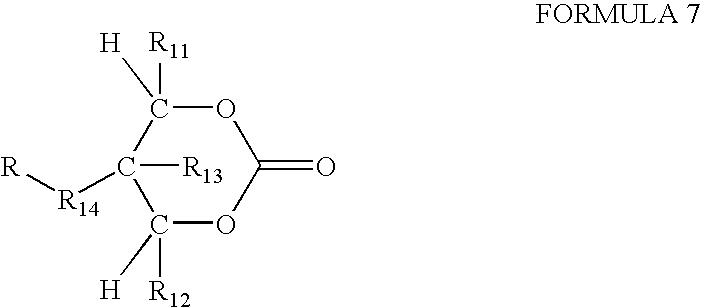
- An exemplary monomer has the structure shown in Formula 7:
- R 11 , R 12 and R 13 may be independently selected from H, linear or branched, substituted or unsubstituted alkyl, or aryl, and R 1 and R 2 are preferably H, and R 13 is preferably CH 3 .
- the optional bridging group R 14 may be linear or branched, substituted or unsubstituted alkyl, heteroalkyl, cycloalkyl, heterocyclic, aryl and heteroaryl, and R 4 is preferably alkyl.
- F is a functional group that can vary widely to enable the coupling with peptides, proteins or other biological agents or to control the solubility of the GR oligocarbonate transporter.
- Suitable functional groups include acyl groups such as carboxylic acids, amides, esters, and the like, and protected thiol, amine, or hydroxyl groups.
- F can include a drug, a gene, a probe, or other biologically useful compound.
- the oligomerization reaction described above preferably provides a degree of oligomerization (DP) ranging from 4 to 350, with a particularly preferred DP ranging from 6 to 25.
- DP degree of oligomerization
- the guanidine functional cyclic carbonate monomer is reacted with an initiator compound.
- the initiator compound includes an amino, hydroxy or thiol functional group, and optionally further includes a biological cargo such as, for example, a drug, a gene, a probe, or other biologically useful compound or their equivalents.
- the resulting carbonate cooligomer reaction product includes multiple protected guanidinyl groups pendant from a carbonate-containing backbone scaffold, as well as a biologically useful cargo compound on at least one end of the backbone.
- the carbonate cooligomer may include a few monomeric units (also referred to herein as oligomers such as dimers, trimers and tetramers), a plurality of monomeric units (also referred to herein generally as oligomers), and/or compounds that themselves have multiple branches.
- n in the carbonate cooligomer of Reaction 1 may vary widely from about 4 to about 350, and typically n ranges from about 1 to about 50, more preferably about 5 to about 25, and most preferably from about 8 to about 22.
- a guanidinyl functional oligomerizable cyclic carbonate monomer of Formula 8 MTC-ethylguanidine-BOC
- MTC-ethylguanidine-BOC MTC-ethylguanidine-BOC
- the amino functional initiator compound of Formula 9,5-(dimethylamino)-N-(2-hydroxyethyl)naphthalene-1-sulfonamide may be reacted with the amino functional initiator compound of Formula 9,5-(dimethylamino)-N-(2-hydroxyethyl)naphthalene-1-sulfonamide
- the carbonate cooligomer may optionally be reacted with an acid to remove the protecting groups P on the guanidine groups (Formula 6 and Reaction 1), which produces a guanidinium rich (GR) molecular transporter conjugate compound as a reaction product.
- GR guanidinium rich
- the GR molecular transporter conjugate compound derived from the carbonate oligomer of Formula 10 includes pendant guanidinium groups that can enhance transport and/or delivery of the reversibly attached cargo compound across a selected biological barrier.
- the molecular transporter conjugate compounds shown in Formula 11 above incorporate a backbone scaffold (carbonate) and side chain spacing (1,7) previously unexplored in cell uptake studies. These compounds are stable in Hepes buffered saline (pH 7.4) for hours at 37° C. as needed for their administration, and do not exhibit acute toxicity in the Jurkat cell line under the conditions of the biological assays ( ⁇ 25 ⁇ M, 5 min incubation, viability greater than 80%) or when used at therapeutic concentrations for longer exposure times. Like their oligoarginine counterparts, these transporters are highly water-soluble, but they readily partition into octanol (a membrane polarity surrogate) when treated with sodium laurate, a model membrane constituent.
- octanol a membrane polarity surrogate
- Reaction 2 illustrates a preferred embodiment of a one-step oligomerization strategy according to one aspect of the present invention. This strategy enables the direct introduction of probes and, by analogy, drug moieties in the same synthetic operation.
- the monomers described above e.g., compound 3 in Reaction 2 above
- the carbonate molecular transporter conjugate compounds compound 6 in Reaction 2 above
- the facile cellular uptake exhibited by the compounds described herein and the ease with which short to long oligomers (and co-oligomers) can be prepared offers many advantages for drug/probe delivery, particularly for biological cargos.
- TU 1-(3,5-Bis-trifluoromethyl-phenyl)-3-cyclohexyl-thiourea
- Dansyl aminocaproic acid NHS ester was obtained from Invitrogen, Carlsbad, Calif.
- Methylene chloride was stirred over CaH 2 overnight, degassed by three freeze-pump-thaw cycles and vacuum transferred into a flame-dried bomb.
- GPC Gel permeation chromatography
- Viscotek Houston, Tex.
- S3580 refractive index detector and Viscotek GPCmax autosampler were employed.
- the system was calibrated using monodisperse polystyrene standards (Polymer Laboratories and Varian, Inc., Palo Alto, Calif.).
- dansyl chloride 5.05 g, 18.72 mmol was placed in a dry 250 mL round bottom flask equipped with a stir bar. Dry methylene chloride (50 mL) was added via syringe, the flask attached to an addition funnel and the system cooled to 0° C. Ethanolamine (1.25 g, 1.24 mL, 20.59 mmol), triethylamine (2.27 g, 3.13 mL, 22.46 mmol), and 75 mL of dry methylene chloride were loaded into the addition funnel, and the solution was added dropwise with stirring over 30 min. The solution was stirred for an additional 30 min before the ice bath was removed, the solution allowed to reach ambient temperature and left to stir for an additional 14 hours.
- FIG. 1 shows a GPC overlay of RI and UV detector spectra of Compound 5b.
- FIG. 3 shows stacked 1H-NMR spectra of MTC-ethylguanidine-boc (Compound 3) (top, CDCl 3 ), PMTC-guanidine-boc (Compound 5) (mid, CDCl 3 ), and PMTC-guanidine (Compound 6) (below, DMSO-d6).
- Octoarginine 25 mg, 0.01834 mmol was added to a small conical vial with stirbar and deionized water, then lyophilized.
- Dansyl aminocaproic acid NHS ester (10 mg, 0.021668 mmol, Invitrogen) was dissolved in 100 ⁇ L DMF and added to the conical vial.
- Diisopropylethylamine (2.8 ⁇ L, 0.16251 mmol) was added and the reaction stirred at room temperature for 22.4 hours, when DMF was blown off with a stream of nitrogen.
- FIG. 4 shows the 1 H NMR spectrum of r8 dansyl, D 2 O.
- Dansyl-tagged oligomers and octaarginine control were brought up in pH 7.2 PBS buffer at 5 ⁇ M, 12.5 ⁇ M, and 25 ⁇ M concentrations.
- Jurkat cells grown in 10% FBS in RPMI media 1640 (+ glutamine) were used for cellular uptake experiments.
- Cells were plated on a microtiter plate at 3.0 ⁇ 10 6 cells/mL with 200 ⁇ L/well. The plate was centrifuged (1300 rpm for 3 min), media removed, and cells resuspended in PBS buffer twice.
- FIG. 6 shows the concentration dependence of cellular uptake into Jurkat Cells in pH 7.2 PBS, incubated at 5 minutes with r8 dansyl, oligomers Compounds 6a or 6b, or the dansyl alcohol initiator Compound 4 at 23° C.
- Uptake assays at 4° C. were performed as described above except that solutions were precooled at 4° C. and cells were incubated on ice. Uptake assays in the presence of sodium azide were performed as described above with the exception that cells used were preincubated for 30 min with 0.5% sodium azide in 2% FBS/PBS buffer before the addition of fluorescently labeled oligomers and cells were washed with 0.5% sodium azide in PBS buffer.
- FIG. 7 is a plot of the concentration dependence of cellular uptake into Jurkat Cells in pH 7.2 PBS or K+ PBS, incubated at 5 minutes with r8 dansyl, oligomers Compounds 6b in two separate batches, 1 or 2, or the dansyl alcohol initiator Compound 4 at 23° C.
- FIG. 8 is a plot of the flow cytometry determined cellular uptake of oligocarbonates Compounds 6a, 6b, r8 dansyl, and dansyl alcohol initiator Compound 4 in PBS.
- Jurkat cells were incubated with the various transporters for 5 minutes at either 23° C. or 4° C.
- FIG. 9 is a plot of the flow cytometry determined cellular uptake of oligocarbonates Compounds 6a, 6b, r8 dansyl, and dansyl alcohol initiator Compound 4 in PBS.
- Jurkat cells were incubated with the various transporters for 5 minutes at 23° C., in the presence and absence of NaN 3 .
- FIG. 10 is a plot of the flow cytometry determined cellular uptake of oligocarbonates Compounds 6a, 6b, r8 dansyl, and dansyl alcohol Compound 4 in PBS or [K+] PBS.
- Jurkat cells were incubated with the various transporters for 5 minutes at 23° C.
- the uptake of Compounds 6a-6b decreases with decreasing membrane potential. This effect was established by assaying the uptake of Compound 6 in cells incubated with modified PBS in which all sodium ions were replaced with potassium ions, a protocol known to eliminate the voltage potential across the cell membrane.
- FIG. 11 shows the cellular uptake of Compound 6b into Jurkat cells, 5 min incubation, 25 ⁇ M at 23° C. visualized by fluorescence microscopy using a two-photon excitation.
- Panels A-O show varying Z-cuts through the cell (from top to bottom) with 0.9 ⁇ m resolution and 0.7 ⁇ m between cuts.
- Panel P shows the bright field image of the same cell.
- HBS HEPES buffered saline
- methanol 10 mg 1-naphthalenemethanol
- 24 mL of methanol which served as an internal standard.
- 20 ⁇ L of the solution was removed and analyzed by RP-HPLC. The percent decomposition was calculated from the integrated peak areas of the conjugate, the internal standard, and the various decomposition products.
- Jurkat cells grown in 10% FBS in RPMI media 1640 (+ glutamine) were plated at 5-10 ⁇ 10 4 cells/mL on a 96-well microtiter plate in the same media.
- compound was serially diluted in triplicate over 20 wells in columns 2-11 and rows 1-3 and 5-7; typical dilutions spanned the concentration range of 400 ⁇ M to 20 nM.
- Columns 1 and 12 contained no cells and no compound, respectively.
- Rows 4 and 8 contained a serial dilution of colchicine as internal control; colchicine concentrations were generally much lower than compound concentrations in order to obtain an EC50 (half-maximal effective concentration).
Landscapes
- Chemical & Material Sciences (AREA)
- Organic Chemistry (AREA)
- Health & Medical Sciences (AREA)
- Medicinal Chemistry (AREA)
- Bioinformatics & Cheminformatics (AREA)
- Polymers & Plastics (AREA)
- Chemical Kinetics & Catalysis (AREA)
- Engineering & Computer Science (AREA)
- Life Sciences & Earth Sciences (AREA)
- General Health & Medical Sciences (AREA)
- Public Health (AREA)
- Veterinary Medicine (AREA)
- Animal Behavior & Ethology (AREA)
- Epidemiology (AREA)
- Pharmacology & Pharmacy (AREA)
- Organic Low-Molecular-Weight Compounds And Preparation Thereof (AREA)
- Medicinal Preparation (AREA)
Abstract

-
- wherein
- R1, R2, and R3 are independently selected from the group consisting of H, linear or branched, substituted or unsubstituted alkyl;
- R10 is a connecting group selected from the group consisting of linear or branched, substituted or unsubstituted alkyl, heteroalkyl, cycloalkyl, heterocyclic, aryl and heteroaryl;
- R4 is an optional bridging group selected from the group consisting of linear or branched, substituted or unsubstituted alkyl, heteroalkyl, cycloalkyl, heterocyclic, aryl and heteroaryl;
- Z is selected from the group consisting of O, NH, NR, and S;
- G is a guanidine group; and
- P is a protecting group.
Description

wherein
- R1, R2, and R3 are independently selected from the group consisting of H, linear or branched, substituted or unsubstituted alkyl;
- R10 is a connecting group selected from the group consisting of linear or branched, substituted or unsubstituted alkyl, heteroalkyl, cycloalkyl, heterocyclic, aryl and heteroaryl;
- R4 is an optional bridging group selected from the group consisting of linear or branched, substituted or unsubstituted alkyl, heteroalkyl, cycloalkyl, heterocyclic, aryl and heteroaryl;
- Z is selected from the group consisting of O, NH, NR, and S;
- G is a guanidine group; and
- P is a protecting group.




| TABLE 1 |
| Characterization of PMTC-guanidine-boc oligomers: |
| n | Mn(NMR) | Mn(GPC) | PDIa | ||
| 5a | 8 | 3,854 | 3,029 | 1.16 |
| |
11 | 5,189 | 3,160 | 1.11 |
| 5c | 22 | 10,084 | 4,692 | 1.15 |
| PDI = Mw/Mn | ||||


| TABLE 2 |
| Toxicity and Stability of |
| Stability (t1/2, | ||||
| Compound | EC50 (μM) | hours) | ||
| Dansyl- |
17.85 ± 1.07 | 8.3 ± 1.4 | ||
| Dansyl- |
8.53 ± 0.75 | 8.10 ± 0.14 | ||
| Dansyl- |
2.32 ± 0.63 | 15.9 ± 0.4 | ||
| |
311 | — | ||
Claims (25)


Priority Applications (3)
| Application Number | Priority Date | Filing Date | Title |
|---|---|---|---|
| US12/433,693 US7939621B2 (en) | 2009-04-30 | 2009-04-30 | Oligocarbonate molecular transporters |
| KR1020100024178A KR20100119491A (en) | 2009-04-30 | 2010-03-18 | Oligocarbonate molecular transporters |
| CN201010170790.XA CN101891732B (en) | 2009-04-30 | 2010-04-30 | Cyclic carbonate monomer and preparing method thereof |
Applications Claiming Priority (1)
| Application Number | Priority Date | Filing Date | Title |
|---|---|---|---|
| US12/433,693 US7939621B2 (en) | 2009-04-30 | 2009-04-30 | Oligocarbonate molecular transporters |
Publications (2)
| Publication Number | Publication Date |
|---|---|
| US20100280219A1 US20100280219A1 (en) | 2010-11-04 |
| US7939621B2 true US7939621B2 (en) | 2011-05-10 |
Family
ID=43030879
Family Applications (1)
| Application Number | Title | Priority Date | Filing Date |
|---|---|---|---|
| US12/433,693 Active - Reinstated 2029-07-14 US7939621B2 (en) | 2009-04-30 | 2009-04-30 | Oligocarbonate molecular transporters |
Country Status (3)
| Country | Link |
|---|---|
| US (1) | US7939621B2 (en) |
| KR (1) | KR20100119491A (en) |
| CN (1) | CN101891732B (en) |
Cited By (2)
| Publication number | Priority date | Publication date | Assignee | Title |
|---|---|---|---|---|
| US20170303541A1 (en) * | 2015-05-19 | 2017-10-26 | International Business Machines Corporation | Antimicrobial guanidinium and thiouronium functionalized polymers |
| US10953039B2 (en) | 2018-09-27 | 2021-03-23 | International Business Machines Corporation | Utilizing polymers and antibiotics to enhance antimicrobial activity and inhibit antibiotic resistance |
Families Citing this family (8)
| Publication number | Priority date | Publication date | Assignee | Title |
|---|---|---|---|---|
| WO2012116250A1 (en) * | 2011-02-25 | 2012-08-30 | University Of Massachusetts Medical School | Monomers and polymers for functional polycarbonates and poly (ester-carbonates) and peg-co-polycarbonate hydrogels |
| JP6165137B2 (en) * | 2011-07-04 | 2017-07-19 | エッセンス・べスローテン・フエンノートシャップSsens B.V. | Method for producing polymer, polymer molded article, bio-element, and cyclic carbonate |
| US9816066B2 (en) | 2012-04-24 | 2017-11-14 | The Regents Of The University Of California | Method for delivery of small molecules and proteins across the cell wall of algae using molecular transporters |
| CN104031248B (en) * | 2014-05-28 | 2016-09-07 | 博瑞生物医药(苏州)股份有限公司 | Carbonate polymer with disulfide five-membered ring functional group in side chain and its application |
| US9469726B2 (en) * | 2014-10-06 | 2016-10-18 | International Business Machines Corporation | Water soluble polycarbonates for medical applications |
| US10385152B2 (en) * | 2015-06-18 | 2019-08-20 | Basf Se | Copolymer made from cyclic exo-vinyl carbonate acrylates |
| CN106729700B (en) * | 2016-12-08 | 2020-07-07 | 天津千顺科技有限公司 | Surface guanidine modified nano-adjuvant material and preparation method and application thereof |
| US11167036B2 (en) * | 2018-11-27 | 2021-11-09 | International Business Machines Corporation | Techniques for enhancing the selectivity and efficacy of antimicrobial and anticancer polymer agents |
Citations (5)
| Publication number | Priority date | Publication date | Assignee | Title |
|---|---|---|---|---|
| US20030092046A1 (en) | 1999-07-07 | 2003-05-15 | Muthiah Manoharan | Guanidinium functionalized oligomers and methods |
| US20060280796A1 (en) | 2004-03-05 | 2006-12-14 | Chung Sung-Kee | Inositol-based molecular transporters and processes for the preparation thereof |
| US20070213277A1 (en) | 1999-08-24 | 2007-09-13 | Cellgate, Inc., A Delaware Corporation | Compositions and methods for enhancing drug delivery across and into ocular tissues |
| US7312194B2 (en) | 2001-01-04 | 2007-12-25 | Alchemia Pty. Ltd. | Delivery systems |
| US20080248126A1 (en) | 2007-03-02 | 2008-10-09 | Jianjun Cheng | Particulate drug delivery |
-
2009
- 2009-04-30 US US12/433,693 patent/US7939621B2/en active Active - Reinstated
-
2010
- 2010-03-18 KR KR1020100024178A patent/KR20100119491A/en not_active Ceased
- 2010-04-30 CN CN201010170790.XA patent/CN101891732B/en active Active
Patent Citations (5)
| Publication number | Priority date | Publication date | Assignee | Title |
|---|---|---|---|---|
| US20030092046A1 (en) | 1999-07-07 | 2003-05-15 | Muthiah Manoharan | Guanidinium functionalized oligomers and methods |
| US20070213277A1 (en) | 1999-08-24 | 2007-09-13 | Cellgate, Inc., A Delaware Corporation | Compositions and methods for enhancing drug delivery across and into ocular tissues |
| US7312194B2 (en) | 2001-01-04 | 2007-12-25 | Alchemia Pty. Ltd. | Delivery systems |
| US20060280796A1 (en) | 2004-03-05 | 2006-12-14 | Chung Sung-Kee | Inositol-based molecular transporters and processes for the preparation thereof |
| US20080248126A1 (en) | 2007-03-02 | 2008-10-09 | Jianjun Cheng | Particulate drug delivery |
Non-Patent Citations (5)
Cited By (7)
| Publication number | Priority date | Publication date | Assignee | Title |
|---|---|---|---|---|
| US20170303541A1 (en) * | 2015-05-19 | 2017-10-26 | International Business Machines Corporation | Antimicrobial guanidinium and thiouronium functionalized polymers |
| US9854806B2 (en) | 2015-05-19 | 2018-01-02 | International Business Machines Corporation | Antimicrobial guanidinium and thiouronium functionalized polymers |
| US10779539B2 (en) | 2015-05-19 | 2020-09-22 | Coral Bay Ii, Llc. | Antimicrobial guanidinium and thiouronium functionalized polymers |
| US10980234B2 (en) * | 2015-05-19 | 2021-04-20 | Coral Bay Ii, Llc | Antimicrobial guanidinium and thiouronium functionalized polymers |
| US11690380B2 (en) | 2015-05-19 | 2023-07-04 | Coral Bay Ii, Llc | Antimicrobial guanidinium and thiouronium functionalized polymers |
| US10953039B2 (en) | 2018-09-27 | 2021-03-23 | International Business Machines Corporation | Utilizing polymers and antibiotics to enhance antimicrobial activity and inhibit antibiotic resistance |
| US11766451B2 (en) | 2018-09-27 | 2023-09-26 | International Business Machines Corporation | Utilizing polymers and antibiotics to enhance antimicrobial activity and inhibit antibiotic resistance |
Also Published As
| Publication number | Publication date |
|---|---|
| CN101891732B (en) | 2014-07-30 |
| KR20100119491A (en) | 2010-11-09 |
| CN101891732A (en) | 2010-11-24 |
| US20100280219A1 (en) | 2010-11-04 |
Similar Documents
| Publication | Publication Date | Title |
|---|---|---|
| US7939621B2 (en) | Oligocarbonate molecular transporters | |
| Schoenmakers et al. | The effect of the linker on the hydrolysis rate of drug-linked ester bonds | |
| Hatai et al. | Diverse properties of guanidiniocarbonyl pyrrole-based molecules: artificial analogues of arginine | |
| AU2002359679B2 (en) | Guanidinium transport reagents and conjugates | |
| CN103025165B (en) | From the controlled release of macromolecular conjugates | |
| US9346923B2 (en) | Method for manufacturing block copolymer | |
| WO2018010202A1 (en) | Ternary conjugate of antitumor drug, and synthesis and application | |
| US20210113707A1 (en) | Amanitin antibody conjugate | |
| Sedlák et al. | Synthesis of pH-sensitive amphotericin B–poly (ethylene glycol) conjugates and study of their controlled release in vitro | |
| US20240150379A1 (en) | Boronated Multifunctional Targeting Drug Conjugates, Their Uses and Methods for Their Preparation | |
| AU2024234895A1 (en) | Compound or salt thereof, lipid composition, pharmaceutical composition, and delivery carrier | |
| Herceg et al. | Cathepsin B-cleavable cyclopeptidic chemotherapeutic prodrugs | |
| US11739115B2 (en) | Functionalized bile acids for therapeutic and material applications | |
| US20070292384A1 (en) | Water soluble micelle-forming and biodegradable cyclotriphosphazene-taxol conjugate anticancer agent and preparation method thereof | |
| US20220162259A1 (en) | Peptide complex and production method therefor, and use of said peptide complex | |
| JP4621426B2 (en) | New urea oligomer, process for its preparation and pharmaceutical composition containing it | |
| US20230225982A1 (en) | Modified guanidine-containing polymers for biologic delivery | |
| CN110294764A (en) | A kind of podophyllotoxin derivative and preparation method thereof of azo key connection | |
| Kaplan et al. | Development of tripeptide-cyclotriphosphazene derivatives: In vitro cytotoxicity, genotoxicity studies and molecular docking analysis within ovarian and prostate cancer cell line receptors | |
| Sepay et al. | In Situ Bioorthogonal Generation of Therapeutics in Mitochondria Using a Guanidine-Rich Molecular Transporter | |
| EP1846378B1 (en) | Cationic lipids for the transfection of nucleic acids | |
| US20240376212A1 (en) | Alpha v-integrin targeted small molecule drug conjugates | |
| Lillethorup | Selective Delivery of Drugs to the CNS for Treatment of Neurological Diseases | |
| Healy | Stimuli-Responsive Molecular Systems–From Theranostic Dendrimers to Responsive Anion Binders | |
| WO2024020355A2 (en) | Azlactone-based polymers as a scaffold for diverse applications in drug and gene delivery |
Legal Events
| Date | Code | Title | Description |
|---|---|---|---|
| AS | Assignment |
Owner name: STANFORD UNIVERSITY, CALIFORNIA Free format text: ASSIGNMENT OF ASSIGNORS INTEREST;ASSIGNORS:COOLEY, CHRISTINA B.;KIESEWETTER, MATTHEW;NEDERBERG, FREDRIK;AND OTHERS;SIGNING DATES FROM 20090427 TO 20090428;REEL/FRAME:022623/0690 Owner name: INTERNATIONAL BUSINESS MACHINES CORPORATION, NEW Y Free format text: ASSIGNMENT OF ASSIGNORS INTEREST;ASSIGNOR:HEDRICK, JAMES L.;REEL/FRAME:022623/0782 Effective date: 20090424 |
|
| AS | Assignment |
Owner name: NATIONAL SCIENCE FOUNDATION, VIRGINIA Free format text: CONFIRMATORY LICENSE;ASSIGNOR:STANFORD UNIVERSITY;REEL/FRAME:024391/0964 Effective date: 20100208 |
|
| STCF | Information on status: patent grant |
Free format text: PATENTED CASE |
|
| FPAY | Fee payment |
Year of fee payment: 4 |
|
| AS | Assignment |
Owner name: THE BOARD OF TRUSTEES OF THE LELAND STANFORD JUNIO Free format text: CHANGE OF NAME;ASSIGNOR:STANFORD UNIVERSITY;REEL/FRAME:040192/0991 Effective date: 20040113 |
|
| FEPP | Fee payment procedure |
Free format text: MAINTENANCE FEE REMINDER MAILED (ORIGINAL EVENT CODE: REM.); ENTITY STATUS OF PATENT OWNER: LARGE ENTITY |
|
| FEPP | Fee payment procedure |
Free format text: SURCHARGE, PETITION TO ACCEPT PYMT AFTER EXP, UNINTENTIONAL (ORIGINAL EVENT CODE: M1558); ENTITY STATUS OF PATENT OWNER: LARGE ENTITY |
|
| MAFP | Maintenance fee payment |
Free format text: PAYMENT OF MAINTENANCE FEE, 8TH YEAR, LARGE ENTITY (ORIGINAL EVENT CODE: M1552); ENTITY STATUS OF PATENT OWNER: LARGE ENTITY Year of fee payment: 8 |
|
| FEPP | Fee payment procedure |
Free format text: PETITION RELATED TO MAINTENANCE FEES FILED (ORIGINAL EVENT CODE: PMFP); ENTITY STATUS OF PATENT OWNER: LARGE ENTITY Free format text: PETITION RELATED TO MAINTENANCE FEES GRANTED (ORIGINAL EVENT CODE: PMFG); ENTITY STATUS OF PATENT OWNER: LARGE ENTITY |
|
| PRDP | Patent reinstated due to the acceptance of a late maintenance fee |
Effective date: 20190513 |
|
| MAFP | Maintenance fee payment |
Free format text: PAYMENT OF MAINTENANCE FEE, 12TH YEAR, LARGE ENTITY (ORIGINAL EVENT CODE: M1553); ENTITY STATUS OF PATENT OWNER: LARGE ENTITY Year of fee payment: 12 |