US7935779B2 - Synthesis of polyimides (PI) from poly-carbodiimides and dianhydrides by sequential self-repetitive reaction (SSRR) - Google Patents

Synthesis of polyimides (PI) from poly-carbodiimides and dianhydrides by sequential self-repetitive reaction (SSRR) Download PDF

Info

Publication number
US7935779B2
US7935779B2 US12/044,309 US4430908A US7935779B2 US 7935779 B2 US7935779 B2 US 7935779B2 US 4430908 A US4430908 A US 4430908A US 7935779 B2 US7935779 B2 US 7935779B2
Authority
US
United States
Prior art keywords
dianhydride
ester
tetracarboxylic acid
diisocyanate
poly
Prior art date
Legal status (The legal status is an assumption and is not a legal conclusion. Google has not performed a legal analysis and makes no representation as to the accuracy of the status listed.)
Expired - Fee Related, expires
Application number
US12/044,309
Other versions
US20090012242A1 (en
Inventor
Shenghong A. Dai
Jiang-Jen Lin
Kuan-Liang Wei
Current Assignee (The listed assignees may be inaccurate. Google has not performed a legal analysis and makes no representation or warranty as to the accuracy of the list.)
Great Eastern Resins Industrial Co Ltd
Original Assignee
Great Eastern Resins Industrial Co Ltd
Priority date (The priority date is an assumption and is not a legal conclusion. Google has not performed a legal analysis and makes no representation as to the accuracy of the date listed.)
Filing date
Publication date
Application filed by Great Eastern Resins Industrial Co Ltd filed Critical Great Eastern Resins Industrial Co Ltd
Priority to US12/044,309 priority Critical patent/US7935779B2/en
Assigned to GREAT EASTERN RESINS INDUSTRIAL CO., LTD. reassignment GREAT EASTERN RESINS INDUSTRIAL CO., LTD. ASSIGNMENT OF ASSIGNORS INTEREST (SEE DOCUMENT FOR DETAILS). Assignors: WEI, KUAN-LIANG, DAI, SHENGHONG A., LIN, JIANG-JEN
Publication of US20090012242A1 publication Critical patent/US20090012242A1/en
Priority to CN2009100095458A priority patent/CN101550236B/en
Application granted granted Critical
Publication of US7935779B2 publication Critical patent/US7935779B2/en
Expired - Fee Related legal-status Critical Current
Adjusted expiration legal-status Critical

Links

Images

Classifications

    • CCHEMISTRY; METALLURGY
    • C08ORGANIC MACROMOLECULAR COMPOUNDS; THEIR PREPARATION OR CHEMICAL WORKING-UP; COMPOSITIONS BASED THEREON
    • C08GMACROMOLECULAR COMPOUNDS OBTAINED OTHERWISE THAN BY REACTIONS ONLY INVOLVING UNSATURATED CARBON-TO-CARBON BONDS
    • C08G73/00Macromolecular compounds obtained by reactions forming a linkage containing nitrogen with or without oxygen or carbon in the main chain of the macromolecule, not provided for in groups C08G12/00 - C08G71/00
    • C08G73/06Polycondensates having nitrogen-containing heterocyclic rings in the main chain of the macromolecule
    • C08G73/10Polyimides; Polyester-imides; Polyamide-imides; Polyamide acids or similar polyimide precursors
    • C08G73/16Polyester-imides
    • CCHEMISTRY; METALLURGY
    • C08ORGANIC MACROMOLECULAR COMPOUNDS; THEIR PREPARATION OR CHEMICAL WORKING-UP; COMPOSITIONS BASED THEREON
    • C08GMACROMOLECULAR COMPOUNDS OBTAINED OTHERWISE THAN BY REACTIONS ONLY INVOLVING UNSATURATED CARBON-TO-CARBON BONDS
    • C08G73/00Macromolecular compounds obtained by reactions forming a linkage containing nitrogen with or without oxygen or carbon in the main chain of the macromolecule, not provided for in groups C08G12/00 - C08G71/00
    • CCHEMISTRY; METALLURGY
    • C08ORGANIC MACROMOLECULAR COMPOUNDS; THEIR PREPARATION OR CHEMICAL WORKING-UP; COMPOSITIONS BASED THEREON
    • C08GMACROMOLECULAR COMPOUNDS OBTAINED OTHERWISE THAN BY REACTIONS ONLY INVOLVING UNSATURATED CARBON-TO-CARBON BONDS
    • C08G73/00Macromolecular compounds obtained by reactions forming a linkage containing nitrogen with or without oxygen or carbon in the main chain of the macromolecule, not provided for in groups C08G12/00 - C08G71/00
    • C08G73/06Polycondensates having nitrogen-containing heterocyclic rings in the main chain of the macromolecule
    • C08G73/10Polyimides; Polyester-imides; Polyamide-imides; Polyamide acids or similar polyimide precursors
    • C08G73/1003Preparatory processes
    • YGENERAL TAGGING OF NEW TECHNOLOGICAL DEVELOPMENTS; GENERAL TAGGING OF CROSS-SECTIONAL TECHNOLOGIES SPANNING OVER SEVERAL SECTIONS OF THE IPC; TECHNICAL SUBJECTS COVERED BY FORMER USPC CROSS-REFERENCE ART COLLECTIONS [XRACs] AND DIGESTS
    • Y10TECHNICAL SUBJECTS COVERED BY FORMER USPC
    • Y10STECHNICAL SUBJECTS COVERED BY FORMER USPC CROSS-REFERENCE ART COLLECTIONS [XRACs] AND DIGESTS
    • Y10S525/00Synthetic resins or natural rubbers -- part of the class 520 series
    • Y10S525/907Polycarbodiimide

Definitions

  • the present invention relates to processes for synthesizing polyimides (PI) by a sequential self-repetitive reaction (an “SSRR” reaction or “SSRR” process) between poly-carbodiimides or diisocyanates with dianhydrides.
  • Polyimide (PI) is one of the most widely used high-temperature polymers. PI possesses an excellent thermal property, mechanical property, and flame/chemical resistance and it has been extensively used in the aviation, automotive, aerospace, and electronic industries (see Maier, G., Prog. Polym. Sci. 2001, 26, 3).
  • PIs General synthetic methods of PIs have been well developed, including the step of condensation reaction between diamines and dianhydrides.
  • PI particularly aromatic PI
  • PIs have encountered numerous processing difficulties due to its poor solubility in organic solvents.
  • PIs are usually synthesized in-situ by forming soluble poly(amic acid) intermediates from the reaction of diamine and dianhydride at low temperatures during their first-step of syntheses, casting the poly(amic acids) as films, and in the final step, conducting ring-closuring imidization at high temperatures (>300° C.) to remove water and the solvent.
  • a new synthetic process for PIs using a sequential self-repetitive reaction especially as a one-pot process by bringing together poly(aryl carbodiimides) (p-CDI) from aryl diisocyanates and o-ester acids from dianhydrides.
  • the raw materials for forming PIs are dianhydrides and common diisocyanates can also be used with a CDI catalyst as the sources for p-CDIs through poly-condensation reactions.
  • n is an integer in the range of 1 to 100 and R is an optionally substituted tetravalent aromatic organic radical containing at least one benzene ring or an optionally substituted tetravalent aliphatic organic radical containing at least two carbon atoms,
  • n is an integer in the range of 1 to 100 and R is an optionally substituted tetravalent aromatic organic radical containing at least one benzene ring or an optionally substituted tetravalent aliphatic organic radical containing at least two carbon atoms,
  • FIGS. 1 to 3 show the 1 H NMR spectra of polyimides obtained by the process of the present invention, which are illustrated in the examples.
  • the present invention provides a process for synthesizing polyimides by a SSRR reaction.
  • the process of the present invention starts from reacting a dianhydride having the following formula (wherein R is an optionally substituted tetravalent aromatic organic radical containing at least one benzene ring or an optionally substituted tetravalent aliphatic organic radical containing at least two carbon atoms
  • R 2 —OH (wherein R 2 is C 1-8 alkyl), preferably in a molar ratio of about 1:1 to form an acid-ester functionalized anhydride having the formula
  • aromatic dianhydride examples include, but not limited to 3,3′,4,4′-benzophenone tetracarboxylic acid anhydride, pyromellitic dianhydride, 2,3,6,7-napthalene tetracarboxylic acid dianhydride, 1,4,5,6-tetracarboxylic dianhydride, 3,3′,4,4′-diphenyl tetracarboxylic acid dianhydride, 1,2,5,6-napthalene tetracarboxylic acid dianhydride, 2,2′,3,3′ diphenyl tetracarboxylic acid dianhydride, 2,2-bis(3,4,-dicarboxyphenyl) propane dianhydride, 3,4,9,10-perylene tetracarboxylic acid dianhydride, bis(3,4-dicarboxyphenyl) ether dianhydride, naphthalene-1,2,4,5-tetracarboxylic acid dianhydride, n
  • Suitable aliphatic dianhydride include, but not limited to tetrahydrofuran tetracarboxylic dianhydride, cyclopentane tetracarboxylic dianhydride, bicycle-[2,2,2]-octen-(7)-2,3,5,6-tetracarboxylic-2,3,5,6-dianhydride, 1,2,3,4-cyclobutanetetracarboxylic acid dianhydride, and 1,2,4,5-cyclobutanetetracarboxylic acid dianhydride.
  • the anhydride/R 2 —OH reaction may be conducted in the presence of a catalyst such as triethylamine (TEA).
  • a catalyst such as triethylamine (TEA).
  • the p-CDI used in the present invention can be previously formed by catalytically converting an aryl diisocyanate in the presence of a CDI catalyst. It is preferred that this reaction is carried out in dry N-methylpyrrolidone (NMP). However, other suitable solvents may be used. Suitable solvents include N,N dimethylacetamide (DMAC), tetramethylene sulfone (TMS), N,N dimethylformamide (DMF) and dimethylsulfoxide (DMSO). Those skilled in the art are readily able to determine which solvents are suitable in carrying out this reaction. The species of the CDI catalysts are also well documented and familiar to skilled artisans.
  • Suitable CDI catalyst includes, but not limited to, various organic derivatives of phosphorous and ringed-phosphorous compounds such as 3-methyl-3-phospholene oxide (MPO) 1,3-dimethyl-3-phospholene oxide (DMPO), 1,3-dimethyl-1,3,2-diazaphosphorolidine, triphenyl arsineoxide, and those listed on page 235 of Tetrahedron Report R101 in Tetrahedron Vol. 37, pages 233-284, (1981) and Angew. Chem. Int. Ed. Vol. 1, 621 (1962), which are incorporated herewith for reference.
  • MPO 3-methyl-3-phospholene oxide
  • DMPO 1,3-dimethyl-3-phospholene oxide
  • 1,3-dimethyl-1,3,2-diazaphosphorolidine 1,3-dimethyl-1,3,2-diazaphosphorolidine
  • triphenyl arsineoxide triphenyl arsineoxide
  • aryl diisocyanate there is no particular limitation to the species of aryl diisocyanate.
  • the radical “aryl” refers to a monovalent monocyclic or bicyclic aromatic hydrocarbon moiety which is optionally substituted with one or more, preferably one, two or three, substituents, each of which is preferably selected from the group consisting of C 1-8 alkyl, C 1-8 alkoxy, nitro, halo, and aryl C 1-8 alkyl.
  • a particularly preferred aryl substituent is methyl, methoxy, nitro, fluoro, chloro, bromo, oxygen, sulfur, sulfone or phenylmethyl. More specifically the term aryl includes, but is not limited to, phenyl, tolyl or phenylmethylene, and the like.
  • suitable aryl diisocyanate includes, but not limited to, 4,4′-diphenylmethane diisocyanate (MDI), 4,4′-biphenylene diisocyanate, 4,41-Diisocyanatodiphenyl sulfide, 4,4′-diisocyanato diphenyl sulfone, 4,4′-diisocyanato diphenyl ether, meta-naphthalene diisocyanate (MNDI), para-naphthalene diisocyanate (PNDI), meta-phenylene diisocyanate (MPDI), para-phenylene diisocyanate (PPDI), tolylene diisocyanate (TDI), 4,4′-diisocyanato-3,3′-dimethyldiphenylenemethane, 4,4′-methylenebis(1-isocyanato-2-methoxybenzene), meta-xylylene diisocyanate,
  • MDI 4,
  • the reaction of acid-ester functionalized anhydride with a p-CDT comprises mixing the acid-ester functionalized anhydride with an aryl diisocyanate, following by catalytically converting the aryl diisocyanate into a p-CDI in the presence of a CDI catalyst, and then reacting the p-CDI and acid-ester functionalized anhydride to the p-AEA.
  • aryl N-acylurea is thermally stable up to about 120° C. and undergoes a rapid transformation into isocyanate and amide at a higher temperature. It is also known in the art that isocyanates can be converted to CDIs in the presence of a CDI catalyst.
  • p-AEA is firstly reacted with R 2 —OH (wherein R 2 is C 1-8 alkyl) in a molar ratio of about 1:1 again to is form a poly-acylurea-functionalized ester-acid-ester (p-AEAE) having the formula
  • the obtained P-AEAE is further heated in the presence of a CDI catalyst to a temperature from about 120° C. to about 280° C., preferably from about 120° C. to about 270° C., more preferably from about 140° C. to about 250° C., to form an aryl isocyanate and a poly(acid-ester-amide) having the following formula
  • the SSRR process is consisted of three self-repetitive steps.
  • the first step is the catalytic conversion of 1.0 mole of the aryl isocyanate into 0.5 mole of the p-CDI.
  • the second step is the reaction between 0.5 mole of the p-CDI and 0.5 mole of the poly(acid-ester-amide) to form 0.5 mole of the p-AAE.
  • the third step is the thermolysis of 0.5 mole of the p-AAE yielding 0.5 mole of the aryl isocyanate and concurrently generating 0.5 mole of the poly-di(ester-amide) which is further subject to a ring-closure reaction to form 0.5 mole of the polyimide as a product.
  • a ring-closure reaction to form 0.5 mole of the polyimide as a product.
  • the above-mentioned process for synthesizing polyimides by the SSRR can directly start from the ring-opening reaction of dianhydrides as a one-pot process.
  • an aryl diisocyanate and a CDI catalyst can replace the p-CDI used to react with the product of the ring-opening reaction of dianhydrides.
  • the above-mentioned process for synthesizing polyimides by the SSRR can directly start from the ring-opening reaction of dianhydrides, followed by mixing with an aryl diisocyanate and a CDI catalyst, as a one-pot process.
  • a suitable solvent such as dry tetrahydrofuran (THF), N-methylpyrrolidone (NMP), tetramethylene sulfone (TMS), N,N dimethylacetamide (DMAC), N,N dimethylformamide (DMF) and dimethylsulfoxide (DMSO), to carry out the SSRR process so as to produce the desired polyimide.
  • THF dry tetrahydrofuran
  • NMP N-methylpyrrolidone
  • TMS tetramethylene sulfone
  • DMAC N,N dimethylacetamide
  • DMF N,N dimethylformamide
  • DMSO dimethylsulfoxide
  • the poly(aryl acylurea) is decomposed into the poly-di(ester-amide) and the aryl isocyanate at a temperature of from about 120° C. to about 180° C. Then, the reaction temperature is raised to a range of about 180° C. to about 280° C. for a sufficient time, such as about 15 minutes to about 120 minutes, to affect the ring-closure and form the desired polyimide.
  • the ring-opening reaction of aryl dianhydride can be completely conducted at first to obtain an aryl di(ester-acid).
  • the obtained aryl di(ester-acid) is then reacted with a p-CDI or mixed with an aryl diisocyanate and a CDI catalyst so as to conduct the above-mentioned SSRR process for synthesizing polyimides.
  • the present invention further provides a process for synthesizing a polyimide having the structural formula
  • n is an integer in the range of 1 to 100 and R is an optionally substituted tetravalent aromatic organic radical containing at least one benzene ring or an optionally substituted tetravalent aliphatic organic radical containing at least two carbon atoms
  • the reaction of di(ester-acid) with a p-CDI comprises mixing the di(ester-acid) with an aryl diisocyanate, following by catalytically converting the aryl diisocyanate into a p-CDT in the presence of a CDI catalyst, and then heating the p-CDI and di(ester-acid) to conduct the sequential self-repetitive reaction.
  • the above-mentioned synthesizing process can directly start from the ring-opening reaction of dianhydrides as a one-pot process.
  • the synthesizing process is preferably carried out in a suitable solvent, such as dry tetrahydrofuran (THF), N-methylpyrrolidone (NMP), tetramethylene sulfone (TMS), N,N dimethylacetamide (DMAC), N,N dimethylformamide (DMF) and dimethylsulfoxide (DMSO), so as to produce the desired product.
  • a suitable solvent such as dry tetrahydrofuran (THF), N-methylpyrrolidone (NMP), tetramethylene sulfone (TMS), N,N dimethylacetamide (DMAC), N,N dimethylformamide (DMF) and dimethylsulfoxide (DMSO)
  • NMP (20 ml) was placed into a 100 ml, three-necked, round-bottomed flask equipped with a thermometer, a nitrogen gas inlet tube, a reflux condenser, an oil bath, and a magnetic stirrer.
  • DMPO 20 mg
  • PMDE 1 g, 3.5 mmol
  • MDI 0.87 g; 3.55 mmol
  • the resulting PI was precipitated from NMP and isolated by filtering (96%).
  • the detailed reactions scheme is as shown below.
  • NMP (30 ml) was placed into a 100 ml, three-necked, round-bottomed flask equipped with a thermometer, a nitrogen gas inlet tube, a reflux condenser, an oil bath, and a magnetic stirrer.
  • DMPO 20 mg
  • BTDE 1.542 g, 3.99 mmol
  • MDI 1 g; 3.99 mmol
  • the resulting MDI-ketone-PI was precipitated from NMP and isolated by filtering (98%).
  • the detailed reactions scheme is as shown in Scheme 3.
  • NMP (20 ml) was placed into a 100 ml, three-necked, round-bottomed flask equipped with a thermometer, a nitrogen gas inlet tube, a reflux condenser, an oil bath, and a magnetic stirrer.
  • DMPO 20 mg
  • ODPE 11.0 g, 2.67 mmol
  • MDI 0.67 g; 2.67 mmol
  • the resulting solution obtained was poured into 500 ml of water.
  • the resulting product was filtered and dried, to yield 1.153 g (91%) of MDI-ether-PT.
  • the 1 H NMR analysis of MDI-ether-PI was shown in FIG. 2 .
  • the detailed reactions scheme is as shown in Scheme 3.
  • NMP (20 ml) was placed into a 100 ml, three-necked, round-bottomed flask equipped with a thermometer, a nitrogen gas inlet tube, a reflux condenser, an oil bath, and a magnetic stirrer.
  • DMPO 20 mg
  • ODPE 1.0 g, 2.67 mmol
  • TDI 0.65 g; 2.67 mmol
  • the resulting solution obtained was poured into 500 ml of water.
  • the resulting product was filtered and dried, to yield 1.06 g (99.9%) TDI-ether-PI.
  • the 1 H NMR analysis of TDI-ether-PI was shown in FIG. 3 .
  • the detailed reactions scheme is as shown in Scheme 3.

Landscapes

  • Chemical & Material Sciences (AREA)
  • Health & Medical Sciences (AREA)
  • Chemical Kinetics & Catalysis (AREA)
  • Medicinal Chemistry (AREA)
  • Polymers & Plastics (AREA)
  • Organic Chemistry (AREA)
  • Macromolecular Compounds Obtained By Forming Nitrogen-Containing Linkages In General (AREA)
  • Polyurethanes Or Polyureas (AREA)

Abstract

Disclosed are processes for synthesizing polyimides by a sequential self-repetitive reaction between poly (aryl carbodiimide) (p-CDI) or aryl diisocyanates with dianhydrides.

Description

FIELD OF THE INVENTION
The present invention relates to processes for synthesizing polyimides (PI) by a sequential self-repetitive reaction (an “SSRR” reaction or “SSRR” process) between poly-carbodiimides or diisocyanates with dianhydrides.
BACKGROUND OF THE INVENTION
Polyimide (PI) is one of the most widely used high-temperature polymers. PI possesses an excellent thermal property, mechanical property, and flame/chemical resistance and it has been extensively used in the aviation, automotive, aerospace, and electronic industries (see Maier, G., Prog. Polym. Sci. 2001, 26, 3).
A large number of new PIs with unique properties have been introduced for various industrial and consumer product applications since their commercializations at the beginning of the 1960s (see Kharitonov, A. P.; Taege, R.; Ferrier, G.; Teplyakov, V. V.; Syrtsova, D. A.; Koops, G.-H., J. Fluorine Chem. 2005, 126, 251, and Ameduri, B.; Boutevin, B., J. Fluorine Chem. 2005, 126, 221, and Rusanov, A. L.; Komarova, L. G.; Likhatchev, D. Y.; Shevelev, S. A.; Tartakovsky, V. A., Russ. Chem. Rev. 2003, 72, 899).
General synthetic methods of PIs have been well developed, including the step of condensation reaction between diamines and dianhydrides. However, PI, particularly aromatic PI, has encountered numerous processing difficulties due to its poor solubility in organic solvents. As a result, PIs are usually synthesized in-situ by forming soluble poly(amic acid) intermediates from the reaction of diamine and dianhydride at low temperatures during their first-step of syntheses, casting the poly(amic acids) as films, and in the final step, conducting ring-closuring imidization at high temperatures (>300° C.) to remove water and the solvent. In order to improve the solubility and processing capability of PIs, some structural modifications introducing bulky groups or flexible chains such as —O—, —SO2—, —C═O, —CF3, —CH3 into the backbone or side chain of PIs have also been demonstrated. (see Eastmond, G. C., Paprotny J., React. Funct. Polym. 1996, 30, 27).
In this present invention, we uncovered a new synthetic process for PIs using a sequential self-repetitive reaction (SSRR), especially as a one-pot process by bringing together poly(aryl carbodiimides) (p-CDI) from aryl diisocyanates and o-ester acids from dianhydrides. The raw materials for forming PIs are dianhydrides and common diisocyanates can also be used with a CDI catalyst as the sources for p-CDIs through poly-condensation reactions.
SUMMARY OF THE INVENTION
It is therefore an object of the invention to provide a process for synthesizing a polyimide having the formula
Figure US07935779-20110503-C00001
wherein n is an integer in the range of 1 to 100 and R is an optionally substituted tetravalent aromatic organic radical containing at least one benzene ring or an optionally substituted tetravalent aliphatic organic radical containing at least two carbon atoms,
comprising:
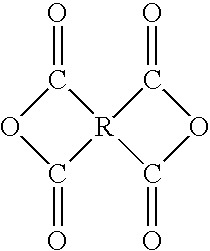
    • a) reacting a dianhydride having the formula
Figure US07935779-20110503-C00002
    •  with R2—OH (wherein R2 is C1-8 alkyl) in a molar ratio of about 1:1 to form an acid-ester functionalized anhydride having the formula
Figure US07935779-20110503-C00003
    • b) reacting a poly (aryl carbodiimide) (p-CDI) and said acid-ester functionalized anhydride to form a poly-acylurea-functionalized ester-anhydride (p-AEA) having the formula
Figure US07935779-20110503-C00004
    • c) reacting said p-AEA with R2—OH (wherein R2 is C1-8 alkyl) in a molar ratio of about 1:1 to form a poly-acylurea-functionalized ester-acid-ester (p-AEAE) having the formula
Figure US07935779-20110503-C00005
    • d) heating said p-AEAE in the presence of a CDI catalyst to a temperature from about 120° C. to about 280° C. to form an aryl isocyanate and a poly(acid-ester-amide) having the following formula
Figure US07935779-20110503-C00006
    •  and simultaneously conducting a sequential self-repetitive reaction to form said polyimide, wherein said sequential self-repetitive reaction involves repetitions of three sequential steps comprising:
    • 1) catalytically converting said aryl isocyanate into said p-CDI in the presence of said CDI catalyst;
    • 2) reacting said p-CDI and said poly(acid-ester-amide) to form a poly-acylurea-functionalized amide-ester (p-AAE) having the formula
Figure US07935779-20110503-C00007
    • 3) thermolyzing said p-AAE obtained in step 2 into said aryl isocyanate and a poly-di(ester-amide) having the formula
Figure US07935779-20110503-C00008
    •  said poly-di(ester-amide) further being subject to a ring-closure reaction to release R2OHs and form said polyimide as a product.
It is another object of the invention to provide a process for synthesizing a polyimide having the structural formula
Figure US07935779-20110503-C00009
wherein n is an integer in the range of 1 to 100 and R is an optionally substituted tetravalent aromatic organic radical containing at least one benzene ring or an optionally substituted tetravalent aliphatic organic radical containing at least two carbon atoms,
comprising:
    • a) reacting a dianhydride having the formula
Figure US07935779-20110503-C00010
    •  with R2—OH (wherein R2 is C1-8 alkyl) in a molar ratio of about 1:2 to form a di(ester-acid) having the formula
Figure US07935779-20110503-C00011
    • b) heating said di(ester-acid) and a p-CDI to a temperature from about 120° C. to about 280° C. to conduct the sequential self-repetitive reaction as defined above to form said polyimide.
Various advantages and objects of the present invention will be apparent to those skilled in the art from the descriptions below and from the appended claims.
BRIEF DESCRIPTION OF THE DRAWINGS
FIGS. 1 to 3 show the 1H NMR spectra of polyimides obtained by the process of the present invention, which are illustrated in the examples.
DETAILED DESCRIPTION OF THE INVENTION
At first, the present invention provides a process for synthesizing polyimides by a SSRR reaction.
The process of the present invention starts from reacting a dianhydride having the following formula (wherein R is an optionally substituted tetravalent aromatic organic radical containing at least one benzene ring or an optionally substituted tetravalent aliphatic organic radical containing at least two carbon atoms
Figure US07935779-20110503-C00012

with R2—OH (wherein R2 is C1-8 alkyl), preferably in a molar ratio of about 1:1 to form an acid-ester functionalized anhydride having the formula
Figure US07935779-20110503-C00013
Examples of suitable aromatic dianhydride include, but not limited to 3,3′,4,4′-benzophenone tetracarboxylic acid anhydride, pyromellitic dianhydride, 2,3,6,7-napthalene tetracarboxylic acid dianhydride, 1,4,5,6-tetracarboxylic dianhydride, 3,3′,4,4′-diphenyl tetracarboxylic acid dianhydride, 1,2,5,6-napthalene tetracarboxylic acid dianhydride, 2,2′,3,3′ diphenyl tetracarboxylic acid dianhydride, 2,2-bis(3,4,-dicarboxyphenyl) propane dianhydride, 3,4,9,10-perylene tetracarboxylic acid dianhydride, bis(3,4-dicarboxyphenyl) ether dianhydride, naphthalene-1,2,4,5-tetracarboxylic acid dianhydride, naphthalene-1,4,5,8-tetracarboxylic acid dianhydride, decahydronaphthalene-1,4,5,8-tetracarboxylic acid dianhydride, 4,8-dimethyl-1,2,3,5,6,7-hexahydronaphthalene-1,2,5,6-tetracarboxylic acid dianhydride, 2,6-dichloronaphthalene-1,4,5,8-tetracarboxylic acid dianhydride, 2,7-dichloronaphthalene-1,4,5,8-tetracarboxylic acid dianhydride, 2,3,6,7-tetrachloronaphthalene-1,4,5,8-tetracarboxylic acid dianhydride, phenanthrene-1,8,9,10-tetracarboxylic acid dianhydride, bis(3,4-dicarboxyphenyl) sulfone dianhydride, (3′,4′-dicarboxyphenyl) 2-dicarboxy 5,6-benzimidazole dianhydride, (3′,4′-dicarboxyphenyl) 2-dicarboxy 5,6-benzoxazole dianhydride, (3′,4′-dicarboxyphenyl) 2-dicarboxy 5,6-benzothiazole dianhydride, or bis (3′,4′-dicarboxydiphenylether) 2,5- oxadiazole 1,3,4 dianhydride.
Examples of suitable aliphatic dianhydride include, but not limited to tetrahydrofuran tetracarboxylic dianhydride, cyclopentane tetracarboxylic dianhydride, bicycle-[2,2,2]-octen-(7)-2,3,5,6-tetracarboxylic-2,3,5,6-dianhydride, 1,2,3,4-cyclobutanetetracarboxylic acid dianhydride, and 1,2,4,5-cyclobutanetetracarboxylic acid dianhydride.
As known in the art, the anhydride/R2—OH reaction may be conducted in the presence of a catalyst such as triethylamine (TEA).
Subsequently, the obtained acid-ester functionalized anhydride is reacted with a poly(aryl carbodiimide) (p-CDI) to form a poly-acylurea-functionalized ester-anhydride (p-AEA) having the formula
Figure US07935779-20110503-C00014
As well known in the art, the p-CDI used in the present invention can be previously formed by catalytically converting an aryl diisocyanate in the presence of a CDI catalyst. It is preferred that this reaction is carried out in dry N-methylpyrrolidone (NMP). However, other suitable solvents may be used. Suitable solvents include N,N dimethylacetamide (DMAC), tetramethylene sulfone (TMS), N,N dimethylformamide (DMF) and dimethylsulfoxide (DMSO). Those skilled in the art are readily able to determine which solvents are suitable in carrying out this reaction. The species of the CDI catalysts are also well documented and familiar to skilled artisans. Suitable CDI catalyst includes, but not limited to, various organic derivatives of phosphorous and ringed-phosphorous compounds such as 3-methyl-3-phospholene oxide (MPO) 1,3-dimethyl-3-phospholene oxide (DMPO), 1,3-dimethyl-1,3,2-diazaphosphorolidine, triphenyl arsineoxide, and those listed on page 235 of Tetrahedron Report R101 in Tetrahedron Vol. 37, pages 233-284, (1981) and Angew. Chem. Int. Ed. Vol. 1, 621 (1962), which are incorporated herewith for reference.
There is no particular limitation to the species of aryl diisocyanate. In a more general sense, any aryl diisocyanate can be used for carrying out the present invention. According to the present invention, the radical “aryl” refers to a monovalent monocyclic or bicyclic aromatic hydrocarbon moiety which is optionally substituted with one or more, preferably one, two or three, substituents, each of which is preferably selected from the group consisting of C1-8 alkyl, C1-8 alkoxy, nitro, halo, and aryl C1-8alkyl. A particularly preferred aryl substituent is methyl, methoxy, nitro, fluoro, chloro, bromo, oxygen, sulfur, sulfone or phenylmethyl. More specifically the term aryl includes, but is not limited to, phenyl, tolyl or phenylmethylene, and the like.
According to the present invention, suitable aryl diisocyanate includes, but not limited to, 4,4′-diphenylmethane diisocyanate (MDI), 4,4′-biphenylene diisocyanate, 4,41-Diisocyanatodiphenyl sulfide, 4,4′-diisocyanato diphenyl sulfone, 4,4′-diisocyanato diphenyl ether, meta-naphthalene diisocyanate (MNDI), para-naphthalene diisocyanate (PNDI), meta-phenylene diisocyanate (MPDI), para-phenylene diisocyanate (PPDI), tolylene diisocyanate (TDI), 4,4′-diisocyanato-3,3′-dimethyldiphenylenemethane, 4,4′-methylenebis(1-isocyanato-2-methoxybenzene), meta-xylylene diisocyanate, para-xylylene diisocyanate, or a mixture thereof.
According to an embodiment of the present invention, the reaction of acid-ester functionalized anhydride with a p-CDT comprises mixing the acid-ester functionalized anhydride with an aryl diisocyanate, following by catalytically converting the aryl diisocyanate into a p-CDI in the presence of a CDI catalyst, and then reacting the p-CDI and acid-ester functionalized anhydride to the p-AEA.
It is known in the art that aryl N-acylurea is thermally stable up to about 120° C. and undergoes a rapid transformation into isocyanate and amide at a higher temperature. It is also known in the art that isocyanates can be converted to CDIs in the presence of a CDI catalyst.
Accordingly, the obtained p-AEA is firstly reacted with R2—OH (wherein R2 is C1-8 alkyl) in a molar ratio of about 1:1 again to is form a poly-acylurea-functionalized ester-acid-ester (p-AEAE) having the formula
Figure US07935779-20110503-C00015
The obtained P-AEAE is further heated in the presence of a CDI catalyst to a temperature from about 120° C. to about 280° C., preferably from about 120° C. to about 270° C., more preferably from about 140° C. to about 250° C., to form an aryl isocyanate and a poly(acid-ester-amide) having the following formula
Figure US07935779-20110503-C00016

while the SSRR reaction involving repetitions of the following three sequential steps is simultaneously conducted to form a polyimide having the formula
Figure US07935779-20110503-C00017
  • 1) catalytically converting said aryl isocyanate into said p-CDI in the presence of said CDI catalyst;
  • 2) reacting said p-CDI and said poly(acid-ester-amide) derivative to form a p-AAE having the formula
Figure US07935779-20110503-C00018
  • 3) thermolyzing said p-AAE obtained in step 2 into said aryl isocyanate and poly-di(ester-amide) having the formula
Figure US07935779-20110503-C00019
  •  said poly-di(ester-amide) further being subject to a ring-closure reaction to release ROHs and form said polyimide as a product.
As illustrated in Scheme 1, the SSRR process is consisted of three self-repetitive steps. The first step is the catalytic conversion of 1.0 mole of the aryl isocyanate into 0.5 mole of the p-CDI. The second step is the reaction between 0.5 mole of the p-CDI and 0.5 mole of the poly(acid-ester-amide) to form 0.5 mole of the p-AAE. Lastly, the third step is the thermolysis of 0.5 mole of the p-AAE yielding 0.5 mole of the aryl isocyanate and concurrently generating 0.5 mole of the poly-di(ester-amide) which is further subject to a ring-closure reaction to form 0.5 mole of the polyimide as a product. Thus, it points to the fact that 50% of the aryl isocyanate and the poly(acid-ester-amide) were consumed in one full cycle by the SSRR to form 50% of the polyimide. Repetitions of the same three sequential reactions will eventually consume all the aryl isocyanate and the poly(acid-ester-amide).
Figure US07935779-20110503-C00020
In another embodiment of the present invention, the above-mentioned process for synthesizing polyimides by the SSRR can directly start from the ring-opening reaction of dianhydrides as a one-pot process. As stated above, an aryl diisocyanate and a CDI catalyst can replace the p-CDI used to react with the product of the ring-opening reaction of dianhydrides. Accordingly, the above-mentioned process for synthesizing polyimides by the SSRR can directly start from the ring-opening reaction of dianhydrides, followed by mixing with an aryl diisocyanate and a CDI catalyst, as a one-pot process.
It is preferred that all of the starting materials are dissolved in a suitable solvent, such as dry tetrahydrofuran (THF), N-methylpyrrolidone (NMP), tetramethylene sulfone (TMS), N,N dimethylacetamide (DMAC), N,N dimethylformamide (DMF) and dimethylsulfoxide (DMSO), to carry out the SSRR process so as to produce the desired polyimide. Those skilled in the art are readily able to determine which solvents are suitable in carrying out this reaction.
Specifically in the present invention, the poly(aryl acylurea) is decomposed into the poly-di(ester-amide) and the aryl isocyanate at a temperature of from about 120° C. to about 180° C. Then, the reaction temperature is raised to a range of about 180° C. to about 280° C. for a sufficient time, such as about 15 minutes to about 120 minutes, to affect the ring-closure and form the desired polyimide.
In another embodiment of the present invention, the ring-opening reaction of aryl dianhydride can be completely conducted at first to obtain an aryl di(ester-acid). The obtained aryl di(ester-acid) is then reacted with a p-CDI or mixed with an aryl diisocyanate and a CDI catalyst so as to conduct the above-mentioned SSRR process for synthesizing polyimides.
Accordingly, the present invention further provides a process for synthesizing a polyimide having the structural formula
Figure US07935779-20110503-C00021
wherein n is an integer in the range of 1 to 100 and R is an optionally substituted tetravalent aromatic organic radical containing at least one benzene ring or an optionally substituted tetravalent aliphatic organic radical containing at least two carbon atoms
comprising:
    • a) reacting a dianhydride having the formula
Figure US07935779-20110503-C00022
    •  with R2—OH (wherein R2 is C1-8 alkyl) in a molar ratio of about 1:2 to form a di(ester-acid) having the formula
Figure US07935779-20110503-C00023
    • b) heating said di(ester-acid) and a p-CDI to a temperature from about 120° C. to about 280° C., preferably from about 120° C. to about 270° C., more preferably from about 140° C. to about 250° C., to conduct the sequential self-repetitive reaction as defined above to form the polyimide.
According to an embodiment of the present invention, the reaction of di(ester-acid) with a p-CDI comprises mixing the di(ester-acid) with an aryl diisocyanate, following by catalytically converting the aryl diisocyanate into a p-CDT in the presence of a CDI catalyst, and then heating the p-CDI and di(ester-acid) to conduct the sequential self-repetitive reaction.
Similarly, the above-mentioned synthesizing process can directly start from the ring-opening reaction of dianhydrides as a one-pot process. Furthermore, the synthesizing process is preferably carried out in a suitable solvent, such as dry tetrahydrofuran (THF), N-methylpyrrolidone (NMP), tetramethylene sulfone (TMS), N,N dimethylacetamide (DMAC), N,N dimethylformamide (DMF) and dimethylsulfoxide (DMSO), so as to produce the desired product. Those skilled in the art are readily able to determine which solvents are suitable for carrying out this reaction. Furthermore, as above-mentioned, the anhydride/R2—OH reaction may be conducted in the presence of a catalyst such as triethylamine (TEA).
Without further elaboration, it is believed that one skilled in the art can, based on the above disclosure and the examples described below, utilize the present invention to its fullest extent. The following examples are to be construed as merely illustrative examples of how one skilled in the art can practice the claimed methods and are not limitative of the remainder of the disclosure in any way.
EXAMPLES
General. 1H NMR spectra were recorded on Varian Inova 200 MHz or 600 MHz. Chemical shifts are given in δ, the coupling constants J are given in Hz. The spectra were recorded in solvents such as acetone-d6 or DMSO-d6 at room temperature, and chemical shifts are given relative to the solvent signals.
Example 1
Methanol (50 ml) was placed into a 100 ml, three-necked, round-bottomed flask equipped with a thermometer, a nitrogen gas inlet tube, a reflux condenser, an oil bath, and a magnetic stirrer. Then pyromellitic dianhydride (PMDA, 2 g, 9.17 mmol) was added, and the mixture was heated to 50° C. for 1 h. In the end of reaction, solvent was removed through evaporation under reduced pressure. The product was obtained and yielded 93% of m-dimethyl pyromellitate (PMDE) as a white solid.
Example 2
Methanol (100 ml) was placed into a 250 ml, three-necked, round-bottomed flask equipped with a thermometer, a nitrogen gas inlet tube, a reflux condenser, an oil bath, and a magnetic stirrer. 3,3′,4,4′-benzophenone tetracarboxylic dianhydride (BTDA, 9.95 g, 30.1 mmol) was added to methanol, and the mixture was heated to 60° C. for 2 h. In the end of reaction, solvent was removed through evaporation under reduced pressure. The product was obtained and yielded 89% of 1,2-benzenedicarboxylic acid-4,4′-carbonylbis-2,2′-dimethyl ester (BTDE) as a yellow solid.
Example 3
Methanol (50 ml) was placed into a 100 ml, three-necked, round-bottomed flask equipped with a thermometer, a nitrogen gas inlet tube, a reflux condenser, an oil bath, and a magnetic stirrer. 3,3′,4,4′-oxydiphthalic dianhydride (ODPA, 5 g, 16.12 mmol) was added to methanol, and the mixture was heated to 60° C. for 2 h. In the end of reaction, solvent was removed through evaporation under reduced pressure. The product was obtained and yielded 92% of 1,2′-benzenedicarboxylic-4,4′-oxybis-2,2′-dimethyl ester (ODPE).
Example 4
NMP (20 ml) was placed into a 100 ml, three-necked, round-bottomed flask equipped with a thermometer, a nitrogen gas inlet tube, a reflux condenser, an oil bath, and a magnetic stirrer. DMPO (20 mg) and PMDE (1 g, 3.5 mmol) formed from Example 1 were added, and the mixture was heated to 10° C. with stirring for 10 minutes. MDI (0.887 g; 3.55 mmol) was added into the mixture. The mixture was heated to 200° C. and stirred for h. The resulting PI (MDI-phenyl-PI) was precipitated from NMP and isolated by filtering (96%). The detailed reactions scheme is as shown below.
Figure US07935779-20110503-C00024
Example 5
NMP (30 ml) was placed into a 100 ml, three-necked, round-bottomed flask equipped with a thermometer, a nitrogen gas inlet tube, a reflux condenser, an oil bath, and a magnetic stirrer. DMPO (20 mg) and BTDE (1.542 g, 3.99 mmol) were added, and the mixture was heated to 180° C. with stirring for 10 minutes. MDI (1 g; 3.99 mmol) was added into the mixture. The mixture was heated to 200° C. and stirred for 5 h. The resulting MDI-ketone-PI was precipitated from NMP and isolated by filtering (98%). The detailed reactions scheme is as shown in Scheme 3.
Example 6
NMP (30 ml) was placed into a 100 ml, three-necked, round-bottomed flask equipped with a thermometer, a nitrogen gas inlet tube, a reflux condenser, an oil bath, and a magnetic stirrer. DMPO (20 mg) and BTDE (1.108 g, 2.87 mmol) were added, and the mixture was heated to 180° C. with stirring for 10 minutes. TDI (0.5 g; 2.87 mmol) was added into the mixture. The mixture was heated to 200° C. and stirred for 5 h. The resulting solution obtained was poured into 500 ml of water. The resulting product was filtered and dried, to yield 1.16 g (99%) of TDI-ketone-PI. The 1H NMR analysis of TDI-ketone-PI was shown in FIG. 1. The detailed reactions scheme is as shown in Scheme 3.
Example 7
NMP (20 ml) was placed into a 100 ml, three-necked, round-bottomed flask equipped with a thermometer, a nitrogen gas inlet tube, a reflux condenser, an oil bath, and a magnetic stirrer. DMPO (20 mg) and ODPE (11.0 g, 2.67 mmol) were added and the mixture was heated to 180° C. with stirring for 10 minutes. MDI (0.67 g; 2.67 mmol) was added into the mixture. The mixture was heated to 200° C. and stirred for 5 h. The resulting solution obtained was poured into 500 ml of water. The resulting product was filtered and dried, to yield 1.153 g (91%) of MDI-ether-PT. The 1H NMR analysis of MDI-ether-PI was shown in FIG. 2. The detailed reactions scheme is as shown in Scheme 3.
Example 8
NMP (20 ml) was placed into a 100 ml, three-necked, round-bottomed flask equipped with a thermometer, a nitrogen gas inlet tube, a reflux condenser, an oil bath, and a magnetic stirrer. DMPO (20 mg) and ODPE (1.0 g, 2.67 mmol) were added and the mixture was heated to 180° C. with stirring for 10 minutes. TDI (0.465 g; 2.67 mmol) was added into the mixture, and the mixture was heated to 200° C. and stirred for 5 h. The resulting solution obtained was poured into 500 ml of water. The resulting product was filtered and dried, to yield 1.06 g (99.9%) TDI-ether-PI. The 1H NMR analysis of TDI-ether-PI was shown in FIG. 3. The detailed reactions scheme is as shown in Scheme 3.
Figure US07935779-20110503-C00025
It will be readily apparent that various modifications of the invention are possible and will readily suggest themselves to those skilled in the art and are contemplated.

Claims (18)

1. A process for synthesizing a polyimide having the formula
Figure US07935779-20110503-C00026
comprising:
a) reacting a dianhydride having the formula
Figure US07935779-20110503-C00027
 with R2—OH in a molar ratio of about 1:1 to form an acid-ester functionalized anhydride having the formula
Figure US07935779-20110503-C00028
b) reacting a poly (aryl carbodiimide) (p-CDI) and said acid-ester functionalized anhydride to form a poly-acylurea-functionalized ester-anhydride (p-AEA) having the formula
Figure US07935779-20110503-C00029
c) reacting said p-AEA with R2—OH in a molar ratio of about 1:1 to form a poly-acylurea-functionalized ester-acid-ester (p-AEAE) having the formula
Figure US07935779-20110503-C00030
d) heating said p-AEAE in the presence of a CDI catalyst to a temperature from about 120° C. to about 280° C. to form an aryl isocyanate and a poly(acid-ester-amide) having the following formula
Figure US07935779-20110503-C00031
and simultaneously conducting a sequential self-repetitive reaction to form said polyimide, wherein said sequential self-repetitive reaction involves repetitions of three sequential steps comprising:
1) catalytically converting said aryl isocyanate into said p-CDI in the presence of said CDI catalyst;
2) reacting said p-CDI and said poly(acid-ester-amide) to form a poly-acylurea-functionalized amide-ester (p-AAE) having the formula
Figure US07935779-20110503-C00032
3) thermolyzing said p-AAE obtained in step 2) into said aryl isocyanate and a poly-di(ester-amide) having the formula
Figure US07935779-20110503-C00033
said poly-di(ester-amide) further being subject to a ring-closure reaction to release R2OHs and form said polyimide as a product
wherein, in the formulas above:
n is an integer in the range of 1 to 100;
R is a tetravalent aromatic organic radical containing at least one benzene ring or a tetravalent aliphatic organic radical containing at least two carbon atoms; and,
R2 is C1-8 alkyl.
2. The process according to claim 1, wherein said aromatic dianhydride is selected from the group consisting of 3,3′,4,4′-benzophenone tetracarboxylic acid dianhydride, pyromellitic dianhydride, 2,3,6,7-napthalene tetracarboxylic acid dianhydride, 3,3′,4,4′-diphenyl tetracarboxylic acid dianhydride, 1,2,5,6-napthalene tetracarboxylic acid dianhydride, 2,2′,3,3′ diphenyl tetracarboxylic acid dianhydride, 2,2-bis(3,4,-dicarboxyphenyl) propane dianhydride, 3,4,9,10-perylene tetracarboxylic acid dianhydride, bis(3,4-dicarboxyphenyl) ether dianhydride, naphthalene-1,2,4,5-tetracarboxylic acid dianhydride, naphthalene-1,4,5,8-tetracarboxylic acid dianhydride, decahydronaphthalene-1,4,5,8-tetracarboxylic acid dianhydride, 4,8-dimethyl -1,2,3,5,6,7-hexahydronaphthalene-1,2,5,6-tetracarboxylic acid dianhydride, 2,6-dichloronaphthalene -1,4,5,8-tetracarboxylic acid dianhydride, 2,7-dichloronaphthalene-1,4,5,8-tetracarboxylic acid dianhydride, 2,3,6,7-tetrachloronaphthalene-1,4,5,8-tetracarboxylic acid dianhydride, phenanthrene -1,8,9,10-tetracarboxylic acid dianhydride, bis(3,4-dicarboxyphenyl) sulfone dianhydride, (3′,4′-dicarboxyphenyl) 2-dicarboxy 5,6-benzimidazole dianhydride, (3′,4′-dicarboxyphenyl) 2-dicarboxy 5,6-benzoxazole dianhydride, (3′,4′-dicarboxyphenyl) 2-dicarboxy 5,6-benzothiazole dianhydride, and his (3′,4′-dicarboxydiphenylether) 2,5-oxadiazole 1,3,4 dianhydride.
3. The process according to claim 1, wherein said aliphatic dianhydride is selected from the group consisting of tetrahydrofuran tetracarboxylic dianhydride, cyclopentane tetracarboxylic dianhydride, bicycle[2,2,2]-octen-(7)-2,3,5,6-tetracarboxylic-2,3,5,6-dianhydride, 1,2,3,4-cyclobutanetetracarboxylic acid dianhydride, and 1,2,4,5-cyclobutanetetracarboxylic acid dianhydride.
4. The process according to claim 1, wherein step (b) comprises mixing said acid-ester functionalized anhydride with an aryl diisocyanate, following by catalytically converting said aryl diisocyanate into said p-CDI in the presence of a CDI catalyst.
5. The process according to claim 4 wherein said aryl diisocyanate is selected from the group consisting of 4,4′-diphenylmethane diisocyanate (MDI), 4,4′-biphenylene diisocyanate, 4,4′-Diisocyanatodiphenyl sulfide, 4,4′-diisocyanato diphenyl sulfone, 4,4′-diisocyanato diphenyl ether, meta-naphthalene diisocyanate (MNDI), para-naphthalene diisocyanate (PNDI), meta-phenylene diisocyanate (MPDI), para-phenylene diisocyanate (PPDI), tolylene diisocyanate (TDI), 4,4′-diisocyanato-3,3′-dimethyldiphenylenemethane, 4,4′-methylenebis(1-isocyanato-2-methoxybenzene), meta-xylylene diisocyanate, para-xylylene diisocyanate, and a mixture thereof.
6. The process according to claim 4 being a one-pot process.
7. The process according to claim 1, wherein said temperature in step d) is from about 120° C. to about 270° C.
8. The process according to claim 7, wherein said temperature in step d) is from about 140° C. to about 250° C.
9. The process according to claim 1 being a one-pot process.
10. A process for synthesizing a polyimide having the structural formula
Figure US07935779-20110503-C00034
comprising:
a) reacting a dianhydride having the formula
Figure US07935779-20110503-C00035
with R2—OH in a molar ratio of about 1:2 to form a di(ester-acid) having the formula
Figure US07935779-20110503-C00036
b) heating said di(ester-acid) and a p-CDI (poly (aryl carbodiimide)) to a temperature from about 120° C. to about 280° C. to form an aryl isocyanate and a poly(acid-ester-amide) and simultaneously to conduct a sequential self-repetitive reaction, wherein said sequential self-repetitive reaction involves repetitions of three sequential steps comprising:
1) catalytically converting said aryl isocyanate into said p-CDI in the presence of a CDI catalyst;
2) reacting said p-CDI and said poly(acid-ester-amide) to form a poly-acylurea-functionalized amide-ester (p-AAE) having the formula
Figure US07935779-20110503-C00037
3) thermolyzing said p-AAE obtained in step 2) into said aryl isocyanate and a poly-di (ester-amide) having the formula
Figure US07935779-20110503-C00038
said poly-di(ester-amide) further being subject to a ring-closure reaction to release R2OHs and form said polyimide as a product
wherein, in the formulas above:
n is an integer in the range of 1 to 100;
R is a tetravalent aromatic organic radical containing at least one benzene ring or a tetravalent aliphatic organic radical containing at least two carbon atoms; and, R2 is C1-8 alkyl.
11. The process according to claim 10, wherein said aromatic dianhydride is selected from the group consisting of 3,3′,4,4′-benzophenone tetracarboxylic acid dianhydride, pyromellitic dianhydride, 2,3,6,7-napthalene tetracarboxylic acid dianhydride, 3,3′,4,4′-diphenyl tetracarboxylic acid dianhydride, 1,2,5,6-napthalene tetracarboxylic acid dianhydride, 2,2′,3,3′ diphenyl tetracarboxylic acid dianhydride, 2,2-bis(3,4,-dicarboxyphenyl) propane dianhydride, 3,4,9,10-perylene tetracarboxylic acid dianhydride, bis(3,4-dicarboxyphenyl) ether dianhydride, naphthalene-1,2,4,5-tetracarboxylic acid dianhydride, naphthalene-1,4,5,8-tetracarboxylic acid dianhydride, decahydronaphthalene-1,4,5,8-tetracarboxylic acid dianhydride, 4,8-dimethyl-1,2,3,5 ,6,7-hexahydronaphthalene-1,2,5,6-tetracarboxylic acid dianhydride, 2,6-dichloronaphthalene-1,4,5,8-tetracarboxylic acid dianhydride, 2,7-dichloronaphthalene-1,4,5,8-tetracarboxylic acid dianhydride, 2,3,6,7-tetrachloronaphthalene-1,4,5,8-tetracarboxylic acid dianhydride, phenanthrene-1,8,9,10-tetracarboxylic acid dianhydride, bis(3,4-dicarboxyphenyl) sulfone dianhydride, (3′,4′-dicarboxyphenyl) 2-dicarboxy 5,6-benzimidazole dianhydride, (3′,4′-dicarboxyphenyl) 2-dicarboxy 5,6-benzoxazole dianhydride, (3′,4′-dicarboxyphenyl) 2-dicarboxy 5,6-benzothiazole dianhydride, and bis (3′,4′-dicarboxydiphenylether) 2,5-oxadiazole 1,3,4 dianhydride.
12. The process according to claim 10, wherein said aliphatic dianhydride is selected from the group consisting of tetrahydrofuran tetracarboxylic dianhydride, cyclopentane tetracarboxylic dianhydride, bicycle-[2,2,2]-octen-(7)-2,3,5,6-tetracarboxylic-2,3,5,6-dianhydride, 1,2,3,4-cyclobutanetetracarboxylic acid dianhydride, and 1,2,4,5-cyclobutanetetracarboxylic acid dianhydride.
13. The process according to claim 10, wherein step (b) comprises mixing said di(ester-acid) with an aryl diisocyanate, following by catalytically converting said aryl diisocyanate into a p-CDI in the presence of a CDI catalyst; and then heating said di(ester-acid) and said p-CDI.
14. The process according to claim 13, said aryl diisocyanate is selected from the group consisting of 4,4′-diphenylmethane diisocyanate, 4,4′-biphenylene diisocyanate, 4,4′-Diisocyanatodiphenyl sulfide, 4,4′-diisocyanato diphenyl sulfone, 4,4′-diisocyanato diphenyl ether, meta-naphthalene diisocyanate, para-naphthalene diisocyanate, meta-phenylene diisocyanate (MPDI), para-phenylene diisocyanate, tolylene diisocyanate, 4,4′-diisocyanato-3,3′-dimethyldiphenylenemethane, 4,4′-methylenebis(1-isocyanato-2-methoxybenzene), meta-xylylene diisocyanate, para-xylylene diisocyanate, and a mixture thereof.
15. The process according to claim 13 being a one-pot process.
16. The process according to claim 10, wherein said temperature in step b) is from about 120° C. to about 270° C.
17. The process according to claim 16, wherein said temperature in step b) is from about 140° C. to about 250° C.
18. The process according to claim 10 being a one-pot process.
US12/044,309 2008-03-07 2008-03-07 Synthesis of polyimides (PI) from poly-carbodiimides and dianhydrides by sequential self-repetitive reaction (SSRR) Expired - Fee Related US7935779B2 (en)

Priority Applications (2)

Application Number Priority Date Filing Date Title
US12/044,309 US7935779B2 (en) 2008-03-07 2008-03-07 Synthesis of polyimides (PI) from poly-carbodiimides and dianhydrides by sequential self-repetitive reaction (SSRR)
CN2009100095458A CN101550236B (en) 2008-03-07 2009-02-19 Synthesis of polyimides (pi) from poly-carbodiimides and dianhydrides by sequential self-repetitive reaction (ssrr)

Applications Claiming Priority (1)

Application Number Priority Date Filing Date Title
US12/044,309 US7935779B2 (en) 2008-03-07 2008-03-07 Synthesis of polyimides (PI) from poly-carbodiimides and dianhydrides by sequential self-repetitive reaction (SSRR)

Publications (2)

Publication Number Publication Date
US20090012242A1 US20090012242A1 (en) 2009-01-08
US7935779B2 true US7935779B2 (en) 2011-05-03

Family

ID=40221973

Family Applications (1)

Application Number Title Priority Date Filing Date
US12/044,309 Expired - Fee Related US7935779B2 (en) 2008-03-07 2008-03-07 Synthesis of polyimides (PI) from poly-carbodiimides and dianhydrides by sequential self-repetitive reaction (SSRR)

Country Status (2)

Country Link
US (1) US7935779B2 (en)
CN (1) CN101550236B (en)

Families Citing this family (5)

* Cited by examiner, † Cited by third party
Publication number Priority date Publication date Assignee Title
TWI416198B (en) * 2010-11-19 2013-11-21 Largan Precision Co Ltd Optical imaging system
JP2016079220A (en) * 2014-10-10 2016-05-16 日立化成株式会社 Compound having imide group and carbodiimide group in molecule, method for producing the compound, resin composition, prepreg, laminate and film
CN110178076B (en) * 2016-11-15 2022-04-19 日产化学株式会社 Liquid crystal aligning agent, liquid crystal alignment film, and liquid crystal display element
PE20211066A1 (en) 2018-08-31 2021-06-09 Xenon Pharmaceuticals Inc SULFONAMIDE COMPOUNDS SUBSTITUTED WITH HETEROARYL AND THEIR USE AS THERAPEUTIC AGENTS
CN113061250A (en) * 2021-03-09 2021-07-02 南京信息工程大学 Polynaphthylimide ketone linear polycondensate photocatalyst, preparation method, acidification treatment method and application thereof

Citations (2)

* Cited by examiner, † Cited by third party
Publication number Priority date Publication date Assignee Title
JPH0680776A (en) * 1992-09-02 1994-03-22 Asahi Chem Ind Co Ltd Polyimide precursor and composition
US5648451A (en) * 1995-10-10 1997-07-15 Sumitomo Bakelite Company Limited Process for producing photosensitive resin

Family Cites Families (1)

* Cited by examiner, † Cited by third party
Publication number Priority date Publication date Assignee Title
TWI297003B (en) * 2006-06-01 2008-05-21 Nat Univ Chung Hsing Synthesis of amides, amide-imides and their polymers from aryl n-acylurea for use as intermediate in sequential self-repetitive reaction (ssrr)

Patent Citations (2)

* Cited by examiner, † Cited by third party
Publication number Priority date Publication date Assignee Title
JPH0680776A (en) * 1992-09-02 1994-03-22 Asahi Chem Ind Co Ltd Polyimide precursor and composition
US5648451A (en) * 1995-10-10 1997-07-15 Sumitomo Bakelite Company Limited Process for producing photosensitive resin

Also Published As

Publication number Publication date
CN101550236B (en) 2011-09-14
US20090012242A1 (en) 2009-01-08
CN101550236A (en) 2009-10-07

Similar Documents

Publication Publication Date Title
US7935779B2 (en) Synthesis of polyimides (PI) from poly-carbodiimides and dianhydrides by sequential self-repetitive reaction (SSRR)
Hsiao et al. Syntheses and properties of polyimides based on bis (p-aminophenoxy) biphenyls
Maya et al. Chemical modification of copolyimides with bulky pendent groups: effect of modification on solubility and thermal stability
JPS6252746B2 (en)
US5886131A (en) Method for preparing 1,4-Bis(4-aminophenoxy)naphthalene and its polymers
JPS60257805A (en) gas separation membrane
EP0387106B1 (en) Novel diamine compounds, production of the same and polyamideimide resins produced therefrom
CH617447A5 (en)
TWI364432B (en) Synthesis of polyimides (pi) from poly-carbodiimides and dianhydrides by sequential self-repetitive reaction (ssrr)
JPH04331229A (en) Polyether-imide imide resin and its manufacture
Ghaemy et al. Organosoluble and thermally stable polyimides derived from a new diamine containing bulky-flexible triaryl pyridine pendent group
KR20010006371A (en) Chemical imidization reagent for polyimide synthesis
CN118221714B (en) Silicon-containing acid anhydride compounds and their preparation methods, and polyimide compounds and their preparation methods and applications.
Liou et al. New organo‐soluble aromatic polyimides based on 3, 3′, 5, 5′‐tetrabromo‐2, 2‐bis [4‐(3, 4‐dicarboxyphenoxy) phenyl] propane dianhydride and aromatic diamines
Ustimov et al. Synthesis of oligoimides with terminal nadic groups in the presence of a new cyclizing system methyltriethoxysilane—tertiary aliphatic amine
Zeng et al. Synthesis and characterization of highly organosoluble polyimides based on a new asymmetric dianhydride
JPH09316190A (en) A novel aromatic diamine compound, a method for producing the same, and a polymer thereof.
CN117285709B (en) A catalyst for synthesizing polyimide and its preparation method and application
TWI297003B (en) Synthesis of amides, amide-imides and their polymers from aryl n-acylurea for use as intermediate in sequential self-repetitive reaction (ssrr)
Kim et al. Synthesis and characterization of novel aromatic condensation polymers containing rigid benzoxazole pendent groups
JPS6315827A (en) Diacetylene group-containing polyamic acid and polyimide
JPH03247623A (en) Polyimide resin and its manufacture
JP2007320912A (en) From aryl isocyanates or aryl carbodiimides of amides, amide-imides, and aryl N-acylureas for use as novel sequential, self-repetitive reaction (SSRR) intermediates in the synthesis of these polymers Synthesis of
KR20070116395A (en) Synthesis of aryl n-acylurea from aryl isocyanates or aryl carbodiimides for use as intermediate in novel sequential self-repetitive reaction (ssrr) to form amides, amide-imides and their polymers
RU2270842C1 (en) Method of producing siloxane-containing polyimides

Legal Events

Date Code Title Description
AS Assignment

Owner name: GREAT EASTERN RESINS INDUSTRIAL CO., LTD., TAIWAN

Free format text: ASSIGNMENT OF ASSIGNORS INTEREST;ASSIGNORS:DAI, SHENGHONG A.;LIN, JIANG-JEN;WEI, KUAN-LIANG;REEL/FRAME:020944/0111;SIGNING DATES FROM 20080215 TO 20080222

Owner name: GREAT EASTERN RESINS INDUSTRIAL CO., LTD., TAIWAN

Free format text: ASSIGNMENT OF ASSIGNORS INTEREST;ASSIGNORS:DAI, SHENGHONG A.;LIN, JIANG-JEN;WEI, KUAN-LIANG;SIGNING DATES FROM 20080215 TO 20080222;REEL/FRAME:020944/0111

STCF Information on status: patent grant

Free format text: PATENTED CASE

CC Certificate of correction
FPAY Fee payment

Year of fee payment: 4

FEPP Fee payment procedure

Free format text: MAINTENANCE FEE REMINDER MAILED (ORIGINAL EVENT CODE: REM.); ENTITY STATUS OF PATENT OWNER: LARGE ENTITY

LAPS Lapse for failure to pay maintenance fees

Free format text: PATENT EXPIRED FOR FAILURE TO PAY MAINTENANCE FEES (ORIGINAL EVENT CODE: EXP.); ENTITY STATUS OF PATENT OWNER: LARGE ENTITY

STCH Information on status: patent discontinuation

Free format text: PATENT EXPIRED DUE TO NONPAYMENT OF MAINTENANCE FEES UNDER 37 CFR 1.362

FP Lapsed due to failure to pay maintenance fee

Effective date: 20190503