US7933892B2 - Computer-readable medium storing program for automatically generating query window, apparatus for automatically generating query window, and method for automatically generating query window - Google Patents
Computer-readable medium storing program for automatically generating query window, apparatus for automatically generating query window, and method for automatically generating query window Download PDFInfo
- Publication number
- US7933892B2 US7933892B2 US12/058,163 US5816308A US7933892B2 US 7933892 B2 US7933892 B2 US 7933892B2 US 5816308 A US5816308 A US 5816308A US 7933892 B2 US7933892 B2 US 7933892B2
- Authority
- US
- United States
- Prior art keywords
- query
- query window
- input fields
- increase
- generation unit
- Prior art date
- Legal status (The legal status is an assumption and is not a legal conclusion. Google has not performed a legal analysis and makes no representation as to the accuracy of the status listed.)
- Expired - Fee Related, expires
Links
Images




Classifications
-
- G—PHYSICS
- G06—COMPUTING OR CALCULATING; COUNTING
- G06F—ELECTRIC DIGITAL DATA PROCESSING
- G06F16/00—Information retrieval; Database structures therefor; File system structures therefor
- G06F16/80—Information retrieval; Database structures therefor; File system structures therefor of semi-structured data, e.g. markup language structured data such as SGML, XML or HTML
- G06F16/83—Querying
- G06F16/838—Presentation of query results
-
- G—PHYSICS
- G06—COMPUTING OR CALCULATING; COUNTING
- G06F—ELECTRIC DIGITAL DATA PROCESSING
- G06F16/00—Information retrieval; Database structures therefor; File system structures therefor
- G06F16/80—Information retrieval; Database structures therefor; File system structures therefor of semi-structured data, e.g. markup language structured data such as SGML, XML or HTML
- G06F16/83—Querying
- G06F16/832—Query formulation
-
- G—PHYSICS
- G06—COMPUTING OR CALCULATING; COUNTING
- G06F—ELECTRIC DIGITAL DATA PROCESSING
- G06F16/00—Information retrieval; Database structures therefor; File system structures therefor
- G06F16/80—Information retrieval; Database structures therefor; File system structures therefor of semi-structured data, e.g. markup language structured data such as SGML, XML or HTML
- G06F16/83—Querying
- G06F16/835—Query processing
Definitions
- the present invention typically relates to a technology allowing an end user having no technical knowledge about query languages to easily make or formulate a query in a system that receives a query in a query language (for example, XQuery) about data in a tagged document format such as Extensible Markup Language (XML), processes the query, and returns a corresponding tagged document.
- a query language for example, XQuery
- XML Extensible Markup Language
- the query processing apparatus includes an interface that virtually integrates and processes data distributed and stored in multiple databases in response to a query in a query language related to data in a tagged document format to return tagged document data and returns virtual schema information describing a relationship between the tagged document data and the multiple databases.
- the disclosed apparatus and method includes acquiring virtual schema information related to tagged document data from the query processing apparatus, automatically generating a query window based on the acquired virtual schema information, specifying an increase or a decrease in a number of repetitions of condition input fields for a repetitive item on the query window that is automatically generated, copying content of the condition input fields in a certain repetition to the condition input fields in a repetition to be newly added when an increase in the number of repetitions is specified, specifying a joining condition between conditions corresponding to the condition input fields in each of the repetitions, an increase or a decrease in the number of which is specified, and generating query code from information input in the query window and transmitting the query code to the query processing apparatus.
- FIG. 1 illustrates a configuration of a related art
- FIG. 2 illustrates a configuration and a query process
- FIG. 3 illustrates an example of XML data
- FIG. 5 illustrates an example of a query window
- FIG. 6 illustrates an example of a query window
- FIG. 7 illustrates an example of a query window
- FIG. 9 illustrates an example of a query window
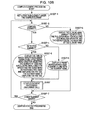
- FIGS. 10A and 10B are flowcharts illustrating operation(s) for automatically generating a query window
- FIGS. 11A and 11B are flowcharts illustrating an example of operation(s) for generating XQuery code
- FIG. 12 is a flowchart showing an example of operation(s) for generating XQuery code
- FIGS. 13A and 13B are flowcharts illustrating an example of operation(s) for generating XQuery code
- FIG. 14 is a flowchart illustrating an example of operation(s) for generating XQuery code
- FIG. 15 illustrates an example of XQuery code that is generated
- FIG. 16 illustrates a configuration and a query process
- FIG. 19 illustrates an example (a correspondence with database item(s)) of a database integration metadata
- FIG. 20 illustrates an example (a correspondence with database item(s)) of a database integration metadata
- the present invention is provided to resolve the following and other existing problems.
- Systems which store data in tagged document formats, such as the XML, and which have query processing functions use query languages, such as the Xquery language, as access interfaces to data.
- query languages such as the Xquery language
- Some systems use the tagged document formats, such as the XML, and the query languages supporting the tagged document formats as the query interfaces although the systems store data in other formats (for example, data of relational tables) as the entities.
- the end users can make the queries about data for which the query windows are prepared only by specifying conditions, provided on the query windows.
- the end users request specialists of system building to generate query windows and wait for completion of the query windows. In such cases, it takes time before the queries can be formulated and cost is generally associated with generating the windows. Accordingly, it is difficult for the end users to freely make the queries.
- GUI graphical user interface
- a computer-readable medium storing a program for automatically generating a query window, an apparatus and method for automatically generating a query window, according to embodiments of the present invention, will herein be described with reference to the attached drawings.
- An aspect of the present invention is embodied by a computer program, an apparatus, or a method having the configuration described below.
- a query processing unit virtually integrates and processes data distributed and stored in multiple databases in response to a query in a query language about or related to data in a tagged document format, such as the XML, to return tagged document data and returns virtual schema information describing a relationship between the tagged document data and the multiple databases.
- a virtual schema information acquiring operation includes acquiring virtual schema information about or related to tagged document data from a query processing unit.
- An automatic query window generation operation unit automatically generates a query window on the basis of the acquired virtual schema information.
- An increase-or-decrease-of-repetition specifying operation specifies an increase or a decrease in a number of repetition(s) of condition input field(s) for a repetitive item on a query window that is automatically generated by the automatic query window generation unit.
- a condition-input-field-in-repetition copying operation includes copying content of the condition input fields in a certain repetition to the condition input fields in a repetition to be newly added in response to the increase-or-decrease-of-repetition specifying operation specifying the increase in the number of repetitions.
- a joining-operator-in-repetition specifying operation specifies a joining condition between conditions corresponding to the condition input fields in each of the repetitions, an increase or decrease in the number of which is specified by the increase-or-decrease-of-repetition specifying operation.
- the configuration according to an embodiment of the present invention may include operation(s) of specifying an increase or a decrease in a number of condition input field(s) corresponding to item(s) each having a value on the query window that is automatically generated by the automatic query window generating unit and specifying a joining condition between conditions corresponding to the condition input fields, an increase or a decrease in the number of which is specified.
- the configuration according to an embodiment of the present invention may include the operations of holding customization information used for customizing content displayed in a query window and varying the content displayed in the query window on the basis of the customization information.
- An embodiment of the present invention has the following configuration.
- a query processing unit includes an interface that processes a query in a query language about or related to data in a tagged document format, such as the XML, to return tagged document data and that returns schema information about the tagged document data that is stored.
- An automatic query window generation unit automatically generates a query window on the basis of a structure of the acquired schema information.
- a query code generating part generates query code from information input in the query window and transmits the query code to the query processing unit.
- FIG. 2 illustrates a configuration and a query process according to an embodiment of the present invention.
- the automatic query window generation unit 201 acquires a list of data in a tagged document format (hereinafter referred to as tagged document data) such as XML name(s) from the query processing unit 202 .
- tagged document data a tagged document format
- XML name(s) XML name(s)
- the automatic query window generation unit 201 displays the acquired list on a screen for end users of the display apparatus 204 and an end user selects tagged document data (such as XML) about which the end user wants to make a query from the list.
- tagged document data such as XML
- the automatic query window generation unit 201 acquires schema information such as XML schema information about the tagged document data selected by the end user from the query processing unit 202 .
- the automatic query window generation unit 201 automatically generates a query window on the basis of the schema information.
- the automatic query window generation unit 201 sequentially follows a tree structure of the tagged document data from the top element to detect each element from the schema information and generates query window(s) in operation S 204 in FIG. 2 .
- the automatic query window generation unit 201 varies the query window displayed in the display apparatus 204 depending on which kind each element belongs to. According to an embodiment, each element belongs to either of the following two kinds:
- FIG. 4 illustrates an example of schema information in XML data in FIG. 3 .
- the schema information is defined in the XML Schema in embodiment(s) of the present invention.
- each element is categorized according to the above-described rule as follows:
- the automatic query window generation unit 201 displays element names 504 - 1 , 504 - 2 , and 504 - 3 and frames 505 - 1 , 505 - 2 , and 505 - 3 surrounding the display of sub-elements under the element names 504 - 1 , 504 - 2 , and 504 - 3 in a display apparatus 204 , as shown in FIG. 5 .
- Each input field 502 used for specifying a conditional expression is a text box where a value is input.
- Each input field 503 used for specifying a conditional expression is a pull-down menu from which a relational operator specifying a relationship between the value input in the input field 502 and data value held by the corresponding element is selected.
- the automatic query window generation unit 201 varies choices for a relational operator specified by the end user depending on the data type of a element for which the value is input. The choices are registered in advance for each data type.
- the automatic query window generation unit 201 displays the following six choices, as shown by the input field 503 in FIG. 6 :
- the automatic query window generation unit 201 displays the following choices:
- the automatic query window generation unit 201 displays an “Add” button 701 used by the end user to specify an increase in a number of input fields for the conditional expressions, as shown in FIG. 7 .
- the end user can click the “Add” button 701 with a mouse on the screen of the display apparatus 204 to increment a pair of the input field 502 and the input field 503 by one, thereby displaying input fields 502 ′ and 503 ′.
- the automatic query window generation unit 201 also displays a pull-down menu 702 used by the end user to select a join operator (“AND” operator or “OR” operator) for joining conditions corresponding to adjacent condition input fields.
- the automatic query window generation unit 201 displays a “Delete” button 703 for a pair of the input fields 502 and 503 . The end user can click the “Delete” button 703 with the mouse to delete the corresponding condition input field.
- One tab 801 is initially displayed, and the tabs 801 of the number corresponding to a number of the conditions selected from the pull-down menu 802 are subsequently displayed.
- the join operator between the conditions specified in the area of the tabs 801 can be selected with the pull-down menu 803 . Accordingly, in the example shown in FIG. 3 , it is possible to search for “an order form from XXX business company ordering three aaa articles and two bbb articles”.
- the conditions input by the end user may be directly copied to the condition input fields on the tab 801 currently displayed to generate a new tab 801 including the condition input fields having the copied conditions as initial values.
- the automatic query window generation unit 201 displays a response to the query code, returned from the query processing unit 202 , in the query window. Then, the process of automatically generating a query window is terminated.
- the automatic query window generation unit 201 displays element name “Order list” of the top element 404 as a title of the query window (“Order list” query window 506 in FIG. 5 ).
- the automatic query window generation unit 201 determines whether only one repetitive complex element exists. If the determination in operation S 1004 is affirmative, then in operation S 1006 , the automatic query window generation unit 201 generates the frame 505 - 1 in FIG. 5 surrounding the entire window, along with the element name “Order” 504 - 1 in FIG. 5 . If the determination in operation S 1004 is negative, in operation S 1005 , the automatic query window generation unit 201 performs error processing. The special processing, different from the processing for other sub-elements, is performed for this second-level sub-element.
- the automatic query window generation unit 201 performs complex element processing for sub-elements under the second-level complex elements.
- the complex element processing will now be described in detail with reference to FIG. 10B .
- the automatic query window generation unit 201 gets a first sub-element under a complex element (second-level).
- the automatic query window generation unit 201 performs a loop process from operation S 1007 - 2 to operation S 1007 - 7 while acquiring a lower-level element to be processed under the second-level complex element.
- the automatic query window generation unit 201 determines whether the element to be processed is a complex element.
- the automatic query window generation unit 201 displays the element name 504 - 2 and the frame 505 - 2 surrounding the display of sub-elements under the element name 504 - 2 , as described above with reference to FIG. 8 .
- the automatic query window generation unit 201 displays the element name 504 - 3 and the frame 505 - 3 surrounding the display of sub-elements under the element name 504 - 3 in the tab format and also displays the pull-down menus 802 and 803 allowing the end user to specify the conditions with the multiple tabs 801 , as described above with reference to FIGS. 8 and 9 .
- the automatic query window generation unit 201 recursively calls the complex element processing to process the sub-elements under the complex element to be processed.
- the automatic query window generation unit 201 determines whether a next element exists. If the next element exists, the process goes back from operation S 1007 - 7 to operation S 1007 - 2 and the automatic query window generation unit 201 processes the subsequent element.
- FIGS. 11 to 14 are flowcharts showing in detail operation(s) for generating Xquery code in operation S 207 in FIG. 2 , performed by the automatic query window generation unit 201 .
- the flowcharts in FIGS. 11 to 14 are sequentially described.
- the automatic query window generation unit 201 specifies the conditions corresponding to each element on the query window on the basis of the schema information ( FIG. 4 ) in a loop process from operation S 1106 to operation S 1114 . Specifically, in operation S 1106 , the automatic query window generation unit 201 gets a next-level sub-element (first-level element for the first time). In operation S 1107 , the automatic query window generation unit 201 determines whether the element to be processed is a complex element. If the element to be processed is not a complex element, then in operation S 1108 , the automatic query window generation unit 201 performs simple element processing. If the element to be processed is a complex element, then in operation S 109 , the automatic query window generation unit 201 performs complex element processing.
- the automatic query window generation unit 201 determines whether a next element exists. After the processing of all the elements is completed, in Operation S 115 , the automatic query window generation unit 201 outputs the “where” clause. In Operation S 1116 , the automatic query window generation unit 201 outputs a “return” clause. In Operation S 1117 , the automatic query window generation unit 201 outputs an ending tag. Then, the process for generating XQuery code is terminated.
- FIG. 12 is a flowchart showing in detail the simple element processing (S 1108 in FIG. 11A ).
- the automatic query window generation unit 201 performs a loop process (from Operation S 1202 to Operation S 1213 ) for generating the conditional expressions corresponding to the input conditions while acquiring values (first condition S 1201 and element name S 1202 ) of the input fields 502 and 503 (refer to FIG. 5 ) from the form data in the query window in Operations S 1201 and S 1213 .
- the automatic query window generation unit 201 acquires the value of the input field 502 specified by the end user and a relational operator in the input field 503 from the form data in the query window.
- the automatic query window generation unit 201 determines whether a next element exists. After the processing of all the input conditions in one simple element is completed, then in Operation S 1214 , the automatic query window generation unit 201 determines whether the multiple conditional expressions are generated. If the multiple conditional expressions are generated, then in Operation S 1215 , the automatic query window generation unit 201 surrounds the entire conditional expressions with a parenthesis ( ). Then, the generation of the conditional expression for one simple element is terminated.
- the automatic query window generation unit 201 gets the name of the complex element.
- the automatic query window generation unit 201 processes a variable name used for identifying the conditional expression corresponding to the element.
- the automatic query window generation unit 201 determines whether the complex element is a repetitive complex element. If the complex element is not a repetitive complex element (the determination in Operation S 1305 is negative), then in Operation S 1306 , the automatic query window generation unit 201 performs “processing in the repetition of the complex element”, described below, for generating the conditional expression for the complex element. In Operation S 1307 , the automatic query window generation unit 201 determines the generated conditional expression to be the conditional expression for the complex element. Then, the complex element processing in Operation S 109 in FIG. 11A is terminated.
- the automatic query window generation unit 201 initializes the conditional expression for the complex element. Then, the automatic query window generation unit 201 generates the conditional expression corresponding to each tab while acquiring the condition specified for each tab (the tab 801 in FIG. 9 ) on the query window from the form data in the query window in a loop process from Operation S 1309 to Operation S 1316 and joins the tabs with each other.
- the automatic query window generation unit 201 acquires the tab to be processed.
- the automatic query window generation unit 201 performs “the processing in the repetition of the complex element” described below for generating the conditional expression for the tab element.
- the automatic query window generation unit 201 determines whether the conditional expression is generated. If the conditional expression is generated and the automatic query window generation unit 201 determines in Operation S 1311 that the generated conditional expression is the first conditional expression for the complex element, then in Operation S 1312 , the automatic query window generation unit 201 determines the generated conditional expression to be the conditional expression for the complex element.
- the automatic query window generation unit 201 determines in Operation S 1310 that the conditional expression is generated and the automatic query window generation unit 201 determines in Operation S 1311 that the conditional expression generated in Operation S 1306 is the second or subsequent conditional expression for the complex element (the determination in Operation S 1311 is negative), then in Operations S 1313 and S 1314 or S 1315 , the automatic query window generation unit 201 joins the generated conditional expression to the conditional expressions that have been generated for the complex element with the “AND” operator or the “OR” operator specified as the join operator between the conditions specified on each tab.
- the specification of the join operator can be acquired as the form data on the pull-down menus 802 and 803 on the query window shown in FIG. 8 .
- the automatic query window generation unit 201 determines whether a next tab exists. After the processing of all the tab elements is completed, then in Operation S 1317 , the automatic query window generation unit 201 determines whether the multiple conditional expressions are generated. If the multiple conditional expressions are generated, then in Operation S 1318 , the automatic query window generation unit 201 surrounds the entire conditional expressions with a parenthesis ( ). Then, the generation of the conditional expression for the complex element to be processed is terminated. On the other hand, in Operation S 1317 , when determining that there are no multiple conditional expression are generated, the process ends.
- FIG. 14 is a flowchart showing in detail the “processing in the repetition of the complex element” in Operation S 1306 in FIGS. 13A and 13B for generating the conditional expressions for the elements in one repetition.
- the automatic query window generation unit 201 initializes the conditional expression set in the repetition. Then, the automatic query window generation unit 201 generates the conditional expression corresponding to each sub-element under the complex element to be processed while acquiring the conditions specified for the sub-element under the complex element to be processed from the form data in the query window in a loop process from Operation S 1402 to Operation S 1410 and joins the generated conditional expressions with each other.
- the automatic query window generation unit 201 gets the next sub-element.
- the automatic query window generation unit 201 determines whether the sub-element is a complex element. If the sub-element is not a complex element, then in Operation S 1404 , the automatic query window generation unit 201 recursively calls the simple element processing shown in the flowchart in FIG. 12 to perform the simple element processing in order to generate the conditional expression corresponding to the sub-element. If the sub-element is a complex element, then in Operation S 1405 , the automatic query window generation unit 201 recursively calls the complex element processing shown in the flowcharts in FIGS. 13A and 13B to perform the complex element processing in order to generate the conditional expression corresponding to the sub-element.
- the automatic query window generation unit 201 determines whether the conditional expression is generated. If the conditional expression is generated, then in Operation S 1407 and Operation S 1408 (for a first condition) or Operation S 1409 (for a second or a subsequent condition), the automatic query window generation unit 201 generates the conditional expression corresponding to each sub-element while joining the conditional expressions generated for the elements with the “AND” operator. If the conditional expression is not generated in Operation S 1406 , the process goes to S 1410 .
- the automatic query window generation unit 201 determines whether a next element exists. After the processing of all the sub-elements is completed, then in Operation S 1411 , the automatic query window generation unit 201 determines whether the multiple conditional expressions are generated. If the multiple conditional expressions are generated, then in Operation S 1412 , the automatic query window generation unit 201 surrounds the entire conditional expressions with a parenthesis ( ). Then, the generation of the conditional expressions for the elements in the repetition is terminated. When determining that multiple conditional expressions are not generated in Operation S 1411 , processing ends.
- FIG. 15 shows an example of XQuery code generated in the operation for generating Xquery code, shown in the flowcharts in FIGS. 11A to 14 .
- FIG. 16 illustrates a configuration and a query process according to an embodiment of the present invention.
- the end user does not want to display the “Receiver” in the query window because it is meaningless.
- the end user wants to display “Product number”, instead of the “Code”, in the query window.
- the automatic query window generation unit 201 includes a customization information storage unit 1601 storing customization information 1602 , in addition to the configuration shown in FIG. 2 according to the above discussed embodiment of the present invention.
- the customization information 1602 stored in the customization information storage unit 1601 is generated in advance by, for example, a system administrator.
- the customization information 1602 includes:
- the element that is not to be displayed is specified by its path from the root.
- the element whose display name is to be changed is specified by its path from a root and the display name subjected to the change is also displayed.
- Operation S 1601 “Acquisition of customization information” in Operation S 1601 is added to the operations shown in FIG. 2 according to the above embodiment of the present invention, performed by the automatic query window generation unit 201 .
- the automatic query window generation unit 201 accesses the customization information storage unit 1601 to acquire the customization information 1602 . If an instruction about an element is included in the customization information 1602 when the query window is to be generated on the basis of each element in the schema information, then in Operation S 204 ′, the automatic query window generation unit 201 varies the content of the query window to be generated in accordance with the instruction about the element. Operation(s) similar to those described with FIG. 2 are not repeated with description of FIG. 16 .
- FIG. 17 illustrates a configuration according to an embodiment of the present invention.
- the configuration according to an embodiment of the present invention embodies the query processing unit 202 shown in FIG. 1 and shown in FIG. 16 .
- the query processing unit 202 includes a database integrated reference system 1701 and database integration metadata 1702 .
- RDBs relational databases
- XML-DB XML database
- the XQuery is used as the query interface (Operation S 208 in FIG. 2 or 16 ) and the query result is returned in the XML (Operation S 209 in FIG. 2 or 16 ).
- the database integrated reference system 1701 does not differ from systems (such as, XML databases) storing the XML data as the entities in the sight of only the query interface.
- the database integrated reference system 1701 differs from the systems storing the XML data as the entities in that the XML Schema defining the schema of the XML data does not exist in the database integrated reference system 1701 because the database integrated reference system 1701 holds no XML data as the entities.
- the database integrated reference system 1701 defines in advance the database integration metadata 1702 used for generating the view in the XML format from multiple data sources, instead of the XML Schema.
- the database integrated reference system 1701 can realize the automatic query window generation according to embodiment(s) of the present invention by using the database integration metadata 1702 instead of the XML Schema.
- FIGS. 18 to 21 show an example of the database integration metadata 1702 .
- the database integration metadata 1702 includes the following pieces of information.
- the structure of the view in the virtual XML format presented by the database integrated reference system 1701 in FIG. 17 is defined by the virtual XML schema information in FIG. 18 .
- the virtual XML schema information a format similar to the XML Schema is used to define the XML structure of the integrated data view. Nodes building the schema is categorized into the following three types.
- the corresponding database is the RDB
- the set of the ComplexElement node and SimpleElement nodes under the ComplexElement node correspond to one tuple.
- the ComplexElement node is an intermediate node having sub-nodes but has no value. Any of the nodes of the three types occur under the ComplexElement node.
- the SimpleElement node corresponds to one column in each tuple and holds only the value of the column.
- the SimpleElement node corresponds to an end node including a value. No node occurs under the SimpleElement node because it is the end node.
- the TagElement node has no corresponding database element. Any of the nodes of the three types occurs under the TagElement node.
- IDs are assigned to the ComplexElement and SimpleElement nodes in order to establish the correspondence with the database items corresponding to the respective nodes.
- the IDs are called ComplexElement-ID and SimpleElement-ID, respectively.
- the ComplexElement and SimpleElement nodes each have a “visible” attribute. If the value of the “visible” attribute is set to “false”, the ComplexElement or SimpleElement node is used only in the process of joining the pieces of data and has no relation to the schema of the view. In other words, the ComplexElement and SimpleElement nodes are ignored in the description of the XQuery code and do not occur in the XML. Accordingly, the elements having the “visible” attribute set to “false” can be ignored.
- the virtual XML schema information ( FIG. 18 ) in the database integration metadata 1702 defines a tree structure (hierarchical structure) of the XML, like the XML Schema.
- the elements of the above three types can be processed in the following manner to perform the automatic query window generation (the flowchart shown in FIG. 10 ) in the same process as in the XML Schema.
- the SimpleElement is processed as an simple element.
- the TagElement is processed as a non-repetitive complex element.
- the ComplexElement is processed as a repetitive complex element if the value of the “maxOccurs” attribute is equal to two or more and is processed as a non-repetitive complex element if the value of the “maxOccurs” attribute is equal to one.
- the top node in the XML is not defined in the database integration metadata 1702 .
- the first ComplexElement node defined in the virtual XML schema information ( FIG. 18 ) corresponds to the second top node in the virtual XML. Accordingly, it may be necessary to replace the name of the top element used in Operations S 1001 and S 1002 in FIG. 10 with the XML file name.
- No information about the data type is defined in the database integration metadata 1702 .
- information indicating which piece of data in the real database each element in the virtual XML corresponds to is described as an ID in the correspondence with the database items ( FIGS. 19 and 20 ).
- the database integrated reference system 1701 holds information indicating which part in which database in which server each ID indicates.
- the information about the data type in the real database is also held in the database integrated reference system 1701 . Accordingly, the information about a data type in a real database can be acquired and be used as the data type of each element in the virtual XML.
- the query window for the end user is automatically generated, so that it does not require cost and it is not necessary for the end user to wait for the development of the query window. Consequently, it is possible to easily introduce new queries.
- the configuration according to the last embodiment of the present invention described herein is combined with the technology for easily providing a virtual view of data distributed across multiple databases in a tagged document format, disclosed in, for example, Japanese Unexamined Patent Application Publication No. 2005-208757, 2006-18607, or 2007-257083 by the assignee, to allow the end user to easily make a query about the data distributed across the multiple databases.
Landscapes
- Engineering & Computer Science (AREA)
- Theoretical Computer Science (AREA)
- Physics & Mathematics (AREA)
- Data Mining & Analysis (AREA)
- Databases & Information Systems (AREA)
- General Engineering & Computer Science (AREA)
- General Physics & Mathematics (AREA)
- Mathematical Physics (AREA)
- Information Retrieval, Db Structures And Fs Structures Therefor (AREA)
- User Interface Of Digital Computer (AREA)
- Document Processing Apparatus (AREA)
Abstract
Description
-
- Simple element (element having a value): no element occurs under the simple element and has a data value
- Complex element: at least one element occurs under the complex element
-
- Non-repetitive complex element: non-repetitive complex element occurs only once
- Repetitive complex element: repetitive complex element occurs multiple times
-
- Repetitive complex elements 401-1 and 401-2: complex elements having a maxOccurs attribute whose value is equal to two or more
- Non-repetitive complex element 402-1: a complex element having the maxOccurs attribute whose value is equal to one
- Simple elements 403-1 and 403-2: simple elements
-
- equal to (=)
- not equal to (!=)
- greater than (>)
- greater than or equal to (>=)
- smaller than or equal to (<=)
- smaller than (<)
-
- including (matching of substring)
- beginning with (matching of first string)
- ending with (matching of last string)
-
- on (=)
- excluding (!=)
- after (>)
- on and after (>=)
- on and before (<=)
- before (<)
-
- The multiple condition input fields are surrounded by separate frames and the frames are tiled.
- An input field or pull-down menu with which the condition input field to be displayed is specified is provided to display only one condition input field that is specified.
-
- A numerical input field is provided. The end user inputs a number in the numeral input field and presses (selects) an “Execute” button to vary the number of the tabs.
- An “Increment by one” button and “Decrement” buttons are provided. The number of the tabs is varied each time the end user presses (selects) either of the “Increment by one” button or the corresponding “Decrement” button. One “Increment by one” button shared between the tabs is provided outside the tabs while one “Decrement” button is provided for each tab. As an application of this method, one “Create copy of tab” button may be provided for each tab. Pressing the “Create copy of tab” button copies all the conditions input on the tab to a new tab. With this method, it is possible for the end user to rapidly input conditions, most of which match with the conditions input on an original tab and only part of which is different from them.
- A required predetermined number of tabs are provided and a number of the tabs is kept constant. The number of tabs may be fixed or may be equal to a value of the maxOccurs attribute in the XML Schema.
-
- Virtual XML schema information: information indicating how related data across the multiple databases 1703-1, 1703-2, and 1703-3 is presented to the end user as the XML data (part of the
database integration metadata 1702 shown inFIG. 18 ). - Correspondence between database items: information indicating which item in which database corresponds to each node in the XML (part of the
database integration metadata 1702 shown inFIGS. 19 and 20 ). - Information about association between elements: information indicating which item in each database is used when the pieces of the XML data and tuples in the different databases 1703-1, 1703-2, and 1703-3 are associated with each other to generate one XML code (part of the
database integration metadata 1702 shown inFIG. 21 ).
- Virtual XML schema information: information indicating how related data across the multiple databases 1703-1, 1703-2, and 1703-3 is presented to the end user as the XML data (part of the
Claims (6)
Applications Claiming Priority (3)
| Application Number | Priority Date | Filing Date | Title |
|---|---|---|---|
| JP2007207274A JP5458480B2 (en) | 2007-08-08 | 2007-08-08 | Inquiry screen generation device for tagged document data inquiry processing system |
| JP2007-207274 | 2007-08-08 | ||
| JPJP2007-207274 | 2007-08-08 |
Publications (2)
| Publication Number | Publication Date |
|---|---|
| US20090043746A1 US20090043746A1 (en) | 2009-02-12 |
| US7933892B2 true US7933892B2 (en) | 2011-04-26 |
Family
ID=40347448
Family Applications (1)
| Application Number | Title | Priority Date | Filing Date |
|---|---|---|---|
| US12/058,163 Expired - Fee Related US7933892B2 (en) | 2007-08-08 | 2008-03-28 | Computer-readable medium storing program for automatically generating query window, apparatus for automatically generating query window, and method for automatically generating query window |
Country Status (2)
| Country | Link |
|---|---|
| US (1) | US7933892B2 (en) |
| JP (1) | JP5458480B2 (en) |
Families Citing this family (4)
| Publication number | Priority date | Publication date | Assignee | Title |
|---|---|---|---|---|
| US8452808B2 (en) * | 2010-03-02 | 2013-05-28 | Microsoft Corporation | Automatic generation of virtual database schemas |
| JP6339932B2 (en) * | 2014-12-26 | 2018-06-06 | エヌ・ティ・ティ・コムウェア株式会社 | Data management apparatus, data management method, and data management program |
| JP6592960B2 (en) * | 2015-05-19 | 2019-10-23 | 沖電気工業株式会社 | Information processing apparatus, information processing method, and program |
| US10726507B1 (en) | 2016-11-11 | 2020-07-28 | Palantir Technologies Inc. | Graphical representation of a complex task |
Citations (4)
| Publication number | Priority date | Publication date | Assignee | Title |
|---|---|---|---|---|
| JP2005208757A (en) | 2004-01-20 | 2005-08-04 | Fujitsu Ltd | Database integrated reference device, database integrated reference method, and database integrated reference program |
| JP2006018607A (en) | 2004-07-01 | 2006-01-19 | Fujitsu Ltd | Metadata editor program, recording medium therefor, metadata editing method and metadata editing apparatus |
| US20060248092A1 (en) * | 2005-04-29 | 2006-11-02 | International Business Machines Corporation | Dynamic exception reporting service for heterogeneous structured enterprise data |
| JP2007257083A (en) | 2006-03-20 | 2007-10-04 | Fujitsu Ltd | Database integrated reference program, database integrated reference method, and database integrated reference device |
Family Cites Families (7)
| Publication number | Priority date | Publication date | Assignee | Title |
|---|---|---|---|---|
| JPH09245052A (en) * | 1996-03-05 | 1997-09-19 | Mitsubishi Electric Corp | Structured document processing device |
| US5909678A (en) * | 1996-09-13 | 1999-06-01 | International Business Machines Corporation | Computer systems, method and program for constructing statements by dragging and dropping iconic representations of subcomponent statements onto a phrase template |
| JPH11288412A (en) * | 1998-04-02 | 1999-10-19 | Hitachi Ltd | Document creation method and system, and computer-readable recording medium recording document creation program |
| JP3178421B2 (en) * | 1998-07-01 | 2001-06-18 | 日本電気株式会社 | Text search device and computer-readable recording medium storing text search program |
| JP3842573B2 (en) * | 2001-03-30 | 2006-11-08 | 株式会社東芝 | Structured document search method, structured document management apparatus and program |
| JP4025178B2 (en) * | 2002-11-11 | 2007-12-19 | 株式会社東芝 | Structured data search method, structured data search device and program |
| US7979456B2 (en) * | 2004-04-08 | 2011-07-12 | International Business Machines Corporation | Method of managing and providing parameterized queries |
-
2007
- 2007-08-08 JP JP2007207274A patent/JP5458480B2/en not_active Expired - Fee Related
-
2008
- 2008-03-28 US US12/058,163 patent/US7933892B2/en not_active Expired - Fee Related
Patent Citations (4)
| Publication number | Priority date | Publication date | Assignee | Title |
|---|---|---|---|---|
| JP2005208757A (en) | 2004-01-20 | 2005-08-04 | Fujitsu Ltd | Database integrated reference device, database integrated reference method, and database integrated reference program |
| JP2006018607A (en) | 2004-07-01 | 2006-01-19 | Fujitsu Ltd | Metadata editor program, recording medium therefor, metadata editing method and metadata editing apparatus |
| US20060248092A1 (en) * | 2005-04-29 | 2006-11-02 | International Business Machines Corporation | Dynamic exception reporting service for heterogeneous structured enterprise data |
| JP2007257083A (en) | 2006-03-20 | 2007-10-04 | Fujitsu Ltd | Database integrated reference program, database integrated reference method, and database integrated reference device |
Also Published As
| Publication number | Publication date |
|---|---|
| JP5458480B2 (en) | 2014-04-02 |
| US20090043746A1 (en) | 2009-02-12 |
| JP2009043022A (en) | 2009-02-26 |
Similar Documents
| Publication | Publication Date | Title |
|---|---|---|
| EP3358470B1 (en) | Method of preparing documents in markup languages | |
| US7644361B2 (en) | Method of using recommendations to visually create new views of data across heterogeneous sources | |
| US7574652B2 (en) | Methods for interactively defining transforms and for generating queries by manipulating existing query data | |
| US8429519B2 (en) | Presentation generator | |
| US9330120B2 (en) | Visual data importer | |
| US8458164B2 (en) | Query model tool and method for visually grouping and ungrouping predicates | |
| US8806345B2 (en) | Information exchange using generic data streams | |
| US7941395B2 (en) | System for storing documents in a repository | |
| US8650182B2 (en) | Mechanism for efficiently searching XML document collections | |
| US20050060647A1 (en) | Method for presenting hierarchical data | |
| US20090077091A1 (en) | System for development and hosting of network applications | |
| US7703026B2 (en) | Non-pattern based user interface in pattern based environment | |
| KR20100124736A (en) | Graphical representation of data relationship | |
| US7970777B2 (en) | Model-driven database query | |
| US7333986B2 (en) | Hierarchical database management system, hierarchical database management method, and hierarchical database management program | |
| US7933892B2 (en) | Computer-readable medium storing program for automatically generating query window, apparatus for automatically generating query window, and method for automatically generating query window | |
| US7818328B2 (en) | API for obtaining unambiguous representation of objects in a relational database | |
| US8799256B2 (en) | Incorporated web page content | |
| JP3914081B2 (en) | Access authority setting method and structured document management system | |
| US20230367471A1 (en) | System and Method for Specifying Properties for a Protocol-Compliant Uniform Resource Locator | |
| WO2001052117A2 (en) | 'data integrator' system for collecting, fusing and displaying information including persistent connection and storage arrangement | |
| US11741295B2 (en) | Independent rendering engine for a user interface internationalization | |
| WO2003019843A9 (en) | Method and apparatus for formatting a data grid for the display of a view | |
| US20070094289A1 (en) | Dynamic, hierarchical data exchange system | |
| JP2003091535A (en) | Data management method, program and device |
Legal Events
| Date | Code | Title | Description |
|---|---|---|---|
| AS | Assignment |
Owner name: FUJITSU LIMITED, JAPAN Free format text: ASSIGNMENT OF ASSIGNORS INTEREST;ASSIGNOR:KANEMASA, YASUHIKO;REEL/FRAME:020993/0709 Effective date: 20080523 |
|
| AS | Assignment |
Owner name: FUJITSU LIMITED, JAPAN Free format text: CORRECTIVE ASSIGNMENT TO CORRECT THE INVENTOR'S ECECUTION DATE PREVIOUSLY RECORDED ON REEL 020993, FRAME 0709;ASSIGNOR:KANEMASA, YASUHIKO;REEL/FRAME:021346/0222 Effective date: 20080527 |
|
| AS | Assignment |
Owner name: FUJITSU LIMITED, JAPAN Free format text: CORRECTIVE ASSIGNMENT TO CORRECT THE ASSIGNOR'S EXECUTION DATE PREVIOUSLY RECORDED ON REEL 021346, FRAME 0222;ASSIGNOR:KANEMASA, YASUHIKO;REEL/FRAME:021388/0713 Effective date: 20080327 Owner name: FUJITSU LIMITED, JAPAN Free format text: CORRECTIVE ASSIGNMENT TO CORRECT THE ASSIGNOR'S EXECUTION DATE PREVIOUSLY RECORDED ON REEL 021346, FRAME 0222. ASSIGNOR HEREBY CONFIRMS THE ASSIGNMENT OF THE ENTIRE INTEREST;ASSIGNOR:KANEMASA, YASUHIKO;REEL/FRAME:021388/0713 Effective date: 20080327 |
|
| STCF | Information on status: patent grant |
Free format text: PATENTED CASE |
|
| FEPP | Fee payment procedure |
Free format text: PAYOR NUMBER ASSIGNED (ORIGINAL EVENT CODE: ASPN); ENTITY STATUS OF PATENT OWNER: LARGE ENTITY |
|
| FPAY | Fee payment |
Year of fee payment: 4 |
|
| CC | Certificate of correction | ||
| FEPP | Fee payment procedure |
Free format text: MAINTENANCE FEE REMINDER MAILED (ORIGINAL EVENT CODE: REM.); ENTITY STATUS OF PATENT OWNER: LARGE ENTITY |
|
| LAPS | Lapse for failure to pay maintenance fees |
Free format text: PATENT EXPIRED FOR FAILURE TO PAY MAINTENANCE FEES (ORIGINAL EVENT CODE: EXP.); ENTITY STATUS OF PATENT OWNER: LARGE ENTITY |
|
| STCH | Information on status: patent discontinuation |
Free format text: PATENT EXPIRED DUE TO NONPAYMENT OF MAINTENANCE FEES UNDER 37 CFR 1.362 |
|
| FP | Lapsed due to failure to pay maintenance fee |
Effective date: 20190426 |