US7932252B2 - Aryl sulfonamides - Google Patents
Aryl sulfonamides Download PDFInfo
- Publication number
- US7932252B2 US7932252B2 US11/596,147 US59614705A US7932252B2 US 7932252 B2 US7932252 B2 US 7932252B2 US 59614705 A US59614705 A US 59614705A US 7932252 B2 US7932252 B2 US 7932252B2
- Authority
- US
- United States
- Prior art keywords
- substituted
- unsubstituted
- hydrogen
- group
- halogen
- Prior art date
- Legal status (The legal status is an assumption and is not a legal conclusion. Google has not performed a legal analysis and makes no representation as to the accuracy of the status listed.)
- Active, expires
Links
- 0 *C(c1c(*)c(*)c(*)c(*)c1NS([Al])(=O)=O)(O*)[Al] Chemical compound *C(c1c(*)c(*)c(*)c(*)c1NS([Al])(=O)=O)(O*)[Al] 0.000 description 49
- CZNBCVUQMYJNDW-UHFFFAOYSA-N C.CC(C)(C)C(C)(C)C1=CN=CO1.CC(C)(C)C(C)(C)C1=COC=N1.CC(C)(C)C(C)(C)C1=NC=CO1.CC(C)(C)C1(C)CCOCC1.CC(C)(C)C1=CC=CN1.CC(C)(C)C1=CC=CO1.CC(C)(C)C1=CN=CN=C1.CC(C)(C)C1=CSN=N1.CC(C)(C)C1CCOCC1.CC(C)(C)N1CCC(F)(F)CC1.CC(C)(C)N1CCCC1.CC(C)(C)N1CCCCC1.CC(C)(C)N1CCNCC1.CC(C)(C)N1CCS(=O)(=O)CC1.CC(C)(C)N1CCSCC1.CC(C)(C)OC(=O)N1C=CC=C1C(C)(C)C.CC1=C(C(C)(C)C)OC=N1.CC1=NN=C(C(C)(C)C)O1.CC1=NOC(C)=C1C(C)(C)C.CC1CN(C(C)(C)C)CC(C)O1.CC1COC(C)(C(C)(C)C)O1.CC1OC(C)(C(C)(C)C)OC1C.CN1N=NN=C1C(C)(C)C.COC(=O)C(C)(C)C(C)(C)C Chemical compound C.CC(C)(C)C(C)(C)C1=CN=CO1.CC(C)(C)C(C)(C)C1=COC=N1.CC(C)(C)C(C)(C)C1=NC=CO1.CC(C)(C)C1(C)CCOCC1.CC(C)(C)C1=CC=CN1.CC(C)(C)C1=CC=CO1.CC(C)(C)C1=CN=CN=C1.CC(C)(C)C1=CSN=N1.CC(C)(C)C1CCOCC1.CC(C)(C)N1CCC(F)(F)CC1.CC(C)(C)N1CCCC1.CC(C)(C)N1CCCCC1.CC(C)(C)N1CCNCC1.CC(C)(C)N1CCS(=O)(=O)CC1.CC(C)(C)N1CCSCC1.CC(C)(C)OC(=O)N1C=CC=C1C(C)(C)C.CC1=C(C(C)(C)C)OC=N1.CC1=NN=C(C(C)(C)C)O1.CC1=NOC(C)=C1C(C)(C)C.CC1CN(C(C)(C)C)CC(C)O1.CC1COC(C)(C(C)(C)C)O1.CC1OC(C)(C(C)(C)C)OC1C.CN1N=NN=C1C(C)(C)C.COC(=O)C(C)(C)C(C)(C)C CZNBCVUQMYJNDW-UHFFFAOYSA-N 0.000 description 9
- NTZGBIAHCPJRDX-UHFFFAOYSA-N C=CC(C)(C)C.CC(=O)C(C)(C)C.CC(C)(C)Br.CC(C)(C)C#CC1=CC=CC=C1.CC(C)(C)C#N.CC(C)(C)C(C)(C)C.CC(C)(C)C(C)(C)CCO.CC(C)(C)C(C)(C)CO.CC(C)(C)C(F)(F)F.CC(C)(C)C1(C)OCCO1.CC(C)(C)C1=C(F)N=CC=C1.CC(C)(C)C1=CC=CC=C1.CC(C)(C)C1=CN=CO1.CC(C)(C)C1=COC=C1.CC(C)(C)C1=CSC=C1.CC(C)(C)Cl.CC(C)(C)F.CC(C)(C)N1C=CC=N1.CC(C)(C)N1CCOCC1.CC(C)(C)S(C)(=O)=O.CC(C)(C)[N+](=O)[O-].CC(C)C(C)(C)C.CC(C)OC(C)(C)C.CC1=COC=N1.CC1=NC(C)=C(C(C)(C)C)O1.CC1=NC=C(C(C)(C)C)O1.CC1=NC=CO1.CCC(C)(C)C.CCC(C)(C)C(C)(C)C.CCOC(C)(C)C.COC(=O)CCC(C)(C)C.COC(C)(C)C.COC(F)(F)F.[H]C(C)(C)C Chemical compound C=CC(C)(C)C.CC(=O)C(C)(C)C.CC(C)(C)Br.CC(C)(C)C#CC1=CC=CC=C1.CC(C)(C)C#N.CC(C)(C)C(C)(C)C.CC(C)(C)C(C)(C)CCO.CC(C)(C)C(C)(C)CO.CC(C)(C)C(F)(F)F.CC(C)(C)C1(C)OCCO1.CC(C)(C)C1=C(F)N=CC=C1.CC(C)(C)C1=CC=CC=C1.CC(C)(C)C1=CN=CO1.CC(C)(C)C1=COC=C1.CC(C)(C)C1=CSC=C1.CC(C)(C)Cl.CC(C)(C)F.CC(C)(C)N1C=CC=N1.CC(C)(C)N1CCOCC1.CC(C)(C)S(C)(=O)=O.CC(C)(C)[N+](=O)[O-].CC(C)C(C)(C)C.CC(C)OC(C)(C)C.CC1=COC=N1.CC1=NC(C)=C(C(C)(C)C)O1.CC1=NC=C(C(C)(C)C)O1.CC1=NC=CO1.CCC(C)(C)C.CCC(C)(C)C(C)(C)C.CCOC(C)(C)C.COC(=O)CCC(C)(C)C.COC(C)(C)C.COC(F)(F)F.[H]C(C)(C)C NTZGBIAHCPJRDX-UHFFFAOYSA-N 0.000 description 9
- ZIUMNFGITPRMJF-UHFFFAOYSA-N C=CC(C)(C)C.CC(=O)C(C)(C)C.CC(C)(C)Br.CC(C)(C)C#CC1=CC=CC=C1.CC(C)(C)C#N.CC(C)(C)C(C)(C)C.CC(C)(C)C(C)(C)CCO.CC(C)(C)C(C)(C)CO.CC(C)(C)C(F)(F)F.CC(C)(C)C1=CC=CC=C1.CC(C)(C)C1=CN=CO1.CC(C)(C)C1=COC=C1.CC(C)(C)C1=COC=N1.CC(C)(C)C1=NC=CO1.CC(C)(C)Cl.CC(C)(C)F.CC(C)(C)N1C=CC=N1.CC(C)(C)N1CCOCC1.CC(C)(C)OC(F)(F)F.CC(C)(C)S(C)(=O)=O.CC(C)(C)[N+](=O)[O-].CC(C)C(C)(C)C.CC(C)OC(C)(C)C.CC1=NC(C)=C(C(C)(C)C)O1.CC1=NC=C(C(C)(C)C)O1.CCC(C)(C)C.CCC(C)(C)C(C)(C)C.CCOC(C)(C)C.COC(=O)CCC(C)(C)C.COC(C)(C)C.[H]C(C)(C)C Chemical compound C=CC(C)(C)C.CC(=O)C(C)(C)C.CC(C)(C)Br.CC(C)(C)C#CC1=CC=CC=C1.CC(C)(C)C#N.CC(C)(C)C(C)(C)C.CC(C)(C)C(C)(C)CCO.CC(C)(C)C(C)(C)CO.CC(C)(C)C(F)(F)F.CC(C)(C)C1=CC=CC=C1.CC(C)(C)C1=CN=CO1.CC(C)(C)C1=COC=C1.CC(C)(C)C1=COC=N1.CC(C)(C)C1=NC=CO1.CC(C)(C)Cl.CC(C)(C)F.CC(C)(C)N1C=CC=N1.CC(C)(C)N1CCOCC1.CC(C)(C)OC(F)(F)F.CC(C)(C)S(C)(=O)=O.CC(C)(C)[N+](=O)[O-].CC(C)C(C)(C)C.CC(C)OC(C)(C)C.CC1=NC(C)=C(C(C)(C)C)O1.CC1=NC=C(C(C)(C)C)O1.CCC(C)(C)C.CCC(C)(C)C(C)(C)C.CCOC(C)(C)C.COC(=O)CCC(C)(C)C.COC(C)(C)C.[H]C(C)(C)C ZIUMNFGITPRMJF-UHFFFAOYSA-N 0.000 description 9
- KKVUJFFKBJCWTL-UHFFFAOYSA-N CC(C)(C)C(C)(C)C1=CN=CO1.CC(C)(C)C(C)(C)C1=COC=N1.CC(C)(C)C(C)(C)C1=NC=CO1.CC(C)(C)C1(C)CCOCC1.CC(C)(C)C1(C)OCCO1.CC(C)(C)C1=C(F)N=CC=C1.CC(C)(C)C1=CC=CN1.CC(C)(C)C1=CC=CO1.CC(C)(C)C1=CN=CN=C1.CC(C)(C)C1=CSC=C1.CC(C)(C)C1=CSN=N1.CC(C)(C)C1CCOCC1.CC(C)(C)N1CCC(F)(F)CC1.CC(C)(C)N1CCCC1.CC(C)(C)N1CCCCC1.CC(C)(C)N1CCNCC1.CC(C)(C)N1CCS(=O)(=O)CC1.CC(C)(C)N1CCSCC1.CC(C)(C)OC(=O)N1C=CC=C1C(C)(C)C.CC1=C(C(C)(C)C)OC=N1.CC1=NN=C(C(C)(C)C)O1.CC1=NOC(C)=C1C(C)(C)C.CC1CN(C(C)(C)C)CC(C)O1.CC1COC(C)(C(C)(C)C)O1.CC1OC(C)(C(C)(C)C)OC1C.CN1N=NN=C1C(C)(C)C.COC(=O)C(C)(C)C(C)(C)C Chemical compound CC(C)(C)C(C)(C)C1=CN=CO1.CC(C)(C)C(C)(C)C1=COC=N1.CC(C)(C)C(C)(C)C1=NC=CO1.CC(C)(C)C1(C)CCOCC1.CC(C)(C)C1(C)OCCO1.CC(C)(C)C1=C(F)N=CC=C1.CC(C)(C)C1=CC=CN1.CC(C)(C)C1=CC=CO1.CC(C)(C)C1=CN=CN=C1.CC(C)(C)C1=CSC=C1.CC(C)(C)C1=CSN=N1.CC(C)(C)C1CCOCC1.CC(C)(C)N1CCC(F)(F)CC1.CC(C)(C)N1CCCC1.CC(C)(C)N1CCCCC1.CC(C)(C)N1CCNCC1.CC(C)(C)N1CCS(=O)(=O)CC1.CC(C)(C)N1CCSCC1.CC(C)(C)OC(=O)N1C=CC=C1C(C)(C)C.CC1=C(C(C)(C)C)OC=N1.CC1=NN=C(C(C)(C)C)O1.CC1=NOC(C)=C1C(C)(C)C.CC1CN(C(C)(C)C)CC(C)O1.CC1COC(C)(C(C)(C)C)O1.CC1OC(C)(C(C)(C)C)OC1C.CN1N=NN=C1C(C)(C)C.COC(=O)C(C)(C)C(C)(C)C KKVUJFFKBJCWTL-UHFFFAOYSA-N 0.000 description 9
- JBRUVWAHWNJVSN-UHFFFAOYSA-N C1CCC1.CC(C)(C)C Chemical compound C1CCC1.CC(C)(C)C JBRUVWAHWNJVSN-UHFFFAOYSA-N 0.000 description 4
- OKNZKYVBLWZWSW-UHFFFAOYSA-N C=C(=C)(C)C1=CC(Cl)=[N+]([O-])C=C1.CC(C)(C)C1=CC=C(Cl)N=C1.CC(C)(C)C1=CC=NC(C#N)=C1.CC(C)(C)C1=CC=NC(Cl)=C1.CC(C)(C)C1=CC=NC(Cl)=C1.CC(C)(C)C1=CC=NC(S(C)(=O)=O)=C1.CC(C)(C)C1=CC=NC=C1.CC(C)(C)C1=CC=[N+]([O-])C=C1.CC(C)(C)C1=CN=C(S(C)(=O)=O)C=C1.CC(C)(C)C1=CN=CC=C1.CC(C)(C)C1=C[N+]([O-])=CC=C1.CC1=C(C(C)(C)C)C=CC(C)=N1O.CC1=C(C(C)(C)C)C=CC=N1.CC1=C(C(C)(C)C)C=CC=[N+]1[O-].CC1=CC(C(C)(C)C)=CC=N1.CC1=NC=C(C(C)(C)C)C=C1.CC1=[N+]([O-])C=C(C(C)(C)C)C=C1.COC1=NC=CC(C(C)(C)C)=C1.CSC1=CC(C(C)(C)C)=CC=N1.CSC1=NC=C(C(C)(C)C)C=C1 Chemical compound C=C(=C)(C)C1=CC(Cl)=[N+]([O-])C=C1.CC(C)(C)C1=CC=C(Cl)N=C1.CC(C)(C)C1=CC=NC(C#N)=C1.CC(C)(C)C1=CC=NC(Cl)=C1.CC(C)(C)C1=CC=NC(Cl)=C1.CC(C)(C)C1=CC=NC(S(C)(=O)=O)=C1.CC(C)(C)C1=CC=NC=C1.CC(C)(C)C1=CC=[N+]([O-])C=C1.CC(C)(C)C1=CN=C(S(C)(=O)=O)C=C1.CC(C)(C)C1=CN=CC=C1.CC(C)(C)C1=C[N+]([O-])=CC=C1.CC1=C(C(C)(C)C)C=CC(C)=N1O.CC1=C(C(C)(C)C)C=CC=N1.CC1=C(C(C)(C)C)C=CC=[N+]1[O-].CC1=CC(C(C)(C)C)=CC=N1.CC1=NC=C(C(C)(C)C)C=C1.CC1=[N+]([O-])C=C(C(C)(C)C)C=C1.COC1=NC=CC(C(C)(C)C)=C1.CSC1=CC(C(C)(C)C)=CC=N1.CSC1=NC=C(C(C)(C)C)C=C1 OKNZKYVBLWZWSW-UHFFFAOYSA-N 0.000 description 4
- IHOIXFQOUAVPLR-UHFFFAOYSA-N C=C(=C)(C)C1=CC(Cl)=[N+]([O-])C=C1.CC(C)(C)C1=CC=C(Cl)N=C1.CC(C)(C)C1=CC=NC(C#N)=C1.CC(C)(C)C1=CC=NC(Cl)=C1.CC(C)(C)C1=CC=NC(Cl)=C1.CC(C)(C)C1=CC=NC(S(C)(=O)=O)=C1.CC(C)(C)C1=CC=NC=C1.CC(C)(C)C1=CC=[N+]([O-])C=C1.CC(C)(C)C1=CN=C(S(C)(=O)=O)C=C1.CC(C)(C)C1=CN=CC=C1.CC(C)(C)C1=C[N+]([O-])=CC=C1.CC1=C(C(C)(C)C)C=CC=N1.CC1=C(C(C)(C)C)C=CC=N1O.CC1=C(C(C)(C)C)C=CC=[N+]1[O-].CC1=CC(C(C)(C)C)=CC=N1.CC1=NC=C(C(C)(C)C)C=C1.CC1=[N+]([O-])C=C(C(C)(C)C)C=C1.COC1=NC=CC(C(C)(C)C)=C1.CSC1=CC(C(C)(C)C)=CC=N1.CSC1=NC=C(C(C)(C)C)C=C1 Chemical compound C=C(=C)(C)C1=CC(Cl)=[N+]([O-])C=C1.CC(C)(C)C1=CC=C(Cl)N=C1.CC(C)(C)C1=CC=NC(C#N)=C1.CC(C)(C)C1=CC=NC(Cl)=C1.CC(C)(C)C1=CC=NC(Cl)=C1.CC(C)(C)C1=CC=NC(S(C)(=O)=O)=C1.CC(C)(C)C1=CC=NC=C1.CC(C)(C)C1=CC=[N+]([O-])C=C1.CC(C)(C)C1=CN=C(S(C)(=O)=O)C=C1.CC(C)(C)C1=CN=CC=C1.CC(C)(C)C1=C[N+]([O-])=CC=C1.CC1=C(C(C)(C)C)C=CC=N1.CC1=C(C(C)(C)C)C=CC=N1O.CC1=C(C(C)(C)C)C=CC=[N+]1[O-].CC1=CC(C(C)(C)C)=CC=N1.CC1=NC=C(C(C)(C)C)C=C1.CC1=[N+]([O-])C=C(C(C)(C)C)C=C1.COC1=NC=CC(C(C)(C)C)=C1.CSC1=CC(C(C)(C)C)=CC=N1.CSC1=NC=C(C(C)(C)C)C=C1 IHOIXFQOUAVPLR-UHFFFAOYSA-N 0.000 description 4
- GNSAKNHFTPJAHL-UHFFFAOYSA-N C=C(=C)(C)C1=CC(Cl)=[N+]([O-])C=C1.CC(C)(C)C1=CC=NC(C#N)=C1.CC(C)(C)C1=CC=NC(Cl)=C1.CC(C)(C)C1=CC=NC(Cl)=C1.CC(C)(C)C1=CC=NC(S(C)(=O)=O)=C1.CC(C)(C)C1=CC=NC=C1.CC(C)(C)C1=CC=[N+]([O-])C=C1.CC(C)(C)C1=CN=CC=C1.CC(C)(C)C1=C[N+]([O-])=CC=C1.CC1=C(C(C)(C)C)C=CC=N1O.CC1=C(C(C)(C)C)C=CC=[N+]1[O-].CC1=CC(C(C)(C)C)=CC=N1.CC1=NC=C(C(C)(C)C)C=C1.CC1=[N+]([O-])C=C(C(C)(C)C)C=C1.COC1=NC=CC(C(C)(C)C)=C1.CSC1=CC(C(C)(C)C)=CC=N1.CSC1=NC=C(C(C)(C)C)C=C1 Chemical compound C=C(=C)(C)C1=CC(Cl)=[N+]([O-])C=C1.CC(C)(C)C1=CC=NC(C#N)=C1.CC(C)(C)C1=CC=NC(Cl)=C1.CC(C)(C)C1=CC=NC(Cl)=C1.CC(C)(C)C1=CC=NC(S(C)(=O)=O)=C1.CC(C)(C)C1=CC=NC=C1.CC(C)(C)C1=CC=[N+]([O-])C=C1.CC(C)(C)C1=CN=CC=C1.CC(C)(C)C1=C[N+]([O-])=CC=C1.CC1=C(C(C)(C)C)C=CC=N1O.CC1=C(C(C)(C)C)C=CC=[N+]1[O-].CC1=CC(C(C)(C)C)=CC=N1.CC1=NC=C(C(C)(C)C)C=C1.CC1=[N+]([O-])C=C(C(C)(C)C)C=C1.COC1=NC=CC(C(C)(C)C)=C1.CSC1=CC(C(C)(C)C)=CC=N1.CSC1=NC=C(C(C)(C)C)C=C1 GNSAKNHFTPJAHL-UHFFFAOYSA-N 0.000 description 4
- RXGMWNCSMJTJLA-UHFFFAOYSA-N CC(=O)N(C1=CC=NC=C1)C1=C(NS(=O)(=O)C2=CC=C(C(C)(C)C)C=C2)C=CC(Cl)=C1 Chemical compound CC(=O)N(C1=CC=NC=C1)C1=C(NS(=O)(=O)C2=CC=C(C(C)(C)C)C=C2)C=CC(Cl)=C1 RXGMWNCSMJTJLA-UHFFFAOYSA-N 0.000 description 4
- FFGAHPJLAHPJIV-UHFFFAOYSA-N CC(C)(C)C1=CC=CC=C1.CC(C)(C)C1=CC=CC=[N+]1[O-].CC(C)(C)C1=CC=NC=N1.CC(C)(C)C1=CN=C(N2CCOCC2)C=C1.CC(C)(C)C1=CN=CC=N1.CC(C)(C)C1=NC=CC=C1.CC(C)(C)C1=NC=CC=N1.CC(C)(C)C1=NNC=C1.CC1=CC=NC=C1C(C)(C)C.CC1=NC(C(C)(C)C)=CC=C1.CN1=CCN=C1C(C)(C)C.CN1N=C(C(C)(C)C)C2=C1C=CC=C2 Chemical compound CC(C)(C)C1=CC=CC=C1.CC(C)(C)C1=CC=CC=[N+]1[O-].CC(C)(C)C1=CC=NC=N1.CC(C)(C)C1=CN=C(N2CCOCC2)C=C1.CC(C)(C)C1=CN=CC=N1.CC(C)(C)C1=NC=CC=C1.CC(C)(C)C1=NC=CC=N1.CC(C)(C)C1=NNC=C1.CC1=CC=NC=C1C(C)(C)C.CC1=NC(C(C)(C)C)=CC=C1.CN1=CCN=C1C(C)(C)C.CN1N=C(C(C)(C)C)C2=C1C=CC=C2 FFGAHPJLAHPJIV-UHFFFAOYSA-N 0.000 description 4
- IYXKWGCVZLVNCK-UHFFFAOYSA-N CC1=C(C)C(C)=C(NS(C)(=O)=O)C(C)=C1C Chemical compound CC1=C(C)C(C)=C(NS(C)(=O)=O)C(C)=C1C IYXKWGCVZLVNCK-UHFFFAOYSA-N 0.000 description 4
- HVTGZLHEYZNEAK-UHFFFAOYSA-N CC(C)(C)C1=CC=C(S(=O)(=O)NC2=C(NC3=CC=NC=C3)C=C(Cl)C=C2)C=C1 Chemical compound CC(C)(C)C1=CC=C(S(=O)(=O)NC2=C(NC3=CC=NC=C3)C=C(Cl)C=C2)C=C1 HVTGZLHEYZNEAK-UHFFFAOYSA-N 0.000 description 3
- QCXBXUSEESYUKB-UHFFFAOYSA-N CC(C)(C)C1=CC=CC=C1.CC(C)(C)C1=CC=NC=C1.CC(C)(C)C1=CC=[N+]([O-])C=C1.CC(C)(C)C1=CN=CC=C1 Chemical compound CC(C)(C)C1=CC=CC=C1.CC(C)(C)C1=CC=NC=C1.CC(C)(C)C1=CC=[N+]([O-])C=C1.CC(C)(C)C1=CN=CC=C1 QCXBXUSEESYUKB-UHFFFAOYSA-N 0.000 description 3
- SQAJJDCAVSPMPB-GTFORLLLSA-N [3H]=C(C)C1=C(NS(C)(=O)=O)C(C)=C(C)C(C)=C1C Chemical compound [3H]=C(C)C1=C(NS(C)(=O)=O)C(C)=C(C)C(C)=C1C SQAJJDCAVSPMPB-GTFORLLLSA-N 0.000 description 3
- IGKVSBQPQSWZKY-UHFFFAOYSA-N C/C(C1=CC(Cl)=CC=C1NS(=O)(=O)C1=CC=C(C(C)(C)C)C=C1)=C(\[Rb])[RaH].CC(=O)C1=CC(Cl)=CC=C1NS(=O)(=O)C1=CC=C(C(C)(C)C)C=C1 Chemical compound C/C(C1=CC(Cl)=CC=C1NS(=O)(=O)C1=CC=C(C(C)(C)C)C=C1)=C(\[Rb])[RaH].CC(=O)C1=CC(Cl)=CC=C1NS(=O)(=O)C1=CC=C(C(C)(C)C)C=C1 IGKVSBQPQSWZKY-UHFFFAOYSA-N 0.000 description 2
- RIZUHANUUNVXRG-UHFFFAOYSA-N C=C(C)(C)=O.CC(C)(C)C.CC(C)(C)C#N.CC(C)(C)CO.CC(C)(C)Cl.CC(C)(C)N1CCOCC1.CC(C)(C)S(C)(=O)=O.COC(C)(C)C.CSC(C)(C)C.[H]C(C)(C)C Chemical compound C=C(C)(C)=O.CC(C)(C)C.CC(C)(C)C#N.CC(C)(C)CO.CC(C)(C)Cl.CC(C)(C)N1CCOCC1.CC(C)(C)S(C)(=O)=O.COC(C)(C)C.CSC(C)(C)C.[H]C(C)(C)C RIZUHANUUNVXRG-UHFFFAOYSA-N 0.000 description 2
- YPWJFBUQSVQTLQ-UHFFFAOYSA-N CC(C)(C)C1=CC=C(Cl)N=C1.CC(C)(C)C1=CC=CC=C1.CC(C)(C)C1=CC=CC=[N+]1[O-].CC(C)(C)C1=CC=NC=N1.CC(C)(C)C1=CN=C(N2CCOCC2)C=C1.CC(C)(C)C1=CN=C(S(C)(=O)=O)C=C1.CC(C)(C)C1=CN=CC=N1.CC(C)(C)C1=NC=CC=C1.CC(C)(C)C1=NC=CC=N1.CC(C)(C)C1=NN=C2=C1C=CC=C2.CC(C)(C)C1=NNC=C1.CC1=C(C(C)(C)C)C=CC=N1.CC1=CC=C(C(C)(C)C)C=C1.CC1=CC=NC=C1C(C)(C)C.CC1=NC(C(C)(C)C)=CC=C1.CN1C=CN=C1C(C)(C)C Chemical compound CC(C)(C)C1=CC=C(Cl)N=C1.CC(C)(C)C1=CC=CC=C1.CC(C)(C)C1=CC=CC=[N+]1[O-].CC(C)(C)C1=CC=NC=N1.CC(C)(C)C1=CN=C(N2CCOCC2)C=C1.CC(C)(C)C1=CN=C(S(C)(=O)=O)C=C1.CC(C)(C)C1=CN=CC=N1.CC(C)(C)C1=NC=CC=C1.CC(C)(C)C1=NC=CC=N1.CC(C)(C)C1=NN=C2=C1C=CC=C2.CC(C)(C)C1=NNC=C1.CC1=C(C(C)(C)C)C=CC=N1.CC1=CC=C(C(C)(C)C)C=C1.CC1=CC=NC=C1C(C)(C)C.CC1=NC(C(C)(C)C)=CC=C1.CN1C=CN=C1C(C)(C)C YPWJFBUQSVQTLQ-UHFFFAOYSA-N 0.000 description 2
- ZYTMPZURJQZVDY-UHFFFAOYSA-N CC(C)(C)C1=CC=C(S(=O)(=O)NC2=C(C(O)C3=CN=CC=C3)C=C(Cl)C=C2)C=C1 Chemical compound CC(C)(C)C1=CC=C(S(=O)(=O)NC2=C(C(O)C3=CN=CC=C3)C=C(Cl)C=C2)C=C1 ZYTMPZURJQZVDY-UHFFFAOYSA-N 0.000 description 2
- ZSOGERHWWLLUOS-UHFFFAOYSA-N CC(C)(C)C1=CC=C(S(=O)(=O)NC2=C(C3=NC=C(C4=CC=CC=C4)N3)C=CC=C2)C=C1 Chemical compound CC(C)(C)C1=CC=C(S(=O)(=O)NC2=C(C3=NC=C(C4=CC=CC=C4)N3)C=CC=C2)C=C1 ZSOGERHWWLLUOS-UHFFFAOYSA-N 0.000 description 2
- JRWROCIMSDXGOZ-UHFFFAOYSA-N CC(C)(C)C1=CC=C(S(=O)(=O)NC2=CC=C(Cl)C=C2C(=O)C2=CC=[N+]([O-])C=C2)C=C1 Chemical compound CC(C)(C)C1=CC=C(S(=O)(=O)NC2=CC=C(Cl)C=C2C(=O)C2=CC=[N+]([O-])C=C2)C=C1 JRWROCIMSDXGOZ-UHFFFAOYSA-N 0.000 description 2
- XJUXXUZDDFBDEF-UHFFFAOYSA-N CC(C)(C)C1=CC=C(S(=O)(=O)NC2=CC=C(Cl)C=C2C(=O)C2=CC=[N+]([O-])C=C2)C=C1.CC(C)(C)C1=CC=C(S(=O)(=O)NC2=CC=C(Cl)C=C2C(C)(O)C2=CC=[N+]([O-])C=C2)C=C1 Chemical compound CC(C)(C)C1=CC=C(S(=O)(=O)NC2=CC=C(Cl)C=C2C(=O)C2=CC=[N+]([O-])C=C2)C=C1.CC(C)(C)C1=CC=C(S(=O)(=O)NC2=CC=C(Cl)C=C2C(C)(O)C2=CC=[N+]([O-])C=C2)C=C1 XJUXXUZDDFBDEF-UHFFFAOYSA-N 0.000 description 2
- PENCPUCVJGYVNF-UHFFFAOYSA-N CC(C)(C)C1=CC=C(S(=O)(=O)NC2=CC=C(Cl)C=C2C(F)(F)C2=CC=NC=C2)C=C1 Chemical compound CC(C)(C)C1=CC=C(S(=O)(=O)NC2=CC=C(Cl)C=C2C(F)(F)C2=CC=NC=C2)C=C1 PENCPUCVJGYVNF-UHFFFAOYSA-N 0.000 description 2
- WEMUFAVCGGHVOV-UHFFFAOYSA-N CC(C)(C)C1=CC=C(S(=O)(=O)NC2=CC=C(Cl)C=C2C(F)(F)C2=CC=[N+]([O-])C=C2)C=C1 Chemical compound CC(C)(C)C1=CC=C(S(=O)(=O)NC2=CC=C(Cl)C=C2C(F)(F)C2=CC=[N+]([O-])C=C2)C=C1 WEMUFAVCGGHVOV-UHFFFAOYSA-N 0.000 description 2
- TXZRKKQUOSAZKF-UHFFFAOYSA-N CC(C)(C)C1=CC=C(S(=O)(=O)NC2=CC=C(Cl)C=C2C(O)C2=CC=NC=C2)C=C1 Chemical compound CC(C)(C)C1=CC=C(S(=O)(=O)NC2=CC=C(Cl)C=C2C(O)C2=CC=NC=C2)C=C1 TXZRKKQUOSAZKF-UHFFFAOYSA-N 0.000 description 2
- IIAQRWDTGUOHMB-UHFFFAOYSA-N CC(C)(C)C1=CC=C(S(=O)(=O)NC2=CC=C(Cl)C=C2C(O)C2=CC=[N+]([O-])C=C2)C=C1 Chemical compound CC(C)(C)C1=CC=C(S(=O)(=O)NC2=CC=C(Cl)C=C2C(O)C2=CC=[N+]([O-])C=C2)C=C1 IIAQRWDTGUOHMB-UHFFFAOYSA-N 0.000 description 2
- LKNGFKPRWFEJMQ-UHFFFAOYSA-N CC(C)(C)C1=CC=C(S(=O)(=O)NC2=CC=C(Cl)C=C2C2=C3C=CC=CC3=CC=N2)C=C1 Chemical compound CC(C)(C)C1=CC=C(S(=O)(=O)NC2=CC=C(Cl)C=C2C2=C3C=CC=CC3=CC=N2)C=C1 LKNGFKPRWFEJMQ-UHFFFAOYSA-N 0.000 description 2
- DJPHORHEAXODDX-UHFFFAOYSA-N CC(C)(C)C1=CC=C(S(=O)(=O)NC2=CC=C(Cl)C=C2C2=C3C=CC=CC3=CC=[N+]2[O-])C=C1 Chemical compound CC(C)(C)C1=CC=C(S(=O)(=O)NC2=CC=C(Cl)C=C2C2=C3C=CC=CC3=CC=[N+]2[O-])C=C1 DJPHORHEAXODDX-UHFFFAOYSA-N 0.000 description 2
- FMDINAUWWSPEFE-UHFFFAOYSA-N CC(C)(C)C1=CC=C(S(=O)(=O)NC2=CC=C(Cl)C=C2C2=CC3=CC=CC=C3C=N2)C=C1 Chemical compound CC(C)(C)C1=CC=C(S(=O)(=O)NC2=CC=C(Cl)C=C2C2=CC3=CC=CC=C3C=N2)C=C1 FMDINAUWWSPEFE-UHFFFAOYSA-N 0.000 description 2
- NHEJKBAEHHVXAN-UHFFFAOYSA-N CC(C)(C)C1=CC=C(S(=O)(=O)NC2=CC=C(Cl)C=C2C2=CC=CC=N2)C=C1 Chemical compound CC(C)(C)C1=CC=C(S(=O)(=O)NC2=CC=C(Cl)C=C2C2=CC=CC=N2)C=C1 NHEJKBAEHHVXAN-UHFFFAOYSA-N 0.000 description 2
- SKOPAOBKKQAIKQ-UHFFFAOYSA-N CC(C)(C)C1=CC=CC=C1.CC(C)(C)C1=CC=CC=[N+]1[O-].CC(C)(C)C1=CC=NC=N1.CC(C)(C)C1=CN=C(N2CCOCC2)C=C1.CC(C)(C)C1=CN=CC=N1.CC(C)(C)C1=NC=CC=C1.CC(C)(C)C1=NC=CC=N1.CC(C)(C)C1=NNC=C1.CC1=CC=NC=C1C(C)(C)C.CC1=NC(C(C)(C)C)=CC=C1.CN1C=CN=C1C(C)(C)C.CN1N=C(C(C)(C)C)C2=C1C=CC=C2 Chemical compound CC(C)(C)C1=CC=CC=C1.CC(C)(C)C1=CC=CC=[N+]1[O-].CC(C)(C)C1=CC=NC=N1.CC(C)(C)C1=CN=C(N2CCOCC2)C=C1.CC(C)(C)C1=CN=CC=N1.CC(C)(C)C1=NC=CC=C1.CC(C)(C)C1=NC=CC=N1.CC(C)(C)C1=NNC=C1.CC1=CC=NC=C1C(C)(C)C.CC1=NC(C(C)(C)C)=CC=C1.CN1C=CN=C1C(C)(C)C.CN1N=C(C(C)(C)C)C2=C1C=CC=C2 SKOPAOBKKQAIKQ-UHFFFAOYSA-N 0.000 description 2
- MPHFDOFMQUXLFW-UHFFFAOYSA-N CC(C)(C)C1=CC=CC=[N+]1[O-].CC(C)(C)C1=CC=NC=N1.CC(C)(C)C1=CN=C(N2CCOCC2)C=C1.CC(C)(C)C1=CN=CC=N1.CC(C)(C)C1=NC=CC=C1.CC(C)(C)C1=NC=CC=N1.CC(C)(C)C1=NNC=C1.CC1=CC=NC=C1C(C)(C)C.CC1=NC(C(C)(C)C)=CC=C1.CN1C=CN=C1C(C)(C)C.CN1N=C(C(C)(C)C)C2=C1C=CC=C2 Chemical compound CC(C)(C)C1=CC=CC=[N+]1[O-].CC(C)(C)C1=CC=NC=N1.CC(C)(C)C1=CN=C(N2CCOCC2)C=C1.CC(C)(C)C1=CN=CC=N1.CC(C)(C)C1=NC=CC=C1.CC(C)(C)C1=NC=CC=N1.CC(C)(C)C1=NNC=C1.CC1=CC=NC=C1C(C)(C)C.CC1=NC(C(C)(C)C)=CC=C1.CN1C=CN=C1C(C)(C)C.CN1N=C(C(C)(C)C)C2=C1C=CC=C2 MPHFDOFMQUXLFW-UHFFFAOYSA-N 0.000 description 2
- QVRGAPRMAURSMX-UHFFFAOYSA-N CC.CC(=O)C1=C(NS(=O)(=O)C2=CC=C(Br)C=C2)C=CC=C1.CC(=O)C1=C(NS(=O)(=O)C2=CC=CC=C2)C=CC=C1 Chemical compound CC.CC(=O)C1=C(NS(=O)(=O)C2=CC=C(Br)C=C2)C=CC=C1.CC(=O)C1=C(NS(=O)(=O)C2=CC=CC=C2)C=CC=C1 QVRGAPRMAURSMX-UHFFFAOYSA-N 0.000 description 2
- ZPZRHHYLURMAKP-UHFFFAOYSA-N CC1=C(C)C(C)=C(S(=O)(=O)NC2=C(C(C)(C)C)C(C)=C(C)C(C)=C2C)C(C)=C1C Chemical compound CC1=C(C)C(C)=C(S(=O)(=O)NC2=C(C(C)(C)C)C(C)=C(C)C(C)=C2C)C(C)=C1C ZPZRHHYLURMAKP-UHFFFAOYSA-N 0.000 description 2
- PDKDHEKGOWLOOF-UHFFFAOYSA-N CC1=C(C)C(C)=C(S(=O)(=O)NC2=C(N(C)C)C(C)=C(C)C(C)=C2C)C(C)=C1C Chemical compound CC1=C(C)C(C)=C(S(=O)(=O)NC2=C(N(C)C)C(C)=C(C)C(C)=C2C)C(C)=C1C PDKDHEKGOWLOOF-UHFFFAOYSA-N 0.000 description 2
- CSCSFKBAGSFHFR-UHFFFAOYSA-N CC1=C(C)C(NS(C)(=O)=O)=C(C(C)(C)C)C(C)=C1C Chemical compound CC1=C(C)C(NS(C)(=O)=O)=C(C(C)(C)C)C(C)=C1C CSCSFKBAGSFHFR-UHFFFAOYSA-N 0.000 description 2
- VOQGSNJGKWUSNR-UHFFFAOYSA-N CC1=C(C)C(NS(C)(=O)=O)=C(N(C)C)C(C)=C1C Chemical compound CC1=C(C)C(NS(C)(=O)=O)=C(N(C)C)C(C)=C1C VOQGSNJGKWUSNR-UHFFFAOYSA-N 0.000 description 2
- PSBPDJXVRYPPLT-UHFFFAOYSA-N COC(C1=CC=[N+]([O-])C=C1)C1=CC(Cl)=CC=C1NS(=O)(=O)C1=CC=C(C(C)(C)C)C=C1 Chemical compound COC(C1=CC=[N+]([O-])C=C1)C1=CC(Cl)=CC=C1NS(=O)(=O)C1=CC=C(C(C)(C)C)C=C1 PSBPDJXVRYPPLT-UHFFFAOYSA-N 0.000 description 2
- RQGBLDHYTLCJRQ-UHFFFAOYSA-N COC1=CC=C(C2=CC(Cl)=CC=C2NS(=O)(=O)C2=CC=C(OC)C=C2)C=C1 Chemical compound COC1=CC=C(C2=CC(Cl)=CC=C2NS(=O)(=O)C2=CC=C(OC)C=C2)C=C1 RQGBLDHYTLCJRQ-UHFFFAOYSA-N 0.000 description 2
- VCSATRBZNNURDS-UHFFFAOYSA-N COC1=CC=C(S(=O)(=O)NC2=C(C3=CC=CC=C3)C=C(Cl)C=C2)C=C1 Chemical compound COC1=CC=C(S(=O)(=O)NC2=C(C3=CC=CC=C3)C=C(Cl)C=C2)C=C1 VCSATRBZNNURDS-UHFFFAOYSA-N 0.000 description 2
- UJDQQHUVTONDAG-UHFFFAOYSA-N COC1=CC=C(S(=O)(=O)NC2=CC=C(Cl)C=C2C2=C(OC)C=CC=C2)C=C1 Chemical compound COC1=CC=C(S(=O)(=O)NC2=CC=C(Cl)C=C2C2=C(OC)C=CC=C2)C=C1 UJDQQHUVTONDAG-UHFFFAOYSA-N 0.000 description 2
- CWUPHTWTTVTZEX-UHFFFAOYSA-N O=S(=O)(NC1=CC=C(Cl)C=C1C1=C2C=CC=CC2=CC=N1)C1=CC=C(C2=CN=CO2)C=C1 Chemical compound O=S(=O)(NC1=CC=C(Cl)C=C1C1=C2C=CC=CC2=CC=N1)C1=CC=C(C2=CN=CO2)C=C1 CWUPHTWTTVTZEX-UHFFFAOYSA-N 0.000 description 2
- XKYSFYWVJDVWPT-UHFFFAOYSA-N BrC1=CN(CC2=CC=CC=C2)N=C1.BrC1=CNN=C1.N#C[Cu].NC1=CC=C(Cl)C=C1.NC1=CC=C(Cl)C=C1C(=O)C1=CN(CC2=CC=CC=C2)N=C1.NC1=CC=C(Cl)C=C1C(=O)C1=CNN=C1.[C-]#[N+]C1=CN(CC2=CC=CC=C2)N=C1 Chemical compound BrC1=CN(CC2=CC=CC=C2)N=C1.BrC1=CNN=C1.N#C[Cu].NC1=CC=C(Cl)C=C1.NC1=CC=C(Cl)C=C1C(=O)C1=CN(CC2=CC=CC=C2)N=C1.NC1=CC=C(Cl)C=C1C(=O)C1=CNN=C1.[C-]#[N+]C1=CN(CC2=CC=CC=C2)N=C1 XKYSFYWVJDVWPT-UHFFFAOYSA-N 0.000 description 1
- VCBUFRQQEDHUOG-UHFFFAOYSA-N C.CC(C)(C)C(C)(C)C1=CN=CO1.CC(C)(C)C(C)(C)C1=COC=N1.CC(C)(C)C(C)(C)C1=NC=CO1.CC(C)(C)C1(C)CCOCC1.CC(C)(C)C1(C)OCCO1.CC(C)(C)C1=C(F)N=CC=C1.CC(C)(C)C1=CC=CN1.CC(C)(C)C1=CC=CO1.CC(C)(C)C1=CN=CN=C1.CC(C)(C)C1=CSC=C1.CC(C)(C)C1=CSN=N1.CC(C)(C)C1CCOCC1.CC(C)(C)N1CCC(F)(F)CC1.CC(C)(C)N1CCCC1.CC(C)(C)N1CCCCC1.CC(C)(C)N1CCNCC1.CC(C)(C)N1CCS(=O)(=O)CC1.CC(C)(C)N1CCSCC1.CC(C)(C)OC(=O)N1C=CC=C1C(C)(C)C.CC1=C(C(C)(C)C)OC=N1.CC1=NN=C(C(C)(C)C)O1.CC1=NOC(C)=C1C(C)(C)C.CC1CN(C(C)(C)C)CC(C)O1.CC1COC(C)(C(C)(C)C)O1.CC1OC(C)(C(C)(C)C)OC1C.CN1N=NN=C1C(C)(C)C.COC(=O)C(C)(C)C(C)(C)C Chemical compound C.CC(C)(C)C(C)(C)C1=CN=CO1.CC(C)(C)C(C)(C)C1=COC=N1.CC(C)(C)C(C)(C)C1=NC=CO1.CC(C)(C)C1(C)CCOCC1.CC(C)(C)C1(C)OCCO1.CC(C)(C)C1=C(F)N=CC=C1.CC(C)(C)C1=CC=CN1.CC(C)(C)C1=CC=CO1.CC(C)(C)C1=CN=CN=C1.CC(C)(C)C1=CSC=C1.CC(C)(C)C1=CSN=N1.CC(C)(C)C1CCOCC1.CC(C)(C)N1CCC(F)(F)CC1.CC(C)(C)N1CCCC1.CC(C)(C)N1CCCCC1.CC(C)(C)N1CCNCC1.CC(C)(C)N1CCS(=O)(=O)CC1.CC(C)(C)N1CCSCC1.CC(C)(C)OC(=O)N1C=CC=C1C(C)(C)C.CC1=C(C(C)(C)C)OC=N1.CC1=NN=C(C(C)(C)C)O1.CC1=NOC(C)=C1C(C)(C)C.CC1CN(C(C)(C)C)CC(C)O1.CC1COC(C)(C(C)(C)C)O1.CC1OC(C)(C(C)(C)C)OC1C.CN1N=NN=C1C(C)(C)C.COC(=O)C(C)(C)C(C)(C)C VCBUFRQQEDHUOG-UHFFFAOYSA-N 0.000 description 1
- BPIWAYJIRAAHOQ-UHFFFAOYSA-N C.CC(C)(C)C(C)(C)C1=CN=CO1.CC(C)(C)C(C)(C)C1=COC=N1.CC(C)(C)C(C)(C)C1=NC=CO1.CC(C)(C)C1(C)CCOCC1.CC(C)(C)C1=C(F)N=CC=C1.CC(C)(C)C1=CC=CN1.CC(C)(C)C1=CC=CO1.CC(C)(C)C1=CN=CN=C1.CC(C)(C)C1=CSN=N1.CC(C)(C)C1CCOCC1.CC(C)(C)N1CCC(F)(F)CC1.CC(C)(C)N1CCCC1.CC(C)(C)N1CCCCC1.CC(C)(C)N1CCNCC1.CC(C)(C)N1CCS(=O)(=O)CC1.CC(C)(C)N1CCSCC1.CC(C)(C)OC(=O)N1C=CC=C1C(C)(C)C.CC1=C(C(C)(C)C)OC=N1.CC1=NN=C(C(C)(C)C)O1.CC1=NOC(C)=C1C(C)(C)C.CC1CN(C(C)(C)C)CC(C)O1.CC1COC(C)(C(C)(C)C)O1.CC1OC(C)(C(C)(C)C)OC1C.CN1N=NN=C1C(C)(C)C.COC(=O)C(C)(C)C(C)(C)C Chemical compound C.CC(C)(C)C(C)(C)C1=CN=CO1.CC(C)(C)C(C)(C)C1=COC=N1.CC(C)(C)C(C)(C)C1=NC=CO1.CC(C)(C)C1(C)CCOCC1.CC(C)(C)C1=C(F)N=CC=C1.CC(C)(C)C1=CC=CN1.CC(C)(C)C1=CC=CO1.CC(C)(C)C1=CN=CN=C1.CC(C)(C)C1=CSN=N1.CC(C)(C)C1CCOCC1.CC(C)(C)N1CCC(F)(F)CC1.CC(C)(C)N1CCCC1.CC(C)(C)N1CCCCC1.CC(C)(C)N1CCNCC1.CC(C)(C)N1CCS(=O)(=O)CC1.CC(C)(C)N1CCSCC1.CC(C)(C)OC(=O)N1C=CC=C1C(C)(C)C.CC1=C(C(C)(C)C)OC=N1.CC1=NN=C(C(C)(C)C)O1.CC1=NOC(C)=C1C(C)(C)C.CC1CN(C(C)(C)C)CC(C)O1.CC1COC(C)(C(C)(C)C)O1.CC1OC(C)(C(C)(C)C)OC1C.CN1N=NN=C1C(C)(C)C.COC(=O)C(C)(C)C(C)(C)C BPIWAYJIRAAHOQ-UHFFFAOYSA-N 0.000 description 1
- CWHXHMLRHSWVJU-UHFFFAOYSA-N C.CC(C)(C)C(C)(C)C1=CN=CO1.CC(C)(C)C(C)(C)C1=COC=N1.CC(C)(C)C(C)(C)C1=NC=CO1.CC(C)(C)C1(C)CCOCC1.CC(C)(C)C1=C(F)N=CC=C1.CC(C)(C)C1=CC=CN1.CC(C)(C)C1=CC=CO1.CC(C)(C)C1=CN=CN=C1.CC(C)(C)C1=CSN=N1.CC(C)(C)C1CCOCC1.CC(C)(C)N1CCC(F)(F)CC1.CC(C)(C)N1CCCC1.CC(C)(C)N1CCCCC1.CC(C)(C)N1CCNCC1.CC(C)(C)N1CCS(=O)(=O)CC1.CC(C)(C)N1CCSCC1.CC(C)(C)OC(=O)N1C=CC=C1C(C)(C)C.CC1=C(C(C)(C)C)OC=N1.CC1=NN=C(C(C)(C)C)O1.CC1=NOC(C)=C1C(C)(C)C.CC1CN(C(C)(C)C)CC(C)O1.CC1COC(C)(C(C)(C)C)O1.CN1N=NN=C1C(C)(C)C.COC(=O)C(C)(C)C(C)(C)C Chemical compound C.CC(C)(C)C(C)(C)C1=CN=CO1.CC(C)(C)C(C)(C)C1=COC=N1.CC(C)(C)C(C)(C)C1=NC=CO1.CC(C)(C)C1(C)CCOCC1.CC(C)(C)C1=C(F)N=CC=C1.CC(C)(C)C1=CC=CN1.CC(C)(C)C1=CC=CO1.CC(C)(C)C1=CN=CN=C1.CC(C)(C)C1=CSN=N1.CC(C)(C)C1CCOCC1.CC(C)(C)N1CCC(F)(F)CC1.CC(C)(C)N1CCCC1.CC(C)(C)N1CCCCC1.CC(C)(C)N1CCNCC1.CC(C)(C)N1CCS(=O)(=O)CC1.CC(C)(C)N1CCSCC1.CC(C)(C)OC(=O)N1C=CC=C1C(C)(C)C.CC1=C(C(C)(C)C)OC=N1.CC1=NN=C(C(C)(C)C)O1.CC1=NOC(C)=C1C(C)(C)C.CC1CN(C(C)(C)C)CC(C)O1.CC1COC(C)(C(C)(C)C)O1.CN1N=NN=C1C(C)(C)C.COC(=O)C(C)(C)C(C)(C)C CWHXHMLRHSWVJU-UHFFFAOYSA-N 0.000 description 1
- PZWAQQSNGFSJEE-UHFFFAOYSA-N C1=CC=CC=C1.CC.CC.O=S(=O)(Cl)C1=CC=CC=C1 Chemical compound C1=CC=CC=C1.CC.CC.O=S(=O)(Cl)C1=CC=CC=C1 PZWAQQSNGFSJEE-UHFFFAOYSA-N 0.000 description 1
- QPVSXMMOSUTVPF-UHFFFAOYSA-N C=C(=C)(C)C1=CC(Cl)=[N+]([O-])C=C1.CC(C)(C)C1=CC=C(Cl)N=C1.CC(C)(C)C1=CC=NC(C#N)=C1.CC(C)(C)C1=CC=NC(Cl)=C1.CC(C)(C)C1=CC=NC(Cl)=C1.CC(C)(C)C1=CC=NC(S(C)(=O)=O)=C1.CC(C)(C)C1=CN=C(N2CCOCC2)C=C1.CC(C)(C)C1=CN=C(S(C)(=O)=O)C=C1.CC(C)(C)C1=CN=CC=C1.CC(C)(C)C1=C[N+]([O-])=CC=C1.CC1=C(C(C)(C)C)C=CC=N1O.CC1=C(C(C)(C)C)C=CC=[N+]1[O-].CC1=CC(C(C)(C)C)=CC=N1.CC1=NC=C(C(C)(C)C)C=C1.CC1=[N+]([O-])C=C(C(C)(C)C)C=C1.COC1=NC=CC(C(C)(C)C)=C1.CSC1=CC(C(C)(C)C)=CC=N1.CSC1=NC=C(C(C)(C)C)C=C1 Chemical compound C=C(=C)(C)C1=CC(Cl)=[N+]([O-])C=C1.CC(C)(C)C1=CC=C(Cl)N=C1.CC(C)(C)C1=CC=NC(C#N)=C1.CC(C)(C)C1=CC=NC(Cl)=C1.CC(C)(C)C1=CC=NC(Cl)=C1.CC(C)(C)C1=CC=NC(S(C)(=O)=O)=C1.CC(C)(C)C1=CN=C(N2CCOCC2)C=C1.CC(C)(C)C1=CN=C(S(C)(=O)=O)C=C1.CC(C)(C)C1=CN=CC=C1.CC(C)(C)C1=C[N+]([O-])=CC=C1.CC1=C(C(C)(C)C)C=CC=N1O.CC1=C(C(C)(C)C)C=CC=[N+]1[O-].CC1=CC(C(C)(C)C)=CC=N1.CC1=NC=C(C(C)(C)C)C=C1.CC1=[N+]([O-])C=C(C(C)(C)C)C=C1.COC1=NC=CC(C(C)(C)C)=C1.CSC1=CC(C(C)(C)C)=CC=N1.CSC1=NC=C(C(C)(C)C)C=C1 QPVSXMMOSUTVPF-UHFFFAOYSA-N 0.000 description 1
- ZAPIIDFAYVUYHP-UHFFFAOYSA-N C=C(C)(C)=O.CC(C)(C)C.CC(C)(C)C#N.CC(C)(C)Cl.CC(C)(C)F.CC(C)(C)N1CCOCC1.CC(C)(C)S(C)(=O)=O.CCC(C)(C)C.COC(C)(C)C.CSC(C)(C)C.[H]C(C)(C)C Chemical compound C=C(C)(C)=O.CC(C)(C)C.CC(C)(C)C#N.CC(C)(C)Cl.CC(C)(C)F.CC(C)(C)N1CCOCC1.CC(C)(C)S(C)(=O)=O.CCC(C)(C)C.COC(C)(C)C.CSC(C)(C)C.[H]C(C)(C)C ZAPIIDFAYVUYHP-UHFFFAOYSA-N 0.000 description 1
- JZKPALSNPFXDSH-UHFFFAOYSA-N C=C(C)(C)=O.CC(C)(C)C.CC(C)(C)C#N.CC(C)(C)Cl.CC(C)(C)N1CCOCC1.CC(C)(C)S(C)(=O)=O.CCC(C)(C)C.COC(C)(C)C.CSC(C)(C)C Chemical compound C=C(C)(C)=O.CC(C)(C)C.CC(C)(C)C#N.CC(C)(C)Cl.CC(C)(C)N1CCOCC1.CC(C)(C)S(C)(=O)=O.CCC(C)(C)C.COC(C)(C)C.CSC(C)(C)C JZKPALSNPFXDSH-UHFFFAOYSA-N 0.000 description 1
- OISBMKSMWAKDMB-UHFFFAOYSA-N C=C(C)(C)=O.CC(C)(C)C.CC(C)(C)C#N.CC(C)(C)Cl.CC(C)(C)S(C)(=O)=O.CC1COCCN1C(C)(C)C.CCC(C)(C)C.COC(C)(C)C.CSC(C)(C)C.[H]C(C)(C)C Chemical compound C=C(C)(C)=O.CC(C)(C)C.CC(C)(C)C#N.CC(C)(C)Cl.CC(C)(C)S(C)(=O)=O.CC1COCCN1C(C)(C)C.CCC(C)(C)C.COC(C)(C)C.CSC(C)(C)C.[H]C(C)(C)C OISBMKSMWAKDMB-UHFFFAOYSA-N 0.000 description 1
- CSSYWWHHYTXGNS-UHFFFAOYSA-N C=C(C1=CC=CC=C1)C1=CC(Cl)=CC=C1NS(=O)(=O)C1=CC=C(C)C=C1 Chemical compound C=C(C1=CC=CC=C1)C1=CC(Cl)=CC=C1NS(=O)(=O)C1=CC=C(C)C=C1 CSSYWWHHYTXGNS-UHFFFAOYSA-N 0.000 description 1
- PYNSEDPOGVBIBK-UHFFFAOYSA-N C=C(C1=CC=[N+]([O-])C=C1)C1=CC(Cl)=CC=C1NS(=O)(=O)C1=CC=C(C(C)(C)C)C=C1 Chemical compound C=C(C1=CC=[N+]([O-])C=C1)C1=CC(Cl)=CC=C1NS(=O)(=O)C1=CC=C(C(C)(C)C)C=C1 PYNSEDPOGVBIBK-UHFFFAOYSA-N 0.000 description 1
- VFSASSOOLZJNOS-UHFFFAOYSA-N C=C(C1=CC=[N+]([O-])C=C1)C1=CC(Cl)=CC=C1NS(=O)(=O)C1=CC=C(C(C)(C)C)C=C1.CC(C)(C)C1=CC=C(S(=O)(=O)NC2=CC=C(Cl)C=C2C(C)(O)C2=CC=[N+]([O-])C=C2)C=C1 Chemical compound C=C(C1=CC=[N+]([O-])C=C1)C1=CC(Cl)=CC=C1NS(=O)(=O)C1=CC=C(C(C)(C)C)C=C1.CC(C)(C)C1=CC=C(S(=O)(=O)NC2=CC=C(Cl)C=C2C(C)(O)C2=CC=[N+]([O-])C=C2)C=C1 VFSASSOOLZJNOS-UHFFFAOYSA-N 0.000 description 1
- KILFMANVWQFRLT-UHFFFAOYSA-N C=CC(C)(C)C.CC(=O)C(C)(C)C.CC(C)(C)Br.CC(C)(C)C#CC1=CC=CC=C1.CC(C)(C)C#N.CC(C)(C)C(C)(C)C.CC(C)(C)C(C)(C)CCO.CC(C)(C)C(C)(C)CO.CC(C)(C)C(F)(F)F.CC(C)(C)C1(C)OCCO1.CC(C)(C)C1=CC=CC=C1.CC(C)(C)C1=CN=CO1.CC(C)(C)C1=COC=C1.CC(C)(C)C1=COC=N1.CC(C)(C)C1=CSC=C1.CC(C)(C)C1=NC=CO1.CC(C)(C)Cl.CC(C)(C)F.CC(C)(C)N1C=CC=N1.CC(C)(C)N1CCOCC1.CC(C)(C)OC(F)(F)F.CC(C)(C)S(C)(=O)=O.CC(C)(C)[N+](=O)[O-].CC(C)C(C)(C)C.CC(C)OC(C)(C)C.CC1=NC(C)=C(C(C)(C)C)O1.CC1=NC=C(C(C)(C)C)O1.CCC(C)(C)C.CCC(C)(C)C(C)(C)C.CCOC(C)(C)C.COC(=O)CCC(C)(C)C.COC(C)(C)C Chemical compound C=CC(C)(C)C.CC(=O)C(C)(C)C.CC(C)(C)Br.CC(C)(C)C#CC1=CC=CC=C1.CC(C)(C)C#N.CC(C)(C)C(C)(C)C.CC(C)(C)C(C)(C)CCO.CC(C)(C)C(C)(C)CO.CC(C)(C)C(F)(F)F.CC(C)(C)C1(C)OCCO1.CC(C)(C)C1=CC=CC=C1.CC(C)(C)C1=CN=CO1.CC(C)(C)C1=COC=C1.CC(C)(C)C1=COC=N1.CC(C)(C)C1=CSC=C1.CC(C)(C)C1=NC=CO1.CC(C)(C)Cl.CC(C)(C)F.CC(C)(C)N1C=CC=N1.CC(C)(C)N1CCOCC1.CC(C)(C)OC(F)(F)F.CC(C)(C)S(C)(=O)=O.CC(C)(C)[N+](=O)[O-].CC(C)C(C)(C)C.CC(C)OC(C)(C)C.CC1=NC(C)=C(C(C)(C)C)O1.CC1=NC=C(C(C)(C)C)O1.CCC(C)(C)C.CCC(C)(C)C(C)(C)C.CCOC(C)(C)C.COC(=O)CCC(C)(C)C.COC(C)(C)C KILFMANVWQFRLT-UHFFFAOYSA-N 0.000 description 1
- GDGSWIBKQBXKRI-UHFFFAOYSA-N C=CC(C)(C)C.CC(=O)C(C)(C)C.CC(C)(C)Br.CC(C)(C)C#CC1=CC=CC=C1.CC(C)(C)C#N.CC(C)(C)C(C)(C)C.CC(C)(C)C(C)(C)CCO.CC(C)(C)C(C)(C)CO.CC(C)(C)C(F)(F)F.CC(C)(C)C1(C)OCCO1.CC(C)(C)C1=CC=CC=C1.CC(C)(C)C1=CN=CO1.CC(C)(C)C1=COC=C1.CC(C)(C)C1=COC=N1.CC(C)(C)C1=CSC=C1.CC(C)(C)C1=NC=CO1.CC(C)(C)Cl.CC(C)(C)F.CC(C)(C)N1C=CC=N1.CC(C)(C)N1CCOCC1.CC(C)(C)OC(F)(F)F.CC(C)(C)S(C)(=O)=O.CC(C)(C)[N+](=O)[O-].CC(C)C(C)(C)C.CC(C)OC(C)(C)C.CC1=NC(C)=C(C(C)(C)C)O1.CC1=NC=C(C(C)(C)C)O1.CCC(C)(C)C.CCC(C)(C)C(C)(C)C.CCOC(C)(C)C.COC(=O)CCC(C)(C)C.COC(C)(C)C.[H]C(C)(C)C Chemical compound C=CC(C)(C)C.CC(=O)C(C)(C)C.CC(C)(C)Br.CC(C)(C)C#CC1=CC=CC=C1.CC(C)(C)C#N.CC(C)(C)C(C)(C)C.CC(C)(C)C(C)(C)CCO.CC(C)(C)C(C)(C)CO.CC(C)(C)C(F)(F)F.CC(C)(C)C1(C)OCCO1.CC(C)(C)C1=CC=CC=C1.CC(C)(C)C1=CN=CO1.CC(C)(C)C1=COC=C1.CC(C)(C)C1=COC=N1.CC(C)(C)C1=CSC=C1.CC(C)(C)C1=NC=CO1.CC(C)(C)Cl.CC(C)(C)F.CC(C)(C)N1C=CC=N1.CC(C)(C)N1CCOCC1.CC(C)(C)OC(F)(F)F.CC(C)(C)S(C)(=O)=O.CC(C)(C)[N+](=O)[O-].CC(C)C(C)(C)C.CC(C)OC(C)(C)C.CC1=NC(C)=C(C(C)(C)C)O1.CC1=NC=C(C(C)(C)C)O1.CCC(C)(C)C.CCC(C)(C)C(C)(C)C.CCOC(C)(C)C.COC(=O)CCC(C)(C)C.COC(C)(C)C.[H]C(C)(C)C GDGSWIBKQBXKRI-UHFFFAOYSA-N 0.000 description 1
- CFZXFUIBBSSATP-UHFFFAOYSA-N C=CC(C)(C)C.CC(=O)C(C)(C)C.CC(C)(C)C#CC1=CC=CC=C1.CC(C)(C)C#N.CC(C)(C)C(C)(C)C.CC(C)(C)C(C)(C)CCO.CC(C)(C)C(C)(C)CO.CC(C)(C)C(F)(F)F.CC(C)(C)C1=CC=CC=C1.CC(C)(C)C1=CN=CO1.CC(C)(C)C1=COC=C1.CC(C)(C)C1=COC=N1.CC(C)(C)C1=NC=CO1.CC(C)(C)F.CC(C)(C)N1C=CC=N1.CC(C)(C)N1CCOCC1.CC(C)(C)OC(F)(F)F.CC(C)(C)S(C)(=O)=O.CC1=NC(C)=C(C(C)(C)C)O1.CC1=NC=C(C(C)(C)C)O1.CCC(C)(C)C(C)(C)C.CCOC(C)(C)C.COC(=O)CCC(C)(C)C.[H]C(C)(C)C Chemical compound C=CC(C)(C)C.CC(=O)C(C)(C)C.CC(C)(C)C#CC1=CC=CC=C1.CC(C)(C)C#N.CC(C)(C)C(C)(C)C.CC(C)(C)C(C)(C)CCO.CC(C)(C)C(C)(C)CO.CC(C)(C)C(F)(F)F.CC(C)(C)C1=CC=CC=C1.CC(C)(C)C1=CN=CO1.CC(C)(C)C1=COC=C1.CC(C)(C)C1=COC=N1.CC(C)(C)C1=NC=CO1.CC(C)(C)F.CC(C)(C)N1C=CC=N1.CC(C)(C)N1CCOCC1.CC(C)(C)OC(F)(F)F.CC(C)(C)S(C)(=O)=O.CC1=NC(C)=C(C(C)(C)C)O1.CC1=NC=C(C(C)(C)C)O1.CCC(C)(C)C(C)(C)C.CCOC(C)(C)C.COC(=O)CCC(C)(C)C.[H]C(C)(C)C CFZXFUIBBSSATP-UHFFFAOYSA-N 0.000 description 1
- UFXPUXKHKYIUEV-UHFFFAOYSA-N C=CC(O)(C1=CC=[N+]([O-])C=C1)C1=CC(Cl)=CC=C1NS(=O)(=O)C1=CC=C(C(C)(C)C)C=C1 Chemical compound C=CC(O)(C1=CC=[N+]([O-])C=C1)C1=CC(Cl)=CC=C1NS(=O)(=O)C1=CC=C(C(C)(C)C)C=C1 UFXPUXKHKYIUEV-UHFFFAOYSA-N 0.000 description 1
- XJGLUNOVWSRNKC-UHFFFAOYSA-N C=CC(O)(C1=CC=[N+]([O-])C=C1)C1=CC(Cl)=CC=C1NS(=O)(=O)C1=CC=C(C(C)(C)C)C=C1.CC(C)(C)C1=CC=C(S(=O)(=O)NC2=CC=C(Cl)C=C2C(=O)C2=CC=[N+]([O-])C=C2)C=C1 Chemical compound C=CC(O)(C1=CC=[N+]([O-])C=C1)C1=CC(Cl)=CC=C1NS(=O)(=O)C1=CC=C(C(C)(C)C)C=C1.CC(C)(C)C1=CC=C(S(=O)(=O)NC2=CC=C(Cl)C=C2C(=O)C2=CC=[N+]([O-])C=C2)C=C1 XJGLUNOVWSRNKC-UHFFFAOYSA-N 0.000 description 1
- UEHTVTOTTWYZRR-UHFFFAOYSA-N CC(=O)C1=CC=C(S(=O)(=O)NC2=CC=C(Cl)C=C2C(O)C2=CN=CC=C2)C=C1 Chemical compound CC(=O)C1=CC=C(S(=O)(=O)NC2=CC=C(Cl)C=C2C(O)C2=CN=CC=C2)C=C1 UEHTVTOTTWYZRR-UHFFFAOYSA-N 0.000 description 1
- XUXFCQRCRZIKBM-UHFFFAOYSA-N CC(=O)N(C1=CC=NC=C1)C1=C(NS(=O)(=O)C2=CC=C(C(C)(C)C)C=C2)C=CC(Cl)=C1.CC(=O)OC(C)=O.CC(C)(C)C1=CC=C(S(=O)(=O)Cl)C=C1.CC(C)(C)C1=CC=C(S(=O)(=O)NC2=C(Br)C=C(Cl)C=C2)C=C1.CC(C)(C)C1=CC=C(S(=O)(=O)NC2=C(NC3=CC=NC=C3)C=C(Cl)C=C2)C=C1.CC(C)(C)O[Na].NC1=CC=C(Cl)C=C1Br.NC1=CC=CC=C1 Chemical compound CC(=O)N(C1=CC=NC=C1)C1=C(NS(=O)(=O)C2=CC=C(C(C)(C)C)C=C2)C=CC(Cl)=C1.CC(=O)OC(C)=O.CC(C)(C)C1=CC=C(S(=O)(=O)Cl)C=C1.CC(C)(C)C1=CC=C(S(=O)(=O)NC2=C(Br)C=C(Cl)C=C2)C=C1.CC(C)(C)C1=CC=C(S(=O)(=O)NC2=C(NC3=CC=NC=C3)C=C(Cl)C=C2)C=C1.CC(C)(C)O[Na].NC1=CC=C(Cl)C=C1Br.NC1=CC=CC=C1 XUXFCQRCRZIKBM-UHFFFAOYSA-N 0.000 description 1
- IPPXBWBTHCJXHW-UHFFFAOYSA-N CC(C)(C)Br.CC(C)(C)C.CC(C)(C)Cl.CC(C)(C)[N+](=O)[O-].CC(C)C(C)(C)C.CC(C)CC(C)(C)C.CC(C)OC(C)(C)C.CCC(C)(C)C.COC(C)(C)C Chemical compound CC(C)(C)Br.CC(C)(C)C.CC(C)(C)Cl.CC(C)(C)[N+](=O)[O-].CC(C)C(C)(C)C.CC(C)CC(C)(C)C.CC(C)OC(C)(C)C.CCC(C)(C)C.COC(C)(C)C IPPXBWBTHCJXHW-UHFFFAOYSA-N 0.000 description 1
- LDBXAONXBOLIBY-UHFFFAOYSA-N CC(C)(C)C(=O)NC1=CC=C(Cl)C=C1.CC(C)(C)C(=O)NC1=CC=C(Cl)C=C1B(O)O.CC(C)(C)C(=O)NC1=CC=C(Cl)C=C1[Ar].COB(OC)OC.NC1=CC=C(Cl)C=C1[Ar] Chemical compound CC(C)(C)C(=O)NC1=CC=C(Cl)C=C1.CC(C)(C)C(=O)NC1=CC=C(Cl)C=C1B(O)O.CC(C)(C)C(=O)NC1=CC=C(Cl)C=C1[Ar].COB(OC)OC.NC1=CC=C(Cl)C=C1[Ar] LDBXAONXBOLIBY-UHFFFAOYSA-N 0.000 description 1
- SYYNJVKWDUXFCT-UHFFFAOYSA-N CC(C)(C)C1=CC(C(F)(F)F)=CN=C1.CC(C)(C)C1=CC=NC(C(F)(F)F)=C1.CC(C)(C)C1=CC=NN=C1.CC(C)(C)C1=CN=C(C(F)(F)F)N=C1.CC(C)(C)C1=CN=CN=C1 Chemical compound CC(C)(C)C1=CC(C(F)(F)F)=CN=C1.CC(C)(C)C1=CC=NC(C(F)(F)F)=C1.CC(C)(C)C1=CC=NN=C1.CC(C)(C)C1=CN=C(C(F)(F)F)N=C1.CC(C)(C)C1=CN=CN=C1 SYYNJVKWDUXFCT-UHFFFAOYSA-N 0.000 description 1
- QYZHHDXJCKLZAH-UHFFFAOYSA-N CC(C)(C)C1=CC2=C(C=CC=C2)C=N1.CC(C)(C)C1=CC2=C(C=CC=C2)C=[N+]1[O-].CC(C)(C)C1=CC2=C(C=N1)C=[N+]([O-])C=C2.CC(C)(C)C1=CC=C(Cl)C=C1.CC(C)(C)C1=CC=C(F)C=C1.CC(C)(C)C1=CC=CC=C1.CC(C)(C)C1=CC=CC=N1.CC(C)(C)C1=NC=C(C2=CC=CC=C2)N1.CC(C)(C)C1=NN=NN1.CC1=CC=C(C(C)(C)C)C=C1.COC1=C(C(C)(C)C)C=CC=C1.COC1=CC(C(C)(C)C)=CC=C1.COC1=CC=C(C(C)(C)C)C=C1 Chemical compound CC(C)(C)C1=CC2=C(C=CC=C2)C=N1.CC(C)(C)C1=CC2=C(C=CC=C2)C=[N+]1[O-].CC(C)(C)C1=CC2=C(C=N1)C=[N+]([O-])C=C2.CC(C)(C)C1=CC=C(Cl)C=C1.CC(C)(C)C1=CC=C(F)C=C1.CC(C)(C)C1=CC=CC=C1.CC(C)(C)C1=CC=CC=N1.CC(C)(C)C1=NC=C(C2=CC=CC=C2)N1.CC(C)(C)C1=NN=NN1.CC1=CC=C(C(C)(C)C)C=C1.COC1=C(C(C)(C)C)C=CC=C1.COC1=CC(C(C)(C)C)=CC=C1.COC1=CC=C(C(C)(C)C)C=C1 QYZHHDXJCKLZAH-UHFFFAOYSA-N 0.000 description 1
- WJWHIQIYRPFSMF-UHFFFAOYSA-N CC(C)(C)C1=CC=C(Cl)N=C1.CC(C)(C)C1=CC=CC=C1.CC(C)(C)C1=CC=CC=[N+]1[O-].CC(C)(C)C1=CC=NC=N1.CC(C)(C)C1=CN=C(N2CCOCC2)C=C1.CC(C)(C)C1=CN=C(S(C)(=O)=O)C=C1.CC(C)(C)C1=CN=CC=N1.CC(C)(C)C1=NC=CC=C1.CC(C)(C)C1=NC=CC=N1.CC(C)(C)C1=NNC2=C1C=CC=C2.CC(C)(C)C1=NNC=C1.CC1=C(C(C)(C)C)C=CC=N1.CC1=CC=C(C(C)(C)C)C=C1.CC1=CC=NC=C1C(C)(C)C.CC1=NC(C(C)(C)C)=CC=C1.CN1C=CN=C1C(C)(C)C Chemical compound CC(C)(C)C1=CC=C(Cl)N=C1.CC(C)(C)C1=CC=CC=C1.CC(C)(C)C1=CC=CC=[N+]1[O-].CC(C)(C)C1=CC=NC=N1.CC(C)(C)C1=CN=C(N2CCOCC2)C=C1.CC(C)(C)C1=CN=C(S(C)(=O)=O)C=C1.CC(C)(C)C1=CN=CC=N1.CC(C)(C)C1=NC=CC=C1.CC(C)(C)C1=NC=CC=N1.CC(C)(C)C1=NNC2=C1C=CC=C2.CC(C)(C)C1=NNC=C1.CC1=C(C(C)(C)C)C=CC=N1.CC1=CC=C(C(C)(C)C)C=C1.CC1=CC=NC=C1C(C)(C)C.CC1=NC(C(C)(C)C)=CC=C1.CN1C=CN=C1C(C)(C)C WJWHIQIYRPFSMF-UHFFFAOYSA-N 0.000 description 1
- WTWXJLVXYZOLON-UHFFFAOYSA-N CC(C)(C)C1=CC=C(Cl)N=C1.CC(C)(C)C1=CC=CC=C1.CC(C)(C)C1=CC=CC=[N+]1[O-].CC(C)(C)C1=CC=NC=N1.CC(C)(C)C1=CN=C(N2CCOCC2)C=C1.CC(C)(C)C1=CN=CC=N1.CC(C)(C)C1=NC=CC=C1.CC(C)(C)C1=NC=CC=N1.CC(C)(C)C1=NN=C2=C1C=CC=C2.CC(C)(C)C1=NNC=C1.CC1=C(C(C)(C)C)C=CC(S(C)(=O)=O)=N1.CC1=C(C(C)(C)C)C=CC=N1.CC1=CC=C(C(C)(C)C)C=C1.CC1=CC=NC=C1C(C)(C)C.CC1=NC(C(C)(C)C)=CC=C1.CN1C=CN=C1C(C)(C)C Chemical compound CC(C)(C)C1=CC=C(Cl)N=C1.CC(C)(C)C1=CC=CC=C1.CC(C)(C)C1=CC=CC=[N+]1[O-].CC(C)(C)C1=CC=NC=N1.CC(C)(C)C1=CN=C(N2CCOCC2)C=C1.CC(C)(C)C1=CN=CC=N1.CC(C)(C)C1=NC=CC=C1.CC(C)(C)C1=NC=CC=N1.CC(C)(C)C1=NN=C2=C1C=CC=C2.CC(C)(C)C1=NNC=C1.CC1=C(C(C)(C)C)C=CC(S(C)(=O)=O)=N1.CC1=C(C(C)(C)C)C=CC=N1.CC1=CC=C(C(C)(C)C)C=C1.CC1=CC=NC=C1C(C)(C)C.CC1=NC(C(C)(C)C)=CC=C1.CN1C=CN=C1C(C)(C)C WTWXJLVXYZOLON-UHFFFAOYSA-N 0.000 description 1
- NGMZTDDCKWIXMR-UHFFFAOYSA-N CC(C)(C)C1=CC=C(S(=O)(=O)NC2=C(Br)C=C(Cl)C=C2)C=C1 Chemical compound CC(C)(C)C1=CC=C(S(=O)(=O)NC2=C(Br)C=C(Cl)C=C2)C=C1 NGMZTDDCKWIXMR-UHFFFAOYSA-N 0.000 description 1
- MABNQLAWQLNONY-UHFFFAOYSA-N CC(C)(C)C1=CC=C(S(=O)(=O)NC2=C(C(N)C3=CC=[N+]([O-])C=C3)C=C(Cl)C=C2)C=C1 Chemical compound CC(C)(C)C1=CC=C(S(=O)(=O)NC2=C(C(N)C3=CC=[N+]([O-])C=C3)C=C(Cl)C=C2)C=C1 MABNQLAWQLNONY-UHFFFAOYSA-N 0.000 description 1
- DOWABINBKWSKEV-UHFFFAOYSA-N CC(C)(C)C1=CC=C(S(=O)(=O)NC2=C(C(O)C3=CC=CC=C3)C=C(Cl)C=C2)C=C1 Chemical compound CC(C)(C)C1=CC=C(S(=O)(=O)NC2=C(C(O)C3=CC=CC=C3)C=C(Cl)C=C2)C=C1 DOWABINBKWSKEV-UHFFFAOYSA-N 0.000 description 1
- LANOJRHNBKNYON-UHFFFAOYSA-N CC(C)(C)C1=CC=C(S(=O)(=O)NC2=C(C3(C4=CC=[N+]([O-])C=C4)OCCO3)C=C(Cl)C=C2)C=C1 Chemical compound CC(C)(C)C1=CC=C(S(=O)(=O)NC2=C(C3(C4=CC=[N+]([O-])C=C4)OCCO3)C=C(Cl)C=C2)C=C1 LANOJRHNBKNYON-UHFFFAOYSA-N 0.000 description 1
- UCIJUANSCNKWOD-UHFFFAOYSA-N CC(C)(C)C1=CC=C(S(=O)(=O)NC2=C(C3=NN=NN3)C=C(Cl)C=C2)C=C1 Chemical compound CC(C)(C)C1=CC=C(S(=O)(=O)NC2=C(C3=NN=NN3)C=C(Cl)C=C2)C=C1 UCIJUANSCNKWOD-UHFFFAOYSA-N 0.000 description 1
- XHTPFRWCVRNBQD-YRAYJJHYSA-N CC(C)(C)C1=CC=C(S(=O)(=O)NC2=CC=C(Cl)C=C2C(=O)C2=CC=NC=C2)C=C1.CO/N=C(/C1=CC=NC=C1)C1=CC(Cl)=CC=C1NS(=O)(=O)C1=CC=C(C(C)(C)C)C=C1.CO/N=C(\C1=CC=NC=C1)C1=CC(Cl)=CC=C1NS(=O)(=O)C1=CC=C(C(C)(C)C)C=C1 Chemical compound CC(C)(C)C1=CC=C(S(=O)(=O)NC2=CC=C(Cl)C=C2C(=O)C2=CC=NC=C2)C=C1.CO/N=C(/C1=CC=NC=C1)C1=CC(Cl)=CC=C1NS(=O)(=O)C1=CC=C(C(C)(C)C)C=C1.CO/N=C(\C1=CC=NC=C1)C1=CC(Cl)=CC=C1NS(=O)(=O)C1=CC=C(C(C)(C)C)C=C1 XHTPFRWCVRNBQD-YRAYJJHYSA-N 0.000 description 1
- CUAGAFSIDFMZEE-WVHOOTJCSA-N CC(C)(C)C1=CC=C(S(=O)(=O)NC2=CC=C(Cl)C=C2C(=O)C2=CC=NC=C2)C=C1.CO/N=C(/C1=CC=NC=C1)C1=CC(Cl)=CC=C1NS(=O)(=O)C1=CC=C(C(C)(C)C)C=C1.CO/N=C(\C1=CC=NC=C1)C1=CC(Cl)=CC=C1NS(=O)(=O)C1=CC=C(C(C)(C)C)C=C1.CONCl Chemical compound CC(C)(C)C1=CC=C(S(=O)(=O)NC2=CC=C(Cl)C=C2C(=O)C2=CC=NC=C2)C=C1.CO/N=C(/C1=CC=NC=C1)C1=CC(Cl)=CC=C1NS(=O)(=O)C1=CC=C(C(C)(C)C)C=C1.CO/N=C(\C1=CC=NC=C1)C1=CC(Cl)=CC=C1NS(=O)(=O)C1=CC=C(C(C)(C)C)C=C1.CONCl CUAGAFSIDFMZEE-WVHOOTJCSA-N 0.000 description 1
- VBQJBIOPOBWLJI-UHFFFAOYSA-N CC(C)(C)C1=CC=C(S(=O)(=O)NC2=CC=C(Cl)C=C2C(=O)C2=CC=[N+]([O-])C=C2)C=C1.CC(C)(C)C1=CC=C(S(=O)(=O)NC2=CC=C(Cl)C=C2C(N)C2=CC=[N+]([O-])C=C2)C=C1 Chemical compound CC(C)(C)C1=CC=C(S(=O)(=O)NC2=CC=C(Cl)C=C2C(=O)C2=CC=[N+]([O-])C=C2)C=C1.CC(C)(C)C1=CC=C(S(=O)(=O)NC2=CC=C(Cl)C=C2C(N)C2=CC=[N+]([O-])C=C2)C=C1 VBQJBIOPOBWLJI-UHFFFAOYSA-N 0.000 description 1
- PPRQHSYKWUZFIQ-UHFFFAOYSA-N CC(C)(C)C1=CC=C(S(=O)(=O)NC2=CC=C(Cl)C=C2C(=O)C2=CC=[N+]([O-])C=C2)C=C1.CC(C)(C)C1=CC=C(S(=O)(=O)NC2=CC=C(Cl)C=C2C2(C3=CC=[N+]([O-])C=C3)OCCO2)C=C1 Chemical compound CC(C)(C)C1=CC=C(S(=O)(=O)NC2=CC=C(Cl)C=C2C(=O)C2=CC=[N+]([O-])C=C2)C=C1.CC(C)(C)C1=CC=C(S(=O)(=O)NC2=CC=C(Cl)C=C2C2(C3=CC=[N+]([O-])C=C3)OCCO2)C=C1 PPRQHSYKWUZFIQ-UHFFFAOYSA-N 0.000 description 1
- WKMNAZZLVKGGSG-UHFFFAOYSA-N CC(C)(C)C1=CC=C(S(=O)(=O)NC2=CC=C(Cl)C=C2C(C)(C)C2=CC=[N+]([O-])C=C2)C=C1 Chemical compound CC(C)(C)C1=CC=C(S(=O)(=O)NC2=CC=C(Cl)C=C2C(C)(C)C2=CC=[N+]([O-])C=C2)C=C1 WKMNAZZLVKGGSG-UHFFFAOYSA-N 0.000 description 1
- RLBSYCNARRDPAJ-UHFFFAOYSA-N CC(C)(C)C1=CC=C(S(=O)(=O)NC2=CC=C(Cl)C=C2C(C)(O)C2=CC=[N+]([O-])C=C2)C=C1 Chemical compound CC(C)(C)C1=CC=C(S(=O)(=O)NC2=CC=C(Cl)C=C2C(C)(O)C2=CC=[N+]([O-])C=C2)C=C1 RLBSYCNARRDPAJ-UHFFFAOYSA-N 0.000 description 1
- RTAKYAWBHHWWIT-UHFFFAOYSA-N CC(C)(C)C1=CC=C(S(=O)(=O)NC2=CC=C(Cl)C=C2C(Cl)C2=CC=NC=C2)C=C1 Chemical compound CC(C)(C)C1=CC=C(S(=O)(=O)NC2=CC=C(Cl)C=C2C(Cl)C2=CC=NC=C2)C=C1 RTAKYAWBHHWWIT-UHFFFAOYSA-N 0.000 description 1
- SQIRVYQLHWWKRE-UHFFFAOYSA-N CC(C)(C)C1=CC=C(S(=O)(=O)NC2=CC=C(Cl)C=C2C2=NC=CC3=C[N+]([O-])=CC=C32)C=C1 Chemical compound CC(C)(C)C1=CC=C(S(=O)(=O)NC2=CC=C(Cl)C=C2C2=NC=CC3=C[N+]([O-])=CC=C32)C=C1 SQIRVYQLHWWKRE-UHFFFAOYSA-N 0.000 description 1
- OFVQNRUMIZNJRN-UHFFFAOYSA-N CC(C)(C)C1=CC=CC=[N+]1[O-].CC(C)(C)C1=CC=NC=N1.CC(C)(C)C1=CN=CC=N1.CC(C)(C)C1=NC=CC=C1.CC(C)(C)C1=NC=CC=N1.CC(C)(C)C1=NC=CS1.CC(C)(C)C1=NNC=C1.CC1=CC=NC=C1C(C)(C)C.CC1=NC(C(C)(C)C)=CC=C1.CN1C=C(C(C)(C)C)N=N1.CN1C=CN=C1C(C)(C)C.CN1N=C(C(C)(C)C)C2=C1C=CC=C2.CN1N=NC=C1C(C)(C)C Chemical compound CC(C)(C)C1=CC=CC=[N+]1[O-].CC(C)(C)C1=CC=NC=N1.CC(C)(C)C1=CN=CC=N1.CC(C)(C)C1=NC=CC=C1.CC(C)(C)C1=NC=CC=N1.CC(C)(C)C1=NC=CS1.CC(C)(C)C1=NNC=C1.CC1=CC=NC=C1C(C)(C)C.CC1=NC(C(C)(C)C)=CC=C1.CN1C=C(C(C)(C)C)N=N1.CN1C=CN=C1C(C)(C)C.CN1N=C(C(C)(C)C)C2=C1C=CC=C2.CN1N=NC=C1C(C)(C)C OFVQNRUMIZNJRN-UHFFFAOYSA-N 0.000 description 1
- DXYJWBPTTAZMJB-UHFFFAOYSA-N CC(C)(C)C1=CC=NC=C1.CC(C)(C)C1=CN=CC=C1 Chemical compound CC(C)(C)C1=CC=NC=C1.CC(C)(C)C1=CN=CC=C1 DXYJWBPTTAZMJB-UHFFFAOYSA-N 0.000 description 1
- SXCIEOOIDZRODY-UHFFFAOYSA-N CC(C)OC1=CC=C(S(=O)(=O)NC2=CC=C(Cl)C=C2C(O)C2=CC=NC=C2)C=C1 Chemical compound CC(C)OC1=CC=C(S(=O)(=O)NC2=CC=C(Cl)C=C2C(O)C2=CC=NC=C2)C=C1 SXCIEOOIDZRODY-UHFFFAOYSA-N 0.000 description 1
- SMTCEKDDSAHATA-ORCZOHCLSA-N CC.CC.CC.CC.CC.CC.CC.CC.CC.CC.CC.CC.CC.CC.CC.CC1=CC(C(C)(C)C)=C(NS(=O)(=O)C2=CC=CC=C2)C=C1.CC1=CC(NS(=O)(=O)C2=CC=CC=C2)=C(C(C)(C)C)C=C1.CC1=CC(NS(=O)(=O)C2=CC=CC=C2)=C(N(C)C)C=C1.[3H]=C(C)C1=C(NS(=O)(=O)C2=CC=CC=C2)C=C(C)C=C1.[3H]=C(C)C1=C(NS(=O)(=O)C2=CC=CC=C2)C=CC(C)=C1 Chemical compound CC.CC.CC.CC.CC.CC.CC.CC.CC.CC.CC.CC.CC.CC.CC.CC1=CC(C(C)(C)C)=C(NS(=O)(=O)C2=CC=CC=C2)C=C1.CC1=CC(NS(=O)(=O)C2=CC=CC=C2)=C(C(C)(C)C)C=C1.CC1=CC(NS(=O)(=O)C2=CC=CC=C2)=C(N(C)C)C=C1.[3H]=C(C)C1=C(NS(=O)(=O)C2=CC=CC=C2)C=C(C)C=C1.[3H]=C(C)C1=C(NS(=O)(=O)C2=CC=CC=C2)C=CC(C)=C1 SMTCEKDDSAHATA-ORCZOHCLSA-N 0.000 description 1
- FVNKIMYRHBBKGO-UHFFFAOYSA-N CC.CC.CC.CC1=CC(C)=C(NS(=O)(=O)C2=CC=CC=C2)C=C1 Chemical compound CC.CC.CC.CC1=CC(C)=C(NS(=O)(=O)C2=CC=CC=C2)C=C1 FVNKIMYRHBBKGO-UHFFFAOYSA-N 0.000 description 1
- ZCGTXSGWVIGOTN-UHFFFAOYSA-N CC1=C(C)C(C)=C(NS(=O)(=O)C2=C(C)C(C)=C(C)C(C)=C2C)C(C)=C1C Chemical compound CC1=C(C)C(C)=C(NS(=O)(=O)C2=C(C)C(C)=C(C)C(C)=C2C)C(C)=C1C ZCGTXSGWVIGOTN-UHFFFAOYSA-N 0.000 description 1
- CKPXCNWWRFSDHE-UHFFFAOYSA-N CCC1=CC=C(S(=O)(=O)NC2=C(C(O)C3=CC=NC=C3)C=C(Cl)C=C2)C=C1 Chemical compound CCC1=CC=C(S(=O)(=O)NC2=C(C(O)C3=CC=NC=C3)C=C(Cl)C=C2)C=C1 CKPXCNWWRFSDHE-UHFFFAOYSA-N 0.000 description 1
- WLAGOFUJXJVBOW-UHFFFAOYSA-N CN(C)C(C1=CC=NC=C1)C1=C(NS(=O)(=O)C2=CC=C(C(C)(C)C)C=C2)C=CC(Cl)=C1 Chemical compound CN(C)C(C1=CC=NC=C1)C1=C(NS(=O)(=O)C2=CC=C(C(C)(C)C)C=C2)C=CC(Cl)=C1 WLAGOFUJXJVBOW-UHFFFAOYSA-N 0.000 description 1
- PHRYJFKEFQUHTJ-ROMGYVFFSA-N CO/N=C(/C1=CC=NC=C1)C1=C(NS(=O)(=O)C2=CC=C(C(C)(C)C)C=C2)C=CC(Cl)=C1 Chemical compound CO/N=C(/C1=CC=NC=C1)C1=C(NS(=O)(=O)C2=CC=C(C(C)(C)C)C=C2)C=CC(Cl)=C1 PHRYJFKEFQUHTJ-ROMGYVFFSA-N 0.000 description 1
- ZMDZRSLODUNWGK-XTQSDGFTSA-N CO/N=C(\C1=CC=CC=C1)C1=CC(Cl)=CC=C1NS(=O)(=O)C1=CC=C(C)C=C1 Chemical compound CO/N=C(\C1=CC=CC=C1)C1=CC(Cl)=CC=C1NS(=O)(=O)C1=CC=C(C)C=C1 ZMDZRSLODUNWGK-XTQSDGFTSA-N 0.000 description 1
- JZFRPBYINVXNRX-UHFFFAOYSA-N COC(C1=CC=NC=C1)C1=CC(Cl)=CC=C1NS(=O)(=O)C1=CC=C(C(C)(C)C)C=C1 Chemical compound COC(C1=CC=NC=C1)C1=CC(Cl)=CC=C1NS(=O)(=O)C1=CC=C(C(C)(C)C)C=C1 JZFRPBYINVXNRX-UHFFFAOYSA-N 0.000 description 1
- SAQNGKOHHHKKLI-UHFFFAOYSA-N COC1=CC=C(S(=O)(=O)NC2=CC=C(Cl)C=C2C2=CC(OC)=CC=C2)C=C1 Chemical compound COC1=CC=C(S(=O)(=O)NC2=CC=C(Cl)C=C2C2=CC(OC)=CC=C2)C=C1 SAQNGKOHHHKKLI-UHFFFAOYSA-N 0.000 description 1
- SCLJESUIIPBTHB-UHFFFAOYSA-N COC1=CC=C(S(=O)(=O)NC2=CC=C(Cl)C=C2C2=CC=C(C)C=C2)C=C1 Chemical compound COC1=CC=C(S(=O)(=O)NC2=CC=C(Cl)C=C2C2=CC=C(C)C=C2)C=C1 SCLJESUIIPBTHB-UHFFFAOYSA-N 0.000 description 1
- GTBPLOCMOHOEPL-UHFFFAOYSA-N COC1=CC=C(S(=O)(=O)NC2=CC=C(Cl)C=C2C2=CC=C(Cl)C=C2)C=C1 Chemical compound COC1=CC=C(S(=O)(=O)NC2=CC=C(Cl)C=C2C2=CC=C(Cl)C=C2)C=C1 GTBPLOCMOHOEPL-UHFFFAOYSA-N 0.000 description 1
- YYYWCNKHXUPZCZ-UHFFFAOYSA-N COC1=CC=C(S(=O)(=O)NC2=CC=C(Cl)C=C2C2=CC=C(F)C=C2)C=C1 Chemical compound COC1=CC=C(S(=O)(=O)NC2=CC=C(Cl)C=C2C2=CC=C(F)C=C2)C=C1 YYYWCNKHXUPZCZ-UHFFFAOYSA-N 0.000 description 1
- IXASIZNBLBKCNE-UHFFFAOYSA-N CS(=O)(=O)NC1=CC=C(Cl)C=C1[Ar].NC1=CC=C(Cl)C=C1[Ar].O=S(=O)(Cl)[Ar].[Ar] Chemical compound CS(=O)(=O)NC1=CC=C(Cl)C=C1[Ar].NC1=CC=C(Cl)C=C1[Ar].O=S(=O)(Cl)[Ar].[Ar] IXASIZNBLBKCNE-UHFFFAOYSA-N 0.000 description 1
- DJUQOTYUKCLFSL-UHFFFAOYSA-N C[N+]1=CC=C(C(C)(C)C)C=C1 Chemical compound C[N+]1=CC=C(C(C)(C)C)C=C1 DJUQOTYUKCLFSL-UHFFFAOYSA-N 0.000 description 1
- XVEZLBBLNIOUPN-UHFFFAOYSA-N NC1=CC=C(Cl)C=C1C(F)(F)C1=CC=NC=C1 Chemical compound NC1=CC=C(Cl)C=C1C(F)(F)C1=CC=NC=C1 XVEZLBBLNIOUPN-UHFFFAOYSA-N 0.000 description 1
- XIBDARNQWOYTNV-UHFFFAOYSA-N NC1=CC=C(Cl)C=C1C1=C2C=CC=CC2=CC=N1 Chemical compound NC1=CC=C(Cl)C=C1C1=C2C=CC=CC2=CC=N1 XIBDARNQWOYTNV-UHFFFAOYSA-N 0.000 description 1
- HPTYCWNOULCTTE-UHFFFAOYSA-N NC1=CC=C(Cl)C=C1C1=CC2=CC=CC=C2C=N1 Chemical compound NC1=CC=C(Cl)C=C1C1=CC2=CC=CC=C2C=N1 HPTYCWNOULCTTE-UHFFFAOYSA-N 0.000 description 1
- XHNNHXYVSDNTLR-UHFFFAOYSA-N NC1=CC=C(Cl)C=C1C1=CC=CC=N1 Chemical compound NC1=CC=C(Cl)C=C1C1=CC=CC=N1 XHNNHXYVSDNTLR-UHFFFAOYSA-N 0.000 description 1
- JKNGQSPFNUQWSN-UHFFFAOYSA-N O=S(=O)(NC1=C(C(O)C2=CC=NC=C2)C=C(Cl)C=C1)C1=CC=C(C2=CN=CO2)C=C1 Chemical compound O=S(=O)(NC1=C(C(O)C2=CC=NC=C2)C=C(Cl)C=C1)C1=CC=C(C2=CN=CO2)C=C1 JKNGQSPFNUQWSN-UHFFFAOYSA-N 0.000 description 1
- LUQINYLDVSZMIA-CRTVXBCISA-N [3H]=C(C)C1=C(NS(=O)(=O)C2=C(C)C(C)=C(C)C(C)=C2C)C(C)=C(C)C(C)=C1C Chemical compound [3H]=C(C)C1=C(NS(=O)(=O)C2=C(C)C(C)=C(C)C(C)=C2C)C(C)=C(C)C(C)=C1C LUQINYLDVSZMIA-CRTVXBCISA-N 0.000 description 1
- PHRYJFKEFQUHTJ-XTCLZLMSSA-N [H]N(C1=C(/C(=N/OC)C2=CC=NC=C2)C=C(Cl)C=C1)S(=O)(=O)C1=CC=C(C(C)(C)C)C=C1 Chemical compound [H]N(C1=C(/C(=N/OC)C2=CC=NC=C2)C=C(Cl)C=C1)S(=O)(=O)C1=CC=C(C(C)(C)C)C=C1 PHRYJFKEFQUHTJ-XTCLZLMSSA-N 0.000 description 1
Classifications
-
- C—CHEMISTRY; METALLURGY
- C07—ORGANIC CHEMISTRY
- C07D—HETEROCYCLIC COMPOUNDS
- C07D233/00—Heterocyclic compounds containing 1,3-diazole or hydrogenated 1,3-diazole rings, not condensed with other rings
- C07D233/54—Heterocyclic compounds containing 1,3-diazole or hydrogenated 1,3-diazole rings, not condensed with other rings having two double bonds between ring members or between ring members and non-ring members
- C07D233/64—Heterocyclic compounds containing 1,3-diazole or hydrogenated 1,3-diazole rings, not condensed with other rings having two double bonds between ring members or between ring members and non-ring members with substituted hydrocarbon radicals attached to ring carbon atoms, e.g. histidine
-
- A—HUMAN NECESSITIES
- A61—MEDICAL OR VETERINARY SCIENCE; HYGIENE
- A61P—SPECIFIC THERAPEUTIC ACTIVITY OF CHEMICAL COMPOUNDS OR MEDICINAL PREPARATIONS
- A61P1/00—Drugs for disorders of the alimentary tract or the digestive system
- A61P1/04—Drugs for disorders of the alimentary tract or the digestive system for ulcers, gastritis or reflux esophagitis, e.g. antacids, inhibitors of acid secretion, mucosal protectants
-
- A—HUMAN NECESSITIES
- A61—MEDICAL OR VETERINARY SCIENCE; HYGIENE
- A61P—SPECIFIC THERAPEUTIC ACTIVITY OF CHEMICAL COMPOUNDS OR MEDICINAL PREPARATIONS
- A61P1/00—Drugs for disorders of the alimentary tract or the digestive system
- A61P1/16—Drugs for disorders of the alimentary tract or the digestive system for liver or gallbladder disorders, e.g. hepatoprotective agents, cholagogues, litholytics
-
- A—HUMAN NECESSITIES
- A61—MEDICAL OR VETERINARY SCIENCE; HYGIENE
- A61P—SPECIFIC THERAPEUTIC ACTIVITY OF CHEMICAL COMPOUNDS OR MEDICINAL PREPARATIONS
- A61P11/00—Drugs for disorders of the respiratory system
-
- A—HUMAN NECESSITIES
- A61—MEDICAL OR VETERINARY SCIENCE; HYGIENE
- A61P—SPECIFIC THERAPEUTIC ACTIVITY OF CHEMICAL COMPOUNDS OR MEDICINAL PREPARATIONS
- A61P11/00—Drugs for disorders of the respiratory system
- A61P11/06—Antiasthmatics
-
- A—HUMAN NECESSITIES
- A61—MEDICAL OR VETERINARY SCIENCE; HYGIENE
- A61P—SPECIFIC THERAPEUTIC ACTIVITY OF CHEMICAL COMPOUNDS OR MEDICINAL PREPARATIONS
- A61P13/00—Drugs for disorders of the urinary system
- A61P13/12—Drugs for disorders of the urinary system of the kidneys
-
- A—HUMAN NECESSITIES
- A61—MEDICAL OR VETERINARY SCIENCE; HYGIENE
- A61P—SPECIFIC THERAPEUTIC ACTIVITY OF CHEMICAL COMPOUNDS OR MEDICINAL PREPARATIONS
- A61P15/00—Drugs for genital or sexual disorders; Contraceptives
- A61P15/02—Drugs for genital or sexual disorders; Contraceptives for disorders of the vagina
-
- A—HUMAN NECESSITIES
- A61—MEDICAL OR VETERINARY SCIENCE; HYGIENE
- A61P—SPECIFIC THERAPEUTIC ACTIVITY OF CHEMICAL COMPOUNDS OR MEDICINAL PREPARATIONS
- A61P17/00—Drugs for dermatological disorders
-
- A—HUMAN NECESSITIES
- A61—MEDICAL OR VETERINARY SCIENCE; HYGIENE
- A61P—SPECIFIC THERAPEUTIC ACTIVITY OF CHEMICAL COMPOUNDS OR MEDICINAL PREPARATIONS
- A61P17/00—Drugs for dermatological disorders
- A61P17/02—Drugs for dermatological disorders for treating wounds, ulcers, burns, scars, keloids, or the like
-
- A—HUMAN NECESSITIES
- A61—MEDICAL OR VETERINARY SCIENCE; HYGIENE
- A61P—SPECIFIC THERAPEUTIC ACTIVITY OF CHEMICAL COMPOUNDS OR MEDICINAL PREPARATIONS
- A61P17/00—Drugs for dermatological disorders
- A61P17/04—Antipruritics
-
- A—HUMAN NECESSITIES
- A61—MEDICAL OR VETERINARY SCIENCE; HYGIENE
- A61P—SPECIFIC THERAPEUTIC ACTIVITY OF CHEMICAL COMPOUNDS OR MEDICINAL PREPARATIONS
- A61P17/00—Drugs for dermatological disorders
- A61P17/06—Antipsoriatics
-
- A—HUMAN NECESSITIES
- A61—MEDICAL OR VETERINARY SCIENCE; HYGIENE
- A61P—SPECIFIC THERAPEUTIC ACTIVITY OF CHEMICAL COMPOUNDS OR MEDICINAL PREPARATIONS
- A61P19/00—Drugs for skeletal disorders
- A61P19/02—Drugs for skeletal disorders for joint disorders, e.g. arthritis, arthrosis
-
- A—HUMAN NECESSITIES
- A61—MEDICAL OR VETERINARY SCIENCE; HYGIENE
- A61P—SPECIFIC THERAPEUTIC ACTIVITY OF CHEMICAL COMPOUNDS OR MEDICINAL PREPARATIONS
- A61P19/00—Drugs for skeletal disorders
- A61P19/06—Antigout agents, e.g. antihyperuricemic or uricosuric agents
-
- A—HUMAN NECESSITIES
- A61—MEDICAL OR VETERINARY SCIENCE; HYGIENE
- A61P—SPECIFIC THERAPEUTIC ACTIVITY OF CHEMICAL COMPOUNDS OR MEDICINAL PREPARATIONS
- A61P21/00—Drugs for disorders of the muscular or neuromuscular system
-
- A—HUMAN NECESSITIES
- A61—MEDICAL OR VETERINARY SCIENCE; HYGIENE
- A61P—SPECIFIC THERAPEUTIC ACTIVITY OF CHEMICAL COMPOUNDS OR MEDICINAL PREPARATIONS
- A61P25/00—Drugs for disorders of the nervous system
-
- A—HUMAN NECESSITIES
- A61—MEDICAL OR VETERINARY SCIENCE; HYGIENE
- A61P—SPECIFIC THERAPEUTIC ACTIVITY OF CHEMICAL COMPOUNDS OR MEDICINAL PREPARATIONS
- A61P25/00—Drugs for disorders of the nervous system
- A61P25/28—Drugs for disorders of the nervous system for treating neurodegenerative disorders of the central nervous system, e.g. nootropic agents, cognition enhancers, drugs for treating Alzheimer's disease or other forms of dementia
-
- A—HUMAN NECESSITIES
- A61—MEDICAL OR VETERINARY SCIENCE; HYGIENE
- A61P—SPECIFIC THERAPEUTIC ACTIVITY OF CHEMICAL COMPOUNDS OR MEDICINAL PREPARATIONS
- A61P27/00—Drugs for disorders of the senses
- A61P27/02—Ophthalmic agents
-
- A—HUMAN NECESSITIES
- A61—MEDICAL OR VETERINARY SCIENCE; HYGIENE
- A61P—SPECIFIC THERAPEUTIC ACTIVITY OF CHEMICAL COMPOUNDS OR MEDICINAL PREPARATIONS
- A61P27/00—Drugs for disorders of the senses
- A61P27/16—Otologicals
-
- A—HUMAN NECESSITIES
- A61—MEDICAL OR VETERINARY SCIENCE; HYGIENE
- A61P—SPECIFIC THERAPEUTIC ACTIVITY OF CHEMICAL COMPOUNDS OR MEDICINAL PREPARATIONS
- A61P29/00—Non-central analgesic, antipyretic or antiinflammatory agents, e.g. antirheumatic agents; Non-steroidal antiinflammatory drugs [NSAID]
-
- A—HUMAN NECESSITIES
- A61—MEDICAL OR VETERINARY SCIENCE; HYGIENE
- A61P—SPECIFIC THERAPEUTIC ACTIVITY OF CHEMICAL COMPOUNDS OR MEDICINAL PREPARATIONS
- A61P3/00—Drugs for disorders of the metabolism
- A61P3/08—Drugs for disorders of the metabolism for glucose homeostasis
- A61P3/10—Drugs for disorders of the metabolism for glucose homeostasis for hyperglycaemia, e.g. antidiabetics
-
- A—HUMAN NECESSITIES
- A61—MEDICAL OR VETERINARY SCIENCE; HYGIENE
- A61P—SPECIFIC THERAPEUTIC ACTIVITY OF CHEMICAL COMPOUNDS OR MEDICINAL PREPARATIONS
- A61P31/00—Antiinfectives, i.e. antibiotics, antiseptics, chemotherapeutics
-
- A—HUMAN NECESSITIES
- A61—MEDICAL OR VETERINARY SCIENCE; HYGIENE
- A61P—SPECIFIC THERAPEUTIC ACTIVITY OF CHEMICAL COMPOUNDS OR MEDICINAL PREPARATIONS
- A61P31/00—Antiinfectives, i.e. antibiotics, antiseptics, chemotherapeutics
- A61P31/04—Antibacterial agents
-
- A—HUMAN NECESSITIES
- A61—MEDICAL OR VETERINARY SCIENCE; HYGIENE
- A61P—SPECIFIC THERAPEUTIC ACTIVITY OF CHEMICAL COMPOUNDS OR MEDICINAL PREPARATIONS
- A61P31/00—Antiinfectives, i.e. antibiotics, antiseptics, chemotherapeutics
- A61P31/12—Antivirals
-
- A—HUMAN NECESSITIES
- A61—MEDICAL OR VETERINARY SCIENCE; HYGIENE
- A61P—SPECIFIC THERAPEUTIC ACTIVITY OF CHEMICAL COMPOUNDS OR MEDICINAL PREPARATIONS
- A61P31/00—Antiinfectives, i.e. antibiotics, antiseptics, chemotherapeutics
- A61P31/12—Antivirals
- A61P31/14—Antivirals for RNA viruses
- A61P31/18—Antivirals for RNA viruses for HIV
-
- A—HUMAN NECESSITIES
- A61—MEDICAL OR VETERINARY SCIENCE; HYGIENE
- A61P—SPECIFIC THERAPEUTIC ACTIVITY OF CHEMICAL COMPOUNDS OR MEDICINAL PREPARATIONS
- A61P35/00—Antineoplastic agents
-
- A—HUMAN NECESSITIES
- A61—MEDICAL OR VETERINARY SCIENCE; HYGIENE
- A61P—SPECIFIC THERAPEUTIC ACTIVITY OF CHEMICAL COMPOUNDS OR MEDICINAL PREPARATIONS
- A61P35/00—Antineoplastic agents
- A61P35/02—Antineoplastic agents specific for leukemia
-
- A—HUMAN NECESSITIES
- A61—MEDICAL OR VETERINARY SCIENCE; HYGIENE
- A61P—SPECIFIC THERAPEUTIC ACTIVITY OF CHEMICAL COMPOUNDS OR MEDICINAL PREPARATIONS
- A61P35/00—Antineoplastic agents
- A61P35/04—Antineoplastic agents specific for metastasis
-
- A—HUMAN NECESSITIES
- A61—MEDICAL OR VETERINARY SCIENCE; HYGIENE
- A61P—SPECIFIC THERAPEUTIC ACTIVITY OF CHEMICAL COMPOUNDS OR MEDICINAL PREPARATIONS
- A61P37/00—Drugs for immunological or allergic disorders
-
- A—HUMAN NECESSITIES
- A61—MEDICAL OR VETERINARY SCIENCE; HYGIENE
- A61P—SPECIFIC THERAPEUTIC ACTIVITY OF CHEMICAL COMPOUNDS OR MEDICINAL PREPARATIONS
- A61P37/00—Drugs for immunological or allergic disorders
- A61P37/02—Immunomodulators
-
- A—HUMAN NECESSITIES
- A61—MEDICAL OR VETERINARY SCIENCE; HYGIENE
- A61P—SPECIFIC THERAPEUTIC ACTIVITY OF CHEMICAL COMPOUNDS OR MEDICINAL PREPARATIONS
- A61P37/00—Drugs for immunological or allergic disorders
- A61P37/02—Immunomodulators
- A61P37/06—Immunosuppressants, e.g. drugs for graft rejection
-
- A—HUMAN NECESSITIES
- A61—MEDICAL OR VETERINARY SCIENCE; HYGIENE
- A61P—SPECIFIC THERAPEUTIC ACTIVITY OF CHEMICAL COMPOUNDS OR MEDICINAL PREPARATIONS
- A61P37/00—Drugs for immunological or allergic disorders
- A61P37/08—Antiallergic agents
-
- A—HUMAN NECESSITIES
- A61—MEDICAL OR VETERINARY SCIENCE; HYGIENE
- A61P—SPECIFIC THERAPEUTIC ACTIVITY OF CHEMICAL COMPOUNDS OR MEDICINAL PREPARATIONS
- A61P43/00—Drugs for specific purposes, not provided for in groups A61P1/00-A61P41/00
-
- A—HUMAN NECESSITIES
- A61—MEDICAL OR VETERINARY SCIENCE; HYGIENE
- A61P—SPECIFIC THERAPEUTIC ACTIVITY OF CHEMICAL COMPOUNDS OR MEDICINAL PREPARATIONS
- A61P9/00—Drugs for disorders of the cardiovascular system
-
- A—HUMAN NECESSITIES
- A61—MEDICAL OR VETERINARY SCIENCE; HYGIENE
- A61P—SPECIFIC THERAPEUTIC ACTIVITY OF CHEMICAL COMPOUNDS OR MEDICINAL PREPARATIONS
- A61P9/00—Drugs for disorders of the cardiovascular system
- A61P9/10—Drugs for disorders of the cardiovascular system for treating ischaemic or atherosclerotic diseases, e.g. antianginal drugs, coronary vasodilators, drugs for myocardial infarction, retinopathy, cerebrovascula insufficiency, renal arteriosclerosis
-
- C—CHEMISTRY; METALLURGY
- C07—ORGANIC CHEMISTRY
- C07C—ACYCLIC OR CARBOCYCLIC COMPOUNDS
- C07C311/00—Amides of sulfonic acids, i.e. compounds having singly-bound oxygen atoms of sulfo groups replaced by nitrogen atoms, not being part of nitro or nitroso groups
- C07C311/15—Sulfonamides having sulfur atoms of sulfonamide groups bound to carbon atoms of six-membered aromatic rings
- C07C311/21—Sulfonamides having sulfur atoms of sulfonamide groups bound to carbon atoms of six-membered aromatic rings having the nitrogen atom of at least one of the sulfonamide groups bound to a carbon atom of a six-membered aromatic ring
-
- C—CHEMISTRY; METALLURGY
- C07—ORGANIC CHEMISTRY
- C07C—ACYCLIC OR CARBOCYCLIC COMPOUNDS
- C07C311/00—Amides of sulfonic acids, i.e. compounds having singly-bound oxygen atoms of sulfo groups replaced by nitrogen atoms, not being part of nitro or nitroso groups
- C07C311/22—Sulfonamides, the carbon skeleton of the acid part being further substituted by singly-bound oxygen atoms
- C07C311/29—Sulfonamides, the carbon skeleton of the acid part being further substituted by singly-bound oxygen atoms having the sulfur atom of at least one of the sulfonamide groups bound to a carbon atom of a six-membered aromatic ring
-
- C—CHEMISTRY; METALLURGY
- C07—ORGANIC CHEMISTRY
- C07D—HETEROCYCLIC COMPOUNDS
- C07D213/00—Heterocyclic compounds containing six-membered rings, not condensed with other rings, with one nitrogen atom as the only ring hetero atom and three or more double bonds between ring members or between ring members and non-ring members
- C07D213/02—Heterocyclic compounds containing six-membered rings, not condensed with other rings, with one nitrogen atom as the only ring hetero atom and three or more double bonds between ring members or between ring members and non-ring members having three double bonds between ring members or between ring members and non-ring members
- C07D213/04—Heterocyclic compounds containing six-membered rings, not condensed with other rings, with one nitrogen atom as the only ring hetero atom and three or more double bonds between ring members or between ring members and non-ring members having three double bonds between ring members or between ring members and non-ring members having no bond between the ring nitrogen atom and a non-ring member or having only hydrogen or carbon atoms directly attached to the ring nitrogen atom
- C07D213/24—Heterocyclic compounds containing six-membered rings, not condensed with other rings, with one nitrogen atom as the only ring hetero atom and three or more double bonds between ring members or between ring members and non-ring members having three double bonds between ring members or between ring members and non-ring members having no bond between the ring nitrogen atom and a non-ring member or having only hydrogen or carbon atoms directly attached to the ring nitrogen atom with substituted hydrocarbon radicals attached to ring carbon atoms
- C07D213/44—Radicals substituted by doubly-bound oxygen, sulfur, or nitrogen atoms, or by two such atoms singly-bound to the same carbon atom
- C07D213/53—Nitrogen atoms
-
- C—CHEMISTRY; METALLURGY
- C07—ORGANIC CHEMISTRY
- C07D—HETEROCYCLIC COMPOUNDS
- C07D213/00—Heterocyclic compounds containing six-membered rings, not condensed with other rings, with one nitrogen atom as the only ring hetero atom and three or more double bonds between ring members or between ring members and non-ring members
- C07D213/02—Heterocyclic compounds containing six-membered rings, not condensed with other rings, with one nitrogen atom as the only ring hetero atom and three or more double bonds between ring members or between ring members and non-ring members having three double bonds between ring members or between ring members and non-ring members
- C07D213/89—Heterocyclic compounds containing six-membered rings, not condensed with other rings, with one nitrogen atom as the only ring hetero atom and three or more double bonds between ring members or between ring members and non-ring members having three double bonds between ring members or between ring members and non-ring members with hetero atoms directly attached to the ring nitrogen atom
-
- C—CHEMISTRY; METALLURGY
- C07—ORGANIC CHEMISTRY
- C07D—HETEROCYCLIC COMPOUNDS
- C07D217/00—Heterocyclic compounds containing isoquinoline or hydrogenated isoquinoline ring systems
- C07D217/12—Heterocyclic compounds containing isoquinoline or hydrogenated isoquinoline ring systems with radicals, substituted by hetero atoms, attached to carbon atoms of the nitrogen-containing ring
- C07D217/14—Heterocyclic compounds containing isoquinoline or hydrogenated isoquinoline ring systems with radicals, substituted by hetero atoms, attached to carbon atoms of the nitrogen-containing ring other than aralkyl radicals
-
- C—CHEMISTRY; METALLURGY
- C07—ORGANIC CHEMISTRY
- C07D—HETEROCYCLIC COMPOUNDS
- C07D257/00—Heterocyclic compounds containing rings having four nitrogen atoms as the only ring hetero atoms
- C07D257/02—Heterocyclic compounds containing rings having four nitrogen atoms as the only ring hetero atoms not condensed with other rings
- C07D257/04—Five-membered rings
-
- C—CHEMISTRY; METALLURGY
- C07—ORGANIC CHEMISTRY
- C07D—HETEROCYCLIC COMPOUNDS
- C07D405/00—Heterocyclic compounds containing both one or more hetero rings having oxygen atoms as the only ring hetero atoms, and one or more rings having nitrogen as the only ring hetero atom
- C07D405/02—Heterocyclic compounds containing both one or more hetero rings having oxygen atoms as the only ring hetero atoms, and one or more rings having nitrogen as the only ring hetero atom containing two hetero rings
- C07D405/04—Heterocyclic compounds containing both one or more hetero rings having oxygen atoms as the only ring hetero atoms, and one or more rings having nitrogen as the only ring hetero atom containing two hetero rings directly linked by a ring-member-to-ring-member bond
-
- C—CHEMISTRY; METALLURGY
- C07—ORGANIC CHEMISTRY
- C07D—HETEROCYCLIC COMPOUNDS
- C07D471/00—Heterocyclic compounds containing nitrogen atoms as the only ring hetero atoms in the condensed system, at least one ring being a six-membered ring with one nitrogen atom, not provided for by groups C07D451/00 - C07D463/00
- C07D471/02—Heterocyclic compounds containing nitrogen atoms as the only ring hetero atoms in the condensed system, at least one ring being a six-membered ring with one nitrogen atom, not provided for by groups C07D451/00 - C07D463/00 in which the condensed system contains two hetero rings
- C07D471/04—Ortho-condensed systems
Definitions
- the present invention provides compounds, pharmaceutical compositions containing one or more of those compounds or their pharmaceutically acceptable salts, which are effective in inhibiting the binding or function of various chemokines, such as TECK (thymus-expressed chemokine), to the CCR9 receptor.
- chemokines such as TECK (thymus-expressed chemokine)
- the compounds and compositions have utility in treating inflammatory and immune disorder conditions and diseases.
- Chemokines are chemotactic cytokines that are released by a wide variety of cells and attract various types of immune system cells, such as macrophages, T cells, eosinophils, basophils and neutrophils, to sites of inflammation (reviewed in Schall, Cytokine, 3:165-183 (1991), Schall, et al., Curr. Opin. Immunol., 6:865 873 (1994) and Murphy, Rev. Immun., 12:593-633 (1994)).
- chemokines in addition to stimulating chemotaxis, other changes can be selectively induced by chemokines in responsive cells, including changes in cell shape, transient rises in the concentration of intracellular free calcium ions ([Ca 2+ ]), granule exocytosis, integrin up-regulation, formation of bioactive lipids (e.g., leukotrienes) and respiratory burst, associated with leukocyte activation.
- the chemokines are early triggers of the inflammatory response, causing inflammatory mediator release, chemotaxis and extravasation to sites of infection or inflammation.
- T lymphocyte (T cell) infiltration into the small intestine and colon has been linked to the pathogenesis of Coeliac diseases, food allergies, rheumatoid arthritis, human inflammatory bowel diseases (IBD) which include Crohn's disease and ulcerative colitis. Blocking trafficking of relevant T cell populations to the intestine can lead to an effective approach to treat human IBD. More recently, chemokine receptor 9 (CCR9) has been noted to be expressed on gut-homing T cells in peripheral blood, elevated in patients with small bowel inflammation such as Crohn's disease and celiac disease.
- CCR9 chemokine receptor 9
- TECK thymus-expressed chemokine
- U.S. Pat. No. 6,403,607 discloses sulfonamide derivatives useful as treatment for peptic ulcers.
- the present invention is directed to compounds and pharmaceutically acceptable salts thereof, compositions, and methods useful in modulating CCR9 chemokine activity.
- the compounds and salts thereof, compositions, and methods described herein are useful in treating or preventing CCR9-mediated conditions or diseases, including certain inflammatory and immunoregulatory disorders and diseases.
- inventive compounds are of the formula (I):
- inventive compounds are of the formula (III):
- Ar 1 , Ar 2 , Y 1 , Y 2 , Y 3 , and Y 4 are as defined below. Salts and N-oxides of these compounds are also within the scope of the invention.
- inventive compounds are of the formula (VI):
- inventive compounds are of the formula (VIII):
- compositions useful in modulating CCR9 chemokine activity in another aspect, provides compositions useful in modulating CCR9 chemokine activity.
- a composition according to the present invention comprises a compound according to the invention and a pharmaceutically acceptable carrier or excipient.
- the present invention provides a method of modulating CCR9 function in a cell, comprising contacting the cell with a therapeutically effective amount of a compound or composition according to the invention.
- the present invention provides a method for modulating CCR9 function, comprising contacting a CCR9 protein with a therapeutically effective amount of a compound or composition according to the invention.
- the present invention provides a method for treating a CCR9-mediated condition or disease, comprising administering to a subject a safe and effective amount of a compound or composition according to the invention.
- the present invention further provides pharmaceutical compositions containing one or more of these compounds, as well as methods for the use of these compounds in therapeutic methods, primarily to treat diseases associated with CCR9 signaling activity.
- the present invention is directed to compounds and salts thereof, compositions and methods useful in the modulation of chemokine receptor function, particularly CCR9 function.
- Modulation of chemokine receptor activity is intended to encompass antagonism, agonism, partial antagonism, inverse agonism and/or partial agonism of the activity associated with a particular chemokine receptor, preferably the CCR9 receptor.
- the compounds of the present invention are compounds which modulate at least one function or characteristic of mammalian CCR9, for example, a human CCR9 protein.
- a binding assay e.g., ligand binding or agonist binding
- a migration assay e.g., a signaling assay (e.g., activation of a mammalian G protein, induction of rapid and transient increase in the concentration of cytosolic free calcium), and/or cellular response assay (e.g., stimulation of chemotaxis, exocytosis or inflammatory mediator release by leukocytes).
- a signaling assay e.g., activation of a mammalian G protein, induction of rapid and transient increase in the concentration of cytosolic free calcium
- cellular response assay e.g., stimulation of chemotaxis, exocytosis or inflammatory mediator release by leukocytes.
- Alkyl by itself or as part of another substituent refers to a hydrocarbon group which may be linear, cyclic, or branched or a combination thereof having the number of carbon atoms designated (i.e., C 1-8 means one to eight carbon atoms).
- alkyl groups include methyl, ethyl, n-propyl, isopropyl, n-butyl, t-butyl, isobutyl, sec-butyl, cyclohexyl, cyclopentyl, (cyclohexyl)methyl, cyclopropylmethyl, bicyclo[2.2.1]heptane, bicyclo[2.2.2]octane, etc.
- Alkyl groups can be substituted or unsubstituted, unless otherwise indicated. Examples of substituted alkyl include haloalkyl, thioalkyl, aminoalkyl, and the like.
- Alkenyl refers to an unsaturated hydrocarbon group which may be linear, cyclic or branched or a combination thereof. Alkenyl groups with 2-8 carbon atoms are preferred. The alkenyl group may contain 1, 2 or 3 carbon-carbon double bonds. Examples of alkenyl groups include ethenyl, n-propenyl, isopropenyl, n-but-2-enyl, n-hex-3-enyl, cyclohexenyl, cyclopentenyl and the like. Alkenyl groups can be substituted or unsubstituted, unless otherwise indicated.
- Alkynyl refers to an unsaturated hydrocarbon group which may be linear, cyclic or branched or a combination thereof. Alkynyl groups with 2-8 carbon atoms are preferred. The alkynyl group may contain 1, 2 or 3 carbon-carbon triple bonds. Examples of alkynyl groups include ethynyl, n-propynyl, n-but-2-ynyl, n-hex-3-ynyl and the like. Alkynyl groups can be substituted or unsubstituted, unless otherwise indicated.
- Aryl refers to a polyunsaturated, aromatic hydrocarbon group having a single ring (bicyclic) or multiple rings (preferably bicyclic) which can be fused together or linked covalently.
- Aryl groups with 6-10 carbon atoms are preferred. Examples of aryl groups include phenyl and naphthalene-1-yl, naphthalene-2-yl, biphenyl and the like.
- Aryl groups can be substituted or unsubstituted, unless otherwise indicated.
- Halo or “halogen”, by itself or as part of a substituent refers to a chlorine, bromine, iodine, or fluorine atom.
- haloalkyl as a substituted alkyl group, refers to a monohaloalkyl or polyhaloalkyl group, most typically substituted with from 1-3 halogen atoms. Examples include 1-chloroethyl, 3-bromopropyl, trifluoromethyl and the like.
- Heterocyclyl refers to a saturated or unsaturated non-aromatic group containing at least one heteroatom (typically 1 to 5 heteroatoms) selected from nitrogen, oxygen or sulfur.
- these groups contain 0-5 nitrogen atoms, 0-2 sulfur atoms and 0-2 oxygen atoms. More preferably, these groups contain 0-3 nitrogen atoms, 0-1 sulfur atoms and 0-1 oxygen atoms.
- heterocycle groups include pyrrolidine, piperidine, imidazolidine, pyrazolidine, butyrolactam, valerolactam, imidazolidinone, hydantoin, dioxolane, phthalimide, piperidine, 1,4-dioxane, morpholine, thiomorpholine, thiomorpholine-S-oxide, thiomorpholine-S,S-dioxide, piperazine, pyran, pyridone, 3-pyrroline, thiopyran, pyrone, tetrahydrofuran, tetrahydrothiophene, quinuclidine and the like.
- Preferred heterocyclic groups are monocyclic, though they may be fused or linked covalently to an aryl or heteroaryl ring system.
- heterocyclic groups may be represented by formula (AA) below:
- R 20 , R 21 , R 22 , R 23 , R 24 , R 25 , and R 26 are independently selected from the group consisting of hydrogen, halogen, unsubstituted or substituted C 1-8 alkyl, unsubstituted or substituted C 2-8 alkenyl, unsubstituted or substituted C 2-8 alkynyl, —C(O)R 27 , —CO 2 R 27 , —C(O)NR 27 R 28 , —NR 27 C(O)R 28 , —S(O) 2 R 28 , —S
- R 20 +R 21 +R 22 +R 23 groups that are other than hydrogen is 0, 1 or 2.
- R 20 , R 21 , R 22 , R 23 , R 24 , R 25 , and R 26 are independently selected from the group consisting of hydrogen, halogen, unsubstituted or substituted C 1-8 alkyl, —C(O)R 28 , —CO 2 R 28 , —C(O)NR 28 R 29 , —NR 28 C(O)R 29 , —S(O) 2 R 28 , —S(O) 2 NR 28 R 29 , —NS(O) 2 R 28 R 29 , —NR 28 R 29 , and —OR 28 , wherein R 28 and R 29 are independently selected from the group consisting of hydrogen, unsubstituted C 1-8 alkyl and wherein the aliphatic portions of each of the R 20 , R 21 , R 22 , R 23 , R 24 , R 25
- R 20 , R 21 , R 22 , R 23 , R 24 , R 25 , and R 26 are independently hydrogen or C 1-4 alkyl. In another preferred embodiment, at least three of R 20 , R 21 , R 22 , R 23 , R 24 , R 25 , and R 26 are hydrogen.
- Heteroaryl refers to an aromatic group containing at least one heteroatom. Examples include pyridyl, pyridazinyl, pyrazinyl, pyrimidinyl, triazinyl, quinolinyl, quinoxalinyl, quinazolinyl, cinnolinyl, phthalazinyl, benzotriazinyl, purinyl, benzimidazolyl, benzopyrazolyl, benzotriazolyl, benzisoxazolyl, isobenzofuryl, isoindolyl, indolizinyl, benzotriazinyl, thienopyridinyl, thienopyrimidinyl, pyrazolopyrimidinyl, imidazopyridines, benzothiazolyl, benzofuranyl, benzothienyl, indolyl, quinolyl, isoquinolyl, isothiazolyl, pyrazolyl
- Preferred heteroaryl groups are those having at least one aryl ring nitrogen atom, such as quinolinyl, quinoxalinyl, purinyl, benzimidazolyl, benzopyrazolyl, benzotriazolyl, benzothiazolyl, indolyl, quinolyl, isoquinolyl and the like.
- Preferred 6-ring heteroaryl systems include pyridyl, pyridazinyl, pyrazinyl, pyrimidinyl, triazinyl and the like.
- Preferred 5-ring heteroaryl systems include isothiazolyl, pyrazolyl, imidazolyl, thienyl, furyl, triazolyl, tetrazolyl, oxazolyl, isoxazolyl, oxadiazolyl, thiadiazolyl, pyrrolyl, thiazolyl and the like.
- Heterocyclyl and heteroaryl can be attached at any available ring carbon or heteroatom.
- Each heterocyclyl and heteroaryl may have one or more rings. When multiple rings are present, they can be fused together or linked covalently.
- Each heterocyclyl and heteroaryl must contain at least one heteroatom (typically 1 to 5 heteroatoms) selected from nitrogen, oxygen or sulfur. Preferably, these groups contain 0-5 nitrogen atoms, 0-2 sulfur atoms and 0-2 oxygen atoms. More preferably, these groups contain 0-3 nitrogen atoms, 0-1 sulfur atoms and 0-1 oxygen atoms. Heterocyclyl and heteroaryl groups can be substituted or unsubstituted, unless otherwise indicated.
- substitution may be on a carbon or heteroatom.
- substitution when the substitution is ⁇ O, the resulting group may have either a carbonyl (—C(O)—) or a N-oxide (—N + —O ⁇ ).
- Suitable substituents for substituted alkyl, substituted alkenyl, and substituted alkynyl include halogen, —CN, —CO 2 R′, —C(O)R′, —C(O)NR′R′′, oxo ( ⁇ O or —O ⁇ ), —OR′, —OC(O)R′, —OC(O)NR′R′′—NO 2 , —NR′C(O)R′′, —NR′′′C(O)NR′R′′, —NR′R′′, —NR′CO 2 R′′, —NR′S(O) 2 R′′′, —SR′, —S(O)R′, —S(O) 2 R′, —S(O) 2 NR′R′′, —SiR′R′′R′′′, —N 3 , substituted or unsubstituted C 6-10 aryl, substituted or unsubstituted 5- to 10-membered heteroaryl, and substituted
- Suitable substituents for substituted aryl, substituted heteroaryl and substituted heterocyclyl include halogen, —CN, —CO 2 R′, —C(O)R′, —C(O)NR′R′′, oxo ( ⁇ O or —O ⁇ ), —OR′, —OC(O)R′, —OC(O)NR′R′′, —NO 2 , —NR′C(O)R′′, —NR′C(O)NR′′R′′′, —NR′R′′, —NR′CO 2 R′′, —NR′S(O) 2 R′′, —SR′, —S(O)R′, —S(O) 2 R′, —S(O) 2 NR′R′′, —NR′—C(NHR′′) ⁇ NR′′′, —SiR′R′′R′′′, —N 3 , substituted or unsubstituted C 1-8 alkyl group, substituted or unsubstit
- R′, R′′ and R′′′ each independently refer to a variety of groups including hydrogen, substituted or unsubstituted C 1-8 alkyl, substituted or unsubstituted C 2-8 alkenyl, substituted or unsubstituted C 2-8 alkynyl, substituted or unsubstituted aryl, substituted or unsubstituted heteroaryl, substituted or unsubstituted heterocyclyl, substituted or unsubstituted arylalkyl, and substituted or unsubstituted aryloxyalkyl.
- R′ and R′′ When R′ and R′′ are attached to the same nitrogen atom, they can be combined with the nitrogen atom to form a 3-, 4-, 5-, 6-, or 7-membered ring (for example, —NR′R′′ includes 1-pyrrolidinyl and 4-morpholinyl).
- Two of the substituents on adjacent atoms of an aryl or heteroaryl ring may optionally be replaced with a substituent of the formula -T-C(O)—(CH 2 ) q —U—, wherein T and U are independently —NR′′′′—, —O—, —CH 2 — or a single bond, and q is an integer of from 0 to 2.
- two of the substituents on adjacent atoms of the aryl or heteroaryl ring may optionally be replaced with a substituent of the formula -A′-(CH 2 ) r —B′—, wherein A′ and B′ are independently —CH 2 —, —O—, —NR′′′′—, —S—, —S(O)—, —S(O) 2 —, —S(O) 2 NR′′′′— or a single bond, and r is an integer from 1 to 3.
- One of the single bonds of the new ring so formed may optionally be replaced with a double bond.
- two of the substituents on adjacent atoms of the aryl or heteroaryl ring may optionally be replaced with a substituent of the formula —(CH 2 ) s —X—(CH 2 ) t —, where s and t are independently integers from 0 to 3, and X is —O—, —NR′′′′—, —S—, —S(O)—, —S(O) 2 —, or —S(O) 2 NR′—.
- the substituent R′′′′ in —NR′′′′— and —S(O) 2 NR′′′′— is hydrogen or unsubstituted C 1-6 alkyl.
- Heteroatom is meant to include oxygen (O), nitrogen (N), sulfur (S) and silicon (Si).
- “Pharmaceutically acceptable” carrier, diluent, or excipient is a carrier, diluent, or excipient compatible with the other ingredients of the formulation and not deleterious to the recipient thereof.
- “Pharmaceutically-acceptable salt” refers to a salt which is acceptable for administration to a patient, such as a mammal (e.g., salts having acceptable mammalian safety for a given dosage regime). Such salts can be derived from pharmaceutically-acceptable inorganic or organic bases and from pharmaceutically-acceptable inorganic or organic acids, depending on the particular substituents found on the compounds described herein. When compounds of the present invention contain relatively acidic functionalities, base addition salts can be obtained by contacting the neutral form of such compounds with a sufficient amount of the desired base, either neat or in a suitable inert solvent.
- Salts derived from pharmaceutically-acceptable inorganic bases include aluminum, ammonium, calcium, copper, ferric, ferrous, lithium, magnesium, manganic, manganous, potassium, sodium, zinc and the like.
- Salts derived from pharmaceutically-acceptable organic bases include salts of primary, secondary, tertiary and quaternary amines, including substituted amines, cyclic amines, naturally-occurring amines and the like, such as arginine, betaine, caffeine, choline, N,N′-dibenzylethylenediamine, diethylamine, 2-diethylaminoethanol, 2-dimethylaminoethanol, ethanolamine, ethylenediamine, N-ethylmorpholine, N-ethylpiperidine, glucamine, glucosamine, histidine, hydrabamine, isopropylamine, lysine, methylglucamine, morpholine, piperazine, piperidine, polyamine resins,
- salts derived from pharmaceutically-acceptable acids include acetic, ascorbic, benzenesulfonic, benzoic, camphosulfonic, citric, ethanesulfonic, fumaric, gluconic, glucoronic, glutamic, hippuric, hydrobromic, hydrochloric, isethionic, lactic, lactobionic, maleic, malic, mandelic, methanesulfonic, mucic, naphthalenesulfonic, nicotinic, nitric, pamoic, pantothenic, phosphoric, succinic, sulfuric, tartaric, p-toluenesulfonic and the like.
- salts of amino acids such as arginate and the like, and salts of organic acids like glucuronic or galactunoric acids and the like (see, for example, Berge, S. M., et al, “Pharmaceutical Salts”, J. Pharmaceutical Science, 1977, 66:1-19)
- Certain specific compounds of the present invention contain both basic and acidic functionalities that allow the compounds to be converted into either base or acid addition salts.
- the neutral forms of the compounds may be regenerated by contacting the salt with a base or acid and isolating the parent compound in the conventional manner.
- the parent form of the compound differs from the various salt forms in certain physical properties, such as solubility in polar solvents, but otherwise the salts are equivalent to the parent form of the compound for the purposes of the present invention.
- Salt thereof refers to a compound formed when the hydrogen of an acid is replaced by a cation, such as a metal cation or an organic cation and the like.
- the salt is a pharmaceutically-acceptable salt, although this is not required for salts of intermediate compounds which are not intended for administration to a patient.
- the present invention provides compounds which are in a prodrug form.
- Prodrugs of the compounds described herein are those compounds that readily undergo chemical changes under physiological conditions to provide the compounds of the present invention.
- prodrugs can be converted to the compounds of the present invention by chemical or biochemical methods in an ex vivo environment. For example, prodrugs can be slowly converted to the compounds of the present invention when placed in a transdermal patch reservoir with a suitable enzyme or chemical reagent.
- “Therapeutically effective amount” refers to an amount sufficient to effect treatment when administered to a patient in need of treatment.
- Treating” or “treatment” as used herein refers to the treating or treatment of a disease or medical condition (such as a bacterial infection) in a patient, such as a mammal (particularly a human or a companion animal) which includes:
- Certain compounds of the present invention can exist in unsolvated forms as well as solvated forms, including hydrated forms. In general, both solvated forms and unsolvated forms are intended to be encompassed within the scope of the present invention. Certain compounds of the present invention may exist in multiple crystalline or amorphous forms (i.e., as polymorphs). In general, all physical forms are equivalent for the uses contemplated by the present invention and are intended to be within the scope of the present invention.
- Certain compounds of the present invention possess asymmetric carbon atoms (optical centers) or double bonds; the racemates, diastereomers, geometric isomers and individual isomers (e.g., separate enantiomers) are all intended to be encompassed within the scope of the present invention.
- the compounds of the present invention may also contain unnatural proportions of atomic isotopes at one or more of the atoms that constitute such compounds.
- the compounds may be radiolabeled with radioactive isotopes, such as for example tritium ( 3 H), iodine-125 ( 125 I) or carbon-14 ( 14 C). All isotopic variations of the compounds of the present invention, whether radioactive or not, are intended to be encompassed within the scope of the present invention.
- the present invention provides compounds that modulate CCR9 activity. Specifically, the invention provides compounds having anti-inflammatory or immunoregulatory activity. The compounds of the invention are thought to interfere with inappropriate T cell trafficking by specifically modulating or inhibiting a chemokine receptor function. Chemokine receptors are integral membrane proteins which interact with an extracellular ligand, such as a chemokine, and mediate a cellular response to the ligand, e.g., chemotaxis, increased intracellular calcium ion concentration, etc.
- modulation of a chemokine receptor function e.g., interference with a chemokine receptor ligand interaction
- modulate a chemokine receptor mediated response and treat or prevent a chemokine receptor mediated condition or disease.
- Modulation of a chemokine receptor function includes both inducement and inhibition of the function. The type of modulation accomplished will depend on the characteristics of the compound, i.e., antagonist or full, partial or inverse agonist.
- the compounds provided herein interfere with the interaction between a chemokine receptor and one or more cognate ligands.
- the compounds interfere with the interaction between CCR9 and a CCR9 ligand, such as TECK.
- Compounds contemplated by the invention include, but are not limited to, the exemplary compounds provided herein and salts thereof.
- compounds of this invention act as potent CCR9 antagonists. Accordingly, the compounds provided herein are useful in pharmaceutical compositions, methods for the treatment of CCR9-mediated diseases, and as controls in assays for the identification of competitive CCR9 antagonists.
- cancers that are caused by uncontrolled proliferation of T cells may be treated with a CCR9 antagonist.
- Certain types of cancer are caused by T cells expressing chemokine receptor CCR9.
- thymoma and thymic carcinoma are diseases in which cancer cells are found in the tissues of the thymus, an organ where lymphocyte development occurs. T cells in the thymus, called thymocytes, are known to express functional CCR9; its ligand is highly expressed in the thymus.
- Another example is the acute lymphocytic leukemia (ALL), also called acute lymphoblastic leukemia and acute, is a common leukemia, which can occur in children as well as adults. Recent studies have shown that T cells in patients with ALL selectively express high level of CCR9 (Qiuping Z et al., Cancer Res. 2003, 1; 63(19):6469-77)
- Chemokine receptors have been implicated in cancer. Although the exact mechanisms of chemokine receptors' involvements have yet to be fully understood, such receptors are known to promote the growth of cancer cells (proliferation), facilitate the spread of cancer cells (metastasis) or help them resist program cell death (apoptosis).
- CCR9 in a cancer T cell line MOLT-4 provides the cells with a survival signal, allowing them to resist apoptosis (Youn B S, et al., Apoptosis. 2002 June; 7(3):271-6).
- thymoma thymic carcinoma and acute lymphocytic leukemia
- blocking the signaling of CCR9 should help prevent their expansion and metastasis.
- the present invention provides compounds of the formula (I) and pharmaceutically acceptable salts and N-oxides thereof:
- R a and R b are each independently hydrogen, halogen, substituted or unsubstituted C 1-8 alkyl, substituted or unsubstituted C 2-8 alkenyl, substituted or unsubstituted C 2-8 alkynyl, —CN, —OR 1 , —NR 1 R 2 , —NHC(O)R 1 , —NHSO 2 R 1 , —S(O)R 1 , or —S(O) 2 R 2 ; or where R a and R b , together with the atom to which they are attached are combined to form substituted or unsubstituted C 3-8 cycloalkyl or substituted or unsubstituted 3- to 10-membered heterocyclic ring;
- Ar 1 is a substituted or unsubstituted C 6-10 aryl or substituted or unsubstituted 5- to 10-membered heteroaryl; each having 0 to 5 substituents selected from the group consisting of halogen, substituted or unsubstituted C 1-8 alkyl, substituted or unsubstituted C 2-8 alkenyl, substituted or unsubstituted C 2-8 alkynyl, —CN, —NO 2 , ⁇ O, —C(O)R 3 , —CO 2 R 3 , —C(O)NR 3 R 4 , —OR 3 , —OC(O)R 3 , —OC(O)NR 3 R 4 , —NR 5 C(O)R 3 , —NR 5 C(O)NR 3 R 4 , —NR 3 R 4 , —NR 5 CO 2 R 3 , —NR 5 S(O) 2 R 3 , —SR 3 , —S(O)R 3
- Y 1 , Y 2 , Y 3 , and Y 4 are each independently selected from the group consisting of hydrogen, halogen, substituted or unsubstituted C 1-4 alkyl, —CN, —C(O)R 6 , —CO 2 R 6 , —OR 6 , —NO 2 , —SR 6 , —S(O)R 6 , and —S(O) 2 R 6 ;
- Ar 2 is a substituted or unsubstituted C 6-10 aryl, a substituted or unsubstituted 5- to 10-membered heteroaryl, or a substituted or unsubstituted 3- to 10-membered heterocyclyl; each having 0 to 4 substituents selected from the group consisting of halogen, substituted or unsubstituted C 1-8 alkyl, substituted or unsubstituted C 2-8 alkenyl, substituted or unsubstituted C 2-8 alkynyl, —CN, ⁇ O, —NO 2 , —OR 7 , —OC(O)R 7 , —CO 2 R 7 , —C(O)R 7 , —C(O)NR 8 R 9 , —OC(O)NR 8 R 9 , —NR 7 C(O)R 8 , —NR 7 C(O)NR 8 R 9 , —NR 8 R 9 , —NR 7 CO 2 R 8 , —
- the present invention provides compounds of the formula (II) and pharmaceutically acceptable salts and N-oxides thereof:
- X 1 , X 2 , X 3 , X 4 , X 5 are each independently selected from the group consisting of hydrogen, halogen, substituted or unsubstituted C 1-8 alkyl, substituted or unsubstituted C 2-8 alkenyl, substituted or unsubstituted C 2-8 alkynyl, —CN, —C(O)R 3 , —CO 2 R 3 , —C(O)NR 3 R 4 , —OR 3 , —OC(O)R 3 , —OC(O)NR 3 R 4 , —NO 2 , —NR 5 C(O)R 3 , —NR 5 C(O)NR 3 R 4 , —NR 3 R 4 , —NR 5 CO 2 R 3 , —NR 5 S(O) 2 R 3 , —SR 3 , —S(O)R 3 , —S(O) 2 R 3 , —S(O) 2 NR 3 R 4
- the present invention provides compounds of the formula (III) and pharmaceutically acceptable salts and N-oxides thereof:
- Ar 1 , Ar 2 , Y 1 , Y 2 , Y 3 , and Y 4 are as defined in formula (I).
- the present invention provides compounds of the formula (IV) and pharmaceutically acceptable salts and N-oxides thereof:
- the present invention provides compounds of the formula (V) and pharmaceutically acceptable salts and N-oxides thereof,
- the present invention provides compounds of the formula (VI) and pharmaceutically acceptable salts and N-oxides thereof:
- Ar 1 , Ar 2 , Y 1 , Y 2 , Y 3 , and Y 4 are as defined in formula (I);
- the present invention provides compounds of the formula (VII) and pharmaceutically acceptable salts and N-oxides thereof:
- the present invention provides compounds of the formula (VIII) and pharmaceutically acceptable salts and N-oxides thereof:
- Ar 1 , Ar 2 , Y 1 , Y 2 , Y 3 , and Y 4 are as defined in formula (I);
- the present invention provides compounds of the formula (IX) and pharmaceutically acceptable salts and N-oxides thereof:
- the present invention provides compounds of the formula (X) and pharmaceutically acceptable salts and N-oxides thereof:
- Ar 2 , Y 1 , Y 2 , Y 3 , Y 4 , R a , and R b are as defined in formula (I);
- X 1 , X 2 , X 3 , X 4 , and X 5 are as defined in formula (II), with the proviso that X 1 is not —NR 5 C(O)R 3 , —NR 5 C(O)NR 3 R 4 , —NR 5 CO 2 R 3 , —NR 5 S(O) 2 R 3 .
- Ar 2 , Y 1 , Y 2 , Y 3 , Y 4 , R a , and R b are as defined in formula (I); X 1 , X 2 , X 3 , X 4 , and X 5 are as defined in formula (II), with the proviso that X 1 is not butyrolactam, valerolactam, imidazolidinone, hydantoin, phthalimide, and pyridone.
- the present invention provides compounds of the formula (XI) and pharmaceutically acceptable salts and N-oxides thereof:
- Ar 2 , Y 1 , Y 2 , Y 3 , and Y 4 are as defined for formula (I); and X 1 , X 2 , X 3 , X 4 , and X 5 are as defined in formula (II), with the proviso that at least one of Y 1 , Y 2 , Y 3 and Y 4 is other than hydrogen, and that when three of Y 1 , Y 2 , Y 3 and Y 4 are hydrogen, the other is not —OR 6 .
- the present invention provides compounds of the formula (XII) and pharmaceutically acceptable salts and N-oxides thereof:
- Ar 2 , Y 1 , Y 2 , Y 3 , and Y 4 are as defined in formula (I); R c is as defined in formula (VI); and X 1 , X 2 , X 3 , and X 4 are as defined in formula (II) with the proviso that X 1 is not —NR 5 C(O)R 3 , —NR 5 C(O)NR 3 R 4 , —NR 5 CO 2 R 3 , —NR 5 S(O) 2 R 3 .
- Ar 2 , Y 1 , Y 2 , Y 3 , and Y 4 are as defined in formula (I); R c is as defined in formula (VI); and X 1 , X 2 , X 3 , and X 4 are as defined in formula (II) with the proviso that X 1 is not butyrolactam, valerolactam, imidazolidinone, hydantoin, phthalimide, and pyridone.
- the present invention provides compounds of the formula (XIII) and pharmaceutically acceptable salts and N-oxides thereof:
- Ar 2 , Y 1 , Y 2 , Y 3 , and Y 4 are as defined for formula (I); T is ⁇ NR d ; and X 1 , X 2 , X 3 , X 4 , and X 5 are as defined in formula (II), with the proviso that at least one of Y 1 , Y 2 , Y 3 and Y 4 is other than hydrogen, and that when three of Y 1 , Y 2 , Y 3 and Y 4 are hydrogen, the other is not —OR 6 .
- the present invention provides compounds of the formula (XX-CXXXVI) and pharmaceutically acceptable salts and N-oxides thereof:
- J 1 , J 2 and J 3 are each independently selected from the group consisting of CR 25 R 26 , O, S(O) I , and NR 24 , where I is 0, 1 or 2 with the proviso that p+q+r is 3, 4 or 5; and with the proviso that the resulting ring system does not contain a hydrazine functionality, a peroxide functionality nor a hydroxylamine derived functionality, and where R 24 , R 25 and R 26 are as defined for formula (AA) in [0029] in the section describing abbreviations.
- R 24 , R 25 and R 26 are independently hydrogen or unsubstituted C 1-6 alkyl.
- Each A is independently CZ 1 , N or N + —O ⁇ , where Z 1 is an Ar 2 substituent, as defined for formula (III), independently selected from the group consisting of: halogen, substituted or unsubstituted C 1-8 alkyl, substituted or unsubstituted C 2-8 alkenyl, substituted or unsubstituted C 2-8 alkynyl, —CN, ⁇ O, —NO 2 , —OR 7 , —OC(O)R 7 , —CO 2 R 7 , —C(O)R 7 , —C(O)NR 8 R 9 , —OC(O)NR 8 R 9 , —NR 7 C(O)R 8 , —NR 7 C(O)NR 8 R 9 , —NR 8 R 9 , —NR 7 CO 2 R 8 , —SR 7 , —S(O)R 7 , —S(O) 2 R 7 , —S(O) 2 NR 8
- Each E is independently CZ 1 , or N, where Z 1 is defined as in [0072].
- Each G is independently O, S, or NZ 1 , where Z 1 is defined as in [0072].
- Each U 1 is independently selected from the group consisting of CH 2 , O, NR 8 , where R 8 is as defined in formula (I).
- R 8 is as defined in formula (I). In one preferred embodiment, R 8 is hydrogen or unsubstituted C 1-6 alkyl.
- R a is hydrogen, halogen, —OR 1 (where R 1 is as defined in formula (I) and preferably is hydrogen or C 1-4 alkyl), substituted or unsubstituted C 1-4 alkyl, or substituted or unsubstituted C 1-4 alkenyl.
- Ar 1 is a substituted or unsubstituted C 6-10 aryl.
- Ar 1 is a substituted or unsubstituted phenyl.
- Ar 1 is a substituted or unsubstituted 5- to 10-membered heteroaryl selected from pyridyl, pyridazinyl, pyrazinyl, pyrimidinyl, triazinyl, quinolinyl, quinoxalinyl, quinazolinyl, cinnolinyl, phthalazinyl, benzotriazinyl, purinyl, benzimidazolyl, benzopyrazolyl, benzotriazolyl, benzisoxazolyl, isobenzofuryl, isoindolyl, indolizinyl, benzotriazinyl, thienopyridinyl, thienopyrimidinyl, pyrazolopyrimidinyl, imidazopyridines, benzothiazolyl, benzofuranyl, benzothienyl, indo
- Ar 1 is substituted or unsubstituted 5- to 10-membered heteroaryl and comprises from 0 to 2 sulfur atoms, 0 to 2 oxygen atoms and 0 to 5 nitrogen atoms.
- heterocycle groups as substituents on Ar 1 can include pyrrolidine, piperidine, imidazolidine, pyrazolidine, butyrolactam, valerolactam, imidazolidinone, hydantoin, dioxolane, phthalimide, piperidine, 1,4-dioxane, morpholine, thiomorpholine, thiomorpholine-S-oxide, thiomorpholine-S,S-dioxide, piperazine, pyran, pyridone, 3-pyrroline, thiopyran, pyrone, tetrahydrofuran, or tetrahydrothiophene.
- 6-membered heteroaryl systems as substituents on Ar 1 include pyridyl, pyridazinyl, pyrazinyl, pyrimidinyl and triazinyl.
- 5-ring heteroaryl systems as substituents on Ar 1 include isothiazolyl, pyrazolyl, imidazolyl, triazolyl, tetrazolyl, oxazolyl, isoxazolyl, oxadiazolyl, thiadiazolyl, pyrrolyl and thiazolyl.
- Ar 1 is a substituted or unsubstituted 5- or 6-membered heteroaryl or substituted or unsubstituted phenyl, each optionally having 1 to 5 substituents as defined in formula (I).
- Ar 1 is substituted or unsubstituted phenyl, having 1 to 5 substituents (X 1 , X 2 , X 3 , X 4 , X 5 ) as defined in formula (II).
- Ar 1 is a substituted or unsubstituted phenyl and Ar 2 is substituted or unsubstituted 5- to 10-membered monocyclic or bicyclic heteroaryl, phenyl or naphthalenyl, each with 0 to 4 substituents.
- Ar 1 is a substituted or unsubstituted phenyl and Ar 2 is substituted or unsubstituted phenyl, or a substituted or unsubstituted 5- or 6-membered heteroaryl.
- Ar 1 is substituted or unsubstituted phenyl and Ar 2 is a substituted or unsubstituted fused 5,6-ring and 6,6-ring heteroaryl.
- Ar 1 is substituted or unsubstituted phenyl and Ar 2 is 5- to 10-membered monocyclic or bicyclic heteroaryl ring system, where one ring heteroatom is located alpha (ortho) to the biaryl bond.
- Ar 1 is substituted or unsubstituted phenyl and Ar 2 is 5- to 10-membered monocyclic or bicyclic heteroaryl ring system containing one or more ring nitrogen atoms, and where one or more ring nitrogen atoms is located alpha (ortho) to the biaryl bond.
- Ar 1 is substituted or unsubstituted phenyl
- Ar 2 is substituted or unsubstituted phenyl, or a substituted or unsubstituted 5- or 6-membered heteroaryl
- R a and R b are both halogen, and more preferably, are both fluorine.
- Ar 1 is substituted or unsubstituted phenyl
- Ar 2 is substituted or unsubstituted phenyl, or a substituted or unsubstituted 5- or 6-membered heteroaryl
- R a is hydrogen, halogen, —OR 1 (where R 1 is as defined in formula (I) and preferably is hydrogen or C 1-4 alkyl), substituted or unsubstituted C 1-4 alkyl, or substituted or unsubstituted C 1-4 alkenyl
- R b is hydrogen, halogen, or —OR 1 (where R 1 is as defined in formula (I) and preferably is hydrogen or C 1-4 alkyl).
- Ar 1 is a substituted or unsubstituted phenyl and Ar 2 is substituted or unsubstituted phenyl, or a substituted or unsubstituted 5- or 6-membered heteroaryl, where R c is hydrogen or —CO 2 R 1 .
- Ar 1 is a substituted or unsubstituted phenyl and Ar 2 is substituted or unsubstituted phenyl, or a substituted or unsubstituted 5- or 6-membered heteroaryl, where R c is hydrogen or —CO 2 Me.
- Ar 2 is a substituted or unsubstituted phenyl, having 0 to 5 substituents as defined in formula (I).
- Ar 2 is a substituted or unsubstituted phenyl.
- Ar 2 is a substituted or unsubstituted naphthalyl, having 0 to 5 substituents as defined in formula (I).
- Ar 2 is a substituted or unsubstituted 5- to 10-membered heteroaryl, having 0 to 5 substituents as defined in formula (I).
- Ar 2 is substituted or unsubstituted 5- to 10-membered monocyclic or bicyclic heteroaryl with 0 to 4 substituents.
- Ar 2 is 5- to 10-membered monocyclic or bicyclic heteroaryl ring system, where one ring heteroatom is located alpha (ortho) to the biaryl bond.
- Ar 2 is 5- to 10-membered monocyclic or bicyclic heteroaryl ring system containing one or more ring nitrogen atoms, and where one or more ring nitrogen atoms is located alpha (ortho) to the biaryl bond.
- Ar 2 is a substituted or unsubstituted 5- to 10-membered heteroaryl selected from the group consisting of pyridyl, pyridazinyl, pyrazinyl, pyrimidinyl, triazinyl, quinolinyl, quinoxalinyl, quinazolinyl, cinnolinyl, phthalazinyl, benzotriazinyl, purinyl, benzimidazolyl, benzopyrazolyl, benzotriazolyl, benzisoxazolyl, isobenzofuryl, isoindolyl, indolizinyl, benzotriazinyl, thienopyridinyl, thienopyrimidinyl, pyrazolopyrimidinyl, imidazopyridines, benzothiazolyl, benzofuranyl, benzothienyl, indolyl
- Ar 2 is substituted or unsubstituted 6-membered heteroaryl with 1 to 2 nitrogen atoms and with 0 to 2 substituents independently selected from the group consisting of halogen, unsubstituted or substituted C 1-6 alkyl, unsubstituted or substituted C 1-6 alkenyl, unsubstituted or substituted C 1-6 alkynyl, ⁇ O, —CN, —NO 2 —OR 10 , —C(O)R 10 , —C(O)NR 10 R 11 , —NR 10 C(O)R 11 , —NR 11 R 12 , —SR 10 , —S(O)R 10 , —S(O) 2 R 10 , —S(O) 2 NR 11 R 12 , —NR 10 S(O) 2 R 11 , —OC(O)R 10 , —CO 2 R 10 , —OC(O)NR 11
- Ar 2 is a substituted or unsubstituted 6-membered heteroaryl with 1 to 2 nitrogen atoms and with 0 to 2 substituents independently selected from the group consisting of halogen, substituted C 1-6 alkyl (but not C 1-6 haloalkyl), unsubstituted or substituted C 1-6 alkenyl, unsubstituted or substituted C 1-6 alkynyl, ⁇ O, —CN, —C(O)R 10 , —C(O)NR 10 R 11 , —NR 10 C(O)R 1 , —NR 11 R 12 , —SR 10 , —S(O)R 10 , —S(O) 2 R 10 , —S(O) 2 NR 11 R 12 , —NR 10 S(O) 2 R 11 , —OC(O)R 10 , —CO 2 R 10 (but not —CO 2 H), —OC(O)
- Preferred substituents include chlorine, ⁇ O, —CN, —SCH 3 , —SO 2 CH 3 .
- Ar 2 can be any chemically allowed regioisomer of pyridyl, pyrimidinyl, pyridazinyl, pyrazinyl and the like, and their respective N-oxides.
- Ar 2 is substituted or unsubstituted 6-membered heteroaryl with 1 to 2 nitrogen atoms and optionally with 1 or 2 substituents independently selected from the group consisting of halogen, unsubstituted or substituted C 1-6 alkyl, unsubstituted or substituted C 1-6 alkenyl, unsubstituted or substituted C 1-6 alkynyl, ⁇ O, —CN, —NO 2 , —OR 10 , —C(O)R 10 , —C(O)NR 10 R 11 , —NR 10 C(O)R 11 , —NR 11 R 12 , —SR 10 , —S(O)R 10 , —S(O) 2 R 10 , —S(O) 2 NR 11 R 12 , —NR 10 S(O) 2 R 11 , —OC(O)R 10 , —CO 2 R 10 , —OC(O)R 10 , —CO 2 R 10 , —
- Ar 2 is substituted or unsubstituted 6-membered heteroaryl with 1 to 2 nitrogen atoms and with 0 to 2 substituents independently selected from the group consisting of unsubstituted C 1-6 alkyl, ⁇ O, C 1-6 haloalkyl, —COOH, —NO 2 , or —OR 10 .
- Ar 2 can be any chemically allowed regioisomer of pyridyl, pyrimidinyl, pyridazinyl, pyrazinyl and the like, and their respective N-oxides.
- Ar 2 is substituted or unsubstituted 6-membered heteroaryl with 1 to 2 nitrogen atoms and with 0 to 2 substituents independently selected from the group consisting of —CH 3 , ⁇ O, —CH 3 , —OCH 3 .
- Ar 2 can be any chemically allowed regioisomer of pyridyl, pyrimidinyl, pyridazinyl, pyrazinyl and the like, and their respective N-oxides.
- Ar 2 is a substituted or unsubstituted fused 5,6-ring and 6,6-ring heteroaryl selected from the group which includes isoquinolinyl, quinolizinyl, pyrrolizinyl, quinoxalinyl, quinazolinyl, cinnolinyl, phthalazinyl, benzotriazinyl, purinyl, benzimidazolyl, benzopyrazolyl, isoquinolinyl, quinolizinyl, benzotriazolyl, benzisoxazolyl, isobenzofuryl, isoindolyl, indolizinyl, thienopyridinyl, thienopyrimidinyl, pyrazolopyrimidinyl, pyrazolopyridinyl, imidazopyridinyl, pyridinopyridinyl, pyridinopyrimidinyl, pyridinopyrimidinyl, pyri
- Ar 2 is a substituted or unsubstituted 5- to 10-membered heteroaryl with 1 to 4 nitrogen atoms and with 0 to 4 substituents independently selected from the group consisting of halogen, unsubstituted or substituted C 1-6 alkyl, unsubstituted or substituted C 2-6 alkenyl, unsubstituted or substituted C 2-6 alkynyl, ⁇ O, —CN, —NO 2 —OR 10 , —C(O)R 10 , —C(O)NR 10 R 11 , —NR 10 C(O)R 11 , —NR 11 R 12 , —SR 10 , —S(O)R 10 , —S(O) 2 R 10 , —S(O) 2 NR 11 R 12 , —NR 10 S(O) 2 R 11 , —OC(O)R 10 , —CO 2 R 10 , —OC(O)R 10 , —CO 2 R 10 ,
- Ar 2 is a substituted or unsubstituted 6-membered heteroaryl selected from the group consisting of pyridyl, pyridazinyl, pyrazinyl, pyrimidinyl, and triazinyl.
- Ar 2 is a substituted or unsubstituted 5-membered heteroaryl selected from the group consisting of isothiazolyl, pyrazolyl, imidazolyl, thienyl, furyl, triazolyl, tetrazolyl, oxazolyl, isoxazolyl, oxadiazolyl, thiadiazolyl, pyrrolyl, and thiazolyl.
- suitable 6-membered ring heteroaryl systems as substituents on Ar 2 include pyridyl, pyridazinyl, pyrazinyl, pyrimidinyl and triazinyl.
- suitable 5-membered ring heteroaryl systems as substituents on Ar 2 include isothiazolyl, pyrazolyl, imidazolyl, triazolyl, tetrazolyl, oxazolyl, isoxazolyl, oxadiazolyl, thiadiazolyl, pyrrolyl and thiazolyl.
- Ar 2 is any substituted or unsubstituted chemically allowed regioisomers of pyridyl, pyrimidinyl, pyridazinyl, pyrazinyl and the like and their respective N-oxides.
- Ar 2 is a substituted or unsubstituted 2-pyridyl.
- Ar 2 is a substituted or unsubstituted 2-pyridyl-N-oxide.
- Ar 2 is a substituted or unsubstituted 3-pyridyl.
- Ar 2 is a substituted or unsubstituted 3-pyridyl-N-oxide.
- Ar 2 is a substituted or unsubstituted 4-pyridyl.
- Ar 2 is a substituted or unsubstituted 4-pyridyl-N-oxide.
- Ar 2 is a substituted or unsubstituted 2-pyridyl, 3-pyridyl or 4-pyridyl ring.
- Ar 2 is a substituted or unsubstituted 3-pyridazinyl, 4-pyridazinyl, 5-pyridazinyl, 6-pyridazinyl, 2-pyrazinyl, 3-pyrazinyl, 5-pyrazinyl, 6-pyrazinyl, 2-pyrimidinyl, 4-pyrimidinyl, 5-pyrimidinyl or 6-pyrimidinyl ring.
- Ar 2 is pyridinyl with from 0 to 3 substituents; pyrimidinyl with from 0 to 3 substituents; pyrazinyl with from 0 to 3 substituents; or pyridazinyl with from 0 to 3 substituents (especially, where one ring nitrogen has a ⁇ O substituent).
- Ar 2 has from 0 to 3 substituents; (and in one particular embodiment, one ring nitrogen has a ⁇ O substituent).
- Ar 2 is pyrazolyl with from 0 to 3 substituents; or imidazolyl with from 0 to 3 substituents.
- Ar 2 is a substituted or unsubstituted N-pyrazolyl, 3-pyrazolyl, 4-pyrazolyl, 5-pyrazolyl, 2-imidazolyl, 4-imidazolyl or 5-imidazolyl.
- Ar 2 is a substituted or unsubstituted pyrazolyl.
- Ar 2 is tetrazolyl with 0 or 1 substituents.
- Ar 2 is a substituted or unsubstituted imidazolyl.
- Ar 2 is imidazolyl with 0 or 1 substituents.
- Ar 2 is a substituted or unsubstituted thiazolyl.
- Ar 2 is a substituted or unsubstituted triazolyl.
- Ar 2 is a substituted or unsubstituted C 6-10 aryl or substituted or unsubstituted 5- to 10-membered heteroaryl selected from pyridyl, pyridazinyl, pyrazinyl, pyrimidinyl, triazinyl, quinolinyl, quinoxalinyl, quinazolinyl, cinnolinyl, phthalazinyl, benzotriazinyl, purinyl, benzimidazolyl, benzopyrazolyl, benzotriazolyl, benzisoxazolyl, isobenzofuryl, isoindolyl, indolizinyl, benzotriazinyl, thienopyridinyl, thienopyrimidinyl, pyrazolopyrimidinyl, imidazopyridines, benzothiazolyl, benzofuranyl, benzothiazolyl, benzofuranyl, benzothi
- Ar 2 is a substituted or unsubstituted C 6-10 aryl selected from phenyl or naphthalenyl or is a substituted or unsubstituted 5- to 10-membered heteroaryl selected from the group which includes isoquinolinyl, quinolizinyl, pyrrolizinyl, quinoxalinyl, quinazolinyl, cinnolinyl, phthalazinyl, benzotriazinyl, purinyl, benzimidazolyl, benzopyrazolyl, isoquinolinyl, quinolizinyl, benzotriazolyl, benzisoxazolyl, isobenzofuryl, isoindolyl, indolizinyl, thienopyridinyl, thienopyrimidinyl, pyrazolopyridinyl, pyrazolopyrimidinyl, imidazopyr
- Ar 2 is monocyclic.
- Ar 2 is a fused bicyclic.
- At least one substituent on the group Ar 2 is cyano.
- At least one substituent on the group Ar 2 is —S(O) 2 R 7 .
- R 7 is methyl.
- At least one substituent on the group Ar 2 is halogen, particularly chlorine.
- At least one substituent on the group Ar 2 is —OR 7 .
- R 7 is methyl.
- At least one substituent on the group Ar 2 is —SR 7 .
- R 7 is methyl.
- At least one substituent on the group Ar 2 is unsubstituted C 1-6 alkyl (in particular methyl) or C 1-6 haloalkyl (in particular —CF 3 ).
- At least one substituent on the group Ar 2 is substituted C 1-6 alkyl (preferably not C 1-6 haloalkyl).
- At least one substituent on the group Ar 2 is a heterocyclyl selected from the group including pyrrolidine, piperidine, imidazolidine, pyrazolidine, butyrolactam, valerolactam, imidazolidinone, hydantoin, dioxolane, phthalimide, piperidine, 1,4-dioxane, morpholine, thiomorpholine, thiomorpholine-S-oxide, thiomorpholine-S,S-dioxide, piperazine, pyran, pyridone, 3-pyrroline, thiopyran, pyrone, tetrahydrofuran, and tetrahydrothiophene.
- a heterocyclyl selected from the group including pyrrolidine, piperidine, imidazolidine, pyrazolidine, butyrolactam, valerolactam, imidazolidinone, hydantoin, dioxolane, phthalimide
- Ar 2 is a substituted or unsubstituted 3- to 10-membered heterocycle, having 0 to 3 substituents as defined in formula (I).
- Ar 2 is a substituted or unsubstituted 3- to 10-membered heterocycle selected from the group consisting of pyrimidine, pyrrolidine, piperidine, imidazolidine, pyrazolidine, butyrolactam, valerolactam, imidazolidinone, hydantoin, dioxolane, phthalimide, 1,4-dioxane, morpholine, thiomorpholine, thiomorpholine-S-oxide, thiomorpholine-S,S-dioxide, piperazine, pyran, pyridone, 3-pyrroline, thiopyran, pyrone, tetrahydrofuran, and tetrahydrothiophene.
- Ar 2 is a substituted or unsubstituted 3- to 10-membered heterocycle selected from the group consisting of pyrimidine, pyrrolidine, piperidine, imidazolidine, pyrazolidine, dioxolane, 1,4-dioxane, morpholine, thiomorpholine, thiomorpholine-S-oxide, thiomorpholine-S,S-dioxide, piperazine, pyran, 3-pyrroline, thiopyran, pyrone, tetrahydrofuran, and tetrahydrothiophene.
- Ar 2 is a substituted or unsubstituted heterocyclic ring system selected from pyrrolidine, piperidine, imidazolidine, pyrazolidine, butyrolactam, valerolactam, imidazolidinone, hydantoin, dioxolane, phthalimide, piperidine, 1,4-dioxane, morpholine, thiomorpholine, thiomorpholine-S-oxide, thiomorpholine-S,S-dioxide, piperazine, pyran, pyridone, 3-pyrroline, thiopyran, pyrone, tetrahydrofuran or tetrahydrothiophene.
- Ar 2 is selected from substituted and unsubstituted piperidine, substituted and unsubstituted piperazine, and substituted and unsubstituted morpholine.
- Ar 2 is a substituted or unsubstituted heterocyclic ring system selected from pyrrolidine, piperidine, imidazolidine, pyrazolidine, dioxolane, piperidine, 1,4-dioxane, morpholine, thiomorpholine, thiomorpholine-S-oxide, thiomorpholine-S,S-dioxide, piperazine, pyran, 3-pyrroline, thiopyran, pyrone, tetrahydrofuran or tetrahydrothiophene.
- Ar 2 is pyrrolidine, piperidine, imidazolidine, pyrazolidine, butyrolactam, valerolactam, imidazolidinone, hydantoin, dioxolane, phthalimide, piperidine, 1,4-dioxane, morpholine, thiomorpholine, thiomorpholine-S-oxide, thiomorpholine-S,S-dioxide, piperazine, pyran, pyridone, 3-pyrroline, thiopyran, pyrone, tetrahydrofuran, tetrahydrothiophene.
- Ar 2 is pyrrolidine, piperidine, imidazolidine, pyrazolidine, dioxolane, piperidine, 1,4-dioxane, morpholine, thiomorpholine, thiomorpholine-S-oxide, thiomorpholine-S,S-dioxide, piperazine, pyran, 3-pyrroline, thiopyran, pyrone, tetrahydrofuran, tetrahydrothiophene.
- Ar 2 is a heterocyclic group represented by formula (AA) below, where formula (AA) is attached via a free valence on either M 1 or M 2 , and where formula AA and the substituents therein are defined in [0029].
- heterocycle groups as substituents on Ar 2 include pyrrolidine, piperidine, imidazolidine, pyrazolidine, butyrolactam, valerolactam, imidazolidinone, hydantoin, dioxolane, phthalimide, piperidine, 1,4-dioxane, morpholine, thiomorpholine, thiomorpholine-S-oxide, thiomorpholine-S,S-dioxide, piperazine, pyran, pyridone, 3-pyrroline, thiopyran, pyrone, tetrahydrofuran, and tetrahydrothiophene.
- heterocycle groups as substituents on Ar 2 include pyrrolidine, piperidine, imidazolidine, pyrazolidine, dioxolane, piperidine, 1,4-dioxane, morpholine, thiomorpholine, thiomorpholine-S-oxide, thiomorpholine-S,S-dioxide, piperazine, pyran, 3-pyrroline, thiopyran, pyrone, tetrahydrofuran, and tetrahydrothiophene.
- Ar 2 has one or more substituents selected from the group consisting of:
- Ar 2 is the following residue:
- Ar 2 is selected from one of the following residues:
- Ar 2 is selected from one of the following residues:
- Ar 2 is selected from one of the following residues:
- Ar 2 is selected from the group consisting of:
- Ar 2 is selected from the group consisting of:
- Ar 2 has one or more substituents selected from the group consisting of:
- At least one of X 1 , X 2 , X 3 , X 4 , and X 5 is other than hydrogen.
- X 1 is other than hydrogen and at least 2 of X 2 , X 3 , X 4 , and X 5 are hydrogen.
- at least 3 of X 2 , X 3 , X 4 , and X 5 are hydrogen; more preferably, X 2 , X 3 , X 4 , and X 5 are hydrogen; also more preferably X 2 , X 3 , and X 5 are hydrogen.
- any one of X 1 , X 2 , X 3 , X 4 , X 5 , X a , and X b may be a heterocyclic group represented by formula (AA) below, where formula (AA) is attached via a free valence on either M 1 or M 2 , and where formula (AA) and the substituents therein are defined in [0029].
- X 1 , X 2 , X 3 , X 4 , X 5 , X a , and X b are each independently selected from the group consisting of hydrogen, halogen, —CN, —NO 2 , —OH, —OR 3 , —C(O)R 3 , —CO 2 R 3 , —O(CO)R 3 , —OC(O)NR 3 R 4 , —SR 3 , —S(O)R 3 , —S(O) 2 R 3 , —NR 3 R 3 , —NR 5 C(O)R 3 , —NR 5 C(O) 2 R 3 , —NR 5 C(O)NR 3 R 4 , —NR 5 S(O) 2 R 3 , —S(O) 2 NR 3 R 4 , substituted or unsubstituted C
- X 1 , X 2 , X 3 , X 4 , X 5 , X a , and X b are each independently selected from the group consisting of hydrogen, halogen, —CN, —NO 2 , —OH, —OR 3 , —C(O)R 3 , —CO 2 R 3 , —O(CO)R 3 , —OC(O)NR 3 R 4 , —SR 3 , —S(O)R 3 , —S(O) 2 R 3 , —NR 3 R 3 , —S(O) 2 NR 3 R 4 , substituted or unsubstituted C 1-8 alkyl, substituted or unsubstituted C 2-8 alkenyl, substituted or unsubstituted C 2-8 alkynyl, substituted or unsubstituted phen
- X 1 , X a , and X b are each independently selected from the group consisting of hydrogen, halogen, —NO 2 , —OR 3 , —C(O)R 3 , —S(O) 2 R 3 , —NR 3 R 4 , substituted or unsubstituted C 1-8 alkyl, substituted or unsubstituted phenyl, substituted or unsubstituted 5- or 6-membered heteroaryl, and substituted or unsubstituted 5- or 6-membered heterocyclyl.
- X a or X 2 is hydrogen.
- X a or X 2 is fluorine, chlorine, —CN, or —CF 3 .
- At least one of X a , X b , X 1 , X 2 , X 3 , X 4 , X 5 or at least one X is substituted or unsubstituted heterocyclic group selected from the group consisting of pyrrolidinyl, piperidinyl, piperazinyl, morpholinyl, 1,3-dioxalanyl, thiomorpholinyl, thiomorpholinyl-S,S-dioxide, piperazinyl and pyranyl.
- At least one of X a , X b , X 1 , X 2 , X 3 , X 4 , X 5 or at least one X is a substituted C 1-8 alkyl, where suitable substituents are as defined for formula (II).
- the substituent is a substituted or unsubstituted heterocyclic group of the formula (AA) as defined in paragraph [0029], [0030] and [0031].
- the substituent is selected from the group including pyrrolidine, piperidine, imidazolidine, pyrazolidine, butyrolactam, valerolactam, imidazolidinone, hydantoin, dioxolane, phthalimide, piperidine, 1,4-dioxane, morpholine, thiomorpholine, thiomorpholine-S-oxide, thiomorpholine-S,S-dioxide, piperazine, pyran, pyridone, 3-pyrroline, thiopyran, pyrone, tetrahydrofuran, and tetrahydrothiophene.
- R 20 , R 21 , R 22 , R 23 , R 24 , R 25 , and R 26 are independently hydrogen or C 1-4 alkyl.
- at least three of R 20 , R 2 , R 22 , R 23 , R 24 , R 25 , and R 26 are hydrogen, j is 1 or 2, k is 1 or 2 with the proviso that j+k is 3 or 4.
- At least five of R 20 , R 21 , R 22 , R 23 , R 24 , R 25 , and R 26 are hydrogen, j is 1 or 2, k is 1 or 2 with the proviso that j+k is 3 or 4.
- At least one of X a , X b , X 1 , X 2 , X 3 , X 4 , X 5 or at least one X is a substituted C 1-8 alkyl, where suitable substituents are as defined for formula (II).
- the substituted C 1-8 alkyl is substituted with a 5- or 6-membered heteroaryl selected from the group consisting of pyridyl, pyridazinyl, pyrazinyl, pyrimidinyl, triazinyl, isothiazolyl, pyrazolyl, imidazolyl, thienyl, furyl, triazolyl, tetrazolyl, oxazolyl, isoxazolyl, oxadiazolyl, thiadiazolyl, pyrrolyl, and thiazolyl. More preferably, the substituted C 1-8 alkyl is substituted with oxazolyl.
- a suitable substituent for substituted C 1-8 alkyl (as X, X 1 , X 2 , X 3 , X 4 , X 5 , X a , X b , or X) can be selected from the group consisting of —CN, —OR 1 , —C(O)R 1 , —CO 2 R 1 , —O(CO)R 1 , —SO 2 R 1 and halogen.
- At least one of X a , X b , X 1 , X 2 , X 3 , X 4 , X 5 or at least one X is an unsubstituted C 1-8 alkyl.
- each of the formulae (II, IV, V, VII, IX and XX-CXXXVI) at least one of X a , X b , X 1 , X 2 , X 3 , X 4 , X 5 or at least one X is t-butyl.
- each of the formulae (II, IV, V, VII, IX and XX-CXXXVI) at least one of X a , X b , X 1 , X 2 , X 3 , X 4 , X 5 or at least one X is oxazolyl.
- At least one of X a , X b , X 1 , X 2 , X 3 , X 4 , X 5 or at least one X is trifluoromethoxy.
- each of the formulae (II, IV, V, VII, IX and XX-CXXXVI) at least one of X a , X b , X 1 , X 2 , X 3 , X 4 , X 5 or at least one X is —SO 2 R 3 .
- At least one of X a , X b , X 1 , X 2 , X 3 , X 4 , X 5 or at least one X is isopropyl.
- At least one of X a , X b , X 1 , X 2 , X 3 , X 4 , X 5 or at least one X is a cyano, halogen or trifluoromethyl group.
- At least one of X a , X b , X 1 , X 2 , X 3 , X 4 , X 5 or at least one X is —C(Me) 2 CH 2 OH.
- At least one of X a , X b , X 1 , X 2 , X 3 , X 4 , X 5 or at least one X is —C(O)Me.
- At least one of X a , X b , X 1 , X 2 , X 3 , X 4 , X 5 or at least one X is —(CH 2 ) 2 CO 2 Me.
- At least one of X a , X b , X 1 , X 2 , X 3 , X 4 , X 5 or at least one X is isoamyl.
- At least one of X a , X b , X 1 , X 2 , X 3 , X 4 , X 5 or at least one X is 1-3,dioxalanyl.
- At least one of X a , X b , X 1 , X 2 , X 3 , X 4 , X 5 or at least one X is furyl.
- At least one of X a , X b , X 1 , X 2 , X 3 , X 4 , X 5 or at least one X is pyrazolyl.
- each of the formulae (II, IV, V, VII, IX and XX-CXXXVI) at least one of X a , X b , X 1 , X 2 , X 3 , X 4 , X 5 or at least one X is thienyl.
- the remaining substituents are hydrogen. In another embodiment, the remaining substituents are selected from the group consisting of hydrogen, halogen, cyano, or trifluoromethyl.
- At least one of X 1 , X 2 , X 3 , X 4 , and X 5 is other than hydrogen.
- X 1 is other than hydrogen and at least 2 of X 2 , X 3 , X 4 , and X 5 are hydrogen.
- at least 3 of X 2 , X 3 , X 4 , and X 5 are hydrogen; more preferably, X 2 , X 3 , X 4 , and X 5 are hydrogen.
- At least one of X 1 , X a , and X b is a substituted or unsubstituted 5- or 6-membered heteroaryl ring selected from the group consisting of pyridyl, pyridazinyl, pyrazinyl, pyrimidinyl, triazinyl, isothiazolyl, pyrazolyl, imidazolyl, thienyl, furyl, triazolyl, tetrazolyl, oxazolyl, isoxazolyl, oxadiazolyl, thiadiazolyl, pyrrolyl, and thiazolyl.
- X 1 , X a , and X b is a substituted or unsubstituted 5- or 6-membered heterocyclic ring, and the heterocycle is selected from the group consisting of pyrrolidine, piperidine, imidazolidine, pyrazolidine, butyrolactam, valerolactam, imidazolidinone, hydantoin, dioxolane, phthalimide, piperidine, 1,4-dioxane, morpholine, thiomorpholine, thiomorpholine-S-oxide, thiomorpholine-S,S-dioxide, piperazine, pyran, pyridone, 3-pyrroline, thiopyran, pyrone, tetrahydrofuran, and tetrahydrothiophene.
- At least one of X, X 1 , X 2 , X 3 , X 4 , X 5 , X a , and X b are independently selected from the group consisting of:
- At least one of X, X 1 , X 2 , X 3 , X 4 , X 5 , X a , and X b are independently selected from the group consisting of:
- X, X 1 , X a , and X b are independently selected from the group consisting hydrogen, —OMe, —O i Pr, —OEt, ethyl, methyl, iso-propyl, isoamyl, or —CF 3 with the proviso that at least one substituent is other than hydrogen.
- X 1 , X a , and X b are independently selected from the group consisting of hydrogen, —S(O) 2 R 3 , —NR 5 C(O)NR 3 R 4 , —NR 5 S(O) 2 R 3 , —S(O) 2 NR 3 R 4 , substituted C 1-8 alkyl (but not C 1-8 haloalkyl), substituted C 2-8 alkenyl, substituted C 2-8 alkynyl, substituted or unsubstituted 5- or 6-membered heteroaryl, or substituted or unsubstituted 4- to 7-membered heterocyclyl, with the proviso that at least one substituent is other than hydrogen.
- X 1 , X a , and X b are independently selected such that at least one substituent is unsubstituted C 1-8 alkyl.
- X 1 , X a , and X b are independently selected from the group consisting of hydrogen, —NO 2 , —OR 3 , —C(O)R 3 , —S(O) 2 R 3 , —NR 3 R 4 , substituted or unsubstituted C 1-8 alkyl, substituted or unsubstituted phenyl, substituted or unsubstituted 5- or 6-membered heteroaryl, or substituted or unsubstituted 5- or 6-membered heterocyclyl.
- X a is hydrogen.
- X a is fluorine, chlorine, —CN, —CF 3 .
- X a is hydrogen
- X b is other than hydrogen
- X 1 , X a , and X b is a substituted or unsubstituted C 1-8 alkyl as defined for formula (VIII).
- X a or X 2 is hydrogen, and X 1 and X b are substituted C 1-8 alkyl.
- X a or X 2 is hydrogen, and X 1 and X b are unsubstituted C 1-8 alkyl.
- At least one of X 1 , X a , and X b is a halogen atom, —CF 3 , —CN, substituted or unsubstituted C 1-8 alkyl, substituted or unsubstituted 5- or 6-membered heteroaryl, or substituted or unsubstituted 4- to 7-membered heterocyclyl and when an additional X 1 , X a , and X b group is present, it is a halogen atom or CF 3 .
- X 1 , X a , and X b is a substituted or unsubstituted 5- or 6-membered heteroaryl ring selected from the group consisting of pyridyl, pyridazinyl, pyrazinyl, pyrimidinyl, triazinyl, isothiazolyl, pyrazolyl, imidazolyl, thienyl, furyl, triazolyl, tetrazolyl, oxazolyl, isoxazolyl, oxadiazolyl, thiadiazolyl, pyrrolyl, and thiazolyl; and wherein additional X 1 , X 2 , X 3 , X 4 , X 5 , X a , and X b , when present, are
- At least one of X 1 , X a , and X b is a substituted or unsubstituted oxazolyl.
- At least one of X 1 , X a , and X b is a substituted or unsubstituted morpholinyl.
- X 1 , X a , and X b is a substituted or unsubstituted 5- or 6-membered heterocyclic ring, and the heterocycle is selected from the group consisting of pyrrolidine, piperidine, imidazolidine, pyrazolidine, butyrolactam, valerolactam, imidazolidinone, hydantoin, dioxolane, phthalimide, piperidine, 1,4-dioxane, morpholine, thiomorpholine, thiomorpholine-S-oxide, thiomorpholine-S,S-dioxide, piperazine, pyran, pyridone, 3-pyrroline, thiopyran, pyrone, tetrahydrofuran, and tetrahydrothiophene; and wherein additional X
- At least one of X 1 , X a , and X b is a substituted or unsubstituted 5- or 6-membered heterocyclic ring, and the heterocycle is selected from the group consisting of pyrrolidine, piperidine, imidazolidine, pyrazolidine, dioxolane, piperidine, 1,4-dioxane, morpholine, thiomorpholine, thiomorpholine-S-oxide, thiomorpholine-S,S-dioxide, piperazine, pyran, 3-pyrroline, thiopyran, pyrone, tetrahydrofuran, and tetrahydrothiophene; and wherein additional X 1 , X 2 , X 3 , X 4 , X 5 , X a , and X b , when
- X 1 , X a , and X b are independently selected from the group consisting of:
- one of X 1 or X b is selected from the above group and X a or X 2 is selected from the group consisting of —F, —Cl, —CN and —CF 3 .
- one of X 1 or X b is selected from the above group and X a or X 2 is hydrogen.
- X 1 or X b is either a substituted C 1-8 alkyl, a substituted 5- or 6-membered heteroaryl, or a substituted 4- to 7-membered heterocycle
- the aromatic or aliphatic portions of X 1 or X b may have from 1 to 3 substituents independently selected from the group consisting of halogen, —CN, ⁇ O, —OC(O)R 3 , —OR 3 , —C(O)R 3 , —C(O)NR 3 R 4 , —NR 5 C(O)R 3 , —CO 2 R 3 , —NR 3 R 4 , —S(O) 2 R 3 , substituted or unsubstituted phenyl, substituted or unsubstituted 5- or 6-membered heteroaryl, and substituted or unsubstituted 4- to 7-membere
- X 1 or X b is either a substituted C 1-8 alkyl, a substituted 5- or 6-membered heteroaryl, or a substituted 4- to 7-membered heterocycle
- the aromatic or aliphatic portions of X 1 or X b may have from 1 to 3 substituents independently selected from the group consisting of halogen, —CN, ⁇ O, —OC(O)R 3 , —OR 3 , —C(O)R 3 , —C(O)NR 3 R 4 , —CO 2 R 3 , —NR 3 R 4 , —S(O) 2 R 3 , substituted or unsubstituted phenyl, substituted or unsubstituted 5- or 6-membered heteroaryl, and substituted or unsubstituted 4- to 7-membered heterocycle.
- X 1 and X b are independently selected from the group consisting of —CN, halogen, —NO 2 , —OR 3 , —C(O)R 3 , —S(O) 2 R 3 , —NR 3 R 4 , substituted or unsubstituted C 1-8 alkyl, substituted or unsubstituted phenyl, substituted or unsubstituted 5- or 6-membered heteroaryl, and substituted or unsubstituted 5- or 6-membered heterocyclyl.
- X a or X 2 is hydrogen.
- X a or X 2 is other than hydrogen, and in a further embodiment, X a or X 2 is halogen, cyano or C 1-8 haloalkyl.
- X 1 and X b are independently selected from the group consisting of:
- each of X a , X 2 , X 3 , X 4 and X 5 is hydrogen, and X 1 or X b is other than hydrogen.
- each of X a , X 2 , X 3 , X 4 and X 5 is hydrogen and X 1 or X b is hydrogen and the other is C 1-8 alkyl, optionally having from 1 to 3 substituents independently selected from the group consisting of halogen, —CN, ⁇ O, —OC(O)R 3 , —OR 3 , —C(O)R 3 , —C(O)NR 3 R 4 , —NR 4 C(O)R 3 , —CO 2 R 3 , —NR 3 R 4 , —SR 3 , —S(O)R 3 , —S(O) 2 R 3 , —NR 3 S(O) 2 R 4 , substituted or unsubstituted phenyl, and substituted or unsubstituted 5- or 6-membered heteroaryl, and substituted or
- each of X a , X 2 , X 3 , X 4 and X 5 is hydrogen and X 1 or X b is hydrogen and the other is C 1-8 alkyl, optionally having from 1 to 3 substituents independently selected from the group consisting of halogen, —CN, ⁇ O, —OC(O)R 3 , —OR 3 , —C(O)R 3 , —C(O)NR 3 R 4 , —CO 2 R 3 , —NR 3 R 4 , —SR 3 , —S(O)R 3 , —S(O) 2 R 3 , substituted or unsubstituted phenyl, and substituted or unsubstituted 5- or 6-membered heteroaryl, and substituted or unsubstituted 4- to 7-membered heterocycle.
- one of X is independently selected from the group consisting of halogen, —CN, ⁇ O, —OC(O)R 3 , —OR
- each of X a , X 2 , X 3 , X 4 and X 5 is hydrogen and X 1 or X b is C 6-10 aryl or a heteroaryl, optionally having from 1 to 3 substituents independently selected from the group consisting of halogen, —CN, —OH, —OR 3 , ⁇ O, —OC(O)R 3 , —CO 2 R 3 , —C(O)R 3 , —C(O)NR 3 R 4 , —NR 5 C(O)R 3 , —NR 3 R 4 , —SR 3 , —S(O)R 3 , —S(O) 2 R 3 , —NR 5 S(O) 2 R 3 , and substituted or unsubstituted C 1-8 alkyl.
- one of X a and X 1 is
- each of X a , X 2 , X 3 , X 4 and X 5 is hydrogen and X 1 or X b is C 6-10 aryl or a heteroaryl, optionally having from 1 to 3 substituents independently selected from the group consisting of halogen, —CN, —OH, —OR 3 , ⁇ O, —OC(O)R 3 , —CO 2 R 3 , —C(O)R 3 , —C(O)NR 3 R 4 , —NR 3 R 4 , —SR 3 , —S(O)R 3 , —S(O) 2 R 3 and substituted or unsubstituted C 1-8 alkyl.
- one of X a and X 1 is selected from the group consisting of halogen, cyano and C 1-8 haloalkyl.
- each of X a , X 2 , X 3 , X 4 and X 5 is hydrogen and X 1 or X b is a 5- or 6-membered heterocyclyl, optionally having 1 to 2 substituents independently selected from the group consisting of substituted or unsubstituted C 1-8 alkyl, —OR 3 , —C(O)R 3 , —C(O)NR 3 R 4 , —NR 3 R 4 , and —S(O) 2 R 3 .
- one of X a and X 2 is selected from the group consisting of halogen, cyano and C 1-8 haloalkyl.
- each of X a , X 2 , X 3 , X 4 and X 5 is hydrogen, and X 1 or X b is substituted phenyl or substituted 5- or 6-membered heteroaryl, optionally having from 1 to 3 substituents independently selected from the group consisting of halogen, —OR 3 , —NO 2 , ⁇ O—C(O)R 3 , —C(O)NR 3 R 4 , —NR 5 C(O)R 3 , —NR 3 R 4 , —SR 3 , —NR 5 S(O) 2 R 3 , —S(O) 2 R 3 , and substituted or unsubstituted C 1-8 alkyl.
- one of X a and X 2 is selected from the group consisting of halogen, cyano and C 1-8 haloalkyl.
- each of X a , X 2 , X 3 , X 4 and X 5 is hydrogen
- X 1 or X b is substituted phenyl or substituted 5- or 6-membered heteroaryl, optionally having from 1 to 3 substituents independently selected from the group consisting of halogen, —OR 3 , —NO 2 , ⁇ O—C(O)R 3 , —C(O)NR 3 R 4 , —NR 3 R 4 , —SR 3 , —S(O) 2 R 3 , and substituted or unsubstituted C 1-8 alkyl.
- one of X a and X 2 is selected from the group consisting of halogen, cyano and C 1-8 haloalkyl.
- each of X a , X 2 , X 3 , X 4 and X 5 is hydrogen
- X 1 or X b is a 4- to 7-membered heterocyclyl, optionally having from 1 to 3 substituents independently selected from the group consisting of substituted or unsubstituted C 1-8 alkyl, —OR 3 , —OC(O)R 3 , —CO 2 R 3 , —C(O)R 3 , —CONR 3 R 4 , —NR 3 R 4 , —NR 5 C(O)R 3 , —S(O) 2 R 3 , —SR 3 and —NR 5 S(O) 2 R 3 .
- one of X a and X 1 is selected from the group consisting of halogen, cyano and C 1-8 haloalkyl.
- each of X a , X 2 , X 3 , X 4 and X 5 is hydrogen
- X 1 or X b is a 4- to 7-membered heterocyclyl, optionally having from 1 to 3 substituents independently selected from the group consisting of substituted or unsubstituted C 1-8 alkyl, —OR 3 , —OC(O)R 3 , —CO 2 R 3 , —C(O)R 3 , —CONR 3 R 4 , —NR 3 R 4 , —S(O) 2 R 3 , and —SR 3 .
- one of X a and X 1 is selected from the group consisting of halogen, cyano and C 1-8 haloalkyl.
- each of X a , X 2 , X 3 , X 4 and X 5 is hydrogen, and X 1 or X b is other than hydrogen.
- each of X a , X 2 , X 3 , X 4 and X 5 is hydrogen
- X 1 or X b is C 1-8 alkyl, optionally having from 1 to 3 substituents independently selected from the group consisting of halogen, —OH, —CN, ⁇ O, —OC(O)R 3 , —OR 3 , —C(O)R 3 , —C(O)NR 3 R 4 , —NR 5 C(O)R 3 , —CO 2 R 3 , —NR 3 R 4 , —S(O) 2 R 3 , substituted or unsubstituted phenyl, substituted or unsubstituted 5- or 6-membered heteroaryl, and substituted or unsubstituted 4- to 7-membered heterocycle.
- X a or X 2 is
- each of X a , X 2 , X 3 , X 4 and X 5 is hydrogen
- X 1 or X b is C 1-8 alkyl, optionally having from 1 to 3 substituents independently selected from the group consisting of halogen, —OH, —CN, ⁇ O, —OC(O)R 3 , —OR 3 , —C(O)R 3 , —C(O)NR 3 R 4 , —CO 2 R 3 , —NR 3 R 4 , —S(O) 2 R 3 , substituted or unsubstituted phenyl, substituted or unsubstituted 5- or 6-membered heteroaryl, and substituted or unsubstituted 4- to 7-membered heterocycle.
- X a or X 2 is selected from the group consisting of halogen,
- each of X a , X 2 , X 3 , X 4 and X 5 is hydrogen
- X 1 or X b is C 1-8 alkyl, having 1 to 3 substituents independently selected from the group consisting of halogen, —CN, ⁇ O, —OC(O)R 3 , —OR 3 , —C(O)R 3 , —C(O)NR 3 R 4 , —NR 4 C(O)R 3 , —CO 2 R 3 , —NR 3 R 4 , —SR 3 , —S(O)R 3 , —S(O) 2 R 3 , —NR 3 S(O) 2 R 4 , substituted or unsubstituted phenyl, and substituted or unsubstituted 5- or 6-membered heteroaryl, and substituted or unsubstituted 4- to
- each of X a , X 2 , X 3 , X 4 and X 5 is hydrogen
- X 1 or X b is C 1-8 alkyl, having 1 to 3 substituents independently selected from the group consisting of halogen, —CN, ⁇ O, —OC(O)R 3 , —OR 3 , —C(O)R 3 , —C(O)NR 3 R 4 , —CO 2 R 3 , —NR 3 R 4 , —SR 3 , —S(O)R 3 , —S(O) 2 R 3 , substituted or unsubstituted phenyl, and substituted or unsubstituted 5- or 6-membered heteroaryl, and substituted or unsubstituted 4- to 7-membered heterocycle.
- X a , X 2 is hydrogen
- X 1 or X b is C 1-8 alkyl, having 1 to 3 substituents independently selected from the group consisting of
- each of X a , X 2 , X 3 , X 4 and X 5 is hydrogen
- X 1 or X b is selected from the group consisting of —CN, —CF 3 , halogen, —OR 3 , —S(O) 2 R 3 , —C(O)R 3 , a substituted or unsubstituted C 1-8 alkyl, a substituted or unsubstituted 5- or 6-membered heteroaryl, and a substituted or unsubstituted 4- to 7-membered heterocycle.
- each of X a , X 2 , X 3 , X 4 and X 5 is hydrogen
- X 1 or X b is selected from the group consisting of —CN, halogen, —OR 3 , —SO 2 R 3 , —C(O)R 3 , substituted or unsubstituted C 1-8 alkyl, substituted or unsubstituted 5- or 6-membered heteroaryl, and substituted or unsubstituted 4- to 7-membered heterocycle.
- X a and X 2 is selected from the group consisting of halogen, cyano and C 1-8 haloalkyl.
- each of X a , X 2 , X 3 , X 4 and X 5 is hydrogen, and X 1 or X b is unsubstituted C 1-8 alkyl.
- each of X a , X 2 , X 3 , X 4 and X 5 is hydrogen, and X 1 or X b is a t-butyl group.
- each of X a , X 2 , X 3 , X 4 and X 5 is hydrogen
- X 1 or X b is selected from the group consisting of halogen, —CN, —CF 3 , unsubstituted or substituted C 1-6 alkyl, substituted or unsubstituted 5- or 6-membered heteroaryl, and substituted or unsubstituted 4- to 7-membered heterocyclyl.
- one of X a and X 2 is other than hydrogen.
- each of X a , X 2 , X 3 , X 4 and X 5 is hydrogen
- X 1 or X b is C 6-10 aryl or a heteroaryl, having from 0 to 3 substituents independently selected from the group consisting of halogen, —CN, —OH, —OR 3 , ⁇ O, —OC(O)R 3 , —CO 2 R 3 , —C(O)R 3 , —C(O)NR 3 R 4 , —NR 3 R 4 , —SR 3 , —S(O)R 3 , —S(O) 2 R 3 , and substituted or unsubstituted C 1-8 alkyl.
- X a or X 2 is halogen, —CN, or —CF 3 .
- each of X a , X 2 , X 3 , X 4 and X 5 is hydrogen
- X 1 or X b is C 6-10 aryl or a heteroaryl, having from 0 to 3 substituents independently selected from the group consisting of halogen, —CN, —OH, —OR 3 , ⁇ O, —OC(O)R 3 , —CO 2 R 3 , —C(O)R 3 , —C(O)NR 3 R 4 , —NR 5 C(O)R 3 , —NR 3 R 4 , —SR 3 , —S(O)R 3 , —S(O) 2 R 3 , —NR 5 S(O) 2 R 3 , and substituted or unsubstituted C 1-8 alkyl.
- X a or X 2 is halogen
- each of X a , X 2 , X 3 , X 4 and X 5 is hydrogen
- X 1 or X b is substituted phenyl or substituted 5- or 6-membered heteroaryl, having from 0 to 3 substituents independently selected from the group consisting of halogen, —OR 3 , —NO 2 , ⁇ O—C(O)R 3 , —C(O)NR 3 R 4 , —NR 5 C(O)R 3 , —NR 3 R 4 , —SR 3 , —NR 5 S(O) 2 R 3 , —S(O) 2 R 3 , and substituted or unsubstituted C 1-8 alkyl.
- X a or X 2 is halogen, —CN, or —CF 3 .
- each of X a , X 2 , X 3 , X 4 and X 5 is hydrogen
- X 1 or X b is substituted phenyl or substituted 5- or 6-membered heteroaryl, having from 0 to 3 substituents independently selected from the group consisting of halogen, —OR 3 , —NO 2 , ⁇ O—C(O)R 3 , —C(O)NR 3 R 4 , —NR 3 R 4 , —SR 3 , —S(O) 2 R 3 , and substituted or unsubstituted C 1-8 alkyl.
- X a or X 2 is halogen, —CN, or —CF 3 .
- each of X a , X 2 , X 3 , X 4 and X 5 is hydrogen
- X 1 or X b is a 4- to 7-membered heterocyclyl, having 0 to 3 substituents independently selected from the group consisting of substituted or unsubstituted C 1-8 alkyl, —OR 3 , —OC(O)R 3 , —CO 2 R 3 , —C(O)R 3 , —C(O)NR 3 R 4 , —NR 3 R 4 , —NR 5 C(O)R 3 , —S(O) 2 R 3 , —SR 3 and —NR 5 S(O) 2 R 3 .
- X a or X 2 is halogen, —CN, or —CF 3 .
- each of X a , X 2 , X 3 , X 4 and X 5 is hydrogen
- X 1 or X b is a 4- to 7-membered heterocyclyl, having 0 to 3 substituents independently selected from the group consisting of substituted or unsubstituted C 1-8 alkyl, —OR 3 , —OC(O)R 3 , —CO 2 R 3 , —C(O)R 3 , —C(O)NR 3 R 4 , —NR 3 R 4 , —S(O) 2 R 3 , and —SR 3 .
- X a or X 2 is halogen, —CN, or —CF 3 .
- each of X a , X 2 , X 3 , X 4 and X 5 is hydrogen
- X 1 or X b is a 5- or 6-membered heterocyclyl, having 0 to 2 substituents independently selected from the group consisting of substituted or unsubstituted C 1-8 alkyl, —OR 3 , —C(O)R 3 , —C(O)NR 3 R 4 , —NR 3 R 4 , and —S(O) 2 R 3 .
- X a or X 2 is halogen, —CN, or —CF 3
- each of X a , X 2 , X 3 , X 4 and X 5 is hydrogen
- X 1 or X b is C 6-10 aryl or a heteroaryl, optionally having from 1 to 3 substituents independently selected from the group consisting of halogen, —CN, —OH, —OR 3 , ⁇ O, —NO 2 , —OC(O)R 3 , —CO 2 R 3 , —C(O)R 3 , —C(O)NR 3 R 4 , —NR 5 C(O)R 3 , —NR 3 R 4 , —SR 3 , —S(O)R 3 , —S(O) 2 R 3 , —NR 5 S(O) 2 R 3 , and substituted or unsubstituted C 1-8 alkyl.
- X a is substituted or unsubstituted C 1-8 alkyl.
- each of X a , X 2 , X 3 , X 4 and X 5 is hydrogen
- X 1 or X b is C 6-10 aryl or a heteroaryl, optionally having from 1 to 3 substituents independently selected from the group consisting of halogen, —CN, —OH, —OR 3 , ⁇ O, —NO 2 , —OC(O)R 3 , —CO 2 R 3 , —C(O)R 3 , —C(O)NR 3 R 4 , —NR 3 R 4 , —SR 3 , —S(O)R 3 , —S(O) 2 R 3 , and substituted or unsubstituted C 1-8 alkyl.
- X a or X 2 is selected from the group consisting of halogen, cyano and C 1-8 hal
- each of X a , X 2 , X 3 , X 4 and X 5 is hydrogen
- X 1 or X b is phenyl or 5- or 6-membered heteroaryl, optionally having from 1 to 3 substituents independently selected from the group consisting of halogen, —OR 3 , ⁇ O, —NO 2 , —C(O)R 3 , —C(O)NR 3 R 4 , —NR 5 C(O)R 3 , —NR 3 R 4 , —SR 3 , —NR 5 S(O) 2 R 3 , —S(O) 2 R 3 , and substituted or unsubstituted C 1-8 alkyl.
- X a or X 2 is selected from the group consisting of halogen, cyano and C 1-8 haloalkyl.
- each of X a , X 2 , X 3 , X 4 and X 5 is hydrogen
- X 1 or X b is phenyl or 5- or 6-membered heteroaryl, optionally having from 1 to 3 substituents independently selected from the group consisting of halogen, —OR 3 , ⁇ O, —NO 2 , —C(O)R 3 , —C(O)NR 3 R 4 , —NR 3 R 4 , —SR 3 , —S(O) 2 R 3 , and substituted or unsubstituted C 1-8 alkyl.
- X a or X 2 is selected from the group consisting of halogen, cyano and C 1-8 haloalkyl.
- each of X a , X 2 , X 3 , X 4 and X 5 is hydrogen
- X 1 or X b is a 4- to 7-membered heterocyclyl, optionally having from 1 to 3 substituents independently selected from the group consisting of substituted or unsubstituted C 1-8 alkyl, —OR 3 , —OH, —NR 5 C(O)R 3 , —OC(O)R 3 , —CO 2 R 3 , —C(O)R 3 , —C(O)NR 3 R 4 , —NR 3 R 4 , —S(O) 2 R 3 , —SR 3 and —NR 5 S(O) 2 R 3 .
- X a or X 2 is selected from the group consisting of halogen, cyano and C 1-8 haloalkyl
- each of X a , X 2 , X 3 , X 4 and X 5 is hydrogen
- X 1 or X b is a 5- or 6-membered heterocyclyl, optionally having 1 to 2 substituents independently selected from the group consisting of substituted or unsubstituted C 1-8 alkyl, —OR 3 , —C(O)R 3 , —C(O)NR 3 R 4 , —NR 3 R 4 , and —S(O) 2 R 3
- X a or X 2 is selected from the group consisting of halogen, cyano and C 1-8 haloalkyl.
- each of Y a , Y 2 , Y 3 , and Y 3 is hydrogen, and Y 1 or Y a is other than hydrogen.
- Y 3 is hydrogen
- Y 1 is other than hydrogen
- one of Y 2 and Y 4 is hydrogen and the other is other than hydrogen.
- Y 1 , Y 2 , Y 3 , Y 4 , Y a and Y b are selected from the group consisting of halogen, —CF 3 , C 1-8 alkyl, C(O)R 1 , —SO 2 R 1 , —C(O)NR 1 R 2 .
- At least one of Y 1 , Y 2 , Y 3 , Y 4 , Y a and Y b is halogen, —CN, —NO 2 , —OR 6 , —C(O)R 6 , —SR 6 , —CF 3 , —S(O)R 6 , —S(O) 2 R 6 or substituted or unsubstituted C 1-4 alkyl.
- At least one of Y 1 , Y 2 , Y 3 , Y 4 , Y a and Y b is halogen, —CN, —NO 2 , —C(O)R 6 , —SR 6 , —CF 3 , —S(O)R 6 , —S(O) 2 R 6 or substituted or unsubstituted C 1-4 alkyl.
- Y 1 or Y b is hydrogen and Y a , Y 2 , Y 3 , and Y 4 is other than hydrogen.
- Y 1 , Y a and Y b represent from 1 to 3 substituents independently selected from the group consisting of hydrogen, halogen, —CN, —NO 2 , —OR 6 , —C(O)R 6 , —SR 6 , —CF 3 , —S(O)R 6 , and —S(O) 2 R 6 and substituted or unsubstituted C 1-6 alkyl.
- Y 1 , Y a and Y b represent from 1 to 3 substituents independently selected from the group consisting of hydrogen, halogen, —CN, —NO 2 , —C(O)R 6 , —SR 6 , —CF 3 , —S(O)R 6 , and —S(O) 2 R 6 and substituted or unsubstituted C 1-6 alkyl.
- Y 1 , Y a and Y b represent from 1 to 3 substituents independently selected from the group consisting of hydrogen, halogen, —CN, —NO 2 , —CF 3 , and —S(O) 2 Me.
- one of Y 1 , Y a and Y b is halogen and one of the others is selected from the group consisting of hydrogen, halogen, —CN, —NO 2 , —OH, —OR 6 , —C(O)R 6 , —CO 2 R 6 , —SR 6 , —S(O)R 6 , —S(O) 2 R 6 and substituted or unsubstituted C 1-4 alkyl.
- one of Y 1 , Y a and Y b is halogen and one of the others is selected from the group consisting of hydrogen, halogen, —CN, —NO 2 , —C(O)R 6 , —CO 2 R 6 , —SR 6 , —S(O)R 6 , —S(O) 2 R 6 and substituted or unsubstituted C 1-4 alkyl.
- one of Y 1 , Y a and Y b is substituted alkyl, having from 1 to 3 substituents independently selected from the group consisting of halogen, —OH, —OR m , —CN, —NO 2 , ⁇ O, —OC(O)R m , —CO 2 R m , —C(O)R m , —C(O)NHR n , —C(O)NH 2 , —C(O)NR m R n , —NR m C(O)R n , —NHC(O)R n , —NR m R n , —NHR m , —NH 2 , —SR m , —S(O)R m , —S(O) 2 R m , —NR m S(O) 2 R n , and ——NH 2 , —SR m , —S(O)R m
- Y 1 , Y a and Y b are each independently selected from the group consisting of hydrogen, halogen, —CN, —NO 2 , —OH, —OR 6 , —C(O)R 6 , —CO 2 R 6 , —SR 6 , —S(O)R 6 , —S(O) 2 R 6 , and substituted or unsubstituted C 1-4 alkyl, with the proviso that Y 1 and Y a or Y b and Y a cannot both be hydrogen simultaneously.
- Y 1 , Y a and Y b are each independently selected from the group consisting of hydrogen, halogen, —CN, —NO 2 , —C(O)R 6 , —CO 2 R 6 , —SR 6 , —S(O)R 6 , —S(O) 2 R 6 , and substituted or unsubstituted C 1-4 alkyl, with the proviso that Y 1 and Y a or Y b and Y a cannot both be hydrogen simultaneously.
- Y 1 or Y b , and Y a are each independently hydrogen or halogen, with the proviso that one or both are halogen.
- Y 1 or Y b is hydrogen and Y a is chloro, fluoro or bromo; in another embodiment, Y a is hydrogen and Y 1 or Y b is chloro, fluoro or bromo; in another embodiment Y 1 or Y b and Y a are both chloro, fluoro, or bromo (particularly fluoro).
- Y 1 , Y a , and Y b are each independently selected from the group consisting of hydrogen, halogen, —CN, —NO 2 , —OR 6 , —C(O)R 6 , —SR 6 , —S(O)R 6 , —S(O) 2 R 6 and substituted or unsubstituted C 1-6 alkyl.
- Y 1 , Y a , and Y b are each independently selected from the group consisting of hydrogen, halogen, —CN, —NO 2 , —C(O)R 6 , —SR 6 , —S(O)R 6 , —S(O) 2 R 6 and substituted or unsubstituted C 1-6 alkyl.
- Y 1 , Y a , and Y b are each independently selected from the group consisting of hydrogen, halogen, —CN, —NO 2 , —CF 3 , and —SO 2 Me.
- one of Y 1 , Y a , and Y b is halogen and the other is selected from the group consisting of hydrogen, halogen, —CN, —NO 2 , —OH, —OR 6 , —C(O)R 6 , —CO 2 R 6 , —SR 6 , —S(O)R 6 , —S(O) 2 R 6 and substituted or unsubstituted C 1-4 alkyl.
- one of Y 1 , Y a , and Y b is halogen and the other is selected from the group consisting of hydrogen, halogen, —CN, —NO 2 , —C(O)R 6 , —CO 2 R 6 , —SR 6 , —S(O)R 6 , —S(O) 2 R 6 and substituted or unsubstituted C 1-4 alkyl.
- one of Y 1 , Y a , and Y b is substituted alkyl, having from 1 to 3 substituents independently selected from the group consisting of halogen, —OH, —OR m , —CN, —NO 2 , ⁇ O, —OC(O)R m , —CO 2 R m , —C(O)R m , —C(O)NHR n , —C(O)NH 2 , —C(O)NR m R n , —NR m C(O)R n , —NHC(O)R n , —NR m R n , —NHR m , —NH 2 , —SR m , —S(O)R m , —S(O) 2 R m , —NR m S(O) 2 R n , and
- Y 1 , Y a , and Y b are each independently selected from the group consisting of hydrogen, halogen, —CN, —NO 2 , —OH, —OR 6 , —C(O)R 6 , —CO 2 R 6 , —SR 6 , —S(O)R 6 , —S(O) 2 R 6 , and substituted or unsubstituted C 1-4 alkyl, with the proviso that Y 1 and Y a , or Y a and Y b cannot both be hydrogen simultaneously.
- Y 1 , Y a , and Y b are each independently selected from the group consisting of hydrogen, halogen, —CN, —NO 2 , —C(O)R 6 , —CO 2 R 6 , —SR 6 , —S(O)R 6 , —S(O) 2 R 6 , and substituted or unsubstituted C 1-4 alkyl, with the proviso that Y 1 and Y a , or Y a and Y b cannot both be hydrogen simultaneously.
- Y 1 , Y a , and Y b are each independently hydrogen or halogen, with the proviso that one or both of Y 1 and Y a , or Y a and Y b are halogen.
- Y 1 or Y b is hydrogen and Y a is chloro, fluoro or bromo; Y a is hydrogen and Y 1 or Y b is chloro, fluoro or bromo; or Y 1 , Y a , Y b are each independently chloro, fluoro, or bromo (particularly fluoro).
- Y 1 or Y b is hydrogen and Y a is chloro, fluoro or bromo; or Y a is hydrogen and Y 1 or Y b is chloro, fluoro or bromo; or Y 1 , Y b and Y a are each independently selected from the group consisting of chloro, fluoro, and bromo (and in one particular embodiment, both Y 1 and Y a are fluoro or both Y b and Y a are fluoro).
- At least one of Y 1 to Y 4 is other than hydrogen.
- At least one of Y 1 to Y 4 is halogen, —CN, —NO 2 , —OR 6 , —C(O)R 6 , —SR 6 , —CF 3 , —S(O)R 6 , —S(O) 2 R 13 or substituted or unsubstituted C 1-4 alkyl.
- At least one of Y 1 to Y 4 is halogen, —CN, —NO 2 , —C(O)R 6 , —SR 6 , —CF 3 , —S(O)R 6 , —S(O) 2 R 13 or substituted or unsubstituted C 1-4 alkyl.
- Y 3 is hydrogen and Y 1 is chlorine or fluorine, and when Y 1 is chlorine, both Y 2 and Y 4 are hydrogen or when Y 1 is fluorine, either Y 2 or Y 4 is also fluorine or halogen.
- Y 3 is hydrogen and Y 1 is chlorine or fluorine, with the following provisos: when Y 1 is chlorine, both Y 2 and Y 4 are hydrogen; and when Y 1 is fluorine, either Y 2 or Y 4 are fluorine, the other being hydrogen.
- Y 2 is chlorine and Y 1 , Y 3 , and Y 4 are hydrogen.
- Y 2 is halogen and Y 3 is hydrogen, Y 1 and Y 4 are each independently selected from the group consisting of halogen and hydrogen.
- R a and R b are hydrogen, halogen or OR 1 , preferably both halogen.
- R a and R b are both fluorine.
- X 2 , X 3 and X 5 are hydrogen.
- Z 1 , Z a , Z b or Z c are independently selected from the group consisting of hydrogen, halogen —OR 10 , —CN, —NO 2 , ⁇ O, —OC(O)R 10 , —CO 2 R 10 , —C(O)R 10 , —CONR 11 R 12 , —NR 10 C(O)R 12 , —NR 11 R 12 , —SR 10 , —S(O)R 10 , —S(O) 2 R 10 , —NR 10 S(O) 2 R 11 , substituted or unsubstituted C 1-8 alkyl, substituted or unsubstituted 4- to 7-membered heterocyclyl, substituted or unsubstituted 5 or 6 ring heteroaryl, substituted or unsubstituted phenyl, substituted or unsubstituted C 1-8 alkenyl and substituted or
- any of formulae (XX-CXXXVI), Z 1 , Z a , Z b and Z c are independently selected from the group consisting of unsubstituted C 1-6 alkyl (not —Me), ⁇ O, C 1-6 haloalkyl (not —CF 3 ), —COOH, —NO 2 , or —OR 10 (not —OMe).
- Ar 2 can be any chemically allowed regioisomer of pyridyl, pyrimidinyl, pyridazinyl, pyrazinyl and the like, and their respective N-oxides.
- any of formulae (XX-CXXXVI), Z 1 , Z a , Z b and Z c are independently selected from the group consisting of —CH 3 , ⁇ O, —CF 3 , —OCH 3 .
- Ar 2 can be any chemically allowed regioisomer of pyridyl, pyrimidinyl, pyridazinyl, pyrazinyl and the like, and their respective N-oxides.
- any of formulae (XX-CXXIX), Z 1 , Z a , Z b and Z c are independently selected from the group consisting of halogen, substituted C 1-6 alkyl (but not C 1-6 haloalkyl), unsubstituted or substituted C 1-6 alkenyl, unsubstituted or substituted C 1-6 alkynyl, ⁇ O, —CN, —C(O)R 10 , —C(O)NR 10 R 11 , —NR 10 C(O)R 11 , —NR 11 R 12 , —SR 10 , —S(O)R 10 , —S(O) 2 R 10 , —S(O) 2 NR 11 R 12 , —NR 10 S(O) 2 R 11 , —OC(O)R 10 , —CO 2 R 10 (but not —CO 2 H), —OC(O)NR 11 R 12 , —NR 10 C(O)NR 11 R
- Preferred substituents include chlorine, ⁇ O, —CN, —SCH 3 , —SO 2 CH 3 .
- Ar 2 can be any chemically allowed regioisomer of pyridyl, pyrimidinyl, pyridazinyl, pyrazinyl and the like, and their respective N-oxides.
- any of formulae (XX-CXXIX) where L is a bond or NR c when Z 1 , Z a , Z b or Z c are substituted C 1-8 alkyl, substituted C 2-6 alkenyl, substituted C 2-8 alkynyl or substituted C 1-8 alkoxy groups, it preferably has from 1 to 3 substituents independently selected from the group consisting of halogen, —OH, —OR 10 , ⁇ O, —CO 2 R 10 , —C(O)R 10 , —C(O)NR 11 R 12 , —NR 10 C(O)R 11 , —NR 11 R 12 , —SR 10 , —S(O)R 10 , —S(O) 2 R 10 , —NR 10 S(O) 2 R 11 , substituted or unsubstituted phenyl, substituted or unsubstituted 5- or 6-membered heteroaryl, and substituted or unsub
- it has from 1 to 3 substituents independently selected from the group consisting of halogen, —OH, —OR 10 , ⁇ O, —C(O)R 10 , —CO 2 R 10 , —C(O)NR 11 R 12 , —NR 10 C(O)R 11 , —NR 11 R 12 , —SR 10 , —S(O)R 10 , —S(O) 2 R 10 , —S(O) 2 NR 11 R 12 , —NR 10 S(O) 2 R 11 , and 4- to 7-membered heterocyclyl.
- substituents independently selected from the group consisting of halogen, —OH, —OR 10 , ⁇ O, —C(O)R 10 , —CO 2 R 10 , —C(O)NR 11 R 12 , —NR 10 C(O)R 11 , —NR 11 R 12 , —SR 10 , —S(O)R 10 , —S(O
- each of the formula (XX-CXXXVI) when one of Z 1 , Z a , Z b , Z c , and Z d is a substituted C 1-8 alkyl, substituted C 2-8 alkenyl, substituted C 2-8 alkynyl, it preferably has from 1 to 3 substituents independently selected from the group consisting of halogen, —OR 10 , ⁇ O, —CO 2 R 10 , —C(O)R 10 , —C(O)NR 11 R 12 , —NR 10 C(O)R 11 , —NR 11 R 12 , —SR 10 , —S(O)R 10 , —S(O) 2 R 10 , —NR 10 S(O) 2 R 11 , substituted or unsubstituted phenyl, substituted or unsubstituted 5- or 6-membered heteroaryl, and substituted or unsubstituted 4- to 7-membered heterocyclyl
- it has from 1 to 3 substituents independently selected from the group consisting of halogen, —OR 10 , ⁇ O, —C(O)R 10 , —CO 2 R 10 , —CONR 11 R 12 , —NR 10 C(O)R 11 , —NR 11 R 12 , —SR 10 , —S(O)R 10 , —S(O) 2 R 10 , —S(O) 2 NR 11 R 12 , —NR 10 S(O) 2 R 11 , and 4- to 7-membered heterocyclyl.
- substituents independently selected from the group consisting of halogen, —OR 10 , ⁇ O, —C(O)R 10 , —CO 2 R 10 , —CONR 11 R 12 , —NR 10 C(O)R 11 , —NR 11 R 12 , —SR 10 , —S(O)R 10 , —S(O) 2 R 10 , —S(O) 2
- Z 1 , Z a , Z b or Z c when Z 1 , Z a , Z b or Z c is substituted heterocyclyl, it preferably has from 1 to 2 substituents independently selected from the group consisting of substituted or unsubstituted C 1-8 alkyl, —OR 10 , —OH, —C(O)R 10 , —C(O)NR 11 R 12 , —NR 11 R 12 , and —S(O) 2 R 10 .
- any of formulae (XX-CXXXVI) when Z 1 , Z a , Z b , Z c , and Z d is substituted heterocyclyl, it preferably has from 1 to 2 substituents independently selected from the group consisting of substituted or unsubstituted C 1-8 alkyl, —OR 10 , —OH, —C(O)R 10 , —C(O)NR 11 R 12 , —NR 11 R 12 , and —S(O) 2 R 10 .
- At least one of Z 1 , Z a , Z b and Z c is a unsubstituted or substituted heterocyclyl selected from the group including pyrrolidine, piperidine, imidazolidine, pyrazolidine, butyrolactam, valerolactam, imidazolidinone, hydantoin, dioxolane, phthalimide, piperidine, 1,4-dioxane, morpholine, thiomorpholine, thiomorpholine-S-oxide, thiomorpholine-S,S-dioxide, piperazine, pyran, pyridone, 3-pyrroline, thiopyran, pyrone, tetrahydrofuran, and tetrahydrothiophene.
- Z 1 , Z a , Z b and Z c are independently selected from the group consisting of hydrogen, halogen, substituted or unsubstituted C 1-8 alkyl, substituted or unsubstituted C 2-8 alkenyl, substituted or unsubstituted C 2-8 alkynyl, substituted or unsubstituted C 1-8 alkoxy, ⁇ O, —CN, —NO 2 , —OR 10 , —OC(O)R 10 , —CO 2 R 10 , —C(O)R 10 , —C(O)NR 11 R 12 , —NR 10 C(O)R 1 , —NR 11 R 12 , —SR 10 , —S(O)R 10 , —S(O) 2 R 10 , —S(O) 2 NR 11 R 12 , —NR 10 S(O) 2 R 11 , —OC(O
- Z 1 , Z a , Z b or Z c when Z 1 , Z a , Z b or Z c are substituted C 1-8 alkyl, substituted C 2-8 alkenyl, substituted C 2-8 alkynyl or substituted C 1-8 alkoxy groups, it preferably has from 1 to 3 substituents independently selected from the group consisting of halogen, —OH, —OR 10 , ⁇ O, —CO 2 R 10 , —C(O)R 10 , —C(O)NR 11 R 12 , —NR 10 C(O)R 11 , —NR 11 R 12 , —SR 10 , —S(O)R 10 , —S(O) 2 R 10 , —NR 10 S(O) 2 R 11 , substituted or unsubstituted phenyl, substituted or unsubstituted 5- or 6-membered heteroaryl, and substituted or unsubstituted 4- to 7-membered heterocycl
- it has from 1 to 3 substituents independently selected from the group consisting of halogen, —OH, —OR 10 , ⁇ O, —C(O)R 10 , —CO 2 R 10 , —C(O)NR 11 R 12 , —NR 10 C(O)R 11 , —NR 11 R 12 , —SR 10 , S(O)R 10 , —S(O) 2 R 10 , —S(O) 2 NR 11 R 12 , —NR 10 S(O) 2 R 11 , and 4- to 7-membered heterocyclyl.
- substituents independently selected from the group consisting of halogen, —OH, —OR 10 , ⁇ O, —C(O)R 10 , —CO 2 R 10 , —C(O)NR 11 R 12 , —NR 10 C(O)R 11 , —NR 11 R 12 , —SR 10 , S(O)R 10 , —S(O) 2 R 10
- each of the formulae (XX-CXXXVI) when at least one of Z 1 , Z a , Z b and Z c is a substituted C 1-8 alkyl at least one substituent is a substituted or unsubstituted 4- to 7-membered heterocyclyl represented by formula (AA) as defined in [0029], [0030], and [0031].
- R 20 , R 21 , R 22 , R 23 , R 24 , R 25 , and R 26 are independently hydrogen or C 1-4 alkyl.
- At least three of R 20 , R 21 , R 22 , R 23 , R 24 , R 25 , and R 26 are hydrogen, j is 1 or 2, k is 1 or 2 with the proviso that j+k is 3 or 4.
- at least five of R 20 , R 21 , R 22 , R 23 , R 24 , R 25 , and R 26 are hydrogen, j is 1 or 2, k is 1 or 2 with the proviso that j+k is 3 or 4.
- each of the formulae (XX-CXXXVI) when at least one of Z 1 , Z a , Z b and Z c is a substituted C 1-8 alkyl at least one substituent is selected from the group including pyrrolidine, piperidine, imidazolidine, pyrazolidine, butyrolactam, valerolactam, imidazolidinone, hydantoin, dioxolane, phthalimide, piperidine, 1,4-dioxane, morpholine, thiomorpholine, thiomorpholine-S-oxide, thiomorpholine-S,S-dioxide, piperazine, pyran, pyridone, 3-pyrroline, thiopyran, pyrone, tetrahydrofuran, and tetrahydrothiophene.
- each of the formulae (XX-CXXXVI) when at least one of Z 1 , Z a , Z b and Z c is a substituted C 1-8 alkyl at least one substituent is a substituted or unsubstituted 5- or 6-membered heteroaryl selected from the group consisting of pyridyl, pyridazinyl, pyrazinyl, pyrimidinyl, triazinyl, isothiazolyl, pyrazolyl, imidazolyl, thienyl, furyl, triazolyl, tetrazolyl, oxazolyl, isoxazolyl, oxadiazolyl, thiadiazolyl, pyrrolyl, and thiazolyl.
- Z 1 , Z a , Z b or Z c when Z 1 , Z a , Z b or Z c is substituted heterocyclyl, it preferably has from 1 to 2 substituents independently selected from the group consisting of substituted, or unsubstituted C 1-8 alkyl, —OR 10 , —OH, —C(O)R 10 , —C(O)NR 11 R 12 , —NR 11 R 12 , and —S(O) 2 R 10 .
- Z 1 , Z a , Z b and Z c are independently selected from the group consisting of halogen, —OH, —OR 10 , —CN, —NO 2 , ⁇ O, —OC(O)R 10 , —CO 2 R 10 , —C(O)R 10 , —C(O)NR 11 R 12 , —NR 10 C(O)R 12 , —NR 11 R 12 , —SR 10 , —S(O)R 10 , —S(O) 2 R 10 , —NR 10 S(O) 2 R 11 , substituted or unsubstituted C 1-8 alkyl, substituted or unsubstituted 4- to 7-membered heterocyclyl, substituted or unsubstituted 5 or 6 ring heteroaryl, substituted or unsubstituted phenyl, substituted or unsubstituted C 1-8 alkeny
- At least one of Z 1 , Z a , Z b and Z c is a substituted or unsubstituted 5- or 6-membered heteroaryl selected from the group consisting of pyridyl, pyridazinyl, pyrazinyl, pyrimidinyl, triazinyl, isothiazolyl, pyrazolyl, imidazolyl, thienyl, furyl, triazolyl, tetrazolyl, oxazolyl, isoxazolyl, oxadiazolyl, thiadiazolyl, pyrrolyl, and thiazolyl.
- L is NR c , Z a , and Z b are independently selected from the group consisting of halogen, —OH, —OR 10 , —CN, —NO 2 , ⁇ O, —OC(O)R 10 , —CO 2 R 10 , —C(O)R 10 , —C(O)NR 11 R 12 , —NR 10 C(O)R 12 , —NR 11 R 12 , —SR 10 , —S(O)R 10 , —S(O) 2 R 10 , —NR 10 S(O) 2 R 11 , substituted or unsubstituted C 1-8 alkyl, substituted or unsubstituted 4- to 7-membered heterocyclyl, substituted or unsubstituted 5 or 6 ring heteroaryl, substituted or unsubstituted phenyl, substituted or unsubstituted C 1-8 al
- Z 1 , Z a , Z b or Z c are each hydrogen.
- At least one substituent Z 1 , Z a , Z b and Z c is cyano.
- At least one substituent Z 1 , Z a , Z b and Z c is —S(O) 2 R 7 .
- R 7 is methyl.
- At least one substituent Z 1 , Z a , Z b and Z c is halogen (in particular chlorine).
- At least one substituent Z 1 , Z a , Z b and Z c is —OR 7 .
- R 7 is methyl.
- At least one substituent Z 1 , Z a , Z b and Z c is —SR 7 .
- R 7 is methyl.
- any one of Z 1 , Z a , Z b , and Z c may be a heterocyclic group represented by formula (AA) below, where formula (AA) is attached via a free valence on either M 1 or M 2 , and where formula (AA) and the substituents therein are defined in [0029].
- Z 1 , Z a , Z b or Z c are selected from one of the following residues
- each of the formulae (VIII, IX, XX-CXXIX, CXXXIII, and CXXXIV) where L is C T, T is ⁇ CR d R e , and R d and R e are each independently selected from the group consisting of hydrogen, —C(O)R 41 and —C(O) 2 R 41 . More preferably, R d and R e are each independently selected from the group consisting of hydrogen, —C(O)Me and —C(O) 2 Me.
- T is ⁇ CHC(O)Me, ⁇ CHCO 2 Me, ⁇ CH 2 or ⁇ NOMe;
- X 2 , X 3 and X 5 are hydrogen;
- X 4 is selected from the group consisting of hydrogen, fluorine, chlorine, —CN and trifluoromethoxy; and
- X 1 is selected from one of the residues shown below:
- Y 2 is halogen
- Y 3 is hydrogen
- Y 1 and Y 4 are each independently hydrogen or halogen.
- Y 2 is halogen
- Y 3 is hydrogen
- Y 1 and Y 4 are each independently hydrogen or halogen.
- X 2 , X 3 and X 5 are hydrogen, X 4 is selected from the group consisting of hydrogen, fluorine, chlorine, —CN and trifluoromethoxy and X 1 is selected from one of the residues shown below:
- Y 2 is halogen
- Y 3 is hydrogen
- Y 1 and Y 4 are each independently hydrogen or halogen.
- X 2 , X 3 and X 5 are hydrogen, X 4 ; is selected from the group consisting of hydrogen, fluorine, chlorine, —CN and trifluoromethoxy; and X 1 is selected from group consisting of:
- Y 2 is halogen
- Y 3 is hydrogen
- Y 1 and Y 4 are each independently hydrogen or halogen.
- X 2 , X 3 and X 5 are hydrogen
- X 4 is selected from the group consisting of hydrogen, fluorine, chlorine, —CN and trifluoromethoxy
- X 1 is selected from the group consisting of:
- the present invention provides compositions that modulate CCR9 activity.
- the compositions for modulating chemokine receptor activity in humans and animals will comprise a pharmaceutically acceptable excipient or diluent and a compound having the formula provided above as any of formulae (I, III, VI, and VIII).
- composition as used herein is intended to encompass a product comprising the specified ingredients in the specified amounts, as well as any product which results, directly or indirectly, from combination of the specified ingredients in the specified amounts.
- pharmaceutically acceptable it is meant the carrier, diluent or excipient must be compatible with the other ingredients of the formulation and not deleterious to the recipient thereof.
- compositions for the administration of the compounds of this invention may conveniently be presented in unit dosage form and may be prepared by any of the methods well known in the art of pharmacy. All methods include the step of bringing the active ingredient into association with the carrier which constitutes one or more accessory ingredients.
- the pharmaceutical compositions are prepared by uniformly and intimately bringing the active ingredient into association with a liquid carrier or a finely divided solid carrier or both, and then, if necessary, shaping the product into the desired formulation.
- the active object compound is included in an amount sufficient to produce the desired effect upon the process or condition of diseases.
- compositions containing the active ingredient may be in a form suitable for oral use, for example, as tablets, troches, lozenges, aqueous or oily suspensions, dispersible powders or granules, emulsions and self emulsifications as described in U.S. Pat. No. 6,451,339, hard or soft capsules, or syrups or elixirs.
- Compositions intended for oral use may be prepared according to any method known to the art for the manufacture of pharmaceutical compositions. Such compositions may contain one or more agents selected from sweetening agents, flavoring agents, coloring agents and preserving agents in order to provide pharmaceutically elegant and palatable preparations.
- Tablets contain the active ingredient in admixture with other non-toxic pharmaceutically acceptable excipients which are suitable for the manufacture of tablets.
- excipients may be, for example, inert diluents such as cellulose, silicon dioxide, aluminum oxide, calcium carbonate, sodium carbonate, glucose, mannitol, sorbitol, lactose, calcium phosphate or sodium phosphate; granulating and disintegrating agents, for example, corn starch, or alginic acid; binding agents, for example PVP, cellulose, PEG, starch, gelatin or acacia, and lubricating agents, for example magnesium stearate, stearic acid or talc.
- inert diluents such as cellulose, silicon dioxide, aluminum oxide, calcium carbonate, sodium carbonate, glucose, mannitol, sorbitol, lactose, calcium phosphate or sodium phosphate
- granulating and disintegrating agents for example, corn starch, or alginic
- the tablets may be uncoated or they may be coated enterically or otherwise by known techniques to delay disintegration and absorption in the gastrointestinal tract and thereby provide a sustained action over a longer period.
- a time delay material such as glyceryl monostearate or glyceryl distearate may be employed. They may also be coated by the techniques described in U.S. Pat. Nos. 4,256,108; 4,166,452; and 4,265,874 to form osmotic therapeutic tablets for controlled release.
- Formulations for oral use may also be presented as hard gelatin capsules wherein the active ingredient is mixed with an inert solid diluent, for example, calcium carbonate, calcium phosphate or kaolin, or as soft gelatin capsules wherein the active ingredient is mixed with water or an oil medium, for example peanut oil, liquid paraffin, or olive oil.
- emulsions can be prepared with a non-water miscible ingredient such as oil and stabilized with surfactants such as mono-diglycerides, PEG esters and the like.
- Aqueous suspensions contain the active materials in admixture with excipients suitable for the manufacture of aqueous suspensions.
- excipients are suspending agents, for example sodium carboxymethylcellulose, methylcellulose, hydroxypropylmethylcellulose, sodium alginate, polyvinyl-pyrrolidone, gum tragacanth and gum acacia; dispersing or wetting agents may be a naturally-occurring phosphatide, for example lecithin, or condensation products of an alkylene oxide with fatty acids, for example polyoxyethylene stearate, or condensation products of ethylene oxide with long chain aliphatic alcohols, for example heptadecaethyleneoxycetanol, or condensation products of ethylene oxide with partial esters derived from fatty acids and a hexitol such as polyoxyethylene sorbitol monooleate, or condensation products of ethylene oxide with partial esters derived from fatty acids and hexitol anhydrides, for example polyethylene sorbitan monoole
- the aqueous suspensions may also contain one or more preservatives, for example ethyl, or n-propyl, p-hydroxybenzoate, one or more coloring agents, one or more flavoring agents, and one or more sweetening agents, such as sucrose or saccharin.
- preservatives for example ethyl, or n-propyl, p-hydroxybenzoate
- coloring agents for example ethyl, or n-propyl, p-hydroxybenzoate
- coloring agents for example ethyl, or n-propyl, p-hydroxybenzoate
- flavoring agents for example ethyl, or n-propyl, p-hydroxybenzoate
- sweetening agents such as sucrose or saccharin.
- Oily suspensions may be formulated by suspending the active ingredient in a vegetable oil, for example arachis oil, olive oil, sesame oil or coconut oil, or in a mineral oil such as liquid paraffin.
- the oily suspensions may contain a thickening agent, for example beeswax, hard paraffin or cetyl alcohol.
- Sweetening agents such as those set forth above, and flavoring agents may be added to provide a palatable oral preparation.
- These compositions may be preserved by the addition of an antioxidant such as ascorbic acid.
- Dispersible powders and granules suitable for preparation of an aqueous suspension by the addition of water provide the active ingredient in admixture with a dispersing or wetting agent, suspending agent and one or more preservatives.
- a dispersing or wetting agent e.g., glycerol, glycerol, glycerol, glycerol, glycerol, glycerol, glycerin, glycerin, glycerin, glycerin, glycerin, sorbitol, sorbitol, sorbitol, sorbitol, sorbitol, sorbitol, sorbitol, sorbitol, sorbitol, sorbitol, glycerol, glycerol, glycerol, glycerol, glycerol, glycerol, glycerol, glycerol, glycerol
- the pharmaceutical compositions of the invention may also be in the form of oil in water emulsions.
- the oily phase may be a vegetable oil, for example olive oil or arachis oil, or a mineral oil, for example liquid paraffin or mixtures of these.
- Suitable emulsifying agents may be naturally-occurring gums, for example gum acacia or gum tragacanth, naturally-occurring phosphatides, for example soy bean, lecithin, and esters or partial esters derived from fatty acids and hexitol anhydrides, for example sorbitan monooleate, and condensation products of the said partial esters with ethylene oxide, for example polyoxyethylene sorbitan monooleate.
- the emulsions may also contain sweetening and flavoring agents.
- Syrups and elixirs may be formulated with sweetening agents, for example glycerol, propylene glycol, sorbitol or sucrose. Such formulations may also contain a demulcent, a preservative, and flavoring and coloring agents.
- Oral solutions can be prepared in combination with, for example, cyclodextrin, PEG and surfactants.
- the pharmaceutical compositions may be in the form of a sterile injectable aqueous or oleaginous suspension.
- This suspension may be formulated according to the known art using those suitable dispersing or wetting agents and suspending agents which have been mentioned above.
- the sterile injectable preparation may also be a sterile injectable solution or suspension in a non-toxic parenterally acceptable diluent or solvent, for example as a solution in 1,3-butane diol.
- the acceptable vehicles and solvents that may be employed are water, Ringer's solution and isotonic sodium chloride solution.
- sterile, axed oils are conventionally employed as a solvent or suspending medium.
- any bland fixed oil may be employed including synthetic mono- or diglycerides.
- fatty acids such as oleic acid find use in the preparation of injectables.
- the compounds of the present invention may also be administered in the form of suppositories for rectal administration of the drug.
- These compositions can be prepared by mixing the drug with a suitable non-irritating excipient which is solid at ordinary temperatures but liquid at the rectal temperature and will therefore melt in the rectum to release the drug.
- a suitable non-irritating excipient which is solid at ordinary temperatures but liquid at the rectal temperature and will therefore melt in the rectum to release the drug.
- Such materials are cocoa butter and polyethylene glycols.
- the compounds can be administered via ocular delivery by means of solutions or ointments.
- transdermal delivery of the subject compounds can be accomplished by means of iontophoretic patches and the like.
- topical application For topical use, creams, ointments, jellies, solutions or suspensions containing the compounds of the present invention are employed. As used herein, topical application is also meant to include the use of mouth washes and gargles.
- compositions and methods of the present invention may further comprise other therapeutically active compounds as noted herein, such as those applied in the treatment of the above mentioned pathological conditions.
- the present invention provides methods of treating or preventing a CCR9-mediated condition or disease by administering to a subject having such a condition or disease a therapeutically effective amount of any compound of formulae (I, III, VI and VIII) above.
- Compounds for use in the present methods include those compounds according to formulae (I, III, VI and VIII), those provided above as embodiments, those specifically exemplified in the Examples below, and those provided with specific structures herein.
- the “subject” is defined herein to include animals such as mammals, including, but not limited to, primates (e.g., humans), cows, sheep, goats, horses, dogs, cats, rabbits, rats, mice and the like. In preferred embodiments, the subject is a human.
- CCR9-mediated condition or disease refers to a condition or disease characterized by inappropriate, i.e., less than or greater than normal, CCR9 functional activity.
- Inappropriate CCR9 functional activity might arise as the result of CCR9 expression in cells which normally do not express CCR9, increased CCR9 expression (leading to, e.g., inflammatory and immunoregulatory disorders and diseases) or decreased CCR9 expression.
- Inappropriate CCR9 functional activity might also arise as the result of TECK secretion by cells which normally do not secrete TECK, increased TECK expression (leading to, e.g., inflammatory and immunoregulatory disorders and diseases) or decreased TECK expression.
- a CCR9-mediated condition or disease may be completely or partially mediated by inappropriate CCR9 functional activity.
- a CCR9-mediated condition or disease is one in which modulation of CCR9 results in some effect on the underlying condition or disease (e.g., a CCR9 antagonist results in some improvement in patient well-being in at least some patients).
- terapéuticaally effective amount means the amount of the subject compound that will elicit the biological or medical response of a cell, tissue, system, or animal, such as a human, that is being sought by the researcher, veterinarian, medical doctor or other treatment provider.
- diseases or conditions associated with inflammation, immune disorders, infection and cancer can be treated or prevented with the present compounds, compositions, and methods.
- diseases or conditions including chronic diseases, of humans or other species can be treated with inhibitors of CCR9 function.
- diseases or conditions include: (1) allergic diseases such as systemic anaphylaxis or hypersensitivity responses, drug allergies, insect sting allergies and food allergies, (2) inflammatory bowel diseases, such as Crohn's disease, ulcerative colitis, ileitis and enteritis, (3) vaginitis, (4) psoriasis and inflammatory dermatoses such as dermatitis, eczema, atopic dermatitis, allergic contact dermatitis, urticaria and pruritus, (5) vasculitis, (6) spondyloarthropathies, (7) scleroderma, (8) asthma and respiratory allergic diseases such as allergic asthma, allergic rhinitis, hypersensitivity lung diseases and the like, (9) autoimmune diseases, such as fibromy
- diseases or conditions can be treated with modulators and agonists of CCR9 function.
- diseases to be treated by modulating CCR9 function include cancers, cardiovascular diseases, diseases in which angiogenesis or neovascularization play a role (neoplastic diseases, retinopathy and macular degeneration), infectious diseases (viral infections, e.g., HIV infection, and bacterial infections) and immunosuppressive diseases such as organ transplant conditions and skin transplant conditions.
- organ transplant conditions is means to include bone marrow transplant conditions and solid organ (e.g., kidney, liver, lung, heart, pancreas or combination thereof) transplant conditions.
- the present methods are directed to the treatment of diseases or conditions selected from inflammatory bowel disease including Crohn's disease and Ulcerative Colitis, allergic diseases, psoriasis, atopic dermatitis and asthma, autoimmune disease such as rheumatoid arthritis and immune-mediated food allergies such as Coelaic disease.
- diseases or conditions selected from inflammatory bowel disease including Crohn's disease and Ulcerative Colitis, allergic diseases, psoriasis, atopic dermatitis and asthma, autoimmune disease such as rheumatoid arthritis and immune-mediated food allergies such as Coelaic disease.
- the compounds and compositions of the present invention may be administered by oral, parenteral (e.g., intramuscular, intraperitoneal, intravenous, ICV, intracisternal injection or infusion, subcutaneous injection, or implant), inhalation, nasal, vaginal, rectal, sublingual, or topical routes of administration and may be formulated, alone or together, in suitable dosage unit formulations containing conventional non-toxic pharmaceutically acceptable carriers, adjuvants and vehicles appropriate for each route of administration.
- the present invention also contemplates administration of the compounds and compositions of the present invention in a depot formulation.
- an appropriate dosage level will generally be about 0.001 to 100 mg per kg patient body weight per day which can be administered in single or multiple doses.
- the dosage level will be about 0.01 to about 25 mg/kg per day; more preferably about 0.05 to about 10 mg/kg per day.
- a suitable dosage level may be about 0.01 to 25 mg/kg per day, about 0.05 to 10 mg/kg per day, or about 0.1 to 5 mg/kg per day. Within this range the dosage may be 0.005 to 0.05, 0.05 to 0.5, 0.5 to 5.0, or 5.0 to 50 mg/kg per day.
- compositions are preferably provided in the form of tablets containing 1.0 to 1000 milligrams of the active ingredient, particularly 1.0, 5.0, 10.0, 15.0, 20.0, 25.0, 50.0, 75.0, 100.0, 150.0, 200.0, 250.0, 300.0, 400.0, 500.0, 600.0, 750.0, 800.0, 900.0, and 1000.0 milligrams of the active ingredient for the symptomatic adjustment of the dosage to the patient to be treated.
- the compounds may be administered on a regimen of 1 to 4 times per day, preferably once or twice per day.
- the specific dose level and frequency of dosage for any particular patient may be varied and will depend upon a variety of factors including the activity of the specific compound employed, the metabolic stability and length of action of that compound, the age, body weight, hereditary characteristics, general health, sex, diet, mode and time of administration, rate of excretion, drug combination, the severity of the particular condition, and the host undergoing therapy.
- the present methods are directed to the treatment of allergic diseases, wherein a compound or composition of the invention is administered either alone or in combination with a second therapeutic agent, wherein said second therapeutic agent is an antihistamine.
- a compound or composition of the invention is administered either alone or in combination with a second therapeutic agent, wherein said second therapeutic agent is an antihistamine.
- the practitioner can administer a combination of the compound or composition of the present invention and a second therapeutic agent.
- the compound or composition and the second therapeutic agent can be administered sequentially, in any order.
- the present methods are directed to the treatment of psoriasis wherein a compound or composition of the invention is used alone or in combination with a second therapeutic agent such as a corticosteroid, a lubricant, a keratolytic agent, a vitamin D 3 derivative, PUVA and anthralin.
- a second therapeutic agent such as a corticosteroid, a lubricant, a keratolytic agent, a vitamin D 3 derivative, PUVA and anthralin.
- the present methods are directed to the treatment of atopic dermatitis using a compound or composition of the invention either alone or in combination with a second therapeutic agent such as a lubricant and a corticosteroid.
- the present methods are directed to the treatment of asthma using a compound or composition of the invention either alone or in combination with a second therapeutic agent such as a ⁇ 2-agonist and a corticosteroid.
- the compounds and compositions of the present invention can be combined with other compounds and compositions having related utilities to prevent and treat the condition or disease of interest, such as inflammatory conditions and diseases, including inflammatory bowel disease, allergic diseases, psoriasis, atopic dermatitis and asthma, and those pathologies noted above.
- Selection of the appropriate agents for use in combination therapies can be made one of ordinary skill in the art.
- the combination of therapeutic agents may act synergistically to effect the treatment or prevention of the various disorders. Using this approach, one may be able to achieve therapeutic efficacy with lower dosages of each agent, thus reducing the potential for adverse side effects.
- the weight ratio of the compound of the present invention to the second active ingredient may be varied and will depend upon the effective dose of each ingredient. Generally, an effective dose of each will be used. Thus, for example, when a compound of the present invention is combined with an NSAID the weight ratio of the compound of the present invention to the NSAID will generally range from about 1000:1 to about 1:1000, preferably about 200:1 to about 1:200. Combinations of a compound of the present invention and other active ingredients will generally also be within the aforementioned range, but in each case, an effective dose of each active ingredient should be used.
- Reagents and solvents used below can be obtained from commercial sources such as Aldrich Chemical Co. (Milwaukee, Wis., USA).
- 1 H-NMR were recorded on a Varian Mercury 400 MHz NMR spectrometer. Significant peaks are tabulated in the order: multiplicity (s, singlet; d, doublet; t, triplet; q, quartet; m, multiplet) and number of protons.
- Mass spectrometry results are reported as the ratio of mass over charge, followed by the relative abundance of each ion (in parenthesis). In tables, a single m/e value is reported for the M+H (or, as noted, M ⁇ H) ion containing the most common atomic isotopes.
- Electrospray ionization (ESI) mass spectrometry analysis was conducted on a Hewlett-Packard MSD electrospray mass spectrometer using the HP1100 HPLC for sample delivery. Normally the analyte was dissolved in methanol at 0.1 mg/mL and 1 microliter was infused with the delivery solvent into the mass spectrometer, which scanned from 100 to 1500 daltons. All compounds could be analyzed in the positive ESI mode, using acetonitrile/water with 1% formic acid as the delivery solvent. The compounds provided below could also be analyzed in the negative ESI mode, using 2 mM NH 4 OAc in acetonitrile/water as the delivery system.
- ESI Electrospray ionization
- transformations include: standard functional group manipulations; reduction such as nitro to amino; oxidations of functional groups including alcohols and pyridines; aryl substitutions via IPSO or other mechanisms for the introduction of a variety of groups including nitrile, methyl and halogen; protecting group introductions and removals; Grignard formation and reaction with an electrophile; metal-mediated cross couplings including but not limited to Stille, Ullmann, Harwig, Buckvald, Suzuki and Sonigashira reactions and variants thereof; halogenations and other electrophilic aromatic substitution reactions; diazonium salt formations and reactions of these species; etherifications; cyclative condensations, dehydrations, oxidations and reductions leading to heteroaryl groups; aryl metallations and transmetallations and reaction of the ensuing aryl-metal species with an electrophile such as an acid chloride or Weinreb amide; amidations; esterifications; nuclephilic substitution reactions; alkylations; acylations; sulfonamide formation
- Trimethylacetyl chloride was added drop wise to a solution of desired aniline in dry pyridine and the reaction was stirred under nitrogen overnight. About halt of the pyridine was removed by rotary evaporation, then the mixture was treated with 6M hydrochloric acid and extracted with ethyl acetate. The extracts were washed with saturated aqueous NaHCO 3 and with water, then were dried (MgSO 4 ), filtered and concentrated by rotary evaporation.
- EDC and desired heteroaryl carboxylic acid were stirred in acetonitrile-THF with N,O-dimethylhydroxylamine hydrochloride and triethylamine. After stirring overnight at ambient temperature, the resulting reaction mixture was added to ice water and extracted with ethyl acetate (3 ⁇ 100 mL). The extracts were dried, filtered, and concentrated.
- N-Aryl-benzenesulfonamide 250 ⁇ mol was dissolved in 2 mL DCM and m-CPBA (1.0-1.5 eq) was then added. The reaction was shaken at RT and monitored by LC-MS. Additional m-CPBA was added as needed in aliquots until the reaction was complete. In most cases the reaction required 15-24 h reaction time. Standard workup led to the required products.
- N-(4-Chloro-phenyl)-2,2-dimethyl-propionamide (2.11 g, 10 mmol) was dissolved in anhydrous THF (25 mL) and cooled to 0° C., then n-butyl lithium (22 mmol, 8.8 mL of 2.5 M solution in hexanes) was added dropwise over 30 minutes. The reaction mixture was stirred at this temperature for an additional 2 h and was then cooled to ⁇ 78° C. A solution of trimethylborate (3.11 g, 30 mmol) in anhydrous THF was added and the mixture was allowed to warm to room temperature and stirred overnight. After concentrating by rotary evaporation the crude product was acidified with 3N HCl.
- the crystalline solid was collected by filtration, washed with water and dried to afford 1.2 g of the boronic acid MS: MS (M+H + ): 256.
- the boronic acid (0.5 mmol), the appropriate aryl halide (0.5 mmol), tetrakis(triphenylphosophine)palladium(0) (0.025 mmol) and K 2 CO 3 (1 mmol) were suspended DMF (5 mL) and heated at 100° C. overnight. After cooling to room temperature the reaction mixture was diluted with ether (20 mL) and washed twice with 10 mL portions of water.
- the organic extract was concentrated and product was purified by flash chromatography on silica gel column using 5-20% ethylacetate/hexane solvent mixture.
- the pivaloyl protected biaryl was suspended in 70% sulfuric acid and refluxed overnight. After cooling to room temperature the reaction was cautiously added to cold concentrated aqueous NaOH solution to achieve neutral pH and extracted with ethyl acetate. The organic layer was dried over anhydrous magnesium sulfate and the solvent was evaporated to afford product.
- N-(2-Bromo-4-methyl-phenyl)-4-tert-butyl-benzenesulfonamide (416 mg, 1 mmol) Pd(dba) 3 (5 mol %), rac-2-2′-bis(diphenylphosphino)-1,1′-binaphtyl (3, mmol), 4-aminopyridine (3 mmol) and Na—O-t-Bu (3 mmol) were suspended in toluene (5 mL) and heated at 100° C. overnight.
- reaction mixture was filtered through a short plug of silica, washed with ethyl acetate, and the product purified by flash chromatography on a silica gel column using 10-30% ethyl acetate in hexanes as the mobile phase. Fractions containing product were combined and concentrated to yield product as a solid.
- the desired benzene derivative (1.4 mmol) was dissolved in CHCl 3 (15 mL) at 0° C., and to this was added chlorosulfonic acid (4.2 mmol). After 30 minutes, the reaction mixture was warmed to room temperature, and additional chlorosulfonic acid (4.2 mmol) was added. After a further hour, the reaction mixture was cooled to 0° C., and crushed ice added to the reaction. The reaction mixture was partitioned between 1M pH7 phosphate buffer and ether, and the ether layer washed with saturated aqueous NaCl, dried over Na 2 SO 4 , filtered, and concentrated in vacuo to yield crude product.
- the desired bromobenzenesulfonamide derivative (0.22 mmol) was dissolved in 6 mL anhydrous dioxane, and to this solution was added potassium phosphate tribasic monohydrate (1.32 mmol), rac-2,2′-bis(diphenylphosphino)-1,1′-binaphthyl (0.032 mmol), followed by the desired heterocycle (1.1 mmol).
- the mixture was purged under nitrogen, and Pd (dba) 3 (0.01 mmol) was added.
- the reaction mixture was heated overnight at 90° C., cooled, water (5 mL) added, and extracted with ethyl acetate 3 times. The combined organic layer was washed with brine, dried over magnesium sulfate, filtered and concentrated.
- the crude reaction mixture was purified using HPLC.
- the desired bromobenzenesulfonamide derivative (0.25 g, 0.55 mmol) was dissolved in 2.5 mL of anhydrous dimethylformamide. To this solution was added 0.14 g (1.3 mmol) sodium carbonate, suitable heteroaryl-3-boronic acid (0.68 mmol), and Pd(PPh 3 ) 4 19 mg (0.014 mmol). The reaction mixture was heated overnight at 80° C. under a nitrogen atmosphere. The mixture was quenched with water and extracted 3 times with dichloromethane. The organic layer was dried over magnesium sulfate, filtered, and concentrated, and the crude product purified by flash column chromatography.
- Non-exhaustive standard organic chemistry transformations that can be employed include (a) the Wittig olefination (b) Peterson olefiniation (c) Lombardo reaction (d) Metal mediated carbene insertion reactions (e) dehydration reactions of an intermediate alcohols catalysed or enabled by an inorganic or organic acid or other standard dehydrating reagents (f) elimination of an active intermediate such as a mesylate or tosylate.
- Aryl ketone (1 mmol), O-alkylhydroxylamine hydrochloride (835 mg, 10 mmol), anhydrous pyridine (1.6 mL) and absolute ethanol (5 mL) were placed in a vial.
- the vial was capped, placed in a 70° C. sand-bath and shaken for 20 h. After cooling to room temperature the crude reaction mixture was diluted with ethyl acetate (20 mL) and washed twice with 20 mL portions of water. The organic layer was concentrated and the isomeric products were isolated by preparative HPLC.
- CCR9 receptor signaling assays can be used to measure the ability of a compound, such as a potential CCR9 antagonist, to block CCR9 ligand- (e.g. TECK)-induced signaling.
- a migration assay can be used to measure the ability of a compound of interest, such as a possible CCR9 antagonist, to block CCR9-mediated cell migration in vitro. The latter is believed to resemble chemokine-induced cell migration in vivo.
- a CCR9 protein (whether isolated or recombinant) which has at least one property, activity, or functional characteristic of a mammalian CCR9 protein.
- the property can be a binding property (to, for example, a ligand or inhibitor), a signaling activity (e.g., activation of a mammalian G protein, induction of rapid and transient increase in the concentration of cytosolic free calcium [Ca ++ ]), cellular response function (e.g., stimulation of chemotaxis or inflammatory mediator release by leukocytes), and the like.
- the assay can be a cell based assay that utilizes cells stably or transiently transfected with a vector or expression cassette having a nucleic acid sequence which encodes the CCR9 receptor.
- the cells are maintained under conditions appropriate for expression of the receptor and are contacted with a putative agent under conditions appropriate for binding to occur. Binding can be detected using standard techniques. For example, the extent of binding can be determined relative to a suitable control (for example, relative to background in the absence of a putative agent, or relative to a known ligand).
- a cellular fraction, such as a membrane fraction, containing the receptor can be used in lieu of whole cells.
- the putative agent can be labeled with a suitable label (e.g., fluorescent label, chemiluminescent label, isotope label, enzyme label, and the like) and binding can be determined by detection of the label.
- a suitable label e.g., fluorescent label, chemiluminescent label, isotope label, enzyme label, and the like
- binding can be determined by detection of the label.
- Specific and/or competitive binding can be assessed by competition or displacement studies, using unlabeled agent or a ligand (e.g., TECK) as a competitor.
- Binding inhibition assays can be used to evaluate the present compounds.
- the compounds are evaluated as inhibitors of ligand binding using, for example, TECK.
- the CCR9 receptor is contacted with a ligand such as TECK and a measure of ligand binding is made.
- the receptor is then contacted with a test agent in the presence of a ligand (e.g., TECK) and a second measurement of binding is made.
- a reduction in the extent of ligand binding is indicative of inhibition of binding by the test agent.
- the binding inhibition assays can be carried out using whole cells which express CCR9, or a membrane fraction from cells which express CCR9.
- G protein activity such as hydrolysis of GTP to GDP
- later signaling events triggered by receptor binding can be assayed by known methods (see, for example, PCT/US97/15915; Neote, et al., Cell, 72:415425 (1993); Van Riper, et al., J. Exp. Med., 177:851-856 (1993) and Dahinden, et al., J. Exp. Med., 179:751-756 (1994)).
- Chemotaxis assays can also be used to assess receptor function and evaluate the compounds provided herein. These assays are based on the functional migration of cells in vitro or in vivo induced by an agent, and can be used to assess the binding and/or effect on chemotaxis of ligands, inhibitors, or agonists. A variety of chemotaxis assays are known in the art, and any suitable assay can be used to evaluate the compounds of the present invention. Examples of suitable assays include those described in PCT/US97/15915; Springer, et al., WO 94/20142; Berman et al., Immunol. Invest., 17:625-677 (1988); and Kavanaugh et al., J. Immunol., 146:4149-4156 (1991)).
- Calcium signaling assays measure calcium concentration over time, preferably before and after receptor binding. These assays can be used to quantify the generation of a receptor signaling mediator, Ca ++ , following receptor binding (or absence thereof). These assays are useful in determining the ability of a compound, such as those of the present invention, to generate the receptor signaling mediator by binding to a receptor of interest. Also, these assays are useful in determining the ability of a compound, such as those of the present invention, to inhibit generation of the receptor signaling mediator by interfering with binding between a receptor of interest and a ligand.
- CCR9-expressing cells such as a T cell line MOLT-4 cells
- a compound of interest such as a potential CCR9 antagonist
- the cell number can be from 10 5 to 5 ⁇ 10 5 cells per well in a 96-well microtiter plate.
- the concentration of the compound being tested may range from 0 to 100 ⁇ M.
- FLIPR® Fluorometric Imaging Plate Reader
- the FLIPR® system is well known to those skilled in the art as a standard method of performing assays.
- the cells are then stimulated with an appropriate amount of the CCR9 ligand TECK (e.g. 5-100 nM final concentration) and the signal of intracellular calcium increase (also called calcium flux) is recorded.
- the efficacy of a compound as an inhibitor of binding between CCR9 and the ligand can be calculated as an IC 50 (the concentration needed to cause 50% inhibition in signaling) or IC 90 (at 90% inhibition).
- CCR9-expressing cells such as MOLT-4
- a compound of interest such as a possible CCR9 antagonist
- concentrations typically, fifty thousand cells per well are used, but the amount can range from 10 3 -10 6 cells per well.
- CCR9 ligand TECK typically at 50 nM (but can range from 5-100 nM), is placed at the lower chamber and the migration apparatus is assembled.
- IC 50 the concentration needed to reduce cell migration by 50%
- IC 90 for 90% inhibition
- T cell infiltration into the small intestine and colon have been linked to the pathogenesis of human inflammatory bowel diseases which include Coeliac disease, Crohn's disease and ulcerative colitis.
- Blocking trafficking of relevant T cell populations to the intestine is believed to be an effective approach to treat human IBD.
- CCR9 is expressed on gut-homing T cells in peripheral blood, elevated in patients with small bowel inflammation such as Crohn's disease and Coeliac disease.
- CCR9 ligand TECK is expressed in the small intestine. It is thus believed that this ligand-receptor pair plays a role in IBD development by mediating migration of T cells to the intestine.
- MDR knockout mice MDR ⁇ / ⁇
- IBD human inflammatory bowel disease
- mice Another murine model was described by Davidson et al., J Exp Med., 184(1):241-51 (1986).
- the murine IL-10 gene was deleted and mice rendered deficient in the production of interleukin 10 (IL-10 ⁇ / ⁇ ).
- IL-10 ⁇ / ⁇ interleukin 10
- mice develop a chronic inflammatory bowel disease (IBD) that predominates in the colon and shares histopathological features with human IBD.
- IBD chronic inflammatory bowel disease
- TNF ARE( ⁇ / ⁇ ) model The role of TNF in Crohn's disease in human has been demonstrated more recently by success of treatment using anti-TNF alpha antibody by Targan et al., N Engl J Med., 337(15):1029-35 (1997). Mice with aberrant production of TNF-alpha due to genetic alteration in the TNF gene (ARE ⁇ / ⁇ ) develop Crohn's-like inflammatory bowel diseases (see Kontoyiannis et al., Immunity, 10(3):387-98 (1999)).
- the SAMP/yit model This is model described by Kosiewicz et al., J Clin Invest., 107(6):695-702 (2001).
- the mouse strain, SAMP/Yit spontaneously develops a chronic inflammation localized to the terminal ileum.
- the resulting ileitis is characterized by massive infiltration of activated T lymphocytes into the lamina propria, and bears a remarkable resemblance to human Crohn's disease.
- MOLT-4 cells were obtained from the American Type Culture Collection (Manassas, Va.) and cultured in RPMI tissue culture medium supplemented with 10% fetal calf serum (FCS) in a humidified 5% CO 2 incubator at 37° C.
- Recombinant human chemokine protein TECK was obtained from R&D Systems (Minneapolis, Minn.).
- ChemoTX® chemotaxis microchambers were purchased from Neuro Probe (Gaithersburg, Md.).
- CyQUANT® cell proliferation kits were purchased from Molecular Probes (Eugene, Oreg.).
- Calcium indicator dye Fluo-4 AM was purchased from Molecular Devices (Mountain View, Calif.).
- the primary screen to identify CCR9 antagonists was carried out using RAM assay (WO 02101350), which detects potential hits by their ability to activate cell migration under inhibitory TECK concentration.
- MOLT-4 cells were harvested by centrifugation of cell suspension at 1000 RPM on a GS-6R Beckman centrifuge. The cell pellet was resuspended in chemotaxis buffer (HBSS/0.1% BSA) at 5 ⁇ 10 6 cells/mL. Twenty-five microliters of cells was mixed with an equal volume of a test compound diluted to 20 ⁇ M in the same buffer.
- the level of migration activation was calculated as a RAM index—the ratio between the signal of a particular well and the median signal of the whole plate.
- Compounds with a RAM index of greater than 1.8 were regarded as RAM positive, and were selected for IC 50 determinations in conventional functional assays.
- Calcium flux assay measures an increase in intracellular calcium following ligand-induced receptor activation. In the screen of CCR9 antagonists, it was used as a secondary assay carried out on a FLIPR® machine (Molecular Devices, Mountain View, Calif.). To begin an assay, MOLT-4 cells were harvested by centrifugation of cell suspension, and resuspended to 1.5 ⁇ 10 6 cells/mL in HBSS (with 1% fetal calf serum). Cells were then labeled with a calcium indicator dye Fluo-4 AM for 45 minutes at 37° C. with gentle shaking. Following incubation, cells were pelletted, washed once with HBSS and resuspended in the same buffer at a density of 1.6 ⁇ 10 6 cells/mL.
- Chemokine protein TECK was added at a final concentration of 25 nM to activate the receptor. The degree of inhibition was determined by comparing calcium signals between compound-treated and untreated cells. IC 50 calculations were further performed by non-linear squares regression analysis using Graphpad Prism (Graphpad Software, San Diego, Calif.).
- CCR9 antagonists were carried out in two steps: First, RAM assay was used to screen a compound library in a high-throughput manner. The assay detected compounds by their ability to cause a positive migration signal under RAM condition. Secondly, RAM positive compounds were tested to determine their IC 50 s using the conventional migration and calcium flux assays.
- the MDR1a-knockout mice which lack the P-glycoprotein gene, spontaneously develop colitis under specific pathogen-free condition.
- the pathology in these animals has been characterized as Th1-type T cell-mediated inflammation similar to ulcerative colitis in humans.
- Disease normally begins to develop at around 8-10 weeks after birth. However, the ages at which disease emerges and the ultimate penetrance level often vary considerably among different animal facilities.
- the compounds of the present invention will be tested using this model or in the TNF ARE( ⁇ / ⁇ ) model described above.
Landscapes
- Health & Medical Sciences (AREA)
- Organic Chemistry (AREA)
- Chemical & Material Sciences (AREA)
- Life Sciences & Earth Sciences (AREA)
- Chemical Kinetics & Catalysis (AREA)
- General Chemical & Material Sciences (AREA)
- Medicinal Chemistry (AREA)
- Nuclear Medicine, Radiotherapy & Molecular Imaging (AREA)
- Pharmacology & Pharmacy (AREA)
- Animal Behavior & Ethology (AREA)
- General Health & Medical Sciences (AREA)
- Public Health (AREA)
- Veterinary Medicine (AREA)
- Bioinformatics & Cheminformatics (AREA)
- Engineering & Computer Science (AREA)
- Immunology (AREA)
- Oncology (AREA)
- Pulmonology (AREA)
- Dermatology (AREA)
- Neurology (AREA)
- Communicable Diseases (AREA)
- Diabetes (AREA)
- Physical Education & Sports Medicine (AREA)
- Rheumatology (AREA)
- Neurosurgery (AREA)
- Biomedical Technology (AREA)
- Virology (AREA)
- Pain & Pain Management (AREA)
- Hematology (AREA)
- Endocrinology (AREA)
- Heart & Thoracic Surgery (AREA)
- Cardiology (AREA)
- Orthopedic Medicine & Surgery (AREA)
- Urology & Nephrology (AREA)
- Molecular Biology (AREA)
- Obesity (AREA)
- Psychiatry (AREA)
- Hospice & Palliative Care (AREA)
- AIDS & HIV (AREA)
- Tropical Medicine & Parasitology (AREA)
Abstract
Description

where Ar1, Y1, Y2, Y3, Y4, Ra, Rb and Ar2 are as defined below. Salts and N-oxides of these compounds are also within the scope of the invention.


where Ar1, Ar2, Rc, Y1, Y2, Y3, and Y4 are as defined below. Salts and N-oxides of these compounds are also within the scope of the invention.


where formula (AA) is attached via a free valence on either M1 or M2; M1 represents O, NR24, or S(O)I; M2 represents CR25R26, O, S(O)I, or NR24; I is 0, 1 or 2; j is 1, 2 or 3; and k is 1, 2 or 3, with the proviso that j+k is 3, 4, or 5; and R20, R21, R22, R23, R24, R25, and R26 are independently selected from the group consisting of hydrogen, halogen, unsubstituted or substituted C1-8 alkyl, unsubstituted or substituted C2-8 alkenyl, unsubstituted or substituted C2-8 alkynyl, —C(O)R27, —CO2R27, —C(O)NR27R28, —NR27C(O)R28, —S(O)2R28, —S(O)2NR28R29, —NS(O)2R28R29, —NR28R29, —OR28, —V1C(O)R28, —V1CO2R28, —V1C(O)NR28R29, —V1NR28C(O)R29, —V1S(O)2R28, —V1S(O)2NR28R29, —V1NS(O)2R28R29, —V1NR28R29, and —V1OR28, wherein V1 is a member selected from the group consisting of C1-4 alkylene, C2-4 alkenylene and C2-4 alkynylene, and R27, R28 and R29 are independently selected from the group consisting of hydrogen and C1-8 alkyl, and wherein the aliphatic portions of each of the R20, R21, R22, R23, R24, R25, R26, R27, R28 and R29 substituents are optionally substituted with from one to three members selected from the group consisting of halogen, —OH, —OR30, —OC(O)NHR30, —OC(O)NR30R31, —SH, —SR30, —S(O)R30, —S(O)2R30, —S(O)2NH2, —S(O)2NHR30, —S(O)2NR30R31, —NHS(O)2R30, —NR30S(O)2R31, —C(O)NH2, —C(O)NHR30, —C(O)NR30R31, —C(O)R30, —NHC(O)R30, —NR30C(O)R31, —NHC(O)NH2, —NR30C(O)NH2, —NR30C(O)NHR31, —NHC(O)NHR30, —NR30C(O)NR30R31, —NHC(O)NR30R31, —CO2H, —CO2R30, —NHCO2R30, —NR30CO2R31, —CN, —NO2, —NH2, —NHR30, —NR30R31, —NR30S(O)NH2 and —NR30C(O)2NHR31, wherein R30 and R31 are independently an unsubstituted C1-6 alkyl. Additionally, any two of R20, R21, R22, R23, R24, R25, and R26 may be combined to form a bridged or spirocyclic ring system.
-
- ameliorating the disease or medical condition, i.e., eliminating or causing regression of the disease or medical condition in a patient;
- suppressing the disease or medical condition, i.e., slowing or arresting the development of the disease or medical condition in a patient; or
- alleviating the symptoms of the disease or medical condition in a patient.

where:
-
- where R1 and R2 are each independently selected from the group consisting of hydrogen, C1-8 alkyl, C2-8 alkenyl, C2-8 alkynyl, C6-10 aryl, 5- to 10-membered heteroaryl, and 3- to 10-membered heterocycle, or when attached to the same nitrogen atom, can be combined with the nitrogen atom to form a 5- or 6-membered heterocyclyl; and
- where the aliphatic and aromatic portions of R1, R2, Ra and Rb can be substituted with from 1 to 3 substituents selected from the group consisting of halogen, —OH, —ORm, —OC(O)NHRm, —OC(O)NRmRn, —SH, —SRm, —S(O)Rm, —S(O)2Rm, —S(O)2NH2, —S(O)2NHRm, —S(O)2NRmRn, —NHS(O)2Rm, —NRmS(O)2Rn, —C(O)NH2, —C(O)NHRm, —C(O)N(Rm)2, —C(O)Rm, —NHC(O)Rm, —NRmC(O)Rn, —NHC(O)NH2, —NRmC(O)NH2, —NRmC(O)NHRn, —NHC(O)NHRm, —NRoC(O)NRmRn, —NHC(O)N(Rm)2, —CO2H, —CO2Rm, —NHCO2Rm, —NRmCO2Rn, —CN, —NO2, —NH2, —NHRn, —NRmRn, —NRmS(O)NH2 and —NRmS(O)2NHRn, where Rm, Rn, and Ro are each independently unsubstituted C1-6 alkyl.
-
- suitable substituted C1-8 alkyl, substituted C2-8 alkenyl, or substituted C2-8 alkynyl may have from 1-5 substituents independently selected from the group consisting of halogen, —OH, —CN, —NO2, ═O, —OC(O)R3, —OR3, —C(O)R3, —C(O)NR3R4, —OC(O)NR3R4, —NR4C(O)R3, —NR3C(O)NR4R5, —CO2R3, —NR3R4, —NR4CO2R3, —SR3, —S(O)R3, —S(O)2R3, —S(O)2NR3R4, —NR3S(O)2R4, unsubstituted or substituted aryl, unsubstituted or substituted heteroaryl, and unsubstituted or substituted heterocyclyl;
- suitable substituted C6-10 aryl, substituted 5- to 10-membered heteroaryl, or substituted 3- to 10-membered heterocyclyl, may have from 1-4 substituents independently selected from the group consisting of halogen, unsubstituted C1-8 alkyl, unsubstituted C1-8 haloalkyl, —CN, —NO2, —OR3, ═O, —OC(O)R3, —CO2R3, —C(O)R3, —C(O)NR3R4, —OC(O)NR3R4, —NR4C(O)R3, —NR3C(O)NR4R5, —NR3R4, —NR4CO2R3, —SR3, —S(O)R3, —S(O)2R3, —S(O)2NR3R4, and —NR3S(O)2R4;
- where R3, R4, and R5 are each independently selected from the group consisting of hydrogen, C1-8 alkyl, C2-8 alkenyl, C2-8 alkynyl, C6-10 aryl, 5- to 10-membered heteroaryl, and 3- to 10-membered heterocycle, or where R3 and R4, together with the atom(s) to which they are attached, form an substituted or unsubstituted 5-, 6-, or 7-membered ring;
- where the aliphatic and aromatic portions of R3, R4 and R5 can be substituted with from 1 to 3 substituents selected from the group consisting of halogen, —OH, —ORm, —OC(O)NHRm, —OC(O)NRmRn, —SH, —SRm, —S(O)Rm, —S(O)2Rm, —S(O)2NH2, —S(O)2NHRm, —S(O)2NRmRn, —NHS(O)2Rm, —NRmS(O)2Rn, —C(O)NH2, —C(O)NHRm, —C(O)N(Rm)2, —C(O)Rm, —NHC(O)Rm, —NRmC(O)Rn, —NHC(O)NH2, —NRmC(O)NH2, —NRmC(O)NHRn, —NHC(O)NHRm, —NRoC(O)NRmRn, —NHC(O)N(Rm)2, —CO2H, —CO2Rm, —NHCO2Rm, —NRmCO2Rn, —CN, —NO2, —NH2, —NHRn, —NRmRn, —NRmS(O)NH2 and —NRmS(O)2NHRn, where Rm, Rn, and Ro are each independently unsubstituted C1-6 alkyl.
-
- where substituted C1-4 alkyl can have from 1 to 3 substituents independently selected from the group consisting of halogen, —OH, —OR6, —CN, —NO2, ═O, —OC(O)R6, —CO2R6, —C(O)R6, —C(O)NR6R13, —OC(O)NR6R13, —NR13C(O)R6, —NR6C(O)NR13R14, —NR6R13, —NR13CO2R6, —SR6, —S(O)R6, —S(O)2R6, —S(O)2NR6R13, and —NR13S(O)2R6; where R6, R13, and R14 are independently selected from the group consisting of hydrogen, C1-8 alkyl, C2-8 alkenyl, C2-8 alkynyl, C6-10 aryl, and 5- to 10-membered heteroaryl; and
- where the aliphatic and aromatic portions of R6, R13, and R14 can be substituted with from 1 to 3 substituents selected from the group consisting of halogen, —OH, —ORm, —OC(O)NHRm, —OC(O)NRmRn, —SH, —SRm, —S(O)Rm, —S(O)2Rm, —S(O)2NH2, —S(O)2NHRm, —S(O)2NRmRn, —NHS(O)2Rm, —NRmS(O)2Rn, —C(O)NH2, —C(O)NHRm, —C(O)N(Rm)2, —C(O)Rm, —NHC(O)Rm, —NRmC(O)Rn, —NHC(O)NH2, —NRmC(O)NH2, —NRmC(O)NHRn, —NHC(O)NHRm, —NRoC(O)NRmRn, —NHC(O)N(Rm)2, —CO2H, —CO2Rm, —NHCO2Rm, —NRmCO2Rn, —CN, —NO2, —NH2, —NHRn, —NRmRn, —NRmS(O)NH2 and —NRmS(O)2NHRn, where Rm, Rn, and Ro are each independently unsubstituted C1-6 alkyl.
-
- suitable substituted C1-8 alkyl, C2-8 alkenyl, C2-8 alkynyl may have from 1 to 5 substituents independently selected from the group consisting of halogen, —OH, —OR7, —CN, —NO2, ═O, —OC(O)R7, —CO2R7, —C(O)R7, —C(O)NR7R8, —OC(O)NR7R8, —NR7C(O)R8, —NR7C(O)NR8R9, —NR7R8, —NR7CO2R8, —SR7, —S(O)R7, —S(O)2R7, —S(O)2NR7R8, —NR7S(O)2R8, unsubstituted or substituted phenyl, unsubstituted or substituted C5-6 heteroaryl, or unsubstituted or substituted C3-6 heterocyclyl;
- suitable substituted aryl, heteroaryl and heterocyclyl substituents may have from 1 to 5 substituents independently selected from the group consisting of halogen, —OR7, —CN, —NO2, ═O, —OC(O)R7, —CO2R7, —C(O)R7, —C(O)NR7R8, —OC(O)NR7R8, —NR7C(O)R8, —NR7C(O)NR8R9, —NR7R8, —NR7CO2R8, —SR7, —S(O)R7, —S(O)2R7, —S(O)2NR7R8, —NR7S(O)2R8, unsubstituted C3-6 heterocyclyl, unsubstituted C1-8 alkyl, and unsubstituted C1-8 haloalkyl;
- where R7, R8 and R9 are each independently selected from the group consisting of hydrogen, C1-8 alkyl, C2-8 alkenyl, C2-8 alkynyl, C6-10 aryl, 5 to 10 membered heteroaryl and 3- to 10-membered heterocycle, or R7, R8 and R9, may together with the atom(s) to which they are attached, form a substituted or unsubstituted 5-, 6-, or 7-membered ring, and
- where the aliphatic and aromatic portions of R7, R8 and R9 can be substituted with 1 to 3 substituents selected from the group consisting of halogen, —OH, —ORm, —OC(O)NHRm, —OC(O)NRmRn, —SH, —SRm, —S(O)Rm, —S(O)2Rm, —S(O)2NH2, —S(O)2NHRm, —S(O)2NRmRn, —NHS(O)2Rm, —NRmS(O)2Rn, —C(O)NH2, —C(O)NHRm, —C(O)N(Rm)2, —C(O)Rm, —NHC(O)Rm, —NRmC(O)Rn, —NHC(O)NH2, —NRmC(O)NH2, —NRmC(O)NHRn, —NHC(O)NHRm, —NRoC(O)NRmRn, —NHC(O)N(Rm)2, —CO2H, —CO2Rm, —NHCO2Rm, —NRmCO2Rn, —CN, —NO2, —NH2, —NHRn, —NRmRn, —NRmS(O)NH2 and —NRmS(O)2NHRn, where Rm, Rn, and Ro are each independently unsubstituted C1-6 alkyl.

where Ar2, Y1, Y2, Y3, Y4, Ra, and Rb are as defined in formula (I); and
-
- where R3, R4, and R5 and substituted C1-8 alkyl, substituted C2-8 alkenyl, substituted C2-8 alkynyl, substituted C6-10 aryl, substituted 5- to 10-membered heteroaryl, and substituted 3- to 10-membered heterocyclyl are as defined for formula (I).

where Ar1, Ar2, Y1, Y2, Y3, and Y4 are as defined in formula (I).

where Ar2, Y1, Y2, Y3, and Y4 are as defined in formula (I) and X1, X2, X3, and X4, are as defined in formula (II).

where Xa and Xb are each independently as defined for X1 in formula (II); Y1 and Ya are each independently as defined for Y1 in formula (IV); and Ar2 is as defined for formula (I).

where Ar1, Ar2, Y1, Y2, Y3, and Y4 are as defined in formula (I); and
-
- Rc is hydrogen, substituted or unsubstituted C1-8 alkyl, —C(O)R1, —C(O)2R1, or —S(O)2R1; where R1 is as defined for formula (I).

-
- where Ar2, Y1, Y2, Y3, and Y4 are as defined in formula (I); X1, X2, X3, and X4 are as defined in formula (II); and Rc is as defined in formula (VI).

where Ar1, Ar2, Y1, Y2, Y3, and Y4 are as defined in formula (I); and
-
- T is selected from the group consisting of ═CRdRe, ═NORd, and ═NRd;
- Rd and Re are each independently selected from the group consisting of hydrogen, halogen (only for ═CRdRe), substituted or unsubstituted C1-8 alkyl, —CN, —OR41 (only for ═CRdRe), —C(O)R41, —C(O)2R41, —C(O)NR41R42, —SR41 (only for ═CRdRe); —NR41R42 (only for ═CReRe), —S(O)R41 (only for ═CRdRe), and —S(O)2R42 (only for ═CRdRe); or where Rd and Re, together with the atom to which they are attached, form substituted or unsubstituted C3-8 cycloalkyl or substituted or unsubstituted 3- to 10-membered heterocyclic ring (only for ═CRdRe);
- R41 and R42 are each independently hydrogen, C1-8 alkyl, 5- to 10-membered heteroaryl, 3 to 10 membered heterocycle, or when attached to the same nitrogen atom, can be combined with the nitrogen atom to form a 5- or 6-membered heterocyclyl, and
- substituted C1-8 alkyl, substituted 3- to 10-membered heterocyclic ring, substituted 5- to 10-membered heteroaryl, and the aliphatic portions of R41 and R42 can be substituted with from 1 to 3 substituents selected from the group consisting of halogen, —OH, —ORm, —OC(O)NHRm, —OC(O)NRmRn, —SH, —SRm, —S(O)Rm, —S(O)2Rm, —S(O)2NH2, —S(O)2NHRm, —S(O)2NRmRn, —NHS(O)2Rm, —NRmS(O)2Rn, —C(O)NH2, —C(O)NHRm, —C(O)N(Rm)2, —C(O)Rm, —NHC(O)Rm, —NRmC(O)Rn, —NHC(O)NH2, —NRmC(O)NH2, —NRmC(O)NHRn, —NHC(O)NHRm, —NRoC(O)NRmRn, —NHC(O)N(Rm)2, —CO2H, —CO2Rm, —NHCO2Rm, —NRmCO2Rn, —CN, —NO2, —NH2, —NHRn, —NRmRn, —NRmS(O)NH2 and —NRmS(O)2NHRn, where Rm, Rn, and Ro are each independently unsubstituted C1-6 alkyl.
- Rd and Re are each independently selected from the group consisting of hydrogen, halogen (only for ═CRdRe), substituted or unsubstituted C1-8 alkyl, —CN, —OR41 (only for ═CRdRe), —C(O)R41, —C(O)2R41, —C(O)NR41R42, —SR41 (only for ═CRdRe); —NR41R42 (only for ═CReRe), —S(O)R41 (only for ═CRdRe), and —S(O)2R42 (only for ═CRdRe); or where Rd and Re, together with the atom to which they are attached, form substituted or unsubstituted C3-8 cycloalkyl or substituted or unsubstituted 3- to 10-membered heterocyclic ring (only for ═CRdRe);
- T is selected from the group consisting of ═CRdRe, ═NORd, and ═NRd;

where Ar2, Y1, Y2, Y3, and Y4 are as defined in formula (I); T is as defined for formula (VIII); and X1, X2, X3, X4, and X5 are as defined in formula (II).

where Ar2, Y1, Y2, Y3, Y4, Ra, and Rb are as defined in formula (I); X1, X2, X3, X4, and X5 are as defined in formula (II), with the proviso that X1 is not —NR5C(O)R3, —NR5C(O)NR3R4, —NR5CO2R3, —NR5S(O)2R3. In another embodiment, Ar2, Y1, Y2, Y3, Y4, Ra, and Rb are as defined in formula (I); X1, X2, X3, X4, and X5 are as defined in formula (II), with the proviso that X1 is not butyrolactam, valerolactam, imidazolidinone, hydantoin, phthalimide, and pyridone.

where Ar2, Y1, Y2, Y3, and Y4 are as defined for formula (I); and X1, X2, X3, X4, and X5 are as defined in formula (II), with the proviso that at least one of Y1, Y2, Y3 and Y4 is other than hydrogen, and that when three of Y1, Y2, Y3 and Y4 are hydrogen, the other is not —OR6.

where Ar2, Y1, Y2, Y3, and Y4 are as defined in formula (I); Rc is as defined in formula (VI); and X1, X2, X3, and X4 are as defined in formula (II) with the proviso that X1 is not —NR5C(O)R3, —NR5C(O)NR3R4, —NR5CO2R3, —NR5S(O)2R3. In another embodiment, Ar2, Y1, Y2, Y3, and Y4 are as defined in formula (I); Rc is as defined in formula (VI); and X1, X2, X3, and X4 are as defined in formula (II) with the proviso that X1 is not butyrolactam, valerolactam, imidazolidinone, hydantoin, phthalimide, and pyridone.


-
- Rc is defined as in formula (VI);
- Ra and Rb are defined as in formula (I);
- T is defined as in formula (VIII);
- X1, Xa and Xb are each independently as defined for X1 in formula (II);
- Y1, Ya, and Yb are each independently as defined for Y1 in formula (I); and
- Z1, Za, Zb and Zc are each independently selected from the group consisting of hydrogen, halogen, substituted or unsubstituted C1-8 alkyl, substituted or unsubstituted C2-8 alkenyl, substituted or unsubstituted C2-8 alkynyl, —CN, ═O, —NO2, —OR10, —OC(O)R10, —CO2R10, —C(O)R10, —C(O)NR11R12, —OC(O)NR11R12, —NR10C(O)R11, —NR10C(O)NR11R12, —NR11R12, —NR10CO2R11, —SR10, —S(O)R10, —S(O)2R10, —S(O)2NR11R12, —NR10S(O)2R11, substituted or unsubstituted C6-10 aryl, substituted or unsubstituted 5- to 10-membered heteroaryl and substituted or unsubstituted 3- to 10-membered heterocyclyl;
- where suitable substituted C1-8 alkyl, C2-8 alkenyl, C2-8 alkynyl may have from 1 to 3 substituents independently selected from the group consisting of halogen, —OR10, —CN, —NO2, ═O, —OC(O)R10, —CO2R10,
- —C(O)R10, —C(O)NR10R11, —OC(O)NR10R11, —NR10C(O)R11, —NR10C(O)NR11R12, —NR10R11, —NR10CO2R11, —SR10, —S(O)R10, —S(O)2R10, —S(O)2NR10R11, —NR10S(O)2R11, unsubstituted or substituted phenyl, unsubstituted or substituted C5-6 heteroaryl, and unsubstituted or substituted C3-6 heterocyclyl;
- where suitable substituted aryl, heteroaryl and heterocyclyl substituents may have from 1 to 3 substituents independently selected from the group consisting of halogen, —OR10, —CN, —NO2, ═O, —OC(O)R10, —OC(O)R10, —CO2R10, —C(O)R10, —C(O)NR10R11, —OC(O)NR10R11, —NR10C(O)R11, —NR10C(O)NR11R12, —NR10R11, —NR10CO2R11, —SR10, —S(O)R10, —S(O)2R10, —S(O)2NR10R11, —NR10S(O)2R11, unsubstituted 4- to 7-membered ring heterocyclyl, unsubstituted C1-8 alkyl and unsubstituted
- C1-8 haloalkyl; with the proviso that when L is C=T where the substituent Z1, Za, Zb and Zc is a heterocycle, suitable substituents on this heterocycle preferably do not include another heterocycle;
- R10, R11 and R12 are each hydrogen, C1-8 alkyl, C2-8 alkenyl, C2-8 alkynyl, aryl, or heteroaryl; or R10 and R11, or R11 and R12, or R10 and R12, together with the atom(s) to which they are attached, form a substituted or unsubstituted 5-, 6-, or 7-membered ring; and
- the aliphatic and aromatic portions of R10, R11 and R12 are optionally further substituted with from 1 to 3 substituents selected from the group consisting of halogen, —OH, —ORm, —OC(O)NHRm, —OC(O)NRmRn, —SH, —SRm, —S(O)Rm, —S(O)2Rm, —S(O)2NH2, —S(O)2NHRm, —S(O)2NRmRn, —NHS(O)2Rm, —NRmS(O)2Rn, —C(O)NH2, —C(O)NHRm, —C(O)N(Rm)2, —C(O)Rm, —NHC(O)Rm, —NRmC(O)Rn, —NHC(O)NH2, —NRmC(O)NH2, —NRmC(O)NHRn, —NHC(O)NHRm, —NRoC(O)NRmRn, —NHC(O)N(Rm)2, —CO2H, —CO2Rm, —NHCO2Rm, —NRmCO2Rn, —CN, —NO2, —NH2, —NHRn, —NRmRn, —NRmS(O)NH2, and —NRmS(O)2NHRn, where Rm, Rn, and Ro are each independently unsubstituted C1-6 alkyl.
-
- where R7, R8, R9, substituted C1-8 alkyl, substituted C2-8 alkenyl, substituted C2-8 alkynyl, substituted C6-10 aryl, substituted 5- to 10-membered heteroaryl, and substituted 3- to 10-membered heterocyclyl are as defined for formula (III).
-
- In one embodiment where L is CRaRb or NRc, the substituents Ar2, Y1, Y2, Y3, Y4, Ra, and Rb are as defined in formula (I); X1, X2, X3, X4, and X5 are as defined in formula (II), with the proviso that X1 is not —NR5C(O)R3, —NR5C(O)NR3R4, —NR5CO2R3, —NR5S(O)2R3.
- In another embodiment where L is CRaRb or NRc, Ar2, Y1, Y2, Y3, Y4, Ra, and Rb are as defined in formula (I); X1, X2, X3, X4, and X5 are as defined in formula (II), with the proviso that X1 is not butyrolactam, valerolactam, imidazolidinone, hydantoin, phthalimide, and pyridone.
- In another embodiment where L is a bond or C═NRd, Ar2, Y1, Y2, Y3, and Y4 are as defined for formula (I); and X1, X2, X3, X4, and X5 are as defined in formula (II), with the proviso that at least one of Y1, Y2, Y3 and Y4 is other than hydrogen.
- In another embodiment where L is a bond or C═NRd, Ar2, Y1, Y2, Y3, and Y4 are as defined for formula (I); and X1, X2, X3, X4, and X5 are as defined in formula (II), with the proviso and that when three of Y1, Y2, Y3 and Y4 are hydrogen, the other is not —OR6.


with the proviso that at least one substituent is other than hydrogen. In another embodiment, all substituents on Ar2 are hydrogen.


-
- X2 and Xa are selected from either hydrogen or fluorine; and
- X3, X4 and X5 are hydrogen.
-
- Y3 is hydrogen;
- Y1 is chlorine or fluorine, with the proviso that when Y1 is chlorine, both Y2 and Y4 are hydrogen or when Y1 is fluorine, either Y2 or Y4 is also fluorine; and
- Ar2 is selected from the group consisting of:


-
- Y3 is hydrogen;
- Y2 is halogen;
- Y1 and Y4 are each independently hydrogen or halogen; and
- Ar2 is selected from the group consisting of:


-
- Y2 is halogen;
- Y1, Y3 and Y4 are each independently hydrogen or halogen; and
- Ar2 is selected from the group consisting of:


-
- Y3 is hydrogen;
- Y2 is halogen;
- Y1 and Y4 are each independently hydrogen or halogen; and
- Ar2 is selected from the group consisting of:


-
- Y3 is hydrogen;
- Y1 is chlorine or fluorine, with the proviso that when Y1 is chlorine, both Y2 and Y4 are hydrogen or alternatively, if Y1 is fluorine, then either Y2 or Y4 is also fluorine;
- X1 is selected from the group consisting of:


-
- X2, X3, and X5 are hydrogen;
- X4 is halogen, —CN, CF3, or hydrogen;
- Ar2 is selected from the group consisting of:


-
- and Ra and Rb are hydrogen, halogen or OR1, preferably both halogen.
-
- Y2 is halogen;
- Y1, Y3 and Y4 are each independently hydrogen or halogen;
- X1 is selected from the group consisting of:


-
- X2, X3, and X5 are hydrogen;
- X4 is halogen, —CN, CF3, or hydrogen;
- Ar2 is selected from the group consisting of:


and Ra and Rb are hydrogen, halogen or OR1, preferably both halogen.
-
- Y3 is hydrogen;
- Y1 is chlorine or fluorine, with the proviso that when Y1 is chlorine, both Y2 and Y4 are hydrogen or alternatively, if Y1 is fluorine, then either Y2 or Y4 is also fluorine;
- X1 is selected from the group consisting of:


-
- X2, X3, and X5 are hydrogen;
- X4 is halogen, —CN, CF3, or hydrogen;
- Ar2 is selected from the group consisting of:

-
- and Ra and Rb are both fluorine.
-
- Y2 is halogen;
- Y3 is hydrogen;
- Y1 and Y4 are each independently hydrogen or halogen;
- X1 is selected from the group consisting of:


-
- X2, X3, and X5 are hydrogen;
- X4 is halogen, —CN, CF3, or hydrogen;
- Ar2 is selected from the group consisting of:

and Ra and Rb are both fluorine.
-
- Y3 is hydrogen;
- Y1 is chlorine or fluorine, with the following provisos: when Y1 is chlorine, both Y2 and Y4 are hydrogen; and when Y1 is fluorine, either Y2 or Y4 are fluorine, the other being hydrogen; and
- Ar2 is selected from the group consisting of:

-
- Y2 is halogen;
- Y3 is hydrogen;
- Y1 and Y4 are each independently hydrogen or halogen; and
- Ar2 is selected from the group consisting of:

-
- Y3 is hydrogen;
- Y1 is chlorine or fluorine, with the following provisos: when Y1 is chlorine, both Y2 and Y4 are hydrogen; and when Y1 is fluorine, either Y2 or Y4 are fluorine, the other being hydrogen;
- Ar2 is selected from the group consisting of:

-
- and X2, X3 and X5 are hydrogen.
-
- Y2 is halogen;
- Y3 is hydrogen;
- Y1 and Y4 are each independently hydrogen or halogen;
- Ar2 is selected from the group consisting of:

and X2, X3 and X5 are hydrogen.
-
- Y3 is hydrogen;
- Y1 is chlorine or fluorine, with the following provisos: when Y1 is chlorine, both Y2 and Y4 are hydrogen; and when Y1 is fluorine, either Y2 or Y4 are fluorine, the other being hydrogen;
- Ar2 is selected from the group consisting of:

-
- X2, X3 and X5 are hydrogen; and
- X1 is selected from the group consisting of:


-
- Y2 is halogen;
- Y3 is hydrogen;
- Y1 and Y4 are each independently hydrogen or halogen;
- Ar2 is selected from the group consisting of:

-
- X2, X3 and X5 are hydrogen; and
- X1 is selected from the group consisting of:


-
- Y3 is hydrogen;
- Y1 is chlorine or fluorine, with the following provisos: when Y1 is chlorine, both Y2 and Y4 are hydrogen; and when Y1 is fluorine, either Y2 or Y4 are fluorine, the other being hydrogen;
- Ar2 is selected from the group consisting of:

-
- X2, X3 and X5 are hydrogen;
- X4 is halogen, —CN, or —CF3; and
- X1 is selected from the group consisting of:


-
- Y2 is halogen;
- Y3 is hydrogen;
- Y1 and Y4 are each independently hydrogen or halogen;
- Ar2 is selected from the group consisting of:

-
- X2, X3 and X5 are hydrogen;
- X4 is halogen, —CN, or —CF3; and
- X1 is selected from the group consisting of:


-
- Y3 is hydrogen;
- Y1 is chlorine or fluorine, with the following provisos: when Y1 is chlorine, both Y2 and Y4 are hydrogen; and when Y1 is fluorine, either Y2 or Y4 are fluorine, the other being hydrogen;
- Ar2 is selected from the group consisting of:

-
- X2, X3 and X5 are hydrogen;
- X4 is hydrogen; and
- X1 is selected from the group consisting of:


-
- Y2 is halogen;
- Y3 is hydrogen;
- Y1 and Y4 are each independently hydrogen or halogen;
- Ar2 is selected from the group consisting of:

-
- X2, X3 and X5 are hydrogen;
- X4 is hydrogen; and
- X1 is selected from the group consisting of:


-
- Y3 is hydrogen;
- Y1 is chlorine or fluorine, with the proviso that when Y1 is chlorine, both Y2 and Y4 are hydrogen or when Y1 is fluorine, either Y2 or Y4 is also fluorine;
- X2, X3 and X5 are hydrogen; and
- Ar2 is selected from the group consisting of:


-
- Rc when present is as defined for formula (VI), preferably Rc is hydrogen or —C(O)R, more preferably COMe;
- T when present is as defined for formula (VIII), preferably T is ═CHC(O)R41, ═CHC(O)2R41, ═CH2 or ═NOMe, more preferably ═CHC(O)Me, ═CHC(O)2Me.
In other embodiments Y2 is halogen; Y3 is hydrogen; and Y1 and Y4 are each independently hydrogen or halogen.
-
- Y3 is hydrogen;
- Y1 is chlorine or fluorine, with the proviso that when Y1 is chlorine, both Y2 and Y4 are hydrogen or when Y1 is fluorine, either Y2 or Y4 is also fluorine;
- and X1 is selected from the group consisting of:


-
- X2, X3 and X5 are hydrogen;
- and Ar2 is selected from the group consisting of:


-
- Rc when present is as defined for formula (VI), preferably Rc is hydrogen or —C(O)R, more preferably COMe;
- T when present is as defined for formula (VIII), preferably T is ═CHC(O)R41, ═CHC(O)2R41, ═CH2 or ═NOMe, more preferably ═CHC(O)Me, ═CHC(O)2Me.
In other embodiments Y2 is halogen; Y3 is hydrogen; and Y1 and Y4 are each independently hydrogen or halogen.
-
- Y3 is hydrogen;
- Y1 is chlorine or fluorine, with the proviso that when Y1 is chlorine, both Y2 and Y4 are hydrogen or when Y1 is fluorine, either Y2 or Y4 is also fluorine;
- X1 is selected from the group consisting of:


-
- X2, X3 and X5 are hydrogen;
- X4 is halogen, —CN, or —CF3;
- Ar2 is selected from the group consisting of:


-
- Rc when present is as defined for formula (VI), preferably Rc is hydrogen or —C(O)R, more preferably COMe;
- T when present is as defined for formula (VIII), preferably T is ═CHC(O)R41, ═CHC(O)2R41, ═CH2 or ═NOMe, more preferably ═CHC(O)Me, ═CHC(O)2Me.
In other embodiments Y2 is halogen; Y3 is hydrogen; and Y1 and Y4 are each independently hydrogen or halogen.
-
- Y3 is hydrogen;
- Y1 is chlorine or fluorine, with the proviso that when Y1 is chlorine, both Y2 and Y4 are hydrogen or when Y1 is fluorine, either Y2 or Y4 is also fluorine;
- X1 is selected from the group consisting of:


-
- X2, X3 and X5 are hydrogen;
- X4 is hydrogen;
- and Ar2 is selected from the group consisting of:


-
- Rc when present is as defined for formula (VI), preferably Rc is hydrogen or —C(O)R, more preferably COMe;
- T when present is as defined for formula (VIII), preferably T is ═CHC(O)R41, ═CHC(O)2R41, ═CH2 or ═NOMe, more preferably ═CHC(O)Me, ═CHC(O)2Me.
In other embodiments Y2 is halogen; Y3 is hydrogen; and Y1 and Y4 are each independently hydrogen or halogen.
-
- Y3 is hydrogen;
- Y1 is chlorine or fluorine, with the proviso that when Y1 is chlorine, both Y2 and Y4 are hydrogen or when Y1 is fluorine, either Y2 or Y4 is also fluorine;
- X1 is selected from the group consisting of:


-
- X2, X3 and X5 are hydrogen;
- X4 is hydrogen;
- and Ar2 is selected from the group consisting of:

-
- Rc when present is as defined for formula (VI), preferably Rc is hydrogen or —C(O)R, more preferably COMe;
- T when present is as defined for formula (VIII), preferably T is ═CHC(O)R41, ═CHC(O)2R41, ═CH2 or ═NOMe, more preferably ═CHC(O)Me, ═CHC(O)2Me.
In other embodiments Y2 is halogen; Y3 is hydrogen; and Y1 and Y4 are each independently hydrogen or halogen.
-
- suitable substituted C1-8 alkyl, C2-8 alkenyl and C2-8 alkynyl may have from 1 to 3 substituents independently selected from the group consisting of halogen, —OR10, —CN, —NO2, ═O, —OC(O)R10, —CO2R10,
- —C(O)R10, —CONR10R11, —OC(O)NR10R11, —NR10C(O)R11, —NR10C(O)NR11R12, —NR10R11, —NR10CO2R11, —SR10, —SOR10, —SO2R10, —SO2NR10R11, —NR10SO2R11, unsubstituted or substituted phenyl, unsubstituted or substituted C5-6 heteroaryl, and unsubstituted or substituted C3-6 heterocyclyl;
- suitable substituted aryl, heteroaryl and heterocycle substituents may have from 1 to 3 substituents independently selected from the group consisting of halogen, —OR10, —CN, —NO2, ═O, —OC(O)R10, —OC(O)R10,
- —CO2R10, —C(O)R10, —CONR10R11, —OC(O)NR10R11, —NR10C(O)R11, —NR10C(O)NR11R12, —NR10R11, —NR10CO2R11, —SR10, —SOR10, —SO2R10, —SO2NR10R11, —NR10SO2R11 and unsubstituted 4- to 7-membered heterocyclyl, unsubstituted C1-8 alkyl and unsubstituted C1-8 haloalkyl; with the proviso that where the substituent Z1, Za, Zb and Zc is a heterocycle, suitable substituents on this heterocycle preferably do not include another heterocycle.
- R10, R11 and R12 are each independently hydrogen, C1-8 alkyl, C2-8 alkenyl, C2-8 alkynyl, aryl, or heteroaryl, or where R10 and R11, or R11 and R12, or R10 and R12, together with the atom(s) to which they are attached, form an substituted or unsubstituted 5-, 6-, or 7-membered ring, and
- and the aromatic and aliphatic portions of R10, R11 and R12 are optionally further substituted with from one to three members selected from the group consisting of halogen, —OH, —ORm, —OC(O)NHRm, —OC(O)NRmRn, —SH, —SRm, —S(O)Rm, —S(O)2Rm, —S(O)2NH2, —S(O)2NHRm, —S(O)2NRmRn, —NHS(O)2Rm, —NRmS(O)2Rn, —C(O)NH2, —C(O)NHRm, —C(O)N(Rm)2, —C(O)Rm, —NHC(O)Rm, —NRmC(O)Rn, —NHC(O)NH2, —NRmC(O)NH2, —NRmC(O)NHRn, —NHC(O)NHRm, —NRoC(O)NRmRn, —NHC(O)N(Rm)2, —CO2H, —CO2Rm, —NHCO2Rm, —NRmCO2Rn, —CN, —NO2, —NH2, —NHRn, —NRmRn, —NRmS(O)NH2, and —NRmS(O)2NHRn, where Rm, Rn, and Ro are each independently unsubstituted C1-6 alkyl.


with the proviso that at least one of Z′, Z1, Za, Zb or Zc are other than hydrogen.


with the proviso that at least one substituent other than hydrogen is present;
-
- Y3 is hydrogen, and Y1 is chlorine or fluorine; where when Y1 is chlorine, both Y2 and Y4 are hydrogen; or alternatively, when Y1 is fluorine, then either Y2 or Y4 is also fluorine, with the other residue then being hydrogen; and
- Ar2 is selected from the following group consisting of:


In other embodiments Y2 is halogen; Y3 is hydrogen; and Y1 and Y4 are each independently hydrogen or halogen.


with the proviso that at least one substituent other than hydrogen is present;
-
- Y3 is hydrogen, and Y1 is chlorine or fluorine; where when Y1 is chlorine, both Y2 and Y4 are hydrogen; or alternatively, if Y1 is fluorine, then either Y2 or Y4 is also fluorine, with the other residue then being hydrogen;
- Za is hydrogen, and Z1 or Zb is selected from the group consisting of:

In other embodiments Y2 is halogen; Y3 is hydrogen; and Y1 and Y4 are each independently hydrogen or halogen.


with the proviso that at least one of the substituents is other than hydrogen;
-
- when Y3 is hydrogen, Y1 is chlorine or fluorine; when Y1 is chlorine, both Y2 and Y4 are hydrogen also; or when Y1 is fluorine, either Y2 or Y4 is also fluorine, with the other residue being hydrogen;
- Ar2 is selected from the group consisting of:


In other embodiments Y2 is halogen; Y3 is hydrogen; and Y1 and Y4 are each independently hydrogen or halogen.


with the proviso that at least one substituent other than hydrogen is present;
-
- when Y1 or Yb is chlorine, then Ya is hydrogen; or alternatively, when Y1 or Yb is fluorine, then Ya is hydrogen or fluorine;
- Za is hydrogen, and Z1 or Zb are selected from the group consisting of:

-
- or Z1, Za and Zb are all simultaneously hydrogen.
- In other embodiments Y2 is halogen; Y3 is hydrogen; and Y1 and Y4 are each independently hydrogen or halogen.


with the proviso that at least one of the substituents is other than hydrogen;
-
- Y3 is hydrogen, and Y1 is chlorine or fluorine, but when Y1 is chlorine, both Y2 and Y4 are hydrogen; alternatively, when Y1 is fluorine, then either Y2 or Y4 is also fluorine, with the other residue then being hydrogen; and
- Ar2 is selected from the group consisting of:

In other embodiments Y2 is halogen; Y3 is hydrogen; and Y1 and Y4 are each independently hydrogen or halogen.


with the proviso that:
-
- at least one of X1 and X4 is other than hydrogen;
- when Y1 or Yb is chlorine, Ya is hydrogen; alternatively when Y1 or Yb is fluorine, then Ya is hydrogen or fluorine;
- when Z1, Za and Zb or any combination thereof are present, Za is hydrogen, and Z1 or Zb are selected from the following group consisting of:

-
- or Z1, Za and Zb are all simultaneously hydrogen;
- or Z1, Za and Zb are all selected from the group consisting of hydrogen, ═O, —OCH3, —Cl, —F, and —CH3.
In other embodiments Y2 is halogen; Y3 is hydrogen; and Y1 and Y4 are each independently hydrogen or halogen.
Compositions that Modulate CCR9 Activity


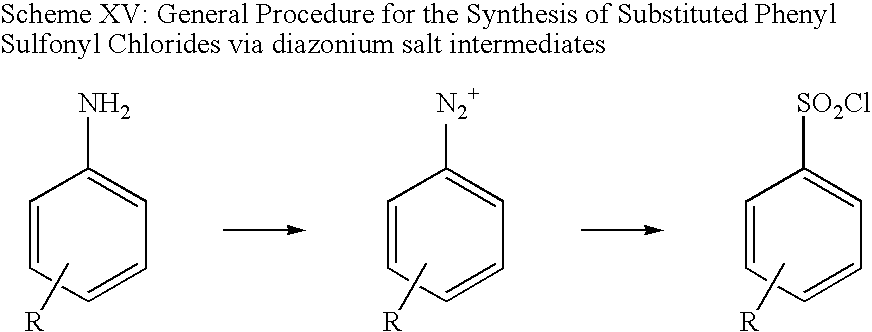


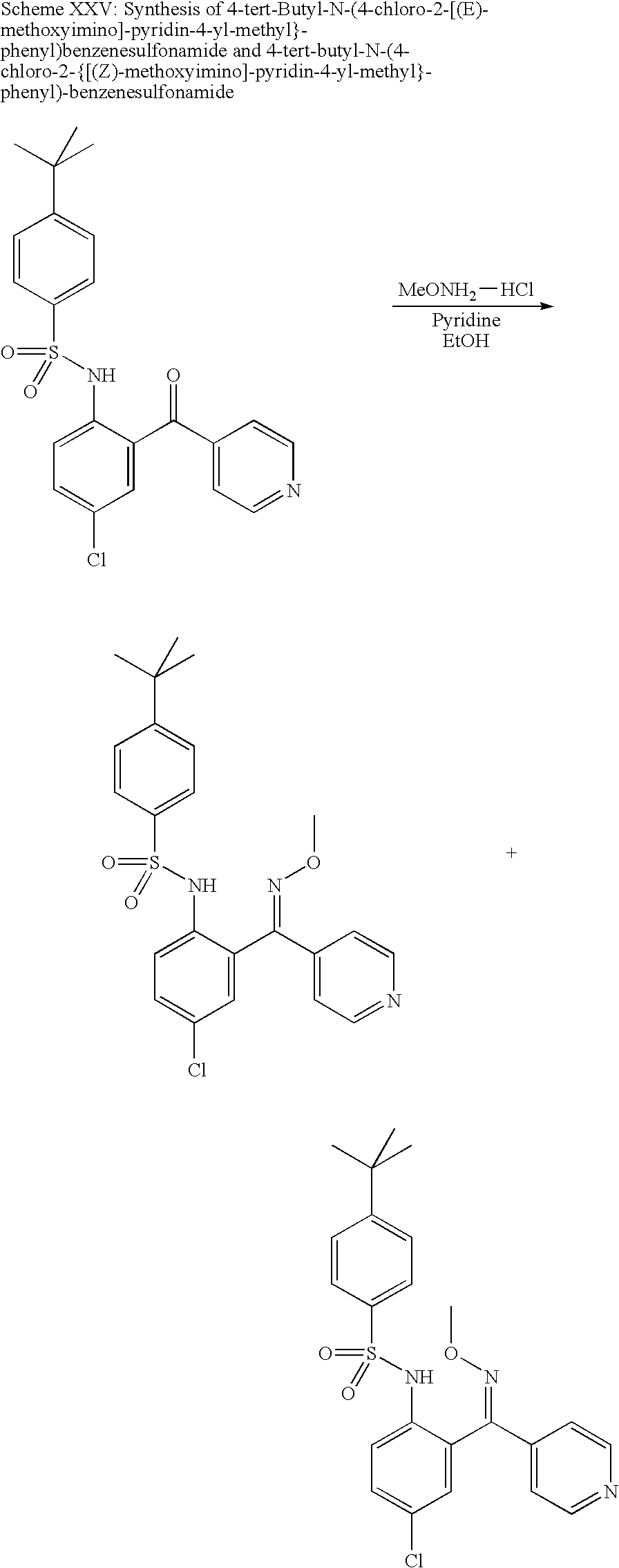
| TABLE 1 |
| Compounds with activity in either |
| or both of the chemotaxis assay and calcium |
| mobilization assays, with IC50 < 500 nM. |
 |
 |
 |
 |
 |
 |
 |
 |
 |
 |
 |
 |
 |
 |
 |
 |
| TABLE 2 |
| Compounds with activity in either |
| or both of the chemotaxis assay and calcium |
| mobilization assays, with IC50 < 2000 nM. |
 |
 |
 |
 |
 |
 |
 |
| TABLE 3 |
| Compounds with activity in either |
| or both of the chemotaxis assay and calcium |
| mobilization assays, with 500 nM < IC50 < 5000 nM. |
 |
 |
 |
 |
 |
 |
 |
 |
| TABLE 4 |
| Compounds with activity in either |
| or both of the chemotaxis assay and calcium |
| mobilization assays, with 2000 nM < IC50 < 10000 nM (++) |
 |
 |
 |
 |
 |
 |
 |
 |
 |
 |
In Vivo Efficacy Studies
Claims (4)

Priority Applications (2)
| Application Number | Priority Date | Filing Date | Title |
|---|---|---|---|
| US11/596,147 US7932252B2 (en) | 2004-05-12 | 2005-05-12 | Aryl sulfonamides |
| US13/045,209 US20120101097A9 (en) | 2004-05-12 | 2011-03-10 | Aryl sulfonamides |
Applications Claiming Priority (6)
| Application Number | Priority Date | Filing Date | Title |
|---|---|---|---|
| US57056804P | 2004-05-12 | 2004-05-12 | |
| US57071004P | 2004-05-12 | 2004-05-12 | |
| US57056904P | 2004-05-12 | 2004-05-12 | |
| US57186804P | 2004-05-17 | 2004-05-17 | |
| US11/596,147 US7932252B2 (en) | 2004-05-12 | 2005-05-12 | Aryl sulfonamides |
| PCT/US2005/016544 WO2005113513A2 (en) | 2004-05-12 | 2005-05-12 | Aryl sulfonamides |
Publications (2)
| Publication Number | Publication Date |
|---|---|
| US20080161345A1 US20080161345A1 (en) | 2008-07-03 |
| US7932252B2 true US7932252B2 (en) | 2011-04-26 |
Family
ID=34969526
Family Applications (2)
| Application Number | Title | Priority Date | Filing Date |
|---|---|---|---|
| US11/596,147 Active 2026-11-05 US7932252B2 (en) | 2004-05-12 | 2005-05-12 | Aryl sulfonamides |
| US13/045,209 Abandoned US20120101097A9 (en) | 2004-05-12 | 2011-03-10 | Aryl sulfonamides |
Family Applications After (1)
| Application Number | Title | Priority Date | Filing Date |
|---|---|---|---|
| US13/045,209 Abandoned US20120101097A9 (en) | 2004-05-12 | 2011-03-10 | Aryl sulfonamides |
Country Status (8)
| Country | Link |
|---|---|
| US (2) | US7932252B2 (en) |
| EP (1) | EP1748989A2 (en) |
| JP (1) | JP2007537275A (en) |
| AU (1) | AU2005245401A1 (en) |
| CA (1) | CA2566387A1 (en) |
| IL (1) | IL179172A0 (en) |
| WO (1) | WO2005113513A2 (en) |
| ZA (1) | ZA200609362B (en) |
Cited By (3)
| Publication number | Priority date | Publication date | Assignee | Title |
|---|---|---|---|---|
| WO2014008417A1 (en) * | 2012-07-04 | 2014-01-09 | Concert Pharmaceuticals, Inc. | Deuterated vercirnon |
| US10532051B2 (en) | 2014-10-06 | 2020-01-14 | Chemocentryx, Inc. | Compositions and methods for treating inflammatory bowel disease using a combination therapy of small molecule inhibitors of C-C chemokine receptor 9 (CCR9) and anti-α4β7 integrin blocking antibodies |
| US10792360B1 (en) | 2019-11-21 | 2020-10-06 | Chemocentryx, Inc. | Compositions and methods for treating inflammatory bowel disease using CCR9 inhibitor and anti-TNF-alpha blocking antibodies |
Families Citing this family (32)
| Publication number | Priority date | Publication date | Assignee | Title |
|---|---|---|---|---|
| AU2005245401A1 (en) | 2004-05-12 | 2005-12-01 | Chemocentryx | Aryl sulfonamides |
| GB0526257D0 (en) | 2005-12-22 | 2006-02-01 | Novartis Ag | Organic compounds |
| US7718683B2 (en) | 2006-07-14 | 2010-05-18 | Chemocentryx, Inc. | Triazolyl phenyl benzenesulfonamides |
| CN101511800B (en) * | 2006-07-14 | 2013-02-27 | 坎莫森特里克斯公司 | Triazolyl phenyl benzenesulfonamides |
| WO2008010934A2 (en) * | 2006-07-14 | 2008-01-24 | Chemocentryx, Inc. | Triazolyl phenyl benzenesulfonamides |
| PE20080948A1 (en) * | 2006-07-25 | 2008-09-10 | Irm Llc | IMIDAZOLE DERIVATIVES AS MODULATORS OF THE HEDGEHOG PATH |
| US7776877B2 (en) | 2007-06-22 | 2010-08-17 | Chemocentryx, Inc. | N-(2-(hetaryl)aryl) arylsulfonamides and N-(2-(hetaryl) hetaryl arylsulfonamides |
| CA2765053C (en) | 2009-06-09 | 2015-08-18 | California Capital Equity, Llc | Isoquinoline, quinoline, and quinazoline derivatives as inhibitors of hedgehog signaling |
| ES2547072T3 (en) * | 2009-07-21 | 2015-10-01 | The Board Of Trustees Of The Leland Stanford Junior University | Heteroaryl benzamides, compositions and methods of use |
| MX337575B (en) | 2009-10-09 | 2016-03-10 | Zafgen Corp | Sulphone compounds for use in the treatment of obesity. |
| AU2011281037B2 (en) | 2010-07-22 | 2014-11-27 | Zafgen, Inc. | Tricyclic compounds and methods of making and using same |
| WO2012087630A1 (en) * | 2010-12-20 | 2012-06-28 | E.I. Du Pont De Nemours And Company | Pyridine and pyrimidine compounds for controlling invertebrate |
| WO2012103333A1 (en) * | 2011-01-26 | 2012-08-02 | Zafgen Corporation | Tetrazole compounds and methods of making and using same |
| SG194812A1 (en) | 2011-05-06 | 2013-12-30 | Zafgen Inc | Partially saturated tricyclic compounds and methods of making and using same |
| US9242997B2 (en) | 2011-05-06 | 2016-01-26 | Zafgen, Inc. | Tricyclic pyrazole sulphonamide compunds and methods of making and using same |
| CN103748094B (en) | 2011-05-06 | 2016-06-29 | 扎夫根股份有限公司 | Tricyclic sulfonamide compounds and methods for their preparation and use |
| WO2013016156A1 (en) | 2011-07-22 | 2013-01-31 | Glaxo Group Limited | Polymorphic forms of the sodium salt of 4-tert- butyl -n-[4-chloro-2-(1-oxy-pyridine-4-carbonyl)-phenyl]-benzene sulfonamide |
| CN103841971B (en) * | 2011-07-22 | 2016-09-14 | 坎莫森特里克斯公司 | Polymorphic form of the sodium salt of 4-tert-butyl-N-[4-chloro-2-(1-oxy-pyridine-4-carbonyl)-phenyl]-benzenesulfonamide |
| PL2748146T3 (en) * | 2011-07-22 | 2017-09-29 | Chemocentryx, Inc. | A crystalline form of the sodium salt of 4-tert-butyl-n-[4-chloro-2-(1-oxy-pyridine-4-carbonyl)-phenyl]-benzene sulfonamide |
| WO2013109735A1 (en) | 2012-01-18 | 2013-07-25 | Zafgen, Inc. | Tricyclic sulfone compounds and methods of making and using same |
| BR112014017673A8 (en) | 2012-01-18 | 2017-07-11 | Zafgen Inc | TRICYCLIC SULPHONAMIDE COMPOUNDS AND METHODS FOR MAKING AND USING THEM |
| RU2627268C2 (en) | 2012-02-29 | 2017-08-04 | Хемоцентрикс, Инк. | Aza-aryl-1-h-pyrazol-1-yl-sulphonamides |
| MX2015005733A (en) | 2012-11-05 | 2016-02-10 | Zafgen Inc | Tricyclic compounds for use in the treatment and/or control of obesity. |
| BR112015010196A2 (en) | 2012-11-05 | 2017-07-11 | Zafgen Inc | methods of treating liver disease |
| KR20150079952A (en) | 2012-11-05 | 2015-07-08 | 자프겐 인크. | Tricyclic compounds and methods of making and using same |
| EP3076968B1 (en) * | 2013-12-02 | 2019-04-17 | ChemoCentryx, Inc. | Ccr6 compounds |
| WO2015097121A1 (en) | 2013-12-23 | 2015-07-02 | Norgine B.V. | Compounds useful as ccr9 modulators |
| JP2017503772A (en) | 2013-12-23 | 2017-02-02 | ノージン ビーブイ | Benzenesulfonamide as a CCR9 inhibitor |
| BR112021025888A2 (en) | 2019-07-10 | 2022-04-26 | Chemocentryx Inc | Indanes as pd-l1 inhibitors |
| JP7736678B2 (en) | 2019-10-16 | 2025-09-09 | ケモセントリックス,インコーポレイティド | Heteroaryl-biphenyl amides for the treatment of pd-l1 disease |
| ES3064674T3 (en) | 2019-10-16 | 2026-04-28 | Chemocentryx Inc | Heteroaryl-biphenyl amines for the treatment of pd-l1 diseases |
| TWI904146B (en) * | 2020-03-31 | 2025-11-11 | 美商卡默森屈有限公司 | Compositions and methods for treating inflammatory bowel disease using ccr9 inhibitor and anti-il-23 blocking antibodies |
Citations (30)
| Publication number | Priority date | Publication date | Assignee | Title |
|---|---|---|---|---|
| DE3544409A1 (en) | 1984-12-21 | 1986-10-16 | VEB Fahlberg-List Chemische und pharmazeutische Fabriken, DDR 3013 Magdeburg | 2-Arylsulphonamido-benzo- and acetophenones and their oximes, processes for their preparation and their use in medicaments |
| WO1993009780A1 (en) | 1991-11-15 | 1993-05-27 | Byk Gulden Lomberg Chemische Fabrik Gmbh | Use of sulphonyl compounds |
| WO2001077087A1 (en) | 2000-04-07 | 2001-10-18 | Astrazeneca Ab | Novel compounds |
| US6403607B1 (en) | 1998-03-30 | 2002-06-11 | Hiroyoshi Hidaka | Sulfonamide derivatives and drugs containing the same as the active ingredient |
| WO2002092585A1 (en) | 2001-05-11 | 2002-11-21 | Biovitrum Ab | Novel, arylsusfonamide compounds for the treatment of obesity, type ii diabetes and cns-disorders |
| GB2376691A (en) * | 2000-06-01 | 2002-12-24 | Nippon Steel Chemical Co | Organic electroluminescent element material and organic electroluminescent element |
| WO2003045393A1 (en) * | 2001-11-30 | 2003-06-05 | F. Hoffmann-La Roche Ag | Piperazine derivatives for use as ccr-3 receptor antagonists in the treatment of asthma |
| WO2003068732A2 (en) | 2002-02-13 | 2003-08-21 | Glaxo Group Limited | Benzenesulfonamide derivatives and their use as dopamine d3 and d2 receptor liga ds |
| WO2003099773A1 (en) | 2002-05-24 | 2003-12-04 | Millennium Pharmaceuticals, Inc. | Ccr9 inhibitors and methods of use thereof |
| WO2004016221A2 (en) | 2002-08-15 | 2004-02-26 | Icagen, Inc | Sulfonamides as potassium channel blockers |
| WO2004058741A1 (en) | 2002-12-20 | 2004-07-15 | Merck & Co., Inc. | Triazole derivatives as inhibitors of 11-beta-hydroxysteroid dehydrogenase-1 |
| US20040167113A1 (en) | 2002-11-18 | 2004-08-26 | Solomon Ugashe | Bis-aryl sulfonamides |
| WO2004073634A2 (en) | 2003-02-20 | 2004-09-02 | Encysive Pharmaceuticals Inc. | Phenylenediamine urotensin-ii receptor antagonists and ccr-9 antagonists |
| WO2005004818A2 (en) | 2003-07-09 | 2005-01-20 | Imclone Systems Incorporated | Heterocyclic compounds and their use as anticancer agents |
| WO2005004810A2 (en) | 2003-07-02 | 2005-01-20 | Merck & Co., Inc. | Arylsulfonamide derivatives |
| WO2005007621A2 (en) | 2003-05-30 | 2005-01-27 | Rigel Pharmaceuticals, Inc. | Ubiquitin ligase inhibitors |
| US20050137193A1 (en) | 2002-11-18 | 2005-06-23 | Chemocentreyx | Aryl sulfonamides |
| WO2005080335A1 (en) | 2004-02-13 | 2005-09-01 | President And Fellows Of Harvard College | 3-3-di-substituted-oxindoles as inhibitors of translation initiation |
| WO2005113513A2 (en) | 2004-05-12 | 2005-12-01 | Chemocentryx | Aryl sulfonamides |
| US20060111351A1 (en) | 2002-11-18 | 2006-05-25 | Solomon Ungashe | Aryl sulfonamides |
| US20060173019A1 (en) | 2005-01-14 | 2006-08-03 | Solomon Ungashe | Heteroaryl sulfonamides and CCR2 |
| US20070021466A1 (en) | 2002-11-18 | 2007-01-25 | Solomon Ungashe | CCR2 inhibitors and methods of use thereof |
| WO2007014008A2 (en) | 2005-07-22 | 2007-02-01 | Glaxo Group Limted | Benzenesulfonamide inhibitor of ccr2 chemokine receptor |
| WO2007014054A2 (en) | 2005-07-22 | 2007-02-01 | Glaxo Group Limted | Benzenesulfonamide inhibitor of ccr2 chemokine receptor |
| US20070037794A1 (en) | 2005-01-14 | 2007-02-15 | Solomon Ungashe | Heteroaryl sulfonamides and CCR2 |
| US7227035B2 (en) | 2002-11-18 | 2007-06-05 | Chemocentryx | Bis-aryl sulfonamides |
| WO2008008375A2 (en) | 2006-07-14 | 2008-01-17 | Chemocentryx, Inc. | Triazolyl pyridyl benzenesulfonamides as ccr2 or ccr9 modulators for the treatment of inflammation |
| WO2008008374A2 (en) | 2006-07-14 | 2008-01-17 | Chemocentryx, Inc. | Ccr2 inhibitors and methods of use thereof |
| US20080039465A1 (en) | 2006-07-14 | 2008-02-14 | Charvat Trevor T | Triazolyl phenyl benzenesulfonamides |
| US7776877B2 (en) | 2007-06-22 | 2010-08-17 | Chemocentryx, Inc. | N-(2-(hetaryl)aryl) arylsulfonamides and N-(2-(hetaryl) hetaryl arylsulfonamides |
Family Cites Families (2)
| Publication number | Priority date | Publication date | Assignee | Title |
|---|---|---|---|---|
| US5956509A (en) * | 1995-08-18 | 1999-09-21 | Microsoft Corporation | System and method for performing remote requests with an on-line service network |
| EP0994862B1 (en) * | 1997-07-11 | 2005-06-01 | SmithKline Beecham plc | Sulphonamide derivatives being 5-ht6 receptor antagonists and process for their preparation |
-
2005
- 2005-05-12 AU AU2005245401A patent/AU2005245401A1/en not_active Abandoned
- 2005-05-12 JP JP2007513327A patent/JP2007537275A/en active Pending
- 2005-05-12 CA CA002566387A patent/CA2566387A1/en not_active Abandoned
- 2005-05-12 US US11/596,147 patent/US7932252B2/en active Active
- 2005-05-12 EP EP05747905A patent/EP1748989A2/en not_active Withdrawn
- 2005-05-12 WO PCT/US2005/016544 patent/WO2005113513A2/en not_active Ceased
-
2006
- 2006-11-09 IL IL179172A patent/IL179172A0/en unknown
- 2006-11-10 ZA ZA2006/09362A patent/ZA200609362B/en unknown
-
2011
- 2011-03-10 US US13/045,209 patent/US20120101097A9/en not_active Abandoned
Patent Citations (41)
| Publication number | Priority date | Publication date | Assignee | Title |
|---|---|---|---|---|
| DE3544409A1 (en) | 1984-12-21 | 1986-10-16 | VEB Fahlberg-List Chemische und pharmazeutische Fabriken, DDR 3013 Magdeburg | 2-Arylsulphonamido-benzo- and acetophenones and their oximes, processes for their preparation and their use in medicaments |
| WO1993009780A1 (en) | 1991-11-15 | 1993-05-27 | Byk Gulden Lomberg Chemische Fabrik Gmbh | Use of sulphonyl compounds |
| US6403607B1 (en) | 1998-03-30 | 2002-06-11 | Hiroyoshi Hidaka | Sulfonamide derivatives and drugs containing the same as the active ingredient |
| WO2001077087A1 (en) | 2000-04-07 | 2001-10-18 | Astrazeneca Ab | Novel compounds |
| GB2376691A (en) * | 2000-06-01 | 2002-12-24 | Nippon Steel Chemical Co | Organic electroluminescent element material and organic electroluminescent element |
| WO2002092585A1 (en) | 2001-05-11 | 2002-11-21 | Biovitrum Ab | Novel, arylsusfonamide compounds for the treatment of obesity, type ii diabetes and cns-disorders |
| WO2003045393A1 (en) * | 2001-11-30 | 2003-06-05 | F. Hoffmann-La Roche Ag | Piperazine derivatives for use as ccr-3 receptor antagonists in the treatment of asthma |
| WO2003068732A2 (en) | 2002-02-13 | 2003-08-21 | Glaxo Group Limited | Benzenesulfonamide derivatives and their use as dopamine d3 and d2 receptor liga ds |
| WO2003099773A1 (en) | 2002-05-24 | 2003-12-04 | Millennium Pharmaceuticals, Inc. | Ccr9 inhibitors and methods of use thereof |
| WO2004016221A2 (en) | 2002-08-15 | 2004-02-26 | Icagen, Inc | Sulfonamides as potassium channel blockers |
| US20040167113A1 (en) | 2002-11-18 | 2004-08-26 | Solomon Ugashe | Bis-aryl sulfonamides |
| US6939885B2 (en) | 2002-11-18 | 2005-09-06 | Chemocentryx | Aryl sulfonamides |
| US20070203131A1 (en) | 2002-11-18 | 2007-08-30 | Solomon Ungashe | Bis-aryl sulfonamides |
| US20040171654A1 (en) | 2002-11-18 | 2004-09-02 | Solomon Ugashe | Aryl sulfonamides |
| WO2004085384A2 (en) | 2002-11-18 | 2004-10-07 | Chemocentryx | Bis-aryl sulfonamides |
| US7227035B2 (en) | 2002-11-18 | 2007-06-05 | Chemocentryx | Bis-aryl sulfonamides |
| US20070021466A1 (en) | 2002-11-18 | 2007-01-25 | Solomon Ungashe | CCR2 inhibitors and methods of use thereof |
| US20060111351A1 (en) | 2002-11-18 | 2006-05-25 | Solomon Ungashe | Aryl sulfonamides |
| US20050137193A1 (en) | 2002-11-18 | 2005-06-23 | Chemocentreyx | Aryl sulfonamides |
| US20050165067A1 (en) | 2002-11-18 | 2005-07-28 | Chemocentryx | Aryl sulfonamides |
| WO2004058741A1 (en) | 2002-12-20 | 2004-07-15 | Merck & Co., Inc. | Triazole derivatives as inhibitors of 11-beta-hydroxysteroid dehydrogenase-1 |
| WO2004073634A2 (en) | 2003-02-20 | 2004-09-02 | Encysive Pharmaceuticals Inc. | Phenylenediamine urotensin-ii receptor antagonists and ccr-9 antagonists |
| WO2005007621A2 (en) | 2003-05-30 | 2005-01-27 | Rigel Pharmaceuticals, Inc. | Ubiquitin ligase inhibitors |
| WO2005004810A2 (en) | 2003-07-02 | 2005-01-20 | Merck & Co., Inc. | Arylsulfonamide derivatives |
| US20090048301A1 (en) | 2003-07-09 | 2009-02-19 | Imclone Systems Incorporated | Heterocyclic compounds and their use as anticancer agents |
| WO2005004818A2 (en) | 2003-07-09 | 2005-01-20 | Imclone Systems Incorporated | Heterocyclic compounds and their use as anticancer agents |
| WO2005080335A1 (en) | 2004-02-13 | 2005-09-01 | President And Fellows Of Harvard College | 3-3-di-substituted-oxindoles as inhibitors of translation initiation |
| WO2005113513A2 (en) | 2004-05-12 | 2005-12-01 | Chemocentryx | Aryl sulfonamides |
| US20060173019A1 (en) | 2005-01-14 | 2006-08-03 | Solomon Ungashe | Heteroaryl sulfonamides and CCR2 |
| US20070037794A1 (en) | 2005-01-14 | 2007-02-15 | Solomon Ungashe | Heteroaryl sulfonamides and CCR2 |
| WO2007014008A2 (en) | 2005-07-22 | 2007-02-01 | Glaxo Group Limted | Benzenesulfonamide inhibitor of ccr2 chemokine receptor |
| WO2007014054A2 (en) | 2005-07-22 | 2007-02-01 | Glaxo Group Limted | Benzenesulfonamide inhibitor of ccr2 chemokine receptor |
| WO2008008431A2 (en) | 2006-07-14 | 2008-01-17 | Chemocentryx, Inc. | Heteroaryl sulfonamides and ccr2/ccr9 |
| WO2008008375A2 (en) | 2006-07-14 | 2008-01-17 | Chemocentryx, Inc. | Triazolyl pyridyl benzenesulfonamides as ccr2 or ccr9 modulators for the treatment of inflammation |
| WO2008008374A2 (en) | 2006-07-14 | 2008-01-17 | Chemocentryx, Inc. | Ccr2 inhibitors and methods of use thereof |
| US20080039465A1 (en) | 2006-07-14 | 2008-02-14 | Charvat Trevor T | Triazolyl phenyl benzenesulfonamides |
| US20080039504A1 (en) | 2006-07-14 | 2008-02-14 | Charvat Trevor T | Triazolyl pyridyl benzenesulfonamides |
| US7718683B2 (en) | 2006-07-14 | 2010-05-18 | Chemocentryx, Inc. | Triazolyl phenyl benzenesulfonamides |
| US20100190762A1 (en) | 2006-07-14 | 2010-07-29 | Chemocentryx, Inc. | Triazolyl phenyl benzenesulfonamides |
| US20100234364A1 (en) * | 2006-07-14 | 2010-09-16 | Arindrajit Basak | Ccr2 inhibitors and methods of use thereof |
| US7776877B2 (en) | 2007-06-22 | 2010-08-17 | Chemocentryx, Inc. | N-(2-(hetaryl)aryl) arylsulfonamides and N-(2-(hetaryl) hetaryl arylsulfonamides |
Non-Patent Citations (11)
| Title |
|---|
| Charvat et al., U.S. Appl. No. 12/753,342, filed Apr. 2, 2010. |
| Charvat et al., U.S. Appl. No. 12/832,374, filed Jul. 8, 2010. |
| Cook, A. H. et al., "Sulfonamides Derived from Substituted Anilines", Journal of the Chemical Society, 182-185, 1945. * |
| International Application No. PCT/US2007/015808-Search Report; Jan. 30, 2008. |
| Maquestiau et al., Rapid Communications in Mass Spectrometry (1989), 3(9), 320-2. |
| Notice of Allowance U.S. Appl. No. 11/775,585, mailed Jan. 27, 2010, 9 pages. |
| PCT International Search Report; Mailing Date: Nov. 16, 2005; 7 pp. |
| PCT Written Opinion of the International Searching Authority; Mailing Date: Nov. 16, 2005; 8 pp. |
| Registry No. 349404-57-5, entered into Registry file on STN on Jul. 29, 2001. * |
| Registry No. 460334-45-6, entered into Registry file on STN on Oct. 10, 2002. * |
| Science IP Jun. 29, 2007-Search Report. |
Cited By (6)
| Publication number | Priority date | Publication date | Assignee | Title |
|---|---|---|---|---|
| WO2014008417A1 (en) * | 2012-07-04 | 2014-01-09 | Concert Pharmaceuticals, Inc. | Deuterated vercirnon |
| US9181190B2 (en) | 2012-07-04 | 2015-11-10 | Concert Pharmaceuticals, Inc. | Deuterated vercirnon |
| US10532051B2 (en) | 2014-10-06 | 2020-01-14 | Chemocentryx, Inc. | Compositions and methods for treating inflammatory bowel disease using a combination therapy of small molecule inhibitors of C-C chemokine receptor 9 (CCR9) and anti-α4β7 integrin blocking antibodies |
| US11020394B2 (en) | 2014-10-06 | 2021-06-01 | Chemocentryx, Inc. | Compositions and methods for treating inflammatory bowel disease using a combination therapy of small molecule inhibitors of C—C chemokine receptor type 9 (CCR9) and anti-α4β7 integrin blocking antibodies |
| US11045469B2 (en) | 2014-10-06 | 2021-06-29 | Chemocentryx, Inc. | Compositions and methods for treating inflammatory bowel disease using a combination therapy of small molecule inhibitors of C-C chemokine receptor type 9 (CCR9) and anti-α4β7 integrin blocking antibodies |
| US10792360B1 (en) | 2019-11-21 | 2020-10-06 | Chemocentryx, Inc. | Compositions and methods for treating inflammatory bowel disease using CCR9 inhibitor and anti-TNF-alpha blocking antibodies |
Also Published As
| Publication number | Publication date |
|---|---|
| WO2005113513A2 (en) | 2005-12-01 |
| WO2005113513A3 (en) | 2006-04-20 |
| CA2566387A1 (en) | 2005-12-01 |
| ZA200609362B (en) | 2008-04-30 |
| JP2007537275A (en) | 2007-12-20 |
| US20120101097A9 (en) | 2012-04-26 |
| EP1748989A2 (en) | 2007-02-07 |
| AU2005245401A1 (en) | 2005-12-01 |
| US20080161345A1 (en) | 2008-07-03 |
| US20110201610A1 (en) | 2011-08-18 |
| IL179172A0 (en) | 2007-03-08 |
Similar Documents
| Publication | Publication Date | Title |
|---|---|---|
| US7932252B2 (en) | Aryl sulfonamides | |
| US10364240B2 (en) | Aryl sulfonamides | |
| EP1562940B1 (en) | Aryl sulfonamides | |
| US7335653B2 (en) | Bis-aryl sulfonamides | |
| US20100234364A1 (en) | Ccr2 inhibitors and methods of use thereof | |
| US7683176B2 (en) | Triazolyl pyridyl benzenesulfonamides | |
| US20060173019A1 (en) | Heteroaryl sulfonamides and CCR2 | |
| US20060111351A1 (en) | Aryl sulfonamides | |
| US8642808B2 (en) | Bis-aryl sulfonamides | |
| US20180009797A1 (en) | Aza-aryl 1h-pyrazol-1-yl benzene sulfonamides |
Legal Events
| Date | Code | Title | Description |
|---|---|---|---|
| AS | Assignment |
Owner name: CHEMOCENTRYX, INC., CALIFORNIA Free format text: ASSIGNMENT OF ASSIGNORS INTEREST;ASSIGNORS:UNGASHE, SOLOMON;WRIGHT, JOHN JESSEN;PENNELL, ANDREW;REEL/FRAME:020086/0873;SIGNING DATES FROM 20070924 TO 20071008 Owner name: CHEMOCENTRYX, INC., CALIFORNIA Free format text: ASSIGNMENT OF ASSIGNORS INTEREST;ASSIGNORS:UNGASHE, SOLOMON;WRIGHT, JOHN JESSEN;PENNELL, ANDREW;SIGNING DATES FROM 20070924 TO 20071008;REEL/FRAME:020086/0873 |
|
| STCF | Information on status: patent grant |
Free format text: PATENTED CASE |
|
| CC | Certificate of correction | ||
| FEPP | Fee payment procedure |
Free format text: PAT HOLDER CLAIMS SMALL ENTITY STATUS, ENTITY STATUS SET TO SMALL (ORIGINAL EVENT CODE: LTOS); ENTITY STATUS OF PATENT OWNER: LARGE ENTITY |
|
| FPAY | Fee payment |
Year of fee payment: 4 |
|
| MAFP | Maintenance fee payment |
Free format text: PAYMENT OF MAINTENANCE FEE, 8TH YR, SMALL ENTITY (ORIGINAL EVENT CODE: M2552); ENTITY STATUS OF PATENT OWNER: SMALL ENTITY Year of fee payment: 8 |
|
| FEPP | Fee payment procedure |
Free format text: ENTITY STATUS SET TO UNDISCOUNTED (ORIGINAL EVENT CODE: BIG.); ENTITY STATUS OF PATENT OWNER: LARGE ENTITY |
|
| MAFP | Maintenance fee payment |
Free format text: PAYMENT OF MAINTENANCE FEE, 12TH YEAR, LARGE ENTITY (ORIGINAL EVENT CODE: M1553); ENTITY STATUS OF PATENT OWNER: LARGE ENTITY Year of fee payment: 12 |
|
| AS | Assignment |
Owner name: CHEMOCENTRYX, INC., CALIFORNIA Free format text: ASSIGNEE CHANGE OF ADDRESS;ASSIGNOR:CHEMOCENTRYX, INC.;REEL/FRAME:064144/0685 Effective date: 20230623 |