US7919227B2 - Positive resist composition and method of forming resist pattern - Google Patents
Positive resist composition and method of forming resist pattern Download PDFInfo
- Publication number
- US7919227B2 US7919227B2 US12/440,447 US44044707A US7919227B2 US 7919227 B2 US7919227 B2 US 7919227B2 US 44044707 A US44044707 A US 44044707A US 7919227 B2 US7919227 B2 US 7919227B2
- Authority
- US
- United States
- Prior art keywords
- group
- alkyl group
- lower alkyl
- structural unit
- acid
- Prior art date
- Legal status (The legal status is an assumption and is not a legal conclusion. Google has not performed a legal analysis and makes no representation as to the accuracy of the status listed.)
- Active, expires
Links
- 239000000203 mixture Substances 0.000 title claims abstract description 53
- 238000000034 method Methods 0.000 title claims description 21
- 125000000217 alkyl group Chemical group 0.000 claims abstract description 224
- 125000004435 hydrogen atom Chemical group [H]* 0.000 claims abstract description 92
- 239000002253 acid Substances 0.000 claims abstract description 87
- 125000005843 halogen group Chemical group 0.000 claims abstract description 50
- 239000011347 resin Substances 0.000 claims abstract description 45
- 229920005989 resin Polymers 0.000 claims abstract description 45
- 125000001153 fluoro group Chemical group F* 0.000 claims abstract description 40
- 229910052731 fluorine Inorganic materials 0.000 claims abstract description 25
- 239000003513 alkali Substances 0.000 claims abstract description 19
- 230000001965 increasing effect Effects 0.000 claims abstract description 8
- 230000009471 action Effects 0.000 claims abstract description 7
- -1 acrylate ester Chemical class 0.000 claims description 59
- 125000004122 cyclic group Chemical group 0.000 claims description 46
- 125000001931 aliphatic group Chemical group 0.000 claims description 43
- 150000002596 lactones Chemical class 0.000 claims description 12
- 239000000758 substrate Substances 0.000 claims description 12
- 125000004432 carbon atom Chemical group C* 0.000 description 100
- 125000003118 aryl group Chemical group 0.000 description 44
- 238000004090 dissolution Methods 0.000 description 36
- 230000002401 inhibitory effect Effects 0.000 description 35
- 125000001424 substituent group Chemical group 0.000 description 35
- 150000001875 compounds Chemical class 0.000 description 24
- 239000000243 solution Substances 0.000 description 23
- 125000002496 methyl group Chemical group [H]C([H])([H])* 0.000 description 20
- 239000000178 monomer Substances 0.000 description 20
- 125000003367 polycyclic group Chemical group 0.000 description 20
- 238000006243 chemical reaction Methods 0.000 description 19
- 125000002947 alkylene group Chemical group 0.000 description 18
- 239000002904 solvent Substances 0.000 description 16
- YMWUJEATGCHHMB-UHFFFAOYSA-N Dichloromethane Chemical compound ClCCl YMWUJEATGCHHMB-UHFFFAOYSA-N 0.000 description 15
- 230000015572 biosynthetic process Effects 0.000 description 14
- 125000006165 cyclic alkyl group Chemical group 0.000 description 14
- LZCLXQDLBQLTDK-UHFFFAOYSA-N ethyl 2-hydroxypropanoate Chemical compound CCOC(=O)C(C)O LZCLXQDLBQLTDK-UHFFFAOYSA-N 0.000 description 14
- LLHKCFNBLRBOGN-UHFFFAOYSA-N propylene glycol methyl ether acetate Chemical compound COCC(C)OC(C)=O LLHKCFNBLRBOGN-UHFFFAOYSA-N 0.000 description 14
- 229910052799 carbon Inorganic materials 0.000 description 13
- 150000002430 hydrocarbons Chemical class 0.000 description 13
- JGTNAGYHADQMCM-UHFFFAOYSA-M 1,1,2,2,3,3,4,4,4-nonafluorobutane-1-sulfonate Chemical compound [O-]S(=O)(=O)C(F)(F)C(F)(F)C(F)(F)C(F)(F)F JGTNAGYHADQMCM-UHFFFAOYSA-M 0.000 description 12
- YEJRWHAVMIAJKC-UHFFFAOYSA-N 4-Butyrolactone Chemical compound O=C1CCCO1 YEJRWHAVMIAJKC-UHFFFAOYSA-N 0.000 description 12
- ZMANZCXQSJIPKH-UHFFFAOYSA-N Triethylamine Chemical compound CCN(CC)CC ZMANZCXQSJIPKH-UHFFFAOYSA-N 0.000 description 12
- 150000001721 carbon Chemical group 0.000 description 11
- 125000002887 hydroxy group Chemical group [H]O* 0.000 description 11
- 125000004430 oxygen atom Chemical group O* 0.000 description 11
- XBWQFDNGNOOMDZ-UHFFFAOYSA-N 1,1,2,2,3,3,3-heptafluoropropane-1-sulfonic acid Chemical compound OS(=O)(=O)C(F)(F)C(F)(F)C(F)(F)F XBWQFDNGNOOMDZ-UHFFFAOYSA-N 0.000 description 10
- WEVYAHXRMPXWCK-UHFFFAOYSA-N Acetonitrile Chemical compound CC#N WEVYAHXRMPXWCK-UHFFFAOYSA-N 0.000 description 10
- ORILYTVJVMAKLC-UHFFFAOYSA-N adamantane Chemical compound C1C(C2)CC3CC1CC2C3 ORILYTVJVMAKLC-UHFFFAOYSA-N 0.000 description 10
- 239000007789 gas Substances 0.000 description 10
- 125000003545 alkoxy group Chemical group 0.000 description 9
- 150000007514 bases Chemical class 0.000 description 9
- 125000003178 carboxy group Chemical group [H]OC(*)=O 0.000 description 9
- 239000012046 mixed solvent Substances 0.000 description 9
- VLKZOEOYAKHREP-UHFFFAOYSA-N n-Hexane Chemical compound CCCCCC VLKZOEOYAKHREP-UHFFFAOYSA-N 0.000 description 9
- 239000000126 substance Substances 0.000 description 9
- ARXJGSRGQADJSQ-UHFFFAOYSA-N 1-methoxypropan-2-ol Chemical compound COCC(C)O ARXJGSRGQADJSQ-UHFFFAOYSA-N 0.000 description 8
- OZAIFHULBGXAKX-UHFFFAOYSA-N 2-(2-cyanopropan-2-yldiazenyl)-2-methylpropanenitrile Chemical compound N#CC(C)(C)N=NC(C)(C)C#N OZAIFHULBGXAKX-UHFFFAOYSA-N 0.000 description 8
- RTZKZFJDLAIYFH-UHFFFAOYSA-N Diethyl ether Chemical compound CCOCC RTZKZFJDLAIYFH-UHFFFAOYSA-N 0.000 description 8
- 125000001309 chloro group Chemical group Cl* 0.000 description 8
- 229920001577 copolymer Polymers 0.000 description 8
- 125000001495 ethyl group Chemical group [H]C([H])([H])C([H])([H])* 0.000 description 8
- 239000000463 material Substances 0.000 description 8
- 150000003839 salts Chemical class 0.000 description 8
- XLYOFNOQVPJJNP-UHFFFAOYSA-N water Substances O XLYOFNOQVPJJNP-UHFFFAOYSA-N 0.000 description 8
- 239000002585 base Substances 0.000 description 7
- 239000007795 chemical reaction product Substances 0.000 description 7
- 229910052801 chlorine Inorganic materials 0.000 description 7
- 125000004093 cyano group Chemical group *C#N 0.000 description 7
- 230000000694 effects Effects 0.000 description 7
- 229940116333 ethyl lactate Drugs 0.000 description 7
- 239000003960 organic solvent Substances 0.000 description 7
- 125000001997 phenyl group Chemical group [H]C1=C([H])C([H])=C(*)C([H])=C1[H] 0.000 description 7
- ZCYVEMRRCGMTRW-UHFFFAOYSA-N 7553-56-2 Chemical group [I] ZCYVEMRRCGMTRW-UHFFFAOYSA-N 0.000 description 6
- CSCPPACGZOOCGX-UHFFFAOYSA-N Acetone Chemical compound CC(C)=O CSCPPACGZOOCGX-UHFFFAOYSA-N 0.000 description 6
- WKBOTKDWSSQWDR-UHFFFAOYSA-N Bromine atom Chemical group [Br] WKBOTKDWSSQWDR-UHFFFAOYSA-N 0.000 description 6
- 239000004215 Carbon black (E152) Substances 0.000 description 6
- RGSFGYAAUTVSQA-UHFFFAOYSA-N Cyclopentane Chemical compound C1CCCC1 RGSFGYAAUTVSQA-UHFFFAOYSA-N 0.000 description 6
- WSFSSNUMVMOOMR-UHFFFAOYSA-N Formaldehyde Chemical compound O=C WSFSSNUMVMOOMR-UHFFFAOYSA-N 0.000 description 6
- OKKJLVBELUTLKV-UHFFFAOYSA-N Methanol Chemical compound OC OKKJLVBELUTLKV-UHFFFAOYSA-N 0.000 description 6
- YXFVVABEGXRONW-UHFFFAOYSA-N Toluene Chemical compound CC1=CC=CC=C1 YXFVVABEGXRONW-UHFFFAOYSA-N 0.000 description 6
- ZQZBBQNLHWBXPW-UHFFFAOYSA-N chloromethoxycyclopentane Chemical compound ClCOC1CCCC1 ZQZBBQNLHWBXPW-UHFFFAOYSA-N 0.000 description 6
- 230000000052 comparative effect Effects 0.000 description 6
- 229930195733 hydrocarbon Natural products 0.000 description 6
- 238000001459 lithography Methods 0.000 description 6
- 125000002950 monocyclic group Chemical group 0.000 description 6
- 230000005855 radiation Effects 0.000 description 6
- YGSDEFSMJLZEOE-UHFFFAOYSA-N salicylic acid Chemical compound OC(=O)C1=CC=CC=C1O YGSDEFSMJLZEOE-UHFFFAOYSA-N 0.000 description 6
- WGTYBPLFGIVFAS-UHFFFAOYSA-M tetramethylammonium hydroxide Chemical compound [OH-].C[N+](C)(C)C WGTYBPLFGIVFAS-UHFFFAOYSA-M 0.000 description 6
- GETQZCLCWQTVFV-UHFFFAOYSA-N trimethylamine Chemical compound CN(C)C GETQZCLCWQTVFV-UHFFFAOYSA-N 0.000 description 6
- CERQOIWHTDAKMF-UHFFFAOYSA-N Methacrylic acid Chemical compound CC(=C)C(O)=O CERQOIWHTDAKMF-UHFFFAOYSA-N 0.000 description 5
- 125000005073 adamantyl group Chemical group C12(CC3CC(CC(C1)C3)C2)* 0.000 description 5
- 229940125904 compound 1 Drugs 0.000 description 5
- 238000010894 electron beam technology Methods 0.000 description 5
- 238000011156 evaluation Methods 0.000 description 5
- 125000002768 hydroxyalkyl group Chemical group 0.000 description 5
- 229910052740 iodine Inorganic materials 0.000 description 5
- 239000010410 layer Substances 0.000 description 5
- 238000002156 mixing Methods 0.000 description 5
- 125000001624 naphthyl group Chemical group 0.000 description 5
- 239000000047 product Substances 0.000 description 5
- 238000003786 synthesis reaction Methods 0.000 description 5
- VEXZGXHMUGYJMC-UHFFFAOYSA-N Hydrochloric acid Chemical compound Cl VEXZGXHMUGYJMC-UHFFFAOYSA-N 0.000 description 4
- CPELXLSAUQHCOX-UHFFFAOYSA-N Hydrogen bromide Chemical compound Br CPELXLSAUQHCOX-UHFFFAOYSA-N 0.000 description 4
- CSNNHWWHGAXBCP-UHFFFAOYSA-L Magnesium sulfate Chemical compound [Mg+2].[O-][S+2]([O-])([O-])[O-] CSNNHWWHGAXBCP-UHFFFAOYSA-L 0.000 description 4
- IMNFDUFMRHMDMM-UHFFFAOYSA-N N-Heptane Chemical compound CCCCCCC IMNFDUFMRHMDMM-UHFFFAOYSA-N 0.000 description 4
- JUJWROOIHBZHMG-UHFFFAOYSA-N Pyridine Chemical compound C1=CC=NC=C1 JUJWROOIHBZHMG-UHFFFAOYSA-N 0.000 description 4
- CDBYLPFSWZWCQE-UHFFFAOYSA-L Sodium Carbonate Chemical compound [Na+].[Na+].[O-]C([O-])=O CDBYLPFSWZWCQE-UHFFFAOYSA-L 0.000 description 4
- 125000005907 alkyl ester group Chemical group 0.000 description 4
- 150000001450 anions Chemical group 0.000 description 4
- 239000007864 aqueous solution Substances 0.000 description 4
- XCIXKGXIYUWCLL-UHFFFAOYSA-N cyclopentanol Chemical compound OC1CCCC1 XCIXKGXIYUWCLL-UHFFFAOYSA-N 0.000 description 4
- 125000001511 cyclopentyl group Chemical group [H]C1([H])C([H])([H])C([H])([H])C([H])(*)C1([H])[H] 0.000 description 4
- 238000004821 distillation Methods 0.000 description 4
- CATSNJVOTSVZJV-UHFFFAOYSA-N heptan-2-one Chemical compound CCCCCC(C)=O CATSNJVOTSVZJV-UHFFFAOYSA-N 0.000 description 4
- IXCSERBJSXMMFS-UHFFFAOYSA-N hydrogen chloride Substances Cl.Cl IXCSERBJSXMMFS-UHFFFAOYSA-N 0.000 description 4
- 229910000041 hydrogen chloride Inorganic materials 0.000 description 4
- 238000004519 manufacturing process Methods 0.000 description 4
- XTAZYLNFDRKIHJ-UHFFFAOYSA-N n,n-dioctyloctan-1-amine Chemical compound CCCCCCCCN(CCCCCCCC)CCCCCCCC XTAZYLNFDRKIHJ-UHFFFAOYSA-N 0.000 description 4
- OOHAUGDGCWURIT-UHFFFAOYSA-N n,n-dipentylpentan-1-amine Chemical compound CCCCCN(CCCCC)CCCCC OOHAUGDGCWURIT-UHFFFAOYSA-N 0.000 description 4
- 229910052757 nitrogen Inorganic materials 0.000 description 4
- UMRZSTCPUPJPOJ-KNVOCYPGSA-N norbornane Chemical compound C1C[C@H]2CC[C@@H]1C2 UMRZSTCPUPJPOJ-KNVOCYPGSA-N 0.000 description 4
- 125000000962 organic group Chemical group 0.000 description 4
- 239000002798 polar solvent Substances 0.000 description 4
- BWHMMNNQKKPAPP-UHFFFAOYSA-L potassium carbonate Chemical compound [K+].[K+].[O-]C([O-])=O BWHMMNNQKKPAPP-UHFFFAOYSA-L 0.000 description 4
- 239000002244 precipitate Substances 0.000 description 4
- 229920006395 saturated elastomer Polymers 0.000 description 4
- 230000035945 sensitivity Effects 0.000 description 4
- 238000003756 stirring Methods 0.000 description 4
- 125000000999 tert-butyl group Chemical group [H]C([H])([H])C(*)(C([H])([H])[H])C([H])([H])[H] 0.000 description 4
- VZGDMQKNWNREIO-UHFFFAOYSA-N tetrachloromethane Chemical compound ClC(Cl)(Cl)Cl VZGDMQKNWNREIO-UHFFFAOYSA-N 0.000 description 4
- SMZOUWXMTYCWNB-UHFFFAOYSA-N 2-(2-methoxy-5-methylphenyl)ethanamine Chemical compound COC1=CC=C(C)C=C1CCN SMZOUWXMTYCWNB-UHFFFAOYSA-N 0.000 description 3
- ZWEHNKRNPOVVGH-UHFFFAOYSA-N 2-Butanone Chemical compound CCC(C)=O ZWEHNKRNPOVVGH-UHFFFAOYSA-N 0.000 description 3
- NIXOWILDQLNWCW-UHFFFAOYSA-N 2-Propenoic acid Natural products OC(=O)C=C NIXOWILDQLNWCW-UHFFFAOYSA-N 0.000 description 3
- QTBSBXVTEAMEQO-UHFFFAOYSA-N Acetic acid Chemical compound CC(O)=O QTBSBXVTEAMEQO-UHFFFAOYSA-N 0.000 description 3
- QGZKDVFQNNGYKY-UHFFFAOYSA-N Ammonia Chemical compound N QGZKDVFQNNGYKY-UHFFFAOYSA-N 0.000 description 3
- UHOVQNZJYSORNB-UHFFFAOYSA-N Benzene Chemical compound C1=CC=CC=C1 UHOVQNZJYSORNB-UHFFFAOYSA-N 0.000 description 3
- YXHKONLOYHBTNS-UHFFFAOYSA-N Diazomethane Chemical compound C=[N+]=[N-] YXHKONLOYHBTNS-UHFFFAOYSA-N 0.000 description 3
- XEKOWRVHYACXOJ-UHFFFAOYSA-N Ethyl acetate Chemical compound CCOC(C)=O XEKOWRVHYACXOJ-UHFFFAOYSA-N 0.000 description 3
- LYCAIKOWRPUZTN-UHFFFAOYSA-N Ethylene glycol Chemical compound OCCO LYCAIKOWRPUZTN-UHFFFAOYSA-N 0.000 description 3
- ZMXDDKWLCZADIW-UHFFFAOYSA-N N,N-Dimethylformamide Chemical compound CN(C)C=O ZMXDDKWLCZADIW-UHFFFAOYSA-N 0.000 description 3
- 229930040373 Paraformaldehyde Natural products 0.000 description 3
- KWYUFKZDYYNOTN-UHFFFAOYSA-M Potassium hydroxide Chemical compound [OH-].[K+] KWYUFKZDYYNOTN-UHFFFAOYSA-M 0.000 description 3
- DNIAPMSPPWPWGF-UHFFFAOYSA-N Propylene glycol Chemical compound CC(O)CO DNIAPMSPPWPWGF-UHFFFAOYSA-N 0.000 description 3
- FAPWRFPIFSIZLT-UHFFFAOYSA-M Sodium chloride Chemical compound [Na+].[Cl-] FAPWRFPIFSIZLT-UHFFFAOYSA-M 0.000 description 3
- HEMHJVSKTPXQMS-UHFFFAOYSA-M Sodium hydroxide Chemical compound [OH-].[Na+] HEMHJVSKTPXQMS-UHFFFAOYSA-M 0.000 description 3
- 150000001252 acrylic acid derivatives Chemical class 0.000 description 3
- 239000000654 additive Substances 0.000 description 3
- 150000003973 alkyl amines Chemical class 0.000 description 3
- KRKNYBCHXYNGOX-UHFFFAOYSA-N citric acid Chemical compound OC(=O)CC(O)(C(O)=O)CC(O)=O KRKNYBCHXYNGOX-UHFFFAOYSA-N 0.000 description 3
- 239000011248 coating agent Substances 0.000 description 3
- 238000000576 coating method Methods 0.000 description 3
- 230000007423 decrease Effects 0.000 description 3
- ZBCBWPMODOFKDW-UHFFFAOYSA-N diethanolamine Chemical compound OCCNCCO ZBCBWPMODOFKDW-UHFFFAOYSA-N 0.000 description 3
- MTHSVFCYNBDYFN-UHFFFAOYSA-N diethylene glycol Chemical compound OCCOCCO MTHSVFCYNBDYFN-UHFFFAOYSA-N 0.000 description 3
- USIUVYZYUHIAEV-UHFFFAOYSA-N diphenyl ether Chemical compound C=1C=CC=CC=1OC1=CC=CC=C1 USIUVYZYUHIAEV-UHFFFAOYSA-N 0.000 description 3
- 238000001035 drying Methods 0.000 description 3
- 150000002148 esters Chemical class 0.000 description 3
- 238000001704 evaporation Methods 0.000 description 3
- 238000001914 filtration Methods 0.000 description 3
- 238000003682 fluorination reaction Methods 0.000 description 3
- 238000005227 gel permeation chromatography Methods 0.000 description 3
- DMEGYFMYUHOHGS-UHFFFAOYSA-N heptamethylene Natural products C1CCCCCC1 DMEGYFMYUHOHGS-UHFFFAOYSA-N 0.000 description 3
- 239000003112 inhibitor Substances 0.000 description 3
- 239000007788 liquid Substances 0.000 description 3
- 238000005259 measurement Methods 0.000 description 3
- 125000004108 n-butyl group Chemical group [H]C([H])([H])C([H])([H])C([H])([H])C([H])([H])* 0.000 description 3
- 125000004433 nitrogen atom Chemical group N* 0.000 description 3
- 239000012044 organic layer Substances 0.000 description 3
- FJKROLUGYXJWQN-UHFFFAOYSA-N papa-hydroxy-benzoic acid Natural products OC(=O)C1=CC=C(O)C=C1 FJKROLUGYXJWQN-UHFFFAOYSA-N 0.000 description 3
- 229920002866 paraformaldehyde Polymers 0.000 description 3
- ACVYVLVWPXVTIT-UHFFFAOYSA-N phosphinic acid Chemical compound O[PH2]=O ACVYVLVWPXVTIT-UHFFFAOYSA-N 0.000 description 3
- 229910052698 phosphorus Inorganic materials 0.000 description 3
- 239000011574 phosphorus Substances 0.000 description 3
- 229920000642 polymer Polymers 0.000 description 3
- 238000006116 polymerization reaction Methods 0.000 description 3
- 229960004889 salicylic acid Drugs 0.000 description 3
- 239000004065 semiconductor Substances 0.000 description 3
- 238000006467 substitution reaction Methods 0.000 description 3
- 150000005846 sugar alcohols Polymers 0.000 description 3
- 238000011282 treatment Methods 0.000 description 3
- 125000005270 trialkylamine group Chemical group 0.000 description 3
- IMFACGCPASFAPR-UHFFFAOYSA-N tributylamine Chemical compound CCCCN(CCCC)CCCC IMFACGCPASFAPR-UHFFFAOYSA-N 0.000 description 3
- KVNYFPKFSJIPBJ-UHFFFAOYSA-N 1,2-diethylbenzene Chemical compound CCC1=CC=CC=C1CC KVNYFPKFSJIPBJ-UHFFFAOYSA-N 0.000 description 2
- DURPTKYDGMDSBL-UHFFFAOYSA-N 1-butoxybutane Chemical compound CCCCOCCCC DURPTKYDGMDSBL-UHFFFAOYSA-N 0.000 description 2
- 238000001644 13C nuclear magnetic resonance spectroscopy Methods 0.000 description 2
- FFWSICBKRCICMR-UHFFFAOYSA-N 5-methyl-2-hexanone Chemical compound CC(C)CCC(C)=O FFWSICBKRCICMR-UHFFFAOYSA-N 0.000 description 2
- IJGRMHOSHXDMSA-UHFFFAOYSA-N Atomic nitrogen Chemical compound N#N IJGRMHOSHXDMSA-UHFFFAOYSA-N 0.000 description 2
- OKTJSMMVPCPJKN-UHFFFAOYSA-N Carbon Chemical compound [C] OKTJSMMVPCPJKN-UHFFFAOYSA-N 0.000 description 2
- HEDRZPFGACZZDS-UHFFFAOYSA-N Chloroform Chemical compound ClC(Cl)Cl HEDRZPFGACZZDS-UHFFFAOYSA-N 0.000 description 2
- XDTMQSROBMDMFD-UHFFFAOYSA-N Cyclohexane Chemical compound C1CCCCC1 XDTMQSROBMDMFD-UHFFFAOYSA-N 0.000 description 2
- IAZDPXIOMUYVGZ-UHFFFAOYSA-N Dimethylsulphoxide Chemical compound CS(C)=O IAZDPXIOMUYVGZ-UHFFFAOYSA-N 0.000 description 2
- YNQLUTRBYVCPMQ-UHFFFAOYSA-N Ethylbenzene Chemical compound CCC1=CC=CC=C1 YNQLUTRBYVCPMQ-UHFFFAOYSA-N 0.000 description 2
- UFHFLCQGNIYNRP-UHFFFAOYSA-N Hydrogen Chemical compound [H][H] UFHFLCQGNIYNRP-UHFFFAOYSA-N 0.000 description 2
- OFOBLEOULBTSOW-UHFFFAOYSA-N Malonic acid Chemical compound OC(=O)CC(O)=O OFOBLEOULBTSOW-UHFFFAOYSA-N 0.000 description 2
- CTQNGGLPUBDAKN-UHFFFAOYSA-N O-Xylene Chemical compound CC1=CC=CC=C1C CTQNGGLPUBDAKN-UHFFFAOYSA-N 0.000 description 2
- PWATWSYOIIXYMA-UHFFFAOYSA-N Pentylbenzene Chemical compound CCCCCC1=CC=CC=C1 PWATWSYOIIXYMA-UHFFFAOYSA-N 0.000 description 2
- NBIIXXVUZAFLBC-UHFFFAOYSA-N Phosphoric acid Chemical compound OP(O)(O)=O NBIIXXVUZAFLBC-UHFFFAOYSA-N 0.000 description 2
- ABLZXFCXXLZCGV-UHFFFAOYSA-N Phosphorous acid Chemical compound OP(O)=O ABLZXFCXXLZCGV-UHFFFAOYSA-N 0.000 description 2
- GLUUGHFHXGJENI-UHFFFAOYSA-N Piperazine Chemical compound C1CNCCN1 GLUUGHFHXGJENI-UHFFFAOYSA-N 0.000 description 2
- NQRYJNQNLNOLGT-UHFFFAOYSA-N Piperidine Chemical compound C1CCNCC1 NQRYJNQNLNOLGT-UHFFFAOYSA-N 0.000 description 2
- 239000004793 Polystyrene Substances 0.000 description 2
- XUIMIQQOPSSXEZ-UHFFFAOYSA-N Silicon Chemical compound [Si] XUIMIQQOPSSXEZ-UHFFFAOYSA-N 0.000 description 2
- 235000002597 Solanum melongena Nutrition 0.000 description 2
- 244000061458 Solanum melongena Species 0.000 description 2
- WYURNTSHIVDZCO-UHFFFAOYSA-N Tetrahydrofuran Chemical compound C1CCOC1 WYURNTSHIVDZCO-UHFFFAOYSA-N 0.000 description 2
- 230000002411 adverse Effects 0.000 description 2
- 125000005233 alkylalcohol group Chemical group 0.000 description 2
- 150000001412 amines Chemical class 0.000 description 2
- RDOXTESZEPMUJZ-UHFFFAOYSA-N anisole Chemical compound COC1=CC=CC=C1 RDOXTESZEPMUJZ-UHFFFAOYSA-N 0.000 description 2
- 125000002029 aromatic hydrocarbon group Chemical group 0.000 description 2
- 150000004945 aromatic hydrocarbons Chemical class 0.000 description 2
- 125000004429 atom Chemical group 0.000 description 2
- WPYMKLBDIGXBTP-UHFFFAOYSA-N benzoic acid Chemical compound OC(=O)C1=CC=CC=C1 WPYMKLBDIGXBTP-UHFFFAOYSA-N 0.000 description 2
- 125000006267 biphenyl group Chemical group 0.000 description 2
- 125000005708 carbonyloxy group Chemical group [*:2]OC([*:1])=O 0.000 description 2
- 150000001732 carboxylic acid derivatives Chemical class 0.000 description 2
- 239000012295 chemical reaction liquid Substances 0.000 description 2
- 238000003776 cleavage reaction Methods 0.000 description 2
- 229940125782 compound 2 Drugs 0.000 description 2
- 238000002425 crystallisation Methods 0.000 description 2
- 230000008025 crystallization Effects 0.000 description 2
- RWGFKTVRMDUZSP-UHFFFAOYSA-N cumene Chemical compound CC(C)C1=CC=CC=C1 RWGFKTVRMDUZSP-UHFFFAOYSA-N 0.000 description 2
- JHIVVAPYMSGYDF-UHFFFAOYSA-N cyclohexanone Chemical compound O=C1CCCCC1 JHIVVAPYMSGYDF-UHFFFAOYSA-N 0.000 description 2
- 238000011161 development Methods 0.000 description 2
- 238000010586 diagram Methods 0.000 description 2
- CSYSRRCOBYEGPI-UHFFFAOYSA-N diazo(sulfonyl)methane Chemical class [N-]=[N+]=C=S(=O)=O CSYSRRCOBYEGPI-UHFFFAOYSA-N 0.000 description 2
- MHDVGSVTJDSBDK-UHFFFAOYSA-N dibenzyl ether Chemical compound C=1C=CC=CC=1COCC1=CC=CC=C1 MHDVGSVTJDSBDK-UHFFFAOYSA-N 0.000 description 2
- 238000010494 dissociation reaction Methods 0.000 description 2
- 230000005593 dissociations Effects 0.000 description 2
- 239000004210 ether based solvent Substances 0.000 description 2
- 230000002349 favourable effect Effects 0.000 description 2
- 125000003983 fluorenyl group Chemical group C1(=CC=CC=2C3=CC=CC=C3CC12)* 0.000 description 2
- 230000009477 glass transition Effects 0.000 description 2
- 229910052736 halogen Inorganic materials 0.000 description 2
- 150000002367 halogens Chemical class 0.000 description 2
- 125000005842 heteroatom Chemical group 0.000 description 2
- 150000002391 heterocyclic compounds Chemical class 0.000 description 2
- VKYKSIONXSXAKP-UHFFFAOYSA-N hexamethylenetetramine Chemical compound C1N(C2)CN3CN1CN2C3 VKYKSIONXSXAKP-UHFFFAOYSA-N 0.000 description 2
- 239000001257 hydrogen Substances 0.000 description 2
- 229910052739 hydrogen Inorganic materials 0.000 description 2
- 229910000042 hydrogen bromide Inorganic materials 0.000 description 2
- 125000000959 isobutyl group Chemical group [H]C([H])([H])C([H])(C([H])([H])[H])C([H])([H])* 0.000 description 2
- 125000001449 isopropyl group Chemical group [H]C([H])([H])C([H])(*)C([H])([H])[H] 0.000 description 2
- 229910052943 magnesium sulfate Inorganic materials 0.000 description 2
- 235000019341 magnesium sulphate Nutrition 0.000 description 2
- 238000000655 nuclear magnetic resonance spectrum Methods 0.000 description 2
- 229920002223 polystyrene Polymers 0.000 description 2
- 229910000027 potassium carbonate Inorganic materials 0.000 description 2
- 235000011181 potassium carbonates Nutrition 0.000 description 2
- 230000008569 process Effects 0.000 description 2
- 125000001436 propyl group Chemical group [H]C([*])([H])C([H])([H])C([H])([H])[H] 0.000 description 2
- 238000000746 purification Methods 0.000 description 2
- UMJSCPRVCHMLSP-UHFFFAOYSA-N pyridine Natural products COC1=CC=CN=C1 UMJSCPRVCHMLSP-UHFFFAOYSA-N 0.000 description 2
- 230000035484 reaction time Effects 0.000 description 2
- 229930195734 saturated hydrocarbon Natural products 0.000 description 2
- 230000007017 scission Effects 0.000 description 2
- 229910052710 silicon Inorganic materials 0.000 description 2
- 239000010703 silicon Substances 0.000 description 2
- 229910000029 sodium carbonate Inorganic materials 0.000 description 2
- 235000017550 sodium carbonate Nutrition 0.000 description 2
- 238000003860 storage Methods 0.000 description 2
- 229910052717 sulfur Inorganic materials 0.000 description 2
- 125000004434 sulfur atom Chemical group 0.000 description 2
- 238000002076 thermal analysis method Methods 0.000 description 2
- ITMCEJHCFYSIIV-UHFFFAOYSA-M triflate Chemical compound [O-]S(=O)(=O)C(F)(F)F ITMCEJHCFYSIIV-UHFFFAOYSA-M 0.000 description 2
- LWIHDJKSTIGBAC-UHFFFAOYSA-K tripotassium phosphate Chemical compound [K+].[K+].[K+].[O-]P([O-])([O-])=O LWIHDJKSTIGBAC-UHFFFAOYSA-K 0.000 description 2
- 238000005406 washing Methods 0.000 description 2
- 239000008096 xylene Substances 0.000 description 2
- DTGKSKDOIYIVQL-WEDXCCLWSA-N (+)-borneol Chemical group C1C[C@@]2(C)[C@@H](O)C[C@@H]1C2(C)C DTGKSKDOIYIVQL-WEDXCCLWSA-N 0.000 description 1
- VISTUMYXGYLTFC-UHFFFAOYSA-N (1-cyanobutylideneamino) propane-1-sulfonate Chemical compound CCCC(C#N)=NOS(=O)(=O)CCC VISTUMYXGYLTFC-UHFFFAOYSA-N 0.000 description 1
- YQCKLEXBDDKTRB-UHFFFAOYSA-N (1-cyanopropylideneamino) ethanesulfonate Chemical compound CCC(C#N)=NOS(=O)(=O)CC YQCKLEXBDDKTRB-UHFFFAOYSA-N 0.000 description 1
- KQTKIMROWOIVHW-UHFFFAOYSA-N (4-hydroxynaphthalen-1-yl)-dimethylsulfanium;trifluoromethanesulfonate Chemical compound [O-]S(=O)(=O)C(F)(F)F.C1=CC=C2C([S+](C)C)=CC=C(O)C2=C1 KQTKIMROWOIVHW-UHFFFAOYSA-N 0.000 description 1
- WBUSZOLVSDXDOC-UHFFFAOYSA-M (4-methoxyphenyl)-diphenylsulfanium;trifluoromethanesulfonate Chemical compound [O-]S(=O)(=O)C(F)(F)F.C1=CC(OC)=CC=C1[S+](C=1C=CC=CC=1)C1=CC=CC=C1 WBUSZOLVSDXDOC-UHFFFAOYSA-M 0.000 description 1
- AWOATHYNVXCSGP-UHFFFAOYSA-M (4-methylphenyl)-diphenylsulfanium;trifluoromethanesulfonate Chemical compound [O-]S(=O)(=O)C(F)(F)F.C1=CC(C)=CC=C1[S+](C=1C=CC=CC=1)C1=CC=CC=C1 AWOATHYNVXCSGP-UHFFFAOYSA-M 0.000 description 1
- BJEPYKJPYRNKOW-REOHCLBHSA-N (S)-malic acid Chemical compound OC(=O)[C@@H](O)CC(O)=O BJEPYKJPYRNKOW-REOHCLBHSA-N 0.000 description 1
- RYHBNJHYFVUHQT-UHFFFAOYSA-N 1,4-Dioxane Chemical compound C1COCCO1 RYHBNJHYFVUHQT-UHFFFAOYSA-N 0.000 description 1
- SGUVLZREKBPKCE-UHFFFAOYSA-N 1,5-diazabicyclo[4.3.0]-non-5-ene Chemical compound C1CCN=C2CCCN21 SGUVLZREKBPKCE-UHFFFAOYSA-N 0.000 description 1
- OESYNCIYSBWEQV-UHFFFAOYSA-N 1-[diazo-(2,4-dimethylphenyl)sulfonylmethyl]sulfonyl-2,4-dimethylbenzene Chemical compound CC1=CC(C)=CC=C1S(=O)(=O)C(=[N+]=[N-])S(=O)(=O)C1=CC=C(C)C=C1C OESYNCIYSBWEQV-UHFFFAOYSA-N 0.000 description 1
- GYQQFWWMZYBCIB-UHFFFAOYSA-N 1-[diazo-(4-methylphenyl)sulfonylmethyl]sulfonyl-4-methylbenzene Chemical compound C1=CC(C)=CC=C1S(=O)(=O)C(=[N+]=[N-])S(=O)(=O)C1=CC=C(C)C=C1 GYQQFWWMZYBCIB-UHFFFAOYSA-N 0.000 description 1
- BMVXCPBXGZKUPN-UHFFFAOYSA-N 1-hexanamine Chemical compound CCCCCCN BMVXCPBXGZKUPN-UHFFFAOYSA-N 0.000 description 1
- 238000005160 1H NMR spectroscopy Methods 0.000 description 1
- GQHTUMJGOHRCHB-UHFFFAOYSA-N 2,3,4,6,7,8,9,10-octahydropyrimido[1,2-a]azepine Chemical compound C1CCCCN2CCCN=C21 GQHTUMJGOHRCHB-UHFFFAOYSA-N 0.000 description 1
- XXXFZKQPYACQLD-UHFFFAOYSA-N 2-(2-hydroxyethoxy)ethyl acetate Chemical class CC(=O)OCCOCCO XXXFZKQPYACQLD-UHFFFAOYSA-N 0.000 description 1
- VLSRKCIBHNJFHA-UHFFFAOYSA-N 2-(trifluoromethyl)prop-2-enoic acid Chemical compound OC(=O)C(=C)C(F)(F)F VLSRKCIBHNJFHA-UHFFFAOYSA-N 0.000 description 1
- DRYBUHKBBRHEAE-UHFFFAOYSA-N 2-[diazo(propan-2-ylsulfonyl)methyl]sulfonylpropane Chemical compound CC(C)S(=O)(=O)C(=[N+]=[N-])S(=O)(=O)C(C)C DRYBUHKBBRHEAE-UHFFFAOYSA-N 0.000 description 1
- SAFWZKVQMVOANB-UHFFFAOYSA-N 2-[tert-butylsulfonyl(diazo)methyl]sulfonyl-2-methylpropane Chemical compound CC(C)(C)S(=O)(=O)C(=[N+]=[N-])S(=O)(=O)C(C)(C)C SAFWZKVQMVOANB-UHFFFAOYSA-N 0.000 description 1
- HXDLWJWIAHWIKI-UHFFFAOYSA-N 2-hydroxyethyl acetate Chemical class CC(=O)OCCO HXDLWJWIAHWIKI-UHFFFAOYSA-N 0.000 description 1
- PPPFYBPQAPISCT-UHFFFAOYSA-N 2-hydroxypropyl acetate Chemical class CC(O)COC(C)=O PPPFYBPQAPISCT-UHFFFAOYSA-N 0.000 description 1
- LPEKGGXMPWTOCB-UHFFFAOYSA-N 8beta-(2,3-epoxy-2-methylbutyryloxy)-14-acetoxytithifolin Natural products COC(=O)C(C)O LPEKGGXMPWTOCB-UHFFFAOYSA-N 0.000 description 1
- 239000004925 Acrylic resin Substances 0.000 description 1
- 229920000178 Acrylic resin Polymers 0.000 description 1
- 239000005711 Benzoic acid Substances 0.000 description 1
- AXPZDYVDTMMLNB-UHFFFAOYSA-N Benzyl ethyl ether Chemical compound CCOCC1=CC=CC=C1 AXPZDYVDTMMLNB-UHFFFAOYSA-N 0.000 description 1
- DKPFZGUDAPQIHT-UHFFFAOYSA-N Butyl acetate Natural products CCCCOC(C)=O DKPFZGUDAPQIHT-UHFFFAOYSA-N 0.000 description 1
- MHZGKXUYDGKKIU-UHFFFAOYSA-N Decylamine Chemical compound CCCCCCCCCCN MHZGKXUYDGKKIU-UHFFFAOYSA-N 0.000 description 1
- JYFHYPJRHGVZDY-UHFFFAOYSA-N Dibutyl phosphate Chemical compound CCCCOP(O)(=O)OCCCC JYFHYPJRHGVZDY-UHFFFAOYSA-N 0.000 description 1
- XBPCUCUWBYBCDP-UHFFFAOYSA-N Dicyclohexylamine Chemical compound C1CCCCC1NC1CCCCC1 XBPCUCUWBYBCDP-UHFFFAOYSA-N 0.000 description 1
- RWSOTUBLDIXVET-UHFFFAOYSA-N Dihydrogen sulfide Chemical class S RWSOTUBLDIXVET-UHFFFAOYSA-N 0.000 description 1
- ZAFNJMIOTHYJRJ-UHFFFAOYSA-N Diisopropyl ether Chemical compound CC(C)OC(C)C ZAFNJMIOTHYJRJ-UHFFFAOYSA-N 0.000 description 1
- LCGLNKUTAGEVQW-UHFFFAOYSA-N Dimethyl ether Chemical compound COC LCGLNKUTAGEVQW-UHFFFAOYSA-N 0.000 description 1
- XXRCUYVCPSWGCC-UHFFFAOYSA-N Ethyl pyruvate Chemical compound CCOC(=O)C(C)=O XXRCUYVCPSWGCC-UHFFFAOYSA-N 0.000 description 1
- 208000033962 Fontaine progeroid syndrome Diseases 0.000 description 1
- WJYIASZWHGOTOU-UHFFFAOYSA-N Heptylamine Chemical compound CCCCCCCN WJYIASZWHGOTOU-UHFFFAOYSA-N 0.000 description 1
- WMFYOYKPJLRMJI-UHFFFAOYSA-N Lercanidipine hydrochloride Chemical compound Cl.COC(=O)C1=C(C)NC(C)=C(C(=O)OC(C)(C)CN(C)CCC(C=2C=CC=CC=2)C=2C=CC=CC=2)C1C1=CC=CC([N+]([O-])=O)=C1 WMFYOYKPJLRMJI-UHFFFAOYSA-N 0.000 description 1
- AFVFQIVMOAPDHO-UHFFFAOYSA-N Methanesulfonic acid Chemical compound CS(O)(=O)=O AFVFQIVMOAPDHO-UHFFFAOYSA-N 0.000 description 1
- DHRYUWTZILQCSH-UHFFFAOYSA-N N#CCC1C=CC(OC)=CC1=NOS(=O)(=O)C1=CC=C(C)C=C1 Chemical compound N#CCC1C=CC(OC)=CC1=NOS(=O)(=O)C1=CC=C(C)C=C1 DHRYUWTZILQCSH-UHFFFAOYSA-N 0.000 description 1
- QLZHNIAADXEJJP-UHFFFAOYSA-N Phenylphosphonic acid Chemical compound OP(O)(=O)C1=CC=CC=C1 QLZHNIAADXEJJP-UHFFFAOYSA-N 0.000 description 1
- XBDQKXXYIPTUBI-UHFFFAOYSA-M Propionate Chemical compound CCC([O-])=O XBDQKXXYIPTUBI-UHFFFAOYSA-M 0.000 description 1
- UIIMBOGNXHQVGW-UHFFFAOYSA-M Sodium bicarbonate Chemical class [Na+].OC([O-])=O UIIMBOGNXHQVGW-UHFFFAOYSA-M 0.000 description 1
- UIIMBOGNXHQVGW-DEQYMQKBSA-M Sodium bicarbonate-14C Chemical compound [Na+].O[14C]([O-])=O UIIMBOGNXHQVGW-DEQYMQKBSA-M 0.000 description 1
- KDYFGRWQOYBRFD-UHFFFAOYSA-N Succinic acid Natural products OC(=O)CCC(O)=O KDYFGRWQOYBRFD-UHFFFAOYSA-N 0.000 description 1
- HEDRZPFGACZZDS-MICDWDOJSA-N Trichloro(2H)methane Chemical compound [2H]C(Cl)(Cl)Cl HEDRZPFGACZZDS-MICDWDOJSA-N 0.000 description 1
- GSEJCLTVZPLZKY-UHFFFAOYSA-N Triethanolamine Chemical compound OCCN(CCO)CCO GSEJCLTVZPLZKY-UHFFFAOYSA-N 0.000 description 1
- SLINHMUFWFWBMU-UHFFFAOYSA-N Triisopropanolamine Chemical compound CC(O)CN(CC(C)O)CC(C)O SLINHMUFWFWBMU-UHFFFAOYSA-N 0.000 description 1
- KQJQGQQKVOFRSA-UHFFFAOYSA-N [(z)-10-[(z)-benzenesulfonyl(diazo)methyl]sulfonyldecylsulfonyl-diazomethyl]sulfonylbenzene Chemical compound C=1C=CC=CC=1S(=O)(=O)C(=[N+]=[N-])S(=O)(=O)CCCCCCCCCCS(=O)(=O)C(=[N+]=[N-])S(=O)(=O)C1=CC=CC=C1 KQJQGQQKVOFRSA-UHFFFAOYSA-N 0.000 description 1
- GPJHNTJAOZBIGY-UHFFFAOYSA-N [(z)-10-[(z)-cyclohexylsulfonyl(diazo)methyl]sulfonyldecylsulfonyl-diazomethyl]sulfonylcyclohexane Chemical compound C1CCCCC1S(=O)(=O)C(=[N+]=[N-])S(=O)(=O)CCCCCCCCCCS(=O)(=O)C(=[N+]=[N-])S(=O)(=O)C1CCCCC1 GPJHNTJAOZBIGY-UHFFFAOYSA-N 0.000 description 1
- AFHIVRYWSKRDBG-UHFFFAOYSA-N [(z)-2-[(z)-cyclohexylsulfonyl(diazo)methyl]sulfonylethylsulfonyl-diazomethyl]sulfonylcyclohexane Chemical compound C1CCCCC1S(=O)(=O)C(=[N+]=[N-])S(=O)(=O)CCS(=O)(=O)C(=[N+]=[N-])S(=O)(=O)C1CCCCC1 AFHIVRYWSKRDBG-UHFFFAOYSA-N 0.000 description 1
- VXRGRWGFHNTEPY-UHFFFAOYSA-N [(z)-3-[(z)-benzenesulfonyl(diazo)methyl]sulfonylpropylsulfonyl-diazomethyl]sulfonylbenzene Chemical compound C=1C=CC=CC=1S(=O)(=O)C(=[N+]=[N-])S(=O)(=O)CCCS(=O)(=O)C(=[N+]=[N-])S(=O)(=O)C1=CC=CC=C1 VXRGRWGFHNTEPY-UHFFFAOYSA-N 0.000 description 1
- GWBFMJPLANPQOC-UHFFFAOYSA-N [(z)-3-[(z)-cyclohexylsulfonyl(diazo)methyl]sulfonylpropylsulfonyl-diazomethyl]sulfonylcyclohexane Chemical compound C1CCCCC1S(=O)(=O)C(=[N+]=[N-])S(=O)(=O)CCCS(=O)(=O)C(=[N+]=[N-])S(=O)(=O)C1CCCCC1 GWBFMJPLANPQOC-UHFFFAOYSA-N 0.000 description 1
- JVUDAVZQVCLJKL-UHFFFAOYSA-N [(z)-4-[(z)-benzenesulfonyl(diazo)methyl]sulfonylbutylsulfonyl-diazomethyl]sulfonylbenzene Chemical compound C=1C=CC=CC=1S(=O)(=O)C(=[N+]=[N-])S(=O)(=O)CCCCS(=O)(=O)C(=[N+]=[N-])S(=O)(=O)C1=CC=CC=C1 JVUDAVZQVCLJKL-UHFFFAOYSA-N 0.000 description 1
- FUGRCQITCCIXEN-UHFFFAOYSA-N [(z)-6-[(z)-benzenesulfonyl(diazo)methyl]sulfonylhexylsulfonyl-diazomethyl]sulfonylbenzene Chemical compound C=1C=CC=CC=1S(=O)(=O)C(=[N+]=[N-])S(=O)(=O)CCCCCCS(=O)(=O)C(=[N+]=[N-])S(=O)(=O)C1=CC=CC=C1 FUGRCQITCCIXEN-UHFFFAOYSA-N 0.000 description 1
- DDRVMECQKNCWLO-UHFFFAOYSA-N [(z)-6-[(z)-cyclohexylsulfonyl(diazo)methyl]sulfonylhexylsulfonyl-diazomethyl]sulfonylcyclohexane Chemical compound C1CCCCC1S(=O)(=O)C(=[N+]=[N-])S(=O)(=O)CCCCCCS(=O)(=O)C(=[N+]=[N-])S(=O)(=O)C1CCCCC1 DDRVMECQKNCWLO-UHFFFAOYSA-N 0.000 description 1
- LFJLNVUGIWJQCX-UHFFFAOYSA-N [[(4-bromophenyl)-cyanomethylidene]amino] methanesulfonate Chemical compound CS(=O)(=O)ON=C(C#N)C1=CC=C(Br)C=C1 LFJLNVUGIWJQCX-UHFFFAOYSA-N 0.000 description 1
- YZKPMQYQDNZVOA-UHFFFAOYSA-N [[(4-chlorophenyl)-cyanomethylidene]amino] benzenesulfonate Chemical compound C1=CC(Cl)=CC=C1C(C#N)=NOS(=O)(=O)C1=CC=CC=C1 YZKPMQYQDNZVOA-UHFFFAOYSA-N 0.000 description 1
- XFKLGCJLOAROOM-UHFFFAOYSA-N [[cyano(cyclohexyl)methylidene]amino] cyclohexanesulfonate Chemical compound C1CCCCC1S(=O)(=O)ON=C(C#N)C1CCCCC1 XFKLGCJLOAROOM-UHFFFAOYSA-N 0.000 description 1
- UPCZHURFXAKDDK-UHFFFAOYSA-N [[cyano(cyclohexyl)methylidene]amino] trifluoromethanesulfonate Chemical compound FC(F)(F)S(=O)(=O)ON=C(C#N)C1CCCCC1 UPCZHURFXAKDDK-UHFFFAOYSA-N 0.000 description 1
- ZINVXILHIAWSLM-UHFFFAOYSA-N [[cyano(cyclopentyl)methylidene]amino] cyclohexanesulfonate Chemical compound C1CCCCC1S(=O)(=O)ON=C(C#N)C1CCCC1 ZINVXILHIAWSLM-UHFFFAOYSA-N 0.000 description 1
- YLFUQIIGNDCPKW-UHFFFAOYSA-N [[cyano(phenyl)methylidene]amino] 4-chlorobenzenesulfonate Chemical compound C1=CC(Cl)=CC=C1S(=O)(=O)ON=C(C#N)C1=CC=CC=C1 YLFUQIIGNDCPKW-UHFFFAOYSA-N 0.000 description 1
- CVVUERJCYWZURN-UHFFFAOYSA-N [[cyano(phenyl)methylidene]amino] 4-dodecylbenzenesulfonate Chemical compound C1=CC(CCCCCCCCCCCC)=CC=C1S(=O)(=O)ON=C(C#N)C1=CC=CC=C1 CVVUERJCYWZURN-UHFFFAOYSA-N 0.000 description 1
- LMBCUZJGJVCPSD-UHFFFAOYSA-N [[cyano(phenyl)methylidene]amino] 4-methylbenzenesulfonate Chemical compound C1=CC(C)=CC=C1S(=O)(=O)ON=C(C#N)C1=CC=CC=C1 LMBCUZJGJVCPSD-UHFFFAOYSA-N 0.000 description 1
- SOLHUHOMYHSYTJ-UHFFFAOYSA-N [[cyano(phenyl)methylidene]amino] 4-nitro-2-(trifluoromethyl)benzenesulfonate Chemical compound FC(F)(F)C1=CC([N+](=O)[O-])=CC=C1S(=O)(=O)ON=C(C#N)C1=CC=CC=C1 SOLHUHOMYHSYTJ-UHFFFAOYSA-N 0.000 description 1
- BEYLCDIPKBCBGC-UHFFFAOYSA-N [[cyano(phenyl)methylidene]amino] 4-nitrobenzenesulfonate Chemical compound C1=CC([N+](=O)[O-])=CC=C1S(=O)(=O)ON=C(C#N)C1=CC=CC=C1 BEYLCDIPKBCBGC-UHFFFAOYSA-N 0.000 description 1
- XDHUWCBFSRIEEC-UHFFFAOYSA-N [[cyano(phenyl)methylidene]amino] methanesulfonate Chemical compound CS(=O)(=O)ON=C(C#N)C1=CC=CC=C1 XDHUWCBFSRIEEC-UHFFFAOYSA-N 0.000 description 1
- PEJLVNJVORRJOP-UHFFFAOYSA-N [[cyano(phenyl)methylidene]amino] trifluoromethanesulfonate Chemical compound FC(F)(F)S(=O)(=O)ON=C(C#N)C1=CC=CC=C1 PEJLVNJVORRJOP-UHFFFAOYSA-N 0.000 description 1
- KOMVIYNHRYVHAN-UHFFFAOYSA-N [[cyano(thiophen-2-yl)methylidene]amino] benzenesulfonate Chemical compound C=1C=CC=CC=1S(=O)(=O)ON=C(C#N)C1=CC=CS1 KOMVIYNHRYVHAN-UHFFFAOYSA-N 0.000 description 1
- UHNRALZVSXNUTL-UHFFFAOYSA-N [[cyano-(2,4-dichlorophenyl)methylidene]amino] benzenesulfonate Chemical compound ClC1=CC(Cl)=CC=C1C(C#N)=NOS(=O)(=O)C1=CC=CC=C1 UHNRALZVSXNUTL-UHFFFAOYSA-N 0.000 description 1
- YLEGKVDNSYZTCN-UHFFFAOYSA-N [[cyano-(2,6-dichlorophenyl)methylidene]amino] benzenesulfonate Chemical compound ClC1=CC=CC(Cl)=C1C(C#N)=NOS(=O)(=O)C1=CC=CC=C1 YLEGKVDNSYZTCN-UHFFFAOYSA-N 0.000 description 1
- LOVKRNMQTUTWQJ-UHFFFAOYSA-N [[cyano-(4-methoxyphenyl)methylidene]amino] 2-chlorobenzenesulfonate Chemical compound C1=CC(OC)=CC=C1C(C#N)=NOS(=O)(=O)C1=CC=CC=C1Cl LOVKRNMQTUTWQJ-UHFFFAOYSA-N 0.000 description 1
- OGYIZEXHMFOOOY-UHFFFAOYSA-N [[cyano-(4-methoxyphenyl)methylidene]amino] benzenesulfonate Chemical compound C1=CC(OC)=CC=C1C(C#N)=NOS(=O)(=O)C1=CC=CC=C1 OGYIZEXHMFOOOY-UHFFFAOYSA-N 0.000 description 1
- UPXATANHGSYTNL-UHFFFAOYSA-N [[cyano-(4-methoxyphenyl)methylidene]amino] ethanesulfonate Chemical compound CCS(=O)(=O)ON=C(C#N)C1=CC=C(OC)C=C1 UPXATANHGSYTNL-UHFFFAOYSA-N 0.000 description 1
- BADIYTSGNBSILF-UHFFFAOYSA-N [[cyano-(4-methoxyphenyl)methylidene]amino] methanesulfonate Chemical compound COC1=CC=C(C(=NOS(C)(=O)=O)C#N)C=C1 BADIYTSGNBSILF-UHFFFAOYSA-N 0.000 description 1
- ZMIGBWNVUSOGIL-UHFFFAOYSA-N [[cyano-(4-methoxyphenyl)methylidene]amino] trifluoromethanesulfonate Chemical compound COC1=CC=C(C(=NOS(=O)(=O)C(F)(F)F)C#N)C=C1 ZMIGBWNVUSOGIL-UHFFFAOYSA-N 0.000 description 1
- WVCAZSUCPKYBCC-UHFFFAOYSA-N [[cyano-(4-methylphenyl)methylidene]amino] propane-1-sulfonate Chemical compound CCCS(=O)(=O)ON=C(C#N)C1=CC=C(C)C=C1 WVCAZSUCPKYBCC-UHFFFAOYSA-N 0.000 description 1
- GLGXSTXZLFQYKJ-UHFFFAOYSA-N [cyclohexylsulfonyl(diazo)methyl]sulfonylcyclohexane Chemical compound C1CCCCC1S(=O)(=O)C(=[N+]=[N-])S(=O)(=O)C1CCCCC1 GLGXSTXZLFQYKJ-UHFFFAOYSA-N 0.000 description 1
- 238000010521 absorption reaction Methods 0.000 description 1
- KXKVLQRXCPHEJC-UHFFFAOYSA-N acetic acid trimethyl ester Natural products COC(C)=O KXKVLQRXCPHEJC-UHFFFAOYSA-N 0.000 description 1
- XRLHGXGMYJNYCR-UHFFFAOYSA-N acetic acid;2-(2-hydroxypropoxy)propan-1-ol Chemical class CC(O)=O.CC(O)COC(C)CO XRLHGXGMYJNYCR-UHFFFAOYSA-N 0.000 description 1
- 230000004913 activation Effects 0.000 description 1
- 230000000996 additive effect Effects 0.000 description 1
- 125000004183 alkoxy alkyl group Chemical group 0.000 description 1
- 150000001346 alkyl aryl ethers Chemical class 0.000 description 1
- BJEPYKJPYRNKOW-UHFFFAOYSA-N alpha-hydroxysuccinic acid Natural products OC(=O)C(O)CC(O)=O BJEPYKJPYRNKOW-UHFFFAOYSA-N 0.000 description 1
- 229910000147 aluminium phosphate Inorganic materials 0.000 description 1
- 229910021529 ammonia Inorganic materials 0.000 description 1
- 125000002178 anthracenyl group Chemical group C1(=CC=CC2=CC3=CC=CC=C3C=C12)* 0.000 description 1
- 125000005428 anthryl group Chemical group [H]C1=C([H])C([H])=C2C([H])=C3C(*)=C([H])C([H])=C([H])C3=C([H])C2=C1[H] 0.000 description 1
- 230000003667 anti-reflective effect Effects 0.000 description 1
- 239000002635 aromatic organic solvent Substances 0.000 description 1
- 235000010233 benzoic acid Nutrition 0.000 description 1
- 239000004305 biphenyl Substances 0.000 description 1
- 235000010290 biphenyl Nutrition 0.000 description 1
- VGZKCAUAQHHGDK-UHFFFAOYSA-M bis(4-tert-butylphenyl)iodanium;trifluoromethanesulfonate Chemical compound [O-]S(=O)(=O)C(F)(F)F.C1=CC(C(C)(C)C)=CC=C1[I+]C1=CC=C(C(C)(C)C)C=C1 VGZKCAUAQHHGDK-UHFFFAOYSA-M 0.000 description 1
- 125000001246 bromo group Chemical group Br* 0.000 description 1
- HDRPFVZCOICVJO-UHFFFAOYSA-N bromomethoxycyclopentane Chemical compound BrCOC1CCCC1 HDRPFVZCOICVJO-UHFFFAOYSA-N 0.000 description 1
- QDHFHIQKOVNCNC-UHFFFAOYSA-N butane-1-sulfonic acid Chemical compound CCCCS(O)(=O)=O QDHFHIQKOVNCNC-UHFFFAOYSA-N 0.000 description 1
- KDYFGRWQOYBRFD-NUQCWPJISA-N butanedioic acid Chemical compound O[14C](=O)CC[14C](O)=O KDYFGRWQOYBRFD-NUQCWPJISA-N 0.000 description 1
- YFNONBGXNFCTMM-UHFFFAOYSA-N butoxybenzene Chemical compound CCCCOC1=CC=CC=C1 YFNONBGXNFCTMM-UHFFFAOYSA-N 0.000 description 1
- 125000002915 carbonyl group Chemical group [*:2]C([*:1])=O 0.000 description 1
- 150000001735 carboxylic acids Chemical class 0.000 description 1
- 150000001768 cations Chemical group 0.000 description 1
- 239000012986 chain transfer agent Substances 0.000 description 1
- 230000008859 change Effects 0.000 description 1
- NFJPGAKRJKLOJK-UHFFFAOYSA-N chembl1901631 Chemical compound CCCCOP(=O)OCCCC NFJPGAKRJKLOJK-UHFFFAOYSA-N 0.000 description 1
- 239000003795 chemical substances by application Substances 0.000 description 1
- 238000004587 chromatography analysis Methods 0.000 description 1
- 235000015165 citric acid Nutrition 0.000 description 1
- 239000011247 coating layer Substances 0.000 description 1
- 239000003086 colorant Substances 0.000 description 1
- 150000004292 cyclic ethers Chemical class 0.000 description 1
- 125000000753 cycloalkyl group Chemical group 0.000 description 1
- 125000000113 cyclohexyl group Chemical group [H]C1([H])C([H])([H])C([H])([H])C([H])(*)C([H])([H])C1([H])[H] 0.000 description 1
- 229930007927 cymene Natural products 0.000 description 1
- 125000002704 decyl group Chemical group [H]C([H])([H])C([H])([H])C([H])([H])C([H])([H])C([H])([H])C([H])([H])C([H])([H])C([H])([H])C([H])([H])C([H])([H])* 0.000 description 1
- 230000007547 defect Effects 0.000 description 1
- 230000006866 deterioration Effects 0.000 description 1
- 125000005265 dialkylamine group Chemical group 0.000 description 1
- HPNMFZURTQLUMO-UHFFFAOYSA-N diethylamine Chemical compound CCNCC HPNMFZURTQLUMO-UHFFFAOYSA-N 0.000 description 1
- LVTYICIALWPMFW-UHFFFAOYSA-N diisopropanolamine Chemical compound CC(O)CNCC(C)O LVTYICIALWPMFW-UHFFFAOYSA-N 0.000 description 1
- 229940043276 diisopropanolamine Drugs 0.000 description 1
- YLFBFPXKTIQSSY-UHFFFAOYSA-N dimethoxy(oxo)phosphanium Chemical compound CO[P+](=O)OC YLFBFPXKTIQSSY-UHFFFAOYSA-N 0.000 description 1
- CYQUIWZGOBANMJ-UHFFFAOYSA-M dimethyl(phenyl)sulfanium;trifluoromethanesulfonate Chemical compound [O-]S(=O)(=O)C(F)(F)F.C[S+](C)C1=CC=CC=C1 CYQUIWZGOBANMJ-UHFFFAOYSA-M 0.000 description 1
- DZHKQDRHJHDKLF-UHFFFAOYSA-M dinaphthalen-1-yl(phenyl)sulfanium;trifluoromethanesulfonate Chemical compound [O-]S(=O)(=O)C(F)(F)F.C1=CC=CC=C1[S+](C=1C2=CC=CC=C2C=CC=1)C1=CC=CC2=CC=CC=C12 DZHKQDRHJHDKLF-UHFFFAOYSA-M 0.000 description 1
- LAWOZCWGWDVVSG-UHFFFAOYSA-N dioctylamine Chemical compound CCCCCCCCNCCCCCCCC LAWOZCWGWDVVSG-UHFFFAOYSA-N 0.000 description 1
- ASMQGLCHMVWBQR-UHFFFAOYSA-M diphenyl phosphate Chemical compound C=1C=CC=CC=1OP(=O)([O-])OC1=CC=CC=C1 ASMQGLCHMVWBQR-UHFFFAOYSA-M 0.000 description 1
- SBQIJPBUMNWUKN-UHFFFAOYSA-M diphenyliodanium;trifluoromethanesulfonate Chemical compound [O-]S(=O)(=O)C(F)(F)F.C=1C=CC=CC=1[I+]C1=CC=CC=C1 SBQIJPBUMNWUKN-UHFFFAOYSA-M 0.000 description 1
- ZPWVASYFFYYZEW-UHFFFAOYSA-L dipotassium hydrogen phosphate Chemical compound [K+].[K+].OP([O-])([O-])=O ZPWVASYFFYYZEW-UHFFFAOYSA-L 0.000 description 1
- POLCUAVZOMRGSN-UHFFFAOYSA-N dipropyl ether Chemical compound CCCOCCC POLCUAVZOMRGSN-UHFFFAOYSA-N 0.000 description 1
- WEHWNAOGRSTTBQ-UHFFFAOYSA-N dipropylamine Chemical compound CCCNCCC WEHWNAOGRSTTBQ-UHFFFAOYSA-N 0.000 description 1
- SZXQTJUDPRGNJN-UHFFFAOYSA-N dipropylene glycol Chemical compound OCCCOCCCO SZXQTJUDPRGNJN-UHFFFAOYSA-N 0.000 description 1
- 229940042400 direct acting antivirals phosphonic acid derivative Drugs 0.000 description 1
- BNIILDVGGAEEIG-UHFFFAOYSA-L disodium hydrogen phosphate Chemical compound [Na+].[Na+].OP([O-])([O-])=O BNIILDVGGAEEIG-UHFFFAOYSA-L 0.000 description 1
- ODQWQRRAPPTVAG-GZTJUZNOSA-N doxepin Chemical compound C1OC2=CC=CC=C2C(=C/CCN(C)C)/C2=CC=CC=C21 ODQWQRRAPPTVAG-GZTJUZNOSA-N 0.000 description 1
- 238000001312 dry etching Methods 0.000 description 1
- 239000000975 dye Substances 0.000 description 1
- 230000002708 enhancing effect Effects 0.000 description 1
- 125000001301 ethoxy group Chemical group [H]C([H])([H])C([H])([H])O* 0.000 description 1
- UHKJHMOIRYZSTH-UHFFFAOYSA-N ethyl 2-ethoxypropanoate Chemical compound CCOC(C)C(=O)OCC UHKJHMOIRYZSTH-UHFFFAOYSA-N 0.000 description 1
- 229940117360 ethyl pyruvate Drugs 0.000 description 1
- 125000000816 ethylene group Chemical group [H]C([H])([*:1])C([H])([H])[*:2] 0.000 description 1
- 230000008020 evaporation Effects 0.000 description 1
- 238000004817 gas chromatography Methods 0.000 description 1
- 238000002290 gas chromatography-mass spectrometry Methods 0.000 description 1
- 125000001072 heteroaryl group Chemical group 0.000 description 1
- 239000004312 hexamethylene tetramine Substances 0.000 description 1
- 235000010299 hexamethylene tetramine Nutrition 0.000 description 1
- FUZZWVXGSFPDMH-UHFFFAOYSA-M hexanoate Chemical compound CCCCCC([O-])=O FUZZWVXGSFPDMH-UHFFFAOYSA-M 0.000 description 1
- 125000004051 hexyl group Chemical group [H]C([H])([H])C([H])([H])C([H])([H])C([H])([H])C([H])([H])C([H])([H])* 0.000 description 1
- 229910000039 hydrogen halide Inorganic materials 0.000 description 1
- 239000012433 hydrogen halide Substances 0.000 description 1
- XMBWDFGMSWQBCA-UHFFFAOYSA-N hydrogen iodide Chemical class I XMBWDFGMSWQBCA-UHFFFAOYSA-N 0.000 description 1
- 238000005286 illumination Methods 0.000 description 1
- 230000001771 impaired effect Effects 0.000 description 1
- 239000012535 impurity Substances 0.000 description 1
- 125000001972 isopentyl group Chemical group [H]C([H])([H])C([H])(C([H])([H])[H])C([H])([H])C([H])([H])* 0.000 description 1
- 150000002576 ketones Chemical class 0.000 description 1
- 239000004973 liquid crystal related substance Substances 0.000 description 1
- XGZVUEUWXADBQD-UHFFFAOYSA-L lithium carbonate Chemical compound [Li+].[Li+].[O-]C([O-])=O XGZVUEUWXADBQD-UHFFFAOYSA-L 0.000 description 1
- 229910052808 lithium carbonate Inorganic materials 0.000 description 1
- 239000001630 malic acid Substances 0.000 description 1
- 235000011090 malic acid Nutrition 0.000 description 1
- AUHZEENZYGFFBQ-UHFFFAOYSA-N mesitylene Substances CC1=CC(C)=CC(C)=C1 AUHZEENZYGFFBQ-UHFFFAOYSA-N 0.000 description 1
- 125000001827 mesitylenyl group Chemical group [H]C1=C(C(*)=C(C([H])=C1C([H])([H])[H])C([H])([H])[H])C([H])([H])[H] 0.000 description 1
- 125000000956 methoxy group Chemical group [H]C([H])([H])O* 0.000 description 1
- UZKWTJUDCOPSNM-UHFFFAOYSA-N methoxybenzene Substances CCCCOC=C UZKWTJUDCOPSNM-UHFFFAOYSA-N 0.000 description 1
- BDJSOPWXYLFTNW-UHFFFAOYSA-N methyl 3-methoxypropanoate Chemical compound COCCC(=O)OC BDJSOPWXYLFTNW-UHFFFAOYSA-N 0.000 description 1
- 229940057867 methyl lactate Drugs 0.000 description 1
- CWKLZLBVOJRSOM-UHFFFAOYSA-N methyl pyruvate Chemical compound COC(=O)C(C)=O CWKLZLBVOJRSOM-UHFFFAOYSA-N 0.000 description 1
- XQFRROQMLZCQNL-UHFFFAOYSA-M methyl(diphenyl)sulfanium;trifluoromethanesulfonate Chemical compound [O-]S(=O)(=O)C(F)(F)F.C=1C=CC=CC=1[S+](C)C1=CC=CC=C1 XQFRROQMLZCQNL-UHFFFAOYSA-M 0.000 description 1
- 125000001570 methylene group Chemical group [H]C([H])([*:1])[*:2] 0.000 description 1
- 229910000402 monopotassium phosphate Inorganic materials 0.000 description 1
- 235000019796 monopotassium phosphate Nutrition 0.000 description 1
- 229910000403 monosodium phosphate Inorganic materials 0.000 description 1
- 235000019799 monosodium phosphate Nutrition 0.000 description 1
- ZQJAONQEOXOVNR-UHFFFAOYSA-N n,n-di(nonyl)nonan-1-amine Chemical compound CCCCCCCCCN(CCCCCCCCC)CCCCCCCCC ZQJAONQEOXOVNR-UHFFFAOYSA-N 0.000 description 1
- COFKFSSWMQHKMD-UHFFFAOYSA-N n,n-didecyldecan-1-amine Chemical compound CCCCCCCCCCN(CCCCCCCCCC)CCCCCCCCCC COFKFSSWMQHKMD-UHFFFAOYSA-N 0.000 description 1
- CLZGJKHEVKJLLS-UHFFFAOYSA-N n,n-diheptylheptan-1-amine Chemical compound CCCCCCCN(CCCCCCC)CCCCCCC CLZGJKHEVKJLLS-UHFFFAOYSA-N 0.000 description 1
- DIAIBWNEUYXDNL-UHFFFAOYSA-N n,n-dihexylhexan-1-amine Chemical compound CCCCCCN(CCCCCC)CCCCCC DIAIBWNEUYXDNL-UHFFFAOYSA-N 0.000 description 1
- NJWMENBYMFZACG-UHFFFAOYSA-N n-heptylheptan-1-amine Chemical compound CCCCCCCNCCCCCCC NJWMENBYMFZACG-UHFFFAOYSA-N 0.000 description 1
- 125000000740 n-pentyl group Chemical group [H]C([H])([H])C([H])([H])C([H])([H])C([H])([H])C([H])([H])* 0.000 description 1
- 125000004123 n-propyl group Chemical group [H]C([H])([H])C([H])([H])C([H])([H])* 0.000 description 1
- 125000001971 neopentyl group Chemical group [H]C([*])([H])C(C([H])([H])[H])(C([H])([H])[H])C([H])([H])[H] 0.000 description 1
- IZJVVXCHJIQVOL-UHFFFAOYSA-N nitro(phenyl)methanesulfonic acid Chemical compound OS(=O)(=O)C([N+]([O-])=O)C1=CC=CC=C1 IZJVVXCHJIQVOL-UHFFFAOYSA-N 0.000 description 1
- 239000012299 nitrogen atmosphere Substances 0.000 description 1
- 229910000069 nitrogen hydride Inorganic materials 0.000 description 1
- FJDUDHYHRVPMJZ-UHFFFAOYSA-N nonan-1-amine Chemical compound CCCCCCCCCN FJDUDHYHRVPMJZ-UHFFFAOYSA-N 0.000 description 1
- 125000001400 nonyl group Chemical group [H]C([*])([H])C([H])([H])C([H])([H])C([H])([H])C([H])([H])C([H])([H])C([H])([H])C([H])([H])C([H])([H])[H] 0.000 description 1
- 125000002868 norbornyl group Chemical group C12(CCC(CC1)C2)* 0.000 description 1
- IOQPZZOEVPZRBK-UHFFFAOYSA-N octan-1-amine Chemical compound CCCCCCCCN IOQPZZOEVPZRBK-UHFFFAOYSA-N 0.000 description 1
- TVMXDCGIABBOFY-UHFFFAOYSA-N octane Chemical compound CCCCCCCC TVMXDCGIABBOFY-UHFFFAOYSA-N 0.000 description 1
- WLGDAKIJYPIYLR-UHFFFAOYSA-N octane-1-sulfonic acid Chemical compound CCCCCCCCS(O)(=O)=O WLGDAKIJYPIYLR-UHFFFAOYSA-N 0.000 description 1
- CDXVUROVRIFQMV-UHFFFAOYSA-N oxo(diphenoxy)phosphanium Chemical compound C=1C=CC=CC=1O[P+](=O)OC1=CC=CC=C1 CDXVUROVRIFQMV-UHFFFAOYSA-N 0.000 description 1
- RQKYHDHLEMEVDR-UHFFFAOYSA-N oxo-bis(phenylmethoxy)phosphanium Chemical compound C=1C=CC=CC=1CO[P+](=O)OCC1=CC=CC=C1 RQKYHDHLEMEVDR-UHFFFAOYSA-N 0.000 description 1
- 125000005616 oxoacid group Chemical group 0.000 description 1
- HFPZCAJZSCWRBC-UHFFFAOYSA-N p-cymene Chemical compound CC(C)C1=CC=C(C)C=C1 HFPZCAJZSCWRBC-UHFFFAOYSA-N 0.000 description 1
- 125000001147 pentyl group Chemical group C(CCCC)* 0.000 description 1
- 125000006551 perfluoro alkylene group Chemical group 0.000 description 1
- 125000005010 perfluoroalkyl group Chemical group 0.000 description 1
- 125000005561 phenanthryl group Chemical group 0.000 description 1
- DLRJIFUOBPOJNS-UHFFFAOYSA-N phenetole Chemical compound CCOC1=CC=CC=C1 DLRJIFUOBPOJNS-UHFFFAOYSA-N 0.000 description 1
- ZUOUZKKEUPVFJK-UHFFFAOYSA-N phenylbenzene Natural products C1=CC=CC=C1C1=CC=CC=C1 ZUOUZKKEUPVFJK-UHFFFAOYSA-N 0.000 description 1
- MLCHBQKMVKNBOV-UHFFFAOYSA-N phenylphosphinic acid Chemical compound OP(=O)C1=CC=CC=C1 MLCHBQKMVKNBOV-UHFFFAOYSA-N 0.000 description 1
- RMVRSNDYEFQCLF-UHFFFAOYSA-O phenylsulfanium Chemical compound [SH2+]C1=CC=CC=C1 RMVRSNDYEFQCLF-UHFFFAOYSA-O 0.000 description 1
- 150000003007 phosphonic acid derivatives Chemical class 0.000 description 1
- 150000003008 phosphonic acid esters Chemical class 0.000 description 1
- 150000003013 phosphoric acid derivatives Chemical class 0.000 description 1
- 150000003014 phosphoric acid esters Chemical class 0.000 description 1
- PJNZPQUBCPKICU-UHFFFAOYSA-N phosphoric acid;potassium Chemical compound [K].OP(O)(O)=O PJNZPQUBCPKICU-UHFFFAOYSA-N 0.000 description 1
- 239000004014 plasticizer Substances 0.000 description 1
- 239000003505 polymerization initiator Substances 0.000 description 1
- 239000011736 potassium bicarbonate Substances 0.000 description 1
- 235000015497 potassium bicarbonate Nutrition 0.000 description 1
- 229910000028 potassium bicarbonate Inorganic materials 0.000 description 1
- TYJJADVDDVDEDZ-UHFFFAOYSA-M potassium hydrogencarbonate Chemical compound [K+].OC([O-])=O TYJJADVDDVDEDZ-UHFFFAOYSA-M 0.000 description 1
- 229910000160 potassium phosphate Inorganic materials 0.000 description 1
- 235000011009 potassium phosphates Nutrition 0.000 description 1
- 230000002265 prevention Effects 0.000 description 1
- KCXFHTAICRTXLI-UHFFFAOYSA-N propane-1-sulfonic acid Chemical compound CCCS(O)(=O)=O KCXFHTAICRTXLI-UHFFFAOYSA-N 0.000 description 1
- 125000004805 propylene group Chemical group [H]C([H])([H])C([H])([*:1])C([H])([H])[*:2] 0.000 description 1
- 239000007870 radical polymerization initiator Substances 0.000 description 1
- 238000010526 radical polymerization reaction Methods 0.000 description 1
- 239000011541 reaction mixture Substances 0.000 description 1
- 230000009467 reduction Effects 0.000 description 1
- 238000011160 research Methods 0.000 description 1
- 238000005070 sampling Methods 0.000 description 1
- 150000005619 secondary aliphatic amines Chemical class 0.000 description 1
- 238000004904 shortening Methods 0.000 description 1
- 239000011780 sodium chloride Substances 0.000 description 1
- AJPJDKMHJJGVTQ-UHFFFAOYSA-M sodium dihydrogen phosphate Chemical compound [Na+].OP(O)([O-])=O AJPJDKMHJJGVTQ-UHFFFAOYSA-M 0.000 description 1
- 239000001488 sodium phosphate Substances 0.000 description 1
- 229910000162 sodium phosphate Inorganic materials 0.000 description 1
- 235000011008 sodium phosphates Nutrition 0.000 description 1
- 239000007787 solid Substances 0.000 description 1
- 230000003595 spectral effect Effects 0.000 description 1
- 239000003381 stabilizer Substances 0.000 description 1
- RWSOTUBLDIXVET-UHFFFAOYSA-O sulfonium Chemical compound [SH3+] RWSOTUBLDIXVET-UHFFFAOYSA-O 0.000 description 1
- QAOWNCQODCNURD-UHFFFAOYSA-N sulfuric acid Substances OS(O)(=O)=O QAOWNCQODCNURD-UHFFFAOYSA-N 0.000 description 1
- 239000004094 surface-active agent Substances 0.000 description 1
- 230000002194 synthesizing effect Effects 0.000 description 1
- 150000003510 tertiary aliphatic amines Chemical class 0.000 description 1
- YLQBMQCUIZJEEH-UHFFFAOYSA-N tetrahydrofuran Natural products C=1C=COC=1 YLQBMQCUIZJEEH-UHFFFAOYSA-N 0.000 description 1
- 125000003718 tetrahydrofuranyl group Chemical group 0.000 description 1
- 125000001412 tetrahydropyranyl group Chemical group 0.000 description 1
- 238000005979 thermal decomposition reaction Methods 0.000 description 1
- SWZDQOUHBYYPJD-UHFFFAOYSA-N tridodecylamine Chemical compound CCCCCCCCCCCCN(CCCCCCCCCCCC)CCCCCCCCCCCC SWZDQOUHBYYPJD-UHFFFAOYSA-N 0.000 description 1
- IMNIMPAHZVJRPE-UHFFFAOYSA-N triethylenediamine Chemical compound C1CN2CCN1CC2 IMNIMPAHZVJRPE-UHFFFAOYSA-N 0.000 description 1
- ZZJNLOGMYQURDL-UHFFFAOYSA-M trifluoromethanesulfonate;tris(4-methylphenyl)sulfanium Chemical compound [O-]S(=O)(=O)C(F)(F)F.C1=CC(C)=CC=C1[S+](C=1C=CC(C)=CC=1)C1=CC=C(C)C=C1 ZZJNLOGMYQURDL-UHFFFAOYSA-M 0.000 description 1
- FAYMLNNRGCYLSR-UHFFFAOYSA-M triphenylsulfonium triflate Chemical compound [O-]S(=O)(=O)C(F)(F)F.C1=CC=CC=C1[S+](C=1C=CC=CC=1)C1=CC=CC=C1 FAYMLNNRGCYLSR-UHFFFAOYSA-M 0.000 description 1
- YFTHZRPMJXBUME-UHFFFAOYSA-N tripropylamine Chemical compound CCCN(CCC)CCC YFTHZRPMJXBUME-UHFFFAOYSA-N 0.000 description 1
- RYFMWSXOAZQYPI-UHFFFAOYSA-K trisodium phosphate Chemical compound [Na+].[Na+].[Na+].[O-]P([O-])([O-])=O RYFMWSXOAZQYPI-UHFFFAOYSA-K 0.000 description 1
Classifications
-
- G—PHYSICS
- G03—PHOTOGRAPHY; CINEMATOGRAPHY; ANALOGOUS TECHNIQUES USING WAVES OTHER THAN OPTICAL WAVES; ELECTROGRAPHY; HOLOGRAPHY
- G03F—PHOTOMECHANICAL PRODUCTION OF TEXTURED OR PATTERNED SURFACES, e.g. FOR PRINTING, FOR PROCESSING OF SEMICONDUCTOR DEVICES; MATERIALS THEREFOR; ORIGINALS THEREFOR; APPARATUS SPECIALLY ADAPTED THEREFOR
- G03F7/00—Photomechanical, e.g. photolithographic, production of textured or patterned surfaces, e.g. printing surfaces; Materials therefor, e.g. comprising photoresists; Apparatus specially adapted therefor
- G03F7/004—Photosensitive materials
- G03F7/039—Macromolecular compounds which are photodegradable, e.g. positive electron resists
-
- G—PHYSICS
- G03—PHOTOGRAPHY; CINEMATOGRAPHY; ANALOGOUS TECHNIQUES USING WAVES OTHER THAN OPTICAL WAVES; ELECTROGRAPHY; HOLOGRAPHY
- G03F—PHOTOMECHANICAL PRODUCTION OF TEXTURED OR PATTERNED SURFACES, e.g. FOR PRINTING, FOR PROCESSING OF SEMICONDUCTOR DEVICES; MATERIALS THEREFOR; ORIGINALS THEREFOR; APPARATUS SPECIALLY ADAPTED THEREFOR
- G03F7/00—Photomechanical, e.g. photolithographic, production of textured or patterned surfaces, e.g. printing surfaces; Materials therefor, e.g. comprising photoresists; Apparatus specially adapted therefor
- G03F7/004—Photosensitive materials
- G03F7/039—Macromolecular compounds which are photodegradable, e.g. positive electron resists
- G03F7/0392—Macromolecular compounds which are photodegradable, e.g. positive electron resists the macromolecular compound being present in a chemically amplified positive photoresist composition
- G03F7/0397—Macromolecular compounds which are photodegradable, e.g. positive electron resists the macromolecular compound being present in a chemically amplified positive photoresist composition the macromolecular compound having an alicyclic moiety in a side chain
-
- Y—GENERAL TAGGING OF NEW TECHNOLOGICAL DEVELOPMENTS; GENERAL TAGGING OF CROSS-SECTIONAL TECHNOLOGIES SPANNING OVER SEVERAL SECTIONS OF THE IPC; TECHNICAL SUBJECTS COVERED BY FORMER USPC CROSS-REFERENCE ART COLLECTIONS [XRACs] AND DIGESTS
- Y10—TECHNICAL SUBJECTS COVERED BY FORMER USPC
- Y10S—TECHNICAL SUBJECTS COVERED BY FORMER USPC CROSS-REFERENCE ART COLLECTIONS [XRACs] AND DIGESTS
- Y10S430/00—Radiation imagery chemistry: process, composition, or product thereof
- Y10S430/1053—Imaging affecting physical property or radiation sensitive material, or producing nonplanar or printing surface - process, composition, or product: radiation sensitive composition or product or process of making binder containing
- Y10S430/1055—Radiation sensitive composition or product or process of making
- Y10S430/106—Binder containing
- Y10S430/111—Polymer of unsaturated acid or ester
Definitions
- the present invention relates to a positive resist composition and a method of forming a resist pattern.
- a resist film composed of a resist material is formed on a substrate, and the resist film is subjected to selective exposure of radial rays such as light or electron beams through a mask having a predetermined pattern, followed by development, thereby forming a resist pattern having a predetermined shape on the resist film.
- a resist material in which the exposed portions become soluble in a developing solution is called a positive-type resist material
- a resist material in which the exposed portions become insoluble in a developing solution is called a negative-type resist material.
- miniaturization techniques involve shortening the wavelength of the exposure light source.
- ultraviolet radiation typified by g-line and i-line radiation
- KrF excimer lasers and ArF excimer lasers are now starting to be introduced in mass production of semiconductor elements.
- lithography techniques that use exposure light source having a wavelength shorter than these excimer lasers, such as F 2 excimer lasers, electron beam, extreme ultraviolet radiation (EUV), and X ray.
- Resist materials for use with these types of exposure light sources require lithography properties such as a resolution capable of reproducing patterns of minute dimensions, and a sensitivity to these types of exposure light sources.
- a resist material capable of satisfying these requirements is a chemically amplified resist (also referred to as a chemically amplified resist composition), which includes a base resin that displays changed alkali solubility under the action of acid, and an acid generator that generates acid upon exposure.
- a chemically amplified positive resist contains, as a base resin, a resin which exhibits increased alkali solubility under action of acid, and an acid generator. In the formation of a resist pattern, when acid is generated from the acid generator upon exposure, the exposed portions become alkali soluble.
- PHS-based resins polyhydroxystyrene (PHS) or derivative resins thereof in which the hydroxyl groups have been protected with acid-dissociable, dissolution-inhibiting groups (PHS-based resins), which exhibit high transparency relative to a KrF excimer laser (248 nm), have been used as the base resin of chemically amplified resists.
- PHS-based resins contain aromatic rings such as benzene rings, their transparency is inadequate for light with wavelengths shorter than 248 nm, such as light of 193 nm. Accordingly, chemically amplified resists that use a PHS-based resin as the base resin component suffer from low levels of resolution in processes that use light of 193 nm.
- Patent Document 1 Japanese Unexamined Patent Application, First Publication No. 2003-241385
- the roughness is, for example, roughness on the side wall surfaces of a line pattern (so-called line edge roughness (LER)), it can cause fluctuations in the line width and thus, has the potential to adversely affect the formation of very fine semiconductor elements.
- LER line edge roughness
- the present invention takes the above circumstances into consideration, with an object of providing a positive resist composition which is capable of forming a resist pattern with a reduced level of LER, and a method of forming a resist pattern.
- a first aspect of the present invention is a positive resist composition including a resin component (A) which exhibits increased alkali solubility under action of acid and an acid-generator component (B) which generates acid upon exposure, wherein the resin component (A) includes a structural unit (a1) represented by the general formula (I) shown below.
- R represents a hydrogen atom, a halogen atom, a lower alkyl group or a halogenated lower alkyl group
- R 1′ represents a hydrogen atom or a lower alkyl group
- n represents an integer of 0 to 3
- R 1 represents a lower alkyl group, a fluorine atom, or a fluorinated lower alkyl group
- p represents an integer of 0 to 2.
- a second aspect of the present invention is a method of forming a resist pattern, including: applying a positive resist composition of the first aspect to a substrate to form a resist film on the substrate; subjecting the resist film to exposure; and developing the resist film to form a resist pattern.
- structural unit refers to a monomer unit that contributes to the formation of a resin component (polymer).
- alkyl group includes linear, branched or cyclic, monovalent saturated hydrocarbon, unless otherwise specified.
- alkylene group includes linear, branched or cyclic, divalent saturated hydrocarbon, unless otherwise specified.
- a “lower alkyl group” refers to an alkyl group of 1 to 5 carbon atoms.
- a “halogenated lower alkyl group” is a group in which a part or all of the hydrogen atoms of the abovementioned lower alkyl group is substituted with halogen atoms.
- exposure is used as a general concept that includes irradiation with any form of radiation.
- a positive resist composition which is capable of forming a resist pattern with a reduced level of LER, and a method of forming a resist pattern.
- the positive resist composition of the present invention includes a resin component (A) (hereafter, frequently referred to as “component (A)”) which exhibits increased alkali solubility under action of acid and an acid-generator component (B) (hereafter, frequently referred to as “component (B)”) which generates acid upon exposure.
- component (A) resin component (hereafter, frequently referred to as “component (A)”
- component (B) an acid-generator component
- the component (A) is alkali insoluble prior to exposure, and when acid is generated from the component (B) upon exposure, the generated acid acts on the component (A) to increase the alkali solubility thereof. Therefore, in the formation of a resist pattern, by conducting selective exposure of a resist film formed by applying the positive resist composition onto a substrate, the exposed portions become alkali soluble, whereas the unexposed portions remain alkali insoluble, and hence, a resist pattern can be formed by alkali developing.
- the component (A) includes a structural unit (a1) represented by the general formula (I) above.
- the component (A) includes a structural unit (a2) derived from an acrylate ester having a lactone-containing cyclic group, as well as the structural unit (a1).
- the component (A) preferably includes a structural unit (a3) derived from an acrylate ester containing a polar group-containing aliphatic hydrocarbon group, as well as the structural unit (a1). Furthermore, the component (A) preferably includes a structural unit (a3) derived from an acrylate ester containing a polar group-containing aliphatic hydrocarbon group, as well as the structural unit (a1) and the structural unit (a2).
- structural unit derived from an acrylate ester refers to a structural unit which is formed by the cleavage of the ethylenic double bond of an acrylate ester.
- acrylate ester is a generic term that includes acrylate esters having a hydrogen atom bonded to the carbon atom on the ⁇ -position, and acrylate esters having a substituent (an atom other than a hydrogen atom or a group) bonded to the carbon atom on the ⁇ -position.
- a substituent an atom other than a hydrogen atom or a group
- a halogen atom, a lower alkyl group or a halogenated lower alkyl group can be exemplified.
- the halogen atom include a fluorine atom, a chlorine atom, a bromine atom and an iodine atom, and a fluorine atom is particularly desirable.
- the “ ⁇ -position (the carbon atom on the ⁇ -position)” refers to the carbon atom having the carbonyl group bonded thereto, unless specified otherwise.
- Examples of the lower alkyl group for the substituent at the ⁇ -position within an acrylate ester include linear or branched lower alkyl groups such as a methyl group, an ethyl group, a propyl group, an isopropyl group, an n-butyl group, an isobutyl group, a tert-butyl group, a pentyl group, an isopentyl group, and a neopentyl group.
- halogenated lower alkyl group for the substituent at the ⁇ -position examples include groups in which a part or all of the hydrogen atoms of the aforementioned “lower alkyl group for the substituent at the ⁇ -position” are substituted with halogen atoms.
- halogen atoms include fluorine atoms, chlorine atoms, bromine atoms and iodine atoms, and fluorine atoms are particularly desirable.
- a hydrogen atom, a halogen atom, a lower alkyl group or a halogenated lower alkyl group be bonded to the ⁇ -position of the acrylate ester, more preferably a hydrogen atom, a fluorine atom, a lower alkyl group or a fluorinated lower alkyl group.
- a hydrogen atom or a methyl group is particularly preferable, and a methyl group is most preferable.
- the structural unit (a1) is a structural unit represented by the general formula (I) above. By having the structural unit (a1), a resist pattern with a reduced level of LER can be formed.
- R represents a hydrogen atom, a halogen atom, a lower alkyl group or a halogenated lower alkyl group.
- the halogen atom, the lower alkyl group and the halogenated lower alkyl group for R are the same as the halogen atom, the lower alkyl group and the halogenated lower alkyl group which may be bonded to the ⁇ -position of the aforementioned acrylate ester.
- a hydrogen atom or a methyl group is particularly preferable, and a methyl group is most preferable.
- R 1′ represents a hydrogen atom or a lower alkyl group.
- the lower alkyl group for R 1′ the same as the lower alkyl groups for R above can be exemplified.
- the lower alkyl group for R 1′ a methyl group or an ethyl group is preferable, and a methyl group is particularly desirable.
- R 1′ be a hydrogen atom.
- n is an integer of 0 to 3, preferably 0 to 2, more preferably 0 or 1, and most preferably 0.
- R 1 represents a lower alkyl group, a fluorine atom, or a fluorinated lower alkyl group.
- the lower alkyl group for R 1 the same as the lower alkyl groups for R above can be exemplified.
- the fluorinated lower alkyl group for R 1 is a group in which some or all of the hydrogen atoms of the aforementioned lower alkyl group have been substituted with fluorine atoms.
- p represents an integer of 0 to 2, preferably 0 or 1, and particularly preferably 0 from an industrial point of view.
- substitution position of R 1 may be any substitution positions, and if p is 2, any combination of the substitution positions is suitable.
- Monomers that give rise to the structural unit (a1) can be synthesized, for example, by reacting a compound represented by the general formula (1) shown below with a compound represented by the general formula (2) shown below.
- R 1′ , R 1 , n and p are respectively as defined for R 1′ , R 1 , n and p in the general formula (I) above, and X represents a halogen atom.
- R represents a hydrogen atom, a halogen atom, a lower alkyl group or a halogenated lower alkyl group.
- R 1′ , R 1 , n and p are respectively as defined for R 1′ , R 1 , n and p in the general formula (I) above.
- X represents a halogen atom.
- halogen atoms as X, a chlorine atom or a bromine atom is particularly desirable.
- Specific examples of compounds represented by the general formula (1) include chloromethoxycyclopentane and bromomethoxycyclopentane.
- R represents a hydrogen atom, a halogen atom, a lower alkyl group or a halogenated lower alkyl group.
- R is as defined for R in the general formula (I) above.
- Specific examples of compounds represented by the general formula (2) include acrylic acid, methacrylic acid, and trifluoromethylacrylic acid.
- the compound represented by the general formula (2) is usually used at 0.8 to 5 times the number of moles, and preferably 1.0 to 2.0 times the number of moles, based on the compound represented by the general formula (1).
- the reaction temperature is usually within a range of from ⁇ 200 to 200° C., and preferably within a range of from ⁇ 50 to 100° C.
- the reaction pressure is usually within a range of from 0.01 to 10 MPa in absolute pressure, and preferably within a range of from normal pressure to 1 MPa.
- Solvents can be used in the reaction, if necessary, and examples of the solvents include hydrocarbon based solvents such as hexane, heptane, and octane; aromatic hydrocarbon based solvents such as benzene, toluene, and xylene; ether based solvents such as diethyl ether, diisopropyl ether, and tetrahydrofuran; halogen based solvents such as dichloromethane, chloroform, and carbon tetrachloride; acetone, acetonitrile, N,N-dimethylformamide, and dimethyl sulfoxide.
- hydrocarbon based solvents such as hexane, heptane, and octane
- aromatic hydrocarbon based solvents such as benzene, toluene, and xylene
- ether based solvents such as diethyl ether, diisopropyl ether, and te
- the reaction can be carried out in the presence of a basic substance, if necessary.
- Examples of the basic substance include trimethylamine, triethylamine, tributylamine, trioctylamine, pyridine, lithium carbonate, potassium carbonate, and sodium carbonate.
- the used amount of the basic substance is usually within a range of from 1 to 5 moles, preferably within a range of from 1 to 2 moles, per 1 mole of the compound represented by the general formula (2).
- a reaction product is usually washed using an aqueous solution of a basic compound for removing unreacted portions of the compound represented by the general formula (2).
- basic compound commonly used basic compounds can be used, and among them, inorganic basic compounds are preferable.
- Specific examples thereof include sodium bicarbonate, sodium carbonate, potassium bicarbonate, potassium carbonate, sodium dihydrogen phosphate, disodium hydrogen phosphate, sodium phosphate, potassium dihydrogen phosphate, dipotassium hydrogen phosphate, potassium phosphate, sodium hydroxide, and potassium hydroxide.
- organic basic compounds such as trimethylamine, triethylamine, tributylamine, trioctylamine, and pyridine can also be used.
- organic basic compounds are difficult to remove by washing with water, and thus may remain in the monomers that give rise to the structural unit (a1) and may adversely affect the storage stability of the compound.
- the monomers that give rise to the structural unit (a1) can be obtained by washing a reaction product using an aqueous solution of a basic compound, and thereafter conducting a common post treatment followed by the evaporation of solvents under reduced pressure.
- the monomers obtained in this manner that give rise to the structural unit (a1) can be made into finished products as they are, or can be subjected to further purification processes such as distillation and crystallization, depending on the properties of the obtained monomers that give rise to the structural unit (a1) and the types of impurities contained therein.
- the compound represented by the general formula (1) can be produced, for example, by reacting cyclopentyl alcohol (cyclopentanol) with formaldehyde or paraformaldehyde and hydrogen chloride gas or hydrogen bromide gas in an organic solvent.
- cyclopentyl alcohol cyclopentanol
- the reaction temperature is usually within a range of from ⁇ 200 to 200° C., and preferably within a range of from ⁇ 50 to 100° C.
- the reaction pressure is usually within a range of from 0.01 to 10 MPa in absolute pressure, and preferably within a range of from normal pressure to 1 MPa.
- organic solvent those in which water dissolves with a solubility of 5% by weight or less at a reaction temperature are usually used.
- organic solvent examples include hydrocarbon-based solvents such as hexane and heptane; ether-based solvents such as diethyl ether and dibutyl ether; and halogen-based solvents such as dichloromethane and carbon tetrachloride.
- the compound represented by the general formula (1) can be obtained by evaporating solvents from the obtained reaction product under reduced pressure.
- the obtained compound represented by the general formula (1) can be used as it is for producing the monomers that give rise to the structural unit (a1), or can be subjected to further purification processes such as distillation and crystallization, if necessary, and then used for producing the monomers that give rise to the structural unit (a1).
- one type of structural unit may be used alone, or two or more types of structural units may be used in combination.
- the amount of the structural unit (a1) within the component (A) based on the combined total of all structural units constituting the component (A) is preferably 10 to 80 mol %, more preferably 20 to 70 mol %, and still more preferably 25 to 50 mol %.
- the amount of the structural unit (a1) is preferably 10 to 80 mol %, more preferably 20 to 70 mol %, and still more preferably 25 to 50 mol %.
- the component (A) further include a structural unit (a2) derived from an acrylate ester having a lactone-containing cyclic group.
- lactone-containing cyclic group refers to a cyclic group including one ring containing a —O—C(O)— structure (lactone ring), and this ring is counted as the first ring.
- a lactone-containing cyclic group in which the only ring structure is the lactone ring is referred to as a monocyclic group, and groups containing other ring structures are described as polycyclic groups regardless of the structure of the other rings.
- the lactone-containing cyclic group of the structural unit (a2) is effective in improving the adhesion between the resist film and the substrate, and increasing the compatibility with the developing solution containing water.
- the structural unit (a2) there is no particular limitation, and an arbitrary structural unit may be used.
- lactone-containing monocyclic groups include groups in which one hydrogen atom has been removed from ⁇ -butyrolactone.
- lactone-containing polycyclic groups include groups in which one hydrogen atom has been removed from a lactone ring-containing bicycloalkane, tricycloalkane or tetracycloalkane.
- examples of the structural unit (a2) include structural units represented by general formulas (a2-1) to (a2-5) shown below.
- R represents a hydrogen atom, a halogen atom, a lower alkyl group or a halogenated lower alkyl group
- R′ represents a hydrogen atom, a lower alkyl group or an alkoxy group of 1 to 5 carbon atoms
- m represents an integer of 0 or 1
- A represents an alkylene group of 1 to 5 carbon atoms or an oxygen atom.
- R is the same as R in general formula (I) for the structural unit (a1) above.
- the lower alkyl group for R′ is the same as the lower alkyl group for R in general formula (I) for the structural unit (a1) above.
- R′ is preferably a hydrogen atom.
- alkylene group of 1 to 5 carbon atoms for A examples include methylene group, ethylene group, n-propylene group, and isopropylene group.
- At least one structural unit selected from the group consisting of structural units represented by general formulas (a2-1) to (a2-5) is preferable, more preferably at least one structural unit selected from the group consisting of structural units represented by general formulas (a2-1) to (a2-3).
- one type of structural unit may be used alone, or two or more types may be used in combination.
- the amount of the structural unit (a2) within the component (A) based on the combined total of all structural units constituting the component (A) is preferably 5 to 60 mol %, more preferably 10 to 50 mol %, and still more preferably 20 to 50 mol %.
- the amount of the structural unit (a2) is preferably 5 to 60 mol %, more preferably 10 to 50 mol %, and still more preferably 20 to 50 mol %.
- the component (A) further include a structural unit (a3) derived from an acrylate ester having a polar group-containing aliphatic hydrocarbon group.
- the inclusion of the structural unit (a3) enhances the hydrophilicity of the component (A) and improves the compatibility of the component (A) with the developing solution. As a result, the alkali solubility of the exposed portions improves, which contributes to favorable improvements in the resolution.
- the polar group examples include a hydroxyl group, a cyano group, a carboxyl group (a carboxy group), or a hydroxyalkyl group in which a part of the hydrogen atoms of the alkyl group have been substituted with fluorine atoms (i.e., fluorinated alkylalcohol), and a hydroxyl group is particularly preferable.
- aliphatic hydrocarbon group examples include linear or branched hydrocarbon groups (and preferably alkylene groups) of 1 to 10 carbon atoms, and polycyclic aliphatic hydrocarbon groups (polycyclic groups). These polycyclic groups can be selected appropriately from the multitude of groups that have been proposed for the resins of resist compositions designed for use with ArF excimer lasers.
- structural units derived from an acrylate ester that include an aliphatic polycyclic group that contains a hydroxyl group, a cyano group, a carboxyl group (a carboxy group) or a hydroxyalkyl group in which a part of the hydrogen atoms of the alkyl group have been substituted with fluorine atoms are particularly desirable.
- the polycyclic groups include groups in which one or more hydrogen atoms have been removed from a bicycloalkane, tricycloalkane, tetracycloalkane or the like.
- groups in which one or more hydrogen atoms have been removed from a polycycloalkane such as adamantane, norbornane, isobornane, tricyclodecane or tetracyclododecane.
- adamantane norbornane
- isobornane tricyclodecane or tetracyclododecane.
- groups in which two or more hydrogen atoms have been removed from adamantane, norbornane or tetracyclododecane are preferred industrially.
- the structural unit (a3) is preferably a structural unit derived from a hydroxyethyl ester of acrylic acid.
- the hydrocarbon group is a polycyclic group, structural units represented by general formulas (a3-1), (a3-2), and (a3-3) shown below are preferable.
- R represents a hydrogen atom, a halogen atom, a lower alkyl group or a halogenated lower alkyl group
- j is an integer of 1 to 3
- k is an integer of 1 to 3
- t′ is an integer of 1 to 3
- 1 is an integer of 1 to 5
- s is an integer of 1 to 3.
- the halogen atom, lower alkyl group and halogenated lower alkyl group for R are the same as the halogen atom, lower alkyl group and halogenated lower alkyl group which can be bonded to the ⁇ -position of the aforementioned acrylate ester.
- j is preferably 1 or 2, and more preferably 1.
- j is 2, it is preferable that the hydroxyl groups be bonded to the 3rd and 5th position of the adamantyl group.
- j is 1, it is preferable that the hydroxyl group be bonded to the 3rd position of the adamantyl group.
- j is preferably 1 and it is particularly desirable that the hydroxyl group be bonded to the 3rd position of the adamantyl group.
- k is preferably 1.
- the cyano group is preferably bonded to the 5th or 6th position of the norbonyl group.
- t′ is preferably 1, l is preferably 1, and s is preferably 1. Further, it is preferable that a 2-norbonyl group or 3-norbonyl group be bonded to the terminal of the carboxy group of the acrylic acid.
- the fluorinated alkylalcohol hydroxyalkyl group in which a part of the hydrogen atoms of the alkyl group have been substituted with fluorine atoms
- one type of structural unit may be used alone, or two or more types of structural units may be used in combination.
- the amount of the structural unit (a3) within the component (A) based on the combined total of all structural units constituting the component (A) is preferably 5 to 50 mol %, more preferably 5 to 40 mol %, and still more preferably 5 to 25 mol %.
- the amount of the structural unit (a3) is preferably 5 to 50 mol %, more preferably 5 to 40 mol %, and still more preferably 5 to 25 mol %.
- the component (A) may also have an additional structural unit other than the above-mentioned structural units (a1) to (a3), as long as the effects of the present invention are not impaired.
- any structural unit which cannot be classified as one of the above structural units (a1) to (a3) can be used without any particular limitations, and any of the multitude of conventional structural units used within resist resins for ArF excimer lasers or KrF excimer lasers (and particularly for ArF excimer lasers) can be used.
- the additional structural unit include a structural unit (a1′) derived from an acrylate ester having an acid dissociable, dissolution inhibiting group and a structural unit (a4) derived from an acrylate ester containing a non-acid dissociable, aliphatic polycyclic group.
- the component (A) may further include a structural unit (a1′) derived from an acrylate ester having an acid dissociable, dissolution inhibiting group, but excluding the same structural unit as the structural unit (a1) represented by the general formula (I) above.
- any of the groups that have been proposed as acid dissociable, dissolution inhibiting groups for the base resins of chemically amplified resists can be used, provided the group has an alkali dissolution-inhibiting effect that renders the entire component (A) alkali insoluble prior to dissociation, and then following dissociation, renders the entire component (A) alkali soluble.
- (meth)acrylate ester is a generic term that includes either or both of the acrylate ester having a hydrogen atom bonded to the ⁇ -position and the methacrylate ester having a methyl group bonded to the ⁇ -position.
- a tertiary alkyl ester describes a structure in which an ester is formed by substituting the hydrogen atom of a carboxyl group with a chain-like or cyclic tertiary alkyl group, and a tertiary carbon atom within the chain-like or cyclic tertiary alkyl group is bonded to the oxygen atom at the terminal of the carbonyloxy group (—C(O)—O—).
- the action of acid causes cleavage of the bond between the oxygen atom and the tertiary carbon atom.
- the chain-like or cyclic alkyl group may have a substituent.
- tertiary alkyl ester-type acid dissociable, dissolution inhibiting groups groups that exhibit acid dissociability as a result of the formation of a tertiary alkyl ester with a carboxyl group are referred to as “tertiary alkyl ester-type acid dissociable, dissolution inhibiting groups”.
- tertiary alkyl ester-type acid dissociable, dissolution inhibiting groups include aliphatic branched, acid dissociable, dissolution inhibiting groups and aliphatic cyclic group-containing acid dissociable, dissolution inhibiting groups.
- aliphatic is a relative concept used in relation to the term “aromatic”, and defines a group or compound that has no aromaticity.
- aliphatic branched refers to a branched structure having no aromaticity.
- the “aliphatic branched, acid dissociable, dissolution inhibiting group” is not limited to be constituted of only carbon and hydrogen (not limited to hydrocarbon groups), but is preferably a hydrocarbon group. Further, the “hydrocarbon group” may be either saturated or unsaturated, but is preferably saturated.
- Examples of aliphatic branched, acid dissociable, dissolution inhibiting groups include tertiary alkyl groups of 4 to 8 carbon atoms, and specific examples include a tert-butyl group, tert-amyl group and tert-heptyl group.
- aliphatic cyclic group refers to a monocyclic group or polycyclic group that has no aromaticity.
- the “aliphatic cyclic group” within the structural unit (a1′) may or may not have a substituent.
- substituents include a lower alkyl group of 1 to 5 carbon atoms, a fluorine atom, a fluorinated lower alkyl group of 1 to 5 carbon atoms which is substituted by a fluorine atom, and an oxygen atom ( ⁇ O).
- the basic ring of the “aliphatic cyclic group” exclusive of substituents is not limited to be constituted from only carbon and hydrogen (not limited to hydrocarbon groups), but is preferably a hydrocarbon group. Further, the “hydrocarbon group” may be either saturated or unsaturated, but is preferably saturated. Furthermore, the “aliphatic cyclic group” is preferably a polycyclic group. The number of carbon atoms within the aliphatic cyclic group is preferably within a range of from 6 to 20, and is more preferably from 7 to 15.
- aliphatic cyclic groups groups in which one or more hydrogen atoms have been removed from a monocycloalkane or a polycycloalkane such as a bicycloalkane, tricycloalkane or tetracycloalkane which may or may not be substituted with a lower alkyl group, a fluorine atom or a fluorinated lower alkyl group, may be exemplified.
- Specific examples include groups in which one or more hydrogen atoms have been removed from a monocycloalkane such as cyclopentane and cyclohexane; and groups in which one or more hydrogen atoms have been removed from a polycycloalkane such as adamantane, norbornane, isobornane, tricyclodecane or tetracyclododecane.
- aliphatic cyclic group-containing acid dissociable, dissolution inhibiting group for example, a group which has a tertiary carbon atom on the ring structure of the alkyl group can be mentioned. Specific examples include a 2-methyl-2-adamantyl group and a 2-ethyl-2-adamantyl group. Further, groups having an aliphatic cyclic group such as an adamantyl group, and a branched alkylene group having a tertiary carbon atom bonded thereto, as in the group bonded to the oxygen atom of the carbonyloxy group (—C(O)—O—) in the structural units represented by general formula (a1′′) shown below, can be exemplified.
- R is as defined for R in general formula (I) above, and each of R 15 and R 16 represents an alkyl group (which may be either linear or branched, and preferably has 1 to 5 carbon atoms).
- An “acetal-type acid dissociable, dissolution inhibiting group” generally substitutes a hydrogen atom at the terminal of an alkali-soluble group such as a carboxy group or a hydroxyl group, so as to be bonded with an oxygen atom.
- an alkali-soluble group such as a carboxy group or a hydroxyl group
- the generated acid acts to break the bond between the acetal-type acid dissociable, dissolution inhibiting group and the oxygen atom to which the acetal-type, acid dissociable, dissolution inhibiting group is bonded.
- acetal-type acid dissociable, dissolution inhibiting groups include groups represented by general formula (p1-1) shown below.
- R 1′ represents a hydrogen atom or a lower alkyl group
- n represents an integer of 0 to 3
- Y represents a lower alkyl group or an aliphatic cyclic group.
- R 1′ and n are respectively as defined for R 1′ and n in the general formula (I) above.
- n is preferably an integer of 0 to 2, more preferably 0 or 1, and most preferably 0.
- the lower alkyl group for R 1′ the same as the lower alkyl groups for R above can be exemplified.
- a methyl group or ethyl group is preferable, and a methyl group is particularly desirable.
- R 1′ in the general formula (p1-1) above is a hydrogen atom is particularly preferable.
- any of the aliphatic monocyclic/polycyclic groups which have been proposed for conventional ArF resists and the like can be appropriately selected for use.
- the same groups described above in connection with the “aliphatic cyclic group” can be exemplified, provided that the aliphatic monocyclic groups included in the structural unit represented by the general formula (I) above (a group in which 1 to 3 hydrogen atoms have been removed from cyclopentane) are excluded.
- aliphatic cyclic group for Y include those with structures represented by the chemical formulas shown below.
- R 17 and R 18 each independently represent a linear or branched alkyl group or a hydrogen atom; and R 19 represents a linear, branched or cyclic alkyl group; or R 17 and R 19 each independently represent a linear or branched alkylene group, wherein the terminal of R 17 may be bonded to the terminal of R 19 to form a ring.
- the alkyl group for R 17 and R 18 preferably has 1 to 15 carbon atoms, and may be either linear or branched.
- As the alkyl group an ethyl group or a methyl group is preferable, and a methyl group is most preferable. It is particularly desirable that either one of R 17 and R 18 be a hydrogen atom, and the other be a methyl group.
- R 19 represents a linear, branched or cyclic alkyl group which preferably has 1 to 15 carbon atoms, and may be any of linear, branched or cyclic.
- R 19 represents a linear or branched alkyl group, it is preferably an alkyl group of 1 to 5 carbon atoms, more preferably an ethyl group or a methyl group, and most preferably an ethyl group.
- R 19 represents a cycloalkyl group, it preferably has 4 to 15 carbon atoms, more preferably 4 to 12 carbon atoms, and most preferably 5 to 10 carbon atoms. Specific examples thereof include groups in which one or more hydrogen atoms have been removed from a monocycloalkane or a polycycloalkane such as a bicycloalkane, tricycloalkane or tetracycloalkane, which may or may not be substituted with a fluorine atom or a fluorinated lower alkyl group.
- Specific examples include groups in which one or more hydrogen atoms have been removed from a monocycloalkane such as cyclopentane and cyclohexane; and groups in which one or more hydrogen atoms have been removed from a polycycloalkane such as adamantane, norbornane, isobornane, tricyclodecane or tetracyclododecane.
- a group in which one or more hydrogen atoms have been removed from adamantane is preferable.
- R 17 and R 19 may each independently represent a linear or branched alkylene group (preferably an alkylene group of 1 to 5 carbon atoms), and the terminal of R 19 may be bonded to the terminal of R 17 .
- a cyclic group is formed by R 17 , R 19 , the oxygen atom having R 19 bonded thereto and the carbon atom having the oxygen atom and R 17 bonded thereto.
- a cyclic group is preferably a 4 to 7-membered ring, and more preferably a 4 to 6-membered ring.
- Specific examples of the cyclic group include a tetrahydropyranyl group and a tetrahydrofuranyl group.
- structural unit (a1′) it is preferable to use at least one member selected from the group consisting of structural units represented by formula (a1-0-1) shown below and structural units represented by formula (a1-0-2) shown below.
- R represents a hydrogen atom, a halogen atom, a lower alkyl group or a halogenated lower alkyl group
- X 1 represents an acid dissociable, dissolution inhibiting group
- R represents a hydrogen atom, a halogen atom, a lower alkyl group or a halogenated lower alkyl group
- X 2 represents an acid dissociable, dissolution inhibiting group
- Y 2 represents an alkylene group or an aliphatic cyclic group.
- halogen atom, lower alkyl group and halogenated lower alkyl group for R in the general formula (a1-0-1) are the same as the halogen atom, lower alkyl group and halogenated lower alkyl group which may be bonded to the ⁇ -position of the aforementioned acrylate ester.
- X 1 is not particularly limited as long as it is an acid dissociable, dissolution inhibiting group.
- examples thereof include the aforementioned tertiary alkyl ester-type acid dissociable, dissolution inhibiting groups and acetal-type acid dissociable, dissolution inhibiting groups, and tertiary alkyl ester-type acid dissociable, dissolution inhibiting groups are preferable.
- R is as defined for R in general formula (a1-0-1) above.
- X 2 is the same as X 1 in general formula (a1-0-1).
- Y 2 represents an alkylene group or an aliphatic cyclic group, and is preferably an alkylene group of 1 to 4 carbon atoms or a divalent aliphatic cyclic group.
- the aliphatic cyclic group the same as those exemplified above in connection with the explanation of “aliphatic cyclic group” can be used, except that two or more hydrogen atoms have been removed therefrom.
- structural unit (a1′) include structural units represented by general formulas (a1-1) to (a1-4) shown below.
- X′ represents a tertiary alkyl ester-type acid dissociable, dissolution inhibiting group
- Y represents a lower alkyl group of 1 to 5 carbon atoms or an aliphatic cyclic group
- n represents an integer of 0 to 3
- m represents 0 or 1
- R represents a hydrogen atom, a halogen atom, a lower alkyl group or a halogenated lower alkyl group
- each of R 1′ and R 2′ independently represent a hydrogen atom or a lower alkyl group of 1 to 5 carbon atoms.
- the halogen atom, lower alkyl group and halogenated lower alkyl group for R are the same as the halogen atom, lower alkyl group and halogenated lower alkyl group which can be bonded to the ⁇ -position of the aforementioned acrylate ester.
- R 1′ and R 2′ represent a hydrogen atom, and it is more preferable that both of R 1′ and R 2′ represent a hydrogen atom.
- n is preferably 0 or 1.
- Examples of the tertiary alkyl ester-type acid dissociable, dissolution inhibiting group for X′ are the same as the above-exemplified tertiary alkyl ester-type acid dissociable, dissolution inhibiting groups for X 1 .
- Examples of the aliphatic cyclic group for Y are the same as those exemplified above in connection with the explanation of “aliphatic cyclic group”.
- one type of structural unit may be used alone, or two or more types of structural units may be used in combination.
- the amount of the structural unit (a1′) based on the combined total of all structural units constituting the component (A) is preferably 10 to 80 mol %, more preferably 20 to 70 mol %, and still more preferably 25 to 50 mol %.
- the amount of the structural unit (a1′) is preferably 10 to 80 mol %, more preferably 20 to 70 mol %, and still more preferably 25 to 50 mol %.
- the component (A) may further include a structural unit (a4) derived from an acrylate ester containing a non-acid dissociable, aliphatic polycyclic group.
- polycyclic group examples include the same groups as those described above in connection with the aforementioned structural unit (a1′), and any of the multitude of conventional polycyclic groups used within the resin component of resist compositions for ArF excimer lasers or KrF excimer lasers (and particularly for ArF excimer lasers) can be used.
- At least one polycyclic group selected from amongst a tricyclodecanyl group, adamantyl group, tetracyclododecanyl group, isobornyl group, and norbornyl group is particularly desirable.
- These polycyclic groups may or may not have a substituent.
- a linear or branched alkyl group of 1 to 5 carbon atoms can be exemplified.
- structural unit (a4) include units with structures represented by general formulas (a4-1) to (a4-5) shown below.
- R represents a hydrogen atom, a halogen atom, a lower alkyl group or a halogenated lower alkyl group.
- the halogen atom, lower alkyl group and halogenated lower alkyl group for R are the same as the halogen atom, lower alkyl group and halogenated lower alkyl group which can be bonded to the ⁇ -position of the aforementioned acrylate ester.
- the amount of the structural unit (a4) in the component (A) based on the combined total of all structural units constituting the component (A) is preferably 1 to 30 mol %, and more preferably 10 to 20 mol %.
- the component (A) is a resin (polymer) including at least the structural unit (a1) above, and is preferably a copolymer that includes the structural unit (a1), the structural unit (a2), and/or the structural unit (a3).
- the copolymer include a copolymer formed from the structural units (a1) and (a2) above, a copolymer formed from the structural units (a1) and (a3) above, a copolymer formed from the structural units (a1), (a2), and (a3) above, and a copolymer formed from the structural units (a1), (a2), and (a3) above as well as the structural unit (a4).
- the component (A) one type may be used alone, or two or more types may be used in combination.
- ком ⁇ онент (A) a copolymer having a combination of structural units shown in the following formula (A1-11) is particularly preferable.
- R represents a hydrogen atom, a halogen atom, a lower alkyl group or a halogenated lower alkyl group; and n represents an integer of 0 to 3.
- R is preferably a hydrogen atom or a methyl group, and a methyl group is particularly desirable.
- n is more preferably an integer of 0 or 1, and most preferably 0.
- the component (A) can be obtained, for example, by a conventional radical polymerization or the like of the monomers corresponding with each of the structural units, using a radical polymerization initiator such as azobisisobutyronitrile (AIBN).
- a radical polymerization initiator such as azobisisobutyronitrile (AIBN).
- a —C(CF 3 ) 2 —OH group can be introduced at the terminals of the component (A).
- a chain transfer agent such as HS—CH 2 —CH 2 —CH 2 —C(CF 3 ) 2 —OH
- a —C(CF 3 ) 2 —OH group can be introduced at the terminals of the component (A).
- Such a copolymer having introduced a hydroxyalkyl group in which a part of the hydrogen atoms of the alkyl group are substituted with fluorine atoms is effective in reducing developing defects and LER (line edge roughness: unevenness of the side walls of a line pattern).
- the weight average molecular weight (Mw) (the polystyrene equivalent value determined by gel permeation chromatography) of the component (A) is not particularly limited, but is preferably 2,000 to 50,000, more preferably 3,000 to 30,000, and most preferably 5,000 to 20,000.
- Mw the polystyrene equivalent value determined by gel permeation chromatography
- the weight average molecular weight (Mw) is not particularly limited, but is preferably 2,000 to 50,000, more preferably 3,000 to 30,000, and most preferably 5,000 to 20,000.
- the dispersity (Mw/Mn) is preferably 1.0 to 5.0, more preferably 1.0 to 3.0, and most preferably 1.2 to 2.5.
- Mn is the number average molecular weight.
- the quantity of the component (A) in the positive resist composition is preferably adjusted in accordance with the film thickness of the resist that is to be formed.
- any of the known acid generators used in conventional chemically amplified resist compositions can be used.
- these acid generators are numerous, and include onium salt-based acid generators such as iodonium salts and sulfonium salts; oxime sulfonate-based acid generators; diazomethane-based acid generators such as bisalkyl or bisaryl sulfonyl diazomethanes and poly(bis-sulfonyl)diazomethanes; nitrobenzylsulfonate-based acid generators; iminosulfonate-based acid generators; and disulfone-based acid generators.
- onium salt-based acid generators such as iodonium salts and sulfonium salts
- oxime sulfonate-based acid generators such as bisalkyl or bisaryl sulfonyl diazomethanes and poly(bis-sulfonyl)diazomethanes
- an onium salt-based acid generator a compound represented by general formula (b-0) shown below can be preferably used.
- R 51 represents a linear, branched or cyclic alkyl group, or a linear, branched or cyclic fluorinated alkyl group
- R 52 represents a hydrogen atom, a hydroxyl group, a halogen atom, a linear or branched alkyl group, a linear or branched halogenated alkyl group, or a linear or branched alkoxy group
- R 53 represents an aryl group which may have a substituent
- u′′ represents an integer of 1 to 3.
- R 51 represents a linear, branched or cyclic alkyl group, or a linear, branched or cyclic fluorinated alkyl group.
- the linear or branched alkyl group preferably has 1 to 10 carbon atoms, more preferably 1 to 8 carbon atoms, and most preferably 1 to 4 carbon atoms.
- the cyclic alkyl group preferably has 4 to 12 carbon atoms, more preferably 5 to 10 carbon atoms, and most preferably 6 to 10 carbon atoms.
- the linear or branched fluorinated alkyl group preferably has 1 to 10 carbon atoms, more preferably 1 to 8 carbon atoms, and most preferably 1 to 4 carbon atoms.
- the cyclic fluorinated alkyl group preferably has 4 to 12 carbon atoms, more preferably 5 to 10 carbon atoms, and most preferably 6 to 10 carbon atoms.
- the fluorination ratio of the fluorinated alkyl group (percentage of the number of fluorine atoms substituting the hydrogen atoms, based on the total number of all hydrogen atoms within the alkyl group) is preferably from 10 to 100%, more preferably from 50 to 100%, and it is particularly desirable that all of the hydrogen atoms are substituted with fluorine atoms, as the acid strength increases.
- R 51 is most preferably a linear alkyl group or a linear fluorinated alkyl group.
- R 52 represents a hydrogen atom, a hydroxyl group, a halogen atom, a linear or branched alkyl group, a linear or branched halogenated alkyl group, or a linear or branched alkoxy group.
- halogen atom for R 52 examples include a fluorine atom, a bromine atom, a chlorine atom and an iodine atom, and a fluorine atom is preferable.
- the alkyl group for R 52 is linear or branched, and preferably has 1 to 5 carbon atoms, more preferably 1 to 4 carbon atoms, and most preferably 1 to 3 carbon atoms.
- the halogenated alkyl group for R 52 is a linear or branched group in which some or all of the hydrogen atoms of the alkyl group have been substituted with halogen atoms.
- the alkyl group of the halogenated alkyl group the same as the linear or branched alkyl group for R 52 may be exemplified.
- the halogen atoms for substituting the hydrogen atoms of the alkyl group the same as the halogen atom for R 52 may be exemplified.
- halogenated alkyl group it is preferable that 50 to 100% of the hydrogen atoms of the alkyl group be substituted with halogen atoms, and it is more preferable that all of the hydrogen atoms are substituted with halogen atoms.
- the alkoxy group for R 52 is linear or branched, and preferably has 1 to 5 carbon atoms, more preferably 1 to 4 carbon atoms, and most preferably 1 to 3 carbon atoms.
- R 52 a hydrogen atom is particularly desirable.
- R 53 represents an aryl group which may have a substituent, and examples of the basic ring excluding the substituent include a naphthyl group, a phenyl group and an anthracenyl group.
- a phenyl group is preferable.
- substituents examples include a hydroxyl group and a lower alkyl group (linear or branched, and preferably has 1 to 5 carbon atoms, and a methyl group is particularly desirable).
- aryl group for R 53 those which do not have a substituent are preferable.
- u′′ is an integer of 1 to 3, preferably 2 or 3, and it is particularly desirable that u′′ be 3.
- one type of acid generator may be used alone, or two or more types may be used in combination.
- an onium salt-based acid generator other than those represented by general formula (b-0) a compound represented by general formula (b-1) or (b-2) shown below can be preferably used.
- R 1′′ to R 3′′ , R 5′′ and R 6′′ each independently represent an aryl group or alkyl group; and R 4′′ represents a linear, branched or cyclic alkyl group or a linear, branched or cyclic fluorinated alkyl group, with the proviso that at least one of R 1′′ to R 3′′ represents an aryl group, and at least one of R 5′′ and R 6′′ represents an aryl group.
- R 1′′ to R 3′′ each independently represents an aryl group or an alkyl group. Further, among R 1′′ to R 3′′ , at least one group represents an aryl group. Among R 1′′ to R 3′′ , two or more groups are preferably aryl groups, and it is particularly desirable that all of R 1′′ to R 3′′ are aryl groups.
- the aryl group for R 1′′ to R 3′′ is not particularly limited.
- an aryl group having 6 to 20 carbon atoms may be used in which some or all of the hydrogen atoms of the aryl group may or may not be substituted with alkyl groups, alkoxy groups, or halogen atoms.
- the aryl group is preferably an aryl group having 6 to 10 carbon atoms because it can be synthesized at a low cost. Specific examples thereof include a phenyl group and a naphthyl group.
- the alkyl group, with which hydrogen atoms of the aryl group may be substituted is preferably an alkyl group having 1 to 5 carbon atoms, and most preferably a methyl group, an ethyl group, a propyl group, an n-butyl group, or a tert-butyl group.
- the alkoxy group, with which hydrogen atoms of the aryl group may be substituted is preferably an alkoxy group having 1 to 5 carbon atoms, and most preferably a methoxy group or an ethoxy group.
- the halogen atom, with which hydrogen atoms of the aryl group may be substituted is preferably a fluorine atom.
- the alkyl group for R 1′′ to R 3′′ is not particularly limited and includes, for example, a linear, branched or cyclic alkyl group having 1 to 10 carbon atoms. In terms of achieving excellent resolution, the alkyl group preferably has 1 to 5 carbon atoms.
- a methyl group examples thereof include a methyl group, an ethyl group, an n-propyl group, an isopropyl group, an n-butyl group, an isobutyl group, an n-pentyl group, a cyclopentyl group, a hexyl group, a cyclohexyl group, a nonyl group, and a decanyl group, and a methyl group is most preferable because it is excellent in resolution and can be synthesized at a low cost.
- R 1′′ to R 3′′ each independently represent a phenyl group or a naphthyl group.
- R 4′′ represents a linear, branched or cyclic alkyl group or a fluorinated alkyl group.
- the linear or branched alkyl group preferably has 1 to 10 carbon atoms, more preferably 1 to 8 carbon atoms, and most preferably 1 to 4 carbon atoms.
- the cyclic alkyl group is preferably a cyclic group, as described for R 1′′ , having 4 to 15 carbon atoms, more preferably 4 to 10 carbon atoms, and most preferably 6 to 10 carbon atoms.
- the linear or branched fluorinated alkyl group preferably has 1 to 10 carbon atoms, more preferably 1 to 8 carbon atoms, and most preferably 1 to 4 carbon atoms.
- the cyclic fluorinated alkyl group is preferably a cyclic group, as described for R 1′′ , having 4 to 15 carbon atoms, more preferably 4 to 10 carbon atoms, and most preferably 6 to 10 carbon atoms.
- the fluorination ratio of the fluorinated alkyl group (percentage of fluorine atoms within the alkyl group) is preferably from 10 to 100%, more preferably from 50 to 100%, and it is particularly desirable that all hydrogen atoms are substituted with fluorine atoms because the acid strength increases.
- R 4′′ is most preferably a linear or cyclic alkyl group or a linear or cyclic fluorinated alkyl group.
- R 5′′ and R 6′′ each independently represents an aryl group or an alkyl group. At least one of R 5′′ and R 6′′ represents an aryl group. It is preferable that both of R 5′′ and R 6′′ represent an aryl group.
- aryl group for R 5′′ and R 6′′ the same as the aryl groups for R 1′′ to R 3′′ can be exemplified.
- alkyl group for R 5′′ and R 6′′ the same as the alkyl groups for R 1′′ to R 3′′ can be exemplified.
- both of R 5′′ and R 6′′ represent a phenyl group.
- R 4′′ in formula (b-2) the same as those mentioned above for R 4′′ in formula (b-1) can be exemplified.
- suitable onium salt-based acid generators represented by formula (b-1) or (b-2) include diphenyliodonium trifluoromethanesulfonate or nonafluorobutanesulfonate; bis(4-tert-butylphenyl)iodonium trifluoromethanesulfonate or nonafluorobutanesulfonate; triphenylsulfonium trifluoromethanesulfonate, heptafluoropropanesulfonate or nonafluorobutanesulfonate; tri(4-methylphenyl)sulfonium trifluoromethanesulfonate, heptafluoropropanesulfonate or nonafluorobutanesulfonate; dimethyl(4-hydroxynaphthyl)sulfonium trifluoromethanesulfonate, heptafluoropropanesulfonate or nonafluorobuta
- onium salts in which the anion moiety of these onium salts are replaced by methanesulfonate, n-propanesulfonate, n-butanesulfonate, or n-octanesulfonate.
- onium salt-based acid generators in which the anion moiety in general formula (b-1) or (b-2) is replaced by an anion moiety represented by general formula (b-3) or (b-4) shown below (the cation moiety is the same as (b-1) or (b-2)) may also be used.
- X′′ represents an alkylene group of 2 to 6 carbon atoms in which at least one hydrogen atom has been substituted with a fluorine atom
- Y′′ and Z′′ each independently represent an alkyl group of 1 to 10 carbon atoms in which at least one hydrogen atom has been substituted with a fluorine atom.
- X′′ represents a linear or branched alkylene group in which at least one hydrogen atom has been substituted with a fluorine atom, and the alkylene group has 2 to 6 carbon atoms, preferably 3 to 5 carbon atoms, and most preferably 3 carbon atoms.
- Y′′ and Z′′ each independently represents a linear or branched alkyl group in which at least one hydrogen atom has been substituted with a fluorine atom, and the alkyl group has 1 to 10 carbon atoms, preferably 1 to 7 carbon atoms, and more preferably 1 to 3 carbon atoms.
- the number of hydrogen atoms substituted with fluorine atoms is as large as possible because the acid strength increases and the transparency to high energy radiation of 200 nm or less or electron beam is improved.
- the percentage of the fluorine atoms within the alkylene group or alkyl group, i.e., the fluorination ratio is preferably from 70 to 100%, more preferably from 90 to 100%, and it is particularly desirable that the alkylene group or alkyl group be a perfluoroalkylene or perfluoroalkyl group in which all hydrogen atoms are substituted with fluorine atoms.
- an oximesulfonate-based acid generator is a compound having at least one group represented by general formula (B-1) shown below, and has a feature of generating acid by irradiation.
- Such oximesulfonate-based acid generators are widely used for a chemically amplified resist composition, and can be appropriately selected.
- R 31 and R 32 each independently represents an organic group.
- the organic group for R 31 and R 32 refers to a group containing a carbon atom, and may include atoms other than carbon atoms (e.g., a hydrogen atom, an oxygen atom, a nitrogen atom, a sulfur atom, a halogen atom (such as a fluorine atom and a chlorine atom) and the like).
- atoms other than carbon atoms e.g., a hydrogen atom, an oxygen atom, a nitrogen atom, a sulfur atom, a halogen atom (such as a fluorine atom and a chlorine atom) and the like).
- a linear, branched, or cyclic alkyl group or aryl group is preferable.
- the alkyl group or the aryl group may have a substituent.
- the substituent is not particularly limited, and examples thereof include a fluorine atom and a linear, branched, or cyclic alkyl group having 1 to 6 carbon atoms.
- the expression “having a substituent” means that some or all of the hydrogen atoms of the alkyl group or the aryl group are substituted with substituents.
- the alkyl group preferably has 1 to 20 carbon atoms, more preferably 1 to 10 carbon atoms, still more preferably 1 to 8 carbon atoms, still more preferably 1 to 6 carbon atoms, and most preferably 1 to 4 carbon atoms.
- a partially or completely halogenated alkyl group (hereinafter, sometimes referred to as a “halogenated alkyl group”) is particularly desirable.
- the “partially halogenated alkyl group” refers to an alkyl group in which some of the hydrogen atoms are substituted with halogen atoms
- the “completely halogenated alkyl group” refers to an alkyl group in which all of the hydrogen atoms are substituted with halogen atoms.
- halogen atom examples include a fluorine atom, a chlorine atom, a bromine atom and an iodine atom, and a fluorine atom is particularly desirable.
- the halogenated alkyl group is preferably a fluorinated alkyl group.
- the aryl group preferably has 4 to 20 carbon atoms, more preferably 4 to 10 carbon atoms, and most preferably 6 to 10 carbon atoms.
- a partially or completely halogenated aryl group is particularly desirable.
- the “partially halogenated aryl group” refers to an aryl group in which some of the hydrogen atoms are substituted with halogen atoms
- the “completely halogenated aryl group” refers to an aryl group in which all of hydrogen atoms are substituted with halogen atoms.
- Examples of the above-mentioned halogen atom include a fluorine atom, a chlorine atom, a bromine atom and an iodine atom, and a fluorine atom is particularly desirable.
- an alkyl group of 1 to 4 carbon atoms which has no substituent or a fluorinated alkyl group of 1 to 4 carbon atoms is particularly desirable.
- organic group for R 32 a linear, branched, or cyclic alkyl group, aryl group, or cyano group is preferable.
- alkyl group and the aryl group for R 32 are the same as those of the alkyl group and the aryl group for R 31 .
- R 32 a cyano group, an alkyl group of 1 to 8 carbon atoms having no substituent or a fluorinated alkyl group of 1 to 8 carbon atoms is particularly desirable.
- Preferred examples of the oxime sulfonate-based acid generator include compounds represented by general formula (B-2) or (B-3) shown below.
- R 33 represents a cyano group, an alkyl group having no substituent or a halogenated alkyl group
- R 34 represents an aryl group
- R 35 represents an alkyl group having no substituent or a halogenated alkyl group.
- R 36 represents a cyano group, an alkyl group having no substituent or a halogenated alkyl group
- R 37 represents a divalent or trivalent aromatic hydrocarbon group
- R 38 represents an alkyl group having no substituent or a halogenated alkyl group
- p′′ represents 2 or 3.
- the alkyl group having no substituent or the halogenated alkyl group for R 33 preferably has 1 to 10 carbon atoms, more preferably 1 to 8 carbon atoms, and most preferably 1 to 6 carbon atoms.
- a halogenated alkyl group is preferable, and a fluorinated alkyl group is more preferable.
- the fluorinated alkyl group for R 33 preferably has 50% or more of the hydrogen atoms thereof fluorinated, more preferably 70% or more, and still more preferably 90% or more.
- Examples of the aryl group for R 34 include groups in which one hydrogen atom has been removed from an aromatic hydrocarbon ring, such as a phenyl group, a biphenyl group, a fluorenyl group, a naphthyl group, an anthracyl group, an anthryl group, and a phenanthryl group, and heteroaryl groups in which some of the carbon atoms constituting the ring(s) of these groups are substituted with hetero atoms such as an oxygen atom, a sulfur atom, and a nitrogen atom.
- a fluorenyl group is preferable.
- the aryl group for R 34 may have a substituent such as an alkyl group of 1 to 10 carbon atoms, a halogenated alkyl group, or an alkoxy group.
- the alkyl group, halogenated alkyl group, and alkoxy group as the substituent preferably has 1 to 8 carbon atoms, and more preferably 1 to 4 carbon atoms.
- Examples of the halogen atom within the halogenated alkyl group include a fluorine atom, a chlorine atom, a bromine atom and an iodine atom.
- the halogenated alkyl group is preferably a fluorinated alkyl group.
- the alkyl group having no substituent or the halogenated alkyl group for R 35 preferably has 1 to 10 carbon atoms, more preferably 1 to 8 carbon atoms, and most preferably 1 to 6 carbon atoms.
- a halogenated alkyl group is preferable, and a partially or completely fluorinated alkyl group (that is, a fluorinated alkyl group) is more preferable.
- the fluorinated alkyl group for R 35 preferably has 50% or more of the hydrogen atoms fluorinated, more preferably 70% or more, and still more preferably 90% or more.
- a completely fluorinated alkyl group in which 100% of the hydrogen atoms are substituted with fluorine atoms is particularly desirable.
- the alkyl group having no substituent and the halogenated alkyl group for R 36 are the same as the alkyl group having no substituent and the halogenated alkyl group for R 33 .
- Examples of the divalent or trivalent aromatic hydrocarbon group for R 37 include groups in which one or two hydrogen atoms have been removed from the aryl group for R 34 .
- alkyl group having no substituent or the halogenated alkyl group for R 38 the same one as the alkyl group having no substituent or the halogenated alkyl group for R 35 can be used.
- p′′ is preferably 2.
- Suitable oxime sulfonate-based acid generators include ⁇ -(p-toluenesulfonyloxyimino)-benzyl cyanide, ⁇ -(p-chlorobenzenesulfonyloxyimino)-benzyl cyanide, ⁇ -(4-nitrobenzenesulfonyloxyimino)-benzyl cyanide, ⁇ -(4-nitro-2-trifluoromethylbenzenesulfonyloxyimino)-benzyl cyanide, ⁇ -(benzenesulfonyloxyimino)-4-chlorobenzyl cyanide, ⁇ -(benzenesulfonyloxyimino)-2,4-dichlorobenzyl cyanide, ⁇ -(benzenesulfonyloxyimino)-2,6-dichlorobenzyl cyanide, ⁇ -(benzenesulfonyloxy
- oxime sulfonate-based acid generators disclosed in Japanese Unexamined Patent Application, First Publication No. Hei 9-208554 (Chemical Formulas 18 and 19 shown in paragraphs [0012] to [0014]) and oxime sulfonate-based acid generators disclosed in WO 2004/074242A2 (Examples 1 to 40 described at pages 65 to 85) may be preferably used.
- oxime sulfonate-based acid generators the following 4 compounds can be exemplified.
- suitable bisalkyl or bisaryl sulfonyl diazomethanes include bis(isopropylsulfonyl)diazomethane, bis(p-toluenesulfonyl)diazomethane, bis(1,1-dimethylethylsulfonyl)diazomethane, bis(cyclohexylsulfonyl)diazomethane, and bis(2,4-dimethylphenylsulfonyl)diazomethane.
- diazomethane-based acid generators disclosed in Japanese Unexamined Patent Application, First Publication No. Hei 11-035551, Japanese Unexamined Patent Application, First Publication No. Hei 11-035552 and Japanese Unexamined Patent Application, First Publication No. Hei 11-035573 may be preferably used.
- poly(bis-sulfonyl)diazomethanes those disclosed in Japanese Unexamined Patent Application, First Publication No. Hei 11-322707, including 1,3-bis(phenylsulfonyldiazomethylsulfonyl)propane, 1,4-bis(phenylsulfonyldiazomethylsulfonyl)butane, 1,6-bis(phenylsulfonyldiazomethylsulfonyl)hexane, 1,10-bis(phenylsulfonyldiazomethylsulfonyl)decane, 1,2-bis(cyclohexylsulfonyldiazomethylsulfonyl)ethane, 1,3-bis(cyclohexylsulfonyldiazomethylsulfonyl)propane, 1,6-bis(cyclohexylsulfonyldiazomethylsulfonyl)
- one type of these acid generators may be used alone, or two or more types may be used in combination.
- an onium salt in which an anion is a fluorinated alkylsulfonate ion it is particularly preferable to use an onium salt in which an anion is a fluorinated alkylsulfonate ion.
- the amount of the component (B) within the positive resist composition of the present invention is 0.5 to 30 parts by weight, and preferably 1 to 15 parts by weight, relative to 100 parts by weight of the component (A).
- amount of the component (B) is within the above-mentioned range, formation of a resist pattern can be satisfactorily performed. Further, by virtue of the above-mentioned range, a uniform solution can be obtained and the storage stability becomes satisfactory.
- the positive resist composition of the present invention further contains a nitrogen-containing organic compound (D) (hereafter referred to as the component (D)) as an optional component.
- D nitrogen-containing organic compound
- aliphatic is a relative concept used in relation to the term “aromatic”, and defines a group or compound that has no aromaticity.
- aliphatic cyclic group refers to a monocyclic group or polycyclic group that has no aromaticity.
- An aliphatic amine is an amine having one or more aliphatic groups, and the aliphatic groups preferably have 1 to 12 carbon atoms.
- aliphatic amines examples include amines in which at least one hydrogen atom of ammonia (NH 3 ) has been substituted with an alkyl group or hydroxyalkyl group of 1 to 12 carbon atoms (i.e., alkylamines or alkyl alcohol amines), and cyclic amines.
- NH 3 hydrogen atom of ammonia
- alkylamines and alkylalcoholamines include monoalkylamines such as n-hexylamine, n-heptylamine, n-octylamine, n-nonylamine, and n-decylamine; dialkylamines such as diethylamine, di-n-propylamine, di-n-heptylamine, di-n-octylamine, and dicyclohexylamine; trialkylamines such as trimethylamine, triethylamine, tri-n-propylamine, tri-n-butylamine, tri-n-pentylamine, tri-n-hexylamine, tri-n-heptylamine, tri-n-octylamine, tri-n-nonylamine, tri-n-decanylamine, and tri-n-dodecylamine; and alkyl alcohol amines such as diethanolamine, triethanolamine, di
- Examples of the cyclic amine include heterocyclic compounds containing a nitrogen atom as a hetero atom.
- the heterocyclic compound may be a monocyclic compound (aliphatic monocyclic amine), or a polycyclic compound (aliphatic polycyclic amine).
- aliphatic monocyclic amine examples include piperidine, and piperazine.
- the aliphatic polycyclic amine preferably has 6 to 10 carbon atoms, and specific examples thereof include 1,5-diazabicyclo[4.3.0]-5-nonene, 1,8-diazabicyclo[5.4.0]-7-undecene, hexamethylenetetramine, and 1,4-diazabicyclo[2.2.2]octane.
- one type may be used alone, or two or more types may be used in combination.
- alkylamines are preferable, and it is particularly preferable to use trialkylamines of 5 to 10 carbon atoms.
- the component (D) is typically used in an amount within a range from 0.01 to 5.0 parts by weight, relative to 100 parts by weight of the component (A).
- At least one compound (E) (hereafter referred to as the component (E)) selected from the group consisting of an organic carboxylic acid, or a phosphorus oxo acid or derivative thereof can be added.
- Suitable organic carboxylic acids include acetic acid, malonic acid, citric acid, malic acid, succinic acid, benzoic acid, and salicylic acid.
- Examples of phosphorus oxo acids include phosphoric acid, phosphonic acid and phosphinic acid. Among these, phosphonic acid is particularly desirable.
- Examples of phosphorus oxo acid derivatives include esters in which a hydrogen atom within the above-mentioned oxo acids is substituted with a hydrocarbon group.
- Examples of the hydrocarbon group include an alkyl group of 1 to 5 carbon atoms and an aryl group of 6 to 15 carbon atoms.
- phosphoric acid derivatives examples include phosphoric acid esters such as di-n-butyl phosphate and diphenyl phosphate.
- phosphonic acid derivatives include phosphonic acid esters such as dimethyl phosphonate, di-n-butyl phosphonate, phenylphosphonic acid, diphenyl phosphonate and dibenzyl phosphonate.
- phosphinic acid derivatives include phosphinic acid esters such as phenylphosphinic acid.
- one type may be used alone, or two or more types may be used in combination.
- an organic carboxylic acid is preferable, and salicylic acid is most preferable.
- the component (E) is typically used in an amount within a range from 0.01 to 5.0 parts by weight, relative to 100 parts by weight of the component (A).
- miscible additives can also be added to the positive resist composition of the present invention.
- miscible additives include additive resins for improving the performance of the resist film, surfactants for improving the applicability, dissolution inhibitors, plasticizers, stabilizers, colorants, halation prevention agents, and dyes.
- the positive resist composition of the present invention can be prepared by dissolving the materials for the resist composition (the component (A), component (B), and if desired, the aforementioned optional components) in an organic solvent (hereafter, frequently referred to as “component (S)”).
- the component (S) may be any organic solvent which can dissolve the respective components to give a uniform solution, and any one or more kinds of organic solvents can be appropriately selected from those which have been conventionally known as solvents for a chemically amplified resist.
- lactones such as ⁇ -butyrolactone
- ketones such as acetone, methyl ethyl ketone, cyclohexanone, methyl-n-amyl ketone, methyl isoamyl ketone, and 2-heptanone
- polyhydric alcohols such as ethylene glycol, diethylene glycol, propylene glycol and dipropylene glycol
- compounds having an ester bond such as ethylene glycol monoacetate, diethylene glycol monoacetate, propylene glycol monoacetate, and dipropylene glycol monoacetate
- polyhydric alcohol derivatives including compounds having an ether bond, such as a monoalkylether (e.g., monomethylether, monoethylether, monopropylether or monobutylether) or monophenylether of any of these polyhydric alcohols or compounds having an ester bond (among these, propylene glycol monomethyl ether acetate (PGMEA) and propylene glycol monomethyl
- organic solvents can be used individually, or in combination as a mixed solvent.
- propylene glycol monomethyl ether acetate PGMEA
- propylene glycol monomethyl ether PGME
- EL ethyl lactate
- ⁇ -butyrolactone propylene glycol monomethyl ether acetate
- PGMEA propylene glycol monomethyl ether acetate
- PGME propylene glycol monomethyl ether
- EL ethyl lactate
- ⁇ -butyrolactone ⁇ -butyrolactone
- a mixed solvent obtained by mixing PGMEA with a polar solvent is preferable.
- the mixing ratio (weight ratio) of the mixed solvent can be appropriately determined, taking into consideration the compatibility of the PGMEA with the polar solvent, but is preferably in the range of 1:9 to 9:1, more preferably from 2:8 to 8:2.
- the PGMEA:EL weight ratio is preferably from 1:9 to 9:1, and more preferably from 2:8 to 8:2.
- the PGMEA:PGME weight ratio is preferably from 1:9 to 9:1, more preferably from 2:8 to 8:2, and still more preferably 3:7 to 7:3.
- a mixed solvent of at least one of PGMEA and EL with ⁇ -butyrolactone is also preferable.
- the mixing ratio (former:latter) of such a mixed solvent is preferably from 70:30 to 95:5.
- a mixed solvent of the aforementioned mixed solvent of PGMEA and PGME with ⁇ -butyrolactone is also preferable.
- the amount of the component (S) used is not particularly limited, and is appropriately adjusted to a concentration which enables coating of a coating solution to a substrate, depending on the thickness of the coating film.
- the component (S) is used in an amount such that the solid content of the resist composition becomes within the range from 2 to 20% by weight, and preferably from 5 to 15% by weight.
- the positive resist composition of the present invention has the effect that a resist pattern with a reduced level of line edge roughness (LER) can be formed.
- LER line edge roughness
- the resin component used in the present invention has a structural unit (a1) containing an acetal-type acid dissociable, dissolution inhibiting group.
- an acid dissociable, dissolution inhibiting group can be dissociated with a low activation energy, as compared to, for example, a tertiary alkyl ester-type acid dissociable, dissolution inhibiting group. Therefore, the acid dissociable, dissolution inhibiting groups of the structural unit (a1) can be readily dissociated at exposed portions, and as a result, the difference (contrast) in the alkali solubility between exposed portions and unexposed portions becomes large. Accordingly, the degree of roughness in a boundary area between the exposed portions and unexposed portions is improved.
- the acid dissociable, dissolution inhibiting groups of the structural unit (a1) include a cyclopentyl group.
- a cyclopentyl group By having a cyclopentyl group, the glass transition temperature of the resin component becomes lower compared to that of, for example, a conventional resin component having an acid dissociable, dissolution inhibiting group that includes a polycyclic group, a chain tertiary alkyl group, or the like.
- the resist film easily softens by treatments such as post exposure baking (PEB), and thereby easily reducing fine unevenness on the resist pattern surface.
- PEB post exposure baking
- the positive resist composition of the present invention can form a resist pattern with a reduced level of LER.
- lithography properties such as the depth of focus (DOF) are also satisfactory.
- the “DOF” is the range of depth of focus in which a resist pattern having a predetermined size within the range corresponding to the target size can be formed when the exposure focus is moved upwardly or downwardly with the same exposure dose, i.e., the range in which a resist pattern faithful to the mask pattern can be obtained.
- the larger DOF is, the more preferable.
- an excellent exposure margin is achieved (that is, an exposure margin is large).
- a minimum exposure dose required to separate the lines completely that is, a minimum exposure dose required to form spaces
- an optimum exposure dose for forming the pattern having a line width:space width ratio of 1:1 is defined as [E1:1]
- a minimum exposure dose which is enough to break the lines is defined as [Eb]
- the exposure margin is satisfactory within a range of, for example, ⁇ 5% of the abovementioned [E1:1], as the absolute value for the dimensional variations per 1 mJ/cm 2 [nm/(mJ/cm 2 )] decreases when forming L/S patterns with a target dimension.
- the method of forming a resist pattern according to the present invention includes: applying a positive resist composition of the present invention to a substrate to form a resist film on the substrate; subjecting the resist film to exposure; and developing the resist film to form a resist pattern.
- the method for forming a resist pattern according to the present invention can be performed, for example, as follows.
- the positive resist composition is applied onto a substrate such as a silicon wafer using a spinner or the like, and a prebake (post applied bake (PAB)) is conducted under temperature conditions of 80 to 150° C. for 40 to 120 seconds, preferably 60 to 90 seconds to form a resist film.
- a prebake post applied bake (PAB)
- PAB post applied bake
- the resist film is selectively exposed to an ArF excimer laser beam through a desired mask pattern, followed by post exposure bake (PEB) under temperature conditions of 80 to 150° C. for 40 to 120 seconds, preferably 60 to 90 seconds.
- PEB post exposure bake
- developing is conducted using an alkali developing solution such as a 0.1 to 10% by weight aqueous solution of tetramethylammonium hydroxide. In this manner, a resist pattern that is faithful to the mask pattern can be obtained.
- a post bake step may be performed after the alkali developing. Further, an organic or inorganic anti-reflective film may also be provided between the substrate and the applied coating layer of the resist composition.
- the wavelength to be used for exposure is not particularly limited and the exposure can be conducted using radiations such as ArF excimer laser, KrF excimer laser, F 2 excimer laser, extreme ultraviolet rays (EUV), vacuum ultraviolet rays (VUV), electron beam (EB), X-rays, and soft X-rays.
- the positive resist composition of the present invention is particularly effective to ArF excimer laser.
- the resins (A)-1 to (A)-3 used in Example 1 and Comparative Examples 1 and 2 were synthesized by respectively using the monomers (1) to (5) shown below.
- the monomer (1) was synthesized through the procedure described below.
- reaction products were transferred to a separatory funnel and separated into an organic layer and an aqueous layer. Crude reaction products were obtained by evaporating solvents from the organic layer through distillation under reduced pressure.
- chloromethoxycyclopentane (compound 1) was obtained with a selectivity of 83.1% (yield: 33.66 g; gas chromatographic purity: 97.6%) by subjecting the crude reaction products to distillation under reduced pressure.
- the resulting reaction solution was a white turbid solution at this stage.
- the obtained solution was transferred to a separatory funnel, and after separating an aqueous layer, the resultant was washed three times with 100 mL of an aqueous saturated sodium bicarbonate solution.
- the resultant was further washed with 200 mL of an aqueous saturated sodium chloride solution, followed by drying with magnesium sulfate.
- the resulting reaction liquid was dropwise added to methanol about 30 times in amount while stirring, to obtain a colorless precipitate.
- the obtained precipitate was subjected to filtration, and then the precipitate was washed in methanol in an amount about 30 times the amount of the monomers used in the polymerization.
- the resulting precipitate was subjected to filtration, followed by drying at 50° C. under reduced pressure for about 40 hours, thereby obtaining the resin (A)-1.
- the resins (A)-2 and (A)-3 were synthesized in substantially the same manner as in the above method for synthesizing the resin (A)-1, except that monomers for deriving the structural units of the respective polymers were used in a predetermined molar ratio.
- the weight average molecular weight (Mw) and dispersity (Mw/Mn) of the resins (A)-1 to (A)-3 were determined respectively, by the polystyrene equivalent value as measured by gel permeation chromatography (GPC).
- the thermal decomposition temperature (Td) and the glass transition temperature (Tg) of the resins (A)-1 to (A)-3 were measured, respectively.
- the Td value (° C.) was measured using a thermal analysis apparatus DSC6200 (product name) manufactured by Seiko Instruments, Inc. under conditions including the rate of temperature increase of 10° C./minute.
- the Tg value (° C.) was measured using a thermal analysis apparatus TG/DTA6200 (product name) manufactured by Seiko Instruments, Inc. under conditions including the rate of temperature increase of 10° C./minute.
- compositional ratio indicating the percentage (mol %) of the respective structural units within the resins (A)-1 to (A)-3 was determined by carbon NMR (nuclear magnetic resonance spectrum).
- each of the subscript numerals at the lower right of the respective structural units indicate the percentage (mol %) of the respective structural units within the resins.
- Line and space resist patterns were formed using the obtained positive resist composition, and the following evaluations on the line edge roughness (LER), the depth of focus (DOF), and the exposure margin were performed, respectively.
- a commercially available organic anti-reflection film composition was applied onto an 8-inch silicon wafer using a spinner, and the composition was then baked at 185° C. for 60 seconds, thereby forming an organic anti-reflection film having a film thickness of 38 nm.
- the positive resist composition obtained above was applied onto the organic anti-reflection film using a spinner, and was then prebaked (PAB) on a hotplate at a temperature indicated in Table 2 for 60 seconds and dried, thereby forming a resist film having a film thickness of 130 nm.
- PEB post exposure bake
- TMAH tetramethylammonium hydroxide
- the exposure dose (sensitivity) (unit: mJ/cm 2 ) with which a 85 nm L/S pattern having a line width:space width ratio of 1:1 was formed was determined as [E1:1]. The results are shown in Table 2.
- the “3 ⁇ value” is determined by measuring the width of the resist patterns formed respectively with the abovementioned positive resist composition using a measuring SEM (product name: S-9360, manufactured by Hitachi, Ltd.) at a measurement voltage of 300 V, and calculating the value (namely, 3 ⁇ ) of 3 times the standard deviation (namely, ⁇ ) from these measurement results.
- SEM product name: S-9360, manufactured by Hitachi, Ltd.
- [Eclr] and [Eb] were determined as a minimum exposure dose required to separate the lines and a minimum exposure dose which is enough to deform the shape of the formed lines, respectively, when forming the 85 nm L/S pattern in substantially the same procedure as described in the above paragraph “Formation of a resist pattern” by gradually increasing the exposure dose.
- Ms ([ E 1:1 ]/[Eclr] ⁇ 1) ⁇ 100
- Mb ([ Eb]/[E 1:1] ⁇ 1) ⁇ 100
- the resist composition of Example 1 according to the present invention was capable of forming resist patterns with a reduced level of LER, since the resist pattern formed by using the resist composition of Example 1 had a lower LER value, as compared to the resist pattern formed by using the resist composition of Comparative Example 1.
- Example 1 Further, it was confirmed that the DOF characteristics in Example 1 according to the present invention were comparable to those in Comparative Example 1 and were satisfactory.
- Example 1 Furthermore, it was confirmed that the exposure margin in Example 1 was also satisfactory, since the larger Ms and Mb values as well as the smaller absolute value for dimensional variations were achieved compared to those obtained in Comparative Example 1.
- a positive resist composition which is capable of forming a resist pattern with a reduced level of LER, and a method of forming a resist pattern. Therefore, the present invention is extremely useful in industry.
Landscapes
- Physics & Mathematics (AREA)
- Spectroscopy & Molecular Physics (AREA)
- General Physics & Mathematics (AREA)
- Materials For Photolithography (AREA)
- Exposure And Positioning Against Photoresist Photosensitive Materials (AREA)
Abstract
-
- the resin component (A) including a structural unit (a1) represented by general formula (I) shown below:
- wherein R represents a hydrogen atom, a halogen atom, a lower alkyl group or a halogenated lower alkyl group; R1′ represents a hydrogen atom or a lower alkyl group; n represents an integer of 0 to 3; R1 represents a lower alkyl group, a fluorine atom, or a fluorinated lower alkyl group; and p represents an integer of 0 to 2.

Description

wherein R represents a hydrogen atom, a halogen atom, a lower alkyl group or a halogenated lower alkyl group; R1′ represents a hydrogen atom or a lower alkyl group; n represents an integer of 0 to 3; R1 represents a lower alkyl group, a fluorine atom, or a fluorinated lower alkyl group; and p represents an integer of 0 to 2.


wherein R1′, R1, n and p are respectively as defined for R1′, R1, n and p in the general formula (I) above, and X represents a halogen atom.

wherein R represents a hydrogen atom, a halogen atom, a lower alkyl group or a halogenated lower alkyl group.

wherein R represents a hydrogen atom, a halogen atom, a lower alkyl group or a halogenated lower alkyl group; R′ represents a hydrogen atom, a lower alkyl group or an alkoxy group of 1 to 5 carbon atoms; m represents an integer of 0 or 1; and A represents an alkylene group of 1 to 5 carbon atoms or an oxygen atom.


wherein R represents a hydrogen atom, a halogen atom, a lower alkyl group or a halogenated lower alkyl group; j is an integer of 1 to 3; k is an integer of 1 to 3; t′ is an integer of 1 to 3; 1 is an integer of 1 to 5; and s is an integer of 1 to 3.

wherein R is as defined for R in general formula (I) above, and each of R15 and R16 represents an alkyl group (which may be either linear or branched, and preferably has 1 to 5 carbon atoms).

wherein R1′ represents a hydrogen atom or a lower alkyl group; n represents an integer of 0 to 3; and Y represents a lower alkyl group or an aliphatic cyclic group.


wherein R17 and R18 each independently represent a linear or branched alkyl group or a hydrogen atom; and R19 represents a linear, branched or cyclic alkyl group; or R17 and R19 each independently represent a linear or branched alkylene group, wherein the terminal of R17 may be bonded to the terminal of R19 to form a ring.

wherein R represents a hydrogen atom, a halogen atom, a lower alkyl group or a halogenated lower alkyl group; and X1 represents an acid dissociable, dissolution inhibiting group.

wherein R represents a hydrogen atom, a halogen atom, a lower alkyl group or a halogenated lower alkyl group; X2 represents an acid dissociable, dissolution inhibiting group; and Y2 represents an alkylene group or an aliphatic cyclic group.

wherein X′ represents a tertiary alkyl ester-type acid dissociable, dissolution inhibiting group; Y represents a lower alkyl group of 1 to 5 carbon atoms or an aliphatic cyclic group; n represents an integer of 0 to 3; m represents 0 or 1; R represents a hydrogen atom, a halogen atom, a lower alkyl group or a halogenated lower alkyl group; and each of R1′ and R2′ independently represent a hydrogen atom or a lower alkyl group of 1 to 5 carbon atoms.


wherein R represents a hydrogen atom, a halogen atom, a lower alkyl group or a halogenated lower alkyl group.

wherein R represents a hydrogen atom, a halogen atom, a lower alkyl group or a halogenated lower alkyl group; and n represents an integer of 0 to 3.
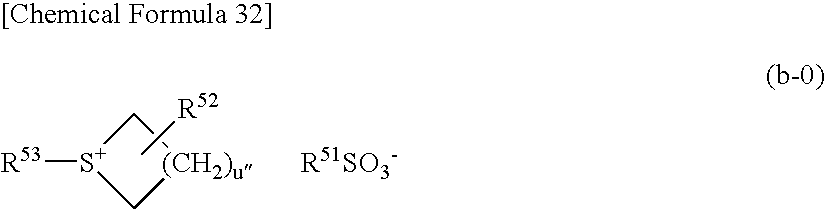
wherein R51 represents a linear, branched or cyclic alkyl group, or a linear, branched or cyclic fluorinated alkyl group; R52 represents a hydrogen atom, a hydroxyl group, a halogen atom, a linear or branched alkyl group, a linear or branched halogenated alkyl group, or a linear or branched alkoxy group; R53 represents an aryl group which may have a substituent; and u″ represents an integer of 1 to 3.


wherein R1″ to R3″, R5″ and R6″ each independently represent an aryl group or alkyl group; and R4″ represents a linear, branched or cyclic alkyl group or a linear, branched or cyclic fluorinated alkyl group, with the proviso that at least one of R1″ to R3″ represents an aryl group, and at least one of R5″ and R6″ represents an aryl group.

wherein X″ represents an alkylene group of 2 to 6 carbon atoms in which at least one hydrogen atom has been substituted with a fluorine atom; and Y″ and Z″ each independently represent an alkyl group of 1 to 10 carbon atoms in which at least one hydrogen atom has been substituted with a fluorine atom.

wherein R31 and R32 each independently represents an organic group.

wherein R33 represents a cyano group, an alkyl group having no substituent or a halogenated alkyl group; R34 represents an aryl group; and R35 represents an alkyl group having no substituent or a halogenated alkyl group.

wherein R36 represents a cyano group, an alkyl group having no substituent or a halogenated alkyl group; R37 represents a divalent or trivalent aromatic hydrocarbon group; R38 represents an alkyl group having no substituent or a halogenated alkyl group; and p″ represents 2 or 3.


Ms=([E1:1]/[Eclr]−1)×100
Mb=([Eb]/[E1:1]−1)×100

[Synthesis of Monomer (1)]

[Synthesis of Chloromethoxycyclopentane (Compound 1)]

| TABLE 1 | ||||||
| Compo- | Component | Compo- | Component | |||
| nent (A) | (B) | nent (D) | (E) | Component (S) | ||
| Ex. 1 | (A)-1 | (B)-1 | (D)-1 | (E)-1 | (S)-1 | (S)-2 |
| [100] | [13.0] | [0.54] | [1.32] | [10] | [1,450] | |
| Comp. | (A)-2 | (B)-1 | (D)-1 | (E)-1 | (S)-1 | (S)-2 |
| Ex. 1 | [100] | [13.0] | [0.54] | [1.32] | [10] | [1,450] |
| Comp. | (A)-3 | (B)-1 | (D)-1 | (E)-1 | (S)-1 | (S)-2 |
| Ex. 2 | [100] | [13.0] | [0.54] | [1.32] | [10] | [1,450] |

(D)-1: tri-n-pentylamine
(E)-1: salicylic acid
(S)-1: γ-butyrolactone
(S)-2: a mixed solvent of PGMEA/PGME=6/4 (weight ratio)
Ms=([E1:1]/[Eclr]−1)×100
Mb=([Eb]/[E1:1]−1)×100
| TABLE 2 | |||||||||||
| Dimensional | |||||||||||
| PAB | PEB | LER | DOF | Eclr | E1:1 | Eb | Ms | Mb | variations | ||
| (° C.) | (° C.) | (nm) | (μm) | (mJ/cm2) | (mJ/cm2) | (mJ/cm2) | (%) | (%) | [nm/(mJ/cm2)] | ||
| Ex. 1 | 80 | 80 | 7.2 | 0.4 | 44 | 48 | 56 | 9 | 17 | −4.5 |
| Comp. Ex. 1 | 110 | 110 | 9.1 | 0.4 | 36 | 38 | 44 | 6 | 16 | −7.1 |
| Comp. Ex. 2 | 80 | 80 | NG | NG | NG | NG | NG | NG | NG | NG |
Claims (6)

Applications Claiming Priority (3)
| Application Number | Priority Date | Filing Date | Title |
|---|---|---|---|
| JP2006246130A JP4890166B2 (en) | 2006-09-11 | 2006-09-11 | Positive resist composition and resist pattern forming method |
| JP2006-246130 | 2006-09-11 | ||
| PCT/JP2007/065445 WO2008032512A1 (en) | 2006-09-11 | 2007-08-07 | Positive-type resist composition and method for formation of resist pattern |
Publications (2)
| Publication Number | Publication Date |
|---|---|
| US20100040970A1 US20100040970A1 (en) | 2010-02-18 |
| US7919227B2 true US7919227B2 (en) | 2011-04-05 |
Family
ID=39183578
Family Applications (1)
| Application Number | Title | Priority Date | Filing Date |
|---|---|---|---|
| US12/440,447 Active 2028-03-23 US7919227B2 (en) | 2006-09-11 | 2007-08-07 | Positive resist composition and method of forming resist pattern |
Country Status (5)
| Country | Link |
|---|---|
| US (1) | US7919227B2 (en) |
| JP (1) | JP4890166B2 (en) |
| KR (1) | KR101016930B1 (en) |
| TW (1) | TWI362564B (en) |
| WO (1) | WO2008032512A1 (en) |
Families Citing this family (1)
| Publication number | Priority date | Publication date | Assignee | Title |
|---|---|---|---|---|
| KR101968704B1 (en) | 2012-03-13 | 2019-04-12 | 삼성전자주식회사 | Method and apparatus for determining transmitting power in the mimo communication system |
Citations (17)
| Publication number | Priority date | Publication date | Assignee | Title |
|---|---|---|---|---|
| JPH09208554A (en) | 1996-02-02 | 1997-08-12 | Tokyo Ohka Kogyo Co Ltd | Oxime sulfonate compound and acid generating agent for resist |
| US5688628A (en) * | 1993-11-11 | 1997-11-18 | Nippon Zeon Co., Ltd. | Resist composition |
| JPH1135552A (en) | 1997-07-24 | 1999-02-09 | Tokyo Ohka Kogyo Co Ltd | New diazomethane compound |
| JPH1135551A (en) | 1997-07-24 | 1999-02-09 | Tokyo Ohka Kogyo Co Ltd | New sulfonyldiazomethane compound |
| JPH1135573A (en) | 1997-07-24 | 1999-02-09 | Tokyo Ohka Kogyo Co Ltd | New bissulfonyldiazomethane |
| US5945517A (en) | 1996-07-24 | 1999-08-31 | Tokyo Ohka Kogyo Co., Ltd. | Chemical-sensitization photoresist composition |
| JPH11322707A (en) | 1998-05-18 | 1999-11-24 | Tokyo Ohka Kogyo Co Ltd | Poly (disulfonyldiazomethane) compound |
| US6153733A (en) | 1998-05-18 | 2000-11-28 | Tokyo Ohka Kogyo Co., Ltd. | (Disulfonyl diazomethane compounds) |
| JP2002220059A (en) | 2001-01-23 | 2002-08-06 | Inoac Corp | Cover and object transport tool with it |
| JP2003241385A (en) | 2001-12-03 | 2003-08-27 | Tokyo Ohka Kogyo Co Ltd | Positive resist composition and method of forming resist pattern using the same |
| JP2004046098A (en) | 2002-05-31 | 2004-02-12 | Internatl Business Mach Corp <Ibm> | Photoresist composition |
| WO2004074242A2 (en) | 2003-02-19 | 2004-09-02 | Ciba Specialty Chemicals Holding Inc. | Halogenated oxime derivatives and the use thereof as latent acids |
| JP2005043852A (en) | 2002-10-29 | 2005-02-17 | Jsr Corp | Radiation sensitive resin composition |
| US7645559B2 (en) * | 2005-08-23 | 2010-01-12 | Tokyo Ohka Kogyo Co., Ltd. | Positive resist composition and method of forming resist pattern |
| US20100081088A1 (en) * | 2008-09-30 | 2010-04-01 | Tokyo Ohka Kogyo Co., Ltd. | Resist composition, method of forming resist pattern, compound and acid generator including the same |
| US7781144B2 (en) * | 2005-05-17 | 2010-08-24 | Tokyo Ohka Kogyo Co., Ltd. | Positive resist composition and resist pattern forming method |
| US7803512B2 (en) * | 2005-02-16 | 2010-09-28 | Tokyo Ohka Kogyo Co., Ltd. | Positive resist composition and method of forming resist pattern |
-
2006
- 2006-09-11 JP JP2006246130A patent/JP4890166B2/en active Active
-
2007
- 2007-08-07 KR KR1020097004733A patent/KR101016930B1/en active Active
- 2007-08-07 WO PCT/JP2007/065445 patent/WO2008032512A1/en not_active Ceased
- 2007-08-07 US US12/440,447 patent/US7919227B2/en active Active
- 2007-08-15 TW TW096130178A patent/TWI362564B/en active
Patent Citations (18)
| Publication number | Priority date | Publication date | Assignee | Title |
|---|---|---|---|---|
| US5688628A (en) * | 1993-11-11 | 1997-11-18 | Nippon Zeon Co., Ltd. | Resist composition |
| JPH09208554A (en) | 1996-02-02 | 1997-08-12 | Tokyo Ohka Kogyo Co Ltd | Oxime sulfonate compound and acid generating agent for resist |
| US5945517A (en) | 1996-07-24 | 1999-08-31 | Tokyo Ohka Kogyo Co., Ltd. | Chemical-sensitization photoresist composition |
| JPH1135552A (en) | 1997-07-24 | 1999-02-09 | Tokyo Ohka Kogyo Co Ltd | New diazomethane compound |
| JPH1135551A (en) | 1997-07-24 | 1999-02-09 | Tokyo Ohka Kogyo Co Ltd | New sulfonyldiazomethane compound |
| JPH1135573A (en) | 1997-07-24 | 1999-02-09 | Tokyo Ohka Kogyo Co Ltd | New bissulfonyldiazomethane |
| JPH11322707A (en) | 1998-05-18 | 1999-11-24 | Tokyo Ohka Kogyo Co Ltd | Poly (disulfonyldiazomethane) compound |
| US6153733A (en) | 1998-05-18 | 2000-11-28 | Tokyo Ohka Kogyo Co., Ltd. | (Disulfonyl diazomethane compounds) |
| JP2002220059A (en) | 2001-01-23 | 2002-08-06 | Inoac Corp | Cover and object transport tool with it |
| JP2003241385A (en) | 2001-12-03 | 2003-08-27 | Tokyo Ohka Kogyo Co Ltd | Positive resist composition and method of forming resist pattern using the same |
| US7323287B2 (en) | 2001-12-03 | 2008-01-29 | Tokyo Ohka Kogyo Co., Ltd | Positive type resist composition and resist pattern formation method using same |
| JP2004046098A (en) | 2002-05-31 | 2004-02-12 | Internatl Business Mach Corp <Ibm> | Photoresist composition |
| JP2005043852A (en) | 2002-10-29 | 2005-02-17 | Jsr Corp | Radiation sensitive resin composition |
| WO2004074242A2 (en) | 2003-02-19 | 2004-09-02 | Ciba Specialty Chemicals Holding Inc. | Halogenated oxime derivatives and the use thereof as latent acids |
| US7803512B2 (en) * | 2005-02-16 | 2010-09-28 | Tokyo Ohka Kogyo Co., Ltd. | Positive resist composition and method of forming resist pattern |
| US7781144B2 (en) * | 2005-05-17 | 2010-08-24 | Tokyo Ohka Kogyo Co., Ltd. | Positive resist composition and resist pattern forming method |
| US7645559B2 (en) * | 2005-08-23 | 2010-01-12 | Tokyo Ohka Kogyo Co., Ltd. | Positive resist composition and method of forming resist pattern |
| US20100081088A1 (en) * | 2008-09-30 | 2010-04-01 | Tokyo Ohka Kogyo Co., Ltd. | Resist composition, method of forming resist pattern, compound and acid generator including the same |
Non-Patent Citations (1)
| Title |
|---|
| International Search Report issued for corresponding PCT Application No. PCT/JP2007/065445, dated Sep. 11, 2007. |
Also Published As
| Publication number | Publication date |
|---|---|
| WO2008032512A1 (en) | 2008-03-20 |
| TW200834241A (en) | 2008-08-16 |
| KR20090039827A (en) | 2009-04-22 |
| KR101016930B1 (en) | 2011-02-28 |
| JP2008065281A (en) | 2008-03-21 |
| US20100040970A1 (en) | 2010-02-18 |
| JP4890166B2 (en) | 2012-03-07 |
| TWI362564B (en) | 2012-04-21 |
Similar Documents
| Publication | Publication Date | Title |
|---|---|---|
| US7767379B2 (en) | Polymer compound, positive resist composition, and method of forming resist pattern | |
| US7776510B2 (en) | Resist composition, method of forming resist pattern, compound and acid generator | |
| US7776511B2 (en) | Positive resist composition and method of forming resist pattern | |
| US7745098B2 (en) | Polymer compound, positive resist composition and method of forming resist pattern | |
| US20090197197A1 (en) | Resist composition and method of forming resist pattern | |
| US8021824B2 (en) | Polymer compound, resist composition and method of forming resist pattern | |
| US8088553B2 (en) | Positive resist composition, method of forming resist pattern, and polymeric compound | |
| US8247160B2 (en) | Resist composition, method of forming resist pattern, and novel compound and acid generator | |
| US7919651B2 (en) | Positive resist composition, method of forming resist pattern, polymeric compound, and compound | |
| US8227169B2 (en) | Compound, acid generator, resist composition, and method of forming resist pattern | |
| US7741008B2 (en) | Positive resist composition, positive resist composition for thermal flow, and resist pattern forming method | |
| US8211616B2 (en) | Positive resist composition and method of forming resist pattern | |
| US8263307B2 (en) | Positive resist composition and method of forming resist pattern | |
| US7741009B2 (en) | Positive resist composition and method of forming resist pattern | |
| US8216764B2 (en) | Positive resist composition and method of forming resist pattern | |
| US8247159B2 (en) | Positive resist composition and method of forming resist pattern | |
| US20090317741A1 (en) | Compound, acid generator, resist composition and method of forming resist pattern | |
| US8232040B2 (en) | Positive resist composition and method of forming resist pattern | |
| US7491485B2 (en) | Resist composition and method of forming resist pattern | |
| US20090155713A1 (en) | Resist composition and process for producing same | |
| US20080311515A1 (en) | Positive resist composition and method of forming resist pattern | |
| US7939243B2 (en) | Resin, resist composition and method of forming resist pattern | |
| US20100040970A1 (en) | Positive resist composition and method of forming resist pattern | |
| US7964331B2 (en) | Positive resist composition and method of forming resist pattern | |
| JP2008065282A (en) | Positive resist composition and resist pattern forming method |
Legal Events
| Date | Code | Title | Description |
|---|---|---|---|
| AS | Assignment |
Owner name: TOKYO OHKA KOGYO CO., LTD.,JAPAN Free format text: ASSIGNMENT OF ASSIGNORS INTEREST;ASSIGNORS:KINOSHITA, YOHEI;IWAI, TAKESHI;OGATA, TOSHIYUKI;REEL/FRAME:022432/0511 Effective date: 20090303 Owner name: TOKYO OHKA KOGYO CO., LTD., JAPAN Free format text: ASSIGNMENT OF ASSIGNORS INTEREST;ASSIGNORS:KINOSHITA, YOHEI;IWAI, TAKESHI;OGATA, TOSHIYUKI;REEL/FRAME:022432/0511 Effective date: 20090303 |
|
| STCF | Information on status: patent grant |
Free format text: PATENTED CASE |
|
| CC | Certificate of correction | ||
| FPAY | Fee payment |
Year of fee payment: 4 |
|
| MAFP | Maintenance fee payment |
Free format text: PAYMENT OF MAINTENANCE FEE, 8TH YEAR, LARGE ENTITY (ORIGINAL EVENT CODE: M1552); ENTITY STATUS OF PATENT OWNER: LARGE ENTITY Year of fee payment: 8 |
|
| MAFP | Maintenance fee payment |
Free format text: PAYMENT OF MAINTENANCE FEE, 12TH YEAR, LARGE ENTITY (ORIGINAL EVENT CODE: M1553); ENTITY STATUS OF PATENT OWNER: LARGE ENTITY Year of fee payment: 12 |