US7915283B2 - Indole, azaindole and related heterocyclic 4-alkenyl piperidine amides - Google Patents
Indole, azaindole and related heterocyclic 4-alkenyl piperidine amides Download PDFInfo
- Publication number
- US7915283B2 US7915283B2 US12/015,767 US1576708A US7915283B2 US 7915283 B2 US7915283 B2 US 7915283B2 US 1576708 A US1576708 A US 1576708A US 7915283 B2 US7915283 B2 US 7915283B2
- Authority
- US
- United States
- Prior art keywords
- group
- heteroaryl
- phenyl
- alkyl
- hydrogen
- Prior art date
- Legal status (The legal status is an assumption and is not a legal conclusion. Google has not performed a legal analysis and makes no representation as to the accuracy of the status listed.)
- Expired - Fee Related, expires
Links
- NQRYJNQNLNOLGT-UHFFFAOYSA-N tetrahydropyridine hydrochloride Natural products C1CCNCC1 NQRYJNQNLNOLGT-UHFFFAOYSA-N 0.000 title claims abstract description 34
- SIKJAQJRHWYJAI-UHFFFAOYSA-N Indole Chemical compound C1=CC=C2NC=CC2=C1 SIKJAQJRHWYJAI-UHFFFAOYSA-N 0.000 title description 58
- BAXOFTOLAUCFNW-UHFFFAOYSA-N 1H-indazole Chemical compound C1=CC=C2C=NNC2=C1 BAXOFTOLAUCFNW-UHFFFAOYSA-N 0.000 title description 49
- 125000000623 heterocyclic group Chemical group 0.000 title description 32
- PZOUSPYUWWUPPK-UHFFFAOYSA-N indole Natural products CC1=CC=CC2=C1C=CN2 PZOUSPYUWWUPPK-UHFFFAOYSA-N 0.000 title description 30
- RKJUIXBNRJVNHR-UHFFFAOYSA-N indolenine Natural products C1=CC=C2CC=NC2=C1 RKJUIXBNRJVNHR-UHFFFAOYSA-N 0.000 title description 30
- 150000001875 compounds Chemical class 0.000 claims abstract description 260
- 238000000034 method Methods 0.000 claims abstract description 247
- 230000000840 anti-viral effect Effects 0.000 claims abstract description 11
- -1 benzoimidazolyl Chemical group 0.000 claims description 160
- 125000001072 heteroaryl group Chemical group 0.000 claims description 104
- 229910052736 halogen Inorganic materials 0.000 claims description 55
- 150000002367 halogens Chemical class 0.000 claims description 53
- 125000001997 phenyl group Chemical group [H]C1=C([H])C([H])=C(*)C([H])=C1[H] 0.000 claims description 53
- 125000004169 (C1-C6) alkyl group Chemical group 0.000 claims description 49
- 229910052739 hydrogen Inorganic materials 0.000 claims description 46
- 239000001257 hydrogen Substances 0.000 claims description 42
- 125000000217 alkyl group Chemical group 0.000 claims description 24
- 125000000449 nitro group Chemical group [O-][N+](*)=O 0.000 claims description 22
- 125000001424 substituent group Chemical group 0.000 claims description 22
- 125000002541 furyl group Chemical group 0.000 claims description 21
- 125000002887 hydroxy group Chemical group [H]O* 0.000 claims description 21
- 125000004076 pyridyl group Chemical group 0.000 claims description 21
- 125000001544 thienyl group Chemical group 0.000 claims description 21
- 125000004093 cyano group Chemical group *C#N 0.000 claims description 20
- UFHFLCQGNIYNRP-UHFFFAOYSA-N Hydrogen Chemical compound [H][H] UFHFLCQGNIYNRP-UHFFFAOYSA-N 0.000 claims description 19
- 125000002496 methyl group Chemical group [H]C([H])([H])* 0.000 claims description 18
- 150000002431 hydrogen Chemical group 0.000 claims description 17
- 125000002924 primary amino group Chemical group [H]N([H])* 0.000 claims description 17
- 125000003831 tetrazolyl group Chemical group 0.000 claims description 17
- GLUUGHFHXGJENI-UHFFFAOYSA-N Piperazine Chemical compound C1CNCCN1 GLUUGHFHXGJENI-UHFFFAOYSA-N 0.000 claims description 16
- 125000000753 cycloalkyl group Chemical group 0.000 claims description 16
- 125000002883 imidazolyl group Chemical group 0.000 claims description 16
- 125000001786 isothiazolyl group Chemical group 0.000 claims description 16
- 125000000842 isoxazolyl group Chemical group 0.000 claims description 16
- 125000001715 oxadiazolyl group Chemical group 0.000 claims description 16
- 125000002971 oxazolyl group Chemical group 0.000 claims description 16
- 125000003373 pyrazinyl group Chemical group 0.000 claims description 16
- 125000003226 pyrazolyl group Chemical group 0.000 claims description 16
- 125000000714 pyrimidinyl group Chemical group 0.000 claims description 16
- 125000001113 thiadiazolyl group Chemical group 0.000 claims description 16
- 125000000335 thiazolyl group Chemical group 0.000 claims description 16
- 125000001425 triazolyl group Chemical group 0.000 claims description 16
- 125000002098 pyridazinyl group Chemical group 0.000 claims description 15
- 150000003839 salts Chemical class 0.000 claims description 15
- WYURNTSHIVDZCO-UHFFFAOYSA-N Tetrahydrofuran Chemical compound C1CCOC1 WYURNTSHIVDZCO-UHFFFAOYSA-N 0.000 claims description 14
- RWRDLPDLKQPQOW-UHFFFAOYSA-N Pyrrolidine Chemical compound C1CCNC1 RWRDLPDLKQPQOW-UHFFFAOYSA-N 0.000 claims description 12
- 125000003545 alkoxy group Chemical group 0.000 claims description 12
- 125000000956 methoxy group Chemical group [H]C([H])([H])O* 0.000 claims description 12
- YNAVUWVOSKDBBP-UHFFFAOYSA-N Morpholine Chemical compound C1COCCN1 YNAVUWVOSKDBBP-UHFFFAOYSA-N 0.000 claims description 10
- 125000000304 alkynyl group Chemical group 0.000 claims description 9
- 125000001797 benzyl group Chemical group [H]C1=C([H])C([H])=C(C([H])=C1[H])C([H])([H])* 0.000 claims description 9
- 125000004191 (C1-C6) alkoxy group Chemical group 0.000 claims description 8
- 125000004435 hydrogen atom Chemical group [H]* 0.000 claims description 7
- 125000004193 piperazinyl group Chemical group 0.000 claims description 7
- YLQBMQCUIZJEEH-UHFFFAOYSA-N tetrahydrofuran Natural products C=1C=COC=1 YLQBMQCUIZJEEH-UHFFFAOYSA-N 0.000 claims description 7
- PXGOKWXKJXAPGV-UHFFFAOYSA-N Fluorine Chemical compound FF PXGOKWXKJXAPGV-UHFFFAOYSA-N 0.000 claims description 6
- 239000011737 fluorine Substances 0.000 claims description 6
- 229910052731 fluorine Inorganic materials 0.000 claims description 6
- 125000004573 morpholin-4-yl group Chemical group N1(CCOCC1)* 0.000 claims description 6
- 125000004196 benzothienyl group Chemical group S1C(=CC2=C1C=CC=C2)* 0.000 claims description 5
- 239000011203 carbon fibre reinforced carbon Substances 0.000 claims description 5
- 229910052760 oxygen Inorganic materials 0.000 claims description 5
- 229910052717 sulfur Inorganic materials 0.000 claims description 5
- 125000005247 tetrazinyl group Chemical group N1=NN=NC(=C1)* 0.000 claims description 5
- PVOAHINGSUIXLS-UHFFFAOYSA-N 1-Methylpiperazine Chemical compound CN1CCNCC1 PVOAHINGSUIXLS-UHFFFAOYSA-N 0.000 claims description 4
- NOWKCMXCCJGMRR-UHFFFAOYSA-N Aziridine Chemical compound C1CN1 NOWKCMXCCJGMRR-UHFFFAOYSA-N 0.000 claims description 4
- 241000124008 Mammalia Species 0.000 claims description 4
- DHXVGJBLRPWPCS-UHFFFAOYSA-N Tetrahydropyran Chemical compound C1CCOCC1 DHXVGJBLRPWPCS-UHFFFAOYSA-N 0.000 claims description 4
- XYOVOXDWRFGKEX-UHFFFAOYSA-N azepine Chemical compound N1C=CC=CC=C1 XYOVOXDWRFGKEX-UHFFFAOYSA-N 0.000 claims description 4
- HONIICLYMWZJFZ-UHFFFAOYSA-N azetidine Chemical compound C1CNC1 HONIICLYMWZJFZ-UHFFFAOYSA-N 0.000 claims description 4
- 125000005872 benzooxazolyl group Chemical group 0.000 claims description 4
- 125000004306 triazinyl group Chemical group 0.000 claims description 4
- 125000000719 pyrrolidinyl group Chemical group 0.000 claims description 3
- 125000003718 tetrahydrofuranyl group Chemical group 0.000 claims description 3
- 125000002023 trifluoromethyl group Chemical group FC(F)(F)* 0.000 claims description 2
- 108010021119 Trichosanthin Proteins 0.000 claims 2
- 208000030507 AIDS Diseases 0.000 abstract description 80
- 239000003814 drug Substances 0.000 abstract description 19
- 229940079593 drug Drugs 0.000 abstract description 16
- 238000011282 treatment Methods 0.000 abstract description 16
- 239000008194 pharmaceutical composition Substances 0.000 abstract description 4
- 238000002360 preparation method Methods 0.000 description 193
- HEDRZPFGACZZDS-MICDWDOJSA-N Trichloro(2H)methane Chemical compound [2H]C(Cl)(Cl)Cl HEDRZPFGACZZDS-MICDWDOJSA-N 0.000 description 186
- 239000000203 mixture Substances 0.000 description 185
- OKKJLVBELUTLKV-UHFFFAOYSA-N Methanol Chemical compound OC OKKJLVBELUTLKV-UHFFFAOYSA-N 0.000 description 180
- 238000006243 chemical reaction Methods 0.000 description 171
- XEKOWRVHYACXOJ-UHFFFAOYSA-N Ethyl acetate Chemical compound CCOC(C)=O XEKOWRVHYACXOJ-UHFFFAOYSA-N 0.000 description 159
- 239000000543 intermediate Substances 0.000 description 142
- 238000004895 liquid chromatography mass spectrometry Methods 0.000 description 129
- 239000000243 solution Substances 0.000 description 122
- 239000007787 solid Substances 0.000 description 111
- YMWUJEATGCHHMB-UHFFFAOYSA-N Dichloromethane Chemical compound ClCCl YMWUJEATGCHHMB-UHFFFAOYSA-N 0.000 description 100
- XLYOFNOQVPJJNP-UHFFFAOYSA-N water Substances O XLYOFNOQVPJJNP-UHFFFAOYSA-N 0.000 description 83
- 235000019439 ethyl acetate Nutrition 0.000 description 78
- 239000002904 solvent Substances 0.000 description 74
- ZMXDDKWLCZADIW-UHFFFAOYSA-N N,N-Dimethylformamide Chemical compound CN(C)C=O ZMXDDKWLCZADIW-UHFFFAOYSA-N 0.000 description 70
- 238000007429 general method Methods 0.000 description 61
- VYPSYNLAJGMNEJ-UHFFFAOYSA-N Silicium dioxide Chemical compound O=[Si]=O VYPSYNLAJGMNEJ-UHFFFAOYSA-N 0.000 description 59
- 238000005859 coupling reaction Methods 0.000 description 58
- 238000003756 stirring Methods 0.000 description 57
- 238000010168 coupling process Methods 0.000 description 53
- 230000008878 coupling Effects 0.000 description 51
- 238000002953 preparative HPLC Methods 0.000 description 49
- 208000031886 HIV Infections Diseases 0.000 description 46
- 239000002253 acid Substances 0.000 description 46
- 208000037357 HIV infectious disease Diseases 0.000 description 44
- 125000005334 azaindolyl group Chemical group N1N=C(C2=CC=CC=C12)* 0.000 description 44
- 239000012267 brine Substances 0.000 description 44
- 208000033519 human immunodeficiency virus infectious disease Diseases 0.000 description 44
- HPALAKNZSZLMCH-UHFFFAOYSA-M sodium;chloride;hydrate Chemical compound O.[Na+].[Cl-] HPALAKNZSZLMCH-UHFFFAOYSA-M 0.000 description 44
- 238000005160 1H NMR spectroscopy Methods 0.000 description 43
- 239000012044 organic layer Substances 0.000 description 43
- OKKJLVBELUTLKV-MZCSYVLQSA-N Deuterated methanol Chemical compound [2H]OC([2H])([2H])[2H] OKKJLVBELUTLKV-MZCSYVLQSA-N 0.000 description 42
- 239000003153 chemical reaction reagent Substances 0.000 description 40
- PMZURENOXWZQFD-UHFFFAOYSA-L Sodium Sulfate Chemical compound [Na+].[Na+].[O-]S([O-])(=O)=O PMZURENOXWZQFD-UHFFFAOYSA-L 0.000 description 38
- 229910052938 sodium sulfate Inorganic materials 0.000 description 38
- 239000007832 Na2SO4 Substances 0.000 description 37
- CSNNHWWHGAXBCP-UHFFFAOYSA-L Magnesium sulfate Chemical compound [Mg+2].[O-][S+2]([O-])([O-])[O-] CSNNHWWHGAXBCP-UHFFFAOYSA-L 0.000 description 35
- 230000015572 biosynthetic process Effects 0.000 description 33
- 238000003786 synthesis reaction Methods 0.000 description 33
- HEDRZPFGACZZDS-UHFFFAOYSA-N Chloroform Chemical compound ClC(Cl)Cl HEDRZPFGACZZDS-UHFFFAOYSA-N 0.000 description 32
- JGFZNNIVVJXRND-UHFFFAOYSA-N N,N-Diisopropylethylamine (DIPEA) Chemical compound CCN(C(C)C)C(C)C JGFZNNIVVJXRND-UHFFFAOYSA-N 0.000 description 31
- VLKZOEOYAKHREP-UHFFFAOYSA-N n-Hexane Chemical compound CCCCCC VLKZOEOYAKHREP-UHFFFAOYSA-N 0.000 description 31
- 238000004949 mass spectrometry Methods 0.000 description 30
- 239000011541 reaction mixture Substances 0.000 description 30
- HBOMLICNUCNMMY-XLPZGREQSA-N zidovudine Chemical compound O=C1NC(=O)C(C)=CN1[C@@H]1O[C@H](CO)[C@@H](N=[N+]=[N-])C1 HBOMLICNUCNMMY-XLPZGREQSA-N 0.000 description 30
- RTZKZFJDLAIYFH-UHFFFAOYSA-N Diethyl ether Chemical compound CCOCC RTZKZFJDLAIYFH-UHFFFAOYSA-N 0.000 description 29
- ZMANZCXQSJIPKH-UHFFFAOYSA-N Triethylamine Chemical compound CCN(CC)CC ZMANZCXQSJIPKH-UHFFFAOYSA-N 0.000 description 29
- 150000001299 aldehydes Chemical group 0.000 description 29
- 125000003118 aryl group Chemical group 0.000 description 29
- RYHBNJHYFVUHQT-UHFFFAOYSA-N 1,4-Dioxane Chemical compound C1COCCO1 RYHBNJHYFVUHQT-UHFFFAOYSA-N 0.000 description 26
- 150000001412 amines Chemical class 0.000 description 26
- 150000002475 indoles Chemical class 0.000 description 26
- BWHMMNNQKKPAPP-UHFFFAOYSA-L potassium carbonate Chemical compound [K+].[K+].[O-]C([O-])=O BWHMMNNQKKPAPP-UHFFFAOYSA-L 0.000 description 26
- 239000000047 product Substances 0.000 description 26
- RIOQSEWOXXDEQQ-UHFFFAOYSA-N triphenylphosphine Chemical compound C1=CC=CC=C1P(C=1C=CC=CC=1)C1=CC=CC=C1 RIOQSEWOXXDEQQ-UHFFFAOYSA-N 0.000 description 26
- 229960002555 zidovudine Drugs 0.000 description 25
- 238000000746 purification Methods 0.000 description 24
- UHOVQNZJYSORNB-UHFFFAOYSA-N Benzene Chemical compound C1=CC=CC=C1 UHOVQNZJYSORNB-UHFFFAOYSA-N 0.000 description 23
- UIIMBOGNXHQVGW-UHFFFAOYSA-M Sodium bicarbonate Chemical class [Na+].OC([O-])=O UIIMBOGNXHQVGW-UHFFFAOYSA-M 0.000 description 23
- 229910052681 coesite Inorganic materials 0.000 description 23
- 229910052906 cristobalite Inorganic materials 0.000 description 23
- 239000000377 silicon dioxide Substances 0.000 description 23
- 229910052682 stishovite Inorganic materials 0.000 description 23
- 229910052905 tridymite Inorganic materials 0.000 description 23
- LMDZBCPBFSXMTL-UHFFFAOYSA-N 1-Ethyl-3-(3-dimethylaminopropyl)carbodiimide Substances CCN=C=NCCCN(C)C LMDZBCPBFSXMTL-UHFFFAOYSA-N 0.000 description 22
- 239000002585 base Substances 0.000 description 22
- 238000003818 flash chromatography Methods 0.000 description 22
- IJGRMHOSHXDMSA-UHFFFAOYSA-N Atomic nitrogen Chemical compound N#N IJGRMHOSHXDMSA-UHFFFAOYSA-N 0.000 description 21
- LFQSCWFLJHTTHZ-UHFFFAOYSA-N Ethanol Chemical compound CCO LFQSCWFLJHTTHZ-UHFFFAOYSA-N 0.000 description 21
- VEXZGXHMUGYJMC-UHFFFAOYSA-N Hydrochloric acid Chemical compound Cl VEXZGXHMUGYJMC-UHFFFAOYSA-N 0.000 description 21
- KWYUFKZDYYNOTN-UHFFFAOYSA-M Potassium hydroxide Chemical compound [OH-].[K+] KWYUFKZDYYNOTN-UHFFFAOYSA-M 0.000 description 21
- 239000008346 aqueous phase Substances 0.000 description 21
- CTSLXHKWHWQRSH-UHFFFAOYSA-N oxalyl chloride Chemical compound ClC(=O)C(Cl)=O CTSLXHKWHWQRSH-UHFFFAOYSA-N 0.000 description 21
- NFHFRUOZVGFOOS-UHFFFAOYSA-N palladium;triphenylphosphane Chemical compound [Pd].C1=CC=CC=C1P(C=1C=CC=CC=1)C1=CC=CC=C1.C1=CC=CC=C1P(C=1C=CC=CC=1)C1=CC=CC=C1.C1=CC=CC=C1P(C=1C=CC=CC=1)C1=CC=CC=C1.C1=CC=CC=C1P(C=1C=CC=CC=1)C1=CC=CC=C1 NFHFRUOZVGFOOS-UHFFFAOYSA-N 0.000 description 21
- KDLHZDBZIXYQEI-UHFFFAOYSA-N Palladium Chemical compound [Pd] KDLHZDBZIXYQEI-UHFFFAOYSA-N 0.000 description 20
- HEMHJVSKTPXQMS-UHFFFAOYSA-M Sodium hydroxide Chemical compound [OH-].[Na+] HEMHJVSKTPXQMS-UHFFFAOYSA-M 0.000 description 20
- VSCWAEJMTAWNJL-UHFFFAOYSA-K aluminium trichloride Chemical compound Cl[Al](Cl)Cl VSCWAEJMTAWNJL-UHFFFAOYSA-K 0.000 description 20
- 239000012074 organic phase Substances 0.000 description 20
- 150000002148 esters Chemical class 0.000 description 19
- CPELXLSAUQHCOX-UHFFFAOYSA-M Bromide Chemical compound [Br-] CPELXLSAUQHCOX-UHFFFAOYSA-M 0.000 description 18
- IAZDPXIOMUYVGZ-UHFFFAOYSA-N Dimethylsulphoxide Chemical compound CS(C)=O IAZDPXIOMUYVGZ-UHFFFAOYSA-N 0.000 description 18
- 241000725303 Human immunodeficiency virus Species 0.000 description 18
- YXFVVABEGXRONW-UHFFFAOYSA-N Toluene Chemical compound CC1=CC=CC=C1 YXFVVABEGXRONW-UHFFFAOYSA-N 0.000 description 18
- 239000003112 inhibitor Substances 0.000 description 17
- 239000010410 layer Substances 0.000 description 17
- 229910052943 magnesium sulfate Inorganic materials 0.000 description 17
- 230000009466 transformation Effects 0.000 description 17
- OAYLNYINCPYISS-UHFFFAOYSA-N ethyl acetate;hexane Chemical compound CCCCCC.CCOC(C)=O OAYLNYINCPYISS-UHFFFAOYSA-N 0.000 description 16
- ZCSHNCUQKCANBX-UHFFFAOYSA-N lithium diisopropylamide Chemical compound [Li+].CC(C)[N-]C(C)C ZCSHNCUQKCANBX-UHFFFAOYSA-N 0.000 description 16
- NLXLAEXVIDQMFP-UHFFFAOYSA-N Ammonia chloride Chemical compound [NH4+].[Cl-] NLXLAEXVIDQMFP-UHFFFAOYSA-N 0.000 description 15
- VEXZGXHMUGYJMC-UHFFFAOYSA-M Chloride anion Chemical compound [Cl-] VEXZGXHMUGYJMC-UHFFFAOYSA-M 0.000 description 15
- MZRVEZGGRBJDDB-UHFFFAOYSA-N N-Butyllithium Chemical compound [Li]CCCC MZRVEZGGRBJDDB-UHFFFAOYSA-N 0.000 description 15
- WREGKURFCTUGRC-POYBYMJQSA-N Zalcitabine Chemical compound O=C1N=C(N)C=CN1[C@@H]1O[C@H](CO)CC1 WREGKURFCTUGRC-POYBYMJQSA-N 0.000 description 14
- 150000001408 amides Chemical class 0.000 description 14
- 150000001732 carboxylic acid derivatives Chemical group 0.000 description 14
- 150000002825 nitriles Chemical class 0.000 description 14
- 229910052757 nitrogen Inorganic materials 0.000 description 14
- 239000002243 precursor Substances 0.000 description 14
- 238000010992 reflux Methods 0.000 description 14
- WSLDOOZREJYCGB-UHFFFAOYSA-N 1,2-Dichloroethane Chemical compound ClCCCl WSLDOOZREJYCGB-UHFFFAOYSA-N 0.000 description 13
- WFDIJRYMOXRFFG-UHFFFAOYSA-N Acetic anhydride Chemical compound CC(=O)OC(C)=O WFDIJRYMOXRFFG-UHFFFAOYSA-N 0.000 description 13
- WEVYAHXRMPXWCK-UHFFFAOYSA-N Acetonitrile Chemical compound CC#N WEVYAHXRMPXWCK-UHFFFAOYSA-N 0.000 description 13
- 150000001204 N-oxides Chemical class 0.000 description 13
- CDBYLPFSWZWCQE-UHFFFAOYSA-L Sodium Carbonate Chemical compound [Na+].[Na+].[O-]C([O-])=O CDBYLPFSWZWCQE-UHFFFAOYSA-L 0.000 description 13
- 230000001404 mediated effect Effects 0.000 description 13
- 239000003921 oil Substances 0.000 description 13
- 235000019198 oils Nutrition 0.000 description 13
- 229910000027 potassium carbonate Inorganic materials 0.000 description 13
- 230000009467 reduction Effects 0.000 description 13
- 238000006722 reduction reaction Methods 0.000 description 13
- 239000003419 rna directed dna polymerase inhibitor Substances 0.000 description 13
- KXCAEQNNTZANTK-UHFFFAOYSA-N stannane Chemical compound [SnH4] KXCAEQNNTZANTK-UHFFFAOYSA-N 0.000 description 13
- 229910000080 stannane Inorganic materials 0.000 description 13
- VHYFNPMBLIVWCW-UHFFFAOYSA-N 4-Dimethylaminopyridine Chemical compound CN(C)C1=CC=NC=C1 VHYFNPMBLIVWCW-UHFFFAOYSA-N 0.000 description 12
- WSFSSNUMVMOOMR-UHFFFAOYSA-N Formaldehyde Chemical compound O=C WSFSSNUMVMOOMR-UHFFFAOYSA-N 0.000 description 12
- WMHSRBZIJNQHKT-FFKFEZPRSA-N abacavir sulfate Chemical compound OS(O)(=O)=O.C=12N=CN([C@H]3C=C[C@@H](CO)C3)C2=NC(N)=NC=1NC1CC1.C=12N=CN([C@H]3C=C[C@@H](CO)C3)C2=NC(N)=NC=1NC1CC1 WMHSRBZIJNQHKT-FFKFEZPRSA-N 0.000 description 12
- ZADPBFCGQRWHPN-UHFFFAOYSA-N boronic acid Chemical compound OBO ZADPBFCGQRWHPN-UHFFFAOYSA-N 0.000 description 12
- 239000003054 catalyst Substances 0.000 description 12
- 239000003795 chemical substances by application Substances 0.000 description 12
- 239000012043 crude product Substances 0.000 description 12
- RAXXELZNTBOGNW-UHFFFAOYSA-N imidazole Natural products C1=CNC=N1 RAXXELZNTBOGNW-UHFFFAOYSA-N 0.000 description 12
- 229910052751 metal Inorganic materials 0.000 description 12
- 239000002184 metal Substances 0.000 description 12
- ISWSIDIOOBJBQZ-UHFFFAOYSA-N phenol group Chemical group C1(=CC=CC=C1)O ISWSIDIOOBJBQZ-UHFFFAOYSA-N 0.000 description 12
- 239000011734 sodium Substances 0.000 description 12
- 229920002554 vinyl polymer Polymers 0.000 description 12
- KLDLRDSRCMJKGM-UHFFFAOYSA-N 3-[chloro-(2-oxo-1,3-oxazolidin-3-yl)phosphoryl]-1,3-oxazolidin-2-one Chemical compound C1COC(=O)N1P(=O)(Cl)N1CCOC1=O KLDLRDSRCMJKGM-UHFFFAOYSA-N 0.000 description 11
- RYGMFSIKBFXOCR-UHFFFAOYSA-N Copper Chemical compound [Cu] RYGMFSIKBFXOCR-UHFFFAOYSA-N 0.000 description 11
- XTHFKEDIFFGKHM-UHFFFAOYSA-N Dimethoxyethane Chemical compound COCCOC XTHFKEDIFFGKHM-UHFFFAOYSA-N 0.000 description 11
- QAOWNCQODCNURD-UHFFFAOYSA-N Sulfuric acid Chemical compound OS(O)(=O)=O QAOWNCQODCNURD-UHFFFAOYSA-N 0.000 description 11
- 125000003277 amino group Chemical group 0.000 description 11
- 229910052799 carbon Inorganic materials 0.000 description 11
- XMBWDFGMSWQBCA-UHFFFAOYSA-N hydrogen iodide Chemical compound I XMBWDFGMSWQBCA-UHFFFAOYSA-N 0.000 description 11
- 239000000137 peptide hydrolase inhibitor Substances 0.000 description 11
- 238000000844 transformation Methods 0.000 description 11
- CURLTUGMZLYLDI-UHFFFAOYSA-N Carbon dioxide Chemical compound O=C=O CURLTUGMZLYLDI-UHFFFAOYSA-N 0.000 description 10
- DTQVDTLACAAQTR-UHFFFAOYSA-N Trifluoroacetic acid Chemical compound OC(=O)C(F)(F)F DTQVDTLACAAQTR-UHFFFAOYSA-N 0.000 description 10
- 239000007864 aqueous solution Substances 0.000 description 10
- 125000004432 carbon atom Chemical group C* 0.000 description 10
- 125000001309 chloro group Chemical group Cl* 0.000 description 10
- 239000010949 copper Substances 0.000 description 10
- AJDPNPAGZMZOMN-UHFFFAOYSA-N diethyl (4-oxo-1,2,3-benzotriazin-3-yl) phosphate Chemical compound C1=CC=C2C(=O)N(OP(=O)(OCC)OCC)N=NC2=C1 AJDPNPAGZMZOMN-UHFFFAOYSA-N 0.000 description 10
- MHYCRLGKOZWVEF-UHFFFAOYSA-N ethyl acetate;hydrate Chemical compound O.CCOC(C)=O MHYCRLGKOZWVEF-UHFFFAOYSA-N 0.000 description 10
- 239000000706 filtrate Substances 0.000 description 10
- 150000002576 ketones Chemical class 0.000 description 10
- 239000000463 material Substances 0.000 description 10
- 230000003647 oxidation Effects 0.000 description 10
- 238000007254 oxidation reaction Methods 0.000 description 10
- XHXFXVLFKHQFAL-UHFFFAOYSA-N phosphoryl trichloride Chemical compound ClP(Cl)(Cl)=O XHXFXVLFKHQFAL-UHFFFAOYSA-N 0.000 description 10
- 239000007858 starting material Substances 0.000 description 10
- NBRIZDGVBLBLLZ-UHFFFAOYSA-N tert-butyl 4-[bromo(phenyl)methylidene]piperidine-1-carboxylate Chemical compound C1CN(C(=O)OC(C)(C)C)CCC1=C(Br)C1=CC=CC=C1 NBRIZDGVBLBLLZ-UHFFFAOYSA-N 0.000 description 10
- ITMCEJHCFYSIIV-UHFFFAOYSA-M triflate Chemical compound [O-]S(=O)(=O)C(F)(F)F ITMCEJHCFYSIIV-UHFFFAOYSA-M 0.000 description 10
- DNUTZBZXLPWRJG-UHFFFAOYSA-N 1-Piperidine carboxylic acid Chemical compound OC(=O)N1CCCCC1 DNUTZBZXLPWRJG-UHFFFAOYSA-N 0.000 description 9
- NGNBDVOYPDDBFK-UHFFFAOYSA-N 2-[2,4-di(pentan-2-yl)phenoxy]acetyl chloride Chemical compound CCCC(C)C1=CC=C(OCC(Cl)=O)C(C(C)CCC)=C1 NGNBDVOYPDDBFK-UHFFFAOYSA-N 0.000 description 9
- BXZVVICBKDXVGW-NKWVEPMBSA-N Didanosine Chemical compound O1[C@H](CO)CC[C@@H]1N1C(NC=NC2=O)=C2N=C1 BXZVVICBKDXVGW-NKWVEPMBSA-N 0.000 description 9
- 230000010933 acylation Effects 0.000 description 9
- 238000005917 acylation reaction Methods 0.000 description 9
- INLLPKCGLOXCIV-UHFFFAOYSA-N bromoethene Chemical class BrC=C INLLPKCGLOXCIV-UHFFFAOYSA-N 0.000 description 9
- 150000004820 halides Chemical class 0.000 description 9
- VHHHONWQHHHLTI-UHFFFAOYSA-N hexachloroethane Chemical compound ClC(Cl)(Cl)C(Cl)(Cl)Cl VHHHONWQHHHLTI-UHFFFAOYSA-N 0.000 description 9
- 230000007062 hydrolysis Effects 0.000 description 9
- 238000006460 hydrolysis reaction Methods 0.000 description 9
- CBVCZFGXHXORBI-PXQQMZJSSA-N indinavir Chemical compound C([C@H](N(CC1)C[C@@H](O)C[C@@H](CC=2C=CC=CC=2)C(=O)N[C@H]2C3=CC=CC=C3C[C@H]2O)C(=O)NC(C)(C)C)N1CC1=CC=CN=C1 CBVCZFGXHXORBI-PXQQMZJSSA-N 0.000 description 9
- 229960001936 indinavir Drugs 0.000 description 9
- 229920006395 saturated elastomer Polymers 0.000 description 9
- USFZMSVCRYTOJT-UHFFFAOYSA-N Ammonium acetate Chemical compound N.CC(O)=O USFZMSVCRYTOJT-UHFFFAOYSA-N 0.000 description 8
- 102100034343 Integrase Human genes 0.000 description 8
- 229940124158 Protease/peptidase inhibitor Drugs 0.000 description 8
- 108010092799 RNA-directed DNA polymerase Proteins 0.000 description 8
- 244000309464 bull Species 0.000 description 8
- NPZTUJOABDZTLV-UHFFFAOYSA-N hydroxybenzotriazole Substances O=C1C=CC=C2NNN=C12 NPZTUJOABDZTLV-UHFFFAOYSA-N 0.000 description 8
- 239000012442 inert solvent Substances 0.000 description 8
- DLEDOFVPSDKWEF-UHFFFAOYSA-N lithium butane Chemical compound [Li+].CCC[CH2-] DLEDOFVPSDKWEF-UHFFFAOYSA-N 0.000 description 8
- 125000000325 methylidene group Chemical group [H]C([H])=* 0.000 description 8
- 229910052763 palladium Inorganic materials 0.000 description 8
- 229910000030 sodium bicarbonate Inorganic materials 0.000 description 8
- 239000000725 suspension Substances 0.000 description 8
- 230000002194 synthesizing effect Effects 0.000 description 8
- ROUYFJUVMYHXFJ-UHFFFAOYSA-N tert-butyl 4-oxopiperidine-1-carboxylate Chemical compound CC(C)(C)OC(=O)N1CCC(=O)CC1 ROUYFJUVMYHXFJ-UHFFFAOYSA-N 0.000 description 8
- CSCPPACGZOOCGX-UHFFFAOYSA-N Acetone Chemical compound CC(C)=O CSCPPACGZOOCGX-UHFFFAOYSA-N 0.000 description 7
- AFVFQIVMOAPDHO-UHFFFAOYSA-N Methanesulfonic acid Chemical compound CS(O)(=O)=O AFVFQIVMOAPDHO-UHFFFAOYSA-N 0.000 description 7
- JUJWROOIHBZHMG-UHFFFAOYSA-N Pyridine Chemical group C1=CC=NC=C1 JUJWROOIHBZHMG-UHFFFAOYSA-N 0.000 description 7
- 239000003443 antiviral agent Substances 0.000 description 7
- 229910052796 boron Inorganic materials 0.000 description 7
- 238000010276 construction Methods 0.000 description 7
- 238000001816 cooling Methods 0.000 description 7
- 229910052802 copper Inorganic materials 0.000 description 7
- WHBIGIKBNXZKFE-UHFFFAOYSA-N delavirdine Chemical compound CC(C)NC1=CC=CN=C1N1CCN(C(=O)C=2NC3=CC=C(NS(C)(=O)=O)C=C3C=2)CC1 WHBIGIKBNXZKFE-UHFFFAOYSA-N 0.000 description 7
- 238000006073 displacement reaction Methods 0.000 description 7
- XPOQHMRABVBWPR-ZDUSSCGKSA-N efavirenz Chemical compound C([C@]1(C2=CC(Cl)=CC=C2NC(=O)O1)C(F)(F)F)#CC1CC1 XPOQHMRABVBWPR-ZDUSSCGKSA-N 0.000 description 7
- 230000000694 effects Effects 0.000 description 7
- 239000006260 foam Substances 0.000 description 7
- 239000007788 liquid Substances 0.000 description 7
- 229910052744 lithium Inorganic materials 0.000 description 7
- NUJOXMJBOLGQSY-UHFFFAOYSA-N manganese dioxide Chemical compound O=[Mn]=O NUJOXMJBOLGQSY-UHFFFAOYSA-N 0.000 description 7
- 239000002777 nucleoside Substances 0.000 description 7
- 150000003833 nucleoside derivatives Chemical class 0.000 description 7
- WRIKHQLVHPKCJU-UHFFFAOYSA-N sodium bis(trimethylsilyl)amide Chemical compound C[Si](C)(C)N([Na])[Si](C)(C)C WRIKHQLVHPKCJU-UHFFFAOYSA-N 0.000 description 7
- 125000000472 sulfonyl group Chemical group *S(*)(=O)=O 0.000 description 7
- 125000000391 vinyl group Chemical group [H]C([*])=C([H])[H] 0.000 description 7
- 239000011701 zinc Substances 0.000 description 7
- JIAARYAFYJHUJI-UHFFFAOYSA-L zinc dichloride Chemical compound [Cl-].[Cl-].[Zn+2] JIAARYAFYJHUJI-UHFFFAOYSA-L 0.000 description 7
- MVXVYAKCVDQRLW-UHFFFAOYSA-N 1h-pyrrolo[2,3-b]pyridine Chemical compound C1=CN=C2NC=CC2=C1 MVXVYAKCVDQRLW-UHFFFAOYSA-N 0.000 description 6
- NHQDETIJWKXCTC-UHFFFAOYSA-N 3-chloroperbenzoic acid Chemical compound OOC(=O)C1=CC=CC(Cl)=C1 NHQDETIJWKXCTC-UHFFFAOYSA-N 0.000 description 6
- QTBSBXVTEAMEQO-UHFFFAOYSA-N Acetic acid Chemical compound CC(O)=O QTBSBXVTEAMEQO-UHFFFAOYSA-N 0.000 description 6
- OKTJSMMVPCPJKN-UHFFFAOYSA-N Carbon Chemical compound [C] OKTJSMMVPCPJKN-UHFFFAOYSA-N 0.000 description 6
- YXHKONLOYHBTNS-UHFFFAOYSA-N Diazomethane Chemical compound C=[N+]=[N-] YXHKONLOYHBTNS-UHFFFAOYSA-N 0.000 description 6
- 241000713772 Human immunodeficiency virus 1 Species 0.000 description 6
- OAKJQQAXSVQMHS-UHFFFAOYSA-N Hydrazine Chemical compound NN OAKJQQAXSVQMHS-UHFFFAOYSA-N 0.000 description 6
- 108010002350 Interleukin-2 Proteins 0.000 description 6
- 102000000588 Interleukin-2 Human genes 0.000 description 6
- 208000007766 Kaposi sarcoma Diseases 0.000 description 6
- 229940122313 Nucleoside reverse transcriptase inhibitor Drugs 0.000 description 6
- XNKLLVCARDGLGL-JGVFFNPUSA-N Stavudine Chemical compound O=C1NC(=O)C(C)=CN1[C@H]1C=C[C@@H](CO)O1 XNKLLVCARDGLGL-JGVFFNPUSA-N 0.000 description 6
- 238000006069 Suzuki reaction reaction Methods 0.000 description 6
- ATJFFYVFTNAWJD-UHFFFAOYSA-N Tin Chemical compound [Sn] ATJFFYVFTNAWJD-UHFFFAOYSA-N 0.000 description 6
- 229960004748 abacavir Drugs 0.000 description 6
- 150000007513 acids Chemical class 0.000 description 6
- 125000003368 amide group Chemical group 0.000 description 6
- 125000004104 aryloxy group Chemical group 0.000 description 6
- GZUFKJOJARFQPB-UHFFFAOYSA-N benzamide;piperazine Chemical class C1CNCCN1.NC(=O)C1=CC=CC=C1 GZUFKJOJARFQPB-UHFFFAOYSA-N 0.000 description 6
- 125000001246 bromo group Chemical group Br* 0.000 description 6
- 229910002092 carbon dioxide Inorganic materials 0.000 description 6
- MOIPGXQKZSZOQX-UHFFFAOYSA-N carbonyl bromide Chemical compound BrC(Br)=O MOIPGXQKZSZOQX-UHFFFAOYSA-N 0.000 description 6
- 238000004587 chromatography analysis Methods 0.000 description 6
- 125000001153 fluoro group Chemical group F* 0.000 description 6
- 125000005553 heteroaryloxy group Chemical group 0.000 description 6
- RMGJCSHZTFKPNO-UHFFFAOYSA-M magnesium;ethene;bromide Chemical compound [Mg+2].[Br-].[CH-]=C RMGJCSHZTFKPNO-UHFFFAOYSA-M 0.000 description 6
- ZXUQEPZWVQIOJE-UHFFFAOYSA-N methyl 2-chloro-2-oxoacetate Chemical compound COC(=O)C(Cl)=O ZXUQEPZWVQIOJE-UHFFFAOYSA-N 0.000 description 6
- NQDJXKOVJZTUJA-UHFFFAOYSA-N nevirapine Chemical compound C12=NC=CC=C2C(=O)NC=2C(C)=CC=NC=2N1C1CC1 NQDJXKOVJZTUJA-UHFFFAOYSA-N 0.000 description 6
- 230000002829 reductive effect Effects 0.000 description 6
- 238000010898 silica gel chromatography Methods 0.000 description 6
- 229910000029 sodium carbonate Inorganic materials 0.000 description 6
- LPXPTNMVRIOKMN-UHFFFAOYSA-M sodium nitrite Chemical compound [Na+].[O-]N=O LPXPTNMVRIOKMN-UHFFFAOYSA-M 0.000 description 6
- 239000000758 substrate Substances 0.000 description 6
- 125000000475 sulfinyl group Chemical group [*:2]S([*:1])=O 0.000 description 6
- DYHSDKLCOJIUFX-UHFFFAOYSA-N tert-butoxycarbonyl anhydride Chemical compound CC(C)(C)OC(=O)OC(=O)OC(C)(C)C DYHSDKLCOJIUFX-UHFFFAOYSA-N 0.000 description 6
- YSQHFYZJUYPJOD-UHFFFAOYSA-N tert-butyl 4-(2-hydrazinyl-2-oxo-1-phenylethylidene)piperidine-1-carboxylate Chemical compound C1CN(C(=O)OC(C)(C)C)CCC1=C(C(=O)NN)C1=CC=CC=C1 YSQHFYZJUYPJOD-UHFFFAOYSA-N 0.000 description 6
- 125000005296 thioaryloxy group Chemical group 0.000 description 6
- 125000005404 thioheteroaryloxy group Chemical group 0.000 description 6
- 125000005190 thiohydroxy group Chemical group 0.000 description 6
- FYSNRJHAOHDILO-UHFFFAOYSA-N thionyl chloride Chemical compound ClS(Cl)=O FYSNRJHAOHDILO-UHFFFAOYSA-N 0.000 description 6
- 150000003852 triazoles Chemical class 0.000 description 6
- ONDSBJMLAHVLMI-UHFFFAOYSA-N trimethylsilyldiazomethane Chemical compound C[Si](C)(C)[CH-][N+]#N ONDSBJMLAHVLMI-UHFFFAOYSA-N 0.000 description 6
- 239000003039 volatile agent Substances 0.000 description 6
- XGQWHPNNXPOKNU-UHFFFAOYSA-N 1-[4-[bromo(phenyl)methylidene]piperidin-1-yl]-2-(4,7-dimethoxy-1h-pyrrolo[2,3-c]pyridin-3-yl)ethane-1,2-dione Chemical compound C1=2C(OC)=CN=C(OC)C=2NC=C1C(=O)C(=O)N(CC1)CCC1=C(Br)C1=CC=CC=C1 XGQWHPNNXPOKNU-UHFFFAOYSA-N 0.000 description 5
- XWIYUCRMWCHYJR-UHFFFAOYSA-N 1h-pyrrolo[3,2-b]pyridine Chemical compound C1=CC=C2NC=CC2=N1 XWIYUCRMWCHYJR-UHFFFAOYSA-N 0.000 description 5
- FPQQSJJWHUJYPU-UHFFFAOYSA-N 3-(dimethylamino)propyliminomethylidene-ethylazanium;chloride Chemical compound Cl.CCN=C=NCCCN(C)C FPQQSJJWHUJYPU-UHFFFAOYSA-N 0.000 description 5
- 229960000549 4-dimethylaminophenol Drugs 0.000 description 5
- 206010048843 Cytomegalovirus chorioretinitis Diseases 0.000 description 5
- XPOQHMRABVBWPR-UHFFFAOYSA-N Efavirenz Natural products O1C(=O)NC2=CC=C(Cl)C=C2C1(C(F)(F)F)C#CC1CC1 XPOQHMRABVBWPR-UHFFFAOYSA-N 0.000 description 5
- AVXURJPOCDRRFD-UHFFFAOYSA-N Hydroxylamine Chemical compound ON AVXURJPOCDRRFD-UHFFFAOYSA-N 0.000 description 5
- DGAQECJNVWCQMB-PUAWFVPOSA-M Ilexoside XXIX Chemical compound C[C@@H]1CC[C@@]2(CC[C@@]3(C(=CC[C@H]4[C@]3(CC[C@@H]5[C@@]4(CC[C@@H](C5(C)C)OS(=O)(=O)[O-])C)C)[C@@H]2[C@]1(C)O)C)C(=O)O[C@H]6[C@@H]([C@H]([C@@H]([C@H](O6)CO)O)O)O.[Na+] DGAQECJNVWCQMB-PUAWFVPOSA-M 0.000 description 5
- WHXSMMKQMYFTQS-UHFFFAOYSA-N Lithium Chemical compound [Li] WHXSMMKQMYFTQS-UHFFFAOYSA-N 0.000 description 5
- 238000006619 Stille reaction Methods 0.000 description 5
- 150000001336 alkenes Chemical class 0.000 description 5
- 150000001345 alkine derivatives Chemical class 0.000 description 5
- 238000010640 amide synthesis reaction Methods 0.000 description 5
- 229960005475 antiinfective agent Drugs 0.000 description 5
- 239000000010 aprotic solvent Substances 0.000 description 5
- 125000005621 boronate group Chemical class 0.000 description 5
- 238000012512 characterization method Methods 0.000 description 5
- 239000012230 colorless oil Substances 0.000 description 5
- 208000001763 cytomegalovirus retinitis Diseases 0.000 description 5
- 229960003804 efavirenz Drugs 0.000 description 5
- 238000010931 ester hydrolysis Methods 0.000 description 5
- 125000005843 halogen group Chemical group 0.000 description 5
- 238000010438 heat treatment Methods 0.000 description 5
- 239000002835 hiv fusion inhibitor Substances 0.000 description 5
- 239000002955 immunomodulating agent Substances 0.000 description 5
- 229940121354 immunomodulator Drugs 0.000 description 5
- 230000000670 limiting effect Effects 0.000 description 5
- 230000014759 maintenance of location Effects 0.000 description 5
- 150000004702 methyl esters Chemical class 0.000 description 5
- 238000006396 nitration reaction Methods 0.000 description 5
- 239000002726 nonnucleoside reverse transcriptase inhibitor Substances 0.000 description 5
- 125000002524 organometallic group Chemical group 0.000 description 5
- 239000007800 oxidant agent Substances 0.000 description 5
- 125000006239 protecting group Chemical group 0.000 description 5
- 238000007363 ring formation reaction Methods 0.000 description 5
- 239000000741 silica gel Substances 0.000 description 5
- 229910002027 silica gel Inorganic materials 0.000 description 5
- 125000005420 sulfonamido group Chemical group S(=O)(=O)(N*)* 0.000 description 5
- 125000005309 thioalkoxy group Chemical group 0.000 description 5
- CFOAUYCPAUGDFF-UHFFFAOYSA-N tosmic Chemical compound CC1=CC=C(S(=O)(=O)C[N+]#[C-])C=C1 CFOAUYCPAUGDFF-UHFFFAOYSA-N 0.000 description 5
- DLQYXUGCCKQSRJ-UHFFFAOYSA-N tris(furan-2-yl)phosphane Chemical compound C1=COC(P(C=2OC=CC=2)C=2OC=CC=2)=C1 DLQYXUGCCKQSRJ-UHFFFAOYSA-N 0.000 description 5
- 229910052725 zinc Inorganic materials 0.000 description 5
- 239000011592 zinc chloride Substances 0.000 description 5
- CYPYTURSJDMMMP-WVCUSYJESA-N (1e,4e)-1,5-diphenylpenta-1,4-dien-3-one;palladium Chemical compound [Pd].[Pd].C=1C=CC=CC=1\C=C\C(=O)\C=C\C1=CC=CC=C1.C=1C=CC=CC=1\C=C\C(=O)\C=C\C1=CC=CC=C1.C=1C=CC=CC=1\C=C\C(=O)\C=C\C1=CC=CC=C1 CYPYTURSJDMMMP-WVCUSYJESA-N 0.000 description 4
- XLKDJOPOOHHZAN-UHFFFAOYSA-N 1h-pyrrolo[2,3-c]pyridine Chemical compound C1=NC=C2NC=CC2=C1 XLKDJOPOOHHZAN-UHFFFAOYSA-N 0.000 description 4
- HZNVUJQVZSTENZ-UHFFFAOYSA-N 2,3-dichloro-5,6-dicyano-1,4-benzoquinone Chemical compound ClC1=C(Cl)C(=O)C(C#N)=C(C#N)C1=O HZNVUJQVZSTENZ-UHFFFAOYSA-N 0.000 description 4
- ZFRKELDZOMHMRN-UHFFFAOYSA-N 2-(7-chloro-1h-pyrrolo[3,2-b]pyridin-3-yl)-2-oxoacetic acid Chemical compound C1=CN=C2C(C(=O)C(=O)O)=CNC2=C1Cl ZFRKELDZOMHMRN-UHFFFAOYSA-N 0.000 description 4
- XKRFYHLGVUSROY-UHFFFAOYSA-N Argon Chemical compound [Ar] XKRFYHLGVUSROY-UHFFFAOYSA-N 0.000 description 4
- IAZDPXIOMUYVGZ-WFGJKAKNSA-N Dimethyl sulfoxide Chemical compound [2H]C([2H])([2H])S(=O)C([2H])([2H])[2H] IAZDPXIOMUYVGZ-WFGJKAKNSA-N 0.000 description 4
- 101100189356 Mus musculus Papolb gene Proteins 0.000 description 4
- 238000005481 NMR spectroscopy Methods 0.000 description 4
- KFSLWBXXFJQRDL-UHFFFAOYSA-N Peracetic acid Chemical compound CC(=O)OO KFSLWBXXFJQRDL-UHFFFAOYSA-N 0.000 description 4
- 206010039491 Sarcoma Diseases 0.000 description 4
- WQDUMFSSJAZKTM-UHFFFAOYSA-N Sodium methoxide Chemical compound [Na+].[O-]C WQDUMFSSJAZKTM-UHFFFAOYSA-N 0.000 description 4
- HCHKCACWOHOZIP-UHFFFAOYSA-N Zinc Chemical compound [Zn] HCHKCACWOHOZIP-UHFFFAOYSA-N 0.000 description 4
- MCGSCOLBFJQGHM-SCZZXKLOSA-N abacavir Chemical compound C=12N=CN([C@H]3C=C[C@@H](CO)C3)C2=NC(N)=NC=1NC1CC1 MCGSCOLBFJQGHM-SCZZXKLOSA-N 0.000 description 4
- 238000005865 alkene metathesis reaction Methods 0.000 description 4
- 150000001350 alkyl halides Chemical class 0.000 description 4
- 230000029936 alkylation Effects 0.000 description 4
- 238000005804 alkylation reaction Methods 0.000 description 4
- YMARZQAQMVYCKC-OEMFJLHTSA-N amprenavir Chemical compound C([C@@H]([C@H](O)CN(CC(C)C)S(=O)(=O)C=1C=CC(N)=CC=1)NC(=O)O[C@@H]1COCC1)C1=CC=CC=C1 YMARZQAQMVYCKC-OEMFJLHTSA-N 0.000 description 4
- 150000008064 anhydrides Chemical class 0.000 description 4
- 150000001450 anions Chemical class 0.000 description 4
- 150000001502 aryl halides Chemical class 0.000 description 4
- 125000004429 atom Chemical group 0.000 description 4
- WXNOJTUTEXAZLD-UHFFFAOYSA-L benzonitrile;dichloropalladium Chemical compound Cl[Pd]Cl.N#CC1=CC=CC=C1.N#CC1=CC=CC=C1 WXNOJTUTEXAZLD-UHFFFAOYSA-L 0.000 description 4
- 125000002915 carbonyl group Chemical group [*:2]C([*:1])=O 0.000 description 4
- 125000003178 carboxy group Chemical group [H]OC(*)=O 0.000 description 4
- 210000004027 cell Anatomy 0.000 description 4
- 238000006193 diazotization reaction Methods 0.000 description 4
- 229940093499 ethyl acetate Drugs 0.000 description 4
- 125000001495 ethyl group Chemical group [H]C([H])([H])C([H])([H])* 0.000 description 4
- 238000002474 experimental method Methods 0.000 description 4
- 238000007306 functionalization reaction Methods 0.000 description 4
- 210000003714 granulocyte Anatomy 0.000 description 4
- 150000004795 grignard reagents Chemical class 0.000 description 4
- 238000005984 hydrogenation reaction Methods 0.000 description 4
- 208000015181 infectious disease Diseases 0.000 description 4
- 150000002545 isoxazoles Chemical class 0.000 description 4
- JTEGQNOMFQHVDC-NKWVEPMBSA-N lamivudine Chemical compound O=C1N=C(N)C=CN1[C@H]1O[C@@H](CO)SC1 JTEGQNOMFQHVDC-NKWVEPMBSA-N 0.000 description 4
- AMXOYNBUYSYVKV-UHFFFAOYSA-M lithium bromide Chemical group [Li+].[Br-] AMXOYNBUYSYVKV-UHFFFAOYSA-M 0.000 description 4
- LULAYUGMBFYYEX-UHFFFAOYSA-N metachloroperbenzoic acid Natural products OC(=O)C1=CC=CC(Cl)=C1 LULAYUGMBFYYEX-UHFFFAOYSA-N 0.000 description 4
- 229940042402 non-nucleoside reverse transcriptase inhibitor Drugs 0.000 description 4
- 150000002916 oxazoles Chemical class 0.000 description 4
- 230000001590 oxidative effect Effects 0.000 description 4
- 150000002923 oximes Chemical class 0.000 description 4
- IZUPBVBPLAPZRR-UHFFFAOYSA-N pentachloro-phenol Natural products OC1=C(Cl)C(Cl)=C(Cl)C(Cl)=C1Cl IZUPBVBPLAPZRR-UHFFFAOYSA-N 0.000 description 4
- 239000002244 precipitate Substances 0.000 description 4
- 230000008569 process Effects 0.000 description 4
- 229910052708 sodium Inorganic materials 0.000 description 4
- 239000000126 substance Substances 0.000 description 4
- 238000006467 substitution reaction Methods 0.000 description 4
- PLHJWODQEMFGFO-UHFFFAOYSA-N tert-butyl 4-[iodo(phenyl)methylidene]piperidine-1-carboxylate Chemical compound C1CN(C(=O)OC(C)(C)C)CCC1=C(I)C1=CC=CC=C1 PLHJWODQEMFGFO-UHFFFAOYSA-N 0.000 description 4
- 150000003536 tetrazoles Chemical class 0.000 description 4
- 125000002813 thiocarbonyl group Chemical group *C(*)=S 0.000 description 4
- 150000008648 triflates Chemical class 0.000 description 4
- 125000005423 trihalomethanesulfonamido group Chemical group 0.000 description 4
- 125000005152 trihalomethanesulfonyl group Chemical group 0.000 description 4
- 125000004953 trihalomethyl group Chemical group 0.000 description 4
- 229960000523 zalcitabine Drugs 0.000 description 4
- VNDYJBBGRKZCSX-UHFFFAOYSA-L zinc bromide Chemical compound Br[Zn]Br VNDYJBBGRKZCSX-UHFFFAOYSA-L 0.000 description 4
- NWZSZGALRFJKBT-KNIFDHDWSA-N (2s)-2,6-diaminohexanoic acid;(2s)-2-hydroxybutanedioic acid Chemical compound OC(=O)[C@@H](O)CC(O)=O.NCCCC[C@H](N)C(O)=O NWZSZGALRFJKBT-KNIFDHDWSA-N 0.000 description 3
- SCYULBFZEHDVBN-UHFFFAOYSA-N 1,1-Dichloroethane Chemical compound CC(Cl)Cl SCYULBFZEHDVBN-UHFFFAOYSA-N 0.000 description 3
- SRSKXJVMVSSSHB-UHFFFAOYSA-N 1h-pyrrolo[3,2-c]pyridine Chemical compound N1=CC=C2NC=CC2=C1 SRSKXJVMVSSSHB-UHFFFAOYSA-N 0.000 description 3
- OISVCGZHLKNMSJ-UHFFFAOYSA-N 2,6-dimethylpyridine Chemical compound CC1=CC=CC(C)=N1 OISVCGZHLKNMSJ-UHFFFAOYSA-N 0.000 description 3
- PUSNWSDZLHDCQB-UHFFFAOYSA-N 2-(4,7-dimethoxy-1h-pyrrolo[2,3-c]pyridin-3-yl)-2-oxoacetic acid Chemical compound COC1=CN=C(OC)C2=C1C(C(=O)C(O)=O)=CN2 PUSNWSDZLHDCQB-UHFFFAOYSA-N 0.000 description 3
- UBWKQOIARHDTJT-UHFFFAOYSA-N 2-[1-[(2-methylpropan-2-yl)oxycarbonyl]piperidin-4-ylidene]-2-phenylacetic acid Chemical compound C1CN(C(=O)OC(C)(C)C)CCC1=C(C(O)=O)C1=CC=CC=C1 UBWKQOIARHDTJT-UHFFFAOYSA-N 0.000 description 3
- YEDUAINPPJYDJZ-UHFFFAOYSA-N 2-hydroxybenzothiazole Chemical compound C1=CC=C2SC(O)=NC2=C1 YEDUAINPPJYDJZ-UHFFFAOYSA-N 0.000 description 3
- JCEHYFFOPVMPKB-UHFFFAOYSA-N 4-fluoro-1h-pyrrolo[2,3-c]pyridine Chemical class FC1=CN=CC2=C1C=CN2 JCEHYFFOPVMPKB-UHFFFAOYSA-N 0.000 description 3
- UPDSOLUKSUHRDC-UHFFFAOYSA-N 4-methoxy-1h-pyrrolo[2,3-c]pyridine Chemical class COC1=CN=CC2=C1C=CN2 UPDSOLUKSUHRDC-UHFFFAOYSA-N 0.000 description 3
- DLFVBJFMPXGRIB-UHFFFAOYSA-N Acetamide Chemical compound CC(N)=O DLFVBJFMPXGRIB-UHFFFAOYSA-N 0.000 description 3
- 238000006159 Bartoli reaction Methods 0.000 description 3
- WVDDGKGOMKODPV-UHFFFAOYSA-N Benzyl alcohol Chemical compound OCC1=CC=CC=C1 WVDDGKGOMKODPV-UHFFFAOYSA-N 0.000 description 3
- ZOXJGFHDIHLPTG-UHFFFAOYSA-N Boron Chemical compound [B] ZOXJGFHDIHLPTG-UHFFFAOYSA-N 0.000 description 3
- QAGYKUNXZHXKMR-UHFFFAOYSA-N CPD000469186 Natural products CC1=C(O)C=CC=C1C(=O)NC(C(O)CN1C(CC2CCCCC2C1)C(=O)NC(C)(C)C)CSC1=CC=CC=C1 QAGYKUNXZHXKMR-UHFFFAOYSA-N 0.000 description 3
- XFXPMWWXUTWYJX-UHFFFAOYSA-N Cyanide Chemical compound N#[C-] XFXPMWWXUTWYJX-UHFFFAOYSA-N 0.000 description 3
- RGSFGYAAUTVSQA-UHFFFAOYSA-N Cyclopentane Chemical compound C1CCCC1 RGSFGYAAUTVSQA-UHFFFAOYSA-N 0.000 description 3
- 206010011831 Cytomegalovirus infection Diseases 0.000 description 3
- VZCYOOQTPOCHFL-OWOJBTEDSA-N Fumaric acid Chemical compound OC(=O)\C=C\C(O)=O VZCYOOQTPOCHFL-OWOJBTEDSA-N 0.000 description 3
- 108010010369 HIV Protease Proteins 0.000 description 3
- 108010078851 HIV Reverse Transcriptase Proteins 0.000 description 3
- RAXXELZNTBOGNW-UHFFFAOYSA-O Imidazolium Chemical compound C1=C[NH+]=CN1 RAXXELZNTBOGNW-UHFFFAOYSA-O 0.000 description 3
- 108010050904 Interferons Proteins 0.000 description 3
- 102000014150 Interferons Human genes 0.000 description 3
- WMFOQBRAJBCJND-UHFFFAOYSA-M Lithium hydroxide Chemical compound [Li+].[OH-] WMFOQBRAJBCJND-UHFFFAOYSA-M 0.000 description 3
- KWYHDKDOAIKMQN-UHFFFAOYSA-N N,N,N',N'-tetramethylethylenediamine Chemical compound CN(C)CCN(C)C KWYHDKDOAIKMQN-UHFFFAOYSA-N 0.000 description 3
- PXHVJJICTQNCMI-UHFFFAOYSA-N Nickel Chemical compound [Ni] PXHVJJICTQNCMI-UHFFFAOYSA-N 0.000 description 3
- MUBZPKHOEPUJKR-UHFFFAOYSA-N Oxalic acid Chemical compound OC(=O)C(O)=O MUBZPKHOEPUJKR-UHFFFAOYSA-N 0.000 description 3
- ABLZXFCXXLZCGV-UHFFFAOYSA-N Phosphorous acid Chemical class OP(O)=O ABLZXFCXXLZCGV-UHFFFAOYSA-N 0.000 description 3
- ZLMJMSJWJFRBEC-UHFFFAOYSA-N Potassium Chemical compound [K] ZLMJMSJWJFRBEC-UHFFFAOYSA-N 0.000 description 3
- WTKZEGDFNFYCGP-UHFFFAOYSA-N Pyrazole Chemical compound C=1C=NNC=1 WTKZEGDFNFYCGP-UHFFFAOYSA-N 0.000 description 3
- 239000007868 Raney catalyst Substances 0.000 description 3
- 229910000564 Raney nickel Inorganic materials 0.000 description 3
- NCDNCNXCDXHOMX-UHFFFAOYSA-N Ritonavir Natural products C=1C=CC=CC=1CC(NC(=O)OCC=1SC=NC=1)C(O)CC(CC=1C=CC=CC=1)NC(=O)C(C(C)C)NC(=O)N(C)CC1=CSC(C(C)C)=N1 NCDNCNXCDXHOMX-UHFFFAOYSA-N 0.000 description 3
- NINIDFKCEFEMDL-UHFFFAOYSA-N Sulfur Chemical compound [S] NINIDFKCEFEMDL-UHFFFAOYSA-N 0.000 description 3
- 108060008682 Tumor Necrosis Factor Proteins 0.000 description 3
- XSQUKJJJFZCRTK-UHFFFAOYSA-N Urea Chemical class NC(N)=O XSQUKJJJFZCRTK-UHFFFAOYSA-N 0.000 description 3
- 241000700605 Viruses Species 0.000 description 3
- 150000001263 acyl chlorides Chemical class 0.000 description 3
- 150000001298 alcohols Chemical class 0.000 description 3
- 125000003172 aldehyde group Chemical group 0.000 description 3
- 150000003973 alkyl amines Chemical class 0.000 description 3
- 230000002924 anti-infective effect Effects 0.000 description 3
- 229940121357 antivirals Drugs 0.000 description 3
- QVGXLLKOCUKJST-UHFFFAOYSA-N atomic oxygen Chemical compound [O] QVGXLLKOCUKJST-UHFFFAOYSA-N 0.000 description 3
- HSDAJNMJOMSNEV-UHFFFAOYSA-N benzyl chloroformate Chemical compound ClC(=O)OCC1=CC=CC=C1 HSDAJNMJOMSNEV-UHFFFAOYSA-N 0.000 description 3
- WLJVXDMOQOGPHL-UHFFFAOYSA-N benzyl-alpha-carboxylic acid Natural products OC(=O)CC1=CC=CC=C1 WLJVXDMOQOGPHL-UHFFFAOYSA-N 0.000 description 3
- GDTBXPJZTBHREO-UHFFFAOYSA-N bromine Substances BrBr GDTBXPJZTBHREO-UHFFFAOYSA-N 0.000 description 3
- 229910052794 bromium Inorganic materials 0.000 description 3
- 239000001569 carbon dioxide Substances 0.000 description 3
- KXZJHVJKXJLBKO-UHFFFAOYSA-N chembl1408157 Chemical compound N=1C2=CC=CC=C2C(C(=O)O)=CC=1C1=CC=C(O)C=C1 KXZJHVJKXJLBKO-UHFFFAOYSA-N 0.000 description 3
- 239000000460 chlorine Substances 0.000 description 3
- 229910052801 chlorine Inorganic materials 0.000 description 3
- 150000001805 chlorine compounds Chemical class 0.000 description 3
- IJOOHPMOJXWVHK-UHFFFAOYSA-N chlorotrimethylsilane Chemical compound C[Si](C)(C)Cl IJOOHPMOJXWVHK-UHFFFAOYSA-N 0.000 description 3
- KRKNYBCHXYNGOX-UHFFFAOYSA-N citric acid Chemical compound OC(=O)CC(O)(C(O)=O)CC(O)=O KRKNYBCHXYNGOX-UHFFFAOYSA-N 0.000 description 3
- DOBRDRYODQBAMW-UHFFFAOYSA-N copper(i) cyanide Chemical compound [Cu+].N#[C-] DOBRDRYODQBAMW-UHFFFAOYSA-N 0.000 description 3
- 239000006071 cream Substances 0.000 description 3
- 238000002425 crystallisation Methods 0.000 description 3
- 230000008025 crystallization Effects 0.000 description 3
- 238000010511 deprotection reaction Methods 0.000 description 3
- 229960002656 didanosine Drugs 0.000 description 3
- 229940042399 direct acting antivirals protease inhibitors Drugs 0.000 description 3
- 201000010099 disease Diseases 0.000 description 3
- 208000037265 diseases, disorders, signs and symptoms Diseases 0.000 description 3
- 125000000524 functional group Chemical group 0.000 description 3
- DMEGYFMYUHOHGS-UHFFFAOYSA-N heptamethylene Natural products C1CCCCCC1 DMEGYFMYUHOHGS-UHFFFAOYSA-N 0.000 description 3
- IKDUDTNKRLTJSI-UHFFFAOYSA-N hydrazine monohydrate Substances O.NN IKDUDTNKRLTJSI-UHFFFAOYSA-N 0.000 description 3
- 238000009434 installation Methods 0.000 description 3
- 229940079322 interferon Drugs 0.000 description 3
- 239000002608 ionic liquid Substances 0.000 description 3
- 229960001627 lamivudine Drugs 0.000 description 3
- 238000004811 liquid chromatography Methods 0.000 description 3
- 210000002540 macrophage Anatomy 0.000 description 3
- VXWPONVCMVLXBW-UHFFFAOYSA-M magnesium;carbanide;iodide Chemical compound [CH3-].[Mg+2].[I-] VXWPONVCMVLXBW-UHFFFAOYSA-M 0.000 description 3
- 229940098779 methanesulfonic acid Drugs 0.000 description 3
- 239000011259 mixed solution Substances 0.000 description 3
- QAGYKUNXZHXKMR-HKWSIXNMSA-N nelfinavir Chemical compound CC1=C(O)C=CC=C1C(=O)N[C@H]([C@H](O)CN1[C@@H](C[C@@H]2CCCC[C@@H]2C1)C(=O)NC(C)(C)C)CSC1=CC=CC=C1 QAGYKUNXZHXKMR-HKWSIXNMSA-N 0.000 description 3
- 229960000884 nelfinavir Drugs 0.000 description 3
- 150000002826 nitrites Chemical class 0.000 description 3
- JRZJOMJEPLMPRA-UHFFFAOYSA-N olefin Natural products CCCCCCCC=C JRZJOMJEPLMPRA-UHFFFAOYSA-N 0.000 description 3
- 125000001181 organosilyl group Chemical group [SiH3]* 0.000 description 3
- 150000004866 oxadiazoles Chemical class 0.000 description 3
- 150000003901 oxalic acid esters Chemical class 0.000 description 3
- 239000001301 oxygen Substances 0.000 description 3
- 230000020477 pH reduction Effects 0.000 description 3
- 239000000546 pharmaceutical excipient Substances 0.000 description 3
- SUSQOBVLVYHIEX-UHFFFAOYSA-N phenylacetonitrile Chemical compound N#CCC1=CC=CC=C1 SUSQOBVLVYHIEX-UHFFFAOYSA-N 0.000 description 3
- UEZVMMHDMIWARA-UHFFFAOYSA-M phosphonate Chemical compound [O-]P(=O)=O UEZVMMHDMIWARA-UHFFFAOYSA-M 0.000 description 3
- 125000005499 phosphonyl group Chemical group 0.000 description 3
- FAIAAWCVCHQXDN-UHFFFAOYSA-N phosphorus trichloride Chemical compound ClP(Cl)Cl FAIAAWCVCHQXDN-UHFFFAOYSA-N 0.000 description 3
- IVXQBCUBSIPQGU-UHFFFAOYSA-N piperazine-1-carboxamide Chemical compound NC(=O)N1CCNCC1 IVXQBCUBSIPQGU-UHFFFAOYSA-N 0.000 description 3
- 229910052700 potassium Inorganic materials 0.000 description 3
- 239000011591 potassium Substances 0.000 description 3
- NNFCIKHAZHQZJG-UHFFFAOYSA-N potassium cyanide Chemical compound [K+].N#[C-] NNFCIKHAZHQZJG-UHFFFAOYSA-N 0.000 description 3
- 239000000843 powder Substances 0.000 description 3
- 150000003217 pyrazoles Chemical class 0.000 description 3
- UMJSCPRVCHMLSP-UHFFFAOYSA-N pyridine Natural products COC1=CC=CN=C1 UMJSCPRVCHMLSP-UHFFFAOYSA-N 0.000 description 3
- 238000004007 reversed phase HPLC Methods 0.000 description 3
- 238000012552 review Methods 0.000 description 3
- NCDNCNXCDXHOMX-XGKFQTDJSA-N ritonavir Chemical compound N([C@@H](C(C)C)C(=O)N[C@H](C[C@H](O)[C@H](CC=1C=CC=CC=1)NC(=O)OCC=1SC=NC=1)CC=1C=CC=CC=1)C(=O)N(C)CC1=CSC(C(C)C)=N1 NCDNCNXCDXHOMX-XGKFQTDJSA-N 0.000 description 3
- 229960000311 ritonavir Drugs 0.000 description 3
- QWAXKHKRTORLEM-UGJKXSETSA-N saquinavir Chemical compound C([C@@H]([C@H](O)CN1C[C@H]2CCCC[C@H]2C[C@H]1C(=O)NC(C)(C)C)NC(=O)[C@H](CC(N)=O)NC(=O)C=1N=C2C=CC=CC2=CC=1)C1=CC=CC=C1 QWAXKHKRTORLEM-UGJKXSETSA-N 0.000 description 3
- 229960001852 saquinavir Drugs 0.000 description 3
- 238000010561 standard procedure Methods 0.000 description 3
- 229960001203 stavudine Drugs 0.000 description 3
- 230000004936 stimulating effect Effects 0.000 description 3
- 239000011593 sulfur Substances 0.000 description 3
- 229960001355 tenofovir disoproxil Drugs 0.000 description 3
- VCMJCVGFSROFHV-WZGZYPNHSA-N tenofovir disoproxil fumarate Chemical class OC(=O)\C=C\C(O)=O.N1=CN=C2N(C[C@@H](C)OCP(=O)(OCOC(=O)OC(C)C)OCOC(=O)OC(C)C)C=NC2=C1N VCMJCVGFSROFHV-WZGZYPNHSA-N 0.000 description 3
- WGZSNIGVDLBCLS-UHFFFAOYSA-N tert-butyl 4-benzylidenepiperidine-1-carboxylate Chemical compound C1CN(C(=O)OC(C)(C)C)CCC1=CC1=CC=CC=C1 WGZSNIGVDLBCLS-UHFFFAOYSA-N 0.000 description 3
- 150000003512 tertiary amines Chemical class 0.000 description 3
- 238000002560 therapeutic procedure Methods 0.000 description 3
- YONPGGFAJWQGJC-UHFFFAOYSA-K titanium(iii) chloride Chemical compound Cl[Ti](Cl)Cl YONPGGFAJWQGJC-UHFFFAOYSA-K 0.000 description 3
- 238000006478 transmetalation reaction Methods 0.000 description 3
- WUOFQGMXQCSPPV-UHFFFAOYSA-N tributyl(1,3-thiazol-2-yl)stannane Chemical compound CCCC[Sn](CCCC)(CCCC)C1=NC=CS1 WUOFQGMXQCSPPV-UHFFFAOYSA-N 0.000 description 3
- LEIMLDGFXIOXMT-UHFFFAOYSA-N trimethylsilyl cyanide Chemical compound C[Si](C)(C)C#N LEIMLDGFXIOXMT-UHFFFAOYSA-N 0.000 description 3
- 102000003390 tumor necrosis factor Human genes 0.000 description 3
- XOYXESIZZFUVRD-UVSAJTFZSA-N (2s,3s,4r,5s,6s)-6-[(2r,3r,4r,5s,6r)-6-[(2r,3s,4r,5s,6r)-5-acetamido-6-[(2r,3r,4r,5s,6r)-4-acetyloxy-6-[(2r,3r,4r,5s,6r)-4-acetyloxy-6-[(2r,3r,4r,5s,6s)-4-acetyloxy-5-hydroxy-2-(hydroxymethyl)-6-methoxyoxan-3-yl]oxy-5-hydroxy-2-(hydroxymethyl)oxan-3-yl]ox Chemical compound CC(=O)O[C@@H]1[C@H](O)[C@@H](OC)O[C@H](CO)[C@H]1O[C@@H]1[C@@H](O)[C@@H](OC(C)=O)[C@H](O[C@@H]2[C@H]([C@@H](OC(C)=O)[C@H](O[C@@H]3[C@H]([C@@H](O)[C@H](O[C@@H]4[C@H]([C@@H](OC(C)=O)[C@H](O[C@@H]5[C@H]([C@@H](OC(C)=O)[C@H](O[C@@H]6[C@H]([C@@H](OC(C)=O)[C@H](O[C@@H]7[C@H]([C@@H](OC(C)=O)[C@H](OC)[C@@H](CO)O7)O)[C@@H](CO)O6)O)[C@H](O5)C(O)=O)O)[C@@H](CO)O4)O)[C@@H](CO)O3)NC(C)=O)[C@@H](CO)O2)O)[C@@H](CO)O1 XOYXESIZZFUVRD-UVSAJTFZSA-N 0.000 description 2
- OQJVXNHMUWQQEW-UHFFFAOYSA-N 1,2,3,4-tetrahydropyrazine Chemical class C1CNC=CN1 OQJVXNHMUWQQEW-UHFFFAOYSA-N 0.000 description 2
- WORJRXHJTUTINR-UHFFFAOYSA-N 1,4-dioxane;hydron;chloride Chemical compound Cl.C1COCCO1 WORJRXHJTUTINR-UHFFFAOYSA-N 0.000 description 2
- UGVLJPNYUPKHLI-UHFFFAOYSA-N 1-(4,7-dimethoxy-1h-pyrrolo[2,3-c]pyridin-3-yl)-2-[4-(1-phenyl-3-trimethylsilylprop-2-ynylidene)piperidin-1-yl]ethane-1,2-dione Chemical compound C1=2C(OC)=CN=C(OC)C=2NC=C1C(=O)C(=O)N(CC1)CCC1=C(C#C[Si](C)(C)C)C1=CC=CC=C1 UGVLJPNYUPKHLI-UHFFFAOYSA-N 0.000 description 2
- QXLURKDMUDNWBV-UHFFFAOYSA-N 1-(4,7-dimethoxy-1h-pyrrolo[2,3-c]pyridin-3-yl)-2-[4-(1-phenylprop-2-ynylidene)piperidin-1-yl]ethane-1,2-dione Chemical compound C1=2C(OC)=CN=C(OC)C=2NC=C1C(=O)C(=O)N(CC1)CCC1=C(C#C)C1=CC=CC=C1 QXLURKDMUDNWBV-UHFFFAOYSA-N 0.000 description 2
- OVQAJYCAXPHYNV-UHFFFAOYSA-N 1-benzyl-3-methylpiperidin-4-one Chemical compound C1CC(=O)C(C)CN1CC1=CC=CC=C1 OVQAJYCAXPHYNV-UHFFFAOYSA-N 0.000 description 2
- BMQZYMYBQZGEEY-UHFFFAOYSA-M 1-ethyl-3-methylimidazolium chloride Chemical compound [Cl-].CCN1C=C[N+](C)=C1 BMQZYMYBQZGEEY-UHFFFAOYSA-M 0.000 description 2
- QWENRTYMTSOGBR-UHFFFAOYSA-N 1H-1,2,3-Triazole Chemical compound C=1C=NNN=1 QWENRTYMTSOGBR-UHFFFAOYSA-N 0.000 description 2
- VFHUJFBEFDVZPJ-UHFFFAOYSA-N 1h-indole-2-carboxamide Chemical class C1=CC=C2NC(C(=O)N)=CC2=C1 VFHUJFBEFDVZPJ-UHFFFAOYSA-N 0.000 description 2
- DMPXDLRQZYXVHL-UHFFFAOYSA-N 2,5-dihydroxy-3,6-bis[6-(3-methylbut-2-enyl)-1h-indol-3-yl]cyclohexa-2,5-diene-1,4-dione Chemical compound CC(C)=CCC1=CC=C2C(C=3C(=O)C(O)=C(C(C=3O)=O)C=3C4=CC=C(C=C4NC=3)CC=C(C)C)=CNC2=C1 DMPXDLRQZYXVHL-UHFFFAOYSA-N 0.000 description 2
- ZBBXYWGCFWNWST-UHFFFAOYSA-N 2-(4-methoxy-7-pyrazin-2-yl-1h-pyrrolo[2,3-c]pyridin-3-yl)-2-oxoacetic acid Chemical compound C1=2NC=C(C(=O)C(O)=O)C=2C(OC)=CN=C1C1=CN=CC=N1 ZBBXYWGCFWNWST-UHFFFAOYSA-N 0.000 description 2
- JEMDTMDAVBFXBD-UHFFFAOYSA-N 2-(5-phenyl-1,3,4-oxadiazol-2-yl)-2-piperidin-4-ylideneacetonitrile Chemical compound C1CNCCC1=C(C#N)C(O1)=NN=C1C1=CC=CC=C1 JEMDTMDAVBFXBD-UHFFFAOYSA-N 0.000 description 2
- RNTPSOSNNABBAL-UHFFFAOYSA-N 2-[4-hydroxy-1-[(2-methylpropan-2-yl)oxycarbonyl]piperidin-4-yl]-2-phenylacetic acid Chemical compound C1CN(C(=O)OC(C)(C)C)CCC1(O)C(C(O)=O)C1=CC=CC=C1 RNTPSOSNNABBAL-UHFFFAOYSA-N 0.000 description 2
- OFVHMZSKMQPCKB-UHFFFAOYSA-N 2-methylpiperidin-4-one Chemical compound CC1CC(=O)CCN1 OFVHMZSKMQPCKB-UHFFFAOYSA-N 0.000 description 2
- DGMOBVGABMBZSB-UHFFFAOYSA-N 2-methylpropanoyl chloride Chemical compound CC(C)C(Cl)=O DGMOBVGABMBZSB-UHFFFAOYSA-N 0.000 description 2
- HLTDBMHJSBSAOM-UHFFFAOYSA-N 2-nitropyridine Chemical compound [O-][N+](=O)C1=CC=CC=N1 HLTDBMHJSBSAOM-UHFFFAOYSA-N 0.000 description 2
- QRAXRGMGMCJFBR-UHFFFAOYSA-N 3-(5-trimethylstannylpyridin-3-yl)propanoic acid Chemical compound C[Sn](C)(C)C1=CN=CC(CCC(O)=O)=C1 QRAXRGMGMCJFBR-UHFFFAOYSA-N 0.000 description 2
- ZCQAZMZXZLZXSR-UHFFFAOYSA-N 3-[5-[[1-[(2-methylpropan-2-yl)oxycarbonyl]piperidin-4-ylidene]-phenylmethyl]pyridin-3-yl]propanoic acid Chemical compound C1CN(C(=O)OC(C)(C)C)CCC1=C(C=1C=C(CCC(O)=O)C=NC=1)C1=CC=CC=C1 ZCQAZMZXZLZXSR-UHFFFAOYSA-N 0.000 description 2
- HTKXRTUKPXEALT-UHFFFAOYSA-N 3-bromo-2h-indazole Chemical compound C1=CC=CC2=C(Br)NN=C21 HTKXRTUKPXEALT-UHFFFAOYSA-N 0.000 description 2
- QCQCHGYLTSGIGX-GHXANHINSA-N 4-[[(3ar,5ar,5br,7ar,9s,11ar,11br,13as)-5a,5b,8,8,11a-pentamethyl-3a-[(5-methylpyridine-3-carbonyl)amino]-2-oxo-1-propan-2-yl-4,5,6,7,7a,9,10,11,11b,12,13,13a-dodecahydro-3h-cyclopenta[a]chrysen-9-yl]oxy]-2,2-dimethyl-4-oxobutanoic acid Chemical compound N([C@@]12CC[C@@]3(C)[C@]4(C)CC[C@H]5C(C)(C)[C@@H](OC(=O)CC(C)(C)C(O)=O)CC[C@]5(C)[C@H]4CC[C@@H]3C1=C(C(C2)=O)C(C)C)C(=O)C1=CN=CC(C)=C1 QCQCHGYLTSGIGX-GHXANHINSA-N 0.000 description 2
- KMRRETJLFOXIAI-UHFFFAOYSA-N 4-methoxy-7-(1,2,4-triazol-1-yl)-1h-pyrrolo[2,3-c]pyridine Chemical compound C1=2NC=CC=2C(OC)=CN=C1N1C=NC=N1 KMRRETJLFOXIAI-UHFFFAOYSA-N 0.000 description 2
- KYEAMASUCOVGFX-UHFFFAOYSA-N 4-methoxy-7-(4-methyltriazol-1-yl)-1h-pyrrolo[2,3-c]pyridine Chemical compound C1=2NC=CC=2C(OC)=CN=C1N1C=C(C)N=N1 KYEAMASUCOVGFX-UHFFFAOYSA-N 0.000 description 2
- VUZFWWURENSAGY-UHFFFAOYSA-N 4-methoxy-7-pyrazin-2-yl-1h-pyrrolo[2,3-c]pyridine Chemical compound C1=2NC=CC=2C(OC)=CN=C1C1=CN=CC=N1 VUZFWWURENSAGY-UHFFFAOYSA-N 0.000 description 2
- YYROPELSRYBVMQ-UHFFFAOYSA-N 4-toluenesulfonyl chloride Chemical compound CC1=CC=C(S(Cl)(=O)=O)C=C1 YYROPELSRYBVMQ-UHFFFAOYSA-N 0.000 description 2
- LLGMYKPLPYSPKQ-UHFFFAOYSA-N 6-chloro-1h-pyrrolo[2,3-b]pyridine-5-carbonitrile Chemical class C1=C(C#N)C(Cl)=NC2=C1C=CN2 LLGMYKPLPYSPKQ-UHFFFAOYSA-N 0.000 description 2
- CHVRKRDEYKTBKI-UHFFFAOYSA-N 6-oxo-1,2,3,7-tetrahydropyrrolo[2,3-b]pyridine-5-carbonitrile Chemical class C1=C(C#N)C(O)=NC2=C1CCN2 CHVRKRDEYKTBKI-UHFFFAOYSA-N 0.000 description 2
- DDGRTUWDSZHBCJ-UHFFFAOYSA-N 7-chloro-4-methoxy-1h-pyrrolo[2,3-c]pyridine Chemical compound COC1=CN=C(Cl)C2=C1C=CN2 DDGRTUWDSZHBCJ-UHFFFAOYSA-N 0.000 description 2
- HMXZIJABHDJYQQ-UHFFFAOYSA-N 7-methyl-1h-pyrrolo[3,2-b]pyridine Chemical compound CC1=CC=NC2=C1NC=C2 HMXZIJABHDJYQQ-UHFFFAOYSA-N 0.000 description 2
- CYJRNFFLTBEQSQ-UHFFFAOYSA-N 8-(3-methyl-1-benzothiophen-5-yl)-N-(4-methylsulfonylpyridin-3-yl)quinoxalin-6-amine Chemical compound CS(=O)(=O)C1=C(C=NC=C1)NC=1C=C2N=CC=NC2=C(C=1)C=1C=CC2=C(C(=CS2)C)C=1 CYJRNFFLTBEQSQ-UHFFFAOYSA-N 0.000 description 2
- PVFOHMXILQEIHX-UHFFFAOYSA-N 8-[(6-bromo-1,3-benzodioxol-5-yl)sulfanyl]-9-[2-(2-bromophenyl)ethyl]purin-6-amine Chemical compound C=1C=2OCOC=2C=C(Br)C=1SC1=NC=2C(N)=NC=NC=2N1CCC1=CC=CC=C1Br PVFOHMXILQEIHX-UHFFFAOYSA-N 0.000 description 2
- USVZHTBPMMSRHY-UHFFFAOYSA-N 8-[(6-bromo-1,3-benzodioxol-5-yl)sulfanyl]-9-[2-(2-chlorophenyl)ethyl]purin-6-amine Chemical compound C=1C=2OCOC=2C=C(Br)C=1SC1=NC=2C(N)=NC=NC=2N1CCC1=CC=CC=C1Cl USVZHTBPMMSRHY-UHFFFAOYSA-N 0.000 description 2
- KWOLFJPFCHCOCG-UHFFFAOYSA-N Acetophenone Chemical compound CC(=O)C1=CC=CC=C1 KWOLFJPFCHCOCG-UHFFFAOYSA-N 0.000 description 2
- QGZKDVFQNNGYKY-UHFFFAOYSA-N Ammonia Chemical compound N QGZKDVFQNNGYKY-UHFFFAOYSA-N 0.000 description 2
- 239000005695 Ammonium acetate Substances 0.000 description 2
- 238000005679 Batcho-Leimgruber synthesis reaction Methods 0.000 description 2
- WKBOTKDWSSQWDR-UHFFFAOYSA-N Bromine atom Chemical compound [Br] WKBOTKDWSSQWDR-UHFFFAOYSA-N 0.000 description 2
- JGLMVXWAHNTPRF-CMDGGOBGSA-N CCN1N=C(C)C=C1C(=O)NC1=NC2=CC(=CC(OC)=C2N1C\C=C\CN1C(NC(=O)C2=CC(C)=NN2CC)=NC2=CC(=CC(OCCCN3CCOCC3)=C12)C(N)=O)C(N)=O Chemical compound CCN1N=C(C)C=C1C(=O)NC1=NC2=CC(=CC(OC)=C2N1C\C=C\CN1C(NC(=O)C2=CC(C)=NN2CC)=NC2=CC(=CC(OCCCN3CCOCC3)=C12)C(N)=O)C(N)=O JGLMVXWAHNTPRF-CMDGGOBGSA-N 0.000 description 2
- ZAMOUSCENKQFHK-UHFFFAOYSA-N Chlorine atom Chemical compound [Cl] ZAMOUSCENKQFHK-UHFFFAOYSA-N 0.000 description 2
- 208000006081 Cryptococcal meningitis Diseases 0.000 description 2
- XDTMQSROBMDMFD-UHFFFAOYSA-N Cyclohexane Chemical compound C1CCCCC1 XDTMQSROBMDMFD-UHFFFAOYSA-N 0.000 description 2
- 206010012735 Diarrhoea Diseases 0.000 description 2
- ROSDSFDQCJNGOL-UHFFFAOYSA-N Dimethylamine Chemical compound CNC ROSDSFDQCJNGOL-UHFFFAOYSA-N 0.000 description 2
- 102100031939 Erythropoietin Human genes 0.000 description 2
- QUSNBJAOOMFDIB-UHFFFAOYSA-N Ethylamine Chemical compound CCN QUSNBJAOOMFDIB-UHFFFAOYSA-N 0.000 description 2
- 229940126656 GS-4224 Drugs 0.000 description 2
- AEMRFAOFKBGASW-UHFFFAOYSA-N Glycolic acid Chemical compound OCC(O)=O AEMRFAOFKBGASW-UHFFFAOYSA-N 0.000 description 2
- 239000007821 HATU Substances 0.000 description 2
- 229940122440 HIV protease inhibitor Drugs 0.000 description 2
- 101100005713 Homo sapiens CD4 gene Proteins 0.000 description 2
- CPELXLSAUQHCOX-UHFFFAOYSA-N Hydrogen bromide Chemical compound Br CPELXLSAUQHCOX-UHFFFAOYSA-N 0.000 description 2
- MHAJPDPJQMAIIY-UHFFFAOYSA-N Hydrogen peroxide Chemical compound OO MHAJPDPJQMAIIY-UHFFFAOYSA-N 0.000 description 2
- 108010074328 Interferon-gamma Proteins 0.000 description 2
- 102000008070 Interferon-gamma Human genes 0.000 description 2
- KJHKTHWMRKYKJE-SUGCFTRWSA-N Kaletra Chemical compound N1([C@@H](C(C)C)C(=O)N[C@H](C[C@H](O)[C@H](CC=2C=CC=CC=2)NC(=O)COC=2C(=CC=CC=2C)C)CC=2C=CC=CC=2)CCCNC1=O KJHKTHWMRKYKJE-SUGCFTRWSA-N 0.000 description 2
- 206010027209 Meningitis cryptococcal Diseases 0.000 description 2
- BAVYZALUXZFZLV-UHFFFAOYSA-N Methylamine Chemical compound NC BAVYZALUXZFZLV-UHFFFAOYSA-N 0.000 description 2
- SJRJJKPEHAURKC-UHFFFAOYSA-N N-Methylmorpholine Chemical compound CN1CCOCC1 SJRJJKPEHAURKC-UHFFFAOYSA-N 0.000 description 2
- AYCPARAPKDAOEN-LJQANCHMSA-N N-[(1S)-2-(dimethylamino)-1-phenylethyl]-6,6-dimethyl-3-[(2-methyl-4-thieno[3,2-d]pyrimidinyl)amino]-1,4-dihydropyrrolo[3,4-c]pyrazole-5-carboxamide Chemical compound C1([C@H](NC(=O)N2C(C=3NN=C(NC=4C=5SC=CC=5N=C(C)N=4)C=3C2)(C)C)CN(C)C)=CC=CC=C1 AYCPARAPKDAOEN-LJQANCHMSA-N 0.000 description 2
- ZCQWOFVYLHDMMC-UHFFFAOYSA-N Oxazole Chemical compound C1=COC=N1 ZCQWOFVYLHDMMC-UHFFFAOYSA-N 0.000 description 2
- NBIIXXVUZAFLBC-UHFFFAOYSA-N Phosphoric acid Chemical compound OP(O)(O)=O NBIIXXVUZAFLBC-UHFFFAOYSA-N 0.000 description 2
- KYQCOXFCLRTKLS-UHFFFAOYSA-N Pyrazine Chemical compound C1=CN=CC=N1 KYQCOXFCLRTKLS-UHFFFAOYSA-N 0.000 description 2
- IWUCXVSUMQZMFG-AFCXAGJDSA-N Ribavirin Chemical compound N1=C(C(=O)N)N=CN1[C@H]1[C@H](O)[C@H](O)[C@@H](CO)O1 IWUCXVSUMQZMFG-AFCXAGJDSA-N 0.000 description 2
- MUMGGOZAMZWBJJ-DYKIIFRCSA-N Testostosterone Chemical compound O=C1CC[C@]2(C)[C@H]3CC[C@](C)([C@H](CC4)O)[C@@H]4[C@@H]3CCC2=C1 MUMGGOZAMZWBJJ-DYKIIFRCSA-N 0.000 description 2
- IQFYYKKMVGJFEH-XLPZGREQSA-N Thymidine Chemical compound O=C1NC(=O)C(C)=CN1[C@@H]1O[C@H](CO)[C@@H](O)C1 IQFYYKKMVGJFEH-XLPZGREQSA-N 0.000 description 2
- 229910010062 TiCl3 Inorganic materials 0.000 description 2
- WGLPBDUCMAPZCE-UHFFFAOYSA-N Trioxochromium Chemical compound O=[Cr](=O)=O WGLPBDUCMAPZCE-UHFFFAOYSA-N 0.000 description 2
- 229910052770 Uranium Inorganic materials 0.000 description 2
- GLWHPRRGGYLLRV-XLPZGREQSA-N [[(2s,3s,5r)-3-azido-5-(5-methyl-2,4-dioxopyrimidin-1-yl)oxolan-2-yl]methoxy-hydroxyphosphoryl] phosphono hydrogen phosphate Chemical compound O=C1NC(=O)C(C)=CN1[C@@H]1O[C@H](COP(O)(=O)OP(O)(=O)OP(O)(O)=O)[C@@H](N=[N+]=[N-])C1 GLWHPRRGGYLLRV-XLPZGREQSA-N 0.000 description 2
- 229960005327 acemannan Drugs 0.000 description 2
- 235000011054 acetic acid Nutrition 0.000 description 2
- 230000002378 acidificating effect Effects 0.000 description 2
- 230000004913 activation Effects 0.000 description 2
- 239000004480 active ingredient Substances 0.000 description 2
- ORILYTVJVMAKLC-UHFFFAOYSA-N adamantane Chemical compound C1C(C2)CC3CC1CC2C3 ORILYTVJVMAKLC-UHFFFAOYSA-N 0.000 description 2
- WOZSCQDILHKSGG-UHFFFAOYSA-N adefovir depivoxil Chemical compound N1=CN=C2N(CCOCP(=O)(OCOC(=O)C(C)(C)C)OCOC(=O)C(C)(C)C)C=NC2=C1N WOZSCQDILHKSGG-UHFFFAOYSA-N 0.000 description 2
- 125000003342 alkenyl group Chemical group 0.000 description 2
- 150000004703 alkoxides Chemical class 0.000 description 2
- 238000010976 amide bond formation reaction Methods 0.000 description 2
- 235000019257 ammonium acetate Nutrition 0.000 description 2
- 229940043376 ammonium acetate Drugs 0.000 description 2
- 235000019270 ammonium chloride Nutrition 0.000 description 2
- 239000005557 antagonist Substances 0.000 description 2
- 230000000844 anti-bacterial effect Effects 0.000 description 2
- 239000004599 antimicrobial Substances 0.000 description 2
- 229910052786 argon Inorganic materials 0.000 description 2
- 238000009876 asymmetric hydrogenation reaction Methods 0.000 description 2
- DCBDOYDVQJVXOH-UHFFFAOYSA-N azane;1h-indole Chemical compound N.C1=CC=C2NC=CC2=C1 DCBDOYDVQJVXOH-UHFFFAOYSA-N 0.000 description 2
- 230000009286 beneficial effect Effects 0.000 description 2
- 230000008901 benefit Effects 0.000 description 2
- 238000006480 benzoylation reaction Methods 0.000 description 2
- 238000009835 boiling Methods 0.000 description 2
- RJCQBQGAPKAMLL-UHFFFAOYSA-N bromotrifluoromethane Chemical compound FC(F)(F)Br RJCQBQGAPKAMLL-UHFFFAOYSA-N 0.000 description 2
- HQABUPZFAYXKJW-UHFFFAOYSA-N butan-1-amine Chemical compound CCCCN HQABUPZFAYXKJW-UHFFFAOYSA-N 0.000 description 2
- OVBXTKIWZAHFAC-UHFFFAOYSA-N butane;pyrazine;tin Chemical compound CCCC[Sn](CCCC)(CCCC)C1=CN=CC=N1 OVBXTKIWZAHFAC-UHFFFAOYSA-N 0.000 description 2
- 150000001718 carbodiimides Chemical class 0.000 description 2
- 238000005810 carbonylation reaction Methods 0.000 description 2
- 150000001735 carboxylic acids Chemical class 0.000 description 2
- 238000003889 chemical engineering Methods 0.000 description 2
- QOPVNWQGBQYBBP-UHFFFAOYSA-N chloroethyl chloroformate Chemical compound CC(Cl)OC(Cl)=O QOPVNWQGBQYBBP-UHFFFAOYSA-N 0.000 description 2
- 229940014461 combivir Drugs 0.000 description 2
- 238000005686 cross metathesis reaction Methods 0.000 description 2
- MGNZXYYWBUKAII-UHFFFAOYSA-N cyclohexa-1,3-diene Chemical compound C1CC=CC=C1 MGNZXYYWBUKAII-UHFFFAOYSA-N 0.000 description 2
- PAFZNILMFXTMIY-UHFFFAOYSA-N cyclohexylamine Chemical compound NC1CCCCC1 PAFZNILMFXTMIY-UHFFFAOYSA-N 0.000 description 2
- LPIQUOYDBNQMRZ-UHFFFAOYSA-N cyclopentene Chemical compound C1CC=CC1 LPIQUOYDBNQMRZ-UHFFFAOYSA-N 0.000 description 2
- 229960005319 delavirdine Drugs 0.000 description 2
- 230000005595 deprotonation Effects 0.000 description 2
- 238000010537 deprotonation reaction Methods 0.000 description 2
- 238000011161 development Methods 0.000 description 2
- 125000004989 dicarbonyl group Chemical group 0.000 description 2
- ZFZKDGSYCAZGBZ-UHFFFAOYSA-N dichloromethane;nitromethane Chemical compound ClCCl.C[N+]([O-])=O ZFZKDGSYCAZGBZ-UHFFFAOYSA-N 0.000 description 2
- UAOMVDZJSHZZME-UHFFFAOYSA-N diisopropylamine Chemical compound CC(C)NC(C)C UAOMVDZJSHZZME-UHFFFAOYSA-N 0.000 description 2
- 239000003085 diluting agent Substances 0.000 description 2
- 239000003937 drug carrier Substances 0.000 description 2
- VLCYCQAOQCDTCN-UHFFFAOYSA-N eflornithine Chemical group NCCCC(N)(C(F)F)C(O)=O VLCYCQAOQCDTCN-UHFFFAOYSA-N 0.000 description 2
- 229960002759 eflornithine Drugs 0.000 description 2
- 230000008030 elimination Effects 0.000 description 2
- 238000003379 elimination reaction Methods 0.000 description 2
- 239000000839 emulsion Substances 0.000 description 2
- HHFAWKCIHAUFRX-UHFFFAOYSA-N ethoxide Chemical compound CC[O-] HHFAWKCIHAUFRX-UHFFFAOYSA-N 0.000 description 2
- 238000000605 extraction Methods 0.000 description 2
- 238000001914 filtration Methods 0.000 description 2
- 239000012458 free base Substances 0.000 description 2
- 229940044627 gamma-interferon Drugs 0.000 description 2
- HHLFWLYXYJOTON-UHFFFAOYSA-N glyoxylic acid Chemical compound OC(=O)C=O HHLFWLYXYJOTON-UHFFFAOYSA-N 0.000 description 2
- 150000002390 heteroarenes Chemical class 0.000 description 2
- FFUAGWLWBBFQJT-UHFFFAOYSA-N hexamethyldisilazane Chemical compound C[Si](C)(C)N[Si](C)(C)C FFUAGWLWBBFQJT-UHFFFAOYSA-N 0.000 description 2
- 238000004128 high performance liquid chromatography Methods 0.000 description 2
- 239000004030 hiv protease inhibitor Substances 0.000 description 2
- 230000033444 hydroxylation Effects 0.000 description 2
- 238000005805 hydroxylation reaction Methods 0.000 description 2
- 239000005457 ice water Substances 0.000 description 2
- 150000002460 imidazoles Chemical class 0.000 description 2
- 230000002584 immunomodulator Effects 0.000 description 2
- 238000011065 in-situ storage Methods 0.000 description 2
- 229910052740 iodine Inorganic materials 0.000 description 2
- SUMDYPCJJOFFON-UHFFFAOYSA-N isethionic acid Chemical compound OCCS(O)(=O)=O SUMDYPCJJOFFON-UHFFFAOYSA-N 0.000 description 2
- 125000000468 ketone group Chemical group 0.000 description 2
- JVTAAEKCZFNVCJ-UHFFFAOYSA-N lactic acid Chemical compound CC(O)C(O)=O JVTAAEKCZFNVCJ-UHFFFAOYSA-N 0.000 description 2
- AFRJJFRNGGLMDW-UHFFFAOYSA-N lithium amide Chemical compound [Li+].[NH2-] AFRJJFRNGGLMDW-UHFFFAOYSA-N 0.000 description 2
- WGOPGODQLGJZGL-UHFFFAOYSA-N lithium;butane Chemical compound [Li+].CC[CH-]C WGOPGODQLGJZGL-UHFFFAOYSA-N 0.000 description 2
- FRIJBUGBVQZNTB-UHFFFAOYSA-M magnesium;ethane;bromide Chemical compound [Mg+2].[Br-].[CH2-]C FRIJBUGBVQZNTB-UHFFFAOYSA-M 0.000 description 2
- 238000002844 melting Methods 0.000 description 2
- 230000008018 melting Effects 0.000 description 2
- ZAHQPTJLOCWVPG-UHFFFAOYSA-N mitoxantrone dihydrochloride Chemical compound Cl.Cl.O=C1C2=C(O)C=CC(O)=C2C(=O)C2=C1C(NCCNCCO)=CC=C2NCCNCCO ZAHQPTJLOCWVPG-UHFFFAOYSA-N 0.000 description 2
- 125000002950 monocyclic group Chemical group 0.000 description 2
- 229960000689 nevirapine Drugs 0.000 description 2
- 125000004433 nitrogen atom Chemical group N* 0.000 description 2
- QJGQUHMNIGDVPM-UHFFFAOYSA-N nitrogen group Chemical group [N] QJGQUHMNIGDVPM-UHFFFAOYSA-N 0.000 description 2
- LYGJENNIWJXYER-UHFFFAOYSA-N nitromethane Chemical compound C[N+]([O-])=O LYGJENNIWJXYER-UHFFFAOYSA-N 0.000 description 2
- 231100000252 nontoxic Toxicity 0.000 description 2
- 230000003000 nontoxic effect Effects 0.000 description 2
- WCPAKWJPBJAGKN-UHFFFAOYSA-N oxadiazole Chemical compound C1=CON=N1 WCPAKWJPBJAGKN-UHFFFAOYSA-N 0.000 description 2
- 235000010603 pastilles Nutrition 0.000 description 2
- XDRYMKDFEDOLFX-UHFFFAOYSA-N pentamidine Chemical compound C1=CC(C(=N)N)=CC=C1OCCCCCOC1=CC=C(C(N)=N)C=C1 XDRYMKDFEDOLFX-UHFFFAOYSA-N 0.000 description 2
- 229960004448 pentamidine Drugs 0.000 description 2
- 239000000816 peptidomimetic Substances 0.000 description 2
- XNGIFLGASWRNHJ-UHFFFAOYSA-N phthalic acid Chemical compound OC(=O)C1=CC=CC=C1C(O)=O XNGIFLGASWRNHJ-UHFFFAOYSA-N 0.000 description 2
- BDAWXSQJJCIFIK-UHFFFAOYSA-N potassium methoxide Chemical compound [K+].[O-]C BDAWXSQJJCIFIK-UHFFFAOYSA-N 0.000 description 2
- OXCMYAYHXIHQOA-UHFFFAOYSA-N potassium;[2-butyl-5-chloro-3-[[4-[2-(1,2,4-triaza-3-azanidacyclopenta-1,4-dien-5-yl)phenyl]phenyl]methyl]imidazol-4-yl]methanol Chemical compound [K+].CCCCC1=NC(Cl)=C(CO)N1CC1=CC=C(C=2C(=CC=CC=2)C2=N[N-]N=N2)C=C1 OXCMYAYHXIHQOA-UHFFFAOYSA-N 0.000 description 2
- LEHBURLTIWGHEM-UHFFFAOYSA-N pyridinium chlorochromate Chemical compound [O-][Cr](Cl)(=O)=O.C1=CC=[NH+]C=C1 LEHBURLTIWGHEM-UHFFFAOYSA-N 0.000 description 2
- 150000003233 pyrroles Chemical class 0.000 description 2
- AUWRQHJAZGNEHF-UHFFFAOYSA-N pyrrolo[3,2-b]pyridin-4-amine Chemical compound NN1C=CC=C2N=CC=C12 AUWRQHJAZGNEHF-UHFFFAOYSA-N 0.000 description 2
- 125000002943 quinolinyl group Chemical class N1=C(C=CC2=CC=CC=C12)* 0.000 description 2
- 230000035484 reaction time Effects 0.000 description 2
- 230000009257 reactivity Effects 0.000 description 2
- 238000005932 reductive alkylation reaction Methods 0.000 description 2
- 229940064914 retrovir Drugs 0.000 description 2
- 230000002441 reversible effect Effects 0.000 description 2
- ATEBXHFBFRCZMA-VXTBVIBXSA-N rifabutin Chemical compound O([C@](C1=O)(C)O/C=C/[C@@H]([C@H]([C@@H](OC(C)=O)[C@H](C)[C@H](O)[C@H](C)[C@@H](O)[C@@H](C)\C=C\C=C(C)/C(=O)NC(=C2N3)C(=O)C=4C(O)=C5C)C)OC)C5=C1C=4C2=NC13CCN(CC(C)C)CC1 ATEBXHFBFRCZMA-VXTBVIBXSA-N 0.000 description 2
- 229910052707 ruthenium Inorganic materials 0.000 description 2
- YGSDEFSMJLZEOE-UHFFFAOYSA-N salicylic acid Chemical compound OC(=O)C1=CC=CC=C1O YGSDEFSMJLZEOE-UHFFFAOYSA-N 0.000 description 2
- 239000012047 saturated solution Substances 0.000 description 2
- XNQAJERZSLDENY-UHFFFAOYSA-N semicochliodinol A Chemical compound C1=CC=C2C(C=3C(=O)C(O)=C(C(C=3O)=O)C3=CNC4=CC=C(C=C43)CC=C(C)C)=CNC2=C1 XNQAJERZSLDENY-UHFFFAOYSA-N 0.000 description 2
- NDVLTYZPCACLMA-UHFFFAOYSA-N silver oxide Chemical compound [O-2].[Ag+].[Ag+] NDVLTYZPCACLMA-UHFFFAOYSA-N 0.000 description 2
- SQGYOTSLMSWVJD-UHFFFAOYSA-N silver(1+) nitrate Chemical compound [Ag+].[O-]N(=O)=O SQGYOTSLMSWVJD-UHFFFAOYSA-N 0.000 description 2
- 239000002002 slurry Substances 0.000 description 2
- 229910000104 sodium hydride Inorganic materials 0.000 description 2
- 235000010288 sodium nitrite Nutrition 0.000 description 2
- JJICLMJFIKGAAU-UHFFFAOYSA-M sodium;2-amino-9-(1,3-dihydroxypropan-2-yloxymethyl)purin-6-olate Chemical compound [Na+].NC1=NC([O-])=C2N=CN(COC(CO)CO)C2=N1 JJICLMJFIKGAAU-UHFFFAOYSA-M 0.000 description 2
- 238000003419 tautomerization reaction Methods 0.000 description 2
- HQMYWQCBINPHBB-UHFFFAOYSA-N tert-butyl 2-methyl-4-oxopiperidine-1-carboxylate Chemical compound CC1CC(=O)CCN1C(=O)OC(C)(C)C HQMYWQCBINPHBB-UHFFFAOYSA-N 0.000 description 2
- XAOCTHMOTPMROV-UHFFFAOYSA-N tert-butyl 4-(4-hydroxy-1-phenylpent-2-ynylidene)piperidine-1-carboxylate Chemical compound C=1C=CC=CC=1C(C#CC(O)C)=C1CCN(C(=O)OC(C)(C)C)CC1 XAOCTHMOTPMROV-UHFFFAOYSA-N 0.000 description 2
- FAPBOQIHCNCMJW-UHFFFAOYSA-N tert-butyl 4-(4-oxo-1-phenylpent-2-ynylidene)piperidine-1-carboxylate Chemical compound C=1C=CC=CC=1C(C#CC(=O)C)=C1CCN(C(=O)OC(C)(C)C)CC1 FAPBOQIHCNCMJW-UHFFFAOYSA-N 0.000 description 2
- ZTNONSQUGWNVHP-UHFFFAOYSA-N tert-butyl 4-[(1-methylimidazol-4-yl)-phenylmethylidene]piperidine-1-carboxylate Chemical compound CN1C=NC(C(=C2CCN(CC2)C(=O)OC(C)(C)C)C=2C=CC=CC=2)=C1 ZTNONSQUGWNVHP-UHFFFAOYSA-N 0.000 description 2
- RVBMYPZRHVEHNW-UHFFFAOYSA-N tert-butyl 4-[(3,5-difluorophenyl)-phenylmethylidene]piperidine-1-carboxylate Chemical compound C1CN(C(=O)OC(C)(C)C)CCC1=C(C=1C=C(F)C=C(F)C=1)C1=CC=CC=C1 RVBMYPZRHVEHNW-UHFFFAOYSA-N 0.000 description 2
- LFIFDLPMFVEMNH-UHFFFAOYSA-N tert-butyl 4-[(5-methyl-1,3,4-oxadiazol-2-yl)-phenylmethylidene]piperidine-1-carboxylate Chemical compound O1C(C)=NN=C1C(C=1C=CC=CC=1)=C1CCN(C(=O)OC(C)(C)C)CC1 LFIFDLPMFVEMNH-UHFFFAOYSA-N 0.000 description 2
- GCOHEAFZMWZACC-UHFFFAOYSA-N tert-butyl 4-[(5-methyl-1h-pyrazol-3-yl)-phenylmethylidene]piperidine-1-carboxylate Chemical compound N1N=C(C)C=C1C(C=1C=CC=CC=1)=C1CCN(C(=O)OC(C)(C)C)CC1 GCOHEAFZMWZACC-UHFFFAOYSA-N 0.000 description 2
- ZFYZNJURSZJSFW-UHFFFAOYSA-N tert-butyl 4-[2-(2-formylhydrazinyl)-2-oxo-1-phenylethylidene]piperidine-1-carboxylate Chemical compound C1CN(C(=O)OC(C)(C)C)CCC1=C(C(=O)NNC=O)C1=CC=CC=C1 ZFYZNJURSZJSFW-UHFFFAOYSA-N 0.000 description 2
- DYNUTGUKXKLWTA-UHFFFAOYSA-N tert-butyl 4-[2-[2-[1-(9h-fluoren-9-ylmethoxycarbonyl)azetidine-3-carbonyl]hydrazinyl]-2-oxo-1-phenylethylidene]piperidine-1-carboxylate Chemical compound C1CN(C(=O)OC(C)(C)C)CCC1=C(C=1C=CC=CC=1)C(=O)NNC(=O)C1CN(C(=O)OCC2C3=CC=CC=C3C3=CC=CC=C32)C1 DYNUTGUKXKLWTA-UHFFFAOYSA-N 0.000 description 2
- NVHNECRYHMGPRZ-UHFFFAOYSA-N tert-butyl 4-[[5-(azetidin-3-yl)-1,3,4-oxadiazol-2-yl]-phenylmethylidene]piperidine-1-carboxylate Chemical compound C1CN(C(=O)OC(C)(C)C)CCC1=C(C=1C=CC=CC=1)C1=NN=C(C2CNC2)O1 NVHNECRYHMGPRZ-UHFFFAOYSA-N 0.000 description 2
- OBTQAFGDPURZCW-UHFFFAOYSA-N tert-butyl 4-[[5-[1-(9h-fluoren-9-ylmethoxycarbonyl)azetidin-3-yl]-1,3,4-oxadiazol-2-yl]-phenylmethylidene]piperidine-1-carboxylate Chemical compound C1CN(C(=O)OC(C)(C)C)CCC1=C(C=1C=CC=CC=1)C1=NN=C(C2CN(C2)C(=O)OCC2C3=CC=CC=C3C3=CC=CC=C32)O1 OBTQAFGDPURZCW-UHFFFAOYSA-N 0.000 description 2
- WGCUIGIJDHTHHO-UHFFFAOYSA-N tert-butyl 4-[phenyl(pyrazin-2-yl)methylidene]piperidine-1-carboxylate Chemical compound C1CN(C(=O)OC(C)(C)C)CCC1=C(C=1N=CC=NC=1)C1=CC=CC=C1 WGCUIGIJDHTHHO-UHFFFAOYSA-N 0.000 description 2
- BEUUJDAEPJZWHM-COROXYKFSA-N tert-butyl n-[(2s,3s,5r)-3-hydroxy-6-[[(2s)-1-(2-methoxyethylamino)-3-methyl-1-oxobutan-2-yl]amino]-6-oxo-1-phenyl-5-[(2,3,4-trimethoxyphenyl)methyl]hexan-2-yl]carbamate Chemical compound C([C@@H]([C@@H](O)C[C@H](C(=O)N[C@H](C(=O)NCCOC)C(C)C)CC=1C(=C(OC)C(OC)=CC=1)OC)NC(=O)OC(C)(C)C)C1=CC=CC=C1 BEUUJDAEPJZWHM-COROXYKFSA-N 0.000 description 2
- BCNZYOJHNLTNEZ-UHFFFAOYSA-N tert-butyldimethylsilyl chloride Chemical compound CC(C)(C)[Si](C)(C)Cl BCNZYOJHNLTNEZ-UHFFFAOYSA-N 0.000 description 2
- VZGDMQKNWNREIO-UHFFFAOYSA-N tetrachloromethane Chemical compound ClC(Cl)(Cl)Cl VZGDMQKNWNREIO-UHFFFAOYSA-N 0.000 description 2
- 125000001412 tetrahydropyranyl group Chemical group 0.000 description 2
- 230000001225 therapeutic effect Effects 0.000 description 2
- VZCYOOQTPOCHFL-UHFFFAOYSA-N trans-butenedioic acid Natural products OC(=O)C=CC(O)=O VZCYOOQTPOCHFL-UHFFFAOYSA-N 0.000 description 2
- 229910052723 transition metal Inorganic materials 0.000 description 2
- 150000003624 transition metals Chemical class 0.000 description 2
- 230000005532 trapping Effects 0.000 description 2
- WCEWCRAPSCLFOV-UHFFFAOYSA-N tributyl-(1-methylimidazol-4-yl)stannane Chemical compound CCCC[Sn](CCCC)(CCCC)C1=CN(C)C=N1 WCEWCRAPSCLFOV-UHFFFAOYSA-N 0.000 description 2
- IEDVJHCEMCRBQM-UHFFFAOYSA-N trimethoprim Chemical compound COC1=C(OC)C(OC)=CC(CC=2C(=NC(N)=NC=2)N)=C1 IEDVJHCEMCRBQM-UHFFFAOYSA-N 0.000 description 2
- 229960001082 trimethoprim Drugs 0.000 description 2
- FIQMHBFVRAXMOP-UHFFFAOYSA-N triphenylphosphane oxide Chemical compound C=1C=CC=CC=1P(C=1C=CC=CC=1)(=O)C1=CC=CC=C1 FIQMHBFVRAXMOP-UHFFFAOYSA-N 0.000 description 2
- 125000002221 trityl group Chemical group [H]C1=C([H])C([H])=C([H])C([H])=C1C([*])(C1=C(C(=C(C(=C1[H])[H])[H])[H])[H])C1=C([H])C([H])=C([H])C([H])=C1[H] 0.000 description 2
- 229960005486 vaccine Drugs 0.000 description 2
- 229940052255 ziagen Drugs 0.000 description 2
- 229940120938 zidovudine and lamivudine Drugs 0.000 description 2
- 229940102001 zinc bromide Drugs 0.000 description 2
- VCGRFBXVSFAGGA-UHFFFAOYSA-N (1,1-dioxo-1,4-thiazinan-4-yl)-[6-[[3-(4-fluorophenyl)-5-methyl-1,2-oxazol-4-yl]methoxy]pyridin-3-yl]methanone Chemical compound CC=1ON=C(C=2C=CC(F)=CC=2)C=1COC(N=C1)=CC=C1C(=O)N1CCS(=O)(=O)CC1 VCGRFBXVSFAGGA-UHFFFAOYSA-N 0.000 description 1
- UAOUIVVJBYDFKD-XKCDOFEDSA-N (1R,9R,10S,11R,12R,15S,18S,21R)-10,11,21-trihydroxy-8,8-dimethyl-14-methylidene-4-(prop-2-enylamino)-20-oxa-5-thia-3-azahexacyclo[9.7.2.112,15.01,9.02,6.012,18]henicosa-2(6),3-dien-13-one Chemical compound C([C@@H]1[C@@H](O)[C@@]23C(C1=C)=O)C[C@H]2[C@]12C(N=C(NCC=C)S4)=C4CC(C)(C)[C@H]1[C@H](O)[C@]3(O)OC2 UAOUIVVJBYDFKD-XKCDOFEDSA-N 0.000 description 1
- QWQBQRYFWNIDOC-UHFFFAOYSA-N (3,5-difluorophenyl)boronic acid Chemical compound OB(O)C1=CC(F)=CC(F)=C1 QWQBQRYFWNIDOC-UHFFFAOYSA-N 0.000 description 1
- VDUKDQTYMWUSAC-UHFFFAOYSA-N (4-methylsulfonylphenyl)boronic acid Chemical compound CS(=O)(=O)C1=CC=C(B(O)O)C=C1 VDUKDQTYMWUSAC-UHFFFAOYSA-N 0.000 description 1
- GBBJBUGPGFNISJ-YDQXZVTASA-N (4as,7r,8as)-9,9-dimethyltetrahydro-4h-4a,7-methanobenzo[c][1,2]oxazireno[2,3-b]isothiazole 3,3-dioxide Chemical compound C1S(=O)(=O)N2O[C@@]32C[C@@H]2C(C)(C)[C@]13CC2 GBBJBUGPGFNISJ-YDQXZVTASA-N 0.000 description 1
- HINZVVDZPLARRP-YSVIXOAZSA-N (4r,5s,6s,7r)-1,3-bis[(3-aminophenyl)methyl]-4,7-dibenzyl-5,6-dihydroxy-1,3-diazepan-2-one;methanesulfonic acid Chemical compound CS(O)(=O)=O.CS(O)(=O)=O.NC1=CC=CC(CN2C(N(CC=3C=C(N)C=CC=3)[C@H](CC=3C=CC=CC=3)[C@H](O)[C@@H](O)[C@H]2CC=2C=CC=CC=2)=O)=C1 HINZVVDZPLARRP-YSVIXOAZSA-N 0.000 description 1
- 239000001124 (E)-prop-1-ene-1,2,3-tricarboxylic acid Substances 0.000 description 1
- GWKIPRVERALPRD-ZDUSSCGKSA-N (s)-4-isopropoxycarbonyl-6-methoxy-3-methylthiomethyl-3,4-dihydroquinoxalin-2(1h)-thione Chemical compound N1C(=S)[C@H](CSC)N(C(=O)OC(C)C)C2=CC(OC)=CC=C21 GWKIPRVERALPRD-ZDUSSCGKSA-N 0.000 description 1
- MOWXJLUYGFNTAL-DEOSSOPVSA-N (s)-[2-chloro-4-fluoro-5-(7-morpholin-4-ylquinazolin-4-yl)phenyl]-(6-methoxypyridazin-3-yl)methanol Chemical compound N1=NC(OC)=CC=C1[C@@H](O)C1=CC(C=2C3=CC=C(C=C3N=CN=2)N2CCOCC2)=C(F)C=C1Cl MOWXJLUYGFNTAL-DEOSSOPVSA-N 0.000 description 1
- KZPYGQFFRCFCPP-UHFFFAOYSA-N 1,1'-bis(diphenylphosphino)ferrocene Chemical compound [Fe+2].C1=CC=C[C-]1P(C=1C=CC=CC=1)C1=CC=CC=C1.C1=CC=C[C-]1P(C=1C=CC=CC=1)C1=CC=CC=C1 KZPYGQFFRCFCPP-UHFFFAOYSA-N 0.000 description 1
- BQCIDUSAKPWEOX-UHFFFAOYSA-N 1,1-Difluoroethene Chemical group FC(F)=C BQCIDUSAKPWEOX-UHFFFAOYSA-N 0.000 description 1
- BDNKZNFMNDZQMI-UHFFFAOYSA-N 1,3-diisopropylcarbodiimide Chemical compound CC(C)N=C=NC(C)C BDNKZNFMNDZQMI-UHFFFAOYSA-N 0.000 description 1
- ACTKAGSPIFDCMF-UHFFFAOYSA-N 1,3-oxazol-2-amine Chemical class NC1=NC=CO1 ACTKAGSPIFDCMF-UHFFFAOYSA-N 0.000 description 1
- NXWFZLSDGBWCMN-UHFFFAOYSA-N 1,3-oxazol-4-amine Chemical class NC1=COC=N1 NXWFZLSDGBWCMN-UHFFFAOYSA-N 0.000 description 1
- KPKNTUUIEVXMOH-UHFFFAOYSA-N 1,4-dioxa-8-azaspiro[4.5]decane Chemical compound O1CCOC11CCNCC1 KPKNTUUIEVXMOH-UHFFFAOYSA-N 0.000 description 1
- LBXBVHAILDVZGA-UHFFFAOYSA-N 1-(4,7-dimethoxy-1h-pyrrolo[2,3-c]pyridin-3-yl)-2-[4-(1,3-diphenylprop-2-ynylidene)piperidin-1-yl]ethane-1,2-dione Chemical compound C1=2C(OC)=CN=C(OC)C=2NC=C1C(=O)C(=O)N(CC1)CCC1=C(C=1C=CC=CC=1)C#CC1=CC=CC=C1 LBXBVHAILDVZGA-UHFFFAOYSA-N 0.000 description 1
- XBMQCEKDMYBQEK-UHFFFAOYSA-N 1-(4,7-dimethoxy-1h-pyrrolo[2,3-c]pyridin-3-yl)-2-[4-(4-hydroxy-1-phenylbut-2-ynylidene)piperidin-1-yl]ethane-1,2-dione Chemical compound C1=2C(OC)=CN=C(OC)C=2NC=C1C(=O)C(=O)N(CC1)CCC1=C(C#CCO)C1=CC=CC=C1 XBMQCEKDMYBQEK-UHFFFAOYSA-N 0.000 description 1
- LNLAQPBCUHPMEN-UHFFFAOYSA-N 1-(4,7-dimethoxy-1h-pyrrolo[2,3-c]pyridin-3-yl)-2-[4-(4-methoxy-1-phenylbut-2-ynylidene)piperidin-1-yl]ethane-1,2-dione Chemical compound C1CN(C(=O)C(=O)C=2C3=C(OC)C=NC(OC)=C3NC=2)CCC1=C(C#CCOC)C1=CC=CC=C1 LNLAQPBCUHPMEN-UHFFFAOYSA-N 0.000 description 1
- CFYWTZVPXRUOSP-UHFFFAOYSA-N 1-(4,7-dimethoxy-1h-pyrrolo[2,3-c]pyridin-3-yl)-2-[4-(4-methyl-1-phenylpent-2-ynylidene)piperidin-1-yl]ethane-1,2-dione Chemical compound C1=2C(OC)=CN=C(OC)C=2NC=C1C(=O)C(=O)N(CC1)CCC1=C(C#CC(C)C)C1=CC=CC=C1 CFYWTZVPXRUOSP-UHFFFAOYSA-N 0.000 description 1
- OSSQHHAPYLJQRN-UHFFFAOYSA-N 1-(4,7-dimethoxy-1h-pyrrolo[2,3-c]pyridin-3-yl)-2-[4-[(5-methyl-1,3,4-oxadiazol-2-yl)-phenylmethylidene]piperidin-1-yl]ethane-1,2-dione Chemical compound C1=2C(OC)=CN=C(OC)C=2NC=C1C(=O)C(=O)N(CC1)CCC1=C(C=1C=CC=CC=1)C1=NN=C(C)O1 OSSQHHAPYLJQRN-UHFFFAOYSA-N 0.000 description 1
- FZCIGYYPLJWSEV-UHFFFAOYSA-N 1-(4,7-dimethoxy-1h-pyrrolo[2,3-c]pyridin-3-yl)-2-[4-[1,3,4-oxadiazol-2-yl(phenyl)methylidene]piperidin-1-yl]ethane-1,2-dione Chemical compound C1=2C(OC)=CN=C(OC)C=2NC=C1C(=O)C(=O)N(CC1)CCC1=C(C=1C=CC=CC=1)C1=NN=CO1 FZCIGYYPLJWSEV-UHFFFAOYSA-N 0.000 description 1
- OUPUUNLKXUODBV-UHFFFAOYSA-N 1-(4,7-dimethoxy-1h-pyrrolo[2,3-c]pyridin-3-yl)-2-[4-[phenyl(1,3-thiazol-2-yl)methylidene]piperidin-1-yl]ethane-1,2-dione Chemical compound C1=2C(OC)=CN=C(OC)C=2NC=C1C(=O)C(=O)N(CC1)CCC1=C(C=1C=CC=CC=1)C1=NC=CS1 OUPUUNLKXUODBV-UHFFFAOYSA-N 0.000 description 1
- MDCXNCFECPXGJG-UHFFFAOYSA-N 1-(4,7-dimethoxy-1h-pyrrolo[2,3-c]pyridin-3-yl)-2-[4-[phenyl(pyridin-2-yl)methylidene]piperidin-1-yl]ethane-1,2-dione Chemical compound C1=2C(OC)=CN=C(OC)C=2NC=C1C(=O)C(=O)N(CC1)CCC1=C(C=1N=CC=CC=1)C1=CC=CC=C1 MDCXNCFECPXGJG-UHFFFAOYSA-N 0.000 description 1
- VHZRYKMIIRKGQG-UHFFFAOYSA-N 1-(4,7-dimethoxy-1h-pyrrolo[2,3-c]pyridin-3-yl)-2-[4-[phenyl-[5-(trifluoromethyl)-1,3,4-oxadiazol-2-yl]methylidene]piperidin-1-yl]ethane-1,2-dione Chemical compound C1=2C(OC)=CN=C(OC)C=2NC=C1C(=O)C(=O)N(CC1)CCC1=C(C=1C=CC=CC=1)C1=NN=C(C(F)(F)F)O1 VHZRYKMIIRKGQG-UHFFFAOYSA-N 0.000 description 1
- ACGQYNLMEWQEDI-UHFFFAOYSA-N 1-(4-methoxy-7-pyrazin-2-yl-1h-pyrrolo[2,3-c]pyridin-3-yl)-2-[4-[(5-methyl-1,3,4-oxadiazol-2-yl)-phenylmethylidene]piperidin-1-yl]ethane-1,2-dione Chemical compound C1=2NC=C(C(=O)C(=O)N3CCC(CC3)=C(C=3OC(C)=NN=3)C=3C=CC=CC=3)C=2C(OC)=CN=C1C1=CN=CC=N1 ACGQYNLMEWQEDI-UHFFFAOYSA-N 0.000 description 1
- NMHMMRBXYOFKJW-UHFFFAOYSA-N 1-(4-methoxy-7-pyrazin-2-yl-1h-pyrrolo[2,3-c]pyridin-3-yl)-2-[4-[phenyl(pyrazin-2-yl)methylidene]piperidin-1-yl]ethane-1,2-dione Chemical compound C1=2NC=C(C(=O)C(=O)N3CCC(CC3)=C(C=3C=CC=CC=3)C=3N=CC=NC=3)C=2C(OC)=CN=C1C1=CN=CC=N1 NMHMMRBXYOFKJW-UHFFFAOYSA-N 0.000 description 1
- LQOJNKLKEYTMAD-UHFFFAOYSA-N 1-(4-methoxy-7-pyrazin-2-yl-1h-pyrrolo[2,3-c]pyridin-3-yl)-2-[4-[phenyl(pyridin-3-yl)methylidene]piperidin-1-yl]ethane-1,2-dione Chemical compound C1=2NC=C(C(=O)C(=O)N3CCC(CC3)=C(C=3C=CC=CC=3)C=3C=NC=CC=3)C=2C(OC)=CN=C1C1=CN=CC=N1 LQOJNKLKEYTMAD-UHFFFAOYSA-N 0.000 description 1
- ANMHADZXKUGGHE-UHFFFAOYSA-N 1-(7-chloro-1h-pyrrolo[3,2-b]pyridin-3-yl)-2-[4-[(3,5-difluorophenyl)-phenylmethylidene]piperidin-1-yl]ethane-1,2-dione Chemical compound FC1=CC(F)=CC(C(=C2CCN(CC2)C(=O)C(=O)C=2C3=NC=CC(Cl)=C3NC=2)C=2C=CC=CC=2)=C1 ANMHADZXKUGGHE-UHFFFAOYSA-N 0.000 description 1
- WNRKCJAJGYUMOD-UHFFFAOYSA-N 1-(7-chloro-1h-pyrrolo[3,2-b]pyridin-3-yl)-2-[4-[(5-methyl-1,3,4-oxadiazol-2-yl)-phenylmethylidene]piperidin-1-yl]ethane-1,2-dione Chemical compound O1C(C)=NN=C1C(C=1C=CC=CC=1)=C1CCN(C(=O)C(=O)C=2C3=NC=CC(Cl)=C3NC=2)CC1 WNRKCJAJGYUMOD-UHFFFAOYSA-N 0.000 description 1
- QDEJCUHGSHSYQH-UHFFFAOYSA-N 1-(9h-fluoren-9-ylmethoxycarbonyl)azetidine-3-carboxylic acid Chemical compound C1C(C(=O)O)CN1C(=O)OCC1C2=CC=CC=C2C2=CC=CC=C21 QDEJCUHGSHSYQH-UHFFFAOYSA-N 0.000 description 1
- ASOKPJOREAFHNY-UHFFFAOYSA-N 1-Hydroxybenzotriazole Chemical compound C1=CC=C2N(O)N=NC2=C1 ASOKPJOREAFHNY-UHFFFAOYSA-N 0.000 description 1
- ABDDQTDRAHXHOC-QMMMGPOBSA-N 1-[(7s)-5,7-dihydro-4h-thieno[2,3-c]pyran-7-yl]-n-methylmethanamine Chemical compound CNC[C@@H]1OCCC2=C1SC=C2 ABDDQTDRAHXHOC-QMMMGPOBSA-N 0.000 description 1
- QXHXJQMSKQAGIT-UHFFFAOYSA-N 1-[4-(3-cyclopropyl-1-phenylprop-2-ynylidene)piperidin-1-yl]-2-(4,7-dimethoxy-1h-pyrrolo[2,3-c]pyridin-3-yl)ethane-1,2-dione Chemical compound C1=2C(OC)=CN=C(OC)C=2NC=C1C(=O)C(=O)N(CC1)CCC1=C(C=1C=CC=CC=1)C#CC1CC1 QXHXJQMSKQAGIT-UHFFFAOYSA-N 0.000 description 1
- XZNPCRYMYJZGQK-UHFFFAOYSA-N 1-[4-[(3,5-difluorophenyl)-phenylmethylidene]piperidin-1-yl]-2-[4-methoxy-7-(3-methyl-1,2,4-triazol-1-yl)-1h-pyrrolo[2,3-c]pyridin-3-yl]ethane-1,2-dione Chemical compound C1=2NC=C(C(=O)C(=O)N3CCC(CC3)=C(C=3C=CC=CC=3)C=3C=C(F)C=C(F)C=3)C=2C(OC)=CN=C1N1C=NC(C)=N1 XZNPCRYMYJZGQK-UHFFFAOYSA-N 0.000 description 1
- KULOPMDOVRKCFU-UHFFFAOYSA-N 1-[4-[(5-cyclobutyl-1,3,4-oxadiazol-2-yl)-phenylmethylidene]piperidin-1-yl]-2-[4-methoxy-7-(3-methyl-1,2,4-triazol-1-yl)-1h-pyrrolo[2,3-c]pyridin-3-yl]ethane-1,2-dione Chemical compound C1=2NC=C(C(=O)C(=O)N3CCC(CC3)=C(C=3OC(=NN=3)C3CCC3)C=3C=CC=CC=3)C=2C(OC)=CN=C1N1C=NC(C)=N1 KULOPMDOVRKCFU-UHFFFAOYSA-N 0.000 description 1
- RBQCDWXREWMLJW-UHFFFAOYSA-N 1-[4-[(5-cyclopropyl-1,3,4-oxadiazol-2-yl)-phenylmethylidene]piperidin-1-yl]-2-[4-methoxy-7-(3-methyl-1,2,4-triazol-1-yl)-1h-pyrrolo[2,3-c]pyridin-3-yl]ethane-1,2-dione Chemical compound C1=2NC=C(C(=O)C(=O)N3CCC(CC3)=C(C=3OC(=NN=3)C3CC3)C=3C=CC=CC=3)C=2C(OC)=CN=C1N1C=NC(C)=N1 RBQCDWXREWMLJW-UHFFFAOYSA-N 0.000 description 1
- JUHHPDDFJCMMRT-UHFFFAOYSA-N 1-[4-[(5-cyclopropyl-1,3,4-oxadiazol-2-yl)-phenylmethylidene]piperidin-1-yl]-2-[4-methoxy-7-(triazol-1-yl)-1h-pyrrolo[2,3-c]pyridin-3-yl]ethane-1,2-dione Chemical compound C1=2NC=C(C(=O)C(=O)N3CCC(CC3)=C(C=3OC(=NN=3)C3CC3)C=3C=CC=CC=3)C=2C(OC)=CN=C1N1C=CN=N1 JUHHPDDFJCMMRT-UHFFFAOYSA-N 0.000 description 1
- AUMKMOOBTTUYLY-UHFFFAOYSA-N 1-[4-[(5-ethyl-1,3,4-oxadiazol-2-yl)-phenylmethylidene]piperidin-1-yl]-2-[4-methoxy-7-(triazol-1-yl)-1h-pyrrolo[2,3-c]pyridin-3-yl]ethane-1,2-dione Chemical compound O1C(CC)=NN=C1C(C=1C=CC=CC=1)=C1CCN(C(=O)C(=O)C=2C3=C(OC)C=NC(=C3NC=2)N2N=NC=C2)CC1 AUMKMOOBTTUYLY-UHFFFAOYSA-N 0.000 description 1
- UVHNQAVICITERA-UHFFFAOYSA-N 1-[4-[(5-tert-butyl-1,3,4-oxadiazol-2-yl)-phenylmethylidene]piperidin-1-yl]-2-[4-methoxy-7-(3-methyl-1,2,4-triazol-1-yl)-1h-pyrrolo[2,3-c]pyridin-3-yl]ethane-1,2-dione Chemical compound C1=2NC=C(C(=O)C(=O)N3CCC(CC3)=C(C=3OC(=NN=3)C(C)(C)C)C=3C=CC=CC=3)C=2C(OC)=CN=C1N1C=NC(C)=N1 UVHNQAVICITERA-UHFFFAOYSA-N 0.000 description 1
- RQEILVZSTMHSQI-UHFFFAOYSA-N 1-[4-[[3-(hydroxymethyl)phenyl]-phenylmethylidene]piperidin-1-yl]-2-[4-methoxy-7-(3-methyl-1,2,4-triazol-1-yl)-1h-pyrrolo[2,3-c]pyridin-3-yl]ethane-1,2-dione Chemical compound C1=2NC=C(C(=O)C(=O)N3CCC(CC3)=C(C=3C=CC=CC=3)C=3C=C(CO)C=CC=3)C=2C(OC)=CN=C1N1C=NC(C)=N1 RQEILVZSTMHSQI-UHFFFAOYSA-N 0.000 description 1
- ZMQGTKGNOURZJA-UHFFFAOYSA-N 1-[4-[[3-(hydroxymethyl)phenyl]-phenylmethylidene]piperidin-1-yl]-2-[4-methoxy-7-(triazol-1-yl)-1h-pyrrolo[2,3-c]pyridin-3-yl]ethane-1,2-dione Chemical compound C1=2NC=C(C(=O)C(=O)N3CCC(CC3)=C(C=3C=CC=CC=3)C=3C=C(CO)C=CC=3)C=2C(OC)=CN=C1N1C=CN=N1 ZMQGTKGNOURZJA-UHFFFAOYSA-N 0.000 description 1
- YNYDJTPOSRCNKR-UHFFFAOYSA-N 1-[4-[[5-(hydroxymethyl)pyridin-3-yl]-phenylmethylidene]piperidin-1-yl]-2-[4-methoxy-7-(3-methyl-1,2,4-triazol-1-yl)-1h-pyrrolo[2,3-c]pyridin-3-yl]ethane-1,2-dione Chemical compound C1=2NC=C(C(=O)C(=O)N3CCC(CC3)=C(C=3C=CC=CC=3)C=3C=C(CO)C=NC=3)C=2C(OC)=CN=C1N1C=NC(C)=N1 YNYDJTPOSRCNKR-UHFFFAOYSA-N 0.000 description 1
- TXAUVQITSFDNQO-UHFFFAOYSA-N 1-[4-[bromo(phenyl)methylidene]piperidin-1-yl]-2-(7-chloro-1h-pyrrolo[3,2-b]pyridin-3-yl)ethane-1,2-dione Chemical compound C=1NC=2C(Cl)=CC=NC=2C=1C(=O)C(=O)N(CC1)CCC1=C(Br)C1=CC=CC=C1 TXAUVQITSFDNQO-UHFFFAOYSA-N 0.000 description 1
- RPQDKUANNNQAOK-UHFFFAOYSA-N 1-[4-methoxy-7-(1,2,4-triazol-1-yl)-1h-pyrrolo[2,3-c]pyridin-3-yl]-2-[4-[(5-methyl-1,3,4-oxadiazol-2-yl)-phenylmethylidene]piperidin-1-yl]ethane-1,2-dione Chemical compound C1=2NC=C(C(=O)C(=O)N3CCC(CC3)=C(C=3OC(C)=NN=3)C=3C=CC=CC=3)C=2C(OC)=CN=C1N1C=NC=N1 RPQDKUANNNQAOK-UHFFFAOYSA-N 0.000 description 1
- XJBYYYCYJMCUBR-UHFFFAOYSA-N 1-[4-methoxy-7-(3-methyl-1,2,4-triazol-1-yl)-1h-pyrrolo[2,3-c]pyridin-3-yl]-2-[4-[(1-methylimidazol-4-yl)-phenylmethylidene]piperidin-1-yl]ethane-1,2-dione Chemical compound C1=2NC=C(C(=O)C(=O)N3CCC(CC3)=C(C=3N=CN(C)C=3)C=3C=CC=CC=3)C=2C(OC)=CN=C1N1C=NC(C)=N1 XJBYYYCYJMCUBR-UHFFFAOYSA-N 0.000 description 1
- NGJMFZVTWOGACR-UHFFFAOYSA-N 1-[4-methoxy-7-(3-methyl-1,2,4-triazol-1-yl)-1h-pyrrolo[2,3-c]pyridin-3-yl]-2-[4-[(2-oxo-3h-1,3,4-oxadiazol-5-yl)-phenylmethylidene]piperidin-1-yl]ethane-1,2-dione Chemical compound C1=2NC=C(C(=O)C(=O)N3CCC(CC3)=C(C=3OC(O)=NN=3)C=3C=CC=CC=3)C=2C(OC)=CN=C1N1C=NC(C)=N1 NGJMFZVTWOGACR-UHFFFAOYSA-N 0.000 description 1
- AUOCWTCLFHLBSK-UHFFFAOYSA-N 1-[4-methoxy-7-(3-methyl-1,2,4-triazol-1-yl)-1h-pyrrolo[2,3-c]pyridin-3-yl]-2-[4-[(5-methyl-1,3,4-oxadiazol-2-yl)-phenylmethylidene]piperidin-1-yl]ethane-1,2-dione Chemical compound C1=2NC=C(C(=O)C(=O)N3CCC(CC3)=C(C=3OC(C)=NN=3)C=3C=CC=CC=3)C=2C(OC)=CN=C1N1C=NC(C)=N1 AUOCWTCLFHLBSK-UHFFFAOYSA-N 0.000 description 1
- LASBLNMMHAPELJ-UHFFFAOYSA-N 1-[4-methoxy-7-(3-methyl-1,2,4-triazol-1-yl)-1h-pyrrolo[2,3-c]pyridin-3-yl]-2-[4-[1,3,4-oxadiazol-2-yl(phenyl)methylidene]piperidin-1-yl]ethane-1,2-dione Chemical compound C1=2NC=C(C(=O)C(=O)N3CCC(CC3)=C(C=3OC=NN=3)C=3C=CC=CC=3)C=2C(OC)=CN=C1N1C=NC(C)=N1 LASBLNMMHAPELJ-UHFFFAOYSA-N 0.000 description 1
- ZNFVXFSXUICUCP-UHFFFAOYSA-N 1-[4-methoxy-7-(3-methyl-1,2,4-triazol-1-yl)-1h-pyrrolo[2,3-c]pyridin-3-yl]-2-[4-[phenyl-(5-phenyl-1,3,4-oxadiazol-2-yl)methylidene]piperidin-1-yl]ethane-1,2-dione Chemical compound C1=2NC=C(C(=O)C(=O)N3CCC(CC3)=C(C=3OC(=NN=3)C=3C=CC=CC=3)C=3C=CC=CC=3)C=2C(OC)=CN=C1N1C=NC(C)=N1 ZNFVXFSXUICUCP-UHFFFAOYSA-N 0.000 description 1
- TUCAZTXSPIRZNM-UHFFFAOYSA-N 1-[4-methoxy-7-(3-methyl-1,2,4-triazol-1-yl)-1h-pyrrolo[2,3-c]pyridin-3-yl]-2-[4-[phenyl-(5-prop-1-en-2-yl-1,3,4-oxadiazol-2-yl)methylidene]piperidin-1-yl]ethane-1,2-dione Chemical compound C1=2NC=C(C(=O)C(=O)N3CCC(CC3)=C(C=3OC(=NN=3)C(C)=C)C=3C=CC=CC=3)C=2C(OC)=CN=C1N1C=NC(C)=N1 TUCAZTXSPIRZNM-UHFFFAOYSA-N 0.000 description 1
- JPRZAIDQXFPANB-UHFFFAOYSA-N 1-[4-methoxy-7-(3-methyl-1,2,4-triazol-1-yl)-1h-pyrrolo[2,3-c]pyridin-3-yl]-2-[4-[phenyl-(5-propan-2-yl-1,3,4-oxadiazol-2-yl)methylidene]piperidin-1-yl]ethane-1,2-dione Chemical compound C1=2NC=C(C(=O)C(=O)N3CCC(CC3)=C(C=3OC(=NN=3)C(C)C)C=3C=CC=CC=3)C=2C(OC)=CN=C1N1C=NC(C)=N1 JPRZAIDQXFPANB-UHFFFAOYSA-N 0.000 description 1
- OEDHMUSXKGRIKU-UHFFFAOYSA-N 1-[4-methoxy-7-(4-methyltriazol-1-yl)-1h-pyrrolo[2,3-c]pyridin-3-yl]-2-[4-[(5-methyl-1h-pyrazol-3-yl)-phenylmethylidene]piperidin-1-yl]ethane-1,2-dione Chemical compound C1=2NC=C(C(=O)C(=O)N3CCC(CC3)=C(C=3NN=C(C)C=3)C=3C=CC=CC=3)C=2C(OC)=CN=C1N1C=C(C)N=N1 OEDHMUSXKGRIKU-UHFFFAOYSA-N 0.000 description 1
- FAYAIYSOGGXWRD-UHFFFAOYSA-N 1-[4-methoxy-7-(triazol-1-yl)-1h-pyrrolo[2,3-c]pyridin-3-yl]-2-[4-[(2-oxo-3h-1,3,4-oxadiazol-5-yl)-phenylmethylidene]piperidin-1-yl]ethane-1,2-dione Chemical compound C1=2NC=C(C(=O)C(=O)N3CCC(CC3)=C(C=3OC(O)=NN=3)C=3C=CC=CC=3)C=2C(OC)=CN=C1N1C=CN=N1 FAYAIYSOGGXWRD-UHFFFAOYSA-N 0.000 description 1
- AXGVTCDINATNIH-UHFFFAOYSA-N 1-[4-methoxy-7-(triazol-1-yl)-1h-pyrrolo[2,3-c]pyridin-3-yl]-2-[4-[(5-methyl-1,3,4-oxadiazol-2-yl)-phenylmethylidene]piperidin-1-yl]ethane-1,2-dione Chemical compound C1=2NC=C(C(=O)C(=O)N3CCC(CC3)=C(C=3OC(C)=NN=3)C=3C=CC=CC=3)C=2C(OC)=CN=C1N1C=CN=N1 AXGVTCDINATNIH-UHFFFAOYSA-N 0.000 description 1
- TVUWUJMCTJJCTG-UHFFFAOYSA-N 1-[4-methoxy-7-(triazol-1-yl)-1h-pyrrolo[2,3-c]pyridin-3-yl]-2-[4-[1,3,4-oxadiazol-2-yl(phenyl)methylidene]piperidin-1-yl]ethane-1,2-dione Chemical compound C1=2NC=C(C(=O)C(=O)N3CCC(CC3)=C(C=3OC=NN=3)C=3C=CC=CC=3)C=2C(OC)=CN=C1N1C=CN=N1 TVUWUJMCTJJCTG-UHFFFAOYSA-N 0.000 description 1
- WGTSKOYXXHWHPS-UHFFFAOYSA-N 1-[4-methoxy-7-(triazol-1-yl)-1h-pyrrolo[2,3-c]pyridin-3-yl]-2-[4-[phenyl-(5-propan-2-yl-1,3,4-oxadiazol-2-yl)methylidene]piperidin-1-yl]ethane-1,2-dione Chemical compound C1=2NC=C(C(=O)C(=O)N3CCC(CC3)=C(C=3OC(=NN=3)C(C)C)C=3C=CC=CC=3)C=2C(OC)=CN=C1N1C=CN=N1 WGTSKOYXXHWHPS-UHFFFAOYSA-N 0.000 description 1
- JRCMMZKPHNGCAC-UHFFFAOYSA-N 1-benzyl-7-bromo-2,3-dihydropyrrolo[3,2-b]pyridine Chemical compound C1=2C(Br)=CC=NC=2CCN1CC1=CC=CC=C1 JRCMMZKPHNGCAC-UHFFFAOYSA-N 0.000 description 1
- YNQXOOPPJWSXMW-UHFFFAOYSA-N 1-ethenyl-2-fluorobenzene Chemical compound FC1=CC=CC=C1C=C YNQXOOPPJWSXMW-UHFFFAOYSA-N 0.000 description 1
- LEWNYOKWUAYXPI-UHFFFAOYSA-N 1-ethenylpiperidine Chemical compound C=CN1CCCCC1 LEWNYOKWUAYXPI-UHFFFAOYSA-N 0.000 description 1
- NJMWOUFKYKNWDW-UHFFFAOYSA-N 1-ethyl-3-methylimidazolium Chemical compound CCN1C=C[N+](C)=C1 NJMWOUFKYKNWDW-UHFFFAOYSA-N 0.000 description 1
- CLRZCLCPWOVCEN-UHFFFAOYSA-N 1-hydroxyindazole Chemical compound C1=CC=C2N(O)N=CC2=C1 CLRZCLCPWOVCEN-UHFFFAOYSA-N 0.000 description 1
- ABEXEQSGABRUHS-UHFFFAOYSA-N 16-methylheptadecyl 16-methylheptadecanoate Chemical compound CC(C)CCCCCCCCCCCCCCCOC(=O)CCCCCCCCCCCCCCC(C)C ABEXEQSGABRUHS-UHFFFAOYSA-N 0.000 description 1
- IHWDSEPNZDYMNF-UHFFFAOYSA-N 1H-indol-2-amine Chemical compound C1=CC=C2NC(N)=CC2=C1 IHWDSEPNZDYMNF-UHFFFAOYSA-N 0.000 description 1
- MFNOMYANTMSCGT-UHFFFAOYSA-N 1H-pyrrolo[3,2-b]pyridin-2-ol Chemical compound C1=CC=C2[NH2+]C([O-])=CC2=N1 MFNOMYANTMSCGT-UHFFFAOYSA-N 0.000 description 1
- MDELYEBAXHZXLZ-UHFFFAOYSA-N 1h-indazol-4-amine Chemical class NC1=CC=CC2=C1C=NN2 MDELYEBAXHZXLZ-UHFFFAOYSA-N 0.000 description 1
- CBTITARLOCZPDU-UHFFFAOYSA-N 1h-indole-2-carbonitrile Chemical compound C1=CC=C2NC(C#N)=CC2=C1 CBTITARLOCZPDU-UHFFFAOYSA-N 0.000 description 1
- NTUHBYLZRBVHRS-UHFFFAOYSA-N 1h-indole-7-carbonitrile Chemical compound N#CC1=CC=CC2=C1NC=C2 NTUHBYLZRBVHRS-UHFFFAOYSA-N 0.000 description 1
- WAUGGYPDCQZJKK-UHFFFAOYSA-N 1h-pyrrol-3-amine Chemical compound NC=1C=CNC=1 WAUGGYPDCQZJKK-UHFFFAOYSA-N 0.000 description 1
- PMBKVWCLVTYNAG-UHFFFAOYSA-N 1h-pyrrolo[3,2-b]pyridine-3-carboxamide Chemical class C1=CN=C2C(C(=O)N)=CNC2=C1 PMBKVWCLVTYNAG-UHFFFAOYSA-N 0.000 description 1
- NOGFHTGYPKWWRX-UHFFFAOYSA-N 2,2,6,6-tetramethyloxan-4-one Chemical compound CC1(C)CC(=O)CC(C)(C)O1 NOGFHTGYPKWWRX-UHFFFAOYSA-N 0.000 description 1
- UICGVRYQECACAQ-UHFFFAOYSA-N 2,2-diethyl-1-indazol-1-ylbutan-1-one Chemical compound C1=CC=C2N(C(=O)C(CC)(CC)CC)N=CC2=C1 UICGVRYQECACAQ-UHFFFAOYSA-N 0.000 description 1
- PGZVFRAEAAXREB-UHFFFAOYSA-N 2,2-dimethylpropanoyl 2,2-dimethylpropanoate Chemical compound CC(C)(C)C(=O)OC(=O)C(C)(C)C PGZVFRAEAAXREB-UHFFFAOYSA-N 0.000 description 1
- XBNGYFFABRKICK-UHFFFAOYSA-N 2,3,4,5,6-pentafluorophenol Chemical class OC1=C(F)C(F)=C(F)C(F)=C1F XBNGYFFABRKICK-UHFFFAOYSA-N 0.000 description 1
- HNGJGZFTQRJUIF-UHFFFAOYSA-N 2,5-dihydroxy-3,6-bis(1h-indol-3-yl)cyclohexa-2,5-diene-1,4-dione Chemical compound C1=CC=C2C(C3=C(O)C(=O)C(C=4C5=CC=CC=C5NC=4)=C(C3=O)O)=CNC2=C1 HNGJGZFTQRJUIF-UHFFFAOYSA-N 0.000 description 1
- IBTGEEMBZJBBSH-UHFFFAOYSA-N 2,6-dimethoxypyridine Chemical compound COC1=CC=CC(OC)=N1 IBTGEEMBZJBBSH-UHFFFAOYSA-N 0.000 description 1
- SQSWKTXLBGPWJB-UHFFFAOYSA-N 2-(1,3-benzothiazol-2-yl)-2-[1-[2-(4,7-dimethoxy-1h-pyrrolo[2,3-c]pyridin-3-yl)-2-oxoacetyl]piperidin-4-ylidene]acetonitrile Chemical compound C1=CC=C2SC(C(C#N)=C3CCN(CC3)C(=O)C(=O)C3=CNC=4C(OC)=NC=C(C3=4)OC)=NC2=C1 SQSWKTXLBGPWJB-UHFFFAOYSA-N 0.000 description 1
- DPYGALNQNXDEFK-UHFFFAOYSA-N 2-(1-benzofuran-3-yl)-2-[1-[2-(4,7-dimethoxy-1h-pyrrolo[2,3-c]pyridin-3-yl)-2-oxoacetyl]piperidin-4-ylidene]acetonitrile Chemical compound C1=CC=C2C(C(C#N)=C3CCN(CC3)C(=O)C(=O)C3=CNC=4C(OC)=NC=C(C3=4)OC)=COC2=C1 DPYGALNQNXDEFK-UHFFFAOYSA-N 0.000 description 1
- BXKSCOJBLLWCKJ-UHFFFAOYSA-N 2-(1-benzothiophen-3-yl)-2-[1-[2-(4,7-dimethoxy-1h-pyrrolo[2,3-c]pyridin-3-yl)-2-oxoacetyl]piperidin-4-ylidene]acetonitrile Chemical compound C1=CC=C2C(C(C#N)=C3CCN(CC3)C(=O)C(=O)C3=CNC=4C(OC)=NC=C(C3=4)OC)=CSC2=C1 BXKSCOJBLLWCKJ-UHFFFAOYSA-N 0.000 description 1
- FPEGGKCNMYDNMW-UHFFFAOYSA-N 2-(1h-indol-3-yl)-2-oxoacetyl chloride Chemical compound C1=CC=C2C(C(=O)C(=O)Cl)=CNC2=C1 FPEGGKCNMYDNMW-UHFFFAOYSA-N 0.000 description 1
- HSYXJRMJAXXRNP-UHFFFAOYSA-N 2-(2,2,2-trifluoroacetyl)benzenecarboperoxoic acid Chemical compound OOC(=O)C1=CC=CC=C1C(=O)C(F)(F)F HSYXJRMJAXXRNP-UHFFFAOYSA-N 0.000 description 1
- LKUIOYOICNVIDY-UHFFFAOYSA-N 2-(5-phenyl-1,3,4-oxadiazol-2-yl)acetonitrile Chemical compound O1C(CC#N)=NN=C1C1=CC=CC=C1 LKUIOYOICNVIDY-UHFFFAOYSA-N 0.000 description 1
- ACTOXUHEUCPTEW-BWHGAVFKSA-N 2-[(4r,5s,6s,7r,9r,10r,11e,13e,16r)-6-[(2s,3r,4r,5s,6r)-5-[(2s,4r,5s,6s)-4,5-dihydroxy-4,6-dimethyloxan-2-yl]oxy-4-(dimethylamino)-3-hydroxy-6-methyloxan-2-yl]oxy-10-[(2s,5s,6r)-5-(dimethylamino)-6-methyloxan-2-yl]oxy-4-hydroxy-5-methoxy-9,16-dimethyl-2-o Chemical compound O([C@H]1/C=C/C=C/C[C@@H](C)OC(=O)C[C@@H](O)[C@@H]([C@H]([C@@H](CC=O)C[C@H]1C)O[C@H]1[C@@H]([C@H]([C@H](O[C@@H]2O[C@@H](C)[C@H](O)[C@](C)(O)C2)[C@@H](C)O1)N(C)C)O)OC)[C@@H]1CC[C@H](N(C)C)[C@@H](C)O1 ACTOXUHEUCPTEW-BWHGAVFKSA-N 0.000 description 1
- PKOWUEPFAADCCU-UHFFFAOYSA-N 2-[1-[2-(4,7-dimethoxy-1h-pyrrolo[2,3-c]pyridin-3-yl)-2-oxoacetyl]piperidin-4-ylidene]-2-(1,3-thiazol-5-yl)acetonitrile Chemical compound C1=2C(OC)=CN=C(OC)C=2NC=C1C(=O)C(=O)N(CC1)CCC1=C(C#N)C1=CN=CS1 PKOWUEPFAADCCU-UHFFFAOYSA-N 0.000 description 1
- VRNRPBDBHOMBFO-UHFFFAOYSA-N 2-[1-[2-(4,7-dimethoxy-1h-pyrrolo[2,3-c]pyridin-3-yl)-2-oxoacetyl]piperidin-4-ylidene]-2-(2,4,5-trimethylthiophen-3-yl)acetonitrile Chemical compound C1=2C(OC)=CN=C(OC)C=2NC=C1C(=O)C(=O)N(CC1)CCC1=C(C#N)C1=C(C)SC(C)=C1C VRNRPBDBHOMBFO-UHFFFAOYSA-N 0.000 description 1
- QVIWXFXEHQPVST-UHFFFAOYSA-N 2-[1-[2-(4,7-dimethoxy-1h-pyrrolo[2,3-c]pyridin-3-yl)-2-oxoacetyl]piperidin-4-ylidene]-2-(4-phenyl-1,3-thiazol-2-yl)acetonitrile Chemical compound C1=2C(OC)=CN=C(OC)C=2NC=C1C(=O)C(=O)N(CC1)CCC1=C(C#N)C(SC=1)=NC=1C1=CC=CC=C1 QVIWXFXEHQPVST-UHFFFAOYSA-N 0.000 description 1
- ZXYUXUZUEDJESN-UHFFFAOYSA-N 2-[1-[2-(4,7-dimethoxy-1h-pyrrolo[2,3-c]pyridin-3-yl)-2-oxoacetyl]piperidin-4-ylidene]-2-(5-phenyl-1,3,4-oxadiazol-2-yl)acetonitrile Chemical compound C1=2C(OC)=CN=C(OC)C=2NC=C1C(=O)C(=O)N(CC1)CCC1=C(C#N)C(O1)=NN=C1C1=CC=CC=C1 ZXYUXUZUEDJESN-UHFFFAOYSA-N 0.000 description 1
- XPRINEWGYBFNMJ-UHFFFAOYSA-N 2-[1-[2-(4,7-dimethoxy-1h-pyrrolo[2,3-c]pyridin-3-yl)-2-oxoacetyl]piperidin-4-ylidene]-2-thiophen-3-ylacetonitrile Chemical compound C1=2C(OC)=CN=C(OC)C=2NC=C1C(=O)C(=O)N(CC1)CCC1=C(C#N)C=1C=CSC=1 XPRINEWGYBFNMJ-UHFFFAOYSA-N 0.000 description 1
- CIAMNGHILNDHGO-UHFFFAOYSA-N 2-[1-[2-(7-chloro-1h-pyrrolo[3,2-b]pyridin-3-yl)-2-oxoacetyl]piperidin-4-ylidene]-2-phenylacetonitrile Chemical compound C=1NC=2C(Cl)=CC=NC=2C=1C(=O)C(=O)N(CC1)CCC1=C(C#N)C1=CC=CC=C1 CIAMNGHILNDHGO-UHFFFAOYSA-N 0.000 description 1
- HLWGMRLYYSBSBO-UHFFFAOYSA-N 2-[1-[2-[4-fluoro-7-(1,2,4-triazol-1-yl)-1h-pyrrolo[2,3-c]pyridin-3-yl]-2-oxoacetyl]piperidin-4-ylidene]-2-phenylacetonitrile Chemical compound C1=2NC=C(C(=O)C(=O)N3CCC(CC3)=C(C#N)C=3C=CC=CC=3)C=2C(F)=CN=C1N1C=NC=N1 HLWGMRLYYSBSBO-UHFFFAOYSA-N 0.000 description 1
- FYGJTXXHEVRYNY-UHFFFAOYSA-N 2-[1-[2-[4-fluoro-7-(triazol-1-yl)-1h-pyrrolo[2,3-c]pyridin-3-yl]-2-oxoacetyl]piperidin-4-ylidene]-2-phenylacetonitrile Chemical compound C1=2NC=C(C(=O)C(=O)N3CCC(CC3)=C(C#N)C=3C=CC=CC=3)C=2C(F)=CN=C1N1C=CN=N1 FYGJTXXHEVRYNY-UHFFFAOYSA-N 0.000 description 1
- OCDSIZLQJMRVPA-UHFFFAOYSA-N 2-[1-[2-[7-(1,3-oxazol-2-yl)-1h-pyrrolo[3,2-b]pyridin-3-yl]-2-oxoacetyl]piperidin-4-ylidene]-2-phenylacetonitrile Chemical compound C=1NC2=C(C=3OC=CN=3)C=CN=C2C=1C(=O)C(=O)N(CC1)CCC1=C(C#N)C1=CC=CC=C1 OCDSIZLQJMRVPA-UHFFFAOYSA-N 0.000 description 1
- HMCHVGZJHPSNCU-UHFFFAOYSA-N 2-[1-[2-[7-(3-aminopyrazol-1-yl)-4-fluoro-1h-pyrrolo[2,3-c]pyridin-3-yl]-2-oxoacetyl]piperidin-4-ylidene]-2-phenylacetonitrile Chemical compound N1=C(N)C=CN1C1=NC=C(F)C2=C1NC=C2C(=O)C(=O)N(CC1)CCC1=C(C#N)C1=CC=CC=C1 HMCHVGZJHPSNCU-UHFFFAOYSA-N 0.000 description 1
- DQQAFFVIYQXNEK-UHFFFAOYSA-N 2-[1-[2-[7-(6-aminopyrazin-2-yl)-1h-pyrrolo[3,2-b]pyridin-3-yl]-2-oxoacetyl]piperidin-4-ylidene]-2-phenylacetonitrile Chemical compound NC1=CN=CC(C=2C=3NC=C(C=3N=CC=2)C(=O)C(=O)N2CCC(CC2)=C(C#N)C=2C=CC=CC=2)=N1 DQQAFFVIYQXNEK-UHFFFAOYSA-N 0.000 description 1
- MIHIDZZXBRMXRO-UHFFFAOYSA-N 2-[1-[2-oxo-2-(7-pyrazin-2-yl-1h-pyrrolo[3,2-b]pyridin-3-yl)acetyl]piperidin-4-ylidene]-2-phenylacetonitrile Chemical compound C=1NC2=C(C=3N=CC=NC=3)C=CN=C2C=1C(=O)C(=O)N(CC1)CCC1=C(C#N)C1=CC=CC=C1 MIHIDZZXBRMXRO-UHFFFAOYSA-N 0.000 description 1
- WTPJXJNTZJXLCC-UHFFFAOYSA-N 2-[1-[2-oxo-2-[7-(1,3-thiazol-2-yl)-1h-pyrrolo[3,2-b]pyridin-3-yl]acetyl]piperidin-4-ylidene]-2-phenylacetonitrile Chemical compound C=1NC2=C(C=3SC=CN=3)C=CN=C2C=1C(=O)C(=O)N(CC1)CCC1=C(C#N)C1=CC=CC=C1 WTPJXJNTZJXLCC-UHFFFAOYSA-N 0.000 description 1
- BAKLUHXXAMFUQW-UHFFFAOYSA-N 2-[1-[2-oxo-2-[7-(triazol-2-yl)-1h-pyrrolo[3,2-b]pyridin-3-yl]acetyl]piperidin-4-ylidene]-2-phenylacetonitrile Chemical compound C=1NC2=C(N3N=CC=N3)C=CN=C2C=1C(=O)C(=O)N(CC1)CCC1=C(C#N)C1=CC=CC=C1 BAKLUHXXAMFUQW-UHFFFAOYSA-N 0.000 description 1
- NWLXDKYFURTZBO-UHFFFAOYSA-N 2-[4-methoxy-7-(1,2,4-triazol-1-yl)-1h-pyrrolo[2,3-c]pyridin-3-yl]-2-oxoacetic acid Chemical compound C1=2NC=C(C(=O)C(O)=O)C=2C(OC)=CN=C1N1C=NC=N1 NWLXDKYFURTZBO-UHFFFAOYSA-N 0.000 description 1
- GQHBPAXZVTUKID-UHFFFAOYSA-N 2-[4-methoxy-7-(3-methyl-1,2,4-triazol-1-yl)-1h-pyrrolo[2,3-c]pyridin-3-yl]-2-oxoacetic acid Chemical compound C1=2NC=C(C(=O)C(O)=O)C=2C(OC)=CN=C1N1C=NC(C)=N1 GQHBPAXZVTUKID-UHFFFAOYSA-N 0.000 description 1
- ITEAKHKYHAINHT-UHFFFAOYSA-N 2-[4-methoxy-7-(3-methyl-1,2,4-triazol-1-yl)-1h-pyrrolo[2,3-c]pyridin-3-yl]-2-oxoacetic acid;hydrochloride Chemical compound Cl.C1=2NC=C(C(=O)C(O)=O)C=2C(OC)=CN=C1N1C=NC(C)=N1 ITEAKHKYHAINHT-UHFFFAOYSA-N 0.000 description 1
- QADUXECEHUSXRH-UHFFFAOYSA-N 2-[4-methoxy-7-(3-methylpyrazol-1-yl)-1h-pyrrolo[2,3-c]pyridin-3-yl]-2-oxoacetic acid Chemical compound C1=2NC=C(C(=O)C(O)=O)C=2C(OC)=CN=C1N1C=CC(C)=N1 QADUXECEHUSXRH-UHFFFAOYSA-N 0.000 description 1
- XQDFRVIYBBKIST-UHFFFAOYSA-N 2-[4-methoxy-7-(4-methyltriazol-1-yl)-1h-pyrrolo[2,3-c]pyridin-3-yl]-2-oxoacetic acid;hydrochloride Chemical compound Cl.C1=2NC=C(C(=O)C(O)=O)C=2C(OC)=CN=C1N1C=C(C)N=N1 XQDFRVIYBBKIST-UHFFFAOYSA-N 0.000 description 1
- CHHGNLGFDMAFGO-UHFFFAOYSA-N 2-[4-methoxy-7-(triazol-1-yl)-1h-pyrrolo[2,3-c]pyridin-3-yl]-2-oxoacetic acid Chemical compound C1=2NC=C(C(=O)C(O)=O)C=2C(OC)=CN=C1N1C=CN=N1 CHHGNLGFDMAFGO-UHFFFAOYSA-N 0.000 description 1
- NOIXNOMHHWGUTG-UHFFFAOYSA-N 2-[[4-[4-pyridin-4-yl-1-(2,2,2-trifluoroethyl)pyrazol-3-yl]phenoxy]methyl]quinoline Chemical compound C=1C=C(OCC=2N=C3C=CC=CC3=CC=2)C=CC=1C1=NN(CC(F)(F)F)C=C1C1=CC=NC=C1 NOIXNOMHHWGUTG-UHFFFAOYSA-N 0.000 description 1
- GWFOVSGRNGAGDL-FSDSQADBSA-N 2-amino-9-[(1r,2r,3s)-2,3-bis(hydroxymethyl)cyclobutyl]-3h-purin-6-one Chemical compound C1=2NC(N)=NC(=O)C=2N=CN1[C@@H]1C[C@H](CO)[C@H]1CO GWFOVSGRNGAGDL-FSDSQADBSA-N 0.000 description 1
- MANJIGKYCYWWBD-UHFFFAOYSA-N 2-chloro-2-oxoacetic acid Chemical compound OC(=O)C(Cl)=O MANJIGKYCYWWBD-UHFFFAOYSA-N 0.000 description 1
- UUOLETYDNTVQDY-UHFFFAOYSA-N 2-chloro-3-nitropyridine Chemical compound [O-][N+](=O)C1=CC=CN=C1Cl UUOLETYDNTVQDY-UHFFFAOYSA-N 0.000 description 1
- JRMAQQQTXDJDNC-UHFFFAOYSA-M 2-ethoxy-2-oxoacetate Chemical compound CCOC(=O)C([O-])=O JRMAQQQTXDJDNC-UHFFFAOYSA-M 0.000 description 1
- OYWPFIUVDKHHGQ-UHFFFAOYSA-N 2-iodopyrazine Chemical compound IC1=CN=CC=N1 OYWPFIUVDKHHGQ-UHFFFAOYSA-N 0.000 description 1
- XWKFPIODWVPXLX-UHFFFAOYSA-N 2-methyl-5-methylpyridine Natural products CC1=CC=C(C)N=C1 XWKFPIODWVPXLX-UHFFFAOYSA-N 0.000 description 1
- SDTMFDGELKWGFT-UHFFFAOYSA-N 2-methylpropan-2-olate Chemical compound CC(C)(C)[O-] SDTMFDGELKWGFT-UHFFFAOYSA-N 0.000 description 1
- LOEMDEDKAHXRTN-UHFFFAOYSA-N 2-nitrobenzenecarboperoxoic acid Chemical class OOC(=O)C1=CC=CC=C1[N+]([O-])=O LOEMDEDKAHXRTN-UHFFFAOYSA-N 0.000 description 1
- XKRQAICSWGTWRE-UHFFFAOYSA-N 2-oxo-2-(1h-pyrrolo[2,3-b]pyridin-3-yl)acetic acid Chemical compound C1=CC=C2C(C(=O)C(=O)O)=CNC2=N1 XKRQAICSWGTWRE-UHFFFAOYSA-N 0.000 description 1
- GUGQQGROXHPINL-UHFFFAOYSA-N 2-oxobutanoyl chloride Chemical compound CCC(=O)C(Cl)=O GUGQQGROXHPINL-UHFFFAOYSA-N 0.000 description 1
- OELAWOJFKUGDSV-UHFFFAOYSA-N 2-phenyl-2-piperidin-4-ylideneacetonitrile Chemical compound C=1C=CC=CC=1C(C#N)=C1CCNCC1 OELAWOJFKUGDSV-UHFFFAOYSA-N 0.000 description 1
- FBCZWQNVHNIQOD-UHFFFAOYSA-N 2-piperazin-1-yl-1h-indole Chemical class C1CNCCN1C1=CC2=CC=CC=C2N1 FBCZWQNVHNIQOD-UHFFFAOYSA-N 0.000 description 1
- 125000003903 2-propenyl group Chemical group [H]C([*])([H])C([H])=C([H])[H] 0.000 description 1
- HCDMJFOHIXMBOV-UHFFFAOYSA-N 3-(2,6-difluoro-3,5-dimethoxyphenyl)-1-ethyl-8-(morpholin-4-ylmethyl)-4,7-dihydropyrrolo[4,5]pyrido[1,2-d]pyrimidin-2-one Chemical compound C=1C2=C3N(CC)C(=O)N(C=4C(=C(OC)C=C(OC)C=4F)F)CC3=CN=C2NC=1CN1CCOCC1 HCDMJFOHIXMBOV-UHFFFAOYSA-N 0.000 description 1
- MZIRJKCDGHPTMM-UHFFFAOYSA-N 3-(5-bromopyridin-3-yl)propanoic acid Chemical compound OC(=O)CCC1=CN=CC(Br)=C1 MZIRJKCDGHPTMM-UHFFFAOYSA-N 0.000 description 1
- WNEODWDFDXWOLU-QHCPKHFHSA-N 3-[3-(hydroxymethyl)-4-[1-methyl-5-[[5-[(2s)-2-methyl-4-(oxetan-3-yl)piperazin-1-yl]pyridin-2-yl]amino]-6-oxopyridin-3-yl]pyridin-2-yl]-7,7-dimethyl-1,2,6,8-tetrahydrocyclopenta[3,4]pyrrolo[3,5-b]pyrazin-4-one Chemical compound C([C@@H](N(CC1)C=2C=NC(NC=3C(N(C)C=C(C=3)C=3C(=C(N4C(C5=CC=6CC(C)(C)CC=6N5CC4)=O)N=CC=3)CO)=O)=CC=2)C)N1C1COC1 WNEODWDFDXWOLU-QHCPKHFHSA-N 0.000 description 1
- NLGWNMOZZFMXSG-UHFFFAOYSA-N 3-[3-[[1-[(2-methylpropan-2-yl)oxycarbonyl]piperidin-4-ylidene]-phenylmethyl]-1h-pyrazol-5-yl]propanoic acid Chemical compound C1CN(C(=O)OC(C)(C)C)CCC1=C(C=1C=CC=CC=1)C1=NNC(CCC(O)=O)=C1 NLGWNMOZZFMXSG-UHFFFAOYSA-N 0.000 description 1
- XPCWINYIPBRSCB-UHFFFAOYSA-N 3-[5-[[1-[2-[4-methoxy-7-(3-methyl-1,2,4-triazol-1-yl)-1h-pyrrolo[2,3-c]pyridin-3-yl]-2-oxoacetyl]piperidin-4-ylidene]-phenylmethyl]pyridin-3-yl]propanoic acid Chemical compound C1=2NC=C(C(=O)C(=O)N3CCC(CC3)=C(C=3C=CC=CC=3)C=3C=C(CCC(O)=O)C=NC=3)C=2C(OC)=CN=C1N1C=NC(C)=N1 XPCWINYIPBRSCB-UHFFFAOYSA-N 0.000 description 1
- QSKAVTHFNNZOEO-UHFFFAOYSA-N 3-[6-[[1-[2-[4-methoxy-7-(3-methyl-1,2,4-triazol-1-yl)-1h-pyrrolo[2,3-c]pyridin-3-yl]-2-oxoacetyl]piperidin-4-ylidene]-phenylmethyl]pyrazin-2-yl]propanoic acid Chemical compound C1=2NC=C(C(=O)C(=O)N3CCC(CC3)=C(C=3C=CC=CC=3)C=3N=C(CCC(O)=O)C=NC=3)C=2C(OC)=CN=C1N1C=NC(C)=N1 QSKAVTHFNNZOEO-UHFFFAOYSA-N 0.000 description 1
- BMYNFMYTOJXKLE-UHFFFAOYSA-N 3-azaniumyl-2-hydroxypropanoate Chemical compound NCC(O)C(O)=O BMYNFMYTOJXKLE-UHFFFAOYSA-N 0.000 description 1
- WFIVLCREJCWWFR-UHFFFAOYSA-N 3-chloro-2-nitro-1h-indole Chemical compound C1=CC=C2C(Cl)=C([N+](=O)[O-])NC2=C1 WFIVLCREJCWWFR-UHFFFAOYSA-N 0.000 description 1
- MCSXGCZMEPXKIW-UHFFFAOYSA-N 3-hydroxy-4-[(4-methyl-2-nitrophenyl)diazenyl]-N-(3-nitrophenyl)naphthalene-2-carboxamide Chemical compound Cc1ccc(N=Nc2c(O)c(cc3ccccc23)C(=O)Nc2cccc(c2)[N+]([O-])=O)c(c1)[N+]([O-])=O MCSXGCZMEPXKIW-UHFFFAOYSA-N 0.000 description 1
- USCSRAJGJYMJFZ-UHFFFAOYSA-N 3-methyl-1-butyne Chemical group CC(C)C#C USCSRAJGJYMJFZ-UHFFFAOYSA-N 0.000 description 1
- OQOXQGCYFYSFRH-UHFFFAOYSA-N 3-nitrobenzenecarboperoxoic acid Chemical compound OOC(=O)C1=CC=CC([N+]([O-])=O)=C1 OQOXQGCYFYSFRH-UHFFFAOYSA-N 0.000 description 1
- YBEXULNLNKARDI-UHFFFAOYSA-N 3-piperidin-1-ylprop-2-enenitrile Chemical compound N#CC=CN1CCCCC1 YBEXULNLNKARDI-UHFFFAOYSA-N 0.000 description 1
- XQAVWTMXLIRALT-UHFFFAOYSA-N 4,7-dimethoxy-1h-pyrrolo[2,3-c]pyridine Chemical class COC1=CN=C(OC)C2=C1C=CN2 XQAVWTMXLIRALT-UHFFFAOYSA-N 0.000 description 1
- JZAGWCNXFMYGLY-UHFFFAOYSA-N 4-[1,3-oxazol-2-yl(diphenyl)methyl]aniline Chemical class C1=CC(N)=CC=C1C(C=1C=CC=CC=1)(C=1C=CC=CC=1)C1=NC=CO1 JZAGWCNXFMYGLY-UHFFFAOYSA-N 0.000 description 1
- JDFPSHJDAQNIHN-UHFFFAOYSA-N 4-[1-[2-(4,7-dimethoxy-1h-pyrrolo[2,3-c]pyridin-3-yl)-2-oxoacetyl]piperidin-4-ylidene]-4-phenylbut-2-ynoic acid Chemical compound C1=2C(OC)=CN=C(OC)C=2NC=C1C(=O)C(=O)N(CC1)CCC1=C(C#CC(O)=O)C1=CC=CC=C1 JDFPSHJDAQNIHN-UHFFFAOYSA-N 0.000 description 1
- APWMKANSVFPXNX-UHFFFAOYSA-N 4-[bromo(phenyl)methylidene]piperidine;hydrochloride Chemical compound Cl.C=1C=CC=CC=1C(Br)=C1CCNCC1 APWMKANSVFPXNX-UHFFFAOYSA-N 0.000 description 1
- KVCQTKNUUQOELD-UHFFFAOYSA-N 4-amino-n-[1-(3-chloro-2-fluoroanilino)-6-methylisoquinolin-5-yl]thieno[3,2-d]pyrimidine-7-carboxamide Chemical compound N=1C=CC2=C(NC(=O)C=3C4=NC=NC(N)=C4SC=3)C(C)=CC=C2C=1NC1=CC=CC(Cl)=C1F KVCQTKNUUQOELD-UHFFFAOYSA-N 0.000 description 1
- WFWKZHZTDPTPOV-UHFFFAOYSA-N 4-amino-n-[2-(ethylamino)ethyl]benzamide Chemical compound CCNCCNC(=O)C1=CC=C(N)C=C1 WFWKZHZTDPTPOV-UHFFFAOYSA-N 0.000 description 1
- UQEANKGXXSENNF-UHFFFAOYSA-N 4-bromo-1-fluoro-2-nitrobenzene Chemical compound [O-][N+](=O)C1=CC(Br)=CC=C1F UQEANKGXXSENNF-UHFFFAOYSA-N 0.000 description 1
- HUQSHNLGOKQVHA-UHFFFAOYSA-N 4-iodo-1-methylimidazole Chemical compound CN1C=NC(I)=C1 HUQSHNLGOKQVHA-UHFFFAOYSA-N 0.000 description 1
- UDEUJLHVKKTHFA-UHFFFAOYSA-N 4-methoxy-7-(3-methyl-1,2,4-triazol-1-yl)-1h-pyrrolo[2,3-c]pyridine Chemical compound C1=2NC=CC=2C(OC)=CN=C1N1C=NC(C)=N1 UDEUJLHVKKTHFA-UHFFFAOYSA-N 0.000 description 1
- DFPIJSCCIPNHMA-UHFFFAOYSA-N 4-methoxy-7-(3-methylpyrazol-1-yl)-1h-pyrrolo[2,3-c]pyridine Chemical compound C1=2NC=CC=2C(OC)=CN=C1N1C=CC(C)=N1 DFPIJSCCIPNHMA-UHFFFAOYSA-N 0.000 description 1
- LCYRGBRLMPMLMP-UHFFFAOYSA-N 4-methoxy-7-(triazol-1-yl)-1h-pyrrolo[2,3-c]pyridine Chemical compound C1=2NC=CC=2C(OC)=CN=C1N1C=CN=N1 LCYRGBRLMPMLMP-UHFFFAOYSA-N 0.000 description 1
- 125000004217 4-methoxybenzyl group Chemical group [H]C1=C([H])C(=C([H])C([H])=C1OC([H])([H])[H])C([H])([H])* 0.000 description 1
- XILPCSMEKCBYFO-UHFFFAOYSA-N 4-methyl-1,2,4-triazole Chemical compound CN1C=NN=C1 XILPCSMEKCBYFO-UHFFFAOYSA-N 0.000 description 1
- TWSPEQRWUUBWAJ-UHFFFAOYSA-N 4-methyl-3,5-dinitropyridine Chemical compound CC1=C([N+]([O-])=O)C=NC=C1[N+]([O-])=O TWSPEQRWUUBWAJ-UHFFFAOYSA-N 0.000 description 1
- FXKQPQOOZSXQAG-UHFFFAOYSA-N 4-methyltriazine Chemical compound CC1=CC=NN=N1 FXKQPQOOZSXQAG-UHFFFAOYSA-N 0.000 description 1
- NSPMIYGKQJPBQR-UHFFFAOYSA-N 4H-1,2,4-triazole Chemical compound C=1N=CNN=1 NSPMIYGKQJPBQR-UHFFFAOYSA-N 0.000 description 1
- HQQTZCPKNZVLFF-UHFFFAOYSA-N 4h-1,2-benzoxazin-3-one Chemical compound C1=CC=C2ONC(=O)CC2=C1 HQQTZCPKNZVLFF-UHFFFAOYSA-N 0.000 description 1
- GJOHLWZHWQUKAU-UHFFFAOYSA-N 5-azaniumylpentan-2-yl-(6-methoxyquinolin-8-yl)azanium;dihydrogen phosphate Chemical compound OP(O)(O)=O.OP(O)(O)=O.N1=CC=CC2=CC(OC)=CC(NC(C)CCCN)=C21 GJOHLWZHWQUKAU-UHFFFAOYSA-N 0.000 description 1
- RWHZLSHOGJONCU-UHFFFAOYSA-N 5h-indolo[3,2-b][1,5]benzothiazepine Chemical class C1=NC2=CC=CC=C2SC2=C1NC1=CC=CC=C21 RWHZLSHOGJONCU-UHFFFAOYSA-N 0.000 description 1
- VJXSSYDSOJBUAV-UHFFFAOYSA-N 6-(2,5-dimethoxy-benzyl)-5-methyl-pyrido[2,3-d]pyrimidine-2,4-diamine Chemical compound COC1=CC=C(OC)C(CC=2C(=C3C(N)=NC(N)=NC3=NC=2)C)=C1 VJXSSYDSOJBUAV-UHFFFAOYSA-N 0.000 description 1
- STQGQHZAVUOBTE-UHFFFAOYSA-N 7-Cyan-hept-2t-en-4,6-diinsaeure Natural products C1=2C(O)=C3C(=O)C=4C(OC)=CC=CC=4C(=O)C3=C(O)C=2CC(O)(C(C)=O)CC1OC1CC(N)C(O)C(C)O1 STQGQHZAVUOBTE-UHFFFAOYSA-N 0.000 description 1
- SPEDIHYXRLLSEY-UHFFFAOYSA-N 7-bromo-1-methyl-2,3-dihydropyrrolo[3,2-b]pyridine Chemical compound C1=CC(Br)=C2N(C)CCC2=N1 SPEDIHYXRLLSEY-UHFFFAOYSA-N 0.000 description 1
- DMELXNIJOPEOFT-UHFFFAOYSA-N 7-bromo-4-fluoro-1h-indazole Chemical compound FC1=CC=C(Br)C2=C1C=NN2 DMELXNIJOPEOFT-UHFFFAOYSA-N 0.000 description 1
- SSEKUWDRHZZSFH-UHFFFAOYSA-N 7-bromo-4-methoxy-1h-pyrrolo[2,3-c]pyridine Chemical compound COC1=CN=C(Br)C2=C1C=CN2 SSEKUWDRHZZSFH-UHFFFAOYSA-N 0.000 description 1
- HOHKYYCVFMEBGG-UHFFFAOYSA-N 7-chloro-1h-pyrrolo[2,3-c]pyridine Chemical compound ClC1=NC=CC2=C1NC=C2 HOHKYYCVFMEBGG-UHFFFAOYSA-N 0.000 description 1
- ZBEYLQBHTDNDDR-UHFFFAOYSA-N 7-chloro-1h-pyrrolo[3,2-b]pyridine Chemical compound ClC1=CC=NC2=C1NC=C2 ZBEYLQBHTDNDDR-UHFFFAOYSA-N 0.000 description 1
- ZCYVEMRRCGMTRW-UHFFFAOYSA-N 7553-56-2 Chemical compound [I] ZCYVEMRRCGMTRW-UHFFFAOYSA-N 0.000 description 1
- QKEBGAUJUHZNNU-UHFFFAOYSA-N 9h-pyrrolo[2,3-f]quinoxaline Chemical class N1=CC=NC2=C(NC=C3)C3=CC=C21 QKEBGAUJUHZNNU-UHFFFAOYSA-N 0.000 description 1
- 241000427202 Adria Species 0.000 description 1
- QGZKDVFQNNGYKY-UHFFFAOYSA-O Ammonium Chemical compound [NH4+] QGZKDVFQNNGYKY-UHFFFAOYSA-O 0.000 description 1
- 108010019625 Atazanavir Sulfate Proteins 0.000 description 1
- DWRXFEITVBNRMK-UHFFFAOYSA-N Beta-D-1-Arabinofuranosylthymine Natural products O=C1NC(=O)C(C)=CN1C1C(O)C(O)C(CO)O1 DWRXFEITVBNRMK-UHFFFAOYSA-N 0.000 description 1
- CIUUIPMOFZIWIZ-UHFFFAOYSA-N Bropirimine Chemical compound NC1=NC(O)=C(Br)C(C=2C=CC=CC=2)=N1 CIUUIPMOFZIWIZ-UHFFFAOYSA-N 0.000 description 1
- FIPWRIJSWJWJAI-UHFFFAOYSA-N Butyl carbitol 6-propylpiperonyl ether Chemical compound C1=C(CCC)C(COCCOCCOCCCC)=CC2=C1OCO2 FIPWRIJSWJWJAI-UHFFFAOYSA-N 0.000 description 1
- FGUUSXIOTUKUDN-IBGZPJMESA-N C1(=CC=CC=C1)N1C2=C(NC([C@H](C1)NC=1OC(=NN=1)C1=CC=CC=C1)=O)C=CC=C2 Chemical compound C1(=CC=CC=C1)N1C2=C(NC([C@H](C1)NC=1OC(=NN=1)C1=CC=CC=C1)=O)C=CC=C2 FGUUSXIOTUKUDN-IBGZPJMESA-N 0.000 description 1
- QVJAEHWIKHNTSX-UHFFFAOYSA-N C[Si](C)(C)[S] Chemical compound C[Si](C)(C)[S] QVJAEHWIKHNTSX-UHFFFAOYSA-N 0.000 description 1
- 206010006895 Cachexia Diseases 0.000 description 1
- OYPRJOBELJOOCE-UHFFFAOYSA-N Calcium Chemical compound [Ca] OYPRJOBELJOOCE-UHFFFAOYSA-N 0.000 description 1
- UXVMQQNJUSDDNG-UHFFFAOYSA-L Calcium chloride Chemical compound [Cl-].[Cl-].[Ca+2] UXVMQQNJUSDDNG-UHFFFAOYSA-L 0.000 description 1
- 241000222122 Candida albicans Species 0.000 description 1
- 206010007134 Candida infections Diseases 0.000 description 1
- 238000005787 Castro-Stephens coupling reaction Methods 0.000 description 1
- 241001227713 Chiron Species 0.000 description 1
- VWFCHDSQECPREK-LURJTMIESA-N Cidofovir Chemical compound NC=1C=CN(C[C@@H](CO)OCP(O)(O)=O)C(=O)N=1 VWFCHDSQECPREK-LURJTMIESA-N 0.000 description 1
- 229910021589 Copper(I) bromide Inorganic materials 0.000 description 1
- 239000001879 Curdlan Substances 0.000 description 1
- 229920002558 Curdlan Polymers 0.000 description 1
- XZMCDFZZKTWFGF-UHFFFAOYSA-N Cyanamide Chemical compound NC#N XZMCDFZZKTWFGF-UHFFFAOYSA-N 0.000 description 1
- PMPVIKIVABFJJI-UHFFFAOYSA-N Cyclobutane Chemical compound C1CCC1 PMPVIKIVABFJJI-UHFFFAOYSA-N 0.000 description 1
- 241000701022 Cytomegalovirus Species 0.000 description 1
- GSNUFIFRDBKVIE-UHFFFAOYSA-N DMF Natural products CC1=CC=C(C)O1 GSNUFIFRDBKVIE-UHFFFAOYSA-N 0.000 description 1
- FEWJPZIEWOKRBE-JCYAYHJZSA-N Dextrotartaric acid Chemical compound OC(=O)[C@H](O)[C@@H](O)C(O)=O FEWJPZIEWOKRBE-JCYAYHJZSA-N 0.000 description 1
- 206010061818 Disease progression Diseases 0.000 description 1
- 108090000394 Erythropoietin Proteins 0.000 description 1
- 241000400611 Eucalyptus deanei Species 0.000 description 1
- 244000166102 Eucalyptus leucoxylon Species 0.000 description 1
- 235000004694 Eucalyptus leucoxylon Nutrition 0.000 description 1
- KRHYYFGTRYWZRS-UHFFFAOYSA-M Fluoride anion Chemical compound [F-] KRHYYFGTRYWZRS-UHFFFAOYSA-M 0.000 description 1
- 238000005863 Friedel-Crafts acylation reaction Methods 0.000 description 1
- 238000005727 Friedel-Crafts reaction Methods 0.000 description 1
- 229930183217 Genin Natural products 0.000 description 1
- 239000007818 Grignard reagent Substances 0.000 description 1
- 108010051696 Growth Hormone Proteins 0.000 description 1
- 229910004713 HPF6 Inorganic materials 0.000 description 1
- VPIAKHNXCOTPAY-UHFFFAOYSA-N Heptane-1-thiol Chemical compound CCCCCCCS VPIAKHNXCOTPAY-UHFFFAOYSA-N 0.000 description 1
- 208000009889 Herpes Simplex Diseases 0.000 description 1
- 208000007514 Herpes zoster Diseases 0.000 description 1
- 201000002563 Histoplasmosis Diseases 0.000 description 1
- 108010016183 Human immunodeficiency virus 1 p16 protease Proteins 0.000 description 1
- WTDHULULXKLSOZ-UHFFFAOYSA-N Hydroxylamine hydrochloride Chemical class Cl.ON WTDHULULXKLSOZ-UHFFFAOYSA-N 0.000 description 1
- XQFRJNBWHJMXHO-RRKCRQDMSA-N IDUR Chemical compound C1[C@H](O)[C@@H](CO)O[C@H]1N1C(=O)NC(=O)C(I)=C1 XQFRJNBWHJMXHO-RRKCRQDMSA-N 0.000 description 1
- 108010054710 IMREG-1 Proteins 0.000 description 1
- 108060003951 Immunoglobulin Proteins 0.000 description 1
- HCUARRIEZVDMPT-UHFFFAOYSA-N Indole-2-carboxylic acid Chemical class C1=CC=C2NC(C(=O)O)=CC2=C1 HCUARRIEZVDMPT-UHFFFAOYSA-N 0.000 description 1
- 108010054698 Interferon Alfa-n3 Proteins 0.000 description 1
- 108010047761 Interferon-alpha Proteins 0.000 description 1
- 102000006992 Interferon-alpha Human genes 0.000 description 1
- 102000003996 Interferon-beta Human genes 0.000 description 1
- 108090000467 Interferon-beta Proteins 0.000 description 1
- 241000764238 Isis Species 0.000 description 1
- OFFWOVJBSQMVPI-RMLGOCCBSA-N Kaletra Chemical compound N1([C@@H](C(C)C)C(=O)N[C@H](C[C@H](O)[C@H](CC=2C=CC=CC=2)NC(=O)COC=2C(=CC=CC=2C)C)CC=2C=CC=CC=2)CCCNC1=O.N([C@@H](C(C)C)C(=O)N[C@H](C[C@H](O)[C@H](CC=1C=CC=CC=1)NC(=O)OCC=1SC=NC=1)CC=1C=CC=CC=1)C(=O)N(C)CC1=CSC(C(C)C)=N1 OFFWOVJBSQMVPI-RMLGOCCBSA-N 0.000 description 1
- NJBBLOIWMSYVCQ-VZTVMPNDSA-N Kynostatin 272 Chemical compound C([C@H](NC(=O)[C@@H](NC(=O)COC=1C2=CC=NC=C2C=CC=1)CSC)[C@H](O)C(=O)N1[C@@H](CSC1)C(=O)NC(C)(C)C)C1=CC=CC=C1 NJBBLOIWMSYVCQ-VZTVMPNDSA-N 0.000 description 1
- 238000010715 Leimgruber–Batcho indole synthesis reaction Methods 0.000 description 1
- URLZCHNOLZSCCA-VABKMULXSA-N Leu-enkephalin Chemical compound C([C@@H](C(=O)N[C@@H](CC(C)C)C(O)=O)NC(=O)CNC(=O)CNC(=O)[C@@H](N)CC=1C=CC(O)=CC=1)C1=CC=CC=C1 URLZCHNOLZSCCA-VABKMULXSA-N 0.000 description 1
- 238000005684 Liebig rearrangement reaction Methods 0.000 description 1
- FYYHWMGAXLPEAU-UHFFFAOYSA-N Magnesium Chemical compound [Mg] FYYHWMGAXLPEAU-UHFFFAOYSA-N 0.000 description 1
- 206010025476 Malabsorption Diseases 0.000 description 1
- 208000004155 Malabsorption Syndromes Diseases 0.000 description 1
- 238000006519 Mcmurry reaction Methods 0.000 description 1
- LOMVENUNSWAXEN-UHFFFAOYSA-N Methyl oxalate Chemical compound COC(=O)C(=O)OC LOMVENUNSWAXEN-UHFFFAOYSA-N 0.000 description 1
- ZSXGLVDWWRXATF-UHFFFAOYSA-N N,N-dimethylformamide dimethyl acetal Chemical compound COC(OC)N(C)C ZSXGLVDWWRXATF-UHFFFAOYSA-N 0.000 description 1
- LRHPLDYGYMQRHN-UHFFFAOYSA-N N-Butanol Chemical class CCCCO LRHPLDYGYMQRHN-UHFFFAOYSA-N 0.000 description 1
- ZNWDZJLADJYDNK-UHFFFAOYSA-N N1=CC2=NC=CC=C2C2=NC(=O)C=CC2=N1 Chemical compound N1=CC2=NC=CC=C2C2=NC(=O)C=CC2=N1 ZNWDZJLADJYDNK-UHFFFAOYSA-N 0.000 description 1
- 229910021585 Nickel(II) bromide Inorganic materials 0.000 description 1
- GRYLNZFGIOXLOG-UHFFFAOYSA-N Nitric acid Chemical compound O[N+]([O-])=O GRYLNZFGIOXLOG-UHFFFAOYSA-N 0.000 description 1
- 108010033272 Nitrilase Proteins 0.000 description 1
- CTQNGGLPUBDAKN-UHFFFAOYSA-N O-Xylene Chemical compound CC1=CC=CC=C1C CTQNGGLPUBDAKN-UHFFFAOYSA-N 0.000 description 1
- 208000007027 Oral Candidiasis Diseases 0.000 description 1
- 235000019502 Orange oil Nutrition 0.000 description 1
- 229910019201 POBr3 Inorganic materials 0.000 description 1
- 208000009353 Pallister-W syndrome Diseases 0.000 description 1
- 241001631646 Papillomaviridae Species 0.000 description 1
- 229910002666 PdCl2 Inorganic materials 0.000 description 1
- 108010071384 Peptide T Proteins 0.000 description 1
- 240000003296 Petasites japonicus Species 0.000 description 1
- 235000003823 Petasites japonicus Nutrition 0.000 description 1
- PCNDJXKNXGMECE-UHFFFAOYSA-N Phenazine Natural products C1=CC=CC2=NC3=CC=CC=C3N=C21 PCNDJXKNXGMECE-UHFFFAOYSA-N 0.000 description 1
- YGYAWVDWMABLBF-UHFFFAOYSA-N Phosgene Chemical compound ClC(Cl)=O YGYAWVDWMABLBF-UHFFFAOYSA-N 0.000 description 1
- OAICVXFJPJFONN-UHFFFAOYSA-N Phosphorus Chemical compound [P] OAICVXFJPJFONN-UHFFFAOYSA-N 0.000 description 1
- OFOBLEOULBTSOW-UHFFFAOYSA-N Propanedioic acid Natural products OC(=O)CC(O)=O OFOBLEOULBTSOW-UHFFFAOYSA-N 0.000 description 1
- KJTLSVCANCCWHF-UHFFFAOYSA-N Ruthenium Chemical compound [Ru] KJTLSVCANCCWHF-UHFFFAOYSA-N 0.000 description 1
- 125000005631 S-sulfonamido group Chemical group 0.000 description 1
- KEAYESYHFKHZAL-UHFFFAOYSA-N Sodium Chemical compound [Na] KEAYESYHFKHZAL-UHFFFAOYSA-N 0.000 description 1
- VMHLLURERBWHNL-UHFFFAOYSA-M Sodium acetate Chemical compound [Na+].CC([O-])=O VMHLLURERBWHNL-UHFFFAOYSA-M 0.000 description 1
- DWAQJAXMDSEUJJ-UHFFFAOYSA-M Sodium bisulfite Chemical compound [Na+].OS([O-])=O DWAQJAXMDSEUJJ-UHFFFAOYSA-M 0.000 description 1
- 102100038803 Somatotropin Human genes 0.000 description 1
- 239000004187 Spiramycin Substances 0.000 description 1
- QAOWNCQODCNURD-UHFFFAOYSA-L Sulfate Chemical compound [O-]S([O-])(=O)=O QAOWNCQODCNURD-UHFFFAOYSA-L 0.000 description 1
- FEWJPZIEWOKRBE-UHFFFAOYSA-N Tartaric acid Natural products [H+].[H+].[O-]C(=O)C(O)C(O)C([O-])=O FEWJPZIEWOKRBE-UHFFFAOYSA-N 0.000 description 1
- 101800001703 Thymopentin Proteins 0.000 description 1
- 102400000160 Thymopentin Human genes 0.000 description 1
- 229910021626 Tin(II) chloride Inorganic materials 0.000 description 1
- 229910021627 Tin(IV) chloride Inorganic materials 0.000 description 1
- SUJUHGSWHZTSEU-UHFFFAOYSA-N Tipranavir Natural products C1C(O)=C(C(CC)C=2C=C(NS(=O)(=O)C=3N=CC(=CC=3)C(F)(F)F)C=CC=2)C(=O)OC1(CCC)CCC1=CC=CC=C1 SUJUHGSWHZTSEU-UHFFFAOYSA-N 0.000 description 1
- RTAQQCXQSZGOHL-UHFFFAOYSA-N Titanium Chemical compound [Ti] RTAQQCXQSZGOHL-UHFFFAOYSA-N 0.000 description 1
- 206010066901 Treatment failure Diseases 0.000 description 1
- GCTFWCDSFPMHHS-UHFFFAOYSA-M Tributyltin chloride Chemical compound CCCC[Sn](Cl)(CCCC)CCCC GCTFWCDSFPMHHS-UHFFFAOYSA-M 0.000 description 1
- GSEJCLTVZPLZKY-UHFFFAOYSA-N Triethanolamine Chemical compound OCCN(CCO)CCO GSEJCLTVZPLZKY-UHFFFAOYSA-N 0.000 description 1
- 206010054094 Tumour necrosis Diseases 0.000 description 1
- HIINQLBHPIQYHN-JTQLQIEISA-N Tyr-Gly-Gly Chemical compound OC(=O)CNC(=O)CNC(=O)[C@@H](N)CC1=CC=C(O)C=C1 HIINQLBHPIQYHN-JTQLQIEISA-N 0.000 description 1
- HDOVUKNUBWVHOX-QMMMGPOBSA-N Valacyclovir Chemical compound N1C(N)=NC(=O)C2=C1N(COCCOC(=O)[C@@H](N)C(C)C)C=N2 HDOVUKNUBWVHOX-QMMMGPOBSA-N 0.000 description 1
- 206010058874 Viraemia Diseases 0.000 description 1
- 208000036142 Viral infection Diseases 0.000 description 1
- 208000037055 W syndrome Diseases 0.000 description 1
- 238000007295 Wittig olefination reaction Methods 0.000 description 1
- LXRZVMYMQHNYJB-UNXOBOICSA-N [(1R,2S,4R)-4-[[5-[4-[(1R)-7-chloro-1,2,3,4-tetrahydroisoquinolin-1-yl]-5-methylthiophene-2-carbonyl]pyrimidin-4-yl]amino]-2-hydroxycyclopentyl]methyl sulfamate Chemical compound CC1=C(C=C(S1)C(=O)C1=C(N[C@H]2C[C@H](O)[C@@H](COS(N)(=O)=O)C2)N=CN=C1)[C@@H]1NCCC2=C1C=C(Cl)C=C2 LXRZVMYMQHNYJB-UNXOBOICSA-N 0.000 description 1
- XUTIDUCSRSNKKP-UHFFFAOYSA-N [1,2]oxazolo[4,5-b]pyridine Chemical compound C1=CN=C2C=NOC2=C1 XUTIDUCSRSNKKP-UHFFFAOYSA-N 0.000 description 1
- HGTDLKXUWVKLQX-UHFFFAOYSA-N [3-(hydroxymethyl)phenyl]boronic acid Chemical compound OCC1=CC=CC(B(O)O)=C1 HGTDLKXUWVKLQX-UHFFFAOYSA-N 0.000 description 1
- BOUARFRGCVOQDU-UHFFFAOYSA-M [Br-].[Zn+]C=C Chemical compound [Br-].[Zn+]C=C BOUARFRGCVOQDU-UHFFFAOYSA-M 0.000 description 1
- CLZISMQKJZCZDN-UHFFFAOYSA-N [benzotriazol-1-yloxy(dimethylamino)methylidene]-dimethylazanium Chemical compound C1=CC=C2N(OC(N(C)C)=[N+](C)C)N=NC2=C1 CLZISMQKJZCZDN-UHFFFAOYSA-N 0.000 description 1
- LTRZPFCYQMGZGD-UHFFFAOYSA-N [chloro(diphenoxyphosphoryl)methyl]benzene Chemical compound C=1C=CC=CC=1OP(=O)(OC=1C=CC=CC=1)C(Cl)C1=CC=CC=C1 LTRZPFCYQMGZGD-UHFFFAOYSA-N 0.000 description 1
- 230000001594 aberrant effect Effects 0.000 description 1
- DHKHKXVYLBGOIT-UHFFFAOYSA-N acetaldehyde Diethyl Acetal Natural products CCOC(C)OCC DHKHKXVYLBGOIT-UHFFFAOYSA-N 0.000 description 1
- 150000001241 acetals Chemical class 0.000 description 1
- OFLXLNCGODUUOT-UHFFFAOYSA-N acetohydrazide Chemical compound C\C(O)=N\N OFLXLNCGODUUOT-UHFFFAOYSA-N 0.000 description 1
- PBCJIPOGFJYBJE-UHFFFAOYSA-N acetonitrile;hydrate Chemical compound O.CC#N PBCJIPOGFJYBJE-UHFFFAOYSA-N 0.000 description 1
- WETWJCDKMRHUPV-UHFFFAOYSA-N acetyl chloride Chemical compound CC(Cl)=O WETWJCDKMRHUPV-UHFFFAOYSA-N 0.000 description 1
- 239000012346 acetyl chloride Substances 0.000 description 1
- 230000021736 acetylation Effects 0.000 description 1
- 238000006640 acetylation reaction Methods 0.000 description 1
- 229960004150 aciclovir Drugs 0.000 description 1
- MKUXAQIIEYXACX-UHFFFAOYSA-N aciclovir Chemical compound N1C(N)=NC(=O)C2=C1N(COCCO)C=N2 MKUXAQIIEYXACX-UHFFFAOYSA-N 0.000 description 1
- 229940091181 aconitic acid Drugs 0.000 description 1
- 239000013543 active substance Substances 0.000 description 1
- 230000001154 acute effect Effects 0.000 description 1
- 125000002015 acyclic group Chemical group 0.000 description 1
- 150000001266 acyl halides Chemical class 0.000 description 1
- 125000004423 acyloxy group Chemical group 0.000 description 1
- 229960003205 adefovir dipivoxil Drugs 0.000 description 1
- 239000005456 alcohol based solvent Substances 0.000 description 1
- 125000006241 alcohol protecting group Chemical group 0.000 description 1
- 230000001476 alcoholic effect Effects 0.000 description 1
- 150000001338 aliphatic hydrocarbons Chemical class 0.000 description 1
- 229910052783 alkali metal Inorganic materials 0.000 description 1
- 229910052784 alkaline earth metal Inorganic materials 0.000 description 1
- 239000002168 alkylating agent Substances 0.000 description 1
- 229940100198 alkylating agent Drugs 0.000 description 1
- 229910000147 aluminium phosphate Inorganic materials 0.000 description 1
- 150000001409 amidines Chemical class 0.000 description 1
- 229910021529 ammonia Inorganic materials 0.000 description 1
- 229960001830 amprenavir Drugs 0.000 description 1
- 239000003708 ampul Substances 0.000 description 1
- 239000000538 analytical sample Substances 0.000 description 1
- 208000007502 anemia Diseases 0.000 description 1
- 208000022531 anorexia Diseases 0.000 description 1
- 125000002178 anthracenyl group Chemical group C1(=CC=CC2=CC3=CC=CC=C3C=C12)* 0.000 description 1
- 239000002259 anti human immunodeficiency virus agent Substances 0.000 description 1
- 230000003466 anti-cipated effect Effects 0.000 description 1
- 229940124411 anti-hiv antiviral agent Drugs 0.000 description 1
- 229940053202 antiepileptics carboxamide derivative Drugs 0.000 description 1
- 229940054051 antipsychotic indole derivative Drugs 0.000 description 1
- 229940111121 antirheumatic drug quinolines Drugs 0.000 description 1
- 238000013459 approach Methods 0.000 description 1
- 229910052785 arsenic Inorganic materials 0.000 description 1
- RQNWIZPPADIBDY-UHFFFAOYSA-N arsenic atom Chemical compound [As] RQNWIZPPADIBDY-UHFFFAOYSA-N 0.000 description 1
- 150000001543 aryl boronic acids Chemical class 0.000 description 1
- AXRYRYVKAWYZBR-GASGPIRDSA-N atazanavir Chemical compound C([C@H](NC(=O)[C@@H](NC(=O)OC)C(C)(C)C)[C@@H](O)CN(CC=1C=CC(=CC=1)C=1N=CC=CC=1)NC(=O)[C@@H](NC(=O)OC)C(C)(C)C)C1=CC=CC=C1 AXRYRYVKAWYZBR-GASGPIRDSA-N 0.000 description 1
- 239000012298 atmosphere Substances 0.000 description 1
- DXZFFLRJVDZCMT-UHFFFAOYSA-N azane 2,2,2-trichloro-1,3,2lambda6-dioxatellurolane Chemical compound Cl[TeH]1(OCCO1)(Cl)Cl.N DXZFFLRJVDZCMT-UHFFFAOYSA-N 0.000 description 1
- GHQPBDDZGPAVJP-UHFFFAOYSA-N azanium;methanol;hydroxide Chemical compound N.O.OC GHQPBDDZGPAVJP-UHFFFAOYSA-N 0.000 description 1
- 125000002393 azetidinyl group Chemical group 0.000 description 1
- 150000001540 azides Chemical class 0.000 description 1
- ZCYLNKVZILAXNX-UHFFFAOYSA-N benzamide;1-methylpiperazine Chemical compound CN1CCNCC1.NC(=O)C1=CC=CC=C1 ZCYLNKVZILAXNX-UHFFFAOYSA-N 0.000 description 1
- 150000001556 benzimidazoles Chemical class 0.000 description 1
- 125000003785 benzimidazolyl group Chemical group N1=C(NC2=C1C=CC=C2)* 0.000 description 1
- 125000001164 benzothiazolyl group Chemical group S1C(=NC2=C1C=CC=C2)* 0.000 description 1
- 125000004541 benzoxazolyl group Chemical group O1C(=NC2=C1C=CC=C2)* 0.000 description 1
- 235000019445 benzyl alcohol Nutrition 0.000 description 1
- BNQRPLGZFADFGA-UHFFFAOYSA-N benzyl(triphenyl)phosphanium Chemical compound C=1C=CC=CC=1[P+](C=1C=CC=CC=1)(C=1C=CC=CC=1)CC1=CC=CC=C1 BNQRPLGZFADFGA-UHFFFAOYSA-N 0.000 description 1
- USFRYJRPHFMVBZ-UHFFFAOYSA-M benzyl(triphenyl)phosphanium;chloride Chemical compound [Cl-].C=1C=CC=CC=1[P+](C=1C=CC=CC=1)(C=1C=CC=CC=1)CC1=CC=CC=C1 USFRYJRPHFMVBZ-UHFFFAOYSA-M 0.000 description 1
- 150000003939 benzylamines Chemical class 0.000 description 1
- PNPBGYBHLCEVMK-UHFFFAOYSA-N benzylidene(dichloro)ruthenium;tricyclohexylphosphanium Chemical compound Cl[Ru](Cl)=CC1=CC=CC=C1.C1CCCCC1[PH+](C1CCCCC1)C1CCCCC1.C1CCCCC1[PH+](C1CCCCC1)C1CCCCC1 PNPBGYBHLCEVMK-UHFFFAOYSA-N 0.000 description 1
- 125000001584 benzyloxycarbonyl group Chemical group C(=O)(OCC1=CC=CC=C1)* 0.000 description 1
- NDKBVBUGCNGSJJ-UHFFFAOYSA-M benzyltrimethylammonium hydroxide Chemical compound [OH-].C[N+](C)(C)CC1=CC=CC=C1 NDKBVBUGCNGSJJ-UHFFFAOYSA-M 0.000 description 1
- WQZGKKKJIJFFOK-VFUOTHLCSA-N beta-D-glucose Chemical compound OC[C@H]1O[C@@H](O)[C@H](O)[C@@H](O)[C@@H]1O WQZGKKKJIJFFOK-VFUOTHLCSA-N 0.000 description 1
- IQFYYKKMVGJFEH-UHFFFAOYSA-N beta-L-thymidine Natural products O=C1NC(=O)C(C)=CN1C1OC(CO)C(O)C1 IQFYYKKMVGJFEH-UHFFFAOYSA-N 0.000 description 1
- 238000001815 biotherapy Methods 0.000 description 1
- SIPUZPBQZHNSDW-UHFFFAOYSA-N bis(2-methylpropyl)aluminum Chemical compound CC(C)C[Al]CC(C)C SIPUZPBQZHNSDW-UHFFFAOYSA-N 0.000 description 1
- 150000001642 boronic acid derivatives Chemical class 0.000 description 1
- 125000005620 boronic acid group Chemical group 0.000 description 1
- 230000031709 bromination Effects 0.000 description 1
- 238000005893 bromination reaction Methods 0.000 description 1
- 229950009494 bropirimine Drugs 0.000 description 1
- GKPOMITUDGXOSB-UHFFFAOYSA-N but-3-yn-2-ol Chemical compound CC(O)C#C GKPOMITUDGXOSB-UHFFFAOYSA-N 0.000 description 1
- 125000000484 butyl group Chemical group [H]C([*])([H])C([H])([H])C([H])([H])C([H])([H])[H] 0.000 description 1
- 239000011575 calcium Substances 0.000 description 1
- 229910052791 calcium Inorganic materials 0.000 description 1
- 239000001110 calcium chloride Substances 0.000 description 1
- 229910001628 calcium chloride Inorganic materials 0.000 description 1
- 201000003984 candidiasis Diseases 0.000 description 1
- FFGPTBGBLSHEPO-UHFFFAOYSA-N carbamazepine Chemical compound C1=CC2=CC=CC=C2N(C(=O)N)C2=CC=CC=C21 FFGPTBGBLSHEPO-UHFFFAOYSA-N 0.000 description 1
- 239000004202 carbamide Substances 0.000 description 1
- DKVNPHBNOWQYFE-UHFFFAOYSA-N carbamodithioic acid Chemical compound NC(S)=S DKVNPHBNOWQYFE-UHFFFAOYSA-N 0.000 description 1
- 125000001951 carbamoylamino group Chemical group C(N)(=O)N* 0.000 description 1
- 125000000609 carbazolyl group Chemical group C1(=CC=CC=2C3=CC=CC=C3NC12)* 0.000 description 1
- 150000001721 carbon Chemical group 0.000 description 1
- 235000011089 carbon dioxide Nutrition 0.000 description 1
- PFKFTWBEEFSNDU-UHFFFAOYSA-N carbonyldiimidazole Chemical compound C1=CN=CN1C(=O)N1C=CN=C1 PFKFTWBEEFSNDU-UHFFFAOYSA-N 0.000 description 1
- 150000007942 carboxylates Chemical class 0.000 description 1
- 150000001733 carboxylic acid esters Chemical class 0.000 description 1
- 230000003197 catalytic effect Effects 0.000 description 1
- 210000004970 cd4 cell Anatomy 0.000 description 1
- 230000021164 cell adhesion Effects 0.000 description 1
- 238000004113 cell culture Methods 0.000 description 1
- 239000007809 chemical reaction catalyst Substances 0.000 description 1
- 239000003638 chemical reducing agent Substances 0.000 description 1
- 235000019365 chlortetracycline Nutrition 0.000 description 1
- KRVSOGSZCMJSLX-UHFFFAOYSA-L chromic acid Substances O[Cr](O)(=O)=O KRVSOGSZCMJSLX-UHFFFAOYSA-L 0.000 description 1
- 150000004777 chromones Chemical class 0.000 description 1
- 229960000724 cidofovir Drugs 0.000 description 1
- GTZCVFVGUGFEME-IWQZZHSRSA-N cis-aconitic acid Chemical compound OC(=O)C\C(C(O)=O)=C\C(O)=O GTZCVFVGUGFEME-IWQZZHSRSA-N 0.000 description 1
- 229960004106 citric acid Drugs 0.000 description 1
- KDLRVYVGXIQJDK-AWPVFWJPSA-N clindamycin Chemical compound CN1C[C@H](CCC)C[C@H]1C(=O)N[C@H]([C@H](C)Cl)[C@@H]1[C@H](O)[C@H](O)[C@@H](O)[C@@H](SC)O1 KDLRVYVGXIQJDK-AWPVFWJPSA-N 0.000 description 1
- 229960002227 clindamycin Drugs 0.000 description 1
- 230000002281 colonystimulating effect Effects 0.000 description 1
- 229940000425 combination drug Drugs 0.000 description 1
- 238000002648 combination therapy Methods 0.000 description 1
- NKNDPYCGAZPOFS-UHFFFAOYSA-M copper(i) bromide Chemical compound Br[Cu] NKNDPYCGAZPOFS-UHFFFAOYSA-M 0.000 description 1
- 239000007771 core particle Substances 0.000 description 1
- 239000006184 cosolvent Substances 0.000 description 1
- FCRWGDJBFPDQPO-UHFFFAOYSA-N ctk4b2887 Chemical compound Cl[N] FCRWGDJBFPDQPO-UHFFFAOYSA-N 0.000 description 1
- 235000019316 curdlan Nutrition 0.000 description 1
- 229940078035 curdlan Drugs 0.000 description 1
- 238000007333 cyanation reaction Methods 0.000 description 1
- CHVJITGCYZJHLR-UHFFFAOYSA-N cyclohepta-1,3,5-triene Chemical compound C1C=CC=CC=C1 CHVJITGCYZJHLR-UHFFFAOYSA-N 0.000 description 1
- NXQGGXCHGDYOHB-UHFFFAOYSA-L cyclopenta-1,4-dien-1-yl(diphenyl)phosphane;dichloropalladium;iron(2+) Chemical compound [Fe+2].Cl[Pd]Cl.[CH-]1C=CC(P(C=2C=CC=CC=2)C=2C=CC=CC=2)=C1.[CH-]1C=CC(P(C=2C=CC=CC=2)C=2C=CC=CC=2)=C1 NXQGGXCHGDYOHB-UHFFFAOYSA-L 0.000 description 1
- 125000001559 cyclopropyl group Chemical group [H]C1([H])C([H])([H])C1([H])* 0.000 description 1
- 229940087451 cytovene Drugs 0.000 description 1
- STQGQHZAVUOBTE-VGBVRHCVSA-N daunorubicin Chemical compound O([C@H]1C[C@@](O)(CC=2C(O)=C3C(=O)C=4C=CC=C(C=4C(=O)C3=C(O)C=21)OC)C(C)=O)[C@H]1C[C@H](N)[C@H](O)[C@H](C)O1 STQGQHZAVUOBTE-VGBVRHCVSA-N 0.000 description 1
- 229960000975 daunorubicin Drugs 0.000 description 1
- 230000034994 death Effects 0.000 description 1
- 206010061428 decreased appetite Diseases 0.000 description 1
- 238000007269 dehydrobromination reaction Methods 0.000 description 1
- 230000003111 delayed effect Effects 0.000 description 1
- 238000001212 derivatisation Methods 0.000 description 1
- 239000002274 desiccant Substances 0.000 description 1
- 229960000633 dextran sulfate Drugs 0.000 description 1
- 150000004985 diamines Chemical group 0.000 description 1
- 125000005331 diazinyl group Chemical group N1=NC(=CC=C1)* 0.000 description 1
- 150000008049 diazo compounds Chemical class 0.000 description 1
- 239000012954 diazonium Substances 0.000 description 1
- 150000001989 diazonium salts Chemical class 0.000 description 1
- MHDVGSVTJDSBDK-UHFFFAOYSA-N dibenzyl ether Chemical compound C=1C=CC=CC=1COCC1=CC=CC=C1 MHDVGSVTJDSBDK-UHFFFAOYSA-N 0.000 description 1
- WBKFWQBXFREOFH-UHFFFAOYSA-N dichloromethane;ethyl acetate Chemical compound ClCCl.CCOC(C)=O WBKFWQBXFREOFH-UHFFFAOYSA-N 0.000 description 1
- SPWVRYZQLGQKGK-UHFFFAOYSA-N dichloromethane;hexane Chemical compound ClCCl.CCCCCC SPWVRYZQLGQKGK-UHFFFAOYSA-N 0.000 description 1
- WGLUMOCWFMKWIL-UHFFFAOYSA-N dichloromethane;methanol Chemical compound OC.ClCCl WGLUMOCWFMKWIL-UHFFFAOYSA-N 0.000 description 1
- YNHIGQDRGKUECZ-UHFFFAOYSA-N dichloropalladium;triphenylphosphanium Chemical compound Cl[Pd]Cl.C1=CC=CC=C1[PH+](C=1C=CC=CC=1)C1=CC=CC=C1.C1=CC=CC=C1[PH+](C=1C=CC=CC=1)C1=CC=CC=C1 YNHIGQDRGKUECZ-UHFFFAOYSA-N 0.000 description 1
- ZBCBWPMODOFKDW-UHFFFAOYSA-N diethanolamine Chemical compound OCCNCCO ZBCBWPMODOFKDW-UHFFFAOYSA-N 0.000 description 1
- BGRWYRAHAFMIBJ-UHFFFAOYSA-N diisopropylcarbodiimide Natural products CC(C)NC(=O)NC(C)C BGRWYRAHAFMIBJ-UHFFFAOYSA-N 0.000 description 1
- 230000005750 disease progression Effects 0.000 description 1
- KPUWHANPEXNPJT-UHFFFAOYSA-N disiloxane Chemical compound [SiH3]O[SiH3] KPUWHANPEXNPJT-UHFFFAOYSA-N 0.000 description 1
- 238000004090 dissolution Methods 0.000 description 1
- 239000012990 dithiocarbamate Substances 0.000 description 1
- 238000007876 drug discovery Methods 0.000 description 1
- 238000002651 drug therapy Methods 0.000 description 1
- 238000001035 drying Methods 0.000 description 1
- 239000012039 electrophile Substances 0.000 description 1
- 229940072253 epivir Drugs 0.000 description 1
- 229940105423 erythropoietin Drugs 0.000 description 1
- VDDXQSUSMHZCLS-UHFFFAOYSA-N ethenyl trifluoromethanesulfonate Chemical class FC(F)(F)S(=O)(=O)OC=C VDDXQSUSMHZCLS-UHFFFAOYSA-N 0.000 description 1
- BEFDCLMNVWHSGT-UHFFFAOYSA-N ethenylcyclopentane Chemical compound C=CC1CCCC1 BEFDCLMNVWHSGT-UHFFFAOYSA-N 0.000 description 1
- 150000002170 ethers Chemical class 0.000 description 1
- OWZFULPEVHKEKS-UHFFFAOYSA-N ethyl 2-chloro-2-oxoacetate Chemical compound CCOC(=O)C(Cl)=O OWZFULPEVHKEKS-UHFFFAOYSA-N 0.000 description 1
- CEIPQQODRKXDSB-UHFFFAOYSA-N ethyl 3-(6-hydroxynaphthalen-2-yl)-1H-indazole-5-carboximidate dihydrochloride Chemical compound Cl.Cl.C1=C(O)C=CC2=CC(C3=NNC4=CC=C(C=C43)C(=N)OCC)=CC=C21 CEIPQQODRKXDSB-UHFFFAOYSA-N 0.000 description 1
- IVTNFPBKDVQZLF-UHFFFAOYSA-N ethyl 5-tributylstannyl-1h-pyrazole-3-carboxylate Chemical compound CCCC[Sn](CCCC)(CCCC)C1=CC(C(=O)OCC)=NN1 IVTNFPBKDVQZLF-UHFFFAOYSA-N 0.000 description 1
- 125000004494 ethyl ester group Chemical group 0.000 description 1
- 230000001747 exhibiting effect Effects 0.000 description 1
- 229960004396 famciclovir Drugs 0.000 description 1
- GGXKWVWZWMLJEH-UHFFFAOYSA-N famcyclovir Chemical compound N1=C(N)N=C2N(CCC(COC(=O)C)COC(C)=O)C=NC2=C1 GGXKWVWZWMLJEH-UHFFFAOYSA-N 0.000 description 1
- 230000002349 favourable effect Effects 0.000 description 1
- RFHAOTPXVQNOHP-UHFFFAOYSA-N fluconazole Chemical compound C1=NC=NN1CC(C=1C(=CC(F)=CC=1)F)(O)CN1C=NC=N1 RFHAOTPXVQNOHP-UHFFFAOYSA-N 0.000 description 1
- 229960004884 fluconazole Drugs 0.000 description 1
- 150000003948 formamides Chemical class 0.000 description 1
- XZBIXDPGRMLSTC-UHFFFAOYSA-N formohydrazide Chemical compound NNC=O XZBIXDPGRMLSTC-UHFFFAOYSA-N 0.000 description 1
- 238000009472 formulation Methods 0.000 description 1
- 239000001530 fumaric acid Substances 0.000 description 1
- 229960002598 fumaric acid Drugs 0.000 description 1
- 150000002240 furans Chemical class 0.000 description 1
- AWJWCTOOIBYHON-UHFFFAOYSA-N furo[3,4-b]pyrazine-5,7-dione Chemical compound C1=CN=C2C(=O)OC(=O)C2=N1 AWJWCTOOIBYHON-UHFFFAOYSA-N 0.000 description 1
- 230000004927 fusion Effects 0.000 description 1
- 229960002963 ganciclovir Drugs 0.000 description 1
- 239000007789 gas Substances 0.000 description 1
- 210000004392 genitalia Anatomy 0.000 description 1
- 102000018146 globin Human genes 0.000 description 1
- 108060003196 globin Proteins 0.000 description 1
- 239000000122 growth hormone Substances 0.000 description 1
- 125000002795 guanidino group Chemical group C(N)(=N)N* 0.000 description 1
- 125000001475 halogen functional group Chemical group 0.000 description 1
- 230000035876 healing Effects 0.000 description 1
- XLYOFNOQVPJJNP-ZSJDYOACSA-N heavy water Substances [2H]O[2H] XLYOFNOQVPJJNP-ZSJDYOACSA-N 0.000 description 1
- 238000007074 heterocyclization reaction Methods 0.000 description 1
- 125000004051 hexyl group Chemical group [H]C([H])([H])C([H])([H])C([H])([H])C([H])([H])C([H])([H])C([H])([H])* 0.000 description 1
- 239000008240 homogeneous mixture Substances 0.000 description 1
- 150000004677 hydrates Chemical class 0.000 description 1
- 150000002429 hydrazines Chemical class 0.000 description 1
- 125000000717 hydrazino group Chemical group [H]N([*])N([H])[H] 0.000 description 1
- 150000003840 hydrochlorides Chemical class 0.000 description 1
- 150000002440 hydroxy compounds Chemical class 0.000 description 1
- MPGWGYQTRSNGDD-UHFFFAOYSA-N hypericin Chemical compound OC1=CC(O)=C(C2=O)C3=C1C1C(O)=CC(=O)C(C4=O)=C1C1=C3C3=C2C(O)=CC(C)=C3C2=C1C4=C(O)C=C2C MPGWGYQTRSNGDD-UHFFFAOYSA-N 0.000 description 1
- PHOKTTKFQUYZPI-UHFFFAOYSA-N hypericin Natural products Cc1cc(O)c2c3C(=O)C(=Cc4c(O)c5c(O)cc(O)c6c7C(=O)C(=Cc8c(C)c1c2c(c78)c(c34)c56)O)O PHOKTTKFQUYZPI-UHFFFAOYSA-N 0.000 description 1
- 229940005608 hypericin Drugs 0.000 description 1
- 238000005417 image-selected in vivo spectroscopy Methods 0.000 description 1
- LFKYBJLFJOOKAE-UHFFFAOYSA-N imidazol-2-ylidenemethanone Chemical compound O=C=C1N=CC=N1 LFKYBJLFJOOKAE-UHFFFAOYSA-N 0.000 description 1
- 150000002462 imidazolines Chemical class 0.000 description 1
- 125000002636 imidazolinyl group Chemical group 0.000 description 1
- 230000028993 immune response Effects 0.000 description 1
- 102000018358 immunoglobulin Human genes 0.000 description 1
- 229960001438 immunostimulant agent Drugs 0.000 description 1
- 239000003022 immunostimulating agent Substances 0.000 description 1
- 230000003308 immunostimulating effect Effects 0.000 description 1
- 230000001024 immunotherapeutic effect Effects 0.000 description 1
- 238000010348 incorporation Methods 0.000 description 1
- 150000002476 indolines Chemical class 0.000 description 1
- 125000001041 indolyl group Chemical group 0.000 description 1
- 239000004615 ingredient Substances 0.000 description 1
- 230000005764 inhibitory process Effects 0.000 description 1
- 239000002198 insoluble material Substances 0.000 description 1
- 238000012739 integrated shape imaging system Methods 0.000 description 1
- 229960001388 interferon-beta Drugs 0.000 description 1
- 238000001990 intravenous administration Methods 0.000 description 1
- 150000004694 iodide salts Chemical class 0.000 description 1
- 239000011630 iodine Substances 0.000 description 1
- 125000002346 iodo group Chemical group I* 0.000 description 1
- 229910021506 iron(II) hydroxide Inorganic materials 0.000 description 1
- DQRZDIMTJNNJHB-UHFFFAOYSA-N isis 2922 Chemical compound O=C1NC(=O)C(C)=CN1C1OC(COP(O)(=S)OC2C(OC(C2)N2C(NC(=O)C(C)=C2)=O)COP(O)(=S)OC2C(OC(C2)N2C(NC(=O)C(C)=C2)=O)COP(O)(=S)OC2C(OC(C2)N2C3=C(C(NC(N)=N3)=O)N=C2)COP(O)(=S)OC2C(OC(C2)N2C(N=C(N)C=C2)=O)COP(O)(=S)OC2C(OC(C2)N2C3=C(C(NC(N)=N3)=O)N=C2)COP(O)(O)=S)C(OP(O)(=S)OCC2C(CC(O2)N2C3=C(C(NC(N)=N3)=O)N=C2)OP(O)(=S)OCC2C(CC(O2)N2C(N=C(N)C=C2)=O)OP(O)(=S)OCC2C(CC(O2)N2C(NC(=O)C(C)=C2)=O)OP(O)(=S)OCC2C(CC(O2)N2C(N=C(N)C=C2)=O)OP(O)(=S)OCC2C(CC(O2)N2C(NC(=O)C(C)=C2)=O)OP(O)(=S)OCC2C(CC(O2)N2C(NC(=O)C(C)=C2)=O)OP(O)(=S)OCC2C(CC(O2)N2C(N=C(N)C=C2)=O)OP(O)(=S)OCC2C(CC(O2)N2C(NC(=O)C(C)=C2)=O)OP(O)(=S)OCC2C(CC(O2)N2C(NC(=O)C(C)=C2)=O)OP(O)(=S)OCC2C(CC(O2)N2C(N=C(N)C=C2)=O)OP(O)(=S)OCC2C(CC(O2)N2C(NC(=O)C(C)=C2)=O)OP(O)(=S)OCC2C(CC(O2)N2C(NC(=O)C(C)=C2)=O)OP(O)(=S)OCC2C(CC(O2)N2C3=C(C(NC(N)=N3)=O)N=C2)OP(S)(=O)OCC2C(CC(O2)N2C(N=C(N)C=C2)=O)OP(O)(=S)OCC2C(CC(O2)N2C3=C(C(NC(N)=N3)=O)N=C2)O)C1 DQRZDIMTJNNJHB-UHFFFAOYSA-N 0.000 description 1
- 125000000959 isobutyl group Chemical group [H]C([H])([H])C([H])(C([H])([H])[H])C([H])([H])* 0.000 description 1
- 239000012948 isocyanate Substances 0.000 description 1
- 150000002513 isocyanates Chemical class 0.000 description 1
- 125000000904 isoindolyl group Chemical group C=1(NC=C2C=CC=CC12)* 0.000 description 1
- 238000002955 isolation Methods 0.000 description 1
- 150000002527 isonitriles Chemical class 0.000 description 1
- 125000001449 isopropyl group Chemical group [H]C([H])([H])C([H])(*)C([H])([H])[H] 0.000 description 1
- 125000002183 isoquinolinyl group Chemical group C1(=NC=CC2=CC=CC=C12)* 0.000 description 1
- VHVPQPYKVGDNFY-ZPGVKDDISA-N itraconazole Chemical compound O=C1N(C(C)CC)N=CN1C1=CC=C(N2CCN(CC2)C=2C=CC(OC[C@@H]3O[C@](CN4N=CN=C4)(OC3)C=3C(=CC(Cl)=CC=3)Cl)=CC=2)C=C1 VHVPQPYKVGDNFY-ZPGVKDDISA-N 0.000 description 1
- 229940112586 kaletra Drugs 0.000 description 1
- BWHLPLXXIDYSNW-UHFFFAOYSA-N ketorolac tromethamine Chemical compound OCC(N)(CO)CO.OC(=O)C1CCN2C1=CC=C2C(=O)C1=CC=CC=C1 BWHLPLXXIDYSNW-UHFFFAOYSA-N 0.000 description 1
- 108010075606 kynostatin 272 Proteins 0.000 description 1
- 239000004310 lactic acid Substances 0.000 description 1
- 235000014655 lactic acid Nutrition 0.000 description 1
- 239000011968 lewis acid catalyst Substances 0.000 description 1
- 239000003446 ligand Substances 0.000 description 1
- 238000006138 lithiation reaction Methods 0.000 description 1
- YNESATAKKCNGOF-UHFFFAOYSA-N lithium bis(trimethylsilyl)amide Chemical compound [Li+].C[Si](C)(C)[N-][Si](C)(C)C YNESATAKKCNGOF-UHFFFAOYSA-N 0.000 description 1
- ANYSGBYRTLOUPO-UHFFFAOYSA-N lithium tetramethylpiperidide Chemical compound [Li]N1C(C)(C)CCCC1(C)C ANYSGBYRTLOUPO-UHFFFAOYSA-N 0.000 description 1
- UBJFKNSINUCEAL-UHFFFAOYSA-N lithium;2-methylpropane Chemical compound [Li+].C[C-](C)C UBJFKNSINUCEAL-UHFFFAOYSA-N 0.000 description 1
- 229950005339 lobucavir Drugs 0.000 description 1
- 229960004525 lopinavir Drugs 0.000 description 1
- 229940120922 lopinavir and ritonavir Drugs 0.000 description 1
- 239000011777 magnesium Substances 0.000 description 1
- 229910052749 magnesium Inorganic materials 0.000 description 1
- 235000019341 magnesium sulphate Nutrition 0.000 description 1
- NXPHGHWWQRMDIA-UHFFFAOYSA-M magnesium;carbanide;bromide Chemical compound [CH3-].[Mg+2].[Br-] NXPHGHWWQRMDIA-UHFFFAOYSA-M 0.000 description 1
- IJMWREDHKRHWQI-UHFFFAOYSA-M magnesium;ethene;chloride Chemical compound [Mg+2].[Cl-].[CH-]=C IJMWREDHKRHWQI-UHFFFAOYSA-M 0.000 description 1
- IUYHWZFSGMZEOG-UHFFFAOYSA-M magnesium;propane;chloride Chemical compound [Mg+2].[Cl-].C[CH-]C IUYHWZFSGMZEOG-UHFFFAOYSA-M 0.000 description 1
- VZCYOOQTPOCHFL-UPHRSURJSA-N maleic acid Chemical compound OC(=O)\C=C/C(O)=O VZCYOOQTPOCHFL-UPHRSURJSA-N 0.000 description 1
- 239000011976 maleic acid Substances 0.000 description 1
- 229940098895 maleic acid Drugs 0.000 description 1
- 239000002609 medium Substances 0.000 description 1
- RQZAXGRLVPAYTJ-GQFGMJRRSA-N megestrol acetate Chemical compound C1=C(C)C2=CC(=O)CC[C@]2(C)[C@@H]2[C@@H]1[C@@H]1CC[C@@](C(C)=O)(OC(=O)C)[C@@]1(C)CC2 RQZAXGRLVPAYTJ-GQFGMJRRSA-N 0.000 description 1
- 229960004296 megestrol acetate Drugs 0.000 description 1
- LVWZTYCIRDMTEY-UHFFFAOYSA-N metamizole Chemical compound O=C1C(N(CS(O)(=O)=O)C)=C(C)N(C)N1C1=CC=CC=C1 LVWZTYCIRDMTEY-UHFFFAOYSA-N 0.000 description 1
- 238000005649 metathesis reaction Methods 0.000 description 1
- DCUFMVPCXCSVNP-UHFFFAOYSA-N methacrylic anhydride Chemical compound CC(=C)C(=O)OC(=O)C(C)=C DCUFMVPCXCSVNP-UHFFFAOYSA-N 0.000 description 1
- TWXDDNPPQUTEOV-FVGYRXGTSA-N methamphetamine hydrochloride Chemical compound Cl.CN[C@@H](C)CC1=CC=CC=C1 TWXDDNPPQUTEOV-FVGYRXGTSA-N 0.000 description 1
- QARBMVPHQWIHKH-UHFFFAOYSA-N methanesulfonyl chloride Chemical compound CS(Cl)(=O)=O QARBMVPHQWIHKH-UHFFFAOYSA-N 0.000 description 1
- WSFSSNUMVMOOMR-NJFSPNSNSA-N methanone Chemical compound O=[14CH2] WSFSSNUMVMOOMR-NJFSPNSNSA-N 0.000 description 1
- NBTOZLQBSIZIKS-UHFFFAOYSA-N methoxide Chemical compound [O-]C NBTOZLQBSIZIKS-UHFFFAOYSA-N 0.000 description 1
- RBVBFOUICOJJQK-UHFFFAOYSA-N methyl 2-(4-methoxy-7-pyrazin-2-yl-1h-pyrrolo[2,3-c]pyridin-3-yl)-2-oxoacetate Chemical compound N1=CC(OC)=C2C(C(=O)C(=O)OC)=CNC2=C1C1=CN=CC=N1 RBVBFOUICOJJQK-UHFFFAOYSA-N 0.000 description 1
- RBBCKXOLMFMHMO-UHFFFAOYSA-N methyl 2-[4-methoxy-7-(1,2,4-triazol-1-yl)-1h-pyrrolo[2,3-c]pyridin-3-yl]-2-oxoacetate Chemical compound N1=CC(OC)=C2C(C(=O)C(=O)OC)=CNC2=C1N1C=NC=N1 RBBCKXOLMFMHMO-UHFFFAOYSA-N 0.000 description 1
- DYJVNORAJMGSKJ-UHFFFAOYSA-N methyl 2-[4-methoxy-7-(4-methyltriazol-1-yl)-1h-pyrrolo[2,3-c]pyridin-3-yl]-2-oxoacetate Chemical compound N1=CC(OC)=C2C(C(=O)C(=O)OC)=CNC2=C1N1C=C(C)N=N1 DYJVNORAJMGSKJ-UHFFFAOYSA-N 0.000 description 1
- MOVBJUGHBJJKOW-UHFFFAOYSA-N methyl 2-amino-5-methoxybenzoate Chemical compound COC(=O)C1=CC(OC)=CC=C1N MOVBJUGHBJJKOW-UHFFFAOYSA-N 0.000 description 1
- 238000005822 methylenation reaction Methods 0.000 description 1
- BEARMXYKACECDH-UHFFFAOYSA-N methylsulfonylmethylbenzene Chemical compound CS(=O)(=O)CC1=CC=CC=C1 BEARMXYKACECDH-UHFFFAOYSA-N 0.000 description 1
- JMUHBNWAORSSBD-WKYWBUFDSA-N mifamurtide Chemical compound CCCCCCCCCCCCCCCC(=O)OC[C@@H](OC(=O)CCCCCCCCCCCCCCC)COP(O)(=O)OCCNC(=O)[C@H](C)NC(=O)CC[C@H](C(N)=O)NC(=O)[C@H](C)NC(=O)[C@@H](C)O[C@H]1[C@H](O)[C@@H](CO)OC(O)[C@@H]1NC(C)=O JMUHBNWAORSSBD-WKYWBUFDSA-N 0.000 description 1
- 229960005225 mifamurtide Drugs 0.000 description 1
- 150000007522 mineralic acids Chemical class 0.000 description 1
- 238000002156 mixing Methods 0.000 description 1
- 125000002757 morpholinyl group Chemical group 0.000 description 1
- 230000035772 mutation Effects 0.000 description 1
- ULWOJODHECIZAU-UHFFFAOYSA-N n,n-diethylpropan-2-amine Chemical compound CCN(CC)C(C)C ULWOJODHECIZAU-UHFFFAOYSA-N 0.000 description 1
- WHQSYGRFZMUQGQ-UHFFFAOYSA-N n,n-dimethylformamide;hydrate Chemical compound O.CN(C)C=O WHQSYGRFZMUQGQ-UHFFFAOYSA-N 0.000 description 1
- KRKPYFLIYNGWTE-UHFFFAOYSA-N n,o-dimethylhydroxylamine Chemical compound CNOC KRKPYFLIYNGWTE-UHFFFAOYSA-N 0.000 description 1
- GYGNNRWBBHJVNM-UHFFFAOYSA-N n-(1h-1,2-benzodiazepin-7-yl)hydroxylamine Chemical class N1N=CC=CC2=CC(NO)=CC=C21 GYGNNRWBBHJVNM-UHFFFAOYSA-N 0.000 description 1
- 125000000740 n-pentyl group Chemical group [H]C([H])([H])C([H])([H])C([H])([H])C([H])([H])C([H])([H])* 0.000 description 1
- 229930014626 natural product Natural products 0.000 description 1
- IPLJNQFXJUCRNH-UHFFFAOYSA-L nickel(2+);dibromide Chemical compound [Ni+2].[Br-].[Br-] IPLJNQFXJUCRNH-UHFFFAOYSA-L 0.000 description 1
- 229910017604 nitric acid Inorganic materials 0.000 description 1
- 150000002828 nitro derivatives Chemical class 0.000 description 1
- 239000012299 nitrogen atmosphere Substances 0.000 description 1
- 239000012454 non-polar solvent Substances 0.000 description 1
- 239000012038 nucleophile Substances 0.000 description 1
- 230000000269 nucleophilic effect Effects 0.000 description 1
- 235000016709 nutrition Nutrition 0.000 description 1
- 230000035764 nutrition Effects 0.000 description 1
- 229960000988 nystatin Drugs 0.000 description 1
- VQOXZBDYSJBXMA-NQTDYLQESA-N nystatin A1 Chemical compound O[C@H]1[C@@H](N)[C@H](O)[C@@H](C)O[C@H]1O[C@H]1/C=C/C=C/C=C/C=C/CC/C=C/C=C/[C@H](C)[C@@H](O)[C@@H](C)[C@H](C)OC(=O)C[C@H](O)C[C@H](O)C[C@H](O)CC[C@@H](O)[C@H](O)C[C@](O)(C[C@H](O)[C@H]2C(O)=O)O[C@H]2C1 VQOXZBDYSJBXMA-NQTDYLQESA-N 0.000 description 1
- 238000006772 olefination reaction Methods 0.000 description 1
- 239000010502 orange oil Substances 0.000 description 1
- 150000007524 organic acids Chemical class 0.000 description 1
- 150000007530 organic bases Chemical class 0.000 description 1
- 238000006053 organic reaction Methods 0.000 description 1
- 150000002905 orthoesters Chemical class 0.000 description 1
- 235000006408 oxalic acid Nutrition 0.000 description 1
- SJGALSBBFTYSBA-UHFFFAOYSA-N oxaziridine Chemical compound C1NO1 SJGALSBBFTYSBA-UHFFFAOYSA-N 0.000 description 1
- 150000002918 oxazolines Chemical class 0.000 description 1
- AUONHKJOIZSQGR-UHFFFAOYSA-N oxophosphane Chemical compound P=O AUONHKJOIZSQGR-UHFFFAOYSA-N 0.000 description 1
- PIBWKRNGBLPSSY-UHFFFAOYSA-L palladium(II) chloride Chemical compound Cl[Pd]Cl PIBWKRNGBLPSSY-UHFFFAOYSA-L 0.000 description 1
- FJKROLUGYXJWQN-UHFFFAOYSA-N papa-hydroxy-benzoic acid Natural products OC(=O)C1=CC=C(O)C=C1 FJKROLUGYXJWQN-UHFFFAOYSA-N 0.000 description 1
- 230000035515 penetration Effects 0.000 description 1
- 125000000538 pentafluorophenyl group Chemical group FC1=C(F)C(F)=C(*)C(F)=C1F 0.000 description 1
- 230000002093 peripheral effect Effects 0.000 description 1
- 150000004965 peroxy acids Chemical class 0.000 description 1
- XCRBXWCUXJNEFX-UHFFFAOYSA-N peroxybenzoic acid Chemical compound OOC(=O)C1=CC=CC=C1 XCRBXWCUXJNEFX-UHFFFAOYSA-N 0.000 description 1
- 239000003208 petroleum Substances 0.000 description 1
- 239000012071 phase Substances 0.000 description 1
- WVDDGKGOMKODPV-ZQBYOMGUSA-N phenyl(114C)methanol Chemical compound O[14CH2]C1=CC=CC=C1 WVDDGKGOMKODPV-ZQBYOMGUSA-N 0.000 description 1
- VUNXBQRNMNVUMV-UHFFFAOYSA-N phenyl(piperazin-1-yl)methanone Chemical compound C=1C=CC=CC=1C(=O)N1CCNCC1 VUNXBQRNMNVUMV-UHFFFAOYSA-N 0.000 description 1
- 229960003424 phenylacetic acid Drugs 0.000 description 1
- 239000003279 phenylacetic acid Substances 0.000 description 1
- UYWQUFXKFGHYNT-UHFFFAOYSA-N phenylmethyl ester of formic acid Natural products O=COCC1=CC=CC=C1 UYWQUFXKFGHYNT-UHFFFAOYSA-N 0.000 description 1
- ACVYVLVWPXVTIT-UHFFFAOYSA-M phosphinate Chemical compound [O-][PH2]=O ACVYVLVWPXVTIT-UHFFFAOYSA-M 0.000 description 1
- ZJAOAACCNHFJAH-UHFFFAOYSA-N phosphonoformic acid Chemical compound OC(=O)P(O)(O)=O ZJAOAACCNHFJAH-UHFFFAOYSA-N 0.000 description 1
- UXCDUFKZSUBXGM-UHFFFAOYSA-N phosphoric tribromide Chemical compound BrP(Br)(Br)=O UXCDUFKZSUBXGM-UHFFFAOYSA-N 0.000 description 1
- 229910052698 phosphorus Inorganic materials 0.000 description 1
- 239000011574 phosphorus Substances 0.000 description 1
- 239000006187 pill Substances 0.000 description 1
- 150000004885 piperazines Chemical class 0.000 description 1
- XUWHAWMETYGRKB-UHFFFAOYSA-N piperidin-2-one Chemical compound O=C1CCCCN1 XUWHAWMETYGRKB-UHFFFAOYSA-N 0.000 description 1
- 125000005936 piperidyl group Chemical group 0.000 description 1
- 229960005235 piperonyl butoxide Drugs 0.000 description 1
- 229950001030 piritrexim Drugs 0.000 description 1
- 125000003367 polycyclic group Chemical group 0.000 description 1
- 229920000642 polymer Polymers 0.000 description 1
- SCVFZCLFOSHCOH-UHFFFAOYSA-M potassium acetate Chemical compound [K+].CC([O-])=O SCVFZCLFOSHCOH-UHFFFAOYSA-M 0.000 description 1
- FEMRXDWBWXQOGV-UHFFFAOYSA-N potassium amide Chemical class [NH2-].[K+] FEMRXDWBWXQOGV-UHFFFAOYSA-N 0.000 description 1
- XAEFZNCEHLXOMS-UHFFFAOYSA-M potassium benzoate Chemical compound [K+].[O-]C(=O)C1=CC=CC=C1 XAEFZNCEHLXOMS-UHFFFAOYSA-M 0.000 description 1
- 229910000105 potassium hydride Inorganic materials 0.000 description 1
- NTTOTNSKUYCDAV-UHFFFAOYSA-N potassium hydride Chemical compound [KH] NTTOTNSKUYCDAV-UHFFFAOYSA-N 0.000 description 1
- 239000012286 potassium permanganate Substances 0.000 description 1
- LJCNRYVRMXRIQR-OLXYHTOASA-L potassium sodium L-tartrate Chemical compound [Na+].[K+].[O-]C(=O)[C@H](O)[C@@H](O)C([O-])=O LJCNRYVRMXRIQR-OLXYHTOASA-L 0.000 description 1
- 230000003389 potentiating effect Effects 0.000 description 1
- 230000002265 prevention Effects 0.000 description 1
- 229960005179 primaquine Drugs 0.000 description 1
- FYPMFJGVHOHGLL-UHFFFAOYSA-N probucol Chemical compound C=1C(C(C)(C)C)=C(O)C(C(C)(C)C)=CC=1SC(C)(C)SC1=CC(C(C)(C)C)=C(O)C(C(C)(C)C)=C1 FYPMFJGVHOHGLL-UHFFFAOYSA-N 0.000 description 1
- 229960003912 probucol Drugs 0.000 description 1
- REQCZEXYDRLIBE-UHFFFAOYSA-N procainamide Chemical class CCN(CC)CCNC(=O)C1=CC=C(N)C=C1 REQCZEXYDRLIBE-UHFFFAOYSA-N 0.000 description 1
- 229940002612 prodrug Drugs 0.000 description 1
- 239000000651 prodrug Substances 0.000 description 1
- 230000002035 prolonged effect Effects 0.000 description 1
- 230000001737 promoting effect Effects 0.000 description 1
- BDERNNFJNOPAEC-UHFFFAOYSA-N propan-1-ol Chemical class CCCO BDERNNFJNOPAEC-UHFFFAOYSA-N 0.000 description 1
- 238000011321 prophylaxis Methods 0.000 description 1
- 125000001436 propyl group Chemical group [H]C([*])([H])C([H])([H])C([H])([H])[H] 0.000 description 1
- 230000005588 protonation Effects 0.000 description 1
- SSKVDVBQSWQEGJ-UHFFFAOYSA-N pseudohypericin Natural products C12=C(O)C=C(O)C(C(C=3C(O)=CC(O)=C4C=33)=O)=C2C3=C2C3=C4C(C)=CC(O)=C3C(=O)C3=C(O)C=C(O)C1=C32 SSKVDVBQSWQEGJ-UHFFFAOYSA-N 0.000 description 1
- 125000000561 purinyl group Chemical group N1=C(N=C2N=CNC2=C1)* 0.000 description 1
- 125000004309 pyranyl group Chemical group O1C(C=CC=C1)* 0.000 description 1
- NLPWLRLVHHQARI-UHFFFAOYSA-N pyrazine;tributyltin Chemical compound C1=CN=CC=N1.CCCC[Sn](CCCC)CCCC NLPWLRLVHHQARI-UHFFFAOYSA-N 0.000 description 1
- ABMYEXAYWZJVOV-UHFFFAOYSA-N pyridin-3-ylboronic acid Chemical compound OB(O)C1=CC=CN=C1 ABMYEXAYWZJVOV-UHFFFAOYSA-N 0.000 description 1
- ZUFQODAHGAHPFQ-UHFFFAOYSA-N pyridoxine hydrochloride Chemical compound Cl.CC1=NC=C(CO)C(CO)=C1O ZUFQODAHGAHPFQ-UHFFFAOYSA-N 0.000 description 1
- 150000003230 pyrimidines Chemical class 0.000 description 1
- ORKUYZDMEWAUEZ-UHFFFAOYSA-N pyrrolo[3,2-b]pyridin-2-one Chemical compound N1=CC=CC2=NC(=O)C=C21 ORKUYZDMEWAUEZ-UHFFFAOYSA-N 0.000 description 1
- 125000000168 pyrrolyl group Chemical group 0.000 description 1
- 238000010791 quenching Methods 0.000 description 1
- 230000000171 quenching effect Effects 0.000 description 1
- 230000006340 racemization Effects 0.000 description 1
- 239000012048 reactive intermediate Substances 0.000 description 1
- 230000008707 rearrangement Effects 0.000 description 1
- 108700018720 recombinant interferon alpha 2b-like Proteins 0.000 description 1
- 108010043277 recombinant soluble CD4 Proteins 0.000 description 1
- 238000001953 recrystallisation Methods 0.000 description 1
- 238000006268 reductive amination reaction Methods 0.000 description 1
- 238000010405 reoxidation reaction Methods 0.000 description 1
- 230000010076 replication Effects 0.000 description 1
- 229940063627 rescriptor Drugs 0.000 description 1
- 238000011160 research Methods 0.000 description 1
- VEMKTZHHVJILDY-UHFFFAOYSA-N resmethrin Chemical compound CC1(C)C(C=C(C)C)C1C(=O)OCC1=COC(CC=2C=CC=CC=2)=C1 VEMKTZHHVJILDY-UHFFFAOYSA-N 0.000 description 1
- 230000027756 respiratory electron transport chain Effects 0.000 description 1
- 230000000284 resting effect Effects 0.000 description 1
- 229910052703 rhodium Inorganic materials 0.000 description 1
- 239000010948 rhodium Substances 0.000 description 1
- MHOVAHRLVXNVSD-UHFFFAOYSA-N rhodium atom Chemical compound [Rh] MHOVAHRLVXNVSD-UHFFFAOYSA-N 0.000 description 1
- 229960000329 ribavirin Drugs 0.000 description 1
- HZCAHMRRMINHDJ-DBRKOABJSA-N ribavirin Natural products O[C@@H]1[C@H](O)[C@@H](CO)O[C@H]1N1N=CN=C1 HZCAHMRRMINHDJ-DBRKOABJSA-N 0.000 description 1
- 229960000885 rifabutin Drugs 0.000 description 1
- 238000006798 ring closing metathesis reaction Methods 0.000 description 1
- 229960004889 salicylic acid Drugs 0.000 description 1
- 150000003333 secondary alcohols Chemical class 0.000 description 1
- 150000003335 secondary amines Chemical class 0.000 description 1
- JWHQWQQROAZMII-UHFFFAOYSA-N semicochliodinol B Chemical compound C1=CC=C2C(C=3C(=O)C(O)=C(C(C=3O)=O)C=3C4=CC=C(C=C4NC=3)CC=C(C)C)=CNC2=C1 JWHQWQQROAZMII-UHFFFAOYSA-N 0.000 description 1
- 238000000926 separation method Methods 0.000 description 1
- 229910001961 silver nitrate Inorganic materials 0.000 description 1
- 229910001923 silver oxide Inorganic materials 0.000 description 1
- QRUBYZBWAOOHSV-UHFFFAOYSA-M silver trifluoromethanesulfonate Chemical compound [Ag+].[O-]S(=O)(=O)C(F)(F)F QRUBYZBWAOOHSV-UHFFFAOYSA-M 0.000 description 1
- 125000003808 silyl group Chemical group [H][Si]([H])([H])[*] 0.000 description 1
- XGVXKJKTISMIOW-ZDUSSCGKSA-N simurosertib Chemical compound N1N=CC(C=2SC=3C(=O)NC(=NC=3C=2)[C@H]2N3CCC(CC3)C2)=C1C XGVXKJKTISMIOW-ZDUSSCGKSA-N 0.000 description 1
- 238000009097 single-agent therapy Methods 0.000 description 1
- 239000012312 sodium hydride Substances 0.000 description 1
- 235000010267 sodium hydrogen sulphite Nutrition 0.000 description 1
- 235000011006 sodium potassium tartrate Nutrition 0.000 description 1
- 235000011152 sodium sulphate Nutrition 0.000 description 1
- AKHNMLFCWUSKQB-UHFFFAOYSA-L sodium thiosulfate Chemical class [Na+].[Na+].[O-]S([O-])(=O)=S AKHNMLFCWUSKQB-UHFFFAOYSA-L 0.000 description 1
- 239000011877 solvent mixture Substances 0.000 description 1
- 238000000527 sonication Methods 0.000 description 1
- 239000004334 sorbic acid Substances 0.000 description 1
- 235000010199 sorbic acid Nutrition 0.000 description 1
- 229940075582 sorbic acid Drugs 0.000 description 1
- 241000894007 species Species 0.000 description 1
- 235000019372 spiramycin Nutrition 0.000 description 1
- 229960001294 spiramycin Drugs 0.000 description 1
- 229930191512 spiramycin Natural products 0.000 description 1
- 235000011150 stannous chloride Nutrition 0.000 description 1
- 125000003638 stannyl group Chemical group [H][Sn]([H])([H])* 0.000 description 1
- 238000003883 substance clean up Methods 0.000 description 1
- BUUPQKDIAURBJP-UHFFFAOYSA-N sulfinic acid Chemical compound OS=O BUUPQKDIAURBJP-UHFFFAOYSA-N 0.000 description 1
- BDHFUVZGWQCTTF-UHFFFAOYSA-M sulfonate Chemical compound [O-]S(=O)=O BDHFUVZGWQCTTF-UHFFFAOYSA-M 0.000 description 1
- 150000003467 sulfuric acid derivatives Chemical class 0.000 description 1
- 230000001629 suppression Effects 0.000 description 1
- 229940054565 sustiva Drugs 0.000 description 1
- 229940066769 systemic antihistamines substituted alkylamines Drugs 0.000 description 1
- 239000011975 tartaric acid Substances 0.000 description 1
- 235000002906 tartaric acid Nutrition 0.000 description 1
- JFVZFKDSXNQEJW-CQSZACIVSA-N tenofovir disoproxil Chemical compound N1=CN=C2N(C[C@@H](C)OCP(=O)(OCOC(=O)OC(C)C)OCOC(=O)OC(C)C)C=NC2=C1N JFVZFKDSXNQEJW-CQSZACIVSA-N 0.000 description 1
- RKXKXFBJYQHSSU-UHFFFAOYSA-N tert-butyl 4-[(2,6-dimethoxypyridin-3-yl)-phenylmethylidene]piperidine-1-carboxylate Chemical compound COC1=NC(OC)=CC=C1C(C=1C=CC=CC=1)=C1CCN(C(=O)OC(C)(C)C)CC1 RKXKXFBJYQHSSU-UHFFFAOYSA-N 0.000 description 1
- PCBTWYQBFGZTIH-UHFFFAOYSA-N tert-butyl 4-[(5-tert-butyl-1,3,4-oxadiazol-2-yl)-phenylmethylidene]piperidine-1-carboxylate Chemical compound C1CN(C(=O)OC(C)(C)C)CCC1=C(C=1C=CC=CC=1)C1=NN=C(C(C)(C)C)O1 PCBTWYQBFGZTIH-UHFFFAOYSA-N 0.000 description 1
- UTJSAHYNPALLRH-UHFFFAOYSA-N tert-butyl 4-[1,3,4-oxadiazol-2-yl(phenyl)methylidene]piperidine-1-carboxylate Chemical compound C1CN(C(=O)OC(C)(C)C)CCC1=C(C=1C=CC=CC=1)C1=NN=CO1 UTJSAHYNPALLRH-UHFFFAOYSA-N 0.000 description 1
- WLTPVYIFMPTIFB-UHFFFAOYSA-N tert-butyl 4-[[3-(hydroxymethyl)phenyl]-phenylmethylidene]piperidine-1-carboxylate Chemical compound C1CN(C(=O)OC(C)(C)C)CCC1=C(C=1C=C(CO)C=CC=1)C1=CC=CC=C1 WLTPVYIFMPTIFB-UHFFFAOYSA-N 0.000 description 1
- RWFIUGCVNPMNHO-UHFFFAOYSA-N tert-butyl 4-[[5-(1-methylazetidin-3-yl)-1,3,4-oxadiazol-2-yl]-phenylmethylidene]piperidine-1-carboxylate Chemical compound C1N(C)CC1C1=NN=C(C(=C2CCN(CC2)C(=O)OC(C)(C)C)C=2C=CC=CC=2)O1 RWFIUGCVNPMNHO-UHFFFAOYSA-N 0.000 description 1
- KXMBPFZFZNYYGI-UHFFFAOYSA-N tert-butyl 4-[[5-(hydroxymethyl)pyridin-3-yl]-phenylmethylidene]piperidine-1-carboxylate Chemical compound C1CN(C(=O)OC(C)(C)C)CCC1=C(C=1C=C(CO)C=NC=1)C1=CC=CC=C1 KXMBPFZFZNYYGI-UHFFFAOYSA-N 0.000 description 1
- BZHZEQNEDKSBLN-UHFFFAOYSA-N tert-butyl 4-[phenyl(1,3-thiazol-2-yl)methylidene]piperidine-1-carboxylate Chemical compound C1CN(C(=O)OC(C)(C)C)CCC1=C(C=1C=CC=CC=1)C1=NC=CS1 BZHZEQNEDKSBLN-UHFFFAOYSA-N 0.000 description 1
- BLBAHPWLYDGWRF-UHFFFAOYSA-N tert-butyl 4-[phenyl-(5-phenyl-1,3,4-oxadiazol-2-yl)methylidene]piperidine-1-carboxylate Chemical compound C1CN(C(=O)OC(C)(C)C)CCC1=C(C=1C=CC=CC=1)C1=NN=C(C=2C=CC=CC=2)O1 BLBAHPWLYDGWRF-UHFFFAOYSA-N 0.000 description 1
- DRUFAEAXKXKTBW-UHFFFAOYSA-N tert-butyl 4-[phenyl-(5-prop-1-en-2-yl-1,3,4-oxadiazol-2-yl)methylidene]piperidine-1-carboxylate Chemical compound O1C(C(=C)C)=NN=C1C(C=1C=CC=CC=1)=C1CCN(C(=O)OC(C)(C)C)CC1 DRUFAEAXKXKTBW-UHFFFAOYSA-N 0.000 description 1
- PDTZMULNKGUIEJ-UHFFFAOYSA-N tert-butyl 4-methylidenepiperidine-1-carboxylate Chemical compound CC(C)(C)OC(=O)N1CCC(=C)CC1 PDTZMULNKGUIEJ-UHFFFAOYSA-N 0.000 description 1
- RUPAXCPQAAOIPB-UHFFFAOYSA-N tert-butyl formate Chemical compound CC(C)(C)OC=O RUPAXCPQAAOIPB-UHFFFAOYSA-N 0.000 description 1
- 125000000999 tert-butyl group Chemical group [H]C([H])([H])C(*)(C([H])([H])[H])C([H])([H])[H] 0.000 description 1
- IXZDIALLLMRYOU-UHFFFAOYSA-N tert-butyl hypochlorite Chemical compound CC(C)(C)OCl IXZDIALLLMRYOU-UHFFFAOYSA-N 0.000 description 1
- 150000003509 tertiary alcohols Chemical class 0.000 description 1
- 229960003604 testosterone Drugs 0.000 description 1
- JRMUNVKIHCOMHV-UHFFFAOYSA-M tetrabutylammonium bromide Chemical compound [Br-].CCCC[N+](CCCC)(CCCC)CCCC JRMUNVKIHCOMHV-UHFFFAOYSA-M 0.000 description 1
- FPGGTKZVZWFYPV-UHFFFAOYSA-M tetrabutylammonium fluoride Chemical compound [F-].CCCC[N+](CCCC)(CCCC)CCCC FPGGTKZVZWFYPV-UHFFFAOYSA-M 0.000 description 1
- OSBSFAARYOCBHB-UHFFFAOYSA-N tetrapropylammonium Chemical compound CCC[N+](CCC)(CCC)CCC OSBSFAARYOCBHB-UHFFFAOYSA-N 0.000 description 1
- 150000003557 thiazoles Chemical class 0.000 description 1
- 125000001984 thiazolidinyl group Chemical group 0.000 description 1
- 150000003549 thiazolines Chemical class 0.000 description 1
- 150000007970 thio esters Chemical class 0.000 description 1
- YUKQRDCYNOVPGJ-UHFFFAOYSA-N thioacetamide Chemical compound CC(N)=S YUKQRDCYNOVPGJ-UHFFFAOYSA-N 0.000 description 1
- 125000004568 thiomorpholinyl group Chemical group 0.000 description 1
- 229940104230 thymidine Drugs 0.000 description 1
- PSWFFKRAVBDQEG-YGQNSOCVSA-N thymopentin Chemical compound NC(N)=NCCC[C@H](N)C(=O)N[C@@H](CCCCN)C(=O)N[C@@H](CC(O)=O)C(=O)N[C@@H](C(C)C)C(=O)N[C@H](C(O)=O)CC1=CC=C(O)C=C1 PSWFFKRAVBDQEG-YGQNSOCVSA-N 0.000 description 1
- 229960004517 thymopentin Drugs 0.000 description 1
- AXZWODMDQAVCJE-UHFFFAOYSA-L tin(II) chloride (anhydrous) Chemical compound [Cl-].[Cl-].[Sn+2] AXZWODMDQAVCJE-UHFFFAOYSA-L 0.000 description 1
- HPGGPRDJHPYFRM-UHFFFAOYSA-J tin(iv) chloride Chemical compound Cl[Sn](Cl)(Cl)Cl HPGGPRDJHPYFRM-UHFFFAOYSA-J 0.000 description 1
- SUJUHGSWHZTSEU-FYBSXPHGSA-N tipranavir Chemical compound C([C@@]1(CCC)OC(=O)C([C@H](CC)C=2C=C(NS(=O)(=O)C=3N=CC(=CC=3)C(F)(F)F)C=CC=2)=C(O)C1)CC1=CC=CC=C1 SUJUHGSWHZTSEU-FYBSXPHGSA-N 0.000 description 1
- 229960000838 tipranavir Drugs 0.000 description 1
- 239000010936 titanium Substances 0.000 description 1
- 229910052719 titanium Inorganic materials 0.000 description 1
- JOXIMZWYDAKGHI-UHFFFAOYSA-N toluene-4-sulfonic acid Chemical compound CC1=CC=C(S(O)(=O)=O)C=C1 JOXIMZWYDAKGHI-UHFFFAOYSA-N 0.000 description 1
- GTZCVFVGUGFEME-UHFFFAOYSA-N trans-aconitic acid Natural products OC(=O)CC(C(O)=O)=CC(O)=O GTZCVFVGUGFEME-UHFFFAOYSA-N 0.000 description 1
- DDDYWHPOPFVEHN-UHFFFAOYSA-N triazin-4-ylstannane Chemical class [SnH3]C1=NN=NC=C1 DDDYWHPOPFVEHN-UHFFFAOYSA-N 0.000 description 1
- 150000003918 triazines Chemical class 0.000 description 1
- YOWGRWHKDCHINP-UHFFFAOYSA-N tributyl(1,3-oxazol-2-yl)stannane Chemical compound CCCC[Sn](CCCC)(CCCC)C1=NC=CO1 YOWGRWHKDCHINP-UHFFFAOYSA-N 0.000 description 1
- 125000002827 triflate group Chemical group FC(S(=O)(=O)O*)(F)F 0.000 description 1
- 125000004385 trihaloalkyl group Chemical group 0.000 description 1
- 125000000026 trimethylsilyl group Chemical group [H]C([H])([H])[Si]([*])(C([H])([H])[H])C([H])([H])[H] 0.000 description 1
- CSRZQMIRAZTJOY-UHFFFAOYSA-N trimethylsilyl iodide Substances C[Si](C)(C)I CSRZQMIRAZTJOY-UHFFFAOYSA-N 0.000 description 1
- CWMFRHBXRUITQE-UHFFFAOYSA-N trimethylsilylacetylene Chemical group C[Si](C)(C)C#C CWMFRHBXRUITQE-UHFFFAOYSA-N 0.000 description 1
- CCRMAATUKBYMPA-UHFFFAOYSA-N trimethyltin Chemical compound C[Sn](C)C.C[Sn](C)C CCRMAATUKBYMPA-UHFFFAOYSA-N 0.000 description 1
- NOYPYLRCIDNJJB-UHFFFAOYSA-N trimetrexate Chemical compound COC1=C(OC)C(OC)=CC(NCC=2C(=C3C(N)=NC(N)=NC3=CC=2)C)=C1 NOYPYLRCIDNJJB-UHFFFAOYSA-N 0.000 description 1
- 229960001099 trimetrexate Drugs 0.000 description 1
- LENZDBCJOHFCAS-UHFFFAOYSA-N tris Chemical compound OCC(N)(CO)CO LENZDBCJOHFCAS-UHFFFAOYSA-N 0.000 description 1
- SOBHUZYZLFQYFK-UHFFFAOYSA-K trisodium;hydroxy-[[phosphonatomethyl(phosphonomethyl)amino]methyl]phosphinate Chemical compound [Na+].[Na+].[Na+].OP(O)(=O)CN(CP(O)([O-])=O)CP([O-])([O-])=O SOBHUZYZLFQYFK-UHFFFAOYSA-K 0.000 description 1
- GPRLSGONYQIRFK-MNYXATJNSA-N triton Chemical compound [3H+] GPRLSGONYQIRFK-MNYXATJNSA-N 0.000 description 1
- 229940111527 trizivir Drugs 0.000 description 1
- 229910052721 tungsten Inorganic materials 0.000 description 1
- 230000007306 turnover Effects 0.000 description 1
- 229940093257 valacyclovir Drugs 0.000 description 1
- 229920001567 vinyl ester resin Polymers 0.000 description 1
- 230000029812 viral genome replication Effects 0.000 description 1
- 230000009385 viral infection Effects 0.000 description 1
- 229940098802 viramune Drugs 0.000 description 1
- 229940100050 virazole Drugs 0.000 description 1
- 238000010792 warming Methods 0.000 description 1
- 239000008096 xylene Substances 0.000 description 1
- 229940087450 zerit Drugs 0.000 description 1
- 235000005074 zinc chloride Nutrition 0.000 description 1
- GTLDTDOJJJZVBW-UHFFFAOYSA-N zinc cyanide Chemical compound [Zn+2].N#[C-].N#[C-] GTLDTDOJJJZVBW-UHFFFAOYSA-N 0.000 description 1
Classifications
-
- C—CHEMISTRY; METALLURGY
- C07—ORGANIC CHEMISTRY
- C07D—HETEROCYCLIC COMPOUNDS
- C07D401/00—Heterocyclic compounds containing two or more hetero rings, having nitrogen atoms as the only ring hetero atoms, at least one ring being a six-membered ring with only one nitrogen atom
- C07D401/02—Heterocyclic compounds containing two or more hetero rings, having nitrogen atoms as the only ring hetero atoms, at least one ring being a six-membered ring with only one nitrogen atom containing two hetero rings
- C07D401/06—Heterocyclic compounds containing two or more hetero rings, having nitrogen atoms as the only ring hetero atoms, at least one ring being a six-membered ring with only one nitrogen atom containing two hetero rings linked by a carbon chain containing only aliphatic carbon atoms
-
- A—HUMAN NECESSITIES
- A61—MEDICAL OR VETERINARY SCIENCE; HYGIENE
- A61P—SPECIFIC THERAPEUTIC ACTIVITY OF CHEMICAL COMPOUNDS OR MEDICINAL PREPARATIONS
- A61P31/00—Antiinfectives, i.e. antibiotics, antiseptics, chemotherapeutics
- A61P31/12—Antivirals
- A61P31/14—Antivirals for RNA viruses
- A61P31/18—Antivirals for RNA viruses for HIV
-
- C—CHEMISTRY; METALLURGY
- C07—ORGANIC CHEMISTRY
- C07D—HETEROCYCLIC COMPOUNDS
- C07D413/00—Heterocyclic compounds containing two or more hetero rings, at least one ring having nitrogen and oxygen atoms as the only ring hetero atoms
- C07D413/14—Heterocyclic compounds containing two or more hetero rings, at least one ring having nitrogen and oxygen atoms as the only ring hetero atoms containing three or more hetero rings
-
- C—CHEMISTRY; METALLURGY
- C07—ORGANIC CHEMISTRY
- C07D—HETEROCYCLIC COMPOUNDS
- C07D471/00—Heterocyclic compounds containing nitrogen atoms as the only ring hetero atoms in the condensed system, at least one ring being a six-membered ring with one nitrogen atom, not provided for by groups C07D451/00 - C07D463/00
- C07D471/02—Heterocyclic compounds containing nitrogen atoms as the only ring hetero atoms in the condensed system, at least one ring being a six-membered ring with one nitrogen atom, not provided for by groups C07D451/00 - C07D463/00 in which the condensed system contains two hetero rings
- C07D471/04—Ortho-condensed systems
Definitions
- This invention provides compounds having drug and bio-affecting properties, their pharmaceutical compositions and method of use.
- the invention is concerned with new piperidine 4-alkenyl derivatives that possess unique antiviral activity.
- the present invention relates to compounds useful for the treatment of HIV and AIDS.
- HIV-1 human immunodeficiency virus-1
- HIV-1 human immunodeficiency virus-1
- RT nucleoside reverse transcriptase
- AZT or Retrovir®
- didanosine or Videx®
- stavudine or Zerit®
- lamivudine or 3TC or Epivir®
- zalcitabine or DDC or Hivid®
- abacavir succinate or Ziagen®
- Tenofovir disoproxil fumarate salt or Viread®
- Combivir® contains ⁇ 3TC plus AZT
- Trizivir® contains abacavir, lamivudine, and zidovudine
- three non-nucleoside reverse transcriptase inhibitors nevirapine (or Viramune®), delavirdine (or Rescriptor®) and efavirenz (or Sustiva®)
- seven peptidomimetic protease inhibitors or approved formulations saquina
- NNRTIs Non-nucleoside reverse transcriptase inhibitors
- NNRTIs the major drawback to the development and application of NNRTIs is the propensity for rapid emergence of drug resistant strains, both in tissue cell culture and in treated individuals, particularly those subject to monotherapy. As a consequence, there is considerable interest in the identification of NNRTIs less prone to the development of resistance (Pedersen & Pedersen, Ref 15).
- a review covering both NRTI and NNRTIs has appeared (De clercq, reference 100). An overview of the current state of the HIV drugs has been published (De clercq, reference 101)
- indole derivatives including indole-3-sulfones, piperazino indoles, pyrazino indoles, and 5H-indolo[3,2-b][1,5]benzothiazepine derivatives have been reported as HIV-1 reverse transciptase inhibitors (Greenlee et al, Ref. 1; Williams et al, Ref. 2; Romero et al, Ref. 3; Font et al, Ref. 17; Romero et al, Ref. 18; Young et al, Ref. 19; Genin et al, Ref. 20; Silvestri et al, Ref. 21).
- Indole 2-carboxamides have also been described as inhibitors of cell adhesion and HIV infection (Boschelli et al, U.S. Pat. No. 5,424,329, Ref. 4). 3-substituted indole natural products (Semicochliodinol A and B, didemethylasterriquinone and isocochliodinol) were disclosed as inhibitors of HIV-1 protease (Fredenhagen et al, Ref. 22).
- Indole and azaindole piperazine containing derivatives have been disclosed in three different PCT and issued U.S. patent applications (Reference 93-95, 106) Those compounds describe oxo acetyl substituted piperazine amides. None of these applications discloses piperidine alkenyl compounds such as described in this invention. The selection of the group attached to the oxoacetyl moiety is critical for the activity of the compounds and only certain groups provide compounds which exhibit useful levels of antiviral potency and drug like properties.
- the present invention comprises compounds of Formula I, their pharmaceutical formulations, and their use in patients suffering from or susceptible to a virus such as HIV.
- the compounds of Formula I which include nontoxic pharmaceutically acceptable salts and/or hydrates thereof, have the formula and meaning as described below. Each embodiment of a particular aspect of the invention depends from the preceding embodiment unless otherwise stated.
- the present invention comprises compounds of Formula I, or pharmaceutically acceptable salts thereof, which are effective antiviral agents, particularly as inhibitors of HIV.
- a first embodiment of the invention are compounds of Formula I, including pharmaceutically acceptable salts thereof,
- Q is selected from the group consisting of:
- R 1 , R 2 , R 3 , R 4 , and R 5 are independently selected from the group consisting of hydrogen, halogen, cyano, nitro, COOR 8 , XR 9 , and B; m is 1 or 2; R 6 is O or does not exist; R 7 is (CH 2 ) n R 10 ; n is 0-6; R 10 is selected from the group consisting of H, (C 1-6 )alkyl, —C(O)—(C 1-6 )alkyl, C(O)-phenyl and CONR 11 R 12 ; R 11 and R 12 are each independently H, (C 1-6 )alkyl or phenyl; -- represents a carbon-carbon bond or does not exist; D is selected from the group consisting of hydrogen, (C 1-6 )alkyl, (C 1-6 )alkynyl, (C 3-6 ) cycloalkyl, halogen, cyano, —CONR 32 R 33 , —SO2R 32
- a preferred embodiment of the invention are compounds of Formula I, wherein:
- R 1 is hydrogen; -- represents a carbon-carbon bond; and R 6 does not exist.
- R 7 is hydrogen
- R 15 , R 16 , R 17 , R 18 , R 19 , R 20 , R 21 are each independently H or methyl with the proviso that a maximum of one of R 15 -R 22 is methyl.
- Q is a member selected from groups (A) and (B) consisting of:
- R 2 and R 3 are each independently hydrogen, methoxy or halogen
- R 2 is hydrogen, methoxy or halogen.
- Q is a member selected from groups (A), (B) and (C) consisting of:
- R 2 is hydrogen, methoxy or halogen
- R 3 is hydrogen
- R 2 and R 3 are hydrogen
- R 2 is hydrogen, methoxy or halogen; and R 3 and R 4 are hydrogen.
- D is selected from the group consisting of hydrogen, (C 1-6 )alkyl, (C 1-6 )alkynyl, (C 3-6 )cycloalkyl, halogen, cyano, —CONR 32 R 33 , —SO2R 32 , COR 32 , COOR 8 , tetrahydrofuryl, pyrrolidinyl, phenyl and heteroaryl; wherein said (C 1-6 )alkyl, (C 1-6 )alkynyl, phenyl and heteroaryl are each independently optionally substituted with one to three same or different members selected from the group G; heteroaryl is (1) a five membered ring selected from the group consisting of furanyl, thienyl, thiazolyl, isothiazolyl, oxazolyl, isoxazolyl, imidazolyl, oxadiazolyl, thiadiazolyl, pyrazolyl, tetrazolyl, and tri
- Another embodiment of the present invention is a method for treating mammals infected with a virus, especially wherein said virus is HIV, comprising administering to said mammal an antiviral effective amount of a compound of Formula I, and one or more pharmaceutically acceptable carriers, excipients or diluents; optionally the compound of Formula I can be administered in combination with an antiviral effective amount of an AIDS treatment agent selected from the group consisting of: (a) an AIDS antiviral agent; (b) an anti-infective agent; (c) an immunomodulator; and (d) HIV entry inhibitors.
- an AIDS treatment agent selected from the group consisting of: (a) an AIDS antiviral agent; (b) an anti-infective agent; (c) an immunomodulator; and (d) HIV entry inhibitors.
- Another embodiment of the present invention is a pharmaceutical composition
- a pharmaceutical composition comprising an antiviral effective amount of a compound of Formula I and one or more pharmaceutically acceptable carriers, excipients, diluents and optionally in combination with an antiviral effective amount of an AIDS treatment agent selected from the group consisting of: (a) an AIDS antiviral agent; (b) an anti-infective agent; (c) an immunomodulator; and (d) HIV entry inhibitors.
- the present invention includes the individual diastereoisomeric and enantiomeric forms of the compounds of Formula I in addition to the mixtures thereof.
- C 1-6 alkyl as used herein and in the claims (unless specified otherwise) mean straight or branched chain alkyl groups such as methyl, ethyl, propyl, isopropyl, butyl, isobutyl, t-butyl, amyl, hexyl and the like.
- Halogen refers to chlorine, bromine, iodine or fluorine.
- aryl group refers to an all carbon monocyclic or fused-ring polycyclic (i.e., rings which share adjacent pairs of carbon atoms) groups having a completely conjugated pi-electron system. Examples, without limitation, of aryl groups are phenyl, napthalenyl and anthracenyl. The aryl group may be substituted or unsubstituted.
- the substituted group(s) is preferably one or more selected from alkyl, cycloalkyl, aryl, heteroaryl, heteroalicyclic, hydroxy, alkoxy, aryloxy, heteroaryloxy, heteroalicycloxy, thiohydroxy, thioaryloxy, thioheteroaryloxy, thioheteroalicycloxy, cyano, halogen, nitro, carbonyl, O-carbamyl, N-carbamyl,
- R x and R y are independently selected from the group consisting of hydrogen, alkyl, cycloalkyl, aryl, carbonyl, C-carboxy, sulfonyl, trihalomethyl, and, combined, a five- or six-member heteroalicyclic ring.
- heteroaryl refers to a monocyclic or fused ring (i.e., rings which share an adjacent pair of atoms) group having in the ring(s) one or more atoms selected from the group consisting of nitrogen, oxygen and sulfur and, in addition, having a completely conjugated pi-electron system. Unless otherwise indicated, the heteroaryl group may be attached at either a carbon or nitrogen atom within the heteroaryl group. It should be noted that the term heteroaryl is intended to encompass an N-oxide of the parent heteroaryl if such an N-oxide is chemically feasible as is known in the art.
- heteroaryl groups are furyl, thienyl, benzothienyl, thiazolyl, imidazolyl, oxazolyl, oxadiazolyl, thiadiazolyl, benzothiazolyl, triazolyl, tetrazolyl, isoxazolyl, isothiazolyl, pyrrolyl, pyranyl, tetrahydropyranyl, pyrazolyl, pyridyl, pyrimidinyl, quinolinyl, isoquinolinyl, purinyl, carbazolyl, benzoxazolyl, benzimidazolyl, indolyl, isoindolyl, pyrazinyl.
- the substituted group(s) is preferably one or more selected from alkyl, cycloalkyl, aryl, heteroaryl, heteroalicyclic, hydroxy, alkoxy, aryloxy, heteroaryloxy, heteroalicycloxy, thioalkoxy, thiohydroxy, thioaryloxy, thioheteroaryloxy, thioheteroalicycloxy, cyano, halogen, nitro, carbonyl, O-carbamyl, N-carbamyl, C-amido, N-amido, C-carboxy, O-carboxy, sulfinyl, sulfonyl, sulfonamido, trihalomethyl, ureido, amino, and —NR x R y , wherein R x and R y are as
- a “heteroalicyclic” group refers to a monocyclic or fused ring group having in the ring(s) one or more atoms selected from the group consisting of nitrogen, oxygen and sulfur. Rings are selected from those which provide stable arrangements of bonds and are not intended to encomplish systems which would not exist. The rings may also have one or more double bonds. However, the rings do not have a completely conjugated pi-electron system.
- heteroalicyclic groups examples, without limitation, of heteroalicyclic groups are azetidinyl, piperidyl, piperazinyl, imidazolinyl, thiazolidinyl, 3-pyrrolidin-1-yl, morpholinyl, thiomorpholinyl and tetrahydropyranyl.
- the substituted group(s) is preferably one or more selected from alkyl, cycloalkyl, aryl, heteroaryl, heteroalicyclic, hydroxy, alkoxy, aryloxy, heteroaryloxy, heteroalicycloxy, thiohydroxy, thioalkoxy, thioaryloxy, thioheteroaryloxy, thioheteroalicycloxy, cyano, halogen, nitro, carbonyl, thiocarbonyl, O-carbamyl, N-carbamyl, O-thiocarbamyl, N-thiocarbamyl, C-amido, C-thioamido, N-amido, C-carboxy, O-carboxy, sulfinyl, sulfonyl, sulfonamido, trihalomethanesulfonamido, trihalomethanesulfonyl, silyl, guanyl, guanidino,
- alkyl group refers to a saturated aliphatic hydrocarbon including straight chain and branched chain groups.
- the alkyl group has 1 to 20 carbon atoms (whenever a numerical range; e.g., “1-20”, is stated herein, it means that the group, in this case the alkyl group may contain 1 carbon atom, 2 carbon atoms, 3 carbon atoms, etc. up to and including 20 carbon atoms). More preferably, it is a medium size alkyl having 1 to 10 carbon atoms. Most preferably, it is a lower alkyl having 1 to 4 carbon atoms.
- the alkyl group may be substituted or unsubstituted.
- the substituent group(s) is preferably one or more individually selected from trihaloalkyl, cycloalkyl, aryl, heteroaryl, heteroalicyclic, hydroxy, alkoxy, aryloxy, heteroaryloxy, heteroalicycloxy, thiohydroxy, thioalkoxy, thioaryloxy, thioheteroaryloxy, thioheteroalicycloxy, cyano, halo, nitro, carbonyl, thiocarbonyl, O-carbamyl, N-carbamyl, O-thiocarbamyl, N-thiocarbamyl, C-amido, C-thioamido, N-amido, C-carboxy, O-carboxy, sulfinyl, sulfonyl, sulfonamido, trihalomethanesulfonamido, trihalomethanesulfonyl, and combined, a five- or six-member
- a “cycloalkyl” group refers to an all-carbon monocyclic or fused ring (i.e., rings which share and adjacent pair of carbon atoms) group wherein one or more rings does not have a completely conjugated pi-electron system.
- examples, without limitation, of cycloalkyl groups are cyclopropane, cyclobutane, cyclopentane, cyclopentene, cyclohexane, cyclohexadiene, cycloheptane, cycloheptatriene and adamantane.
- a cycloalkyl group may be substituted or unsubstituted.
- the substituent group(s) is preferably one or more individually selected from alkyl, aryl, heteroaryl, heteroalicyclic, hydroxy, alkoxy, aryloxy, heteroaryloxy, heteroalicycloxy, thiohydroxy, thioalkoxy, thioaryloxy, thioheteroaryloxy, thioheteroalicycloxy, cyano, halo, nitro, carbonyl, thiocarbonyl, O-carbamyl, N-carbamyl, O-thiocarbamyl, N-thiocarbamyl, C-amido, C-thioamido, N-amido, C-carboxy, O-carboxy, sulfinyl, sulfonyl, sulfonamido, trihalo-methanesulfonamido, trihalomethanesulfonyl, silyl, guanyl, guanidino, ureid
- alkenyl refers to an alkyl group, as defined herein, consisting of at least two carbon atoms and at least one carbon-carbon double bond.
- alkynyl group refers to an alkyl group, as defined herein, consisting of at least two carbon atoms and at least one carbon-carbon triple bond.
- a “hydroxy” group refers to an —OH group.
- alkoxy refers to both an —O-alkyl and an —O-cycloalkyl group as defined herein.
- aryloxy refers to both an —O-aryl and an —O-heteroaryl group, as defined herein.
- heteroaryloxy refers to a heteroaryl-O— group with heteroaryl as defined herein.
- heteroalicycloxy refers to a heteroalicyclic-O— group with heteroalicyclic as defined herein.
- a “thiohydroxy” group refers to an —SH group.
- a “thioalkoxy” group refers to both an S-alkyl and an —S-cycloalkyl group, as defined herein.
- a “thioaryloxy” group refers to both an —S-aryl and an —S-heteroaryl group, as defined herein.
- a “thioheteroaryloxy” group refers to a heteroaryl-S— group with heteroaryl as defined herein.
- a “thioheteroalicycloxy” group refers to a heteroalicyclic-S— group with heteroalicyclic as defined herein.
- a “carbonyl” group refers to a —C( ⁇ O)—R′′ group, where R′′ is selected from the group consisting of hydrogen, alkyl, alkenyl, alkynyl, cycloalkyl, aryl, heteroaryl (bonded through a ring carbon) and heteroalicyclic (bonded through a ring carbon), as each is defined herein.
- aldehyde refers to a carbonyl group where R′′ is hydrogen.
- a “thiocarbonyl” group refers to a —C( ⁇ S)—R′′ group, with R′′ as defined herein.
- a “Keto” group refers to a —CC( ⁇ O)C— group wherein the carbon on either or both sides of the C ⁇ O may be alkyl, cycloalkyl, aryl or a carbon of a heteroaryl or heteroaliacyclic group.
- a “trihalomethanecarbonyl” group refers to a Z 3 CC( ⁇ O)— group with said Z being a halogen.
- C-carboxy refers to a —C( ⁇ O)O—R′′ groups, with R′′ as defined herein.
- O-carboxy refers to a R′′C(—O)O-group, with R′′ as defined herein.
- a “carboxylic acid” group refers to a C-carboxy group in which R′′ is hydrogen.
- a “trihalomethyl” group refers to a —CZ 3 , group wherein Z is a halogen group as defined herein.
- a “trihalomethanesulfonyl” group refers to an Z 3 CS( ⁇ O) 2 — groups with Z as defined above.
- a “trihalomethanesulfonamido” group refers to a Z 3 CS( ⁇ O) 2 NR x — group with Z and R X as defined herein.
- a “sulfinyl” group refers to a —S( ⁇ O)—R′′ group, with R′′ as defined herein and, in addition, as a bond only; i.e., —S(O)—.
- a “sulfonyl” group refers to a —S( ⁇ O) 2 R′′ group with R′′ as defined herein and, in addition as a bond only; i.e., —S(O) 2 —.
- S-sulfonamido refers to a —S( ⁇ O) 2 NR X R Y , with R X and R Y as defined herein.
- N-Sulfonamido refers to a R′′S( ⁇ O) 2 NR X — group with R x as defined herein.
- a “O-carbamyl” group refers to a —OC( ⁇ O)NR x R y as defined herein.
- N-carbamyl refers to a R x OC( ⁇ O)NR y group, with R x and R y as defined herein.
- a “O-thiocarbamyl” group refers to a —OC( ⁇ S)NR x R y group with R x and R y as defined herein.
- N-thiocarbamyl refers to a R x OC( ⁇ S)NR y — group with R x and R y as defined herein.
- amino refers to an —NH 2 group.
- a “C-amido” group refers to a —C( ⁇ O)NR x R y group with R x and R y as defined herein.
- C-thioamido refers to a —C( ⁇ S)NR x R y group, with R x and R y as defined herein.
- N-amido group refers to a R x C( ⁇ O)NR y — group, with R x and R y as defined herein.
- an “ureido” group refers to a —NR x C( ⁇ O)NR y R y2 group with R x and R y as defined herein and R y2 defined the same as R x and R y .
- a “guanidino” group refers to a —R x NC( ⁇ N)NR y R y2 group, with R x , R y and R y2 as defined herein.
- a “guanyl” group refers to a R x R y NC( ⁇ N)— group, with R x and R Y as defined herein.
- a “cyano” group refers to a —CN group.
- a “silyl” group refers to a —Si(R′′) 3 , with R′′ as defined herein.
- a “phosphonyl” group refers to a P( ⁇ O)(OR x ) 2 with R x as defined herein.
- a “hydrazino” group refers to a —NR x NR y R y2 group with R x , R y and R y2 as defined herein.
- Any two adjacent R groups may combine to form an additional aryl, cycloalkyl, heteroaryl or heterocyclic ring fused to the ring initially bearing those R groups.
- nitogen atoms in heteroaryl systems can be “participating in a heteroaryl ring double bond”, and this refers to the form of double bonds in the two tautomeric structures which comprise five-member ring heteroaryl groups. This dictates whether nitrogens can be substituted as well understood by chemists in the art.
- the disclosure and claims of the present invention are based on the known general principles of chemical bonding. It is understood that the claims do not encompass structures known to be unstable or not able to exist based on the literature.
- Physiologically acceptable salts and prodrugs of compounds disclosed herein are within the scope of this invention.
- pharmaceutically acceptable salt as used herein and in the claims is intended to include nontoxic base addition salts. Suitable salts include those derived from organic and inorganic acids such as, without limitation, hydrochloric acid, hydrobromic acid, phosphoric acid, sulfuric acid, methanesulfonic acid, acetic acid, tartaric acid, lactic acid, sulfinic acid, citric acid, maleic acid, fumaric acid, sorbic acid, aconitic acid, salicylic acid, phthalic acid, and the like.
- salts of acidic groups such as a carboxylate
- suitable organic bases such as lower alkylamines (methylamine, ethylamine, cyclohexylamine, and the like) or with substituted lower alkylamines (e.g. hydroxyl-substituted alkylamines such as diethanolamine, triethanolamine or tris(hydroxymethyl)-aminomethane), or with bases such as piperidine or morpholine.
- the term “antiviral effective amount” means the total amount of each active component of the method that is sufficient to show a meaningful patient benefit, i.e., healing of acute conditions characterized by inhibition of the HIV infection.
- a meaningful patient benefit i.e., healing of acute conditions characterized by inhibition of the HIV infection.
- the term refers to that ingredient alone.
- the term refers to combined amounts of the active ingredients that result in the therapeutic effect, whether administered in combination, serially or simultaneously.
- the terms “treat, treating, treatment” as used herein and in the claims means preventing or ameliorating diseases associated with HIV infection.
- the present invention is also directed to combinations of the compounds with one or more agents useful in the treatment of AIDS.
- the compounds of this invention may be effectively administered, whether at periods of pre-exposure and/or post-exposure, in combination with effective amounts of the AIDS antivirals, immunomodulators, antiinfectives, or vaccines, such as those in the following table.
- AIDS, ARC, HIV Ind. Ltd. (Osaka, positive Japan) asymptomatic ddC Hoffman-La Roche HIV infection, AIDS, Dideoxycytidine ARC ddI Bristol-Myers Squibb HIV infection, AIDS, Dideoxyinosine ARC; combination with AZT/d4T DMP-450 AVID HIV infection, (Camden, NJ) AIDS, ARC (protease inhibitor) Efavirenz DuPont Merck HIV infection, (DMP 266) AIDS, ARC ( ⁇ )6-Chloro-4-(S)- (non-nucleoside RT cyclopropylethynyl- inhibitor) 4(S)-trifluoro- methyl-1,4-dihydro- 2H-3,1-benzoxazin- 2-one, STOCRINE EL10 Elan Corp, PLC HIV infection (Gainesville, GA) Famciclovir Smith Kline herpes zoster, herpes simplex FTC
- HIV infection HIV infection, AIDS, ARC Recombinant Human Triton Biosciences AIDS, Kaposi's Interferon Beta (Almeda, CA) sarcoma, ARC Interferon alfa-n3 Interferon Sciences ARC, AIDS Indinavir Merck HIV infection, AIDS, ARC, asymptomatic HIV positive, also in combination with AZT/ddI/ddC ISIS 2922 ISIS Pharmaceuticals CMV retinitis KNI-272 Nat'l Cancer Institute HIV-assoc.
- Lamivudine 3TC Glaxo Wellcome HIV infection, AIDS, ARC (reverse transcriptase inhibitor); also with AZT Lobucavir Bristol-Myers Squibb CMV infection Nelfinavir Agouron HIV infection, Pharmaceuticals AIDS, ARC (protease inhibitor) Nevirapine Boeheringer HIV infection, Ingleheim AIDS, ARC (RT inhibitor) Novapren Novaferon Labs, Inc. HIV inhibitor (Akron, OH) Peptide T Peninsula Labs AIDS Octapeptide (Belmont, CA) Sequence Trisodium Astra Pharm. CMV retinitis, HIV Phosphonoformate Products, Inc.
- HIV infection other CMV infections PNU-140690 Pharmacia Upjohn HIV infection, AIDS, ARC (protease inhibitor) Probucol Vyrex HIV infection, AIDS RBC-CD4 Sheffield Med. HIV infection, Tech (Houston, TX) AIDS, ARC Ritonavir Abbott HIV infection, AIDS, ARC (protease inhibitor) Saquinavir Hoffmann- HIV infection, LaRoche AIDS, ARC (protease inhibitor) Stavudine; d4T Bristol-Myers Squibb HIV infection, AIDS, Didehydrodeoxy- ARC thymidine Valaciclovir Glaxo Wellcome Genital HSV & CMV infections Virazole Viratek/ICN asymptomatic HIV Ribavirin (Costa Mesa, CA) positive, LAS, ARC VX-478 Vertex HIV infection, AIDS, ARC Zalcitabine Hoffmann-LaRoche HIV infection, AIDS, ARC, with AZT Zidovudine; AZT Glaxo Wellcom
- IMMUNOMODULATORS AS-101 Wyeth-Ayerst AIDS Bropirimine Pharmacia Upjohn Advanced AIDS Acemannan Carrington Labs, Inc. AIDS, ARC (Irving, TX) CL246,738 American Cyanamid AIDS, Kaposi's Lederle Labs sarcoma EL10 Elan Corp, PLC HIV infection (Gainesville, GA) FP-21399 Fuki ImmunoPharm Blocks HIV fusion with CD4+ cells Gamma Interferon Genentech ARC, in combination w/TNF (tumor necrosis factor) Granulocyte Genetics Institute AIDS Macrophage Colony Sandoz Stimulating Factor Granulocyte Hoechst-Roussel AIDS Macrophage Colony Immunex Stimulating Factor Granulocyte Schering-Plough AIDS, Macrophage Colony combination Stimulating Factor w/AZT HIV Core Particle Rorer Seropositive HIV Immunostimulant IL-2 Cet
- Kaposi's sarcoma Muramyl-Tripeptide Granulocyte Amgen AIDS, in combination Colony Stimulating w/AZT Factor Remune Immune Response Immunotherapeutic Corp.
- rCD4 Genentech AIDS ARC Recombinant Soluble Human CD4 rCD4-IgG AIDS, ARC hybrids Recombinant Biogen AIDS, ARC Soluble Human CD4 Interferon Hoffman-La Roche Kaposi's sarcoma Alfa 2a AIDS, ARC, in combination w/AZT SK&F106528 Smith Kline HIV infection Soluble T4 Thymopentin Immunobiology HIV infection Research Institute (Annandale, NJ) Tumor Necrosis Genentech ARC, in combination Factor; TNF w/gamma Interferon ANTI-INFECTIVES Clindamycin with Pharmacia Upjohn PCP Primaquine Fluconazole Pfizer Cryptococcal meningitis, candidiasis Pastille Squib
- the compounds of the invention herein may be used in combination with another class of agents for treating AIDS which are called HIV entry inhibitors.
- HIV entry inhibitors are discussed in DRUGS OF THE FUTURE 1999, 24(12), pp. 1355-1362; CELL, Vol. 9, pp. 243-246, Oct. 29, 1999; and DRUG DISCOVERY TODAY, Vol. 5, No. 5, May 2000, pp. 183-194.
- Preferred combinations are simultaneous or alternating treatments of with a compound of the present invention and an inhibitor of HIV protease and/or a non-nucleoside inhibitor of HIV reverse transcriptase.
- An optional fourth component in the combination is a nucleoside inhibitor of HIV reverse transcriptase, such as AZT, 3TC, ddC or ddI.
- a preferred inhibitor of HIV protease is indinavir, which is the sulfate salt of N-(2(R)-hydroxy-1-(S)-indanyl)-2(R)-phenylmethyl-4-(S)-hydroxy-5-(1-(4-(3-pyridyl-methyl)-2(S)—N′-(t-butylcarboxamido)-piperazinyl))-pentaneamide ethanolate, and is synthesized according to U.S. Pat. No. 5,413,999.
- Indinavir is generally administered at a dosage of 800 mg three times a day.
- Other preferred protease inhibitors are nelfinavir and ritonavir.
- HIV protease is saquinavir which is administered in a dosage of 600 or 1200 mg tid.
- Preferred non-nucleoside inhibitors of HIV reverse transcriptase include efavirenz.
- the preparation of ddC, ddI and AZT are also described in EPO 0,484,071. These combinations may have unexpected effects on limiting the spread and degree of infection of HIV.
- Preferred combinations include those with the following (1) indinavir with efavirenz, and, optionally, AZT and/or 3TC and/or ddI and/or ddC; (2) indinavir, and any of AZT and/or ddI and/or ddC and/or 3TC, in particular, indinavir and AZT and 3TC; (3) stavudine and 3TC and/or zidovudine; (4) zidovudine and lamivudine and 141W94 and 1592U89; (5) zidovudine and lamivudine.
- the compound of the present invention and other active agents may be administered separately or in conjunction.
- the administration of one element may be prior to, concurrent to, or subsequent to the administration of other agent(s).
- the combination of EDAC and triethylamine in tetrahydrofuran or BOPCl and diisopropyl ethyl amine in chloroform have been utilized most frequently but DEPBT, or other coupling reagents such as PyBop could be utilized.
- Another useful coupling condition employs HATU (L. A. Carpino et. al. J. Chem. Soc. Chem. Comm. 1994, 201-203; A.
- DEPBT (3-(diethoxyphosphoryloxy)-1,2,3-benzotriazin-4(3H)-one) and N,N-diisopropylethylamine, commonly known as Hunig's base, represents another efficient method to form the amide bond (step D) and provide compounds of Claim I.
- DEPBT is either purchased from Adrich or prepared according to the procedure of Ref. 28, Li, H.; Jiang, X.; Ye, Y.-H.; Fan, C.; Romoff, T.; Goodman, M. Organic Lett., 1999, 1, 91-93.
- an inert solvent such as DMF or THF is used but other aprotic solvents could be used.
- the amide bond construction reaction could be carried out using the preferred conditions described above, the EDC conditions described below, other coupling conditions described in this application, or alternatively by applying the conditions or coupling reagents for amide bond construction described later in this application for construction of substituents R 2 -R 5 . Some specific nonlimiting examples are given in this application.
- the acid could be converted to a methyl ester using excess diazomethane in THF/ether.
- the methyl ester in dry THF could be reacted with the lithium amide of intermediate H—W.
- the lithium amide of H—W, Li—W is formed by reacting intermediate 1 with lithium bistrimethylsilylamide in THF for 30 minutes in an ice water cooling bath.
- Sodium or potassium amides could be formed similarly and utilized if additional reactivity is desired.
- Other esters such as ethyl, phenyl, or pentafluorophenyl could be utilized and would be formed using standard methodology.
- Scheme A1 depicts the general coupling reaction using the BOP-Cl coupling method while Scheme A2 depicts a specific reaction, which typifies the coupling reactions used to make the compounds of formula I or precursors to them.
- the reaction can be monitored by LC/MS.
- the acids QC(O)C(O)OH(Z—OH) can be converted to the acid chlorides QC(O)C(O)—Cl (Z—Cl) using oxalyl chloride in a solvent such as benzene or thionyl chloride either neat or containing a catalystic amount of DMF. Temperatures between 0° C. and reflux may be utilized depending on the substrate.
- Scheme D describes a useful method for preparing the compounds described by H—W where W is as defined in the description and claims of the invention.
- this methodology will work best when D is a group which lowers the PKA of the hydrogens on the adjacent methylene moiety.
- D is a group which lowers the PKA of the hydrogens on the adjacent methylene moiety.
- cyano, sulfonyl, amido and the like as specified in the claim.
- A preferably could be aryl or heteroaryl moieties as described in claim 1 .
- A could also be other groups described in claim 1 .
- Alkoxide bases of C1 to C4 alcohols can be utilized but other bases such as lithium, sodium, or potassium dialkyl amides or the corresponding bistrimethylsilyl amides could also be utilized.
- an organometallic reagent to a ketone can provide an intermediate tertiary alkoxide which undergoes protonation and acid catalyzed elimination to form the desired double bond.
- a number of organo metallic reagents could suffice as shown but an extra equivalent (at least two total) could be needed to compensate for deprotection of the amine nitrogen in many cases.
- Standard olefination conditions such as Wittig, Horner Emmons, Petersen or Arsenic based can be used to convert the ketone to the desired products.
- Some general reviews of this methodology and directions for use are contained in the following references: Wadsworth, W. S, Jr., in “Organic Reactions”, Dauben, W. G., Ed., Wiley, New York, 1977, 25, 73. McMurry, J. E. Acct. Chem. Res. 1983, 16, 405. Cushman, M., et al. Bioorg. Med. Chem. 2002, 10, 2807.
- phosphinate or phosphine oxide based reagents could be used with similar bases or with sodium or potassium methoxide or ethoxide in the corresponding alcohol solvents.
- substituted azaindoles containing a chloride, bromide, iodide, triflate, or phosphonate undergo coupling reactions with a boronate (Suzuki type reactions) or a stannane to provide substituted azaindoles.
- Stannanes and boronates are prepared via standard literature procedures or as described in the experimental section of this application.
- the vinyl bromides, chlorides, triflates, or phosphonates may undergo metal mediated coupling to provide compounds of formula W-H. Stille or Suzuki couplings are particularly useful.
- a detailed discussion of the references and best conditions for these kinds of metal mediated coupling is described later in this application where the discussion is combined with a description of how these types of reactions may also be used to funtionalize indoles and azaindoles.
- the compounds W—H could be prepared via olefin metathesis using highly active Rhodium catalysts.
- the methylene starting material can be prepared via simple Wittig methylenation of the precursor ketone which is prepared via literature methods.
- the olefin metathesis is preferably carried out using 1% of the imadazoylidene ruthenium benzylidene catalyst described in the following reference.
- the reaction is carried out starting at low temperatures ( ⁇ 40°) or similar.
- Starting methylene material is mixed with excess olefin (5 to 100 equivalents) and the reaction is warmed to ⁇ 40° C. Synthesis of Symmetrical Trisubstituted Olefins by Cross Metathesis. Chatterjee, Arnab K.; Sanders, Daniel P.; Grubbs, Robert H., Organic Letters, ACS ASAP.
- Scheme L shows specific examples of general Scheme K which are some of those described in the experimental section.
- Scheme M shows how a protected vinyl bromide can be converted to a carboxylic acid via lithium bromide exchange and reaction with carbon dioxide.
- carboxylic acids are excellent precursors to many heterocyles or amides.
- the rest of Scheme M shows conversion to funtionalized oxadiazoles.
- Other chemistry described in this application depicts other methods for converting acids to groups of other compounds of the invention.
- Scheme N depicts a more specific example of Scheme M.
- Scheme P depicts methods for functionalizing the vinyl bromide to install groups D (or A). Either a modified Stille coupling or a zinc mediated coupling are depicted. Details of these transformations are discussed later in the section on metal couplings.
- Scheme Q depicts some specific examples of Scheme P.
- Scheme R depicts methods for functionalizing the vinyl bromide to install groups D (or A). Either a modified Stille coupling, zinc mediated coupling, or a Suzuki boronic acid coupling are depicted. A method for converting the vinyl bromide to vinyl idodide is shown. If the vinyl bromide fails to undergo efficient reaction, the more reactive iodide can be prepared as a better partner. Details of these transformations are discussed later in the section on metal couplings.
- Scheme S provides specific examples of Scheme R.
- Scheme T shows methods for converting the vinyl bromide into more funtionalized groups D (or A).
- a key aldehyde intermediate is generated from the vinyl bromide and can be used to generate heteroaryls such as the oxazole via reaction with Tosmic.
- Scheme U shows how a hydrazide (generated from the acid) can be used to prepare oxadiazoles with different substituents.
- Scheme V provides more specific examples of Scheme U.
- Scheme W shows some other methods for installing D (or A).
- Scheme X shows a particular example where a functionalized heteroaryl or in this case aryl are coupled and then further functionalization can occur (in this case reduction of an ester to an alcohol).
- Scheme Y provides more specific examples of Scheme X.
- Step A in Schemes 1a-1e depict the synthesis of a aza indole or indole intermediates, 2a-2e via the well known Bartoli reaction in which vinyl magnesium bromide reacts with an aryl or heteroaryl nitro group, such as in 1a-1e, to form a five-membered nitrogen containing ring as shown.
- Some references for details on how to carry out the transformation include: Bartoli et al. a) Tetrahedron Lett. 1989, 30, 2129. b) J. Chem. Soc. Perkin Trans. 1 1991, 2757. c) J. Chem. Soc. Perkin Trans. II 1991, 657. d) Synthesis (1999), 1594.
- a solution of vinyl Magnesium bromide in THF (typically 1.0M but from 0.25 to 3.0M) is added dropwise to a solution of the nitro pyridine in THF at ⁇ 78° under an inert atmosphere of either nitrogen or Argon.
- the reaction temperature is allowed to warm to ⁇ 20° and then is stirred for approximately 12 h before quenching with 20% aq ammonium chloride solution.
- the reaction is extracted with ethyl acetate and then worked up in a typical manner using a drying agent such as anhydrous magnesium sulfate or sodium sulfate. Products are generally purified using chromatography over Silica gel. Best results are generally achieved using freshly prepared vinyl Magnesium bromide.
- vinyl Magnesium chloride may be substituted for vinyl Magnesium bromide.
- modified procedures might occasionally provide enhanced yield.
- An inverse addition procedure can sometimes be employed. (The nitro pyridine solution is added to the vinyl Grignard solution). Occasionally solvents such as dimethoxy ethane or dioxane may prove useful.
- a procedure in which the nitro compound in THF is added to a 1M solution of vinyl magnesium bromide in THF at ⁇ 40° C. may prove beneficial.
- TLC the reaction is quenched with sat ammonium chloride aqueous solution and purified by standard methods.
- a reference for this alternative procedure is contained in M. C. Pirrung, M. Wedel, and Y. Zhao et. al. Syn Lett 2002, 143-145.
- Substituted azaindoles may be prepared by methods described in the literature or may be available from commercial sources. Thus there are many methods for synthesizing intermediates 2a-2d and the specific examples are too numerous to even list. Methodology for the preparation of many compounds of interest is described in references of Blair, Wang, Wallace, and Wang references 93-95 and 103 respectively. A review on the synthesis of 7-azaindoles has been published (Merour et. al. reference 102). Alternative syntheses of aza indoles and general methods for synthesizing intermediates 2 include, but are not limited to, those described in the following references (a-k below): a) Prokopov, A. A.; Yakhontov, L. N. Khim .- Farm.
- indole intermediates include: the Leimgruber-Batcho Indole synthesis (reference 93); the Fisher Indole synthesis (references 94 and 95); the 2,3-rearrangement protocol developed by Gassman (reference 96); the annelation of pyrroles (reference 97); tin mediated cyclizations (reference 98); and the Larock palladium mediated cyclization of 2-alkynyl anilines.
- Many other methods of indole synthesis are known and a chemist with typical skill in the art can readily locate conditions for preparation of indoles which can be utilized to prepare compounds of Formula I.
- Step B Intermediate 3a-e can be prepared by reaction of intermediates 2, with an excess of ClCOCOOMe in the presence of AlCl 3 (aluminum chloride) (Sycheva et al, Ref. 26, Sycheva, T. V.; Rubtsov, N. M.; Sheinker, Yu. N.; Yakhontov, L. N. Some further descriptions of the exact procedures to carry out this reaction are contained in a) Zhang, Zhongxing; Yang, Zhong; Wong, Henry; Zhu, Juliang; Meanwell, Nicholas A.; Kadow, John F.; Wang, Tao. “An Effective Procedure for the Acylation of Azaindoles at C-3.” J. Org. Chem.
- an inert solvent such as CH 2 Cl 2
- others such as THF, Et 2 O, DCE, dioxane, benzene, or toluene may find applicability either alone or in mixtures.
- Other oxalate esters such as ethyl or benzyl mono esters of oxalic acid could also suffice for either method shown above. More lipophilic esters ease isolation during aqueous extractions.
- Phenolic or substituted phenolic (such as pentafluorophenol) esters enable direct coupling of the H—W-A in Step D without activation.
- Lewis acid catalysts such as tin tetrachloride, titanium IV chloride, and aluminum chloride are employed in Step B with aluminum chloride being most preferred.
- the azaindole is treated with a Grignard reagent such as MeMgI (methyl magnesium iodide), methyl magnesium bromide or ethyl magnesium bromide and a zinc halide, such as ZnCl 2 (zinc chloride) or zinc bromide, followed by the addition of an oxalyl chloride mono ester, such as ClCOCOOMe (methyl chlorooxoacetate) or another ester as above, to afford the aza-indole glyoxyl ester (Shadrina et al, Ref.
- Oxalic acid esters such as methyl oxalate, ethyl oxalate or as above are used.
- Aprotic solvents such as CH 2 Cl 2 , Et 2 O, benzene, toluene, DCE, or the like may be used alone or in combination for this sequence.
- oxalyl chloride mono esters oxalyl chloride itself may be reacted with the azaindole and then further reacted with an appropriate amine, such as H—W-A.
- Step C Hydrolysis of the methyl ester, (intermediates 3a-3e, Schemes 1a-1e) affords a potassium salt of intermediates 4, which is coupled with alkenyl piperidines H—W-A as shown in Step D of the Schemes 1a-1e.
- Some typical conditions employ methanolic or ethanolic sodium hydroxide followed by careful acidification with aqueous hydrochloric acid of varying molarity but 1M HCl is preferred. The acidification is not utilized in many cases as described above for the preferred conditions.
- Lithium hydroxide or potassium hydroxide could also be employed and varying amounts of water could be added to the alcohols. Propanols or butanols could also be used as solvents.
- Elevated temperatures up to the boiling points of the solvents may be utilized if ambient temperatures do not suffice.
- the hydrolysis may be carried out in a non polar solvent such as CH 2 Cl 2 or THF in the presence of Triton B. Temperatures of ⁇ 78° C. to the boiling point of the solvent may be employed but ⁇ 10° C. is preferred.
- Other conditions for ester hydrolysis are listed in reference 41 and both this reference and many of the conditions for ester hydrolysis are well known to chemists of average skill in the art.
- ionic liquid 1-alkyl-3-alkylimidazolium chloroaluminate is generally useful in promoting the Friedel-Crafts type acylation of indoles and azaindoles.
- the ionic liquid is generated by mixing 1-alkyl-3-alkylimidazolium chloride with aluminium chloride at room temperature with vigorous stirring. 1:2 or 1:3 molar ratio of 1-alkyl-3-alkylimidazolium chloride to aluminium chloride is preferred.
- One particular useful imidazolium chloroaluminate for the acylation of azaindole with methyl or ethyl chlorooxoacetate is the 1-ethyl-3-methylimidazolium chloroaluminate.
- the reaction is typically performed at ambient temperature and the azaindoleglyoxyl ester can be isolated. More conveniently, we found that the glyoxyl ester can be hydrolyzed in situ at ambient temperature on prolonged reaction time (typically overnight) to give the corresponding glyoxyl acid (intermediates 4a-4-e) for amide formation (Scheme 2).
- a representative experimental procedure is as follows: 1-ethyl-3-methylimidazolium chloride (2 equiv.; purchased from TCI; weighted under a stream of nitrogen) was stirred in an oven-dried round bottom flask at r.t. under a nitrogen atmosphere, and added aluminium chloride (6 equiv.; anhydrous powder packaged under argon in ampules purchased from Aldrich preferred; weighted under a stream of nitrogen). The mixture was vigorously stirred to form a liquid, which was then added azaindole (1 equiv.) and stirred until a homogenous mixture resulted.
- Step D Was Described Above.
- amide bond construction reactions depicted in step D of schemes 1a-1e could be carried out using the specialized conditions described herein or alternatively by applying the conditions or coupling reagents for amide bond construction described in Wallace, reference 95. Some specific nonlimiting examples are given in this application.
- Schemes 3 provide more specific examples of the transformation previously described in Scheme A.
- Intermediates 9-13 are prepared by the methodologies as described for intermediates 1c-5c in Scheme 1c.
- Scheme 4 is another embodiment of the transformations described in Schemes 1a-1e and 3.
- Conversion of the phenol to the chloride (Step S, Scheme 4) may be accomplished according to the procedures described in Reimann, E.; Wichmann, P.; Hoefner, G.; Sci. Pharm. 1996, 64(3), 637-646; and Katritzky, A. R.; Rachwal, S.; Smith, T. P.; Steel, P. J.; J. Heterocycl. Chem. 1995, 32(3), 979-984.
- Step T of Scheme 4 can be carried out as described for Step A of Scheme 1.
- the bromo intermediate can then be converted into alkoxy, chloro, or fluoro intermediates as shown in Step U of Scheme 4.
- step U is the conversion of the bromide into alkoxy derivatives
- the conversion may be carried out by reacting the bromide with an excess of, for example, sodium methoxide or potassium methoxide in methanol with cuprous salts, such as copper I bromide, copper I iodide, and copper I cyanide.
- cuprous salts such as copper I bromide, copper I iodide, and copper I cyanide.
- the reaction may be carried out at temperatures of between ambient and 175° C. but most likely will be around 115° C. or 100° C.
- the reaction may be run in a pressure vessel or sealed tube to prevent escape of volatiles such as methanol.
- the reaction can be run in a solvent such as toluene or xylene and the methanol allowed to partially escape the reaction vessel by heating and then achieving reflux by adding a condenser.
- a solvent such as toluene or xylene
- the preferred conditions on a typically laboratory scale utilize 3 eq of sodium methoxide in methanol, CuBr as the reaction catalyst (0.2 to 3 equivalents with the preferred being 1 eq or less), and a reaction temperature of 115° C.
- the reaction is carried out in a sealed tube or sealed reaction vessel.
- the copper catalyzed displacement reaction of aryl halides by methoxide is described in detail in H. L. Aalten et al.
- Step U Conversion of the bromide to the fluoro derivative (Step U, Scheme 4) may be accomplished according to Antipin, I. S.; Vigalok, A. I.; Konovalov, A. I.; Zh. Org. Khim. 1991, 27(7), 1577-1577; and Uchibori, Y.; Umeno, M.; Seto, H.; Qian, Z.; Yoshioka, H.; Synlett. 1992, 4, 345-346. Conversion of the bromide to the chloro derivative (Step U, Scheme 5) may be accomplished according to procedures described in Gilbert, E. J.; Van Vranken, D. L.; J. Am. Chem. Soc.
- Steps V, W, and X of Scheme 4 are carried out according to the procedures previously described for Steps B, C, and D of Scheme 1a-1e, respectively.
- the steps of Scheme 4 may be carried out in a different order as shown in Schemes 5 and Scheme 6.
- Scheme 7 depicts a shorthand method for representing the reactions in Scheme 1a-1e and generic Q. It is understood, for the purposes of Scheme 7 and further Schemes, that 1b is used to synthesize 2b-5b, 1c provides 2c-5c and 1d provides 2d-5d etc.
- the substituents R x represent for azaindoles R 2 -R 4 and for indoles R 2 -R 5 . In formulas in following schemes, one of the substituents may be depicted but it is understood that each formula can represent the appropriate generic azaindoles or indole in order to keep the application succinct.
- An alternative method for carrying out the sequence outlined in steps B-D involves treating an azaindole, such as 16, obtained by procedures described in the literature or from commercial sources, with MeMgI and ZnCl 2 , followed by the addition of ClCOCOCl (oxalyl chloride) in either THF or Et 2 O to afford a mixture of a glyoxyl chloride azaindole, 17a, and an acyl chloride azaindole, 17b.
- an azaindole such as 16 obtained by procedures described in the literature or from commercial sources
- step D The resulting mixture of glyoxyl chloride azaindole and acyl chloride azaindole is then coupled with H—W-A under basic conditions to afford the products of step D as a mixture of compounds, 18a and 18b, where either one or two carbonyl groups link the azaindole and group W.
- step D Separation via chromatographic methods which are well known in the art provides the pure 18a and 18b. This sequence is summarized in Scheme 9, below.
- Scheme 10 shows the preparation of an indole intermediate 7a, acylation of 7a with ethyl oxalyl chloride to provide intermediate 8a, followed by ester hydrolysis to provide intermediate 9a, and amide formation to provide intermediate 10a.
- acylation of an indole intermediate could be carried out directly with oxalyl chloride followed by base mediated coupling with H—W-A to provide an intermediate of Formula 10a′ as shown in Scheme 5.
- aldehyde group to form intermediates of formula 11
- transition metal catalyzed carbonylation reactions of suitable bromo, trifluoromethane sulfonates(yl), or stannanes(yl) indoles.
- aldehydes can be introduced by reacting indolyl anions or indolyl Grignard reagents with formaldehyde and then oxidizing with MnO 2 or TPAP/NMO or other suitable oxidants to provide intermediate 11.
- a general strategy for providing further functionality of this invention is to position or install a halide such as bromo, chloro, or iodo, aldehyde, cyano, or a carboxy group on the azaindole and then to convert that functionality to the desired compounds.
- a halide such as bromo, chloro, or iodo, aldehyde, cyano, or a carboxy group on the azaindole
- conversion to substituted heteroaryl, aryl, and amide groups on the ring are of particular interest.
- Schemes 7A, 8 and 9 General routes for functionalizing azaindole rings are shown in Schemes 7A, 8 and 9.
- the azaindole, 17, can be oxidized to the corresponding N-oxide derivative, 18, by using mCPBA (meta-Chloroperbenzoic Acid) in acetone or DMF (eq. 1, Harada et al, Ref. 29 and Antonini et al, Ref. 34).
- the N-oxide, 18, can be converted to a variety of substituted azaindole derivatives by using well documented reagents such as phosphorus oxychloride (POCl 3 ) (eq. 2, Schneller et al, Ref.
- Nitration of azaindole N-oxides results in introduction of a nitro group to azaindole ring, as shown in Scheme 8 (eq. 7, Antonini et al, Ref. 34).
- the nitro group can subsequently be displaced by a variety of nucleophilic agents, such as OR, NR 1 R 2 or SR, in a well established chemical fashion (eq. 8, Regnouf De Vains et al, Ref. 35(a), Miura et al, Ref. 35(b), Profft et al, Ref. 35(c)).
- N-oxides, 26, are readily reduced to the corresponding azaindole, 27, using phosphorus trichloride (PCl 3 ) (eq. 9, Antonini et al, Ref 0.34 and Nesi et al, Ref. 36).
- nitro-substituted N-oxide, 25, can be reduced to the azaindole, 28, using phosphorus trichloride (eq. 10).
- the nitro group of compound 28 can be reduced to either a hydroxylamine (NHOH), as in 29, (eq. 11, Walser et al, Ref. 37(a) and Barker et al, Ref. 37(b)) or an amino (NH 2 ) group, as in 30, (eq. 12, Nesi et al, Ref. 36 and Ayyangar et al, Ref. 38) by carefully selecting different reducing conditions.
- the alkylation of the nitrogen atom at position 1 of the azaindole derivatives can be achieved using NaH as the base, DMF as the solvent and an alkyl halide or sulfonate as alkylating agent, according to a procedure described in the literature (Mahadevan et al, Ref 39) (Scheme 9).
- each process can be applied repeatedly and combinations of these processes is permissible in order to provide azaindoles incorporating multiple substituents.
- the application of such processes provides additional compounds of Formula I.
- the pyridine may be oxidized to the N-oxide prior to the reaction using a peracid such as MCPBA or a more potent oxidant like meta-trifluoromethyl or meta nitro peroxy benzoic acids.
- a peracid such as MCPBA
- a more potent oxidant like meta-trifluoromethyl or meta nitro peroxy benzoic acids.
- reduction of the nitro group using for example hydrogenation over Pd/C catalyst in a solvent such as MeOH, EtOH, or EtOAc provides the cyclized product, 34.
- the reduction may be carried out using tin dichloride and HCl, hydrogenation over Raney nickel or other catalysts, or by using other methods for nitro reduction such as described elsewhere in this application.
- a general method for preparing indoles and azaindoles of the invention utilize the Leim-Gruber Batcho-reation sequence as shown in the scheme below:
- the amino indole, 34 can now be converted to compounds of Formula I via, for example, diazotization of the amino group, and then conversion of the diazonium salt to the fluoride, chloride or alkoxy group. See the discussion of such conversions in the descriptions for Schemes 17 and 18.
- the conversion of the amino moiety into desired functionality could then be followed by installation of the oxoacetopiperidinealkene moiety by the standard methodology described above.
- 5 or 7-substitution of the azaindole can arise from N-oxide formation at position 6 and subsequent conversion to the chloro via conditions such as POCl 3 in chloroform, acetic anhydride followed by POCl 3 in DMF, or alternatively TsCl in DMF.
- Intermediate 37 is then prepared from 36 by the selective reduction of the nitro group in the presence of bromide and subsequent cyclization as described in the second step of Scheme 10A.
- Fe(OH) 2 in DMF with catalytic tetrabutylammonium bromide can also be utilized for the reduction of the nitro group.
- the bromide may then be converted to alkoy using the conditions employed in step U of scheme 4.
- the compounds are then converted to compounds of Formula I as above.
- the protecting group on the C-7 position may be removed with TMSI, hydrogenation orin the case of allyl standard palladium deprotection conditions in order to generate the free C-7 hydroxy compound which can also be depicted as its pyridone tautomer.
- POBr3 or POCl3 can be used to convert the hydroxy intermediate to the C-7 bromo or chloro intermediate respectively.
- Step E Scheme 14 depicts the nitration of an azaindole, 41, (R 2 ⁇ H).
- Numerous conditions for nitration of the azaindole may be effective and have been described in the literature.
- N 2 O 5 in nitromethane followed by aqueous sodium bisulfite according to the method of Bakke, J. M.; Ranes, E.; Synthesis 1997, 3, 281-283 could be utilized.
- Nitric acid in acetic may also be employed as described in Kimura, H.; Yotsuya, S.; Yuki, S.; Sugi, H.; Shigehara, I.; Haga, T.; Chem. Pharm. Bull 1995, 43(10), 1696-1700.
- Step F substituted azaindoles containing a chloride, bromide, iodide, triflate, or phosphonate undergo coupling reactions with a boronate (Suzuki type reactions) or a stannane (Stille type coupling) to provide substituted indoles or azaindoles.
- This type of coupling as mentioned previously can also be used to functionalize vinyl halides, triflates or phosphonates to add groups D or A or precursors.
- Stannanes and boronates are prepared via standard literature procedures or as described in the experimental section of this application.
- the substituted indoles, azaindoles, or alkenes may undergo metal mediated coupling to provide compounds of Formula I wherein R 4 is aryl, heteroaryl, or heteroalicyclic for example.
- the indoles or azaindole intermediates, (halogens, triflates, phosphonates) may undergo Stille-type coupling with heteroarylstannanes as shown in Scheme 15 or with the corresponding vinyl reagents as described in earlier Schemes. Conditions for this reaction are well known in the art and the following are three example references a) Farina, V.; Roth, G. P. Recent advances in the Stille reaction; Adv. Met .- Org. Chem. 1996, 5, 1-53.
- an indole stannane could also couple to a heterocyclic or aryl halide or triflate to construct compounds of Formula I.
- Suzuki coupling (Norio Miyaura and Akiro Suzuki Chem. Rev. 1995, 95, 2457.) between a triflate, bromo, or chloro azaindole intermediate and a suitable boronate could also be employed and some specific examples are contained in this application.
- Palladium catalyzed couplings of stannanes and boronates between halo azaindole or indole intermediates or vinyl halides or vinyl triflates or similar vinyl substrate are also feasible and have been utilized extensively for this invention.
- Preferred procedures for coupling of a chloro or bromo azaindole or vinyl halide and a stannane employ dioxane, stoichiometric or an excess of the tin reagent (up to 5 equivalents), 0.1 to 1 eq of tetrakis triphenyl phosphine Palladium (0) in dioxane heated for 5 to 15 h at 110 to 120°.
- Other solvents such as DMF, THF, toluene, or benzene could be employed.
- Another useful procedure for coupling a halo indole or azaindole with a suitable tributyl heteroaryl or other stannane employs usually a slight excess (1.1 eqs) but up to several equivalents of the stannane, 0.1 eqs CuI, 0.1 equivalents of tetrakis triphenyl phosphine palladium (O) all of which is usually dissolved in dry DMF (approximately 5 mmol of halide per 25 mL of DMF but this concentration can be reduced for sluggish reactions or increased if solubility is an issue).
- the reaction is usually heated at an elevated temperature of about 90° C. and the reaction is usually run in a sealed reaction vessel or sealed tube.
- the Stille type coupling between a stannane ( ⁇ 1.1 eqs) and a vinyl, heteroaryl, or aryl halide may proceed better using (0.05 to 0.1 eq) bvPd2(dba) 3 as catalyst and tri-2-furylphosphine ( ⁇ 0.25 eq) as the added ligand.
- the reaction is usually heated in THF or dioxane at a temperature between 70 and 90° C.
- Preferred procedures for Suzuki coupling of a chloro azaindole and a boronate employ 1:1 DMF water as solvent, 2 equivalents of potassium carbonate as base stoichiometric or an excess of the boron reagent (up to 5 equivalents), 0.1 to 1 eq of Palladium (0) tetrakis triphenyl phosphine heated for 5 to 15 h at 110 to 120°. Less water is occasionally employed.
- Another useful condition for coupling a heteroaryl or aryl boronic acid to a stoichiometric amount of vinyl halide or triflate utilizes DME as solvent ( ⁇ 0.33 mmol halide per 3 mL DME), ⁇ 4 eq of 2M sodium carbonate, and 0.05 eq Pd2 dba3 heated in a sealed tube or sealed vessel at 90° C. for ⁇ 16 h. Reaction times vary with substrate.
- Another useful method for coupling involves use of coupling an aryl, heteroaryl, or vinyl zinc bromide or chloride coupled with a vinyl, aryl, or heteroaryl halide using tetrakis triphenyl phosphine palladium (O) heated in THF.
- the boronate or stannane may be formed on the azaindole via methods known in the art and the coupling performed in the reverse manner with aryl or heteroaryl based halogens or triflates.
- boronate or stannane agents could be either purchased from commercial resources or prepared following disclosed documents. Additional examples for the preparation of tin reagents or boronate reagents are contained in the experimental section, and references 93-95 and 106.
- Novel stannane agents could be prepared from one of the following routes.
- Boronate reagents are prepared as described in reference 71. Reaction of lithium or Grignard reagents with trialkyl borates generates boronates. Alternatively, Palladium catalyzed couplings of alkoxy diboron or alkyl diboron reagents with aryl or heteroaryl halides can provide boron reagents for use in Suzuki type couplings. Some example conditions for coupling a halide with (MeO)BB(OMe)2 utilize PdCl2 (dppf), KOAc, DMSO, at 80° C. until reaction is complete when followed by TLC or HPLC analysis.
- dppf PdCl2
- KOAc KOAc
- DMSO DMSO
- the reaction mixture was cooled to room temperature and filtered through filter paper.
- the filtrate was diluted with methanol and purified either by preparative HPLC or silica gel. In many cases no chromatography is necessary, the product can be obtained by crystallization with methanol.
- the installation of amines or N linked heteroaryls may be carried out by heating 1 to 40 equivalents of the appropriate amine and an equivalent of the appropriate aza indole chloride, bromide or iodide with copper bronze (from 0.1 to 10 equivalents (preferably about 2 equivalents) and from 1 to 10 equivalents of finely pulverized potassium hydroxide (preferably about 2 equivalents). Temperatures of 120° to 200° may be employed with 140-160° generally preferred. For volatile starting materials a sealed reactor may be employed. The reaction is most commonly used when the halogen being displaced is at the 7-position of a 6-aza or 4-azaindole but the method can work in the 5-azaseries or when the halogen is at a different position (4-7 position possible). As shown above the reaction can be employed on azaindoles unsubstituted at position 3 or intermediates which contain the dicarbonyl or the intact dicarbonyl piperidine alkene.
- the preparation of a key aldehyde intermediate, 43, using a procedure adapted from the method of Gilmore et. Al. Synlett 1992, 79-80 is shown in Scheme 16 above.
- the aldehyde substituent is shown only at the R 4 position for the sake of clarity, and should not be considered as a limitation of the methodology.
- the bromide or iodide intermediate is converted into an aldehyde intermediate, 43, by metal-halogen exchange and subsequent reaction with dimethylformamide in an appropriate aprotic solvent.
- Typical bases used include, but are not limited to, alkyl lithium bases such as n-butyl lithium, sec butyl lithium or tert butyl lithium or a metal such as lithium metal.
- a preferred aprotic solvent is THF.
- the transmetallation is initiated at ⁇ 78° C.
- the reaction may be allowed to warm to allow the transmetalation to go to completion depending on the reactivity of the bromide intermediate.
- the reaction is then recooled to ⁇ 78° C. and allowed to react with dimethylformamide. (allowing the reaction to warm may be required to enable complete reaction) to provide an aldehyde which is elaborated to compounds of Formula I.
- Other methods for introduction of an aldehyde group to form intermediates of formula 43 include transition metal catalyzed carbonylation reactions of suitable bromo, trifluoromethane sulfonyl, or stannyl azaindoles.
- aldehydes can be introduced by reacting indolyl anions or indolyl Grignard reagents with formaldehyde and then oxidizing with MnO 2 or TPAP/NMO or other suitable oxidants to provide intermediate 43.
- This anion may be quenched with DMF, formaldehyde, or carbon dioxide to give the aldehyde, benzyl alcohol, or carboxylic acid respectively and the protecting group removed with aqueous t butoxide.
- Similar transformations can be achieved by converting indoles to indoline, lithiation at C-7 and then reoxidation to the indole such as described in the Iwao reference above.
- the oxidation level of any of these products may be adjusted by methods well known in the art as the interconversion of alcohol, aldehyde, and acid groups has been well studied. It is also well understood that a cyano group can be readily converted to an aldehyde.
- a reducing agent such as DIBALH in hexane such as used in Weyerstahl, P.; Schlicht, V.; Liebigs Ann/Recl. 1997, 1, 175-177 or alternatively catecholalane in THF such as used in Cha, J. S.; Chang, S. W.; Kwon, O. O.; Kim, J. M.; Synlett. 1996, 2, 165-166 will readily achieve this conversion to provide intermediates such as 44 (Scheme 16). Methods for synthesizing the nitriles are shown later in this application.
- a protected alcohol, aldehyde, or acid group could be present in the starting azaindole and carried through the synthetic steps to a compound of Formula I in a protected form until they can be converted into the desired substituent at R 1 through R 4 .
- a benzyl alcohol can be protected as a benzyl ether or silyl ether or other alcohol protecting group; an aldehyde may be carried as an acetal, and an acid may be protected as an ester or ortho ester until deprotection is desired and carried out by literature methods.
- Step G shows the reduction of a nitro group on 45 to the amino group of 46. Although shown on position 4 of the azaindole, the chemistry is applicable to other nitro isomers.
- the procedure described in Ciurla, H.; Puszko, A.; Khim Geterotsikl Soedin 1996, 10, 1366-1371 uses hydrazine Raney-Nickel for the reduction of the nitro group to the amine.
- Robinson, R. P.; Donahue O, K. M.; Son, P. S.; Wagy, S. D.; J. Heterocycl. Chem. 1996, 33(2), 287-293 describes the use of hydrogenation and Raney Nickel for the reduction of the nitro group to the amine.
- Step 2 of Scheme 17 describes general methods for conversion of amino groups on azaindoles or indoles into other functionality.
- Scheme 18 also depicts transformations of an amino azaindole into various intermediates and compounds of Formula I.
- the amino group at any position of the azaindole, such as 46 may be converted to a hydroxy group using sodium nitrite, sulfuric acid, and water via the method of Klemm, L. H.; Zell, R.; J. Heterocycl. Chem. 1968, 5, 773. Bradsher, C. K.; Brown, F. C.; Porter, H. K.; J. Am. Chem. Soc. 1954, 76, 2357 describes how the hydroxy group may be alkylated under standard or Mitsonobu conditions to form ethers.
- the amino group may be converted directly into a methoxy group by diazotization (sodium nitrite and acid) and trapping with methanol.
- the amino group of an azaindole, such as 46 can be converted to fluoro via the method of Sanchez using HPF 6 , NaNO 2 , and water by the method described in Sanchez, J. P.; Gogliotti, R. D.; J. Heterocycl. Chem. 1993, 30(4), 855-859.
- Other methods useful for the conversion of the amino group to fluoro are described in Rocca, P.; Marsais, F.; Godard, A.; Queguiner, G.; Tetrahedron Lett. 1993, 34(18), 2937-2940 and Sanchez, J. P.; Rogowski, J. W.; J. Heterocycl. Chem. 1987, 24, 215.
- the amino group of the azaindole, 46 can also be converted to a chloride via diazotization and chloride displacement as described in Ciurla, H.; Puszko, A.; Khim Geterotsikl Soedin 1996, 10, 1366-1371 or the methods in Raveglia, L. F.; Giardina, G. A.; Grugni, M.; Rigolio, R.; Farina, C.; J. Heterocycl. Chem. 1997, 34(2), 557-559 or the methods in Matsumoto, J. I.; Miyamoto, T.; Minamida, A.; Mishimura, Y.; Egawa, H.; Mishimura, H.; J. Med. Chem. 1984, 27(3), 292; or as in Lee, T. C.; Salemnick, G.; J. Org. Chem. 1975, 24, 3608.
- the amino group of the azaindole, 46 can also be converted to a bromide via diazotization and displacement by bromide as described in Raveglia, L. F.; Giardina, G. A.; Grugni, M.; Rigolio, R.; Farina, C.; J. Heterocycl. Chem. 1997, 34(2), 557-559; Talik, T.; Talik, Z.; Ban-Oganowska, H.; Synthesis 1974, 293; and Abramovitch, R. A.; Saha, M.; Can. J. Chem. 1966, 44, 1765.
- Scheme 19 shows the preparation of a 7-chloro-4-azaindole, 50, which can be converted to compounds of Formula I by the chemistry previously described, especially the palladium catalyzed tin and boron based coupling methodology described above.
- the chloro nitro indole, 49 is commercially available or can be prepared from 48 according to the method of Delarge, J.; Lapiere, C. L. Pharm. Acta Helv. 1975, 50(6), 188-91.
- the 7-functionalized 5-azaindole derivatives may be obtained by functionalization using the methodologies of T. Fukuda et. al. Tetrahedron 1999, 55, 9151 and M. Iwao et. Al. Heterocycles 1992, 34(5), 103 described above for the 4 or 6 azaindoles.
- the 4 or 6 positions of the 5 aza indoles can be functionalized by using the azaindole N-oxide.
- azaindole oxoacetyl or oxo piperidines with carboxylic acids can be carried out from nitrile, aldehyde, or anion precursors via hydrolysis, oxidation, or trapping with CO 2 respectively.
- Step 1 one method for forming the nitrile intermediate, 62, is by cyanide displacement of a halide in the aza-indole ring.
- the cyanide reagent used can be sodium cyanide, or more preferably copper or zinc cyanide.
- the reactions may be carried out in numerous solvents which are well known in the art. For example DMF is used in the case of copper cyanide.
- the chloride or more preferably a bromide on the azaindole may be displaced by sodium cyanide in dioxane via the method described in Synlett. 1998, 3, 243-244.
- Nickel dibromide, Zinc, and triphenyl phosphine in can be used to activate aromatic and heteroaryl chlorides to displacement via potassium cyanide in THF or other suitable solvent by the methods described in Eur. Pat. Appl., 831083, 1998.
- step 2 The conversion of the cyano intermediate, 62, to the carboxylic acid intermediate, 63, is depicted in step 2, Scheme 22 or in step a12, Scheme 23.
- Many methods for the conversion of nitrites to acids are well known in the art and may be employed.
- Suitable conditions for step 2 of Scheme 22 or the conversion of intermediate 65 to intermediate 66 below employ potassium hydroxide, water, and an aqueous alcohol such as ethanol. Typically the reaction must be heated at refluxing temperatures for one to 100 h.
- Other procedures for hydrolysis include those described in:
- the acid intermediate, 66 (Scheme 23), may then be esterified using conditions well known in the art. For example, reaction of the acid with diazomethane in an inert solvent such as ether, dioxane, or THF would give the methyl ester.
- Intermediate 67 may then be converted to intermediate 68 according to the procedure described in Scheme 2.
- Intermediate 68 may then be hydrolyzed to provide intermediate 69.
- step a13 another preparation of the indoleoxoacetylalkenylpiperidine 7-carboxylic acids, 69, is carried out by oxidation of the corresponding 7-carboxaldehyde, 70.
- Numerous oxidants are suitable for the conversion of aldehyde to acid and many of these are described in standard organic chemistry texts such as: Larock, Richard C., Comprehensive organic transformations: a guide to functional group preparations 2 nd ed. New York: Wiley-VCH, 1999.
- One preferred method is the use of silver nitrate or silver oxide in a solvent such as aqueous or anhydrous methanol at a temperature of ⁇ 25° C. or as high as reflux.
- the reaction is typically carried out for one to 48 h and is typically monitored by TLC or LC/MS until complete conversion of product to starting material has occurred.
- KmnO 4 or CrO 3 /H 2 SO 4 could be utilized.
- Scheme 25 gives a specific example of the oxidation of an aldehyde intermediate, 70a, to provide the carboxylic acid intermediate, 69a.
- intermediate 69 can be prepared by the nitrile method of synthesis carried out in an alternative order as shown in Scheme 26.
- the nitrile hydrolyis step can be delayed and the nitrile carried through the synthesis to provide a nitrile which can be hydrolyzed to provide the free acid, 69, as above.
- Step H The direct conversion of nitrites, such as 72, to amides, such as 73, shown in Scheme 27, Step H, can be carried out using the conditions as described in Shiotani, S.; Taniguchi, K.; J. Heterocycl. Chem. 1996, 33(4), 1051-1056 (describes the use of aqueous sulfuric acid); Memoli, K. A.; Tetrahedron Lett. 1996, 37(21), 3617-3618; Adolfsson, H.; Waernmark, K.; Moberg, C.; J. Org. Chem. 1994, 59(8), 2004-2009; and El Hadri, A.; Leclerc, G.; J. Heterocycl. Chem. 1993, 30(3), 631-635.
- Steps a6, a17, and a18 encompasses reactions and conditions for 1 0 , 2 0 and 3 0 amide bond formation as shown in Schemes 28 and 29 which provide compounds such as those of Formula 73.
- the reaction conditions for the formation of amide bonds encompass any reagents that generate a reactive intermediate for activation of the carboxylic acid to amide formation, for example (but not limited to), acyl halide, from carbodiimide, acyl iminium salt, symmetrical anhydrides, mixed anhydrides (including phosphonic/phosphinic mixed anhydrides), active esters (including silyl ester, methyl ester and thioester), acyl carbonate, acyl azide, acyl sulfonate and acyloxy N-phosphonium salt.
- the reaction of the indole carboxylic acids with amines to form amides may be mediated by standard amide bond forming conditions described in the art.
- amide bond formation Some examples for amide bond formation are listed in references 41-53 but this list is not limiting.
- carboxylic acid to amine coupling reagents which are applicable are EDC, Diisopropylcarbodiimide or other carbodiimides, PyBop (benzotriazolyloxytris(dimethylamino) phosphonium hexafluorophosphate), 2-(1H-benzotriazole-1-yl)-1,1,3,3-tetramethyl uronium hexafluorophosphate (HBTU).
- a particularly useful method for azaindole 7-carboxylic acid to amide reactions is the use of carbonyl imidazole as the coupling reagent as described in reference 53. The temperature of this reaction may be lower than in the cited reference, from 80° C. (or possibly lower) to 150° C. or higher. A more specific application is depicted in Scheme 30.
- the carboxylic acid may be converted to an acid chloride using reagents such as thionyl chloride (neat or in an inert solvent) or oxalyl chloride in a solvent such as benzene, toluene, THF, or CH 2 Cl 2 .
- reagents such as thionyl chloride (neat or in an inert solvent) or oxalyl chloride in a solvent such as benzene, toluene, THF, or CH 2 Cl 2 .
- the amides may alternatively, be formed by reaction of the acid chloride with an excess of ammonia, primary, or secondary amine in an inert solvent such as benzene, toluene, THF, or CH 2 Cl 2 or with stoichiometric amounts of amines in the presence of a tertiary amine such as triethylamine or a base such as pyridine or 2,6-lutidine.
- the acid chloride may be reacted with an amine under basic conditions (Usually sodium or potassium hydroxide) in solvent mixtures containing water and possibly a miscible co solvent such as dioxane or THF.
- Scheme 25B depicts a typical preparation of an acid chloride and derivatization to an amide of Formula I.
- the carboxylic acid may be converted to an ester preferably a methyl or ethyl ester and then reacted with an amine.
- the ester may be formed by reaction with diazomethane or alternatively trimethylsilyl diazomethane using standard conditions which are well known in the art. References and procedures for using these or other ester forming reactions can be found in reference 52 or 54.
- heterocycles may be prepared from an aldehyde, carboxylic acid, carboxylic acid ester, carboxylic acid amide, carboxylic acid halide, or cyano moiety or attached to another carbon substituted by a bromide or other leaving group such as a triflate, mesylate, chloride, iodide, or phosphonate.
- a bromide or other leaving group such as a triflate, mesylate, chloride, iodide, or phosphonate.
- the methods for preparing such intermediates from intermediates typified by the carboxylic acid intermediate, 69, bromo intermediate, 76, or aldehyde intermediate, 70 described above are known by a typical chemist practitioner.
- the methods or types of heterocycles which may be constructed are described in the chemical literature.
- reaction conditions identified by such a search can then be employed using the substrates described in this application to produce all of the compounds envisioned and covered by this invention.
- amides commercially available amines can be used in the synthesis.
- search programs can be used to locate literature preparations of known amines or procedures to synthesize new amines. These procedures are then carried out by one with typical skill in the art to provide the compounds of Formula I for use as antiviral agents.
- suitable substituted azaindoles such as the bromoazaindole intermediate, 76
- the bromoazaindole intermediates, 76 (or azaindole triflates or iodides) may undergo Stille-type coupling with heteroarylstannanes as shown in Scheme 32, step a13.
- Conditions for this reaction are well known in the art and references 68-70 as well as reference 52 provide numerous conditions in addition to the specific examples provided in Scheme 14 and in the specific embodiments.
- an indole stannane could also couple to a heterocyclic or aryl halide or triflate to construct compounds of Formula I.
- Suzuki coupling (reference 71) between the bromo intermediate, 76, and a suitable boronate could also be employed and some specific examples are contained in this application.
- aldehyde intermediates, 70 may be used to generate numerous compounds of Formula I.
- the aldehyde group may be a precursor for any of the substituents R 1 through R 5 but the transormation for R 5 is depicted above for simplicity.
- the aldehyde intermediate 70 may be reacted to become incorporated into a ring as
- the aldehyde, 70 may be reacted with a Tosmic based reagent to generate oxazoles (references 42 and 43 for example).
- the aldehyde, 70 may be reacted with a Tosmic reagent and than an amine to give imidazoles as in reference 72 or the aldehyde intermediate, 70, may be reacted with hydroxylamine to give an oxime which is a compound of Formula I as described below.
- Oxidation of the oxime with NBS, t-butyl hypochlorite, or the other known reagents would provide the N-oxide which react with alkynes or 3 alkoxy vinyl esters to give isoxazoles of varying substitution.
- Reaction of the aldehyde intermediate 70, with the known reagent, 77 (reference 70) shown below under basic conditions would provide 4-aminotrityl oxazoles.
- trityl group Removal of the trityl group would provide 4-amino oxazoles which could be substituted by acylation, reductive alkylation or alkylation reactions or heterocycle forming reactions.
- the trityl could be replaced with an alternate protecting group such as a monomethoxy trityl, CBZ, benzyl, or appropriate silyl group if desired.
- Reference 73 demonstrates the preparation of oxazoles containing a triflouoromethyl moiety and the conditions described therein demonstrates the synthesis of oxazoles with fluorinated methyl groups appended to them.
- the aldehyde could also be reacted with a metal or Grignard (alkyl, aryl, or heteroaryl) to generate secondary alcohols. These would be efficacious or could be oxidized to the ketone with TPAP or MnO 2 or PCC for example to provide ketones of Formula I which could be utilized for treatment or reacted with metal reagents to give tertiary alcohols or alternatively converted to oximes by reaction with hydroxylamine hydrochlorides in ethanolic solvents. Alternatively the aldehyde could be converted to benzyl amines via reductive amination. An example of oxazole formation via a Tosmic reagent is shown below in Scheme 35. The same reaction would work with aldehydes at other positions and also in the 5 and 6 aza indole series.
- a metal or Grignard alkyl, aryl, or heteroaryl
- Scheme 36 shows in step a15, a cyano intermediate, such as 62, which could be directly converted to compounds of Formula I via heterocycle formation or reaction with organometallic reagents.
- Scheme 37 shows a method for acylation of a cyanoindole intermediate of formula 65 with oxalyl chloride which would give acid chloride, 79, which could then be coupled with the appropriate amine in the presence of base to provide 80.
- the nitrile intermediate, 80 could be converted to the tetrazole of formula 81, which could then be alkylated with trimethylsilyldiazomethane to give the compound of formula 82 (Scheme 38).
- Tetrazole alkylation with alkyl halides would be carried out prior to azaindole acylation as shown in Scheme 39.
- Intermediate 65 could be converted to tetrazole, 83, which could be alkylated to provide 84.
- Intermediate 84 could then be acylated and hydrolyzed to provide 85 which could be subjected to amide formation conditions to provide 86.
- the group appended to the tetrazole may be quite diverse and still exhibit impressive potency.
- a 7-cyanoindole, such as 80, could be efficiently converted to the imidate ester under conventional Pinner conditions using 1,4-dioxane as the solvent.
- the imidate ester can be reacted with nitrogen, oxygen and sulfur nucleophiles to provide C7-substituted indoles, for example: imidazolines, benzimidazoles, azabenzimidazoles, oxazolines, oxadiazoles, thiazolines, triazoles, pyrimidines and amidines etc.
- the imidate may be reacted with acetyl hydrazide with heating in a nonparticipating solvent such as dioxane, THF, or benzene for example.
- aqueous base or aqueous base in an alcoholic solvent may need to be added to effect final dehydrative cyclization in some cases) to form a methyl triazine.
- Other hydrazines can be used.
- Triazines can also be installed via coupling of stannyl triazines with 4, 5, 6, or 7-bromo or chloro azaindoles. The examples give an example of the formation of many of these heterocycles.
- Scheme 41 shows addition of either hydroxylamine or hydroxylamine acetic acid to aldehyde intermediate 90 may give oximes of Formula 91.
- An acid may be a precursor for substituents R 1 through R 5 when it occupies the corresponding position such as R 5 as shown in Scheme 42.
- An acid intermediate such as 69, may be used as a versatile precursor to generate numerous substituted compounds.
- the acid could be converted to hydrazonyl bromide and then a pyrazole via reference 74.
- One method for general heterocycle synthesis would be to convert the acid to an alpha bromo ketone (ref 75) by conversion to the acid chloride using standard methods, reaction with diazomethane, and finally reaction with HBr.
- the alpha bromo ketone could be used to prepare many different compounds of Formula I as it can be converted to many heterocycles or other compounds of Formula I.
- Alpha amino ketones can be prepared by displacement of the bromide with amines.
- the alpha bromo ketone could be used to prepare heterocycles not available directly from the aldeheyde or acid.
- using the conditions of Hulton in reference 76 to react with the alpha bromo ketone would provide oxazoles.
- Reaction of the alpha bromoketone with urea via the methods of reference 77 would provide 2-amino oxazoles.
- the alpha bromoketone could also be used to generate furans using beta keto esters (ref 78-80) or other methods, pyrroles (from beta dicarbonyls as in ref 81 or by Hantsch methods (ref 82) thiazoles, isoxazoles and imidazoles (ref 83) example using literature procedures.
- Coupling of the aforementioned acid chloride with N-methyl-O-methyl hydroxylamine would provide a “Weinreb Amide” which could be used to react with alkyl lithiums or Grignard reagents to generate ketones.
- Reaction of the Weinreb anion with a dianion of a hydroxylamine would generate isoxazoles (ref 84).
- Reaction with an acetylenic lithium or other carbanion would generate alkynyl indole ketones.
- Reaction of this alkynyl intermediate with diazomethane or other diazo compounds would give pyrazoles (ref 85).
- Reaction with azide or hydroxylamine would give heterocycles after elimination of water.
- Nitrile oxides would react with the alkynyl ketone to give isoxazoles (ref 86).
- Reaction of the initial acid to provide an acid chloride using for example oxalyl chloride or thionyl chloride or triphenyl phosphine/carbon tetrachloride provides a useful intermediate as noted above.
- Reaction of the acid chloride with an alpha ester substituted isocyanide and base would give 2-substituted oxazoles (ref 87). These could be converted to amines, alcohols, or halides using standard reductions or Hoffman/Curtius type rearrangements.
- Scheme 43 describes alternate chemistry for installing the oxoacetyl alkenylpiperidine moiety onto the 3 position of the azaindoles.
- StepA′′′ in Scheme 43 depicts reaction with formaldehyde and dimethylamine using the conditions in Frydman, B.; Despuy, M. E.; Rapoport, H.; J. Am. Chem. Soc. 1965, 87, 3530 will provide the dimethylamino compound shown.
- Step B′′′ shows displacement with potassium cyanide would provide the cyano derivative according to the method described in Miyashita, K.; Kondoh, K.; Tsuchiya, K.; Miyabe, H.; Imanishi, T.; Chem. Pharm. Bull 1997, 45(5), 932-935 or in Kawase, M.; Sinhababu, A. K.; Borchardt, R. T.; Chem. Pharm. Bull. 1990, 38(11), 2939-2946.
- the same transformation could also be carried out using TMSCN and a tetrabutylammonium flouride source as in Iwao, M.; Motoi, O.; Tetrahedron Lett. 1995, 36(33), 5929-5932.
- Sodium cyanide could also be utilized.
- Step C′′′ of Scheme 43 depicts hydrolysis of the nitrile with sodium hydroxide and methanol would provide the acid via the methods described in Iwao, M.; Motoi, O.; Tetrahedron Lett. 1995, 36(33), 5929-5932 for example.
- the use of a nitrilase enzyme to achieve the same transformation is described by Klempier N, de Raadt A, Griengl H, Heinisch G, J. Heterocycl. Chem., 1992 29, 93, and may be applicable.
- Step D′′′ of Scheme 43 depicts an alpha hydroxylation which may be accomplished by methods as described in Hanessian, S.; Wang, W.; Gai, Y.; Tetrahedron Lett. 1996, 37(42), 7477-7480; Robinson, R. A.; Clark, J. S.; Holmes, A. B.; J. Am. Chem. Soc. 1993, 115(22), 10400-10401 (KN(TMS) 2 and then camphorsulfonyloxaziridine or another oxaziridine; and Davis, F. A.; Reddy, R. T.; Reddy, R. E.; J. Org. Chem. 1992, 57(24), 6387-6389.
- Step E′′′ of Scheme 43 shows methods for the oxidation of the alpha hydroxy ester to the ketone which may be accomplished according to the methods described in Mohand, S. A.; Levina, A.; Muzart, J.; Synth. Comm. 1995, 25 (14), 2051-2059.
- a preferred method for step E′′′ is that of Ma, Z.; Bobbitt, J. M.; J. Org. Chem. 1991, 56(21), 6110-6114 which utilizes 4-(NH—Ac)-TEMPO in a solvent such as CH 2 Cl 2 in the presence of para toluenesulfonic acid.
- the method described in Corson, B. B.; Dodge, R. A.; Harris, S. A.; Hazen, R. K.; Org. Synth. 1941, I, 241 for the oxidation of the alpha hydroxy ester to the ketone uses KmnO 4 as oxidant.
- Other methods for the oxidation of the alpha hydroxy ester to the ketone include those described in Hunaeus; Zincke; Ber. Dtsch Chem. Ges. 1877, 10, 1489; Acree; Am. Chem. 1913, 50, 391; and Claisen; Ber. Dtsch. Chem. Ges. 1877, 10, 846.
- Step F′′′ of Scheme 43 depicts the coupling reactions which may be carried out as described previously in the application and by a preferred method which is described in Li, H.; Jiang, X.; Ye, Y.-H.; Fan, C.; Romoff, T.; Goodman, M. Organic Lett., 1999, 1, 91-93 and employs 3-(Diethoxyphosphoryloxy)-1,2,3-benzotriazin-4(3H)-one (DEPBT); a new coupling reagent with remarkable resistance to racemization.
- DEPBT 3-(Diethoxyphosphoryloxy)-1,2,3-benzotriazin-4(3H)-one
- Scheme 44 depicts the preparation of Formula I compounds by coupling HWC(O)A to the acid as described in Step F′′′ of Scheme 43, followed by hydroxylation as in Step D′′′ of Scheme 43 and oxidation as described in Step E′′′ of Scheme 43.
- Scheme 45 depicts a method for the preparation which could be used to obtain amido compounds of Formula I.
- Step G′ represents ester hydrolysis followed by amide formation (Step H′ as described in Step F′′′ of Scheme 43).
- Step I′ of Scheme 45 depicts the preparation of the N-oxide which could be accomplished according to the procedures in Suzuki, H.; Iwata, C.; Sakurai, K.; Tokumoto, K.; Takahashi, H.; Hanada, M.; Yokoyama, Y.; Murakami, Y.; Tetrahedron 1997, 53(5), 1593-1606; Suzuki, H.; Yokoyama, Y.; Miyagi, C.; Murakami, Y.; Chem. Pharm. Bull.
- Step J′ of Scheme 45 Cyanation of the N-oxide is shown in Step J′ of Scheme 45 which may be accomplished according to Suzuki, H.; Iwata, C.; Sakurai, K.; Tokumoto, K.; Takahashi, H.; Hanada, M.; Yokoyama, Y.; Murakami, Y.; Tetrahedron 1997, 53(5), 1593-1606 and Suzuki, H.; Yokoyama, Y.; Miyagi, C.; Murakami, Y.; Chem. Pharm. Bull. 1991, 39(8), 2170-2172.
- Step K′ of Scheme 45 Hydrolysis of the nitrile to the acid is depicted in Step K′ of Scheme 45 according to procedures such as Shiotani, S.; Tanigucchi, K.; J. Heterocycl. Chem. 1996, 33(4), 1051-1056; Memoli, K. A.; Tetrahedron Lett. 1996, 37(21), 3617-3618; Adolfsson, H.; Waernmark, K.; Moberg, C.; J. Org. Chem. 1994, 59(8), 2004-2009; and El Hadri, A.; Leclerc, G.; J. Heterocycl. Chem. 1993, 30(3), 631-635.
- Step L′ of Scheme 45 depicts a method which could be utilized for the preparation of amido compounds of Formula I from the cyano derivative which may be accomplished according to procedures described in Shiotani, S.; Taniguchi, K.; J. Heterocycl. Chem. 1997, 34(2), 493-499; Boogaard, A. T.; Pandit, U. K.; Koomen, G.-J.; Tetrahedron 1994, 50(8), 2551-2560; Rivalle, C.; Bisagni, E.; Heterocycles 1994, 38(2), 391-397; and Macor, J. E.; Post, R.; Ryan, K.; J. Heterocycl. Chem. 1992, 29(6), 1465-1467.
- Step M′ of Scheme 45 shows a method which could be used for the preparation of amido compounds of Formula I from the acid derivative which may be accomplished according to procedures described in Norman, M. H.; Navas, F. III; Thompson, J. B.; Rigdon, G. C.; J. Med. Chem. 1996, 39(24), 4692-4703; Hong, F.; Pang, Y.-P.; Cusack, B.; Richelson, E.; J. Chem. Soc., Perkin Trans 1 1997, 14, 2083-2088; Langry, K. C.; Org. Prep. Proced. Int. 1994, 26(4), 429-438; Romero, D. L.; Morge, R.
- Scheme 46 shows a method which could be used for the synthesis of an azaindole acetic acid derivative. Protection of the amine group could be effected by treatment with di-tert-butyldicarbonate to introduce the t-Butoxycarbonyl (BOC) group. Introduction of the oxalate moiety may then be accomplished as shown in Step A of Scheme 46 according to the procedures described in Hewawasam, P.; Meanwell, N. A.; Tetrahedron Lett. 1994, 35(40), 7303-7306 (using t-Buli, or s-buli, THF); or Stanetty, P.; Koller, H.; Mihovilovic, M.; J. Org. Chem.
- Scheme 49 provides another route to azaindole intermediates which could then be further elaborated to provide compounds of Formula I, such as the amido derivatives shown.
- Steps G′′. and H′′ of Scheme 49 may be carried out according to the procedures described in Takahashi, K.; Shibasaki, K.; Ogura, K.; Iida, H.; Chem. Lett. 1983, 859; and Itoh, N.; Chem. Pharm. Bull. 1962, 10, 55.
- Elaboration of the intermediate to the amido compound of Formula I could be accomplished as previously described for Steps I′-M′ of Scheme 45.
- Scheme 50 shows the preparation of azaindole oxalic acid derivatives.
- the starting materials in Scheme 50 may be prepared according to Tetrahedron Lett. 1995, 36, 2389-2392.
- Steps A′, B′, C′, and D′ of Scheme 50 may be carried out according to procedures described in Jones, R. A.; Pastor, J.; Siro, J.; Voro, T. N.; Tetrahedron 1997, 53(2), 479-486; and Singh, S. K.; Dekhane, M.; Le Hyaric, M.; Potier, P.; Dodd, R. H.; Heterocycles 1997, 44(1), 379-391.
- Step E′ of Scheme 50 could be carried out according to the procedures described in Suzuki, H.; Iwata, C.; Sakurai, K.; Tokumoto, K.; Takahashi, H.; Hanada, M.; Yokoyama, Y.; Murakami, Y.; Tetrahedron 1997, 53(5), 1593-1606; Suzuki, H.; Yokoyama, Y.; Miyagi, C.; Murakami, Y.; Chem. Pharm. Bull. 1991, 39(8), 2170-2172; Hagen, T. J.; Narayanan, K.; Names, J.; Cook, J. M.; J. Org. Chem.
- Step F′ of Scheme 50 shows the conversion of the phenol to a fluoro, chloro or bromo derivative. Conversion of the phenol to the fluoro derivative could be carried out according to procedures described in Christe, K. O.; Pavlath, A. E.; J. Org. Chem.
- Scheme 51 describes methods for the preparation of azaindole acetic acid derivatives by the same methods employed for the preparation of azaindole oxalic acid derivatives as shown and described in Scheme 50 above.
- the starting material employed in Scheme 51 could be prepared according to J. Org. Chem. 1999, 64, 7788-7801. Steps A′′, B′′, C′′, D′′, and E′′ of Scheme 51 could be carried out in the same fashion as previously described for Steps A′, B′, C′, D′, and E′ of Scheme 50.
- Alternatives for running this reaction include using Castro-Stephens conditions in which a primary amine such as for example butylamine, is used with CuI, a Palladium (O) catalyst such as tetrakis triphenylphosphine palladium (O) in an inert solvent such as THF or dioxane.
- a primary amine such as for example butylamine
- a Palladium (O) catalyst such as tetrakis triphenylphosphine palladium (O) in an inert solvent such as THF or dioxane.
- Scheme ZA Provides a More Specific Example of Scheme Z.
- Scheme ZB below shows an example of how the alkyne used to construct D may be functionalized by first deprotonation with a suitable base such as LDA in THF at low temperature and then reaction with a suitable electrophile.
- a suitable base such as LDA in THF at low temperature
- Carbon dioxide is in the example shown below to provide an acid but alkyl halides, alkyl cyanoformates, or isocyantes could be used to provide alkyl substitution, esters, or amides respectively.
- Scheme ZB1 Shows a Specific Example of Scheme ZB.
- Scheme ZC Shows a General Scheme for Synthesizing C Linked Triazoles of the Compound of Formula I.
- Scheme ZD depicts a more narrow version of Scheme ZC which is meant to provide an example but not be limiting.
- R depicts substituents as described by the claims of the invention which a chemist of normal skill could be used in the reaction sequence. Simple alkyls and the like would for example work well.
- Scheme ZE Depicts a Method for Preparing C-Trizole Substituted Indoles and Azaindoles which can then be Coupled to HWA Using the Standard Methodology.
- Scheme ZF Provides a More Specific Example of Scheme ZE for Illustration.
- Peroxy acetic acid generated in situ from acetic acid and hydrogen peroxide may also find use.
- Compounds in which R 7 are not H may be prepared from compounds or intermediates where R is H via standard methodology well known to organic chemists ie alkylation with alkyl halides, acylation with acid chlorides or anhydrides, reaction with alkyl chloroformates or with isocyanates or ClC(O)NR 11 R 12 .
- it may be advantageous to use no added base and just a solvent such as dichloromethane, 1,2-dichloroethane, chloroform, THF, dioxane, pyridine or DMF.
- an alkyl amine base such as triethylamine or diisopropyl ethylamine in a solvent such as dichloromethane, 1,2-dichloroethane, chloroform, THF, or dioxane may provide the best reaction.
- a solvent such as dichloromethane, 1,2-dichloroethane, chloroform, THF, or dioxane
- adding DMAP to the above reactions could prove beneficial.
- deprotonation of the indole NH with sodium hydride, potassium hydride, or lithium bistrimethylsily acetamide in THF, dioxane, or DMF may be needed before adding the desired reagent for generating R 7 .
- Solvent A 10% MeOH/90% H 2 O/0.1% Trifluoroacetic Acid
- Solvent B 10% H 2 O/90% MeOH/0.1% Trifluoroacetic Acid
- references 93-95 and 106 are applicable example procedures for synthesizing the compounds of formula I in this application and the intermediates used for their synthesis.
- the following guidelines are illustrative but not limiting.
- the general Bartoli (vinyl Magnesium bromide) methods for preparing functionalized indoles or azaindoles described in the applications can be utilized for preparing new indoles or azaindoles from the appropriate nitro aromatics or heteroaromatics for this application.
- the general procedure for preparing intermediate 2a (7-chloro-6-azaindole) from 2-chloro-3-nitro pyridine can be considered a general procedure illustrating conditions which can be used to prepare azaindoles for this application. This should be obvious since the same class of intermediates are needed for both inventions.
- intermediate 4 of PCT/US01/20300 and the preparation of intermediate 5a of PCT/US02/00455 describe couplings of a piperazine benzamide or methyl piperazine benzamide to an indole or azaindole oxoacetic acid or carboxylate salt respectively.
- the acid or salt can be used interchangeably.
- both the piperazine benzamides and the piperidinyl alkene moieties are relatively inert and thus reaction conditions used for functionalizing indoles or azaindoles in the presence of piperazine benzamides are useful for carrying out the same transformations in the presence of the piperidine alkenes.
- the methods and transformations described in references 93-95 and 106 including the experimental procedures which describe methods to functionalize the indole or azaindole moiety in the piperazine amide series are generally applicable for construction and functionalization of the piperidine alkenes of this invention.
- These same applications describe general methods and specific preparations for obtaining stannane and boronic acid reagents used for synthesizing the compounds of formula I.
- PhMgI (3 ml, 3M in THF) was added to a solution of 4-bnenzoylpiperidine hydrochloride (200 mg) in dry THF (10 ml) at room temperature. The reaction mixture was kept stirring for 12 hours before being quenched with MeOH (2 ml).
- Titanium trichloride (5 g) and DME (60 ml) were added to flask (250 ml) which was filled with nitrogen. Lithium (0.72 g) was etched to brilliance in methanol, quickly washed in petroleum ether, and cut into small pieces directly into the stirred suspension. The mixture was refluxed for three hours.
- the Grubb's catalyst was added into a solution of N-Boc-4-methylenepiperidine (100 mg) and 1-fluoro-2-vinylbenzene (123 mg) in methylene chloride (10 ml). After the reaction was heated at 40° c. for 10 hours, TFA (2 ml) was subjected to the solution at room temperature and the resulting mixture was kept stirring for another 10 hours. Solvents was removed under vacuum to give a residue, which could be purified using Shimadzu automated preparative HPLC System.
- step b The residue obtained in step b was dissolved in TFA (2 ml) at room temperature and the resulting mixture was kept stirring for 12 hours. The following concentration under vacuum afforded a residue which was used in further reactions without purification.
- step b The residue obtained in step b was dissolved in TFA (2 ml) at room temperature and the resulting mixture was kept stirring for 12 hours. The following concentration under vacuum afforded a residue which was used in further reactions without purification.
- step b The product obtained in step b (2 g) was dissolved in TFA (10 ml) and the mixture was heated to reflux for one hour. After solvents were removed under vacuum, saturated NaHCO3 solution was added to adjust pH to 8. The aqueous layer was extracted with ether (3 ⁇ 50 ml). After pH of water solution was adjust to 10, the aqueous layer was further extracted with methylene chloride (3 ⁇ 50 ml). The combine organic layer was washed with brine, dried over MgSO 4 , concentrated to provide a residue (1.4 g) which was used in further reactions without purification.
- Methyl ketone (1 eq.) was added into a solution of dimethoxy-DMF (5-10 eq.) in DMF and the resulting mixture was heated to 110-115° C. for 12 hours. Solvents were then removed under vacuum to provide a residue.
- Indole or azaindole halide (30 mg, 1 eq.), triazole or pyrazole or imidazole (3-20 eq.), Cu (0.1-1 eq.) and K 2 CO 3 (2-5 eq.) were combined in a sealed tube which was degassed before sealed. The mixture was heated to 160° C. for 4-16 hours. After cooling down to room temperature, the mixture was added with MeOH (14 ml) and dichloromethane (7 ml). After filteration, the filtrare was concentrated to give a residue which was purified using a Shimadzu automated preparative HPLC System to provide the desired compound.
- Method G-B for N-Containing Heterocycles with Melting Points Lower or Higher than or Equal to 160° C.
- indole or azaindole halide (20 mg, 1 eq.), stannyl agent (1-2 eq.) and Pd(Ph 3 P) 4 (0.1-1 eq.) were combined in 1.5 ml of dioxane.
- the reaction was heated at 110-170° C. for 4-16 hours (it required much shorter time when reaction was run in a microwave reactor. After the mixture cooled down to room temperature, it was poured into 5 ml of water. The solution was extracted with EtOAc (4 ⁇ 5 ml). The combined extract was concentrated in vacuo to give a residue which was purified using a Shimadzu automated preparative HPLC System to give the desire compound.
- indole or azaindole halide (20 mg, 1 eq.), boronic acid (1-5 eq.), Pd(Ph 3 P) 4 (0.1-1 eq.) and K 2 CO 3 (2-5 eq.) were combined in 1.5 ml of DMF or dioxane with or without 1.5 ml of water.
- the reaction was heated at 110-170° C. for 4-16 hours (it required much shorter time when reaction was run in a microwave reactor). After the mixture cooled down to room temperature, it was poured into 20 ml of water. The solution was extracted with EtOAc (4 ⁇ 20 ml). The combined extract was concentrated to give a residue which was purified using a Shimadzu automated preparative HPLC System to give the desired product.
- Nitrile derivative (40 mg) was dissolved in 0.1 ml of concentrated H 2 SO 4 and reaction was heated to 40-100° C. for 1-12 hours. After the mixture was cooled down to room temperature, it was diluted with water (10 ml) and methanol (10 ml). Saturated solution of NaHCO 3 was added to adjust pH to 5. Then, solvents was removed under vacuum to give a residue which was purified using a Shimadzu automated preparative HPLC System to provide the desired compound.
- Method B To a solution of 4-(1-phenylmethylene-1-carboxylhydrazide)-piperidine-1-carboxylic acid tert-butyl ester (0.056 g, 0.169 mmol) and iPr 2 NEt (0.20 mL, 1.16 mmol) in CH 3 CN (1 mL) was added acetic anhydride (0.02 mL, 0.212 mmol) and the mixture was allowed to stir at room temperature for 1 h. To this mixture was then added PPh 3 (0.182 g, 0.694 mmol), followed by hexachloroethane (0.093 g, 0.394 mmol). The mixture was allowed to stir for 12 h and then it was worked up and purified as in Method A above to give the title compound (0.040 g, 64%) as a colorless solid:
- the reaction was subsequently quenched with saturated aqueous NH 4 Cl and diluted with EtOAc.
- the organic phase was separated and the aqueous phase was re-extracted with EtOAc (2 ⁇ ).
- the combined organic layers were washed (H 2 O, brine), dried (Na 2 SO 4 ) and evaporated, and the crude product (0.093 g) was dissolved in dry THF (1 mL) and NaHCO 3 was added. This mixture was cooled to 0° C. and NBS (0.046 g, 0.256 mmol) was added. After 2 hours the solution was allowed to warm to room temperature and saturated NaHCO 3 (2 mL) was added.
- Example 101 A mixture of Example 101 (30 mg, 0.074 mmol), 2-tributylstannanyl thiazole (111 mg, 0.30 mmol), Pd(PPh 3 ) 4 (172 mg, 0.149 mmol) and dioxane (1 mL) in a sealed tube was heated at 120° C. for 15 h. The reaction mixture was diluted with MeOH, filtered through Celite and concentrated. The residue was purified by preparative HPLC to yield title compound (5.6 mg, 0.012 mmol, 19%) as an orange solid.
Landscapes
- Organic Chemistry (AREA)
- Chemical & Material Sciences (AREA)
- Health & Medical Sciences (AREA)
- Life Sciences & Earth Sciences (AREA)
- Virology (AREA)
- General Chemical & Material Sciences (AREA)
- Nuclear Medicine, Radiotherapy & Molecular Imaging (AREA)
- Oncology (AREA)
- Molecular Biology (AREA)
- Chemical Kinetics & Catalysis (AREA)
- Tropical Medicine & Parasitology (AREA)
- Medicinal Chemistry (AREA)
- Communicable Diseases (AREA)
- AIDS & HIV (AREA)
- Pharmacology & Pharmacy (AREA)
- Animal Behavior & Ethology (AREA)
- General Health & Medical Sciences (AREA)
- Public Health (AREA)
- Veterinary Medicine (AREA)
- Pharmaceuticals Containing Other Organic And Inorganic Compounds (AREA)
Abstract

wherein:
- Z is

- Q is selected from the group consisting of:

- —W— is

Description

- 1. Greenlee, W. J.; Srinivasan, P. C. Indole reverse transcriptase inhibitors. U.S. Pat. No. 5,124,327.
- 2. Williams, T. M.; Ciccarone, T. M.; Saari, W. S.; Wai, J. S.; Greenlee, W. J.; Balani, S. K.; Goldman, M. E.; Theohrides, A. D. Indoles as inhibitors of HIV reverse transcriptase. European Patent 530907.
- 3. Romero, D. L.; Thomas, R. C.; Preparation of substituted indoles as anti-AIDS pharmaceuticals. PCT WO 93/01181.
- 4. Boschelli, D. H.; Connor, D. T.; Unangst, P. C. Indole-2-carboxamides as inhibitors of cell adhesion. U.S. Pat. No. 5,424,329.
- 5. (a) Mantovanini, M.; Melillo, G.; Daffonchio, L. Tropyl 7-azaindol-3-ylcarboxyamides as antitussive agents. PCT WO 95/04742 (Dompe Spa). (b) Cassidy, F.; Hughes, I.; Rahman, S.; Hunter, D. J. Bisheteroaryl-carbonyl and carboxamide derivatives with 5HT 2C/2B antagonists activity. PCT WO 96/11929. (c) Scherlock, M. H.; Tom, W. C. Substituted 1H-pyrrolopyridine-3-carboxamides. U.S. Pat. No. 5,023,265.
- 6. Larder, B. A.; Kemp, S. D. Multiple mutations in the HIV-1 reverse transcriptase confer high-level resistance to zidovudine (AZT). Science, 1989, 246, 1155-1158.
- 7. Gulick, R. M. Current antiretroviral therapy: An overview. Quality of Life Research, 1997, 6, 471-474.
- 8. Kuritzkes, D. R. HIV resistance to current therapies. Antiviral Therapy, 1997, 2 (Supplement 3), 61-67.
- 9. Morris-Jones, S.; Moyle, G.; Easterbrook, P. J. Antiretroviral therapies in HIV-1 infection. Expert Opinion on Investigational Drugs, 1997, 6(8), 1049-1061.
- 10. Schinazi, R. F.; Larder, B. A.; Mellors, J. W. Mutations in retroviral genes associated with drug resistance. International Antiviral News, 1997, 5, 129-142.
- 11. Vacca, J. P.; Condra, J. H. Clinically effective HIV-1 protease inhibitors. Drug Discovery Today, 1997, 2, 261-272.
- 12. Flexner, D. HIV-protease inhibitors. Drug Therapy, 1998, 338, 1281-1292.
- 13. Berkhout, B. HIV-1 evolution under pressure of protease inhibitors: Climbing the stairs of viral fitness. J. Biomed. Sci., 1999, 6, 298-305.
- 14. Ren, S.; Lien, E. J. Development of HIV protease inhibitors: A survey. Prog. Drug Res., 1998, 51, 1-31.
- 15. Pedersen, O. S.; Pedersen, E. B. Non-nucleoside reverse transcriptase inhibitors: the NNRTI boom. Antiviral Chem. Chemother. 1999, 10, 285-314.
- 16. (a) De Clercq, E. The role of non-nucleoside reverse transcriptase inhibitors (NNRTIs) in the therapy of HIV-1 infection. Antiviral Research, 1998, 38, 153-179. (b) De Clercq, E. Perspectives of non-nucleoside reverse transcriptase inhibitors (NNRTIs) in the therapy of HIV infection. IL. Farmaco, 1999, 54, 26-45.
- 17. Font, M.; Monge, A.; Cuartero, A.; Elorriaga, A.; Martinez-Irujo, J. J.; Alberdi, E.; Santiago, E.; Prieto, I.; Lasarte, J. J.; Sarobe, P. and Borras, F. Indoles and pyrazino[4,5-b]indoles as nonnucleoside analog inhibitors of HIV-1 reverse transcriptase. Eur. J. Med. Chem., 1995, 30, 963-971.
- 18. Romero, D. L.; Morge, R. A.; Genin, M. J.; Biles, C.; Busso, M; Resnick, L.; Althaus, I. W.; Reusser, F.; Thomas, R. C and Tarpley, W. G. Bis(heteroaryl)piperazine (BHAP) reverse transcriptase inhibitors: structure-activity relationships of novel substituted indole analogues and the identification of 1-[(5-methanesulfonamido-1H-indol-2-yl)-carbonyl]-4-[3-[1-methylethyl)amino]-pyridinyl]piperazine momomethansulfonate (U-90152S), a second generation clinical candidate. J. Med. Chem., 1993, 36, 1505-1508.
- 19. Young, S. D.; Amblard, M. C.; Britcher, S. F.; Grey, V. E.; Tran, L. O.; Lumma, W. C.; Huff, J. R.; Schleif, W. A.; Emini, E. E.; O'Brien, J. A.; Pettibone, D. J. 2-Heterocyclic indole-3-sulfones as inhibitors of HIV-reverse transcriptase. Bioorg. Med. Chem. Lett., 1995, 5, 491-496.
- 20. Genin, M. J.; Poel, T. J.; Yagi, Y.; Biles, C.; Althaus, I.; Keiser, B. J.; Kopta, L. A.; Friis, J. M.; Reusser, F.; Adams, W. J.; Olmsted, R. A.; Voorman, R. L.; Thomas, R. C. and Romero, D. L. Synthesis and bioactivity of novel bis(heteroaryl)piperazine (BHAP) reverse transcriptase inhibitors: structure-activity relationships and increased metabolic stability of novel substituted pyridine analogs. J. Med. Chem., 1996, 39, 5267-5275.
- 21. Silvestri, R.; Artico, M.; Bruno, B.; Massa, S.; Novellino, E.; Greco, G.; Marongiu, M. E.; Pani, A.; De Montis, A and La Colla, P. Synthesis and biological evaluation of 5H-indolo[3,2-b][1,5]benzothiazepine derivatives, designed as conformationally constrained analogues of the human immunodeficiency virus type 1 reverse transcriptase inhibitor L-737,126. Antiviral Chem. Chemother. 1998, 9, 139-148.
- 22. Fredenhagen, A.; Petersen, F.; Tintelnot-Blomley, M.; Rosel, J.; Mett, H and Hug, P. J. Semicochliodinol A and B: Inhibitors of HIV-1 protease and EGF-R protein Tyrosine Kinase related to Asterriquinones produced by the fungus Chrysosporium nerdarium. Antibiotics, 1997, 50, 395-401.
- 23. Kato, M.; Ito, K.; Nishino, S.; Yamakuni, H.; Takasugi, H. New 5-HT3 (Serotonin-3) receptor antagonists. IV. Synthesis and structure-activity relationships of azabicycloalkaneacetamide derivatives. Chem. Pharm. Bull., 1995, 43, 1351-1357.
- 24. Levacher, V.; Benoit, R.; Duflos, J; Dupas, G.; Bourguignon, J.; Queguiner, G. Broadening the scope of NADH models by using chiral and non chiral pyrrolo[2,3-b]pyridine derivatives. Tetrahedron, 1991, 47, 429-440.
- 25. Shadrina, L. P.; Dormidontov, Yu. P.; Ponomarev, V, G.; Lapkin, I. I. Reactions of organomagnesium derivatives of 7-aza- and benzoindoles with diethyl oxalate and the reactivity of ethoxalylindoles. Khim. Geterotsikl. Soedin., 1987, 1206-1209.
- 26. Sycheva, T. V.; Rubtsov, N. M.; Sheinker, Yu. N.; Yakhontov, L. N. Some reactions of 5-cyano-6-chloro-7-azaindoles and lactam-lactim tautomerism in 5-cyano-6-hydroxy-7-azaindolines. Khim. Geterotsikl. Soedin., 1987, 100-106.
- 27. (a) Desai, M.; Watthey, J. W. H.; Zuckerman, M. A convenient preparation of 1-aroylpiperazines. Org. Prep. Proced. Int., 1976, 8, 85-86. (b) Adamczyk, M.; Fino, J. R. Synthesis of procainamide metabolites. N-acetyl desethylprocainamide and desethylprocainamide. Org. Prep. Proced. Int. 1996, 28, 470-474. (c) Rossen, K.; Weissman, S. A.; Sager, J.; Reamer, R. A.; Askin, D.; Volante, R. P.; Reider, P. J. Asymmetric Hydrogenation of tetrahydropyrazines: Synthesis of (S)-piperazine 2-tert-butylcarboxamide, an intermediate in the preparation of the HIV protease inhibitor Indinavir. Tetrahedron Lett., 1995, 36, 6419-6422. (d) Wang, T.; Zhang, Z.; Meanwell, N. A. Benzoylation of Dianions: Preparation of mono-Benzoylated Symmetric Secondary Diamines. J. Org. Chem., 1999, 64, 7661-7662.
- 28. Li, H.; Jiang, X.; Ye, Y.-H.; Fan, C.; Romoff, T.; Goodman, M. 3-(Diethoxyphosphoryloxy)-1,2,3-benzotriazin-4(3H)-one (DEPBT): A new coupling reagent with remarkable resistance to racemization. Organic Lett., 1999, 1, 91-93.
- 29. Harada, N.; Kawaguchi, T.; Inoue, I.; Ohashi, M.; Oda, K.; Hashiyama, T.; Tsujihara, K. Synthesis and antitumor activity of quaternary salts of 2-(2′-oxoalkoxy)-9-hydroxyellipticines. Chem. Pharm. Bull., 1997, 45, 134-137.
- 30. Schneller, S. W.; Luo, J.-K. Synthesis of 4-amino-1H-pyrrolo[2,3-b]pyridine (1,7-Dideazaadenine) and 1H-pyrrolo[2,3-b]pyridin-4-ol (1,7-Dideazahypoxanthine). J. Org. Chem., 1980, 45, 4045-4048.
- 31. Shiotani, S.; Tanigochi, K. Furopyridines. XXII [1]. Elaboration of the C-substitutents alpha to the heteronitrogen atom of furo[2,3-b]-, -[3.2-b]-, -[2,3-c]- and -[3,2-c]pyridine. J. Het. Chem., 1997, 34, 901-907.
- 32. Minakata, S.; Komatsu, M.; Ohshiro, Y. Regioselective functionalization of 1H-pyrrolo[2,3-b]pyridine via its N-oxide. Synthesis, 1992, 661-663.
- 33. Klemm, L. H.; Hartling, R. Chemistry of thienopyridines. XXIV. Two transformations of thieno[2,3-b]pyridine 7-oxide (1). J. Het. Chem., 1976, 13, 1197-1200.
- 34. Antonini, I.; Claudi, F.; Cristalli, G.; Franchetti, P.; Crifantini, M.; Martelli, S. Synthesis of 4-amino-1-β-D-ribofuranosyl-1H-pyrrolo[2,3-b]pyridine (1-Deazatubercidin) as a potential antitumor agent. J. Med. Chem., 1982, 25, 1258-1261.
- 35. (a) Regnouf De Vains, J. B.; Papet, A. L.; Marsura, A. New symmetric and unsymmetric polyfunctionalized 2,2′-bipyridines. J. Het. Chem., 1994, 31, 1069-1077. (b) Miura, Y.; Yoshida, M.; Hamana, M. Synthesis of 2,3-fused quinolines from 3-substituted quinoline 1-oxides. Part II, Heterocycles, 1993, 36, 1005-1016. (c) Profft, V. E.; Rolle, W. Uber 4-merkaptoverbindungendes 2-methylpyridins. J. Prakt. Chem., 1960, 283 (11), 22-34.
- 36. Nesi, R.; Giomi, D.; Turchi, S.; Tedeschi, P., Ponticelli, F. A new one step synthetic approach to the isoxazolo[4,5-b]pyridine system. Synth. Comm., 1992, 22, 2349-2355.
- 37. (a) Walser, A.; Zenchoff, G.; Fryer, R. I. Quinazolines and 1,4-benzodiazepines. 75. 7-Hydroxyaminobenzodiazepines and derivatives. J. Med. Chem., 1976, 19, 1378-1381. (b) Barker, G.; Ellis, G. P. Benzopyrone. Part I. 6-Amino- and 6-hydroxy-2-subtituted chromones. J. Chem. Soc., 1970, 2230-2233.
- 38. Ayyangar, N. R.; Lahoti, R J.; Daniel, T. An alternate synthesis of 3,4-diaminobenzophenone and mebendazole. Org. Prep. Proced. Int., 1991, 23, 627-631.
- 39. Mahadevan, I.; Rasmussen, M. Ambident heterocyclic reactivity: The alkylation of pyrrolopyridines (azaindoles, diazaindenes). Tetrahedron, 1993, 49, 7337-7352.
- 40. Chen, B. K.; Saksela, K.; Andino, R.; Baltimore, D. Distinct modes of human immunodeficiency type 1 proviral latency revealed by superinfection of nonproductively infected cell lines with recombinant luciferase-encoding viruses. J. Virol., 1994, 68, 654-660.
- 41. Bodanszky, M.; Bodanszky, A. “The Practice of Peptide Synthesis” 2nd Ed., Springer-Verlag: Berlin Heidelberg, Germany, 1994.
- 42. Albericio, F. et al. J. Org. Chem. 1998, 63, 9678.
- 43. Knorr, R. et al. Tetrahedron Lett. 1989, 30, 1927.
- 44. (a) Jaszay Z. M. et al. Synth. Commun., 1998 28, 2761 and references cited therein; (b) Bernasconi, S. et al. Synthesis, 1980, 385.
- 45. (a) Jaszay Z. M. et al. Synthesis, 1989, 745 and references cited therein; (b) Nicolaou, K. C. et al. Angew. Chem. Int. Ed. 1999, 38, 1669.
- 46. Ooi, T. et al. Synlett. 1999, 729.
- 47. Ford, R. E. et al. J. Med. Chem. 1986, 29, 538.
- 48. (a) Yeung, K.-S. et al. Bristol-Myers Squibb Unpublished Results. (b) Wang, W. et al. Tetrahedron Lett. 1999, 40, 2501.
- 49. Brook, M. A. et al. Synthesis, 1983, 201.
- 50. Yamazaki, N. et al. Tetrahedron Lett. 1972, 5047.
- 51. Barry A. Bunin “The Combinatorial Index” 1998 Academic Press, San Diego/London pages 78-82.
- 52. Richard C. Larock Comprehensive Organic Transormations 2nd Ed. 1999, John Wiley and Sons New York.
- 53. M. D. Mullican et. al. J. Med. Chem. 1991, 34, 2186-2194.
- 54. Protective groups in organic synthesis 3rd ed./Theodora W. Greene and Peter G. M. Wuts. New York: Wiley, 1999.
- 55. Katritzky, Alan R. Lagowski, Jeanne M. The principles of heterocyclic Chemistry New York: Academic Press, 1968.
- 56. Paquette, Leo A. Principles of modern heterocyclic chemistry New York: Benjamin.
- 57. Katritzky, Alan R.; Rees, Charles W.; Comprehensive heterocyclic chemistry: the structure, reactions, synthesis, and uses of heterocyclic compounds 1st ed. Oxford (Oxfordshire); New York: Pergamon Press, 1984. 8 v.
- 58. Katritzky, Alan R Handbook of heterocyclic 1st ed Oxford (Oxfordshire); New York: Pergamon Press, 1985.
- 59. Davies, David I Aromatic Heterocyclic Oxford; New York: Oxford University Press, 1991.
- 60. Ellis, G. P. Synthesis of fused Chichester [Sussex]; New York: Wiley, c1987-c1992. Chemistry of heterocyclic compounds; v. 47.
- 61. Joule, J. A Mills, K., Smith, G. F. Heterocyclic Chemistry, 3rd ed London; New York Chapman & Hall, 1995.
- 62. Katritzky, Alan R., Rees, Charles W., Scriven, Eric F. V. Comprehensive heterocyclic chemistry II: a review of the literature 1982-1995.
- 63. The structure, reactions, synthesis, and uses of heterocyclic compounds 1st ed. Oxford; New York: Pergamon, 1996. 11 v. in 12: ill.; 28 cm.
- 64. Eicher, Theophil, Hauptmann, Siegfried. The chemistry of heterocycles structure, reactions, syntheses, and applications Stuttgart; New York: G. Thieme, 1995.
- 65. Grimmett, M. R. Imidazole and benzimidazole Synthesis London; San Diego Academic Press, 1997.
- 66. Advances in heterocyclic chemistry. Published in New York by Academic Press, starting in 1963-present.
- 67. Gilchrist, T. L. (Thomas Lonsdale) Heterocyclic chemistry 3rd ed. Harlow, Essex: Longman, 1997. 414 p.: ill.; 24 cm.
- 68. Farina, Vittorio; Roth, Gregory P. Recent advances in the Stille reaction; Adv. Met.-Org. Chem. 1996, 5, 1-53.
- 69. Farina, Vittorio; Krishnamurthy, Venkat; Scott, William J. The Stille reaction; Org. React. (N.Y.) (1997), 50, 1-652.
- 70. Stille, J. K. Angew. Chem. Int. Ed. Engl. 1986, 25, 508-524.
- 71. Norio Miyaura and Akiro Suzuki Chem. Rev. 1995, 95, 2457.
- 72. Home, D. A. Heterocycles 1994, 39, 139.
- 73. Kamitori, Y. et. al. Heterocycles, 1994, 37(1), 153.
- 74. Shawali, J. Heterocyclic Chem. 1976, 13, 989.
- 75. a) Kende, A. S. et al. Org. Photochem. Synth. 1972, 1, 92. b) Hankes, L. V.; Biochem. Prep. 1966, 11, 63. c) Synth. Meth. 22, 837.
- 76. Hulton et. al. Synth. Comm. 1979, 9, 789.
- 77. Pattanayak, B. K. et. al. Indian J. Chem. 1978, 16, 1030.
- 78. Chemische Berichte 1902, 35, 1545.
- 79. Chemische Berichte Ibid 1911, 44, 493.
- 80. Moubarak, I., Vessiere, R. Synthesis 1980, Vol. 1, 52-53.
- 81. Ind J. Chem. 1973, 11, 1260.
- 82. Roomi et. al. Can J. Chem. 1970, 48, 1689.
- 83. Sorrel, T. N. J. Org. Chem. 1994, 59, 1589.
- 84. Nitz, T. J. et. al. J. Org. Chem. 1994, 59, 5828-5832.
- 85. Bowden, K. et. al. J. Chem. Soc. 1946, 953.
- 86. Nitz, T. J. et. al. J. Org. Chem. 1994, 59, 5828-5832.
- 87. Scholkopf et. al. Angew. Int. Ed. Engl. 1971, 10(5), 333.
- 88. (a) Behun, J. D.; Levine, R. J. Org. Chem. 1961, 26, 3379. (b) Rossen, K.; Weissman, S. A.; Sager, J.; Reamer, R. A.; Askin, D.; Volante, R. P.; Reider, P. J. Asymmetric Hydrogenation of tetrahydropyrazines: Synthesis of (S)-piperazine 2-tert-butylcarboxamide, an intermediate in the preparation of the HIV protease inhibitor Indinavir. Tetrahedron Lett., 1995, 36, 6419-6422. (c) Jenneskens, L. W.; Mahy, J.; den Berg, E. M. M. de B.-v.; Van der Hoef, I.; Lugtenburg, J. Recl. Trav. Chim. Pays-Bas 1995, 114, 97.
- 89. Wang, T.; Zhang, Z.; Meanwell, N. A. Benzoylation of Dianions: Preparation of mono-Benzoylated Symmetric Secondary Diamines. J. Org. Chem., 1999, 64, 7661-7662.
- 90. (a) Adamczyk, M.; Fino, J. R. Synthesis of procainamide metabolites. N-acetyl desethylprocainamide and desethylprocainamide. Org. Prep. Proced. Int. 1996, 28, 470-474. (b) Wang, T.; Zhang, Z.; Meanwell, N. A. Regioselective mono-Benzoylation of Unsymmetrical piperazines. J. Org. Chem., in press.
- 91. Masuzawa, K.; Kitagawa, M.; Uchida, H. Bull Chem. Soc. Jpn. 1967, 40, 244-245.
- 92. Furber, M.; Cooper, M. E.; Donald, D. K. Tetrahedron Lett. 1993, 34, 1351-1354.
- 93. Blair, Wade S.; Deshpande, Milind; Fang, Haiquan; Lin, Pin-fang; Spicer, Timothy P.; Wallace, Owen B.; Wang, Hui; Wang, Tao; Zhang, Zhongxing; Yeung, Kap-sun. Preparation of antiviral indoleoxoacetyl piperazine derivatives U.S. Pat. No. 6,469,006. Preparation of antiviral indoleoxoacetyl piperazine derivatives. PCT Int. Appl. (PCT/US00/14359), WO 0076521 A1, filed May 24, 2000, published Dec. 21, 2000.
- 94. Wang, Tao; Wallace, Owen B.; Zhang, Zhongxing; Meanwell, Nicholas A.; Bender, John A. Antiviral azaindole derivatives. U.S. Pat. No. 6,476,034 and Wang, Tao; Wallace, Owen B.; Zhang, Zhongxing; Meanwell, Nicholas A.; Bender, John A. Preparation of antiviral azaindole derivatives. PCT Int. Appl. (PCT/US01/02009), WO 0162255 A1, filed Jan. 19, 2001, published Aug. 30, 2001.
- 95. Wallace, Owen B.; Wang, Tao; Yeung, Kap-Sun; Pearce, Bradley C.; Meanwell, Nicholas A.; Qiu, Zhilei; Fang, Haiquan; Xue, Qiufen May; Yin, Zhiwei. Composition and antiviral activity of substituted indoleoxoacetic piperazine derivatives. U.S. patent application Ser. No. 10/027,612 filed Dec. 19, 2001, which is a continuation-in-part application of U.S. Ser. No. 09/888,686 filed Jun. 25, 2001 (corresponding to PCT Int. Appl. (PCT/US01/20300), WO 0204440 A1, filed Jun. 26, 2001, published Jan. 17, 2002.
- 96. J. L. Marco, S. T. Ingate, and P. M. Chinchon Tetrahedron 1999, 55, 7625-7644.
- 97. C. Thomas, F. Orecher, and P. Gmeiner Synthesis 1998, 1491.
- 98. M. P. Pavia, S. J. Lobbestael, C. P. Taylor, F. M. Hershenson, and D. W. Miskell
- 99. Buckheit, Robert W., Jr. Expert Opinion on Investigational Drugs 2001, 10(8), 1423-1442.
- 100. Balzarini, J.; De Clercq, E. Antiretroviral Therapy 2001, 31-62.
- 101. E. De clercq Journal of Clinical Virology, 2001, 22, 73-89.
- 102. Merour, Jean-Yves; Joseph, Benoit. Curr. Org. Chem. (2001), 5(5), 471-506.
- 103. T. W. von Geldern et al. J. Med. Chem. 1996, 39, 968.
- 104. M. Abdaoui et al. Tetrahedron 2000, 56, 2427.
- 105. W. J. Spillane et al. J. Chem. Soc., Perkin Trans. 1, 1982, 3, 677
- 106. Wang, Tao; Wallace, Owen B.; Zhang, Zhongxing; Meanwell, Nicholas A.; Kadow, John F. Yin, Zhiwei. Composition and Antiviral Activity of Substituted Azaindoleoxoacetic piperazine Derivatives. U.S. patent application Ser. No. 10/214,982 filed Aug. 7, 2002, which is a continuation-in-part application of U.S. Ser. No. 10/038,306 filed Jan. 2, 2002 (corresponding to PCT Int. Appl. (PCT/U502/00455), WO 02/062423 A1, filed Jan. 2, 2002, published Aug. 15, 2002.

wherein:
Z is

Q is selected from the group consisting of:

—W— is

R1, R2, R3, R4, and R5 are independently selected from the group consisting of hydrogen, halogen, cyano, nitro, COOR8, XR9, and B;
m is 1 or 2;
R6 is O or does not exist;
R7 is (CH2)nR10;
n is 0-6;
R10 is selected from the group consisting of H, (C1-6)alkyl, —C(O)—(C1-6)alkyl, C(O)-phenyl and CONR11R12;
R11 and R12 are each independently H, (C1-6)alkyl or phenyl;
-- represents a carbon-carbon bond or does not exist;
D is selected from the group consisting of hydrogen, (C1-6)alkyl, (C1-6)alkynyl, (C3-6) cycloalkyl, halogen, cyano, —CONR32R33, —SO2R32, COR32, COOR8, tetrahydrofuryl, pyrrolidinyl, phenyl and heteroaryl; wherein said (C1-6)alkyl, (C1-6)alkynyl, phenyl and heteroaryl are each independently optionally substituted with one to three same or different members selected from the group G; heteroaryl is selected from the group consisting of furanyl, thienyl, thiazolyl, isothiazolyl, oxazolyl, isoxazolyl, imidazolyl, oxadiazolyl, thiadiazolyl, pyrazolyl, tetrazolyl, triazolyl, pyridinyl, pyrazinyl, pyridazinyl, and pyrimidinyl;
A is selected from the group consisting of phenyl and heteroaryl; wherein said phenyl and heteroaryl are each independently optionally substituted with one to three same or different members selected from the group K; and heteroaryl is selected from the group consisting of pyridinyl, pyrazinyl, pyridazinyl, pyrimidinyl, furanyl, thienyl, benzothienyl, thiazolyl, isothiazolyl, oxazolyl, benzooxazolyl, isoxazolyl, imidazolyl, benzoimidazolyl, 1H-imidazo[4,5-b]pyridin-2-yl, 1H-imidazo[4,5-c]pyridin-2-yl, oxadiazolyl, thiadiazolyl, pyrazolyl, tetrazolyl, tetrazinyl, triazinyl and triazolyl; with the proviso that when m is 1 and A is benzoimidazolyl, 1H-imidazo[4,5-b]pyridin-2-yl or 1H-imidazo[4,5-c]pyridin-2-yl, D is not —H;
R15, R16, R17, R18, R19, R20, R21, R22 are each independently selected from the group consisting of H and (C1-6)alkyl; wherein (C1-6)alkyl is optionally substituted with one to three same or different halogen, amino, OH, CN or NO2;
B is selected from the group consisting of (C1-6)alkyl, (C3-6)cycloalkyl, C(O)NR23R24, phenyl and heteroaryl; wherein said (C1-6)alkyl, phenyl and heteroaryl are independently optionally substituted with one to three same or different halogens or from one to three same or different substituents selected from F; heteroaryl is selected from the group consisting of pyridinyl, pyrazinyl, pyridazinyl, pyrimidinyl, furanyl, thienyl, benzothienyl, thiazolyl, isothiazolyl, oxazolyl, benzooxazolyl, isoxazolyl, imidazolyl, benzoimidazolyl, 1H-imidazo[4,5-b]pyridin-2-yl, 1H-imidazo[4,5-c]pyridin-2-yl, oxadiazolyl, thiadiazolyl, pyrazolyl, tetrazolyl, tetrazinyl, triazinyl and triazolyl;
F is selected from the group consisting of (C1-6)alkyl, (C3-6)cycloalkyl cyano, phenyl, heteroaryl, heteroalicyclic, hydroxy, (C1-6)alkoxy, halogen, benzyl, —NR25C(O)—(C1-6)alkyl, —NR26R27, morpholino, nitro, —S(C1-6)alkyl, —SPh, NR25S(O)2—R26, piperazinyl, N-Me piperazinyl, C(O)H, (CH2)nCOOR28 and —CONR29R30; wherein said (C1-6)alkyl, heteroaryl, or phenyl is optionally substituted with one to three same or different halogens or one to three methyl groups; heteroaryl is selected from the group consisting of furanyl, thienyl, thiazolyl, isothiazolyl, oxazolyl, isoxazolyl, imidazolyl, oxadiazolyl, thiadiazolyl, pyrazolyl, tetrazolyl, triazolyl, pyridinyl, pyrazinyl, pyridazinyl, and pyrimidinyl; heteroalicyclic is selected from the group consisting of aziridine, azetidine, pyrrolidine, piperazine, N-methyl piperazine, piperidine, tetrahydrofuran, tetrahydropyran, azepine and morpholine;
G is selected from the group consisting of (C1-6)alkyl, (C3-6)cycloalkyl cyano, trimethylsilyl, phenyl, heteroaryl, heteroalicyclic, hydroxy, (C1-6)alkoxy, halogen, benzyl, —NR25C(O)—(C1-6)alkyl, —NR26R27, —C(O)NR26R27 morpholino, nitro, —S(C1-6)alkyl, —SPh, NR25S(O)2—R26, piperazinyl, N-Me piperazinyl, (CH2)nCOOR28 and —CONR29R30; wherein said (C1-6)alkyl, heteroaryl, or phenyl is optionally substituted with one to three same or different halogens or one to three methyl groups; heteroaryl is selected from the group consisting of furanyl, thienyl, thiazolyl, isothiazolyl, oxazolyl, isoxazolyl, imidazolyl, oxadiazolyl, thiadiazolyl, pyrazolyl, tetrazolyl, triazolyl, pyridinyl, pyrazinyl, pyridazinyl, and pyrimidinyl; heteroalicyclic is selected from the group consisting of aziridine, azetidine, pyrrolidine, piperazine, N-methyl piperazine, piperidine, tetrahydrofuran, tetrahydropyran, azepine and morpholine;
K is selected from the group consisting of (C1-3)alkyl, hydroxy, (C1-3)alkoxy, halogen and —NR26R27; wherein said (C1-6)alkyl is optionally substituted with one to three same or different halogens;
R8, R9 and R28 are selected from the group consisting of hydrogen and (C1-6)alkyl;
X is selected from the group consisting of NR31, O and S;
R23, R24, R25, R26, R27, R29, R30, R31 are independently selected from the group consisting of hydrogen, (C1-6)alkyl, (C1-6)alkoxy, phenyl and heteroaryl; wherein said (C1-6)alkyl, phenyl, and heteroaryl are independently optionally substituted with one to three same or different group J; heteroaryl is selected from the group consisting of furanyl, thienyl, thiazolyl, isothiazolyl, oxazolyl, isoxazolyl, imidazolyl, oxadiazolyl, thiadiazolyl, pyrazolyl, tetrazolyl, triazolyl, pyridinyl, pyrazinyl, pyridazinyl, and pyrimidinyl;
J is selected from the group consisting of (C1-6)alkyl, phenyl, heteroaryl, hydroxy, (C1-6)alkoxy, halogen, benzyl, —NR32C(O)—(C1-6)alkyl, —NR32R33, morpholino, nitro, —S(C1-6)alkyl, —SPh, NR32S(O)2—R33, piperazinyl, N-Me piperazinyl, (CH2)nCOOR28 and —CONR32R33; wherein said (C1-6)alkyl, heteroaryl, or phenyl is optionally substituted with one to three same or different halogens, amino, or methyl groups; heteroaryl is selected from the group consisting of furanyl, thienyl, thiazolyl, isothiazolyl, oxazolyl, isoxazolyl, imidazolyl, oxadiazolyl, thiadiazolyl, pyrazolyl, tetrazolyl, triazolyl, pyridinyl, pyrazinyl, pyridazinyl, and pyrimidinyl; and
R32 and R33 are independently selected from the group consisting of hydrogen and (C1-6)alkyl; wherein said (C1-6)alkyl is optionally substituted with one to three same or different halogen, methyl, or CF3 groups.

R1 is hydrogen;
-- represents a carbon-carbon bond; and
R6 does not exist.

provided R2 and R3 are each independently hydrogen, methoxy or halogen; and

provided R2 is hydrogen, methoxy or halogen.

provided R2 is hydrogen, methoxy or halogen;
R3 is hydrogen;

provided R2 and R3 are hydrogen; and

provided R2 is hydrogen, methoxy or halogen; and
R3 and R4 are hydrogen.
A is selected from the group consisting of phenyl and heteroaryl; wherein said phenyl and heteroaryl are each independently optionally substituted with one flourine, hydroxy, methyl, or amino; and heteroaryl is selected from the group consisting of pyridinyl, furanyl and thienyl.
| ANTIVIRALS |
| Drug Name | Manufacturer | Indication |
| 097 | Hoechst/Bayer | HIV infection, |
| AIDS, ARC | ||
| (non-nucleoside | ||
| reverse transcriptase | ||
| (RT) | ||
| inhibitor) | ||
| Amprenivir | Glaxo Wellcome | HIV infection, |
| 141 W94 | AIDS, ARC | |
| GW 141 | (protease inhibitor) | |
| Abacavir (1592U89) | Glaxo Wellcome | HIV infection, |
| GW 1592 | AIDS, ARC | |
| (RT inhibitor) | ||
| Acemannan | Carrington Labs | ARC |
| (Irving, TX) | ||
| Acyclovir | Burroughs Wellcome | HIV infection, AIDS, |
| ARC, in combination | ||
| with AZT | ||
| AD-439 | Tanox Biosystems | HIV infection, AIDS, |
| ARC | ||
| AD-519 | Tanox Biosystems | HIV infection, AIDS, |
| ARC | ||
| Adefovir dipivoxil | Gilead Sciences | HIV infection |
| AL-721 | Ethigen | ARC, PGL |
| (Los Angeles, CA) | HIV positive, AIDS | |
| Alpha Interferon | Glaxo Wellcome | Kaposi's sarcoma, |
| HIV in combination | ||
| w/Retrovir | ||
| Ansamycin | Adria Laboratories | ARC |
| LM 427 | (Dublin, OH) | |
| Erbamont | ||
| (Stamford, CT) | ||
| Antibody which | Advanced Biotherapy | AIDS, ARC |
| Neutralizes pH | Concepts | |
| Labile alpha aberrant | (Rockville, MD) | |
| Interferon | ||
| AR177 | Aronex Pharm | HIV infection, AIDS, |
| ARC | ||
| Beta-fluoro-ddA | Nat'l Cancer Institute | AIDS-associated |
| diseases | ||
| BMS-232623 | Bristol-Myers Squibb/ | HIV infection, |
| (CGP-73547) | Novartis | AIDS, ARC |
| (protease inhibitor) | ||
| BMS-234475 | Bristol-Myers Squibb/ | HIV infection, |
| (CGP-61755) | Novartis | AIDS, ARC |
| (protease inhibitor) | ||
| CI-1012 | Warner-Lambert | HIV-1 infection |
| Cidofovir | Gilead Science | CMV retinitis, |
| herpes, papillomavirus | ||
| Curdlan sulfate | AJI Pharma USA | HIV infection |
| Cytomegalovirus | MedImmune | CMV retinitis |
| Immune globin | ||
| Cytovene | Syntex | Sight threatening |
| Ganciclovir | CMV | |
| peripheral CMV | ||
| retinitis | ||
| Delaviridine | Pharmacia-Upjohn | HIV infection, |
| AIDS, ARC | ||
| (RT inhibitor) | ||
| Dextran Sulfate | Ueno Fine Chem. | AIDS, ARC, HIV |
| Ind. Ltd. (Osaka, | positive | |
| Japan) | asymptomatic | |
| ddC | Hoffman-La Roche | HIV infection, AIDS, |
| Dideoxycytidine | ARC | |
| ddI | Bristol-Myers Squibb | HIV infection, AIDS, |
| Dideoxyinosine | ARC; combination | |
| with AZT/d4T | ||
| DMP-450 | AVID | HIV infection, |
| (Camden, NJ) | AIDS, ARC | |
| (protease inhibitor) | ||
| Efavirenz | DuPont Merck | HIV infection, |
| (DMP 266) | AIDS, ARC | |
| (−)6-Chloro-4-(S)- | (non-nucleoside RT | |
| cyclopropylethynyl- | inhibitor) | |
| 4(S)-trifluoro- | ||
| methyl-1,4-dihydro- | ||
| 2H-3,1-benzoxazin- | ||
| 2-one, STOCRINE | ||
| EL10 | Elan Corp, PLC | HIV infection |
| (Gainesville, GA) | ||
| Famciclovir | Smith Kline | herpes zoster, |
| herpes simplex | ||
| FTC | Emory University | HIV infection, |
| AIDS, ARC | ||
| (reverse transcriptase | ||
| inhibitor) | ||
| GS 840 | Gilead | HIV infection, |
| AIDS, ARC | ||
| (reverse transcriptase | ||
| inhibitor) | ||
| HBY097 | Hoechst Marion | HIV infection, |
| Roussel | AIDS, ARC | |
| (non-nucleoside | ||
| reverse transcriptase | ||
| inhibitor) | ||
| Hypericin | VIMRx Pharm. | HIV infection, AIDS, |
| ARC | ||
| Recombinant Human | Triton Biosciences | AIDS, Kaposi's |
| Interferon Beta | (Almeda, CA) | sarcoma, ARC |
| Interferon alfa-n3 | Interferon Sciences | ARC, AIDS |
| Indinavir | Merck | HIV infection, AIDS, |
| ARC, asymptomatic | ||
| HIV positive, also in | ||
| combination with | ||
| AZT/ddI/ddC | ||
| ISIS 2922 | ISIS Pharmaceuticals | CMV retinitis |
| KNI-272 | Nat'l Cancer Institute | HIV-assoc. diseases |
| Lamivudine, 3TC | Glaxo Wellcome | HIV infection, |
| AIDS, ARC | ||
| (reverse | ||
| transcriptase | ||
| inhibitor); also | ||
| with AZT | ||
| Lobucavir | Bristol-Myers Squibb | CMV infection |
| Nelfinavir | Agouron | HIV infection, |
| Pharmaceuticals | AIDS, ARC | |
| (protease inhibitor) | ||
| Nevirapine | Boeheringer | HIV infection, |
| Ingleheim | AIDS, ARC | |
| (RT inhibitor) | ||
| Novapren | Novaferon Labs, Inc. | HIV inhibitor |
| (Akron, OH) | ||
| Peptide T | Peninsula Labs | AIDS |
| Octapeptide | (Belmont, CA) | |
| Sequence | ||
| Trisodium | Astra Pharm. | CMV retinitis, HIV |
| Phosphonoformate | Products, Inc. | infection, other CMV |
| infections | ||
| PNU-140690 | Pharmacia Upjohn | HIV infection, |
| AIDS, ARC | ||
| (protease inhibitor) | ||
| Probucol | Vyrex | HIV infection, AIDS |
| RBC-CD4 | Sheffield Med. | HIV infection, |
| Tech (Houston, TX) | AIDS, ARC | |
| Ritonavir | Abbott | HIV infection, |
| AIDS, ARC | ||
| (protease inhibitor) | ||
| Saquinavir | Hoffmann- | HIV infection, |
| LaRoche | AIDS, ARC | |
| (protease inhibitor) | ||
| Stavudine; d4T | Bristol-Myers Squibb | HIV infection, AIDS, |
| Didehydrodeoxy- | ARC | |
| thymidine | ||
| Valaciclovir | Glaxo Wellcome | Genital HSV & CMV |
| infections | ||
| Virazole | Viratek/ICN | asymptomatic HIV |
| Ribavirin | (Costa Mesa, CA) | positive, LAS, ARC |
| VX-478 | Vertex | HIV infection, AIDS, |
| ARC | ||
| Zalcitabine | Hoffmann-LaRoche | HIV infection, AIDS, |
| ARC, with AZT | ||
| Zidovudine; AZT | Glaxo Wellcome | HIV infection, AIDS, |
| ARC, Kaposi's | ||
| sarcoma, in | ||
| combination with | ||
| other therapies | ||
| Tenofovir disoproxil, | Gilead | HIV infection, |
| fumarate salt (Viread ®) | AIDS, | |
| (reverse transcriptase | ||
| inhibitor) | ||
| Combivir ® | GSK | HIV infection, |
| AIDS, | ||
| (reverse transcriptase | ||
| inhibitor) | ||
| abacavir succinate | GSK | HIV infection, |
| (or Ziagen ®) | AIDS, | |
| (reverse transcriptase | ||
| inhibitor) | ||
| Drug Name | Manufacturer | Indication |
| IMMUNOMODULATORS |
| AS-101 | Wyeth-Ayerst | AIDS |
| Bropirimine | Pharmacia Upjohn | Advanced AIDS |
| Acemannan | Carrington Labs, Inc. | AIDS, ARC |
| (Irving, TX) | ||
| CL246,738 | American Cyanamid | AIDS, Kaposi's |
| Lederle Labs | sarcoma | |
| EL10 | Elan Corp, PLC | HIV infection |
| (Gainesville, GA) | ||
| FP-21399 | Fuki ImmunoPharm | Blocks HIV fusion |
| with CD4+ cells | ||
| Gamma Interferon | Genentech | ARC, in combination |
| w/TNF (tumor | ||
| necrosis factor) | ||
| Granulocyte | Genetics Institute | AIDS |
| Macrophage Colony | Sandoz | |
| Stimulating Factor | ||
| Granulocyte | Hoechst-Roussel | AIDS |
| Macrophage Colony | Immunex | |
| Stimulating Factor | ||
| Granulocyte | Schering-Plough | AIDS, |
| Macrophage Colony | combination | |
| Stimulating Factor | w/AZT | |
| HIV Core Particle | Rorer | Seropositive HIV |
| Immunostimulant | ||
| IL-2 | Cetus | AIDS, in combination |
| Interleukin-2 | w/AZT | |
| IL-2 | Hoffman-LaRoche | AIDS, ARC, HIV, in |
| Interleukin-2 | Immunex | combination w/AZT |
| IL-2 | Chiron | AIDS, increase in |
| Interleukin-2 | CD4 cell counts | |
| (aldeslukin) | ||
| Immune Globulin | Cutter Biological | Pediatric AIDS, in |
| Intravenous | (Berkeley, CA) | combination w/AZT |
| (human) | ||
| IMREG-1 | Imreg | AIDS, Kaposi's |
| (New Orleans, LA) | sarcoma, ARC, PGL | |
| IMREG-2 | Imreg | AIDS, Kaposi's |
| (New Orleans, LA) | sarcoma, ARC, PGL | |
| Imuthiol Diethyl | Merieux Institute | AIDS, ARC |
| Dithio Carbamate | ||
| Alpha-2 | Schering Plough | Kaposi's sarcoma |
| Interferon | w/AZT, AIDS | |
| Methionine- | TNI Pharmaceutical | AIDS, ARC |
| Enkephalin | (Chicago, IL) | |
| MTP-PE | Ciba-Geigy Corp. | Kaposi's sarcoma |
| Muramyl-Tripeptide | ||
| Granulocyte | Amgen | AIDS, in combination |
| Colony Stimulating | w/AZT | |
| Factor | ||
| Remune | Immune Response | Immunotherapeutic |
| Corp. | ||
| rCD4 | Genentech | AIDS, ARC |
| Recombinant | ||
| Soluble Human CD4 | ||
| rCD4-IgG | AIDS, ARC | |
| hybrids | ||
| Recombinant | Biogen | AIDS, ARC |
| Soluble Human CD4 | ||
| Interferon | Hoffman-La Roche | Kaposi's sarcoma |
| Alfa 2a | AIDS, ARC, | |
| in combination w/AZT | ||
| SK&F106528 | Smith Kline | HIV infection |
| Soluble T4 | ||
| Thymopentin | Immunobiology | HIV infection |
| Research Institute | ||
| (Annandale, NJ) | ||
| Tumor Necrosis | Genentech | ARC, in combination |
| Factor; TNF | w/gamma Interferon |
| ANTI-INFECTIVES |
| Clindamycin with | Pharmacia Upjohn | PCP |
| Primaquine | ||
| Fluconazole | Pfizer | Cryptococcal |
| meningitis, | ||
| candidiasis | ||
| Pastille | Squibb Corp. | Prevention of |
| Nystatin Pastille | oral candidiasis | |
| Ornidyl | Merrell Dow | PCP |
| Eflornithine | ||
| Pentamidine | LyphoMed | PCP treatment |
| Isethionate (IM & IV) | (Rosemont, IL) | |
| Trimethoprim | Antibacterial | |
| Trimethoprim/sulfa | Antibacterial | |
| Piritrexim | Burroughs Wellcome | PCP treatment |
| Pentamidine | Fisons Corporation | PCP prophylaxis |
| Isethionate for | ||
| Inhalation | ||
| Spiramycin | Rhone-Poulenc | Cryptosporidial |
| diarrhea | ||
| Intraconazole- | Janssen-Pharm. | Histoplasmosis; |
| R51211 | cryptococcal | |
| meningitis | ||
| Trimetrexate | Warner-Lambert | PCP |
| Daunorubicin | NeXstar, Sequus | Kaposi's sarcoma |
| Recombinant Human | Ortho Pharm. Corp. | Severe anemia |
| Erythropoietin | assoc. with AZT | |
| therapy | ||
| Recombinant Human | Serono | AIDS-related |
| Growth Hormone | wasting, cachexia | |
| Megestrol Acetate | Bristol-Myers Squibb | Treatment of |
| anorexia assoc. | ||
| W/AIDS | ||
| Testosterone | Alza, Smith Kline | AIDS-related wasting |
| Total Enteral | Norwich Eaton | Diarrhea and |
| Nutrition | Pharmaceuticals | malabsorption |
| related to AIDS | ||
-
- h=hour(s)
- rt=room temperature
- mol=mole(s)
- mmol=millimole(s)
- g=gram(s)
- mg=milligram(s)
- mL=milliliter(s)
- TFA=Trifluoroacetic Acid
- DCE=1,2-Dichloroethane
- CH2Cl2=Dichloromethane
- TPAP=tetrapropylammonium perruthenate
- THF=Tetrahydrofuran
- DEPBT=3-(Diethoxyphosphoryloxy)-1,2,3-benzotriazin-4(3H)-one
- DMAP=4-dimethylaminopyridine
- P-EDC=Polymer supported 1-(3-dimethylaminopropyl)-3-ethylcarbodiimide
- EDC=1-(3-dimethylaminopropyl)-3-ethylcarbodiimide
- DMF=N,N-dimethylformamide
- Hunig's Base=N,N-Diisopropylethylamine
- mCPBA=meta-Chloroperbenzoic Acid
- azaindole=1H-Pyrrolo-pyridine
- 4-azaindole=1H-pyrrolo[3,2-b]pyridine
- 5-azaindole=1H-Pyrrolo[3,2-c]pyridine
- 6-azaindole=1H-pyrrolo[2,3-c]pyridine
- 7-azaindole=1H-Pyrrolo[2,3-b]pyridine
- PMB=4-Methoxybenzyl
- DDQ=2,3-Dichloro-5,6-dicyano-1,4-benzoquinone
- OTf=Trifluoromethanesulfonoxy
- NMM=4-Methylmorpholine
- PIP-COPh=1-Benzoylpiperazine
- NaHMDS=Sodium hexamethyldisilazide
- EDAC=1-(3-Dimethylaminopropyl)-3-ethylcarbodiimide
- TMS=Trimethylsilyl
- DCM=Dichloromethane
- DCE=Dichloroethane
- MeOH=Methanol
- THF=Tetrahydrofuran
- EtOAc=Ethyl Acetate
- LDA=Lithium diisopropylamide
- TMP-Li=2,2,6,6-tetramethylpiperidinyl lithium
- DME=Dimethoxyethane
- DIBALH=Diisobutylaluminum hydride
- HOBT=1-hydroxybenzotriazole
- CBZ=Benzyloxycarbonyl
- PCC=Pyridinium chlorochromate


- Functional group diversity by ruthenium-catalyzed olefin cross-metathesis. Toste, F. Dean; Chatterjee, Arnab K.; Grubbs, Robert H., The Arnold and Mabel Beckman Laboratory of Chemical Synthesis, Division of Chemistry and Chemical Engineering, California Institute of Technology, Pasadena, Calif., USA. Pure and Applied Chemistry (2002), 74(1), 7-10. A Versatile Precursor for the Synthesis of New Ruthenium Olefin Metathesis Catalysts. Sanford, Melanie S.; Love, Jennifer A.; Grubbs, Robert H. Arnold and Mabel Beckman Laboratories for Chemical Synthesis Division of Chemistry and Chemical Engineering, California Institute of Technology, Pasadena, Calif., USA. Organometallics (2001), 20(25), 5314-5318.
- Olefin metathesis with 1,1-difluoroethylene. Trnka, Tina M.; Day, Michael W.; Grubbs, Robert H. Arnold and Mabef Beckman Lab. of Chemical Synthesis, California Institute of Technology, Pasadena, Calif., USA. Angewandte Chemie, International Edition (2001), 40(18), 3441-3444.
Scheme K shows a sequence in which a piperidone is coverted to a monofuntionalized olefin via Wittig olefination. Bromination and dehydrobromination provides a versatile vinyl bromide intermediate. This intermediate is coupled to the QC(O)C(O)OH acid with BOPCl to provide a compound of formula I. This intermediate is then funtionalized using palladium mediated couplings to either boronates or stannanes. Conditions for these couplings are described in this application.

Scheme L shows specific examples of general Scheme K which are some of those described in the experimental section.

Scheme M shows how a protected vinyl bromide can be converted to a carboxylic acid via lithium bromide exchange and reaction with carbon dioxide. As described in this application and the incorporated ones, carboxylic acids are excellent precursors to many heterocyles or amides. The rest of Scheme M shows conversion to funtionalized oxadiazoles. Other chemistry described in this application depicts other methods for converting acids to groups of other compounds of the invention.

Scheme N depicts a more specific example of Scheme M.

Scheme P depicts methods for functionalizing the vinyl bromide to install groups D (or A). Either a modified Stille coupling or a zinc mediated coupling are depicted. Details of these transformations are discussed later in the section on metal couplings.

Scheme Q depicts some specific examples of Scheme P.

Scheme R depicts methods for functionalizing the vinyl bromide to install groups D (or A). Either a modified Stille coupling, zinc mediated coupling, or a Suzuki boronic acid coupling are depicted. A method for converting the vinyl bromide to vinyl idodide is shown. If the vinyl bromide fails to undergo efficient reaction, the more reactive iodide can be prepared as a better partner. Details of these transformations are discussed later in the section on metal couplings.

Scheme S provides specific examples of Scheme R.

Scheme T shows methods for converting the vinyl bromide into more funtionalized groups D (or A). A key aldehyde intermediate is generated from the vinyl bromide and can be used to generate heteroaryls such as the oxazole via reaction with Tosmic.

Scheme U shows how a hydrazide (generated from the acid) can be used to prepare oxadiazoles with different substituents.

Scheme V provides more specific examples of Scheme U.

Scheme W shows some other methods for installing D (or A).

Scheme X shows a particular example where a functionalized heteroaryl or in this case aryl are coupled and then further functionalization can occur (in this case reduction of an ester to an alcohol).

Scheme Y provides more specific examples of Scheme X.


- Related references: (1) Welton, T. Chem. Rev. 1999, 99, 2071; (2) Surette, J. K. D.; Green, L.; Singer, R. D. Chem. Commun. 1996, 2753; (3) Saleh, R. Y. WO 0015594.

Schemes 3—provide more specific examples of the transformation previously described in Scheme A. Intermediates 9-13 are prepared by the methodologies as described for intermediates 1c-5c in Scheme 1c. Scheme 4 is another embodiment of the transformations described in Schemes 1a-1e and 3. Conversion of the phenol to the chloride (Step S, Scheme 4) may be accomplished according to the procedures described in Reimann, E.; Wichmann, P.; Hoefner, G.; Sci. Pharm. 1996, 64(3), 637-646; and Katritzky, A. R.; Rachwal, S.; Smith, T. P.; Steel, P. J.; J. Heterocycl. Chem. 1995, 32(3), 979-984. Step T of Scheme 4 can be carried out as described for Step A of Scheme 1. The bromo intermediate can then be converted into alkoxy, chloro, or fluoro intermediates as shown in Step U of Scheme 4. When step U is the conversion of the bromide into alkoxy derivatives, the conversion may be carried out by reacting the bromide with an excess of, for example, sodium methoxide or potassium methoxide in methanol with cuprous salts, such as copper I bromide, copper I iodide, and copper I cyanide. The reaction may be carried out at temperatures of between ambient and 175° C. but most likely will be around 115° C. or 100° C. The reaction may be run in a pressure vessel or sealed tube to prevent escape of volatiles such as methanol. Alternatively, the reaction can be run in a solvent such as toluene or xylene and the methanol allowed to partially escape the reaction vessel by heating and then achieving reflux by adding a condenser. The preferred conditions on a typically laboratory scale utilize 3 eq of sodium methoxide in methanol, CuBr as the reaction catalyst (0.2 to 3 equivalents with the preferred being 1 eq or less), and a reaction temperature of 115° C. The reaction is carried out in a sealed tube or sealed reaction vessel. The copper catalyzed displacement reaction of aryl halides by methoxide is described in detail in H. L. Aalten et al. 1989, Tetrahedron 45(17) pp 5565 to 5578 and these conditions described herein were also utilized in this application with azaindoles. The conversion of the bromide into alkoxy derivatives may also be carried out according to procedures described in. Palucki, M.; Wolfe, J. P.; Buchwald, S. L.; J. Am. Chem. Soc. 1997, 119(14), 3395-3396; Yamato, T.; Komine, M.; Nagano, Y.; Org. Prep. Proc. Int. 1997, 29(3), 300-303; Rychnovsky, S. D.; Hwang, K.; J. Org. Chem. 1994, 59(18), 5414-5418. Conversion of the bromide to the fluoro derivative (Step U, Scheme 4) may be accomplished according to Antipin, I. S.; Vigalok, A. I.; Konovalov, A. I.; Zh. Org. Khim. 1991, 27(7), 1577-1577; and Uchibori, Y.; Umeno, M.; Seto, H.; Qian, Z.; Yoshioka, H.; Synlett. 1992, 4, 345-346. Conversion of the bromide to the chloro derivative (Step U, Scheme 5) may be accomplished according to procedures described in Gilbert, E. J.; Van Vranken, D. L.; J. Am. Chem. Soc. 1996, 118(23), 5500-5501; Mongin, F.; Mongin, O.; Trecourt, F.; Godard, A.; Queguiner, G.; Tetrahedron Lett. 1996, 37(37), 6695-6698; and O'Connor, K. J.; Burrows, C. J.; J. Org. Chem. 1991, 56(3), 1344-1346. Steps V, W, and X of Scheme 4 are carried out according to the procedures previously described for Steps B, C, and D of Scheme 1a-1e, respectively. The steps of Scheme 4 may be carried out in a different order as shown in Schemes 5 and Scheme 6.


- Lever, O. W. J.; Werblood, H. M.; Russell, R. K.; Synth. Comm. 1993, 23(9), 1315-1320; Wozniak, M.; Van Der Plas, H. C.; J. Heterocycl Chem. 1978, 15, 731.


- Littke, A. F.; Dai, C.; Fu, G. C. J. Am. Chem. Soc. 2000, 122(17), 4020-4028;
- Varma, R. S.; Naicker, K. P. Tetrahedron Lett. 1999, 40(3), 439-442; Wallow, T. I.;
- Novak, B. M. J. Org. Chem. 1994, 59(17), 5034-7; Buchwald, S.; Old, D. W.;
- Wolfe, J. P.; Palucki, M.; Kamikawa, K.; Chieffi, A.; Sadighi, J. P.; Singer, R. A.;
- Ahman, J PCT Int. Appl. WO 0002887 2000; Wolfe, J. P.; Buchwald, S. L. Angew. Chem., Int. Ed. 1999, 38(23), 3415; Wolfe, J. P.; Singer, R. A.; Yang, B. H.;
- Buchwald, S. L. J. Am. Chem. Soc. 1999, 121(41), 9550-9561; Wolfe, J. P.;
- Buchwald, S. L. Angew. Chem., Int. Ed. 1999, 38(16), 2413-2416; Bracher, F.;
- Hildebrand, D.; Liebigs Ann. Chem. 1992, 12, 1315-1319; and Bracher, F.;
- Hildebrand, D.; Liebigs Ann. Chem. 1993, 8, 837-839.


described in the claims or be converted into an acyclic group. The aldehyde, 70, may be reacted with a Tosmic based reagent to generate oxazoles (references 42 and 43 for example). The aldehyde, 70, may be reacted with a Tosmic reagent and than an amine to give imidazoles as in reference 72 or the aldehyde intermediate, 70, may be reacted with hydroxylamine to give an oxime which is a compound of Formula I as described below. Oxidation of the oxime with NBS, t-butyl hypochlorite, or the other known reagents would provide the N-oxide which react with alkynes or 3 alkoxy vinyl esters to give isoxazoles of varying substitution. Reaction of the aldehyde intermediate 70, with the known reagent, 77 (reference 70) shown below under basic conditions would provide 4-aminotrityl oxazoles.


- (1) Das, B. P.; Boykin, D. W. J. Med. Chem. 1977, 20, 531.
- (2) Czamy, A.; Wilson, W. D.; Boykin, D. W. J. Heterocyclic Chem. 1996, 33, 1393.
- (3) Francesconi, I.; Wilson, W. D.; Tanious, F. A.; Hall, J. E.; Bender, B. C.; Tidwell, R. R.; McCurdy, D.; Boykin, D. W. J. Med. Chem. 1999, 42, 2260.


Scheme ZA Provides a More Specific Example of Scheme Z.


Scheme ZB1 Shows a Specific Example of Scheme ZB.

Scheme ZC Shows a General Scheme for Synthesizing C Linked Triazoles of the Compound of Formula I.

Scheme ZD depicts a more narrow version of Scheme ZC which is meant to provide an example but not be limiting. In both Schemes ZD and ZC, R depicts substituents as described by the claims of the invention which a chemist of normal skill could be used in the reaction sequence. Simple alkyls and the like would for example work well.

Scheme ZE Depicts a Method for Preparing C-Trizole Substituted Indoles and Azaindoles which can then be Coupled to HWA Using the Standard Methodology.

Scheme ZF Provides a More Specific Example of Scheme ZE for Illustration.

| Column A: | YMC ODS-A S7 3.0 × 50 mm column |
| Column B: | PHX-LUNA C18 4.6 × 30 mm Column |
| Column C: | XTERRA ms C18 4.6 × 30 mm column |
| Column D: | YMC ODS-A C18 4.6 × 30 mm column |
| Column E: | YMC ODS-A C18 4.6 × 33 mm column |
| Column F: | YMC C18 S5 4.6 × 50 mm column |
| Column G: | XTERRA C18 S7 3.0 × 50 mm column |
| Column H: | YMC C18 S5 4.6 × 33 mm column |
| Column I: | YMC ODS-A C18 S7 3.0 × 50 mm column |
| Column J: | XTERRA C-18 S5 4.6 × 50 mm column |
| Column K: | YMC ODS-A C18 4.6 × 33 mm column |
| Column L: | Xterra MS C18 5 uM 4.6 × 30 mm column |
| Column M: | XTERRA MS C-18 7 u 4.6 × 50 mm column |
| Gradient: | 100% Solvent A/0% Solvent B to 0% Solvent |
| A/100% Solvent B | |
| Gradient time: | 2 minutes |
| Hold time | 1 minute |
| Flow rate: | 5 ml/min |
| Detector Wavelength: | 220 nm |
| Solvent A: | 10% MeOH/90% H2O/0.1% Trifluoroacetic Acid |
| Solvent B: | 10% H2O/90% MeOH/0.1% Trifluoroacetic Acid |
| Solvent A: | 10% MeOH/90% H2O/0.1% Trifluoroacetic Acid |
| Solvent B: | 10% H2O/90% MeOH/0.1% Trifluoroacetic Acid |
| Column: | YMC C18 S5 20 × 100 mm column |
| Detector Wavelength: | 220 nm |


Step a


Step a

Step a


Step a
 |
| Compd. | Method | MS (M + H)+ | MS (M + H)+ Observ. And | |
| Number | Structure | Used | Calcd. | Retention Time |
| H-W-a |
 |
I-A | 199.12 | 199.15 Rf = 0.88 min (column C) |
| H-W-b |
 |
I-B | 250.16 | 250.27 Rf = 1.35 min (column C) |
| H-W-c |
 |
I-C | 208.09 | 208.19 Rf = 1.34 min (column C) |
| H-W-d |
 |
I-D | 252.04 | 252.15 Rf = 1.31 min (column C) |
| H-W-e |
 |
* | ||
| H-W-f |
 |
I-A | 200.12 | 200.11 Rf = 0.41 min (column L) |
| H-W-g |
 |
I-A | 239.13 | 239.11 Rf = 0.60 min (column L) |
| H-W-h |
 |
I-A (LDA used as base) | 231.15 | 231.15 Rf = 0.71 min (column L) |
| H-W-i |
 |
I-C | 190.12 | 190.13 Rf = 0.80 min (column L) |
| H-W-j |
 |
I-C or I-F | 188.14 | 188.18 Rf = 1.18 min (column L) |
| H-W-k |
 |
I-F | 192.12 | 192.17 Rf = 1.03 min (column L) |
| H-W-l |
 |
I-F | 208.09 | 208.13 Rf = 1.18 min (column L) |
| H-W-m |
 |
I-C or I-F | 188.14 | 188.16 Rf = 1.17 min (column L) |
| H-W-n |
 |
I-A | 277.03 | 277.06 Rf = 1.01 min (column L) |
| H-W-o |
 |
I-A | 233.08 | 233.10 Rf = 0.97 min (column L) |
| H-W-p |
 |
I-A | 217.11 | 217.14 Rf = 0.76 min (column L) |
| H-W-q |
 |
I-A | 217.11 | 217.14 Rf = 0.89 min (column L) |
| H-W-r |
 |
I-A | 242.13 | 242.16 Rf = 0.51 min (column L) |
| H-W-s |
 |
I-A | 251.08 | 251.07 Rf = 0.93 min (column L) |
| H-W-t |
 |
I-A | 235.10 | 235.11 Rf = 0.71 min (column L) |
| H-W-u |
 |
I-A | 235.10 | 235.11 Rf = 0.91 min (column L) |
| H-W-v |
 |
I-A | 214.13 | 214.16 Rf = 0.50 min (column L) |
| H-W-w |
 |
I-A | 200.12 | 200.20 Rf = 0.38 min (column L) |
| H-W-x |
 |
I-G | 213.14 | 213.24 Rf = 0.83 min (column M) |
| H-W-y |
 |
I-H | 188.14 | 188.12 Rf = 1.15 min (column L) |
| H-W-z |
 |
I-H | 213.14 | 213.14 Rf = 0.97 min (column L) |
| H-W-001 |
 |
I-A | 255.10 | 255.09 Rf = 1.13 min (column L) |
| H-W-002 |
 |
I-A | 205.08 | 205.12 Rf = 0.74 min (column L) |
| H-W-003 |
 |
I-E | 188.14 | 188.38 Rf = 1.53 min (column G) |
| H-W-004 |
 |
I-I | 252.11 | 252.20 Rf = 0.53 min (column M) |
| *The compound was prepared by removing the tBoc protecting group from commercially available N-BOC-4-PHENYLMETHYLENE PIPERIDINE which can be purchased from Arch Corporation, New Brunswick, NJ. Alternatively the preparation of either the free base or hydrochloride salt has been described in the patent literature: Free base: Fujita, Kazushi; Murata, Shinobu; Kawakami, Hajime.1999, JP 11001481 A2 | ||||
| Hydrochloride salt: Kato, Kaneyoshi; Terauchi, Jun; Suzuki, Nobuhiro; Takekawa, Shiro. PCT Int. Appl. (2001), WO 0125228 A1. | ||||

Method F-A: Preparation of Structures in claim I from Acyl Chloride


 |
| MS (M + H)+ | ||||
| MS | Observ. And | |||
| Compd. | Method | (M + H)+ | Retention Time | |
| Number | Structure | Used | Calcd. | and NMR |
| Ia Example 1 |  | F-A | 370.16 | 370.33 min Rf = 1.63 min (column C) |
| Ib Example 2 |  | F-B | 401.16 | 401.23 Rf = 1.40 min (column K) 1H NMR (500 MHz, CD3OD) δ8.46 (m, 2H), 7.44 (m, 5H), 6.90 (m, 1H), 3.95 (s, 1.5H), 3.93 (s, 1.5H), 3.81 (t, 1H, J = 5.5 Hz), 3.64, (t, 1H, J = 5.5 Hz), 3.54 (t, 1H, J = 5.5 Hz), 3.37 (t, 1H, J = 5.5 Hz), 2.87 (t, 1H, J = 5.5 Hz), 2.72 (t, 1H, J = 5.5 Hz), 2.55 (t, 1H, J = 6.0 Hz), 2.44 (t, 1H, J = 5.5 Hz) |
| Ic Example 3 |  | F-B | 431.17 | 431.12 Rf = 1.57 min (column K) |
| Id Example 4 |  | F-A | 421.19 | 421.34 Rf = 2.17 min (colunm J) 1H NMR (500 MHz,) δ8.18 (s, 1H), 8.09 (d, 1H, J = 7.5 Hz), 7.53 (d, 1H, J = 7.5 Hz), 7.37-7.08 (m, 12H), 3.68 (t, 2H, J = 5.5 Hz), 3.40 (t, 2H, J = 5.0 Hz), 2.40 (t, 2H, J = 5.5 Hz), 2.24 (t, 2H, J = 5.5 Hz) |
| Ie Example 5 |  | F-B | 440.14 | 440.10 Rf = 1.82 min (column L) |
| If Example 6 |  | F-A (iPr2NEt used, Start % B = 20, Gradient Time = 8 min, Flow Rate = 40 ml/min, column Xterra MS C-18 5 uM 30 × 100 mm) | 431.44 | 431.09 Rf = 2.53 min (column G Gradient Time = 3 min Flow Rate = 4 ml/min) |
| Ig Example 7 |  | F-B | 484.09 | 483.98 Rf = 1.83 min (column L) |
| Ih Example 8 |  | F-B | 420.19 | 420.17 Rf = 1.74 min (column G) 1H NMR (500 MHz, CD3OD) δ8.18 (ss, 1H), 7.24 (m, 6H), 4.12 (s, 3H), 3.77-2.14 (m, 8H), 1.98 (ss, 3H) |
| Ii Example 9 |  | F-B | 424.17 | 424.11 Rf = 1.69 min (column G) 1H NMR (500 MHz, CD3OD) δ8.42 (d, 1H, J = 10.0 Hz), 7.31 (m, 6H), 4.37 (s, 3H), 3.93 (s, 3H), 3.76-2.38 (m, 8H) |
| Ij Example 10 |  | F-B | 394.16 | 394.12 Rf = 1.50 min (column G) 1H NMR (500 MHz, CD3OD) δ8.50 (m, 1H), 8.30 (d, 1H, J = 7.5 Hz), 7.39 (m, 5H), 7.30 (m, 1H), 4.22 (s, 3H), 3.80-2.40 (m, 8H) |
| Ik Example 11 |  | F-B | 454.14 | 454.09 Rf = 1.50 min (column L) |
| Il Example 12 |  | F-B | 484.15 | 454.21 Rf = 1.19 min (column L) |
| Im Example 13 |  | F-B | 406.18 | 406.28 Rf = 1.69 min (column L) |
| In Example 14 |  | F-B | 381.16 (M + Na)+ | 381.47 Rf = 1.97 min (column C) |
| Io Example 15 |  | F-B | 406.15 (M + Na)+ | 406.47 Rf = 1.65 min (column C) |
| Ip Example 16 |  | F-B | 415.18 | 415.12 Rf = 1.38 min (column L) |
| Iq Example 17 |  | F-B | 445.19 | 445.54 Rf = 1.22 min (column L) |
| Is Example 18 |  | F-B | 432.17 | 432.10 Rf = 1.10 min (colunm G) 1H NMR (500 MHz, CD3OD) δ8.62 (m, 1H), 8.25 (m, 1H), 8.00 (m, 1H), 7.60 (m, 3H), 4.16 (s, 3H), 3.92 (s, 3H), 3.78-2.71 (m, 8H) |
| It Example 19 |  | F-B | 402.16 | 402.08 Rf = 0.91 min (column G) |
| Iu Example 20 |  | F-B | 436.12 | 436.07 Rf = 1.16 min (colunm G) 1H NMR (500 MHz, CD3OD) δ8.67 (d, 1/2H, J = 7.5 Hz), 8.62 (d, 1/2H, J = 7.5 Hz), 8.34 (s, 1/2H), 8.31 (s, 1/2H), 8.00 (m, 1H), 7.76 (d, 1H, J = 9.0 Hz), 7.63 (m, 1H), 7.59 (m, 1H), 3.99 (s, 3H), 3.97-2.73 (m, 8H) |
| Iv Example 21 |  | F-B | 428.12 | 428.05 Rf = 1.72 min (column G) |
| Iw Example 22 |  | F-B | 436.12 | 436.13 Rf = 0.98 min (column L) |
| Ix Example 23 |  | F-B | 471.18 | 471.48 Rf = 1.18 min (column C) |
| Iy Example 24 |  | F-B | 435.12 | 435.13 Rf = 1.54 min (column L) |
General Procedures for the Preparation of Pyrazoles
3-Substituted pyrazoles can be prepared via the following routes:


| TABLE XX |
| Preparation of Pyrazoles |
| HPLC Rf | |||
| (column)/ | |||
| Method | MS (M + H)+ | ||
| Compound# | Structure | Used | or (M + Na)+ |
| Pyrazole-001 |  | P-A | 0.35 min (column L) |
| Pyrazole-002 |  | P-A | 0.59 min (column L) |
| Pyrazole-003 |  | P-A | 1.07 min (column L)/ MS (M + H)+: Calc'd 139.12 Found 139.18 |
| Pyrazole-004 |  | P-A, P-B, P-C | 0.53 min (column L) |
| Pyrazole-005 |  | P-B | 0.48 min (column L) |
| Pyrazole-006 |  | P-A | 0.63 min (column L) |
| Pyrazole-007 |  | P-A | 0.21 min (cloumn G) |
| Pyrazole-008 |  | P-A | 0.81 min (column L)/ MS (M + H)+: Calc'd 197.13 Found 197.18 |
| Pyrazole-009 |  | P-A | |
| Pyrazole-010 |  | P-A | 0.34 min (column L) |
| Pyrazole-011 |  | P-A | 0.47 min (column L)/ MS (M + H)+: Calc'd 155.08 Found 155.06 |
| Pyrazole-012 |  | P-A | 0.38 min (column G) |
| Pyrazole-013 |  | P-A | |
| Pyrazole-014 |  | P-A | |
| Pyrazole-015 |  | P-A | 0.26 min (column L)/ MS (M + Na)+: Calc'd 149.07 Found 149.11 |
| Pyrazole-016 |  | P-A | 0.31 min (column L)/ MS (M + H)+: Calc'd 141.10 Found 141.17 |
| Pyrazole-017 |  | P-A | 0.27 min (column L)/ MS (M + Na)+: Calc'd 149.07 Found 149.13 |
| Pyrazole-018 |  | P-A | 0.22 min (column L) |
| Pyrazole-019 |  | P-A | 0.61 min (column L)/ MS (M + Na)+: Calc'd 175.08 Found 175.14 |
| Pyrazole-020 |  | P-A | 0.79 min (column L)/ MS (M + Na)+: Calc'd 189.10 Found 189.17 |
| Pyrazole-021 |  | P-A | 0.59 (column L)/ MS (M + H)+: Calc'd 141.10 Found 141.18 |
| Pyrazole-022 |  | P-A | 0.22 min (column L) |
| Pyrazole-023 |  | P-A | 0.34 min (column L)/ MS (M + Na)+: Calc'd 193.10 Found 193.14 |
| Pyrazole-024 |  | P-A | 1.05 min (column L)/ MS (M + H)+: Calc'd 228.08 Found 228.14 |
| Pyrazole-025 |  | P-A | 1.43 min (column G)/ MS (M + H)+: Calc'd 247.11 Found 247.18 |
| Pyrazole-026 |  | P-A | 0.25 min (column G) |
| Pyrazole-027 |  | P-A | 0.36 min (column G)/ MS (M + H)+: Calc'd 171.08 Found 171.13 |
| Pyrazole-028 |  | P-A | 0.93 min (column G) |
| Pyrazole-029 |  | P-A | 0.29 min (column G)/ MS (M + H)+: Calc'd 155.08 Found 155.14 |
General Procedure to Cross-Link N-Nitrogen of N-Containing Heterocycles (e.g., Triazole, Pyrazole and Imidazole, etc) with Azaindole or Indole Halides
Method G-A: for N-Containing Heterocycles with Melting Points Lower than or Equal to 160° C.

| MS (M + H)+ | ||||
| MS | Observ. And | |||
| Compd. | Method | (M + H)+ | Retention Time | |
| Number | Structure | Used | Calcd. | and NMR |
| I-N-001 |  | G-A | 468.18 | 468.41 Rf = 1.74 min (column G) 1H NMR (500 MHz, CD3OD) δ 9.35 (s, 1H), 8.30 (m, 2H), 7.83 (d, 1H, J = 8.00 Hz), 7.42 (m, 5H), 4.03 (s, 3H), 3.95-2.56 (m, 8H) |
General Procedures to Cross-Link Tin or Boronic Agents with Azaindole or Indole Halides (WO-02/062423 Published on Aug. 15, 2003)


| MS (M + H)+ | |||
| MS | Observ. And | ||
| Compd. | (M + H)+ | Retention Time | |
| Number | Structure | Calcd. | and NMR |
| I-C-001 Example 26 |  | 479.18 | 479.21 Rf = 1.56 min (column G) 1H NMR (500 MHz, CDCl3) δ 9.80 (d, 1H, J = 6.5 Hz), 8.58 (m, 2H), 8.20 (d, 1H, J = 8.5 Hz), 8.13 (d, 1H, J = 8.5 Hz), 7.30 (m, 5H), 4.11 (s, 3H), 3.96- 2.60 (m, 8H) |
| I-C-002 Example 27 |  | 480.18 | 480.14 Rf = 1.25 min (column G) 1H NMR (500 MHz, CD3OD) δ 9.63 (s, 1H), 8.78 (s, 1H), 8.60 (m, 2H), 8.39 (m, 1H), 8.20 (m, 1H), 7.92 (m, 1H), 7.61 (m, 1H), 7.56 (m, 1H), 4.10 (s, 3H), 4.10-2.70 (m, 8H) |
| I-C-003 Example 28 |  | 494.19 | 494.50 Rf = 1.38 min (column C) 1H NMR (500 MHz, CD3OD) δ 8.84 (s, 1H), 8.61(m, 2H), 8.22 (s, 1H), 8.00 (m, 2H), 7.63 (m, 1H), 7.60 (m, 1H), 4.11 (s, 3H), 3.98- 2.79 (m, 8H) |
| I-C-004 Example 29 |  | 495.18 | 495.41 Rf = 1.20 min (column J) 1H NMR (500 MHz, CD3OD) δ 8.84 (s, 1H), 8.61 (m, 2H), 8.22 (s, 1H), 8.00 (m, 2H), 7.63 (m, 1H), 7.60 (m, 1H), 4.11 (s, 3H), 3.98- 2.79 (m, 8H) |
| I-C-005 Example 30 |  | 479.18 | 479.49 Rf = 1.33 min (column C) 1H NMR (500 MHz, CD3OD) δ 8.39 (s, 1H), 8.63 (m, 2H), 8.22 (s, 1H), 7.56 (m, 2H), 7.61 (m, 1H), 7.50 (m, 1H), 4.11 (s, 3H), 3.98- 2.79 (m, 8H) |
| I-C-006 Example 31 |  | 494.19 | 494.46 Rf = 1.29 min (column C) |
| I-C-007 Example 32 |  | 555.17 | 555.21 Rf = 1.34 min (column C) |
| I-C-008 Example 33 |  | 556.17 | 556.18 Rf = 0.99 min (column G) |
| I-C-009 Example 34 |  | 556.17 | 556.50 Rf = 1.27 min (column C) |
| I-C-010 Example 35 |  | 493.19 | 493.53 Rf = 1.29 min (column C) |
| I-C-011 Example 36 |  | 534.12 | 534.57 Rf = 1.31 min (column C) |
| I-C-012 Example 37 |  | 520.20 | 520.33 Rf = 520.33 min (column L) |
| I-C-013 Example 38 |  | 574.25 | 574.30 Rf = 1.41 min (column L) |
| I-C-014 Example 39 |  | 588.26 | 588.38 Rf = 1.46 min (column L) |
| I-C-015 Example 40 |  | 563.23 | 563.31 Rf = 1.53 min (column L) |
| I-C-016 Example 41 |  | 535.20 | 535.58 Rf = 1.42 min (column C) |
| I-C-017 Example 42 |  | 549.21 | 549.27 Rf = 1.51 min (column L) |
| I-C-018 Example 43 |  | 521.18 | 521.51 Rf = 1.36 min (column C) |
| I-C-019 Example 44 |  | 521.18 | 521.22 Rf = 1.34 min (column L) |
| I-C-020 Example 45 |  | 549.21 | 549.48 Rf = 1.74 min (column C) |
| I-C-021 Example 46 |  | 502.19 | 502.20 Rf = 1.37 min (column L) |
General Procedure for Hydrolysis of CN to Amide

| MS (M + H)+ | |||
| MS | Observ. And | ||
| Compd. | (M + H)+ | Retention Time | |
| Number | Structure | Calcd. | and NMR |
| I-A-001 Example 47 |  | 449.18 | 449.52 Rf = 1.31 min (column C) |
| I-A-002 Example 48 |  | 453.13 | 453.14 Rf = 1.32 min (column G) |
| I-A-003 Example 49 |  | 497.19 | 497.23 Rf = 1.39 min (column G) |
Synthesis of Additional Vinylpiperidine Intermediates


Prepared as per the previous example to give the title compound (52% yield) as a colourless foam:

Prepared as per the previous example to give the title compound (45% yield) as a colourless oil:

Method A: To a suspension of 4-(1-phenylmethylene-1-(N′-formyl)carboxylhydrazide)-piperidine-1-carboxylic acid tert-butyl ester (0.106 g, 0.294 mmol) in CH3CN (2 mL) was added iPr2NEt (0.30 mL, 1.7 mmol) and PPh3 (0.137 g, 0.523 mmol), followed after 5 min by hexachloroethane (0.162 g, 0.685 mmol). The mixture was stirred at room temperature for 4 h and then the solvent was removed in vacuo and the residue was partitioned with EtOAc-H2O. The organic phase was separated and the aqueous phase was re-extracted with EtOAc. The combined organic phases were washed (H2O, brine), dried (Na2SO4) and evaporated. The residue was purified by preparative HPLC to give the title compound (0.050 g, 50%) as a colorless solid:

Method B: To a solution of 4-(1-phenylmethylene-1-carboxylhydrazide)-piperidine-1-carboxylic acid tert-butyl ester (0.056 g, 0.169 mmol) and iPr2NEt (0.20 mL, 1.16 mmol) in CH3CN (1 mL) was added acetic anhydride (0.02 mL, 0.212 mmol) and the mixture was allowed to stir at room temperature for 1 h. To this mixture was then added PPh3 (0.182 g, 0.694 mmol), followed by hexachloroethane (0.093 g, 0.394 mmol). The mixture was allowed to stir for 12 h and then it was worked up and purified as in Method A above to give the title compound (0.040 g, 64%) as a colorless solid:

Prepared according to method B to give the title compound (77% yield) as a colourless solid:

Prepared according to method B and purified by flash chromatography (SiO2/EtOAc-hexane, 1:1) to give the title compound (68% yield) as a colourless solid:

General Method: A solution of 4-[1-phenylmethylene-1-(1,3,4-oxadiazol-2-yl)]piperidine-1-carboxylic acid tert-butyl ester (0.050 g, 0.148 mmol) in dry CH2Cl2 (1 mL) was treated with TFA (0.25 mL). After stirring the mixture for 1 h, the solvent was evaporated in vacuo and the residue was dissolved in CHCl3. To this mixture was added 4,7-dimethoxy-6-azaindol-3-yloxoacetic acid (0.044 g, 0.163 mmol), iPr2NEt (0.10 mL, 0.57 mmol) and then BOPCl (0.049 g, 0.193 mmol). The mixture was allowed to stir at room temperature for 6 h and then the solvent was removed in vacuo. The residue was partitioned with EtOAc-H2O, the organic phase was separated and the aqueous phase was re-extracted with EtOAc (2×). The combined organic layers were washed (H2O, brine), dried (Na2SO4) and evaporated. The residue was purified by preparative HPLC to give the title compound (0.015 g, 21%) as a colorless solid:

Prepared as a colourless solid (33% yield):

Prepared according to the general method as a light yellow solid (77% yield):
| TABLE 1 |
| Representative 4,7-dimethoxy-6-azaindole derivatives |
 |
| LCMS: m/e | ||
| Example | R | (M + H)+ |
| 54 |
 |
472 |
| 55 |
 |
502 |
| 56 |
 |
484 |
| 57 |
 |
482 |
| 58 |
 |
512 |
| 59 |
 |
507 |
| 60 |
 |
501 |
| 61 |
 |
473 |
| 62 |
 |
512 |
| 63 |
 |
528 |
| 64 |
 |
500 |
| 65 |
 |
512 |
| 66 |
 |
529 |
| 67 |
 |
500 |
| 68 |
 |
528 |

To a solution of 4-(1-bromo-1-phenyl-methylene)-piperidine-1-carboxylic acid tert-butyl ester (0.352 g, 1.0 mmol) in 4 mL of dry THF, at −78° C. under Ar, was added n-butyllithium solution (1.6M in hexanes, 0.75 mL, 1.2 mmol) dropwise. After 15 min, a solution of freshly fused ZnCl2 in 1.2 mL of dry THF was added dropwise and then the cooling bath was removed and the reaction mixture was allowed to warm to room temperature. To this mixture was then added 2-iodopyrazine (0.119 mL, 1.2 mmol) and (Ph3P)4Pd (0.058 g, 5 mol %) and the reaction vessel was sealed and then heated at 90° C. for 16 h. The cooled mixture was quenched with saturated aqueous NH4Cl and then it was partitioned with EtOAc-water. The organic phase was washed (brine), dried (Na2SO4) and evaporated to give a dark brown gum. Flash chromatography of this material [SiO2/1-2% MeOH—NH4OH (9:1) in CH2Cl2] afforded the title compound (0.237 g, 68%) as a light yellow solid:

A solution of 4-(1-bromo-1-phenyl-methylene)-piperidine-1-carboxylic acid tert-butyl ester (0.205 g, 0.58 mmol) and 2-(tri-n-butylstannyl)thiazole (0.239 g, 0.64 mmol) in 6 mL of dry DMF was degassed with a stream of Ar bubbles for 10 min. To this solution was added (Ph3P)4Pd (0.067 g, 10 mol %) and CuI (0.011 g, 10 mol %), and then the reaction vessel was sealed and heated at 90° C. for 18 h. The cooled mixture was concentrated and then it was partitioned with EtOAc-water. The organic phase was washed (brine), dried (MgSO4) and evaporated. Flash chromatography of the residue (SiO2/hexane-EtOAc, 3:2) afforded the title compound (0.195 g, 94%) as a yellow solid:

To a solution of 4-(1-bromo-1-phenyl-methylene)-piperidine-1-carboxylic acid tert-butyl ester (0.742 g, 2.11 mmol), in dry THF (15 mL) at −78° C., was added n-BuLi (1.7 M solution in hexanes, 1.6 mL, 2.72 mmol) dropwise over about 5 min. After stirring the mixture at −78° C. for 20 min, solid I2 (0.729 g, 2.87 mmol) was added and the reaction mixture was allowed to slowly warm to room temperature. The mixture was then quenched with saturated NH4Cl and saturated Na2S2O3, diluted with water and extracted with EtOAc (×3). The combined organic phase was washed (H2O, brine), dried (Na2SO4) and concentrated to give the title compound as a yellow orange solid (0.800 g) which was used in subsequent steps without further purification. An analytical sample was obtained by recrystallization from hexane (5° C.) to afford the pure iodide as a cream coloured powder:

A mixture of 4-(1-iodo-1-phenyl-methylene)-piperidine-1-carboxylic acid tert-butyl ester (0.094 g, 0.235 mmol), Pd2dba3 (0.008 g, 0.0086 mmol)), tri-2-furylphosphine (0.014 g, 0.062 mmol) and 3-(tri-n-butylstannyl)-5-carbethoxypyrazole (0.107 g, 0.249 mmol) in THF (2 mL) was heated at 70° C. for 18 h. The reaction was then partitioned with H2O— EtOAc, the layers were separated and the aqueous phase was re-extracted with EtOAc (×2). The combined organic phase was washed (H2O, brine), dried (Na2SO4) and evaporated, and the residue was purified by preparative HPLC to afford the title compound (0.054 g, 55%) as a light yellow solid:

To a mixture of 4-(1-bromo-1-phenyl-methylene)-piperidine-1-carboxylic acid tert-butyl ester (0.115 g, 0.33 mmol) and 3,5-difluorophenylboronic acid (0.052 g 0.33 mmol) in DME (3 mL) was added 2M sodium carbonate (0.65 mL, 1.30 mmol). The reaction vessel was then flushed with Ar for 10 minutes, Pd2 dba3 (0.015 g, 0.016 mmol) was added, the vessel was sealed and the mixture was heated at 90° C. for 16 h. The cooled mixture was filtered (0.45 μm syringe filter) and the filtrate was evaporated. The residue was purified by preparative HPLC to give the title compound (0.080 g, 64%) as a white solid:

To a mixture of 4-(1-iodo-1-phenyl-methylene)-piperidine-1-carboxylic acid tert-butyl ester (0.132 g, 0.33 mmol) and 3-hydroxymethylphenylboronic acid (0.050 g 0.33 mmol) in DME (3 mL) was added 2M sodium carbonate (0.65 mL, 1.30 mmol). The reaction vessel was then flushed with Ar for 10 minutes, Pd2 dba3 (0.015 g, 0.016 mmol) was added, the vessel was sealed and the mixture was heated at 90° C. for 16 h. The cooled mixture was filtered (0.45 μm syringe filter) and the filtrate was evaporated. The residue was purified by preparative HPLC to give the title compound (0.037 g, 71%) as a white solid:

To a solution of 2,6-dimethoxypyridine (0.211 g, 1.51 mmol) in dry THF (7 mL) at −78° C. under Ar was added n-BuLi (1.53 M in hexanes, 1.18 mL, 1.81 mmol) dropwise. After the addition, the mixture was stirred at 10° C. for 30 minutes and then it was re-cooled to −78° C. To this mixture was added a solution of (previously fused in vacuo) zinc bromide (0.407 g, 1.81 mmol) in THF (2 mL) and the reaction mixture was allowed to warm to ambient temperature. The resulting mixture was cannulated into a flame-dried flask containing 4-(1-bromo-1-phenyl-methylene)-piperidine-1-carboxylic acid tert-butyl ester (0.532 g, 1.51 mmol) and Pd(PPh3)4 under Ar. The vessel was sealed and the mixture was heated at 90° C. (oil bath temperature) for 4 h. The cooled mixture was then quenched with saturated NH4Cl and extracted with EtOAc. The organic phase was dried (MgSO4), filtered and concentrated to dryness. The residue was then purified by flash chromatography (SiO2/CH2Cl2-hexane, 7:3) to afford the title compound (0.295 g, 48%) as a yellow gum:

To a solution of 4-(1-bromo-1-phenyl-methylene)-piperidine-1-carboxylic acid tert-butyl ester (1.078 g, 3.06 mmol) in dry THF (100 mL) was added n-BuLi (1.8M in hexanes, 2.15 mL, 3.87 mmol) at −78° C. under Ar. The mixture was allowed to stir for 20 min and then anhydrous DMF (0.36 mL, 4.65 mmol) was added. After stirring for 1.5 h at −78° C. the cooling bath was removed and the solution was allowed to warm to room temperature over 2 h. The reaction mixture was then quenched with saturated aqueous NH4Cl, the layers were separated and the aqueous phase was extracted with EtOAc (2×). The combined organic layers were washed (H2O, brine), dried (Na2SO4) and evaporated. The residue was purified by flash chromatography (SiO2/hexane-EtOAc, 4:1) to give the title compound (0.568 g, 62%) as a colorless oil:

To a solution of 4-(1-phenylmethylene-1-formyl)-piperidine-1-carboxylic acid tert-butyl ester (0.060 g, 0.199 mmol) and tosylmethylisocyanide (0.046 g, 0.236 mmol) in MeOH (5 mL) was added K2CO3 (0.034 g, 0.247 mmol). The reaction mixture was heated at reflux for 3 h and then it was cooled to room temperature and quenched with saturated aqueous NH4Cl. The ethanol was subsequently removed in vacuo and the aqueous mixture was diluted with EtOAc. The organic phase was separated and the aqueous phase re-extracted with EtOAc. The combined organic layers were washed (H2O, brine), dried (Na2SO4) and the solvent was removed in vacuo. The residue was purified by flash chromatography to give the title compound (0.060 g, 89%) as a cream coloured solid:

To a solution of 4-(1-phenylmethylene-1-formyl)-piperidine-1-carboxylic acid tert-butyl ester (0.518 g, 1.471 mmol) in THF (30 mL), at −78° C. under Ar, was added n-BuLi (1.8M in hexanes, 1.13 mL, 2.034 mmol) and the solution was allowed to stir for 20 min. A solution of ZnCl2 (0.211 g, 1.548 mmol) in THF (5 mL) was added and the mixture was allowed to stir for another 30 min before warming to room temperature. The mixture was then cooled to 0° C. and Pd(PPh3)4 (0.085 g, 0.734 mmol) was added, followed by acetyl chloride (0.21 mL, 2.95 mmol). The solution was allowed to warm to room temperature over 16 h and then quenched with saturated aqueous NH4Cl. The layers were separated and the aqueous phase was extracted twice with EtOAc. The combined organic layers were washed (H2O, brine), dried (Na2SO4) and evaporated, and the residue was purified by preparative HPLC to give the title compound (0.237 g, 51%) as an orange liquid:

A solution of 4-(1-phenylmethylene-1-acetyl)-piperidine-1-carboxylic acid tert-butyl ester (0.074 g, 0.234 mmol) in THF (2 mL) was added to a solution of LDA [prepared from iPr2NH (0.04 mL, 0.285 mmol) and n-BuLi (1.8M in hexanes, 0.15 mL, 0.270 mmol)] at −78° C. and the solution was stirred for 30 min before TMSCl (0.04 mL, 0.326 mmol) was added. The mixture was allowed to stir for 1 h and then the cooling bath was removed and the solution allowed to warm to room temperature. The reaction was subsequently quenched with saturated aqueous NH4Cl and diluted with EtOAc. The organic phase was separated and the aqueous phase was re-extracted with EtOAc (2×). The combined organic layers were washed (H2O, brine), dried (Na2SO4) and evaporated, and the crude product (0.093 g) was dissolved in dry THF (1 mL) and NaHCO3 was added. This mixture was cooled to 0° C. and NBS (0.046 g, 0.256 mmol) was added. After 2 hours the solution was allowed to warm to room temperature and saturated NaHCO3 (2 mL) was added. The mixture was then extracted with Et2O (2×) and the combined organic layers were washed (H2O, brine) and dried (Na2SO4). The solvent was removed in vacuo and the residue was purified by preparative HPLC to give the title compound (0.045 g, 47%) as an orange liquid:

To a solution of 4-(1-phenylmethylene-1-(2′-bromoacetyl)-piperidine-1-carboxylic acid tert-butyl ester (0.045 g, 0.113 mmol) and NaHCO3 (0.0104 g, 0.123 mmol) in EtOH (1 mL) was added thioacetamide (0.009 g, 0.118 mmol) and the reaction was heated at reflux. After 2 h the solution was cooled to room temperature and the solvent removed in vacuo. The residue was dissolved in EtOAc and the solution was washed (saturated aqueous NaHCO3, H2O, brine), dried (Na2SO4) and the solvent was removed in vacuo. The residue was purified by preparative HPLC to give the title compound (0.033 g, 78%) as an orange liquid:

General Method: To a suspension of 4-(1-phenylmethylene-1-carboxylhydrazide)-piperidine-1-carboxylic acid tert-butyl ester (0.280 g, 0.85 mmol) in H2O (5 mL) containing Na2CO3 (0.085 g, 0.85 mmol) at 0° C. was added isobutyryl chloride (0.089 mL, 0.85 mmol). After 48 h at room temperature, a further 0.089 mL (0.85 mmol) of isobutyryl chloride was added and stirring continued for 4 h. The mixture was then quenched with saturated NH4Cl and extracted with EtOAc (×3). The combined organic layers were washed, (H2O, brine), dried (Na2SO4) and evaporated to give the title compound (0.163 g, 48%) as a colorless foam. This material was sufficiently pure to be used directly in the next step without further purification:

Prepared according to the general method above to give the title compound as a colourless foam (59% yield):

Prepared according to the general method above to give the title compound as a colourless foam (20% yield):

Prepared according to the general method above to give the title compound as a colourless foam (40% yield):

A solution of 4-(1-phenylmethylene-1-carboxylhydrazide)-piperidine-1-carboxylic acid tert-butyl ester (0.250 g, 0.75 mmol), EDCI (0.202 g, 1.06 mmol) and HOBt (0.143 g, 1.06 mmol) in CH2Cl2 was stirred at room temperature for 30 min and then glycolic acid (0.060 g, 0.75 mmol) was added. The solution was stirred for 48 hour and then it was diluted with water and the layers were separated. The aqueous phase was extracted with CH2Cl2 (×2) and the combined organic layers were dried (Na2SO4). After removal of the solvent in vacuo, the residue was purified by flash chromatography (SiO2/15% MeOH—CH2Cl2) to give the title compound (0.058 g, 20%) as a colourless foam:

A solution of 4-(1-phenylmethylene-1-(N′-hydroxymethylcarbonyl)carboxylhydrazide)-piperidine-1-carboxylic acid tert-butyl ester (0.058 g, 0.15 mmol) and tert-butyldimethylsilyl chloride (TBS-Cl) (0.027 g, 0.18 mmol) in DMF (3 mL) was treated at 0° C. with imidazole (0.022 g, 0.33 mmol), and the mixture was then allowed to warm to room temperature and stirring was maintained for 48 h. The reaction was then poured into water and extracted with EtOAc (×3). The combined organic layers were washed (H2O ×3, brine), dried (Na2SO4) and evaporated. The residue was purified by flash chromatography (SiO2/hexane-EtOAc, 7:3) to afford the title compound (0.022 g, 29%):

Method A: To a suspension of 4-(1-phenylmethylene-1-(N′-isobutyryl)carboxylhydrazide)-piperidine-1-carboxylic acid tert-butyl ester (0.163 g, 0.41 mmol) in CH3CN (5 mL) was added iPr2NEt (0.49 mL, 2.8 mmol) and PPh3 (0.435 g, 1.66 mmol), followed after 5 min by hexachloroethane (0.221 g, 0.93 mmol). The mixture was stirred at room temperature for 4 h and then the solvent was removed in vacuo and the residue was partitioned with EtOAc-H2O. The organic phase was separated and the aqueous phase was re-extracted with EtOAc. The combined organic phases were washed (H2O, brine), dried (Na2SO4) and evaporated. The residue was purified by flash chromatography (SiO2/hexane-EtOAc, 1:1) to give the title compound (0.077 g, 49%) as a colorless solid:

Prepared according to Method A above, to give the title compound (57% yield) as a colourless solid:

Prepared according to Method A above, to give the title compound (85% yield) as a colourless solid:

Prepared according to Method A above and purified by flash chromatography (SiO2/hexane-EtOAc, 65:35) to give the title compound (74% yield) as a colourless solid:

General Method: A mixture of 7-chloro-4-methoxy-6-azaindole (1.029 g, 5.62 mmol), 1,2,4-triazole (11.6 g, 30 equiv), copper bronze (0.72 g, 11.2 mgatom) and finely pulverized KOH (0.63 g, 11.2 mmol) was heated in a sealed tube at 160° C. (oil bath temperature) for 18 h. The cooled mixture was taken up in MeOH and the resulting slurry was filtered through a pad of Celite. The filtrate was evaporated, the residue taken up in EtOAc and the resulting suspension was filtered. This process was repeated and the resulting solution was subsequently adsorbed on silica gel and the volatiles were removed in vacuo. This solid was applied to the top of a silica gel chromatography column, which was eluted with 10-50% EtOAc-CH2Cl2 to give the title compound (0.697 g, 58%) as an off-white solid:


Prepared according to the general method above to give a cream-coloured solid (46% yield):

Prepared according to the general method above to give a cream coloured solid (25% overall yield):

Prepared according to the general method above and purified by preparative HPLC (YMC-Pack C-18, 30×100 mm; 10-90% MeCN—H2O/0.05% NH4OAc) to give the title compound as a cream-coloured solid (30% yield):

Prepared according to the general method above to give the title compound as a solid (% yield):

Prepared according to the general method above to give the title compound as a white solid (32% yield):

Prepared according to the general method above to give the title compound as a beige solid (26% overall yield):

A mixture of 7-bromo-4-methoxy-6-azaindole (1.160 g, 5.11 mmol) and 2-(tri-n-butylstannyl)pyrazine (2.07 g, 5.62 mmol) in 25 mL of dry DMF was degassed with a stream of Ar bubbles for 10 min. To this solution was added tetrakis(triphenylphosphine)palladium (0.590 g, 0.511 mmol) and CuI (0.097 g, 0.511 mmol) and the mixture was heated in a sealed tube at 90° C. for 4 h. The cooled mixture was filtered through methanesulfonic acid SCX cartridges (7×3 g) with MeOH, to remove triphenylphosphine oxide. The filtrate was evaporated and the residue triturated with MeOH to give the title compound (0.612 g, 53%) as a light yellow solid:

To a mixture of AlCl3 (3.09 g, 23.2 mmol) in 20 mL of CH2Cl2-MeNO2 (4:1) was added 4-methoxy-7-pyrazinyl-6-azaindole (0.525 g, 2.32 mmol) as a solid. To the resulting burgundy solution was added methyl oxalyl chloride (0.853 mL, 9.28 mmol) dropwise and then the mixture was stirred at room temperature for 1.5 h. The reaction mixture was then carefully poured into cold 20% aqueous ammonium acetate and EtOAc was added. The resulting emulsion was filtered and the residue was washed with additional EtOAc. The organic phase was separated and the aqueous phase was again extracted with EtOAc. The combined organic phase was dried (MgSO4) and evaporated to give 4-methoxy-7-pyrazinyl-6-azaindol-3-yl-oxoacetic acid methyl ester (0.494 g, 68%) as a brownish solid: LCMS m/e 313 (M+H)+. This material (0.456 g, 1.46 mmol) was taken up in 20 mL of MeOH, 1M K2CO3 (5.84 mL, 5.84 mmol) was added and the mixture was stirred at room temperature for 30 min. The solution was then diluted with water (4 mL) and concentrated in vacuo. The resulting aqueous solution was cooled at 0° C. and acidified to pH 1-2 with 6N HCl. This gave a bright yellow precipitate which was filtered, washed with cold 0.1N HCl and ether and dried in vacuo to give the title compound (0.309 g, 71%) as a yellow solid:

General Method: A solution of 4-(1-phenyl-1-(pyrazin-2-yl)-methylene)-piperidine-1-carboxylic acid tert-butyl ester (0.028 g, 0.080 mmol) in dry CH2Cl2 (2 mL) was treated with TFA (0.40 mL). After stirring the mixture for 1 h, the volatiles were evaporated and the residue was dissolved in CHCl3 (4 mL). To this mixture was added 4-methoxy-7-pyrazinyl-6-azaindol-3-yl-oxoacetic acid (0.027 g, 0.080 mmol), iPr2NEt (0.14 mL, 0.80 mmol) and then BOPCl (0.020 g, 0.080 mmol). The mixture was allowed to stir at room temperature for 1 h and then the solvent was removed in vacuo. The residue was partitioned with EtOAc-H2O, the organic phase was separated and the aqueous phase was re-extracted with EtOAc. The combined organic layers were dried (MgSO4) and evaporated. The residue was purified by preparative HPLC to give the title compound (0.014 g, 37%) as a yellow solid:

Prepared according to the general method above to give the title compound as a beige solid (42% yield):

Prepared according to the general method above to give the title compound as a light yellow solid (35% yield):

Prepared according to the general method above to give the title compound as a white solid (50% yield):

Prepared according to the general method above to give the title compound as a white solid (38% yield):


Prepared according to the general method above to give the title compound as a white solid (50% yield):

Prepared according to the general method above to give the title compound as a white solid (45% yield):

Prepared according to the general method above to give the title compound as a white solid (6% yield):

Prepared according to the general method above to give the title compound as a white solid (46% yield):

Prepared according to the general method above to give the title compound as a white solid (50% yield):

Prepared according to the general method above to give the title compound as a white solid (73% yield):

Prepared according to the general method above to give the title compound as a white solid (54% yield):

Prepared according to the general method above to give the title compound as a white solid (51% yield):

Prepared according to the general method above to give the title compound as a white solid (52% yield):

Prepared according to the general method above to give the title compound as a white solid (36% yield):

Prepared according to the general method above to give the title compound as a white solid (57% yield):

Prepared according to the general method above to give the title compound as a white solid (24% yield):

Prepared according to the general method above to give the title compound as a beige solid (56% yield):
| TABLE 2 |
| Representative 4-methoxy-7-substituted-6-azaindole derivatives |
 |
| LCMS: m/e | |||
| Example | R1 | R2 | (M + H)+ |
| 88 |
 |
Br | 522 |
| 89 |
 |
Br | 533 |
| 90 |
 |
 |
537 |
| 91 |
 |
 |
551 |
| 92 |
 |
 |
521 |
| 93 |
 |
 |
548 |
| 94 |
 |
 |
548 |
| 95 |
 |
 |
539 |
| 96 |
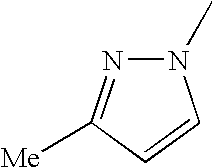 |
 |
534 |
| 97 |
 |
 |
550 |
| 98 |
 |
 |
550 |
| 99 |
 |
 |
538 |
| 100 |
 |
 |
553 |

To a solution of (7-chloro-1H-pyrrolo[3,2-b]pyridin-3-yl)-oxo-acetic acid (1.5 g, 6.7 mmol) and phenylpiperidine-4-ylidene acetonitrile (1.3 g, 6.7 mmol) in DMF (50 mL) was added DEPBT (3.15 g, 10.5 mmol) and ethyl diisopropylamine (6.1 mL, 35 mmol). The solution was stirred 20 h, concentrated under vacuum and partitioned between 5% Na2CO3(aq) (80 mL) and EtOAc (5×100 mL). The combine organic layers were dried (MgSO4), filtered and concentrated. The residue was purified by Biotage Chromatography (SiO2, 30% EtOAc/Hex to 100% EtOAc) and by preparative HPLC to yield the title compound (300 mg, 0.74 mmol, 11%) as a yellow solid.

A mixture of compound of Example 101 (30 mg, 0.074 mmol), 2-tributylstannanyl pyrazine (82 mg, 0.22 mmol), Pd(PPh3)4 (88 mg, 0.076 mmol) and dioxane (1 mL) in a sealed tube was heated at 140° C. for 15 h. The reaction mixture was diluted with MeOH, filtered through Celite and concentrated. The residue was purified by preparative HPLC to yield title compound (2.6 mg, 0.0058 mmol, 9%) as a yellow oil.


A mixture of Example 101 (30 mg, 0.074 mmol), 2-tributylstannanyl thiazole (111 mg, 0.30 mmol), Pd(PPh3)4 (172 mg, 0.149 mmol) and dioxane (1 mL) in a sealed tube was heated at 120° C. for 15 h. The reaction mixture was diluted with MeOH, filtered through Celite and concentrated. The residue was purified by preparative HPLC to yield title compound (5.6 mg, 0.012 mmol, 19%) as an orange solid.

A mixture of compound of example 101 (34 mg, 0.084 mmol), 1,2,3-triazole (0.40 mL, 6.9 mmol), copper metal (5.4 mg, 0.084 mmol), and K2CO3 (11.5 mg, 0.083 mmol) in a sealed tube was heated at 160° C. for 5 h. The reaction mixture was diluted with MeOH (2 mL), filtered through Celite and concentrated. The residue was purified by preparative HPLC to yield title compound (3.1 mg, 0.026 mmol, 39%) as a yellow solid.

A mixture of compound of example 101 (35 mg, 0.087 mmol), 5-tri-n-butylstannanypyrazine-2-ylaminel (135 mg, 0.35 mmol), Pd(PPh3)4 (202 mg, 0.174 mmol) and dioxane (1 mL) in a sealed tube was heated at 160° C. for 0.5 h with microwaves. The reaction mixture was diluted with MeOH, filtered through Celite and concentrated. The residue was purified by preparative HPLC to yield title compound (9.2 mg, 0.020 mmol, 23%) as an orange solid.

To a solution of (7-chloro-1H-pyrrolo[3,2-b]pyridin-3-yl)-oxo-acetic acid (191 mg, 0.87 mmol), 4-(bromophenylmethylene)-piperidine hydrochloride salt (245 mg, 0.85 mmol) and diisopropylethylamine (440 mg, 3.4 mmol) in chloroform (10 mL) was added BOPCl (261 mg, 1.02 mmol). The reaction solution was stirred two days, treated with additional diisopropylethylamine (440 mg, 3.4 mmol) and BOPCl (130 mg, 0.50 mmol) and stirred three days. The reaction mixture was concentrated, dissolved into MeOH and purified by preparative HPLC to yield title compound shown (293 mg, 0.64 mmol, 75%) as a white solid.

4-[(5-Methyl-[1,3,4]oxadiazol-2-yl)-phenyl-methylene]-piperidine-1-carboxylic acid tert-butyl ester (30 mg, 0.085 mmol) was stirred with 4.0M HCl in dioxane (2.0 mL) for 2 h and then concentrated under vacuum. The resulting residue, (7-chloro-1H-pyrrolo[3,2-b]pyridin-3-yl)-oxo-acetic acid (27 mg, 0.12 mmol), and diisopropylethylamine (0.5 mL, 2.9 mmol) were dissolved into chloroform (2 mL) and treated with added BOPCl (34 mg, 0.13 mmol). The reaction solution was stirred three days, concentrated, dissolved into MeOH and purified by preparative HPLC to yield the TFA salt of title compound shown (43 mg, 0.075 mmol, 89%) as an off-white solid.

4-[(3,5-Difluoro-phenyl)-phenyl-methylene]-piperidine-1-carboxylic acid tert-butyl ester (29 mg, 0.074 mmol) was stirred with 4.0M HCl in dioxane (2.0 mL) for 2 h and then concentrated under vacuum. The resulting residue, (7-chloro-1H-pyrrolo[3,2-b]pyridin-3-yl)-oxo-acetic acid (27 mg, 0.12 mmol), and diisopropylethylamine (0.5 mL, 2.9 mmol) were dissolved into chloroform (2 mL) and treated with added BOPCl (34 mg, 0.13 mmol). The reaction solution was stirred three days, concentrated, dissolved into MeOH and purified by preparative HPLC to yield the TFA salt of title compound shown (37 mg, 0.061 mmol, 83%) as a white solid.

Intermediate 1zz was isolated as a white solid. LC/MS: (ES+) m/z (M+H)+=289. Rt=0.85 min.

The title compound was prepared according to general procedures described before.

A mixture of intermediate 1zz (760 mg, 2.65 mmol), Intermediate 2zz (577 mg, 2.92 mmol), HOBT (811 mg, 5.30 mmol) EDAC (1.0 g, 5.30 mmol) and NMM (1.80 ml, 15.90 mmol) in DMF (5.0 ml) was stirred at room temperature for 20 hr. The resulting solution was diluted with ethylacetate (30 ml), then washed with water (25 ml×2) and brine (20 ml). The organic layer was dried over magnesium sulfate, filtered and concentrated. The residue was crystallized in methanol. After filtration, the solid was dried in air to afford the title compound (385 mg, 31%). 1H NMR (300 MHz, CDCl3): 9.41 (bs, 1H); 8.27-8.26 (m, 1H); 8.12-8.10 (m, 1H); 7.44-7.25 (m, 5H); 3.95-2.59 (m, 8H). LC/MS: (ES+) m/z (m+H)+=469. Rt=1.52 min.

The title compound was prepared from intermediate 3zz (300 mg, 0.64 mmol) following the procedure described before (Cu coupling) using the following reagents and amounts: 1,2,3-triazole (1.3 g, 19.2 mmol); potassium carbonate (88 mg, 0.64 mmol); Copper (41 mg, 0.64 mmol). Title compound was obtained as a brown solid (78 mg, 27%). 1H NMR (500 MHz, CDCl3): 11.09 (bs, 1H); 9.28-9.27 (m, 1H); 8.32-8.31 (m, 1H); 8.22 (m, 1H); 8.09-8.08 (m, 1H); 7.49-7.25 (m, 5H); 3.96-2.61 (m, 8H). LC/MS: (ES+) m/z (m+H)+=456, Rt=1.56 min.

The title compound was prepared from intermediate 3zz (105 mg, 0.22 mmol) according to general procedures described before (Cu-coupling) using the following reagents and amounts: 3-aminopyrizole (450 mg, 5.41 mmol); potassium carbonate (30 mg, 0.22 mmol); copper (16 mg, 0.25 mmol). Title compound was obtained as a yellow solid (13.6 mg, 3.5%). 1H NMR (300 MHz, DMSO): 12.40 (bs, 1H); 8.37-8.29 (m, 2H); 8.08-8.02 (m, 1H); 7.55-7.35 (m, 5H); 5.93-5.90 (m, 1H); 3.85-2.49 (m, 8H). LC/MS: (ES+) m/z (m+H)+=470, Rt=1.57 min.


As shown in Scheme 31 to a solution of 1-[4-(1-bromo-1-phenyl-methylene)-piperidin-1-yl]-2-(4,7-dimethoxy-6-azaindol-3-yl)-ethane-1,2-dione (0.094 g, 0.195 mmol), PdCl2(PhCN)2 (0.005 g, 0.0117 mmol), and CuI (0.005 g, 0.0252 mmol) in piperidine (1.5 mL) was added trimethylsilylacetylene (0.070 mL, 0.495 mmol). The mixture was heated at 60° C. for 2 h and the solvent removed in vacuo. The residue was diluted with EtOAc and H2O, the organic phase was separated and the aqueous phase was re-extracted with EtOAc (×2). The combined organic layers were washed, (H2O, brine), dried (Na2SO4) and evaporated, and the residue was purified by preparative HPLC to give the title compound as a colorless solid (0.038 g, 39%).

To a solution of 1-[4-(1-phenyl-1-(2-trimethylsilylethyn-1-yl)-methylene)-piperidin-1-yl]-2-(4,7-dimethoxy-6-azaindol-3-yl)-ethane-1,2-dione (0.035 g, 0.0699 mmol) in MeOH (1 mL) was added K2CO3 (0.010 g, 0.0724 mmol) and the mixture was allowed to stir at room temperature for 6 h. The mixture was then evaporated and the residue was purified by preparative HPLC to give the title compound as a colorless solid (0.027. g, 91%).


General Method: As shown in Scheme 47 to a mixture of 1-[4-(1-bromo-1-phenyl-methylene)-piperidin-1-yl]-2-(4,7-dimethoxy-6-azaindol-3-yl)-ethane-1,2-dione (0.101 g, 0.208 mmol), PdCl2(PhCN)2 (0.004 g, 0.0107 mmol), tri-2-furylphosphine (0.010 g, 0.045 mmol), CuI (0.004 g, 0.023 mmol) was added piperidine (2 mL), followed by isopropylacetylene (0.11 mL, 1.07 mmol). The mixture was heated in a sealed tube at 100° C. for 3 h and the solvent was then removed in vacuo. The residue was purified by preparative HPLC to afford the title compound (0.212 g, 22%). as a light yellow solid:

Prepared according to the general method to give the title compound (21% yield) as a solid:

Prepared according to the general method to give, after crystallization from MeOH, the title compound (22% yield) as a solid:

Prepared according to the general method to give the title compound (59% yield) as a solid:

Prepared according to the general method to give the title compound (29% yield) as a solid:

To a solution of LDA [prepared from iPr2NH (0.15 mL, 1.070 mmol) and n-BuLi (0.52 mL, 0.936 mmol)] in THF (3 mL) at −78° C. under Ar was added 1-[4-(1-phenyl-1-ethynyl-methylene)-piperidin-1-yl]-2-(4,7-dimethoxy-6-azaindol-3-yl)-ethane-1,2-dione (0.160 g, 0.373 mmol). The solution was allowed to stir for 30 min and then a large excess of powdered dry ice was added directly into the flask. The mixture was allowed to warm to room temperature overnight and was then quenched with 10% aqueous HCl. The mixture was extracted with EtOAc (×3) and the combined organic layers were washed (H2O, brine), dried (Na2SO4) and concentrated. The residue was purified by preparative HPLC to afford the title compound as a colorless solid (0.026 g, 15%):

A mixture of 3-bromo-5-carboxyethylpyridine (0.108 g, 0.469 mmol), hexamethylditin (0.088 mL, 0.422 mmol) and tetrakis(triphenylphosphine)palladium (0.010 g, 0.008 mmol) in dry THF (2 mL) was degassed with a stream of Ar bubbles for 10 min. The reaction vessel was then sealed and the mixture was heated at 80° C. (oil bath temperature) for 16 h. The cooled mixture was then evaporated to dryness and the residue chromatographed (SiO2/hexane-EtOAc, 1:1) to give the title compound (0.113 g, 77%) as a clear yellow oil:

A mixture of 3-trimethylstannyl-5-carboxyethylpyridine (0.298 g, 0.949 mmol) and 4-(1-bromo-1-phenyl-methylene)-piperidine-1-carboxylic acid tert-butyl ester (0.334 mL, 0.949 mmol) in dry THF (5 mL) was degassed with a stream of Ar bubbles for 10 min. To this solution was added bis(triphenylphosphine)palladium dichloride (0.033 g, 0.047 mmol) and then the reaction vessel was sealed and the mixture was heated at 90° C. (oil bath temperature) for 16 h. The cooled mixture was then evaporated to dryness and the residue chromatographed (SiO2/hexane-EtOAc, 7:3) to give the title compound (0.294 g, 73%) as a clear yellow oil:

To a solution of 4-(1-phenyl-1-(5-carboxyethylpyridin-3-yl)-methylene)-piperidine-1-carboxylic acid tert-butyl ester (0.058 g, 0.137 mmol) in dry THF (2 mL) was added LAH (0.334 mL, 0.949 mmol) portionwise over 10 min. The mixture was stirred at room temperature for an additional 30 min and then it was quenched with a saturated aqueous solution of Rochelle's salt (5 mL). The resulting mixture was filtered and the filtrate concentrated to dryness to give the title compound (0.046 g, 87%) as a clear brown oil:

Prepared analogously to the general method of Example 70 to give the title compound as a white solid (8% yield):


Prepared analogously to the general method of Example 70 to give the title compound as a white solid (12% yield):

Example 129a could be prepared analogously to Example 110.

To a mixture of N-Boc-4-piperidone (0.200 g, 1.00 mmol) and 2-(cyanomethyl)-5-phenyl-1,3,4-oxadiazole in dry THF (5 mL), at 5° C. under Ar, was added NaHMDS solution (1M in THF, 1.1 mL, 1.1 mmol) and the mixture was then stirred at room temperature for 16 h. The reaction was quenched with MeOH (1 mL) and then the mixture was evaporated to dryness. The residue was taken up in HCl-dioxane (4 M, 2 mL) and the reaction mixture was kept at room temperature for 20 h before again being evaporated to dryness. The residue was taken up in EtOAc, washed (sat. NaHCO3×2, brine), dried (MgSO4) and evaporated to give the title compound (0.212 g, 80%) as a dark red semi-solid, which was used as such in the next step:
| TABLE X |
| Representative cyanovinylpiperidine intermediates |
 |
| Yield | LCMS: m/e | ||
| Example | R | (%) | (M + H)+ |
| 1 |
 |
70 | 256 |
| 2 |
 |
50 | 206 |
| 3 |
 |
83 | 247 |
| 4 |
 |
100 | 205 |
| 5 |
 |
100 | 239 |
| 6 |
 |
91 | 255 |
| 7 |
 |
82 | 282 |

General Method: To a solution of oxalyl chloride (0.030 mL, 0.34 mmol) in DCM (4 mL), at 5° C. under Ar, was added DMF (0.02 mL) and stirring was continued at the same temperature for 10 min. The mixture was then cooled at −20° C., a solution of 4,7-dimethoxy-6-azaindol-3-yl-oxoacetic acid (0.060 g, 0.24 mmol) in NMP-DCM (1:2, 1.5 mL) was added dropwise, and stirring was continued at −20° C. for 1 h. To this mixture was added a mixture of 4-[1-cyano-1-(5-phenyl-1,3,4-oxadiazol-2-yl)-methylene]-piperidine (0.064 g, 0.24 mmol) and Hünig's base (0.080 mL, 0.48 mmol) in DCM (1.5 mL). This mixture was stirred at 5° C. for 1 h and then it was evaporated to dryness. The residue was purified by preparative HPLC to give the title compound (0.037 g, 31%) as a beige solid:

Prepared according to the general method above to give the title compound (20% yield) as a beige solid:

Prepared according to the general method above to give the title compound (51% yield) as a white solid:

Prepared according to the general method above to give the title compound (2% yield) as a yellow solid:

Prepared according to the general method above to give the title compound (7% yield) as a white solid:

Prepared according to the general method above to give the title compound (5% yield) as a white solid:

Prepared according to the general method above to give the title compound (20% yield) as a white solid:

Prepared according to the general method above to give the title compound (15% yield) as a white solid:

Prepared according to the general method to give the title compound (25% yield) as a light tan solid.

Prepared according to the general method to give the title compound (23% yield) as a white solid.

Prepared according to the general method to give the title compound (14% yield) as a white solid:

Prepared according to the general method to give the title compound (39% yield) as a white solid.

Prepared according to the general method to give the title compound (54% yield) as a white solid.

Prepared according to the general method to give the title compound (36% yield) as a white solid.

To a solution of phenylacetic acid (13.7 g, 0.100 mol) in THF (90 mL) at 0° C. was slowly added iPrMgCl (2M in Et2O, 100 mL, 0.200 mol). The mixture was stirred at rt for 1 h and then N-Boc-4-piperidone (20.0 g, 0.100 mol) was added as a solid. Stirring was continued for 1 h and then the mixture was quenched with sat. NH4Cl and acidified to pH 2 using concentrated HCl. The mixture was extracted with EtOAc (×3) and the combined organic layers were dried over Na2SO4, filtered and concentrated to give the title compound (33.3 g, 99%) as a colorless foam which was of sufficient purity to continue to the next step:

A mixture of NaOAc (16.3 g, 0.20 mol) and 4-hydroxy-4-(1-carboxy-1-phenyl-methyl)piperidine-1-carboxylic acid tert-butyl ester (33.3 g, 0.099 mol) were dissolved in Ac2O (110 mL) in a sealed tube and allowed to stir at rt for 4 h. The mixture was then heated at 70° C. for 16 h, after which the volatiles were removed in vacuo. The residue was subsequently diluted with EtOAc and 300 mL of 1M NaOH was added. This mixture was stirred for 2 h and then the pH was adjusted to 2 using conc. HCl. The mixture was extracted with EtOAc (×3) and the combined organic layers were washed (brine), dried (Na2SO4) and evaporated to give an oil, which was triturated with hexane to give the title compound (28.9 g, 87%) as a colorless solid:

A mixture of 4-(1-phenyl-1-carboxy-methylene)piperidine-1-carboxylic acid tert-butyl ester (0.153 g, 0.048 mol), EDCI (0.113 g, 0.059 mol), and HOBt (0.081 g, 0.060 mol) in DMF (3 mL) was stirred for 30 min at room temperature and then hydrazine hydrate (1.0 mL) was added. Stirring was continued for 12 h and then the mixture was poured into water and extracted with EtOAc (×3). The combined organic layers were washed, (H2O ×5, brine) and dried (Na2SO4). The solvent was removed in vacuo and the residue was purified by preparative HPLC to give the title compound (0.147 g, 92%) as a colorless oil:

A mixture of 4-(1-phenyl-1-carboxy-methylene)piperidine-1-carboxylic acid tert-butyl ester (1.05 g, 3.31 mmol), EDCI (0.888 g, 4.63 mmol) and HOBt (0.626 g, 4.63 mmol) in DMF (4 mL) was stirred for 30 min at room temperature and then formic hydrazide (3.97 g, 66.2 mmol) was added. Stirring was continued for 1 h and then the mixture was poured into water and extracted with EtOAc (×3). The combined organic layers were washed (H2O ×3, brine), dried (Na2SO4) and evaporated to give the title compound (1.48 g, 97%) as a colorless oil:

Method A: To a suspension of 4-(1-phenyl-1-(2-formylhydrazinocarbonyl)-methylene)piperidine-1-carboxylic acid tert-butyl ester (0.106 g, 0.294 mmol) in CH3CN (2 mL) was added iPr2NEt (0.30 mL, 1.7 mmol) and PPh3 (0.137 g, 0.523 mmol), followed after 5 min by hexachloroethane (0.162 g, 0.685 mmol). The mixture was stirred at room temperature for 4 h and then the solvent was removed in vacuo and the residue was partitioned with EtOAc-H2O. The organic phase was separated and the aqueous phase was re-extracted with EtOAc. The combined organic phases were washed (H2O, brine), dried (Na2SO4) and evaporated. The residue was purified by flash chromatography (SiO2/EtOAc-hexane, 35:65) to give the title compound (0.050 g, 50%) as a colorless solid:

Method B: To a solution of 4-(1-phenyl-1-hydrazinocarbonyl-methylene)piperidine-1-carboxylic acid tert-butyl ester (0.056 g, 0.169 mmol) and iPr2NEt (0.20 mL, 1.16 mmol) in CH3CN (1 mL) was added acetic anhydride (0.020 mL, 0.212 mmol) and the mixture was allowed to stir at room temperature for 1 h. To this mixture was added PPh3 (0.182 g, 0.694 mmol), followed by hexachloroethane (0.093 g, 0.394 mmol). The mixture was stirred for 12 h and then it was worked up as in Method A above and the crude product purified by flash chromatography (SiO2/EtOAc-hexane, 3:7)) to give the title compound (0.040 g, 64%) as a colorless solid: 1Hnmr (400 MHz, CDCl3) δ 7.44-7.34 (m, 3H), 7.39-7.23 (m, 2H), 3.56 (m, 3H), 3.40 (m, 3H), 2.85 (br m, 2H), 2.33 (s, 3H), 2.20 (m, 2H).

To a solution of 4-(1-phenyl-1-hydrazinocarbonyl-methylene)piperidine-1-carboxylic acid tert-butyl ester (0.150 g, 0.45 mmol) and iPr2NEt (0.541 mL, 3.11 mmol) in CH3CN (5 mL) was added benzoic anhydride (0.128 mg, 0.57 mmol) and the mixture was allowed to stir at room temperature for 1 h. To this mixture was then added PPh3 (0.485 g, 1.85 mmol), followed by hexachloroethane (0.245 g, 1.04 mmol). The mixture was allowed to stir for 1 h and then it was worked up as in Method A above and the crude product purified by flash chromatography (SiO2/EtOAc-hexane, 1:4) to give the title compound (0.146 g, 78%) as a colorless solid:

To a solution of 4-(1-phenyl-1-hydrazinocarbonyl-methylene)piperidine-1-carboxylic acid tert-butyl ester (0.150 g, 0.45 mmol) and iPr2NEt (0.545 mL, 3.13 mmol) in CH3CN (5 mL) was added trimethylacetic anhydride (0.116 mg, 0.57 mmol) and the mixture was allowed to stir at room temperature for 1 h. To this mixture was then added PPh3 (0.488 g, 1.86 mmol), followed by hexachloroethane (0.247 g, 1.04 mmol). The mixture was allowed to stir for 1 h and then it was worked up as in Method A above and the crude product purified by flash chromatography (SiO2/EtOAc-hexane, 1:4) to give the title compound (0.180 g, 100%) as a colorless solid:

To a solution 4-(1-phenyl-1-hydrazinocarbonyl-methylene)piperidine-1-carboxylic acid tert-butyl ester (0.140 g, 0.422 mmol) and iPr2NEt (0.507 mL, 2.913 mmol) in CH3CN (5 mL) was added methacrylic anhydride (0.079 mL, 0.53 mmol) and the mixture was allowed to stir at room temperature for 1 h. To this mixture was then added PPh3 (0.454 g, 1.73 mmol), followed by hexachloroethane (0.230 g, 0.971 mmol). The mixture was allowed to stir for an additional 1 h and then it was worked up as in Method A above and the crude product purified by preparative HPLC to give the title compound (0.060 g, 37%) as a colorless solid:

To a solution of Fmoc-azetidine-3-carboxylic acid (0.495 g, 1.53 mmol) in CH2Cl2 (10 mL) was added HOBt (0.290 g, 2.14 mmol) and EDCI (0.411 g, 2.14 mmol), and the mixture was allowed to stir for 10 min. To this solution was added 4-(1-phenyl-1-hydrazinocarbonyl-methylene)piperidine-1-carboxylic acid tert-butyl ester (0.507 g, 1.53 mmol), the mixture was stirred for 1 h and then it was diluted with H2O and the layers separated. The aqueous phase was extracted with CH2Cl2 (×3) and the combined organic layers were washed (H2O, brine), dried (Na2SO4) and evaporated to give the title compound (0.99 g, 100%) which was of sufficient purity to be used as such in the following step:

To a solution of 4-[1-phenyl-1-(2-(N-(9-fluorenylmethoxycarbonyl)-3-azetidinecarbonyl)-hydrazinocarbonyl)-methylene]-piperidine-1-carboxylic acid tert-butyl ester (0.411 g, 0.645 mmol), iPr2NEt (0.775 mL, 4.448 mmol) and PPh3 (0.693 g, 2.643 mmol) in CH3CN (8 mL) was added hexachloroethane (0.351 mg, 1.483 mmol). The mixture was allowed to stir for 1 h and then it was worked up as in Method A above and the crude product purified by flash chromatography (SiO2/EtOAc-hexane, 1:1) to give the title compound (0.299 g, 75%) as a colorless solid:

To a solution of 4-[1-phenyl-1-(5-(N-(9-fluorenylmethoxycarbonyl)azetidin-3-yl)-1,3,4-oxadiazol-2-yl)methylene]piperidine-1-carboxylic acid tert-butyl ester (0.161 g, 0.260 mmol) and heptanethiol (0.398 mL, 2.60 mmol) in THF (2.6 mL) at rt was added DBU (2 drops). The mixture was allowed to stir for 18 h and then the solvent was removed in vacuo. The residue was dissolved in MeOH and purified by preparative HPLC(NH4OAc) to afford the title compound (0.077 g, 74%) as a colorless solid:

To a solution of 4-[1-phenyl-1-(5-(azetidin-3-yl)-1,3,4-oxadiazol-2-yl)methylene]piperidine-1-carboxylic acid tert-butyl ester (0.029 g, 0.074 mmol) in MeOH (5 mL) was added formaldehyde (0.322 mL, 57% solution in H2O) dropwise at rt. A solution of NaCNBH3 (0.026 g, 0.415 mmol) in MeOH (0.3 mL) was then added and the solution was stirred at rt for 15 min. The resulting mixture was poured into H2O and extracted with EtOAc (×3), and the combined organic layers were washed (H2O, brine), dried (Na2SO4) and concentrated. The residue was purified by preparative HPLC (NH4OAc) to afford the title compound (0.012 g, 17%) as a colorless solid:

To a solution of 4-iodo-1-methylimidazole (0.424 g, 2.04 mmol) in CH2Cl2 at rt was added EtMgBr (3.0 M in Et2O, 0.75 mL, 2.25 mmol) and the resulting solution was allowed to stir for 30 min at rt. To this solution was then added Bu3SnCl (0.60 mL, 2.21 mmol) and the mixture was stirred for another 7 h. The resulting mixture was then washed (sat. NH4C1, H2O, brine), dried (Na2SO4) and evaporated to give the title compound, which was used directly in the following step without further purification:

A mixture of 4-(1-phenyl-1-iodo)methylene)-piperidine-1-carboxylic acid tert-butyl ester (0.112 g, 0.280 mmol), 4-tri-n-butylstannyl-1-methylimidazole (0.181 g, 0.486 mmol) Pd2(dba)3 (0.013 mg, 0.014 mmol) and tri-(2-furyl)phosphine (0.007 g, 0.031 mmol) in THF (4 mL) was heated at 70° C. in a sealed tube under Ar for 12 h. The mixture was cooled to rt, aqueous KF was added and the mixture was allowed to stir for 2 h. The resulting mixture was extracted with EtOAc (×3) and the combined organic layers were washed (H2O, brine), dried (Na2SO4) and concentrated in vacuo. The residue was purified by preparative HPLC (NH4OAc) to give the title compound (0.047 g, 47%) as an oil which was slightly contaminated with the starting stannane. This material was used in the following step without further purification.

To solution of 4-[1-phenyl-1-(1-methylimidazol-4-yl)methylene]piperidine-1-carboxylic acid tert-butyl ester (0.0477 g, 0.0775 mmol) in CH2Cl2 (3 mL) was added TFA (0.3 mL) and the solution was allowed to stir at rt for 30 min. The solvent was then removed in vacuo and the material was dissolved in CHCl3. To this solution was added 4-methoxy-7-(3-methyl-1,2,4-triazol-1-yl)-6-azaindol-3-yl-oxoacetic acid hydrochloride salt (0.0258 g, 0.0764 mmol) and iPrNEt2 (0.024 mL, 1.38 mmol), followed by BOP-Cl (0.0271 g, 0.106 mmol). The mixture was allowed to stir at rt for 2 h and then the solvent was removed in vacuo and the residue was partitioned with H2O-EtOAc. The aqueous phase was re-extracted with EtOAc (×2) and the combined organic layers were washed (H2O, brine), dried (Na2SO4) and evaporated. The resulting residue was purified by preparative HPLC (NH4OAc) to give the title compound (0.0210 g, 50%) as a colorless solid:

A mixture of 4-methoxy-7-chloro-6-azaindole (0.301 g, 1.65 mmol), copper powder (0.124 g, 1.944 mmol), AgOTf (0.471 g, 1.831 mmol) and 4-methyl-1,2,4-triazole (1.415 g, 17.05 mmol) (prepared according to Begtrup, M. J. Chem. Soc. Perkin Trans. II, 1976, 736) was heated at 130° C. in a sealed tube for 36 h. The cooled reaction mixture was diluted with MeOH and then filtered through Celite. The filtrate was evaporated and the residue was partitioned with EtOAc-H2O. The aqueous phase was separated and re-extracted with EtOAc (×2). The combined organic layers were washed (10% HCl, H2O, brine), dried (Na2SO4) and concentrated, and the residue was purified by flash chromatography (SiO2/8% acetone in CH2Cl2) affording a light yellow solid (174.5 mg). From the aqueous phase a further 18.4 mg was obtained by basification, extraction and flash chromatography. The total yield of the title compound was 0.193 g, (51%):

To a solution of AlCl3 (1.382 g, 10.36 mmol) in CH2Cl2 (4 mL) and MeNO2 (1 mL) was added 4-methoxy-7-(4-methyl-1,2,3-triazol-1-yl)-6-azaindole (0.155 g, 0.677 mmol) as a solid. After dissolution of the starting material (ca. 5 min), ClCOCO2Me (0.29 mL, 3.15 mmol) was added and the mixture was allowed to stir for 18 h. Another portion of ClCOCO2Me (0.29 mL, 3.15 mmol) was then added and stirring continued for a further 24 h. The mixture was subsequently cooled to 0° C., quenched by the slow addition of 1 M aqueous NH4OAc and then extracted with EtOAc. The aqueous layer was separated and acidified with 6 M HCl and then the resultant precipitate was filtered and dried to give the title acid (0.158 g, 69%): LCMS: m/e 302 (M+H)+. The organic layer was washed (H2O, brine), dried (Na2SO4) and evaporated to give 4-methoxy-7-(4-methyl-1,2,3-triazol-1-yl)-6-azaindol-3-yl-oxoacetic acid methyl ester (0.037 g, 15%): LCMS: m/e 316 (M+H)+. This material was hydrolyzed by dissolving in MeOH (2 mL) and treating with 1M NaOH (0.3 mL). The mixture was allowed to stir for 4 h, at which point the solvent was removed and the residue diluted with H2O (4 mL). The mixture was then acidified to pH 1 using 6N HCl and the precipitated acid was filtered and dried to give a further 0.021 g of the title compound. Total yield=0.179 g (78%).

To a mixture of 4-(1-phenyl-1-iodomethylene)-piperidine-1-carboxylic acid tert-butyl ester (0.537 g, 1.60 mmol), PdCl2(PhCN)2 (0.032 g, 0.083 mmol), tri-2-furylphosphine (0.0806 g, 0.347 mmol), and CuI (0.034 g, 0.178 mmol) was added piperidine (10 mL), followed by 3-butyn-2-ol (0.25 mL, 3.19 mmol). The mixture was heated at 100° C. for 8 h and then the solvent was removed in vacuo. The residue was partitioned with EtOAc-H2O and the aqueous phase was separated and re-extracted with EtOAc (×2). The combined organic layers were washed (H2O, brine), dried (Na2SO4) and concentrated, and the residue was purified by flash chromatography (SiO2/hexane:EtOAc, 3:2) to give the title compound (0.402 g, 73%) as a yellow orange oil which solidified on standing:

To a solution of 4-(1-phenyl-1-(3-hydroxy-1-butyn-1-yl)-methylene)-piperidine-1-carboxylic acid tert-butyl ester (0.197 g, 0.577 mmol) in CH2Cl2 (5 mL) was added activated MnO2 (1.125 g) at 0° C. The mixture was allowed to stir for 3 h, at which point no starting material remained. The reaction mixture was filtered through a pad of Celite and the filtrate was concentrated to give the title compound (0.190 g, 97%) as a colorless oil:


A mixture of 4-[1-phenyl-1-(3-oxo-1-butyn-1-yl)methylene]-piperidine-1-carboxylic acid tert-butyl ester (0.365 g, 1.069 mmol) and hydrazine hydrate (0.065 mL, 1.14 mmol) in EtOH (5 mL) was allowed to stir at rt for 2 h and then it was heated at 80° C. for 14 h. The solvent was subsequently removed under reduced pressure and the residue was purified by preparative HPLC affording the title compound (0.151 g, 40%) as a colorless solid

To a solution of 4-[1-phenyl-1-(3-methylpyrazol-5-yl)methylene]piperidine-1-carboxylic acid tert-butyl ester (0.0190 g, 0.0538 mmol) in CH2Cl2 (1 mL) was added TFA (0.4 mL) and the mixture was stirred at rt for 30 min. The solvent was then removed in vacuo and the material was dissolved in CHCl3 (2 mL). To this solution was added 4-methoxy-7-(4-methyl-1,2,3-triazol-1-yl)-6-azaindol-3-yl-oxoacetic acid hydrochloride salt (0.0187 g, 0.0621 mmol) and iPrNEt2 (0.050 mL, 0.287 mmol), followed by BOP-Cl (0.0221 g, 0.868 mmol). The mixture was allowed to stir at rt for 2 h and then the solvent was removed in vacuo. The resulting residue was diluted with H2O and extracted with EtOAc (×3). The combined organic layers were washed (H2O, brine), dried (Na2SO4) and concentrated, and the residue was purified by preparative HPLC (NH4OAc) to give the title compound (0.0128 g, 44%) as a colorless solid:

To a solution of 4-[1-phenyl-1-(5-methyl-1,3,4-oxadiazol-2-yl)methylene]piperidine-1-carboxylic acid tert-butyl ester (0.0300 g, 0.084 mmol) in CH2Cl2 (1 mL) was added TFA (0.4 mL) and the reaction mixture was stirred at rt for 30 min. The solvent was subsequently removed in vacuo and the material was dissolved in CHCl3 (3 mL). To this solution was then added 4-methoxy-7-(4-methyl-1,2,3-triazol-1-yl)-6-azaindol-3-yl-oxoacetic acid hydrochloride salt (0.0250 g, 0.084 mmol) and iPrNEt2 (0.059 mL, 0.338 mmol), followed by BOP-Cl (0.0210 g, 0.084 mmol). The mixture was allowed to stir at rt for 2 h and then the solvent was removed in vacuo. The residue was diluted with H2O and extracted with EtOAc (×3). The combined organic layers were washed (H2O, brine), dried (Na2SO4) and concentrated, and the residue was purified by preparative HPLC (NH4OAc) affording the title compound (0.0174 g, 39%) as a colorless solid:

A mixture of 4-methoxy-7-cyano-6-azaindole (0.131 g, 0.757 mmol) and acetic hydrazide (0.270 g, 3.645 mmol) was heated in a sealed tube at 150° C. for 48 h. The reaction mixture was cooled and the solid residue was diluted with EtOAc-H2O. The aqueous phase was separated and re-extracted twice with EtOAc. The combined organic layers were washed (H2O, brine), dried (Na2SO4) and concentrated, and the residue was purified by preparative HPLC (NH4OAc), affording the title compound (0.0455 g, 26%) as a colorless solid:

To a solution of AlCl3 (0.321 g, 2.411 mmol) in CH2Cl2 (0.8 mL) and MeNO2 (0.2 mL) was added 4-methoxy-7-(5-methyl-1,3,4-triazol-2-yl)-6-azaindole (0.0435 g, 0.190 mmol) as a solid. After dissolution of the starting material (ca. 5 min), ClCOCO2Me (0.070 mL, 0.756 mmol) was added and the mixture was allowed to stir for 5 h. The mixture was then cooled at 0° C., quenched by the slow addition of 1 M aqueous NH4OAc and extracted with EtOAc (×3). The combined organic layers were washed (H2O, brine), dried (Na2SO4) and evaporated to give 4-methoxy-7-(5-methyl-1,3,4-triazol-2-yl)-6-azaindol-3-yl-oxoacetic acid methyl ester (0.0347 g, 60%: LCMS: m/e 316 (M+H)+. This material was dissolved in MeOH (2 mL) and treated with 2.5 M NaOH (0.2 mL, 0.5 mmol). The mixture was allowed to stir for 5 h, at which point the solvent was removed and the residue was diluted with H2O (2 mL). This mixture was acidified to pH 1 with 6 M HCl and the solution was lyophilized to give the title compound (0.062 g), which contained a nominal amount of inorganic salts. This material was used as such in the following step:

To a solution of 4-[1-phenyl-1-(5-methyl-1,3,4-oxadiazol-2-yl)methylene]-piperidine-1-carboxylic acid tert-butyl ester (0.0348 g, 0.098 mmol) in CH2Cl2 (1 mL) was added TFA (0.5 mL) and the reaction mixture was stirred for 30 min. The solvent was then removed in vacuo and the residual material was dissolved in CHCl3 (1 mL). To this solution was then added 4-methoxy-7-(5-methyl-1,3,4-triazol-2-yl)-6-azaindol-3-yl-oxoacetic acid hydrochloride salt (0.0621 g, 0.206 mmol) and iPrNEt2 (0.18 mL, 1.03 mmol), followed by BOP-Cl (0.0670 g, 0.263 mmol). The mixture was stirred at rt for 2 h and then the solvent was removed in vacuo. The residue was diluted with H2O and extracted with EtOAc (×3). The combined organic layers were washed (H2O, brine), dried (Na2SO4) and concentrated, and the residue was purified by preparative HPLC (NH4OAc) to give the title compound (0.0093 g, 18%) as a colorless solid:

To a mixture of 4-methoxy-7-bromo-6-azaindole (0.200 g, 0.88 mmol), PdCl2(PhCN)2 (0.017 g, 0.044 mmol), tri-2-furylphosphine (0.0410 g, 0.176 mmol) and CuI (0.017 g, 0.088 mmol) was added piperidine (10 mL), followed by 3-butyn-2-ol (0.09 mL, 1.15 mmol). The mixture was heated at 80° C. for 6 h and then the solvent was removed in vacuo. The residue was partitioned with EtOAc-H2O and then the aqueous phase was separated and re-extracted with EtOAc (×2). The combined organic layers were washed (H2O, brine), dried (Na2SO4) and concentrated to afford the title compound (0.200 g, 95%) as a brown solid which was of sufficient purity for use in the following step:

To a solution of 4-methoxy-7-(3-hydroxy-1-butyn-1-yl)-6-azaindole (0.200 g, 0.88 mmol) in CH2Cl2 (25 mL) was added activated MnO2 (1.72 g) and the reaction mixture was stirred for 12 h. The mixture was then filtered through Celite and the filtrate was concentrated to afford the title compound (0.152 g, 80%) as a light brown solid:

To a solution of AlCl3 (0.411 g, 3.08 mmol) in CH2Cl2 (1.6 mL) and MeNO2 (0.4 mL) was added 4-methoxy-7-(5-methylpyrazol-2-yl)-6-azaindole (0.054 g, 0.237 mmol) as a solid. After dissolution of the starting material (ca. 5 min) ClCOCO2Me (0.087 mL, 0.946 mmol) was added and the mixture was allowed to stir for 5 h. The reaction was cooled to 0° C., quenched by the slow addition of 1 M aqueous NH4OAc and extracted with EtOAc (×3). The combined organic layers were washed (H2O, brine), dried (Na2SO4) and concentrated to give 4-methoxy-7-(3-methylpyrazol-5-yl)-6-azaindol-3-yl-oxoacetic acid methyl ester (0.0550 g, 75%): LCMS: m/e 315 (M+H)+. This material was dissolved in MeOH (2 mL) and treated with 2.5 M NaOH (0.14 mL, 0.35 mmol). The resulting mixture was allowed to stir for 1 h, at which point the solvent was removed and the residue diluted with H2O (2 mL). This mixture was acidified to pH 1 with 6 M HCl, the mixture was washed with EtOAc and then it was lyophilized to give the title compound (0.050 g), which contained a nominal amount of inorganic salts. This material was used as such in the following step:

To a solution of 4-[1-phenyl-1-(5-methyl-1,3,4-oxadiazol-2-yl)methylene]piperidine-1-carboxylic acid tert-butyl ester (0.0430 g, 0.167 mmol) in CH2Cl2 (2 mL) was added TFA (0.3 mL) and the reaction mixture was stirred for 30 min. The solvent was then removed in vacuo and the residual material was dissolved in CHCl3 (2 mL). To this solution was added 4-methoxy-7-(2-methylpyrazol-5-yl)-6-azaindol-3-yl-oxoacetic acid hydrochloride salt (0.050 g, 0.167 mmol) and iPrNEt2 (0.145 mL, 0.833 mmol), followed by BOP-Cl (0.0590 g, 0.233 mmol). The mixture was allowed to stir at rt for 2 h and then the solvent was removed in vacuo. The residue was diluted with H2O and extracted with EtOAc (×3). The combined organic layers were washed (H2O, brine), dried (Na2SO4) and concentrated and the residue was purified by preparative HPLC (TFA) to give the title compound (0.0053 g, 6%) as a colorless solid:

General method: A mixture of 4-(1-bromo-1-phenyl-methylene)-piperidine-1-carboxylic acid tert-butyl ester (0.123 g, 0.35 mmol), 1-methyl-4-(4,4,5,5-tetramethyl-1,3-dioxa-2-borolan-2-yl)pyrazole (0.073 g, 0.35 mmol) and 2 M aqueous Na2CO3 (0.7 mL, 1.4 mmol) in DME (3 mL) was degassed with a stream of Ar bubbles for 10 min. To this solution was added Pd2(dba)3 (0.016 g, 5 mol %) and then the reaction vessel was sealed and the mixture was heated at 90° C. (block temperature) for 16 h. The cooled mixture was then evaporated to dryness and the residue was purified by preparative HPLC to give the title compound (0.063 g, 51%) as a solid:

Prepared according to the general method from 4-(1-bromo-1-phenyl-methylene)-piperidine-1-carboxylic acid tert-butyl ester (0.123 g, 0.35 mmol) and 1-benzyl-4-(4,4,5,5-tetramethyl-1,3-dioxa-2-borolan-2-yl)pyrazole (0.099 g, 0.35 mmol) to give the title compound (0.079 g, 52%) as a solid:

To a solution of 4-(1-phenyl-1-(1-benzylpyrazol-4-yl)-methylene)-piperidine-1-carboxylic acid tert-butyl ester (0.079 g, 0.18 mmol) in DMSO (0.2 mL) was added potassium tert-butoxide solution (1 M in THF, 2.0 mL, 2.0 mmol) and O2 was bubbled through the stirring mixture for 15 min. The reaction mixture was then quenched with saturated aqueous NH4Cl (2 mL) and extracted with EtOAc (×2). The combined organic phase was dried (Na2SO4) and evaporated, and the resulting residue was purified by preparative HPLC to give the title compound (0.024 g, 39%) as a gum:

General method: 4-(1-Phenyl-1-(1-methylpyrazol-4-yl)-methylene)-piperidine-1-carboxylic acid tert-butyl ester (0.025 g, 0.070 mmol) was taken up in 4 N HCl in dioxane solution (1 mL) and the mixture was stirred at rt for 1 h, after which the volatiles were removed in vacuo. The residue was taken up in a mixture of chloroform (1 mL) and diisopropylethylamine (0.040 mL, 0.23 mmol) and the resulting solution was added to a mixture of 4-methoxy-7-(3-methyl-1,2,4-triazol-1-yl)-6-azaindol-3-yl-oxoacetic acid hydrochloride salt (0.020 g, 0.060 mmol) and diisopropylethylamine (0.040 mL, 0.23 mmol) in chloroform (1 mL). To this mixture was added BOP-Cl (0.015 g, 0.060 mmol) and the resulting mixture was stirred at rt for 2.5 h before being concentrated under reduced pressure. The residue obtained was purified by preparative HPLC (TFA) to afford the product as its TFA salt. This material was partitioned with EtOAc-sat. NaHCO3 and the organic phase was separated, dried (Na2SO4) and evaporated to give the pure title compound (0.0258 g, 80%) as an off-white solid:

Prepared according to the general method above to give the title compound (55% yield) as a white solid:

General method: 4-(1-Phenyl-1-(1-benzylpyrazol-4-yl)-methylene)-piperidine-1-carboxylic acid tert-butyl ester (0.035 g, 0.082 mmol) was taken up in 4 N HCl in dioxane solution (1 mL) and the mixture was stirred at rt for 1 h, after which the volatiles were removed in vacuo. The residue was taken up in a mixture of chloroform (1 mL) and diisopropylethylamine (0.040 mL, 0.23 mmol) and the resulting solution was added to a mixture of 4-methoxy-7-(3-methyl-1,2,4-triazol-1-yl)-6-azaindol-3-yl-oxoacetic acid hydrochloride salt (0.023 g, 0.068 mmol) and diisopropylethylamine (0.040 mL, 0.23 mmol) in chloroform (1 mL). To this mixture was added BOP-Cl (0.017 g, 0.068 mmol) and the resulting mixture was stirred at rt for 2.5 h before being concentrated under reduced pressure. The residue obtained was purified by preparative HPLC (TFA) to afford the product as its TFA salt. This material was partitioned with EtOAc-sat. NaHCO3 and the organic phase was separated, dried (Na2SO4) and evaporated to give the pure title compound (0.0247 g, 59%) as an off-white solid:

Prepared according to the general method above to give the title compound (53% yield) as a white solid:
-
- Virus production—Human embryonic Kidney cell line, 293T, was propagated in Dulbecco's Modified Eagle Medium (Invitrogen, Carlsbad, Calif.) containing 10% fetal Bovine serum (FBS, Sigma, St. Louis, Mo.).
- Virus infection—Human epithelial cell line, HeLa, expressing the HIV-1 receptor CD4 was propagated in Dulbecco's Modified Eagle Medium (Invitrogen, Carlsbad, Calif.) containing 10% fetal Bovine serum (FBS, Sigma, St. Louis, Mo.) and supplemented with 0.2 mg/mL Geneticin (Invitrogen, Carlsbad, Calif.).
Virus-Single-round infectious reporter virus was produced by co-transfecting human embryonic Kidney 293 cells with an HIV-1 envelope DNA expression vector and a proviral cDNA containing an envelope deletion mutation and the luciferase reporter gene inserted in place of HIV-1 nef sequences (Chen et al, Ref. 41). Transfections were performed using lipofectAMINE PLUS reagent as described by the manufacturer (Invitrogen, Carlsbad, Calif.).
Experiment
- 1. HeLa CD4 cells were plated in 96 well plates at a cell density of 1×10⁴ cells per well in 100 μl Dulbecco's Modified Eagle Medium containing 10% fetal Bovine serum and incubated overnight.
- 2. Compound was added in a 2 μl dimethylsulfoxide solution, so that the final assay concentration would be ≦10 μM.
- 3. 100 μl of single-round infectious reporter virus in Dulbecco's Modified Eagle Medium was then added to the plated cells and compound at an approximate multiplicity of infection (MOI) of 0.01, resulting in a final volume of 200 μl per well.
- 4. Virally-infected cells were incubated at 37 degrees Celsius, in a CO2 incubator, and harvested 72 h after infection.
- 5. Viral infection was monitored by measuring luciferase expression from viral DNA in the infected cells using a luciferase reporter gene assay kit, as described by the manufacturer (Roche Molecular Biochemicals, Indianapolis, Ind.). Infected cell supernatants were removed and 50 μl of lysis buffer was added per well. After 15 minutes, 50 μl of freshly-reconstituted luciferase assay reagent was added per well. Luciferase activity was then quantified by measuring luminescence using a Wallac microbeta scintillation counter.
- 6. The percent inhibition for each compound was calculated by quantifying the level of luciferase expression in cells infected in the presence of each compound as a percentage of that observed for cells infected in the absence of compound and subtracting such a determined value from 100.
- 7. An EC50 provides a method for comparing the antiviral potency of the compounds of this invention. The effective concentration for fifty percent inhibition (EC50) was calculated with the Microsoft Excel Xlfit curve fitting software. For each compound, curves were generated from percent inhibition calculated at 10 different concentrations by using a four paramenter logistic model (model 205). The EC50 data for the compounds is shown in Table 2. Table 1 is the key for the data in Table 2.
Results
| TABLE 1 |
| Biological Data Key for EC50s |
| Compounds with | Compounds with | Compounds | |
| Compounds with | EC50s > | EC50s >1 μM but | with |
| EC50s > 0.5 μM | 5 μM | <5 μM | EC50 < 1 μM |
| Group D | Group C | Group B | Group A |
| TABLE 2 | ||
| EC50 | ||
| Compd. | Group | |
| Number | Structure | from Table 1 |
| Ia Example 1 |
 |
B |
| Ib Example 2 |
 |
A |
| Ic Example 3 |
 |
A |
| Id Example 4 |
 |
B |
| Ie Example 5 |
 |
A |
| If Example 6 |
 |
A |
| Ig Example 7 |
 |
A |
| Ih Example 8 |
 |
A |
| Ii Example 9 |
 |
A |
| Ij Example 10 |
 |
A |
| Ik Example 11 |
 |
|
| Il Example 12 |
 |
B |
| Im Example 13 |
 |
C |
| In Example 14 |
 |
B |
| Io Example 15 |
 |
A |
| Ip Example 16 |
 |
A |
| Iq Example 17 |
 |
A |
| Is Example 18 |
 |
A |
| It Example 19 |
 |
A |
| Iu Example 20 |
 |
A |
| Iv Example 21 |
 |
A |
| Iw Example 22 |
 |
A |
| Ix Example 23 |
 |
A |
| Iy Example 24 |
 |
A |
| Example 25 |
 |
A |
| I-C-001 Example 26 |
 |
A |
| I-C-002 Example 27 |
 |
A |
| I-C-003 Example 28 |
 |
A |
| I-C-004 Example 29 |
 |
A |
| I-C-005 Example 30 |
 |
A |
| I-C-006 Example 31 |
 |
A |
| I-C-007 Example 32 |
 |
A |
| I-C-008 Example 33 |
 |
A |
| I-C-009 Example 34 |
 |
A |
| I-C-010 Example 35 |
 |
A |
| I-C-011 Example 36 |
 |
A |
| I-C-012 Example 37 |
 |
A |
| I-C-013 Example 38 |
 |
A |
| I-C-014 Example 39 |
 |
A |
| I-C-015 Example 40 |
 |
A |
| I-C-016 Example 41 |
 |
A |
| I-C-017 Example 42 |
 |
A |
| I-C-018 Example 43 |
 |
A |
| I-C-019 Example 44 |
 |
A |
| I-C-020 Example 45 |
 |
A |
| I-C-021 Example 46 |
 |
A |
| I-A-001 Example 47 |
 |
A |
| I-A-002 Example 48 |
 |
B |
| I-A-003 Example 49 |
 |
A |
| Example 48a |
 |
A |
| Example 49a |
 |
A |
| Example 50 |
 |
A |
| Example 51 |
 |
A |
| Example 52 |
 |
A |
| Example 53 |
 |
A |
| Example 54 |
 |
A |
| Example 55 |
 |
A |
| Example 56 |
 |
A |
| Example 57 |
 |
A |
| Example 58 |
 |
A |
| Example 59 |
 |
A |
| Example 60 |
 |
A |
| Example 61 |
 |
A |
| Example 62 |
 |
A |
| Example 63 |
 |
A |
| Example 64 |
 |
A |
| Example 65 |
 |
A |
| Example 66 |
 |
A |
| Example 67 |
 |
A |
| Example 68 |
 |
A |
| Example 70 |
 |
A |
| Example 71 |
 |
A |
| Example 72 |
 |
A |
| Example 73 |
 |
A |
| Example 74 |
 |
A |
| Example 75 |
 |
A |
| Example 76 |
 |
A |
| Example 77 |
 |
A |
| Example 78 |
 |
A |
| Example 79 |
 |
A |
| Example 80 |
 |
A |
| Example 81 |
 |
A |
| Example 82 |
 |
A |
| Example 83 |
 |
A |
| Example 84 |
 |
A |
| Example 85 |
 |
A |
| Example 86 |
 |
|
| Example 87 |
 |
A |
| Example 88 |
 |
A |
| Example 89 |
 |
A |
| Example 90 |
 |
A |
| Example 91 |
 |
A |
| Example 92 |
 |
A |
| Example 93 |
 |
A |
| Example 94 |
 |
A |
| Example 95 |
 |
A |
| Example 96 |
 |
A |
| Example 97 |
 |
A |
| Example 98 |
 |
A |
| Example 99 |
 |
A |
| Example 100 |
 |
A |
| Example 101 |
 |
A |
| Example 102 |
 |
A |
| Example 103 |
 |
A |
| Example 104 |
 |
A |
| Example 105 |
 |
A |
| Example 106 |
 |
A |
| Example 107 |
 |
A |
| Example 108 |
 |
A |
| Example 109 |
 |
A |
| Example 109A |
 |
A |
| Example 110 |
 |
A |
| Example 111 |
 |
A |
| Example 112 |
 |
A |
| Example 113 |
 |
A |
| Example 114 |
 |
A |
| Example 115 |
 |
A |
| Example 116 |
 |
A |
| Example 117 |
 |
A |
| Example 118 |
 |
A |
| Example 119 |
 |
A |
| Example 120 |
 |
A |
| Example 121 |
 |
AA |
| Example 122 |
 |
C |
| Example 123 |
 |
C |
| Example 124 |
 |
A |
| Example 125 |
 |
C |
| Example 126 |
 |
A |
| Example 127 |
 |
A |
| Example 128 |
 |
A |
| Example 129a |
 |
A |
| Example 129 |
 |
C |
| Example 130 |
 |
A |
| Example 131 |
 |
A |
| Example 132 |
 |
A |
| Example 133 |
 |
A |
| Example 134 |
 |
A |
| Example 135 |
 |
D |
| Example 136 |
 |
A |
| Example 137 |
 |
A |
| Example 138 |
 |
A |
| Example 139 |
 |
A |
| Example 140 |
 |
A |
| Example 141 |
 |
A |
| Example 142 |
 |
A |
| Example 143 |
 |
A |
| Example 144 |
 |
A |
Claims (18)


Priority Applications (1)
| Application Number | Priority Date | Filing Date | Title |
|---|---|---|---|
| US12/015,767 US7915283B2 (en) | 2002-05-28 | 2008-01-17 | Indole, azaindole and related heterocyclic 4-alkenyl piperidine amides |
Applications Claiming Priority (4)
| Application Number | Priority Date | Filing Date | Title |
|---|---|---|---|
| US38350902P | 2002-05-28 | 2002-05-28 | |
| US10/425,370 US20040063744A1 (en) | 2002-05-28 | 2003-04-29 | Indole, azaindole and related heterocyclic 4-alkenyl piperidine amides |
| US10/762,108 US7348337B2 (en) | 2002-05-28 | 2004-01-21 | Indole, azaindole and related heterocyclic 4-alkenyl piperidine amides |
| US12/015,767 US7915283B2 (en) | 2002-05-28 | 2008-01-17 | Indole, azaindole and related heterocyclic 4-alkenyl piperidine amides |
Related Parent Applications (1)
| Application Number | Title | Priority Date | Filing Date |
|---|---|---|---|
| US10/762,108 Division US7348337B2 (en) | 2002-05-28 | 2004-01-21 | Indole, azaindole and related heterocyclic 4-alkenyl piperidine amides |
Publications (2)
| Publication Number | Publication Date |
|---|---|
| US20080188481A1 US20080188481A1 (en) | 2008-08-07 |
| US7915283B2 true US7915283B2 (en) | 2011-03-29 |
Family
ID=46123535
Family Applications (2)
| Application Number | Title | Priority Date | Filing Date |
|---|---|---|---|
| US10/762,108 Expired - Fee Related US7348337B2 (en) | 2002-05-28 | 2004-01-21 | Indole, azaindole and related heterocyclic 4-alkenyl piperidine amides |
| US12/015,767 Expired - Fee Related US7915283B2 (en) | 2002-05-28 | 2008-01-17 | Indole, azaindole and related heterocyclic 4-alkenyl piperidine amides |
Family Applications Before (1)
| Application Number | Title | Priority Date | Filing Date |
|---|---|---|---|
| US10/762,108 Expired - Fee Related US7348337B2 (en) | 2002-05-28 | 2004-01-21 | Indole, azaindole and related heterocyclic 4-alkenyl piperidine amides |
Country Status (1)
| Country | Link |
|---|---|
| US (2) | US7348337B2 (en) |
Cited By (2)
| Publication number | Priority date | Publication date | Assignee | Title |
|---|---|---|---|---|
| US20160052924A1 (en) * | 2013-03-27 | 2016-02-25 | Bristol-Myers Squibb Company | 2-keto amide derivatives as hiv attachment inhibitors |
| US20160052923A1 (en) * | 2013-03-27 | 2016-02-25 | Bristol-Myers Squibb Company | Piperazine and homopiperazine derivatives as hiv attachment inhibitors |
Families Citing this family (27)
| Publication number | Priority date | Publication date | Assignee | Title |
|---|---|---|---|---|
| US7348337B2 (en) * | 2002-05-28 | 2008-03-25 | Bristol-Myers Squibb Company | Indole, azaindole and related heterocyclic 4-alkenyl piperidine amides |
| US20060100209A1 (en) * | 2004-11-09 | 2006-05-11 | Chong-Hui Gu | Formulations of 1-(4-benzoyl-piperazin-1-yl)-2-[4-methoxy-7-(3-methyl-[1,2,4]triazol-1-yl)-1H-pyrrolo[2,3-c]pyridin-3-yl]-ethane-1,2-dione |
| US20060100432A1 (en) * | 2004-11-09 | 2006-05-11 | Matiskella John D | Crystalline materials of 1-(4-benzoyl-piperazin-1-yl)-2-[4-methoxy-7-(3-methyl-[1,2,4]triazol-1-yl)-1H-pyrrolo[2,3-c]pyridin-3-yl]-ethane-1,2-dione |
| US7851476B2 (en) * | 2005-12-14 | 2010-12-14 | Bristol-Myers Squibb Company | Crystalline forms of 1-benzoyl-4-[2-[4-methoxy-7-(3-methyl-1H-1,2,4-triazol-1-YL)-1-[(phosphonooxy)methyl]-1H-pyrrolo[2,3-C]pyridin-3-YL]-1,2-dioxoethyl]-piperazine |
| US7807671B2 (en) * | 2006-04-25 | 2010-10-05 | Bristol-Myers Squibb Company | Diketo-piperazine and piperidine derivatives as antiviral agents |
| US7572810B2 (en) * | 2006-06-08 | 2009-08-11 | Bristol-Myers Squibb Company | Alkene piperidine derivatives as antiviral agents |
| US7504399B2 (en) * | 2006-06-08 | 2009-03-17 | Bristol-Meyers Squibb Company | Piperazine enamines as antiviral agents |
| SI2178858T1 (en) * | 2007-08-02 | 2012-03-30 | Recordati Ireland Ltd | Novel heterocyclic compounds as mglu5 antagonists |
| WO2009114313A2 (en) * | 2008-03-14 | 2009-09-17 | International Partnership For Microbicides | Methods for synthesizing antiviral compounds |
| WO2009158394A1 (en) * | 2008-06-25 | 2009-12-30 | Bristol-Myers Squibb Company | Diketo azolopiperidines and azolopiperazines as anti-hiv agents |
| JP5433691B2 (en) * | 2008-06-25 | 2014-03-05 | ブリストル−マイヤーズ スクイブ カンパニー | Diketopiperidine derivatives as HIV binding inhibitors |
| EP2151434A1 (en) * | 2008-08-05 | 2010-02-10 | Institut Pasteur | Alkoxypyrazoles and the process for their preparation |
| CA2757726A1 (en) | 2009-04-02 | 2010-10-07 | Shionogi & Co., Ltd. | Acrylamide compounds and the use thereof |
| US9790186B2 (en) | 2009-07-21 | 2017-10-17 | Trustees Of Dartmouth College | Composition and method for prevention, mitigation or treatment of an enteropathogenic bacterial infection |
| WO2012019003A1 (en) | 2010-08-06 | 2012-02-09 | Bristol-Myers Squibb Company | Substituted indole and azaindole oxoacetyl piperazinamide derivatives |
| ES2585396T3 (en) | 2010-12-02 | 2016-10-05 | VIIV Healthcare UK (No.5) Limited | Alkylamides as inhibitors of HIV binding |
| WO2012142080A1 (en) | 2011-04-12 | 2012-10-18 | Bristol-Myers Squibb Company | Thioamide, amidoxime and amidrazone derivatives as hiv attachment inhibitors |
| WO2013033061A1 (en) | 2011-08-29 | 2013-03-07 | Bristol-Myers Squibb Company | Fused bicyclic diamine derivatives as hiv attachment inhibitors |
| US8664213B2 (en) | 2011-08-29 | 2014-03-04 | Bristol-Myers Squibb Company | Spiro bicyclic diamine derivatives as HIV attachment inhibitors |
| WO2013138436A1 (en) | 2012-03-14 | 2013-09-19 | Bristol-Myers Squibb Company | Cyclolic hydrazine derivatives as hiv attachment inhibitors |
| CN102633721B (en) * | 2012-03-22 | 2014-10-29 | 凯莱英医药集团(天津)股份有限公司 | Method for preparing pyrazol derivatives by utilizing gas diazomethane |
| TW201414734A (en) | 2012-07-10 | 2014-04-16 | Takeda Pharmaceutical | Azaindole derivatives |
| EP2895472B1 (en) * | 2012-08-09 | 2016-11-23 | VIIV Healthcare UK (No.5) Limited | Tricyclic alkene derivatives as HIV attachment inhibitors |
| WO2014025854A1 (en) | 2012-08-09 | 2014-02-13 | Bristol-Myers Squibb Company | Piperidine amide derivatives as hiv attachment inhibitors |
| WO2015106012A1 (en) | 2014-01-09 | 2015-07-16 | Takeda Pharmaceutical Company Limited | Azaindole derivatives |
| WO2017035288A1 (en) * | 2015-08-27 | 2017-03-02 | Trustees Of Dartmouth College | Composition and method for prevention, mitigation or treatment of an enteropathogenic bacterial infection |
| CN109053575A (en) * | 2018-08-24 | 2018-12-21 | 遵义医学院 | The preparation process of 3- cyclopropyl -1- methyl-1 H- pyrazoles -4- formaldehyde |
Citations (15)
| Publication number | Priority date | Publication date | Assignee | Title |
|---|---|---|---|---|
| US5023265A (en) | 1990-06-01 | 1991-06-11 | Schering Corporation | Substituted 1-H-pyrrolopyridine-3-carboxamides |
| US5124327A (en) | 1991-09-06 | 1992-06-23 | Merck & Co., Inc. | HIV reverse transcriptase |
| WO1993001181A1 (en) | 1991-07-03 | 1993-01-21 | The Upjohn Company | Substituted indoles as anti-aids pharmaceuticals |
| EP0530907A1 (en) | 1991-09-06 | 1993-03-10 | Merck & Co. Inc. | Indoles as inhibitors of HIV reverse transcriptase |
| WO1995004742A1 (en) | 1993-08-05 | 1995-02-16 | Dompe'spa | Tropyl 7-azaindol-3-ylcarboxyamides as antitussive agent |
| US5424329A (en) | 1993-08-18 | 1995-06-13 | Warner-Lambert Company | Indole-2-carboxamides as inhibitors of cell adhesion |
| WO1996011929A1 (en) | 1994-10-12 | 1996-04-25 | Smithkline Beecham Plc | Biheteroaryl-carbonyl and carboxamide derivatives with 5ht 2c/2b antagonists activity |
| WO1997024350A1 (en) | 1995-12-27 | 1997-07-10 | Janssen Pharmaceutica N.V. | N-acyl-2-substituted-4-(benzimidazolyl- or imidazopyridinyl-substituted residues)-piperidines as tachykinin antagonists |
| WO1998028292A1 (en) | 1996-12-23 | 1998-07-02 | Smithkline Beecham Corporation | Novel piperidine containing compounds |
| WO2002004440A1 (en) | 2000-07-10 | 2002-01-17 | Bristol-Myers Squibb Company | Composition and antiviral activity of substituted indoleoxoacetic piperazine derivatives |
| WO2002062423A1 (en) | 2001-02-02 | 2002-08-15 | Bristol-Myers Squibb Company | Composition and antiviral activity of substituted azaindoleoxoacetic piperazine derivatives |
| US6469006B1 (en) | 1999-06-15 | 2002-10-22 | Bristol-Myers Squibb Company | Antiviral indoleoxoacetyl piperazine derivatives |
| US6476034B2 (en) | 2000-02-22 | 2002-11-05 | Bristol-Myers Squibb Company | Antiviral azaindole derivatives |
| US6573262B2 (en) | 2000-07-10 | 2003-06-03 | Bristol-Myers Sqibb Company | Composition and antiviral activity of substituted indoleoxoacetic piperazine derivatives |
| US7348337B2 (en) * | 2002-05-28 | 2008-03-25 | Bristol-Myers Squibb Company | Indole, azaindole and related heterocyclic 4-alkenyl piperidine amides |
-
2004
- 2004-01-21 US US10/762,108 patent/US7348337B2/en not_active Expired - Fee Related
-
2008
- 2008-01-17 US US12/015,767 patent/US7915283B2/en not_active Expired - Fee Related
Patent Citations (15)
| Publication number | Priority date | Publication date | Assignee | Title |
|---|---|---|---|---|
| US5023265A (en) | 1990-06-01 | 1991-06-11 | Schering Corporation | Substituted 1-H-pyrrolopyridine-3-carboxamides |
| WO1993001181A1 (en) | 1991-07-03 | 1993-01-21 | The Upjohn Company | Substituted indoles as anti-aids pharmaceuticals |
| US5124327A (en) | 1991-09-06 | 1992-06-23 | Merck & Co., Inc. | HIV reverse transcriptase |
| EP0530907A1 (en) | 1991-09-06 | 1993-03-10 | Merck & Co. Inc. | Indoles as inhibitors of HIV reverse transcriptase |
| WO1995004742A1 (en) | 1993-08-05 | 1995-02-16 | Dompe'spa | Tropyl 7-azaindol-3-ylcarboxyamides as antitussive agent |
| US5424329A (en) | 1993-08-18 | 1995-06-13 | Warner-Lambert Company | Indole-2-carboxamides as inhibitors of cell adhesion |
| WO1996011929A1 (en) | 1994-10-12 | 1996-04-25 | Smithkline Beecham Plc | Biheteroaryl-carbonyl and carboxamide derivatives with 5ht 2c/2b antagonists activity |
| WO1997024350A1 (en) | 1995-12-27 | 1997-07-10 | Janssen Pharmaceutica N.V. | N-acyl-2-substituted-4-(benzimidazolyl- or imidazopyridinyl-substituted residues)-piperidines as tachykinin antagonists |
| WO1998028292A1 (en) | 1996-12-23 | 1998-07-02 | Smithkline Beecham Corporation | Novel piperidine containing compounds |
| US6469006B1 (en) | 1999-06-15 | 2002-10-22 | Bristol-Myers Squibb Company | Antiviral indoleoxoacetyl piperazine derivatives |
| US6476034B2 (en) | 2000-02-22 | 2002-11-05 | Bristol-Myers Squibb Company | Antiviral azaindole derivatives |
| WO2002004440A1 (en) | 2000-07-10 | 2002-01-17 | Bristol-Myers Squibb Company | Composition and antiviral activity of substituted indoleoxoacetic piperazine derivatives |
| US6573262B2 (en) | 2000-07-10 | 2003-06-03 | Bristol-Myers Sqibb Company | Composition and antiviral activity of substituted indoleoxoacetic piperazine derivatives |
| WO2002062423A1 (en) | 2001-02-02 | 2002-08-15 | Bristol-Myers Squibb Company | Composition and antiviral activity of substituted azaindoleoxoacetic piperazine derivatives |
| US7348337B2 (en) * | 2002-05-28 | 2008-03-25 | Bristol-Myers Squibb Company | Indole, azaindole and related heterocyclic 4-alkenyl piperidine amides |
Non-Patent Citations (8)
Cited By (3)
| Publication number | Priority date | Publication date | Assignee | Title |
|---|---|---|---|---|
| US20160052924A1 (en) * | 2013-03-27 | 2016-02-25 | Bristol-Myers Squibb Company | 2-keto amide derivatives as hiv attachment inhibitors |
| US20160052923A1 (en) * | 2013-03-27 | 2016-02-25 | Bristol-Myers Squibb Company | Piperazine and homopiperazine derivatives as hiv attachment inhibitors |
| US9586957B2 (en) * | 2013-03-27 | 2017-03-07 | VIIV Healthcare UK (No.5) Limited | 2-keto amide derivatives as HIV attachment inhibitors |
Also Published As
| Publication number | Publication date |
|---|---|
| US20080188481A1 (en) | 2008-08-07 |
| US7348337B2 (en) | 2008-03-25 |
| US20040186292A1 (en) | 2004-09-23 |
Similar Documents
| Publication | Publication Date | Title |
|---|---|---|
| US7915283B2 (en) | Indole, azaindole and related heterocyclic 4-alkenyl piperidine amides | |
| EP1513832B1 (en) | Indole, azaindole and related heterocyclic 4-alkenyl piperidine amides | |
| US8039486B2 (en) | Indole, azaindole and related heterocyclic N-substituted piperazine derivatives | |
| US7531552B2 (en) | Indole, azaindole and related heterocyclic pyrrolidine derivatives | |
| US7902204B2 (en) | Diazaindole-dicarbonyl-piperazinyl antiviral agents | |
| KR20030079979A (en) | Composition and antiviral activity of substituted azaindoleoxoacetic piperazine derivatives | |
| US6900206B2 (en) | Indole, azaindole and related heterocyclic sulfonylureido piperazine derivatives | |
| HK1072055B (en) | Indole, azaindole and related heterocyclic 4-alkenyl piperidine amides | |
| HK1072055A (en) | Indole, azaindole and related heterocyclic 4-alkenyl piperidine amides | |
| ES2368430T3 (en) | INDOL, AZAINDOL AND RELATED HETEROCYCLIC N-SUBSTITUTED PIPERAZINE DERIVATIVES. | |
| AU2002241824B2 (en) | Composition and antiviral activity of substituted azaindoleoxoacetic piperazine derivatives | |
| AU2002241824A1 (en) | Composition and antiviral activity of substituted azaindoleoxoacetic piperazine derivatives |
Legal Events
| Date | Code | Title | Description |
|---|---|---|---|
| STCF | Information on status: patent grant |
Free format text: PATENTED CASE |
|
| FPAY | Fee payment |
Year of fee payment: 4 |
|
| AS | Assignment |
Owner name: VIIV HEALTHCARE (NO. 5) LIMITED, UNITED KINGDOM Free format text: ASSIGNMENT OF ASSIGNORS INTEREST;ASSIGNOR:BRISTOL-MYERS SQUIBB COMPANY;REEL/FRAME:039374/0596 Effective date: 20160222 |
|
| AS | Assignment |
Owner name: VIIV HEALTHCARE UK (NO. 5) LIMITED, UNITED KINGDOM Free format text: CORRECTIVE ASSIGNMENT TO CORRECT THE RECEIVING PARTY DATA PREVIOUSLY RECORDED ON REEL 039374 FRAME 0596. ASSIGNOR(S) HEREBY CONFIRMS THE ASSIGNMENT;ASSIGNOR:BRISTOL-MYERS SQUIBB COMPANY;REEL/FRAME:039989/0100 Effective date: 20160222 |
|
| FEPP | Fee payment procedure |
Free format text: MAINTENANCE FEE REMINDER MAILED (ORIGINAL EVENT CODE: REM.); ENTITY STATUS OF PATENT OWNER: LARGE ENTITY |
|
| LAPS | Lapse for failure to pay maintenance fees |
Free format text: PATENT EXPIRED FOR FAILURE TO PAY MAINTENANCE FEES (ORIGINAL EVENT CODE: EXP.); ENTITY STATUS OF PATENT OWNER: LARGE ENTITY |
|
| STCH | Information on status: patent discontinuation |
Free format text: PATENT EXPIRED DUE TO NONPAYMENT OF MAINTENANCE FEES UNDER 37 CFR 1.362 |
|
| FP | Lapsed due to failure to pay maintenance fee |
Effective date: 20190329 |