US7910728B2 - Process for the preparation of a macrocycle - Google Patents
Process for the preparation of a macrocycle Download PDFInfo
- Publication number
- US7910728B2 US7910728B2 US12/317,116 US31711608A US7910728B2 US 7910728 B2 US7910728 B2 US 7910728B2 US 31711608 A US31711608 A US 31711608A US 7910728 B2 US7910728 B2 US 7910728B2
- Authority
- US
- United States
- Prior art keywords
- alkyl
- aryl
- halogen
- formula
- amino
- Prior art date
- Legal status (The legal status is an assumption and is not a legal conclusion. Google has not performed a legal analysis and makes no representation as to the accuracy of the status listed.)
- Expired - Fee Related, expires
Links
- 0 *[Ru](C)(C)(=C(C)C)[PH](C)(C)C.*[Ru]1(C)(C)=C(C)C2=C(C(C)=C(C)C(C)=C2C)O1[Rb].*[Ru]1(C)(C)=C([Y])/C2=C([8*])/C([7*])=C(/[6*])C3=C([5*])C([4*])=C([3*])N1=C32 Chemical compound *[Ru](C)(C)(=C(C)C)[PH](C)(C)C.*[Ru]1(C)(C)=C(C)C2=C(C(C)=C(C)C(C)=C2C)O1[Rb].*[Ru]1(C)(C)=C([Y])/C2=C([8*])/C([7*])=C(/[6*])C3=C([5*])C([4*])=C([3*])N1=C32 0.000 description 7
- GBEBDFLUJLEMNP-UHFFFAOYSA-N CC1=C[C]C2=C1C=CC=C2 Chemical compound CC1=C[C]C2=C1C=CC=C2 GBEBDFLUJLEMNP-UHFFFAOYSA-N 0.000 description 3
- XPISCYOFVDUKNS-UHFFFAOYSA-L CC(C)=CC=[Ru](C)(C)(Cl)Cl Chemical compound CC(C)=CC=[Ru](C)(C)(Cl)Cl XPISCYOFVDUKNS-UHFFFAOYSA-L 0.000 description 2
- XOTNUVAXNHQRKN-UHFFFAOYSA-L CC(C)=CC=[Ru](Cl)(Cl)(C1N(C2=C(C)C=C(C)C=C2C)CCN1C1=C(C)C=C(C)C=C1C)[PH](C1CCCCC1)(C1CCCCC1)C1CCCCC1 Chemical compound CC(C)=CC=[Ru](Cl)(Cl)(C1N(C2=C(C)C=C(C)C=C2C)CCN1C1=C(C)C=C(C)C=C1C)[PH](C1CCCCC1)(C1CCCCC1)C1CCCCC1 XOTNUVAXNHQRKN-UHFFFAOYSA-L 0.000 description 2
- JLNSRCXBNDUWED-UHFFFAOYSA-L CC(C)=CC=[Ru](Cl)(Cl)([PH](C1CCCCC1)(C1CCCCC1)C1CCCCC1)[PH](C1CCCCC1)(C1CCCCC1)C1CCCCC1 Chemical compound CC(C)=CC=[Ru](Cl)(Cl)([PH](C1CCCCC1)(C1CCCCC1)C1CCCCC1)[PH](C1CCCCC1)(C1CCCCC1)C1CCCCC1 JLNSRCXBNDUWED-UHFFFAOYSA-L 0.000 description 2
- QDYWVLIVNIISKL-UHFFFAOYSA-L CC(C)C[PH]1([Ru](Cl)(Cl)(=C2C=C(C3=CC=CC=C3)C3=CC=CC=C32)[PH]2(CC(C)C)C3CCCC2CCC3)C2CCCC1CCC2 Chemical compound CC(C)C[PH]1([Ru](Cl)(Cl)(=C2C=C(C3=CC=CC=C3)C3=CC=CC=C32)[PH]2(CC(C)C)C3CCCC2CCC3)C2CCCC1CCC2 QDYWVLIVNIISKL-UHFFFAOYSA-L 0.000 description 2
- BAVDNAIFBVKTAW-UHFFFAOYSA-M CC(C)O1C2=CC=C(S(=O)(=O)N(C)C)C=C2C=[Ru]1(Cl)(Cl)[PH](C1CCCCC1)(C1CCCCC1)C1CCCCC1 Chemical compound CC(C)O1C2=CC=C(S(=O)(=O)N(C)C)C=C2C=[Ru]1(Cl)(Cl)[PH](C1CCCCC1)(C1CCCCC1)C1CCCCC1 BAVDNAIFBVKTAW-UHFFFAOYSA-M 0.000 description 2
- GTUIROXBNAMUCS-UHFFFAOYSA-M CC(C)O1C2=CC=CC=C2C=[Ru]1(Cl)(Cl)[PH](C1CCCCC1)(C1CCCCC1)C1CCCCC1 Chemical compound CC(C)O1C2=CC=CC=C2C=[Ru]1(Cl)(Cl)[PH](C1CCCCC1)(C1CCCCC1)C1CCCCC1 GTUIROXBNAMUCS-UHFFFAOYSA-M 0.000 description 2
- LIPSKGJFYMWSRN-UHFFFAOYSA-L CC1=CC(C)=C(N2C=CN(C3=C(C)C=C(C)C=C3C)C2[Ru](Cl)(Cl)(=C2C=C(C3=CC=CC=C3)C3=CC=CC=C32)[PH](C2=CC=CC=C2)(C2=CC=CC=C2)C2=CC=CC=C2)C(C)=C1 Chemical compound CC1=CC(C)=C(N2C=CN(C3=C(C)C=C(C)C=C3C)C2[Ru](Cl)(Cl)(=C2C=C(C3=CC=CC=C3)C3=CC=CC=C32)[PH](C2=CC=CC=C2)(C2=CC=CC=C2)C2=CC=CC=C2)C(C)=C1 LIPSKGJFYMWSRN-UHFFFAOYSA-L 0.000 description 2
- BJKSJARACQIFCY-UHFFFAOYSA-L CC1=CC(C)=C(N2C=CN(C3=C(C)C=C(C)C=C3C)C2[Ru](Cl)(Cl)(=C2C=C(C3=CC=CC=C3)C3=CC=CC=C32)[PH](C2CCCCC2)(C2CCCCC2)C2CCCCC2)C(C)=C1 Chemical compound CC1=CC(C)=C(N2C=CN(C3=C(C)C=C(C)C=C3C)C2[Ru](Cl)(Cl)(=C2C=C(C3=CC=CC=C3)C3=CC=CC=C32)[PH](C2CCCCC2)(C2CCCCC2)C2CCCCC2)C(C)=C1 BJKSJARACQIFCY-UHFFFAOYSA-L 0.000 description 2
- DEUGQGXFIJDHMN-UHFFFAOYSA-L CC1=CC(C)=C(N2C=CN(C3=C(C)C=C(C)C=C3C)C2[Ru](Cl)(Cl)(=CC2=CC=CC=C2)[PH](C2CCCCC2)(C2CCCCC2)C2CCCCC2)C(C)=C1 Chemical compound CC1=CC(C)=C(N2C=CN(C3=C(C)C=C(C)C=C3C)C2[Ru](Cl)(Cl)(=CC2=CC=CC=C2)[PH](C2CCCCC2)(C2CCCCC2)C2CCCCC2)C(C)=C1 DEUGQGXFIJDHMN-UHFFFAOYSA-L 0.000 description 2
- WSNZNSHMXFVUFD-UHFFFAOYSA-L CC1=CC(C)=C(N2CCN(C3=C(C)C=C(C)C=C3C)C2[Ru](Cl)(Cl)(=C2C=C(C3=CC=CC=C3)C3=CC=CC=C32)[PH](C2CCCCC2)(C2CCCCC2)C2CCCCC2)C(C)=C1 Chemical compound CC1=CC(C)=C(N2CCN(C3=C(C)C=C(C)C=C3C)C2[Ru](Cl)(Cl)(=C2C=C(C3=CC=CC=C3)C3=CC=CC=C32)[PH](C2CCCCC2)(C2CCCCC2)C2CCCCC2)C(C)=C1 WSNZNSHMXFVUFD-UHFFFAOYSA-L 0.000 description 2
- FSFWPWILDNMVDV-UHFFFAOYSA-L CC1=CC(C)=C(N2CCN(C3=C(C)C=C(C)C=C3C)C2[Ru](Cl)(Cl)(=CC2=CC=CC=C2)[PH](C2CCCCC2)(C2CCCCC2)C2CCCCC2)C(C)=C1 Chemical compound CC1=CC(C)=C(N2CCN(C3=C(C)C=C(C)C=C3C)C2[Ru](Cl)(Cl)(=CC2=CC=CC=C2)[PH](C2CCCCC2)(C2CCCCC2)C2CCCCC2)C(C)=C1 FSFWPWILDNMVDV-UHFFFAOYSA-L 0.000 description 2
- PLVCIAMRYPIXCQ-UHFFFAOYSA-L CC1=CC(C)=C(N2CCN(C3=C(C)C=C(C)C=C3C)C2[Ru](Cl)(Cl)(=CSC2=CC=CC=C2)[PH](C2CCCCC2)(C2CCCCC2)C2CCCCC2)C(C)=C1 Chemical compound CC1=CC(C)=C(N2CCN(C3=C(C)C=C(C)C=C3C)C2[Ru](Cl)(Cl)(=CSC2=CC=CC=C2)[PH](C2CCCCC2)(C2CCCCC2)C2CCCCC2)C(C)=C1 PLVCIAMRYPIXCQ-UHFFFAOYSA-L 0.000 description 2
- JAOQOJVTNVZDOZ-UHFFFAOYSA-L CC1=CC(C)=C(N2CCN(C3=C(C)C=C(C)C=C3C)C2[Ru]2(Cl)(Cl)=C/C3=C/C=C\C4=C(Cl)C=C(C(F)(F)F)N2=C43)C(C)=C1 Chemical compound CC1=CC(C)=C(N2CCN(C3=C(C)C=C(C)C=C3C)C2[Ru]2(Cl)(Cl)=C/C3=C/C=C\C4=C(Cl)C=C(C(F)(F)F)N2=C43)C(C)=C1 JAOQOJVTNVZDOZ-UHFFFAOYSA-L 0.000 description 2
- GDLFVCNFYVPJCQ-UHFFFAOYSA-L CC1=CC(C)=C(N2CCN(C3=C(C)C=C(C)C=C3C)C2[Ru]2(Cl)(Cl)=CC3=CC(Cl)=CC=C3O2C(C)C)C(C)=C1 Chemical compound CC1=CC(C)=C(N2CCN(C3=C(C)C=C(C)C=C3C)C2[Ru]2(Cl)(Cl)=CC3=CC(Cl)=CC=C3O2C(C)C)C(C)=C1 GDLFVCNFYVPJCQ-UHFFFAOYSA-L 0.000 description 2
- FIIJYINTWXKORY-UHFFFAOYSA-L CC1=CC(C)=C(N2CCN(C3=C(C)C=C(C)C=C3C)C2[Ru]2(Cl)(Cl)=CC3=CC(S(=O)(=O)N(C)C)=CC=C3O2C(C)C)C(C)=C1 Chemical compound CC1=CC(C)=C(N2CCN(C3=C(C)C=C(C)C=C3C)C2[Ru]2(Cl)(Cl)=CC3=CC(S(=O)(=O)N(C)C)=CC=C3O2C(C)C)C(C)=C1 FIIJYINTWXKORY-UHFFFAOYSA-L 0.000 description 2
- QDJBFQNIBHVQRV-UHFFFAOYSA-L CC1=CC(C)=C(N2CCN(C3=C(C)C=C(C)C=C3C)C2[Ru]2(Cl)(Cl)=CC3=CC([N+](=O)[O-])=CC=C3O2C(C)C)C(C)=C1 Chemical compound CC1=CC(C)=C(N2CCN(C3=C(C)C=C(C)C=C3C)C2[Ru]2(Cl)(Cl)=CC3=CC([N+](=O)[O-])=CC=C3O2C(C)C)C(C)=C1 QDJBFQNIBHVQRV-UHFFFAOYSA-L 0.000 description 2
- XGUXORVTVYEGGP-UHFFFAOYSA-L CC1=CC(C)=C(N2CCN(C3=C(C)C=C(C)C=C3C)C2[Ru]2(Cl)(Cl)=CC3=CC=CC=C3O2C(C)C)C(C)=C1 Chemical compound CC1=CC(C)=C(N2CCN(C3=C(C)C=C(C)C=C3C)C2[Ru]2(Cl)(Cl)=CC3=CC=CC=C3O2C(C)C)C(C)=C1 XGUXORVTVYEGGP-UHFFFAOYSA-L 0.000 description 2
- QWMBFNJNLQBDGH-UHFFFAOYSA-L CC1=CC=CC=C1N1CCN(C2=C(C)C=CC=C2)C1[Ru](Cl)(Cl)(=CC1=CC=CC=C1)[PH](C1CCCCC1)(C1CCCCC1)C1CCCCC1 Chemical compound CC1=CC=CC=C1N1CCN(C2=C(C)C=CC=C2)C1[Ru](Cl)(Cl)(=CC1=CC=CC=C1)[PH](C1CCCCC1)(C1CCCCC1)C1CCCCC1 QWMBFNJNLQBDGH-UHFFFAOYSA-L 0.000 description 2
- AFQRYTARHOMPFY-UHFFFAOYSA-L CC1=CC=CC=C1N1CCN(C2=C(C)C=CC=C2)C1[Ru]1(Cl)(Cl)=CC2=CC=CC=C2O1C(C)C Chemical compound CC1=CC=CC=C1N1CCN(C2=C(C)C=CC=C2)C1[Ru]1(Cl)(Cl)=CC2=CC=CC=C2O1C(C)C AFQRYTARHOMPFY-UHFFFAOYSA-L 0.000 description 2
- GMUOLESMBOWFAO-UHFFFAOYSA-L CCCN1CCN(CCC)C1[Ru](Cl)(Cl)(=CC1=CC=CC=C1)[PH](C1CCCCC1)(C1CCCCC1)C1CCCCC1 Chemical compound CCCN1CCN(CCC)C1[Ru](Cl)(Cl)(=CC1=CC=CC=C1)[PH](C1CCCCC1)(C1CCCCC1)C1CCCCC1 GMUOLESMBOWFAO-UHFFFAOYSA-L 0.000 description 2
- WIOMBYMHPJSUCH-UHFFFAOYSA-L Cl[Ru](Cl)(=C1C=C(C2=CC=CC=C2)C2=CC=CC=C21)([PH](C1CCCCC1)(C1CCCCC1)C1CCCCC1)[PH](C1CCCCC1)(C1CCCCC1)C1CCCCC1 Chemical compound Cl[Ru](Cl)(=C1C=C(C2=CC=CC=C2)C2=CC=CC=C21)([PH](C1CCCCC1)(C1CCCCC1)C1CCCCC1)[PH](C1CCCCC1)(C1CCCCC1)C1CCCCC1 WIOMBYMHPJSUCH-UHFFFAOYSA-L 0.000 description 2
- AUNZPZHODCANNW-UHFFFAOYSA-L Cl[Ru](Cl)(=CC1=CC=CC=C1)([PH](C1CCCCC1)(C1CCCCC1)C1CCCCC1)[PH](C1CCCCC1)(C1CCCCC1)C1CCCCC1 Chemical compound Cl[Ru](Cl)(=CC1=CC=CC=C1)([PH](C1CCCCC1)(C1CCCCC1)C1CCCCC1)[PH](C1CCCCC1)(C1CCCCC1)C1CCCCC1 AUNZPZHODCANNW-UHFFFAOYSA-L 0.000 description 2
- XJWNROVTAGKIKG-LZDHPJNASA-N C.C.CC(C)(C)OC(=O)N[C@H]1CCCCC/C=C\[C@@H]2C[C@@]2(C(=O)O)NC(=O)[C@@H]2C[C@@H](OC(=O)N3CC4=C(C3)C(F)=CC=C4)CN2C1=O.CCOC(=O)[C@@]12C[C@H]1/C=C\CCCCC[C@H](NC(=O)OC(C)(C)C)C(=O)N1C[C@H](OC(=O)N3CC4=C(C3)C(F)=CC=C4)C[C@H]1C(=O)N2 Chemical compound C.C.CC(C)(C)OC(=O)N[C@H]1CCCCC/C=C\[C@@H]2C[C@@]2(C(=O)O)NC(=O)[C@@H]2C[C@@H](OC(=O)N3CC4=C(C3)C(F)=CC=C4)CN2C1=O.CCOC(=O)[C@@]12C[C@H]1/C=C\CCCCC[C@H](NC(=O)OC(C)(C)C)C(=O)N1C[C@H](OC(=O)N3CC4=C(C3)C(F)=CC=C4)C[C@H]1C(=O)N2 XJWNROVTAGKIKG-LZDHPJNASA-N 0.000 description 1
- LXJIBAJBSTWPJL-ZNUMPFIPSA-N C.C=CCCCCC[C@H](NC(=O)OC(C)(C)C)C(=O)N1C[C@H](O)C[C@H]1C(=O)N[C@]1(C(=O)OCC)C[C@H]1C=C.CCOC(=O)[C@@]12C[C@H]1/C=C\CCCCC[C@H](NC(=O)OC(C)(C)C)C(=O)N1C[C@H](O)C[C@H]1C(=O)N2 Chemical compound C.C=CCCCCC[C@H](NC(=O)OC(C)(C)C)C(=O)N1C[C@H](O)C[C@H]1C(=O)N[C@]1(C(=O)OCC)C[C@H]1C=C.CCOC(=O)[C@@]12C[C@H]1/C=C\CCCCC[C@H](NC(=O)OC(C)(C)C)C(=O)N1C[C@H](O)C[C@H]1C(=O)N2 LXJIBAJBSTWPJL-ZNUMPFIPSA-N 0.000 description 1
- RLDKAKIBHBYMMN-QNQUOOOCSA-J C1CCOC1.CC(C)(C)OC(=O)N[C@H]1CCCCC/C=C\[C@@H]2C[C@@]2(C(=O)N([Na])S(=O)(=O)C2CC2)NC(=O)[C@@H]2C[C@@H](OC(=O)N3CC4=CC=CC(F)=C4C3)CN2C1=O.CC(C)(C)OC(=O)N[C@H]1CCCCC/C=C\[C@@H]2C[C@@]2(C(=O)NS(=O)(=O)C2CC2)NC(=O)[C@@H]2C[C@@H](OC(=O)N3CC4=CC=CC(F)=C4C3)CN2C1=O.CC(C)(C)OC(=O)N[C@H]1CCCCC/C=C\[C@@H]2C[C@@]2(C(=O)O)NC(=O)[C@@H]2C[C@@H](OC(=O)N3CC4=CC=CC(F)=C4C3)CN2C1=O.CC(C)(C)OC(=O)N[C@H]1CCCCC/C=C\[C@@H]2C[C@@]23N=C(OC3=O)[C@@H]2C[C@@H](OC(=O)N3CC4=CC=CC(F)=C4C3)CN2C1=O.I[V](I)I.NS(=O)(=O)C1CC1 Chemical compound C1CCOC1.CC(C)(C)OC(=O)N[C@H]1CCCCC/C=C\[C@@H]2C[C@@]2(C(=O)N([Na])S(=O)(=O)C2CC2)NC(=O)[C@@H]2C[C@@H](OC(=O)N3CC4=CC=CC(F)=C4C3)CN2C1=O.CC(C)(C)OC(=O)N[C@H]1CCCCC/C=C\[C@@H]2C[C@@]2(C(=O)NS(=O)(=O)C2CC2)NC(=O)[C@@H]2C[C@@H](OC(=O)N3CC4=CC=CC(F)=C4C3)CN2C1=O.CC(C)(C)OC(=O)N[C@H]1CCCCC/C=C\[C@@H]2C[C@@]2(C(=O)O)NC(=O)[C@@H]2C[C@@H](OC(=O)N3CC4=CC=CC(F)=C4C3)CN2C1=O.CC(C)(C)OC(=O)N[C@H]1CCCCC/C=C\[C@@H]2C[C@@]23N=C(OC3=O)[C@@H]2C[C@@H](OC(=O)N3CC4=CC=CC(F)=C4C3)CN2C1=O.I[V](I)I.NS(=O)(=O)C1CC1 RLDKAKIBHBYMMN-QNQUOOOCSA-J 0.000 description 1
- KRQVYOPADVNZOF-FHRIKTRUSA-N C=CCCCCC[C@H](NC(=O)OC(C)(C)C)C(=O)N1C[C@H](OC(=O)N2CC3=CC=CC(F)=C3C2)C[C@H]1C(=O)N[C@]1(C(=O)OCC)C[C@H]1C=C.C=C[C@@H]1C[C@]1(N)C(=O)OCC.C=C[C@@H]1C[C@]1(NC(=O)OC(C)(C)C)C(=O)OCC.C=C[C@@H]1C[C@]1(NC(=O)[C@@H]1C[C@@H](O)CN1C(=O)OC(C)(C)C)C(=O)OCC.C=C[C@@H]1C[C@]1(NC(=O)[C@@H]1C[C@@H](OC(=O)N2CC3=CC=CC(F)=C3C2)CN1)C(=O)OCC.C=C[C@@H]1C[C@]1(NC(=O)[C@@H]1C[C@@H](OC(=O)N2CC3=CC=CC(F)=C3C2)CN1C(=O)OC(C)(C)C)C(=O)OCC Chemical compound C=CCCCCC[C@H](NC(=O)OC(C)(C)C)C(=O)N1C[C@H](OC(=O)N2CC3=CC=CC(F)=C3C2)C[C@H]1C(=O)N[C@]1(C(=O)OCC)C[C@H]1C=C.C=C[C@@H]1C[C@]1(N)C(=O)OCC.C=C[C@@H]1C[C@]1(NC(=O)OC(C)(C)C)C(=O)OCC.C=C[C@@H]1C[C@]1(NC(=O)[C@@H]1C[C@@H](O)CN1C(=O)OC(C)(C)C)C(=O)OCC.C=C[C@@H]1C[C@]1(NC(=O)[C@@H]1C[C@@H](OC(=O)N2CC3=CC=CC(F)=C3C2)CN1)C(=O)OCC.C=C[C@@H]1C[C@]1(NC(=O)[C@@H]1C[C@@H](OC(=O)N2CC3=CC=CC(F)=C3C2)CN1C(=O)OC(C)(C)C)C(=O)OCC KRQVYOPADVNZOF-FHRIKTRUSA-N 0.000 description 1
- HRPNNAREVOUTOT-YHNQENBCSA-N C=CCCCCC[C@H](NC(=O)OC(C)(C)C)C(=O)N1C[C@H](OC(=O)N2CC3=C\C=C/C(F)=C\3C2)C[C@H]1C(=O)N[C@@]1(C(=O)OCC)C[C@H]1C=C Chemical compound C=CCCCCC[C@H](NC(=O)OC(C)(C)C)C(=O)N1C[C@H](OC(=O)N2CC3=C\C=C/C(F)=C\3C2)C[C@H]1C(=O)N[C@@]1(C(=O)OCC)C[C@H]1C=C HRPNNAREVOUTOT-YHNQENBCSA-N 0.000 description 1
- XCQQKFGYDGRROW-UHFFFAOYSA-N CC.CN1CC2=C(C1)C(F)=CC=C2.CN1CC2=C(C=CC=C2)C1 Chemical compound CC.CN1CC2=C(C1)C(F)=CC=C2.CN1CC2=C(C=CC=C2)C1 XCQQKFGYDGRROW-UHFFFAOYSA-N 0.000 description 1
- WVXOBBMSNKJMDS-UHFFFAOYSA-N CC.CN1CC2=C(C=CC=C2)C1 Chemical compound CC.CN1CC2=C(C=CC=C2)C1 WVXOBBMSNKJMDS-UHFFFAOYSA-N 0.000 description 1
- KVCFZUOAZDUAOS-UHFFFAOYSA-N CC1=C[C]C2=C1C=CC=C2.[C]=C(C)C.[C]=C=C(C)C Chemical compound CC1=C[C]C2=C1C=CC=C2.[C]=C(C)C.[C]=C=C(C)C KVCFZUOAZDUAOS-UHFFFAOYSA-N 0.000 description 1
- XKQNGBFZNKCAFB-DUDKLZRASA-N CCOC(=O)[C@]12C[C@H]1/C=C\CCCCC[C@H](NC(=O)OC(C)(C)C)C(=O)N1C[C@H](OC(=O)N3CC4=CC=CC(F)=C4C3)C[C@H]1C(=O)N2 Chemical compound CCOC(=O)[C@]12C[C@H]1/C=C\CCCCC[C@H](NC(=O)OC(C)(C)C)C(=O)N1C[C@H](OC(=O)N3CC4=CC=CC(F)=C4C3)C[C@H]1C(=O)N2 XKQNGBFZNKCAFB-DUDKLZRASA-N 0.000 description 1
- QOHXSQYMIVUNSN-UHFFFAOYSA-N CN1CC2=C(C1)C(F)=CC=C2 Chemical compound CN1CC2=C(C1)C(F)=CC=C2 QOHXSQYMIVUNSN-UHFFFAOYSA-N 0.000 description 1
- MTYTUJNCFOPDAU-UHFFFAOYSA-N [CH]=C=C(C)C.[C]=C(C)C Chemical compound [CH]=C=C(C)C.[C]=C(C)C MTYTUJNCFOPDAU-UHFFFAOYSA-N 0.000 description 1
Classifications
-
- C—CHEMISTRY; METALLURGY
- C07—ORGANIC CHEMISTRY
- C07D—HETEROCYCLIC COMPOUNDS
- C07D487/00—Heterocyclic compounds containing nitrogen atoms as the only ring hetero atoms in the condensed system, not provided for by groups C07D451/00 - C07D477/00
- C07D487/02—Heterocyclic compounds containing nitrogen atoms as the only ring hetero atoms in the condensed system, not provided for by groups C07D451/00 - C07D477/00 in which the condensed system contains two hetero rings
- C07D487/04—Ortho-condensed systems
-
- A—HUMAN NECESSITIES
- A61—MEDICAL OR VETERINARY SCIENCE; HYGIENE
- A61P—SPECIFIC THERAPEUTIC ACTIVITY OF CHEMICAL COMPOUNDS OR MEDICINAL PREPARATIONS
- A61P31/00—Antiinfectives, i.e. antibiotics, antiseptics, chemotherapeutics
- A61P31/12—Antivirals
-
- A—HUMAN NECESSITIES
- A61—MEDICAL OR VETERINARY SCIENCE; HYGIENE
- A61P—SPECIFIC THERAPEUTIC ACTIVITY OF CHEMICAL COMPOUNDS OR MEDICINAL PREPARATIONS
- A61P31/00—Antiinfectives, i.e. antibiotics, antiseptics, chemotherapeutics
- A61P31/12—Antivirals
- A61P31/14—Antivirals for RNA viruses
-
- A—HUMAN NECESSITIES
- A61—MEDICAL OR VETERINARY SCIENCE; HYGIENE
- A61P—SPECIFIC THERAPEUTIC ACTIVITY OF CHEMICAL COMPOUNDS OR MEDICINAL PREPARATIONS
- A61P43/00—Drugs for specific purposes, not provided for in groups A61P1/00-A61P41/00
-
- C—CHEMISTRY; METALLURGY
- C07—ORGANIC CHEMISTRY
- C07D—HETEROCYCLIC COMPOUNDS
- C07D403/00—Heterocyclic compounds containing two or more hetero rings, having nitrogen atoms as the only ring hetero atoms, not provided for by group C07D401/00
- C07D403/02—Heterocyclic compounds containing two or more hetero rings, having nitrogen atoms as the only ring hetero atoms, not provided for by group C07D401/00 containing two hetero rings
- C07D403/12—Heterocyclic compounds containing two or more hetero rings, having nitrogen atoms as the only ring hetero atoms, not provided for by group C07D401/00 containing two hetero rings linked by a chain containing hetero atoms as chain links
-
- Y—GENERAL TAGGING OF NEW TECHNOLOGICAL DEVELOPMENTS; GENERAL TAGGING OF CROSS-SECTIONAL TECHNOLOGIES SPANNING OVER SEVERAL SECTIONS OF THE IPC; TECHNICAL SUBJECTS COVERED BY FORMER USPC CROSS-REFERENCE ART COLLECTIONS [XRACs] AND DIGESTS
- Y02—TECHNOLOGIES OR APPLICATIONS FOR MITIGATION OR ADAPTATION AGAINST CLIMATE CHANGE
- Y02P—CLIMATE CHANGE MITIGATION TECHNOLOGIES IN THE PRODUCTION OR PROCESSING OF GOODS
- Y02P20/00—Technologies relating to chemical industry
- Y02P20/50—Improvements relating to the production of bulk chemicals
- Y02P20/55—Design of synthesis routes, e.g. reducing the use of auxiliary or protecting groups
Definitions
- the present invention relates to identification an improved process for the preparation of the macrocyclic lactam of formula I which is a useful intermediate for the large scale manufacture of VII.
- Compounds of formula VII are inhibitors of HCV protease and are useful for treating HCV infections.
- the key step in one synthesis of the macrocyclic compounds of formula VII is a ring closing metathesis (RCM) reaction of a diene compound in the presence of a suitable ring closing metathesis catalyst.
- RCM ring closing metathesis
- WO 2007/015824 discloses a diene of formula 2a can be subjected to RCM in the presence of a Nolan or Hoveyda catalyst to form the macrocyclic ester of formula 2b. Carbamoylation of the hydroxy substitutent is then carried out after the ring closure.
- RCM as disclosed in the art suffers from modest yields and low catalyst selectivity, which translate into low efficiency and high costs.
- the present invention provides a process for the manufacture of a compounds according to formula I or VII.
- Compound I is a useful intermediate useful intermediates for the preparation of VII which is an inhibitor of HCV protease.
- the invention provides process comprising the step of contacting a diene of formula II wherein R 1 is an amino protecting group, R 2 is C 1-4 -alkyl and X is a halogen atom with a penta-coordinated ruthenium (II) carbene complex to manufacture of a macrocyclic compound of formula I which can be converted to a medicament of formula VII.
- the invention further provides a method for the preparation of a medicament of formula I which further comprises the steps of hydrolyzing the ester (step b), forming the acyl sulfonamide (step c) and conversion of the acyl sulfonamide XXI to a salt.
- a process for manufacture of a compound according to formula VII comprising the step contacting a diene of formula II with a penta-coordinated ruthenium (II) carbene complex ring-closing catalyst to afford a compound of formula I wherein R 1 , R 2 and X are as described hereinabove.
- a process for the manufacture of a macrocyclic compound according to formula VII comprising the steps of (a) contacting a diene of formula II with a pentacoordinated ruthenium (II) carbene complex ring-closing catalyst to afford a compound of formula I; (b) hydrolyzing the macrocyclic ester of formula I in the presence of a base to form the macrocyclic acid of the formula XX; (c) forming the macrocyclic sulfonamide of formula XXI; (d) treating the macrocyclic sulfonimide of formula XXI with a sodium base to form the salt of the macrocyclic compound of formula VIII wherein R 1 , R 2 , R 3 and X are as described hereinabove.
- the diene of formula II can be prepared as depicted in SCHEME A.
- the vinylcyclopropancarboxylate X is treated with sulfuric acid to form XI, then coupled with Boc-(2S,4R)-hydroxyproline to form XII.
- Carbamate formation at the free OH group with 4-fluoroisoindoline leads to XIII and removal of the Boc-protecting group and addition of the (S)-2-tert-butoxycarbonylamino-non-8-enoic acid side chain affords diene IIb.
- Step a) of the present process is the RCM of II which affords the macrocyclic ester of formula I.
- the RCM reaction is performed with a pentacoordinated ruthenium (II) carbene complex catalyst selected from compounds of the formula III to IV wherein L is a neutral ligand and X 1 and X 2 independently of each other are anionic ligands;
- Y is hydrogen, C 1-6 -alkyl, C 2-6 -alkenyl or aryl, or Y and R 8 taken together are a (CH ⁇ CR)— or a—(CH 2 ) n — bridge wherein n is 2 or 3 and R is as defined for R 4 ;
- Y 1 and Y 2 independently of each other are hydrogen, C 1-6 -alkyl, C 2-6 -alkenyl, C 2-6 -alkynyl, C 1-6 -alkylthio, aryl, arylthio, C 1-6 -alkylsulfonyl or C 1-6 -alkylsulfinyl,
- Y 3 is hydrogen, C 1-6 -alkyl, C 2-6 -alkenyl, C 2-6 -alkynyl, C 1-6 -alkylthio, aryl, arylthio, C 1-6 -alkylsulfonyl or C 1-6 -alkylsulfinyl;
- R a1 , R a2 and R a3 independently of each other are C 1-6 -alkyl, C 3-7 -cycloalkyl, aryl or heteroaryl or R a1 and R a2 , or R a2 and R a3 , or R a1 and R a3 together form a 1,5-bridged cyclooctyl group;
- R b is C 1-6 -alkyl, C 2-6 -alkenyl, halogen-C 1-6 -alkyl, C 2-6 -alkynyl, aryl, C 1-6 -alkoxycarbonyl, C 1-6 -alkylcarbonyl, mono-C 1-6 -alkyl- or di-C 1-6 -alkylamino, C 1-6 -alkylaminocarbonyl, C 1-6 -alkylthiocarbonyl, C 1-6 -alkylsulfonyl, C 1-6 -alkylsulfinyl or arylalkyl;
- R 3 , R 4 , R 5 , R 6 , R 7 and R 8 are independently hydrogen, C 1-6 -alkyl, halogen-C 1-6 -alkyl, C 2-6 -alkenyl, C 2-6 -alkynyl, halogen-C 1-6 -alkyl, C 1-6 -alkoxy, C 2-6 -alkenyloxy, C 2-6 -alkynyloxy, C 1-6 -alkylcarbonyl, aryl, hydroxy, aryloxy, nitro, C 1-6 -alkoxycarbonyl, amino, mono-C 1-6 -alkyl- or di-C 1-6 -alkylamino, halogen, thio, C 1-6 -alkylthio, arylthio, C 1-6 -alkylsulfonyl, C 1-6 -alkylsulfinyl, arylsulfonyl, SO 3 H, C 1-6 -al
- a, b, c and d independently are hydrogen, C 1-6 -alkyl, halogen-C 1-6 -alkyl, C 2-6 -alkenyl, C 2-6 -alkynyl, halogen-C 1-6 -alkyl, C 1-6 -alkoxy, C 2-6 -alkenyloxy, C 2-6 -alkynyloxy, C 1-6 , aryl, hydroxy, aryloxy, nitro, C 1-6 -alkoxycarbonyl, amino, mono-C 1-6 -alkyl- or di-C 1-6 -alkylamino, halogen, thio, C 1-6 -alkylthio, arylthio, C 1-6 -alkylsulfonyl, C 1-6 -akylsulfinyl, arylsulfonyl, SO 3 H, C 1-6 -alkylcarbonyl amino, aryl carbonyl amino, C
- the ligand L is a neutral ligand preferably selected from the phosphine, —P(R a1 )(R a2 )(R a3 ),
- R 10 and R 11 independently of each other are C 1-6 -alkyl, aryl, C 2-6 -alkenyl or 1-adamantyl;
- R 9a-d are independently hydrogen, C 1-6 -alkyl, C 2-6 -alkenyl or aryl, or R 9b and R 9c or R 9a and R 9d taken together form a-(CH 2 ) 4 — bridge;
- R a1-a3 are as outlined above, but preferably cyclohexyl or phenyl.
- R 10 and R 11 are C 1-6 -alkyl or a phenyl group which phenyl is mono-, di- or tri-substituted with C 1-6 -alkyl; more R 10 and R 11 preferably have the meaning of t-butyl, 1-adamantyl, isopropyl, 2-methylphenyl, 2,6-diisopropylphenyl or 2,4,6-trimethylphenyl; and, most preferably, 2,4,6-trimethylphenyl.
- R 9a and R 9c are methyl or phenyl and R 9b and R 9d are hydrogen, or R 9a and R 9c or R 9b and R 9d are taken together to form a —(CH 2 ) n — bridge wherein n is 3 or 4. Its hereby understood that if chiral carbon atoms are present, both the racemic and the enantiomerically pure form are comprised.
- R 9a-d is hydrogen.
- L is wherein R 10 and R 11 are as described above.
- the anionic ligands X 1 and X 2 are preferably selected from a halogen or a pseudo halogen such as cyanide, a rhodanide, a cyanate, an isocyanate, acetate or trifluoroacetate.
- Preferred anionic ligands for X 1 and X 2 are a halogens and chloro is the most preferred anionic ligand.
- Y preferably is hydrogen; Y 1 and Y 2 are the same or different and preferably are hydrogen, C 1-6 -alkyl, C 2-6 -alkenyl, C 1-6 -alkylthio, phenyl or phenylthio, or Y 1 and Y 2 taken together form a cycle of the type VI wherein G is hydrogen or phenyl; Y 3 preferably is hydrogen.
- R b is as outlined above, but preferably is C 1-6 -alkyl or halogen-C 1-6 -alkyl. The preferred meaning for a, b and d is hydrogen.
- the preferred meaning for c is hydrogen, halogen, nitro, C 1-6 -alkylcarbonyl amino, aryl carbonyl amino, aryl sulfonyl amino, alkyl sulfonyl amino, halogen-C 1-6 -alkyl sulfonyl amino or SO 2 —NR′R′′ wherein R′ and R′′ independently of each other are hydrogen, C 1-6 -alkyl, aryl or R′ and R′′ together with the N atom form a carbocycle;
- the more preferred meaning for c is hydrogen, Cl, nitro or SO 2 —NR′R′′.
- a process for manufacture of a compound according to formula VII comprising the step contacting a diene of formula II with a penta-coordinated ruthenium (II) carbene complex ring-closing catalyst to afford a compound of formula I wherein R 1 , R 2 and X are as described hereinabove.
- the following catalysts represent preferred pentacoordinated ruthenium (II) carbene complex catalysts
- More preferred catalysts are: [RuCl 2 (PCy 3 )(ImH 2 Mes)(benzylidene)], [RuCl 2 (PCy 3 )(ImH 2 Mes)(3-phenylindenyl-1-idene)], [RuCl 2 (3-phenylindenyl-1idene)(ImMes)(PCy 3 )] and [RuCl 2 ( ⁇ CH(2-iPrO, 5-SO 2 NMe 2 Ph))(ImH 2 Mes)].
- the RCM reaction is usually performed in an organic solvent, preferably in an aromatic organic solvent such as in benzene, toluene or mesitylene or in halogenated aromatic solvents such as in polyfluorinated benzenes or toluenes.
- aromatic organic solvent such as in benzene, toluene or mesitylene
- halogenated aromatic solvents such as in polyfluorinated benzenes or toluenes.
- halogenated hydrocarbons such as dichloromethane or dichloroethane are suitable solvents.
- the solvents may be used as single solvent or as a mixture of different solvents.
- a co-solvent selected from an aliphatic hydrocarbon such as pentane, hexane or heptane may be used as well. It is convenient to run the reaction either by bubbling an inert gas through the reaction mixture or under a slight vacuum.
- the ring closure is carried out at one of the aforementioned catalysts at a reaction temperature selected in a range of 20° C. to 140° C., preferably 40 to 100° C. and even more preferred 50° C. to 90° C.
- the molar substrate to catalyst ratio S/C is usually selected in a range of 20 to 10000, but preferably in a range of 200 to 4000.
- the macrocyclic ester of formula I can be isolated by applying methods known to the skilled in the art such as by column chromatography or by crystallisation.
- the metathesis reaction mixture can also, after a simple extractive work-up, be used directly into the next step.
- ethylenediamine In order to remove most catalyst from the solution of the macrocyclic ester I it is convenient to treat the reaction mixture with a complexing agent such as ethylenediamine and to extract the resulting soluble ruthenium species into aqueous acid.
- a complexing agent such as ethylenediamine
- the amount of ethylenediamine is not critical; it can be used in a 1:1 to 100:1 molar ratio relative to the catalyst, preferentially in 20:1 to 70:1 molar ratio.
- Step b entails the hydrolysis of the macrocyclic ester of formula I affording the macrocyclic acid of formula XX.
- the hydrolysis can usually be accomplished by treatment with an aqueous alkali hydroxide solution such as with an aqueous sodium hydroxide solution in solvents like methanol or ethanol at a temperature of 0° C. to 40° C.
- an aqueous alkali hydroxide solution such as with an aqueous sodium hydroxide solution in solvents like methanol or ethanol at a temperature of 0° C. to 40° C.
- the macrocyclic acid of formula XX can be isolated by extraction into a suitable solvent such as with dichloromethane. Crystallization from a suitable solvent, preferably in tetrahydrofuran leads to a crystalline product with a purity of over 98%.
- Step c requires the coupling of the macrocyclic acid of formula XX with cyclopropyl sulfonamide to form the macrocyclic sulfonamide of formula XXI.
- the macrocyclic acid is a compound of formula XX wherein R 1 is Boc and X represents a 4-fluoro substituent is used.
- a first step the macrocyclic acid of formula XX is reacted with acetic acid anhydride in the presence of an inorganic base, such as with an alkali carbonate like sodium carbonate and a suitable organic solvent such as with tetrahydrofuran which produces an azlactone intermediate of the formula XXIII wherein R 1 is an amino protecting group and X is halogen.
- an inorganic base such as with an alkali carbonate like sodium carbonate
- a suitable organic solvent such as with tetrahydrofuran which produces an azlactone intermediate of the formula XXIII wherein R 1 is an amino protecting group and X is halogen.
- the reaction is expediently performed at a temperature of 10° C. to 50° C.
- the azlactone intermediate will not be isolated but reacted in situ with cyclopropyl sulfonamide in the presence of an inorganic base, such as with an alkali carbonate like potassium carbonate to afford the macrocyclic sulfonamide of formula XXI.
- the reaction in this second step is expediently performed at a temperature of 50° C. to 70° C.
- reaction mixture Upon completion of the reaction the reaction mixture can be treated with water. After separation and removal of the water phase the organic phase may further be diluted with a suitable organic solvent such as with ethyl acetate or toluene and washed e.g. with an aqueous sulphuric acid and water.
- a suitable organic solvent such as with ethyl acetate or toluene and washed e.g. with an aqueous sulphuric acid and water.
- Isolation of the macrocyclic sulfonamide of formula XXI can then be accomplished by a solvent switch to ethanol followed by addition of the ethanolic solution to water thereby causing precipitation of the desired product.
- the macrocyclic sulfonamide of formula XXI will not be isolated, but the organic phase which has been treated as hereinbefore described will be freed of residual water by a continuous azeotropic distillation which results in a mixture can then directly be used for subsequent step d.
- Step d requires the treatment of the macrocyclic sulfonamide of formula XXI with a sodium base to form the end product, i.e. the macrocyclic compound of formula VII.
- the macrocyclic sulfonamide of the formula XXI wherein R 1 is Boc and X represents a 4-fluoro substituent is used.
- the water free mixture obtained from step c) is treated with a sodium base sodium hydroxide, preferably an aqueous solution thereof, sodium methylate or sodium ethoxide, preferably with sodium methylate in the presence of methanol at a temperature of 0° C. and 50° C.
- a sodium base sodium hydroxide preferably an aqueous solution thereof, sodium methylate or sodium ethoxide, preferably with sodium methylate in the presence of methanol at a temperature of 0° C. and 50° C.
- the reaction mixture can be treated with a mixture of a suitable organic solvent such as ethyl acetate and water where after the crystals of the sodium salt of formula VII, preferably the compound of formula VIII can be collected in good purity and yield.
- amino protecting group refers to any substituents conventionally used to hinder the reactivity of the amino group. Suitable amino protecting groups are described in Green T., “Protective Groups in Organic Synthesis”, Chapter 7, John Wiley and Sons, Inc., 1991, 309-385. Suitable amino protecting groups are Fmoc, Cbz, Moz, Boc, Troc, Teoc or Voc. Preferred amino protecting group, as defined for R 1 is Boc.
- halogen refers to fluorine, chlorine, bromine and iodine.
- the preferred halogen as a rule is chlorine, while the preferred halogen for X is fluorine.
- C 1-6 -alkyl refers to a branched or straight-chain monovalent saturated aliphatic hydrocarbon radical of one to six carbon atoms, preferably one to four carbon atoms. This term is further exemplified by radicals as methyl, ethyl, n-propyl, isopropyl, n-butyl, s-butyl, t-butyl and pentyl or hexyl and its isomers.
- C 1-4 -alkyl refers to a branched or straight-chain monovalent saturated aliphatic hydrocarbon radical of one to four carbon atoms such as methyl, ethyl, n-propyl, isopropyl, n-butyl, s-butyl, t-butyl, preferably to ethyl.
- C 2-6 -alkenyl refers to a branched or straight-chain monovalent unsaturated aliphatic hydrocarbon radical of two to six carbon atoms, preferably two to four carbon atoms. This term is further exemplified by radicals as vinyl, propenyl, butenyl, pentenyl and hexenyl and their isomers. Preferred alkenyl radical is vinyl.
- C 2-6 -alkynyl refers to a branched or straight-chain monovalent unsaturated aliphatic hydrocarbon radical of two to six carbon atoms, preferably two to four carbon atoms. This term is further exemplified by radicals as ethynyl, propynyl, butynyl, pentynyl or hexynyl their isomers.
- halogen-C 1-6 -alkyl refers to a halogen substituted C 1-6 -alkyl radical wherein halogen has the meaning as above.
- Preferred “halogen-C 1-6 -alkyl” radicals are the fluorinated C 1-6 -alkyl radicals such as CF 3 , CH 2 CF 3 , CH(CF 3 ) 2 , CH(CH 3 )(CF 3 ), C 4 F 9 .
- C 1-6 -alkoxy refers to a branched or straight-chain monovalent saturated aliphatic hydrocarbon radical of one to six carbon atoms, preferably 1 to 4 carbon atoms attached to an oxygen atom.
- alkoxy are methoxy, ethoxy, propoxy, isopropoxy, butoxy, isobutoxy and hexyloxy. Preferred are the alkoxy groups specifically exemplified herein.
- the alkyl chain of the alkoxy group can optionally be substituted, particularly mono-, di- or tri-substituted by alkoxy groups as defined above, preferably methoxy, or ethoxy or by aryl groups, preferably henyl.
- Preferred substituted alkoxy group is the benzyloxy group.
- C 1-6 -alkyl carbonyl refers to C 1-6 -alkyl substituted carbonyl group, preferably to a C 1-4 -alkycarbonyl group. It includes for example acetyl, propanoyl, butanoyl or pivaloyl. Preferred alkyl carbonyl group is acetyl.
- C 1-6 -alkylthio refers to the group C 1-6 -alkyl-S—, preferably C 1-4 -alkyl e.g. methylthio or ethylthio. Preferred are the alkylthio groups specifically exemplified herein.
- arylthio refers to a group aryl-S—, preferably to phenylthio.
- C 1-6 -alkylsulfonyl refers to a C 1-6 -alkyl substituted sulfonyl group, preferably to methylsulfonyl.
- C 1-6 -alkylsulfinyl refers to a C 1-6 -alkyl substituted sulfinyl group, preferably to methylsulfinyl.
- SO 2 -aryl refers to a sulfonyl substituted aryl radical.
- Preferred SO 2 -aryl radical is SO 2 -phenyl.
- SO 2 —NR′R′′ refers to a sulfonyl group substituted with an amino group NR′R′′ wherein R′ and R′′ independently of each other have the meaning of hydrogen or C 1-6 -alkyl or R′ and R′′ together with the N atom form a carbocycle, e.g. —(CH 2 ) 4 — or —(CH) 4 —.
- Preferred SO 2 —NR′R′′ radical is SO 2 —N(CH 3 ) 2 .
- the term “mono- or di-C 1-6 -alkyl-amino” refers to an amino group, which is mono- or disubstituted with C 1-6 -alkyl, preferably C 1-4 -alkyl.
- a mono-C 1-6 -alkyl-amino group includes for example methylamino or ethylamino.
- the term “di-C 1-6 -alkyl-amino” includes for example dimethylamino, diethylamino or ethylmethylamino.
- Preferred are the mono- or di-C 1-4 -alkylamino groups specifically exemplified herein.
- di-C 1-6 -alkyl-amino includes ring systems wherein the two alkyl groups together with the nitrogen atom to which they are attached form a 4 to 7 membered heterocycle which also may carry one further hetero atom selected from nitrogen, oxygen or sulfur.
- cycloalkyl denotes a “C 3-7 -cycloalkyl” group containing from 3 to 7 carbon atoms, such as cyclopropyl, cyclobutyl, cyclopentyl, cyclohexyl or cycloheptyl.
- aryl relates to the phenyl or naphthyl group, preferably the phenyl group, which can optionally be mono-, di-, tri- or multiply-substituted by halogen, hydroxy, CN, halogen-C 1-6 -alkyl, NO 2 , NH 2 , NH(alkyl), N(alkyl) 2 , carboxy, aminocarbonyl, alkyl, alkoxy, alkylcarbonyl, C 1-6 -alkylsulfonyl, SO 2 -aryl, SO 3 H, SO 3 -alkyl, SO 2 —NR′R′′, aryl and/or aryloxy.
- Preferred aryl group is phenyl.
- aryloxy relates to an aryl radical attached to an oxygen atom.
- aryl has the meaning as defined above.
- Preferred aryloxy group is phenyloxy.
- arylalkyl relates to an aryl radical attached to an alkyl group.
- aryl has the meaning as defined above.
- Preferred arylalkyl group is benzyl.
- heteroaryl relates to a heterocyclic aryl radical containing 1 to 3 heteroatoms in the ring with the remainder being carbon atoms. Suitable heteroatoms include, without limitation, oxygen, sulfur, and nitrogen. Exemplary heteroaryl groups include furanyl, thienyl, pyridyl, pyrrolyl, N-alkyl pyrrolo, pyrimidyl, pyrazinyl, imidazolyl, benzofuranyl, quinolinyl, and indolyl.
- the heteroaryl group can optionally be mono-, di-, tri- or multiply-substituted by halogen, hydroxy, CN, NO 2 , NH 2 , NH(alkyl), N(alkyl) 2 , carboxy, aminocarbonyl, alkyl, alkoxy, alkylcarbonyl, C 1-6 -alkylsulfonyl, SO 2 -aryl, SO 3 H, SO 3 -alkyl, SO 2 —NR′R′′, aryl and/or aryloxy.
- a or “an” entity refers to one or more of that entity; for example, a compound refers to one or more compounds or at least one compound.
- a compound refers to one or more compounds or at least one compound.
- the terms “a” (or “an”), “one or more”, and “at least one” can be used interchangeably herein.
- the terms “comprise(s)” and “comprising” are to be interpreted as having an open-ended meaning. That is, the terms are to be interpreted synonymously with the phrases “having at least” or “including at least”.
- the term “comprising” means that the process includes at least the recited steps, but may include additional steps.
- the term “comprising” means that the compound or composition includes at least the recited features or components, but may also include additional features or components.
- both R′′s can be carbon, both R′′s can be nitrogen, or one R′′ can be carbon and the other nitrogen.
- any variable e.g., R 1 , R 4a , Ar, X 1 or Het
- its definition on each occurrence is independent of its definition at every other occurrence. Also, combinations of substituents and/or variables are permissible only if such compounds result in stable compounds.
- variable can be equal to any integer value of the numerical range, including the end-points of the range.
- variable can be equal to any real value of the numerical range, including the end-points of the range.
- a variable which is described as having values between 0 and 2 can be 0, 1 or 2 for variables which are inherently discrete, and can be 0.0, 0.1, 0.01, 0.001, or any other real value for variables which are inherently continuous.
- the term “treating”, “contacting” or “reacting” when referring to a chemical reaction means to add or mix two or more reagents under appropriate conditions to produce the indicated and/or the desired product. It should be appreciated that the reaction which produces the indicated and/or the desired product may not necessarily result directly from the combination of two reagents which were initially added, i.e., there may be one or more intermediates which are produced in the mixture which ultimately leads to the formation of the indicated and/or the desired product.
- Diene IIb 4-Fluoro-1,3-dihydro-isoindole-2-carboxylic acid (3R,5S)-1-((S)-2-tert-butoxycarbonylamino-non-8-enoyl)-5-((1R,2S)-1-ethoxycarbonyl-2-vinyl-cyclopropylcarbamoyl)-pyrrolidin-3-yl ester of the formula
- RCM-Ester Ib (2R,6S,12Z,13aS,14aR,16aS)-Cyclopropa[e]pyrrolo[1,2-a][1,4]diazacyclopentadecine-14a(5H)-carboxylic acid, 6-[[(tert-butoxy)carbonyl]amino]-2-[[(4-fluoro-1,3-dihydro-2H-isoindol-2-yl)carbonyl]oxy]-1,2,3,6,7,8,9,10,11,13a,14,15,16,16a-hexadecahydro-5,16-dioxo-, ethyl ester
- the reaction mixture was stirred for 2.5 h at 0° C.
- the salts were filtered off and the filtrate was treated with 20 mL of aqueous HCl (0.5 N).
- the solvents were removed at 50° C. under reduced pressure using a rotary evaporator and the residue was extracted twice with 50 mL of ethyl acetate.
- the extract was washed with 40 mL of water and 40 mL of aqueous sodium carbonate solution (10% w/w), and dried over sodium sulfate.
- the resulting suspension was heated to 52° C. bath temperature. After stirring for 3 h at this temperature the reaction mixture was cooled with an ice bath and 70 mL of aqueous HCl (1M) were added. The mixture was extracted with 50 mL of toluene. The separated aqueous layer was extracted twice with 50 mL toluene. The combined toluene extracts were washed with 30 mL of water and 30 mL of an aqueous solution of sodium carbonate (5% w/w).
- the phases were separated and the aqueous layer was extracted with toluene (3 ⁇ 3 mL).
- the combined organic layers were washed with 2 mL of water, 5 mL of aqueous sodium carbonate (5% w/w) and dried over sodium sulfate.
- the solvent was removed at 50° C. under reduced pressure using a rotary evaporator.
- HPLC method on reverse phase (RP) column Waters XBridge C18 column, 4.6 ⁇ 150 mm, solvent A: water/acetonitrile 95/5, solvent B: acetonitrile, gradient from A/B 50/50 to 10/90 within 11 min, then 4 min at 10/90, 40° C., 210 nm, 1 mL/min. Retention times: toluene 5.2 min, diene I 8.85 min, RCM-ester Ib 6.97 min (identified by HPLC/MS, [MH] + 657.4 u), peaks of dimeric by-products at 10.2, 10.4, 12.1 and 13.1 min (MS: [MH] + 1313 u). Only the sum of the dimer peaks is given in the tables and experiments.
- a % a % a % a % 7a 5008 70 1 h 3 (5 h) 80/81 11.4 >99.8 ⁇ 0.2 7b 5008 70 1.5 h 3 (2.5 h) 81/82 11.1 >99.8 ⁇ 0.2 7c 5008 70 $ 4 (6 h) 80/81 10.6 >99.8 ⁇ 0.2 7d 5016 80 1.5 h 2 (2.5 h) 82/84 11.2 >99.8 ⁇ 0.2 7e 5001 70 1.5 h 2 (2.5 h) 80/82 13.0 >99.8 ⁇ 0.2 % y % yield determined by HPLC with internal standard; a %: HPLC area % Reaction Nr. 7d and 7e have been carried out at S/C of 600. $ Catalyst was added in one portion at beginning of reaction.
- Example 10 was carried out in analogy to example 8, but 2.3 mg of catalyst 5008 were added over 1 h. After 2 h of total reaction time, work-up as in example 8 with final charcoal treatment afforded after evaporation of the solvent RCM-ester Ib as an off-white solid (3.48 g) with 78% purity (83.1% yield)
- the mixture was concentrated to a residual volume of 200 mL and then treated with 200 g of water.
- the biphasic mixture was stirred for 15 minutes and the layers were then allowed to separate.
- the lower aqueous phase was removed.
- the organic phase was diluted with 90 g of ethyl acetate and washed with 3% sulfuric acid (1 ⁇ 140 g) and water (3 ⁇ 130 g).
- the organic layer was concentrated to dryness and then redissolved in 400 mL of ethyl acetate. Residual amounts of water were removed by a continuous azeotropic distillation with ethyl acetate. The mixture was then treated at 10° C.
Landscapes
- Chemical & Material Sciences (AREA)
- Organic Chemistry (AREA)
- Health & Medical Sciences (AREA)
- Life Sciences & Earth Sciences (AREA)
- Veterinary Medicine (AREA)
- Virology (AREA)
- General Health & Medical Sciences (AREA)
- Public Health (AREA)
- Chemical Kinetics & Catalysis (AREA)
- General Chemical & Material Sciences (AREA)
- Medicinal Chemistry (AREA)
- Nuclear Medicine, Radiotherapy & Molecular Imaging (AREA)
- Pharmacology & Pharmacy (AREA)
- Animal Behavior & Ethology (AREA)
- Communicable Diseases (AREA)
- Oncology (AREA)
- Molecular Biology (AREA)
- Engineering & Computer Science (AREA)
- Bioinformatics & Cheminformatics (AREA)
- Organic Low-Molecular-Weight Compounds And Preparation Thereof (AREA)
- Plural Heterocyclic Compounds (AREA)
- Peptides Or Proteins (AREA)
- Medicines That Contain Protein Lipid Enzymes And Other Medicines (AREA)
- Low-Molecular Organic Synthesis Reactions Using Catalysts (AREA)
- Pharmaceuticals Containing Other Organic And Inorganic Compounds (AREA)
Abstract

wherein R1 is an amino protecting group and X is halogen by way of a ring closing metathesis approach.
Description


WO 2007/015824 discloses a diene of formula 2a can be subjected to RCM in the presence of a Nolan or Hoveyda catalyst to form the macrocyclic ester of formula 2b. Carbamoylation of the hydroxy substitutent is then carried out after the ring closure. Unfortunately the RCM as disclosed in the art suffers from modest yields and low catalyst selectivity, which translate into low efficiency and high costs.


(i)(1). H2SO4, EtOAc, 2. (2) 1 eq. TEA; (ii) Boc-(2S,4R)-hydroxyproline (1.0 Eq), 1.05 eq NMM, pivaloyl chloride (1.0 Eq.); (iii) 4-fluoro-2,3-dihydro-1H-isoindole hydrochloride salt; (iv) H2SO4, EtOAc, recrystallize from toluene; (v) (S)-2-tert-butoxycarbonylamino-non-8-enoic acid dicyclohexylammonium salt (1.10 Eq.), pivaloyl chloride (1.10 Eq.)


or carbene complexes VII, VIII or IX wherein R10 and R11 independently of each other are C1-6-alkyl, aryl, C2-6-alkenyl or 1-adamantyl; R9a-d are independently hydrogen, C1-6-alkyl, C2-6-alkenyl or aryl, or R9b and R9c or R9a and R9d taken together form a-(CH2)4— bridge; Ra1-a3 are as outlined above, but preferably cyclohexyl or phenyl.


| Catalyst structure | Chemical Name |
 |
[RuCl2(PCy3)2(benzylidene)] |
 |
[RuCl2(PCy3)(ImH2Mes)(benzylidene)] |
 |
[RuCl2(═CH(2-iPrOPh))(PCy3)] |
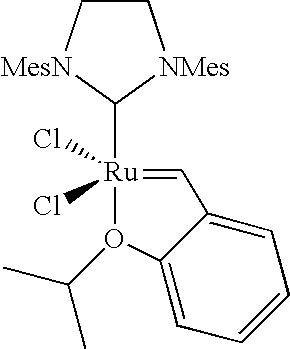 |
[RuCl2(═CH(2-iPrOPh))(ImH2Mes)] |
 |
[RuCl2(═CH—CH═CMe2)(P(Cyp)3)2] |
 |
[RuCl2(PCy3)2(3-phenylindenyl-1-idene)] |
 |
[RuCl2(═CHPh)(ImH2Pr)(PCy3)] |
 |
[RuCl2(PCy3)(ImH2Mes)(3-phenyl-indenyl-1- idene)] |
 |
[RuCl2(═CH(2-iPrO, 5-NO2Ph))(ImH2Mes)] |
 |
[RuCl2(3-phenylindenyl-1-idene)(ImMes)- (PCy3)] |
 |
[RuCl2(3-phenylindenyl-1-idene)(ImMes)- (PPh3)] |
 |
[RuCl2(═CH(2-iPrO, 5-ClPh))(ImH2Mes)] |
 |
[RuCl2(═CH(7-CF3, 5-Cl-8-quinoline))- (ImH2Mes)] |
 |
[RuCl2(═CH(2-iPrO, 5-SO2NMe2Ph))- (ImH2Mes)] |
 |
[RuCl2(═CHPh)(ImMes)(PCy3)] |
 |
[RuCl2(═CHSPh)(ImH2Mes)(PCy3)] |
 |
[RuCl2(3-phenylindenyl-1-idene)- (isobutylphobane)2] |
 |
[RuCl2(═CH(2-iPr, 5-SO2NMe2Ph))(PCy3)] |
 |
[RuCl2(═CHPh)(ImH2oTol)(PCy3)] |
 |
[RuCl2(═CHCH═CMe2)(PCy3)2] |
 |
[RuCl2(═CH(2-iPrOPh))(ImH2oTol)] |
 |
[RuCl2(═CH—CH═CMe2)(ImH2Mes)(PCy3)] |


-
- r.t.=room temperature
- Boc=tert-butoxycarbonyl
- ImH2Mes=1,3-bis-(2,4,6-trimethylphenyl)-2-imidazolidinylidene
- ImMes=1,3-bis-(2,4,6-trimethylphenyl)-2-imidazolylidene
- ImH2Pr=1,3-bis-(2,6-diisopropylphenyl)-2-imidazolidinylidene
- RCM=ring closing metathesis
- RP column=reverse phase column
- S/C=molar substrate-to-catalyst ratio
- Mes=2,4,6-trimethylphenyl
- Cy=cyclohexyl
- Cyp=cyclopentyl


| Table of Catalysts tested: |
| Catalyst | ||
| Number | Catalyst Structure | Chemical Name |
| 5000 |  | [RuCl2(PCy3)2(benzylidene)] CAS No. 172222-30-9; a) |
| 5001 |  | [RuCl2(PCy3)(ImH2Mes)(benzylidene)] CAS No. 246047-72-3; a) |
| 5002 |  | [RuCl2(═CH(2-iPrOPh))(PCy3)] CAS No. 203714-71-0; a) |
| 5003 |  | [RuCl2(═CH(2-iPrOPh))(ImH2Mes)] CAS No. 301224-40-8; a) |
| 5004 |  | [RuCl2(═CH—CH═CMe2)(P(Cyp)3)2] CAS No. 220883-08-9; a) |
| 5006 |  | [RuCl2(PCy3)2(3-phenylindenyl-1-idene)] CAS No. 250220-36-1; c) |
| 5007 |  | [RuCl2(═CHPh)(ImH2Pr)(PCy3)] CAS No. 373640-75-6; Prepared according to: M. D. Dinger, J. C. Mol, Adv. Synth. Catal. 2002, 344, 671. |
| 5008 |  | [RuCl2(PCy3)(ImH2Mes)(3-phenylindenyl-1-idene)] CAS No. 536724-67-1; c) |
| 5014 |  | [RuCl2(═CH(2-iPrO, 5-NO2Ph))(ImH2Mes)] CAS No. 502964-52-5; Prepared according to K. Grela, S. Harutyunyan, A. Michrowska, Angew. Chem. Int. Ed. 2002, 41, 4038. |
| 5016 |  | [RuCl2(3-phenylindenyl-1-indene)(ImMes)(PCy3)] CAS No. 254972-49-1; d) |
| 5017 |  | [RuCl2(3-phenylindenyl-1-idene)(ImMes)(PPh3)] CAS No. 254972-47-9; d) |
| 5024 |  | [RuCl2(═CH(2-iPrO, 5-ClPh))(ImH2Mes)] CAS No. 918870-68-5; b) |
| 5025 |  | [RuCl2(═CH(7-CF3, 5-Cl-8-quinoline))(ImH2Mes)]; e) |
| 5028 |  | [RuCl2(═CH(2-iPrO, 5-SO2NMe2Ph)(ImH2Mes))] CAS No. 918870-76-5; b) |
| 5033 |  | [RuCl2(═CHPh)(ImMes)(PCy3)] CAS No. 223415-64-3; Prepared accordino to S. P. Nolan et al, Organometallics 2002, 21, 442. |
| 5040 |  | [RuCl2(═CHSPh)(ImH2Mes)(PCy3)]; g) |
| 5041 |  | [RuCl2(3-phenylindenyl-1-idene)- (isobutylphobane)2] CAS No. 894423-99-5; c) |
| 5042 |  | [RuCl2(═CH(2-iPrO, 5-SO2NMe2Ph))(PCy3)] CAS No. 918871-44-0; b) |
| 5043 |  | [RuCl2(═CHPh)(ImH2oTol)(PCy3)] CAS No. 927429-60-5; a) |
| 5045 |  | [RuCl2(═CHCH═CMe2)(PCy3)2] CAS No. 194659-03-5; a) |
| 5046 |  | [RuCl2(═CH(2-iPrOPh))(ImH2oTol)] CAS No. 927429-61-6; a) |
| 5048 |  | [RuCl2(═CH—CH═CMe2)(ImH2Mes)(PCy3)] CAS No. 253688-91-4; a) |
a) Commercially available from Sigma-Aldrich Chemie GmbH, Postfach, CH-9471 Buchs, Switzerland:
b) Commercially available from Zannan Pharma Ltd. 4299 Jindu Road, Bid. 3, Shanghai, 201108, P.R. China and Strem Chemicals Inc., 7 Mulliken Way, Newburyport, Mass. 01950-4098, USA.
c) Commercially available from Umicore & Co., Rodenbacher Chaussee 4, D-63403 Hanau, Germany and Strem Chemicals Inc., 7 Mulliken Way, Newburyport, Mass. 0 1950-4098, USA.
d) Commercially available from Degussa AG, Rodenbacher Chaussee 4, D-63403 Hanau, Germany.
e) [RuCl2(ImH2Mes)((4-chloro-2-trifluoromethyl-8-quinolinyl)methylene)]
A suspension of 1.39 g (1.64 mmol) of [RuCl2(PCy3)(ImH2Mes)(phenylmethylene)], 0.17 g (1.80 mmol) copper chloride and 464 mg (1.69 mmol) 4-chloro-2-trifluoromethyl-8-vinyl-quinoline in 100 mL methylene chloride was stirred at 30° C. for 90 min. The reaction mixture was evaporated to dryness and the isolated crude product purified by silica gel chromatography (hexane/ethyl acetate 5:2) to yield 278 mg (24%) of the title compound as green crystals. MS: 721.2 (M+). 1H-NMR (300 MHz, CD2Cl2): 2.85 (s, 6H); 2.40 (s, 12H); 4.05 (s, 4H); 7.01 (s, 4H); 7.54 (s, 1H); 7.56 (t, J=7.7 Hz, 1H); 7.65 (d, J=6.8 Hz, 1H); 8.51 (d, J=8.4 Hz, 1H); 16.70-17.10 (br, 1H).
f) Commercially available from Johnson Matthey PCT, 28 Cambridge Science Park, Milton Road, Cambridge, CB4 0FP, UK.
g) Commercially available from Strem Chemicals, Inc., Postfach 1215, KEHL, 77672, Germany.
| TABLE 1 | |||
| RP column | Chiral column | ||
| RCM- | Dimers | RCM | ||||
| Reaction | Catalyst | Diene IIb | ester Ib | (area | ester Ib | Ib/epi- |
| Nr. | Nr. | (area %) | %) | %) | (area %) | Ib |
| 2a | 5000 | 12 | 52 | 4 | 42 | 65/35 |
| 2b | 5001 | 2 | 69 | 11 | 93 | 97/3 |
| 2c | 5002 | 6 | 66 | 4 | 65 | 87/13 |
| 2d | 5003 | 0.8 | 71 | 13 | 94 | 99/1 |
| 2e | 5004 | 60 | 20 | 2 | 8 | 33/67 |
| 2f | 5005 | 63 | 14 | 1 | 14 | 94/6 |
| 2g | 5006 | 11 | 54 | 4 | 41 | 64/33 |
| 2h | 5007 | 1.5 | 77 | 12 | 86 | 89/11 |
| 2i | 5008 | 4 | 67 | 11 | 92 | 97/3 |
| 2j | 5014 | 2 | 69 | 11 | 95 | 98/2 |
| 2k | 5016 | 3 | 67 | 11 | 91 | 96/4 |
| 2l | 5017 | 3 | 66 | 9 | 87 | 93/7 |
| 2m | 5025 | 75 | 17 | 0.4 | 17 | >99/1 |
| 2n | 5028 | 0.6 | 75 | 14 | 92 | 94/6 |
| 2o | 5033 | 4 | 78 | 9 | 84 | 89/11 |
| 2p | 5040 | 47 | 40 | 2 | 45 | 99/1 |
| 2q | 5041 | 13 | 42 | 1 | 36 | 73/27 |
| 2r | 5042 | 8 | 81 | 6 | 83 | >99/1 |
| 2s | 5043 | 4 | 82 | 9 | 80 | 99/1 |
| 2t | 5045 | 0.3 | 71 | 4 | 55 | 78/22 |
| 2u | 5046 | 1 | 76 | 17 | 75 | >99/1 |
| 2v | 5047 | 6 | 74 | 11 | 74 | 99/1 |
| 2w | 5048 | 2 | 74 | 16 | 72 | 96/4 |
| 2x | 5049 | 2 | 75 | 15 | 78 | 98/2 |
| 2y | 5050 | 0.2 | 74 | 16 | 72 | 95/5 |
| 2z | 5051 | 31 | 51 | 3 | 50 | 96/4 |
| Reactions 2a-2q have been run in toluene distilled under argon, reactions 2r-2z have been run in toluene filtered through aluminum oxide (Fluka Catal. Nr. 06320) | ||||||
| TABLE 2 | |||
| RP column | Chiral column | ||
| RCM- | RCM- | |||||
| Reaction | Catalyst | Diene | Ester Ib | Dimers | Ester | Epi-Ib |
| Nr. | Nr. | IIb a % | a %/% y. | a % | Ib a % | a % |
| 4a | 5007 | 1 | 81/86 | 13.9 | 99.5 | 0.5 |
| 4b | 5008 | 0.3 | 80/87 | 15 | >99.8 | <0.2 |
| 4c | 5016 | 1 | 81/86 | 12.8 | 99.4 | 0.6 |
| 4d | 5003 | 2.5 | 80/84 | 11.8 | 99.4 | 0.6 |
| 4e | 5014 | 2 | 80/87 | 12.8 | >99.8 | <0.2 |
| 4f | 5028 | 2 | 81/81 | 12.3 | >99.8 | <0.2 |
| 4g | 5024 | 9 | 73/n.d. | 9 | >99.8 | <0.2 |
| % y. = % yield determined by HPLC with internal standard; | ||||||
| a %: HPLC area %; | ||||||
| n.d.: not determined. | ||||||
| Reactions 4e-g: after 4 h, additional 0.005 mmol of catalyst were added, total reaction time was 6 h. | ||||||
| TABLE 3 | |||
| RP column | Chiral column | ||
| RCM-Ester | Epi- | ||||||
| Reaction | Catalyst | T | Diene IIb | Ib | Dimers | RCM-Ester | Ib |
| Nr. | Nr. | ° C. | a % (time) | a %/% y. | a % | Ib a % | a % |
| 5a | 5008 | 50 | 2 | (5 h) | 77/n.d. | 13 | >99.8 | <0.2 |
| 5b | 5001 | 60 | 31 | (6.5 h) | 53/n.d. | 8 | >99.8 | <0.2 |
| 5c | 5008 | 60 | 1 | (4 h) | 82/85 | 13 | 99.7 | 0.3 |
| 5d | 5008 | 70 | 3.5 | (4 h) | 80/87 | 11 | 99.8 | 0.2 |
| 5e | 5016 | 70 | 5 | (7 h) | 78/83 | 10 | 99.5 | 0.5 |
| 5f | 5016 | 80 | 3 | (3 h) | 82/83 | 10 | 99.7 | 0.3 |
| % y = % yield determined by HPLC with internal standard; | ||||||||
| a %: HPLC area %; | ||||||||
| n.d.: not determined. | ||||||||
| TABLE 4 | |||
| RP column | Chiral column | ||
| RCM-Ester | RCM- | Epi- | ||||||
| Reaction | Catalyst | T | Addn. | Diene IIb | Ib | Dimers | Ester Ib | Ib |
| Nr. | Nr. | ° C. | time | a % (time) | a %/% y. | a % | a % | a % |
| 7a | 5008 | 70 | 1 h | 3 (5 h) | 80/81 | 11.4 | >99.8 | <0.2 |
| 7b | 5008 | 70 | 1.5 h | 3 (2.5 h) | 81/82 | 11.1 | >99.8 | <0.2 |
| 7c | 5008 | 70 | $ | 4 (6 h) | 80/81 | 10.6 | >99.8 | <0.2 |
| 7d | 5016 | 80 | 1.5 h | 2 (2.5 h) | 82/84 | 11.2 | >99.8 | <0.2 |
| 7e | 5001 | 70 | 1.5 h | 2 (2.5 h) | 80/82 | 13.0 | >99.8 | <0.2 |
| % y = % yield determined by HPLC with internal standard; | ||||||||
| a %: HPLC area % | ||||||||
| Reaction Nr. 7d and 7e have been carried out at S/C of 600. | ||||||||
| $ Catalyst was added in one portion at beginning of reaction. | ||||||||
| TABLE 5 | |||
| RP column | Chiral column | ||
| RCM-Ester | Epi- | ||||||
| Reaction | Catalyst | T | Diene IIb | Ib | Dimers | RCM-Ester | Ib |
| Nr. | Nr. | ° C. | a % (time) | a %/% y. | a % | Ib a % | a % |
| 9a | 5008 | 70 | 0.4 (2 h) | 82/84 | 13.4 | >99.8 | <0.2 |
| 9b | 5001 | 70 | 1.0 (2 h) | 82/87 | 12.8 | >99.8 | <0.2 |
| 9c | 5016 | 80 | 1.0 (2 h) | 83/82 | 11.8 | >99.8 | <0.2 |
| 9d | 5028 | 70 | 0.8 (2 h) | 82/84 | 12.6 | >99.8 | <0.2 |
| 9e | 5048 | 70 | 0.6 (1.5 h) | 83 87 | 12.8 | >99.8 | <0.2 |
| 9f | 5049 | 70 | 1.3 (2 h) | 80/86 | 12.0 | >99.8 | <0.2 |
| 9g | 5050 | 70 | 0.8 (2 h) | 83/87 | 12.4 | >99.8 | <0.2 |
| All reactions were run at S/C 1000. Reaction 9a was run on a 10 mmol scale. | |||||||
| % y = % yield determined by HPLC with internal standard; | |||||||
| a %: HPLC area % | |||||||


Claims (13)


Applications Claiming Priority (3)
| Application Number | Priority Date | Filing Date | Title |
|---|---|---|---|
| EP07150287 | 2007-12-21 | ||
| EP07150287 | 2007-12-21 | ||
| EP07150287.6 | 2007-12-21 |
Publications (2)
| Publication Number | Publication Date |
|---|---|
| US20090163706A1 US20090163706A1 (en) | 2009-06-25 |
| US7910728B2 true US7910728B2 (en) | 2011-03-22 |
Family
ID=40456983
Family Applications (1)
| Application Number | Title | Priority Date | Filing Date |
|---|---|---|---|
| US12/317,116 Expired - Fee Related US7910728B2 (en) | 2007-12-21 | 2008-12-19 | Process for the preparation of a macrocycle |
Country Status (12)
| Country | Link |
|---|---|
| US (1) | US7910728B2 (en) |
| EP (1) | EP2225249B1 (en) |
| JP (1) | JP5439384B2 (en) |
| KR (1) | KR101629523B1 (en) |
| CN (1) | CN101903391B (en) |
| AU (1) | AU2008340430B2 (en) |
| BR (1) | BRPI0820733A2 (en) |
| CA (1) | CA2709032C (en) |
| ES (1) | ES2599927T3 (en) |
| IL (1) | IL206100A (en) |
| MX (1) | MX2010006659A (en) |
| WO (1) | WO2009080542A1 (en) |
Cited By (6)
| Publication number | Priority date | Publication date | Assignee | Title |
|---|---|---|---|---|
| US8466159B2 (en) | 2011-10-21 | 2013-06-18 | Abbvie Inc. | Methods for treating HCV |
| US8492386B2 (en) | 2011-10-21 | 2013-07-23 | Abbvie Inc. | Methods for treating HCV |
| WO2014058794A1 (en) | 2012-10-08 | 2014-04-17 | Abbvie Inc. | Compounds useful for making hcv protease inhibitors |
| US8809265B2 (en) | 2011-10-21 | 2014-08-19 | Abbvie Inc. | Methods for treating HCV |
| US8853176B2 (en) | 2011-10-21 | 2014-10-07 | Abbvie Inc. | Methods for treating HCV |
| WO2017189978A1 (en) | 2016-04-28 | 2017-11-02 | Emory University | Alkyne containing nucleotide and nucleoside therapeutic compositions and uses related thereto |
Families Citing this family (28)
| Publication number | Priority date | Publication date | Assignee | Title |
|---|---|---|---|---|
| EA201071034A1 (en) | 2008-04-15 | 2011-06-30 | Интермьюн, Инк. | NEW MACROCYCLIC INHIBITORS OF HEPATITIS C VIRUS REPLICATIONS |
| KR101647520B1 (en) | 2008-08-07 | 2016-08-10 | 에프. 호프만-라 로슈 아게 | Process for the preparation of a macrocycle |
| UY32099A (en) | 2008-09-11 | 2010-04-30 | Enanta Pharm Inc | HEPATITIS C SERINA PROTEASAS MACROCYCLIC INHIBITORS |
| AR075584A1 (en) * | 2009-02-27 | 2011-04-20 | Intermune Inc | THERAPEUTIC COMPOSITIONS THAT INCLUDE beta-D-2'-DESOXI-2'-FLUORO-2'-C-METHYLYCTIDINE AND A CARDIEX ISOINDOL ACID DERIVATIVE AND ITS USES. COMPOUND. |
| WO2010118078A1 (en) | 2009-04-08 | 2010-10-14 | Idenix Pharmaceuticals, Inc. | Macrocyclic serine protease inhibitors |
| US8232246B2 (en) | 2009-06-30 | 2012-07-31 | Abbott Laboratories | Anti-viral compounds |
| TW201117812A (en) | 2009-08-05 | 2011-06-01 | Idenix Pharmaceuticals Inc | Macrocyclic serine protease inhibitors |
| KR20120110090A (en) * | 2009-09-28 | 2012-10-09 | 에프. 호프만-라 로슈 리미티드 | Novel macrocyclic inhibitors of hepatitis c virus replication |
| IN2012DN02693A (en) * | 2009-09-28 | 2015-09-04 | Intermune Inc | |
| MX2012006877A (en) | 2009-12-18 | 2012-08-31 | Idenix Pharmaceuticals Inc | 5,5-fused arylene or heteroarylene hepatitis c virus inhibitors. |
| NZ602288A (en) * | 2010-03-10 | 2014-02-28 | Abbvie Bahamas Ltd | Solid compositions comprising amorphous (2r,6s,13as,14ar,16as,z)-n-(cyclopropylsulfonyl)-6-(5-methylpyrazine-2-carboxamido)-5,16-dioxo-2-(phenanthridin-6-yloxy)-1,2,3,5,6,7,8,9,10,11,13a,14,14a,15,16,16a-hexadecahydrocyclopropa[e]pyrrolo[1,2-a][1,4]diazacyclopentadecine-14a-carboxamide |
| CA2822556A1 (en) | 2010-12-30 | 2012-07-05 | Enanta Pharmaceuticals, Inc | Macrocyclic hepatitis c serine protease inhibitors |
| EA201390988A1 (en) | 2010-12-30 | 2014-04-30 | Энанта Фармасьютикалз, Инк. | PHENANTRIDINE MACROCYCLIC INHIBITORS OF THE HYPATITIS C VIRUS SERIN PROTEASE |
| US9353100B2 (en) | 2011-02-10 | 2016-05-31 | Idenix Pharmaceuticals Llc | Macrocyclic serine protease inhibitors, pharmaceutical compositions thereof, and their use for treating HCV infections |
| US20120252721A1 (en) | 2011-03-31 | 2012-10-04 | Idenix Pharmaceuticals, Inc. | Methods for treating drug-resistant hepatitis c virus infection with a 5,5-fused arylene or heteroarylene hepatitis c virus inhibitor |
| US8957203B2 (en) | 2011-05-05 | 2015-02-17 | Bristol-Myers Squibb Company | Hepatitis C virus inhibitors |
| US10201584B1 (en) | 2011-05-17 | 2019-02-12 | Abbvie Inc. | Compositions and methods for treating HCV |
| EA025560B1 (en) | 2012-10-19 | 2017-01-30 | Бристол-Майерс Сквибб Компани | Hepatitis c virus inhibitors |
| EP2914613B1 (en) | 2012-11-02 | 2017-11-22 | Bristol-Myers Squibb Company | Hepatitis c virus inhibitors |
| US9334279B2 (en) | 2012-11-02 | 2016-05-10 | Bristol-Myers Squibb Company | Hepatitis C virus inhibitors |
| US9643999B2 (en) | 2012-11-02 | 2017-05-09 | Bristol-Myers Squibb Company | Hepatitis C virus inhibitors |
| US9409943B2 (en) | 2012-11-05 | 2016-08-09 | Bristol-Myers Squibb Company | Hepatitis C virus inhibitors |
| JP6342922B2 (en) | 2013-03-07 | 2018-06-13 | ブリストル−マイヤーズ スクイブ カンパニーBristol−Myers Squibb Company | Hepatitis C virus inhibitor |
| WO2015042375A1 (en) | 2013-09-20 | 2015-03-26 | Idenix Pharmaceuticals, Inc. | Hepatitis c virus inhibitors |
| WO2015103490A1 (en) | 2014-01-03 | 2015-07-09 | Abbvie, Inc. | Solid antiviral dosage forms |
| WO2015134561A1 (en) | 2014-03-05 | 2015-09-11 | Idenix Pharmaceuticals, Inc. | Pharmaceutical compositions comprising a 5,5-fused heteroarylene flaviviridae inhibitor and their use for treating or preventing flaviviridae infection |
| US20170066779A1 (en) | 2014-03-05 | 2017-03-09 | Idenix Pharmaceuticals Llc | Solid forms of a flaviviridae virus inhibitor compound and salts thereof |
| CN109280074A (en) * | 2017-07-20 | 2019-01-29 | 歌礼药业(浙江)有限公司 | Dan Nuoruiwei sodium crystal and preparation method thereof |
Citations (8)
| Publication number | Priority date | Publication date | Assignee | Title |
|---|---|---|---|---|
| WO2002083742A2 (en) | 2001-04-16 | 2002-10-24 | California Institute Of Technology | Group 8 transition metal carbene complexes as enantioselective olefin metathesis catalysts |
| WO2005016944A1 (en) | 2003-08-02 | 2005-02-24 | Boehringer Ingelheim International Gmbh | Novel metathesis catalysts |
| WO2005037214A2 (en) | 2003-10-14 | 2005-04-28 | Intermune, Inc. | Macrocyclic carboxylic acids and acylsulfonamides as inhibitors of hcv replication |
| WO2006043145A1 (en) | 2004-10-21 | 2006-04-27 | Pfizer Inc. | Inhibitors of hepatitis c virus protease, and compositions and treatments using the same |
| US20070054842A1 (en) | 2005-07-25 | 2007-03-08 | Blatt Lawrence M | Novel macrocyclic inhibitors of hepatitis C virus replication |
| EP1825913A1 (en) | 2006-02-22 | 2007-08-29 | Lanxess Deutschland GmbH & Co.KG | New catalyst systems and their application for metathesis reactions |
| WO2007140954A1 (en) | 2006-06-07 | 2007-12-13 | Umicore Ag & Co. Kg | Complex of ruthenium and osmium, method of production thereof and use thereof as (pre)catalysts of the metathesis reaction |
| WO2008086161A1 (en) | 2007-01-08 | 2008-07-17 | Phenomix Corporation | Macrocyclic hepatitis c protease inhibitors |
Family Cites Families (1)
| Publication number | Priority date | Publication date | Assignee | Title |
|---|---|---|---|---|
| US5831108A (en) * | 1995-08-03 | 1998-11-03 | California Institute Of Technology | High metathesis activity ruthenium and osmium metal carbene complexes |
-
2008
- 2008-12-11 CA CA2709032A patent/CA2709032C/en not_active Expired - Fee Related
- 2008-12-11 AU AU2008340430A patent/AU2008340430B2/en not_active Ceased
- 2008-12-11 KR KR1020107013641A patent/KR101629523B1/en not_active Expired - Fee Related
- 2008-12-11 WO PCT/EP2008/067309 patent/WO2009080542A1/en not_active Ceased
- 2008-12-11 CN CN2008801220355A patent/CN101903391B/en active Active
- 2008-12-11 MX MX2010006659A patent/MX2010006659A/en active IP Right Grant
- 2008-12-11 JP JP2010538595A patent/JP5439384B2/en not_active Expired - Fee Related
- 2008-12-11 BR BRPI0820733-0A patent/BRPI0820733A2/en not_active IP Right Cessation
- 2008-12-11 ES ES08864619.5T patent/ES2599927T3/en active Active
- 2008-12-11 EP EP08864619.5A patent/EP2225249B1/en not_active Not-in-force
- 2008-12-19 US US12/317,116 patent/US7910728B2/en not_active Expired - Fee Related
-
2010
- 2010-05-31 IL IL206100A patent/IL206100A/en not_active IP Right Cessation
Patent Citations (8)
| Publication number | Priority date | Publication date | Assignee | Title |
|---|---|---|---|---|
| WO2002083742A2 (en) | 2001-04-16 | 2002-10-24 | California Institute Of Technology | Group 8 transition metal carbene complexes as enantioselective olefin metathesis catalysts |
| WO2005016944A1 (en) | 2003-08-02 | 2005-02-24 | Boehringer Ingelheim International Gmbh | Novel metathesis catalysts |
| WO2005037214A2 (en) | 2003-10-14 | 2005-04-28 | Intermune, Inc. | Macrocyclic carboxylic acids and acylsulfonamides as inhibitors of hcv replication |
| WO2006043145A1 (en) | 2004-10-21 | 2006-04-27 | Pfizer Inc. | Inhibitors of hepatitis c virus protease, and compositions and treatments using the same |
| US20070054842A1 (en) | 2005-07-25 | 2007-03-08 | Blatt Lawrence M | Novel macrocyclic inhibitors of hepatitis C virus replication |
| EP1825913A1 (en) | 2006-02-22 | 2007-08-29 | Lanxess Deutschland GmbH & Co.KG | New catalyst systems and their application for metathesis reactions |
| WO2007140954A1 (en) | 2006-06-07 | 2007-12-13 | Umicore Ag & Co. Kg | Complex of ruthenium and osmium, method of production thereof and use thereof as (pre)catalysts of the metathesis reaction |
| WO2008086161A1 (en) | 2007-01-08 | 2008-07-17 | Phenomix Corporation | Macrocyclic hepatitis c protease inhibitors |
Non-Patent Citations (3)
| Title |
|---|
| Furstner, A., "Olefin Methathesis and Beyond," Angewandte Chemie International Edition, 2000, vol. 39 (17), pp. 3012-3043. |
| Tsantrizos, Y. S., et. al. "Olefin ring-closing methathesis as a powerful tool in drug discovery and development -potent macrocyclic inhibitors of the hepatitis C virus NS protease," Journal of Organometallic Chemistry, 2006, vol. 691 (24-25), pp. 5163-5171. |
| Yee, N. K., et. al. "Efficient Large-Scale Synthesis of BILN 2061, a Potent HCV Protease Inhibitor, by a Convergent Approach Based on Ring-Closing Methathesis," The Journal of Organic Chemistry, 2006, vol. 71 (19), pp. 7133-7145. |
Cited By (12)
| Publication number | Priority date | Publication date | Assignee | Title |
|---|---|---|---|---|
| US8466159B2 (en) | 2011-10-21 | 2013-06-18 | Abbvie Inc. | Methods for treating HCV |
| US8492386B2 (en) | 2011-10-21 | 2013-07-23 | Abbvie Inc. | Methods for treating HCV |
| US8680106B2 (en) | 2011-10-21 | 2014-03-25 | AbbVic Inc. | Methods for treating HCV |
| US8685984B2 (en) | 2011-10-21 | 2014-04-01 | Abbvie Inc. | Methods for treating HCV |
| US8809265B2 (en) | 2011-10-21 | 2014-08-19 | Abbvie Inc. | Methods for treating HCV |
| US8853176B2 (en) | 2011-10-21 | 2014-10-07 | Abbvie Inc. | Methods for treating HCV |
| US8969357B2 (en) | 2011-10-21 | 2015-03-03 | Abbvie Inc. | Methods for treating HCV |
| US8993578B2 (en) | 2011-10-21 | 2015-03-31 | Abbvie Inc. | Methods for treating HCV |
| US9452194B2 (en) | 2011-10-21 | 2016-09-27 | Abbvie Inc. | Methods for treating HCV |
| WO2014058794A1 (en) | 2012-10-08 | 2014-04-17 | Abbvie Inc. | Compounds useful for making hcv protease inhibitors |
| WO2017189978A1 (en) | 2016-04-28 | 2017-11-02 | Emory University | Alkyne containing nucleotide and nucleoside therapeutic compositions and uses related thereto |
| US11192914B2 (en) | 2016-04-28 | 2021-12-07 | Emory University | Alkyne containing nucleotide and nucleoside therapeutic compositions and uses related thereto |
Also Published As
| Publication number | Publication date |
|---|---|
| JP2011508729A (en) | 2011-03-17 |
| MX2010006659A (en) | 2010-07-05 |
| BRPI0820733A2 (en) | 2015-06-16 |
| CA2709032C (en) | 2016-02-23 |
| JP5439384B2 (en) | 2014-03-12 |
| KR20100106411A (en) | 2010-10-01 |
| EP2225249B1 (en) | 2016-08-03 |
| WO2009080542A1 (en) | 2009-07-02 |
| CN101903391A (en) | 2010-12-01 |
| CA2709032A1 (en) | 2009-07-02 |
| AU2008340430A1 (en) | 2009-07-02 |
| KR101629523B1 (en) | 2016-06-10 |
| IL206100A0 (en) | 2010-11-30 |
| ES2599927T3 (en) | 2017-02-06 |
| US20090163706A1 (en) | 2009-06-25 |
| CN101903391B (en) | 2013-04-03 |
| IL206100A (en) | 2015-09-24 |
| EP2225249A1 (en) | 2010-09-08 |
| AU2008340430B2 (en) | 2013-01-24 |
Similar Documents
| Publication | Publication Date | Title |
|---|---|---|
| US7910728B2 (en) | Process for the preparation of a macrocycle | |
| US8106187B2 (en) | Process for the preparation of a macrocycle | |
| US7939668B2 (en) | Ruthenium complexes as catalysts for metathesis reactions | |
| US20090088571A1 (en) | Synthesis of 6,7-Dihydro-5H-imidazo[1,2-a]imidazole-3-sulfonic acid amides | |
| EP2459525A1 (en) | Enantio- and stereo-specific syntheses of -amino- - hydroxy amides |
Legal Events
| Date | Code | Title | Description |
|---|---|---|---|
| AS | Assignment |
Owner name: F. HOFFMANN-LA ROCHE AG,SWITZERLAND Free format text: ASSIGNMENT OF ASSIGNORS INTEREST;ASSIGNORS:HILDBRAND, STEFAN;PUENTENER, KURT;SCALONE, MICHAELANGELO;REEL/FRAME:022596/0926 Effective date: 20081124 Owner name: F. HOFFMANN-LA ROCHE AG, SWITZERLAND Free format text: ASSIGNMENT OF ASSIGNORS INTEREST;ASSIGNORS:HILDBRAND, STEFAN;PUENTENER, KURT;SCALONE, MICHAELANGELO;REEL/FRAME:022596/0926 Effective date: 20081124 |
|
| AS | Assignment |
Owner name: ROCHE PALO ALTO LLC,CALIFORNIA Free format text: ASSIGNMENT OF ASSIGNORS INTEREST;ASSIGNOR:F. HOFFMANN-LA ROCHE AG;REEL/FRAME:022626/0346 Effective date: 20081126 Owner name: ROCHE PALO ALTO LLC, CALIFORNIA Free format text: ASSIGNMENT OF ASSIGNORS INTEREST;ASSIGNOR:F. HOFFMANN-LA ROCHE AG;REEL/FRAME:022626/0346 Effective date: 20081126 |
|
| STCF | Information on status: patent grant |
Free format text: PATENTED CASE |
|
| FPAY | Fee payment |
Year of fee payment: 4 |
|
| MAFP | Maintenance fee payment |
Free format text: PAYMENT OF MAINTENANCE FEE, 8TH YEAR, LARGE ENTITY (ORIGINAL EVENT CODE: M1552); ENTITY STATUS OF PATENT OWNER: LARGE ENTITY Year of fee payment: 8 |
|
| FEPP | Fee payment procedure |
Free format text: MAINTENANCE FEE REMINDER MAILED (ORIGINAL EVENT CODE: REM.); ENTITY STATUS OF PATENT OWNER: LARGE ENTITY |
|
| LAPS | Lapse for failure to pay maintenance fees |
Free format text: PATENT EXPIRED FOR FAILURE TO PAY MAINTENANCE FEES (ORIGINAL EVENT CODE: EXP.); ENTITY STATUS OF PATENT OWNER: LARGE ENTITY |
|
| STCH | Information on status: patent discontinuation |
Free format text: PATENT EXPIRED DUE TO NONPAYMENT OF MAINTENANCE FEES UNDER 37 CFR 1.362 |
|
| FP | Lapsed due to failure to pay maintenance fee |
Effective date: 20230322 |