US7889200B2 - System and method for generating circular layout graphs - Google Patents
System and method for generating circular layout graphs Download PDFInfo
- Publication number
- US7889200B2 US7889200B2 US12/638,169 US63816909A US7889200B2 US 7889200 B2 US7889200 B2 US 7889200B2 US 63816909 A US63816909 A US 63816909A US 7889200 B2 US7889200 B2 US 7889200B2
- Authority
- US
- United States
- Prior art keywords
- nodes
- edges
- unit circle
- processor
- node
- Prior art date
- Legal status (The legal status is an assumption and is not a legal conclusion. Google has not performed a legal analysis and makes no representation as to the accuracy of the status listed.)
- Expired - Fee Related
Links
Images




Classifications
-
- G—PHYSICS
- G06—COMPUTING OR CALCULATING; COUNTING
- G06T—IMAGE DATA PROCESSING OR GENERATION, IN GENERAL
- G06T11/00—Two-dimensional [2D] image generation
- G06T11/20—Drawing from basic elements
- G06T11/26—Drawing of charts or graphs
Definitions
- Circular layouts are among the most prominent and oldest conventions used to draw graphs. This drawing convention is often used for the layout of networks and systems management diagrams, where it naturally captures the essence of ring and star topologies. It may be also used for other kinds of graphs, such as social networks and WWW graphs. In particular, a circular layout is appropriate for applications that emphasize the clustering decomposition of a graph, where each cluster is drawn on a separate circle.
- nodes are drawn on a circle, while the edges connecting these nodes are line segments passing within the circle.
- these layouts may provide a compact presentation, focusing on individual nodes and edges.
- well-designed circular layouts sometimes reveal global properties of the graph such as symmetries and patterns of collective behavior. Unfortunately, strong regularity can obscure other information. For example, circular layout drawings can be very dense, and following paths on them can be difficult.
- a method for identifying a plurality of nodes for a circular layout each of the plurality of nodes to be connected via an edge to at least one other of the plurality of nodes, fixing all of the plurality of nodes on a unit circle, except for one of the nodes, moving the unfixed node to a barycenter of the fixed plurality of nodes, projecting the unfixed node to the unit circle of the circular layout and displaying the circular layout
- a system having a memory storing data corresponding to a plurality of nodes and a plurality of edges connecting the nodes, a processor receiving the data and generating a circular layout from the data, wherein the processor fixes all of the plurality of nodes to a unit circle, except for one of the nodes, moves the unfixed node to a barycenter of the fixed plurality of nodes and projects the unfixed node to the unit circle of the circular layout and a display displaying the circular layout.
- FIG. 1 illustrates an example of a prior art circular layout graph.
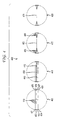
- FIG. 2 illustrates the steps of a method of edge-length minimizing implemented according to an embodiment of the invention.
- FIG. 3 illustrates an exemplary edge-length minimized graph produced by the method implemented according to an embodiment of the invention.
- FIG. 4 illustrates the steps of a method of bundling edges together implemented according to an embodiment of the invention.
- FIG. 5 illustrates an exemplary edge bundled graph produced by the method implemented according to an embodiment of the invention
- FIG. 6 illustrates an exemplary exterior edge routed and edge-length minimized graph produced by the method implemented according to an embodiment of the invention.
- FIG. 7 illustrates an exemplary exterior edge routed and edge bundled graph produced by the method implemented according to an embodiment of the invention.
- the present invention may be further understood with reference to the following description and the appended drawings, wherein like elements are referred to with the same reference numerals.
- the exemplary embodiments are directed to creating diagrams and, more particularly to methods of creating circular graph layouts having increased clarity and readability.
- FIG. 1 shows a circular graph 100 generated using a prior art method.
- the data used to create the circular graph is the same data used for the creation of the improved circular layout using the exemplary embodiments of the present invention.
- the graph 100 illustrates the readability problem of the graphs generated according to the prior art methods. Using the exemplary methods according to the present invention, the clarity and readability of circular layout graphs is increased.
- FIG. 2 illustrates an exemplary embodiment of a method 200 for minimizing edge length in a circular graph, and thus clutter and density.
- the description of the method 200 will reference the circular graph 300 shown in FIG. 3 , including the node 105 and the edge 110 .
- the method 200 implicates all the nodes and edges of the circular graph 300 .
- only a single node 105 and single edge 110 is labeled for the purpose of illustrating the exemplary method 200 .
- the steps of method 200 and other methods described herein are exemplary and the order of the steps may be rearranged as a matter of design choice.
- the coordinates of an individual node i 105 may be denoted as i ⁇ V by (x i , y i ) ⁇ R 2 . It may then be assumed that the plurality of nodes are arranged on the unit circle centered at the origin.
- the goal of the process 200 is the minimization of total squared edge lengths, resulting in the following optimization problem:
- the exemplary method also accounts for the unit circle constraints. Such equality constraints may be addressed by Lagrange multipliers. Therefore, for each individual node i 105 , a Lagrange multiplier ⁇ i is introduced and the function is defined as:
- Equation 1 Any minimum of Equation 1 should be a zero for all partial derivatives of Equation 2.
- ⁇ f/ ⁇ x 0
- ⁇ f/ ⁇ y 0
- ⁇ f/ ⁇ 0
- N(i) ⁇ j
- ⁇ I,J> ⁇ E ⁇ is the set of a plurality of nodes that are neighbors of the individual node i 105 .
- each individual node on the unit circle should lie on the line connecting the origin and the barycenter of its neighbors.
- the angular coordinate of each individual node is the mean of the angular coordinates of the plurality of its neighbor nodes, while the radial coordinate is 1. If each individual node was given an imaginary mass, identical to the masses of the remaining plurality of nodes; the barycenter is the point where the mass of the system of nodes may be considered to be concentrated.
- the method 200 begins in step 210 by fixing all the nodes of the graph, except for the selected individual node 105 .
- step 215 the unfixed single node 105 is moved to the barycenter of its neighbors.
- step 220 the unfixed node 105 is projected back to the circle.
- the formulas for this operation are:
- step 225 the selected individual node 105 that is unfixed, is fixed.
- step 230 it is determined if the preceding steps 210 - 225 have been performed on all the plurality of nodes. If the steps have not been performed for all of the plurality of nodes, the method loops back and the steps 210 - 225 are performed on a different node from the previously selected node 105 .
- step 235 the number of iterations of steps 210 - 230 that have been performed on all of the plurality of nodes is checked. If the number of iterations is too low, another iteration of steps 210 - 235 is performed. If the number is satisfactory then the process moves on to step 240 .
- the number of iterations is approximately 50. However, those skilled in the art will understand that the number of iterations may be adjusted based on the problem to be solved and the quality of the desired result.
- step 240 the angular order of the nodes is preserved, but a uniform distribution along the circle is imposed as shown in the circular graph 300 of FIG. 3 .
- This step is performed because the global minimum of edge lengths is attained when the entire plurality of the individual nodes are collapsed into one position. The redistribution of step 240 prevents this collapse.
- step 245 the number of iterations of step 240 is checked. If the number is too low, the system starts again from step 210 . If the number is sufficient then the method 200 is complete.
- the number of iterations may be approximately the same as the number of nodes in the graph being drawn. For example, a graph having approximately 1000 nodes will have approximately 1000 iterations performed. However, those skilled in the art will understand that other factors may also affect the number of iterations that are performed.
- the result of the method 200 is the generation of an improved circular graph as shown in FIG. 3 . That is, using the same data that was used to generate the circular graph 100 of FIG.
- the method 200 is able to generate the vastly improved circular graph 300 of FIG. 3 .
- the method 200 may also be performed while fixing positions of a number, such as 3, of the plurality nodes 105 , to prevent the collapse of the layout.
- FIG. 3 there is shown an exemplary circular layout 300 as may be generated by using the exemplary method 200 described with reference to FIG. 2 .
- the graph 300 comprises a plurality of nodes and a plurality edges.
- the graph 300 contains fewer edge crossings, lower clutter, and lower density as compared to a traditional circular graph 100 as shown in FIG. 1 .
- a dynamic programming process may be performed for further local refinement of the graph.
- the circular order resulting from method 200 may be further refined by utilizing a method that explicitly considers the discrete nature of the problem.
- the refinement method may consider every sequence of k nodes, and reorder the sequence in a way that minimizes the total edge length. More formally, assuming that the circle contains n equally spaced nodes named 0, 1, . . . , n ⁇ 1, where individual point i 105 is located at
- each of the n nodes is uniquely associated with one of the n circle points via the bijection of p(i):V ⁇ 0, 1, . . . , n ⁇ 1 ⁇ .
- V the total length of the edges adjacent to V
- Minimization of l(V) may be done by a dynamic programming algorithm which rearranges increasingly larger subsets of V. Typical values of k are between 5 and 10. The minimization algorithm is run on each of the n overlapping subsequences of length k until the total edge length cannot be further reduced.
- FIG. 4 illustrates an exemplary embodiment of a method 400 for bundling edges together.
- the essence of this method 400 is controlled deformation of the edges such that groups of edges share long common segments, thereby improving the utilization of the drawing area by saving ink, and thus increasing clarity.
- This set includes the 4 edges ( 431 , 435 ), ( 432 , 436 ), ( 433 , 437 ) and ( 434 , 438 ).
- the first step 405 is to divide the 2m endpoints of the edges into two equally sized sets: S (“sources”) and T (“targets”), such that for each (v i , u i ) ⁇ Q, either v i ⁇ S, u i ⁇ T, or u i ⁇ S, v i ⁇ T.
- S sources
- targets targets
- step 410 centroids of S and T are computed.
- the line 450 containing centroid S and centroid T, is further calculated.
- the prospective bundling should pass along this line. More specifically, two points 440 and 445 on line 450 are computed.
- Step 415 the bundling is carried out by replacing the original line segments by the following: first, a line from each node of S ( 431 , 432 , 433 , and 434 ) to 440 , the meeting point of the “sources”; then, a line 465 from 440 to 445 ; and finally, a line from each node of T ( 435 , 436 , 437 , and 438 ) to 445 , the meeting point of the “targets.”
- the bundled edges may be various colors in order to further improve readability.
- the edges to be bundled should be identified.
- the sets of edges are selected such that, by bundling them, the amount of ink used is minimized.
- the edges may be selected through the use of a bottom-up, agglomerative approach. The process starts with multiple sets, each of which contains a single edge. Then, sets are merged as long as the corresponding bundling improves drawing area utilization.
- the edges to be bundled may be limited to those edges that never cross.
- FIG. 5 illustrates a circular graph 500 that is the possible result of the edge bundling method performed according to an exemplary embodiment of the present invention as described above.
- the circular graph 500 may also be considered to start from the same initial set of data that originally produced the graph 100 and the improved graph 300 .
- the improved circular graph 300 may be produced.
- the exemplary edge bundling method described with reference to FIG. 4 may be applied to result in the further improved graph 500 of FIG. 5 .
- FIG. 6 illustrates a circular graph 600 possibly resulting from the application of an exemplary external edge routing method performed according to an embodiment of the present invention as described below.
- the external edge routing method is applied to the circular graph 300 . It shows the improvement in readability and decrease in edge crossing achieved by externally routing edges 605 .
- the added readability as shown in FIG. 6 may be achieved without altering the node positions. This is accomplished by taking a subset of the edges from the interior of the circle and routing them around the exterior of the circle. This may be done in an optimal way that maximizes the number of extracted edges or minimizes the number of crossings. Since exterior routing of an edge is inherently longer than interior routing, one concern is that edges routed externally should be readable. Therefore, according to an embodiment of the invention, there is no edge crossing within the external face. Since two edges cross in the external face if and only if they cross internally, no internally crossing edges are routed externally. According to an exemplary embodiment, weights are associated with the edges (as explained below), and the process strives to maximize the total weight of the extracted edges.
- edge flipping may occur as follows.
- Each exterior edge 605 ⁇ i, j> may be drawn in two ways: either along the short arc connecting i and j, or along the complementary long arc connecting i and j. Therefore, the process assumes that all exterior edges are flipped so that no edge is passing over the length ⁇ 1 arc connecting point n ⁇ 1 with point 0 on the circle. Note that this flipping will not introduce any crossing into a crossing-free layout. As a consequence, the process may cut the circle between point n ⁇ 1 and 0, where no edge passes, and solve an equivalent problem on a line starting at 0 and ending at n ⁇ 1. By solving the problem on a line, the process determines which edges should be extracted.
- each of these edges will be drawn on the exterior of the circle along the shorter of the two possible arcs.
- the intuition behind the algorithm for solving the problem on the line is based on likening each edge to parentheses, where the left endpoint of the edge opens the parenthesis, and the right endpoint closes it. Accordingly, a non-crossing set of edges is equivalent to a valid sequence of nested parentheses. This induces the following recurrence relation, where P ij is the maximal weighted sum of edges that can be legally routed between i and j:
- edge weights allow flexibility in the optimization goal.
- the default may be to pick the weights in a way that ensures minimizing the number of edge crossings.
- W ij may be set to the number of crossings involving ⁇ p ⁇ 1 (i),p ⁇ 1 (j)>.
- P 0,n ⁇ 1 is exactly the number of saved edge crossings.
- Exterior routing is a very effective technique, which may remove a significant portion of the edge crossings.
- An additional outcome of exterior routing is that it tends to extract many of the short edges. These edges are often hard to read when drawn as straight lines, as they are almost collinear with the adjacent edges.
- co-linearity issue of specific edges may be explicitly addressed by increasing their weights, thus encouraging the algorithm to pick them for exterior routing.
- FIG. 7 illustrates the resulting circular graph 700 based on the combination of the exemplary methods of edge length minimizing, edge bundling and external edge routing.
- the exemplary methods attempt to capitalize on all available degrees of freedom for the data. Thus, it may be optimal to use one of the methods (e.g., external edge routing, edge bundling, and edge length minimizing) either alone or in combination with one or more of the other methods.
- one of the methods e.g., external edge routing, edge bundling, and edge length minimizing
Landscapes
- Physics & Mathematics (AREA)
- General Physics & Mathematics (AREA)
- Engineering & Computer Science (AREA)
- Theoretical Computer Science (AREA)
- Image Generation (AREA)
Abstract
Description
∂f/∂x=0,∂f/∂y=0,∂f/∂λ=0
This means that for each individual node i 105:
where N(i)={j|<I,J>εE} is the set of a plurality of nodes that are neighbors of the individual node i 105.
In addition, each of the n nodes is uniquely associated with one of the n circle points via the bijection of p(i):V→{0, 1, . . . , n−1}. The angular distance between two nodes i and j is defined as: dij=min (p(i)−p(j) mod n, p(j)−p(i) mod n). Since k nodes V={v1, v2, . . . , vk}, located consecutively at p(v1), p(v1)+1, . . . , p(v1)+k−1, the goal is to reorder V to minimize l(V), the total length of the edges adjacent to V, which is defined as:
The profitability of the bundling the lines of Q may be inferred, as the ink potentially saved is may be calculated by the difference:
Claims (20)
Priority Applications (1)
| Application Number | Priority Date | Filing Date | Title |
|---|---|---|---|
| US12/638,169 US7889200B2 (en) | 2007-05-10 | 2009-12-15 | System and method for generating circular layout graphs |
Applications Claiming Priority (2)
| Application Number | Priority Date | Filing Date | Title |
|---|---|---|---|
| US11/746,756 US7656405B1 (en) | 2007-05-10 | 2007-05-10 | System and method for generating circular layout graphs |
| US12/638,169 US7889200B2 (en) | 2007-05-10 | 2009-12-15 | System and method for generating circular layout graphs |
Related Parent Applications (1)
| Application Number | Title | Priority Date | Filing Date |
|---|---|---|---|
| US11/746,756 Continuation US7656405B1 (en) | 2007-05-10 | 2007-05-10 | System and method for generating circular layout graphs |
Publications (2)
| Publication Number | Publication Date |
|---|---|
| US20100182322A1 US20100182322A1 (en) | 2010-07-22 |
| US7889200B2 true US7889200B2 (en) | 2011-02-15 |
Family
ID=41581328
Family Applications (2)
| Application Number | Title | Priority Date | Filing Date |
|---|---|---|---|
| US11/746,756 Expired - Fee Related US7656405B1 (en) | 2007-05-10 | 2007-05-10 | System and method for generating circular layout graphs |
| US12/638,169 Expired - Fee Related US7889200B2 (en) | 2007-05-10 | 2009-12-15 | System and method for generating circular layout graphs |
Family Applications Before (1)
| Application Number | Title | Priority Date | Filing Date |
|---|---|---|---|
| US11/746,756 Expired - Fee Related US7656405B1 (en) | 2007-05-10 | 2007-05-10 | System and method for generating circular layout graphs |
Country Status (1)
| Country | Link |
|---|---|
| US (2) | US7656405B1 (en) |
Families Citing this family (4)
| Publication number | Priority date | Publication date | Assignee | Title |
|---|---|---|---|---|
| US8933937B2 (en) * | 2010-01-22 | 2015-01-13 | Microsoft Corporation | Visualizing a layered graph using edge bundling |
| US9443334B2 (en) | 2011-05-05 | 2016-09-13 | Microsoft Technology Licensing, Llc | Routing edges with ordered bundles |
| US8832582B2 (en) * | 2012-03-15 | 2014-09-09 | Microsoft Corporation | Interactive control of the curvature of links |
| WO2017051538A1 (en) * | 2015-09-25 | 2017-03-30 | 株式会社日本電気特許技術情報センター | Information-processing device, information-processing method, and program-recording medium |
Family Cites Families (3)
| Publication number | Priority date | Publication date | Assignee | Title |
|---|---|---|---|---|
| US6509898B2 (en) | 1998-04-17 | 2003-01-21 | Xerox Corporation | Usage based methods of traversing and displaying generalized graph structures |
| US6369819B1 (en) | 1998-04-17 | 2002-04-09 | Xerox Corporation | Methods for visualizing transformations among related series of graphs |
| US7202868B2 (en) | 2004-03-31 | 2007-04-10 | Hewlett-Packard Development Company, L.P. | System and method for visual recognition of paths and patterns |
-
2007
- 2007-05-10 US US11/746,756 patent/US7656405B1/en not_active Expired - Fee Related
-
2009
- 2009-12-15 US US12/638,169 patent/US7889200B2/en not_active Expired - Fee Related
Also Published As
| Publication number | Publication date |
|---|---|
| US7656405B1 (en) | 2010-02-02 |
| US20100182322A1 (en) | 2010-07-22 |
Similar Documents
| Publication | Publication Date | Title |
|---|---|---|
| Gansner et al. | Improved circular layouts | |
| Zulehner et al. | An efficient methodology for mapping quantum circuits to the IBM QX architectures | |
| d'Angelo et al. | Gathering of robots on anonymous grids and trees without multiplicity detection | |
| US8621359B2 (en) | Method and apparatus for generating 3D carousel tree data visualization and related device | |
| US7889200B2 (en) | System and method for generating circular layout graphs | |
| Vandaele et al. | Phase polynomials synthesis algorithms for NISQ architectures and beyond | |
| Pupyrev et al. | Edge routing with ordered bundles | |
| Efremova et al. | The dynamics of monotone maps of dendrites | |
| Bekos et al. | Boundary labeling with octilinear leaders | |
| Angelini et al. | An algorithm to construct greedy drawings of triangulations | |
| Cooper et al. | A generalization of the Graham-Pollak tree theorem to Steiner distance | |
| Krauthgamer et al. | The set cover conjecture and subgraph isomorphism with a tree pattern | |
| Bläsius et al. | Strongly hyperbolic unit disk graphs | |
| Bhowmick et al. | Fault-tolerant covering problems in metric spaces | |
| Dobler et al. | On computing optimal linear diagrams | |
| Turau et al. | A distributed algorithm for minimum distance-k domination in trees | |
| Rajan et al. | 2-power domination in certain interconnection networks | |
| Lin et al. | A recursive algorithm for constructing dual-CISTs in hierarchical folded cubic networks | |
| Kao et al. | 3-D localized position-based routing with nearly certain delivery in mobile ad hoc networks | |
| Chen et al. | A linear kernel for co-path/cycle packing | |
| Wongwattanakij et al. | An improved PTAS for covering targets with mobile sensors | |
| Santhakumaran et al. | On the edge-to-vertex geodetic number of a graph | |
| Hao et al. | Bounds on the domination number of a digraph | |
| Chai et al. | Symbolic partition in chaotic maps | |
| Fotakis et al. | Online sum-radii clustering |
Legal Events
| Date | Code | Title | Description |
|---|---|---|---|
| AS | Assignment |
Owner name: AT&T CORP., NEW YORK Free format text: ASSIGNMENT OF ASSIGNORS INTEREST;ASSIGNORS:GANSNER, EMDEN;KOREN, YEHUDA;REEL/FRAME:023696/0718 Effective date: 20070511 |
|
| FEPP | Fee payment procedure |
Free format text: PAYOR NUMBER ASSIGNED (ORIGINAL EVENT CODE: ASPN); ENTITY STATUS OF PATENT OWNER: LARGE ENTITY |
|
| REMI | Maintenance fee reminder mailed | ||
| LAPS | Lapse for failure to pay maintenance fees | ||
| STCH | Information on status: patent discontinuation |
Free format text: PATENT EXPIRED DUE TO NONPAYMENT OF MAINTENANCE FEES UNDER 37 CFR 1.362 |
|
| STCH | Information on status: patent discontinuation |
Free format text: PATENT EXPIRED DUE TO NONPAYMENT OF MAINTENANCE FEES UNDER 37 CFR 1.362 |
|
| FP | Lapsed due to failure to pay maintenance fee |
Effective date: 20150215 |