US7834194B2 - Cycloalkyl lactam derivatives as inhibitors of 11-beta-hydroxysteroid dehydrogenase 1 - Google Patents
Cycloalkyl lactam derivatives as inhibitors of 11-beta-hydroxysteroid dehydrogenase 1 Download PDFInfo
- Publication number
- US7834194B2 US7834194B2 US11/722,101 US72210105A US7834194B2 US 7834194 B2 US7834194 B2 US 7834194B2 US 72210105 A US72210105 A US 72210105A US 7834194 B2 US7834194 B2 US 7834194B2
- Authority
- US
- United States
- Prior art keywords
- alkyl
- cyclohexyl
- pyrrolidin
- ylmethyl
- hydrogen
- Prior art date
- Legal status (The legal status is an assumption and is not a legal conclusion. Google has not performed a legal analysis and makes no representation as to the accuracy of the status listed.)
- Expired - Fee Related, expires
Links
- 0 **C1([3*])CCN([2*])C1=O.*C.[1*]C.[4*]C1=C(C(C)C)*C2=C1C=CC=C2.[4*]C1=C(C(C)C)C2=C(*1)C=CC=C2.[5*]C.[5*]C.[6*]C Chemical compound **C1([3*])CCN([2*])C1=O.*C.[1*]C.[4*]C1=C(C(C)C)*C2=C1C=CC=C2.[4*]C1=C(C(C)C)C2=C(*1)C=CC=C2.[5*]C.[5*]C.[6*]C 0.000 description 92
- DZQPJTROZVRJSF-UHFFFAOYSA-N CC(C)(C)C1CCC(O)CC1.CC(C)(C)C1CCCCC1 Chemical compound CC(C)(C)C1CCC(O)CC1.CC(C)(C)C1CCCCC1 DZQPJTROZVRJSF-UHFFFAOYSA-N 0.000 description 3
- SFGMGPLVUSQSCP-UHFFFAOYSA-N O=C(O)C1=CC=C(C2=CC=C3S/C(CC4CCN(C5CCCCC5)C4=O)=C\C3=C2)C=C1 Chemical compound O=C(O)C1=CC=C(C2=CC=C3S/C(CC4CCN(C5CCCCC5)C4=O)=C\C3=C2)C=C1 SFGMGPLVUSQSCP-UHFFFAOYSA-N 0.000 description 3
- LXOWDHJHMUXDTH-UHFFFAOYSA-N O=C1C(CC2=C(Cl)C3=C(C=CC=C3)S2)CCCN1C1CCC(O)CC1 Chemical compound O=C1C(CC2=C(Cl)C3=C(C=CC=C3)S2)CCCN1C1CCC(O)CC1 LXOWDHJHMUXDTH-UHFFFAOYSA-N 0.000 description 3
- QDATZHUYQNQMGM-UHFFFAOYSA-N CC(C)(C)[Si](C)(C)OC1CCC(N2CCCC(CC3=C(Cl)C4=C(C=CC=C4)S3)C2=O)CC1 Chemical compound CC(C)(C)[Si](C)(C)OC1CCC(N2CCCC(CC3=C(Cl)C4=C(C=CC=C4)S3)C2=O)CC1 QDATZHUYQNQMGM-UHFFFAOYSA-N 0.000 description 2
- GZCQXAKLLMKQKH-UHFFFAOYSA-N CC(C)(C)[Si](C)(C)OC1CCC(N2CCCCC2=O)CC1 Chemical compound CC(C)(C)[Si](C)(C)OC1CCC(N2CCCCC2=O)CC1 GZCQXAKLLMKQKH-UHFFFAOYSA-N 0.000 description 2
- TXZSDWAGMTULKT-UHFFFAOYSA-N CC1=C(CO)SC2=C1C=CC=C2 Chemical compound CC1=C(CO)SC2=C1C=CC=C2 TXZSDWAGMTULKT-UHFFFAOYSA-N 0.000 description 2
- JTEAIGJJLOMYPM-UHFFFAOYSA-N COC1=CC2=C(C=C1)C(Cl)=C(CC1CCN(C3CCCCC3)C1=O)S2 Chemical compound COC1=CC2=C(C=C1)C(Cl)=C(CC1CCN(C3CCCCC3)C1=O)S2 JTEAIGJJLOMYPM-UHFFFAOYSA-N 0.000 description 2
- GGXCDSGEXTYMQV-UHFFFAOYSA-N ClC1=C(CBr)SC2=C1C=C1OCOC1=C2 Chemical compound ClC1=C(CBr)SC2=C1C=C1OCOC1=C2 GGXCDSGEXTYMQV-UHFFFAOYSA-N 0.000 description 2
- LHSJNJSMWKHRNW-UHFFFAOYSA-N O=C1C(C/C2=C/C3=CC(C4=CC=NC(F)=C4)=CC=C3S2)CCN1C1CCCCC1 Chemical compound O=C1C(C/C2=C/C3=CC(C4=CC=NC(F)=C4)=CC=C3S2)CCN1C1CCCCC1 LHSJNJSMWKHRNW-UHFFFAOYSA-N 0.000 description 2
- QTABDFPQIAUYDG-UHFFFAOYSA-N O=C1C(CC2=C(Cl)C3=C(C=C4OCOC4=C3)S2)CCN1C1CCCCC1 Chemical compound O=C1C(CC2=C(Cl)C3=C(C=C4OCOC4=C3)S2)CCN1C1CCCCC1 QTABDFPQIAUYDG-UHFFFAOYSA-N 0.000 description 2
- JZFYWSIRSSGCHX-UHFFFAOYSA-N O=C1C(CC2=CC3=C(C=CC=C3)O2)CCN1C1CCCCC1 Chemical compound O=C1C(CC2=CC3=C(C=CC=C3)O2)CCN1C1CCCCC1 JZFYWSIRSSGCHX-UHFFFAOYSA-N 0.000 description 2
- DTSGHZSGQCMCCI-UHFFFAOYSA-N O=C1C(CC2=CC3=C(C=CC=C3)S2)CCN1C1CCCCC1 Chemical compound O=C1C(CC2=CC3=C(C=CC=C3)S2)CCN1C1CCCCC1 DTSGHZSGQCMCCI-UHFFFAOYSA-N 0.000 description 2
- JQQONDVCJKOBDE-UHFFFAOYSA-N O=C1CCCN1C1CCC(O)CC1 Chemical compound O=C1CCCN1C1CCC(O)CC1 JQQONDVCJKOBDE-UHFFFAOYSA-N 0.000 description 2
- KAKXAXVTXCGICU-UHFFFAOYSA-N OCC1=CC2=C(C=CC(Br)=C2)S1 Chemical compound OCC1=CC2=C(C=CC(Br)=C2)S1 KAKXAXVTXCGICU-UHFFFAOYSA-N 0.000 description 2
- ZIYHWMODTVOWAT-UHFFFAOYSA-N BrCC1=CC2=C(C=CC(Br)=C2)S1 Chemical compound BrCC1=CC2=C(C=CC(Br)=C2)S1 ZIYHWMODTVOWAT-UHFFFAOYSA-N 0.000 description 1
- HEGQUHMRICIJNP-UHFFFAOYSA-N BrCC1=CC2=CC=C(Br)C=C2S1 Chemical compound BrCC1=CC2=CC=C(Br)C=C2S1 HEGQUHMRICIJNP-UHFFFAOYSA-N 0.000 description 1
- PGHIKBCGDZTVNW-UHFFFAOYSA-N C1CCOCC1.C1CCSCC1.CC(C)(C)C.CC(C)(C)C.CC(C)(C)N1CCCCC1 Chemical compound C1CCOCC1.C1CCSCC1.CC(C)(C)C.CC(C)(C)C.CC(C)(C)N1CCCCC1 PGHIKBCGDZTVNW-UHFFFAOYSA-N 0.000 description 1
- KMQUEGSBCDLING-UHFFFAOYSA-N CC(C)(C(CC1)CCC1=O)I Chemical compound CC(C)(C(CC1)CCC1=O)I KMQUEGSBCDLING-UHFFFAOYSA-N 0.000 description 1
- CCOQPGVQAWPUPE-UHFFFAOYSA-N CC(C)(C)C1CCC(O)CC1 Chemical compound CC(C)(C)C1CCC(O)CC1 CCOQPGVQAWPUPE-UHFFFAOYSA-N 0.000 description 1
- XTVMZZBLCLWBPM-UHFFFAOYSA-N CC(C)(C)C1CCCCC1 Chemical compound CC(C)(C)C1CCCCC1 XTVMZZBLCLWBPM-UHFFFAOYSA-N 0.000 description 1
- WRYMRHQCIFWHGV-UHFFFAOYSA-N CC(C)(C)[Si](C)(C)OC1CCC(N2CCCC2=O)CC1 Chemical compound CC(C)(C)[Si](C)(C)OC1CCC(N2CCCC2=O)CC1 WRYMRHQCIFWHGV-UHFFFAOYSA-N 0.000 description 1
- YABPWQOZFNSTAA-UHFFFAOYSA-N CC1=C(CBr)OC2=C1C=CC=C2 Chemical compound CC1=C(CBr)OC2=C1C=CC=C2 YABPWQOZFNSTAA-UHFFFAOYSA-N 0.000 description 1
- HEEYMFHLKYALCI-UHFFFAOYSA-N CC1=C(CBr)SC2=C1C=CC=C2 Chemical compound CC1=C(CBr)SC2=C1C=CC=C2 HEEYMFHLKYALCI-UHFFFAOYSA-N 0.000 description 1
- ZZFHRPDWQBBEKE-UHFFFAOYSA-N CC1=C(CC2CCN(C3CCC(O)CC3)C2=O)OC2=C1C=CC=C2 Chemical compound CC1=C(CC2CCN(C3CCC(O)CC3)C2=O)OC2=C1C=CC=C2 ZZFHRPDWQBBEKE-UHFFFAOYSA-N 0.000 description 1
- OPKJYENSDIDTBY-UHFFFAOYSA-N CC1=C(CC2CCN(C3CCCCC3)C2=O)SC2=C1C=CC=C2 Chemical compound CC1=C(CC2CCN(C3CCCCC3)C2=O)SC2=C1C=CC=C2 OPKJYENSDIDTBY-UHFFFAOYSA-N 0.000 description 1
- BPIHBHUOKWCMGZ-UHFFFAOYSA-N CC1=C(CO)OC2=C1C=CC=C2 Chemical compound CC1=C(CO)OC2=C1C=CC=C2 BPIHBHUOKWCMGZ-UHFFFAOYSA-N 0.000 description 1
- DWXHWRWOXGGFNO-UHFFFAOYSA-N CN(C)CCCOC1=CC2=C(C=C1)C(Cl)=C(CC1CCN(C3CCCCC3)C1=O)S2.Cl Chemical compound CN(C)CCCOC1=CC2=C(C=C1)C(Cl)=C(CC1CCN(C3CCCCC3)C1=O)S2.Cl DWXHWRWOXGGFNO-UHFFFAOYSA-N 0.000 description 1
- KCPKICXIXOHVHO-UHFFFAOYSA-N COC(=O)C1=CC=C(C2=CC=C3S/C(CC4CCN(C5CCCCC5)C4=O)=C\C3=C2)C=C1 Chemical compound COC(=O)C1=CC=C(C2=CC=C3S/C(CC4CCN(C5CCCCC5)C4=O)=C\C3=C2)C=C1 KCPKICXIXOHVHO-UHFFFAOYSA-N 0.000 description 1
- NUKSIOIYCARYGC-UHFFFAOYSA-N COC1=CC2=C(C=C1)C(Cl)=C(CBr)S2 Chemical compound COC1=CC2=C(C=C1)C(Cl)=C(CBr)S2 NUKSIOIYCARYGC-UHFFFAOYSA-N 0.000 description 1
- QNZVGZNUKQVZLA-UHFFFAOYSA-N COC1=CC2=C(C=C1)C(Cl)=C(CO)S2 Chemical compound COC1=CC2=C(C=C1)C(Cl)=C(CO)S2 QNZVGZNUKQVZLA-UHFFFAOYSA-N 0.000 description 1
- GCWTXNCEANTCPB-UHFFFAOYSA-N FC1=CC2=C(C=C1)C(Cl)=C(CBr)S2 Chemical compound FC1=CC2=C(C=C1)C(Cl)=C(CBr)S2 GCWTXNCEANTCPB-UHFFFAOYSA-N 0.000 description 1
- MDGIZRHJKCRUHF-UHFFFAOYSA-N O=C(O)C1=CC=C(COC2=CC3=C(C=C2)C(Cl)=C(CC2CCN(C4CCCCC4)C2=O)S3)C=C1 Chemical compound O=C(O)C1=CC=C(COC2=CC3=C(C=C2)C(Cl)=C(CC2CCN(C4CCCCC4)C2=O)S3)C=C1 MDGIZRHJKCRUHF-UHFFFAOYSA-N 0.000 description 1
- WWCDBQMGLIXDIU-UHFFFAOYSA-N O=C(O)CCCOC1=CC2=C(C=C1)C(Cl)=C(CC1CCN(C3CCCCC3)C1=O)S2 Chemical compound O=C(O)CCCOC1=CC2=C(C=C1)C(Cl)=C(CC1CCN(C3CCCCC3)C1=O)S2 WWCDBQMGLIXDIU-UHFFFAOYSA-N 0.000 description 1
- DJAWTOMFDMKLAE-UHFFFAOYSA-N O=C(OC1CCC(N2CCCC2=O)CC1)C1=CC=C([N+](=O)[O-])C=C1 Chemical compound O=C(OC1CCC(N2CCCC2=O)CC1)C1=CC=C([N+](=O)[O-])C=C1 DJAWTOMFDMKLAE-UHFFFAOYSA-N 0.000 description 1
- XFUSPMCVBXVPCK-UHFFFAOYSA-N O=C1C(C/C2=C/C3=CC(Br)=CC=C3S2)CCN1C1CCCCC1 Chemical compound O=C1C(C/C2=C/C3=CC(Br)=CC=C3S2)CCN1C1CCCCC1 XFUSPMCVBXVPCK-UHFFFAOYSA-N 0.000 description 1
- SPUQXBFBFMRVGI-UHFFFAOYSA-N O=C1C(C/C2=C/C3=CC=C(Br)C=C3S2)CCN1C1CCCCC1 Chemical compound O=C1C(C/C2=C/C3=CC=C(Br)C=C3S2)CCN1C1CCCCC1 SPUQXBFBFMRVGI-UHFFFAOYSA-N 0.000 description 1
- KCPBRRIESHWIPY-UHFFFAOYSA-N O=C1C(CC2=C(Cl)C3=C(C=C(F)C=C3)S2)CCN1C1CCCCC1 Chemical compound O=C1C(CC2=C(Cl)C3=C(C=C(F)C=C3)S2)CCN1C1CCCCC1 KCPBRRIESHWIPY-UHFFFAOYSA-N 0.000 description 1
- HANWMPLKYJNQPD-UHFFFAOYSA-N O=C1C(CC2=C(Cl)C3=C(C=C(O)C=C3)S2)CCN1C1CCCCC1 Chemical compound O=C1C(CC2=C(Cl)C3=C(C=C(O)C=C3)S2)CCN1C1CCCCC1 HANWMPLKYJNQPD-UHFFFAOYSA-N 0.000 description 1
- TUMQYVMOIBVSSN-UHFFFAOYSA-N O=C1C(CC2=C(Cl)C3=C(C=CC=C3)S2)CCN1C1CCC(O)CC1 Chemical compound O=C1C(CC2=C(Cl)C3=C(C=CC=C3)S2)CCN1C1CCC(O)CC1 TUMQYVMOIBVSSN-UHFFFAOYSA-N 0.000 description 1
- ORJVNBIZFFCWHJ-UHFFFAOYSA-N O=C1C(CC2=C(Cl)C3=C(C=CC=C3)S2)CCN1C1CCCCC1 Chemical compound O=C1C(CC2=C(Cl)C3=C(C=CC=C3)S2)CCN1C1CCCCC1 ORJVNBIZFFCWHJ-UHFFFAOYSA-N 0.000 description 1
- CQZHGURLNBHTMA-UHFFFAOYSA-N O=C1C(CC2=CSC3=C2C=C(Cl)C=C3)CCN1C1CCCCC1 Chemical compound O=C1C(CC2=CSC3=C2C=C(Cl)C=C3)CCN1C1CCCCC1 CQZHGURLNBHTMA-UHFFFAOYSA-N 0.000 description 1
- JNSWUBZROGBYKG-UHFFFAOYSA-N OCC1=C(Cl)C2=C(C=C(F)C=C2)S1 Chemical compound OCC1=C(Cl)C2=C(C=C(F)C=C2)S1 JNSWUBZROGBYKG-UHFFFAOYSA-N 0.000 description 1
- QYKMTPATROEBKX-UHFFFAOYSA-N OCC1=C(Cl)C2=C(C=C3OCOC3=C2)S1 Chemical compound OCC1=C(Cl)C2=C(C=C3OCOC3=C2)S1 QYKMTPATROEBKX-UHFFFAOYSA-N 0.000 description 1
Classifications
-
- C—CHEMISTRY; METALLURGY
- C07—ORGANIC CHEMISTRY
- C07D—HETEROCYCLIC COMPOUNDS
- C07D207/00—Heterocyclic compounds containing five-membered rings not condensed with other rings, with one nitrogen atom as the only ring hetero atom
- C07D207/02—Heterocyclic compounds containing five-membered rings not condensed with other rings, with one nitrogen atom as the only ring hetero atom with only hydrogen or carbon atoms directly attached to the ring nitrogen atom
- C07D207/18—Heterocyclic compounds containing five-membered rings not condensed with other rings, with one nitrogen atom as the only ring hetero atom with only hydrogen or carbon atoms directly attached to the ring nitrogen atom having one double bond between ring members or between a ring member and a non-ring member
- C07D207/22—Heterocyclic compounds containing five-membered rings not condensed with other rings, with one nitrogen atom as the only ring hetero atom with only hydrogen or carbon atoms directly attached to the ring nitrogen atom having one double bond between ring members or between a ring member and a non-ring member with hetero atoms or with carbon atoms having three bonds to hetero atoms with at the most one bond to halogen, e.g. ester or nitrile radicals, directly attached to ring carbon atoms
- C07D207/24—Oxygen or sulfur atoms
- C07D207/26—2-Pyrrolidones
-
- A—HUMAN NECESSITIES
- A61—MEDICAL OR VETERINARY SCIENCE; HYGIENE
- A61P—SPECIFIC THERAPEUTIC ACTIVITY OF CHEMICAL COMPOUNDS OR MEDICINAL PREPARATIONS
- A61P3/00—Drugs for disorders of the metabolism
- A61P3/04—Anorexiants; Antiobesity agents
-
- A—HUMAN NECESSITIES
- A61—MEDICAL OR VETERINARY SCIENCE; HYGIENE
- A61P—SPECIFIC THERAPEUTIC ACTIVITY OF CHEMICAL COMPOUNDS OR MEDICINAL PREPARATIONS
- A61P3/00—Drugs for disorders of the metabolism
- A61P3/08—Drugs for disorders of the metabolism for glucose homeostasis
-
- C—CHEMISTRY; METALLURGY
- C07—ORGANIC CHEMISTRY
- C07D—HETEROCYCLIC COMPOUNDS
- C07D405/00—Heterocyclic compounds containing both one or more hetero rings having oxygen atoms as the only ring hetero atoms, and one or more rings having nitrogen as the only ring hetero atom
- C07D405/02—Heterocyclic compounds containing both one or more hetero rings having oxygen atoms as the only ring hetero atoms, and one or more rings having nitrogen as the only ring hetero atom containing two hetero rings
- C07D405/06—Heterocyclic compounds containing both one or more hetero rings having oxygen atoms as the only ring hetero atoms, and one or more rings having nitrogen as the only ring hetero atom containing two hetero rings linked by a carbon chain containing only aliphatic carbon atoms
-
- C—CHEMISTRY; METALLURGY
- C07—ORGANIC CHEMISTRY
- C07D—HETEROCYCLIC COMPOUNDS
- C07D409/00—Heterocyclic compounds containing two or more hetero rings, at least one ring having sulfur atoms as the only ring hetero atoms
- C07D409/02—Heterocyclic compounds containing two or more hetero rings, at least one ring having sulfur atoms as the only ring hetero atoms containing two hetero rings
- C07D409/06—Heterocyclic compounds containing two or more hetero rings, at least one ring having sulfur atoms as the only ring hetero atoms containing two hetero rings linked by a carbon chain containing only aliphatic carbon atoms
-
- C—CHEMISTRY; METALLURGY
- C07—ORGANIC CHEMISTRY
- C07D—HETEROCYCLIC COMPOUNDS
- C07D409/00—Heterocyclic compounds containing two or more hetero rings, at least one ring having sulfur atoms as the only ring hetero atoms
- C07D409/14—Heterocyclic compounds containing two or more hetero rings, at least one ring having sulfur atoms as the only ring hetero atoms containing three or more hetero rings
-
- C—CHEMISTRY; METALLURGY
- C07—ORGANIC CHEMISTRY
- C07D—HETEROCYCLIC COMPOUNDS
- C07D495/00—Heterocyclic compounds containing in the condensed system at least one hetero ring having sulfur atoms as the only ring hetero atoms
- C07D495/02—Heterocyclic compounds containing in the condensed system at least one hetero ring having sulfur atoms as the only ring hetero atoms in which the condensed system contains two hetero rings
- C07D495/04—Ortho-condensed systems
Definitions
- Type 1 diabetes or insulin-dependent diabetes mellitus (IDDM), in which patients produce little or no insulin, the hormone which regulates glucose utilization
- IDDM insulin-dependent diabetes mellitus
- Type 2 diabetes or noninsulin-dependent diabetes mellitus (NIDDM)
- Type 1 diabetes is typically treated with exogenous insulin administered via injection.
- Type 2 diabetics often develop “insulin resistance”, such that the effect of insulin in stimulating glucose and lipid metabolism in the main insulin-sensitive tissues, namely, muscle, liver, and adipose tissues, is diminished.
- Patients who are insulin resistant but not diabetic have elevated insulin levels that compensate for their insulin resistance, so that serum glucose levels are not elevated.
- the plasma insulin levels even when they are elevated, are insufficient to overcome the pronounced insulin resistance, resulting in hyperglycemia.
- Insulin resistance is primarily due to a receptor signaling defect that is not yet completely understood. Resistance to insulin results in insufficient activation of glucose uptake, diminished oxidation of glucose and storage of glycogen in muscle, inadequate insulin repression of lipolysis in adipose tissue, and inadequate glucose production and secretion by the liver.
- Persistent or uncontrolled hyperglycemia that occurs in diabetics is associated with increased morbidity and premature mortality.
- Abnormal glucose homeostasis is also associated both directly and indirectly with obesity, hypertension, and alterations in lipid, lipoprotein, and apolipoprotein metabolism.
- Type 2 diabetics are at increased risk of developing cardiovascular complications, e.g., atherosclerosis, coronary heart disease, stroke, peripheral vascular disease, hypertension, nephropathy, neuropathy, and retinopathy. Therefore, therapeutic control of glucose homeostasis, lipid metabolism, obesity, and hypertension are critically important in the clinical management and treatment of diabetes mellitus.
- Syndrome X or metabolic syndrome is a condition characterized by insulin resistance, along with abdominal obesity, hyper insulinemia, high blood pressure, low HDL and High VLDL. These patients, whether or not they develop overt diabetes mellitus, are at increased risk of developing the cardiovascular complications listed above.
- 11-beta hydroxysteroid dehydrogenase 1 (“11- ⁇ -HSD1”) to metabolic syndrome.
- 11- ⁇ -HSD1 11-beta hydroxysteroid dehydrogenase 1
- a drug which specifically inhibits 11- ⁇ -HSD1 in type 2 obese diabetic patients will lower blood glucose by reducing hepatic gluconeogenesis, reduce central obesity, improve atherogenic lipoprotein phenotypes, lower blood pressure, and reduce insulin resistance. Insulin effects in muscle will be enhanced, and insulin secretion from the beta cells of the islet may also be increased.
- the present invention provides a compound structurally represented by formula I:
- G 1 is methylene or ethylene
- L is a divalent linking group selected from —(C 1 -C 4 )alkylene-, —S—, —CH(OH)—, or —O—
- A is methylene, —S—, —O—, or —NH—
- R 1 is
- R 5 and R 6 may combine with the ring atoms to which they are attached to form
- Ar 1 is phenyl or naphthyl; Ar 2 is
- the present invention provides compounds of formula I that are useful as potent and selective inhibitors of 11-beta hydroxysteroid dehydrogenase 1.
- the present invention further provides a pharmaceutical composition which comprises a compound of Formula I, or a pharmaceutical salt thereof, and a pharmaceutically acceptable carrier, diluent, or excipient.
- the present invention provides a method for the treatment of metabolic syndrome, and related disorders, which comprise administering to a patient in need thereof an effective amount of a compound of formula I or a pharmaceutically acceptable salt thereof.
- the present compounds are useful in the treatment of a wide range of conditions and disorders in which inhibition of 11-beta hydroxysteroid dehydrogenase 1 is beneficial. These disorders and conditions are defined herein as “diabetic disorders” and “metabolic syndrome disorders”.
- diabetic disorders and “metabolic syndrome disorders”.
- One of skill in the art is able to identify “diabetic disorders” and “metabolic syndrome disorders” by the involvement of 11-beta hydroxysteroid dehydrogenase 1 activity either in the pathophysiology of the disorder, or in the homeostatic response to the disorder.
- the compounds may find use for example to prevent, treat, or alleviate, diseases or conditions or associated symptoms or sequelae, of “Diabetic disorders” and “metabolic syndrome disorders”.
- Diabetic disorders” and “metabolic syndrome disorders” include, but are not limited to, diabetes, type 1 diabetes, type 2 diabetes, hyperglycemia, hyper insulinemia, beta-cell rest, improved beta-cell function by restoring first phase response, prandial hyperglycemia, preventing apoptosis, impaired fasting glucose (IFG), metabolic syndrome, hypoglycemia, hyper-/hypokalemia, normalizing glucagon levels, improved LDL/HDL ratio, reducing snacking, eating disorders, weight loss, polycystic ovarian syndrome (PCOS), obesity as a consequence of diabetes, latent autoimmune diabetes in adults (LADA), insulitis, islet transplantation, pediatric diabetes, gestational diabetes, diabetic late complications, micro-/macroalbuminuria, nephropathy, retinopathy, neuropathy, diabetic foot ulcers, reduced intestinal motility due to glucagon administration, short bowel syndrome, antidiarrheic, increasing gastric secretion, decreased blood flow, erectile dysfunction
- the present invention also provides a method of treatment of a condition selected from the group consisting of: (1) hyperglycemia, (2) low glucose tolerance, (3) insulin resistance, (4) obesity, (5) lipid disorders, (6) dyslipidemia, (7) hyperlipidemia, (8) hypertriglyceridemia, (9) hypercholesterolemia, (10) low HDL levels, (11) high LDL levels, (12) atherosclerosis and its sequelae, (13) vascular restenosis, (14) pancreatitis, (15) abdominal obesity, (16) neurodegenerative disease, (17) retinopathy, (18) nephropathy, (19) neuropathy, (20) Syndrome X, (21) osteoporosis, as well as other conditions and disorders where insulin resistance is a component, in a patient in need of such treatment, comprising administering to said patient a therapeutically effective amount of a compound of formula (I) or a pharmaceutically acceptable salt thereof.
- a condition selected from the group consisting of: (1) hyperglycemia, (2) low glucose tolerance, (3) insulin resistance, (4) obesity
- (C 1 -C 4 )alkyl refers to straight-chain or branched-chain saturated aliphatic groups of 1 to 4 carbon atoms including methyl, ethyl, n-propyl, isopropyl, n-butyl, isobutyl, sec-butyl, t-butyl, and the like.
- (C 1 -C 4 )alkoxy represents a C 1 -C 4 alkyl group attached through an oxygen atom and examples include methoxy, ethoxy, n-propoxy, isopropoxy, and the like.
- —(C 1 -C 4 )alkylene- refers to straight-chain or branched-chain saturated divalent aliphatic groups such as methylene, ethylene, n-propylene, gemdimethyl methylene, and the like.
- halogen refers to fluoro, chloro, bromo, and iodo.
- HET 1 and HET 2 may be attached at any point which affords a stable structure.
- substituents means that the groups in question are either unsubstituted or substituted with one or more of the substituents specified. When the groups in question are substituted with more than one substituent, the substituents may be the same or different.
- substituents may be the same or different.
- independently means that the groups in question may be the same or different. Certain of the herein defined terms may occur more than once in the structural formulae, and upon such occurrence each term shall be defined independently of the other.
- the term “patient” refers to a warm-blooded animal or mammal that has or is at risk of developing a disease selected from (1) through (20) described below. It is understood that guinea pigs, dogs, cats, rats, mice, hamsters, and primates, including humans, are examples of patients within the scope of the meaning of the term “patient”.
- the term “patient” includes and livestock animals. Livestock animals are animals raised for food production. Ruminants or “cud-chewing” animals such as cows, bulls, heifers, steers, sheep, buffalo, bison, goats and antelopes are examples of livestock.
- livestock examples include pigs and avians (poultry) such as chickens, ducks, turkeys and geese.
- livestock examples include fish, shellfish and crustaceans raised in aquaculture.
- exotic animals used in food production such as alligators, water buffalo and ratites (e.g., emu, rheas or ostriches).
- the patient to be treated is preferably a mammal, in particular a human being.
- treatment include their generally accepted meanings, i.e., the management and care of a patient for the purpose of preventing, reducing the risk in incurring or developing a given condition or disease, prohibiting, restraining, alleviating, ameliorating, slowing, stopping, delaying, or reversing the progression or severity, and holding in check and/or treating existing characteristics, of a disease, disorder, or pathological condition, described herein, including the alleviation or relief of symptoms or complications, or the cure or elimination of the disease, disorder, or condition.
- the present method includes both medical therapeutic and/or prophylactic treatment, as appropriate.
- the term “therapeutically effective amount” means an amount of compound of the present invention that is capable of alleviating the symptoms of the various pathological conditions herein described.
- the specific dose of a compound administered according to this invention will, of course, be determined by the particular circumstances surrounding the case including, for example, the compound administered, the route of administration, the state of being of the patient, and the pathological condition being treated.
- composition means a pharmaceutical composition and is intended to encompass a pharmaceutical product comprising the active ingredient(s) including compound(s) of Formula I, and the inert ingredient(s) that make up the carrier. Accordingly, the pharmaceutical compositions of the present invention encompass any composition made by admixing a compound of the present invention and a pharmaceutically acceptable carrier.
- suitable solvent refers to any solvent, or mixture of solvents, inert to the ongoing reaction that sufficiently solubilizes the reactants to afford a medium within which to effect the desired reaction.
- unit dosage form means physically discrete units suitable as unitary dosages for human subjects and other non-human animals, each unit containing a predetermined quantity of active material calculated to produce the desired therapeutic effect, in association with a suitable pharmaceutical carrier.
- stereoisomer refers to a compound made up of the same atoms bonded by the same bonds but having different three-dimensional structures which are not interchangeable. The three-dimensional structures are called configurations.
- enantiomer refers to two stereoisomers whose molecules are nonsuperimposable mirror images of one another.
- chiral center refers to a carbon atom to which four different groups are attached.
- diastereomers refers to stereoisomers which are not enantiomers.
- two diastereomers which have a different configuration at only one chiral center are referred to herein as “epimers”.
- racemate “racemic mixture” or “racemic modification” refer to a mixture of equal parts of enantiomers.
- enantiomeric enrichment refers to the increase in the amount of one enantiomer as compared to the other.
- a convenient method of expressing the enantiomeric enrichment achieved is the concept of enantiomeric excess, or “ee”, which is found using the following equation:
- E 1 is the amount of the first enantiomer and E 2 is the amount of the second enantiomer.
- E 1 is the amount of the first enantiomer
- E 2 is the amount of the second enantiomer.
- Enantiomeric enrichment is readily determined by one of ordinary skill in the art using standard techniques and procedures, such as gas or high performance liquid chromatography with a chiral column. Choice of the appropriate chiral column, eluent and conditions necessary to effect separation of the enantiomeric pair is well within the knowledge of one of ordinary skill in the art.
- the specific stereoisomers and enantiomers of compounds of formula I can be prepared by one of ordinary skill in the art utilizing well known techniques and processes, such as those disclosed by J. Jacques, et al., “ Enantiomers, Racemates, and Resolutions ”, John Wiley and Sons, Inc., 1981, and E. L. Eliel and S. H. Wilen, “ Stereochemistry of Organic Compounds ”, (Wiley-Interscience 1994), and European Patent Application No. EP-A-838448, published Apr. 29, 1998. Examples of resolutions include recrystallization techniques or chiral chromatography.
- Some of the compounds of the present invention have one or more chiral centers and may exist in a variety of stereoisomeric configurations. As a consequence of these chiral centers, the compounds of the present invention occur as racemates, mixtures of enantiomers and as individual enantiomers, as well as diastereomers and mixtures of diastereomers. All such racemates, enantiomers, and diastereomers are within the scope of the present invention.
- R and S are used herein as commonly used in organic chemistry to denote specific configuration of a chiral center.
- the term “R” (rectus) refers to that configuration of a chiral center with a clockwise relationship of group priorities (highest to second lowest) when viewed along the bond toward the lowest priority group.
- the term “S” (sinister) refers to that configuration of a chiral center with a counterclockwise relationship of group priorities (highest to second lowest) when viewed along the bond toward the lowest priority group.
- the priority of groups is based upon their atomic number (in order of decreasing atomic number). A partial list of priorities and a discussion of stereochemistry is contained in “Nomenclature of Organic Compounds: Principles and Practice”, (J. H. Fletcher, et al., eds., 1974) at pages 103-120.
- the designation refers to a bond that protrudes forward out of the plane of the page.
- the designation refers to a bond that protrudes backward out of the plane of the page.
- the designation refers to a bond wherein the stereochemistry is not defined.
- the present invention provides a compound of Formula I, or a pharmaceutically acceptable salt thereof, as described in detail above. While all of the compounds of the present invention are useful, certain of the compounds are particularly interesting and are preferred. The following listings set out several groups of preferred embodiments.
- the present invention provides a compound structurally represented by formula I, or a pharmaceutically acceptable salt thereof, wherein
- G 1 is methylene or ethylene
- L is —CH 2 —
- A is —CH 2 —, —S—, —O—, or —NH—
- R 1 is hydrogen
- R 2 is
- R 5 and R 6 may combine with the ring atoms to which they are attached to form
- Ar 1 is phenyl
- Ar 2 is
- the present invention provides a compound structurally represented by formula I, or a pharmaceutically acceptable salt thereof, wherein
- G 1 is methylene;
- L is —CH 2 —;
- A is —CH 2 —, —S—, —O—, or —NH—;
- R 1 is hydrogen;
- R 2 is
- R 5 and R 6 may combine with the ring atoms to which they are attached to form
- Ar 1 is phenyl
- Ar 2 is
- the present invention provides a compound structurally represented by formula I, or a pharmaceutically acceptable salt thereof, wherein
- G 1 is ethylene;
- L is —CH 2 —;
- A is —CH 2 —, —S—, —O—, or —NH—;
- R 1 is hydrogen;
- R 2 is
- R 5 and R 6 may combine with the ring atoms to which they are attached to form
- Ar 1 is phenyl; Ar 1 is
- the present invention provides a compound structurally represented by formula I, or a pharmaceutically acceptable salt thereof, wherein
- G 1 is methylene;
- L is —CH 2 —;
- A is —S—, or —O—;
- R 1 is hydrogen;
- R 2 is
- the present invention provides a compound structurally represented by formula I, or a pharmaceutically acceptable salt thereof, wherein G 1 is methylene; L is methylene;
- dashed line represents the point of attachment to the R 2 position in formula I;
- R 3 is hydrogen;
- A is —S— or —O—;
- R 4 is hydrogen;
- R 5 is halo; and
- R 6 is hydrogen.
- each of the embodiments described herein above is further narrowed as described in the following preferences.
- each of the preferences below is independently combined with each of the embodiments above, and the particular combination provides another embodiment in which the variable indicated in the preference is narrowed according to the preference.
- R 0 is
- R 0 is
- G 1 is methylene.
- G 1 is ethylene.
- L is —CH 2 —.
- A is —CH 2 —.
- A is —S—.
- A is —O—.
- A is —NH—.
- R 1 is hydrogen.
- R 1 is —CH 3 .
- R 2 is
- R 2 is
- R 2 is
- R 2 is
- R 3 is hydrogen
- R 4 is hydrogen, hydroxy, —(C 1 -C 4 )alkyl(optionally substituted with one to three halogens), —(C 1 -C 4 )alkoxy, halo, cyano, —SCF 3 , —OCF 3 .
- R 4 is hydrogen, or halo.
- R 4 is halo.
- R 4 is fluoro or chloro, or bromo.
- R 5 is hydroxy, —(C 1 -C 4 )alkyl(optionally substituted with one to three halogens), —(C 1 -C 4 )alkoxy(optionally substituted with one to three halogens), halo, cyano, —SCF 3 , —OCF 3 , —(C 1 -C 4 )alkyl-C(O)OH, —(C 1 -C 4 )alkyl-C(O)O—(C 1 -C 4 )alkyl, —(C 1 -C 4 )alkyl-OH, or —(C 1 -C 4 )alkyl-C(O)N(R 11 )(R 12 ); wherein R 11 and R 12 are each independently hydrogen or —(C 1 -C 4 )alkyl, or R 11 and R 12 taken together with the nitrogen to which they are attached form piperidinyl or pyrrolidinyl.
- R 5 is hydrogen, hydroxy, —(C 1 -C 4 )alkyl(optionally substituted with one to three halogens), —(C 1 -C 4 )alkoxy(optionally substituted with one to three halogens), halo, cyano, —SCF 3 , —OCF 3 .
- R 5 is hydrogen, —CH 3 (optionally substituted with one to three halogens), or halo.
- R 5 is hydrogen.
- R 6 is hydroxy, —(C 1 -C 4 )alkyl(optionally substituted with one to three halogens), —(C 1 -C 4 )alkoxy(optionally substituted with one to three halogens), halo, cyano, Ar 2 , Het 1 , Het 2 , Ar 2 —(C 1 -C 4 )alkyl, Het 2 —(C 1 -C 4 )alkyl, —C(O)—(C 1 -C 4 )alkyl, —C(O)—Ar 2 , —C(O)—Het 2 , —(C 1 -C 4 )alkyl-N(R 13 )(R 14 ), —O—(C 1 -C 4 )alkyl-Ar 2 , —O—(C 1 -C 4 )alkyl-C(O)OH, or —O—(C 1 -C 4 )alkyl-C(
- R 6 is hydrogen, hydroxy, —(C 1 -C 4 )alkyl(optionally substituted with one to three halogens), —(C 1 -C 4 )alkoxy(optionally substituted with one to three halogens), halo, cyano, —C(O)—(C 1 -C 4 )alkyl, —(C 1 -C 4 )alkyl-N(R 13 )(R 14 ), —O—(C 1 -C 4 )alkyl-C(O)OH, or —O—(C 1 -C 4 )alkyl-N(R 13 )(R 14 ); wherein R 13 and R 14 are each independently hydrogen or —(C 1 -C 4 )alkyl, or R 13 and R 14 taken together with the nitrogen to which they are attached form piperidinyl or pyrrolidinyl.
- R 6 is hydroxy, —(C 1 -C 4 )alkyl(optionally substituted with one to three halogens), —(C 1 -C 4 )alkoxy(optionally substituted with one to three halogens), halo, cyano, —C(O)—(C 1 -C 4 )alkyl, —(C 1 -C 4 )alkyl-N(R 13 )(R 14 ), —O—(C 1 -C 4 )alkyl-C(O)OH, or —O—(C 1 -C 4 )alkyl-N(R 13 )(R 14 ); wherein R 13 and R 14 are each independently hydrogen or —(C 1 -C 4 )alkyl, or R 13 and R 14 taken together with the nitrogen to which they are attached form piperidinyl or pyrrolidinyl.
- R 6 is Ar 2 , Het 1 , Het 2 , Ar 2 —(C 1 -C 4 )alkyl, Het 2 -(C 1 -C 4 )alkyl, —C(O)—Ar 2 , —C(O)—Het 2 , —O—(C 1 -C 4 )alkyl-Ar 2 .
- Ar 1 is phenyl
- Ar 2 is Ar 1 optionally substituted with from one or two moieties independently selected from halo, hydroxy, cyano, —(C 1 -C 4 )alkyl(optionally substituted with one to three halogens), —C(O)OH, —C(O)OCH 3 , —(C 1 -C 4 )alkyl-C(O)OH, —O—(C 1 -C 4 )alkyl-C(O)OH, —(C 1 -C 4 )alkyl-N(R 15 )(R 16 ), —O—(C 1 -C 4 )alkyl-N(R 15 )(R 6 ); wherein R 15 and R 16 are each independently hydrogen or —(C 1 -C 4 )alkyl, or R 15 and R 16 taken together with the nitrogen to which they are attached form piperidinyl or pyrrolidinyl.
- Ar 2 is Ar 1 substituted once with a moiety independently selected from halo, hydroxy, cyano, —(C 1 -C 4 )alkyl(optionally substituted with one to three halogens), —C(O)OH, —C(O)OCH 3 , —(C 1 -C 4 )alkyl-C(O)OH, —O—(C 1 -C 4 )alkyl-C(O)OH, —(C 1 -C 4 )alkyl-N(R 15 )(R 16 ), —O—(C 1 -C 4 )alkyl-N(R 15 )(R 16 ); wherein R 15 and R 16 are each independently hydrogen or —(C 1 -C 4 )alkyl, or R 15 and R 16 taken together with the nitrogen to which they are attached form piperidinyl or pyrrolidinyl.
- Het 1 is a heterocyclic radical selected from pyridinyl, piperidinyl, pyrimidinyl, pyrazinyl, piperazinyl, pyridazinyl, indolyl, isoindolyl, indolinyl, furanyl, thiazolyl, oxazolyl, isoxazolyl, isothiazolyl, thiophenyl.
- Het 1 is a heterocyclic radical selected from pyridinyl, piperidinyl, pyrimidinyl, pyrazinyl, piperazinyl, pyridazinyl, furanyl, thiazolyl, oxazolyl, isoxazolyl, isothiazolyl, thiophenyl.
- Het 1 is pyridinyl.
- Het 2 is Het 1 optionally substituted with from one or two moieties independently selected from halo, hydroxy, cyano, —(C 1 -C 4 )alkyl(optionally substituted with one to three halogens), —C(O)OH, —C(O)OCH 3 , —(C 1 -C 4 )alkyl-C(O)OH, —O—(C 1 -C 4 )alkyl)C(O)OH, —(C 1 -C 4 )alkyl-N(R 7 )(R 15 ), —O—(C 1 -C 4 )alkyl-N(R 17 )(R 18 ), wherein R 17 and R 18 are each independently hydrogen or —(C 1 -C 4 )alkyl, or R 17 and R 18 taken together with the nitrogen to which they are attached form piperidinyl or pyrrolidinyl.
- Het 2 is Het 1 substituted once by a moiety selected from halo, hydroxy, cyano, —(C 1 -C 4 )alkyl(optionally substituted with one to three halogens), —C(O)OH, —C(O)OCH 3 , —(C 1 -C 4 )alkyl-C(O)OH, —O—(C 1 -C 4 )alkyl)C(O)OH, —(C 1 -C 4 )alkyl-N(R 17 )(R 18 ), —O—(C 1 -C 4 )alkyl-N(R 17 )(R 18 ), wherein R 17 and R 18 are each independently hydrogen or —(C 1 -C 4 )alkyl, or R 17 and R 18 taken together with the nitrogen to which they are attached form piperidinyl or pyrrolidinyl.
- R 17 and R 18 are each independently hydrogen or —(C 1 -C 4 )
- R 19 is hydroxy, or —CH 3 (optionally substituted with one to three halogens), or —CH 2 OH.
- R 19 is hydroxyl.
- R 19 is —CH 3 (optionally substituted with one to three halogens).
- R 19 is —CH 2 OH.
- R 20 is hydrogen, hydroxy, —(C 1 -C 4 )alkyl(optionally substituted with one to three halogens), or —CH 2 OH.
- R 20 is hydrogen or hydroxyl.
- the present invention provides a compound structurally represented by formula (IA), or a pharmaceutically acceptable salt thereof:
- G 1 is methylene or ethylene
- L is a divalent linking group selected from C 1 -C 4 alkylene, —S—, —CH(OH)—, —O—, or —NH—;
- A is methylene, —S—, —O—, or —NH—;
- R 1 is hydrogen, hydroxy, C 1 -C 4 alkyl, C 1 -C 4 alkoxy, or —CH 2 OR 7 wherein R 7 is hydrogen or C 1 -C 4 alkyl;
- R 2 is a monovalent radical having one of the following formulae
- X is hydrogen, hydroxy or —CH 2 OH and Y is hydrogen or methyl or X and Y together form ( ⁇ O) and wherein R 8 and R 9 are each independently hydrogen, hydroxy, C 1 -C 4 alkyl or phenyl, and R 10 is hydrogen, hydroxy, or C 1 -C 4 alkyl and G 2 is methylene, ethylene, or 1-propylene;
- R 3 is hydrogen, hydroxy, or C 1 -C 4 alkyl
- R 4 and R 5 are each independently hydrogen, hydroxy, C 1 -C 4 alkyl, C 1 -C 4 alkoxy, halo, cyano, trifluoromethyl, trifluoromethylsulfanyl, trifluoromethoxy, Ar 1 , Het 1 , Ar 1 —(C 1 -C 4 alkyl), Het 1 -(C 1 -C 4 alkyl), —(C 1 -C 4 alkyl)COOH, —(C 1 -C 4 alkyl)COO(C 1 -C 4 alkyl), —(C 1 -C 4 alkyl)OH, or —(C 1 -C 4 alkyl)CON(R 11 )(R 12 ); wherein R 11 and R 12 are each independently hydrogen or C 1 -C 4 alkyl or R 11 and R 12 taken together with the nitrogen to which they are attached form piperidinyl or pyrrolidinyl;
- R 6 is hydrogen, hydroxy, C 1 -C 4 alkyl, C 1 -C 4 alkoxy, halo, cyano, trifluoromethyl, Ar 2 , Het 2 , Ar 2 —(C 1 -C 4 alkyl), Het 2 -(C 1 -C 4 alkyl), —CO(C 1 -C 4 alkyl), —CO—Ar 2 , —CO-Het 2 , —(C 1 -C 4 alkyl)N(R 13 )(R 14 ), —O(C 1 -C 4 alkyl)-Ar 2 , —O(C 1 -C 4 alkyl)COOH, or —O(C 1 -C 4 alkyl)N(R 13 )(R 14 ); wherein R 13 and R 14 are each independently hydrogen or C 1 -C 4 alkyl or R 13 and R 14 taken together with the nitrogen to which they are attached form piperidinyl or pyrrolidinyl;
- R 5 and R 6 combine together on the ring which they are attached to form
- Ar 1 is phenyl or naphthyl
- Ar 2 is Ar 1 optionally substituted with from one to three moieties selected from halo, hydroxy, cyano, trifluoromethyl, C 1 -C 4 alkyl, —COOH, —COOCH 3 , —(C 1 -C 4 alkyl)COOH, —O(C 1 -C 4 alkyl)COOH, —(C 1 -C 4 alkyl)N(R 15 )(R 16 ), —O(C 1 -C 4 alkyl)N(R 15 )(R 16 ), imidazolyl, pyridyl, or —(C 1 -C 4 alkyl)-imidazolyl; wherein R 15 and R 16 are each independently hydrogen or C 1 -C 4 alkyl or R 15 and R 16 taken together with the nitrogen to which they are attached form piperidinyl or pyrrolidinyl;
- Het 1 is a heterocyclic radical selected from pyridinyl, piperidinyl, pyrimidinyl, pyrazinyl, piperazinyl, pyridazinyl, indolyl, isoindolyl, indolinyl, furanyl, benzofuranyl, thiazolyl, oxazolyl, isoxazolyl, isothiazolyl, benzothiophenyl, thiophenyl, quinolinyl, isoquinolinyl, quinoxalinyl, quinazolinyl, or phthalazinyl; and
- Het 2 is Het 1 optionally substituted with from one to three moieties selected from halo, hydroxy, cyano, trifluoromethyl, C 1 -C 4 alkyl, —COOH, —COOCH 3 , —(C 1 -C 4 alkyl)COOH, —O(C 1 -C 4 alkyl)COOH, —(C 1 -C 4 alkyl)N(R 17 )(R 18 ), —O(C 1 -C 4 alkyl)N(R 17 )(R 18 ), imidazolyl, pyridyl, or —(C 1 -C 4 alkyl)-imidazolyl; wherein R 17 and R 18 are each independently hydrogen or C 1 -C 4 alkyl or R 17 and R 18 taken together with the nitrogen to which they are attached form piperidinyl or pyrrolidinyl.
- the present invention provides a compound structurally represented by formula (IB), or a pharmaceutically acceptable salt thereof:
- G 1 is methylene or ethylene
- L is a divalent linking group selected from C 1 -C 4 alkylene, —S—, —CH(OH)—, —O—, or —NH—;
- A is methylene, —S—, —O—, or —NH—;
- R 1 is hydrogen, hydroxy, C 1 -C 4 alkyl, C 1 -C 4 alkoxy, or —CH 2 OR 7 wherein R 7 is hydrogen or C 1 -C 4 alkyl;
- R 2 is a monovalent radical having one of the following formulae
- X is hydrogen, hydroxy or —CH 2 OH and Y is hydrogen or methyl or X and Y together form ( ⁇ O) and wherein R 8 and R 9 are each independently hydrogen, hydroxy, C 1 -C 4 alkyl or phenyl, and R 10 is hydrogen, hydroxy, or C 1 -C 4 alkyl and G 2 is methylene, ethylene, or 1-propylene;
- R 3 is hydrogen, hydroxy, or C 1 -C 4 alkyl
- R 4 and R 5 are each independently hydrogen, hydroxy, C 1 -C 4 alkyl, C 1 -C 4 alkoxy, halo, cyano, trifluoromethyl, trifluoromethylsulfanyl, trifluoromethoxy, Ar 1 , Het 1 , Ar 1 —(C 1 -C 4 alkyl), Het 1 -(C 1 -C 4 alkyl), —(C 1 -C 4 alkyl)COOH, —(C 1 -C 4 alkyl)COO(C 1 -C 4 alkyl), —(C 1 -C 4 alkyl)OH, or —(C 1 -C 4 alkyl)CON(R 11 )(R 12 ); wherein R 11 and R 12 are each independently hydrogen or C 1 -C 4 alkyl or R 11 and R 12 taken together with the nitrogen to which they are attached form piperidinyl or pyrrolidinyl;
- R 6 is hydrogen, hydroxy, C 1 -C 4 alkyl, C 1 -C 4 alkoxy, halo, cyano, trifluoromethyl, Ar 2 , Het 2 , Ar 2 —(C 1 -C 4 alkyl), Het 2 -(C 1 -C 4 alkyl), —CO(C 1 -C 4 alkyl), —CO—Ar 2 , —CO-Het 2 , —(C 1 -C 4 alkyl)N(R 13 )(R 14 ), —O(C 1 -C 4 alkyl)-Ar 2 , —O(C 1 -C 4 alkyl)COOH, or —O(C 1 -C 4 alkyl)N(R 13 )(R 14 ); wherein R 13 and R 14 are each independently hydrogen or C 1 -C 4 alkyl or R 13 and R 14 taken together with the nitrogen to which they are attached form piperidinyl or pyrrolidinyl;
- R 5 and R 6 combine together on the ring which they are attached form
- Ar 1 is phenyl or naphthyl
- Ar 2 is Ar 1 optionally substituted with from one to three moieties selected from halo, hydroxy, cyano, trifluoromethyl, C 1 -C 4 alkyl, —COOH, —COOCH 3 , —(C 1 -C 4 alkyl)COOH, —O(C 1 -C 4 alkyl)COOH, —(C 1 -C 4 alkyl)N(R 15 )(R 16 ), —O(C 1 -C 4 alkyl)N(R 15 )(R 16 ), imidazolyl, pyridyl, or —(C 1 -C 4 alkyl)-imidazolyl; wherein R 15 and R 16 are each independently hydrogen or C 1 -C 4 alkyl or R 15 and R 16 taken together with the nitrogen to which they are attached form piperidinyl or pyrrolidinyl;
- Het 1 is a heterocyclic radical selected from pyridinyl, piperidinyl, pyrimidinyl, pyrazinyl, piperazinyl, pyridazinyl, indolyl, isoindolyl, indolinyl, furanyl, benzofuranyl, thiazolyl, oxazolyl, isoxazolyl, isothiazolyl, benzothiophenyl, thiophenyl, quinolinyl, isoquinolinyl, quinoxalinyl, quinazolinyl, or phthalazinyl; and
- Het 2 is Het 1 optionally substituted with from one to three moieties selected from halo, hydroxy, cyano, trifluoromethyl, C 1 -C 4 alkyl, —COOH, —COOCH 3 , —(C 1 -C 4 alkyl)COOH, —O(C 1 -C 4 alkyl)COOH, —(C 1 -C 4 alkyl)N(R 17 )(R 18 ), —O(C 1 -C 4 alkyl)N(R 7 )(R 18 ), imidazolyl, pyridyl, or —(C 1 -C 4 alkyl)-imidazolyl; wherein R 17 and R 18 are each independently hydrogen or C 1 -C 4 alkyl or R 17 and R 18 taken together with the nitrogen to which they are attached form piperidinyl or pyrrolidinyl.
- Preferred compounds of the invention include compounds or pharmaceutically acceptable salts of formulae (IA) or (IB) wherein:
- any combination of the above groups e.g., (1) and (2); (3) and (5); (3), (4), (5), (6), (7), and (8); and (1), (2), (3), (4), (5), (6), (7), and (8), are specifically contemplated.
- Preferred compounds of the invention also include compounds or pharmaceutically acceptable salts of formula (IIA):
- R 1 is hydrogen or methyl
- R 2 is a monovalent radical having one of the following formulae
- X is hydrogen, hydroxy or —CH 2 OH and Y is hydrogen or methyl or X and Y together form ( ⁇ O) and wherein R 8 and R 9 are each independently hydrogen, hydroxy, C 1 -C 4 alkyl or phenyl, and R 10 is hydrogen, hydroxy, or C 1 -C 4 alkyl and G 2 is methylene, ethylene, or 1-propylene;
- A is methylene, —S—, —O—, or —NH—;
- R 4 and R 5 are each independently hydrogen, hydroxy, C 1 -C 4 alkyl, C 1 -C 4 alkoxy, halo, cyano, or trifluoromethyl;
- R 6 is hydrogen, hydroxy, C 1 -C 4 alkyl, C 1 -C 4 alkoxy, halo, cyano, or trifluoromethyl.
- Preferred compounds of the invention also include compounds or pharmaceutically acceptable salts of formula (IB):
- R 1 is hydrogen or methyl
- R 2 is a monovalent radical having one of the following formulae
- X is hydrogen, hydroxy or —CH 2 OH and Y is hydrogen or methyl or X and Y together form ( ⁇ O) and wherein R 8 and R 9 are each independently hydrogen, hydroxy, C 1 -C 4 alkyl or phenyl, and R 10 is hydrogen, hydroxy, or C 1 -C 4 alkyl and G 2 is methylene, ethylene, or 1-propylene;
- A is methylene, —S—, —O—, or —NH—;
- R 4 and R 5 are each independently hydrogen, hydroxy, C 1 -C 4 alkyl, C 1 -C 4 alkoxy, halo, cyano, or trifluoromethyl;
- R 6 is hydrogen, hydroxy, C 1 -C 4 alkyl, C 1 -C 4 alkoxy, halo, cyano, or trifluoromethyl.
- Preferred compounds of the invention are represented by the following compounds and pharmaceutically acceptable salts thereof:
- the compounds of Formula I can be prepared by one of ordinary skill in the art following a variety of procedures, some of which are illustrated in the procedures and schemes set forth below.
- the particular order of steps required to produce the compounds of Formula I is dependent upon the particular compound to being synthesized, the starting compound, and the relative liability of the substituted moieties.
- the reagents or starting materials are readily available to one of skill in the art, and to the extent not commercially available, are readily synthesized by one of ordinary skill in the art following standard procedures commonly employed in the art, along with the various procedures and schemes set forth below.
- the optimal time for performing the reactions of the Schemes, Preparations, Examples and Procedures can be determined by monitoring the progress of the reaction via conventional chromatographic techniques. Furthermore, it is preferred to conduct the reactions of the invention under an inert atmosphere, such as, for example, argon, or, particularly, nitrogen. Choice of solvent is generally not critical so long as the solvent employed is inert to the ongoing reaction and sufficiently solubilizes the reactants to effect the desired reaction.
- the compounds are preferably isolated and purified before their use in subsequent reactions. Some compounds may crystallize out of the reaction solution during their formation and then collected by filtration, or the reaction solvent may be removed by extraction, evaporation, or decantation.
- the intermediates and final products of Formula I may be further purified, if desired by common techniques such as recrystallization or chromatography over solid supports such as silica gel or alumina.
- TLC thin layer chromatography
- HPLC high performance liquid chromatography
- R f retention factor
- R t retention time
- ⁇ refers to part per million down-field from tetramethylsilane
- MS mass spectrometry, Observed Mass indicates [M+H] unless indicated otherwise.
- MS (FD) refers to field desorption mass spectrometry
- MS(IS) refers to ion spray mass spectrometry
- Mass spectrum (ion spray) refers to ion-spray ionization mode.
- MS(FIA) refers to flow injection analysis mass spectrometry
- MS (FAB) refers to fast atom bombardment mass spectrometry
- MS(EI) refers to electron impact mass spectrometry
- MS(ES) refers to electron spray mass spectrometry
- MS (EI) refers to electron impact mass spectrometry-electrospray ionization
- MS (ES+) refers to mass spectrometry-electrospray ionization
- MS(APCi) refers to atmospheric pressure chemical ionization mass spectrometry
- UV refers to ultraviolet spectrometry
- 1 H NMR refers to proton nuclear magnetic resonance spectrometry.
- LC-MS refers to liquid chromatography-mass spectrometry
- GC/MS gas chromatography/mass spectrometry
- IR refers to infra red spectrometry, and the absorption maxima listed for the IR spectra are only those of interest and not all of the maxima observed.
- RT refers to room temperature.
- THF tetrahydrofuran
- LAH lithium aluminum hydride
- LDA lithium diisopropylamide
- DMSO dimethylsulfoxide
- DMF dimethylforamide
- HCl hydrochloric acid
- EtOAc ethyl acetate
- Pd—C palladium on carbon
- DCM dichloromethane
- DMAP dimethylaminopyridine
- LiHMDS Lithium Hexamethyldisilisane
- TFA trifluoroacetic acid
- EDAC N-Ethyl-N′-(3-dimethylaminopropyl)carbodiimide hydrochloride
- HOBT 1-Hydroxy benzotriazole
- Bn-9-BBN refers to Benzoacetic acid
- DIAD diisopropyl azodicarboxylate.
- Ph refers to phenyl
- Me refers to methyl
- Et refers to ethyl
- Bn refers to benzyl
- MeOH refers to methanol.
- the reaction affords good to moderate yields of product especially for benzylic alkylating reagents.
- the reaction is initiated at temperatures of ⁇ 78° C. and warmed to room temperature. Depending on the reactivity of the alkylating reagent, the time varies. Alkyl alkylating agents take longer (1-3 hours or more, while the subset of benzyl alkylating agents proceed rapidly at ⁇ 78° C. ( ⁇ 15 minutes).
- the alkylating agents are halides; generally the iodides, bromides, or chlorides; however one skilled in the art would recognize that tosylates, triflates, nosylates, and other alkylating agents would work.
- R 1 is not hydrogen, the major product of the alkylation is the trans-isomer and this is the preferred method for the preparation of these compounds.
- alkylating agents (7) can be prepared by modifications of a variety of literature conditions a few of which are illustrated here.
- Substituted aldehydes (4 or 4a) or carbonyl chlorides (5 or 5a) which are readily available from the corresponding carboxylic acids with thionyl chloride or oxalyl chloride, and the subclass of benzo[b]thiophene-3-chloro-2-carbonyl chlorides are readily available from the appropriate cinnamic acid and thionyl chloride ( J. Heterocyclic Chem .
- conversion of the methyl moiety to the halide (7 or 7a) can be effected by treatment with a radical precursor (AIBN, benzyl peroxide, a peroxide, etc.) in a suitable solvent with a bromide radical precursor (NBS, bromine, etc.) to afford the bromide (7 or 7a).
- a radical precursor AIBN, benzyl peroxide, a peroxide, etc.
- NBS bromine, etc.
- the alkyl iodides are generally the best alkylating agent for the reaction in General Scheme A.
- a versatile method of preparing these alkylating partners is to first make the tosylate (triflate and mesylate with alternative bases than triethyl amine can also be effectively used) from an alcohol (9) and then displace the tosylate with iodide ion in acetone.
- Chloromethyl-heteroaromatics in certain cases can be easily made from paraformaldehyde or freshly cracked formaldehyde or another formaldehyde synthetic equivalent via acid catalyzed aromatic substitution ( J. Med Chem . (1988) 31, 72-83).
- Elimination of the alcohol to the ⁇ , ⁇ -unsaturated lactam (14 or 14a) can be effected by formation of the mesylate with methanesulfonyl chloride and triethyl amine as base; followed by treatment with DBU ( Chem. Pharm. Bull . (1990) 38 393-399). Other conditions to affect this transformation (i.e.; different bases to substitute for triethyl amine or DBU or different activation agents to replace DBU) could be used and should be evident to those trained in the art. Reduction of the double bond moiety of (14 or 14a) by catalytic hydrogenation affords (3 or 3a). Catalytic hydrogenation could potentially be replaced with 1,4-conjugate addition of hydride or alkyl metal species to form (3 or 3a) or alkylated variants thereof.
- R 1 does not equal hydrogen
- the major compound of these reduction is the cis-isomer and this is the preferred method for the preparation of these compounds.
- substituted cyclohexyl amines are acylated with 4-chlorobutyryl chloride using triethylamine, pyridine, or another appropriate acid scavenger base.
- the second cyclization sometimes occurs in this acylation, but usually a stronger base such as NaH or KH is necessary to effect the second cyclization.
- Other strong bases such as tert-BuOK could potentially be used. This procedure is particularly effective to make lactams with a 1-alkyl substituent on the cyclic amine moiety.
- the silylated lactam (30) is alkylated via treatment with LDA, followed by treatment with an alkylating agent (2 or 2a) in conditions similar to Scheme A.
- the silyl moiety is removed in the aqueous workup of the reaction.
- the substituted lactam product (31 and 31a) can be N-alkylated by treatment with NaH in THF with a substituted or unsubstituted 3-halo-cyclohex-1-ene to form the lactam (33 or 33a).
- the cyclohexenyl product (33 or 33a) can be optionally oxidized via literature procedures to cyclohexyl alcohols (34 or 34a), diols (35 or 35a), reduced to the cyclohexyl moiety (36 or 36a), or be oxidized to an epoxide intermediate (37 or 37a).
- Epoxide intermediate (37 or 37a) can be further functionalized with a nucleophile to form substituted alcohols (38 or 38a).
- substituted cyclohexyl alcohols (39), which are readily available either commercially or by known literature procedures can be converted to azides via treatment with diphenylphosphoryl azide (DPPA) and triphenyl azide and DEAD in THF to form the azide (40).
- DPPA diphenylphosphoryl azide
- DEAD triphenyl azide and DEAD in THF
- the relative stereochemistry of the starting alcohol is inverted and is evident to those trained in the art.
- Treatment of the azide (40) with butyrylactone forms the lactam (41).
- the Schmidt reaction the relative stereochemistry of the N-moiety to the substituents R 8 and R 9 is conserved as is evident to those trained in the art and is illustrated in the examples below.
- amines are acylated and cyclized with 2,4-dibromobutryl chloride to produce the N-alkylated-3-bromopyrrolidinones (45) in good yield ( J. Med. Chem . (1987) 30, 1995-1998).
- a hydroxyl substituted lactam (47) stereochemistry is inverted with the Mitsunobu reaction to form its diastereomer (48) (trans to cis conversion illustrated here; but the reverse could easily be done).
- the alcohol substituted lactams are conveniently alkylated by first protecting the alcohol moiety with a silyl protecting group (TBS used but a variety of protecting groups from Green's Protecting Groups in Org Synthesis could be employed), and then alkylated employing the conditions of Scheme A. Deprotection of the alcohol with appropriate conditions (acid/HCl or fluoride deprotection of silyl moieties are convenient) yield the hydroxylated lactams (49 and 49a).
- heteroaryl “Br” lactams (50 or 50a) (bromine as indicated by Br* can also be I, Cl, or OTf and this same chemistry would produce the drawn compounds with the appropriate catalysts known in the literature by those trained in the art) are converted to the biaryl/aryl-heteroaryl compounds by coupling to the appropriate aryl/heteroaryl boronic acid (51 or 51a) via reaction route 1 to produce the lactams (52 or 52a) directly.
- the linker (L) can be any of the following [CH 2 , CHR, O, S, or (CH 2 ) n ].
- organometallic conversion to introduce alkyl moieties containing nitrile, ester and other functionality is a Pd-catalyzed Negishi insertion of an R 6 zinc halide (56) to the halide/triflate (50 or 50a) to produce the lactams (57 or 57a).
- a similar Negishi reaction can be used to produce (57 or 57a) where R 6 ⁇ CN when R 6 ZnX (56) is replaced with ZnCN in the reaction.
- the boronic acids (53 or 53a) prepared in Scheme O1 and O2 are conveniently converted into hydroxyl substituted heteroaromatic lactams (58 and 58a) via oxidation with N-methyl morpholine oxide in a suitable solvent or via treatment of the boronic acid with another oxidizing agent such as peroxides.
- another oxidizing agent such as peroxides.
- Other oxidants known in the literature could likely also be utilized.
- These hydroxyl substituted heteroaromatic lactams (58 and 58a) are useful starting materials in alkylations as in Scheme R.
- a Varian INOVA 400 MHz spectrometer is used to obtain 1 H NMR Specta the in the solvent indicated.
- a Finnigan LCQ Duo instrument using a mobile phase of 50% acetonitrile, 25% methanol, and 25% 2 mM aqueous ammonium acetate is used to obtain the Electrospray mass spectra.
- a Varian Prostar 210 instrument equipped with a PDA detector is used to run the analytical HPLC.
- a 5-cm YMC ODS-AQ column with a particle size of 3 microns is used as the stationary phase and 0.1% TFA in water is used as mobile phase A and 0.05% TFA in acetonitrile is used as mobile phase B.
- Trans-(4-hydroxy-cyclohexyl)-carbamic acid benzyl ester Combine trans-cyclohexylamine hydrochloride (14.0 g, 92.3 mmol), sodium carbonate (19.6 g, 0.185 mol), DCM (50 mL), water (50 mL) and stir for 5 minutes at room temperature. Add benzoyl chloroformate (15.6 mL, 111 mmol) dropwise to the reaction mixture and stir at room temperature for 2 hours. Separate the organic layer, wash with water (3 ⁇ 50 mL) and dry over anhydrous Na 2 SO 4 . Evaporate the solvent to obtain the desired intermediate as a white solid (22.7 g, 99%).
- Trans-[4-(tert-butyl-dimethyl-silanyloxy)-cyclohexyl]-carbamic acid benzyl ester Combine trans-(4-hydroxy-cyclohexyl)-carbamic acid benzyl ester (16.0 g, 0.064 mol), imidazole (13.9 g, 0.10 mol), and anhydrous THF (300 mL), add tert-butyldimethylsilyl chloride (14.5 g, 0.10 mol) and stir at room temperature for 18 hours. Wash the reaction mixture with water (250 mL), saturated aqueous NaHCO 3 (250 mL) and dry the organic layer over anhydrous Na 2 SO 4 . Remove the solvent and purify the residue by chromatography over silica gel (eluting with 0 to 30% EtOAc in hexane) to obtain the desired intermediate as clear oil (23.0 g, 98%).
- Trans-5-chloro-pentanoic acid-[4-tert-butyl-dimethyl-silanyloxy)-cyclohexyl]-amide Combine 5-chlorovaleric acid (19.7 g, 0.16 mol), thionyl chloride (20 mL) and reflux for 3 hours. Remove unreacted thionyl chloride by evaporation with toluene (3 ⁇ 10 mL) to obtain 5-chloro-pentanoyl chloride as a clear oil (24.1 g, 97%).
- Trans-1-(4-[tert-butyl-dimethyl-silanyloxy)-cyclohexyl]-piperidin-2-one Dissolve trans-5-chloro-pentanoic acid-[4-(tert-butyl-dimethyl-silanyloxy)-cyclohexyl]-amide (22.7 g, 65.1 mmol) in anhydrous THF (500 mL), add sodium hydride (60% dispersion in mineral oil, 13.0 g, 0.32 mol) by portions and heat the reaction mixture at 70° C. for 18 hours. Cool the reaction mixture to room temperature, quench with water (200 mL) and extract with DCM (3 ⁇ 100 mL).
- Cis-4-nitro-benzoic acid-4-(2-oxo-piperidin-1-yl)-cyclohexyl-ester Dissolve trans-1-(4-hydroxy-cyclohexyl)-piperidine-2-one (4.0 g, 20.0 mol) in THF (250 mL), cool to ⁇ 5° C. and add triphenyl phosphine (12.0 g, 0.05 mol) and benzoic acid (8.4 g, 0.05 mol). Add diisopropylazodicarboxylate (10.1 g, 0.05 mol) dropwise to the reaction mixture, warm to room temperature and stir for 18 hours.
- Cis-1-[4-(tert-butyl-dimethyl-silaniloxy)-cyclohexyl]-piperidin-2-one Dissolve cis-4-nitro-benzoic acid-4-(2-oxo-piperidin-1-yl)-cyclohexyl-ester (5.0 g, 14.4 mmol) in methanol (150 mL), add water (20 mL), K 2 CO 3 (8.7 g, 0.06 mol) and stir the reaction mixture at room temperature for 18 hours.
- Example Structure and name Reagents used Mass spec 2 1-cyclohexyl pyrrolidinone (959 mg, 5.73 mmol) and 2-bromomethyl-3- chloro- benzo[b]thiophene (US 4,939,140) (1.00 g, 3.82 mmol) (APCI-pos mode) m/z (rel intensity) 348 (100), 350 (40) 3 1-cyclohexyl pyrrolidinone (357 mg, 2.13 mmol) and 2-bromomethyl- benzofuran [J. Med. Chem.
- Human 11 ⁇ -HSD type 1 activity is measured by assaying NADPH production by fluorescence assay. Solid compounds are dissolved in DMSO to a concentration of 10 mM. Twenty microliters of each are then transferred to a column of a 96-well polypropylene Nunc plate where they are further diluted 50-fold followed by subsequent two-fold titration, ten times across the plate with additional DMSO using a Tecan Genesis 200 automated system. Plates are then transferred to a Tecan Freedom 200 system with an attached Tecan Temo 96-well head and an Ultra 384 plate reader.
- Reagents are supplied in 96-well polypropylene Nunc plates and are dispensed individually into black 96-well Molecular Devices High Efficiency assay plates (40 ⁇ L/well capacity) in the following fashion: 9 ⁇ L/well of substrate (2.22 mM NADP, 55.5 ⁇ M Cortisol, 10 mM Tris, 0.25% Prionex, 0.1% Triton X100), 3 ⁇ L/well of water to compound wells or 3 ⁇ L to control and standard wells, 6 ⁇ L/well recombinant human 11 ⁇ -HSD type 1 enzyme, 2 ⁇ L/well of compound dilutions.
- a series of wells are added that represent assay minimum and maximum: one set containing substrate with 667 ⁇ M carbenoxolone (background), and another set containing substrate and enzyme without compound (maximum signal).
- Final DMSO concentration is 0.5% for all compounds, controls and standards. Plates are then placed on a shaker by the robotic arm of the Tecan for 15 seconds before being covered and stacked for a three hour incubation period at room temperature. Upon completion of this incubation, the Tecan robotic arm removes each plate individually from the stacker and places them in position for addition of 5 ⁇ L/well of a 250 ⁇ M carbenoxolone solution to stop the enzymatic reaction. Plates are then shaken once more for 15 seconds then placed into an Ultra 384 microplate reader (355EX/460EM) for detection of NADPH fluorescence.
- mice are challenged with a subcutaneous injection of cortisone at a set timepoint after compound injection, and the blood of each animal is collected some time later. Separated serum is then isolated and analyzed for levels of cortisone and cortisol by LC-MS/MS, followed by calculation of mean cortisol and percent inhibition of each dosing group.
- LC-MS/MS LC-MS/MS
- Compounds are prepared in 1% w-w HEC, 0.25% w-w polysorbate 80, 0.05% w-w Dow Corning antifoam #1510-US at various doses based on assumed average weight of 25 grams. Compounds are dosed orally, 200 ⁇ l per animal, followed by a subcutaneous dose, 200 ⁇ lper animal, of 30 mg/kg cortisone at 1 to 24 hours post compound dose. At 10 minutes post cortisone challenge, each animal is euthanized for 1 minute in a CO 2 chamber, followed by blood collection via cardiac puncture into serum separator tubes. Once fully clotted, tubes are spun at 2500 ⁇ g, 4° C.
- the serum is transferred to wells of 96-well plates (Corning Inc, Costar #4410, cluster tubes, 1.2 ml, polypropylene), and the plates frozen at ⁇ 20° C. until analysis by LC-MS/MS.
- serum samples are thawed and the proteins are precipitated by the addition of acetonitrile containing d 4 -cortisol internal standard.
- Samples are vortex mixed and centrifuged. The supernatant is removed and dried under a stream of warm nitrogen. Extracts are reconstituted in methanol/water (1:1) and injected onto the LC-MS/MS system.
- the levels of cortisone and cortisol are assayed by selective reaction monitoring mode following positive ACPI ionization on a triple quadrupole mass spectrophotometer.
- a compound of formula (I) can be formulated with common excipients, diluents, or carriers, and formed into tablets, capsules, and the like.
- excipients, diluents, and carriers that are suitable for formulation include the following: fillers and extenders such as starch, sugars, mannitol, and silicic derivatives; binding agents such as carboxymethyl cellulose and other cellulose derivatives, alginates, gelatin, and polyvinyl pyrrolidone; moisturizing agents such as glycerol; disintegrating agents such as agar, calcium carbonate, and sodium bicarbonate; agents for retarding dissolution such as paraffin; resorption accelerators such as quaternary ammonium compounds; surface active agents such as cetyl alcohol, glycerol monostearate; adsorptive carriers such as kaolin and bentonite; and lubricants such as talc, calcium and magnesium stearate and solid polyethyl glycols.
- Final pharmaceutical forms may be: pills, tablets, powders, lozenges, syrups, aerosols, saches, cachets, elixirs, suspensions, emulsions, ointments, suppositories, sterile injectable solutions, or sterile packaged powders, depending on the type of excipient used.
- a compound of formula (I) or a pharmaceutically acceptable salt thereof is suited to formulation as sustained release dosage forms.
- the formulations can also be so constituted that they release the active ingredient only or preferably in a particular part of the intestinal tract, possibly over a period of time.
- Such formulations would involve coatings, envelopes, or protective matrices that may be made from polymeric substances or waxes.
- a compound of formula (I) or a pharmaceutically acceptable salt thereof required to constitute an effective amount according to this invention will depend upon the particular circumstances of the conditions to be treated. Considerations such as dosage, route of administration, and frequency of dosing are best decided by the attending physician. Generally, accepted and effective dose ranges for oral or parenteral administration will be from about 0.1 mg/kg/day to about 10 mg/kg/day which translates into about 6 mg to 600 mg, and more typically between 30 mg and 200 mg for human patients. Such dosages will be administered to a patient in need of treatment from one to three times each day or as often as needed to effectively treat a disease selected from (1) to (20) above.
- the compounds of the present invention can be administered alone or in the form of a pharmaceutical composition, that is, combined with pharmaceutically acceptable carriers, or excipients, the proportion and nature of which are determined by the solubility and chemical properties of the compound selected, the chosen route of administration, and standard pharmaceutical practice.
- the compounds of the present invention while effective themselves, may be formulated and administered in the form of their pharmaceutically acceptable salts, for purposes of stability, convenience of crystallization, increased solubility, and the like.
- a compound of formula (I) or a pharmaceutically acceptable salt thereof can be administered in any form or mode that makes the compound bioavailable in an effective amount, including oral and parenteral routes.
- the active compounds can be administered rectally, orally, by inhalation, or by the subcutaneous, intramuscular, intravenous, transdermal, intranasal, rectal, occular, topical, sublingual, buccal, or other routes.
- Oral administration may be preferred for treatment of the disorders described herein. However, oral administration is the preferred route.
- Other routes include the intravenous route as a matter of convenience or to avoid potential complications related to oral administration.
- the pharmaceutical compositions are prepared in a manner well known in the pharmaceutical art.
- the carrier or excipient may be a solid, semi-solid, or liquid material that can serve as a vehicle or medium for the active ingredient. Suitable carriers or excipients are well known in the art.
- the pharmaceutical composition may be adapted for oral, inhalation, parenteral, or topical use and may be administered to the patient in the form of tablets, capsules, aerosols, inhalants, suppositories, solutions, suspensions, or the like.
- the compounds may be incorporated with excipients and used in the form of tablets, troches, capsules, elixirs, suspensions, syrups, wafers, chewing gums and the like. These preparations should contain at least 4% of the active ingredients, but may be varied depending upon the particular form and may conveniently be between 4% to about 70% of the weight of the unit. The amount of the compound present in compositions is such that a suitable dosage will be obtained. Preferred compositions and preparations according to the present invention may be determined by a person skilled in the art.
- the tablets, pills, capsules, troches, and the like may also contain one or more of the following adjuvants: binders such as povidone, hydroxypropyl cellulose, microcrystalline cellulose, gum tragacanth or gelatin; excipients such as dicalcium phosphate, starch, or lactose; disintegrating agents such as alginic acid, Primogel, corn starch and the like; lubricants such as talc, hydrogenated vegetable oil, magnesium stearate or Sterotex; glidants such as colloidal silicon dioxide; and sweetening agents, such as sucrose, aspartame, or saccharin, or a flavoring agent, such as peppermint, methyl salicylate or orange flavoring, may be added.
- binders such as povidone, hydroxypropyl cellulose, microcrystalline cellulose, gum tragacanth or gelatin
- excipients such as dicalcium phosphate, starch, or lactose
- disintegrating agents such as algin
- the dosage unit form When the dosage unit form is a capsule, it may contain, in addition to materials of the above type, a liquid carrier such as polyethylene glycol or a fatty oil.
- Other dosage unit forms may contain other various materials that modify the physical form of the dosage unit, for example, coatings.
- tablets or pills may be coated with sugar, shellac, or other coating agents.
- Syrups may contain, in addition to the present compounds, sucrose as a sweetening agent and certain preservatives, dyes and colorings and flavors. Materials used in preparing these various compositions should be pharmaceutically pure and non-toxic in the amounts used. In those instances where oral administration is impossible or not preferred, the composition may be made available in a form suitable for parenteral administration, e.g., intravenous, intraperitoneal or intramuscular.
Landscapes
- Chemical & Material Sciences (AREA)
- Organic Chemistry (AREA)
- Health & Medical Sciences (AREA)
- Diabetes (AREA)
- Nuclear Medicine, Radiotherapy & Molecular Imaging (AREA)
- General Health & Medical Sciences (AREA)
- Hematology (AREA)
- Obesity (AREA)
- Engineering & Computer Science (AREA)
- Chemical Kinetics & Catalysis (AREA)
- General Chemical & Material Sciences (AREA)
- Medicinal Chemistry (AREA)
- Veterinary Medicine (AREA)
- Public Health (AREA)
- Pharmacology & Pharmacy (AREA)
- Life Sciences & Earth Sciences (AREA)
- Animal Behavior & Ethology (AREA)
- Bioinformatics & Cheminformatics (AREA)
- Emergency Medicine (AREA)
- Endocrinology (AREA)
- Child & Adolescent Psychology (AREA)
- Pharmaceuticals Containing Other Organic And Inorganic Compounds (AREA)
- Acyclic And Carbocyclic Compounds In Medicinal Compositions (AREA)
- Medicines That Contain Protein Lipid Enzymes And Other Medicines (AREA)
Abstract

Description

or a pharmaceutically acceptable salt thereof wherein
R0 is

wherein the zig-zag mark represents the point of attachment to the R0 position in Formula I;
G1 is methylene or ethylene;
L is a divalent linking group selected from —(C1-C4)alkylene-, —S—, —CH(OH)—, or —O—;
A is methylene, —S—, —O—, or —NH—;
R1 is
-
- Hydrogen, hydroxy, —(C1-C4)alkyl(optionally substituted with one to three halogens), —(C1-C4)alkoxy(optionally substituted with one to three halogens), or —CH2OR7 wherein R7 is hydrogen or —(C1-C4)alkyl(optionally substituted with one to three halogens);
R2 is
- Hydrogen, hydroxy, —(C1-C4)alkyl(optionally substituted with one to three halogens), —(C1-C4)alkoxy(optionally substituted with one to three halogens), or —CH2OR7 wherein R7 is hydrogen or —(C1-C4)alkyl(optionally substituted with one to three halogens);

-
- wherein the dashed line indicates the point of attachment to the R2 position in formula I; G2 is methylene, ethylene, or 1-propylene; X is hydrogen, hydroxyl, or —CH2OH; Y is hydrogen or methyl, provided that at least one of X and Y is not hydrogen; or X and Y together with the carbon to which they are attached form a carbonyl; R8 and R9 are each independently hydrogen, hydroxy, or —(C1-C4)alkyl(optionally substituted with one to three halogens); R10 is hydrogen, hydroxy, or —(C1-C4)alkyl(optionally substituted with one to three halogens);
R3 is - hydrogen, hydroxy (provided that when L is —S— or —CH(OH)— then R3 cannot be hydroxy), or —(C1-C4)alkyl;
R4 is - hydrogen, hydroxy, —(C1-C4)alkyl(optionally substituted with one to three halogens), —(C1-C4)alkoxy, halo, cyano, —SCF3, —OCF3, Ar1, Het1, Ar1—(C1-C4)alkyl, Het1-(C1-C4)alkyl, —(C1-C4)alkyl-C(O)OH, —(C1-C4)alkyl-C(O)O—(C1-C4)alkyl, —(C1-C4)alkyl-OH, or —(C1-C4)alkyl-C(O)N(R11)(R12); wherein R11 and R12 are each independently hydrogen or —(C1-C4)alkyl, or R11 and R12 taken together with the nitrogen to which they are attached form piperidinyl or pyrrolidinyl;
R5 is - hydrogen, hydroxy, —(C1-C4)alkyl(optionally substituted with one to three halogens), —(C1-C4)alkoxy(optionally substituted with one to three halogens), halo, cyano, —SCF3, —OCF3, Ar1, Het1, Ar1—(C1-C4)alkyl, Het1-(C1-C4)alkyl, —(C1-C4)alkyl-C(O)OH, —(C1-C4)alkyl-C(O)O—(C1-C4)alkyl, —(C1-C4)alkyl-OH, or —(C1-C4)alkyl-C(O)N(R11)(R12); wherein R11 and R12 are each independently hydrogen or —(C1-C4)alkyl, or R11 and R12 taken together with the nitrogen to which they are attached form piperidinyl or pyrrolidinyl
R6 is - hydrogen, hydroxy, —(C1-C4)alkyl(optionally substituted with one to three halogens), —(C1-C4)alkoxy(optionally substituted with one to three halogens), halo, cyano, Ar2, Het1, Het2, Ar2—(C1-C4)alkyl, Het2—(C1-C4)alkyl, —C(O)—(C1-C4)alkyl, —C(O)—Ar2, —C(O)—Het2, —(C1-C4)alkyl-N(R13)(R14), —O—(C1-C4)alkyl-Ar2, —O—(C1-C4)alkyl-C(O)OH, or —O—(C1-C4)alkyl-N(R13)(R14); wherein R13 and R14 are each independently hydrogen or —(C1-C4)alkyl, or R13 and R14 taken together with the nitrogen to which they are attached form piperidinyl or pyrrolidinyl; or when R0 is
- wherein the dashed line indicates the point of attachment to the R2 position in formula I; G2 is methylene, ethylene, or 1-propylene; X is hydrogen, hydroxyl, or —CH2OH; Y is hydrogen or methyl, provided that at least one of X and Y is not hydrogen; or X and Y together with the carbon to which they are attached form a carbonyl; R8 and R9 are each independently hydrogen, hydroxy, or —(C1-C4)alkyl(optionally substituted with one to three halogens); R10 is hydrogen, hydroxy, or —(C1-C4)alkyl(optionally substituted with one to three halogens);

then R5 and R6 may combine with the ring atoms to which they are attached to form

Ar1 is phenyl or naphthyl;
Ar2 is
-
- Ar1 optionally substituted with from one to three moieties independently selected from halo, hydroxy, cyano, —(C1-C4)alkyl(optionally substituted with one to three halogens), —C(O)OH, —C(O)OCH3, —(C1-C4)alkyl-C(O)OH, —O—(C1-C4)alkyl-C(O)OH, —(C1-C4)alkyl-N(R15)(R16), —O—(C1-C4)alkyl-N(R15)(R16), imidazolyl, pyridinyl, or —(C1-C4)alkyl-imidazolyl; wherein R15 and R16 are each independently hydrogen or —(C1-C4)alkyl, or R15 and R16 taken together with the nitrogen to which they are attached form piperidinyl or pyrrolidinyl;
Het1 is - a heterocyclic radical selected from pyridinyl, piperidinyl, pyrimidinyl, pyrazinyl, piperazinyl, pyridazinyl, indolyl, isoindolyl, indolinyl, furanyl, benzofuranyl, thiazolyl, oxazolyl, isoxazolyl, isothiazolyl, benzothiophenyl, thiophenyl, quinolinyl, isoquinolinyl, quinoxalinyl, quinazolinyl, or phthalazinyl;
Het2 is - Het1 optionally substituted with from one to three moieties independently selected from halo, hydroxy, cyano, —(C1-C4)alkyl(optionally substituted with one to three halogens), —C(O)OH, —C(O)OCH3, —(C1-C4)alkyl-C(O)OH, —O—(C1-C4)alkyl)C(O)OH, —(C1-C4)alkyl-N(R17)(R11), —O—(C1-C4)alkyl-N(R17)(R18), imidazolyl, pyridinyl, or —(C1-C4)alkyl-imidazolyl; wherein R17 and R18 are each independently hydrogen or —(C1-C4)alkyl, or R17 and R18 taken together with the nitrogen to which they are attached form piperidinyl or pyrrolidinyl;
R19 is - hydroxy, —(C1-C4)alkyl(optionally substituted with one to three halogens), or —CH2OH; and
R20 is - Hydrogen, hydroxy, —(C1-C4)alkyl(optionally substituted with one to three halogens), or —CH2OH.
- Ar1 optionally substituted with from one to three moieties independently selected from halo, hydroxy, cyano, —(C1-C4)alkyl(optionally substituted with one to three halogens), —C(O)OH, —C(O)OCH3, —(C1-C4)alkyl-C(O)OH, —O—(C1-C4)alkyl-C(O)OH, —(C1-C4)alkyl-N(R15)(R16), —O—(C1-C4)alkyl-N(R15)(R16), imidazolyl, pyridinyl, or —(C1-C4)alkyl-imidazolyl; wherein R15 and R16 are each independently hydrogen or —(C1-C4)alkyl, or R15 and R16 taken together with the nitrogen to which they are attached form piperidinyl or pyrrolidinyl;
wherein E1 is the amount of the first enantiomer and E2 is the amount of the second enantiomer. Thus, if the initial ratio of the two enantiomers is 50:50, such as is present in a racemic mixture, and an enantiomeric enrichment sufficient to produce a final ratio of 70:30 is achieved, the ee with respect to the first enantiomer is 40%. However, if the final ratio is 90:10, the ee with respect to the first enantiomer is 80%. An ee of greater than 90% is preferred, an ee of greater than 95% is most preferred and an ee of greater than 99% is most especially preferred. Enantiomeric enrichment is readily determined by one of ordinary skill in the art using standard techniques and procedures, such as gas or high performance liquid chromatography with a chiral column. Choice of the appropriate chiral column, eluent and conditions necessary to effect separation of the enantiomeric pair is well within the knowledge of one of ordinary skill in the art. In addition, the specific stereoisomers and enantiomers of compounds of formula I can be prepared by one of ordinary skill in the art utilizing well known techniques and processes, such as those disclosed by J. Jacques, et al., “Enantiomers, Racemates, and Resolutions”, John Wiley and Sons, Inc., 1981, and E. L. Eliel and S. H. Wilen, “Stereochemistry of Organic Compounds”, (Wiley-Interscience 1994), and European Patent Application No. EP-A-838448, published Apr. 29, 1998. Examples of resolutions include recrystallization techniques or chiral chromatography.


wherein the zig-zag mark represents the point of attachment to the R0 position in Formula I;
G1 is methylene or ethylene;
L is —CH2—;
A is —CH2—, —S—, —O—, or —NH—;
R1 is hydrogen;
R2 is

-
- wherein the dashed line indicates the point of attachment to the R2 position in formula I; G2 is methylene, ethylene, or 1-propylene; X is hydrogen, hydroxyl, or —CH2OH; Y is hydrogen or methyl, provided that at least one of X and Y is not hydrogen; or X and Y together with the carbon to which they are attached form a carbonyl; R8 and R9 are each independently hydrogen, hydroxy, or —(C1-C4)alkyl(optionally substituted with one to three halogens); R10 is hydrogen, hydroxy, or —(C1-C4)alkyl(optionally substituted with one to three halogens);
R3 is hydrogen;
R4 is - hydrogen, hydroxy, —(C1-C4)alkyl(optionally substituted with one to three halogens), —(C1-C4)alkoxy, halo, cyano, —SCF3, —OCF3, —(C1-C4)alkyl-C(O)OH, —(C1-C4)alkyl-C(O)O—(C1-C4)alkyl, —(C1-C4)alkyl-OH, or —(C1-C4)alkyl-C(O)N(R11)(R12); wherein R11 and R12 are each independently hydrogen or —(C1-C4)alkyl, or R11 and R12 taken together with the nitrogen to which they are attached form piperidinyl or pyrrolidinyl;
R5 is - hydrogen, hydroxy, —(C1-C4)alkyl(optionally substituted with one to three halogens), —(C1-C4)alkoxy(optionally substituted with one to three halogens), halo, cyano, —SCF3, —OCF3, —(C1-C4)alkyl-C(O)OH, —(C1-C4)alkyl-C(O)O—(C1-C4)alkyl, —(C1-C4)alkyl-OH, or —(C1-C4)alkyl-C(O)N(R11)(R12); wherein R11 and R12 are each independently hydrogen or —(C1-C4)alkyl, or R11 and R12 taken together with the nitrogen to which they are attached form piperidinyl or pyrrolidinyl
R6 is - hydrogen, hydroxy, —(C1-C4)alkyl(optionally substituted with one to three halogens), —(C1-C4)alkoxy(optionally substituted with one to three halogens), halo, cyano, Ar2, Het1, Het2, Ar2—(C1-C4)alkyl, Het2-(C1-C4)alkyl, —C(O)—(C1-C4)alkyl, —C(O)—Ar2, —C(O)—Het2, —(C1-C4)alkyl-N(R13)(R14), —O—(C1-C4)alkyl-Ar2, —O—(C1-C4)alkyl-C(O)OH, or —O—(C1-C4)alkyl-N(R13)(R14); wherein R13 and R14 are each independently hydrogen or —(C1-C4)alkyl, or R13 and R14 taken together with the nitrogen to which they are attached form piperidinyl or pyrrolidinyl; or when R0 is
- wherein the dashed line indicates the point of attachment to the R2 position in formula I; G2 is methylene, ethylene, or 1-propylene; X is hydrogen, hydroxyl, or —CH2OH; Y is hydrogen or methyl, provided that at least one of X and Y is not hydrogen; or X and Y together with the carbon to which they are attached form a carbonyl; R8 and R9 are each independently hydrogen, hydroxy, or —(C1-C4)alkyl(optionally substituted with one to three halogens); R10 is hydrogen, hydroxy, or —(C1-C4)alkyl(optionally substituted with one to three halogens);

then R5 and R6 may combine with the ring atoms to which they are attached to form

Ar1 is phenyl;
Ar2 is
-
- Ar1 optionally substituted with from one to three moieties independently selected from halo, hydroxy, cyano, —(C1-C4)alkyl(optionally substituted with one to three halogens), —C(O)OH, —C(O)OCH3, —(C1-C4)alkyl-C(O)OH, —O—(C1-C4)alkyl-C(O)OH, —(C1-C4)alkyl-N(R15)(R16), —O—(C1-C4)alkyl-N(R15)(R16), imidazolyl, pyridinyl, or —(C1-C4)alkyl-imidazolyl; wherein R15 and R16 are each independently hydrogen or —(C1-C4)alkyl, or R15 and R16 taken together with the nitrogen to which they are attached form piperidinyl or pyrrolidinyl;
Het1 is - a heterocyclic radical selected from pyridinyl, piperidinyl, pyrimidinyl, pyrazinyl, piperazinyl, pyridazinyl, indolyl, isoindolyl, indolinyl, furanyl, benzofuranyl, thiazolyl, oxazolyl, isoxazolyl, isothiazolyl, benzothiophenyl, thiophenyl, quinolinyl, isoquinolinyl, quinoxalinyl, quinazolinyl, or phthalazinyl;
Het2 is - Het1 optionally substituted with from one to three moieties independently selected from halo, hydroxy, cyano, —(C1-C4)alkyl(optionally substituted with one to three halogens), —C(O)OH, —C(O)OCH3, —(C1-C4)alkyl-C(O)OH, —O—(C1-C4)alkyl)C(O)OH, —(C1-C4)alkyl-N(R17)(R18), —O—(C1-C4)alkyl-N(R17)(R18), imidazolyl, pyridinyl, or —(C1-C4)alkyl-imidazolyl; wherein R17 and R18 are each independently hydrogen or —(C1-C4)alkyl, or R17 and R18 taken together with the nitrogen to which they are attached form piperidinyl or pyrrolidinyl;
R19 is - hydroxy, —(C1-C4)alkyl(optionally substituted with one to three halogens), or —CH2OH; and
R20 is - Hydrogen, hydroxy, —(C1-C4)alkyl(optionally substituted with one to three halogens), or —CH2OH.
- Ar1 optionally substituted with from one to three moieties independently selected from halo, hydroxy, cyano, —(C1-C4)alkyl(optionally substituted with one to three halogens), —C(O)OH, —C(O)OCH3, —(C1-C4)alkyl-C(O)OH, —O—(C1-C4)alkyl-C(O)OH, —(C1-C4)alkyl-N(R15)(R16), —O—(C1-C4)alkyl-N(R15)(R16), imidazolyl, pyridinyl, or —(C1-C4)alkyl-imidazolyl; wherein R15 and R16 are each independently hydrogen or —(C1-C4)alkyl, or R15 and R16 taken together with the nitrogen to which they are attached form piperidinyl or pyrrolidinyl;

wherein the zig-zag mark represents the point of attachment to the R0 position in Formula I;
G1 is methylene;
L is —CH2—;
A is —CH2—, —S—, —O—, or —NH—;
R1 is hydrogen;
R2 is

-
- wherein the dashed line indicates the point of attachment to the R2 position in formula I; G2 is methylene, X is hydrogen or —CH2OH; Y is hydrogen or methyl, provided that at least one of X and Y is not hydrogen; or X and Y together with the carbon to which they are attached form a carbonyl; R8 and R9 are each independently hydrogen, hydroxy, or —(C1-C4)alkyl(optionally substituted with one to three halogens); R10 is hydrogen, hydroxy, or —(C1-C4)alkyl(optionally substituted with one to three halogens);
R3 is hydrogen;
R4 is - hydrogen, —CH3 (optionally substituted with one to three halogens), or halo;
R5 is - hydrogen, or halo;
R6 is - hydrogen, hydroxy, —(C1-C4)alkyl(optionally substituted with one to three halogens), —(C1-C4)alkoxy(optionally substituted with one to three halogens), halo, cyano, Ar2, Het1, Het2, Ar2—(C1-C4)alkyl, Het2-(C1-C4)alkyl, —C(O)—(C1-C4)alkyl, —C(O)—Ar2, —C(O)—Het2, —(C1-C4)alkyl-N(R13)(R14), —O—(C1-C4)alkyl-Ar2, —O—(C1-C4)alkyl-C(O)OH, or —O—(C1-C4)alkyl-N(R13)(R14); wherein R13 and R14 are each independently hydrogen or —(C1-C4)alkyl, or R13 and R14 taken together with the nitrogen to which they are attached form piperidinyl or pyrrolidinyl; or when R0 is
- wherein the dashed line indicates the point of attachment to the R2 position in formula I; G2 is methylene, X is hydrogen or —CH2OH; Y is hydrogen or methyl, provided that at least one of X and Y is not hydrogen; or X and Y together with the carbon to which they are attached form a carbonyl; R8 and R9 are each independently hydrogen, hydroxy, or —(C1-C4)alkyl(optionally substituted with one to three halogens); R10 is hydrogen, hydroxy, or —(C1-C4)alkyl(optionally substituted with one to three halogens);

then R5 and R6 may combine with the ring atoms to which they are attached to form

Ar1 is phenyl;
Ar2 is
-
- Ar1 optionally substituted with from one to three moieties independently selected from halo, hydroxy, cyano, —(C1-C4)alkyl(optionally substituted with one to three halogens), —C(O)OH, —C(O)OCH3, —(C1-C4)alkyl-C(O)OH, —O—(C1-C4)alkyl-C(O)OH, —(C1-C4)alkyl-N(R15)(R16), —O—(C1-C4)alkyl-N(R15)(R16); wherein R15 and R16 are each independently hydrogen or —(C1-C4)alkyl, or R15 and R16 taken together with the nitrogen to which they are attached form piperidinyl or pyrrolidinyl;
Het1 is - a heterocyclic radical selected from pyridinyl, piperidinyl, pyrimidinyl, pyrazinyl, piperazinyl, pyridazinyl, indolyl, isoindolyl, indolinyl, furanyl, thiazolyl, oxazolyl, isoxazolyl, isothiazolyl, thiophenyl;
Het2 is - Het1 optionally substituted with from one to three moieties independently selected from halo, hydroxy, cyano, —(C1-C4)alkyl(optionally substituted with one to three halogens), —C(O)OH, —C(O)OCH3, —(C1-C4)alkyl-C(O)OH, —O—(C1-C4)alkyl)C(O)OH, —(C1-C4)alkyl-N(R17)(R18), —O—(C1-C4)alkyl-N(R17)(R18); wherein R17 and R18 are each independently hydrogen or —(C1-C4)alkyl, or R17 and R18 taken together with the nitrogen to which they are attached form piperidinyl or pyrrolidinyl;
R19 is - hydroxy, —(C1-C4)alkyl(optionally substituted with one to three halogens), or —CH2OH; and
R20 is - Hydrogen, hydroxy, —(C1-C4)alkyl(optionally substituted with one to three halogens), or —CH2OH.
- Ar1 optionally substituted with from one to three moieties independently selected from halo, hydroxy, cyano, —(C1-C4)alkyl(optionally substituted with one to three halogens), —C(O)OH, —C(O)OCH3, —(C1-C4)alkyl-C(O)OH, —O—(C1-C4)alkyl-C(O)OH, —(C1-C4)alkyl-N(R15)(R16), —O—(C1-C4)alkyl-N(R15)(R16); wherein R15 and R16 are each independently hydrogen or —(C1-C4)alkyl, or R15 and R16 taken together with the nitrogen to which they are attached form piperidinyl or pyrrolidinyl;

wherein the zig-zag mark represents the point of attachment to the R0 position in Formula I;
G1 is ethylene;
L is —CH2—;
A is —CH2—, —S—, —O—, or —NH—;
R1 is hydrogen;
R2 is

-
- wherein the dashed line indicates the point of attachment to the R2 position in formula I; G2 is methylene, X is hydrogen or —CH2OH; Y is hydrogen or methyl, provided that at least one of X and Y is not hydrogen; or X and Y together with the carbon to which they are attached form a carbonyl; R8 and R9 are each independently hydrogen, hydroxy, or —(C1-C4)alkyl(optionally substituted with one to three halogens); R10 is hydrogen, hydroxy, or —(C1-C4)alkyl(optionally substituted with one to three halogens);
R3 is hydrogen;
R4 is - hydrogen, —CH3 (optionally substituted with one to three halogens), or halo;
R5 is - hydrogen, or halo;
R6 is - hydrogen, hydroxy, —(C1-C4)alkyl(optionally substituted with one to three halogens), —(C1-C4)alkoxy(optionally substituted with one to three halogens), halo, cyano, Ar2, Het1, Het2, Ar2—(C1-C4)alkyl, Het2—(C1-C4)alkyl, —C(O)—(C1-C4)alkyl, —C(O)—Ar2, —C(O)—Het2, —(C1-C4)alkyl-N(R13)(R14), —O—(C1-C4)alkyl-Ar2, —O—(C1-C4)alkyl-C(O)OH, or —O—(C1-C4)alkyl-N(R13)(R14); wherein R13 and R14 are each independently hydrogen or —(C1-C4)alkyl, or R13 and R14 taken together with the nitrogen to which they are attached form piperidinyl or pyrrolidinyl; or when R0 is
- wherein the dashed line indicates the point of attachment to the R2 position in formula I; G2 is methylene, X is hydrogen or —CH2OH; Y is hydrogen or methyl, provided that at least one of X and Y is not hydrogen; or X and Y together with the carbon to which they are attached form a carbonyl; R8 and R9 are each independently hydrogen, hydroxy, or —(C1-C4)alkyl(optionally substituted with one to three halogens); R10 is hydrogen, hydroxy, or —(C1-C4)alkyl(optionally substituted with one to three halogens);
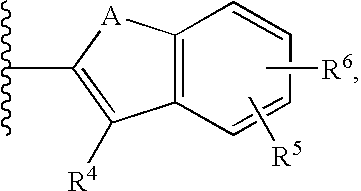
then R5 and R6 may combine with the ring atoms to which they are attached to form

Ar1 is phenyl;
Ar1 is
-
- Ar1 optionally substituted with from one to three moieties independently selected from halo, hydroxy, cyano, —(C1-C4)alkyl(optionally substituted with one to three halogens), —C(O)OH, —C(O)OCH3, —(C1-C4)alkyl-C(O)OH, —O—(C1-C4)alkyl-C(O)OH, —(C1-C4)alkyl-N(R15)(R6), —O—(C1-C4)alkyl-N(R15)(R16); wherein R15 and R16 are each independently hydrogen or —(C1-C4)alkyl, or R15 and R16 taken together with the nitrogen to which they are attached form piperidinyl or pyrrolidinyl;
Het1 is - a heterocyclic radical selected from pyridinyl, piperidinyl, pyrimidinyl, pyrazinyl, piperazinyl, pyridazinyl, indolyl, isoindolyl, indolinyl, furanyl, thiazolyl, oxazolyl, isoxazolyl, isothiazolyl, thiophenyl;
Het2 is - Het1 optionally substituted with from one to three moieties independently selected from halo, hydroxy, cyano, —(C1-C4)alkyl(optionally substituted with one to three halogens), —C(O)OH, —C(O)OCH3, —(C1-C4)alkyl-C(O)OH, —O—(C1-C4)alkyl)C(O)OH, —(C1-C4)alkyl-N(R17)(R18), —O—(C1-C4)alkyl-N(R17)(R18); wherein R17 and R18 are each independently hydrogen or —(C1-C4)alkyl, or R17 and R18 taken together with the nitrogen to which they are attached form piperidinyl or pyrrolidinyl;
R19 is - hydroxy, —(C1-C4)alkyl(optionally substituted with one to three halogens), or —CH2OH; and
R20 is - Hydrogen, hydroxy, —(C1-C4)alkyl(optionally substituted with one to three halogens), or —CH2OH.
- Ar1 optionally substituted with from one to three moieties independently selected from halo, hydroxy, cyano, —(C1-C4)alkyl(optionally substituted with one to three halogens), —C(O)OH, —C(O)OCH3, —(C1-C4)alkyl-C(O)OH, —O—(C1-C4)alkyl-C(O)OH, —(C1-C4)alkyl-N(R15)(R6), —O—(C1-C4)alkyl-N(R15)(R16); wherein R15 and R16 are each independently hydrogen or —(C1-C4)alkyl, or R15 and R16 taken together with the nitrogen to which they are attached form piperidinyl or pyrrolidinyl;

wherein the zig-zag mark represents the point of attachment to the R0 position in Formula I;
G1 is methylene;
L is —CH2—;
A is —S—, or —O—;
R1 is hydrogen;
R2 is

-
- wherein the dashed line indicates the point of attachment to the R2 position in formula I; G2 is methylene, X and Y together with the carbon to which they are attached form a carbonyl; R8 and R9 are each independently hydrogen; R10 is hydrogen;
R3 is hydrogen;
R4 is - hydrogen, —CH3 (optionally substituted with one to three halogens), or halo;
R5 is - hydrogen, or halo;
R6 is - hydroxy, —(C1-C4)alkyl(optionally substituted with one to three halogens), —(C1-C4)alkoxy(optionally substituted with one to three halogens), halo, cyano, Ar2, Het1, Het2, Ar2—(C1-C4)alkyl, Het2-(C1-C4)alkyl, —C(O)—(C1-C4)alkyl, —C(O)—Ar2, —C(O)—Het2, —(C1-C4)alkyl-N(R13)(R14), —O—(C1-C4)alkyl-Ar2, —O—(C1-C4)alkyl-C(O)OH, or —O—(C1-C4)alkyl-N(R13)(R14); wherein R13 and R14 are each independently hydrogen or —(C1-C4)alkyl, or R13 and R14 taken together with the nitrogen to which they are attached form piperidinyl or pyrrolidinyl;
Ar1 is phenyl;
Ar2 is - Ar1 optionally substituted with from one to three moieties independently selected from halo, hydroxy, cyano, —(C1-C4)alkyl(optionally substituted with one to three halogens), —C(O)OH, —C(O)OCH3, —(C1-C4)alkyl-C(O)OH, —O—(C1-C4)alkyl-C(O)OH, —(C1-C4)alkyl-N(R15)(R16), —O—(C1-C4)alkyl-N(R15)(R16); wherein R15 and R16 are each independently hydrogen or —(C1-C4)alkyl, or R15 and R16 taken together with the nitrogen to which they are attached form piperidinyl or pyrrolidinyl;
Het1 is - a heterocyclic radical selected from pyridinyl, piperidinyl, pyrimidinyl, pyrazinyl, piperazinyl, pyridazinyl, indolyl, isoindolyl, indolinyl, furanyl, thiazolyl, oxazolyl, isoxazolyl, isothiazolyl, thiophenyl;
Het2 is - Het1 optionally substituted with from one to three moieties independently selected from halo, hydroxy, cyano, —(C1-C4)alkyl(optionally substituted with one to three halogens), —C(O)OH, —C(O)OCH3, —(C1-C4)alkyl-C(O)OH, —O—(C1-C4)alkyl)C(O)OH, —(C1-C4)alkyl-N(R17)(R18), —O—(C1-C4)alkyl-N(R17)(R18); wherein R17 and R18 are each independently hydrogen or —(C1-C4)alkyl, or R17 and R18 taken together with the nitrogen to which they are attached form piperidinyl or pyrrolidinyl;
R19 is - hydroxy, —(C1-C4)alkyl(optionally substituted with one to three halogens), or —CH2OH; and
R20 is - Hydrogen, hydroxy, —(C1-C4)alkyl(optionally substituted with one to three halogens), or —CH2OH.
- wherein the dashed line indicates the point of attachment to the R2 position in formula I; G2 is methylene, X and Y together with the carbon to which they are attached form a carbonyl; R8 and R9 are each independently hydrogen; R10 is hydrogen;

wherein the zig-zag mark represents the point of attachment to the R0 position in Formula I;
R1 is hydrogen;
R2 is

wherein the dashed line represents the point of attachment to the R2 position in formula I; R3 is hydrogen; A is —S— or —O—; R4 is hydrogen; R5 is halo; and R6 is hydrogen.

Preferably R0 is

Preferably G1 is methylene. Preferably G1 is ethylene. Preferably L is —CH2—. Preferably A is —CH2—. Preferably A is —S—. Preferably A is —O—. Preferably A is —NH—. Preferably R1 is hydrogen. Preferably R1 is —CH3.
Preferably R2 is

-
- wherein the dashed line indicates the point of attachment to the R2 position in formula I; G2 is methylene, ethylene, or 1-propylene; X is hydrogen, hydroxyl, or —CH2OH; Y is hydrogen or methyl, provided that at least one of X and Y is not hydrogen; or X and Y together with the carbon to which they are attached form a carbonyl; R8 and R9 are each independently hydrogen, hydroxy, or —(C1-C4)alkyl(optionally substituted with one to three halogens).
Preferably R2 is
- wherein the dashed line indicates the point of attachment to the R2 position in formula I; G2 is methylene, ethylene, or 1-propylene; X is hydrogen, hydroxyl, or —CH2OH; Y is hydrogen or methyl, provided that at least one of X and Y is not hydrogen; or X and Y together with the carbon to which they are attached form a carbonyl; R8 and R9 are each independently hydrogen, hydroxy, or —(C1-C4)alkyl(optionally substituted with one to three halogens).

-
- wherein the dashed line indicates the point of attachment to the R2 position in formula I; R8 and R9 are each independently hydrogen, hydroxy, or —(C1-C4)alkyl(optionally substituted with one to three halogens).
Preferably R2 is
- wherein the dashed line indicates the point of attachment to the R2 position in formula I; R8 and R9 are each independently hydrogen, hydroxy, or —(C1-C4)alkyl(optionally substituted with one to three halogens).

Preferably R2 is

Preferably R2 is

Preferably R2 is


-
- wherein the dashed line indicates the point of attachment to the R2 position in formula I; R10 is hydrogen, hydroxy, or —(C1-C4)alkyl(optionally substituted with one to three halogens).
Preferably R2 is
- wherein the dashed line indicates the point of attachment to the R2 position in formula I; R10 is hydrogen, hydroxy, or —(C1-C4)alkyl(optionally substituted with one to three halogens).

Preferably R3 is hydrogen.

wherein

wherein X is hydrogen, hydroxy or —CH2OH and Y is hydrogen or methyl or X and Y together form (═O) and wherein R8 and R9 are each independently hydrogen, hydroxy, C1-C4 alkyl or phenyl, and R10 is hydrogen, hydroxy, or C1-C4 alkyl and G2 is methylene, ethylene, or 1-propylene;


wherein

wherein X is hydrogen, hydroxy or —CH2OH and Y is hydrogen or methyl or X and Y together form (═O) and wherein R8 and R9 are each independently hydrogen, hydroxy, C1-C4 alkyl or phenyl, and R10 is hydrogen, hydroxy, or C1-C4 alkyl and G2 is methylene, ethylene, or 1-propylene;

-
- (1) G1 is methylene;
- (2) L is methylene;
- (3) R1 is hydrogen or methyl;
- (4) R2 is cyclohexyl, 6-hydroxycyclohexyl, or 1-adamantyl;
- (5) R3 is hydrogen;
- (6) A is —S— or —O—;
- (7) R4 and R5 are each independently hydrogen, hydroxy, C1-C4 alkyl, C1-C4 alkoxy, halo, cyano, or trifluoromethyl;
- (8) R6 is hydrogen, hydroxy, C1-C4 alkyl, C1-C4 alkoxy, halo, cyano, or trifluoromethyl;
- (9) R5 and R6 combine together on the ring which they are attached to form

Further, any combination of the above groups, e.g., (1) and (2); (3) and (5); (3), (4), (5), (6), (7), and (8); and (1), (2), (3), (4), (5), (6), (7), and (8), are specifically contemplated.

wherein

wherein X is hydrogen, hydroxy or —CH2OH and Y is hydrogen or methyl or X and Y together form (═O) and wherein R8 and R9 are each independently hydrogen, hydroxy, C1-C4 alkyl or phenyl, and R10 is hydrogen, hydroxy, or C1-C4 alkyl and G2 is methylene, ethylene, or 1-propylene;

wherein

wherein X is hydrogen, hydroxy or —CH2OH and Y is hydrogen or methyl or X and Y together form (═O) and wherein R8 and R9 are each independently hydrogen, hydroxy, C1-C4 alkyl or phenyl, and R10 is hydrogen, hydroxy, or C1-C4 alkyl and G2 is methylene, ethylene, or 1-propylene;
-
- (1) R1 is hydrogen;
- (2) R2 is cyclohexyl or 1-adamantyl;
- (a) (3) A is —O— or —S—;
- (4) R4 and R5 are each independently hydrogen, hydroxy, C1-C4 alkyl, C1-C4 alkoxy, halo, cyano, or trifluoromethyl; and
- (5) R6 is hydrogen.
Further, any combination of the above groups, e.g., (1) and (2); (3) and (4); (1), (2), (3), and (4); (1), (2), (3), (4) and (5); (1) and (3); (2) and (3), and the like, are specifically contemplated.
- 3-Benzo[b]thiophen-2-ylmethyl-1-cyclohexyl-pyrrolidin-2-one;
- 3-(3-Chloro-benzo[b]thiophen-2-ylmethyl)-1-cyclohexyl-pyrrolidin-2-one;
- 3-Benzofuran-2-ylmethyl-1-cyclohexyl-pyrrolidin-2-one;
- 3-(7-Chloro-1,3-dioxa-5-thia-s-indacen-6-ylmethyl)-1-cyclohexyl-pyrrolidin-2-one;
- 1-Cyclohexyl-3-(3-methyl-benzo[b]thiophen-2-ylmethyl)-pyrrolidin-2-one;
- 3-(3-Chloro-6-fluoro-benzo[b]thiophen-2-ylmethyl)-1-cyclohexyl-pyrrolidin-2-one;
- 3-(5-Chloro-benzo[b]thiophen-3-ylmethyl)-1-cyclohexyl-pyrrolidin-2-one;
- 3-(3-Chloro-6-methoxy-benzo[b]thiophen-2-ylmethyl)-1-cyclohexyl-pyrrolidin-2-one;
- 3-(5-Bromo-benzo[b]thiophen-2-ylmethyl)-1-cyclohexyl-pyrrolidin-2-one;
- 3-(6-Bromo-benzo[b]thiophen-2-ylmethyl)-1-cyclohexyl-pyrrolidin-2-one;
- 3-(3-Chloro-benzo[b]thiophen-2-ylmethyl)-1-(cis-4-hydroxy-cyclohexyl)-pyrrolidin-2-one;
- 3-(3-Chloro-benzo[b]thiophen-2-ylmethyl)-1-(4-hydroxy-cyclohexyl)-pyrrolidin-2-one;
- 1-(4-Hydroxy-cyclohexyl)-3-(3-methyl-benzofuran-2-ylmethyl)-pyrrolidin-2-one;
- 3-(3-Chloro-6-hydroxy-benzo[b]thiophen-2-ylmethyl)-1-cyclohexyl-pyrrolidin-2-one;
- 4-[3-Chloro-2-(1-cyclohexyl-2-oxo-pyrrolidin-3-ylmethyl)-benzo[b]thiophen-6-yloxymethyl]-benzoic acid;
- 3-[3-Chloro-6-(3-dimethylamino-propoxy)-benzo[b]thiophen-2-ylmethyl]-1-cyclohexyl-pyrrolidin-2-one hydrochloride salt;
- 3-[3-Chloro-6-(3-dimethylamino-propoxy)-benzo[b]thiophen-2-ylmethyl]-1-cyclohexyl-pyrrolidin-2-one;
- 4-[3-Chloro-2-(1-cyclohexyl-2-oxo-pyrrolidin-3-ylmethyl)-benzo[b]thiophen-6-yloxy]-butyric acid;
- 1-Cyclohexyl-3-[5-(2-fluoro-pyridin-4-yl)-benzo[b]thiophen-2-ylmethyl]-pyrrolidin-2-one;
- 4-[2-(1-Cyclohexyl-2-oxo-pyrrolidin-3-ylmethyl)-benzo[b]thiophen-5-yl]-benzoic acid;
- 3-(3-Chloro-benzo[b]thiophen-2-ylmethyl)-trans-1-(4-hyroxyl-cyclohexyl)-piperidin-2-one;
- 3-(3-Chloro-benzo[b]thiophen-2-ylmethyl)-1-(4-hyroxyl-cyclohexyl)-piperidin-2-one; and
- 3-(3-Chloro-benzo[b]thiophen-2-ylmethyl)-cis-1-(4-hyroxyl-cyclohexyl)-piperidin-2-one.


In Schemes S1 and S2, the nitrites (61 or 61a) prepared via Scheme P) or the esters (61 or 61a) (on biaryl substituted compounds to date prepared via Scheme O) are hydrolyzed under standard basic or acidic conditions (the optimal condition varies with the sensitivity of R4 and R5) to afford the carboxylic acid compound (62 or 62a) which is further elaborated using standard dicarbodiimide coupling methods to prepare amides (63 or 63a). Other amide coupling techniques (which are numerous and known to those trained in the art) would give amides (63 or 63a).
General Experimental Details


| TABLE 1 |
| The following examples are prepared essentially as described in Preparation 5 except |
| using the reagents in the “Reagents used” column. |
| Preparation | Structure and name | Reagents used |
| 9 |
 |
3-chloro-6-fluoro- benzo[b]thiophene-2- carbonyl chloride (2.00 g, 8.03 mmol) | 1H NMR (CDCl3) δ 7.74 (dd, 1 H), 7.50 (dd, 1 H, 7.20 (m, 1 H), 4.96 (d, 2 H), 1.97 (t, 1 H). |
| 11 |
 |
3-methyl-benzofuran- 2-carbonyl chloride (5.00 g, 25.7 mmol) | 1H NMR (CDCl3) δ 7.49 (m, 1 H), 7.43 (m, 1 H), 7.26 (m, 2 H), 4.76 (d, 2 H), 2.26 (s, 3 H), 1.84 (t, 1 H) |
| 13 |
 |
3-chloro-6-methoxy- benzo[b]thiophene-2- carbonyl chloride (1.82 g, 6.97 mmol) | 1H NMR (CDCl3) δ 7.67 (d, 1 H), 7.26 (m, 1 H), 7.06 (dd, 1 H), 4.94 (d, 2 H), 3.88 (s, 3 H), 1.91 (t, 1 H) |
| TABLE 2 |
| The following examples are prepared essentially as described in Preparation 6 except |
| using the reagents in the “Reagents used” column. |
| Preparation | Structure and name | Reagents used |
| 8 |
 |
3-methyl- benzo[b]thiophen-2- yl)-methanol (3.60 g, 20.2 mmol) | 1H NMR (CDCl3) δ 7.77 (m, 1 H), 7.68 (m, 1 H), 7.37 (m, 2 H), 4.77 (s, 2 H), 2.39 (s, 3 H) |
| 10 |
 |
(3-chloro-6-fluoro- benzo[b]thiophen-2- yl)-methanol (1.65 g, 7.62 mmol) | 1H NMR (CDCl3) δ 7.75 (dd, 1 H), 7.46 (dd, 1 H), 7.21 (m, 1 H), 4.78 (d, 2 H) |
| 12 |
 |
(3-methyl- benzofuran-2-yl)- methanol (4.02 g, 24.8 mmol) | 1H NMR (CDCl3) δ 7.46 (m, 2 H), 7.31 (m, 1 H), 7.24 (m, 1 H), 4.64 (s, 2 H), 2.25 (s, 3 H) |
| 14 |
 |
(3-chloro-6-methoxy- benzo[b]thiophen-2- yl)-methanol (1.25 g, 5.47 mmol) | 1H NMR (CDCl3) δ 7.67 (d, 1 H), 7.23 (d, 1 H), 7.06 (dd, 1 H), 4.79 (s, 2 H), 3.88 (s, 3 H) |
| 16 |
 |
(5-bromo- benzo[b]thiophen-2- yl)-methanol (10.3 g, 42 mmol) | 1H NMR (CDCl3) δ 7.85- 7.87 (m, 1 H), 7.64 (d, J = 8.59 Hz, 1 H), 7.41- 7.45 (m, 1 H), 7.24-7.27 (m, 1 H), 4.76 (s, 2 H) |
| 17 |
 |
(6-bromo- benzo[b]thiophen-2- yl)-methanol (2.5 g, 10 mmol) | 1H NMR (CDCl3) δ 7.92- 7.94 (m, 1 H), 7.56 (d, J = 8.59 Hz, 1 H), 7.45 (dd, J = 8.59, 1.95 Hz, 1 H), 7.28 (s, 1 H), 4.75 (s, 2 H) |


| TABLE 3 |
| The following examples are prepared essentially as described in Example 1 except using |
| the reagents in the “Reagents used” column. |
| Example | Structure and name | Reagents used | Mass spec |
| 2 |
 |
1-cyclohexyl pyrrolidinone (959 mg, 5.73 mmol) and 2-bromomethyl-3- chloro- benzo[b]thiophene (US 4,939,140) (1.00 g, 3.82 mmol) | (APCI-pos mode) m/z (rel intensity) 348 (100), 350 (40) |
| 3 |
 |
1-cyclohexyl pyrrolidinone (357 mg, 2.13 mmol) and 2-bromomethyl- benzofuran [J. Med. Chem. (1987) 400- 405] (300 mg, 1.42 mmol) | (apci) m/z = 298.2 (M + H) |
| 4 |
 |
1-cyclohexyl pyrrolidinone (0.360 g, 2.15 mmol) and 6- bromomethyl-7- chloro-1,3-dioxa-5- thia-s-indacene (0.439 g, 1.44 mmol) | (APCI-pos mode) m/z (rel intensity) 392.2 (100), 394.1 (40) |
| 5 |
 |
1-cyclohexyl pyrrolidinone (620 mg, 3.70 mmol) and 2-bromomethyl-3- methyl- benzo[b]thiophene (600 mg, 2.47 mmol) | (apci) m/z = 328.2 (M + H) |
| 6 |
 |
1-cyclohexyl pyrrolidinone (0.396 mg, 2.37 mmol) and 2-bromomethyl-3- chloro-6-fluoro- benzo[b]thiophene (0.389, 1.39 mol) | (APCI-pos mode) m/z (rel intensity) 366.2 (100), 368.2 (40) |
| 7 |
 |
1-cyclohexyl pyrrolidinone (400 mg, 2.39 mmol) and 5-bromo-3- chloromethyl- benzo[b]thiophene (938 mg, 3.59 mmol) | (apci) m/z = 348.2 (M + H) |
| 8 |
 |
1-cyclohexyl pyrrolidinone (1.118 g, 6.69 mmol) and 2- bromomethyl-3- chloro-6-methoxy- benzo[b]thiophene (1.30 g, 4.46 mmol) | (apci) m/z = 378.2 (M + H) |
| 9 |
 |
1-cyclohexyl pyrrolidinone (6.8 g, 40 mmol) and 5- bromo-2- bromomethyl- benzo[b]thiophene (6.0 g, 20 mmol) | (APCI-pos mode) m/z (rel intensity): 392.1 (M + H, 100%) |
| 10 |
 |
1-cyclohexyl pyrrolidinone (0.7 g, 4 mmol) and 6- bromo-2- bromomethyl- benzo[b]thiophene (0.5 g, 2 mmol) | (APCI-pos mode) m/z (rel intensity): 392.1 (M + H, 100%) |


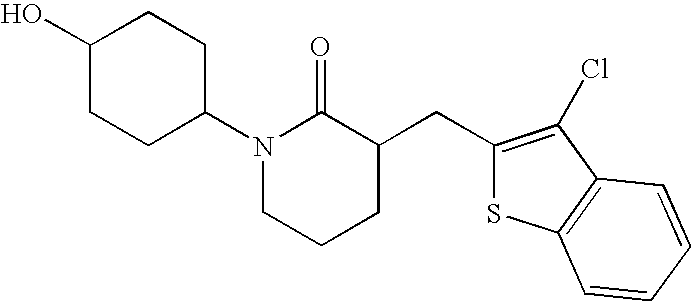
| 11β-HSD | |
| type 1 | |
| enzyme | |
| assay | |
| Example | IC50 (nM) |
 |
190 |
 |
682 |
 |
162 |
 |
508 |
 |
257 |
 |
427 |
 |
276 |
Claims (4)


Priority Applications (1)
| Application Number | Priority Date | Filing Date | Title |
|---|---|---|---|
| US11/722,101 US7834194B2 (en) | 2004-12-21 | 2005-12-16 | Cycloalkyl lactam derivatives as inhibitors of 11-beta-hydroxysteroid dehydrogenase 1 |
Applications Claiming Priority (3)
| Application Number | Priority Date | Filing Date | Title |
|---|---|---|---|
| US63789504P | 2004-12-21 | 2004-12-21 | |
| PCT/US2005/045906 WO2006068991A1 (en) | 2004-12-21 | 2005-12-16 | Cycloalkyl lactam derivatives as inhibitors of 11-beta-hydroxysteroid dehydrogenase 1 |
| US11/722,101 US7834194B2 (en) | 2004-12-21 | 2005-12-16 | Cycloalkyl lactam derivatives as inhibitors of 11-beta-hydroxysteroid dehydrogenase 1 |
Publications (2)
| Publication Number | Publication Date |
|---|---|
| US20080207691A1 US20080207691A1 (en) | 2008-08-28 |
| US7834194B2 true US7834194B2 (en) | 2010-11-16 |
Family
ID=36293609
Family Applications (1)
| Application Number | Title | Priority Date | Filing Date |
|---|---|---|---|
| US11/722,101 Expired - Fee Related US7834194B2 (en) | 2004-12-21 | 2005-12-16 | Cycloalkyl lactam derivatives as inhibitors of 11-beta-hydroxysteroid dehydrogenase 1 |
Country Status (6)
| Country | Link |
|---|---|
| US (1) | US7834194B2 (en) |
| EP (1) | EP1830840B1 (en) |
| AT (1) | ATE401073T1 (en) |
| DE (1) | DE602005008282D1 (en) |
| ES (1) | ES2308601T3 (en) |
| WO (1) | WO2006068991A1 (en) |
Families Citing this family (13)
| Publication number | Priority date | Publication date | Assignee | Title |
|---|---|---|---|---|
| JPWO2006104280A1 (en) * | 2005-03-31 | 2008-09-11 | 武田薬品工業株式会社 | Diabetes prevention and treatment |
| WO2007124329A1 (en) | 2006-04-21 | 2007-11-01 | Eli Lilly And Company | Cyclohexylimidazole lactam derivatives as inhibitors of 11-beta-hydroxysteroid dehydrogenase 1 |
| MY148128A (en) | 2006-04-21 | 2013-02-28 | Lilly Co Eli | Cyclohexylpyrazole-lactam derivatives as inhibitors of 11-beta-hydroxysteroid dehydrogenase 1 |
| CN101541747B (en) | 2006-04-21 | 2012-11-14 | 伊莱利利公司 | Biphenyl amide lactam derivatives as inhibitors of 11- beta-hydroxysteroid dehydrogenase 1 |
| JP5118692B2 (en) | 2006-04-24 | 2013-01-16 | イーライ リリー アンド カンパニー | Cyclohexyl substituted pyrrolidinones as inhibitors of 11-β-hydroxysteroid dehydrogenase 1 |
| CN101432275B (en) * | 2006-04-24 | 2013-10-30 | 伊莱利利公司 | Inhibitors of 11-beta-hydroxysteroid dehydrogenase 1 |
| ATE473210T1 (en) | 2006-04-24 | 2010-07-15 | Lilly Co Eli | SUBSTITUTED PYRROLIDINONES AS INHIBITORS OF 11-BETA-HYDROXYSTEROIDDEHYDROGENASE 1 |
| EP2016071B1 (en) * | 2006-04-25 | 2013-07-24 | Eli Lilly And Company | Inhibitors of 11-beta-hydroxysteroid dehydrogenase 1 |
| PL2021337T3 (en) | 2006-04-25 | 2010-06-30 | Lilly Co Eli | Inhibitors of 11-beta-hydroxysteroid dehydrogenase 1 |
| ES2344616T3 (en) | 2006-04-25 | 2010-09-01 | ELI LILLY & COMPANY | INHIBITORS OF 11-BETA-HYDROXIESTEROID DEHYDROGENASE 1. |
| US7829582B2 (en) * | 2006-04-28 | 2010-11-09 | Eli Lilly And Company | Piperidinyl substituted pyrrolidinones as inhibitors of 11-beta-hydroxysteroid dehydrogenase 1 |
| PE20110235A1 (en) | 2006-05-04 | 2011-04-14 | Boehringer Ingelheim Int | PHARMACEUTICAL COMBINATIONS INCLUDING LINAGLIPTIN AND METMORPHINE |
| ES2350077B1 (en) | 2009-06-04 | 2011-11-04 | Laboratorios Salvat, S.A. | INHIBITING COMPOUNDS OF 11BETA-HYDROXIESTEROID DEHYDROGENASE TYPE 1. |
Citations (4)
| Publication number | Priority date | Publication date | Assignee | Title |
|---|---|---|---|---|
| WO2002026706A2 (en) | 2000-09-29 | 2002-04-04 | Bayer Pharmaceuticals Corporation | 17-beta-hydroxysteroid dehydrogenase-ii inhibitors |
| WO2004033427A1 (en) | 2002-10-11 | 2004-04-22 | Astrazeneca Ab | 1,4-disubstituted piperidine derivatives and their use as 11-betahsd1 inhibitors |
| WO2004041776A2 (en) | 2002-05-06 | 2004-05-21 | Bristol-Myers Squibb Company | SULFONYLAMINOVALEROLAC TAMS AND DERIVATIVES THEREOF AS FACTOR Xa INHIBITORS |
| WO2005108361A1 (en) | 2004-05-07 | 2005-11-17 | Janssen Pharmaceutica N.V. | Adamantyl pyrrolidin-2-one derivatives as 11-beta hydroxysteroid dehydrogenase inhibitors |
-
2005
- 2005-12-16 AT AT05854586T patent/ATE401073T1/en not_active IP Right Cessation
- 2005-12-16 EP EP05854586A patent/EP1830840B1/en not_active Expired - Lifetime
- 2005-12-16 DE DE602005008282T patent/DE602005008282D1/en not_active Expired - Lifetime
- 2005-12-16 US US11/722,101 patent/US7834194B2/en not_active Expired - Fee Related
- 2005-12-16 ES ES05854586T patent/ES2308601T3/en not_active Expired - Lifetime
- 2005-12-16 WO PCT/US2005/045906 patent/WO2006068991A1/en not_active Ceased
Patent Citations (4)
| Publication number | Priority date | Publication date | Assignee | Title |
|---|---|---|---|---|
| WO2002026706A2 (en) | 2000-09-29 | 2002-04-04 | Bayer Pharmaceuticals Corporation | 17-beta-hydroxysteroid dehydrogenase-ii inhibitors |
| WO2004041776A2 (en) | 2002-05-06 | 2004-05-21 | Bristol-Myers Squibb Company | SULFONYLAMINOVALEROLAC TAMS AND DERIVATIVES THEREOF AS FACTOR Xa INHIBITORS |
| WO2004033427A1 (en) | 2002-10-11 | 2004-04-22 | Astrazeneca Ab | 1,4-disubstituted piperidine derivatives and their use as 11-betahsd1 inhibitors |
| WO2005108361A1 (en) | 2004-05-07 | 2005-11-17 | Janssen Pharmaceutica N.V. | Adamantyl pyrrolidin-2-one derivatives as 11-beta hydroxysteroid dehydrogenase inhibitors |
Non-Patent Citations (6)
Also Published As
| Publication number | Publication date |
|---|---|
| ES2308601T3 (en) | 2008-12-01 |
| EP1830840B1 (en) | 2008-07-16 |
| EP1830840A1 (en) | 2007-09-12 |
| US20080207691A1 (en) | 2008-08-28 |
| DE602005008282D1 (en) | 2008-08-28 |
| ATE401073T1 (en) | 2008-08-15 |
| WO2006068991A1 (en) | 2006-06-29 |
Similar Documents
| Publication | Publication Date | Title |
|---|---|---|
| US7713979B2 (en) | Cycloalkyl lactam derivatives as inhibitors of 11-beta-hydroxysteroid dehydrogenase 1 | |
| US7834194B2 (en) | Cycloalkyl lactam derivatives as inhibitors of 11-beta-hydroxysteroid dehydrogenase 1 | |
| US7981918B2 (en) | Cyclohexylpyrazole-lactam derivatives as inhibitors of 11-beta-hydroxysteroid dehydrogenase 1 | |
| US6329392B1 (en) | Substituted piperidines useful for the treatment of allergic diseases | |
| US7473702B2 (en) | Substituted gamma lactams as therapeutic agents | |
| CN101454310B (en) | Inhibitors of 11-beta-hydroxysteroid dehydrogenase 1 | |
| US7820659B2 (en) | Cyclohexylimidiazole lactam derivatives as inhibitors of 11-β-hydroxysteroid dehydrogenase 1 | |
| EP1926708B1 (en) | Biaryl substituted heterocycle inhibitors of lta4h for treating inflammation | |
| US20060247439A1 (en) | Mchir antagonists | |
| US8815871B2 (en) | N,N-substituted 3-aminopyrrolidine compounds useful as monoamines reuptake inhibitors | |
| US20080214621A1 (en) | Cycloalkyl Lactam Derivatives As Inhibitors Of 11-Beta-Hydroxysteroid Dehydrogenase 1 | |
| TW201444798A (en) | Phenylpyrazole derivatives as potent ROCK1 and ROCK2 inhibitors | |
| JP2001151771A (en) | Nitrogen-containing aromatic heterocyclic derivatives | |
| CN104884436A (en) | Novel benzazepine derivative and pharmaceutical use thereof | |
| TW201546050A (en) | Novel benzoazepine derivatives and medical applications thereof | |
| KR20050016991A (en) | Mchir antagonists | |
| HK1126493B (en) | Cyclohexylpyrazole-lactam derivatives as inhibitors of 11-beta-hydroxysteroid dehydrogenase 1 |
Legal Events
| Date | Code | Title | Description |
|---|---|---|---|
| AS | Assignment |
Owner name: ELI LILLY AND COMPANY,INDIANA Free format text: ASSIGNMENT OF ASSIGNORS INTEREST;ASSIGNORS:AICHER, THOMAS DANIEL;CHICARELLI, MARK JOSEPH;HINKLIN, RONALD JAY;AND OTHERS;SIGNING DATES FROM 20050112 TO 20050209;REEL/FRAME:019608/0117 Owner name: ELI LILLY AND COMPANY, INDIANA Free format text: ASSIGNMENT OF ASSIGNORS INTEREST;ASSIGNORS:AICHER, THOMAS DANIEL;CHICARELLI, MARK JOSEPH;HINKLIN, RONALD JAY;AND OTHERS;SIGNING DATES FROM 20050112 TO 20050209;REEL/FRAME:019608/0117 |
|
| REMI | Maintenance fee reminder mailed | ||
| LAPS | Lapse for failure to pay maintenance fees | ||
| STCH | Information on status: patent discontinuation |
Free format text: PATENT EXPIRED DUE TO NONPAYMENT OF MAINTENANCE FEES UNDER 37 CFR 1.362 |
|
| STCH | Information on status: patent discontinuation |
Free format text: PATENT EXPIRED DUE TO NONPAYMENT OF MAINTENANCE FEES UNDER 37 CFR 1.362 |
|
| FP | Lapsed due to failure to pay maintenance fee |
Effective date: 20141116 |