US7829632B2 - Polyester polycarbonate compositions, methods of making, and articles formed therefrom - Google Patents
Polyester polycarbonate compositions, methods of making, and articles formed therefrom Download PDFInfo
- Publication number
- US7829632B2 US7829632B2 US11/741,835 US74183507A US7829632B2 US 7829632 B2 US7829632 B2 US 7829632B2 US 74183507 A US74183507 A US 74183507A US 7829632 B2 US7829632 B2 US 7829632B2
- Authority
- US
- United States
- Prior art keywords
- composition
- terephthalate
- poly
- polyester
- percent
- Prior art date
- Legal status (The legal status is an assumption and is not a legal conclusion. Google has not performed a legal analysis and makes no representation as to the accuracy of the status listed.)
- Active, expires
Links
- 0 C1=CC=CC=C1.CC.CC(C)=O.COC(C)=O.CO[1*]OC(=O)OC1=CC=CC=C1 Chemical compound C1=CC=CC=C1.CC.CC(C)=O.COC(C)=O.CO[1*]OC(=O)OC1=CC=CC=C1 0.000 description 6
- IQOALSQSZWVOHL-UHFFFAOYSA-N CC.CC.OC1=CC=C(CC2=CC=C(O)C=C2)C=C1 Chemical compound CC.CC.OC1=CC=C(CC2=CC=C(O)C=C2)C=C1 IQOALSQSZWVOHL-UHFFFAOYSA-N 0.000 description 5
Classifications
-
- C—CHEMISTRY; METALLURGY
- C08—ORGANIC MACROMOLECULAR COMPOUNDS; THEIR PREPARATION OR CHEMICAL WORKING-UP; COMPOSITIONS BASED THEREON
- C08L—COMPOSITIONS OF MACROMOLECULAR COMPOUNDS
- C08L67/00—Compositions of polyesters obtained by reactions forming a carboxylic ester link in the main chain; Compositions of derivatives of such polymers
- C08L67/02—Polyesters derived from dicarboxylic acids and dihydroxy compounds
-
- C—CHEMISTRY; METALLURGY
- C08—ORGANIC MACROMOLECULAR COMPOUNDS; THEIR PREPARATION OR CHEMICAL WORKING-UP; COMPOSITIONS BASED THEREON
- C08L—COMPOSITIONS OF MACROMOLECULAR COMPOUNDS
- C08L69/00—Compositions of polycarbonates; Compositions of derivatives of polycarbonates
- C08L69/005—Polyester-carbonates
-
- C—CHEMISTRY; METALLURGY
- C08—ORGANIC MACROMOLECULAR COMPOUNDS; THEIR PREPARATION OR CHEMICAL WORKING-UP; COMPOSITIONS BASED THEREON
- C08L—COMPOSITIONS OF MACROMOLECULAR COMPOUNDS
- C08L2205/00—Polymer mixtures characterised by other features
- C08L2205/02—Polymer mixtures characterised by other features containing two or more polymers of the same C08L -group
Definitions
- This disclosure relates to polyester polycarbonate compositions, methods of making, and articles formed therefrom.
- Polyesters can be blended with other miscible or immiscible polymers to improve various properties of the polyester.
- polyesters can be blended with polycarbonates to provide improved mechanical properties such as impact strength, and/or can also be added to improve rheological properties such as melt volume rate.
- other properties of the polyester specifically optical properties, can be adversely affected by forming a blend.
- Such polyester blends can have a hazy appearance, with diminished light transmittance.
- Miscible blends that is, blends that have substantially a single phase, tend to have less haze. It has been difficult, however, to develop blends of polyesters and polycarbonates that have sufficient miscibility to provide good optical properties, while maintaining other advantageous properties of the blends.
- polyester polycarbonate compositions comprising polycarbonate and polyester, in particular polyester polycarbonate compositions having high transparency and low haze. It would be a further advantage if the compositions had other advantageous properties, for example, weatherability, barrier, and chemical resistance.
- composition comprising from 5 to 85 weight percent of a polyester-polycarbonate polymer of the formula
- each R f is independently a halogen atom, a C 1-12 hydrocarbon group, or a halogen-substituted C 1-12 hydrocarbon group, m and n are each greater than one, p is 0 to 4, and each R 1 is independently a C 6-30 aromatic hydrocarbon group, from 1 to 70 weight percent of a poly(C 4 -alkylene terephthalate) ester; and from 1 to 85 weight percent of a polyester comprising cyclohexyldimethylene terephthalate units, ethylene terephthalate units, or a combination of cyclohexyldimethylene terephthalate and ethylene terephthalate units; wherein weight percents are based on the total weight of the polyester-polycarbonate polymer, the poly(C 4 -alkylene terephthalate) ester, and the polyester.
- a composition comprises from 5 to 85 weight percent a polyester-polycarbonate polymer comprising isophthalate-terephthalate-resorcinol ester units and carbonate units of the formula
- each R f is independently a halogen atom, a C 1-12 hydrocarbon group, or a halogen-substituted C 1-12 hydrocarbon group
- p is 0 to 4
- m and n are each greater than one
- each R 1 is independently a C 6-30 aromatic hydrocarbon group
- m is 2 to 500
- n is 2 to 500
- from 5 to 45 weight percent of a poly(C 4 -alkylene terephthalate) ester from 1 to 85 weight percent a polyester comprising cyclohexyldimethylene terephthalate units, ethylene terephthalate units, or a combination of cyclohexyldimethylene terephthalate and ethylene terephthalate units; wherein weight percents are based on the total weight of the polyester-polycarbonate polymer, the poly(C 4 -alkylene terephthalate) ester, and the polyester.
- a composition comprises from 5 to 85 weight percent poly(isophthalate-terephthalate-resorcinol ester)-co-(bisphenol-A carbonate); from 5 to 45 weight percent poly(1,4 butylene terephthalate); and from 5 to 85 weight percent poly(ethylene terephthalate)-co-poly(1,4-cyclohexyldimethylene terephthalate); wherein the poly(ethylene terephthalate)-co-poly(1,4-cyclohexyldimethylene terephthalate) comprises from 10 to 30 mole percent ethylene terephthalate units and from 70 to 90 mole percent 1,4-cyclohexyldimethylene terephthalate units; wherein weight percents are based on the total weight of the polyester-polycarbonate polymer, the poly(1,4-butylene terephthalate), and the poly(ethylene terephthalate)-co-poly(1,4-cyclohexyldimethylene terephthalate
- a composition comprises from 45 to 85 weight percent poly(isophthalate-terephthalate-resorcinol ester)-co-(bisphenol-A carbonate); from 1 to 35 weight percent poly(1,4-butylene terephthalate); and from 1 to 40 weight percent poly(1,4-cyclohexyldimethylene terephthalate); wherein weight percents are based on the total weight of the polyester-polycarbonate polymer, the poly(1,4-butylene terephthalate), and the poly(1,4-cyclohexyldimethylene terephthalate); and further wherein an article molded from the composition has a percent haze value of less than or equal to 10 percent, and a total luminous transmittance value of greater than or equal to 70 percent, each measured according to ASTM D1003-00.
- a method of forming a composition comprises melt blending the components of the any one of the above-described compositions.
- composition comprising, in specific ratios, a blend of a polyester-polycarbonate polymer having isophthalate terephthalate resorcinol (ITR) ester units and carbonate units, a poly(C 4 -alkylene terephthalate) ester, and a polyester comprising cyclohexyldimethylene terephthalate units, ethylene terephthalate units, or a combination of cyclohexyldimethylene terephthalate units and ethylene terephthalate units, has a low haze value and a high total luminous transmittance value.
- ITR isophthalate terephthalate resorcinol
- the blend of these polymers can be extruded to provide transparent pellets when the amount of the polyester-polycarbonate polymer is from 5 to 85 weight percent (wt %), the amount of the poly(C 4 -alkylene terephthalate) ester is from 1 to 70 wt %, and the amount of the polyester is from 1 to 85 wt %.
- the composition comprises a polyester-polycarbonate polymer, also known as a polyester carbonate, copolyester-polycarbonate, and copolyestercarbonate.
- the polyester-polycarbonate polymer comprises ITR ester units and carbonate units of the formula (1)
- each R f is independently a halogen atom, a C 1-12 hydrocarbon group, or a halogen-substituted C 1-12 hydrocarbon group
- p is 0 to 4
- each R 1 is independently a C 6-30 hydrocarbon group wherein at least 60% of the R 1 groups are aromatic
- m and n are each independently greater than one.
- m is 2 to 500
- n is 2 to 500.
- R f in formula (1) s a C 1-3 alkyl group or a halogen-substituted C 1-3 alkyl group, and p as 0 to 2. In another embodiment, p is zero.
- the ITR ester units can be derived from the reaction of a mixture of terephthalic acid and isophthalic acid or a chemical equivalent thereof with a compound such as resorcinol, 5-methyl resorcinol, 5-ethyl resorcinol, 5-propyl resorcinol, 5-butyl resorcinol, 5-t-butyl resorcinol, 2,4,5-trifluoro resorcinol, 2,4,6-trifluoro resorcinol, 4,5,6-trifluoro resorcinol, 2,4,5-tribromo resorcinol, 2,4,6-tribromo resorcinol, 4,5,6-tribromo resorcinol, or a combination comprising at least one of the foregoing compounds.
- a compound such as resorcinol, 5-methyl resorcinol, 5-ethyl resorcinol, 5-propyl resor
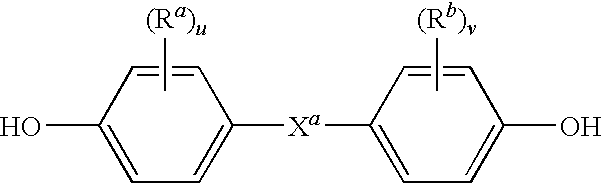
- R 1 in formula (1) is derived from a dihydroxy compound of formula (2)
- each R a and R b is independently a halogen atom or a C 1-12 alkyl, and u and v are each independently integers of 0 to 4.
- X a represents a bridging group connecting the two hydroxy-substituted aromatic groups, wherein the bridging group and the hydroxy substituent of each C 6 arylene group are disposed ortho, meta, or para (specifically para) to each other on the C 6 arylene group.
- the bridging group X a can be a single bond, —O—, —S—, —S(O)—, —S(O) 2 —, —C(O)—, or a C 1-18 organic group.
- the C 1-18 organic bridging group can be cyclic (including fused rings) or acyclic, aromatic (including fused rings) or non-aromatic, and can further comprise heteroatoms such as halogens, oxygen, nitrogen, sulfur, silicon, or phosphorous.
- the C 1-18 organic group can be disposed such that the C 6 arylene groups connected thereto are each connected to a common alkylidene carbon or to different carbons of the C 1-18 organic bridging group.
- R a and R b are each independently a halogen or a C 1-3 alkyl group, and u and v are each independently 0 to 1.
- X a is a C 1-18 alkylene group, a C 3-18 cycloalkylene group, a fused C 6-18 cycloalkylene group, a group of the formula —B 1 —W—B 2 — wherein B 1 and B 2 are the same or different C 1-6 alkylene group and W is a C 3-12 cycloalkylidene group or a C 6-16 arylene group, a C 3-18 cycloalkylidene, a C 1-25 alkylidene of formula —C(R c ) (R d )— wherein R c and R d are each independently hydrogen, C 1-12 alkyl, C 1-12 cycloalkyl, C 7-12 arylalkyl, C 1-12 heteroalkyl, or cyclic C 7
- Exemplary groups of this type include methylene, cyclohexylmethylene, ethylidene, neopentylidene, and isopropylidene, as well as 2-[2.2.1]-bicycloheptylidene, cyclohexylidene, cyclopentylidene, cyclododecylidene, and adamantylidene.
- the foregoing X a groups can be unsubstituted or substituted with one or more halogens, C 1-12 alkyl groups, C 6-18 aromatic groups, and/or heteroatom containing groups, such as ester, amide, and the like.
- aromatic dihydroxy compounds include the following: 4,4′-dihydroxybiphenyl, 1,6-dihydroxynaphthalene, 2,6-dihydroxynaphthalene, bis(4-hydroxyphenyl)methane, bis(4-hydroxyphenyl)diphenylmethane, bis(4-hydroxyphenyl)-1-naphthylmethane, 1,2-bis(4-hydroxyphenyl)ethane, 1,1-bis(4-hydroxyphenyl)-1-phenylethane, 2-(4-hydroxyphenyl)-2-(3-hydroxyphenyl)propane, bis(4-hydroxyphenyl)phenylmethane, 2,2-bis(4-hydroxy-3-bromophenyl)propane, 1,1-bis(hydroxyphenyl)cyclopentane, 1,1-bis(4-hydroxyphenyl)cyclohexane, 1,1-bis(4-hydroxyphenyl)isobutene, 1,1
- R 1 is derived from 1,1-bis(4-hydroxyphenyl) methane, 1,1-bis(4-hydroxyphenyl)ethane, 2,2-bis(4-hydroxyphenyl)propane (hereinafter “bisphenol A” or “BPA”), 2,2-bis(4-hydroxyphenyl)butane, 2,2-bis(4-hydroxyphenyl) octane, 1,1-bis(4-hydroxyphenyl)propane, 1,1-bis(4-hydroxyphenyl)n-butane, 2,2-bis(4-hydroxy-1-methylphenyl)propane, 1,1-bis(4-hydroxy-t-butylphenyl)propane, 3,3-bis(4-hydroxyphenyl)phthalimidine, 2-phenyl-3,3-bis(4-hydroxyphenyl)phthalimidine (PPPBP), and 1,1-bis(4-hydroxy-3-methylphenyl)cyclohexane (DMBPC).
- BPA bisphenol A
- BPA 2,
- the ratio of ITR ester units (m) to the carbonate units (n) in the polyester-polycarbonate is 5:99 to 95:1, specifically 5:95 to 95:5, more specifically 10:90 to 90:10, still more specifically 20:80 to 80:20.
- m can be 2 to 500
- n can be 2 to 500.
- R f is a C 1-3 alkyl group or a halogen-substituted C 1-3 alkyl group
- p is 0 to 2
- R a and R b are each independently a halogen or a C 1-3 alkyl group
- u and v are each independently 0 to 1
- X a is a C 1-25 alkylidene of formula —C(R c )(R d )— wherein R c and R d are each independently hydrogen, C 1-12 alkyl, or C 7-12 arylalkyl.
- p is zero, u and v are each zero, and X a is a C 1-13 alkylidene of formula —C(R c )(R d )— wherein R c and R d are each independently hydrogen or C 1-6 alkyl, specifically methyl.
- Chain stoppers (also referred to as capping agents), which limit molecular weight growth rate during manufacture of the polymer can be used.
- Suitable chain stoppers include monophenolic compounds such as phenol, p-cumyl-phenol, p-tertiary-butyl phenol, and hydroxy diphenyl, monoethers of hydroquinones such as p-methoxyphenol, alkyl-substituted phenols including those with branched chain alkyl substituents having 8 to 9 carbon atoms, mono-phenolic UV absorbers such as 4-substituted-2-hydroxybenzophenones, aryl salicylate, monoesters of diphenols such as resorcinol monobenzoate, 2-(2-hydroxyaryl)-benzotriazole, 2-(2-hydroxyaryl)-1,3,5-triazines, and the like; monocarboxylic acid chlorides such as benzoyl chloride, C 1-22 alkyl-substituted benzoyl chlorides (e.
- the polyester-polycarbonate polymers can have a weight-averaged molecular weight (Mw) of 1,500 to 100,000 atomic mass units, specifically 1,700 to 50,000 atomic mass units, and more specifically 2,000 to 40,000 atomic mass units.
- Mw weight-averaged molecular weight
- Molecular weight determinations are performed using gel permeation chromatography (GPC), using a crosslinked styrene-divinylbenzene column and calibrated to polystyrene references. Samples are prepared at a concentration of about 1 mg/ml, and are eluted at a flow rate of about 1.0 ml/min.
- the poly(isophthalate-terephthalate-resorcinol ester)s can be obtained by interfacial polymerization or melt-process condensation, by solution phase condensation, or by transesterification polymerization. It is possible to use a branched poly(isophthalate-terephthalate-resorcinol ester)s in which a branching agent, for example, a glycol having three or more hydroxyl groups or a trifunctional or multifunctional carboxylic acid has been incorporated. Furthermore, it is sometimes desirable to have various concentrations of acid and hydroxyl end groups on the poly(isophthalate-terephthalate-resorcinol ester)s, depending on the ultimate end use of the composition.
- a branching agent for example, a glycol having three or more hydroxyl groups or a trifunctional or multifunctional carboxylic acid
- the poly(isophthalate-terephthalate-resorcinol ester)s can then be reacted with a carbonate precursor in the presence of a suitable dihydroxy compound such as an aromatic diol of formula (2).
- suitable carbonate precursors include, for example, a carbonyl halide such as carbonyl bromide or carbonyl chloride, or a haloformate such as a bishaloformates of a dihydric phenol (e.g., the bischloroformates of bisphenol A, hydroquinone, or the like) or a glycol (e.g., the bishaloformate of ethylene glycol, neopentyl glycol, polyethylene glycol, or the like). Combinations comprising at least one of the foregoing types of carbonate precursors can also be used. It is also desirable to include a chain stopper in addition to the dihydroxy compound.
- a poly(isophthalate-terephthalate-resorcinol ester) is prepared by solution phase condensation, i.e., is prepared by contacting a mixture of isophthalic acid and terephthalic acid with resorcinol in a suitable solvent. To the resulting mixture is then added BPA, phenol (chain stopper), and phosgene (carbonyl chloride, a carbonate precursor). Poly(isophthalate-terephthalate-resorcinol ester)-co-(bisphenol-A carbonate) is thus produced.
- compositions also comprise two different polyesters, a poly(C 4 -alkylene terephthalate) ester and a polyester comprising cyclohexyldimethylene terephthalate units, ethylene terephthalate units, or a combination of cyclohexyldimethylene terephthalate and ethylene terephthalate units.
- poly(C 4 -alkylene terephthalate) esters examples include poly(1,4-butylene terephthalate), poly(1,3-butylene terephthalate), poly(1,2-butylene terephthalate), poly(1,1-butylene terephthalate), poly(1,3-2-methylpropylene terephthalate), poly(1,2-2-methylpropylene terephthalate), and combinations comprising at least one of the foregoing poly(C 4 -alkylene terephthalate) esters.
- the poly(C 4 -alkylene terephthalate) ester is poly(1,4-butylene terephthalate) (PBT).
- the polyester comprising cyclohexyldimethylene terephthalate units, ethylene terephthalate units, or a combination of cyclohexyldimethylene terephthalate and ethylene terephthalate units can be selected from poly(cyclohexyldimethylene terephthalate) (PCT), poly(ethylene terephthalate)-co-(1,4-cyclohexyldimethylene terephthalate), abbreviated as PETG where the polymer comprises greater than 50 mol % of ethylene terephthalate ester units, and abbreviated as PCTG where the polymer comprises greater than 50 mol % of 1,4-cyclohexyldimethylene terephthalate ester units.
- PCT poly(cyclohexyldimethylene terephthalate)
- PETG poly(ethylene terephthalate)-co-(1,4-cyclohexyldimethylene terephthalate)
- PETG poly(ethylene tere
- the poly(ethylene terephthalate)-co-(1,4-cyclohexyldimethylene terephthalate) comprises 10 to 90 mole percent ethylene terephthalate units and 10 to 90 mole percent 1,4-cyclohexyldimethylene terephthalate units.
- the polyester is PCT.
- the polyester is PET.
- the polyester is PETG.
- the polyester is PCTG.
- 1,4-cyclohexyldimethylene units are present, a mixture of cis-to trans-isomers in ratios of about 1:4 to about 4:1 can be used. Specifically, a ratio of cis-to trans-isomers of about 1:3 can be useful. Additionally, up to 30 mole percent of isophthalate units can be present along with terephthalate units in both PCTG and PETG, based on the total moles of terephthalate units.
- the polyesters can be obtained by interfacial polymerization or melt-process condensation as described above, by solution phase condensation, or by transesterification polymerization wherein, for example, a dialkyl ester such as dimethyl terephthalate can be transesterified with ethylene glycol using acid catalysis, to generate poly(ethylene terephthalate). It is possible to use a branched polyester in which a branching agent, for example, a glycol having three or more hydroxyl groups or a trifunctional or multifunctional carboxylic acid has been incorporated. Furthermore, it is sometime desirable to have various concentrations of acid and hydroxyl end groups on the polyester, depending on the ultimate end use of the composition.
- the polyester-polycarbonate polymer is present in the composition in an amount of 5 to 85 weight percent. In one embodiment, the polyester-polycarbonate polymer is present in the composition in an amount of 5 to 65 weight percent. In another embodiment, the polyester-polycarbonate polymer is present in the composition in an amount of 45 to 85 weight percent.
- the poly(C 4 -alkylene terephthalate) ester is present in the composition in an amount of 1 to 70 weight percent. In one embodiment, the poly(C 4 -alkylene terephthalate) ester is present in the composition in an amount of 5 to 45 weight percent. In another embodiment, the poly(C 4 -alkylene terephthalate) ester is present in the composition in an amount of 1 to 35 weight percent.
- the polyester comprising cyclohexyldimethylene terephthalate units, ethylene terephthalate units, or a combination thereof is present in the composition in an amount of 1 to 85 weight percent. In one embodiment, this polyester is present in the composition in an amount of 5 to 85 weight percent. In another embodiment, this polyester is present in the composition in an amount of 15 to 85 weight percent. In yet another embodiment, this polyester is present in the composition in an amount of 1 to 40 weight percent. All of the foregoing weight percents are based on the total weight of the polyester-polycarbonate polymer, the poly(C 4 -alkylene terephthalate) ester, and the polyester.
- the composition can include various other additives ordinarily incorporated with compositions of this type, such as an antioxidant, a heat stabilizer, a light stabilizer, an ultraviolet light absorber, a plasticizer, a mold release agent, a lubricant, an antistatic agent, a quencher or a colorant such as a pigment or a dye.
- additives ordinarily incorporated with compositions of this type, such as an antioxidant, a heat stabilizer, a light stabilizer, an ultraviolet light absorber, a plasticizer, a mold release agent, a lubricant, an antistatic agent, a quencher or a colorant such as a pigment or a dye.
- Mixtures comprising at least one of the foregoing additives can be used.
- Such additives can be mixed at a suitable time during the mixing of the components for forming the composition.
- the composition can comprise a colorant such as a pigment and/or dye additive.
- Suitable pigments include for example, inorganic pigments such as metal oxides and mixed metal oxides such as zinc oxide, titanium dioxides, iron oxides or the like; sulfides such as zinc sulfides, or the like; aluminates; sodium sulfo-silicates, sulfates, chromates, or the like; carbon blacks; zinc ferrites; ultramarine blue; Pigment Brown 24; Pigment Red 101; Pigment Yellow 119; organic pigments such as azos, di-azos, quinacridones, perylenes, naphthalene tetracarboxylic acids, flavanthrones, isoindolinones, tetrachloroisoindolinones, anthraquinones, anthanthrones, dioxazines, phthalocyanines, and azo lakes; Pigment Blue 60, Pigment Red 122, Pigment Red 149
- Pigments can be used in amounts of 0.01 to 10 percent by weight, based on the total weight of the polyester-polycarbonate polymer, the poly(C 4 -alkylene terephthalate) ester, and the polyester, where the use of the pigment does not significantly adversely affect the desired properties of the composition.
- Suitable dyes can be organic materials and include, for example, coumarin dyes such as coumarin 460 (blue), coumarin 6 (green), nile red or the like; lanthanide complexes; hydrocarbon and substituted hydrocarbon dyes; polycyclic aromatic hydrocarbon dyes; scintillation dyes such as oxazole or oxadiazole dyes; aryl-or heteroaryl-substituted poly (C 2-8 ) olefin dyes; carbocyanine dyes; indanthrone dyes; phthalocyanine dyes; oxazine dyes; carbostyryl dyes; napthalenetetracarboxylic acid dyes; porphyrin dyes; bis(styryl)biphenyl dyes; acridine dyes; anthraquinone dyes; cyanine dyes; methine dyes; arylmethane dyes; azo dyes; indigoid dyes, thi
- Dyes can be used in amounts of 0.01 to 10 percent by weight, based on the total weight of the polyester-polycarbonate polymer, the poly(C 4 -alkylene terephthalate) ester, and the polyester, where the use of the dyes does not significantly adversely affect the desired properties of the composition.
- the composition can further comprise an antioxidant.
- Suitable antioxidant additives include, for example, organophosphites such as tris(nonyl phenyl)phosphite, tris(2,4-di-t-butylphenyl)phosphite, bis(2,4-di-t-butylphenyl)pentaerythritol diphosphite, distearyl pentaerythritol diphosphite or the like; alkylated monophenols or polyphenols; alkylated reaction products of polyphenols with dienes, such as tetrakis[methylene(3,5-di-tert-butyl-4-hydroxyhydrocinnamate)]methane, or the like; butylated reaction products of para-cresol or dicyclopentadiene; alkylated hydroquinones; hydroxylated thiodiphenyl ethers; alkylidene-bisphenols; benzyl compounds; esters
- Suitable heat stabilizer additives include, for example, organophosphites such as triphenyl phosphite, tris-(2,6-dimethylphenyl)phosphite, tris-(mixed mono-and di-nonylphenyl)phosphite or the like; phosphonates such as dimethylbenzene phosphonate or the like, phosphates such as trimethyl phosphate, or the like, or combinations comprising at least one of the foregoing heat stabilizers.
- Heat stabilizers can be used in amounts of 0.0001 to 1 percent by weight, based on the total weight of the polyester-polycarbonate polymer, the poly(C 4 -alkylene terephthalate) ester, and the polyester.
- Light stabilizers and/or ultraviolet light (UV) absorbing additives can also be used.
- Suitable light stabilizer additives include, for example, benzotriazoles such as 2-(2-hydroxy-5-methylphenyl)benzotriazole, 2-(2-hydroxy-5-tert-octylphenyl)-benzotriazole and 2-hydroxy-4-n-octoxy benzophenone, or the like, or combinations comprising at least one of the foregoing light stabilizers.
- Light stabilizers can be used in amounts of 0.0001 to 1 percent by weight, based on the total weight of the polyester-polycarbonate polymer, the poly(C 4 -alkylene terephthalate) ester, and the polyester.
- Suitable quenchers include zinc phosphate, mono zinc phosphate, phosphorous acid or phosphoric acid (diluted in water), sodium acid pyrophosphate and other phosphorous based compounds. Quenchers are not restricted to just phosphorus-based compounds, they can also include silicon-based compounds (such as tetrapropyl orthosilicate or tetrakis-(2-methoxyethoxy) silane). Sometimes they could also include compounds such as sodium lauryl sulphate, boric acid, citric acid, oxalic acid and cyclic iminoether containing compounds.
- Quenchers can be used in an amount that is at least 0.0001 based on the total weight of the polyester-polycarbonate polymer, the poly(C 4 -alkylene terephthalate) ester, and the polyester.
- the amount of the quencher can range from 0.0001 to 0.2 percent by weight, based on the total weight of the polyester-polycarbonate polymer, the poly(C 4 -alkylene terephthalate) ester, and the polyester.
- Plasticizers, lubricants, and/or mold release agents additives can also be used.
- materials which include, for example, phthalic acid esters such as dioctyl-4,5-epoxy-hexahydrophthalate; tris-(octoxycarbonylethyl)isocyanurate; tristearin; di-or polyfunctional aromatic phosphates such as resorcinol tetraphenyl diphosphate (RDP), the bis(diphenyl) phosphate of hydroquinone and the bis(diphenyl) phosphate of bisphenol-A; poly-alpha-olefins; epoxidized soybean oil; silicones, including silicone oils; esters, for example, fatty acid esters such as alkyl stearyl esters, e.g., methyl stearate; stearyl stearate, pentaerythritol tetrastearate, and the like; mixtures of methyl
- Such materials can be used in amounts of 0.001 to 1 percent by weight, specifically 0.01 to 0.75 percent by weight, more specifically 0.1 to 0.5 percent by weight, based on the total weight of the polyester-polycarbonate polymer, the poly(C 4 -alkylene terephthalate) ester, and the polyester.
- Exemplary polymeric antistatic agents include certain polyesteramides polyether-polyamide (polyetheramide) block copolymers, polyetheresteramide block copolymers, polyetheresters, or polyurethanes, each containing polyalkylene glycol moieties polyalkylene oxide units such as polyethylene glycol, polypropylene glycol, polytetramethylene glycol, and the like.
- polyetheramide polyether-polyamide
- polyetheresteramide block copolymers polyetheresters
- polyurethanes each containing polyalkylene glycol moieties polyalkylene oxide units such as polyethylene glycol, polypropylene glycol, polytetramethylene glycol, and the like.
- Such polymeric antistatic agents are commercially available, for example Pelestat® 6321 (Sanyo) or Pebax® MH1657 (Atofina), Irgastat® P18 and P22 (Ciba-Geigy).
- the foregoing additives are present in a total amount of less than or equal to 5 wt %, based on the total weight of the polyester-polycarbonate polymer, the poly(C 4 -alkylene terephthalate) ester, and the polyester.
- one or more of the components can be incorporated into the composition by feeding directly into the extruder at the throat and/or downstream through a sidestuffer.
- the polyester-polycarbonate polymer, poly(C 4 -alkylene terephthalate) ester, the polyester, and any desired polymer and/or additives can also be compounded into a masterbatch and combined with a desired polymeric resin and fed into the extruder.
- the extruder is generally operated at a temperature higher than that necessary to cause the composition to flow.
- the extrudate is immediately quenched in a water batch and pelletized.
- the pellets, so prepared, when cutting the extrudate can be one-fourth inch long or less as desired. Such pellets can be used for subsequent molding, shaping, or forming.
- a method of preparing the composition comprises melt blending a polyester-polycarbonate polymer, a poly(C 4 -alkylene terephthalate) ester, and an polyester.
- the melt blending can be done by extrusion.
- the composition is extruded using a 28 mm twin-screw extruder with a vacuum vented mixing screw.
- the extruder is typically operated at a temperature of 200 to 300° C., specifically 220 to 285° C., more specifically 240 to 270° C., wherein the die temperature can be different.
- the extruded composition is quenched in water and pelletized.
- the extruded pellets formed from the composition have excellent optical properties.
- the extruded pellets comprising the composition are clear.
- the extruded pellets comprising the composition are colorless.
- the extruded pellets comprising the composition are clear and colorless.
- one embodiment is a composition comprising from 5 to 85 weight percent of a polyester-polycarbonate polymer of the formula (1) wherein each R f is independently a halogen atom, a C 1-12 hydrocarbon group, or a halogen-substituted C 1-12 hydrocarbon group, p is 0 to 4, and each R 1 is independently a C 6-30 aromatic hydrocarbon group, from 1 to 70 weight percent of a poly(C 4 -alkylene terephthalate) ester; and from 1 to 85 weight percent of a polyester comprising cyclohexyldimethylene terephthalate units, ethylene terephthalate units, or a combination of cyclohexyldimethylene terephthalate and ethylene terephthalate units; wherein all weight percents are based on the total weight of the polyester-polycarbonate polymer, the poly(C 4 -alkylene terephthalate) ester, and the polyester; wherein an extruded pellet comprising the composition is
- Articles molded from the composition exhibit advantageous optical properties. Percent haze and total luminous transmittance, determined in accordance with ASTM D1003-00, are used to describe the optical properties of the articles molded from the composition. An article molded from the composition has a percent haze value of less than or equal to 10 percent. Another article molded from the composition has a total luminous transmittance value of greater than or equal to 70 percent. Another article molded from the composition has a percent haze value of less than or equal to 10 percent and a total luminous transmittance value of greater than or equal to 70 percent.
- compositions are further illustrated by the following non-limiting examples.
- compositions were compounded on a Werner and Pfleider 28 millimeter twin screw extruder with a vacuum vented mixing screw, barrel and die head temperatures between 240° C. and 265° C., and 150 to 300 rpm screw speed.
- the extruder has eight (8) independent feeders and could be operated at a maximum rate of 30 kilograms per hour.
- the extrudate was cooled through a water bath prior to pelletizing.
- Test parts were injection molded on a van Dorn molding machine with a temperature of 240° C. to 265° C. The pellets were dried for 3 to 4 hours at 60° C.-120° C. in a forced air circulating oven prior to injection molding.
- Polymer molecular weights were determined by gel permeation chromatography (GPC) using a crosslinked styrene-divinylbenzene gel column, a sample concentration of 1 milligram per milliliter, and was calibrated using polycarbonate standards. Percent haze (Haze), total luminous transmittance (% T), and yellowing index (YI) were measured on 2.5 millimeter plaques according to ASTM D1003-00 using a Haze-Guard Dual, obtained from BYK-Gardner.
- GPC gel permeation chromatography
- compositions for the examples and comparative examples were prepared using the components shown in Table 1.
- ITR-PC polymers used herein were prepared according to the following general procedure.
- a 30 liter round bottom reactor equipped with a mechanical stirrer, pH electrode, condenser, and two addition tubes connected to metering pumps was charged with resorcinol (12.5 to 25 mole percent (mol %) excess relative to the total moles of diacid chloride), water (to provide 34 to 35 wt % salts following preparation of the hydroxy-terminated polyester), methylene chloride (6 liters), and triethylamine (2 mol %).
- the mixture was stirred with a 6-inch impeller at 300 to 350 rpm.
- the reaction mixture was stirred for several minutes.
- the methylene chloride solution containing the product polyester-polycarbonate polymer was separated from the brine layer and washed twice with 1 N HCl, and four times with deionized water. The volumes of the aqueous washes were roughly equal to the volume of the product polymer solution.
- the product was isolated by injection of steam into a well-agitated mixture of hot water and the methylene chloride solution of the product polyester-polycarbonate.
- the product was isolated as a white powder, filtered, and dried for 24 hours at 80° C. to 100° C.
- the product polyester-polycarbonate was characterized by GPC (Mw, polystyrene molecular weight standards). The analytical results were consistent with the formation of block polyester-polycarbonates. NMR indicated that the product polyester-polycarbonate was fully end capped as shown by the absence of free terminal hydroxy groups and acid end-groups.
- Examples 1-82 represented as En wherein n corresponds to the number of the experiment, and comparative examples 1-9, represented as Cn wherein n corresponds to the number of the experiment, were prepared by melt blending 20:80 ITR-PC or 90:10 ITR-PC with PBT and PETG, PCTG, or PCT according to the method described above.
- the weight ratios used in the examples and comparative examples are as described in Tables 2-4. All component amounts are in weight percent, based on the total weight of the composition.
- the appearance column refers to the post-extrusion appearance of pellets extruded from each composition before molding. The appearance is reported as clear, hazy, or opaque.
- Clear refers to compositions that are clear and colorless, or clear and colored, that allow clear images to pass through them undistorted.
- Hazy refers to compositions that allow light to pass through them, however images are blurred and/or distorted, or only partial images pass through them.
- Opaque compositions block all light from passing through them. Percent haze and total luminous transmittance are reported for molded articles of the compositions as described above.
- Examples 1-2, 5-6, 9-12, and 15-22 in Table 2 show that molded articles of ternary compositions comprising 5 to 60 weight percent ITR-PC, 5 to 40 weight percent PBT, and 15 to 85 weight percent PETG have a total luminous transmittance value higher than 70 percent, and a haze value lower than 10 percent.
- Examples 65-77 in Table 4 show that molded articles of certain ternary compositions comprising 45 to 85 weight percent ITR-PC, 1 to 35 weight percent PBT, and 1 to 40 weight percent PCT have a total luminous transmittance value higher than 70 percent, and a haze value lower than 10 percent.
Landscapes
- Chemical & Material Sciences (AREA)
- Health & Medical Sciences (AREA)
- Chemical Kinetics & Catalysis (AREA)
- Medicinal Chemistry (AREA)
- Polymers & Plastics (AREA)
- Organic Chemistry (AREA)
- Compositions Of Macromolecular Compounds (AREA)
- Manufacture Of Macromolecular Shaped Articles (AREA)
- Processes Of Treating Macromolecular Substances (AREA)
Abstract
Description

wherein each Rf is independently a halogen atom, a C1-12 hydrocarbon group, or a halogen-substituted C1-12 hydrocarbon group, m and n are each greater than one, p is 0 to 4, and each R1 is independently a C6-30 aromatic hydrocarbon group, from 1 to 70 weight percent of a poly(C4-alkylene terephthalate) ester; and from 1 to 85 weight percent of a polyester comprising cyclohexyldimethylene terephthalate units, ethylene terephthalate units, or a combination of cyclohexyldimethylene terephthalate and ethylene terephthalate units; wherein weight percents are based on the total weight of the polyester-polycarbonate polymer, the poly(C4-alkylene terephthalate) ester, and the polyester.

wherein each Rf is independently a halogen atom, a C1-12 hydrocarbon group, or a halogen-substituted C1-12 hydrocarbon group, p is 0 to 4, m and n are each greater than one, each R1 is independently a C6-30 aromatic hydrocarbon group, m is 2 to 500, and n is 2 to 500; from 5 to 45 weight percent of a poly(C4-alkylene terephthalate) ester; and from 1 to 85 weight percent a polyester comprising cyclohexyldimethylene terephthalate units, ethylene terephthalate units, or a combination of cyclohexyldimethylene terephthalate and ethylene terephthalate units; wherein weight percents are based on the total weight of the polyester-polycarbonate polymer, the poly(C4-alkylene terephthalate) ester, and the polyester.

wherein each Rf is independently a halogen atom, a C1-12 hydrocarbon group, or a halogen-substituted C1-12 hydrocarbon group, p is 0 to 4, each R1 is independently a C6-30 hydrocarbon group wherein at least 60% of the R1 groups are aromatic, and m and n are each independently greater than one. In an embodiment, m is 2 to 500, and n is 2 to 500.

wherein each Ra and Rb is independently a halogen atom or a C1-12 alkyl, and u and v are each independently integers of 0 to 4. Also in formula (2), Xa represents a bridging group connecting the two hydroxy-substituted aromatic groups, wherein the bridging group and the hydroxy substituent of each C6 arylene group are disposed ortho, meta, or para (specifically para) to each other on the C6 arylene group. The bridging group Xa can be a single bond, —O—, —S—, —S(O)—, —S(O)2—, —C(O)—, or a C1-18 organic group. The C1-18 organic bridging group can be cyclic (including fused rings) or acyclic, aromatic (including fused rings) or non-aromatic, and can further comprise heteroatoms such as halogens, oxygen, nitrogen, sulfur, silicon, or phosphorous. The C1-18 organic group can be disposed such that the C6 arylene groups connected thereto are each connected to a common alkylidene carbon or to different carbons of the C1-18 organic bridging group.
| TABLE 1 | ||
| Component | Description | Source |
| PC | Polycarbonate resin (Mw = 60,000 g/mol, PS | GE Plastics |
| standards) | ||
| 20:80 ITR-PC | Poly(20 wt. % isophthalate-terephthalate- | GE Plastics |
| resorcinol ester)-co-(80 wt. % bisphenol-A | ||
| carbonate) copolymer (Mw = 60,000 g/mol, PS | ||
| standards) | ||
| 90:10 ITR-PC | Poly(90 wt. % isophthalate-terephthalate- | GE Plastics |
| resorcinol)-co-(10 wt. % bisphenol-A carbonate) | ||
| copolymer (Mw = 40,000 g/mol, PS standards) | ||
| PBT | Poly(butylene terephthalate) (Mw = 105,000 g/mol, | GE Plastics |
| PS standard) | ||
| PETG | Poly(70 mol % ethylene terephthalate)-co-(30 mol % | Eastman |
| 1,4-cyclohexanedimethylene terephthalate) | Chemical | |
| (Mw = 70,000 g/mol, PS standards) | ||
| PCTG | Poly(20 mol % ethylene terephthalate)-co-(80 mol % | Eastman |
| 1,4-cyclohexanedimethylene terephthalate) | Chemical | |
| (Mw = 70,000 g/mol, PS standards) | ||
| PCT | Poly(1,4-cyclohexanedimethylene terephthalate) | Eastman |
| (Mw = 70,000 g/mol, PS standards) | Chemical | |
Moles BPA added=6.84 moles diacid chloride×((mol % PC)/(mol % ITR))
wherein, for example, a polymer with a desired composition of 20 mol % carbonate units and 80 mol % ester units (i.e., 80:20 ITR-PC), uses an amount of BPA=6.84×20/80=1.71 moles BPA.
| TABLE 2 | ||||||||
| Post- | ||||||||
| 20:80 | 90:10 | extrusion | ||||||
| PBT | PETG | ITR-PC | ITR-PC | Appearance | % T | Haze | ||
| C1 | 50 | 50 | — | — | Clear | 41.8 | 99.3 |
| C2 | 85 | 15 | — | — | Opaque | 17.1 | 99.3 |
| C3 | 15 | 85 | — | — | Clear | 87.1 | 1.3 |
| E1 | 10 | 80 | 10 | — | Clear | 86.5 | 1.6 |
| E2 | 10 | 80 | — | 10 | Clear | 87.6 | 1.1 |
| E3 | 45 | 45 | 10 | — | Clear | 59.9 | 91.1 |
| E4 | 45 | 45 | — | 10 | Clear | 68.6 | 71.9 |
| E5 | 40 | 40 | 20 | — | Clear | 85.6 | 5.0 |
| E6 | 40 | 40 | — | 20 | Clear | 85.7 | 3.4 |
| E7 | 70 | 10 | 20 | — | Hazy | 24.0 | 99.3 |
| E8 | 70 | 10 | — | 20 | Hazy | 22.3 | 99.3 |
| E9 | 10 | 70 | 20 | — | Clear | 87.6 | 1.7 |
| E10 | 10 | 70 | — | 20 | Clear | 87.6 | 1.2 |
| E11 | 35 | 35 | 30 | — | Clear | 87.2 | 2.1 |
| E12 | 35 | 35 | — | 30 | Clear | 86.8 | 1.6 |
| E13 | 60 | 10 | 30 | — | Clear | 45.0 | 99.3 |
| E14 | 60 | 10 | — | 30 | Clear | 41.8 | 99.3 |
| E15 | 10 | 60 | 30 | — | Clear | 87.0 | 1.6 |
| E16 | 10 | 60 | — | 30 | Clear | 87.8 | 1.3 |
| E17 | 30 | 30 | 40 | — | Clear | 86.9 | 1.7 |
| E18 | 30 | 30 | — | 40 | Clear | 87.5 | 1.4 |
| E19 | 25 | 25 | 50 | — | Clear | 87.3 | 1.8 |
| E20 | 25 | 25 | — | 50 | Clear | 87.5 | 1.6 |
| E21 | 20 | 20 | 60 | — | Clear | 87.7 | 1.9 |
| E22 | 20 | 20 | — | 60 | Clear | 87.2 | 1.9 |
| TABLE 3 | ||||||||
| Post- | ||||||||
| 20:80 | 90:10 | Extrusion | ||||||
| PBT | PCTG | ITR-PC | ITR-PC | Appearance | % T | Haze | ||
| C4 | 50 | 50 | — | — | Opaque | 15.6 | 99.3 |
| C5 | 85 | 15 | — | — | Opaque | 10.8 | 99.3 |
| C6 | 15 | 85 | — | — | Clear | 87.1 | 1.2 |
| E23 | 10 | 80 | 10 | — | Clear | 86.2 | 2.4 |
| E24 | 10 | 80 | — | 10 | Clear | 86.4 | 1.0 |
| E25 | 45 | 45 | 10 | — | Hazy | 44.4 | 92.2 |
| E26 | 45 | 45 | — | 10 | Hazy | 73.7 | 39.2 |
| E27 | 40 | 40 | 20 | — | Clear | 84.8 | 4.9 |
| E28 | 40 | 40 | — | 20 | Clear | 86.4 | 2.0 |
| E29 | 70 | 10 | 20 | — | Hazy | 18.9 | 99.4 |
| E30 | 70 | 10 | — | 20 | Hazy | 20.7 | 99.3 |
| E31 | 10 | 70 | 20 | — | Clear | 87.2 | 1.2 |
| E32 | 10 | 70 | — | 20 | Clear | 86.7 | 0.8 |
| E33 | 35 | 35 | 30 | — | Clear | 86.8 | 2.2 |
| E34 | 35 | 35 | — | 30 | Clear | 87.1 | 1.0 |
| E35 | 60 | 10 | 30 | — | Clear | 35.5 | 99.3 |
| E36 | 60 | 10 | — | 30 | Clear | 58.0 | 93.6 |
| E37 | 10 | 60 | 30 | — | Clear | 87.3 | 1.4 |
| E38 | 10 | 60 | — | 30 | Clear | 86.9 | 0.9 |
| E39 | 30 | 30 | 40 | — | Clear | 87.3 | 1.6 |
| E40 | 25 | 25 | 50 | — | Clear | 87.4 | 1.7 |
| E41 | 20 | 20 | 60 | — | Clear | 87.4 | 1.9 |
| E42 | 10 | 10 | — | 80 | Clear | 86.5 | 1.6 |
| TABLE 4 | ||||||||
| Post- | ||||||||
| 20:80 | 90:10 | Extrusion | ||||||
| PBT | PCT | ITR-PC | ITR-PC | Appearance | % T | Haze | ||
| C7 | 50 | 50 | — | — | Opaque | — | 99 |
| C8 | 85 | 15 | — | — | Opaque | — | 99 |
| C9 | 15 | 85 | — | — | Opaque | — | 99 |
| E43 | 10 | 80 | 10 | — | Hazy | 18.5 | 99.3 |
| E44 | 10 | 80 | — | 10 | Hazy | 19.4 | 99.3 |
| E45 | 45 | 45 | — | 10 | Hazy | 10.8 | 99.4 |
| E46 | 70 | 10 | 20 | — | Hazy | 13.5 | 99.3 |
| E47 | 70 | 10 | — | 20 | Hazy | 15.9 | 99.3 |
| E48 | 40 | 40 | 20 | — | Hazy | 11.9 | 99.3 |
| E49 | 40 | 40 | — | 20 | Hazy | 17.2 | 99.3 |
| E50 | 10 | 70 | 20 | — | Clear | 26.1 | 99.3 |
| E51 | 10 | 70 | — | 20 | Hazy | 25.4 | 99.5 |
| E52 | 55 | 15 | 30 | — | Hazy | 16.2 | 99.3 |
| E53 | 60 | 10 | — | 30 | Hazy | 34.9 | 99.3 |
| E54 | 35 | 35 | 30 | — | Clear | 19.5 | 99.4 |
| E55 | 35 | 35 | — | 30 | Hazy | 25.9 | 99.3 |
| E56 | 15 | 55 | 30 | — | Clear | 28.8 | 99.2 |
| E57 | 10 | 60 | — | 30 | Clear | 47.9 | 84.7 |
| E58 | 10 | 50 | 40 | — | Clear | 42.6 | 90.5 |
| E59 | 10 | 50 | — | 40 | Clear | 67.7 | 25.8 |
| E60 | 30 | 30 | 40 | — | Clear | 24.8 | 99.3 |
| E61 | 30 | 30 | — | 40 | Clear | 47.3 | 45.2 |
| E62 | 50 | 10 | — | 40 | Clear | 79.9 | 17.6 |
| E63 | 20 | 40 | — | 40 | Clear | 49.9 | 48.5 |
| E64 | 40 | 20 | — | 40 | Clear | 58.6 | 43.9 |
| E65 | 25 | 25 | — | 50 | Clear | 81.5 | 2.8 |
| E66 | 35 | 5 | 60 | — | Clear | 87.5 | 2.2 |
| E67 | 25 | 15 | 60 | — | Clear | 87.2 | 2.1 |
| E68 | 15 | 25 | 60 | — | Clear | 83.5 | 4.1 |
| E69 | 5.15 | 34.85 | 60 | — | Clear | 80.7 | 6.6 |
| E70 | 20 | 20 | — | 60 | Clear | 87.5 | 0.9 |
| E71 | 10 | 30 | — | 60 | Clear | 86.1 | 1.5 |
| E72 | 30 | 10 | — | 60 | Clear | 87.4 | 1.1 |
| E73 | 25 | 5 | 70 | — | Clear | 87.4 | 2.4 |
| E74 | 15 | 15 | 70 | — | Clear | 87.4 | 3 |
| E75 | 5.15 | 24.85 | 70 | — | Clear | 86.8 | 7.6 |
| E76 | 12.5 | 12.5 | 75 | — | Clear | 88.4 | 1.3 |
| E77 | 10 | 10 | — | 80 | Clear | 87 | 1.5 |
| E78 | 10 | 40 | — | 50 | Clear | 51.2 | 58.1 |
| E79 | 40 | 10 | — | 50 | Clear | 56.4 | 55.1 |
| E80 | 40 | 10 | 50 | — | Clear | 51.6 | 66.6 |
| E81 | 10 | 40 | 50 | — | Clear | 50.6 | 92.9 |
| E82 | 25 | 25 | 50 | — | Clear | 51.8 | 78.7 |
Claims (64)




Priority Applications (5)
| Application Number | Priority Date | Filing Date | Title |
|---|---|---|---|
| US11/741,835 US7829632B2 (en) | 2007-04-30 | 2007-04-30 | Polyester polycarbonate compositions, methods of making, and articles formed therefrom |
| PCT/US2008/060202 WO2008134229A1 (en) | 2007-04-30 | 2008-04-14 | Polyester polycarbonate compositions, methods of making, and articles formed therefrom |
| CN2008800228576A CN101765638B (en) | 2007-04-30 | 2008-04-14 | Polyester polycarbonate compositions, methods of making, and articles formed therefrom |
| AT08745737T ATE524519T1 (en) | 2007-04-30 | 2008-04-14 | POLYESTER-POLYCARBONATE COMPOSITIONS, PRODUCTION PROCESSES THEREOF, AND ARTICLES THEREOF |
| EP08745737A EP2152806B1 (en) | 2007-04-30 | 2008-04-14 | Polyester polycarbonate compositions, methods of making, and articles formed therefrom |
Applications Claiming Priority (1)
| Application Number | Priority Date | Filing Date | Title |
|---|---|---|---|
| US11/741,835 US7829632B2 (en) | 2007-04-30 | 2007-04-30 | Polyester polycarbonate compositions, methods of making, and articles formed therefrom |
Publications (2)
| Publication Number | Publication Date |
|---|---|
| US20080269400A1 US20080269400A1 (en) | 2008-10-30 |
| US7829632B2 true US7829632B2 (en) | 2010-11-09 |
Family
ID=39476678
Family Applications (1)
| Application Number | Title | Priority Date | Filing Date |
|---|---|---|---|
| US11/741,835 Active 2027-07-20 US7829632B2 (en) | 2007-04-30 | 2007-04-30 | Polyester polycarbonate compositions, methods of making, and articles formed therefrom |
Country Status (5)
| Country | Link |
|---|---|
| US (1) | US7829632B2 (en) |
| EP (1) | EP2152806B1 (en) |
| CN (1) | CN101765638B (en) |
| AT (1) | ATE524519T1 (en) |
| WO (1) | WO2008134229A1 (en) |
Cited By (4)
| Publication number | Priority date | Publication date | Assignee | Title |
|---|---|---|---|---|
| US20110155975A1 (en) * | 2009-12-30 | 2011-06-30 | Shreyas Chakravarti | Polycarbonate-poly(ether-ester) copolymer composition, method of manufacture, and articles therefrom |
| US9441106B2 (en) | 2011-11-11 | 2016-09-13 | Sabic Global Technologies B.V. | Composition, multilayer sheets made therefrom, and methods for making and using the same |
| US9790363B2 (en) | 2014-02-27 | 2017-10-17 | Sabic Global Technologies B.V. | Polyester-polycarbonate composition and article |
| WO2022123536A1 (en) * | 2020-12-10 | 2022-06-16 | Shpp Global Technologies B.V. | Improved processing of weatherable poly(carbonate-co-monoarylate)s with balanced flow and impact properties |
Families Citing this family (5)
| Publication number | Priority date | Publication date | Assignee | Title |
|---|---|---|---|---|
| US7687583B2 (en) * | 2007-04-30 | 2010-03-30 | Sabic Innovative Plastics Ip B.V. | Polyester polycarbonate compositions, methods of making, and articles formed therefrom |
| US9066051B2 (en) * | 2010-03-05 | 2015-06-23 | Wesley T. Adams | Luminous printing |
| US8691915B2 (en) | 2012-04-23 | 2014-04-08 | Sabic Innovative Plastics Ip B.V. | Copolymers and polymer blends having improved refractive indices |
| US20170029615A1 (en) * | 2014-06-23 | 2017-02-02 | Sabic Global Technologies B.V. | Filler reinforced thermoplastic compositions with improved bonding strength |
| EP3530700B1 (en) * | 2018-02-21 | 2022-05-11 | SHPP Global Technologies B.V. | Polycarbonate copolymer blends, articles formed therefrom, and methods of manufacture |
Citations (27)
| Publication number | Priority date | Publication date | Assignee | Title |
|---|---|---|---|---|
| US4113692A (en) | 1976-12-06 | 1978-09-12 | General Electric Company | Reinforced thermoplastic compositions of polyester resins and a polycarbonate resin |
| US4226961A (en) | 1978-01-16 | 1980-10-07 | General Electric Company | Transparent compositions of bisphenol-A-polycarbonate, polyalkylene terephthalate and an aromatic polyester carbonate |
| US4246381A (en) | 1979-06-18 | 1981-01-20 | Union Carbide Corporation | Polyarylate blends with copolyesters |
| EP0155989A1 (en) | 1983-10-03 | 1985-10-02 | General Electric Company | Polycarbonate resin mixtures |
| US4677150A (en) | 1986-01-10 | 1987-06-30 | Celanese Engineering Resins Inc. | Modified polyester compositions |
| EP0272416A2 (en) | 1986-12-22 | 1988-06-29 | General Electric Company | Blends of copolyestercarbonate and polyester resins exhibiting improved color properties |
| EP0355614A2 (en) | 1988-08-24 | 1990-02-28 | Bayer Ag | Impact-resistant thermoplastic moulding compositions from aromatic polyester carbonates and poly(alkylene terephthalates) |
| EP0465924A2 (en) | 1990-07-10 | 1992-01-15 | General Electric Company | Copolyester carbonate-polyester composition |
| US5223572A (en) | 1988-08-24 | 1993-06-29 | Bayer Aktiengesellschaft | Impact resistant thermoplastic moulding compounds of aromatic polyester carbonates and polyalkylene terephthalates |
| US5310793A (en) | 1989-02-02 | 1994-05-10 | Bayer Aktiengesellschaft | Mixtures of polyalkylene terephthalates, new polycarbonates and/or polyester-carbonates and elastomers |
| US5321114A (en) | 1989-12-22 | 1994-06-14 | General Electric Company | Phenolic compound end capped polyester carbonate |
| EP0687710A2 (en) | 1994-06-14 | 1995-12-20 | General Electric Company | Copolyester-carbonate resin/PCT blends |
| EP0933395A2 (en) | 1998-01-28 | 1999-08-04 | General Electric Company | Polyester molding composition |
| WO2000026275A1 (en) | 1998-10-29 | 2000-05-11 | General Electric Company | Weatherable block copolyestercarbonates, methods for their preparation and blends containing them |
| US6066694A (en) | 1998-03-04 | 2000-05-23 | General Electric Company | Polyester molding composition |
| US20020132889A1 (en) | 2000-12-15 | 2002-09-19 | Penning Jan Paul | Polycarbonate-polyester compositions with enhanced flow |
| US6476158B1 (en) | 1999-08-31 | 2002-11-05 | General Electric Company | Process for colored polycarbonate-polyester compositions with improved weathering |
| US6538065B1 (en) * | 2001-07-26 | 2003-03-25 | General Electric Company | Method for preparing copolyestercarbonates and articles therefrom |
| US6559270B1 (en) | 1998-10-29 | 2003-05-06 | General Electric Company | Weatherable block copolyestercarbonates and blends containing them, and method |
| US6572956B1 (en) | 1999-04-08 | 2003-06-03 | General Electric Company | Weatherable multilayer resinous articles and method for their preparation |
| US6838518B2 (en) | 2001-12-20 | 2005-01-04 | Bayer Aktiengesellschaft | Extrudable polycarbonate molding compositions |
| US20050101757A1 (en) | 2003-11-12 | 2005-05-12 | Katherine Glasgow | Transparent polycarbonate-polysiloxane copolymer blend, method for the preparation thereof, and article derived therefrom |
| US20050158561A1 (en) | 2004-01-16 | 2005-07-21 | General Electric Company | Weatherable multilayer articles and method for their preparation |
| US6949599B2 (en) | 2003-08-28 | 2005-09-27 | General Electric Company | Polycarbonate polyester molding composition |
| US20060100394A1 (en) | 2004-11-05 | 2006-05-11 | Hale Wesley R | Blends of polyesters with modified polycarbonates |
| US7087682B2 (en) | 2003-05-02 | 2006-08-08 | General Electric | Polymeric blends for optical devices and method of manufacture thereof |
| US7109274B2 (en) | 2004-06-28 | 2006-09-19 | General Electric Company | Polyarylate compositions |
-
2007
- 2007-04-30 US US11/741,835 patent/US7829632B2/en active Active
-
2008
- 2008-04-14 WO PCT/US2008/060202 patent/WO2008134229A1/en not_active Ceased
- 2008-04-14 EP EP08745737A patent/EP2152806B1/en not_active Not-in-force
- 2008-04-14 AT AT08745737T patent/ATE524519T1/en not_active IP Right Cessation
- 2008-04-14 CN CN2008800228576A patent/CN101765638B/en not_active Expired - Fee Related
Patent Citations (29)
| Publication number | Priority date | Publication date | Assignee | Title |
|---|---|---|---|---|
| US4113692A (en) | 1976-12-06 | 1978-09-12 | General Electric Company | Reinforced thermoplastic compositions of polyester resins and a polycarbonate resin |
| US4226961A (en) | 1978-01-16 | 1980-10-07 | General Electric Company | Transparent compositions of bisphenol-A-polycarbonate, polyalkylene terephthalate and an aromatic polyester carbonate |
| US4246381A (en) | 1979-06-18 | 1981-01-20 | Union Carbide Corporation | Polyarylate blends with copolyesters |
| EP0155989A1 (en) | 1983-10-03 | 1985-10-02 | General Electric Company | Polycarbonate resin mixtures |
| US4677150A (en) | 1986-01-10 | 1987-06-30 | Celanese Engineering Resins Inc. | Modified polyester compositions |
| EP0272416A2 (en) | 1986-12-22 | 1988-06-29 | General Electric Company | Blends of copolyestercarbonate and polyester resins exhibiting improved color properties |
| EP0355614A2 (en) | 1988-08-24 | 1990-02-28 | Bayer Ag | Impact-resistant thermoplastic moulding compositions from aromatic polyester carbonates and poly(alkylene terephthalates) |
| US5223572A (en) | 1988-08-24 | 1993-06-29 | Bayer Aktiengesellschaft | Impact resistant thermoplastic moulding compounds of aromatic polyester carbonates and polyalkylene terephthalates |
| US5310793A (en) | 1989-02-02 | 1994-05-10 | Bayer Aktiengesellschaft | Mixtures of polyalkylene terephthalates, new polycarbonates and/or polyester-carbonates and elastomers |
| US5321114A (en) | 1989-12-22 | 1994-06-14 | General Electric Company | Phenolic compound end capped polyester carbonate |
| EP0465924A2 (en) | 1990-07-10 | 1992-01-15 | General Electric Company | Copolyester carbonate-polyester composition |
| EP0687710A2 (en) | 1994-06-14 | 1995-12-20 | General Electric Company | Copolyester-carbonate resin/PCT blends |
| EP0933395A2 (en) | 1998-01-28 | 1999-08-04 | General Electric Company | Polyester molding composition |
| US6066694A (en) | 1998-03-04 | 2000-05-23 | General Electric Company | Polyester molding composition |
| EP1624008A1 (en) | 1998-10-29 | 2006-02-08 | General Electric Company | Weatherable blockcopolyestercarbonates, methods for their preparation and blends containing them |
| WO2000026275A1 (en) | 1998-10-29 | 2000-05-11 | General Electric Company | Weatherable block copolyestercarbonates, methods for their preparation and blends containing them |
| US6559270B1 (en) | 1998-10-29 | 2003-05-06 | General Electric Company | Weatherable block copolyestercarbonates and blends containing them, and method |
| US6583256B2 (en) * | 1998-10-29 | 2003-06-24 | General Electric Company | Weatherable block copolyestercarbonate compositions |
| US6572956B1 (en) | 1999-04-08 | 2003-06-03 | General Electric Company | Weatherable multilayer resinous articles and method for their preparation |
| US6476158B1 (en) | 1999-08-31 | 2002-11-05 | General Electric Company | Process for colored polycarbonate-polyester compositions with improved weathering |
| US20020132889A1 (en) | 2000-12-15 | 2002-09-19 | Penning Jan Paul | Polycarbonate-polyester compositions with enhanced flow |
| US6538065B1 (en) * | 2001-07-26 | 2003-03-25 | General Electric Company | Method for preparing copolyestercarbonates and articles therefrom |
| US6838518B2 (en) | 2001-12-20 | 2005-01-04 | Bayer Aktiengesellschaft | Extrudable polycarbonate molding compositions |
| US7087682B2 (en) | 2003-05-02 | 2006-08-08 | General Electric | Polymeric blends for optical devices and method of manufacture thereof |
| US6949599B2 (en) | 2003-08-28 | 2005-09-27 | General Electric Company | Polycarbonate polyester molding composition |
| US20050101757A1 (en) | 2003-11-12 | 2005-05-12 | Katherine Glasgow | Transparent polycarbonate-polysiloxane copolymer blend, method for the preparation thereof, and article derived therefrom |
| US20050158561A1 (en) | 2004-01-16 | 2005-07-21 | General Electric Company | Weatherable multilayer articles and method for their preparation |
| US7109274B2 (en) | 2004-06-28 | 2006-09-19 | General Electric Company | Polyarylate compositions |
| US20060100394A1 (en) | 2004-11-05 | 2006-05-11 | Hale Wesley R | Blends of polyesters with modified polycarbonates |
Non-Patent Citations (3)
| Title |
|---|
| European Patent Office, International Search Report, Date of Mailing: Jul. 16, 2008, International Application No. PCT/ US2008/061227. |
| European Patent Office, International Search Report, Date of Mailing: Jun. 25, 2008, International Application No. PCT/US2008/060202. |
| International Preliminary Report on Patentability and Written Opinion of the International Searching Authority for PCT/US2008/060202, mailed Nov. 12, 2009, 8 pages. |
Cited By (5)
| Publication number | Priority date | Publication date | Assignee | Title |
|---|---|---|---|---|
| US20110155975A1 (en) * | 2009-12-30 | 2011-06-30 | Shreyas Chakravarti | Polycarbonate-poly(ether-ester) copolymer composition, method of manufacture, and articles therefrom |
| US8129471B2 (en) * | 2009-12-30 | 2012-03-06 | Sabic Innovative Plastics Ip B.V. | Polycarbonate-poly(ether-ester) copolymer composition, method of manufacture, and articles therefrom |
| US9441106B2 (en) | 2011-11-11 | 2016-09-13 | Sabic Global Technologies B.V. | Composition, multilayer sheets made therefrom, and methods for making and using the same |
| US9790363B2 (en) | 2014-02-27 | 2017-10-17 | Sabic Global Technologies B.V. | Polyester-polycarbonate composition and article |
| WO2022123536A1 (en) * | 2020-12-10 | 2022-06-16 | Shpp Global Technologies B.V. | Improved processing of weatherable poly(carbonate-co-monoarylate)s with balanced flow and impact properties |
Also Published As
| Publication number | Publication date |
|---|---|
| WO2008134229A1 (en) | 2008-11-06 |
| ATE524519T1 (en) | 2011-09-15 |
| CN101765638A (en) | 2010-06-30 |
| CN101765638B (en) | 2013-10-23 |
| US20080269400A1 (en) | 2008-10-30 |
| EP2152806B1 (en) | 2011-09-14 |
| EP2152806A1 (en) | 2010-02-17 |
Similar Documents
| Publication | Publication Date | Title |
|---|---|---|
| US7687583B2 (en) | Polyester polycarbonate compositions, methods of making, and articles formed therefrom | |
| US7691304B2 (en) | Thermoplastic composition, method of manufacture thereof, and articles derived therefrom | |
| EP2084226B1 (en) | Thermoplastic composition, method of manufacture thereof, and articles derived therefrom | |
| US7691950B2 (en) | Polyester polycarbonate compositions, methods of making, and articles formed therefrom | |
| EP2152806B1 (en) | Polyester polycarbonate compositions, methods of making, and articles formed therefrom | |
| US7686998B2 (en) | Thermoplastic composition, method of manufacture thereof, and articles derived therefrom | |
| EP2193168A1 (en) | High heat polycarbonates, methods of making, and articles formed therefrom | |
| US20100168314A1 (en) | Thermoplastic composition with improved low temperature ductility | |
| CN104684973A (en) | Flame-resistant polycarbonate film |
Legal Events
| Date | Code | Title | Description |
|---|---|---|---|
| AS | Assignment |
Owner name: GENERAL ELECTRIC COMPANY, NEW YORK Free format text: ASSIGNMENT OF ASSIGNORS INTEREST;ASSIGNORS:CHAKRAVARTI, SHREYAS;SCHRAUWEN, BERNARDUS ANTONIUS GERARDUS;VAN DE GRAMPEL, ROBERT DIRK;REEL/FRAME:019227/0825;SIGNING DATES FROM 20070425 TO 20070427 |
|
| AS | Assignment |
Owner name: SABIC INNOVATIVE PLASTICS IP B.V.,NETHERLANDS Free format text: ASSIGNMENT OF ASSIGNORS INTEREST;ASSIGNOR:GENERAL ELECTRIC COMPANY;REEL/FRAME:020985/0551 Effective date: 20070831 Owner name: SABIC INNOVATIVE PLASTICS IP B.V., NETHERLANDS Free format text: ASSIGNMENT OF ASSIGNORS INTEREST;ASSIGNOR:GENERAL ELECTRIC COMPANY;REEL/FRAME:020985/0551 Effective date: 20070831 |
|
| AS | Assignment |
Owner name: CITIBANK, N.A., AS COLLATERAL AGENT,NEW YORK Free format text: SECURITY AGREEMENT;ASSIGNOR:SABIC INNOVATIVE PLASTICS IP B.V.;REEL/FRAME:021423/0001 Effective date: 20080307 Owner name: CITIBANK, N.A., AS COLLATERAL AGENT, NEW YORK Free format text: SECURITY AGREEMENT;ASSIGNOR:SABIC INNOVATIVE PLASTICS IP B.V.;REEL/FRAME:021423/0001 Effective date: 20080307 |
|
| FEPP | Fee payment procedure |
Free format text: PAYOR NUMBER ASSIGNED (ORIGINAL EVENT CODE: ASPN); ENTITY STATUS OF PATENT OWNER: LARGE ENTITY |
|
| STCF | Information on status: patent grant |
Free format text: PATENTED CASE |
|
| AS | Assignment |
Owner name: SABIC INNOVATIVE PLASTICS IP B.V., NETHERLANDS Free format text: RELEASE BY SECURED PARTY;ASSIGNOR:CITIBANK, N.A.;REEL/FRAME:032459/0798 Effective date: 20140312 |
|
| FPAY | Fee payment |
Year of fee payment: 4 |
|
| AS | Assignment |
Owner name: SABIC GLOBAL TECHNOLOGIES B.V., NETHERLANDS Free format text: CHANGE OF NAME;ASSIGNOR:SABIC INNOVATIVE PLASTICS IP B.V.;REEL/FRAME:038883/0834 Effective date: 20140402 |
|
| AS | Assignment |
Owner name: KRATOS ENTERPRISES HOLDINGS, LLC, MICHIGAN Free format text: ASSIGNMENT OF ASSIGNORS INTEREST;ASSIGNOR:KRATOS ENTERPRISES, LLC;REEL/FRAME:039155/0109 Effective date: 20160713 |
|
| MAFP | Maintenance fee payment |
Free format text: PAYMENT OF MAINTENANCE FEE, 8TH YEAR, LARGE ENTITY (ORIGINAL EVENT CODE: M1552) Year of fee payment: 8 |
|
| AS | Assignment |
Owner name: SHPP GLOBAL TECHNOLOGIES B.V., NETHERLANDS Free format text: ASSIGNMENT OF ASSIGNORS INTEREST;ASSIGNOR:SABIC GLOBAL TECHNOLOGIES B.V.;REEL/FRAME:054528/0467 Effective date: 20201101 |
|
| AS | Assignment |
Owner name: SHPP GLOBAL TECHNOLOGIES B.V., NETHERLANDS Free format text: CORRECTIVE ASSIGNMENT TO CORRECT THE REMOVE THE APPLICATION NUMBER 15039474 PREVIOUSLY RECORDED AT REEL: 054528 FRAME: 0467. ASSIGNOR(S) HEREBY CONFIRMS THE ASSIGNMENT;ASSIGNOR:SABIC GLOBAL TECHNOLOGIES B.V.;REEL/FRAME:057453/0680 Effective date: 20201101 |
|
| MAFP | Maintenance fee payment |
Free format text: PAYMENT OF MAINTENANCE FEE, 12TH YEAR, LARGE ENTITY (ORIGINAL EVENT CODE: M1553); ENTITY STATUS OF PATENT OWNER: LARGE ENTITY Year of fee payment: 12 |