US7820649B2 - Quinazolinone and isoquinolinone acetamide derivatives - Google Patents
Quinazolinone and isoquinolinone acetamide derivatives Download PDFInfo
- Publication number
- US7820649B2 US7820649B2 US11/852,762 US85276207A US7820649B2 US 7820649 B2 US7820649 B2 US 7820649B2 US 85276207 A US85276207 A US 85276207A US 7820649 B2 US7820649 B2 US 7820649B2
- Authority
- US
- United States
- Prior art keywords
- oxo
- quinazolin
- diazepin
- isopropylacetamide
- methoxyphenyl
- Prior art date
- Legal status (The legal status is an assumption and is not a legal conclusion. Google has not performed a legal analysis and makes no representation as to the accuracy of the status listed.)
- Active
Links
- 0 [1*]NC(=O)CN1C(=O)C2=C(C=CC=C2)C=C1[2*].[3*]C.[4*]C Chemical compound [1*]NC(=O)CN1C(=O)C2=C(C=CC=C2)C=C1[2*].[3*]C.[4*]C 0.000 description 30
- BSQDJJNUVKAHQX-UHFFFAOYSA-N CC(C)(C)NC(=O)CN1C(=O)C2=C(C=CC(N3CCCNCC3)=C2)N=C1C1CCCC1 Chemical compound CC(C)(C)NC(=O)CN1C(=O)C2=C(C=CC(N3CCCNCC3)=C2)N=C1C1CCCC1 BSQDJJNUVKAHQX-UHFFFAOYSA-N 0.000 description 4
- LKCKUYRPMPUHTD-UHFFFAOYSA-N CC(C)NC(=O)CN Chemical compound CC(C)NC(=O)CN LKCKUYRPMPUHTD-UHFFFAOYSA-N 0.000 description 3
- WQNYPBZDNJRGQJ-UHFFFAOYSA-N CC(C)NC(=O)CN1C(=O)C2=C(C=CC(N3CCN(C(C)C)CC3)=C2)N=C1C1=CC=C(F)C(Cl)=C1 Chemical compound CC(C)NC(=O)CN1C(=O)C2=C(C=CC(N3CCN(C(C)C)CC3)=C2)N=C1C1=CC=C(F)C(Cl)=C1 WQNYPBZDNJRGQJ-UHFFFAOYSA-N 0.000 description 3
- UPMJSRRPKVPPTJ-UHFFFAOYSA-N COC1=CC(C2=NC3=C(C=C(N4CC(C)NCC(C)(C)C4)C=C3)C(=O)N2CC(=O)NC(C)C)=CC=C1F Chemical compound COC1=CC(C2=NC3=C(C=C(N4CC(C)NCC(C)(C)C4)C=C3)C(=O)N2CC(=O)NC(C)C)=CC=C1F UPMJSRRPKVPPTJ-UHFFFAOYSA-N 0.000 description 3
- ZXYQFMGTPNOHLF-UHFFFAOYSA-N COC1=CC=CC(C2=NC3=C(C=C(N4CCCN(CC(F)(F)F)CC4)C=C3)C(=O)N2CC(=O)NC(C)C)=C1 Chemical compound COC1=CC=CC(C2=NC3=C(C=C(N4CCCN(CC(F)(F)F)CC4)C=C3)C(=O)N2CC(=O)NC(C)C)=C1 ZXYQFMGTPNOHLF-UHFFFAOYSA-N 0.000 description 3
- SSIXUWRSQRIBMZ-UHFFFAOYSA-N COCC(C)NC(=O)CN1C(=O)C2=C(C=CC(N3CCN4CCC3CC4)=C2)N=C1C1=CC=C(F)C(OC)=C1 Chemical compound COCC(C)NC(=O)CN1C(=O)C2=C(C=CC(N3CCN4CCC3CC4)=C2)N=C1C1=CC=C(F)C(OC)=C1 SSIXUWRSQRIBMZ-UHFFFAOYSA-N 0.000 description 3
- ONUCCUGDWPXAJG-UHFFFAOYSA-N FCC1CNCCN1 Chemical compound FCC1CNCCN1 ONUCCUGDWPXAJG-UHFFFAOYSA-N 0.000 description 3
- ABRNJMNALUJGKU-UHFFFAOYSA-N C.C1CCN(CC2CNC2)CC1 Chemical compound C.C1CCN(CC2CNC2)CC1 ABRNJMNALUJGKU-UHFFFAOYSA-N 0.000 description 2
- CFPCOGAGCAWYDF-UHFFFAOYSA-N CC(C)(C)NC(=O)CN1C(=O)C2=C(C=CC(Br)=C2)N=C1C1=CC=CC(Cl)=C1 Chemical compound CC(C)(C)NC(=O)CN1C(=O)C2=C(C=CC(Br)=C2)N=C1C1=CC=CC(Cl)=C1 CFPCOGAGCAWYDF-UHFFFAOYSA-N 0.000 description 2
- NFVBCGWOMNFPBO-UHFFFAOYSA-N CC(C)(C)NC(=O)CN1C(=O)C2=C(C=CC(N3CCCN(CCO)CC3)=C2)N=C1C1=CC(Cl)=C(F)C=C1 Chemical compound CC(C)(C)NC(=O)CN1C(=O)C2=C(C=CC(N3CCCN(CCO)CC3)=C2)N=C1C1=CC(Cl)=C(F)C=C1 NFVBCGWOMNFPBO-UHFFFAOYSA-N 0.000 description 2
- GLCWDWJVOOJJKB-UHFFFAOYSA-N CC(C)CNC(=O)CN1C(=O)C2=C(C=CC(N3CCCN(C(C)C)CC3)=C2)N=C1C1=CC=CC(Cl)=C1 Chemical compound CC(C)CNC(=O)CN1C(=O)C2=C(C=CC(N3CCCN(C(C)C)CC3)=C2)N=C1C1=CC=CC(Cl)=C1 GLCWDWJVOOJJKB-UHFFFAOYSA-N 0.000 description 2
- JNYUMOJXHDAOIS-UHFFFAOYSA-N CC(C)N1CCCN(C2=CC3=C(C=C2)N=C(C2=CC=CC(Cl)=C2)N(CC(=O)N(C)C(C)C)C3=O)CC1 Chemical compound CC(C)N1CCCN(C2=CC3=C(C=C2)N=C(C2=CC=CC(Cl)=C2)N(CC(=O)N(C)C(C)C)C3=O)CC1 JNYUMOJXHDAOIS-UHFFFAOYSA-N 0.000 description 2
- HYJWETRWXBUDJJ-UHFFFAOYSA-N CC(C)NC(=O)CN1C(=O)C2=C(C=CC(N3CC(C)NC(C)C3)=C2)N=C1C1=CC=C(F)C(Cl)=C1 Chemical compound CC(C)NC(=O)CN1C(=O)C2=C(C=CC(N3CC(C)NC(C)C3)=C2)N=C1C1=CC=C(F)C(Cl)=C1 HYJWETRWXBUDJJ-UHFFFAOYSA-N 0.000 description 2
- HYILOEZEZHWZKY-UHFFFAOYSA-N CC(C)NC(=O)CN1C(=O)C2=C(C=CC(N3CCCN(C(C)C)CC3)=C2)N=C1C1=CC(OC(F)(F)F)=CC(Cl)=C1 Chemical compound CC(C)NC(=O)CN1C(=O)C2=C(C=CC(N3CCCN(C(C)C)CC3)=C2)N=C1C1=CC(OC(F)(F)F)=CC(Cl)=C1 HYILOEZEZHWZKY-UHFFFAOYSA-N 0.000 description 2
- QBRQJTKOYSXBMA-UHFFFAOYSA-N CC(C)NC(=O)CN1C(=O)C2=C(C=CC(N3CCCN(C(C)C)CC3)=C2)N=C1C1=CC=C(C(F)(F)F)C=C1F Chemical compound CC(C)NC(=O)CN1C(=O)C2=C(C=CC(N3CCCN(C(C)C)CC3)=C2)N=C1C1=CC=C(C(F)(F)F)C=C1F QBRQJTKOYSXBMA-UHFFFAOYSA-N 0.000 description 2
- PVGKXJBRXZAEJR-UHFFFAOYSA-N CC(C)NC(=O)CN1C(=O)C2=C(C=CC(N3CCCN(C(C)C4CC4)CC3)=C2)N=C1C1=CC=C(F)C(Cl)=C1 Chemical compound CC(C)NC(=O)CN1C(=O)C2=C(C=CC(N3CCCN(C(C)C4CC4)CC3)=C2)N=C1C1=CC=C(F)C(Cl)=C1 PVGKXJBRXZAEJR-UHFFFAOYSA-N 0.000 description 2
- UZKHMFLUUYDYDL-UHFFFAOYSA-N CC(C)NC(=O)CN1C(=O)C2=C(C=CC(N3CCCN(CC(C)(C)C)CC3)=C2)N=C1C1=CC=C(F)C(Cl)=C1 Chemical compound CC(C)NC(=O)CN1C(=O)C2=C(C=CC(N3CCCN(CC(C)(C)C)CC3)=C2)N=C1C1=CC=C(F)C(Cl)=C1 UZKHMFLUUYDYDL-UHFFFAOYSA-N 0.000 description 2
- DJMDOMXKFBTUBU-UHFFFAOYSA-N CC(C)NC(=O)CN1C(=O)C2=C(C=CC(N3CCCNCC3)=C2)N=C1C1=CC=CC(Cl)=C1 Chemical compound CC(C)NC(=O)CN1C(=O)C2=C(C=CC(N3CCCNCC3)=C2)N=C1C1=CC=CC(Cl)=C1 DJMDOMXKFBTUBU-UHFFFAOYSA-N 0.000 description 2
- RPTJASGXJBYLFO-UHFFFAOYSA-N CC(C)NC(=O)CN1C(=O)C2=C(C=CC(N3CCN(C)CC(C)(C)C3)=C2)N=C1C1=CC=C(F)C(Cl)=C1 Chemical compound CC(C)NC(=O)CN1C(=O)C2=C(C=CC(N3CCN(C)CC(C)(C)C3)=C2)N=C1C1=CC=C(F)C(Cl)=C1 RPTJASGXJBYLFO-UHFFFAOYSA-N 0.000 description 2
- QNMZBMDXVOLJAL-GOSISDBHSA-N CC(C)NC(=O)CN1C(=O)C2=C(C=CC(N3CCN(CC4CC4)[C@H](C)C3)=C2)N=C1C1=CC=C(F)C(Cl)=C1 Chemical compound CC(C)NC(=O)CN1C(=O)C2=C(C=CC(N3CCN(CC4CC4)[C@H](C)C3)=C2)N=C1C1=CC=C(F)C(Cl)=C1 QNMZBMDXVOLJAL-GOSISDBHSA-N 0.000 description 2
- OTNOZQDNWPHPGN-UHFFFAOYSA-N CC(C)NC(=O)CN1C(=O)C2=C(C=CC(N3CCN4CCC3CC4)=C2)N=C1C1=CC=C(F)C(Cl)=C1 Chemical compound CC(C)NC(=O)CN1C(=O)C2=C(C=CC(N3CCN4CCC3CC4)=C2)N=C1C1=CC=C(F)C(Cl)=C1 OTNOZQDNWPHPGN-UHFFFAOYSA-N 0.000 description 2
- QKEOSEDFLPDSGX-HSZRJFAPSA-N CC(C)NC(=O)CN1C(=O)C2=C(C=CC(N3CCN[C@@H](C(C)C)C3)=C2)N=C1C1=CC=C(F)C(Cl)=C1 Chemical compound CC(C)NC(=O)CN1C(=O)C2=C(C=CC(N3CCN[C@@H](C(C)C)C3)=C2)N=C1C1=CC=C(F)C(Cl)=C1 QKEOSEDFLPDSGX-HSZRJFAPSA-N 0.000 description 2
- URIFGBJWFXYNQM-OAHLLOKOSA-N CC(C)NC(=O)CN1C(=O)C2=C(C=CC(N3CCN[C@H](C)C3)=C2)N=C1C1=CC=C(F)C(Cl)=C1 Chemical compound CC(C)NC(=O)CN1C(=O)C2=C(C=CC(N3CCN[C@H](C)C3)=C2)N=C1C1=CC=C(F)C(Cl)=C1 URIFGBJWFXYNQM-OAHLLOKOSA-N 0.000 description 2
- PNWGEASMSKNQFW-UHFFFAOYSA-N CC(C)NC(=O)CNC(=O)C1=C(N)C=CC(N2CCCN(C(=O)OC(C)(C)C)C(C)C2)=C1 Chemical compound CC(C)NC(=O)CNC(=O)C1=C(N)C=CC(N2CCCN(C(=O)OC(C)(C)C)C(C)C2)=C1 PNWGEASMSKNQFW-UHFFFAOYSA-N 0.000 description 2
- MOCSTYGEEBPKOK-UHFFFAOYSA-N CC(C)NC(=O)CNC(=O)C1=C(N)C=CC(N2CCCN(C)CC2)=C1 Chemical compound CC(C)NC(=O)CNC(=O)C1=C(N)C=CC(N2CCCN(C)CC2)=C1 MOCSTYGEEBPKOK-UHFFFAOYSA-N 0.000 description 2
- RFBILVIYCYKQHC-UHFFFAOYSA-N CC(C)NC(=O)CNC(=O)C1=C([N+](=O)[O-])C=CC(N2CCCN(C(=O)OC(C)(C)C)C(C)C2)=C1 Chemical compound CC(C)NC(=O)CNC(=O)C1=C([N+](=O)[O-])C=CC(N2CCCN(C(=O)OC(C)(C)C)C(C)C2)=C1 RFBILVIYCYKQHC-UHFFFAOYSA-N 0.000 description 2
- PCSCFJLGJHWKJL-UHFFFAOYSA-N CC1CCNCCN1 Chemical compound CC1CCNCCN1 PCSCFJLGJHWKJL-UHFFFAOYSA-N 0.000 description 2
- JMMAYWRNZMVHST-UHFFFAOYSA-N CCC1CNCCCN1 Chemical compound CCC1CNCCCN1 JMMAYWRNZMVHST-UHFFFAOYSA-N 0.000 description 2
- SATDDIUMZKUDAM-UHFFFAOYSA-N CCCC1CN(C2=CC3=C(C=C2)N=C(C2=CC=C(F)C(Cl)=C2)N(CC(=O)NC(C)C)C3=O)CCCN1C(C)C Chemical compound CCCC1CN(C2=CC3=C(C=C2)N=C(C2=CC=C(F)C(Cl)=C2)N(CC(=O)NC(C)C)C3=O)CCCN1C(C)C SATDDIUMZKUDAM-UHFFFAOYSA-N 0.000 description 2
- ICFCLSPQHOUXSK-UHFFFAOYSA-N CCN1CCCN(C2=CC3=C(C=C2)N=C(C2=CC=C(F)C(OC)=C2)N(CC(=O)NC(C)(C)C(F)(F)F)C3=O)CC1 Chemical compound CCN1CCCN(C2=CC3=C(C=C2)N=C(C2=CC=C(F)C(OC)=C2)N(CC(=O)NC(C)(C)C(F)(F)F)C3=O)CC1 ICFCLSPQHOUXSK-UHFFFAOYSA-N 0.000 description 2
- UALKRBVVCKZVFT-KRWDZBQOSA-N CCN1CCCN(C2=CC3=C(C=C2)N=C(C2=CC=C(F)C(OC)=C2)N(CC(=O)N[C@@H](C)C(F)(F)F)C3=O)CC1 Chemical compound CCN1CCCN(C2=CC3=C(C=C2)N=C(C2=CC=C(F)C(OC)=C2)N(CC(=O)N[C@@H](C)C(F)(F)F)C3=O)CC1 UALKRBVVCKZVFT-KRWDZBQOSA-N 0.000 description 2
- SZMJBEHVGVFPQD-UHFFFAOYSA-N CCN1CCCN(C2=CC3=C(C=C2)N=C(C2=CC=CC(Cl)=C2)N(CC(=O)NC(C)(C)C)C3=O)CC1 Chemical compound CCN1CCCN(C2=CC3=C(C=C2)N=C(C2=CC=CC(Cl)=C2)N(CC(=O)NC(C)(C)C)C3=O)CC1 SZMJBEHVGVFPQD-UHFFFAOYSA-N 0.000 description 2
- FQBSRDJVPDBTMF-UHFFFAOYSA-N COC1=C(F)C=CC(C2=NC3=C(C=C(N4CCCN(CCO)CC4)C=C3)C(=O)N2CC(=O)NC(C)(C)C)=C1 Chemical compound COC1=C(F)C=CC(C2=NC3=C(C=C(N4CCCN(CCO)CC4)C=C3)C(=O)N2CC(=O)NC(C)(C)C)=C1 FQBSRDJVPDBTMF-UHFFFAOYSA-N 0.000 description 2
- VZFBPUYBHNQXNE-UHFFFAOYSA-N COC1=CC(C2=CC3=C(C=C(N4CCCNCC4)C=C3)C(=O)N2CC(=O)NC(C)C)=CC=C1F Chemical compound COC1=CC(C2=CC3=C(C=C(N4CCCNCC4)C=C3)C(=O)N2CC(=O)NC(C)C)=CC=C1F VZFBPUYBHNQXNE-UHFFFAOYSA-N 0.000 description 2
- UXSHTDUUENATBP-UHFFFAOYSA-N COC1=CC(C2=NC3=C(C=C(N4CCCN(C(=O)OC(C)(C)C)CC4)C=C3)C(=O)N2CC(=O)NC(C)C)=CC=C1 Chemical compound COC1=CC(C2=NC3=C(C=C(N4CCCN(C(=O)OC(C)(C)C)CC4)C=C3)C(=O)N2CC(=O)NC(C)C)=CC=C1 UXSHTDUUENATBP-UHFFFAOYSA-N 0.000 description 2
- WXISHVBJFFLPOE-UHFFFAOYSA-N COC1=CC(C2=NC3=C(C=C(N4CCCN(C(C)C)CC4)C=C3)C(=O)N2CC(=O)NC(C)C)=CC(C(F)(F)F)=C1 Chemical compound COC1=CC(C2=NC3=C(C=C(N4CCCN(C(C)C)CC4)C=C3)C(=O)N2CC(=O)NC(C)C)=CC(C(F)(F)F)=C1 WXISHVBJFFLPOE-UHFFFAOYSA-N 0.000 description 2
- OUJJGXQIZFIKOE-UHFFFAOYSA-N COC1=CC(C2=NC3=C(C=C(N4CCCN(CCO)CC4)C=C3)C(=O)N2CC(=O)NCC(C)C)=CC=C1F Chemical compound COC1=CC(C2=NC3=C(C=C(N4CCCN(CCO)CC4)C=C3)C(=O)N2CC(=O)NCC(C)C)=CC=C1F OUJJGXQIZFIKOE-UHFFFAOYSA-N 0.000 description 2
- XULCVAHLSRAYSO-UHFFFAOYSA-N COC1=CC(C2=NC3=C(C=C(N4CCCNC(CCS(C)(=O)=O)C4)C=C3)C(=O)N2CC(=O)NC(C)C)=CC=C1F Chemical compound COC1=CC(C2=NC3=C(C=C(N4CCCNC(CCS(C)(=O)=O)C4)C=C3)C(=O)N2CC(=O)NC(C)C)=CC=C1F XULCVAHLSRAYSO-UHFFFAOYSA-N 0.000 description 2
- CGYRABPERFJCEF-DEOSSOPVSA-N COC1=CC(C2=NC3=C(C=C(N4CCCN[C@H](C(C)C)C4)C=C3)C(=O)N2CC(=O)NC(C)C)=CC=C1F Chemical compound COC1=CC(C2=NC3=C(C=C(N4CCCN[C@H](C(C)C)C4)C=C3)C(=O)N2CC(=O)NC(C)C)=CC=C1F CGYRABPERFJCEF-DEOSSOPVSA-N 0.000 description 2
- BMJBQVZLFBGGDQ-UHFFFAOYSA-N COC1=CC(C2=NC3=C(C=C(N4CCN5CCC4CC5)C=C3)C(=O)N2CC(=O)NC(C)(C)C)=CC=C1F Chemical compound COC1=CC(C2=NC3=C(C=C(N4CCN5CCC4CC5)C=C3)C(=O)N2CC(=O)NC(C)(C)C)=CC=C1F BMJBQVZLFBGGDQ-UHFFFAOYSA-N 0.000 description 2
- FAQXBXROUKXLAI-UHFFFAOYSA-N COC1=CC(OC)=CC(C2=NC3=C(C=C(N4CCCNCC4)C=C3)C(=O)N2CC(=O)NC(C)C)=C1 Chemical compound COC1=CC(OC)=CC(C2=NC3=C(C=C(N4CCCNCC4)C=C3)C(=O)N2CC(=O)NC(C)C)=C1 FAQXBXROUKXLAI-UHFFFAOYSA-N 0.000 description 2
- RRDCFCTXVCZCQA-UHFFFAOYSA-N COC1=CC=CC(C2=NC3=C(C=C(N4CCCC(CN(C)C)C4)C=C3)C(=O)N2CC(=O)NC(C)C)=C1 Chemical compound COC1=CC=CC(C2=NC3=C(C=C(N4CCCC(CN(C)C)C4)C=C3)C(=O)N2CC(=O)NC(C)C)=C1 RRDCFCTXVCZCQA-UHFFFAOYSA-N 0.000 description 2
- GKOARSKKXWWCJS-UHFFFAOYSA-N COC1=CC=CC(C2=NC3=C(C=C(N4CCCN(C(C)C)CC4)C=C3)C(=O)N2CC(=O)NC(C)C)=C1 Chemical compound COC1=CC=CC(C2=NC3=C(C=C(N4CCCN(C(C)C)CC4)C=C3)C(=O)N2CC(=O)NC(C)C)=C1 GKOARSKKXWWCJS-UHFFFAOYSA-N 0.000 description 2
- WUHLCLSHAOBMMF-HSZRJFAPSA-N COC1=CC=CC(C2=NC3=C(C=C(N4CCC[C@H](CN5CCCCC5)C4)C=C3)C(=O)N2CC(=O)NC(C)C)=C1 Chemical compound COC1=CC=CC(C2=NC3=C(C=C(N4CCC[C@H](CN5CCCCC5)C4)C=C3)C(=O)N2CC(=O)NC(C)C)=C1 WUHLCLSHAOBMMF-HSZRJFAPSA-N 0.000 description 2
- RIHYPGLNPWXXBX-UHFFFAOYSA-N COC1=CC=CC(C2=NC3=C(C=C(N4CCNCC4)C=C3)C(=O)N2CC(=O)NC(C)C)=C1 Chemical compound COC1=CC=CC(C2=NC3=C(C=C(N4CCNCC4)C=C3)C(=O)N2CC(=O)NC(C)C)=C1 RIHYPGLNPWXXBX-UHFFFAOYSA-N 0.000 description 2
- YLWAQFZLGUMGFD-UHFFFAOYSA-N COCC(C)N1CCCN(C2=CC3=C(C=C2)N=C(C2=CC=CC(Cl)=C2)N(CC(=O)NC(C)C)C3=O)CC1 Chemical compound COCC(C)N1CCCN(C2=CC3=C(C=C2)N=C(C2=CC=CC(Cl)=C2)N(CC(=O)NC(C)C)C3=O)CC1 YLWAQFZLGUMGFD-UHFFFAOYSA-N 0.000 description 2
- KQSRRPNZMUXNMH-UHFFFAOYSA-N COCCN1CCCN(C2=CC3=C(C=C2)N=C(C2=CC(OC)=C(F)C=C2)N(CC(=O)NC(C)C)C3=O)CC1 Chemical compound COCCN1CCCN(C2=CC3=C(C=C2)N=C(C2=CC(OC)=C(F)C=C2)N(CC(=O)NC(C)C)C3=O)CC1 KQSRRPNZMUXNMH-UHFFFAOYSA-N 0.000 description 2
- ZSJAQFOWCQDXAU-UHFFFAOYSA-N COCCN1CCCN(C2=CC3=C(C=C2)N=C(C2=CC=CC(OC)=C2)N(CC(=O)NC(C)C)C3=O)CC1 Chemical compound COCCN1CCCN(C2=CC3=C(C=C2)N=C(C2=CC=CC(OC)=C2)N(CC(=O)NC(C)C)C3=O)CC1 ZSJAQFOWCQDXAU-UHFFFAOYSA-N 0.000 description 2
- AZLYPQAJKQHTSS-NNJIEVJOSA-N [H]C12CCCN1CCN(C1=CC3=C(C=C1)N=C(C1=CC=C(F)C(Cl)=C1)N(CC(=O)N[C@H](C)C(F)(F)F)C3=O)C2 Chemical compound [H]C12CCCN1CCN(C1=CC3=C(C=C1)N=C(C1=CC=C(F)C(Cl)=C1)N(CC(=O)N[C@H](C)C(F)(F)F)C3=O)C2 AZLYPQAJKQHTSS-NNJIEVJOSA-N 0.000 description 2
- IAMOVIPAVSAVQP-UHFFFAOYSA-N CC(C)(C)NC(=O)CN1C(=O)C2=C(C=CC(N3CCCN(C(=O)OC(C)(C)C)CC3)=C2)N=C1C1=CC=CC(Cl)=C1 Chemical compound CC(C)(C)NC(=O)CN1C(=O)C2=C(C=CC(N3CCCN(C(=O)OC(C)(C)C)CC3)=C2)N=C1C1=CC=CC(Cl)=C1 IAMOVIPAVSAVQP-UHFFFAOYSA-N 0.000 description 1
- OWQGDJDGZWAHJN-UHFFFAOYSA-N CC(C)(C)NC(=O)CN1C(=O)C2=C(C=CC(N3CCCNCC3)=C2)N=C1C1=CC=C(F)C(Cl)=C1 Chemical compound CC(C)(C)NC(=O)CN1C(=O)C2=C(C=CC(N3CCCNCC3)=C2)N=C1C1=CC=C(F)C(Cl)=C1 OWQGDJDGZWAHJN-UHFFFAOYSA-N 0.000 description 1
- FXPMXCHGAQYUBO-UHFFFAOYSA-N CC(C)(C)NC(=O)CN1C(=O)C2=C(C=CC(N3CCCNCC3)=C2)N=C1C1=CC=CC(Cl)=C1 Chemical compound CC(C)(C)NC(=O)CN1C(=O)C2=C(C=CC(N3CCCNCC3)=C2)N=C1C1=CC=CC(Cl)=C1 FXPMXCHGAQYUBO-UHFFFAOYSA-N 0.000 description 1
- IKFMHCBGALFJFP-UHFFFAOYSA-N CC(C)(C)NC(=O)CN1C(=O)C2=C(C=CC(N3CCCNCC3)=C2)N=C1C1=CC=CC(F)=C1 Chemical compound CC(C)(C)NC(=O)CN1C(=O)C2=C(C=CC(N3CCCNCC3)=C2)N=C1C1=CC=CC(F)=C1 IKFMHCBGALFJFP-UHFFFAOYSA-N 0.000 description 1
- SFWBWQKROVCYKG-UHFFFAOYSA-N CC(C)(C)NC(=O)CN1C(=O)C2=C(C=CC(N3CCCNCC3)=C2)N=C1C1=CC=CC=C1 Chemical compound CC(C)(C)NC(=O)CN1C(=O)C2=C(C=CC(N3CCCNCC3)=C2)N=C1C1=CC=CC=C1 SFWBWQKROVCYKG-UHFFFAOYSA-N 0.000 description 1
- GUGOWDBHPRVSLM-UHFFFAOYSA-N CC(C)(C)NC(=O)CNC(=O)C1=C(N)C=CC(Br)=C1 Chemical compound CC(C)(C)NC(=O)CNC(=O)C1=C(N)C=CC(Br)=C1 GUGOWDBHPRVSLM-UHFFFAOYSA-N 0.000 description 1
- CYJKKSQIDUBLFA-UHFFFAOYSA-N CC(C)(C)OC(=O)N1CC(CN2CCCCC2)C1 Chemical compound CC(C)(C)OC(=O)N1CC(CN2CCCCC2)C1 CYJKKSQIDUBLFA-UHFFFAOYSA-N 0.000 description 1
- LVYVGVJPTGKRSM-UHFFFAOYSA-N CC(C)(C)OC(=O)N1CC(COS(C)(=O)=O)C1 Chemical compound CC(C)(C)OC(=O)N1CC(COS(C)(=O)=O)C1 LVYVGVJPTGKRSM-UHFFFAOYSA-N 0.000 description 1
- YVKNOIWCCPVMAF-UHFFFAOYSA-N CC(C)CCN1CCCN(C2=CC3=C(C=C2)N=C(C2=CC=CC(Cl)=C2)N(CC(=O)NC(C)C)C3=O)CC1 Chemical compound CC(C)CCN1CCCN(C2=CC3=C(C=C2)N=C(C2=CC=CC(Cl)=C2)N(CC(=O)NC(C)C)C3=O)CC1 YVKNOIWCCPVMAF-UHFFFAOYSA-N 0.000 description 1
- MCNPCHDKUDFQGO-UHFFFAOYSA-N CC(C)CN1CCCN(C2=CC3=C(C=C2)N=C(C2=CC=C(F)C(Cl)=C2)N(CC(=O)NC(C)C)C3=O)CC1 Chemical compound CC(C)CN1CCCN(C2=CC3=C(C=C2)N=C(C2=CC=C(F)C(Cl)=C2)N(CC(=O)NC(C)C)C3=O)CC1 MCNPCHDKUDFQGO-UHFFFAOYSA-N 0.000 description 1
- MUUDOADYCPDURC-UHFFFAOYSA-N CC(C)CNC(=O)CN1C(=O)C2=C(C=CC(N3CCCN(C(C)C)CC3)=C2)N=C1C1=CC=C(F)C(Cl)=C1 Chemical compound CC(C)CNC(=O)CN1C(=O)C2=C(C=CC(N3CCCN(C(C)C)CC3)=C2)N=C1C1=CC=C(F)C(Cl)=C1 MUUDOADYCPDURC-UHFFFAOYSA-N 0.000 description 1
- BORVLGZAPJIIGF-UHFFFAOYSA-N CC(C)N1CCCN(C2=CC3=C(C=C2)N=C(C2=CC(Cl)=C(F)C=C2)N(CC(=O)NC(C)(C)C)C3=O)CC1 Chemical compound CC(C)N1CCCN(C2=CC3=C(C=C2)N=C(C2=CC(Cl)=C(F)C=C2)N(CC(=O)NC(C)(C)C)C3=O)CC1 BORVLGZAPJIIGF-UHFFFAOYSA-N 0.000 description 1
- BOJTYPKOYYOQOU-UHFFFAOYSA-N CC(C)N1CCCN(C2=CC3=C(C=C2)N=C(C2=CC=C(F)C(Cl)=C2)N(CC(=O)NC(C)(C)C(F)(F)F)C3=O)CC1 Chemical compound CC(C)N1CCCN(C2=CC3=C(C=C2)N=C(C2=CC=C(F)C(Cl)=C2)N(CC(=O)NC(C)(C)C(F)(F)F)C3=O)CC1 BOJTYPKOYYOQOU-UHFFFAOYSA-N 0.000 description 1
- DFQFUOQAMZLKHU-UHFFFAOYSA-N CC(C)N1CCCN(C2=CC3=C(C=C2)N=C(C2=CC=C(F)C(Cl)=C2)N(CC(=O)NC(C)C(F)(F)F)C3=O)CC1 Chemical compound CC(C)N1CCCN(C2=CC3=C(C=C2)N=C(C2=CC=C(F)C(Cl)=C2)N(CC(=O)NC(C)C(F)(F)F)C3=O)CC1 DFQFUOQAMZLKHU-UHFFFAOYSA-N 0.000 description 1
- OMSUHKQADQIEPJ-UHFFFAOYSA-N CC(C)N1CCCN(C2=CC3=C(C=C2)N=C(C2=CC=CC(Cl)=C2)N(CC(=O)NC(C)(C)C(F)(F)F)C3=O)CC1 Chemical compound CC(C)N1CCCN(C2=CC3=C(C=C2)N=C(C2=CC=CC(Cl)=C2)N(CC(=O)NC(C)(C)C(F)(F)F)C3=O)CC1 OMSUHKQADQIEPJ-UHFFFAOYSA-N 0.000 description 1
- YLEJLOOBRKEZHS-UHFFFAOYSA-N CC(C)N1CCCN(C2=CC3=C(C=C2)N=C(C2=CC=CC(Cl)=C2)N(CC(=O)NC(C)(C)C)C3=O)CC1 Chemical compound CC(C)N1CCCN(C2=CC3=C(C=C2)N=C(C2=CC=CC(Cl)=C2)N(CC(=O)NC(C)(C)C)C3=O)CC1 YLEJLOOBRKEZHS-UHFFFAOYSA-N 0.000 description 1
- CNTMLTMCNMTRLZ-UHFFFAOYSA-N CC(C)N1CCCN(C2=CC3=C(C=C2)N=C(C2=CC=CC(Cl)=C2)N(CC(=O)NC(C)C(F)(F)F)C3=O)CC1 Chemical compound CC(C)N1CCCN(C2=CC3=C(C=C2)N=C(C2=CC=CC(Cl)=C2)N(CC(=O)NC(C)C(F)(F)F)C3=O)CC1 CNTMLTMCNMTRLZ-UHFFFAOYSA-N 0.000 description 1
- PTSOUJUCYZFTKG-UHFFFAOYSA-N CC(C)N1CCCN(C2=CC3=C(C=C2)N=C(C2=CC=CC(Cl)=C2)N(CC(=O)NC2CCC2)C3=O)CC1 Chemical compound CC(C)N1CCCN(C2=CC3=C(C=C2)N=C(C2=CC=CC(Cl)=C2)N(CC(=O)NC2CCC2)C3=O)CC1 PTSOUJUCYZFTKG-UHFFFAOYSA-N 0.000 description 1
- YVRFOWTXKRNCDU-UHFFFAOYSA-N CC(C)N1CCCN(C2=CC3=C(C=C2)N=C(C2=CC=CC(F)=C2)N(CC(=O)NC(C)(C)C)C3=O)CC1 Chemical compound CC(C)N1CCCN(C2=CC3=C(C=C2)N=C(C2=CC=CC(F)=C2)N(CC(=O)NC(C)(C)C)C3=O)CC1 YVRFOWTXKRNCDU-UHFFFAOYSA-N 0.000 description 1
- DWZNTIPCZRUQNB-UHFFFAOYSA-N CC(C)NC(=O)CN1C(=O)C2=C(C=CC(N3CCCN(C(=O)OC(C)(C)C)C(C)C3)=C2)N=C1C1=CC=C(F)C(Cl)=C1 Chemical compound CC(C)NC(=O)CN1C(=O)C2=C(C=CC(N3CCCN(C(=O)OC(C)(C)C)C(C)C3)=C2)N=C1C1=CC=C(F)C(Cl)=C1 DWZNTIPCZRUQNB-UHFFFAOYSA-N 0.000 description 1
- PPYFLKADNGRURF-UHFFFAOYSA-N CC(C)NC(=O)CN1C(=O)C2=C(C=CC(N3CCCN(C(C)C)CC3)=C2)N=C1C1=CC(C(F)(F)F)=CC(Cl)=C1 Chemical compound CC(C)NC(=O)CN1C(=O)C2=C(C=CC(N3CCCN(C(C)C)CC3)=C2)N=C1C1=CC(C(F)(F)F)=CC(Cl)=C1 PPYFLKADNGRURF-UHFFFAOYSA-N 0.000 description 1
- MWWDVNFPJKQOKN-UHFFFAOYSA-N CC(C)NC(=O)CN1C(=O)C2=C(C=CC(N3CCCN(C(C)C)CC3)=C2)N=C1C1=CC(C(F)(F)F)=CC(F)=C1 Chemical compound CC(C)NC(=O)CN1C(=O)C2=C(C=CC(N3CCCN(C(C)C)CC3)=C2)N=C1C1=CC(C(F)(F)F)=CC(F)=C1 MWWDVNFPJKQOKN-UHFFFAOYSA-N 0.000 description 1
- VKQBQBXZMSQVMO-UHFFFAOYSA-N CC(C)NC(=O)CN1C(=O)C2=C(C=CC(N3CCCN(C(C)C)CC3)=C2)N=C1C1=CC(Cl)=CC(Cl)=C1 Chemical compound CC(C)NC(=O)CN1C(=O)C2=C(C=CC(N3CCCN(C(C)C)CC3)=C2)N=C1C1=CC(Cl)=CC(Cl)=C1 VKQBQBXZMSQVMO-UHFFFAOYSA-N 0.000 description 1
- HPSZLFIMTLXRRQ-UHFFFAOYSA-N CC(C)NC(=O)CN1C(=O)C2=C(C=CC(N3CCCN(C(C)C)CC3)=C2)N=C1C1=CC(Cl)=CC(F)=C1 Chemical compound CC(C)NC(=O)CN1C(=O)C2=C(C=CC(N3CCCN(C(C)C)CC3)=C2)N=C1C1=CC(Cl)=CC(F)=C1 HPSZLFIMTLXRRQ-UHFFFAOYSA-N 0.000 description 1
- XEFKMQQWLPQISC-UHFFFAOYSA-N CC(C)NC(=O)CN1C(=O)C2=C(C=CC(N3CCCN(C(C)C)CC3)=C2)N=C1C1=CC(F)=CC(F)=C1 Chemical compound CC(C)NC(=O)CN1C(=O)C2=C(C=CC(N3CCCN(C(C)C)CC3)=C2)N=C1C1=CC(F)=CC(F)=C1 XEFKMQQWLPQISC-UHFFFAOYSA-N 0.000 description 1
- RDPKPBXGXYGVFM-UHFFFAOYSA-N CC(C)NC(=O)CN1C(=O)C2=C(C=CC(N3CCCN(C(C)C)CC3)=C2)N=C1C1=CC=C(Cl)C(Cl)=C1 Chemical compound CC(C)NC(=O)CN1C(=O)C2=C(C=CC(N3CCCN(C(C)C)CC3)=C2)N=C1C1=CC=C(Cl)C(Cl)=C1 RDPKPBXGXYGVFM-UHFFFAOYSA-N 0.000 description 1
- TYYADQXLMQEZSK-UHFFFAOYSA-N CC(C)NC(=O)CN1C(=O)C2=C(C=CC(N3CCCN(C(C)C)CC3)=C2)N=C1C1=CC=C(Cl)C(F)=C1 Chemical compound CC(C)NC(=O)CN1C(=O)C2=C(C=CC(N3CCCN(C(C)C)CC3)=C2)N=C1C1=CC=C(Cl)C(F)=C1 TYYADQXLMQEZSK-UHFFFAOYSA-N 0.000 description 1
- QUNWXGMQAINAPQ-UHFFFAOYSA-N CC(C)NC(=O)CN1C(=O)C2=C(C=CC(N3CCCN(C(C)C)CC3)=C2)N=C1C1=CC=C(F)C(C(F)(F)F)=C1 Chemical compound CC(C)NC(=O)CN1C(=O)C2=C(C=CC(N3CCCN(C(C)C)CC3)=C2)N=C1C1=CC=C(F)C(C(F)(F)F)=C1 QUNWXGMQAINAPQ-UHFFFAOYSA-N 0.000 description 1
- RRIAKTSXZCCRFM-UHFFFAOYSA-N CC(C)NC(=O)CN1C(=O)C2=C(C=CC(N3CCCN(C(C)C)CC3)=C2)N=C1C1=CC=C(F)C(Cl)=C1 Chemical compound CC(C)NC(=O)CN1C(=O)C2=C(C=CC(N3CCCN(C(C)C)CC3)=C2)N=C1C1=CC=C(F)C(Cl)=C1 RRIAKTSXZCCRFM-UHFFFAOYSA-N 0.000 description 1
- SUHKBNODIQGTKI-UHFFFAOYSA-N CC(C)NC(=O)CN1C(=O)C2=C(C=CC(N3CCCN(C(C)C)CC3)=C2)N=C1C1=CC=C(F)C(F)=C1 Chemical compound CC(C)NC(=O)CN1C(=O)C2=C(C=CC(N3CCCN(C(C)C)CC3)=C2)N=C1C1=CC=C(F)C(F)=C1 SUHKBNODIQGTKI-UHFFFAOYSA-N 0.000 description 1
- DKUIBQKJDPSAGI-UHFFFAOYSA-N CC(C)NC(=O)CN1C(=O)C2=C(C=CC(N3CCCN(C(C)C)CC3)=C2)N=C1C1=CC=C(F)C=C1 Chemical compound CC(C)NC(=O)CN1C(=O)C2=C(C=CC(N3CCCN(C(C)C)CC3)=C2)N=C1C1=CC=C(F)C=C1 DKUIBQKJDPSAGI-UHFFFAOYSA-N 0.000 description 1
- XBMNUXKKWQWRBA-UHFFFAOYSA-N CC(C)NC(=O)CN1C(=O)C2=C(C=CC(N3CCCN(C(C)C)CC3)=C2)N=C1C1=CC=CC(C(F)(F)F)=C1F Chemical compound CC(C)NC(=O)CN1C(=O)C2=C(C=CC(N3CCCN(C(C)C)CC3)=C2)N=C1C1=CC=CC(C(F)(F)F)=C1F XBMNUXKKWQWRBA-UHFFFAOYSA-N 0.000 description 1
- UCMUBANPRMAEQE-UHFFFAOYSA-N CC(C)NC(=O)CN1C(=O)C2=C(C=CC(N3CCCN(C(C)C)CC3)=C2)N=C1C1=CC=CC(Cl)=C1 Chemical compound CC(C)NC(=O)CN1C(=O)C2=C(C=CC(N3CCCN(C(C)C)CC3)=C2)N=C1C1=CC=CC(Cl)=C1 UCMUBANPRMAEQE-UHFFFAOYSA-N 0.000 description 1
- UVMUXEDPLMGZRV-UHFFFAOYSA-N CC(C)NC(=O)CN1C(=O)C2=C(C=CC(N3CCCN(C(C)C)CC3)=C2)N=C1C1=CC=CC(Cl)=C1Cl Chemical compound CC(C)NC(=O)CN1C(=O)C2=C(C=CC(N3CCCN(C(C)C)CC3)=C2)N=C1C1=CC=CC(Cl)=C1Cl UVMUXEDPLMGZRV-UHFFFAOYSA-N 0.000 description 1
- AGLQADICNBAKRA-UHFFFAOYSA-N CC(C)NC(=O)CN1C(=O)C2=C(C=CC(N3CCCN(C(C)C)CC3)=C2)N=C1C1=CC=CC(F)=C1 Chemical compound CC(C)NC(=O)CN1C(=O)C2=C(C=CC(N3CCCN(C(C)C)CC3)=C2)N=C1C1=CC=CC(F)=C1 AGLQADICNBAKRA-UHFFFAOYSA-N 0.000 description 1
- ZLRLUXBQAPUKBH-UHFFFAOYSA-N CC(C)NC(=O)CN1C(=O)C2=C(C=CC(N3CCCN(C(C)C)CC3)=C2)N=C1C1=CC=CC=C1F Chemical compound CC(C)NC(=O)CN1C(=O)C2=C(C=CC(N3CCCN(C(C)C)CC3)=C2)N=C1C1=CC=CC=C1F ZLRLUXBQAPUKBH-UHFFFAOYSA-N 0.000 description 1
- SZTAYBORHASQRE-UHFFFAOYSA-N CC(C)NC(=O)CN1C(=O)C2=C(C=CC(N3CCCN(C(C)C)CC3)=C2)N=C1C1=CC=CS1 Chemical compound CC(C)NC(=O)CN1C(=O)C2=C(C=CC(N3CCCN(C(C)C)CC3)=C2)N=C1C1=CC=CS1 SZTAYBORHASQRE-UHFFFAOYSA-N 0.000 description 1
- OTPKFQYXFUAISF-UHFFFAOYSA-N CC(C)NC(=O)CN1C(=O)C2=C(C=CC(N3CCCN(C(C)C)CC3)=C2)N=C1C1CCCC1 Chemical compound CC(C)NC(=O)CN1C(=O)C2=C(C=CC(N3CCCN(C(C)C)CC3)=C2)N=C1C1CCCC1 OTPKFQYXFUAISF-UHFFFAOYSA-N 0.000 description 1
- BRYHSRSUVPJOJL-LJQANCHMSA-N CC(C)NC(=O)CN1C(=O)C2=C(C=CC(N3CCCN(C(C)C)[C@H](C)C3)=C2)N=C1C1=CC=C(F)C(Cl)=C1 Chemical compound CC(C)NC(=O)CN1C(=O)C2=C(C=CC(N3CCCN(C(C)C)[C@H](C)C3)=C2)N=C1C1=CC=C(F)C(Cl)=C1 BRYHSRSUVPJOJL-LJQANCHMSA-N 0.000 description 1
- PJNPAFONPNNGCC-UHFFFAOYSA-N CC(C)NC(=O)CN1C(=O)C2=C(C=CC(N3CCCN(C(C)CN(C)C)CC3)=C2)N=C1C1=CC=CC(Cl)=C1 Chemical compound CC(C)NC(=O)CN1C(=O)C2=C(C=CC(N3CCCN(C(C)CN(C)C)CC3)=C2)N=C1C1=CC=CC(Cl)=C1 PJNPAFONPNNGCC-UHFFFAOYSA-N 0.000 description 1
- VNLXXMODYIBWKG-UHFFFAOYSA-N CC(C)NC(=O)CN1C(=O)C2=C(C=CC(N3CCCN(C)CC3)=C2)N=C1C1=CC=CC(Cl)=C1 Chemical compound CC(C)NC(=O)CN1C(=O)C2=C(C=CC(N3CCCN(C)CC3)=C2)N=C1C1=CC=CC(Cl)=C1 VNLXXMODYIBWKG-UHFFFAOYSA-N 0.000 description 1
- UBPTYVATGXGRQP-UHFFFAOYSA-N CC(C)NC(=O)CN1C(=O)C2=C(C=CC(N3CCCN(C4CC4)CC3)=C2)N=C1C1=CC=C(F)C(Cl)=C1 Chemical compound CC(C)NC(=O)CN1C(=O)C2=C(C=CC(N3CCCN(C4CC4)CC3)=C2)N=C1C1=CC=C(F)C(Cl)=C1 UBPTYVATGXGRQP-UHFFFAOYSA-N 0.000 description 1
- QMIICYFJGVCOPD-UHFFFAOYSA-N CC(C)NC(=O)CN1C(=O)C2=C(C=CC(N3CCCN(C4CC4)CC3)=C2)N=C1C1=CC=CC(Cl)=C1 Chemical compound CC(C)NC(=O)CN1C(=O)C2=C(C=CC(N3CCCN(C4CC4)CC3)=C2)N=C1C1=CC=CC(Cl)=C1 QMIICYFJGVCOPD-UHFFFAOYSA-N 0.000 description 1
- UCGFFHIPROXRJZ-UHFFFAOYSA-N CC(C)NC(=O)CN1C(=O)C2=C(C=CC(N3CCCN(C4CCCC4)CC3)=C2)N=C1C1=CC=C(F)C(Cl)=C1 Chemical compound CC(C)NC(=O)CN1C(=O)C2=C(C=CC(N3CCCN(C4CCCC4)CC3)=C2)N=C1C1=CC=C(F)C(Cl)=C1 UCGFFHIPROXRJZ-UHFFFAOYSA-N 0.000 description 1
- YMKXWDBUXDPIKX-UHFFFAOYSA-N CC(C)NC(=O)CN1C(=O)C2=C(C=CC(N3CCCN(CC4(C)COC4)CC3)=C2)N=C1C1=CC(Cl)=C(F)C=C1 Chemical compound CC(C)NC(=O)CN1C(=O)C2=C(C=CC(N3CCCN(CC4(C)COC4)CC3)=C2)N=C1C1=CC(Cl)=C(F)C=C1 YMKXWDBUXDPIKX-UHFFFAOYSA-N 0.000 description 1
- RNPOIIXGKPTYKB-UHFFFAOYSA-N CC(C)NC(=O)CN1C(=O)C2=C(C=CC(N3CCCN(CC4(C)COC4)CC3)=C2)N=C1C1=CC(Cl)=CC=C1 Chemical compound CC(C)NC(=O)CN1C(=O)C2=C(C=CC(N3CCCN(CC4(C)COC4)CC3)=C2)N=C1C1=CC(Cl)=CC=C1 RNPOIIXGKPTYKB-UHFFFAOYSA-N 0.000 description 1
- OMMPNOCDVUGNQM-UHFFFAOYSA-N CC(C)NC(=O)CN1C(=O)C2=C(C=CC(N3CCCN(CC4CC4(F)F)CC3)=C2)N=C1C1=CC(Cl)=C(F)C=C1 Chemical compound CC(C)NC(=O)CN1C(=O)C2=C(C=CC(N3CCCN(CC4CC4(F)F)CC3)=C2)N=C1C1=CC(Cl)=C(F)C=C1 OMMPNOCDVUGNQM-UHFFFAOYSA-N 0.000 description 1
- JIKMFPNFHHAPBG-UHFFFAOYSA-N CC(C)NC(=O)CN1C(=O)C2=C(C=CC(N3CCCN(CC4CC4(F)F)CC3)=C2)N=C1C1=CC(Cl)=CC=C1 Chemical compound CC(C)NC(=O)CN1C(=O)C2=C(C=CC(N3CCCN(CC4CC4(F)F)CC3)=C2)N=C1C1=CC(Cl)=CC=C1 JIKMFPNFHHAPBG-UHFFFAOYSA-N 0.000 description 1
- ZOVSJEWKMOGBKG-UHFFFAOYSA-N CC(C)NC(=O)CN1C(=O)C2=C(C=CC(N3CCCN(CC4CC4)CC3)=C2)N=C1C1=CC=CC(Cl)=C1 Chemical compound CC(C)NC(=O)CN1C(=O)C2=C(C=CC(N3CCCN(CC4CC4)CC3)=C2)N=C1C1=CC=CC(Cl)=C1 ZOVSJEWKMOGBKG-UHFFFAOYSA-N 0.000 description 1
- ATRPXFGLNVGPDX-UHFFFAOYSA-N CC(C)NC(=O)CN1C(=O)C2=C(C=CC(N3CCCN(CC4CCCC4)CC3)=C2)N=C1C1=CC=CC(Cl)=C1 Chemical compound CC(C)NC(=O)CN1C(=O)C2=C(C=CC(N3CCCN(CC4CCCC4)CC3)=C2)N=C1C1=CC=CC(Cl)=C1 ATRPXFGLNVGPDX-UHFFFAOYSA-N 0.000 description 1
- YVGMYJUIZDDVMM-UHFFFAOYSA-N CC(C)NC(=O)CN1C(=O)C2=C(C=CC(N3CCCN(CC4CCOCC4)CC3)=C2)N=C1C1=CC=CC(Cl)=C1 Chemical compound CC(C)NC(=O)CN1C(=O)C2=C(C=CC(N3CCCN(CC4CCOCC4)CC3)=C2)N=C1C1=CC=CC(Cl)=C1 YVGMYJUIZDDVMM-UHFFFAOYSA-N 0.000 description 1
- XERMCZMEMKRIAB-UHFFFAOYSA-N CC(C)NC(=O)CN1C(=O)C2=C(C=CC(N3CCCN(CC4CCS(=O)(=O)CC4)CC3)=C2)N=C1C1=CC=C(F)C(Cl)=C1 Chemical compound CC(C)NC(=O)CN1C(=O)C2=C(C=CC(N3CCCN(CC4CCS(=O)(=O)CC4)CC3)=C2)N=C1C1=CC=C(F)C(Cl)=C1 XERMCZMEMKRIAB-UHFFFAOYSA-N 0.000 description 1
- QAGARJQXBGIRRC-UHFFFAOYSA-N CC(C)NC(=O)CN1C(=O)C2=C(C=CC(N3CCCN(CC4CCS(=O)(=O)CC4)CC3)=C2)N=C1C1=CC=CC(Cl)=C1 Chemical compound CC(C)NC(=O)CN1C(=O)C2=C(C=CC(N3CCCN(CC4CCS(=O)(=O)CC4)CC3)=C2)N=C1C1=CC=CC(Cl)=C1 QAGARJQXBGIRRC-UHFFFAOYSA-N 0.000 description 1
- QTOXZVWWPKBXQQ-UHFFFAOYSA-N CC(C)NC(=O)CN1C(=O)C2=C(C=CC(N3CCCN(CCO)CC3)=C2)N=C1C1=CC(Cl)=CC=C1 Chemical compound CC(C)NC(=O)CN1C(=O)C2=C(C=CC(N3CCCN(CCO)CC3)=C2)N=C1C1=CC(Cl)=CC=C1 QTOXZVWWPKBXQQ-UHFFFAOYSA-N 0.000 description 1
- OSGRNDOYVJSKOB-UHFFFAOYSA-N CC(C)NC(=O)CN1C(=O)C2=C(C=CC(N3CCCN(CCO)CC3)=C2)N=C1C1=CC=C(F)C(Cl)=C1 Chemical compound CC(C)NC(=O)CN1C(=O)C2=C(C=CC(N3CCCN(CCO)CC3)=C2)N=C1C1=CC=C(F)C(Cl)=C1 OSGRNDOYVJSKOB-UHFFFAOYSA-N 0.000 description 1
- CQFMQOSUFIYRRP-UHFFFAOYSA-N CC(C)NC(=O)CN1C(=O)C2=C(C=CC(N3CCCNC(C)C3)=C2)N=C1C1=CC=C(F)C(Cl)=C1 Chemical compound CC(C)NC(=O)CN1C(=O)C2=C(C=CC(N3CCCNC(C)C3)=C2)N=C1C1=CC=C(F)C(Cl)=C1 CQFMQOSUFIYRRP-UHFFFAOYSA-N 0.000 description 1
- UOOLMQZROZMGOW-UHFFFAOYSA-N CC(C)NC(=O)CN1C(=O)C2=C(C=CC(N3CCCNC(CCS(C)(=O)=O)C3)=C2)N=C1C1=CC=C(F)C(Cl)=C1 Chemical compound CC(C)NC(=O)CN1C(=O)C2=C(C=CC(N3CCCNC(CCS(C)(=O)=O)C3)=C2)N=C1C1=CC=C(F)C(Cl)=C1 UOOLMQZROZMGOW-UHFFFAOYSA-N 0.000 description 1
- IPZAPYGRCPZPJS-UHFFFAOYSA-N CC(C)NC(=O)CN1C(=O)C2=C(C=CC(N3CCCNC(CCS(C)(=O)=O)C3)=C2)N=C1C1=CC=CC(Cl)=C1 Chemical compound CC(C)NC(=O)CN1C(=O)C2=C(C=CC(N3CCCNC(CCS(C)(=O)=O)C3)=C2)N=C1C1=CC=CC(Cl)=C1 IPZAPYGRCPZPJS-UHFFFAOYSA-N 0.000 description 1
- GUVVLCBOMBACDI-UHFFFAOYSA-N CC(C)NC(=O)CN1C(=O)C2=C(C=CC(N3CCCNCC3)=C2)N=C1C1=CC(C(F)(F)F)=CC(Cl)=C1 Chemical compound CC(C)NC(=O)CN1C(=O)C2=C(C=CC(N3CCCNCC3)=C2)N=C1C1=CC(C(F)(F)F)=CC(Cl)=C1 GUVVLCBOMBACDI-UHFFFAOYSA-N 0.000 description 1
- CHICKVOROLGAMJ-UHFFFAOYSA-N CC(C)NC(=O)CN1C(=O)C2=C(C=CC(N3CCCNCC3)=C2)N=C1C1=CC=C(F)C(Cl)=C1 Chemical compound CC(C)NC(=O)CN1C(=O)C2=C(C=CC(N3CCCNCC3)=C2)N=C1C1=CC=C(F)C(Cl)=C1 CHICKVOROLGAMJ-UHFFFAOYSA-N 0.000 description 1
- XRMZQDUHZXEEKN-XMMPIXPASA-N CC(C)NC(=O)CN1C(=O)C2=C(C=CC(N3CCCN[C@@H](C(C)C)C3)=C2)N=C1C1=CC=C(F)C(Cl)=C1 Chemical compound CC(C)NC(=O)CN1C(=O)C2=C(C=CC(N3CCCN[C@@H](C(C)C)C3)=C2)N=C1C1=CC=C(F)C(Cl)=C1 XRMZQDUHZXEEKN-XMMPIXPASA-N 0.000 description 1
- MSERTCUGEBZVAP-XMMPIXPASA-N CC(C)NC(=O)CN1C(=O)C2=C(C=CC(N3CCCN[C@@H](C(C)C)C3)=C2)N=C1C1=CC=CC(Cl)=C1 Chemical compound CC(C)NC(=O)CN1C(=O)C2=C(C=CC(N3CCCN[C@@H](C(C)C)C3)=C2)N=C1C1=CC=CC(Cl)=C1 MSERTCUGEBZVAP-XMMPIXPASA-N 0.000 description 1
- XRMZQDUHZXEEKN-DEOSSOPVSA-N CC(C)NC(=O)CN1C(=O)C2=C(C=CC(N3CCCN[C@H](C(C)C)C3)=C2)N=C1C1=CC=C(F)C(Cl)=C1 Chemical compound CC(C)NC(=O)CN1C(=O)C2=C(C=CC(N3CCCN[C@H](C(C)C)C3)=C2)N=C1C1=CC=C(F)C(Cl)=C1 XRMZQDUHZXEEKN-DEOSSOPVSA-N 0.000 description 1
- MSERTCUGEBZVAP-DEOSSOPVSA-N CC(C)NC(=O)CN1C(=O)C2=C(C=CC(N3CCCN[C@H](C(C)C)C3)=C2)N=C1C1=CC=CC(Cl)=C1 Chemical compound CC(C)NC(=O)CN1C(=O)C2=C(C=CC(N3CCCN[C@H](C(C)C)C3)=C2)N=C1C1=CC=CC(Cl)=C1 MSERTCUGEBZVAP-DEOSSOPVSA-N 0.000 description 1
- QFUGRXYCIKVNEL-QHCPKHFHSA-N CC(C)NC(=O)CN1C(=O)C2=C(C=CC(N3CCC[C@H]3CN3CCCC3)=C2)N=C1C1=CC=CC(Cl)=C1 Chemical compound CC(C)NC(=O)CN1C(=O)C2=C(C=CC(N3CCC[C@H]3CN3CCCC3)=C2)N=C1C1=CC=CC(Cl)=C1 QFUGRXYCIKVNEL-QHCPKHFHSA-N 0.000 description 1
- ZPMXUYUONMSEHX-UHFFFAOYSA-N CC(C)NC(=O)CN1C(=O)C2=C(C=CC(N3CCC[N+]([O-])(C(C)C)CC3)=C2)N=C1C1=CC=C(F)C(Cl)=C1 Chemical compound CC(C)NC(=O)CN1C(=O)C2=C(C=CC(N3CCC[N+]([O-])(C(C)C)CC3)=C2)N=C1C1=CC=C(F)C(Cl)=C1 ZPMXUYUONMSEHX-UHFFFAOYSA-N 0.000 description 1
- LCGOVIISYSZDSR-GOSISDBHSA-N CC(C)NC(=O)CN1C(=O)C2=C(C=CC(N3CCN(C(C)C)[C@H](C)C3)=C2)N=C1C1=CC=C(F)C(Cl)=C1 Chemical compound CC(C)NC(=O)CN1C(=O)C2=C(C=CC(N3CCN(C(C)C)[C@H](C)C3)=C2)N=C1C1=CC=C(F)C(Cl)=C1 LCGOVIISYSZDSR-GOSISDBHSA-N 0.000 description 1
- FXZSETSLRFEQGS-UHFFFAOYSA-N CC(C)NC(=O)CN1C(=O)C2=C(C=CC(N3CCN(CC4CC4)CC3)=C2)N=C1C1=CC=C(F)C(Cl)=C1 Chemical compound CC(C)NC(=O)CN1C(=O)C2=C(C=CC(N3CCN(CC4CC4)CC3)=C2)N=C1C1=CC=C(F)C(Cl)=C1 FXZSETSLRFEQGS-UHFFFAOYSA-N 0.000 description 1
- NPZIWPHACUTZDW-HHHXNRCGSA-N CC(C)NC(=O)CN1C(=O)C2=C(C=CC(N3CCN(CC4CC4)[C@@H](C(C)C)C3)=C2)N=C1C1=CC=C(F)C(Cl)=C1 Chemical compound CC(C)NC(=O)CN1C(=O)C2=C(C=CC(N3CCN(CC4CC4)[C@@H](C(C)C)C3)=C2)N=C1C1=CC=C(F)C(Cl)=C1 NPZIWPHACUTZDW-HHHXNRCGSA-N 0.000 description 1
- ZUFRDOJOYWLFSA-UHFFFAOYSA-N CC(C)NC(=O)CN1C(=O)C2=C(C=CC(N3CCNC(C)(C)C3)=C2)N=C1C1=CC=C(F)C(Cl)=C1 Chemical compound CC(C)NC(=O)CN1C(=O)C2=C(C=CC(N3CCNC(C)(C)C3)=C2)N=C1C1=CC=C(F)C(Cl)=C1 ZUFRDOJOYWLFSA-UHFFFAOYSA-N 0.000 description 1
- SQHHJSWXFABPQU-UHFFFAOYSA-N CC(C)NC(=O)CN1C(=O)C2=C(C=CC(N3CCNC(C)CC3)=C2)N=C1C1=CC=C(F)C(Cl)=C1 Chemical compound CC(C)NC(=O)CN1C(=O)C2=C(C=CC(N3CCNC(C)CC3)=C2)N=C1C1=CC=C(F)C(Cl)=C1 SQHHJSWXFABPQU-UHFFFAOYSA-N 0.000 description 1
- SDPJBABNWRIGAX-UHFFFAOYSA-N CC(C)NC(=O)CN1C(=O)C2=C(C=CC(N3CCNC(CF)C3)=C2)N=C1C1=CC=C(F)C(Cl)=C1 Chemical compound CC(C)NC(=O)CN1C(=O)C2=C(C=CC(N3CCNC(CF)C3)=C2)N=C1C1=CC=C(F)C(Cl)=C1 SDPJBABNWRIGAX-UHFFFAOYSA-N 0.000 description 1
- SFZPVLQMSUTEOV-UHFFFAOYSA-N CC(C)NC(=O)CN1C(=O)C2=C(C=CC(N3CCNCC(C)(C)C3)=C2)N=C1C1=CC=C(F)C(Cl)=C1 Chemical compound CC(C)NC(=O)CN1C(=O)C2=C(C=CC(N3CCNCC(C)(C)C3)=C2)N=C1C1=CC=C(F)C(Cl)=C1 SFZPVLQMSUTEOV-UHFFFAOYSA-N 0.000 description 1
- WLZFOZIPLSIVCJ-UHFFFAOYSA-N CC(C)NC(=O)CN1C(=O)C2=C(C=CC(N3CCNCC(C)(C)C3)=C2)N=C1C1=CC=CC(Cl)=C1 Chemical compound CC(C)NC(=O)CN1C(=O)C2=C(C=CC(N3CCNCC(C)(C)C3)=C2)N=C1C1=CC=CC(Cl)=C1 WLZFOZIPLSIVCJ-UHFFFAOYSA-N 0.000 description 1
- BFQDUJIGHNZAKG-UHFFFAOYSA-N CC(C)NC(=O)CN1C(=O)C2=C(C=CC(N3CCNCC(F)C3)=C2)N=C1C1=CC=C(F)C(Cl)=C1 Chemical compound CC(C)NC(=O)CN1C(=O)C2=C(C=CC(N3CCNCC(F)C3)=C2)N=C1C1=CC=C(F)C(Cl)=C1 BFQDUJIGHNZAKG-UHFFFAOYSA-N 0.000 description 1
- FPKOZSUVLMLGPT-UHFFFAOYSA-N CC(C)NC(=O)CN1C(=O)C2=C(C=CC(N3CCNCC3)=C2)N=C1C1=CC=C(F)C(Cl)=C1 Chemical compound CC(C)NC(=O)CN1C(=O)C2=C(C=CC(N3CCNCC3)=C2)N=C1C1=CC=C(F)C(Cl)=C1 FPKOZSUVLMLGPT-UHFFFAOYSA-N 0.000 description 1
- QKEOSEDFLPDSGX-QHCPKHFHSA-N CC(C)NC(=O)CN1C(=O)C2=C(C=CC(N3CCN[C@H](C(C)C)C3)=C2)N=C1C1=CC=C(F)C(Cl)=C1 Chemical compound CC(C)NC(=O)CN1C(=O)C2=C(C=CC(N3CCN[C@H](C(C)C)C3)=C2)N=C1C1=CC=C(F)C(Cl)=C1 QKEOSEDFLPDSGX-QHCPKHFHSA-N 0.000 description 1
- SRDHLFLAXAMBNM-UHFFFAOYSA-N CC(C)NC(=O)CNC(=O)C1=C([N+](=O)[O-])C=CC(F)=C1 Chemical compound CC(C)NC(=O)CNC(=O)C1=C([N+](=O)[O-])C=CC(F)=C1 SRDHLFLAXAMBNM-UHFFFAOYSA-N 0.000 description 1
- YJNSFUMYYFDCEB-UHFFFAOYSA-N CC(C)NC(=O)CNC(=O)C1=C([N+](=O)[O-])C=CC(N2CCCN(C)CC2)=C1 Chemical compound CC(C)NC(=O)CNC(=O)C1=C([N+](=O)[O-])C=CC(N2CCCN(C)CC2)=C1 YJNSFUMYYFDCEB-UHFFFAOYSA-N 0.000 description 1
- ZLKCBHWEYHALLV-UHFFFAOYSA-N CC(C)NC(=O)CNC(=O)C1=C([N+](=O)[O-])C=CC(N2CCCNC(C)C2)=C1 Chemical compound CC(C)NC(=O)CNC(=O)C1=C([N+](=O)[O-])C=CC(N2CCCNC(C)C2)=C1 ZLKCBHWEYHALLV-UHFFFAOYSA-N 0.000 description 1
- IXUOEOAXHYIKHZ-UHFFFAOYSA-N CC(C)NC(=O)CNC(=O)OCC1=CC=CC=C1 Chemical compound CC(C)NC(=O)CNC(=O)OCC1=CC=CC=C1 IXUOEOAXHYIKHZ-UHFFFAOYSA-N 0.000 description 1
- DXONDBRIUGACRG-UHFFFAOYSA-N CC1(C)CNCCN(C2=CC3=C(C=C2)N=C(C2=CC=C(F)C(Cl)=C2)N(CC(=O)NC(C)(C)C)C3=O)C1 Chemical compound CC1(C)CNCCN(C2=CC3=C(C=C2)N=C(C2=CC=C(F)C(Cl)=C2)N(CC(=O)NC(C)(C)C)C3=O)C1 DXONDBRIUGACRG-UHFFFAOYSA-N 0.000 description 1
- SGVKQRVOTIDYTG-UHFFFAOYSA-N CC1=CC(C)=CC(C2=NC3=C(C=C(N4CCCN(C(C)C)CC4)C=C3)C(=O)N2CC(=O)NC(C)C)=C1 Chemical compound CC1=CC(C)=CC(C2=NC3=C(C=C(N4CCCN(C(C)C)CC4)C=C3)C(=O)N2CC(=O)NC(C)C)=C1 SGVKQRVOTIDYTG-UHFFFAOYSA-N 0.000 description 1
- URELOYGXASVWDO-UHFFFAOYSA-N CC1=CC=C(C2=NC3=C(C=C(N4CCCN(C(C)C)CC4)C=C3)C(=O)N2CC(=O)NC(C)C)C=C1C Chemical compound CC1=CC=C(C2=NC3=C(C=C(N4CCCN(C(C)C)CC4)C=C3)C(=O)N2CC(=O)NC(C)C)C=C1C URELOYGXASVWDO-UHFFFAOYSA-N 0.000 description 1
- AMKLUANFQOIZJQ-UHFFFAOYSA-N CC1=CC=C(C2=NC3=C(C=C(N4CCCN(C(C)C)CC4)C=C3)C(=O)N2CC(=O)NC(C)C)C=C1F Chemical compound CC1=CC=C(C2=NC3=C(C=C(N4CCCN(C(C)C)CC4)C=C3)C(=O)N2CC(=O)NC(C)C)C=C1F AMKLUANFQOIZJQ-UHFFFAOYSA-N 0.000 description 1
- KLTPNIHWSWPILZ-UHFFFAOYSA-N CC1=NC(C2=NC3=C(C=C(N4CCCN(C(C)C)CC4)C=C3)C(=O)N2CC(=O)NC(C)C)=CC=C1 Chemical compound CC1=NC(C2=NC3=C(C=C(N4CCCN(C(C)C)CC4)C=C3)C(=O)N2CC(=O)NC(C)C)=CC=C1 KLTPNIHWSWPILZ-UHFFFAOYSA-N 0.000 description 1
- BJPCEVKBOAXMAH-UHFFFAOYSA-N CC1CC(=O)NCCN1 Chemical compound CC1CC(=O)NCCN1 BJPCEVKBOAXMAH-UHFFFAOYSA-N 0.000 description 1
- FOQJWGSPRIKWRJ-UHFFFAOYSA-N CC1CCOC1.CC1COC1.CCC1(C)CCOC1.CCC1(C)COC1.CCC1CCOCC1.CCC1CCS(=O)(=O)C1.CCC1CCS(=O)(=O)CC1 Chemical compound CC1CCOC1.CC1COC1.CCC1(C)CCOC1.CCC1(C)COC1.CCC1CCOCC1.CCC1CCS(=O)(=O)C1.CCC1CCS(=O)(=O)CC1 FOQJWGSPRIKWRJ-UHFFFAOYSA-N 0.000 description 1
- CDQKCEZAHWUJTR-UHFFFAOYSA-N CCC(Br)C(=O)NCCCN Chemical compound CCC(Br)C(=O)NCCCN CDQKCEZAHWUJTR-UHFFFAOYSA-N 0.000 description 1
- RXDYXWZFDJQKRN-UHFFFAOYSA-N CCC(Br)C(=O)NCCCNC(=O)OC(C)(C)C Chemical compound CCC(Br)C(=O)NCCCNC(=O)OC(C)(C)C RXDYXWZFDJQKRN-UHFFFAOYSA-N 0.000 description 1
- LRLHBYRMGIZDMI-UHFFFAOYSA-N CCC(C)N1CCCN(C2=CC3=C(C=C2)N=C(C2=CC=CC(Cl)=C2)N(CC(=O)NC(C)C)C3=O)CC1 Chemical compound CCC(C)N1CCCN(C2=CC3=C(C=C2)N=C(C2=CC=CC(Cl)=C2)N(CC(=O)NC(C)C)C3=O)CC1 LRLHBYRMGIZDMI-UHFFFAOYSA-N 0.000 description 1
- PVKDWTIIRJEGPQ-UHFFFAOYSA-N CCC(CC)N1CCCN(C2=CC3=C(C=C2)N=C(C2=CC=C(F)C(OC)=C2)N(CC(=O)NC(C)C)C3=O)CC1 Chemical compound CCC(CC)N1CCCN(C2=CC3=C(C=C2)N=C(C2=CC=C(F)C(OC)=C2)N(CC(=O)NC(C)C)C3=O)CC1 PVKDWTIIRJEGPQ-UHFFFAOYSA-N 0.000 description 1
- PVIFBNKTMUSMCK-UHFFFAOYSA-N CCC(NC(=O)CN1C(=O)C2=C(C=CC(N3CCN4CCC3CC4)=C2)N=C1C1=CC=C(F)C(OC)=C1)C(F)(F)F Chemical compound CCC(NC(=O)CN1C(=O)C2=C(C=CC(N3CCN4CCC3CC4)=C2)N=C1C1=CC=C(F)C(OC)=C1)C(F)(F)F PVIFBNKTMUSMCK-UHFFFAOYSA-N 0.000 description 1
- CEGDUELXVQPGKU-UHFFFAOYSA-N CCC1CN(C2=CC3=C(C=C2)N=C(C2=CC=C(F)C(Cl)=C2)N(CC(=O)NC(C)C)C3=O)CCCN1 Chemical compound CCC1CN(C2=CC3=C(C=C2)N=C(C2=CC=C(F)C(Cl)=C2)N(CC(=O)NC(C)C)C3=O)CCCN1 CEGDUELXVQPGKU-UHFFFAOYSA-N 0.000 description 1
- KGMYBGCPEMQCLE-UHFFFAOYSA-N CCC1CN(C2=CC3=C(C=C2)N=C(C2=CC=C(F)C(OC)=C2)N(CC(=O)NC(C)C)C3=O)CC(C)(C)CN1 Chemical compound CCC1CN(C2=CC3=C(C=C2)N=C(C2=CC=C(F)C(OC)=C2)N(CC(=O)NC(C)C)C3=O)CC(C)(C)CN1 KGMYBGCPEMQCLE-UHFFFAOYSA-N 0.000 description 1
- PNZUFVWMGPKMFR-UHFFFAOYSA-N CCC1CN(C2=CC3=C(C=C2)N=C(C2=CC=C(F)C(OC)=C2)N(CC(=O)NC(C)C)C3=O)CCCN1 Chemical compound CCC1CN(C2=CC3=C(C=C2)N=C(C2=CC=C(F)C(OC)=C2)N(CC(=O)NC(C)C)C3=O)CCCN1 PNZUFVWMGPKMFR-UHFFFAOYSA-N 0.000 description 1
- QVRMAOOOBMPDKM-UHFFFAOYSA-N CCC1CN(C2=CC3=C(C=C2)N=C(C2=CC=C(F)C(OC)=C2)N(CC(=O)NC(C)C)C3=O)CCCN1C(C)C Chemical compound CCC1CN(C2=CC3=C(C=C2)N=C(C2=CC=C(F)C(OC)=C2)N(CC(=O)NC(C)C)C3=O)CCCN1C(C)C QVRMAOOOBMPDKM-UHFFFAOYSA-N 0.000 description 1
- FERQAFDPFHUPSG-UHFFFAOYSA-N CCC1CN(C2=CC3=C(C=C2)N=C(C2=CC=CC(Cl)=C2)N(CC(=O)NC(C)C)C3=O)CCCN1 Chemical compound CCC1CN(C2=CC3=C(C=C2)N=C(C2=CC=CC(Cl)=C2)N(CC(=O)NC(C)C)C3=O)CCCN1 FERQAFDPFHUPSG-UHFFFAOYSA-N 0.000 description 1
- SGCXXMVKFMVWMF-UHFFFAOYSA-N CCC1NCCCNC1=O Chemical compound CCC1NCCCNC1=O SGCXXMVKFMVWMF-UHFFFAOYSA-N 0.000 description 1
- GAPPCCDDLDUETP-UHFFFAOYSA-N CCCC(C)N1CCCN(C2=CC3=C(C=C2)N=C(C2=CC=C(F)C(OC)=C2)N(CC(=O)NC(C)C)C3=O)CC1 Chemical compound CCCC(C)N1CCCN(C2=CC3=C(C=C2)N=C(C2=CC=C(F)C(OC)=C2)N(CC(=O)NC(C)C)C3=O)CC1 GAPPCCDDLDUETP-UHFFFAOYSA-N 0.000 description 1
- ZYMWRPYOIDFCGU-UHFFFAOYSA-N CCCC1CN(C2=CC3=C(C=C2)N=C(C2=CC=C(F)C(Cl)=C2)N(CC(=O)NC(C)C)C3=O)CCCN1 Chemical compound CCCC1CN(C2=CC3=C(C=C2)N=C(C2=CC=C(F)C(Cl)=C2)N(CC(=O)NC(C)C)C3=O)CCCN1 ZYMWRPYOIDFCGU-UHFFFAOYSA-N 0.000 description 1
- QPYHZEJYDNKYNZ-UHFFFAOYSA-N CCCC1CN(C2=CC3=C(C=C2)N=C(C2=CC=C(F)C(OC)=C2)N(CC(=O)NC(C)C)C3=O)CC(C)(C)CN1 Chemical compound CCCC1CN(C2=CC3=C(C=C2)N=C(C2=CC=C(F)C(OC)=C2)N(CC(=O)NC(C)C)C3=O)CC(C)(C)CN1 QPYHZEJYDNKYNZ-UHFFFAOYSA-N 0.000 description 1
- IRQURIMMLNBSCF-UHFFFAOYSA-N CCCC1CN(C2=CC3=C(C=C2)N=C(C2=CC=C(F)C(OC)=C2)N(CC(=O)NC(C)C)C3=O)CCCN1 Chemical compound CCCC1CN(C2=CC3=C(C=C2)N=C(C2=CC=C(F)C(OC)=C2)N(CC(=O)NC(C)C)C3=O)CCCN1 IRQURIMMLNBSCF-UHFFFAOYSA-N 0.000 description 1
- ZGRSRIFAAIHMOU-UHFFFAOYSA-N CCCC1CN(C2=CC3=C(C=C2)N=C(C2=CC=CC(Cl)=C2)N(CC(=O)NC(C)C)C3=O)CCCN1 Chemical compound CCCC1CN(C2=CC3=C(C=C2)N=C(C2=CC=CC(Cl)=C2)N(CC(=O)NC(C)C)C3=O)CCCN1 ZGRSRIFAAIHMOU-UHFFFAOYSA-N 0.000 description 1
- FPRWVVWBVIMUPM-UHFFFAOYSA-N CCCCN1CCCN(C2=CC3=C(C=C2)N=C(C2=CC=C(F)C(OC)=C2)N(CC(=O)NC(C)C)C3=O)CC1 Chemical compound CCCCN1CCCN(C2=CC3=C(C=C2)N=C(C2=CC=C(F)C(OC)=C2)N(CC(=O)NC(C)C)C3=O)CC1 FPRWVVWBVIMUPM-UHFFFAOYSA-N 0.000 description 1
- LPPMWJFUKUDZOR-UHFFFAOYSA-N CCCN1CCCN(C2=CC3=C(C=C2)N=C(C2=CC=C(F)C(Cl)=C2)N(CC(=O)NC(C)C)C3=O)CC1 Chemical compound CCCN1CCCN(C2=CC3=C(C=C2)N=C(C2=CC=C(F)C(Cl)=C2)N(CC(=O)NC(C)C)C3=O)CC1 LPPMWJFUKUDZOR-UHFFFAOYSA-N 0.000 description 1
- MEWVTUIWCSWYDJ-UHFFFAOYSA-N CCCN1CCCN(C2=CC3=C(C=C2)N=C(C2=CC=C(F)C(OC)=C2)N(CC(=O)NC(C)C)C3=O)CC1 Chemical compound CCCN1CCCN(C2=CC3=C(C=C2)N=C(C2=CC=C(F)C(OC)=C2)N(CC(=O)NC(C)C)C3=O)CC1 MEWVTUIWCSWYDJ-UHFFFAOYSA-N 0.000 description 1
- QDIOPPSGZKAEEJ-UHFFFAOYSA-N CCCN1CCCN(C2=CC3=C(C=C2)N=C(C2=CC=CC(Cl)=C2)N(CC(=O)NC(C)C)C3=O)CC1 Chemical compound CCCN1CCCN(C2=CC3=C(C=C2)N=C(C2=CC=CC(Cl)=C2)N(CC(=O)NC(C)C)C3=O)CC1 QDIOPPSGZKAEEJ-UHFFFAOYSA-N 0.000 description 1
- QBMSICGTDURDPK-UHFFFAOYSA-N CCN1CCCN(C2=CC3=C(C=C2)N=C(C2=CC(Cl)=C(F)C=C2)N(CC(=O)NC(C)(C)C)C3=O)CC1 Chemical compound CCN1CCCN(C2=CC3=C(C=C2)N=C(C2=CC(Cl)=C(F)C=C2)N(CC(=O)NC(C)(C)C)C3=O)CC1 QBMSICGTDURDPK-UHFFFAOYSA-N 0.000 description 1
- ZKFNUWBMOSQJSG-UHFFFAOYSA-N CCN1CCCN(C2=CC3=C(C=C2)N=C(C2=CC(OC)=C(F)C=C2)N(CC(=O)NC(C)(C)C)C3=O)CC1 Chemical compound CCN1CCCN(C2=CC3=C(C=C2)N=C(C2=CC(OC)=C(F)C=C2)N(CC(=O)NC(C)(C)C)C3=O)CC1 ZKFNUWBMOSQJSG-UHFFFAOYSA-N 0.000 description 1
- VVFHRKNBRXNADB-UHFFFAOYSA-N CCN1CCCN(C2=CC3=C(C=C2)N=C(C2=CC=C(F)C(Cl)=C2)N(CC(=O)NC(C)C)C3=O)CC1 Chemical compound CCN1CCCN(C2=CC3=C(C=C2)N=C(C2=CC=C(F)C(Cl)=C2)N(CC(=O)NC(C)C)C3=O)CC1 VVFHRKNBRXNADB-UHFFFAOYSA-N 0.000 description 1
- FNTBPWFBAKMSAW-UHFFFAOYSA-N CCN1CCCN(C2=CC3=C(C=C2)N=C(C2=CC=C(F)C(Cl)=C2)N(CC(=O)NC2CCC2)C3=O)CC1 Chemical compound CCN1CCCN(C2=CC3=C(C=C2)N=C(C2=CC=C(F)C(Cl)=C2)N(CC(=O)NC2CCC2)C3=O)CC1 FNTBPWFBAKMSAW-UHFFFAOYSA-N 0.000 description 1
- NYMNMBUZSGXVKK-UHFFFAOYSA-N CCN1CCCN(C2=CC3=C(C=C2)N=C(C2=CC=C(F)C(Cl)=C2)N(CC(=O)NCC(C)C)C3=O)CC1 Chemical compound CCN1CCCN(C2=CC3=C(C=C2)N=C(C2=CC=C(F)C(Cl)=C2)N(CC(=O)NCC(C)C)C3=O)CC1 NYMNMBUZSGXVKK-UHFFFAOYSA-N 0.000 description 1
- CCFKNEYUCWMVPJ-INIZCTEOSA-N CCN1CCCN(C2=CC3=C(C=C2)N=C(C2=CC=C(F)C(Cl)=C2)N(CC(=O)N[C@@H](C)C(F)(F)F)C3=O)CC1 Chemical compound CCN1CCCN(C2=CC3=C(C=C2)N=C(C2=CC=C(F)C(Cl)=C2)N(CC(=O)N[C@@H](C)C(F)(F)F)C3=O)CC1 CCFKNEYUCWMVPJ-INIZCTEOSA-N 0.000 description 1
- CCFKNEYUCWMVPJ-MRXNPFEDSA-N CCN1CCCN(C2=CC3=C(C=C2)N=C(C2=CC=C(F)C(Cl)=C2)N(CC(=O)N[C@H](C)C(F)(F)F)C3=O)CC1 Chemical compound CCN1CCCN(C2=CC3=C(C=C2)N=C(C2=CC=C(F)C(Cl)=C2)N(CC(=O)N[C@H](C)C(F)(F)F)C3=O)CC1 CCFKNEYUCWMVPJ-MRXNPFEDSA-N 0.000 description 1
- FFKDYFWHQHUXKR-UHFFFAOYSA-N CCN1CCCN(C2=CC3=C(C=C2)N=C(C2=CC=C(F)C(OC)=C2)N(CC(=O)NC(C)C)C3=O)CC1 Chemical compound CCN1CCCN(C2=CC3=C(C=C2)N=C(C2=CC=C(F)C(OC)=C2)N(CC(=O)NC(C)C)C3=O)CC1 FFKDYFWHQHUXKR-UHFFFAOYSA-N 0.000 description 1
- ADTMRKRZIHRHER-UHFFFAOYSA-N CCN1CCCN(C2=CC3=C(C=C2)N=C(C2=CC=C(F)C(OC)=C2)N(CC(=O)NC2CCC2)C3=O)CC1 Chemical compound CCN1CCCN(C2=CC3=C(C=C2)N=C(C2=CC=C(F)C(OC)=C2)N(CC(=O)NC2CCC2)C3=O)CC1 ADTMRKRZIHRHER-UHFFFAOYSA-N 0.000 description 1
- KTJKULMYSJEUAA-UHFFFAOYSA-N CCN1CCCN(C2=CC3=C(C=C2)N=C(C2=CC=C(F)C(OC)=C2)N(CC(=O)NCC(C)C)C3=O)CC1 Chemical compound CCN1CCCN(C2=CC3=C(C=C2)N=C(C2=CC=C(F)C(OC)=C2)N(CC(=O)NCC(C)C)C3=O)CC1 KTJKULMYSJEUAA-UHFFFAOYSA-N 0.000 description 1
- UALKRBVVCKZVFT-QGZVFWFLSA-N CCN1CCCN(C2=CC3=C(C=C2)N=C(C2=CC=C(F)C(OC)=C2)N(CC(=O)N[C@H](C)C(F)(F)F)C3=O)CC1 Chemical compound CCN1CCCN(C2=CC3=C(C=C2)N=C(C2=CC=C(F)C(OC)=C2)N(CC(=O)N[C@H](C)C(F)(F)F)C3=O)CC1 UALKRBVVCKZVFT-QGZVFWFLSA-N 0.000 description 1
- YGIPXLHRLUAWTM-UHFFFAOYSA-N CCN1CCCN(C2=CC3=C(C=C2)N=C(C2=CC=CC(Cl)=C2)N(CC(=O)NC(C)C)C3=O)CC1 Chemical compound CCN1CCCN(C2=CC3=C(C=C2)N=C(C2=CC=CC(Cl)=C2)N(CC(=O)NC(C)C)C3=O)CC1 YGIPXLHRLUAWTM-UHFFFAOYSA-N 0.000 description 1
- SGEXUKJTUSXJSQ-UHFFFAOYSA-N CCN1CCCN(C2=CC3=C(C=C2)N=C(C2=CC=CC(OC)=C2)N(CC(=O)NC(C)C)C3=O)CC1 Chemical compound CCN1CCCN(C2=CC3=C(C=C2)N=C(C2=CC=CC(OC)=C2)N(CC(=O)NC(C)C)C3=O)CC1 SGEXUKJTUSXJSQ-UHFFFAOYSA-N 0.000 description 1
- SBAQEJMYMOZTGZ-UHFFFAOYSA-N CCN1CCN(C2=CC3=C(C=C2)N=C(C2=CC=C(F)C(Cl)=C2)N(CC(=O)NC(C)C)C3=O)CC1 Chemical compound CCN1CCN(C2=CC3=C(C=C2)N=C(C2=CC=C(F)C(Cl)=C2)N(CC(=O)NC(C)C)C3=O)CC1 SBAQEJMYMOZTGZ-UHFFFAOYSA-N 0.000 description 1
- ZYRBEYPKLLJCJH-UHFFFAOYSA-N CCNC(=O)CN1C(=O)C2=C(C=CC(N3CCCN(C(C)C)CC3)=C2)N=C1C1=CC=CC(Cl)=C1 Chemical compound CCNC(=O)CN1C(=O)C2=C(C=CC(N3CCCN(C(C)C)CC3)=C2)N=C1C1=CC=CC(Cl)=C1 ZYRBEYPKLLJCJH-UHFFFAOYSA-N 0.000 description 1
- OPYSSPVJNQBDQR-UHFFFAOYSA-N CCOC(=N)C1=CC(Cl)=CC=C1.Cl Chemical compound CCOC(=N)C1=CC(Cl)=CC=C1.Cl OPYSSPVJNQBDQR-UHFFFAOYSA-N 0.000 description 1
- KKXWTUYDLQVOOO-UHFFFAOYSA-N CCOC(=O)C1CN(CC2=CC=CC=C2)CCN1CC1=CC=CC=C1 Chemical compound CCOC(=O)C1CN(CC2=CC=CC=C2)CCN1CC1=CC=CC=C1 KKXWTUYDLQVOOO-UHFFFAOYSA-N 0.000 description 1
- PQELVPJTWSDREF-GOSISDBHSA-N CC[C@@H](C)NC(=O)CN1C(=O)C2=C(C=CC(N3CCN4CCC3CC4)=C2)N=C1C1=CC=C(F)C(OC)=C1 Chemical compound CC[C@@H](C)NC(=O)CN1C(=O)C2=C(C=CC(N3CCN4CCC3CC4)=C2)N=C1C1=CC=C(F)C(OC)=C1 PQELVPJTWSDREF-GOSISDBHSA-N 0.000 description 1
- NHJBKRDSZARCIU-UHFFFAOYSA-N CN1CCCN(C2=CC3=C(C=C2)N=C(C2=CC(Cl)=C(F)C=C2)N(CC(=O)NC(C)(C)C)C3=O)CC1 Chemical compound CN1CCCN(C2=CC3=C(C=C2)N=C(C2=CC(Cl)=C(F)C=C2)N(CC(=O)NC(C)(C)C)C3=O)CC1 NHJBKRDSZARCIU-UHFFFAOYSA-N 0.000 description 1
- KFUVBSCWEIOMJV-UHFFFAOYSA-N CN1CCCN(C2=CC3=C(C=C2)N=C(C2=CC=CC(Cl)=C2)N(CC(=O)NC(C)(C)C)C3=O)CC1 Chemical compound CN1CCCN(C2=CC3=C(C=C2)N=C(C2=CC=CC(Cl)=C2)N(CC(=O)NC(C)(C)C)C3=O)CC1 KFUVBSCWEIOMJV-UHFFFAOYSA-N 0.000 description 1
- IEXXMVQVEHETTA-UHFFFAOYSA-N CN1CCN2CCC1C2.CN1CCN2CCCC2C1.CN1CCN2CCCCC2C1 Chemical compound CN1CCN2CCC1C2.CN1CCN2CCCC2C1.CN1CCN2CCCCC2C1 IEXXMVQVEHETTA-UHFFFAOYSA-N 0.000 description 1
- XAGNPEXGQXKLDN-UHFFFAOYSA-N CNC(=O)C1=CC(Cl)=CC=C1C Chemical compound CNC(=O)C1=CC(Cl)=CC=C1C XAGNPEXGQXKLDN-UHFFFAOYSA-N 0.000 description 1
- XUDPIZIKLAFSMX-UHFFFAOYSA-N COC(=O)CN1C(=O)C2=C(C=CC(Cl)=C2)C=C1C1=CC=C(F)C(OC)=C1 Chemical compound COC(=O)CN1C(=O)C2=C(C=CC(Cl)=C2)C=C1C1=CC=C(F)C(OC)=C1 XUDPIZIKLAFSMX-UHFFFAOYSA-N 0.000 description 1
- VPAYLJCVTKBMPG-UHFFFAOYSA-N COC1=C(F)C(C2=NC3=C(C=C(N4CCCN(C(C)C)CC4)C=C3)C(=O)N2CC(=O)NC(C)C)=CC=C1 Chemical compound COC1=C(F)C(C2=NC3=C(C=C(N4CCCN(C(C)C)CC4)C=C3)C(=O)N2CC(=O)NC(C)C)=CC=C1 VPAYLJCVTKBMPG-UHFFFAOYSA-N 0.000 description 1
- HBYBMWZRDUYEOO-UHFFFAOYSA-N COC1=C(F)C=CC(C2=NC3=C(C=C(N4CC(C)NCC4C)C=C3)C(=O)N2CC(=O)NC(C)C)=C1 Chemical compound COC1=C(F)C=CC(C2=NC3=C(C=C(N4CC(C)NCC4C)C=C3)C(=O)N2CC(=O)NC(C)C)=C1 HBYBMWZRDUYEOO-UHFFFAOYSA-N 0.000 description 1
- OAHYVAYUYNKCBO-UHFFFAOYSA-N COC1=C(F)C=CC(C2=NC3=C(C=C(N4CCCN(C(C)C)CC4)C=C3)C(=O)N2CC(=O)NC(C)(C)C)=C1 Chemical compound COC1=C(F)C=CC(C2=NC3=C(C=C(N4CCCN(C(C)C)CC4)C=C3)C(=O)N2CC(=O)NC(C)(C)C)=C1 OAHYVAYUYNKCBO-UHFFFAOYSA-N 0.000 description 1
- TXWMQFJDIYIEII-UHFFFAOYSA-N COC1=C(F)C=CC(C2=NC3=C(C=C(N4CCCN(C(C)C)CC4)C=C3)C(=O)N2CC(=O)NC(C)C)=C1 Chemical compound COC1=C(F)C=CC(C2=NC3=C(C=C(N4CCCN(C(C)C)CC4)C=C3)C(=O)N2CC(=O)NC(C)C)=C1 TXWMQFJDIYIEII-UHFFFAOYSA-N 0.000 description 1
- JIFUJTPCUKZNHU-UHFFFAOYSA-N COC1=C(F)C=CC(C2=NC3=C(C=C(N4CCCN(C)CC4)C=C3)C(=O)N2CC(=O)NC(C)(C)C)=C1 Chemical compound COC1=C(F)C=CC(C2=NC3=C(C=C(N4CCCN(C)CC4)C=C3)C(=O)N2CC(=O)NC(C)(C)C)=C1 JIFUJTPCUKZNHU-UHFFFAOYSA-N 0.000 description 1
- HORZKESAUCAZJE-UHFFFAOYSA-N COC1=C(F)C=CC(C2=NC3=C(C=C(N4CCCN(C5CCCC5)CC4)C=C3)C(=O)N2CC(=O)NC(C)(C)C)=C1 Chemical compound COC1=C(F)C=CC(C2=NC3=C(C=C(N4CCCN(C5CCCC5)CC4)C=C3)C(=O)N2CC(=O)NC(C)(C)C)=C1 HORZKESAUCAZJE-UHFFFAOYSA-N 0.000 description 1
- AOXGJWJIUCEHFZ-UHFFFAOYSA-N COC1=C(F)C=CC(C2=NC3=C(C=C(N4CCCN(CC5(C)COC5)CC4)C=C3)C(=O)N2CC(=O)NC(C)C)=C1 Chemical compound COC1=C(F)C=CC(C2=NC3=C(C=C(N4CCCN(CC5(C)COC5)CC4)C=C3)C(=O)N2CC(=O)NC(C)C)=C1 AOXGJWJIUCEHFZ-UHFFFAOYSA-N 0.000 description 1
- JNZBOUNSRZZDPF-UHFFFAOYSA-N COC1=C(F)C=CC(C2=NC3=C(C=C(N4CCCN(CC5CC5(F)F)CC4)C=C3)C(=O)N2CC(=O)NC(C)C)=C1 Chemical compound COC1=C(F)C=CC(C2=NC3=C(C=C(N4CCCN(CC5CC5(F)F)CC4)C=C3)C(=O)N2CC(=O)NC(C)C)=C1 JNZBOUNSRZZDPF-UHFFFAOYSA-N 0.000 description 1
- LQVCVNZECKDFCW-UHFFFAOYSA-N COC1=C(F)C=CC(C2=NC3=C(C=C(N4CCCN(CCO)CC4)C=C3)C(=O)N2CC(=O)NC(C)C)=C1 Chemical compound COC1=C(F)C=CC(C2=NC3=C(C=C(N4CCCN(CCO)CC4)C=C3)C(=O)N2CC(=O)NC(C)C)=C1 LQVCVNZECKDFCW-UHFFFAOYSA-N 0.000 description 1
- IEYYEQOQUNKJAG-UHFFFAOYSA-N COC1=C(F)C=CC(C2=NC3=C(C=C(N4CCN5CCCCC5C4)C=C3)C(=O)N2CC(=O)NC(C)C)=C1 Chemical compound COC1=C(F)C=CC(C2=NC3=C(C=C(N4CCN5CCCCC5C4)C=C3)C(=O)N2CC(=O)NC(C)C)=C1 IEYYEQOQUNKJAG-UHFFFAOYSA-N 0.000 description 1
- IEBTXKFUZNJZEK-UHFFFAOYSA-N COC1=C(F)C=CC(C2=NC3=C(C=C(N4CCNC(C)(C)C4)C=C3)C(=O)N2CC(=O)NC(C)C)=C1 Chemical compound COC1=C(F)C=CC(C2=NC3=C(C=C(N4CCNC(C)(C)C4)C=C3)C(=O)N2CC(=O)NC(C)C)=C1 IEBTXKFUZNJZEK-UHFFFAOYSA-N 0.000 description 1
- QVWKJYZRRFGVFJ-INIZCTEOSA-N COC1=C(F)C=CC(C2=NC3=C(C=C(N4CCN[C@@H](C)C4)C=C3)C(=O)N2CC(=O)NC(C)C)=C1 Chemical compound COC1=C(F)C=CC(C2=NC3=C(C=C(N4CCN[C@@H](C)C4)C=C3)C(=O)N2CC(=O)NC(C)C)=C1 QVWKJYZRRFGVFJ-INIZCTEOSA-N 0.000 description 1
- GHERYWXNPYHEAU-UHFFFAOYSA-N COC1=CC(C2=CC3=C(C=C(Cl)C=C3)C(=O)N2)=CC=C1F Chemical compound COC1=CC(C2=CC3=C(C=C(Cl)C=C3)C(=O)N2)=CC=C1F GHERYWXNPYHEAU-UHFFFAOYSA-N 0.000 description 1
- WXOGRGHICSLNDU-UHFFFAOYSA-N COC1=CC(C2=CC3=C(C=C(Cl)C=C3)C(=O)N2CC(=O)NC(C)C)=CC=C1F Chemical compound COC1=CC(C2=CC3=C(C=C(Cl)C=C3)C(=O)N2CC(=O)NC(C)C)=CC=C1F WXOGRGHICSLNDU-UHFFFAOYSA-N 0.000 description 1
- CSTFROVCUDVUSK-UHFFFAOYSA-N COC1=CC(C2=NC3=C(C=C(N4CC(C)N(C(=O)OC(C)(C)C)CC(C)(C)C4)C=C3)C(=O)N2CC(=O)NC(C)C)=CC=C1F Chemical compound COC1=CC(C2=NC3=C(C=C(N4CC(C)N(C(=O)OC(C)(C)C)CC(C)(C)C4)C=C3)C(=O)N2CC(=O)NC(C)C)=CC=C1F CSTFROVCUDVUSK-UHFFFAOYSA-N 0.000 description 1
- YLGNBECGFIQZHI-UHFFFAOYSA-N COC1=CC(C2=NC3=C(C=C(N4CC(C)N(C(=O)OC(C)(C)C)CC(C)(C)C4)C=C3)C(=O)N2CC(=O)O)=CC=C1F Chemical compound COC1=CC(C2=NC3=C(C=C(N4CC(C)N(C(=O)OC(C)(C)C)CC(C)(C)C4)C=C3)C(=O)N2CC(=O)O)=CC=C1F YLGNBECGFIQZHI-UHFFFAOYSA-N 0.000 description 1
- PTQVTIAKYVUNQK-UHFFFAOYSA-N COC1=CC(C2=NC3=C(C=C(N4CC(C)NCC(C)(C)C4)C=C3)C(=O)N2CC(=O)O)=CC=C1F Chemical compound COC1=CC(C2=NC3=C(C=C(N4CC(C)NCC(C)(C)C4)C=C3)C(=O)N2CC(=O)O)=CC=C1F PTQVTIAKYVUNQK-UHFFFAOYSA-N 0.000 description 1
- QZCGMEKRRWHVNC-UHFFFAOYSA-N COC1=CC(C2=NC3=C(C=C(N4CC(C)NCC(C)(C)C4)C=C3)C(=O)N2CC(=O)OC(C)(C)C)=CC=C1F Chemical compound COC1=CC(C2=NC3=C(C=C(N4CC(C)NCC(C)(C)C4)C=C3)C(=O)N2CC(=O)OC(C)(C)C)=CC=C1F QZCGMEKRRWHVNC-UHFFFAOYSA-N 0.000 description 1
- IEBAVJQJVKBNMK-UHFFFAOYSA-N COC1=CC(C2=NC3=C(C=C(N4CCCN(C(C)C(C)C)CC4)C=C3)C(=O)N2CC(=O)NC(C)C)=CC=C1F Chemical compound COC1=CC(C2=NC3=C(C=C(N4CCCN(C(C)C(C)C)CC4)C=C3)C(=O)N2CC(=O)NC(C)C)=CC=C1F IEBAVJQJVKBNMK-UHFFFAOYSA-N 0.000 description 1
- OTFWOHDIJFKZAI-UHFFFAOYSA-N COC1=CC(C2=NC3=C(C=C(N4CCCN(C(C)C)CC4)C=C3)C(=O)N2CC(=O)NC(C)C)=CC=C1C Chemical compound COC1=CC(C2=NC3=C(C=C(N4CCCN(C(C)C)CC4)C=C3)C(=O)N2CC(=O)NC(C)C)=CC=C1C OTFWOHDIJFKZAI-UHFFFAOYSA-N 0.000 description 1
- OVZDYCMXJKGPFH-UHFFFAOYSA-N COC1=CC(C2=NC3=C(C=C(N4CCCN(C)CC4)C=C3)C(=O)N2CC(=O)NC(C)C)=CC=C1F Chemical compound COC1=CC(C2=NC3=C(C=C(N4CCCN(C)CC4)C=C3)C(=O)N2CC(=O)NC(C)C)=CC=C1F OVZDYCMXJKGPFH-UHFFFAOYSA-N 0.000 description 1
- URNRUROBMBOZMN-UHFFFAOYSA-N COC1=CC(C2=NC3=C(C=C(N4CCCN(C5CC5)CC4)C=C3)C(=O)N2CC(=O)NC(C)C)=CC=C1F Chemical compound COC1=CC(C2=NC3=C(C=C(N4CCCN(C5CC5)CC4)C=C3)C(=O)N2CC(=O)NC(C)C)=CC=C1F URNRUROBMBOZMN-UHFFFAOYSA-N 0.000 description 1
- DONKMDIBAHMVLK-UHFFFAOYSA-N COC1=CC(C2=NC3=C(C=C(N4CCCN(C5CCC5)CC4)C=C3)C(=O)N2CC(=O)NC(C)C)=CC=C1F Chemical compound COC1=CC(C2=NC3=C(C=C(N4CCCN(C5CCC5)CC4)C=C3)C(=O)N2CC(=O)NC(C)C)=CC=C1F DONKMDIBAHMVLK-UHFFFAOYSA-N 0.000 description 1
- IHHFEUDRWIJRET-UHFFFAOYSA-N COC1=CC(C2=NC3=C(C=C(N4CCCN(CC5CCCC5)CC4)C=C3)C(=O)N2CC(=O)NC(C)C)=CC=C1F Chemical compound COC1=CC(C2=NC3=C(C=C(N4CCCN(CC5CCCC5)CC4)C=C3)C(=O)N2CC(=O)NC(C)C)=CC=C1F IHHFEUDRWIJRET-UHFFFAOYSA-N 0.000 description 1
- YHWMCCVSFRCCKB-UHFFFAOYSA-N COC1=CC(C2=NC3=C(C=C(N4CCCN(CC5CCOCC5)CC4)C=C3)C(=O)N2CC(=O)NC(C)C)=CC=C1F Chemical compound COC1=CC(C2=NC3=C(C=C(N4CCCN(CC5CCOCC5)CC4)C=C3)C(=O)N2CC(=O)NC(C)C)=CC=C1F YHWMCCVSFRCCKB-UHFFFAOYSA-N 0.000 description 1
- YQUIYDYEKMBXFE-UHFFFAOYSA-N COC1=CC(C2=NC3=C(C=C(N4CCCN(CC5CCS(=O)(=O)CC5)CC4)C=C3)C(=O)N2CC(=O)NC(C)C)=CC=C1F Chemical compound COC1=CC(C2=NC3=C(C=C(N4CCCN(CC5CCS(=O)(=O)CC5)CC4)C=C3)C(=O)N2CC(=O)NC(C)C)=CC=C1F YQUIYDYEKMBXFE-UHFFFAOYSA-N 0.000 description 1
- IIPWBBOGUYGQIU-UHFFFAOYSA-N COC1=CC(C2=NC3=C(C=C(N4CCCN(CCO)CC4)C=C3)C(=O)N2CC(=O)NC2CCC2)=CC=C1F Chemical compound COC1=CC(C2=NC3=C(C=C(N4CCCN(CCO)CC4)C=C3)C(=O)N2CC(=O)NC2CCC2)=CC=C1F IIPWBBOGUYGQIU-UHFFFAOYSA-N 0.000 description 1
- MFOWJVHLYDLZCI-KRWDZBQOSA-N COC1=CC(C2=NC3=C(C=C(N4CCCN(CCO)CC4)C=C3)C(=O)N2CC(=O)N[C@@H](C)C(F)(F)F)=CC=C1F Chemical compound COC1=CC(C2=NC3=C(C=C(N4CCCN(CCO)CC4)C=C3)C(=O)N2CC(=O)N[C@@H](C)C(F)(F)F)=CC=C1F MFOWJVHLYDLZCI-KRWDZBQOSA-N 0.000 description 1
- MFOWJVHLYDLZCI-QGZVFWFLSA-N COC1=CC(C2=NC3=C(C=C(N4CCCN(CCO)CC4)C=C3)C(=O)N2CC(=O)N[C@H](C)C(F)(F)F)=CC=C1F Chemical compound COC1=CC(C2=NC3=C(C=C(N4CCCN(CCO)CC4)C=C3)C(=O)N2CC(=O)N[C@H](C)C(F)(F)F)=CC=C1F MFOWJVHLYDLZCI-QGZVFWFLSA-N 0.000 description 1
- XDSMKQIGXYUPLD-UHFFFAOYSA-N COC1=CC(C2=NC3=C(C=C(N4CCCNCC4)C=C3)C(=O)N2CC(=O)NC(C)(C)C)=CC=C1F Chemical compound COC1=CC(C2=NC3=C(C=C(N4CCCNCC4)C=C3)C(=O)N2CC(=O)NC(C)(C)C)=CC=C1F XDSMKQIGXYUPLD-UHFFFAOYSA-N 0.000 description 1
- UWLWWWFFPZUKAY-UHFFFAOYSA-N COC1=CC(C2=NC3=C(C=C(N4CCCNCC4)C=C3)C(=O)N2CC(=O)NC(C)C)=CC=C1F Chemical compound COC1=CC(C2=NC3=C(C=C(N4CCCNCC4)C=C3)C(=O)N2CC(=O)NC(C)C)=CC=C1F UWLWWWFFPZUKAY-UHFFFAOYSA-N 0.000 description 1
- CGYRABPERFJCEF-XMMPIXPASA-N COC1=CC(C2=NC3=C(C=C(N4CCCN[C@@H](C(C)C)C4)C=C3)C(=O)N2CC(=O)NC(C)C)=CC=C1F Chemical compound COC1=CC(C2=NC3=C(C=C(N4CCCN[C@@H](C(C)C)C4)C=C3)C(=O)N2CC(=O)NC(C)C)=CC=C1F CGYRABPERFJCEF-XMMPIXPASA-N 0.000 description 1
- QPFVDNVTKBMRSN-UHFFFAOYSA-N COC1=CC(C2=NC3=C(C=C(N4CCN(C(C)C)CC4)C=C3)C(=O)N2CC(=O)NC(C)C)=CC=C1F Chemical compound COC1=CC(C2=NC3=C(C=C(N4CCN(C(C)C)CC4)C=C3)C(=O)N2CC(=O)NC(C)C)=CC=C1F QPFVDNVTKBMRSN-UHFFFAOYSA-N 0.000 description 1
- FLFOTZWONJGGAF-UHFFFAOYSA-N COC1=CC(C2=NC3=C(C=C(N4CCN(C)CC(C)(C)C4)C=C3)C(=O)N2CC(=O)NC(C)C)=CC=C1F Chemical compound COC1=CC(C2=NC3=C(C=C(N4CCN(C)CC(C)(C)C4)C=C3)C(=O)N2CC(=O)NC(C)C)=CC=C1F FLFOTZWONJGGAF-UHFFFAOYSA-N 0.000 description 1
- MRWHZPKAOSUYQZ-UHFFFAOYSA-N COC1=CC(C2=NC3=C(C=C(N4CCN5CCC4CC5)C=C3)C(=O)N2CC(=O)NC(C)(C)C#N)=CC=C1F Chemical compound COC1=CC(C2=NC3=C(C=C(N4CCN5CCC4CC5)C=C3)C(=O)N2CC(=O)NC(C)(C)C#N)=CC=C1F MRWHZPKAOSUYQZ-UHFFFAOYSA-N 0.000 description 1
- YUNGDDFHDLYVEZ-UHFFFAOYSA-N COC1=CC(C2=NC3=C(C=C(N4CCN5CCC4CC5)C=C3)C(=O)N2CC(=O)NC(C)(C)C(F)(F)F)=CC=C1F Chemical compound COC1=CC(C2=NC3=C(C=C(N4CCN5CCC4CC5)C=C3)C(=O)N2CC(=O)NC(C)(C)C(F)(F)F)=CC=C1F YUNGDDFHDLYVEZ-UHFFFAOYSA-N 0.000 description 1
- HOUMWBJWVGTGTM-UHFFFAOYSA-N COC1=CC(C2=NC3=C(C=C(N4CCN5CCC4CC5)C=C3)C(=O)N2CC(=O)NC(C)C)=CC=C1 Chemical compound COC1=CC(C2=NC3=C(C=C(N4CCN5CCC4CC5)C=C3)C(=O)N2CC(=O)NC(C)C)=CC=C1 HOUMWBJWVGTGTM-UHFFFAOYSA-N 0.000 description 1
- YPIKSNHEGIMXFW-UHFFFAOYSA-N COC1=CC(C2=NC3=C(C=C(N4CCN5CCC4CC5)C=C3)C(=O)N2CC(=O)NC(C)C)=CC=C1F Chemical compound COC1=CC(C2=NC3=C(C=C(N4CCN5CCC4CC5)C=C3)C(=O)N2CC(=O)NC(C)C)=CC=C1F YPIKSNHEGIMXFW-UHFFFAOYSA-N 0.000 description 1
- PSQBYMDHOVMPCD-UHFFFAOYSA-N COC1=CC(C2=NC3=C(C=C(N4CCN5CCC4CC5)C=C3)C(=O)N2CC(=O)NCC(C)C)=CC=C1F Chemical compound COC1=CC(C2=NC3=C(C=C(N4CCN5CCC4CC5)C=C3)C(=O)N2CC(=O)NCC(C)C)=CC=C1F PSQBYMDHOVMPCD-UHFFFAOYSA-N 0.000 description 1
- LGBPPQMASDIFHM-UHFFFAOYSA-N COC1=CC(C2=NC3=C(C=C(N4CCN5CCC4CC5)C=C3)C(=O)N2CC(=O)NCC2CC2)=CC=C1F Chemical compound COC1=CC(C2=NC3=C(C=C(N4CCN5CCC4CC5)C=C3)C(=O)N2CC(=O)NCC2CC2)=CC=C1F LGBPPQMASDIFHM-UHFFFAOYSA-N 0.000 description 1
- ZVGPEVQYPZKITA-UHFFFAOYSA-N COC1=CC(C2=NC3=C(C=C(N4CCNCC(C)(C)C4)C=C3)C(=O)N2CC(=O)NC(C)C)=CC=C1F Chemical compound COC1=CC(C2=NC3=C(C=C(N4CCNCC(C)(C)C4)C=C3)C(=O)N2CC(=O)NC(C)C)=CC=C1F ZVGPEVQYPZKITA-UHFFFAOYSA-N 0.000 description 1
- QVWKJYZRRFGVFJ-MRXNPFEDSA-N COC1=CC(C2=NC3=C(C=C(N4CCN[C@H](C)C4)C=C3)C(=O)N2CC(=O)NC(C)C)=CC=C1F Chemical compound COC1=CC(C2=NC3=C(C=C(N4CCN[C@H](C)C4)C=C3)C(=O)N2CC(=O)NC(C)C)=CC=C1F QVWKJYZRRFGVFJ-MRXNPFEDSA-N 0.000 description 1
- HLQSIGOAZQGGGM-RUZDIDTESA-N COC1=CC(C2=NC3=C(C=C(N4C[C@H](C(C)C)NCC(C)(C)C4)C=C3)C(=O)N2CC(=O)NC(C)C)=CC=C1F Chemical compound COC1=CC(C2=NC3=C(C=C(N4C[C@H](C(C)C)NCC(C)(C)C4)C=C3)C(=O)N2CC(=O)NC(C)C)=CC=C1F HLQSIGOAZQGGGM-RUZDIDTESA-N 0.000 description 1
- MLAKHSBFJJPIJK-UHFFFAOYSA-N COC1=CC(OC)=CC(C2=NC3=C(C=C(N4CCCN(C(C)C)CC4)C=C3)C(=O)N2CC(=O)NC(C)C)=C1 Chemical compound COC1=CC(OC)=CC(C2=NC3=C(C=C(N4CCCN(C(C)C)CC4)C=C3)C(=O)N2CC(=O)NC(C)C)=C1 MLAKHSBFJJPIJK-UHFFFAOYSA-N 0.000 description 1
- KYICGHOIKPWLKR-UHFFFAOYSA-N COC1=CC(OC)=CC(C2=NC3=C(C=C(N4CCN5CCC4CC5)C=C3)C(=O)N2CC(=O)NC(C)C)=C1 Chemical compound COC1=CC(OC)=CC(C2=NC3=C(C=C(N4CCN5CCC4CC5)C=C3)C(=O)N2CC(=O)NC(C)C)=C1 KYICGHOIKPWLKR-UHFFFAOYSA-N 0.000 description 1
- GXVVWMYCRCZJOZ-UHFFFAOYSA-N COC1=CC=CC(C2=NC3=C(C=C(N4CC(CCN5CCCCC5)C4)C=C3)C(=O)N2CC(=O)NC(C)C)=C1 Chemical compound COC1=CC=CC(C2=NC3=C(C=C(N4CC(CCN5CCCCC5)C4)C=C3)C(=O)N2CC(=O)NC(C)C)=C1 GXVVWMYCRCZJOZ-UHFFFAOYSA-N 0.000 description 1
- XVXDTAIZTCPSEV-UHFFFAOYSA-N COC1=CC=CC(C2=NC3=C(C=C(N4CC(CN5CCCCC5)C4)C=C3)C(=O)N2CC(=O)NC(C)C)=C1 Chemical compound COC1=CC=CC(C2=NC3=C(C=C(N4CC(CN5CCCCC5)C4)C=C3)C(=O)N2CC(=O)NC(C)C)=C1 XVXDTAIZTCPSEV-UHFFFAOYSA-N 0.000 description 1
- DBNAZXOOMGIJSZ-UHFFFAOYSA-N COC1=CC=CC(C2=NC3=C(C=C(N4CCC(CN5CCCCC5)C4)C=C3)C(=O)N2CC(=O)NC(C)C)=C1 Chemical compound COC1=CC=CC(C2=NC3=C(C=C(N4CCC(CN5CCCCC5)C4)C=C3)C(=O)N2CC(=O)NC(C)C)=C1 DBNAZXOOMGIJSZ-UHFFFAOYSA-N 0.000 description 1
- FFDQXAFMZYXQSU-UHFFFAOYSA-N COC1=CC=CC(C2=NC3=C(C=C(N4CCC(N(C)C)C4)C=C3)C(=O)N2CC(=O)NC(C)C)=C1 Chemical compound COC1=CC=CC(C2=NC3=C(C=C(N4CCC(N(C)C)C4)C=C3)C(=O)N2CC(=O)NC(C)C)=C1 FFDQXAFMZYXQSU-UHFFFAOYSA-N 0.000 description 1
- LWBKIRBVIVLFCU-UHFFFAOYSA-N COC1=CC=CC(C2=NC3=C(C=C(N4CCC(N(C)C)CC4)C=C3)C(=O)N2CC(=O)NC(C)C)=C1 Chemical compound COC1=CC=CC(C2=NC3=C(C=C(N4CCC(N(C)C)CC4)C=C3)C(=O)N2CC(=O)NC(C)C)=C1 LWBKIRBVIVLFCU-UHFFFAOYSA-N 0.000 description 1
- CTYQSEMAMJUSGD-UHFFFAOYSA-N COC1=CC=CC(C2=NC3=C(C=C(N4CCC(N5CCCCC5)CC4)C=C3)C(=O)N2CC(=O)NC(C)C)=C1 Chemical compound COC1=CC=CC(C2=NC3=C(C=C(N4CCC(N5CCCCC5)CC4)C=C3)C(=O)N2CC(=O)NC(C)C)=C1 CTYQSEMAMJUSGD-UHFFFAOYSA-N 0.000 description 1
- WUHLCLSHAOBMMF-UHFFFAOYSA-N COC1=CC=CC(C2=NC3=C(C=C(N4CCCC(CN5CCCCC5)C4)C=C3)C(=O)N2CC(=O)NC(C)C)=C1 Chemical compound COC1=CC=CC(C2=NC3=C(C=C(N4CCCC(CN5CCCCC5)C4)C=C3)C(=O)N2CC(=O)NC(C)C)=C1 WUHLCLSHAOBMMF-UHFFFAOYSA-N 0.000 description 1
- SKGHTDRGIDMUHP-UHFFFAOYSA-N COC1=CC=CC(C2=NC3=C(C=C(N4CCCC(CN5CCOCC5)C4)C=C3)C(=O)N2CC(=O)NC(C)C)=C1 Chemical compound COC1=CC=CC(C2=NC3=C(C=C(N4CCCC(CN5CCOCC5)C4)C=C3)C(=O)N2CC(=O)NC(C)C)=C1 SKGHTDRGIDMUHP-UHFFFAOYSA-N 0.000 description 1
- NHVRDSLKSLXEFH-UHFFFAOYSA-N COC1=CC=CC(C2=NC3=C(C=C(N4CCCN(C)CC4)C=C3)C(=O)N2CC(=O)NC(C)C)=C1 Chemical compound COC1=CC=CC(C2=NC3=C(C=C(N4CCCN(C)CC4)C=C3)C(=O)N2CC(=O)NC(C)C)=C1 NHVRDSLKSLXEFH-UHFFFAOYSA-N 0.000 description 1
- QGKNMZXVMKHJTO-UHFFFAOYSA-N COC1=CC=CC(C2=NC3=C(C=C(N4CCCN(C5=CC=CC=C5)CC4)C=C3)C(=O)N2CC(=O)NC(C)C)=C1 Chemical compound COC1=CC=CC(C2=NC3=C(C=C(N4CCCN(C5=CC=CC=C5)CC4)C=C3)C(=O)N2CC(=O)NC(C)C)=C1 QGKNMZXVMKHJTO-UHFFFAOYSA-N 0.000 description 1
- DCSPVKHOQDOETR-UHFFFAOYSA-N COC1=CC=CC(C2=NC3=C(C=C(N4CCCN(CC#N)CC4)C=C3)C(=O)N2CC(=O)NC(C)C)=C1 Chemical compound COC1=CC=CC(C2=NC3=C(C=C(N4CCCN(CC#N)CC4)C=C3)C(=O)N2CC(=O)NC(C)C)=C1 DCSPVKHOQDOETR-UHFFFAOYSA-N 0.000 description 1
- MLCFUADAIYWRCJ-UHFFFAOYSA-N COC1=CC=CC(C2=NC3=C(C=C(N4CCCN(CC5=CC=CC=C5)CC4)C=C3)C(=O)N2CC(=O)NC(C)C)=C1 Chemical compound COC1=CC=CC(C2=NC3=C(C=C(N4CCCN(CC5=CC=CC=C5)CC4)C=C3)C(=O)N2CC(=O)NC(C)C)=C1 MLCFUADAIYWRCJ-UHFFFAOYSA-N 0.000 description 1
- PDRDJWKBAAQYNR-UHFFFAOYSA-N COC1=CC=CC(C2=NC3=C(C=C(N4CCCN(CC5CC5)CC4)C=C3)C(=O)N2CC(=O)NC(C)C)=C1 Chemical compound COC1=CC=CC(C2=NC3=C(C=C(N4CCCN(CC5CC5)CC4)C=C3)C(=O)N2CC(=O)NC(C)C)=C1 PDRDJWKBAAQYNR-UHFFFAOYSA-N 0.000 description 1
- UKXLWCQVGOKQRM-UHFFFAOYSA-N COC1=CC=CC(C2=NC3=C(C=C(N4CCCNCC4)C=C3)C(=O)N2CC(=O)NC(C)C)=C1 Chemical compound COC1=CC=CC(C2=NC3=C(C=C(N4CCCNCC4)C=C3)C(=O)N2CC(=O)NC(C)C)=C1 UKXLWCQVGOKQRM-UHFFFAOYSA-N 0.000 description 1
- WUHLCLSHAOBMMF-QHCPKHFHSA-N COC1=CC=CC(C2=NC3=C(C=C(N4CCC[C@@H](CN5CCCCC5)C4)C=C3)C(=O)N2CC(=O)NC(C)C)=C1 Chemical compound COC1=CC=CC(C2=NC3=C(C=C(N4CCC[C@@H](CN5CCCCC5)C4)C=C3)C(=O)N2CC(=O)NC(C)C)=C1 WUHLCLSHAOBMMF-QHCPKHFHSA-N 0.000 description 1
- RRMKZCPPZMMHSG-UHFFFAOYSA-N COC1=CC=CC(C2=NC3=C(C=C(N4CCN(C)CC4)C=C3)C(=O)N2CC(=O)NC(C)C)=C1 Chemical compound COC1=CC=CC(C2=NC3=C(C=C(N4CCN(C)CC4)C=C3)C(=O)N2CC(=O)NC(C)C)=C1 RRMKZCPPZMMHSG-UHFFFAOYSA-N 0.000 description 1
- IJESAUBORIHKBE-UHFFFAOYSA-N COCCN1CCCN(C2=CC3=C(C=C2)N=C(C2=CC(Cl)=C(F)C=C2)N(CC(=O)NC(C)C)C3=O)CC1 Chemical compound COCCN1CCCN(C2=CC3=C(C=C2)N=C(C2=CC(Cl)=C(F)C=C2)N(CC(=O)NC(C)C)C3=O)CC1 IJESAUBORIHKBE-UHFFFAOYSA-N 0.000 description 1
- NJKUKLGMJOFOII-UHFFFAOYSA-N COCCN1CCCN(C2=CC3=C(C=C2)N=C(C2=CC(Cl)=CC=C2)N(CC(=O)NC(C)C)C3=O)CC1 Chemical compound COCCN1CCCN(C2=CC3=C(C=C2)N=C(C2=CC(Cl)=CC=C2)N(CC(=O)NC(C)C)C3=O)CC1 NJKUKLGMJOFOII-UHFFFAOYSA-N 0.000 description 1
- SVDBJCVMKKHGJT-OAHLLOKOSA-N C[C@@H](NC(=O)CN1C(=O)C2=C(C=CC(N3CCNCC(C)(C)C3)=C2)N=C1C1=CC=C(F)C(Cl)=C1)C(F)(F)F Chemical compound C[C@@H](NC(=O)CN1C(=O)C2=C(C=CC(N3CCNCC(C)(C)C3)=C2)N=C1C1=CC=C(F)C(Cl)=C1)C(F)(F)F SVDBJCVMKKHGJT-OAHLLOKOSA-N 0.000 description 1
- WAGLPJDWYHYAER-CQSZACIVSA-N C[C@@H]1CN(C2=CC3=C(C=C2)N=C(C2=CC=C(F)C(Cl)=C2)N(CC(=O)NC(C)(C)C(F)(F)F)C3=O)CCN1 Chemical compound C[C@@H]1CN(C2=CC3=C(C=C2)N=C(C2=CC=C(F)C(Cl)=C2)N(CC(=O)NC(C)(C)C(F)(F)F)C3=O)CCN1 WAGLPJDWYHYAER-CQSZACIVSA-N 0.000 description 1
- SVDBJCVMKKHGJT-HNNXBMFYSA-N C[C@H](NC(=O)CN1C(=O)C2=C(C=CC(N3CCNCC(C)(C)C3)=C2)N=C1C1=CC=C(F)C(Cl)=C1)C(F)(F)F Chemical compound C[C@H](NC(=O)CN1C(=O)C2=C(C=CC(N3CCNCC(C)(C)C3)=C2)N=C1C1=CC=C(F)C(Cl)=C1)C(F)(F)F SVDBJCVMKKHGJT-HNNXBMFYSA-N 0.000 description 1
- CXKBLBBIGCJJQH-UHFFFAOYSA-N FC1CN(CC2=CC=CC=C2)CCN(CC2=CC=CC=C2)C1 Chemical compound FC1CN(CC2=CC=CC=C2)CCN(CC2=CC=CC=C2)C1 CXKBLBBIGCJJQH-UHFFFAOYSA-N 0.000 description 1
- OLZWIACIXDAZQZ-UHFFFAOYSA-N FC1CNCCNC1 Chemical compound FC1CNCCNC1 OLZWIACIXDAZQZ-UHFFFAOYSA-N 0.000 description 1
- SDEMZAXQOIWPPI-UHFFFAOYSA-N FCC1CN(CC2=CC=CC=C2)CCN1CC1=CC=CC=C1 Chemical compound FCC1CN(CC2=CC=CC=C2)CCN1CC1=CC=CC=C1 SDEMZAXQOIWPPI-UHFFFAOYSA-N 0.000 description 1
- SOUPGWGAPDMYFM-UHFFFAOYSA-N OCC1CN(CC2=CC=CC=C2)CCN1CC1=CC=CC=C1 Chemical compound OCC1CN(CC2=CC=CC=C2)CCN1CC1=CC=CC=C1 SOUPGWGAPDMYFM-UHFFFAOYSA-N 0.000 description 1
- FBTRNTSENXYPBX-UHFFFAOYSA-N [H]C1(C2=CC=CC(Cl)=C2)NC2=C(C=C(Br)C=C2)C(=O)N1CC(=O)NC(C)(C)C Chemical compound [H]C1(C2=CC=CC(Cl)=C2)NC2=C(C=C(Br)C=C2)C(=O)N1CC(=O)NC(C)(C)C FBTRNTSENXYPBX-UHFFFAOYSA-N 0.000 description 1
- DBADPUJOBJXUAW-UHFFFAOYSA-N [H]C12CCCN1CCN(C1=CC3=C(C=C1)N=C(C1=CC=C(F)C(Cl)=C1)N(CC(=O)NC(C)C)C3=O)C2 Chemical compound [H]C12CCCN1CCN(C1=CC3=C(C=C1)N=C(C1=CC=C(F)C(Cl)=C1)N(CC(=O)NC(C)C)C3=O)C2 DBADPUJOBJXUAW-UHFFFAOYSA-N 0.000 description 1
- AZLYPQAJKQHTSS-BUSXIPJBSA-N [H]C12CCCN1CCN(C1=CC3=C(C=C1)N=C(C1=CC=C(F)C(Cl)=C1)N(CC(=O)N[C@@H](C)C(F)(F)F)C3=O)C2 Chemical compound [H]C12CCCN1CCN(C1=CC3=C(C=C1)N=C(C1=CC=C(F)C(Cl)=C1)N(CC(=O)N[C@@H](C)C(F)(F)F)C3=O)C2 AZLYPQAJKQHTSS-BUSXIPJBSA-N 0.000 description 1
- UXAMGDHBCXJURP-UHFFFAOYSA-N [H]C12CCCN1CCN(C1=CC3=C(C=C1)N=C(C1=CC=CC(Cl)=C1)N(CC(=O)NC(C)C)C3=O)C2 Chemical compound [H]C12CCCN1CCN(C1=CC3=C(C=C1)N=C(C1=CC=CC(Cl)=C1)N(CC(=O)NC(C)C)C3=O)C2 UXAMGDHBCXJURP-UHFFFAOYSA-N 0.000 description 1
Classifications
-
- C—CHEMISTRY; METALLURGY
- C07—ORGANIC CHEMISTRY
- C07D—HETEROCYCLIC COMPOUNDS
- C07D243/00—Heterocyclic compounds containing seven-membered rings having two nitrogen atoms as the only ring hetero atoms
- C07D243/06—Heterocyclic compounds containing seven-membered rings having two nitrogen atoms as the only ring hetero atoms having the nitrogen atoms in positions 1 and 4
- C07D243/08—Heterocyclic compounds containing seven-membered rings having two nitrogen atoms as the only ring hetero atoms having the nitrogen atoms in positions 1 and 4 not condensed with other rings
-
- C—CHEMISTRY; METALLURGY
- C07—ORGANIC CHEMISTRY
- C07D—HETEROCYCLIC COMPOUNDS
- C07D403/00—Heterocyclic compounds containing two or more hetero rings, having nitrogen atoms as the only ring hetero atoms, not provided for by group C07D401/00
- C07D403/02—Heterocyclic compounds containing two or more hetero rings, having nitrogen atoms as the only ring hetero atoms, not provided for by group C07D401/00 containing two hetero rings
- C07D403/04—Heterocyclic compounds containing two or more hetero rings, having nitrogen atoms as the only ring hetero atoms, not provided for by group C07D401/00 containing two hetero rings directly linked by a ring-member-to-ring-member bond
-
- A—HUMAN NECESSITIES
- A61—MEDICAL OR VETERINARY SCIENCE; HYGIENE
- A61K—PREPARATIONS FOR MEDICAL, DENTAL OR TOILETRY PURPOSES
- A61K31/00—Medicinal preparations containing organic active ingredients
- A61K31/33—Heterocyclic compounds
- A61K31/395—Heterocyclic compounds having nitrogen as a ring hetero atom, e.g. guanethidine or rifamycins
- A61K31/435—Heterocyclic compounds having nitrogen as a ring hetero atom, e.g. guanethidine or rifamycins having six-membered rings with one nitrogen as the only ring hetero atom
- A61K31/47—Quinolines; Isoquinolines
- A61K31/472—Non-condensed isoquinolines, e.g. papaverine
-
- A—HUMAN NECESSITIES
- A61—MEDICAL OR VETERINARY SCIENCE; HYGIENE
- A61P—SPECIFIC THERAPEUTIC ACTIVITY OF CHEMICAL COMPOUNDS OR MEDICINAL PREPARATIONS
- A61P25/00—Drugs for disorders of the nervous system
-
- A—HUMAN NECESSITIES
- A61—MEDICAL OR VETERINARY SCIENCE; HYGIENE
- A61P—SPECIFIC THERAPEUTIC ACTIVITY OF CHEMICAL COMPOUNDS OR MEDICINAL PREPARATIONS
- A61P25/00—Drugs for disorders of the nervous system
- A61P25/18—Antipsychotics, i.e. neuroleptics; Drugs for mania or schizophrenia
-
- A—HUMAN NECESSITIES
- A61—MEDICAL OR VETERINARY SCIENCE; HYGIENE
- A61P—SPECIFIC THERAPEUTIC ACTIVITY OF CHEMICAL COMPOUNDS OR MEDICINAL PREPARATIONS
- A61P25/00—Drugs for disorders of the nervous system
- A61P25/22—Anxiolytics
-
- A—HUMAN NECESSITIES
- A61—MEDICAL OR VETERINARY SCIENCE; HYGIENE
- A61P—SPECIFIC THERAPEUTIC ACTIVITY OF CHEMICAL COMPOUNDS OR MEDICINAL PREPARATIONS
- A61P25/00—Drugs for disorders of the nervous system
- A61P25/24—Antidepressants
-
- A—HUMAN NECESSITIES
- A61—MEDICAL OR VETERINARY SCIENCE; HYGIENE
- A61P—SPECIFIC THERAPEUTIC ACTIVITY OF CHEMICAL COMPOUNDS OR MEDICINAL PREPARATIONS
- A61P25/00—Drugs for disorders of the nervous system
- A61P25/28—Drugs for disorders of the nervous system for treating neurodegenerative disorders of the central nervous system, e.g. nootropic agents, cognition enhancers, drugs for treating Alzheimer's disease or other forms of dementia
-
- A—HUMAN NECESSITIES
- A61—MEDICAL OR VETERINARY SCIENCE; HYGIENE
- A61P—SPECIFIC THERAPEUTIC ACTIVITY OF CHEMICAL COMPOUNDS OR MEDICINAL PREPARATIONS
- A61P25/00—Drugs for disorders of the nervous system
- A61P25/30—Drugs for disorders of the nervous system for treating abuse or dependence
- A61P25/36—Opioid-abuse
-
- A—HUMAN NECESSITIES
- A61—MEDICAL OR VETERINARY SCIENCE; HYGIENE
- A61P—SPECIFIC THERAPEUTIC ACTIVITY OF CHEMICAL COMPOUNDS OR MEDICINAL PREPARATIONS
- A61P43/00—Drugs for specific purposes, not provided for in groups A61P1/00-A61P41/00
-
- C—CHEMISTRY; METALLURGY
- C07—ORGANIC CHEMISTRY
- C07D—HETEROCYCLIC COMPOUNDS
- C07D217/00—Heterocyclic compounds containing isoquinoline or hydrogenated isoquinoline ring systems
- C07D217/22—Heterocyclic compounds containing isoquinoline or hydrogenated isoquinoline ring systems with hetero atoms or with carbon atoms having three bonds to hetero atoms with at the most one bond to halogen, e.g. ester or nitrile radicals, directly attached to carbon atoms of the nitrogen-containing ring
- C07D217/24—Oxygen atoms
-
- C—CHEMISTRY; METALLURGY
- C07—ORGANIC CHEMISTRY
- C07D—HETEROCYCLIC COMPOUNDS
- C07D239/00—Heterocyclic compounds containing 1,3-diazine or hydrogenated 1,3-diazine rings
- C07D239/70—Heterocyclic compounds containing 1,3-diazine or hydrogenated 1,3-diazine rings condensed with carbocyclic rings or ring systems
- C07D239/72—Quinazolines; Hydrogenated quinazolines
- C07D239/86—Quinazolines; Hydrogenated quinazolines with hetero atoms directly attached in position 4
- C07D239/88—Oxygen atoms
- C07D239/91—Oxygen atoms with aryl or aralkyl radicals attached in position 2 or 3
-
- C—CHEMISTRY; METALLURGY
- C07—ORGANIC CHEMISTRY
- C07D—HETEROCYCLIC COMPOUNDS
- C07D401/00—Heterocyclic compounds containing two or more hetero rings, having nitrogen atoms as the only ring hetero atoms, at least one ring being a six-membered ring with only one nitrogen atom
- C07D401/02—Heterocyclic compounds containing two or more hetero rings, having nitrogen atoms as the only ring hetero atoms, at least one ring being a six-membered ring with only one nitrogen atom containing two hetero rings
- C07D401/04—Heterocyclic compounds containing two or more hetero rings, having nitrogen atoms as the only ring hetero atoms, at least one ring being a six-membered ring with only one nitrogen atom containing two hetero rings directly linked by a ring-member-to-ring-member bond
-
- C—CHEMISTRY; METALLURGY
- C07—ORGANIC CHEMISTRY
- C07D—HETEROCYCLIC COMPOUNDS
- C07D405/00—Heterocyclic compounds containing both one or more hetero rings having oxygen atoms as the only ring hetero atoms, and one or more rings having nitrogen as the only ring hetero atom
- C07D405/02—Heterocyclic compounds containing both one or more hetero rings having oxygen atoms as the only ring hetero atoms, and one or more rings having nitrogen as the only ring hetero atom containing two hetero rings
- C07D405/12—Heterocyclic compounds containing both one or more hetero rings having oxygen atoms as the only ring hetero atoms, and one or more rings having nitrogen as the only ring hetero atom containing two hetero rings linked by a chain containing hetero atoms as chain links
-
- C—CHEMISTRY; METALLURGY
- C07—ORGANIC CHEMISTRY
- C07D—HETEROCYCLIC COMPOUNDS
- C07D409/00—Heterocyclic compounds containing two or more hetero rings, at least one ring having sulfur atoms as the only ring hetero atoms
- C07D409/02—Heterocyclic compounds containing two or more hetero rings, at least one ring having sulfur atoms as the only ring hetero atoms containing two hetero rings
- C07D409/04—Heterocyclic compounds containing two or more hetero rings, at least one ring having sulfur atoms as the only ring hetero atoms containing two hetero rings directly linked by a ring-member-to-ring-member bond
-
- C—CHEMISTRY; METALLURGY
- C07—ORGANIC CHEMISTRY
- C07D—HETEROCYCLIC COMPOUNDS
- C07D409/00—Heterocyclic compounds containing two or more hetero rings, at least one ring having sulfur atoms as the only ring hetero atoms
- C07D409/02—Heterocyclic compounds containing two or more hetero rings, at least one ring having sulfur atoms as the only ring hetero atoms containing two hetero rings
- C07D409/12—Heterocyclic compounds containing two or more hetero rings, at least one ring having sulfur atoms as the only ring hetero atoms containing two hetero rings linked by a chain containing hetero atoms as chain links
-
- C—CHEMISTRY; METALLURGY
- C07—ORGANIC CHEMISTRY
- C07D—HETEROCYCLIC COMPOUNDS
- C07D471/00—Heterocyclic compounds containing nitrogen atoms as the only ring hetero atoms in the condensed system, at least one ring being a six-membered ring with one nitrogen atom, not provided for by groups C07D451/00 - C07D463/00
- C07D471/02—Heterocyclic compounds containing nitrogen atoms as the only ring hetero atoms in the condensed system, at least one ring being a six-membered ring with one nitrogen atom, not provided for by groups C07D451/00 - C07D463/00 in which the condensed system contains two hetero rings
- C07D471/08—Bridged systems
-
- C—CHEMISTRY; METALLURGY
- C07—ORGANIC CHEMISTRY
- C07D—HETEROCYCLIC COMPOUNDS
- C07D487/00—Heterocyclic compounds containing nitrogen atoms as the only ring hetero atoms in the condensed system, not provided for by groups C07D451/00 - C07D477/00
- C07D487/02—Heterocyclic compounds containing nitrogen atoms as the only ring hetero atoms in the condensed system, not provided for by groups C07D451/00 - C07D477/00 in which the condensed system contains two hetero rings
- C07D487/04—Ortho-condensed systems
Definitions
- the present invention relates to quinazolinone and isoquinolinone derivatives, to pharmaceutical compositions comprising these compounds and to their use in therapy, in particular to their use for the manufacture of a medicament for the treatment or prevention of disorders or diseases influenced by modulation of the activity of the HPA axis.
- hypothalamo-pituitary-adrenal (HPA) axis is the major stress axis in humans and other mammals.
- a variety of stressors and multiple other classes of stimuli) cause release of the hormone ACTH (adrenocorticotropic hormone) from the anterior pituitary gland.
- ACTH enters the systemic circulation and acts on the adrenal cortex to promote synthesis and release of glucocorticoid hormone (the major endogenous glucocorticoid being cortisol in humans and corticosterone in rodents).
- the glucocorticoids exert a broad spectrum of effects, the main purpose of which is to mobilise energy sources for successful responsiveness and eventual adaptation to the stressor.
- HPA axis activity in man is associated with the development of a variety of psychiatric disturbances, some of which are stress-related in aetiology. Elevated cortisol levels, which are indicative of HPA axis hyperactivity and loss of normal negative feedback regulatory processes, are a common finding in affective disorders and various other psychiatric disturbances, and are widely utilised as a diagnostic tool (Holsboer et al., Biol. Psych., 1986, 21, 601-611).
- CRH corticotropin releasing hormone
- AVP arginine vasopressin
- CRH and AVP act synergistically at the corticotrope to regulate ACTH secretion in both rats (Rivier and Vale, Nature, 1983, 305, 325-327) and in man (De Bold et al., J. Clin. Invest., 1984, 73, 533-538).
- vasopressin V 3 (or V 1b ) receptor
- V 1b vasopressin receptor
- V 3 antagonists A study in rodents with non-selective peptide V 3 antagonists indicates that the V 3 receptor does play a functional role in control of pituitary ACTH release (Bernardini et al., Neuroendocrinology, 1994, 60, 503-508). Vasopressin antagonists are thus utilised to modulate and normalise pituitary ACTH release and subsequent HPA axis dysfunction in CNS disorders which are characterised by abnormal HPA axis negative feedback mechanisms.
- vasopressin In addition to the V 3 receptor, vasopressin also activates peripheral receptors, i.e., the V 1a receptor, predominantly found on liver and vascular tissue and the V 2 receptor, predominantly found on kidney tissue. Interaction at these receptors mediate the pressor and antidiuretic actions of AVP.
- non-peptide low-molecular weight antagonists Whilst there are several non-peptide low-molecular weight antagonists known which are selective for the V 1a or the V 2 receptor (for a recent review see Freidinger and Pettibone, Medicinal Research Reviews, 1997, 17, 1-16), there are only a small number of non-peptide ligands known with selectivity for the V 3 receptor (see for example, WO 01/55130 and WO 04/009585). There exists therefore a need for further non-peptide V 3 selective antagonists which are both safe and effective.
- the present invention provides a quinazolinone or isoquinolinone derivative of formula I
- C 1-6 alkyl represents a branched or unbranched alkyl group having 1-6 carbon atoms. Examples of such groups are methyl, ethyl, isopropyl, tertiary-butyl, pentyl and hexyl.
- C 1-2 alkyl represents an alkyl group having 1-2 carbon atoms.
- C 2-6 alkenyl represents a branched or unbranched alkenyl group having 2-6 carbon atoms and at least one double bond. Examples of such groups are ethenyl and isopropenyl.
- C 2-6 alkynyl represents a branched or unbranched alkynyl group having 2-6 carbon atoms and at least one triple bond. Examples of such groups are ethynyl and 3-methyl-1-butylyl.
- C 3-6 cycloalkyl represents a branched or unbranched cyclic alkyl group having 3-6 carbon atoms. Examples of such groups are cyclopropyl, cyclopentyl and 2-methylcyclopentyl.
- C 4-7 cycloalkyl represents a branched or unbranched cyclic alkyl group having 4-7 carbon atoms.
- C 3-6 cycloalkylC 1-3 alkyl represents a C 1-3 alkyl group which is substituted with a C 3-6 cycloalkyl group. Examples of such groups are cyclopropylmethyl and 2-cyclobutylethyl.
- cyanoC 1-2 alkyl represents a C 1-2 alkyl group which is substituted with a cyano group. Examples of such groups are cyanomethyl and cyanoethyl.
- diC 1-2 alkylamino represents an amino group which is substituted with two C 1-2 alkyl groups. Examples of such groups are dimethylamine and diethylamine.
- C 1-6 alkyloxy represents a branched or unbranched alkyloxy group having 1-6 carbon atoms. Examples of such groups are methoxy, ethoxy, isopropyloxy and tertiary-butyloxy.
- C 3-6 cycloalkyloxy represents a branched or unbranched cyclic alkyloxy group having 3-6 carbon atoms. Examples of such groups are cyclopropyloxy, cyclopentyloxy and 2-methylcyclopentyloxy.
- C 1-6 acyl represents an acyl group derived from a carboxylic acid having 1-6 carbon atoms.
- the acyl group can comprise a hydrocarbon which may be branched, unbranched, saturated or unsaturated. Examples of such groups include formyl, acetyl, propionyl, acryloyl and pivaloyl. Also included within the definition of C 1-6 acyl are groups derived from dicarboxylic acids like groups derived from malonic acid.
- C 6-10 aryl represents an aromatic group having 6-10 carbon atoms. Examples of such groups include phenyl and naphthyl.
- C 6-10 arylC 1-2 alkyl represents a C 1-2 alkyl group which is substituted with a C 6-10 aryl group. Examples of such groups include benzyl and phenethyl.
- halogen represents a fluorine, chlorine, bromine or iodine.
- 5-10 membered heteroaryl ring system comprising a heteroatom selected from N, O and S represents a monocyclic or fused bicyclic 5-10 membered heteroaryl ring system comprising a heteroatom selected from N, O and S.
- groups include furanyl, thienyl, pyrrolyl, pyridinyl, indolyl, benzthienyl and quinolinyl.
- Examples of 4-8 membered saturated or unsaturated heterocyclic rings formed by R 5 and R 6 together with the nitrogen to which they are bonded and optionally comprising a further heteroatomic moiety selected from O, S and NR 7 wherein R 5 -R 7 have the previously defined meanings include piperidine homopiperidine, morpholine, thiomorpholine, 4-methylpiperazine and tetrahydropyridine.
- Examples of 4-6 membered saturated heterocyclic rings comprising a heterocyclic moiety selected from O, SO 2 , and NR 10 include tetrahydropyran and piperidine.
- solvate refers to a complex of variable stoichiometry formed by a solvent and a solute (in this invention, a compound of formula I). Such solvents may not interfere with the biological activity of the solute.
- suitable solvents include, water, methanol, ethanol and acetic acid.
- the solvent used is a pharmaceutically acceptable solvent, such as water, ethanol and acetic acid.
- R 1 is C 1-6 alkyl, C 3-6 cycloalkyl or C 3-6 cycloalkylC 1-3 alkyl. In a further embodiment R 1 is C 3-4 alkyl, C 3-4 cycloalkyl or C 3-4 cycloalkylC 1-3 alkyl. In a further embodiment R 1 is isopropyl, isobutyl, tertiary-butyl, cyclopropylmethyl, cyclobutyl, 2,2,2-trifluoro-1-methylethyl or 2,2,2-trifluoro-1,1-dimethylethyl.
- R 2 is C 6-10 aryl, optionally substituted with one to three substituents selected from halogen, hydroxy, cyano, C 1-6 alkyl, C 3-6 cycloalkyl, C 1-6 alkyloxy and C 3-6 cycloalkyloxy, said C 1-6 alkyl, C 3-6 cycloalkyl, C 1-6 alkyloxy and C 3-6 cycloalkyloxy being optionally substituted with one or more halogens.
- R 2 is a phenyl ring.
- R 2 is a 3-substituted phenyl ring.
- R 2 is a 3-substituted phenyl ring substituted with one to three substituents selected from chloro, fluoro, C 1-2 alkyl, trifluoromethyl, C 1-3 alkyloxy, C 1-4 cycloalkyloxy and trifluoromethoxy.
- R 2 is a substituted phenyl ring selected from 3-chlorophenyl, 3-fluorophenyl, 3-methoxyphenyl, 3-trifluoromethoxyphenyl, 3-chloro-4-fluorophenyl, 4-fluoro-3-methoxyphenyl and 3,5-dimethoxyphenyl.
- R 2 is a 5-10 membered heteroaryl ring system comprising a heteroatom selected from N, O and S and optionally substituted with a substituent selected from methyl, C 1-6 alkyloxy and halogen.
- R 2 is a 2-thienyl, 3-thienyl or 6-indolyl optionally substituted with chloro or methyl.
- R 2 is C 4-7 cycloalkyl
- R 3 is a substituent selected from chloro, methyl and methoxy. In a further embodiment R 3 is a substituent at the 7-position of the quinazolinone.
- R 3 is a substituent at the 6-position of the isoquinolinone.
- R 4 is the group
- R 8 -R 11 have the previously defined meanings.
- R 4 is a group selected from
- R 4 is a group selected from
- R 7 and R 8 have the previously defined meanings.
- R 4 is a group selected from:
- R 6 , R 7 and R 12 have the previously defined meanings.
- R 4 is a group selected from:
- R 7 has the previously defined meaning.
- R 4 is a group selected from:
- R 7 has the previously defined meaning.
- R 4 is a group selected from:
- R 7 has the previously defined meaning.
- R 4 is a substituent at the 6-position of the quinazolinone. In a further embodiment R 4 is a substituent at the 7-position of the isoquinolinone.
- R 7 and R 8 are independently H, C 1-6 alkyl, C 3-6 cycloalkyl, C 3-6 cycloalkylC 1-3 alkyl, C 6-10 aryl or C 6-10 arylC 1-3 alkyl. In a further embodiment R 7 and R 8 are independently H or C 1-4 alkyl.
- R 7 and R 8 are independently H, methyl, ethyl, propyl, butyl, isopropyl, hydroxyethyl, methoxyethyl, cyclopropylmethyl, 1-cyclopropylethyl, cyclopentyl or cyclobutyl.
- R 7 and R 8 are independently selected from: H, methyl and
- R 7 and R 8 together with the nitrogen to which they are bonded form a 4 to 6 membered heterocyclic ring optionally comprising a further heteroatomic moiety selected from O, S or NR 10 , said heterocyclic ring being optionally substituted with a hydroxyl substituent, wherein R 10 has the previously defined meaning.
- R 7 and R 8 together with the nitrogen to which they are bonded form a heterocyclic ring selected from pyrrolidine, piperidine, 3-hydroxypiperidine and morpholine.
- n is 2. In a further embodiment m is 3.
- X is N. In a further embodiment X is CH.
- the quinazolinone and isoquinolinone derivatives of the present invention are prepared by methods well known in the art of organic chemistry. See, for example, J. March, ‘ Advanced Organic Chemistry’ 4 th Edition, John Wiley and Sons. During synthetic sequences it may be necessary and/or desirable to protect sensitive or reactive groups on any of the molecules concerned. This is achieved by means of conventional protecting groups, such as those described in T. W. Greene and P. G. M. Wuts, ‘Protective Groups in Organic Synthesis’ 2 nd Edition, John Wiley and Sons, 1991. The protective groups are optionally removed at a convenient subsequent stage using methods well known in the art.
- anthranilic acid of formula 2 wherein R 4 is OH or a suitably reactive group such as halogen (e.g. bromo or iodo) etc. is reacted with a glycine amide of formula 3 in the presence of a suitable amide bond coupling reagent to give the coupled product 4.
- a suitable amide bond coupling reagent would be EDCI.
- the coupling reagent is added either alone or in the presence of an additive such as HOBt and in a suitable inert solvent such as dichloromethane or DMF.
- the necessary anthranilic acids 2 and glycine amides 3 are either commercially available or they can readily be prepared by procedures well known in the art.
- the intermediate quinazolinones of general formula 6 can be made by condensation of the imidate salt 5 in a suitable solvent such as ethanol and at elevated temperatures such as at reflux.
- Intermediates 6 wherein R 4 is a reactive group such as triflate can be readily prepared from the corresponding intermediate 6 wherein R 4 is OH using procedures well known in the art, for example the triflate can be prepared by treatment of alcohols 6 with trifluoromethanesulfonic anhydride and pyridine.
- diamines of formula 7 can then be functionalised with diamines of formula 7 in the presence of a suitable catalyst system, such as Pd 2 (dba) 3 and BINAP, under conditions well known in the art to provide the desired product 8.
- a suitable catalyst system such as Pd 2 (dba) 3 and BINAP, under conditions well known in the art to provide the desired product 8.
- Diamines of formula 7 are either commercially available or they can readily be prepared by procedures well known in the art.
- the quinazolinone intermediates 6 can be formed by condensation of intermediate 4 with a suitable aldehyde, R 2 CHO, followed by subsequent oxidation of the resultant dihydroquinazolinone intermediate 9 with a suitable oxidant such as MnO 2 , DDQ, or CuCl 2 (Scheme 2).
- Aldehydes R 2 CHO are either commercially available or they can readily be prepared by procedures well known in the art.
- the amide intermediate 4 can alternatively be prepared by reaction of an isatoic anhydride of general formula 10 with a glycine amide of formula 3 in a polar aprotic solvent such as acetonitrile.
- the isatoic anhydrides 10 are either commercially available or can readily be prepared by reaction of a suitable anthranilic acid of formula 2 with a carbonylating reagent such as phosgene or triphosgene (Scheme 3).
- the fluoro-2-nitrobenzoic acid derivatives are either commercially available or can be prepared using procedures well known in the art of organic chemistry.
- the acid 11 can be coupled with a glycine amide of formula 3 using analogous procedures to those indicated previously (see Scheme 1) to yield the amide 12.
- This in turn can then treated with amine 7 in an inert polar, aprotic solvent such as DMF, DMSO or DMP at elevated temperatures and in the presence of a suitable base (for example, potassium or cesium carbonate) to afford the adduct 13.
- Amines 7 are either commercially available or they can readily be prepared by procedures well known in the art.
- the nitro group is then reduced to give the aniline 14 using methods well known in the art, for example, reduction under a hydrogen atmosphere and in the presence of a suitable catalyst such as palladium on carbon.
- a suitable catalyst such as palladium on carbon.
- the desired quinazolinones 8 can be prepared upon reaction of 14 with an imidate* HCl salt of formula 5 (as previously described—Scheme 1) or upon reaction of 14 with an aldehyde R 2 CHO followed by oxidation (as previously described—Scheme 2).
- the fluoro-2-nitrobenzoic acid derivatives 11 are either commercially available or can be prepared using procedures well known in the art of organic chemistry.
- the acid 11 can be coupled with suitably protected glycine of formula 16, for example glycine tert-butyl ester or glycine methyl ester, using analogous procedures to those indicated previously (see Scheme 1) to yield the amide 15.
- suitably protected glycine of formula 16 is either commercially available or can be prepared using procedures well known in the art of organic chemistry.
- Amide 15 can in turn be treated with amine 7 in an inert polar, aprotic solvent such as DMF, DMSO or DMP at elevated temperatures and in the presence of a suitable base (for example, potassium or cesium carbonate) to afford the adduct 17.
- a suitable base for example, potassium or cesium carbonate
- Amines 7 are either commercially available or they can readily be prepared by procedures well known in the art of organic chemistry.
- the nitro group can then reduced to give the aniline 18 using methods well known in the art, for example, reduction under a hydrogen atmosphere and in the presence of a suitable catalyst such as palladium on carbon.
- Quinazolinones 19 are prepared upon reaction of 18 with an imidate* HCl salt of formula 5 (as previously described—Scheme 1) or upon reaction of 14 with an aldehyde R 2 CHO followed by oxidation (as previously described—Scheme 2).
- Removal of the carboxylic acid protecting group can be readily achieved using procedures well known in the art of organic chemistry, for example tert-butyl ester can be removed under acidic conditions for example trifluoroacetic acid in an aprotic solvent such as DMF or DCM, to give the carboxylic acids 20.
- the desired quinazolinones 8 can be prepared by reaction carboxylic acid 20 with amine 21 using procedures well known in the art, for example a suitable amide coupling reagent.
- a suitable amide coupling reagent would be EDCI.
- the coupling agent is added either alone or in the presence of an additive such as HOBt and in a suitable inert solvent such as DMF or DCM.
- a suitably functionalised 2-halobenzoic acid ester of formula 22 can be reacted with a suitably functionalised styrene of formula 23 in the presence of a suitable Pd(II) catalyst (for example palladium diacetate), a triarylphosphine ligand (for example tri(o-tolyl)phosphine) and a tertiary amine base (for example triethylamine) in a polar aprotic solvent (for example acetonitrile) to give the coupled product 24.
- P represents a suitable protecting group, for example methyl.
- the 2-halobenzoic acids 22 and styrenes 23 are either commercially available or they can readily be prepared by procedures well known in the art.
- the carboxylic acid ester 24 can then be hydrolysed to the carboxylic acid 25 using either acid or base in a suitable solvent such as ethanol.
- the carboxylic acid intermediate 25 can subsequently be cyclised to the isocoumarin 26 using a palladium(II) catalyst, for example, bis(acetonitrile)dichloropalladium(II) and an oxidant, for example, p-benzoquinone, in an inert solvent, for example, tetrahydrofuran.
- a palladium(II) catalyst for example, bis(acetonitrile)dichloropalladium(II) and an oxidant, for example, p-benzoquinone
- the isocoumarin 26 thus obtained can be heated together with a glycine amide 3 to provide the isoquinolinone which can subsequently be deprotected to give isoquinolinone 27.
- the free alcohol 27 thus obtained can be converted to the corresponding triflate using procedures well known in the art, for example by treatment of alcohol 27 with trifluoromethanesulfonic anhydride and pyridine.
- Triflate 28 can be reacted with diamines of formula 7 in the presence of a suitable catalyst system, such as Pd 2 (dba) 3 and BINAP, under conditions well known in the art to afford desired isoquinolones 29 (Scheme 6).
- halo can be for example fluoro
- amine 7 in an inert polar, aprotic solvent such as DMF, DMSO or DMP at elevated temperatures and in the presence of a suitable base (for example, potassium or cesium carbonate) to afford the aldehyde 31.
- a suitable base for example, potassium or cesium carbonate
- Aldehyde 31 can be reacted with a suitably functionalised carboxylic acid (32), carboxylic acid ester (33) or nitrile (34) to afford carboxylic acid 35.
- Carboxylic acid 35 can be formed directly when using a suitably functionalised carboxylic acid 32 or following subsequent hydrolysis of the carboxylic acid ester or nitrile when using carboxylic acid ester 33 or nitrile 34 respectively. Hydrolysis can be achieved using procedures well known in the art of organic chemistry. Subsequent treatment of adduct 35 with, for example, DPPA at elevated temperatures can afford isoquinolone 36 via a Curtius reaction. Alkylation of isoquinolone 36 with a suitably protected bromoacetic acid derivative 37 (P represents a suitable protecting group, for example methyl) can afford ester 38. Hydrolysis of ester 38 using procedures well known in the art of organic chemistry and subsequent reaction with amine 21 using procedures well known in the art (as previously described—Scheme 7) can afford the desired isoquinolones 29.
- P represents a suitable protecting group, for example methyl
- a 3-halo-6-methylbenzoic acid of formula 39 can be for example fluoro
- diamines of formula 7 in an inert polar, aprotic solvent such as DMF, DMSO or DMP at elevated temperatures and in the presence of a base such as potassium carbonate can afford carboxylic acid 40.
- Carboxylic acid 40 can be converted to amide 41 by reaction with methylamine using procedures well known in the art of organic chemistry, for example converting to the acid chloride with thionyl chloride or oxalyl chloride and subsequent reaction with methylamine.
- Amide 41 can be treated with a suitable base, for example LDA or BuLi, and subsequently reacted with an appropriately substituted nitrile 42 in a suitable solvent to provide isoquinolone 36.
- Isoquinolones 38 can be prepared upon reaction of 36 with a suitably protected bromoacetic acid derivative 37 in an inert polar, aprotic solvent such as DMF and in the presence of a suitable base such as potassium carbonate. P represents a protecting group for example methyl.
- the carboxylic acid ester can then be hydrolysed to the carboxylic acid using either acid or base in a suitable solvent and subsequently reacted with amine 21 (as previously described—Scheme 7) to afford isoquinolones 29.
- a 3-halo-6-methylbenzoic acid of formula 39 where halo can for example chloro or bromo, can be reacted with methylamine using procedures well known in the art of organic chemistry to provide amide 43.
- acid 39 can be converted to the acid chloride by reaction with, for example, thionyl chloride or oxalyl chloride at elevated temperature.
- the acid chloride can then be treated with methylamine.
- Amide 43 can be reacted with a suitable base, for example LDA or BuLi, in a suitable solvent such as THF and subsequently treated with an appropriately substituted nitrile of formula 42 to provide isoquinolone 44.
- Isoquinolone 45 can be prepared by alkylation of isoquinolone 44 with a bromoacetic acid ester derivative 37 in a polar aprotic solvent such as DMF and in the presence of a suitable base such as potassium carbonate.
- P is a protecting group for example methyl. Deprotection using procedures well known in the art of organic chemistry followed by reaction with amine 21 can provide isoquinolones of formula 46.
- Isoquinolones of formula 29 can be prepared by reacting isoquinolones 46 with diamines of formula 7 at elevated temperatures in a suitable solvent and in the presence of a suitable catalyst system, such as [1,3-bis(2,6-diisopropylphenyl)imidazol-2-ylidene](3-chloropyridyl)palladium(II) dichloride.
- a suitable catalyst system such as [1,3-bis(2,6-diisopropylphenyl)imidazol-2-ylidene](3-chloropyridyl)palladium(II) dichloride.
- the quinazolinones and isoquinolinones of general formula I can be prepared using the general procedures and/or reaction sequences described above in any suitable order.
- the processes detailed above describe introduction of the R 4 groups later in the syntheses utilizing preformed quinazolinone and isoquinolinone intermediates, it will be recognized that, in some cases, the R 4 groups can be introduced before the formation of the quinazolinone and isoquinolinone ring system.
- the present invention also includes within its scope all stereoisomeric forms of quinazolinone and isoquinolinone derivatives resulting, for example, because of configurational or geometrical isomerism.
- stereoisomeric forms are enantiomers, diastereoisomers, cis and trans isomers etc.
- R 1 is 2-methylcyclopropylamine the compound exists as a pair of enantiomers.
- R 4 comprises an alkene fragment
- both (Z) and (E) stereoisomeric forms of the compound are possible.
- the present invention includes the aforementioned stereoisomers substantially free, i.e., associated with less than 5%, preferably less than 2% and in particular less than 1% of the other enantiomer. Mixtures of stereoisomers in any proportion, for example a racemic mixture comprising substantially equal amounts of two enantiomers are also included within the scope of the present invention.
- chiral compounds For chiral compounds, methods for asymmetric synthesis whereby the pure stereoisomers are obtained are well known in the art, e.g., synthesis with chiral induction, synthesis starting from chiral intermediates, enantioselective enzymatic conversions, separation of stereoisomers using chromatography on chiral media. Such methods are described in Chirality In Industry (edited by A. N. Collins, G. N. Sheldrake and J. Crosby, 1992; John Wiley). Likewise methods for synthesis of geometrical isomers are also well known in the art.
- the present invention also includes within its scope all isotopically labelled forms of the compounds of the invention.
- compounds isotopically labelled with 2 H, 3 H, 11 C, 13 C, 14 C, 131 I, 125 I, 123 I and 18 F.
- the labelled compounds are useful as diagnostic tools, radio tracers, or monitoring agents in various diagnostic methods and for in vivo receptor imaging.
- the quinazolinone and isoquinolinone derivatives of the present invention are isolated from reaction mixtures as pharmaceutically acceptable salts. These salts are also obtained by treatment of said free base with an organic or inorganic acid, for example, hydrogen chloride, hydrogen bromide, hydrogen iodide, sulfuric acid, phosphoric acid, acetic acid, trifluoroacetic acid, propionic acid, glycolic acid, maleic acid, malonic acid, methanesulfonic acid, fumaric acid, succinic acid, tartaric acid, citric acid, benzoic acid and ascorbic acid.
- an organic or inorganic acid for example, hydrogen chloride, hydrogen bromide, hydrogen iodide, sulfuric acid, phosphoric acid, acetic acid, trifluoroacetic acid, propionic acid, glycolic acid, maleic acid, malonic acid, methanesulfonic acid, fumaric acid, succinic acid, tartaric acid, citric acid, benzoic acid and ascorbic acid
- the quinazolinone and isoquinolinone derivatives of the present invention also exist as amorphous forms. Multiple crystalline forms are also possible. All these physical forms are included within the scope of the present invention.
- the quinazolinone and isoquinolinone derivatives of the present invention and their pharmaceutically acceptable salts and solvates are useful in therapy.
- the quinazolinone and isoquinolinone derivatives of the present invention are useful for the manufacture of a medicament for the treatment or prevention of diseases influenced by modulation of the activity of the HPA axis.
- the quinazolinone and isoquinolinone derivatives are useful for the manufacture of a medicament for the treatment of schizophrenia, anxiety, hot flushes, addiction, anorexia nervosa, stress-related disorders and Alzheimer's dementia.
- the quinazolinone and isoquinolinone derivatives of the present invention are useful for the manufacture of a medicament for the treatment or prevention of depression.
- Depression states in the treatment of which the compounds of the present invention and their pharmaceutically acceptable salts and solvates are particularly useful are those classified as mood disorders in the Diagnostic and Statistical Manual of Mental Disorders, Fourth Edition—Text Revised , American Psychiatric Association, Washington D.C. (2000), including mood episodes, depressive disorders, bipolar disorders and other mood disorders.
- the present invention further includes a method for the treatment of a mammal, including a human, suffering from or liable to suffer from depression or any of the aforementioned disorders, which comprises administering an effective amount of a quinazolinone or isoquinolinone derivative of the present invention or a pharmaceutically acceptable salt or solvate thereof.
- the amount of a quinazolinone or isoquinolinone derivative of the present invention or a pharmaceutically acceptable salt or solvate thereof, also referred to herein as the active ingredient, which is required to achieve a therapeutic effect will, of course, vary with the particular compound, the route of administration, the age and condition of the recipient, and the particular disorder or disease being treated.
- a suitable daily dose for any of the above mentioned disorders will be in the range of 0.001 to 50 mg per kilogram body weight of the recipient (e.g. a human) per day, preferably in the range of 0.01 to 20 mg per kilogram body weight per day.
- the desired dose may be presented as multiple sub-doses administered at appropriate intervals throughout the day.
- the present invention therefore also provides a pharmaceutical composition
- a pharmaceutical composition comprising a quinazolinone and isoquinolinone derivative according to the present invention in admixture with one or more pharmaceutically acceptable excipients, such as the ones described in Gennaro et. al., Remington: The Science and Practice of Pharmacy, 20 th Edition, Lippincott, Williams and Wilkins, 2000; see especially part 5: pharmaceutical manufacturing.
- pharmaceutically acceptable excipients such as the ones described in Gennaro et. al., Remington: The Science and Practice of Pharmacy, 20 th Edition, Lippincott, Williams and Wilkins, 2000; see especially part 5: pharmaceutical manufacturing.
- accepted means being compatible with the other ingredients of the composition and not deleterious to the recipients thereof. Suitable excipients are described e.g., in the Handbook of Pharmaceutical Excipients, 2 nd Edition; Editors A. Wade and P.
- compositions include those suitable for oral, nasal, topical (including buccal, sublingual and transdermal), parenteral (including subcutaneous, intravenous and intramuscular) or rectal administration.
- the mixtures of a quinazolinone and isoquinolinone derivative according to the present invention and one or more pharmaceutically acceptable excipient or excipients may be compressed into solid dosage units, such as tablets, or be processed into capsules or suppositories.
- solid dosage units such as tablets
- the compounds can also be applied as an injection preparation in the form of a solution, suspension, emulsion, or as a spray, e.g., a nasal or buccal spray.
- a spray e.g., a nasal or buccal spray.
- dosage units e.g., tablets
- the use of conventional additives such as fillers, colorants, polymeric binders and the like is contemplated.
- any pharmaceutically acceptable additive can be used.
- the compounds of the invention are also suitable for use in an implant, a patch, a gel or any other preparation for immediate and/or sustained release.
- Suitable fillers with which the pharmaceutical compositions can be prepared and administered include lactose, starch, cellulose and derivatives thereof, and the like, or mixtures thereof used in suitable amounts.
- N-Cbz-glycine (20.9 g, 100 mmol) in THF (400 mL) at 0° C. was added N-methylmorpholine (NMM) (12.1 mL, 110 mmol) and i-butylchloroformate (13 mL, 100 mmol). The resultant mixture was stirred at 0° C. for 2 min and then i-propylamine (9.4 mL, 110 mmol) was added. The reaction mixture was warmed to room temperature and stirred at this temperature for 16 h. The mixture was filtered through a pad of CELITETM and concentrated in vacuo.
- NMM N-methylmorpholine
- i-butylchloroformate 13 mL, 100 mmol
- 3-Piperidin-1-ylmethylazetidine-1-carboxylic acid tert-butyl ester 180 mg, 0.70 mmol was treated with a solution of TFA:DCM (1:1 v/v, 5 mL) and the resultant solution stirred at room temperature for 1 h. The solution was concentrated in vacuo afford 1-azetidin-3-ylmethylpiperidine (INTERMEDIATE III.1) (190 mg, 0.70 mmol, 100%) as the trifluoroacetic acid salt which was used without further purification.
- INTERMEDIATE III.6 4-Piperidin-3-ylmethylmorpholine (from commercially available tert-butyl 3-(hydroxymethyl)piperidine-1-carboxylate, Pharmacore)
- INTERMEDIATE III.8 1-(2-Azetidin-3-ylethyl)piperidine (from tert-butyl 3-(2-hydroxyethyl)azetidine-1-carboxylate (prepared according to Duggan, M. E., et al., U.S. Pat. No. 5,281,585)
- INTERMEDIATE V.2 4- ⁇ 4-Amino-3-[(isopropylcarbamoylmethyl)carbamoyl]phenyl ⁇ perhydro-1,4-diazepine-1-carboxylic acid tert-butyl ester (from INTERMEDIATE IV.1)
- INTERMEDIATE V.3 4- ⁇ 4-Amino-3-[(isopropylcarbamoylmethyl)carbamoyl]phenyl ⁇ piperazine-1-carboxylic acid tert-butyl ester (from INTERMEDIATE IV.1)
- INTERMEDIATE V.5 2-Amino-5-(3-dimethylaminomethylpiperidin-1-yl)-N-(isopropylcarbamoylmethyl)benzamide (from INTERMEDIATE IV.1 and INTERMEDIATE III.7)
- INTERMEDIATE V.7 2-Amino-N-(isopropylcarbamoylmethyl)-5-((S)-3-piperidin-1-ylmethylpiperidin-1-yl)benzamide (from INTERMEDIATE IV.1 and INTERMEDIATE III.5)
- INTERMEDIATE V.9 2-Amino-N-(isopropylcarbamoylmethyl)-5-((R)-3-piperidin-1-ylmethylpiperidin-1-yl)benzamide (from INTERMEDIATE IV.1 and INTERMEDIATE III.4)
- INTERMEDIATE V.10 2-Amino-N-(isopropylcarbamoylmethyl)-5-(3-piperidin-1-ylmethylpiperidin-1-yl)benzamide (from INTERMEDIATE IV.1 and INTERMEDIATE III.3)
- INTERMEDIATE V.11 2-Amino-N-(isopropylcarbamoylmethyl)-5-(3-piperidin-1-ylmethyl-azetidin-1-yl)benzamide (from INTERMEDIATE IV.1 and INTERMEDIATE III.1)
- INTERMEDIATE V.12 2-Amino-N-(isopropylcarbamoylmethyl)-5-(4-phenylperhydro-1,4-diazepin-1-yl)benzamide (from INTERMEDIATE IV.1)
- INTERMEDIATE V.14 2-Amino-N-(isopropylcarbamoylmethyl)-5-(3-piperidin-1-ylmethylpyrrolidin-1-yl)benzamide (from INTERMEDIATE IV.1 and INTERMEDIATE III.2)
- INTERMEDIATE V.16 2-Amino-N-(isopropylcarbamoylmethyl)-5-[3-(2-piperidin-1-ylethyl)azetidin-1-yl]benzamide (from INTERMEDIATE IV.1 and INTERMEDIATE III.8)
- INTERMEDIATE V.17 2-Amino-N-(isopropylcarbamoylmethyl)-5-(3-morpholin-4-ylmethylpiperidin-1-yl)benzamide (from INTERMEDIATE IV.1 and INTERMEDIATE III.6)
- INTERMEDIATE V.26 2-Amino-5-(3-ethylperhydro-1,4-diazepin-1-yl)-N-(isopropylcarbamoylmethyl)benzamide (from INTERMEDIATE IV.1 and INTERMEDIATE X.1)
- INTERMEDIATE V.27 2-Amino-5-(3-fluoromethylpiperazin-1-yl)-N-(isopropylcarbamoylmethyl)benzamide (from INTERMEDIATE IV.1 and INTERMEDIATE XII.1)
- INTERMEDIATE V.29 2-Amino-N-(isopropylcarbamoylmethyl)-5-(5-methylperhydro-1,4-diazepin-1-yl)benzamide (from INTERMEDIATE IV.1 and INTERMEDIATE XI.1)
- INTERMEDIATE V.30 [2-Amino-5-(4-ethylperhydro-1,4-diazepin-1-yl)benzoylamino]acetic acid tert-butyl ester (from INTERMEDIATE IV.3)
- INTERMEDIATE V.32 2-Amino-N-(isopropylcarbamoylmethyl)-5-(3-propylperhydro-1,4-diazepin-1-yl)benzamide (from INTERMEDIATE IV.1 and INTERMEDIATE X.3)
- INTERMEDIATE V.33 2-Amino-N-(isopropylcarbamoylmethyl)-5-[3-(2-methanesulfonylethyl)perhydro-1,4-diazepin-1-yl]benzamide (from INTERMEDIATE IV.1 and INTERMEDIATE X.4)
- INTERMEDIATE V.34 2-Amino-N-(isopropylcarbamoylmethyl)-5-((S)-3-isopropylperhydro-1,4-diazepin-1-yl)benzamide (from INTERMEDIATE IV.1 and INTERMEDIATE X.5)
- INTERMEDIATE V.35 2-Amino-N-(isopropylcarbamoylmethyl)-5-((R)-3-isopropylperhydro-1,4-diazepin-1-yl)benzamide (from INTERMEDIATE IV.1 and INTERMEDIATE X.6)
- INTERMEDIATE V.38 4- ⁇ 4-Amino-3-[(tert-butylcarbamoylmethyl)carbamoyl]phenyl ⁇ perhydro-1,4-diazepine-1-carboxylic acid tert-butyl ester (from INTERMEDIATE IV.2)
- INTERMEDIATE V.39 [2-Amino-5-(6,6-dimethyl-3-propylperhydro-1,4-diazepin-1-yl)benzoylamino]acetic acid tert-butyl ester (from INTERMEDIATE IV.3 and INTERMEDIATE X.9)
- INTERMEDIATE V.43 [2-Amino-5-(6,6-dimethylperhydro-1,4-diazepin-1-yl)benzoylamino]acetic acid tert-butyl ester (from INTERMEDIATE IV.3 and INTERMEDIATE X.10)
- INTERMEDIATE V.44 [2-Amino-5-(3,6,6-trimethylperhydro-1,4-diazepin-1-yl)benzoylamino]acetic acid tert-butyl ester (from INTERMEDIATE IV.3 and INTERMEDIATE X.7)
- INTERMEDIATE V.45 [2-Amino-5-(3-ethyl-6,6-dimethylperhydro-1,4-diazepin-1-yl)benzoylamino]acetic acid tert-butyl ester (from INTERMEDIATE IV.3 and INTERMEDIATE X.8)
- INTERMEDIATE V.50 [2-Amino-5-((R)-3-methylpiperazin-1-yl)benzoylamino]acetic acid tert-butyl ester (from INTERMEDIATE IV.3)
- INTERMEDIATE V.52 [2-Amino-5-(4-isopropylperhydro-1,4-diazepin-1-yl)benzoylamino]acetic acid tert-butyl ester (from INTERMEDIATE IV.3)
- reaction mixture was filtered through a silica plug, solvent evaporated under reduced pressure and crude product purified by chromatography on silica gel with a gradient of DCM to DCM:MeOH (4:1, v/v) as eluent. This afforded N-isopropylcarbamoylmethyl)-5-(3-methylperhydro-1,4-diazepin-1-yl)-2-nitrobenzamide (72 mg, 0.191 mmol, 36%).
- INTERMEDIATE V.54 4- ⁇ 4-Amino-3-[(isopropylcarbamoylmethyl)carbamoyl]phenyl ⁇ -6,6-dimethylperhydro-1,4-diazepine-1-carboxylic acid tert-butyl ester (from INTERMEDIATE IV.1 and INTERMEDIATE X.10)
- INTERMEDIATE V.55 4- ⁇ 4-Amino-3-[(isopropylcarbamoylmethyl)carbamoyl]phenyl ⁇ -6-fluoroperhydro-1,4-diazepine-1-carboxylic acid tert-butyl ester (from INTERMEDIATE IV.1 and XII.2)
- INTERMEDIATE VII.1 4-[3-(Isopropylcarbamoylmethyl)-2-(3-methoxyphenyl)-4-oxo-3,4-dihydroquinazolin-6-yl]perhydro-1,4-diazepine-1-carboxylic acid tert-butyl ester
- INTERMEDIATE VII.2 4-[2-(3-Chlorophenyl)-3-(isopropylcarbamoylmethyl)-4-oxo-3,4-dihydroquinazolin-6-yl]perhydro-1,4-diazepine-1-carboxylic acid tert-butyl ester (from INTERMEDIATE V.2 and 11.1)
- INTERMEDIATE VII.3 4-[2-(3-Chlorophenyl)-3-(isopropylcarbamoylmethyl)-4-oxo-3,4-dihydroquinazolin-6-yl]piperazine-1-carboxylic acid tert-butyl ester (from INTERMEDIATE V.3 and 11.1)
- INTERMEDIATE VII.4 4-[3-(tert-Butylcarbamoylmethyl)-2-(3-chloro-4-fluorophenyl)-4-oxo-3,4-dihydroquinazolin-6-yl]perhydro-1,4-diazepine-1-carboxylic acid tert-butyl ester (from INTERMEDIATE V.38 and 11.4)
- INTERMEDIATE VII.5 4-[3-(tert-Butylcarbamoylmethyl)-2-(4-fluoro-3-methoxyphenyl)-4-oxo-3,4-dihydroquinazolin-6-yl]perhydro-1,4-diazepine-1-carboxylic acid tert-butyl ester (from INTERMEDIATE V.38 and 11.3)
- INTERMEDIATE VII.6 4-[2-(3-Chloro-4-fluorophenyl)-3-(isopropylcarbamoylmethyl)-4-oxo-3,4-dihydroquinazolin-6-yl]perhydro-1,4-diazepine-1-carboxylic acid tert-butyl ester (from INTERMEDIATE V.2 and 11.4)
- INTERMEDIATE VII.7 4-[2-(4-Fluoro-3-methoxyphenyl)-3-(isopropylcarbamoylmethyl)-4-oxo-3,4-dihydroquinazolin-6-yl]perhydro-1,4-diazepine-1-carboxylic acid tert-butyl ester (from INTERMEDIATE V.2 and 11.3)
- INTERMEDIATE VII.8 [2-(3-Chloro-4-fluorophenyl)-6-(4-ethylperhydro-1,4-diazepin-1-yl)-4-oxo-4H-quinazolin-3-yl]acetic acid tert-butyl ester (from INTERMEDIATE V.30 and 11.4)
- INTERMEDIATE VII.9 ⁇ 2-(4-Fluoro-3-methoxyphenyl)-6-[4-(2-hydroxyethyl)perhydro-1,4-diazepin-1-yl]-4-oxo-4H-quinazolin-3-yl ⁇ acetic acid tert-butyl ester (from INTERMEDIATE V.41 and 11.3)
- INTERMEDIATE VII.10 4-[2-(4-Fluoro-3-methoxyphenyl)-3-(isopropylcarbamoylmethyl)-4-oxo-3,4-dihydroquinazolin-6-yl]-6,6-dimethylperhydro-1,4-diazepine-1-carboxylic acid tert-butyl ester (from INTERMEDIATE V.54 and 11.3)
- INTERMEDIATE VII.11 4-[2-(3-Chloro-4-fluorophenyl)-3-(isopropylcarbamoylmethyl)-4-oxo-3,4-dihydroquinazolin-6-yl]-6,6-dimethylperhydro-1,4-diazepine-1-carboxylic acid tert-butyl ester (from INTERMEDIATE V.54 and 11.2)
- INTERMEDIATE VII.18 4-[2-(3-Chloro-4-fluorophenyl)-3-(isopropylcarbamoylmethyl)-4-oxo-3,4-dihydroquinazolin-6-yl]-2-methylperhydro-1,4-diazepine-1-carboxylic acid tert-butyl ester
- reaction mixture was evaporated to dryness, crude material dissolved in DCM (3 mL) and manganese dioxide (80 mg, 0.840 mmol) was added. The reaction mixture was stirred in a sealed vial at 60° C. for 3 h. TLC showed incomplete reaction so additional manganese dioxide (80 mg, 0.840 mmol) was added and the reaction mixture heated at 60° C. for a further 2 h. Solvent was evaporated under reduced pressure and crude product purified by chromatography on silica gel with DCM:MeOH (9:1, v/v) as eluent.
- INTERMEDIATE VII.24 [6-(4-Ethylperhydro-1,4-diazepin-1-yl)-2-(4-fluoro-3-methoxyphenyl)-4-oxo-4H-quinazolin-3-yl]acetic acid tert-butyl ester (from INTERMEDIATE V.30)
- INTERMEDIATE VII.26 [2-(4-Fluoro-3-methoxyphenyl)-6-((S)-3-isopropyl-6,6-dimethylperhydro-1,4-diazepin-1-yl)-4-oxo-4H-quinazolin-3-yl]acetic acid tert-butyl ester (from INTERMEDIATE V.40)
- INTERMEDIATE VII.27 4-[2-(3-Chloro-4-fluorophenyl)-3-(isopropylcarbamoylmethyl)-4-oxo-3,4-dihydroquinazolin-6-yl]-6-fluoroperhydro-1,4-diazepine-1-carboxylic acid tert-butyl ester (from INTERMEDIATE V.55)
- INTERMEDIATE VII 0.28 4-[2-(3-Chloro-4-fluorophenyl)-3-(isopropylcarbamoylmethyl)-4-oxo-3,4-dihydroquinazolin-6-yl]piperazine-1-carboxylic acid tert-butyl ester (from INTERMEDIATE V.3)
- INTERMEDIATE VII.1 4-[3-(tert-Butylcarbamoylmethyl)-2-(3-chlorophenyl)-4-oxo-3,4-dihydroquinazolin-6-yl]perhydro-1,4-diazepine-1-carboxylic acid tert-butyl ester
- Racemic-2,2′-bis(diphenylphosphino)-1,1′-binaphthyl (5 mg, 0.009 mmol) and anhydrous toluene (0.5 mL) was heated in a microwave vial with stirring at 80° C. under an Argon atmosphere until a homogeneous milky solution was obtained ( ⁇ 5 min). This solution was cooled to room temperature and palladium(II) acetate (2 mg, 0.006 mmol) was added.
- N-(3-Aminopropyl)-2-bromobutyramide trifluoroacetic acid salt (1.8 g, 5.33 mmol), K 2 CO 3 (2.94 g, 21.33 mmol) and acetonitrile (30 mL) were combined and stirred at 140° C. in a microwave for 3500 seconds. Analysis showed presence of a considerable amount of starting material so the reaction mixture was subjected to a further 2000 seconds at 140° C. The reaction mixture was diluted with DCM (50 mL) and filtered through celite. Solvent was evaporated under reduced pressure and purified by chromatography on silica gel with a gradient of DCM to DCM:MeOH (3:1, v/v) as eluent. This afforded 3-ethylperhydro-1,4-diazepin-2-one (540 mg, 3.80 mmol, 71%).
- Lithium aluminium hydride (1M in THF) (4 mL, 3.93 mmol) was added to a stirred solution of 1,4-dibenzylpiperazine-2-carboxylic acid ethyl ester (1.33 g, 3.93 mmol) in THF (25 mL) cooled to ⁇ 78° C. under a nitrogen atmosphere.
- Water (145 ⁇ L), NaOH (aq.) (10 wt %, 145 ⁇ L) and water (450 ⁇ L) was added at 45 min intervals.
- the aqueous phase was washed with EtOAc (20 mL), basified to pH ⁇ 10-11 with 4 N NaOH (aq.) and the resultant pale green precipitate was collected by suction filtration.
- the crude product was purified by chromatography on silica gel with a gradient of MeOH:DCM (1:19 to 3:7, v/v) as eluent to afford the product as an off-white solid (0.60 g, 1.3 mmol, 32%).
Landscapes
- Chemical & Material Sciences (AREA)
- Organic Chemistry (AREA)
- Health & Medical Sciences (AREA)
- Bioinformatics & Cheminformatics (AREA)
- Engineering & Computer Science (AREA)
- General Health & Medical Sciences (AREA)
- Public Health (AREA)
- Medicinal Chemistry (AREA)
- Veterinary Medicine (AREA)
- Pharmacology & Pharmacy (AREA)
- Life Sciences & Earth Sciences (AREA)
- Animal Behavior & Ethology (AREA)
- Chemical Kinetics & Catalysis (AREA)
- General Chemical & Material Sciences (AREA)
- Biomedical Technology (AREA)
- Nuclear Medicine, Radiotherapy & Molecular Imaging (AREA)
- Neurology (AREA)
- Neurosurgery (AREA)
- Psychiatry (AREA)
- Addiction (AREA)
- Pain & Pain Management (AREA)
- Hospice & Palliative Care (AREA)
- Epidemiology (AREA)
- Pharmaceuticals Containing Other Organic And Inorganic Compounds (AREA)
- Nitrogen Condensed Heterocyclic Rings (AREA)
- Plural Heterocyclic Compounds (AREA)
Abstract

or pharmaceutically acceptable salts or solvates thereof, wherein each of the substituents is given the definition as set forth in the specification and claims. Also disclosed are pharmaceutical compositions comprising quinazolinone or isoquinolinone according to the present invention and its use in therapy.
Description

wherein
- R1 is C1-6alkyl, C3-6cycloalkyl, C3-6cycloalkylC1-3alkyl, C2-6alkenyl, C2-6alkynyl, said C1-6alkyl, C3-6cycloalkyl and C3-6cycloalkylC1-3alkyl being optionally substituted with hydroxy, C1-6 alkyloxy, cyano or more halogens;
- R2 is C6-10aryl optionally substituted with one to three substituents selected from halogen, hydroxy, cyano, C1-6alkyl, C3-6cycloalkyl, C1-6alkyloxy and C3-6cycloalkyloxy, said C1-6alkyl, C3-6 cycloalkyl, C1-6 alkyloxy and C3-6cycloalkyloxy being optionally substituted with one or more halogens;
- or R2 is a 5-10 membered heteroaryl ring system comprising a heteroatom selected from N, O and S and optionally substituted with a substituent selected from methyl, C1-6alkyloxy and halogen;
- or R2 is C4-7cycloalkyl;
- R3 is an optional substituent selected from C1-6alkyl, C1-6alkyloxy and halogen, said C1-6alkyl and C1-6alkyloxy being optionally substituted with one or more halogens;
- R4 is a group located at the 6- or 7-position of the quinazolinone or isoquinolinone ring having the formula II

wherein
- R5 together with one of R6 forms a 4-8 membered saturated or unsaturated heterocyclic ring optionally comprising a further heteroatomic moiety selected from O, S and NR9, said heterocyclic ring being optionally substituted with one or two substituents selected from methyl, halogen, hydroxy and oxo or R5 together with one of R7 and R8 forms a 6-8 membered heterocyclic ring optionally substituted with one or two substituents selected from methyl, halogen, hydroxy and oxo;
- Each R6 is independently H, halogen or C1-4alkyl optionally substituted with halogen or SO2CH3 or one of R6 together with R5 forms a 4-8 membered saturated or unsaturated heterocyclic ring optionally comprising a further heteroatomic moiety selected from O, S and NR9, said heterocyclic ring being optionally substituted with one or two substituents selected from methyl, halogen, hydroxy and oxo;
- R7 and R8 are independently H, C1-6alkyl, C3-6cycloalkyl, C3-6cycloalkylC1-3alkyl, cyanoC1-3alkyl, C6-10aryl, C6-10arylC1-3alkyl, C1-3alkyloxyC1-3alkyl or C1-6acyl said C1-6alkyl, C3-6cycloalkyl and C3-6cycloalkylC1-3alkyl being optionally substituted with hydroxy, 1 or more halogens or diC1-2alkylamino;
- or R7 and R3 together with the nitrogen to which they are bonded form a 4-8 membered saturated or unsaturated heterocyclic ring optionally comprising a further heteroatomic moiety selected from O, S and NR10, said heterocyclic ring being optionally substituted with one or two substituents selected from C1-6alkyl, halogen, hydroxy, C1-6alkyloxy, cyano and COOR11;
- or one of R7 and R8 is Y, CH2Y or CH2CH2Y, wherein Y is a 4-6 membered saturated heterocyclic ring comprising a heterocyclic moiety selected from O, SO2 and NR10, said ring being optionally substituted with 1-2 substituents selected from methyl or halogen; or one of R7 or R3 together with R5 forms a 6-8 membered heterocyclic ring being optionally substituted with one or two substituents selected from methyl, halogen, hydroxy and oxo
- or one of R7 and R3 together with R12 forms a 4-8 membered saturated or unsaturated heterocyclic ring optionally comprising a further heteroatomic moiety selected from O, S and NR13 said heterocyclic ring being optionally substituted with one or two substituents selected from methyl, hydroxy and oxo;
- R9 and R10 are independently H, C1-6alkyl or C1-6acyl;
- R11 is H or C1-6alkyl;
- Each R12 is independently H or C1-4alkyl or one of R12 together with one of R7 or R3 forms a 4-8 membered saturated or unsaturated heterocyclic ring optionally comprising a further heteroatomic moiety selected from O, S and NR13 said heterocyclic ring being optionally substituted with one or two substituents selected from methyl, hydroxy and oxo;
- R13 is H, C1-6alkyl or C1-6acyl;
- m is 2-3 and
- X is N or CH
or a pharmaceutically acceptable salt or solvate thereof.

wherein R8-R11 have the previously defined meanings. In a further embodiment R4 is a group selected from

wherein R7 and R8 have the previously defined meanings

wherein R7 and R8 have the previously defined meanings.
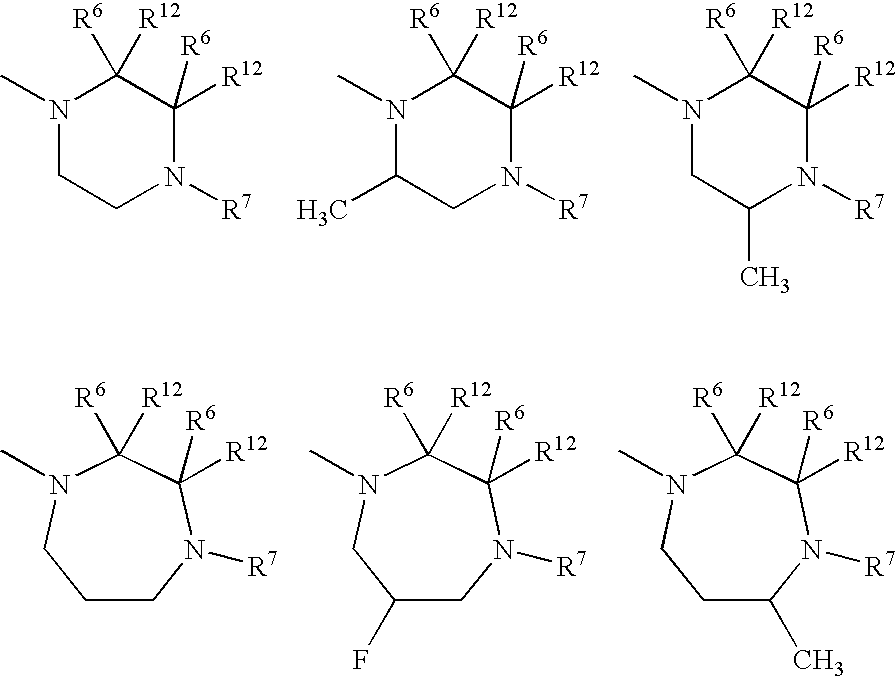
wherein R6, R7 and R12 have the previously defined meanings.

wherein R7 has the previously defined meaning.

wherein R7 has the previously defined meaning.

wherein R7 has the previously defined meaning.

- 2-[2-(3-Chlorophenyl)-4-oxo-6-perhydro-1,4-diazepin-1-yl-4H-quinazolin-3-yl]-N-isopropylacetamide;
- N-tert-Butyl-2-[2-(3-chlorophenyl)-4-oxo-6-perhydro-1,4-diazepin-1-yl-4H-quinazolin-3-yl]acetamide;
- N-tert-Butyl-2-(2-(3-chloro-4-fluorophenyl)-6-(1,4-diazepan-1-yl)-4-oxoquinazolin-3(4H)-yl)acetamide;
- 2-(2-(3-Chloro-4-fluorophenyl)-6-(1,4-diazepan-1-yl)-4-oxoquinazolin-3(4H)-yl)-N-isopropylacetamide;
- 2-(2-(3-Chloro-4-fluorophenyl)-6-(3-methyl-1,4-diazepan-1-yl)-4-oxoquinazolin-3(4H)-yl)-N-isopropylacetamide;
- 2-[2-(3-Chloro-4-fluorophenyl)-6-(3-ethylperhydro-1,4-diazepin-1-yl)-4-oxo-4H-quinazolin-3-yl]-N-isopropylacetamide;
- 2-[2-(3-Chloro-4-fluorophenyl)-6-(dimethylperhydro-1,4-diazepin-1-yl)-4-oxo-4H-quinazolin-3-yl]-N-isopropylacetamide;
- 2-[6-(Dimethylperhydro-1,4-diazepin-1-yl)-2-(4-fluoro-3-methoxyphenyl)-4-oxo-4H-quinazolin-3-yl]-N-isopropylacetamide;
- 2-[2-(3-Chloro-4-fluorophenyl)-6-((S)-3-isopropylperhydro-1,4-diazepin-1-yl)-4-oxo-4H-quinazolin-3-yl]-N-isopropylacetamide;
- 2-[2-(3-Chlorophenyl)-6-((S)-3-isopropylperhydro-1,4-diazepin-1-yl)-4-oxo-4H-quinazolin-3-yl]-N-isopropylacetamide;
- 2-[2-(4-Fluoro-3-methoxyphenyl)-6-((S)-3-isopropylperhydro-1,4-diazepin-1-yl)-4-oxo-4H-quinazolin-3-yl]-N-isopropylacetamide;
- 2-[2-(3-Chloro-4-fluorophenyl)-6-((R)-3-isopropylperhydro-1,4-diazepin-1-yl)-4-oxo-4H-quinazolin-3-yl]-N-isopropylacetamide;
- 2-[2-(3-Chlorophenyl)-6-((R)-3-isopropylperhydro-1,4-diazepin-1-yl)-4-oxo-4H-quinazolin-3-yl]-N-isopropylacetamide;
- 2-[2-(4-Fluoro-3-methoxyphenyl)-6-((R)-3-isopropylperhydro-1,4-diazepin-1-yl)-4-oxo-4H-quinazolin-3-yl]-N-isopropylacetamide;
- 2-[2-(3-Chlorophenyl)-6-(4-methylperhydro-1,4-diazepin-1-yl)-4-oxo-4H-quinazolin-3-yl]-N-isopropylacetamide;
- 2-[6-(4-Ethylperhydro-1,4-diazepin-1-yl)-2-(3-methoxyphenyl)-4-oxo-4H-quinazolin-3-yl]-N-isopropylacetamide;
- 2-[2-(3-Chlorophenyl)-4-oxo-6-(4-propylperhydro-1,4-diazepin-1-yl)-4H-quinazolin-3-yl]-N-isopropylacetamide;
- N-tert-Butyl-2-[6-(4-ethylperhydro-1,4-diazepin-1-yl)-2-(4-fluoro-3-methoxyphenyl)-4-oxo-4H-quinazolin-3-yl]acetamide;
- 2-[2-(3-Chlorophenyl)-6-(4-ethylperhydro-1,4-diazepin-1-yl)-4-oxo-4H-quinazolin-3-yl]-N-isopropylacetamide;
- 2-[6-(4-Ethylperhydro-1,4-diazepin-1-yl)-2-(4-fluoro-3-methoxyphenyl)-4-oxo-4H-quinazolin-3-yl]-N-isopropylacetamide;
- 2-[2-(4-Fluoro-3-methoxyphenyl)-4-oxo-6-(4-propylperhydro-1,4-diazepin-1-yl)-4H-quinazolin-3-yl]-N-isopropylacetamide;
- 2-[2-(3-Chloro-4-fluorophenyl)-6-(4-ethylperhydro-1,4-diazepin-1-yl)-4-oxo-4H-quinazolin-3-yl]-N-isopropylacetamide;
- N-Isopropyl-2-[6-(4-isopropylperhydro-1,4-diazepin-1-yl)-2-(3-methoxyphenyl)-4-oxo-4H-quinazolin-3-yl]acetamide;
- 2-[2-(3-Chloro-4-fluorophenyl)-6-(4-isopropylperhydro-1,4-diazepin-1-yl)-4-oxo-4H-quinazolin-3-yl]-N-isopropylacetamide;
- 2-[2-(3-Chloro-5-trifluoromethylphenyl)-4-oxo-6-perhydro-1,4-diazepin-1-yl-4H-quinazolin-3-yl]-N-isopropylacetamide;
- 2-[2-(3,5-Dimethoxyphenyl)-6-(4-isopropylperhydro-1,4-diazepin-1-yl)-4-oxo-4H-quinazolin-3-yl]-N-isopropylacetamide;
- 2-{2-(3-Chloro-4-fluorophenyl)-6-[4-(1-cyclopropylethyl)perhydro-1,4-diazepin-1-yl]-4-oxo-4H-quinazolin-3-yl}-N-isopropylacetamide;
- 2-{2-(4-Fluoro-3-methoxyphenyl)-6-[4-(2-hydroxyethyl)perhydro-1,4-diazepin-1-yl]-4-oxo-4H-quinazolin-3-yl}-N-isopropylacetamide;
- 2-{2-(3-Chloro-4-fluorophenyl)-6-[4-(2-hydroxyethyl)perhydro-1,4-diazepin-1-yl]-4-oxo-4H-quinazolin-3-yl}-N-isopropylacetamide;
- 2-[2-(3-Chloro-4-fluorophenyl)-6-(1,4-diazabicyclo[3.2.2]non-4-yl)-4-oxo-4H-quinazolin-3-yl]-N-isopropylacetamide;
- 2-[2-(4-Fluoro-3-methoxyphenyl)-6-(4-isopropylpiperazin-1-yl)-4-oxo-4H-quinazolin-3-yl]-N-isopropylacetamide;
- 2-[2-(3-Chloro-4-fluorophenyl)-6-(4-isopropylpiperazin-1-yl)-4-oxo-4H-quinazolin-3-yl]-N-isopropylacetamide;
- 2-[2-(3-Chloro-4-fluorophenyl)-6-((S)-3-isopropylpiperazin-1-yl)-4-oxo-4H-quinazolin-3-yl]-N-isopropylacetamide;
- 2-[2-(3-Chloro-4-fluorophenyl)-6-((R)-3-isopropylpiperazin-1-yl)-4-oxo-4H-quinazolin-3-yl]-N-isopropylacetamide;
- 2-[6-(1,4-Diazabicyclo[3.2.2]non-4-yl)-2-(3,5-dimethoxyphenyl)-4-oxo-4H-quinazolin-3-yl]-N-isopropylacetamide;
- 2-[2-(3-Chlorophenyl)-6-(4-isopropylperhydro-1,4-diazepin-1-yl)-4-oxo-4H-quinazolin-3-yl]-N-(2,2,2-trifluoro-1,1-dimethylethyl)acetamide;
- N-Isopropyl-2-(6-(4-isopropyl-1,4-diazepan-1-yl)-2-(3-methoxyphenyl)-4-oxoquinazolin-3(4H)-yl)acetamide;
- 2-(2-(3-Chlorophenyl)-6-(4-cyclopropylmethyl-1,4-diazepan-1-yl)-4-oxoquinazolin-3(4H)-yl)-N-isopropylacetamide and
- N-tert-Butyl-2-(2-(3-chlorophenyl)-6-(4-isopropyl-1,4-diazepan-1-yl)-4-oxoquinazolin-3(4H)-yl)acetamide
or a pharmaceutically acceptable salt or solvate thereof.


and X is N (shown as 8 below) can be prepared by the general three stage synthetic sequence shown in Scheme 1. Firstly an anthranilic acid of formula 2 wherein R4 is OH or a suitably reactive group such as halogen (e.g. bromo or iodo) etc., is reacted with a glycine amide of formula 3 in the presence of a suitable amide bond coupling reagent to give the coupled product 4. One example of such a coupling reagent would be EDCI. The coupling reagent is added either alone or in the presence of an additive such as HOBt and in a suitable inert solvent such as dichloromethane or DMF. The necessary anthranilic acids 2 and glycine amides 3 are either commercially available or they can readily be prepared by procedures well known in the art. The intermediate quinazolinones of general formula 6 can be made by condensation of the imidate salt 5 in a suitable solvent such as ethanol and at elevated temperatures such as at reflux. Intermediates 6 wherein R4 is a reactive group such as triflate can be readily prepared from the corresponding intermediate 6 wherein R4 is OH using procedures well known in the art, for example the triflate can be prepared by treatment of alcohols 6 with trifluoromethanesulfonic anhydride and pyridine. The intermediate quinazolinones 6 wherein R4 is a suitably reactive group such as halogen (e.g. bromo or iodo), triflate, etc., can then be functionalised with diamines of formula 7 in the presence of a suitable catalyst system, such as Pd2(dba)3 and BINAP, under conditions well known in the art to provide the desired product 8. Diamines of formula 7 are either commercially available or they can readily be prepared by procedures well known in the art.


and X is N can also be prepared in four stages from the required fluoro-2-nitrobenzoic acid 11 as shown in Scheme 4. The fluoro-2-nitrobenzoic acid derivatives are either commercially available or can be prepared using procedures well known in the art of organic chemistry. The acid 11 can be coupled with a glycine amide of formula 3 using analogous procedures to those indicated previously (see Scheme 1) to yield the amide 12. This in turn can then treated with amine 7 in an inert polar, aprotic solvent such as DMF, DMSO or DMP at elevated temperatures and in the presence of a suitable base (for example, potassium or cesium carbonate) to afford the adduct 13. Amines 7 are either commercially available or they can readily be prepared by procedures well known in the art. The nitro group is then reduced to give the aniline 14 using methods well known in the art, for example, reduction under a hydrogen atmosphere and in the presence of a suitable catalyst such as palladium on carbon. Finally, the desired quinazolinones 8 can be prepared upon reaction of 14 with an imidate* HCl salt of formula 5 (as previously described—Scheme 1) or upon reaction of 14 with an aldehyde R2CHO followed by oxidation (as previously described—Scheme 2).


and X is N can also be prepared in 6 stages from the required fluoro-2-nitrobenzoic acid 15 as shown in Scheme 5. The fluoro-2-nitrobenzoic acid derivatives 11 are either commercially available or can be prepared using procedures well known in the art of organic chemistry. The acid 11 can be coupled with suitably protected glycine of formula 16, for example glycine tert-butyl ester or glycine methyl ester, using analogous procedures to those indicated previously (see Scheme 1) to yield the amide 15. Suitably protected glycine of formula 16 is either commercially available or can be prepared using procedures well known in the art of organic chemistry. Amide 15 can in turn be treated with amine 7 in an inert polar, aprotic solvent such as DMF, DMSO or DMP at elevated temperatures and in the presence of a suitable base (for example, potassium or cesium carbonate) to afford the adduct 17. Amines 7 are either commercially available or they can readily be prepared by procedures well known in the art of organic chemistry. The nitro group can then reduced to give the aniline 18 using methods well known in the art, for example, reduction under a hydrogen atmosphere and in the presence of a suitable catalyst such as palladium on carbon. Quinazolinones 19 are prepared upon reaction of 18 with an imidate* HCl salt of formula 5 (as previously described—Scheme 1) or upon reaction of 14 with an aldehyde R2CHO followed by oxidation (as previously described—Scheme 2). Removal of the carboxylic acid protecting group can be readily achieved using procedures well known in the art of organic chemistry, for example tert-butyl ester can be removed under acidic conditions for example trifluoroacetic acid in an aprotic solvent such as DMF or DCM, to give the carboxylic acids 20. Finally, the desired quinazolinones 8 can be prepared by reaction carboxylic acid 20 with amine 21 using procedures well known in the art, for example a suitable amide coupling reagent. One example of such a coupling reagent would be EDCI. The coupling agent is added either alone or in the presence of an additive such as HOBt and in a suitable inert solvent such as DMF or DCM.


and X is CH (shown as 29 below) can be prepared by the general six stage synthetic sequence shown in Scheme 6. Firstly a suitably functionalised 2-halobenzoic acid ester of formula 22, can be reacted with a suitably functionalised styrene of formula 23 in the presence of a suitable Pd(II) catalyst (for example palladium diacetate), a triarylphosphine ligand (for example tri(o-tolyl)phosphine) and a tertiary amine base (for example triethylamine) in a polar aprotic solvent (for example acetonitrile) to give the coupled product 24. P represents a suitable protecting group, for example methyl. The 2-halobenzoic acids 22 and styrenes 23 are either commercially available or they can readily be prepared by procedures well known in the art. The carboxylic acid ester 24 can then be hydrolysed to the carboxylic acid 25 using either acid or base in a suitable solvent such as ethanol. The carboxylic acid intermediate 25 can subsequently be cyclised to the isocoumarin 26 using a palladium(II) catalyst, for example, bis(acetonitrile)dichloropalladium(II) and an oxidant, for example, p-benzoquinone, in an inert solvent, for example, tetrahydrofuran. The isocoumarin 26 thus obtained can be heated together with a glycine amide 3 to provide the isoquinolinone which can subsequently be deprotected to give isoquinolinone 27. The free alcohol 27 thus obtained can be converted to the corresponding triflate using procedures well known in the art, for example by treatment of alcohol 27 with trifluoromethanesulfonic anhydride and pyridine. Triflate 28 can be reacted with diamines of formula 7 in the presence of a suitable catalyst system, such as Pd2(dba)3 and BINAP, under conditions well known in the art to afford desired isoquinolones 29 (Scheme 6).


and X is CH (shown as 29 below) can alternatively be prepared by the general five stage synthetic sequence shown in Scheme 7. Firstly a 4-halobenzaldehyde of formula 30, halo can be for example fluoro, can be reacted with amine 7 in an inert polar, aprotic solvent such as DMF, DMSO or DMP at elevated temperatures and in the presence of a suitable base (for example, potassium or cesium carbonate) to afford the aldehyde 31. Aldehyde 31 can be reacted with a suitably functionalised carboxylic acid (32), carboxylic acid ester (33) or nitrile (34) to afford carboxylic acid 35. Carboxylic acid 35 can be formed directly when using a suitably functionalised carboxylic acid 32 or following subsequent hydrolysis of the carboxylic acid ester or nitrile when using carboxylic acid ester 33 or nitrile 34 respectively. Hydrolysis can be achieved using procedures well known in the art of organic chemistry. Subsequent treatment of adduct 35 with, for example, DPPA at elevated temperatures can afford isoquinolone 36 via a Curtius reaction. Alkylation of isoquinolone 36 with a suitably protected bromoacetic acid derivative 37 (P represents a suitable protecting group, for example methyl) can afford ester 38. Hydrolysis of ester 38 using procedures well known in the art of organic chemistry and subsequent reaction with amine 21 using procedures well known in the art (as previously described—Scheme 7) can afford the desired isoquinolones 29.


and X is CH (shown as 29 below) can alternatively be prepared by the general five stage synthetic sequence shown in Scheme 8. A 3-halo-6-methylbenzoic acid of formula 39, halo can be for example fluoro, can be reacted with diamines of formula 7 in an inert polar, aprotic solvent such as DMF, DMSO or DMP at elevated temperatures and in the presence of a base such as potassium carbonate can afford carboxylic acid 40. Carboxylic acid 40 can be converted to amide 41 by reaction with methylamine using procedures well known in the art of organic chemistry, for example converting to the acid chloride with thionyl chloride or oxalyl chloride and subsequent reaction with methylamine. Amide 41 can be treated with a suitable base, for example LDA or BuLi, and subsequently reacted with an appropriately substituted nitrile 42 in a suitable solvent to provide isoquinolone 36. Isoquinolones 38 can be prepared upon reaction of 36 with a suitably protected bromoacetic acid derivative 37 in an inert polar, aprotic solvent such as DMF and in the presence of a suitable base such as potassium carbonate. P represents a protecting group for example methyl. The carboxylic acid ester can then be hydrolysed to the carboxylic acid using either acid or base in a suitable solvent and subsequently reacted with amine 21 (as previously described—Scheme 7) to afford isoquinolones 29.


and X is CH (shown as 29 below) can alternatively be prepared by the general five stage synthetic sequence shown in Scheme 9. A 3-halo-6-methylbenzoic acid of formula 39, where halo can for example chloro or bromo, can be reacted with methylamine using procedures well known in the art of organic chemistry to provide amide 43. For example acid 39 can be converted to the acid chloride by reaction with, for example, thionyl chloride or oxalyl chloride at elevated temperature. The acid chloride can then be treated with methylamine. Amide 43 can be reacted with a suitable base, for example LDA or BuLi, in a suitable solvent such as THF and subsequently treated with an appropriately substituted nitrile of formula 42 to provide isoquinolone 44. Isoquinolone 45 can be prepared by alkylation of isoquinolone 44 with a bromoacetic acid ester derivative 37 in a polar aprotic solvent such as DMF and in the presence of a suitable base such as potassium carbonate. P is a protecting group for example methyl. Deprotection using procedures well known in the art of organic chemistry followed by reaction with amine 21 can provide isoquinolones of formula 46. Isoquinolones of formula 29 can be prepared by reacting isoquinolones 46 with diamines of formula 7 at elevated temperatures in a suitable solvent and in the presence of a suitable catalyst system, such as [1,3-bis(2,6-diisopropylphenyl)imidazol-2-ylidene](3-chloropyridyl)palladium(II) dichloride.


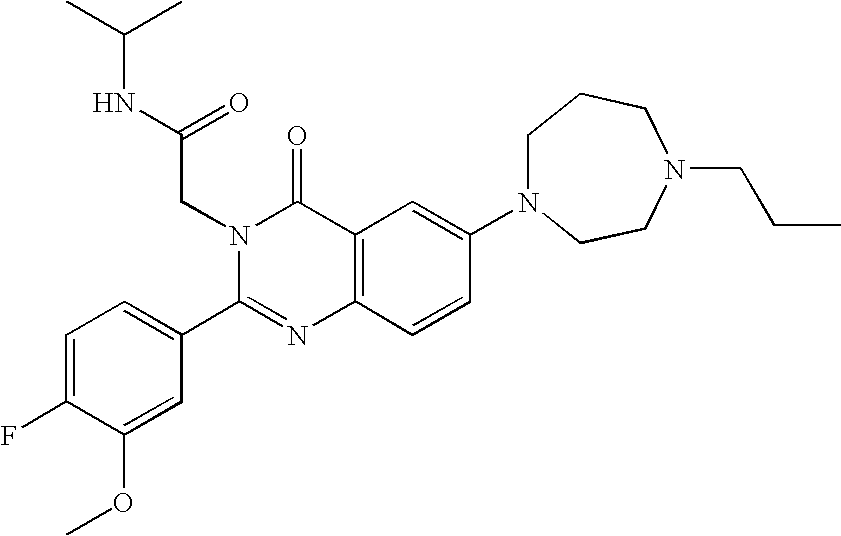


| TABLE 1 |
| V3 binding activity for compounds according to the invention |
| EXAMPLE 1b: 2-[2-(3-Chlorophenyl)-4- oxo-6-perhydro-1,4-diazepin-1-yl-4H- quinazolin-3-yl]-N-isopropylacetamide |
 |
+++ |
| EXAMPLE 2b: N-Isopropyl-2-[2-(3- methoxyphenyl)-4-oxo-6-piperazin-1-yl- 4H-quinazolin-3-yl]acetamide |
 |
++ |
| EXAMPLE 3c: 2-[6-(3- Dimethylaminomethylpiperidin-1-yl)-2-(3- methoxyphenyl)-4-oxo-4H-quinazolin-3-yl]- N-isopropylacetamide |
 |
++ |
| EXAMPLE 3f: N-Isopropyl-2-[2-(3- methoxyphenyl)-4-oxo-6-((R)-3-piperidin- 1-ylmethylpiperidin-1-yl)-4H-quinazolin-3- yl]acetamide |
 |
+++ |
| EXAMPLE 4c: N-Isopropyl-2-{2-(3- methoxyphenyl)-4-oxo-6-[4-(2,2,2- trifluoroethyl)perhydro-1,4-diazepin-1-yl]- 4H-quinazolin-3-yl}acetamide |
 |
+ |
| EXAMPLE 4d: N-Isopropyl-2-[6-[4-(2- methoxyethyl)perhydro-1,4-diazepin-1-yl]- 2-(3-methoxyphenyl)-4-oxo-4H-quinazolin- 3-yl]acetamide |
 |
+++ |
| EXAMPLE 5s: 2-[2-(3-Chloro-4- fluorophenyl)-4-oxo-6-(4,6,6- trimethylperhydro-1,4-diazepin-1-yl)-4H- quinazolin-3-yl]-N-isopropylacetamide |
 |
+++ |
| EXAMPLE 5Ac: 2-{2-(3-Chloro-4- fluorophenyl)-6-[4-(2,2- dimethylpropyl)perhydro-1,4-diazepin-1- yl]-4-oxo-4H-quinazolin-3-yl}-N- isopropylacetamide |
 |
+++ |
| EXAMPLE 6w: 2-[2-(3-Chloro-5- trifluoromethoxyphenyl)-6-(4- isopropylperhydro-1,4-diazepin-1-yl)-4- oxo-4H-quinazolin-3-yl]-N- isopropylacetamide |
 |
+++ |
| EXAMPLE 7a: N-tert-Butyl-2-(2- cyclopentyl-4-oxo-6-perhydro-1,4- diazepin-1-yl-4H-quinazolin-3-yl- acetamide |
 |
++ |
| EXAMPLE 9h: 2-[6-(4-Ethylperhydro-1,4- diazepin-1-yl)-2-(4-fluoro-3- methoxyphenyl)-4-oxo-4H-quinazolin-3-yl]- N-(2,2,2-trifluoro-1,1- dimethylethyl)acetamide |
 |
+++ |
| EXAMPLE 9u: 2-[2-(3-Chlorophenyl)-6-(4- isopropylperhydro-1,4-diazepin-1-yl)-4- oxo-4H-quinazolin-3-yl]-N-isopropyl-N- methylacetamide |
 |
++ |
| EXAMPLE 9Ah: 2-[6-(1,4- Diazabicyclo[3.2.2]non-4-yl)-2-(4-fluoro-3- methoxyphenyl)-4-oxo-4H-quinazolin-3-yl]- N-(2-methoxy-1-methylethyl) acetamide |
 |
++ |
| +++ 0-10 nM | ||
| ++ 10-100 nM | ||
| + 100 nM-1 uM | ||
| TABLE 2 |
| V3 receptor antagonism in isolated rat anterior pituitary cells for compounds |
| according to the invention |
| EXAMPLE 4b: N-Isopropyl-2-[6-(4- isopropylperhydro-1,4-diazepin-1-yl)-2-(3- methoxyphenyl)-4-oxo-4H-quinazolin-3- yl]acetamide |
 |
++ |
| ++ 10-100 nM | ||
| + 100 nM-1 uM | ||
Claims (11)


Priority Applications (1)
| Application Number | Priority Date | Filing Date | Title |
|---|---|---|---|
| US11/852,762 US7820649B2 (en) | 2006-09-11 | 2007-09-10 | Quinazolinone and isoquinolinone acetamide derivatives |
Applications Claiming Priority (2)
| Application Number | Priority Date | Filing Date | Title |
|---|---|---|---|
| US84371806P | 2006-09-11 | 2006-09-11 | |
| US11/852,762 US7820649B2 (en) | 2006-09-11 | 2007-09-10 | Quinazolinone and isoquinolinone acetamide derivatives |
Publications (2)
| Publication Number | Publication Date |
|---|---|
| US20080090802A1 US20080090802A1 (en) | 2008-04-17 |
| US7820649B2 true US7820649B2 (en) | 2010-10-26 |
Family
ID=39184483
Family Applications (1)
| Application Number | Title | Priority Date | Filing Date |
|---|---|---|---|
| US11/852,762 Active US7820649B2 (en) | 2006-09-11 | 2007-09-10 | Quinazolinone and isoquinolinone acetamide derivatives |
Country Status (20)
| Country | Link |
|---|---|
| US (1) | US7820649B2 (en) |
| EP (1) | EP2069315B1 (en) |
| JP (1) | JP5256202B2 (en) |
| KR (1) | KR20090107994A (en) |
| CN (1) | CN101600698B (en) |
| AR (1) | AR062731A1 (en) |
| AT (1) | ATE523500T1 (en) |
| AU (1) | AU2007296634B2 (en) |
| CA (1) | CA2663161C (en) |
| CL (1) | CL2007002635A1 (en) |
| CO (1) | CO6160322A2 (en) |
| EC (1) | ECSP099177A (en) |
| IL (1) | IL197530A0 (en) |
| MX (1) | MX2009002686A (en) |
| NO (1) | NO20091012L (en) |
| NZ (1) | NZ575426A (en) |
| PE (1) | PE20080841A1 (en) |
| RU (1) | RU2009113612A (en) |
| TW (1) | TW200827352A (en) |
| WO (1) | WO2008033764A2 (en) |
Families Citing this family (29)
| Publication number | Priority date | Publication date | Assignee | Title |
|---|---|---|---|---|
| JP2010229035A (en) * | 2007-08-01 | 2010-10-14 | Taisho Pharmaceutical Co Ltd | Pyridopyrimidin-4-one derivatives |
| WO2009130231A1 (en) * | 2008-04-24 | 2009-10-29 | Glaxo Group Limited | Pyrrolo [1, 2-a] pyrazine derivatives as vasopressin vib receptor antagonists |
| JP5369721B2 (en) * | 2009-01-30 | 2013-12-18 | 大正製薬株式会社 | Pyridopyrimidin-4-one derivatives |
| CN102666540A (en) * | 2009-10-13 | 2012-09-12 | Msd欧斯股份有限公司 | Condensed azine derivatives for treating acetylcholine receptor related diseases |
| HRP20150462T1 (en) | 2010-10-01 | 2015-07-17 | Taisho Pharmaceutical Co., Ltd | 1,2,4-triazolone derivative |
| SI2772482T1 (en) | 2011-10-27 | 2016-06-30 | Taisho Pharmaceutical Co., Ltd. | Azole derivative |
| WO2013147117A1 (en) * | 2012-03-30 | 2013-10-03 | 大正製薬株式会社 | Fused azole derivative |
| SI2861566T1 (en) | 2012-06-13 | 2017-03-31 | F. Hoffmann-La Roche Ag | New diazaspirocycloalkane and azaspirocycloalkane |
| PL2900669T3 (en) | 2012-09-25 | 2020-01-31 | F. Hoffmann-La Roche Ag | Hexahydropyrrolo[3,4-c]pyrrole derivatives and related compounds as autotaxin (atx) inhibitors and as inhibitors of the lysophosphatidic acid (lpa) production for treating e.g. renal diseases |
| AR095079A1 (en) | 2013-03-12 | 2015-09-16 | Hoffmann La Roche | DERIVATIVES OF OCTAHIDRO-PIRROLO [3,4-C] -PIRROL AND PIRIDINA-FENILO |
| AU2014356583B2 (en) | 2013-11-26 | 2019-02-28 | F. Hoffmann-La Roche Ag | New octahydro-cyclobuta (1,2-c;3,4-c')dipyrrol-2-yl |
| CR20160418A (en) | 2014-03-26 | 2016-11-07 | Hoffmann La Roche | NEW BICYCLE COMPOUNDS OF 7 LINKS |
| MA50635A (en) | 2014-03-26 | 2020-08-12 | Hoffmann La Roche | NEW BICYCLIC COMPOUNDS AS INHIBITORS OF AUTOTAXIN (ATX) AND LYSOPHOSPHATIDIC ACID PRODUCTION |
| EP3177616B1 (en) | 2014-08-04 | 2021-02-24 | Sandoz AG | Novel routes of synthesis for the preparation of suvorexant |
| WO2016034703A1 (en) | 2014-09-05 | 2016-03-10 | AbbVie Deutschland GmbH & Co. KG | Fused heterocyclic or carbocyclic compounds carrying a substituted cycloaliphatic radical and use thereof for treating vasopressin-related diseases |
| MA41898A (en) * | 2015-04-10 | 2018-02-13 | Hoffmann La Roche | BICYCLIC QUINAZOLINONE DERIVATIVES |
| EP3344619B1 (en) | 2015-09-04 | 2020-10-28 | H. Hoffnabb-La Roche Ag | Phenoxymethyl derivatives |
| WO2017050747A1 (en) | 2015-09-24 | 2017-03-30 | F. Hoffmann-La Roche Ag | New bicyclic compounds as dual atx/ca inhibitors |
| BR112018006080A2 (en) | 2015-09-24 | 2018-10-09 | F. Hoffmann-La Roche Ag | new bicyclic compounds as dual action inhibitors of atx / ca |
| MA42918A (en) | 2015-09-24 | 2018-08-01 | Hoffmann La Roche | BICYCLIC COMPOUNDS USED AS ATX INHIBITORS |
| AU2016328437A1 (en) | 2015-09-24 | 2018-01-25 | F. Hoffmann-La Roche Ag | Bicyclic compounds as ATX inhibitors |
| WO2017100599A1 (en) | 2015-12-09 | 2017-06-15 | Luc Therapeutics | Thienopyrimidinone nmda receptor modulators and uses thereof |
| ES2821010T3 (en) * | 2015-12-09 | 2021-04-23 | Cadent Therapeutics Inc | Heteroaromatic modulators of the NMDA receptor and their uses |
| AU2017382339B2 (en) | 2016-12-22 | 2024-02-15 | Novartis Ag | NMDA receptor modulators and uses thereof |
| RU2019132254A (en) | 2017-03-16 | 2021-04-16 | Ф. Хоффманн-Ля Рош Аг | HETEROCYCLIC COMPOUNDS SUITABLE AS DUAL ATX / CA INHIBITORS |
| EP3596060B1 (en) | 2017-03-16 | 2023-09-20 | F. Hoffmann-La Roche AG | New bicyclic compounds as atx inhibitors |
| PT3830092T (en) | 2018-08-03 | 2023-07-25 | Novartis Ag | Heteroaromatic nmda receptor modulators and uses thereof |
| CN111100063B (en) * | 2018-10-25 | 2022-05-17 | 南京药石科技股份有限公司 | Preparation method for synthesizing 2-fluoromethyl substituted pyrrolidine, piperidine and piperazine derivatives |
| CN116751169B (en) * | 2023-06-05 | 2025-08-29 | 重庆市畜牧科学院 | An N-(2-oxopropyl)acetamide derivative and its preparation method and application |
Citations (4)
| Publication number | Priority date | Publication date | Assignee | Title |
|---|---|---|---|---|
| US4438121A (en) | 1981-05-26 | 1984-03-20 | Synthelabo | Isoquinoline amidoxime derivatives |
| WO2001055130A2 (en) | 2000-01-25 | 2001-08-02 | Sanofi-Synthelabo | Novel 1,3-dihydro-2h-indol-2-one derivatives and their use as ligands for v1b and v1a arginine-vasopressin receptors |
| WO2004009585A2 (en) | 2002-07-19 | 2004-01-29 | Sanofi-Aventis | Acyloxypyrrolidine derivatives and use thereof as ligands of v1b or both v1b and v1a receptors |
| WO2006095014A1 (en) | 2005-03-11 | 2006-09-14 | N.V. Organon | 2- (4-0x0-4h-quinaz0lin-3-yl) acetamides and their use as vasopressin v3 antagonists |
Family Cites Families (6)
| Publication number | Priority date | Publication date | Assignee | Title |
|---|---|---|---|---|
| SK146199A3 (en) | 1997-04-25 | 2000-06-12 | Janssen Pharmaceutica Nv | Farnesyltransferase inhibiting quinazolinones |
| IL139199A (en) | 1999-11-02 | 2006-10-31 | Nihon Nohyaku Co Ltd | Substituted aminoquinazolinone |
| AU2005205016B2 (en) * | 2004-01-16 | 2010-07-15 | F. Hoffmann-La Roche Ag | 1-benzyl-5-piperazin-1-yl-3,4 dihydro-1H-quinazolin-2-one derivatives and the respective 1H-benzo(1,2,6)thiadiazine-2,2-dioxide and 1,4-dihydro-benzo(D) (1,3)oxazin-2-one derivatives as modulators of the 5-hydroxytryptamine receptor (5-HT) for the treatment of diseases of the central nervous system |
| JPWO2005115993A1 (en) * | 2004-05-31 | 2008-03-27 | 萬有製薬株式会社 | Quinazoline derivatives |
| WO2006012577A2 (en) * | 2004-07-22 | 2006-02-02 | Bayer Pharmaceuticals Corporation | Quinazolinone derivatives useful for the regulation of glucose homeostasis and food intake |
| EP2066640B1 (en) * | 2006-09-11 | 2011-09-07 | N.V. Organon | 2-(1-oxo-1h-isoquinolin-2-yl) acetamide derivatives |
-
2007
- 2007-09-10 NZ NZ575426A patent/NZ575426A/en not_active IP Right Cessation
- 2007-09-10 CN CN2007800416250A patent/CN101600698B/en active Active
- 2007-09-10 WO PCT/US2007/078022 patent/WO2008033764A2/en not_active Ceased
- 2007-09-10 JP JP2009527608A patent/JP5256202B2/en not_active Expired - Fee Related
- 2007-09-10 AT AT07842157T patent/ATE523500T1/en not_active IP Right Cessation
- 2007-09-10 US US11/852,762 patent/US7820649B2/en active Active
- 2007-09-10 CA CA2663161A patent/CA2663161C/en active Active
- 2007-09-10 RU RU2009113612/04A patent/RU2009113612A/en unknown
- 2007-09-10 EP EP07842157A patent/EP2069315B1/en active Active
- 2007-09-10 AU AU2007296634A patent/AU2007296634B2/en not_active Ceased
- 2007-09-10 MX MX2009002686A patent/MX2009002686A/en not_active Application Discontinuation
- 2007-09-10 KR KR1020097007035A patent/KR20090107994A/en not_active Withdrawn
- 2007-09-11 AR ARP070103999A patent/AR062731A1/en not_active Application Discontinuation
- 2007-09-11 PE PE2007001221A patent/PE20080841A1/en not_active Application Discontinuation
- 2007-09-11 TW TW096133906A patent/TW200827352A/en unknown
- 2007-09-11 CL CL2007002635A patent/CL2007002635A1/en unknown
-
2009
- 2009-03-06 NO NO20091012A patent/NO20091012L/en not_active Application Discontinuation
- 2009-03-11 EC EC2009009177A patent/ECSP099177A/en unknown
- 2009-03-11 IL IL197530A patent/IL197530A0/en unknown
- 2009-04-08 CO CO09036257A patent/CO6160322A2/en unknown
Patent Citations (6)
| Publication number | Priority date | Publication date | Assignee | Title |
|---|---|---|---|---|
| US4438121A (en) | 1981-05-26 | 1984-03-20 | Synthelabo | Isoquinoline amidoxime derivatives |
| WO2001055130A2 (en) | 2000-01-25 | 2001-08-02 | Sanofi-Synthelabo | Novel 1,3-dihydro-2h-indol-2-one derivatives and their use as ligands for v1b and v1a arginine-vasopressin receptors |
| US6730695B2 (en) | 2000-01-25 | 2004-05-04 | Sanofi-Synthelabo | 1,3-dihydro-2h-indol-2-one derivatives and their use as ligands for V1b and V1a arginine-vasopressin receptors |
| WO2004009585A2 (en) | 2002-07-19 | 2004-01-29 | Sanofi-Aventis | Acyloxypyrrolidine derivatives and use thereof as ligands of v1b or both v1b and v1a receptors |
| US7202267B2 (en) | 2002-07-19 | 2007-04-10 | Sanofi-Aventis | Acyloxypyrrolidine derivatives, preparation thereof and application thereof in therapeutic |
| WO2006095014A1 (en) | 2005-03-11 | 2006-09-14 | N.V. Organon | 2- (4-0x0-4h-quinaz0lin-3-yl) acetamides and their use as vasopressin v3 antagonists |
Non-Patent Citations (21)
Also Published As
| Publication number | Publication date |
|---|---|
| CN101600698A (en) | 2009-12-09 |
| TW200827352A (en) | 2008-07-01 |
| AU2007296634B2 (en) | 2012-09-20 |
| US20080090802A1 (en) | 2008-04-17 |
| RU2009113612A (en) | 2010-10-20 |
| NO20091012L (en) | 2009-03-26 |
| EP2069315A4 (en) | 2010-11-03 |
| CA2663161C (en) | 2014-10-28 |
| CN101600698B (en) | 2012-01-11 |
| JP2010502746A (en) | 2010-01-28 |
| KR20090107994A (en) | 2009-10-14 |
| WO2008033764A2 (en) | 2008-03-20 |
| CA2663161A1 (en) | 2008-03-20 |
| ECSP099177A (en) | 2009-06-30 |
| EP2069315A2 (en) | 2009-06-17 |
| IL197530A0 (en) | 2009-12-24 |
| NZ575426A (en) | 2010-09-30 |
| WO2008033764A3 (en) | 2008-12-18 |
| ATE523500T1 (en) | 2011-09-15 |
| PE20080841A1 (en) | 2008-06-14 |
| CL2007002635A1 (en) | 2009-10-23 |
| AU2007296634A1 (en) | 2008-03-20 |
| JP5256202B2 (en) | 2013-08-07 |
| MX2009002686A (en) | 2009-10-13 |
| CO6160322A2 (en) | 2010-05-20 |
| EP2069315B1 (en) | 2011-09-07 |
| AR062731A1 (en) | 2008-11-26 |
Similar Documents
| Publication | Publication Date | Title |
|---|---|---|
| US20080090802A1 (en) | Quinazolinone and isoquinolinone acetamide derivatives | |
| US7807686B2 (en) | 2-(4-oxo-4H-quinazolin-3-yl)acetamides and their use as vasopressin V3 antagonists | |
| US7268142B2 (en) | Tetrahydroisoquinolinyl derivatives of quinazoline and isoquinoline | |
| US8173639B2 (en) | Isoquinolinone derivatives as NK3 antagonists | |
| US20060019975A1 (en) | Novel piperidyl derivatives of quinazoline and isoquinoline | |
| JP2010536869A (en) | Naphthylpyrimidine, naphthylpyrazine and naphthylpyridazine analogs and their use as agonists of the Wnt-β catenin cell message system | |
| EP1085871A1 (en) | QUINAZOLINONE INHIBITORS OF cGMP PHOSPHODIESTERASE | |
| SK90799A3 (en) | Quinoline and quinazoline compounds useful in therapy, particularly in the treatment of begnin prostatic hyperplasia | |
| JPH1112274A (en) | Quinolines and quinazolines useful in therapy | |
| US8350043B2 (en) | Azinone and diazinone V3 inhibitors for depression and stress disorders | |
| US7906504B2 (en) | 2-(1-oxo-1H-isoquinolin-2-yl)acetamide derivatives | |
| US20120258957A1 (en) | Heterocyclic derivatives | |
| EP2150534B1 (en) | Isoquinolinone derivatives as nk3 antagonists | |
| KR20070032021A (en) | Quinazolin-4-yl-piperidine and Cinnoline-4-yl-piperidine derivatives as fidi10 inhibitors for CN disease |
Legal Events
| Date | Code | Title | Description |
|---|---|---|---|
| AS | Assignment |
Owner name: N.V. ORGANON, NETHERLANDS Free format text: ASSIGNMENT OF ASSIGNORS INTEREST;ASSIGNORS:MCARTHUR, DUNCAN R.;JEREMIAH, FIONA;RATCLIFFE, PAUL D.;AND OTHERS;REEL/FRAME:020053/0921;SIGNING DATES FROM 20070829 TO 20071025 Owner name: PHARMACOPEIA, INC., NEW JERSEY Free format text: ASSIGNMENT OF ASSIGNORS INTEREST;ASSIGNORS:MCARTHUR, DUNCAN R.;JEREMIAH, FIONA;RATCLIFFE, PAUL D.;AND OTHERS;REEL/FRAME:020053/0921;SIGNING DATES FROM 20070829 TO 20071025 Owner name: N.V. ORGANON, NETHERLANDS Free format text: ASSIGNMENT OF ASSIGNORS INTEREST;ASSIGNORS:MCARTHUR, DUNCAN R.;JEREMIAH, FIONA;RATCLIFFE, PAUL D.;AND OTHERS;SIGNING DATES FROM 20070829 TO 20071025;REEL/FRAME:020053/0921 Owner name: PHARMACOPEIA, INC., NEW JERSEY Free format text: ASSIGNMENT OF ASSIGNORS INTEREST;ASSIGNORS:MCARTHUR, DUNCAN R.;JEREMIAH, FIONA;RATCLIFFE, PAUL D.;AND OTHERS;SIGNING DATES FROM 20070829 TO 20071025;REEL/FRAME:020053/0921 Owner name: N.V. ORGANON, NETHERLANDS Free format text: ASSIGNMENT OF ASSIGNORS INTEREST;ASSIGNORS:LETOURNEAU, JEFFREY JOHN;HO, KOC KAN;JOKIEL, PATRICK;AND OTHERS;REEL/FRAME:020053/0870 Effective date: 20070828 Owner name: PHARMACOPEIA, INC., NEW JERSEY Free format text: ASSIGNMENT OF ASSIGNORS INTEREST;ASSIGNORS:LETOURNEAU, JEFFREY JOHN;HO, KOC KAN;JOKIEL, PATRICK;AND OTHERS;REEL/FRAME:020053/0870 Effective date: 20070828 |
|
| STCF | Information on status: patent grant |
Free format text: PATENTED CASE |
|
| AS | Assignment |
Owner name: MSD OSS B.V., NETHERLANDS Free format text: MERGER;ASSIGNOR:N.V. ORGANON;REEL/FRAME:027307/0482 Effective date: 20111031 |
|
| AS | Assignment |
Owner name: ORGANON BIOSCIENCES NEDERLAND B.V., NETHERLANDS Free format text: MERGER;ASSIGNOR:MSD OSS B.V.;REEL/FRAME:029939/0001 Effective date: 20130101 |
|
| AS | Assignment |
Owner name: MERCK SHARP & DOHME B.V., NETHERLANDS Free format text: MERGER;ASSIGNOR:ORGANON BIOSCIENCES NEDERLAND B.V.;REEL/FRAME:029940/0296 Effective date: 20130102 |
|
| FPAY | Fee payment |
Year of fee payment: 4 |
|
| MAFP | Maintenance fee payment |
Free format text: PAYMENT OF MAINTENANCE FEE, 8TH YEAR, LARGE ENTITY (ORIGINAL EVENT CODE: M1552) Year of fee payment: 8 |
|
| MAFP | Maintenance fee payment |
Free format text: PAYMENT OF MAINTENANCE FEE, 12TH YEAR, LARGE ENTITY (ORIGINAL EVENT CODE: M1553); ENTITY STATUS OF PATENT OWNER: LARGE ENTITY Year of fee payment: 12 |