US7816536B2 - 4-substituted and 7-substituted indoles, benzofurans, benzothiophenes, benzimidazoles, benzoxazoles, and benzothiazoles and methods for making same - Google Patents
4-substituted and 7-substituted indoles, benzofurans, benzothiophenes, benzimidazoles, benzoxazoles, and benzothiazoles and methods for making same Download PDFInfo
- Publication number
- US7816536B2 US7816536B2 US11/450,541 US45054106A US7816536B2 US 7816536 B2 US7816536 B2 US 7816536B2 US 45054106 A US45054106 A US 45054106A US 7816536 B2 US7816536 B2 US 7816536B2
- Authority
- US
- United States
- Prior art keywords
- group
- substituted
- formula
- compound
- benzothiophene
- Prior art date
- Legal status (The legal status is an assumption and is not a legal conclusion. Google has not performed a legal analysis and makes no representation as to the accuracy of the status listed.)
- Expired - Fee Related, expires
Links
- 0 *[C@H](CC)C1=CCC2=C1C=CC=C2.C1=CC2=C(C=C1)CC=C2 Chemical compound *[C@H](CC)C1=CCC2=C1C=CC=C2.C1=CC2=C(C=C1)CC=C2 0.000 description 63
- HKNRPVCPVHQZGS-WGCWOXMQSA-N C/C=C(\C)C([Y])=[N+]=[N-] Chemical compound C/C=C(\C)C([Y])=[N+]=[N-] HKNRPVCPVHQZGS-WGCWOXMQSA-N 0.000 description 5
- AZHSSKPUVBVXLK-UHFFFAOYSA-N CC(O)O Chemical compound CC(O)O AZHSSKPUVBVXLK-UHFFFAOYSA-N 0.000 description 2
- OEHKEBUOIHZMGZ-UHFFFAOYSA-N CC1=OCCN1C Chemical compound CC1=OCCN1C OEHKEBUOIHZMGZ-UHFFFAOYSA-N 0.000 description 2
- ZCCPVTVGEQLONB-UHFFFAOYSA-N CNCC1OCCO1 Chemical compound CNCC1OCCO1 ZCCPVTVGEQLONB-UHFFFAOYSA-N 0.000 description 2
- BFLLXCPZKZGBFQ-UHFFFAOYSA-N [H]CN(C)C([H])C1OC234OC(C([H])N(C)C[H])OC2(O1)(OC(C([H])N(C)C[H])O3)OC(C([H])N(C)C[H])O4 Chemical compound [H]CN(C)C([H])C1OC234OC(C([H])N(C)C[H])OC2(O1)(OC(C([H])N(C)C[H])O3)OC(C([H])N(C)C[H])O4 BFLLXCPZKZGBFQ-UHFFFAOYSA-N 0.000 description 2
- ZNVXPKJIWBMDPY-KXGNSMRSSA-N C.CC(=O)OC1=CCCC2=C1C=CN2C(=O)OC(C)(C)C.COC(=O)/C=C1\CCC[C@H]1C1=CC=CC2=C1C=CN2C(=O)OC(C)(C)C.COC(=O)C(=[N+]=[N-])C1=CCCC1.[2H][S-]1(=S)([SH]=[S-]2([2H])([SH]=[S-]3([2H])([Rh][Rh])OP3[S-]3([2H])(=S)OP3)OP2)OP1 Chemical compound C.CC(=O)OC1=CCCC2=C1C=CN2C(=O)OC(C)(C)C.COC(=O)/C=C1\CCC[C@H]1C1=CC=CC2=C1C=CN2C(=O)OC(C)(C)C.COC(=O)C(=[N+]=[N-])C1=CCCC1.[2H][S-]1(=S)([SH]=[S-]2([2H])([SH]=[S-]3([2H])([Rh][Rh])OP3[S-]3([2H])(=S)OP3)OP2)OP1 ZNVXPKJIWBMDPY-KXGNSMRSSA-N 0.000 description 1
- QROGIFZRVHSFLM-QHHAFSJGSA-N C/C=C/C1=CC=CC=C1 Chemical compound C/C=C/C1=CC=CC=C1 QROGIFZRVHSFLM-QHHAFSJGSA-N 0.000 description 1
- PSSYKPTXCQBPTJ-UHFFFAOYSA-N C1=OCCN1 Chemical compound C1=OCCN1 PSSYKPTXCQBPTJ-UHFFFAOYSA-N 0.000 description 1
- FWSVHEYVKUFLJW-UHFFFAOYSA-N CB(O)N1C(Br)=CC2=C1CCCC2=O Chemical compound CB(O)N1C(Br)=CC2=C1CCCC2=O FWSVHEYVKUFLJW-UHFFFAOYSA-N 0.000 description 1
- DEQVGJZJPXFHRF-UHFFFAOYSA-N CB(O)N1C=C(C)C2=C1C=CC=C2 Chemical compound CB(O)N1C=C(C)C2=C1C=CC=C2 DEQVGJZJPXFHRF-UHFFFAOYSA-N 0.000 description 1
- JVTQXUUVJFOEOM-UHFFFAOYSA-N CB(O)N1C=CC2=C1CCCC2=O Chemical compound CB(O)N1C=CC2=C1CCCC2=O JVTQXUUVJFOEOM-UHFFFAOYSA-N 0.000 description 1
- OTMSDBZUPAUEDD-UHFFFAOYSA-N CC Chemical compound CC OTMSDBZUPAUEDD-UHFFFAOYSA-N 0.000 description 1
- SAMPQBCMQKAPTK-QQBLYCEHSA-N CC(=O)OC1=CCCC2=C1C=C(C1=CC3=C(C=CC=C3)N1C(=O)OC(C)(C)C)N2C(=O)OC(C)(C)C.CC(C)(C)OC(=O)N1C(B(O)O)=CC2=C1C=CC=C2.CC(C)(C)OC(=O)N1C(Br)=CC2=C1CCCC2=O.COC(=O)/C=C/[C@@H](C1=CN(C(=O)OC(C)(C)C)C2=CC=CC=C12)C1=CC=CC2=C1C=C(C1=CC3=C(C=CC=C3)N1C(=O)OC(C)(C)C)N2C(=O)OC(C)(C)C.COC(=O)C(/C=C/C1=CN(C(=O)OC(C)(C)C)C2=C1C=CC=C2)=[N+]=[N-] Chemical compound CC(=O)OC1=CCCC2=C1C=C(C1=CC3=C(C=CC=C3)N1C(=O)OC(C)(C)C)N2C(=O)OC(C)(C)C.CC(C)(C)OC(=O)N1C(B(O)O)=CC2=C1C=CC=C2.CC(C)(C)OC(=O)N1C(Br)=CC2=C1CCCC2=O.COC(=O)/C=C/[C@@H](C1=CN(C(=O)OC(C)(C)C)C2=CC=CC=C12)C1=CC=CC2=C1C=C(C1=CC3=C(C=CC=C3)N1C(=O)OC(C)(C)C)N2C(=O)OC(C)(C)C.COC(=O)C(/C=C/C1=CN(C(=O)OC(C)(C)C)C2=C1C=CC=C2)=[N+]=[N-] SAMPQBCMQKAPTK-QQBLYCEHSA-N 0.000 description 1
- NTGNFQYMZKLWCR-UMGHKBELSA-N CC(=O)OC1=CCCC2=C1C=CN2C(=O)OC(C)(C)C.COC(=O)/C=C/[C@@H](C1=CC=CC=C1)C1=CC=CC2=C1C=CN2C(=O)OC(C)(C)C.[2H][S-]1(=S)([SH]=[S-]2([2H])([SH]=[S-]3([2H])([Rh][Rh])OP3[S-]3([2H])(=S)OP3)OP2)OP1 Chemical compound CC(=O)OC1=CCCC2=C1C=CN2C(=O)OC(C)(C)C.COC(=O)/C=C/[C@@H](C1=CC=CC=C1)C1=CC=CC2=C1C=CN2C(=O)OC(C)(C)C.[2H][S-]1(=S)([SH]=[S-]2([2H])([SH]=[S-]3([2H])([Rh][Rh])OP3[S-]3([2H])(=S)OP3)OP2)OP1 NTGNFQYMZKLWCR-UMGHKBELSA-N 0.000 description 1
- QTBSBXVTEAMEQO-UHFFFAOYSA-M CC(=O)[O-] Chemical compound CC(=O)[O-] QTBSBXVTEAMEQO-UHFFFAOYSA-M 0.000 description 1
- CXVLBMBTSYOJII-UHFFFAOYSA-N CC1=C2CC(C)CCC2=CC=C1.CC1=CC(C2CCCC(C)C2)=CC=C1.CCC1=CC=CC(C)=C1.CCOC1=CC=CC(C)=C1 Chemical compound CC1=C2CC(C)CCC2=CC=C1.CC1=CC(C2CCCC(C)C2)=CC=C1.CCC1=CC=CC(C)=C1.CCOC1=CC=CC(C)=C1 CXVLBMBTSYOJII-UHFFFAOYSA-N 0.000 description 1
- QIMMUPPBPVKWKM-UHFFFAOYSA-N CC1=CC2=CC=CC=C2C=C1 Chemical compound CC1=CC2=CC=CC=C2C=C1 QIMMUPPBPVKWKM-UHFFFAOYSA-N 0.000 description 1
- ZBTMRBYMKUEVEU-UHFFFAOYSA-N CC1=CC=C(Br)C=C1 Chemical compound CC1=CC=C(Br)C=C1 ZBTMRBYMKUEVEU-UHFFFAOYSA-N 0.000 description 1
- WYUIWKFIFOJVKW-UHFFFAOYSA-N CC1=CC=C(Cl)C(Cl)=C1 Chemical compound CC1=CC=C(Cl)C(Cl)=C1 WYUIWKFIFOJVKW-UHFFFAOYSA-N 0.000 description 1
- YXFVVABEGXRONW-UHFFFAOYSA-N CC1=CC=CC=C1 Chemical compound CC1=CC=CC=C1 YXFVVABEGXRONW-UHFFFAOYSA-N 0.000 description 1
- UDDVMPHNQKRNNS-UHFFFAOYSA-N CCC1CCCC(C)C1 Chemical compound CCC1CCCC(C)C1 UDDVMPHNQKRNNS-UHFFFAOYSA-N 0.000 description 1
- KLIFRUFNZFYNGU-UHFFFAOYSA-N CN(C)CC1OC2(C)(C)OC(CN(C)C)OC2(C)(C)O1 Chemical compound CN(C)CC1OC2(C)(C)OC(CN(C)C)OC2(C)(C)O1 KLIFRUFNZFYNGU-UHFFFAOYSA-N 0.000 description 1
- VZOHNUDLKQGGFS-UHFFFAOYSA-N CN(C)CC1OC234OCOC2(OCO3)(O1)OC(CN(C)C)O4 Chemical compound CN(C)CC1OC234OCOC2(OCO3)(O1)OC(CN(C)C)O4 VZOHNUDLKQGGFS-UHFFFAOYSA-N 0.000 description 1
- BPYMKLCDCLXIHD-UHFFFAOYSA-N CN(C)CC1OC2OC(CN(C)C)OC2O1 Chemical compound CN(C)CC1OC2OC(CN(C)C)OC2O1 BPYMKLCDCLXIHD-UHFFFAOYSA-N 0.000 description 1
- NXULHXVLCPCRRN-BQYQJAHWSA-N COC(=O)C(/C=C/C1=CC=CC=C1)=[N+]=[N-] Chemical compound COC(=O)C(/C=C/C1=CC=CC=C1)=[N+]=[N-] NXULHXVLCPCRRN-BQYQJAHWSA-N 0.000 description 1
- CHLICZRVGGXEOD-UHFFFAOYSA-N COC1=CC=C(C)C=C1 Chemical compound COC1=CC=C(C)C=C1 CHLICZRVGGXEOD-UHFFFAOYSA-N 0.000 description 1
- ADLGMIFSXLCREI-UHFFFAOYSA-N O=C(O)CC[PH](C1=CC=CC=C1)(C1=CC=CC=C1)C1=CC=CC=C1.[Cl-] Chemical compound O=C(O)CC[PH](C1=CC=CC=C1)(C1=CC=CC=C1)C1=CC=CC=C1.[Cl-] ADLGMIFSXLCREI-UHFFFAOYSA-N 0.000 description 1
- TTYFVLXVNAATTA-UHFFFAOYSA-N O=C1CCCC2=C1C=C(Br)N2 Chemical compound O=C1CCCC2=C1C=C(Br)N2 TTYFVLXVNAATTA-UHFFFAOYSA-N 0.000 description 1
- YDAOTLYGTWGWNT-UHFFFAOYSA-N O=C1CCCC2=C1C=C([N+](=O)[O-])S2 Chemical compound O=C1CCCC2=C1C=C([N+](=O)[O-])S2 YDAOTLYGTWGWNT-UHFFFAOYSA-N 0.000 description 1
- BPYRLADJZXKBGO-UHFFFAOYSA-N [H]C(NC)C1OCCO1.[H]C(NC)C1OCCO1 Chemical compound [H]C(NC)C1OCCO1.[H]C(NC)C1OCCO1 BPYRLADJZXKBGO-UHFFFAOYSA-N 0.000 description 1
- BHXZDCLKJIFSMS-DFWDWNHLSA-N [H]C1CC[C@@]([H])(C2OC345OC([C@]6([H])CCC([H])N6C)OC3(O2)(OC([C@]2([H])CCC([H])N2C)O4)OC([C@]2([H])CCC([H])N2C)O5)N1C Chemical compound [H]C1CC[C@@]([H])(C2OC345OC([C@]6([H])CCC([H])N6C)OC3(O2)(OC([C@]2([H])CCC([H])N2C)O4)OC([C@]2([H])CCC([H])N2C)O5)N1C BHXZDCLKJIFSMS-DFWDWNHLSA-N 0.000 description 1
- BHXZDCLKJIFSMS-XTFANKIMSA-N [H]C1CC[C@]([H])(C2OC345OC([C@@]6([H])CCC([H])N6C)OC3(O2)(OC([C@@]2([H])CCC([H])N2C)O4)OC([C@@]2([H])CCC([H])N2C)O5)N1C Chemical compound [H]C1CC[C@]([H])(C2OC345OC([C@@]6([H])CCC([H])N6C)OC3(O2)(OC([C@@]2([H])CCC([H])N2C)O4)OC([C@@]2([H])CCC([H])N2C)O5)N1C BHXZDCLKJIFSMS-XTFANKIMSA-N 0.000 description 1
Classifications
-
- C—CHEMISTRY; METALLURGY
- C07—ORGANIC CHEMISTRY
- C07D—HETEROCYCLIC COMPOUNDS
- C07D209/00—Heterocyclic compounds containing five-membered rings, condensed with other rings, with one nitrogen atom as the only ring hetero atom
- C07D209/02—Heterocyclic compounds containing five-membered rings, condensed with other rings, with one nitrogen atom as the only ring hetero atom condensed with one carbocyclic ring
- C07D209/04—Indoles; Hydrogenated indoles
- C07D209/08—Indoles; Hydrogenated indoles with only hydrogen atoms or radicals containing only hydrogen and carbon atoms, directly attached to carbon atoms of the hetero ring
-
- C—CHEMISTRY; METALLURGY
- C07—ORGANIC CHEMISTRY
- C07D—HETEROCYCLIC COMPOUNDS
- C07D209/00—Heterocyclic compounds containing five-membered rings, condensed with other rings, with one nitrogen atom as the only ring hetero atom
- C07D209/02—Heterocyclic compounds containing five-membered rings, condensed with other rings, with one nitrogen atom as the only ring hetero atom condensed with one carbocyclic ring
- C07D209/04—Indoles; Hydrogenated indoles
- C07D209/10—Indoles; Hydrogenated indoles with substituted hydrocarbon radicals attached to carbon atoms of the hetero ring
- C07D209/18—Radicals substituted by carbon atoms having three bonds to hetero atoms with at the most one bond to halogen, e.g. ester or nitrile radicals
-
- C—CHEMISTRY; METALLURGY
- C07—ORGANIC CHEMISTRY
- C07D—HETEROCYCLIC COMPOUNDS
- C07D333/00—Heterocyclic compounds containing five-membered rings having one sulfur atom as the only ring hetero atom
- C07D333/50—Heterocyclic compounds containing five-membered rings having one sulfur atom as the only ring hetero atom condensed with carbocyclic rings or ring systems
- C07D333/52—Benzo[b]thiophenes; Hydrogenated benzo[b]thiophenes
- C07D333/62—Benzo[b]thiophenes; Hydrogenated benzo[b]thiophenes with hetero atoms or with carbon atoms having three bonds to hetero atoms with at the most one bond to halogen, e.g. ester or nitrile radicals, directly attached to carbon atoms of the hetero ring
Definitions
- the present invention relates to methods and intermediates that can be used to make heterocyclic compounds and, more particularly, to methods and intermediates that can be used to make 4-substituted and 7-substituted indoles, benzofurans, benzothiophenes, benzimidazoles, benzoxazoles, and benzothiazoles.
- Heterocyclic compounds such as indoles, benzofurans, benzothiophenes, benzimidazoles, benzoxazoles, and benzothiazoles, are important materials in the pharmaceutical and other industries.
- the indole nucleus has long been of great interest to synthetic chemists owing to its ubiquity in a large number of biologically active alkaloids, pharmaceutical agents and natural products (Sundberg, Indoles , London: Academic Press (1996), which is hereby incorporated by reference.)
- positions on the indole nucleus, as well as those on other heterocyclic nuclei, are more difficult to functionalize.
- the 4-position in indoles is notoriously difficult to functionalize using electrophilic substitution chemistry.
- electrophilic substitution chemistry There are comparatively few methods for selective functionalization of this less reactive position. Such methods include a thallation/iodination reaction (Somei et al., Heterocycles, 22:797-801 (1984), which is hereby incorporated by reference); directed lithiation of 3-substituted gramines (Iwao, which is hereby incorporated by reference); and other metallation/substitution reactions.
- a need continues to exist for synthetic methods for the preparation of substituted indoles, benzofurans, benzothiophenes, benzimidazoles, benzoxazoles, and benzothiazoles, and for intermediates useful in such methods.
- the present invention is directed to addressing this need.
- the present invention relates to a method for making a 4-substituted indole, benzofuran, benzothiophene, benzimidazole, benzoxazole, or benzothiazole.
- the method includes providing a 4-substituted-6,7-dihydro indole, benzofuran, benzothiophene, benzimidazole, benzoxazole, or benzothiazole compound having the formula:
- Q 11 is a leaving group; wherein X 1 is N-Q 12 , O, or S; wherein Q 12 is an alkyl group, an aryl group, an alkylcarbonyl group, an arylcarbonyl group, an alkyloxycarbonyl group, an aryloxycarbonyl group, an alkylsulfonyl group, or an arylsulfonyl group; wherein X 2 is C—R 3 or N; wherein R 11 is selected from a hydrogen atom, a halogen atom, an alkyl group, an aryl group, a carboxylic ester group, an amide group, a aldehyde group, an alkylcarbonyl group, an arylcarbonyl group, an alkyloxycarbonyl group, or an aryloxycarbonyl group, an unsubstituted, monosubstitued, or disubstituted amine, an alkoxy group, an alkylthio group,
- Q 13 is an alkyl group or an aryl group
- Q 14 is a hydrogen atom, an alkyl group, or an aryl group
- Q 13 and Q 14 taken together with the carbon atoms to which they are bonded, form a 5-12 membered ring (e.g., a substituted or unsubstituted cyclopentene or cyclohexene ring); and wherein Y is an electron withdrawing group.
- the method also includes contacting the 4-substituted-6,7-dihydro indole, benzofuran, benzothiophene, benzimidazole, benzoxazole, or benzothiazole compound with the vinyldiazo compound in the presence of a dirhodium catalyst under conditions effective to produce a compound having the formula:
- the present invention also relates to a compound having the formula:
- X 1 is N-Q 12 , O, or S; wherein Q 12 is a hydrogen atom, an alkyl group, an aryl group, an alkylcarbonyl group, an arylcarbonyl group, an alkyloxycarbonyl group, an aryloxycarbonyl group, an alkylsulfonyl group, or an arylsulfonyl group; wherein X 2 is C—R 3 or N; wherein R 11 is selected from a hydrogen atom, a halogen atom, an alkyl group, an aryl group, a carboxylic acid group, a carboxylic ester group, an amide group, a aldehyde group, an alkylcarbonyl group, an arylcarbonyl group, an alkyloxycarbonyl group, or an aryloxycarbonyl group, an unsubstituted, monosubstitued, or disubstituted amine, an alkoxy group, a hydroxy
- the present invention also relates to a compound having the formula:
- X 1 is N-Q 12 , O, or S; wherein Q 12 is a hydrogen atom, an alkyl group, an aryl group, an alkylcarbonyl group, an arylcarbonyl group, an alkyloxycarbonyl group, an aryloxycarbonyl group, an alkylsulfonyl group, or an arylsulfonyl group; wherein X 2 is C—R 3 or N; wherein R 11 is selected from a hydrogen atom, a halogen atom, an alkyl group, an aryl group, a carboxylic acid group, a carboxylic ester group, an amide group, a aldehyde group, an alkylcarbonyl group, an arylcarbonyl group, an alkyloxycarbonyl group, or an aryloxycarbonyl group, an unsubstituted, monosubstitued, or disubstituted amine, an alkoxy group, a hydroxy
- the present invention also relates to a method for making a 7-substituted indole, benzofuran, benzothiophene, benzimidazole, benzoxazole, or benzothiazole.
- the method includes providing a 7-substituted-4,5-dihydro indole, benzofuran, benzothiophene, benzimidazole, benzoxazole, or benzothiazole compound having the formula:
- Q 11 is a leaving group; wherein X 1 is N-Q 12 , O, or S; wherein Q 12 is an alkyl group, an aryl group, an alkylcarbonyl group, an arylcarbonyl group, an alkyloxycarbonyl group, an aryloxycarbonyl group, an alkylsulfonyl group, or an arylsulfonyl group; wherein X 2 is C—R 3 or N; wherein R 11 is selected from a hydrogen atom, a halogen atom, an alkyl group, an aryl group, a carboxylic ester group, an amide group, a aldehyde group, an alkylcarbonyl group, an arylcarbonyl group, an alkyloxycarbonyl group, or an aryloxycarbonyl group, an unsubstituted, monosubstitued, or disubstituted amine, an alkoxy group, an alkylthio group,
- Q 13 is an alkyl group or an aryl group
- Q 14 is a hydrogen atom, an alkyl group, or an aryl group
- Q 13 and Q 14 taken together with the carbon atoms to which they are bonded, form a 5-12 membered ring (e.g., a substituted or unsubstituted cyclopentene or cyclohexene ring); and wherein Y is an electron withdrawing group.
- the method further includes contacting the 7-substituted-4,5-dihydro indole, benzofuran, benzothiophene, benzimidazole, benzoxazole, or benzothiazole compound with the vinyldiazo compound in the presence of a dirhodium catalyst under conditions effective to produce a compound having the formula:
- the present invention also relates to a compound having the formula:
- X 1 is N-Q 12 , O, or S; wherein Q 12 is a hydrogen atom, an alkyl group, an aryl group, an alkylcarbonyl group, an arylcarbonyl group, an alkyloxycarbonyl group, an aryloxycarbonyl group, an alkylsulfonyl group, or an arylsulfonyl group; wherein X 2 is C—R 3 or N; wherein R 11 is selected from a hydrogen atom, a halogen atom, an alkyl group, an aryl group, a carboxylic acid group, a carboxylic ester group, an amide group, a aldehyde group, an alkylcarbonyl group, an arylcarbonyl group, an alkyloxycarbonyl group, or an aryloxycarbonyl group, an unsubstituted, monosubstitued, or disubstituted amine, an alkoxy group, a hydroxy
- the present invention also relates to a compound having the formula:
- X 1 is N-Q 12 , O, or S; wherein Q 12 is a hydrogen atom, an alkyl group, an aryl group, an alkylcarbonyl group, an arylcarbonyl group, an alkyloxycarbonyl group, an aryloxycarbonyl group, an alkylsulfonyl group, or an arylsulfonyl group; wherein X 2 is C—R 3 or N; wherein R 11 is selected from a hydrogen atom, a halogen atom, an alkyl group, an aryl group, a carboxylic acid group, a carboxylic ester group, an amide group, a aldehyde group, an alkylcarbonyl group, an arylcarbonyl group, an alkyloxycarbonyl group, or an aryloxycarbonyl group, an unsubstituted, monosubstitued, or disubstituted amine, an alkoxy group, a hydroxy
- the methods can also be used to prepare 7-substituted indoles, benzofurans, benzothiophenes, benzimidazoles, benzoxazoles, and benzothiazoles, and the methods can provide a convenient route to the enantioselective synthesis of 7-substituted indoles, benzofurans, benzothiophenes, benzimidazoles, benzoxazoles, and benzothiazoles.
- 4-substituted indole is meant to refer to any compound having an indole ring system and a substituent at the indole ring system's 4 position.
- the other positions on the indole ring system can be substituted or unsubstituted.
- 4-substituted benzofuran is meant to refer to any compound having a benzofuran ring system and a substituent at the benzofuran ring system's 4 position.
- the other positions on the benzofuran ring system can be substituted or unsubstituted.
- 4-substituted benzothiophene is meant to refer to any compound having a benzothiophene ring system and a substituent at the benzothiophene ring system's 4 position.
- the other positions on the benzothiophene ring system can be substituted or unsubstituted.
- 4-substituted benzimidazole is meant to refer to any compound having a benzimidazole ring system and a substituent at the benzimidazole ring system's 4 position.
- the other positions on the benzimidazole ring system can be substituted or unsubstituted.
- 4-substituted benzoxazole is meant to refer to any compound having a benzoxazole ring system and a substituent at the benzoxazole ring system's 4 position.
- the other positions on the benzoxazole ring system can be substituted or unsubstituted.
- 4-substituted benzothiazole is meant to refer to any compound having a benzothiazole ring system and a substituent at the benzothiazole ring system's 4 position.
- the other positions on the benzothiazole ring system can be substituted or unsubstituted.
- the present invention in one aspect thereof, relates to a method for making a 4-substituted indole, benzofuran, benzothiophene, benzimidazole, benzoxazole, or benzothiazole.
- the method includes providing a 4-substituted-6,7-dihydro indole, benzofuran, benzothiophene, benzimidazole, benzoxazole, or benzothiazole compound having the formula:
- Q 11 is a leaving group; wherein X 1 is N-Q 12 , O, or S; wherein Q 12 is an alkyl group, an aryl group, an alkylcarbonyl group, an arylcarbonyl group, an alkyloxycarbonyl group, an aryloxycarbonyl group, an alkylsulfonyl group, or an arylsulfonyl group; wherein X 2 is C—R 3 or N; wherein R 11 is selected from a hydrogen atom, a halogen atom, an alkyl group, an aryl group, a carboxylic ester group, an amide group, a aldehyde group, an alkylcarbonyl group, an arylcarbonyl group, an alkyloxycarbonyl group, or an aryloxycarbonyl group, an unsubstituted, monosubstitued, or disubstituted amine, an alkoxy group, an alkylthio group,
- the method further includes providing a diazovinyl compound having the formula:
- Q 13 is an alkyl group or an aryl group
- Q 14 is a hydrogen atom, an alkyl group, or an aryl group
- Q 13 and Q 14 taken together with the carbon atoms to which they are bonded, form a 5-12 membered ring (e.g., a substituted or unsubstituted cyclopentene or cyclohexene ring); and wherein Y is an electron withdrawing group.
- the method also includes contacting the 4-substituted-6,7-dihydro indole, benzofuran, benzothiophene, benzimidazole, benzoxazole, or benzothiazole compound with the vinyldiazo compound in the presence of a dirhodium catalyst under conditions effective to produce a compound having the formula:
- the 4-substituted-6,7-dihydro indole, benzofuran, benzothiophene, benzimidazole, benzoxazole, or benzothiazole compound can be contacted with the vinyldiazo compound in any suitable solvent, examples of which include alkane solvents (e.g., hexanes, 2,2-dimethylbutane, etc.), aromatic solvents (e.g., benzene, toluene, trifluorotoluene, etc.), and combinations thereof (e.g., a hexanes/toluene mixture).
- alkane solvents e.g., hexanes, 2,2-dimethylbutane, etc.
- aromatic solvents e.g., benzene, toluene, trifluorotoluene, etc.
- combinations thereof e.g., a hexanes/toluene mixture.
- the 4-substituted-6,7-dihydro indole, benzofuran, benzothiophene, benzimidazole, benzoxazole, or benzothiazole compound and the vinyldiazo compound can be reacted in any suitable mole ratio, such as 4-substituted-6,7-dihydro indole, benzofuran, benzothiophene, benzimidazole, benzoxazole, or benzothiazole compound:vinyldiazo compound mole ratios of from about 5:1 to about 1:5, such as from about 4:1 to about 1:4, from about 3:1 to about 1:3 from about 2:1 to about 1:2, from about 1.8:1 to about 1:1.8, from about 1.5:1 to about 1:1.5, from about 1.4:1 to about 1:1.4, from about 1.3:1 to about 1:1.3, from about 1.2:1 to about 1:1.2, from about 1.1:1 to about 1:1.1, from about 1.05:1 to about 1:1.05, and/or about 1:1
- the reaction can be carried out at any suitable temperature, such from about O° C. to about the boiling point of the solvent being employed, from about O° C. to about room temperature, from about room temperature to about the boiling point of the solvent, from about O° C. to about 100° C., from about O° C. to about 80° C., from about O° C. to about 70° C., from about O° C. to about 60° C., from about O° C. to about 50° C., etc.
- any suitable temperature such from about O° C. to about the boiling point of the solvent being employed, from about O° C. to about room temperature, from about room temperature to about the boiling point of the solvent, from about O° C. to about 100° C., from about O° C. to about 80° C., from about O° C. to about 70° C., from about O° C. to about 60° C., from about O° C. to about 50° C., etc.
- the amount of dirhodium catalyst present can be from about 0.05 mol % to about 10 mol %, such as from about 0.1 mol % to about 5 mol %, from about 0.2 mol % to about 2 mol %, from about 0.25 mol % to about 1 mol %, from about 0.3 mol % to about 0.8 mol %, from about 0.4 mol % to about 0.6 mol %, and/or about 0.5 mol %, based, for example, on the number of moles of the limiting reactant present in the reaction.
- Q 11 is a leaving group.
- the ability of a group to act as a leaving group depends on its standalone stability as an anion, and on the strength of its bond to carbon, and both of these factors correlate well with its Br ⁇ nsted basicity. This is often given as the pKa of the conjugate acid. The lower the pKa, the better the leaving group as a general rule. For example, groups with a (conjugate acid) pKa of 6 or less can be good leaving groups for use in the practice of the present invention.
- suitable leaving groups include those having a (conjugate acid) pKa of less than 6, less than 5.5, less than 5, less than 4.5, less than 4, less than 3.5, less than 3, less than 2.5, less than 2, less than 1.5, less than 1, less than 0.5, and/or less than 0.
- Q 11 can be a halogen atom, an alkyl sulfonate group (e.g., a triflate group, a mesylate group, etc.), an aryl sulfonate group (e.g., a tosylate group), and an acyloxy group (e.g., a acetoxy group).
- Q 13 can be an alkyl group or an aryl group.
- suitable alkyl groups there can be mentioned unsubstituted C1-C12 alkyl groups, unsubstituted C1-C8 alkyl groups, unsubstituted C1-C6 alkyl groups, unsubstituted C1-C4 alkyl groups, substituted C1-C12 alkyl groups, substituted C1-C8 alkyl groups, substituted C1-C6 alkyl groups, substituted C1-C4 alkyl groups, methyl, ethyl, n-propyl, i-propyl, n-butyl i-butyl, t-butyl, cyclohexyl, cyclopentyl, cyclohexenyl, cyclopentenyl, and the like.
- suitable aryl groups there can be mentioned 5-20 membered homocyclic rings, 5-20 membered heterocyclic rings, 5-10 membered homocyclic rings, 5-10 membered heterocyclic rings, phenyl, naphthyl, pyridyl, and the like, which can be unsubstituted or substituted with, for example, one or more alkyls, alkoxys, halogens, or combinations thereof.
- Q 13 can be a moiety having the formula -Q 5 -Q 6 , where Q 5 is a C1-C12 saturated or unsaturated alkylene moiety, optionally containing one or more heteroatoms and where Q 6 is a substituted or unsubstituted, 5-20 membered, heterocyclic or homocyclic ring; such as in the case where -Q 5 - is an unsaturated alkylene moiety having the formula —CH ⁇ CH—, as in the case where Q 6 is a substituted or unsubstituted phenyl ring, and such as in the case where -Q 5 - is an unsaturated alkylene moiety having the formula —CH ⁇ CH— and Q 6 is a substituted or unsubstituted phenyl ring.
- Q 14 can be a hydrogen atom, an alkyl group, or an aryl group.
- suitable alkyl groups there can be mentioned unsubstituted C1-C12 alkyl groups, unsubstituted C1-C8 alkyl groups, unsubstituted C1-C6 alkyl groups, unsubstituted C1-C4 alkyl groups, substituted C1-C12 alkyl groups, substituted C1-C8 alkyl groups, substituted C1-C6 alkyl groups, substituted C1-C4 alkyl groups, methyl, ethyl, n-propyl, i-propyl, n-butyl i-butyl, t-butyl, cyclohexyl, cyclopentyl, cyclohexenyl, cyclopentenyl, and the like.
- suitable aryl groups there can be mentioned 5-20 membered homocyclic rings, 5-20 membered heterocyclic rings, 5-10 membered homocyclic rings, 5-10 membered heterocyclic rings, phenyl, naphthyl, pyridyl, and the like, which can be unsubstituted or substituted with, for example, one or more alkyls, alkoxys, halogens, or combinations thereof.
- Q 13 and Q 14 taken together with the carbon atoms to which they are bonded, can represent a 5-12 membered ring.
- the 5-12 membered ring can be homocyclic or heterocyclic, substituted or unsubstituted, monocyclic or polycyclic.
- the 5-12 membered ring can be a substituted or unsubstituted 5- or 6-membered ring (e.g., a cyclopentyl ring or a cyclohexyl ring).
- the method of the present invention can be used to prepare 4-substituted indoles, for example, by using a 4-substituted-6,7-dihydro indole having the formula:
- the method of the present invention can be used to prepare a 4-substituted benzofuran, for example, by using a 4-substituted-6,7-dihydro benzofuran having the formula:
- the method of the present invention can be used to prepare a 4-substituted benzothiophene, for example, by using a 4-substituted-6,7-dihydro benzothiophene having the formula:
- the method of the present invention can be used to prepare a 4-substituted benzimidazole, for example, by using a 4-substituted-6,7-dihydro benzimidazole having the formula:
- the method of the present invention can be used to prepare a 4-substituted benzoxazole, for example, by using a 4-substituted-6,7-dihydro benzoxazole having the formula:
- the method of the present invention can be used to prepare a 4-substituted benzothiazole, for example, by using a 4-substituted-6,7-dihydro benzothiazole having the formula:
- Such enantiomeric enrichment (e.g., >50% ee, >55% ee, >60% ee, >70% ee, >80% ee, >85% ee, >90% ee, >95% ee, >98% ee, and/or >99% ee) can be achieved by contacting the 4-substituted-6,7-dihydro indole, benzofuran, benzothiophene, benzimidazole, benzoxazole, or benzothiazole compound with the vinyldiazo compound in the presence of a dirhodium catalyst having D 2 symmetry under conditions effective to selectively produce compounds having the formula:
- the method of the present invention can further include a step in which the N-Q 12 group is converted to an N—H group. This step can be carried out by any suitable method, such as by treating the compound in which X 1 is N-Q 12 with a strong acid.
- the methods of the present invention for making 4-substituted indoles, benzofurans, benzothiophenes, benzimidazoles, benzoxazoles, or benzothiazoles can, optionally, include additional steps, for example, to convert compounds having the formula:
- Y is an electron withdrawing group, a aldehyde group, or a —CH 2 OH or other alkyl group; and in which each of R 5 and R 6 is a hydrogen atom, or in which R 5 and R 6 , taken together, represent a second bond between the carbon atoms to which they are bonded.
- Y is a carboxylic (e.g., acid, ester, etc.) electron withdrawing group
- the conversion of the Y electron withdrawing group to an aldehyde group, or to a —CH 2 OH group, or to another alkyl group can be readily achieved, for example, by the use of a suitable reducing agent and a combination of suitable reducing agents.
- compounds in which R 5 and R 6 , taken together, represent a second bond between the carbon atoms to which they are bonded can be converted to compounds in which each of R 5 and R 6 is a hydrogen atom, for example by catalytic hydrogenation.
- enantiomer that are enriched (e.g., >50% ee, >55% ee, >60% ee, >70% ee, >80% ee, >85% ee, >90% ee, >95% ee, >98% ee, and/or >99% ee) in one or the other enantiomer, i.e., in an enantiomer having the formula:
- R 11 is a carboxylic acid group, a hydroxy group, or a thiol group. In other embodiments, R 11 is not a carboxylic acid group. In still other embodiments, R 11 is not a hydroxy group. In yet other embodiments, R 11 is not a thiol group. In still other embodiments, R 11 is not a carboxylic acid group, a hydroxy group, or a thiol group. In certain embodiments, in such enantiomerically enriched compounds, R 12 is a carboxylic acid group, a hydroxy group, or a thiol group.
- R 12 is not a carboxylic acid group. In still other embodiments, R 12 is not a hydroxy group. In yet other embodiments, R 12 is not a thiol group. In still other embodiments, R 12 is not a carboxylic acid group, a hydroxy group, or a thiol group. In certain embodiments, in such enantiomerically enriched compounds, R 3 is a carboxylic acid group, a hydroxy group, or a thiol group. In other embodiments, R 3 is not a carboxylic acid group. In still other embodiments, R 3 is not a hydroxy group. In yet other embodiments, R 3 is not a thiol group.
- R 3 is not a carboxylic acid group, a hydroxy group, or a thiol group.
- R 11 is not a carboxylic acid group, a hydroxy group, or a thiol group
- R 12 is not a carboxylic acid group, a hydroxy group, or a thiol group
- R 3 is not a carboxylic acid group, a hydroxy group, or a thiol group.
- the present invention also relates to a method for making 7-substituted indoles, benzofurans, benzothiophenes, benzimidazoles, benzoxazoles, and benzothiazoles, and the methods can provide a convenient route to the enantioselective synthesis of 7-substituted indoles, benzofurans, benzothiophenes, benzimidazoles, benzoxazoles, and benzothiazoles.
- 7-substituted indole is meant to refer to any compound having an indole ring system and a substituent at the indole ring system's 7 position.
- the other positions on the indole ring system can be substituted or unsubstituted.
- 7-substituted benzofuran is meant to refer to any compound having a benzofuran ring system and a substituent at the benzofuran ring system's 7 position.
- the other positions on the benzofuran ring system can be substituted or unsubstituted.
- 7-substituted benzothiophene is meant to refer to any compound having a benzothiophene ring system and a substituent at the benzothiophene ring system's 7 position.
- the other positions on the benzothiophene ring system can be substituted or unsubstituted.
- 7-substituted benzimidazole is meant to refer to any compound having a benzimidazole ring system and a substituent at the benzimidazole ring system's 7 position.
- the other positions on the benzimidazole ring system can be substituted or unsubstituted.
- 7-substituted benzoxazole is meant to refer to any compound having a benzoxazole ring system and a substituent at the benzoxazole ring system's 7 position.
- the other positions on the benzoxazole ring system can be substituted or unsubstituted.
- 7-substituted benzothiazole is meant to refer to any compound having a benzothiazole ring system and a substituent at the benzothiazole ring system's 7 position.
- the other positions on the benzothiazole ring system can be substituted or unsubstituted.
- the present invention in one aspect thereof, relates to a method for making a 7-substituted indole, benzofuran, benzothiophene, benzimidazole, benzoxazole, or benzothiazole.
- the method includes providing a 7-substituted-4,5-dihydro indole, benzofuran, benzothiophene, benzimidazole, benzoxazole, or benzothiazole compound having the formula:
- Q 11 is a leaving group; wherein X 1 is N-Q 12 , O, or S; wherein Q 12 is an alkyl group, an aryl group, an alkylcarbonyl group, an arylcarbonyl group, an alkyloxycarbonyl group, an aryloxycarbonyl group, an alkylsulfonyl group, or an arylsulfonyl group; wherein X 2 is C—R 3 or N; wherein R 11 is selected from a hydrogen atom, a halogen atom, an alkyl group, an aryl group, a carboxylic ester group, an amide group, a aldehyde group, an alkylcarbonyl group, an arylcarbonyl group, an alkyloxycarbonyl group, or an aryloxycarbonyl group, an unsubstituted, monosubstitued, or disubstituted amine, an alkoxy group, an alkylthio group,
- the method further includes providing a diazovinyl compound having the formula:
- Q 13 is an alkyl group or an aryl group
- Q 14 is a hydrogen atom, an alkyl group, or an aryl group
- Q 13 and Q 14 taken together with the carbon atoms to which they are bonded, form a 5-12 membered ring (e.g., a substituted or unsubstituted cyclopentene or cyclohexene ring); and wherein Y is an electron withdrawing group.
- the method also includes contacting the 7-substituted-4,5-dihydro indole, benzofuran, benzothiophene, benzimidazole, benzoxazole, or benzothiazole compound with the vinyldiazo compound in the presence of a dirhodium catalyst under conditions effective to produce a compound having the formula:
- the 7-substituted-4,5-dihydro indole, benzofuran, benzothiophene, benzimidazole, benzoxazole, or benzothiazole compound can be contacted with the vinyldiazo compound in any suitable solvent, examples of which include alkane solvents (e.g., hexanes, 2,2-dimethylbutane, etc.), aromatic solvents (e.g., benzene, toluene, trifluorotoluene, etc.), and combinations thereof (e.g., a hexanes/toluene mixture).
- alkane solvents e.g., hexanes, 2,2-dimethylbutane, etc.
- aromatic solvents e.g., benzene, toluene, trifluorotoluene, etc.
- combinations thereof e.g., a hexanes/toluene mixture.
- the 7-substituted-4,5-dihydro indole, benzofuran, benzothiophene, benzimidazole, benzoxazole, or benzothiazole compound and the vinyldiazo compound can be reacted in any suitable mole ratio, such as 7-substituted-4,5-dihydro indole, benzofuran, benzothiophene, benzimidazole, benzoxazole, or benzothiazole compound:vinyldiazo compound mole ratios of from about 5:1 to about 1:5, such as from about 4:1 to about 1:4, from about 3:1 to about 1:3 from about 2:1 to about 1:2, from about 1.8:1 to about 1:1.8, from about 1.5:1 to about 1:1.5, from about 1.4:1 to about 1:1.4, from about 1.3:1 to about 1:1.3, from about 1.2:1 to about 1:1.2, from about 1.1:1 to about 1:1.1, from about 1.05:1 to about 1:1.05, and/or about 1:1
- the reaction can be carried out at any suitable temperature, such from about O° C. to about the boiling point of the solvent being employed, from about O° C. to about room temperature, from about room temperature to about the boiling point of the solvent, from about O° C. to about 100° C., from about O° C. to about 80° C., from about O° C. to about 70° C., from about O° C. to about 60° C., from about O° C. to about 50° C., etc.
- any suitable temperature such from about O° C. to about the boiling point of the solvent being employed, from about O° C. to about room temperature, from about room temperature to about the boiling point of the solvent, from about O° C. to about 100° C., from about O° C. to about 80° C., from about O° C. to about 70° C., from about O° C. to about 60° C., from about O° C. to about 50° C., etc.
- the amount of dirhodium catalyst present can be from about 0.05 mol % to about 10 mol %, such as from about 0.1 mol % to about 5 mol %, from about 0.2 mol % to about 2 mol %, from about 0.25 mol % to about 1 mol %, from about 0.3 mol % to about 0.8 mol %, from about 0.4 mol % to about 0.6 mol %, and/or about 0.5 mol %, based, for example, on the number of moles of the limiting reactant present in the reaction.
- Q 11 is a leaving group, and considerations for selecting suitable leaving groups in the context of making 7-substituted indoles, benzofurans, benzothiophenes, benzimidazoles, benzoxazoles, and benzothiazoles are the same as those set forth above in the context of making 4-substituted indoles, benzofurans, benzothiophenes, benzimidazoles, benzoxazoles, and benzothiazoles.
- suitable leaving groups include those having a (conjugate acid) pKa of less than 6, less than 5.5, less than 5, less than 4.5, less than 4, less than 3.5, less than 3, less than 2.5, less than 2, less than 1.5, less than 1, less than 0.5, and/or less than 0.
- Q 11 can be a halogen atom, an alkyl sulfonate group (e.g., a triflate group, a mesylate group, etc.), an aryl sulfonate group (e.g., a tosylate group), and an acyloxy group (e.g., a acetoxy group).
- Q 13 can be an alkyl group or an aryl group.
- suitable alkyl groups there can be mentioned unsubstituted C1-C12 alkyl groups, unsubstituted C1-C8 alkyl groups, unsubstituted C1-C6 alkyl groups, unsubstituted C1-C4 alkyl groups, substituted C1-C12 alkyl groups, substituted C1-C8 alkyl groups, substituted C1-C6 alkyl groups, substituted C1-C4 alkyl groups, methyl, ethyl, n-propyl, i-propyl, n-butyl i-butyl, t-butyl, cyclohexyl, cyclopentyl, cyclohexenyl, cyclopentenyl, and the like.
- suitable aryl groups there can be mentioned 5-20 membered homocyclic rings, 5-20 membered heterocyclic rings, 5-10 membered homocyclic rings, 5-10 membered heterocyclic rings, phenyl, naphthyl, pyridyl, and the like, which can be unsubstituted or substituted with, for example, one or more alkyls, alkoxys, halogens, or combinations thereof.
- Q 13 can be a moiety having the formula -Q 5 -Q 6 , where Q 5 is a C1-C12 saturated or unsaturated alkylene moiety, optionally containing one or more heteroatoms and where Q 6 is a substituted or unsubstituted, 5-20 membered, heterocyclic or homocyclic ring; such as in the case where -Q 5 - is an unsaturated alkylene moiety having the formula —CH ⁇ CH—, as in the case where Q 6 is a substituted or unsubstituted phenyl ring, and such as in the case where -Q 5 - is an unsaturated alkylene moiety having the formula —CH ⁇ CH— and Q 6 is a substituted or unsubstituted phenyl ring.
- Q 14 can be a hydrogen atom, an alkyl group, or an aryl group.
- suitable alkyl groups there can be mentioned unsubstituted C1-C12 alkyl groups, unsubstituted C1-C8 alkyl groups, unsubstituted C1-C6 alkyl groups, unsubstituted C1-C4 alkyl groups, substituted C1-C12 alkyl groups, substituted C1-C8 alkyl groups, substituted C1-C6 alkyl groups, substituted C1-C4 alkyl groups, methyl, ethyl, n-propyl, i-propyl, n-butyl i-butyl, t-butyl, cyclohexyl, cyclopentyl, cyclohexenyl, cyclopentenyl, and the like.
- suitable aryl groups there can be mentioned 5-20 membered homocyclic rings, 5-20 membered heterocyclic rings, 5-10 membered homocyclic rings, 5-10 membered heterocyclic rings, phenyl, naphthyl, pyridyl, and the like, which can be unsubstituted or substituted with, for example, one or more alkyls, alkoxys, halogens, or combinations thereof.
- Q 13 and Q 14 taken together with the carbon atoms to which they are bonded, can represent a 5-12 membered ring.
- the 5-12 membered ring can be homocyclic or heterocyclic, substituted or unsubstituted, monocyclic or polycyclic.
- the 5-12 membered ring can be a substituted or unsubstituted 5- or 6-membered ring (e.g., a cyclopentyl ring or a cyclohexyl ring).
- the method of the present invention can be used to prepare 7-substituted indoles, for example, by using a 7-substituted-4,5-dihydro indole having the formula:
- the method of the present invention can be used to prepare a 7-substituted benzofuran, for example, by using a 7-substituted-4,5-dihydro benzofuran having the formula:
- the method of the present invention can be used to prepare a 7-substituted benzothiophene, for example, by using a 7-substituted-4,5-dihydro benzothiophene having the formula:
- the method of the present invention can be used to prepare a 7-substituted benzimidazole, for example, by using a 7-substituted-4,5-dihydro benzimidazole having the formula:
- the method of the present invention can be used to prepare a 7-substituted benzoxazole, for example, by using a 7-substituted-4,5-dihydro benzoxazole having the formula:
- the method of the present invention can be used to prepare a 7-substituted benzothiazole, for example, by using a 7-substituted-4,5-dihydro benzothiazole having the formula:
- Such enantiomeric enrichment (e.g., >50% ee, >55% ee, >60% ee, >70% ee, >80% ee, >85% ee, >90% ee, >95% ee, >98% ee, and/or >99% ee) can be achieved by contacting the 7-substituted-4,5-dihydro indole, benzofuran, benzothiophene, benzimidazole, benzoxazole, or benzothiazole compound with the vinyldiazo compound in the presence of a dirhodium catalyst having D 2 symmetry under conditions effective to selectively produce compounds having the formula:
- the method of the present invention can further include a step in which the N-Q 12 group is converted to an N—H group. This step can be carried out by any suitable method, such as by treating the compound in which X 1 is N-Q 12 with a strong acid.
- the methods of the present invention for making 7-substituted indoles, benzofurans, benzothiophenes, benzimidazoles, benzoxazoles, or benzothiazoles can, optionally, include additional steps, for example, to convert compounds having the formula:
- Y is an electron withdrawing group, a aldehyde group, or a —CH 2 OH or other alkyl group; and in which each of R 5 and R 6 is a hydrogen atom, or in which R 5 and R 6 , taken together, represent a second bond between the carbon atoms to which they are bonded.
- Y is a carboxylic (e.g., acid, ester, etc.) electron withdrawing group
- the conversion of the Y electron withdrawing group to an aldehyde group, or to a —CH 2 OH group, or to another alkyl group can be readily achieved, for example, by the use of a suitable reducing agent and a combination of suitable reducing agents.
- compounds in which R 5 and R 6 , taken together, represent a second bond between the carbon atoms to which they are bonded can be converted to compounds in which each of R 5 and R 6 is a hydrogen atom, for example by catalytic hydrogenation.
- enantiomer that are enriched (e.g., >50% ee, >55% ee, >60% ee, >70% ee, >80% ee, >85% ee, >90% ee, >95% ee, >98% ee, and/or >99% ee) in one or the other enantiomer, i.e., in an enantiomer having the formula:
- R 11 is a carboxylic acid group, a hydroxy group, or a thiol group. In other embodiments, R 11 is not a carboxylic acid group. In still other embodiments, R 11 is not a hydroxy group. In yet other embodiments, R 11 is not a thiol group. In still other embodiments, R 11 is not a carboxylic acid group, a hydroxy group, or a thiol group. In certain embodiments, in such enantiomerically enriched compounds, R 12 is a carboxylic acid group, a hydroxy group, or a thiol group.
- R 12 is not a carboxylic acid group. In still other embodiments, R 12 is not a hydroxy group. In yet other embodiments, R 12 is not a thiol group. In still other embodiments, R 12 is not a carboxylic acid group, a hydroxy group, or a thiol group. In certain embodiments, in such enantiomerically enriched compounds, R 3 is a carboxylic acid group, a hydroxy group, or a thiol group. In other embodiments, R 3 is not a carboxylic acid group. In still other embodiments, R 3 is not a hydroxy group. In yet other embodiments, R 3 is not a thiol group.
- R 3 is not a carboxylic acid group, a hydroxy group, or a thiol group.
- R 11 is not a carboxylic acid group, a hydroxy group, or a thiol group
- R 12 is not a carboxylic acid group, a hydroxy group, or a thiol group
- R 3 is not a carboxylic acid group, a hydroxy group, or a thiol group.
- alkyl is meant to include linear alkyls, branched alkyls, and cycloalkyls, each of which can be substituted or unsubstituted.
- Alkyl is also meant to include lower linear alkyls (e.g., C1-C6 linear alkyls), such as methyl, ethyl, n-propyl, n-butyl, n-pentyl, and n-hexyl; lower branched alkyls (e.g., C3-C8 branched alkyls), such as isopropyl, t-butyl, 1-methylpropyl, 2-methylpropyl, 1-methylbutyl, 2-methylbutyl, 3-methylbutyl, 1,2-dimethylpropyl, 1,1-dimethylpropyl, 2,2-dimethylpropyl, 1-methylpentyl, 2-methylpentyl, 3-methylpentyl, 4-methylpentyl
- Alkyl as use herein, is meant to include unsubstituted alkyls, such as those set forth above, in which no atoms other than carbon and hydrogen are present. “Alkyl”, as use herein, is also meant to include substituted alkyls.
- Suitable substituents include aryl groups (which may themselves be substituted), heterocyclic rings (saturated or unsaturated and optionally substituted), alkoxy groups (which is meant to include aryloxy groups (e.g., phenoxy groups)), amine groups (e.g., disubstituted with aryl or alkyl groups), carboxylic acid derivatives (e.g., carboxylic acid esters, amides, etc.), halogen atoms (e.g., Cl, Br, and I), and the like.
- aryl groups which may themselves be substituted
- heterocyclic rings saturated or unsaturated and optionally substituted
- alkoxy groups which is meant to include aryloxy groups (e.g., phenoxy groups)
- amine groups e.g., disubstituted with aryl or alkyl groups
- carboxylic acid derivatives e.g., carboxylic acid esters, amides, etc.
- halogen atoms
- alkyl groups bearing one or more alkenyl or alkynyl substituents e.g., a methyl group itself substituted with a prop-1-en-1-yl group to produce a but-2-en-1-yl substituent
- alkyl is meant to be included in the meaning of “alkyl”.
- alkoxy is meant to include groups having the formula —O—R, where R is an alkyl or aryl group. They include methoxy, ethoxy, propoxy, phenoxy, 4-methylphenoxy, and the like.
- aryl is meant to include aromatic rings, for example, aromatic rings having from 4 to 12 members, such as phenyl rings. These aromatic rings can optionally contain one or more heteroatoms (e.g., one or more of N, O, and S), and, thus, “aryl”, as used herein, is meant to include heteroaryl moieties, such as pyridyl rings and furanyl rings. The aromatic rings can be optionally substituted. “Aryl” is also meant to include aromatic rings to which are fused one or more other aryl rings or non-aryl rings.
- naphthyl groups, indole groups, and 5,6,7,8-tetrahydro-2-naphthyl groups are aryl groups for the purposes of the present application.
- the aryl rings can be optionally substituted.
- Suitable substituents include alkyl groups (which can optionally be substituted), other aryl groups (which may themselves be substituted), heterocyclic rings (saturated or unsaturated), alkoxy groups (which is meant to include aryloxy groups (e.g., phenoxy groups)), amine groups (e.g., disubstituted with aryl or alkyl groups), carboxylic acid groups, carboxylic acid derivatives (e.g., carboxylic acid esters, amides, etc.), halogen atoms (e.g., Cl, Br, and I), and the like.
- ring refers to a homocyclic or heterocyclic ring which can be saturated or unsaturated, aromatic or non-aromatic.
- the ring can be unsubstituted, or it can be substituted with one or more substituents.
- the substituents can be saturated or unsaturated, aromatic or nonaromatic, and examples of suitable substituents include those recited above in the discussion relating to substituents on alkyl and aryl groups.
- two or more ring substituents can combine to form another ring, so that “ring”, as used herein, is meant to include fused ring systems.
- the ring may optionally include unsaturated (aromatic or nonaromatic) or saturated substituents.
- dirhodium catalyst is meant to include any material which is or can be used as a catalyst which contains two rhodium atoms and/or ions that are bonded with one another.
- the nature of the bond is not limitative: it can be covalent, ionic, van der Walls, pi-pi, sigma-pi, etc., or combinations of these.
- the dirhodium catalyst can include other atoms or ions or groups of atoms (e.g., ligands).
- Dirhodium catalyst is also meant to include dirhodium or dirhodium-containing compounds that are attached to surfaces, such as dirhodium complexes which contain one or more ligands that is or are bonded (directly or indirectly) to a surface.
- dirhodium complexes which contain one or more ligands that is or are bonded (directly or indirectly) to a surface.
- each rhodium in the dirhodium catalyst can have a formal charge of +2, and the charge on the overall complex can be neutral.
- dirhodium catalysts examples include catalysts having the formula L 4 Rh—RhL 4 where each of the L's is the same or different and represents a coordinating atom from one or more ligands.
- the dirhodium catalyst can be a dirhodium tetracarboxylate catalyst (i.e., a catalyst having the formula L 4 Rh—RhL 4 where each of the L's represents a carboxylate oxygen from one of four carboxylate groups.
- a dirhodium tetracarboxylate catalyst i.e., a catalyst having the formula L 4 Rh—RhL 4 where each of the L's represents a carboxylate oxygen from one of four carboxylate groups.
- dirhodium tetracarboxylate catalysts examples include dirhodium acetate dimer, dirhodium propionate dimer, dirhodium butyrate dimer, dirhodium pentanoate dimer, dirhodium hexanoate dimer, dirhodium heptanoate dimer, dirhodium octanoate dimer, fluorinated analogs thereof (e.g. dirhodium heptafluorobutyrate dimer), and combinations thereof.
- dirhodium tetracarboxylate catalysts include those having the formula (“Formula I”):
- each of M 1 and M 2 is Rh.
- Z 4 represents the atoms necessary to complete a 3-12 membered heterocyclic ring, such as an alkylene moiety (e.g., a —CH 2 CH 2 CH 2 — moiety).
- Q 3 is an electron withdrawing group, such as a group having the formulae —C(O)R 9 , —SO 2 R 9 , or —P(O)R 9 R 9 ′, where each of R 9 and R 9 ′ is independently selected from an alkyl group, an aryl group, and an alkoxy group.
- electron withdrawing group refers to those groups which are able to withdraw electron density from adjacent positions in a molecule, as determined, for example, by reference to the tables in the classical works which establish the classification of various substituents according to their electron withdrawing character. For example, reference may be made to the classification established by the Hammett scale, such as the one set forth in Gordon et al., The Chemist's Companion , New York: John Wiley & Sons, pp. 145-147 (1972) (“Gordon”), which is hereby incorporated by reference. Suitable electron-withdrawing groups include those having a para a value higher than or equal to about 0.2 or higher than or equal to about 0.3, with reference to the Hammett scale.
- suitable electron withdrawing groups include esters, amides, ketones, phosphonates, sulfonates, sulfones, nitro, trifluoromethyl groups and other perfluoronated alkyl groups, and the like.
- Particular examples of electron withdrawing groups are moieties having the formulae —C(O)R, —SO 2 R, and —P(O)RR′, where R and R′ are independently selected from an alkyl group, an aryl group, and an alkoxy group.
- alkylene refers to a bivalent alkyl group, where alkyl has the meaning given above.
- Linear, branched, and cyclic alkylenes, as well as examples thereof, are defined in similar fashion with reference to their corresponding alkyl group.
- alkylenes examples include eth-1,1-diyl (i.e., —CH(CH 3 )—), eth-1,2-diyl (i.e., —CH 2 CH 2 —), prop-1,1-diyl (i.e., —CH(CH 2 CH 3 )—), prop-1,2-diyl (i.e., —CH 2 —CH(CH 3 )—), prop-1,3-diyl (i.e., —CH 2 CH 2 CH 2 —), prop-2,2-diyl (e.g.
- alkylene compounds having the formula —R′—R′′—, where —R′ represents a linear or branched alkyl group and R′′— represents a cycloalkyl group, such as moieties having the formula:
- Formula I in all other formulae set forth in this document which contain one or more chiral centers and which do not specify the stereochemistry of a particular chiral center, such formulae are to be construed as encompassing all possible stereochemistries.
- Formula I is meant to include (i) compounds in which the unspecified chiral center is entirely in the R configuration, (ii) compounds in which the unspecified chiral center is entirely in the S configuration, and (iii) racemic and other mixtures of (i) and (ii).
- dirhodium tetracarboxylate catalysts of Formula I are meant to include substantially chirally pure catalysts having one of the following formulae (“Formula II-A” and “Formula II-B”, respectively):
- Molecules having D 2 symmetry are molecules which have a vertical C 2 axis and a set of two C 2 axes perpendicular to the vertical C 2 axis. D 2 symmetry is further described in, for example, Cotton et al., Advanced Inorganic Chemistry, 4th ed., New York: John Wiley & Sons, pages 28-46 (1980), which is hereby incorporated by reference.
- Suitable catalysts having Formulae I and II include: Rh 2 (DOSP) 4 , Rh 2 (S-DOSP) 4 , and Rh 2 (R-DOSP) 4 , which are compounds having Formulae I, II-A, and II-B, respectively, in which each of M 1 and M 2 is Rh, Z 4 is a —CH 2 CH 2 CH 2 — group, and Q 3 represents a 4-dodecylphenylsulfonyl moiety; and Rh 2 (TBSP) 4 , Rh 2 (S-TBSP) 4 , and Rh 2 (R-TBSP) 4 , which are compounds having Formulae I, II-A, and II-B, respectively, in which each of M 1 and M 2 is Rh, Z 4 is a —CH 2 CH 2 CH 2 — group, and Q 3 represents a 4-t-butylphenylsulfonyl moiety.
- dirhodium tetracarboxylate catalysts include those which contain two rhodium atoms or ions that are bonded to one another along an axis. This can be represented by the formula Rh—Rh, where the dash represents the bond and the bond axis. These catalysts also contain two carboxylate ligands.
- carboxylate ligands means ligands which contain one or more carboxylate groups. As used herein, carboxylate groups mean groups having the formula:
- the carboxylate group can be expressed without showing the delocalized electrons, as in the following formula:
- Each of the two carboxylate ligands includes two carboxylate groups, and these two carboxylate groups are bonded to each other via a moiety having the formula (“Formula III”):
- Z 10 and Z 11 together with the atoms to which they are bonded form a 3-12 membered ring
- Z 10 ′ and Z 11 ′ together with the atoms to which they are bonded form a 3-12 membered ring
- Z 10 and Z 10 ′ can be the same, and each can contain a heteroatom, such as a nitrogen, oxygen, or sulfur.
- Z 10 and Z 10 ′ are the same, and each represents a single heteroatom selected from the group consisting a sulfur atom, an oxygen atom, and an optionally substituted nitrogen atom.
- At least one of Z 10 and Z 10 ′ has the formula —NQ-, at least one of Z 11 and Z 11 ′ is an arylene or alkylene group, and Q is an electron withdrawing group.
- each of Z 10 and Z 10 ′ has the formula —NQ-, each of Z 11 and Z 11 ′ is an alkylene group, and Q is an electron withdrawing group.
- Z 10 and Z 11 and/or one of Z 10 ′ and Z 11 ′ can represent a direct bond between the carbons to which they are attached, this need not be the case, for example as when only three, only two, only one, or none of Z 10 , Z 11 , Z 10 ′, and Z 11 ′ represents such a direct bond.
- R 78 , R 78 ′, R 79 , and R 79 are independently selected from the group consisting of H, an alkyl group, and an aryl group, such as in the case where each of R 78 , R 78 ′, R 79 , and R 79 ′ represents a hydrogen.
- Z 12 represents an alkylene or arylene group, such as a substituted or unsubstituted 1,3-phenylene group.
- each of the two carboxylate groups includes a first carboxylate oxygen atom (“O 1 ”), a second carboxylate oxygen atom (“O 2 ”), and a carbon (“C”) to which the O 1 and the O 2 are bonded thereby forming two O 1 —C—O 2 moieties.
- O 1 of each of the two carboxylate groups of each of the two carboxylate ligands is bonded to the first rhodium (Rh 1 );
- O 2 of each of the two carboxylate groups of each of the two carboxylate ligands is bonded to the second rhodium (Rh 2 ).
- Each of the two carboxylate ligands further includes at least two stereocenters.
- These stereocenters can be included in one or more of Z 10 , Z 11 , Z 10 ′, and Z 11 ′, and/or they can be located at the carbon atoms to which Z 10 , Z 11 , Z 10 ′, and Z 11 ′ are bonded.
- the stereochemistry at these stereocenters are selected such that the catalyst, taken as a whole, has D 2 symmetry.
- dirhodium tetracarboxylate catalysts include those having the formula (“Formula IV”):
- M 1 and M 2 represent rhodium atoms or ions.
- Z 2 and Z 3 independently, are the atoms necessary to complete a 3-12 membered heterocyclic ring.
- Examples of such atoms include: substituted or unsubstituted alkylene moieties, such as those having the formula —(CH 2 ) i —, where i is an integer from 1 to 8; and moieties having the formula —(CH 2 ) i —X—(CH 2 ) j —, where i and j each independently represent integers from 0 to 4 and X is a heteroatom, such as O, S, and NR 70 , where R 70 is a substituted or unsubstituted alkyl, aryl, or heteroaryl group.
- Z 2 and Z 3 can be the same, as in the case where each of Z 2 and Z 3 has the formula —CH 2 CH 2 —.
- Z 1 is an alkylene or arylene group.
- Z 1 can have the formula —(CH 2 ) i —, where i is an integer from 1 to 8.
- Z 1 can have the formula —(CH 2 ) i —X—(CH 2 ) j —, where i and j each independently represent integers from 0 to 4 and X is a heteroatom, such as O, S, and NR 70 , where R 70 is an alkyl or aryl group.
- Z 1 can be a cycloalkyl moiety, such as cyclopent-1,3-diyl and cyclohex-1,3-diyl, which can be substituted or unsubstituted.
- Z 1 can be an arylene moiety, such as a 1,3-phenylene or 1,3-naphthylene, or an heterocyclic moiety, such as a pyrid-3,5-diyl, pyrid-2,6-diyl, 2H-pyran-3,5-diyl, and tetrohydropyran-3,5-diyl moiety.
- Q 1 and Q 2 are the same or different and are electron withdrawing groups.
- Q 1 suitable for use in the practice of the present invention are moieties having the formulae —C(O)R 1 , —SO 2 R 1 , and —P(O)R 1 R 1 ′
- suitable Q 2 include moieties having the formulae —C(O)R 2 , —SO 2 R 2 , and —P(O)R 2 R 2 ′.
- each of R 1 , R 1 ′, R 2 , and R 2 ′ is independently selected from an alkyl group, an aryl group, and an alkoxy group.
- Q 1 has the formula —SO 2 R 1 ;
- Q 2 has the formula —SO 2 R 2 ; and
- R 1 and R 2 are the same or different and are substituted or unsubstituted alkyl or aryl groups, such as in the case where Q 1 has the formula —SO 2 R 1 ;
- Q 2 has the formula —SO 2 R 2 ; and each of R 1 and R 2 is independently selected from the group consisting of 4-(t-butyl)phenyl, 2,4,6-trimethylphenyl, and 2,4,6-triisopropylphenyl.
- L 1 and L 3 taken together, represent a —O—CR 13 —O— moiety
- L 2 and L 4 taken together, represent a —O—CR 14 —O— moiety
- R 13 and R 14 can be the same or they can be different, and each is independently selected from the group consisting of alkyl groups and aryl groups.
- R 13 and R 14 can represent alkylene or arylene groups that are directly or indirectly bonded to one another.
- the dirhodium tetracarboxylate catalysts of Formula IV can be expressed as the following formula (“Formula V”):
- R 72 represents an alkylene or arylene group.
- R 72 can be selected such that the dirhodium tetracarboxylate catalysts of Formula V have the following formula (“Formula VI”):
- the dirhodium tetracarboxylate catalysts of Formulae IV, V, and VI have at least four stereocenters (i.e., at least the two carbons to which Z 2 is bonded and at least the two carbons to which Z 3 is bonded are stereocenters).
- Formulae IV, V, and VI are not meant to be limited to any particular set of configurations at the catalyst's stereocenters, and the structures given in these formulae are meant to be broadly read to include any and all possible collections of stereocenters.
- catalysts of Formula VI are meant to include (i) compounds having the formula (“Formula VII”):
- Each of the catalysts having Formulae VII and VIII can be present alone (i.e., as a pure diastereoisomer), or it can be present in a mixture with one or more different diastereoisomers.
- the catalysts having Formulae VII and VIII can be substantially free of other diastereoisomers.
- substantially free of other diastereoisomers means that the molar ratio of other diastereoisomers to the catalyst is less than 40%, such as less than 30%, less than 20%, less than 10%, less than 5%, less than 2%, and/or less than 1%.
- catalysts having Formula VII and VIII, respectively, are those having the formula (“Formula IX”):
- catalysts having Formula VII and VIII, respectively are those having the formula (“Formula XI”):
- R 1 and R 2 can be the same or different and each can be selected from, for example, alkyl groups and aryl groups.
- arylene is meant to include a bivalent aryl group in which both valencies are present on aromatic carbons.
- groups include, for example, 1,3-phenylene, 1,4-phenylene, 5-methyl-1,3-phenylene, pyrid-2,3-diyl, pyrid-2,4-diyl, pyrid-2,5-diyl, pyrid-3,5-diyl, 1,3-naphthylene, 1,7-naphthylene, 1,8-naphthylene, 5,6,7,8-tetrahydro-1,3-naphthylene, thiophene-2,5-diyl, and furan-2,5-diyl.
- “Arylene”, as used herein, is also meant to include a bivalent group having the formula —R—R′—, where R is an alkyl group and R′ is an aryl group.
- R is an alkyl group
- R′ is an aryl group.
- one of the valencies is on the R (i.e., alkyl) portion of the —R—R′— moiety and the other of the valencies resides on the R′ (i.e., aryl) portion of the —R—R′— moiety.
- Examples of this type of arylene moiety include moieties having the formulae:
- dirhodium tetracarboxylate catalysts as well as methods for making various dirhodium tetracarboxylate catalysts are described in, for example, U.S. Pat. No. 6,410,746 to Davies, International Publication No. WO 00/64583; and Davies et al., “Novel Dirhodium Tetraprolinate Catalysts Containing Bridging Prolinate Ligands For Asymmetric Carbenoid Reactions,” Tetrahedron Letters , pages 5287-5290 (1999), each of which is hereby incorporated by reference.
- dirhodium tetracarboxamidate catalysts such as those having the following formula (“Formula XIII”):
- each of M 1 and M 2 is Rh.
- W 3 represents an alkyl group, an aryl group, an alkoxy group, or an amine group
- W 4 represents an alkyl group or an aryl group.
- W 3 and W 4 taken together with the atoms to which they are bonded, represent a 3-12 membered ring, for example, as shown in the following formula (“Formula XIV”):
- Z 4 represents the atoms necessary to complete a 3-12 membered ring.
- the ring can be substituted or unsubstituted; and it can include additional heteroatoms (i.e., in addition to the N to which Z 4 is bonded, or it can consist only of carbons (except for the N to which Z 4 is bonded).
- Z 4 together with the carbon and N atoms to which it is bonded, can represents a substituted or unsubstituted C3-C8 lactam ring, a substituted or unsubstituted oxazolidone ring, a substituted or unsubstituted pyrrolidone ring, or a substituted or unsubstituted imidazolidone ring.
- Suitable catalysts of Formula XIV include: dirhodium(II) tetrakis(caprolactam); dirhodium(II) tetrakis[methyl 2-oxazolidone-4-carboxylate]; dirhodium(II) tetrakis[methyl 2-oxazolidone-4-(S)-carboxylate]; dirhodium(II) tetrakis[methyl 2-pyrrolidone-5-carboxylate]; dirhodium(II) tetrakis[methyl 2-pyrrolidone-5(R)-carboxylate]; dirhodium(II) tetrakis(methyl 2-pyrrolidone-5(S)-carboxylate]; dirhodium(II) tetrakis[methyl 1-(3-phenylpropanoyl)-2-imidazolidone-4-carboxylate; dirhodium(II) tetrakis[methyl 1-(3-
- the aforementioned dirhodium catalysts can be tethered, for example as described in WO 03/018184, which is hereby incorporated by reference. Additionally, the aforementioned dirhodium catalysts can be used in conjunction with an organic ester, as described in WO 03/018183, which is hereby incorporated by reference.
- alkylcarbonyl is meant to refer to a group having the formula —C(O)—R, where R is an alkyl group.
- arylcarbonyl is meant to refer to a group having the formula —C(O)—R, where R is an aryl group.
- alkyloxycarbonyl is meant to refer to a group having the formula —C(O)—O—R, where R is an alkyl group.
- aryloxycarbonyl is meant to refer to a group having the formula —C(O)—O—R, where R is an aryl group.
- Scheme 1 sets forth a strategy for enantioselectively synthesizing 4-substituted indoles 2 from a 4-acetoxy-6,7-dihydroindole (1) via a rhodium(II)-catalyzed combined C—H activation/Cope rearrangement-elimination reaction:
- Rh 2 (S-DOSP) 4 -catalyzed reaction with 4-acetoxy-6,7-dihydroindole (1) is applicable to a range of terminally-substituted vinyldiazoacetates 3, as illustrated in Tables 1 and 2.
- the standard reaction conditions used 1 mol % of catalyst and 2,2-dimethylbutane (“DMB”) as solvent.
- DMB 2,2-dimethylbutane
- Electron-rich and electron-deficient aryl substituents are compatible with this chemistry (entries 1-5 in Table 2), as well as an indolylvinyldiazoacetate (entry 6 in Table 2).
- a dienyldiazoacetate is equally effective (entry 7 in Table 2) and even an alkyl substituent can be accommodated (entry 8 in Table 2). In all instances the new stereogenic centers in the 4-substituted indoles 4 are formed in >97% ee.
- the absolute configuration of the bromophenyl derivative 4c (entry 3 in Table 2) was determined by X-ray crystallography of the reduced analogue (and the X-ray crystallographic data have been submitted to the Cambridge Structure Database (Nygren et al., Private Communication CCDC 279134 (2005), which is hereby incorporated by reference), while the absolute configurations of other derivates have been tentatively assigned assuming an analogous enantioinduction.
- the desired indole can be formed in good yield, even thought the precursor contains a 2,3-unsubstituted pyrrole ring (a moiety known to be reactive toward cyclopropanation under the reaction conditions. It is believed that the apparent favorability of the combined C—H activation/Cope rearrangement reaction and the electronically deactivating BOC protecting group on the pyrrole ring may be responsible for this surprising selectivity. Indeed, the major by-product of this reaction results from a tandem cyclopropanation/Cope rearrangement of the pyrrole ring to yield a very unusual tropane structure, as shown below:
- X can be H, Ar, or Me.
- Tert-butyl 4,5,6,7-tetrahydro-4-oxoindole-1-carboxylate 4,5,6,7-tetrahydro-4-oxoindole-1-carboxylate (1) was prepared using a modified literature procedure (Maekawa, which is hereby incorporated by reference). To a dry 250 mL round bottom flask charged with a magnetic stir bar was added tert-butyl 4,5,6,7-tetrahydro-4-oxoindole-1-carboxylate (4.619 g, 19.6 mmole), 150 mL isopropenyl acetate and p-toluenesulfonic acid monohydrate (67 mg, 0.35 mmole).
- the solution was refluxed for 5 hours while the solvent was slowly distilled off at the rate of 20 mL/hour. After cooling the solution to ambient temperature, 100 mL of a 1:1 solution of diethyl ether and saturated aqueous NaHCO 3 was added. The layers were separated and the aqueous layer extracted with 30 mL diethyl ether. The combined ether extracts were washed with saturated aqueous NaHCO 3 (2 ⁇ 30 mL), brine (30 mL), and dried over anhydrous MgSO 4 . The solution was then filtered through a plug of silica gel and concentrated in vacuo.
- 6,7-Dihydro-2-nitrobenzo[b]thiophen-4-yl acetate (7) was prepared using a modified literature procedure (Maekawa, which is hereby incorporated by reference). To a flame-dried 100 mL round bottom flask charged with a stir bar was added 6,7-dihydro-2-nitrobenzo[b]thiophen-4-yl acetate (0.40 g, 2.0 mmole), isopropenyl acetate (75 mL), and p-toluenesulfonic acid monohydrate (50 mg, 0.26 mmole). The solution was refluxed for 8 hours during which time the solvent was slowly distilled off at a rate of 7 mL/hour.
Landscapes
- Chemical & Material Sciences (AREA)
- Organic Chemistry (AREA)
- Indole Compounds (AREA)
- Plural Heterocyclic Compounds (AREA)
Abstract
Description


wherein Q11 is a leaving group; wherein X1 is N-Q12, O, or S; wherein Q12 is an alkyl group, an aryl group, an alkylcarbonyl group, an arylcarbonyl group, an alkyloxycarbonyl group, an aryloxycarbonyl group, an alkylsulfonyl group, or an arylsulfonyl group; wherein X2 is C—R3 or N; wherein R11 is selected from a hydrogen atom, a halogen atom, an alkyl group, an aryl group, a carboxylic ester group, an amide group, a aldehyde group, an alkylcarbonyl group, an arylcarbonyl group, an alkyloxycarbonyl group, or an aryloxycarbonyl group, an unsubstituted, monosubstitued, or disubstituted amine, an alkoxy group, an alkylthio group, an arylthio group, and a nitro group; and wherein R12 and R3 are independently selected from a hydrogen atom, a halogen atom, an alkyl group, an aryl group, a carboxylic ester group, an amide group, a aldehyde group, an alkylcarbonyl group, an arylcarbonyl group, an alkyloxycarbonyl group, or an aryloxycarbonyl group, an unsubstituted, monosubstitued, or disubstituted amine, an alkoxy group, an alkylthio group, an arylthio group, and a nitro group, or wherein R12 and R3, taken together with the carbon atoms to which they are bonded, form a 5-12 membered ring. The method further includes providing a diazovinyl compound having the formula:

wherein Q13 is an alkyl group or an aryl group, and wherein Q14 is a hydrogen atom, an alkyl group, or an aryl group; or wherein Q13 and Q14, taken together with the carbon atoms to which they are bonded, form a 5-12 membered ring (e.g., a substituted or unsubstituted cyclopentene or cyclohexene ring); and wherein Y is an electron withdrawing group. The method also includes contacting the 4-substituted-6,7-dihydro indole, benzofuran, benzothiophene, benzimidazole, benzoxazole, or benzothiazole compound with the vinyldiazo compound in the presence of a dirhodium catalyst under conditions effective to produce a compound having the formula:


wherein X1 is N-Q12, O, or S; wherein Q12 is a hydrogen atom, an alkyl group, an aryl group, an alkylcarbonyl group, an arylcarbonyl group, an alkyloxycarbonyl group, an aryloxycarbonyl group, an alkylsulfonyl group, or an arylsulfonyl group; wherein X2 is C—R3 or N; wherein R11 is selected from a hydrogen atom, a halogen atom, an alkyl group, an aryl group, a carboxylic acid group, a carboxylic ester group, an amide group, a aldehyde group, an alkylcarbonyl group, an arylcarbonyl group, an alkyloxycarbonyl group, or an aryloxycarbonyl group, an unsubstituted, monosubstitued, or disubstituted amine, an alkoxy group, a hydroxy group, an alkylthio group, an arylthio group, a thiol group, and a nitro group; wherein R12 and R3 are independently selected from a hydrogen atom, a halogen atom, an alkyl group, an aryl group, a carboxylic acid group, a carboxylic ester group, an amide group, a aldehyde group, an alkylcarbonyl group, an arylcarbonyl group, an alkyloxycarbonyl group, or an aryloxycarbonyl group, an unsubstituted, monosubstitued, or disubstituted amine, an alkoxy group, a hydroxy group, an alkylthio group, an arylthio group, a thiol group, and a nitro group, or wherein R12 and R3, taken together with the carbon atoms to which they are bonded, form a 5-12 membered ring; wherein Q13 is an alkyl group or an aryl group; wherein Q14 is a hydrogen atom, an alkyl group, or an aryl group; or wherein Q13 and Q14, taken together with the carbon atoms to which they are bonded, form a 5-12 membered ring (e.g., a substituted or unsubstituted cyclopentyl or cyclohexyl ring); and wherein Y is an electron withdrawing group.

that is enriched in an enantiomer having one of the following formulae:

wherein X1 is N-Q12, O, or S; wherein Q12 is a hydrogen atom, an alkyl group, an aryl group, an alkylcarbonyl group, an arylcarbonyl group, an alkyloxycarbonyl group, an aryloxycarbonyl group, an alkylsulfonyl group, or an arylsulfonyl group; wherein X2 is C—R3 or N; wherein R11 is selected from a hydrogen atom, a halogen atom, an alkyl group, an aryl group, a carboxylic acid group, a carboxylic ester group, an amide group, a aldehyde group, an alkylcarbonyl group, an arylcarbonyl group, an alkyloxycarbonyl group, or an aryloxycarbonyl group, an unsubstituted, monosubstitued, or disubstituted amine, an alkoxy group, a hydroxy group, an alkylthio group, an arylthio group, a thiol group, and a nitro group; wherein R12 and R3 are independently selected from a hydrogen atom, a halogen atom, an alkyl group, an aryl group, a carboxylic acid group, a carboxylic ester group, an amide group, a aldehyde group, an alkylcarbonyl group, an arylcarbonyl group, an alkyloxycarbonyl group, or an aryloxycarbonyl group, an unsubstituted, monosubstitued, or disubstituted amine, an alkoxy group, a hydroxy group, an alkylthio group, an arylthio group, a thiol group, and a nitro group, or wherein R12 and R3, taken together with the carbon atoms to which they are bonded, form a 5-12 membered ring; wherein Q13 is an alkyl group or an aryl group; wherein Q14 is a hydrogen atom, an alkyl group, or an aryl group; or wherein Q13 and Q14, taken together with the carbon atoms to which they are bonded, form a 5-12 membered ring (e.g., a substituted or unsubstituted cyclopentyl or cyclohexyl ring); wherein Y is an electron withdrawing group, a aldehyde group, or a —CH2OH or other alkyl group; and wherein each of R5 and R6 is a hydrogen atom, or wherein R5 and R6, taken together, represent a second bond between the carbon atoms to which they are bonded.

wherein Q11 is a leaving group; wherein X1 is N-Q12, O, or S; wherein Q12 is an alkyl group, an aryl group, an alkylcarbonyl group, an arylcarbonyl group, an alkyloxycarbonyl group, an aryloxycarbonyl group, an alkylsulfonyl group, or an arylsulfonyl group; wherein X2 is C—R3 or N; wherein R11 is selected from a hydrogen atom, a halogen atom, an alkyl group, an aryl group, a carboxylic ester group, an amide group, a aldehyde group, an alkylcarbonyl group, an arylcarbonyl group, an alkyloxycarbonyl group, or an aryloxycarbonyl group, an unsubstituted, monosubstitued, or disubstituted amine, an alkoxy group, an alkylthio group, an arylthio group, and a nitro group; and wherein R12 and R3 are independently selected from a hydrogen atom, a halogen atom, an alkyl group, an aryl group, a carboxylic ester group, an amide group, a aldehyde group, an alkylcarbonyl group, an arylcarbonyl group, an alkyloxycarbonyl group, or an aryloxycarbonyl group, an unsubstituted, monosubstitued, or disubstituted amine, an alkoxy group, an alkylthio group, an arylthio group, and a nitro group, or wherein R12 and R3, taken together with the carbon atoms to which they are bonded, form a 5-12 membered ring. The method further includes providing a diazovinyl compound having the formula:

wherein Q13 is an alkyl group or an aryl group, and wherein Q14 is a hydrogen atom, an alkyl group, or an aryl group; or wherein Q13 and Q14, taken together with the carbon atoms to which they are bonded, form a 5-12 membered ring (e.g., a substituted or unsubstituted cyclopentene or cyclohexene ring); and wherein Y is an electron withdrawing group. The method further includes contacting the 7-substituted-4,5-dihydro indole, benzofuran, benzothiophene, benzimidazole, benzoxazole, or benzothiazole compound with the vinyldiazo compound in the presence of a dirhodium catalyst under conditions effective to produce a compound having the formula:


wherein X1 is N-Q12, O, or S; wherein Q12 is a hydrogen atom, an alkyl group, an aryl group, an alkylcarbonyl group, an arylcarbonyl group, an alkyloxycarbonyl group, an aryloxycarbonyl group, an alkylsulfonyl group, or an arylsulfonyl group; wherein X2 is C—R3 or N; wherein R11 is selected from a hydrogen atom, a halogen atom, an alkyl group, an aryl group, a carboxylic acid group, a carboxylic ester group, an amide group, a aldehyde group, an alkylcarbonyl group, an arylcarbonyl group, an alkyloxycarbonyl group, or an aryloxycarbonyl group, an unsubstituted, monosubstitued, or disubstituted amine, an alkoxy group, a hydroxy group, an alkylthio group, an arylthio group, a thiol group, and a nitro group; wherein R12 and R3 are independently selected from a hydrogen atom, a halogen atom, an alkyl group, an aryl group, a carboxylic acid group, a carboxylic ester group, an amide group, a aldehyde group, an alkylcarbonyl group, an arylcarbonyl group, an alkyloxycarbonyl group, or an aryloxycarbonyl group, an unsubstituted, monosubstitued, or disubstituted amine, an alkoxy group, a hydroxy group, an alkylthio group, an arylthio group, a thiol group, and a nitro group, or wherein R12 and R3, taken together with the carbon atoms to which they are bonded, form a 5-12 membered ring; wherein Q13 is an alkyl group or an aryl group; wherein Q14 is a hydrogen atom, an alkyl group, or an aryl group; or wherein Q13 and Q14, taken together with the carbon atoms to which they are bonded, form a 5-12 membered ring (e.g., a substituted or unsubstituted cyclopentyl or cyclohexyl ring); and wherein Y is an electron withdrawing group.

that is enriched in an enantiomer having one of the following formulae:

wherein X1 is N-Q12, O, or S; wherein Q12 is a hydrogen atom, an alkyl group, an aryl group, an alkylcarbonyl group, an arylcarbonyl group, an alkyloxycarbonyl group, an aryloxycarbonyl group, an alkylsulfonyl group, or an arylsulfonyl group; wherein X2 is C—R3 or N; wherein R11 is selected from a hydrogen atom, a halogen atom, an alkyl group, an aryl group, a carboxylic acid group, a carboxylic ester group, an amide group, a aldehyde group, an alkylcarbonyl group, an arylcarbonyl group, an alkyloxycarbonyl group, or an aryloxycarbonyl group, an unsubstituted, monosubstitued, or disubstituted amine, an alkoxy group, a hydroxy group, an alkylthio group, an arylthio group, a thiol group, and a nitro group; wherein R12 and R3 are independently selected from a hydrogen atom, a halogen atom, an alkyl group, an aryl group, a carboxylic acid group, a carboxylic ester group, an amide group, a aldehyde group, an alkylcarbonyl group, an arylcarbonyl group, an alkyloxycarbonyl group, or an aryloxycarbonyl group, an unsubstituted, monosubstitued, or disubstituted amine, an alkoxy group, a hydroxy group, an alkylthio group, an arylthio group, a thiol group, and a nitro group, or wherein R12 and R3, taken together with the carbon atoms to which they are bonded, form a 5-12 membered ring; wherein Q13 is an alkyl group or an aryl group; wherein Q14 is a hydrogen atom, an alkyl group, or an aryl group; or wherein Q13 and Q14, taken together with the carbon atoms to which they are bonded, form a 5-12 membered ring (e.g., a substituted or unsubstituted cyclopentyl or cyclohexyl ring); wherein Y is an electron withdrawing group, a aldehyde group, or a —CH2OH or other alkyl group; and wherein each of R5 and R6 is a hydrogen atom, or wherein R5 and R6, taken together, represent a second bond between the carbon atoms to which they are bonded.

wherein Q11 is a leaving group; wherein X1 is N-Q12, O, or S; wherein Q12 is an alkyl group, an aryl group, an alkylcarbonyl group, an arylcarbonyl group, an alkyloxycarbonyl group, an aryloxycarbonyl group, an alkylsulfonyl group, or an arylsulfonyl group; wherein X2 is C—R3 or N; wherein R11 is selected from a hydrogen atom, a halogen atom, an alkyl group, an aryl group, a carboxylic ester group, an amide group, a aldehyde group, an alkylcarbonyl group, an arylcarbonyl group, an alkyloxycarbonyl group, or an aryloxycarbonyl group, an unsubstituted, monosubstitued, or disubstituted amine, an alkoxy group, an alkylthio group, an arylthio group, and a nitro group; and wherein R12 and R3 are independently selected from a hydrogen atom, a halogen atom, an alkyl group, an aryl group, a carboxylic ester group, an amide group, a aldehyde group, an alkylcarbonyl group, an arylcarbonyl group, an alkyloxycarbonyl group, or an aryloxycarbonyl group, an unsubstituted, monosubstitued, or disubstituted amine, an alkoxy group, an alkylthio group, an arylthio group, and a nitro group, or wherein R12 and R3, taken together with the carbon atoms to which they are bonded, form a 5-12 membered ring.

wherein Q13 is an alkyl group or an aryl group, and wherein Q14 is a hydrogen atom, an alkyl group, or an aryl group; or wherein Q13 and Q14, taken together with the carbon atoms to which they are bonded, form a 5-12 membered ring (e.g., a substituted or unsubstituted cyclopentene or cyclohexene ring); and wherein Y is an electron withdrawing group.

Illustratively, the 4-substituted-6,7-dihydro indole, benzofuran, benzothiophene, benzimidazole, benzoxazole, or benzothiazole compound can be contacted with the vinyldiazo compound in any suitable solvent, examples of which include alkane solvents (e.g., hexanes, 2,2-dimethylbutane, etc.), aromatic solvents (e.g., benzene, toluene, trifluorotoluene, etc.), and combinations thereof (e.g., a hexanes/toluene mixture). The 4-substituted-6,7-dihydro indole, benzofuran, benzothiophene, benzimidazole, benzoxazole, or benzothiazole compound and the vinyldiazo compound can be reacted in any suitable mole ratio, such as 4-substituted-6,7-dihydro indole, benzofuran, benzothiophene, benzimidazole, benzoxazole, or benzothiazole compound:vinyldiazo compound mole ratios of from about 5:1 to about 1:5, such as from about 4:1 to about 1:4, from about 3:1 to about 1:3 from about 2:1 to about 1:2, from about 1.8:1 to about 1:1.8, from about 1.5:1 to about 1:1.5, from about 1.4:1 to about 1:1.4, from about 1.3:1 to about 1:1.3, from about 1.2:1 to about 1:1.2, from about 1.1:1 to about 1:1.1, from about 1.05:1 to about 1:1.05, and/or about 1:1. The reaction can be carried out at any suitable temperature, such from about O° C. to about the boiling point of the solvent being employed, from about O° C. to about room temperature, from about room temperature to about the boiling point of the solvent, from about O° C. to about 100° C., from about O° C. to about 80° C., from about O° C. to about 70° C., from about O° C. to about 60° C., from about O° C. to about 50° C., etc. The amount of dirhodium catalyst present can be from about 0.05 mol % to about 10 mol %, such as from about 0.1 mol % to about 5 mol %, from about 0.2 mol % to about 2 mol %, from about 0.25 mol % to about 1 mol %, from about 0.3 mol % to about 0.8 mol %, from about 0.4 mol % to about 0.6 mol %, and/or about 0.5 mol %, based, for example, on the number of moles of the limiting reactant present in the reaction.

and contacting the 4-substituted-6,7-dihydro indole with the vinyldiazo compound in the presence of a dirhodium catalyst under conditions effective to produce a compound having the formula:


and contacting the 4-substituted-6,7-dihydro benzofuran with the vinyldiazo compound in the presence of a dirhodium catalyst under conditions effective to produce a compound having the formula:


and contacting the 4-substituted-6,7-dihydro benzothiophene with the vinyldiazo compound in the presence of a dirhodium catalyst under conditions effective to produce a compound having the formula:


and contacting the 4-substituted-6,7-dihydro benzimidazole with the vinyldiazo compound in the presence of a dirhodium catalyst under conditions effective to produce a compound having the formula:


and contacting the 4-substituted-6,7-dihydro benzoxazole with the vinyldiazo compound in the presence of a dirhodium catalyst under conditions effective to produce a compound having the formula:


and contacting the 4-substituted-6,7-dihydro benzothiazole with the vinyldiazo compound in the presence of a dirhodium catalyst under conditions effective to produce a compound having the formula:


can be enriched in one or the other enantiomer, i.e., in an enantiomer having the formula:

or in an enantiomer having the formula:

Such enantiomeric enrichment (e.g., >50% ee, >55% ee, >60% ee, >70% ee, >80% ee, >85% ee, >90% ee, >95% ee, >98% ee, and/or >99% ee) can be achieved by contacting the 4-substituted-6,7-dihydro indole, benzofuran, benzothiophene, benzimidazole, benzoxazole, or benzothiazole compound with the vinyldiazo compound in the presence of a dirhodium catalyst having D2 symmetry under conditions effective to selectively produce compounds having the formula:

that are enriched in one or the other enantiomer.

to other 4-substituted indoles, benzofurans, benzothiophenes, benzimidazoles, benzoxazoles, or benzothiazoles.

to 4-substituted indoles, benzofurans, benzothiophenes, benzimidazoles, benzoxazoles, or benzothiazoles having the formula:

in which Y is an electron withdrawing group, a aldehyde group, or a —CH2OH or other alkyl group; and in which each of R5 and R6 is a hydrogen atom, or in which R5 and R6, taken together, represent a second bond between the carbon atoms to which they are bonded. For example, in the case where Y is a carboxylic (e.g., acid, ester, etc.) electron withdrawing group, the conversion of the Y electron withdrawing group to an aldehyde group, or to a —CH2OH group, or to another alkyl group, can be readily achieved, for example, by the use of a suitable reducing agent and a combination of suitable reducing agents. Additionally or alternatively, compounds in which R5 and R6, taken together, represent a second bond between the carbon atoms to which they are bonded can be converted to compounds in which each of R5 and R6 is a hydrogen atom, for example by catalytic hydrogenation.

that are enriched (e.g., >50% ee, >55% ee, >60% ee, >70% ee, >80% ee, >85% ee, >90% ee, >95% ee, >98% ee, and/or >99% ee) in one or the other enantiomer, i.e., in an enantiomer having the formula:

or in an enantiomer having the formula:

and the present invention, in another aspect thereof, relates to such compounds. In certain embodiments, in such enantiomerically enriched compounds, R11 is a carboxylic acid group, a hydroxy group, or a thiol group. In other embodiments, R11 is not a carboxylic acid group. In still other embodiments, R11 is not a hydroxy group. In yet other embodiments, R11 is not a thiol group. In still other embodiments, R11 is not a carboxylic acid group, a hydroxy group, or a thiol group. In certain embodiments, in such enantiomerically enriched compounds, R12 is a carboxylic acid group, a hydroxy group, or a thiol group. In other embodiments, R12 is not a carboxylic acid group. In still other embodiments, R12 is not a hydroxy group. In yet other embodiments, R12 is not a thiol group. In still other embodiments, R12 is not a carboxylic acid group, a hydroxy group, or a thiol group. In certain embodiments, in such enantiomerically enriched compounds, R3 is a carboxylic acid group, a hydroxy group, or a thiol group. In other embodiments, R3 is not a carboxylic acid group. In still other embodiments, R3 is not a hydroxy group. In yet other embodiments, R3 is not a thiol group. In still other embodiments, R3 is not a carboxylic acid group, a hydroxy group, or a thiol group. In certain embodiments, in such enantiomerically enriched compounds, R11 is not a carboxylic acid group, a hydroxy group, or a thiol group; R12 is not a carboxylic acid group, a hydroxy group, or a thiol group; and R3 is not a carboxylic acid group, a hydroxy group, or a thiol group.

wherein Q11 is a leaving group; wherein X1 is N-Q12, O, or S; wherein Q12 is an alkyl group, an aryl group, an alkylcarbonyl group, an arylcarbonyl group, an alkyloxycarbonyl group, an aryloxycarbonyl group, an alkylsulfonyl group, or an arylsulfonyl group; wherein X2 is C—R3 or N; wherein R11 is selected from a hydrogen atom, a halogen atom, an alkyl group, an aryl group, a carboxylic ester group, an amide group, a aldehyde group, an alkylcarbonyl group, an arylcarbonyl group, an alkyloxycarbonyl group, or an aryloxycarbonyl group, an unsubstituted, monosubstitued, or disubstituted amine, an alkoxy group, an alkylthio group, an arylthio group, and a nitro group; and wherein R12 and R3 are independently selected from a hydrogen atom, a halogen atom, an alkyl group, an aryl group, a carboxylic ester group, an amide group, a aldehyde group, an alkylcarbonyl group, an arylcarbonyl group, an alkyloxycarbonyl group, or an aryloxycarbonyl group, an unsubstituted, monosubstitued, or disubstituted amine, an alkoxy group, an alkylthio group, an arylthio group, and a nitro group, or wherein R12 and R3, taken together with the carbon atoms to which they are bonded, form a 5-12 membered ring.

wherein Q13 is an alkyl group or an aryl group, and wherein Q14 is a hydrogen atom, an alkyl group, or an aryl group; or wherein Q13 and Q14, taken together with the carbon atoms to which they are bonded, form a 5-12 membered ring (e.g., a substituted or unsubstituted cyclopentene or cyclohexene ring); and wherein Y is an electron withdrawing group.

Illustratively, the 7-substituted-4,5-dihydro indole, benzofuran, benzothiophene, benzimidazole, benzoxazole, or benzothiazole compound can be contacted with the vinyldiazo compound in any suitable solvent, examples of which include alkane solvents (e.g., hexanes, 2,2-dimethylbutane, etc.), aromatic solvents (e.g., benzene, toluene, trifluorotoluene, etc.), and combinations thereof (e.g., a hexanes/toluene mixture). The 7-substituted-4,5-dihydro indole, benzofuran, benzothiophene, benzimidazole, benzoxazole, or benzothiazole compound and the vinyldiazo compound can be reacted in any suitable mole ratio, such as 7-substituted-4,5-dihydro indole, benzofuran, benzothiophene, benzimidazole, benzoxazole, or benzothiazole compound:vinyldiazo compound mole ratios of from about 5:1 to about 1:5, such as from about 4:1 to about 1:4, from about 3:1 to about 1:3 from about 2:1 to about 1:2, from about 1.8:1 to about 1:1.8, from about 1.5:1 to about 1:1.5, from about 1.4:1 to about 1:1.4, from about 1.3:1 to about 1:1.3, from about 1.2:1 to about 1:1.2, from about 1.1:1 to about 1:1.1, from about 1.05:1 to about 1:1.05, and/or about 1:1. The reaction can be carried out at any suitable temperature, such from about O° C. to about the boiling point of the solvent being employed, from about O° C. to about room temperature, from about room temperature to about the boiling point of the solvent, from about O° C. to about 100° C., from about O° C. to about 80° C., from about O° C. to about 70° C., from about O° C. to about 60° C., from about O° C. to about 50° C., etc. The amount of dirhodium catalyst present can be from about 0.05 mol % to about 10 mol %, such as from about 0.1 mol % to about 5 mol %, from about 0.2 mol % to about 2 mol %, from about 0.25 mol % to about 1 mol %, from about 0.3 mol % to about 0.8 mol %, from about 0.4 mol % to about 0.6 mol %, and/or about 0.5 mol %, based, for example, on the number of moles of the limiting reactant present in the reaction.

and contacting the 7-substituted-4,5-dihydro indole with the vinyldiazo compound in the presence of a dirhodium catalyst under conditions effective to produce a compound having the formula:


and contacting the 7-substituted-4,5-dihydro benzofuran with the vinyldiazo compound in the presence of a dirhodium catalyst under conditions effective to produce a compound having the formula:


and contacting the 7-substituted-4,5-dihydro benzothiophene with the vinyldiazo compound in the presence of a dirhodium catalyst under conditions effective to produce a compound having the formula:


and contacting the 7-substituted-4,5-dihydro benzimidazole with the vinyldiazo compound in the presence of a dirhodium catalyst under conditions effective to produce a compound having the formula:


and contacting the 7-substituted-4,5-dihydro benzoxazole with the vinyldiazo compound in the presence of a dirhodium catalyst under conditions effective to produce a compound having the formula:


and contacting the 7-substituted-4,5-dihydro benzothiazole with the vinyldiazo compound in the presence of a dirhodium catalyst under conditions effective to produce a compound having the formula:


can be enriched in one or the other enantiomer, i.e., in an enantiomer having the formula:

or in an enantiomer having the formula:

Such enantiomeric enrichment (e.g., >50% ee, >55% ee, >60% ee, >70% ee, >80% ee, >85% ee, >90% ee, >95% ee, >98% ee, and/or >99% ee) can be achieved by contacting the 7-substituted-4,5-dihydro indole, benzofuran, benzothiophene, benzimidazole, benzoxazole, or benzothiazole compound with the vinyldiazo compound in the presence of a dirhodium catalyst having D2 symmetry under conditions effective to selectively produce compounds having the formula:

that are enriched in one or the other enantiomer.

to other 7-substituted indoles, benzofurans, benzothiophenes, benzimidazoles, benzoxazoles, or benzothiazoles.

to 4-substituted indoles, benzofurans, benzothiophenes, benzimidazoles, benzoxazoles, or benzothiazoles having the formula:

in which Y is an electron withdrawing group, a aldehyde group, or a —CH2OH or other alkyl group; and in which each of R5 and R6 is a hydrogen atom, or in which R5 and R6, taken together, represent a second bond between the carbon atoms to which they are bonded. For example, in the case where Y is a carboxylic (e.g., acid, ester, etc.) electron withdrawing group, the conversion of the Y electron withdrawing group to an aldehyde group, or to a —CH2OH group, or to another alkyl group, can be readily achieved, for example, by the use of a suitable reducing agent and a combination of suitable reducing agents. Additionally or alternatively, compounds in which R5 and R6, taken together, represent a second bond between the carbon atoms to which they are bonded can be converted to compounds in which each of R5 and R6 is a hydrogen atom, for example by catalytic hydrogenation.

that are enriched (e.g., >50% ee, >55% ee, >60% ee, >70% ee, >80% ee, >85% ee, >90% ee, >95% ee, >98% ee, and/or >99% ee) in one or the other enantiomer, i.e., in an enantiomer having the formula:

or in an enantiomer having the formula:

and the present invention, in another aspect thereof, relates to such compounds. In certain embodiments, in such enantiomerically enriched compounds, R11 is a carboxylic acid group, a hydroxy group, or a thiol group. In other embodiments, R11 is not a carboxylic acid group. In still other embodiments, R11 is not a hydroxy group. In yet other embodiments, R11 is not a thiol group. In still other embodiments, R11 is not a carboxylic acid group, a hydroxy group, or a thiol group. In certain embodiments, in such enantiomerically enriched compounds, R12 is a carboxylic acid group, a hydroxy group, or a thiol group. In other embodiments, R12 is not a carboxylic acid group. In still other embodiments, R12 is not a hydroxy group. In yet other embodiments, R12 is not a thiol group. In still other embodiments, R12 is not a carboxylic acid group, a hydroxy group, or a thiol group. In certain embodiments, in such enantiomerically enriched compounds, R3 is a carboxylic acid group, a hydroxy group, or a thiol group. In other embodiments, R3 is not a carboxylic acid group. In still other embodiments, R3 is not a hydroxy group. In yet other embodiments, R3 is not a thiol group. In still other embodiments, R3 is not a carboxylic acid group, a hydroxy group, or a thiol group. In certain embodiments, in such enantiomerically enriched compounds, R11 is not a carboxylic acid group, a hydroxy group, or a thiol group; R12 is not a carboxylic acid group, a hydroxy group, or a thiol group; and R3 is not a carboxylic acid group, a hydroxy group, or a thiol group.

In Formula I, each of M1 and M2 is Rh. Z4 represents the atoms necessary to complete a 3-12 membered heterocyclic ring, such as an alkylene moiety (e.g., a —CH2CH2CH2— moiety). Q3 is an electron withdrawing group, such as a group having the formulae —C(O)R9, —SO2R9, or —P(O)R9R9′, where each of R9 and R9′ is independently selected from an alkyl group, an aryl group, and an alkoxy group.


as well as dirhodium tetracarboxylate catalysts of Formula I having D2 symmetry. Molecules having D2 symmetry are molecules which have a vertical C2 axis and a set of two C2 axes perpendicular to the vertical C2 axis. D2 symmetry is further described in, for example, Cotton et al., Advanced Inorganic Chemistry, 4th ed., New York: John Wiley & Sons, pages 28-46 (1980), which is hereby incorporated by reference.

which can be written with the following formula:

where the dashed line represents the delocalized electrons. Alternatively, the carboxylate group can be expressed without showing the delocalized electrons, as in the following formula:

Each of the two carboxylate ligands includes two carboxylate groups, and these two carboxylate groups are bonded to each other via a moiety having the formula (“Formula III”):

In Formula III, Z10 and Z11, together with the atoms to which they are bonded form a 3-12 membered ring, and Z10′ and Z11′, together with the atoms to which they are bonded form a 3-12 membered ring. Z10 and Z10′ can be the same, and each can contain a heteroatom, such as a nitrogen, oxygen, or sulfur. For example in one embodiment, Z10 and Z10′ are the same, and each represents a single heteroatom selected from the group consisting a sulfur atom, an oxygen atom, and an optionally substituted nitrogen atom. In another illustrative embodiment, at least one of Z10 and Z10′ has the formula —NQ-, at least one of Z11 and Z11′ is an arylene or alkylene group, and Q is an electron withdrawing group. In yet another illustrative embodiment, each of Z10 and Z10′ has the formula —NQ-, each of Z11 and Z11′ is an alkylene group, and Q is an electron withdrawing group. Although one of Z10 and Z11 and/or one of Z10′ and Z11′ can represent a direct bond between the carbons to which they are attached, this need not be the case, for example as when only three, only two, only one, or none of Z10, Z11, Z10′, and Z11′ represents such a direct bond. R78, R78′, R79, and R79 are independently selected from the group consisting of H, an alkyl group, and an aryl group, such as in the case where each of R78, R78′, R79, and R79′ represents a hydrogen. Z12 represents an alkylene or arylene group, such as a substituted or unsubstituted 1,3-phenylene group.

In Formula IV, M1 and M2 represent rhodium atoms or ions. Z2 and Z3, independently, are the atoms necessary to complete a 3-12 membered heterocyclic ring. Examples of such atoms include: substituted or unsubstituted alkylene moieties, such as those having the formula —(CH2)i—, where i is an integer from 1 to 8; and moieties having the formula —(CH2)i—X—(CH2)j—, where i and j each independently represent integers from 0 to 4 and X is a heteroatom, such as O, S, and NR70, where R70 is a substituted or unsubstituted alkyl, aryl, or heteroaryl group. Illustratively, Z2 and Z3 can be the same, as in the case where each of Z2 and Z3 has the formula —CH2CH2—. Z1 is an alkylene or arylene group. Illustratively, Z1 can have the formula —(CH2)i—, where i is an integer from 1 to 8. Alternatively, Z1 can have the formula —(CH2)i—X—(CH2)j—, where i and j each independently represent integers from 0 to 4 and X is a heteroatom, such as O, S, and NR70, where R70 is an alkyl or aryl group. Still alternatively, Z1 can be a cycloalkyl moiety, such as cyclopent-1,3-diyl and cyclohex-1,3-diyl, which can be substituted or unsubstituted. Still alternatively, Z1 can be an arylene moiety, such as a 1,3-phenylene or 1,3-naphthylene, or an heterocyclic moiety, such as a pyrid-3,5-diyl, pyrid-2,6-diyl, 2H-pyran-3,5-diyl, and tetrohydropyran-3,5-diyl moiety. Q1 and Q2 are the same or different and are electron withdrawing groups. Examples of Q1 suitable for use in the practice of the present invention are moieties having the formulae —C(O)R1, —SO2R1, and —P(O)R1R1′, and examples of suitable Q2 include moieties having the formulae —C(O)R2, —SO2R2, and —P(O)R2R2′. In these formulae, each of R1, R1′, R2, and R2′ is independently selected from an alkyl group, an aryl group, and an alkoxy group. In one illustrative embodiment, Q1 has the formula —SO2R1; Q2 has the formula —SO2R2; and R1 and R2 are the same or different and are substituted or unsubstituted alkyl or aryl groups, such as in the case where Q1 has the formula —SO2R1; Q2 has the formula —SO2R2; and each of R1 and R2 is independently selected from the group consisting of 4-(t-butyl)phenyl, 2,4,6-trimethylphenyl, and 2,4,6-triisopropylphenyl. In the above Formula IV, L1 and L3, taken together, represent a —O—CR13—O— moiety, and L2 and L4, taken together, represent a —O—CR14—O— moiety. In these moieties, R13 and R14 can be the same or they can be different, and each is independently selected from the group consisting of alkyl groups and aryl groups. Alternatively, R13 and R14 can represent alkylene or arylene groups that are directly or indirectly bonded to one another. In the latter case, the dirhodium tetracarboxylate catalysts of Formula IV can be expressed as the following formula (“Formula V”):

where R72 represents an alkylene or arylene group. Illustratively, R72 can be selected such that the dirhodium tetracarboxylate catalysts of Formula V have the following formula (“Formula VI”):


and (ii) compounds having the formula (“Formula VIII”):

Each of the catalysts having Formulae VII and VIII can be present alone (i.e., as a pure diastereoisomer), or it can be present in a mixture with one or more different diastereoisomers. Alternatively, the catalysts having Formulae VII and VIII can be substantially free of other diastereoisomers. In this context, “substantially free of other diastereoisomers” means that the molar ratio of other diastereoisomers to the catalyst is less than 40%, such as less than 30%, less than 20%, less than 10%, less than 5%, less than 2%, and/or less than 1%.

and those having the formula (“Formula X”):

Still other examples of catalysts having Formula VII and VIII, respectively, are those having the formula (“Formula XI”):

and those having the formula (“Formula XII”):

In Formula XI and Formula XII, R1 and R2 can be the same or different and each can be selected from, for example, alkyl groups and aryl groups.

and the like.

In Formula XIII, each of M1 and M2 is Rh. W3 represents an alkyl group, an aryl group, an alkoxy group, or an amine group, and W4 represents an alkyl group or an aryl group. Alternatively, W3 and W4, taken together with the atoms to which they are bonded, represent a 3-12 membered ring, for example, as shown in the following formula (“Formula XIV”):

In Formula XIV, Z4 represents the atoms necessary to complete a 3-12 membered ring. The ring can be substituted or unsubstituted; and it can include additional heteroatoms (i.e., in addition to the N to which Z4 is bonded, or it can consist only of carbons (except for the N to which Z4 is bonded). Illustratively, Z4, together with the carbon and N atoms to which it is bonded, can represents a substituted or unsubstituted C3-C8 lactam ring, a substituted or unsubstituted oxazolidone ring, a substituted or unsubstituted pyrrolidone ring, or a substituted or unsubstituted imidazolidone ring. Specific examples of suitable catalysts of Formula XIV include: dirhodium(II) tetrakis(caprolactam); dirhodium(II) tetrakis[methyl 2-oxazolidone-4-carboxylate]; dirhodium(II) tetrakis[methyl 2-oxazolidone-4-(S)-carboxylate]; dirhodium(II) tetrakis[methyl 2-pyrrolidone-5-carboxylate]; dirhodium(II) tetrakis[methyl 2-pyrrolidone-5(R)-carboxylate]; dirhodium(II) tetrakis(methyl 2-pyrrolidone-5(S)-carboxylate]; dirhodium(II) tetrakis[methyl 1-(3-phenylpropanoyl)-2-imidazolidone-4-carboxylate; dirhodium(II) tetrakis[methyl 1-(3-phenylpropanoyl)-2-imidazolidone-4(S)-carboxylate; and adducts (e.g., acetonitrile and/or alcohol adducts) thereof. Methods for producing these and other dirhodium tetracarboxamidate catalysts can be found, for example, in U.S. Pat. No. 5,175,311 to Doyle, which is hereby incorporated by reference.

| TABLE 1 |
 |
 |
| diazo:substrate | temp | |||
| molar ratio | solvent | (° C.) | % yield | % ee |
| 1.2:1 | hexane/toluene | 23 | 64 | 97.8 |
| 1:1.2 | hexane/toluene | 23 | 56 | 97.7 |
| 1.3:1 | trifluorotoluene | 23 | 39 | 94.5 |
| 1.3:1 | 2,2-dimethylbutane | 23 | 65 | 98.5 |
| 1.5:1 | 2,2-dimethylbutane | 0 | 58 | 98.8 |
| 1.5:1 | 2,2-dimethylbutane | 23 | 60 | 97.7 |
| TABLE 2 |
 |
 |
| table | ||||
| entry | compound | R53 | % yield | % ee |
| 1 | a |
 |
65 | 98.5 |
| 2 | b |
 |
52 | 98.0 |
| 3 | c |
 |
53 | 98.7 |
| 4 | d |
 |
45 | 98.0 |
| 5 | e |
 |
56 | 98.0 |
| 6 | f |
 |
64 | 97.7 |
| 7 | g |
 |
56 | 99.0 |
| 8 | h |
 |
61 | 98.6 |

In these cases, competing reactions on the pyrrole ring were not observed and the 4-substituted indoles 6a (n=1) and 6b (n=2) were formed in 95% and 90% yields, respectively. Once, again, the enantioselectivities in these reactions were very high (6a: 98.8% ee and 6b: 94% ee).


Palladium catalyzed coupling (Thoresen, et al., Synlett, 1998:1276-1278 (1998), which is hereby incorporated by reference) followed by acylation (Maekawa et al., Chirality, 15:95-100 (2003) (“Maekawa”), which is hereby incorporated by reference) readily forms the 2-indole derivative 9. Rh2(S-DOSP)4, catalyzed reaction of 9 with the 3-indolylvinyldiazoacetate 3f generates the trisindole derivative 10 in 82% yield and 97% ee. In 10, one indole is 2-substituted, another is 3-substituted, and the third is 2,4-disubstituted. The successful outcome of this reaction underscores the facility of the combined C—H activation/Cope rearrangement because indoles have often been shown to be reactive partners in carbenoid chemistry (Davies pp. 1-18 in Advances in Nitrogen Heterocycles, Vol. 1, Moody, ed., London:JAI Press (1995), which is hereby incorporated by reference).


where X can be H, Ar, or Me.

was prepared using a modified literature procedure (Basel et al., Synthesis, 4:550-552 (2001) (“Basel”), which is hereby incorporated by reference). To a flame-dried 250 mL round bottom flask under argon and charged with a stir bar was added 1,5,6,7-tetrahydro-4H-indol-4-one (4.8 g, 35.5 mmole), di-tert-butyl dicarbonate (8.4 g, 38.6 mmole), and 150 mL dry acetonitrile. DMAP (43 mg, 0.36 mmole) was then added and the solution stirred overnight at ambient temperature. Imidazole (0.48 g, 7.1 mmole) was then added, and the solution stirred for an additional 15 minutes. Chloroform (250 mL) was then added and the mixture washed with 0.5% HCl solution (3×200 mL). The organic layer was then dried over anhydrous MgSO4, filtered through a plug of silica gel, and concentrated in vacuo to give pure product as a white solid (8.1 g, 97% yield). Rf 0.24 (1:1 pentane:diethyl ether); 1H NMR (400 MHz, CDCl3) δ 7.16 (d, J=3.4 Hz, 1H), 6.55 (d, J=3.4 Hz, 1H), 3.13 (t, J=6.0 Hz, 2H), 2.48 (m, 2H), 2.15 (m, 2H), 1.61 (s, 9H).

was prepared using a literature procedure (Remers et al., J. Org. Chem., 36:1241-1247 (1971) (“Remers”), which is hereby incorporated by reference). To a 100 mL round bottom flask charged with a magnetic stir bar was added 1,5,6,7-tetrahydro-4H-indol-4-one (1.2 g, 8.8 mmole) and dry THF (20 mL). Stirring was commenced, and a solution of phenyltrimethylammonium tribromide (3.33 g, 8.8 mmole) in 15 mL of dry THF was added dropwise over 10 minutes at ambient temperature. After the addition was complete, the reaction mixture was stirred for an additional 2 hours and then filtered to remove the precipitate. The filtrate was concentrated in vacuo and the residue treated with dichloromethane (30 mL) and 5% aqueous Na2CO3 solution (30 mL). The layers were separated and the dichloromethane layer was then washed with brine (30 mL), dried over anhydrous MgSO4, filtered and concentrated in vacuo to give the crude product as a white solid which was directly used without further purification. 1H NMR data matched the literature values exactly (“Remers”, which is hereby incorporated by reference).

was prepared using a modified literature procedure (Basel, which is hereby incorporated by reference). To a flame-dried 250 mL round bottom flask under argon and charged with a stir bar was added crude 2-bromo-6,7-dihydro-1H-indol-4(5H)-one (1.2 g, 8.8 mmole), di-tert-butyldicarbonate (1.92 g, 8.8 mmole), and 70 mL of dry acetonitrile. Stirring was commenced and DMAP (10 mg, 0.08 mmole) was added in one portion. The solution was stirred at ambient temperature for 1 hour, and then imidazole (0.11 g, 1.6 mmole) was added. The reaction mixture was stirred for an additional 15 minutes and the chloroform (100 mL) was added. The solution was then washed with 0.5% aqueous HCl solution (3×100 mL). The chloroform layer was then dried over anhydrous MgSO4, filtered through a plug of silica gel, and concentrated in vacuo to give a brown oil. Purification by flash chromatography (silica gel, 4:1-2:1 pentane:diethyl ether) gave the product as a white solid (1.47 g, 53% yield for 2 steps). Rf 0.17 (2:1 pentane:diethyl ether); FTIR (neat): 1753, 1672 cm−1; 1H NMR (400 MHz, CDCl3) δ 6.66 (s, 1H), 3.03 (t, J=6.0 Hz, 2H), 2.47 (m, 2H), 2.14 (m, 2H), 1.65 (s, 9H); 13C NMR (75 MHz, CDCl3) δ 192.8 (C), 147.3 (C), 145.8 (C), 122.9 (C), 112.0 (CH), 102.2 (C), 86.1 (C), 36.9 (CH2), 27.5 (CH3), 24.6 (CH2), 23.0 (CH2).

was prepared using a literature procedure (Asprou et al., J. Heterocyclic Chem., 17:87-92 (1980) (“Asprou”), which is hereby incorporated by reference). To a 50 mL round bottom flask charged with a stir bar was added 4-keto-4,5,6,7-tetrahydrothianaphthene (0.61 g, 4 mmole) and concentrated sulfuric acid (6 mL). The solution was then cooled in an ice/salt bath to −5° C. and stirred while a solution of concentrated nitric acid (0.3 mL) in concentrated sulfuric acid (3 mL) was added dropwise over 30 minutes. Solution was stirred for another 50 minutes and allowed to gradually warm to 5° C. The reaction mixture was then poured onto crushed ice and the yellow precipitate filter and washed with several portions of ice-cold water to give product as a yellow solid (0.594 g, 75% yield). Spectral data were consistent with the literature values (Asprou, which is hereby incorporated by reference).

was prepared according to the literature procedure (Maekawa, which is hereby incorporated by reference) and gave 1H NMR data identical to the published values (Maekawa, which is hereby incorporated by reference).
Claims (36)


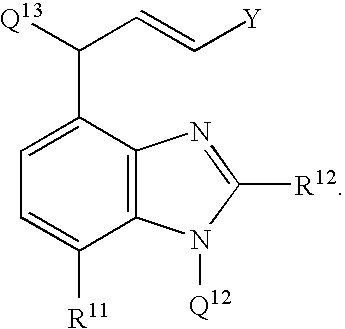


Priority Applications (1)
| Application Number | Priority Date | Filing Date | Title |
|---|---|---|---|
| US11/450,541 US7816536B2 (en) | 2005-06-10 | 2006-06-09 | 4-substituted and 7-substituted indoles, benzofurans, benzothiophenes, benzimidazoles, benzoxazoles, and benzothiazoles and methods for making same |
Applications Claiming Priority (2)
| Application Number | Priority Date | Filing Date | Title |
|---|---|---|---|
| US68920805P | 2005-06-10 | 2005-06-10 | |
| US11/450,541 US7816536B2 (en) | 2005-06-10 | 2006-06-09 | 4-substituted and 7-substituted indoles, benzofurans, benzothiophenes, benzimidazoles, benzoxazoles, and benzothiazoles and methods for making same |
Publications (2)
| Publication Number | Publication Date |
|---|---|
| US20070004787A1 US20070004787A1 (en) | 2007-01-04 |
| US7816536B2 true US7816536B2 (en) | 2010-10-19 |
Family
ID=37532635
Family Applications (1)
| Application Number | Title | Priority Date | Filing Date |
|---|---|---|---|
| US11/450,541 Expired - Fee Related US7816536B2 (en) | 2005-06-10 | 2006-06-09 | 4-substituted and 7-substituted indoles, benzofurans, benzothiophenes, benzimidazoles, benzoxazoles, and benzothiazoles and methods for making same |
Country Status (2)
| Country | Link |
|---|---|
| US (1) | US7816536B2 (en) |
| WO (1) | WO2006135804A1 (en) |
Cited By (1)
| Publication number | Priority date | Publication date | Assignee | Title |
|---|---|---|---|---|
| US9475816B2 (en) | 2012-09-07 | 2016-10-25 | Takeda Pharmaceutical Company Limited | Substituted-1,4-dihydropyrazolo[4,3-b]indoles |
Families Citing this family (1)
| Publication number | Priority date | Publication date | Assignee | Title |
|---|---|---|---|---|
| CN116850187B (en) * | 2023-07-21 | 2025-10-31 | 华东理工大学 | Use of Hapalindole in preparing medicine for inhibiting liver cancer or breast cancer |
Citations (16)
| Publication number | Priority date | Publication date | Assignee | Title |
|---|---|---|---|---|
| US2507631A (en) | 1944-01-19 | 1950-05-16 | Ciba Pharm Prod Inc | Pyridine and piperidine compounds and process of making same |
| US2957880A (en) | 1953-12-23 | 1960-10-25 | Ciba Pharm Prod Inc | Process for the conversion of stereoisomers |
| US4133881A (en) | 1977-04-27 | 1979-01-09 | A. H. Robins Company, Incorporated | Azetidinyl acetonitrile and acetamide antiarrhythmia compositions and methods |
| US4238488A (en) | 1978-11-17 | 1980-12-09 | Imperial Chemical Industries Limited | Carboxylic acid derivatives of N-substituted benzyl-1,2,5,6-tetrahydropyridines |
| US4866048A (en) | 1985-08-02 | 1989-09-12 | Leo Pharmaceutical Products Ltd. | Novel vitamin D analogues |
| US5036053A (en) | 1988-05-27 | 1991-07-30 | Warner-Lambert Company | Diol-containing renin inhibitors |
| US5175311A (en) | 1990-03-29 | 1992-12-29 | Research Corporation Technologies, Inc. | Method of enantioselective cyclopropanation using chiral catalysts |
| GB2260903A (en) | 1992-01-29 | 1993-05-05 | Leo Pharm Prod Ltd | Treatment of alopecia with vitamin D3 derivatives |
| US5401732A (en) | 1989-02-23 | 1995-03-28 | Leo Pharmaceutical Products Ltd. A/S Kemiske Fabrik Produkionsaktiese Skab | Vitamin D analogues |
| US5591854A (en) | 1994-10-14 | 1997-01-07 | Wake Forest University | Enantioselective synthesis of seven-membered carbocycles and tropanes |
| US5665890A (en) | 1995-03-14 | 1997-09-09 | President And Fellows Of Harvard College | Stereoselective ring opening reactions |
| US5760055A (en) | 1992-03-13 | 1998-06-02 | Wake Forest University | Biologically active tropane derivatives |
| WO2000064583A1 (en) | 1999-04-27 | 2000-11-02 | The Research Foundation Of State University Of New York | Metal catalysts and methods for making and using same |
| WO2004058174A2 (en) | 2002-12-20 | 2004-07-15 | Bayer Pharmaceuticals Corporation | Indane acetic acid derivatives and their use as pharmaceutical agents, intermediates, and method of preparation |
| US6962891B2 (en) | 2001-08-27 | 2005-11-08 | The Research Foundation Of State University Of New York | Solid support dirhodium catalyst compositions and methods for making and using same |
| US7030051B2 (en) | 2001-08-27 | 2006-04-18 | The Research Foundation Of State University Of New York | Dirhodium catalyst compositions and methods for using same |
-
2006
- 2006-06-09 US US11/450,541 patent/US7816536B2/en not_active Expired - Fee Related
- 2006-06-10 WO PCT/US2006/022614 patent/WO2006135804A1/en not_active Ceased
Patent Citations (19)
| Publication number | Priority date | Publication date | Assignee | Title |
|---|---|---|---|---|
| US2507631A (en) | 1944-01-19 | 1950-05-16 | Ciba Pharm Prod Inc | Pyridine and piperidine compounds and process of making same |
| US2957880A (en) | 1953-12-23 | 1960-10-25 | Ciba Pharm Prod Inc | Process for the conversion of stereoisomers |
| US4133881A (en) | 1977-04-27 | 1979-01-09 | A. H. Robins Company, Incorporated | Azetidinyl acetonitrile and acetamide antiarrhythmia compositions and methods |
| US4238488A (en) | 1978-11-17 | 1980-12-09 | Imperial Chemical Industries Limited | Carboxylic acid derivatives of N-substituted benzyl-1,2,5,6-tetrahydropyridines |
| US4866048A (en) | 1985-08-02 | 1989-09-12 | Leo Pharmaceutical Products Ltd. | Novel vitamin D analogues |
| US5036053A (en) | 1988-05-27 | 1991-07-30 | Warner-Lambert Company | Diol-containing renin inhibitors |
| US5401732A (en) | 1989-02-23 | 1995-03-28 | Leo Pharmaceutical Products Ltd. A/S Kemiske Fabrik Produkionsaktiese Skab | Vitamin D analogues |
| US5296595A (en) | 1990-03-29 | 1994-03-22 | Research Corporation Technologies | Method of enantioselectively inserting a carbene |
| US5175311A (en) | 1990-03-29 | 1992-12-29 | Research Corporation Technologies, Inc. | Method of enantioselective cyclopropanation using chiral catalysts |
| GB2260903A (en) | 1992-01-29 | 1993-05-05 | Leo Pharm Prod Ltd | Treatment of alopecia with vitamin D3 derivatives |
| US5760055A (en) | 1992-03-13 | 1998-06-02 | Wake Forest University | Biologically active tropane derivatives |
| US5591854A (en) | 1994-10-14 | 1997-01-07 | Wake Forest University | Enantioselective synthesis of seven-membered carbocycles and tropanes |
| US5665890A (en) | 1995-03-14 | 1997-09-09 | President And Fellows Of Harvard College | Stereoselective ring opening reactions |
| WO2000064583A1 (en) | 1999-04-27 | 2000-11-02 | The Research Foundation Of State University Of New York | Metal catalysts and methods for making and using same |
| US6410746B1 (en) | 1999-04-27 | 2002-06-25 | Research Foundation Of State University Of New York, The | Metal cataltsts and methods for making and using same |
| US6762304B2 (en) | 1999-04-27 | 2004-07-13 | Research Foundation Of State University Of New York | Metal catalysts and methods for making and using same |
| US6962891B2 (en) | 2001-08-27 | 2005-11-08 | The Research Foundation Of State University Of New York | Solid support dirhodium catalyst compositions and methods for making and using same |
| US7030051B2 (en) | 2001-08-27 | 2006-04-18 | The Research Foundation Of State University Of New York | Dirhodium catalyst compositions and methods for using same |
| WO2004058174A2 (en) | 2002-12-20 | 2004-07-15 | Bayer Pharmaceuticals Corporation | Indane acetic acid derivatives and their use as pharmaceutical agents, intermediates, and method of preparation |
Non-Patent Citations (34)
Cited By (1)
| Publication number | Priority date | Publication date | Assignee | Title |
|---|---|---|---|---|
| US9475816B2 (en) | 2012-09-07 | 2016-10-25 | Takeda Pharmaceutical Company Limited | Substituted-1,4-dihydropyrazolo[4,3-b]indoles |
Also Published As
| Publication number | Publication date |
|---|---|
| US20070004787A1 (en) | 2007-01-04 |
| WO2006135804A1 (en) | 2006-12-21 |
Similar Documents
| Publication | Publication Date | Title |
|---|---|---|
| Hunjan et al. | Recent advances in functionalization of pyrroles and their translational potential | |
| Caiuby et al. | α-Imino iridium carbenes from imidoyl sulfoxonium ylides: application in the one-step synthesis of indoles | |
| Dubs et al. | Mechanistic studies on the catalytic asymmetric Mannich-type reaction with dihydroisoquinolines and development of oxidative Mannich-type reactions starting from tetrahydroisoquinolines | |
| EP2476688B1 (en) | Ruthenium-based catalytic complexes and the use of such complexes for olefin metathesis | |
| Bolm et al. | Synthesis of iridium complexes with novel planar chiral chelating imidazolylidene ligands | |
| Barakat et al. | Highly enantioselective Friedel–Crafts alkylation of indoles with α, β-unsaturated ketones with simple Cu (II)–oxazoline–imidazoline catalysts | |
| US20090187028A1 (en) | Process for preparing Chiral Dipeptidyl Peptidase -IV Inhibitor Intermediates | |
| Nagare et al. | Electrochemical oxidative addition of nucleophiles on 2-arylindoles: synthesis of C2-heteroquaternary indolin-3-ones | |
| Rafiński et al. | Highly efficient synthesis of spirocyclic (1R)-camphor-derived triazolium salts: Application in the catalytic asymmetric benzoin condensation | |
| Zhou et al. | Modular synthesis of tetrasubstituted pyrroles through a four-component cyclization strategy using ammonium salt as the nitrogen source | |
| Nishimura et al. | A short synthesis of (+)-β-lycorane by asymmetric conjugate addition cascade | |
| Yang et al. | A zinc/PyBisulidine catalyzed asymmetric Mannich reaction of N-tosyl imines with 3-acyloxy-2-oxindoles | |
| US20070004787A1 (en) | 4-Substituted and 7-substituted indoles, benzofurans, benzothiophenes, benzimidazoles, benzoxazoles, and benzothiazoles and methods for making same | |
| Han et al. | Chiral ferrocenyl P, S-ligands for highly efficient copper-catalyzed asymmetric [3+ 2] cycloaddition of azomethine ylides | |
| Rong et al. | Metal-free cascade reactions of aziridines with arylalkynes and aryldiazoniums: facile access to arylazopyrrolines | |
| CN108976241A (en) | A kind of synthetic method of chirality 1,4- dihydropyran simultaneously [2,3-c] pyrazole compound | |
| CN1139576C (en) | Process for manufacture of optically active (R)-or (S)-1-(4-methoxy-benzyl)-8-octahydro-isoquinoline adducts of the general formula | |
| CN113045530B (en) | Method for preparing naphthopyran compounds by ruthenium catalysis | |
| Müller et al. | Synthesis of a ketorolac model via aromatic carbenoid insertion | |
| JP3630002B2 (en) | Process for producing optically active 1,2-diols | |
| García et al. | Tandem reactions involving organolithium reagents. A review | |
| CN109956946B (en) | A kind of iridium-catalyzed method for asymmetric hydrogenation of dihydropyrrole/indole[1,2-a]pyrazine to synthesize chiral amine | |
| JP2015172024A (en) | Chiral bicyclic diene ligand having hydrogen bond formation amide group | |
| WO2005068457A1 (en) | Cataltytic asymmetric hetero diels-alder reaction of a heteroaromatic c-nitroso dienophile: a novel method for synthesis of chiral non-racemic amino alcohols | |
| CN115710210B (en) | Iron-catalyzed C-H bond amination process |
Legal Events
| Date | Code | Title | Description |
|---|---|---|---|
| AS | Assignment |
Owner name: RESEARCH FOUNDATION OF STATE UNIVERSITY OF NEW YOR Free format text: ASSIGNMENT OF ASSIGNORS INTEREST;ASSIGNORS:DAVIES, HUW M. L.;MANNING, JAMES;REEL/FRAME:018388/0644 Effective date: 20060724 |
|
| REMI | Maintenance fee reminder mailed | ||
| LAPS | Lapse for failure to pay maintenance fees | ||
| STCH | Information on status: patent discontinuation |
Free format text: PATENT EXPIRED DUE TO NONPAYMENT OF MAINTENANCE FEES UNDER 37 CFR 1.362 |
|
| STCH | Information on status: patent discontinuation |
Free format text: PATENT EXPIRED DUE TO NONPAYMENT OF MAINTENANCE FEES UNDER 37 CFR 1.362 |
|
| FP | Lapsed due to failure to pay maintenance fee |
Effective date: 20141019 |
|
| AS | Assignment |
Owner name: NATIONAL SCIENCE FOUNDATION, VIRGINIA Free format text: CONFIRMATORY LICENSE;ASSIGNOR:STATE UNIVERSITY OF NEW YORK, BUFFALO;REEL/FRAME:037040/0755 Effective date: 20151020 |