US7812184B2 - Production method of optically active epoxy compound, complex used for the method and production method of the complex - Google Patents
Production method of optically active epoxy compound, complex used for the method and production method of the complex Download PDFInfo
- Publication number
- US7812184B2 US7812184B2 US11/979,815 US97981507A US7812184B2 US 7812184 B2 US7812184 B2 US 7812184B2 US 97981507 A US97981507 A US 97981507A US 7812184 B2 US7812184 B2 US 7812184B2
- Authority
- US
- United States
- Prior art keywords
- group
- formula
- optically active
- production method
- complex
- Prior art date
- Legal status (The legal status is an assumption and is not a legal conclusion. Google has not performed a legal analysis and makes no representation as to the accuracy of the status listed.)
- Expired - Fee Related, expires
Links
- 0 [1*]C1=CC=CC2=C1O[C@]13OC4=C([1*])C=CC=C4CN1[C@@H]([2*])[C@H]([2*])[N@]3C2.[1*]C1=CC=CC2=C1O[C@]13OC4=C([1*])C=CC=C4CN1[C@H]([2*])[C@@H]([2*])[N@]3C2 Chemical compound [1*]C1=CC=CC2=C1O[C@]13OC4=C([1*])C=CC=C4CN1[C@@H]([2*])[C@H]([2*])[N@]3C2.[1*]C1=CC=CC2=C1O[C@]13OC4=C([1*])C=CC=C4CN1[C@H]([2*])[C@@H]([2*])[N@]3C2 0.000 description 28
- ROYYKMYPMLDXFU-UHFFFAOYSA-L CO[Ti](O)(O)OC Chemical compound CO[Ti](O)(O)OC ROYYKMYPMLDXFU-UHFFFAOYSA-L 0.000 description 8
- GZDCUGNVLFNYCR-HABFLWMTSA-N *.*.COC1=CC=CC=C1C1=CC=CC(CN[C@@H]2CCCCC2NCC2=CC=CC(C3=C(OC)C=CC=C3)=C2O)=C1O.COC1=CC=CC=C1C1=CC=CC(CN[C@H]2CCCCC2NCC2=CC=CC(C3=C(OC)C=CC=C3)=C2O)=C1O.OC1=C(CN[C@@H]2CCCCC2NCC2=CC=CC(C3=C(C(F)(F)F)C=CC=C3)=C2O)C=CC=C1C1=CC=CC=C1C(F)(F)F.OC1=C(CN[C@H]2CCCCC2NCC2=CC=CC(C3=C(C(F)(F)F)C=CC=C3)=C2O)C=CC=C1C1=CC=CC=C1C(F)(F)F.S.S Chemical compound *.*.COC1=CC=CC=C1C1=CC=CC(CN[C@@H]2CCCCC2NCC2=CC=CC(C3=C(OC)C=CC=C3)=C2O)=C1O.COC1=CC=CC=C1C1=CC=CC(CN[C@H]2CCCCC2NCC2=CC=CC(C3=C(OC)C=CC=C3)=C2O)=C1O.OC1=C(CN[C@@H]2CCCCC2NCC2=CC=CC(C3=C(C(F)(F)F)C=CC=C3)=C2O)C=CC=C1C1=CC=CC=C1C(F)(F)F.OC1=C(CN[C@H]2CCCCC2NCC2=CC=CC(C3=C(C(F)(F)F)C=CC=C3)=C2O)C=CC=C1C1=CC=CC=C1C(F)(F)F.S.S GZDCUGNVLFNYCR-HABFLWMTSA-N 0.000 description 1
- CBXIUTKQSGPJIN-RTUZPNSSSA-N *.COC1=CC=CC=C1C1=CC=CC(/C=N/[C@@H]2CCCCC2/N=C/C2=CC=CC(C3=C(OC)C=CC=C3)=C2O)=C1O Chemical compound *.COC1=CC=CC=C1C1=CC=CC(/C=N/[C@@H]2CCCCC2/N=C/C2=CC=CC(C3=C(OC)C=CC=C3)=C2O)=C1O CBXIUTKQSGPJIN-RTUZPNSSSA-N 0.000 description 1
- KLFGSBSWRBEISW-IDCGIGBZSA-N *.COC1=CC=CC=C1C1=CC=CC(CN[C@@H]2CCCCC2NCC2=CC=CC(C3=C(OC)C=CC=C3)=C2O)=C1O Chemical compound *.COC1=CC=CC=C1C1=CC=CC(CN[C@@H]2CCCCC2NCC2=CC=CC(C3=C(OC)C=CC=C3)=C2O)=C1O KLFGSBSWRBEISW-IDCGIGBZSA-N 0.000 description 1
- AQPVUUQBODOTDT-HBQHEMQVSA-L *.CO[Ti]1(C)OC2=C(C=CC=C2C2=CC=CC=C2)CN[C@@H]2CCCCC2NCC2=CC=CC(C3=CC=CC=C3)=C2O1 Chemical compound *.CO[Ti]1(C)OC2=C(C=CC=C2C2=CC=CC=C2)CN[C@@H]2CCCCC2NCC2=CC=CC(C3=CC=CC=C3)=C2O1 AQPVUUQBODOTDT-HBQHEMQVSA-L 0.000 description 1
- HRHZPSOMJBQXRE-IDCGIGBZSA-N *.OC1=C(CN[C@@H]2CCCCC2NCC2=CC=CC(C3=C(C(F)(F)F)C=CC=C3)=C2O)C=CC=C1C1=CC=CC=C1C(F)(F)F Chemical compound *.OC1=C(CN[C@@H]2CCCCC2NCC2=CC=CC(C3=C(C(F)(F)F)C=CC=C3)=C2O)C=CC=C1C1=CC=CC=C1C(F)(F)F HRHZPSOMJBQXRE-IDCGIGBZSA-N 0.000 description 1
- VULDRYBWNMXMBZ-IDCGIGBZSA-N *.OC1=C(CN[C@@H]2CCCCC2NCC2=CC=CC(C3=CC=CC=C3)=C2O)C=CC=C1C1=CC=CC=C1 Chemical compound *.OC1=C(CN[C@@H]2CCCCC2NCC2=CC=CC(C3=CC=CC=C3)=C2O)C=CC=C1C1=CC=CC=C1 VULDRYBWNMXMBZ-IDCGIGBZSA-N 0.000 description 1
- KBCFVIZIEHWGHM-GEECQRFBSA-N C/C=C\C#CC1=CC=CC=C1.C1=CC=C2CC=CC2=C1.C1=CC=C2CCC=CC2=C1.C1=CC=C2CCCC=CC2=C1.C=CC1=CC=CC=C1.CC1=CCCC2=CC=CC=C12 Chemical compound C/C=C\C#CC1=CC=CC=C1.C1=CC=C2CC=CC2=C1.C1=CC=C2CCC=CC2=C1.C1=CC=C2CCCC=CC2=C1.C=CC1=CC=CC=C1.CC1=CCCC2=CC=CC=C12 KBCFVIZIEHWGHM-GEECQRFBSA-N 0.000 description 1
- RRGXZRHXNYRXIT-UHFFFAOYSA-N C1=CC2=C(C=C1)C=C(C1CO1)C=C2.CC1(C)OC2=CC=CC=C2C2OC21.S Chemical compound C1=CC2=C(C=C1)C=C(C1CO1)C=C2.CC1(C)OC2=CC=CC=C2C2OC21.S RRGXZRHXNYRXIT-UHFFFAOYSA-N 0.000 description 1
- HICPYHQUCXZEMN-HDOIDHKWSA-N C1=CC=C(C2CO2)C=C1.C1=CC=C2C(=C1)CC1OC21.C1=CC=C2C(=C1)CCC1OC21.C1=CC=C2C(=C1)CCCC1OC21.CC1OC1C#CC1=CC=CC=C1.C[C@]12O[C@H]1CCC1=CC=CC=C12.S Chemical compound C1=CC=C(C2CO2)C=C1.C1=CC=C2C(=C1)CC1OC21.C1=CC=C2C(=C1)CCC1OC21.C1=CC=C2C(=C1)CCCC1OC21.CC1OC1C#CC1=CC=CC=C1.C[C@]12O[C@H]1CCC1=CC=CC=C12.S HICPYHQUCXZEMN-HDOIDHKWSA-N 0.000 description 1
- WJNCQDNUZOJVRB-UHFFFAOYSA-N C=CC1=CC2=C(C=CC=C2)C=C1.CC1(C)C=CC2=CC=CC=C2O1 Chemical compound C=CC1=CC2=C(C=CC=C2)C=C1.CC1(C)C=CC2=CC=CC=C2O1 WJNCQDNUZOJVRB-UHFFFAOYSA-N 0.000 description 1
- SCGVJXMRTCSOBS-DRGYSUAASA-L CCC(C)(C1(C)CC)O[Tl+]1(Oc1c(CN[C@H](CCCC2)C2NCc2ccc3)cccc1-c1ccccc1)Oc2c3-c1ccccc1 Chemical compound CCC(C)(C1(C)CC)O[Tl+]1(Oc1c(CN[C@H](CCCC2)C2NCc2ccc3)cccc1-c1ccccc1)Oc2c3-c1ccccc1 SCGVJXMRTCSOBS-DRGYSUAASA-L 0.000 description 1
Classifications
-
- C—CHEMISTRY; METALLURGY
- C07—ORGANIC CHEMISTRY
- C07C—ACYCLIC OR CARBOCYCLIC COMPOUNDS
- C07C215/00—Compounds containing amino and hydroxy groups bound to the same carbon skeleton
- C07C215/46—Compounds containing amino and hydroxy groups bound to the same carbon skeleton having hydroxy groups bound to carbon atoms of at least one six-membered aromatic ring and amino groups bound to acyclic carbon atoms or to carbon atoms of rings other than six-membered aromatic rings of the same carbon skeleton
- C07C215/48—Compounds containing amino and hydroxy groups bound to the same carbon skeleton having hydroxy groups bound to carbon atoms of at least one six-membered aromatic ring and amino groups bound to acyclic carbon atoms or to carbon atoms of rings other than six-membered aromatic rings of the same carbon skeleton with amino groups linked to the six-membered aromatic ring, or to the condensed ring system containing that ring, by carbon chains not further substituted by hydroxy groups
- C07C215/50—Compounds containing amino and hydroxy groups bound to the same carbon skeleton having hydroxy groups bound to carbon atoms of at least one six-membered aromatic ring and amino groups bound to acyclic carbon atoms or to carbon atoms of rings other than six-membered aromatic rings of the same carbon skeleton with amino groups linked to the six-membered aromatic ring, or to the condensed ring system containing that ring, by carbon chains not further substituted by hydroxy groups with amino groups and the six-membered aromatic ring, or the condensed ring system containing that ring, bound to the same carbon atom of the carbon chain
-
- C—CHEMISTRY; METALLURGY
- C07—ORGANIC CHEMISTRY
- C07D—HETEROCYCLIC COMPOUNDS
- C07D301/00—Preparation of oxiranes
- C07D301/02—Synthesis of the oxirane ring
- C07D301/03—Synthesis of the oxirane ring by oxidation of unsaturated compounds, or of mixtures of unsaturated and saturated compounds
- C07D301/12—Synthesis of the oxirane ring by oxidation of unsaturated compounds, or of mixtures of unsaturated and saturated compounds with hydrogen peroxide or inorganic peroxides or peracids
-
- C—CHEMISTRY; METALLURGY
- C07—ORGANIC CHEMISTRY
- C07C—ACYCLIC OR CARBOCYCLIC COMPOUNDS
- C07C2601/00—Systems containing only non-condensed rings
- C07C2601/12—Systems containing only non-condensed rings with a six-membered ring
- C07C2601/14—The ring being saturated
Definitions
- the present invention relates to a novel optically active titanium complex and the ligand thereof, and a production method of optically active epoxy compound by use of the complex.
- Optically active epoxy compounds have been widely used as intermediates of several medicines represented by optically active benzopyran compounds that are effective for treating hypertension, asthma or the like, and the synthetic methods of the compounds have been widely considered.
- synthetic methods asymmetric epoxidation of carbon-carbon double bond is the most practical method, since asymmetric epoxidation by use of titanium tartrate as a catalyst was found (Non-patent document 1), several synthetic methods through asymmetric epoxidation have been developed (Non-patent Documents 2 and 3).
- Non-patent Documents 4 and 5 Non-patent Documents 4 and 5
- the turnover number of catalysts is insufficient.
- Non-patent Document 6 Non-patent Document 6
- the asymmetric epoxidation of several olefins by use of hydrogen peroxide as an oxidizing agent proceeds in a high enantioselectivity manner when a di- ⁇ -oxotitanium salan complex is used as a catalyst.
- An object of the present invention is to solve the above-mentioned problems in the prior art and to provide a production method of optically active epoxy compounds that is industrially useful, and a complex used as a catalyst in the method and a ligand of the complex.
- the present inventors eagerly investigated a production method of optically active epoxy compounds that is industrially useful, and a complex used as a catalyst in the method and a ligand of the complex. As a result, they identified the skeleton that is necessary for expressing a high catalyst activity of optically active titanium salan complex, and the substituent that is useful therefor and the position of the substituent, and found that optically active epoxy compounds can be produced with a high enantioselectivity and a high chemical yield compared with a case where the prior optically active titanium salan complex is used, and completed the present invention.
- R 3 is hydrogen atom or methyl group
- R 4 and R 5 are hydrogen atom, or R 4 and R 5 together form —CH 2 —, —CH 2 CH 2 —, —CH 2 CH 2 CH 2 — or —CH 2 O— (the oxygen atom in the —CH 2 O— is bonded at R 5 side)
- R 6 is a phenyl group
- R 7 is methyl group or ethyl group
- the carbon atom shown with * is optically active, characterized by comprising subjecting an unsaturated compound of formula (4), (5) or (6)
- R 1 is a phenyl group (the phenyl group is substituted with methyl group, ethyl group (the methyl group and the ethyl group are substituted with at least one halogen atom) or C 1-7 alkoxy group)
- R 2 is C 3-5 divalent group in which two R 2 s together form a ring
- M is TiJ 1 J 2 (in TiJ 1 J 2 , Ti is titanium atom, J 1 and J 2 independently of each other are a halogen atom, C 1-4 alkoxy group, or J 1 and J 2 together show oxygen atom, or J 1 and J 2 together form a ring that is a divalent group of formula (2)
- R 1 is 2-trifluoromethylphenyl group or 2-methoxyphenyl group
- R 2 is C 3-5 divalent group in which two R 2 s together form a ring
- M is TiJ 1 J 2 (in TiJ 1 J 2 , Ti is titanium atom, J 1 and J 2 independently of each other are a halogen atom, C 1-4 alkoxy group, or J 1 and J 2 together show oxygen atom, or J 1 and J 2 together form a ring that is a divalent group of formula (2)
- R 1 is 2-trifluoromethylphenyl group
- R 2 is tetramethylene group that two R 2 s together form.
- R 1 is 2-methoxyphenyl group
- R 2 is tetramethylene group that two R 2 s together form.
- unsaturated compounds having prochiral carbon-carbon double bond in the molecule can be epoxidized in a high enantioselectivity, and thus optically active epoxy compounds can be produced.
- the complex of the present invention is very useful as a catalyst in the production method.
- the optically active epoxy compounds obtained by the production method of the present invention are useful as optically active pharmaceutical intermediates of the compounds that are effective for treating hypertension, asthma or the like.
- n means normal, “i” means iso, “s” means secondary, “t” means tertiary, “c” means cyclo, “o” means ortho, “m” means meta, and “p” means para.
- optically active epoxy compound according to the present invention is characterized by being able to produce an optically active epoxy compound of compound of formulae (7), (8) or (9)
- R 3 is hydrogen atom or methyl group
- R 4 and R 5 are hydrogen atom, or R 4 and R 5 together form —CH 2 —, —CH 2 CH 2 —, —CH 2 CH 2 CH 2 — or —CH 2 O— (the oxygen atom in the —CH 2 O— is bonded at R 5 side)
- R 6 is a phenyl group
- R 7 is methyl group or ethyl group
- the carbon atom shown with * is optically active, characterized by comprising subjecting an unsaturated compound of formula (4), (5) or (6)
- R 1 is a phenyl group (the phenyl group is substituted with methyl group, ethyl group (the methyl group and the ethyl group are substituted with at least one halogen atom) or C 1-7 alkoxy group)
- R 2 is C 3-5 divalent group in which two R 2 s together form a ring
- M is TiJ 1 J 2 (in TiJ 1 J 2 , Ti is titanium atom, J 1 and J 2 independently of each other are a halogen atom, C 1-4 alkoxy group, or J 1 and J 2 together show oxygen atom, or J 1 and J 2 together form a ring that is a divalent group of formula (2)
- R 1 in the formulae (1) and (1′) is a phenyl group (the phenyl group is substituted with methyl group, ethyl group (the methyl group and the ethyl group are substituted with at least one halogen atom) or C 1-7 alkoxy group).
- R 1 in the formulae (1) and (1′) is preferably is 2-methylphenyl group (the methyl group in the 2-methylphenyl group is substituted with at least one halogen atom), 2-methoxyphenyl group, 2-ethoxyphenyl group, or 2-i-propoxyphenyl group, and more preferably 2-methoxyphenyl group, or 2-trifluoromethylphenyl group.
- R 2 in the formulae (1) and (1′) is C 3-5 divalent group in which two R 2 s together form a ring.
- R 2 in the formulae (1) and (1′) is concretely described.
- R 2 includes trimethylene group, tetramethylene group or the like in which two R 2 s together form a ring, and preferably R 2 is tetramethylene group.
- R 3 in the formulae (1) and (1′) is concretely described.
- R 3 is hydrogen atom or methyl group, and preferably hydrogen atom.
- R 4 and R 5 together form a divalent group of —CH 2 CH 2 — preferable R 3 includes hydrogen atom or methyl group.
- R 4 and R 5 in the formulae (1) and (1′) is concretely described.
- R 4 and R 5 are hydrogen atom or R 4 and R 5 together form a divalent group of —CH 2 —, —CH 2 CH 2 —, —CH 2 CH 2 CH 2 — or —CH 2 O— (the oxygen atom in the —CH 2 O— is bonded at R 5 side), and preferably R 4 and R 5 are hydrogen atom or R 4 and R 5 together form a divalent group of —CH 2 —, or —CH 2 CH 2 CH 2 —.
- R 7 in the formulae (1) and (1′) is concretely described.
- R 7 is methyl group or ethyl group, and more preferably methyl group.
- M in the formulae (1) and (1′) is TiJ 1 J 2 (in TiJ 1 J 2 , Ti is titanium atom, J 1 and J 2 independently of each other are a halogen atom, C 1-4 alkoxy group, or J 1 and J 2 together show oxygen atom, or J 1 and J 2 together form a ring that is a divalent group of formula (2)
- J 1 and J 2 in M independently of each other are isopropoxy group, or J 1 and J 2 together show oxygen atom, J 1 and J 2 together form a ring that is a divalent group of formula (2)
- the optically active titanium complex in the present invention is ⁇ -oxotitanium binuclear complex being a divalent group of formula (2) that J 1 and J 2 together form a ring.
- the above-mentioned ⁇ -oxotitanium binuclear complex in the production method of the present invention is formed by reacting a salen ligand with titanium alkoxide to form a titanium complex in which J 1 and J 2 independently of each other are C 1-4 alkoxy group, and then forming ⁇ -oxotitanium binuclear complex through a mononuclear oxotitanium complex in which J 1 and J 2 together show oxygen atom.
- the optically active titanium complex in the present invention may be a mixture of these complexes in three states. Further, the optically active titanium complex in the present invention can be in a state of ⁇ -oxotitanium b-nuclear complex wherein b is an integer of 3 to 10.
- the optically active titanium complex of formulae (1) and (1′) can be produced according to the methods described in Patent Document 1 and Non-patent Document 7. That is, a titanium compound is reacted with the salan ligand of formula (10) or (10′), then treated with water or water-containing solvent (the water-containing solvent is a mixed solvent containing water in an amount of 0.1 to 100% by mass in an organic solvent, and THF, methanol and i-propanol, etc. are used as the organic solvent). Further, water addition can be performed also by adding aqueous hydrogen peroxide.
- the used titanium compounds include titanium tetrachloride, or titanium tetrabromide
- the titanium alkoxides include titanium tetramethoxide, titanium tetraethoxide, titanium tetra n-propoxide, titanium tetra i-propoxide, titanium tetra n-butoxide, titanium tetra t-butoxide or the like.
- titanium compounds titanium tetra i-propoxide [Ti(Oi-Pr) 4 ] is preferable.
- the used amount of the titanium compound is preferably a range from 1 to 2 mol, more preferably a range from 1 to 1.2 mol based on 1 mol of the salan ligand.
- the used amount of water is preferably a range from 1 to 1000 mol, more preferably a range from 1 to 10 mol based on 1 equivalent of the salan ligand.
- the production method of optically active epoxy compound according to the present invention can be also performed by forming the above-mentioned optically active titanium salan complex in the reaction system and subjecting a compound having prochiral carbon-carbon double bond in the molecule to asymmetric epoxidation without isolation of the catalyst.
- the reaction solvents used in the production of the optically active titanium salan complex of formulae (1) and (1′) are aprotic organic solvents, protic organic solvents or mixtures of these solvents.
- the aprotic organic solvents include halogen-based solvents, aromatic hydrocarbon-based solvents, ester-based solvents, ether-based solvents, amide-based solvents or nitrile-based solvents, and are concretely dichloromethane, chloroform, 1,2-dichloroethane, toluene, ethyl acetate, tetrahydrofuran, diethyl ether, dimethylformamide (DMF), butyronitrile, propionitrile, acetonitrile and the like.
- DMF dimethylformamide
- the protic organic solvents include alcohol-based solvents, and are ethanol, i-propanol or t-butanol, etc.
- Preferable reaction solvents are dichloromethane 1,2-dichloroethane and toluene that are aprotic solvents. Further preferable solvent is dichloromethane.
- the salan ligands of the formulae (10) and (10′) can be produced by reducing the salen ligand of formula (11) or (11′)
- Reducing agents used in the reduction are preferably sodium borohydride (NaBH 4 ), sodium cyanotrihydridoborate (NaBH 3 CN) and lithium aluminum hydride (LiAlH 4 ), etc.
- Sodium borohydride (NaBH 4 ) is preferable.
- the structure of the salan ligands of particularly preferable optically active titanium salan complexes having a combination of the above-mentioned preferable substituents is as follows.
- R 1 is preferably 2-methoxyphenyl group or 2-trifluoromethylphenyl group
- R 2 is preferably tetramethylene group that is a divalent group that R 2 s together form a ring
- the starting materials for the production method of optically active epoxy compound according to the present invention are the unsaturated compounds of formulae (4), (5) and (6) that are compounds having prochiral carbon-carbon double bond in the molecule.
- the epoxy compounds produced according to the method of the present invention have the structure of the formulae (7), (8) and (9) in which the carbon-carbon double bond of the starting material is transformed into an epoxy bond.
- the resulting optically active epoxy compound is shown by the formula (7)
- the resulting optically active epoxy compound is shown by the formula (8)
- the resulting optically active epoxy compound is shown by the formula (9).
- the production method of the present invention can provide only either of enantiomers in a high selectivity.
- the production method of the present invention can provide selectively both enantiomers of optically active epoxy compounds by using either the complex of formula (1) or the complex of formula (1′).
- R 4 and R 5 in the formula (4) may together form a divalent group.
- R 4 and R 5 together form —CH 2 O— the oxygen atom in the —CH 2 O— is bonded at R 5 side
- a 6-membered ring is formed, and the compounds include benzopyran and the derivatives thereof.
- the compounds include indene and the derivatives thereof.
- R 4 and R 5 together form —CH 2 CH 2 — a 6-membered ring is formed, the compounds include 1,2-dihydronaphthalene and the derivatives thereof.
- R 4 and R 5 together form —CH 2 CH 2 CH 2 — a 7-membered ring is formed
- the compounds include 1,2-benzo-1,3-cycloheptadiene and the derivatives thereof.
- the peracid used in the method of the present invention is preferably aqueous hydrogen peroxide and urea-hydrogen peroxide addition compound (UHP), and aqueous hydrogen peroxide is more preferable.
- concentration of aqueous hydrogen peroxide is not specifically limited but from the viewpoint of industrial aspect and availability, it is preferable to use a product having a concentration of about 30% that is commercially available.
- aqueous hydrogen peroxide may be added dropwise in limited amounts to an epoxidation reaction solution. In this case, the used amount of the catalyst can be reduced.
- the used amount of the oxidizing agent is preferably a range from 1 to 10 equivalents (eq), more preferably a range from 1 to 1.2 equivalents (eq) based on an unsaturated compound being a substrate.
- the used amount of the catalyst is preferably a range from 0.01 to 100 mol %, more preferably a range from 0.01 to 10 mol % based on an unsaturated compound being a substrate.
- the production method of optically active epoxy compound according to the present invention is generally performed in an organic solvent.
- the organic solvent are preferably aprotic organic solvents, and concretely include hydrocarbon halogenides such as dichloromethane (CH 2 Cl 2 ), 1,2-dichloroethane (1,2-CH 2 ClCH 2 Cl), chlorobenzene or the like, aromatic hydrocarbons such as toluene or the like, esters such as ethyl acetate or the like, ethers such as tetrahydrofuran (THF) or the like.
- Preferable solvents are hydrocarbon halogenides, and more preferable solvent is dichloromethane.
- the reaction solution may be two-phase system composed of an organic phase and an aqueous phase.
- reaction temperature of the production method of optically active epoxy compound according to the present invention is not specifically limited, but it is preferable to perform the method at 0 to 50° C., and it is more preferable to perform the method at 20 to 30° C. Further, reaction time is not specifically limited, and suitably selected depending on the reaction temperature.
- R means (R) of absolute configuration.
- a dichloromethane solution 0.5 mL in which the salan ligand of formula (13′) (3.2 mg, 0.006 mmol) was dissolved
- a dichloromethane solution in which Ti(Oi-Pr) 4 (1.4 mg, 0.005 mmol) was dissolved was added and stirred at 25° C. for 1 hour.
- an unsaturated compound having carbon-carbon double bond (0.10 mmol)
- commercially available 30% aqueous hydrogen peroxide 0.11 mmol
- Example 5 the used amount of the salan ligand and Ti(Oi-Pr) 4 was altered, and the reaction was carried out similarly to Method A.
- Example 6 and 7 the reaction time was altered to 6 hours, and the reaction was carried out similarly to Method A.
- Example 12 the used amount of the salan ligand and Ti(Oi-Pr) 4 was altered, and the reaction was carried out similarly to Method B.
- Example 13 and 14 the reaction time was altered to 6 hours, and the reaction was carried out similarly to Method B.
- R means (R) of absolute configuration
- a dichloromethane solution 1.0 mL, 10 mM
- Ti(Oi-Pr) 4 was dissolved and stirred at 25° C.
- a drop of water was added, and further stirred for 30 minutes.
- R means (R) of absolute configuration and an unsaturated compound having carbon-carbon double bond (0.10 mmol) were dissolved.
- 30% aqueous hydrogen peroxide (0.15 mmol) was added, and reacted by stirring at 25° C. for 24 hours. Thereafter, the solvent was distilled off under reduced pressure, and the resulting residue was purified with silica gel chromatography to obtain an aimed optically active epoxy compound.
- Comparative Examples 1, 2 and 4 to 8 in which a catalyst was prepared from the salan ligand of formula (15′) and Ti(Oi-Pr) 4 in situ and an optically active epoxy compound was produced, and Comparative Example 3 in which an optically active epoxy compound was produced by use of the isolated catalyst of formula (16′) being an optically active titanium salan complex, are shown in Table 3.
- the reaction time was altered to 6 hours and the used amount of 30% aqueous hydrogen peroxide was altered to 0.12 mmol, and the reaction was carried out similarly to Method D.
- the yield of the products was analyzed with 1 H-NMR (400 MHz).
- the enantiomer excess rate of Product 7 was analyzed by use of Daicel Chiralcell OJ-H, and the enantiomer excess rate of Product 8 was analyzed by use of Daicel Chiralcell OB-H, in which a high performance liquid chromatography (HPLC) was used.
- HPLC high performance liquid chromatography
- the production method of the present invention can epoxidize a prochiral unsaturated compound having carbon-carbon double bond in the molecule in a high enantioselectivity to produce an optically active epoxy compound.
- the complex of the present invention is very useful as a catalyst in the production method.
- the optically active epoxy compound obtained according to the production method of the present invention is useful as optically active pharmaceutical intermediates of the compounds that are effective for treating hypertension, asthma or the like.
Landscapes
- Chemical & Material Sciences (AREA)
- Organic Chemistry (AREA)
- Inorganic Chemistry (AREA)
- Epoxy Compounds (AREA)
- Low-Molecular Organic Synthesis Reactions Using Catalysts (AREA)
- Organic Low-Molecular-Weight Compounds And Preparation Thereof (AREA)
- Heterocyclic Carbon Compounds Containing A Hetero Ring Having Oxygen Or Sulfur (AREA)
- Catalysts (AREA)
Abstract

and the substituent that is useful therefor and the position of the substituent are identified, and it is found that optically active epoxy compounds can be produced with a high enantioselectivity and a high chemical yield compared with a case where the prior optically active titanium salan complex is used. The production method comprises subjecting a prochiral compound (formula (4), (5) or (6)) having carbon-carbon double bond in the molecule to asymmetric epoxidation to produce an optically active epoxy compound (formula (7), (8) or (9)). The present invention relates also to a complex used for the production method and a production method of the complex.

Description
- Patent Document 1: WO 2006/087874 A1
- Non-patent Document 1: T. Katsuki, K. B. Sharpless, J. Am. Chem. Soc. (1980), 102, 5974-5796
- Non-patent Document 2: E. N. Jacobsen, M. H. Wu, “Comprehensive Asymmetric Catalysis” Ed. by Jacobsen, E. N.; Pfaltz, A.; Yamamoto, H. Springer (1999), Vol. II, 21, pp. 649-677
- Non-patent Document 3: T. Katsuki, “Comprehensive Coordination Chemistry II” Ed. by McCleverty, J., Elsevier Science Ltd., Oxford (2003), Vol. 9, Chapter 9.4, pp. 207-264
- Non-patent Document 4: L. Shu, Y Shi, Tetrahedron, (2001), 57, 5213-5218
- Non-patent Document 5: S. Colonna, H. Molinari, S. Banfi, S. Julia, J. Masana, z, Tetrahedron, (1983), 39, 1635-1641
- Non-patent Document 6: K. Matsumoto, Y Sawada, B. Saito, K. Sakai, T. Katasuki, Angew. Chem. Int. Ed. (2005), 44, 4935-4939
- Non-patent Document 7: Y Sawada, K. Matsumoto, S. Kondo, H. Watanabe, T. Ozawa, K. Suzuki, B. Saito, K. Sakai, T. Katasuki, Angew. Chem. Int. Ed. (2006), 45, 3478-3480
- [1] A production method of an optically active epoxy compound of formulae (7), (8) or (9)

wherein R3 is hydrogen atom or methyl group, R4 and R5 are hydrogen atom, or R4 and R5 together form —CH2—, —CH2CH2—, —CH2CH2CH2— or —CH2O— (the oxygen atom in the —CH2O— is bonded at R5 side), R6 is a phenyl group, R7 is methyl group or ethyl group, the carbon atom shown with * is optically active,
characterized by comprising subjecting an unsaturated compound of formula (4), (5) or (6)

wherein R3, R4, R5, R6 and R7 are as defined above, to asymmetric epoxidation with a peracid by using as a catalyst an optically active titanium complex of formula (1) or (1′)

wherein R1 is a phenyl group (the phenyl group is substituted with methyl group, ethyl group (the methyl group and the ethyl group are substituted with at least one halogen atom) or C1-7alkoxy group), R2 is C3-5 divalent group in which two R2s together form a ring, M is TiJ1J2 (in TiJ1J2, Ti is titanium atom, J1 and J2 independently of each other are a halogen atom, C1-4alkoxy group, or J1 and J2 together show oxygen atom, or J1 and J2 together form a ring that is a divalent group of formula (2)

(a partial structure O-E-O in the formula is shown by formula (3) in the compound of formula (1) and by formula (3′) in the compound of formula (1′)

wherein R1 and R2 are as defined above)).
- [2] The production method of an optically active epoxy compound as set forth in [1], wherein R2 is tetramethylene group that two R2s together form.
- [3] The production method of an optically active epoxy compound as set forth in [2], wherein R1 is 2-methylphenyl group (the methyl group in the 2-methylphenyl group is substituted with at least one halogen atom).
- [4] The production method of an optically active epoxy compound as set forth in [3], wherein R1 is 2-trifluoromethylphenyl group.
- [5] The production method of an optically active epoxy compound as set forth in [2], wherein R1 is 2-methoxyphenyl group.
- [6] An optically active titanium complex of formula (1) or (1′)
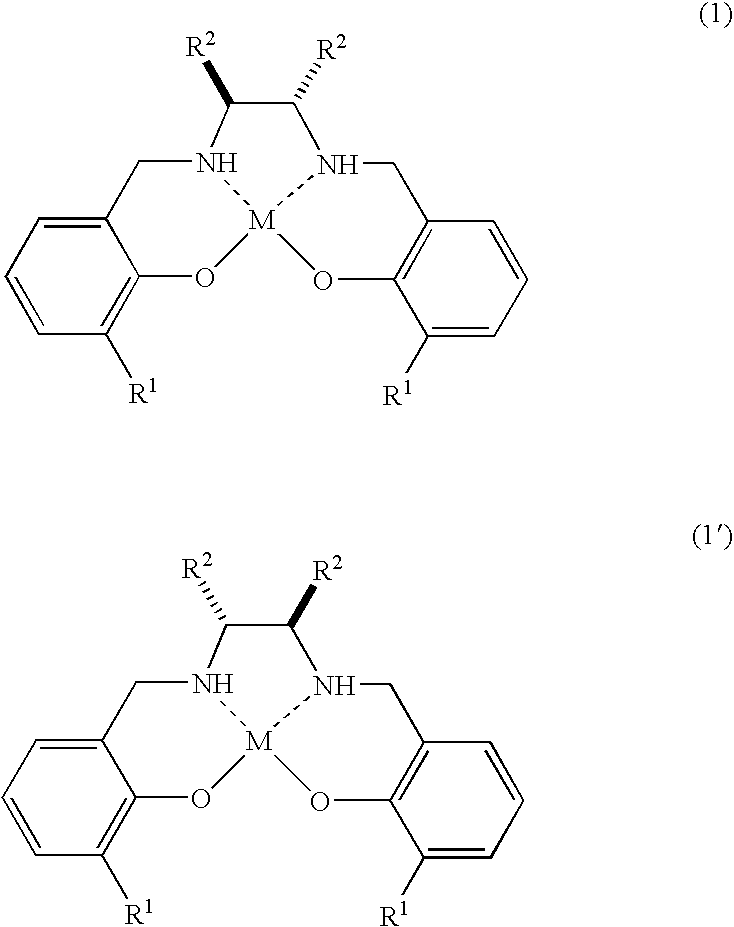
wherein R1 is 2-trifluoromethylphenyl group or 2-methoxyphenyl group, R2 is C3-5 divalent group in which two R2s together form a ring, M is TiJ1J2 (in TiJ1J2, Ti is titanium atom, J1 and J2 independently of each other are a halogen atom, C1-4alkoxy group, or J1 and J2 together show oxygen atom, or J1 and J2 together form a ring that is a divalent group of formula (2)

(a partial structure O-E-O in the formula is shown by formula (3) in the compound of formula (1) and by formula (3′) in the compound of formula (1′)

wherein R1 and R2 are as defined above)).
- [7] The optically active titanium complex as set forth in [6], wherein R1 is 2-trifluoromethylphenyl group, R2 is tetramethylene group that two R2s together form.
- [8] The optically active titanium complex as set forth in [6], wherein R1 is 2-methoxyphenyl group, R2 is tetramethylene group that two R2s together form.
- [9] A salan ligand of formulae (10) and (10′)

wherein R1 is 2-trifluoromethylphenyl group, R2 is tetramethylene group that two R2s together form.
- [10] A salan ligand of formulae (10) and (10′)

wherein R1 is 2-methoxyphenyl group, R2 is tetramethylene group that two R2s together form.
- [11] The production method as set forth in any one of [1] to [5], wherein aqueous hydrogen peroxide is used as the peracid.
Effect of the Invention

wherein R3 is hydrogen atom or methyl group, R4 and R5 are hydrogen atom, or R4 and R5 together form —CH2—, —CH2CH2—, —CH2CH2CH2— or —CH2O— (the oxygen atom in the —CH2O— is bonded at R5 side), R6 is a phenyl group, R7 is methyl group or ethyl group, the carbon atom shown with * is optically active,
characterized by comprising subjecting an unsaturated compound of formula (4), (5) or (6)

wherein R3, R4, R5, R6 and R7 are as defined above, to asymmetric epoxidation with a peracid by using as a catalyst an optically active titanium complex of formula (1) or (1′)

wherein R1 is a phenyl group (the phenyl group is substituted with methyl group, ethyl group (the methyl group and the ethyl group are substituted with at least one halogen atom) or C1-7alkoxy group), R2 is C3-5 divalent group in which two R2s together form a ring, M is TiJ1J2 (in TiJ1J2, Ti is titanium atom, J1 and J2 independently of each other are a halogen atom, C1-4alkoxy group, or J1 and J2 together show oxygen atom, or J1 and J2 together form a ring that is a divalent group of formula (2)

(a partial structure O-E-O in the formula is shown by formula (3) in the compound of formula (1) and by formula (3′) in the compound of formula (1′)

wherein R1 and R2 are as defined above)).

(a partial structure O-E-O in the formula is shown by formula (3) in the compound of formula (1) and by formula (3′) in the compound of formula (1′)

wherein R1 and R2 are as defined above)).

(a partial structure O-E-O in the formula is shown by formula (3) in the compound of formula (1) and by formula (3′) in the compound of formula (1′)

wherein R1 and R2 are as defined above)). It is more preferable that J1 and J2 together form a ring that is a divalent group of formula (2)

(a partial structure O-E-O in the formula is shown by formula (3) in the compound of formula (1) and by formula (3′) in the compound of formula (1′)

wherein R1 and R2 are as defined above)).

wherein R1 and R2 are as defined above. Reducing agents used in the reduction are preferably sodium borohydride (NaBH4), sodium cyanotrihydridoborate (NaBH3CN) and lithium aluminum hydride (LiAlH4), etc. Sodium borohydride (NaBH4) is preferable.

is particularly preferable.

wherein R means (R) of absolute configuration, was reduced with NaBH4 to synthesize the salan ligand of formula (13′)

wherein R means (R) of absolute configuration. In a dichloromethane solution (0.5 mL) in which the salan ligand of formula (13′) (3.2 mg, 0.006 mmol) was dissolved, a dichloromethane solution in which Ti(Oi-Pr)4 (1.4 mg, 0.005 mmol) was dissolved was added and stirred at 25° C. for 1 hour. Thereafter, continuously without isolation of the optically active titanium salan complex, an unsaturated compound having carbon-carbon double bond (0.10 mmol), and then commercially available 30% aqueous hydrogen peroxide (0.11 mmol) were added, and stirred at a reaction temperature of 25° C. for 9 hours. The solvent of the reaction mixture was distilled off under reduced pressure, and purification procedure with silica gel chromatography was performed to obtain an aimed optically active epoxy compound. In addition, the optical purity of the resulting optically active epoxy compound was analyzed with an optically active high performance liquid chromatography column. Further, the analysis of the optically active titanium salan complex was carried out with ESI-MS manufactured by JEOL Ltd., and m/z was 1201.46 (theoretical value: 1201.43). Substrates 1 to 6 of the following formulae

were subjected to asymmetric epoxidation as unsaturated compounds having carbon-carbon double bond according to the above-mentioned Method A, and thereby as optically active epoxy compounds, Products 1 to 6 of the following formulae

were obtained from Substrates 1 to 6, respectively. In the meantime, the yield of the products was analyzed with 1H-NMR (400 MHz). The enantiomer excess rate of Product 1 was analyzed by use of Daicel Chiralcell OB-H and hexan/isopropanol (99/1=v/v) mixed liquid, the enantiomer excess rate of Product 2 was analyzed by use of Daicel Chiralpack AS-H and hexan/isopropanol (999/1=v/v) mixed liquid, the enantiomer excess rate of Product 3 was analyzed by use of Daicel Chiralcell OD-H and hexan/isopropanol (99/1=v/v) mixed liquid, the enantiomer excess rate of Product 4 was analyzed by use of Daicel Chiralcell OD-H and hexan/isopropanol (999/1=v/v) mixed liquid, the enantiomer excess rate of Product 5 was analyzed by use of Daicel Chiralcell OB-H and hexan/isopropanol (9/1=v/v) mixed liquid, and the enantiomer excess rate of Product 6 was analyzed by use of Daicel Chiralcell OB-H and hexan/isopropanol (99/1=v/v) mixed liquid, in which a high performance liquid chromatography (HPLC) was used.
| TABLE 1 | ||||||||
| Catalyst (prepared in | Enantiomer | |||||||
| situ) | Excess Rate | |||||||
| Substrate*2 | Salan | Reaction | Product*2 | (% ee, | ||||||
| (unsaturated | Ligand | Ti(Oi-Pr)4 | Oxidizing | Time | (epoxy | Yield | absolute | |||
| compound) | (mol %)*1 | (mol %)*1 | Agent | Solvent | (hour) | compound) | (%) | configuration) | ||
| Example 1 | Substrate 1 | 6 | 5 | Aqueous | Dichloromethane | 9 | Product 1 | 89 | 98, (1S, 2R) |
| hydrogen | |||||||||
| peroxide | |||||||||
| Example 2 | Substrate 2 | 6 | 5 | Aqueous | Dichloromethane | 9 | Product 2 | 66 | 97, (5S, 6R) |
| hydrogen | |||||||||
| peroxide | |||||||||
| Example 3 | Substrate 3 | 6 | 5 | Aqueous | Dichloromethane | 9 | Product 3 | 84 | 94, (2R, 3S) |
| hydrogen | |||||||||
| peroxide | |||||||||
| Example 4 | Substrate 4 | 6 | 5 | Aqueous | Dichloromethane | 9 | Product 4 | 68 | 89, (S) |
| hydrogen | |||||||||
| peroxide | |||||||||
| Example 5 | Substrate 4 | 5 | 4 | Aqueous | Dichloromethane | 9 | Product 4 | 62 | 89, (S) |
| hydrogen | |||||||||
| peroxide | |||||||||
| Example 6 | Substrate 5 | 6 | 5 | Aqueous | Dichloromethane | 6 | Product 5 | 86 | 98, (1S, 2R) |
| hydrogen | |||||||||
| peroxide | |||||||||
| Example 7 | Substrate 6 | 6 | 5 | Aqueous | Dichloromethane | 6 | Product 6 | 81 | 96, (1R, 2S) |
| hydrogen | |||||||||
| peroxide | |||||||||
| *1The used amount of salan ligand (13′) and Ti(Oi-Pr)4 based on the substrate. | |||||||||
| *2The structure of the substrate and the product is shown above. | |||||||||

wherein R means (R) of absolute configuration, was dissolved, a dichloromethane solution in which Ti(Oi-Pr)4 (1.4 mg, 0.005 mmol) was dissolved was added and stirred at 25° C. for 1 hour. Thereafter, continuously without isolation of the optically active titanium salan complex, an unsaturated compound having carbon-carbon double bond (0.10 mmol), and then commercially available 30% aqueous hydrogen peroxide (0.11 mmol) were added, and stirred at a reaction temperature of 25° C. for 9 hours. The solvent of the reaction mixture was distilled off under reduced pressure, and purification procedure with silica gel chromatography was performed to obtain an aimed optically active epoxy compound.
| TABLE 2 | ||||||||
| Catalyst (prepared in | Enantiomer | |||||||
| situ) | Excess Rate | |||||||
| Substrate*2 | Salan | Reaction | Product*2 | (% ee, | ||||||
| (unsaturated | Ligand | Ti(Oi-Pr)4 | Oxidizing | Time | (epoxy | Yield | absolute | |||
| compound) | (mol %)*1 | (mol %)*1 | Agent | Solvent | (hour) | compound) | (%) | configuration) | ||
| Example 8 | Substrate 1 | 6 | 5 | Aqueous | Dichloromethane | 9 | Product 1 | 93 | 98, (1S, 2R) |
| hydrogen | |||||||||
| peroxide | |||||||||
| Example 9 | Substrate 2 | 6 | 5 | Aqueous | Dichloromethane | 9 | Product 2 | 78 | 98, (5S, 6R) |
| hydrogen | |||||||||
| peroxide | |||||||||
| Example 10 | Substrate 3 | 6 | 5 | Aqueous | Dichloromethane | 9 | Product 3 | 92 | 96, (2R, 3S) |
| hydrogen | |||||||||
| peroxide | |||||||||
| Example 11 | Substrate 4 | 6 | 5 | Aqueous | Dichloromethane | 9 | Product 4 | 80 | 87, (S) |
| hydrogen | |||||||||
| peroxide | |||||||||
| Example 12 | Substrate 4 | 5 | 4 | Aqueous | Dichloromethane | 9 | Product 4 | 71 | 87, (S) |
| hydrogen | |||||||||
| peroxide | |||||||||
| Example 13 | Substrate 5 | 6 | 5 | Aqueous | Dichloromethane | 6 | Product 5 | 77 | 98, (1S, 2R) |
| hydrogen | |||||||||
| peroxide | |||||||||
| Example 14 | Substrate 6 | 6 | 5 | Aqueous | Dichloromethane | 6 | Product 6 | 71 | 93, (1R, 2S) |
| hydrogen | |||||||||
| peroxide | |||||||||
| *1The used amount of salan ligand (12′) and Ti(Oi-Pr)4 based on the substrate. | |||||||||
| *2The structure of the substrate and the product is shown above. | |||||||||

wherein R means (R) of absolute configuration, was added in a dichloromethane solution (1.0 mL, 10 mM) in which Ti(Oi-Pr)4 was dissolved and stirred at 25° C. Half an hour (30 minutes) later, a drop of water was added, and further stirred for 30 minutes. Then, Substrate 1 (0.10 mmol) and 30% aqueous hydrogen peroxide (0.12 mmol) were added, and reacted by stirring at 25° C. for 6 hours. Thereafter, the solvent was distilled off under reduced pressure, and the resulting residue was purified with silica gel chromatography by use of pentane/diethyl ether (40/1=v/v) mixed liquid to obtain Product 1.

wherein R means (R) of absolute configuration and an unsaturated compound having carbon-carbon double bond (0.10 mmol) were dissolved. In the resulting reaction solution, 30% aqueous hydrogen peroxide (0.15 mmol) was added, and reacted by stirring at 25° C. for 24 hours. Thereafter, the solvent was distilled off under reduced pressure, and the resulting residue was purified with silica gel chromatography to obtain an aimed optically active epoxy compound.
| TABLE 3 | ||||||||||
| Used | ||||||||||
| Isolated | Amount | Enantiomer | ||||||||
| Catalyst (prepared in | Catalyst | of | Excess | |||||||
| situ) | Titanium | Aqueous | Reaction | Rate | ||||||
| Substrate*2 | Salan | Salan | Hydrogen | Reaction | Temper- | Product*2 | (% ee, | |||||
| (unsaturated | Ligand | Ti(Oi-Pr)4 | Complex | Peroxide | Time | ature | (epoxy | Yield | absolute | |||
| compound) | (mol %)*1 | (mol %)*1 | (mol %)*1 | (mmol) | Solvent | (hour) | (° C.) | compound) | (%) | configuration) | ||
| Comparative | Substrate 1 | — | — | 5 | 0.12 | Dichloro- | 6 | 25 | Product 1 | 87 | 96, (1S, 2R) |
| Example 1 | methane | ||||||||||
| Comparative | Substrate 1 | — | — | 5 | 0.12 | Dichloro- | 24 | 0 | Product 1 | 79 | 96, (1S, 2R) |
| Example 2 | methane | ||||||||||
| Comparative | Substrate 1 | 10 | 10 | — | 0.12 | Dichloro- | 6 | 25 | Product 1 | 90 | 95, (1S, 2R) |
| Example 3 | methane | ||||||||||
| Comparative | Substrate 2 | — | — | 5 | 0.15 | Dichloro- | 24 | 25 | Product 2 | 44 | 97, (5S, 6R) |
| Example 4 | methane | ||||||||||
| Comparative | Substrate 3 | — | — | 5 | 0.15 | Dichloro- | 24 | 25 | Product 3 | 69 | 90, (2R, 3S) |
| Example 5 | methane | ||||||||||
| Comparative | Substrate 4 | — | — | 5 | 0.15 | Dichloro- | 24 | 25 | Product 4 | 47 | 82, (S) |
| Example 6 | methane | ||||||||||
| Comparative | Substrate 5 | — | — | 5 | 0.15 | Dichloro- | 24 | 25 | Product 5 | 72 | 95, (1S, 2R) |
| Example 7 | methane | ||||||||||
| Comparative | Substrate 6 | — | — | 5 | 0.15 | Dichloro- | 24 | 25 | Product 6 | 55 | 95, (1R, 2S) |
| Example 8 | methane | ||||||||||
| *1The used amount of salan ligand (15′), Ti(Oi-Pr)4 and titanium salan complex (16′) based on the substrate. | |||||||||||
| *2The structure of the substrate and the product is shown above. | |||||||||||

as an unsaturated compound having carbon-carbon double bond, asymmetric epoxidation was performed according to Method A or Method B to obtain as an optically active epoxy compound, Product 7 (from Substrate 7) or Product 8 (from Substrate 8) of the following formula

The yield of the products was analyzed with 1H-NMR (400 MHz). The enantiomer excess rate of Product 7 was analyzed by use of Daicel Chiralcell OJ-H, and the enantiomer excess rate of Product 8 was analyzed by use of Daicel Chiralcell OB-H, in which a high performance liquid chromatography (HPLC) was used.
| TABLE 4 | ||||||||
| Catalyst (prepared in | Enantiomer | |||||||
| situ) | Excess Rate | |||||||
| Substrate*2 | Salan | Reaction | Product*2 | (% ee, | ||||||
| (unsaturated | Ligand | Ti(Oi-Pr)4 | Oxidizing | Time | (epoxy | Yield | absolute | |||
| compound) | (mol %)*1 | (mol %)*1 | Agent | Solvent | (hour) | compound) | (%) | configuration) | ||
| Example 15 | Substrate 7 | 6 | 5 | Aqueous | Dichloromethane | 9 | Product 7 | 82 | 98, (S) |
| hydrogen | |||||||||
| peroxide | |||||||||
| Example 16 | Substrate 8 | 6 | 5 | Aqueous | Dichloromethane | 9 | Product 8 | 75 | >99, (3S, 4S) |
| hydrogen | |||||||||
| peroxide | |||||||||
| *1The used amount of salan ligand (13′) and Ti(Oi-Pr)4 based on the substrate. | |||||||||
| *2The structure of the substrate and the product is shown above. | |||||||||
| TABLE 5 | ||||||||
| Catalyst (prepared in | Enantiomer | |||||||
| situ) | Excess Rate | |||||||
| Substrate*2 | Salan | Reaction | Product*2 | (% ee, | ||||||
| (unsaturated | Ligand | Ti(Oi-Pr)4 | Oxidizing | Time | (epoxy | Yield | absolute | |||
| compound) | (mol %)*1 | (mol %)*1 | Agent | Solvent | (hour) | compound) | (%) | configuration) | ||
| Example 17 | Substrate 7 | 6 | 5 | Aqueous | Dichloromethane | 9 | Product 7 | 83 | 98, (S) |
| hydrogen | |||||||||
| peroxide | |||||||||
| Example 18 | Substrate 8 | 6 | 5 | Aqueous | Dichloromethane | 9 | Product 8 | 44 | >99, (3S, 4S) |
| hydrogen | |||||||||
| peroxide | |||||||||
| *1The used amount of salan ligand (12′) and Ti(Oi-Pr)4 based on the substrate. | |||||||||
| *2The structure of the substrate and the product is shown above. | |||||||||
Claims (15)


Applications Claiming Priority (2)
| Application Number | Priority Date | Filing Date | Title |
|---|---|---|---|
| JP2007077871A JP2008239495A (en) | 2007-03-23 | 2007-03-23 | Method for producing optically active epoxy compound, complex to be used in the method and method for producing the same |
| JP2007-077871 | 2007-03-23 |
Publications (2)
| Publication Number | Publication Date |
|---|---|
| US20080234502A1 US20080234502A1 (en) | 2008-09-25 |
| US7812184B2 true US7812184B2 (en) | 2010-10-12 |
Family
ID=39775423
Family Applications (1)
| Application Number | Title | Priority Date | Filing Date |
|---|---|---|---|
| US11/979,815 Expired - Fee Related US7812184B2 (en) | 2007-03-23 | 2007-11-08 | Production method of optically active epoxy compound, complex used for the method and production method of the complex |
Country Status (2)
| Country | Link |
|---|---|
| US (1) | US7812184B2 (en) |
| JP (1) | JP2008239495A (en) |
Cited By (14)
| Publication number | Priority date | Publication date | Assignee | Title |
|---|---|---|---|---|
| US20090043100A1 (en) * | 2006-03-10 | 2009-02-12 | Nissan Chemical Industries, Ltd | Process for Producing Optically Active Chromene Oxide Compound |
| US20140039141A1 (en) * | 2012-08-03 | 2014-02-06 | Ramot At Tel-Aviv University Ltd. | Halogenated Catalysts Comprising Salan Ligands |
| US8937137B2 (en) | 2013-03-13 | 2015-01-20 | Exxonmobil Chemical Patents Inc. | Diphenylamine salan catalyst |
| US8957172B2 (en) | 2012-08-03 | 2015-02-17 | Exxonmobil Chemical Patents Inc. | Nonsymmetric catalysts comprising salan ligands |
| US8957171B2 (en) | 2012-08-03 | 2015-02-17 | Exxonmobil Chemical Patents Inc. | Catalysts comprising salan ligands |
| US9045568B2 (en) | 2012-08-03 | 2015-06-02 | Exxonmobil Chemical Patents Inc. | Vinyl terminated polyethylene with long chain branching |
| US9120879B2 (en) | 2012-11-02 | 2015-09-01 | Exxonmobil Chemical Patents Inc. | Supported Salan catalysts |
| US9150676B2 (en) | 2013-06-20 | 2015-10-06 | Exxonmobil Chemical Patents Inc. | Thio-salalen catalyst |
| US9193813B2 (en) | 2014-03-31 | 2015-11-24 | Exxonmobil Chemical Patents Inc. | Phenylene-bridged salalen catalysts |
| US9200100B2 (en) | 2013-06-20 | 2015-12-01 | Exxonmobil Chemical Patents Inc. | Long-bridged salen catalyst |
| US9200099B2 (en) | 2013-06-20 | 2015-12-01 | Exxonmobil Chemical Patents Inc. | Salenol catalyst |
| US9290589B2 (en) | 2013-12-13 | 2016-03-22 | Exxonmobil Chemical Patents Inc. | Cyclopentadienyl-substituted salan catalysts |
| US9365661B2 (en) | 2012-08-03 | 2016-06-14 | Exxonmobil Chemical Patents Inc. | Polyalphaolefins prepared using modified salan catalyst compounds |
| US9382349B2 (en) | 2012-08-03 | 2016-07-05 | Exxonmobil Chemical Patents Inc. | Polyalphaolefins prepared using modified Salan catalyst compounds |
Families Citing this family (7)
| Publication number | Priority date | Publication date | Assignee | Title |
|---|---|---|---|---|
| WO2008111563A1 (en) * | 2007-03-09 | 2008-09-18 | Nissan Chemical Industries, Ltd. | Process for production of optically active sulfoxide compound using iron-salan complex catalyst |
| JP5797373B2 (en) * | 2009-05-26 | 2015-10-21 | 日産化学工業株式会社 | Method for producing optically active cis-silylolefin oxide compound |
| CN102408344A (en) * | 2011-08-01 | 2012-04-11 | 温州大学 | A class of chiral solvating reagents |
| WO2016033720A1 (en) * | 2014-09-01 | 2016-03-10 | 中国科学院长春应用化学研究所 | Titanium catalyst and preparation process and use thereof |
| KR101709124B1 (en) * | 2015-08-19 | 2017-02-22 | 기초과학연구원 | Novel chiral metal complexes and chiral analysis of charged molecules by spectroscopy using the same |
| JP7327758B2 (en) * | 2019-10-29 | 2023-08-16 | 株式会社ダイセル | Method for producing epoxy compound |
| CN118047738B (en) * | 2024-03-19 | 2026-03-06 | 扬州大学 | An asymmetric synthetic method for (1R,2S,3R)-1-((R)-epoxyethylene-2-yl)-4-penten-1,3-diol |
Citations (1)
| Publication number | Priority date | Publication date | Assignee | Title |
|---|---|---|---|---|
| WO2006087874A1 (en) | 2005-02-18 | 2006-08-24 | Japan Science And Technology Agency | Process for producing optically active epoxy compound, complex for use in the process, and process for producing the same |
-
2007
- 2007-03-23 JP JP2007077871A patent/JP2008239495A/en active Pending
- 2007-11-08 US US11/979,815 patent/US7812184B2/en not_active Expired - Fee Related
Patent Citations (1)
| Publication number | Priority date | Publication date | Assignee | Title |
|---|---|---|---|---|
| WO2006087874A1 (en) | 2005-02-18 | 2006-08-24 | Japan Science And Technology Agency | Process for producing optically active epoxy compound, complex for use in the process, and process for producing the same |
Non-Patent Citations (9)
| Title |
|---|
| Colonna et al.; "Highly enantioselective epoxidation by means of polyaminoacids in a triphase system: Influence of structural Variations within the catalysts;" Tetrahedron; 1983; pp. 1635-1641; vol. 39; No. 9; Pergamon Press Ltd. |
| Jacobsen et al.; "Comprehensive Asymmetric Catalysis;" 1999; pp. 649-677; vol. II; 21; Springer; Germany. |
| Katsuki et al.; "The First Practical Method for Asymmetric Epoxidation;" J. Am.Chem. Soc.; 1980; pp. 5974-5976; 102; American Chemical Society. |
| Katsuki, T. (Edited by Jon A. McCleverty, Thomas J. Meyer); "Comprehensive Coordination Chemistry II;" 2003; pp. 207-264; vol. 9; Elsevier Ltd.; Oxford, United Kingdom. |
| Matsumoto et al., Synlett, 2006, (20), 3545-3547, Aug. 12, 2006. * |
| Matsumoto et al.; "Construction of Pseudo-Heterochiral and Homochiral Di-mu-oxotitanium (Schiff base) Dimers and Enantioselective Epoxidation Using Aqueous Hydrogen Peroxide;" Agnewandte Chemie Int. Ed.; 2005; pp. 4935-4939; vol. 44; Wiley-VCH Verlag GmbH & Co. KgaA, Weinheim. |
| Matsumoto et al.; "Construction of Pseudo-Heterochiral and Homochiral Di-μ-oxotitanium (Schiff base) Dimers and Enantioselective Epoxidation Using Aqueous Hydrogen Peroxide;" Agnewandte Chemie Int. Ed.; 2005; pp. 4935-4939; vol. 44; Wiley-VCH Verlag GmbH & Co. KgaA, Weinheim. |
| Sawada et al.; "Titanium-Salan-Catalyzed Asymmetric Epoxidation with Aqueous Hydrogen Peroxide as the Oxidant;" Agnewandte Chemie Int. Ed.; 2006; pp. 3478-3480; vol. 45; Wiley-VCH Verlag GmbH & Co. KgaA, Weinheim. |
| Shu et al.; "An efficient ketone-catalyzed asymmetric epoxidation using hydrogen peroxide (H2O2) as primary oxidant;" Tetrahedron; 2001; pp. 5213-5218; vol. 57; Elsevier Science Ltd. |
Cited By (18)
| Publication number | Priority date | Publication date | Assignee | Title |
|---|---|---|---|---|
| US8394974B2 (en) * | 2006-03-10 | 2013-03-12 | Nissan Chemical Industries, Ltd. | Process for producing optically active chromene oxide compound |
| US20090043100A1 (en) * | 2006-03-10 | 2009-02-12 | Nissan Chemical Industries, Ltd | Process for Producing Optically Active Chromene Oxide Compound |
| US9365661B2 (en) | 2012-08-03 | 2016-06-14 | Exxonmobil Chemical Patents Inc. | Polyalphaolefins prepared using modified salan catalyst compounds |
| US20140039141A1 (en) * | 2012-08-03 | 2014-02-06 | Ramot At Tel-Aviv University Ltd. | Halogenated Catalysts Comprising Salan Ligands |
| US9464148B2 (en) | 2012-08-03 | 2016-10-11 | Exxonmobil Chemical Patents Inc. | Vinyl terminated polyethylene with long chain branching |
| US8952114B2 (en) * | 2012-08-03 | 2015-02-10 | Exxonmobil Chemical Patents Inc. | Halogenated catalysts comprising Salan ligands |
| US8957172B2 (en) | 2012-08-03 | 2015-02-17 | Exxonmobil Chemical Patents Inc. | Nonsymmetric catalysts comprising salan ligands |
| US8957171B2 (en) | 2012-08-03 | 2015-02-17 | Exxonmobil Chemical Patents Inc. | Catalysts comprising salan ligands |
| US9045568B2 (en) | 2012-08-03 | 2015-06-02 | Exxonmobil Chemical Patents Inc. | Vinyl terminated polyethylene with long chain branching |
| US9382349B2 (en) | 2012-08-03 | 2016-07-05 | Exxonmobil Chemical Patents Inc. | Polyalphaolefins prepared using modified Salan catalyst compounds |
| US9120879B2 (en) | 2012-11-02 | 2015-09-01 | Exxonmobil Chemical Patents Inc. | Supported Salan catalysts |
| US9556287B2 (en) | 2012-11-02 | 2017-01-31 | Exxonmobil Chemical Patents Inc. | Vinyl terminated macromonomers |
| US8937137B2 (en) | 2013-03-13 | 2015-01-20 | Exxonmobil Chemical Patents Inc. | Diphenylamine salan catalyst |
| US9200100B2 (en) | 2013-06-20 | 2015-12-01 | Exxonmobil Chemical Patents Inc. | Long-bridged salen catalyst |
| US9200099B2 (en) | 2013-06-20 | 2015-12-01 | Exxonmobil Chemical Patents Inc. | Salenol catalyst |
| US9150676B2 (en) | 2013-06-20 | 2015-10-06 | Exxonmobil Chemical Patents Inc. | Thio-salalen catalyst |
| US9290589B2 (en) | 2013-12-13 | 2016-03-22 | Exxonmobil Chemical Patents Inc. | Cyclopentadienyl-substituted salan catalysts |
| US9193813B2 (en) | 2014-03-31 | 2015-11-24 | Exxonmobil Chemical Patents Inc. | Phenylene-bridged salalen catalysts |
Also Published As
| Publication number | Publication date |
|---|---|
| US20080234502A1 (en) | 2008-09-25 |
| JP2008239495A (en) | 2008-10-09 |
Similar Documents
| Publication | Publication Date | Title |
|---|---|---|
| US20080234502A1 (en) | Production method of optically active epoxy compound, complex used for the method and production method of the complex | |
| Tzouras et al. | Zn-catalyzed multicomponent KA2 coupling: One-pot assembly of propargylamines bearing tetrasubstituted carbon centers | |
| US6844448B2 (en) | Main-group metal-based asymmetric catalysts and applications thereof | |
| US6841667B2 (en) | Nucleophilic kinetic resolution of cyclic substrates using silyl azides | |
| US20080071099A1 (en) | Method for Production of Optically Active Epoxy Compound, and Complex Used Therefor and Process for Producing the Same | |
| US5665890A (en) | Stereoselective ring opening reactions | |
| US8889865B2 (en) | Process for preparing amines from alcohols and ammonia | |
| US8921581B1 (en) | Succinic anhydrides from epoxides | |
| KR100910067B1 (en) | Novel bimetallic salen catalyst and preparation method of chiral compound using same | |
| Ema et al. | Chiral macrocyclic organocatalysts for kinetic resolution of disubstituted epoxides with carbon dioxide | |
| Maeda et al. | Chiral bifunctional metalloporphyrin catalysts for kinetic resolution of epoxides with carbon dioxide | |
| Haak et al. | Olefin metathesis as a tool for multinuclear Co (III) salen catalyst construction: access to cooperative catalysts | |
| US8557726B2 (en) | Chiral heterogeneous catalyst for assymmetric nitroaldol reaction | |
| Akbari et al. | Heterogenization of a green homogeneous catalyst: Synthesis and characterization of imidazolium ionene/Br–Cl–@ SiO2 as an efficient catalyst for the cycloaddition of CO2 with epoxides | |
| Pérez-Pérez et al. | Bifunctional silanol-based HBD catalysts for CO 2 fixation into cyclic carbonates | |
| KR101839877B1 (en) | New organocatalysts and method of manufacturing alkylene carbonates using the same | |
| KR102046244B1 (en) | Phenolic organocatalyts and method of manufacturing cyclic alkylene carbonates using the same | |
| US6172268B1 (en) | Method for producing an optically active 1-substituted 2-propanol | |
| JP2010270278A (en) | Cobalt complex, catalyst system containing the complex, and epoxide compound and carbon dioxide copolymerization method using the complex | |
| CN101844980A (en) | Method for preparing chiral alpha-hydroxy-beta-keto ester compound by utilizing chiral beta-alkoxy beta'-alkamine as catalyst | |
| KR20080019391A (en) | New nucleophile chiral salen catalyst and preparation method of chiral compound using same | |
| US8236976B2 (en) | Processes for highly enantio- and diastereoselective synthesis of acyclic epoxy alcohols and allylic epoxy alcohols | |
| JP2000063314A (en) | Method for producing optically active 1-substituted-2-propanol | |
| KR100472572B1 (en) | Preparation of Chiral Compounds by Asymmetric Ring Opening of Racemates | |
| Carminati | Metal Porphyrin Complexes: Smart Catalysts to Promote Eco-Friendly CC and CN Bond Formations |
Legal Events
| Date | Code | Title | Description |
|---|---|---|---|
| AS | Assignment |
Owner name: NISSAN CHEMICAL INDUSTRIES, LTD., JAPAN Free format text: ASSIGNMENT OF ASSIGNORS INTEREST;ASSIGNORS:KONDO, SHOICHI;MATSUMOTO, KAZUHIRO;SAWADA, YUJI;AND OTHERS;REEL/FRAME:020489/0850 Effective date: 20080122 |
|
| FEPP | Fee payment procedure |
Free format text: PAYOR NUMBER ASSIGNED (ORIGINAL EVENT CODE: ASPN); ENTITY STATUS OF PATENT OWNER: LARGE ENTITY |
|
| REMI | Maintenance fee reminder mailed | ||
| LAPS | Lapse for failure to pay maintenance fees | ||
| STCH | Information on status: patent discontinuation |
Free format text: PATENT EXPIRED DUE TO NONPAYMENT OF MAINTENANCE FEES UNDER 37 CFR 1.362 |
|
| STCH | Information on status: patent discontinuation |
Free format text: PATENT EXPIRED DUE TO NONPAYMENT OF MAINTENANCE FEES UNDER 37 CFR 1.362 |
|
| FP | Lapsed due to failure to pay maintenance fee |
Effective date: 20141012 |