US7807837B2 - Scalable synthesis of imidazole derivatives - Google Patents
Scalable synthesis of imidazole derivatives Download PDFInfo
- Publication number
- US7807837B2 US7807837B2 US12/364,089 US36408909A US7807837B2 US 7807837 B2 US7807837 B2 US 7807837B2 US 36408909 A US36408909 A US 36408909A US 7807837 B2 US7807837 B2 US 7807837B2
- Authority
- US
- United States
- Prior art keywords
- alkyl
- methyl
- compound
- alkoxy
- haloc
- Prior art date
- Legal status (The legal status is an assumption and is not a legal conclusion. Google has not performed a legal analysis and makes no representation as to the accuracy of the status listed.)
- Expired - Fee Related
Links
- 0 O*1C=*C=C1 Chemical compound O*1C=*C=C1 0.000 description 12
- QBHOMUSCYSFVLT-UHFFFAOYSA-N CN1C(C(=O)C2=CC=C(Br)C=C2)=CN=C1SCCCN1CCCCC1 Chemical compound CN1C(C(=O)C2=CC=C(Br)C=C2)=CN=C1SCCCN1CCCCC1 QBHOMUSCYSFVLT-UHFFFAOYSA-N 0.000 description 4
- TUVDDHIGEUNFJB-UHFFFAOYSA-N C.CC(C)[N+]12CCC(C)(CC1)CC2 Chemical compound C.CC(C)[N+]12CCC(C)(CC1)CC2 TUVDDHIGEUNFJB-UHFFFAOYSA-N 0.000 description 3
- GBZPNPQJVWRRPZ-UHFFFAOYSA-N CC(C)N1CCC(COC2=NC=C(C(=O)C3=CC=C(Cl)C=C3)N2C)CC1 Chemical compound CC(C)N1CCC(COC2=NC=C(C(=O)C3=CC=C(Cl)C=C3)N2C)CC1 GBZPNPQJVWRRPZ-UHFFFAOYSA-N 0.000 description 3
- FRBLRXVRNMPBLT-UHFFFAOYSA-N CCCC1=NC=C(C)N1C Chemical compound CCCC1=NC=C(C)N1C FRBLRXVRNMPBLT-UHFFFAOYSA-N 0.000 description 3
- BGFQEWIJVNQLQQ-UHFFFAOYSA-N CC(C)N1CCC(COC2=NC=C(C(=O)C3=CC=C([N+](=O)[O-])C=C3)N2C)CC1 Chemical compound CC(C)N1CCC(COC2=NC=C(C(=O)C3=CC=C([N+](=O)[O-])C=C3)N2C)CC1 BGFQEWIJVNQLQQ-UHFFFAOYSA-N 0.000 description 2
- SSQCGJUNGGCIHW-UHFFFAOYSA-N CC(C)N1CCC(COC2=NC=C(C(=O)C3=CC=CC=C3Cl)N2C)CC1 Chemical compound CC(C)N1CCC(COC2=NC=C(C(=O)C3=CC=CC=C3Cl)N2C)CC1 SSQCGJUNGGCIHW-UHFFFAOYSA-N 0.000 description 2
- YESNJBBONVHQQS-UHFFFAOYSA-N CCCS(=O)(=O)C1=NC=C(C(=O)C2=CC=C(Cl)C=C2)N1C Chemical compound CCCS(=O)(=O)C1=NC=C(C(=O)C2=CC=C(Cl)C=C2)N1C YESNJBBONVHQQS-UHFFFAOYSA-N 0.000 description 2
- LUAULRVZNKLMAS-UHFFFAOYSA-N CCS(=O)(=O)C1=NC=C(C(C)=O)N1C Chemical compound CCS(=O)(=O)C1=NC=C(C(C)=O)N1C LUAULRVZNKLMAS-UHFFFAOYSA-N 0.000 description 2
- SJGYKYIXSMGFNF-UHFFFAOYSA-N CN(C)CCCSC1=NC=C(C(=NO)C2=CC=C(Cl)C=C2)N1C Chemical compound CN(C)CCCSC1=NC=C(C(=NO)C2=CC=C(Cl)C=C2)N1C SJGYKYIXSMGFNF-UHFFFAOYSA-N 0.000 description 2
- PKMIIVDMTSRASC-UHFFFAOYSA-N CN1C(C(=O)C2=CC=C(Cl)C=C2)=CN=C1S Chemical compound CN1C(C(=O)C2=CC=C(Cl)C=C2)=CN=C1S PKMIIVDMTSRASC-UHFFFAOYSA-N 0.000 description 2
- AWKZQGCQDZDOSH-UHFFFAOYSA-N CN1C(C(=O)C2=CC=C(Cl)C=C2)=CN=C1SCCC1CCCN1C Chemical compound CN1C(C(=O)C2=CC=C(Cl)C=C2)=CN=C1SCCC1CCCN1C AWKZQGCQDZDOSH-UHFFFAOYSA-N 0.000 description 2
- MIMLOJPYNRSGJA-UHFFFAOYSA-N CN1C(C(=O)C2=CC=CC3=C2C=CC=C3)=CN=C1OCCCN1CCCCC1 Chemical compound CN1C(C(=O)C2=CC=CC3=C2C=CC=C3)=CN=C1OCCCN1CCCCC1 MIMLOJPYNRSGJA-UHFFFAOYSA-N 0.000 description 2
- UUXZQXXATDXIDD-UHFFFAOYSA-N CN1C(C(O)C2=CC=C(Br)C=C2)=CN=C1S Chemical compound CN1C(C(O)C2=CC=C(Br)C=C2)=CN=C1S UUXZQXXATDXIDD-UHFFFAOYSA-N 0.000 description 2
- HCGHEXVFRVANBC-UHFFFAOYSA-N [H]C(=O)C1=CN=C(Cl)N1C Chemical compound [H]C(=O)C1=CN=C(Cl)N1C HCGHEXVFRVANBC-UHFFFAOYSA-N 0.000 description 2
- CJVGCBZYKCWPPK-UHFFFAOYSA-N B.CC1=NC=CN1C.CN1C=CN=C1 Chemical compound B.CC1=NC=CN1C.CN1C=CN=C1 CJVGCBZYKCWPPK-UHFFFAOYSA-N 0.000 description 1
- ZNWMRQIWHXQYKT-UHFFFAOYSA-N C.C.C.C.C.C.C.C1CCOC1.C1CCOC1.CC(=O)C1=CN=C(S(=O)(=O)C2=CC=CC=C2)N1C.CC(=O)C1=CN=C(SC2=CC=CC=C2)N1C.CC(O)C1=CN=C(SC2=CC=CC=C2)N1C.CCCC1=NC=C(C(C)=O)N1C.CCOCC.CN1C=CN=C1.CN1C=CN=C1SC1=CC=CC=C1.ClCCl.O=[Mn]=O Chemical compound C.C.C.C.C.C.C.C1CCOC1.C1CCOC1.CC(=O)C1=CN=C(S(=O)(=O)C2=CC=CC=C2)N1C.CC(=O)C1=CN=C(SC2=CC=CC=C2)N1C.CC(O)C1=CN=C(SC2=CC=CC=C2)N1C.CCCC1=NC=C(C(C)=O)N1C.CCOCC.CN1C=CN=C1.CN1C=CN=C1SC1=CC=CC=C1.ClCCl.O=[Mn]=O ZNWMRQIWHXQYKT-UHFFFAOYSA-N 0.000 description 1
- GCIGKJBQVGYLLA-UHFFFAOYSA-N C.C.C.C.C.C.C1CCOC1.CCCC1=NC=C(C(C)=O)N1C.CCCC1=NC=C(C(C)O)N1C.CCCC1=NC=CN1C.CCOCC.CN1C=CN=C1S(=O)(=O)C1=CC=CC=C1.CN1C=CN=C1SC1=CC=CC=C1.ClCCl.O=[Mn]=O Chemical compound C.C.C.C.C.C.C1CCOC1.CCCC1=NC=C(C(C)=O)N1C.CCCC1=NC=C(C(C)O)N1C.CCCC1=NC=CN1C.CCOCC.CN1C=CN=C1S(=O)(=O)C1=CC=CC=C1.CN1C=CN=C1SC1=CC=CC=C1.ClCCl.O=[Mn]=O GCIGKJBQVGYLLA-UHFFFAOYSA-N 0.000 description 1
- AWMDVTONOARTPW-UHFFFAOYSA-N C.C.CC1=NC=CN1C.CN1C=CN=C1 Chemical compound C.C.CC1=NC=CN1C.CN1C=CN=C1 AWMDVTONOARTPW-UHFFFAOYSA-N 0.000 description 1
- NTJCZIZCMMDIMA-UHFFFAOYSA-N C.CCCC1=NC=C(C(C)=NO)N1C.CCCC1=NC=C(C(C)=O)N1C Chemical compound C.CCCC1=NC=C(C(C)=NO)N1C.CCCC1=NC=C(C(C)=O)N1C NTJCZIZCMMDIMA-UHFFFAOYSA-N 0.000 description 1
- RAXXELZNTBOGNW-UHFFFAOYSA-N C1=CNC=N1 Chemical compound C1=CNC=N1 RAXXELZNTBOGNW-UHFFFAOYSA-N 0.000 description 1
- CSLBTDZJYMNBTD-UHFFFAOYSA-N CC(=O)C1=CN=C(S)N1C.CC(=O)CBr.CC(=O)CN(C)C=O.CCSC1=NC=C(C(C)=O)N1C Chemical compound CC(=O)C1=CN=C(S)N1C.CC(=O)CBr.CC(=O)CN(C)C=O.CCSC1=NC=C(C(C)=O)N1C CSLBTDZJYMNBTD-UHFFFAOYSA-N 0.000 description 1
- BMTCYSDYILVYSY-UHFFFAOYSA-N CC(=O)C1=CN=C(SCCCN(C)C)N1C.CC(=O)C1=CN=C([SH](C)CCCN(C)(C)C)N1C.OO Chemical compound CC(=O)C1=CN=C(SCCCN(C)C)N1C.CC(=O)C1=CN=C([SH](C)CCCN(C)(C)C)N1C.OO BMTCYSDYILVYSY-UHFFFAOYSA-N 0.000 description 1
- BPSFBBAXQXSTEB-UHFFFAOYSA-N CC(=O)C1=CN=C(SCCl)N1C.CC(O)C1=CN=C(S)N1C.CC(O)C1=CN=C(SCCl)N1C.CCSC1=NC=C(C(C)=O)N1C.CCSC1=NC=C(C(C)=O)N1C.CCSC1=NC=C(C(C)O)N1C.CCSC1=NC=C(C(C)O)N1C.CN1C=CN=C1S Chemical compound CC(=O)C1=CN=C(SCCl)N1C.CC(O)C1=CN=C(S)N1C.CC(O)C1=CN=C(SCCl)N1C.CCSC1=NC=C(C(C)=O)N1C.CCSC1=NC=C(C(C)=O)N1C.CCSC1=NC=C(C(C)O)N1C.CCSC1=NC=C(C(C)O)N1C.CN1C=CN=C1S BPSFBBAXQXSTEB-UHFFFAOYSA-N 0.000 description 1
- IITOSKKOYADVMJ-UHFFFAOYSA-O CC(C)(C)[SH+](C)(C)OC(c([n]1C)cnc1SC1CCN(C)CC1)c1cc(F)ccc1 Chemical compound CC(C)(C)[SH+](C)(C)OC(c([n]1C)cnc1SC1CCN(C)CC1)c1cc(F)ccc1 IITOSKKOYADVMJ-UHFFFAOYSA-O 0.000 description 1
- SLIDKTRLUGBTLT-UHFFFAOYSA-N CC(C)N1CCC(CNC2=NC=C(C(=O)C3=CC=C(Cl)C=C3)N2C)CC1 Chemical compound CC(C)N1CCC(CNC2=NC=C(C(=O)C3=CC=C(Cl)C=C3)N2C)CC1 SLIDKTRLUGBTLT-UHFFFAOYSA-N 0.000 description 1
- HFOLGAYRFUFNIA-UHFFFAOYSA-N CC(C)N1CCC(COC2=NC=C(C(=O)C3=CC(Cl)=CC(Cl)=C3)N2C)CC1 Chemical compound CC(C)N1CCC(COC2=NC=C(C(=O)C3=CC(Cl)=CC(Cl)=C3)N2C)CC1 HFOLGAYRFUFNIA-UHFFFAOYSA-N 0.000 description 1
- IWQZHRNOIZTBSF-UHFFFAOYSA-N CC(C)N1CCC(COC2=NC=C(C(=O)C3=CC=C(Br)C=C3)N2C)CC1 Chemical compound CC(C)N1CCC(COC2=NC=C(C(=O)C3=CC=C(Br)C=C3)N2C)CC1 IWQZHRNOIZTBSF-UHFFFAOYSA-N 0.000 description 1
- CMHKSEIZGYFMOI-UHFFFAOYSA-N CC(C)N1CCC(COC2=NC=C(C(=O)C3=CC=C(C(F)(F)F)C=C3)N2C)CC1 Chemical compound CC(C)N1CCC(COC2=NC=C(C(=O)C3=CC=C(C(F)(F)F)C=C3)N2C)CC1 CMHKSEIZGYFMOI-UHFFFAOYSA-N 0.000 description 1
- PQWMHFYUTHAWBF-UHFFFAOYSA-N CC(C)N1CCC(COC2=NC=C(C(=O)C3=CC=C(F)C=C3)N2C)CC1 Chemical compound CC(C)N1CCC(COC2=NC=C(C(=O)C3=CC=C(F)C=C3)N2C)CC1 PQWMHFYUTHAWBF-UHFFFAOYSA-N 0.000 description 1
- ZZVGECDCHCQRRY-UHFFFAOYSA-N CC(C)N1CCC(COC2=NC=C(C(=O)C3=CC=CC(Cl)=C3)N2C)CC1 Chemical compound CC(C)N1CCC(COC2=NC=C(C(=O)C3=CC=CC(Cl)=C3)N2C)CC1 ZZVGECDCHCQRRY-UHFFFAOYSA-N 0.000 description 1
- UCAFNBRSGRAPRR-UHFFFAOYSA-N CC(C)N1CCC(COC2=NC=C(C(O)C3=CC(F)=CC=C3)N2C)CC1 Chemical compound CC(C)N1CCC(COC2=NC=C(C(O)C3=CC(F)=CC=C3)N2C)CC1 UCAFNBRSGRAPRR-UHFFFAOYSA-N 0.000 description 1
- NOBYAHARXGSFBH-UHFFFAOYSA-N CC(C)N1CCC(COC2=NC=C(C(O[Si](C)(C)C(C)(C)C)C3=CC(F)=CC=C3)N2C)CC1 Chemical compound CC(C)N1CCC(COC2=NC=C(C(O[Si](C)(C)C(C)(C)C)C3=CC(F)=CC=C3)N2C)CC1 NOBYAHARXGSFBH-UHFFFAOYSA-N 0.000 description 1
- ADVSMVQOVMSWJJ-UHFFFAOYSA-N CC(C)N1CCC(OC2=NC=C(C(=O)C3=CC=C(Cl)C=C3)N2C)CC1 Chemical compound CC(C)N1CCC(OC2=NC=C(C(=O)C3=CC=C(Cl)C=C3)N2C)CC1 ADVSMVQOVMSWJJ-UHFFFAOYSA-N 0.000 description 1
- SQJARQXLOZMWCM-UHFFFAOYSA-N CC(C)N1CCC(SC2=NC=C(C(=O)C3=CC=C(Cl)C=C3)N2C)CC1 Chemical compound CC(C)N1CCC(SC2=NC=C(C(=O)C3=CC=C(Cl)C=C3)N2C)CC1 SQJARQXLOZMWCM-UHFFFAOYSA-N 0.000 description 1
- UCKAFOMBEUKOQC-UHFFFAOYSA-N CC(C)[N+]12CCC(C)(CC1)CC2 Chemical compound CC(C)[N+]12CCC(C)(CC1)CC2 UCKAFOMBEUKOQC-UHFFFAOYSA-N 0.000 description 1
- WEQSMXWTBRYPDN-UHFFFAOYSA-N CC1=CN=C(C)N1C Chemical compound CC1=CN=C(C)N1C WEQSMXWTBRYPDN-UHFFFAOYSA-N 0.000 description 1
- GIWQSPITLQVMSG-UHFFFAOYSA-N CC1=NC=CN1C Chemical compound CC1=NC=CN1C GIWQSPITLQVMSG-UHFFFAOYSA-N 0.000 description 1
- ZFNAETKJDHAQEN-UHFFFAOYSA-N CCC(=O)NCC1=CC=CC=C1 Chemical compound CCC(=O)NCC1=CC=CC=C1 ZFNAETKJDHAQEN-UHFFFAOYSA-N 0.000 description 1
- ABMKDRVZMXFEEG-UHFFFAOYSA-N CCC(C)N1CCC(COC2=NC=C(C(=O)C3=CC=C(Br)C=C3)N2C)CC1 Chemical compound CCC(C)N1CCC(COC2=NC=C(C(=O)C3=CC=C(Br)C=C3)N2C)CC1 ABMKDRVZMXFEEG-UHFFFAOYSA-N 0.000 description 1
- AYYRPHAQTOWURD-UHFFFAOYSA-N CCCC1=NC=C(C(C)=O)N1C Chemical compound CCCC1=NC=C(C(C)=O)N1C AYYRPHAQTOWURD-UHFFFAOYSA-N 0.000 description 1
- SQGRQAOYDIGCMG-UHFFFAOYSA-N CCCC1=NC=C(C(C)=O)N1C.CCCC1=NC=C(C(C)=O)N1C.NN Chemical compound CCCC1=NC=C(C(C)=O)N1C.CCCC1=NC=C(C(C)=O)N1C.NN SQGRQAOYDIGCMG-UHFFFAOYSA-N 0.000 description 1
- OIOHSIHDOWPKRH-UHFFFAOYSA-N CCCC1=NC=C(C(C)=O)N1C.CCS(=O)(=O)C1=NC=C(C(C)=O)N1C.CCSC1=NC=C(C(C)=O)N1C Chemical compound CCCC1=NC=C(C(C)=O)N1C.CCS(=O)(=O)C1=NC=C(C(C)=O)N1C.CCSC1=NC=C(C(C)=O)N1C OIOHSIHDOWPKRH-UHFFFAOYSA-N 0.000 description 1
- YGTMKNFGSKFQAJ-UHFFFAOYSA-N CCCSC1=NC=C(C(=O)C2=CC=C(Cl)C=C2)N1C Chemical compound CCCSC1=NC=C(C(=O)C2=CC=C(Cl)C=C2)N1C YGTMKNFGSKFQAJ-UHFFFAOYSA-N 0.000 description 1
- TZLQWGNXVSEPPI-UHFFFAOYSA-N CCCSC1=NC=C(C(O)C2=CC=C(Cl)C=C2)N1C Chemical compound CCCSC1=NC=C(C(O)C2=CC=C(Cl)C=C2)N1C TZLQWGNXVSEPPI-UHFFFAOYSA-N 0.000 description 1
- AQRWXKSOZQQXCE-UHFFFAOYSA-N CCN1CCC(COC2=NC=C(C(=O)C3=CC=C(Br)C=C3)N2C)CC1 Chemical compound CCN1CCC(COC2=NC=C(C(=O)C3=CC=C(Br)C=C3)N2C)CC1 AQRWXKSOZQQXCE-UHFFFAOYSA-N 0.000 description 1
- KFGALDRZUNNWJH-UHFFFAOYSA-N CN(C)CCCS(=O)C1=NC=C(C(=O)C2=CC=C(Cl)C=C2)N1C Chemical compound CN(C)CCCS(=O)C1=NC=C(C(=O)C2=CC=C(Cl)C=C2)N1C KFGALDRZUNNWJH-UHFFFAOYSA-N 0.000 description 1
- DIHDYVLUYJDARI-UHFFFAOYSA-N CN(C)CCCSC1=NC=C(C(=O)C2=CC=C(Br)C=C2)N1C Chemical compound CN(C)CCCSC1=NC=C(C(=O)C2=CC=C(Br)C=C2)N1C DIHDYVLUYJDARI-UHFFFAOYSA-N 0.000 description 1
- VIKOHWDIBJCRQE-UHFFFAOYSA-N CN(C)CCCSC1=NC=C(C(=O)C2=CC=C(Cl)C=C2)N1C Chemical compound CN(C)CCCSC1=NC=C(C(=O)C2=CC=C(Cl)C=C2)N1C VIKOHWDIBJCRQE-UHFFFAOYSA-N 0.000 description 1
- SWSGSMRYFWMYEM-UHFFFAOYSA-N CN(C)CCCSC1=NC=C(C(=O)C2=CC=CC=C2)N1C Chemical compound CN(C)CCCSC1=NC=C(C(=O)C2=CC=CC=C2)N1C SWSGSMRYFWMYEM-UHFFFAOYSA-N 0.000 description 1
- WFVJBDNVYIVRFF-UHFFFAOYSA-N CN(C)CCCSC1=NC=C(CC2=CC=C(Cl)C=C2)N1C Chemical compound CN(C)CCCSC1=NC=C(CC2=CC=C(Cl)C=C2)N1C WFVJBDNVYIVRFF-UHFFFAOYSA-N 0.000 description 1
- RKXSBTZEODDCBB-UHFFFAOYSA-N CN(C)CCSC1=NC=C(C(=O)C2=CC=C(Cl)C=C2)N1C Chemical compound CN(C)CCSC1=NC=C(C(=O)C2=CC=C(Cl)C=C2)N1C RKXSBTZEODDCBB-UHFFFAOYSA-N 0.000 description 1
- PNCQGFKDGYSUSW-UHFFFAOYSA-N CN(C)CCSC1=NC=C(C(O)C2=CC=C(Cl)C=C2)N1C Chemical compound CN(C)CCSC1=NC=C(C(O)C2=CC=C(Cl)C=C2)N1C PNCQGFKDGYSUSW-UHFFFAOYSA-N 0.000 description 1
- BEAGQFNIVCQRQP-UHFFFAOYSA-N CN1C(C(=O)C2=CC=C(Cl)C=C2)=CN=C1Cl Chemical compound CN1C(C(=O)C2=CC=C(Cl)C=C2)=CN=C1Cl BEAGQFNIVCQRQP-UHFFFAOYSA-N 0.000 description 1
- FSYSGRGNIARIMB-UHFFFAOYSA-N CN1C(C(=O)C2=CC=C(Cl)C=C2)=CN=C1OCC1CCC(N(C)C)CC1 Chemical compound CN1C(C(=O)C2=CC=C(Cl)C=C2)=CN=C1OCC1CCC(N(C)C)CC1 FSYSGRGNIARIMB-UHFFFAOYSA-N 0.000 description 1
- WZDWQVXVYWPBCH-UHFFFAOYSA-N CN1C(C(=O)C2=CC=C(Cl)C=C2)=CN=C1S(=O)(=O)C1=CC=CC=C1 Chemical compound CN1C(C(=O)C2=CC=C(Cl)C=C2)=CN=C1S(=O)(=O)C1=CC=CC=C1 WZDWQVXVYWPBCH-UHFFFAOYSA-N 0.000 description 1
- IKCXVLCGHAWUCB-UHFFFAOYSA-N CN1C(C(=O)C2=CC=C(Cl)C=C2)=CN=C1SC1=CC=CC=C1 Chemical compound CN1C(C(=O)C2=CC=C(Cl)C=C2)=CN=C1SC1=CC=CC=C1 IKCXVLCGHAWUCB-UHFFFAOYSA-N 0.000 description 1
- MJSZFCKLQHLDFJ-UHFFFAOYSA-N CN1C(C(=O)C2=CC=C(Cl)C=C2)=CN=C1SCCCCl Chemical compound CN1C(C(=O)C2=CC=C(Cl)C=C2)=CN=C1SCCCCl MJSZFCKLQHLDFJ-UHFFFAOYSA-N 0.000 description 1
- JXUJBAFCQZYLGX-UHFFFAOYSA-N CN1C(C(=O)C2=CC=C(Cl)C=C2)=CN=C1SCCCN1CCCCC1 Chemical compound CN1C(C(=O)C2=CC=C(Cl)C=C2)=CN=C1SCCCN1CCCCC1 JXUJBAFCQZYLGX-UHFFFAOYSA-N 0.000 description 1
- XSMYIPIZQODQQW-UHFFFAOYSA-N CN1C(C(=O)O)=CN=C1Cl Chemical compound CN1C(C(=O)O)=CN=C1Cl XSMYIPIZQODQQW-UHFFFAOYSA-N 0.000 description 1
- KWMTZEWVLUJSQE-UHFFFAOYSA-N CN1C(C(O)C2=CC(F)=CC=C2)=CN=C1Cl Chemical compound CN1C(C(O)C2=CC(F)=CC=C2)=CN=C1Cl KWMTZEWVLUJSQE-UHFFFAOYSA-N 0.000 description 1
- STCKMFUAPXGYRJ-UHFFFAOYSA-N CN1C(C(O)C2=CC(F)=CC=C2)=CN=C1NCCCN1CCCCC1 Chemical compound CN1C(C(O)C2=CC(F)=CC=C2)=CN=C1NCCCN1CCCCC1 STCKMFUAPXGYRJ-UHFFFAOYSA-N 0.000 description 1
- WUNPONPDVHFTQH-UHFFFAOYSA-N CN1C(C(O)C2=CC=C(Br)C=C2)=CN=C1SCCCCl Chemical compound CN1C(C(O)C2=CC=C(Br)C=C2)=CN=C1SCCCCl WUNPONPDVHFTQH-UHFFFAOYSA-N 0.000 description 1
- VPVCPKUIRCWXLM-UHFFFAOYSA-N CN1C(C(O)C2=CC=C(Br)C=C2)=CN=C1SCCCN1CCCCC1 Chemical compound CN1C(C(O)C2=CC=C(Br)C=C2)=CN=C1SCCCN1CCCCC1 VPVCPKUIRCWXLM-UHFFFAOYSA-N 0.000 description 1
- OEYLKRACNWBNMU-UHFFFAOYSA-N CN1C(C(O)C2=CC=C(Cl)C=C2)=CN=C1SC1=CC=CC=C1 Chemical compound CN1C(C(O)C2=CC=C(Cl)C=C2)=CN=C1SC1=CC=CC=C1 OEYLKRACNWBNMU-UHFFFAOYSA-N 0.000 description 1
- QDMUBGHQZGRGIY-UHFFFAOYSA-N CN1C(C(O)C2=CC=C(Cl)C=C2)=CN=C1SCCCCl Chemical compound CN1C(C(O)C2=CC=C(Cl)C=C2)=CN=C1SCCCCl QDMUBGHQZGRGIY-UHFFFAOYSA-N 0.000 description 1
- ZVAYFWOFKHHXDL-UHFFFAOYSA-N CN1C(C(O)C2=CC=CC3=C2C=CC=C3)=CN=C1OCCCN1CCCCC1 Chemical compound CN1C(C(O)C2=CC=CC3=C2C=CC=C3)=CN=C1OCCCN1CCCCC1 ZVAYFWOFKHHXDL-UHFFFAOYSA-N 0.000 description 1
- YIANJCFVIZOWAN-UHFFFAOYSA-N CN1C(C(O[Si](C)(C)C(C)(C)C)C2=CC(F)=CC=C2)=CN=C1Cl Chemical compound CN1C(C(O[Si](C)(C)C(C)(C)C)C2=CC(F)=CC=C2)=CN=C1Cl YIANJCFVIZOWAN-UHFFFAOYSA-N 0.000 description 1
- XAKHPZPFQXXEMQ-UHFFFAOYSA-N CN1C(CN2CCCCC2)=CN=C1OCCCN1CCCCC1 Chemical compound CN1C(CN2CCCCC2)=CN=C1OCCCN1CCCCC1 XAKHPZPFQXXEMQ-UHFFFAOYSA-N 0.000 description 1
- LKKUSEFSPZBARB-UHFFFAOYSA-N CN1C=CN=C1.CN1C=CN=C1Cl.ClCCl.[Li]CCCC Chemical compound CN1C=CN=C1.CN1C=CN=C1Cl.ClCCl.[Li]CCCC LKKUSEFSPZBARB-UHFFFAOYSA-N 0.000 description 1
- PEBDRAIQWVAYCJ-UHFFFAOYSA-N CN1C=CN=C1.CN1C=CN=C1Cl.O=C=C(Cl)Cl.[Li]CCCC Chemical compound CN1C=CN=C1.CN1C=CN=C1Cl.O=C=C(Cl)Cl.[Li]CCCC PEBDRAIQWVAYCJ-UHFFFAOYSA-N 0.000 description 1
- VSCQFRRKWFQPOA-UHFFFAOYSA-N CN1C=CN=C1Cl Chemical compound CN1C=CN=C1Cl VSCQFRRKWFQPOA-UHFFFAOYSA-N 0.000 description 1
- PVNIEOMOEJBZME-UHFFFAOYSA-N CN1C=CN=C1OCCCN1CCCCC1 Chemical compound CN1C=CN=C1OCCCN1CCCCC1 PVNIEOMOEJBZME-UHFFFAOYSA-N 0.000 description 1
- YMGMBOOGZVIHOZ-UHFFFAOYSA-N CN1C=CN=C1S(=O)(=O)C1=CC=CC=C1 Chemical compound CN1C=CN=C1S(=O)(=O)C1=CC=CC=C1 YMGMBOOGZVIHOZ-UHFFFAOYSA-N 0.000 description 1
- ORCWXWOSEJBVPQ-UHFFFAOYSA-N CN1C=CN=C1SC1=CC=CC=C1 Chemical compound CN1C=CN=C1SC1=CC=CC=C1 ORCWXWOSEJBVPQ-UHFFFAOYSA-N 0.000 description 1
- MTMFASDIOSHOIH-UHFFFAOYSA-N CN1CCC(SC2=NC=C(C(=O)C3=CC=C(Cl)C=C3)N2C)CC1 Chemical compound CN1CCC(SC2=NC=C(C(=O)C3=CC=C(Cl)C=C3)N2C)CC1 MTMFASDIOSHOIH-UHFFFAOYSA-N 0.000 description 1
- VWZKGZNCRJPIQN-UHFFFAOYSA-N CN1CCC(SC2=NC=C(C(O)C3=CC(F)=CC=C3)N2C)CC1 Chemical compound CN1CCC(SC2=NC=C(C(O)C3=CC(F)=CC=C3)N2C)CC1 VWZKGZNCRJPIQN-UHFFFAOYSA-N 0.000 description 1
- NGMUVUKUPBYOOO-UHFFFAOYSA-N CN1CCC(SC2=NC=C(C(O[Si](C)(C)C(C)(C)C)C3=CC(F)=CC=C3)N2C)CC1 Chemical compound CN1CCC(SC2=NC=C(C(O[Si](C)(C)C(C)(C)C)C3=CC(F)=CC=C3)N2C)CC1 NGMUVUKUPBYOOO-UHFFFAOYSA-N 0.000 description 1
- LHUOAIXJPPMULP-UHFFFAOYSA-N CON(C)C(=O)C1=CC=C(Cl)C=C1 Chemical compound CON(C)C(=O)C1=CC=C(Cl)C=C1 LHUOAIXJPPMULP-UHFFFAOYSA-N 0.000 description 1
- IHQPLFULKLPJMY-UHFFFAOYSA-N [C-]#[N+]C1=CC=C(C(O)C2=CN=C(OCC3CCN(C(C)C)CC3)N2C)C=C1 Chemical compound [C-]#[N+]C1=CC=C(C(O)C2=CN=C(OCC3CCN(C(C)C)CC3)N2C)C=C1 IHQPLFULKLPJMY-UHFFFAOYSA-N 0.000 description 1
Classifications
-
- C—CHEMISTRY; METALLURGY
- C07—ORGANIC CHEMISTRY
- C07D—HETEROCYCLIC COMPOUNDS
- C07D233/00—Heterocyclic compounds containing 1,3-diazole or hydrogenated 1,3-diazole rings, not condensed with other rings
- C07D233/54—Heterocyclic compounds containing 1,3-diazole or hydrogenated 1,3-diazole rings, not condensed with other rings having two double bonds between ring members or between ring members and non-ring members
- C07D233/66—Heterocyclic compounds containing 1,3-diazole or hydrogenated 1,3-diazole rings, not condensed with other rings having two double bonds between ring members or between ring members and non-ring members with hetero atoms or with carbon atoms having three bonds to hetero atoms with at the most one bond to halogen, e.g. ester or nitrile radicals, directly attached to ring carbon atoms
- C07D233/84—Sulfur atoms
-
- C—CHEMISTRY; METALLURGY
- C07—ORGANIC CHEMISTRY
- C07D—HETEROCYCLIC COMPOUNDS
- C07D233/00—Heterocyclic compounds containing 1,3-diazole or hydrogenated 1,3-diazole rings, not condensed with other rings
- C07D233/54—Heterocyclic compounds containing 1,3-diazole or hydrogenated 1,3-diazole rings, not condensed with other rings having two double bonds between ring members or between ring members and non-ring members
- C07D233/66—Heterocyclic compounds containing 1,3-diazole or hydrogenated 1,3-diazole rings, not condensed with other rings having two double bonds between ring members or between ring members and non-ring members with hetero atoms or with carbon atoms having three bonds to hetero atoms with at the most one bond to halogen, e.g. ester or nitrile radicals, directly attached to ring carbon atoms
- C07D233/70—One oxygen atom
-
- C—CHEMISTRY; METALLURGY
- C07—ORGANIC CHEMISTRY
- C07D—HETEROCYCLIC COMPOUNDS
- C07D233/00—Heterocyclic compounds containing 1,3-diazole or hydrogenated 1,3-diazole rings, not condensed with other rings
- C07D233/54—Heterocyclic compounds containing 1,3-diazole or hydrogenated 1,3-diazole rings, not condensed with other rings having two double bonds between ring members or between ring members and non-ring members
- C07D233/66—Heterocyclic compounds containing 1,3-diazole or hydrogenated 1,3-diazole rings, not condensed with other rings having two double bonds between ring members or between ring members and non-ring members with hetero atoms or with carbon atoms having three bonds to hetero atoms with at the most one bond to halogen, e.g. ester or nitrile radicals, directly attached to ring carbon atoms
- C07D233/88—Nitrogen atoms, e.g. allantoin
-
- C—CHEMISTRY; METALLURGY
- C07—ORGANIC CHEMISTRY
- C07D—HETEROCYCLIC COMPOUNDS
- C07D401/00—Heterocyclic compounds containing two or more hetero rings, having nitrogen atoms as the only ring hetero atoms, at least one ring being a six-membered ring with only one nitrogen atom
- C07D401/02—Heterocyclic compounds containing two or more hetero rings, having nitrogen atoms as the only ring hetero atoms, at least one ring being a six-membered ring with only one nitrogen atom containing two hetero rings
- C07D401/12—Heterocyclic compounds containing two or more hetero rings, having nitrogen atoms as the only ring hetero atoms, at least one ring being a six-membered ring with only one nitrogen atom containing two hetero rings linked by a chain containing hetero atoms as chain links
-
- C—CHEMISTRY; METALLURGY
- C07—ORGANIC CHEMISTRY
- C07D—HETEROCYCLIC COMPOUNDS
- C07D403/00—Heterocyclic compounds containing two or more hetero rings, having nitrogen atoms as the only ring hetero atoms, not provided for by group C07D401/00
- C07D403/02—Heterocyclic compounds containing two or more hetero rings, having nitrogen atoms as the only ring hetero atoms, not provided for by group C07D401/00 containing two hetero rings
- C07D403/12—Heterocyclic compounds containing two or more hetero rings, having nitrogen atoms as the only ring hetero atoms, not provided for by group C07D401/00 containing two hetero rings linked by a chain containing hetero atoms as chain links
Definitions
- the present invention relates to imidazole derivatives, their syntheses and their uses, and it also relates to regioselective scale-up synthetic methods for such derivatives.
- Histamine [2-(imidazol-4-yl)ethylamine] is a transmitter substance. Histamine exerts a physiological effect via multiple distinct G-protein coupled receptors. It plays a role in immediate hypersensitivity reactions and is released from mast cells following antigen IgE antibody interaction. The actions of released histamine on the vasculature and smooth muscle system account for the symptoms of the allergic response. These actions occur at the H 1 receptor (Ash, A. S. F., and Schild, H. O., Br. J. Pharmacol. 1966, 27, 427-439) and are blocked by the classical antihistamines (e.g., diphenhydramine). Histamine is also an important regulator of gastric acid secretion through its action on parietal cells.
- H 2 receptor antagonists e.g., cimetidine
- H 3 — The third histamine receptor —H 3 — was first described as a presynaptic autoreceptor in the central nervous system (CNS) (Arrang, J.-M., et al., Nature 1983, 302, 832-837) controlling the synthesis and release of histamine.
- H 3 receptors are also located presynaptically as heteroreceptors on serotonergic, noradrenergic, dopaminergic, cholinergic, and GABAergic (gamma-aminobutyric acid containing) neurons. These H 3 receptors have also recently been identified in peripheral tissues such as vascular smooth muscle. Consequently there are many potential therapeutic applications for histamine H 3 agonists, antagonists, and inverse agonists.
- histamine H 3 agonists in sleep/wake and arousal/vigilance disorders is suggested based on animal studies (Lin, et al., Brain Res. 1990, 523, 325-330; Monti, et al., Eur. J. Pharmacol. 1991, 205(3), 283-287). Their use in the treatment of migraine has also been suggested (McLeod, et al., Soc. Neurosci. Abstr. 1996, 22, 2010) based on their ability to inhibit neurogenic inflammation. Other applications could be a protective role in myocardial ischemia and hypertension where blockade of norepinephrine release is beneficial (Imamura, et al., J. Pharmacol. Expt.
- histamine H 3 agonists may be beneficial in asthma due to their ability to reduce non-adrenergic non-cholinergic (NANC) neurotransmission in airways and to reduce microvascular leakage (Ichinose, et al., Eur. J. Pharmacol. 1989, 174(1), 49-55).
- NANC non-adrenergic non-cholinergic
- histamine H 3 antagonists and inverse agonists have similarly been proposed based on animal pharmacology experiments with known histamine H 3 antagonists (e.g. thioperamide).
- histamine H 3 antagonists e.g. thioperamide.
- these include, dementia, Alzheimer's disease (Panula, et al., Soc. Neurosci. Abstr. 1995, 21, 1977), epilepsy (Yokoyama, et al., Eur. J. Pharmacol. 1993, 234, 129-133) narcolepsy, eating disorders (Machidori, et al., Brain Res. 1992, 590, 180), motion sickness, vertigo, attention deficit hyperactivity disorders (ADHD), learning and memory (Barnes, et al., Soc. Neurosci. Abstr.
- Histamine H 3 antagonists alone or in combination with a histamine H 1 antagonist, are reported to be useful for the treatment of upper airway allergic response (U.S. Pat. Nos. 5,217,986, 5,352,707, and 5,869,479).
- GT-2331 histamine H 3 antagonist
- Imidazole derivatives such as acylimidazole derivatives
- dextrans have been used as carriers for flurbiprofen (CAS Reg. 51543-38-5), a nonsteroidal anti-inflammatory prostaglandin synthesis inhibitor, more specifically, a non-selective inhibitor of the cyclooxygenase activity of prostaglandin H synthase (PGHS).
- flurbiprofen CAS Reg. 51543-38-5
- PGHS prostaglandin H synthase
- conjugates of this drug are reportedly synthesized by making their acylimidazole derivatives, which are condensed in situ with dextrans of a variety of molar masses.
- the conjugated entities reportedly show a remarkable reduction in ulcerogenicity with respect to the parent flurbiprofen.
- Embodiments of synthetic methods developed in the context of this invention are useful in the preparation of acylimidazole derivatives.
- acylimidazole derivatives that comprise a quaternary ammonium moiety are reportedly antagonists of tachykinins, including NKA (neurokinin A), NKB (neurokinin B), and Substance P, acting at the human neurokinin-1 (NK 1 ), neurokinin-2 (NK 2 ), and neurokinin-3 (NK 3 ) receptors.
- NKA neurokinin A
- NKB neurokinin B
- Substance P acting at the human neurokinin-1
- NK 2 neurokinin-2
- NK 3 neurokinin-3
- Such compounds can reportedly be used for treating an inflammatory disease, a central nervous system (CNS) disorder, a gastrointestinal (GI) disorder, a urogenital tract disorder, a pulmonary disorder, an allergy, a hypersensitivity disorder, a proliferative disorder, a vasospastic disease, a fibrosing or collagen disease, reflux sympathetic dystrophy, an addiction disorder, a stress-related somatic disorder, a peripheral neuropathy, a neuropathological disorder, a disorder relaed to immune enhancement or suppression, a rheumatic disease, and an ophthalmic disease.
- CNS central nervous system
- GI gastrointestinal
- this methodology also leads to the generation of highly reactive by-products during the reaction.
- the dichlorocarbene produced during the reaction leads to the formation of polymeric impurities, which adversely affect the isolation of the product of interest in large-scale reactions, such as reactions for the production of more than, for example, 10 g of product.
- embodiments of the present invention provide synthetic methods that are characterized by at least one of the following features: High yields, with embodiments producing at least about 90% yield of the intermediate imidazole derivative of interest; regioselectivity; small number of synthetic steps, with embodiments having as few as two synthetic steps, such as regioselective substitution of the imidazole ring C-5 position with the use of a C-2 position blocking agent that is also a reactive leaving group in the subsequent substitution of such C-2 position; use of readily available and inexpensive reagents, such as perhaloalkanes and N—F electrophilic fluorinating agents as sources of halogen; stable by-product formation under synthetic reaction conditions; easy and reliable removal of by-products, such as removal of perhaloalkenes by distillation; purification by simple procedures, such as crystallization; and suitability for the production of multi-gram quantities of the products of interest.
- a series of heterocyclic derivatives with the ability to modulate the activity of the histamine receptor, specifically the H 3 receptor, are described herein. Also described are methods for preparing these heterocyclic derivatives, and other imidazole derivatives, that are amenable to large-scale procedures. Synthetic methods described herein are useful in the preparation of such H 3 receptor modulators; embodiments of synthetic methods developed in the context of this invention are also useful, as indicated above, in the preparation of a variety of imidazole compounds in addition to such H 3 receptor modulators.
- the present invention provides compounds of the formula (I), and methods of making the same:
- embodiments of the present invention also comprise assignments wherein Q 1 is -Lnk 1 -C(RR 1 )(AR)-Lnk 2 -N + (QS 1 )(QS 2 )(QS 3 ), wherein
- Lnk 1 is a bond or C 2-4 alkylene, optionally substituted with at least one of C 1-4 alkyl, haloC 1-4 alkyl, C 1-4 alkoxy, haloC 1-4 alkoxy, fluoro, chloro, bromo, iodo, and cyano;
- RR 1 is H or C 1-6 alkyl, optionally substituted with at least one of C 1-4 alkyl, haloC 1-4 alkyl, C 1-4 alkoxy, haloC 1-4 alkoxy, fluoro, chloro, bromo, iodo, and cyano;
- AR is phenyl, naphthyl, benzyl, thienyl, benzo[b]thienyl, or indolyl, each of which is optionally substituted with 1 to 3 substituents, each of said substituents independently selected from C 1-4 alkyl, haloC 1-4 alkyl, C 1-4 alkoxy, haloC 1-4 alkoxy, fluoro, chloro, bromo, iodo, and cyano, or AR is 1,3-benzodioxolan-4 or 5-yl or 1,4-benzodioxan-5 or 6-yl;
- Lnk 2 is a bond or C 2-4 alkylene, optionally substituted with at least one of C 1-4 alkyl, haloC 1-4 alkyl, C 1-4 alkoxy, haloC 1-4 alkoxy, fluoro, chloro, bromo, iodo, and cyano; and
- each of QS 1 , QS 2 , and QS 3 is independently selected from H, C 1-6 alkyl, optionally substituted with at least one of C 1-4 alkyl, haloC 1-4 alkyl, C 1-4 alkoxy, haloC 1-4 alkoxy, fluoro, chloro, bromo, iodo, and cyano, or
- any two of QS 1 , QS 2 , and QS 3 are taken together to form, together with the attachment quaternary nitrogen member, a heterocycle, while the third is selected from C 1-6 alkyl, optionally substituted with at least one of C 1-4 alkyl, C 1-4 alkoxy, fluoro, chloro, bromo, iodo, and cyano, or
- QNCS is H or one of C 1-6 alkyl, phenyl, naphthyl, benzyl, pyridyl, thienyl, C 3-7 cycloalkyl, each of which being optionally substituted with at least one of C 1-4 alkyl, haloC 1-4 alkyl, C 1-4 alkoxy, haloC 1-4 alkoxy, fluoro, chloro, bromo, iodo, and cyano.
- any of the compounds given herein comprises a quaternary nitrogen moiety
- the corresponding compound is given by a formula that comprises the positively charged moiety that is referred to explicitly and an acceptable anion, that is not necessarily referred to explicitly.
- This acceptable anion is preferably a pharmaceutically acceptable anion.
- Such pharmaceutically acceptable anion is chosen from the anionic forms provided herein in the context of describing pharmaceutically acceptable salts and equivalents thereof.
- embodiments of the present invention also comprise assignments where this moiety is —C(O)-Lnk 3 -ACS, wherein
- Lnk 3 is a bond or C 2-4 alkylene, optionally substituted with at least one of C 1-4 alkyl, haloC 1-4 alkyl, C 1-4 alkoxy, haloC 1-4 alkoxy, fluoro, chloro, bromo, iodo, and cyano; and
- ACS is one of H; C 1-6 alkyl, optionally substituted with at least one of C 1-4 alkyl, haloC 1-4 alkyl, C 1-4 alkoxy, haloC 1-4 alkoxy, fluoro, chloro, bromo, iodo, and cyano; and ACS1, wherein ACS1 is selected from phenyl, C 3-7 cycloalkyl, and heteroaryl, each of said ACS1 being optionally benzo- or C 3-7 cycloalkyl-fused, and optionally substituted, including any of the benzo- and C 3-7 cycloalkyl-fused portions, by from 1 to 3 substituents, each independently selected from C 1-4 alkyl, haloC 1-4 alkyl, C 1-4 alkoxy, haloC 1-4 alkoxy, fluoro, chloro, bromo, iodo, cyano, phenoxy, C 2-4 alkanoyl, C 1-4 alkoxycarbony
- isomeric forms of the compounds of formula (I), and of their pharmaceutically acceptable salts, esters, and amides are encompassed within the present invention, and reference herein to one of such isomeric forms is meant to refer to at least one of such isomeric forms.
- compounds according to this invention may exist, for example in a single isomeric form whereas other compounds may exist in the form of a regioisomeric mixture.
- the invention also features pharmaceutical compositions containing such compounds and methods of using such compositions in the treatment or prevention of disease states mediated by histamine H 3 receptor activity.
- the invention also features a pharmaceutical composition
- a pharmaceutical composition comprising a compound of the invention and a pharmaceutically acceptable carrier; and methods of preparing or formulating such compositions.
- a composition of the invention may further include more than one compound of the invention, or a combination therapy (combination formulation or combination of differently formulated active agents).
- Compounds according to this invention are useful for treating or preventing neurologic disorders including sleep/wake and arousal/vigilance disorders (e.g., insomnia and jet lag), attention deficit hyperactivity disorders (ADHD), learning and memory disorders, cognitive dysfunction, migraine, neurogenic inflammation, dementia, mild cognitive impairment (pre-dementia), Alzheimer's disease, epilepsy, narcolepsy with or without associated cataplexy, cataplexy, disorders of sleep/wake homeostasis, idiopathic somnolescense, excessive daytime sleepiness (EDS), circadian rhythm disorders, sleep/fatigue disorders, fatigue, drowsiness associated with sleep apnea, sleep impairment due to perimeopausal hormonal shifts, Parkinson's-related fatigue, multiple sclerosis (MS)-related fatigue, depression-related fatigue, chemotherapy-induced fatigue, eating disorders, obesity, motion sickness, vertigo, schizophrenia, substance abuse, bi
- sleep/wake and arousal/vigilance disorders e.g., insomnia and jet
- compounds of this invention may be used in a combination therapy method including administering a jointly effective dose of an H 3 antagonist and administering a jointly effective dose of a histamine H 1 antagonist, such as loratidine (CLARITINTM), desloratidine (CLARINEXTM), fexofenadine (ALLEGRATM) and cetirizine (ZYRTECTM), for the treatment of allergic rhinitis, nasal congestion, and allergic congestion.
- a histamine H 1 antagonist such as loratidine (CLARITINTM), desloratidine (CLARINEXTM), fexofenadine (ALLEGRATM) and cetirizine (ZYRTECTM)
- compounds of this invention may be used in a combination therapy method, including administering a jointly effective dose of an H 3 antagonist and administering a jointly effective dose of a neurotransmitter re-uptake blocker, such as a selective serotonin re-uptake inhibitor (SSRI), a serotonin-norepinephrine reuptake inhibitor, a noradrenergic reuptake inhibitor, or a non-selective serotonin, dopamine or norepinephrine re-uptake inhibitor, including fluoxetine (PROZACTM), sertraline (ZOLOFTTM), paroxetine (PAXILTM) and amitryptyline, for the treatment of depression, mood disorders or schizophrenia.
- a neurotransmitter re-uptake blocker such as a selective serotonin re-uptake inhibitor (SSRI), a serotonin-norepinephrine reuptake inhibitor, a noradrenergic reuptake inhibitor, or
- compounds of this invention may be used in a combination therapy method, including administering a jointly effective dose of an H 3 antagonist and administering a jointly effective dose of modafinil, for example, for the treatment of narcolepsy, excessive daytime sleepiness (EDS), Alzheimer's disease, depression, attention deficit disorders, MS-related fatigue, post-anesthesia grogginess, cognitive impairment, schizophrenia, spasticity associated with cerebral palsy, age-related memory decline, idiopathic somnolence, or jet-lag.
- narcolepsy excessive daytime sleepiness (EDS), Alzheimer's disease, depression, attention deficit disorders, MS-related fatigue, post-anesthesia grogginess, cognitive impairment, schizophrenia, spasticity associated with cerebral palsy, age-related memory decline, idiopathic somnolence, or jet-lag.
- the present invention also provides process intermediates useful in preparing compounds of formula (I).
- a preferred embodiment of the present invention is an intermediate compound of the formula (II):
- the present invention also features methods of making a compound of formula (I), a pharmaceutically acceptable salt, ester, ether, N-oxide, amide, hydrate, solvate or isotopically labeled form thereof, comprising: Reacting an imidazole compound of formula (A) with a base and at least one of a perhaloalkane (PHA) and an N—F electrophilic fluorinating agent (EFA), to form a 2-haloimidazole compound of formula (B), according to scheme I.1:
- Hal is F or Cl, and Q 1 is defined as indicated herein.
- the present invention also features methods of making a compound of formula (I), a pharmaceutically acceptable salt, ester, ether, N-oxide, amide, hydrate, solvate or isotopically labeled form thereof, by reacting an imidazole compound of formula (A) with a base and at least one of a perhaloalkane (PHA) and an N—F electrophilic fluorinating agent (EFA), to form a 2-haloimidazole compound of formula (B) according to Scheme I.1, and further comprising: Reacting compound of formula (B) with a base and performing and addition with an electrophile (D) to form a C-5 position substituted imidazole compound of formula (C), according to Scheme I.2:
- Hal is F or Cl
- Q 1 and R M are defined as indicated herein, and wherein the set of (D), a, X, O′ and R is one of the following assignment sets (i)-(iv):
- electrophile (D) is O ⁇ C(X)R, a is a single bond, X is H, O′ is OH, and R is R M ;
- electrophile (D) is O ⁇ C(X)R, a is a double bond, X is —N(OMe)Me or —N(Me) 2 , O′ is O, and R is R M ;
- electrophile (D) is CO 2 , a is a double bond, and O′ is O; R is hydroxy; and
- electrophile (D) is O ⁇ C(X)R, a is a double bond, O′ is O, R is R M , and X is fluoro, chloro, bromo or iodo
- the present invention also features methods of making a compound of formula (I), a pharmaceutically acceptable salt, ester, ether, N-oxide, amide, hydrate, solvate or isotopically labeled form thereof, comprising:
- C-2 position concisely refer to the corresponding carbon members in an imidazole ring where the carbon and nitrogen ring members are numbered as in the conventional numbering given herein. These terms are used herein to describe not only the various positions in imidazole itself, but also when describing, in language other than systematic compound nomenclature, substitutions in the imidazole ring moiety that is part of imidazole derivatives.
- C-2 position is the concise form used herein to refer to the carbon member at the C-2 position of the imidazole ring. Analogous considerations apply to the terms “C-4 position” and “C-5 position”.
- imidazole compound and “imidazole derivative” are used herein to refer to a compound whose structure comprises an imidazole ring, whether such ring is substituted or unsubstituted.
- embodiments of the present invention include synthetic methods with imidazole and/or imidazole derivatives that have substituents in position 4 that are chemically compatible with the reactions described herein. No additional schemes are given explicitly herein because implementation of the methods of this invention with such compounds can be done in light of the disclosure provided herein and ordinary skill in the art. Furthermore, embodiments of the present invention include synthetic methods with imidazole and/or imidazole derivatives that have no substituents or that have substituents in the 1 and/or 5 positions that are different from those described herein and that are chemically compatible with the reactions described herein. No additional schemes are given explicitly herein because implementation of the methods of this invention with such compounds can be done in light of the disclosure provided herein and ordinary skill in the art. Analogously, no additional schemes are provided for steps that would lead to the addition or removal of substituents in any of positions 1, 4, and 5 that can be performed in light of the disclosure provided herein and the ordinary skill in the art.
- perhaloalkane refers to an alkane that has at least two carbon members and all such members are fully substituted with halogen members, such as fluoro and chloro.
- halogen members such as fluoro and chloro.
- the limit to such alkane length and characteristics is determined by the suitability of the specific PHA as an effective electrophile for the synthesis of imidazole derivatives under the conditions as taught herein.
- perhaloC 2-6 alkane refers to an alkane that has at least two carbon members, the total number of such carbon members ranges from two to six, and each carbon member is fully substituted with halogen members, such as fluoro and chloro.
- the substituent halogen members are in some embodiments identical; in other embodiments, a plurality of different halogen members provides the substituents.
- the substituents include at least one halogen member other than chloro, at least two substituents are chloro.
- PHA in some embodiments of this invention is a linear substituted alkane. In other embodiments, PHA is a branched substituted alkane.
- PHA examples include by way of illustration but not as limitation, the following: 1,2-Dichlorohexafluoropropane; perchloropropane; perchloropentane; 1,2-dichlorodecafluoropentane; perchloroethane (or hexachloroethane); and 1,1,1,2,4,4,4-heptachloro-3-fluoro-2-trichloromethyl-butane.
- S 1 example is one of S 1 and S 2
- S 2 example is one of S 3 and S 4
- S 1 and S 2 is accordingly used herein for the sake of brevity, but not by way of limitation.
- the foregoing first example on substituent terminology, which is stated in generic terms, is meant to illustrate the various substituent R assignments described herein.
- the foregoing convention given herein for substituents extends, when applicable, to other compound members, such as linking members, and indices.
- embodiments of this invention comprise the various groupings that can be made from the listed assignments, taken independently, and equivalents thereof.
- substituent S example is one of S 1 , S 2 , and S 3
- this listing refers to embodiments of this invention for which S example is S 1 ; S example is S 2 ; S example is S 3 ; S example is one of S 1 and S 2 ; S example is one of S 1 and S 3 ; S example is one of S 2 and S 3 ; S example is one of S 1 , S 2 and S 3 ; and S example is any equivalent of each one of these choices.
- C i-j when applied herein to a class of substituents, is meant to refer to embodiments of this invention for which each and every one of the number of carbon members, from i to j and including i and j, is independently realized.
- the term C 1-3 refers independently to embodiments that have one carbon member (C 1 ), embodiments that have two carbon members (C 2 ), and embodiments that have three carbon members (C 3 ).
- the present invention is directed to compounds of formula (I) as herein defined, enantiomers, diastereomers, racemates, tautomers, hydrates, solvates thereof, pharmaceutically acceptable salts, amides and esters thereof, and methods of making such compounds.
- alkyl shall include unbranched and branched carbon chains, preferably of one to seven carbon atoms and more preferably of one to five carbon atoms, or one to three carbons, that are mono- or di-valent.
- methyl is used, which connotes the functional group (—CH 3 ), or (—CH 2 —), as is chemically appropriate for a given substitution.
- Alkyl groups include but are not limited to methyl, ethyl, propyl, isopropyl, butyl, isobutyl, sec-butyl, tert-butyl, pentyl and the like.
- haloalkyl shall denote unbranched or branched, mono- or di-valent “alkyl” groups substituted with one or more “halo” atoms, preferably one to five “halo” atoms, more preferably one to three “halo” atoms.
- Haloalkyl” groups shall include partially and fully halogenated groups and groups with mixed halogens such as —CHCl—CH 2 Cl, —CF 3 , —CFCl 2 , —CH(CH 2 Br)-(CH 2 ) 3 —CH 2 I and —CCl 2 -CH(CHCl 2 )—CHCl—.
- alkenyl shall include unbranched and branched carbon chains, preferably of two to seven carbon atoms and more preferably of two to five carbon atoms, that are mono- or di-valent.
- alkenyl groups include vinyl, ethylidine (for example, ethan-1-ylidene and ethan-1-yl-2-ylidene), allyl, pent-3-enyl, pent[3]eno, 3-methylhex-4-enyl, and the like.
- alkoxy shall denote the functional group (R—O—), where R is a mono-valent straight or branched chain “alkyl” group as described above. Examples include methoxy, ethoxy, n-propoxy, sec-butoxy, tert-butoxy, n-hexyloxy, and the like.
- cycloalkyl shall denote a three- to eight-membered, saturated monocyclic carbocyclic ring structure. Suitable examples include cyclopropyl, cylcobutyl, cyclopentyl, cyclohexyl, cycloheptyl, cyclooctyl, and the like.
- cycloalkenyl shall denote a three- to eight-membered, partially unsaturated, monocyclic, carbocyclic ring structure (preferably a five- to eight-membered, partially unsaturated, monocyclic, carbocyclic ring structure), wherein the ring structure contains at least one double bond.
- Suitable examples include cyclohexenyl, cyclopentenyl, cycloheptenyl, cyclooctenyl, cyclohexa-1,3-dienyl, and the like.
- aryl shall refer to carbocyclic aromatic groups such as phenyl, naphthyl, (4-phenyl)phenyl and the like.
- arylalkyl shall mean any “alkyl” group substituted with an aryl group such as phenyl, naphthyl, and the like, wherein the arylalkyl group is bound through the alkyl portion.
- arylalkyl examples include benzyl, phenethyl, and napthylmethyl.
- heterocycle shall denote any three- to eight-membered (preferably four- to seven-membered, and more preferably four- to six-membered) monocyclic, seven- to eleven-membered (preferably eight- to ten-membered) bicyclic, or eleven- to fourteen-membered tricyclic ring structure containing at least one (e.g., between 1 and 2, or between 1 and 3) heteroatom selected from the group consisting of N, O and S, optionally containing one to four (e.g., between 1 and 2, or between 1 and 3) additional heteroatoms, wherein the ring structure is saturated, partially unsaturated, aromatic or partially aromatic. Attachment through any heteroatom or carbon atom of the heterocyclyl group that results in the creation of a stable structure is included within this term.
- Exemplary monocyclic heterocyclyl groups can include azetidinyl, thietanyl, pyrrolidyl, pyrrolyl, imidazolinyl, imidazolyl, triazolyl (such as 1H-[1,2,4]triazolyl and 5-oxo-4,5-dihydro-1H-[1,2,4]triazol-3-yl), tetrazolyl, furyl, thienyl, oxazolyl, oxadiazolyl, thiazaolyl, thiadiazolyl, piperidyl, pyridyl, didehydropiperidyl, N-oxo-pyridyl, piperazyl, pyrimidyl, tetrahydropyranyl, morpholinyl, thiomorpholinyl, azepinyl, diazepanyl, and the like.
- Exemplary bicyclic heterocyclyl groups can include thienofuryl, pyrrolopyridyl, furopyridyl, thienopyridyl, indolinyl, indolyl, indolizinyl, indazolyl, tetrahydroindazolyl, benzimidazolyl, purinyl, naphthyridinyl, quinolinyl, isoquinolinyl, quinuclidinyl, 3,4-dihydro-4-oxoquinazolinyl, and the like.
- Exemplary tricyclic heterocylclyl groups can include carbozolyl, acridyl, phenazyl, phenoxazyl, phenothiazinyl, thianthrenyl, and the like.
- heterocyclylalkyl shall mean any “alkyl” group substituted with a heterocyclyl group such as piperidyl or pyridyl, and the like, wherein the heterocyclylalkyl group is bound to the rest of the molecule through the alkyl portion.
- cycloalkyl-heterocyclyl As used herein, unless otherwise noted, the terms “cycloalkyl-heterocyclyl”, “heterocyclyl-cycloalkyl”, “bi-heterocyclyl” and “biaryl” shall denote independently selected pairs of cyclic systems directly joined to each other by a single bond.
- cycloalkylamino As used herein, unless otherwise noted, the terms “cycloalkylamino”, “heterocyclylamino”, and “arylalkylamino” shall denote a secondary amino group substituted with cycloalkyl, heterocyclyl, and arylalkyl groups, respectively, wherein the cycloalkylamino, heterocyclylamino, and arylalkylamino substituents are bound through the amino nitrogen. Suitable examples of such substituent groups include, but are not limited to, cyclohexylamino, piperidin-4-ylamino, benzylamino, and the like.
- substituents are independently selected from halo, cyano, C 1-6 alkyl, trifluoromethyl, hydroxy, hydroxyalkyl, alkoxy, amino, alkylamino, dialkylamino, nitro, aryl, arylalkyl, and the like.
- phenyl(alkyl)amido(alkyl) refers to a group of the formula:
- Terms such as “valence allowed site,” “valence allowed member,” and morphological variations thereof are used in this sense.
- “valence allowed” when applied to a carbon member refers to the tetravalency of C; it refers to the trivalency of N when applied to a nitrogen member; and it refers to the bonding of a nitrogen member that is conventionally characterized with a positive electric charge or that is in a quaternary form.
- the present invention also encompasses compounds as described herein and equivalents thereof with at least one valence allowed nitrogen member, including but not limited to a quaternary nitrogen member and a nitrogen oxide, each of which may be prepared according to known methods (See, J. March, Advanced Organic Chemistry, 4th ed., 1991, pp. 411-412, 1200-1201; R. C. Larock, Comprehensive Organic Transformations, 1989, pp. 397-400, 421-425; and references cited therein).
- the present invention provides compounds of the formula (I):
- the invention encompasses the described compounds or pharmaceutically acceptable esters, ethers, N-oxides, amides, salts, hydrates, solvates or isotopically labeled forms thereof.
- a preferred embodiment of the present invention is a compound of formula (I) wherein Q 1 is unsubstituted or substituted C 1-7 alkyl, more preferably unsubstituted or substituted C 1-5 alkyl, and most preferably unsubstituted C 1-3 alkyl.
- Preferred substituents are those having a basic amine.
- a preferred embodiment of the present invention is a compound of formula (I) wherein Q 1 is methyl.
- Another preferred embodiment of the present invention is a compound of formula (I) wherein M is a moiety of the formula —CH 2 R M , —CHOHR M , —C( ⁇ O)R M or —C( ⁇ N—OH)R M , and more preferably —CHOHR M , —C( ⁇ O)R M or —C( ⁇ N—OH)R M .
- Another preferred embodiment of the present invention is a compound of formula (I) wherein R M is unsubstituted or substituted C 3-7 cycloalkyl, aryl or 4-7 membered heterocyclyl.
- R M is aryl, and more preferably phenyl, unsubstituted or substituted with halo, cyano, hydroxy, methoxy, C 1-3 alkyl, perhalomethyl, nitro or amino, and preferably substituted with F, Cl, Br, cyano, methoxy, C 1-3 alkyl, hydroxy, CF 3 or nitro.
- Another preferred embodiment of the present invention is a compound of formula (I) wherein A 3 is oxygen, sulfur or NH, and more preferably oxygen or sulfur, and most preferably oxygen.
- Another preferred embodiment of the present invention is a compound of formula (I) wherein L 3 is unsubstituted or substituted C 1-5 alkyl or C 2-5 alkenyl.
- L 3 is selected from (a) C 1-3 alkyl, which may be unsubstituted or substituted, and independently may be unbranched or branched, and (b) C 4-5 alkyl, which is branched or substituted, or both.
- L 3 include methyl, ethyl, propyl, 1-methylethyl (isopropyl), 1-methylpropyl, 2-methylpropyl, 1-methylbutyl, 2-methylbutyl, 3-methylbutyl and 2-ethylpropyl.
- Another preferred embodiment of the present invention is a compound of formula (I) wherein L 3 is absent.
- Another preferred embodiment of the present invention is a compound of formula (I) wherein Q 3 is R 31 HN— or R 31 R 32 N—, or an unsubstituted or substituted nitrogen-containing 5-6 membered heterocyclyl, (C 3-6 cycloalkyl)-(5-6 membered heterocyclyl), (5-6 membered heterocyclyl)-(C 3-6 cycloalkyl) or bi-heterocyclyl, and more preferably R 31 R 32 N— or an unsubstituted or substituted nitrogen-containing 5-6 membered heterocyclyl.
- Another preferred embodiment of the present invention is a compound of formula (I) wherein: Q 1 is methyl; M is a moiety of the formula —CH 2 R M , —CHOHR M , —C( ⁇ O)R M or —C( ⁇ N—OH)R M ; R M is phenyl or pyridyl, where R M is unsubstituted or substituted with F, Cl, Br, cyano, methoxy, C 1-3 alkyl, CF 3 or nitro; A 3 is oxygen or sulfur; L 3 is selected from (a) C 1-3 alkyl, which may be unsubstituted or substituted, and independently may be unbranched or branched, and (b) C 4-5 alkyl, which is branched or substituted, or both; and Q 3 is R 31 R 32 N—.
- Another preferred embodiment of the present invention is a compound of formula (I) wherein: Q 1 is methyl; M is a moiety of the formula —CH 2 R M , —CHOHR M or —C( ⁇ O)R M ; R M is phenyl unsubstituted or substituted with F, Cl, Br, cyano, methoxy, C 1-3 alkyl, CF 3 or nitro; A 3 is oxygen or sulfur; L 3 is unsubstituted or substituted C 1-5 alkyl or C 2-5 alkenyl, or L 3 is absent; and Q 3 is an unsubstituted or substituted nitrogen-containing 5-6 membered heterocyclyl (e.g., piperidino, piperazino, or N-substituted 4-piperidinyl).
- Q 1 is methyl
- M is a moiety of the formula —CH 2 R M , —CHOHR M or —C( ⁇ O)R M
- R M is phenyl unsubsti
- Another preferred embodiment of the present invention is a compound of formula (I) wherein:
- Preferred compounds of the present invention are as described in Examples I through V and XI through XXIV.
- More preferred compounds of the present invention are:
- Additional embodiments of this invention provide methods of making a compound of formula (I), a pharmaceutically acceptable salt, ester, ether, N-oxide, amide, hydrate, solvate or isotopically labeled form thereof, according to Scheme I.1, wherein at least one of the following is satisfied:
- Additional embodiments of this invention provide methods of making a compound of formula (I) a pharmaceutically acceptable salt, ester, ether, N-oxide, amide, hydrate, solvate or isotopically labeled form thereof, according to Scheme I.2, wherein at least one of the following is satisfied:
- the compounds according to this invention may accordingly exist as enantiomers. Where the compounds possess two or more chiral centers, they may additionally exist as diastereomers. Where the compounds according to this invention have at least one double bond, they may accordingly exist as geometric isomers, for example, E- and Z-isomers. It is to be understood that all such isomers and mixtures thereof are encompassed within the scope of the present invention. It is also understood that certain compounds of the present invention may possess structural arrangements that permit the structure to exist as tautomers, and as such, these tautomers are intended to be included in the present invention. Furthermore, some of the crystalline forms for the compounds may exist as polymorphs and as such are intended to be included in the present invention. In addition, certain compounds referred to herein can exist in solvated as well as unsolvated forms. It is understood that this invention encompasses all such solvated and unsolvated forms that possess the activity that characterizes the compounds of this invention.
- Compounds according to the present invention that have been modified to be detectable by some analytic technique are also within the scope of this invention.
- An example of such compounds is an isotopically labeled compound, such as 11 C, 13 N, 15 O or 18 F isotopically labeled compound, which may be used as a probe in detection and/or imaging techniques, such as positron emission tomography (PET) and single-photon emission computed tomography (SPECT).
- PET positron emission tomography
- SPECT single-photon emission computed tomography
- 18 F-labeled compounds which may be prepared from nitro-substituted, electron-deficient phenyl precursors by nucleophilic aromatic substitution using [ 18 F]fluoride ion.
- Nucleophilic fluorinations may be performed under anhydrous conditions in an inert atmosphere in a non-hydrolytic solvent, usually in the presence of a phase transfer agent, for example, Kryptofix 2.2.2® or tetra-N-butylammonium hydrogen carbonate (Ding, Y.-S., et al. J. Med. Chem., 1991, 34, 767-771).
- a phase transfer agent for example, Kryptofix 2.2.2® or tetra-N-butylammonium hydrogen carbonate (Ding, Y.-S., et al. J. Med. Chem., 1991, 34, 767-771).
- a phase transfer agent for example, Kryptofix 2.2.2® or tetra-N-butylammonium hydrogen carbonate (Ding, Y.-S., et al. J. Med. Chem., 1991, 34, 767-771).
- an isotopically labeled compound such as
- the present invention also provides prodrugs of the compounds of this invention.
- prodrugs refer to compounds that are readily convertible in vivo into a compound of formula (I).
- administering shall encompass any one of the administration of at least one of the compounds according to this invention and the administration of at least one compound that converts to one or more compound according to this invention in vivo after administration to the subject. Conventional procedures for the selection and preparation of suitable prodrug derivatives are described, for example, in “Design of Prodrugs”, ed. H. Bundgaard, Elsevier, 1985.
- references to a compound herein stands for a reference to any one of: (a) the actually recited form of such compound, and (b) any of the forms of such compound in the medium in which the compound is being considered when named.
- reference herein to a compound such as R—COOH encompasses reference to any one of, for example, R—COOH (S) , R—COOH (sol) , and R—COO ⁇ (sol) .
- R—COOH (s) refers to the solid compound, as it could be for example in a tablet or some other solid pharmaceutical composition or preparation
- R—COOH (sol) refers to the undissociated form of the compound in a solvent, such as water
- R—COO ⁇ (sol) refers to the dissociated form of the compound in a solvent, such as the dissociated form of the compound in an aqueous environment, whether such dissociated form derives from R—COOH, from a salt thereof, or from any other entity that yields R—COO ⁇ upon dissociation in the medium being considered.
- an expression such as “exposing an entity to compound of formula R—COOH” refers to the exposure of such entity to the form, or forms, of the compound R—COOH that exists, or exist, in the medium in which such exposure takes place.
- entity is for example in an aqueous environment, it is understood that the compound R—COOH is in such same medium, and therefore the entity is being exposed to species such as R—COOH (aq) and/or R—COO ⁇ (aq) , where the subscript “ (aq) ” stands for “aqueous” according to its conventional meaning in chemistry and biochemistry.
- a carboxylic acid functional group has been chosen in these nomenclature examples; this choice is not intended, however, as a limitation but it is merely an illustration. It is understood that analogous examples can be provided in terms of other functional groups, including but not limited to hydroxyl, basic nitrogen members, such as those in amines, and any other group that interacts or transforms according to known manners in the medium that contains the compound. Such interactions and transformations include, but are not limited to, dissociation, association, tautomerism, solvolysis, including hydrolysis, salvation, including hydration, protonation, and deprotonation. No further examples in this regard are provided herein because these interactions and transformations in a given medium are known by any one of ordinary skill in the art.
- Embodiments of processes illustrated herein include, when chemically meaningful, one or more steps such as hydrolysis, halogenation, protection, and deprotection. These steps can be implemented in light of the teachings provided herein and the ordinary skill in the art.
- compounds of this invention may be modified by using protecting groups; such compounds, precursors, or prodrugs are also within the scope of the invention. This modification may be achieved by means of conventional protecting groups, such as those described in “Protective Groups in Organic Chemistry”, ed. J. F. W. McOmie, Plenum Press, 1973; and T. W. Greene & P. G. M. Wuts, “Protective Groups in Organic Synthesis”, 3 rd ed., John Wiley & Sons, 1999.
- the protecting groups may be removed at a convenient subsequent stage using methods known from the art.
- Protection for the hydroxyl group includes methyl ethers, substituted methyl ethers, substituted ethyl ethers, substituted benzyl ethers, and silyl ethers.
- substituted Methyl Ethers include methyoxymethyl, methylthiomethyl, t-butylthiomethyl, (phenyldimethylsilyl)methoxymethyl, benzyloxymethyl, p-methoxybenzyloxymethyl, (4-methoxyphenoxy)methyl, guaiacolmethyl, t-butoxymethyl, 4-pentenyloxymethyl, siloxymethyl, 2-methoxyethoxymethyl, 2,2,2-trichloroethoxymethyl, bis(2-chloroethoxy)methyl, 2-(trimethylsilyl)ethoxymethyl, tetrahydropyranyl, 3-bromotetrahydropyranyl, tetrahydrothiopyranyl, 1-methoxycyclohexyl, 4-methoxytetrahydropyranyl, 4-methoxytetrahydrothiopyranyl, 4-methoxytetrahydrothiopyranyl S,S-d
- substituted Ethyl Ethers include 1-ethoxyethyl, 1-(2-chloroethoxy)ethyl, 1-methyl-1-methoxyethyl, 1-methyl-1-benzyloxyethyl, 1-methyl-1-benzyloxy-2-fluoroethyl, 2,2,2-trichloroethyl, 2-trimethylsilylethyl, 2-(phenylselenyl)ethyl, t-butyl, allyl, p-chlorophenyl, p-methoxyphenyl, 2,4-dinitrophenyl, and benzyl.
- substituted benzyl ethers include p-methoxybenzyl, 3,4-dimethoxybenzyl, o-nitrobenzyl, p-nitrobenzyl, p-halobenzyl, 2,6-dichlorobenzyl, p-cyanobenzyl, p-phenylbenzyl, 2- and 4-picolyl, 3-methyl-2-picolyl N-oxido, diphenylmethyl, p, p′-dinitrobenzhydryl, 5-dibenzosuberyl, triphenylmethyl, ⁇ -naphthyldiphenylmethyl, p-methoxyphenyldiphenylmethyl, di(p-methoxyphenyl)phenylmethyl, tri(p-methoxyphenyl)methyl, 4-(4′-bromophenacyloxy)phenyldiphenylmethyl, 4,4′,4′′-tris(4,5-dichlor
- silyl Ethers examples include trimethylsilyl, triethylsilyl, triisopropylsilyl, dimethylisopropylsilyl, diethylisopropylsilyl, dimethylthexylsilyl, t-butyldimethylsilyl, t-butyldiphenylsilyl, tribenzylsilyl, tri-p-xylylsilyl, triphenylsilyl, diphenylmethylsilyl, and t-butylmethoxyphenylsilyl.
- esters In addition to ethers, a hydroxyl group may be protected as an ester.
- esters include formate, benzoylformate, acetate, chloroacetate, dichloroacetate, trichloroacetate, trifluoroacetate, methoxyacetate, triphenylmethoxyacetate, phenoxyacetate, p-chlorophenoxyacetate, p-P-phenylacetate, 3-phenylpropionate, 4-oxopentanoate(levulinate), 4,4-(ethylenedithio)pentanoate, pivaloate, adamantoate, crotonate, 4-methoxycrotonate, benzoate, p-phenylbenzoate, 2,4,6-trimethylbenzoate(mesitoate).
- Carbonates include methyl, 9-fluorenylmethyl, ethyl, 2,2,2-trichloroethyl, 2-(trimethylsilyl)ethyl, 2-(phenylsulfonyl)ethyl, 2-(triphenylphosphonio)ethyl, isobutyl, vinyl, allyl, p-nitrophenyl, benzyl, p-methoxybenzyl, 3,4-dimethoxybenzyl, o-nitrobenzyl, p-nitrobenzyl, S-benzyl thiocarbonate, 4-ethoxy-1-naphthyl, and methyl dithiocarbonate.
- assisted Cleavage examples include 2-iodobenzoate, 4-azidobutyrate, 4-nitro-4-methylpentanoate, o-(dibromomethyl)benzoate, 2-formylbenzenesulfonate, 2-(methylthiomethoxy)ethyl carbonate, 4-(methylthiomethoxy)butyrate, and 2-(methylthiomethoxymethyl)benzoate.
- miscellaneous esters examples include 2,6-dichloro-4-methylphenoxyacetate, 2,6-dichloro-4-(1,1,3,3-tetramethylbutyl)phenoxyacetate, 2,4-bis(1,1-dimethylpropyl)phenoxyacetate, chlorodiphenylacetate, isobutyrate, monosuccinoate, (E)-2-methyl-2-butenoate(tigloate), o-(methoxycarbonyl)benzoate, p-P-benzoate, ⁇ -naphthoate, nitrate, alkyl N,N,N′,N′-tetramethylphosphorodiamidate, N-phenylcarbamate, borate, dimethylphosphinothioyl, and 2,4-dinitrophenylsulfenate.
- Sulfonates examples include sulfate, methanesulfonate(mesylate), benzylsulfonate, and tosylate.
- Cyclic Acetals and Ketals examples include methylene, ethylidene, 1-t-butylethylidene, 1-phenylethylidene, (4-methoxyphenyl)ethylidene, 2,2,2-trichloroethylidene, acetonide (isopropylidene), cyclopentylidene, cyclohexylidene, cycloheptylidene, benzylidene, p-methoxybenzylidene, 2,4-dimethoxybenzylidene, 3,4-dimethoxybenzylidene, and 2-nitrobenzylidene.
- Cyclic Ortho Esters examples include methoxymethylene, ethoxymethylene, dimethoxymethylene, 1-methoxyethylidene, 1-ethoxyethylidine, 1,2-dimethoxyethylidene, ⁇ -methoxybenzylidene, 1-(N,N-dimethylamino)ethylidene derivative, ⁇ -(N,N-dimethylamino)benzylidene derivative, and 2-oxacyclopentylidene.
- silyl derivatives examples include di-t-butylsilylene group, and 1,3-(1,1,3,3-tetraisopropyldisiloxanylidene) derivative.
- Protection for the amino (or alkylamino) group includes carbamates, amides, and special —NH protective groups.
- carbamates include methyl and ethyl carbamates, substituted ethyl carbamates, assisted cleavage carbamates, photolytic cleavage carbamates, urea-type derivatives, and miscellaneous carbamates.
- methyl and ethyl carbamates include methyl and ethyl, 9-fluorenylmethyl, 9-(2-sulfo)fluorenylmethyl, 9-(2,7-dibromo)fluorenylmethyl, 2,7-di-t-butyl-[9-(10,10-dioxo-10,10,10,10-tetrahydrothioxanthyl)]methyl, and 4-methoxyphenacyl.
- substituted Ethyl examples include 2,2,2-trichloroethyl, 2-trimethylsilylethyl, 2-phenylethyl, 1-(1-adamantyl)-1-methylethyl, 1,1-dimethyl-2-haloethyl, 1,1-dimethyl-2,2-dibromoethyl, 1,1-dimethyl-2,2,2-trichloroethyl, 1-methyl-1-(4-biphenylyl)ethyl, 1-(3,5-di-t-butylphenyl)-1-methylethyl, 2-(2′- and 4′-pyridyl)ethyl, 2-(N,N-dicyclohexylcarboxamido)ethyl, t-butyl, 1-adamantyl, vinyl, allyl, 1-isopropylallyl, cinnamyl, 4-nitrocinnamyl
- assisted Cleavage examples include 2-methylthioethyl, 2-methylsulfonylethyl, 2-(p-toluenesulfonyl)ethyl, [2-(1,3-dithianyl)]methyl, 4-methylthiophenyl, 2,4-dimethylthiophenyl, 2-phosphonioethyl, 2-triphenylphosphonioisopropyl, 1,1-dimethyl-2-cyanoethyl, m-chloro-p-acyloxybenzyl, p-(dihydroxyboryl)benzyl, 5-benzisoxazolylmethyl, and 2-(trifluoromethyl)-6-chromonylmethyl.
- Photolytic Cleavage examples include m-nitrophenyl, 3,5-dimethoxybenzyl, o-nitrobenzyl, 3,4-dimethoxy-6-nitrobenzyl, and phenyl(o-nitrophenyl)methyl.
- Urea-Type Derivatives examples include phenothiazinyl-(10)-carbonyl derivative, N′-p-toluenesulfonylaminocarbonyl, and N′-phenylaminothiocarbonyl.
- miscellaneous Carbamates examples include t-amyl, S-benzyl thiocarbamate, p-cyanobenzyl, cyclobutyl, cyclohexyl, cyclopentyl, cyclopropylmethyl, p-decyloxybenzyl, diisopropylmethyl, 2,2-dimethoxycarbonylvinyl, o-(N,N-dimethylcarboxamido)benzyl, 1,1-dimethyl-3-(N,N-dimethylcarboxamido) propyl, 1,1-dimethylpropynyl, di(2-pyridyl)methyl, 2-furanylmethyl, 2-iodoethyl, isobornyl, isobutyl, isonicotinyl, p-(p′-methoxyphenylazo)benzyl, 1-methylcyclobutyl, 1-methylcyclohexyl, 1-methyl-1-
- N-formyl N-acetyl, N-chloroacetyl, N-trichloroacetyl, N-trifluoroacetyl, N-phenylacetyl, N-3-phenylpropionyl, N-picolinoyl, N-3-pyridylcarboxamide, N-benzoylphenylalanyl derivative, N-benzoyl, N-p-phenylbenzoyl.
- Cyclic Imide Derivatives N-phthalimide, N-dithiasuccinoyl, N-2,3-diphenylmaleoyl, N-2,5-dimethylpyrrolyl, N-1,1,4,4-tetramethyldisilylazacyclopentane adduct, 5-substituted 1,3-dimethyl-1,3,5-triazacyclohexan-2-one, 5-substituted 1,3-dibenzyl-1,3,5-triazacyclohexan-2-one, and 1-substituted 3,5-dinitro-4-pyridonyl.
- N-Alkyl and N-Aryl Amines N-methyl, N-allyl, N-[2-(trimethylsilyl)ethoxy]methyl, N-3-acetoxypropyl, N-(1-isopropyl-4-nitro-2-oxo-3-pyrrolin-3-yl), quaternary ammonium salts, N-benzyl, N-4-methoxybenzyl, N-di(4-methoxyphenyl)methyl, N-5-dibenzosuberyl, N-triphenylmethyl, N-(4-methoxyphenyl)diphenylmethyl, N-9-phenylfluorenyl, N-2,7-dichloro-9-fluorenylmethylene, N-ferrocenylmethyl, and N2-picolylamine N′-oxide.
- alkanoyl group such as acetyl
- an alkoxycarbonyl group such as methoxycarbonyl, ethoxycarbonyl, and t-butoxycarbonyl
- an arylmethoxycarbonyl group such as benzyloxycarbonyl
- an aroyl group such as benzoyl.
- deprotection conditions vary with the protecting group.
- Groups such as an alkanoyl, alkoxycarbonyl, or aroyl may be removed, for example, by hydrolysis with a suitable
- t-butoxycarbonyl group may be removed by, for example, treatment with an acid, such as hydrochloric, sulfuric, phosphoric, or trifluoroacetic.
- Arylmethoxycarbonyl groups such as benzyloxycarbonyl, may be removed by, for example, hydrogenation in the presence of a catalyst, such as palladium-on-carbon, or by treatment with a Lewis acid, such as boron tris(trifluoroacetate).
- a phthaloyl group protecting a primary amino group may be removed by, for example, treatment with an alkylamine, such as dimethylaminopropylamine, or with hydrazine.
- Acyclic Acetals and Ketals examples include dimethyl, bis(2,2,2-trichloroethyl), dibenzyl, bis(2-nitrobenzyl) and diacetyl.
- Cyclic Acetals and Ketals examples include 1,3-dioxanes, 5-methylene-1,3-dioxane, 5,5-dibromo-1,3-dioxane, 5-(2-pyridyl)-1,3-dioxane, 1,3-dioxolanes, 4-bromomethyl-1,3-dioxolane, 4-(3-butenyl)-1,3-dioxolane, 4-phenyl-1,3-dioxolane, 4-(2-nitrophenyl)-1,3-dioxolane, 4,5-dimethoxymethyl-1,3-dioxolane, O,O′-phenylenedioxy and 1,5-dihydro-3H-2,4-benzodioxepin.
- Acyclic Dithio Acetals and Ketals examples include S,S′-dimethyl, S,S′-diethyl, S,S′-dipropyl, S,S′-dibutyl, S,S′-dipentyl, S,S′-diphenyl, S,S′-dibenzyl and S,S′-diacetyl.
- Cyclic Dithio Acetals and Ketals examples include 1,3-dithiane, 1,3-dithiolane and 1,5-dihydro-3H-2,4-benzodithiepin.
- Acyclic Monothio Acetals and Ketals examples include O-trimethylsilyl-5-alkyl, O-methyl-5-alkyl or —S-phenyl and O-methyl-S-2-(methylthio)ethyl.
- Cyclic Monothio Acetals and Ketals examples include 1,3-oxathiolanes.
- O-Substituted Cyanohydrins examples include O-acetyl, O-trimethylsilyl, O-1-ethoxyethyl and O-tetrahydropyranyl.
- substituted Hydrazones include N,N-dimethyl and 2,4-dinitrophenyl.
- Oxime Derivatives examples include O-methyl, O-benzyl and O-phenylthiomethyl.
- substituted Methylene and cyclic derivatives include oxazolidines, 1-methyl-2-(1′-hydroxyalkyl)imidazoles, N,N′-dimethylimidazolidines, 2,3-dihydro-1,3-benzothiazoles, diethylamine adducts, and methylaluminum bis(2,6-di-t-butyl-4-methylphenoxide) (MAD) complex.
- Selective Protection of ⁇ - and ⁇ -Diketones examples include enamines, enol acetates, enol ethers, methyl, ethyl, i-butyl, piperidinyl, morpholinyl, 4-methyl-1,3-dioxolanyl, pyrrolidinyl, benzyl, S-butyl, and trimethylsilyl.
- Cyclic Ketals, Monothio and Dithio Ketals examples include bismethylenedioxy derivatives and tetramethylbismethylenedioxy derivatives.
- Substituted Methyl Esters include 9-fluorenylmethyl, methoxymethyl, methylthiomethyl, tetrahydropyranyl, tetrahydrofuranyl, methoxyethoxymethyl, 2-(trimethylsilyl)ethoxymethyl, benzyloxymethyl, phenacyl, p-bromophenacyl, ⁇ -methylphenacyl, p-methoxyphenacyl, carboxamidomethyl, and N-phthalimidomethyl.
- 2-Substituted Ethyl Esters 2-Substituted Ethyl Esters.
- 2-substituted ethyl esters examples include 2,2,2-trichloroethyl, 2-haloethyl, ⁇ -chloroalkyl, 2-(trimethylsilyl)ethyl, 2-methylthioethyl, 1,3-dithianyl-2-methyl, 2-(p-nitrophenylsulfenyl)ethyl, 2-(p-toluenesulfonyl)ethyl, 2-(2′-pyridyl)ethyl, 2-(diphenylphosphino)ethyl, 1-methyl-1-phenylethyl, t-butyl, cyclopentyl, cyclohexyl, allyl, 3-buten-1-yl, 4-(trimethylsilyl)-2-buten-1-yl, cinnamyl, ⁇ -methylcinnamyl, phenyl, p-(methylmercapto)phenyl and benzyl.
- substituted benzyl esters include triphenylmethyl, diphenylmethyl, bis(o-nitrophenyl)methyl, 9-anthrylmethyl, 2-(9,10-dioxo)anthrylmethyl, 5-dibenzosuberyl, 1-pyrenylmethyl, 2-(trifluoromethyl)-6-chromylmethyl, 2,4,6-trimethylbenzyl, p-bromobenzyl, o-nitrobenzyl, p-nitrobenzyl, p-methoxybenzyl, 2,6-dimethoxybenzyl, 4-(methylsulfinyl)benzyl, 4-sulfobenzyl, piperonyl, 4-picolyl and p-P-benzyl.
- Silyl Esters examples include trimethylsilyl, triethylsilyl, t-butyldimethylsilyl, i-propyldimethylsilyl, phenyldimethylsilyl and di-t-butylmethylsilyl.
- Activated Esters examples include thiols.
- miscellaneous Derivatives examples include oxazoles, 2-alkyl-1,3-oxazolines, 4-alkyl-5-oxo-1,3-oxazolidines, 5-alkyl-4-oxo-1,3-dioxolanes, ortho esters, phenyl group and pentaminocobalt(III) complex.
- Stannyl Esters examples include triethylstannyl and tri-n-butylstannyl.
- amides include N,N-dimethyl, pyrrolidinyl, piperidinyl, 5,6-dihydrophenanthridinyl, o-nitroanilides, N-7-nitroindolyl, N-8-Nitro-1,2,3,4-tetrahydroquinolyl, and p-P-benzenesulfonamides.
- Hydrazides examples include N-phenyl and N,N′-diisopropyl.
- optionally substituted compound 1 is treated first with a base, preferably an organometallic base (e.g. n-BuLi, LTMP, LDA, LHMDS or, more preferably, t-BuLi), at a low-temperature gradient (preferably from ⁇ 78° C. to 0° C.) in a solvent such as Et 2 O, benzene, DME or, preferably, THF, and is then treated with aldehyde R M CHO at low temperature (preferably ⁇ 78° C.) to yield compound 2.
- a base preferably an organometallic base (e.g. n-BuLi, LTMP, LDA, LHMDS or, more preferably, t-BuLi)
- a solvent such as Et 2 O, benzene, DME or, preferably, THF
- compound 3 is treated with an oxidizing agent (e.g. KMnO 4 , PCC, PDC, “Swern” oxidation reagents such as (COCl) 2 /DMSO/Et 3 N, or, preferably, MnO 2 in CH 2 Cl 2 ) to yield the desired compound 5 of the present invention.
- an oxidizing agent e.g. KMnO 4 , PCC, PDC, “Swern” oxidation reagents such as (COCl) 2 /DMSO/Et 3 N, or, preferably, MnO 2 in CH 2 Cl 2
- compound 2 may be treated with Br-L 3 -Cl in the presence of a base (e.g. NaH, KOH or, preferably, K 2 CO 3 in acetone) to provide compound 4.
- a base e.g. NaH, KOH or, preferably, K 2 CO 3 in acetone
- Compound 4 may be treated with an oxidizing agent, preferably MnO 2 in CH 2 Cl 2 , to yield compound 6, which is then treated with primary or secondary amine Q 3 -H in the presence of a base (e.g. K 2 CO 3 /acetone) to yield the desired compound 5 of the present invention.
- compound 4 may be treated with primary or secondary amine Q 3 -H in the presence of a base (e.g. K 2 CO 3 /acetone) to provide compound 3, which is then treated with an oxidizing agent, preferably MnO 2 in CH 2 Cl 2 , to again yield the desired compound 5 of the present invention.
- alpha-bromoketone 7 is treated with methylamine in Et 2 O, followed by a solution of formyl acetic anhydride (preformed from the reaction of acetic anhydride and formic acid) to afford compound 8.
- Compound 8 is treated with ethyl formate and an alkoxide (e.g. sodium methoxide, sodium tert-butoxide or, preferably, sodium ethoxide) in a solvent such as benzene or, preferably, THF, then cooled and treated with hydrochloric acid (10%) and potassium thiocyanate to give compound 9.
- Compound 9 is then treated with halide X-L 3 -Q 3 , where X is preferably chlorine, in the presence of a base (e.g. NaH, KOH or, preferably, Cs 2 CO 3 ) to provide the desired compound 5a of the present invention.
- a base e.g. NaH, KOH or, preferably, Cs 2 CO 3
- compound 5b (in which Q 4 is hydrogen) is treated with an oxidizing agent, preferably hydrogen peroxide in acetic acid or 3-chloroperoxybenzoic acid in CH 2 Cl 2 or Et 2 O, to provide compound 10.
- an oxidizing agent preferably hydrogen peroxide in acetic acid or 3-chloroperoxybenzoic acid in CH 2 Cl 2 or Et 2 O
- Desired compound 11 of the present invention is obtained upon treatment of compound 10 with H-A 3 -L 3 -Q 3 in the presence of a base (e.g., KH or, preferably, NaH) in a solvent such as DMF, benzene, DME or, preferably, THF.
- a base e.g., KH or, preferably, NaH
- Desired compound 26 of the present invention is obtained upon reduction of compound 25 under “Wolff-Kishner” conditions, that is, treatment with hydrazine in the presence of a base (e.g. KOH, NaOH or, preferably, KOt-Bu) in a solvent such as ethylene glycol or, preferably, butanol at elevated temperature (e.g. 100° C.).
- a base e.g. KOH, NaOH or, preferably, KOt-Bu
- solvent such as ethylene glycol or, preferably, butanol at elevated temperature (e.g. 100° C.).
- Compound 25 is treated with hydroxylamine hydrochloride in the presence of NaOAc or, preferably, pyridine in an alcoholic solvent (e.g. methanol or, preferably, ethanol) at elevated temperature (e.g. 80° C.) to afford the desired oxime compound 27 of the present invention.
- an alcoholic solvent e.g. methanol or, preferably, ethanol
- elevated temperature e.g. 80° C.
- Compound 20 is treated with an organolithium base (e.g. LDA, t-BuLi or, preferably, n-BuLi) at low temperature (preferably ⁇ 78° C.) in a solvent such as DME, Et 2 O or, preferably, THF, followed by treatment with an organo-disulfide, preferably diphenyldisulfide, to afford compound 28.
- an organolithium base e.g. LDA, t-BuLi or, preferably, n-BuLi
- a solvent such as DME, Et 2 O or, preferably, THF
- an organo-disulfide preferably diphenyldisulfide
- Compound 29 is obtained by treating compound 28 with a base (e.g. LHMDS, LDA or, preferably, LTMP) at low temperature (preferably ⁇ 78° C.) in a solvent such as THF, followed by aldehyde R M CHO.
- Compound 29 is treated with an
- oxidation reagents such as (COCl) 2 /DMSO/Et 3 N or, preferably, MnO 2 in CH 2 Cl 2 ) to yield compound 30, which is treated with an oxidizing agent (e.g. hydrogen peroxide in acetic acid, 3-chloroperoxybenzoic acid in CH 2 Cl 2 , or, preferably, 3-chloroperoxybenzoic acid in Et 2 O) to provide compound 31.
- an oxidizing agent e.g. hydrogen peroxide in acetic acid, 3-chloroperoxybenzoic acid in CH 2 Cl 2 , or, preferably, 3-chloroperoxybenzoic acid in Et 2 O
- Desired compound 25 of the present invention is obtained upon treatment of compound 31 with H-A 3 -L 3 -Q 3 in the presence of a base (e.g. KH or, preferably, NaH) in a solvent such as DMF, benzene, DME or, preferably, THF.
- a base e.g.
- Compound 28 is treated with an oxidizing agent (e.g. hydrogen peroxide in acetic acid or, preferably, 3-chloroperoxybenzoic acid in Et 2 O) to provide compound 32.
- an oxidizing agent e.g. hydrogen peroxide in acetic acid or, preferably, 3-chloroperoxybenzoic acid in Et 2 O
- Compound 33 is obtained upon treatment of compound 32 with H-A 3 -L 3 -Q 3 in the presence of a base (e.g. KH or, preferably, NaH) in a solvent such as DMF, benzene, DME or, preferably, THF.
- Compound 34 is obtained by treating compound 33 with a base (e.g. LHMDS, LDA or, preferably, LTMP) at low temperature (preferably ⁇ 78° C.) in a solvent such as THF, followed by aldehyde R M CHO.
- a base e.g. LHMDS, LDA or, preferably, LTMP
- Compound 34 is treated with an oxidizing agent (e.g. KMnO 4 , PCC, PDC, “Swern” oxidation reagents such as (COCl) 2 /DMSO/Et 3 N or, preferably, MnO 2 in CH 2 Cl 2 ) to yield the desired compound 25 of the present invention.
- an oxidizing agent e.g. KMnO 4 , PCC, PDC, “Swern” oxidation reagents such as (COCl) 2 /DMSO/Et 3 N or, preferably, MnO 2 in CH 2 Cl 2
- Compound 35 is treated with hydrogen peroxide in acetic acid to provide desired compounds 36 of the present invention as a mixture of desired oxidation states.
- the product mixture is separated by chromatography (e.g. flash chromatography on silica gel).
- Desired compound 38 of the present invention is obtained by treating compound 37 with an amine in the presence of a reducing agent such as NaBH 3 CN or, preferably, NaBH(OAc) 3 in a solvent such as methanol, ethanol, CF 3 CH 2 OH or, preferably, 1,2-dichloroethane.
- a reducing agent such as NaBH 3 CN or, preferably, NaBH(OAc) 3 in a solvent such as methanol, ethanol, CF 3 CH 2 OH or, preferably, 1,2-dichloroethane.
- Scheme I.1 and entitites (A) and (B) therein comprise at least the features and characteristics of Scheme XIIIa and entities (39) and (40) described herein.
- imidazole 39 is treated with a suitable base, preferably an organolithium compound.
- a suitable base preferably an organolithium compound.
- Embodiments of this invention use any of the following bases and chemically compatible mixtures thereof: LDA, LiHMDS (or LHMDS), t-BuLi, sec-BuLi, n-BuLi.
- a preferred base is n-BuLi.
- the treatment with a base is performed at a temperature such that the desired organolithium species is formed and is stable at such temperature.
- Embodiments of this invention include performing this treatment with a base at a temperature in the range from about 0° C. to about ⁇ 100° C.
- the temperature range is from about ⁇ 20° C. to about ⁇ 90° C. in other embodiments.
- a preferred temperature for such treatment is about ⁇ 78° C.
- the treatment with a base is performed in a solvent such that it is not detrimental to the stability of the organolithium species being formed. Examples of solvents that are used in embodiments of this invention are DME, Et 2 O, THF, and chemically compatible mixtures thereof.
- a preferred solvent is THF.
- Preparation of imidazole derivative (39) from generally available products is within the ordinary skill in the art.
- EFA N—F electrophilic fluorinating agent
- Such reaction in some embodiments of this invention is performed with a perchloroalkane to produce 2-chloroimidazole.
- a perchloroC 2-6 alkane is used in some embodiments of this invention.
- a preferred PHA is hexachloroethane.
- the PHA is preferably added in a solvent that is chemically compatible with the solvent that is used in the base treatment.
- Some embodiments of this invention use the same solvent for the base treatment and for the introduction of PHA.
- Some embodiments of this invention use introduction of PHA without solvent as an undiluted solid.
- Other embodiments of this invention use a PHA that falls within the definition of this term given herein.
- EFA electrophilic fluorinating agent
- Examples of EFAs are: 1-chloromethyl-4-fluoro-1,4-diazoniabicyclo[2.2.2]octane bis-(tetrafluoroborate), also known as Selectfluor®; N-fluorobenzenesulfonamide, also known as NSFI; N-fluoropyridinium triflate; N-fluoroquiniclidinium triflate.
- electrophilic fluorinating agents see Taylor, S. D.; Kotoris, C. C.; Hum, G., Tetrahedron 1999, 55, 12431-12477.
- Scheme I.2 and entities (B), (C), and (D) therein comprise at lest the features and characteristics if Scheme XIIIb and entities (40), (41) and D described herein.
- compound 40 is then treated with a suitable base, such as an organolithium compound.
- a suitable base such as an organolithium compound.
- suitable base such as an organolithium compound.
- examples of such base are LDA, LiHMDS, t-BuLi, sec-BuLi, n-BuLi, and chemically compatible mixtures thereof.
- a preferred base is n-BuLi.
- the choice of base in Scheme XIIIa is in some embodiments of this invention the same as the choice of base in Scheme XIIIb. In other embodiments, the choice of base in Scheme XIIIa is different from that in Scheme XIIIb.
- Embodiments of this invention include performing this treatment with a base at a temperature in the range from about 0° C. to about ⁇ 100° C.
- the temperature range is from about ⁇ 20° C. to about ⁇ 90° C. in other embodiments.
- a preferred temperature for such treatment is about ⁇ 78° C.
- the treatment with a base is performed in a solvent such that the organolithium species generated during the reaction is stable. Examples of solvents that are used in embodiments of this invention are DME, Et 2 O, THF, and chemically compatible mixtures thereof.
- a preferred solvent is THF.
- Suitable electrophiles (D) include those wherein:
- electrophile (D) is O ⁇ C(X)R, a is a single bond, X is H, O′ is OH, and R is R M ;
- electrophile (D) is O ⁇ C(X)R, a is a double bond, X is —N(OMe)Me, O′ is O, and R is R M ;
- electrophile (D) is CO 2 , a is a double bond, and O′ is O; R is hydroxy; or
- electrophile (D) is O ⁇ C(X)R, a is a double bond, X is fluoro, chloro, bromo or iodo, O′ is O, R is R M .
- R M is defined as indicated herein.
- Some embodiments of this invention block the C-2 position with a blocking group during metallation of the C-5 position to regioselectively introduce a substituent in such C-5 position.
- some embodiments of this invention use as such blocking group a group that can be an effective reactive leaving group in a nucleophilic substitution that introduces a substituent in the C-2 position.
- such blocking group can be embodied by a group that does not undergo halogen-metal exchange to a significant extent (exchange being less than about 5%) under the conditions taught herein. These conditions include the metallation of the C-5 position to regioselectively introduce a desired substituent in such C-5 position. This characteristic of such group is herein referred to as being stable to metal exchange conditions.
- compound 41′ (where O′ is ⁇ O, and a is a double bond) can be converted into compounds of formula (I) where M is —C( ⁇ O)R M and A 3 is O or S.
- An appropriate oxygen or sulfur nucleophile is deprotonated with a suitable base, preferably NaH or n-BuLi, in a solvent such as THF at reduced temperature (preferably 0° C. for NaH and ⁇ 78° C. for n-BuLi), and treated with compound 41′ at elevated temperature, preferably 60° C., to provide compound 42.
- compound 41′ can be transformed into compounds of formula (I) where A 3 is NH or NR 3 .
- compound 41′ can be treated with a nucleophilic primary or secondary amine and a suitable base, preferably a trialkylamine base such as diisopropylethylamine, in a solvent such as THF, at elevated temperature (preferably 60° C.) to provide analogs 43.
- a suitable base preferably a trialkylamine base such as diisopropylethylamine
- THF solvent
- elevated temperature preferably 60° C.
- compound 41′ (where O′ is —OH, and a is a single bond) can be converted into compounds of formula (I) where M is —CHOHR M and A 3 is O or S.
- the free hydroxyl group in compound 41′ can be protected (represented by “OP” of compound 44 in Scheme XV) with a suitable protecting group, such as a tetrahydropyranyl or t-butyldimethylsilyl group, using conventional methods known to one skilled in the art, to form compound 44.
- a suitable protecting group such as a tetrahydropyranyl or t-butyldimethylsilyl group
- hydroxy protection and “hydroxy deprotection”, respectively.
- An appropriate oxygen or sulfur nucleophile is deprotonated with a suitable base, preferably NaH or n-BuLi, in a solvent such as THF at reduced temperature (preferably 0° C. for NaH and ⁇ 78° C. for n-BuLi), and treated with compound 44 at elevated temperature, preferably 60° C., to provide compound 45.
- the protecting group can be removed during the workup of this step, or in a separate step using standard conditions, to form compound 46.
- compound 41′ can be transformed into compounds of formula (I) where M is —CHOHR M and A 3 is NH or NR 3 .
- compound 41′ can be treated, with or without protection of the hydroxyl group, with a nucleophilic primary or secondary amine and a suitable base, preferably a trialkylamine base such as diisopropylethylamine, in a solvent such as THF, at elevated temperature (preferably 60° C.) to provide analogs 46.
- a nucleophilic primary or secondary amine and a suitable base preferably a trialkylamine base such as diisopropylethylamine
- these isomers may be separated by conventional techniques such as resolution, for example by formation of diastereomeric salts, kinetic resolution including variants thereof, such as dynamic resolution, preferential crystallization, biotransformation, enzymatic transformation, and preparative chromatography.
- resolution for example by formation of diastereomeric salts
- kinetic resolution including variants thereof, such as dynamic resolution, preferential crystallization, biotransformation, enzymatic transformation, and preparative chromatography.
- the compounds may be prepared in racemic form, or individual enantiomers may be prepared either by enantiospecific synthesis or by resolution.
- the compounds may, for example, be resolved into their component enantiomers by standard techniques, such as the formation of diastereomeric pairs by salt formation with an optically active acid, such as ( ⁇ )-di-p-toluoyl-D-tartaric acid and/or (+)-di-p-toluoyl-L-tartaric acid followed by fractional crystallization and regeneration of the free base.
- the compounds may also be resolved by formation of diastereomeric esters or amides, followed by chromatographic separation and removal of the chiral auxiliary. Alternatively, the compounds may be separated using a chiral HPLC column. Regioisomeric mixtures may also be separated into their constituent regioisomers by conventional techniques.
- salts of the compounds of the present invention are those that are pharmaceutically acceptable.
- salts of acids and bases that are non-pharmaceutically acceptable may also find use, for example, in the preparation or purification of a pharmaceutically acceptable compound. All salts, whether pharmaceutically acceptable or not are included within the ambit of the present invention.
- Pharmaceutically acceptable salts, esters, and amides of compounds according to the present invention refer to those salts, amides and ester forms of the compounds of the present invention that would be apparent to the pharmaceutical chemist, i.e., those that are non-toxic and that would favorably affect the pharmacological properties of said compounds of the present invention.
- Those compounds having favorable pharmacological properties would be apparent to the pharmaceutical chemist, i.e., those that are non-toxic and that possess such pharmacological properties to provide sufficient palatability, absorption, distribution, metabolism and excretion.
- Other factors, more practical in nature, that are also important in the selection are cost of raw materials, ease of crystallization, yield, stability, hygroscopicity, and flowability of the resulting bulk drug.
- Compounds of the present invention containing acidic protons may be converted into their therapeutically active non-toxic metal or amine addition salt forms by treatment with appropriate organic and inorganic bases.
- Appropriate base salt forms comprise, for example, the ammonium salts; the alkali and earth alkaline metal salts (e.g. lithium, sodium, potassium, magnesium, calcium salts, which may be prepared by treatment with, for example, magnesium hydroxide, calcium hydroxide, potassium hydroxide, zinc hydroxide, or sodium hydroxide); and amine salts made with organic bases (e.g.
- primary, secondary and tertiary aliphatic and aromatic amines such as L-arginine, benethamine, benzathine, choline, deanol, diethanolamine, diethylamine, dimethylamine, dipropylamine, diisopropylamine, 2-(diethylamino)-ethanol, ethanolamine, ethylamine, ethylenediamine, isopropylamine, N-methyl-glucamine, hydrabamine, 1H-imidazole, L-lysine, morpholine, 4-(2-hydroxyethyl)-morpholine, methylamine, piperidine, piperazine, propylamine, pyrrolidine, 1-(2-hydroxyethyl)-pyrrolidine, pyridine, quinuclidine, quinoline, isoquinoline, secondary amines, triethanolamine, trimethylamine, triethylamine, N-methyl-D-glucamine, 2-amino-2-(hydroxymethyl)-1
- Salt also comprises the hydrates and solvent addition forms that compounds of the present invention are able to form. Examples of such forms are hydrates, alcoholates, and generally solvates.
- esters examples include C 1-7 alkyl, C 5-7 cycloalkyl, phenyl, substituted phenyl, and phenylC 1-6 alkyl-esters. Preferred esters include methyl esters. Furthermore, examples of suitable esters include such esters where one or more carboxyl substituents is replaced with p-methoxybenzyloxy-carbonyl, 2,4,6-trimethylbenzyloxycarbonyl, 9-anthryloxycarbonyl, CH 3 SCH 2 COO—, tetrahydrofur-2-yloxycarbonyl, tetrahydropyran-2-yloxy-carbonyl, fur-2-yloxycarbonyl, benzoylmethoxycarbonyl, p-nitrobenzyloxy-carbonyl, 4-pyridylmethoxycarbonyl, 2,2,2-trichloroethoxycarbonyl, 2,2,2-tri bromoethoxycarbonyl, t-butyloxycarbonyl, t-
- each of the terms “pharmaceutically acceptable salts,” “pharmaceutically acceptable esters,” and “pharmaceutically acceptable amides” include those salts, esters and amides, respectively that do not change the intrinsic properties of the active ingredient. See, for example, Remington, The Science and Practice of Pharmacy, 704 (20 th ed., 2000).
- “Patient” or “subject” includes mammals such as human beings and animals (e.g., dogs, cats, horses, rats, rabbits, mice, non-human primates) in need of observation, experiment, treatment or prevention in connection with the relevant disease or condition.
- the patient is a human being.
- composition is intended to encompass a product comprising the specified ingredients in the specified amounts, as well as any product that results, directly or indirectly, from combinations of the specified ingredients in the specified amounts.
- terapéuticaally effective amount means that amount of active compound or pharmaceutical agent, alone or in combination with another agent according to the particular aspect of the invention, that elicits the biological or medicinal response in a tissue system, animal or human that is being sought by a researcher, veterinarian, medical doctor or other clinician, where the medical response includes, but is not limited to, alleviation of the symptoms of the disease or disorder being treated.
- a method of treatment relating to a disclosed compound and another compound specified in the claim can include (a) an independently therapeutically effective amount of the disclosed compound and an independently therapeutically effective amount of the specified compound; (b) an independently sub-therapeutically effective amount of a disclosed compound and an independently sub-therapeutically effective amount of the specified compound; or (c) an independently therapeutically effective amount of one compound and an independently sub-therapeutically effective amount of the other compound.
- the invention features any of the above combinations such that the co-administration steps, the co-administration amounts, or both the steps and the amounts together provide the desired pharmaceutical effect. Advantages of such co-administration can include improvement in the side-effect profiles of one or more of the co-administered agents.
- the compounds according to this invention are modulators of the histamine H 3 receptor, and as such, the compounds are useful in the treatment of histamine H 3 -mediated disease states.
- the present invention provides for pharmaceutical compositions for the treatment of disorders and conditions modulated by a histamine receptor, more particularly the H 3 receptor, comprising a pharmaceutically acceptable carrier and one or more compounds according to this invention.
- the invention also provides a process for making a pharmaceutical composition comprising formulating a pharmaceutically acceptable carrier and one or more of the compounds according to this invention.
- the present invention also provides pharmaceutical compositions (and methods of making same) comprising one or more compounds of this invention in association with a pharmaceutically acceptable carrier and one or more additional pharmaceutical agents such as H 1 receptor antagonists, H 2 receptor antagonists, SSRIs (such as PROZACTM), selective norepinephrine uptake inhibitors, or modafinil.
- additional pharmaceutical agents such as H 1 receptor antagonists, H 2 receptor antagonists, SSRIs (such as PROZACTM), selective norepinephrine uptake inhibitors, or modafinil.
- the present invention also provides for methods for treating various disorders associated with histamine activity, more particularly histamine H 3 antagonist activity, comprising administering to a subject in need of such treatment a therapeutically effective amount of one or more compounds according to this invention.
- the present invention also provides for methods for treating various disorders associated with histamine activity, more particularly, histamine H 3 antagonist activity, comprising administering to a subject in need of such treatment a therapeutically effective amount of a pharmaceutical composition according to this invention.
- the present invention also provides methods for the treatment of disorders and conditions modulated by a histamine receptor, more particularly the H 3 receptor, comprising administering to a subject in need of such treatment a therapeutically effective amount of one or more compounds of this invention in combination with one or more additional pharmaceutical agents such as H 1 receptor antagonists, H 2 receptor antagonists, SSRIs (such as PROZACTM), selective norepinephrine uptake inhibitors, or modafinil.
- additional pharmaceutical agents such as H 1 receptor antagonists, H 2 receptor antagonists, SSRIs (such as PROZACTM), selective norepinephrine uptake inhibitors, or modafinil.
- co-administration comprising administering at least one disclosed compound and administering at least one agent selected from a histamine H 1 receptor modulating compound, a histamine H 2 receptor modulating compound, an SSRI (such as PROZACTM), a selective norepinephrine uptake inhibiting compound, and modafinil; and combination compositions thereof.
- Co-administration includes essentially simultaneous administration of either a co-formulated combination or separate formulations, and administration of separate formulations at different times.
- histamine H 1 receptor antagonists are useful in pharmaceutical compositions and in methods for treating or preventing histamine H 3 receptor mediated disorders such as neurologic disorders including sleep/wake and arousal/vigilance disorders (e.g.
- insomnia and jet lag attention deficit hyperactivity disorders
- ADHD attention deficit hyperactivity disorders
- learning and memory disorders cognitive dysfunction, migraine, neurogenic inflammation, dementia, mild cognitive impairment (pre-dementia), Alzheimer's disease, epilepsy, narcolepsy with or without associated cataplexy, cataplexy, disorders of sleep/wake homeostasis, idiopathic somnolence, excessive daytime sleepiness (EDS), circadian rhythm disorders, sleep/fatigue disorders, fatigue, drowsiness associated with sleep apnea, sleep impairment due to perimenopausal hormonal shifts, Parkinson's-related fatigue, MS-related fatigue, depression-related fatigue, chemotherapy-induced fatigue, eating disorders, obesity, motion sickness, vertigo, schizophrenia, substance abuse, bipolar disorders, manic disorders and depression, as well as other histamine H 3 receptor mediated disorders such as upper airway allergic response, asthma, itch, nasal congestion and allergic rhinitis in a subject in need thereof.
- the present invention provides a series of heterocyclic derivatives with the ability to modulate the activity of a histamine receptor, specifically the H 3 receptor.
- These heterocycles include N(1)-substituted imidazoles that contain both 2- and 5-substituents.
- a number of compounds of the present invention that are methylated at the N(1) position of the imidazole ring have been found to have exceptional activity.
- the present invention provides a method of treating disorders and conditions mediated by the H 3 receptor, particularly a method of treating attention deficit hyperactivity disorder (ADHD) (i.e., improving attention and/or memory retention), in a subject in need thereof that comprises administering one or more of the compounds according to this invention in a therapeutically effective amount.
- ADHD attention deficit hyperactivity disorder
- the compound may be administered to a subject by any conventional route of administration, including, but not limited to, intravenous, oral, subcutaneous, intramuscular, intradermal and parenteral.
- the quantity of the compound that is effective for treating ADHD is between 0.01 mg per kg and 20 mg per kg of subject body weight.
- the present invention provides a method for treating dementia and/or Alzheimer's disease, wherein a compound according to this invention acts as a histamine H 3 antagonist (Panula, et al. 1995).
- the present invention provides a method for treating epilepsy according to (Yokoyama, et al. 1993), wherein a compound of the present invention acts as a histamine H 3 antagonist.
- the present invention provides a method for treating narcolepsy and/or eating disorders based on the reference, Machidori, et al. 1992, where a compound of the present invention acts as a histamine H 3 antagonist.
- the present invention provides a method for treating one or more disorders or conditions selected from a group consisting of motion sickness, vertigo, attention deficit hyperactivity disorders (ADHD), and learning and memory disorders, wherein a compound of the present invention acts as a histamine H 3 antagonist, based on the reference, Barnes, et al. 1993.
- a compound of the present invention acts as a histamine H 3 antagonist, based on the reference, Barnes, et al. 1993.
- the present invention provides a method for treating schizophrenia based on the reference, Schlicker, et al. 1996, wherein a compound of the present invention acts as a histamine H 3 antagonist.
- the present invention provides a method of treating upper airway allergic response by administering a compound of the present invention alone, or in combination with a histamine H 1 antagonist. Such utility is reported in U.S. Pat. Nos. 5,217,986; 5,352,707; and 5,869,479.
- compositions can be prepared using conventional pharmaceutical excipients and compounding techniques.
- these compositions are in unit dosage forms such as tablets, pills, capsules, powders, granules, sterile parenteral solutions or suspensions, metered aerosol or liquid sprays, drops, ampoules, autoinjector devices or suppositories; for oral, parenteral, intranasal, sublingual or rectal administration, or for administration by inhalation or insufflation.
- the composition may be presented in a form suitable for once-weekly or once-monthly administration; for example, an insoluble salt of the active compound, such as the decanoate salt, may be adapted to provide a depot preparation for intramuscular injection.
- the principal active ingredient is mixed with a pharmaceutical carrier, e.g. conventional tableting ingredients such as corn starch, lactose, sucrose, sorbitol, talc, stearic acid, magnesium stearate, dicalcium phosphate or gums, and other pharmaceutical diluents, e.g. water, to form a solid preformulation composition containing a homogeneous mixture of a compound of the present invention, or a pharmaceutically acceptable salt thereof.
- a pharmaceutical carrier e.g. conventional tableting ingredients such as corn starch, lactose, sucrose, sorbitol, talc, stearic acid, magnesium stearate, dicalcium phosphate or gums, and other pharmaceutical diluents, e.g. water
- a pharmaceutical carrier e.g. conventional tableting ingredients such as corn starch, lactose, sucrose, sorbitol, talc, stearic acid, magnesium stearate, dicalcium phosphate
- This solid preformulation composition is then subdivided into unit dosage forms of the type described above containing from 1 to about 1000 mg of the active ingredient of the present invention.
- the tablets or pills of the novel composition can be coated or otherwise compounded to provide a dosage form affording the advantage of prolonged action.
- the tablet or pill can comprise an inner dosage and an outer dosage component, the latter being in the form of an envelope over the former.
- the two components can be separated by an enteric layer, which serves to resist disintegration in the stomach and permits the inner component to pass intact into the duodenum or to be delayed in release.
- enteric layers or coatings such materials including a number of polymeric acids with such materials as shellac, cetyl alcohol and cellulose acetate.
- liquid forms in which the novel compositions of the present invention may be incorporated for administration orally or by injection include, aqueous solutions, suitably flavoured syrups, aqueous or oil suspensions, and flavoured emulsions with edible oils such as cottonseed oil, sesame oil, coconut oil or peanut oil, as well as elixirs and similar pharmaceutical vehicles.
- Suitable dispersing or suspending agents for aqueous suspensions include synthetic and natural gums such as tragacanth, acacia, alginate, dextran, sodium carboxymethylcellulose, methylcellulose, polyvinyl-pyrrolidone or gelatin.
- sterile suspensions and solutions are desired. Isotonic preparations that generally contain suitable preservatives are employed when intravenous administration is desired.
- compounds of the present invention may be administered in a single daily dose, or the total daily dosage may be administered in divided doses of two, three or four times daily.
- compounds for the present invention can be administered in intranasal form via topical use of suitable intranasal vehicles, or via transdermal skin patches well known to those of ordinary skill in that art.
- the dosage administration will, of course, be continuous rather than intermittent throughout the dosage regimen.
- the active drug component can be combined with an oral, non-toxic pharmaceutically acceptable inert carrier such as ethanol, glycerol, water, and the like.
- suitable binders, lubricants, disintegrating agents and coloring agents can also be incorporated into the mixture.
- suitable binders include, without limitation, starch, gelatin, natural sugars such as glucose or beta-lactose, corn sweeteners, natural and synthetic gums such as acacia, tragacanth or sodium oleate, sodium stearate, magnesium stearate, sodium benzoate, sodium acetate, sodium chloride, and the like.
- Disintegrators include, without limitation, starch, methyl cellulose, agar, bentonite, xanthan gum, and the like.
- the compounds of the present invention can also be administered in the form of liposome delivery systems, such as small unilamellar vesicles, large unilamellar vesicles, and multilamellar vesicles.
- Liposomes can be formed from a variety of phospholipids, such as cholesterol, stearylamine or phophatidylcholines.
- Compounds of the present invention may also be delivered by the use of monoclonal antibodies as individual carriers to which the compound molecules are coupled.
- the compounds of the present invention may also be coupled with soluble polymers as targetable drug carriers.
- Such polymers can include polyvinylpyrrolidone, pyran copolymer, polyhydroxypropylmethacrylamidephenol, polyhydroxyethylaspartamidephenol, or polyethyl-eneoxidepolylysine substituted with palmitoyl residue.
- the compounds of the present invention may be coupled to a class of biodegradable polymers useful in achieving controlled release of a drug, for example, polylactic acid, polyepsilon caprolactone, polyhydroxy butyric acid, polyesters, polyacetals, polydihydropyrans, polycyanoacrylates and cross-linked or amphipathic block copolymers of hydrogels.
- a drug for example, polylactic acid, polyepsilon caprolactone, polyhydroxy butyric acid, polyesters, polyacetals, polydihydropyrans, polycyanoacrylates and cross-linked or amphipathic block copolymers of hydrogels.
- Compounds of this invention may be administered in any of the foregoing compositions and according to dosage regimens established in the art whenever treatment of disorders or conditions mediated by the histamine H 3 receptor (e.g. ADHD) is required.
- histamine H 3 receptor e.g. ADHD
- the daily dosage of the products may be varied over a wide range from 1 to 1,000 mg per adult human per day.
- the compositions are preferably provided in the form of tablets containing, 1.0, 5.0, 10.0, 15.0, 25.0, 50.0, 100, 250 and 500 milligrams of the active ingredient for the symptomatic adjustment of the dosage to the subject to be treated.
- An effective amount of the drug is ordinarily supplied at a dosage level of from about 0.01 mg/kg to about 20 mg/kg of body weight per day.
- the range is from about 0.02 mg/kg to about 10 mg/kg of body weight per day, and especially from about 0.05 mg/kg to about 10 mg/kg of body weight per day.
- the compounds may be administered on a regimen of 1 to 4 times per day.
- Optimal dosages to be administered may be readily determined by those skilled in the art, and will vary with the particular compound used, the strength of the preparation, the mode of administration, and the advancement of the disease condition. In addition, factors associated with the particular subject being treated, including subject age, weight, diet and time of administration, will result in the need to adjust dosages.
- the methods of treatment described in the present invention may also be carried out using a pharmaceutical composition comprising any of the compounds as defined herein and a pharmaceutically acceptable carrier.
- the pharmaceutical composition may contain between about 5 mg and 1000 mg, preferably about 10 to 500 mg, of the compound, and may be constituted into any form suitable for the mode of administration selected.
- Carriers include necessary and inert pharmaceutical excipients, including, but not limited to, binders, suspending agents, lubricants, flavorants, sweeteners, preservatives, dyes, and coatings.
- compositions suitable for oral administration include solid forms, such as pills, tablets, caplets, capsules (each including immediate release, timed release and sustained release formulations), granules, and powders, and liquid forms, such as solutions, syrups, elixirs, emulsions, and suspensions.
- forms useful for parenteral administration include sterile solutions, emulsions and suspensions.
- NMR spectra were obtained on either a Bruker model DPX400 (400 MHz) or DPX500 (500 MHz) spectrometer.
- the format of the 1 H NMR data below is: chemical shift in ppm down field of the tetramethylsilane reference (multiplicity, coupling constant J in Hz, integration).
- Mass spectra were obtained on an Agilent series 1100 MSD using electrospray ionization (ESI) in either positive or negative mode as indicated.
- ESI electrospray ionization
- the “mass calculated” for a molecular formula is the monoisotopic mass of the compound.
- Step A Preparation of (4-Chlorophenyl)-(2-mercapto-3-methyl-3H-imidazol-4-yl)-methanol.
- 2-Mercapto-1-methylimidazole 1.0 g
- THF t-BuLi
- pentane 11.3 mL
- the reaction mixture was warmed to 0° C.
- the reaction was cooled to ⁇ 78° C. and 4-chlorobenzaldehyde (1.5 g) in THF (20 mL) was added dropwise.
- Step B Preparation of (4-Chlorophenyl)-[2-(2-dimethylamino-ethylsulfanyl)-3-methyl-3H-imidazol-4-yl]-methanol.
- the product from Example I, Step A (0.1 g) in acetone (4 mL) was treated with K 2 CO 3 (0.5 g) followed by dimethylaminoethyl chloride (0.2 g). The mixture was allowed to stir at rt for 16 h and was then partitioned between EtOAc (50 mL) and brine (50 mL). The organic layer was separated and washed with brine (2 ⁇ 200 mL), dried over Na 2 SO 4 , filtered, and concentrated to give the crude product.
- Step C Preparation of (4-Chlorophenyl)-[2-(2-dimethylamino-ethylsulfanyl)-3-methyl-3H-imidazol-4-yl]methanone.
- the product of Example I, Step B (0.07 g) in CH 2 Cl 2 (2 mL) was treated with MnO 2 (0.05 g). The reaction mixture was allowed to stir at rt for 1 h.
- Step D Additional compounds prepared following Scheme I and Example I, Steps A, B, and C.
- the following compounds of formula (I) were prepared following Scheme I and Example I, Steps A, B, and C; and substituting reagents, and adjusting reaction conditions as needed.
- the compounds were found to have useful biological activity based on the K i (nM) value from a [ 3 H]-N-methylhistamine binding assay.
- M is —CHOHR M ;
- R M is p-bromophenyl;
- a 3 is thiol (SH);
- L 3 is absent;
- Q 3 is absent; and
- Q 1 is methyl; also known as (4-Bromophenyl)-(2-mercapto-3-methyl-3H-imidazol-4-yl)-methanol;
- M is —CHOHR M ;
- R M is p-chlorophenyl;
- a 3 is sulfur;
- L 3 is absent;
- Q 3 is 4-methylpentyl; and
- M is —C( ⁇ O)R M ;
- R M is p-chlorophenyl;
- a 3 is sulfur;
- L 3 is absent;
- Q 3 is 4-methylpentyl; and
- Q 1 is methyl; also known as (4-Chlorophenyl)-[3-methyl-2-(4-methylpentylsulfanyl)-3H-imidazol-4-yl]-methanone;
- M is —C( ⁇ O)R M ;
- R M is p-chlorophenyl;
- a 3 is sulfur;
- L 3 is ethyl;
- Q 3 is tetrahydropyran-2-yloxy;
- Q 1 is methyl; also known as (4-Chloro-phenyl)- ⁇ 3-methyl-2-[2-(tetrahydropyran-2-yloxy)-ethylsulfanyl]-3H-imidazol-4-yl ⁇ -methanone;
- M is —C( ⁇ O)R M ;
- R M is p-chlorophenyl;
- a 3 is sulfur;
- L 3 is absent;
- Q 3 is 2-hydroxyethyl; and
- Q 1 is methyl; also known as (4-Chlorophenyl)-[2-(2-hydroxyethylsulfanyl)-3-methyl-3H-imidazol-4-yl]-methanone;
- M is —C( ⁇ O)R M ; R M is p-chlorophenyl; A 3 is sulfur; L 3 is ethyl; Q 3 is cyclohexylsulfanyl; and Q 1 is methyl; also known as (4-Chloro-phenyl)-[2-(2-cyclohexylsulfanyl-ethylsulfanyl)-3-methyl-3H-imidazol-4-yl]-methanone; 1 H NMR (400 MHz, CDCl 3 ): ⁇ 7.70 (dm), 7.39 (dm), 3.82 (s), 3.41-3.38 (m), 2.90-2.81 (m); and
- This example demonstrates the preparation of a compound of formula (I) following Scheme I, wherein M is —C( ⁇ O)R M ; R M is p-chlorophenyl; A 3 is sulfur; L 3 is n-propyl; Q 3 is dimethylamino; and Q 1 is methyl.
- this compound can be prepared following Schemes II, IX, X, and XIV.
- Step A Preparation of (4-Chlorophenyl)-[2-(3-chloro-propylsulfanyl)-3-methyl-3H-imidazol-4-yl]-methanol.
- the product of Example I, Step A (0.09 g) in acetone (2 mL) and DMF (2 mL) was treated with K 2 CO 3 (0.2 g) followed by 1-bromo-3-chloropropane (0.11 g). The mixture was allowed to stir at rt for 16 h and was then partitioned between EtOAc (50 mL) and brine (50 mL).
- Step B Preparation of (4-Chloro-phenyl)-[2-(3-chloro-propylsulfanyl)-3-methyl-3H-imidazol-4-yl]-methanone.
- the product of Example II, Step A (2.1 g) was subjected to the same conditions as described in Example I, Step C (MnO 2 , 0.3 g) to provide (4-Chloro-phenyl)-[2-(3-chloro-propylsulfanyl)-3-methyl-3H-imidazol-4-yl]-methanone (1.7 g, 81%).
- Step C Preparation of (4-Chloro-phenyl)-[2-(3-dimethylamino-propylsulfanyl)-3-methyl-3H-imidazol-4-yl]methanone.
- the product from Example II, Step B (0.42 g) in acetone (25 mL) was treated with K 2 CO 3 followed by dimethylamine hydrochloride (0.42 g). The mixture was allowed to stir at 60° C. overnight. The reaction mixture was cooled to rt and diluted with EtOAc (75 mL) and washed with brine (2 ⁇ 70 mL). The organic portion was dried over MgSO 4 , filtered, and concentrated to give the crude product.
- Step D Additional compounds prepared following Scheme I and Example II Steps A, B, and C.
- the following compounds of formula (I) were prepared following Scheme I and Example II, Steps A, B, and C; and substituting reagents, and adjusting reaction conditions as needed.
- the compounds were found to have useful biological activity based on the K i (nM) value from a [ 3 H]-N-methylhistamine binding assay.
- M is —CHOHR M ;
- R M is p-chlorophenyl;
- a 3 is sulfur;
- L 3 is n-propyl;
- Q 3 is 4-morpholinyl; and
- Q 1 is methyl; also known as, (4-Chlorophenyl)-[3-methyl-2-(3-morpholin-4-yl-propylsulfanyl)-3H-imidazol-4-yl]-methanol;
- M is —C( ⁇ O)R M ;
- R M is p-chlorophenyl;
- a 3 is sulfur;
- L 3 is n-propyl;
- Q 3 is 4-morpholinyl; and
- Q 1 is methyl; also known as (4-Chlorophenyl)-[3-methyl-2-(3-morpholin-4-yl-propylsulfanyl)-3H-imidazol-4-yl]-methanone;
- M is —C( ⁇ O)R M ;
- R M is p-bromophenyl;
- a 3 is sulfur;
- L 3 is n-propyl;
- Q 3 is cyclohexylamino;
- Q 1 is methyl; also known as (4-Bromophenyl)-[2-(3-cyclohexylamino-propylsulfanyl)-3-methyl-3H-imidazol-4-yl]-methanone;
- M is —C( ⁇ O)R M ;
- R M is p-bromophenyl;
- a 3 is sulfur;
- L 3 is n-propyl;
- Q 3 is benzylamino; and
- Q 1 is methyl; also known as [2-(3-Benzylamino-propylsulfanyl)-3-methyl-3H-imidazol-4-yl]-(4-bromo-phenyl)-methanone;
- M is —C( ⁇ O)R M ;
- R M is p-bromophenyl;
- a 3 is sulfur;
- L 3 is n-propyl;
- Q 3 is 4-thiomorpholinyl; and
- Q 1 is methyl; also known as (4-Bromophenyl)-[3-methyl-2-(3-thiomorpholin-4-yl-propylsulfanyl)-3H-imidazol-4-yl]-methanone;
- M is —C( ⁇ O)R M ;
- R M is p-chlorophenyl;
- a 3 is sulfur;
- L 3 is n-propyl;
- Q 3 is 1-piperidyl; and
- Q 1 is methyl; also known as (4-Chlorophenyl)-[3-methyl-2-(3-piperidin-1-yl-propylsulfanyl)-3H-imidazol-4-yl]-methanone;
- Step A Preparation of (4-Bromophenyl)-(2-mercapto-3-3-methyl-3H-imidazol-4-yl)-methanol.
- the preparation of Example I, Step A was performed employing 2-Mercapto-1-methylimidazole (5.0 g) and 4-bromobenzaldehyde (9.7 g) to provide the above-identified compound as a white solid (3.0 g, 23%).
- Step B (4-Bromophenyl)-[2-(3-chloro-propylsulfanyl)-3-methyl-3H-imidazol-4-yl]-methanol.
- the product from Example III, Step A (3.0 g) was subjected to the same conditions as described in Example II, Step A employing 1-bromo-3-chloropropane (3.1 g) to provide the title compound (2.9 g, 77%) as a colorless oil.
- Step C (4-Bromophenyl)-[3-methyl-2-(3-piperidin-1-yl-propylsulfanyl)-3H-imidazol-4-yl]-methanol.
- the product of Example III, Step B (0.11 g) in acetone (5 mL) and DMF (5 mL) was treated with piperidine (0.22 g) and K 2 CO 3 (1.8 g). The reaction mixture was allowed to stir for 16 h and then partitioned between EtOAc (75 mL) and aqueous (aq.) saturated (satd.) NaHCO 3 (50 mL).
- Step D (4-Bromophenyl)-[3-methyl-2-(3-piperidin-1-yl-propylsulfanyl)-3H-imidazol-4-yl]-methanone.
- the product from Example III, Step C (0.05 g) was subjected to the same conditions described in Example I, Step C (MnO 2 , 0.05 g) to provide the title compound (0.01 g, 20%).
- Step E Additional compounds prepared following Scheme I, and Example III, Steps A, B, C, and D.
- the following compounds of formula (I) were prepared following Scheme I and Example III, Steps A, B, C, and D; and substituting reagents, and adjusting reaction conditions as needed.
- the compounds were found to have useful biological activity based on the K i (nM) value from a [ 3 H]-N-methylhistamine binding assay.
- M is —C( ⁇ O)R M ;
- R M is p-bromophenyl;
- a 3 is sulfur;
- L 3 is n-propyl;
- Q 3 is dimethylamino; and
- Q 1 is methyl; also known as (4-Bromophenyl)-[2-(3-dimethylamino-propylsulfanyl)-3-methyl-3H-imidazol-4-yl]-methanone;
- M is —C( ⁇ O)R M ;
- R M is p-chlorophenyl;
- a 3 is sulfur;
- L 3 is n-propyl;
- Q 3 is 4-thiomorpholinyl; and
- Q 1 is methyl; also known as (4-chloro-phenyl)-[3-methyl-2-(3-thiomorpholin-4-yl-propylsulfanyl)-3H-imidazol-4-yl]-methanone;
- M is —C( ⁇ O)R M ;
- R M is p-bromophenyl;
- a 3 is sulfur;
- L 3 is absent;
- Q 3 is 3-chloropropyl; and
- Step A (4-Chlorophenyl)-(2-mercapto-3-methyl-3H-imidazol-4-yl)-methanone.
- monomethylamine 186 g, 6 mol
- p-chlorophenacylbromide 466 g, 2 mol
- the temperature was maintained at 0° C. during the addition and stirring was continued for 2 h.
- the Et 2 O and excess amine were distilled in vacuo leaving a slurry (3 L).
- the slurry was added to cold formyl acetic anhydride, which was prepared by heating a solution of acetic anhydride (816 mL) and formic acid (98%, 354 mL). The mixture was stored in the refrigerator overnight. The solids were then filtered and extracted with benzene. The ether was distilled in vacuo and the residue was dissolved in benzene and washed thoroughly with water and brine. The solution was dried over MgSO 4 and charcoal. After filtration and evaporation of the solvent, the oil was dissolved in Et 2 O and seeded. The product precipitated and was filtered, and washed with Et 2 O to produce adduct 8 (155 g). This compound was carried on without further purification.
- Step B Preparation of (4-Chlorophenyl)- ⁇ 3-methyl-2-[2-(1-methylpyrrolidin-2-yl)-ethylsulfanyl]-3H-imidazol-4-yl ⁇ -methanone.
- Example IV, Step A (0.15 g) was subjected to the same conditions as described in Example II, Step C, using 2-(2-chloroethyl-1-methyl-pyrrolidine hydrochloride (0.16 g) to provide (4-Chlorophenyl)- ⁇ 3-methyl-2-[2-(1-methylpyrrolidin-2-yl)-ethylsulfanyl]-3H-imidazol-4-yl ⁇ -methanone (0.025 g, 11%).
- M calc 363; M+H found 364.
- Step C Additional compounds prepared following Scheme II, and Example IV, Steps A, and B.
- the following compounds of formula (I) were prepared following Scheme II and Example IV, Steps A and B; and substituting reagents, and adjusting reaction conditions as needed.
- the compounds were found to have useful biological activity based on the K i (nM) value from a [ 3 H]-N-methylhistamine binding assay.
- M is —C( ⁇ O)R M ;
- R M is phenyl;
- a 3 is sulfur;
- L 3 is n-propyl;
- Q 3 is dimethylamino; and
- Q 1 is methyl; also known as [2-(3-Dimethylamino-propylsulfanyl)-3-methyl-3H-imidazol-4-yl]-phenyl-methanone;
- Step A Preparation of (4-Chlorophenyl)-(3-methyl-2-propylsulfanyl-3H-imidazol-4-yl)-methanol.
- the product of Example I, Step A (3.35 g) was subjected to the same conditions as described in Example I, Step B except that bromopropane (1.4 mL) was employed as the alkylating agent to provide (4-Chlorophenyl)-(3-methyl-2-propylsulfanyl-3H-imidazol-4-yl)-methanol (2.69 g, 71%).
- Calculated for C 14 H 17 N 2 OSCl C, 56.65, H, 5.77, 9.44. Found C, 55.88; H, 5.88; N, 9.84.
- Step B Preparation of (4-Chlorophenyl)-(3-methyl-2-propylsulfanyl-3H-imidazol-4-yl)-methanone.
- the product of Example V, Step A (2.69 g) was subjected to the same conditions as described in Example I, Step C (MnO 2 , 3.39 g) to provide (4-Chlorophenyl)-(3-methyl-2-propylsulfanyl-3H-imidazol-4-yl)-methanone (2.67 g, 85%).
- Step C Preparation of (4-Chlorophenyl)-[3-methyl-2-(propane-1-sulfonyl)-3H-imidazol-4-yl]-methanone.
- the product of Example V, Step B (2.26 g) in CH 2 Cl 2 (300 mL) at 0° C. was treated with mCPBA, (57%, 2.58 g). After 2 h, the reaction mixture was warmed to rt. After stirring overnight, additional mCPBA (57%, 1.6 g) was added. After 4 h, the mixture was partitioned between CH 2 Cl 2 and aq. satd. NaHCO 3 . The organic portion was separated, washed three times with aq. satd.
- Step D Preparation of (4-Chlorophenyl)-[2-(1-isopropyl-piperidin-4-ylmethoxy)-3-methyl-3H-imidazol-4-yl]-methanone.
- (1-Isopropyl-piperidin-4-yl)-methanol (0.08 g) in THF (10 mL) was treated with NaH (60% in mineral oil, 0.02 g). After 30 min, the reaction mixture was cooled to 0° C. and the product of Example V, Step C (0.125 g) in THF (5 mL) was added. After stirring overnight, the reaction mixture was partitioned between brine and EtOAc.
- Step E Additional compounds prepared following Scheme III, and Example V, Steps A, B, C, and D.
- the following compounds of formula (I) were prepared following Scheme III and Example V, Steps A, B, C, and D; and substituting reagents, and adjusting reaction conditions as needed.
- the compounds were found to have useful biological activity based on the K i (nM) value from a [ 3 H]-N-methylhistamine binding assay.
- M is —C( ⁇ O)R M ;
- R M is p-chlorophenyl;
- a 3 is sulfoxide (S ⁇ O);
- L 3 is absent;
- Q 3 is methyl;
- Q 1 is methyl; also known as (4-Chloro-phenyl)-(2-methanesulfinyl-3-methyl-3H-imidazol-4-yl)-methanone;
- M is —C( ⁇ O)R M ;
- R M is p-chlorophenyl;
- a 3 is oxygen;
- L 3 is ethyl;
- Q 3 is 1-piperidyl; and
- Q 1 is methyl; also known as (4-Chlorophenyl)-[3-methyl-2-(2-piperidin-1-yl-ethoxy)-3H-imidazol-4-yl]-methanone;
- M is —C( ⁇ O)R M ;
- R M is p-chlorophenyl;
- a 3 is NH;
- L 3 is n-propyl;
- Q 3 is 1-piperidyl; and
- Q 1 is methyl; also known as (4-Chlorophenyl)-[3-methyl-2-(3-piperidin-1-yl-propylamino)-3H-imidazol-4-yl]-methanone;
- M is —C( ⁇ O)R M ;
- R M is p-bromophenyl;
- a 3 is oxygen;
- L 3 is n-propyl;
- Q 3 is 1-piperidyl; and
- Q 1 is methyl; also known as (4-Bromophenyl)-[3-methyl-2-(3-piperidin-1-yl-propoxy)-3H-imidazol-4-yl]-methanone;
- M is —C( ⁇ O)R M ;
- R M is p-chlorophenyl;
- a 3 is oxygen;
- L 3 is n-propyl;
- Q 3 is dimethylamino; and
- Q 1 is methyl; also known as (4-Chlorophenyl)-[2-(3-dimethylamino-propoxy)-3-methyl-3H-imidazol-4-yl]-methanone;
- M is —C( ⁇ O)R M ;
- R M is p-bromophenyl;
- a 3 is oxygen;
- L 3 is methyl;
- Q 3 is 1-tert-butoxycarbonyl-piperidin-4-yl; and
- Q 1 is methyl; also known as 4-[5[(4-bromobenzoyl)-1-methyl-1H-imidazol-2-yloxymethyl]-piperidine-1-carboxylic acid tert-butyl ester;
- M is —C( ⁇ O)R M ;
- R M is phenyl;
- a 3 is oxygen;
- L 3 is n-propyl;
- Q 3 is 1-piperidyl; and
- Q 1 is methyl; also known as [3-Methyl-2-(3-piperidin-1-yl-propoxy)-3H-imidazol-4-yl]-phenyl-methanone;
- M is —C( ⁇ O)R M ;
- R M is p-bromophenyl;
- a 3 is oxygen;
- L 3 is ethan-1-yl-2-ylidene;
- Q 3 is 4-(1-isopropyl-piperidyl); and
- Q 1 is methyl; also known as (4-Bromophenyl)- ⁇ 2-[2-(1-isopropyl-piperidin-4-ylidene)-ethoxy]-3-methyl-3H-imidazol-4-yl ⁇ -methanone;
- Step F Additional compounds that can be prepared following Scheme III and Example V, Steps A, B, C, and D, and E.
- the following compound of formula (I) was prepared by first following Scheme III and Example V, Steps A, B, C, D, and E to prepare 4-[5[(4-bromobenzoyl)-1-methyl-1H-imidazol-2-yloxymethyl]-piperidine-1-carboxylic acid tert-butyl ester (see Step E above).
- This intermediate was then treated with trifluoroacetic acid in CH 2 Cl 2 under standard tert-butoxycarbonyl removal conditions to yield the compound of formula (I) wherein:
- M is —C( ⁇ O)R M ; R M is p-bromophenyl; A 3 is oxygen; L 3 is methyl; Q 3 is 4-piperidyl; and Q 1 is methyl; also known as (4-Bromophenyl)-[3-methyl-2-(piperidin-4-ylmethoxy)-3H-imidazol-4-yl]-methanone; 1 H NMR (400 MHz, CDCl 3 /CD 3 OD ( ⁇ 1:1)): ⁇ 7.57 (m, 4H), 7.13 (s, 1H), 4.27 (d, 2H), 3.69 (s, 3H), 3.40 (m, 2H), 2.86 (m, 2H), 2.10 (br s, 1H), 1.96 (m, 2H), 1.59 (m, 2H).
- Step G Additional compounds that can be prepared following Scheme III and Example V, Steps A, B, C, D, E and F.
- the following compounds of formula (I) were prepared by first following Scheme III and Example V, Steps A, B, C, D, E, and F to prepare (4-Bromophenyl)-[3-methyl-2-(piperidin-4-ylmethoxy)-3H-imidazol-4-yl]-methanone (see Step F above).
- This intermediate was then subjected to the reductive amination procedure outlined in Example XV, using the appropriate aldehydes to yield the compounds of formula (I) wherein:
- M is —C( ⁇ O)R M ;
- R M is p-bromophenyl;
- a 3 is oxygen;
- L 3 is methyl;
- Q 3 is 4-[1-(3-methylbutyl)-piperidyl]; and
- Q 1 is methyl; also known as (4-Bromophenyl)- ⁇ 3-methyl-2-[1-(3-methyl-butyl)-piperidin-4-ylmethoxy]-3H-imidazol-4-yl ⁇ -methanone;
- Step A Preparation of 1-Methyl-2-phenylsulfanyl-1H-imidazole.
- 1-Methyl-1H-imidazole 3.00 mL
- dry THF 120 mL
- n-BuLi 15.0 mL, 2.50 M in hexanes
- the reaction solution was stirred for 20 min at ⁇ 78° C. and diphenyldisulfide (8.21 g) was added.
- the reaction mixture was stirred for 15 min at ⁇ 78° C. and was allowed to warm to rt over 45 min. Water (25.0 mL) was added and the solvent was removed in vacuo.
- Step B Preparation of (4-Chlorophenyl)-(3-methyl-2-phenylsulfanyl-3H-imidazol-4-yl)-methanol.
- 2,2,6,6-tetramethylpiperidine (3.54 mL) in dry THF (50.0 mL) and 1,2-dimethoxyethane (DME, 20.0 mL) was added n-BuLi (8.00 mL, 2.50 M in hexanes).
- DME 1,2-dimethoxyethane
- Step C Preparation of (4-Chlorophenyl)-(3-methyl-2-phenylsulfanyl-3H-imidazol-4-yl)-methanone.
- MnO 2 3.00 g
- the reaction mixture was stirred for 24 h at rt and was filtered through diatomaceous earth. The solvent was removed in vacuo and the residue was purified by flash chromatography (hexanes/acetone) to give the title compound (620 mg).
- Step D Preparation of (2-Benzenesulfonyl-3-methyl-3H-imidazol-4-yl)-(4-chlorophenyl)-methanone.
- 3-chloroperoxybenzoic acid 57%, 2.86 g.
- the reaction solution was stirred for 6 h at rt and Et 2 O (650 mL) was added.
- the organic layer was washed with satd. NaHCO 3 (3 ⁇ 150 mL), water (150 mL) and brine (150 mL) and was dried over MgSO 4 .
- the solvent was removed in vacuo and the residue was purified by flash chromatography on silica gel (hexanes/acetone) to give the material (802 mg) containing the title compound, which was used without additional purification.
- Step E Preparation of (4-Chlorophenyl)-[2-(1-isopropyl-piperidin-4-yloxy)-3-methyl-3H-imidazol-4-yl]-methanone.
- 1-isopropyl-piperidin-4-ol 301 mg
- dry THF 10.0 mL
- NaH 50% dispersion in mineral oil, 76.0 mg
- the reaction mixture was stirred for 30 min at rt and a solution of the product of Example XI, Step D (150 mg) in dry THF (1.00 mL) was added.
- the reaction mixture was stirred for 18 h at rt and water (1.00 mL) was added.
- Step F Additional compounds prepared following Scheme IX and Example XII Steps A, B, C, D, and E.
- the following compounds of formula (I) were prepared following Scheme IX and Example XI, Steps A, B, C, D, and E; and substituting reagents, and adjusting reaction conditions as needed.
- the compounds were found to have useful biological activity based on the K i (nM) value from a [ 3 H]-N-methylhistamine binding assay.
- M is —C( ⁇ O)R M ;
- R M is p-chlorophenyl;
- a 3 is sulfur;
- L 3 is n-propyl;
- Q 3 is dimethylamino; and
- Q 1 is methyl; also known as (4-Chlorophenyl)-[2-(3-dimethylamino-propylsulfanyl)-3-methyl-3H-imidazol-4-yl]-methanone;
- M is —C( ⁇ O)R M ;
- R M is p-chlorophenyl;
- a 3 is oxygen;
- L 3 is absent;
- Q 3 is 4-(piperidin-1-ylmethyl)phenyl; and
- Q 1 is methyl; also known as (4-Chlorophenyl)-[3-methyl-2-(4-piperidin-1-ylmethyl-phenoxy)-3H-imidazol-4-yl]-methanone;
- Step G Additional compounds that can be prepared following Scheme IX and Example XII Steps A, B, C, D, and E.
- the following compound of formula (I) was prepared by first following Scheme IX and Example XI, Steps A, B, C, D, and E to prepare the compound wherein M is —C( ⁇ O)R M ; R M is p-chlorophenyl; A 3 is sulfur; L 3 is n-propyl; Q 3 is 2-(1,3-dioxolanyl); and Q 1 is methyl (that is, (4-Chlorophenyl)-[2-(3-[1,3]dioxolan-2-yl-propylsulfanyl)-3-methyl-3H-imidazol-4-yl]-methanone).
- M is —C( ⁇ O)R M ;
- R M is p-chlorophenyl;
- a 3 is sulfur;
- L 3 is n-butyl;
- Q 3 is 1-piperidyl; and
- Q 1 is methyl; also known as (4-Chlorophenyl)-[3-methyl-2-(4-piperidin-1-yl-butylsulfanyl)-3H-imidazol-4-yl]-methanone;
- Step A Preparation of 2-Benzenesulfonyl-1-methyl-1H-imidazole.
- 1-methyl-2-phenylsulfanyl-1H-imidazole (the product of Step A in Example XI) (3.00 g) in Et 2 O (150 mL) at rt was added 3-chloroperoxybenzoic acid (57%, 22.7 g).
- the reaction solution was stirred for 18 h at rt and Et 2 O (750 mL) was added.
- the organic layer was washed with satd. NaHCO 3 (3 ⁇ 200 mL), water (200 mL), and brine (200 mL) and was dried over MgSO 4 .
- the solvent was removed in vacuo and the residue was purified by flash chromatography on silica gel (hexanes/acetone) to give the title compound (2.21 g).
- Step B Preparation of 1-[3-(1-Methyl-1H-imidazol-2-yloxy)-propyl]-piperidine.
- 3-piperidin-1-yl-propan-1-ol 3.19 g
- NaH 50% dispersion in mineral oil, 800 mg
- the reaction mixture was stirred for 30 min at rt and a solution of the product of Example XII, Step A (990 mg) in dry THF (20.0 mL) was added.
- the reaction mixture was heated at reflux for 20 h and was allowed to cool to rt. Water (10.0 mL) was added and the solvent was removed in vacuo.
- Step C Preparation of [3-Methyl-2-(3-piperidin-1-yl-propoxy)-3H-imidazol-4-yl]-naphthalen-1-yl-methanol.
- DME 1,2-dimethoxyethane
- Step D Preparation of [3-Methyl-2-(3-piperidin-1-yl-propoxy)-3H-imidazol-4-yl]-naphthalen-1-yl-methanone.
- MnO 2 85%, activated, 47.0 mg.
- the reaction mixture was stirred for 18 h at rt and was filtrated over diatomaceous earth.
- the solvent was removed in vacuo and the residue was purified by flash chromatography (CHCl 3 /NH 3 , 2 M in MeOH) to give the title compound (8.00 mg).
- Step E Additional compounds prepared following Scheme X and Example XII, Steps A, B, C, and D.
- the following compounds of formula (I) were prepared following Scheme X and Example XII, Steps A, B, C, and D; and substituting reagents, and adjusting reaction conditions as needed.
- the compounds were found to have useful biological activity based on the K i (nM) value from a [ 3 H]-N-methylhistamine binding assay.
- M is —C( ⁇ O)R M ;
- R M is 4-methoxyphenyl;
- a 3 is oxygen;
- L 3 is n-propyl;
- Q 3 is 1-piperidyl; and
- Q 1 is methyl; also known as (4-Methoxyphenyl)-[3-methyl-2-(3-piperidin-1-yl-propoxy)-3H-imidazol-4-yl]-methanone;
- M is —C( ⁇ O)R M ;
- R M is 4-pyridyl;
- a 3 is oxygen;
- L 3 is n-propyl;
- Q 3 is 1-piperidyl; and
- Q 1 is methyl; also known as [3-Methyl-2-(3-piperidin-1-yl-propoxy)-3H-imidazol-4-yl]-pyridin-4-yl-methanone;
- M is —C( ⁇ O)R M ;
- R M is 3-pyridyl;
- a 3 is oxygen;
- L 3 is n-propyl;
- Q 3 is 1-piperidyl; and
- Q 1 is methyl; also known as [3-Methyl-2-(3-piperidin-1-yl-propoxy)-3H-imidazol-4-yl]-pyridin-3-yl-methanone;
- M is —C( ⁇ O)R M ;
- R M is 2-pyridyl;
- a 3 is oxygen;
- L 3 is n-propyl;
- Q 3 is 1-piperidyl; and
- Q 1 is methyl; also known as [3-Methyl-2-(3-piperidin-1-yl-propoxy)-3H-imidazol-4-yl]-pyridin-2-yl-methanone;
- M is —C( ⁇ O)R M ;
- R M is cyclohexyl;
- a 3 is oxygen;
- L 3 is n-propyl;
- Q 3 is 1-piperidyl; and
- Q 1 is methyl; also known as Cyclohexyl-[3-methyl-2-(3-piperidin-1-yl-propoxy)-3H-imidazol-4-yl]-methanone;
- M is —C( ⁇ O)R M ;
- R M is 4-biphenyl;
- a 3 is oxygen;
- L 3 is n-propyl;
- Q 3 is 1-piperidyl; and
- Q 1 is methyl; also known as Biphenyl-4-yl-[3-methyl-2-(3-piperidin-1-yl-propoxy)-3H-imidazol-4-yl]-methanone;
- M is —C( ⁇ O)R M ;
- R M is hydrogen;
- a 3 is oxygen;
- L 3 is n-propyl;
- Q 3 is 1-piperidyl; and
- M is —C( ⁇ O)R M ;
- R M is 4-isopropylphenyl;
- a 3 is oxygen;
- L 3 is methyl;
- Q 3 is 4-(1-isopropylpiperidyl); and
- Q 1 is methyl; also known as (4-Isopropylphenyl)-[2-(1-isopropyl-piperidin-4-ylmethoxy)-3-methyl-3H-imidazol-4-yl]-methanone;
- 1 H NMR 400 MHz, CDCl 3 ): ⁇ 7.70-7.55 (m, 2H), 7.27-7.22 (m, 2H), 7.17 (s, 1H), 4.28-4.15 (m, 2H), 3.69 (s, 3H), 2.98-2.82 (m, 2H), 2.81-2.65 (m, 1H), 2.25-2.05 (m, 3H), 1.85-1.25 (m
- Step A Preparation of (4-Chloro-phenyl)-[2-(3-dimethylamino-propane-1-sulfinyl)-3-methyl-3H-imidazol-4-yl]-methanone.
- Step B Additional compounds prepared following Scheme XI, and Example XVI, Step A.
- the following compounds of formula (I) were prepared following Scheme XI and Example XVI, Step A; and substituting reagents, and adjusting reaction conditions as needed.
- Step A Preparation of 2-Chloro-1-methyl-1H-imidazole.
- N-methylimidazole 4.1 g, 0.05 mol
- THF 25 mL
- the stirrer was started and the solution was cooled to ⁇ 78° C.
- n-BuLi 2.5 M in hexanes, 22 mL, 0.055 mol
- Step B Preparation of 4-Chloro-N-methoxy-N-methyl-benzamide.
- a 1-L, three-necked, round-bottomed flask equipped with a magnetic stirrer, nitrogen inlet and an addition funnel was charged with N,O-dimethylhydroxylamine hydrochloride (20 g, 0.20 mol) and CH 2 Cl 2 (250 mL).
- the mixture was cooled to 0° C. and triethylamine (24 g, 0.20 mol) was added, followed by a solution of 4-chlorobenzoyl chloride (35.8 g, 0.2 mol) in CH 2 Cl 2 (100 mL).
- Step C (2-Chloro-3-methyl-3H-imidazol-4-yl)-(4-chloro-phenyl)-methanone.
- 2-chloro-1-methyl-1H-imidazole 15 g, 0.128 mol
- THF 250 mL
- the reaction mixture was cooled to ⁇ 78° C. and n-BuLi (2.5 M in hexanes, 54 mL, 0.135 mol) was added.
- This step is alternatively performed using 4-chlorobenzoyl chloride in place of 4-chloro-N-methoxy-N-methyl-benzamide.
- Step D (4-Chloro-phenyl)-[2-(1-isopropyl-piperidin-4-ylmethoxy)-3-methyl-3H-imidazol-4-yl]-methanone.
- NaH 1.45 g, 0.061 mol
- THF 300 mL
- the stirred suspension was cooled to 0° C. and (1-isopropyl-piperidin-4-yl)-methanol (9.5 g, 0.06 mol) was added. The cooling bath was removed, and the reaction warmed to rt.
- Step E (4-Chloro-phenyl)-[2-(1-isopropyl-piperidin-4-ylmethoxy)-3-methyl-3H-imidazol-4-yl]-methanone maleate salt.
- a 500-mL, 3-necked, round-bottomed flask equipped with a magnetic stirrer, nitrogen inlet, reflux condenser and an addition funnel was charged with (4-chloro-phenyl)-[2-(1-isopropyl-piperidin-4-ylmethoxy)-3-methyl-3H-imidazol-4-yl]-methanone (15.4 g, 40.96 mol), EtOH (170 mL), and maleic acid (4.75 g, 40.96 mol).
- the mixture was heated on a heating mantle at 70-75° C. until a clear solution was obtained.
- the heat source was removed and the reaction mixture was cooled to rt.
- the solution was transferred to a 2-L beaker, washing with 25 mL of EtOH.
- the solution was diluted with 750 mL of Et 2 O with vigorous stirring.
- the white precipitate that formed was filtered and dried in vacuo to afford the maleate salt as a white powder. Recrystallization from water afforded the maleate salt (18.8 g, 93%) as colorless needles. mp 161-162° C.
- This example teaches the preparation of a compound of formula (I) following Schemes XIIIa-b and XIV, wherein M is —C( ⁇ O)R M ; R M is p-chlorophenyl; A 3 is NH; L 3 is methyl, Q 3 is 4-(1-isopropyl-piperidyl); and Q 1 is methyl.
- Step A (3-Fluoro-phenyl)-(2-chloro-3-methyl-3H-imidazol-4-yl)-methanol.
- 2-chloro-1-methyl-1H-imidazole (1 equiv.) and THF (0.5 M).
- the reaction mixture is cooled to ⁇ 78° C. and n-BuLi (2.5 M in hexanes, 1.05 equiv.) is added.
- Step B (3-Fluoro-phenyl)-[3-methyl-2-(3-piperidin-1-yl-propylamino)-3H-imidazol-4-yl]-methanol.
- 3-fluoro-phenyl)-(2-chloro-3-methyl-3H-imidazol-4-yl)-methanol (1 equivalent) in THF (0.2 M) is added 3-piperidin-1-ylpropylamine (1.5 equivalents) and diisopropylethylamine (1.5 equivalents).
- the mixture is heated at reflux until HPLC analysis shows consumption of the starting material.
- the reaction mixture is cooled to rt, quenched with satd. aq.
- Step A′ 2-Chloro-3-methyl-3H-imidazole-4-carbaldehyde.
- 2-chloro-1-methyl-1H-imidazole (1 equiv.) and THF (0.5 M).
- the reaction mixture is cooled to ⁇ 78° C. and n-BuLi (2.5 M in hexanes, 1.05 equiv.) is added.
- the resulting mixture is stirred for 1 h and a solution of DMF (1.05 eq) in THF (2.5 M) is then added dropwise.
- Step B′ (3-Fluoro-phenyl)-(2-chloro-3-methyl-3H-imidazol-4-yl)-methanol.
- n-BuLi 2.5 M in hexanes, 1.05 equiv.
- the resulting mixture is stirred for 1 h and a solution of 2-chloro-3-methyl-3H-imidazole-4-carbaldehyde (1.05 eq) in THF (2.5 M) is then added dropwise. After the addition is complete, the cooling bath is removed and the reaction is allowed to warm to rt.
- reaction mixture is quenched with satd. aq. NH 4 Cl, transferred to a separatory funnel, and extracted with EtOAc.
- the organic layer is washed with water, brine and dried over anhydrous Na 2 SO 4 . After filtration, the solvents are evaporated under reduced pressure to yield the product.
- the material is purified by recrystallization or column chromatography.
- Step C′ As described in Step B above.
- Step A 5-[(3-Fluoro-phenyl)-(tert-butyl-dimethyl-silanyloxy)-methyl]-2-chloro-1-methyl-1H-imidazole.
- the solution is diluted with satd. aq. NH 4 Cl and extracted with EtOAc. The combined organic layers are dried over anhydrous Na 2 SO 4 , filtered, and concentrated. The crude material is purified by HPLC or flash column chromatography.
- Step B 4- ⁇ 5-[(3-Fluoro-phenyl)-(tert-butyl-dimethyl-silanyloxy)-methyl]-1-methyl-1H-imidazol-2-ylsulfanyl ⁇ -1-methyl-piperidine.
- 1-methyl-piperidine-thiol 1.5 equivalents
- NaH 50% dispersion in oil, 1.5 equivalents
- 5-[(3-fluoro-phenyl)-(tert-butyl-dimethyl-silanyloxy)-methyl]-2-chloro-1-methyl-1H-imidazole (1 equivalent) in THF (1 M) is added dropwise.
- the mixture is heated at reflux until HPLC analysis shows consumption of the starting material.
- the reaction mixture is cooled to rt, quenched with satd. aq. NH 4 Cl, and extracted with EtOAc (2 ⁇ ).
- the combined organic extracts are washed with water and brine, dried over anhydrous Na 2 SO 4 , filtered and concentrated.
- the crude material is purified by HPLC or flash column chromatography to provide the desired product.
- Step C (3-Fluoro-phenyl)-[3-methyl-2-(1-methyl-piperidin-4-ylsulfanyl)-3H-imidazol-4-yl]-methanol.
- the solution is diluted with satd. aq. NaHCO 3 and extracted with EtOAc.
- the organic layer is dried over anhydrous Na 2 SO 4 .
- the crude material is purified by chromatography or recrystallization.
- This material can then be oxidized to form the corresponding sulfoxide (A 3 is S(O)), or sulfone (A 3 is S(O 2 )) as described in Example XVI, Scheme XI.
- Step A 4- ⁇ 5-[(3-Fluoro-phenyl)-(tert-butyl-dimethyl-silanyloxy)-methyl]-1-methyl-1H-imidazol-2-yloxymethyl ⁇ -1-isopropyl-piperidine.
- To a 0° C. solution of (1-isopropyl-piperidin-4-yl)-methanol (1 equiv.) in THF (0.1 M) is added NaH (1.01 equiv.). The cooling bath is removed, and the reaction is warmed to rt.
- Step B (3-Fluoro-phenyl)-[3-methyl-2-(1-methyl-piperidin-4-ylsulfanyl)-3H-imidazol-4-yl]-methanol.
- a solution of 4- ⁇ 5-[(3-fluoro-phenyl)-(tert-butyl-dimethyl-silanyloxy)-methyl]-1-methyl-1H-imidazol-2-yloxymethyl ⁇ -1-isopropyl-piperidine (1 equiv.) in THF (0.2 M) is treated with tetrabutylammonium fluoride (1.2 equiv.).
- the solution is diluted with satd. aq. NaHCO 3 and extracted with EtOAc.
- the organic layer is dried over anhydrous Na 2 SO 4 .
- the crude material is purified by chromatography or recrystallization.
- the histamine H 3 receptor binding effectiveness of compounds of the present invention was determined using the human histamine H 3 receptor, Lovenberg, et al. Mol. Pharmacol. 1999, 1107. Screening using the human receptor is particularly important for the identification of new therapies for the treatment of human disease.
- Prior binding assays for example, relied on rat synaptosomes (Garbarg, et al. J. Pharmacol. Exp. Ther. 1992, 263, 304), rat cortical membranes (West, et al. Mol. Pharmacol. 1990, 610), and guinea pig brain (Korte, et al. Biochem. Biophys. Res. Commun. 1990, 978).
- a 10 cm tissue culture dish with a confluent monolayer of SK-N-MC cells was split two days prior to transfection. Using sterile technique the media was removed and the cells were detached from the dish by the addition of trypsin. One fifth of the cells were then placed onto a new 10 cm dish. Cells were grown in a 37° C. incubator with 5% CO 2 in Minimal Essential Media Eagle with 10% Fetal Bovine Serum. After two days cells were approximately 80% confluent. These were removed from the dish with trypsin and pelleted in a clinical centrifuge. The pellet was then re-suspended in 400 ⁇ L complete media and transferred to an electroporation cuvette with a 0.4 cm gap between the electrodes (Bio-Rad #165-2088).
- One ⁇ g supercoiled H 3 receptor cDNA was added to the cells and mixed.
- the voltage for the electroporation was set at 0.25 kV, the capacitance is set at 960 ⁇ F.
- the cells were diluted into 10 mL complete media and plated onto four 10 cm dishes. Because of the variability in the efficiency of electroporation four different concentrations of cells were plated. The ratios used were; 1:20, 1:10, 1:5, with the remainder of the cells being added to the fourth dish.
- the cells were allowed to recover for 24 h before adding the selection media (complete media with 600 ⁇ g/mL G418). After 10 days dishes were analyzed for surviving colonies of cells. Dishes with well-isolated colonies were used.
- SK-N-MC cells were used because they give efficient coupling for inhibition of adenylate cyclase.
- the clones that gave the most robust inhibition of adenylate cyclase in response to histamine were used for further study.
- Cell pellets from histamine H 3 receptor-expressing SK-N-MC cells were homogenized in 20 mM Tris HCl/0.5 mM EDTA. Supernatants from an 800 g spin were collected, recentrifuged at 30,000 g for 30 min. Pellets were re-homogenized in 50 mM Tris/5 mM EDTA (pH 7.4). Membranes were incubated with 0.8 nM [ 3 H]-N-methylhistamine plus/minus test compounds for 45 min at 25° C. and harvested by rapid filtration over GF/C glass fiber filters (pretreated with 0.3% polyethylenimine) followed by four washes with ice-cold buffer.
Landscapes
- Chemical & Material Sciences (AREA)
- Organic Chemistry (AREA)
- Plural Heterocyclic Compounds (AREA)
- Pharmaceuticals Containing Other Organic And Inorganic Compounds (AREA)
Abstract
Description


wherein:
- Q1 is selected from the group consisting of C1-7alkyl and C2-7alkenyl;
- wherein Q1 may be substituted with one or more substituents selected from the group consisting of halo, cyano, hydroxy, OR11, C1-5alkyl, C1-5haloalkyl, C2-5alkenyl, nitro, amino (H2N—), R11HN—, R11R12N—, amido (H2NC(O)), R11HNC(O), R11R12NC(O) and R11OC(O), and
- wherein R11 and R12 are independently C1-6alkyl, C1-6haloalkyl or C2-6alkenyl;
- wherein Q1 may be substituted with one or more substituents selected from the group consisting of halo, cyano, hydroxy, OR11, C1-5alkyl, C1-5haloalkyl, C2-5alkenyl, nitro, amino (H2N—), R11HN—, R11R12N—, amido (H2NC(O)), R11HNC(O), R11R12NC(O) and R11OC(O), and
- M is a moiety of the formula —CH2RM, —CHOHRM, —C(═O)RM or —C(═N—OH)RM,
- wherein RM is selected from the group consisting of H, hydroxy, C1-7alkyl, RM1HN—, RM1RM2N—, cycloalkyl, aryl, biaryl and heterocyclyl, where when M is —CHOHRM, then RM is not RM1HN— or RM1RM2 N—,
- wherein RM may be substituted with one or more substituents independently selected from the group consisting of halo, cyano, hydroxy, ORM1, C1-6alkyl, C1-6haloalkyl, C2-6alkenyl, nitro, amino (H2N—), RM1HN—, RM1RM2N—, amido (H2NC(O)), RM1HNC(O) and RM1RM2NC(O), and
- wherein RM1 and RM2 are either independently selected from H, C1-6alkyl, C1-6haloalkyl, and C2-5alkenyl, or RM1 and RM2 are taken together to form C4-7alkylene;
- or M is hydrogen;
- A3 is NH, NR3, sulfur, sulfoxide, sulfone or oxygen, wherein R3 is C1-6alkyl;
- L3 is C1-7alkyl or C2-7alkenyl;
- wherein L3 may be substituted with one or more substituents selected from the group consisting of halo, hydroxy, methoxy and amino (H2N—);
- or L3 is absent; and
- Q3 is selected from the group consisting of C1-7alkyl, C2-7alkenyl, C3-7cycloalkyl, C5-7cycloalkenyl, aryl, 4-7 membered heterocyclyl, (C3-7cycloalkyl)-(4-7 membered heterocyclyl), (4-7 membered heterocyclyl)-(C3-7cycloalkyl), and bi-(4-7 membered heterocyclyl), and when L3 is not absent, then Q3 is additionally selected from the group consisting of R31HN—, R31R32N—, azinoyl (R31HN+(O−) or R31R32N+(O−)), C3-7cycloalkylamino, 4-7 membered heterocyclylamino, aryl C1-6alkylamino, C3-7 cycloalkylsulfanyl, 4-7 membered heterocyclylsulfanyl, and 4-7 membered heterocyclyloxy;
- wherein Q3 may be substituted with one or more substituents selected from the group consisting of halo, cyano, hydroxy, OR31, C1-5alkyl, C1-5haloalkyl, C2-5alkenyl, nitro, amino (H2N—), R31HN—, R31R32N—, amido (H2NC(O)), R3HNC(O), R31R32 NC(O), R31OC(O), C3-7cycloalkyl, monocyclic 4-7 membered heterocyclyl, and (monocyclic 4-7 membered heterocyclyl)-(C1-6alkyl), and
- wherein R31 and R32 are independently C1-5alkyl, C1-5haloalkyl or C2-5alkenyl;
or a pharmaceutically acceptable ester, ether, N-oxide, amide, salt, hydrate, solvate or isotopically labeled form thereof.
- wherein R31 and R32 are independently C1-5alkyl, C1-5haloalkyl or C2-5alkenyl;
- wherein Q3 may be substituted with one or more substituents selected from the group consisting of halo, cyano, hydroxy, OR31, C1-5alkyl, C1-5haloalkyl, C2-5alkenyl, nitro, amino (H2N—), R31HN—, R31R32N—, amido (H2NC(O)), R3HNC(O), R31R32 NC(O), R31OC(O), C3-7cycloalkyl, monocyclic 4-7 membered heterocyclyl, and (monocyclic 4-7 membered heterocyclyl)-(C1-6alkyl), and

wherein QNCS is H or one of C1-6alkyl, phenyl, naphthyl, benzyl, pyridyl, thienyl, C3-7cycloalkyl, each of which being optionally substituted with at least one of C1-4alkyl, haloC1-4alkyl, C1-4alkoxy, haloC1-4alkoxy, fluoro, chloro, bromo, iodo, and cyano.

wherein:
- Q1 is selected from the group consisting of C1-7alkyl and C2-7alkenyl;
- wherein Q1 may be substituted with one or more substituents selected from the group consisting of halo, cyano, hydroxy, OR11, C1-5alkyl, C1-5haloalkyl, C2-5alkenyl, nitro, amino (H2N—), R11HN—, R11R12N—, amido (H2NC(O)), R11HNC(O), R11R12NC(O) and R11OC(O), and
- wherein R11 and R12 are independently C1-6alkyl, C1-6haloalkyl or C2-6alkenyl;
- wherein Q1 may be substituted with one or more substituents selected from the group consisting of halo, cyano, hydroxy, OR11, C1-5alkyl, C1-5haloalkyl, C2-5alkenyl, nitro, amino (H2N—), R11HN—, R11R12N—, amido (H2NC(O)), R11HNC(O), R11R12NC(O) and R11OC(O), and
- RM is selected from the group consisting of H, hydroxy, methyl, RM1HN—, RM1RM2N—, C4-7cycloalkyl (e.g., cyclopentyl or cyclohexyl), aryl, biaryl (e.g., naphthyl or 4-biphenyl), and 4-7 membered heterocyclyl containing between 1 and 2 heteroatoms,
- wherein RM may be substituted with one or more substituents independently selected from the group consisting of halo, cyano, hydroxy, ORM1, C1-6alkyl, C1-6haloalkyl, C2-6alkenyl, nitro, amino (H2N—), RM1HN—, RM1RM2N—, amido (H2NC(O)), RM1HNC(O) and RM1RM2NC(O), and
- wherein RM1 and RM2 are independently C1-6alkyl, C1-6haloalkyl or C2-5alkenyl;
- wherein RM may be substituted with one or more substituents independently selected from the group consisting of halo, cyano, hydroxy, ORM1, C1-6alkyl, C1-6haloalkyl, C2-6alkenyl, nitro, amino (H2N—), RM1HN—, RM1RM2N—, amido (H2NC(O)), RM1HNC(O) and RM1RM2NC(O), and
- L3 is C1-7alkyl, C2-7alkenyl, or phenyl;
- wherein L3 may be substituted with one or more substituents selected from the group consisting of halo, hydroxy, methoxy and amino (H2N—); and
- Q4 is hydrogen;
or a derivative thereof that bears one or more protecting groups.

wherein Hal is F or Cl, and Q1 is defined as indicated herein.

wherein Hal is F or Cl, Q1 and RM are defined as indicated herein, and wherein the set of (D), a, X, O′ and R is one of the following assignment sets (i)-(iv):
(i) electrophile (D) is O═C(X)R, a is a single bond, X is H, O′ is OH, and R is RM;
(ii) electrophile (D) is O═C(X)R, a is a double bond, X is —N(OMe)Me or —N(Me)2, O′ is O, and R is RM;
(iii) electrophile (D) is CO2, a is a double bond, and O′ is O; R is hydroxy; and
(iv) electrophile (D) is O═C(X)R, a is a double bond, O′ is O, R is RM, and X is fluoro, chloro, bromo or iodo.


has the following standard name according to systematic nomenclature: (2-Chlorophenyl)-[2-(1-isopropyl-piperidin-4-ylmethoxy)-3-methyl-3H-imidazol-4-yl]-methanone. The substitutions in the imidazole ring moiety are referred to in this context as having, for example, a methyl in the N-1 position, even though the same position is referred to as position 3 in the standard name of the compound according to systematic nomenclature. Likewise, the halobenzoyl group is referred to as a substituent introduced in the C-5 position of the imidazole ring, even though such position is assigned the number 4 in the standard name of the same compound according to systematic nomenclature. This way of referring to the imidazole positions when describing substitutions in the context of reactivity is used herein because the numbering of the positions in imidazole itself is fixed as given above, whereas the numbering of the imidazole moiety positions when assigning standard names according to systematic nomenclature depends on the nature of the various groups attached to the imidazole moiety, as illustrated by the example given above.


and the formula (II):

described in the Summary section above. The invention encompasses the described compounds or pharmaceutically acceptable esters, ethers, N-oxides, amides, salts, hydrates, solvates or isotopically labeled forms thereof.
- Q1 is C1-3alkyl;
- wherein Q1 may be substituted with one substituent selected from the group consisting of amino, R11HN—, R11R12N—, amido, R11HNC(O), R11R12NC(O) and R11OC(O), and
- wherein R11 and R12 are independently C1-5alkyl, C1-5haloalkyl or C2-5alkenyl;
- wherein Q1 may be substituted with one substituent selected from the group consisting of amino, R11HN—, R11R12N—, amido, R11HNC(O), R11R12NC(O) and R11OC(O), and
- M is a moiety of the formula —CH2RM, —CHOHRM, or —C(═O)RM,
- wherein RM is selected from the group consisting of C1-3alkyl, RM1HN—, RM1RM2N—, C5-7cycloalkyl, aryl, biaryl and 4-7 membered heterocyclyl containing between 1 and 2 heteroatoms, where when M is —CHOHRM, then RM is not RM1HN— or RM1RM2N—,
- wherein RM may be substituted with one or more substituents independently selected from the group consisting of halo, cyano, hydroxy, ORM1, C1-5alkyl, nitro, and amino; and
- A3 is sulfur or oxygen;
- L3 is C1-7alkyl or C2-7alkenyl;
- wherein L3 may be substituted with one or more substituents selected from the group consisting of halo, hydroxy, methoxy and amino (H2N—);
- or L3 is absent; and
- Q3 is selected from the group consisting of C1-7alkyl, C2-7alkenyl, C3-7cycloalkyl, C5-7cycloalkenyl, aryl, 4-7 membered heterocyclyl, (C3-7cycloalkyl)-(4-7 membered heterocyclyl), (4-7 membered heterocyclyl)-(C3-7cycloalkyl), bi-(4-7 membered heterocyclyl), and when L3 is not absent, then Q3 is additionally selected from the group consisting of R31HN—, R31R32N—, azinoyl, C3-7cycloalkylamino, 4-7 membered heterocyclylamino, aryl C1-6alkylamino, C3-7cycloalkylsulfanyl, 4-7 membered heterocyclylsulfanyl, and 4-7 membered heterocyclyloxy;
- wherein Q3 may be substituted with one or more substituents selected from the group consisting of halo, cyano, hydroxy, OR31, C1-5alkyl, C1-5haloalkyl, C2-5alkenyl, nitro, amino, R31HN—, R31R32N—, amido, R31HNC(O), R31R32NC(O), R31OC(O), C3-7cycloalkyl, monocyclic 4-7 membered heterocyclyl, and (monocyclic 4-7 membered heterocyclyl)-alkyl, and
- wherein R31 and R32 are independently C1-5alkyl, C1-5haloalkyl or C2-5alkenyl;
or a pharmaceutically acceptable ester, ether, N-oxide, amide, salt, hydrate, solvate or isotopically labeled form thereof.
- wherein R31 and R32 are independently C1-5alkyl, C1-5haloalkyl or C2-5alkenyl;
- wherein Q3 may be substituted with one or more substituents selected from the group consisting of halo, cyano, hydroxy, OR31, C1-5alkyl, C1-5haloalkyl, C2-5alkenyl, nitro, amino, R31HN—, R31R32N—, amido, R31HNC(O), R31R32NC(O), R31OC(O), C3-7cycloalkyl, monocyclic 4-7 membered heterocyclyl, and (monocyclic 4-7 membered heterocyclyl)-alkyl, and

- (2-Chlorophenyl)-[2-(1-isopropyl-piperidin-4-ylmethoxy)-3-methyl-3H-imidazol-4-yl]-methanone;

- (4-Bromophenyl)-[2-(3-dimethylamino-propylsulfanyl)-3-methyl-3H-imidazol-4-yl]-methanone;

- (4-Chlorophenyl)-{3-methyl-2-[2-(1-methylpyrrolidin-2-yl)-ethylsulfanyl]-3H-imidazol-4-yl}-methanone;

- (4-Fluorophenyl)-[2-(1-isopropyl-piperidin-4-ylmethoxy)-3-methyl-3H-imidazol-4-yl]-methanone;

- (3-Chlorophenyl)-[2-(1-isopropyl-piperidin-4-ylmethoxy)-3-methyl-3H-imidazol-4-yl]-methanone;

- (4-Chlorophenyl)-[2-(1-isopropyl-piperidin-4-ylsulfanyl)-3-methyl-3H-imidazol-4-yl]-methanone;

- (4-Chlorophenyl)-[3-methyl-2-(3-piperidin-1-yl-propylsulfanyl)-3H-imidazol-4-yl]-methanone;

- (4-Chlorophenyl)-[2-(3-dimethylamino-propylsulfanyl)-3-methyl-3H-imidazol-4-yl]-methanone oxime;

- (4-Chlorophenyl)-[2-(1-isopropyl-piperidin-4-ylmethoxy)-3-methyl-3H-imidazol-4-yl]-methanone;

- [2-(3-Dimethylamino-propylsulfanyl)-3-methyl-3H-imidazol-4-yl]-phenyl-methanone;

- (3,5-Dichlorophenyl)-[2-(1-isopropyl-piperidin-4-ylmethoxy)-3-methyl-3H-imidazol-4-yl]-methanone;

- [2-(1-Isopropyl-piperidin-4-ylmethoxy)-3-methyl-3H-imidazol-4-yl]-(4-trifluoromethyl-phenyl)-methanone;

- [2-(1-Isopropyl-piperidin-4-ylmethoxy)-3-methyl-3H-imidazol-4-yl]-(4-nitro-phenyl)-methanone;

- (4-Bromophenyl)-[2-(1-isopropyl-piperidin-4-ylmethoxy)-3-methyl-3H-imidazol-4-yl]-methanone;

- (4-Bromophenyl)-[2-(1-ethyl-piperidin-4-ylmethoxy)-3-methyl-3H-imidazol-4-yl]-methanone;

- (4-Chlorophenyl)-[3-methyl-2-(1-methyl-piperidin-4-ylsulfanyl)-3H-imidazol-4-yl]-methanone;

- (4-Bromophenyl)-[3-methyl-2-(3-piperidin-1-yl-propylsulfanyl)-3H-imidazol-4-yl methanone;

- 4-{Hydroxy-[2-(1-isopropyl-piperidin-4-ylmethoxy)-3-methyl-3H-imidazol-4-yl]-methyl}-benzonitrile; and

- (4-Bromophenyl)-[2-(1-sec-butyl-piperidin-4-ylmethoxy)-3-methyl-3H-imidazol-4-yl]-methanone.
-
- said at least one of a PHA and an EFA is a perhaloalkane;
- said at least one of a PHA and an EFA is a perhaloC2-6alkane;
- said at least one of a PHA and an EFA is a perhaloC2-4alkane;
- said at least one of a PHA and an EFA is a perchloroC2-6alkane;
- said at least one of a PHA and an EFA is a perchloroC2-4alkane;
- said at least one of a PHA and an EFA is hexachloroethane;
- said at least one of a PHA and an EFA is at least one of 1-chloromethyl-4-fluoro-1,4-diazoniabicyclo[2.2.2]octane bis-(tetrafluoroborate); N-fluorobenzenesulfonamide; N-fluoropyridinium triflate; N-fluoroquiniclidinium triflate and mixtures thereof;
- said base is an organolithium compound;
- said base is one of LDA, LiHMDS, t-BuLi, sec-BuLi, n-BuLi, and mixtures thereof;
- said base is n-BuLi;
- Q1 is selected from the group consisting of C1-7alkyl, C1-7haloalkyl and C2-7alkenyl;
- wherein Q1 may be substituted with one or more substituents selected from the group consisting of halo, cyano, hydroxy, OR11, C1-5alkyl, C1-5haloalkyl, C2-5alkenyl, nitro, amino (H2N—), R11HN—, R11R12N—, amido (H2NC(O)), R11HNC(O), R11R12NC(O) and R11OC(O), and wherein R11 and R12 are independently C1-6alkyl, C1-6haloalkyl or C2-6alkenyl;
- Q1 is -Lnk1-C(RR1)(AR)-Lnk2-N+(QS1)(QS2)(QS3), wherein
- Lnk1 is a bond or C2-4alkylene, optionally substituted with at least one of C1-4alkyl, haloC1-4alkyl, C1-4alkoxy, haloC1-4alkoxy, fluoro, chloro, bromo, iodo, and cyano;
- RR1 is H or C1-6alkyl, optionally substituted with at least one of C1-4alkyl, haloC1-4alkyl, C1-4alkoxy, haloC1-4alkoxy, fluoro, chloro, bromo, iodo, and cyano;
- AR is phenyl, naphthyl, benzyl, thienyl, benzo[b]thienyl, or indolyl, each of which is optionally substituted with 1 to 3 substituents, each of said substituents independently selected from C1-4alkyl, haloC1-4alkyl, C1-4alkoxy, haloC1-4alkoxy, fluoro, chloro, bromo, iodo, and cyano, or AR is 1,3-benzodioxolan-4 or 5-yl or 1,4-benzodioxan-5 or 6-yl;
- Lnk2 is a bond or C2-4alkylene, optionally substituted with at least one of C1-4alkyl, haloC1-4alkyl, C1-4alkoxy, haloC1-4alkoxy, fluoro, chloro, bromo, iodo, and cyano; and
- each of QS1, QS2, and QS3 is independently selected from H, C1-6alkyl, optionally substituted with at least one of C1-4alkyl, haloC1-4alkyl, C1-4alkoxy, haloC1-4alkoxy, fluoro, chloro, bromo, iodo, and cyano, or any two of QS1, QS2, and QS3 are taken together to form, together with the attachment quaternary nitrogen member, a heterocycle, while the third is selected from C1-6alkyl, optionally substituted with at least one of C1-4alkyl, C1-4alkoxy, fluoro, chloro, bromo, iodo, and cyano, or the three QS1, QS2, and QS3 are taken together to form, together with the attachment quaternary nitrogen member, optionally substituted quinuclidinium

-
- wherein QNCS is H or one of C1-6alkyl, phenyl, naphthyl, benzyl, pyridyl, thienyl, C3-7cycloalkyl, each of which being optionally substituted with at least one of C1-4alkyl, haloC1-4alkyl, C1-4alkoxy, haloC1-4alkoxy, fluoro, chloro, bromo, iodo, and cyano;
- Q1 is methyl;
- Hal is chloro;
- said reacting compound of formula (A) with a base is performed at a temperature from about 0° C. to about −100° C.;
- said reacting compound of formula (A) with a base is performed at a temperature from about −20° C. to about −90° C.;
- said reacting compound of formula (A) with a base is performed at a temperature of about −78° C.
-
- the compound of formula (I) is the compound of formula (11)

-
- wherein RM, Q1, A3, L3, and Q3 are as defined for formula (I);
- Q1 is selected from the group consisting of C1-7alkyl and C2-7alkenyl;
- wherein Q1 may be substituted with one or more substituents selected from the group consisting of halo, cyano, hydroxy, OR11, C1-5alkyl, C1-5haloalkyl, C2-5alkenyl, nitro, amino (H2N—), R11HN—, R11R12N—, amido (H2NC(O)), R11HNC(O), R11R12NC(O) and R11OC(O), and wherein R11 and R12 are independently C1-6alkyl, C1-6haloalkyl or C2-6alkenyl;
- Q1 is -Lnk1-C(RR1)(AR)-Lnk2-N+(QS1)(QS2)(QS3), wherein
- Lnk1 is a bond or C2-4alkylene, optionally substituted with at least one of C1-4alkyl, haloC1-4alkyl, C1-4alkoxy, haloC1-4alkoxy, fluoro, chloro, bromo, iodo, and cyano;
- RR1 is H or C1-6alkyl, optionally substituted with at least one of C1-4alkyl, haloC1-4alkyl, C1-4alkoxy, haloC1-4alkoxy, fluoro, chloro, bromo, iodo, and cyano;
- AR is phenyl, naphthyl, benzyl, thienyl, benzo[b]thienyl, or indolyl, each of which is optionally substituted with 1 to 3 substituents, each of said substituents independently selected from C1-4alkyl, haloC1-4alkyl, C1-4alkoxy, haloC1-4alkoxy, fluoro, chloro, bromo, iodo, and cyano, or AR is 1,3-benzodioxolan-4 or 5-yl or 1,4-benzodioxan-5 or 6-yl;
- Lnk2 is a bond or C2-4alkylene, optionally substituted with at least one of C1-4alkyl, haloC1-4alkyl, C1-4alkoxy, haloC1-4alkoxy, fluoro, chloro, bromo, iodo, and cyano; and
- each of QS1, QS2, and QS3 is independently selected from H, C1-6alkyl, optionally substituted with at least one of C1-4alkyl, haloC1-4alkyl, C1-4alkoxy, haloC1-4alkoxy, fluoro, chloro, bromo, iodo, and cyano, or any two of QS1, QS2, and QS3 are taken together to form, together with the attachment quaternary nitrogen member, a heterocycle, while the third is selected from C1-6alkyl, optionally substituted with at least one of C1-4alkyl, C1-4alkoxy, fluoro, chloro, bromo, iodo, and cyano, or
- the three QS1, QS2, and QS3 are taken together to form, together with the attachment quaternary nitrogen member, optionally substituted quinuclidinium

-
- wherein QNCS is H or one of C1-6alkyl, phenyl, naphthyl, benzyl, pyridyl, thienyl, C3-7cycloalkyl, each of which being optionally substituted with at least one of C1-4alkyl, haloC1-4alkyl, C1-4alkoxy, haloC1-4alkoxy, fluoro, chloro, bromo, iodo, and cyano; Q1 is methyl;
- Hal in Scheme I.2 is chosen as the same as Hal in Scheme I.1;
- Hal is chloro;
- a is a double bond;
- —O′ is O;
- a is a single bond;
- a is a single bond and O′ is OH;
- said base is an organollithium compound;
- said base is one of LDA, LiHMDS, t-BuLi, sec-BuLi, n-BuLi, and mixtures thereof;
- said base is n-BuLi;
- said electrophile (D) is one of:
- (D) is O═C(X)R, with a being a single bond, X being H, O′ being OH, and R being RM;
- (D) is O═C(X)R, with a being a double bond, X being —N(OMe)Me or N(Me)2, O′ being 0, and R being RM;
- (D) is CO2, with a being a double bond, and O′ being O, R being hydroxy; and
- (D) is O═C(X)R, with a being a double bond, O′ being 0, R being RM, X being fluoro, chloro, bromo or iodo; and RM is defined as indicated herein;
- said reacting compound of formula (B) with a base is performed at a temperature from about 0° C. to about −100° C.;
- said reacting compound of formula (B) with a base is performed at a temperature from about −20° C. to about −90° C.;
- said reacting compound of formula (B) with a base is performed at a temperature of about −78° C.;
- said base in Scheme I.2 is the same base as in Scheme I.1;
- R is one of phenyl or halophenyl;
- R is benzyl substituted with one of cyano, nitro, and trifluoromethyl;
- R is phenyl substituted with at least two halo groups;
- a is a double bond and O′ is N—OH;
- further comprising at least one of the following features for a nucleophilic substitution on compound (C):
- reacting compound (41) with a deprotonated nucleophile, wherein O′ is O, a is a double bond, R is RM, and said nucleophile is H-A3-L3-Q3;
- reacting compound (41) with a deprotonated oxygen or sulfur nucleophile, wherein O′ is O, a is a double bond, R is RM, and said nucleophile is H-A3-L3-Q3, with A3 being O or S;
- reacting compound (41) with a deprotonated oxygen or sulfur nucleophile, wherein O′ is O, a is a double bond, R is RM, and said nucleophile is H-A3-L3-Q3, with A3-L3-Q3 being one of 1-isopropyl-piperidin-4-ylmethoxy, 3-dimethylamino-propylsulfanyl, 2-(1-methylpyrrolidin-2-yl)-ethylsulfanyl, 1-isopropyl-piperidin-4-ylsulfanyl, 3-piperidin-1-yl-propylsulfanyl, 3-dimethylamino-propylsulfanyl, 1-ethyl-piperidin-4-ylmethoxy, 1-methyl-piperidin-4-ylsulfanyl, and 1-sec-butyl-piperidin-4-ylmethoxy;
- treating compound (41) with a nucleophilic primary amine H2N-L3-Q3 in the presence of a base, wherein O′ is O, a is a double bond, and R is RM;
- treating compound (41) with a nucleophilic secondary amine HR3N-L3-Q3 in the presence of a base, wherein O′ is O, a is a double bond, and R is RM;
- performing hydroxy protection, where O′ is OH and a is a single bond, to form a hydroxy-protected compound, reacting said hydroxy-protected compound with a deprotonated nucleophile, wherein R is RM, and said nucleophile is H-A3-L3-Q3, and optionally performing hydroxy deprotection;
- performing hydroxy protection, where O′ is OH and a is a single bond to form a hydroxy-protected compound, reacting said hydroxy-protected compound with a deprotonated oxygen or sulfur nucleophile, wherein R is RM, and said nucleophile is H-A3-L3-Q3, with A3 being O or S, and optionally performing hydroxy deprotection;
- treating compound (41) with a nucleophilic primary amine H2N-L3-Q3 in the presence of a base, wherein O′ is OH, a is a single bond, and R is RM, and optionally further comprising at least one of hydroxy protection, and hydroxy protection with subsequent hydroxy deprotection;
- treating compound (41) with a nucleophilic secondary amine HR3N-L3-Q3 in the presence of a base, wherein O′ is OH, a is a single bond, and R is RM, and optionally further comprising at least one of hydroxy protection, and hydroxy protection with subsequent hydroxy deprotection;
- treating compound (41) with a deprotonated sulfur nucleophile reagent H-A3-L3-Q4, wherein A3 is S, Q4 is hydrogen, O′ is O, and a is a double bond, to form compound (5b), and optionally further comprising treating compound (5b) with an oxidizing agent resulting in an intermediate compound (10), and optionally further comprising treating intermediate compound (10) with a nucleophile reagent H-A3-L3-Q3, wherein L3 of the reagent H-A3-L3-Q3 is independent of L3 of formula (5b) and formula (10), in the presence of a base yielding said compound of formula (II).
-
- said blocking the C-2 position is performed according to at least any one of the features that refer to Scheme I.1 in the additional embodiments of methods of making a compound of formula (I) given herein;
- said reacting said compound of formula (B) with a base and said performing an addition are performed according to at least any one of the features that refer to Scheme I.2 in the additional embodiments of methods of making a compound of formula (I) given herein; and
- said performing a nucleophilic substitution is performed according to at least any one of the features that refer to said nucleophilic substitution on compound (C).
| Table of Acronyms and Abbreviations |
| Acronym/ | |||
| Term | Abbreviation | ||
| acetic anhydride | Ac2O | ||
| acetic acid | AcOH | ||
| Tert-butyloxycarbonyl | t-BOC | ||
| n-butyl lithium | n-BuLi | ||
| tert-butyl lithium | t-BuLi | ||
| n- or 1-butanol | BuOH | ||
| meta- or 3-chloroperoxybenzoic acid | mCPBA | ||
| 1,2-dimethoxyethane | DME | ||
| N,N-dimethylformamide | DMF | ||
| Dimethylsulfoxide | DMSO | ||
| Triethylamine | Et3N | ||
| diethyl ether | Et2O | ||
| Ethanol | EtOH | ||
| Potassium tert-butoxide | KOt-Bu | ||
| Lithium diisopropylamide | LDA | ||
| Lithium bis(trimethylsilyl)amide | LHMDS | ||
| Lithium tetramethylpiperidide | LTMP | ||
| Methylamine | MeNH2 | ||
| Methanol | MeOH | ||
| Sodium triacetoxyborohydride | NaBH(OAc)3 | ||
| sodium ethoxide | NaOEt | ||
| Sodium methoxide | NaOMe | ||
| Pyridinium chlorochromate | PCC | ||
| Pyridinium dichromate | PDC | ||
| tetrakis(triphenylphosphine)palladium(0) | (Ph3P)4Pd | ||
| Diphenyldisulfide | PhSSPh | ||
| room temperature | rt | ||
| Trifluoroacetic acid | TFA | ||
| Tetrahydrofuran | THF | ||


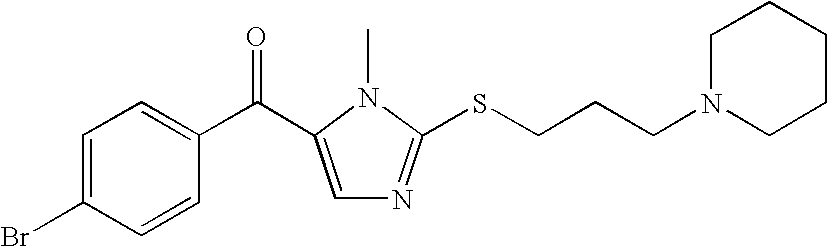


wherein the symbols for the substituents are as defined herein, are prepared with the 2- and 5-substitution regioselectivity as described herein in Schemes XIIIa-b, XIV, XV, the foregoing Examples, and equivalents thereof. The substituents -Lnk1-C(RR1)(AR)-Lnk2-N+(QS1)(QS2)(QS3) and —C(O)-Lnk3-ACS are prepared as described in, for example, U.S. Pat. Nos. 6,380,396 and 6,207,678, Schemes 1-5 therein, and illustrative examples thereof.

K i=(IC 50)/(1+([L]/(K D)).
| Ki Values |
| Ki | ||
| Example | Compound Name | (nM) |
| I | (4-Chloro-phenyl)-[2-(2-dimethylamino-ethyl- | 98 |
| sulfanyl)-3-methyl-3H-imidazol-4-yl]-methanone | ||
| II | (4-Chlorophenyl)-[2-(3-dimethylamino- | 2 |
| propylsulfanyl)-3-methyl-3H-imidazol-4-yl]- | ||
| methanone | ||
| II | (4-Chlorophenyl)-[3-methyl-2-(3-piperidin-1-yl- | 3.1 |
| propylsulfanyl)-3H-imidazol-4-yl]-methanone | ||
| III | (4-Bromophenyl)-[3-methyl-2-(3-piperidin-1-yl- | 7.5 |
| propylsulfanyl)-3H-imidazol-4-yl]-methanone | ||
| III | (4-Bromophenyl)-[2-(3-dimethylamino- | 1.6 |
| propylsulfanyl)-3-methyl-3H-imidazol-4-yl]- | ||
| methanone | ||
| IV | (4-Chlorophenyl)-{3-methyl-2-[2-(1-methylpyrrolidin- | 2 |
| 2-yl)-ethylsulfanyl]-3H-imidazol-4-yl}-methanone | ||
| IV | [2-(3-Dimethylamino-propylsulfanyl)-3-methyl-3H- | 4 |
| imidazol-4-yl]-phenyl-methanone | ||
| IV | (4-Chlorophenyl)-[3-methyl-2-(1-methyl-piperidin-4- | 7 |
| ylsulfanyl)-3H-imidazol-4-yl]-methanone | ||
| V | (4-Chloro-phenyl)-[2-(1-isopropyl-piperidin-4- | 3.7 |
| ylmethoxy)-3-methyl-3H-imidazol-4-yl]-methanone | ||
| V | (4-Chlorophenyl)-[3-methyl-2-(3-piperidin-1-yl- | 32 |
| propylamino)-3H-imidazol-4-yl]-methanone | ||
| V | (4-Bromophenyl)-[2-(1-isopropyl-piperidin-4- | 5.3 |
| ylmethoxy)-3-methyl-3H-imidazol-4-yl]-methanone | ||
| V | (4-Bromophenyl)-[2-(1-ethyl-piperidin-4-ylmethoxy)- | 6.6 |
| 3-methyl-3H-imidazol-4-yl]-methanone | ||
| V | (4-Bromophenyl)-[2-(1-sec-butyl-piperidin-4- | 9 |
| ylmethoxy)-3-methyl-3H-imidazol-4-yl]-methanone | ||
| XI | (4-Chlorophenyl)-[2-(1-isopropyl-piperidin-4-yloxy)-3- | 25 |
| methyl-3H-imidazol-4-yl]-methanone | ||
| XI | (4-Chlorophenyl)-[2-(1-isopropyl-piperidin-4- | 3 |
| ylsulfanyl)-3-methyl-3H-imidazol-4-yl]-methanone | ||
| XII | [3-Methyl-2-(3-piperidin-1-yl-propoxy)-3H- | 79 |
| imidazol-4-yl]-naphthalen-1-yl-methanone | ||
| XII | (2-Chlorophenyl)-[2-(1-isopropyl-piperidin-4- | 1.3 |
| ylmethoxy)-3-methyl-3H-imidazol-4-yl]-methanone | ||
| XII | (4-Fluorophenyl)-[2-(1-isopropyl-piperidin-4- | 2.5 |
| ylmethoxy)-3-methyl-3H-imidazol-4-yl]-methanone | ||
| XII | (3-Chlorophenyl)-[2-(1-isopropyl-piperidin-4- | 2.8 |
| ylmethoxy)-3-methyl-3H-imidazol-4-yl]-methanone | ||
| XII | (3,5-Dichlorophenyl)-[2-(1-isopropyl-piperidin-4- | 4 |
| ylmethoxy)-3-methyl-3H-imidazol-4-yl]-methanone | ||
| XII | [2-(1-Isopropyl-piperidin-4-ylmethoxy)-3-methyl-3H- | 4.1 |
| imidazol-4-yl]-(4-trifluoromethyl-phenyl)-methanone | ||
| XII | [2-(1-Isopropyl-piperidin-4-ylmethoxy)-3-methyl-3H- | 4.6 |
| imidazol-4-yl]-(4-nitro-phenyl)-methanone | ||
| XII | 4-{Hydroxy-[2-(1-isopropyl-piperidin-4-ylmethoxy)-3- | 7.6 |
| methyl-3H-imidazol-4-yl]-methyl}-benzonitrile | ||
| XIII | {3-[5-(4-Chlorobenzyl)-1-methyl-1H-imidazol-2- | 22 |
| ylsulfanyl]-propyl}-dimethyl-amine | ||
| XIV | (4-Chlorophenyl)-[2-(3-dimethylamino- | 3.2 |
| propylsulfanyl)-3-methyl-3H-imidazol-4-yl]- | ||
| methanone oxime | ||
| XV | [3-Methyl-2-(3-piperidin-1-yl-propoxy)-3H- | 36.4 |
| imidazol-4-yl]-piperidin-1-yl-methane | ||
| XVI | (4-Chlorophenyl)-[2-(3-dimethylamino-propane-1- | 315 |
| sulfinyl)-3-methyl-3H-imidazol-4-yl]-methanone | ||
Claims (5)


Priority Applications (1)
| Application Number | Priority Date | Filing Date | Title |
|---|---|---|---|
| US12/364,089 US7807837B2 (en) | 2004-05-07 | 2009-02-02 | Scalable synthesis of imidazole derivatives |
Applications Claiming Priority (3)
| Application Number | Priority Date | Filing Date | Title |
|---|---|---|---|
| US56940504P | 2004-05-07 | 2004-05-07 | |
| US11/123,631 US7507756B2 (en) | 2004-05-07 | 2005-05-06 | Scalable synthesis of imidazole derivatives |
| US12/364,089 US7807837B2 (en) | 2004-05-07 | 2009-02-02 | Scalable synthesis of imidazole derivatives |
Related Parent Applications (1)
| Application Number | Title | Priority Date | Filing Date |
|---|---|---|---|
| US11/123,631 Division US7507756B2 (en) | 2004-05-07 | 2005-05-06 | Scalable synthesis of imidazole derivatives |
Publications (2)
| Publication Number | Publication Date |
|---|---|
| US20090143591A1 US20090143591A1 (en) | 2009-06-04 |
| US7807837B2 true US7807837B2 (en) | 2010-10-05 |
Family
ID=35394115
Family Applications (2)
| Application Number | Title | Priority Date | Filing Date |
|---|---|---|---|
| US11/123,631 Active 2026-08-20 US7507756B2 (en) | 2004-05-07 | 2005-05-06 | Scalable synthesis of imidazole derivatives |
| US12/364,089 Expired - Fee Related US7807837B2 (en) | 2004-05-07 | 2009-02-02 | Scalable synthesis of imidazole derivatives |
Family Applications Before (1)
| Application Number | Title | Priority Date | Filing Date |
|---|---|---|---|
| US11/123,631 Active 2026-08-20 US7507756B2 (en) | 2004-05-07 | 2005-05-06 | Scalable synthesis of imidazole derivatives |
Country Status (6)
| Country | Link |
|---|---|
| US (2) | US7507756B2 (en) |
| EP (1) | EP1747203A4 (en) |
| JP (1) | JP2007536270A (en) |
| CN (1) | CN1980896A (en) |
| AU (1) | AU2005243153A1 (en) |
| WO (1) | WO2005110998A1 (en) |
Cited By (1)
| Publication number | Priority date | Publication date | Assignee | Title |
|---|---|---|---|---|
| US20080200479A1 (en) * | 2005-02-24 | 2008-08-21 | Stefano Biondi | Ocaperidone Salts and Pharmaceutical Compositions Containing the Same |
Families Citing this family (1)
| Publication number | Priority date | Publication date | Assignee | Title |
|---|---|---|---|---|
| DE60224509T2 (en) * | 2001-03-29 | 2009-03-05 | Ortho-Mcneil-Janssen Pharmaceuticals, Inc. | IMIDAZOLE DERIVATIVES USE AS HISTAMINE H3 RECEPTOR LIGANDS |
Citations (9)
| Publication number | Priority date | Publication date | Assignee | Title |
|---|---|---|---|---|
| JPS63239273A (en) | 1986-11-28 | 1988-10-05 | Mitsui Petrochem Ind Ltd | Phenylimidazole derivative |
| US5217986A (en) | 1992-03-26 | 1993-06-08 | Harbor Branch Oceanographic Institution, Inc. | Anti-allergy agent |
| US5352707A (en) | 1992-03-26 | 1994-10-04 | Harbor Branch Oceanographic Institution, Inc. | Method for treating airway congestion |
| US5869479A (en) | 1997-08-14 | 1999-02-09 | Schering Corporation | Treatment of upper airway allergic responses |
| WO1999042458A1 (en) | 1998-02-19 | 1999-08-26 | James Black Foundation Limited | Histamine h3 receptor ligands |
| EP0978512A1 (en) | 1998-07-29 | 2000-02-09 | Societe Civile Bioprojet | Non-imidazole aryloxy (or arylthio) alkylamines as histamine H3-receptor antagonists and their therapeutic applications |
| US6207678B1 (en) | 1997-06-18 | 2001-03-27 | Pfizer Inc | Quaternary ammonium compounds as tachykinin antagonists |
| WO2002076925A2 (en) | 2001-03-23 | 2002-10-03 | Eli Lilly And Company | Non-imidazole aryl alkylamines compounds as histamine h3 receptor antagonists, preparation and therapeutic uses |
| WO2002079168A1 (en) | 2001-03-29 | 2002-10-10 | Ortho Mcneil Pharmaceutical, Inc. | Imidazolyl derivatives useful as histamine h3 receptor ligands |
-
2005
- 2005-05-06 US US11/123,631 patent/US7507756B2/en active Active
- 2005-05-06 CN CNA2005800225964A patent/CN1980896A/en active Pending
- 2005-05-06 WO PCT/US2005/016041 patent/WO2005110998A1/en not_active Ceased
- 2005-05-06 JP JP2007511673A patent/JP2007536270A/en not_active Withdrawn
- 2005-05-06 EP EP05746296A patent/EP1747203A4/en not_active Withdrawn
- 2005-05-06 AU AU2005243153A patent/AU2005243153A1/en not_active Abandoned
-
2009
- 2009-02-02 US US12/364,089 patent/US7807837B2/en not_active Expired - Fee Related
Patent Citations (12)
| Publication number | Priority date | Publication date | Assignee | Title |
|---|---|---|---|---|
| JPS63239273A (en) | 1986-11-28 | 1988-10-05 | Mitsui Petrochem Ind Ltd | Phenylimidazole derivative |
| US5217986A (en) | 1992-03-26 | 1993-06-08 | Harbor Branch Oceanographic Institution, Inc. | Anti-allergy agent |
| US5352707A (en) | 1992-03-26 | 1994-10-04 | Harbor Branch Oceanographic Institution, Inc. | Method for treating airway congestion |
| US6207678B1 (en) | 1997-06-18 | 2001-03-27 | Pfizer Inc | Quaternary ammonium compounds as tachykinin antagonists |
| US6380396B1 (en) | 1997-06-18 | 2002-04-30 | Pfizer Inc. | Quaternary ammonium compounds |
| US5869479A (en) | 1997-08-14 | 1999-02-09 | Schering Corporation | Treatment of upper airway allergic responses |
| WO1999042458A1 (en) | 1998-02-19 | 1999-08-26 | James Black Foundation Limited | Histamine h3 receptor ligands |
| EP0978512A1 (en) | 1998-07-29 | 2000-02-09 | Societe Civile Bioprojet | Non-imidazole aryloxy (or arylthio) alkylamines as histamine H3-receptor antagonists and their therapeutic applications |
| WO2002076925A2 (en) | 2001-03-23 | 2002-10-03 | Eli Lilly And Company | Non-imidazole aryl alkylamines compounds as histamine h3 receptor antagonists, preparation and therapeutic uses |
| WO2002079168A1 (en) | 2001-03-29 | 2002-10-10 | Ortho Mcneil Pharmaceutical, Inc. | Imidazolyl derivatives useful as histamine h3 receptor ligands |
| US20020198237A1 (en) | 2001-03-29 | 2002-12-26 | Michael Bogenstaetter | Heterocyclic compounds |
| US7265135B2 (en) | 2001-03-29 | 2007-09-04 | Ortho-Mcneil Pharmaceutical, Inc. | 2-oxy, 2-amino, and 2-thio-imidazole compounds |
Non-Patent Citations (62)
| Title |
|---|
| Arrang, J.M. et al.: Auto-inhibition of Brain Histamine Release Mediated by a Novel Class (H3) of Histamine Receptor. Nature (1983) 302: 832-837. |
| Ash, A.S.F et al.: Receptors Mediating Some Actions of Histamine. Br. J. Pharmac. Chemother. (1966) 27: 427-439. |
| Barnes, J.C. et al.: The Selective Histamine H3 Receptor Antagonist Thioperamide Improves Cognition and Enhances Hippocampal Acetylcholine Release in Vivo. Soc. Neurosci. Abstr. (1993) 19: 1813. |
| Black, J.W. et al.: Definition and Antagonism of Histamine H2-Receptors. Nature (1972) 236: 385-390. |
| Boga, C. et al.: A New Synthesis of Chloroheterocycles via Metal-Halogen Exchange between Trichloroacetyl Derivatives and Heteroaromatic Lithium and Grignard Reagents. J. Organomet. Chem. (1999) 588: 155-159. |
| Boga, C. et al.: Tetrahalogenomethanes: Simple Reagents for the Synthesis of Monochalogenated and Mixed Dihalogenated Aromatic Heterocycles via Metal-Halogen Exchange from Lithium Compounds. J. Organomet. Chem. (2000) 601: 233-236. |
| Bundgaard H Design of Prodrugs H. Budgaard Ed. 1985. |
| Ding, Y.-S et al.: Synthesis of High Specific Activity (+) and (-)-6[18F]-Fluoronorepinephrine via the Nucleophilic Aromatic Substitution Reaction. J. Med. Chem. (1991) 34: 767-771. |
| Ding, Y.-S et al.: Synthesis of High Specific Activity (+) and (−)-6[18F]-Fluoronorepinephrine via the Nucleophilic Aromatic Substitution Reaction. J. Med. Chem. (1991) 34: 767-771. |
| Eriksen et al., "Synthesis of 2-Substituted-1-Hydroxyimidazoles Through Directed Lithiation" Journal of Organic Chemistry 1998 vol. 63(1) pp. 12-16. |
| Eriksen, B.L. et al.: Synthesis of 4-and 5-Substituted 1-Hydroxyimidazoles through Directed Lithiation and Metal-Halogen Exchange. J. Org. Chem. (2001) 66:8344-8348. |
| European Supplementary Search Report for corresponding EP 05746296.2 mailed on Mar. 19, 2009. |
| Ganellin, C.R. et al.: Synthesis of Potent Non-Imidazole Histamine H3-Receptor Antagonists. Arch. Pharm. Pharm. Med. Chem. (Weinheim, Ger.) (1998) 331: 395-404. |
| Garbarg, M. et al.: S-[2-(4-Imidazolyl)ethyl]isothiourea, a Highly Specific and Potent Histamine H3 Receptor Agonist. J. Pharmacol. Exp. Ther. (1992) 263(1):304-310. |
| Gewald, K. et al.: 4-Amino-imidazole durch Thorpe-Cyclisierung. Monatsh. Chem. (1976) 107: 1413-1421. (Note: This article is not in English. Look to the tables and drawings for relevance.). |
| Gilatech, Inc. Press Release: Nov. 5, 1998. |
| Gilman, H. et al.: Some Factors Affecting Halogen-Metal Interconversions. J. Am. Chem. Soc. (1940) 62: 1843-1846. |
| Greene & Wuts Protective Groups in Organic Synthesis 3RD Ed John Wiley and Sons 1999. |
| Grimmett, M.R.: Imidazoles. In Comprehensive Heterocyclic Chemistry II, A Review of the Literature 1982-1995; Katritsky, A.R. et al., Eds.; Elsevier: Tarrytown, NY, (1996) 3: 136-139. |
| Ichinose, M. et al.: Histamine H3-Receptors Modulate Nonadrenergic Noncholinergic Neural Bronchoconstriction in Guinea-Pig In Vivo. Eur. J. Pharmacol. (1989) 174(1): 49-55. |
| Imamura, M. et al.: Unmasking of Activated Histamine H3-Receptors in Myocardial Ischemia: Their Role as Regulators of Exocytotic Norepinephrine Release. J. Pharmacol. Exp. Ther. (1994) 271(3): 1259-1266. |
| Imbach, J.L. et al.: Recherches dans la Serie des Azoles. Synthese de Chloroimidazoles Non N-Substitues. J. Heterocycl. Chem. (1967) 4: 451-452. (Note: This article is not in English. Look to the tables for relevance.). |
| Jarosinski, M.A. et al.: Preparation of Noncondensed 2-Substituted 1-Methylimidazoles via Ipso Substitution Reaction on 2-Sulfinyl or 2-Sulfonyl Derivatives of 4,5-Disubstituted 1-Methylimidazoles. J. Org. Chem. (1991) 56: 4058-4062. |
| Jones, R.G.: Studies on Imidazoles. II. The Synthesis of 5-Imidazolecarboxylates from Glycine and Substituted Glycine Esters. J. Am. Chem. Soc. (1949) 71: 644-647. |
| Korte, A. et al.: Characterization and Tissue Distribution of H3 Histamine Receptors in Guinea Pigs by N alpha-Methylhistamine. Biochem. Biophys. Res. Commun. (1990) 168(3): 979-986. |
| Krause et al.: "Medicinal Chemistry of Histamine H3 Receptor Agonists"; The Histamine H3 Receptor-A Target for New Drugs; Leurs, R. and Timmerman, H., (Eds.), Elsevier, (1998): 175-196. |
| Larock et al Comprehensive Organic Transformations 1989 pp. 397-400, 421-425. |
| Leurs et al "The Histamine H3 Receptor-A Target for New Drugs" Leurs R and Timmernam H Eds Elsevier 1998. |
| Leurs, R. et al.: The Medicinal Chemistry and Therapeutic Potentials of Ligands of the Histamine H3 Receptor; Prog. Drug. Res. (1995) 45: 107-165. |
| Lin, J.-S. et al.: Involvement of Histaminergic Neurons in Arousal Mechanisms Demonstrated with H3-Receptor Ligands in the Cat. Brain Res. (1990) 523: 325-330. |
| Linney, I.D. et al.: Design, Synthesis, and Structure-Activity Relationships of Novel Non-Imidazole Histamine H3 Receptor Antagonists. J. Med. Chem. (2000) 43(12): 2362-2370. |
| Lovenberg, T.W. et al.: Cloning and Functional Expression of the Human Histamine H3 Receptor. Mol. Pharmacol. (1999) 55(6): 1101-1107. |
| Lovenberg, T.W. et al.: Cloning of Rat Histamine H3 Receptor Reveals Distinct Species Pharmacological Profiles. J. Pharmacol. Exp. Ther. (2000) 293(3): 771-778. |
| Machidori, H. et al.: Zucker Obese Rats: Defect in Brain Histamine Control of Feeding; Brain Res. (1992) 590: 180-186. |
| Mani, N.S. et al.: A Scalable Synthesis of a Histamine H3 Receptor Antagonist. J. Org. Chem. (2004) 69: 8115-8117. |
| March et al Advanced Organic Chemistry 4TH Ed 1992 pp. 411-412, and 1200-1201. |
| McLeod, R.L. et al.: Antimigraine and Sedative Activity of SCH 50971: A Novel Orally-Active Histamine H3 Receptor Agonist. Soc. Neurosci. Abstr. (1996) 22: 2010. |
| McOmie Protective Groups in Organic Chemistry Ed. JFW McOmie Plenum Press 1973. |
| Monti, J.M. et al.: Effects of Selective Activation or Blockade of the Histamine H3 Receptor on Sleep and Wakefulness. Eur. J. Pharmacol. (1991) 205(3): 283-287. |
| Morisset, S. et al.: High Constitutive Activity of Native H3 Receptors Regulates Histamine Neurons in Brain. Nature (2000) 408: 860-864. |
| O'Connell et al., Synthesis (1988), (10), 767-71. * |
| Oda, T. et al.: Molecular Cloning and Characterization of a Novel Type of Histamine Receptor Preferentially Expressed in Leukocytes. J. Biol. Chem. (2000) 275(47): 36781-36786. |
| Other News to Note. Bioworld Today (1999) 10(40): 3. |
| Panula, P. et al.: Significant Changes in the Human Brain Histaminergic System in Alzheimer's Disease. Soc. Neurosci. Abstr. (1995) 21: 1977. |
| Phillips, J.G. et al.: Medicinal Chemistry of Histamine H3 Receptor Antagonists. In The Histamine H3 Receptor-A Target for New Drugs. Leurs, R.; Timmerman, H., Eds.; Elsevier: (1998):197-222. |
| Piotrowski, D.W.: A Concise Route to Novel 1-Aryl and 1-Pyridyl-2-Azabicyclo[2.1.1]hexanes. Synlett (1999) 7: 1091-1093. |
| Remington: The Science and Practice of Pharmacy 2000 p. 704 20TH Edition Alfonso Gennaro Ed. |
| Schlicker, E. et al.: The Moderate Affinity of Clozapine at H3 Receptors Is Not Shared by Its Two Major Metabolites and by Structurally Related and Unrelated Atypical Neuroleptics. Naunyn-Schmiedeberg's Arch. Pharmacol. (1996) 353: 290-294. |
| Shrivastava, S.K. et al.: Dextrans-Potential Polymeric Drug Carriers for Flurbiprofen. Pharmazie (2003) 58(6): 389-391. |
| Stark, H. et al.: Developments of Histamine H3-Receptor Antagonists. Drugs Future (1996) 21(5): 507-520. |
| Suzuki, M. et al.: Synthesis of 5-Carbon-Substituted 1-beta-D- Ribofuranosylimidazole-4-carboxamides via Lithiation of a Primary Carboxamide. Chem. Pharm. Bull. (1987) 35(10): 4056-4063. |
| Suzuki, M. et al.: Synthesis of 5-Carbon-Substituted 1-β-D- Ribofuranosylimidazole-4-carboxamides via Lithiation of a Primary Carboxamide. Chem. Pharm. Bull. (1987) 35(10): 4056-4063. |
| Tanaka, H. et al.: A Lithiation Route to C-5 Substitution of an Imidazole Nucleoside and its Application to the Synthesis of 3-Deazaguanosine. Tetrahedron (1986) 42: 1971-1980. |
| Taylor, S.D. et al.; Recent Advances in Electrophilic Fluorination. Tetrahedron (1999) 55: 12431-12477. |
| Terasawa, K. et al.: Cytoxic Activity of 5-Benzoylimidazole and Related Compounds against Human Oral Tumor Cell Lines. Anticancer Res. (2000) 21: 1081-1086. |
| Tozer, M.J. et al.: Histamine H3 Receptor Antagonists. Exp. Opin. Ther. Patents (2000) 10(7):1045-1055. |
| Walczynski, K. et al.: Non-Imidazole Histamine H3 Ligands, Part 2: New 2- Substituted Benzothiazoles as Histamine H3 Antagonists. Arch. Pharm. Pharm. Med. Chem. (Weinheim, Ger.) (1999) 332: 389-398. |
| Walczynski, K. et al.: Non-Imidazole Histamine H3 Ligands. Part I. Synthesis of 2-(1-Piperaziny1)- and 2-(Hexahydro-1H-1,4-diazepin-1-yl)benzothiazole Derivatives as H3-Antagonists with H1 Blocking Activities. Farmaco (1999) 54: 684-694. |
| West, R.E. et al.: Identification of Two H3-Histamine Receptor Subtypes. Mol. Pharmacol. (1990) 38(5): 610-613. |
| West, R.E., Jr. et al.: The Profiles of Human and Primate [3H]N alpha-methylhistamine Binding Differ from That of Rodents. Eur. J. Pharmacol. (1999) 377: 233-239. |
| Yashioka, H. et al.: New Synthetic Route to Imadazol[4,5-c]pyridines by the Thermal Electrocyclic Reaction of 1-Azahexatriene Systems. Heterocycles (1995) 41(1): 161-174. |
| Yokoyama, H. et al.: Effect of Thioperamide, a Histamine H3 Receptor Antagonist, on Electrically Induced Convulsions in Mice. Eur. J. Pharmacol. (1993) 234:129-133. |
Cited By (1)
| Publication number | Priority date | Publication date | Assignee | Title |
|---|---|---|---|---|
| US20080200479A1 (en) * | 2005-02-24 | 2008-08-21 | Stefano Biondi | Ocaperidone Salts and Pharmaceutical Compositions Containing the Same |
Also Published As
| Publication number | Publication date |
|---|---|
| US20090143591A1 (en) | 2009-06-04 |
| US20050250948A1 (en) | 2005-11-10 |
| US7507756B2 (en) | 2009-03-24 |
| EP1747203A4 (en) | 2009-04-22 |
| AU2005243153A1 (en) | 2005-11-24 |
| WO2005110998A1 (en) | 2005-11-24 |
| JP2007536270A (en) | 2007-12-13 |
| EP1747203A1 (en) | 2007-01-31 |
| CN1980896A (en) | 2007-06-13 |
Similar Documents
| Publication | Publication Date | Title |
|---|---|---|
| US7241778B2 (en) | Non-imidazole aryloxypiperidines | |
| US7186732B2 (en) | Non-imidazole aryloxyalkylamines | |
| AU2001281121A1 (en) | Non-imidazole aryloxypiperidines as H3 receptor ligands | |
| US20080004314A1 (en) | Phenylpiperidines and Phenylpyrrolidines | |
| AU2001284733A1 (en) | Non-imidazole aryloxyalkylamines as H3 receptor ligands | |
| US20010044439A1 (en) | Method for using 2-aryloxyalkylaminobenzoxazoles and 2-aryloxyalkylaminobenzothiazoles as H3 antagonists | |
| WO2001074813A2 (en) | METHOD FOR USING 2- OR 3-ARYL SUBSTITUTED IMIDAZO[1,2-a] PYRIDINES AS H3 ANTAGONISTS | |
| DE60101906T2 (en) | PHENYL-SUBSTITUTED INDOLICINE DERIVATIVES AND THE USE THEREOF AS HISTAMINE H3 LIGANDS | |
| US7807837B2 (en) | Scalable synthesis of imidazole derivatives | |
| US6884803B2 (en) | Phenylalkynes | |
| US7288540B2 (en) | Phenylalkynes | |
| CA2507875A1 (en) | Methods for preparing phenylalkyne derivatives |
Legal Events
| Date | Code | Title | Description |
|---|---|---|---|
| AS | Assignment |
Owner name: JANSSEN PHARMACEUTICA NV, BELGIUM Free format text: ASSIGNMENT OF ASSIGNORS INTEREST;ASSIGNORS:JONES, TODD K.;MANI, NEELAKANDHA;REEL/FRAME:023293/0494 Effective date: 20050505 |
|
| STCF | Information on status: patent grant |
Free format text: PATENTED CASE |
|
| FPAY | Fee payment |
Year of fee payment: 4 |
|
| MAFP | Maintenance fee payment |
Free format text: PAYMENT OF MAINTENANCE FEE, 8TH YEAR, LARGE ENTITY (ORIGINAL EVENT CODE: M1552) Year of fee payment: 8 |
|
| FEPP | Fee payment procedure |
Free format text: MAINTENANCE FEE REMINDER MAILED (ORIGINAL EVENT CODE: REM.); ENTITY STATUS OF PATENT OWNER: LARGE ENTITY |
|
| LAPS | Lapse for failure to pay maintenance fees |
Free format text: PATENT EXPIRED FOR FAILURE TO PAY MAINTENANCE FEES (ORIGINAL EVENT CODE: EXP.); ENTITY STATUS OF PATENT OWNER: LARGE ENTITY |
|
| STCH | Information on status: patent discontinuation |
Free format text: PATENT EXPIRED DUE TO NONPAYMENT OF MAINTENANCE FEES UNDER 37 CFR 1.362 |
|
| FP | Lapsed due to failure to pay maintenance fee |
Effective date: 20221005 |