US7807223B2 - Precursors having open ligands for ruthenium containing films deposition - Google Patents
Precursors having open ligands for ruthenium containing films deposition Download PDFInfo
- Publication number
- US7807223B2 US7807223B2 US11/835,968 US83596807A US7807223B2 US 7807223 B2 US7807223 B2 US 7807223B2 US 83596807 A US83596807 A US 83596807A US 7807223 B2 US7807223 B2 US 7807223B2
- Authority
- US
- United States
- Prior art keywords
- ruthenium
- group
- precursors
- precursor
- deposition
- Prior art date
- Legal status (The legal status is an assumption and is not a legal conclusion. Google has not performed a legal analysis and makes no representation as to the accuracy of the status listed.)
- Active, expires
Links
- 239000002243 precursor Substances 0.000 title claims abstract description 68
- 229910052707 ruthenium Inorganic materials 0.000 title claims abstract description 56
- KJTLSVCANCCWHF-UHFFFAOYSA-N Ruthenium Chemical compound [Ru] KJTLSVCANCCWHF-UHFFFAOYSA-N 0.000 title claims abstract description 50
- 230000008021 deposition Effects 0.000 title abstract description 21
- 239000003446 ligand Substances 0.000 title description 29
- 239000000203 mixture Substances 0.000 claims abstract description 13
- 238000000151 deposition Methods 0.000 claims description 23
- 239000000758 substrate Substances 0.000 claims description 19
- 229910052739 hydrogen Inorganic materials 0.000 claims description 18
- QVGXLLKOCUKJST-UHFFFAOYSA-N atomic oxygen Chemical compound [O] QVGXLLKOCUKJST-UHFFFAOYSA-N 0.000 claims description 17
- 229910052760 oxygen Inorganic materials 0.000 claims description 17
- 239000001301 oxygen Substances 0.000 claims description 17
- 238000006243 chemical reaction Methods 0.000 claims description 16
- 238000000034 method Methods 0.000 claims description 11
- 239000007789 gas Substances 0.000 claims description 10
- 239000001257 hydrogen Substances 0.000 claims description 10
- TXEYQDLBPFQVAA-UHFFFAOYSA-N tetrafluoromethane Chemical group FC(F)(F)F TXEYQDLBPFQVAA-UHFFFAOYSA-N 0.000 claims description 10
- UFHFLCQGNIYNRP-UHFFFAOYSA-N Hydrogen Chemical compound [H][H] UFHFLCQGNIYNRP-UHFFFAOYSA-N 0.000 claims description 8
- POILWHVDKZOXJZ-ARJAWSKDSA-M (z)-4-oxopent-2-en-2-olate Chemical compound C\C([O-])=C\C(C)=O POILWHVDKZOXJZ-ARJAWSKDSA-M 0.000 claims description 3
- 125000006165 cyclic alkyl group Chemical group 0.000 claims 1
- 125000004122 cyclic group Chemical group 0.000 description 13
- 239000007788 liquid Substances 0.000 description 13
- 150000001875 compounds Chemical class 0.000 description 12
- 239000000376 reactant Substances 0.000 description 12
- 125000003903 2-propenyl group Chemical group [H]C([*])([H])C([H])=C([H])[H] 0.000 description 11
- 239000007983 Tris buffer Substances 0.000 description 10
- 238000000231 atomic layer deposition Methods 0.000 description 8
- 239000012535 impurity Substances 0.000 description 8
- 230000009257 reactivity Effects 0.000 description 8
- WOCIAKWEIIZHES-UHFFFAOYSA-N ruthenium(iv) oxide Chemical compound O=[Ru]=O WOCIAKWEIIZHES-UHFFFAOYSA-N 0.000 description 8
- 125000000217 alkyl group Chemical group 0.000 description 6
- -1 cycloheptadienyl Chemical group 0.000 description 6
- 0 C[Ru]C.Cc1ccc(C)c1.cc(C)cc(c)C Chemical compound C[Ru]C.Cc1ccc(C)c1.cc(C)cc(c)C 0.000 description 5
- 239000000463 material Substances 0.000 description 5
- 230000008569 process Effects 0.000 description 5
- 238000005137 deposition process Methods 0.000 description 4
- 230000008018 melting Effects 0.000 description 4
- 238000002844 melting Methods 0.000 description 4
- 230000003647 oxidation Effects 0.000 description 4
- 238000007254 oxidation reaction Methods 0.000 description 4
- OKTJSMMVPCPJKN-UHFFFAOYSA-N Carbon Chemical compound [C] OKTJSMMVPCPJKN-UHFFFAOYSA-N 0.000 description 3
- VGGSQFUCUMXWEO-UHFFFAOYSA-N Ethene Chemical compound C=C VGGSQFUCUMXWEO-UHFFFAOYSA-N 0.000 description 3
- 239000005977 Ethylene Substances 0.000 description 3
- 230000004888 barrier function Effects 0.000 description 3
- 239000003990 capacitor Substances 0.000 description 3
- 229910052799 carbon Inorganic materials 0.000 description 3
- 125000000058 cyclopentadienyl group Chemical group C1(=CC=CC1)* 0.000 description 3
- ZSWFCLXCOIISFI-UHFFFAOYSA-N endo-cyclopentadiene Natural products C1C=CC=C1 ZSWFCLXCOIISFI-UHFFFAOYSA-N 0.000 description 3
- 150000002431 hydrogen Chemical class 0.000 description 3
- 238000011534 incubation Methods 0.000 description 3
- 239000011261 inert gas Substances 0.000 description 3
- 239000007787 solid Substances 0.000 description 3
- 238000001179 sorption measurement Methods 0.000 description 3
- YRAJNWYBUCUFBD-UHFFFAOYSA-N 2,2,6,6-tetramethylheptane-3,5-dione Chemical compound CC(C)(C)C(=O)CC(=O)C(C)(C)C YRAJNWYBUCUFBD-UHFFFAOYSA-N 0.000 description 2
- XKRFYHLGVUSROY-UHFFFAOYSA-N Argon Chemical compound [Ar] XKRFYHLGVUSROY-UHFFFAOYSA-N 0.000 description 2
- IJGRMHOSHXDMSA-UHFFFAOYSA-N Atomic nitrogen Chemical compound N#N IJGRMHOSHXDMSA-UHFFFAOYSA-N 0.000 description 2
- KAKZBPTYRLMSJV-UHFFFAOYSA-N Butadiene Chemical compound C=CC=C KAKZBPTYRLMSJV-UHFFFAOYSA-N 0.000 description 2
- RYGMFSIKBFXOCR-UHFFFAOYSA-N Copper Chemical compound [Cu] RYGMFSIKBFXOCR-UHFFFAOYSA-N 0.000 description 2
- YCKRFDGAMUMZLT-UHFFFAOYSA-N Fluorine atom Chemical compound [F] YCKRFDGAMUMZLT-UHFFFAOYSA-N 0.000 description 2
- CUJRVFIICFDLGR-UHFFFAOYSA-N acetylacetonate Chemical compound CC(=O)[CH-]C(C)=O CUJRVFIICFDLGR-UHFFFAOYSA-N 0.000 description 2
- 229910052454 barium strontium titanate Inorganic materials 0.000 description 2
- 230000015572 biosynthetic process Effects 0.000 description 2
- 230000005587 bubbling Effects 0.000 description 2
- 125000004432 carbon atom Chemical group C* 0.000 description 2
- 125000002915 carbonyl group Chemical group [*:2]C([*:1])=O 0.000 description 2
- 239000012159 carrier gas Substances 0.000 description 2
- 229910052802 copper Inorganic materials 0.000 description 2
- 239000010949 copper Substances 0.000 description 2
- MGNZXYYWBUKAII-UHFFFAOYSA-N cyclohexa-1,3-diene Chemical compound C1CC=CC=C1 MGNZXYYWBUKAII-UHFFFAOYSA-N 0.000 description 2
- 125000003678 cyclohexadienyl group Chemical group C1(=CC=CCC1)* 0.000 description 2
- 229910052731 fluorine Inorganic materials 0.000 description 2
- 239000011737 fluorine Substances 0.000 description 2
- 238000002347 injection Methods 0.000 description 2
- 239000007924 injection Substances 0.000 description 2
- 238000004519 manufacturing process Methods 0.000 description 2
- 229910052751 metal Inorganic materials 0.000 description 2
- 239000002184 metal Substances 0.000 description 2
- 125000002524 organometallic group Chemical group 0.000 description 2
- 230000001590 oxidative effect Effects 0.000 description 2
- TWNQGVIAIRXVLR-UHFFFAOYSA-N oxo(oxoalumanyloxy)alumane Chemical compound O=[Al]O[Al]=O TWNQGVIAIRXVLR-UHFFFAOYSA-N 0.000 description 2
- 125000004430 oxygen atom Chemical group O* 0.000 description 2
- BPUBBGLMJRNUCC-UHFFFAOYSA-N oxygen(2-);tantalum(5+) Chemical compound [O-2].[O-2].[O-2].[O-2].[O-2].[Ta+5].[Ta+5] BPUBBGLMJRNUCC-UHFFFAOYSA-N 0.000 description 2
- BASFCYQUMIYNBI-UHFFFAOYSA-N platinum Chemical class [Pt] BASFCYQUMIYNBI-UHFFFAOYSA-N 0.000 description 2
- 230000001603 reducing effect Effects 0.000 description 2
- 150000003304 ruthenium compounds Chemical class 0.000 description 2
- 229910001925 ruthenium oxide Inorganic materials 0.000 description 2
- 239000004065 semiconductor Substances 0.000 description 2
- 239000002904 solvent Substances 0.000 description 2
- 239000000126 substance Substances 0.000 description 2
- RRKODOZNUZCUBN-CCAGOZQPSA-N (1z,3z)-cycloocta-1,3-diene Chemical compound C1CC\C=C/C=C\C1 RRKODOZNUZCUBN-CCAGOZQPSA-N 0.000 description 1
- IQSUNBLELDRPEY-UHFFFAOYSA-N 1-ethylcyclopenta-1,3-diene Chemical compound CCC1=CC=CC1 IQSUNBLELDRPEY-UHFFFAOYSA-N 0.000 description 1
- WYILUGVDWAFRSG-UHFFFAOYSA-N 2,4-dimethylpenta-1,3-diene;ruthenium(2+) Chemical compound [Ru+2].CC(C)=CC(C)=[CH-].CC(C)=CC(C)=[CH-] WYILUGVDWAFRSG-UHFFFAOYSA-N 0.000 description 1
- OXJUCLBTTSNHOF-UHFFFAOYSA-N 5-ethylcyclopenta-1,3-diene;ruthenium(2+) Chemical compound [Ru+2].CC[C-]1C=CC=C1.CC[C-]1C=CC=C1 OXJUCLBTTSNHOF-UHFFFAOYSA-N 0.000 description 1
- XKPKIWQIAHUJHM-UHFFFAOYSA-N C.C#C.C#CC.C#CC#CC.C#CC#CC#C.CC#CC.CC1CCCCC1.C[Ru] Chemical compound C.C#C.C#CC.C#CC#CC.C#CC#CC#C.CC#CC.CC1CCCCC1.C[Ru] XKPKIWQIAHUJHM-UHFFFAOYSA-N 0.000 description 1
- IYFYSCSZQHSUDS-SUESZSCISA-N C1=C\CC/C=C\CC/1.C=[Ru](C(=C)(=C)C)C(=C)(=C)C Chemical compound C1=C\CC/C=C\CC/1.C=[Ru](C(=C)(=C)C)C(=C)(=C)C IYFYSCSZQHSUDS-SUESZSCISA-N 0.000 description 1
- XOSBQSGUNCVAIL-UHFFFAOYSA-N CC(=C[Ru]C1(C=CC=C1)CC)C=C(C)C Chemical compound CC(=C[Ru]C1(C=CC=C1)CC)C=C(C)C XOSBQSGUNCVAIL-UHFFFAOYSA-N 0.000 description 1
- ADIFCHBANOPQIB-UHFFFAOYSA-N CC(C)=CC(C)=C[Ru]C1(C)C=CC(C)=C1 Chemical compound CC(C)=CC(C)=C[Ru]C1(C)C=CC(C)=C1 ADIFCHBANOPQIB-UHFFFAOYSA-N 0.000 description 1
- XAZKFISIRYLAEE-UHFFFAOYSA-N CC1CC(C)CC1 Chemical compound CC1CC(C)CC1 XAZKFISIRYLAEE-UHFFFAOYSA-N 0.000 description 1
- BOQKGWFIYQVXMG-UHFFFAOYSA-N CCC([Ru]C(CC)=CC=CC)=CC=CC Chemical compound CCC([Ru]C(CC)=CC=CC)=CC=CC BOQKGWFIYQVXMG-UHFFFAOYSA-N 0.000 description 1
- VCGPIYJKZKYARY-UHFFFAOYSA-N CCC.CCC.CCC.C[Ru](C)C Chemical compound CCC.CCC.CCC.C[Ru](C)C VCGPIYJKZKYARY-UHFFFAOYSA-N 0.000 description 1
- RTZXYYPUQWXORL-UHFFFAOYSA-N CCC.CCC.C[Ru](C)(C=O)C=O Chemical compound CCC.CCC.C[Ru](C)(C=O)C=O RTZXYYPUQWXORL-UHFFFAOYSA-N 0.000 description 1
- CBENFWSGALASAD-UHFFFAOYSA-N Ozone Chemical compound [O-][O+]=O CBENFWSGALASAD-UHFFFAOYSA-N 0.000 description 1
- WYURNTSHIVDZCO-UHFFFAOYSA-N Tetrahydrofuran Chemical compound C1CCOC1 WYURNTSHIVDZCO-UHFFFAOYSA-N 0.000 description 1
- 229910052782 aluminium Inorganic materials 0.000 description 1
- XAGFODPZIPBFFR-UHFFFAOYSA-N aluminium Chemical compound [Al] XAGFODPZIPBFFR-UHFFFAOYSA-N 0.000 description 1
- 229910052786 argon Inorganic materials 0.000 description 1
- 125000004429 atom Chemical group 0.000 description 1
- 230000008901 benefit Effects 0.000 description 1
- 239000006227 byproduct Substances 0.000 description 1
- 239000003054 catalyst Substances 0.000 description 1
- 238000005229 chemical vapour deposition Methods 0.000 description 1
- KDUIUFJBNGTBMD-VXMYFEMYSA-N cyclooctatetraene Chemical compound C1=C\C=C/C=C\C=C1 KDUIUFJBNGTBMD-VXMYFEMYSA-N 0.000 description 1
- 125000002433 cyclopentenyl group Chemical group C1(=CCCC1)* 0.000 description 1
- 230000007423 decrease Effects 0.000 description 1
- 230000003247 decreasing effect Effects 0.000 description 1
- 125000004989 dicarbonyl group Chemical group 0.000 description 1
- 238000009792 diffusion process Methods 0.000 description 1
- 229910000449 hafnium oxide Inorganic materials 0.000 description 1
- WIHZLLGSGQNAGK-UHFFFAOYSA-N hafnium(4+);oxygen(2-) Chemical compound [O-2].[O-2].[Hf+4] WIHZLLGSGQNAGK-UHFFFAOYSA-N 0.000 description 1
- 238000010438 heat treatment Methods 0.000 description 1
- 239000001307 helium Substances 0.000 description 1
- 229910052734 helium Inorganic materials 0.000 description 1
- SWQJXJOGLNCZEY-UHFFFAOYSA-N helium atom Chemical compound [He] SWQJXJOGLNCZEY-UHFFFAOYSA-N 0.000 description 1
- 229910000311 lanthanide oxide Inorganic materials 0.000 description 1
- 239000012705 liquid precursor Substances 0.000 description 1
- 150000002736 metal compounds Chemical class 0.000 description 1
- 125000005394 methallyl group Chemical group 0.000 description 1
- 125000002496 methyl group Chemical group [H]C([H])([H])* 0.000 description 1
- 150000004767 nitrides Chemical class 0.000 description 1
- 229910052757 nitrogen Inorganic materials 0.000 description 1
- 229910000510 noble metal Chemical class 0.000 description 1
- SJYNFBVQFBRSIB-UHFFFAOYSA-N norbornadiene Chemical compound C1=CC2C=CC1C2 SJYNFBVQFBRSIB-UHFFFAOYSA-N 0.000 description 1
- 150000002902 organometallic compounds Chemical class 0.000 description 1
- 229910052697 platinum Inorganic materials 0.000 description 1
- 229910021420 polycrystalline silicon Inorganic materials 0.000 description 1
- 229920005591 polysilicon Polymers 0.000 description 1
- 125000002924 primary amino group Chemical group [H]N([H])* 0.000 description 1
- 239000000047 product Substances 0.000 description 1
- 238000010926 purge Methods 0.000 description 1
- 150000003254 radicals Chemical class 0.000 description 1
- FZHCFNGSGGGXEH-UHFFFAOYSA-N ruthenocene Chemical compound [Ru+2].C=1C=C[CH-]C=1.C=1C=C[CH-]C=1 FZHCFNGSGGGXEH-UHFFFAOYSA-N 0.000 description 1
- 229910052710 silicon Inorganic materials 0.000 description 1
- 239000010703 silicon Substances 0.000 description 1
- 238000004544 sputter deposition Methods 0.000 description 1
- LENZDBCJOHFCAS-UHFFFAOYSA-N tris Chemical compound OCC(N)(CO)CO LENZDBCJOHFCAS-UHFFFAOYSA-N 0.000 description 1
- 238000011144 upstream manufacturing Methods 0.000 description 1
Classifications
-
- C—CHEMISTRY; METALLURGY
- C23—COATING METALLIC MATERIAL; COATING MATERIAL WITH METALLIC MATERIAL; CHEMICAL SURFACE TREATMENT; DIFFUSION TREATMENT OF METALLIC MATERIAL; COATING BY VACUUM EVAPORATION, BY SPUTTERING, BY ION IMPLANTATION OR BY CHEMICAL VAPOUR DEPOSITION, IN GENERAL; INHIBITING CORROSION OF METALLIC MATERIAL OR INCRUSTATION IN GENERAL
- C23C—COATING METALLIC MATERIAL; COATING MATERIAL WITH METALLIC MATERIAL; SURFACE TREATMENT OF METALLIC MATERIAL BY DIFFUSION INTO THE SURFACE, BY CHEMICAL CONVERSION OR SUBSTITUTION; COATING BY VACUUM EVAPORATION, BY SPUTTERING, BY ION IMPLANTATION OR BY CHEMICAL VAPOUR DEPOSITION, IN GENERAL
- C23C16/00—Chemical coating by decomposition of gaseous compounds, without leaving reaction products of surface material in the coating, i.e. chemical vapour deposition [CVD] processes
- C23C16/06—Chemical coating by decomposition of gaseous compounds, without leaving reaction products of surface material in the coating, i.e. chemical vapour deposition [CVD] processes characterised by the deposition of metallic material
- C23C16/18—Chemical coating by decomposition of gaseous compounds, without leaving reaction products of surface material in the coating, i.e. chemical vapour deposition [CVD] processes characterised by the deposition of metallic material from metallo-organic compounds
-
- C—CHEMISTRY; METALLURGY
- C07—ORGANIC CHEMISTRY
- C07F—ACYCLIC, CARBOCYCLIC OR HETEROCYCLIC COMPOUNDS CONTAINING ELEMENTS OTHER THAN CARBON, HYDROGEN, HALOGEN, OXYGEN, NITROGEN, SULFUR, SELENIUM OR TELLURIUM
- C07F15/00—Compounds containing elements of Groups 8, 9, 10 or 18 of the Periodic Table
- C07F15/0006—Compounds containing elements of Groups 8, 9, 10 or 18 of the Periodic Table compounds of the platinum group
- C07F15/0046—Ruthenium compounds
-
- C—CHEMISTRY; METALLURGY
- C07—ORGANIC CHEMISTRY
- C07F—ACYCLIC, CARBOCYCLIC OR HETEROCYCLIC COMPOUNDS CONTAINING ELEMENTS OTHER THAN CARBON, HYDROGEN, HALOGEN, OXYGEN, NITROGEN, SULFUR, SELENIUM OR TELLURIUM
- C07F15/00—Compounds containing elements of Groups 8, 9, 10 or 18 of the Periodic Table
- C07F15/0006—Compounds containing elements of Groups 8, 9, 10 or 18 of the Periodic Table compounds of the platinum group
- C07F15/0046—Ruthenium compounds
- C07F15/0053—Ruthenium compounds without a metal-carbon linkage
-
- C—CHEMISTRY; METALLURGY
- C07—ORGANIC CHEMISTRY
- C07F—ACYCLIC, CARBOCYCLIC OR HETEROCYCLIC COMPOUNDS CONTAINING ELEMENTS OTHER THAN CARBON, HYDROGEN, HALOGEN, OXYGEN, NITROGEN, SULFUR, SELENIUM OR TELLURIUM
- C07F17/00—Metallocenes
- C07F17/02—Metallocenes of metals of Groups 8, 9 or 10 of the Periodic Table
-
- C—CHEMISTRY; METALLURGY
- C23—COATING METALLIC MATERIAL; COATING MATERIAL WITH METALLIC MATERIAL; CHEMICAL SURFACE TREATMENT; DIFFUSION TREATMENT OF METALLIC MATERIAL; COATING BY VACUUM EVAPORATION, BY SPUTTERING, BY ION IMPLANTATION OR BY CHEMICAL VAPOUR DEPOSITION, IN GENERAL; INHIBITING CORROSION OF METALLIC MATERIAL OR INCRUSTATION IN GENERAL
- C23C—COATING METALLIC MATERIAL; COATING MATERIAL WITH METALLIC MATERIAL; SURFACE TREATMENT OF METALLIC MATERIAL BY DIFFUSION INTO THE SURFACE, BY CHEMICAL CONVERSION OR SUBSTITUTION; COATING BY VACUUM EVAPORATION, BY SPUTTERING, BY ION IMPLANTATION OR BY CHEMICAL VAPOUR DEPOSITION, IN GENERAL
- C23C16/00—Chemical coating by decomposition of gaseous compounds, without leaving reaction products of surface material in the coating, i.e. chemical vapour deposition [CVD] processes
- C23C16/22—Chemical coating by decomposition of gaseous compounds, without leaving reaction products of surface material in the coating, i.e. chemical vapour deposition [CVD] processes characterised by the deposition of inorganic material, other than metallic material
- C23C16/30—Deposition of compounds, mixtures or solid solutions, e.g. borides, carbides, nitrides
- C23C16/40—Oxides
- C23C16/406—Oxides of iron group metals
Definitions
- the invention relates to ruthenium precursors for ruthenium containing film deposition which are useful in semi-conductor fabrication.
- Ruthenium is one of the most promising materials for capacitor electrodes for the next generation DRAM devices, as well as for barrier and/or seed layers between a copper layer and a Low-k dielectric layer.
- high dielectric constant (high k) materials such as aluminum oxide (Al 2 O 3 ) tantalum pentaoxide (Ta 2 O 5 ) hafnium oxide and related materials, or Barium Strontium Titanate (BST) are used in capacitor cells and the process uses temperature up to 600° C. At such temperatures the oxidation of polysilicon, silicon, or aluminum occurs leading to capacitance loss.
- Ruthenium, as well as ruthenium oxide have both high oxidation resistance and high electrical conductivity, and can be used as a capacitor electrode and an effective barrier against oxygen diffusion.
- Ruthenium is also used as a gate metal for lanthanide oxide. Besides, it is easily dry etched by ozone or by plasma techniques with oxygen, which is not the case of platinum and other noble metal compounds. Ruthenium may also be used as a barrier layer and a seed layer to separate a low-k material layer from an electrochemically deposited copper.
- ruthenium or ruthenium oxide layers deposition Bis(ethylcyclopentadienyl)Ruthenium, [Ru(EtCp) 2 ], pure or dissolved in a solvent (e.g. tetrahydrofurane), is frequently used as a precursor: It is liquid at room temperature, with a vapor pressure of 0.1 Torr at 75° C. Ru or RuO 2 films are usually deposited using this precursor by CVD at temperatures between 300° C. to 400° C., and more recently by Atomic Layer Deposition (ALD), using oxygen as a reactant.
- ALD Atomic Layer Deposition
- Ruthenocene which has a melting point around 200° C., is also one of the precursors frequently used to deposit Ru or RuO 2 in the same range of temperature as Ru(EtCp) 2 , with the same reactant, by CVD or ALD.
- Tris(2,4-octanedionato)ruthenium [Ru(OD) 3 ] which is liquid at room temperature and has a vapor pressure of 1 Torr at 200° C. is also used as a precursor by CVD deposition in a temperature range around 300° C.
- US 2004/0241321 discloses “sandwiched” precursors, i.e., with the ruthenium atom centered around two of these Op ligands.
- U.S. Pat. No. 6,605,735 discloses “half-sandwich” precursors with the ruthenium atom centered around one Op ligand and one cyclic-type (cyclopentadienyl for instance) ligand (The molecule, whatever the structure, has 18 electrons (8 from the Ru, 5 ⁇ 2 from the Op or Cp) and is thus stable.
- Ruthenium films are often deposited on oxygen sensitive surfaces made of nitrides, or pure metal, such as Ta or TaN. The use of oxygen as a co-reactant is therefore undesired as it results in the partial oxidation of the underlying layer.
- ruthenium precursors for ruthenium containing film deposition selected from the group comprising: Ru(XOp)(XCp), Ru(XOp) 2 , Ru(allyl) 3 , RuX(allyl) 2 , RuX 2 (allyl) 2 , Ru(CO) x (amidinate) y , Ru(diketonate) 2 X 2 , Ru(diketonate) 2 (amidinate) 2 their derivatives and any mixture thereof.
- the precursor used may be a mix of open and cyclic ligands or direct bonds.
- the cyclic or more generally “closed” ligands are rings comprising between 2 and 12 carbon atoms.
- the precursor used shall have double bonds which increase the stability of such precursor.
- the precursor may possibly have no carbon double bond if desired -diene, -triene, -tetraene, or similar bounds are used instead.
- ligands such as cyclopentadienyl, cyclohexadiene, cycloheptadienyl, norbornadiene, cyclooctadienyl, cyclooctatetraene may be used.
- ligands such as cyclopentadienyl, cyclohexadiene, cycloheptadienyl, norbornadiene, cyclooctadienyl, cyclooctatetraene may be used.
- at least, one of the carbon atoms of these closed ligands preferably all of them may independently be bounded with molecules selected from the group comprising H, alkyl groups (C ⁇ 16), perfluorocarbon groups (C X F (2X+1) , C ⁇ 16), amino compounds or any other group that may improve the characteristics of the molecules or of the resulting films.
- Allyl containing precursors are known for example to have a higher volatility than other organometallic compounds.
- the melting point of the various compounds exemplified hereinbelow is lower than 150° C., in order to ease the delivery up to the deposition chamber.
- the melting point of a precursor according to the invention shall be at most equal to 100° C. and more preferably, at most equal to 50° C. or even below room temperature to allow its delivery as a liquid.
- the high reactivity of such precursors enables low temperature deposition and less film impurities.
- the high volatility of the precursors according to the invention also provide high deposition rates and allows no heating of the delivery lines of the precursors.
- the stability of these precursors comprising molecules with an outer shell which is electronically filled is also improved.
- the precursors according to the invention reacts with hydrogen and not oxygen (as those of the prior art), which will prevent them from generating oxygen-containing interface layer between the ruthenium film and the substrate.
- This precursor and more generally the ruthenium compounds of the formula Ru(R 1 R 2 R 3 R 4 R 5 Cp)(R 6 R 7 R 8 R 9 R 10 Op), wherein R 1 to R 10 are independently selected from the group comprising H, C1-C12 linear, branched or cyclic, Perfluorocarbon groups (Generic formula C X F (2X+1) , C ⁇ 16) and, R1 to R5 comprising at least two methyl groups.
- the reactivity of these precursors due to the open pentadienyl ligand, referred to as Op, is increased compared to the reactivity of Ru(EtCp) 2 .
- the growth rate of the film is higher than that obtained with Ru(EtCp) 2 or Ru(MeCp) 2 counterparts, and the purity (due to the presence of a more reactive ligand) is increased.
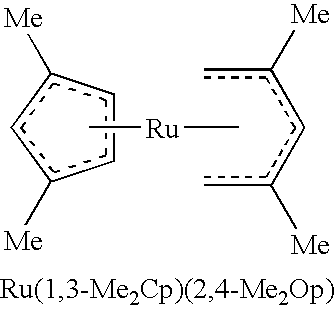
- a preferred example of this type of precursors is (1,3-dimethylcyclopentadienyl) (2,4-dimethylpentadienyl) ruthenium, (1,3-Me 2 Cp) (2,4-Me 2 Op) as represented hereinbelow.
- This precursor is a cost-effective liquid, whereas its counterpart Ru(EtCp)(2,4-Me c Op), (ethylcyclopentadienyl) (2,4-dimethylpenta-dienyl) ruthenium, made of ethylcyclopentadiene is an expensive chemical. It has nevertheless a relatively high vapor pressure (around 0.1 torr at 75° C.).
- R 1 to R 10 are independently selected from the group comprising H, C1-C12 linear, branched or cyclic, with a carbon chain on at least one of the terminal carbons (i.e., R 1 , R 5 , R 6 , R 10 ) and perfluorocarbon groups (Generic formula C X F (2X+1) , C ⁇ 16).
- Bis(1-ethylpentadienyl)ruthenium (as represented hereinbelow) is liquid because of the specific position of the alkyl groups on the pentadienyl and has a higher volatility than known related precursors.
- Bis(2,4-dimethylpentadienyl)ruthenium compound is solid, a drawback when delivery is considered.
- a better disposition of the alkyl group enhances the properties of the precursor: the melting point is decreased and the precursor is liquid.
- the allyl ligand is a 3-electron donor group to the metallorganic complex.
- the use of allyl compounds provides higher vapor pressure than other organometallic complexes and brings higher volatility to the ruthenium tris(allyl) precursor.
- this allyl-containing complex can be used with hydrogen as a co-reactant to form ruthenium film, while oxygen is needed for other organometallics. This will allow deposition of highly pure metallic ruthenium films without oxygen impurities. Not only oxygen will be absent into the ruthenium film, but also it will not react with the substrate, preventing the creation of an undesired oxide thin layer that degrades the device's properties.
- the invention relates to tris(allyl) ruthenium compounds of the formula (R 1 CHCR 2 CHR 3 )(T 1 CHCT 2 CHT 3 )(W 1 CHCW 2 CHW 3 ) Ru, wherein R 1 , R 2 , R 3 , T 1 , T 2 , T 3 , W 1 , W 2 and W 3 are the same or different, independently selected from the group comprising H, C1-C12 linear, branched or cyclic, and perfluorocarbon groups (Generic formula C X F (2X+1) , C ⁇ 16) More particularly, precursors of the invention comprises: tris(1-methylallyl)ruthenium, tris(2-methylallyl)ruthenium and tris(2-ethylallyl)ruthenium precursors, the latter being a liquid.
- 3-electron donor ligands can be considered, including some having a closed structure, providing compounds of the general formula RuX n , where n is the number of ligands, each X being a 3-electron donor independently selected from the group comprising H, C1-C12 linear, branched or cyclic.
- cyclopentenyl can be used.
- Allyl group and its useful properties can also be combined with other groups.
- one allyl group is substituted by a group comprising a 4 electrons donor. This 4-electron donor will enhance the stability of the molecule as an 18 electron complex is formed.
- the invention relates to Bis(allyl)RuX compounds of the formula (R 1 CHCR 2 CHR 3 )(T 1 CHCT 2 CHT 3 )RuX, wherein R 1 , R 2 , R 3 , T 1 , T 2 and T 3 are the same or different, independently selected from the group comprising H,C1-C12 linear, branched or cyclic.
- Perfluorocarbon groups (Generic formula C X F (2X+1) , C ⁇ 16), X being selected from the group comprising cyclooctadiene, aka cod, cht, or butadiene, amidinates or any other 4 electrons donor ligands.
- tris(1-methylallyl)ruthenium tris(2-methylallyl)ruthenium and tris(2-ethylallyl)ruthenium precursors.
- Ru(allyl) 2 (cod) as well as bis(2-methylallyl)(cod), are already knows as catalysts, not as ruthenium precursors for film deposition.
- the formula of this family of precursors can be written as Ru(R 1 HCHCR 2 CHR 3 )(R 4 HCHCR 5 CHR 6 )X 2 , with R 1 to R 6 to be independently selected from the group comprising H, C1-C12 linear, branched or cyclic, and a perfluorocarbon group (generic formula C X F (2X+1) , C ⁇ 16), X being be selected from the group comprising 2-electron donors, such as carbonyl, CNR, R being an low grade alkyl group (C ⁇ 4), and ethylene (R 7 R 8 C ⁇ HCR 9 R 10 ).
- dicarbonyl bis( ⁇ 3 -2-propenyl)ruthenium is a pale yellow liquid.
- the electronic shell of this family is full with 18 electrons, ensuring the stability of such precursors. Vapor pressure of carbonyl containing compounds is usually high.
- the precursors of this family are thus stable, liquid, and highly volatile.
- amidinate ligand whose general formula is R 1 CNC(R′)NCR 2 , generates usually good quality of films from precursors containing this ligand.
- Each radical R i (R 1 , R 2 . . . R′, . . . ) is selected from the group comprising C1-C12 linear, branched or cyclic, a perfluorocarbon group (generic formula C X F (2X+1) , C ⁇ 16).
- the resulting precursors are volatile and stable. Besides, tests have shown that substantially no impurities were present in the resulting films, thereby generating high purity ruthenium films.
- CO can be substituted in the formula by another 2-electron donor such as ethylene (R 5 R 6 C ⁇ CR 7 R 8 ).
- Similar ligands are known, as guadiminate and can be considered as part of the amidinate family and thus apply to the previous example. It is in fact based on the skeleton of the amidinate ligand, but the R′ group is a ligand of the formula N—Z 1 Z 2 , where Zi is independently selected from the group comprising C1-C2 linear, branched or cyclic, and a perfluorocarbon group (generic formula C X F (2X+1) , C ⁇ 16).
- This family of ruthenium precursors under the generic formula Ru(diketonate) 2 X 2 , is composed on one hand by diketonate groups, which is constituted by acac, acetylacetonate, hfac, hexafluoroacetylacetonate, tfac, tetrafluoroacetylacetonate, ofac, octafluorohexadionate, fod, heptafluoro-dimethyloctanedionate, TMHD, tetramethylheptdionate, and DMHD, dimethylheptadionate.
- diketonate groups which is constituted by acac, acetylacetonate, hfac, hexafluoroacetylacetonate, tfac, tetrafluoroacetylacetonate, ofac, octafluorohexa
- the X complex is a 2-electron donor (CNR or ethylene (R 5 R 6 C ⁇ CR 7 R 8 ) groups for example). No carbon neither fluorine impurities are reported in the final films. Besides, these molecules are also thermally stable below 180° C.
- This family of ruthenium precursors under the generic formula Ru(diketonate) 2 (amidinate), is composed on one hand by the diketonate group, which comprises acac, acetylacetonate, hfac, hexafluoroacetylacetonate, tfac, tetrafluoroacetylacetonate, ofac, octafluorohexadionate, fod, heptafluoro-dimethyloctanedionate, TMHD, tetramethylheptdionate, and DMHD, dimethylheptadionate and on the other hand, by the amidinate group which can also be substituted by the guadiminate ligand. Besides, these molecules are thermally stable below 180° C.
- Another family of precursors according to the invention is essentially consisting of the addition of an oxygen atom to a cyclohexadienyl ligand.
- This molecule is a 5-electron donor, similar to cyclopentadienyl or pentadienyl ligands.
- the chemical formula of this new ligand can be written as R 1 OCR 1 CR 2 CR 3 CR 4 CR 5 CR 6 , R 1 to R 6 being independently selected from the group comprising H, C1-C12 linear, branched or cyclic and perfluorocarbon groups (Generic formula C X F (2X+1) , C ⁇ 16).
- any other groups or species that would increase the volatility of the compound may also be used and are included within the scope of this invention.
- the oxygen atom looses touch with the centered metallic Ru atom (it is placed at the outside of the molecule, far from the centered ruthenium atom), leading to a molecule with different properties than the cyclohexadienyl.
- These compounds behave more like open ligands and thus have higher reactivity and volatility, but keep the stability of the cyclic, or closed ligands.
- precursors has the required properties to enable ruthenium containing films deposition. Such deposition process is thereafter described.
- the word “precursor” stands for one or a mixture of several among all of the precursors that are disclosed hereabove (with or without a solvent).
- the CVD, Chemical Vapor Deposition, deposition method is characterized by mixing gases in a low pressure reactor that react together and form films on a substrate.
- the ruthenium precursor is supplied from a container, in which it is stored, to the reaction chamber in which the deposition process is carried out by bubbling an inert gas into the liquid precursor or by liquid delivery injection technique.
- a substrate is placed in the reaction chamber (hot or cold wall) at a pre-selected temperature.
- the ruthenium precursor is mixed upstream or into the reaction chamber with one or several co-reactants.
- co-reactants can be for example hydrogen, oxygen, a mixture of hydrogen/oxygen and/or any other gas or mixture of gases having reducing and/or oxidizing properties.
- the substrate's temperature is set in a range from room temperature (25° C.) to 400° C.
- Pressure in the reaction furnace is set in a range from 0.001 Torr to atmospheric pressure, preferably in the range 0.01-10 Torr.
- the ruthenium precursor and the co-reactant(s) may be transported to the reaction furnace by the use of one, several, or a mix of carrier gases.
- Carrier gases may for example be selected from the group consisting of nitrogen, helium, and/or argon.
- the deposition on the substrate is carried out during a desired period after which the feeding of all the reacting gases is stopped and the reaction chamber is purged with an inert gas. Next steps of the semi-conductor manufacturing process may then be carried out.
- the ALD (Atomic Layer Deposition) deposition method is characterized by the formation of a film on a substrate whereas the gases involved are not mixed. This technique is based on a self-limiting process of adsorption on the substrate.
- the ruthenium precursor is supplied from a container, in which it is stored, to a reaction chamber in which the deposition process is carried out by a bubbling or liquid delivery injection technique.
- a substrate is placed in the reaction chamber (hot or cold wall) at a pre-selected temperature.
- the substrate's temperature is set in a range from room temperature (25° C.) to 400° C.
- Pressure in the reaction furnace is set in a range from 0.001 Torr to atmospheric pressure, preferably in the range 0.01-10 Torr.
- ruthenium precursor is allowed to enter in to the reaction chamber during a short time, thereafter called a pulse.
- the ruthenium precursor reacts at the surface of the substrate via an adsorption reaction until saturation of all the bonds available at the surface of the substrate.
- a sufficient purge by an inert gas follows in order to remove the un-reacted ruthenium precursor and the by-products present in the reaction chamber.
- a pulse of a co-reactant which can be hydrogen, oxygen, a mixture of hydrogen/oxygen or any other gas or mixture of gases having reducing or oxidizing properties, is injected into the reaction chamber.
- the reactive gas reacts with the adsorbed layer deposited during the pulse of the ruthenium precursor.
- the result is a pure ruthenium layer deposited on the substrate. This cycle is repeated as many times as desired on order to obtain film of the desired thickness.
Landscapes
- Chemical & Material Sciences (AREA)
- Organic Chemistry (AREA)
- General Chemical & Material Sciences (AREA)
- Chemical Kinetics & Catalysis (AREA)
- Engineering & Computer Science (AREA)
- Materials Engineering (AREA)
- Mechanical Engineering (AREA)
- Metallurgy (AREA)
- Inorganic Chemistry (AREA)
- Electrodes Of Semiconductors (AREA)
- Chemical Vapour Deposition (AREA)
Abstract
Description
-
- (a) the poor adhesion of such layer/film to the substrate;
- (b) the presence of impurities in the film deposits on that substrate: the presence of impurities such as carbon in the deposited layer increases the resistivity of the film. Other impurities such as oxygen, hydrogen, and/or fluorine are sometimes present in the deposited layer, depending on the precursor composition.
- (c) the delivery of the Ru precursor product may not be easy, due to the low vapor pressure of these precursors, which are sometimes solid, also raise concerns.
- (d) the incubation time of Ru(EtCp)2: This incubation time may be reduced by using Ru(dmpd)(EtCp). A sputtering deposition seed layer before Ru deposition is sometimes necessary to avoid this incubation time at the initial stage of the growth when using Ru(EtCp)2
- (e) some precursors have a very low volatility which decreases the deposition speed of the process.


II—Description of the Film Deposition Process
Claims (1)
R1CNC(R′)NCR2
Applications Claiming Priority (3)
| Application Number | Priority Date | Filing Date | Title |
|---|---|---|---|
| EP6300864 | 2006-08-08 | ||
| EP06300864.3A EP1887102B1 (en) | 2006-08-08 | 2006-08-08 | Precursors having open ligands for ruthenium containing films deposition |
| EPEP6300864 | 2006-08-08 |
Publications (2)
| Publication Number | Publication Date |
|---|---|
| US20080107812A1 US20080107812A1 (en) | 2008-05-08 |
| US7807223B2 true US7807223B2 (en) | 2010-10-05 |
Family
ID=37689801
Family Applications (1)
| Application Number | Title | Priority Date | Filing Date |
|---|---|---|---|
| US11/835,968 Active 2028-09-19 US7807223B2 (en) | 2006-08-08 | 2007-08-08 | Precursors having open ligands for ruthenium containing films deposition |
Country Status (7)
| Country | Link |
|---|---|
| US (1) | US7807223B2 (en) |
| EP (1) | EP1887102B1 (en) |
| JP (1) | JP2008069453A (en) |
| KR (1) | KR20080013802A (en) |
| CN (1) | CN101122010A (en) |
| SG (1) | SG139723A1 (en) |
| TW (1) | TW200823151A (en) |
Families Citing this family (17)
| Publication number | Priority date | Publication date | Assignee | Title |
|---|---|---|---|---|
| US8795771B2 (en) | 2006-10-27 | 2014-08-05 | Sean T. Barry | ALD of metal-containing films using cyclopentadienyl compounds |
| WO2009013721A1 (en) * | 2007-07-24 | 2009-01-29 | L'air Liquide-Societe Anonyme Pour L'etude Et L'exploitation Des Procedes Georges Claude | Ruthenium precursor with two differing ligands for use in semiconductor applications |
| US8309174B2 (en) * | 2008-04-15 | 2012-11-13 | L'air Liquide Societe Anonyme Pour L'etude Et L'exploitation Des Procedes Georges Claude | Heteroleptic iridium precursors to be used for the deposition of iridium-containing films |
| DE102008026284A1 (en) | 2008-06-02 | 2009-12-03 | Umicore Ag & Co. Kg | Process for the preparation of ruthenium-dienyl complexes |
| EP2307589B1 (en) * | 2008-07-24 | 2018-12-19 | L'Air Liquide Société Anonyme pour l'Etude et l'Exploitation des Procédés Georges Claude | Method for deposition of transition metal-containing films using heteroleptic cyclopentadienyl transition metal precursors |
| US20100047988A1 (en) | 2008-08-19 | 2010-02-25 | Youn-Joung Cho | Methods of forming a layer, methods of forming a gate structure and methods of forming a capacitor |
| US8563085B2 (en) | 2009-08-18 | 2013-10-22 | Samsung Electronics Co., Ltd. | Precursor composition, methods of forming a layer, methods of forming a gate structure and methods of forming a capacitor |
| EP2339048B1 (en) * | 2009-09-14 | 2016-12-07 | Rohm and Haas Electronic Materials, L.L.C. | Method for depositing organometallic compounds |
| GB201116025D0 (en) * | 2011-09-16 | 2011-10-26 | Surface Innovations Ltd | Method |
| KR101628843B1 (en) * | 2014-02-24 | 2016-06-10 | 영남대학교 산학협력단 | Method for forming ruthenium containing thin film by atomic layer deposition |
| JP5892668B1 (en) | 2014-10-03 | 2016-03-23 | 田中貴金属工業株式会社 | Chemical vapor deposition material comprising organic ruthenium compound and chemical vapor deposition method using the chemical vapor deposition material |
| TWI742092B (en) * | 2016-06-13 | 2021-10-11 | 美商應用材料股份有限公司 | Lanthanide, yttrium and scandium precursors for ald, cvd and thin film doping and methods of use |
| JP6429352B1 (en) * | 2017-11-16 | 2018-11-28 | 株式会社Adeka | Ruthenium compound, raw material for thin film formation, and method for producing thin film |
| KR102634502B1 (en) * | 2017-11-16 | 2024-02-06 | 가부시키가이샤 아데카 | Ruthenium compounds, raw materials for forming thin films, and methods for producing thin films |
| WO2019154945A1 (en) * | 2018-02-12 | 2019-08-15 | Merck Patent Gmbh | Methods of vapor deposition of ruthenium using an oxygen-free co-reactant |
| US12264168B2 (en) | 2019-06-21 | 2025-04-01 | Adeka Corporation | Ruthenium compound, thin-film forming raw material, and method of producing thin film |
| TWI872394B (en) * | 2021-11-30 | 2025-02-11 | 法商液態空氣喬治斯克勞帝方法研究開發股份有限公司 | Deposition of noble metal islets or thin films for its use for electrochemical catalysts with improved catalytic activity |
Citations (9)
| Publication number | Priority date | Publication date | Assignee | Title |
|---|---|---|---|---|
| EP1293509A2 (en) | 2001-09-12 | 2003-03-19 | Tosoh Corporation | Ruthenium complex, process for producing the same and process for producing thin film |
| US20040166671A1 (en) | 2003-02-26 | 2004-08-26 | Kwang-Hee Lee | Methods for forming ruthenium films with beta-diketone containing ruthenium complexes and method for manufacturing metal-insulator-metal capacitor using the same |
| US6818783B2 (en) * | 2000-04-03 | 2004-11-16 | Air Products And Chemicals, Inc. | Volatile precursors for deposition of metals and metal-containing films |
| US20040241321A1 (en) * | 2002-06-04 | 2004-12-02 | Applied Materials, Inc. | Ruthenium layer formation for copper film deposition |
| US20050033075A1 (en) * | 2001-11-09 | 2005-02-10 | Yun Chi | Volatile noble metal organometallic complexes |
| WO2005020317A2 (en) | 2003-08-04 | 2005-03-03 | Applied Materials, Inc. | Ruthenium layer formation for copper film deposition |
| WO2008088563A2 (en) * | 2007-01-17 | 2008-07-24 | Advanced Technology Materials, Inc. | Precursor compositions for ald/cvd of group ii ruthenate thin films |
| US20080237861A1 (en) * | 2007-03-30 | 2008-10-02 | Dominguez Juan E | Novel Fluorine-Free Precursors and Methods for the Deposition of Conformal Conductive Films for Nanointerconnect Seed and Fill |
| US20090022958A1 (en) * | 2007-07-19 | 2009-01-22 | Plombon John J | Amorphous metal-metalloid alloy barrier layer for ic devices |
Family Cites Families (1)
| Publication number | Priority date | Publication date | Assignee | Title |
|---|---|---|---|---|
| JP4548335B2 (en) * | 2003-03-07 | 2010-09-22 | 味の素株式会社 | Inducing agent for converting intestinal cells into insulin-producing cells, and therapeutic agent for diabetes |
-
2006
- 2006-08-08 EP EP06300864.3A patent/EP1887102B1/en active Active
-
2007
- 2007-07-27 TW TW096127437A patent/TW200823151A/en unknown
- 2007-08-02 CN CNA2007101398270A patent/CN101122010A/en active Pending
- 2007-08-06 SG SG200705726-8A patent/SG139723A1/en unknown
- 2007-08-07 JP JP2007205828A patent/JP2008069453A/en active Pending
- 2007-08-08 KR KR1020070079321A patent/KR20080013802A/en not_active Ceased
- 2007-08-08 US US11/835,968 patent/US7807223B2/en active Active
Patent Citations (10)
| Publication number | Priority date | Publication date | Assignee | Title |
|---|---|---|---|---|
| US6818783B2 (en) * | 2000-04-03 | 2004-11-16 | Air Products And Chemicals, Inc. | Volatile precursors for deposition of metals and metal-containing films |
| EP1293509A2 (en) | 2001-09-12 | 2003-03-19 | Tosoh Corporation | Ruthenium complex, process for producing the same and process for producing thin film |
| US6605735B2 (en) | 2001-09-12 | 2003-08-12 | Tosoh Corporation | Ruthenium complex, process for producing the same and process for producing thin film |
| US20050033075A1 (en) * | 2001-11-09 | 2005-02-10 | Yun Chi | Volatile noble metal organometallic complexes |
| US20040241321A1 (en) * | 2002-06-04 | 2004-12-02 | Applied Materials, Inc. | Ruthenium layer formation for copper film deposition |
| US20040166671A1 (en) | 2003-02-26 | 2004-08-26 | Kwang-Hee Lee | Methods for forming ruthenium films with beta-diketone containing ruthenium complexes and method for manufacturing metal-insulator-metal capacitor using the same |
| WO2005020317A2 (en) | 2003-08-04 | 2005-03-03 | Applied Materials, Inc. | Ruthenium layer formation for copper film deposition |
| WO2008088563A2 (en) * | 2007-01-17 | 2008-07-24 | Advanced Technology Materials, Inc. | Precursor compositions for ald/cvd of group ii ruthenate thin films |
| US20080237861A1 (en) * | 2007-03-30 | 2008-10-02 | Dominguez Juan E | Novel Fluorine-Free Precursors and Methods for the Deposition of Conformal Conductive Films for Nanointerconnect Seed and Fill |
| US20090022958A1 (en) * | 2007-07-19 | 2009-01-22 | Plombon John J | Amorphous metal-metalloid alloy barrier layer for ic devices |
Non-Patent Citations (3)
| Title |
|---|
| European Search Report for EP 06 30 0864. |
| Lee, John P. et al. "Reactions of a Ru(II) phenyl complex with substrates that possess C-N or C-O multiple bonds: C-C bond formation, N-H bond cleavage, and decarbonylation reactions,"Organometallics, Mar. 13, 2006, vol. 25, No. 6, pp. 1500-1510. |
| Li Huazhi, et al., "Vapor Deposition of Ruthenium from an Amidinate Precursor". Journal of the Electrochemical Society, 154, (12) D642-D647 (2007). * |
Also Published As
| Publication number | Publication date |
|---|---|
| EP1887102B1 (en) | 2020-04-08 |
| SG139723A1 (en) | 2008-02-29 |
| KR20080013802A (en) | 2008-02-13 |
| US20080107812A1 (en) | 2008-05-08 |
| CN101122010A (en) | 2008-02-13 |
| JP2008069453A (en) | 2008-03-27 |
| EP1887102A1 (en) | 2008-02-13 |
| TW200823151A (en) | 2008-06-01 |
Similar Documents
| Publication | Publication Date | Title |
|---|---|---|
| US7807223B2 (en) | Precursors having open ligands for ruthenium containing films deposition | |
| US8658249B2 (en) | Heteroleptic iridium precursors to be used for the deposition of iridium-containing films | |
| US8546276B2 (en) | Deposition of group IV metal-containing films at high temperature | |
| US7416994B2 (en) | Atomic layer deposition systems and methods including metal beta-diketiminate compounds | |
| US7858523B2 (en) | Unsymmetrical ligand sources, reduced symmetry metal-containing compounds, and systems and methods including same | |
| US20080254218A1 (en) | Metal Precursor Solutions For Chemical Vapor Deposition | |
| US8617649B2 (en) | Cyclopentadienyl transition metal precursors for deposition of transition metal-containing films | |
| JP5265570B2 (en) | Method for depositing ruthenium-containing films | |
| KR20100122960A (en) | Deposition of ternary oxide films containing ruthenium and alkali earth metals | |
| US20130168614A1 (en) | Nickel allyl amidinate precursors for deposition of nickel-containing films | |
| US9034761B2 (en) | Heteroleptic (allyl)(pyrroles-2-aldiminate) metal-containing precursors, their synthesis and vapor deposition thereof to deposit metal-containing films | |
| US20240218005A1 (en) | Novel compound, precursor composition comprising same, and method for preparing thin film using same | |
| WO2024050202A1 (en) | Multiple substituted cyclopentadienyl rare-earth complexes as precursors for vapor phase thin film deposition processes | |
| US20080160176A1 (en) | Method of fabricating iridium layer with volatile precursor |
Legal Events
| Date | Code | Title | Description |
|---|---|---|---|
| AS | Assignment |
Owner name: L'AIR LIQUIDE, SOCIETE ANONYME POUR L'ETUDE ET L'E Free format text: ASSIGNMENT OF ASSIGNORS INTEREST;ASSIGNORS:DUSSARRAT, CHRISTIAN;GATINEAU, JULIEN;REEL/FRAME:019989/0092 Effective date: 20071012 |
|
| STCF | Information on status: patent grant |
Free format text: PATENTED CASE |
|
| FEPP | Fee payment procedure |
Free format text: PAYOR NUMBER ASSIGNED (ORIGINAL EVENT CODE: ASPN); ENTITY STATUS OF PATENT OWNER: LARGE ENTITY |
|
| FPAY | Fee payment |
Year of fee payment: 4 |
|
| MAFP | Maintenance fee payment |
Free format text: PAYMENT OF MAINTENANCE FEE, 8TH YEAR, LARGE ENTITY (ORIGINAL EVENT CODE: M1552) Year of fee payment: 8 |
|
| MAFP | Maintenance fee payment |
Free format text: PAYMENT OF MAINTENANCE FEE, 12TH YEAR, LARGE ENTITY (ORIGINAL EVENT CODE: M1553); ENTITY STATUS OF PATENT OWNER: LARGE ENTITY Year of fee payment: 12 |