US7803197B2 - Thiol derivative dyes - Google Patents
Thiol derivative dyes Download PDFInfo
- Publication number
- US7803197B2 US7803197B2 US12/310,118 US31011807A US7803197B2 US 7803197 B2 US7803197 B2 US 7803197B2 US 31011807 A US31011807 A US 31011807A US 7803197 B2 US7803197 B2 US 7803197B2
- Authority
- US
- United States
- Prior art keywords
- alkyl
- formula
- hydrogen
- independently
- aryl
- Prior art date
- Legal status (The legal status is an assumption and is not a legal conclusion. Google has not performed a legal analysis and makes no representation as to the accuracy of the status listed.)
- Expired - Fee Related
Links
- 0 *=C(B)C.CSCN(C)[Y] Chemical compound *=C(B)C.CSCN(C)[Y] 0.000 description 107
- GIMBBGGEDYHTHZ-UHFFFAOYSA-N CSC(=O)SCCN(C)C1=CC=C(/N=N/C2=[N+](C)C=CN2C)C=C1 Chemical compound CSC(=O)SCCN(C)C1=CC=C(/N=N/C2=[N+](C)C=CN2C)C=C1 GIMBBGGEDYHTHZ-UHFFFAOYSA-N 0.000 description 2
- ZUJZFHUJPLQPCO-UHFFFAOYSA-N CSCN(C)[Y] Chemical compound CSCN(C)[Y] ZUJZFHUJPLQPCO-UHFFFAOYSA-N 0.000 description 2
- QEMXHQIAXOOASZ-UHFFFAOYSA-N C[N+](C)(C)C Chemical compound C[N+](C)(C)C QEMXHQIAXOOASZ-UHFFFAOYSA-N 0.000 description 2
- JHPBLCWQQUJCDR-UHFFFAOYSA-N C.C#CC.CC(=N)N(C)C.CC(=O)N(C)C.CC(=S)N(C)C.CC(C)=O.CC(C)=S.COC(C)=O.COC(C)=S Chemical compound C.C#CC.CC(=N)N(C)C.CC(=O)N(C)C.CC(=S)N(C)C.CC(C)=O.CC(C)=S.COC(C)=O.COC(C)=S JHPBLCWQQUJCDR-UHFFFAOYSA-N 0.000 description 1
- FVAMJCNNOIVSEB-UHFFFAOYSA-N C.C1=CC2=[N+](C=C1)CCSC2 Chemical compound C.C1=CC2=[N+](C=C1)CCSC2 FVAMJCNNOIVSEB-UHFFFAOYSA-N 0.000 description 1
- UCBFBQXXPWLTSZ-WAYWQWQTSA-N C/C(/N(C)C)=N/C Chemical compound C/C(/N(C)C)=N/C UCBFBQXXPWLTSZ-WAYWQWQTSA-N 0.000 description 1
- XBANTQSNEWIACE-UHFFFAOYSA-N CC(=N)N(C)C.CC(=O)N(C)C.CC(=S)N(C)C.CC(C)=O.CC(C)=S.COC(C)=O.COC(C)=S Chemical compound CC(=N)N(C)C.CC(=O)N(C)C.CC(=S)N(C)C.CC(C)=O.CC(C)=S.COC(C)=O.COC(C)=S XBANTQSNEWIACE-UHFFFAOYSA-N 0.000 description 1
- CIKHDUOVWKXUEU-UHFFFAOYSA-N CC(=O)SCCN(C)C1=CC=C(/N=N/C2=[N+](C)C=CN2C)C=C1 Chemical compound CC(=O)SCCN(C)C1=CC=C(/N=N/C2=[N+](C)C=CN2C)C=C1 CIKHDUOVWKXUEU-UHFFFAOYSA-N 0.000 description 1
- IFUKARPCPODKFN-UHFFFAOYSA-N CC(=S)SCCN(C)C1=CC=C(/N=N/C2=[N+](C)C=CN2C)C=C1 Chemical compound CC(=S)SCCN(C)C1=CC=C(/N=N/C2=[N+](C)C=CN2C)C=C1 IFUKARPCPODKFN-UHFFFAOYSA-N 0.000 description 1
- HXPCEMSYLFKUAI-UHFFFAOYSA-N CC1=C2C=CC=CC2=[N+](C)C=C1.CC1=CC=CC=[N+]1C.CC1=CC=[N+](C)C=C1.CC1=[N+](C)C2=CC=CC=C2C1(C)C Chemical compound CC1=C2C=CC=CC2=[N+](C)C=C1.CC1=CC=CC=[N+]1C.CC1=CC=[N+](C)C=C1.CC1=[N+](C)C2=CC=CC=C2C1(C)C HXPCEMSYLFKUAI-UHFFFAOYSA-N 0.000 description 1
- MBHINSULENHCMF-UHFFFAOYSA-N CCC(=O)N(C)C Chemical compound CCC(=O)N(C)C MBHINSULENHCMF-UHFFFAOYSA-N 0.000 description 1
- DSYQDJQLPQFTLD-UHFFFAOYSA-M CCC(=O)N(C)[Rf] Chemical compound CCC(=O)N(C)[Rf] DSYQDJQLPQFTLD-UHFFFAOYSA-M 0.000 description 1
- FFLLAUXQZOFCEA-CWPDLPROSA-N CCC.CNC.CSCN(C)C1=CC=C(C[3H][Y])C=C1 Chemical compound CCC.CNC.CSCN(C)C1=CC=C(C[3H][Y])C=C1 FFLLAUXQZOFCEA-CWPDLPROSA-N 0.000 description 1
- QOVIWHKZIMAGNB-UHFFFAOYSA-N CCN(CC)C(=S)SCCN(C)C1=CC=C(/N=N/C2=[N+](C)C=CN2C)C=C1 Chemical compound CCN(CC)C(=S)SCCN(C)C1=CC=C(/N=N/C2=[N+](C)C=CN2C)C=C1 QOVIWHKZIMAGNB-UHFFFAOYSA-N 0.000 description 1
- ZOLFVYBNADWQBL-UHFFFAOYSA-N CCOC(=S)SCCN(C)C1=CC=C(/N=N/C2=[N+](C)C=CN2C)C=C1 Chemical compound CCOC(=S)SCCN(C)C1=CC=C(/N=N/C2=[N+](C)C=CN2C)C=C1 ZOLFVYBNADWQBL-UHFFFAOYSA-N 0.000 description 1
- IAIMHZGRGREQBQ-UHFFFAOYSA-N CN1C=C[N+](C)=C1/N=N/C1=CC=C(F)C=C1.[Cl-] Chemical compound CN1C=C[N+](C)=C1/N=N/C1=CC=C(F)C=C1.[Cl-] IAIMHZGRGREQBQ-UHFFFAOYSA-N 0.000 description 1
- MKTXBTIVUCDBRR-UHFFFAOYSA-N CN1C=C[N+](C)=C1/N=N/C1=CC=C(N(C)CCCl)C=C1 Chemical compound CN1C=C[N+](C)=C1/N=N/C1=CC=C(N(C)CCCl)C=C1 MKTXBTIVUCDBRR-UHFFFAOYSA-N 0.000 description 1
- UDVNHSHXLPOGEP-UHFFFAOYSA-O CN1C=C[N+](C)=C1/N=N/C1=CC=C(N(C)CCS)C=C1 Chemical compound CN1C=C[N+](C)=C1/N=N/C1=CC=C(N(C)CCS)C=C1 UDVNHSHXLPOGEP-UHFFFAOYSA-O 0.000 description 1
- MNJYAXPLJSVPNG-UHFFFAOYSA-N CN1C=C[N+](C)=C1/N=N/C1=CC=C(N(C)CCSC#N)C=C1 Chemical compound CN1C=C[N+](C)=C1/N=N/C1=CC=C(N(C)CCSC#N)C=C1 MNJYAXPLJSVPNG-UHFFFAOYSA-N 0.000 description 1
- PGMASSVGJRYCNR-UHFFFAOYSA-N CN1C=C[N+](C)=C1/N=N/C1=CC=C(N(C)CCSC(=N)N)C=C1 Chemical compound CN1C=C[N+](C)=C1/N=N/C1=CC=C(N(C)CCSC(=N)N)C=C1 PGMASSVGJRYCNR-UHFFFAOYSA-N 0.000 description 1
- XAWYEWCEAGSBMC-UHFFFAOYSA-O CN1C=C[N+](C)=C1/N=N/C1=CC=C(N(C)CCSC(N)=O)C=C1 Chemical compound CN1C=C[N+](C)=C1/N=N/C1=CC=C(N(C)CCSC(N)=O)C=C1 XAWYEWCEAGSBMC-UHFFFAOYSA-O 0.000 description 1
- YSWFTZBLQUVTLR-UHFFFAOYSA-N C[N+](C)(C)C[N+](C)(C)C Chemical compound C[N+](C)(C)C[N+](C)(C)C YSWFTZBLQUVTLR-UHFFFAOYSA-N 0.000 description 1
- GCEKHZHAVMKRCL-UHFFFAOYSA-N C[N+](C)([Rh])C[N+](C)(C)[Rh] Chemical compound C[N+](C)([Rh])C[N+](C)(C)[Rh] GCEKHZHAVMKRCL-UHFFFAOYSA-N 0.000 description 1
Classifications
-
- C—CHEMISTRY; METALLURGY
- C09—DYES; PAINTS; POLISHES; NATURAL RESINS; ADHESIVES; COMPOSITIONS NOT OTHERWISE PROVIDED FOR; APPLICATIONS OF MATERIALS NOT OTHERWISE PROVIDED FOR
- C09B—ORGANIC DYES OR CLOSELY-RELATED COMPOUNDS FOR PRODUCING DYES, e.g. PIGMENTS; MORDANTS; LAKES
- C09B44/00—Azo dyes containing onium groups
- C09B44/10—Azo dyes containing onium groups containing cyclammonium groups attached to an azo group by a carbon atom of the ring system
- C09B44/16—1,3-Diazoles or hydrogenated 1,3-diazoles ; (Benz)imidazolium
-
- A—HUMAN NECESSITIES
- A61—MEDICAL OR VETERINARY SCIENCE; HYGIENE
- A61K—PREPARATIONS FOR MEDICAL, DENTAL OR TOILETRY PURPOSES
- A61K8/00—Cosmetics or similar toiletry preparations
- A61K8/18—Cosmetics or similar toiletry preparations characterised by the composition
- A61K8/30—Cosmetics or similar toiletry preparations characterised by the composition containing organic compounds
- A61K8/49—Cosmetics or similar toiletry preparations characterised by the composition containing organic compounds containing heterocyclic compounds
- A61K8/494—Cosmetics or similar toiletry preparations characterised by the composition containing organic compounds containing heterocyclic compounds with more than one nitrogen as the only hetero atom
- A61K8/4946—Imidazoles or their condensed derivatives, e.g. benzimidazoles
-
- A—HUMAN NECESSITIES
- A61—MEDICAL OR VETERINARY SCIENCE; HYGIENE
- A61Q—SPECIFIC USE OF COSMETICS OR SIMILAR TOILETRY PREPARATIONS
- A61Q5/00—Preparations for care of the hair
- A61Q5/06—Preparations for styling the hair, e.g. by temporary shaping or colouring
- A61Q5/065—Preparations for temporary colouring the hair, e.g. direct dyes
-
- A—HUMAN NECESSITIES
- A61—MEDICAL OR VETERINARY SCIENCE; HYGIENE
- A61Q—SPECIFIC USE OF COSMETICS OR SIMILAR TOILETRY PREPARATIONS
- A61Q5/00—Preparations for care of the hair
- A61Q5/10—Preparations for permanently dyeing the hair
-
- C—CHEMISTRY; METALLURGY
- C09—DYES; PAINTS; POLISHES; NATURAL RESINS; ADHESIVES; COMPOSITIONS NOT OTHERWISE PROVIDED FOR; APPLICATIONS OF MATERIALS NOT OTHERWISE PROVIDED FOR
- C09B—ORGANIC DYES OR CLOSELY-RELATED COMPOUNDS FOR PRODUCING DYES, e.g. PIGMENTS; MORDANTS; LAKES
- C09B49/00—Sulfur dyes
-
- C—CHEMISTRY; METALLURGY
- C09—DYES; PAINTS; POLISHES; NATURAL RESINS; ADHESIVES; COMPOSITIONS NOT OTHERWISE PROVIDED FOR; APPLICATIONS OF MATERIALS NOT OTHERWISE PROVIDED FOR
- C09B—ORGANIC DYES OR CLOSELY-RELATED COMPOUNDS FOR PRODUCING DYES, e.g. PIGMENTS; MORDANTS; LAKES
- C09B55/00—Azomethine dyes
-
- C—CHEMISTRY; METALLURGY
- C09—DYES; PAINTS; POLISHES; NATURAL RESINS; ADHESIVES; COMPOSITIONS NOT OTHERWISE PROVIDED FOR; APPLICATIONS OF MATERIALS NOT OTHERWISE PROVIDED FOR
- C09B—ORGANIC DYES OR CLOSELY-RELATED COMPOUNDS FOR PRODUCING DYES, e.g. PIGMENTS; MORDANTS; LAKES
- C09B55/00—Azomethine dyes
- C09B55/002—Monoazomethine dyes
- C09B55/003—Monoazomethine dyes with the -C=N- group attached to an heteroring
-
- C—CHEMISTRY; METALLURGY
- C09—DYES; PAINTS; POLISHES; NATURAL RESINS; ADHESIVES; COMPOSITIONS NOT OTHERWISE PROVIDED FOR; APPLICATIONS OF MATERIALS NOT OTHERWISE PROVIDED FOR
- C09B—ORGANIC DYES OR CLOSELY-RELATED COMPOUNDS FOR PRODUCING DYES, e.g. PIGMENTS; MORDANTS; LAKES
- C09B56/00—Azo dyes containing other chromophoric systems
- C09B56/18—Hydrazone-azo dyes
Definitions
- the present invention relates to novel thiol derivative dyes, compositions thereof, to processes for their preparation and to their use for the dyeing of organic materials, such as keratin fibers, wool, leather, silk, cellulose or polyamides, especially keratin-containing fibers, cotton or nylon, and preferably hair, more preferably human hair.
- organic materials such as keratin fibers, wool, leather, silk, cellulose or polyamides, especially keratin-containing fibers, cotton or nylon, and preferably hair, more preferably human hair.
- cationic dyes can be used for the dyeing of organic material, for example keratin, silk, cellulose or cellulose derivatives, and also synthetic fibers, for example polyamides. Cationic dyes exhibit very brilliant shades. A disadvantage is their unsatisfactory fastness to washing.
- the technical problem is to provide dyes that are distinguished by deep dyeing having good fastness properties with respect to washing, light, shampooing and rubbing.
- C 1 -C 14 alkyl is for example, methyl, ethyl, propyl, isopropyl, n-butyl, sec-butyl, tert-butyl, n-pentyl, 2-pentyl, 3-pentyl, 2,2′-dimethylpropyl, cyclopentyl, cyclohexyl, n-hexyl, n-octyl, 1,1′,3,3′-tetramethylbutyl or 2-ethylhexyl, nonyl, decyl, undecyl or dodecyl.
- C 1 -C 12 alkylene is for example methylene, ethylene, propylene, isopropylene, n-butylene, sec-butylene, tert-butylene, n-pentylene, 2-pentylene, 3-pentylene or 2,2′-dimethylpropylene, n-hexylene, n-octylene, 1,1′,3,3′-tetramethylbutylene, 2-ethylhexylene, nonylene, decylene, undecylene or dodecylene.
- Alkylene may be straight-chain, branched, or, from C 5 alkyl upwards, monocyclic or polycyclic, and may be interrupted by hetero atoms, such as such as O, S, —CO—, N, NH, NR 54 , —OCO—, —CO(OR 4 )—, —CONR 4 —, —(R 5 )NC(O)—; for example C 1 -C 10 alkylene may be a resisue such as: —CH 2 CH 2 —O—CH 2 CH 2 —O—CH 2 CH 2 —, —CH 2 CH 2 —O—CH 2 CH 2 —, —CH 2 CH 2 —O—CH 2 CH 2 —, —CH 2 CH 2 —O—CH 2 —, —CH 2 —O—CH 2 —, —CH 2 CH 2 —CH 2 CH 2 —O—CH 2 —, —CH 2 CH 2 —CH 2 CH 2 —O—CH 2 —
- C 5 -C 10 cycloalkylene is for example cyclopentylene, cyclohexylene, cycloheptylene, cyclooctylene, cyclononylene or cyclodecylene.
- C 5 -C 10 arylene is for example phenylene or naphthylene.
- Aryl-alkylene is for example C 5 -C 10 aryl-C 1 -C 10 alkylene.
- Alkyl-arylene is for example C 1 -C 10 alkyl-C 5 -C 10 arylene.
- the mixture comprises at least two compounds of formula (1), and/or at least two compounds of formula (2) and/or at least one compound of formula (1) and at least one compound of formula (2), wherein
- R 1 , R 2 , Q 1 and T 1 independently from each other are defined as in formula (1).
- a further embodiment of the present invention relates to processes for the preparation of the dyes of formula (1).
- the process comprises condensating the methylenic compound Y 1 with the amino benzophenone compound of formula (1c) to the compound of formula (1d) and subsequently-reacting this compound to give the compound of formula (2) according to the following reaction scheme:
- the reaction is generally initiated by contacting, for example by mixing together the starting compounds or by dropwise addition of one starting compound to the other.
- the temperature is in the range of 250 to 400 K, preferably in the range of 270 to 300 K during the mixing of the starting compounds.
- the reaction time is generally dependent on the reactivity of the starting compounds, on the selected reaction temperature and on the desired conversion.
- the reaction time is usually in the range from 3 hours to 3 days.
- the selected reaction pressure is generally in the range from 50 kPa to 3 MPa, especially from 100 kPa to 1 MPa, and is more especially atmospheric pressure.
- reaction is carried out in the presence of a catalyst.
- the molar ratio of compound of formula (1b) to the catalyst is generally selected in the range from 10:1 to 1:5, especially in the range from 10:1 to 1:1.
- reaction may be carried out with or without a solvent, but is preferably carried out in the presence of a solvent, preferably organic solvents or solvent mixtures.
- Preferred solvents are alcohols like methanol, ethanol, propanol, 2-propanol or butanol; nitriles like acetonitril or propionitril; amides like dimethylformamide, dimethylacetamide or N-methylpyrolidone; halogenated hydrocarbons like chloroform, methylenechloride, trichloroethylene or chlorobenzene; or other solvents like dimethylsulfoxide or water or mixtures of the mentioned solvents.
- the product prepared according to the process of the present invention may advantageously be worked up and isolated, and if desired be purified.
- the work up starts by decreasing the temperature of the reaction mixture in the range from 350 to 273 K, especially in the range from 320 to 273 K.
- reaction product is filtered off and then subsequently dried.
- Filtration is normally carried out in standard filtering equipment, for example Büchner funnels, filter presses, pressurised suction filters, preferably in vacuo.
- the temperature for the drying is dependent on the pressure applied. Drying is usually carried out in vacuo at 50-200 mbar.
- the drying is usually carried out at a temperature in the range from 313 to 363 K, especially from 323 to 353 K, and more especially in the range from 328 to 348 K.
- the product is purified by recrystallisation after isolation.
- the dyes of formula (1) according to the invention are suitable for dyeing organic materials, such as keratin-containing fibers, wool, leather, silk, cellulose or polyamides, cotton or nylon, and preferably human hair.
- the dyeings obtained are distinguished by their depth of shade and their good fastness properties to washing, such as, for example, fastness to light, shampooing and rubbing.
- the stability, in particular the storage stability of the dyes according to the invention are excellent.
- hair dyeing agents on a synthetic base may be classified into three groups:
- the multiplicity of shades of the dyes can be increased by combination with other dyes.
- the dyes of formula (1) of the present invention may be combined with dyes of the same or other classes of dyes, especially with direct dyes, oxidation dyes; dye precursor combinations of a coupler compound as well as a diazotized compound, or a capped diazotized compound; and/or cationic reactive dyes.
- Direct dyes are of natural origin or may be prepared synthetically. They are uncharged, cationic or anionic, such as acid dyes.
- the dyes of formula (1) may be used in combination with at least one single direct dye different from the dyes of formula (1).
- Direct dyes do not require any addition of an oxidizing agent to develop their dyeing effect. Accordingly the dyeing results are less permanent than those obtained with permanent dyeing compositions. Direct dyes are therefore preferably used for semipermanent hair dyeings.
- More preferred direct dyes which are useful for the combination with at least one single dye of formula (1), especially for semi permanent dyeing are: 2-amino-3-nitrophenol, 2-amino-4-hydroxyethylamino-anisole sulfate, 2-amino-6-chloro-4-nitrophenol, 2-chloro-5-nitro-N-hydroxyethylene-p-phenylendiamine, 2-hydroxyethyl-picramic acid, 2,6-diamino-3-((pyridine-3yl)-azo)pyridine, 2-nitro-5-glyceryl-methylaniline, 3-methylamino-4-nitro-phenoxyethanol, 4-amino-2-nitrodiphenyleneamine-2′-carboxilic acid, 6-nitro-1,2,3,4,-tetrahydroquinoxaline, 4-N-ethyl-1,4-bis(2′-hydroxyethylamino-2-nitrobenzene hydrochloride, 1-methyl-3-nitro-4-(2′-hydroxyethyl)-aminobenzen
- the dyes of formula (1) may be combined with at least one cationic azo dye, for example the compounds disclosed in GB-A-2 319 776 as well as the oxazine dyes described in DE-A-299 12 327 and mixtures thereof with the other direct dyes mentioned therein, and even more preferred with cationic dyes such as Basic Yellow 87, Basic Orange 31 or Basic Red 51, or with cationic dyes as described in WO 01/66646, especially example 4, or with cationic dyes as described in WO 02/31056, especially example 6 (compound of formula 106); or the cationic dye of formula (3) as described in EP-A-714,954, or with a yellow cationic dye of formula
- cationic nitroaniline and anthraquinone dyes are useful for a combination with a dye of formula (1), for example the dyes as described in the following patent specifications: U.S. Pat. No. 5,298,029, especially in col 2, I. 33 to col 5, I. 38; U.S. Pat. No. 5,360,930, especially in col 2, I. 38 to col 5, I. 49; U.S. Pat. No. 5,169,403, especially in col 2, I. 30 to col 5, I. 38; U.S. Pat. No. 5,256,823, especially in col 4, I. 23 to col 5, I. 15; U.S. Pat. No. 5,135,543, especially in col 4, I. 24 to col 5, I.
- the dyes of formula (1) may also be combined with acid dyes, for example the dyes which are known from the international names (Color index), or trade names.
- Preferred acid dyes which are useful for the combination with a dye of formula (1) are described in U.S. Pat. No. 6,248,314. They include Red Color No. 120, Yellow Color No. 4, Yellow Color No. 5, Red Color No. 201, Red Color No. 227, Orange Color No. 205, Brown Color No. 201, Red Color No. 502, Red Color No. 503, Red Color No. 504, Red Color No. 506, Orange Color No. 402, Yellow Color No. 402, Yellow Color No. 406, Yellow Color No. 407, Red Color No. 213, Red Color No. 214, Red Color No. 3, Red Color No. 104, Red Color No. 105(1), Red Color No. 106, Green Color No. 2, Green Color No. 3, Orange Color No. 207, Yellow Color No.
- These acid dyes may be used either as single component or in any combination thereof.
- Hair dye compositions comprising an acid dye are known. They are for example described in “Dermatology”, edited by Ch. Culnan, H. Maibach, Verlag Marcel Dekker Inc., New York, Basle, 1986, Vol. 7, Ch. Zviak, The Science of Hair Care, chapter 7, p. 248-250, especially on p. 253 and 254.
- Hair dye compositions which comprise an acid dye have a pH of 2-6, preferably 2-5, more preferably 2.5-4.0.
- the dyes of formula (1) according to the present invention may also readily be used in combination with acid dyes and/or adjuvants, for example
- the dyes of formula (1) may also be combined with uncharged dyes, for example selected from the group of the nitroanilines, nitrophenylenediamines, nitroaminophenols, anthraquinones, indophenols, phenazines, phenothiazines, bispyrazolons, or bispyrazol aza derivatives and methines.
- uncharged dyes for example selected from the group of the nitroanilines, nitrophenylenediamines, nitroaminophenols, anthraquinones, indophenols, phenazines, phenothiazines, bispyrazolons, or bispyrazol aza derivatives and methines.
- the dyes of formula (1) may also be used in combination with oxidation dye systems.
- Oxidation dyes which, in the initial state, are not dyes but dye precursors are classified according to their chemical properties into developer and coupler compounds.
- Suitable oxidation dyes are described for example in
- Preferred developer compounds are for example primary aromatic amines, which are substituted in the para- or ortho-position with a substituted or unsubstituted hydroxy- or amino residue, or diaminopyridine derivatives, heterocyclic hydrazones, 4-aminopyrazol derivatives, 2,4,5,6-tetraminopyrimidine derivatives, or unsaturated aldehydes as described in DE 19 717 224, especially on p. 2, I. 50 to I. 66 and on p. 3 I. 8 to I. 12, or cationic developer compounds as described in WO 00/43367, especially on p., 2 I. 27 to p. 8, I. 24, in particular on p. 9, I. 22 to p. 11, I. 6.
- developer compounds in their physiological compatible acid addition salt form such as hydrochloride or sulfate can be used.
- Developer compounds, which have aromatic OH radicals are also suitable in their salt form together with a base, such as alkali metal-phenolates.
- Preferred developer compounds are disclosed in DE 19959479, p. 2, I. 8-29.
- More preferred developer compounds are p-phenylendiamine, p-toluoylendiamine, p-, m-o-aminophenol, N,N-bis-(2-hydroxyethyl)-p-phenylenediamine sulfate, 2-amino-4-hydroxy-ethylaminoanisole sulfate, hydroxyethyl-3,4-methylenedioxyaniline, 1-(2′-hydroxyethyl)-2,5-diaminobenzene, 2,6-dimethoxy-3,5-diamino-pyridine, hydroxypropyl-bis-(N-hydroxyethyl-p-phenylenediamine) hydrochloride, hydroxyethyl-p-phenylenediamine sulfate, 4-amino-3-me-thylphenol, 4-methylaminophenol sulfate, 2-aminomethyl-4-aminophenol, 4,5-diamino-1-(
- Preferred coupler compounds are m-phenylendiamine derivatives, naphthole, resorcine and resorcine derivatives, pyrazolone and m-aminophenol derivatives, and most preferably the coupler compounds disclosed in DE 19959479, p. 1, I. 33 to p. 3, I. 11.
- the dyes of formula (1) may also be used together with unsaturated aldehydes as disclosed in DE 19 717 224 (p. 2, I. 50 to I. 66 and on p. 3 I. 8 to I. 12) which may be used as direct dyes or, alternatively together with oxidation dye precursors.
- autooxidizable compounds may be used in combination with the dyes of formula (1).
- Autooxidizable compounds are aromatic compounds with more than two substituents in the aromatic ring, which have a very low redox potential and will therefore be oxidized when exposed to the air.
- the dyeings obtained with these compounds are very stable and resistant to shampoo.
- Autooxidizable compounds are for example benzene, indol, or indoline, especially 5,6-di-hydroxyindol or 5,6-dihydroxyindoline derivatives as described in WO 99/20234, especially on p. 26, I. 10 to p. 28, I. 15, or in WO 00/28957 on p. 2, third paragraph.
- Preferred autooxidizable benzene derivatives are 1,2,4-trihydroxybenzene, 1-methyl-2,4,5-trihydroxybenzene, 2,4-diamnio-6-methylphenol, 2-amino-4-methylaminophenol, 2,5-diamino-4-methyl-phenol, 2,6-diamino-4-diethylaminophenol, 2,6-diamino-1,4-dihydroxy-benzene, and the salts of these compounds, which are accessible with acid.
- Preferred autooxidizable indol derivatives are 5,6-dihydroxyindol, 2-methyl-5,6-dihydroxy-indol, 3-methyl-5,6-dihydroxyindole, 1-methyl-5,6-dihydroxyindol, 2,3-dimethyl-5,6-dihydroxy-indol, 5-methoxy-6-dihydroxyindol, 5-acetoxy-6-hydroixyindol, 5,6-diacetoxyindol, acid of 5,6-dihydroxyindol-2-carbon acid, and the salts of these compounds, which are accessible with acid.
- the dyes of formula (1) may also be used in combination with naturally occurring dyes, such as henna red, henna neutral, henna black, camomile blossom, sandalwood, black tea, Rhamnus frangula bark, sage, campeche wood, madder root, catechu, sedre and alkanet root.
- Naturally occurring dyes such as henna red, henna neutral, henna black, camomile blossom, sandalwood, black tea, Rhamnus frangula bark, sage, campeche wood, madder root, catechu, sedre and alkanet root.
- the dyes of formula (1) may also be used in combination with capped diazotised compounds.
- Suitable diazotised compounds are for example the compounds of formulae (1)-(4) in WO 2004/019897 (bridging pages 1 and 2) and the corresponding watersoluble coupling components (I)-(IV) as disclosed in the same reference.
- DC-01 WO 95/01772, wherein mixtures of at least two cationic dyes are disclosed, especially p. 2, I. 7 to p. 4, I. 1, preferably p. 4, I. 35 to p. 8, I. 21; formulations p. 11, last ⁇ -p. 28, I. 19;
- DC-02 U.S. Pat. No. 6,843,256, wherein cationic dyes are disclosed, especially the compounds of formulae (1), (2), (3) and (4) (col. 1, I. 27-col. 3, I. 20, and preferably the compounds as prepared in the examples 1 to 4 (col. 10, I. 42 to col. 13, I. 37; formulations col. 13, I. 38 to col. 15, I. 8;
- DC-03 EP 970 685, wherein direct dyes are described, especially p. 2, I. 44 to p. 9, I. 56 and preferably p. 9, I. 58 to p. 48, I. 12; processes for dyeing of keratin-containing fibers especially p. 50, I. 15 to 43; formulations p. 50, I.
- compositions (A) containing one or more oxidation dye precursors and optionally one or more couplers, of a composition (B), in powder form, containing one or more direct dyes (col. 5, I. 40-col. 7, I. 14), optionally dispersed in an organic pulverulent excipient and/or a mineral pulverulent excipient, and a composition (C) containing one or more oxidizing agents are disclosed; formulations col. 8, I. 60-col. 9, I. 56; (DC-12): U.S. Pat. No.
- a ready-to-use composition comprising at least one oxidation base, at least one cationic direct dye and at least one enzyme of the 2-electron oxidoreductase type in the presence of at least one donor for the said enzyme are disclosed; especially col. 8, I. 17-col. 13, I. 65; dyeing formulations in col. 2, I. 16 to col. 25, I. 55, a multi-compartment dyeing device is described in col. 26, I. 13-24; (DC-13): WO 99/20235, wherein compositions of at least one cationic dye and at least one nitrated benzene dye with cationic direct dyes and nitro benzene direct dyes are described; on p. 2, I. 1 to p.
- I. 1 to p. 40 I. 11, preferably p. 8, I. 12 to p. 25 I. 6, p. 26, I. 7 to p. 30, I. 15; p. 1, I. 25 to p. 8, I. 5, p. 30, I. 17 to p. 34 I. 25, p. 8, I. 12 to p. 25 I. 6, p. 35, I. 21 to 27, especially on p. 36, I. 1 to p. 37; (DC-14): WO 99/20234, wherein compositions comprising at least one direct cationic dye and at least one autooxidisable dye, especially benzene, indol and indoline derivatives are described, preferably direct dyes on p.
- dyeing agents comprising unsaturated aldehydes and coupler compounds and primary and secondary amino group compounds, nitrogen-containing heterocyclic compounds, amino acids, oligopeptids, aromatic hydroxy compounds, and/or at least one CH-active compound are disclosed p. 3, I. 42-p. 5 I. 25; dyeing formulations p. 8, I. 25-p. 9, I. 61.
- the dyes of formula (1) according to the present invention may be added to the dye combinations or dyeing formulations or may be replaced with at least one dye of formula (1).
- the present invention also relates to formulations, which are used for the dyeing of organic materials, preferably keratin-containing fibers, and most preferably human hair, comprising at least one dye of formula (1).
- the dyes of formula (1) are incorporated into the composition for treating organic material, preferably for dyeing in amounts of 0.001-5% b.w. (hereinafter indicated merely by “%”), particularly 0.005-4%, more particularly 0.2-3%, based on the total weight of the composition.
- the formulations may be applied on the keratin-containing fiber, preferably the human hair in different technical forms.
- formulations are for example a solution, especially a thickened aqueous or aqueous alcoholic solution, a cream, foam, shampoo, powder, gel, or emulsion.
- Customary the dyeing compositions are applied to the keratin-containing fiber in an amount of 50 to 100 g at a temperature from 15 to 50° C., preferably from 20 to 40° C.
- formulations are ready-to-use compositions or multi-compartment dyeing devices or ‘kits’ or any of the multi-compartment packaging systems with compartments as described for example in U.S. Pat. No. 6,190,421, col 2, I. 16 to 31.
- the pH value of the ready-to-use dyeing compositions is usually from 2 to 11, preferably from 5 to 10.
- the dyeing compositions which are not stable to reduction, are prepared with oxidizing agent free compositions just before the dyeing process.
- One preferred embodiment of the present invention relates to the formulation of dyes, wherein the dyes of formula (1) are in powder form.
- Powder formulations are preferably used if stability and/or solubility problems as for example described in DE 197 13 698, p. 2, I. 26 to 54 and p. 3, I. 51 to p. 4, I. 25, and p. 4, I. 41 top. 5 I. 59.
- Suitable cosmetic hair-care formulations are hair-treatment preparations, e.g. hair-washing preparations in the form of shampoos and conditioners, hair-care preparations, e.g. pre-treatment preparations or leave-on products such as sprays, creams, gels, lotions, mousses and oils, hair tonics, styling creams, styling gels, pomades, hair rinses, treatment packs, intensive hair treatments, hair-structuring preparations, e.g. hair-waving preparations for permanent waves (hot wave, mild wave, cold wave), hair-straightening preparations, liquid hair-setting preparations, hair foams, hairsprays, bleaching preparations, e.g.
- hair-treatment preparations e.g. hair-washing preparations in the form of shampoos and conditioners
- hair-care preparations e.g. pre-treatment preparations or leave-on products such as sprays, creams, gels, lotions, mousses and oils, hair tonics, styling creams, styling gels, po
- the dyeing compositions of the present invention can usually be incorporated into an aqueous cosmetic carrier.
- Suitable aqueous cosmetic carriers include, for example W/O, O/W, O/W/O, W/O/W or PIT emulsions and all kinds of microemulsions, creams, sprays, emulsions, gels, powders and also surfactant-containing foaming solutions, e.g. shampoos or other preparations, that are suitable for use on keratin-containing fibers.
- surfactant-containing foaming solutions e.g. shampoos or other preparations
- Such forms of use are described in detail in Research Disclosure 42448 (August 1999).
- the dyeing compositions according to the invention are also excellently suitable for the dyeing method described in DE-A-3 829 870
- the constituents of the aqueous carrier are present in the dyeing compositions of the present invention in the customary amounts, for example emulsifiers may be present in the dyeing compositions in concentrations from 0.5 to 30% b.w. and thickeners in concentrations from 0.1 to 25% b.w. of the total dyeing composition.
- a shampoo has, for example, the following composition:
- the dyes of formula (1) may be stored in a liquid to paste-like preparation (aqueous or non-aqueous) or in the form of a dry powder.
- the preparation should be substantially anhydrous in order to reduce reaction of the compounds.
- the dyeing compositions according to the invention may comprise any active ingredients, additives or adjuvants known for such preparations, like surfactants, solvents, bases, acids, perfumes, polymeric adjuvants, thickeners and light stabilisers.
- the following adjuvants are preferably used in the hair dyeing compositions of the present invention:
- UV absorbers which may be use in the dyeing compositions of the present invention No. Chemical Name CAS No. 1 (+/ ⁇ )-1,7,7-trimethyl-3-[(4-methylphenyl)methylene]bicyclo- 36861-47-9 [2.2.1]heptan-2-one 2 1,7,7-trimethyl-3-(phenylmethylene)bicyclo[2.2.1]heptan-2-one 15087-24-8 3 (2-Hydroxy-4-methoxyphenyl)(4-methylphenyl)methanone 1641-17-4 4 2,4-dihydroxybenzophenone 131-56-6 5 2,2′,4,4′-tetrahydroxybenzophenone 131-55-5 6 2-Hydroxy-4-methoxy benzophenone; 131-57-7 7 2,2′-dihydroxy-4,4′-dimethoxybenzophenone 131-54-4 8 2,2′-Dihydroxy-4-methoxybenzophenone 131-53-3 9 1-[4-(1,1
- UV absorbers can effectively protect natural and dyed hair from the damaging rays of the sun and increase the wash fastness of dyed hair.
- UV absorbers or combinations may be used in the dyeing compositions according to the invention:
- Suitable cosmetic preparations may usually contain 0.05 to 40% b.w., preferably from 0.1 to 20% b.w., based on the total weight of the composition, of one or more UV absorbers;
- the dyeing compositions according to the present invention generally comprise at least one surfactant.
- Suitable surfactants are zwitterionic or ampholytic, or more preferably anionic, non-ionic and/or cationic surfactants.
- Suitable anionic surfactants in the dyeing compositions according to the present invention include all anionic surface-active substances that are suitable for use on the human body. Such substances are characterised by an anionic group that imparts water solubility, for example a carboxylate, sulfate, sulfonate or phosphate group, and a lipophilic alkyl group having approximately 10 to 22 carbon atoms. In addition, glycol or polyglycol ether groups, ester, ether and amide groups and also hydroxy groups may be present in the molecule.
- suitable anionic surfactants each in the form of sodium, potassium or ammonium salts or mono-, di- or tri-alkanolammonium salts having 2 or 3 carbon atoms in the alkanol group:
- Preferred anionic surfactants are alkyl sulfates, alkyl polyglycol ether sulfates and ether carboxylic acids having 10 to 18 carbon atoms in the alkyl group and up to 12 glycol ether groups in the molecule, and also especially salts of saturated and especially unsaturated C 8 -C 22 carboxylic acids, such as oleic acid, stearic acid, isostearic acid and palmitic acid.
- zwitterionic surfactants that carry at least one quaternary ammonium group and at least one —COO ⁇ or —SO 3 ⁇ group in the molecule are terminated zwitterionic surfactants.
- betaines such as the N-alkylN,N-dimethylammonium glycinates, for example cocoalkyldimethylammonium glycinate, N-acylaminopropyl-N,N-dimethylammonium glycinates, for example cocoacylaminopropyldimethylammonium glycinate, and 2-alkyl-3-carboxymethyl-3-hydroxyethylimidazoline having from 8 to 18 carbon atoms in the alkyl or acyl group and also cocoacylaminoethylhydroxyethylcarboxymethyl glycinate.
- a preferred zwitterionic surfactant is the fatty acid amide derivative known by the CTFA name cocoamidopropyl betaine.
- Ampholytic surfactants are surface-active compounds that, in addition to a C 8 -C 18 -alkyl or -acyl group and contain at least one free amino group and at least one —COOH or —SO 3 H group in the molecule and are capable of forming internal salts.
- ampholytic surfactants include N-alkylglycines, N-alkylpropionic acids, N-alkylaminobutyric acids, N-alkyliminodipropionic acids, N-hydroxyethyl-N-alkylamidopropylglycines, N-alkyltaurines, N-alkylsarcosines, 2-alkylaminopropionic acids and alkylaminoacetic acids, each having approximately from 8 to 18 carbon atoms in the alkyl group.
- Ampholytic surfactants to which special preference is given are N-cocoalkylaminopropionate, cocoacylaminoethylaminopropionate and C 12 -C 18 acylsarcosine.
- Non-ionic surfactants are described in WO 00/10519, especially p. 45, I. 11 to p. 50, I. 12.
- Non-ionic surfactants contain as hydrophilic group, for example, a polyol group, a polyalkylene glycol ether group or a combination of polyol and polyglycol ether groups.
- Such compounds are, for example:
- the surfactants which are addition products of ethylene and/or propylene oxide with fatty alcohols or derivatives of such addition products may either be products having a “normal” homologue distribution or products having a restricted homologue distribution.
- “Normal” homologue distribution are mixtures of homologues obtained in the reaction of fatty alcohol and alkylene oxide using alkali metals, alkali metal hydroxides or alkali metal alcoholates as catalysts.
- Restricted homologue distributions are obtained when, for example, hydrotalcites, alkali metal salts of ether carboxylic acids, alkali metal oxides, hydroxides or alcoholates are used as catalysts.
- ammonium halides such as alkyltrimethylammonium chlorides, dialkyldimethylammonium chlorides and trialkylmethylammonium chlorides, for example cetyltrimethylammonium chloride, stearyltrimethylammonium chloride, distearyldimethyl-lammonium chloride, lauryldimethylammonium chloride, lauryldimethylbenzylammonium chloride and tricetylmethylammonium chloride.
- Further cationic surfactants that can be used in accordance with the invention are quaternised protein hydrolysates.
- cationic silicone oils such as, for example, the commercially available products Q2-7224 (manufacturer: Dow Corning; a stabilised trimethylsilylamodimethicone), Dow Corning 929 emulsion (comprising a hydroxylamino-modified silicone, which is also referred to as amodimethicone), SM-2059 (manufacturer: General Electric), SLM-55067 (manufacturer: Wacker) and also Abil®-Quat 3270 and 3272 (manufacturer: Th. Goldschmidt; diquaternary polydimethylsiloxanes, quaternium-80), or silicones, as described in WO 00/12057, especially p. 45, I. 9 to p. 55, I. 2.
- Alkylamidoamines especially fatty acid amidoamines, such as the stearylamidopropyldimethylamine obtainable under the name Tego Amid® 18 are also preferred as surfactants in the present dyeing compositions. They are distinguished not only by a good conditioning action but also especially by their good biodegradability.
- estersquats such as the methyl hydroxyalkyldialkoyloxyalkylammonium methosulfates marketed under the trademark Stepantex®, are also very readily biodegradable.
- quaternary sugar derivative that can be used as cationic surfactant is the commercial product Glucquat®100, according to CTFA nomenclature a “lauryl methyl gluceth-10 hydroxypropyl dimonium chloride”.
- the alkyl-group-containing compounds used as surfactants may be single substances, but the use of natural raw materials of vegetable or animal origin is generally preferred in the preparation of such substances, with the result that the substance mixtures obtained have different alkyl chain lengths according to the particular starting material used.
- the dyes of formula (1) are suitable for the dyeing of organic material, preferably keratin-containing fibers.
- a further preferred embodiment of the present invention relates to a method of treating keratin-containing fibers with a thiol dye of formula (1).
- the process comprises
- a further preferred method comprises treating the hair in the presence of a reduction agent.
- Preferred reduction agents are for example thioglycol acid or salts thereof, gycerine monothioglycolat, cystein, 2-mercaptopropionic acid, 2-mercaptoethylamine, thiolactic acid, thioglycerine, sodium sulfite, dithionithe, ammonium sulfite, sodium bisulfite, sodium metabisulfite or hydrochinon.
- the present invention relates to a process, comprising treating the hair with
- the sequence of the reaction steps is generally not important, the reduction agent can be applied first or in a final step.
- the oxidizing agent is applied together with an acid or a base.
- the acid is for example citric acid, phosphoric acid or tartrate acid.
- the base is for example sodium hydroxide, ammonia or monoethanolamine.
- the dyes of formula (1) are suitable for all-over dyeing of the hair, that is to say when dyeing the hair on a first occasion, and also for re-dyeing subsequently, or dyeing of locks or parts of the hair.
- the dyes of formula (1) are applied on the hair for example by massage with the hand, a comb, a brush, or a bottle, or a bottle, which is combined with a comb or a nozzle.
- a process for dyeing keratin-containing fibers which comprises treating the keratin-containing fiber with at least one dye of formula (1), a base and an oxidizing agent.
- the oxidation dyeing process usually involves lightening, that is to say that it involves applying to the keratin-containing fibers, at basic pH, a mixture of bases and aqueous hydrogen peroxide solution, leaving the applied mixture to stand on the hair and then rinsing the hair. It allows, particularly in the case of hair dyeing, the melanin to be lightened and the hair to be dyed.
- Lightening the melanin has the advantageous effect of creating a unified dyeing in the case of grey hair, and, in the case of naturally pigmented hair, of bringing out the color, that is to say of making it more visible.
- the oxidizing agent containing composition is left on the fiber for 0 to 15 minutes, in particular for 0 to 5 minutes at 15 to 45° C., usually in amounts of 30 to 200 g.
- Oxidizing agents are for example persulfate or dilute hydrogen peroxide solutions, hydrogen peroxide emulsions or hydrogen peroxide gels, alkaline earth metal peroxides, organic peroxides, such as urea peroxides, melamine peroxides, or alkalimetalbromat fixations are also applicable if a shading powder on the basis of semi-permanent, direct hair dyes is used.
- Most preferred oxidizing agent is hydrogen peroxide, preferably used in a concentration from about 2 to 30%, more preferably about 3 to 20% by, and most preferably from 6 to 12% b.w. the corresponding composition.
- the oxidizing agents may be present in the dyeing compositions according to the invention preferably in an amount from 0.01% to 6%, especially from 0.01% to 1%, based on the total dyeing composition.
- the dyeing with an oxidative agent is carried out in the presence of a base, for example ammonia, alkali metal carbonates, earth metal (potassium or lithium) carbonates, alkanol amines, such as mono-, di- or triethanolamine, alkali metal (sodium) hydroxides, earth metal hydroxides or compounds of the formula
- R is a propylene residue, which may be substituted with OH or C 1 -C 4 alkyl
- R 3 , R 4 , R 5 and R 6 are independently or dependently from each other hydrogen, C 1 -C 4 alkyl or hydroxy-(C 1 -C 4 )alkyl.
- the pH-value of the oxidizing agent containing composition is usually about 2 to 7, and in particular about 2 to 5.
- One preferred method of applying formulations comprising the dyes of formula (1) on the keratin-containing fiber, preferably the hair is by using a multi-compartment dyeing device or “kit” or any other multi-compartment packaging system, as described for example in WO 97/20545 on p. 4, I. 19 to I. 27.
- the first compartment contains for example at least one dye of formula (1) and optionally further direct dyes and a basifying agent, and in the second compartment an oxidizing agent; or in the first compartment at least one dye of formula (1) and optionally further direct dyes, in the second compartment a basifying agent and in the third compartment an oxidizing agent.
- a further preferred embodiment of the present invention relates to a method of dyeing hair with oxidative dyes, which comprises
- the pH-value of the oxidizing agent free composition is usually from 3 to 11, and in particular from 5 to 10, and most particular about 9 to 10.
- a ready-to-use composition is prepared according to a first preferred embodiment by a process which comprises a preliminary step which involves separately storing, on the one hand, a composition (A) comprising, in a medium which is suitable for dyeing, at least one developer compound, especially selected from para-phenylenediamines and bis(phenyl)alkylenediamines, and the acid-addition salts thereof, at least one coupler, especially selected from meta-phenylenediamines and the acid-addition salts thereof, and at least one dye of formula (1), on the other hand, a composition (B) containing, in a medium which is suitable for dyeing, at least one oxidizing agent and mixing (A) and (B) together immediately before applying this mixture to the keratin-containing fibers.
- a composition (A) comprising, in a medium which is suitable for dyeing, at least one developer compound, especially selected from para-phenylenediamines and bis(phenyl)alkylenediamines, and
- the process includes a preliminary step which involves separately storing, on the one hand, a composition (A) comprising, in a medium which is suitable for dyeing, at least one developer compound, especially selected from para-phenylenediamines and bis(phenyl)alkylenediamines, and the acid-addition salts thereof, at least one coupler compound, especially selected from meta-phenylenediamines and the acid-addition salts thereof; on the other hand, a composition (A′) comprising, in a medium which is suitable for dyeing, at least one dye of formula (1), and, finally, a composition (B) containing, in a medium which is suitable for dyeing, at least one oxidizing agent as defined above, and mixing them together at the time of use immediately before applying this mixture to the keratin-containing fibers.
- a composition (A) comprising, in a medium which is suitable for dyeing, at least one developer compound, especially selected from para-phenylenediamines and bis(phenyl)al
- composition (A′) used according to this second embodiment may optionally be in powder form, the dye(s) of formula (1) (themselves) constituting, in this case, all of the composition (A′) or optionally being dispersed in an organic and/or inorganic pulverulent excipient.
- the organic excipient may be of synthetic or natural origin and is selected in particular from crosslinked and non-crosslinked synthetic polymers, polysaccharides such as celluloses and modified or unmodified starches, as well as natural products such as sawdust and plant gums (guar gum, carob gum, xanthan gum, etc.).
- the inorganic excipient may contain metal oxides such as titanium oxides, aluminium oxides, kaolin, talc, silicates, mica and silicas.
- a very suitable excipient in the dyeing compositions according to the invention is sawdust.
- the powdered composition (A′) may also contain binders or coating products in an amount which preferably does not exceed approximately 3% b.w. relative to the total weight of composition (A′).
- binders are preferably selected from oils and liquid fatty substances of inorganic, synthetic, animal or plant origin.
- the present invention relates to a process of dyeing of keratin-containing fibers of the dyes of formula (1) with autooxidable compounds and optionally further dyes.
- the present invention relates to a process for dyeing keratin-containing fibers with the dyes of formula (1) and capped diazotised compounds, which comprises,
- the capped diazotised compound and coupler compound and optionally the oxidizing agent and developer compound can be applied in any desired order successively, or simultaneously.
- the capped diazotised compound and the coupler compound are applied simultaneously, in a single composition.
- Alkaline conditions denotes a pH in the range from 8 to 10, preferably 9-10, especially 9.5-10, which are chieved by the addition of bases, for example sodium carbonate, ammonia or sodium hydroxide.
- the bases may be added to the hair, to the dye precursors, the capped diazotised compound and/or the water-soluble coupling component, or to the dyeing compositions comprising the dye precursors.
- Acids are for example tartaric acid or citric acid, a citric acid gel, a suitable buffer solution with optionally an acid dye.
- the ratio of the amount of alkaline dyeing composition applied in the first stage to that of acid dyeing composition applied in the second stage is preferably about from 1:3 to 3:1, especially about 1:1.
- the present invention relates to a process for dyeing keratin-containing fibers with the dyes of formula (1) and at least one acid dye.
- the obtained diazo-solution is dropped to a 273K cold solution of 38 g imidazole in 30 ml water, whereby the pH of the solution is maintained in the range of pH 10 to 11 by adding 36% sodium hydroxide solution.
- the obtained suspension is warmed up to 295K, the pH is adjusted to 10.5 with 36% sodium hydroxide solution.
- the suspension is filtered off and then washed twice with 250 ml water to obtain 250 g of the humid product.
- This humid product is introduced into a reaction vessel 500 ml of water, the filter cake is added from the previous step and suspended by stirring.
- Dimethyl sulphate (DMS) and sodium hydroxide are added, maintaining the pH at 10-10.3 and the temperature at 25-30° C. 2.6 equivalent of dimethyl sulphate (DMS) are added within ca. 5 hours. Temperature is maintained for one more hour to finish the hydrolysis of excess of DMS. The disappearance of DMS is controlled.
- 100 g of sodium chloride and 50 g of potassium chloride are added and cooled to 0° C. After 16 hours the product is separated by filtration and washed with a cold solution of sodium/potassium chloride.
- reaction mixture is stirred at this temperature during 5 h. Then the reaction mass is stirred for 4 h while the temperature is decreased to 295K. The reaction mass is filtered off and the filter residue is washed with 45 ml isopropanole. Then the material is dried in vacuum to obtain 26 g of product.
- the product is crystallized by cooling to room temperature under mixing, than separated by filtration, washed and dried in vacuum dryer.
- the product is characterized by NMR data.
- the product is characterized by 1H-NMR data in deuterated chloroform (128 scans)/360 MHz.
- the product is characterized by 1H-NMR data in deuterated chloroform (128 scans)/360 MHz.
- potassium thiocyanate is dissolved to 30 g of the foregoing alkylating dye with 75 ml ethanol as solvent. The temperature is raised to reflux and maintained at 80° C. during the following 4 h. Then sulfuric acid and water are added and the hydrolysis to the thiocarbamate is performed.
- the product is characterized by 1H-NMR data in deuterated chloroform (128 scans)/360 MHz.
- the 0.1%, by weight colouring material solution of example B1 is applied on the dry hair (two blond, two middle blond, and two damaged hair strands) and allowed to stand for 20 min at room temperature. Then the strands are rinsed and the towel dry strands are treated with the solution 2 (permanent fixation) and allowed to stand for 10 min.
- the strands are rinsed under tap water and dried for 12 h at room temperature.
- Washing fastness 10 ⁇ washed with shampoo.
- a solution 1 (permanent lotion) is applied on shampooed hair at room temperature (two blond, two middle blond, and two damaged hair strands) and allowed to stand for 10 min. Then the strands are rinsed under tap water and the towel dry strands are treated with the 0.1%, by weight colouring material solution of example B1 allowed to stand for 20 min and then rinsed. Then the towel dry strands are treated with the solution 2 (permanent fixation) at room temperature and allowed to stand for 10 min. Then the strands are rinsed under tap water and dried for 12 h at room temperature.
Landscapes
- Organic Chemistry (AREA)
- Chemical & Material Sciences (AREA)
- Health & Medical Sciences (AREA)
- Life Sciences & Earth Sciences (AREA)
- Veterinary Medicine (AREA)
- Animal Behavior & Ethology (AREA)
- General Health & Medical Sciences (AREA)
- Public Health (AREA)
- Epidemiology (AREA)
- Birds (AREA)
- Cosmetics (AREA)
- Organic Low-Molecular-Weight Compounds And Preparation Thereof (AREA)
- Coloring (AREA)
Abstract

Description

wherein
- L1 is hydrogen; C1-C12alkyl; or phenyl-C1-C4alkyl;
- X is C1-C12alkylene, C2-C12alkenylene, C5-C10cycloalkylene, C5-C10arylene, or C5-C10arylene-C1-C10alkylene, which may by interrupted by —O—, —NH—, —S—, —CO—, o-SO2—;
- Y is the residue of an organic dye
- Z is a group of formula

or —C≡N; wherein
- A is O; S; or N-L2;
- B is L3; —OL3; —NL3L4; or —SL3; and
- L2, L3 and L4, independently from each other are hydrogen; C1-C12alkyl; C6-C12aryl; or C6-C12aryl-C1-C12alkyl.
- X is C1-C12alkylene; and more preferably
- X is ethylene.
- Y is selected from are selected from the group of anthraquinone, acridine, azo, azomethine, dioxaxin, hydrazomethine, benzodifuranone, coumarine, diketopyrrolopyrrol, dioxaxine, diphenylmethane, formazane, indigoid, indophenol, naphtalimide, naphthaquinone, nitroaryl, merocyanine, methine, oxazine, perinone, perylene, pyrenequinone, phtalocyanine, phenazine, quinoneimine, quinacridone, quinophtalone, triphenylmethane, xanthene, thiazine dye, thioxanthene and direct dyes.
- Y is selected from a nitroaryl, an anthraquinone, a naphthoquinone, a pyrenequinone, a phathylocyanine, formazan, a methine, an azomethine, a dioxacin, a phenazine, an azo, an indophenol, a triphenylmethane, a xanthene, a thioxanthene and a cationic direct dye.
- Y is a radical of formula


wherein the mixture comprises at least two compounds of formula (1), and/or at least two compounds of formula (2) and/or at least one compound of formula (1) and at least one compound of formula (2), wherein
- R1, R2 and R3 independently from each other hydrogen; halogen; C1-C16alkyl, which is saturated or unsaturated, linear or branched, substituted or unsubstituted, or interrupted or uninterrupted with heteroatoms; phenyl, which substituted or unsubstituted; a carboxylic acid radical; sulfonic acid radical; hydroxy; nitrile; C1-C16alkoxy, (poly)-hydroxy-C2-C4-alkoxy; halogen; sulfonylamino; SR33; NR33R34; OR33; SO2; COOR33; NR33COR34; or CONR33;
- Q1 is a bivalent radical selected from —N═N—; —CRd═N—; —N═CRd—; —NRd—N═CRe—; and —RdC═N—NRe—;
- T1 is a bivalent radical of an aromatic or heteroaromatic substituted or unsubstituted compound;
- Rd and Re independently from each other are hydrogen; unsubstituted or substituted C1-C14alkyl; C2-C14alkenyl; C5-C10aryl; C1 C10alkyl-C5-C10aryl; or C5-C10aryl-C1-C10alkyl;
- R33 and R34 independently from each other are hydrogen; C1-C12alkyl, which may be substituted by one or more C1-C5alkyl, C1-C5-alkoxy, hydroxy or —(CO)—H; —(CO)—C1-C5alkyl; phenyl or phenyl-C1-C4alkyl, wherein the phenyl moiety may be substituted by one or more C1-C5alkyl, C1-C5alkoxy, halogen, —NH2, mono-C1-C5alkylamino, di-C1-C5alkylamino, —NO2, carboxy or hydroxy;
- R4, R5 and R6 independently from each other are hydrogen; C1-C20alkyl or C1-C20alkoxy, which may be substituted by one or more C1-C5alkoxy, halogen, —NH2, mono-C1-C5alkylamino, di-C1-C5alkylamino, —NO2 or hydroxy; C3-C6cycloalkyl; —C(O)H; —C(O)—C1-C5alkyl; halogen; NO2; OH; phenyl, which may be substituted by one or more C1-C5alkyl, C1-C5alkoxy, halogen, —NH2, mono-C1-C5alkylamino, di-C1-C5alkylamino, —NO2 or hydroxy; or a radical of formula —NR35R36;
- R35 and R36 independently from each other are hydrogen; C1-C12alkyl, which may be substituted by one or more C1-C5alkyl, C1-C5-alkoxy, hydroxy or —(CO)—H; —(CO)—C1-C5alkyl; phenyl or phenyl-C1-C4alkyl, wherein the phenyl moiety may be substituted by one or more C1-C5alkyl, C1-C5alkoxy, halogen, —NH2, mono-C1-C5alkylamino, di-C1-C5alkylamino, —NO2, carboxy or hydroxy;
- R7, R8, R9 and R10 independently from each other are hydrogen; C1-C20alkyl; C1-C20alkoxy; C3-C6cycloalkyl; halogen; NO2; OH; SH; or a radical of formula

- X1 is C1-C18alkylene; —(CO)—C1-C18alkylene C1-C18arylene; C6-C18arylene-C1-C12alkylene; or —(OCH2CH2)n2—O—;
- T2 is a radical of formula

or —O—(X3)s;
- Q2 is a cationic biradical of a saturated, aromatic or heteroaromatic group; or a radical of formula

- Rf, Rg and Rh independently from each other are hydrogen; C1-C14alkyl; C2-C14alkenyl; C6-C10aryl; C6-C10aryl-C1-C10alkyl; or C1-C10alkyl(C5-C10aryl);
- X2, X3 and X4 independently from each other are C1-C18alkylene; —(CO)—C1-C18alkylene-C1-C18arylene; C6-C18arylene-C1-C12alkylene; or —(OCH2CH2)n1—O—;
- p is 0; or 1
- R37 is hydrogen; or C1-C20alkyl;
- R38, R39 and R40 independently from each other are hydrogen, C1-C20alkyl, C4-C12cycloalkyl, C6-C13aralkyl; phenyl-C1-C5alkyl; or R38 and R39 together with the linking nitrogen atom form a C4-C12-membered heterocyclic ring which may be interrupted by one or more than one —O— or —NH— groups;
- u is 0 or 1;
- n1 and n2 independently from each other are a number from 1 to 5;
- s is 0; or 1;
- t is 0; or 1;
- R11, R12 and R13 independently from each other are hydrogen; C1-C20alkyl or C1-C20alkoxy, which may be substituted by one or more C1-C5alkoxy, halogen, —NH2, mono-C1-C5alkylamino, di-C1-C5alkylamino, —NO2 or hydroxy; C3-C6cycloalkyl; —C(O)H; —C(O)—C1-C5alkyl; —C(O)OH; —C(O)O—C1-C5alkyl; halogen; NO2; OH; SH; phenyl, which may be substituted by one or more C1-C5alkyl, C1-C5alkoxy, halogen, —NH2, mono-C1-C5alkylamino, di-C1-C5alkylamino, —NO2 or hydroxy; or a radical —NR41R42;
- Q3 is —C(O)—; —C(O)O—; —OCO—; —N(Ri)—X5—; —CON(Ri)—; —(Ri)NC(O)—; —O—; —S—; —S(O)—; or —S(O)2—;
- T3 is the direct bond;

or a cationic biradical of a saturated, aromatic or heteroaromatic group;
- Ri, Rk, Rl independently from each other are C1-C14alkyl; C2-C14alkenyl; C6-C10aryl; C6-C10aryl-C1-C10alkyl; or C1-C10alkyl(C5-C10aryl);
- R41 and R42 independently from each other are hydrogen; C1-C12alkyl, which may be substituted by one or more C1-C5alkyl, C1-C5-alkoxy, hydroxy or —(CO)—H; —(CO)—C1-C5alkyl; phenyl or phenyl-C1-C4alkyl, wherein the phenyl moiety may be substituted by one or more C1-C5alkyl, C1-C5alkoxy, halogen, —NH2, mono-C1-C5alkylamino, di-C1-C5alkylamino, —NO2, carboxy or hydroxy; or a radical of formula

wherein at least one of the radicals R11, R12 or R13 is NO2;
- R43, R44 and R45 independently from each other are hydrogen; C1-C14alkyl; C2-C14alkenyl; C6-C10aryl; C6-C10aryl-C1-C10alkyl; or C1-C10alkyl(C5-C10aryl);
- X5 is the direct bond; C1-C10alkylene; C5-C10cycloalkylene; C5-C10arylene; or C5-C10arylene-(C1-C10alkylene);
- R14 is N+R46R47;
- R46 and R47 independently from each other are hydrogen; C1-C12alkyl; or phenyl-C1-C4alkyl; or
- R46 and/or R47 are a bivalent C3-C6alkylene radical which is linked to the carbon atoms C1 or C2 in formula (1e) respectively and, together with the linking nitrogen atom form a 6 to 16-membered carbocyclic ring;
- R15 is NR48R49; or OR48;
- R48 and R49, independently from each other are hydrogen; C1-C12alkyl; or phenyl-C1-C4alkyl; or
- R48 and R49 are a bivalent C3-C6alkylene radical which is linked to the carbon atoms C3 or C4 in formula (1e) respectively and, together with the linking nitrogen or oxygen atom form a 6 to 16-membered carbocyclic ring; or
- R48 and R49 together with the linking nitrogen atom form a 4 to 8 membered carbocyclic ring;
- R16, R17, R18, R19 and R20 independently form each other are hydrogen; C1-C12alkyl; halogen; NR50R51; or a radical of formula

- R50 and R51 independently from each other are hydrogen; C1-C12alkyl; phenyl-C1-C4alkyl; or a radical of formula

- V1 is —O—; or —NR53;
- R52 and R53 independently from each other are hydrogen; or C1-C5alkyl;
- Hal is a halogen atom; and wherein at least one of R16, R17, R18, R19 and R20 is hydrogen;
- B2 and B3, independently from each other are C6-C10aryl; or a 5-7-membered heterocyclic compound, which may be substituted by C1-C12alkyl, C1-C12alkoxy, phenyl, hydroxy, halogen, sulfonic acid, carboxylate, or by the radical —NR54R55 or —OR56;
- B4 is C6-C10arylene, or a bivalent radical of a 5-7-membered heterocyclic compound, which may be substituted by C1-C12alkyl, C1-C12alkoxy, phenyl, hydroxy, halogen, sulfonic acid, carboxylate, or by the radical —NR54R55 or —OR56;
- R54, R55 and R56 independently from each other are hydrogen; or C1-C12alkyl, which may be substituted by hydroxy or C6-C10aryl; or
- R54 and R55 together with the linking nitrogen atom form a 5 to 7 membered heterocyclic ring;
- R21 and R22 independently from each other are hydrogen; C1-C20alkyl; C1-C20alkoxy; C3-C6cycloalkyl; C5-C10aryl; anellated aromatic groups; carboxylate; or sulfonate groups;
- R23, R24, R25 and R26 each independently from each other are hydrogen; unsubstituted or substituted, straight-chain or branched, monocyclic or polycyclic, interrupted or uninterrupted C1-C14alkyl, C2-C14alkenyl, C6-C10aryl, C6-C10aryl-C1-C10alkyl or C5-C10alkyl(C5-C10aryl); or
- R23 and R24 and/or R25 and R26 together with the linking nitrogen atom form a 5 to 7 membered carbocyclic ring which may contain one or more than one hetero atom; or
- R23 is linked to C1 together with N+ forming a 5-7 membered carbocyclic ring; or
- R24 is linked to C2 together with N+ forming a 5-7 membered carbocyclic ring;
- G1 and G2 independently from each other are N; —O—; —S—; or a radical of CR64;
- R57 is hydrogen; C1-C14alkyl; C2-C14alkenyl; C6-C10aryl; C5-C10aryl-(C1-C10alkyl); or —C1-C10alkyl(C5-C10aryl);
- r is 0; or 1; and
- An is an anion
- Y is a radical of formula

wherein
R1, R2, Q1 and T1 independently from each other are defined as in formula (1).
- Z is selected from the radicals of formulae

-
- or (1b8) *—CΞN; wherein
- L3 and L4 are defined as in formula (1).
| TABLE 1 |
| Exemplified compounds of the present invention |
 |
| Compound | ||||
| of formula | Y | L1 | X | Z |
| (3) |
 |
H CH3 C2 H5 | —CH2—CH2— | —(CO)H —(CO)CH3 —(CO)C6 H5 |
| (4) |
 |
CH3 | —CH2—CH2— | —(CO)H —(CO)CH3 |
| (5) |
 |
CH3 | —CH2—CH2— | —(CO)H —(CO)CH3 |
| (6) |
 |
CH3 | —CH2—CH2— | —(CO)H —(CO)CH3 |
| (7) |
 |
CH3 | —CH2—CH2— | —(CO)H —(CO)CH3 |
| (8) |
 |
CH3 | —CH2—CH2— | —(CO)H —(CO)CH3 |
| (9) |
 |
CH3 | —CH2—CH2— | —(CS)H —(CS)CH3 |
| (10) |
 |
CH3 | —CH2—CH2— | —(CS)H —(CS)CH3 |
| (11) |
 |
CH3 | —CH2—CH2— | —(CS)H —(CS)CH3 |
| (12) |
 |
CH3 | —CH2—CH2— | —(CS)H —(CS)CH3 |
| (13) |
 |
CH3 | —CH2—CH2— | —(CS)H —(CS)CH3 |
| (14) |
 |
CH3 | —CH2—CH2— | —(CS)H —(CS)CH3 |
| (15) |
 |
CH3 | —CH2—CH2— | —(CO)N(CH3)2 |
| (16) |
 |
CH3 | —CH2—CH2— | —(CO)N(CH3)2 |
| (17) |
 |
CH3 | —CH2—CH2— | —(CO)N(CH3)2 |
| (18) |
 |
CH3 | —CH2—CH2— | —(CO)N(CH3)2 |
| (19) |
 |
CH3 | —CH2—CH2— | —(CO)N(CH3)2 |
| (20) |
 |
CH3 | —CH2—CH2— | —(CO)N(CH3)2 |
| (21) |
 |
CH3 | —CH2—CH2— | —(CS)N(CH3)2 |
| (22) |
 |
CH3 | —CH2—CH2— | —(CS)N(CH3)2 |
| (23) |
 |
CH3 | —CH2—CH2— | —(CS)N(CH3)2 |
| (24) |
 |
CH3 | —CH2—CH2— | —(CS)N(CH3)2 |
| (25) |
 |
CH3 | —CH2—CH2— | —(CS)N(CH3)2 |
| (26) |
 |
CH3 | —CH2—CH2— | —(CS)N(CH3)2 |
| (27) |
 |
CH3 | —CH2—CH2— | —(CO)N(CH3)2 |
| (28) |
 |
CH3 | —CH2—CH2— | —(CO)N(CH3)2 |
| (29) |
 |
CH3 | —CH2—CH2— | —(CO)N(CH3)2 |
| (30) |
 |
CH3 | —CH2—CH2— | —(CO)N(CH3)2 |
| (31) |
 |
CH3 | —CH2—CH2— | —(CO)N(CH3)2 |
| (32) |
 |
CH3 | —CH2—CH2— | —(CO)N(CH3)2 |
| (33) |
 |
CH3 | —CH2—CH2— |
 |
| (34) |
 |
CH3 | —CH2—CH2— |
 |
| (35) |
 |
CH3 | —CH2—CH2— |
 |
| (36) |
 |
CH3 | —CH2—CH2— |
 |
| (37) |
 |
CH3 | —CH2—CH2— |
 |
| (38) |
 |
CH3 | —CH2—CH2— |
 |
| (39) |
 |
CH3 | —CH2—CH2— | *—C≡N |
| (40) |
 |
CH3 | —CH2—CH2— | *—C≡N |
| (41) |
 |
CH3 | —CH2—CH2— | *—C≡N |
| (42) |
 |
CH3 | —CH2—CH2— | *—C≡N |
| (43) |
 |
CH3 | —CH2—CH2— | *—C≡N |
| (44) |
 |
CH3 | —CH2—CH2— | *—C≡N |
| (45) |
 |
CH3 | —CH2—CH2— | —(CO)O—C2 H5 |
| (46) |
 |
CH3 | —CH2—CH2— | —(CO)O—CH3 |
| (47) |
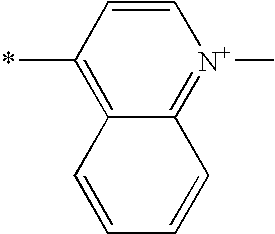 |
CH3 | —CH2—CH2— | —(CO)O—CH3 |
| (48) |
 |
CH3 | —CH2—CH2— | —(CO)O—CH3 |
| (49) |
 |
CH3 | —CH2—CH2— | —(CO)O—CH3 |
| (50) |
 |
CH3 | —CH2—CH2— | —(CO)O—CH3 |
| (51) |
 |
CH3 | —CH2—CH2— | —(CS)O—CH3 |
| (52) |
 |
CH3 | —CH2—CH2— | —(CS)O—CH3 |
| (53) |
 |
CH3 | —CH2—CH2— | —(CS)O—CH3 |
| (54) |
 |
CH3 | —CH2—CH2— | —(CS)O—CH3 |
| (55) |
 |
CH3 | —CH2—CH2— | —(CS)O—CH3 |
| (56) |
 |
CH3 | —CH2—CH2— | —(CS)O—CH3 |
| (57) |
 |
CH3 | —CH2—CH2— | —(CS)S—C2 H5 |
| (58) |
 |
CH3 | —CH2—CH2— | —(CS)S—CH3 |
| (59) |
 |
CH3 | —CH2—CH2— | —(CS)S—CH3 |
| (60) |
 |
CH3 | —CH2—CH2— | —(CS)S—CH3 |
| (61) |
 |
CH3 | —CH2—CH2— | —(CS)S—CH3 |
| (62) |
 |
CH3 | —CH2—CH2— | —(CS)S—CH3 |
| (63) |
 |
CH3 | —CH2—CH2— | —(CS)N(CH3)2 |
| (64) |
 |
H CH3 C2 H5 | —CH2—CH2— | —(CO)H —(CO)CH3 —(CO)C6 H5 |
| (65) |
 |
CH3 | —CH2—CH2— | —(CS)H —(CS)CH3 |
| (66) |
 |
CH3 | —CH2—CH2— | —(CO)N(CH3)2 |
| (67) |
 |
CH3 | —CH2—CH2— | —(CS)N(CH3)2 |
| (68) |
 |
CH3 | —CH2—CH2— | —(CO)N(CH3)2 |
| (69) |
 |
CH3 | —CH2—CH2— |
 |
| (70) |
 |
CH3 | —CH2—CH2— | —C≡N |
| (71) |
 |
CH3 | —CH2—CH2— | —(CO)O—C2 H5 |
| (72) |
 |
CH3 | —CH2—CH2— | —(CS)O—CH3 |
| (73) |
 |
CH3 | —CH2—CH2— | —(CS)S—C2 H5 |
| (74) |
 |
CH3 | —CH2—CH2— | —(CS)N(CH3)2 |
| (75) |
 |
H CH3 C2 H5 | —CH2—CH2— | —(CO)H —(CO)CH3 —(CO)C6 H5 |
| (76) |
 |
CH3 | —CH2—CH2— | —(CS)H —(CS)CH3 |
| (77) |
 |
CH3 | —CH2—CH2— | —(CO)N(CH3)2 |
| (78) |
 |
CH3 | —CH2—CH2— | —(CS)N(CH3)2 |
| (79) |
 |
CH3 | —CH2—CH2— | —(CO)N(CH3)2 |
| (80) |
 |
CH3 | —CH2—CH2— |
 |
| (81) |
 |
CH3 | —CH2—CH2— | —C≡N |
| (82) |
 |
CH3 | —CH2—CH2— | —(CO)O—C2 H5 |
| (83) |
 |
CH3 | —CH2—CH2— | —(CS)O—CH3 |
| (84) |
 |
CH3 | —CH2—CH2— | —(CS)S—C2 H5 |

wherein
- Y1 is selected from

and Y2 is simultaneously hydrogen; or
- Y1 and Y2 together with the linked carbon atom 1C of formula (2) form a condensed carbocyclic ring of formula

- Hal is a halogen atom; and
- R1, X and Z are defined as in formula (1).
-
- temporary dyeing agents
- semipermanent dyeing agents, and
- permanent dyeing agents.

wherein
- R1 and R2 are each independently of the other a C1-C8alkyl; or an unsubstituted or substituted benzyl;
- R3 is hydrogen; C1-C8alkyl; C1-C8alkoxy; cyanide; or halide; preferably hydrogen; and
- X− is an anion; and preferably a compound of formula (DD1), wherein
- R1 is methyl; R2 is benzyl; R3 is hydrogen; and X− is an anion; or wherein
- R1 is benzyl; R2 is benzyl; R3 is hydrogen; and X− is an anion; or wherein
- R1 is benzyl; R2 is methyl; R3 is hydrogen; and X− is an anion.
-
- acid dyes and an alkylene carbonate, as described in U.S. Pat. No. 6,248,314, especially in examples 1 and 2;
- acid hair dye compositions comprising various kinds of organic solvents represented by benzyl alcohol as a penetrant solvent have good penetrability into hair, as described in Japanese Patent Application Laid-Open Nos. 210023/1986 and 101841/1995;
- acid hair dye compositions with a water-soluble polymer or the like to prevent the drooping of the hair dye composition, as described for example in Japanese Patent Application Laid-Open Nos. 87450/1998, 255540/1997 and 245348/1996;
- acid hair dye compositions with a water-soluble polymer of aromatic alcohols, lower alkylene carbonates, or the like as described in Japanese Patent Application Laid-Open No. 53970/1998 and Japanese Patent Invention No. 23911/1973.
-
- DE 19 959 479, especially in col 2, I. 6 to col 3, I. 11;
- “Dermatology”, edited by Ch. Culnan, H. Maibach, Verlag Marcel Dekker Inc., New York, Basle, 1986, Vol. 7, Ch. Zviak, The Science of Hair Care, chapter 8, on p. 264-267 (oxidation dyes);
-
- the developer/-coupler combination 2,4,5,6-tetraminopyrimidine and 2-methylresorcine for assessing of red shades;
- p-toluenediamine and 4-amino-2-hydroxytoluene for assessing of blue-violet shades;
- p-toluenediamine and 2-amino-4-hydroxyethylaminoanisole for assessing of blue shades;
- p-toluenediamine and 2,4-diamino-phenoxyethynol for assessing of blue shades;
- methyl-4-aminophenol and 4-amino-2-hydroxytlooluene for assessing of orange shades;
- p-toluenediamine and resorcine for assessing of brown-green shades;
- p-toluenediamine and 1-naphthol for assessing of blue-violet shades, or
- p-toluenediamine and 2-methylresorcine for assessing of brown-gold shades.
(DC-03): EP 970 685, wherein direct dyes are described, especially p. 2, I. 44 to p. 9, I. 56 and preferably p. 9, I. 58 to p. 48, I. 12; processes for dyeing of keratin-containing fibers especially p. 50, I. 15 to 43; formulations p. 50, I. 46 to p. 51, I. 40;
(DC-04): DE-A-19 713 698, wherein direct dyes are described, especially p. 2, I. 61 to p. 3, I. 43; formulations p. 5, I. 26 to 60;
(DC-05): U.S. Pat. No. 6,368,360, wherein directed dyes (col. 4, I. 1 to col. 6, I. 31) and oxidizing agents (col. 6, I. 37-39) are disclosed; formulations col. 7, I. 47 to col. 9, I. 4;
(DC-06): EP 1 166 752, wherein cationic dyes (p. 3, I. 22-p. 4, I. 15) and anionic UV-absorbers (p. 4, I. 27-30) are disclosed; formulations p. 7, I. 50-p. 9, I. 56;
(DC-07): EP 998,908, wherein oxidation dyeings comprising a cationic direct dye and pyrazolo-[1,5-a]-pyrimidines (p. 2, I. 48-p. 4, I. 1) are disclosed; dyeing formulations p. 47, I. 25 to p. 50, I. 29;
(DC-08): FR-2788432, wherein combinations of cationic dyes with Arianors are disclosed, especially p. 53, I. 1 to p. 63, I. 23, more especially p. 51 to 52, most especially Basic Brown 17, Basic brown 16, Basic Red 76 and Basic Red 118, and/or at least one Basic Yellow 57, and/or at least one Basic Blue 99; or combinations of arianors and/or oxidative dyes, especially p. 2, I. 16 to p. 3, I. 16; dyeing formulations on p. 53, I. 1 to p. 63, I. 23;
(DC-09): DE-A-19 713 698, wherein the combinations of direct dyes and permanent-wave fixing comprising an oxidation agent, an oxidation dye and a direct dye are disclosed; especially p. 4, I. 65 to p. 5, I. 59;
(DC-10): EP 850 638, wherein developer compounds and oxidizing agents are disclosed; especially p. 2, I. 27 to p. 7, I. 46 and preferably p. 7, I. 20 to p. 9, I. 26; dyeing formulations p. 2, I. 3-12 and I. 30 to p. 14, and p. 28, I. 35-p. 30, I. 20; preferably p. 30, I. 25-p. 32, I. 30;
(DC-11): U.S. Pat. No. 6,190,421 wherein extemporaneous mixtures of a composition (A) containing one or more oxidation dye precursors and optionally one or more couplers, of a composition (B), in powder form, containing one or more direct dyes (col. 5, I. 40-col. 7, I. 14), optionally dispersed in an organic pulverulent excipient and/or a mineral pulverulent excipient, and a composition (C) containing one or more oxidizing agents are disclosed; formulations col. 8, I. 60-col. 9, I. 56;
(DC-12): U.S. Pat. No. 6,228,129, wherein a ready-to-use composition comprising at least one oxidation base, at least one cationic direct dye and at least one enzyme of the 2-electron oxidoreductase type in the presence of at least one donor for the said enzyme are disclosed; especially col. 8, I. 17-col. 13, I. 65; dyeing formulations in col. 2, I. 16 to col. 25, I. 55, a multi-compartment dyeing device is described in col. 26, I. 13-24;
(DC-13): WO 99/20235, wherein compositions of at least one cationic dye and at least one nitrated benzene dye with cationic direct dyes and nitro benzene direct dyes are described; on p. 2, I. 1 to p. 7, I. 9, and p. 39, I. 1 to p. 40 I. 11, preferably p. 8, I. 12 to p. 25 I. 6, p. 26, I. 7 to p. 30, I. 15; p. 1, I. 25 to p. 8, I. 5, p. 30, I. 17 to p. 34 I. 25, p. 8, I. 12 to p. 25 I. 6, p. 35, I. 21 to 27, especially on p. 36, I. 1 to p. 37;
(DC-14): WO 99/20234, wherein compositions comprising at least one direct cationic dye and at least one autooxidisable dye, especially benzene, indol and indoline derivatives are described, preferably direct dyes on p. 2, I. 19 to p. 26, I. 4, and autooxidisable dyes as disclosed especially on p. 26, I. 10 to p. 28, I. 15; dyeing formulations especially on p. 34, I. 5 to p. 35, Ii 18;
(DC-15): EP 850 636, wherein oxidation dyeing compositions comprising at least one direct dye and at least one meta-aminophenol derivative as coupler component and at least one developer compound and an oxidizing agent are disclosed, especially p. 5, I. 41 to p. 7, I. 52, dyeing formulations p. 19, I. 50-p. 22, I. 12;
(DC-16): EP-A-850 637, wherein oxidation dyeing compositions comprising at least one oxidation base selected from para-phenylenediamines and bis(phenyl)alkylenediamines, and the acid-addition salts thereof, at least one coupler selected from meta-diphenols, and the acid-addition salts thereof, at least one cationic direct dye, and at least one oxidizing agent are disclosed, especially p. 6, I. 50 to p. 8, I. 44 are disclosed; dyeing formulations p. 21, I. 30-p. 22, I. 57;
(DC-17): WO 99/48856, wherein oxidation dyeing compositions comprising cationic couplers are disclosed, especially p. 9, I. 16-p. 13, I. 8, and p. 11, I. 20-p. 12, I. 13; dyeing formulations p. 36, I. 7-p. 39, I. 24;
(DC-18): DE 197 172 24, wherein dyeing agents comprising unsaturated aldehydes and coupler compounds and primary and secondary amino group compounds, nitrogen-containing heterocyclic compounds, amino acids, oligopeptids, aromatic hydroxy compounds, and/or at least one CH-active compound are disclosed p. 3, I. 42-p. 5 I. 25; dyeing formulations p. 8, I. 25-p. 9, I. 61.
-
- non-ionic polymers, for example vinylpyrrolidone/vinyl acrylate copolymers, polyvinylpyrrolidone and vinylpyrrolidone/vinyl acetate copolymers and polysiloxanes;
- cationic polymers, such as quaternised cellulose ethers, polysiloxanes having quaternary groups, dimethyldiallylammonium chloride polymers, copolymers of dimethyldiallylammonium chloride and acrylic acid, as available commercially under the name Merquat® 280 and the use thereof in hair dyeing as described, for example, in DE-A-4 421 031, especially p. 2, I. 20 to 49, or EP-A-953 334;
- acrylamide/dimethyldiallylammonium chloride copolymers, diethyl-sulfate-quaternised dimethylaminoethyl methacrylate/vinylpyrrolidone copolymers, vinylpyrrolidone/-imidazolinium methochloride copolymers;
- quaternised polyvinyl alcohol:
- zwitterionic and amphoteric polymers, such as acrylamido-propyltrimethylammonium chloride/acrylate copolymers and octylacrylamide/methyl methacrylate/tert-butylaminoethyl methacrylate/2-hydroxypropyl methacrylate copolymers;
- anionic polymers, such as, for example, polyacrylic acids, crosslinked polyacrylic acids, vinyl acetate/crotonic acid copolymers, vinylpyrrolidone/vinyl acrylate copolymers, vinyl acetate/butyl maleate/isobornyl acrylate copolymers, methyl vinyl ether/maleic anhydride copolymers and acrylic acid/ethyl acrylate/N-tert-butyl acrylamide terpolymers;
- thickeners, such as agar, guar gum, alginates, xanthan gum, gum arabic, karaya gum, locust bean flour, linseed gums, dextrans, cellulose derivatives, e.g. methyl cellulose, hydroxyalkyl cellulose and carboxymethyl cellulose, starch fractions and derivatives, such amylose, amylopectin and dextrins, clays, e.g. bentonite or fully synthetic hydrocolloids such as, for example, polyvinyl alcohol;
- structuring agents, such as glucose and maleic acid;
- hair-conditioning compounds, such as phospholipids, for example soya lecithin, egg lecithin, cephalins, silicone oils, and conditioning compounds, such as those described in DE-A-19 729 080, especially p. 2, I. 20 to 49, EP-A-834 303, especially p. 2, I. 18-p. 3, I. 2, or EP-A-312 343, especially p. 2, I. 59-p. 3, I. 11;
- protein hydrolysates, especially elastin, collagen, keratin, milk protein, soya protein and wheat protein hydrolysates, condensation products thereof with fatty acids and also quaternised protein hydrolysates;
- perfume oils, dimethyl isosorbitol and cyclodextrins,
- solubilisers, such as ethanol, isopropanol, ethylene glycol, propylene glycol, glycerol and diethylene glycol,
- anti-dandruff active ingredients, such as piroctones, olamines and zinc Omadine,
- substances for adjusting the pH value;
- panthenol, pantothenic acid, allantoin, pyrrolidonecarboxylic acids and salts thereof, plant extracts and vitamins;
- cholesterol;
- light stabilisers and UV absorbers as listed in Table below:
| TABLE 2 |
| UV absorbers which may be use in the dyeing compositions of the present invention |
| No. | Chemical Name | CAS No. |
| 1 | (+/−)-1,7,7-trimethyl-3-[(4-methylphenyl)methylene]bicyclo- | 36861-47-9 |
| [2.2.1]heptan-2-one | ||
| 2 | 1,7,7-trimethyl-3-(phenylmethylene)bicyclo[2.2.1]heptan-2-one | 15087-24-8 |
| 3 | (2-Hydroxy-4-methoxyphenyl)(4-methylphenyl)methanone | 1641-17-4 |
| 4 | 2,4-dihydroxybenzophenone | 131-56-6 |
| 5 | 2,2′,4,4′-tetrahydroxybenzophenone | 131-55-5 |
| 6 | 2-Hydroxy-4-methoxy benzophenone; | 131-57-7 |
| 7 | 2,2′-dihydroxy-4,4′-dimethoxybenzophenone | 131-54-4 |
| 8 | 2,2′-Dihydroxy-4-methoxybenzophenone | 131-53-3 |
| 9 | 1-[4-(1,1-dimethylethyl)phenyl]-3-(4-methoxyphenyl)propane-1,3-dione | 70356-09-1 |
| 10 | 3,3,5-Trimethyl cyclohexyl-2-hydroxy benzoate | 118-56-9 |
| 11 | Isopentyl p-methoxycinnamate | 71617-10-2 |
| 12 | Menthyl-o-aminobenzoate | 134-09-8 |
| 13 | Menthyl salicylate | 89-46-3 |
| 14 | 2-Ethylhexyl 2-cyano,3,3-diphenylacrylate | 6197-30-4 |
| 15 | 2-ethylhexyl 4-(dimethylamino)benzoate | 21245-02-3 |
| 16 | 2-ethylhexyl 4-methoxycinnamate | 5466-77-3 |
| 17 | 2-ethylhexyl salicylate | 118-60-5 |
| 18 | Benzole acid, 4,4′,4″-(1,3,5-triazine-2,4,6-triyltriimino)tris-tris(2- | 88122-99-0 |
| ethylhexyl)ester; 2,4,6-Trianilino-(p-carbo-2′-ethylhexyl-1′-oxi)- | ||
| 1,3,5-triazine | ||
| 19 | Benzoic acid, 4-amino-, ethyl ester, polymer with oxirane | 113010-52-9 |
| 20 | 2-Propenamide, N-[[4-[(4,7,7-trimethyl-3-oxobicyclo[2.2.1]hept-2- | 147897-12-9 |
| ylidene)methyl]phenyl]methyl]-, homopolymer | ||
| 21 | Triethanolamine salicylate | 2174-16-5 |
| 22 | 2,2′-Methylene-bis-[6-(2H-benzotriazol-2-yl)-4-(1,1,3,3-tetramethyl- | 103597-45-1 |
| butyl)-phenol] | ||
| 23 | 2,4-bis{[4-(2-ethylhexyloxy)-2-hydroxy]-phenyl}-6-(4-methoxy- | 187393-00-6 |
| phenyl)-(1,3,5)-triazine (Tinosorb S) | ||
| 24 | Benzoic acid, 4,4′-[[6-[[4-[[(1,1-dimethylethyl)amino]carbonyl]- | 154702-15-5 |
| phenyl]amino]1,3,5-triazine-2,4-diyl]diimino]bis-, bis(2-ethylhexyl)-ester | ||
| 25 | Phenol, 2-(2H-benzotriazol-2-yl)-4-methyl-6-[2-methyl-3-[1,3,3,3- | 155633-54-8 |
| tetramethyl-1-[(trimethylsilyl)oxy]disiloxanyl]propyl]- | ||
| 26 | Dimethicodiethylbezalmalonate | 207574-74-1 |
| 27 | Benzoic acid, 2-[4-(diethylamino)-2-hydroxybenzoyl]-, hexyl ester | 302776-68-7 |
| 28 | 1,3,5-Triazine, 2,4,6-tris(4-methoxyphenyl)- | 7753-12-0 |
| 29 | 1,3,5-Triazine, 2,4,6-tris[4-[(2-ethylhexyl)oxy]phenyl]- | 208114-14-1 |
| 30 | 2-Propenoic acid, 3-(1H-imidazol-4-yl)- | 104-98-3 |
| 31 | Benzoic acid, 2-hydroxy-, [4-(1-methylethyl)phenyl]methyl ester | 94134-93-7 |
| 32 | 1,2,3-Propanetriol, 1-(4-aminobenzoate) | 136-44-7 |
| 33 | Benzeneacetic acid, 3,4-dimethoxy-a-oxo- | 4732-70-1 |
| 34 | 2-Propenoic acid, 2-cyano-3,3-diphenyl-, ethyl ester | 5232-99-5 |
| 35 | Anthralinic acid, p-menth-3-yl ester | 134-09-8 |
| 36 | 1,3,5-Triazine-2,4,6-triamine, N,N′-bis[4-[5-(1,1-dimethylpropyl)-2- | 288254-16-0 |
| benzoxazolyl]phenyl]-N″-(2-ethylhexyl)- or Uvasorb K2A | ||
| 37 | 2-Hydroxy-4-methoxy benzophenone-5-sulfonic acid | 4065-45-6 |
| 38 | Alpha-(2-oxoborn-3-ylidene)toluene-4-sulphonic acid and its salts | 56039-58-8 |
| 39 | Methyl N,N,N-trimethyl-4-[(4,7,7-trimethyl-3-oxobicyclo[2,2,1]hept- | 52793-97-2 |
| 2-ylidene)methyl]anilinium sulphate; | ||
| 40 | 4-aminobenzoic acid | 150-13-0 |
| 41 | 2-phenyl-1H-benzimidazole-5-sulphonic acid | 27503-81-7 |
| 42 | 3,3′-(1,4-phenylenedimethylene)bis[7,7-dimethyl-2-oxo-bicyclo- | 90457-82-2 |
| [2.2.1]heptane-1-methanesulfonic acid] | ||
| 43 | 1H-Benzimidazole-4,6-disulfonic acid, 2,2′-(1,4-phenylene)bis-, | 180898-37-7 |
| disodium salt | ||
| 44 | Benzenesulfonic acid, 3-(2H-benzotriazol-2-yl)-4-hydroxy-5-(1- | 92484-48-5 |
| methylpropyl)-, monosodium salt | ||
| 45 | 1-Dodecanaminium, N-[3-[[4-(dimethylamino)benzoyl]amino]pro- | 156679-41-3 |
| pyl]N,N-dimethyl-, salt with 4-methylbenzenesulfonic acid (1:1) | ||
| 46 | 1-Propanaminium, N,N,N-trimethyl-3-[(1-oxo-3-phenyl-2-propenyl)- | 177190-98-6 |
| amino]-, chloride | ||
| 47 | 1H-Benzimidazole-4,6-disulfonic acid, 2,2′-(1,4-phenylene)bis- | 170864-82-1 |
| 48 | 1-Propanaminium, 3-[[3-[3-(2H-benzotriazol-2-yl)-5-(1,1-dimethyl- | 340964-15-0 |
| ethyl)-4-hydroxyphenyl]-1-oxopropyl]amino]-N,N-diethyl-N-methyl-, | ||
| methyl sulfate (salt) | ||
| 49 | 2,2′-bis(1,4-phenylene)-1H-benzimidazole-4,6-disulphonic acid mono | 349580-12-7, |
| sodium salt or Disodium phenyl dibenzimidazole tetrasulfonate | ||
| or Neoheliopan AP | ||
-
- cationic benzotriazole UV absorbers as for example described in WO 01/36396 especially on p. 1, I. 20 to p. 2, I. 24, and preferred on p. 3 to 5, and on p. 26 to 37;
- cationic benzotriazole UV in combination with antioxidants as described in WO 01/36396, especially on p. 11, I. 14 to p. 18;
- UV absorbers in combination with antioxidants as described in U.S. Pat. No. 5,922,310, especially in col 2, I. 1 to 3;
- UV absorbers in combination with antioxidants as described in U.S. Pat. No. 4,786,493, especially in col 1, 42 to col 2, I. 7, and preferred in col 3, 43 to col 5, I. 20;
- combination of UV absorbers as described in U.S. Pat. No. 5,830,441, especially in col 4, I. 53 to 56;
- combination of UV absorbers as described in WO 01/36396, especially on p. 11, I. 9 to 13; or
- triazine derivatives as described in WO 98/22447, especially on p. 1, I. 23 to p. 2, I. 4, and preferred on p. 2, I. 11 to p. 3, I. 15 and most preferred on p. 6 to 7, and 12 to 16.
-
- consistency regulators, such as sugar esters, polyol esters or polyol alkyl ethers;
- fats and waxes, such as spermaceti, beeswax, montan wax, paraffins, fatty alcohols and fatty acid esters;
- fatty alkanolamides;
- polyethylene glycols and polypropylene glycols having a molecular weight from 150 to 50 000, for example such as those described in EP-A-801 942, especially p. 3, I. 44 to 55,
- complexing agents, such as EDTA, NTA and phosphonic acids,
- swelling and penetration substances, such as polyols and polyol ethers, as listed extensively, for example, in EP-A-962 219, especially p. 27, I. 18 to 38, for example glycerol, propylene glycol, propylene glycol monoethyl ether, butyl glycol, benzyl alcohol, carbonates, hydrogen carbonates, guanidines, ureas and also primary, secondary and tertiary phosphates, imidazoles, tannins, pyrrole;
- opacifiers, such as latex;
- pearlising agents, such as ethylene glycol mono- and di-stearate;
- propellants, such as propane-butane mixtures, N2O, dimethyl ether, CO2 and air;
- antioxidants; preferably the phenolic antioxidants and hindered nitroxyl compounds disclosed in ip.com (IPCOM #000033153D);
- sugar-containing polymers, as described in EP-A-970 687;
- quaternary ammonium salts, as described in WO 00/10517;
- Bacteria inhibiting agents, like preservatives that have a specific action against gram-positive bacteria, such as 2,4,4′-trichloro-2′-hydroxydiphenyl ether, chlorhexidine (1,6-di(4-chlorophenyl-biguanido)hexane) or TCC (3,4,4′-trichlorocarbanilide). A large number of aromatic substances and ethereal oils also have antimicrobial properties. Typical examples are the active ingredients eugenol, menthol and thymol in clove oil, mint oil and thyme oil. A natural deodorising agent of interest is the terpene alcohol farnesol (3,7,11-trimethyl-2,6,10-dodecatrien-1-ol), which is present in lime blossom oil. Glycerol monolaurate has also proved to be a bacteriostatic agent. The amount of the additional bacteria-inhibiting agents present is usually from 0.1 to 2% b.w., based on the solids content of the preparations;
-
- linear fatty acids having 10 to 22 carbon atoms (soaps),
- ether carboxylic acids of formula R—O—(CH2—CH2—O)x—CH2—COOH, in which R is a linear alkyl group having 10 to 22 carbon atoms and x=0 or from 1 to 16,
- acyl sarcosides having 10 to 18 carbon atoms in the acyl group,
- acyl taurides having 10 to 18 carbon atoms in the acyl group,
- acyl isothionates having 10 to 18 carbon atoms in the acyl group,
- sulfosuccinic mono- and di-alkyl esters having 8 to 18 carbon atoms in the alkyl group and sulfosuccinic monoalkylpolyoxyethyl esters having 8 to 18 carbon atoms in the alkyl group and from 1 to 6 oxyethyl groups,
- linear alkane sulfonates having 12 to 18 carbon atoms,
- linear α-olefin sulfonates having 12 to 18 carbon atoms,
- α-sulfo fatty acid methyl esters of fatty acids having 12 to 18 carbon atoms,
- alkyl sulfates and alkyl polyglycol ether sulfates of formula R′—O(CH2—CH2—O)x—SO3H, in which R′ is a preferably linearar alkyl group having 10 to 18 carbon atoms and x′=0 or from 1 to 12,
- mixtures of surface-active hydroxysulfonates according to DE-A-3 725 030;
- sulfated hydroxyalkylpolyethylene and/or hydroxyalkylenepropylene glycol ethers according to DE-A-3 723 354, especially p. 4, I. 42 to 62,
- sulfonates of unsaturated fatty acids having 12 to 24 carbon atoms and 1 to 6 double bonds according to DE-A-3 926 344, especially p. 2, I. 36 to 54,
- esters of tartaric acid and citric acid with alcohols which are addition products of approximately from 2 to 15 molecules of ethylene oxide and/or propylene oxide with fatty alcohols having from 8 to 22 carbon atoms, or
- anionic surfactants, as described in WO 00/10518, especially p. 45, I. 11 to p. 48, I. 3.
-
- addition products of 2 to 30 mol of ethylene oxide and/or 0 to 5 mol of propylene oxide with linearar fatty alcohols having 8 to 22 carbon atoms, with fatty acids having 12 to 22 carbon atoms and with alkylphenols having 8 to 15 carbon atoms in the alkyl group,
- C12-C22 fatty acid mono- and di-esters of addition products of 1 to 30 mol of ethylene oxide with glycerol,
- C8-C22alkyl-mono- and -oligo-glycosides and ethoxylated analogues thereof,
- addition products of 5 to 60 mol of ethylene oxide with castor oil and hydrogenated castor oil,
- addition products of ethylene oxide with sorbitan fatty acid esters,
- addition products of ethylene oxide with fatty acid alkanolamides.
-
- oxidizing agents to achieve lightened coloration, as described in WO 97/20545, especially p. 9, I. 5 to 9,
- oxidizing agents in the form of permanent-wave fixing solution, as described in DE-A-19 713 698, especially p. 4, I. 52 to 55, and I. 60 and 61 or EP-A-1062940, especially p. 6, I. 41 to 47 (and in the equivalent WO 99/40895).

wherein
R is a propylene residue, which may be substituted with OH or C1-C4alkyl,
R3, R4, R5 and R6 are independently or dependently from each other hydrogen, C1-C4alkyl or hydroxy-(C1-C4)alkyl.
- (a) mixing at least one dye of formula (1) and optionally at least one coupler compound and at least one developer compound, and an oxidizing agent, which optionally contains at least one further dye, and
- (b) contacting the keratin-containing fibers with the mixture as prepared in step (a).
- (a) treating the keratin-containing fibers under alkaline conditions with at least one capped diazotised compound and a coupler compound, and optionally a developer compound ad optionally an oxidizing agent, and optionally in the presence of a further dye, and optionally with at least one dye of formula (1); and
- (b) adjusting the pH in the range of 6 to 2 by treatment with an acid, optionally in the presence of a further dye, and optionally at least one dye of formula (1),
with the proviso that at least in one step (a) or (b) at least one dye of formula (1) is present.

A-1.1 Monoazo

19.9 g of N-methyl-2-chlorethylamin are added at 293K, under nitrogen atmosphere, with stirring to 120 g isopropanol and 22 g of the foregoing compound.
| 8.003 | d | 6.7 | 2.00 | Phe | ||
| 7.576 | s | 2.01 | imidazol | |||
| 7.026 | d | 6.9 | 2.01 | Phe | ||
| 4.072 | s | 6.00 | methyl | |||
| 4.002 | t | 6 | 2.03 | ethylene | ||
| 3.855 | t | 6 | 2.05 | ethylene | ||
| 2.289 | s | 3.087 | methyl(amine) | |||

A-2.1 Alkylation
| 8.003 | d | 6.7 | 2.00 | Phe | ||
| 7.576 | s | 2.01 | imidazol | |||
| 7.000 | d | 6.9 | 2.01 | Phe | ||
| 4.060 | s | 6.00 | methyl | |||
| 4.002 | t | 6 | 2.03 | ethylene | ||
| 3.343 | s | 3.08 | methyl(amine) | |||
| 2.703 | t | 6 | 2.05 | ethylene | ||

A-3.1 Alkylation
| 8.003 | d | 6.7 | 2.00 | Phe | ||
| 7.578 | s | 2.01 | imidazol | |||
| 7.060 | d | 6.9 | 2.01 | Phe | ||
| 4.074 | s | 6.00 | methyl | |||
| 3.352 | t | 6 | 2.03 | ethylene | ||
| 3.085 | t | 6 | 2.05 | ethylene | ||
| 2.289 | s | 3.087 | acetate | |||

A-4.1 Alkylation


A-6-1. Alkylation

A-7.1. Alkylation

A-8.1 Alkylation

A-9.1 Alkylation

A-10.1 Alkylation
| Results: |
| Strand | Colour result | Washing fastness | ||
| blond | Pink/good | 2-3 | ||
| middelblond | Pink/good | 3-4 | ||
| damaged | Pink/good | 3 | ||
| Results: |
| Strand | Colour result | Washing fastness | ||
| blond | Pink/good | 2-3 | ||
| middelblond | Pink/good | 3-4 | ||
| damaged | Pink/good | 3 | ||
| Results: |
| Strand | Colour | Washing fastness | ||
| blond | Pink/good | 3-4 | ||
| middelblond | Pink/good | 3-4 | ||
| damaged | Pink/good | 2-3 | ||
Claims (14)


Applications Claiming Priority (4)
| Application Number | Priority Date | Filing Date | Title |
|---|---|---|---|
| EP06119052.6 | 2006-08-17 | ||
| EP06119052 | 2006-08-17 | ||
| EP06119052 | 2006-08-17 | ||
| PCT/EP2007/058224 WO2008019977A2 (en) | 2006-08-17 | 2007-08-08 | Thiol derivative dyes |
Publications (2)
| Publication Number | Publication Date |
|---|---|
| US20100000029A1 US20100000029A1 (en) | 2010-01-07 |
| US7803197B2 true US7803197B2 (en) | 2010-09-28 |
Family
ID=38006045
Family Applications (1)
| Application Number | Title | Priority Date | Filing Date |
|---|---|---|---|
| US12/310,118 Expired - Fee Related US7803197B2 (en) | 2006-08-17 | 2007-08-08 | Thiol derivative dyes |
Country Status (10)
| Country | Link |
|---|---|
| US (1) | US7803197B2 (en) |
| EP (1) | EP2052034B1 (en) |
| JP (1) | JP5237948B2 (en) |
| KR (1) | KR20090037474A (en) |
| CN (1) | CN101528859A (en) |
| BR (1) | BRPI0716047A2 (en) |
| ES (1) | ES2590602T3 (en) |
| MX (1) | MX2009001598A (en) |
| TW (1) | TW200833794A (en) |
| WO (1) | WO2008019977A2 (en) |
Cited By (1)
| Publication number | Priority date | Publication date | Assignee | Title |
|---|---|---|---|---|
| US20180310692A1 (en) * | 2015-12-16 | 2018-11-01 | Henkel Ag & Co. Kgaa | Method and data processing device for ascertaining properties of hair colors in a computer-assisted manner |
Families Citing this family (9)
| Publication number | Priority date | Publication date | Assignee | Title |
|---|---|---|---|---|
| FR2968954B1 (en) * | 2010-12-15 | 2012-12-21 | Oreal | PROCESS FOR COLORING KERATIN FIBERS USING A DIRECT DYE WITH PROTECTED DISULFIDE / THIOL / THIOL FUNCTION AND WATER VAPOR |
| FR2990944A1 (en) * | 2012-05-23 | 2013-11-29 | Oreal | METHOD FOR COLORING KERATIN FIBERS COMPRISING A COLORANT / PIGMENT, A PHOTOACTIVE COMPOUND, AND A LIGHT SOURCE |
| FR3016288B1 (en) | 2013-12-23 | 2016-09-09 | Oreal | PACKAGING ARTICLE COMPRISING AN ENVELOPE AND ANHYDROUS COMPOSITION COMPRISING AN OXIDIZING AGENT |
| DE102014226540A1 (en) * | 2014-12-19 | 2016-06-23 | Henkel Ag & Co. Kgaa | Thickening developers for oxidation colorants |
| MX2017012137A (en) | 2015-03-19 | 2018-02-19 | Basf Se | Cationic direct dyes. |
| FR3043551B1 (en) * | 2015-11-12 | 2017-11-24 | Oreal | DIRECT CATIONIC COLOR WITH ALIPHATIC CHAIN AND FUNCTION DISULFURE / THIOL / THIOL PROTECTED TO COLOR KERATIN FIBERS |
| FR3067599B1 (en) | 2017-06-16 | 2020-09-04 | Oreal | PROCESS FOR COLORING KERATINIC MATERIALS USING AT LEAST ONE BLUE, PURPLE OR GREEN COLOR AND AT LEAST ONE FLUORESCENT COLORANT DISULPHIDE, THIOL OR PROTECTED THIOL |
| FR3067597B1 (en) | 2017-06-16 | 2020-09-04 | Oreal | PROCESS FOR COLORING KERATINIC FIBERS USING AT LEAST ONE DIRECT DYE AND AT LEAST ONE FLUORESCENT DYE DISULPHIDE, THIOL OR PROTECTED THIOL |
| MX2021001594A (en) * | 2018-09-04 | 2021-04-19 | Archroma Ip Gmbh | Method for dyeing a protein substrate. |
Citations (13)
| Publication number | Priority date | Publication date | Assignee | Title |
|---|---|---|---|---|
| US4751286A (en) | 1985-11-19 | 1988-06-14 | The Johns Hopkins University | Protein label and drug delivery system |
| WO1995001772A1 (en) | 1993-07-05 | 1995-01-19 | Ciba-Geigy Ag | Process for dyeing keratin-containing fibres |
| EP0970684A1 (en) | 1998-07-09 | 2000-01-12 | L'oreal | Composition for dyeing keratinous fibres containing a cationic direct dye and a thickening polymer |
| EP1153599A2 (en) | 2000-05-11 | 2001-11-14 | Kao Corporation | Hair dye composition |
| WO2003099243A1 (en) | 2002-05-29 | 2003-12-04 | Henkel Kommanditgesellschaft Auf Aktien | Cosmetic agents containing protein disulfide isomerase |
| US20040093676A1 (en) | 2001-04-03 | 2004-05-20 | Laurent Vidal | Novel dyeing composition for dyeing keratinous fibres comprising a particular dicationic monoazo dye |
| WO2006136617A2 (en) | 2005-10-11 | 2006-12-28 | Ciba Specialty Chemicals Holding Inc. | Mixture of sulfide dyes |
| WO2007025889A2 (en) | 2005-08-30 | 2007-03-08 | Ciba Specialty Chemicals Holding Inc. | Dyes containing a thiol group |
| WO2007039527A2 (en) | 2005-10-06 | 2007-04-12 | Ciba Specialty Chemicals Holding Inc. | Thiol dyes |
| WO2007039528A1 (en) | 2005-10-06 | 2007-04-12 | Ciba Specialty Chemicals Holding Inc. | Triarylmethane dyes |
| US7307155B2 (en) | 2003-07-24 | 2007-12-11 | Ciba Specialty Chemicals Corporation | Cationic direct dyes |
| US7476260B2 (en) | 2004-04-08 | 2009-01-13 | Ciba Specialty Chemicals Corp. | Disulfide dyes, composition comprising them and method of dyeing hair |
| US20090049620A1 (en) | 2005-06-23 | 2009-02-26 | Christian Cremer | Sulfide dyes |
-
2007
- 2007-08-08 WO PCT/EP2007/058224 patent/WO2008019977A2/en not_active Ceased
- 2007-08-08 CN CNA2007800389304A patent/CN101528859A/en active Pending
- 2007-08-08 EP EP07802535.0A patent/EP2052034B1/en active Active
- 2007-08-08 JP JP2009524173A patent/JP5237948B2/en active Active
- 2007-08-08 BR BRPI0716047-0A2A patent/BRPI0716047A2/en not_active Application Discontinuation
- 2007-08-08 MX MX2009001598A patent/MX2009001598A/en not_active Application Discontinuation
- 2007-08-08 ES ES07802535.0T patent/ES2590602T3/en active Active
- 2007-08-08 KR KR1020097003382A patent/KR20090037474A/en not_active Withdrawn
- 2007-08-08 US US12/310,118 patent/US7803197B2/en not_active Expired - Fee Related
- 2007-08-15 TW TW096130099A patent/TW200833794A/en unknown
Patent Citations (15)
| Publication number | Priority date | Publication date | Assignee | Title |
|---|---|---|---|---|
| US4751286A (en) | 1985-11-19 | 1988-06-14 | The Johns Hopkins University | Protein label and drug delivery system |
| WO1995001772A1 (en) | 1993-07-05 | 1995-01-19 | Ciba-Geigy Ag | Process for dyeing keratin-containing fibres |
| EP0970684A1 (en) | 1998-07-09 | 2000-01-12 | L'oreal | Composition for dyeing keratinous fibres containing a cationic direct dye and a thickening polymer |
| EP1153599A2 (en) | 2000-05-11 | 2001-11-14 | Kao Corporation | Hair dye composition |
| US20040093676A1 (en) | 2001-04-03 | 2004-05-20 | Laurent Vidal | Novel dyeing composition for dyeing keratinous fibres comprising a particular dicationic monoazo dye |
| WO2003099243A1 (en) | 2002-05-29 | 2003-12-04 | Henkel Kommanditgesellschaft Auf Aktien | Cosmetic agents containing protein disulfide isomerase |
| US7307155B2 (en) | 2003-07-24 | 2007-12-11 | Ciba Specialty Chemicals Corporation | Cationic direct dyes |
| US7476260B2 (en) | 2004-04-08 | 2009-01-13 | Ciba Specialty Chemicals Corp. | Disulfide dyes, composition comprising them and method of dyeing hair |
| US20090049620A1 (en) | 2005-06-23 | 2009-02-26 | Christian Cremer | Sulfide dyes |
| WO2007025889A2 (en) | 2005-08-30 | 2007-03-08 | Ciba Specialty Chemicals Holding Inc. | Dyes containing a thiol group |
| WO2007039528A1 (en) | 2005-10-06 | 2007-04-12 | Ciba Specialty Chemicals Holding Inc. | Triarylmethane dyes |
| WO2007039527A2 (en) | 2005-10-06 | 2007-04-12 | Ciba Specialty Chemicals Holding Inc. | Thiol dyes |
| US7563289B2 (en) * | 2005-10-06 | 2009-07-21 | Ciba Corporation | Thiol dyes |
| WO2006136617A2 (en) | 2005-10-11 | 2006-12-28 | Ciba Specialty Chemicals Holding Inc. | Mixture of sulfide dyes |
| US20090100610A1 (en) | 2005-10-11 | 2009-04-23 | Christian Cremer | Mixture of Sulfide Dyes |
Non-Patent Citations (5)
| Title |
|---|
| Chem. Mater. (XP-002390713) 2000, 12, 2632-2639. * |
| English language abstract for EP 0970684, Jan. 12, 2000. |
| M. Lal et al., Chem. Mater., vol. 12, pp. 2632-2639, (2000). |
| STIC Search Report dated Jan. 27, 2010. * |
| Wingender et al., Analytical Biochemistry, vol. 127, pp. 351-360, (Dec. 1982). |
Cited By (2)
| Publication number | Priority date | Publication date | Assignee | Title |
|---|---|---|---|---|
| US20180310692A1 (en) * | 2015-12-16 | 2018-11-01 | Henkel Ag & Co. Kgaa | Method and data processing device for ascertaining properties of hair colors in a computer-assisted manner |
| US11140967B2 (en) * | 2015-12-16 | 2021-10-12 | Henkel Ag & Co. Kgaa | Method and data processing device for ascertaining properties of hair colors in a computer-assisted manner |
Also Published As
| Publication number | Publication date |
|---|---|
| WO2008019977A2 (en) | 2008-02-21 |
| BRPI0716047A2 (en) | 2013-09-17 |
| JP5237948B2 (en) | 2013-07-17 |
| JP2010501032A (en) | 2010-01-14 |
| EP2052034A2 (en) | 2009-04-29 |
| TW200833794A (en) | 2008-08-16 |
| KR20090037474A (en) | 2009-04-15 |
| WO2008019977A3 (en) | 2008-12-18 |
| MX2009001598A (en) | 2009-02-23 |
| CN101528859A (en) | 2009-09-09 |
| ES2590602T3 (en) | 2016-11-22 |
| EP2052034B1 (en) | 2016-06-08 |
| US20100000029A1 (en) | 2010-01-07 |
Similar Documents
| Publication | Publication Date | Title |
|---|---|---|
| US7806940B2 (en) | Cationic oligomeric azo dyes | |
| US7811335B2 (en) | Styryl sulfide dyes | |
| US7828858B2 (en) | Mixture of sulfide dyes | |
| US7704284B2 (en) | Xanthene dyes | |
| US7794509B2 (en) | Tricationic dyes | |
| US7563289B2 (en) | Thiol dyes | |
| US7771490B2 (en) | Dyes containing a thiol group | |
| GB2412916A (en) | Sulphide & disulphide dyes for use in dyeing keratin-containing fibres | |
| EP2052034B1 (en) | Thiol derivative dyes | |
| US7789916B2 (en) | Triarylmethane dyes | |
| US7731760B2 (en) | Oxazine disulfide dyes | |
| US7686850B2 (en) | Nitrosulfide dyes | |
| US7550016B2 (en) | Sulfide dyes | |
| US10047225B2 (en) | Styryl sulfide dyes | |
| US7785375B2 (en) | Pyrido thiazinium dyes | |
| GB2446257A (en) | Cationic dyes comprising a 2-oxo-tetrahydrothiophen-3-ylamino substituent for dyeing keratin-containing fibres |
Legal Events
| Date | Code | Title | Description |
|---|---|---|---|
| AS | Assignment |
Owner name: CIBA CORP., NEW YORK Free format text: ASSIGNMENT OF ASSIGNORS INTEREST;ASSIGNORS:ELIU, VICTOR PAUL;FROEHLING, BEATE;KAUFFMANN, DOMINQUE;REEL/FRAME:023326/0311;SIGNING DATES FROM 20081212 TO 20081217 Owner name: CIBA CORP., NEW YORK Free format text: ASSIGNMENT OF ASSIGNORS INTEREST;ASSIGNORS:ELIU, VICTOR PAUL;FROEHLING, BEATE;KAUFFMANN, DOMINQUE;SIGNING DATES FROM 20081212 TO 20081217;REEL/FRAME:023326/0311 |
|
| STCF | Information on status: patent grant |
Free format text: PATENTED CASE |
|
| FPAY | Fee payment |
Year of fee payment: 4 |
|
| MAFP | Maintenance fee payment |
Free format text: PAYMENT OF MAINTENANCE FEE, 8TH YEAR, LARGE ENTITY (ORIGINAL EVENT CODE: M1552) Year of fee payment: 8 |
|
| FEPP | Fee payment procedure |
Free format text: MAINTENANCE FEE REMINDER MAILED (ORIGINAL EVENT CODE: REM.); ENTITY STATUS OF PATENT OWNER: LARGE ENTITY |
|
| LAPS | Lapse for failure to pay maintenance fees |
Free format text: PATENT EXPIRED FOR FAILURE TO PAY MAINTENANCE FEES (ORIGINAL EVENT CODE: EXP.); ENTITY STATUS OF PATENT OWNER: LARGE ENTITY |
|
| STCH | Information on status: patent discontinuation |
Free format text: PATENT EXPIRED DUE TO NONPAYMENT OF MAINTENANCE FEES UNDER 37 CFR 1.362 |
|
| FP | Lapsed due to failure to pay maintenance fee |
Effective date: 20220928 |