US7796518B2 - Traffic policing - Google Patents
Traffic policing Download PDFInfo
- Publication number
- US7796518B2 US7796518B2 US12/094,920 US9492006A US7796518B2 US 7796518 B2 US7796518 B2 US 7796518B2 US 9492006 A US9492006 A US 9492006A US 7796518 B2 US7796518 B2 US 7796518B2
- Authority
- US
- United States
- Prior art keywords
- policer
- policers
- parameters
- integration time
- information
- Prior art date
- Legal status (The legal status is an assumption and is not a legal conclusion. Google has not performed a legal analysis and makes no representation as to the accuracy of the status listed.)
- Active, expires
Links
- 238000000034 method Methods 0.000 claims abstract description 18
- 230000010354 integration Effects 0.000 claims description 24
- 239000003550 marker Substances 0.000 claims description 4
- 230000008569 process Effects 0.000 claims description 3
- 238000012986 modification Methods 0.000 abstract 1
- 230000004048 modification Effects 0.000 abstract 1
- 238000013459 approach Methods 0.000 description 6
- 230000002776 aggregation Effects 0.000 description 4
- 238000004220 aggregation Methods 0.000 description 4
- 230000006399 behavior Effects 0.000 description 3
- 230000007246 mechanism Effects 0.000 description 3
- 230000008901 benefit Effects 0.000 description 2
- 230000003044 adaptive effect Effects 0.000 description 1
- 230000005540 biological transmission Effects 0.000 description 1
- 230000008859 change Effects 0.000 description 1
- 230000003247 decreasing effect Effects 0.000 description 1
- 238000011156 evaluation Methods 0.000 description 1
- 238000005259 measurement Methods 0.000 description 1
- 238000004513 sizing Methods 0.000 description 1
- 238000000638 solvent extraction Methods 0.000 description 1
- 238000012546 transfer Methods 0.000 description 1
Images

Classifications
-
- H—ELECTRICITY
- H04—ELECTRIC COMMUNICATION TECHNIQUE
- H04L—TRANSMISSION OF DIGITAL INFORMATION, e.g. TELEGRAPHIC COMMUNICATION
- H04L47/00—Traffic control in data switching networks
- H04L47/10—Flow control; Congestion control
- H04L47/20—Traffic policing
-
- H—ELECTRICITY
- H04—ELECTRIC COMMUNICATION TECHNIQUE
- H04L—TRANSMISSION OF DIGITAL INFORMATION, e.g. TELEGRAPHIC COMMUNICATION
- H04L47/00—Traffic control in data switching networks
- H04L47/10—Flow control; Congestion control
-
- H—ELECTRICITY
- H04—ELECTRIC COMMUNICATION TECHNIQUE
- H04L—TRANSMISSION OF DIGITAL INFORMATION, e.g. TELEGRAPHIC COMMUNICATION
- H04L47/00—Traffic control in data switching networks
- H04L47/10—Flow control; Congestion control
- H04L47/12—Avoiding congestion; Recovering from congestion
- H04L47/125—Avoiding congestion; Recovering from congestion by balancing the load, e.g. traffic engineering
Definitions
- This invention relates to a packet transport method and apparatus for traffic policing.
- Telecommunication networks carrying multiple different services are necessarily required to support services with different requirements.
- a network whose nodes have traffic control functionality allows sizing of transport services with a certain flow granularity.
- a service contract (or Service Level Agreement (SLA)) is established between the users of the traffic and the network operator who provides the transport service.
- SLA Service Level Agreement
- One of the important aspects of the contract is the specification of the make up of the traffic that will benefit from the service and how the service itself is to be performed; this is the traffic contract (or Service Level Specification (SLS)).
- SLS Service Level Specification
- the traffic contract provides a description of the traffic that will be served (or ‘traffic description’) and a description of the transport service (or Quality of Service (QoS) specification).
- the purpose of the traffic contract in the preliminary step is to establish whether the service requirement can be met by the network, while in the delivery step that of operating an application of the served traffic contract (or ‘traffic policing’) depending on the description given by the user.
- traffic contract or ‘traffic policing’ depending on the description given by the user.
- traffic contract as long as the traffic sent in the network conforms to the description given, it has the right to the level of service required and granted.
- Traffic policing is usually configured on the input interfaces of a network and allows evaluation of the conformity of the traffic received over an interface and partitioning of a network into multiple levels of priority or Class of Service (CoS).
- CoS Class of Service
- traffic policing performs measurement of the traffic profile (or ‘metering’) and possibly marking of the traffic packets so that the subsequent dropping of the traffic not conforming can be done on the basis of this marking.
- LA Link Aggregation
- link aggregation falls within the use of individual logical traffic entities, that is to say, the use of entities which for the upper layers of the network appear as a single entity, but which in reality use different physical ports (generically M in number) which reside on different traffic cards (generically N in number) which can also be supplied on different systems not even necessarily located in the same site.
- the general purpose of this invention is to remedy the above-mentioned shortcomings by making available a packet transport method and apparatus with adaptive traffic policing more aware of the QoS and allowing realizing protection over logically aggregated links in an effective manner.
- FIG. 1 shows diagrammatically a point of arrival in a node of a logically aggregated link
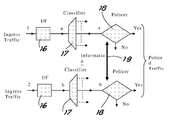
- FIG. 2 shows a functional scheme of the node of FIG. 1 .
- FIG. 3 shows a graph of the recalculation time of a possible policing algorithm.
- FIG. 1 shows a reference scheme 10 of this invention.
- This scheme shows a logically aggregated link 11 (coming from the left-hand side of the figure), with the traffic being carried by the link needing to be classified and subjected to traffic policing.
- the logical link is made up of a plurality of mutually aggregated links 12 and connected to different physical ports which belong to different traffic cards 13 grouped in the more general case on different systems (in the example two systems designated by A and B).
- each of the physical links forming the aggregated link arrives at its own separate interface port on a different card and it is therefore not possible to really realize a policer dealing with the logically aggregated link as a whole.
- FIG. 2 shows the functional scheme applying the principles of this invention to obtain a distributed traffic policing on the cards.
- the traffic policing is performed by the network processors on different cards.
- Each of the input links 12 reaches its respective interface 16 and the flows are then sent to corresponding policers 18 after being appropriately classified by means of classifiers 17 .
- the policers do not apply only rules based on local data but exchange information with each other in order to realize a self-adapting distributed policer as a whole.
- This distributed policer (made up of all the policers 18 with the appropriate information exchange connections 19 ) allows having a traffic policing that behaves like a single entity while adjusting parameters and behaviour depending on actual conditions (class of services, failure conditions, number of physical gates in the aggregated link, number of different cards et cetera).
- FIG. 2 shows for the sake of simplicity two input flows 12 and two policers and reference is made below to this situation. But it is clear from the description given below of an application example of this invention how to apply this invention to a larger number of flows each with its own policer with information exchanges for realization of the distributed policer.
- the two policers 18 are distinguished below by reference letters a and b.
- the policing algorithm selected is for example the known
- the size of the packet is determined and compared against the number of tokens in the buckets. In one implementation, if the packet size in bytes B is less than the number of tokens in the CIR bucket, then the packet is labelled green and B tokens are taken from the CIR bucket. If not, then B is compared to the number of tokens in the EIR bucket; if B is less than this number, the packet is labelled yellow and B tokens are taken from the EIR bucket. If neither bucket has sufficient tokens, then the packet is labelled red. Green packets are generally considered to comply with the user's bandwidth level, whilst yellow and red indicate increasing contravention; packets labelled such may be subject to delay or being dropped.
- a flow of packets is measured and the various packets are marked green, yellow or red depending on whether they conform or not to the bandwidth profile established by the SLS.
- the flow is divided over the various aggregated physical links and the packets should therefore be marked in accordance with said rule while allowing for the flows over the various physical links.
- the recalculation time of the algorithm is shown in FIG. 3 .
- the whole can be generalized for N policers as follows.
- the weight Wn for the n th policer will be:
- each policer After each integration period T (possibly reduced because of an event, as may be seen in FIG. 3 ) each policer sends to all the other policers involved in the aggregation a message containing its own MIRn.
- the integration period T must be as short as possible but long enough to allow sending and receiving of all the messages between one period and the next.
- a policer does not receive within the integration period the MIRn figure of one or more of the other policers involved in the aggregation, it will consider these values equal to zero (this approach, given as an example, is conservative; other approaches can be defined).
- the transmission of electronic messages between the policers uses control channels designed purposely and realizable either inside one apparatus or between different apparatus, channels that are not subject to further definition within the scope of the patent right claimed here.
- IETF Internet Engineering Task Force
- the traffic policing function which is performed by the network processors on different cards, behaves like a single entity, satisfying through information exchange in the algorithm the need to adjust parameters and behaviour depending on the real conditions (class of services, failure conditions, number of physical gates in the aggregated link, number of different cards et cetera). There is thus awareness of the QoS and protection mechanisms aware of the QoS on the logically aggregated link.
Landscapes
- Engineering & Computer Science (AREA)
- Computer Networks & Wireless Communication (AREA)
- Signal Processing (AREA)
- Data Exchanges In Wide-Area Networks (AREA)
Abstract
Description
MIRa=Mean Information Rate classified by the classifier ‘a’
MIRb=Mean Information Rate classified by the classifier ‘b’.
Wa=MIRa/(MIRa+MIRb)
Wb=MIRb/(MIRa+MIRb).
δ1a≧MTU_size; δ2a≧MTU_size
δ1b≧MTU_size; δ2b≧MTU_size
where MTU_size is the Maximum Transfer Unit Size.
policer ‘a’: ρ1a=ρ1/2; ρ2a=ρ2/2; δ1a=δ1/2; δ2a=δ2/2
policer ‘b’: ρ1b=ρ1/2; ρ2b=ρ2/2; δ1b=δ1/2; δ2b=δ2/2
and the updating of the parameters after each integration time will be:
policer ‘a’: ρ1a=ρ1×Wa; ρ2a=ρ2×Wa; δ1a=δ1×Wa; δ2a=δ2×Wa
policer ‘b’: ρ1b=ρ1×Wb; ρ2b=ρ2×Wb; δ1b=δ1×Wb; δ2b=δ2×Wb.
policer ‘a’: ρ1a=ρ1; ρ2a=ρ2; δ1a=δ1; δ2a=δ2
policer ‘b’: ρ1b=ρ1; ρ2b=ρ2; δ1b=δ1; δ2b=δ2
and the updating of the parameters after each integration time will be:
policer ‘a’: ρ1a=ρ1×Wa; ρ2a=ρ2×Wa; δ1a=δ1; δ2a=δ2
policer ‘b’: ρ1b=ρ1×Wb; ρ2b=ρ2×Wb; δ1b=δ1; δ2b=δ2.
indicating with MIRn the MIR measured at each integration time for the nth policer (flow) and the summation being the sum of the MIR measured at each integration time for all the policers.
Claims (21)
ρ1n=ρ1/N, ρ2n=ρ2/N, δ1n=δ1/N, δ2nδ2/N; and
ρ1n=ρ1×Wn, ρ2n=ρ2×Wn, δ1n=δ1 and δ2n=δ2.
ρ1n=ρ1, ρ2n=ρ2, δ1n=δ1, δ2nδ2; and
ρ1n=ρ1×Wn, ρ2n=ρ2×Wn, δ1n=δ1 and δ2n=δ2.
ρ1n=ρ1/N, ρ2n=ρ2/N, δ1n=δ1/N, δ2n=δ2/N; and
ρ1n=ρ1×Wn, ρ2n=ρ2×Wn, δ1n=δ1 and δ2n=δ2.
ρ1n=ρ1, ρ2n=ρ2, δ1n=δ1, δ2n=δ2; and
ρ1n=ρ1×Wn, ρ2n=ρ2×Wn, δ1n=δ1 and δ2n=δ2.
Applications Claiming Priority (4)
| Application Number | Priority Date | Filing Date | Title |
|---|---|---|---|
| ITMI2005A002238 | 2005-11-23 | ||
| IT002238A ITMI20052238A1 (en) | 2005-11-23 | 2005-11-23 | A METHOD AND A PACKAGE TRANSPORTATION SCHEME FOR THE CREATION OF DISTRIBUTED PILICING MECHANISMS |
| ITMI2005A2238 | 2005-11-23 | ||
| PCT/EP2006/068798 WO2007060191A1 (en) | 2005-11-23 | 2006-11-23 | Traffic policing |
Publications (2)
| Publication Number | Publication Date |
|---|---|
| US20080298243A1 US20080298243A1 (en) | 2008-12-04 |
| US7796518B2 true US7796518B2 (en) | 2010-09-14 |
Family
ID=36808867
Family Applications (1)
| Application Number | Title | Priority Date | Filing Date |
|---|---|---|---|
| US12/094,920 Active 2027-03-03 US7796518B2 (en) | 2005-11-23 | 2006-11-23 | Traffic policing |
Country Status (4)
| Country | Link |
|---|---|
| US (1) | US7796518B2 (en) |
| EP (1) | EP1952591B1 (en) |
| IT (1) | ITMI20052238A1 (en) |
| WO (1) | WO2007060191A1 (en) |
Families Citing this family (9)
| Publication number | Priority date | Publication date | Assignee | Title |
|---|---|---|---|---|
| US8369461B2 (en) * | 2007-02-26 | 2013-02-05 | Telefonaktiebolaget L M Ericsson (Publ) | Method and arrangement relating to telecommunications |
| US8000244B1 (en) * | 2007-08-03 | 2011-08-16 | Hewlett-Packard Development Company, L.P. | Shared rate limiters using floating buckets |
| US8116224B2 (en) * | 2008-09-09 | 2012-02-14 | Embarq Holdings Company, LP | System and method for generating alarms based on bursting traffic |
| US8385206B2 (en) * | 2008-12-30 | 2013-02-26 | Alcatel Lucent | Single and dual rate three color marker systems |
| US8537699B2 (en) | 2009-06-16 | 2013-09-17 | Qualcomm Incorporated | Managing video adaptation algorithms |
| US20120195198A1 (en) * | 2011-01-31 | 2012-08-02 | Joseph Regan | Method and apparatus providing protocol policing |
| US20150131442A1 (en) * | 2012-05-08 | 2015-05-14 | Telefonaktiebolaget L M Ericsson (Publ) | Dynamic Profiling for Transport Networks |
| CN102710514B (en) * | 2012-05-25 | 2015-01-21 | 华为技术有限公司 | A packet flow control method and system |
| US10819646B2 (en) * | 2018-10-18 | 2020-10-27 | Ciena Corporation | Systems and methods for distributing unused bandwidth of metered flows in an envelope based on weights |
Citations (4)
| Publication number | Priority date | Publication date | Assignee | Title |
|---|---|---|---|---|
| US20020073226A1 (en) * | 2000-09-18 | 2002-06-13 | Sridhar Manickam R. | Distributed quality-of-service system |
| US20040141462A1 (en) * | 2003-01-17 | 2004-07-22 | Nortel Networks Limited | Multi-staged services policing |
| US20050135378A1 (en) * | 2003-12-22 | 2005-06-23 | Nortel Networks Limited | Service aware policer with efficient handling of in-profile traffic |
| US6970426B1 (en) * | 2003-05-14 | 2005-11-29 | Extreme Networks | Rate color marker |
-
2005
- 2005-11-23 IT IT002238A patent/ITMI20052238A1/en unknown
-
2006
- 2006-11-23 WO PCT/EP2006/068798 patent/WO2007060191A1/en not_active Ceased
- 2006-11-23 US US12/094,920 patent/US7796518B2/en active Active
- 2006-11-23 EP EP06819697.1A patent/EP1952591B1/en not_active Not-in-force
Patent Citations (5)
| Publication number | Priority date | Publication date | Assignee | Title |
|---|---|---|---|---|
| US20020073226A1 (en) * | 2000-09-18 | 2002-06-13 | Sridhar Manickam R. | Distributed quality-of-service system |
| US20040141462A1 (en) * | 2003-01-17 | 2004-07-22 | Nortel Networks Limited | Multi-staged services policing |
| WO2004066565A1 (en) | 2003-01-17 | 2004-08-05 | Nortel Networks Limited | Multi-staged services policing |
| US6970426B1 (en) * | 2003-05-14 | 2005-11-29 | Extreme Networks | Rate color marker |
| US20050135378A1 (en) * | 2003-12-22 | 2005-06-23 | Nortel Networks Limited | Service aware policer with efficient handling of in-profile traffic |
Non-Patent Citations (1)
| Title |
|---|
| Hui, Guo et al. "A Design and Evaluation of Ethernet Links Bundling Systems." 18th International Conference on Advanced Information Networking and Applications, 2004. Japan, Mar. 29-31, 2004. XP010695247, ISBN: 0-7695-2051-0. |
Also Published As
| Publication number | Publication date |
|---|---|
| ITMI20052238A1 (en) | 2007-05-24 |
| WO2007060191A1 (en) | 2007-05-31 |
| US20080298243A1 (en) | 2008-12-04 |
| EP1952591B1 (en) | 2018-06-27 |
| EP1952591A1 (en) | 2008-08-06 |
Similar Documents
| Publication | Publication Date | Title |
|---|---|---|
| CN104272680B (en) | signaling congestion | |
| US10680964B1 (en) | Rate limiting in a multi-chassis environment by exchanging information between peer network elements | |
| Vegesna | IP quality of service | |
| US7349342B2 (en) | Traffic metering in data networks | |
| EP1433066B1 (en) | Device and method for packet forwarding | |
| EP1527568B1 (en) | Programmable scheduling for ip routers | |
| US8737205B2 (en) | Weight-based bandwidth allocation for network traffic | |
| US9998400B2 (en) | Attribution of congestion contributions | |
| US8194542B2 (en) | Method and equipment for performing flow shaping that maintains service quality in packet-switched telecommunications | |
| EP2575303A1 (en) | Determining congestion measures | |
| US8248932B2 (en) | Method and apparatus for fairly sharing excess bandwidth and packet dropping amongst subscribers of a data network | |
| US7796518B2 (en) | Traffic policing | |
| Balogh et al. | Performance evaluation of WFQ, WF 2 Q+ and WRR queue scheduling algorithms | |
| Menth et al. | Active queue management based on congestion policing (CP-AQM) | |
| US8750111B2 (en) | Method and device for transmitting packets in a telecommunications network | |
| Mohammed et al. | Active queue management for congestion control: Performance evaluation, new approach, and comparative study | |
| Menth et al. | Fair resource sharing for stateless-core packet-switched networks with prioritization | |
| AU2007336220B2 (en) | Method for optimising the sharing of a plurality of network resources between a plurality of application flows | |
| Zoriđ et al. | Fairness of scheduling algorithms for real-time traffic in DiffServ based networks | |
| Domżał et al. | Guide to flow-aware networking: quality-of-service architectures and techniques for traffic management | |
| Sakamoto et al. | Bandwidth control using adaptive packet policer management for packet transport network based on service layer request | |
| Balkaş | Delay-bounded Rate Adaptive Shaper for TCP Traffic in Diffserv Internet | |
| Aweya et al. | Relative loss rate differentiation: performance of short‐lived TCP flows | |
| Pakdeepinit et al. | Balancing secondary traffic metering for DiffServ assured forwarding classes | |
| Engelbrecht | Analysis of RED packet loss performance in a simulated IP WAN |
Legal Events
| Date | Code | Title | Description |
|---|---|---|---|
| AS | Assignment |
Owner name: ERICSSON AB, SWEDEN Free format text: ASSIGNMENT OF ASSIGNORS INTEREST;ASSIGNORS:MARTINOTTI, RICCARDO;CORTI, ANDREA;FIORONE, RAOUL;REEL/FRAME:021054/0977 Effective date: 20080529 |
|
| STCF | Information on status: patent grant |
Free format text: PATENTED CASE |
|
| CC | Certificate of correction | ||
| FPAY | Fee payment |
Year of fee payment: 4 |
|
| MAFP | Maintenance fee payment |
Free format text: PAYMENT OF MAINTENANCE FEE, 8TH YEAR, LARGE ENTITY (ORIGINAL EVENT CODE: M1552) Year of fee payment: 8 |
|
| MAFP | Maintenance fee payment |
Free format text: PAYMENT OF MAINTENANCE FEE, 12TH YEAR, LARGE ENTITY (ORIGINAL EVENT CODE: M1553); ENTITY STATUS OF PATENT OWNER: LARGE ENTITY Year of fee payment: 12 |