US7794606B2 - Modular flameless waste treatment method - Google Patents
Modular flameless waste treatment method Download PDFInfo
- Publication number
- US7794606B2 US7794606B2 US11/697,921 US69792107A US7794606B2 US 7794606 B2 US7794606 B2 US 7794606B2 US 69792107 A US69792107 A US 69792107A US 7794606 B2 US7794606 B2 US 7794606B2
- Authority
- US
- United States
- Prior art keywords
- waste
- waste stream
- chamber
- stream
- metal ion
- Prior art date
- Legal status (The legal status is an assumption and is not a legal conclusion. Google has not performed a legal analysis and makes no representation as to the accuracy of the status listed.)
- Expired - Fee Related, expires
Links
- 239000002699 waste material Substances 0.000 title claims abstract description 132
- 238000000034 method Methods 0.000 title claims abstract description 34
- 238000011282 treatment Methods 0.000 title claims abstract description 34
- 229910021645 metal ion Inorganic materials 0.000 claims abstract description 68
- 230000003647 oxidation Effects 0.000 claims abstract description 29
- 238000007254 oxidation reaction Methods 0.000 claims abstract description 29
- 238000009279 wet oxidation reaction Methods 0.000 claims abstract description 14
- 239000007788 liquid Substances 0.000 claims description 25
- QVGXLLKOCUKJST-UHFFFAOYSA-N atomic oxygen Chemical compound [O] QVGXLLKOCUKJST-UHFFFAOYSA-N 0.000 claims description 20
- 229910052760 oxygen Inorganic materials 0.000 claims description 20
- 239000001301 oxygen Substances 0.000 claims description 20
- 239000002245 particle Substances 0.000 claims description 17
- 239000000463 material Substances 0.000 claims description 16
- 239000003112 inhibitor Substances 0.000 claims description 11
- 239000007787 solid Substances 0.000 claims description 10
- 238000010438 heat treatment Methods 0.000 claims description 9
- 229910052709 silver Inorganic materials 0.000 claims description 9
- 239000004332 silver Substances 0.000 claims description 9
- MYMOFIZGZYHOMD-UHFFFAOYSA-N Dioxygen Chemical compound O=O MYMOFIZGZYHOMD-UHFFFAOYSA-N 0.000 claims description 8
- 150000002500 ions Chemical class 0.000 claims description 7
- XEEYBQQBJWHFJM-UHFFFAOYSA-N Iron Chemical compound [Fe] XEEYBQQBJWHFJM-UHFFFAOYSA-N 0.000 claims description 6
- 239000006260 foam Substances 0.000 claims description 6
- 239000000126 substance Substances 0.000 claims description 6
- JPVYNHNXODAKFH-UHFFFAOYSA-N Cu2+ Chemical compound [Cu+2] JPVYNHNXODAKFH-UHFFFAOYSA-N 0.000 claims description 5
- BQCADISMDOOEFD-UHFFFAOYSA-N Silver Chemical compound [Ag] BQCADISMDOOEFD-UHFFFAOYSA-N 0.000 claims description 5
- 229910001431 copper ion Inorganic materials 0.000 claims description 5
- 229910001882 dioxygen Inorganic materials 0.000 claims description 5
- 230000001590 oxidative effect Effects 0.000 claims description 5
- 231100000331 toxic Toxicity 0.000 claims description 5
- 230000002588 toxic effect Effects 0.000 claims description 5
- 230000002879 macerating effect Effects 0.000 claims description 4
- 239000010796 biological waste Substances 0.000 claims description 3
- 229910052742 iron Inorganic materials 0.000 claims description 3
- HCHKCACWOHOZIP-UHFFFAOYSA-N Zinc Chemical compound [Zn] HCHKCACWOHOZIP-UHFFFAOYSA-N 0.000 claims description 2
- 229910052782 aluminium Inorganic materials 0.000 claims description 2
- XAGFODPZIPBFFR-UHFFFAOYSA-N aluminium Chemical compound [Al] XAGFODPZIPBFFR-UHFFFAOYSA-N 0.000 claims description 2
- 239000012620 biological material Substances 0.000 claims description 2
- 150000001875 compounds Chemical class 0.000 claims description 2
- 239000007789 gas Substances 0.000 claims description 2
- 229910052725 zinc Inorganic materials 0.000 claims description 2
- 239000011701 zinc Substances 0.000 claims description 2
- 230000003134 recirculating effect Effects 0.000 claims 1
- 239000010891 toxic waste Substances 0.000 claims 1
- 238000001802 infusion Methods 0.000 abstract description 19
- 239000012530 fluid Substances 0.000 abstract description 13
- 238000002803 maceration Methods 0.000 abstract description 13
- 239000010808 liquid waste Substances 0.000 abstract description 6
- 238000000265 homogenisation Methods 0.000 abstract description 4
- 238000004891 communication Methods 0.000 abstract description 3
- 238000011221 initial treatment Methods 0.000 abstract description 3
- 230000008569 process Effects 0.000 description 13
- 229910052751 metal Inorganic materials 0.000 description 11
- 239000002184 metal Substances 0.000 description 11
- 239000000725 suspension Substances 0.000 description 11
- RYGMFSIKBFXOCR-UHFFFAOYSA-N Copper Chemical compound [Cu] RYGMFSIKBFXOCR-UHFFFAOYSA-N 0.000 description 10
- 239000010949 copper Substances 0.000 description 10
- 229910052802 copper Inorganic materials 0.000 description 9
- 238000004659 sterilization and disinfection Methods 0.000 description 9
- 238000002156 mixing Methods 0.000 description 8
- 150000002739 metals Chemical class 0.000 description 6
- XLYOFNOQVPJJNP-UHFFFAOYSA-N water Substances O XLYOFNOQVPJJNP-UHFFFAOYSA-N 0.000 description 6
- 230000015572 biosynthetic process Effects 0.000 description 5
- 239000000203 mixture Substances 0.000 description 5
- 230000008901 benefit Effects 0.000 description 4
- 150000001735 carboxylic acids Chemical class 0.000 description 4
- 238000006243 chemical reaction Methods 0.000 description 4
- 230000001105 regulatory effect Effects 0.000 description 4
- -1 silver ions Chemical class 0.000 description 4
- QTBSBXVTEAMEQO-UHFFFAOYSA-N Acetic acid Chemical compound CC(O)=O QTBSBXVTEAMEQO-UHFFFAOYSA-N 0.000 description 3
- MUBZPKHOEPUJKR-UHFFFAOYSA-N Oxalic acid Chemical compound OC(=O)C(O)=O MUBZPKHOEPUJKR-UHFFFAOYSA-N 0.000 description 3
- 150000002632 lipids Chemical class 0.000 description 3
- 238000012545 processing Methods 0.000 description 3
- 150000003254 radicals Chemical class 0.000 description 3
- 239000007921 spray Substances 0.000 description 3
- 229910000881 Cu alloy Inorganic materials 0.000 description 2
- FAPWRFPIFSIZLT-UHFFFAOYSA-M Sodium chloride Chemical compound [Na+].[Cl-] FAPWRFPIFSIZLT-UHFFFAOYSA-M 0.000 description 2
- DBMJMQXJHONAFJ-UHFFFAOYSA-M Sodium laurylsulphate Chemical compound [Na+].CCCCCCCCCCCCOS([O-])(=O)=O DBMJMQXJHONAFJ-UHFFFAOYSA-M 0.000 description 2
- RAHZWNYVWXNFOC-UHFFFAOYSA-N Sulphur dioxide Chemical compound O=S=O RAHZWNYVWXNFOC-UHFFFAOYSA-N 0.000 description 2
- 230000000844 anti-bacterial effect Effects 0.000 description 2
- 239000007864 aqueous solution Substances 0.000 description 2
- 230000001580 bacterial effect Effects 0.000 description 2
- 239000011230 binding agent Substances 0.000 description 2
- 239000003795 chemical substances by application Substances 0.000 description 2
- 238000007599 discharging Methods 0.000 description 2
- 230000000694 effects Effects 0.000 description 2
- 239000002440 industrial waste Substances 0.000 description 2
- 239000012678 infectious agent Substances 0.000 description 2
- BDAGIHXWWSANSR-UHFFFAOYSA-N methanoic acid Natural products OC=O BDAGIHXWWSANSR-UHFFFAOYSA-N 0.000 description 2
- 239000007800 oxidant agent Substances 0.000 description 2
- 239000000843 powder Substances 0.000 description 2
- 239000002002 slurry Substances 0.000 description 2
- 235000019333 sodium laurylsulphate Nutrition 0.000 description 2
- 229910000679 solder Inorganic materials 0.000 description 2
- 239000000243 solution Substances 0.000 description 2
- MGWGWNFMUOTEHG-UHFFFAOYSA-N 4-(3,5-dimethylphenyl)-1,3-thiazol-2-amine Chemical compound CC1=CC(C)=CC(C=2N=C(N)SC=2)=C1 MGWGWNFMUOTEHG-UHFFFAOYSA-N 0.000 description 1
- OSWFIVFLDKOXQC-UHFFFAOYSA-N 4-(3-methoxyphenyl)aniline Chemical compound COC1=CC=CC(C=2C=CC(N)=CC=2)=C1 OSWFIVFLDKOXQC-UHFFFAOYSA-N 0.000 description 1
- 229910001316 Ag alloy Inorganic materials 0.000 description 1
- 241000894006 Bacteria Species 0.000 description 1
- OKTJSMMVPCPJKN-UHFFFAOYSA-N Carbon Chemical compound [C] OKTJSMMVPCPJKN-UHFFFAOYSA-N 0.000 description 1
- ZAMOUSCENKQFHK-UHFFFAOYSA-N Chlorine atom Chemical compound [Cl] ZAMOUSCENKQFHK-UHFFFAOYSA-N 0.000 description 1
- 102000007474 Multiprotein Complexes Human genes 0.000 description 1
- 108010085220 Multiprotein Complexes Proteins 0.000 description 1
- FOIXSVOLVBLSDH-UHFFFAOYSA-N Silver ion Chemical compound [Ag+] FOIXSVOLVBLSDH-UHFFFAOYSA-N 0.000 description 1
- 235000011054 acetic acid Nutrition 0.000 description 1
- 239000002253 acid Substances 0.000 description 1
- 150000007513 acids Chemical class 0.000 description 1
- 230000004075 alteration Effects 0.000 description 1
- 239000002518 antifoaming agent Substances 0.000 description 1
- 239000003139 biocide Substances 0.000 description 1
- 230000004071 biological effect Effects 0.000 description 1
- 229910052797 bismuth Inorganic materials 0.000 description 1
- JCXGWMGPZLAOME-UHFFFAOYSA-N bismuth atom Chemical compound [Bi] JCXGWMGPZLAOME-UHFFFAOYSA-N 0.000 description 1
- 229910052799 carbon Inorganic materials 0.000 description 1
- 239000000460 chlorine Substances 0.000 description 1
- 229910052801 chlorine Inorganic materials 0.000 description 1
- 238000004140 cleaning Methods 0.000 description 1
- 238000002485 combustion reaction Methods 0.000 description 1
- 235000013365 dairy product Nutrition 0.000 description 1
- 230000006378 damage Effects 0.000 description 1
- 230000009849 deactivation Effects 0.000 description 1
- 238000013461 design Methods 0.000 description 1
- 239000000645 desinfectant Substances 0.000 description 1
- 238000010586 diagram Methods 0.000 description 1
- YWEUIGNSBFLMFL-UHFFFAOYSA-N diphosphonate Chemical compound O=P(=O)OP(=O)=O YWEUIGNSBFLMFL-UHFFFAOYSA-N 0.000 description 1
- 239000000428 dust Substances 0.000 description 1
- 230000009969 flowable effect Effects 0.000 description 1
- 238000005187 foaming Methods 0.000 description 1
- 239000010794 food waste Substances 0.000 description 1
- 235000019253 formic acid Nutrition 0.000 description 1
- 230000002538 fungal effect Effects 0.000 description 1
- PCHJSUWPFVWCPO-UHFFFAOYSA-N gold Chemical compound [Au] PCHJSUWPFVWCPO-UHFFFAOYSA-N 0.000 description 1
- 229910052737 gold Inorganic materials 0.000 description 1
- 239000010931 gold Substances 0.000 description 1
- 231100001261 hazardous Toxicity 0.000 description 1
- 238000011065 in-situ storage Methods 0.000 description 1
- 208000015181 infectious disease Diseases 0.000 description 1
- 230000002458 infectious effect Effects 0.000 description 1
- 239000004615 ingredient Substances 0.000 description 1
- 229910052500 inorganic mineral Inorganic materials 0.000 description 1
- 238000009434 installation Methods 0.000 description 1
- 231100001231 less toxic Toxicity 0.000 description 1
- 239000007791 liquid phase Substances 0.000 description 1
- 238000004519 manufacturing process Methods 0.000 description 1
- 235000012054 meals Nutrition 0.000 description 1
- 238000005259 measurement Methods 0.000 description 1
- 239000002906 medical waste Substances 0.000 description 1
- 229910001092 metal group alloy Inorganic materials 0.000 description 1
- 239000008267 milk Substances 0.000 description 1
- 235000013336 milk Nutrition 0.000 description 1
- 210000004080 milk Anatomy 0.000 description 1
- 239000011707 mineral Substances 0.000 description 1
- 239000003595 mist Substances 0.000 description 1
- 238000012986 modification Methods 0.000 description 1
- 230000004048 modification Effects 0.000 description 1
- JCXJVPUVTGWSNB-UHFFFAOYSA-N nitrogen dioxide Inorganic materials O=[N]=O JCXJVPUVTGWSNB-UHFFFAOYSA-N 0.000 description 1
- 150000002894 organic compounds Chemical class 0.000 description 1
- 235000006408 oxalic acid Nutrition 0.000 description 1
- 239000003208 petroleum Substances 0.000 description 1
- 239000012071 phase Substances 0.000 description 1
- DLYUQMMRRRQYAE-UHFFFAOYSA-N phosphorus pentoxide Inorganic materials O1P(O2)(=O)OP3(=O)OP1(=O)OP2(=O)O3 DLYUQMMRRRQYAE-UHFFFAOYSA-N 0.000 description 1
- 239000010908 plant waste Substances 0.000 description 1
- 239000013502 plastic waste Substances 0.000 description 1
- 238000007747 plating Methods 0.000 description 1
- 238000004663 powder metallurgy Methods 0.000 description 1
- 239000012255 powdered metal Substances 0.000 description 1
- 239000010909 process residue Substances 0.000 description 1
- 230000001737 promoting effect Effects 0.000 description 1
- 102000004169 proteins and genes Human genes 0.000 description 1
- 108090000623 proteins and genes Proteins 0.000 description 1
- 238000006479 redox reaction Methods 0.000 description 1
- 238000009991 scouring Methods 0.000 description 1
- 239000010865 sewage Substances 0.000 description 1
- 238000003307 slaughter Methods 0.000 description 1
- 239000011885 synergistic combination Substances 0.000 description 1
- 239000008399 tap water Substances 0.000 description 1
- 235000020679 tap water Nutrition 0.000 description 1
- 238000012360 testing method Methods 0.000 description 1
- 231100000419 toxicity Toxicity 0.000 description 1
- 230000001988 toxicity Effects 0.000 description 1
- 230000003612 virological effect Effects 0.000 description 1
- 239000002023 wood Substances 0.000 description 1
Images




Classifications
-
- C—CHEMISTRY; METALLURGY
- C02—TREATMENT OF WATER, WASTE WATER, SEWAGE, OR SLUDGE
- C02F—TREATMENT OF WATER, WASTE WATER, SEWAGE, OR SLUDGE
- C02F1/00—Treatment of water, waste water, or sewage
- C02F1/46—Treatment of water, waste water, or sewage by electrochemical methods
- C02F1/4606—Treatment of water, waste water, or sewage by electrochemical methods for producing oligodynamic substances to disinfect the water
-
- A—HUMAN NECESSITIES
- A61—MEDICAL OR VETERINARY SCIENCE; HYGIENE
- A61L—METHODS OR APPARATUS FOR STERILISING MATERIALS OR OBJECTS IN GENERAL; DISINFECTION, STERILISATION OR DEODORISATION OF AIR; CHEMICAL ASPECTS OF BANDAGES, DRESSINGS, ABSORBENT PADS OR SURGICAL ARTICLES; MATERIALS FOR BANDAGES, DRESSINGS, ABSORBENT PADS OR SURGICAL ARTICLES
- A61L11/00—Methods specially adapted for refuse
-
- C—CHEMISTRY; METALLURGY
- C02—TREATMENT OF WATER, WASTE WATER, SEWAGE, OR SLUDGE
- C02F—TREATMENT OF WATER, WASTE WATER, SEWAGE, OR SLUDGE
- C02F1/00—Treatment of water, waste water, or sewage
- C02F1/72—Treatment of water, waste water, or sewage by oxidation
- C02F1/727—Treatment of water, waste water, or sewage by oxidation using pure oxygen or oxygen rich gas
-
- C—CHEMISTRY; METALLURGY
- C02—TREATMENT OF WATER, WASTE WATER, SEWAGE, OR SLUDGE
- C02F—TREATMENT OF WATER, WASTE WATER, SEWAGE, OR SLUDGE
- C02F2103/00—Nature of the water, waste water, sewage or sludge to be treated
- C02F2103/003—Wastewater from hospitals, laboratories and the like, heavily contaminated by pathogenic microorganisms
-
- C—CHEMISTRY; METALLURGY
- C02—TREATMENT OF WATER, WASTE WATER, SEWAGE, OR SLUDGE
- C02F—TREATMENT OF WATER, WASTE WATER, SEWAGE, OR SLUDGE
- C02F2209/00—Controlling or monitoring parameters in water treatment
- C02F2209/005—Processes using a programmable logic controller [PLC]
-
- C—CHEMISTRY; METALLURGY
- C02—TREATMENT OF WATER, WASTE WATER, SEWAGE, OR SLUDGE
- C02F—TREATMENT OF WATER, WASTE WATER, SEWAGE, OR SLUDGE
- C02F2209/00—Controlling or monitoring parameters in water treatment
- C02F2209/02—Temperature
-
- C—CHEMISTRY; METALLURGY
- C02—TREATMENT OF WATER, WASTE WATER, SEWAGE, OR SLUDGE
- C02F—TREATMENT OF WATER, WASTE WATER, SEWAGE, OR SLUDGE
- C02F2209/00—Controlling or monitoring parameters in water treatment
- C02F2209/05—Conductivity or salinity
-
- C—CHEMISTRY; METALLURGY
- C02—TREATMENT OF WATER, WASTE WATER, SEWAGE, OR SLUDGE
- C02F—TREATMENT OF WATER, WASTE WATER, SEWAGE, OR SLUDGE
- C02F2209/00—Controlling or monitoring parameters in water treatment
- C02F2209/06—Controlling or monitoring parameters in water treatment pH
-
- C—CHEMISTRY; METALLURGY
- C02—TREATMENT OF WATER, WASTE WATER, SEWAGE, OR SLUDGE
- C02F—TREATMENT OF WATER, WASTE WATER, SEWAGE, OR SLUDGE
- C02F2209/00—Controlling or monitoring parameters in water treatment
- C02F2209/08—Chemical Oxygen Demand [COD]; Biological Oxygen Demand [BOD]
-
- C—CHEMISTRY; METALLURGY
- C02—TREATMENT OF WATER, WASTE WATER, SEWAGE, OR SLUDGE
- C02F—TREATMENT OF WATER, WASTE WATER, SEWAGE, OR SLUDGE
- C02F2209/00—Controlling or monitoring parameters in water treatment
- C02F2209/40—Liquid flow rate
-
- C—CHEMISTRY; METALLURGY
- C02—TREATMENT OF WATER, WASTE WATER, SEWAGE, OR SLUDGE
- C02F—TREATMENT OF WATER, WASTE WATER, SEWAGE, OR SLUDGE
- C02F2209/00—Controlling or monitoring parameters in water treatment
- C02F2209/42—Liquid level
Definitions
- the disclosure relates to modular treatment unit intended to provide for treatment and/or disinfection of liquid wastes, including medical, domestic, scientific, mortuary, or commercial wastes, to disinfect and render the wastes non-infectious and less toxic.
- waste streams from hospitals, slaughter houses, and other sources that may contain biologically hazardous and other toxic or objectionable components are not adequately treated before discharging such waste streams to sanitary sewer systems or directly to the environment.
- Large municipal treatment facilities may not adequately be configured for high concentrations of biological and chemical materials originating in hospitals and other sources. Accordingly, there is a need for improved systems and methods for treating waste streams before the streams are discharged into a sanitary sewer system or directly to the environment.
- modular systems may be readily deployed before an inlet to an existing sanitary sewer system at the source of the waste stream thereby reducing the infectivity and toxicity of material that a municipal system must treat.
- an exemplary embodiment of the disclosure provides a modular waste treatment system for liquid waste streams and methods of treating liquid waste streams.
- the modular waste treatment system includes a maceration chamber for initial treatment and homogenization of waste material; a metal ion infusion chamber in fluid flow communication with the maceration chamber for introducing metal ions into the waste material; and an oxidation chamber for wet oxidation of the waste stream. Provision may be made to recycle the waste to one or more of the chambers for further treatment if required.
- the method may include flowing a waste stream into a modular waste treatment system.
- the modular waste treatment system may include a maceration chamber for initial treatment and homogenization of waste material; a metal ion infusion chamber in fluid flow communication with the maceration chamber for introducing metal ions into the waste material; and an oxidation chamber for oxidizing oxidizable material in the waste stream.
- the waste stream is macerated to a predetermined particle size and may be contacted with a film inhibitor in the maceration chamber.
- Metal ions are generated in the metal ion infusion chamber for contact with the waste stream from the maceration chamber to partially detoxify and to promote the oxidation process of the waste stream.
- the waste stream is then oxidized in the presence of oxygen to provide a treated stream that is substantially devoid of toxic and active biological materials.
- An advantage of the system and methods described herein is that the system combines at least two disinfection techniques in a single unit thereby increasing the effectiveness of waste stream treatment over the use of a single disinfection technique.
- the oxidation system used is essentially flameless and therefore does not introduce any combustion products into the atmosphere. However, heating both the waste stream and the oxygen stream may greatly promote the reaction rate.
- the use of elemental oxygen also provides a much more compact system than units using air (containing only about 20 wt. % oxygen).
- the system may be configured as a mobile, or portable, stand-alone unit or may be provided in a substantially fixed non-portable installation that may be inserted between a waste material source and a final disposition of the waste material.
- the waste treatment system may also be combined and/or integral with a waste collection system.
- the waste treatment system may be a stand alone system for discharge of treated wastes to the environment.
- FIG. 1 is a block flow diagram of a treatment process according to the disclosure
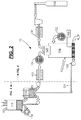
- FIG. 2 is an overall schematic drawing of a treatment system according to the disclosure
- FIG. 3 is an enlarged schematic drawing of a portion of the treatment system of FIG. 2 including a receiving chamber and a metal ion infusion chamber;
- FIG. 4 is an enlarged schematic drawing of a portion of the treatment system of FIG. 2 including an oxidation chamber.
- embodiments of the disclosure provide systems and methods for treating waste streams before discharging the waste streams to a sanitary sewer system or directly to the environment.
- the systems and methods may be adaptable to being portable or being attached to existing sanitary sewer drains for multiple locations.
- Each system may be substantially self-contained so that fluid discharged from the system may be suitable to flow into an existing sanitary sewer without further treatment or for flow directly to the environment without further treatment.
- the systems and methods of the present disclosure may generate reactive disinfection agents in situ during the course of operation of the system.
- Waste streams may be treated with a synergistic combination of metal ions and a wet oxidation step. Because the metal ions are effective at low concentrations and because they are rendered inert during oxidation; no further treatment to remove the metal ions is required.
- An oxygen demand sensor may be included to ensure the effectiveness of treatment before discharge of the treated stream to a sewer system or the environment.
- metal ions used in combination with oxidizing agents such as chlorine are known to be effective biocidal agents
- the combination of metal ions and a wet oxidation step in a single system may provide a synergistically improved effectiveness for eliminating biological activity and reducing the toxic effect of components in the waste stream.
- an embodiment of the disclosure provides a waste treatment unit 10 for performing a series of continuous, in-line processes, with each process stage described in more detail below.
- Each process stage may herein be represented as an individual physical chamber in order to provide clear understanding of the in-line process concept.
- the treatment system 10 includes a waste collection step 12 for collecting waste liquid to be treated. After collection, the waste liquid is macerated in a maceration step 14 in order to reduce the size of solid particles and homogenize the particles and waste in the waste stream to a size that can be effectively treated with metal ions and wet oxidation in later stages of the process. As shown, the macerated liquid may be recycled to mix with the waste liquid being collected in step 12 to promote mixing and homogenization and to extend the time of contact with the active chemicals. Water or other aqueous solution may be added to the waste collected in step 12 to promote flow through the system 10 .
- a metal ion infusion step 16 is provided to generate or otherwise infuse metal ions into the waste liquid for metal ion treatment of the waste liquid and to promote the oxidation process.
- the macerated liquid may be recirculated through the metal ion infusion stage in multiple passes to ensure adequate concentrations of metal ions.
- the metal ion treated liquid is then oxidized in a wet oxidation step 18 .
- the wet oxidation step may be enhanced by heating the metal ion treated liquid in a preheat step 20 prior to the wet oxidation step 18 .
- the wet oxidation step 18 is conducted using oxygen gas 22 , in conjunction with the metal ions to effect a low temperature chemical reaction.
- pure oxygen is the most desirable oxygen gas for conducting the oxidation step of the process 10 because it substantially reduces the volume requirements for treating the waste. Based upon the readings from an oxygen demand sensor, the waste may be recycled or may be suitable for disposal according to step 26 of the process 10 .
- the main components of the system 10 include a receiving chamber 112 , a metal ion infusion chamber 114 , and an oxidation chamber 116 .
- a macerator 118 may be associated with the receiving chamber 112 or may be associated with the metal ion infusion chamber 114 or both. Additional process chemicals such as an anti-foam and a film inhibitor may be provided to the waste liquid in the receiving chamber 112 .
- a heat exchanger or other heating means 122 is provided to preheat the metal ion treated liquid prior to introducing the treated liquid into the oxidation chamber.
- the metal ion treated liquid is also pressurized with a pressure pump 124 for feeding into a spray mixing nozzle 126 for feed, along with an oxidizing agent, into the oxidation chamber 116 .
- An oxygen source 128 is provided for feeding oxygen gas to the oxidation chamber 116 .
- the oxygen gas may also be preheated in a heat exchanger or by other heating means 130 .
- the oxidation chamber 116 may also be pressurized by a compressor or pressure pump 132 associated with the chamber 116 .
- a portion of the metal ion treated and oxidized material in the oxidation chamber 116 may be recirculated through recirculation line 131 by recirculation pump 133 to the metal ion infusion chamber 114 . Further details of the components of the system 10 are provided in FIGS. 3 and 4 discussed below.
- a waste stream 140 comprising biological waste may be fed into the receiving chamber 112 where it may be mechanically macerated in the macerator 118 and combined with tap water 142 or other aqueous fluids such as a saline solution to provide a pumpable slurry.
- a metered dose of a lipid/protein complex film inhibitor 144 may be provided to the receiving chamber 112 .
- a suitable film inhibitor 144 may be an aqueous solution of sodium lauryl sulfate (SLS).
- a foam suppressant 146 such as an organosilicone compound, may also be added to the receiving chamber 112 to reduce foaming tendencies of the waste stream 140 .
- metal ions from a metal ion solution may be metered into the receiving chamber using a dosing pump.
- the receiving chamber 112 may be constructed of copper or copper alloy to provide an inherent bactericidal action thereby suppressing undesirable bacterial growth. Similar bactericidal action may be obtained by copper plating or use of a copper or copper alloy floor plate in the receiving chamber 112 .
- the film inhibitor 144 is believed to perform two critical functions. First, the film inhibitor 144 may initiate a chemical attack to begin breaking down and denaturing both lipid and protein complexes present in the waste material 154 . Second, the film inhibitor's inherent detergency may enable the receiving chamber 112 to remain “self-cleaning”. An amount of film inhibitor 144 that may be used in the receiving chamber 112 may range from about 0.1 to about 10 percent by volume.
- the foam suppressant 146 may further ensure that air bubble formation in the waste material 154 is reduced during maceration cycles, so that air entrapment does not inhibit the operating efficacy of subsequent treatment chambers.
- An amount of foam suppressant 146 that may be used in the receiving chamber 112 to suppress air bubble formation may range from about 0.05 to about 1.0 percent by volume.
- the receiving chamber 112 may include a macerating device 118 , such as a pump, a rotary paddle or blade, or other means of chopping or mixing the recirculated stream 150 from the chamber 112 in order to macerate and mix the incoming waste stream 140 with the water 142 , film inhibitor 144 and/or foam suppressant 146 .
- Maceration may effectively break down waste solids in the waste material 154 to a common rough particle size and to suitably mix waste solids in the waste material 154 with sufficient fluid for flow to subsequent chambers for waste processing. Multiple maceration steps may be used to provide a suitable particle size in the waste material 154 for subsequent treatment.
- the waste material 154 is macerated to provide a substantially liquid stream.
- substantially liquid means that any solids present in the waste material remain substantially suspended in a liquid phase for flow through the system 10 .
- a suitable particle size exiting the receiving chamber 112 may be less than about 0.5 millimeters in diameter and typically less than .3 millimeters in diameter after maceration.
- the maximum particle size exiting from the macerating device 118 may range from about 0.25 to about 0.5 millimeters in diameter.
- the initial particle size of particles entering the macerating device 118 may range from about 5 to about 10 millimeters in diameter.
- the term “diameter” is used to signify an average cross-sectional dimension of particles based on the largest cross-section of the particles in the waste material 154 and is not intended to indicate that the particles are necessarily circular or spherical.
- the chamber 112 may further include a fluid inlet port 156 that may include a unidirectional inlet valve 158 or pump unit for allowing the waste stream 140 to enter the chamber 112 .
- the chamber 112 may have a fluid exit port 160 containing a unidirectional exit valve 162 or pump unit for allowing the waste stream 164 as a slurry or suspension of solids to exit the chamber 112 .
- the inlet and exit ports 156 and 160 may be positioned on opposite sides of the receiving chamber 112 , or they may be otherwise configured to provide flow into and out of the chamber 112 as required to maintain a predetermined level of liquid in the chamber 112 . In that regard a suitable level control device may be used to maintain a predetermined level of fluid in the chamber 112 .
- the waste stream 164 may then flow from the receiving chamber 112 into the metal ion infusion chamber 114 where a set of electrodes comprising an anode 166 and a cathode 168 , each composed of one or more metals selected from silver, copper, iron, zinc, bismuth, gold, aluminum and/or other metals may be immersed in the waste material suspension 166 .
- a set of electrodes comprising an anode 166 and a cathode 168 , each composed of one or more metals selected from silver, copper, iron, zinc, bismuth, gold, aluminum and/or other metals may be immersed in the waste material suspension 166 .
- iron is an effective metal species for promoting oxidation; other metal ions may be suitable for this application.
- Application of electrical energy to the anode 166 and the cathode 168 may cause metal ions to be liberated from the electrodes via one or more redox reactions, whereby the metal ions may become dissolved in the waste material suspension 166 .
- Multiple sets of electrodes comprising one or more metal compositions, and having an appropriate voltage division and current flow may introduce various concentrations of one or more metal ions into the waste suspension 166 .
- the dissolved metal ions may act within the waste suspension 166 to deactivate or destroy bacterial, protist, fungal, and viral infectious agents present within the waste suspension 166 .
- the deactivation or destruction of infectious agents according to embodiments of the disclosure may be herein referred to as “disinfection.”
- Particularly suitable metal ions for use as disinfection agents include copper and silver ions. It is believed that a concentration of copper ions that is much greater than a concentration of silver ions is particularly suitable for disinfection of waste liquids. Although, a concentration ratio of 10:1 Cu to Ag has been found to be highly effective; other ratios may prove to be suitable for this application.
- ions of different metals may be produced at different concentration levels in order to provide a suitable total dissolved metal ion concentration.
- a suitable copper ion concentration may range from about 100 ppm to about 1000 ppm, with a further suitable example being about 400 ppm of copper ions.
- suitable silver ion concentration may range from about 10 ppm to about 100 ppm, with a further suitable example being about 40 ppm of silver ions.
- a suitable total metal ion concentration for disinfection may range from about 110 ppm to about 1100 ppm.
- a suitable total metal ion concentration may range from about 200 ppm to about 800 ppm, and as another suitable example a total metal ion concentration may range from about 300 ppm to about 600 ppm.
- ions of different metals may be produced at different concentration levels in order to provide a suitable total dissolved metal ion concentration.
- a metal ion exposure time ranging from about 60 seconds to about 30 minutes may be suitable to provide disinfection to the waste stream.
- the electrodes used to produce the metal ions may be pure metals in which case multiple electrodes are used and voltages and currents to each electrode are regulated in order to control the various metal ion concentrations.
- the electrodes may also be composed of a mixture of more than one metal, such as a metal alloy, in order to control the concentration of each ion in solution.
- a process for producing a higher concentration of copper ions and a lower concentration of silver ions may use electrodes containing substantially more copper than silver.
- the electrodes may be fabricated employing powder metallurgy.
- a further embodiment using copper powder and silver or silver-alloy “solder” may be employed as a binder.
- the powdered metal electrodes may be fabricated such that the concentration of exposed metals such as copper or silver is controlled to produce the desired concentration ratio of metal ions.
- the composition of an electrode and its corresponding ionic contribution may be controlled through particle size and amount of each phase, primary metal and “binder” present in the powder molded electrode. For example, large spherical grains of copper may be pressed with silver solder powder and sintered to form an electrode with higher surface concentrations of copper.
- the electrodes may be integrated into a mixing pump in which the vanes or other metal portions of the pump may act as electrodes.
- the metal ion infusion chamber 114 may also be equipped with an inlet port 172 for flow of fluid from the receiving chamber 112 into the metal ion infusion chamber 114 , and a first exit port 174 for flow of ion treated material 176 out of the metal ion infusion chamber 114 .
- a second exit port 178 may be provided for the metal ion infusion chamber 114 for recirculation of a portion 180 of the waste material suspension 166 back into the waste stream 164 entering the meal ion infusion chamber 114 .
- the exits ports 174 and 178 may include directionally restrictive fluid flow valves 182 and 184 that provide unidirectional fluid flow through the valves 182 and 184 .
- a recirculation pump 186 may be included to circulate the portion 180 of the metal ion waste material suspension 166 back into the metal ion infusion chamber 114 .
- the metal ion treated material 176 may then flow into the oxidation chamber 116 for wet oxidation of the waste material.
- a pump 188 FIG. 3
- the metal ion treated material 176 is typically preheated to a temperature ranging from about 100° C. to about 200° C. prior to introducing the material 176 to the oxidation chamber 116 .
- the oxygen supply 128 provides pure oxygen, or an oxygen containing gas, such as air, through a pressure regulating valve 192 and the oxygen heat exchanger or other heating means 130 into the spray mixing nozzle 126 for intimate mixing with a relatively fine mist of the material 190 .
- the heat exchanger or other heating means 130 may be used to heat the oxygen to a temperature ranging from about 100° C. to about 350° C. before mixing the heated oxygen with the pressurized waste material 190 .
- the oxidation chamber may be further pressurized by the compressor 132 to provide a chamber operating pressure in the range of from about 0.01 to about 0.2 MPa above ambient pressure. Removal of metal ions from the pressurized waste material 190 prior to flow of the waste material 190 into the oxidation chamber 116 is not necessary as the metal ions may further aid in the oxidation treatment step of the process.
- the chemical oxygen demand (COD) and/or biological oxygen demand (BOD) of oxidized liquid 194 formed in the oxidation chamber 116 may be monitored with sensors, such as an oxygen demand sensor 195 ( FIG. 4 ), to determine the amount of oxygen required to treat all of the incoming waste material 190 .
- a target resulting COD or BOD for the treated waste material 88 is in a range defined by regulatory requirements at a user's location.
- oxidation of the pressurized waste 190 takes place in an aqueous environment wherein water is an integral part of the reaction.
- Water provides a medium for dissolved oxygen to react with organics and other oxidizable materials in the waste 190 . It is believed that wet oxidation involves free radical formation with oxygen derived radicals attacking the organic compounds and resulting in the formation of organic radicals.
- a noteworthy characteristic of wet oxidation chemistry is the formation of carboxylic acids in addition to CO 2 and water.
- Other oxidation products as a result of treating the waste material 190 in the oxidation chamber may include, but are not limited to sulfur dioxide, nitrogen dioxide, and phosphorus pentoxide which may be dissolved in the oxidized liquid 194 .
- the yield of carboxylic acids varies greatly depending on the design of the system and may formed with about 5 to about 10 weight percent of the total organic carbon (TOC) in the waste 190 .
- the primary carboxylic acids formed as a result of wet oxidation include acetic acid, formic acid, and oxalic acid.
- Such carboxylic acids are typically biodegradable and conventional biological post treatment of the oxidized liquid 194 may be conducted to reduce the amount of acids in the liquid 194 .
- Additional water 196 or other aqueous fluid such as a saline solution may be added to the oxidized liquid 194 in order to provide a flowable waste exit stream 198 .
- a flow control valve 200 may be included on the exit stream 198 to maintain a suitable liquid level in the oxidation chamber 116 .
- the system 10 may also include a programmable microcontroller 204 capable of interfacing with automatic controllers, temperature sensors, oxygen sensors, level sensors, conductivity sensors, pH sensors, and COD and/or BOD sensors to coordinate the activities of valves, pumps, heat exchangers or other heating means, pressure regulators, and macerators, to estimate the amount of waste being processed, and to control the electrode voltage and currents responsible for producing the metal ion disinfecting agents.
- a programmable microcontroller 204 capable of interfacing with automatic controllers, temperature sensors, oxygen sensors, level sensors, conductivity sensors, pH sensors, and COD and/or BOD sensors to coordinate the activities of valves, pumps, heat exchangers or other heating means, pressure regulators, and macerators, to estimate the amount of waste being processed, and to control the electrode voltage and currents responsible for producing the metal ion disinfecting agents.
- An ability to reverse the polarity of the electrodes may be desirable to prevent and remove a build-up of residual mineral scale on the electrodes which may impede ion generation
- the system 10 may be particularly adapted to treating waste liquid streams 140 containing consumer and industrial waste materials.
- Such materials may include, but are not limited to, dairy shed waste, fowl waste, milk processing plant waste, food processing wastes, waste from the wine and brewery industries, food waste, shipboard waste, petroleum wastes, wool-scouring waste, sewage, medical waste, waster paper and paper products, paper production waste, rubber waste, saw dust and wood processing waste, plastic waste, and the like.
- Particularly suitable waste materials include those containing bacteria, surgical waste, biological or biologically toxic materials, pharmaceutical and personal care products.
- a macerator or mixer 202 may be included in the metal ion infusion chamber 114 for further reducing the size of any solids present in the waste material suspension 166 or for providing intimate contact between the metal ions and the waste material suspension 166 .
Landscapes
- Life Sciences & Earth Sciences (AREA)
- Chemical & Material Sciences (AREA)
- Hydrology & Water Resources (AREA)
- Engineering & Computer Science (AREA)
- Environmental & Geological Engineering (AREA)
- Water Supply & Treatment (AREA)
- Organic Chemistry (AREA)
- Health & Medical Sciences (AREA)
- Electrochemistry (AREA)
- General Chemical & Material Sciences (AREA)
- Chemical Kinetics & Catalysis (AREA)
- Epidemiology (AREA)
- Animal Behavior & Ethology (AREA)
- General Health & Medical Sciences (AREA)
- Public Health (AREA)
- Veterinary Medicine (AREA)
- Apparatus For Disinfection Or Sterilisation (AREA)
- Processing Of Solid Wastes (AREA)
Abstract
Description
Claims (8)
Priority Applications (14)
| Application Number | Priority Date | Filing Date | Title |
|---|---|---|---|
| US11/697,921 US7794606B2 (en) | 2007-04-09 | 2007-04-09 | Modular flameless waste treatment method |
| CA002682978A CA2682978A1 (en) | 2007-04-09 | 2008-03-26 | Waste treatment system |
| EP12185069.7A EP2537537B1 (en) | 2007-04-09 | 2008-03-26 | Waste treatment system |
| ES08744382.6T ES2445190T3 (en) | 2007-04-09 | 2008-03-26 | Waste treatment system |
| AU2008236503A AU2008236503B2 (en) | 2007-04-09 | 2008-03-26 | Waste treatment system |
| EP08744382.6A EP2144854B1 (en) | 2007-04-09 | 2008-03-26 | Waste treatment system |
| KR1020097023362A KR101516834B1 (en) | 2007-04-09 | 2008-03-26 | Waste treatment system |
| HK10107040.3A HK1140748B (en) | 2007-04-09 | 2008-03-26 | Waste treatment system |
| BRPI0809704-6A BRPI0809704A2 (en) | 2007-04-09 | 2008-03-26 | "WASTE TREATMENT SYSTEM TO TREAT A SUBSTANTIALLY LIQUID WASTE CURRENT AND WASTE CURRENT METHOD" |
| PCT/US2008/058239 WO2008124299A1 (en) | 2007-04-09 | 2008-03-26 | Waste treatment system |
| US12/869,183 US20110290740A1 (en) | 2007-04-09 | 2010-08-26 | Waste treatment and disinfection unit |
| US13/946,625 US20130298946A1 (en) | 2007-04-09 | 2013-07-19 | Pretreatment composition and method |
| US14/050,704 US9045718B2 (en) | 2007-04-09 | 2013-10-10 | Residue cleaning composition and method |
| US14/696,687 US20150225670A1 (en) | 2007-04-09 | 2015-04-27 | Residue cleaning composition and method |
Applications Claiming Priority (1)
| Application Number | Priority Date | Filing Date | Title |
|---|---|---|---|
| US11/697,921 US7794606B2 (en) | 2007-04-09 | 2007-04-09 | Modular flameless waste treatment method |
Related Child Applications (1)
| Application Number | Title | Priority Date | Filing Date |
|---|---|---|---|
| US11/697,933 Continuation-In-Part US7799234B2 (en) | 2007-04-09 | 2007-04-09 | In-line waste disinfection method |
Publications (2)
| Publication Number | Publication Date |
|---|---|
| US20080245748A1 US20080245748A1 (en) | 2008-10-09 |
| US7794606B2 true US7794606B2 (en) | 2010-09-14 |
Family
ID=39826036
Family Applications (1)
| Application Number | Title | Priority Date | Filing Date |
|---|---|---|---|
| US11/697,921 Expired - Fee Related US7794606B2 (en) | 2007-04-09 | 2007-04-09 | Modular flameless waste treatment method |
Country Status (1)
| Country | Link |
|---|---|
| US (1) | US7794606B2 (en) |
Cited By (2)
| Publication number | Priority date | Publication date | Assignee | Title |
|---|---|---|---|---|
| US20110017609A1 (en) * | 2008-03-28 | 2011-01-27 | Moon Sik Choi | Method and apparatus for automatically producing water containing nano gold and silver ions |
| US20150090654A1 (en) * | 2011-10-31 | 2015-04-02 | Innovation Services, Inc. | Apparatus and Method for Generating Metal Ions in a Fluid Stream |
Families Citing this family (5)
| Publication number | Priority date | Publication date | Assignee | Title |
|---|---|---|---|---|
| US20110290740A1 (en) * | 2007-04-09 | 2011-12-01 | Innovation Services, Inc. | Waste treatment and disinfection unit |
| US20130298946A1 (en) * | 2007-04-09 | 2013-11-14 | Innovation Services, Inc. | Pretreatment composition and method |
| WO2009128836A1 (en) * | 2008-04-18 | 2009-10-22 | Aero-Mod, Inc. | Wastewater treatment system |
| WO2010077765A1 (en) * | 2008-12-17 | 2010-07-08 | Hach Company | Treatment system and method for removing challenge materials from a water stream |
| CN104609498B (en) * | 2015-02-21 | 2016-08-17 | 桂林理工大学 | A kind of dynamic adsorption purifies the method for heavy metal ion in water |
Citations (23)
| Publication number | Priority date | Publication date | Assignee | Title |
|---|---|---|---|---|
| US3703453A (en) * | 1970-09-01 | 1972-11-21 | Stellar Ind Ltd | Electrolytic destruction of sewage |
| US3925176A (en) * | 1973-10-10 | 1975-12-09 | Adolph P Okert | Apparatus and method for electrolytic sewage treatment |
| US4054139A (en) | 1975-11-20 | 1977-10-18 | Crossley Kent B | Oligodynamic catheter |
| US4174280A (en) | 1974-07-17 | 1979-11-13 | Sterling Drug Inc. | Oxidation process |
| US4179347A (en) * | 1978-02-28 | 1979-12-18 | Omnipure, Inc. | System for electrocatalytic treatment of waste water streams |
| US4292175A (en) * | 1979-08-03 | 1981-09-29 | Omnipure, Inc. | Compact electrocatalytic sewage treatment unit for maritime use |
| US5073298A (en) * | 1988-07-20 | 1991-12-17 | Dow Corning Corporation | Antimicrobial antifoam compositions and methods |
| US5073382A (en) | 1991-05-09 | 1991-12-17 | N. Jonas & Co., Inc. | Divalent silver alkaline bactericide compositions |
| US5077007A (en) * | 1990-03-02 | 1991-12-31 | Pearson Erich H | Batch treatment process and apparatus for the disinfection of infectious waste |
| US5078902A (en) | 1991-05-09 | 1992-01-07 | N. Jonas & Co., Inc. | Divalent silver halide bactericide |
| US5248486A (en) | 1989-04-17 | 1993-09-28 | Akira Matsuoka | Device, agent and process for medical waste sterilization |
| US5531865A (en) | 1992-08-19 | 1996-07-02 | Cole; Leland G. | Electrolytic water purification process |
| US5820541A (en) * | 1994-11-15 | 1998-10-13 | Biozon, S.L. | Process, formula and installation for the treatment and sterilization of biological, solid, liquid, ferrous metallic, non-ferrous metallic, toxic and dangerous hospital waste material |
| US5820761A (en) | 1994-01-07 | 1998-10-13 | Bayer Aktiengesellschaft | Process for the treatment of organic pollutants in wastewaters by wet oxidation |
| US5919367A (en) | 1997-12-01 | 1999-07-06 | Khudenko; Boris Mikhailovich | Biological-abiotic waste treatment |
| US6096219A (en) * | 1996-11-12 | 2000-08-01 | Sanitrol Systems, Inc. | Method and apparatus for pretreatment of hazardous waste material |
| US6126830A (en) * | 1997-09-10 | 2000-10-03 | Marshall; Judith M. | Method and apparatus for treating medical waste water |
| US6746593B2 (en) * | 2002-01-18 | 2004-06-08 | Robert J. Herbst | High volume electrolytic water treatment system and process for treating wastewater |
| US6783679B1 (en) | 1999-10-19 | 2004-08-31 | Pmc Technologies, Inc. | Waste treatment process |
| US20050199557A1 (en) | 2002-06-24 | 2005-09-15 | Johnston James H | Wet oxidation |
| WO2006065825A2 (en) | 2004-12-13 | 2006-06-22 | University Of Hawaii | Generation of free radicals, analytical methods, bacterial disinfections, and oxidative destruction of organic chemicals using zero valent iron and other metals |
| US7387719B2 (en) * | 2001-04-24 | 2008-06-17 | Scimist, Inc. | Mediated electrochemical oxidation of biological waste materials |
| US7691251B2 (en) * | 2002-01-24 | 2010-04-06 | Scimist, Inc. | Mediated electrochemical oxidation and destruction of sharps |
Family Cites Families (1)
| Publication number | Priority date | Publication date | Assignee | Title |
|---|---|---|---|---|
| US5858246A (en) * | 1997-01-14 | 1999-01-12 | Fountainhead Technologies, Inc. | Method of water purification with oxides of chlorine |
-
2007
- 2007-04-09 US US11/697,921 patent/US7794606B2/en not_active Expired - Fee Related
Patent Citations (24)
| Publication number | Priority date | Publication date | Assignee | Title |
|---|---|---|---|---|
| US3703453A (en) * | 1970-09-01 | 1972-11-21 | Stellar Ind Ltd | Electrolytic destruction of sewage |
| US3925176A (en) * | 1973-10-10 | 1975-12-09 | Adolph P Okert | Apparatus and method for electrolytic sewage treatment |
| US4174280A (en) | 1974-07-17 | 1979-11-13 | Sterling Drug Inc. | Oxidation process |
| US4054139A (en) | 1975-11-20 | 1977-10-18 | Crossley Kent B | Oligodynamic catheter |
| US4179347A (en) * | 1978-02-28 | 1979-12-18 | Omnipure, Inc. | System for electrocatalytic treatment of waste water streams |
| US4292175A (en) * | 1979-08-03 | 1981-09-29 | Omnipure, Inc. | Compact electrocatalytic sewage treatment unit for maritime use |
| US5073298A (en) * | 1988-07-20 | 1991-12-17 | Dow Corning Corporation | Antimicrobial antifoam compositions and methods |
| US5248486A (en) | 1989-04-17 | 1993-09-28 | Akira Matsuoka | Device, agent and process for medical waste sterilization |
| US5077007A (en) * | 1990-03-02 | 1991-12-31 | Pearson Erich H | Batch treatment process and apparatus for the disinfection of infectious waste |
| US5073382A (en) | 1991-05-09 | 1991-12-17 | N. Jonas & Co., Inc. | Divalent silver alkaline bactericide compositions |
| US5078902A (en) | 1991-05-09 | 1992-01-07 | N. Jonas & Co., Inc. | Divalent silver halide bactericide |
| US5531865A (en) | 1992-08-19 | 1996-07-02 | Cole; Leland G. | Electrolytic water purification process |
| US5820761A (en) | 1994-01-07 | 1998-10-13 | Bayer Aktiengesellschaft | Process for the treatment of organic pollutants in wastewaters by wet oxidation |
| US5820541A (en) * | 1994-11-15 | 1998-10-13 | Biozon, S.L. | Process, formula and installation for the treatment and sterilization of biological, solid, liquid, ferrous metallic, non-ferrous metallic, toxic and dangerous hospital waste material |
| US6096219A (en) * | 1996-11-12 | 2000-08-01 | Sanitrol Systems, Inc. | Method and apparatus for pretreatment of hazardous waste material |
| US6126830A (en) * | 1997-09-10 | 2000-10-03 | Marshall; Judith M. | Method and apparatus for treating medical waste water |
| US5919367A (en) | 1997-12-01 | 1999-07-06 | Khudenko; Boris Mikhailovich | Biological-abiotic waste treatment |
| US6783679B1 (en) | 1999-10-19 | 2004-08-31 | Pmc Technologies, Inc. | Waste treatment process |
| US7387719B2 (en) * | 2001-04-24 | 2008-06-17 | Scimist, Inc. | Mediated electrochemical oxidation of biological waste materials |
| US6746593B2 (en) * | 2002-01-18 | 2004-06-08 | Robert J. Herbst | High volume electrolytic water treatment system and process for treating wastewater |
| US7691251B2 (en) * | 2002-01-24 | 2010-04-06 | Scimist, Inc. | Mediated electrochemical oxidation and destruction of sharps |
| US20050199557A1 (en) | 2002-06-24 | 2005-09-15 | Johnston James H | Wet oxidation |
| WO2006065825A2 (en) | 2004-12-13 | 2006-06-22 | University Of Hawaii | Generation of free radicals, analytical methods, bacterial disinfections, and oxidative destruction of organic chemicals using zero valent iron and other metals |
| US20060175266A1 (en) | 2004-12-13 | 2006-08-10 | Jamil Rima | Generation of free radicals, analytical methods, bacterial disinfections, and oxidative destruction of organic chemicals using zero valent iron and other metals |
Non-Patent Citations (20)
| Title |
|---|
| Andrew A. Marino, Electrochemical Properties of Silver-Nylon Fabrics, Journal of the Electrochemical Society, Electrochemical Science and Technology, Jan. 1985, 68-72, vol. 132, No. 1. |
| C. P. Davis, Iontophoretic Killing of Escherichia coli in Static Fluid and in a Model Catheter System, Journal of clinical Microbiology, May 1982, 891-894, vol. 15, No. 5. |
| Charles F. McKhann, M.D. et al., Oligodynamic Action of Metallic Elements and of Metal Alloys on Certain Bacteria and Viruses, Dec. 1985, 95-101, vol. 182(1). |
| Dual Sanitation with Copper Silver Ion, Ideal Distributors Limited, 2007, 1-4. |
| F. X. Abad et al., Disinfection of Human Enteric Viruses in Water by Copper and Silver in Combination with Low Levels of Chlorine, Applied and Environmental Microbiology, Jul. 1994, 2377-2383, vol. 60, No. 7. |
| H. Akiyama, Prophylaxis of Indwelling Urethral Catheter Infection: Clinical Experience with A Modified Foley Catheter And Drainage System, The Journal of Urology, 1979, 40-42, vol. 121. |
| H.T. Michels et al., Copper Alloys for Human Infectious Disease Control, Materials Science and Technology Conference, Sep. 25-28, 2005, Pittsburg, PA. |
| I.B. Romans, Oligodynamic Metals, Disinfection, Sterilization, and Preservation, 1968, Chapter 24, 372-400, Lea & Febiger, Philadelphia. |
| I.B. Romans, Silver Compounds, Disinfection, Sterilization, and Preservation, 1968, Chapter 28, 469-474, Lea & Febiger, Philadelphia. |
| J. A. Spardo et al., Antibacterial Effects of Silver Electrodes with Weak Direct Current, Antimicrobial Agents and Chemotherapy, Nov. 1974, 637-642, vol. 6, No. 5. |
| J. O. Noyce et al., Use of Copper Cast Alloys to Control Escherichia coli O157 Cross-Contamination During Food Processing, Applied and Environmental Microbiology, Jun. 2006, 4239-4244, vol. 72, No. 6. |
| John Apsley et al., Nanotechnology's Latest Oncolytic Agent: Silver, Cancer, & Infection Associations, Townsend Letter for Doctors and Patients, May 2006. |
| Leonard Zimmerman, Toxicity of Copper and Ascorbic Acid to Serratia Marcescens, Journal of Bacteriology, Apr. 1966, 1537-1542, vol. 91, No. 4. |
| M.T. Yahya et al., Disinfection of Bacteria in Water Systems by Using Electrolytically Generated Copper: Silver & Reduced Levels of Free Chlorine, Canadian Journal of Microbiology, 1990, 109-116, vol. 36. |
| Oligodynamic Ag: The Active Ingredient in Sovereign Silver and Argentyn 23, Natural-Immunogenics Corp. |
| Q. L. Feng et al., A Mechanistic Study of the Antibacterial Effect of Silver Ions on Escherichia coli and Staphylococcus aureus, Journal of Biomedical Materials, 2000, 662-668, vol. 52. |
| Silver, Nature's Water Purifier, www.doulton.ca/silver.html., Feb. 27, 1997, 1-6. |
| Studies and Published Papers on Ionisation, Copper, Chlorine Efficacy and Related Issues, http:/www.ecosmarte.com.au, Mar. 13, 2007, 1-95. |
| Tests Show Silver Best "Swimming Pool" Water Purifier, The Silver Institute Letter, May 1975, vol. VI, No. 11. |
| William H. Dresher, Copper Helps Control Deadly Prion Protein Infection, Innovations in Copper, Oct. 2006, 1-4. |
Cited By (6)
| Publication number | Priority date | Publication date | Assignee | Title |
|---|---|---|---|---|
| US20110017609A1 (en) * | 2008-03-28 | 2011-01-27 | Moon Sik Choi | Method and apparatus for automatically producing water containing nano gold and silver ions |
| US8449732B2 (en) * | 2008-03-28 | 2013-05-28 | Moon Sik Choi | Apparatus for automatically producing water containing nano gold or silver ions |
| US20180057368A1 (en) * | 2011-10-13 | 2018-03-01 | Innovation Services, Inc. | Apparatus and Method for Generating Metal Ions in a Fluid Stream |
| US10781115B2 (en) * | 2011-10-13 | 2020-09-22 | Innovation Services, Inc | Apparatus and method for generating metal ions in a fluid stream |
| US20150090654A1 (en) * | 2011-10-31 | 2015-04-02 | Innovation Services, Inc. | Apparatus and Method for Generating Metal Ions in a Fluid Stream |
| US9790107B2 (en) * | 2011-10-31 | 2017-10-17 | Innovation Services, Inc. | Apparatus and method for generating metal ions in a fluid stream |
Also Published As
| Publication number | Publication date |
|---|---|
| US20080245748A1 (en) | 2008-10-09 |
Similar Documents
| Publication | Publication Date | Title |
|---|---|---|
| US7108781B2 (en) | Enhanced air and water purification using continuous breakpoint halogenation with free oxygen radicals | |
| US20080245748A1 (en) | Modular flameless waste treatment unit | |
| AU2008236503B2 (en) | Waste treatment system | |
| WO2001042143A2 (en) | Method and device for electrochemically disinfecting fluids | |
| CN103459328A (en) | water purification | |
| US20110290740A1 (en) | Waste treatment and disinfection unit | |
| US7799234B2 (en) | In-line waste disinfection method | |
| US7989673B2 (en) | High energy disinfection of waste | |
| US10689276B2 (en) | System and method for water disinfection | |
| CN102140000A (en) | Process for realizing decrement of active sludge and removal of endocrine disrupting chemicals from sludge synergistically | |
| CN1294565A (en) | Method and appts. for water sanitisation | |
| EP2496527B1 (en) | Waste sludge digestion process by sequential intermittent ozone dosing | |
| CN111689627A (en) | Pipe network circulating sterilization and bacteriostasis system for pipeline water purification | |
| CN110885127A (en) | Wastewater treatment method using molecular weakly acidic HOCl water | |
| US11383998B1 (en) | Advanced liquid treatment and oxidation method and system | |
| HK1140748B (en) | Waste treatment system | |
| KR20110080287A (en) | Livestock Wastewater Treatment System Using Electrochemical Oxidation and Its Method | |
| CN106746035A (en) | A kind of drinking water algae-removing technology | |
| JP2004082104A (en) | Electrolytic sterilizing apparatus and method | |
| GB2312892A (en) | Multi-stage treatment of contaminated water | |
| JP2004188288A (en) | Water treatment method and water treatment apparatus | |
| TW452640B (en) | Semi-offline feedback-type ozone water processing system for circulation water of cooling tower | |
| WO2018073643A2 (en) | Method and apparatus for sanitizing water | |
| US20230365441A1 (en) | System and method for performing electrochemically-cycled oxidation on landfill leachate | |
| Vaezi et al. | Application of chlorine dioxide for secondary effluent polishing |
Legal Events
| Date | Code | Title | Description |
|---|---|---|---|
| AS | Assignment |
Owner name: INNOVATION SERVICES, INC., TENNESSEE Free format text: ASSIGNMENT OF ASSIGNORS INTEREST;ASSIGNORS:DOOLEY, JOSEPH B.;HUBRIG, JEFFREY G.;LOWDEN, RICHARD A.;REEL/FRAME:019155/0950 Effective date: 20070406 |
|
| FPAY | Fee payment |
Year of fee payment: 4 |
|
| FEPP | Fee payment procedure |
Free format text: MAINTENANCE FEE REMINDER MAILED (ORIGINAL EVENT CODE: REM.) |
|
| LAPS | Lapse for failure to pay maintenance fees |
Free format text: PATENT EXPIRED FOR FAILURE TO PAY MAINTENANCE FEES (ORIGINAL EVENT CODE: EXP.); ENTITY STATUS OF PATENT OWNER: SMALL ENTITY |
|
| STCH | Information on status: patent discontinuation |
Free format text: PATENT EXPIRED DUE TO NONPAYMENT OF MAINTENANCE FEES UNDER 37 CFR 1.362 |
|
| FP | Expired due to failure to pay maintenance fee |
Effective date: 20180914 |