US7790836B2 - Diamine compound having dendron side chain and liquid crystal aligning agent using same - Google Patents
Diamine compound having dendron side chain and liquid crystal aligning agent using same Download PDFInfo
- Publication number
- US7790836B2 US7790836B2 US12/592,315 US59231509A US7790836B2 US 7790836 B2 US7790836 B2 US 7790836B2 US 59231509 A US59231509 A US 59231509A US 7790836 B2 US7790836 B2 US 7790836B2
- Authority
- US
- United States
- Prior art keywords
- polyamic acid
- diamine
- formula
- liquid crystal
- single bond
- Prior art date
- Legal status (The legal status is an assumption and is not a legal conclusion. Google has not performed a legal analysis and makes no representation as to the accuracy of the status listed.)
- Expired - Fee Related
Links
- 0 C.CCC*C1=CC=CC=C1.COC.NBC1=CC=CC(BN)=C1 Chemical compound C.CCC*C1=CC=CC=C1.COC.NBC1=CC=CC(BN)=C1 0.000 description 6
- KAKOUNRRKSHVJO-UHFFFAOYSA-N CC.CC1=CC=CC=C1 Chemical compound CC.CC1=CC=CC=C1 KAKOUNRRKSHVJO-UHFFFAOYSA-N 0.000 description 5
- NUIDCAVVCDDWBK-UHFFFAOYSA-N CC.CC.CC.CC1=CC=CC=C1 Chemical compound CC.CC.CC.CC1=CC=CC=C1 NUIDCAVVCDDWBK-UHFFFAOYSA-N 0.000 description 4
- YPAFXRXQIDJINC-UHFFFAOYSA-N CC.CC.CC1=CC=CC=C1 Chemical compound CC.CC.CC1=CC=CC=C1 YPAFXRXQIDJINC-UHFFFAOYSA-N 0.000 description 3
- RGNFBNRFMOBTAG-UHFFFAOYSA-N CC1(C)C(C)(C)C(C)(C)C1(C)C.CC1=CC(C)=C(C)C=C1C.CC1=CC=C(C(=O)C2=CC(C)=C(C)C=C2)C=C1C.CC1=CC=C(C(C2=CC(C)=C(C)C=C2)(C(F)(F)F)C(F)(F)F)C=C1C.CC1=CC=C(C2=CC(C)=C(C)C=C2)C=C1C.CC1=CC=C(OC2=CC(C)=C(C)C=C2)C=C1C.CC1C(C)C(C)C1C.CC1C(C)C2C=CC1C(C)C2C.CC1CC(C)C(C)C1C.CC1CC(C)C(C)CC1C.CCC(C)C1C=C(C)C(C)C(C)C1.CCC(C)C1CC(C)C(C)C2=CC=CC=C21 Chemical compound CC1(C)C(C)(C)C(C)(C)C1(C)C.CC1=CC(C)=C(C)C=C1C.CC1=CC=C(C(=O)C2=CC(C)=C(C)C=C2)C=C1C.CC1=CC=C(C(C2=CC(C)=C(C)C=C2)(C(F)(F)F)C(F)(F)F)C=C1C.CC1=CC=C(C2=CC(C)=C(C)C=C2)C=C1C.CC1=CC=C(OC2=CC(C)=C(C)C=C2)C=C1C.CC1C(C)C(C)C1C.CC1C(C)C2C=CC1C(C)C2C.CC1CC(C)C(C)C1C.CC1CC(C)C(C)CC1C.CCC(C)C1C=C(C)C(C)C(C)C1.CCC(C)C1CC(C)C(C)C2=CC=CC=C21 RGNFBNRFMOBTAG-UHFFFAOYSA-N 0.000 description 2
- FMIKMAPQEFBWLY-UHFFFAOYSA-N C.C.CC1=CC=C(C)C=C1.CC1=CC=C(CC2=CC=C(C)C=C2)C=C1.CC1=CC=C(OC2=CC=C(C(C)(C)C3=CC=C(OC4=CC=C(C)C=C4)C=C3)C=C2)C=C1.CC1=CC=C(OC2=CC=C(C(C3=CC=C(OC4=CC=C(C)C=C4)C=C3)(C(F)(F)F)C(F)(F)F)C=C2)C=C1.CC1=CC=C(OC2=CC=C(C)C=C2)C=C1.CC1=CC=C(OC2=CC=C(SO(O)C3=CC=C(OC4=CC=C(C)C=C4)C=C3)C=C2)C=C1.CC1=CC=CC(C)=C1.CC1=CC=CC(O(O)SC2=CC=CC(C)=C2)=C1.CC1=CC=CC(OC2=CC=C(O(O)SC3=CC=C(OC4=CC=CC(C)=C4)C=C3)C=C2)=C1.CCCC[Si](C)(C)O[Si](C)(C)CCCC Chemical compound C.C.CC1=CC=C(C)C=C1.CC1=CC=C(CC2=CC=C(C)C=C2)C=C1.CC1=CC=C(OC2=CC=C(C(C)(C)C3=CC=C(OC4=CC=C(C)C=C4)C=C3)C=C2)C=C1.CC1=CC=C(OC2=CC=C(C(C3=CC=C(OC4=CC=C(C)C=C4)C=C3)(C(F)(F)F)C(F)(F)F)C=C2)C=C1.CC1=CC=C(OC2=CC=C(C)C=C2)C=C1.CC1=CC=C(OC2=CC=C(SO(O)C3=CC=C(OC4=CC=C(C)C=C4)C=C3)C=C2)C=C1.CC1=CC=CC(C)=C1.CC1=CC=CC(O(O)SC2=CC=CC(C)=C2)=C1.CC1=CC=CC(OC2=CC=C(O(O)SC3=CC=C(OC4=CC=CC(C)=C4)C=C3)C=C2)=C1.CCCC[Si](C)(C)O[Si](C)(C)CCCC FMIKMAPQEFBWLY-UHFFFAOYSA-N 0.000 description 1
- AMFWBJAMJRHEQM-UHFFFAOYSA-N C.C.CCCC[Si](C)(C)O[Si](C)(C)CCCC Chemical compound C.C.CCCC[Si](C)(C)O[Si](C)(C)CCCC AMFWBJAMJRHEQM-UHFFFAOYSA-N 0.000 description 1
- OVMMIMFMFWNSLK-UHFFFAOYSA-N C1=CC=CC=C1.CC.CC.CC Chemical compound C1=CC=CC=C1.CC.CC.CC OVMMIMFMFWNSLK-UHFFFAOYSA-N 0.000 description 1
- AHWAOUSXIDIGGB-UHFFFAOYSA-N C1=CC=CC=C1.CC.CC.CC.CC Chemical compound C1=CC=CC=C1.CC.CC.CC.CC AHWAOUSXIDIGGB-UHFFFAOYSA-N 0.000 description 1
- YKWYGLUQOOKYNG-UHFFFAOYSA-N CC.CC.CC1=CC=CCC1 Chemical compound CC.CC.CC1=CC=CCC1 YKWYGLUQOOKYNG-UHFFFAOYSA-N 0.000 description 1
- RGZWCMPKRVCXAF-UHFFFAOYSA-N CC1=CC=C(C)C=C1.CC1=CC=C(CC2=CC=C(C)C=C2)C=C1.CC1=CC=C(OC2=CC=C(C(C)(C)C3=CC=C(OC4=CC=C(C)C=C4)C=C3)C=C2)C=C1.CC1=CC=C(OC2=CC=C(C(C3=CC=C(OC4=CC=C(C)C=C4)C=C3)(C(F)(F)F)C(F)(F)F)C=C2)C=C1.CC1=CC=C(OC2=CC=C(C)C=C2)C=C1.CC1=CC=C(OC2=CC=C(SO(O)C3=CC=C(OC4=CC=C(C)C=C4)C=C3)C=C2)C=C1.CC1=CC=CC(C)=C1.CC1=CC=CC(O(O)SC2=CC=CC(C)=C2)=C1.CC1=CC=CC(OC2=CC=C(O(O)SC3=CC=C(OC4=CC=CC(C)=C4)C=C3)C=C2)=C1 Chemical compound CC1=CC=C(C)C=C1.CC1=CC=C(CC2=CC=C(C)C=C2)C=C1.CC1=CC=C(OC2=CC=C(C(C)(C)C3=CC=C(OC4=CC=C(C)C=C4)C=C3)C=C2)C=C1.CC1=CC=C(OC2=CC=C(C(C3=CC=C(OC4=CC=C(C)C=C4)C=C3)(C(F)(F)F)C(F)(F)F)C=C2)C=C1.CC1=CC=C(OC2=CC=C(C)C=C2)C=C1.CC1=CC=C(OC2=CC=C(SO(O)C3=CC=C(OC4=CC=C(C)C=C4)C=C3)C=C2)C=C1.CC1=CC=CC(C)=C1.CC1=CC=CC(O(O)SC2=CC=CC(C)=C2)=C1.CC1=CC=CC(OC2=CC=C(O(O)SC3=CC=C(OC4=CC=CC(C)=C4)C=C3)C=C2)=C1 RGZWCMPKRVCXAF-UHFFFAOYSA-N 0.000 description 1
- YWOOIUHXMUGTLV-UHFFFAOYSA-N CCCCCCCCCCCCCCCCOC1=CC(C(=O)NC2=CC(N)=CC(N)=C2)=CC(OCCCCCCCCCCCCCCC)=C1OCCCCCCCCCCCCCCCC Chemical compound CCCCCCCCCCCCCCCCOC1=CC(C(=O)NC2=CC(N)=CC(N)=C2)=CC(OCCCCCCCCCCCCCCC)=C1OCCCCCCCCCCCCCCCC YWOOIUHXMUGTLV-UHFFFAOYSA-N 0.000 description 1
- KCDLIWNCBUULQT-UHFFFAOYSA-N CCCCCCCCCCCCOC1=CC(C(=O)NC2=CC(N)=CC(N)=C2)=CC(OCCCCCCCCCCCC)=C1OCCCCCCCCCCCC Chemical compound CCCCCCCCCCCCOC1=CC(C(=O)NC2=CC(N)=CC(N)=C2)=CC(OCCCCCCCCCCCC)=C1OCCCCCCCCCCCC KCDLIWNCBUULQT-UHFFFAOYSA-N 0.000 description 1
- CMJORGZZLOQWIS-UHFFFAOYSA-N CCNC(=O)[Y](C(=O)O)(C(=O)O)C(=O)NCNC(=O)C(C(=O)O)(C(=O)O)C(=O)NC Chemical compound CCNC(=O)[Y](C(=O)O)(C(=O)O)C(=O)NCNC(=O)C(C(=O)O)(C(=O)O)C(=O)NC CMJORGZZLOQWIS-UHFFFAOYSA-N 0.000 description 1
- VUJGVNHYRAAOAU-UHFFFAOYSA-N CCNC(=O)[Y](C(C)=O)(C(=O)O)C(=O)NCNC(=O)C(C(=O)O)(C(=O)O)C(=O)NC Chemical compound CCNC(=O)[Y](C(C)=O)(C(=O)O)C(=O)NCNC(=O)C(C(=O)O)(C(=O)O)C(=O)NC VUJGVNHYRAAOAU-UHFFFAOYSA-N 0.000 description 1
Images


Classifications
-
- C—CHEMISTRY; METALLURGY
- C09—DYES; PAINTS; POLISHES; NATURAL RESINS; ADHESIVES; COMPOSITIONS NOT OTHERWISE PROVIDED FOR; APPLICATIONS OF MATERIALS NOT OTHERWISE PROVIDED FOR
- C09K—MATERIALS FOR MISCELLANEOUS APPLICATIONS, NOT PROVIDED FOR ELSEWHERE
- C09K19/00—Liquid crystal materials
- C09K19/52—Liquid crystal materials characterised by components which are not liquid crystals, e.g. additives with special physical aspect: solvents, solid particles
- C09K19/54—Additives having no specific mesophase characterised by their chemical composition
- C09K19/56—Aligning agents
-
- C—CHEMISTRY; METALLURGY
- C08—ORGANIC MACROMOLECULAR COMPOUNDS; THEIR PREPARATION OR CHEMICAL WORKING-UP; COMPOSITIONS BASED THEREON
- C08G—MACROMOLECULAR COMPOUNDS OBTAINED OTHERWISE THAN BY REACTIONS ONLY INVOLVING UNSATURATED CARBON-TO-CARBON BONDS
- C08G73/00—Macromolecular compounds obtained by reactions forming a linkage containing nitrogen with or without oxygen or carbon in the main chain of the macromolecule, not provided for in groups C08G12/00 - C08G71/00
- C08G73/06—Polycondensates having nitrogen-containing heterocyclic rings in the main chain of the macromolecule
- C08G73/10—Polyimides; Polyester-imides; Polyamide-imides; Polyamide acids or similar polyimide precursors
-
- C—CHEMISTRY; METALLURGY
- C08—ORGANIC MACROMOLECULAR COMPOUNDS; THEIR PREPARATION OR CHEMICAL WORKING-UP; COMPOSITIONS BASED THEREON
- C08G—MACROMOLECULAR COMPOUNDS OBTAINED OTHERWISE THAN BY REACTIONS ONLY INVOLVING UNSATURATED CARBON-TO-CARBON BONDS
- C08G73/00—Macromolecular compounds obtained by reactions forming a linkage containing nitrogen with or without oxygen or carbon in the main chain of the macromolecule, not provided for in groups C08G12/00 - C08G71/00
- C08G73/06—Polycondensates having nitrogen-containing heterocyclic rings in the main chain of the macromolecule
- C08G73/10—Polyimides; Polyester-imides; Polyamide-imides; Polyamide acids or similar polyimide precursors
- C08G73/1085—Polyimides with diamino moieties or tetracarboxylic segments containing heterocyclic moieties
-
- C—CHEMISTRY; METALLURGY
- C08—ORGANIC MACROMOLECULAR COMPOUNDS; THEIR PREPARATION OR CHEMICAL WORKING-UP; COMPOSITIONS BASED THEREON
- C08L—COMPOSITIONS OF MACROMOLECULAR COMPOUNDS
- C08L79/00—Compositions of macromolecular compounds obtained by reactions forming in the main chain of the macromolecule a linkage containing nitrogen with or without oxygen or carbon only, not provided for in groups C08L61/00 - C08L77/00
- C08L79/04—Polycondensates having nitrogen-containing heterocyclic rings in the main chain; Polyhydrazides; Polyamide acids or similar polyimide precursors
- C08L79/08—Polyimides; Polyester-imides; Polyamide-imides; Polyamide acids or similar polyimide precursors
-
- G—PHYSICS
- G02—OPTICS
- G02F—OPTICAL DEVICES OR ARRANGEMENTS FOR THE CONTROL OF LIGHT BY MODIFICATION OF THE OPTICAL PROPERTIES OF THE MEDIA OF THE ELEMENTS INVOLVED THEREIN; NON-LINEAR OPTICS; FREQUENCY-CHANGING OF LIGHT; OPTICAL LOGIC ELEMENTS; OPTICAL ANALOGUE/DIGITAL CONVERTERS
- G02F1/00—Devices or arrangements for the control of the intensity, colour, phase, polarisation or direction of light arriving from an independent light source, e.g. switching, gating or modulating; Non-linear optics
- G02F1/01—Devices or arrangements for the control of the intensity, colour, phase, polarisation or direction of light arriving from an independent light source, e.g. switching, gating or modulating; Non-linear optics for the control of the intensity, phase, polarisation or colour
- G02F1/13—Devices or arrangements for the control of the intensity, colour, phase, polarisation or direction of light arriving from an independent light source, e.g. switching, gating or modulating; Non-linear optics for the control of the intensity, phase, polarisation or colour based on liquid crystals, e.g. single liquid crystal display cells
- G02F1/133—Constructional arrangements; Operation of liquid crystal cells; Circuit arrangements
- G02F1/1333—Constructional arrangements; Manufacturing methods
- G02F1/1337—Surface-induced orientation of the liquid crystal molecules, e.g. by alignment layers
- G02F1/133711—Surface-induced orientation of the liquid crystal molecules, e.g. by alignment layers by organic films, e.g. polymeric films
- G02F1/133723—Polyimide, polyamide-imide
Definitions
- the present invention relates to a diamine compound having dendron side chains and an LC (liquid crystal) aligning agent using the same. More particularly, the present invention relates to an LC aligning agent in which shrub-shaped dendron side chains are introduced into a diamine compound so that high heat resistance, high penetration in a visible ray range, excellent alignment capability, high voltage holding ratio, and a high vertical aligning force are assured, and a pretilt angle is easily controlled.
- polyimide nicely endures high temperature treatment, and has excellent applicability, rubbability, chemical stability, and alignment controlling ability in comparison with other organic polymer compounds, thus it has been used for various LCDs.
- acid anhydride and a diamine compound react with each other in a solvent to produce polyamic acid, and polyamic acid is applied on a substrate, heated, and hardened to be imidized, thereby producing a polyimide-based LC alignment film.
- a polyimide resin for an LC alignment film is produced by polycondensating monomers which are exemplified by aromatic acid dianhydride, such as pyromellitic dianhydride (PMDA) or biphthalic dianhydride (BPDA), and aromatic diamine, such as p-phenylene diamine (p-PDA), m-phenylene diamine (m-PDA), 4,4-methylene dianiline (MDA), 2,2-bis(aminophenyl)hexafluoropropane (HFDA), m-bis(aminophenoxy)diphenylsulfone (m-BAPS), p-bis(aminophenoxy)diphenylsulfone (p-BAPS), 4,4-bis(aminophenoxy)phenylpropane (BAPP), or 4,4-bis(aminophenoxy)phenylhexafluoropropane (HF-BAPP).
- aromatic acid dianhydride such as pyromellitic
- Japanese Patent Laid-Open Publication No. Hei. 11-84391 suggests a process which employs an aliphatic cyclic acid dianhydride monomer or aliphatic cyclic diamine so as to avoid the above-mentioned problems.
- Japanese Patent Laid-Open Publication No. Hei. 6-136122 introduces functional diamine having side chains or functional acid dianhydride having side chains so as to increase the pretilt angle of liquid crystals and achieve stability.
- U.S. Pat. No. 5,420,233 discloses a vertical alignment-type aligning agent which consists essentially of polyimide having a linear alkyl group containing 12 or more carbons.
- an object of the present invention is to provide a functional diamine compound which is capable of being used to produce a high performance LC aligning agent having excellent LC alignment, chemical resistance, electrical and optical properties.
- the present invention has been made keeping in mind the above requirements occurring in the prior art to which the present invention pertains, and another object of the present invention is to provide a high performance LC aligning agent which has excellent LC alignment, chemical resistance, electrical and optical properties.
- Still another object of the present invention is to provide an LC aligning agent which can realize a high pretilt angle, thus making it easy to control the pretilt angle. Accordingly, the LC aligning agent can be used to produce an LC alignment film using a twisted nematic (TN) mode, in which the pretilt angle of liquid crystal is low, and a vertically aligned (VA) mode, which requires the high pretilt angle of about 90°.
- TN twisted nematic
- VA vertically aligned
- the present invention in order to accomplish the above objects, relates to a functional diamine compound which has the structure shown in the following Formula 1 and a dendron side chain.
- a and A′ are each independently a single bond, or are selected from the group consisting of —O—, —COO—, —OCO—, and —NHCO—;
- B is a single bond or a benzene ring having an equivalence of 2
- R is a linear, branched, or cyclic alkyl or fluoroalkyl group having 1 to 30 carbons.
- the present invention relates to polyamic acid which is produced by copolymerizing functional diamine, aliphatic cyclic acid dianhydride, aromatic cyclic acid dianhydride, and optionally aromatic cyclic diamine, and polyimide which is a ring-closure polymer of polyamic acid.
- the present invention relates to an LC alignment film produced through the procedure in which polyamic acid, polyimide, or a mixture of polyamic acid and polyimide is dissolved in a solvent, applied, totally or partially heated and hardened to be imidized.
- FIG. 1 illustrates an 1 H-NMR spectrum of a diamine compound according to the present invention
- FIG. 2 illustrates the DSC (Differential Scanning Calorimetry) results of the diamine compound according to the present invention.
- the present invention provides diamine having shrub-shaped side chains, which is a functional monomer newly produced by the inventors of the present invention and expressed by the following Formula 1.
- polyamic acid or polyimide is produced using functional diamine while its content is controlled and the resulting solution is applied as an LC alignment film on an LCD panel, even if it is used in a small amount, it is possible to control a pretilt angle to a desired value between 1 and 90°. It is also possible to produce an LC alignment film in which the alignment of the liquid crystal is not reduced even after a washing process because chemical resistance is excellent, and an electrooptical property, printability and processability are excellent.
- a and A′ are each independently a single bond, or are selected from the group consisting of —O—, —COO—, —OCO—, and —NHCO—;
- B is a single bond or a benzene ring having an equivalence of 2
- R is a linear, branched, or cyclic alkyl or fluoroalkyl group having 1 to 30 carbons.
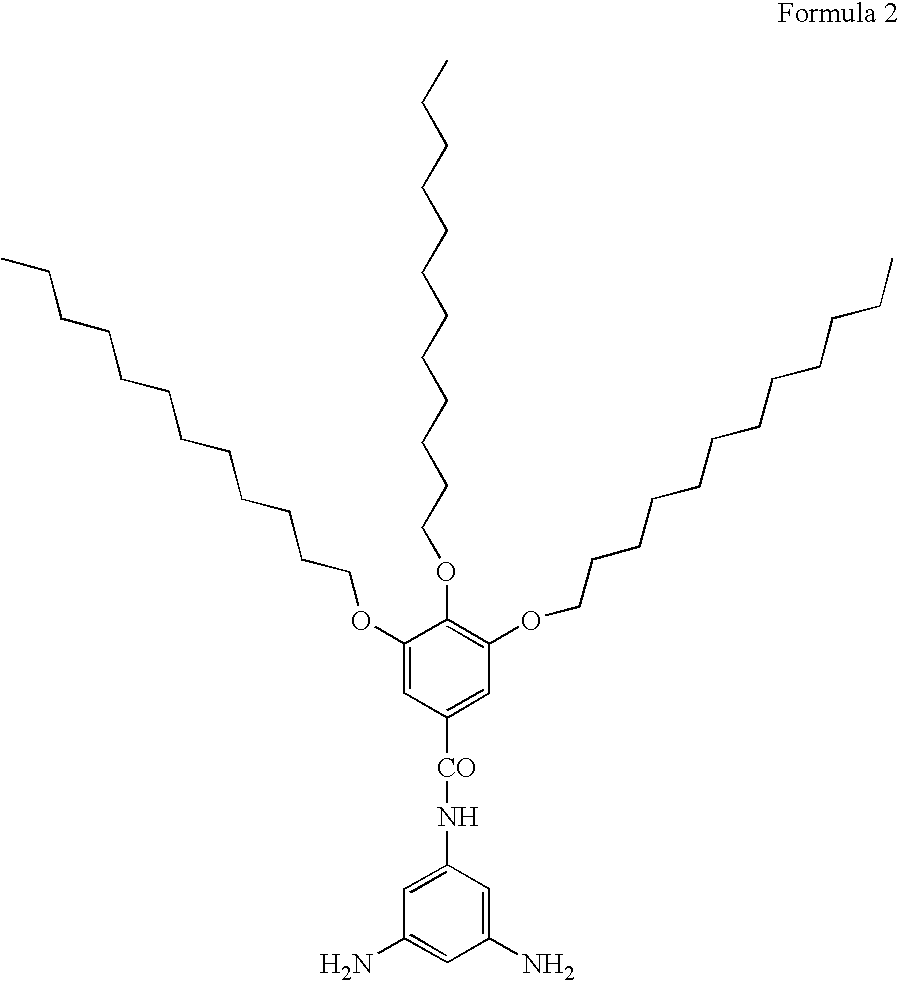
- diamine compound of the present invention include 1261-AG-phenylenediamine expressed by the following Formula 2 and 12G2-AG-phenylenediamine expressed by Formula 3.
- Polyamic acid according to the present invention is produced by copolymerizing functional diamine of the above-mentioned Formula 2, aliphatic cyclic acid dianhydride, aromatic cyclic acid dianhydride, and optionally aromatic cyclic diamine.
- a coating solution which is used to produce the LC alignment film is a polyamic acid solution which is applied, dried, heated and hardened to be dehydrated and subjected to a ring-closure reaction, thereby being converted into polyimide.
- a polyimide coating thin film having a uniform thickness must be formed on a substrate on which a transparent electrode is formed.
- the polyimide solution may be directly applied on the substrate, or may be imidized by heating on the substrate, thereby forming the polyimide coating thin film.
- the solvent for the polyimide solution and the imidization temperature are determined in accordance with typical technology.
- the pretilt angle it is possible to control the pretilt angle to a desired value by adjusting the content of functional diamine. Since the pretilt angle is controlled depending on the content of functional diamine, polyamic acid which does not include aromatic cyclic diamine but functional diamine depending on the mode of the LCD may be used as the LC alignment film. That is to say, the use of aromatic diamine is selective.
- the content of functional diamine is preferably 0.1-100 mol %, more preferably 0.5-30 mol %, and most preferably 1-20 mol % based on total diamine monomers.
- p-PDA p-phenylene diamine
- MDA 4,4-methylene dianiline
- ODA 4,4-oxydianiline
- m-BAPS m-bis(aminophenoxy)diphenylsulfone
- p-BAPS p-bis(aminophenoxy)diphenylsulfone
- Aromatic cyclic acid dianhydride which is used to produce polyamic acid of the present invention enables the film formed in a thickness of 0.1 ⁇ m or so to be capable of enduring a rubbing process, and to have desired heat resistance in a high temperature process at 200° C. or higher and excellent resistance to chemicals.
- aromatic cyclic acid dianhydride include pyromellitic dianhydride (PMDA), biphthalic dianhydride (BPDA), oxydiphthalic dianhydride (ODPA), benzophenonetetracarboxylic dianhydride (BTDA), and hexafluoroisopropylidene diphthalic dianhydride (6-FDA). It is preferable that the content of aromatic cyclic acid dianhydride be 10-100 mol % based on the total content of acid dianhydride used.
- Aliphatic cyclic acid dianhydride used to produce polyamic acid in the present invention helps avoid problems of insolubility in a typical organic solvent, low penetration in a visible ray range due to a charge transfer complex, and reduction of an electrooptical property due to high polarity of the molecular structure.
- Illustrative, but non-limiting examples of aliphatic cyclic acid dianhydride available to the present invention include 5-(2,5-dioxotetrahydrofuran-3-yl)-1,2,3,4-tetrahydronaphthalene-1,2-dicarboxylic anhydride (DOTDA), 5-(2,5-dioxotetrahydrofuryl)-3-methyl-3-cyclohexene-1,2-dicarboxylic anhydride (DOCDA), bicyclooctene-2,3,5,6-tetracarboxylic dianhydride (BODA), 1,2,3,4-cyclobutanetetracarboxylic dianhydride (CBDA), 1,2,3,4-cyclopentanetetracarboxylic dianhydride (CPDA), and 1,2,4,5-cyclohexanetetracarboxylic dianhydride (CHDA).
- the content of aliphatic cyclic acid dianhydride is 5-90 mol %, and
- polyamic acid of the present invention preferably has a structure expressed by the following Formula 4.
- X includes one or more selected from functional groups expressed by the following Formula 5
- Y includes one or more selected from functional groups expressed by the following Formula 6
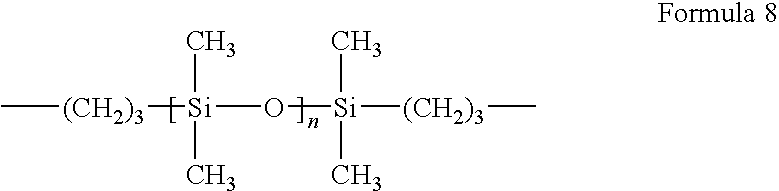
- Z includes one or more functional groups selected from functional groups expressed by the following Formula 7 or 8
- Z′ is a functional group expressed by Formula 9.
- X 1 , X 2 , X 3 , and X 4 are each independently substituents selected from the group consisting of —CH 3 , —F, and —H.
- n is an integer from 1 to 10.
- a and A′ are each independently a single bond, or selected from the group consisting of —O—, —COO—, —OCO—, and —NHCO—;
- B is a single bond or a benzene ring having an equivalence of 2
- R is a linear, branched, or cyclic alkyl or fluoroalkyl group having 1 to 30 carbons.
- Polyamic acid of the present invention has excellent solubility in a polar aprotic solvent, such as N-methyl-2-pyrrolidone (NMP), gamma-butyrolactone (GBL), dimethylformamide (DMF), dimethylacetamide (DMAc), and tetrahydrofuran (THF).
- NMP N-methyl-2-pyrrolidone
- GBL gamma-butyrolactone
- DMF dimethylformamide
- DMAc dimethylacetamide
- THF tetrahydrofuran
- a number average molecular weight of polyamic acid of the present invention is 5,000-500,000 g/mol, and a glass transition temperature ranges from 200 to 350° C. depending on the imidization efficiency or the structure when imidization is conducted.
- polyamic acid is dissolved in a solvent, applied on a substrate, and totally or partially imidized to form the LC alignment film.
- polyamic acid is dissolved in the solvent, applied on the substrate, and totally or partially imidized to produce soluble polyimide, and thereafter, polyimide is used alone or a mixture of polyamic acid and soluble polyimide is used to produce the LC alignment film.
- the LC alignment film of the present invention has high light penetration of 90% or higher in a visible ray region and excellent alignment of liquid crystals, and can be used to easily control the pretilt angle within a range of 1-90°. Furthermore, since it contains functional diamine, refractivity of polymer is reduced and a dielectric constant is reduced.
- example 1 The procedure of example 1 was repeated to produce a polyamic acid solution except that 98 mmol 4,4-methylenedianiline and 20 mmol 12G1-AG-phenylenediamine were used.
- example 1 The procedure of example 1 was repeated to produce a polyamic acid solution except that 90 mmol 4,4-methylenedianiline and 10 mmol 12G1-AG-phenylenediamine were used.
- example 1 The procedure of example 1 was repeated to produce a polyamic acid solution except that 80 mmol 4,4-methylenedianiline and 20 mmol 12G1-AG-phenylenediamine were used.
- example 1 The procedure of example 1 was repeated to produce a polyamic acid solution except that 60 mmol 4,4-methylenedianiline and 40 mmol 12G1-AG-phenylenediamine were used.
- Example 1 The procedure of example 1 was repeated to produce a polyamic acid solution except that 50 mmol 1,2,3,4-cyclobutanetetracarboxylic dianhydride (CBDA) were used instead of 5-(2,5-dioxotetrahydrofuran-3-yl)-1,2,3,4-tetrahydronaphthalene-1,2-dicarboxylic anhydride (DOTDA).
- CBDA 1,2,3,4-cyclobutanetetracarboxylic dianhydride
- DOTDA 5-(2,5-dioxotetrahydrofuran-3-yl)-1,2,3,4-tetrahydronaphthalene-1,2-dicarboxylic anhydride
- polyamic acid solution produced according to example 4, were dissolved in N-methyl pyrrolidinone (NMP) in an amount of 10 wt %, 0.1 mol pyridine and 0.1 mol acetic anhydride were added thereto, a cyclization reaction was conducted at 80° C. for 2 hours, and the resulting product was precipitated in methanol to produce 49 g of polymer powder having imidization efficiency of 70%.
- the polymer powder was sufficiently dried in a vacuum and dissolved in N-methylpyrrolidinone (NMP) to produce a polyimide solution.
- Example 13 The procedure of example 13 was repeated to produce a polyimide solution having imidization efficiency of 98% except that 0.13 mol pyridine and 0.25 mol acetic anhydride were added and a cyclization reaction was conducted at 80° C. for 4 hours.
- example 1 The procedure of example 1 was repeated to produce a polyamic acid solution except that 0.9 mol 4,4-methylenedianiline and 0.1 mol 2,4-diaminophenoxyoctadecane were used.
- example 1 The procedure of example 1 was repeated to produce a polyamic acid solution except that 80 mmol 4,4-methylenedianiline and 20 mmol 2,4-diaminophenoxyhexadecane were used.
- Test cells were produced using LC alignment film solutions produced according to examples 1-14 and comparative examples 1-4 through the following methods.
- the pretilt angle, printability, alignment stability, chemical resistance, contrast ratio, remaining DC, and a voltage holding ratio (VHR) of each test cell were measured using the following methods, and the results are described in the following Table 1.
- Each LC alignment film solution was applied on the ITO glass substrate in a thickness of 0.1 ⁇ m and hardened at 210° C. After the alignment film was formed on the ITO glass substrate, spreading and end-curling properties were observed, both with the naked eye and using an optical microscope, to evaluate the printability of the alignment film.
- the surface of the alignment film was rubbed using a rubbing device, two substrates were disposed parallel to each other such that rubbing directions of the two substrates are in opposite to each other, and a cell was inserted between the two substrates so as to maintain a cell gap of 50 ⁇ m.
- the liquid crystal was charged in the LC cell produced through the above procedure, alignment was observed using an optical microscope which was orthogonally polarized, and the pretilt angle was measured using a crystal rotation method.
- An LC aligning agent which employs a diamine compound according to the present invention has excellent LC alignment and chemical resistance, and excellent electrical and optical properties. Even if it is used in a small amount, it is possible to realize a high pretilt angle, thus the pretilt angle is easily controlled. Therefore, the LC aligning agent can be used to produce an LC alignment film using a twisted nematic (TN) mode, in which the pretilt angle of liquid crystal is low, and a vertically aligned (VA) mode, which requires a high pretilt angle of about 90°.
- TN twisted nematic
- VA vertically aligned
Landscapes
- Chemical & Material Sciences (AREA)
- Organic Chemistry (AREA)
- Physics & Mathematics (AREA)
- Chemical Kinetics & Catalysis (AREA)
- Medicinal Chemistry (AREA)
- Polymers & Plastics (AREA)
- Health & Medical Sciences (AREA)
- Nonlinear Science (AREA)
- Crystallography & Structural Chemistry (AREA)
- Materials Engineering (AREA)
- Engineering & Computer Science (AREA)
- Spectroscopy & Molecular Physics (AREA)
- Mathematical Physics (AREA)
- General Physics & Mathematics (AREA)
- Optics & Photonics (AREA)
- Macromolecular Compounds Obtained By Forming Nitrogen-Containing Linkages In General (AREA)
- Liquid Crystal (AREA)
- Organic Low-Molecular-Weight Compounds And Preparation Thereof (AREA)
Abstract
Description


m is 1 to 3; n is 2 or 3; G is a single bond (when m is 1), a benzene ring having an equivalence of 3

when m is 2), or a benzene ring having an equivalence of 4

when m is 3); and R is a linear, branched, or cyclic alkyl or fluoroalkyl group having 1 to 30 carbons.


m is 1 to 3; n is 2 or 3; G is a single bond (when m is 1), a benzene ring having an equivalence of 3

when m is 2), or a benzene ring having an equivalence of 4

when m is 3); and R is a linear, branched, or cyclic alkyl or fluoroalkyl group having 1 to 30 carbons.


m is 1 to 3; n is 2 or 3; G is a single bond (when m is 1), a benzene ring having an equivalence of 3

when m is 2), or a benzene ring having an equivalence of 4

when m is 3); and R is a linear, branched, or cyclic alkyl or fluoroalkyl group having 1 to 30 carbons.
| TABLE 1 | ||||||||
| Molecular | VHR | |||||||
| Pretilt | Alignment | Chemical | Contrast | weight | Remaining | Room | |||
| Sample | angle (°) | Printability | stability | resistance | ratio | l04 g/M) | DC | temp. | 60° C. |
| Ex. 1 | 4.0 | Excellent | Excellent | Excellent | 425 | 36 | 35 | 99.1 | 98.0 |
| Ex. 2 | 6.2 | Excellent | Excellent | Excellent | 440 | 28 | 45 | 99.6 | 98.5 |
| Ex. 3 | 88.4 | Excellent | Good | Excellent | 315 | 14 | 70 | 99.5 | 98.3 |
| Ex. 4 | 89.5 | Excellent | Excellent | Excellent | 550 | 6 | 65 | 99.4 | 98.1 |
| Ex. 5 | 89.9 | Excellent | Excellent | Excellent | 560 | 3 | 45 | 99.1 | 97.0 |
| Ex. 6 | 89.9 | Excellent | Excellent | Excellent | 615 | 1 | 30 | 99.2 | 96.6 |
| Ex. 7 | 4.2 | Excellent | Excellent | Excellent | 365 | 33 | 25 | 99.5 | 98.5 |
| Ex. 8 | 5.6 | Excellent | Excellent | Excellent | 330 | 42 | 20 | 99.6 | 97.4 |
| Ex. 9 | 87.7 | Excellent | Good | Excellent | 280 | 40 | 30 | 99.4 | 97.6 |
| Ex. 10 | 89.9 | Excellent | Good | Excellent | 450 | 17 | 45 | 99.7 | 97.6 |
| Ex. 11 | 89.9 | Excellent | Excellent | Excellent | 520 | 5 | 90 | 99.2 | 96.0 |
| Ex. 12 | 89.9 | Excellent | Excellent | Excellent | 515 | 2 | 90 | 99.2 | 97.7 |
| Ex. 13 | 89.5 | Good | Excellent | Excellent | 480 | 3 | 80 | 99.0 | 94.8 |
| Ex. 14 | 89.7 | Medium | Excellent | Excellent | 420 | 4 | 120 | 99.5 | 93.5 |
| Co. Ex. 1 | 12.5 | Excellent | Poor | Poor | 285 | 22 | 120 | 98.9 | 92.1 |
| Co .Ex. 2 | 88.9 | Excellent | Poor | Poor | 520 | 10 | 240 | 98.3 | 91.6 |
| Co .Ex. 3 | 9.3 | Excellent | Poor | Poor | 315 | 26 | 46 | 99.0 | 89.5 |
| Co. Ex. 4 | 87.6 | Excellent | Poor | Poor | 480 | 17 | 360 | 99.4 | 89.4 |
Claims (9)






Priority Applications (1)
| Application Number | Priority Date | Filing Date | Title |
|---|---|---|---|
| US12/592,315 US7790836B2 (en) | 2004-12-31 | 2009-11-23 | Diamine compound having dendron side chain and liquid crystal aligning agent using same |
Applications Claiming Priority (4)
| Application Number | Priority Date | Filing Date | Title |
|---|---|---|---|
| KR1020040118128A KR100715095B1 (en) | 2004-12-31 | 2004-12-31 | Diamine compound having side chain of dendron structure and liquid crystal aligning material using the same |
| KR2004-118128 | 2004-12-31 | ||
| US11/221,156 US20060149029A1 (en) | 2004-12-31 | 2005-09-06 | Diamine compound having dendron side chain and liquid crystal aligning agent using same |
| US12/592,315 US7790836B2 (en) | 2004-12-31 | 2009-11-23 | Diamine compound having dendron side chain and liquid crystal aligning agent using same |
Related Parent Applications (1)
| Application Number | Title | Priority Date | Filing Date |
|---|---|---|---|
| US11/221,156 Division US20060149029A1 (en) | 2004-12-31 | 2005-09-06 | Diamine compound having dendron side chain and liquid crystal aligning agent using same |
Related Child Applications (1)
| Application Number | Title | Priority Date | Filing Date |
|---|---|---|---|
| US13/022,890 Division US20110126401A1 (en) | 2004-03-12 | 2011-02-08 | Heat-resistant nonwoven fabric |
Publications (2)
| Publication Number | Publication Date |
|---|---|
| US20100168374A1 US20100168374A1 (en) | 2010-07-01 |
| US7790836B2 true US7790836B2 (en) | 2010-09-07 |
Family
ID=36641494
Family Applications (2)
| Application Number | Title | Priority Date | Filing Date |
|---|---|---|---|
| US11/221,156 Abandoned US20060149029A1 (en) | 2004-12-31 | 2005-09-06 | Diamine compound having dendron side chain and liquid crystal aligning agent using same |
| US12/592,315 Expired - Fee Related US7790836B2 (en) | 2004-12-31 | 2009-11-23 | Diamine compound having dendron side chain and liquid crystal aligning agent using same |
Family Applications Before (1)
| Application Number | Title | Priority Date | Filing Date |
|---|---|---|---|
| US11/221,156 Abandoned US20060149029A1 (en) | 2004-12-31 | 2005-09-06 | Diamine compound having dendron side chain and liquid crystal aligning agent using same |
Country Status (5)
| Country | Link |
|---|---|
| US (2) | US20060149029A1 (en) |
| JP (1) | JP4271173B2 (en) |
| KR (1) | KR100715095B1 (en) |
| CN (1) | CN1927812A (en) |
| TW (1) | TWI289157B (en) |
Families Citing this family (6)
| Publication number | Priority date | Publication date | Assignee | Title |
|---|---|---|---|---|
| US20100048861A1 (en) * | 2006-12-15 | 2010-02-25 | Hak Gee Jung | Polyimide resin and liquid crystal alignment layer and polyimide film using the same |
| JP5239231B2 (en) | 2007-07-06 | 2013-07-17 | 株式会社リコー | Diamine compound, polyamic acid and soluble polyimide, and wettability changing film and electrode obtained therefrom |
| KR101169862B1 (en) * | 2007-10-26 | 2012-07-31 | 제이에스알 가부시끼가이샤 | Liquid crystal aligning agent, method for forming liquid crystal alignment film and liquid crystal display device |
| TWI448790B (en) * | 2011-05-13 | 2014-08-11 | Chi Mei Corp | Liquid crystal alignment film and liguid crystal display element |
| KR101835082B1 (en) * | 2017-05-16 | 2018-03-06 | 에스케이씨 주식회사 | Isocyanate composition for optical lenses and preparation method thereof |
| US12099350B2 (en) | 2022-03-04 | 2024-09-24 | Tyco Fire & Security Gmbh | Central plant with automatic subplant models |
Family Cites Families (4)
| Publication number | Priority date | Publication date | Assignee | Title |
|---|---|---|---|---|
| JP3117103B2 (en) * | 1992-06-23 | 2000-12-11 | 日産化学工業株式会社 | New vertical alignment agent |
| US6746730B1 (en) * | 1999-06-28 | 2004-06-08 | Chisso Corporation | Varnish composition and liquid-crystal display element |
| JP2002055346A (en) * | 2000-08-11 | 2002-02-20 | Sony Corp | Method for forming liquid crystal alignment film and method for manufacturing liquid crystal display device |
| KR100599859B1 (en) * | 2003-10-09 | 2006-07-12 | 제일모직주식회사 | Diamine compound having side chain of dendron structure and liquid crystal aligning material manufactured using the same |
-
2004
- 2004-12-31 KR KR1020040118128A patent/KR100715095B1/en not_active Expired - Fee Related
-
2005
- 2005-06-30 TW TW094122029A patent/TWI289157B/en not_active IP Right Cessation
- 2005-08-31 JP JP2005252909A patent/JP4271173B2/en not_active Expired - Fee Related
- 2005-09-06 US US11/221,156 patent/US20060149029A1/en not_active Abandoned
- 2005-09-07 CN CNA2005100983210A patent/CN1927812A/en active Pending
-
2009
- 2009-11-23 US US12/592,315 patent/US7790836B2/en not_active Expired - Fee Related
Non-Patent Citations (1)
| Title |
|---|
| Wang et al "Synthesis and characterization of polyimides containing multiple alkyl side chains", Polymer Preprint, vol. 40(2), p. 884-885 (1999). * |
Also Published As
| Publication number | Publication date |
|---|---|
| KR20060078792A (en) | 2006-07-05 |
| US20060149029A1 (en) | 2006-07-06 |
| TW200621952A (en) | 2006-07-01 |
| KR100715095B1 (en) | 2007-05-04 |
| JP2006188650A (en) | 2006-07-20 |
| US20100168374A1 (en) | 2010-07-01 |
| TWI289157B (en) | 2007-11-01 |
| JP4271173B2 (en) | 2009-06-03 |
| CN1927812A (en) | 2007-03-14 |
Similar Documents
| Publication | Publication Date | Title |
|---|---|---|
| JP3097702B2 (en) | New liquid crystal alignment agent | |
| KR100491944B1 (en) | Polyimide derivatives with pendant imide group and method for preparing them | |
| US20100168374A1 (en) | Diamine compound having dendron side chain and liquid crystal aligning agent using same | |
| KR100543093B1 (en) | Diamine compound containing triazine group, polyamic acid and liquid crystal aligning film manufactured therefrom | |
| US20080213509A1 (en) | Composition for LC alignment film using diamine having dendron side chain | |
| KR100559264B1 (en) | Vertical alignment composition containing low polar polyamic acid resin, and liquid crystal aligning film and liquid crystal cell using the same | |
| US7307139B2 (en) | Diamine compound having dendron side chain and liquid crystal alignment material produced using the same | |
| KR20060075232A (en) | Polyimide Polyamic Acid Copolymer for Liquid Crystal Alignment Film | |
| KR100514005B1 (en) | Novel Functional Diamines and LC Alignment Layer Prepared by Using the Same | |
| KR100552134B1 (en) | Aliphatic Ring-Soluble Polyimide Resin with Alkyl Succinimide Side Chain | |
| KR100555797B1 (en) | Diamine compound containing triazine group, polyamic acid and liquid crystal aligning film manufactured therefrom | |
| KR100623273B1 (en) | Polyamic acid resin having an alkyl side chain aromatic group containing a polar end group, a vertical alignment composition containing the same, and a liquid crystal alignment film and a liquid crystal cell using the same | |
| KR100491930B1 (en) | Polyamic acid derivatives containing pendant alkenylated imide group and method for preparing them | |
| KR100827336B1 (en) | Functional diamine compound for liquid crystal aligning film and liquid crystal aligning agent using same | |
| KR100552135B1 (en) | Liquid Crystal Alignment Film Composition | |
| KR100662183B1 (en) | Composition for liquid crystal aligning film containing functional diamine | |
| KR100801029B1 (en) | Diamine compound and liquid crystal aligning agent using the same | |
| KR100774616B1 (en) | Polyamic acid composition for liquid crystal alignment film having low pretilt angle and soluble polyimide resin prepared therefrom | |
| KR100543094B1 (en) | Novel functional diamines and liquid crystal alignment films prepared using the same | |
| KR100532913B1 (en) | Polyamic Acid synthesized from Diamine containing Triazine group, and LC Alignment Layer Prepared by the Polyamic acid |
Legal Events
| Date | Code | Title | Description |
|---|---|---|---|
| FEPP | Fee payment procedure |
Free format text: PAYOR NUMBER ASSIGNED (ORIGINAL EVENT CODE: ASPN); ENTITY STATUS OF PATENT OWNER: LARGE ENTITY |
|
| STCF | Information on status: patent grant |
Free format text: PATENTED CASE |
|
| FPAY | Fee payment |
Year of fee payment: 4 |
|
| MAFP | Maintenance fee payment |
Free format text: PAYMENT OF MAINTENANCE FEE, 8TH YEAR, LARGE ENTITY (ORIGINAL EVENT CODE: M1552) Year of fee payment: 8 |
|
| FEPP | Fee payment procedure |
Free format text: MAINTENANCE FEE REMINDER MAILED (ORIGINAL EVENT CODE: REM.); ENTITY STATUS OF PATENT OWNER: LARGE ENTITY |
|
| LAPS | Lapse for failure to pay maintenance fees |
Free format text: PATENT EXPIRED FOR FAILURE TO PAY MAINTENANCE FEES (ORIGINAL EVENT CODE: EXP.); ENTITY STATUS OF PATENT OWNER: LARGE ENTITY |
|
| STCH | Information on status: patent discontinuation |
Free format text: PATENT EXPIRED DUE TO NONPAYMENT OF MAINTENANCE FEES UNDER 37 CFR 1.362 |
|
| FP | Lapsed due to failure to pay maintenance fee |
Effective date: 20220907 |