US7790726B2 - Monocyclic and bicyclic compounds and methods of use - Google Patents
Monocyclic and bicyclic compounds and methods of use Download PDFInfo
- Publication number
- US7790726B2 US7790726B2 US11/504,215 US50421506A US7790726B2 US 7790726 B2 US7790726 B2 US 7790726B2 US 50421506 A US50421506 A US 50421506A US 7790726 B2 US7790726 B2 US 7790726B2
- Authority
- US
- United States
- Prior art keywords
- chloro
- group
- phenyl
- nhr
- oxo
- Prior art date
- Legal status (The legal status is an assumption and is not a legal conclusion. Google has not performed a legal analysis and makes no representation as to the accuracy of the status listed.)
- Active, expires
Links
- 0 *C1=C(*)C(*)=C(C[U]2CCN(C(=O)CC)CC2)C(*)=C1*.C.CC Chemical compound *C1=C(*)C(*)=C(C[U]2CCN(C(=O)CC)CC2)C(*)=C1*.C.CC 0.000 description 21
- BDVHHOADEDCTGD-UHFFFAOYSA-N CN1CCN(CC(N(CC2)CCN2c(cc2OC)ccc2Cl)=O)CC1 Chemical compound CN1CCN(CC(N(CC2)CCN2c(cc2OC)ccc2Cl)=O)CC1 BDVHHOADEDCTGD-UHFFFAOYSA-N 0.000 description 3
- RERVGZVGFGBNEA-UHFFFAOYSA-N CC(C)N1CCCC1=O.CC(C)N1CCccC1=O.CC1=CC=CC=C1.CC1=CC=CC=C1 Chemical compound CC(C)N1CCCC1=O.CC(C)N1CCccC1=O.CC1=CC=CC=C1.CC1=CC=CC=C1 RERVGZVGFGBNEA-UHFFFAOYSA-N 0.000 description 2
- LYKPUDUHNUANMJ-UHFFFAOYSA-N COC1=CC(N2CCN(C(=O)CN3C(=O)COC4=CC=CC=C43)CC2)=CC=C1Cl Chemical compound COC1=CC(N2CCN(C(=O)CN3C(=O)COC4=CC=CC=C43)CC2)=CC=C1Cl LYKPUDUHNUANMJ-UHFFFAOYSA-N 0.000 description 2
- CWVFKCIFZSYJCW-UHFFFAOYSA-N COC1=CC(N2CCN(C(=O)CN3C(=O)N(CC(=O)O)C4=C3C=CC(Cl)=C4)CC2)=CC=C1Cl Chemical compound COC1=CC(N2CCN(C(=O)CN3C(=O)N(CC(=O)O)C4=C3C=CC(Cl)=C4)CC2)=CC=C1Cl CWVFKCIFZSYJCW-UHFFFAOYSA-N 0.000 description 2
- HFAUBRAFSQSROE-UHFFFAOYSA-N COC1=CC(N2CCN(C(=O)CN3CCNC3=O)CC2)=CC=C1Cl Chemical compound COC1=CC(N2CCN(C(=O)CN3CCNC3=O)CC2)=CC=C1Cl HFAUBRAFSQSROE-UHFFFAOYSA-N 0.000 description 2
- WTJPQQVJOSMHTH-IYBDPMFKSA-N COC1=CC(N2CCN(C(=O)CN3[C@@H](C)CCC[C@H]3C)CC2)=CC=C1Cl Chemical compound COC1=CC(N2CCN(C(=O)CN3[C@@H](C)CCC[C@H]3C)CC2)=CC=C1Cl WTJPQQVJOSMHTH-IYBDPMFKSA-N 0.000 description 2
- JFJRVIUVODVKJU-UHFFFAOYSA-N COc(cc(cc1)N(CC2)CCN2C(CCl)=O)c1Cl Chemical compound COc(cc(cc1)N(CC2)CCN2C(CCl)=O)c1Cl JFJRVIUVODVKJU-UHFFFAOYSA-N 0.000 description 2
- RJMAPONQIXPWPC-UHFFFAOYSA-N COc1cc(N(CC2)CCN2C(CN(c(c(N2)c3)ccc3Cl)C2=O)=O)ccc1Cl Chemical compound COc1cc(N(CC2)CCN2C(CN(c(c(N2)c3)ccc3Cl)C2=O)=O)ccc1Cl RJMAPONQIXPWPC-UHFFFAOYSA-N 0.000 description 2
- XVBNFQDJKBKABO-UHFFFAOYSA-N COc1cc(N(CC2)CCN2C(CN(c(cc(cc2)Cl)c2N2)C2=O)=O)ccc1Cl Chemical compound COc1cc(N(CC2)CCN2C(CN(c(cc(cc2)Cl)c2N2)C2=O)=O)ccc1Cl XVBNFQDJKBKABO-UHFFFAOYSA-N 0.000 description 2
- QMEHRXSGHVXYGR-UHFFFAOYSA-N O=C(CN(c(c(O1)c2)ccc2Cl)C1=O)N1CCN(Cc(cc2)ccc2F)CC1 Chemical compound O=C(CN(c(c(O1)c2)ccc2Cl)C1=O)N1CCN(Cc(cc2)ccc2F)CC1 QMEHRXSGHVXYGR-UHFFFAOYSA-N 0.000 description 2
- BDAUTUYOMGXPRO-UHFFFAOYSA-N O=C(CN1C(=O)NC2=CC=C(Cl)C=C21)N1CCC(O)(CC2=CC=C(F)C=C2)CC1 Chemical compound O=C(CN1C(=O)NC2=CC=C(Cl)C=C21)N1CCC(O)(CC2=CC=C(F)C=C2)CC1 BDAUTUYOMGXPRO-UHFFFAOYSA-N 0.000 description 2
- QSLQXIDYUHFAPY-UHFFFAOYSA-N BrB(Br)Br.CCOC(=O)CN1C(=O)[U]C2=C\C(OC)=C/C=C\21.CCOC1=C/C=C2C(=C/1)\[U]C(=O)N\2CC(=O)N1CCN(C2=CC(OC)=C(Cl)C=C2)CC1.COC1=C(Cl)C=CC(N2CCN(C(=O)CN3C(=O)[U]C4=C\C(O)=C/C=C\43)CC2)=C1.COC1=C(Cl)C=CC(N2CCN(C(=O)CN3C(=O)[U]C4=C\C(OCC(=O)O)=C/C=C\43)CC2)=C1.O=C(O)CN1C(=O)[U]C2=C\C(O)=C/C=C\21 Chemical compound BrB(Br)Br.CCOC(=O)CN1C(=O)[U]C2=C\C(OC)=C/C=C\21.CCOC1=C/C=C2C(=C/1)\[U]C(=O)N\2CC(=O)N1CCN(C2=CC(OC)=C(Cl)C=C2)CC1.COC1=C(Cl)C=CC(N2CCN(C(=O)CN3C(=O)[U]C4=C\C(O)=C/C=C\43)CC2)=C1.COC1=C(Cl)C=CC(N2CCN(C(=O)CN3C(=O)[U]C4=C\C(OCC(=O)O)=C/C=C\43)CC2)=C1.O=C(O)CN1C(=O)[U]C2=C\C(O)=C/C=C\21 QSLQXIDYUHFAPY-UHFFFAOYSA-N 0.000 description 1
- ZYQOWSRJMXGGPU-UHFFFAOYSA-N BrB(Br)Br.COC1=CC(N2CCN(C(=O)CN3C(=O)OC4=CC(O)=CC=C43)CC2)=CC=C1Cl.COC1=CC(N2CCN(C(=O)CN3C(=O)OC4=CC(OCCO)=CC=C43)CC2)=CC=C1Cl.COC1=CC(N2CCN(C(=O)CN3C(=O)OC4=CC(OCCOC5CCCCO5)=CC=C43)CC2)=CC=C1Cl.COC1=CC(N2CCNCC2)=CC=C1Cl.COC1=CC=C2C(=C1)OC(=O)N2CC(C)=O.Cl.Cl.O=BP.O=C(O)CN1C(=O)OC2=CC(O)=CC=C21 Chemical compound BrB(Br)Br.COC1=CC(N2CCN(C(=O)CN3C(=O)OC4=CC(O)=CC=C43)CC2)=CC=C1Cl.COC1=CC(N2CCN(C(=O)CN3C(=O)OC4=CC(OCCO)=CC=C43)CC2)=CC=C1Cl.COC1=CC(N2CCN(C(=O)CN3C(=O)OC4=CC(OCCOC5CCCCO5)=CC=C43)CC2)=CC=C1Cl.COC1=CC(N2CCNCC2)=CC=C1Cl.COC1=CC=C2C(=C1)OC(=O)N2CC(C)=O.Cl.Cl.O=BP.O=C(O)CN1C(=O)OC2=CC(O)=CC=C21 ZYQOWSRJMXGGPU-UHFFFAOYSA-N 0.000 description 1
- CKTYDTTYBSPMPR-UHFFFAOYSA-N C.C.C.C.C.C.C.CCOC(=O)CN1C(=O)N(CC(=O)N2CCN(C3=CC=C(Cl)C(OC)=C3)CC2)C2=C1C=C(Cl)C=C2.CCOC(=O)CN1C(=O)N(CC(=O)N2CCN(C3=CC=C(Cl)C(OC)=C3)CC2)C2=C1C=CC(Cl)=C2.COC1=CC(N2CCN(C(=O)CN3C(=O)N(CC(=O)O)C4=C3C=C(Cl)C=C4)CC2)=CC=C1Cl.COC1=CC(N2CCN(C(=O)CN3C(=O)N(CC(=O)O)C4=C3C=CC(Cl)=C4)CC2)=CC=C1Cl Chemical compound C.C.C.C.C.C.C.CCOC(=O)CN1C(=O)N(CC(=O)N2CCN(C3=CC=C(Cl)C(OC)=C3)CC2)C2=C1C=C(Cl)C=C2.CCOC(=O)CN1C(=O)N(CC(=O)N2CCN(C3=CC=C(Cl)C(OC)=C3)CC2)C2=C1C=CC(Cl)=C2.COC1=CC(N2CCN(C(=O)CN3C(=O)N(CC(=O)O)C4=C3C=C(Cl)C=C4)CC2)=CC=C1Cl.COC1=CC(N2CCN(C(=O)CN3C(=O)N(CC(=O)O)C4=C3C=CC(Cl)=C4)CC2)=CC=C1Cl CKTYDTTYBSPMPR-UHFFFAOYSA-N 0.000 description 1
- NAGPIMLEJVDFKK-UHFFFAOYSA-N C.C.COC1=C/C2=C(\C=C/1)NC(=O)O2.COC1=CC(N2CCN(C(=O)CCl)CC2)=CC=C1Cl.COC1=CC2=C(C=C1)N(CC(=O)N1CCN(C3=CC=C(Cl)C(OC)=C3)CC1)C(=O)O2 Chemical compound C.C.COC1=C/C2=C(\C=C/1)NC(=O)O2.COC1=CC(N2CCN(C(=O)CCl)CC2)=CC=C1Cl.COC1=CC2=C(C=C1)N(CC(=O)N1CCN(C3=CC=C(Cl)C(OC)=C3)CC1)C(=O)O2 NAGPIMLEJVDFKK-UHFFFAOYSA-N 0.000 description 1
- WZCGBGSLKSQISP-UHFFFAOYSA-N C.C.COC1=CC(N2CCN(C(=O)CCl)CC2)=CC=C1Cl.COC1=CC(N2CCN(C(=O)CN3C(=O)OC4=C3C=C(Cl)C=C4)CC2)=CC=C1Cl.O=C1NC2=C(/C=C\C(Cl)=C/2)O1 Chemical compound C.C.COC1=CC(N2CCN(C(=O)CCl)CC2)=CC=C1Cl.COC1=CC(N2CCN(C(=O)CN3C(=O)OC4=C3C=C(Cl)C=C4)CC2)=CC=C1Cl.O=C1NC2=C(/C=C\C(Cl)=C/2)O1 WZCGBGSLKSQISP-UHFFFAOYSA-N 0.000 description 1
- XACJAMKEQLSGLP-UHFFFAOYSA-N C.C.COC1=CC(N2CCN(C(=O)CCl)CC2)=CC=C1Cl.COC1=CC(N2CCN(C(=O)CN3C(=O)OC4=C3C=CC(F)=C4)CC2)=CC=C1Cl.O=C1NC2=C(/C=C(F)\C=C/2)O1 Chemical compound C.C.COC1=CC(N2CCN(C(=O)CCl)CC2)=CC=C1Cl.COC1=CC(N2CCN(C(=O)CN3C(=O)OC4=C3C=CC(F)=C4)CC2)=CC=C1Cl.O=C1NC2=C(/C=C(F)\C=C/2)O1 XACJAMKEQLSGLP-UHFFFAOYSA-N 0.000 description 1
- DFIHTOAJZFACGZ-UHFFFAOYSA-N C.C.COC1=CC(N2CCN(C(=O)CCl)CC2)=CC=C1Cl.COC1=CC(N2CCN(C(=O)CN3C(=O)OC4=C3C=CC=C4)CC2)=CC=C1Cl.O=C1NC2=C(C=CC=C2)O1 Chemical compound C.C.COC1=CC(N2CCN(C(=O)CCl)CC2)=CC=C1Cl.COC1=CC(N2CCN(C(=O)CN3C(=O)OC4=C3C=CC=C4)CC2)=CC=C1Cl.O=C1NC2=C(C=CC=C2)O1 DFIHTOAJZFACGZ-UHFFFAOYSA-N 0.000 description 1
- QXCDOSPZCKEXIY-UHFFFAOYSA-N C.C.COC1=CC(N2CCN(C(=O)CCl)CC2)=CC=C1Cl.COC1=CC(N2CCN(C(=O)CN3CCNC3=O)CC2)=CC=C1Cl.O=C1NCCN1 Chemical compound C.C.COC1=CC(N2CCN(C(=O)CCl)CC2)=CC=C1Cl.COC1=CC(N2CCN(C(=O)CN3CCNC3=O)CC2)=CC=C1Cl.O=C1NCCN1 QXCDOSPZCKEXIY-UHFFFAOYSA-N 0.000 description 1
- DJWXYRHBFXDFEZ-UHFFFAOYSA-N C.C.COC1=CC(N2CCN(C(=O)CCl)CC2)=CC=C1Cl.COC1=CC(N2CCN(C(=O)CN3CCOC3=O)CC2)=CC=C1Cl.O=C1NCCO1 Chemical compound C.C.COC1=CC(N2CCN(C(=O)CCl)CC2)=CC=C1Cl.COC1=CC(N2CCN(C(=O)CN3CCOC3=O)CC2)=CC=C1Cl.O=C1NCCO1 DJWXYRHBFXDFEZ-UHFFFAOYSA-N 0.000 description 1
- ZKFYGUAQYQNWSE-WGOHSIFNSA-N C.C.COC1=CC(N2CCN(C(=O)CCl)CC2)=CC=C1Cl.COC1=CC(N2CCN(C(=O)CN3[C@@H](C)CCC[C@H]3C)CC2)=CC=C1Cl.C[C@H]1CCC[C@@H](C)N1 Chemical compound C.C.COC1=CC(N2CCN(C(=O)CCl)CC2)=CC=C1Cl.COC1=CC(N2CCN(C(=O)CN3[C@@H](C)CCC[C@H]3C)CC2)=CC=C1Cl.C[C@H]1CCC[C@@H](C)N1 ZKFYGUAQYQNWSE-WGOHSIFNSA-N 0.000 description 1
- NHUODEKFEHWLIC-UHFFFAOYSA-N C.C.COC1=CC(N2CCN(C(=O)CN3C(=O)N(C)C4=C3C=CC=C4)CC2)=CC=C1Cl.COC1=CC(N2CCN(C(=O)CN3C(=O)NC4=C3C=CC=C4)CC2)=CC=C1Cl Chemical compound C.C.COC1=CC(N2CCN(C(=O)CN3C(=O)N(C)C4=C3C=CC=C4)CC2)=CC=C1Cl.COC1=CC(N2CCN(C(=O)CN3C(=O)NC4=C3C=CC=C4)CC2)=CC=C1Cl NHUODEKFEHWLIC-UHFFFAOYSA-N 0.000 description 1
- NTINYEHTUBCOAU-UHFFFAOYSA-N C.C.Cl.Cl.FC1=CC=C(CN2CCNCC2)C=C1.O=C(CN1C(=O)OC2=C1C=CC(Cl)=C2)N1CCN(CC2=CC=C(F)C=C2)CC1.O=C(O)CN1C(=O)OC2=C1C=CC(Cl)=C2 Chemical compound C.C.Cl.Cl.FC1=CC=C(CN2CCNCC2)C=C1.O=C(CN1C(=O)OC2=C1C=CC(Cl)=C2)N1CCN(CC2=CC=C(F)C=C2)CC1.O=C(O)CN1C(=O)OC2=C1C=CC(Cl)=C2 NTINYEHTUBCOAU-UHFFFAOYSA-N 0.000 description 1
- UIVHNHSAXREDKD-UHFFFAOYSA-N C.C/C([Rf])=C1/C(=O)N(C(C)(C)C)C2=C1C=CC=C2.CC.CC(C)(C)N1C(=O)C(=O)C2=C1C=CC=C2.CC(C)(C)N1CCC2=C1C=CC=C2.CC(C)N1C(=O)CC2=C1C=CC=C2 Chemical compound C.C/C([Rf])=C1/C(=O)N(C(C)(C)C)C2=C1C=CC=C2.CC.CC(C)(C)N1C(=O)C(=O)C2=C1C=CC=C2.CC(C)(C)N1CCC2=C1C=CC=C2.CC(C)N1C(=O)CC2=C1C=CC=C2 UIVHNHSAXREDKD-UHFFFAOYSA-N 0.000 description 1
- SOZIZPKHBCSHLB-UHFFFAOYSA-N C.CC(C)N1CC2=C(C=CC=C2)C1.CC(C)N1CCC2=C(C=CC=C2)C1 Chemical compound C.CC(C)N1CC2=C(C=CC=C2)C1.CC(C)N1CCC2=C(C=CC=C2)C1 SOZIZPKHBCSHLB-UHFFFAOYSA-N 0.000 description 1
- CWIRVUDQAFWPAU-UHFFFAOYSA-N C.CC(C)N1CCC2=C1C=CC=C2.CC(C)N1CCCC2=C1C=CC=C2 Chemical compound C.CC(C)N1CCC2=C1C=CC=C2.CC(C)N1CCCC2=C1C=CC=C2 CWIRVUDQAFWPAU-UHFFFAOYSA-N 0.000 description 1
- NOILFHDWQFJVOX-UHFFFAOYSA-N C.CC.CC.CC(C)N1C(=O)CCC2=CC=CC=C21.CC(C)N1C(=O)CCC2=CC=CC=C21 Chemical compound C.CC.CC.CC(C)N1C(=O)CCC2=CC=CC=C21.CC(C)N1C(=O)CCC2=CC=CC=C21 NOILFHDWQFJVOX-UHFFFAOYSA-N 0.000 description 1
- GDMINNHRUMGTKY-QOOJNRIXSA-M C.CCOC(=O)Cl.CCOC(=O)NC1=C(CO)C=C(Cl)C=C1.COC1=CC(N2CCN(C(=O)CCl)CC2)=CC=C1Cl.COC1=CC(N2CCN(C(=O)CN3C(=O)OCC4=C3C=CC(Cl)=C4)CC2)=CC=C1Cl.NC1=C(CO)C=C(Cl)C=C1.O=C1NC2=C(C=C(Cl)C=C2)CO1.O=COO[Cs].[2H]B[U].[CsH] Chemical compound C.CCOC(=O)Cl.CCOC(=O)NC1=C(CO)C=C(Cl)C=C1.COC1=CC(N2CCN(C(=O)CCl)CC2)=CC=C1Cl.COC1=CC(N2CCN(C(=O)CN3C(=O)OCC4=C3C=CC(Cl)=C4)CC2)=CC=C1Cl.NC1=C(CO)C=C(Cl)C=C1.O=C1NC2=C(C=C(Cl)C=C2)CO1.O=COO[Cs].[2H]B[U].[CsH] GDMINNHRUMGTKY-QOOJNRIXSA-M 0.000 description 1
- IHOHDVODSXOUNY-UHFFFAOYSA-N C.COC1=CC(N2CCN(C(=O)CCl)CC2)=C(F)C=C1Cl.COC1=CC(N2CCN(C(=O)CN3C(=O)COC4=C3N=CC(Cl)=C4)CC2)=C(F)C=C1Cl.O=C1COC2=C(N=CC(Cl)=C2)N1.O=C1COC2=C(N=CC=C2)N1 Chemical compound C.COC1=CC(N2CCN(C(=O)CCl)CC2)=C(F)C=C1Cl.COC1=CC(N2CCN(C(=O)CN3C(=O)COC4=C3N=CC(Cl)=C4)CC2)=C(F)C=C1Cl.O=C1COC2=C(N=CC(Cl)=C2)N1.O=C1COC2=C(N=CC=C2)N1 IHOHDVODSXOUNY-UHFFFAOYSA-N 0.000 description 1
- JCVNBJNRLLTGJX-UHFFFAOYSA-N C.COC1=CC(N2CCN(C(=O)CCl)CC2)=C(F)C=C1Cl.COC1=CC(N2CCN(C(=O)CN3C(=O)OC4=C3N=CC(Cl)=C4)CC2)=C(F)C=C1Cl.O=C1NC2=NC=C(Cl)C=C2O1.O=C1NC2=NC=CC=C2O1 Chemical compound C.COC1=CC(N2CCN(C(=O)CCl)CC2)=C(F)C=C1Cl.COC1=CC(N2CCN(C(=O)CN3C(=O)OC4=C3N=CC(Cl)=C4)CC2)=C(F)C=C1Cl.O=C1NC2=NC=C(Cl)C=C2O1.O=C1NC2=NC=CC=C2O1 JCVNBJNRLLTGJX-UHFFFAOYSA-N 0.000 description 1
- VPYQYRMUEUFOMU-UHFFFAOYSA-N C.COC1=CC(N2CCN(C(=O)CCl)CC2)=CC=C1Cl.COC1=CC(N2CCN(C(=O)CN3C(=O)OC4=CC(/C(N)=N/O)=CC=C43)CC2)=CC=C1Cl.COC1=CC(N2CCN(C(=O)CN3C(=O)OC4=CC(C#N)=CC=C43)CC2)=CC=C1Cl.COC1=CC(N2CCN(C(=O)CN3C(=O)OC4=CC(C5=NOC=N5)=CC=C43)CC2)=CC=C1Cl.N#CC1=CC2=C(C=C1)NC(=O)O2.N#C[Cu].NO.O=C1NC2=C(C=C(Br)C=C2)O1 Chemical compound C.COC1=CC(N2CCN(C(=O)CCl)CC2)=CC=C1Cl.COC1=CC(N2CCN(C(=O)CN3C(=O)OC4=CC(/C(N)=N/O)=CC=C43)CC2)=CC=C1Cl.COC1=CC(N2CCN(C(=O)CN3C(=O)OC4=CC(C#N)=CC=C43)CC2)=CC=C1Cl.COC1=CC(N2CCN(C(=O)CN3C(=O)OC4=CC(C5=NOC=N5)=CC=C43)CC2)=CC=C1Cl.N#CC1=CC2=C(C=C1)NC(=O)O2.N#C[Cu].NO.O=C1NC2=C(C=C(Br)C=C2)O1 VPYQYRMUEUFOMU-UHFFFAOYSA-N 0.000 description 1
- DXOQOUHTERFIFH-UHFFFAOYSA-N C1CNCCN1.COC1=CC(N2CCN(C(=O)CCl)CC2)=CC=C1Cl.COC1=CC(N2CCN(C(=O)CN3CCNCC3)CC2)=CC=C1Cl Chemical compound C1CNCCN1.COC1=CC(N2CCN(C(=O)CCl)CC2)=CC=C1Cl.COC1=CC(N2CCN(C(=O)CN3CCNCC3)CC2)=CC=C1Cl DXOQOUHTERFIFH-UHFFFAOYSA-N 0.000 description 1
- BMZNPGARAMNURE-UHFFFAOYSA-N C1COCCN1.COC1=CC(N2CCN(C(=O)CCl)CC2)=CC=C1Cl.COC1=CC(N2CCN(C(=O)CN3CCOCC3)CC2)=CC=C1Cl Chemical compound C1COCCN1.COC1=CC(N2CCN(C(=O)CCl)CC2)=CC=C1Cl.COC1=CC(N2CCN(C(=O)CN3CCOCC3)CC2)=CC=C1Cl BMZNPGARAMNURE-UHFFFAOYSA-N 0.000 description 1
- VHPDEUFFMYOLBE-UHFFFAOYSA-N CC(=O)OO.CC1=C(Cl)C=CC=C1N.CC1=C(Cl)C=CC=C1N1CN(C(=O)CCl)CC1=O.CC1=C(Cl)C=CC=C1N1CN(C(=O)CN2C(=O)OC3=C2C=CC(Cl)=C3)CC1=O.CC1=C(Cl)C=CC=C1N1CNCC1=O.CC1=C(Cl)C=CC=C1NC(=O)CN.O=C(Cl)CCl.O=C1NC2=C(C=C(Cl)C=C2)O1 Chemical compound CC(=O)OO.CC1=C(Cl)C=CC=C1N.CC1=C(Cl)C=CC=C1N1CN(C(=O)CCl)CC1=O.CC1=C(Cl)C=CC=C1N1CN(C(=O)CN2C(=O)OC3=C2C=CC(Cl)=C3)CC1=O.CC1=C(Cl)C=CC=C1N1CNCC1=O.CC1=C(Cl)C=CC=C1NC(=O)CN.O=C(Cl)CCl.O=C1NC2=C(C=C(Cl)C=C2)O1 VHPDEUFFMYOLBE-UHFFFAOYSA-N 0.000 description 1
- FYNYMZLEFZYUOA-UHFFFAOYSA-N CC(C)(C)P(C1=CC=CC=C1C1=CC=CC=C1)C(C)(C)C.COC(=O)C1CN(C(=O)CN2C(=O)OC3=CC(Cl)=CC=C32)CCN1C1=CC=C(Cl)C(OC)=C1.COC(=O)C1CN(C(=O)OC(C)(C)C)CCN1.COC(=O)C1CN(C(=O)OC(C)(C)C)CCN1C1=CC(OC)=C(Cl)C=C1.COC(=O)C1CNCCN1C1=CC(OC)=C(Cl)C=C1.COC1=C(Cl)C=CC(Br)=C1.O=C(O)CN1C(=O)OC2=CC(Cl)=CC=C21.O=C1OC2=CC=C(Cl)C=C2O1 Chemical compound CC(C)(C)P(C1=CC=CC=C1C1=CC=CC=C1)C(C)(C)C.COC(=O)C1CN(C(=O)CN2C(=O)OC3=CC(Cl)=CC=C32)CCN1C1=CC=C(Cl)C(OC)=C1.COC(=O)C1CN(C(=O)OC(C)(C)C)CCN1.COC(=O)C1CN(C(=O)OC(C)(C)C)CCN1C1=CC(OC)=C(Cl)C=C1.COC(=O)C1CNCCN1C1=CC(OC)=C(Cl)C=C1.COC1=C(Cl)C=CC(Br)=C1.O=C(O)CN1C(=O)OC2=CC(Cl)=CC=C21.O=C1OC2=CC=C(Cl)C=C2O1 FYNYMZLEFZYUOA-UHFFFAOYSA-N 0.000 description 1
- BXGYNKZNIBNJSW-UHFFFAOYSA-N CC(C)N1C(=O)CC2=C1C=CC=C2 Chemical compound CC(C)N1C(=O)CC2=C1C=CC=C2 BXGYNKZNIBNJSW-UHFFFAOYSA-N 0.000 description 1
- GDNPPKFYBQYJNU-UHFFFAOYSA-N CC.CC(C)(C)N1C(=O)C2=C(C=CC=C2)C1=O.CC(C)(C)N1C(=O)C2=C(C=CC=C2)S1(=O)=O.CC(C)(C)N1CC2=C(C=CC=C2)C1.CC(C)(C)N1CC2=C(C=CC=C2)C1=O.CC(C)(C)N1CC2=C(C=CC=C2)S1(=O)=O Chemical compound CC.CC(C)(C)N1C(=O)C2=C(C=CC=C2)C1=O.CC(C)(C)N1C(=O)C2=C(C=CC=C2)S1(=O)=O.CC(C)(C)N1CC2=C(C=CC=C2)C1.CC(C)(C)N1CC2=C(C=CC=C2)C1=O.CC(C)(C)N1CC2=C(C=CC=C2)S1(=O)=O GDNPPKFYBQYJNU-UHFFFAOYSA-N 0.000 description 1
- XUXKWNZKJZVYNX-UHFFFAOYSA-N CC.CC.CC.CC(C)(C)N1CCC2=C(C=CC=C2)C1=O.CC(C)N1C=NC2=C(C=CC=C2)C1=O.CC(C)N1CCC2=C(C=CC=C2)C1 Chemical compound CC.CC.CC.CC(C)(C)N1CCC2=C(C=CC=C2)C1=O.CC(C)N1C=NC2=C(C=CC=C2)C1=O.CC(C)N1CCC2=C(C=CC=C2)C1 XUXKWNZKJZVYNX-UHFFFAOYSA-N 0.000 description 1
- AUXPFVSZOYSAMB-UHFFFAOYSA-N CC1=C(Cl)C=CC=C1N1CN(C(=O)CN2C(=O)OC3=C2C=CC(Cl)=C3)CC1=O Chemical compound CC1=C(Cl)C=CC=C1N1CN(C(=O)CN2C(=O)OC3=C2C=CC(Cl)=C3)CC1=O AUXPFVSZOYSAMB-UHFFFAOYSA-N 0.000 description 1
- OLLRTEDHCSTVHX-UHFFFAOYSA-M CCOC(=O)CCl.CCOC(=O)COC1=CC=C2C(=C1)OC(=O)N2CC(=O)N1CCN(C2=CC=C(Cl)C(OC)=C2)CC1.COC1=CC(N2CCN(C(=O)CN3C(=O)OC4=CC(O)=CC=C43)CC2)=CC=C1Cl.COC1=CC(N2CCN(C(=O)CN3C(=O)OC4=CC(OCC(=O)O)=CC=C43)CC2)=CC=C1Cl.O[Na] Chemical compound CCOC(=O)CCl.CCOC(=O)COC1=CC=C2C(=C1)OC(=O)N2CC(=O)N1CCN(C2=CC=C(Cl)C(OC)=C2)CC1.COC1=CC(N2CCN(C(=O)CN3C(=O)OC4=CC(O)=CC=C43)CC2)=CC=C1Cl.COC1=CC(N2CCN(C(=O)CN3C(=O)OC4=CC(OCC(=O)O)=CC=C43)CC2)=CC=C1Cl.O[Na] OLLRTEDHCSTVHX-UHFFFAOYSA-M 0.000 description 1
- ISDMZZQGPXXDPR-UHFFFAOYSA-N CCOC(=O)CN1C(=O)N(CC(=O)N2CCN(C3=CC=C(Cl)C(OC)=C3)CC2)C2=C1C=C(Cl)C=C2 Chemical compound CCOC(=O)CN1C(=O)N(CC(=O)N2CCN(C3=CC=C(Cl)C(OC)=C3)CC2)C2=C1C=C(Cl)C=C2 ISDMZZQGPXXDPR-UHFFFAOYSA-N 0.000 description 1
- CWWJOAMOPIYMGD-UHFFFAOYSA-N CCOC(=O)CN1C(=O)N(CC(=O)N2CCN(C3=CC=C(Cl)C(OC)=C3)CC2)C2=C1C=C(Cl)C=C2.CCOC(=O)CN1C(=O)N(CC(=O)N2CCN(C3=CC=C(Cl)C(OC)=C3)CC2)C2=C1C=CC(Cl)=C2.COC1=CC(N2CCN(C(=O)CN3C(=O)NC4=C3C=C(Cl)C=C4)CC2)=CC=C1Cl.COC1=CC(N2CCN(C(=O)CN3C(=O)NC4=C3C=CC(Cl)=C4)CC2)=CC=C1Cl Chemical compound CCOC(=O)CN1C(=O)N(CC(=O)N2CCN(C3=CC=C(Cl)C(OC)=C3)CC2)C2=C1C=C(Cl)C=C2.CCOC(=O)CN1C(=O)N(CC(=O)N2CCN(C3=CC=C(Cl)C(OC)=C3)CC2)C2=C1C=CC(Cl)=C2.COC1=CC(N2CCN(C(=O)CN3C(=O)NC4=C3C=C(Cl)C=C4)CC2)=CC=C1Cl.COC1=CC(N2CCN(C(=O)CN3C(=O)NC4=C3C=CC(Cl)=C4)CC2)=CC=C1Cl CWWJOAMOPIYMGD-UHFFFAOYSA-N 0.000 description 1
- UMVDHOXPKHTQPR-UHFFFAOYSA-N CCOC(=O)CN1C(=O)N(CC(=O)N2CCN(C3=CC=C(Cl)C(OC)=C3)CC2)C2=C1C=CC(Cl)=C2 Chemical compound CCOC(=O)CN1C(=O)N(CC(=O)N2CCN(C3=CC=C(Cl)C(OC)=C3)CC2)C2=C1C=CC(Cl)=C2 UMVDHOXPKHTQPR-UHFFFAOYSA-N 0.000 description 1
- KTOHHWBPDXEQLS-UHFFFAOYSA-N CCOC(=O)COC1=CC2=C(C=C1)N(CC(=O)N1CCN(C3=CC=C(Cl)C(OC)=C3)CC1)C(=O)O2.COC(=O)C1CN(C(=O)CN2C(=O)OC3=C2C=CC(Cl)=C3)CCN1C1=CC=C(Cl)C(OC)=C1.COC1=CC(N2CCN(C(=O)CN3C(=O)OC4=C3C=CC(OCC(=O)O)=C4)CC2)=CC=C1Cl.COC1=CC(N2CCN(C(=O)CN3C(=O)OC4=C3C=CC(OCCN)=C4)CC2)=CC=C1Cl.COC1=CC(N2CCN(C(=O)CN3C(=O)OC4=C3C=CC(OCCO)=C4)CC2)=CC=C1Cl Chemical compound CCOC(=O)COC1=CC2=C(C=C1)N(CC(=O)N1CCN(C3=CC=C(Cl)C(OC)=C3)CC1)C(=O)O2.COC(=O)C1CN(C(=O)CN2C(=O)OC3=C2C=CC(Cl)=C3)CCN1C1=CC=C(Cl)C(OC)=C1.COC1=CC(N2CCN(C(=O)CN3C(=O)OC4=C3C=CC(OCC(=O)O)=C4)CC2)=CC=C1Cl.COC1=CC(N2CCN(C(=O)CN3C(=O)OC4=C3C=CC(OCCN)=C4)CC2)=CC=C1Cl.COC1=CC(N2CCN(C(=O)CN3C(=O)OC4=C3C=CC(OCCO)=C4)CC2)=CC=C1Cl KTOHHWBPDXEQLS-UHFFFAOYSA-N 0.000 description 1
- RNRGWGYSABMELU-UHFFFAOYSA-N CCOC(=O)COC1=CC=C2C(=C1)OC(=O)N2CC(=O)N1CCN(C2=CC=C(Cl)C(OC)=C2)CC1 Chemical compound CCOC(=O)COC1=CC=C2C(=C1)OC(=O)N2CC(=O)N1CCN(C2=CC=C(Cl)C(OC)=C2)CC1 RNRGWGYSABMELU-UHFFFAOYSA-N 0.000 description 1
- QJRBDCUIFZXIEV-UHFFFAOYSA-N CN1C(=O)NC2=C1C=CC(Cl)=C2.COC1=CC(N2CCN(C(=O)CCl)CC2)=CC=C1Cl.COC1=CC(N2CCN(C(=O)CN3C(=O)N(C)C4=C3C=C(Cl)C=C4)CC2)=CC=C1Cl Chemical compound CN1C(=O)NC2=C1C=CC(Cl)=C2.COC1=CC(N2CCN(C(=O)CCl)CC2)=CC=C1Cl.COC1=CC(N2CCN(C(=O)CN3C(=O)N(C)C4=C3C=C(Cl)C=C4)CC2)=CC=C1Cl QJRBDCUIFZXIEV-UHFFFAOYSA-N 0.000 description 1
- GDSFGEOJPSSVFA-UHFFFAOYSA-N CN1C(=O)NC2=CC=C(Cl)C=C21.CNC1=CC(Cl)=CC=C1N.CNC1=CC(Cl)=CC=C1[N+](=O)[O-].COC1=CC(N2CCN(C(=O)CCl)CC2)=CC=C1Cl.COC1=CC(N2CCN(C(=O)CN3C(=O)N(C)C4=CC(Cl)=CC=C43)CC2)=CC=C1Cl Chemical compound CN1C(=O)NC2=CC=C(Cl)C=C21.CNC1=CC(Cl)=CC=C1N.CNC1=CC(Cl)=CC=C1[N+](=O)[O-].COC1=CC(N2CCN(C(=O)CCl)CC2)=CC=C1Cl.COC1=CC(N2CCN(C(=O)CN3C(=O)N(C)C4=CC(Cl)=CC=C43)CC2)=CC=C1Cl GDSFGEOJPSSVFA-UHFFFAOYSA-N 0.000 description 1
- YUPGOMGCPIVMLZ-UHFFFAOYSA-N CN1CCNCC1.COC1=CC(N2CCN(C(=O)CCl)CC2)=CC=C1Cl.COC1=CC(N2CCN(C(=O)CN3CCN(C)CC3)CC2)=CC=C1Cl Chemical compound CN1CCNCC1.COC1=CC(N2CCN(C(=O)CCl)CC2)=CC=C1Cl.COC1=CC(N2CCN(C(=O)CN3CCN(C)CC3)CC2)=CC=C1Cl YUPGOMGCPIVMLZ-UHFFFAOYSA-N 0.000 description 1
- DORPMYYWKNKJPO-UHFFFAOYSA-N COC(=O)C1CN(C(=O)CN2C(=O)OC3=CC(Cl)=CC=C32)CCN1C1=CC=C(Cl)C(OC)=C1 Chemical compound COC(=O)C1CN(C(=O)CN2C(=O)OC3=CC(Cl)=CC=C32)CCN1C1=CC=C(Cl)C(OC)=C1 DORPMYYWKNKJPO-UHFFFAOYSA-N 0.000 description 1
- FCYSYDYPZCYDAQ-YRXPIAPBSA-N COC1=C(Cl)C=C(F)C(N2CCN(C(=O)CN3C(=O)OC4=C3C=CC(Cl)=C4)[C@@H](C)C2)=C1.COC1=CC(N2CCN(C(=O)CN3C(=O)OC4=C3C=C(Cl)C=C4)CC2)=CC=C1Cl.COC1=CC(N2CCN(C(=O)CN3C(=O)OC4=C3C=CC(C3=NOC=N3)=C4)CC2)=CC=C1Cl.COC1=CC(N2CCN(C(=O)CN3C(=O)OC4=C3C=CC(Cl)=C4)CC2)=CC=C1Cl.COC1=CC(N2CCN(C(=O)CN3C(=O)OC4=C3C=CC(Cl)=C4)[C@@H](C)C2)=CC=C1Cl.COC1=CC(N2CCN(C(=O)CN3C(=O)OC4=C3C=CC=C4)CC2)=CC=C1Cl.COC1=CC2=C(C=C1)N(CC(=O)N1CCN(C3=CC=C(Cl)C(OC)=C3)CC1)C(=O)O2 Chemical compound COC1=C(Cl)C=C(F)C(N2CCN(C(=O)CN3C(=O)OC4=C3C=CC(Cl)=C4)[C@@H](C)C2)=C1.COC1=CC(N2CCN(C(=O)CN3C(=O)OC4=C3C=C(Cl)C=C4)CC2)=CC=C1Cl.COC1=CC(N2CCN(C(=O)CN3C(=O)OC4=C3C=CC(C3=NOC=N3)=C4)CC2)=CC=C1Cl.COC1=CC(N2CCN(C(=O)CN3C(=O)OC4=C3C=CC(Cl)=C4)CC2)=CC=C1Cl.COC1=CC(N2CCN(C(=O)CN3C(=O)OC4=C3C=CC(Cl)=C4)[C@@H](C)C2)=CC=C1Cl.COC1=CC(N2CCN(C(=O)CN3C(=O)OC4=C3C=CC=C4)CC2)=CC=C1Cl.COC1=CC2=C(C=C1)N(CC(=O)N1CCN(C3=CC=C(Cl)C(OC)=C3)CC1)C(=O)O2 FCYSYDYPZCYDAQ-YRXPIAPBSA-N 0.000 description 1
- ZQGKVUOBYKIJIV-LBPRGKRZSA-N COC1=C(Cl)C=C(F)C(N2CCN(C(=O)CN3C(=O)OC4=CC(Cl)=CC=C43)[C@@H](C)C2)=C1 Chemical compound COC1=C(Cl)C=C(F)C(N2CCN(C(=O)CN3C(=O)OC4=CC(Cl)=CC=C43)[C@@H](C)C2)=C1 ZQGKVUOBYKIJIV-LBPRGKRZSA-N 0.000 description 1
- BIVVGUQQRQYECX-UHFFFAOYSA-N COC1=C(Cl)C=C(F)C(N2CCN(C(=O)CN3C(=O)OC4=CC(Cl)=CN=C43)CC2)=C1 Chemical compound COC1=C(Cl)C=C(F)C(N2CCN(C(=O)CN3C(=O)OC4=CC(Cl)=CN=C43)CC2)=C1 BIVVGUQQRQYECX-UHFFFAOYSA-N 0.000 description 1
- IVABCLGOKHERGY-UHFFFAOYSA-N COC1=C(Cl)C=CC(N2CCN(C(=O)CCl)CC2)=C1.COC1=C(Cl)C=CC(N2CCN(C(=O)CN3C(=O)OCC3C3=CC=CC=C3)CC2)=C1.O=C1NC(C2=CC=CC=C2)CO1 Chemical compound COC1=C(Cl)C=CC(N2CCN(C(=O)CCl)CC2)=C1.COC1=C(Cl)C=CC(N2CCN(C(=O)CN3C(=O)OCC3C3=CC=CC=C3)CC2)=C1.O=C1NC(C2=CC=CC=C2)CO1 IVABCLGOKHERGY-UHFFFAOYSA-N 0.000 description 1
- UXPYUZIDAMOLIK-UHFFFAOYSA-N COC1=C(Cl)C=CC(N2CCN(C(=O)CCl)CC2)=C1.COC1=C(Cl)C=CC(N2CCN(C(=O)CN3CC(C4=CC=CC=C4)OC3=O)CC2)=C1.O=C1NCC(C2=CC=CC=C2)O1 Chemical compound COC1=C(Cl)C=CC(N2CCN(C(=O)CCl)CC2)=C1.COC1=C(Cl)C=CC(N2CCN(C(=O)CN3CC(C4=CC=CC=C4)OC3=O)CC2)=C1.O=C1NCC(C2=CC=CC=C2)O1 UXPYUZIDAMOLIK-UHFFFAOYSA-N 0.000 description 1
- MHCNVHSXTGFOSK-UHFFFAOYSA-N COC1=C(Cl)C=CC(N2CCN(C(=O)CN3C(=O)[U]C4=CC(C5=NC=CO5)=CC=C43)CC2)=C1.COC1=C(Cl)C=CC(N2CCN(C(=O)CN3C(=O)[U]C4=CC(I)=CC=C43)CC2)=C1 Chemical compound COC1=C(Cl)C=CC(N2CCN(C(=O)CN3C(=O)[U]C4=CC(C5=NC=CO5)=CC=C43)CC2)=C1.COC1=C(Cl)C=CC(N2CCN(C(=O)CN3C(=O)[U]C4=CC(I)=CC=C43)CC2)=C1 MHCNVHSXTGFOSK-UHFFFAOYSA-N 0.000 description 1
- XKBPCMHFTYFXPD-UHFFFAOYSA-N COC1=CC(Br)=CC=C1Cl.COC1=CC(C2(O)CCN(C(=O)CN3C(=O)OC4=C3C=CC(Cl)=C4)CC2)=CC=C1Cl.COC1=CC(C2(O)CCNCC2)=CC=C1Cl Chemical compound COC1=CC(Br)=CC=C1Cl.COC1=CC(C2(O)CCN(C(=O)CN3C(=O)OC4=C3C=CC(Cl)=C4)CC2)=CC=C1Cl.COC1=CC(C2(O)CCNCC2)=CC=C1Cl XKBPCMHFTYFXPD-UHFFFAOYSA-N 0.000 description 1
- UXHJXYKIXMXLSJ-UHFFFAOYSA-N COC1=CC(C2(O)CCN(C(=O)CN3C(=O)OC4=CC(Cl)=CC=C43)CC2)=CC=C1Cl Chemical compound COC1=CC(C2(O)CCN(C(=O)CN3C(=O)OC4=CC(Cl)=CC=C43)CC2)=CC=C1Cl UXHJXYKIXMXLSJ-UHFFFAOYSA-N 0.000 description 1
- ZISHRQIIRKQRQB-UHFFFAOYSA-N COC1=CC(N2CCN(C(=O)CCl)CC2)=C(F)C=C1Cl.COC1=CC(N2CCN(C(=O)CN3C(=O)OC4=C3/C=C\C(Cl)=C/4)CC2)=C(F)C=C1Cl.O=C1NC2=C(/C=C(Cl)\C=C/2)O1 Chemical compound COC1=CC(N2CCN(C(=O)CCl)CC2)=C(F)C=C1Cl.COC1=CC(N2CCN(C(=O)CN3C(=O)OC4=C3/C=C\C(Cl)=C/4)CC2)=C(F)C=C1Cl.O=C1NC2=C(/C=C(Cl)\C=C/2)O1 ZISHRQIIRKQRQB-UHFFFAOYSA-N 0.000 description 1
- ZJZGARGLFCLKSP-UHFFFAOYSA-N COC1=CC(N2CCN(C(=O)CCl)CC2)=C(F)C=C1Cl.COC1=CC(N2CCN(C(=O)CN3C(=O)OC4=C3N=CC=C4)CC2)=C(F)C=C1Cl.COC1=CC(N2CCN(C(=O)CN3C4=NC(=O)OC4=CC=C3=O)CC2)=C(F)C=C1Cl.O=C1NC2=NC=CC=C2O1 Chemical compound COC1=CC(N2CCN(C(=O)CCl)CC2)=C(F)C=C1Cl.COC1=CC(N2CCN(C(=O)CN3C(=O)OC4=C3N=CC=C4)CC2)=C(F)C=C1Cl.COC1=CC(N2CCN(C(=O)CN3C4=NC(=O)OC4=CC=C3=O)CC2)=C(F)C=C1Cl.O=C1NC2=NC=CC=C2O1 ZJZGARGLFCLKSP-UHFFFAOYSA-N 0.000 description 1
- QJSOPZOTSQKROB-UHFFFAOYSA-N COC1=CC(N2CCN(C(=O)CCl)CC2)=CC=C1Cl.COC1=CC(N2CCN(C(=O)CN3C(=O)CC4=C3/C=C\C(Cl)=C/4)CC2)=CC=C1Cl.O=C1CC2=C(/C=C\C(Cl)=C/2)N1 Chemical compound COC1=CC(N2CCN(C(=O)CCl)CC2)=CC=C1Cl.COC1=CC(N2CCN(C(=O)CN3C(=O)CC4=C3/C=C\C(Cl)=C/4)CC2)=CC=C1Cl.O=C1CC2=C(/C=C\C(Cl)=C/2)N1 QJSOPZOTSQKROB-UHFFFAOYSA-N 0.000 description 1
- DSGBYOCLNBPOGU-UHFFFAOYSA-N COC1=CC(N2CCN(C(=O)CCl)CC2)=CC=C1Cl.COC1=CC(N2CCN(C(=O)CN3C(=O)COC4=C3C=C(Cl)C=C4)CC2)=CC=C1Cl.NC1=C(O)C=CC(Cl)=C1.O=C(Cl)CCl.O=C1COC2=C(C=C(Cl)C=C2)N1 Chemical compound COC1=CC(N2CCN(C(=O)CCl)CC2)=CC=C1Cl.COC1=CC(N2CCN(C(=O)CN3C(=O)COC4=C3C=C(Cl)C=C4)CC2)=CC=C1Cl.NC1=C(O)C=CC(Cl)=C1.O=C(Cl)CCl.O=C1COC2=C(C=C(Cl)C=C2)N1 DSGBYOCLNBPOGU-UHFFFAOYSA-N 0.000 description 1
- BADLLSRDGAIZIK-UHFFFAOYSA-N COC1=CC(N2CCN(C(=O)CCl)CC2)=CC=C1Cl.COC1=CC(N2CCN(C(=O)CN3C(=O)COC4=C3C=CC(Cl)=C4)CC2)=CC=C1Cl.NC1=C(O)C=C(Cl)C=C1.O=C(Cl)CCl.O=C1COC2=C(C=CC(Cl)=C2)N1 Chemical compound COC1=CC(N2CCN(C(=O)CCl)CC2)=CC=C1Cl.COC1=CC(N2CCN(C(=O)CN3C(=O)COC4=C3C=CC(Cl)=C4)CC2)=CC=C1Cl.NC1=C(O)C=C(Cl)C=C1.O=C(Cl)CCl.O=C1COC2=C(C=CC(Cl)=C2)N1 BADLLSRDGAIZIK-UHFFFAOYSA-N 0.000 description 1
- YYARGSSLBZFTEA-UHFFFAOYSA-N COC1=CC(N2CCN(C(=O)CCl)CC2)=CC=C1Cl.COC1=CC(N2CCN(C(=O)CN3C(=O)COC4=C3C=CC=C4)CC2)=CC=C1Cl.O=C1COC2=C(C=CC=C2)N1 Chemical compound COC1=CC(N2CCN(C(=O)CCl)CC2)=CC=C1Cl.COC1=CC(N2CCN(C(=O)CN3C(=O)COC4=C3C=CC=C4)CC2)=CC=C1Cl.O=C1COC2=C(C=CC=C2)N1 YYARGSSLBZFTEA-UHFFFAOYSA-N 0.000 description 1
- ZKYFBDAIMXFARI-UHFFFAOYSA-N COC1=CC(N2CCN(C(=O)CCl)CC2)=CC=C1Cl.COC1=CC(N2CCN(C(=O)CN3C(=O)COC4OC(=O)N=C43)CC2)=CC=C1Cl.O=C1NC2=NC=CC=C2O1 Chemical compound COC1=CC(N2CCN(C(=O)CCl)CC2)=CC=C1Cl.COC1=CC(N2CCN(C(=O)CN3C(=O)COC4OC(=O)N=C43)CC2)=CC=C1Cl.O=C1NC2=NC=CC=C2O1 ZKYFBDAIMXFARI-UHFFFAOYSA-N 0.000 description 1
- OYMCOLSTDWGQOP-UHFFFAOYSA-N COC1=CC(N2CCN(C(=O)CCl)CC2)=CC=C1Cl.COC1=CC(N2CCN(C(=O)CN3C(=O)NC4=C3/C=C(Cl)\C=C/4)CC2)=CC=C1Cl.COC1=CC(N2CCN(C(=O)CN3C(=O)NC4=C3/C=C\C(Cl)=C/4)CC2)=CC=C1Cl.O=C1NC2=C(/C=C(Cl)\C=C/2)N1 Chemical compound COC1=CC(N2CCN(C(=O)CCl)CC2)=CC=C1Cl.COC1=CC(N2CCN(C(=O)CN3C(=O)NC4=C3/C=C(Cl)\C=C/4)CC2)=CC=C1Cl.COC1=CC(N2CCN(C(=O)CN3C(=O)NC4=C3/C=C\C(Cl)=C/4)CC2)=CC=C1Cl.O=C1NC2=C(/C=C(Cl)\C=C/2)N1 OYMCOLSTDWGQOP-UHFFFAOYSA-N 0.000 description 1
- FMXAXEPHGYFQIH-UHFFFAOYSA-N COC1=CC(N2CCN(C(=O)CCl)CC2)=CC=C1Cl.COC1=CC(N2CCN(C(=O)CN3C(=O)OC4=C3/C=C\C(Cl)=C/4)CC2)=CC=C1Cl.O=C1NC2=C(/C=C(Cl)\C=C/2)O1 Chemical compound COC1=CC(N2CCN(C(=O)CCl)CC2)=CC=C1Cl.COC1=CC(N2CCN(C(=O)CN3C(=O)OC4=C3/C=C\C(Cl)=C/4)CC2)=CC=C1Cl.O=C1NC2=C(/C=C(Cl)\C=C/2)O1 FMXAXEPHGYFQIH-UHFFFAOYSA-N 0.000 description 1
- BPOIFLXNWQGQGH-JDMLHMMVSA-N COC1=CC(N2CCN(C(=O)CCl)[C@@H](C)C2)=C(F)C=C1Cl.COC1=CC(N2CCN(C(=O)CN3C(=O)OC4=C3/C=C\C(Cl)=C/4)[C@@H](C)C2)=C(F)C=C1Cl.O=C1NC2=C(/C=C(Cl)\C=C/2)O1 Chemical compound COC1=CC(N2CCN(C(=O)CCl)[C@@H](C)C2)=C(F)C=C1Cl.COC1=CC(N2CCN(C(=O)CN3C(=O)OC4=C3/C=C\C(Cl)=C/4)[C@@H](C)C2)=C(F)C=C1Cl.O=C1NC2=C(/C=C(Cl)\C=C/2)O1 BPOIFLXNWQGQGH-JDMLHMMVSA-N 0.000 description 1
- LCERNBXNNAIBRI-GESCAMBHSA-N COC1=CC(N2CCN(C(=O)CCl)[C@@H](C)C2)=CC=C1Cl.COC1=CC(N2CCN(C(=O)CN3C(=O)OC4=C3/C=C\C(Cl)=C/4)[C@@H](C)C2)=CC=C1Cl.O=C1NC2=C(/C=C(Cl)\C=C/2)O1 Chemical compound COC1=CC(N2CCN(C(=O)CCl)[C@@H](C)C2)=CC=C1Cl.COC1=CC(N2CCN(C(=O)CN3C(=O)OC4=C3/C=C\C(Cl)=C/4)[C@@H](C)C2)=CC=C1Cl.O=C1NC2=C(/C=C(Cl)\C=C/2)O1 LCERNBXNNAIBRI-GESCAMBHSA-N 0.000 description 1
- WAKJUVGAURPCJQ-UHFFFAOYSA-N COC1=CC(N2CCN(C(=O)CN3C(=O)CC4=C3C=CC(Cl)=C4)CC2)=CC=C1Cl Chemical compound COC1=CC(N2CCN(C(=O)CN3C(=O)CC4=C3C=CC(Cl)=C4)CC2)=CC=C1Cl WAKJUVGAURPCJQ-UHFFFAOYSA-N 0.000 description 1
- QPEDXJXTLLZIEI-UHFFFAOYSA-N COC1=CC(N2CCN(C(=O)CN3C(=O)COC4=C3C=C(Cl)C=C4)CC2)=CC=C1Cl Chemical compound COC1=CC(N2CCN(C(=O)CN3C(=O)COC4=C3C=C(Cl)C=C4)CC2)=CC=C1Cl QPEDXJXTLLZIEI-UHFFFAOYSA-N 0.000 description 1
- RQTGFKZZIPWTMP-UHFFFAOYSA-N COC1=CC(N2CCN(C(=O)CN3C(=O)COC4=C3N=CC(Cl)=C4)CC2)=C(F)C=C1Cl Chemical compound COC1=CC(N2CCN(C(=O)CN3C(=O)COC4=C3N=CC(Cl)=C4)CC2)=C(F)C=C1Cl RQTGFKZZIPWTMP-UHFFFAOYSA-N 0.000 description 1
- LVUPTIAUNOIARH-UHFFFAOYSA-N COC1=CC(N2CCN(C(=O)CN3C(=O)COC4=CC(Cl)=CC=C43)CC2)=CC=C1Cl Chemical compound COC1=CC(N2CCN(C(=O)CN3C(=O)COC4=CC(Cl)=CC=C43)CC2)=CC=C1Cl LVUPTIAUNOIARH-UHFFFAOYSA-N 0.000 description 1
- GWZQAYCXLJVBDD-UHFFFAOYSA-N COC1=CC(N2CCN(C(=O)CN3C(=O)N(C)C4=C3C=C(Cl)C=C4)CC2)=CC=C1Cl Chemical compound COC1=CC(N2CCN(C(=O)CN3C(=O)N(C)C4=C3C=C(Cl)C=C4)CC2)=CC=C1Cl GWZQAYCXLJVBDD-UHFFFAOYSA-N 0.000 description 1
- VDKZHKLBVSMJRV-UHFFFAOYSA-N COC1=CC(N2CCN(C(=O)CN3C(=O)N(C)C4=CC(Cl)=CC=C43)CC2)=CC=C1Cl Chemical compound COC1=CC(N2CCN(C(=O)CN3C(=O)N(C)C4=CC(Cl)=CC=C43)CC2)=CC=C1Cl VDKZHKLBVSMJRV-UHFFFAOYSA-N 0.000 description 1
- GZWRCFOTMQYJMJ-UHFFFAOYSA-N COC1=CC(N2CCN(C(=O)CN3C(=O)N(C)C4=CC=CC=C43)CC2)=CC=C1Cl Chemical compound COC1=CC(N2CCN(C(=O)CN3C(=O)N(C)C4=CC=CC=C43)CC2)=CC=C1Cl GZWRCFOTMQYJMJ-UHFFFAOYSA-N 0.000 description 1
- ZAWPMMSBXFBRLQ-UHFFFAOYSA-N COC1=CC(N2CCN(C(=O)CN3C(=O)OC4=C3C=C(Cl)C=C4)CC2)=CC=C1Cl Chemical compound COC1=CC(N2CCN(C(=O)CN3C(=O)OC4=C3C=C(Cl)C=C4)CC2)=CC=C1Cl ZAWPMMSBXFBRLQ-UHFFFAOYSA-N 0.000 description 1
- PDVDYZCSFHFCTA-UHFFFAOYSA-N COC1=CC(N2CCN(C(=O)CN3C(=O)OC4=C3C=CC(C)=C4)CC2)=CC=C1Cl Chemical compound COC1=CC(N2CCN(C(=O)CN3C(=O)OC4=C3C=CC(C)=C4)CC2)=CC=C1Cl PDVDYZCSFHFCTA-UHFFFAOYSA-N 0.000 description 1
- ZMISCNCSQJGMAY-UHFFFAOYSA-N COC1=CC(N2CCN(C(=O)CN3C(=O)OC4=C3C=CC(Cl)=C4)CC2)=CC=C1Cl Chemical compound COC1=CC(N2CCN(C(=O)CN3C(=O)OC4=C3C=CC(Cl)=C4)CC2)=CC=C1Cl ZMISCNCSQJGMAY-UHFFFAOYSA-N 0.000 description 1
- IZHRZJZJYIGTJW-ZDUSSCGKSA-N COC1=CC(N2CCN(C(=O)CN3C(=O)OC4=C3C=CC(Cl)=C4)[C@@H](C)C2)=CC=C1Cl Chemical compound COC1=CC(N2CCN(C(=O)CN3C(=O)OC4=C3C=CC(Cl)=C4)[C@@H](C)C2)=CC=C1Cl IZHRZJZJYIGTJW-ZDUSSCGKSA-N 0.000 description 1
- DJXWDOJWYUPFPO-UHFFFAOYSA-N COC1=CC(N2CCN(C(=O)CN3C(=O)OC4=C3C=CC(F)=C4)CC2)=CC=C1Cl Chemical compound COC1=CC(N2CCN(C(=O)CN3C(=O)OC4=C3C=CC(F)=C4)CC2)=CC=C1Cl DJXWDOJWYUPFPO-UHFFFAOYSA-N 0.000 description 1
- MONULTRUNXMNPS-UHFFFAOYSA-N COC1=CC(N2CCN(C(=O)CN3C(=O)OC4=C3C=CC=C4)CC2)=CC=C1Cl Chemical compound COC1=CC(N2CCN(C(=O)CN3C(=O)OC4=C3C=CC=C4)CC2)=CC=C1Cl MONULTRUNXMNPS-UHFFFAOYSA-N 0.000 description 1
- AFBOWAOEEKMMCM-UHFFFAOYSA-N COC1=CC(N2CCN(C(=O)CN3C(=O)OC4=C3N=CC=C4)CC2)=C(F)C=C1Cl Chemical compound COC1=CC(N2CCN(C(=O)CN3C(=O)OC4=C3N=CC=C4)CC2)=C(F)C=C1Cl AFBOWAOEEKMMCM-UHFFFAOYSA-N 0.000 description 1
- MFXUSWXERZZAKT-UHFFFAOYSA-N COC1=CC(N2CCN(C(=O)CN3C(=O)OC4=CC(C5=NOC=N5)=CC=C43)CC2)=CC=C1Cl Chemical compound COC1=CC(N2CCN(C(=O)CN3C(=O)OC4=CC(C5=NOC=N5)=CC=C43)CC2)=CC=C1Cl MFXUSWXERZZAKT-UHFFFAOYSA-N 0.000 description 1
- RWXXPRVACWDKGJ-UHFFFAOYSA-N COC1=CC(N2CCN(C(=O)CN3C(=O)OC4=CC(O)=CC=C43)CC2)=CC=C1Cl.COC1=CC(N2CCN(C(=O)CN3C(=O)OC4=CC(OCCN)=CC=C43)CC2)=CC=C1Cl.COC1=CC(N2CCN(C(=O)CN3C(=O)OC4=CC(OCCNC(=O)OC(C)(C)C)=CC=C43)CC2)=CC=C1Cl Chemical compound COC1=CC(N2CCN(C(=O)CN3C(=O)OC4=CC(O)=CC=C43)CC2)=CC=C1Cl.COC1=CC(N2CCN(C(=O)CN3C(=O)OC4=CC(OCCN)=CC=C43)CC2)=CC=C1Cl.COC1=CC(N2CCN(C(=O)CN3C(=O)OC4=CC(OCCNC(=O)OC(C)(C)C)=CC=C43)CC2)=CC=C1Cl RWXXPRVACWDKGJ-UHFFFAOYSA-N 0.000 description 1
- LLSPNYYFLFUQIB-UHFFFAOYSA-N COC1=CC(N2CCN(C(=O)CN3C(=O)OC4=CC(OCC(=O)O)=CC=C43)CC2)=CC=C1Cl Chemical compound COC1=CC(N2CCN(C(=O)CN3C(=O)OC4=CC(OCC(=O)O)=CC=C43)CC2)=CC=C1Cl LLSPNYYFLFUQIB-UHFFFAOYSA-N 0.000 description 1
- WLZXCXFLNXYYFI-UHFFFAOYSA-N COC1=CC(N2CCN(C(=O)CN3C(=O)OC4=CC(OCCN)=CC=C43)CC2)=CC=C1Cl Chemical compound COC1=CC(N2CCN(C(=O)CN3C(=O)OC4=CC(OCCN)=CC=C43)CC2)=CC=C1Cl WLZXCXFLNXYYFI-UHFFFAOYSA-N 0.000 description 1
- QOULRHXQVWPUPP-UHFFFAOYSA-N COC1=CC(N2CCN(C(=O)CN3C(=O)OC4=CC(OCCO)=CC=C43)CC2)=CC=C1Cl Chemical compound COC1=CC(N2CCN(C(=O)CN3C(=O)OC4=CC(OCCO)=CC=C43)CC2)=CC=C1Cl QOULRHXQVWPUPP-UHFFFAOYSA-N 0.000 description 1
- PWOJPNDBPKIWJI-UHFFFAOYSA-N COC1=CC(N2CCN(C(=O)CN3C(=O)OCC3C3=CC=CC=C3)CC2)=CC=C1Cl Chemical compound COC1=CC(N2CCN(C(=O)CN3C(=O)OCC3C3=CC=CC=C3)CC2)=CC=C1Cl PWOJPNDBPKIWJI-UHFFFAOYSA-N 0.000 description 1
- PGUFWIPLNSSHMS-UHFFFAOYSA-N COC1=CC(N2CCN(C(=O)CN3C(=O)OCC4=C3C=CC(Cl)=C4)CC2)=CC=C1Cl Chemical compound COC1=CC(N2CCN(C(=O)CN3C(=O)OCC4=C3C=CC(Cl)=C4)CC2)=CC=C1Cl PGUFWIPLNSSHMS-UHFFFAOYSA-N 0.000 description 1
- HAXIHORDWQDDLX-UHFFFAOYSA-N COC1=CC(N2CCN(C(=O)CN3C=CC=C4CC(=O)/N=C\43)CC2)=CC=C1Cl Chemical compound COC1=CC(N2CCN(C(=O)CN3C=CC=C4CC(=O)/N=C\43)CC2)=CC=C1Cl HAXIHORDWQDDLX-UHFFFAOYSA-N 0.000 description 1
- QSIKNQVBJKNBPI-UHFFFAOYSA-N COC1=CC(N2CCN(C(=O)CN3C=CC=C4OC(=O)N=C43)CC2)=CC=C1Cl Chemical compound COC1=CC(N2CCN(C(=O)CN3C=CC=C4OC(=O)N=C43)CC2)=CC=C1Cl QSIKNQVBJKNBPI-UHFFFAOYSA-N 0.000 description 1
- MQTYUPYLIXORMK-UHFFFAOYSA-N COC1=CC(N2CCN(C(=O)CN3CC(C4=CC=CC=C4)OC3=O)CC2)=CC=C1Cl Chemical compound COC1=CC(N2CCN(C(=O)CN3CC(C4=CC=CC=C4)OC3=O)CC2)=CC=C1Cl MQTYUPYLIXORMK-UHFFFAOYSA-N 0.000 description 1
- HDPYVVWASDCKEC-UHFFFAOYSA-N COC1=CC(N2CCN(C(=O)CN3CCNCC3)CC2)=CC=C1Cl Chemical compound COC1=CC(N2CCN(C(=O)CN3CCNCC3)CC2)=CC=C1Cl HDPYVVWASDCKEC-UHFFFAOYSA-N 0.000 description 1
- ZETBFWSQPMZUKB-UHFFFAOYSA-N COC1=CC(N2CCN(C(=O)CN3CCOCC3)CC2)=CC=C1Cl Chemical compound COC1=CC(N2CCN(C(=O)CN3CCOCC3)CC2)=CC=C1Cl ZETBFWSQPMZUKB-UHFFFAOYSA-N 0.000 description 1
- IWRBVDYGGSICNH-UHFFFAOYSA-N COC1=CC2=C(C=C1)N(CC(=O)N1CCN(C3=CC=C(Cl)C(OC)=C3)CC1)C(=O)O2 Chemical compound COC1=CC2=C(C=C1)N(CC(=O)N1CCN(C3=CC=C(Cl)C(OC)=C3)CC1)C(=O)O2 IWRBVDYGGSICNH-UHFFFAOYSA-N 0.000 description 1
- XPOHRMSRZLUNRL-UHFFFAOYSA-M FC1=CC=C(C[Mg]Cl)C=C1.O=C(CN1C(=O)OC2=CC(Cl)=CC=C21)N1CCC(O)(CC2=CC=C(F)C=C2)CC1.O=C(O)CN1C(=O)OC2=CC(Cl)=CC=C21.O=C1CCN(C(=O)OCC2=CC=CC=C2)CC1.OC1(CC2=CC=C(F)C=C2)CCNCC1 Chemical compound FC1=CC=C(C[Mg]Cl)C=C1.O=C(CN1C(=O)OC2=CC(Cl)=CC=C21)N1CCC(O)(CC2=CC=C(F)C=C2)CC1.O=C(O)CN1C(=O)OC2=CC(Cl)=CC=C21.O=C1CCN(C(=O)OCC2=CC=CC=C2)CC1.OC1(CC2=CC=C(F)C=C2)CCNCC1 XPOHRMSRZLUNRL-UHFFFAOYSA-M 0.000 description 1
- OOSZCNKVJAVHJI-UHFFFAOYSA-N Fc1ccc(CN2CCNCC2)cc1 Chemical compound Fc1ccc(CN2CCNCC2)cc1 OOSZCNKVJAVHJI-UHFFFAOYSA-N 0.000 description 1
- SXQUTAQRGDVWBU-UHFFFAOYSA-N N#CC1=C/C=C2/NC(=O)[U]/C2=C\1.O=C1NC2=C/C=C(Br)\C=C\2[U]1.O=C1NC2=C/C=C/C=C\2[U]1 Chemical compound N#CC1=C/C=C2/NC(=O)[U]/C2=C\1.O=C1NC2=C/C=C(Br)\C=C\2[U]1.O=C1NC2=C/C=C/C=C\2[U]1 SXQUTAQRGDVWBU-UHFFFAOYSA-N 0.000 description 1
- JEYPHXFOVVIVCO-UHFFFAOYSA-N N.N.O=C1C[U]C2=C(C=CC=C2)N1.O=C1C[U]C2C=C(=O)C=CC2N1 Chemical compound N.N.O=C1C[U]C2=C(C=CC=C2)N1.O=C1C[U]C2C=C(=O)C=CC2N1 JEYPHXFOVVIVCO-UHFFFAOYSA-N 0.000 description 1
- MKDJVEUTDGXRFY-UHFFFAOYSA-N N.N.O=C1NC2=C/C=C(Cl)\C=C\2[U]1.O=C1NC2=C/C=C\C=C\2[U]1 Chemical compound N.N.O=C1NC2=C/C=C(Cl)\C=C\2[U]1.O=C1NC2=C/C=C\C=C\2[U]1 MKDJVEUTDGXRFY-UHFFFAOYSA-N 0.000 description 1
- CDAWCLOXVUBKRW-UHFFFAOYSA-N Nc1ccccc1O Chemical compound Nc1ccccc1O CDAWCLOXVUBKRW-UHFFFAOYSA-N 0.000 description 1
- ARSFRMITWQCJRN-UHFFFAOYSA-N O=C(CCl)N1CCC(O)(CC2=CC=C(F)C=C2)CC1.O=C(CN1C(=O)NC2=CC(Cl)=CC=C21)N1CCC(O)(CC2=CC=C(F)C=C2)CC1.O=C(CN1C(=O)NC2=CC=C(Cl)C=C21)N1CCC(O)(CC2=CC=C(F)C=C2)CC1.O=C1NC2=CC=C(Cl)C=C2N1.OC1(CC2=CC=C(F)C=C2)CCNCC1 Chemical compound O=C(CCl)N1CCC(O)(CC2=CC=C(F)C=C2)CC1.O=C(CN1C(=O)NC2=CC(Cl)=CC=C21)N1CCC(O)(CC2=CC=C(F)C=C2)CC1.O=C(CN1C(=O)NC2=CC=C(Cl)C=C21)N1CCC(O)(CC2=CC=C(F)C=C2)CC1.O=C1NC2=CC=C(Cl)C=C2N1.OC1(CC2=CC=C(F)C=C2)CCNCC1 ARSFRMITWQCJRN-UHFFFAOYSA-N 0.000 description 1
- WPBXRQNSNTVJFI-UHFFFAOYSA-N O=C(CN1C(=O)NC2=CC(Cl)=CC=C21)N1CCC(O)(CC2=CC=C(F)C=C2)CC1 Chemical compound O=C(CN1C(=O)NC2=CC(Cl)=CC=C21)N1CCC(O)(CC2=CC=C(F)C=C2)CC1 WPBXRQNSNTVJFI-UHFFFAOYSA-N 0.000 description 1
- LPXCIWFGOVSEIR-UHFFFAOYSA-N O=C(CN1C(=O)OC2=CC(Cl)=CC=C21)N1CCC(O)(CC2=CC=C(F)C=C2)CC1 Chemical compound O=C(CN1C(=O)OC2=CC(Cl)=CC=C21)N1CCC(O)(CC2=CC=C(F)C=C2)CC1 LPXCIWFGOVSEIR-UHFFFAOYSA-N 0.000 description 1
- ASSKVPFEZFQQNQ-UHFFFAOYSA-N O=C1Oc(cccc2)c2N1 Chemical compound O=C1Oc(cccc2)c2N1 ASSKVPFEZFQQNQ-UHFFFAOYSA-N 0.000 description 1
- GZVFFZYANBZGHW-UHFFFAOYSA-N OC(CN(c(c(O1)c2)ccc2Cl)C1=O)=O Chemical compound OC(CN(c(c(O1)c2)ccc2Cl)C1=O)=O GZVFFZYANBZGHW-UHFFFAOYSA-N 0.000 description 1
- CWLXEFDLYUDJFP-UHFFFAOYSA-N OC1Nc2cc(Cl)ccc2N1 Chemical compound OC1Nc2cc(Cl)ccc2N1 CWLXEFDLYUDJFP-UHFFFAOYSA-N 0.000 description 1
Images


Classifications
-
- C—CHEMISTRY; METALLURGY
- C07—ORGANIC CHEMISTRY
- C07D—HETEROCYCLIC COMPOUNDS
- C07D413/00—Heterocyclic compounds containing two or more hetero rings, at least one ring having nitrogen and oxygen atoms as the only ring hetero atoms
- C07D413/02—Heterocyclic compounds containing two or more hetero rings, at least one ring having nitrogen and oxygen atoms as the only ring hetero atoms containing two hetero rings
- C07D413/06—Heterocyclic compounds containing two or more hetero rings, at least one ring having nitrogen and oxygen atoms as the only ring hetero atoms containing two hetero rings linked by a carbon chain containing only aliphatic carbon atoms
-
- A—HUMAN NECESSITIES
- A61—MEDICAL OR VETERINARY SCIENCE; HYGIENE
- A61P—SPECIFIC THERAPEUTIC ACTIVITY OF CHEMICAL COMPOUNDS OR MEDICINAL PREPARATIONS
- A61P1/00—Drugs for disorders of the alimentary tract or the digestive system
-
- A—HUMAN NECESSITIES
- A61—MEDICAL OR VETERINARY SCIENCE; HYGIENE
- A61P—SPECIFIC THERAPEUTIC ACTIVITY OF CHEMICAL COMPOUNDS OR MEDICINAL PREPARATIONS
- A61P1/00—Drugs for disorders of the alimentary tract or the digestive system
- A61P1/04—Drugs for disorders of the alimentary tract or the digestive system for ulcers, gastritis or reflux esophagitis, e.g. antacids, inhibitors of acid secretion, mucosal protectants
-
- A—HUMAN NECESSITIES
- A61—MEDICAL OR VETERINARY SCIENCE; HYGIENE
- A61P—SPECIFIC THERAPEUTIC ACTIVITY OF CHEMICAL COMPOUNDS OR MEDICINAL PREPARATIONS
- A61P11/00—Drugs for disorders of the respiratory system
- A61P11/06—Antiasthmatics
-
- A—HUMAN NECESSITIES
- A61—MEDICAL OR VETERINARY SCIENCE; HYGIENE
- A61P—SPECIFIC THERAPEUTIC ACTIVITY OF CHEMICAL COMPOUNDS OR MEDICINAL PREPARATIONS
- A61P17/00—Drugs for dermatological disorders
-
- A—HUMAN NECESSITIES
- A61—MEDICAL OR VETERINARY SCIENCE; HYGIENE
- A61P—SPECIFIC THERAPEUTIC ACTIVITY OF CHEMICAL COMPOUNDS OR MEDICINAL PREPARATIONS
- A61P17/00—Drugs for dermatological disorders
- A61P17/04—Antipruritics
-
- A—HUMAN NECESSITIES
- A61—MEDICAL OR VETERINARY SCIENCE; HYGIENE
- A61P—SPECIFIC THERAPEUTIC ACTIVITY OF CHEMICAL COMPOUNDS OR MEDICINAL PREPARATIONS
- A61P17/00—Drugs for dermatological disorders
- A61P17/06—Antipsoriatics
-
- A—HUMAN NECESSITIES
- A61—MEDICAL OR VETERINARY SCIENCE; HYGIENE
- A61P—SPECIFIC THERAPEUTIC ACTIVITY OF CHEMICAL COMPOUNDS OR MEDICINAL PREPARATIONS
- A61P19/00—Drugs for skeletal disorders
- A61P19/02—Drugs for skeletal disorders for joint disorders, e.g. arthritis, arthrosis
-
- A—HUMAN NECESSITIES
- A61—MEDICAL OR VETERINARY SCIENCE; HYGIENE
- A61P—SPECIFIC THERAPEUTIC ACTIVITY OF CHEMICAL COMPOUNDS OR MEDICINAL PREPARATIONS
- A61P25/00—Drugs for disorders of the nervous system
- A61P25/14—Drugs for disorders of the nervous system for treating abnormal movements, e.g. chorea, dyskinesia
- A61P25/16—Anti-Parkinson drugs
-
- A—HUMAN NECESSITIES
- A61—MEDICAL OR VETERINARY SCIENCE; HYGIENE
- A61P—SPECIFIC THERAPEUTIC ACTIVITY OF CHEMICAL COMPOUNDS OR MEDICINAL PREPARATIONS
- A61P25/00—Drugs for disorders of the nervous system
- A61P25/28—Drugs for disorders of the nervous system for treating neurodegenerative disorders of the central nervous system, e.g. nootropic agents, cognition enhancers, drugs for treating Alzheimer's disease or other forms of dementia
-
- A—HUMAN NECESSITIES
- A61—MEDICAL OR VETERINARY SCIENCE; HYGIENE
- A61P—SPECIFIC THERAPEUTIC ACTIVITY OF CHEMICAL COMPOUNDS OR MEDICINAL PREPARATIONS
- A61P29/00—Non-central analgesic, antipyretic or antiinflammatory agents, e.g. antirheumatic agents; Non-steroidal antiinflammatory drugs [NSAID]
-
- A—HUMAN NECESSITIES
- A61—MEDICAL OR VETERINARY SCIENCE; HYGIENE
- A61P—SPECIFIC THERAPEUTIC ACTIVITY OF CHEMICAL COMPOUNDS OR MEDICINAL PREPARATIONS
- A61P37/00—Drugs for immunological or allergic disorders
- A61P37/02—Immunomodulators
-
- A—HUMAN NECESSITIES
- A61—MEDICAL OR VETERINARY SCIENCE; HYGIENE
- A61P—SPECIFIC THERAPEUTIC ACTIVITY OF CHEMICAL COMPOUNDS OR MEDICINAL PREPARATIONS
- A61P37/00—Drugs for immunological or allergic disorders
- A61P37/02—Immunomodulators
- A61P37/06—Immunosuppressants, e.g. drugs for graft rejection
-
- A—HUMAN NECESSITIES
- A61—MEDICAL OR VETERINARY SCIENCE; HYGIENE
- A61P—SPECIFIC THERAPEUTIC ACTIVITY OF CHEMICAL COMPOUNDS OR MEDICINAL PREPARATIONS
- A61P37/00—Drugs for immunological or allergic disorders
- A61P37/08—Antiallergic agents
-
- A—HUMAN NECESSITIES
- A61—MEDICAL OR VETERINARY SCIENCE; HYGIENE
- A61P—SPECIFIC THERAPEUTIC ACTIVITY OF CHEMICAL COMPOUNDS OR MEDICINAL PREPARATIONS
- A61P43/00—Drugs for specific purposes, not provided for in groups A61P1/00-A61P41/00
-
- A—HUMAN NECESSITIES
- A61—MEDICAL OR VETERINARY SCIENCE; HYGIENE
- A61P—SPECIFIC THERAPEUTIC ACTIVITY OF CHEMICAL COMPOUNDS OR MEDICINAL PREPARATIONS
- A61P9/00—Drugs for disorders of the cardiovascular system
-
- A—HUMAN NECESSITIES
- A61—MEDICAL OR VETERINARY SCIENCE; HYGIENE
- A61P—SPECIFIC THERAPEUTIC ACTIVITY OF CHEMICAL COMPOUNDS OR MEDICINAL PREPARATIONS
- A61P9/00—Drugs for disorders of the cardiovascular system
- A61P9/10—Drugs for disorders of the cardiovascular system for treating ischaemic or atherosclerotic diseases, e.g. antianginal drugs, coronary vasodilators, drugs for myocardial infarction, retinopathy, cerebrovascula insufficiency, renal arteriosclerosis
-
- C—CHEMISTRY; METALLURGY
- C07—ORGANIC CHEMISTRY
- C07D—HETEROCYCLIC COMPOUNDS
- C07D231/00—Heterocyclic compounds containing 1,2-diazole or hydrogenated 1,2-diazole rings
- C07D231/54—Heterocyclic compounds containing 1,2-diazole or hydrogenated 1,2-diazole rings condensed with carbocyclic rings or ring systems
- C07D231/56—Benzopyrazoles; Hydrogenated benzopyrazoles
-
- C—CHEMISTRY; METALLURGY
- C07—ORGANIC CHEMISTRY
- C07D—HETEROCYCLIC COMPOUNDS
- C07D233/00—Heterocyclic compounds containing 1,3-diazole or hydrogenated 1,3-diazole rings, not condensed with other rings
- C07D233/04—Heterocyclic compounds containing 1,3-diazole or hydrogenated 1,3-diazole rings, not condensed with other rings having one double bond between ring members or between a ring member and a non-ring member
- C07D233/28—Heterocyclic compounds containing 1,3-diazole or hydrogenated 1,3-diazole rings, not condensed with other rings having one double bond between ring members or between a ring member and a non-ring member with hetero atoms or with carbon atoms having three bonds to hetero atoms with at the most one bond to halogen, e.g. ester or nitrile radicals, directly attached to ring carbon atoms
- C07D233/30—Oxygen or sulfur atoms
- C07D233/32—One oxygen atom
- C07D233/36—One oxygen atom with hydrocarbon radicals, substituted by nitrogen atoms, attached to ring nitrogen atoms
-
- C—CHEMISTRY; METALLURGY
- C07—ORGANIC CHEMISTRY
- C07D—HETEROCYCLIC COMPOUNDS
- C07D235/00—Heterocyclic compounds containing 1,3-diazole or hydrogenated 1,3-diazole rings, condensed with other rings
- C07D235/02—Heterocyclic compounds containing 1,3-diazole or hydrogenated 1,3-diazole rings, condensed with other rings condensed with carbocyclic rings or ring systems
- C07D235/04—Benzimidazoles; Hydrogenated benzimidazoles
- C07D235/24—Benzimidazoles; Hydrogenated benzimidazoles with hetero atoms or with carbon atoms having three bonds to hetero atoms with at the most one bond to halogen, e.g. ester or nitrile radicals, directly attached in position 2
- C07D235/26—Oxygen atoms
-
- C—CHEMISTRY; METALLURGY
- C07—ORGANIC CHEMISTRY
- C07D—HETEROCYCLIC COMPOUNDS
- C07D263/00—Heterocyclic compounds containing 1,3-oxazole or hydrogenated 1,3-oxazole rings
- C07D263/02—Heterocyclic compounds containing 1,3-oxazole or hydrogenated 1,3-oxazole rings not condensed with other rings
- C07D263/08—Heterocyclic compounds containing 1,3-oxazole or hydrogenated 1,3-oxazole rings not condensed with other rings having one double bond between ring members or between a ring member and a non-ring member
- C07D263/16—Heterocyclic compounds containing 1,3-oxazole or hydrogenated 1,3-oxazole rings not condensed with other rings having one double bond between ring members or between a ring member and a non-ring member with hetero atoms or with carbon atoms having three bonds to hetero atoms with at the most one bond to halogen, e.g. ester or nitrile radicals, directly attached to ring carbon atoms
- C07D263/18—Oxygen atoms
- C07D263/20—Oxygen atoms attached in position 2
- C07D263/22—Oxygen atoms attached in position 2 with only hydrogen atoms or radicals containing only hydrogen and carbon atoms, directly attached to other ring carbon atoms
-
- C—CHEMISTRY; METALLURGY
- C07—ORGANIC CHEMISTRY
- C07D—HETEROCYCLIC COMPOUNDS
- C07D263/00—Heterocyclic compounds containing 1,3-oxazole or hydrogenated 1,3-oxazole rings
- C07D263/52—Heterocyclic compounds containing 1,3-oxazole or hydrogenated 1,3-oxazole rings condensed with carbocyclic rings or ring systems
- C07D263/54—Benzoxazoles; Hydrogenated benzoxazoles
- C07D263/58—Benzoxazoles; Hydrogenated benzoxazoles with hetero atoms or with carbon atoms having three bonds to hetero atoms with at the most one bond to halogen, e.g. ester or nitrile radicals, directly attached in position 2
-
- C—CHEMISTRY; METALLURGY
- C07—ORGANIC CHEMISTRY
- C07D—HETEROCYCLIC COMPOUNDS
- C07D265/00—Heterocyclic compounds containing six-membered rings having one nitrogen atom and one oxygen atom as the only ring hetero atoms
- C07D265/04—1,3-Oxazines; Hydrogenated 1,3-oxazines
- C07D265/12—1,3-Oxazines; Hydrogenated 1,3-oxazines condensed with carbocyclic rings or ring systems
- C07D265/14—1,3-Oxazines; Hydrogenated 1,3-oxazines condensed with carbocyclic rings or ring systems condensed with one six-membered ring
- C07D265/18—1,3-Oxazines; Hydrogenated 1,3-oxazines condensed with carbocyclic rings or ring systems condensed with one six-membered ring with hetero atoms directly attached in position 2
-
- C—CHEMISTRY; METALLURGY
- C07—ORGANIC CHEMISTRY
- C07D—HETEROCYCLIC COMPOUNDS
- C07D295/00—Heterocyclic compounds containing polymethylene-imine rings with at least five ring members, 3-azabicyclo [3.2.2] nonane, piperazine, morpholine or thiomorpholine rings, having only hydrogen atoms directly attached to the ring carbon atoms
- C07D295/16—Heterocyclic compounds containing polymethylene-imine rings with at least five ring members, 3-azabicyclo [3.2.2] nonane, piperazine, morpholine or thiomorpholine rings, having only hydrogen atoms directly attached to the ring carbon atoms acylated on ring nitrogen atoms
- C07D295/18—Heterocyclic compounds containing polymethylene-imine rings with at least five ring members, 3-azabicyclo [3.2.2] nonane, piperazine, morpholine or thiomorpholine rings, having only hydrogen atoms directly attached to the ring carbon atoms acylated on ring nitrogen atoms by radicals derived from carboxylic acids, or sulfur or nitrogen analogues thereof
- C07D295/182—Radicals derived from carboxylic acids
- C07D295/185—Radicals derived from carboxylic acids from aliphatic carboxylic acids
-
- C—CHEMISTRY; METALLURGY
- C07—ORGANIC CHEMISTRY
- C07D—HETEROCYCLIC COMPOUNDS
- C07D401/00—Heterocyclic compounds containing two or more hetero rings, having nitrogen atoms as the only ring hetero atoms, at least one ring being a six-membered ring with only one nitrogen atom
- C07D401/02—Heterocyclic compounds containing two or more hetero rings, having nitrogen atoms as the only ring hetero atoms, at least one ring being a six-membered ring with only one nitrogen atom containing two hetero rings
- C07D401/06—Heterocyclic compounds containing two or more hetero rings, having nitrogen atoms as the only ring hetero atoms, at least one ring being a six-membered ring with only one nitrogen atom containing two hetero rings linked by a carbon chain containing only aliphatic carbon atoms
-
- C—CHEMISTRY; METALLURGY
- C07—ORGANIC CHEMISTRY
- C07D—HETEROCYCLIC COMPOUNDS
- C07D413/00—Heterocyclic compounds containing two or more hetero rings, at least one ring having nitrogen and oxygen atoms as the only ring hetero atoms
- C07D413/02—Heterocyclic compounds containing two or more hetero rings, at least one ring having nitrogen and oxygen atoms as the only ring hetero atoms containing two hetero rings
- C07D413/04—Heterocyclic compounds containing two or more hetero rings, at least one ring having nitrogen and oxygen atoms as the only ring hetero atoms containing two hetero rings directly linked by a ring-member-to-ring-member bond
-
- C—CHEMISTRY; METALLURGY
- C07—ORGANIC CHEMISTRY
- C07D—HETEROCYCLIC COMPOUNDS
- C07D471/00—Heterocyclic compounds containing nitrogen atoms as the only ring hetero atoms in the condensed system, at least one ring being a six-membered ring with one nitrogen atom, not provided for by groups C07D451/00 - C07D463/00
- C07D471/02—Heterocyclic compounds containing nitrogen atoms as the only ring hetero atoms in the condensed system, at least one ring being a six-membered ring with one nitrogen atom, not provided for by groups C07D451/00 - C07D463/00 in which the condensed system contains two hetero rings
- C07D471/04—Ortho-condensed systems
Definitions
- the present invention provides compounds, pharmaceutical compositions containing one or more of those compounds or their pharmaceutically acceptable salts, which are effective in inhibiting the binding of various chemokines, such as MIP-1 ⁇ , leukotactin, MPIF-1 and RANTES, to the CCR1 receptor.
- various chemokines such as MIP-1 ⁇ , leukotactin, MPIF-1 and RANTES
- the compounds and compositions have utility in treating inflammatory and immune disorder conditions and diseases.
- the immune system which comprises leukocytes (white blood cells (WBCs): T and B lymphocytes, monocytes, macrophages granulocytes, NK cell, mast cells, dendritic cell, and immune derived cells (for example, osteoclasts)), lymphoid tissues and lymphoid vessels, is the body's defense system.
- WBCs white blood cells
- monocytes monocytes
- macrophages granulocytes granulocytes
- NK cell NK cell
- mast cells dendritic cell
- immune derived cells for example, osteoclasts
- Chemokines act as molecular beacons for the recruitment and activation of immune cells, such as lymphocytes, monocytes and granulocytes, identifying sites where pathogens exist.
- chemokine signaling can develop and has been attributed to triggering or sustaining inflammatory disorders, such as rheumatoid arthritis, multiple sclerosis and others.
- rheumatoid arthritis unregulated chemokine accumulation in bone joints attracts and activates infiltrating macrophages and T-cells.
- the activities of these cells induce synovial cell proliferation that leads, at least in part, to inflammation and eventual bone and cartilage loss (see, DeVries, M. E., et al., Semin Immunol 11(2):95-104 (1999)).
- chemokine-mediated monocyte/macrophage and T cell recruitment to the central nervous system A hallmark of some demyelinating diseases such as multiple sclerosis is the chemokine-mediated monocyte/macrophage and T cell recruitment to the central nervous system (see, Kennedy, et al., J. Clin. Immunol. 19(5):273-279 (1999)). Chemokine recruitment of destructive WBCs to transplants has been implicated in their subsequent rejection. See, DeVries, M. E., et al., ibid. Because chemokines play pivotal roles in inflammation and lymphocyte development, the ability to specifically manipulate their activity has enormous impact on ameliorating and halting diseases that currently have no satisfactory treatment. In addition, transplant rejection may be minimized without the generalized and complicating effects of costly immunosuppressive pharmaceuticals.
- Chemokines a group of greater than 40 small peptides (7-10 kD), ligate receptors expressed primarily on WBCs or immune derived cells, and signal through G-protein-coupled signaling cascades to mediate their chemoattractant and chemostimulant functions.
- Receptors may bind more than one ligand; for example, the receptor CCR1 ligates RANTES (regulated on activation normal T cell expressed), MIP-1 ⁇ (macrophage inflammatory protein), MPIF-1/CK ⁇ 8, and Leukotactin chemokines (among others with lesser affinities).
- RANTES regulated on activation normal T cell expressed
- MIP-1 ⁇ macrophage inflammatory protein
- MPIF-1/CK ⁇ 8 MPIF-1/CK ⁇ 8
- Leukotactin chemokines among others with lesser affinities.
- Chemokine activity can be controlled through the modulation of their corresponding receptors, treating related inflammatory and immunological diseases and enabling organ and tissue transplants.
- the receptor CCR1 and its chemokine ligands represent significant therapeutic targets (see Saeki, et al., Current Pharmaceutical Design 9:1201-1208 (2003)) since they have been implicated in rheumatoid arthritis, transplant rejection (see, DeVries, M. E., et al., ibid.), and multiple sclerosis (see, Fischer, et al., J Neuroimmunol. 110(1-2):195-208 (2000); Izikson, et al., J. Exp. Med. 192(7):1075-1080 (2000); and Rottman, et al., Eur. J.
- the present invention provides compounds having the Formula I:
- each R 1 is independently selected from the group consisting of C 1-8 alkyl, C 1-8 haloalkyl, C 3-6 cycloalkyl, —CO 2 R a , —X 1 CO 2 R a , —X 1 SO 2 R a , —X 1 SO 3 R a , —X 1 OR a , —COR a , —CONR a R b , —X 1 NR a R b , —X 1 NR a COR b , —X 1 CONR a R b , X 1 NR a S(O) 2 R b , X 1 S(O) 2 NR a R b and X 1 S(O) 2 R a .
- X 1 is C 1-4 alkylene and each R a and R b is independently selected from the group consisting of hydrogen, C 1-8 alkyl, C 1-8 haloalkyl and C 3-6 cycloalkyl.
- R a and R b when attached to the same nitrogen atom are optionally combined to form a 5- to 7-membered ring having from 0-2 heteroatoms selected from the group consisting of N, O and S.
- any two R 1 substituents attached to the same atom are optionally replaced with the substitutent ⁇ O, ⁇ NH, ⁇ NOH, ⁇ NR a , ⁇ S or ⁇ CR a R b .
- any two R 1 substituents attached to the same or adjacent carbon atoms are cyclized to form a 3- to 7-membered ring.
- the aliphatic portions of each R 1 substituent is optionally substituted with from one to three members selected from the group consisting of —OH, —OR m , —OC(O)NHR m , —OC(O)N(R m ) 2 , —SH, —SR m , —S(O)R m , —S(O) 2 R m , —SO 2 NH 2 , —S(O) 2 NHR m , —S(O) 2 N(R m ) 2 , —NHS(O) 2 R m , —NR m S(O) 2 R m , —C(O)NH 2 , —C(O)NHR m , —C(O)N(R m ) 2 , —C(O)R m
- R 2a , R 2b , R 2c , R 2d and R 2e at each occurrence are each independently selected from the group consisting of hydrogen, halogen, cyano, heteroaryl, —NO 2 , —CO 2 R c , —C(O)NR c R d , —C(O)R c , —S(O)R e , —S(O) 2 R e , —NR c S(O) 2 R e , —R e , —C(NOR c )R d , C(NR c V) ⁇ NV, —N(V)C(R c ) ⁇ NV, —NR d C(O) 2 R e , NR c C(O)NR c R d , —NH—C(NH 2 ) ⁇ NH, NR e C(NH 2 ) ⁇ NH, —NH—C(NH 2 ) ⁇ NR e , —NH—C(
- the symbol X 2 is C 1-4 alkylene and each R c and R d is independently selected from hydrogen, C 1-8 alkyl, C 1-8 haloalkyl, C 3-6 cycloalkyl, or optionally, R c and R d when attached to the same nitrogen atom can be combined with the nitrogen atom to form a five or six-membered ring having from 0 to 2 additional heteroatoms as ring members.
- Each R e is independently selected from the group consisting of C 1-8 alkyl, C 1-8 haloalkyl, C 3-6 cycloalkyl, C 2-8 alkenyl, C 2-8 alkynyl, aryl and heteroaryl.
- R c , R d and R e is optionally further substituted with from one to three members selected from the group consisting of —OH, —OR n , —OC(O)NHR n , —OC(O)N(R n ) 2 , —SH, —SR n , —S(O)R n , —S(O) 2 R n , —SO 2 NH 2 , —S(O) 2 NHR n , —S(O) 2 N(R n ) 2 , —NHS(O) 2 R n , —NR n S(O) 2 R n , —C(O)NH 2 , —C(O)NHR n , —C(O)N(R n ) 2 , —C(O)R n , —NHC(O)R n , —NR n C(O)R n , —NHC(O)R
- B represents a monocyclic (-B 1 ) or bicyclic (-B 1 -B 2 ) ring system in which B 1 is attached to the remainder of the compound of Formula I.
- B 1 is a 5- to 7-membered non-aromatic nitrogen containing heterocyclic ring optionally having 1-2 additional heteroatom ring members selected from the group consisting of N, O, S, S(O) and S(O) 2 , and optionally having up to two double bonds; and
- B 2 is selected from the group consisting of phenyl, pyridinyl, pyrimidinyl, pyrazinyl and pyridazinyl.
- R 3 is independently selected from the group consisting of hydrogen, halogen, —OR f , —OC(O)R f , —NR f R g , —SR f , —R h , —CN, —NO 2 , —CO 2 R f , —CONR f R f , —C(O)R f , —OC(O)NR f R g , —NR g C(O)R f , —NR g C(O) 2 R h , —NR f —C(O)NR f R g , —NH—C(NH 2 ) ⁇ NH, —NR h C(NH 2 ) ⁇ NH, —NH—C(CH(NH 2 ) ⁇ NH, —NR h C(NH 2 ) ⁇ NH, —NH—C(
- R 3 substituents attached to the same atom on B 1 are optionally replaced with the substitutent ⁇ O, ⁇ NH, ⁇ NOH, ⁇ NR f , ⁇ S or ⁇ CR f R g .
- R 3 is not —Y.
- any two R 3 substituent located on adjacent atoms of B 1 or B 2 may be combined to form a 5- or 6-membered ring.
- Each X 3 is independently selected from the group consisting of C 1-4 alkylene, C 2-4 alkenylene and C 2-4 alkynylene; and each R f and R g substituent is independently selected from hydrogen, C 1-8 alkyl, C 1-8 haloalkyl, C 3-6 cycloalkyl, C 2-8 alkenyl, C 2-8 alkynyl, aryl, heteroaryl, aryl-C 1-4 alkyl and aryloxy-C 1-4 alkyl, or when attached to the same nitrogen atom can be combined with the nitrogen atom to form a five or six-membered ring having from 0 to 2 additional heteroatoms as ring members.
- Each R h is independently selected from the group consisting of C 1-8 alkyl, C 1-8 haloalkyl, C 3-6 cycloalkyl, C 2-8 alkenyl, C 2-8 alkynyl, aryl, heteroaryl, aryl-C 1-4 alkyl and aryloxy-C 1-4 alkyl, wherein the aliphatic portions of X 3 , R f , R g and R h are optionally further substituted with from one to three members selected from the group consisting of —OH, —OR o , —OC(O)NHR o , —OC(O)N(R o ) 2 , —SH, —SR o , —S(O)R o , —S(O) 2 R o , —SO 2 NH 2 , —S(O) 2 NHR o , —S(O) 2 N(R o ) 2 , —NHS(O) 2 R
- L 1 is a linking group selected from the group consisting of C 1-3 alkylene, C 1-3 heteroalkylene, optionally substituted with phenyl, —R k , —X 4 OR i , —X 4 OC(O)R i , —X 4 NR i R j , —X 4 SR i , —X 4 CN or —X 4 NO 2 .
- X 4 is selected from the group consisting of C 1-4 alkylene, C 2-4 alkenylene and C 2-4 alkynylene.
- Each R i and R j is independently selected from hydrogen, C 1-8 alkyl, C 1-8 haloalkyl, C 3-6 cycloalkyl, C 2-8 alkenyl, C 2-8 alkynyl, aryl, heteroaryl, aryl-C 1-4 alkyl, and aryloxy-C 1-4 alkyl.
- Each R k is independently selected from the group consisting of C 1-8 alkyl, C 1-8 haloalkyl, C 3-6 cycloalkyl, C 2-8 alkenyl, C 2-8 alkynyl, aryl, heteroaryl, aryl-C 1-4 alkyl, and aryloxy-C 1-4 alkyl.
- the symbol U is selected from the group consisting of N, C—R p and N + —O ⁇ , wherein R p is hydrogen, C 1-3 alkylene-OR q , C 1-3 alkylene-N(R q ) 2 , C 1-3 alkylene-NH(R q ), —OH, —OR q , —R q , —CN, —OC(O)NHR q , —OC(O)N(R q ) 2 , —SH, —SR q , —S(O)R q , S(O) 2 R q , —SO 2 NH 2 , S(O) 2 NHR q , —S(O) 2 N(R q ) 2 , —NHS(O) 2 R q , —NR q S(O) 2 R q , —C(O)NH 2 , —C(O)NHR q , —C(O)
- R q is each independently C 1-8 alkyl, C 1-8 haloalkyl, C 3-8 cycloalkyl; and the aliphatic portions of R q is optionally further substituted with from one to three members selected from the group consisting of —OH, —OR r , —OC(O)NHR r , —OC(O)N(R r ) 2 , —SH, —SR r , —S(O)R r , —S(O) 2 R r , —SO 2 NH 2 , —S(O) 2 NHR r , —S(O) 2 N(R r ) 2 , —NHS(O) 2 R r , —NR r S(O) 2 R r , —C(O)NH 2 , —C(O)NHR r , —C(O)N(R r ) 2 , —C(O)R r , —
- L 2 is a linking group selected from the group consisting of a direct bond, C 1-3 alkylene, C 1-8 heteroalkyl, —O—, —NR s , —C(O)—, —C(R s ) 2 , —S(O)—, —S(O) 2 —, —NR s C(O)— and —NR s S(O) 2 —.
- R s is, at each occurrence, independently selected from the group consisting of hydrogen, C 1-8 alkyl, C 1-8 haloalkyl, C 3-6 cycloalkyl, C 2-8 alkenyl, C 2-8 alkynyl, C 6-10 aryl and C 5-10 heteroaryl; wherein the aliphatic portion of R s are optionally further substituted with from one to three members selected from the group consisting of —OH, —OR t , —OC(O)NHR t , —OC(O)N(R t ) 2 , —SH, —SR t , —S(O)R t , —S(O) 2 R t , —SO 2 NH 2 , —S(O) 2 NHR t , —S(O) 2 N(R t ) 2 , —NHS(O) 2 R t , —NR t S(O) 2 R t , —C
- FIGS. 1A-1F show the structures of certain preferred substituted phenyl moieties comprising the R 2a-2e substituents of the invention.
- alkyl by itself or as part of another substituent, means, unless otherwise stated, a straight or branched chain hydrocarbon radical, having the number of carbon atoms designated (i.e. C 1-8 means one to eight carbons).
- alkyl groups include methyl, ethyl, n-propyl, isopropyl, n-butyl, t-butyl, isobutyl, sec-butyl, n-pentyl, n-hexyl, n-heptyl, n-octyl, and the like.
- alkenyl refers to an unsaturated alkyl group having one or more double bonds.
- alkynyl refers to an unsaturated alkyl group having one or more triple bonds.
- unsaturated alkyl groups include vinyl, 2-propenyl, crotyl, 2-isopentenyl, 2-(butadienyl), 2,4-pentadienyl, 3-(1,4-pentadienyl), ethynyl, 1- and 3-propynyl, 3-butynyl, and the higher homologs and isomers.
- cycloalkyl refers to hydrocarbon rings having the indicated number of ring atoms (e.g., C 3-6 cycloalkyl) and being fully saturated or having no more than one double bond between ring vertices.
- Cycloalkyl is also meant to refer to bicyclic and polycyclic hydrocarbon rings such as, for example, bicyclo[2.2.1]heptane, bicyclo[2.2.2]octane, etc.
- heterocycloalkyl refers to a cycloalkyl group that contain from one to five heteroatoms selected from N, O, and S, wherein the nitrogen and sulfur atoms are optionally oxidized, and the nitrogen atom(s) are optionally quaternized.
- the heterocycloalkyl may be a monocyclic, a bicyclic or a polycylic ring system.
- heterocycloalkyl groups include pyrrolidine, piperidiny, imidazolidine, pyrazolidine, butyrolactam, valerolactam, imidazolidinone, hydantoin, dioxolane, phthalimide, piperidine, 1,4-dioxane, morpholine, thiomorpholine, thiomorpholine-S-oxide, thiomorpholine-S,S-oxide, piperazine, pyran, pyridone, 3-pyrroline, thiopyran, pyrone, tetrahydrofuran, tetrhydrothiophene, quinuclidine, and the like.
- a heterocycloalkyl group can be attached to the remainder of the molecule through a ring carbon or a heteroatom.
- alkylene by itself or as part of another substituent means a divalent radical derived from an alkane, as exemplified by —CH 2 CH 2 CH 2 CH 2 —.
- an alkyl (or alkylene) group will have from 1 to 24 carbon atoms, with those groups having 10 or fewer carbon atoms being preferred in the present invention.
- a “lower alkyl” or “lower alkylene” is a shorter chain alkyl or alkylene group, generally having four or fewer carbon atoms.
- alkenylene” and alkynylene refer to the unsaturated forms of “alkylene” having double or triple bonds, respectively.
- alkoxy alkylamino and “alkylthio” (or thioalkoxy) are used in their conventional sense, and refer to those alkyl groups attached to the remainder of the molecule via an oxygen atom, an amino group, or a sulfur atom, respectively. Additionally, for dialkylamino groups, the alkyl portions can be the same or different and can also be combined to form a 3-7 membered ring with the nitrogen atom to which each is attached. Accordingly, a group represented as —NR a R b is meant to include piperidinyl, pyrrolidinyl, morpholinyl, azetidinyl and the like.
- halo or “halogen,” by themselves or as part of another substituent, mean, unless otherwise stated, a fluorine, chlorine, bromine, or iodine atom. Additionally, terms such as “haloalkyl,” are meant to include monohaloalkyl and polyhaloalkyl.
- C 1-4 haloalkyl is mean to include trifluoromethyl, 2,2,2-trifluoroethyl, 4-chlorobutyl, 3-bromopropyl, and the like.
- aryl means, unless otherwise stated, a polyunsaturated, typically aromatic, hydrocarbon group which can be a single ring or multiple rings (up to three rings) which are fused together or linked covalently.
- heteroaryl refers to aryl groups (or rings) that contain from one to five heteroatoms selected from N, O, and S, wherein the nitrogen and sulfur atoms are optionally oxidized, and the nitrogen atom(s) are optionally quaternized.
- a heteroaryl group can be attached to the remainder of the molecule through a heteroatom.
- Non-limiting examples of aryl groups include phenyl, naphthyl and biphenyl, while non-limiting examples of heteroaryl groups include pyridyl, pyridazinyl, pyrazinyl, pyrimindinyl, triazinyl, quinolinyl, quinoxalinyl, quinazolinyl, cinnolinyl, phthalaziniyl, benzotriazinyl, purinyl, benzimidazolyl, benzopyrazolyl, benzotriazolyl, benzisoxazolyl, isobenzofuryl, isoindolyl, indolizinyl, benzotriazinyl, thienopyridinyl, thienopyrimidinyl, pyrazolopyrimidinyl, imidazopyridines, benzothiaxolyl, benzofuranyl, benzothienyl, indolyl, quinoly
- aryl when used in combination with other terms (e.g., aryloxy, arylthioxy, arylalkyl) includes both aryl and heteroaryl rings as defined above.
- arylalkyl is meant to include those radicals in which an aryl group is attached to an alkyl group (e.g., benzyl, phenethyl, pyridylmethyl and the like).
- alkyl in some embodiments, will include both substituted and unsubstituted forms of the indicated radical. Preferred substituents for each type of radical are provided below.
- aryl and heteroaryl will refer to substituted or unsubstituted versions as provided below, while the term “alkyl” and related aliphatic radicals is meant to refer to unsubstituted version, unless indicated to be substituted.
- Substituents for the alkyl radicals can be a variety of groups selected from: -halogen, —OR′, —NR′R′′, —SR′, —SiR′R′′R′′′, —OC(O)R′, —C(O)R′, —CO 2 R′, —CONR′R′′, —OC(O)NR′R′′, —NR′′C(O)R′, —NR′—C(O)NR′′R′′′, —NR′′C(O) 2 R′, —NH—C(NH 2 ) ⁇ NH, —NR o C(NH 2 ) ⁇ NH, —NH—C(NH 2 ) ⁇ NR′, —S(O)R′, —S(O) 2 R′, —S(O) 2 NR′R′′, —NR′S(O) 2 R′′, —NR′S(O) 2 R′′, —NR′S(O) 2 R′′,
- R′, R′′ and R′′′ each independently refer to hydrogen, unsubstituted C 1-8 alkyl, unsubstituted heteroalkyl, unsubstituted aryl, aryl substituted with 1-3 halogens, unsubstituted C 1-8 alkyl, C 1-8 alkoxy or C 1-8 thioalkoxy groups, or unsubstituted aryl-C 1-4 alkyl groups.
- R′ and R′′ are attached to the same nitrogen atom, they can be combined with the nitrogen atom to form a 3-, 4-, 5-, 6-, or 7-membered ring.
- —NR′R′′ is meant to include 1-pyrrolidinyl and 4-morpholinyl.
- substituents for the aryl and heteroaryl groups are varied and are generally selected from: -halogen, —OR′, —OC(O)R′, —NR′R′′, —SR′, —R′, —CN, —NO 2 , —CO 2 R′, —CONR′R′′, —C(O)R′, —OC(O)NR′R′′, —NR′′C(O)R′, —NR′′C(O) 2 R′, —NR′—C(O)NR′′R′′′, —NH—C(NH 2 ) ⁇ NH, —NR′C(NH 2 ) ⁇ NH, —NH—C(NH 2 ) ⁇ NR′, —S(O)R′, —S(O) 2 R′, —S(O) 2 NR′R′′, —NR′S(O) 2 R′′, —N 3 , perfluoro(C 1 -C 4 )alkoxy, and perfluoro
- Two of the substituents on adjacent atoms of the aryl or heteroaryl ring may optionally be replaced with a substituent of the formula -T-C(O)—(CH 2 ) q -U-, wherein T and U are independently —NH—, —O—, —CH 2 — or a single bond, and q is an integer of from 0 to 2.
- two of the substituents on adjacent atoms of the aryl or heteroaryl ring may optionally be replaced with a substituent of the formula -A-(CH 2 ) r -B-, wherein A and B are independently —CH 2 —, —O—, —NH—, —S—, —S(O)—, —S(O) 2 —, —S(O) 2 NR′— or a single bond, and r is an integer of from 1 to 3.
- One of the single bonds of the new ring so formed may optionally be replaced with a double bond.
- two of the substituents on adjacent atoms of the aryl or heteroaryl ring may optionally be replaced with a substituent of the formula —(CH 2 ) s —X—(CH 2 ) t —, where s and t are independently integers of from 0 to 3, and X is —O—, —NR′—, —S—, —S(O)—, —S(O) 2 —, or —S(O) 2 NR′—.
- the substituent R′ in —NR′— and —S(O) 2 NR′— is selected from hydrogen or unsubstituted C 1-6 alkyl.
- heteroatom is meant to include oxygen (O), nitrogen (N), sulfur (S) and silicon (Si).
- salts are meant to include salts of the active compounds which are prepared with relatively nontoxic acids or bases, depending on the particular substituents found on the compounds described herein.
- base addition salts can be obtained by contacting the neutral form of such compounds with a sufficient amount of the desired base, either neat or in a suitable inert solvent.
- salts derived from pharmaceutically-acceptable inorganic bases include aluminum, ammonium, calcium, copper, ferric, ferrous, lithium, magnesium, manganic, manganous, potassium, sodium, zinc and the like.
- Salts derived from pharmaceutically-acceptable organic bases include salts of primary, secondary and tertiary amines, including substituted amines, cyclic amines, naturally-occurring amines and the like, such as arginine, betaine, caffeine, choline, N,N′-dibenzylethylenediamine, diethylamine, 2-diethylaminoethanol, 2-dimethylaminoethanol, ethanolamine, ethylenediamine, N-ethylmorpholine, N-ethylpiperidine, glucamine, glucosamine, histidine, hydrabamine, isopropylamine, lysine, methylglucamine, morpholine, piperazine, piperadine, polyamine resins, procaine, purines, theobromine, triethylamine, trimethylamine, tripropylamine, tromethamine and the like.
- arginine betaine
- caffeine choline
- acid addition salts can be obtained by contacting the neutral form of such compounds with a sufficient amount of the desired acid, either neat or in a suitable inert solvent.
- pharmaceutically acceptable acid addition salts include those derived from inorganic acids like hydrochloric, hydrobromic, nitric, carbonic, monohydrogencarbonic, phosphoric, monohydrogenphosphoric, dihydrogenphosphoric, sulfuric, monohydrogensulfuric, hydriodic, or phosphorous acids and the like, as well as the salts derived from relatively nontoxic organic acids like acetic, propionic, isobutyric, malonic, benzoic, succinic, suberic, fumaric, mandelic, phthalic, benzenesulfonic, p-tolylsulfonic, citric, tartaric, methanesulfonic, and the like.
- salts of amino acids such as arginate and the like, and salts of organic acids like glucuronic or galactunoric acids and the like (see, for example, Berge, S. M., et al, “Pharmaceutical Salts”, Journal of Pharmaceutical Science, 1977, 66, 1-19).
- Certain specific compounds of the present invention contain both basic and acidic functionalities that allow the compounds to be converted into either base or acid addition salts.
- the neutral forms of the compounds may be regenerated by contacting the salt with a base or acid and isolating the parent compound in the conventional manner.
- the parent form of the compound differs from the various salt forms in certain physical properties, such as solubility in polar solvents, but otherwise the salts are equivalent to the parent form of the compound for the purposes of the present invention.
- the present invention provides compounds which are in a prodrug form.
- Prodrugs of the compounds described herein are those compounds that readily undergo chemical changes under physiological conditions to provide the compounds of the present invention.
- prodrugs can be converted to the compounds of the present invention by chemical or biochemical methods in an ex vivo environment. For example, prodrugs can be slowly converted to the compounds of the present invention when placed in a transdermal patch reservoir with a suitable enzyme or chemical reagent.
- Certain compounds of the present invention can exist in unsolvated forms as well as solvated forms, including hydrated forms. In general, the solvated forms are equivalent to unsolvated forms and are intended to be encompassed within the scope of the present invention. Certain compounds of the present invention may exist in multiple crystalline or amorphous forms. In general, all physical forms are equivalent for the uses contemplated by the present invention and are intended to be within the scope of the present invention.
- Certain compounds of the present invention possess asymmetric carbon atoms (optical centers) or double bonds; the racemates, diastereomers, geometric isomers, regioisomers and individual isomers (e.g., separate enantiomers) are all intended to be encompassed within the scope of the present invention.
- the compounds of the present invention may also contain unnatural proportions of atomic isotopes at one or more of the atoms that constitute such compounds.
- the compounds may be radiolabeled with radioactive isotopes, such as for example tritium ( 3 H), iodine-125 ( 125 I) or carbon-14 ( 14 C). All isotopic variations of the compounds of the present invention, whether radioactive or not, are intended to be encompassed within the scope of the present invention.
- the present invention derives from the discovery that compounds of Formula I act as potent antagonists of the CCR1 receptor.
- the compounds have in vivo anti-inflammatory activity. Accordingly, the compounds provided herein are useful in pharmaceutical compositions, methods for the treatment of CCR1-mediated diseases, and as controls in assays for the identification of competitive CCR1 antagonists.
- the present invention provides compounds having the Formula I:
- each R 1 is independently selected from the group consisting of C 1-8 alkyl, C 1-8 haloalkyl, C 3-6 cycloalkyl, —CO 2 R a , —X 1 CO 2 R a , —X 1 SO 2 R a , —X 1 SO 3 R a , —X 1 OR a , —COR a , CONR a R b , —X 1 NR a NR b , —X 1 NR a COR b , —X 1 CONR a R b , X 1 NR a S(O) 2 R b , X 1 S(O) 2 NR a R b and X 1 S(O) 2 R a .
- X 1 is C 1-4 alkylene and each R a and R b is independently selected from the group consisting of hydrogen, C 1-8 alkyl, C 1-8 haloalkyl and C 3-6 cycloalkyl.
- R a and R b when attached to the same nitrogen atom are optionally combined to form a 5- to 7-membered ring having from 0-2 heteroatoms selected from the group consisting of N, O and S.
- any two R 1 substituents attached to the same atom are optionally replaced with the substitutent ⁇ O, ⁇ NH, ⁇ NOH, ⁇ NR a , ⁇ S or ⁇ CR a R b .
- any two R 1 substituents attached to the same or adjacent carbon atoms are cyclized to form a 3- to 7-membered ring.
- the aliphatic portions of each R 1 substituent is optionally substituted with from one to three members selected from the group consisting of —OH, —OR m , —OC(O)NHR m , —OC(O)N(R m ) 2 , —SH, —SR m , —S(O)R m , —S(O) 2 R m , —SO 2 NH 2 , —S(O) 2 NHR m , —S(O) 2 N(R m ) 2 , —NHS(O) 2 R m , —NR m S(O) 2 R m , —C(O)NH 2 , —C(O)NHR m , —C(O)N(R m ) 2 , —C(O)R m
- each R 1 in Formula I is a substituent selected from the group consisting of C 1-8 alkyl, C 1-8 haloalkyl, C 3-6 cycloalkyl, —CO 2 R a , —X 1 CO 2 R a , —X 1 SO 2 R a , —X 1 SO 3 R a and —X 1 OR a .
- each R 1 in Formula I is a substituent selected from the group consisting of C 1-8 alkyl, C 1-8 haloalkyl, C 3-6 cycloalkyl, —CO 2 R a , —X 1 CO 2 R a , and —X 1 OR a .
- R 1 in Formula I is a substituent independently selected from the group consisting of C 1-8 alkyl, C 1-8 haloalkyl and C 3-6 cycloalkyl.
- the aliphatic portions of each of said R 1 substituents is optionally substituted with from one to three members selected from the group consisting of —OH, —OR m , —OC(O)NHR m , —OC(O)N(R m ) 2 , —SH, —SR m , —S(O)R m , —S(O) 2 R m , —SO 2 NH 2 , —S(O) 2 NHR m , —S(O) 2 N(R m ) 2 , —NHS(O) 2 R m , —NR m S(O) 2 R m , —C(O)NH 2 , —C(O)NHR m , —C(O)NHR m ,
- R 1 when present, is selected from the group consisting of —CO 2 R a or C 1-4 alkyl, optionally substituted with OH, —OR m , —S(O) 2 R m , —CO 2 H or —CO 2 R m .
- R 1 when present, is selected from the group consisting of —CO 2 H or C 1-4 alkyl, optionally substituted with OH, —OR m , —S(O) 2 R m , —CO 2 H or —CO 2 R m .
- R 1 is selected from the group consisting of —CO 2 H, —CO 2 CH 3 and —CH 3 .
- the subscript m in Formula I is an integer from 0-4. In one embodiment, the subscript m, in Formula I, is an integer from 0-2. In another embodiment the subscript m is an integer from 0-1. In another embodiment, R 1 is methyl; and m is from 0-2. In another embodiment, R 1 is selected from the group consisting of —CO 2 H, —CO 2 CH 3 and —CH 3 ; and m is an integer from 0-1.
- R 2a , R 2b , R 2c , R 2d and R 2e at each occurrence are each independently selected from the group consisting of hydrogen, halogen, cyano, heteroaryl, —NO 2 , —CO 2 R c , —C(O)NR c R d , —C(O)R c , —S(O)R e , —S(O) 2 R e , —NR c S(O) 2 R e , —R e , —C(NOR c )R d , —C(NR c V) ⁇ NV, —N(V)C(R c ) ⁇ NV, —NR d C(O) 2 R e , —NR c C(O)NR c R d , —NH—C(NH 2 ) ⁇ NH, —NR e C(NH 2 ) ⁇ NH, —NH—C(NH 2 ) ⁇ NR
- the symbol X 2 is C 1-4 alkylene and each R c and R d is independently selected from hydrogen, C 1-8 alkyl, C 1-8 haloalkyl, C 3-6 cycloalkyl, or optionally, R c and R d when attached to the same nitrogen atom can be combined with the nitrogen atom to form a five or six-membered ring having from 0 to 2 additional heteroatoms as ring members.
- Each R e is independently selected from the group consisting of C 1-8 alkyl, C 1-8 haloalkyl, C 3-6 cycloalkyl, C 2-8 alkenyl, C 2-8 alkynyl, aryl and heteroaryl.
- R c , R d and R e is optionally further substituted with from one to three members selected from the group consisting of —OH, —OR n , —OC(O)NHR n , —OC(O)N(R n ) 2 , —SH, —SR n , —S(O)R n , —S(O) 2 R n , —SO 2 NH 2 , —S(O) 2 NHR n , —S(O) 2 N(R n ) 2 , —NHS(O) 2 R n , —NR n S(O) 2 R n , —C(O)NH 2 , —C(O)NHR n , —C(O)N(R n ) 2 , —C(O)R n , —NHC(O)R n , —NR n C(O)R n , —NHC(O)R
- R 2a , R 2b , R 2c , R 2d and R 2e in Formula I are each is independently selected from the group consisting of hydrogen, halogen, cyano, heteroaryl, —NO 2 , CO 2 R c , CONR c R d , —C(O)R c , —S(O)R e , —S(O) 2 R e , R e , C(NOR c )R d , C(NR c V) ⁇ NV, —N(V)C(R c ) ⁇ NV, —X 2 C(NOR c )R d , —X 2 C(NR c V) ⁇ NV, —X 2 N(V)C(R c ) ⁇ NV, —X 2 NR c R d , —X 2 SR c , —X 2 CN, —X 2 NO 2 , —X 2 CO 2 R c , —X
- the R 2a substitutent in Formula I is selected from the group consisting of hydrogen, F, Cl, Br, I, —CO 2 R c , —CONR c R d , —CN, a 5- to 6-membered heteroaryl, —X 2 NR c R d , —C(NOR c )R d .
- R 2a is hydrogen.
- the R 2a substitutent in Formula I is selected from the group consisting of F, Cl, Br, I, —CO 2 Me, —CONH 2 , CN, oxazolyl, —CH 2 NH 2 , —CH 2 NHMe, —CH 2 NMe 2 and —CH ⁇ N—OH.
- the R 2a substituent is selected from the group consisting of hydrogen, F, Cl, Br and I.
- R 2b and R 2e are each hydrogen.
- R 2b is hydrogen. In another embodiment, R 2b is halogen or OR c . In another embodiment, R 2b is fluoro, chloro, bromo, iodo, methoxy, or ethoxy.
- R 2c and R 2d in Formula I are each substituents independently selected from the group consisting of hydrogen, halogen, —OR c , —SR c , —OC(O)R c , —NR c R d , —R e , —CN, —NO 2 , —CO 2 R c , —C(O)R c , NR d C(O)R c , —NR d C(O) 2 R e , —S(O) 2 R e , S(O) 2 NR c R d , —X 2 OR c , —O—X 2 OR c , —X 2 NR c R d , —O—X 2 NR c R d and —NR d —X 2 CO 2 R c .
- R 2c and R 2d are each independently selected from the group consisting of hydrogen, halogen, F, Cl, Br, I and OR c .
- R 2d is hydrogen and R 2c is selected from the group consisting of halogen, F, Cl, Br, I and OR c .
- the symbols R 2a , R 2c and R 2d in Formula I are each independently selected from the group consisting of hydrogen, halogen, cyano, heteroaryl, —NO 2 , —CO 2 R c , CONR c R d , —C(O)R c , —S(O)R e , —S(O) 2 R e , R e , —C(NOR c )R d , —C(NR c V) ⁇ NV, —N(V)C(R c ) ⁇ NV, —X 2 C(NOR c )R d , —X 2 C(NR c V) ⁇ NV, —X 2 N(V)C(R c ) ⁇ NV, —X 2 NR c R d , —X 2 SR c , —X 2 CN, —X 2 NO 2 , —X 2 CO 2 R c , —X 2 CONR c
- R 2a is selected from the group consisting of hydrogen, halogen, —CO 2 R c , —C(O)NR c R d , —CN, oxazolyl, —X 2 N c R d and —C(NOR c )R d ;
- R 2b and R 2e are each hydrogen;
- R 2c is selected from the group consisting of halogen, —CN, —NO 2 , —CO 2 R c , —C(O)NR c R d , —C(O)R c and —S(O) 2 R e ;
- R 2d is selected from the group consisting of hydrogen, —SR c , —O—X 2 —OR c , —X 2 —OR c , —R e , —OR c , —NR c R d , —NR c S(O) 2 R e and —NR d C(O
- R 2a and R 2b in Formula I are each independently selected from the group consisting of hydrogen, halogen, cyano, heteroaryl, —NO 2 , —CO 2 R c , —CONR c R d , —C(O)R c , —S(O)R e , —S(O) 2 R e , —R e , —C(NOR c )R d , —C(NR c V) ⁇ NV, —N(V)C(R c ) ⁇ NV, —X 2 C(NOR c )R d , —X 2 C(NR c V) ⁇ NV, —X 2 N(V)C(R c ) ⁇ NV, X 2 NR c R d , —X 2 SR c , —X 2 CN, —X 2 NO 2 , —X 2 CO 2 R c , —X 2 CONR c R d , —
- the phenyl ring bearing the R 2a-2e substituents is independently selected from each of the substituted phenyl moieties shown in FIGS. 1A-1F .
- the aliphatic portions of R 2a-2e are optionally substituted with from one to three members selected from the group consisting of —OH, —OR n , —OC(O)NHR n , —OC(O)N(R n ) 2 , —SH, —SR n , —S(O)R n , —S(O) 2 R n , —SO 2 NH 2 , —S(O) 2 NHR n , —S(O) 2 N(R n ) 2 , —NHS(O) 2 R n , —NR n S(O) 2 R n , —C(O)NH 2 , —C(O)NHR n , —C(O)N(R n ) 2 , —C(O)R n , —NHC(O)R n , —NR n C(O)R n , —NHC(O)R
- the symbol B in Formula I represents a monocyclic (-B 1 ) or bicyclic (-B 1 -B 2 ) ring system, wherein the monocyclic or bicyclic ring system is attached to the remainder of Formula I through the B 1 ring.
- the B 1 ring is a 5- to 7-membered non-aromatic nitrogen containing heterocyclic ring optionally having 1-2 additional heteroatom ring members selected from the group consisting of N, O, S, S(O) and S(O) 2 , and optionally having up to two double bonds; and B 2 is selected from the group consisting of phenyl, pyridinyl, pyrimidinyl, pyrazinyl and pyridazinyl.
- B 1 and B 2 are fused or connected with a single bond.
- the B 1 and B 2 rings are both each independently further substituted with 0 to 5 R 3 substitutents.
- the B 1 and B 2 rings of the symbol B are each independently further substituted with 0 to 4 R 3 substitutents, preferably 0-3, or preferably 0-2 R 3 substituents.
- R 3 is independently selected from the group consisting of hydrogen, halogen, —OR f , —OC(O)R f , —NR f R g , —SR f , —R h , —CN, —NO 2 , —CO 2 R f , —CONR f R g , —C(O)R f , —OC(O)NR f R g , —NR g C(O)R f , —NR g C(O) 2 R h , —NR f —C(O)NR f R g , —NH—C(NH 2 ) ⁇ NH, —NR h C(NH 2 ) ⁇ NH, —NH—C(NH 2 ) ⁇ NR h , —C(NR f R g ) ⁇ NOR f , —S(O) 3 R h , X 3 S(O) 3 R f , —
- R 3 substituents attached to the same atom on B 1 are optionally replaced with the substitutent ⁇ O, ⁇ NH, ⁇ NOH, ⁇ NR f , ⁇ S or ⁇ CR f R g .
- R 3 is not —Y.
- any two R 3 substituent located on adjacent atoms of B 1 or B 2 may be combined to form a 5- or 6-membered ring.
- Each X 3 is independently selected from the group consisting of C 1-4 alkylene, C 2-4 alkenylene and C 2-4 alkynylene; and each R f and R g substituent is independently selected from hydrogen, C 1-8 alkyl, C 1-8 haloalkyl, C 3-6 cycloalkyl, C 2-8 alkenyl, C 2-8 alkynyl, aryl, heteroaryl, aryl-C 1-4 alkyl and aryloxy-C 1-4 alkyl, or when attached to the same nitrogen atom can be combined with the nitrogen atom to form a five or six-membered ring having from 0 to 2 additional heteroatoms as ring members.
- Each R h is independently selected from the group consisting of C 1-8 alkyl, C 1-8 haloalkyl, C 3-6 cycloalkyl, C 2-8 alkenyl, C 2-8 alkynyl, aryl, heteroaryl, aryl-C 1-4 alkyl and aryloxy-C 1-4 alkyl, wherein the aliphatic portions of X 3 , R f , R g and R h are optionally further substituted with from one to three members selected from the group consisting of —OH, —OR o , —OC(O)NHR o , —OC(O)N(R o ) 2 , —SH, —SR o , —S(O)R o , —S(O) 2 R o , —SO 2 NH 2 , —S(O) 2 NHR o , —S(O) 2 N(R o ) 2 , —NHS(O) 2 R
- the substituent R 3 on the B group of Formula I is independently selected from the group consisting of hydrogen, halogen, —OR f , —OC(O)R f , —NR f R g , —SR f , —R h , —CN, —NO 2 , —CO 2 R f , —CONR f R g , —C(O)R f , —OC(O)NR f R g , —NR g C(O)R f , —NR g C(O) 2 R h , —NR f —C(O)NR f R g , —S(O)R h , —S(O) 2 R h , —S(O) 3 R h , —NR f S(O) 2 R h , —S(O) 2 NR f R g , —NR f S(O) 2 R h ,
- Y is a five or six-membered aryl, a five or six membered heteroaryl, or a three to eight membered heterocycloalkyl ring, optionally substituted with from one to three substitutents selected from the group consisting of halogen, —OR f , —NR f R g , —R h , —SR f , —CN, —NO 2 , —CO 2 R f , —CONR f R g , —C(O)R f , —NR g C(O)R f , —S(O)R h , —S(O) 2 R h , —NR f S(O) 2 R h and —S(O) 2 NR f R g .
- X 3 is independently C 1-4 alkylene.
- the symbols R f and R g are independently selected from hydrogen, C 1-8 alkyl, C 1-8 haloalkyl and C 3-6 cycloalkyl, and each R h is independently selected from the group consisting of C 1-8 alkyl, C 1-8 haloalkyl and C 3-6 cycloalkyl.
- the R 3 substituent in the B group of Formula I is a member independently selected from the group consisting of hydrogen, halogen, —OR f , —NR f R g , —R h , —CN, and —Y, wherein Y is a five to six-membered aryl ring, a five to six-membered heteroaryl ring, or a three to eight-membered heterocycloalkyl ring selected from the group consisting of homopiperidinyl, morpholinyl, thiomorpholinyl, pyrrolidinyl, piperidinyl, azetidinyl, pyranyl, tetrahydrofuranyl, piperazinyl, phenyl, pyridyl, pyrimidinyl, oxadiazolyl, oxazolyl and thiazolyl, optionally substituted with from one to three substitutents selected
- the R 3 substituent in the B group of Formula I is selected from the group consisting of —Y and —X 3 —Y, wherein Y is selected from the group consisting of homopiperidinyl, morpholinyl, thiomorpholinyl, pyrrolidinyl, piperidinyl, azetidinyl, pyranyl, tetrahydrofuranyl, piperazinyl, phenyl, thienyl, furanyl, pyridyl, pyrimidinyl, pyrazinyl, pyrrolyl, pyridizinyl, pyrazolyl, imidazolyl, thiazolyl, oxazolyl, isoxazolyl, isothiazolyl, triazolyl, tetrazolyl and oxadiazolyl, which is optionally substituted with from one to three substituents independently selected from the group consisting of
- the symbol Y is selected from the group consisting of phenyl, pyridyl, oxazolyl, pyrimidinyl, oxadiazolyl, and thiazolyl, each of which is optionally substituted with from one to three substituents independently selected from the group consisting of halogen, —OR f , —NR f R g , —COR f , —CO 2 R f , —CONR f R g , —NO 2 , —R h and —CN, wherein R f and R g are each independently selected from the group consisting of H, C 1-8 alkyl, C 3-6 cycloalkyl and C 1-8 haloalkyl, and each R h is independently selected from the group consisting of C 1-8 alkyl, C 3-6 cycloalkyl and C 1-8 haloalkyl.
- the R 3 substituent in the B group of Formula I is selected from the group consisting of hydrogen, halogen, C 1-4 alkyl and C 1-4 haloalkyl.
- B group is selected from the optionally substituted group consisting of hydrogen, fluoro, chloro bromo, iodo, —OCH 3 , —CN, —OCH 2 CH 2 OH, —OCH 2 CH 2 NH 2 , —CH 2 CO 2 H, —OCH 2 CO 2 H, —CO 2 H, —OCH 2 CH 2 CO 2 H.
- m is 0 or 1;
- R 2a is preferably hydrogen; and additionally in another aspect, R 2c is preferably selected from the group consisting of F, Cl, Br, CN, NO 2 , —CO 2 CH 3 , —C(O)CH 3 and —S(O) 2 CH 3 .
- the R 3 substituent of the B group in Formula I is a member independently selected from the group consisting of hydrogen, halogen, —OR f , —NR f R g , —C(O)R f , —C(O)OR f , —S(O)R f , —S(O) 2 R f , —S(O) 3 R f , —S(O) 3 R h , —X 3 C(O) 2 R f , X 3 S(O) 3 R f , —S(O) 2 NR f R g , —X 3 S(O) 2 NR f R g , —R h , —CN, X 3 NR f R g , NR g C(O)R f , —X 3 OR f , —X 3 CONR f R g , X 3 N 3 and Y, wherein Y is
- the aliphatic portions of the R 3 substitutents is optionally further substituted with from one to three members selected from the group consisting of —OH, —OR o , —OC(O)NHR o , —OC(O)N(R o ) 2 , —SH, —SR o , —S(O)R o , —S(O) 2 R o , —SO 2 NH 2 , —S(O) 2 NHR o , —S(O) 2 N(R o ) 2 , —NHS(O) 2 R o , —NR o S(O) 2 R o , —C(O)NH 2 , —C(O)NHR o , —C(O)N(R o ) 2 , —C(O)R o , —NHC(O)R o , —NR o C(O)R o , —NR o C
- B is a bicyclic ring system (-B 1 -B 2 ), whereas in other embodiments, -B 1 -B 2 is a fused bicyclic ring system. In yet other embodiments, -B 1 and B 2 are connected by a single bond. In other embodiments, in Formula I, B is a monocyclic ring system (-B 1 ). In some embodiments, B 1 is attached to the remainder of the molecule through a carbon atom. In other embodiments, B 1 is attached to the remainder of the molecule through a nitrogen atom.
- B is a bicyclic ring (-B 1 -B 2 ) having a formula selected from the group consisting of:
- X, Y 1 and Z are each independently selected from the group consisting of —CH 2 —, —CHR 3 —, —C(R 3 ) 2 —, —NR 3 —, —NH—, —S—, —O—, —C(O)—, —S(O)— and —S(O) 2 —.
- any two substituents on the adjacent atoms of X and Y 1 , or Y 1 and Z may be absent and replaced with a bond to form a double bond between X and Y 1 , or Y 1 and Z.
- the R 3 substituent on the B 1 ring in Formula i and ii is selected from the group consisting of halogen, —OR f , —NR f R g , —C(O)R f , —C(O)OR f , —S(O)R f , —S(O) 2 R f , —S(O) 3 R f , —S(O) 3 R h , —X 3 C(O) 2 R f , X 3 S(O) 3 R f , —S(O) 2 NR f R g , —X 3 S(O) 2 NR f R g , —R h , —CN, X 3 NR f R g , NR g C(O)R f , —X 3 OR f , —X 3 CONR f R g , X 3 N 3 , wherein each R f and R g
- aliphatic portions of X 3 , R f , R g and R h is optionally further substituted with from one to three members selected from the group consisting of —OH, —OR o , —OC(O)NHR o , —OC(O)N(R o ) 2 , —SH, —SR o , —S(O)R o , —S(O) 2 R o , —SO 2 NH 2 , —S(O) 2 NHR o , —S(O) 2 N(R o ) 2 , —NHS(O) 2 R o , —NR o S(O) 2 R o , —C(O)NH 2 , —C(O)NHR o , —C(O)N(R o ) 2 , —C(O)R o , —NHC(O)R o , —NR o C(O)R
- Each of ring vertices a, b, c and d of the B 2 ring in Formula i and ii is independently selected from the group consisting of N, N + —O ⁇ , C(H) and C(R 3 ); and from 0-2 ring vertices is N or N + —O ⁇ .
- 1 or 2 of said ring vertices a, b, c and d in Formula i and ii are N or N—O.
- the ring vertex a is N or N + —O ⁇ and ring vertices b, c and d are each independently C(H) or C(R 3 ).
- the ring vertex d is N or N + —O ⁇ and ring vertices a, b and c are each independently C(H) or C(R 3 ).
- the ring vertex b is N or N + —O ⁇ and ring vertices a, c and d are each independently C(H) or C(R 3 ).
- the ring vertex c is N or N + —O ⁇ and ring vertices a, b and d are each independently C(H) or C(R 3 ).
- the ring vertices a, b, c and d are each independently C(H) or C(R 3 ).
- the R 3 substituent in certain embodiments, is independently selected from the group consisting of hydrogen, halogen, —OR f , NR f R g , SR f , —R h , —Y, —CN, X 3 N 3 , —SO 2 R h , X 3 NR f R g , X 3 Y, —S(O) 3 R f , —C(C ⁇ NOR)NR f R g , —NO 2 , —CO 2 R f and —NR g C(O)R f , wherein Y is an optionally substituted group selected from the group consisting of phenyl, pyridyl, pyrimidinyl, oxazolyl, thiazolyl, oxadia
- R 3 substituent on the B 2 ring of the B group is independently selected from the optionally substituted group consisting of halogen, —OR f , —NR f R g , —SR f , —R h , —CN, —NO 2 , —C(NR f R g ) ⁇ NOR f , —CO 2 R f and —Y, wherein Y is an optionally substituted group selected from the group consisting of phenyl, pyridyl, oxazolyl, pyrimidinyl, oxadiazolyl, imidazolyl, pyrazolyl, triazolyl, pyrrolyl, and thiazoyl.
- the R 3 substituent is independently selected from the group consisting of fluoro, chloro, bromo, iodo, amino, —CH 3 , oxazolyl, 2-oxazolyl, thiazolyl, pyridyl, pyrimidinyl, morpholinyl, oxdiazolyl, 2-oxadiazolyl, —OH, —OCH 3 , —OCH 2 CO 2 H, —OCH 2 CO 2 Et, —OCH 2 CH 2 OH, —OCH 2 CH 2 NH 2 , —NHC(O)CH 3 , —CN, —CH 2 N 3 , —CH 2 SO 3 H, —NO 2 , —(C ⁇ NOH)NH 2 , —S(O) 2 CH 3 and —CH 2 NH 2 .
- the ring vertices a, b, c and d of the B ring are C(H) or C(R 3 ), wherein R 3 is halogen.
- the ring vertices a, b, d of the B ring are each C(H) and c is C(R 3 ), wherein R 3 is fluoro, chloro, bromo or iodo.
- the ring vertices a, c, d are each C(H) and b is C(R 3 ), wherein R 3 is fluoro, chloro, bromo or iodo.
- -B 1 -B 2 is a bicyclic ring having Formula i and is selected from the group consisting of
- the bicyclic ring -B 1 -B 2 of Formula I has the Formula i a1
- the R 3 substitutent, at each occurrence, on the B 1 ring is selected from the group consisting of —R h , —X 3 OR f , —X 3 NR f R g , —X 3 CO 2 R f and —X 3 CONR f R g .
- the R 3 substitutent, at each occurrence on the B 1 ring is selected from the group consisting of methyl, ethyl, propyl, CH 2 CH 2 OH, CH 2 CH 2 NH 2 , CH 2 CH 2 NMeH, CH 2 CO 2 H and CH 2 CONH 2 .
- Each of ring vertices a, b, c and d in the B 2 ring of Formula i a1 is independently selected from the group consisting of N, N + —O ⁇ , C(H) and C(R 3 ); and from 0-2 ring vertices is N or N + —O ⁇ .
- the R 3 substituent is independently selected from the group consisting of hydrogen, halogen, —OR f , NR f R g , SR f , —R h , —Y, —CN, X 3 N 3 , —SO 2 R h , X 3 NR f R g , X 3 Y, —S(O) 3 R f , —C(C ⁇ NOR)NR f R g , —NO 2 , —CO 2 R f and —NR g C(O)R f , wherein Y is an optionally substituted group selected from the group consisting of phenyl, pyridyl, pyrimidinyl, oxazolyl, thiazolyl, oxadiazolyl, imidazolyl, pyrazolyl,
- the ring vertices a, b, c and d in the B 2 ring of Formulae i a1 are each independently C(H) or C(R 3 ).
- the ring vertices a, b, d of the B 2 ring are each C(H) and c is C(R 3 ).
- the ring vertices a, c, d of the B 2 ring are each C(H) and b is C(R 3 ).
- the ring vertex a of the B 2 ring is N or N + —O ⁇ and the ring vertices b, c, d are each C(H) or C(R 3 ).
- R 3 is selected from the group consisting of halogen, —OR f , —CN, —NO 2 , C(NH 2 ) ⁇ NOR f and —Y, wherein Y is an optionally substituted oxadiazolyl, oxazolyl, pyrrolyl, pyrazolyl, imidazolyl or thiazolyl group.
- R 3 on the B 2 ring is selected from the group consisting of fluoro, chloro, bromo, iodo, OMe, CN, —C(NH 2 ) ⁇ NOH, oxadiazolyl or OR f , wherein R f is selected from the group consisting of hydrogen, C 1-4 alkyl optionally substituted with —CO 2 H, —CO 2 R o , —NH 2 , —NR o H and —N(R o ) 2 .
- the R 3 substituent of the B 2 ring is selected from the group consisting of halogen, —OR f , —CN, —NO 2 , C(NH 2 ) ⁇ NOR f and —Y, wherein Y is an optionally substituted oxadiazolyl, oxazolyl, pyrrolyl, pyrazolyl, imidazolyl or thiazolyl group.
- R 3 on the B 2 ring is selected from the group consisting of OMe, CN, —C(NH 2 ) ⁇ NOH, oxadiazolyl or OR f , wherein R f is selected from the group consisting of hydrogen, C 1-4 alkyl optionally substituted with —CO 2 H, —CO 2 R o , —NH 2 , —NR o H and —N(R o ) 2 .
- -B 1 -B 2 is selected from the group consisting of:
- -B 1 -B 2 is a bicyclic ring having Formula ii, and is selected from the group consisting of
- Y 1 and Z are —NH—, N(R 3 ), —CH 2 —, —CHR 3 —, —C(R 3 ) 2 , —O or S; and the subscript o is 0-2.
- -B 1 -B 2 is a bicyclic ring having Formula ii, in which X is —C(O)—; Y 1 is —CH 2 —, —CHR 3 — or —C(R 3 ) 2 ; and Z is —NH—, —NR 3 —, O or S.
- the substituents, R 3 and the ring vertices a, b, c and d are as set forth for Formula ii.
- -B 1 -B 2 is a bicyclic ring having the Formula ii and is selected from the group consisting of:
- Each of ring vertices a, b, c and d of the B 2 ring in Formula ii a1 or ii a2 is independently selected from the group consisting of N, N + —O ⁇ , C(H) and C(R 3 ); and from 0-2 ring vertices is N or N + —O ⁇ .
- the R 3 substituent is independently selected from the group consisting of hydrogen, halogen, —OR f , NR f R g , SR f , —R h , —Y, —CN, X 3 N 3 , —SO 2 R h , X 3 NR f R g , X 3 Y, —S(O) 3 R f , —C(C ⁇ NOR f )NR f R g , —NO 2 , —CO 2 R f and —NR g C(O)R f , wherein Y is an optionally substituted group selected from the group consisting of phenyl, pyridyl, pyrimidinyl, oxazolyl, thiazolyl, oxadiazoly
- the ring vertices a, b, c and d in Formulae ii a1 and ii a2 are independently C(H) or C(R 3 ). In another embodiment, the ring vertices a, b, d in Formulae ii a1 and ii a2 are each C(H) and c is C(R 3 ). In another embodiment, the ring vertices a, c, d are each C(H) and b is C(R 3 ). In another embodiment, the ring vertex a is N or N + —O ⁇ , and the ring vertices b, c and d are each independently C(H) or C(R 3 ).
- the ring vertex c is N or N + —O ⁇
- the ring vertices a, b and d are each independently C(H) or C(R 3 ).
- R 3 is selected from the group consisting of halogen, —OR f , —CN, —NO 2 , C(NH 2 ) ⁇ NOR f and —Y, wherein Y is an optionally substituted oxadiazolyl, oxazolyl, pyrrolyl, pyrazolyl, imidazolyl or thiazolyl group.
- the R 3 on the B 2 ring is selected from the group consisting of fluoro, chloro, bromo, iodo, OMe, CN, —C(NH 2 ) ⁇ NOH, oxadiazolyl or OR f , wherein R f is selected from the group consisting of hydrogen, C 1-4 alkyl optionally substituted with —CO 2 H, —CO 2 R o , —NH 2 , —NR o H and —N(R o ) 2 .
- R 3 of the B 2 ring is halogen or OR f , preferably methoxy, fluoro, chloro, bromo or iodo.
- -B 1 -B 2 is selected from the group consisting of
- -B 1 -B 2 is selected from the group consisting of
- -B 1 -B 2 is a bicyclic ring having a Formula selected from the group consisting of:
- X, Y 1 and Z are each independently selected from the group consisting of —CH 2 —, —CHR 3 —, —C(R 3 ) 2 —, —C(O)—, —NH— and —N(R 3 ), —O—, —S—, —S(O)— and —S(O) 2 —.
- any two substituents on adjacent atoms of one of Y 1 and Z may be absent and replaced with a bond to form a double bond between Y 1 and Z; and each of ring vertices a, b, c and d is independently selected from the group consisting of N, N + —O ⁇ , C(H) and C(R 3 ), and from 0-2 ring vertices is N or N + —O ⁇ .
- Certain preferred embodiments for the R 3 substituent in the B 1 and B 2 ring of the B group and the ring vertices a, b, c and d in Formula iii and iv are as set forth for Formula I.
- -B 1 -B 2 is a bicyclic ring having Formula iii, in which -B 1 -B 2 is selected from the group consisting of
- X is CH 2 , CHR 3 , C(R 3 ) 2 , —NH—, N(R 3 ), O or S; and the subscript o is 0-2.
- -B 1 -B 2 is a bicyclic ring having Formula iv, in which -B 1 -B 2 is selected from the group consisting of
- B 1 -B 2 is a bicyclic ring having a formula selected from the group consisting of:
- X, Y 1 and Z are each independently selected from the group consisting of —CH 2 —, —CHR 3 —, —C(R 3 ) 2 , —C(O)—, —S(O)—, —S(O) 2 —, —NH—, —N(R 3 ), —S— and —O—, wherein at least one of X, Y 1 and Z is —NH— or —N(R 3 )—.
- any two substituents on adjacent atoms of X and C, C and Y 1 , X and Y 1 , X and Z, or Y 1 and Z may be absent and replaced with a bond to form a double bond between X and C, C and Y, X and Y 1 , X and Z, or Y 1 and Z.
- Each of ring vertices a, b, c and d is independently selected from the group consisting of N, N + —O ⁇ , —CH— and C(R 3 ), and from 0-2 ring vertices is N or N + —O ⁇ .
- -B 1 -B 2 is a bicyclic ring having the formula:
- the R 3 substituent of the -B 1 ring is each independently selected from the group halogen, —OR f , —OC(O)R f , —NR f R g , —SR f , —R h , —CN, —NO 2 , —CO 2 R f , —CONR f R g , —C(O)R f , —OC(O)NR f R g , —NR g C(O)R f , —NR g C(O) 2 R h , —NR f —C(O)NR f R g , —NH—C(NH 2 ) ⁇ NH, —NR h C(NH 2 ) ⁇ NH, —NH—C(NH 2 )
- each of ring vertices a, b, c d and e is independently selected from the group consisting of N, —C(H)— and C(R 3 ), and from 0-2 ring vertices is N or N + —O ⁇ , wherein the R 3 substituent on the B 2 ring as set forth for Formula I.
- B is the monocyclic ring system (-B 1 ).
- -B 1 is a optionally substituted monocyclic ring system wherein the heterocyclic ring is selected from the group consisting of oxazolidinonyl, imidazolidinonyl, thiazolidinonyl, oxazinanonyl, thiazinanonyl, azetidinyl, pyrrolidinyl, piperidinyl, imidazolidinyl, pyrazolidinyl, morpholinyl, thiomorpholinyl, thiomorpholinyl-S-oxide, thiomorpholinyl-S,S-dioxide, piperazinzyl, butyrolactamyl, valerolactamyl, caprolactamyl, hydantoinyl, dihydropyridinyl and pyridonyl.
- B is the monocyclic ring system B 1 and is attached to the remainder of the molecule through a nitrogen atom. In yet another embodiment, in Formula I, B is the monocyclic ring system B 1 and is attached to the remainder of the molecule through a carbon atom.
- B is the monocyclic ring system is selected from the group consisting of oxazolidinonyl, imidazolidinonyl, thiazolidinonyl, oxazinanonyl, thiazinanonyl, morpholinyl, thiomorpholinyl, valerolactamyl, caprolactamyl, piperidinyl, piperazinyl and pyrrolidinyl and is optionally substituted with 1 to 2 R 3 substituents selected from R h , —OR f , OC(O)R f , —OC(O)NR f R g , NR g C(O)R f , —CN and —CO 2 R f .
- B is the monocyclic ring system selected from the group consisting of oxazolidinonyl, imidazolidinonyl, oxazinanonyl, morpholinyl, piperidinyl, piperazinyl and is optionally substituted with 1 to 2 R 3 substituents selected from R h , —OR f , OC(O)R f , —OC(O)NR f R g , —C(O)NR f R g , NR g C(O)R f , —CN and —CO 2 R f .
- R 3 is selected from —OMe, —NH 2 , —CN, —CH 3 , —CH 2 CH 3 , —CO 2 H, —CO 2 Me and —C(O)NMe 2 .
- L 1 is a linking group selected from the group consisting of C 1-3 alkylene, C 1-3 heteroalkylene, optionally substituted with phenyl, —R k , —X 4 OR i , —X 4 OC(O)R i , —X 4 NR i R j , —X 4 SR i , —X 4 CN or —X 4 NO 2 .
- X 4 is selected from the group consisting of C 1-4 alkylene, C 2-4 alkenylene and C 2-4 alkynylene.
- Each R i and R j is independently selected from hydrogen, C 1-8 alkyl, C 1-8 haloalkyl, C 3-6 cycloalkyl, C 2-8 alkenyl, C 2-8 alkynyl, aryl, heteroaryl, aryl-C 1-4 alkyl, and aryloxy-C 1-4 alkyl.
- Each R k is independently selected from the group consisting of C 1-8 alkyl, C 1-8 haloalkyl, C 3-6 cycloalkyl, C 2-8 alkenyl, C 2-8 alkynyl, aryl, heteroaryl, aryl-C 1-4 alkyl, and aryloxy-C 1-4 alkyl.
- L 1 is selected from the group consisting of —CH 2 —, —CH 2 CH 2 —, —CH 2 CH 2 CH 2 —, —CH 2 O—, —CH 2 NH—, —CH 2 OCH 2 —, and —CH 2 NHCH 2 —.
- L 1 is —CH 2 —.
- the symbol U is selected from the group consisting of N, C—R p and N + —O ⁇ , wherein R p is selected from the group consisting of hydrogen, C 1-3 alkylene-OR q , C 1-3 alkylene-N(R q ) 2 , C 1-3 alkylene-NH(R q ), —OH, —OR q , —R q , —CN, —OC(O)NHR q , OC(O)N(R q ) 2 , —SH, —SR q , —S(O)R q , —S(O) 2 R q , —SO 2 NH 2 , —S(O) 2 NHR q , —S(O) 2 N(R q ) 2 , —NHS(O) 2 R q , —NR q S(O) 2 R q , —C(O)NH 2 , —C(O)NH 2
- R q is each independently C 1-8 alkyl, C 1-8 haloalkyl, C 3-8 cycloalkyl; and the aliphatic portions of R q is optionally further substituted with from one to three members selected from the group consisting of —OH, —OR r , —OC(O)NHR r , —OC(O)N(R r ) 2 , —SH, —SR r , —S(O)R r , —S(O) 2 R r , —SO 2 NH 2 , —S(O) 2 NHR r , —S(O) 2 N(R r ) 2 , —NHS(O) 2 R r , —NR r S(O) 2 R r , —C(O)NH 2 , —C(O)NHR r , —C(O)N(R r ) 2 , —C(O)R r , —
- U is selected from the group consisting of N, C—R p and N—O, wherein R p is —OH, —NH 2 , —CH 2 OH, —CH 2 NH 2 , —CN, —OR q , —R q , —C(O) 2 R q and —C(O)R q .
- R p is —OH, —NH 2 , —CH 2 OH, —CH 2 NH 2 , —CN, —OR q , —R q , —C(O) 2 R q and —C(O)R q .
- the symbol U is selected from the group consisting of N, C—R p and N + —O ⁇ , wherein R p is hydrogen, —OH, —CH 2 OH, —CH 2 OR q , —NH 2 , —CH 2 NH 2 , —CH 2 NHR q , —OR q , —R q , —CN, —NO 2 , CO 2 H, and —CO 2 R q .
- U is selected from the group consisting of N, C—R p and N—O, in which R p is hydrogen, —OH, C 1-3 alkylene-OR q , —NH 2 , —NHC(O)R q , NHR q , —NHCONH 2 , —NHC( ⁇ NH)NH 2 , —NHC( ⁇ NH)R q , C 1-3 alkylene-NH(R q ), —OR q , —R q , —CN, —NO 2 , —CO 2 H, or —CO 2 R q .
- U is selected from the group consisting of N, C—R p and N—O, in which R p is hydrogen, —OH, —CH 2 OH, —CH 2 OR q —NH 2 , —NHC(O)CH 3 , NHC(O)CH 2 NH 2 , —NHC(O)CH 2 OH, —NHCH 2 CH 2 NH, —NHCH 2 CH 2 OH, —NHCONH 2 , —NHC( ⁇ NH)NH 2 , —NHC( ⁇ NH)CH 3 , —OR q , —R q , —CN, —NO 2 , —CO 2 H, or —CO 2 CH 3 .
- R p is hydrogen, —OH, —CH 2 OH, —CH 2 OR q —NH 2 , —NHC(O)CH 3 , NHC(O)CH 2 NH 2 , —NHC(O)CH 2 OH, —NHCH 2 CH 2
- L 2 is a linking group selected from the group consisting of a direct bond, C 1-3 alkylene, C 1-8 heteroalkyl, —O—, —NR s , —C(O)—, —C(R s ) 2 , —S(O)—, —S(O) 2 —, —NR s C(O)— and —NR s S(O) 2 —.
- R s is, at each occurrence, independently selected from the group consisting of hydrogen, C 1-8 alkyl, C 1-8 haloalkyl, C 3-6 cycloalkyl, C 2-8 alkenyl, C 2-8 alkynyl, C 6-10 aryl and C 5-10 heteroaryl; wherein the aliphatic portion of R s are optionally further substituted with from one to three members selected from the group consisting of —OH, —OR t , —OC(O)NHR t , —OC(O)N(R t ) 2 , —SH, —SR t , —S(O)R t , —S(O) 2 R t , —SO 2 NH 2 , —S(O) 2 NHR t , —S(O) 2 N(R t ) 2 , —NHS(O) 2 R t , —NR t S(O) 2 R t , —C
- L 2 is selected from the group consisting of direct bond, —CH 2 —, —O—, —C(R r ) 2 , —S(O)—, —S(O) 2 —, —C(O)— and —NR r — wherein R r is a C 1-6 alkyl or C 1-6 haloalkyl.
- L 2 is selected from the group consisting of direct bond, —CH 2 — and —O—.
- L 2 is a direct bond or —CH 2 —.
- the compound having Formula I has the subformulae Ia, Ib or Ic:
- R 2c is halogen, —CN, or —NO 2
- R 2d is —SR c , —O—X 2 —OR c , —X 2 —OR c , —R e , —OR c , —NR c R d , —NR c S(O) 2 R e or —NR d C(O)R c
- R 2a is halogen, —CO 2 R c , —C(O)NR c R d , —CN, oxazolyl, —X 2 NR c R d or —C(NOR c )R d .
- R 1 when present, is —CO 2 H or C 1-4 alkyl, optionally substituted with —OH, —OR m , —S(O) 2 R m , —CO 2 H and —CO 2 R m .
- R 2c is —F, —Cl, —Br, —I, cyano, or nitro
- R 2d is —SCH 3 , —CH 3 , —CH 2 CH 3 , —CH 2 OCH 3 , —OCH 3 , —OCH 2 CH 3 or —N(CH 3 ) 2
- R 2a is F, Cl, Br, I, —CO 2 Me, —CONH 2 , —CN, oxazolyl, —CH 2 NH 2 , —CH 2 NHMe, —CH 2 NMe 2 or —CH( ⁇ N—OH).
- the subscript m is 0-1 and wherein R 1 when present is —CO 2 H or C 1-4 alkyl.
- the compound having Formula I has the subformulae selected from the group consisting of:
- R 2c is halogen, —CN, or —NO 2 ;
- R 2d is —SR c , —O—X 2 —OR c , —X 2 —O Rc , —R e , —OR c , —NR c R d , —NR c S(O) 2 R e or —NR d C(O)R c ;
- R 2a is halogen, —CO 2 R c , —C(O)NR c R d , —CN, oxazolyl, —X 2 NR c R d or —C(NOR c )R d ; the subscript m is 0-1; wherein R 1 , when present, is —CO 2 H or C 1-4 alkyl, optionally substituted with —OH, —OR m , —S(O) 2 R m , —CO 2 H and —CO 2 R m ;
- the compound of Formula I has the Formula Id:
- the subscript m is an integer from 0-2, preferably from 0-1; and the subscript n is an integer from 0-2, preferably from 0-1.
- the substituent R 1 is selected from the group consisting of —CO 2 R a or C 1-4 alkyl, optionally substituted with OH, —OR m , —S(O) 2 R m , —CO 2 H or —CO 2 R m , or optionally any two R 1 substituents located on the same atom is replaced with the substituent ⁇ O, or ⁇ S.
- R 1 when present, is selected from the group consisting of —CO 2 H or C 1-4 alkyl, optionally substituted with OH, —OR m , —S(O) 2 R m , —CO 2 H or —CO 2 R m , wherein R m is a C 1-4 alkyl.
- R 1 is selected from —CO 2 H, —CO 2 Me, and methyl; and the subscript m is 0-1.
- the substituent R 2a is selected from the group consisting of hydrogen, halogen, —CO 2 R c , —C(O)NR c R d , —CN, R e , oxazolyl, —X 2 NR c R d and —C(NOR c )R d ;
- R 2c is selected from the group consisting of halogen, —CN, —NO 2 , —CO 2 R c , —C(O)NR c R d , —C(O)R c and —S(O) 2 R e ;
- R 2d is selected from the group consisting of hydrogen, —SR c , —O—X 2 —OR c , —X 2 —OR c , —R e , —OR c , —NR c R d , —NR c S(O) 2 R e and —NR d C(O)R c
- R 2a is F, Cl, Br, I, —CO 2 Me, —CONH 2 , —CN, —CH 3 , oxazolyl, —CH 2 NH 2 , —CH 2 NHMe, —CH 2 NMe 2 or —CH( ⁇ N—OH);
- R 2c is —F, —Cl, —Br, —I, cyano, or nitro; and
- R 2d is —SCH 3 , —CH 3 , —CH 2 CH 3 , —CH 2 OCH 3 , —OCH 3 , —OCH 2 CH 3 or —N(CH 3 ) 2 .
- R 2a is hydrogen; and R 2c is —F, —Cl, —Br, —I, cyano, or nitro; and R 2d is —SCH 3 , —CH 3 , —CH 2 CH 3 , —CH 2 OCH 3 , —OCH 3 , —OCH 2 CH 3 or —N(CH 3 ) 2 .
- R 2a and R 2d are each hydrogen and R 2c R 2c is —F, —Cl, —Br, —I, cyano, or nitro.
- the symbol L 1 in Formula Id, is a C 1-3 alkylene or C 1-3 heteroalkylene.
- the symbol L 1 is selected from the group consisting of —CH 2 —, —CH 2 CH 2 —, —CH 2 CH 2 CH 2 —, —CH 2 O—, —CH 2 NH—, —CH 2 OCH 2 —, and —CH 2 NHCH 2 —.
- the symbol L 1 is —CH 2 —.
- the symbol L 2 is selected from the group consisting of direct bond, —CH 2 — and —O—; in certain embodiments, the symbol L 2 is a direct bond or —CH 2 —.
- the symbol U is selected from the group consisting of N and C—R p , wherein R p is —OH, C 1-3 alkylene-OR q , —NH 2 , —NHC(O)R q , NHR q , —NHCONH 2 , —NHC( ⁇ NH)NH 2 , —NHC( ⁇ NH)R q , C 1-3 alkylene-NH(R q ), —OR q , —R q , —CN, —NO 2 , —CO 2 H, or —CO 2 R q .
- U is selected from the group consisting of N and C—R p , wherein R p is hydrogen, —OH, —CH 2 OH, —CH 2 OR q , —NH 2 , —CH 2 NH 2 , —CH 2 NHR q , —OR q , —R q , —CN, —NO 2 , CO 2 H, or —CO 2 R q .
- the symbol U is N.
- the symbol U is C—R p , wherein R p is selected from the group consisting of hydrogen, —OH, —R q , —CN, —CO 2 H and —CO 2 R q .
- the symbol U is nitrogen or C—R p , wherein R p is selected from hydrogen and OH.
- the symbol Z, in Formula Id, is CH 2 , CHR 3 , C(R 3 ) 2 , NH, NR 3 or O, wherein R 3 (in the B 1 ring) is selected from the group consisting of —R h , —X 3 OR f , —X 3 NR f R g , —X 3 CO 2 R f and —X 3 CONR f R g .
- the R 3 substituent of the -B 1 ring is selected from the group consisting of methyl, ethyl, propyl, CH 2 CH 2 OH, CH 2 CH 2 NH 2 , CH 2 CH 2 NMeH, CH 2 CO 2 H and CH 2 CONH 2 .
- Each of ring vertices a, b, c and d in Formula Id is independently selected from the group consisting of N, N + —O ⁇ , C(H) and C(R 3 ); and from 0-2 ring vertices is N or N + —O ⁇ .
- the R 3 substituent is independently selected from the group consisting of hydrogen, halogen, —OR f , NR f R g , SR f , —R h , —Y, —CN, X 3 N 3 , —SO 2 R h , X 3 NR f R g , X 3 Y, —S(O) 3 R f , —C(C ⁇ NOR f )NR f R g , —NO 2 , and —NR g C(O)R f , wherein Y is an optionally substituted group selected from the group consisting of phenyl, pyridyl, pyrimidinyl, oxazolyl, thiazolyl, oxadiazolyl, imidazolyl, pyrazolyl, triazolyl
- R 3 is preferably selected from the group consisting of halogen, —OR f , —CN, —NO 2 , C(NH 2 ) ⁇ NOR f and —Y, wherein Y is an optionally substituted oxadiazolyl, oxazolyl, pyrrolyl, pyrazolyl, imidazolyl and thiazolyl group.
- R 3 on the B 2 ring is selected from the group consisting of OMe, CN, —C(NH 2 ) ⁇ NOH, oxadiazolyl or OR f , wherein R f is selected from the group consisting of hydrogen, C 1-4 alkyl optionally substituted with —CO 2 H, —CO 2 R o , —NH 2 , —NR o H and —N(R o ) 2 .
- the aliphatic portions of the R 3 group of the B 2 ring are each independently optionally substituted with from one to three members selected from the group consisting of —OH, —OR o , —OC(O)NHR o , —OC(O)N(R o ) 2 , —SH, —SR o , —S(O)R o , —S(O) 2 R o , —SO 2 NH 2 , —S(O) 2 NHR o , —S(O) 2 N(R o ) 2 , —NHS(O) 2 R o , —NR o S(O) 2 R o , —C(O)NH 2 , —C(O)NHR o , —C(O)N(R o ) 2 , —C(O)R o , —NHC(O)R o , —NR o C(O)
- the ring vertices a, b, c and d of the B 2 ring are C(H) or C(R 3 ). In one embodiment, in Formula Id the ring vertices a, b, d are each C(H) and c is C(R 3 ). In another embodiment, in Formula Id, the ring vertices a, c, d in Formula Id are each C(H) and b is C(R 3 ). In yet another aspect, in compounds having Formula Id, the ring vertex a is N or N + —O ⁇ and the ring vertices b, c and d are each C(H) or C(R 3 ). In yet another aspect, in compounds having Formula Id, the ring vertex c is N or N + —O ⁇ and the ring vertices a, b and d are each C(H) or C(R 3 ).
- the compounds of Formula I has the formula selected from the group consisting of
- the subscript m is an integer from 0-2, preferably from 0-1; and the subscript n is an integer from 0-2, preferably from 0-1.
- the substituent R 1 is selected from the group consisting of —CO 2 R a or C 1-4 alkyl, optionally substituted with OH, —OR m , —S(O) 2 R m , —CO 2 H or —CO 2 R m , or optionally any two R 1 substituents located on the same atom is replaced with the substituent ⁇ O, or ⁇ S.
- R 1 when present, is selected from the group consisting of —CO 2 H or C 1-4 alkyl, optionally substituted with OH, —OR m , —S(O) 2 R m , —CO 2 H or —CO 2 R m , wherein R m is a C 1-4 alkyl.
- R 1 is selected from —CO 2 H, —CO 2 Me, and methyl; and the subscript m is 0-1.
- R 2a is selected from the group consisting of hydrogen, halogen, —CO 2 R c , —C(O)NR c R d , —CN, R e , oxazolyl, —X 2 NR c R d and —C(NOR c )R d ;
- R 2c is selected from the group consisting of halogen, —CN, —NO 2 , —CO 2 R c , —C(O)NR c R d , —C(O)R c and —S(O) 2 R e ;
- R 2d is selected from the group consisting of hydrogen, —SR c , —O—X 2 —OR c , —X 2 —OR c , —R e , —OR c , —NR c R d , —NR c S(O) 2 R e and —NR d C(O)R
- R 2a is F, Cl, Br, I, —CO 2 Me, —CONH 2 , —CN, —CH 3 , oxazolyl, —CH 2 NH 2 , —CH 2 NHMe, —CH 2 NMe 2 or —CH( ⁇ N—OH);
- R 2c is —F, —Cl, —Br, —I, cyano, or nitro; and
- R 2d is —SCH 3 , —CH 3 , —CH 2 CH 3 , —CH 2 OCH 3 , —OCH 3 , —OCH 2 CH 3 or —N(CH 3 ) 2 .
- R 2a is hydrogen; and R 2c is —F, —Cl, —Br, —I, cyano, or nitro; and R 2d is —SCH 3 , —CH 3 , —CH 2 CH 3 , —CH 2 OCH 3 , —OCH 3 , —OCH 2 CH 3 or —N(CH 3 ) 2 .
- R 2a and R 2d are each hydrogen and R 2c is —F, —Cl, —Br, —I, cyano, or nitro.
- the symbol L 1 in Formula Ie or If, is a C 1-3 alkylene or C 1-3 heteroalkylene.
- the symbol L 1 is selected from the group consisting of —CH 2 —, —CH 2 CH 2 —, —CH 2 CH 2 CH 2 —, —CH 2 O—, —CH 2 NH—, —CH 2 OCH 2 —, and —CH 2 NHCH 2 —.
- the symbol L 1 is —CH 2 —.
- the symbol L 2 is selected from the group consisting of direct bond, —CH 2 — and —O—; in certain embodiments, the symbol L 2 is a direct bond or —CH 2 —.
- the symbol U is selected from the group consisting of N and C—R p , wherein R p is —OH, C 1-3 alkylene-OR q , —NH 2 , —NHC(O)R q , NHR q , —NHCONH 2 , —NHC( ⁇ NH)NH 2 , —NHC( ⁇ NH)R q , C 1-3 alkylene-NH(R q ), —OR q , —R q , —CN, —NO 2 , —CO 2 H, or —CO 2 R q .
- U is selected from the group consisting of N and C—R p , wherein R p is hydrogen, —OH, —CH 2 OH, —CH 2 OR q , —NH 2 , —CH 2 NH 2 , —CH 2 NHR q , —OR q , —R q , —CN, —NO 2 , CO 2 H, or —CO 2 R q .
- the symbol U is N.
- the symbol U is C—R p , wherein R p is selected from the group consisting of hydrogen, —OH, —R q , —CN, —CO 2 H and —CO 2 R q .
- the symbol U is N or C—R p , wherein R p is hydrogen or OH.
- the R 3 substituent of the -B 1 ring is selected from the group consisting of methyl, ethyl, propyl, CH 2 CH 2 OH, CH 2 CH 2 NH 2 , CH 2 CH 2 NMeH, CH 2 CO 2 H and CH 2 CONH 2 .
- the R 3 substituent is independently selected from the group consisting of hydrogen, halogen, —OR f , NR f R g , SR f , —R h , —Y, —CN, X 3 N 3 , —SO 2 R h , X 3 NR f R g , X 3 Y, —S(O) 3 R f , —C(C ⁇ NOR f )NR f R g , —NO 2 , and —NR g C(O)R f , wherein Y is an optionally substituted group selected from the group consisting of phenyl, pyridyl, pyrimidinyl, oxazolyl, thiazolyl, oxadiazolyl, imidazolyl, pyrazolyl, triazolyl
- R 3 is preferably selected from the group consisting of halogen, —OR f , —CN, —NO 2 , C(NH 2 ) ⁇ NOR f and —Y, wherein Y is an optionally substituted oxadiazolyl, oxazolyl, pyrrolyl, pyrazolyl, imidazolyl and thiazolyl group.
- R 3 on the B 2 ring is selected from the group consisting of OMe, CN, —C(NH 2 ) ⁇ NOH, oxadiazolyl or OR f , wherein R f is selected from the group consisting of hydrogen, C 1-4 alkyl optionally substituted with —CO 2 H, —CO 2 R o , —NH 2 , —NR o H and —N(R o ) 2 .
- R 3 in the B 2 ring is halogen or OR f , wherein R f is selected from the group consisting of hydrogen, C 1-4 alkyl optionally substituted with —CO 2 H, —CO 2 R o , —NH 2 , —NR o H and —N(R o ) 2 .
- the aliphatic portions of the R 3 group of the B 2 ring are each independently optionally substituted with from one to three members selected from the group consisting of —OH, —OR o , —OC(O)NHR o , —OC(O)N(R o ) 2 , —SH, —SR o , —S(O)R o , —S(O) 2 R o , —SO 2 NH 2 , —S(O) 2 NHR o , —S(O) 2 N(R o ) 2 , —NHS(O) 2 R o , —NR o S(O) 2 R o , —C(O)NH 2 , —C(O)NHR o , —C(O)N(R o ) 2 , —C(O)R o , —NHC(O)R o , —NR o C(O)
- the ring vertices a, b, c and d of the B 2 ring are C(H) or C(R 3 ). In one embodiment, in Formula Ie or If the ring vertices a, b, d are each C(H) and c is C(R 3 ). In another embodiment, in Formula Id, the ring vertices a, c, d in Formula Ie or If are each C(H) and b is C(R 3 ).
- the ring vertex a is N or N + —O ⁇ and the ring vertices b, c and d are each C(H) or C(R 3 ).
- the ring vertex d is N or N + —O ⁇ and the ring vertices a, b and d are each C(H) or C(R 3 ).
- the substituent R 1 is independently selected from the group consisting of C 1-8 alkyl, C 1-8 haloalkyl, C 3-6 cycloalkyl, —CO 2 R a , —X 1 CO 2 R a , —X 1 SO 2 R a , —X 1 SO 3 R a , —X 1 OR a , —COR a , CONR a R b , —X 1 NR a R b , —X 1 NR a COR b , —X 1 CONR a R b , X 1 NR a S(O) 2 R b , —X 1 S(O) 2 NR a R b and X 1 S(O) 2 R a , wherein X 1 is C 1-4 alkylene and each R a and R b is independently selected from the group consisting of hydrogen, C 1-8 alkyl, C 1-8 haloalkyl and C
- the subscript m is an integer from 0-2; and the subscript n is an integer from 0-1.
- the substituents R 2a , R 2c and R 2d are each independently selected from the group consisting of hydrogen, halogen, cyano, heteroaryl, —NO 2 , —CO 2 R c , —CONR c R d , —C(O)R c , —S(O)R e , —S(O) 2 R e , —R e , —C(NOR c )R d , —C(NR c V) ⁇ NV, —N(V)C(R c ) ⁇ NV, —X 2 C(NOR c )R d , —X 2 C(NR c V) ⁇ NV, —X 2 N(V)C(R c ) ⁇ NV, —X 2 NR c R d , —X 2 SR c , —X 2 NO 2
- the symbol B represents a monocyclic (-B 1 ) ring system, or a bicyclic (-B 1 -B 2 ) ring system selected from the group consisting of formulae i, ii, iii, iv, v, vi, vii, viii, ix and x:
- a family of specific compound of particular interest having Formulae Ia and Ib consists of compounds, pharmaceutically acceptable salts, hydrates or N-oxides thereof, as set forth in Table 1.
- Schemes 1A-1L illustrate a variety of methods for the preparation of a variety of monocyclic and bicyclic groups and derivatives.
- X is halogen;
- U is —NH—.
- Scheme 1A shows the synthesis of a bicyclic group of the invention.
- Scheme 1B shows the synthesis of a bicyclic group of the invention.
- Scheme 1C shows the synthesis of a bicyclic group of the invention.
- Scheme 1D shows a halogenation reaction of a bicyclic group of the invention
- Scheme 1E shows a halogenation reaction of a bicyclic group of the invention
- Scheme 1F shows the cyanation of a bicyclic group of the invention.
- Scheme 1G shows the synthesis of a bicyclic compound of the invention.
- Scheme 1H shows the synthesis of a bicyclic compound of the invention.
- Scheme 1I shows the functionalization of a bicyclic compound of the invention.
- Scheme 1J shows the functionalization of a bicyclic compound of the invention.
- Scheme 1K shows the alkylation of a bicyclic compound of the invention.
- Scheme 1L shows the alkylation reaction of a bicyclic compound of the invention.
- compositions for modulating CCR1 activity in humans and animals will typically contain a pharmaceutical carrier or diluent.
- composition as used herein is intended to encompass a product comprising the specified ingredients in the specified amounts, as well as any product which results, directly or indirectly, from combination of the specified ingredients in the specified amounts.
- pharmaceutically acceptable it is meant the carrier, diluent or excipient must be compatible with the other ingredients of the formulation and not deleterious to the recipient thereof.
- compositions for the administration of the compounds of this invention may conveniently be presented in unit dosage form and may be prepared by any of the methods well known in the art of pharmacy and drug delivery. All methods include the step of bringing the active ingredient into association with the carrier which constitutes one or more accessory ingredients.
- the pharmaceutical compositions are prepared by uniformly and intimately bringing the active ingredient into association with a liquid carrier or a finely divided solid carrier or both, and then, if necessary, shaping the product into the desired formulation.
- the active object compound is included in an amount sufficient to produce the desired effect upon the process or condition of diseases.
- compositions containing the active ingredient may be in a form suitable for oral use, for example, as tablets, troches, lozenges, aqueous or oily suspensions, dispersible powders or granules, emulsions and self emulsifications as described in U.S. Patent Application 2002-0012680, hard or soft capsules, syrups, elixirs, solutions, buccal patch, oral gel, chewing gum, chewable tablets, effervescent powder and effervescent tablets.
- compositions intended for oral use may be prepared according to any method known to the art for the manufacture of pharmaceutical compositions and such compositions may contain one or more agents selected from the group consisting of sweetening agents, flavoring agents, coloring agents, antioxidants and preserving agents in order to provide pharmaceutically elegant and palatable preparations.
- Tablets contain the active ingredient in admixture with non-toxic pharmaceutically acceptable excipients which are suitable for the manufacture of tablets.
- excipients may be for example, inert diluents, such as cellulose, silicon dioxide, aluminum oxide, calcium carbonate, sodium carbonate, glucose, mannitol, sorbitol, lactose, calcium phosphate or sodium phosphate; granulating and disintegrating agents, for example, corn starch, or alginic acid; binding agents, for example PVP, cellulose, PEG, starch, gelatin or acacia, and lubricating agents, for example magnesium stearate, stearic acid or talc.
- the tablets may be uncoated or they may be coated, enterically or otherwise, by known techniques to delay disintegration and absorption in the gastrointestinal tract and thereby provide a sustained action over a longer period.
- a time delay material such as glyceryl monostearate or glyceryl distearate may be employed. They may also be coated by the techniques described in the U.S. Pat. Nos. 4,256,108; 4,166,452; and 4,265,874 to form osmotic therapeutic tablets for control release.
- Formulations for oral use may also be presented as hard gelatin capsules wherein the active ingredient is mixed with an inert solid diluent, for example, calcium carbonate, calcium phosphate or kaolin, or as soft gelatin capsules wherein the active ingredient is mixed with water or an oil medium, for example peanut oil, liquid paraffin, or olive oil.
- emulsions can be prepared with a non-water miscible ingredient such as oils and stabilized with surfactants such as mono-diglycerides, PEG esters and the like.
- Aqueous suspensions contain the active materials in admixture with excipients suitable for the manufacture of aqueous suspensions.
- excipients are suspending agents, for example sodium carboxymethylcellulose, methylcellulose, hydroxy-propylmethylcellulose, sodium alginate, polyvinyl-pyrrolidone, gum tragacanth and gum acacia; dispersing or wetting agents may be a naturally-occurring phosphatide, for example lecithin, or condensation products of an alkylene oxide with fatty acids, for example polyoxyethylene stearate, or condensation products of ethylene oxide with long chain aliphatic alcohols, for example heptadecaethyleneoxycetanol, or condensation products of ethylene oxide with partial esters derived from fatty acids and a hexitol such as polyoxyethylene sorbitol monooleate, or condensation products of ethylene oxide with partial esters derived from fatty acids and hexitol anhydrides, for example polyethylene sorbitan monoo
- the aqueous suspensions may also contain one or more preservatives, for example ethyl, or n-propyl, p-hydroxybenzoate, one or more coloring agents, one or more flavoring agents, and one or more sweetening agents, such as sucrose or saccharin.
- preservatives for example ethyl, or n-propyl, p-hydroxybenzoate
- coloring agents for example ethyl, or n-propyl, p-hydroxybenzoate
- coloring agents for example ethyl, or n-propyl, p-hydroxybenzoate
- flavoring agents for example ethyl, or n-propyl, p-hydroxybenzoate
- sweetening agents such as sucrose or saccharin.
- Oily suspensions may be formulated by suspending the active ingredient in a vegetable oil, for example arachis oil, olive oil, sesame oil or coconut oil, or in a mineral oil such as liquid paraffin.
- the oily suspensions may contain a thickening agent, for example beeswax, hard paraffin or cetyl alcohol. Sweetening agents such as those set forth above, and flavoring agents may be added to provide a palatable oral preparation. These compositions may be preserved by the addition of an anti-oxidant such as ascorbic acid.
- Dispersible powders and granules suitable for preparation of an aqueous suspension by the addition of water provide the active ingredient in admixture with a dispersing or wetting agent, suspending agent and one or more preservatives.
- a dispersing or wetting agent e.g., glycerol, glycerol, glycerol, glycerol, glycerol, glycerol, glycerin, glycerin, glycerin, glycerin, glycerin, sorbitol, sorbitol, sorbitol, sorbitol, sorbitol, sorbitol, sorbitol, sorbitol, sorbitol, sorbitol, glycerol, glycerol, glycerol, glycerol, glycerol, glycerol, glycerol, glycerol, glycerol
- the pharmaceutical compositions of the invention may also be in the form of oil-in-water emulsions.
- the oily phase may be a vegetable oil, for example olive oil or arachis oil, or a mineral oil, for example liquid paraffin or mixtures of these.
- Suitable emulsifying agents may be naturally-occurring gums, for example gum acacia or gum tragacanth, naturally-occurring phosphatides, for example soy bean, lecithin, and esters or partial esters derived from fatty acids and hexitol anhydrides, for example sorbitan monooleate, and condensation products of the said partial esters with ethylene oxide, for example polyoxyethylene sorbitan monooleate.
- the emulsions may also contain sweetening and flavoring agents.
- Syrups and elixirs may be formulated with sweetening agents, for example glycerol, propylene glycol, sorbitol or sucrose. Such formulations may also contain a demulcent, a preservative and flavoring and coloring agents.
- Oral solutions can be prepared in combination with, for example, cyclodextrin, PEG and surfactants.
- the pharmaceutical compositions may be in the form of a sterile injectable aqueous or oleagenous suspension.
- This suspension may be formulated according to the known art using those suitable dispersing or wetting agents and suspending agents which have been mentioned above.
- the sterile injectable preparation may also be a sterile injectable solution or suspension in a non-toxic parenterally-acceptable diluent or solvent, for example as a solution in 1,3-butane diol.
- the acceptable vehicles and solvents that may be employed are water, Ringer's solution and isotonic sodium chloride solution.
- sterile, fixed oils are conventionally employed as a solvent or suspending medium.
- any bland fixed oil may be employed including synthetic mono- or diglycerides.
- fatty acids such as oleic acid find use in the preparation of injectables.
- the compounds of the present invention may also be administered in the form of suppositories for rectal administration of the drug.
- These compositions can be prepared by mixing the drug with a suitable non-irritating excipient which is solid at ordinary temperatures but liquid at the rectal temperature and will therefore melt in the rectum to release the drug.
- a suitable non-irritating excipient which is solid at ordinary temperatures but liquid at the rectal temperature and will therefore melt in the rectum to release the drug.
- Such materials include cocoa butter and polyethylene glycols.
- the compounds can be administered via ocular delivery by means of solutions or ointments.
- transdermal delivery of the subject compounds can be accomplished by means of iontophoretic patches and the like.
- creams, ointments, jellies, solutions or suspensions, etc., containing the compounds of the present invention are employed.
- topical application is also meant to include the use of mouth washes and gargles.
- the compounds of this invention may also be coupled a carrier that is a suitable polymers as targetable drug carriers.
- suitable polymers can include polyvinylpyrrolidone, pyran copolymer, polyhydroxy-propyl-methacrylamide-phenol, polyhydroxyethyl-aspartamide-phenol, or polyethyleneoxide-polylysine substituted with palmitoyl residues.
- the compounds of the invention may be coupled to a carrier that is a class of biodegradable polymers useful in achieving controlled release of a drug, for example polylactic acid, polyglycolic acid, copolymers of polylactic and polyglycolic acid, polyepsilon caprolactone, polyhydroxy butyric acid, polyorthoesters, polyacetals, polydihydropyrans, polycyanoacrylates and cross linked or amphipathic block copolymers of hydrogels.
- Polymers and semipermeable polymer matrices may be formed into shaped articles, such as valves, stents, tubing, prostheses and the like.
- the compound of the invention is coupled to a polymer or semipermeable polymer matrix that is formed as a stent or stent-graft device.
- the present invention provides methods of treating CCR1-mediated conditions or diseases by administering to a subject having such a disease or condition, a therapeutically effective amount of a compound of Formula I above.
- the “subject” is defined herein to include animals such as mammals, including, but not limited to, primates (e.g., humans), cows, sheep, goats, horses, dogs, cats, rabbits, rats, mice and the like.
- CCR1 provides a target for interfering with or promoting specific aspects of immune cell functions, or more generally, with functions associated with CCR1 expression on a wide range of cell types in a mammal, such as a human.
- Compounds that inhibit CCR1 are particularly useful for modulating monocyte, macrophage, lymphocyte, granulocyte, NK cell, mast cells, dendritic cell, neutrophils, and certain immune derived cell (for example, osteoclasts) function for therapeutic purposes.
- the present invention is directed to compounds which are useful in the prevention and/or treatment of a wide variety of inflammatory and immunoregulatory disorders and diseases (see Saeki, et al., Current Pharmaceutical Design 9:1201-1208 (2003)).
- an instant compound that inhibits one or more functions of CCR1 may be administered to inhibit (i.e., reduce or prevent) inflammation or cellular infiltration associated with an immune disorder.
- one or more inflammatory processes such as leukocyte emigration or infiltration, chemotaxis, exocytosis (e.g., of enzymes, histamine) or inflammatory mediator release, can be inhibited.
- monocyte infiltration to an inflammatory site e.g., an affected joint in arthritis, or into the CNS in MS
- an inflammatory site e.g., an affected joint in arthritis, or into the CNS in MS
- an instant compound that promotes one or more functions of CCR1 is administered to stimulate (induce or enhance) an inflammatory response, such as leukocyte emigration, chemotaxis, exocytosis (e.g., of enzymes, histamine) or inflammatory mediator release, resulting in the beneficial stimulation of inflammatory processes.
- an inflammatory response such as leukocyte emigration, chemotaxis, exocytosis (e.g., of enzymes, histamine) or inflammatory mediator release, resulting in the beneficial stimulation of inflammatory processes.
- monocytes can be recruited to combat bacterial infections.
- the disease or condition is one in which the actions of immune cells such monocyte, macrophage, lymphocyte, granulocyte, NK cell, mast cell, dendritic cell, or certain immune derived cell (for example, osteoclasts) are to be inhibited or promoted, in order to modulate the inflammatory or autoimmune response.
- immune cells such monocyte, macrophage, lymphocyte, granulocyte, NK cell, mast cell, dendritic cell, or certain immune derived cell (for example, osteoclasts) are to be inhibited or promoted, in order to modulate the inflammatory or autoimmune response.
- diseases or conditions including chronic diseases, of humans or other species can treated with modulators of CCR1 function.
- diseases or conditions include: (1) allergic diseases such as systemic anaphylaxis or hypersensitivity responses, drug allergies, insect sting allergies and food allergies, (2) inflammatory bowel diseases, such as Crohn's disease, ulcerative colitis, ileitis and enteritis, (3) vaginitis, (4) psoriasis and inflammatory dermatoses such as dermatitis, eczema, atopic dermatitis, allergic contact dermatitis, urticaria and pruritus, (5) vasculitis, (6) spondyloarthropathies, (7) scleroderma, (8) asthma and respiratory allergic diseases such as allergic asthma, allergic rhinitis, hypersensitivity lung diseases and the like, (9) autoimmune diseases, such as fibromyalagia, scleroderma, ankylosing spondylitis, juvenile RA, Still's disease, poly
- diseases or conditions can be treated with modulators of CCR1 function.
- diseases to be treated with modulators of CCR1 function include cancers, cardiovascular diseases, diseases in which angiogenesis or neovascularization play a role (neoplastic diseases, retinopathy and macular degeneration), infectious diseases (viral infections, e.g., HIV infection, and bacterial infections) and immunosuppressive diseases such as organ transplant conditions and skin transplant conditions.
- organ transplant conditions is meant to include bone marrow transplant conditions and solid organ (e.g., kidney, liver, lung, heart, pancreas or combination thereof) transplant conditions.
- the compounds of the present invention are accordingly useful in the prevention and treatment of a wide variety of inflammatory and immunoregulatory disorders and diseases.
- the compounds of the present invention may be administered by oral, parenteral (e.g., intramuscular, intraperitoneal, intravenous, ICV, intracisternal injection or infusion, subcutaneous injection, or implant), by implantation (e.g., as when the compound is coupled to a stent device), by inhalation spray, nasal, vaginal, rectal, sublingual, or topical routes of administration and may be formulated, alone or together, in suitable dosage unit formulations containing conventional non-toxic pharmaceutically acceptable carriers, adjuvants and vehicles appropriate for each route of administration.
- parenteral e.g., intramuscular, intraperitoneal, intravenous, ICV, intracisternal injection or infusion, subcutaneous injection, or implant
- implantation e.g., as when the compound is coupled to a stent device
- inhalation spray e.g., nasal, vaginal, rectal, sublingual, or topical routes of administration and may be formulated, alone or together, in suitable dosage unit formulations
- an appropriate dosage level will generally be about 0.001 to 100 mg per kg patient body weight per day which can be administered in single or multiple doses.
- the dosage level will be about 0.01 to about 25 mg/kg per day; more preferably about 0.05 to about 10 mg/kg per day.
- a suitable dosage level may be about 0.01 to 25 mg/kg per day, about 0.05 to 10 mg/kg per day, or about 0.1 to 5 mg/kg per day. Within this range the dosage may be 0.005 to 0.05, 0.05 to 0.5 or 0.5 to 5.0 mg/kg per day.
- compositions are preferably provided in the form of tablets containing 1.0 to 1000 milligrams of the active ingredient, particularly 1.0, 5.0, 10.0, 15.0, 20.0, 25.0, 50.0, 75.0, 100.0, 150.0, 200.0, 250.0, 300.0, 400.0, 500.0, 600.0, 750.0, 800.0, 900.0, and 1000.0 milligrams of the active ingredient for the symptomatic adjustment of the dosage to the patient to be treated.
- the compounds may be administered on a regimen of 1 to 4 times per day, preferably once or twice per day.
- the specific dose level and frequency of dosage for any particular patient may be varied and will depend upon a variety of factors including the activity of the specific compound employed, the metabolic stability and length of action of that compound, the age, body weight, hereditary characteristics, general health, sex and diet of the subject, as well as the mode and time of administration, rate of excretion, drug combination, and the severity of the particular condition for the subject undergoing therapy.
- the compounds and compositions of the present invention can be combined with other compounds and compositions having related utilities to prevent and treat the condition or disease of interest, such as inflammatory or autoimmune disorders, conditions and diseases, including inflammatory bowel disease, rheumatoid arthritis, osteoarthritis, psoriatic arthritis, polyarticular arthritis, multiple sclerosis, allergic diseases, psoriasis, atopic dermatitis and asthma, and those pathologies noted above.
- inflammatory or autoimmune disorders including inflammatory bowel disease, rheumatoid arthritis, osteoarthritis, psoriatic arthritis, polyarticular arthritis, multiple sclerosis, allergic diseases, psoriasis, atopic dermatitis and asthma, and those pathologies noted above.
- the present compounds and compositions may be used in conjunction with an anti-inflammatory or analgesic agent such as an opiate agonist, a lipoxygenase inhibitor, such as an inhibitor of 5-lipoxygenase, a cyclooxygenase inhibitor, such as a cyclooxygenase-2 inhibitor, an interleukin inhibitor, such as an interleukin-1 inhibitor, an NMDA antagonist, an inhibitor of nitric oxide or an inhibitor of the synthesis of nitric oxide, a non steroidal anti-inflammatory agent, or a cytokine-suppressing anti-inflammatory agent, for example with a compound such as acetaminophen, aspirin, codeine, fentanyl, ibuprofen, indomethacin, ketorolac, morphine, naproxen, phenacetin, piroxicam, a steroidal analgesic,
- an anti-inflammatory or analgesic agent such as an opiate agonist, a
- the instant compounds and compositions may be administered with an analgesic listed above; a potentiator such as caffeine, an H2 antagonist (e.g., ranitidine), simethicone, aluminum or magnesium hydroxide; a decongestant such as phenylephrine, phenylpropanolamine, pseudoephedrine, oxymetazoline, ephinephrine, naphazoline, xylometazoline, propylhexedrine, or levo desoxy ephedrine; an antitussive such as codeine, hydrocodone, caramiphen, carbetapentane, or dextromethorphan; a diuretic; and a sedating or non sedating antihistamine.
- a potentiator such as caffeine, an H2 antagonist (e.g., ranitidine), simethicone, aluminum or magnesium hydroxide
- a decongestant such as phenylephrine, phenylprop
- compounds and compositions of the present invention may be used in combination with other drugs that are used in the treatment, prevention, suppression or amelioration of the diseases or conditions for which compounds and compositions of the present invention are useful.
- Such other drugs may be administered, by a route and in an amount commonly used therefor, contemporaneously or sequentially with a compound or composition of the present invention.
- a pharmaceutical composition containing such other drugs in addition to the compound or composition of the present invention is preferred.
- the pharmaceutical compositions of the present invention include those that also contain one or more other active ingredients or therapeutic agents, in addition to a compound or composition of the present invention.
- Examples of other therapeutic agents that may be combined with a compound or composition of the present invention, either administered separately or in the same pharmaceutical compositions, include, but are not limited to: (a) VLA-4 antagonists, (b) corticosteroids, such as beclomethasone, methylprednisolone, betamethasone, prednisone, prenisolone, dexamethasone, fluticasone, hydrocortisone, budesonide, triamcinolone, salmeterol, salmeterol, salbutamol, formeterol; (c) immunosuppressants such as cyclosporine (cyclosporine A, Sandimmune®, Neoral®), tacrolirnus (FK-506, Prograf®), rapamycin (sirolimus, Rapamune®) and other FK-506 type immunosuppressants, and mycophenolate, e.g., mycophenolate mofetil (CellCept®); (d) antihistamines (H1
- the weight ratio of the compound of the present invention to the second active ingredient may be varied and will depend upon the effective dose of each ingredient. Generally, an effective dose of each will be used. Thus, for example, when a compound of the present invention is combined with an NSAID the weight ratio of the compound of the present invention to the NSAID will generally range from about 1000:1 to about 1:1000, preferably about 200:1 to about 1:200. Combinations of a compound of the present invention and other active ingredients will generally also be within the aforementioned range, but in each case, an effective dose of each active ingredient should be used.
- Reagents and solvents used below can be obtained from commercial sources such as Aldrich Chemical Co. (Milwaukee, Wis., USA).
- 1 H-NMR spectra were recorded on a Varian Mercury 400 MHz NMR spectrometer. Significant peaks are provided relative to TMS and are tabulated in the order: multiplicity (s, singlet; d, doublet; t, triplet; q, quartet; m, multiplet) and number of protons.
- Mass spectrometry results are reported as the ratio of mass over charge, followed by the relative abundance of each ion (in parenthesis).
- Electrospray ionization (ESI) mass spectrometry analysis was conducted on a Hewlett-Packard MSD electrospray mass spectrometer using the HP1100 HPLC for sample delivery. Normally the analyte was dissolved in methanol at 0.1 mg/mL and 1 microlitre was infused with the delivery solvent into the mass spectrometer, which scanned from 100 to 1500 daltons.
- ESI Electrospray ionization
- All compounds could be analyzed in the positive ESI mode, using acetonitrile/water with 1% formic acid as the delivery solvent.
- the compounds provided below could also be analyzed in the negative ESI mode, using 2 mM NH 4 OAc in acetonitrile/water as delivery system.
- arylpiperazine and heteroaromatic subunit precursors were obtained from commercial sources. These commercial sources include Aldrich Chemical Co., Acros Organics, Ryan Scientific Incorporated, Oakwood Products Incorporated, Lancaster Chemicals, Sigma Chemical Co., Lancaster Chemical Co., TCI-America, Alfa Aesar, Davos Chemicals, and GFS Chemicals. Certain relevant arylpiperazine compounds can be commercially obtained. Others could be prepared as described in U.S.
- Compound 7 was prepared according to the procedure described in Example 2 using 2-chloro-1-[(S)-4-(4-chloro-2-fluoro-5-methoxy-phenyl)-2-methyl-piperazin-1-yl]-ethanone (6), 6-chloro-3H-benzooxazol-2-one and K 2 CO 3 in DMF: HPLC retention time, 2.87 minutes (Agilent Zorbax SB-C18, 2.1 ⁇ 50 mm, 5 ⁇ , 35° C.) using 1 ml/min flow rate, a 2.5 minute gradient of 20% to 100% B with a 1.1 minute wash at 100% B (A, 0.1% formic acid/5% acetonitrile/94.9% water, B, 0.1% formic acid/5% water/94.9% acetonitrile); MS (ES) M+H expected, 468.3, found, 468.4.
- 7-Chloro-4H-benzo[1,4]oxazin-3-one A mixture of 2-amino-5-chloro-phenol (27) (2.0 g, 14 mmol, 1 equiv) in 30 ml of THF, chloroacetyl chloride (1.26 ml, 16.8 mmol, 1.2 equiv), and saturated aqueous NaHCO 3 50 mL was stirred at RT for 2 hrs and then heated at 80° C. overnight. The reaction mixture was diluted with EtOAc, and washed with water. Purification of the crude product by flash chromatography provided 7-chloro-4H-benzo[1,4]oxazin-3-one (28): LCMS Retention time: 1.48 min.; LCMS observed (M+H) + : 184.
- 6-Chloro-4H-benzo[1,4]oxazin-3-one (31): 6-Chloro-4H-benzo[1,4]oxazin-3-one was synthesized by the same procedure used in the synthesis of 7-Chloro-4H-benzo[1,4]oxazin-3-one (28): LCMS Retention time, 1.38 min; LCMS observed (M+H) + , 184.
- 6-Chloro-3H-oxazolo[4,5-b]pyridin-2-one (37) A mixture of 3H-oxazolo[4,5-b]pyridin-2-one (36) (300 mg, 2.2 mmol, 1 equiv) and NCS (352 mg, 2.65 mmol, 1.2 equiv) in 5 mL of acetonitrile was heated at 85° C. overnight. The reaction solution was diluted with ethyl acetate (EtOAc), and washed with water.
- EtOAc ethyl acetate
- reaction mixture was diluted with ethyl acetate, washed with water, and purified by flash chromatography to provide (3- ⁇ 2-[4-(4-chloro-3-methoxy-phenyl)-piperazin-1-yl]-2-oxo-ethyl ⁇ -2-oxo-2,3-dihydro-benzooxazol-6-yloxy)-acetic acid ethyl ester (45).
- reaction mixture was neutralized with HCl (1 N), extracted with ethyl acetate, washed with water, and purified by flash chromatography to provide (3- ⁇ 2-[4-(4-chloro-3-methoxy-phenyl)-piperazin-1-yl]-2-oxo-ethyl ⁇ -2-oxo-2,3-dihydro-benzooxazol-6-yloxy)-acetic acid (46): LCMS observed for (M+H) + : 476.5
- reaction mixture was diluted with ethyl acetate, washed with water and purified with flash chromatography to give 3- ⁇ 2-[4-(4-chloro-3-methoxy-phenyl)-piperazin-1-yl]-2-oxo-ethyl ⁇ -2-oxo-2,3-dihydro-benzooxazole-6-carbonitrile (49).
- reaction mixture was purified by HPLC to provide 3- ⁇ 2-[4-(4-chloro-3-methoxy-phenyl)-piperazin-1-yl]-2-oxo-ethyl ⁇ -6-(2-hydroxy-ethoxy)-3H-benzooxazol-2-one (56): LCMS observed for (M+H) + : 462.5.
- 4-Chloro-N2-methyl-benzene-1,2-diamine (60) A mixture of (5-chloro-2-nitro-phenyl)-methyl-amine (59) (500 mg, 2.7 mmol, 1 eq), SnCl 2 .2H 2 O (3.0 g, 13.3 mmol, 5 eq) in ethyl acetate (25 ml) was refluxed overnight. The reaction mixture was diluted with ethyl acetate, washed with saturated potassium carbonate solution. The organic phase was concentrated and the crude residue was purified with flash chromatography to give 4-chloro-N2-methyl-benzene-1,2-diamine (60).
- 6-Chloro-1-methyl-1,3-dihydro-benzoimidazol-2-one (61): A mixture of 4-chloro-N2-methyl-benzene-1,2-diamine (60) (100 mg, 0.64 mmol, 1 eq), triphosgene (95 mg, 0.32 mmol, 0.5 eq), TEA (0.26 ml) in THF (2 ml) was stirred at rt for 4 hours. The reaction solution was washed with ethyl acetate and concentrated to provide 6-chloro-1-methyl-1,3-dihydro-benzoimidazol-2-one (61).
- (6-Chloro-2-oxo-benzooxazol-3-yl)-acetic acid was prepared by heating 6-chloro-3H-benzooxazol-2-one and ethyl chloroacetate in the presence of cesium carbonate in DMF at 60° C. The crude residue was dissolved followed in 1N LiOH in THF and stirred at rt. The resultant mixture was acidified with 1N HCl to pH ⁇ 1. The desired product precipitated out of solution and was isolated by filtration, and used directly in subsequent reactions without further purification.
- 4-(4-Chloro-3-methoxyphenyl)piperazine-1,3-dicarboxylic acid 1-tert-butyl ester 3-methyl ester (63): To a vial containing piperazine-1,3-dicarboxylic acid 1-tert-butyl ester 3-methyl ester (907 mg, 4.04 mmol), was added 4-bromo-1-chloro-2-methoxybenzene (913 mg, 4.12 mmol), palladium acetate (33 mg, 0.14 mmol) and 2-(di-tert-butylphosphino)biphenyl (88 mg, 0.29 mmol). The vial was evacuated and back-filled with nitrogen and to it was added toluene (2 mL).
- reaction mixture was heated to 80° C. for 5 min to give a homogeneous solution.
- sodium tert-butoxide (557 mg, 5.80 mmol) was added to the reaction solution.
- the resultant mixture was again heated to 80° C. After 4 h, the reaction mixture was cooled to room temperature, then diluted with EtOAc (10 mL) and hexanes (10 mL).
- 6-Chloro-1,4-dihydro-benzo[d][1,3]oxazin-2-one (72) To a solution of (4-chloro-2-hydroxymethyl-phenyl)-carbamic acid ethyl ester (71) obtained from the previous step in 5 mL of toluene was added 3 mL of DBU (2 equiv) and the resultant solution was heated at 110° C. overnight. After cooling to rt, the mixture was diluted with EtOAc and washed with water. The organic layer was dried over sodium sulfate, filtered and dried in vacuo to give 6-chloro-1,4-dihydro-benzo[d][1,3]oxazin-2-one (72).
- 2-Amino-N-(3-chloro-2-methyl-phenyl)-acetamide (74) To a mixture of 2-methyl-3-chloroaniline (14.16 g, 100 mmol, 1 equiv), Boc-glycine (17.52 g, 1 equiv), BOP reagent (48.6 g, 1.1 equiv) in 50 mL of DMF was added TEA (42 mL, 3 equiv).
- 2-amino-N-(3-chloro-2-methyl-phenyl)-acetamide (74) (1.18 g, 1 equiv)
- paraformaldehyde (HCHO) n (0.77 g, 1.5 equiv)
- 3 acetic acid salt 3-(3-chloro-2-methyl-phenyl)-imidazolidin
- This example illustrates the evaluation of the biological activity associated with compounds of interest (candidate compounds) of the invention.
- THP-1 cells were obtained from ATCC (TIB-202) and cultured as a suspension in RPMI-1640 medium supplemented with 2 mM L-glutamine, 1.5 g/L sodium bicarbonate, 4.5 g/L glucose, 10 mM HEPES, 1 mM sodium pyruvate, 0.05% 2-mercaptoethanol and 10% FBS. Cells were grown under 5% CO 2 /95% air, 100% humidity at 37° C. and subcultured twice weekly at 1:5 (cells were cultured at a density range of 2 ⁇ 10 5 to 2 ⁇ 10 6 cells/mL) and harvested at 1 ⁇ 10 6 cells/mL. THP-1 cells express CCR1 and can be used in CCR1 binding and functional assays.
- Monocytes were isolated from human buffy coats using the Miltenyi bead isolation system (Miltenyi, Auburn, Calif.). Briefly, following a Ficoll gradient separation to isolate peripheral blood mononuclear cells, cells were washed with PBS and the red blood cells lysed using standard procedures. Remaining cells were labeled with anti-CD14 antibodies coupled to magnetic beads (Miltenyi Biotech, Auburn, Calif.). Labeled cells were passed through AutoMACS (Miltenyi, Auburn, Calif.) and positive fraction collected. Monocytes express CCR1 and can be used in CCR1 binding and functional assays.
- Miltenyi bead isolation system Miltenyi, Auburn, Calif.
- CCR1 expressing cells were centrifuged and resuspended in assay buffer (20 mM HEPES pH 7.1, 140 mM NaCl, 1 mM CaCl 2 , 5 mM MgCl 2 , and with 0.2% bovine serum albumin) to a concentration of 5 ⁇ 10 6 cells/mL for THP-1 cells and 5 ⁇ 10 5 for monocytes.
- Binding assays were set up as follows. 0.1 mL of cells (5 ⁇ 10 5 THP-1 cells/well or 5 ⁇ 10 4 monocytes) was added to the assay plates containing the compounds, giving a final concentration of ⁇ 2-10 ⁇ M each compound for screening (or part of a dose response for compound IC 50 determinations).
- 125 I labeled MIP-1 ⁇ obtained from Perkin Elmer Life Sciences, Boston, Mass.
- 0.1 mL of 125, labeled CCL15/leukotactin obtained as a custom radiolabeling by Perkin Elmer Life Sciences, Boston, Mass.
- assay buffer diluted in assay buffer to a final concentration of ⁇ 50 ⁇ M, yielding ⁇ 30,000 cpm per well, was added (using 125 I labeled MIP-1 ⁇ with THP-1 cells and 125 I labeled CCL15/leukotactin with monocytes), the plates sealed and incubated for approximately 3 hours at 4° C. on a shaker platform.
- IC 50 values are those concentrations required to reduce the binding of labeled MIP-1 ⁇ to the receptor by 50%.
- THP-1 or monocytes were incubated with 3 ⁇ M of INDO-1AM dye (Molecular Probes; Eugene, Oreg.) in cell media for 45 minutes at room temperature and washed with phosphate buffered saline (PBS). After INDO-1AM loading, the cells were resuspended in flux buffer (Hank's balanced salt solution (HBSS) and 1% FBS). Calcium mobilization was measured using a Photon Technology International spectrophotometer (Photon Technology International; New Jersey) with excitation at 350 nm and dual simultaneous recording of fluorescence emission at 400 nm and 490 nm. Relative intracellular calcium levels were expressed as the 400 nm/490 rn emission ratio.
- INDO-1AM dye Molecular Probes; Eugene, Oreg.
- chemokine ligands may be used over a range from 1 to 100 nM. The emission ratio was plotted over time (typically 2-3 minutes).
- Candidate ligand blocking compounds up to 10 ⁇ M were added at 10 seconds, followed by chemokines at 60 seconds (i.e., MIP-1 ⁇ ; R&D Systems; Minneapolis, Minn.) and control chemokine (i.e., SDF-1 ⁇ ; R&D Systems; Minneapolis, Minn.) at 150 seconds.
- Chemotaxis assays were performed using 5 m pore polycarbonate, polyvinylpyrrolidone-coated filters in 96-well chemotaxis chambers (Neuroprobe; Gaithersburg, Md.) using chemotaxis buffer (Hank's balanced salt solution (HBSS) and 1% FBS).
- CCR1 chemokine ligands i.e., MIP-1 ⁇ , CCL15/Leukotactin; R&D Systems; Minneapolis, Minn.
- Other chemokines i.e., SDF-1 ⁇ ; R&D Systems; Minneapolis, Minn. are used as specificity controls.
- the lower chamber was loaded with 29 ⁇ l of chemokine (i.e., 0.1 nM CCL15/Leukotactin) and varying amounts of compound; the top chamber contained 100,000 THP-1 or monocyte cells in 20 ⁇ l.
- the chambers were incubated 1-2 hours at 37° C., and the number of cells in the lower chamber quantified either by direct cell counts in five high powered fields per well or by the CyQuant assay (Molecular Probes), a fluorescent dye method that measures nucleic acid content and microscopic observation.
- radioactive ligand i.e, MIP-1 ⁇ or CCL15/Leukotactin binding to cells expressing CCR1 on the cell surface (for example, THP-1 cells or isolated human monocytes).
- ligand i.e, MIP-1 ⁇ or CCL15/Leukotactin binding to cells expressing CCR1 on the cell surface
- THP-1 cells or isolated human monocytes for example, THP-1 cells or isolated human monocytes
- THP-1 cells and monocytes lack other chemokine receptors that bind the same set of chemokine ligands as CCR1 (i.e., MIP-1 ⁇ , MPIF-1, Leukotactin, etc.). Equal numbers of cells were added to each well in the plate. The cells were then incubated with radiolabeled MIP-1 ⁇ . Unbound ligand was removed by washing the cells, and bound ligand was determined by quantifying radioactive counts. Cells that were incubated without any organic compound gave total counts; non-specific binding was determined by incubating the cells with unlabeled ligand and labeled ligand. Percent inhibition was determined by the equation:
- % ⁇ ⁇ inhibition ( 1 - [ ( sample ⁇ ⁇ cpm ) - ( nonspecific ⁇ ⁇ cpm ) ] ⁇ / ⁇ [ ( total ⁇ ⁇ cpm ) - ( nonspecific ⁇ ⁇ cpm ) ] ) ⁇ 100.
- inhibitory activity was titered over a 1 ⁇ 10 ⁇ 10 to 1 ⁇ 10 ⁇ 4 M range of compound concentrations. In the assay, the amount of compound was varied; while cell number and ligand concentration were held constant.
- CCR1 is a seven transmembrane, G-protein linked receptor.
- a hallmark of signaling cascades induced by the ligation of some such receptors is the pulse-like release of calcium ions from intracellular stores.
- Calcium mobilization assays were performed to determine if the candidate CCR1 inhibitory compounds were able to also block aspects of CCR1 signaling.
- Candidate compounds able to inhibit ligand binding and signaling with an enhanced specificity over other chemokine and non-chemokine receptors were desired.
- CCR1 chemokine ligands i.e., MIP-1 ⁇ , MPIF-1, Leukotactin, etc.
- CCR1 chemokine ligands i.e., MIP-1 ⁇ , MPIF-1, Leukotactin, etc.
- THP-1 cells or monocytes were loaded with INDO-1/AM and assayed for calcium release in response to CCR1 chemokine ligand (i.e., MIP-1 ⁇ ) addition.
- non-CCR1 ligands, specifically bradykinin was added, which also signals via a seven transmembrane receptor. Without compound, a pulse of fluorescent signal will be seen upon MIP-1 ⁇ addition.
- chemokines One of the primary functions of chemokines is their ability to mediate the migration of chemokine receptor-expressing cells, such as white blood cells.
- chemokine receptor-expressing cells such as white blood cells.
- a chemotaxis assay was employed. THP-1 myelomonocytic leukemia cells, which resemble monocytes, as wells as freshly isolated monocytes, were used as targets for chemoattraction by CCR1 chemokine ligands (i.e., MIP-1 ⁇ , CCL15/leukotactin).
- IC 50 values are those compound concentrations required to inhibit the number of cells responding to a CCR1 agonist by 50%.
- LPS bacterial membrane component lipopolysaccharide
- vehicle only phosphate buffered saline with 1% DMSO
- Beneficial effects of treatment were determined by histopathologic evaluation of synovial inflammation. Inflammation scores are used for the histopathologic evaluation: 1-minimal, 2-mild, 3-moderate, 4-moderate-marked.
- Rat collagen arthritis is an experimental model of polyarthritis that has been widely used for preclinical testing of numerous anti-arthritic agents (see Trentham, et al., J. Exp. Med. 146(3):857-868 (1977), Bendele, et al., Toxicologic Pathol. 27:134-142 (1999), Bendele, et al., Arthritis Rheum. 42:498-506 (1999)).
- the hallmarks of this model are reliable onset and progression of robust, easily measurable polyarticular inflammation, marked cartilage destruction in association with pannus formation and mild to moderate bone resorption and periosteal bone proliferation.
- Female Lewis rats (approximately 0.2 kilograms) are anesthetized with isoflurane and injected with Freund's Incomplete Adjuvant containing 2 mg/mL bovine type II collagen at the base of the tail and two sites on the back on days 0 and 6 of this 17 day study.
- a candidate compound is dosed daily in a sub-cutaneous manner from day 0 till day 17 at a efficacious dose. Caliper measurements of the ankle joint diameter were taken, and reducing joint swelling is taken as a measure of efficacy.
Landscapes
- Chemical & Material Sciences (AREA)
- Organic Chemistry (AREA)
- Health & Medical Sciences (AREA)
- Engineering & Computer Science (AREA)
- Bioinformatics & Cheminformatics (AREA)
- Medicinal Chemistry (AREA)
- Life Sciences & Earth Sciences (AREA)
- General Chemical & Material Sciences (AREA)
- Veterinary Medicine (AREA)
- Nuclear Medicine, Radiotherapy & Molecular Imaging (AREA)
- Public Health (AREA)
- Pharmacology & Pharmacy (AREA)
- Chemical Kinetics & Catalysis (AREA)
- Animal Behavior & Ethology (AREA)
- General Health & Medical Sciences (AREA)
- Immunology (AREA)
- Biomedical Technology (AREA)
- Neurosurgery (AREA)
- Neurology (AREA)
- Dermatology (AREA)
- Pulmonology (AREA)
- Cardiology (AREA)
- Rheumatology (AREA)
- Heart & Thoracic Surgery (AREA)
- Transplantation (AREA)
- Orthopedic Medicine & Surgery (AREA)
- Pain & Pain Management (AREA)
- Vascular Medicine (AREA)
- Hospice & Palliative Care (AREA)
- Psychiatry (AREA)
- Urology & Nephrology (AREA)
- Psychology (AREA)
- Physical Education & Sports Medicine (AREA)
- Pharmaceuticals Containing Other Organic And Inorganic Compounds (AREA)
- Heterocyclic Carbon Compounds Containing A Hetero Ring Having Nitrogen And Oxygen As The Only Ring Hetero Atoms (AREA)
- Plural Heterocyclic Compounds (AREA)
- Nitrogen And Oxygen Or Sulfur-Condensed Heterocyclic Ring Systems (AREA)
- Medicines That Contain Protein Lipid Enzymes And Other Medicines (AREA)
- Indole Compounds (AREA)
- Hydrogenated Pyridines (AREA)
Abstract
Description

or pharmaceutically acceptable salts and N-oxides thereof, in which each R1 is independently selected from the group consisting of C1-8 alkyl, C1-8 haloalkyl, C3-6 cycloalkyl, —CO2Ra, —X1CO2Ra, —X1SO2Ra, —X1SO3Ra, —X1ORa, —CORa, —CONRaRb, —X1NRaRb, —X1NRaCORb, —X1CONRaRb, X1NRaS(O)2Rb, X1S(O)2NRaRb and X1S(O)2Ra. In Formula I, X1 is C1-4 alkylene and each Ra and Rb is independently selected from the group consisting of hydrogen, C1-8 alkyl, C1-8 haloalkyl and C3-6 cycloalkyl. Ra and Rb when attached to the same nitrogen atom are optionally combined to form a 5- to 7-membered ring having from 0-2 heteroatoms selected from the group consisting of N, O and S. Optionally any two R1 substituents attached to the same atom are optionally replaced with the substitutent ═O, ═NH, ═NOH, ═NRa, ═S or ═CRaRb. Optionally, any two R1 substituents attached to the same or adjacent carbon atoms are cyclized to form a 3- to 7-membered ring. The aliphatic portions of each R1 substituent is optionally substituted with from one to three members selected from the group consisting of —OH, —ORm, —OC(O)NHRm, —OC(O)N(Rm)2, —SH, —SRm, —S(O)Rm, —S(O)2Rm, —SO2NH2, —S(O)2NHRm, —S(O)2N(Rm)2, —NHS(O)2Rm, —NRmS(O)2Rm, —C(O)NH2, —C(O)NHRm, —C(O)N(Rm)2, —C(O)Rm, —NHC(O)Rm, —NRmC(O)Rm, —NHC(O)NH2, —NRmC(O)NH2, —NRmC(O)NHRm, —NHC(O)NHRm, —NRmC(O)N(Rm)2, —NHC(O)N(Rm)2, —CO2H, —CO2Rm, —NHCO2Rm, —NRmCO2Rm, —CN, —NO2, —NH2, —NHRm, —N(Rm)2, —NRmS(O)NH2 and —NRmS(O)2NHRm, in which each Rm is independently an unsubstituted C1-6 alkyl, and the subscript m is an integer from 0-4.

or pharmaceutically acceptable salts and N-oxides thereof, in which each R1 is independently selected from the group consisting of C1-8 alkyl, C1-8 haloalkyl, C3-6 cycloalkyl, —CO2Ra, —X1CO2Ra, —X1SO2Ra, —X1SO3Ra, —X1ORa, —CORa, CONRaRb, —X1NRaNRb, —X1NRaCORb, —X1CONRaRb, X1NRaS(O)2Rb, X1S(O)2NRaRb and X1S(O)2Ra. In Formula I, X1 is C1-4 alkylene and each Ra and Rb is independently selected from the group consisting of hydrogen, C1-8 alkyl, C1-8 haloalkyl and C3-6 cycloalkyl. Ra and Rb when attached to the same nitrogen atom are optionally combined to form a 5- to 7-membered ring having from 0-2 heteroatoms selected from the group consisting of N, O and S. Optionally any two R1 substituents attached to the same atom are optionally replaced with the substitutent ═O, ═NH, ═NOH, ═NRa, ═S or ═CRaRb. Optionally, any two R1 substituents attached to the same or adjacent carbon atoms are cyclized to form a 3- to 7-membered ring. The aliphatic portions of each R1 substituent is optionally substituted with from one to three members selected from the group consisting of —OH, —ORm, —OC(O)NHRm, —OC(O)N(Rm)2, —SH, —SRm, —S(O)Rm, —S(O)2Rm, —SO2NH2, —S(O)2NHRm, —S(O)2N(Rm)2, —NHS(O)2Rm, —NRmS(O)2Rm, —C(O)NH2, —C(O)NHRm, —C(O)N(Rm)2, —C(O)Rm, —NHC(O)Rm, —NRmC(O)Rm, —NHC(O)NH2, —NRmC(O)NH2, —NRmC(O)NHRm, —NHC(O)NHRm, —NRmC(O)N(Rm)2, —NHC(O)N(Rm)2, —CO2H, —CO2Rm, —NHCO2Rm, —NRmCO2Rm, —CN, —NO2, —NH2, —NHRm, —N(Rm)2, —NRmS(O)NH2 and —NRmS(O)2NHRm, in which each Rm is independently an unsubstituted C1-6 alkyl.

in which X, Y1 and Z are each independently selected from the group consisting of —CH2—, —CHR3—, —C(R3)2—, —NR3—, —NH—, —S—, —O—, —C(O)—, —S(O)— and —S(O)2—. Optionally, any two substituents on the adjacent atoms of X and Y1, or Y1 and Z may be absent and replaced with a bond to form a double bond between X and Y1, or Y1 and Z. In one embodiment, the R3 substituent on the B1 ring in Formula i and ii is selected from the group consisting of halogen, —ORf, —NRfRg, —C(O)Rf, —C(O)ORf, —S(O)Rf, —S(O)2Rf, —S(O)3Rf, —S(O)3Rh, —X3C(O)2Rf, X3S(O)3Rf, —S(O)2NRfRg, —X3S(O)2NRfRg, —Rh, —CN, X3NRfRg, NRgC(O)Rf, —X3ORf, —X3CONRfRg, X3N3, wherein each Rf and Rg is independently selected from hydrogen, C1-6 alkyl, C1-6 haloalkyl and C3-6 cycloalkyl, and each Rh is independently selected from the group consisting of C1-6 alkyl, C1-6 haloalkyl and C3-6 cycloalkyl. The aliphatic portions of X3, Rf, Rg and Rh is optionally further substituted with from one to three members selected from the group consisting of —OH, —ORo, —OC(O)NHRo, —OC(O)N(Ro)2, —SH, —SRo, —S(O)Ro, —S(O)2Ro, —SO2NH2, —S(O)2NHRo, —S(O)2N(Ro)2, —NHS(O)2Ro, —NRoS(O)2Ro, —C(O)NH2, —C(O)NHRo, —C(O)N(Ro)2, —C(O)Ro, —NHC(O)Ro, —NRoC(O)Ro, —NHC(O)NH2, —NRoC(O)NH2, —NRoC(O)NHRo, —NHC(O)NHRo, —NRoC(O)N(Ro)2, —NHC(O)N(Ro)2, —CO2H, —CO2Ro, —NHCO2Ro, —NRoCO2Ro, —CN, —NO2, —NH2, —NHRo, —N(Ro)2, —NRoS(O)NH2 and —NRoS(O)2NHRo, wherein each Ro is independently an unsubstituted C1-6 alkyl.

and wherein the subscript o is from 0-3, and wherein certain preferred substituents Rf, Rg, R3, Z and the ring vertices a, b, c and d are as described above for Formula i.

in which Z is CH2, CHR3, C(R3)2, NH, NR3 or O, wherein certain preferred embodiments of the R3 substituent (on the B1 ring) and the ring vertices a, b, c and d of the B2 ring are set forth as described for Formula i. Furthermore, in another embodiment, the R3 substitutent, at each occurrence, on the B1 ring is selected from the group consisting of —Rh, —X3ORf, —X3NRfRg, —X3CO2Rf and —X3CONRfRg. In another embodiment, the R3 substitutent, at each occurrence on the B1 ring is selected from the group consisting of methyl, ethyl, propyl, CH2CH2OH, CH2CH2NH2, CH2CH2NMeH, CH2CO2H and CH2CONH2.


wherein Y1 and Z are —NH—, N(R3), —CH2—, —CHR3—, —C(R3)2, —O or S; and the subscript o is 0-2. In yet another embodiment, -B1-B2 is a bicyclic ring having Formula ii, in which X is —C(O)—; Y1 is —CH2—, —CHR3— or —C(R3)2; and Z is —NH—, —NR3—, O or S. In each of these embodiments, the substituents, R3 and the ring vertices a, b, c and d are as set forth for Formula ii.

wherein the symbols Y1 and Z are independently selected from the group consisting of O, NH and NR3, wherein the substituent R3, if present, is halogen or Rh. The subscript o in Formula iia1 and iia2 is an integer from 0-1.


in which X, Y1 and Z are each independently selected from the group consisting of —CH2—, —CHR3—, —C(R3)2—, —C(O)—, —NH— and —N(R3), —O—, —S—, —S(O)— and —S(O)2—. Optionally, any two substituents on adjacent atoms of one of Y1 and Z may be absent and replaced with a bond to form a double bond between Y1 and Z; and each of ring vertices a, b, c and d is independently selected from the group consisting of N, N+—O−, C(H) and C(R3), and from 0-2 ring vertices is N or N+—O−. Certain preferred embodiments for the R3 substituent in the B1 and B2 ring of the B group and the ring vertices a, b, c and d in Formula iii and iv are as set forth for Formula I.

wherein X is CH2, CHR3, C(R3)2, —NH—, N(R3), O or S; and the subscript o is 0-2.

in which the subscript o is 0-2.

in which X, Y1 and Z are each independently selected from the group consisting of —CH2—, —CHR3—, —C(R3)2, —C(O)—, —S(O)—, —S(O)2—, —NH—, —N(R3), —S— and —O—, wherein at least one of X, Y1 and Z is —NH— or —N(R3)—. Optionally, any two substituents on adjacent atoms of X and C, C and Y1, X and Y1, X and Z, or Y1 and Z may be absent and replaced with a bond to form a double bond between X and C, C and Y, X and Y1, X and Z, or Y1 and Z. Each of ring vertices a, b, c and d is independently selected from the group consisting of N, N+—O−, —CH— and C(R3), and from 0-2 ring vertices is N or N+—O−. In Formulae v, vi, vii and viii, the preferred embodiments of R3 substituent in the B1 and B2 ring of the B group and the ring vertices a, b, c and d are as set forth for Formula I.

wherein X is selected from the group consisting of C, N, O and S; the subscript n is an integer from 1-2; the bond


in which R2c is halogen, —CN, or —NO2; R2d is —SRc, —O—X2—ORc, —X2—ORc, —Re, —ORc, —NRcRd, —NRcS(O)2Re or —NRdC(O)Rc; and R2a is halogen, —CO2Rc, —C(O)NRcRd, —CN, oxazolyl, —X2NRcRd or —C(NORc)Rd. The subscript m is 0-1; and wherein R1, when present, is —CO2H or C1-4 alkyl, optionally substituted with —OH, —ORm, —S(O)2Rm, —CO2H and —CO2Rm. In a preferred embodiment, in the compounds having Formulae Ia, Ib and Ic, R2c is —F, —Cl, —Br, —I, cyano, or nitro; R2d is —SCH3, —CH3, —CH2CH3, —CH2OCH3, —OCH3, —OCH2CH3 or —N(CH3)2; and R2a is F, Cl, Br, I, —CO2Me, —CONH2, —CN, oxazolyl, —CH2NH2, —CH2NHMe, —CH2NMe2 or —CH(═N—OH). The subscript m is 0-1 and wherein R1 when present is —CO2H or C1-4 alkyl.

wherein R2c is halogen, —CN, or —NO2; R2d is —SRc, —O—X2—ORc, —X2—ORc, —Re, —ORc, —NRcRd, —NRcS(O)2Re or —NRdC(O)Rc; and R2a is halogen, —CO2Rc, —C(O)NRcRd, —CN, oxazolyl, —X2NRcRd or —C(NORc)Rd; the subscript m is 0-1; wherein R1, when present, is —CO2H or C1-4 alkyl, optionally substituted with —OH, —ORm, —S(O)2Rm, —CO2H and —CO2Rm; and wherein; Rp is —OH, C1-3 alkylene-ORq, —NH2, —NHC(O)Rq, NHRq, —NHCONH2, —NHC(═NH)NH2, —NHC(═NH)Rq, C1-3 alkylene-NH(Rq), —ORq, —Rq, —CN, —NO2, —CO2H, or —CO2Rq.


wherein in:
-
- a) Formulae i and ii, the symbols X, Y and Z are each independently selected from the group consisting of —CH2—, —CHR3—, —C(R3)2—, —NR3—, —NH—, —S—, —O—, —C(O)—, —S(O)— and —S(O)2—; or optionally any two substituents on the adjacent atoms of X and Y1, or Y1 and Z may be absent and replaced with a bond to form a double bond between X and Y1, or Y1 and Z; and each of ring vertices a, b, c and d is independently selected from the group consisting of N, N+—O−, C(H) and C(R3), and from 0-2 ring vertices is N or N+—O−;
- b) Formulae iii and iv, X, Y and Z are each independently selected from the group consisting of —CH2—, —CHR3—, —C(R3)2—, —C(O)—, —NH— and —N(R3), —O—, —S—, —S(O)— and —S(O)2—; or optionally any two substituents on adjacent atoms of one of Y and Z may be absent and replaced with a bond to form a double bond between Y and Z; and each of ring vertices a, b, c and d is independently selected from the group consisting of N, N+—O−, C(H) and C(R3), and from 0-2 ring vertices is N or N—O−;
- c) Formulae v, vi, vii and viii, X, Y and Z are each independently selected from the group consisting of —CH2—, —CHR3—, —C(R3)2, —C(O)—, —S(O)—, —S(O)2—, —NH—, —N(R3), —S— and —O—, wherein at least one of X, Y and Z is —NH— or —N(R3)—; optionally any two substituents on adjacent atoms of X and C, C and Y, X and Y, X and Z, or Y and Z may be absent and replaced with a bond to form a double bond between X and C, C and Y, X and Y, X and Z, or Y and Z; each of ring vertices a, b, c and d is independently selected from the group consisting of N, N+—O−, —CH— and C(R3), and from 0-2 ring vertices is N or N+—O−;
- d) Formulae ix and x, X is selected from the group consisting of C, N, O and S; optionally any two R3 substituents on -B1 located on adjacent atoms are absent and replaced with a bond to form a double bond; the subscript o is 0-2 and the subscript n is from 1-2; and each of ring vertices a, b, c d and e is independently selected from the group consisting of N, N+—O−, —C(H)— and C(R3), and from 0-2 ring vertices is N or N+—O−; and the bond, , represents a single or double bond;
The symbol L1 is a linking group selected from the group consisting of C1-3 alkylene, C1-3 heteroalkylene. The symbol U is selected from the group consisting of N, C—Rp and N+—O−, wherein Rp is —OH, C1-3 alkylene-ORq, —NH2, —NHC(O)Rq, NHRq, —NHCONH2, —NHC(═NH)NH2, —NHC(═NH)Rq, C1-3 alkylene-NH(Rq), —ORq, —Rq, —CN, —NO2, —CO2H, or —CO2Rq, wherein Rq is each independently C1-8 alkyl, C1-8 haloalkyl, C3-8 cycloalkyl wherein the aliphatic portions of Rq is optionally further substituted with from one to three members selected from the group consisting of —OH, —ORr, —OC(O)NHRr, —OC(O)N(Rr)2, —SH, —SRr, —S(O)Rr, —S(O)2Rr, —SO2NH2, —S(O)2NHRr, —S(O)2N(Re)2, —NHS(O)2Rr, —NRrS(O)2Rr, —C(O)NH2, —C(O)NHRr, —C(O)N(Rr)2, —C(O)Rr, —NHC(O)Rr, —NRqC(O)Rr, —NHC(O)NH2, —NRrC(O)NH2, —NRrC(O)NHRr, —NHC(O)NHRr, —NRrC(O)N(Rr)2, —NHC(O)N(Rr)2, —CO2H, —CO2Rr, —NHCO2Rr, —NRrCO2Rr, —CN, —NO2, —NH2, —NHRr, —N(Rr)2, NRrS(O)NH2 and —NRrS(O)2NHRr, wherein each Rr is independently an unsubstituted C1-6 alkyl. The symbol L2 is a linking group selected from the group consisting of a direct bond, C1-3 alkylene, —O—, —NRs—, —C(O)—, —C(Rs)2, —S(O)—, —S(O)2—, —NRsC(O)— and —NRsS(O)2—, wherein Rs is at each occurrence is independently selected from the group consisting of hydrogen, C1-8 alkyl, C1-8 haloalkyl, C3-6 cycloalkyl, C2-8 alkenyl, C2-8 alkynyl, C6-10 aryl and C5-10 heteroaryl wherein the aliphatic portion of Rs are optionally further substituted with from one to three members selected from the group consisting of —OH, —ORt, —OC(O)NHRt, —OC(O)N(Rt)2, —SH, —SRt, —S(O)Rt, —S(O)2Rt, —SO2NH2, —S(O)2NHRt, —S(O)2N(Rt)2, —NHS(O)2Rt, —NRtS(O)2Rt, —C(O)NH2, —C(O)NHRt, —C(O)N(Rt)2, —C(O)Rt, —NHC(O)Rt, —NRtC(O)Rt, —NHC(O)NH2, —NRtC(O)NH2, —NRtC(O)NHRt, —NHC(O)NHRt, —NRtC(O)N(Rt)2, —NHC(O)N(Rt)2, —CO2H, —CO2Rt, —NHCO2Rt, —NRtCO2Rt, —CN, —NO2, —NH2, —NHRt, —N(Rt)2, —NRtS(O)NH2 and —NRtS(O)2NHRt, wherein each Rt is independently an unsubstituted C1-6 alkyl or C1-6 haloalkyl.
| TABLE 1 | |
| 1. | 5-chloro-1-{2-[4-(4-chloro-3-methoxy-phenyl)-piperazin-1-yl]-2-oxoethyl}-1,3- |
| dihydro-indol-2- | |
| 2. | 6-chloro-3-{2-[4-(4-chloro-3-methoxy-phenyl)-piperazin-1-yl]-2-oxo-ethyl}-3H- |
| benzooxazol-2- | |
| 3. | 6-Chloro-3-{2-[4-(4-chloro-2-fluoro-5-methoxy-phenyl)-piperazin-1-yl]-2-oxo- |
| ethyl}-3H-benzooxazol-2-one | |
| 4. | 6-Chloro-3-{2-[(S)-4-(4-chloro-2-fluoro-5-methoxy-phenyl)-2-methyl-piperazin-1- |
| yl]-2-oxo-ethyl}-3H-benzooxazol-2-one | |
| 5. | 6-Chloro-3-{2-[(S)-4-(4-chloro-3-methoxy-phenyl)-2-methylpiperazin-1-yl]-2-oxo- |
| ethyl}-3H-benzooxazol-2-one | |
| 6. | Synthesis of 5-Chloro-1-{2-[4-(4-chloro-3-methoxy-phenyl)-piperazin-1-yl]-2-oxo- |
| ethyl}-1,3-dihydro-benzoimidazol-2-one | |
| 7. | 6-Chloro-1-{2-[4-(4-chloro-3-methoxy-phenyl)-piperazin-1-yl]-2-oxo-ethyl}-1,3- |
| dihydro-benzoimidazol-2-one. | |
| 8. | (6-Chloro-3-{2-[4-(4-chloro-3-methoxy-phenyl)-piperazin-1-yl]-2-oxo-ethyl}-2-oxo- |
| 2,3-dihydro-benzoimidazol-1-yl)-acetic acid ethyl ester | |
| 9. | (5-Chloro-3-{2-[4-(4-chloro-3-methoxy-phenyl)-piperazin-1-yl]-2-oxo-ethyl}-2-oxo- |
| 2,3-dihydro-benzoimidazol-1-yl)-acetic acid ethyl ester | |
| 10. | (6-Chloro-3-{2-[4-(4-chloro-3-methoxy-phenyl)-piperazin-1-yl]-2-oxo-ethyl}-2-oxo- |
| 2,3-dihydro-benzoimidazol-1-yl)-acetic acid | |
| 11. | (5-Chloro-3-{2-[4-(4-chloro-3-methoxy-phenyl)-piperazin-1-yl]-2-oxo-ethyl}-2-oxo- |
| 2,3-dihydrobenzoimidazol-1-yl)-acetic acid | |
| 12. | 6-chloro-3-{2-[4-(4-fluoro-benzyl)-piperazin-1-yl]-2-oxo-ethyl}-3H-benzooxazol-2- |
| one | |
| 13. | 3-{2-[4-(4-chloro-3-methoxy-phenyl)-piperazin-1-yl]-2-oxo-ethyl}-3H-benzooxazol- |
| 2-one | |
| 14. | 5-chloro-3-{2-[4-(4-chloro-3-methoxy-phenyl)-piperazin-1-yl]-2-oxo-ethyl}-3H- |
| benzooxazol-2-one | |
| 15. | 6-methoxy-3-{2-[4-(4-chloro-3-methoxy-phenyl)-piperazin-1-yl]-2-oxo-ethyl}-3H- |
| benzooxazol-2-one | |
| 16. | 6-fluoro-3-{2-[4-(4-chloro-3-methoxy-phenyl)-piperazin-1-yl]-2-oxo-ethyl}-3H- |
| benzooxazol-2-one | |
| 17. | 1-{2-[4-(4-chloro-3-methoxy-phenyl)-piperazin-1-yl]-2-oxo-ethyl}-3-methyl-1,3- |
| dihydro-benzoimidazol-2-one | |
| 18. | 1-{2-[4-(4-chloro-3-methoxy-phenyl)-piperazin-1-yl]-2-oxo-ethyl}-oxazolidin-2-one. |
| 19. | 1-{2-[4-(4-chloro-3-methoxy-phenyl)-piperazin-1-yl]-2-oxo-ethyl}-imidazolidin-2- |
| one | |
| 20. | 1-[4-(4-chloro-3-methoxy-phenyl)-piperazin-1-yl]-2-((2S,6R)-2,6-dimethyl-piperidin- |
| 1-yl)- | |
| 21. | 1-[4-(4-chloro-3-methoxy-phenyl)-piperazin-1-yl]-2-morpholin-4-yl-ethanone |
| 22. | 1-[4-(4-chloro-3-methoxy-phenyl)-piperazin-1-yl]-2-(4-methyl-piperazin-1-yl)- |
| ethanone | |
| 23. | 1-[4-(4-chloro-3-methoxy-phenyl)-piperazin-1-yl]-2-piperazin-1-yl-ethanone |
| 24. | 7-Chloro-4-{2-[4-(4-chloro-3-methoxy-phenyl)-piperazin-1-yl]-2-oxo-ethyl}-4H- |
| benzo[1,4]oxazin-3-one | |
| 25. | 6-Chloro-4-{2-[4-(4-chloro-3-methoxy-phenyl)-piperazin-1-yl]-2-oxo-ethyl}-4H- |
| benzo[1,4]oxazin-3-one | |
| 26. | 4-{2-[4-(4-Chloro-3-methoxy-phenyl)-piperazin-1-yl]-2-oxo-ethyl}-4H- |
| benzo[1,4]oxazin-3-one | |
| 27. | 4-{2-[4-(4-Chloro-3-methoxy-phenyl)-piperazin-1-yl]-2-oxo-ethyl}-4H-oxazolo[4,5- |
| b]pyridin-2-one | |
| 28. | 4-{2-[4-(4-Chloro-2-fluoro-5-methoxy-phenyl)-piperazin-1-yl]-2-oxo-ethyl}-4H- |
| oxazolo[4,5-b]pyridin-2-one | |
| 29. | 3-{2-[4-(4-Chloro-2-fluoro-5-methoxy-phenyl)-piperazin-1-yl]-2-oxo-ethyl}-3H- |
| oxazolo[4,5-b]pyridin-2-one | |
| 30. | 6-Chloro-3-{2-[4-(4-chloro-2-fluoro-5-methoxy-phenyl)-piperazin-1-yl]-2-oxo- |
| ethyl}-3H-oxazolo[4,5-b]pyridin-2-one | |
| 31. | 7-Chloro-4-{2-[4-(4-chloro-2-fluoro-5-methoxy-phenyl)-piperazin-1-yl]-2-oxo- |
| ethyl}-4H-pyrido[3,2-b][1,4]oxazin-3-one | |
| 32. | 3-{2-[4-(4-Chloro-3-methoxy-phenyl)-piperazin-1-yl]-2-oxo-ethyl}-4-phenyl- |
| oxazolidin-2-one | |
| 33. | 3-{2-[4-(4-Chloro-3-methoxy-phenyl)-piperazin-1-yl]-2-oxo-ethyl}-5-phenyl- |
| oxazolidin-2-one | |
| 34. | (3-{2-[4-(4-Chloro-3-methoxy-phenyl)-piperazin-1-yl]-2-oxo-ethyl}-2-oxo-2,3- |
| dihydro-benzooxazol-6-yloxy)-acetic acid | |
| 35. | 3-{2-[4-(4-Chloro-3-methoxy-phenyl)-piperazin-1-yl]-2-oxo-ethyl}-6- |
| [1,2,4]oxadiazol-3-yl-3H-benzooxazol-2-one | |
| 36. | 3-{2-[4-(4-Chloro-3-methoxy-phenyl)-piperazin-1-yl]-2-oxo-ethyl}-6-(2-hydroxy- |
| ethoxy)-3H-benzooxazol-2-one | |
| 37. | 6-(2-Amino-ethoxy)-3-{2-[4-(4-chloro-3-methoxy-phenyl)-piperazin-1-yl]-2-oxo- |
| ethyl}-3H-benzooxazol-2-one | |
| 38. | 5-Chloro-1-{2-[4-(4-chloro-3-methoxy-phenyl)-piperazin-1-yl]-2-oxo-ethyl}-3- |
| methyl-1,3-dihydro-benzoimidazol-2-one | |
| 39. | {1-(4-chloro-3-methoxy-phenyl)-4-[2-(6-chloro-2-oxo-2,3-dihydro-benzofuran-3-yl)- |
| acetyl]-piperazin-2-yl}-acetic acid methyl ester | |
| 40. | 5-chloro-3-{2-[4-(4-chloro-3-methoxy-phenyl)-piperazin-1-yl]-2-oxo-ethyl}-1- |
| methyl-1,3-dihydro-benzoimidazol-2-one | |
| 41. | 3-(2-(4-(4-Fluorobenzyl)-4-hydroxypiperidin-1-yl)-2-oxoethyl)-6- |
| chlorobenzo[d]oxazol-2(3H)-one | |
| 42. | 6-Chloro-3-{2-[4-(4-chloro-3-methoxy-phenyl)-4-hydroxy-piperidin-1-yl]-2-oxo- |
| ethyl}-3H-benzooxazol-2-one | |
| 43. | 6-Chloro-1-{2-[4-(4-chloro-3-methoxy-phenyl)-piperazin-1-yl]-2-oxo-ethyl}-1,4- |
| dihydro-benzo[d][1,3]oxazin-2-one | |
| 44. | 6-chloro-3-{2-[3-(3-chloro-2-methyl-phenyl)-4-oxo-imidazolidin-1-yl]-2-oxo-ethyl}- |
| 3H-benzooxazol-2-one | |
| 45. | 5-Chloro-1-{2-[4-(4-fluoro-benzyl)-4-hydroxy-piperidin-1-yl]-2-oxo-ethyl}-1,3- |
| dihydro-benzoimidazol-2-one | |
| 46. | 6-Chloro-1-{2-[4-(4-fluoro-benzyl)-4-hydroxy-piperidin-1-yl]-2-oxo-ethyl}-1,3- |
| dihydro-benzoimidazol-2-one | |
Preparation of Compounds


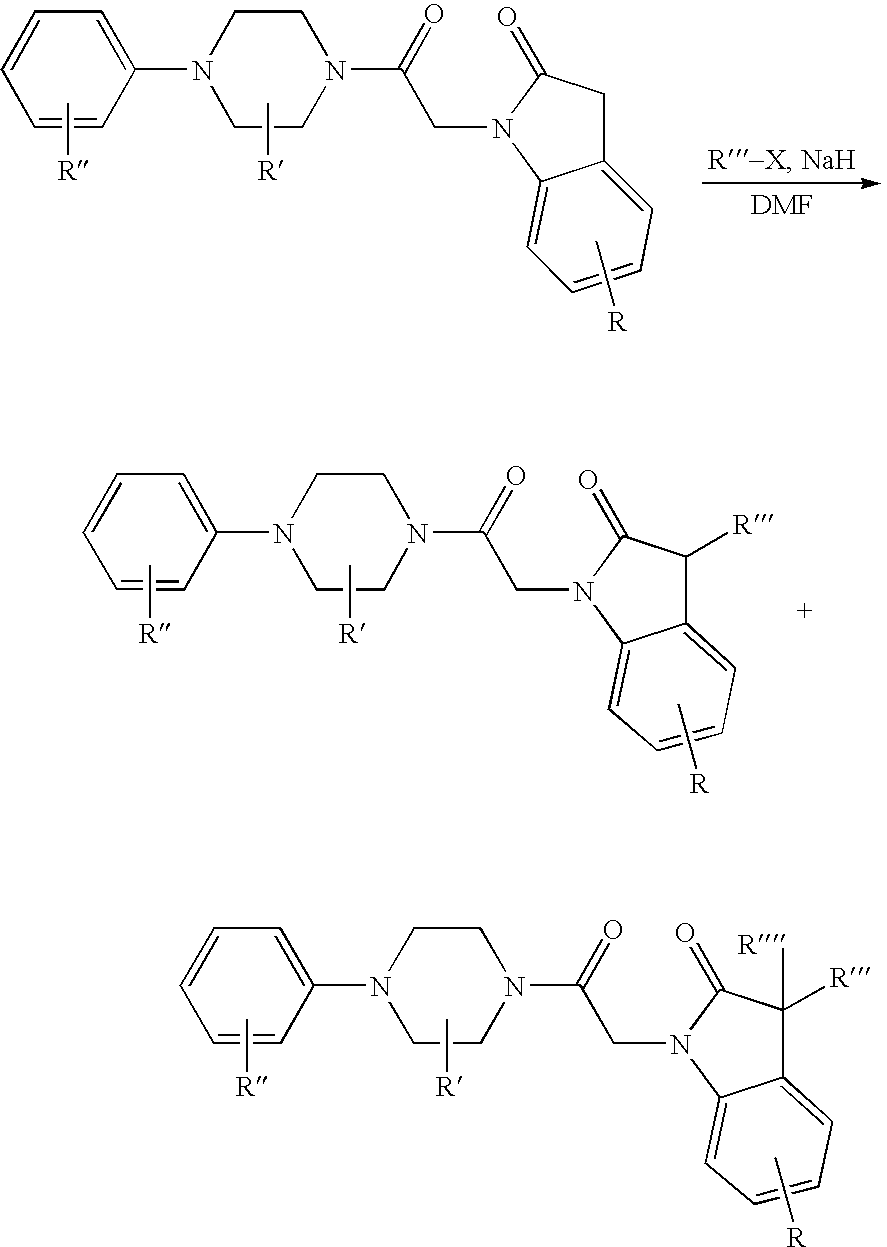
IV. Pharmaceutical Compositions
- NMP: N-methyl-2-pyrrolidinone
- HPLC: High Pressure Liquid Chromatography
- DMF: Dimethyl formamide
- TFA: Trifluoroacetic Acid
- THF: Tetrahydrofuran
- NCS: N-Chlorosuccinimide
- EtOAc: Ethyl acetate
- DCM: Dichloromethane
- HATU: N,N,N′,N′-Tetramethyl-O-(7-azabenzotriazol-1-yl)uronium hexafluorophosphate
- DMA: Dimethylacetamide
- DIPEA: Diisopropylethylamine
- BOP: (Benzotriazol-1-yloxy)tris(dimethylamino)phosphonium hexafluorophosphate
- DBU: 1,8-diazabicyclo(5.4.0)undec-7-ene


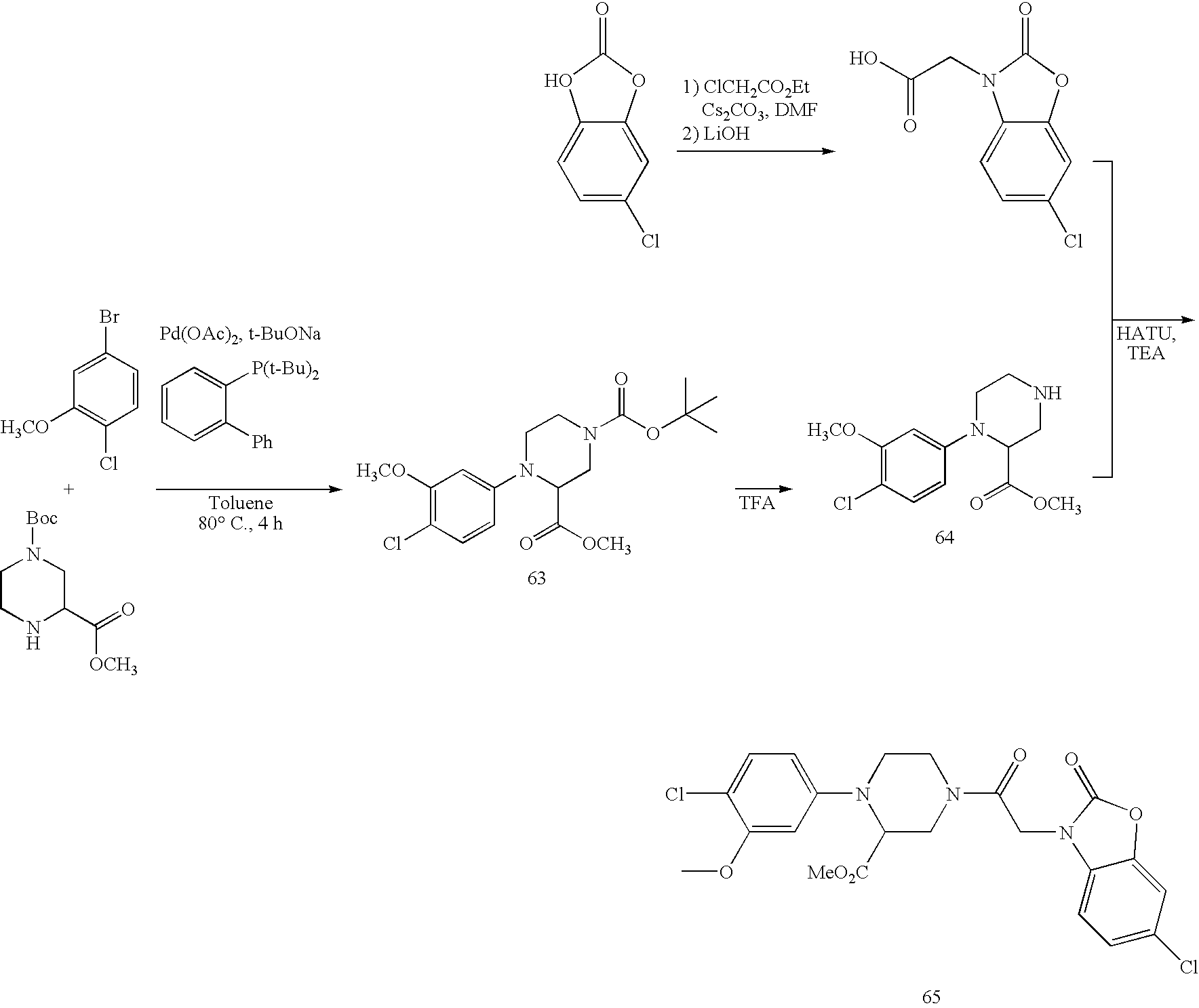


| TABLE 2 |
| Structure |
 |
 |
 |
 |
 |
 |
 |
 |
 |
 |
 |
 |
 |
 |
 |
 |
 |
 |
 |
 |
 |
 |
 |
 |
 |
 |
 |
 |
 |
 |
 |
 |
 |
 |
 |
 |
 |
 |
 |
 |
 |
 |
 |
 |
 |
 |
 |
Claims (7)


Priority Applications (6)
| Application Number | Priority Date | Filing Date | Title |
|---|---|---|---|
| US11/504,215 US7790726B2 (en) | 2005-08-16 | 2006-08-14 | Monocyclic and bicyclic compounds and methods of use |
| PCT/US2006/031971 WO2007022257A2 (en) | 2005-08-16 | 2006-08-15 | Monocyclic and bicyclic compounds and methods of use |
| CA002618844A CA2618844A1 (en) | 2005-08-16 | 2006-08-15 | Monocyclic and bicyclic compounds and methods of use |
| EP06824819A EP1931348A4 (en) | 2005-08-16 | 2006-08-15 | Monocyclic and bicyclic compounds and methods of use |
| JP2008527098A JP2009504754A (en) | 2005-08-16 | 2006-08-15 | Monocyclic and bicyclic compounds and usage |
| AU2006279525A AU2006279525A1 (en) | 2005-08-16 | 2006-08-15 | Monocyclic and bicyclic compounds and methods of use |
Applications Claiming Priority (2)
| Application Number | Priority Date | Filing Date | Title |
|---|---|---|---|
| US70926605P | 2005-08-16 | 2005-08-16 | |
| US11/504,215 US7790726B2 (en) | 2005-08-16 | 2006-08-14 | Monocyclic and bicyclic compounds and methods of use |
Publications (2)
| Publication Number | Publication Date |
|---|---|
| US20070066583A1 US20070066583A1 (en) | 2007-03-22 |
| US7790726B2 true US7790726B2 (en) | 2010-09-07 |
Family
ID=37758340
Family Applications (1)
| Application Number | Title | Priority Date | Filing Date |
|---|---|---|---|
| US11/504,215 Active 2027-01-12 US7790726B2 (en) | 2005-08-16 | 2006-08-14 | Monocyclic and bicyclic compounds and methods of use |
Country Status (6)
| Country | Link |
|---|---|
| US (1) | US7790726B2 (en) |
| EP (1) | EP1931348A4 (en) |
| JP (1) | JP2009504754A (en) |
| AU (1) | AU2006279525A1 (en) |
| CA (1) | CA2618844A1 (en) |
| WO (1) | WO2007022257A2 (en) |
Cited By (22)
| Publication number | Priority date | Publication date | Assignee | Title |
|---|---|---|---|---|
| US9676747B2 (en) | 2011-12-21 | 2017-06-13 | Novira Therapeutics, Inc. | Hepatitis B antiviral agents |
| EP3091984A4 (en) * | 2014-01-09 | 2017-06-21 | The J. David Gladstone Institutes, A Testamentary Trust Established under The Will of J. David Gladstone | Substituted benzoxazine and related compounds |
| US9873671B2 (en) | 2014-01-16 | 2018-01-23 | Novira Therapeutics, Inc. | Azepane derivatives and methods of treating hepatitis B infections |
| US9884818B2 (en) | 2013-05-17 | 2018-02-06 | Janssen Sciences Ireland Uc | Sulphamoylpyrrolamide derivatives and the use thereof as medicaments for the treatment of hepatitis B |
| US9895349B2 (en) | 2013-04-03 | 2018-02-20 | Janssen Sciences Ireland Us | N-phenyl-carboxamide derivatives and the use thereof as medicaments for the treatment of hepatitis B |
| US9975903B2 (en) * | 2014-12-26 | 2018-05-22 | Takeda Pharmaceutical Company Limited | Condensed heterocyclic compound |
| US10071961B2 (en) | 2013-10-23 | 2018-09-11 | Janssen Sciences Ireland Uc | Carboxamide derivatives and the use thereof as medicaments for the treatment of hepatitis B |
| US10077239B2 (en) | 2015-09-29 | 2018-09-18 | Novira Therapeutics, Inc. | Crystalline forms of a hepatitis B antiviral agent |
| US10125094B2 (en) | 2013-02-28 | 2018-11-13 | Janssen Sciences Ireland Uc | Sulfamoyl-arylamides and the use thereof as medicaments for the treatment of hepatitis B |
| US10160743B2 (en) | 2013-05-17 | 2018-12-25 | Janssen Sciences Ireland Uc | Sulphamoylthiophenamide derivatives and the use thereof as medicaments for the treatment of hepatitis B |
| US10213420B2 (en) | 2014-02-05 | 2019-02-26 | Novira Therapeutics, Inc. | Combination therapy for treatment of HBV infections |
| US10392349B2 (en) | 2014-01-16 | 2019-08-27 | Novira Therapeutics, Inc. | Azepane derivatives and methods of treating hepatitis B infections |
| US10441589B2 (en) | 2016-04-15 | 2019-10-15 | Novira Therapeutics, Inc. | Combinations and methods comprising a capsid assembly inhibitor |
| US10450270B2 (en) | 2013-07-25 | 2019-10-22 | Janssen Sciences Ireland Uc | Glyoxamide substituted pyrrolamide derivatives and the use thereof as medicaments for the treatment of hepatitis B |
| US10537580B2 (en) | 2015-03-19 | 2020-01-21 | Novira Therapeutics, Inc. | Azocane and azonane derivatives and methods of treating hepatitis B infections |
| US10676429B2 (en) | 2012-08-28 | 2020-06-09 | Janssen Sciences Ireland Uc | Sulfamoyl-arylamides and the use thereof as medicaments for the treatment of hepatitis B |
| US10875876B2 (en) | 2015-07-02 | 2020-12-29 | Janssen Sciences Ireland Uc | Cyclized sulfamoylarylamide derivatives and the use thereof as medicaments for the treatment of hepatitis B |
| US10973801B2 (en) | 2018-03-14 | 2021-04-13 | Janssen Sciences Ireland Unlimited Company | Capsid assembly modulator dosing regimen |
| US11078193B2 (en) | 2014-02-06 | 2021-08-03 | Janssen Sciences Ireland Uc | Sulphamoylpyrrolamide derivatives and the use thereof as medicaments for the treatment of hepatitis B |
| US11096931B2 (en) | 2019-02-22 | 2021-08-24 | Janssen Sciences Ireland Unlimited Company | Amide derivatives useful in the treatment of HBV infection or HBV-induced diseases |
| US11491148B2 (en) | 2019-05-06 | 2022-11-08 | Janssen Sciences Ireland Unlimited Company | Amide derivatives useful in the treatment of HBV infection or HBV-induced diseases |
| US11597715B2 (en) | 2018-01-11 | 2023-03-07 | Centaurus Therapeutics | Inhibitors of dihydroceramide desaturase for treating disease |
Families Citing this family (17)
| Publication number | Priority date | Publication date | Assignee | Title |
|---|---|---|---|---|
| WO2009071658A1 (en) | 2007-12-05 | 2009-06-11 | Biovitrum Ab (Publ) | Piperazines as anti-obesity agents |
| US8093248B2 (en) | 2007-12-05 | 2012-01-10 | Astrazeneca Ab (Publ) | Compounds useful for the treatment of conditions associated with weight gain |
| EP2341052A4 (en) * | 2008-09-05 | 2011-10-12 | Shionogi & Co | Ring-fused morpholine derivative having pi3k-inhibiting activity |
| CA2742306A1 (en) | 2008-11-03 | 2010-05-06 | Chemocentryx, Inc. | Compounds for the treatment of osteoporosis and cancers |
| JP5807971B2 (en) * | 2009-04-27 | 2015-11-10 | ベーリンガー インゲルハイム インターナショナル ゲゼルシャフト ミット ベシュレンクテル ハフツング | CXCR3 receptor antagonist |
| AR085872A1 (en) | 2011-04-08 | 2013-10-30 | Basf Se | HETEROBICICLIC DERIVATIVES N-SUBSTITUTES USEFUL TO COMBAT PARASITES IN PLANTS AND / OR ANIMALS, COMPOSITIONS THAT CONTAIN THEM AND METHODS TO COMBAT SUCH PESTS |
| BR112013028895A2 (en) | 2011-05-10 | 2016-08-09 | Bayer Ip Gmbh | (thio) bicyclic carbonylamidines |
| SI2928885T1 (en) | 2012-12-06 | 2017-06-30 | Glaxo Group Limited | Modulators of the retinoid-related orphan receptor gamma (ror-gamma) for use in the treatment of autoimmune and inflammatory diseases |
| AR095883A1 (en) | 2013-04-18 | 2015-11-18 | Astellas Pharma Inc | HETEROCYCLIC ACETAMIDE COMPOUNDS |
| CN103709175B (en) * | 2013-12-31 | 2016-06-29 | 定陶县友帮化工有限公司 | The one-step synthesis of the chloro-3H-oxazole of 6-also [4,5-b] pyridin-2-ones |
| ES2716966T3 (en) | 2014-05-28 | 2019-06-18 | Glaxosmithkline Ip Dev Ltd | Piperazine derivatives as ROR-gamma modulators |
| WO2015180613A1 (en) | 2014-05-28 | 2015-12-03 | Glaxosmithkline Intellectual Property Development Limited | Novel compounds |
| WO2015180612A1 (en) * | 2014-05-28 | 2015-12-03 | Glaxosmithkline Intellectual Property Development Limited | Novel compounds |
| KR102890201B1 (en) | 2019-07-10 | 2025-11-24 | 케모센트릭스, 인크. | Indan as a PD-L1 inhibitor |
| ES3068390T3 (en) | 2019-10-16 | 2026-05-29 | Chemocentryx Inc | Heteroaryl-biphenyl amides for the treatment of pd-l1 diseases |
| AU2020368392B2 (en) | 2019-10-16 | 2026-01-08 | Chemocentryx, Inc. | Heteroaryl-biphenyl amines for the treatment of PD-L1 diseases |
| WO2022187804A1 (en) * | 2021-03-02 | 2022-09-09 | Icahn School Of Medicine At Mount Sinai | Benzoxazolone inhibitors of inflammasomes |
Citations (4)
| Publication number | Priority date | Publication date | Assignee | Title |
|---|---|---|---|---|
| WO2003105853A1 (en) * | 2002-06-12 | 2003-12-24 | Chemocentryx, Inc. | 1-aryl-4-substituted piperazines derivatives for use as ccr1 antagonists for the treatment of inflammation and immune disorders |
| US20040034034A1 (en) | 2001-10-22 | 2004-02-19 | Blumberg Laura C. | Novel piperazine derivatives |
| US20050075348A1 (en) | 2001-03-12 | 2005-04-07 | Millennium Pharmaceuticals, Inc. | Functionalized heterocycles as modulators of chemokine receptor function and methods of use therefor |
| US20050143372A1 (en) | 2001-10-30 | 2005-06-30 | Shomir Ghosh | Compounds, pharmaceutical compositions and methods of use therefor |
Family Cites Families (9)
| Publication number | Priority date | Publication date | Assignee | Title |
|---|---|---|---|---|
| DE3114351A1 (en) * | 1981-04-09 | 1982-11-04 | Hoechst Ag, 6000 Frankfurt | "OXINDOL DERIVATIVES, METHOD FOR THE PRODUCTION THEREOF AND MEDICINAL PRODUCTS CONTAINING IT WITH A NEUROANABOLIC EFFECT" |
| JPH0615529B2 (en) * | 1985-04-01 | 1994-03-02 | エーザイ株式会社 | Novel piperidine derivative |
| IT1251144B (en) * | 1991-07-30 | 1995-05-04 | Boehringer Ingelheim Italia | BENZIMIDAZOLONE DERIVATIVES |
| JPH05255089A (en) * | 1991-12-18 | 1993-10-05 | Sanwa Kagaku Kenkyusho Co Ltd | Antiviral agent |
| WO1999012903A1 (en) * | 1997-09-09 | 1999-03-18 | Du Pont Pharmaceuticals Company | Benzimidazolinones, benzoxazolinones, benzopiperazinones, indanones, and derivatives thereof as inhibitors of factor xa |
| CA2342251A1 (en) * | 1998-08-28 | 2000-03-09 | Scios Inc. | Use of piperidines and/or piperazines as inhibitors of p38-alpha kinase |
| US20050256130A1 (en) * | 2002-06-12 | 2005-11-17 | Chemocentryx, Inc. | Substituted piperazines |
| KR20050051691A (en) * | 2002-10-11 | 2005-06-01 | 아스트라제네카 아베 | 1,4-disubstituted piperidine derivatives and their use as 11-betahsd1 inhibitors |
| TW200508197A (en) * | 2003-03-31 | 2005-03-01 | Ucb Sa | Indolone-acetamide derivatives, processes for preparing them and their uses |
-
2006
- 2006-08-14 US US11/504,215 patent/US7790726B2/en active Active
- 2006-08-15 AU AU2006279525A patent/AU2006279525A1/en not_active Abandoned
- 2006-08-15 EP EP06824819A patent/EP1931348A4/en not_active Withdrawn
- 2006-08-15 WO PCT/US2006/031971 patent/WO2007022257A2/en not_active Ceased
- 2006-08-15 JP JP2008527098A patent/JP2009504754A/en active Pending
- 2006-08-15 CA CA002618844A patent/CA2618844A1/en not_active Abandoned
Patent Citations (4)
| Publication number | Priority date | Publication date | Assignee | Title |
|---|---|---|---|---|
| US20050075348A1 (en) | 2001-03-12 | 2005-04-07 | Millennium Pharmaceuticals, Inc. | Functionalized heterocycles as modulators of chemokine receptor function and methods of use therefor |
| US20040034034A1 (en) | 2001-10-22 | 2004-02-19 | Blumberg Laura C. | Novel piperazine derivatives |
| US20050143372A1 (en) | 2001-10-30 | 2005-06-30 | Shomir Ghosh | Compounds, pharmaceutical compositions and methods of use therefor |
| WO2003105853A1 (en) * | 2002-06-12 | 2003-12-24 | Chemocentryx, Inc. | 1-aryl-4-substituted piperazines derivatives for use as ccr1 antagonists for the treatment of inflammation and immune disorders |
Non-Patent Citations (2)
| Title |
|---|
| Lozanova et al. Oxidation Communications, vol. 28 (3), p. 740-745 (Sep. 2005). * |
| Onkol et al. Arch. Pharm. Pharm.Med.Chem. vol. 334, p. 17-20 (2001). * |
Cited By (34)
| Publication number | Priority date | Publication date | Assignee | Title |
|---|---|---|---|---|
| US10196376B2 (en) | 2011-12-21 | 2019-02-05 | Novira Therapeutics, Inc. | Hepatitis B antiviral agents |
| US9676747B2 (en) | 2011-12-21 | 2017-06-13 | Novira Therapeutics, Inc. | Hepatitis B antiviral agents |
| US9751857B2 (en) | 2011-12-21 | 2017-09-05 | Novira Therapeutics, Inc. | Hepatitis B antiviral agents |
| US10676429B2 (en) | 2012-08-28 | 2020-06-09 | Janssen Sciences Ireland Uc | Sulfamoyl-arylamides and the use thereof as medicaments for the treatment of hepatitis B |
| US10995064B2 (en) | 2012-08-28 | 2021-05-04 | Janssen Sciences Ireland Uc | Sulfamoyl-arylamides and the use thereof as medicaments for the treatment of hepatitis B |
| US10941113B2 (en) | 2013-02-28 | 2021-03-09 | Janssen Sciences Ireland Uc | Sulfamoyl-arylamides and the use thereof as medicaments for the treatment of hepatitis B |
| US10125094B2 (en) | 2013-02-28 | 2018-11-13 | Janssen Sciences Ireland Uc | Sulfamoyl-arylamides and the use thereof as medicaments for the treatment of hepatitis B |
| US9895349B2 (en) | 2013-04-03 | 2018-02-20 | Janssen Sciences Ireland Us | N-phenyl-carboxamide derivatives and the use thereof as medicaments for the treatment of hepatitis B |
| US10398677B2 (en) | 2013-04-03 | 2019-09-03 | Janssen Sciences Ireland Uc | N-phenyl-carboxamide derivatives and the use thereof as medicaments for the treatment of hepatitis B |
| US9884818B2 (en) | 2013-05-17 | 2018-02-06 | Janssen Sciences Ireland Uc | Sulphamoylpyrrolamide derivatives and the use thereof as medicaments for the treatment of hepatitis B |
| US10457638B2 (en) | 2013-05-17 | 2019-10-29 | Janssen Sciences Ireland Uc | Sulphamoylpyrrolamide derivatives and the use thereof as medicaments for the treatment of hepatitis B |
| US10160743B2 (en) | 2013-05-17 | 2018-12-25 | Janssen Sciences Ireland Uc | Sulphamoylthiophenamide derivatives and the use thereof as medicaments for the treatment of hepatitis B |
| US10450270B2 (en) | 2013-07-25 | 2019-10-22 | Janssen Sciences Ireland Uc | Glyoxamide substituted pyrrolamide derivatives and the use thereof as medicaments for the treatment of hepatitis B |
| US10377709B2 (en) | 2013-10-23 | 2019-08-13 | Janssen Sciences Ireland Uc | Carboxamide derivatives and the use thereof as medicaments for the treatment of hepatitis B |
| US10071961B2 (en) | 2013-10-23 | 2018-09-11 | Janssen Sciences Ireland Uc | Carboxamide derivatives and the use thereof as medicaments for the treatment of hepatitis B |
| US10087151B2 (en) | 2014-01-09 | 2018-10-02 | The J. David Gladstone Institutes, A Testimentary Trust Established Under The Will Of J. David Gladstone | Substituted benzoxazine and related compounds |
| US10611741B2 (en) | 2014-01-09 | 2020-04-07 | The J. David Gladstone Institutes, A Testamentary Trust Established Under The Will Of J. David Gladstone | Substituted benzoxazine and related compounds |
| EP3091984A4 (en) * | 2014-01-09 | 2017-06-21 | The J. David Gladstone Institutes, A Testamentary Trust Established under The Will of J. David Gladstone | Substituted benzoxazine and related compounds |
| US10392349B2 (en) | 2014-01-16 | 2019-08-27 | Novira Therapeutics, Inc. | Azepane derivatives and methods of treating hepatitis B infections |
| US9873671B2 (en) | 2014-01-16 | 2018-01-23 | Novira Therapeutics, Inc. | Azepane derivatives and methods of treating hepatitis B infections |
| US10213420B2 (en) | 2014-02-05 | 2019-02-26 | Novira Therapeutics, Inc. | Combination therapy for treatment of HBV infections |
| US10632112B2 (en) | 2014-02-05 | 2020-04-28 | Novira Therapeutics, Inc. | Combination therapy for treatment of HBV infections |
| US11078193B2 (en) | 2014-02-06 | 2021-08-03 | Janssen Sciences Ireland Uc | Sulphamoylpyrrolamide derivatives and the use thereof as medicaments for the treatment of hepatitis B |
| US9975903B2 (en) * | 2014-12-26 | 2018-05-22 | Takeda Pharmaceutical Company Limited | Condensed heterocyclic compound |
| US10537580B2 (en) | 2015-03-19 | 2020-01-21 | Novira Therapeutics, Inc. | Azocane and azonane derivatives and methods of treating hepatitis B infections |
| US10875876B2 (en) | 2015-07-02 | 2020-12-29 | Janssen Sciences Ireland Uc | Cyclized sulfamoylarylamide derivatives and the use thereof as medicaments for the treatment of hepatitis B |
| US10077239B2 (en) | 2015-09-29 | 2018-09-18 | Novira Therapeutics, Inc. | Crystalline forms of a hepatitis B antiviral agent |
| US10441589B2 (en) | 2016-04-15 | 2019-10-15 | Novira Therapeutics, Inc. | Combinations and methods comprising a capsid assembly inhibitor |
| US11129834B2 (en) | 2016-04-15 | 2021-09-28 | Novira Therapeutics, Inc. | Combinations and methods comprising a capsid assembly inhibitor |
| US11597715B2 (en) | 2018-01-11 | 2023-03-07 | Centaurus Therapeutics | Inhibitors of dihydroceramide desaturase for treating disease |
| US12247019B2 (en) | 2018-01-11 | 2025-03-11 | Centaurus Therapeutics | Inhibitors of dihydroceramide desaturase for treating disease |
| US10973801B2 (en) | 2018-03-14 | 2021-04-13 | Janssen Sciences Ireland Unlimited Company | Capsid assembly modulator dosing regimen |
| US11096931B2 (en) | 2019-02-22 | 2021-08-24 | Janssen Sciences Ireland Unlimited Company | Amide derivatives useful in the treatment of HBV infection or HBV-induced diseases |
| US11491148B2 (en) | 2019-05-06 | 2022-11-08 | Janssen Sciences Ireland Unlimited Company | Amide derivatives useful in the treatment of HBV infection or HBV-induced diseases |
Also Published As
| Publication number | Publication date |
|---|---|
| CA2618844A1 (en) | 2007-02-22 |
| JP2009504754A (en) | 2009-02-05 |
| WO2007022257A3 (en) | 2007-11-01 |
| US20070066583A1 (en) | 2007-03-22 |
| EP1931348A2 (en) | 2008-06-18 |
| AU2006279525A1 (en) | 2007-02-22 |
| WO2007022257A2 (en) | 2007-02-22 |
| EP1931348A4 (en) | 2009-08-12 |
Similar Documents
| Publication | Publication Date | Title |
|---|---|---|
| US20070066583A1 (en) | Monocyclic and bicyclic compounds and methods of use | |
| US7524845B2 (en) | Azaindazole compounds and methods of use | |
| US7576218B2 (en) | 4-phenylpiperdine-pyrazole CCR1 antagonists | |
| US7777035B2 (en) | Azaindazole compounds and methods of use | |
| US7435831B2 (en) | Bicyclic and bridged nitrogen heterocycles | |
| EP1720545B1 (en) | Bicyclic and bridged nitrogen heterocycles | |
| TWI418353B (en) | 3-(imidazolyl)-pyrazolo[3,4-b]pyridines | |
| US8946240B2 (en) | 4-amino-3-(imidazolyl)-pyrazolo[3,4-D]pyrimidines | |
| US20090252779A1 (en) | Azaindazole compounds and methods of use | |
| CN104955454B (en) | Chemokine receptor anagonists | |
| US7786157B2 (en) | OXO-imidazolidines as modulators of chemokine receptors | |
| WO2023023534A2 (en) | Aryl sulfonyl compounds as ccr6 inhibitors | |
| HK1141458A (en) | Azaindazole compounds and methods of use | |
| HK1141458B (en) | Azaindazole compounds and methods of use |
Legal Events
| Date | Code | Title | Description |
|---|---|---|---|
| AS | Assignment |
Owner name: CHEMOCENTRYX, INC., CALIFORNIA Free format text: ASSIGNMENT OF ASSIGNORS INTEREST;ASSIGNORS:ZHANG, PENGLIE;PENNELL, ANDREW M.K.;WRIGHT, JOHN J. KIM;AND OTHERS;SIGNING DATES FROM 20061016 TO 20061101;REEL/FRAME:018670/0223 Owner name: CHEMOCENTRYX, INC., CALIFORNIA Free format text: ASSIGNMENT OF ASSIGNORS INTEREST;ASSIGNORS:ZHANG, PENGLIE;PENNELL, ANDREW M.K.;WRIGHT, JOHN J. KIM;AND OTHERS;REEL/FRAME:018670/0223;SIGNING DATES FROM 20061016 TO 20061101 |
|
| STCF | Information on status: patent grant |
Free format text: PATENTED CASE |
|
| FPAY | Fee payment |
Year of fee payment: 4 |
|
| MAFP | Maintenance fee payment |
Free format text: PAYMENT OF MAINTENANCE FEE, 8TH YR, SMALL ENTITY (ORIGINAL EVENT CODE: M2552) Year of fee payment: 8 |
|
| MAFP | Maintenance fee payment |
Free format text: PAYMENT OF MAINTENANCE FEE, 12TH YR, SMALL ENTITY (ORIGINAL EVENT CODE: M2553); ENTITY STATUS OF PATENT OWNER: SMALL ENTITY Year of fee payment: 12 |
|
| FEPP | Fee payment procedure |
Free format text: ENTITY STATUS SET TO UNDISCOUNTED (ORIGINAL EVENT CODE: BIG.); ENTITY STATUS OF PATENT OWNER: LARGE ENTITY |