US7788268B2 - In-place sorting using node specific mask width - Google Patents
In-place sorting using node specific mask width Download PDFInfo
- Publication number
- US7788268B2 US7788268B2 US11/970,600 US97060008A US7788268B2 US 7788268 B2 US7788268 B2 US 7788268B2 US 97060008 A US97060008 A US 97060008A US 7788268 B2 US7788268 B2 US 7788268B2
- Authority
- US
- United States
- Prior art keywords
- node
- sequences
- mask
- sorting
- array
- Prior art date
- Legal status (The legal status is an assumption and is not a legal conclusion. Google has not performed a legal analysis and makes no representation as to the accuracy of the status listed.)
- Expired - Fee Related, expires
Links
Images









Classifications
-
- G—PHYSICS
- G06—COMPUTING OR CALCULATING; COUNTING
- G06F—ELECTRIC DIGITAL DATA PROCESSING
- G06F7/00—Methods or arrangements for processing data by operating upon the order or content of the data handled
- G06F7/22—Arrangements for sorting or merging computer data on continuous record carriers, e.g. tape, drum, disc
- G06F7/24—Sorting, i.e. extracting data from one or more carriers, rearranging the data in numerical or other ordered sequence, and rerecording the sorted data on the original carrier or on a different carrier or set of carriers sorting methods in general
Definitions
- Quicksort picks an element from the array (the pivot), partitions the remaining elements into those greater than and less than this pivot, and recursively sorts the partitions.
- the execution speed of Quicksort is a function of the sort ordering that is present in the array of words to be sorted. For a totally random distribution of words to be sorted, Quicksort's execution speed is proportional to N W log N W . In some cases in which the words to be sorted deviate from perfect randomness, the execution speed may deteriorate relative to N W log N W and is proportional to (N W ) 2 in the worst case.
- the present invention provides a method, comprising executing an algorithm by a processor of a computer system, said executing said algorithm comprising in-place sorting S sequences in ascending or descending order of a value associated with each sequence and in a time period denoted as a sorting execution time, said S sequences being stored contiguously in an array within a memory device of the computer system prior to said sorting, S being at least 2, each sequence of the S sequences comprising a contiguous fields of N bits, said N being a positive integer of at least 2, said in-place sorting comprising executing program code at each node of a linked execution structure, each node comprising a segment of the array, said executing program code being performed in a hierarchical sequence with respect to said nodes, said executing program code at each node comprising:
- the present invention provides a process for supporting computer infrastructure, said process comprising providing at least one support service for at least one of creating, integrating, hosting, maintaining, and deploying computer-readable code in a computer system, wherein the code in combination with the computer system is configured to perform a method, said method comprising executing an algorithm by a processor of the computer system, said executing said algorithm comprising in-place sorting S sequences in ascending or descending order of a value associated with each sequence and in a time period denoted as a sorting execution time, said S sequences being stored contiguously in an array within a memory device of the computer system prior to said sorting, S being at least 2, each sequence of the S sequences comprising a contiguous fields of N bits, said N being a positive integer of at least 2, said in-place sorting comprising executing program code at each node of a linked execution structure, each node comprising a segment of the array, said executing program code being performed in a hierarchical sequence with respect to said nodes, said executing program
- the present invention provides a computer program product, comprising a computer usable storage medium having a computer readable program embodied therein, said computer readable program comprising an algorithm for in-place sorting S sequences in ascending or descending order of a value associated with each sequence and in a time period denoted as a sorting execution time, said S sequences being stored contiguously in an array within a memory device of a computer system prior to said sorting, S being at least 2, each sequence of the S sequences comprising contiguous fields of N bits, said N being a positive integer of at least 2, said algorithm adapted to perform said in-place sorting by executing program code at each node of a linked execution structure, each node comprising a segment of the array, said executing program code adapted to be performed by a processor of the computer system, said executing program code adapted to be performed in a hierarchical sequence with respect to said nodes, said executing program code at each node including:
- the present invention advantageously provides a sort algorithm having an execution speed of order less than N W log N W .
- FIG. 1 depicts a path through a linked execution structure, in accordance with embodiments of the present invention.
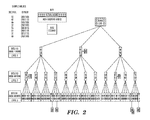
- FIG. 2 depicts paths through a linked execution structure for sorting integers, in accordance with embodiments of the present invention.
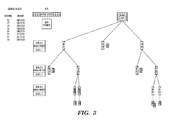
- FIG. 3 depicts FIG. 2 with the non-existent nodes deleted, in accordance with embodiments of the present invention.
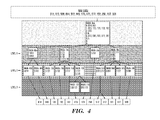
- FIG. 4 depicts paths through a linked execution structure for sorting strings with each path terminated at a leaf node, in accordance with embodiments of the present invention.
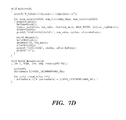
- FIGS. 7A-7D comprise source code for linear sorting of integers under recursive execution, in accordance with embodiments of the present invention.
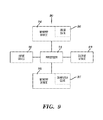
- FIG. 9 illustrates a computer system for sorting sequences of bits, in accordance with embodiments of the present invention.
- FIG. 11 is a graph depicting the number of compares used in sorting integers for a values range of 0-9,999,999, using Quicksort and also using the linear sort of the present invention.
- FIG. 12 is a graph depicting the number of moves used in sorting integers for a values range of 0-9,999, using Quicksort and also using the linear sort of the present invention.
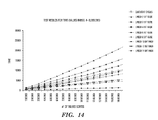
- FIG. 14 is a graph depicting sort time used in sorting integers for a values range of 0-9,999,999, using Quicksort and also using the linear sort of the present invention.
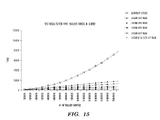
- FIG. 15 is a graph depicting sort time used in sorting integers for a values range of 0-9,999, using Quicksort and also using the linear sort of the present invention.
- FIG. 16 is a graph depicting memory usage for sorting fixed-length bit sequences representing integers, using Quicksort and also using the linear sort of the present invention.
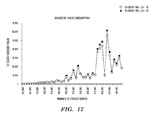
- FIG. 17 is a graph depicting sort time using Quicksort for sorting strings, in accordance with embodiments of the present invention.
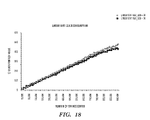
- FIG. 18 is a graph depicting sort time using a linear sort for sorting strings, in accordance with embodiments of the present invention.
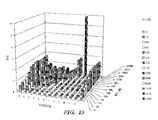
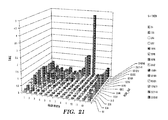
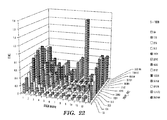
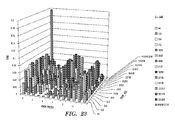
- FIGS. 19-24 is a graph depicting sort time used in sorting integers, using Quicksort and also using the linear sort of the present invention, wherein the sort time is depicted as a function of mask width and maximum value that can be sorted.
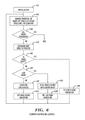
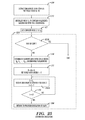
- FIG. 25 is a flow chart for in-place linear sorting under recursive execution, in accordance with embodiments of the present invention.
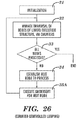
- FIG. 26 is a flow chart for in-place linear sorting under counter-controlled looping, in accordance with embodiments of the present invention.
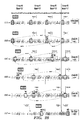
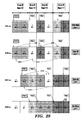
- FIGS. 27-29 depict examples of using domino chains to effectuate in-place linear sorting, in accordance with embodiments of the present invention.
- FIGS. 30-31 are high-level flow charts illustrating the domino chains to effectuate in-place linear sorting, in accordance with embodiments of the present invention
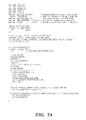
- FIGS. 32 and 34 A- 34 B depict pseudo-code and actual code, respectively, for the recursive calling embodiment of the in-place linear sort of present invention.
- FIG. 33 depicts an example in which 8-bit sequences are broken into groups and arranged into contiguous segments based on a 2-bit mask, in conjunction with the in-place linear sort of the present invention.
- FIG. 43 is a graph of sort time versus mask width at each of the first two levels for the exhaustive testing performed to generate the table of FIG. 42 , in accordance with embodiments of the present invention.
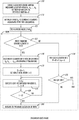
- FIG. 44 is a flow chart depicting use of a node-specific mask width for implementing an in-place sort, in accordance with embodiments of the present invention.
- FIG. 45 depicts an illustrative linked execution structure having node-specific mask widths, in accordance with embodiments of the present invention.
- FIG. 46 is a graph depicting sort time versus number of sequences (S) to sort for a random set of sequences, in accordance with embodiments of the present invention.
- FIG. 47 is a graph depicting sort time versus number of sequences (S) to sort for a set of 9-digit zip codes, in accordance with embodiments of the present invention.
- FIG. 48 is a graph depicting sort time versus number of sequences (S) to sort for a set of 8-digit dates, in accordance with embodiments of the present invention
- the detailed description is presented infra in six sections.
- the first section (Section 1) in conjunction with FIG. 1 , comprises an introduction to the present invention, including assumptions, terminology, features, etc. of the present invention.
- the second section (Section 2) in conjunction with FIGS. 2-9 comprises a sort algorithm detailed description in accordance with the present invention.
- the third section (Section 3), in conjunction with FIGS. 10-24 relates to Timing Tests, including a description and analysis of execution timing test data for the sort algorithm of the present invention as described in Section 2, in comparison with Quicksort.
- the fourth Section (Section 4), in conjunction with FIGS. 25-32 describes the application of in-place sorting to the sort algorithm of Section 2.
- the sixth section (Section 6), in conjunction with FIGS. 35-41 , describes performance test results pertaining to the in-place sort algorithm of the present invention in comparison with Quicksort.
- the seventh section (Section 7), in conjunction with FIGS. 42-48 , describes determining a node-specific mask width for the in-place sort algorithm of the present invention.
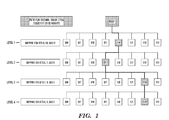
- FIG. 1 depicts a path through linked execution structure, in accordance with embodiments of the present invention.
- the linked execution structure of FIG. 1 is specific to 12-bit words divided into 4 contiguous fields of 3 bits per field.
- the example word 100011110110 shown in FIG. 1 is divided into the following 4 fields (from left to right): 100, 011, 110, 110.
- Each field has 3 bits and therefore has a “width” of 3 bits.
- the sort algorithm of the present invention will utilize a logical mask whose significant bits (for masking purposes) encompass W bits. Masking a sequence of bits is defined herein as extracting (or pointing to) a subset of the bits of the sequence.
- the mask may include a contiguous group of ones (i.e., 11 . . .
- the mask width W determines the division into contiguous fields of each word to be sorted.
- the words to be sorted may be divided into, inter alia, 3 fields, wherein going from left to right the three fields have 5 bits, 5 bits, and 2 bits.
- W is a constant width with respect to the contiguous fields of each word to be sorted.
- W is a variable width with respect to the contiguous fields of each word to be sorted.
- Each word to be sorted may be characterized by the same mask and associated mask width W, regardless of whether W is constant or variable with respect to the contiguous fields.
- the linked execution structure has a root, levels, and nodes.
- the root in FIG. 1 is represented as a generic field of W bits having the form xxx where x is 0 or 1.
- the width W of the mask used for sorting is the number of bits (3) in the root.
- the generic nodes corresponding to the root encompass all possible values derived from the root.
- the generic nodes shown in FIG. 1 are 000, 001, 010, 011, 011, 100, 101, 110, and 111.
- There are L levels (or “depths”) such that each field of a word corresponds to a level of the linked execution structure.
- the actual nodes of a linked execution structure relative to a group of words to be sorted comprise actual nodes and non-existent nodes.
- the paths of the words to be sorted define the actual nodes, and the remaining nodes define the non-existent nodes.
- the actual nodes include 100 node of level 1, the 011 child node of Level 2, the 110 child node of Level 3, and the 110 child node of Level 4. Any other word having a path through the linked execution structure of FIG. 1 defines additional actual nodes.
- leaf node of the linked execution structure, which is an actual node that is also a terminal node of a path through the linked execution structure.
- a leaf node has no children.
- 110 node in Level 4 is a leaf node.
- the given node of the linked execution structure holds no more than one unique word to be sorted, then the given node is a leaf node and the sort algorithm terminates the path at the given node without need to consider the child (if any) of the given node.
- the given node is considered to be a leaf node and is considered to effectively have no children.
- a leaf node it is possible for a leaf node to exist at a level L 1 wherein L 1 ⁇ L. The concept of such leaf nodes will be illustrated by the examples depicted in FIGS. 2-4 , discussed infra.
- the sort algorithm of the present invention has an execution time that is proportional to N*Z, wherein Z is a positive real number such that 1 ⁇ Z ⁇ L.
- N is defined as the number of bits in each word to be sorted, assuming that N is a constant and characterizes each word to be sorted, wherein said assumption holds for the case of an integer sort, a floating point sort, or a string sort such that the string length is constant.
- the sort algorithm of the present invention is designated herein as a “linear sort”.
- linear sort is used herein to refer to the sorting algorithm of the present invention.
- the execution time is proportional to ⁇ j W j N j , where N j is a string length in bits or bytes (assuming that the number of bits per byte is a constant), wherein W j is a weighting factor that is proportional to the number of strings to be sorted having a string length N j .
- the sort algorithm of the present invention is designated herein as having a sorting execution time for sorting words (or sequences of bits), wherein said sorting execution time is a linear function of the word length (or sequence length) of the words (or sequences) to be sorted.
- the word length (or sequence length) may be a constant length expressed as a number of bits or bytes (e.g., for integer sorts, floating point sorts, or string sorts such that the string length is constant).
- the sorting execution time function is a linear function of the word length (or sequence length) of the words (or sequences) to be sorted means that the sorting execution time is linearly proportional to the constant word length (or sequence length).
- sorting execution time of the present invention is also a linear (or less than linear) function of S wherein S is the number of sequences to be sorted, as will be discussed infra.
- an analysis of the efficiency of the sorting algorithm of the present invention may be expressed in terms of an “algorithmic complexity” instead of in terms of a sorting execution time, inasmuch as the efficiency can be analyzed in terms of parameters which the sorting execution time depends on such as number of moves, number of compares, etc. This will be illustrated infra in conjunction with FIGS. 10-13 .
- the linked execution structure of the present invention includes nodes which are linked together in a manner that dictates a sequential order of execution of program code with respect to the nodes.
- the linked execution structure of the present invention may be viewed a program code execution space, and the nodes of the linked execution structure may be viewed as points in the program code execution space.
- the sequential order of execution of the program code with respect to the nodes is a function of an ordering of masking results derived from a masking of the fields of the words (i.e., sequences of bits) to be sorted.
- the generic nodes corresponding to the root are 00, 01, 10, and 11.
- a mask of 110000 is used for Level 1
- a mask of 001100 is used for Level 2
- a mask of 000011 is used for Level 3.
- the mask at each level is applied to a node in the previous level, wherein the root may be viewed as a root level which precedes Level 1, and wherein the root or root level may be viewed as holding the S values to be sorted.
- the Level 1 mask of 110000 is applied to all eight values to be sorted to distribute the values in the 4 nodes (00, 01, 10, 11) in Level 1 (i.e., based on the bit positions 4 and 5 in the words to be sorted).
- the 00 node has 3 values (12, 03, 14), the 01 node has 1 value (31), the 10 node has 4 values (47, 44, 37, 44), and the 11 node has zero values as indicated by the absence of the 11 node at Level 1 in FIG. 2 .
- the 10 node in Level 1 has duplicate values of 44.
- the actual nodes 00, 01, and 10 in Level 1 are processed from left to right.
- Processing the 00 node of Level 1 comprises distributing the values 12, 03, and 14 from the 00 node of Level 1 into its child nodes 00, 01, 10, 11 in Level 2, based on applying the Level 2 mask of 001100 to each of the values 12, 03, and 14.
- the order in which the values 12, 03, and 14 are masked is arbitrary. However, it is important to track the left-to-right ordering of the generic 00, 01, 10, and 11 nodes as explained supra.
- FIG. 2 shows that the 00 node of Level 2 (as linked to the 00 node of Level 1) is a leaf node, since the 00 node of Level 2 has only 1 value, namely 03.
- the value 03 is the first sorted value and is placed in the output array element A( 1 ).
- FIG. 2 shows that the 01 node of Level 1 is a leaf node, since 31 is the only value contained in the 01 node of Level 1. Thus, the value of 31 is outputted to A( 4 ). Accordingly, all nodes in Level 2 and 3 which are linked to the 01 node of Level 1 are non-existent nodes.
- Processing the 10 node of Level 1 comprises distributing the four values 47, 44, 37, and 44 from the 10 node of Level 1 into its child nodes 00, 01, 10, 11 in Level 2, based on applying the Level 2 mask of 001100 to each of the values 47, 44, 37, and 44.
- FIG. 2 shows that the 01 node of Level 2 (as linked to the 10 node of Level 1) is a leaf node, since the 01 node of Level 2 has only 1 value, namely 37. Thus, the value 37 is placed in the output array element A( 5 ). Accordingly, the 00, 01, 10, and 11 nodes of Level 3 which are linked to the 01 node of Level 2 which is linked to the 10 node of Level 1 are non-existent nodes.
- FIG. 1 shows that the 01 node of Level 2 (as linked to the 10 node of Level 1) is a leaf node, since the 01 node of Level 2 has only 1 value, namely 37. Thus, the value 37 is placed in the output array element A( 5 ). Accordingly,
- the 11 node of level 2 (as linked to the 10 node of Level 1) has the three values of 47, 44, and 44. Therefore, the values 47, 44, and 44 in the 11 node of level 2 (as linked to the 10 node of Level 1) are to be next distributed into its child nodes 00, 01, 10, 11 of Level 3 (from left to right), applying the Level 3 mask 000011 to the values 47, 44, and 44. As a result, the duplicate values of 44 and 44 are distributed into the leaf nodes 00 in Level 3, and the value of 47 is distributed into the leaf node 11 in level 3.
- the value 44 is outputted to A( 6 )
- the duplicate value 44 is outputted to A( 7 )
- the value 47 is outputted to A( 8 ).
- the output array now contains the sorted values in ascending order or pointers to the sorted values in ascending order, and the sorting has been completed.
- each of the words to be sorted could be more generally interpreted as a contiguous sequence of binary bits.
- the sequence of bits could be interpreted as an integer as was done in the discussion of FIG. 2 supra.
- the sequence of bits could alternatively be interpreted as a character string, and an example of such a character string interpretation will be discussed infra in conjunction with FIG. 4 .
- the sequence could have been interpreted as a floating point number if the sequence had more bits (i.e., if N were large enough to encompass a sign bit denoting the sign of the floating point number, an exponent field, and a mantissa field).
- the sort algorithm of the present invention accomplishes the sorting in the absence of such comparisons by the masking process characterized by the shifting of the 11 bits as the processing moves down in level from Level 1 to Level 2 to Level 3, together with the left to right ordering of the processing of the generic 00, 01, 10, 11 nodes at each level.
- A( 8 ) contains sorted values in ascending order is a consequence of the first assumption that for any two adjacent bits in the value to be sorted, the bit to the left represents a larger magnitude effect on the value than the bit to the right. If the alternative assumption had been operative (i.e., for any two adjacent bits in the value to be sorted, the bit to the right represents a larger magnitude effect on the value than the bit to the left), then the output array A( 1 ), A( 2 ), . . . , A( 8 ) would contain the same values as under the first assumption; however the sorted values in A( 1 ), A( 2 ), . . . , A( 8 ) would be in descending order.
- the output array A( 1 ), A( 2 ), . . . , A( 8 ) would contain the sorted values in ascending order.
- the mask width could be variable (i.e., as a function of level or depth). For example consider a sort of 16 bit words having mask widths of 3, 5, 4, 4 at levels 1, 2, 3, 4, respectively. That is, the mask at levels 1, 2, 3, and 4 may be, inter alia, 1110000000000000, 0001111100000000, 0000000011110000, and 0000000000001111, respectively.
- the mask widths W 1 , W 2 . . . , W L corresponding to levels 1, 2, . . .
- a second reason for having a variable mask width W is that having a variable W may reduce the sort execution time inasmuch as the sort execution time is a function of W as stated supra.
- W As W is increased, the number of levels may decrease and the number of nodes to be processed may likewise decrease, resulting in a reduction of processing time.
- sufficiently large W may be characterized by a smallest sort execution time, but may also be characterized by prohibitive memory storage requirements and may be impracticable (see infra FIG. 16 and discussion thereof). Thus in practice, it is likely that W can be increased up to a maximum value above which memory constraints become controlling.
- the sort efficiency with respect to execution speed is a function not only of mask width but also of the data density as measured by S/(V MAX ⁇ V MIN ).
- the mask width and the data density do not independently impact the sort execution speed. Instead the mask width and the data density are coupled in the manner in which they impact the sort execution speed. Therefore, it may be possible to fine tune the mask width as a function of level in accordance with the characteristics (e.g., the data density) of the data to be sorted.
- V MIN a lowest or minimum value
- V MIN a variable width mask
- V MAX and V MIN in the sorting to reduce the effective value of N.
- V MAX is determined to have the value 00110100
- V MIN is determined to have the value 00000100
- bits 7 - 8 of all words to be sorted have 00 in the leftmost bits 6 - 7
- bits 0 - 1 of all words to be sorted have 00 in the rightmost bits 0 - 1 . Therefore, bits 7 - 8 and 0 - 1 do not have to be processed in the sorting procedure.
- the masks for this sorting scheme are 00110000 for level 1 and 00001100 for level 2.
- the integer sorting algorithm described supra in terms of the example of FIG. 2 applies generally to integers. If the integers to be sorted are all non-negative, or are all negative, then the output array A( 1 ), A( 2 ), . . . , will store the sorted values (or pointers thereto) as previously described. However, if the values to be sorted are in a standard signed integer format with the negative integers being represented as a two's complement of the corresponding positive integer, and if the integers to be sorted include both negative and non-negative values, then output array A( 1 ), A( 2 ), . . . stores the negative sorted integers to the right of the non-negative sorted integers.
- the sorted results in the array A( 1 ), A( 2 ), . . . may appear as: 0, 2, 5, 8, 9, ⁇ 6, ⁇ 4, ⁇ 2, and the algorithm could test for this possibility and reorder the sorted results as: ⁇ 6, ⁇ 4, ⁇ 2, 0, 2, 5, 8, 9.
- the sorting algorithm described supra will correctly sort a set of floating point numbers in which the floating point representation conforms to the commonly used format having a sign bit, an exponent field, and a mantissa field ordered contiguously from left to right in each word to be sorted.
- the standard IEEE 754 format represents a single-precision real number in the following 32-bit floating point format:
- Exponent Value Exponent Field Bits ⁇ 2 01111101 ⁇ 1 01111110 0 01111111 1 10000000 2 10000001
- the number of bits in the exponent and mantissa fields in the above example is merely illustrative.
- the IEEE 754 representation of a double-precision floating point number has 64 bits (a sign bit, an 11-bit exponent, and a 52-bit mantissa) subject to an exponent bias of +1023.
- the exponent and mantissa fields may each have any finite number of bits compatible with the computer/processor hardware being used and consistent with the degree of precision desired.
- the sign bit is conventionally 1 bit, the sort algorithm of the present invention will work correctly even if more than one bit is used to describe the sign.
- the position of the decimal point is in a fixed position with respect to the bits of the mantissa field and the magnitude of the word is modulated by the exponent value in the exponent field, relative to the fixed position of the decimal point.
- the exponent value may be positive or negative which has the effect of shifting the decimal point to the left or to the right, respectively.
- a mask may be used to define field that include any contiguous sequence of bits.
- the mask may include the sign bit and a portion of the exponent field, or a portion of the exponent field and a portion of the mantissa field, etc.
- the mask for level 1 is 111111110 24 , wherein 0 24 represents 24 consecutive zeroes.
- the mask for level 2 is 000000001111110 16 , wherein 0 16 represents 16 consecutive zeroes.
- the mask for level 3 is 0 16 1111111100000000.
- the mask for level 2 is 0 24 11111111.
- the mask for level 1 includes the sign bit and the 7 leftmost bits of the exponent field
- the mask at level 2 includes the rightmost bit of the exponent field and the 7 leftmost bits of the mantissa field
- an the mask for levels 3 and 4 each include 8 bits of the mantissa field.
- the floating point numbers to be sorted include a mixture of positive and negative values
- the sorted array of values will have the negative sorted values to the right of the positive sorted values in the same hierarchical arrangement as occurs for sorting a mixture of positive and negative integers described supra.
- FIG. 4 depicts paths through a linked execution structure for sorting strings with each path terminated at a leaf node, in accordance with embodiments of the present invention.
- thirteen strings of 3 bytes each are sorted.
- the 13 strings to be sorted are: 512, 123, 589, 014, 512, 043, 173, 179, 577, 152, 256, 167, and 561.
- Each string comprises 3 characters selected from the following list of characters: 0, 1, 2, 3, 4, 5, 6, 7, 8, and 9.
- Each character consists of a byte, namely 8 bits. Although in the example of FIG. 4 a byte consists of 8 bits, a byte may generally consist of any specified number of bits.
- each node potentially has 256 (i.e., 2 8 ) children.
- the sequence 014, 043, 123, . . . at the bottom of FIG. 4 denoted the strings in their sorted order.
- the string length is constant, namely 3 characters or 24 bits. Generally, however, the string length may be variable.
- the character string defines a number of levels of the linked execution structure that is equal to the string length as measured in bytes. There is a one-to-one correspondence between byte number and level number. For example, counting left to right, the first byte corresponds to level 1, the second byte corresponds to level 2, etc.
- the maximum number of levels L of the linked execution structure is equal to the length of the longest string to be sorted, and the processing of any string to be sorted having a length less than the maximum level L will reach a leaf node at a level less than L.
- the mask width is a constant that includes one byte, and the boundary between masks of successive levels coincide with byte boundaries.
- the sorting algorithm described in conjunction with the integer example of FIG. 2 could be used to sort the character strings of FIG. 4
- the sorting algorithm to sort strings could be simplified to take advantage of the fact that mask boundaries coincide with byte boundaries.
- each individual byte may be mapped into a linked list at the byte's respective level within the linked execution structure. Under this scheme, when the processing of a string reaches a node corresponding to the rightmost byte of the string, the string has reached a leaf node and can then be outputted into the sorted list of strings.
- a programming language with uses length/value pairs internally for string storage can compare the level reached with the string's length (in bytes) to determine when that the string has reached a leaf node.
- the preceding scheme is an implicit masking scheme in which the is equal to the number of bits in a character byte.
- the algorithm could use an explicit masking scheme in which any desired masking configuration could be used (e.g., a mask could encompass bits of two or more bytes).
- a masking strategy is always being used, either explicitly or implicitly.
- each node Shown in each node is a mask associated with the node, and the strings whose path passes through the node.
- the mask in each node is represented as a sequence of bytes and each byte might may be one of the following three unique symbols: X, x, and h where h represents one of the characters 0, 1, 2, 3, 4, 5, 6, 7, 8, 9.
- the position within the mask of the symbol X is indicative of the location (and associated level) of child nodes next processed.
- the symbol “h” and its position in the mask indicates that the strings in the node each have the character represented by “h” in the associated position.
- the position within the mask of the symbol “x” indicates the location (and associated level) of the mask representative of other child nodes (e.g., “grandchildren”) to be subsequently processed.
- the strings shown in each node in FIG. 4 each have the form H: s( 1 ), s( 2 ), . . . , wherein H represents a character of the string in the byte position occupied by X, and wherein s( 1 ), s( 2 ), . . . are strings having the character represented by H in the byte position occupied by X.
- H represents a character of the string in the byte position occupied by X
- s( 1 ), s( 2 ), . . . are strings having the character represented by H in the byte position occupied by X.
- the string denoted by 1:014 has “0” in byte position 1 and “1” in byte position 2
- the string denoted by 4:043 has “0” in byte position 1 and “4” in byte position 2 .
- the string denoted by 3:173 has “1” in byte position 1 , “7” in byte position 2 , and “3” in byte position 3
- the string denoted by 9:179 has “1” in byte position 1 , “7” in byte position 2 , and “9” in byte position 3 .
- the method of sorting the strings of FIG. 4 follows substantially the same procedure as was described supra for sorting the integers of FIG. 2 .
- the string sort algorithm which has been coded in the C-programming language as shown in FIG. 8 , is applied to the example of FIG. 4 as follows. Similar to FIG. 2 , an output array A( 1 ), A( 2 ), . . . , A(S) has been reserved to hold the outputted sorted values.
- the discussion infra describes the sort process as distributing the values to be sorted in the various nodes. However, the scope of the present invention includes the alternative of placing pointers to values to be sorted (e.g., in the form of linked lists), instead of the values themselves, in the various nodes.
- the output array A( 1 ), A( 2 ), . . . , A(S) may hold the sorted values or pointers to the sorted values.
- the root node mask of Xxx is applied to all thirteen strings to be sorted to distribute the strings in the 10 nodes 0Xx, 1Xx, . . . , 9Xx, resulting of the extraction and storage of the strings to be sorted and their identification with the first byte of 0, 1, 2, 3, 4, 5, 6, 7, 8, or 9.
- Applying the mask a string may be accomplished by ANDing the mask with the string to isolate the strings having a byte corresponding to the byte position of X in the mask to identify the child nodes.
- the character bytes of a string could be pointed to or extracted from the string by use of a string array subscript, wherein the string array subscript serves as the mask by providing the functionality of the mask.
- Masking a sequence of bits is defined herein as extracting (or pointing to) a subset of the bits of the sequence.
- Processing the Xxx root node comprises distributing the thirteen strings into the child nodes 0Xx, 1Xx, etc.
- the child nodes 0Xx, 1Xx, etc. at Level 1 are next processed on the order 0Xx, 1Xx, etc. since 0 ⁇ 1 ⁇ . . . in character value. Note that the characters are generally processed in the order 0, 1, 2, . . . , 9 since 0 ⁇ 1 ⁇ 2 ⁇ . . . in character value.
- the 0Xx mask is applied to the strings 014 and 043 to define the next child nodes 01X and 04X, respectively, at Level 2.
- the 01X and 04X nodes are processed in the sequential order of 01X and 04X since 0 is less than 4 in character value. Note that the characters are always processed in the order 0, 1, 2, . . . , 9.
- the 01X node at Level 2 is processed, and since the 01X node contains only one string, the 01X node is a leaf node and the string 014 is outputted to A( 1 ).
- the 04X node at Level 2 is next processed and, since the 04X node contains only one string, the 04X node is a leaf node and the string 043 is outputted to A( 2 ).
- the 1Xx mask is applied to the strings 123, 152, 167, (173, 179) to define the next child nodes 12X, 15X, 16X, and 17X, respectively, at Level 2.
- the 12X, 15X, 16X, and 17X nodes are processed in the order 12X, 15X, 16X, and 17X, since the characters are always processed in the order 0, 1, 2, . . . , 9 as explained supra.
- the 12X node at Level 2 is processed, and since the 12X node contains only one string, the 12X node is a leaf node and the string 123 is outputted to A( 3 ).
- the 15X node at Level 2 is next processed and, since the 15X node contains only one string, the 15X node is a leaf node and the string 152 is outputted to A( 4 ).
- the 16X node at Level 2 is next processed and, since the 16X node contains only one string, the 16X node is a leaf node and the string 167 is outputted to A( 5 ).
- the 17X node at Level 2 is next processed such that the 17X mask is applied to the strings 173 and 179 to define the next child nodes 173 and 179 at Level 3, which are processed in the order of 173 and 179 since 3 is less than 9 in character value.
- the 173 node at Level 3 is next processed and, since the 173 node contains only one string, the 173 node is a leaf node and the string 173 is outputted to A( 6 ).
- the 179 node at Level 3 is next processed and, since the 179 node contains only one string, the 179 node is a leaf node and the string 179 is outputted to A( 7 ).
- the 2Xx node For the 2Xx node at level 1, since the 2Xx node contains only one string, the 2Xx node is a leaf node and the string 256 is outputted to A( 8 ).
- the 5Xx mask is applied to the strings ( 512 , 512 ), 561 , 577 , and 589 to define the next child nodes 51X, 56X, 57X, and 58X, respectively, at Level 2.
- the 51X, 56X, 57X, and 58X nodes are processed in the order 51X, 56X, 57X, and 58X, since the characters are always processed in the order 0, 1, 2, . . . , 9 as explained supra.
- the 512X node at Level 2 is processed; since the node 51X does not include more than one unique string (i.e., 512 appears twice as duplicate strings), the 51X node at Level 2 is a leaf node and the duplicate strings 512 and 512 are respectively outputted to A( 9 ) and ( 10 ).
- the 56X node at Level 2 is next processed and, since the 56X node contains only one string, the 56X node is a leaf node and the string 561 is outputted to A( 11 ).
- the 57X node at Level 2 is next processed and, since the 57X node contains only one string, the 57X node is a leaf node and the string 577 is outputted to A( 12 ).
- the 58X node at Level 2 is next processed and, since the 58X node contains only one string, the 58X node is a leaf node and the string 589 is outputted to A( 13 ).
- the output array now contains the sorted strings in ascending order of value or pointers to the sorted values in ascending order of value, and the sorting has been completed.
- sorting the strings is essentially sorting the binary bits comprised by the strings subject to each character or byte of the string defining a unit of mask.
- the sorting algorithm is generally an algorithm for sorting sequences of bits whose interpretation conforms to the assumptions stated supra. No comparisons were made between the values of the strings to be sorted, which has the consequence of saving an enormous amount of processing time that would otherwise have been expended had such comparisons been made.
- A( 13 ) contains sorted strings in ascending order of value as a consequence of the first assumption that for any two adjacent bits (or bytes) in the string to be sorted, the bit (or byte) to the left represents a larger magnitude effect on the value than the bit (or byte) to the right. If the alternative assumption had been operative (i.e., for any two adjacent bits (or bytes) in the string to be sorted, the bit (or byte) to the right represents a larger magnitude effect on the value than the bit (or byte) to the left), then the output array A( 1 ), A( 2 ), . . . , A( 8 ) would contain the same strings as under the first assumption; however the sorted values in A( 1 ), A( 2 ), . . . , A( 8 ) would be in descending order of value.
- the preceding processes could be inverted and the sorted results would not change except possibly the ascending/descending aspect of the sorted strings in A( 1 ), A( 2 ), . . . , ( 13 ).
- the bytes 0 , 1 , 2 , . . . , 8 , 9 would processed from right to left in the ordered sequence: 0, 1, 2, . . . , 8, 9 (which is equivalent to processing the ordered sequence 9, 8, . . . , 2, 1, 0 from left to right).
- A( 8 ) would contain sorted strings in descending order of value is a consequence of the first assumption that for any two adjacent bits (or bytes) in the string to be sorted, the bit (or byte) to the left represents a larger magnitude effect on the value than the bit (or byte) to the right.
- the output array A( 1 ), A( 2 ), . . . , A( 8 ) would contain the sorted strings in ascending order of value.
- the linked execution structure of the present invention includes nodes which are linked together in a manner that dictates a sequential order of execution of program code with respect to the nodes.
- the linked execution structure of the present invention may be viewed a program code execution space, and the nodes of the linked execution structure may be viewed as points in the program code execution space.
- the sequential order of execution of the program code with respect to the nodes is in a hierarchical sequence that is a function of an ordering of masking results derived from a masking of the fields of the words to be sorted.
- FIG. 5 is a flow chart for linear sorting under recursive execution, in accordance with embodiments of the present invention.
- the flow chart of FIG. 5 depicts the processes described supra in conjunction with FIGS. 2 and 4 , and generally applies to sorting S sequences of binary bits irrespective of whether the sequences are interpreted as integers, floats, or strings.
- Steps 10 - 12 constitute initialization, and steps 13 - 20 are incorporated within a SORT module, routine, function, etc. which calls itself recursively in step 18 each time a new node is processed.
- step 10 of the initialization the S sequences are stored in memory, S output areas A 1 , A 2 , . . . , A S are set aside for storing the sorted sequences. S may be set to a minimum value such as, inter alia, 2, 3, etc.
- the upper limit to S is a function of memory usage requirements (e.g., see FIG. 16 and accompanying description) in conjunction with available memory in the computer system being utilized).
- the output areas A 1 , A 2 , . . . , A S correspond to the output areas A( 1 ), A( 2 ), . . . , A(S) described supra in conjunction with FIGS. 2 and 4 .
- an output index P and a field index Q are each initialized to zero.
- the output index P indexes the output array A 1 , A 2 , . . . , A S .
- the field index Q indexes field of a sequence to be sorted, the field corresponding to the bits of the sequences that are masked and also corresponds to the levels of the linked execution structure.
- the root node E 0 is initialized to contain S elements associated with the S sequences.
- An element of a sequence is the sequence itself or a pointer to the sequence inasmuch as the nodes may contain sequences or pointers to sequences (e.g., linked lists) as explained supra.
- Step 14 outputs the elements of E in the A array; i.e., for each element in E, the output pointer P is incremented by 1 and the element is stored in A P .
- Step 16 is executed if E is not a leaf node.
- the elements of E are distributed into C child nodes: E 0 , E 1 , . . . E C ⁇ 1 , ascendingly sequenced for processing purposes.
- the child nodes are ascendingly sequenced for processing, which means that the child nodes are processed in the sequence 0Xx, 1Xx, 2Xx, and 5Xx as explained supra in the discussion of FIG. 4 .
- Step 17 is next executed in which the field index Q (which is also the level index) is incremented by 1 to move the processing forward to the level containing the child nodes E 0 , E 1 , . . . E C ⁇ 1 .
- Step 15 also initializes a child index 1 to 0.
- Steps 18 - 19 define a loop through the child nodes E 1 , E 2 , . . . E C .
- Step 18 sets the node E to E I and executes the SORT routine recursively for node E.
- the child node E I of the linked execution structure is a recursive instance of a point in the program code (i.e., SORT) execution space.
- Step 31 provides initialization which may include substantially some or all of the processes executed in steps 10 - 12 if FIG. 5 .
- the initializations in step 31 include storing the S sequences to be sorted, designating an output area for storing a sorted output array, initializing counters, etc.
- the number of sequences to be sorted (S) may be set to a minimum value such as, inter alia, 2, 3, etc.
- the upper limit to S is a function of memory usage requirements in conjunction with available memory in the computer system being utilized.
- Step 32 manages traversal of the nodes of a linked execution structure, via counter-controlled looping.
- the order of traversal of the nodes are determined by the masking procedure described supra.
- the counter-controlled looping includes iterative execution of program code within nested loops.
- Step 32 controls the counters and the looping so as to process the nodes in the correct order; i.e., the order dictated by the sorting algorithm depicted in FIG. 5 and illustrated in the examples of 2 and 4.
- the counters track the nodes by tracking the paths through the linked execution structure, including tracking the level or depth where each node on each path is located.
- Each loop through the children of a level I node is an inner loop through nodes having a common ancestry at a level closer to the root.
- an inner loop through the children 173 and 179 of node 17X at level 2 is inner with respect to an outer loop through nodes 12X, 15X, 16X, and 16X having the common ancestor of node 1Xx at level 1.
- the inner and outer loops of the preceding example form a subset of the nested loops referred to supra.
- the node counters and associated child node counters may be dynamically generated as the processing occurs.
- the recursive approach of FIG. 5 also accomplishes this tracking of nodes without the complex counter-controlled coding required in FIG. 6 , because the tracking in FIG. 5 is accomplished automatically by the compiler through compilation of the recursive coding.
- the node traversal bookkeeping is performed in FIG. 5 by program code generated by the compiler's implementation of recursive calling
- the node traversal bookkeeping is performed in FIG. 6 by program code employing counter-controlled looping explicitly written by a programmer.
- Step 33 determines whether all nodes have been processed, by determining whether all counters have attained their terminal values. Step 33 of FIG. 6 corresponds to step 15 of FIG. 5 . If all nodes have been processed then the procedure ends. If all nodes have not been processed then step 34 is next executed.
- Step 34 establishes the next node to process, which is a function of the traversal sequence through the linked execution structure as described supra, and associated bookkeeping using counters, of step 32 .
- Step 35 determines whether the node being processed is empty (i.e., devoid of sequences to be sorted or pointers thereto). If the node is determined to be empty then an empty-node indication is set in step 36 and the procedure loops back to step 32 where the node traversal management will resume, taking into account the fact that the empty node indication was set. If the node is not determined to be empty then step 37 is next executed. Note that steps 35 and 36 may be omitted if the coding is structured to process only non-empty nodes.
- Step 37 determines whether the node being processed is a leaf node (i.e., whether the node being processed has no more than one unique sequence).
- Step 37 of FIG. 6 corresponds to step 13 of FIG. 5 . If the node is determined to be a leaf node then step 38 stores the sequences (or pointers thereto) in the node in the next available positions in the sorted output array, and a leaf-node indication is set in step 39 followed by a return to step 32 where the node traversal management will resume, taking into account the fact that a leaf node indication was set. If the node is not determined to be a leaf node then step 40 is next executed.
- Step 40 establishes the child nodes of the node being processed.
- Step 40 of FIG. 6 corresponds to step 16 of FIG. 5 .
- Step 41 sets a child nodes indication, followed by a return to step 32 where the node traversal management will resume, taking into account the fact that a child nodes indication was set.
- the counter-controlled looping is embodied in steps 32 - 41 through generating and managing the counters (step 32 ), establishing the next node to process (step 34 ), and implementing program logic resulting from the decision blocks 33 , 35 , and 37 .
- FIG. 6 expresses program logic natural to counter-controlled looping through the program code
- FIG. 5 expresses logic natural to recursive execution of the program code
- the fundamental method of sorting of the present invention and the associated key steps thereof are essentially the same in FIGS. 5 and 6 .
- the logic depicted in FIG. 6 is merely illustrative, and the counter-controlled looping embodiment may be implemented in any manner that would be apparent to an ordinary person in the art of computer programming who is familiar with the fundamental sorting algorithm described herein.
- the counter-controlled looping embodiment may be implemented in a manner that parallels the logic of FIG. 5 with the exceptions of: 1) the counter-controlled looping through the program code replaces the recursive execution of the program code; and 2) counters associated with the counter-controlled looping need to be programmatically tracked, updated, and tested.
- FIGS. 7A , 7 B, 7 C, and 7 D. comprise source code for linear sorting of integers under recursive execution and also for testing the execution time of the linear sort in comparison with Quicksort, in accordance with embodiments of the present invention.
- the source code of FIG. 7 includes a main program (i.e., void main), a function ‘build’ for randomly generating a starting array of integers to be sorted), a function ‘linear sort’ for performing the linear sort algorithm according to the present invention, and a function ‘quicksort’ for performing the Quicksort algorithm.
- the ‘linear_sort’ function in FIG. 7B will be next related to the flow chart of FIG. 5 .
- Code block 51 in ‘linear_sort’ corresponds to steps 13 - 15 and 20 in FIG. 5 .
- Coding 52 within the code block 51 corresponds to step 20 of FIG. 5 .
- Code block 53 initializes the child array, and the count of the number of children in the elements of the child array, to zero.
- Code block 53 is not explicitly represented in FIG. 5 , but is important for understanding the sort time data shown in FIGS. 19-24 described infra.
- Code block 54 corresponds to step 16 in FIG. 5 .
- Coding block 56 corresponds to the loop of steps 18 - 19 in FIG. 5 . Note that linear_sort is recursively called in block 56 as is done instep 18 of FIG. 5 .
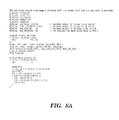
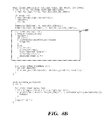
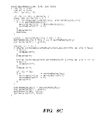
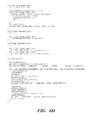
- FIGS. 8A , 8 B, 8 C, and 8 D (collectively “FIG. 8 ”) comprise source code for linear sorting of strings under recursive execution and also for testing the execution time of the linear sort, in comparison with Quicksort, in accordance with embodiments of the present invention.
- the coding in FIG. 8 is similar to the coding in FIG. 7 .
- the coding block 60 in FIG. 8 is analogous to, but different from, the coding block 54 in FIG. 7 .
- block 60 of FIG. 8 reflects that: a mask is not explicitly used but is implicitly simulated by processing a string to be sorted one byte at a time; and the string to be sorted may have a variable number of characters.
- FIG. 9 illustrates a computer system 90 used for sorting sequences of bits, in accordance with embodiments of the present invention.
- the computer system 90 comprises a processor 91 , an input device 92 coupled to the processor 91 , an output device 93 coupled to the processor 91 , and memory devices 94 and 95 each coupled to the processor 91 .
- the input device 92 may be, inter alia, a keyboard, a mouse, etc.
- the output device 93 may be, inter alia, a printer, a plotter, a computer screen, a magnetic tape, a removable hard disk, a floppy disk, etc.
- the memory devices 94 and 95 may be, inter alia, a hard disk, a floppy disk, a magnetic tape, an optical storage such as a compact disc (CD) or a digital video disc (DVD), a dynamic random access memory (DRAM), a read-only memory (ROM), etc.
- the memory device 95 includes a computer code 97 which is a computer program that comprises computer-executable instructions.
- the computer code 97 includes an algorithm for sorting sequences of bits.
- the processor 91 executes the computer code 97 .
- the memory device 94 includes input data 96 .
- the input data 96 includes input required by the computer code 97 .
- the output device 93 displays output from the computer code 97 .
- Either or both memory devices 94 and 95 may be used as a computer usable storage medium (or program storage device) having a computer readable program embodied therein and/or having other data stored therein, wherein the computer readable program comprises the computer code 97 .
- a computer program product (or, alternatively, an article of manufacture) of the computer system 90 may comprise said computer usable storage medium (or said program storage device).
- any of the components of the present invention could be created, integrated, hosted, maintained, deployed, managed, serviced, supported, etc. by a service provider who offers to facilitate implementation of a process for sorting sequences of bits in accordance with embodiments of the present invention.
- the present invention discloses a process for deploying or integrating computing infrastructure, comprising integrating computer-readable code into the computer system 90 , wherein the code in combination with the computer system 90 is capable of performing a method for sorting sequences of bits.
- the invention provides a business method that performs the process steps of the invention on a subscription, advertising, and/or fee basis.
- a service provider such as a Solution Integrator, could offer to facilitate implementation of a process for sorting sequences of bits in accordance with embodiments of the present invention.
- the service provider can create, integrate, host, maintain, deploy, manage, service, support, etc., a computer infrastructure that performs the process steps of the invention for one or more customers.
- the service provider can receive payment from the customer(s) under a subscription and/or fee agreement and/or the service provider can receive payment from the sale of advertising content to one or more third parties.
- FIG. 9 shows the computer system 90 as a particular configuration of hardware and software
- any configuration of hardware and software may be utilized for the purposes stated supra in conjunction with the particular computer system 90 of FIG. 9 .
- the memory devices 94 and 95 may be portions of a single memory device rather than separate memory devices.
- FIGS. 10-24 comprise timing tests for the sort algorithm of the present invention as described in Section 2, including a comparison with Quicksort execution timing data.
- FIGS. 10-15 relate to the sorting of integers
- FIG. 16 relates to memory requirement for storage of data
- FIGS. 17-18 relate to the sorting of strings
- FIGS. 19-24 relate to sorting integers as a function of mask width and maximum value that can be sorted.
- the integers to be sorted in conjunction with FIGS. 10-15 and 19 - 24 were randomly generated from a uniform distribution.
- the timing tests associated with FIGS. 10-23 were performed using an Intel Pentium® III processor at 1133 MHz, and 512M RAM.
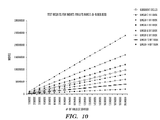
- FIG. 10 is a graph depicting the number of moves versus number of values sorted using a linear sort in contrast with Quicksort for sorting integers for a values range of 0-9,999,999.
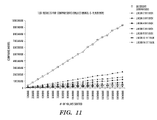
- FIG. 11 is a graph depicting the number of compares/moves versus number of values sorted using a linear sort in contrast with Quicksort for sorting integers for a values range of 0-9,999,999.
- the number of compares/moves is the same as the number of moves depicted in FIG. 10 inasmuch as the linear sort does not “compare” to effectuate sorting.
- the number of compares/moves is a number of compares in addition to the number of moves depicted in FIG. 10 .
- the linear sort was in accordance with embodiments of the present invention using the recursive sort of FIG. 5 as described supra.
- FIG. 11 shows that, with respect to compares/moves for a values range of 0-9,999,999, the linear algorithm is more efficient than Quicksort for all values of W tested.
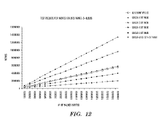
- FIG. 12 is a graph depicting the number of moves versus number of values sorted using a linear sort in contrast with Quicksort for sorting integers for a values range of 0-9,999.
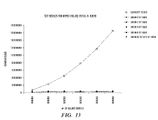
- FIG. 13 is a graph depicting the number of compares versus number of values sorted using a linear sort in contrast with Quicksort for sorting integers for a values range of 0-9,999.
- FIG. 13 shows that, with respect to compares for a values range of 0-9,999, the linear algorithm is more efficient than Quicksort for all values of W tested.
- the difference in efficiency between the linear sort and Quicksort when the dataset contains a large number of duplicates (which occurs when the range of numbers is 0-9,999 since the number of values sorted is much greater than 9,999). Because of the exponential growth of the number of comparisons required by the Quicksort, the test for sorting with multiple duplicates of values (range 0-9,999), the test had to be stopped at 6,000,000 numbers sorted.
- FIG. 14 is a graph depicting the sort time in CPU cycles versus number of values sorted using a linear sort in contrast with Quicksort for sorting integers for a values range of 0-9,999,999.
- FIG. 15 is a graph depicting the sort time in CPU cycles versus number of values sorted using a linear sort in contrast with Quicksort for sorting integers for a values range of 0-9,999.
- FIG. 15 shows that, with respect to sort time for a values range of 0-9,999, the linear algorithm is more efficient than Quicksort for all values of W tested, which reflects the large number of compares for data having many duplicate values as discussed supra in conjunction with FIG. 13 .
- FIG. 16 is a graph depicting memory usage using a linear sort in contrast with Quicksort for sorting 1,000,000 fixed-length sequences of bits representing integers, in accordance with embodiments of the present invention using the recursive sort of FIG. 5 as described supra.
- Quicksort is an in-place sort and therefore uses less memory than does the linear sort.
- the Quicksort curve in FIG. 16 is based on Quicksort using 4 bytes of memory per value to be sorted.
- the graphs stop at a mask width of 19 because the amount of memory consumed with the linear sort approaches unrealistic levels beyond that point.
- memory constraints serve as upper limit on the width of the mask that can be used for the linear sort.
- FIGS. 17 and 18 graphically depict the sort time in CPU cycles versus number of strings sorted for the linear sort and Quicksort, respectively.
- the linear sort was in accordance with embodiments of the present invention using the recursive sort of FIG. 5 as described supra.
- the tests were conducted with simple strings.
- a file of over 1,000,000 strings was created by extracting text-only strings from such sources as public articles, the Bible, and various other sources.
- a set of tests is defined as sorting a collection of 10,000 strings and repeating the sort with increasing numbers of strings in increments of 10,000. No sorting test was performed on more than 1,000,000 strings.
- Quicksort is subject to chance regarding the value at the “pivot” points in the list of strings to be sorted.
- Quicksort When unlucky, Quicksort is forced into much deeper levels of recursion (>200 levels). Unfortunately, this caused stack overflows and the tests abnormally terminated at 430,000 strings sorted by Quicksort.
- FIGS. 17 and 18 shows that, with respect to sort time, the linear algorithm is more efficient than Quicksort by a factor in a range of about 30 to 200 if the number of strings sorted is at least about 100,000.
- a primary reason for the difference between the linear sort and Quicksort is that Quicksort suffers from a “levels of similarity” problem as the strings it is sorting become increasingly more similar. For example, to differentiate between “barnacle” and “break”, the string compare in the linear sort examines only the first 2 bytes. However, as Quicksort recurses and the strings become increasingly more similar (as with “barnacle” and “barney”), increasing numbers of bytes must be examined with each comparison. Combining the superlinear growth of comparisons in Quicksort with the increasing costs of each comparison produces an exponential growth effect for Quicksort.
- FIG. 17 shows that the increase from 20 to 30 characters in the maximum length of strings affects the number of clock cycles for the linear sort, because the complexity of the linear sort is based on the size of the data to be sorted.
- the lack of smoothness in the Quicksort curves of FIG. 17 arises because of the sensitivity of Quicksort to the initial ordering of the data to be sorted, as explained supra.
- FIGS. 21 and 22 represent the same tests and the scale of the Time direction differs in FIGS. 21 and 22 .
- FIGS. 23 and 24 represent the same tests and the scale of the Time direction differs in FIGS. 23 and 24 .
- a difference between the tests of FIGS. 19-24 and the tests of FIGS. 10-16 is that much fewer values are sorted in FIGS. 19-24 than in FIGS. 10-16 .
- FIGS. 19-24 show a “saddle” shape effect in the three-dimensional Time shape for the linear sort.
- the saddle shape is characterized by: 1) for a fixed MOD_VAL the Time is relatively high at low values of MASK WIDTH and at high values of MASK WIDTH but is relatively small at intermediate values of MASK WIDTH; and 2) for a fixed MASK WIDTH, the Time increases as MOD_VAL increases.
- the effect of W on Time for a fixed MOD_VAL is as follows.
- the Time is proportional to the product of the average time per node and the total number of nodes.
- the average time per node includes additive terms corresponding to the various blocks in FIG. 7B
- block 53 is an especially dominant block with respect to computation time.
- block 53 initializes memory in a time proportional to the maximum number of child nodes (2 W ) per parent node.
- Let A represent the time effects in the blocks of FIG. 7B which are additive to the time ( ⁇ 2 W ) consumed by block 53 . It is noted that 2 W increases monotonically and exponentially as W increases.
- the total number of nodes is proportional to N/W where N is the number of bits in each word to be sorted. It is noted that 1/W decreases monotonically as W increases. Thus the behavior of Time as a function of W depends on the competing effects of (2 W +A) and 1/W in the expression (2 W +A)/W. This results in the saddle shape noted supra as W varies and MOD_VAL is held constant.
- the dispersion or standard deviation ⁇ is inverse to the data density as measured by S/(V MAX ⁇ V MIN ), wherein S denotes the number of values to be sorted, and V MAX and V MIN respectively denote the maximum and minimum values to be sorted.
- V MIN ⁇ 0 and V MAX ⁇ MOD_VAL-1.
- the Time is a saddle-shaped function of a width W of the mask.
- the execution time of the linear sorting algorithm of the present invention for sorting sequences of bits is essentially independent of whether the sequences of bits are interpreted as integers or floating point numbers, and the execution time is even more efficient for string sorts than for integer sorts as explained supra. Therefore, generally for a fixed data density of S sequences of bits to be sorted, the sorting execution time is a saddle-shaped function of a width W of the mask that is used in the implementation of the sorting algorithm.
- FIGS. 19-24 show that Time also increases as MOD_VAL increases for Quicksort.
- FIGS. 19-24 show that for a given number S of values to be sorted, and for a given value of MOD_VAL, there are one or mode values of W for which the linear sort Time is less than the Quicksort execution time.
- a practical consequence of this result is that for a given set of data to be sorted, said data being characterized by a dispersion or standard deviation, one can choose a mask width that minimizes the Time and there is one or more values of W for which the linear sort Time is less than the Quicksort execution time.
- FIGS. 19-24 shows timing tests data for sorting integers
- the ability to choose a mask resulting in the linear sort of the present invention executing in less time than a sort using Quicksort also applies to the sorting of floating point numbers since the linear sort algorithm is essentially the same for sorting integers and sorting floating point numbers.
- the ability to choose a mask resulting in the linear sort executing in less time than a sort using Quicksort also applies to the sorting of character strings inasmuch as FIGS. 14-15 and 17 - 18 demonstrate that the sorting speed advantage of the linear sort relative to Quicksort is greater for the sorting of strings than for the sorting of integers.
- the mask used for the sorting of character strings has a width equal to a byte representing a character of the string.
- the linear sort algorithm of Section 2 was described generally.
- the specific implementations of the sort algorithm described in Section 2 assumed that the sequences to be sorted are linked to one another in any logical manner.
- one method of linking the sequences logically is use linked lists of pointers to sequences to effectuate the sorting.
- linked lists the sequences being pointed to may be physically scattered throughout memory, so that the use of linked lists in computer systems having memory caching may result in frequent loading and flushing of cache memory.
- Various phenomena may be at play in relation to memory usage.
- a first phenomenon is the memory caching that is usually part of the CPU itself.
- a second phenomenon is an operating systems design in which virtual memory systems map virtual addresses onto physical addresses. Virtual pages in 8K or larger chunks are loaded into physical memory.
- this section describes the in-place implementation of the linear sorting algorithm of FIG. 2 .
- the in-place implementation of the sorting algorithm of the present invention called “Ambersort”, utilizes memory more efficiently than does the linked lists implementation of the sorting algorithm of the present invention.
- Ambersort utilizes memory more efficiently than does the linked lists implementation of the sorting algorithm of the present invention.
- the sequences to be sorted which are closer in value become physically more proximate to one another. This phenomena during in-place sorting facilitates more efficient use of memory pages and memory caching, resulting in faster sorting than with linked lists.
- the in-place sorting algorithm described herein fits within the linear sorting algorithm of Sections 1-3 described supra, characterized by L levels and a mask of width W to define nodes which are executed recursively (See FIG. 5 and description supra thereof) or under counter-controlled looping (see FIG. 6 and description supra thereof).
- the in-place sorting feature assumes that the sequences of bits to be sorted are initially stored in a physically contiguous arrangement (e.g., a physical array) and that as the nodes are each executed, the sequences are rearranged within the physically contiguous arrangement, so as to remain more physically proximate to one another than with other logical arrangements of the sequences to be sorted.
- an “in-place” sorting algorithm is defined herein as a sorting algorithm that reorders sequences within an array until the sequences are reordered within the array in an ascending or descending order, such that the sequences being sorted are not moved outside of the array during the sorting unless a sequence moved out of the array is subsequently moved back into the array.
- an indirect sequence movement from a first array position within the array to a second array position within the array is within in-place sorting.
- an “indirect move” the sequence is moved from the first array position within the array to at least one location outside of the array, and is subsequently moved from the least one location outside of the array to the second array position within the array.
- a sorting algorithm that does not use in-place sorting builds a new array or other memory structure to store the sorted sequences.
- FIG. 25 describes the in-place sorting embodiment of the present invention that replaces FIG. 5 such that steps 13 , 14 , and 16 of FIG. 5 do not appear in FIG. 25 , the end-of-sort test step 15 of FIG. 5 is replaced by the end-of-sort test step 15 A of FIG. 25 , and the in-place equivalent of steps 13 , 14 , and 16 of FIG. 5 are incorporated directly into the Ambersort of step 18 A which replaces step 18 of FIG. 5 for more efficient use of caching as will be described infra.
- FIG. 25 describes the in-place sorting embodiment of the present invention that replaces FIG. 5 such that steps 13 , 14 , and 16 of FIG. 5 do not appear in FIG. 25 , the end-of-sort test step 15 of FIG. 5 is replaced by the end-of-sort test step 15 A of FIG. 25 , and the in-place equivalent of steps 13 , 14 , and 16 of FIG. 5 are incorporated directly into the Ambersort of step 18 A which replaces step 18 of FIG. 5
- FIG. 26 describes the in-place sorting embodiment of the present invention that replaces FIG. 6 such that steps 35 - 41 of FIG. 6 are replaced by the Ambersort execution step 35 A which is algorithmically the same as Ambersort execution step 18 A of FIG. 25 .
- the primary difference between FIGS. 25 and 26 is that the Ambersort algorithm is invoked recursively in FIG. 25 and is called iteratively via counter-controlled looping in FIG. 26 .
- the complexity of steps 13 , 14 , and 16 of FIG. 5 and of steps 35 - 41 of FIG. 6 for effectuating movement of sequences as the sorting is proceeding is replaced by the in-place movement of the sequences within the Ambersort algorithm as will be described infra.
- Steps 18 A and 35 A of FIGS. 25 and 26 are described infra in detail in the examples of FIGS. 27-29 and the flow charts of FIGS. 30-31 .
- FIGS. 32 and 34 A- 34 B, described infra comprise pseudo-code and actual code, respectively, for the recursive calling embodiment of the in-place linear sort of the present invention.
- the Ambersort may be implemented as a recursive sort. Given an array X of contiguous sequences to be sorted at each level of recursion, a mask of width W divides the X sequences into groups such that each group is characterized by a mask of W bits. The total number of groups G associated with a mask width W is 2 W , denoted as groups 0 , 1 , . . . , 2 W ⁇ 1.
- the mask selects the specific bit positions corresponding to the W bits as a basis for redistributing the X sequences within the array, such that the relocated sequences are physically contiguous with all sequences in the array for whom the selected bit positions contain the same bit values, as will be illustrated infra.
- the selected bit positions for each level of the recursion are non-overlapping but contiguous and immediately to the right of the bit positions in the previous level.
- S is the number of sequences (i.e., words) to be sorted.
- Each sequence is a sequence of bits and N is the number of bits in each sequence.
- W is a mask width
- L is the number of recursive levels and is a function of N and W.
- FIG. 27 provides an example of the grouping of sequences in an array (at a given level of recursion) based on a bit mask, in accordance with embodiments of the present invention.
- an array of 22 contiguous sequences of 52, 16, 01, . . . , 55 (as denoted by reference numeral 22 A) are redistributed, by a recursive call to Ambersort within the same array, into the 22 contiguous sequences of 10, 08, 01, . . . , 55 (as denoted by reference numeral 22 F).
- the array 22 F is not totally sorted but is more sorted than is array 22 A as will be explained infra in conjunction with FIGS. 28-29 .
- Each sequence in the array 22 A or 22 F has 6 bits denoted as bit position 0 , 1 , . . . , 5 from right to left.
- the redistributed array 22 F is organized into 4 groups denoted as groups 0 , 1 , 2 , 3 from left to right, each group identified with a specific mask for bit positions 5 and 4 (i.e., the leftmost 2 bit positions) of the 6 bits in each word.
- the bit positions 5 and 4 for defining the mask have an associated mask 00, 01, 10, 11 and contain 7, 6, 6, 3 words, as denoted by reference numerals 70 , 71 , 72 , and 73 , respectively.
- FIG. 28 depicts execution (i.e., processing) of a first node of the node execution sequence by executing successive domino chains # 1 , # 2 , # 3 , and # 4 to effectuate the grouping of sequences in the array 22 A to generate the array 22 F of FIG. 27 , in accordance with embodiments of the present invention.
- Array 22 A represents the initially ordered state of the sequences 52, 16, 01, . . . , 55 to be sorted.
- the arrays 22 A, 22 B, . . . , 22 F each represent the sequences in a more sorted configuration in the progression from array 22 A to array 22 F.
- sequences in array 22 B are sorted to a greater extent than are the sequences in array 22 A
- sequences in array 22 C are sorted to a greater extent than are the sequences in array 22 B
- sequences in array 22 F are sorted to a greater extent than are the sequences in array 22 E.
- a “domino chain” applied to an array in FIG. 28 is an ordered movement of N sequences (i.e., a first sequence, a second sequence, . . . , a N th sequence) within the array such that: the first sequence is moved into the array position occupied by the second sequence, the second sequence is moved into the array position occupied by the third sequence, . . . , the (N ⁇ 1) th sequence is moved into the array position occupied by the N th sequence, the N th sequence is moved into the array position previously occupied by the first sequence.
- each such sequence move is denoted by the label “move #”.
- Arrays 22 A, 22 B, . . . , 22 F are the same physical array comprising the same sequences therein such that the sequences in each array are in a different sequential ordering. However, the sequences in arrays 22 A and 22 B have the same sequential ordering.
- Application of domino chain # 1 to array 22 B results in array 22 C.
- Application of domino chain # 2 to array 22 C results in array 22 D.
- Application of domino chain # 3 to array 22 D results in array 22 E.
- Application of domino chain # 4 to array 22 E results in array 22 F.
- No domino chain is developed for array 22 F which ends the execution of the first node of the node execution sequence described in FIG. 28 .
- the bit positions of a sequence corresponding to the mask constitute the “mask field” of the sequence, said mask field having “mask bits” therein.
- the combination of the mask bits in the mask field is the “mask value” of the mask field.
- the leftmost 2 bits of the 6-bit sequences is a mask field, said mask field containing the leftmost 2 bits of the sequence as its mask bits.
- the mask bits in the mask field for the leftmost 2 bits of the number 44 (101100) in group 2 of array 22 A are 1 and 0 (or 10 for brevity) having the mask value 10.
- the mask value is the combination of the mask bits in the mask field.
- FIG. 28 is described with the aid of a “POS[ ]” array and a “posptr” variable.
- the 22 array positions within each array are sequentially denoted as array positions 0 , 1 , 2 , . . . , 21 from left to right.
- the groups 0 , 1 , 2 , 3 are initially formed by counting the number of sequences in the array 22 A that belong to each of the groups 0 , 1 , 2 , 3 defined by the 4 possible combinations (00, 01, 10, 11) of the 2 bits in the mask for the leftmost 2 bits of the sequence.
- group 0 has 7 sequences whose mask bits are 00
- group 1 has 6 sequences whose mask bits are 01
- group 2 has 6 sequences whose mask bits are 10
- group 3 has 3 sequences whose mask bits are 11.
- the four groups 0 , 1 , 2 , 3 are separated by vertical lines in FIG.
- G denote the total number of groups and denoting Count for group g as Count[g]
- the groups are processed in the order 0, 1, 2, 3 (i.e., from left to right) and the variable “posptr” identifies or points to the group being processed.
- Ambersort attempts to find start a domino chain in the group characterized by posptr.
- the variable posptr is initially set to zero, since group 0 is the first group to be processed and Ambersort initially attempts to find a domino chain in group 0 .
- a domino chain is started in an array at a sequence that is not located in its proper group.
- a sequence is located in the proper group if the sequence mask bits are equal to the mask bits for the group.
- groups 0 , 1 , 2 , and 3 have masks 00, 01, 10, and 11, respectively. Since the mask in FIGS.
- the mask bits of the sequences are the bits in bit positions 5 and 4 .
- the first sequence 52 (110100) in array 22 B is not in its proper group, because the first sequence (52) is in group 0 having a mask of 00 whereas the mask bits of the first sequence is 11.
- domino chain # 1 is formed and applied to array 22 B as follows.
- the sequence 52 (110100) is selected as the first sequence to be moved in domino chain # 1 because the sequence 52 (110100) is not in its proper group.
- the sequence of 52 (110100) has mask bits of 11 and therefore belongs in group 3 .
- the sequence 52 (110100) is moved (move # 1 ) to the first array position in group 3 where the existing value in group 3 is not properly located in group 3 .
- the value in position 19 is in the wrong group.
- POS[ ] is incremented by 1 when a sequence moves into POS[ ] or when the data value in POS[ ] is skipped over.
- a “skipped over” sequence corresponds to a value that is already in its proper group and should not be moved.
- Domino chain # 1 is thus completed.
- a domino chain is completed when a sequence is moved into an empty array position in the array.
- Domino chain # 1 thus represents the ordered sequence of movements of sequences 52 (110100), 43 (101011), and 10 (001010) within the array 22 B to form array 22 C,
- Domino chain # 2 is thus completed.
- Domino chain # 2 thus represents the ordered sequence of movements of sequences 16 (010000), 47 (101111), and 08 (001000) within the array 22 C to form array 22 D.
- the sequence of 40 (101000) has mask bits of 10 and therefore belongs in group 2 .
- the sequence 17 (010001) is selected as the first sequence to be moved in domino chain # 4 because the sequence 17 (010001) is not in its proper group.
- the sequence of 17 (010001) has mask bits of 01 and therefore belongs in group 1 .
- the displaced sequence at POS[3] 20, namely 13 (001101), is moved into array position 6 (move # 11 ) in array 22 E which is empty since domino chain # 1 started in group 0 .
- Domino chain # 4 is thus completed. Domino chain # 4 thus represents the ordered sequence of movements of sequences 17 (010001), 57 (111001), and 13 (001101) within the array 22 E to form array 22 F.
- the present invention executes each node of the node execution sequence by: dividing the segment of the node into G groups of sequences based on a mask field having a mask width, each group of the G groups having a unique mask value of the mask field; and in-place rearranging the sequences in the segment, said in-place rearranging resulting in each group of the G groups comprising only those sequences having the unique mask value of the group.
- in-place rearranging a sequence is moved, directly or indirectly, from a first array position within the segment to a second array position within the segment.
- a direct move the sequence is moved from the first array position within the segment to the second array position within the segment without being moved out of the segment.
- an “indirect move” the sequence is moved from the first array position within the segment to at least one location outside of the segment, and is subsequently move from said least one location outside of the segment to the second array position within the segment.
- said in-place rearranging comprises executing at least one domino chain with respect to the sequences moved within the segment.
- Executing a domino chain with respect to sequences within the segment comprises moving each said sequence (Z) from a first group (G 1 ) of the G groups having a mask value (V 1 ) that differs from the mask value (V) of the sequence to a second group (G 1 ) of the G groups having a mask value (V 2 ) that is equal to the mask value (V) of the sequence.
- the in-place sorting Upon completion of the node execution of FIG. 28 , the in-place sorting performs a next node execution on each of the four groups of array 22 F at the next recursive level, namely at the level in which the mask is defined by bit positions 3 and 2 .
- FIG. 29 illustrates the next node execution performed on the 7 sequences in group 0 of the 22 F array in FIG. 28 , in accordance with embodiments of the present invention.
- the node execution of FIG. 29 is performed in the same manner as the node execution of FIG. 28 , as described next.
- FIG. 29 depicts arrays 24 A, 24 B, 24 C, and 24 D.
- Arrays 24 A, 24 B, 24 C, and 24 D are the same physical array comprising the same sequences therein such that the sequences in each array are in a different sequential ordering. However, the sequences in arrays 24 A and 24 B have the same sequential ordering.
- Application of domino chain # 1 to array 24 B results in array 24 C.
- Application of domino chain # 2 to array 24 C results in array 24 D.
- the groups 0 , 1 , 2 , 3 are initially formed by counting the number of sequences in the array 24 A that belong to each of the groups 0 , 1 , 2 , 3 defined by the 4 possible combinations (00, 01, 10, 11) of the 2 bits in the mask.
- group 0 has 2 sequences whose mask bits are 00
- group 1 has 1 sequence whose mask bits are 01
- group 2 has 2 sequences whose mask bits are 10
- group 3 has 2 sequences whose mask bits are 11.
- G denote the total number of groups and denoting Count group g as Count[g]
- the groups are processed in the order 0, 1, 2, 3 (i.e., from left to right) and the variable “posptr” identifies or points to the group being processed.
- Ambersort attempts to find start a domino chain in the group characterized by posptr.
- the variable posptr is initially set to zero, since group 0 is the first group to be processed, and Ambersort initially attempts to find a domino chain in group 0 .
- a domino chain is started in an array at a sequence that is not located in its proper group.
- a sequence is located in the proper group if the sequence mask bits are equal to the mask bits for the group.
- groups 0 , 1 , 2 , and 3 have masks 00, 01, 10, and 11, respectively. Since the mask in FIG. 29 pertains to bit positions 3 and 2 (i.e., the middle 2 bits), the mask bits of the sequences are the bits in bit positions 3 and 2 .
- the sequence at POS[1] 2, namely 01 (000001), belongs in group 0 and is moved into array position 0 (move # 4 ) in array 24 B which is empty since domino chain # 1 started in group 0 .
- Domino chain # 1 is thus completed.
- Domino chain # 1 thus represents the ordered sequence of movements of sequences 10 (001010), 14 (001110), 04 (000100), and 01 (000001) within the array 24 B to form array 22 C.
- 03 (000011) is moved into array position 1 (move # 6 ) in array 24 C which is empty since domino chain # 1 started in group 0 .
- Domino chain # 1 is thus completed.
- Domino chain # 1 thus represents the ordered sequence of movements of sequences 08 (001000) and 03 (000011) within the array 24 C to form array 24 D.
- each level of the Ambersort recursion determines the size and position within the segment for each group of the segment.
- the sequences are then each moved zero times (if they are physically in the group they should be in) or one time (displacing a sequence that is improperly placed).
- the first (leftmost) sequence in the segment that is not in its correct group is selected and its array position is considered “empty”.
- the displaced sequence is then moved into an array position in the group that it belongs to, displacing yet another sequence in the wrong array position.
- each sequence in the array is moved zero times or one time, which underlies the linearity of the algorithmic complexity of the Ambersort (i.e., order (S) where S is the number of sequences to be sorted).
- the linked execution structure with respect to the in-place sorting embodiments of the present invention includes nodes which are linked together in a manner that dictates a sequential order of execution of program code with respect to the nodes.
- the linked execution structure of the in-place sorting is a program code execution space, and the nodes of the linked execution structure may be viewed as points in the program code execution space.
- the sequential order of execution of the program code with respect to the nodes is in a hierarchical sequence that is a function of an ordering of masking results derived from a masking of the fields of the sequences to be sorted.
- the in-place sorting algorithm of the present invention includes embodiments in which the mask width W is constant across all nodes, and also includes embodiments in which the mask width W is variable (i.e., node dependent) for optimizing the efficiency of individual sorting attempts.
- child nodes C 1 and C 2 of a parent node P may each be processed with a mask width of W; however, the child nodes of C 1 and C 2 may be processed with a mask width of W 1 and W 2 , respectively, wherein at least two of mask widths W, W 1 , and W 2 are different.
- FIGS. 30-31 are flow charts describing the Ambersort algorithm as applied to a segment to be sorted, in accordance with embodiment of the present invention.
- the flow charts of FIGS. 30-31 relate to steps 18 A and 35 A of FIGS. 25 and 26 , respectively, described supra.
- FIG. 30 is a high-level flow chart comprising steps 26 - 29 .
- Step 26 establishes an initial state as exemplified by array 22 A of FIG. 28 and array 24 A of FIG. 29 .
- Steps 27 - 29 constitute steps of a loop in which domino chain #n is processed.
- Step 27 attempts to generate domino chain #n and generates domino chain #n if it is possible to generate domino chain #n.
- Step 28 ascertains whether domino chain #n was generated in step 27 . If step 28 ascertains that domino chain #n was not generated in step 27 , then the Ambersort algorithm for the segment is exited.
- step 28 increments the domino chain number n by 1 to define the next domino chain number n and the algorithm loops back to step 28 in an attempt to generate the next domino chain #n.
- FIG. 31 depicts steps 26 A, 26 B, 26 C, 26 D, and 26 E which describe aspects of the initialization step 26 of FIG. 30 in more detail.
- step 26 B establishes the Count for each group (i.e., Count[0], Count[1], . . . , Count[G ⁇ 1]), by determining the number of sequences in each group having the same mask bit values.
- FIG. 32 depicts pseudo-code for the Ambersort algorithm called recursively to execute all segments at all levels to perform a complete sort, starting the recursion initially with the total array of sequences to be sorted (i.e., the root node).
- FIG. 32 comprises blocks 43 - 45 of pseudo-code.
- Block 43 is a definition section which defines variables START, COUNT, LEFTMOST, and max_children.
- START and COUNT define the total array of sequences to be sorted (corresponding to the root node) and MASK is the initial mask used for the root node.
- MASK is the initial mask used for the root node.
- START and COUNT define the current segment of sequences to be sorted and MASK is the current mask used for the current segment.
- the variable max_children denotes the number of groups G in the segment (i.e., 2 W ).
- Block 44 corresponds to the initialization step 26 of FIG. 30 (or as described in FIG. 31 ).
- pos[ ] is the POS[ ] array described supra.
- Block 45 corresponds to steps 27 - 29 of the loop in FIG. 30 for generating the domino chains.
- Block 46 calls Ambersort recursively from each group after no more domino chains can be formed in the segment currently being executed by Ambersort (e.g., when no domino chains are found for array 22 F in FIG. 28 or for array 24 D for FIG. 29 , or upon a determination of “NO” in step 28 of FIG. 30 ).
- FIGS. 34A and 34B (collectively, “FIG. 34 ”) is actual Ambersort source code (written in the C programming language) corresponding to the Ambersort pseudo-code of FIG. 32 .
- the Ambersort in-sort technique of the present invention may perform sorting: from left to right or right to left; in ascending or descending sorting order; for bit sequences having various representations (e.g., integers, floating point numbers, character strings, etc.); for integers or floating point numbers having all positive values or having all negative values or having both positive and negative values; etc.
- This section analyzes algorithmic complexity of Ambersort based on: 1) the number of moves; and 2) the iterations of loops within Ambersort.
- the Ambersort source code listed in FIG. 34 aids in explaining the algorithmic complexity.
- Every node execution of the Ambersort handles only a segment of the array to be sorted with the first node execution handling all S sequences of bits to be sorted for the first segment, wherein S denotes the total number of sequences to be sorted.
- S denotes the total number of sequences to be sorted.
- each sequence of bits in the segment is handled exactly one time and is either moved one time or skipped.
- W mask width
- the sequences are shown but the bits in each sequence are not shown.
- groups of size one and sequences at the bottom of the call structure are shown in solid black, because the sequences at the bottom of the call structure are not moved any further and therefore are leaf nodes. Calls from such terminal (i.e., leaf node) sequences are also not made, but the positional integrity of the sequences is maintained for illustration.
- Three observations explained supra about Ambersort's algorithmic complexity can be seen in FIG. 34 .
- the number of moves experienced by each element is exactly zero (if the element is in the correct grouping) or one (if the element is not in the correct grouping), because each recursive call deals with only a segment of the array and segments do not overlap across a level.
- outer looping structures within the Ambersort routine denoted as: outer loop # 1 , outer loop # 2 , outer loop # 3 , outer loop # 4 , outer loop # 5 , and outer loop # 6 .
- Outer loop # 5 contains 2 inner looping structures, namely inner loop # 5 . 1 and inner loop # 5 . 2 .
- WIDTH represents the mask width (W).
- MAX_DEPTH represents the number of levels (L).
- L the variable and MAX_CHILDREN represents the maximum number of groups in a segment and is equal to 2 WIDTH .
- Outer loop # 1 is a “memset” that initializes the array that counts how many of the sequences in the array segment belong to each of the bit-mask driven groups.
- the order of magnitude for outer loop # 1 is MAX_CHILDREN.
- the total complexity of outer loop # 1 for all recursive calls for an entire sort can be computed as:
- WIDTH and MAX_DEPTH are constants and the above summation is actually the maximum number of iterations of outer loop # 1 due to tree pruning
- outer loop # 1 will be considered to be complexity C 1 where C 1 is the constant value computed supra.
- This analysis for outer loops # 1 also applies to outer loops # 3 , # 4 , and # 6 , since outer loops # 3 , # 4 , and # 6 are all bounded by MAX_CHILDREN.
- Outer loop # 5 includes inner loops # 5 . 1 and # 5 . 2 .
- the bounds on inner loop # 5 . 1 are start and finish, the impact of which was discussed supra in conjunction with outer loop # 2 .
- Inner loop # 5 . 2 increments the counter between start and finish and is therefore a means of advancing through the sequences for examination and placement.
- Inner loop # 5 . 1 can have one of three outcomes for any given node execution. The first outcome is the proper placement of a sequence and increment of the counter from start to finish. The second outcome is identification of the beginning of a domino chain and is the first part of placing a sequence into its group. This can happen up to (start-finish+1)/2 times and is part of the outer loop's complexity structure.
- the third outcome occurs when a group has all of its sequences in it and is no longer a candidate for the beginning of a domino chain.
- the variable “posptr” is the counter for this looping mechanism and postpr is not reset with each iteration of the loop.
- this looping mechanism's complexity for a single call to Ambersort is based on MAX_CHILDREN also expressed supra as C 1 . Therefore the complexity of outer loop # 5 for all recursive node executions can be computed as S*C 2 +C 1 .
- the first fundamental behavior of Ambersort is that Ambersort actually benefits from large numbers of duplicates. Duplicates represent a natural “pruning” of the recursive tree and cause the constant overhead of initializing counters etc to be reduced. The corollary to this behavior is that uniformly distributed values across all possible values tend to push Ambersort toward its worst case. This is in very stark contrast to Quicksort which suffers substantially from duplicates.
- the third fundamental behavior of Ambersort is that the optimal selection of the proper mask width depends on a variety of sequences. Using a single width for possible S will physically work, but may display a stair step characteristic depending the magnitude and distribution of sequences to be sorted. For example, 5 million sequences that are uniformly distributed in value across all possible magnitudes may only require 2 levels of recursion for some mask widths. However, 6 million values of the same magnitude distribution may cause significant calls to a third level of recursion. This stair stepping as S is increased continues until the possible recursion tree becomes largely used at which case the stair step actually begins to seem sub-linear. (i.e., the fixed cost of initialization and other overhead is spread across more values). However, linearity is approached because of probabilities.
- FIGS. 35-41 depict performance test results pertaining to the in-place sort algorithm (Ambersort) of the present invention in comparison with Quicksort.
- the Ambersort timing results in clock cycles are a function the number of sequences (S) to be sorted and of the mask width (W).
- the Quicksort timing results are shown in FIGS. 35-40 as a function of S.
- the Ambersort timing results in FIG. 35-40 are represented with background shading (light shading, medium shading, dark shading) as denoted to distinguish three cases: 1) cases in which the mask width W selection gives the optimal Ambersort result (medium shading); 2) cases in which Ambersort outperformed Quicksort but were not the optimal Ambersort result (light shading); and 3) cases in which Ambersort failed to outperform Quicksort (dark shading).
- the Quicksort results are represented with no shading background.
- FIGS. 35 , 36 , 37 , and 38 depict timing test results for the 32-bit sequences to be sorted whose magnitudes are randomly selected as being uniformly distributed over ranges of 8 bits (magnitude between 0 and 000000FF hexadecimal), 16 bits (magnitude between 0 and 0000FFFF hexadecimal), 24 bits (magnitude between 0 and 00FFFFFF hexadecimal), and 32 bits (magnitude between 0 and FFFFFFFF hexadecimal), respectively.
- the “0x” prefix in the title of FIGS. 35-38 denotes that the expressed value is in hexadecimal.
- FIGS. 35-38 show Ambersort performance (in CPU clock cycles on a IBM T40 1.5 GHz Intel Pentium M with 1 G of RAM) for multiple number of values (S) over each of the mask widths W from 1 to 12.
- FIGS. 35-38 also show Quicksort performance.
- the Ambersort timing performance relative to the Quicksort timing performance progressively improves as the maximum possible sequence magnitude (in terms of bits) decreases from 32 bits to 24 bits to 16 bits to 8 bits (from FIG. 38 to FIG. 37 to FIG. 36 to FIG. 35 ), respectively, because as the sequence magnitude decreases, the number of duplicates increases for a given number of sequences S.
- FIG. 39 depicts timing results in clock cycles for sorting zip codes represented as 9-digit integer values that use approximately 30 of 32 possible bits.
- the randomly generated sequences to be sorted were unique and uniformly distributed across all possible values within their permissible range.
- the timing comparison results between Ambersort and Quicksort for FIG. 39 bears a resemblance to the timing comparison results for FIG. 38 , and for each value of S in both FIGS. 38 and 39 , there is at least one mask width W at which Ambersort timing outperforms Quicksort timing.
- FIG. 40 depicts timing results in clock cycles for sorting 10-digit telephone numbers in which the area code is limited by having only 32 bit integers. However, unlike FIG. 39 , there are only about 58,000 unique numbers randomly generated from a uniform distribution, resulting in much better Ambersort versus Quicksort timing performance due to the presence of duplicates in FIG. 40 but not in FIG. 39 .
- FIG. 41 shows the number of moves executed by Ambersort and Quicksort for sorting representing 58,000 unique 32-bit telephone numbers whose magnitude ranges from 0 to FFFFFFFF (hexadecimal).
- the Ambersort mask width is 9 bits.
- the Ambersort appears linear.
- the Quicksort also appears nearly linear to the eye, but its actual shape cannot be ascertained from FIG. 41 due to the coarseness in the scale of the “Number of Moves Expected”. Since Quicksort performs comparisons and moves, whereas Ambersort performs moves but no comparison, the better performance by Ambersort relative to Quicksort is underestimated in FIG. 41 .
- the present invention discloses how to determine a node-specific mask width dynamically while the Ambersort in-place sorting algorithm (see Section 5) is being executed.
- Exhaustive testing was performed in which the Ambersort in-place sorting algorithm was used for all mask width combinations with respect to the levels of a linked execution structure, using 10,000,000 unsigned 32-bit integers randomly selected from a uniformly probability distribution.
- FIG. 42 is a table depicting the mask width employed at each of the four levels of the linked execution structure for the Ambersort in-place sorts having the 20 smallest sort times in the aforementioned exhaustive testing of 10,000,000 unsigned, uniformly distributed 32-bit integers, in accordance with embodiments of the present invention.
- Each row of the table in FIG. 42 depicts the sort time and the mask width employed at each of four levels of the linked execution structure.
- the table in FIG. 42 shows that the 20 smallest sort times have a common characteristic that the sum of W 1 and W 2 is either 24 or 25, wherein W 1 denotes the mask width for nodes of level 1 and W 2 denotes the mask width for nodes of level 2. Note that the sorting was terminated for each combination of mask widths in which the total sort time was dynamically determined to exceed 5000 milliseconds during the course of sorting.
- FIG. 43 is a graph of sort time versus mask width at each of the first two levels for the exhaustive testing performed to generate the table of FIG. 42 , in accordance with embodiments of the present invention.
- the graph in FIG. 43 shows a trough of the minimum of the plotted sort time. This trough confirms the previous result inferred from the table of FIG. 42 , namely the result of the sum of W 1 and W 2 being either 24 or 25.
- a node-specific mask width W that is computed as a function of R enables the Ambersort in-place sort to be implemented dynamically at each node while the in-place sort algorithm is being executed as described supra in Section 5, and as described more specifically infra in FIG. 44 with respect to use of a node-specific mask width.
- FIG. 44 is a flow chart depicting use of a node-specific mask width for implementing an in-place sort, in accordance with embodiments of the present invention.
- the flow chart of FIG. 44 pertains to a method denoted herein as the “Self-Optimizing Ambersort”.
- the method of FIG. 44 comprises executing an algorithm by a processor of a computer system. Said executing the algorithm comprises in-place sorting S sequences in ascending or descending order of a value associated with each sequence and in a time period denoted as a sorting execution time.
- the S sequences are stored contiguously in an array within a memory device of the computer system prior to the sorting.
- S is at least 2.
- Each sequence of the S sequences comprises a contiguous field of N bits, wherein N is a positive integer of at least 1. In one embodiment, N is at least 2.
- the in-place sorting comprises executing program code at each node of a linked execution structure. Each node comprises a segment of the array. Said executing program code is performed in a hierarchical sequence with respect to the nodes. Said executing program code at each node comprises steps 61 - 64 in FIG. 44 .
- Step 61 identifies R sequences of the S sequences comprised by the segment at each node.
- Step 62 ascertains a mask width W that is specific to each node and is a function of R.
- Each group of the G groups has a unique mask value of the mask field.
- Step 64 performs in-place rearranging the R sequences in the segment, resulting in each group of the G groups comprising only those sequences having the unique mask value of the group.
- FIG. 45 depicts an illustrative linked execution structure having node-specific mask widths, in accordance with embodiments of the present invention.
- FIG. 45 there are 750,000 sequences to be sorted as the nodes are recursively processed as described supra, and the mask width W for each node is determined based on the number of sequences R in each node.
- the linked execution structure in FIG. 45 is characterized by many “null groups” whose combination of bits in its relevant mask at various nodes do not contain any sequences, and the child nodes of such null groups (as well as other groups) are not shown in FIG. 45 .
- the linked execution structure in FIG. 45 shows a complete path through the linked execution structure with terminating leaf nodes identified by the label LEAF.
- FIG. 46 is a graph depicting sort time versus number of sequences (S) to sort for a random set of sequences, in accordance with embodiments of the present invention.
- the S sequences to be sorted for each data point in FIG. 46 (denoted as a “Random” data set) were integers randomly selected from a probability density function that is uniformly distributed between 0 and 429-4967295 (i.e., 2 32 -1).
- the sort time in Ambersort is less than the sort time in Quicksort generally, and less than the sort time in Quicksort by a factor of at least about 2 for S at least about 50,000,0000.
- the data points for S less than 50,000,000 are characterized by the Ambersort sorting time being less than the Quicksort sorting time.
- FIG. 47 is a graph depicting sort time versus number of sequences (S) to sort for a set of 9-digit zip codes, in accordance with embodiments of the present invention.
- the S sequences to be sorted for each data point in FIG. 47 (denoted as a “Zip Codes” data set) were 9-digit zip codes randomly selected from a probability density function that is uniformly distributed across zip codes between 000000000 and 999999999.
- the sort time in Ambersort is less than the sort time in Quicksort generally, and less than the sort time in Quicksort by a factor of at least about 2 for S at least about 50,000,0000.
- the data points for S less than 50,000,000 are characterized by the Ambersort sorting time being less than the Quicksort sorting time.
- FIG. 48 is a graph depicting sort time versus number of sequences (S) to sort for a set of 8-digit dates, in accordance with embodiments of the present invention.
- the S sequences to be sorted for each data point in FIG. 48 (denoted as a “Dates” data set) were 8-digit dates randomly selected from a probability density function that is uniformly distributed across valid dates between Jan. 1, 1900 and Dec. 30, 1999.
- the sort time in Ambersort is less than the sort time in Quicksort generally, and less than the sort time in Quicksort by more than a factor of 2 for S at least about 50,000,0000.
- the data points for S less than 50,000,000 are characterized by the Ambersort sorting time being less than the Quicksort sorting time.
- FIGS. 46-48 may be assessed with respect to an efficiency of Ambersort, wherein the efficiency is defined as the ratio of the total sort time to S. In other words, the efficiency is the sort time per sequence sorted.
- FIG. 46 shows that Ambersort consistently outperforms Quicksort for this worst case for Ambersort and represents a significant improvement over the test results described in Section 6 in which a constant mask width was used for Ambersort.
Landscapes
- Engineering & Computer Science (AREA)
- General Engineering & Computer Science (AREA)
- Theoretical Computer Science (AREA)
- Computer Hardware Design (AREA)
- Physics & Mathematics (AREA)
- General Physics & Mathematics (AREA)
- Devices For Executing Special Programs (AREA)
- Information Retrieval, Db Structures And Fs Structures Therefor (AREA)
Abstract
Description
| Sign Bit (1 bit) | Exponent Field (8 bits) | Mantissa Field (23 bits) |
IEEE 754 requires the exponent field to have a +127 (i.e., 01111111) bias for positive exponents and no bias for negative exponents. The exponent field bits satisfy the previously stated assumption that for any two adjacent bits in the value to be sorted, the bit to the left represents a larger magnitude effect on the value than the bit to the right, as may be seen in the following table for the exponents of −2, −1, 0, +1, and +2.
| Exponent Value | Exponent Field Bits | ||
| −2 | 01111101 | ||
| −1 | 01111110 | ||
| 0 | 01111111 | ||
| 1 | 10000000 | ||
| 2 | 10000001 | ||
The number of bits in the exponent and mantissa fields in the above example is merely illustrative. For example, the IEEE 754 representation of a double-precision floating point number has 64 bits (a sign bit, an 11-bit exponent, and a 52-bit mantissa) subject to an exponent bias of +1023. Generally, the exponent and mantissa fields may each have any finite number of bits compatible with the computer/processor hardware being used and consistent with the degree of precision desired. Although the sign bit is conventionally 1 bit, the sort algorithm of the present invention will work correctly even if more than one bit is used to describe the sign. It is assumed herein that the position of the decimal point is in a fixed position with respect to the bits of the mantissa field and the magnitude of the word is modulated by the exponent value in the exponent field, relative to the fixed position of the decimal point. As illustrated supra, the exponent value may be positive or negative which has the effect of shifting the decimal point to the left or to the right, respectively.
MEM=S*M V+(M C*2W−1 *L)
wherein MEM is the number of bytes required by the linear sort, S is the number of sequences to be sorted, MV is the size of the data structure (e.g., 12) required to hold each sequence being sorted, MC is the size of the data structure (e.g., 8) required to hold a child sequence or pointer in the recursive linked execution structure, W is the width of the mask (≧1), and L is the number of levels of recursion. For some embodiments, L=ceiling(MV/W) as explained supra.
Given that both WIDTH and MAX_DEPTH are constants and the above summation is actually the maximum number of iterations of
C1+S*C2+C1+C1+(S*C2+C1)+C1
Since both C1 and C2 are constants, the order of complexity of the algorithm can again be expressed as order (S).
Ambersort Versus Quicksort for CPU Usage
W=min(ceiling(Log2 R/ceiling(Log2 R/12)),12)
wherein ceiling(x) is defined as the smallest integer greater than or equal to x; and wherein min (x,y) is defined as the minimum of x and y. The preceding algorithm or formula is equivalent to the following equations for W:
W=log2R if log2R≦12;
W=ceiling((log2 R)/2) if 12<log2 R≦24;
W=ceiling((log2 R)/3) if 24<log2 R≦31;
W=11 if log2R>31.
Claims (15)
Priority Applications (1)
| Application Number | Priority Date | Filing Date | Title |
|---|---|---|---|
| US11/970,600 US7788268B2 (en) | 2008-01-08 | 2008-01-08 | In-place sorting using node specific mask width |
Applications Claiming Priority (1)
| Application Number | Priority Date | Filing Date | Title |
|---|---|---|---|
| US11/970,600 US7788268B2 (en) | 2008-01-08 | 2008-01-08 | In-place sorting using node specific mask width |
Publications (2)
| Publication Number | Publication Date |
|---|---|
| US20090177657A1 US20090177657A1 (en) | 2009-07-09 |
| US7788268B2 true US7788268B2 (en) | 2010-08-31 |
Family
ID=40845394
Family Applications (1)
| Application Number | Title | Priority Date | Filing Date |
|---|---|---|---|
| US11/970,600 Expired - Fee Related US7788268B2 (en) | 2008-01-08 | 2008-01-08 | In-place sorting using node specific mask width |
Country Status (1)
| Country | Link |
|---|---|
| US (1) | US7788268B2 (en) |
Cited By (2)
| Publication number | Priority date | Publication date | Assignee | Title |
|---|---|---|---|---|
| US20150293957A1 (en) * | 2014-01-29 | 2015-10-15 | International Business Machines Corporation | Radix sort acceleration using custom asic |
| US12105690B1 (en) * | 2022-07-27 | 2024-10-01 | Databricks, Inc. | Multiple pass sort |
Families Citing this family (5)
| Publication number | Priority date | Publication date | Assignee | Title |
|---|---|---|---|---|
| US9405538B2 (en) * | 2012-12-28 | 2016-08-02 | Intel Corporation | Functional unit having tree structure to support vector sorting algorithm and other algorithms |
| US9405508B2 (en) * | 2013-05-21 | 2016-08-02 | Nvidia Corporation | Sorting with key modification |
| US12135953B2 (en) * | 2019-02-19 | 2024-11-05 | Kyle Marcroft | Systems, methods, and devices for the sorting of digital lists |
| IL294187B2 (en) * | 2019-12-23 | 2025-06-01 | Ariel Scient Innovations Ltd | Methods and systems for data compression |
| JP6986309B1 (en) * | 2021-09-22 | 2021-12-22 | 明男 三水 | Data processing equipment, data processing methods, and programs |
Citations (29)
| Publication number | Priority date | Publication date | Assignee | Title |
|---|---|---|---|---|
| US3815038A (en) | 1973-04-13 | 1974-06-04 | Atomic Energy Commission | Differential amplifier circuits |
| US4809158A (en) | 1985-10-23 | 1989-02-28 | Mccauley Peter B | Sorting method and apparatus |
| US5440734A (en) | 1993-09-14 | 1995-08-08 | International Business Machines Corporation | System for MSD radix sort bin storage management |
| US5546390A (en) | 1994-12-29 | 1996-08-13 | Storage Technology Corporation | Method and apparatus for radix decision packet processing |
| US5560007A (en) | 1993-06-30 | 1996-09-24 | Borland International, Inc. | B-tree key-range bit map index optimization of database queries |
| US5671406A (en) | 1995-10-18 | 1997-09-23 | Digital Equipment Corporation | Data structure enhancements for in-place sorting of a singly linked list |
| US5680607A (en) | 1993-11-04 | 1997-10-21 | Northern Telecom Limited | Database management |
| US5799184A (en) | 1990-10-05 | 1998-08-25 | Microsoft Corporation | System and method for identifying data records using solution bitmasks |
| US5873078A (en) | 1996-07-19 | 1999-02-16 | Bay Networks, Inc. | Radix tree search logic |
| US5924091A (en) * | 1996-08-28 | 1999-07-13 | Sybase, Inc. | Database system with improved methods for radix sorting |
| US6128614A (en) | 1995-12-20 | 2000-10-03 | Intel Corporation | Method of sorting numbers to obtain maxima/minima values with ordering |
| US6144986A (en) | 1997-03-27 | 2000-11-07 | Cybersales, Inc. | System for sorting in a multiprocessor environment |
| US20020032681A1 (en) | 1998-10-08 | 2002-03-14 | Music Semiconductors, Inc. | Partially-ordered CAMs used in ternary hierarchical address searching/sorting |
| US6373012B1 (en) | 2000-09-15 | 2002-04-16 | Lockheed Martin Corporation | Method and apparatus for facilitating custom sorting of mail items and improved search techniques usable therewith |
| US6381605B1 (en) | 1999-05-29 | 2002-04-30 | Oracle Corporation | Heirarchical indexing of multi-attribute data by sorting, dividing and storing subsets |
| US6397216B1 (en) | 1999-12-09 | 2002-05-28 | Amdahl Corporation | Ordering keys in a table using an ordering mask |
| US20020143747A1 (en) | 2001-01-04 | 2002-10-03 | Ezchip Technologies | Wildcards in radix- search tree structures |
| US20020165707A1 (en) | 2001-02-26 | 2002-11-07 | Call Charles G. | Methods and apparatus for storing and processing natural language text data as a sequence of fixed length integers |
| US20020174130A1 (en) | 2001-03-20 | 2002-11-21 | Wagner Richard J. | String tree utility data structure and order n sort |
| US20030004938A1 (en) | 2001-05-15 | 2003-01-02 | Lawder Jonathan Keir | Method of storing and retrieving multi-dimensional data using the hilbert curve |
| US6519593B1 (en) | 1998-12-15 | 2003-02-11 | Yossi Matias | Efficient bundle sorting |
| US6532457B1 (en) | 2000-07-14 | 2003-03-11 | Ezchip Technologies Ltd. | Look-ahead tree structure |
| US20030051020A1 (en) | 2001-09-13 | 2003-03-13 | Kadam Sunil S. | Method and apparatus to facilitate remote software management by applying network address-sorting rules on a hierarchical directory structure |
| US6553370B1 (en) | 2000-10-04 | 2003-04-22 | Lsi Logic Corporation | Flexible search engine having sorted binary search tree for perfect match |
| US6564211B1 (en) | 2000-10-04 | 2003-05-13 | Lsi Logic Corporation | Fast flexible search engine for longest prefix match |
| US20030093565A1 (en) | 2001-07-03 | 2003-05-15 | Berger Adam L. | System and method for converting an attachment in an e-mail for delivery to a device of limited rendering capability |
| US6571244B1 (en) | 1999-10-28 | 2003-05-27 | Microsoft Corporation | Run formation in large scale sorting using batched replacement selection |
| US20030130981A1 (en) * | 2002-01-08 | 2003-07-10 | Archana Nehru | Enhanced multiway radix tree and related methods |
| US20040032681A1 (en) | 2002-08-15 | 2004-02-19 | International Business Machines Corporation | Method and system for implementing in situ low flyheight warning |
-
2008
- 2008-01-08 US US11/970,600 patent/US7788268B2/en not_active Expired - Fee Related
Patent Citations (29)
| Publication number | Priority date | Publication date | Assignee | Title |
|---|---|---|---|---|
| US3815038A (en) | 1973-04-13 | 1974-06-04 | Atomic Energy Commission | Differential amplifier circuits |
| US4809158A (en) | 1985-10-23 | 1989-02-28 | Mccauley Peter B | Sorting method and apparatus |
| US5799184A (en) | 1990-10-05 | 1998-08-25 | Microsoft Corporation | System and method for identifying data records using solution bitmasks |
| US5560007A (en) | 1993-06-30 | 1996-09-24 | Borland International, Inc. | B-tree key-range bit map index optimization of database queries |
| US5440734A (en) | 1993-09-14 | 1995-08-08 | International Business Machines Corporation | System for MSD radix sort bin storage management |
| US5680607A (en) | 1993-11-04 | 1997-10-21 | Northern Telecom Limited | Database management |
| US5546390A (en) | 1994-12-29 | 1996-08-13 | Storage Technology Corporation | Method and apparatus for radix decision packet processing |
| US5671406A (en) | 1995-10-18 | 1997-09-23 | Digital Equipment Corporation | Data structure enhancements for in-place sorting of a singly linked list |
| US6128614A (en) | 1995-12-20 | 2000-10-03 | Intel Corporation | Method of sorting numbers to obtain maxima/minima values with ordering |
| US5873078A (en) | 1996-07-19 | 1999-02-16 | Bay Networks, Inc. | Radix tree search logic |
| US5924091A (en) * | 1996-08-28 | 1999-07-13 | Sybase, Inc. | Database system with improved methods for radix sorting |
| US6144986A (en) | 1997-03-27 | 2000-11-07 | Cybersales, Inc. | System for sorting in a multiprocessor environment |
| US20020032681A1 (en) | 1998-10-08 | 2002-03-14 | Music Semiconductors, Inc. | Partially-ordered CAMs used in ternary hierarchical address searching/sorting |
| US6519593B1 (en) | 1998-12-15 | 2003-02-11 | Yossi Matias | Efficient bundle sorting |
| US6381605B1 (en) | 1999-05-29 | 2002-04-30 | Oracle Corporation | Heirarchical indexing of multi-attribute data by sorting, dividing and storing subsets |
| US6571244B1 (en) | 1999-10-28 | 2003-05-27 | Microsoft Corporation | Run formation in large scale sorting using batched replacement selection |
| US6397216B1 (en) | 1999-12-09 | 2002-05-28 | Amdahl Corporation | Ordering keys in a table using an ordering mask |
| US6532457B1 (en) | 2000-07-14 | 2003-03-11 | Ezchip Technologies Ltd. | Look-ahead tree structure |
| US6373012B1 (en) | 2000-09-15 | 2002-04-16 | Lockheed Martin Corporation | Method and apparatus for facilitating custom sorting of mail items and improved search techniques usable therewith |
| US6564211B1 (en) | 2000-10-04 | 2003-05-13 | Lsi Logic Corporation | Fast flexible search engine for longest prefix match |
| US6553370B1 (en) | 2000-10-04 | 2003-04-22 | Lsi Logic Corporation | Flexible search engine having sorted binary search tree for perfect match |
| US20020143747A1 (en) | 2001-01-04 | 2002-10-03 | Ezchip Technologies | Wildcards in radix- search tree structures |
| US20020165707A1 (en) | 2001-02-26 | 2002-11-07 | Call Charles G. | Methods and apparatus for storing and processing natural language text data as a sequence of fixed length integers |
| US20020174130A1 (en) | 2001-03-20 | 2002-11-21 | Wagner Richard J. | String tree utility data structure and order n sort |
| US20030004938A1 (en) | 2001-05-15 | 2003-01-02 | Lawder Jonathan Keir | Method of storing and retrieving multi-dimensional data using the hilbert curve |
| US20030093565A1 (en) | 2001-07-03 | 2003-05-15 | Berger Adam L. | System and method for converting an attachment in an e-mail for delivery to a device of limited rendering capability |
| US20030051020A1 (en) | 2001-09-13 | 2003-03-13 | Kadam Sunil S. | Method and apparatus to facilitate remote software management by applying network address-sorting rules on a hierarchical directory structure |
| US20030130981A1 (en) * | 2002-01-08 | 2003-07-10 | Archana Nehru | Enhanced multiway radix tree and related methods |
| US20040032681A1 (en) | 2002-08-15 | 2004-02-19 | International Business Machines Corporation | Method and system for implementing in situ low flyheight warning |
Non-Patent Citations (7)
| Title |
|---|
| Andersson, Arne et al.; A New Efficient Radix Sort; Department of Computer Science, Lund University, Sweden, AMC, 1994; 8 pages. |
| Andersson, Arne et al.; Sorting in Linear Time?; Department of Computer Science, Lund University, Sweden, AMC, 1995; pp. 427-436. |
| Maus Arne, "ARL, a faster in-place, cache friendly sorting algorithm", in NIK'2002- Norsk Informatikkonferanse, p. 85-95. * |
| Maus, Arne; ARL, a faster-in-place, cache friendly sorting algorithm; in NIK'2002-Norsk Informatikkonferanse, pp. 85-95. |
| Notice of Allowance (mail date Aug. 11, 2008) and Supplemental Notice of Allowability (mail date Nov. 18, 2008) for U.S. Appl. No. 11/011,930, filed Dec. 14, 2004; First Named Inventor Dennis J. Carroll; Confirmation No. 9521; Customer No. 30449. |
| Notice of Allowance (mail date Nov. 12, 2008) for U.S. Appl. No. 11/473,288, filed Jun. 22, 2006; First Named Inventor Dennis J. Carroll; Confirmation No. 6602; Customer No. 30449. |
| Office Action (Mail Date Apr. 21, 2010) for U.S. Appl. No. 11/968,266, filed Jan. 2, 2008, Confirmation No. 8631. |
Cited By (6)
| Publication number | Priority date | Publication date | Assignee | Title |
|---|---|---|---|---|
| US20150293957A1 (en) * | 2014-01-29 | 2015-10-15 | International Business Machines Corporation | Radix sort acceleration using custom asic |
| US9928261B2 (en) * | 2014-01-29 | 2018-03-27 | International Business Machines Corporation | Radix sort acceleration using custom ASIC |
| US9953044B2 (en) * | 2014-01-29 | 2018-04-24 | International Business Machines Corporation | Radix sort acceleration using custom ASIC |
| US10685002B2 (en) | 2014-01-29 | 2020-06-16 | International Business Machines Corporation | Radix sort acceleration using custom asic |
| US12105690B1 (en) * | 2022-07-27 | 2024-10-01 | Databricks, Inc. | Multiple pass sort |
| US12530334B1 (en) | 2022-07-27 | 2026-01-20 | Databricks, Inc. | Multiple pass sort |
Also Published As
| Publication number | Publication date |
|---|---|
| US20090177657A1 (en) | 2009-07-09 |
Similar Documents
| Publication | Publication Date | Title |
|---|---|---|
| US8010540B2 (en) | Algorithm for sorting bit sequences in linear complexity | |
| US7870159B2 (en) | Algorithm for sorting bit sequences in linear complexity | |
| Cormen et al. | Introduction to algorithms | |
| US20090177657A1 (en) | In-place sorting using node specific mask width | |
| Bingmann et al. | Inducing suffix and LCP arrays in external memory | |
| US5864839A (en) | Parallel system and method for generating classification/regression tree | |
| Rácz | nonordfp: An FP-growth variation without rebuilding the FP-tree. | |
| EP0702310B1 (en) | Data retrieval system, data processing system, data retrieval method, and data processing method | |
| US7962524B2 (en) | Computer program, device, and method for sorting dataset records into groups according to frequent tree | |
| US8326810B2 (en) | Block compression of tables with repeated values | |
| EP1066570B1 (en) | Fast string searching and indexing | |
| US8306956B2 (en) | Method and apparatus for compressing a data set | |
| US20030130981A1 (en) | Enhanced multiway radix tree and related methods | |
| US20240143276A1 (en) | Advanced digital sorting and search | |
| US20080306948A1 (en) | String and binary data sorting | |
| Bagwell | Fast and space efficient trie searches | |
| Gawrychowski et al. | Fast entropy-bounded string dictionary look-up with mismatches | |
| Irani et al. | On the time and space complexity of computation using write-once memory or is pen really much worse than pencil? | |
| Jiang et al. | New applications of the incompressibility method | |
| Chapiro | Sorting by recursive partitioning | |
| Yong | Computing (1+ ϵ)-Approximate Degeneracy in Sublinear Time | |
| Waibel | Cuckoo-PTHash: Exploring Cuckoo Hashing in the PTHash Framework | |
| Brodal et al. | Partition-based Simple Heaps | |
| Ghaffari | Advanced Algorithms | |
| Murray et al. | BSS Priority Queue |
Legal Events
| Date | Code | Title | Description |
|---|---|---|---|
| AS | Assignment |
Owner name: INTERNATIONAL BUSINESS MACHINES CORPORATION, NEW Y Free format text: ASSIGNMENT OF ASSIGNORS INTEREST;ASSIGNOR:CARROLL, DENNIS JAMES;REEL/FRAME:020330/0617 Effective date: 20071130 |
|
| FEPP | Fee payment procedure |
Free format text: PAYOR NUMBER ASSIGNED (ORIGINAL EVENT CODE: ASPN); ENTITY STATUS OF PATENT OWNER: LARGE ENTITY |
|
| REMI | Maintenance fee reminder mailed | ||
| LAPS | Lapse for failure to pay maintenance fees | ||
| STCH | Information on status: patent discontinuation |
Free format text: PATENT EXPIRED DUE TO NONPAYMENT OF MAINTENANCE FEES UNDER 37 CFR 1.362 |
|
| STCH | Information on status: patent discontinuation |
Free format text: PATENT EXPIRED DUE TO NONPAYMENT OF MAINTENANCE FEES UNDER 37 CFR 1.362 |
|
| FP | Lapsed due to failure to pay maintenance fee |
Effective date: 20140831 |