US7782056B2 - Systems and methods for correction of inhomogeneities in magnetic resonance images - Google Patents
Systems and methods for correction of inhomogeneities in magnetic resonance images Download PDFInfo
- Publication number
- US7782056B2 US7782056B2 US12/333,395 US33339508A US7782056B2 US 7782056 B2 US7782056 B2 US 7782056B2 US 33339508 A US33339508 A US 33339508A US 7782056 B2 US7782056 B2 US 7782056B2
- Authority
- US
- United States
- Prior art keywords
- images
- image
- inhomogeneities
- calibration
- field
- Prior art date
- Legal status (The legal status is an assumption and is not a legal conclusion. Google has not performed a legal analysis and makes no representation as to the accuracy of the status listed.)
- Expired - Fee Related, expires
Links
Images




Classifications
-
- G—PHYSICS
- G01—MEASURING; TESTING
- G01R—MEASURING ELECTRIC VARIABLES; MEASURING MAGNETIC VARIABLES
- G01R33/00—Arrangements or instruments for measuring magnetic variables
- G01R33/20—Arrangements or instruments for measuring magnetic variables involving magnetic resonance
- G01R33/44—Arrangements or instruments for measuring magnetic variables involving magnetic resonance using nuclear magnetic resonance [NMR]
- G01R33/48—NMR imaging systems
- G01R33/54—Signal processing systems, e.g. using pulse sequences ; Generation or control of pulse sequences; Operator console
- G01R33/56—Image enhancement or correction, e.g. subtraction or averaging techniques, e.g. improvement of signal-to-noise ratio and resolution
- G01R33/565—Correction of image distortions, e.g. due to magnetic field inhomogeneities
- G01R33/56563—Correction of image distortions, e.g. due to magnetic field inhomogeneities caused by a distortion of the main magnetic field B0, e.g. temporal variation of the magnitude or spatial inhomogeneity of B0
-
- G—PHYSICS
- G01—MEASURING; TESTING
- G01R—MEASURING ELECTRIC VARIABLES; MEASURING MAGNETIC VARIABLES
- G01R33/00—Arrangements or instruments for measuring magnetic variables
- G01R33/20—Arrangements or instruments for measuring magnetic variables involving magnetic resonance
- G01R33/44—Arrangements or instruments for measuring magnetic variables involving magnetic resonance using nuclear magnetic resonance [NMR]
- G01R33/48—NMR imaging systems
- G01R33/54—Signal processing systems, e.g. using pulse sequences ; Generation or control of pulse sequences; Operator console
- G01R33/56—Image enhancement or correction, e.g. subtraction or averaging techniques, e.g. improvement of signal-to-noise ratio and resolution
- G01R33/5602—Image enhancement or correction, e.g. subtraction or averaging techniques, e.g. improvement of signal-to-noise ratio and resolution by filtering or weighting based on different relaxation times within the sample, e.g. T1 weighting using an inversion pulse
-
- G—PHYSICS
- G01—MEASURING; TESTING
- G01R—MEASURING ELECTRIC VARIABLES; MEASURING MAGNETIC VARIABLES
- G01R33/00—Arrangements or instruments for measuring magnetic variables
- G01R33/20—Arrangements or instruments for measuring magnetic variables involving magnetic resonance
- G01R33/44—Arrangements or instruments for measuring magnetic variables involving magnetic resonance using nuclear magnetic resonance [NMR]
- G01R33/48—NMR imaging systems
- G01R33/54—Signal processing systems, e.g. using pulse sequences ; Generation or control of pulse sequences; Operator console
- G01R33/56—Image enhancement or correction, e.g. subtraction or averaging techniques, e.g. improvement of signal-to-noise ratio and resolution
- G01R33/565—Correction of image distortions, e.g. due to magnetic field inhomogeneities
- G01R33/5659—Correction of image distortions, e.g. due to magnetic field inhomogeneities caused by a distortion of the RF magnetic field, e.g. spatial inhomogeneities of the RF magnetic field
Definitions
- the present disclosure generally relates to medical imaging and more particularly, relates to the correction of inhomogeneities in Magnetic Resonance (MR) images.
- the inhomogeneities can occur in the radiofrequency (RF) receive field (B 1 ⁇ ), as well as in the RF transmit field (B 1 + ).
- RF radiofrequency
- intensity inhomogeneities are generally attributed to inhomogeneities in the static field of the magnetic resonance system.
- intensity inhomogeneity may also be referred to as intensity nonuniformity, bias field, gain field, or shading.
- This bias field can also be caused by inhomogeneities in the periodic RF pulse.
- the presence of intensity inhomogeneities within images are also influenced by the distance of the tissue to the coil measuring the signal and of the subject/object being imaged.
- the resulting effect is sometimes referred to as a bias field, gain field, shading, intensity nonuniformity or intensity inhomogeneity.
- the effect is that a given type of tissue will have different intensities depending on where in the image the tissue is located.
- Bias fields are problematic because they can adversely impact image quality, for example they can greatly reduce contrast across an image. This can negatively impact clinical decisions being made based on these images. Human vision can to some extent compensate for these effects, but algorithms can do this less well. Bias fields also adversely affect quantitative image analysis, such as segmentation and registration algorithms. The same tissue in different parts of the image can have significantly different image intensities. Bias fields may obscure regions of interest because they are not all visible at a single window/level view. The problems described above are even more pronounced at 3 tesla (T) and higher fields, which are increasingly used field levels.
- T 3 tesla
- FIG. 5 illustrates an example of a homogenous body in a magnetic resonance system in which the corresponding MR image contains intensity inhomogeneities.
- the intensities should be identical throughout the body 600 . That is, the color and/or intensity seen throughout the scanned body should be uniform.
- the top 602 and bottom 604 regions of the body shown also referred to as a “phantom” have a higher intensity level, as illustrated by brighter regions.
- the presence of the intensity inhomogeneity across the phantom is due in part to the fact that this portion of the imaged body is physically closer to the measuring coils used to receive signals.
- T 1 Longitudinal relaxation time T 1 is a tissue specific constant which only depends on the external field. For 3T fields in new MR systems, the T 1 increases, which means that this method would take even longer to run.
- a similar approach H. Mihara et al Magma , vol. 7, pp. 115-20, 1998) to the one taught by Stollberger et al. uses a TR of 1600 msec. TR must be long enough to minimize the effect of T 1 relaxation. As such, this means TR>(3 to 5)*T 1 .
- T 1 (liver) ⁇ 600 msec
- T 1 (spleen) ⁇ 1000 msec
- T 1 (fat) ⁇ 350 msec
- T 1 (brain) between 600 msec and 1000 msec.
- Inhomogeneities in MR images can also occur in the radio frequency (RF) transmit field B 1 + .
- RF radio frequency
- the method of the present disclosure is directed to overcoming the aforementioned disadvantages.
- the present method is directed to facilitating the visual interpretation of magnetic resonance (MR) images and the successful application of quantitative image analysis algorithms, such as segmentation techniques.
- Radio frequency (RF) inhomogeneities can result in changes of intensity in such images of up to 30% (Guillemaud R et al. IEEE Trans Med imaging 16(3), 238-251 (1997)).
- the effect can be modelled as a multiplicative term in the image domain (Id.).
- a method for reducing the inhomogeneities that is based on an object/patient specific calibration scan, acquired with a spoiled gradient recalled echo (SPGR) sequence, and demonstrate that the present approach outperforms current techniques.
- SPGR spoiled gradient recalled echo
- a method for removing intensity inhomogeneities in magnetic resonance (MR) images that includes the steps of acquiring an MR image, acquiring one or more of calibration images to a compute an estimated bias field, and reducing the estimated bias field from the MR image to derive an MR in which inhomogeneities have been reduced.
- a method for removing intensity inhomogeneities in magnetic resonance (MR) images that includes acquiring an MR image for body of tissue using a scanner, acquiring one or more calibration images to compute an estimated bias field, calculating a calibration factor M 0 , that is proportional to the estimated bias field from the one or more calibration images, wherein M 0 is a function of gain setting g associated with the scanner and proton density ⁇ , and reducing the estimated bias field from the MR image through use of the calibration factor M 0 in order to derive an MR image in which inhomogeneities have been reduced.
- M 0 is a function of gain setting g associated with the scanner and proton density ⁇
- the SPGR signal equation is a function of scanning parameters (TR, TE, ⁇ ) and tissue properties (T 1 , T 2 * , ⁇ ) which depend on the spatial location x .
- this embodiment includes the steps of calculating or mapping an estimated RF transmit B 1 + field based on one or more image acquisitions and removing or reducing the estimated B 1 + field from the MR image to derive an MR image in which inhomogeneities have been reduced from both the bias field (also referred to as the RF receive field B 1 ⁇ ) as well as from the RF transmit field B 1 + .
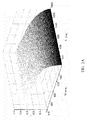
- FIGS. 1 ( a ),( b ) show the value for
- e - TE T 2 calculated for a range of echo time TE and transverse relaxation time T 2 for both a 3D plot and a top view, respectively.
- FIGS. 2 ( a ),( b ) illustrate the value for ⁇ for a range of repetition times TRs and physiological longitudinal relaxation time T 1 values for both a 3D plot and a top view, respectively.
- FIGS. 3 ( a )-( f ) show calibration factors M 0 , M 0 Bold and the percentage difference between the two parametric maps for two patients.
- FIGS. 4 ( a )-( f ) show calibration factors M 0 , M 0 Bold / ⁇ and the percentage difference between the two parametric maps for the same two patients in FIGS. 3 ( a )-( f ).
- FIG. 5 illustrates an example of a homogenous body in a magnetic resonance system containing intensity inhomogeneities.
- FIG. 6 is a flowchart of an exemplary embodiment of a method for removing intensity inhomogeneities of the present disclosure from an MRI image.
- FIGS. 7A-D show the results for various approaches to bias field removal compared to an exemplary embodiment of the present disclosure.
- FIG. 8 is a flow chart of an alternate embodiment to the method illustrated in FIG. 6 , further including estimating the RF transmit field B 1 + and removing inhomogeneities in the B 1 + field from an MR image using the estimated B 1 + field.
- Embodiments of systems and methods are described herein which utilize one or more acquired calibration images to provide a fast, low-cost solution for correcting and removing intensity inhomogeneities in magnetic resonance (MR) images.
- the acquisition of the one or more calibration images can be based on the signal equation of MR sequences, which generally follow a certain pattern, described below. Through the acquisition of the one or more calibration images, it is possible obtain a very good estimated map of the actual intensity inhomogeneities.
- the Ultrafast Gradient Echo (in 2D or 3D) signal (sometimes referred to as the fast spoiled gradient echo (FSPGR) signal, or TurboFLASH or MPRAGE, or TFE or 3DTFE, or RGE or MPRAGE, or FastFE, or Field Echo) at any voxel is given by the signal equation:
- FSPGR fast spoiled gradient echo
- the scanner gain g, repetition time TR, echo time TE and flip angle ⁇ are sequence parameters and are independent of the spatial location.
- tissue parameters such as the proton density ⁇ , longitudinal relaxation time T 1 and the transverse relaxation time T 2 or T* 2 are all a function of the spatial location (x,y,z).
- S ideal f(x,y,z).
- the signal is often contaminated by a bias field B , which is itself a function of the spatial location.
- the estimated bias field B computed this way when viewed spatially could be of entirely general shape and does not carry with it the assumptions implicitly made in iterative correction algorithms (for example, the shape/smoothness of the bias field, see section [0005] above).
- the bias field can be estimated independently at each position x, y and z and so we can consider the signal equation and bias field at each voxel and also where each position can be either regularly or irregularly spaced.
- the bias field B can be modeled as a multiplicative field, resulting in an Observed Signal S obs , where:
- the slope (a) and the y-intercept (b) can be estimated for example by any suitable linear regression.
- T 1 the longitudinal relaxation time
- the bias field ⁇ right arrow over (B) ⁇ cannot be computed, the equation for M 0 can be solved, which in fact, is M 0 true ⁇ right arrow over (B) ⁇ .
- TE echo time
- FIGS. 1 ( a ),( b ) illustrate e ⁇ TE/T 2 calculated for a range of TE and T 2 .
- FIG. 1 ( a ) shows a 3D plot
- FIG. 1( b ) shows a top view where the value of e ⁇ TE/T 2 can be seen from the color bar.
- e ⁇ TE/T 2 For TE ⁇ 1.5 msec the term e ⁇ TE/T 2 never drops below 0.95, making e ⁇ TE/T 2 ⁇ 1 a reasonable assumption.
- Table 1 provides numerical values for this term across a range of abdominal tissues.
- M 0 which is proportional to the bias field
- M 0 is corrupted by the bias field but only contains a negligible contribution from the transverse tissue relaxation time T* 2 .
- TR, TE and ⁇ it is possible to remove the bias field from this image through, for example, a simple division operation.
- This image can for example be another Ultrafast Gradient Echo image, but it can also be a Spin Echo, Inversion Recovery or variations thereof or any other image sequence. Let us for example consider an Ultrafast Gradient Echo image. In this image to be corrected the new values are denoted by a ⁇ symbol shown over each corresponding variable.
- tissue properties, T 1 , T* 2 and the proton density ⁇ of each observed voxel remain unchanged.
- the gain settings, g, of the scanner may or may not have remained constant.
- equation 11 is divided by equation 10 (which defines the parameter or calibration factor M 0 ) to obtain a signal which is independent of the bias field:
- the exemplary method described is not limited to abdominal tissue.
- the only requirement is that e ⁇ TE/T* 2 ⁇ 1, which is generally true for all tissue types provided that TE is very short.
- the application of the correction is not limited to a particular image type such as Ultrafast Gradient Echo images.
- the observed signal equation for other sequences are 1 : 1 http:/www.cis.rit.edu/htbooks/mri/inside.htm
- T 1 W images The effect of the described correction on T 1 W images is to increase the apparent T 1 W, while on T 2 W images the apparent T 2 W is slightly decreased. This small decrease in T 2 W could be compensated by acquiring images with a slightly longer TE than desired. However, the reduction in T 2 W is likely to have a negligible visual effect on the images.
- T 2 is approximately constant for a given tissue and patient.
- T 2 and T* 2 are identical.
- T* 2 ⁇ T 2 we always have that T* 2 ⁇ T 2 .
- e ⁇ TE/T* 2 ⁇ 1 we only have that T* 2 ⁇ T 2 .
- TE ⁇ T* 2 which is generally the case if we use a very short TE.
- T 1 is not affected by the bias field.
- One such approach is thus the reconstruction of synthetic T 1 weighted images as described for example by Deoni et al. (Magn Reson Imaging 2006; 24(9):1241-8).
- T 2 and T* 2 are unknown, it is only possible to compute T 1 W images.
- the reconstruction of T 2 weighted images would require the measurement of T 2 , which takes additional time. It is also not possible to correct contrast enhanced images.
- the parameter M 0 possesses various favorable properties that enables the correction of inhomogeneities in both T 1 W and T 2 W images.
- Intensity inhomogeneities are independent of the pulse sequence and therefore only need to be estimated once per imaging study provided that the patient remains still. Should the patient not remain still, then it is possible to use one of the many motion correction, also called alignment or image registration techniques, in combination with the present method. Some of these methods are described by Hill et al. ( Phys Med Biol , vol. 46, pp. R1-45, 2001) and Maintz et al. ( Med Image Anal , vol. 2, pp. 1-36, 1998) and Mellor et al. ( Med Image Anal , vol. 9, pp. 330-43, 2005) and the references contained therein.
- the correction can be, but is not limited to, rigid, non-rigid, affine and locally affine.
- M 0 Another favorable property related to M 0 is the fact that the bias field is independent of the image sequence itself.
- an alternative approach for determining M 0 that uses a different pulse sequence with a different set of sequence parameters was performed. Using a series of gradient echo images, where all parameters but TE remain constant, it is possible to estimate T* 2 and a parameter which will be referred to as M 0 Bold . The analysis is based on the signal equation.
- FIGS. 3 ( a )-( f ) show M 0 (left, FIGS. 3 ( a ),( d )), M 0 Bold (middle, FIGS. 3 ( b ),( e )) and the percentage difference (right, FIGS. 3 ( c ),( f ) between the two parametric maps for two patients.
- M 0 and M 0 Bold we observe similarities in shape. However, there are clear differences in the intensities of certain tissues. Focusing on the liver, 3 ( c ) and 3 ( f ), we observe significant differences. These occur in areas where the value of ⁇ changes because of variations in the underlying T 1 . Inside the liver large errors occur around blood vessels and tumor deposits. Large errors are indicated by pixels of high signal intensity, i.e., more bright.
- FIGS. 4 ( a )-( f ) show M 0 , (left, FIGS. 4( a ), 4 ( d )) M 0 Bold / ⁇ (middle, FIGS. 4( b ) and 4 ( e )) and the percentage difference (right, FIGS. 4( c ),(f)) between the two parametric maps for the same patients as in FIGS.
- FIGS. 3( c ) and ( f ) now have a markedly reduced errors, particularly around the tumor deposits and vessels, in FIGS. 4( c ) and 4 ( f ). Errors remain in the center of FIG. 4( c ), which is caused by partial volume effects.
- the liver is the region of interest, because the Despot1 sequence parameters have been optimized for the estimation of T 1 ⁇ 600 ms.
- the errors in T 1 for other organs, having significantly different T 1 values e.g. T 1 spleen ⁇ 1057 ms or T 1 kidney ⁇ 1400 ms), would be larger resulting in an incorrect computation of y and hence an incorrect scaling of M 0 Bold .
- T 1 spleen ⁇ 1057 ms or T 1 kidney ⁇ 1400 ms would be larger resulting in an incorrect computation of y and hence an incorrect scaling of M 0 Bold .
- a reduction in errors in all abdominal organs is observed.
- M 0 Bold / ⁇ M 0 within liver was computed. If the two independent approaches to estimate M 0 are equivalent, then their ratio should be constant everywhere, and the ratio of the standard deviation ⁇ and mean ⁇ should be relatively small. The absolute value of M 0 can vary across the image. The results for the two examples are given in Table 3 below.
- FIG. 6 depicts a flowchart of an embodiment of a method of the present disclosure for removing intensity inhomogeneities from an MR image.
- the functions noted in the blocks can occur out of order (or not at all).
- two blocks shown in succession may in fact be executed substantially concurrently or in reverse order, depending on the particular embodiment.
- an MR image is acquired.
- one or more calibration image acquisitions is performed, preferably a plurality of calibration image acquisitions is performed while varying a flip angle, ⁇ .
- ⁇ a flip angle
- a wide range of choice of flip angles and repetition times TR is possible.
- at least two flip angles are preferred and we choose a TR ⁇ T1 which makes our approach particularly fast.
- One possible method to choose the TR and flip angles has been described by Deoni et al. (Magn Reson Med, vol. 51, 194-1999, 2004). In general, any flip angle from 1 to 90 can be used.
- the preferred flip angles are those that optimize the accuracy of the computed calibration factor M 0 .
- the one or more calibration images acquired in step 720 should cover an area equal to or larger than any images acquired in 710 .
- the resolution, thickness and orientation of images in 720 need not be the same as the images acquired in 710 .
- an optional registration step i.e., alignment function (step 730 ) may be performed on the series of images acquired in step 720 .
- the optional alignment step may be performed according to methods known in the art. Exemplary methods for alignment have been indicated in above and exemplary opportunities for alignment in [0060].
- a bias field is calculated based on the series of image acquisitions. This bias field is then removed from the MR image in order to remove inhomogeneities from the MR image (step 760 a ).
- the calculated bias field from 740 can be optionally aligned to the image acquired in step 710 using conventional methods. Because the resolution and/or the orientation of the bias field (which may have the same resolution as the images acquired in step 720 ) and the MR image acquired in step 710 may be different, interpolation (e.g., linear, cubic splines, trilinear, etc.) and re-sampling may be performed either on the MR image resolution of step 710 , 720 , 740 or the computed M 0 if necessary (or desired).
- the images acquired in steps 710 and 720 can be further incorporated into one or more recent registration algorithms such as a Transitive Inverse-consistent registration algorithm, for example.
- the series of images from step 720 or the image computed from the series of images ( 740 ) may (optionally) be subject to image processing to remove artifacts and to address noisy data (e.g., by incorporating a noise model and/or noise reduction step).
- the images may be smoothed or low pass filtered, Gaussian or median filtered (step 750 ).
- Another possibility may be to use Markov Random Fields (see e.g. C. Xiaohua, “Simultaneous segmentation and registration of medical images,” DPhil Thesis Wolfson Medical Vision Laboratory, Department of Engineering Science. Oxford: University of Oxford, 2005 and references therein.
- Yet another possibility is the fitting of a surface to the M 0 , or its noise corrected version. Because the bias field can be expected to vary smoothly, it is acceptable to reduce the image acquisition matrix of the individual images acquired in step 720 . It should be noted that a high resolution image that matches the resolution of the image 710 is desirable but not compulsory.
- the bias field estimated in step 740 based on the one or more acquired calibration images can be combined with image based approaches to remove the estimated bias field in one of the following ways: 1) through an initialization step in accordance with existing bias field removal algorithms such as those taught, for example, by Styner et al. (IEEE Trans Med Imaging, vol. 19, pp. 153-65, 2000), Guimond et al. (IEEE Trans Med Imaging, vol. 20, pp. 58-69, 2001), Guillemaud et al. (IEEE Trans Med Imaging, vol. 16, pp. 238-51, 1997), and Sled et al. (IEEE Trans Med Imaging, vol. 17, pp.
- step 740 by combining the computation of step 740 with existing bias field removal algorithms into an iterative framework using, for example, an Expectation Maximization Framework or a Bayesian Framework.
- SSR segmentation and registration
- One option is to divide the image to be corrected, I, by the optionally processed (e.g. to account for noise) calibration factor M 0 to derive a corrected image.
- An alternative approach is the subtraction of the logarithmic transformed images. This means that the operation I/M 0 is equivalent to log(I) ⁇ log(M 0 ) and calculating the exponential of (log(I) ⁇ log(M 0 )).
- a number of bases can be chosen. As an example one can consider the base 10, 2 or e (approx 2.71). While the results are similar, the second approach may offer a considerable speed improvement.
- the removal of the estimated bias field may be preferred on pixels which do not make up part of the background or on a user defined region of interest.
- an additional step may be included whereby pixels which are not part of the background are identified.
- the uncorrected image is divided by M 0 (or using the logarithmic operation), as described earlier (see [0065]) or a processed (e.g. smoothened) version of M 0 .
- M 0 or using the logarithmic operation
- a processed (e.g. smoothened) version of M 0 This changes the numerical value of each pixel in the corrected image quite drastically (e.g., from 70 to 0.005).
- a normalization step should also be performed in order to convert the intensities associated with the corrected image back to the same mean.
- the relative variation of the M 0 values within the image is unchanged, but their magnitudes are scaled.
- the range may vary from 0 to 1 or from ⁇ 1 to 1.
- normalization can be accomplished by scaling the corrected image so that for example the mean of the uncorrected and corrected image are approximately the same.
- the execution of the individual steps can be conducted in any order and some of these steps could be conducted multiple times. The following illustrates some possible combinations of the execution of the individual steps. Variations thereof are of course possible.
- the noise reduction step can be applied to the individual images with varying alpha before M 0 is computed, or, the noise reduction could be applied to the M 0 image computed from the original images with varying alpha.
- noise reduction techniques can be applied before and after the computation of M 0 .
- the alignment step can occur at various points.
- the re-sampling of the images can also occur at various points.
- One option is the re-sampling (after optional alignment and noise reduction) of the multiple images with varying alpha, 720 , to the size and orientation of 710 prior to computation of M 0 .
- M 0 first (after optional alignment and noise reduction) and then resample the computed M 0 to the size and orientation of 710 .
- Noise reduction and alignment can be applied to any intermediate step of the process.
- FIGS. 7A-D show the results for various approaches to bias field removal for four cases.
- the original image is shown, along with the results from three approaches to removing the bias field: 1) method 1, 2) method 2, and 3) the method described herein.
- the method 1 improves the image quality of images acquired using surface coils by correcting the low spatial frequency intensity modulations.
- the method reduces noise and enhances the contrast in the image.
- the method produces a series of filtered images with decreased intensity near the coil, reducing areas of bright spots.
- the method 2 reduces surface coil intensity variation through a calibration process and uses a calibration scan.
- FIGS. 7A-D were produced as follows.
- the acquired flip angles were 1, 2, 3, 4, 5, 6, 7, 8, 9, 10, 11, 12, 13, 14, 15 degrees. From this data, T 1 and M, were calculated.
- SE Fast Spin Echo
- T 1 weighted GRE Gradient Echo
- TR 7.9 msec
- TE 4.2 msec
- 32 slices covering the whole phantom were acquired.
- Corresponding slices in the data sets were chosen and the images were sampled to have the same resolution and image size.
- the T 1 and T 2 weighted images were corrected using the exemplary method described herein.
- the T 1 and T 2 weighted images were also corrected using method 1 and method 2. Normalized intensity plots (i.e., all normalized to 1) for representative slices along the shown lines were plotted on the same axis.
- the RF transmit field would be perfectly uniform, resulting in a uniform distribution of the prescribed flip angle.
- numerous factors make this assumption invalid. These can be due to the conductive and dielectric properties of tissue resulting in standing waves with constructive and destructive interference and RF attenuation. These effects become more prominent at higher field strength as the wavelength of the RF pulse and the size of the imaged object become more comparable.
- a simple B 1 + mapping strategy acquires an image with two different flip angles, alpha1 and alpha2 with the condition that TR>>T 1 . This is necessary to allow full relaxation of the spins.
- the B 1 + field is then obtained by dividing the two images. The long repetition time however means that this strategy can require several minutes to obtain a full B 1 + map.
- Cunningham et al. (2006) (“Saturated Double-Angle Method for Rapid B 1 + Mapping”, Magnetic Resonance in Medicine 55:1326-1333) describe a double angle method which works accurately even if TR ⁇ T 1 , allowing the determination of a B 1 + map in a single breath hold (i.e. around 20 seconds).
- B 1 + mapping technique may be personal preference or technical ease of implementation.
- the necessary data would be acquired for a patient. This could, for example be acquired shortly before or after the calibration images for the correction of the bias field has been acquired. From this data a B 1 + may be obtained, for example by one of the methods described above.
- FIG. 8 An exemplary embodiment of a method of the present disclosure for calculating and removing an estimated transmitted RF magnetic field B 1 + in conjunction with removing an estimated bias field from an MR image is illustrated in FIG. 8 .
- FIG. 8 is a modified version of FIG. 6 described above.
- Like reference numerals in FIG. 8 designate corresponding blocks and steps to those described in connection with FIG. 6 above and, for brevity, will not be repeated here.
- two sets of artifacts are involved.
- One set of artifacts involves the calculation of an estimated bias field and removal of the calculated bias field from an MR image, as described for example with reference to FIG. 6 above.
- the calculation and removal of an estimated bias field involves the acquisition of at least two data sets.
- One data set is obtained through the acquisition of an MR image.
- Another data set is obtained through the acquisition of one or more calibration images. From these two sets of data an estimated bias field can be calculated including, for example, calibration factor M 0 as described above.
- the further calibration images can be used to calculate an estimated transmitted RF magnetic field B 1 + to additionally remove from the MR image inhomogeneities resulting from inaccuracies in the transmitted RF magnetic field. This involves, for example, acquisition of a third image scan (step 720 ) from which an estimated transmitted RF field B 1 + can be calculated or mapped, as illustrated in step 840 in FIG. 8 , by using any of the aforementioned B 1 + mapping techniques.
- the resulting B 1 + map may be smoothened 850 , similarly to the smoothing operation 750 applied to the M 0 map.
- the smoothened version of the B 1 + map can then be employed to remove or correct RF transmit inhomogeneities 860 a or 860 b by removing the calculated B 1 + field.
- the removal of RF transmit B 1 + inhomogeneities can optionally be done on the original image or the image where the bias field has already been removed. Either of these will in the subsequent text be represented by I.
- One possible correction approach is through either division of the image to be corrected by the optionally processed B 1 + map, or by taking the logarithm of the image to be corrected (i.e. log(I) and the optionally processed calibration factor B 1 + , i.e. log(B 1 + ), forming the difference, i.e. log(I) ⁇ log(B 1 + ), and optionally computing the exponential of this difference, i.e. exp(log(I) ⁇ log(B 1 + )), wherein the base of the logarithm and exponential operation can be any suitable choice.
- a number of bases can be chosen. As an example one can consider the base 10, 2 or e (approx 2.71). While the results are similar, the second approach may offer a considerable speed improvement. There may be other choices of transformation of images which have the same effect, that is to reduce the inhomogeneities on an acquired image through using the estimated B 1 + .
- a more advanced correction technique would calculate a correction factor from the optionally smoothened B 1 + map which is derived through a series of linear and non-linear operations on the B 1 + map, such as addition, subtraction, multiplication, division, logarithms, exponentials and trigonometric functions (e.g. sin, cos, tan and their inverse).
- the ‘error’ in the MR signal due to inaccurate flip angles can be non-linearly related to the longitudinal relaxation time T 1 .
- the T 1 values vary over short distances depending on the underlying tissue class.
- the preferred B 1 + mapping approach may also yield an estimate of T 1 and M 0 . It is thus possible to use an estimate of the T 1 and M 0 values to obtain, together with the optionally processed/smoothed B 1 + estimate, a new correction map. To obtain thus a new correction map it may be desirable to include a model of the signal formation for the image to be corrected (Math-based approach combined with image-based approach, as illustrated by step 860 b ) which can include information from the T 1 and/or M 0 maps. Other, alternative approaches to use the information from the estimated B 1 + map to correct an image may also be possible.
Landscapes
- Physics & Mathematics (AREA)
- Health & Medical Sciences (AREA)
- General Health & Medical Sciences (AREA)
- Nuclear Medicine, Radiotherapy & Molecular Imaging (AREA)
- Radiology & Medical Imaging (AREA)
- Engineering & Computer Science (AREA)
- Signal Processing (AREA)
- High Energy & Nuclear Physics (AREA)
- Condensed Matter Physics & Semiconductors (AREA)
- General Physics & Mathematics (AREA)
- Magnetic Resonance Imaging Apparatus (AREA)
Abstract
Description
S(
calculated for a range of echo time TE and transverse relaxation time T2 for both a 3D plot and a top view, respectively.
Re-arranging this equation yields:
By performing the following substitutions,
The following equation is derived:
| TABLE 1 | ||||
| Tissue | T2 (msec) +/− std |
|
|
|
| Kidney Cortex | 87 ± 4 | 0.9869 | 0.9863 | 0.9856 |
| Kidney Medulla | 85 ± 11 | 0.9876 | 0.9860 | 0.9839 |
| Liver | 46 ± 6 | 0.9772 | 0.9743 | 0.9704 |
| Spleen | 79 ± 15 | 0.9873 | 0.9849 | 0.9814 |
| Pancreas | 46 ± 6 | 0.9772 | 0.9743 | 0.9704 |
| Paravertebral muscle | 27 ± 8 | 0.9663 | 0.9565 | 0.9388 |
| Bone marrow | 49 ± 8 | 0.9792 | 0.9758 | 0.9712 |
| Subcutaneous fat | 58 ± 4 | 0.9808 | 0.9795 | 0.9780 |
| Uterus Myometrium | 117 ± 14 | 0.9909 | 0.9898 | 0.9884 |
| Prostate | 88 ± 0 | 0.9865 | 0.9865 | 0.9865 |
M 0 =gρe −TE/T*
{right arrow over ({circumflex over (B)}=
| TABLE 2 | ||||
| Weighting | TR | TE | ||
| T1 | ≦T1 | <<T2 | ||
| T2 | >>T1 | ≧T2 | ||
| ρ | >>T1 | <<T2 | ||
S observed =S deal ·{right arrow over (B)} (18)
This equation can be re-arranged as follows:
Using the following substitution,
the equation simplifies to:
which again, is of the linear form y=ax+b. Using any suitable linear regression it is possible to estimate the slope, a, and the y-intercept, b and thus determine T*2 and M0 Bold. It should be noted that similar to the calculation of T1, the computation of T*2 is independent of any bias field. The calculation of M0 Bold is corrupted by the multiplicative bias field {right arrow over (B)}.
Relationship Between M0 and M0 Bold
Depending on the choice of sequence parameters, the value of γ can vary significantly.
and
within liver was computed. If the two independent approaches to estimate M0 are equivalent, then their ratio should be constant everywhere, and the ratio of the standard deviation σ and mean μ should be relatively small. The absolute value of M0 can vary across the image. The results for the two examples are given in Table 3 below.
| TABLE 3 | |||
| σ/μ | σ/μ with | ||
| Patient |
| 1 | 0.1474 | 0.1234 | |
| |
0.0877 | 0.0600 | |
Furthermore, the following relationship holds true: M0 Bold/γ≈M0. Rather than correcting M0 Bold (which requires T1 and thus automatically gives M0 as well), it is easier to use M0 directly to remove the bias field.
Claims (21)
e−TE/T* 2≈1.
e−TE/T*
Priority Applications (1)
| Application Number | Priority Date | Filing Date | Title |
|---|---|---|---|
| US12/333,395 US7782056B2 (en) | 2007-12-13 | 2008-12-12 | Systems and methods for correction of inhomogeneities in magnetic resonance images |
Applications Claiming Priority (3)
| Application Number | Priority Date | Filing Date | Title |
|---|---|---|---|
| US1352307P | 2007-12-13 | 2007-12-13 | |
| US9612308P | 2008-09-11 | 2008-09-11 | |
| US12/333,395 US7782056B2 (en) | 2007-12-13 | 2008-12-12 | Systems and methods for correction of inhomogeneities in magnetic resonance images |
Publications (2)
| Publication Number | Publication Date |
|---|---|
| US20090206838A1 US20090206838A1 (en) | 2009-08-20 |
| US7782056B2 true US7782056B2 (en) | 2010-08-24 |
Family
ID=40954514
Family Applications (1)
| Application Number | Title | Priority Date | Filing Date |
|---|---|---|---|
| US12/333,395 Expired - Fee Related US7782056B2 (en) | 2007-12-13 | 2008-12-12 | Systems and methods for correction of inhomogeneities in magnetic resonance images |
Country Status (1)
| Country | Link |
|---|---|
| US (1) | US7782056B2 (en) |
Cited By (9)
| Publication number | Priority date | Publication date | Assignee | Title |
|---|---|---|---|---|
| US20090267945A1 (en) * | 2008-04-25 | 2009-10-29 | Marcel Warntjes | Visualization of Quantitative MRI Data by Quantitative Tissue Plot |
| US20120155732A1 (en) * | 2009-06-26 | 2012-06-21 | University Of South Florida | CT Atlas of Musculoskeletal Anatomy to Guide Treatment of Sarcoma |
| US20120212222A1 (en) * | 2011-02-21 | 2012-08-23 | Raman Krishnan Subramanian | System and method for enhanced contrast mr imaging |
| US9147250B2 (en) | 2011-09-15 | 2015-09-29 | Siemens Aktiengesellschaft | System and method for automatic magnetic resonance volume composition and normalization |
| US20150279062A1 (en) * | 2013-11-01 | 2015-10-01 | Ellumen, Inc. | Dielectric encoding of medical images |
| US20150362573A1 (en) * | 2014-06-17 | 2015-12-17 | Siemens Aktiengesellschaft | Magnetic resonance apparatus and operating method therefor |
| US10247802B2 (en) | 2013-03-15 | 2019-04-02 | Ohio State Innovation Foundation | Signal inhomogeneity correction and performance evaluation apparatus |
| WO2021040880A1 (en) * | 2019-08-30 | 2021-03-04 | Emory University | Systems and methods for correcting intravoxel and/or voxel inhomogeneity and/or standardizing steady-state signal |
| US20230314535A1 (en) * | 2022-03-30 | 2023-10-05 | Siemens Healthineers Digital Technology (Shanghai) Co., Ltd. | Radio-Frequency Field Inhomogeneity Correction in Magnetic Resonance Imaging |
Families Citing this family (13)
| Publication number | Priority date | Publication date | Assignee | Title |
|---|---|---|---|---|
| US7800368B2 (en) * | 2006-02-17 | 2010-09-21 | Regents Of The University Of Minnesota | High field magnetic resonance |
| US20120063656A1 (en) * | 2010-09-13 | 2012-03-15 | University Of Southern California | Efficient mapping of tissue properties from unregistered data with low signal-to-noise ratio |
| US9316707B2 (en) * | 2012-04-18 | 2016-04-19 | General Electric Company | System and method of receive sensitivity correction in MR imaging |
| US9760991B2 (en) * | 2013-04-22 | 2017-09-12 | General Electric Company | System and method for image intensity bias estimation and tissue segmentation |
| EP3374962A1 (en) * | 2015-11-10 | 2018-09-19 | Koninklijke Philips N.V. | Method for automatic optimization of quantitative map generation in functional medical imaging |
| CN106570837B (en) * | 2016-10-28 | 2019-12-17 | 中国人民解放军第三军医大学 | Brain tissue MRI image offset field correction method based on Gaussian multi-scale space |
| CN107248161A (en) * | 2017-05-11 | 2017-10-13 | 江西理工大学 | Retinal vessel extracting method is supervised in a kind of having for multiple features fusion |
| CN107479015B (en) * | 2017-08-21 | 2020-07-24 | 上海联影医疗科技有限公司 | Method and system for magnetic resonance calibration scanning sequence configuration and image acquisition |
| CN108898578B (en) * | 2018-05-29 | 2020-12-08 | 杭州晟视科技有限公司 | Medical image processing method and device and computer storage medium |
| US12045956B2 (en) * | 2021-06-04 | 2024-07-23 | GE Precision Healthcare LLC | Nonuniformity correction systems and methods of diffusion-weighted magnetic resonance images |
| CN115670425B (en) * | 2021-07-30 | 2026-07-21 | 西门子医疗系统有限公司 | Brain free water content measuring method and device and magnetic resonance imaging system |
| WO2024108545A1 (en) * | 2022-11-25 | 2024-05-30 | 中国科学院深圳先进技术研究院 | B1 field correction method and device for precise quantification of cest signal |
| CN116990736B (en) * | 2023-09-22 | 2023-12-12 | 山东奥新医疗科技有限公司 | Nuclear magnetic resonance imaging method, device, equipment and storage medium |
Citations (5)
| Publication number | Priority date | Publication date | Assignee | Title |
|---|---|---|---|---|
| US6587708B2 (en) * | 2000-12-29 | 2003-07-01 | Ge Medical Systems Global Technology, Llc | Method for coherent steady-state imaging of constant-velocity flowing fluids |
| US7324842B2 (en) * | 2002-01-22 | 2008-01-29 | Cortechs Labs, Inc. | Atlas and methods for segmentation and alignment of anatomical data |
| US20080292167A1 (en) * | 2007-05-24 | 2008-11-27 | Nick Todd | Method and system for constrained reconstruction applied to magnetic resonance temperature mapping |
| US20090174403A1 (en) * | 2008-01-09 | 2009-07-09 | The Board Of Trustees Of The Leland Stanford Junior University | Field map estimation for species separation |
| US20090251140A1 (en) * | 2008-04-02 | 2009-10-08 | General Electric Company | Method and apparatus for generating t2* weighted magnetic resonance images |
-
2008
- 2008-12-12 US US12/333,395 patent/US7782056B2/en not_active Expired - Fee Related
Patent Citations (5)
| Publication number | Priority date | Publication date | Assignee | Title |
|---|---|---|---|---|
| US6587708B2 (en) * | 2000-12-29 | 2003-07-01 | Ge Medical Systems Global Technology, Llc | Method for coherent steady-state imaging of constant-velocity flowing fluids |
| US7324842B2 (en) * | 2002-01-22 | 2008-01-29 | Cortechs Labs, Inc. | Atlas and methods for segmentation and alignment of anatomical data |
| US20080292167A1 (en) * | 2007-05-24 | 2008-11-27 | Nick Todd | Method and system for constrained reconstruction applied to magnetic resonance temperature mapping |
| US20090174403A1 (en) * | 2008-01-09 | 2009-07-09 | The Board Of Trustees Of The Leland Stanford Junior University | Field map estimation for species separation |
| US20090251140A1 (en) * | 2008-04-02 | 2009-10-08 | General Electric Company | Method and apparatus for generating t2* weighted magnetic resonance images |
Cited By (17)
| Publication number | Priority date | Publication date | Assignee | Title |
|---|---|---|---|---|
| US20090267945A1 (en) * | 2008-04-25 | 2009-10-29 | Marcel Warntjes | Visualization of Quantitative MRI Data by Quantitative Tissue Plot |
| US8289329B2 (en) * | 2008-04-25 | 2012-10-16 | Marcel Warntjes | Visualization of quantitative MRI data by quantitative tissue plot |
| US20120155732A1 (en) * | 2009-06-26 | 2012-06-21 | University Of South Florida | CT Atlas of Musculoskeletal Anatomy to Guide Treatment of Sarcoma |
| US20120212222A1 (en) * | 2011-02-21 | 2012-08-23 | Raman Krishnan Subramanian | System and method for enhanced contrast mr imaging |
| US8760161B2 (en) * | 2011-02-21 | 2014-06-24 | General Electric Company | System and method for enhanced contrast MR imaging |
| US9147250B2 (en) | 2011-09-15 | 2015-09-29 | Siemens Aktiengesellschaft | System and method for automatic magnetic resonance volume composition and normalization |
| US10247802B2 (en) | 2013-03-15 | 2019-04-02 | Ohio State Innovation Foundation | Signal inhomogeneity correction and performance evaluation apparatus |
| US9704275B2 (en) * | 2013-11-01 | 2017-07-11 | Ellumen, Inc. | Dielectric encoding of medical images |
| US20150279062A1 (en) * | 2013-11-01 | 2015-10-01 | Ellumen, Inc. | Dielectric encoding of medical images |
| US20150362573A1 (en) * | 2014-06-17 | 2015-12-17 | Siemens Aktiengesellschaft | Magnetic resonance apparatus and operating method therefor |
| US10281545B2 (en) * | 2014-06-17 | 2019-05-07 | Siemens Aktiengesellschaft | Magnetic resonance apparatus and operating method therefor |
| WO2021040880A1 (en) * | 2019-08-30 | 2021-03-04 | Emory University | Systems and methods for correcting intravoxel and/or voxel inhomogeneity and/or standardizing steady-state signal |
| US20220342021A1 (en) * | 2019-08-30 | 2022-10-27 | Emory University | Systems and Methods for Correcting Intravoxel and/or Voxel Inhomogeneity |
| US12186104B2 (en) * | 2019-08-30 | 2025-01-07 | Emory University | Systems and methods for correcting intravoxel and/or voxel inhomogeneity |
| US20250090100A1 (en) * | 2019-08-30 | 2025-03-20 | Emory University | Systems and Methods for Correcting Intravoxel and/or Voxel Inhomogeneity |
| US20230314535A1 (en) * | 2022-03-30 | 2023-10-05 | Siemens Healthineers Digital Technology (Shanghai) Co., Ltd. | Radio-Frequency Field Inhomogeneity Correction in Magnetic Resonance Imaging |
| US12360184B2 (en) * | 2022-03-30 | 2025-07-15 | Siemens Healthineers Ag | Radio-frequency field inhomogeneity correction in magnetic resonance imaging |
Also Published As
| Publication number | Publication date |
|---|---|
| US20090206838A1 (en) | 2009-08-20 |
Similar Documents
| Publication | Publication Date | Title |
|---|---|---|
| US20090206838A1 (en) | Systems and Methods for Correction of Inhomogeneities in Magnetic Resonance Images | |
| Volz et al. | Quantitative proton density mapping: correcting the receiver sensitivity bias via pseudo proton densities | |
| Renvall et al. | Automatic cortical surface reconstruction of high-resolution T1 echo planar imaging data | |
| Weiskopf et al. | Unified segmentation based correction of R1 brain maps for RF transmit field inhomogeneities (UNICORT) | |
| Marques et al. | MP2RAGE, a self bias-field corrected sequence for improved segmentation and T1-mapping at high field | |
| US7592810B2 (en) | MRI methods for combining separate species and quantifying a species | |
| US10180474B2 (en) | Magnetic resonance imaging apparatus and quantitative magnetic susceptibility mapping method | |
| US9797974B2 (en) | Nonrigid motion correction in 3D using autofocusing with localized linear translations | |
| Khabipova et al. | A modulated closed form solution for quantitative susceptibility mapping—a thorough evaluation and comparison to iterative methods based on edge prior knowledge | |
| US10726552B2 (en) | Quantification of magnetic resonance data by adaptive fitting of downsampled images | |
| Budde et al. | Ultra-high resolution imaging of the human brain using acquisition-weighted imaging at 9.4 T | |
| Sung et al. | Measurement and characterization of RF nonuniformity over the heart at 3T using body coil transmission | |
| US7863895B2 (en) | System, program product, and method of acquiring and processing MRI data for simultaneous determination of water, fat, and transverse relaxation time constants | |
| EP3658018B1 (en) | Systems and methods for strategically acquired gradient echo imaging | |
| US20230210446A1 (en) | Method for simultaneous multiple magnetic resonance parameter mapping of liver | |
| US11430574B2 (en) | Medical image diagnosis support device and magnetic resonance imaging apparatus | |
| US20120271147A1 (en) | Apparatus, method, and computer-accessible medium for b1-insensitive high resolution 2d t1 mapping in magnetic resonance imaging | |
| Raimondo et al. | Robust high spatio-temporal line-scanning fMRI in humans at 7T using multi-echo readouts, denoising and prospective motion correction | |
| Volz et al. | Maximising BOLD sensitivity through automated EPI protocol optimisation | |
| US12181550B2 (en) | Method for generating a magnetic resonance synthetic computer tomography image | |
| Subramanian et al. | Echo-based Single Point Imaging (ESPI): a novel pulsed EPR imaging modality for high spatial resolution and quantitative oximetry | |
| US11467238B2 (en) | Method for uniform reconstruction of multi-channel surface-coil magnetic resonance data without use of a reference scan | |
| Constantinides et al. | Restoration of low resolution metabolic images with a priori anatomic information: 23Na MRI in myocardial infarction☆ | |
| Kathiravan | A review of magnetic resonance imaging techniques | |
| US20210389401A1 (en) | Systems and methods for enhancement of resolution for strategically acquired gradient echo (stage) imaging |
Legal Events
| Date | Code | Title | Description |
|---|---|---|---|
| AS | Assignment |
Owner name: ISIS INNOVATION LTD., UNITED KINGDOM Free format text: ASSIGNMENT OF ASSIGNORS INTEREST;ASSIGNORS:NOTERDAEME, OLIVIER;BRADY, MICHAEL;REEL/FRAME:022603/0315;SIGNING DATES FROM 20090110 TO 20090420 Owner name: ISIS INNOVATION LTD., UNITED KINGDOM Free format text: ASSIGNMENT OF ASSIGNORS INTEREST;ASSIGNORS:NOTERDAEME, OLIVIER;BRADY, MICHAEL;SIGNING DATES FROM 20090110 TO 20090420;REEL/FRAME:022603/0315 |
|
| REMI | Maintenance fee reminder mailed | ||
| FPAY | Fee payment |
Year of fee payment: 4 |
|
| SULP | Surcharge for late payment | ||
| AS | Assignment |
Owner name: OXFORD UNIVERSITY INNOVATION LIMITED, GREAT BRITAIN Free format text: CHANGE OF NAME;ASSIGNOR:ISIS INNOVATION LIMITED;REEL/FRAME:039550/0045 Effective date: 20160616 Owner name: OXFORD UNIVERSITY INNOVATION LIMITED, GREAT BRITAI Free format text: CHANGE OF NAME;ASSIGNOR:ISIS INNOVATION LIMITED;REEL/FRAME:039550/0045 Effective date: 20160616 |
|
| FEPP | Fee payment procedure |
Free format text: MAINTENANCE FEE REMINDER MAILED (ORIGINAL EVENT CODE: REM.) |
|
| LAPS | Lapse for failure to pay maintenance fees |
Free format text: PATENT EXPIRED FOR FAILURE TO PAY MAINTENANCE FEES (ORIGINAL EVENT CODE: EXP.); ENTITY STATUS OF PATENT OWNER: LARGE ENTITY |
|
| STCH | Information on status: patent discontinuation |
Free format text: PATENT EXPIRED DUE TO NONPAYMENT OF MAINTENANCE FEES UNDER 37 CFR 1.362 |
|
| FP | Lapsed due to failure to pay maintenance fee |
Effective date: 20180824 |