US7781457B2 - Isoquinolinone potassium channel inhibitors - Google Patents
Isoquinolinone potassium channel inhibitors Download PDFInfo
- Publication number
- US7781457B2 US7781457B2 US10/572,343 US57234306A US7781457B2 US 7781457 B2 US7781457 B2 US 7781457B2 US 57234306 A US57234306 A US 57234306A US 7781457 B2 US7781457 B2 US 7781457B2
- Authority
- US
- United States
- Prior art keywords
- group
- alkyl
- substituted
- methyl
- oxo
- Prior art date
- Legal status (The legal status is an assumption and is not a legal conclusion. Google has not performed a legal analysis and makes no representation as to the accuracy of the status listed.)
- Expired - Fee Related, expires
Links
- 0 [1*]N1C(=O)C2=C([2*])C([8*])=C([9*])C([10*])=C2C(C)=C1[5*] Chemical compound [1*]N1C(=O)C2=C([2*])C([8*])=C([9*])C([10*])=C2C(C)=C1[5*] 0.000 description 5
- ZUUYGZDPSMEJOL-UHFFFAOYSA-N CC.CC(C)=C1CCOC1=C(C)C Chemical compound CC.CC(C)=C1CCOC1=C(C)C ZUUYGZDPSMEJOL-UHFFFAOYSA-N 0.000 description 3
- FTNJQNQLEGKTGD-UHFFFAOYSA-N C1=CC=C2OCOC2=C1 Chemical compound C1=CC=C2OCOC2=C1 FTNJQNQLEGKTGD-UHFFFAOYSA-N 0.000 description 2
- LVYBSQBIEGOECD-UHFFFAOYSA-N COC1=CC=C2C(=C1)C(=O)N(C)C(C(=O)O)=C2C1=CC=CC=C1 Chemical compound COC1=CC=C2C(=C1)C(=O)N(C)C(C(=O)O)=C2C1=CC=CC=C1 LVYBSQBIEGOECD-UHFFFAOYSA-N 0.000 description 2
- WNSFBSVZSFGWKG-UHFFFAOYSA-N COC1=CC=C2C(=O)N(C3CC3)C(C3=NC=CS3)=C(C3=CC=CC=C3)C2=C1 Chemical compound COC1=CC=C2C(=O)N(C3CC3)C(C3=NC=CS3)=C(C3=CC=CC=C3)C2=C1 WNSFBSVZSFGWKG-UHFFFAOYSA-N 0.000 description 2
- GALFQSRLUKAONV-UHFFFAOYSA-N C.C1=CSC(CNC2CC2)=N1.COC1=CC(C(=O)C2=CC=CC=C2)=C(C(=O)N(CC2=NC=CS2)C2CC2)C=C1.COC1=CC2=C(C=C1)C(=O)N(C1CC1)C(C1=NC=CS1)C2(O)C1=CC=CC=C1.COC1=CC2=C(C=C1)C(=O)N(C1CC1)C(C1=NC=CS1)C2C1=CC=CC=C1.COC1=CC=C2C(=O)OC(O)(C3=CC=CC=C3)C2=C1.CO[Na].NC1CC1.O=CC1=NC=CS1 Chemical compound C.C1=CSC(CNC2CC2)=N1.COC1=CC(C(=O)C2=CC=CC=C2)=C(C(=O)N(CC2=NC=CS2)C2CC2)C=C1.COC1=CC2=C(C=C1)C(=O)N(C1CC1)C(C1=NC=CS1)C2(O)C1=CC=CC=C1.COC1=CC2=C(C=C1)C(=O)N(C1CC1)C(C1=NC=CS1)C2C1=CC=CC=C1.COC1=CC=C2C(=O)OC(O)(C3=CC=CC=C3)C2=C1.CO[Na].NC1CC1.O=CC1=NC=CS1 GALFQSRLUKAONV-UHFFFAOYSA-N 0.000 description 1
- BQFXBRNEXNLSJW-UHFFFAOYSA-N C1=CC2=C(C=C1)CCCC=C2.C1=CC2=C(C=C1)CCCCC2.C1=CC=C2C=CC=CC2=C1.C1=CC=C2CC=CC2=C1.C1=CC=C2CCC2=C1.C1=CC=C2CCC=CC2=C1.C1=CC=C2CCCC2=C1.C1=CC=C2CCCCC2=C1 Chemical compound C1=CC2=C(C=C1)CCCC=C2.C1=CC2=C(C=C1)CCCCC2.C1=CC=C2C=CC=CC2=C1.C1=CC=C2CC=CC2=C1.C1=CC=C2CCC2=C1.C1=CC=C2CCC=CC2=C1.C1=CC=C2CCCC2=C1.C1=CC=C2CCCCC2=C1 BQFXBRNEXNLSJW-UHFFFAOYSA-N 0.000 description 1
- BNBQRQQYDMDJAH-UHFFFAOYSA-N C1=CC=C2OCCOC2=C1 Chemical compound C1=CC=C2OCCOC2=C1 BNBQRQQYDMDJAH-UHFFFAOYSA-N 0.000 description 1
- POHFGEGSJPLGNI-UHFFFAOYSA-N C1=CC=NC=C1.O.[O-][N+]1=CC=CC=C1 Chemical compound C1=CC=NC=C1.O.[O-][N+]1=CC=CC=C1 POHFGEGSJPLGNI-UHFFFAOYSA-N 0.000 description 1
- ACDDRSZQTWAHFC-UHFFFAOYSA-N C1=CSC(CNC2CC2)=N1 Chemical compound C1=CSC(CNC2CC2)=N1 ACDDRSZQTWAHFC-UHFFFAOYSA-N 0.000 description 1
- TWPMBHWDSJGRFX-UHFFFAOYSA-N CC(C)C1=CN2C=CSC2=N1 Chemical compound CC(C)C1=CN2C=CSC2=N1 TWPMBHWDSJGRFX-UHFFFAOYSA-N 0.000 description 1
- NLJWNNIHEVPCSC-UHFFFAOYSA-N CCCCC(CCC)(C(C)C)C(C)(CC)C(C)C Chemical compound CCCCC(CCC)(C(C)C)C(C)(CC)C(C)C NLJWNNIHEVPCSC-UHFFFAOYSA-N 0.000 description 1
- WLWGMBLOMHEVDK-UHFFFAOYSA-N CNC(=O)C1=C(CC2=CC=CC=C2)C=C(OC)C=C1.CNC(=O)C1=CC=C(OC)C=C1.COC1=CC(CC2=CC=CC=C2)=C(C(=O)O)C=C1.COC1=CC2=C(C=C1)C(=O)N(C)C(C1=CC=CC=N1)=C2C1=CC=CC=C1.COC1=CC=C2C(=O)OC(C3=CC=CC=C3)C2=C1.O=C(Cl)C1=CC=CC=N1.O=CC1=CC=CC=C1.[HH] Chemical compound CNC(=O)C1=C(CC2=CC=CC=C2)C=C(OC)C=C1.CNC(=O)C1=CC=C(OC)C=C1.COC1=CC(CC2=CC=CC=C2)=C(C(=O)O)C=C1.COC1=CC2=C(C=C1)C(=O)N(C)C(C1=CC=CC=N1)=C2C1=CC=CC=C1.COC1=CC=C2C(=O)OC(C3=CC=CC=C3)C2=C1.O=C(Cl)C1=CC=CC=N1.O=CC1=CC=CC=C1.[HH] WLWGMBLOMHEVDK-UHFFFAOYSA-N 0.000 description 1
- RUVLJZSVDAPCTR-UHFFFAOYSA-N CNC(=O)C1=CC=C(OC)C=C1CC1=CC=CC=C1 Chemical compound CNC(=O)C1=CC=C(OC)C=C1CC1=CC=CC=C1 RUVLJZSVDAPCTR-UHFFFAOYSA-N 0.000 description 1
- JHHCUIOLGXFAFI-UHFFFAOYSA-N COC(=O)C1=C(C2=CC(F)=CC=C2)C2=CC(OC)=CC=C2C(=O)N1C Chemical compound COC(=O)C1=C(C2=CC(F)=CC=C2)C2=CC(OC)=CC=C2C(=O)N1C JHHCUIOLGXFAFI-UHFFFAOYSA-N 0.000 description 1
- OAHAJCKNSCXKLU-UHFFFAOYSA-N COC(=O)C1=C(C2=CC=CC=C2)C2=CC=C(OC)C=C2C(=O)N1C Chemical compound COC(=O)C1=C(C2=CC=CC=C2)C2=CC=C(OC)C=C2C(=O)N1C OAHAJCKNSCXKLU-UHFFFAOYSA-N 0.000 description 1
- PHBOXFLZZIKCEO-UHFFFAOYSA-N COC(=O)CN(C)C(=O)C1=CC(OC)=CC=C1C(=O)C1=CC=CC=C1 Chemical compound COC(=O)CN(C)C(=O)C1=CC(OC)=CC=C1C(=O)C1=CC=CC=C1 PHBOXFLZZIKCEO-UHFFFAOYSA-N 0.000 description 1
- MYTGMMGASWYVAT-UHFFFAOYSA-N COC1=CC=C(C(=O)C2=CC=CC=C2)C(C#N)=C1 Chemical compound COC1=CC=C(C(=O)C2=CC=CC=C2)C(C#N)=C1 MYTGMMGASWYVAT-UHFFFAOYSA-N 0.000 description 1
- NTVAYOXZDORJJU-UHFFFAOYSA-N COC1=CC=C(C(=O)C2=CC=CC=C2)C(C(=O)O)=C1 Chemical compound COC1=CC=C(C(=O)C2=CC=CC=C2)C(C(=O)O)=C1 NTVAYOXZDORJJU-UHFFFAOYSA-N 0.000 description 1
- JPMHKRTYDFIVAS-UHFFFAOYSA-N COC1=CC=C(C(=O)C2=CC=CC=C2)C(OS(=O)(=O)C(F)(F)F)=C1 Chemical compound COC1=CC=C(C(=O)C2=CC=CC=C2)C(OS(=O)(=O)C(F)(F)F)=C1 JPMHKRTYDFIVAS-UHFFFAOYSA-N 0.000 description 1
- JCPRYSUVEIIMTF-UHFFFAOYSA-N COC1=CC=C(C(=O)N(CC2=NC=CS2)C2CC2)C(C(=O)C2=CC=CC=C2)=C1 Chemical compound COC1=CC=C(C(=O)N(CC2=NC=CS2)C2CC2)C(C(=O)C2=CC=CC=C2)=C1 JCPRYSUVEIIMTF-UHFFFAOYSA-N 0.000 description 1
- HOMGHIAKJNORSS-UHFFFAOYSA-N COC1=CC=C(C(=O)O)C(C(=O)C2=CC=CC(F)=C2)=C1 Chemical compound COC1=CC=C(C(=O)O)C(C(=O)C2=CC=CC(F)=C2)=C1 HOMGHIAKJNORSS-UHFFFAOYSA-N 0.000 description 1
- BPWTXMARXPIAPN-UHFFFAOYSA-N COC1=CC=C2C(=O)N(C)C(C(=O)N(C)C)=C(C3=CC(F)=CC=C3)C2=C1 Chemical compound COC1=CC=C2C(=O)N(C)C(C(=O)N(C)C)=C(C3=CC(F)=CC=C3)C2=C1 BPWTXMARXPIAPN-UHFFFAOYSA-N 0.000 description 1
- QPSHMPFUHZJDOG-UHFFFAOYSA-N COC1=CC=C2C(=O)N(C)C(C(=O)N3CCCC3)=C(C3=CC(F)=CC=C3)C2=C1 Chemical compound COC1=CC=C2C(=O)N(C)C(C(=O)N3CCCC3)=C(C3=CC(F)=CC=C3)C2=C1 QPSHMPFUHZJDOG-UHFFFAOYSA-N 0.000 description 1
- HTIPOQZBXHVKQW-UHFFFAOYSA-N COC1=CC=C2C(=O)N(C)C(C(=O)O)=C(C3=CC(F)=CC=C3)C2=C1 Chemical compound COC1=CC=C2C(=O)N(C)C(C(=O)O)=C(C3=CC(F)=CC=C3)C2=C1 HTIPOQZBXHVKQW-UHFFFAOYSA-N 0.000 description 1
- HQHWFQBVHGZPDU-UHFFFAOYSA-N COC1=CC=C2C(=O)N(C)C(C3=CC=CC=N3)=C(C3=CC=CC=C3)C2=C1 Chemical compound COC1=CC=C2C(=O)N(C)C(C3=CC=CC=N3)=C(C3=CC=CC=C3)C2=C1 HQHWFQBVHGZPDU-UHFFFAOYSA-N 0.000 description 1
- AHZARIRTKSKHCJ-UHFFFAOYSA-N COC1=CC=C2C(=O)N(C3CC3)C(C3=NC=CS3)C(O)(C3=CC=CC=C3)C2=C1 Chemical compound COC1=CC=C2C(=O)N(C3CC3)C(C3=NC=CS3)C(O)(C3=CC=CC=C3)C2=C1 AHZARIRTKSKHCJ-UHFFFAOYSA-N 0.000 description 1
- QWTDNUCVQCZILF-IBTRZKOZSA-N [3H]C(C)C(C)C Chemical compound [3H]C(C)C(C)C QWTDNUCVQCZILF-IBTRZKOZSA-N 0.000 description 1
- AFABGHUZZDYHJO-XHHURNKPSA-N [3H]C(CC)C(C)C Chemical compound [3H]C(CC)C(C)C AFABGHUZZDYHJO-XHHURNKPSA-N 0.000 description 1
- ZFJMZTPHTBSYLB-UHFFFAOYSA-N [CH2-]ON1CCCCC1 Chemical compound [CH2-]ON1CCCCC1 ZFJMZTPHTBSYLB-UHFFFAOYSA-N 0.000 description 1
Classifications
-
- C—CHEMISTRY; METALLURGY
- C07—ORGANIC CHEMISTRY
- C07D—HETEROCYCLIC COMPOUNDS
- C07D217/00—Heterocyclic compounds containing isoquinoline or hydrogenated isoquinoline ring systems
- C07D217/22—Heterocyclic compounds containing isoquinoline or hydrogenated isoquinoline ring systems with hetero atoms or with carbon atoms having three bonds to hetero atoms with at the most one bond to halogen, e.g. ester or nitrile radicals, directly attached to carbon atoms of the nitrogen-containing ring
- C07D217/26—Carbon atoms having three bonds to hetero atoms with at the most one bond to halogen
-
- A—HUMAN NECESSITIES
- A61—MEDICAL OR VETERINARY SCIENCE; HYGIENE
- A61P—SPECIFIC THERAPEUTIC ACTIVITY OF CHEMICAL COMPOUNDS OR MEDICINAL PREPARATIONS
- A61P43/00—Drugs for specific purposes, not provided for in groups A61P1/00-A61P41/00
-
- A—HUMAN NECESSITIES
- A61—MEDICAL OR VETERINARY SCIENCE; HYGIENE
- A61P—SPECIFIC THERAPEUTIC ACTIVITY OF CHEMICAL COMPOUNDS OR MEDICINAL PREPARATIONS
- A61P9/00—Drugs for disorders of the cardiovascular system
-
- A—HUMAN NECESSITIES
- A61—MEDICAL OR VETERINARY SCIENCE; HYGIENE
- A61P—SPECIFIC THERAPEUTIC ACTIVITY OF CHEMICAL COMPOUNDS OR MEDICINAL PREPARATIONS
- A61P9/00—Drugs for disorders of the cardiovascular system
- A61P9/04—Inotropic agents, i.e. stimulants of cardiac contraction; Drugs for heart failure
-
- A—HUMAN NECESSITIES
- A61—MEDICAL OR VETERINARY SCIENCE; HYGIENE
- A61P—SPECIFIC THERAPEUTIC ACTIVITY OF CHEMICAL COMPOUNDS OR MEDICINAL PREPARATIONS
- A61P9/00—Drugs for disorders of the cardiovascular system
- A61P9/06—Antiarrhythmics
-
- C—CHEMISTRY; METALLURGY
- C07—ORGANIC CHEMISTRY
- C07D—HETEROCYCLIC COMPOUNDS
- C07D217/00—Heterocyclic compounds containing isoquinoline or hydrogenated isoquinoline ring systems
- C07D217/22—Heterocyclic compounds containing isoquinoline or hydrogenated isoquinoline ring systems with hetero atoms or with carbon atoms having three bonds to hetero atoms with at the most one bond to halogen, e.g. ester or nitrile radicals, directly attached to carbon atoms of the nitrogen-containing ring
- C07D217/24—Oxygen atoms
-
- C—CHEMISTRY; METALLURGY
- C07—ORGANIC CHEMISTRY
- C07D—HETEROCYCLIC COMPOUNDS
- C07D401/00—Heterocyclic compounds containing two or more hetero rings, having nitrogen atoms as the only ring hetero atoms, at least one ring being a six-membered ring with only one nitrogen atom
- C07D401/02—Heterocyclic compounds containing two or more hetero rings, having nitrogen atoms as the only ring hetero atoms, at least one ring being a six-membered ring with only one nitrogen atom containing two hetero rings
- C07D401/04—Heterocyclic compounds containing two or more hetero rings, having nitrogen atoms as the only ring hetero atoms, at least one ring being a six-membered ring with only one nitrogen atom containing two hetero rings directly linked by a ring-member-to-ring-member bond
-
- C—CHEMISTRY; METALLURGY
- C07—ORGANIC CHEMISTRY
- C07D—HETEROCYCLIC COMPOUNDS
- C07D401/00—Heterocyclic compounds containing two or more hetero rings, having nitrogen atoms as the only ring hetero atoms, at least one ring being a six-membered ring with only one nitrogen atom
- C07D401/02—Heterocyclic compounds containing two or more hetero rings, having nitrogen atoms as the only ring hetero atoms, at least one ring being a six-membered ring with only one nitrogen atom containing two hetero rings
- C07D401/06—Heterocyclic compounds containing two or more hetero rings, having nitrogen atoms as the only ring hetero atoms, at least one ring being a six-membered ring with only one nitrogen atom containing two hetero rings linked by a carbon chain containing only aliphatic carbon atoms
-
- C—CHEMISTRY; METALLURGY
- C07—ORGANIC CHEMISTRY
- C07D—HETEROCYCLIC COMPOUNDS
- C07D417/00—Heterocyclic compounds containing two or more hetero rings, at least one ring having nitrogen and sulfur atoms as the only ring hetero atoms, not provided for by group C07D415/00
- C07D417/02—Heterocyclic compounds containing two or more hetero rings, at least one ring having nitrogen and sulfur atoms as the only ring hetero atoms, not provided for by group C07D415/00 containing two hetero rings
- C07D417/04—Heterocyclic compounds containing two or more hetero rings, at least one ring having nitrogen and sulfur atoms as the only ring hetero atoms, not provided for by group C07D415/00 containing two hetero rings directly linked by a ring-member-to-ring-member bond
Definitions
- the compounds described in this invention represent a novel structural class of Kv1.5 antagonist.
- a preferred embodiment is a method of treating or preventing cardiac arrhythmias, e.g. atrial fibrillation, atrial flutter, atrial arrhythmia, and supraventricular tachycardia, in a mammal, which comprises administering a therapeutically effective amount of a compound of Formula I.
- cardiac arrhythmias e.g. atrial fibrillation, atrial flutter, atrial arrhythmia, and supraventricular tachycardia
- the compounds of the present invention may have asymmetric centers or asymmetric axes, and this invention includes all of the optical isomers and mixtures thereof. Unless specifically mentioned otherwise, reference to one isomer applies to both isomers.
- C 1-6 haloalkyl (which may alternatively be referred to as “C 1 -C 6 haloalkyl” or “halogenated C 1 -C 6 alkyl”) means a C 1 to C 6 linear or branched alkyl group as defined above with one or more halogen substituents.
- C 1-4 haloalkyl has an analogous meaning.
- C 1-6 fluoroalkyl has an analogous meaning except that the halogen substituents are restricted to fluoro.
- Representative examples include piperidinyl, piperazinyl, azepanyl, pyrrolidinyl, pyrazolidinyl, imidazolidinyl, oxazolidinyl, isoxazolidinyl, morpholinyl, thiomorpholinyl, thiazolidinyl, isothiazolidinyl, and tetrahydrofuryl (or tetrahydrofuranyl).
- Step D Methyl [(2-benzoyl-5-methoxybenzoyl)(methyl)amino]acetate (4)
- the acid chloride of 11 (80 mg, 0.mmol mmol) was added to a solution of excess dimethylamine in dichloroethane containing a catalytic amount of DMAP at room temperature. After stirring for 30 min the reaction mixture was washed with 1M HCl then brine. Drying (Na 2 SO 4 ) and concentration gave the amide 12.
- Step B 2-benzoyl-N-cyclopropyl-4-methoxy-N-(1,3-thiazol-2-ylmethyl)-benzamide (15)
- a Kv1.5 blocker may also be identified through electrophysiological studies of native I Kur using cardiac myocytes or other tissue from various species including, but not limited to, human, rat, mouse, dog, monkey, ferret, rabbit, guinea pig, or goat.
- Kv1.5 may exist as a homo-oligomer, or as a hetero-oligomer with other Kv family members, or may exist in a complex with a ⁇ -subunit.
- Compounds of this invention may block Kv1.5 homo- or hetero-oligomers or Kv1.5 in complexes with ⁇ -subunits.
- the dosage administered will be dependent on the age, health and weight of the recipient, the extent of disease, kind of concurrent treatment, if any, frequency of treatment and the nature of the effect desired.
- a daily dosage of active ingredient compound will be from about 1-500 milligrams per day. Ordinarily, from 10 to 100 milligrams per day in one or more applications is effective to obtain desired results.
- These dosages are the effective amounts for the treatment and prevention of afflictions, diseases and illnesses described above, e.g., cardiac arrhythmias such as atrial fibrillation, atrial flutter, atrial arrhythmia, and supraventricular tachycardia, thromboembolic events such as stroke and congestive heart failure, and immunodepression.
- dosages forms that can also be used to administer the active ingredient as an ointment, cream, drops, transdermal patch or powder for topical administration, as an ophthalmic solution or suspension formation, i.e., eye drops, for ocular administration, as an aerosol spray or powder composition for inhalation or intranasal administration, or as a cream, ointment, spray or suppository for rectal or vaginal administration.
Landscapes
- Organic Chemistry (AREA)
- Chemical & Material Sciences (AREA)
- Health & Medical Sciences (AREA)
- Bioinformatics & Cheminformatics (AREA)
- Engineering & Computer Science (AREA)
- Life Sciences & Earth Sciences (AREA)
- General Health & Medical Sciences (AREA)
- Nuclear Medicine, Radiotherapy & Molecular Imaging (AREA)
- General Chemical & Material Sciences (AREA)
- Pharmacology & Pharmacy (AREA)
- Chemical Kinetics & Catalysis (AREA)
- Animal Behavior & Ethology (AREA)
- Medicinal Chemistry (AREA)
- Public Health (AREA)
- Veterinary Medicine (AREA)
- Cardiology (AREA)
- Heart & Thoracic Surgery (AREA)
- Hospice & Palliative Care (AREA)
- Pharmaceuticals Containing Other Organic And Inorganic Compounds (AREA)
- Other In-Based Heterocyclic Compounds (AREA)
- Plural Heterocyclic Compounds (AREA)
Abstract

Description


or a pharmaceutically acceptable salt, crystal form, or hydrate, wherein:
A is
-
- a) an aryl ring, wherein any stable aryl ring atom is independently unsubstituted or substituted with
- 1) halogen,
- 2) NO2,
- 3) CN,
- 4) CR46═C(R47R48)2,
- 5) C≡CR46,
- 6) (CRiRj)rOR46,
- 7) (CRiRj)rN(R46R47),
- 8) (CRiRj)rC(O)R46,
- 9) (CRiRj)rC(O)OR46,
- 10) (CRiRj)rR46,
- 11) (CRiRj)rS(O)0-2R61,
- 12) (CRiRj)rS(O)0-2N(R46R47),
- 13) OS(O)0-2R61,
- 14) N(R46)C(O)R47,
- 15) N(R46)S(O)0-2R61,
- 16) (CRiRj)rN(R46)R61,
- 17) (CRiRj)rN(R46)R61OR47,
- 18) (CRiRj)rN(R46)(CRkRl)SC(O)N(R47R48),
- 19) N(R46)(CRiRj)rR61,
- 20) N(R46)(CRiRj)rN(R47R48),
- 21) (CRiRj)rC(O)N(R47R48), or
- 22) oxo, or
- b) a heteroaryl ring selected from the group consisting of
- a 5-membered unsaturated monocyclic ring with 1, 2, 3 or 4 heteroatom ring atoms selected from the group consisting or N, O or S,
- a 6-membered unsaturated monocyclic ring with 1, 2, 3 or 4 heteroatom ring atoms selected from the group consisting N, O and S, and
- a 9- or 10-membered unsaturated bicyclic ring with 1, 2, 3 or 4 heteroatom ring atoms selected from the group consisting or N, O or S;
- wherein any stable S heteroaryl ring atom is unsubstituted or mono- or di-substituted with oxo, and any stable C or N heteroaryl ring atom is independently unsubstituted or substituted with
- 1) halogen,
- 2) NO2,
- 3) CN,
- 4) CR46═C(R47R48)2,
- 5) C≡CR46,
- 6) (CRiRj)rOR46,
- 7) (CRiRj)rN(R46R47),
- 8) (CRiRj)rC(O)R46,
- 9) (CRiRj)rC(O)OR46,
- 10) (CRiRj)rR46,
- 11) (CRiRj)rS(O)0-2R61,
- 12) (CRiRj)rS(O)0-2N(R46R47),
- 13) OS(O)0-2R61,
- 14) N(R46)C(O)R47,
- 15) N(R46)S(O)0-2R61,
- 16) (CRiRj)rN(R46)R61,
- 17) (CRiRj)rN(R46)R61OR47,
- 18) (CRiRj)rN(R46)(CRkRl)sC(O)N(R47R48),
- 19) N(R46)(CRiRj)rR61,
- 20) N(R46)(CRiRj)rN(R47R48),
- 21) (CRiRj)rC(O)N(R47R48), or
- 22) oxo;
R1 is selected from the group consisting of
- 1) hydrogen,
- 2) (CRaRb)nR40
- 3) (CRaRb)nOR40,
- 4) (CRaRb)nN(R40R41),
- 5) (CRaRb)nN(R40)C(O)OR41,
- 6) (CRaRb)nN(R40)(CRcRd)2N(R41)C(O)R49,
- 7) C3-8 cycloalkyl,
- 8) (CRaRb)nC(O)OR40,
- 9) (CRaRb)nN(R40)(CRcRd)1-3R41,
- 10) (CRaRb)nS(O)0-2R6,
- 11) (CRaRb)nS(O)0-2N(R40R41),
- 12) (CRaRb)nN(R40)R6OR41,
- 13) (CRaRb)nN(R40)(CRcRd)0-6C(O)N(R41R42);
R5 is selected from the group consisting of - 1) C(O)N(R55R50),
- 2) C(O)OR55, and
- 3) C(O)R82;
R2, R8, R9 and R10 are independently selected from: - 1) hydrogen,
- 2) halogen,
- 3) NO2,
- 4) CN,
- 5) CR43═C(R44R45),
- 6) C≡CR43,
- 7) (CReRf)pOR43,
- 8) (CReRf)pN(R43R44),
- 9) (CReRf)pC(O)R43,
- 10) (CReRf)pC(O)OR43,
- 11) (CReRf)pR43,
- 12) (CReRf)pS(O)0-2R60,
- 13) (CReRf)pS(O)0-2N(R43R44),
- 14) OS(O)0-2R60,
- 15) N(R43)C(O)R44,
- 16) N(R43)S(O)0-2R60,
- 17) (CReRf)pN(R43)R60,
- 18) (CReRf)pN(R43)R60OR44,
- 19) (CReRf)pN(R43)(CRgRh)qC(O)N(R44R45),
- 20) N(R43)(CReRf)pR60,
- 21) N(R43)(CReRf)pN(R44R45), and
- 22) (CReRf)pC(O)N(R43R44),
- or R2 and R8 are independently as defined above, and R9 and R10, together with the atoms to which they are attached, form the ring
- a) an aryl ring, wherein any stable aryl ring atom is independently unsubstituted or substituted with

where Rm is C1-6alkyl;
Ra, Rb, Rc, Rd, Re, Rf, Rg, Rh, Ri, Rj, Rk and Rl are independently selected from the group consisting of:
-
- 1) hydrogen,
- 2) C1-C6 alkyl,
- 3) halogen,
- 4) aryl,
- 5) R80,
- 6) C3-C10 cycloalkyl, and
- 7) OR4,
- said alkyl, aryl, and cycloalkyl being unsubstituted, monosubstituted with R7, disubstituted with R7 and R15, trisubstituted with R7, R15 and R16, or tetrasubstituted with R7, R15, R16 and R17;
R4, R40, R41, R42, R43, R44, R45, R46, R47, R48, R49, R50, R51, R52, and R55 are independently selected from the group consisting of - 1) hydrogen,
- 2) C1-C6 alkyl,
- 3) C3-C10 cycloalkyl,
- 4) aryl,
- 5) R81,
- 6) CF3,
- 7) C2-C6 alkenyl, and
- 8) C2-C6 alkynyl,
- said alkyl, aryl, and cycloalkyl is unsubstituted, mono-substituted with R18, di-substituted with R18 and R19, tri-substituted with R18, R19 and R20, or tetra-substituted with R18, R19, R20 and R21;
R6, R60, R61, and R62 are independently selected from the group consisting of - 1) C1-C6 alkyl,
- 2) aryl,
- 3) R83, and
- 4) C3-C10 cycloalkyl;
- said alkyl, aryl, and cycloalkyl is unsubstituted, mono-substituted with R26, di-substituted with R26 and R27, tri-substituted with R26, R27 and R28, or tetra-substituted with R26, R27, R28 and R29;
R7, R15, R16, R17, R18, R19, R20, R21, R26, R27, R28, and R29 are independently selected from the group consisting of - 1) C1-C6 alkyl,
- 2) halogen,
- 3) OR51,
- 4) CF3,
- 5) aryl,
- 6) C3-C10 cycloalkyl,
- 7) R84,
- 8) S(O)0-2N(R51R52),
- 9) C(O)OR51,
- 10) C(O)R51,
- 11) CN,
- 12) C(O)N(R51R52),
- 13) N(R51)C(O)R52,
- 14) S(O)0-2R62,
- 15) NO2, and
- 16) N(R51R52);
R80, R81, R82, R83, and R84 are independently selected from a group of unsubstituted or substituted heterocyclic rings consisting of a 4-6 membered unsaturated or saturated monocyclic ring with 1, 2, 3 or 4 heteroatom ring atoms selected from the group consisting N, O and S, and a 9- or 10-membered unsaturated or saturated bicyclic ring with 1, 2, 3 or 4 heteroatom ring atoms selected from the group consisting or N, O or S; and
n, p, q, r, and s are independently 0, 1, 2, 3, 4, 5 or 6.
R2, R8, R9 and R10 are independently selected from the group consisting of:
-
- 1) hydrogen,
- 2) halogen,
- 3) OR43, and
- 4) (CReRf)pR43,
- or R2 and R8 are independently as defined above, and R9 and R10, together with the atoms to which they are attached, form the ring
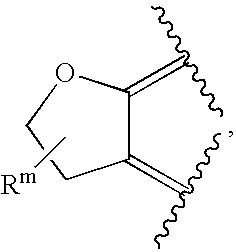
where Rm is C1-6alkyl;
R1 is selected from the group consisting of
-
- 1) hydrogen,
- 2) (CRaRb)1-2R40
- 3) (CRaRb)1-2OR40,
- 4) (CRaRb)1-2N(R40R41),
- 5) (CRaRb)1-2N(R40)C(O)OR41,
- 6) (CRaRb)1-2N(R40)(CRcRd)2N(R41)C(O)R49,
- 7) (CRaRb)1-2C(O)OR40,
- 8) (CRaRb)1-2N(R40)(CRcRd)1-3R41, and
- 9) cyclopropyl.
-
- 1) hydrogen,
- 2) halogen, and
- 3) (CReRf)pOR43.
-
- 1) hydrogen,
- 2) (CRaRb)nR40, and
- 3) (CRaRb)nOR40.
-
- 1) C(O)N(R55R50),
- 2) C(O)OR55, and
- 3) C(O)R82.

- 4-(3-fluorophenyl)-6-methoxy-n,n,2-trimethyl-1-oxo-1,2-dihydroisoquinoline-3-carboxamide,
- 4-(3-fluorophenyl)-6-methoxy-2-methyl-3-(pyrrolidin-1-ylcarbonyl)isoquinolin-1(2H)-one,
- 2-allyl-6-methoxy-1-oxo-4-phenyl-1,2-dihydroisoquinoline-3-carboxamide,
- 6-methoxy-2-methylphenyl-3-pyridin-2-ylisoquinolin-1(2h)-one,
- 2-cyclopropyl-6-methoxyphenyl-3-(1,3-thiazol-2-yl)isoquinolin-1(2h)-one,
- methyl 4-(3-fluorophenyl)-6-methoxy-2-methyl-1-oxo-1,2-dihydroisoquinoline-3-carboxylate,
- methyl 6-methoxy-2-methyl-1-oxo-4-phenyl-1,2-dihydroisoquinoline-3-carboxylate,
- 7-methoxy-2-methyl-1-oxo-phenyl-1,2-dihydroisoquinoline-3-carboxylic acid,
- methyl 7-methoxy-2-methyl-1-oxo-4-phenyl-1,2-dihydroisoquinoline-3-carboxylate, and
- ethyl 2-methyl-1-oxo-4-phenyl-1,2-dihydroisoquinoline-3-carboxylate,
or a pharmaceutically acceptable salt thereof.

wherein w is an integer equal to zero, 1 or 2, the structure is

when w is zero.


imidazo(2,1-b)(1,3)thiazole,

and benzo-1,3-dioxolyl

In certain contexts herein,

is alternatively referred to as phenyl having as a substituent methylenedioxy attached to two adjacent carbon atoms.

which have equivalent meanings.


-
- 1. Patchplate wells are loaded with 3.5 μL of external buffer.
- 2. Planar micropipette hole resistances (Rp) is determined by applying a 10 mV, 160 ms potential difference across each hole (Hole test).
- 3. Cells are pipetted into the Patchplate and form high resistance seals with the 1-2 μm holes at the bottom of each Patchplate well. A seal test scan is performed to determine how many of the Patchplate wells have cells that have formed seals.
- 4. In order to gain electrical access to the cells, intracellular solution containing amphotericin is circulated for 4 minutes on the bottom side of the Patchplate.
- 5. Pre-compound addition test pulse is applied to each well on the Patchplate. Protocol: Cells are voltage clamped at a membrane holding potential of −80 mV for 15 seconds. This is followed by application of a 5 Hz stimulus train (27×150 ms depolarizations to +40 mV). The membrane potential steps to +40 mV evoke outward (positive) ionic currents.
- 6. Compound is added to each well of the Patchplate. Compounds are allowed to incubate for 5 minutes.
- 7. Post-compound addition test pulse protocol is applied. Protocol: Cells are voltage clamped at a membrane holding potential of −80 mV for 15 seconds. This is followed by application of a 5 Hz stimulus train (27×150 ms depolarizations to +40 mV).
% of Control=100×(1+([Drug]/IC500)p)−1
-
- 1) seal resistance
- 2) baseline metric (the mean current at −70 mV from 5 to 45 ms before the first depolarization to +40 mV)
- 3) current run up metric (pre-compound mean current amplitude during the 1st depolarization to +40 mV minus the pre-compound mean current amplitude during the 27th depolarization to +40 mV)
- 4) peak current (maximum current amplitude during the 27th depolarization to +40 mV during the 5 Hz train).
All metrics are obtained during both the pre- and post-compound addition traces. Cells are eliminated from further analysis if: - 1) seal resistance is <50 MΩ
- 2) baseline metric is >±100 pA during the pre-compound
- 3) current run up metric is >−0.2 nA
- 4) pre-read peak metric is <400 pA.
The above-listed compounds provide ≧20% inhibition at a concentration of 33 μM or less in the high throughput Kv1.5 planar patch clamp assay described above.
Atomic Absorption Spectroscope Protocol:
-
- 1. 40,000 cells per well are seeded in a 96-well cell culture plate (assay plate) and the cells are allowed to grow for 48 hours at 37° C.
- 2. The medium is removed and 200 μl of Rb Load Buffer (Aurora Biomed, Vancouver, BC) is added for 3 hours at 37° C. under 5% CO2.
- 3. The cells are washed 5 times with 200 μl Hank's Balanced Salt Solution (HBSS) followed by the addition of 100 μl HBSS containing test compound or 0.5% DMSO.
- 4. After 10 min, 100 μl of HEPES-buffered saline containing 140 mM KCl is added and plate is incubated at RT for 5 min. with gentle shaking.
- 5. Immediately thereafter, 150 μl of supernatant is transferred to a fresh 96 well plate and the remaining supernatant aspirated.
- 6. 120 μl of Cell Lysis Buffer (Aurora Biomed, Vancouver, BC) is added to the assay plate and shaken for 10 min. prior to analysis.
- 7. Rb content is measured in samples of supernatant (SUP) and lysate (LYS) using an ICR-8000 automated AAS instrument (Aurora Biomed, Vancouver, BC).
% FLUX=100%*(SUP/(LYS+SUP)). % INH=100%*(1−(A−B)/(C−B)), where A is % FLUX in the presence of tested compound, B is % FLUX in the presence of 10 mM (6-methoxy-2-methyl-1-oxo-4-phenyl-1,2-dihydroisoquinolin-3-yl)-N,N-dimethylmethanaminium chloride, C is % FLUX in the presence of 0.25% DMSO.
Claims (8)


Priority Applications (1)
| Application Number | Priority Date | Filing Date | Title |
|---|---|---|---|
| US10/572,343 US7781457B2 (en) | 2003-09-23 | 2004-09-22 | Isoquinolinone potassium channel inhibitors |
Applications Claiming Priority (3)
| Application Number | Priority Date | Filing Date | Title |
|---|---|---|---|
| US50513803P | 2003-09-23 | 2003-09-23 | |
| PCT/US2004/030944 WO2005030727A1 (en) | 2003-09-23 | 2004-09-22 | Isoquinolinone potassium channel inhibitors |
| US10/572,343 US7781457B2 (en) | 2003-09-23 | 2004-09-22 | Isoquinolinone potassium channel inhibitors |
Publications (2)
| Publication Number | Publication Date |
|---|---|
| US20060270704A1 US20060270704A1 (en) | 2006-11-30 |
| US7781457B2 true US7781457B2 (en) | 2010-08-24 |
Family
ID=34392983
Family Applications (1)
| Application Number | Title | Priority Date | Filing Date |
|---|---|---|---|
| US10/572,343 Expired - Fee Related US7781457B2 (en) | 2003-09-23 | 2004-09-22 | Isoquinolinone potassium channel inhibitors |
Country Status (7)
| Country | Link |
|---|---|
| US (1) | US7781457B2 (en) |
| EP (1) | EP1667977A4 (en) |
| JP (1) | JP4719152B2 (en) |
| CN (1) | CN1856473A (en) |
| AU (1) | AU2004276267B2 (en) |
| CA (1) | CA2539541C (en) |
| WO (1) | WO2005030727A1 (en) |
Families Citing this family (20)
| Publication number | Priority date | Publication date | Assignee | Title |
|---|---|---|---|---|
| WO2005030729A1 (en) * | 2003-09-23 | 2005-04-07 | Merck & Co., Inc. | Isoquinoline potassium channel inhibitors |
| AU2004289186B2 (en) * | 2003-09-23 | 2010-12-16 | Merck Sharp & Dohme Corp. | Isoquinolinone potassium channel inhibitors |
| EP1667976B1 (en) * | 2003-09-23 | 2010-08-04 | Merck Sharp & Dohme Corp. | Isoquinolinone potassium channel inhibitors |
| US7723352B2 (en) * | 2003-09-23 | 2010-05-25 | Merck Sharp & Dohme | Isoquinolinone potassium channel inhibitors |
| US7569589B2 (en) | 2004-07-29 | 2009-08-04 | Merck & Co., Inc. | Potassium channel inhibitors |
| CN1993347A (en) | 2004-07-29 | 2007-07-04 | 默克公司 | Potassium channel inhibitors |
| CN101277939A (en) | 2005-09-09 | 2008-10-01 | 布里斯托尔-迈尔斯斯奎布公司 | Acyclic IKUR inhibitors |
| WO2007121453A2 (en) * | 2006-04-17 | 2007-10-25 | The Regents Of The University Of California | 2-hydroxy-1-oxo 1,2 dihydro isoquinoline chelating agents |
| BRPI0710946A2 (en) * | 2006-04-27 | 2012-03-06 | Sanofi-Aventis Deutschland Gmbh | Ion channel inhibitors task-1 and task-3 |
| DE102006019589A1 (en) * | 2006-04-27 | 2007-10-31 | Sanofi-Aventis Deutschland Gmbh | Inhibitors of the TASK-1 and Task-3 ion channel |
| US8557601B2 (en) | 2006-07-10 | 2013-10-15 | The Regents Of The University Of California | Luminescent 1-hydroxy-2-pyridinone chelates of lanthanides |
| US9623021B2 (en) * | 2007-01-22 | 2017-04-18 | Gtx, Inc. | Nuclear receptor binding agents |
| EA026578B1 (en) | 2007-01-22 | 2017-04-28 | ДЖиТиЭкс, ИНК. | Nuclear receptor binding agents |
| US9604931B2 (en) | 2007-01-22 | 2017-03-28 | Gtx, Inc. | Nuclear receptor binding agents |
| CA2738313A1 (en) * | 2008-09-23 | 2010-04-08 | Georgetown University | Viral and fungal inhibitors |
| US8563580B2 (en) | 2008-09-23 | 2013-10-22 | Georgetown University | Flavivirus inhibitors and methods for their use |
| WO2011025790A1 (en) | 2009-08-24 | 2011-03-03 | Lumiphore, Inc. | Macrocyclic hopo chelators |
| CA2807886A1 (en) * | 2010-09-01 | 2012-03-08 | Gruenenthal Gmbh | Substituted 1-oxo-dihydroisoquinoline-3-carboxamides as kcnq2/3 modulators |
| CN103864684A (en) * | 2012-12-07 | 2014-06-18 | 天津科技大学 | Synthesis of novel 3,4-dihydro-1(2H)isoquinoline derivatives and application in antitumor drugs |
| US11453652B2 (en) | 2013-03-15 | 2022-09-27 | Lumiphore, Inc. | Di-macrocycles |
Citations (8)
| Publication number | Priority date | Publication date | Assignee | Title |
|---|---|---|---|---|
| EP0481383A1 (en) | 1990-10-16 | 1992-04-22 | Takeda Chemical Industries, Ltd. | Heterocyclic amine derivatives, their production and use |
| EP0566069A1 (en) | 1992-04-15 | 1993-10-20 | Takeda Chemical Industries, Ltd. | Tachykinin receptor antagonists, isoquinolones and their production |
| EP0585913A2 (en) | 1992-09-04 | 1994-03-09 | Takeda Chemical Industries, Ltd. | Condensed heterocyclic compounds, their production and use |
| EP0652218A1 (en) | 1993-11-10 | 1995-05-10 | Takeda Chemical Industries, Ltd. | Heterocyclic compounds, their production and use |
| WO1998038168A1 (en) | 1997-02-27 | 1998-09-03 | Tanabe Seiyaku Co., Ltd. | Isoquinolinone derivatives, process for preparing the same, and their use as phosphodiesterase inhibitors |
| JP2000072751A (en) | 1998-08-26 | 2000-03-07 | Tanabe Seiyaku Co Ltd | Isoquinolinone derivative |
| WO2002006274A1 (en) * | 2000-07-17 | 2002-01-24 | Wyeth | N-(4-sulfonylaryl)cyclylamine-2-hydroxyethylamines as beta-3 adrenergic receptor agonists |
| WO2002062764A1 (en) | 2001-02-02 | 2002-08-15 | Takeda Chemical Industries, Ltd. | Fused heterocyclic compounds |
Family Cites Families (7)
| Publication number | Priority date | Publication date | Assignee | Title |
|---|---|---|---|---|
| JPH10298164A (en) * | 1997-02-27 | 1998-11-10 | Tanabe Seiyaku Co Ltd | Isoquinolinone derivative, its production method and its synthetic intermediate |
| AU2002212969B2 (en) * | 2000-09-20 | 2006-07-06 | Merck Sharp & Dohme Corp. | Isoquinolinone potassium channel inhibitors |
| WO2003068750A1 (en) * | 2002-02-13 | 2003-08-21 | Takeda Chemical Industries, Ltd. | Jnk inhibitor |
| WO2005030729A1 (en) * | 2003-09-23 | 2005-04-07 | Merck & Co., Inc. | Isoquinoline potassium channel inhibitors |
| US7723352B2 (en) * | 2003-09-23 | 2010-05-25 | Merck Sharp & Dohme | Isoquinolinone potassium channel inhibitors |
| EP1667976B1 (en) * | 2003-09-23 | 2010-08-04 | Merck Sharp & Dohme Corp. | Isoquinolinone potassium channel inhibitors |
| AU2004289186B2 (en) * | 2003-09-23 | 2010-12-16 | Merck Sharp & Dohme Corp. | Isoquinolinone potassium channel inhibitors |
-
2004
- 2004-09-22 JP JP2006528110A patent/JP4719152B2/en not_active Expired - Fee Related
- 2004-09-22 WO PCT/US2004/030944 patent/WO2005030727A1/en not_active Ceased
- 2004-09-22 US US10/572,343 patent/US7781457B2/en not_active Expired - Fee Related
- 2004-09-22 CN CNA2004800273785A patent/CN1856473A/en active Pending
- 2004-09-22 AU AU2004276267A patent/AU2004276267B2/en not_active Ceased
- 2004-09-22 EP EP04788883A patent/EP1667977A4/en not_active Withdrawn
- 2004-09-22 CA CA2539541A patent/CA2539541C/en not_active Expired - Fee Related
Patent Citations (8)
| Publication number | Priority date | Publication date | Assignee | Title |
|---|---|---|---|---|
| EP0481383A1 (en) | 1990-10-16 | 1992-04-22 | Takeda Chemical Industries, Ltd. | Heterocyclic amine derivatives, their production and use |
| EP0566069A1 (en) | 1992-04-15 | 1993-10-20 | Takeda Chemical Industries, Ltd. | Tachykinin receptor antagonists, isoquinolones and their production |
| EP0585913A2 (en) | 1992-09-04 | 1994-03-09 | Takeda Chemical Industries, Ltd. | Condensed heterocyclic compounds, their production and use |
| EP0652218A1 (en) | 1993-11-10 | 1995-05-10 | Takeda Chemical Industries, Ltd. | Heterocyclic compounds, their production and use |
| WO1998038168A1 (en) | 1997-02-27 | 1998-09-03 | Tanabe Seiyaku Co., Ltd. | Isoquinolinone derivatives, process for preparing the same, and their use as phosphodiesterase inhibitors |
| JP2000072751A (en) | 1998-08-26 | 2000-03-07 | Tanabe Seiyaku Co Ltd | Isoquinolinone derivative |
| WO2002006274A1 (en) * | 2000-07-17 | 2002-01-24 | Wyeth | N-(4-sulfonylaryl)cyclylamine-2-hydroxyethylamines as beta-3 adrenergic receptor agonists |
| WO2002062764A1 (en) | 2001-02-02 | 2002-08-15 | Takeda Chemical Industries, Ltd. | Fused heterocyclic compounds |
Non-Patent Citations (5)
| Title |
|---|
| Duro, Synthesis and pharmacological activity of amino- and dialkylaminoalkylamide derivatives of 3-carboxy-4-phenylisoquinoline. Database CA Chemical Abstracts Service, Columbus, OH, US 1981. |
| Natsugari, Novel, potent, and orally active Substance P antagonists: synthesis and antagonist activity of N-benzylcarboxamide derivatives of pyrido[3,4-b]pyridine, Journal of Medicinal Chemistry, American Chemical Society, Washington, US, vol. 38, No. 16, Jan. 1, 1995, pp. 3106-3120. |
| Nunami, et al., J. Org. Chem., vol. 44, No. 11 (1979), pp. 1887-1888. |
| Supplementary European Search Report EP 04 78 8883, PCT/ US 20040309844. |
| Unverferth, Synthese und antikonvulsive Aktivitaet von 3-carbamoyl-4-aryl-isochinolin-1(2H)-onen, Archiv der Pharmazie, VCH Verlagsgesellschaft MBH, Weinheim DE, vol. 324, No. 10, Oct. 1, 1991, pp. 809-814 . |
Also Published As
| Publication number | Publication date |
|---|---|
| JP4719152B2 (en) | 2011-07-06 |
| CN1856473A (en) | 2006-11-01 |
| WO2005030727A1 (en) | 2005-04-07 |
| AU2004276267B2 (en) | 2010-08-19 |
| CA2539541C (en) | 2010-06-29 |
| US20060270704A1 (en) | 2006-11-30 |
| CA2539541A1 (en) | 2005-04-07 |
| EP1667977A4 (en) | 2009-09-09 |
| AU2004276267A1 (en) | 2005-04-07 |
| EP1667977A1 (en) | 2006-06-14 |
| JP2007506748A (en) | 2007-03-22 |
Similar Documents
| Publication | Publication Date | Title |
|---|---|---|
| US8338449B2 (en) | Isoquinolinone potassium channel inhibitors | |
| US7709476B2 (en) | Isoquinolinone potassium channel inhibitors | |
| US7692017B2 (en) | Quinoline potassium channel inhibitors | |
| US7781457B2 (en) | Isoquinolinone potassium channel inhibitors | |
| US7906521B2 (en) | Quinazoline potassium channel inhibitors | |
| US7763614B2 (en) | Isoquinoline potassium channel inhibitors | |
| US7741322B2 (en) | Isoquinolinone potassium channel inhibitors | |
| US7825131B2 (en) | Quinoline potassium channel inhibitors |
Legal Events
| Date | Code | Title | Description |
|---|---|---|---|
| AS | Assignment |
Owner name: MERCK & CO., INC., NEW JERSEY Free format text: ASSIGNMENT OF ASSIGNORS INTEREST;ASSIGNORS:TROTTER, B. WESLEY;NANDA, KAUSIK K.;KETT, NATHAN R.;AND OTHERS;SIGNING DATES FROM 20040819 TO 20040909;REEL/FRAME:018755/0899 Owner name: MERCK & CO., INC., NEW JERSEY Free format text: ASSIGNMENT OF ASSIGNORS INTEREST;ASSIGNORS:TROTTER, B. WESLEY;NANDA, KAUSIK K.;KETT, NATHAN R.;AND OTHERS;REEL/FRAME:018755/0899;SIGNING DATES FROM 20040819 TO 20040909 |
|
| AS | Assignment |
Owner name: MERCK & CO., INC., NEW JERSEY Free format text: ASSIGNMENT OF ASSIGNORS INTEREST;ASSIGNORS:ISAACS, RICHARD;DINSMORE, CHRISTOPHER J.;MCINTYRE, CHARLES J.;AND OTHERS;SIGNING DATES FROM 20040901 TO 20040920;REEL/FRAME:018763/0231 Owner name: MERCK & CO., INC., NEW JERSEY Free format text: ASSIGNMENT OF ASSIGNORS INTEREST;ASSIGNORS:ISAACS, RICHARD;DINSMORE, CHRISTOPHER J.;MCINTYRE, CHARLES J.;AND OTHERS;REEL/FRAME:018763/0231;SIGNING DATES FROM 20040901 TO 20040920 |
|
| AS | Assignment |
Owner name: MERCK SHARP & DOHME CORP., NEW JERSEY Free format text: CHANGE OF NAME;ASSIGNOR:MERCK & CO., INC.;REEL/FRAME:023834/0029 Effective date: 20091102 Owner name: MERCK SHARP & DOHME CORP.,NEW JERSEY Free format text: CHANGE OF NAME;ASSIGNOR:MERCK & CO., INC.;REEL/FRAME:023834/0029 Effective date: 20091102 |
|
| AS | Assignment |
Owner name: SCHERING CORPORATION, NEW JERSEY Free format text: MERGER;ASSIGNOR:MERCK SHARP & DOHME CORP.;REEL/FRAME:028850/0515 Effective date: 20120426 |
|
| AS | Assignment |
Owner name: MERCK SHARP & DOHME CORP., NEW JERSEY Free format text: CHANGE OF NAME;ASSIGNOR:SCHERING CORPORATION;REEL/FRAME:028866/0511 Effective date: 20120502 |
|
| FPAY | Fee payment |
Year of fee payment: 4 |
|
| FEPP | Fee payment procedure |
Free format text: MAINTENANCE FEE REMINDER MAILED (ORIGINAL EVENT CODE: REM.) |
|
| LAPS | Lapse for failure to pay maintenance fees |
Free format text: PATENT EXPIRED FOR FAILURE TO PAY MAINTENANCE FEES (ORIGINAL EVENT CODE: EXP.); ENTITY STATUS OF PATENT OWNER: LARGE ENTITY |
|
| STCH | Information on status: patent discontinuation |
Free format text: PATENT EXPIRED DUE TO NONPAYMENT OF MAINTENANCE FEES UNDER 37 CFR 1.362 |
|
| FP | Lapsed due to failure to pay maintenance fee |
Effective date: 20180824 |