US7776972B2 - Phosphine-based polymers and poly(lactic acid) material comprising the same - Google Patents

Phosphine-based polymers and poly(lactic acid) material comprising the same Download PDF

Info

Publication number
US7776972B2
US7776972B2 US12/463,096 US46309609A US7776972B2 US 7776972 B2 US7776972 B2 US 7776972B2 US 46309609 A US46309609 A US 46309609A US 7776972 B2 US7776972 B2 US 7776972B2
Authority
US
United States
Prior art keywords
phosphine
pla
based polymer
lactic acid
poly
Prior art date
Legal status (The legal status is an assumption and is not a legal conclusion. Google has not performed a legal analysis and makes no representation as to the accuracy of the status listed.)
Active
Application number
US12/463,096
Other versions
US20100144979A1 (en
Inventor
Tun-Fun Way
Kelly Teng
Jiun-Jy Chen
Current Assignee (The listed assignees may be inaccurate. Google has not performed a legal analysis and makes no representation or warranty as to the accuracy of the list.)
Industrial Technology Research Institute ITRI
Original Assignee
Industrial Technology Research Institute ITRI
Priority date (The priority date is an assumption and is not a legal conclusion. Google has not performed a legal analysis and makes no representation as to the accuracy of the date listed.)
Filing date
Publication date
Application filed by Industrial Technology Research Institute ITRI filed Critical Industrial Technology Research Institute ITRI
Assigned to INDUSTRIAL TECHNOLOGY RESEARCH INSTITUTE reassignment INDUSTRIAL TECHNOLOGY RESEARCH INSTITUTE ASSIGNMENT OF ASSIGNORS INTEREST (SEE DOCUMENT FOR DETAILS). Assignors: CHEN, JIUN-JY, TENG, KELLY, WAY, TUN-FUN
Publication of US20100144979A1 publication Critical patent/US20100144979A1/en
Application granted granted Critical
Publication of US7776972B2 publication Critical patent/US7776972B2/en
Active legal-status Critical Current
Anticipated expiration legal-status Critical

Links

Classifications

    • CCHEMISTRY; METALLURGY
    • C08ORGANIC MACROMOLECULAR COMPOUNDS; THEIR PREPARATION OR CHEMICAL WORKING-UP; COMPOSITIONS BASED THEREON
    • C08LCOMPOSITIONS OF MACROMOLECULAR COMPOUNDS
    • C08L67/00Compositions of polyesters obtained by reactions forming a carboxylic ester link in the main chain; Compositions of derivatives of such polymers
    • C08L67/04Polyesters derived from hydroxycarboxylic acids, e.g. lactones
    • CCHEMISTRY; METALLURGY
    • C07ORGANIC CHEMISTRY
    • C07FACYCLIC, CARBOCYCLIC OR HETEROCYCLIC COMPOUNDS CONTAINING ELEMENTS OTHER THAN CARBON, HYDROGEN, HALOGEN, OXYGEN, NITROGEN, SULFUR, SELENIUM OR TELLURIUM
    • C07F9/00Compounds containing elements of Groups 5 or 15 of the Periodic Table
    • C07F9/02Phosphorus compounds
    • C07F9/06Phosphorus compounds without P—C bonds
    • C07F9/08Esters of oxyacids of phosphorus
    • C07F9/141Esters of phosphorous acids
    • C07F9/1411Esters of phosphorous acids with hydroxyalkyl compounds with further substituents on alkyl
    • CCHEMISTRY; METALLURGY
    • C08ORGANIC MACROMOLECULAR COMPOUNDS; THEIR PREPARATION OR CHEMICAL WORKING-UP; COMPOSITIONS BASED THEREON
    • C08GMACROMOLECULAR COMPOUNDS OBTAINED OTHERWISE THAN BY REACTIONS ONLY INVOLVING UNSATURATED CARBON-TO-CARBON BONDS
    • C08G79/00Macromolecular compounds obtained by reactions forming a linkage containing atoms other than silicon, sulfur, nitrogen, oxygen, and carbon with or without the latter elements in the main chain of the macromolecule
    • C08G79/02Macromolecular compounds obtained by reactions forming a linkage containing atoms other than silicon, sulfur, nitrogen, oxygen, and carbon with or without the latter elements in the main chain of the macromolecule a linkage containing phosphorus
    • C08G79/04Phosphorus linked to oxygen or to oxygen and carbon
    • CCHEMISTRY; METALLURGY
    • C08ORGANIC MACROMOLECULAR COMPOUNDS; THEIR PREPARATION OR CHEMICAL WORKING-UP; COMPOSITIONS BASED THEREON
    • C08LCOMPOSITIONS OF MACROMOLECULAR COMPOUNDS
    • C08L85/00Compositions of macromolecular compounds obtained by reactions forming a linkage in the main chain of the macromolecule containing atoms other than silicon, sulfur, nitrogen, oxygen and carbon; Compositions of derivatives of such polymers
    • C08L85/02Compositions of macromolecular compounds obtained by reactions forming a linkage in the main chain of the macromolecule containing atoms other than silicon, sulfur, nitrogen, oxygen and carbon; Compositions of derivatives of such polymers containing phosphorus

Definitions

  • the invention relates to a polymer, and more particularly to a phosphine-based polymer and a poly(lactic acid) material comprising the same.
  • PLA Poly(lactic acid)
  • Cargill Corporation has greatly invested in development of PLA.
  • PLA's price is close to nylon and is expected to be equivalent in price to PET in the future.
  • PLA is used mostly in commercialization of biodegradable materials or biomass materials.
  • PLA has been widely utilized in biomedicine, agriculture, clothing, furniture, ornaments, implements for daily use and packaging materials.
  • PLA Compared to conventional polymers, for example, PET, nylon, PE and PP, PLA's molecular weight is violently decreased during a melt process, achieving 35-60% of its molecular weight. That is, its molecular weight (Mw) ratio (Mw(after processing)/Mw(before processing)) is merely 65-40%, as reported by Bhuvanesh Gupta (Prog. Polym. Sci. 32 (2007) 455 review), such that stability and quality of products made thereof are deteriorated. The same aforementioned result also occurs for modification of the processability of textiles, plastics and thin films. Meanwhile, the decrease in molecular weight of PLA copolymers are more serious than that of PLA homopolymers.
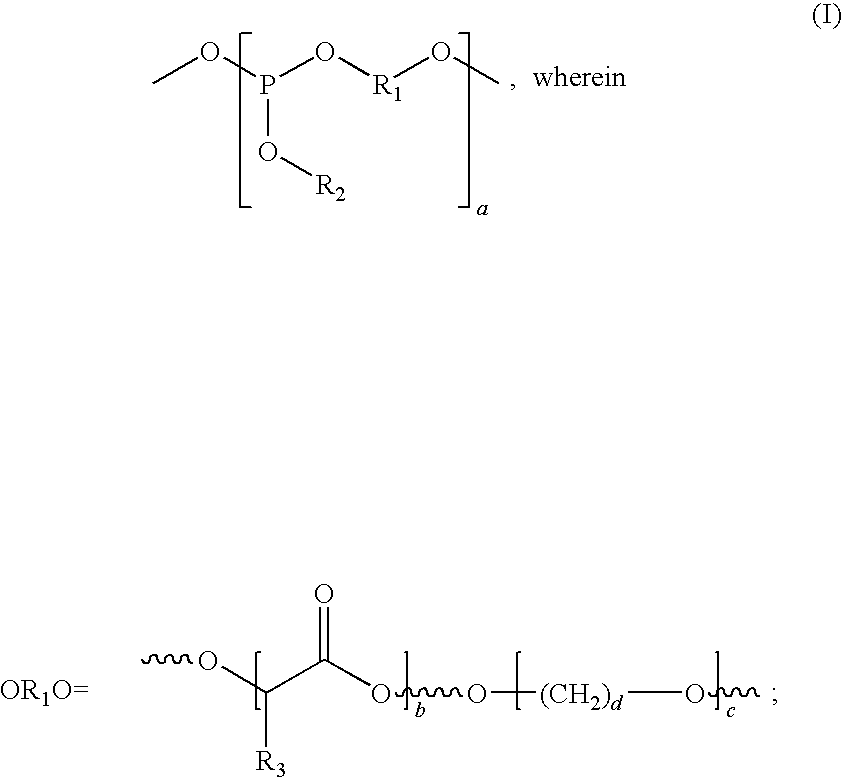
  • One embodiment of the invention provides a phosphine-based polymer having Formula (I):
  • R 2 —OCH 3 or —OCH 2 CH 3
  • R 3 —CH 3
  • One embodiment of the invention provides a poly(lactic acid) (PLA) material comprising poly(lactic acid) and the disclosed phosphine-based polymer.
  • PLA poly(lactic acid)
  • the phosphine-based polymer containing the PLA structure is compatible with PLA, reducing compound leakage after blending.
  • TNPP trinonylphenyl phosphine
  • the phosphine-based polymer has a high boiling point, capable of avoiding evaporation and leakage when being processed.
  • the phosphine-based polymer without nonylphenol acts more like an environmental protection type plasticizer.
  • the phosphine-based polymer is compatible with PLA and acts more like an environmental protection type plasticizer.
  • the molecular weight (Mw) ratio (Mw(after processing)/Mw(before processing)) of the PLA blended with the phosphine-based polymer is not less than 80%.
  • the blend of PLA and the phosphine-based polymer with high content, for example, 10 wt % possesses fire retardation (self-extinguishing properties following direct exposure to flames).
  • One embodiment of the invention provides a phosphine-based polymer having Formula (I):
  • R 2 —OCH 3 or —OCH 2 CH 3
  • R 3 —CH 3
  • a 2-20
  • b 1-8 or 2-5
  • One embodiment of the invention provides a poly(lactic acid) (PLA) material comprising poly(lactic acid) and the disclosed phosphine-based polymer.
  • PLA poly(lactic acid)
  • the phosphine-based polymer may have a weight ratio of 0.05-10 or 2-3 parts by weight, based on 100 parts by weight of the poly(lactic acid).
  • the poly(lactic acid) material may further comprise inorganic nanoparticles or the like, for example, silicon dioxide, titanium dioxide, zinc dioxide or zirconium dioxide.
  • the phosphine-based polymer may have a weight ratio of 0.05-10 parts by weight, based on 100 parts by weight of the poly(lactic acid) material.
  • the inorganic nanoparticles may have a weight ratio of 0.05-10 parts by weight, based on 100 parts by weight of the poly(lactic acid) material.
  • the poly(lactic acid) may have a weight ratio of 80-99.9 parts by weight, based on 100 parts by weight of the poly(lactic acid) material.
  • the phosphine-based polymer containing the PLA structure is compatible with PLA, reducing compound leakage after blending.
  • TNPP trinonylphenyl phosphine
  • the phosphine-based polymer has a high boiling point, capable of avoiding evaporation and leakage when being processed.
  • the phosphine-based polymer without nonylphenol acts more like an environmental protection type plasticizer.
  • the phosphine-based polymer is compatible with PLA and acts more like an environmental protection type plasticizer.
  • the molecular weight (Mw) ratio (Mw(after processing)/Mw(before processing)) of the PLA blended with the phosphine-based polymer is not less than 80%.
  • the blend of PLA and the phosphine-based polymer with high content, for example, 10 wt % possesses fire retardation (self-extinguishing properties following direct exposure to flames).
  • One embodiment of the invention provides preparing a phosphine-based polymer.
  • the molar ratio between the catalyst and the compound having Formula (II) is 1.5 to 2.5.
  • lactic acid methyl ester 0.125 mole ethylene glycol (EG) and 0.3 mole tetrabutyl tin (TBT) were added to a 250 mL reaction bottle and heated to 140° C. under an oil bath to react for 4 hours (sampled each hour). After distilling, a first distillation solution was collected. Next, the first distillation solution was heated to 180° C. to react for 2 hours and sampled. After cooling to 140° C. and distilling, a second distillation solution was collected. The second distillation solution was then heated to 200° C. to react for 2 hours and sampled. After cooling to 140° C. and distilling, a third distillation solution was collected. After reduced-pressure distilling at 130° C., a fourth distillation solution was collected and analyzed.
  • EG ethylene glycol
  • TBT tetrabutyl tin
  • Formula (II) compound (compound 1) prepared by Example 1 was reacted with P(OEt)Cl 2 (molar ratio of 1:1) at 40° C. with diisopropyl ethylamine (catalyst) for 5 hours to prepare Formula (I) compound (phosphine 1).
  • Formula (II) compound prepared by Example 2 was reacted with P(OEt)Cl 2 (molar ratio of 1:1) at 40° C. with diisopropyl ethylamine (catalyst) for 5 hours to prepare Formula (I) compound.
  • PLA molecular PLA molecular Additive weight weight weight Molecular weight ratio amount (before heating) (after heating) (Mw (after heating)/Mw (wt %) (g/mole) (g/mole) (before heating)) 0 211,320 126,792 65 0.1 211,320 166,942 80 1.0 211,320 181,735 86 5.0 211,320 175,395 83
  • PLA molecular PLA molecular Additive weight weight weight Molecular weight ratio amount (before heating) (after heating) (Mw (after heating)/Mw (wt %) (g/mole) (g/mole) (before heating)) 0 210,041 130,225 62 1.0 210,041 176,434 84 5.0 210,041 170,133 81
  • the melt-blown nonwoven had strength not less than 1.5 Kg/5 cm, fiber fineness not greater than 10 ⁇ m and a basis weight not less than 70 g/m 2 .
  • PLA molecular PLA molecular Additive weight weight weight Molecular weight ratio amount (before heating) (after heating) (Mw (after heating)/Mw (wt %) (g/mole) (g/mole) (before heating)) 0 210,450 134,688 64 1.0 210,450 174,673 83 5.0 210,450 172,569 82
  • the PLA blended with phosphine-based polymer (additive) had a higher molecular weight than that of the conventional PLA after heating, with a molecular weight ratio (Mw(after heating)/Mw(before heating)) exceeding 82%. After extending 1.5 times, the fiber had long fiber fineness of 1.5 dpf, strength of 3.1 g/d and extension of 30-40%.

Landscapes

  • Chemical & Material Sciences (AREA)
  • Organic Chemistry (AREA)
  • Health & Medical Sciences (AREA)
  • Chemical Kinetics & Catalysis (AREA)
  • Medicinal Chemistry (AREA)
  • Polymers & Plastics (AREA)
  • Life Sciences & Earth Sciences (AREA)
  • Biochemistry (AREA)
  • General Health & Medical Sciences (AREA)
  • Molecular Biology (AREA)
  • Compositions Of Macromolecular Compounds (AREA)
  • Biological Depolymerization Polymers (AREA)

Abstract

A phosphine-based polymer having Formula (I) is provided.
Figure US07776972-20100817-C00001

The invention also provides a poly(lactic acid) material including poly(lactic acid) and the disclosed phosphine-based polymer, wherein the phosphine-based polymer has a weight ratio of 0.05-10 parts by weight, based on 100 parts by weight of the poly(lactic acid).

Description

CROSS REFERENCE TO RELATED APPLICATIONS
This Application claims priority of Taiwan Patent Application No. 97147085, filed on Dec. 4, 2008, the entirety of which is incorporated by reference herein.
BACKGROUND OF THE INVENTION
1. Field of the Invention
The invention relates to a polymer, and more particularly to a phosphine-based polymer and a poly(lactic acid) material comprising the same.
2. Description of the Related Art
General polymers produced from petrifaction raw materials, for example, PET, nylon, PP and polystyrene have caused serious river and ditch blockage problems, leading to environmental pollution. Thus, displacement of such general polymers with biodegradable materials is desirable. As economies develop and living standards increase in countries like China, India and Eastern Europe, requirement for petroleum and its related products have substantially increased, resulting in rapid exhaustion of the world's petroleum inventory and rising petroleum and its related product prices. Thus, development of a biomass process utilizing natural materials, for example, soybean, corn, cane, rice and barley combined with biotechnology to produce raw materials is desirable.
Most of the products fabricated by the raw materials produced from biomass processes are biodegradable materials. Poly(lactic acid) (PLA) is prepared from a biomass process and its products possess biodegradability. Cargill Corporation has greatly invested in development of PLA. PLA's price is close to nylon and is expected to be equivalent in price to PET in the future. Currently, PLA is used mostly in commercialization of biodegradable materials or biomass materials. PLA has been widely utilized in biomedicine, agriculture, clothing, furniture, ornaments, implements for daily use and packaging materials.
Applications of PLA, however, suffer from some drawbacks, for example, brittleness, easy pyrolysis and deteriorated processability. Compared to conventional polymers, for example, PET, nylon, PE and PP, PLA's molecular weight is violently decreased during a melt process, achieving 35-60% of its molecular weight. That is, its molecular weight (Mw) ratio (Mw(after processing)/Mw(before processing)) is merely 65-40%, as reported by Bhuvanesh Gupta (Prog. Polym. Sci. 32 (2007) 455 review), such that stability and quality of products made thereof are deteriorated. The same aforementioned result also occurs for modification of the processability of textiles, plastics and thin films. Meanwhile, the decrease in molecular weight of PLA copolymers are more serious than that of PLA homopolymers.
BRIEF SUMMARY OF THE INVENTION
One embodiment of the invention provides a phosphine-based polymer having Formula (I):
Figure US07776972-20100817-C00002

R2=—OCH3 or —OCH2CH3, R3=—CH3, a=2-20, b=1-8, c=1-5 and d=2-6.
One embodiment of the invention provides a poly(lactic acid) (PLA) material comprising poly(lactic acid) and the disclosed phosphine-based polymer.
When PLA is blended with the phosphine-based polymer and processed, decreasing of the PLA molecular weight is effectively inhibited. The phosphine-based polymer containing the PLA structure is compatible with PLA, reducing compound leakage after blending. Compared to conventional trinonylphenyl phosphine (TNPP) monomers, the phosphine-based polymer has a high boiling point, capable of avoiding evaporation and leakage when being processed. Additionally, compared to TNPP containing nonylphenol, the phosphine-based polymer without nonylphenol acts more like an environmental protection type plasticizer.
In addition to effective improvement of anti-pyrolysis for PLA during processing, the phosphine-based polymer is compatible with PLA and acts more like an environmental protection type plasticizer. Specifically, the molecular weight (Mw) ratio (Mw(after processing)/Mw(before processing)) of the PLA blended with the phosphine-based polymer is not less than 80%. Additionally, the blend of PLA and the phosphine-based polymer with high content, for example, 10 wt % possesses fire retardation (self-extinguishing properties following direct exposure to flames).
A detailed description is given in the following embodiments.
DETAILED DESCRIPTION OF THE INVENTION
The following description is of the best-contemplated mode of carrying out the invention. This description is made for the purpose of illustrating the general principles of the invention and should not be taken in a limiting sense. The scope of the invention is best determined by reference to the appended claims.
One embodiment of the invention provides a phosphine-based polymer having Formula (I):
Figure US07776972-20100817-C00003
In Formula (I),
Figure US07776972-20100817-C00004

R2=—OCH3 or —OCH2CH3, R3=—CH3, a=2-20, b=1-8 or 2-5, c=1-5 or 1-2 and d=2-6.
One embodiment of the invention provides a poly(lactic acid) (PLA) material comprising poly(lactic acid) and the disclosed phosphine-based polymer.
The phosphine-based polymer may have a weight ratio of 0.05-10 or 2-3 parts by weight, based on 100 parts by weight of the poly(lactic acid). The poly(lactic acid) material may further comprise inorganic nanoparticles or the like, for example, silicon dioxide, titanium dioxide, zinc dioxide or zirconium dioxide.
The phosphine-based polymer may have a weight ratio of 0.05-10 parts by weight, based on 100 parts by weight of the poly(lactic acid) material. The inorganic nanoparticles may have a weight ratio of 0.05-10 parts by weight, based on 100 parts by weight of the poly(lactic acid) material. The poly(lactic acid) may have a weight ratio of 80-99.9 parts by weight, based on 100 parts by weight of the poly(lactic acid) material.
When PLA is blended with the phosphine-based polymer and processed, decreasing of the PLA molecular weight is effectively inhibited. The phosphine-based polymer containing the PLA structure is compatible with PLA, reducing compound leakage after blending. Compared to conventional trinonylphenyl phosphine (TNPP) monomers, the phosphine-based polymer has a high boiling point, capable of avoiding evaporation and leakage when being processed. Additionally, compared to TNPP containing nonylphenol, the phosphine-based polymer without nonylphenol acts more like an environmental protection type plasticizer.
In addition to effective improvement of anti-pyrolysis of PLA during processing, the phosphine-based polymer is compatible with PLA and acts more like an environmental protection type plasticizer. Specifically, the molecular weight (Mw) ratio (Mw(after processing)/Mw(before processing)) of the PLA blended with the phosphine-based polymer is not less than 80%. Additionally, the blend of PLA and the phosphine-based polymer with high content, for example, 10 wt % possesses fire retardation (self-extinguishing properties following direct exposure to flames).
One embodiment of the invention provides preparing a phosphine-based polymer. A compound having Formula (II) and (R2O)PCl2(R2=—OCH3 or —OCH2CH3) are mixed in a solvent such as chloroform, dichloroethane or tetrahydrofuran (THF) and reacted under a catalyst such as triethylamine, pyridine or diisopropyl ethylamine for 5 hours under a temperature ranging from room temperature to 40° C. to prepare a phosphine-based polymer. The molar ratio between the catalyst and the compound having Formula (II) is 1.5 to 2.5.
Figure US07776972-20100817-C00005
In Formula (II), R3=—CH3, b=1-8, c=1-5 and d=2-6.
EXAMPLE 1 Preparation of the Formula (II) Compound (R3=—CH3, d=6, Monomer is Hexanediol (HDO))
0.75 mole lactic acid methyl ester, 0.125 mole hexanediol (HDO) and 0.3 mole tetrabutyl tin (TBT) were added to a 250 mL reaction bottle and heated to 140° C. under an oil bath to react for 4 hours (sampled each hour). After distilling, a first distillation solution was collected. Next, the first distillation solution was heated to 180° C. to react for 2 hours and sampled. After cooling to 140° C. and distilling, a second distillation solution was collected. The second distillation solution was then heated to 200° C. to react for 2 hours and sampled. After cooling to 140° C. and distilling, a third distillation solution was collected. After reduced-pressure distilling at 130° C., a fourth distillation solution was collected and analyzed. According to 1HNMR, the molar ratio between lactate and hexanediol was 4:1.
1HNMR(CDCl3, ppm):5.1(lactate); 4.2-4.4(—OCH2—); 1.4-1.5(—CH2); 1.3-1.4(lactate).
EXAMPLE 2 Preparation of the Formula (II) Compound (R3=—CH3, d=2, Monomer is Ethylene Glycol (EG))
0.75 mole lactic acid methyl ester, 0.125 mole ethylene glycol (EG) and 0.3 mole tetrabutyl tin (TBT) were added to a 250 mL reaction bottle and heated to 140° C. under an oil bath to react for 4 hours (sampled each hour). After distilling, a first distillation solution was collected. Next, the first distillation solution was heated to 180° C. to react for 2 hours and sampled. After cooling to 140° C. and distilling, a second distillation solution was collected. The second distillation solution was then heated to 200° C. to react for 2 hours and sampled. After cooling to 140° C. and distilling, a third distillation solution was collected. After reduced-pressure distilling at 130° C., a fourth distillation solution was collected and analyzed.
1HNMR(CDCl3, ppm):5.1(lactate); 4.2-4.4(—OCH2—); 1.3-1.4(lactate).
EXAMPLE 3 Preparation of the Formula (I) Compound (1)
Figure US07776972-20100817-C00006
Formula (II) compound (compound 1) prepared by Example 1 was reacted with P(OEt)Cl2 (molar ratio of 1:1) at 40° C. with diisopropyl ethylamine (catalyst) for 5 hours to prepare Formula (I) compound (phosphine 1).
1HNMR(CDCl3, ppm):5.1(lactate); 4.2-4.4(—OCH2—); 1.4-1.5(—CH2); 1.3-1.4(—CH3).
EXAMPLE 4 Preparation of the Formula (I) Compound (2)
Formula (II) compound prepared by Example 2 was reacted with P(OEt)Cl2 (molar ratio of 1:1) at 40° C. with diisopropyl ethylamine (catalyst) for 5 hours to prepare Formula (I) compound.
1HNMR(CDCl3, ppm):5.1(lactate); 4.2-4.4(—OCH2—); 1.3-1.4(—CH3).
31PNMR(CDCl3,ppm):139(phosphine).
EXAMPLE 5 Anti-pyrolysis Test for PLA Blended with Phosphine-based Polymer
Dried PLA and the Formula (I) compound (additive) prepared by Example 3 were blended in a twin screw extruder (screw diameter=30 mM, L/D=52, temperature=230° C., retention time=7 minutes). The molecular weight of the formed ester particle was analyzed with GPC, as shown in Table 1.
TABLE 1
PLA molecular PLA molecular
Additive weight weight Molecular weight ratio
amount (before heating) (after heating) (Mw (after heating)/Mw
(wt %) (g/mole) (g/mole) (before heating))
0 211,320 126,792 65
0.1 211,320 166,942 80
1.0 211,320 181,735 86
5.0 211,320 175,395 83
The results indicate that the PLA blended with the phosphine-based polymer (additive) had a higher molecular weight than that of the conventional PLA after heating, with a molecular weight ratio (Mw(after heating)/Mw(before heating)) exceeding 80%.
EXAMPLE 6 Melt-blown Spinning Test for the PLA Blended with the Phosphine-based Polymer
Dried PLA and the Formula (I) compound (additive) prepared by Example 4 were blended and spun with melt-blown spinning at 230° C. The molecular weight of the formed melt-blown nonwoven was analyzed with GPC, as shown in Table 2.
TABLE 2
PLA molecular PLA molecular
Additive weight weight Molecular weight ratio
amount (before heating) (after heating) (Mw (after heating)/Mw
(wt %) (g/mole) (g/mole) (before heating))
0 210,041 130,225 62
1.0 210,041 176,434 84
5.0 210,041 170,133 81
The results indicate that the PLA blended with phosphine-based polymer (additive) had a higher molecular weight than that of the conventional PLA after heating, with a molecular weight ratio (Mw(after heating)/Mw(before heating)) exceeding 80%. The melt-blown nonwoven had strength not less than 1.5 Kg/5 cm, fiber fineness not greater than 10 μm and a basis weight not less than 70 g/m2.
EXAMPLE 7 Long Fiber Spinning Test for PLA Blended with Phosphine-based Polymer
Dried PLA and the Formula (I) compound (additive) prepared by Example 4 were blended and spun with a long fiber spinning (spinneret diameter=0.3 mM, temperature=230° C., retention time=7 minutes). The molecular weight of the formed fiber was analyzed with GPC, as shown in Table 3.
TABLE 3
PLA molecular PLA molecular
Additive weight weight Molecular weight ratio
amount (before heating) (after heating) (Mw (after heating)/Mw
(wt %) (g/mole) (g/mole) (before heating))
0 210,450 134,688 64
1.0 210,450 174,673 83
5.0 210,450 172,569 82
The results indicate that the PLA blended with phosphine-based polymer (additive) had a higher molecular weight than that of the conventional PLA after heating, with a molecular weight ratio (Mw(after heating)/Mw(before heating)) exceeding 82%. After extending 1.5 times, the fiber had long fiber fineness of 1.5 dpf, strength of 3.1 g/d and extension of 30-40%.
While the invention has been described by way of example and in terms of preferred embodiment, it is to be understood that the invention is not limited thereto. To the contrary, it is intended to cover various modifications and similar arrangements (as would be apparent to those skilled in the art). Therefore, the scope of the appended claims should be accorded the broadest interpretation so as to encompass all such modifications and similar arrangements.

Claims (5)

1. A phosphine-based polymer having Formula (I):
Figure US07776972-20100817-C00007
R2=—CH3 or —CH2CH3;
R3=—CH3;
a=2-20;
b=1-8;
c=1-5; and
d=2-6.
2. The phosphine-based polymer as claimed in claim 1, wherein b=2-5 and c=1-2.
3. A poly(lactic acid) material, comprising:
poly(lactic acid); and
a phosphine-based polymer having Formula (I):
Figure US07776972-20100817-C00008
R2=—CH3 or —CH2CH3;
R3=—CH3;
a=2-20;
b=1-8;
c=1-5; and
d=2-6.
4. The poly(lactic acid) material as claimed in claim 3, wherein the phosphine-based polymer is present in the amount of 0.05-10 parts by weight, based on 100 parts by weight of the poly(lactic acid).
5. The poly(lactic acid) material as claimed in claim 3, wherein the phosphine-based polymer is present in the amount of 2-3 parts by weight, based on 100 parts by weight of the poly(lactic acid).
US12/463,096 2008-12-04 2009-05-08 Phosphine-based polymers and poly(lactic acid) material comprising the same Active US7776972B2 (en)

Applications Claiming Priority (3)

Application Number Priority Date Filing Date Title
TW97147085A 2008-12-04
TW097147085A TWI381021B (en) 2008-12-04 2008-12-04 Phosphine-based polymers and poly (lactic acid) material comprising the same
TW097147085 2008-12-04

Publications (2)

Publication Number Publication Date
US20100144979A1 US20100144979A1 (en) 2010-06-10
US7776972B2 true US7776972B2 (en) 2010-08-17

Family

ID=42231824

Family Applications (1)

Application Number Title Priority Date Filing Date
US12/463,096 Active US7776972B2 (en) 2008-12-04 2009-05-08 Phosphine-based polymers and poly(lactic acid) material comprising the same

Country Status (2)

Country Link
US (1) US7776972B2 (en)
TW (1) TWI381021B (en)

Cited By (1)

* Cited by examiner, † Cited by third party
Publication number Priority date Publication date Assignee Title
US20110196900A1 (en) * 2010-02-09 2011-08-11 Alexandre Drobychev Storage of Data In A Distributed Storage System

Family Cites Families (4)

* Cited by examiner, † Cited by third party
Publication number Priority date Publication date Assignee Title
JP4246523B2 (en) * 2003-03-06 2009-04-02 三菱樹脂株式会社 Lactic acid resin composition
US7368503B2 (en) * 2003-12-22 2008-05-06 Eastman Chemical Company Compatibilized blends of biodegradable polymers with improved rheology
TWI251601B (en) * 2003-12-30 2006-03-21 Ind Tech Res Inst Method for producing polylactic acid and copolymer thereof and melt polymerization process for producing the same
CN101125916B (en) * 2007-06-26 2010-06-23 天大药业(珠海)有限公司 Biodegradation polymer and its preparing process and application

Non-Patent Citations (7)

* Cited by examiner, † Cited by third party
Title
Bhuvanesh Gupta et al.; "Poly(lactic acid) fiber: An overview"; ScienceDirect; Elsevier; 2007; pp. 455-482.
Hideto Tsuji; "Poly(lactide) Stereocomplexes: Formation, Structure, Properties, Degradation, and Applications"; Macromolecular Journals; 2007; pp. 1299.
John A. Cicero et al.; "Phosphate stabilization effects on two-step melt-spun fibers of polylactide"; Polymer Degradation and Stability; Elsevier; 2002; pp. 95-105.
Kobayashi, S.; Hashimoto, T.; Saegusa, T.; Macromolecules 1980 (13), p. 1650-1654. *
Saegusa, T.; Miyamoto, M.; Kimura, Y.; Macromolecules, 1981 (14), p. 115-117. *
Xiaoyan Yuan et al.; "Characterization of Poly(L-lactic acid) Fibers Produced by Melt Spinning"; Journal of Applied Polymer Science; 2001; vol. 81; pp. 251-260.
Yang, X.Z.; Wang, Y.C>; Tang, L.Y.; Xia, H.; Wang, J.; Journal of Polymer Science: Part A: Polymer Chemistry, 2008 (46), p. 6425-6434. *

Cited By (1)

* Cited by examiner, † Cited by third party
Publication number Priority date Publication date Assignee Title
US20110196900A1 (en) * 2010-02-09 2011-08-11 Alexandre Drobychev Storage of Data In A Distributed Storage System

Also Published As

Publication number Publication date
US20100144979A1 (en) 2010-06-10
TWI381021B (en) 2013-01-01
TW201022367A (en) 2010-06-16

Similar Documents

Publication Publication Date Title
US11530294B2 (en) Polylactic acid composite and use thereof
US9346904B2 (en) Thermoplastic lignin condensation polymer, and preparation method therefor
CN111205603B (en) Biodegradable mulch film and preparation method thereof
US20250333596A1 (en) Polyester polymer nanocomposites
CN102066627A (en) Multilayer composite fiber
KR20180072481A (en) Biopolymer composition
US20240417512A1 (en) Biopolymer composition, preparation method for same and bioplastic using same
Bragança et al. Thermal, mechanical and morphological analysis of poly (ε‐caprolactone), cellulose acetate and their blends
Baimark et al. Flexible and high heat-resistant stereocomplex PLLA-PEG-PLLA/PDLA blends prepared by melt process: Effect of chain extension
CN116144153A (en) Functional masterbatch and its preparation method and application
Jin et al. Simultaneously reinforcing and toughening of poly (propylene carbonate) by epoxy-terminated hyperbranched polymer (EHBP) through micro-crosslinking
US7776972B2 (en) Phosphine-based polymers and poly(lactic acid) material comprising the same
Shi et al. Grafting polymerization of long-chain hydrophobic acrylic monomer onto lignin and its application in poly (lactic acid)-based wholly green UV barrier composite films
Chen et al. A green and biodegradable plasticizer from copolymers of poly (β‐hydroxybutyrate‐co‐ε‐caprolactone)
Torres et al. Effect of multi‐branched PDLA additives on the mechanical and thermomechanical properties of blends with PLLA
US9908973B2 (en) Additive for polyamide moulding compounds and use thereof
WO2009110171A1 (en) Biodegradable polyester resin composition and molded body composed of the same
CN109810484A (en) A kind of preparation method of polylactic acid modified material
KR101768319B1 (en) Biodegradable resin composition and preparing method of the same
CN102675844A (en) polylactic acid composite and preparing method thereof
CN104045820A (en) Preparation method of poly(propylene carbonate) polylactic acid composite
CN101717497A (en) Bio-based compatilizer, preparation method and application thereof
KR20220042083A (en) Method for preparing biodegradable polymer composition
Sun et al. In-situ reaction compatibilization modification of biodegradable poly (lactic acid)/poly (3-hydroxybutyrate-co-4-hydroxy-butyrate) blends by multifunctional epoxy compound
CN116355653B (en) Polyester compatibilizer and preparation method and application thereof

Legal Events

Date Code Title Description
AS Assignment

Owner name: INDUSTRIAL TECHNOLOGY RESEARCH INSTITUTE,TAIWAN

Free format text: ASSIGNMENT OF ASSIGNORS INTEREST;ASSIGNORS:WAY, TUN-FUN;TENG, KELLY;CHEN, JIUN-JY;REEL/FRAME:022660/0224

Effective date: 20090410

Owner name: INDUSTRIAL TECHNOLOGY RESEARCH INSTITUTE, TAIWAN

Free format text: ASSIGNMENT OF ASSIGNORS INTEREST;ASSIGNORS:WAY, TUN-FUN;TENG, KELLY;CHEN, JIUN-JY;REEL/FRAME:022660/0224

Effective date: 20090410

STCF Information on status: patent grant

Free format text: PATENTED CASE

FPAY Fee payment

Year of fee payment: 4

MAFP Maintenance fee payment

Free format text: PAYMENT OF MAINTENANCE FEE, 8TH YEAR, LARGE ENTITY (ORIGINAL EVENT CODE: M1552)

Year of fee payment: 8

MAFP Maintenance fee payment

Free format text: PAYMENT OF MAINTENANCE FEE, 12TH YEAR, LARGE ENTITY (ORIGINAL EVENT CODE: M1553); ENTITY STATUS OF PATENT OWNER: LARGE ENTITY

Year of fee payment: 12