US7776931B2 - Low dosage naphthenate inhibitors - Google Patents
Low dosage naphthenate inhibitors Download PDFInfo
- Publication number
- US7776931B2 US7776931B2 US10/944,288 US94428804A US7776931B2 US 7776931 B2 US7776931 B2 US 7776931B2 US 94428804 A US94428804 A US 94428804A US 7776931 B2 US7776931 B2 US 7776931B2
- Authority
- US
- United States
- Prior art keywords
- water
- compound
- oil
- mixture
- acid
- Prior art date
- Legal status (The legal status is an assumption and is not a legal conclusion. Google has not performed a legal analysis and makes no representation as to the accuracy of the status listed.)
- Expired - Fee Related, expires
Links
Images
Classifications
-
- C—CHEMISTRY; METALLURGY
- C09—DYES; PAINTS; POLISHES; NATURAL RESINS; ADHESIVES; COMPOSITIONS NOT OTHERWISE PROVIDED FOR; APPLICATIONS OF MATERIALS NOT OTHERWISE PROVIDED FOR
- C09K—MATERIALS FOR MISCELLANEOUS APPLICATIONS, NOT PROVIDED FOR ELSEWHERE
- C09K8/00—Compositions for drilling of boreholes or wells; Compositions for treating boreholes or wells, e.g. for completion or for remedial operations
- C09K8/52—Compositions for preventing, limiting or eliminating depositions, e.g. for cleaning
- C09K8/524—Compositions for preventing, limiting or eliminating depositions, e.g. for cleaning organic depositions, e.g. paraffins or asphaltenes
-
- C—CHEMISTRY; METALLURGY
- C10—PETROLEUM, GAS OR COKE INDUSTRIES; TECHNICAL GASES CONTAINING CARBON MONOXIDE; FUELS; LUBRICANTS; PEAT
- C10G—CRACKING HYDROCARBON OILS; PRODUCTION OF LIQUID HYDROCARBON MIXTURES, e.g. BY DESTRUCTIVE HYDROGENATION, OLIGOMERISATION, POLYMERISATION; RECOVERY OF HYDROCARBON OILS FROM OIL-SHALE, OIL-SAND, OR GASES; REFINING MIXTURES MAINLY CONSISTING OF HYDROCARBONS; REFORMING OF NAPHTHA; MINERAL WAXES
- C10G29/00—Refining of hydrocarbon oils, in the absence of hydrogen, with other chemicals
- C10G29/20—Organic compounds not containing metal atoms
-
- C—CHEMISTRY; METALLURGY
- C10—PETROLEUM, GAS OR COKE INDUSTRIES; TECHNICAL GASES CONTAINING CARBON MONOXIDE; FUELS; LUBRICANTS; PEAT
- C10G—CRACKING HYDROCARBON OILS; PRODUCTION OF LIQUID HYDROCARBON MIXTURES, e.g. BY DESTRUCTIVE HYDROGENATION, OLIGOMERISATION, POLYMERISATION; RECOVERY OF HYDROCARBON OILS FROM OIL-SHALE, OIL-SAND, OR GASES; REFINING MIXTURES MAINLY CONSISTING OF HYDROCARBONS; REFORMING OF NAPHTHA; MINERAL WAXES
- C10G33/00—Dewatering or demulsification of hydrocarbon oils
- C10G33/04—Dewatering or demulsification of hydrocarbon oils with chemical means
-
- C—CHEMISTRY; METALLURGY
- C10—PETROLEUM, GAS OR COKE INDUSTRIES; TECHNICAL GASES CONTAINING CARBON MONOXIDE; FUELS; LUBRICANTS; PEAT
- C10L—FUELS NOT OTHERWISE PROVIDED FOR; NATURAL GAS; SYNTHETIC NATURAL GAS OBTAINED BY PROCESSES NOT COVERED BY SUBCLASSES C10G OR C10K; LIQUIFIED PETROLEUM GAS; USE OF ADDITIVES TO FUELS OR FIRES; FIRE-LIGHTERS
- C10L1/00—Liquid carbonaceous fuels
- C10L1/10—Liquid carbonaceous fuels containing additives
- C10L1/14—Organic compounds
-
- C—CHEMISTRY; METALLURGY
- C10—PETROLEUM, GAS OR COKE INDUSTRIES; TECHNICAL GASES CONTAINING CARBON MONOXIDE; FUELS; LUBRICANTS; PEAT
- C10L—FUELS NOT OTHERWISE PROVIDED FOR; NATURAL GAS; SYNTHETIC NATURAL GAS OBTAINED BY PROCESSES NOT COVERED BY SUBCLASSES C10G OR C10K; LIQUIFIED PETROLEUM GAS; USE OF ADDITIVES TO FUELS OR FIRES; FIRE-LIGHTERS
- C10L1/00—Liquid carbonaceous fuels
- C10L1/10—Liquid carbonaceous fuels containing additives
- C10L1/14—Organic compounds
- C10L1/18—Organic compounds containing oxygen
- C10L1/188—Carboxylic acids; metal salts thereof
- C10L1/1881—Carboxylic acids; metal salts thereof carboxylic group attached to an aliphatic carbon atom
-
- C—CHEMISTRY; METALLURGY
- C10—PETROLEUM, GAS OR COKE INDUSTRIES; TECHNICAL GASES CONTAINING CARBON MONOXIDE; FUELS; LUBRICANTS; PEAT
- C10L—FUELS NOT OTHERWISE PROVIDED FOR; NATURAL GAS; SYNTHETIC NATURAL GAS OBTAINED BY PROCESSES NOT COVERED BY SUBCLASSES C10G OR C10K; LIQUIFIED PETROLEUM GAS; USE OF ADDITIVES TO FUELS OR FIRES; FIRE-LIGHTERS
- C10L1/00—Liquid carbonaceous fuels
- C10L1/10—Liquid carbonaceous fuels containing additives
- C10L1/14—Organic compounds
- C10L1/26—Organic compounds containing phosphorus
- C10L1/2633—Organic compounds containing phosphorus phosphorus bond to oxygen (no P. C. bond)
- C10L1/2641—Organic compounds containing phosphorus phosphorus bond to oxygen (no P. C. bond) oxygen bonds only
-
- C—CHEMISTRY; METALLURGY
- C10—PETROLEUM, GAS OR COKE INDUSTRIES; TECHNICAL GASES CONTAINING CARBON MONOXIDE; FUELS; LUBRICANTS; PEAT
- C10G—CRACKING HYDROCARBON OILS; PRODUCTION OF LIQUID HYDROCARBON MIXTURES, e.g. BY DESTRUCTIVE HYDROGENATION, OLIGOMERISATION, POLYMERISATION; RECOVERY OF HYDROCARBON OILS FROM OIL-SHALE, OIL-SAND, OR GASES; REFINING MIXTURES MAINLY CONSISTING OF HYDROCARBONS; REFORMING OF NAPHTHA; MINERAL WAXES
- C10G2300/00—Aspects relating to hydrocarbon processing covered by groups C10G1/00 - C10G99/00
- C10G2300/10—Feedstock materials
- C10G2300/1033—Oil well production fluids
-
- C—CHEMISTRY; METALLURGY
- C10—PETROLEUM, GAS OR COKE INDUSTRIES; TECHNICAL GASES CONTAINING CARBON MONOXIDE; FUELS; LUBRICANTS; PEAT
- C10G—CRACKING HYDROCARBON OILS; PRODUCTION OF LIQUID HYDROCARBON MIXTURES, e.g. BY DESTRUCTIVE HYDROGENATION, OLIGOMERISATION, POLYMERISATION; RECOVERY OF HYDROCARBON OILS FROM OIL-SHALE, OIL-SAND, OR GASES; REFINING MIXTURES MAINLY CONSISTING OF HYDROCARBONS; REFORMING OF NAPHTHA; MINERAL WAXES
- C10G2300/00—Aspects relating to hydrocarbon processing covered by groups C10G1/00 - C10G99/00
- C10G2300/20—Characteristics of the feedstock or the products
- C10G2300/201—Impurities
- C10G2300/202—Heteroatoms content, i.e. S, N, O, P
- C10G2300/203—Naphthenic acids, TAN
Definitions
- the present invention relates to methods and compositions for inhibiting the formation of naphthenate precipitates or naphthenate-stabilized emulsions during contact between crude oil containing naphthenic acid and water containing cations.
- Crude oil includes various high molecular weight hydrocarbon-containing compounds, frequently including naphthenic acid.
- Naphthenic acids are classified as carboxylic acids of the general formula R—COOH, where R represents a cyclo-aliphatic structure typically having 10 to 50 carbon atoms and 0 to 6 rings.
- R represents a cyclo-aliphatic structure typically having 10 to 50 carbon atoms and 0 to 6 rings.
- the term “naphthenic acid” is generally used to account for carboxylic acids present in crude oil, including acyclic and aromatic acids. Naphthenic acids are found predominantly in immature biodegraded crude oils.
- the amount of organic acid present in crude oil is expressed by the total acid number (TAN), often in units of milligrams KOH per gram of crude.
- TAN total acid number
- crude oil produced from the North Sea, the Far East and Western Africa exhibit high TAN numbers, such as a TAN greater than one (1), including high concentrations of naphthenic acids.
- the naphthenates can then act as natural surfactants leading either to stabilized emulsions or solid deposits following complexation with calcium or other cations present in the aqueous phase.
- the naphthenate deposits can accumulate in flow-lines, heat-exchangers, oil-water separators, desalters, filters, hydro-cyclones, and other oil processing equipment.
- the present invention provides a method comprising adding an inhibitor composition to a mixture of water and oil in an amount that is effective to inhibit interaction between cations in the water and organic acid in the oil.
- the cations originating from the water such as connate water, formation water or seawater, may include an inorganic cationic species. Examples of a cationic species include from calcium cations, magnesium cations, sodium cations, or combinations thereof.
- the organic acid originating from the oil may include a naphthenic acid.
- the inhibitor compositions are suitable for use with oil having a total acid number (TAN) greater than 0.05 and even a TAN greater than 1.
- the inhibitor composition is effective to inhibit formation of organic salts.
- the inhibitor composition may additionally inhibit the agglomeration of these reaction products of metal ions and organic acids in the oil via crystal habit modification.
- crystal habit refers to the typical course of events that occur when a material becomes insoluble by forming a specific type of crystal structure.
- One type of crystal habit modification can be brought about by adding inhibitor molecules that interfere with crystallization to the extent that the crystals are unstable, do not agglomerate, and therefore do not form deposits on oil production equipment.
- the inhibitor composition may also be in the form of an acid that will reduce the dissociation of the naphthenic acid to some extent, although this is not the primary mechanism by which the inhibitor functions. Still, acidification may play a role in the overall inhibition of organic salt deposits and emulsions.
- the inhibitor composition inhibits the cations and organic acid, such as a naphthenic acid, from interacting along an oil-water interface, such as an oil-water emulsion.
- the inhibitor composition inhibits formation of an organic salt, such as a naphthenate salt, along an oil-water interface. More specifically and preferably, the inhibitor composition inhibits naphthenate salt formation along an oil-water interface.
- the inhibitor composition may have a hydrophilic portion and an oleophilic portion.
- the inhibitor composition includes the product formed by a reaction between phosphorus pentoxide and an alcohol.
- the inhibitor also acts along an oil-water interface such that any organic salt that does form will be rendered as an unstable interfacial film, after which the dispersed phase droplets will coalesce and a stable emulsion will not be formed.
- the inhibitor composition inhibits crystal growth of any salts of organic acids that do form, by the incorporation of any or all components of the composition into the crystal structure of the salt, thus reducing, or eliminating agglomeration of the salts, and preventing deleterious salt formation.
- the inhibitor composition can contain active material that acts as a Br ⁇ nsted acid, providing protons to the oil-water medium, and thus reducing the ionization of organic acids present.
- This proton-active material can be in the form of a typical acid species, or can be a surfactant or hydrotrope.
- the inhibitor composition may be a surfactant, such as an anionic surfactant, amphoteric surfactant, or a combination thereof. More particularly, the surfactant may be selected from phosphates, sulfates, sulfonates, sulfosuccinates, polysulfosuccinates, phenols, betaines, thiocarbamates, xanthates and combinations thereof. It is believed that these inhibitor compositions concentrate along the oil-water interface, and also incorporate into metal carboxylate salt complexes and crystals. Preferably, the inhibitor composition is characterized by an inability to form organized phases, such as when the inhibitor composition includes at least one hydrotrope.
- a surfactant such as an anionic surfactant, amphoteric surfactant, or a combination thereof. More particularly, the surfactant may be selected from phosphates, sulfates, sulfonates, sulfosuccinates, polysulfosuccinates, phenol
- a hydrotrope is sometimes defined as having a structure that is similar to that of a surfactant, such that both hydrophobic and hydrophilic groups exist in the same molecule. For a classical hydrotrope however, the hydrophobic moiety is shorter compared with that of a surfactant.
- a hydrotrope may also be referred to as a type of molecule that has both surfactant-like qualities and ionic solubilizer qualities, in that it acts to stabilize other surfactants so that they will remain soluble. Hydrotropes form mixed interfaces with surfactants, and act to effectively destabilize crystalline phases brought about by physical attractions of hydrophobic and hydrophilic surfactant moieties.
- the hydrotropes may be in an acid form, a salt form, or a combination thereof.
- a preferred hydrotrope includes a compound selected from a class of materials that form a mixed interface with surfactants.
- a most preferred hydrotrope includes monophosphate ester, diphosphate ester, or a combination thereof.
- One example of a preferred inhibitor composition includes a phosphate ester having an organic side chain comprising the product formed by a reaction between a fatty acid and up to 9 moles, for example 1 to 9 moles, of ethylene-oxide, propylene-oxide, butylene-oxide, or a combination thereof.
- the inhibitor compositions of the invention are preferably added at a concentration of less than 500 ppm in the mixture of oil and water, more preferably at less than 250 ppm, even more preferably less than 120 ppm, and optionally even less than 50 ppm.
- the inhibitor composition may further comprise acetic acid, but preferably less than 200 ppm acetic acid.
- the amount of inhibitor composition added to the oil and water mixture is effective to protonate naphthenate salts formed prior to the addition of the inhibitor composition.
- the methods of the invention are characterized in that the pH of the oil and water mixture is greater than 5.2 following the addition of the inhibitor composition, more preferably greater than 6, and most preferably about 7.
- the step of adding the inhibitor composition may include injecting the inhibitor composition downhole, dosing the inhibitor composition to an oil-water separator, or providing the inhibitor composition at another desirable point.
- the inhibitor composition may be added as the oil and water mixture is being produced from a formation.
- the inhibitor composition is added before a choke, manifold, turret, or a combination thereof.
- the method may include, after adding the inhibitor composition, reducing the pressure to release carbon dioxide gas from the oil.
- the method may include reducing the pressure on the mixture to release carbon dioxide gas from the mixture before adding the inhibitor composition.
- the inhibitor composition may be added after a choke, manifold, turret, or a combination thereof.
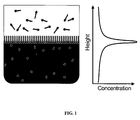
- FIG. 1 is a schematic diagram showing surfactant molecules having a water-loving head and an oil-loving tail, where the molecules have self-associated and concentrated at an oil/water interface.
- the present invention is directed to low dosage naphthenate inhibitor (LDNI) compounds and compositions including those compounds. These compounds are capable of inhibiting naphthenate salt formation, precipitation or emulsions at substantially lower dosage than with existing acetic acid practices.
- Preferred naphthenate inhibitor compounds include acids that are stronger than the carboxylic acids in the crude oil in order to protonate the weaker naphthenic acids.
- the naphthenate inhibitor compounds are non-emulsifying.
- One particularly preferred class of these compounds includes hydrotropes.
- the term “hydrotrope” means a compound having certain surfactant qualities that is less likely to form organized phases and therefore have a lower emulsifying tendency than many other surfactants.
- hydrotropes frequently have a hydrocarbon tail that is suitably shaped or bulky to prevent or interrupt the self organization of other surface active material.
- Hydrotropes may be used in their acid form or weak base salt form, but must be either water-soluble or oil-soluble. Anionic and amphoteric hydrotropes are deemed to be particularly useful in this invention.
- surfactants that would not be classified as classical hydrotropes may also exhibit qualities that are beneficial in inhibiting naphthenate salt formation.
- These other surfactants may include both anionic surfactants and amphoteric surfactants.
- anionic surfactants include phosphates, phosphonates (such as R 1 NR 2 R 3 , wherein R 1 is an organic moiety, and R 2 and R 3 are independently selected from —(CH 2 P( ⁇ O)(OH) 2 ) or H or an organic moiety; or salts of these phosphonates, or quaternary salts of these phosphonates) acrylic acids, sulfates, sulfonates, sulfosuccinates, polysulfosuccinates, betaines, thiocarbamates, xanthates and the like.
- Preferred naphthenate inhibitors also exhibit low corrosivity and will be compatible with other demulsifiers. Further still, it is preferred to use naphthenate inhibitors that are environmentally friendly, such as exhibiting biodegradability, no bioaccumulation, as well as low toxicity to marine species.
- suitable surfactants include, without limitation, phenols, carboxylic acids, betaines, thiocarbamates, xanthates, phosphonates, phosphate esters, sulfates, sulfonates, and sulfosuccinates and derivatives of these surfactants.
- phosphonates include mono-amine, di-amine, tri-amine, tetra-amine, penta-amine and other poly-amine phosphonates, as well as mono-alkyl, di-alkyl, and tri-alkyl phosphonates.
- acrylic acids include surface-active modified polyacrylic acids, as well as polyalkyl sulfosuccinates.
- Preferred naphthenate inhibitor compositions include phosphate esters and sulphonic acids.
- the most preferred inhibitor composition includes a monophosphate ester, a diphosphate ester, or a combination thereof. These phosphate esters have been successfully used and shown to be approximately twenty times as effective as acetic acid per unit volume of inhibitor.
- Other successfully used or tested compositions include sulfonates, sulfosuccinates and ethoxylated fatty acids in combination with polymeric surfactants like poly-glycol esters, poly-imines and epon-resins.
- Naphthenate inhibitor compositions comprising a phosphate ester may be made or obtained in various ways.
- phosphate esters may be prepared from phosphorus chloride (PCl 3 ) or polyphosphoric acid.
- the presently most preferred method of forming the phosphate ester-based naphthenate inhibitors includes the reaction of phosphorus pentoxide with alcohols (ROH) to generate the mono-alkyl and di-alkyl (aryl or mixed alkyl/aryl) phosphonic acid.
- ROH phosphorus pentoxide with alcohols
- Alcohols (ROH) of the class alkyl, aryl substituted aryl having linear, branched, cyclic and substituted cyclic structures including their oxyalkylated derivatives containing 1 to 9 moles ethylene oxide (EO), propylene oxide (PO) or butylene oxide (BO) and/or mixtures thereof, in block or random form, per hydroxyl can be beneficial in producing naphthenate salt inhibitors.
- This reaction yields one mole of monophosphate ester (R—O—P( ⁇ O)(OH) 2 ) and one mole of diphosphate ester ((R—O) 2 —P( ⁇ O)(OH)).
- This reaction product can be used as a naphthenate inhibitor without further modification or purification of the active ingredients.
- Hydrotropes and suitable surfactants of the present invention are preferably added to production or processing streams containing oil and water in an amount effective to inhibit naphthenate salt formation, precipitation or emulsions.
- the naphthenate inhibitor compositions are effective at concentrations less than the dose rate required of acetic acid. While it is recognized that the necessary dosage of a naphthenate inhibitor will vary based on the composition of the crude oil and the composition of the connate or process water, it is generally unnecessary to use more than 200 ppm of the present naphthenate inhibitors even in the absence of acetic acid.
- a preferred naphthenate inhibitor dosage is 100 ppm or less based on total fluids.
- the naphthenate inhibitors are also used at concentrations of 50 ppm or less in combination with a reduced dosage of acetic acid.
- concentrations of 50 ppm or less in combination with a reduced dosage of acetic acid.
- a concentration of about 40 ppm of a mixture of monophosphate ester and diphosphate ester has been shown to be effective in combination with acetic acid, while reducing the typical acetic acid dosage by about 70% to 100 ppm or less.
- the present invention also provides a method of inhibiting, dissolving, or dispersing calcium naphthenate salts or other naphthenate salts that can form precipitates or emulsions during crude oil production or processing.
- the method includes adding an effective amount of a naphthenate inhibitor into the production fluids for contact with mixtures of oil and water in the formation, the production equipment, or processing systems. It is believed that the naphthenate inhibitors of the present invention exhibit surface-active properties that cause the inhibitors to self-associate and concentrate in a layer at the oil-water interface.
- Having the naphthenate inhibitors at the oil-water interface serves to prevent interactions between organic acids in the oil phase with monovalent, di-valent and/or poly-valent cations or cation complexes in the water. It is believed that the physical positioning and geometry of the naphthenate inhibitor composition blocks formation and/or limits growth of naphthenate salts. However, it is preferred that the naphthenate inhibitors also do not cause formation of stable oil-in-water and water-in-oil emulsions.
- the present naphthenate inhibitor compounds provide the advantages of using lower dosages of chemicals and avoiding the corrosivity that comes with operating at lower pH. Improvements in inhibitor logistics and reduction of treatment costs are significant.
- the naphthenate inhibitors are dosed in the oil/water mixtures (emulsions) as the mixtures are produced from the formation.
- the best dosage point or injection point is just before the pressure is released from the fluids, such as just before a choke, the manifold, the turret or any other place where the pressure drops significantly.
- Naphthenate deposits or emulsions are typically formed after the pressure on the fluid is released from the system, because carbon dioxide gas (CO 2 ) will escape from the fluid at reduced pressures, resulting in an increased pH and the formation of naphthenate salts.
- the naphthenate inhibitor is injected into the fluid prior to formation of the naphthenate salts, although injection following naphthenate salt formation may also be successful.
- the invention has been described as a low dosage naphthenate inhibitor (LDNI), but the compounds are believed to have equal or similar utility for inhibiting the formation of other insoluble organic salts or soaps of organic acids present in oil.
- LDNI low dosage naphthenate inhibitor
- the term “soap” is classically defined as any salt of a fatty acid. Such an organic acid can be varied in its functionality and carbon chain length, examples of which include, but are not limited to, the sodium salt of stearic acid and the sodium salt of oleic acid.
- FIG. 1 is a schematic diagram showing surfactant molecules having a water-loving head and an oil-loving tail, where the molecules have self-associated and concentrated at an oil/water interface.
- Careful measurement of surfactant monomer populations below the critical micelle concentration shows that the concentration of surfactant at the oil/water interface is greater than in either the bulk oil or the bulk water phases.
- the bulk concentration of surfactant increases, approaching and exceeding the critical micelle concentration, surfactant aggregates of various shapes and sizes can form, and the bulk concentration may exceed the concentration at the interface. Nevertheless, the surfactant interface will remain as a recognizable structural and chemical line of demarcation between the aqueous and oil phases.
- the nature of the water-loving head group of the surfactant can be engineered to determine its interaction with species in the aqueous environment.
- the nature of the tail can also be engineered to impart particular desired properties. Combining these two parameters carefully provides a material having a greater propensity to concentrate itself at interfaces.
- These low dosage naphthenate inhibitors are far more effective than mere acidification for inhibiting naphthenic acids from interacting with cations in the water, and also for inhibiting the formation of problematic insoluble aggregates as the metal salts.
- Low dosage naphthenate inhibitors are far more cost-effective than conventional treatment programs, since these low dosage naphthenate inhibitors self associate in high concentrations at water/oil interfaces to combat the formation and effects of organic acid-derived salts and soaps that can lead to deposits or stabilization of emulsions.
- the inhibitor compositions are attracted to the oil-water interface (See FIG. 1 ), and may be described in terms of a monolayer concentration or surface excess concentration, such as in units of moles per square centimeter of oil-water interface, as an alternative to bulk concentration, which is typically reported as a molar concentration.
- a preferred surface excess concentration is between about 0.5 ⁇ 10 ⁇ 10 and about 7.5 ⁇ 10 ⁇ 10 moles per square centimeter.
- a dosage rate i.e., the amount of inhibitor used per unit volume of the oil-water mixture.
- the inhibitor may be added to a production fluid having a mixture of oil and water at a dosage rate of between 25 and 1000 ppm inhibitor.
- a dosage rate of between 25 and 1000 ppm inhibitor.
- the surfactant molecules depicted in FIG. 1 are not limited to classical surfactant structures, but can also consist of classical hydrotrope molecules.
- the interface can be a mixed system of surfactant and hydrotrope molecules.
- the interface can be a mixed system of surfactant, hydrotrope, and organic acid metal ion salts.
- the interface can be described as either: a barrier that prevents organic acids and ionized organic acids in the oil phase from combining with metal ions in the aqueous phase; a destabilized liquid particle interface, which when two particles collide, they will coalesce and become non-emulsified due to the destabilized interface; or a combination thereof.
- oil-water interfaces of various types, geometries and configurations, specifically including water-in-oil emulsions, oil-in-water emulsions, oil-in-water-in-oil emulsions, water-in-oil-in-water emulsions, microemulsified systems, and any other emulsion systems or interfaces recognized now or discovered in the future.
- the invention is not limited to an oil-water interface of any particular type, geometry or configuration.
- the examples that follow should not be taken to limit the scope of the invention, but merely represent specific applications of the invention.
- a solution was prepared as a surrogate for connate water by combining 1% calcium chloride and 2.5% sodium chloride in water and adjusting the pH to 8.
- Another solution was prepared as a surrogate for crude oil by combining 1% naphthenic acid in aliphatic hydrocarbons. 50 ml of each solution was combined and shaken for five minutes. Upon standing, a thick oil-in-water emulsion was observed, apparently stabilized against droplet coalescence by a layer of calcium naphthenate at the interface of each droplet.
- a connate water surrogate solution and a crude oil surrogate solution were prepared as described in Example 1.50 ml of each solution was combined. However, before shaking, 500 ppm of acetic acid was added to the combination of surrogate solutions. All of the fluids were then shaken together for five minutes. Upon standing, the fluids separated easily with no apparent emulsions or calcium naphthenate solids. The pH was measured at 5.2.
- a connate water surrogate solution and a crude oil surrogate solution were prepared as described in Example 1.50 ml of each solution was combined. However, before shaking, 40 ppm of a mixture of monophosphate ester and diphosphate ester and 100 ppm of acetic acid were added to the combination of surrogate solutions. All of the fluids were then shaken together for five minutes. Upon standing, the fluids separated easily with no apparent emulsions or calcium naphthenate solids. The pH was measured at 7.0.
- a connate water surrogate solution and a crude oil surrogate solution were prepared as described in Example 1. 50 ml of each solution was combined. However, before shaking, 100 ppm of a mixture of monophosphate ester and diphosphate ester was added to the combination of surrogate solutions. All of the fluids were then shaken together for five minutes. Upon standing, the fluids separated easily with no apparent emulsions or calcium naphthenate solids. The pH was measured at 7.0.
- a naphthenate salt inhibitor solution containing a phosphate ester was prepared.
- a linear fatty alcohol having 9 to 11 carbon atoms was reacted with ethylene oxide at molar ratios of 9, 6, and 3, respectively.
- the three resulting reaction products were then further reacted with phosphorus pentoxide at a molar ratio of about 0.5.
- the final products were believed to each contain a mixture of monophosphate ester and diphosphate ester, albeit having different side chain lengths.
- Each of the three products were shaken at 50 ppm concentration for 5 minutes with 50 ml of the connate water surrogate and 50 ml of the crude oil surrogate described in Example 1. Upon standing, each of the three bottles showed no calcium naphthenate solids. It was noticed that the alkyl groups with increasing oxide content tended to create increased quantities of emulsion. The pH was greater than 6.
- a naphthenate salt inhibitor solution containing a phosphate ester was prepared. 2-ethyl hexanol was reacted with phosphorus pentoxide at a molar ratio of about 0.5. The final product was believed to contain a mixture of monophosphate ester and diphosphate ester. The product was shaken at a concentration of 50 ppm for 5 minutes with 50 ml of the connate water surrogate and 50 ml of the crude oil surrogate described in Example 1. Upon standing, the bottle showed no calcium naphthenate solids and no evidence of emulsions. The pH was greater than 6.
- inhibitor means to restrain from full and free occurrence of some act or event, and is not limited to a definite and known degree of restraint. Accordingly, it should be recognized that the use of a composition to “inhibit” interaction between cations and organic acids does not mean that a given amount of the composition will necessarily produce a direct, measurable and known change in the interaction, since other factors may change in a manner that offsets the use of the composition. For example, a crude oil having a low TAN number, such as less than 0.3, or a water stream having a low concentration of calcium or magnesium ions may have little tendency to interact and form naphthenate salts even without use of an inhibitor composition.
- a crude oil having a high TAN number and water having a high calcium or magnesium ion concentration may produce a significant amount of precipitates or emulsions. While the use of an inhibitor composition will reduce the degree of formation of naphthenate salts and the resulting precipitates or emulsions, the naphthenate salt concentration may still be higher than in the production fluids of low TAN crude. Still, the naphthenate salt-content in the production fluid of a high TAN crude oil will be inhibited, or any adventitious salts that do form will be mitigated, with use of an inhibitor composition relative to the naphthenate salt-content in the production fluid of the same crude oil without an inhibitor composition.
- the term “one” or “single” may be used to indicate that one and only one of something is intended. Similarly, other specific integer values, such as “two,” may be used when a specific number of things is intended.
- the terms “preferably,” “preferred,” “prefer,” “optionally,” “may,” and similar terms are used to indicate that an item, condition or step being referred to is an optional (not required) feature of the invention.
Landscapes
- Chemical & Material Sciences (AREA)
- Oil, Petroleum & Natural Gas (AREA)
- Organic Chemistry (AREA)
- Engineering & Computer Science (AREA)
- Chemical Kinetics & Catalysis (AREA)
- General Chemical & Material Sciences (AREA)
- Life Sciences & Earth Sciences (AREA)
- Emergency Medicine (AREA)
- Health & Medical Sciences (AREA)
- General Life Sciences & Earth Sciences (AREA)
- Materials Engineering (AREA)
- Production Of Liquid Hydrocarbon Mixture For Refining Petroleum (AREA)
- Organic Low-Molecular-Weight Compounds And Preparation Thereof (AREA)
- Cosmetics (AREA)
- Medicinal Preparation (AREA)
- Colloid Chemistry (AREA)
- Nitrogen Condensed Heterocyclic Rings (AREA)
- Transition And Organic Metals Composition Catalysts For Addition Polymerization (AREA)
- Polyesters Or Polycarbonates (AREA)
Abstract
Description
Claims (82)
Priority Applications (12)
| Application Number | Priority Date | Filing Date | Title |
|---|---|---|---|
| US10/944,288 US7776931B2 (en) | 2004-06-16 | 2004-09-17 | Low dosage naphthenate inhibitors |
| CA2566563A CA2566563C (en) | 2004-06-16 | 2005-06-16 | Low dosage naphthenate inhibitors |
| GB0600558A GB2421245B (en) | 2004-06-16 | 2005-06-16 | Low Dosage Naphthenate Inhibitors |
| DE602005012688T DE602005012688D1 (en) | 2004-06-16 | 2005-06-16 | LOW-DOSEED NAPHTHENATE HEMMER |
| CN2005800200030A CN1977089B (en) | 2004-06-16 | 2005-06-16 | Low dosage naphthenate inhibitors |
| EP05814842.0A EP1751395B2 (en) | 2004-06-16 | 2005-06-16 | Low dosage naphthenate inhibitors |
| AT05814842T ATE422529T1 (en) | 2004-06-16 | 2005-06-16 | LOW DOSE NAPHTHENATE INHIBITORS |
| BRPI0512114-0A BRPI0512114B1 (en) | 2004-06-16 | 2005-06-16 | method of inhibiting the formation of organic soaps. |
| MXPA06014087A MXPA06014087A (en) | 2004-06-16 | 2005-06-16 | Low dosage naphthenate inhibitors. |
| PCT/US2005/021354 WO2006025912A2 (en) | 2004-06-16 | 2005-06-16 | Low dosage naphthenate inhibitors |
| DK05814842.0T DK1751395T4 (en) | 2004-06-16 | 2005-06-16 | Low-dose naphthenate inhibitors |
| NO20070177A NO341486B1 (en) | 2004-06-16 | 2007-01-10 | Process for inhibiting the formation of naphthenate precipitates or naphthenate stabilized emulsions |
Applications Claiming Priority (2)
| Application Number | Priority Date | Filing Date | Title |
|---|---|---|---|
| US10/869,826 US7776930B2 (en) | 2004-06-16 | 2004-06-16 | Methods for inhibiting naphthenate salt precipitates and naphthenate-stabilized emulsions |
| US10/944,288 US7776931B2 (en) | 2004-06-16 | 2004-09-17 | Low dosage naphthenate inhibitors |
Related Parent Applications (1)
| Application Number | Title | Priority Date | Filing Date |
|---|---|---|---|
| US10/869,826 Continuation-In-Part US7776930B2 (en) | 2004-06-16 | 2004-06-16 | Methods for inhibiting naphthenate salt precipitates and naphthenate-stabilized emulsions |
Publications (2)
| Publication Number | Publication Date |
|---|---|
| US20050282711A1 US20050282711A1 (en) | 2005-12-22 |
| US7776931B2 true US7776931B2 (en) | 2010-08-17 |
Family
ID=35481374
Family Applications (2)
| Application Number | Title | Priority Date | Filing Date |
|---|---|---|---|
| US10/869,826 Expired - Fee Related US7776930B2 (en) | 2004-06-16 | 2004-06-16 | Methods for inhibiting naphthenate salt precipitates and naphthenate-stabilized emulsions |
| US10/944,288 Expired - Fee Related US7776931B2 (en) | 2004-06-16 | 2004-09-17 | Low dosage naphthenate inhibitors |
Family Applications Before (1)
| Application Number | Title | Priority Date | Filing Date |
|---|---|---|---|
| US10/869,826 Expired - Fee Related US7776930B2 (en) | 2004-06-16 | 2004-06-16 | Methods for inhibiting naphthenate salt precipitates and naphthenate-stabilized emulsions |
Country Status (5)
| Country | Link |
|---|---|
| US (2) | US7776930B2 (en) |
| CN (1) | CN1977089B (en) |
| AT (1) | ATE422529T1 (en) |
| DE (1) | DE602005012688D1 (en) |
| DK (1) | DK1751395T4 (en) |
Cited By (5)
| Publication number | Priority date | Publication date | Assignee | Title |
|---|---|---|---|---|
| US9993382B1 (en) | 2017-07-10 | 2018-06-12 | Stetrix, Inc. | Tissue retention systems and methods |
| US10280714B2 (en) | 2015-11-19 | 2019-05-07 | Ecolab Usa Inc. | Solid chemicals injection system for oil field applications |
| US10669470B2 (en) | 2017-05-23 | 2020-06-02 | Ecolab Usa Inc. | Dilution skid and injection system for solid/high viscosity liquid chemicals |
| US20200199438A1 (en) * | 2017-06-19 | 2020-06-25 | Ecolab Usa Inc. | Naphthenate inhibition |
| US10717918B2 (en) | 2017-05-23 | 2020-07-21 | Ecolab Usa Inc. | Injection system for controlled delivery of solid oil field chemicals |
Families Citing this family (13)
| Publication number | Priority date | Publication date | Assignee | Title |
|---|---|---|---|---|
| EP1971672B1 (en) * | 2005-12-02 | 2018-10-17 | Baker Hughes, a GE company, LLC | Inhibiting naphthenate solids and emulsions in crude oil |
| BRPI0811713B1 (en) * | 2007-06-20 | 2017-10-10 | Akzo Nobel N.V. | METHOD FOR PREVENTING FORMATION OF CALCIUM CARBOXYLATES IN A CRU / WATER OIL CURRENT AND USE OF COMPOUNDS |
| US7871964B2 (en) * | 2008-07-23 | 2011-01-18 | M-I Australia Pty. Ltd. | Compositions and methods for mitigating or preventing emulsion formation in hydrocarbon bodies |
| NZ591658A (en) * | 2008-08-11 | 2012-06-29 | M I Australia Pty Ltd | Compositions and methods for inhibiting emulsion formation in hydrocarbon bodies |
| KR101314589B1 (en) * | 2008-08-26 | 2013-10-07 | 도르프 케탈 케미칼즈 (인디아) 프라이비트 리미티드 | An Effective Novel Polymeric Additive for Inhibiting Napthenic Acid Corrosion and Method of Using the Same |
| MY159736A (en) * | 2009-04-15 | 2017-01-31 | Dorf Ketal Chemicals (I) Pvt Ltd | An effective novel non-polymeric and non-fouling additive for inhibiting high- temperature naphthenic acid corrosion and method of using the same |
| AU2010324533A1 (en) | 2009-11-26 | 2012-06-14 | M-I Australia Pty Ltd | Compositions and methods for inhibiting naphthenate solids formation from liquid hydrocarbons |
| WO2012138485A2 (en) | 2011-04-05 | 2012-10-11 | Montgomery Chemicals Llc | Method and compositions for enhanced oil recovery |
| BR112013028662B1 (en) * | 2011-05-06 | 2020-10-27 | Champion Technologies, Inc | low-dose polymeric naphthenate inhibition method |
| US9663703B2 (en) | 2014-04-25 | 2017-05-30 | James George Clements | Method and compositions for enhanced oil recovery |
| CN105771321B (en) * | 2016-03-21 | 2017-12-19 | 重庆工商大学 | A kind of mineral crystal separates water-in-oil emulsion method |
| GB2580157B (en) * | 2018-12-21 | 2021-05-05 | Equinor Energy As | Treatment of produced hydrocarbons |
| WO2021035207A1 (en) | 2019-08-22 | 2021-02-25 | Ecolab Usa Inc. | Compositions for enhanced oil recovery |
Citations (36)
| Publication number | Priority date | Publication date | Assignee | Title |
|---|---|---|---|---|
| US2143991A (en) | 1934-11-27 | 1939-01-17 | Gulf Research Development Co | Method of shutting off water in oil wells |
| US4192767A (en) | 1976-03-08 | 1980-03-11 | Texaco Inc. | Aqueous surfactant solutions and oil-in-water emulsions |
| US4384977A (en) * | 1981-06-11 | 1983-05-24 | Marathon Oil Company | Polyalkyloxyamines as demulsifying agents |
| US4396530A (en) * | 1981-06-11 | 1983-08-02 | Marathon Oil Company | Mineral acid demulsification of surfactant-containing emulsion |
| US4446002A (en) | 1982-08-05 | 1984-05-01 | Exxon Research And Engineering Co. | Process for suppressing precipitation of sediment in unconverted residuum from virgin residuum conversion process |
| US4514322A (en) * | 1984-04-19 | 1985-04-30 | E. I. Du Pont De Nemours And Company | Phosphorous-doped tin oxide powder |
| US4846957A (en) | 1986-04-11 | 1989-07-11 | The British Petroleum Company P.L.C. | Precipitation of asphaltene |
| US5008026A (en) * | 1989-01-30 | 1991-04-16 | Halliburton Company | Well treatment compositions and method |
| CA2029465A1 (en) | 1989-11-08 | 1991-05-09 | William K. Stephenson | Asphaltene dispersants-inhibitors |
| US5092405A (en) * | 1990-12-21 | 1992-03-03 | Texaco Inc. | Alkoxylated surfactant system for heavy oil reservoirs |
| US5112505A (en) | 1986-05-15 | 1992-05-12 | Petrolite Corporation | Certain dithiocarbamates and method of use for reducing asphaltene precipitation in asphaltenic reservoirs |
| US5130473A (en) | 1986-05-15 | 1992-07-14 | Petrolite Corporation | Dithiocarbamate compounds |
| US5156675A (en) * | 1991-05-16 | 1992-10-20 | Xerox Corporation | Ink for ink jet printing |
| US5213691A (en) | 1991-10-07 | 1993-05-25 | Nalco Chemical Company | Phosphonate-containing polymers for controlling scale in underground petroleum-containing formations and equipment associated therewith |
| US5252254A (en) | 1992-12-30 | 1993-10-12 | Nalco Chemical Company | Naphthenic acid corrosion inhibitor |
| US5283235A (en) * | 1992-03-17 | 1994-02-01 | The Lubrizol Corporation | Compositions containing esters of carboxy-containing interpolymers and methods of using the same |
| US5420040A (en) | 1991-11-20 | 1995-05-30 | Norsk Hydro A.S. | Method for the measurement of precipitation of asphaltene in oil |
| US5425422A (en) | 1993-09-21 | 1995-06-20 | Noranda Inc. | Process for removing and preventing near-wellbore damage due to asphaltene precipitation |
| US5482484A (en) * | 1992-03-20 | 1996-01-09 | Norsk Hydro A.S. | Apparatus for offshore swivel replacement |
| US5500107A (en) * | 1994-03-15 | 1996-03-19 | Betz Laboratories, Inc. | High temperature corrosion inhibitor |
| US5552085A (en) | 1994-08-31 | 1996-09-03 | Nalco Chemical Company | Phosphorus thioacid ester inhibitor for naphthenic acid corrosion |
| WO1998030784A1 (en) * | 1997-01-09 | 1998-07-16 | Imperial College Of Science, Technology & Medicine | Method of controlling asphaltene precipitation in a fluid |
| US5863415A (en) | 1996-05-30 | 1999-01-26 | Baker Hughes Incorporated | Control of naphthenic acid corrosion with thiophosporus compounds |
| US5948237A (en) | 1996-10-15 | 1999-09-07 | Clariant Gmbh | Use of sarcosinates as asphaltene-dispersing agents |
| US5969237A (en) | 1997-10-09 | 1999-10-19 | Baker Hughes Incorporated | Measurement and control of asphaltene agglomeration in hydrocarbon Liquids |
| US5985137A (en) * | 1998-02-26 | 1999-11-16 | Unipure Corporation | Process to upgrade crude oils by destruction of naphthenic acids, removal of sulfur and removal of salts |
| GB2337522A (en) | 1998-05-14 | 1999-11-24 | Bp Chem Int Ltd | Asphaltene precipitation inhibiting polymer for use in oils |
| US6051535A (en) | 1997-01-22 | 2000-04-18 | Bj Services Company | Asphaltene adsorption inhibition treatment |
| WO2001027438A1 (en) * | 1999-10-09 | 2001-04-19 | Cognis Deutschland Gmbh & Co. Kg | Asphaltene inhibitors |
| WO2001029370A1 (en) * | 1999-10-21 | 2001-04-26 | Baker Hughes Incorporated | Asphaltenes monitoring and control system |
| US6225263B1 (en) * | 1996-07-17 | 2001-05-01 | Bp Chemicals Limited | Use of oil and gas field chemicals |
| US6294093B1 (en) | 1998-09-04 | 2001-09-25 | Nalco/Exxon Energy Chemicals, L.P. | Aqueous dispersion of an oil soluble demulsifier for breaking crude oil emulsions |
| CA2455854A1 (en) | 2001-07-31 | 2003-02-13 | Imperial College Innovations Limited | Method of controlling asphaltene precipitation in a fluid |
| US6547957B1 (en) * | 2000-10-17 | 2003-04-15 | Texaco, Inc. | Process for upgrading a hydrocarbon oil |
| US6716358B2 (en) | 2001-03-09 | 2004-04-06 | Exxonmobil Research And Engineering Company | Demulsification of water-in-oil emulsions |
| US20040072361A1 (en) | 2002-10-11 | 2004-04-15 | Exxonmobil Research And Engineering Company | Branched alkyl-aromatic sulfonic acid dispersants for dispersing asphaltenes in petroleum oils |
Family Cites Families (2)
| Publication number | Priority date | Publication date | Assignee | Title |
|---|---|---|---|---|
| US5310897A (en) * | 1984-12-27 | 1994-05-10 | Sumitomo Pharmaceuticals Co., Ltd. | Beta-lactams and their production |
| CN1229840A (en) * | 1998-03-23 | 1999-09-29 | 杨美英 | Multifunctional oil-soluble magnesium salt vanadium corrosion inhibitor |
-
2004
- 2004-06-16 US US10/869,826 patent/US7776930B2/en not_active Expired - Fee Related
- 2004-09-17 US US10/944,288 patent/US7776931B2/en not_active Expired - Fee Related
-
2005
- 2005-06-16 AT AT05814842T patent/ATE422529T1/en not_active IP Right Cessation
- 2005-06-16 DE DE602005012688T patent/DE602005012688D1/en not_active Expired - Lifetime
- 2005-06-16 CN CN2005800200030A patent/CN1977089B/en not_active Expired - Fee Related
- 2005-06-16 DK DK05814842.0T patent/DK1751395T4/en active
Patent Citations (41)
| Publication number | Priority date | Publication date | Assignee | Title |
|---|---|---|---|---|
| US2143991A (en) | 1934-11-27 | 1939-01-17 | Gulf Research Development Co | Method of shutting off water in oil wells |
| US4192767A (en) | 1976-03-08 | 1980-03-11 | Texaco Inc. | Aqueous surfactant solutions and oil-in-water emulsions |
| US4384977A (en) * | 1981-06-11 | 1983-05-24 | Marathon Oil Company | Polyalkyloxyamines as demulsifying agents |
| US4396530A (en) * | 1981-06-11 | 1983-08-02 | Marathon Oil Company | Mineral acid demulsification of surfactant-containing emulsion |
| US4446002A (en) | 1982-08-05 | 1984-05-01 | Exxon Research And Engineering Co. | Process for suppressing precipitation of sediment in unconverted residuum from virgin residuum conversion process |
| US4514322A (en) * | 1984-04-19 | 1985-04-30 | E. I. Du Pont De Nemours And Company | Phosphorous-doped tin oxide powder |
| US4846957A (en) | 1986-04-11 | 1989-07-11 | The British Petroleum Company P.L.C. | Precipitation of asphaltene |
| US5112505A (en) | 1986-05-15 | 1992-05-12 | Petrolite Corporation | Certain dithiocarbamates and method of use for reducing asphaltene precipitation in asphaltenic reservoirs |
| US5130473A (en) | 1986-05-15 | 1992-07-14 | Petrolite Corporation | Dithiocarbamate compounds |
| US5008026A (en) * | 1989-01-30 | 1991-04-16 | Halliburton Company | Well treatment compositions and method |
| CA2029465A1 (en) | 1989-11-08 | 1991-05-09 | William K. Stephenson | Asphaltene dispersants-inhibitors |
| US5092405A (en) * | 1990-12-21 | 1992-03-03 | Texaco Inc. | Alkoxylated surfactant system for heavy oil reservoirs |
| US5156675A (en) * | 1991-05-16 | 1992-10-20 | Xerox Corporation | Ink for ink jet printing |
| US5213691A (en) | 1991-10-07 | 1993-05-25 | Nalco Chemical Company | Phosphonate-containing polymers for controlling scale in underground petroleum-containing formations and equipment associated therewith |
| US5420040A (en) | 1991-11-20 | 1995-05-30 | Norsk Hydro A.S. | Method for the measurement of precipitation of asphaltene in oil |
| US5283235A (en) * | 1992-03-17 | 1994-02-01 | The Lubrizol Corporation | Compositions containing esters of carboxy-containing interpolymers and methods of using the same |
| US5482484A (en) * | 1992-03-20 | 1996-01-09 | Norsk Hydro A.S. | Apparatus for offshore swivel replacement |
| US5252254A (en) | 1992-12-30 | 1993-10-12 | Nalco Chemical Company | Naphthenic acid corrosion inhibitor |
| US5425422A (en) | 1993-09-21 | 1995-06-20 | Noranda Inc. | Process for removing and preventing near-wellbore damage due to asphaltene precipitation |
| US5500107A (en) * | 1994-03-15 | 1996-03-19 | Betz Laboratories, Inc. | High temperature corrosion inhibitor |
| US5552085A (en) | 1994-08-31 | 1996-09-03 | Nalco Chemical Company | Phosphorus thioacid ester inhibitor for naphthenic acid corrosion |
| US5863415A (en) | 1996-05-30 | 1999-01-26 | Baker Hughes Incorporated | Control of naphthenic acid corrosion with thiophosporus compounds |
| US6225263B1 (en) * | 1996-07-17 | 2001-05-01 | Bp Chemicals Limited | Use of oil and gas field chemicals |
| US5948237A (en) | 1996-10-15 | 1999-09-07 | Clariant Gmbh | Use of sarcosinates as asphaltene-dispersing agents |
| CA2277052A1 (en) | 1997-01-09 | 1998-07-16 | Imperial College Of Science, Technology & Medicine | Method of controlling asphaltene precipitation in a fluid |
| WO1998030784A1 (en) * | 1997-01-09 | 1998-07-16 | Imperial College Of Science, Technology & Medicine | Method of controlling asphaltene precipitation in a fluid |
| US6051535A (en) | 1997-01-22 | 2000-04-18 | Bj Services Company | Asphaltene adsorption inhibition treatment |
| US5969237A (en) | 1997-10-09 | 1999-10-19 | Baker Hughes Incorporated | Measurement and control of asphaltene agglomeration in hydrocarbon Liquids |
| US5985137A (en) * | 1998-02-26 | 1999-11-16 | Unipure Corporation | Process to upgrade crude oils by destruction of naphthenic acids, removal of sulfur and removal of salts |
| GB2337522A (en) | 1998-05-14 | 1999-11-24 | Bp Chem Int Ltd | Asphaltene precipitation inhibiting polymer for use in oils |
| US6294093B1 (en) | 1998-09-04 | 2001-09-25 | Nalco/Exxon Energy Chemicals, L.P. | Aqueous dispersion of an oil soluble demulsifier for breaking crude oil emulsions |
| WO2001027438A1 (en) * | 1999-10-09 | 2001-04-19 | Cognis Deutschland Gmbh & Co. Kg | Asphaltene inhibitors |
| CA2386721A1 (en) | 1999-10-09 | 2001-04-19 | Alain Lesimple | Asphaltene inhibitors |
| WO2001029370A1 (en) * | 1999-10-21 | 2001-04-26 | Baker Hughes Incorporated | Asphaltenes monitoring and control system |
| CA2386314A1 (en) | 1999-10-21 | 2001-04-26 | Baker Hughes Incorporated | Asphaltenes monitoring and control system |
| US6547957B1 (en) * | 2000-10-17 | 2003-04-15 | Texaco, Inc. | Process for upgrading a hydrocarbon oil |
| US6716358B2 (en) | 2001-03-09 | 2004-04-06 | Exxonmobil Research And Engineering Company | Demulsification of water-in-oil emulsions |
| CA2455854A1 (en) | 2001-07-31 | 2003-02-13 | Imperial College Innovations Limited | Method of controlling asphaltene precipitation in a fluid |
| WO2003012253A2 (en) * | 2001-07-31 | 2003-02-13 | Imperial College Innovations Limited | Method of controlling asphaltene precipitation in a fluid |
| WO2003012253A3 (en) * | 2001-07-31 | 2003-04-03 | Imp College Innovations Ltd | Method of controlling asphaltene precipitation in a fluid |
| US20040072361A1 (en) | 2002-10-11 | 2004-04-15 | Exxonmobil Research And Engineering Company | Branched alkyl-aromatic sulfonic acid dispersants for dispersing asphaltenes in petroleum oils |
Non-Patent Citations (14)
| Title |
|---|
| Copyright © Webster's Third New International Dictionary, Unabridged, Copyright © 1993 Merriam-Webster.Published under license from Merriam-Webster,Incorporated, http://lionreference.chadwyck.com/searchFulltext.do?id=17573917&idType=offset&divLevel=2&queryId=../session/1247850186-24135&area=mwd&forward=refshelf&trail=refshelf , Headword: "inhibit". * |
| EPO "Communication of a notice of opposition" Sep. 30, 2009, pp. 1-5. (including English translation). |
| Gallup et al. "Formation & Mitigation of 'Metallic Soap' Sludge, Attaka, Indonesia Field" SPE 73960, Unocal Indonesia, Mar. 2002, pp. 1-16. |
| Goldszal et al. "Scale and Naphthenate Inhibition in Deep-Offshore Fields" SPE 74661, Jan. 2002, pp. 1-11. |
| Inge Harald Auflem; "Influence of Asphaltene Aggregation and Pressure on Crude Oil Emulsion Stability"; Department of Chemical Engineering Norwegian University of Science and Technology; pp. 1-51; Jun. 2002. |
| Lewis, Richard J., Sr. (2002). Hawley's Condensed Chemical Dictionary (14th Edition). (pp: ). John Wiley & Sons. Online version available at: http://knovel.com/web/portal/browse/display?-EXT-KNOVEL-DISPLAY-bookid=704&VerticalID=0 , Entry: "cation", "amphiphilic", "surface active agent", and "surfactant". pp. 1-8. * |
| Ogden, P.H. "Chemicals in the Oil Industry: Developments and Applications", Akzo Chemie UK Ltd, Royal Society of Chemistry, 3 pages, (copyright 1991). |
| PCT International Search Report-Mar. 1, 2006. |
| Poggesi et al. "Multifunction Chemicals for West African Deep Offshore Fields", SPE 74649, Jan. 2002, pp. 1-6. |
| Schlumberger Oilfield Glossary, @ http://www.glossary.oilfield.slb.com/Display.cfm?Term=production, "demulsifier" (Oct. 2009). * |
| Schlumberger Oilfield Glossary, @ http://www.glossary.oilfield.slb.com/Display.cfm?Term=production, "raw crude oil", "nonhydrocarbon contaminants", "emulsion", and "brine" (Jul. 2009). * |
| T.G. Balson "Something Old, Something New: A Discussion about Demulsifiers" pp. 226-238; Chemistry in the Oil Industry VIII Nov. 3-5, 2003, Manchester Conference Centre, UK, 3 page Programme. |
| Trond Erik Havre; "Formation of Calcium Naphthenate in Water/Oil Systems, Naphthenic Acid Chemistry and Emulsion Stability"; Department of Chemical Engineering Norwegian University of Science and Technology; pp. 1-64; Oct. 2002. |
| Vindstad, et al. "Fighting Naphthenate Deposition at the Heidrun Field", SPE80375, Jan. 2003, pp. 1-7. |
Cited By (9)
| Publication number | Priority date | Publication date | Assignee | Title |
|---|---|---|---|---|
| US10280714B2 (en) | 2015-11-19 | 2019-05-07 | Ecolab Usa Inc. | Solid chemicals injection system for oil field applications |
| US10669470B2 (en) | 2017-05-23 | 2020-06-02 | Ecolab Usa Inc. | Dilution skid and injection system for solid/high viscosity liquid chemicals |
| US10717918B2 (en) | 2017-05-23 | 2020-07-21 | Ecolab Usa Inc. | Injection system for controlled delivery of solid oil field chemicals |
| US20200199438A1 (en) * | 2017-06-19 | 2020-06-25 | Ecolab Usa Inc. | Naphthenate inhibition |
| US11718779B2 (en) * | 2017-06-19 | 2023-08-08 | Championx Usa Inc. | Naphthenate inhibition |
| US9993382B1 (en) | 2017-07-10 | 2018-06-12 | Stetrix, Inc. | Tissue retention systems and methods |
| US10925792B2 (en) | 2017-07-10 | 2021-02-23 | Stetrix, Inc. | Tissue retention systems and methods |
| US11202732B2 (en) | 2017-07-10 | 2021-12-21 | Stetrix, Inc. | Tissue retention systems and methods |
| US11813205B2 (en) | 2017-07-10 | 2023-11-14 | Stetrix, Inc. | Tissue retention systems and methods |
Also Published As
| Publication number | Publication date |
|---|---|
| DK1751395T4 (en) | 2018-04-16 |
| US20050282711A1 (en) | 2005-12-22 |
| DE602005012688D1 (en) | 2009-03-26 |
| US7776930B2 (en) | 2010-08-17 |
| US20050282915A1 (en) | 2005-12-22 |
| CN1977089B (en) | 2012-05-30 |
| DK1751395T3 (en) | 2009-05-04 |
| ATE422529T1 (en) | 2009-02-15 |
| CN1977089A (en) | 2007-06-06 |
Similar Documents
| Publication | Publication Date | Title |
|---|---|---|
| US7776931B2 (en) | Low dosage naphthenate inhibitors | |
| CA2595460C (en) | Microemulsion containing oil field chemicals useful for oil and gas field applications | |
| EP2705113B1 (en) | Low dosage polymeric naphthenate inhibitors | |
| NO341486B1 (en) | Process for inhibiting the formation of naphthenate precipitates or naphthenate stabilized emulsions | |
| CN110776892A (en) | Microemulsion neutral blocking remover | |
| GB2606338A (en) | Crude oil production using a combination of emulsion viscosity reducer and scale inhibitor | |
| US20250011639A1 (en) | Corrosion inhibitor having carbon-based nanoparticles | |
| EP3642300A1 (en) | Naphthenate inhibition | |
| US11685856B2 (en) | Branched polyethyleneimine (B-PE) as oilfield metal naphthenate inhibitors | |
| AU2024264534A1 (en) | Calcium based nanoparticle corrosion inhibitor additives | |
| EP4630601A1 (en) | Corrosion inhibitor having silica nanoparticles | |
| PL223035B1 (en) | Ferromagnetic clarifier for separation of the oil and water emulsions | |
| Desrina | Effect Of Chemicals On The Formation Of Tar Balls From Overboard Water Discharges An Analysis Of Environmental View |
Legal Events
| Date | Code | Title | Description |
|---|---|---|---|
| AS | Assignment |
Owner name: CHAMPION TECHNOLOGIES, INC., TEXAS Free format text: ASSIGNMENT OF ASSIGNORS INTEREST;ASSIGNORS:VENTER, PETRUS JOHANNES;NACE, VAUGHN M.;UBBELS, SEN J.;REEL/FRAME:015773/0716 Effective date: 20050126 |
|
| STCF | Information on status: patent grant |
Free format text: PATENTED CASE |
|
| FPAY | Fee payment |
Year of fee payment: 4 |
|
| AS | Assignment |
Owner name: NALCO COMPANY, ILLINOIS Free format text: MERGER;ASSIGNOR:CHAMPION TECHNOLOGIES, INC.;REEL/FRAME:033498/0119 Effective date: 20131223 Owner name: ECOLAB USA INC., MINNESOTA Free format text: ASSIGNMENT OF ASSIGNORS INTEREST;ASSIGNOR:NALCO COMPANY;REEL/FRAME:033498/0135 Effective date: 20140714 |
|
| MAFP | Maintenance fee payment |
Free format text: PAYMENT OF MAINTENANCE FEE, 8TH YEAR, LARGE ENTITY (ORIGINAL EVENT CODE: M1552) Year of fee payment: 8 |
|
| AS | Assignment |
Owner name: BANK OF AMERICA, N.A., NORTH CAROLINA Free format text: SECURITY INTEREST;ASSIGNOR:CHAMPIONX USA INC.;REEL/FRAME:052848/0368 Effective date: 20200603 Owner name: JPMORGAN CHASE BANK, N.A., NEW YORK Free format text: SECURITY INTEREST;ASSIGNOR:CHAMPIONX USA INC.;REEL/FRAME:053250/0001 Effective date: 20200603 |
|
| AS | Assignment |
Owner name: CHAMPIONX USA INC., TEXAS Free format text: ASSIGNMENT OF ASSIGNORS INTEREST;ASSIGNOR:ECOLAB USA INC.;REEL/FRAME:053849/0537 Effective date: 20200603 |
|
| FEPP | Fee payment procedure |
Free format text: MAINTENANCE FEE REMINDER MAILED (ORIGINAL EVENT CODE: REM.); ENTITY STATUS OF PATENT OWNER: LARGE ENTITY |
|
| AS | Assignment |
Owner name: CHAMPIONX USA INC., TEXAS Free format text: RELEASE BY SECURED PARTY;ASSIGNOR:BANK OF AMERICA, N.A.;REEL/FRAME:060304/0267 Effective date: 20220607 Owner name: CHAMPIONX USA INC., TEXAS Free format text: RELEASE OF SECURITY INTEREST;ASSIGNOR:BANK OF AMERICA, N.A.;REEL/FRAME:060304/0267 Effective date: 20220607 |
|
| LAPS | Lapse for failure to pay maintenance fees |
Free format text: PATENT EXPIRED FOR FAILURE TO PAY MAINTENANCE FEES (ORIGINAL EVENT CODE: EXP.); ENTITY STATUS OF PATENT OWNER: LARGE ENTITY |
|
| STCH | Information on status: patent discontinuation |
Free format text: PATENT EXPIRED DUE TO NONPAYMENT OF MAINTENANCE FEES UNDER 37 CFR 1.362 |
|
| FP | Lapsed due to failure to pay maintenance fee |
Effective date: 20220817 |
|
| AS | Assignment |
Owner name: CHAMPIONX LLC, TEXAS Free format text: RELEASE OF SECURITY INTEREST IN PATENTS;ASSIGNOR:JPMORGAN CHASE BANK, N.A.;REEL/FRAME:072004/0019 Effective date: 20250716 Owner name: APERGY ESP SYSTEMS, LLC, TEXAS Free format text: RELEASE OF SECURITY INTEREST IN PATENTS;ASSIGNOR:JPMORGAN CHASE BANK, N.A.;REEL/FRAME:072004/0019 Effective date: 20250716 Owner name: APERGY BMCS ACQUISITION CORP, TEXAS Free format text: RELEASE OF SECURITY INTEREST IN PATENTS;ASSIGNOR:JPMORGAN CHASE BANK, N.A.;REEL/FRAME:072004/0019 Effective date: 20250716 Owner name: HARBISON-FISCHER, INC., TEXAS Free format text: RELEASE OF SECURITY INTEREST IN PATENTS;ASSIGNOR:JPMORGAN CHASE BANK, N.A.;REEL/FRAME:072004/0019 Effective date: 20250716 Owner name: NORRIS RODS, INC.,, TEXAS Free format text: RELEASE OF SECURITY INTEREST IN PATENTS;ASSIGNOR:JPMORGAN CHASE BANK, N.A.;REEL/FRAME:072004/0019 Effective date: 20250716 Owner name: NORRISEAL-WELLMARK, INC., TEXAS Free format text: RELEASE OF SECURITY INTEREST IN PATENTS;ASSIGNOR:JPMORGAN CHASE BANK, N.A.;REEL/FRAME:072004/0019 Effective date: 20250716 Owner name: PCS FERGUSON, INC., TEXAS Free format text: RELEASE OF SECURITY INTEREST IN PATENTS;ASSIGNOR:JPMORGAN CHASE BANK, N.A.;REEL/FRAME:072004/0019 Effective date: 20250716 Owner name: QUARTZDYNE, INC., TEXAS Free format text: RELEASE OF SECURITY INTEREST IN PATENTS;ASSIGNOR:JPMORGAN CHASE BANK, N.A.;REEL/FRAME:072004/0019 Effective date: 20250716 Owner name: US SYNTHETIC CORPORATION, TEXAS Free format text: RELEASE OF SECURITY INTEREST IN PATENTS;ASSIGNOR:JPMORGAN CHASE BANK, N.A.;REEL/FRAME:072004/0019 Effective date: 20250716 |