US7771691B2 - Compound and method for the selective extraction of higher fullerenes from mixtures of fullerenes - Google Patents
Compound and method for the selective extraction of higher fullerenes from mixtures of fullerenes Download PDFInfo
- Publication number
- US7771691B2 US7771691B2 US11/782,498 US78249807A US7771691B2 US 7771691 B2 US7771691 B2 US 7771691B2 US 78249807 A US78249807 A US 78249807A US 7771691 B2 US7771691 B2 US 7771691B2
- Authority
- US
- United States
- Prior art keywords
- compound
- formula
- carboxylate
- acyl
- hydroxyl
- Prior art date
- Legal status (The legal status is an assumption and is not a legal conclusion. Google has not performed a legal analysis and makes no representation as to the accuracy of the status listed.)
- Expired - Fee Related, expires
Links
- XMWRBQBLMFGWIX-UHFFFAOYSA-N C60 fullerene Chemical class C12=C3C(C4=C56)=C7C8=C5C5=C9C%10=C6C6=C4C1=C1C4=C6C6=C%10C%10=C9C9=C%11C5=C8C5=C8C7=C3C3=C7C2=C1C1=C2C4=C6C4=C%10C6=C9C9=C%11C5=C5C8=C3C3=C7C1=C1C2=C4C6=C2C9=C5C3=C12 XMWRBQBLMFGWIX-UHFFFAOYSA-N 0.000 title claims abstract description 102
- 229910003472 fullerene Inorganic materials 0.000 title claims abstract description 84
- 239000000203 mixture Substances 0.000 title claims abstract description 52
- 150000001875 compounds Chemical class 0.000 title claims abstract description 43
- 238000000605 extraction Methods 0.000 title claims abstract description 40
- 238000000034 method Methods 0.000 title claims description 35
- 238000000956 solid--liquid extraction Methods 0.000 claims abstract description 17
- RTZKZFJDLAIYFH-UHFFFAOYSA-N Diethyl ether Chemical compound CCOCC RTZKZFJDLAIYFH-UHFFFAOYSA-N 0.000 claims description 42
- 125000000217 alkyl group Chemical group 0.000 claims description 25
- 239000003795 chemical substances by application Substances 0.000 claims description 22
- 125000002252 acyl group Chemical group 0.000 claims description 20
- 125000003158 alcohol group Chemical group 0.000 claims description 20
- 150000007942 carboxylates Chemical class 0.000 claims description 20
- 125000002887 hydroxy group Chemical group [H]O* 0.000 claims description 20
- 125000004453 alkoxycarbonyl group Chemical group 0.000 claims description 16
- 239000007787 solid Substances 0.000 claims description 14
- 239000002904 solvent Substances 0.000 claims description 13
- 125000003118 aryl group Chemical group 0.000 claims description 10
- 229910052739 hydrogen Inorganic materials 0.000 claims description 9
- 125000001072 heteroaryl group Chemical group 0.000 claims description 8
- 238000002360 preparation method Methods 0.000 claims description 8
- 239000003880 polar aprotic solvent Substances 0.000 claims description 7
- 229920000570 polyether Polymers 0.000 claims description 7
- QGZKDVFQNNGYKY-UHFFFAOYSA-N Ammonia Chemical compound N QGZKDVFQNNGYKY-UHFFFAOYSA-N 0.000 claims description 6
- PXIPVTKHYLBLMZ-UHFFFAOYSA-N Sodium azide Chemical compound [Na+].[N-]=[N+]=[N-] PXIPVTKHYLBLMZ-UHFFFAOYSA-N 0.000 claims description 6
- 125000001797 benzyl group Chemical group [H]C1=C([H])C([H])=C(C([H])=C1[H])C([H])([H])* 0.000 claims description 6
- 125000004122 cyclic group Chemical group 0.000 claims description 6
- RIOQSEWOXXDEQQ-UHFFFAOYSA-N triphenylphosphine Chemical compound C1=CC=CC=C1P(C=1C=CC=CC=1)C1=CC=CC=C1 RIOQSEWOXXDEQQ-UHFFFAOYSA-N 0.000 claims description 6
- WEVYAHXRMPXWCK-UHFFFAOYSA-N Acetonitrile Chemical compound CC#N WEVYAHXRMPXWCK-UHFFFAOYSA-N 0.000 claims description 5
- 239000002775 capsule Substances 0.000 claims description 5
- 239000002253 acid Substances 0.000 claims description 4
- 125000002837 carbocyclic group Chemical group 0.000 claims description 4
- 125000000753 cycloalkyl group Chemical group 0.000 claims description 4
- 125000000623 heterocyclic group Chemical group 0.000 claims description 4
- 125000000592 heterocycloalkyl group Chemical group 0.000 claims description 4
- 239000007788 liquid Substances 0.000 claims description 4
- 239000004071 soot Substances 0.000 claims description 4
- 238000003756 stirring Methods 0.000 claims description 4
- 150000007513 acids Chemical class 0.000 claims description 3
- 229910021529 ammonia Inorganic materials 0.000 claims description 3
- 150000001540 azides Chemical class 0.000 claims description 3
- JBFYUZGYRGXSFL-UHFFFAOYSA-N imidazolide Chemical compound C1=C[N-]C=N1 JBFYUZGYRGXSFL-UHFFFAOYSA-N 0.000 claims description 3
- 239000002798 polar solvent Substances 0.000 claims description 3
- 150000002148 esters Chemical class 0.000 claims description 2
- 238000004064 recycling Methods 0.000 claims description 2
- MROVZCRMXJZHCN-UHFFFAOYSA-N 3-[4-(aminomethyl)-6-(trifluoromethyl)pyridin-2-yl]oxy-N-(2-hydroxyethyl)benzamide Chemical compound NCC1=CC(=NC(=C1)C(F)(F)F)OC=1C=C(C(=O)NCCO)C=CC=1 MROVZCRMXJZHCN-UHFFFAOYSA-N 0.000 claims 1
- OKKJLVBELUTLKV-UHFFFAOYSA-N Methanol Chemical compound OC OKKJLVBELUTLKV-UHFFFAOYSA-N 0.000 description 12
- BESIOWGPXPAVOS-UPHRSURJSA-N cyclononene Chemical compound C1CCC\C=C/CCC1 BESIOWGPXPAVOS-UPHRSURJSA-N 0.000 description 10
- YXFVVABEGXRONW-UHFFFAOYSA-N Toluene Chemical compound CC1=CC=CC=C1 YXFVVABEGXRONW-UHFFFAOYSA-N 0.000 description 9
- WYURNTSHIVDZCO-UHFFFAOYSA-N Tetrahydrofuran Chemical compound C1CCOC1 WYURNTSHIVDZCO-UHFFFAOYSA-N 0.000 description 8
- 0 [1*]OC1=CC2=C(C=C1OCNC(=O)N([H])C1=NC(=O)C([3*])=C([2*])N1)CC1=CC(O[1*])=C(OCNC(=O)N([H])C3=NC(=O)C([3*])=C([2*])N3)C=C1CC1=C(/C=C(OCNC(=O)N([H])C3=NC(=O)C([3*])=C([2*])N3)\C(O[1*])=C/1)C2 Chemical compound [1*]OC1=CC2=C(C=C1OCNC(=O)N([H])C1=NC(=O)C([3*])=C([2*])N1)CC1=CC(O[1*])=C(OCNC(=O)N([H])C3=NC(=O)C([3*])=C([2*])N3)C=C1CC1=C(/C=C(OCNC(=O)N([H])C3=NC(=O)C([3*])=C([2*])N3)\C(O[1*])=C/1)C2 0.000 description 8
- 229940125904 compound 1 Drugs 0.000 description 8
- DESCURDGSMFGGQ-UHFFFAOYSA-N n-(4-oxo-6-undecyl-1h-pyrimidin-2-yl)imidazole-1-carboxamide Chemical compound N1C(CCCCCCCCCCC)=CC(=O)N=C1NC(=O)N1C=NC=C1 DESCURDGSMFGGQ-UHFFFAOYSA-N 0.000 description 8
- 239000000243 solution Substances 0.000 description 7
- QGJOPFRUJISHPQ-UHFFFAOYSA-N Carbon disulfide Chemical compound S=C=S QGJOPFRUJISHPQ-UHFFFAOYSA-N 0.000 description 6
- IAZDPXIOMUYVGZ-WFGJKAKNSA-N Dimethyl sulfoxide Chemical compound [2H]C([2H])([2H])S(=O)C([2H])([2H])[2H] IAZDPXIOMUYVGZ-WFGJKAKNSA-N 0.000 description 6
- DTQVDTLACAAQTR-UHFFFAOYSA-N Trifluoroacetic acid Chemical compound OC(=O)C(F)(F)F DTQVDTLACAAQTR-UHFFFAOYSA-N 0.000 description 6
- 238000000926 separation method Methods 0.000 description 6
- OKTJSMMVPCPJKN-UHFFFAOYSA-N Carbon Chemical compound [C] OKTJSMMVPCPJKN-UHFFFAOYSA-N 0.000 description 4
- OKKJLVBELUTLKV-MZCSYVLQSA-N Deuterated methanol Chemical compound [2H]OC([2H])([2H])[2H] OKKJLVBELUTLKV-MZCSYVLQSA-N 0.000 description 4
- 230000008901 benefit Effects 0.000 description 4
- 238000004128 high performance liquid chromatography Methods 0.000 description 4
- 239000000725 suspension Substances 0.000 description 4
- 238000001644 13C nuclear magnetic resonance spectroscopy Methods 0.000 description 3
- 238000005160 1H NMR spectroscopy Methods 0.000 description 3
- 239000007983 Tris buffer Substances 0.000 description 3
- 229910052799 carbon Inorganic materials 0.000 description 3
- 238000012512 characterization method Methods 0.000 description 3
- 238000004587 chromatography analysis Methods 0.000 description 3
- 229940125782 compound 2 Drugs 0.000 description 3
- 239000001257 hydrogen Substances 0.000 description 3
- 238000002955 isolation Methods 0.000 description 3
- 125000000956 methoxy group Chemical group [H]C([H])([H])O* 0.000 description 3
- QEUBHEGFPPTWLY-UHFFFAOYSA-N 83933-03-3 Chemical compound OC1=C(CC=2C(=C(CC=3C(=C(CC=4C(=C(C5)C=CC=4)O)C=CC=3)O)C=CC=2)O)C=CC=C1CC1=C(O)C5=CC=C1 QEUBHEGFPPTWLY-UHFFFAOYSA-N 0.000 description 2
- 241001120493 Arene Species 0.000 description 2
- JONSZZKFNSSKSG-UHFFFAOYSA-N CC(C)COC(=O)C1=[SH]C(=C2[SH]=CC=[SH]2)[SH]=C1.CC(C)COCC1=[SH]C(=C2[SH]=CC=[SH]2)[SH]=C1 Chemical compound CC(C)COC(=O)C1=[SH]C(=C2[SH]=CC=[SH]2)[SH]=C1.CC(C)COCC1=[SH]C(=C2[SH]=CC=[SH]2)[SH]=C1 JONSZZKFNSSKSG-UHFFFAOYSA-N 0.000 description 2
- HCWRENIBWGFVGY-QRWFFLTHSA-N CC(C)[C@@H]1CC[C@](C)(C(C)C)C1(C)C.[H]C12CC[C@@]3([H])CC(C)CC(C)CC3(C)[C@@]1([H])CCC1(C)C([C@H](C)CCCC(C)C)CC[C@]12[H] Chemical compound CC(C)[C@@H]1CC[C@](C)(C(C)C)C1(C)C.[H]C12CC[C@@]3([H])CC(C)CC(C)CC3(C)[C@@]1([H])CCC1(C)C([C@H](C)CCCC(C)C)CC[C@]12[H] HCWRENIBWGFVGY-QRWFFLTHSA-N 0.000 description 2
- DTLLZBWNJSCJDU-UHFFFAOYSA-N CNC1=CC=C(COC)C=C1.CNC1=CC=C(OC)C=C1.CNCC1=CC=C(OC)C=C1.CNCCCOC.CNCCOC Chemical compound CNC1=CC=C(COC)C=C1.CNC1=CC=C(OC)C=C1.CNCC1=CC=C(OC)C=C1.CNCCCOC.CNCCOC DTLLZBWNJSCJDU-UHFFFAOYSA-N 0.000 description 2
- YMWUJEATGCHHMB-UHFFFAOYSA-N Dichloromethane Chemical compound ClCCl YMWUJEATGCHHMB-UHFFFAOYSA-N 0.000 description 2
- LFQSCWFLJHTTHZ-UHFFFAOYSA-N Ethanol Chemical group CCO LFQSCWFLJHTTHZ-UHFFFAOYSA-N 0.000 description 2
- HEDRZPFGACZZDS-MICDWDOJSA-N Trichloro(2H)methane Chemical compound [2H]C(Cl)(Cl)Cl HEDRZPFGACZZDS-MICDWDOJSA-N 0.000 description 2
- OFRMAKFFBCOWHW-UHFFFAOYSA-N [H]N(CCOC1=C(OC)C=C2CC3=C(C=C(OC)C(OCCN([H])C(=O)N([H])C4=NC(=O)C=C(CCCCCCCCCCC)N4)=C3)CC3=C(C=C(OC)C(OCCN([H])C(=O)N([H])C4=NC(=O)C=C(CCCCCCCCCCC)N4)=C3)CC2=C1)C(=O)N([H])C1=NC(=C)C=C(CCCCCCCCCCC)N1 Chemical compound [H]N(CCOC1=C(OC)C=C2CC3=C(C=C(OC)C(OCCN([H])C(=O)N([H])C4=NC(=O)C=C(CCCCCCCCCCC)N4)=C3)CC3=C(C=C(OC)C(OCCN([H])C(=O)N([H])C4=NC(=O)C=C(CCCCCCCCCCC)N4)=C3)CC2=C1)C(=O)N([H])C1=NC(=C)C=C(CCCCCCCCCCC)N1 OFRMAKFFBCOWHW-UHFFFAOYSA-N 0.000 description 2
- UJHVJIKODJBHPI-UHFFFAOYSA-N [H]N(CCOC1=CC2=C(C=C1OC)CC1=C(C=C(OC)C(OCCN([H])C(=O)N([H])C3=NC(=O)C=C(CCCCCCCCCCC)N3)=C1)CC1=CC(OCCN([H])C(=O)N([H])C3=NC(=O)C=C(CCCCCCCCCCC)N3)=C(OC)C=C1C2)C(=O)N([H])C1=NC(=O)C=C(CCCCCCCCCCC)N1 Chemical compound [H]N(CCOC1=CC2=C(C=C1OC)CC1=C(C=C(OC)C(OCCN([H])C(=O)N([H])C3=NC(=O)C=C(CCCCCCCCCCC)N3)=C1)CC1=CC(OCCN([H])C(=O)N([H])C3=NC(=O)C=C(CCCCCCCCCCC)N3)=C(OC)C=C1C2)C(=O)N([H])C1=NC(=O)C=C(CCCCCCCCCCC)N1 UJHVJIKODJBHPI-UHFFFAOYSA-N 0.000 description 2
- -1 amino-ethoxy Chemical group 0.000 description 2
- 150000004945 aromatic hydrocarbons Chemical class 0.000 description 2
- 125000002915 carbonyl group Chemical group [*:2]C([*:1])=O 0.000 description 2
- 238000006243 chemical reaction Methods 0.000 description 2
- 238000013375 chromatographic separation Methods 0.000 description 2
- 229940125898 compound 5 Drugs 0.000 description 2
- 239000000539 dimer Substances 0.000 description 2
- 238000005538 encapsulation Methods 0.000 description 2
- 238000001704 evaporation Methods 0.000 description 2
- 230000008020 evaporation Effects 0.000 description 2
- 239000000284 extract Substances 0.000 description 2
- 125000004005 formimidoyl group Chemical group [H]\N=C(/[H])* 0.000 description 2
- 238000011835 investigation Methods 0.000 description 2
- 239000000463 material Substances 0.000 description 2
- 230000008569 process Effects 0.000 description 2
- 239000000047 product Substances 0.000 description 2
- 238000000746 purification Methods 0.000 description 2
- 238000011084 recovery Methods 0.000 description 2
- WROMPOXWARCANT-UHFFFAOYSA-N tfa trifluoroacetic acid Chemical compound OC(=O)C(F)(F)F.OC(=O)C(F)(F)F WROMPOXWARCANT-UHFFFAOYSA-N 0.000 description 2
- 238000004448 titration Methods 0.000 description 2
- BNCPSJBACSAPHV-UHFFFAOYSA-N (2-oxo-1h-pyrimidin-6-yl)urea Chemical compound NC(=O)NC=1C=CNC(=O)N=1 BNCPSJBACSAPHV-UHFFFAOYSA-N 0.000 description 1
- XUMIQAOMRDRPMD-UHFFFAOYSA-N (6-oxo-1h-pyrimidin-2-yl)urea Chemical group NC(=O)NC1=NC(=O)C=CN1 XUMIQAOMRDRPMD-UHFFFAOYSA-N 0.000 description 1
- JWCQGIUZHXKGMF-UHFFFAOYSA-N CCCCCCCCCCCC1=CC(=O)N=C(NC(=O)N2C=CN=C2)N1.COC1=CC2=C(C=C1OCCN)CC1=C(C=C(OCCN)C(OC)=C1)CC1=CC(OC)=C(OCCN)C=C1C2.[H]N(C(=O)NCCOC1=CC2=C(C=C1OC)CC1=C(C=C(OC)C(OCCNC(=O)N([H])C3=NC(=O)C=C(CCCCCCCCCCC)N3)=C1)CC1=CC(OCCNC(=O)N([H])C3=NC(=O)C=C(CCCCCCCCCCC)N3)=C(OC)C=C1C2)C1=NC(=O)C=C(CCCCCCCCCCC)N1 Chemical compound CCCCCCCCCCCC1=CC(=O)N=C(NC(=O)N2C=CN=C2)N1.COC1=CC2=C(C=C1OCCN)CC1=C(C=C(OCCN)C(OC)=C1)CC1=CC(OC)=C(OCCN)C=C1C2.[H]N(C(=O)NCCOC1=CC2=C(C=C1OC)CC1=C(C=C(OC)C(OCCNC(=O)N([H])C3=NC(=O)C=C(CCCCCCCCCCC)N3)=C1)CC1=CC(OCCNC(=O)N([H])C3=NC(=O)C=C(CCCCCCCCCCC)N3)=C(OC)C=C1C2)C1=NC(=O)C=C(CCCCCCCCCCC)N1 JWCQGIUZHXKGMF-UHFFFAOYSA-N 0.000 description 1
- UFCLZLXZPAPMJI-UHFFFAOYSA-N COC1=CC2=C(C=C1OCCN)CC1=C(C=C(OCCN)C(OC)=C1)CC1=CC(OC)=C(OCCN)C=C1C2.COC1=CC2=C(C=C1OCCOS(C)(=O)=O)CC1=C(C=C(OCCOS(C)(=O)=O)C(OC)=C1)CC1=CC(OC)=C(OCCOS(C)(=O)=O)C=C1C2 Chemical compound COC1=CC2=C(C=C1OCCN)CC1=C(C=C(OCCN)C(OC)=C1)CC1=CC(OC)=C(OCCN)C=C1C2.COC1=CC2=C(C=C1OCCOS(C)(=O)=O)CC1=C(C=C(OCCOS(C)(=O)=O)C(OC)=C1)CC1=CC(OC)=C(OCCOS(C)(=O)=O)C=C1C2 UFCLZLXZPAPMJI-UHFFFAOYSA-N 0.000 description 1
- 229920000858 Cyclodextrin Polymers 0.000 description 1
- 239000002841 Lewis acid Substances 0.000 description 1
- YIYFFLYGSHJWFF-UHFFFAOYSA-N [Zn].N1C(C=C2N=C(C=C3NC(=C4)C=C3)C=C2)=CC=C1C=C1C=CC4=N1 Chemical class [Zn].N1C(C=C2N=C(C=C3NC(=C4)C=C3)C=C2)=CC=C1C=C1C=CC4=N1 YIYFFLYGSHJWFF-UHFFFAOYSA-N 0.000 description 1
- 230000000712 assembly Effects 0.000 description 1
- 238000000429 assembly Methods 0.000 description 1
- 230000015572 biosynthetic process Effects 0.000 description 1
- 229910021387 carbon allotrope Inorganic materials 0.000 description 1
- 125000004432 carbon atom Chemical group C* 0.000 description 1
- 230000008859 change Effects 0.000 description 1
- 238000004440 column chromatography Methods 0.000 description 1
- 230000000536 complexating effect Effects 0.000 description 1
- 238000010668 complexation reaction Methods 0.000 description 1
- 229940126214 compound 3 Drugs 0.000 description 1
- 229940097362 cyclodextrins Drugs 0.000 description 1
- 230000007812 deficiency Effects 0.000 description 1
- 238000002330 electrospray ionisation mass spectrometry Methods 0.000 description 1
- 125000001495 ethyl group Chemical group [H]C([H])([H])C([H])([H])* 0.000 description 1
- 238000004992 fast atom bombardment mass spectroscopy Methods 0.000 description 1
- 239000012634 fragment Substances 0.000 description 1
- 229910002804 graphite Inorganic materials 0.000 description 1
- 239000010439 graphite Substances 0.000 description 1
- 239000005457 ice water Substances 0.000 description 1
- RAXXELZNTBOGNW-UHFFFAOYSA-N imidazole Substances C1=CNC=N1 RAXXELZNTBOGNW-UHFFFAOYSA-N 0.000 description 1
- 230000003993 interaction Effects 0.000 description 1
- 150000007517 lewis acids Chemical class 0.000 description 1
- 238000001840 matrix-assisted laser desorption--ionisation time-of-flight mass spectrometry Methods 0.000 description 1
- AICOOMRHRUFYCM-ZRRPKQBOSA-N oxazine, 1 Chemical compound C([C@@H]1[C@H](C(C[C@]2(C)[C@@H]([C@H](C)N(C)C)[C@H](O)C[C@]21C)=O)CC1=CC2)C[C@H]1[C@@]1(C)[C@H]2N=C(C(C)C)OC1 AICOOMRHRUFYCM-ZRRPKQBOSA-N 0.000 description 1
- 229920000642 polymer Polymers 0.000 description 1
- 239000002244 precipitate Substances 0.000 description 1
- 238000001556 precipitation Methods 0.000 description 1
- 125000006239 protecting group Chemical group 0.000 description 1
- 238000004451 qualitative analysis Methods 0.000 description 1
- 239000011541 reaction mixture Substances 0.000 description 1
- 230000009257 reactivity Effects 0.000 description 1
- 238000001953 recrystallisation Methods 0.000 description 1
- 238000000527 sonication Methods 0.000 description 1
- 239000006228 supernatant Substances 0.000 description 1
- 238000003786 synthesis reaction Methods 0.000 description 1
- XLYOFNOQVPJJNP-UHFFFAOYSA-N water Substances O XLYOFNOQVPJJNP-UHFFFAOYSA-N 0.000 description 1
Images


Classifications
-
- C—CHEMISTRY; METALLURGY
- C07—ORGANIC CHEMISTRY
- C07D—HETEROCYCLIC COMPOUNDS
- C07D239/00—Heterocyclic compounds containing 1,3-diazine or hydrogenated 1,3-diazine rings
- C07D239/02—Heterocyclic compounds containing 1,3-diazine or hydrogenated 1,3-diazine rings not condensed with other rings
- C07D239/24—Heterocyclic compounds containing 1,3-diazine or hydrogenated 1,3-diazine rings not condensed with other rings having three or more double bonds between ring members or between ring members and non-ring members
- C07D239/28—Heterocyclic compounds containing 1,3-diazine or hydrogenated 1,3-diazine rings not condensed with other rings having three or more double bonds between ring members or between ring members and non-ring members with hetero atoms or with carbon atoms having three bonds to hetero atoms with at the most one bond to halogen, directly attached to ring carbon atoms
- C07D239/46—Two or more oxygen, sulphur or nitrogen atoms
- C07D239/47—One nitrogen atom and one oxygen or sulfur atom, e.g. cytosine
-
- B—PERFORMING OPERATIONS; TRANSPORTING
- B82—NANOTECHNOLOGY
- B82Y—SPECIFIC USES OR APPLICATIONS OF NANOSTRUCTURES; MEASUREMENT OR ANALYSIS OF NANOSTRUCTURES; MANUFACTURE OR TREATMENT OF NANOSTRUCTURES
- B82Y30/00—Nanotechnology for materials or surface science, e.g. nanocomposites
-
- B—PERFORMING OPERATIONS; TRANSPORTING
- B82—NANOTECHNOLOGY
- B82Y—SPECIFIC USES OR APPLICATIONS OF NANOSTRUCTURES; MEASUREMENT OR ANALYSIS OF NANOSTRUCTURES; MANUFACTURE OR TREATMENT OF NANOSTRUCTURES
- B82Y40/00—Manufacture or treatment of nanostructures
-
- C—CHEMISTRY; METALLURGY
- C01—INORGANIC CHEMISTRY
- C01B—NON-METALLIC ELEMENTS; COMPOUNDS THEREOF; METALLOIDS OR COMPOUNDS THEREOF NOT COVERED BY SUBCLASS C01C
- C01B32/00—Carbon; Compounds thereof
- C01B32/15—Nano-sized carbon materials
-
- C—CHEMISTRY; METALLURGY
- C01—INORGANIC CHEMISTRY
- C01B—NON-METALLIC ELEMENTS; COMPOUNDS THEREOF; METALLOIDS OR COMPOUNDS THEREOF NOT COVERED BY SUBCLASS C01C
- C01B32/00—Carbon; Compounds thereof
- C01B32/15—Nano-sized carbon materials
- C01B32/152—Fullerenes
- C01B32/156—After-treatment
-
- C—CHEMISTRY; METALLURGY
- C07—ORGANIC CHEMISTRY
- C07C—ACYCLIC OR CARBOCYCLIC COMPOUNDS
- C07C217/00—Compounds containing amino and etherified hydroxy groups bound to the same carbon skeleton
- C07C217/02—Compounds containing amino and etherified hydroxy groups bound to the same carbon skeleton having etherified hydroxy groups and amino groups bound to acyclic carbon atoms of the same carbon skeleton
- C07C217/04—Compounds containing amino and etherified hydroxy groups bound to the same carbon skeleton having etherified hydroxy groups and amino groups bound to acyclic carbon atoms of the same carbon skeleton the carbon skeleton being acyclic and saturated
- C07C217/06—Compounds containing amino and etherified hydroxy groups bound to the same carbon skeleton having etherified hydroxy groups and amino groups bound to acyclic carbon atoms of the same carbon skeleton the carbon skeleton being acyclic and saturated having only one etherified hydroxy group and one amino group bound to the carbon skeleton, which is not further substituted
- C07C217/14—Compounds containing amino and etherified hydroxy groups bound to the same carbon skeleton having etherified hydroxy groups and amino groups bound to acyclic carbon atoms of the same carbon skeleton the carbon skeleton being acyclic and saturated having only one etherified hydroxy group and one amino group bound to the carbon skeleton, which is not further substituted the oxygen atom of the etherified hydroxy group being further bound to a carbon atom of a six-membered aromatic ring
- C07C217/24—Compounds containing amino and etherified hydroxy groups bound to the same carbon skeleton having etherified hydroxy groups and amino groups bound to acyclic carbon atoms of the same carbon skeleton the carbon skeleton being acyclic and saturated having only one etherified hydroxy group and one amino group bound to the carbon skeleton, which is not further substituted the oxygen atom of the etherified hydroxy group being further bound to a carbon atom of a six-membered aromatic ring the six-membered aromatic ring being part of a condensed ring system containing rings other than six-membered aromatic rings
-
- C—CHEMISTRY; METALLURGY
- C07—ORGANIC CHEMISTRY
- C07D—HETEROCYCLIC COMPOUNDS
- C07D409/00—Heterocyclic compounds containing two or more hetero rings, at least one ring having sulfur atoms as the only ring hetero atoms
- C07D409/14—Heterocyclic compounds containing two or more hetero rings, at least one ring having sulfur atoms as the only ring hetero atoms containing three or more hetero rings
-
- C—CHEMISTRY; METALLURGY
- C07—ORGANIC CHEMISTRY
- C07C—ACYCLIC OR CARBOCYCLIC COMPOUNDS
- C07C2603/00—Systems containing at least three condensed rings
- C07C2603/02—Ortho- or ortho- and peri-condensed systems
- C07C2603/40—Ortho- or ortho- and peri-condensed systems containing four condensed rings
-
- Y—GENERAL TAGGING OF NEW TECHNOLOGICAL DEVELOPMENTS; GENERAL TAGGING OF CROSS-SECTIONAL TECHNOLOGIES SPANNING OVER SEVERAL SECTIONS OF THE IPC; TECHNICAL SUBJECTS COVERED BY FORMER USPC CROSS-REFERENCE ART COLLECTIONS [XRACs] AND DIGESTS
- Y10—TECHNICAL SUBJECTS COVERED BY FORMER USPC
- Y10S—TECHNICAL SUBJECTS COVERED BY FORMER USPC CROSS-REFERENCE ART COLLECTIONS [XRACs] AND DIGESTS
- Y10S423/00—Chemistry of inorganic compounds
- Y10S423/39—Fullerene, e.g. c60, c70 derivative and related process
-
- Y—GENERAL TAGGING OF NEW TECHNOLOGICAL DEVELOPMENTS; GENERAL TAGGING OF CROSS-SECTIONAL TECHNOLOGIES SPANNING OVER SEVERAL SECTIONS OF THE IPC; TECHNICAL SUBJECTS COVERED BY FORMER USPC CROSS-REFERENCE ART COLLECTIONS [XRACs] AND DIGESTS
- Y10—TECHNICAL SUBJECTS COVERED BY FORMER USPC
- Y10S—TECHNICAL SUBJECTS COVERED BY FORMER USPC CROSS-REFERENCE ART COLLECTIONS [XRACs] AND DIGESTS
- Y10S423/00—Chemistry of inorganic compounds
- Y10S423/40—Fullerene composition
Definitions
- the present disclosure refers to the extraction of fullerenes from carbonaceous mixtures. More specifically, the present disclosure is directed to a novel extracting agent selective for higher-order fullerenes and the corresponding extracting method.
- Aida's cyclic dimers of zinc porphyrins (Shoji, Y.; Tashiro, K.; Aida, T. J. Am. Chem. Soc. 2004, 126, 6570-6571). These compounds are useful for the extraction of fullerenes ⁇ C 76 directly from fullerene mixtures, and upon several extractions, allow the enrichment of rare fullerenes C 102 -C 110 .
- the higher fullerene C 84 is the third most abundant fullerene after C 60 and C 70 and has a total of 24 isomers (see a) Krätschmer, W.; Lamb, L. D.; Fostiropoulos, K.; Huffman, D. R. Nature 1990, 347, 354. b) Diederich, F.; Ettl, R.; Rubin, Y.; Whetten, R. L.; Beck, R.; Alvarez, M.; Anz, S.; Sensharma, D.; Wudl, F.; Khemani, K. C.; Koch, A. Science 1991, 252, 548).
- C 84 has potential applications in the fields of nonlinear optics and superconductivity (see Shibata, K.; Kubozono, Y.; Kanbara, T.; Hosokawa, T.; Fujiwara, A.; Ito, Y.; Shinohara, H. Appl. Phys. Lett. 2004, 84, 2572) and can be used to develop organic solar cell devices ((a) Kooistra, F. B.; Mihailetchi, V. D.; Vietnamese, L. M.; Kronholm, D.; Blom, P. W. M.; Hummelen, J. C. Chem.
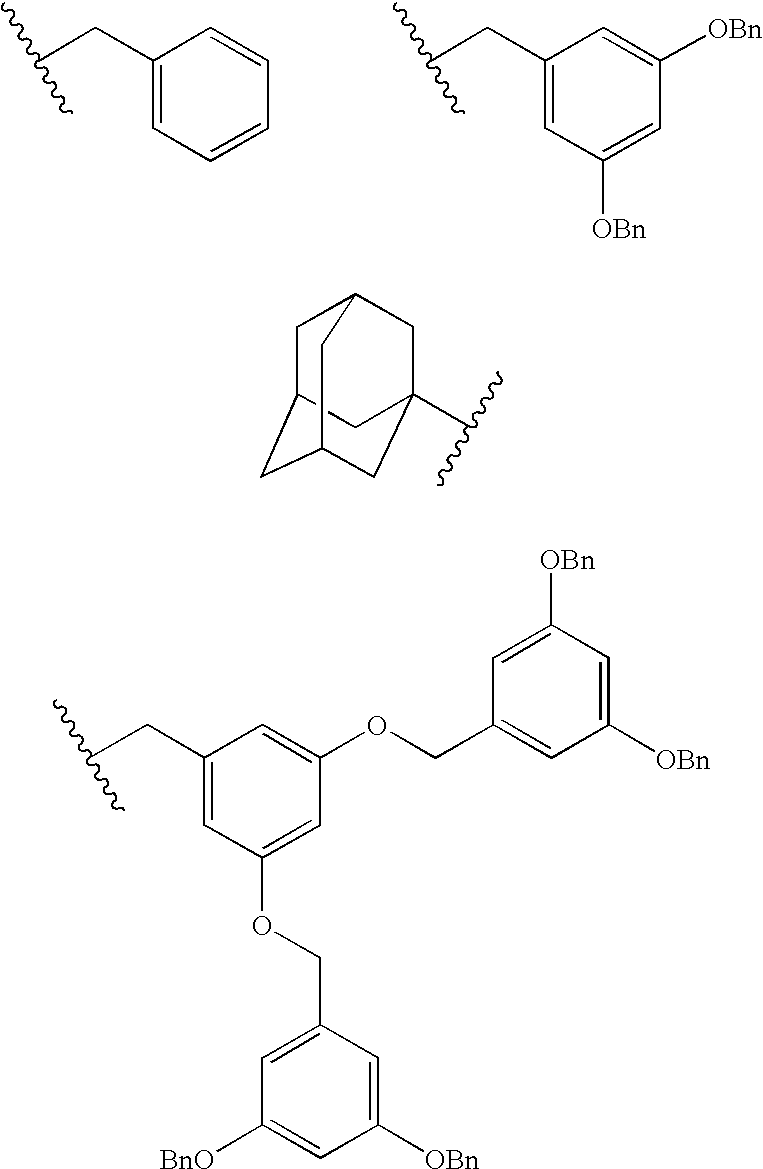
- O—X—NH— is a C 2 to C 5 alkyl, aryl or benzyl
- R 1 is selected from the group comprising linear or branched alkyl and polyethers, optionally unsaturated
- R 2 and R 3 are selected independently from the group comprising H, hydroxyl, protected alcohol functionalities, ether, acyl, carboxylate, alkoxycarbonyl
- linear or branched alkyl optionally unsaturated and optionally substituted by one or more of the following: carbocycles, heterocarbocycles, aromatic rings, heteroaromatic rings, hydroxyl, protected alcohol functionalities, ether, acyl, carboxylate and akoxycarbonyl
- cycloalkyl, heterocycloalkyl, aryl, heteroaryl, benzyl which are optionally substituted by one or more of the following: alkyl, hydroxyl, protected alcohol functionalities, ether, acyl, carboxylate and alkoxycarbonyl; or wherein R 2 and R 3
- Compounds of formula I comprise a cyclotriveratrilene (referred to as CTV) scaffold and three 2-ureido-4-[1H]-pyrimidinone moieties (referred to as UPy).
- CTV cyclotriveratrilene
- UPy 2-ureido-4-[1H]-pyrimidinone moieties
- Atwood et al. have reported the formation of so-called “ball and socket” 1:1 complexes between CTV and C 60 (J. W. Steed, P. C. Junk, J. L. Atwood, J. Am. Chem. Soc. 116, 10346 (1994)).
- 2:1 complexes of CTV with C 60 have been described only rarely (H. Matsubara et al., Chem. Lett., 923 (1998); H. Matsubara, S.-Y. Oguri, K. Asano, K.
- UPy dimers have been employed frequently as noncovalent bonding subunits to construct supramolecular architectures, such as polymers (R. P. Sijbesma et al., Science 278, 1601 (2002)) or oligomeric cyclic aggregates (rosettes) (H. M. Keizer et al., Chem. Eur. J. 11, 4602 (2005)), among others.
- CTV concave cyclotriveratrilene
- compound I is of formula Ia:
- R 1 is selected from the group comprising linear or branched alkyl and polyethers, optionally unsaturated;
- R 2 and R 3 are selected independently from the group comprising H, hydroxyl, protected alcohol functionalities, ether, acyl, carboxylate, alkoxycarbonyl; linear or branched alkyl optionally unsaturated and optionally substituted by one or more of the following: carbocycles, heterocarbocycles, aromatic rings, heteroaromatic rings, hydroxyl, protected alcohol functionalities, ether, acyl, carboxylate and akoxycarbonyl; cycloalkyl, heterocycloalkyl, aryl, heteroaryl, benzyl which are optionally substituted by one or more of the following: alkyl, hydroxyl, protected alcohol functionalities, ether, acyl, carboxylate and alkoxycarbonyl; or wherein R 2 and R 3 together form a carbocyclic or heterocyclic group having from 5 to 8 members, optionally fused to other cyclic
- O—X—NH— is selected from the group comprising:
- R 1 is selected from the group comprising linear or branched alkyl and polyethers, optionally unsaturated.
- R 2 and R 3 are selected independently from the group comprising H, hydroxyl, protected alcohol functionalities, ether, acyl, carboxylate, alkoxycarbonyl; linear or branched alkyl optionally unsaturated and optionally substituted by one or more of the following: hydroxyl, protected alcohol functionalities, ether, acyl, carboxylate, alkoxycarbonyl, esters and derivatives;
- n is an integer from 2 to 4.
- compound I is of formula 1:
- the present disclosure provides a fullerene-extracting composition including a compound of general formula I.
- the present disclosure refers to a capsule including two units of a compound of formula I non-covalently linked.
- the present disclosure provides a non-covalently linked complex including a high-order fullerene and two units of a compound of general formula I.
- said complex comprises C 70 and two units of a compound of general formula I.
- the present disclosure relates to a method for the preparation of a compound of formula Ia according hereto including the following operations:
- the preparation method hereof is straightforward; it is performed at mild conditions and can be easily scaled-up. More advantageously, high yields are obtained by the preparation method hereof and no further purification step being necessary.
- the present disclosure provides a method for the extraction of high-order fullerenes from a carbonaceous mixture characterized in that it includes at least one solid-liquid extraction by using a compound of formula I as extracting agent and a polar aprotic solvent or mixture of solvents as solvent.
- the present disclosure provides a method for the extraction of high-order fullerenes from a carbonaceous mixture including the following operations:
- the method for the extraction of high-order fullerenes according hereto is based on simple solid-liquid extractions, no chromatographic separation being necessary.
- dimers of compounds of general formula I and the complexes between compounds of general formula I and high-order fullerenes are soluble in polar aprotic solvents or mixtures of solvents, in contrast to non-complexed fullerenes which are highly insoluble in them, thus allowing the extraction of high-order fullerenes from carbonaceous mixtures, in particular from carbonaceous mixtures comprising C 60 , simply by solid-liquid extraction.
- a further advantage of the method for the extraction of high-order fullerenes according hereto is that the host-guest complex having two units of a compound of general formula I and a fullerene easily dissociates into smaller, non-complexed fragments upon addition of polar solvents or under the influence of acids, thus allowing the recovery of the corresponding fullerene.
- the compound of formula I can be isolated, for example by evaporation, and recycled. The possibility of recycling the extracting agent makes the method for the extraction of high-order fullerenes according hereto very suitable for industrial applications.
- the fullerene fraction obtained by the method hereof can be subjected to further rounds of solid-liquid extractions according to the method hereof until obtaining the desired purity of the extracted high-order fullerene.
- An ordinary-skilled person in the art will understand that the purity of the fullerenes obtained will increase as increasing the number of solid-liquid extraction rounds. Preferably, from one to four rounds of solid-liquid extractions are performed.
- the polar aprotic solvent or mixture of solvents is tetrahydrofurane (THF) or acetonitrile (MeCN).
- the disrupting compound is an acid, for example trifluoroacetic acid (TFA).
- the amount of compound of formula I employed according to the extraction method hereof is from about 5% to about 60% (w/w) relative to the carbonaceous mixture.
- a further advantage of the extraction method according hereto is that it allows the isolation of high-order fullerenes, which can not be readily isolated by using the methods of the background art.
- the fullerene[70] extracted by the method hereof can be obtained with high purity, preferably with a purity higher than 80%, more preferably with a purity higher than 90%, even more preferably with a purity higher than 95%.
- fullerenes higher than C 70 can be extracted by the method hereof.
- C 70 is obtained.
- the possibility of isolating C 70 opens the way to further investigation of the properties and applications of these C 70 fullerenes in industry.
- C 84 is obtained.
- a compound of formula I wherein X is a C 2 alkyl is employed.
- the method hereof allows isolating C 84 from carbonaceous mixtures.
- the possibility of isolating C 84 opens the way to further investigation of the properties and applications of these C 84 fullerenes in industry.
- the selection of the most suitable X chain of an extracting agent of formula I in order to make it more selective for a particular high order fullerene can be determined by experimentation and is within the skill in the art. For example, for the isolation of C 70 according to the method hereof, shorter X chains in the extracting compounds of formula I are selected, for example a C 2 alkyl.
- the weight ratio of the extracting agent to the carbonaceous mixture has also an influence on the selectivity for a given fullerene.
- the most suitable weight ratio of the extracting agent to the fullerenes mixture can be determined by experimentation and is within the skill in the art.
- the present disclosure refers to the use of a compound of formula I as a fullerene-extracting agent.
- a “high-order fullerene” as defined in the present disclosure refers to a fullerene containing more than 60 carbon atoms.
- a “carbonaceous mixture” as defined in the present disclosure refers to a mixture including fullerenes and optionally including carbon containing materials.
- soot refers to the product produced by sooting flames on graphite, typically including about 7-9% fullerenes and carbonaceous tar of unknown composition.
- fullerene refers to the fullerene mixture arising from extraction of soot with toluene, typically including C 60 (70-90%), C 70 (10-30%) and higher fullerenes (less than 2%).
- protected alcohol functionalities refers to an alcohol protected according to methods known to an ordinary-skilled person in the art. See for example Greene, T. W., Wuts, P. G. M. “Protective Groups in Organic Synthesis”, ed. John Wiley and sons, 1999, 3 rd edition.
- FIG. 1 shows the UV-titration of extracting agent 1 with C 60 , according to Example 2.
- FIG. 2 shows the UV-titration of extracting agent 1 with C 70 , according to Example 2.
- FIG. 3 shows the fullerene ratios upon extraction of fullerite with variable amounts of extracting agent 1, according to Example 2.
- the percentage by weight of agent 1 relative to fullerite is as follows: (A) 67%; (B) 34%; and (C) 18%.
- FIG. 4 shows the variation of the concentration of the extracted fullerenes C 60 , C 70 and C 84 upon increasing the ratio of extracting agent 1 to fullerite, according to Example 2.c.
- FIG. 5 is a qualitative analysis of the variation of the concentration of the extracted fullerenes by using variable amounts of CTV-UPy (% weight to fullerite) after a single solid-liquid extraction with compound 1, according to Example 2.d.
- the extractions were analyzed by MALDI-TOF mass spectrometry after 24 h stirring at room temperature.
- the signals obtained for each fullerene was normalised with respect to the signal of C 60 and plotted versus the ratio of extracting agent 1 to fullerite used.
- FIG. 6 shows the chromatograms obtained for different single-operation extractions performed with varying extracting agent to fullerite ratios, according to Example 2.d.
- Compound 2 can be prepared according to methods described in the background art, for example by the method described by H. M. Keizer et al. Eur. J. Org. Chem. 2553 (2004).
- the extraction method according to the present disclosure by using compound 1 as extractant proved to be very efficient for the extraction of C 70 from mixtures of C 60 and C 70 .
- C 70 was obtained with high purities from 87% to 99%, depending on the composition of the initial fullerene mixture.
- FIGS. 1 and 2 The corresponding binding studies for C 60 and C 70 are shown in FIGS. 1 and 2 , respectively.
- FIG. 3 shows the fullerene ratios upon extraction of fullerite with variable amounts of compound 1.
- the method hereof by using compound 1 as the extracting agent allowed extraction of C 70 from fullerite with high purifies: 85% purity after a single solid-liquid extraction and up to 97% after two solid-liquid extractions. Therefore, the extraction method according hereto allows extracting high-order fullerenes with high purity through simple solid-liquid extractions, avoiding the use of chromatography.
- C 84 is extracted preferentially over C 60 and C 70 at low concentrations of host.
- Example 2.c The procedure as depicted in Example 2.c was repeated by using variable weight ratios of extracting agent to fullerite.
- the method according hereto can be adjusted to the extraction of a selected high-order fullerene.
- the extraction method according to the present disclosure allows extracting high-order fullerenes with high purity through simple solid-liquid extractions, avoiding the use of chromatography. Moreover, the method hereof by using compound 1 as the extracting agent allows the extraction of selected high order fullerenes upon varying the ratio of the extracting agent to fullerite.
Landscapes
- Chemical & Material Sciences (AREA)
- Organic Chemistry (AREA)
- Engineering & Computer Science (AREA)
- Nanotechnology (AREA)
- Materials Engineering (AREA)
- Physics & Mathematics (AREA)
- Condensed Matter Physics & Semiconductors (AREA)
- General Physics & Mathematics (AREA)
- Crystallography & Structural Chemistry (AREA)
- Inorganic Chemistry (AREA)
- Manufacturing & Machinery (AREA)
- Composite Materials (AREA)
- Organic Low-Molecular-Weight Compounds And Preparation Thereof (AREA)
Abstract

and a corresponding method for the extraction of high-order fullerenes from a carbonaceous mixture including at least one solid-liquid extraction.
Description

wherein O—X—NH— is a C2 to C5 alkyl, aryl or benzyl;
R1 is selected from the group comprising linear or branched alkyl and polyethers, optionally unsaturated;
R2 and R3 are selected independently from the group comprising H, hydroxyl, protected alcohol functionalities, ether, acyl, carboxylate, alkoxycarbonyl;
linear or branched alkyl optionally unsaturated and optionally substituted by one or more of the following: carbocycles, heterocarbocycles, aromatic rings, heteroaromatic rings, hydroxyl, protected alcohol functionalities, ether, acyl, carboxylate and akoxycarbonyl;
cycloalkyl, heterocycloalkyl, aryl, heteroaryl, benzyl which are optionally substituted by one or more of the following: alkyl, hydroxyl, protected alcohol functionalities, ether, acyl, carboxylate and alkoxycarbonyl;
or wherein R2 and R3 together form a carbocyclic or heterocyclic group having from 5 to 8 members, optionally fused to other cyclic systems and optionally substituted by one or more of the following: alkyl, hydroxyl, protected alcohol functionalities, ether, acyl, carboxylate and alkoxycarbonyl.

wherein
R1 is selected from the group comprising linear or branched alkyl and polyethers, optionally unsaturated;
R2 and R3 are selected independently from the group comprising H, hydroxyl, protected alcohol functionalities, ether, acyl, carboxylate, alkoxycarbonyl;
linear or branched alkyl optionally unsaturated and optionally substituted by one or more of the following: carbocycles, heterocarbocycles, aromatic rings, heteroaromatic rings, hydroxyl, protected alcohol functionalities, ether, acyl, carboxylate and akoxycarbonyl;
cycloalkyl, heterocycloalkyl, aryl, heteroaryl, benzyl which are optionally substituted by one or more of the following: alkyl, hydroxyl, protected alcohol functionalities, ether, acyl, carboxylate and alkoxycarbonyl;
or wherein R2 and R3 together form a carbocyclic or heterocyclic group having from 5 to 8 members, optionally fused to other cyclic systems and optionally substituted by one or more of the following: alkyl, hydroxyl, protected alcohol functionalities, ether, acyl, carboxylate and alkoxycarbonyl.

R1 is selected from the group comprising linear or branched alkyl and polyethers, optionally unsaturated.
R2 and R3 are selected independently from the group comprising H, hydroxyl, protected alcohol functionalities, ether, acyl, carboxylate, alkoxycarbonyl;
linear or branched alkyl optionally unsaturated and optionally substituted by one or more of the following: hydroxyl, protected alcohol functionalities, ether, acyl, carboxylate, alkoxycarbonyl, esters and derivatives;

wherein n is an integer from 2 to 4
or wherein R2 and R3 together form


- (a) reacting a CTV-compound of formula IIIa with NaN3 to form the corresponding azide derivative IVa;
- (b) treating the CTV-azide derivative IVa obtained in operation a with triphenylphosphine and ammonia to form a CTV-derivative of formula Va;
- (c) reacting the CTV-derivative of formula Va with an imidazolide of formula IIa (see
Scheme 1 below).

- (a) contacting the carbonaceous mixture in a polar aprotic solvent or mixture of solvents with a compound of formula I and stirring;
- (b) separating the liquid from the solid;
- (c) adding at least one disrupting compound selected from the group including polar solvents and acids to the liquid;
- (d) isolating the precipitated high-order fullerenes.


Characterization of Compound 5:

| TABLE 1 |
| Fullerene extraction selectivities |
| Extract | |||
| Initial Ratio | Composition | ||
| [C60/C70/12] | (%)* |
| Entry | (mol equiv) | C70 | C60 |
| 1 | [1:1:1] | 87.26 | 12.74 |
| 2 | [1:1:0.5] | 96.38 | 3.62 |
| 3 | [1:12:11] | 99.31 | 0.69 |
| 4 | [6:1:1] | 92.47 | 7.53 |
| *Inherent solubility of fullerenes in dry THF has been subtracted | |||
Claims (17)


Priority Applications (1)
| Application Number | Priority Date | Filing Date | Title |
|---|---|---|---|
| US11/782,498 US7771691B2 (en) | 2006-07-25 | 2007-07-24 | Compound and method for the selective extraction of higher fullerenes from mixtures of fullerenes |
Applications Claiming Priority (2)
| Application Number | Priority Date | Filing Date | Title |
|---|---|---|---|
| US83306906P | 2006-07-25 | 2006-07-25 | |
| US11/782,498 US7771691B2 (en) | 2006-07-25 | 2007-07-24 | Compound and method for the selective extraction of higher fullerenes from mixtures of fullerenes |
Publications (2)
| Publication Number | Publication Date |
|---|---|
| US20080025904A1 US20080025904A1 (en) | 2008-01-31 |
| US7771691B2 true US7771691B2 (en) | 2010-08-10 |
Family
ID=38986523
Family Applications (1)
| Application Number | Title | Priority Date | Filing Date |
|---|---|---|---|
| US11/782,498 Expired - Fee Related US7771691B2 (en) | 2006-07-25 | 2007-07-24 | Compound and method for the selective extraction of higher fullerenes from mixtures of fullerenes |
Country Status (1)
| Country | Link |
|---|---|
| US (1) | US7771691B2 (en) |
Cited By (1)
| Publication number | Priority date | Publication date | Assignee | Title |
|---|---|---|---|---|
| US8969594B2 (en) | 2012-10-17 | 2015-03-03 | National Taiwan University | Fullerene-containing hemicarceplexes and a method of purifying fullerenes by using the same |
Families Citing this family (2)
| Publication number | Priority date | Publication date | Assignee | Title |
|---|---|---|---|---|
| CN103382388B (en) * | 2013-08-19 | 2014-12-24 | 中国科学院理化技术研究所 | Fluorescent nanoparticle based on quadruple hydrogen bond assembly supermolecule and preparation method and application thereof |
| WO2016154468A1 (en) * | 2015-03-24 | 2016-09-29 | The Board Of Trustees Of The Leland Stanford Junior University | Isolating semiconducting single-walled nanotubes or metallic single-walled nanotubes and approaches therefor |
-
2007
- 2007-07-24 US US11/782,498 patent/US7771691B2/en not_active Expired - Fee Related
Non-Patent Citations (39)
| Title |
|---|
| A. Hirsch, M. Brettreich, "Fullerenes, Chemistry and Reactions" (Wiley-VCH, Weinheim, 2005). |
| A. Hirsch, M. Brettreich, Fullerenes, Chemistry and Reactions, "Fullerenes: Molecular Allotropes of Carbon", Wiley-VCH, Weinheim (2005). |
| Anthopoulos, D.; Kooistra, F. B.; Wondergem, H. J.; Kronholm, D.; Hummelen, J. C.; de Leeuw D. M., "Air-Stable n-Channel Organic Transistors Based on a Soluble C84 Fullerene Derivative", Adv. Mater. 2006, 18, 1679. |
| Billups, Edward E et al., "Buckminsterfullerenes", 1993 VCH Publishers, Inc., (Chapter 3, inter alia). |
| C. Thilgen, F. Diederich, R. L. Whetten, "The Higher Fullerenes", Buckminsterfullerenes, Chapter 3, 59 (1993), VCH Publishers, Inc. |
| Crassous, J.; Rivera, J.; Fender, N. S.; Shu, L. H.; Echegoyen, L; Thilgen, C.; Herrmann, A.; Diederich, F. "Chemistry of C84: Separation of Three Constitutional Isomers and Optical Resolution of D2-C84 by Using the Bingel-Retro-Bingel Strategy", Angew., Chem. Int. Ed. 1999, 38, 1613. |
| D. H. Parker et al., "Fullerenes and Giant Fullerenes: Synthesis, Separation, and Mass Spectrometric Characterization", Carbon 30, 1167 (1992). |
| Darwish, A. D.; Martsinovich, N.; Taylor R., "Methylation of [76] Fullerene and [84] Fullerenes; the First Oxahomo Derivatives of a Higher Fullerene", Org. Biomol. Chem. 2004, 2, 1364. |
| Dennis, T. J. S.; Kai, T.; Tomiyama, T.; Shinohara H., "Isolation and Characterization of the Two Major Isomers of [84] Fullerene (C84)", Chem. Commun 1998, 619-620. |
| Diederich, F.; Ettl, R.; Rubin, Y.; Wetthen, R. L.; Beck, R.; Álvarez, M.; Anz, S.; Sensharma, D.; Wuld, F.; Khemani, K. C.; Koch A, "The Higher Fullerenes: Isolation and Characterization of C76, C84, C90, C94, and C700, an Oxide of D5h-C7O", Science, 1991, 252, 548-551. |
| Diederich, F; Thilgen, C.; Whetten, R.L; Ettl, E.; Chao, I.; Alvarez, "Fullerene Isomerism: Isolation of C2v-C78 and D3-C78", M.M Science 1991, 254, 1768-1770. |
| Ettl, E.; Diederich, F; Whetten R.L , "Isolation of C76, a Chiral (D2) Allotrope of Carbon", Nature 1991, 353, 149-153. |
| Greene, T.W., Wuts, P.G.M. "Protective Groups in Organic Synthesis", ed. John Wiley and sons, 1999, 3rd edition. |
| Greene, T.W., Wuts, P.G.M., "Chapter 2: Protection for the Hydroxyl Group, Including 1,2- and 1,3-Diols", Protective Groups in Organic Synthesis, Third Edition, 1999. |
| H. M. Keizer et al. "Self-Assembled Pentamers and Hexamers Linked through Quadruple-Hydrogen-Bonded 2-Ureido-4[1H]-Pyrimidinones", Chem. Eur. J. 11, 4602 (2005). |
| H. M. Keizer et al., The Convenient Synthesis of Hydrogen-Bonded Ureidopyrimidinones'', Eur. J. Org. Chem. 2553 (2004). |
| H. Matsubara et al., "Supramolecular Inclusion Complexes of Fullerenes Using Cyclotriveratrylene Derivatives with Aromatic Pendants", Chem. Lett., 923 (1998). |
| H. Matsubara, S.-Y. Oguri, K. Asano, K. Yamamoto, "Syntheses of Novel Cyclotriveratrylenophane Capsules and their Supramolecular Complexes of Fullerenes", Chem. Lett., 431 (1999). |
| Haino, T.; Fukunaga, C.; Fukazawa Y, "A new Calix[5]arene-Based Container: Selective Extraction of Higher Fullerenes", Org. Lett. 2006, 8, 16, 3545-3548. |
| Hawkins, J. M.; Nambu, M.; Meyer A., "Resolution and Configurational Stability of the Chiral Fullerenes C76, C78 and C84: A Limit for the Activation Energy of the Stone-Wales Transformation", J. Am. Chem. Soc. 1994, 116, 7642. |
| I. Bucsi, R. Aniszfeld, T. Shamma, G. K. S. Prakash, G. A. Olah, "Convenient Separation of High-Purity C60 from Crude Fullerenes Extract by Selective Complexation with A1C13", Proc. Natl. Acad. Sci. U.S.A., 91, 9019 (1994). |
| I. L. Isaacs, A. Wehrsig, F. Diederich, "Improved Purification of C60 and Formation of sigma- and pi-Homoaromatic Methano-Bridged Fullerenes by Reaction with Alkyl Diazoacetates", Helv. Chim. Acta 76, 1231 (1993). |
| I. L. Isaacs, A. Wehrsig, F. Diederich, "Improved Purification of C60 and Formation of σ- and π-Homoaromatic Methano-Bridged Fullerenes by Reaction with Alkyl Diazoacetates", Helv. Chim. Acta 76, 1231 (1993). |
| J. L. Atwood, G. A. Koutsantonis, C. IL. Raston, "Purification of C60 and C70 by Selective Complexation with Calixarenes", Nature 368, 229 (1994). |
| J. W. Steed, P. C. Junk, J. L. Atwood, "Ball and Socket Nanostructures: New Supramolecular Chemistry Based on Cyclotriveratrylene", J. Am. Chem. Soc. 116, 10346 (1994). |
| K. C. Khemani, M. Prato, F. Wudl, J. Org. Chem, "A Simple Soxhlet Chromatographic Method for the Isolation of Pure C60 and C70", 57, 3254-3256 (1992). |
| Kooistra, F. B.; Mihailetchi, V. D.; Popescu, L. M.; Kronholm, D.; Blom, P. W. M.; Hummelen J. C., "New C84 Derivative and its Application in a Bulk Heterojunction Solar Cell", Chem. Mater. 2006, 18, 3068. |
| Krätschmer, W.; Lamb, L. D.; Fostiropoulos, K.; Huffman D.R., "Solid C60: A New Form of Carbon", Nature 1990, 347, 354. |
| N. Komatsu, "Preferential Precipitation of C70 over C60 with p-halohomooxa-calix[3]arenes", Org. Biomol. Chem., 204 (2003). |
| N. Komatsu, T. Ohe, K. Matsushige, "A Highly Improved Method for Purification of Fullerenes Applicable to Large-Scale Production", Carbon 42, 163 (2004). |
| Nuffer, R.; Bartl, A.; Dunsch, L.; Mathis C., "Polystyrene Hexa-Adducts of Higher Fullerenes", Synth. Met. 2001, 121, 1151. |
| R. P. Sijbesma et al., "Reversible Polymers Formed from Self-Complementary Monomers Using Quadruple Hydrogen Bonding", Science 278, 1601 (1997). |
| Shibata, K.; Kubozono, Y.; Kanbara, T.; Hosokawa, T.; Fujiwara, A.; Ito, Y.; Shinohara H., "Fabrication and Characteristics of C84 Fullerene Field-Effect Transistors", Appl. Phys. Lett. 2004, 84, 14, 2572. |
| Shoji, Y.; Tashiro, K.; Aida, T., "Selective Extraction of Higher Fullerenes Using Cyclic Dimers of Zinc Porphyrins", J. Am. Chem. Soc. 2004, 126, 6570-6571. |
| T. Anderson, K. Nilsson, M. Sundahl, G. Westman, O. Wennerström, "C60 Embedded in y-Cyclodextrin: a Water-soluble Fullerenes", J. Chem. Soc. Chem. Commun., 604 (1992). |
| T. Suzuki, K. Nakashima, S. Shinkai, "Very Convenient and Efficient Purification Method for Fullerene (C60) with 5, 11, 17, 23, 29, 35, 41, 47-Octa-tert-butylcalix[8]arene-49, 50, 51, 52, 53, 54, 55, 56-octol", Chem. Lett., 699 (1994). |
| W. A. Scrivens, P. V. Bedworth, J. M. Tour, "Purification of Gram Quantities of C60, A new Inexpensive and Facile Method", J. Am. Chem. Soc. 114, 7917 (1992). |
| Wakahara, T.; Han, A. H.; Niino, Y.; Maeda, Y.; Akasaka, T.; Suzuki, T.; Yamamoto, K.; Kako, M.; Nakadaira, Y.; Kobayashi, K.; Nagase S., "Silylation of Higher Fullerenes", J. Mater. Chem. 2002, 12, 2061. |
| Wang, G. W.; Saunders, M.; Khong, A.; Cross, R. J., "A New Method for Separating the Isomeric C84 Fullerenes", J. Am. Chem. Soc. 2000, 122, 3216. |
Cited By (1)
| Publication number | Priority date | Publication date | Assignee | Title |
|---|---|---|---|---|
| US8969594B2 (en) | 2012-10-17 | 2015-03-03 | National Taiwan University | Fullerene-containing hemicarceplexes and a method of purifying fullerenes by using the same |
Also Published As
| Publication number | Publication date |
|---|---|
| US20080025904A1 (en) | 2008-01-31 |
Similar Documents
| Publication | Publication Date | Title |
|---|---|---|
| Smith III et al. | Synthesis of prototypical fullerene cyclopropanes and annulenes. Isomer differentiation via NMR and UV spectroscopy | |
| US8076050B2 (en) | Blends of fullerene derivatives, and uses thereof in electronic devices | |
| US7771691B2 (en) | Compound and method for the selective extraction of higher fullerenes from mixtures of fullerenes | |
| EP0197219A1 (en) | Process for the isolation and purification of podophyllotoxin | |
| Mollahosseini et al. | Fullerene-assisted photoinduced charge transfer of single-walled carbon nanotubes through a flavin helix | |
| US20100280077A1 (en) | Process for Preparation of Stable Amorphous R-Lansoprazole | |
| Yin et al. | Efficient synthesis of a hetero [4] rotaxane by a “threading-stoppering-followed-by-clipping” approach | |
| Huerta et al. | Preferential separation of fullerene [84] from fullerene mixtures by encapsulation | |
| KR20090029208A (en) | Dual molecules containing peroxide derivatives, their synthesis and therapeutic use | |
| CN114349674B (en) | Thiourea compound and preparation method thereof | |
| WO1995025067A1 (en) | Method for the separation and purification of fullerenes | |
| Ubasart et al. | Straightforward supramolecular purification of C 84 from a fullerene extract | |
| CS236482B2 (en) | Method of 2-(2-or 3-thienyl)ethylamines production | |
| US7795459B2 (en) | Paricalcitol purification | |
| US8247426B2 (en) | Crystalline irinotecan hydrochloride and methods for its preparation | |
| CN105272987A (en) | Preparation method of 3-cyano-N-confused porphyrin compound | |
| US8071781B2 (en) | Process for preparing rabeprazole sodium | |
| US20170266648A1 (en) | Iron and cobalt catalyzed hydrogen isotope labeling of organic compounds | |
| JP2892401B2 (en) | Method for producing 5- (4-pyridyl) oxazole | |
| US20150299196A1 (en) | Flindersia Alkaloids, Derivatives and Analogs: Compositions and Methods for Producing the Same | |
| CN105669704B (en) | Tetrathiafulvalene class compound and its synthetic method | |
| JP7694948B2 (en) | Encapsulation of BCP and a new method for the synthesis of propellane | |
| JP6982262B2 (en) | Purification method | |
| RU2225391C2 (en) | Method for preparing malonic acid dinitrile | |
| WO2008146297A2 (en) | Improved process for amorphous rabeprazole sodium |
Legal Events
| Date | Code | Title | Description |
|---|---|---|---|
| AS | Assignment |
Owner name: INSTITUT CATALA D'INVESTIGACIO QUIMICA, SPAIN Free format text: ASSIGNMENT OF ASSIGNORS INTEREST;ASSIGNORS:MENDOZA, JAVIER DE;HUERTA MARTINEZ, ELISA;METSELAAR, GERALD;REEL/FRAME:019606/0202 Effective date: 20070717 |
|
| REMI | Maintenance fee reminder mailed | ||
| FPAY | Fee payment |
Year of fee payment: 4 |
|
| SULP | Surcharge for late payment | ||
| FEPP | Fee payment procedure |
Free format text: MAINTENANCE FEE REMINDER MAILED (ORIGINAL EVENT CODE: REM.) |
|
| LAPS | Lapse for failure to pay maintenance fees |
Free format text: PATENT EXPIRED FOR FAILURE TO PAY MAINTENANCE FEES (ORIGINAL EVENT CODE: EXP.); ENTITY STATUS OF PATENT OWNER: SMALL ENTITY |
|
| STCH | Information on status: patent discontinuation |
Free format text: PATENT EXPIRED DUE TO NONPAYMENT OF MAINTENANCE FEES UNDER 37 CFR 1.362 |
|
| FP | Lapsed due to failure to pay maintenance fee |
Effective date: 20180810 |