US7767704B2 - Antiviral 4-aminocarbonylamino-substituted imidazole compounds - Google Patents
Antiviral 4-aminocarbonylamino-substituted imidazole compounds Download PDFInfo
- Publication number
- US7767704B2 US7767704B2 US10/594,343 US59434305A US7767704B2 US 7767704 B2 US7767704 B2 US 7767704B2 US 59434305 A US59434305 A US 59434305A US 7767704 B2 US7767704 B2 US 7767704B2
- Authority
- US
- United States
- Prior art keywords
- substituents
- amino
- substituted
- alkyl
- group
- Prior art date
- Legal status (The legal status is an assumption and is not a legal conclusion. Google has not performed a legal analysis and makes no representation as to the accuracy of the status listed.)
- Expired - Fee Related, expires
Links
- 0 *N([4*])C(=O)N([3*])C1=CN([2*])C(C([1*])=O)=N1 Chemical compound *N([4*])C(=O)N([3*])C1=CN([2*])C(C([1*])=O)=N1 0.000 description 15
- QALDNFGKROWOOI-UHFFFAOYSA-N CC(CO)NC(=O)C1=NC(NC(=O)NC2=CC=C(OC(F)(F)F)C=C2)=CN1CC1=CC=CC=C1 Chemical compound CC(CO)NC(=O)C1=NC(NC(=O)NC2=CC=C(OC(F)(F)F)C=C2)=CN1CC1=CC=CC=C1 QALDNFGKROWOOI-UHFFFAOYSA-N 0.000 description 2
- UGHLZDDNYKTPEC-UHFFFAOYSA-N CC1=C(F)C=C(NC(=O)NC2=CN(C)C(C(=O)O)=N2)C=C1 Chemical compound CC1=C(F)C=C(NC(=O)NC2=CN(C)C(C(=O)O)=N2)C=C1 UGHLZDDNYKTPEC-UHFFFAOYSA-N 0.000 description 2
- SKNLKLNOXYFJDG-UHFFFAOYSA-N CC1=CC(Cl)=CC=C1NC(=O)NC1=CN(CC2=CC=C(C(F)(F)F)C=C2)C(C(=O)NCCNC2CC2)=N1 Chemical compound CC1=CC(Cl)=CC=C1NC(=O)NC1=CN(CC2=CC=C(C(F)(F)F)C=C2)C(C(=O)NCCNC2CC2)=N1 SKNLKLNOXYFJDG-UHFFFAOYSA-N 0.000 description 2
- ZAYAORALNJOGKB-UHFFFAOYSA-N CC1=CC(Cl)=CC=C1NC(=O)NC1=CN(CC2=CC=C(C(F)(F)F)C=C2)C(C(=O)OCCOC(=O)CN2CCOCC2)=N1 Chemical compound CC1=CC(Cl)=CC=C1NC(=O)NC1=CN(CC2=CC=C(C(F)(F)F)C=C2)C(C(=O)OCCOC(=O)CN2CCOCC2)=N1 ZAYAORALNJOGKB-UHFFFAOYSA-N 0.000 description 2
- OTNIQLMNKSAYLF-UHFFFAOYSA-N CC1=CC(Cl)=CC=C1NC(=O)NC1=CN(CC2=CC=CC=C2)C(C(=O)NCCCN2C=CC=N2)=N1 Chemical compound CC1=CC(Cl)=CC=C1NC(=O)NC1=CN(CC2=CC=CC=C2)C(C(=O)NCCCN2C=CC=N2)=N1 OTNIQLMNKSAYLF-UHFFFAOYSA-N 0.000 description 2
- YKZYREOZHAXENN-UHFFFAOYSA-N CC1=CC(Cl)=CC=C1NC(=O)NC1=CN(CC2CC2)C(C(=O)NCCCN2C=CC=N2)=N1 Chemical compound CC1=CC(Cl)=CC=C1NC(=O)NC1=CN(CC2CC2)C(C(=O)NCCCN2C=CC=N2)=N1 YKZYREOZHAXENN-UHFFFAOYSA-N 0.000 description 2
- PIHVPRBYYWPRTC-UHFFFAOYSA-N CC1=CC(Cl)=CC=C1NC(=O)NC1=CN(CC2CC2)C(C(=O)O)=N1 Chemical compound CC1=CC(Cl)=CC=C1NC(=O)NC1=CN(CC2CC2)C(C(=O)O)=N1 PIHVPRBYYWPRTC-UHFFFAOYSA-N 0.000 description 2
- QPXHZTWHKIXBLS-UHFFFAOYSA-N CC1=CC(Cl)=CC=C1NC(=O)NC1=CN(CC=C(Cl)Cl)C(C(=O)O)=N1 Chemical compound CC1=CC(Cl)=CC=C1NC(=O)NC1=CN(CC=C(Cl)Cl)C(C(=O)O)=N1 QPXHZTWHKIXBLS-UHFFFAOYSA-N 0.000 description 2
- XZXUOURRNYHQHK-UHFFFAOYSA-N CCCCN1C=C(NC(=O)NC2=CC=C(OC(F)(F)F)C=C2)N=C1C(=O)NCC(=O)N1CCCC1 Chemical compound CCCCN1C=C(NC(=O)NC2=CC=C(OC(F)(F)F)C=C2)N=C1C(=O)NCC(=O)N1CCCC1 XZXUOURRNYHQHK-UHFFFAOYSA-N 0.000 description 2
- ZQCSAZPYUSMMQB-UHFFFAOYSA-N CCCCN1C=C(NC(=O)NC2=CC=C(OC(F)(F)F)C=C2)N=C1C(=O)NCC1=C(C(F)(F)F)OC(C)=C1 Chemical compound CCCCN1C=C(NC(=O)NC2=CC=C(OC(F)(F)F)C=C2)N=C1C(=O)NCC1=C(C(F)(F)F)OC(C)=C1 ZQCSAZPYUSMMQB-UHFFFAOYSA-N 0.000 description 2
- XMACSELBTGSDRL-UHFFFAOYSA-N CCCCN1C=C(NC(=O)NC2=CC=C(OC(F)(F)F)C=C2)N=C1C(=O)NCC1=CC=C(OC)C=C1 Chemical compound CCCCN1C=C(NC(=O)NC2=CC=C(OC(F)(F)F)C=C2)N=C1C(=O)NCC1=CC=C(OC)C=C1 XMACSELBTGSDRL-UHFFFAOYSA-N 0.000 description 2
- MZDCLWKWDOBOKV-UHFFFAOYSA-N CCCCN1C=C(NC(=O)NC2=CC=C(OC(F)(F)F)C=C2)N=C1C(=O)NCCCN1C=CC=N1 Chemical compound CCCCN1C=C(NC(=O)NC2=CC=C(OC(F)(F)F)C=C2)N=C1C(=O)NCCCN1C=CC=N1 MZDCLWKWDOBOKV-UHFFFAOYSA-N 0.000 description 2
- WGGAHWKAUPESHO-INIZCTEOSA-N CCCCN1C=C(NC(=O)NC2=CC=C(OC(F)(F)F)C=C2)N=C1C(=O)NCCOC(=O)[C@@H](N)CCC(=O)O Chemical compound CCCCN1C=C(NC(=O)NC2=CC=C(OC(F)(F)F)C=C2)N=C1C(=O)NCCOC(=O)[C@@H](N)CCC(=O)O WGGAHWKAUPESHO-INIZCTEOSA-N 0.000 description 2
- ISUHFBQGXRTNHB-UHFFFAOYSA-N CCN1C=C(NC(=O)NC2=CC=C(OC(F)(F)F)C=C2)N=C1C(=O)O Chemical compound CCN1C=C(NC(=O)NC2=CC=C(OC(F)(F)F)C=C2)N=C1C(=O)O ISUHFBQGXRTNHB-UHFFFAOYSA-N 0.000 description 2
- DIXLJVUQLJTUNU-UHFFFAOYSA-N CCOC(=O)C1=NC(NC(=O)NC2=CC(F)=C(C)C=C2)=CN1C Chemical compound CCOC(=O)C1=NC(NC(=O)NC2=CC(F)=C(C)C=C2)=CN1C DIXLJVUQLJTUNU-UHFFFAOYSA-N 0.000 description 2
- ULWNTNNFCRNMRI-UHFFFAOYSA-N CCOC(=O)C1=NC(NC(=O)NC2=CC=C(OC(F)(F)F)C=C2)=CN1CC1=CC=C(C(F)(F)F)C=C1 Chemical compound CCOC(=O)C1=NC(NC(=O)NC2=CC=C(OC(F)(F)F)C=C2)=CN1CC1=CC=C(C(F)(F)F)C=C1 ULWNTNNFCRNMRI-UHFFFAOYSA-N 0.000 description 2
- UHYNYIGCGVDBTC-UHFFFAOYSA-N CCOC(=O)C1=NC=CN1 Chemical compound CCOC(=O)C1=NC=CN1 UHYNYIGCGVDBTC-UHFFFAOYSA-N 0.000 description 2
- DQHBQEIXTVDMIM-UHFFFAOYSA-N CCOC(=O)NCCNC(=O)C1=NC(NC(=O)NC2=CC=C(Cl)C=C2C)=CN1CC1CC1 Chemical compound CCOC(=O)NCCNC(=O)C1=NC(NC(=O)NC2=CC=C(Cl)C=C2C)=CN1CC1CC1 DQHBQEIXTVDMIM-UHFFFAOYSA-N 0.000 description 2
- KXKFWRPDNPDVDR-UHFFFAOYSA-N COC1=CC=C(C(C)NC(=O)C2=NC(NC(=O)NC3=CC=C(OC(F)(F)F)C=C3)=CN2C)C=N1 Chemical compound COC1=CC=C(C(C)NC(=O)C2=NC(NC(=O)NC3=CC=C(OC(F)(F)F)C=C3)=CN2C)C=N1 KXKFWRPDNPDVDR-UHFFFAOYSA-N 0.000 description 2
- PJKJFDUIIDSRJN-UHFFFAOYSA-N COCCOCCCNC(=O)C1=NC(NC(=O)NC2=CC=C(Cl)C=C2C)=CN1CC=C(C)C Chemical compound COCCOCCCNC(=O)C1=NC(NC(=O)NC2=CC=C(Cl)C=C2C)=CN1CC=C(C)C PJKJFDUIIDSRJN-UHFFFAOYSA-N 0.000 description 2
- YJXVIDFGSDLPRB-UHFFFAOYSA-N O=C(NC1=CC=C(OC(F)(F)F)C=C1)NC1=CN(CC2=CC=C(C(F)(F)F)C=C2)C(C(=O)NCCCl)=N1 Chemical compound O=C(NC1=CC=C(OC(F)(F)F)C=C1)NC1=CN(CC2=CC=C(C(F)(F)F)C=C2)C(C(=O)NCCCl)=N1 YJXVIDFGSDLPRB-UHFFFAOYSA-N 0.000 description 2
- NQVHANHKGYFBSS-UHFFFAOYSA-N O=C(NC1=CC=C(OC(F)(F)F)C=C1)NC1=CN(CC2=CC=C(C(F)(F)F)C=C2)C(C(=O)NCCOC(=O)CNC2CC2)=N1 Chemical compound O=C(NC1=CC=C(OC(F)(F)F)C=C1)NC1=CN(CC2=CC=C(C(F)(F)F)C=C2)C(C(=O)NCCOC(=O)CNC2CC2)=N1 NQVHANHKGYFBSS-UHFFFAOYSA-N 0.000 description 2
- AKDSYTSFHMMCNQ-UHFFFAOYSA-N O=C(NC1=CC=C(OC(F)(F)F)C=C1)NC1=CN(CC2CC2)C(C(=O)NCCCl)=N1 Chemical compound O=C(NC1=CC=C(OC(F)(F)F)C=C1)NC1=CN(CC2CC2)C(C(=O)NCCCl)=N1 AKDSYTSFHMMCNQ-UHFFFAOYSA-N 0.000 description 2
- LTWNWEGOZRRJJH-UHFFFAOYSA-N O=C(NC1=CC=C(OC(F)(F)F)C=C1)NC1=CN(CC2CC2)C(C(=O)O)=N1 Chemical compound O=C(NC1=CC=C(OC(F)(F)F)C=C1)NC1=CN(CC2CC2)C(C(=O)O)=N1 LTWNWEGOZRRJJH-UHFFFAOYSA-N 0.000 description 2
- TWJLKUWUVCGORI-UHFFFAOYSA-N O=C(NC1=CC=C(OC(F)(F)F)C=C1)NC1=CN(CC=C(Cl)Cl)C(C(=O)NCCOCCO)=N1 Chemical compound O=C(NC1=CC=C(OC(F)(F)F)C=C1)NC1=CN(CC=C(Cl)Cl)C(C(=O)NCCOCCO)=N1 TWJLKUWUVCGORI-UHFFFAOYSA-N 0.000 description 2
- DNGQJPBQSGZTER-UHFFFAOYSA-M BrCC1CC1.CC1=C(N=C=O)C=CC(Cl)=C1.CC1=CC(Cl)=CC=C1NC(=O)NC1=CN(CC2CC2)C(C(=O)NCCCN2CCOCC2)=N1.CC1=CC(Cl)=CC=C1NC(=O)NC1=CN(CC2CC2)C(C(=O)O)=N1.CCOC(=O)C1=NC(N)=CN1CC1CC1.CCOC(=O)C1=NC(NC(=O)NC2=CC=C(Cl)C=C2C)=CN1CC1CC1.CCOC(=O)C1=NC([N+](=O)[O-])=CN1.CCOC(=O)C1=NC([N+](=O)[O-])=CN1CC1CC1.CCOC(=O)C1=NC=CN1.NCCCN1CCOCC1.O=[N+]([O-])O.O[Na] Chemical compound BrCC1CC1.CC1=C(N=C=O)C=CC(Cl)=C1.CC1=CC(Cl)=CC=C1NC(=O)NC1=CN(CC2CC2)C(C(=O)NCCCN2CCOCC2)=N1.CC1=CC(Cl)=CC=C1NC(=O)NC1=CN(CC2CC2)C(C(=O)O)=N1.CCOC(=O)C1=NC(N)=CN1CC1CC1.CCOC(=O)C1=NC(NC(=O)NC2=CC=C(Cl)C=C2C)=CN1CC1CC1.CCOC(=O)C1=NC([N+](=O)[O-])=CN1.CCOC(=O)C1=NC([N+](=O)[O-])=CN1CC1CC1.CCOC(=O)C1=NC=CN1.NCCCN1CCOCC1.O=[N+]([O-])O.O[Na] DNGQJPBQSGZTER-UHFFFAOYSA-M 0.000 description 1
- ZOGSHNFIAKVILQ-UHFFFAOYSA-N CC(C)=CCN1C=C(NC(=O)NC2=CC=C(Cl)C=C2C)N=C1C(=O)NCC1=CN=CC=C1 Chemical compound CC(C)=CCN1C=C(NC(=O)NC2=CC=C(Cl)C=C2C)N=C1C(=O)NCC1=CN=CC=C1 ZOGSHNFIAKVILQ-UHFFFAOYSA-N 0.000 description 1
- RRRORVXOVLOEQE-UHFFFAOYSA-N CC(C)=CCN1C=C(NC(=O)NC2=CC=C(Cl)C=C2C)N=C1C(=O)NCCCN1C=CC=N1.CCCNC(=O)C1=NC(NC(=O)NC2=CC=C(Cl)C=C2C)=CN1CC=C(C)C Chemical compound CC(C)=CCN1C=C(NC(=O)NC2=CC=C(Cl)C=C2C)N=C1C(=O)NCCCN1C=CC=N1.CCCNC(=O)C1=NC(NC(=O)NC2=CC=C(Cl)C=C2C)=CN1CC=C(C)C RRRORVXOVLOEQE-UHFFFAOYSA-N 0.000 description 1
- MMKINGOMUAEQFT-UHFFFAOYSA-N CC(C)=CCN1C=C(NC(=O)NC2=CC=C(Cl)C=C2C)N=C1C(=O)NCCCN1CCCC1 Chemical compound CC(C)=CCN1C=C(NC(=O)NC2=CC=C(Cl)C=C2C)N=C1C(=O)NCCCN1CCCC1 MMKINGOMUAEQFT-UHFFFAOYSA-N 0.000 description 1
- JAPMGWKBACEYQE-UHFFFAOYSA-N CC(C)=CCN1C=C(NC(=O)NC2=CC=C(Cl)C=C2C)N=C1C(=O)NCCO Chemical compound CC(C)=CCN1C=C(NC(=O)NC2=CC=C(Cl)C=C2C)N=C1C(=O)NCCO JAPMGWKBACEYQE-UHFFFAOYSA-N 0.000 description 1
- VGCCMFOSULERST-UHFFFAOYSA-N CC(C)=CCN1C=C(NC(=O)NC2=CC=C(Cl)C=C2C)N=C1C(=O)O Chemical compound CC(C)=CCN1C=C(NC(=O)NC2=CC=C(Cl)C=C2C)N=C1C(=O)O VGCCMFOSULERST-UHFFFAOYSA-N 0.000 description 1
- DQVGOBIEEFHTGT-UHFFFAOYSA-N CC(C)=CCN1C=C(NC(=O)NC2=CC=C(OC(F)(F)F)C=C2)N=C1C(=O)NC(C)CO Chemical compound CC(C)=CCN1C=C(NC(=O)NC2=CC=C(OC(F)(F)F)C=C2)N=C1C(=O)NC(C)CO DQVGOBIEEFHTGT-UHFFFAOYSA-N 0.000 description 1
- UGIGGVKVUYYDLG-UHFFFAOYSA-N CC(C)=CCN1C=C(NC(=O)NC2=CC=C(OC(F)(F)F)C=C2)N=C1C(=O)NCC(C)C(N)=O Chemical compound CC(C)=CCN1C=C(NC(=O)NC2=CC=C(OC(F)(F)F)C=C2)N=C1C(=O)NCC(C)C(N)=O UGIGGVKVUYYDLG-UHFFFAOYSA-N 0.000 description 1
- XYNAKEZVRASXOS-UHFFFAOYSA-N CC(C)=CCN1C=C(NC(=O)NC2=CC=C(OC(F)(F)F)C=C2)N=C1C(=O)NCCCC1=C(C)NN=C1 Chemical compound CC(C)=CCN1C=C(NC(=O)NC2=CC=C(OC(F)(F)F)C=C2)N=C1C(=O)NCCCC1=C(C)NN=C1 XYNAKEZVRASXOS-UHFFFAOYSA-N 0.000 description 1
- CTTIPZHFRXKRIS-UHFFFAOYSA-N CC(C)=CCN1C=C(NC(=O)NC2=CC=C(OC(F)(F)F)C=C2)N=C1C(=O)NCCCN1C=CC=N1 Chemical compound CC(C)=CCN1C=C(NC(=O)NC2=CC=C(OC(F)(F)F)C=C2)N=C1C(=O)NCCCN1C=CC=N1 CTTIPZHFRXKRIS-UHFFFAOYSA-N 0.000 description 1
- FELKHJYVXPXISV-UHFFFAOYSA-N CC(C)=CCN1C=C(NC(=O)NC2=CC=C(OC(F)(F)F)C=C2)N=C1C(=O)NCCCN1C=CN=C1 Chemical compound CC(C)=CCN1C=C(NC(=O)NC2=CC=C(OC(F)(F)F)C=C2)N=C1C(=O)NCCCN1C=CN=C1 FELKHJYVXPXISV-UHFFFAOYSA-N 0.000 description 1
- BUZPLKXRLNALOS-UHFFFAOYSA-N CC(C)=CCN1C=C(NC(=O)NC2=CC=C(OC(F)(F)F)C=C2)N=C1C(=O)NCCCN1C=CN=C1C Chemical compound CC(C)=CCN1C=C(NC(=O)NC2=CC=C(OC(F)(F)F)C=C2)N=C1C(=O)NCCCN1C=CN=C1C BUZPLKXRLNALOS-UHFFFAOYSA-N 0.000 description 1
- URVMAGQRTLAQPQ-UHFFFAOYSA-N CC(C)=CCN1C=C(NC(=O)NC2=CC=C(OC(F)(F)F)C=C2)N=C1C(=O)NCCCO Chemical compound CC(C)=CCN1C=C(NC(=O)NC2=CC=C(OC(F)(F)F)C=C2)N=C1C(=O)NCCCO URVMAGQRTLAQPQ-UHFFFAOYSA-N 0.000 description 1
- QVBSLGTWNQBCLL-UHFFFAOYSA-N CC(C)=CCN1C=C(NC(=O)NC2=CC=C(OC(F)(F)F)C=C2)N=C1C(=O)NCCN(C)CCO Chemical compound CC(C)=CCN1C=C(NC(=O)NC2=CC=C(OC(F)(F)F)C=C2)N=C1C(=O)NCCN(C)CCO QVBSLGTWNQBCLL-UHFFFAOYSA-N 0.000 description 1
- ZGLAVWHXZABBRH-UHFFFAOYSA-N CC(C)=CCN1C=C(NC(=O)NC2=CC=C(OC(F)(F)F)C=C2)N=C1C(=O)NCCO Chemical compound CC(C)=CCN1C=C(NC(=O)NC2=CC=C(OC(F)(F)F)C=C2)N=C1C(=O)NCCO ZGLAVWHXZABBRH-UHFFFAOYSA-N 0.000 description 1
- GQMZVKASXRUTKB-UHFFFAOYSA-N CC(C)=CCN1C=C(NC(=O)NC2=CC=C(OC(F)(F)F)C=C2)N=C1C(=O)NCCOCCO Chemical compound CC(C)=CCN1C=C(NC(=O)NC2=CC=C(OC(F)(F)F)C=C2)N=C1C(=O)NCCOCCO GQMZVKASXRUTKB-UHFFFAOYSA-N 0.000 description 1
- DONVMEQNXPIHGC-FQEVSTJZSA-N CC(C)=CCN1C=C(NC(=O)NC2=CC=C(OC(F)(F)F)C=C2)N=C1C(=O)N[C@@H](CO)C1=CC=CC=C1 Chemical compound CC(C)=CCN1C=C(NC(=O)NC2=CC=C(OC(F)(F)F)C=C2)N=C1C(=O)N[C@@H](CO)C1=CC=CC=C1 DONVMEQNXPIHGC-FQEVSTJZSA-N 0.000 description 1
- ZXGSDDWIGRLRLQ-UHFFFAOYSA-N CC(C)=CCN1C=C(NC(=O)NC2=CC=C(OC(F)(F)F)C=C2)N=C1C(=O)O Chemical compound CC(C)=CCN1C=C(NC(=O)NC2=CC=C(OC(F)(F)F)C=C2)N=C1C(=O)O ZXGSDDWIGRLRLQ-UHFFFAOYSA-N 0.000 description 1
- GYHKPAAMDIPYSR-UHFFFAOYSA-N CC(C)CNCC(=O)OCCNC(=O)C1=NC(NC(=O)NC2=CC=C(OC(F)(F)F)C=C2)=CN1CC1=CC=C(C(F)(F)F)C=C1 Chemical compound CC(C)CNCC(=O)OCCNC(=O)C1=NC(NC(=O)NC2=CC=C(OC(F)(F)F)C=C2)=CN1CC1=CC=C(C(F)(F)F)C=C1 GYHKPAAMDIPYSR-UHFFFAOYSA-N 0.000 description 1
- BKULMJJHRUEDAX-UHFFFAOYSA-N CC(C)CNCC(=O)OCCOC(=O)C1=NC(NC(=O)NC2=CC=C(OC(F)(F)F)C=C2)=CN1CC1=CC=C(C(F)(F)F)C=C1 Chemical compound CC(C)CNCC(=O)OCCOC(=O)C1=NC(NC(=O)NC2=CC=C(OC(F)(F)F)C=C2)=CN1CC1=CC=C(C(F)(F)F)C=C1 BKULMJJHRUEDAX-UHFFFAOYSA-N 0.000 description 1
- QYOIGGFRUCLRHJ-UHFFFAOYSA-N CC(C)CNCCNC(=O)C1=NC(NC(=O)NC2=CC=C(OC(F)(F)F)C=C2)=CN1CC1=CC=C(C(F)(F)F)C=C1 Chemical compound CC(C)CNCCNC(=O)C1=NC(NC(=O)NC2=CC=C(OC(F)(F)F)C=C2)=CN1CC1=CC=C(C(F)(F)F)C=C1 QYOIGGFRUCLRHJ-UHFFFAOYSA-N 0.000 description 1
- UUMIUIJGURJDCP-UHFFFAOYSA-N CC(C)CNCCNC(=O)C1=NC(NC(=O)NC2=CC=C(OC(F)(F)F)C=C2)=CN1CC1CC1 Chemical compound CC(C)CNCCNC(=O)C1=NC(NC(=O)NC2=CC=C(OC(F)(F)F)C=C2)=CN1CC1CC1 UUMIUIJGURJDCP-UHFFFAOYSA-N 0.000 description 1
- MPSHGJPUYLEYKN-UHFFFAOYSA-N CC(C)NCCNC(=O)C1=NC(NC(=O)NC2=CC=C(OC(F)(F)F)C=C2)=CN1CC1CC1 Chemical compound CC(C)NCCNC(=O)C1=NC(NC(=O)NC2=CC=C(OC(F)(F)F)C=C2)=CN1CC1CC1 MPSHGJPUYLEYKN-UHFFFAOYSA-N 0.000 description 1
- IHRVRHHTMLRZFA-UHFFFAOYSA-N CC(CNC(=O)C1=NC(NC(=O)NC2=CC=C(OC(F)(F)F)C=C2)=CN1CC=C(Cl)Cl)C(N)=O Chemical compound CC(CNC(=O)C1=NC(NC(=O)NC2=CC=C(OC(F)(F)F)C=C2)=CN1CC=C(Cl)Cl)C(N)=O IHRVRHHTMLRZFA-UHFFFAOYSA-N 0.000 description 1
- VDCUWGPIOQUPNJ-UHFFFAOYSA-N CC(CO)NC(=O)C1=NC(NC(=O)NC2=CC=C(OC(F)(F)F)C=C2)=CN1CC1CC1 Chemical compound CC(CO)NC(=O)C1=NC(NC(=O)NC2=CC=C(OC(F)(F)F)C=C2)=CN1CC1CC1 VDCUWGPIOQUPNJ-UHFFFAOYSA-N 0.000 description 1
- KSSAVUYIQQDKQD-UHFFFAOYSA-N CC(CO)NC(=O)C1=NC(NC(=O)NC2=CC=C(OC(F)(F)F)C=C2)=CN1CC=C(Cl)Cl Chemical compound CC(CO)NC(=O)C1=NC(NC(=O)NC2=CC=C(OC(F)(F)F)C=C2)=CN1CC=C(Cl)Cl KSSAVUYIQQDKQD-UHFFFAOYSA-N 0.000 description 1
- BUSBVHKNLSREJC-UHFFFAOYSA-N CC(CO)NC(=O)C1=NC(NC(=O)NC2=CC=C(OC(F)(F)F)C=C2)=CN1CCOC1=CC=CC=C1 Chemical compound CC(CO)NC(=O)C1=NC(NC(=O)NC2=CC=C(OC(F)(F)F)C=C2)=CN1CCOC1=CC=CC=C1 BUSBVHKNLSREJC-UHFFFAOYSA-N 0.000 description 1
- BXRKIFCNQXBQET-UHFFFAOYSA-N CC1=C(CCCNC(=O)C2=NC(NC(=O)NC3=CC=C(OC(F)(F)F)C=C3)=CN2CC2=CC=CC=C2)C=NN1 Chemical compound CC1=C(CCCNC(=O)C2=NC(NC(=O)NC3=CC=C(OC(F)(F)F)C=C3)=CN2CC2=CC=CC=C2)C=NN1 BXRKIFCNQXBQET-UHFFFAOYSA-N 0.000 description 1
- SVZHXMQUJWNCBV-UHFFFAOYSA-N CC1=C(CCCNC(=O)C2=NC(NC(=O)NC3=CC=C(OC(F)(F)F)C=C3)=CN2CC2CC2)C=NN1 Chemical compound CC1=C(CCCNC(=O)C2=NC(NC(=O)NC3=CC=C(OC(F)(F)F)C=C3)=CN2CC2CC2)C=NN1 SVZHXMQUJWNCBV-UHFFFAOYSA-N 0.000 description 1
- LTVSXCKHKTWMSO-UHFFFAOYSA-N CC1=C(CCCNC(=O)C2=NC(NC(=O)NC3=CC=C(OC(F)(F)F)C=C3)=CN2CC=C(Cl)Cl)C=NN1 Chemical compound CC1=C(CCCNC(=O)C2=NC(NC(=O)NC3=CC=C(OC(F)(F)F)C=C3)=CN2CC=C(Cl)Cl)C=NN1 LTVSXCKHKTWMSO-UHFFFAOYSA-N 0.000 description 1
- ZZYBBVGLJSYANM-UHFFFAOYSA-N CC1=C(F)C=C(NC(=O)NC2=CN(C)C(C(=O)NCC3=CC=CN=C3)=N2)C=C1 Chemical compound CC1=C(F)C=C(NC(=O)NC2=CN(C)C(C(=O)NCC3=CC=CN=C3)=N2)C=C1 ZZYBBVGLJSYANM-UHFFFAOYSA-N 0.000 description 1
- WYMQZFTUBSZUQX-UHFFFAOYSA-N CC1=CC(Cl)=CC=C1NC(=O)NC1=CN(CC2=CC=C(C(F)(F)F)C=C2)C(C(=O)NCCCl)=N1 Chemical compound CC1=CC(Cl)=CC=C1NC(=O)NC1=CN(CC2=CC=C(C(F)(F)F)C=C2)C(C(=O)NCCCl)=N1 WYMQZFTUBSZUQX-UHFFFAOYSA-N 0.000 description 1
- PIIXRSYJZZHQFI-UHFFFAOYSA-N CC1=CC(Cl)=CC=C1NC(=O)NC1=CN(CC2=CC=C(C(F)(F)F)C=C2)C(C(=O)NCCN(C)C)=N1 Chemical compound CC1=CC(Cl)=CC=C1NC(=O)NC1=CN(CC2=CC=C(C(F)(F)F)C=C2)C(C(=O)NCCN(C)C)=N1 PIIXRSYJZZHQFI-UHFFFAOYSA-N 0.000 description 1
- SSVGGCIUQODRBT-UHFFFAOYSA-N CC1=CC(Cl)=CC=C1NC(=O)NC1=CN(CC2=CC=C(C(F)(F)F)C=C2)C(C(=O)NCCO)=N1 Chemical compound CC1=CC(Cl)=CC=C1NC(=O)NC1=CN(CC2=CC=C(C(F)(F)F)C=C2)C(C(=O)NCCO)=N1 SSVGGCIUQODRBT-UHFFFAOYSA-N 0.000 description 1
- VAADJWGWPVYDRU-UHFFFAOYSA-N CC1=CC(Cl)=CC=C1NC(=O)NC1=CN(CC2=CC=C(C(F)(F)F)C=C2)C(C(=O)NCCOC(=O)CCl)=N1 Chemical compound CC1=CC(Cl)=CC=C1NC(=O)NC1=CN(CC2=CC=C(C(F)(F)F)C=C2)C(C(=O)NCCOC(=O)CCl)=N1 VAADJWGWPVYDRU-UHFFFAOYSA-N 0.000 description 1
- IBYXXYLTIVNLJC-UHFFFAOYSA-N CC1=CC(Cl)=CC=C1NC(=O)NC1=CN(CC2=CC=C(C(F)(F)F)C=C2)C(C(=O)NCCOC(=O)CN(C)C)=N1 Chemical compound CC1=CC(Cl)=CC=C1NC(=O)NC1=CN(CC2=CC=C(C(F)(F)F)C=C2)C(C(=O)NCCOC(=O)CN(C)C)=N1 IBYXXYLTIVNLJC-UHFFFAOYSA-N 0.000 description 1
- UHFHWGOTXSVDET-UHFFFAOYSA-N CC1=CC(Cl)=CC=C1NC(=O)NC1=CN(CC2=CC=C(C(F)(F)F)C=C2)C(C(=O)O)=N1 Chemical compound CC1=CC(Cl)=CC=C1NC(=O)NC1=CN(CC2=CC=C(C(F)(F)F)C=C2)C(C(=O)O)=N1 UHFHWGOTXSVDET-UHFFFAOYSA-N 0.000 description 1
- QSMUCLNYTMHDDJ-UHFFFAOYSA-N CC1=CC(Cl)=CC=C1NC(=O)NC1=CN(CC2=CC=C(C(F)(F)F)C=C2)C(C(=O)OCCO)=N1 Chemical compound CC1=CC(Cl)=CC=C1NC(=O)NC1=CN(CC2=CC=C(C(F)(F)F)C=C2)C(C(=O)OCCO)=N1 QSMUCLNYTMHDDJ-UHFFFAOYSA-N 0.000 description 1
- KJIQFKHQRUDJMF-UHFFFAOYSA-N CC1=CC(Cl)=CC=C1NC(=O)NC1=CN(CC2=CC=C(C(F)(F)F)C=C2)C(C(=O)OCCOC(=O)CBr)=N1 Chemical compound CC1=CC(Cl)=CC=C1NC(=O)NC1=CN(CC2=CC=C(C(F)(F)F)C=C2)C(C(=O)OCCOC(=O)CBr)=N1 KJIQFKHQRUDJMF-UHFFFAOYSA-N 0.000 description 1
- KYCFMMVDIPUNPW-UHFFFAOYSA-N CC1=CC(Cl)=CC=C1NC(=O)NC1=CN(CC2=CC=CC=C2)C(C(=O)NCC2=CN=CC=C2)=N1 Chemical compound CC1=CC(Cl)=CC=C1NC(=O)NC1=CN(CC2=CC=CC=C2)C(C(=O)NCC2=CN=CC=C2)=N1 KYCFMMVDIPUNPW-UHFFFAOYSA-N 0.000 description 1
- JLURVRUVFMCNIM-UHFFFAOYSA-N CC1=CC(Cl)=CC=C1NC(=O)NC1=CN(CC2=CC=CC=C2)C(C(=O)NCCCC2=C(C)NN=C2)=N1 Chemical compound CC1=CC(Cl)=CC=C1NC(=O)NC1=CN(CC2=CC=CC=C2)C(C(=O)NCCCC2=C(C)NN=C2)=N1 JLURVRUVFMCNIM-UHFFFAOYSA-N 0.000 description 1
- ZDKLOJNCGXKEKC-UHFFFAOYSA-N CC1=CC(Cl)=CC=C1NC(=O)NC1=CN(CC2=CC=CC=C2)C(C(=O)O)=N1 Chemical compound CC1=CC(Cl)=CC=C1NC(=O)NC1=CN(CC2=CC=CC=C2)C(C(=O)O)=N1 ZDKLOJNCGXKEKC-UHFFFAOYSA-N 0.000 description 1
- WCUIJGHEPKZFOW-UHFFFAOYSA-N CC1=CC(Cl)=CC=C1NC(=O)NC1=CN(CC2CC2)C(C(=O)NCC2=CN=CC=C2)=N1 Chemical compound CC1=CC(Cl)=CC=C1NC(=O)NC1=CN(CC2CC2)C(C(=O)NCC2=CN=CC=C2)=N1 WCUIJGHEPKZFOW-UHFFFAOYSA-N 0.000 description 1
- OBZAHOTVIFPIPP-UHFFFAOYSA-N CC1=CC(Cl)=CC=C1NC(=O)NC1=CN(CC2CC2)C(C(=O)NCCCN2CCOCC2)=N1 Chemical compound CC1=CC(Cl)=CC=C1NC(=O)NC1=CN(CC2CC2)C(C(=O)NCCCN2CCOCC2)=N1 OBZAHOTVIFPIPP-UHFFFAOYSA-N 0.000 description 1
- YGUUWMQBAWNFLS-UHFFFAOYSA-N CC1=CC(Cl)=CC=C1NC(=O)NC1=CN(CC=C(Cl)Cl)C(C(=O)NC(C)CO)=N1 Chemical compound CC1=CC(Cl)=CC=C1NC(=O)NC1=CN(CC=C(Cl)Cl)C(C(=O)NC(C)CO)=N1 YGUUWMQBAWNFLS-UHFFFAOYSA-N 0.000 description 1
- KFCBPDGZURMXQA-UHFFFAOYSA-N CC1=CC(Cl)=CC=C1NC(=O)NC1=CN(CC=C(Cl)Cl)C(C(=O)NCC(O)CO)=N1 Chemical compound CC1=CC(Cl)=CC=C1NC(=O)NC1=CN(CC=C(Cl)Cl)C(C(=O)NCC(O)CO)=N1 KFCBPDGZURMXQA-UHFFFAOYSA-N 0.000 description 1
- ZAYSMLMCPUHSPB-UHFFFAOYSA-N CC1=CC(Cl)=CC=C1NC(=O)NC1=CN(CC=C(Cl)Cl)C(C(=O)NCCCC2=C(C)NN=C2)=N1 Chemical compound CC1=CC(Cl)=CC=C1NC(=O)NC1=CN(CC=C(Cl)Cl)C(C(=O)NCCCC2=C(C)NN=C2)=N1 ZAYSMLMCPUHSPB-UHFFFAOYSA-N 0.000 description 1
- ZDSVQEMYYQUJHN-UHFFFAOYSA-N CC1=CC(Cl)=CC=C1NC(=O)NC1=CN(CC=C(Cl)Cl)C(C(=O)NCCCN2C=CC=N2)=N1 Chemical compound CC1=CC(Cl)=CC=C1NC(=O)NC1=CN(CC=C(Cl)Cl)C(C(=O)NCCCN2C=CC=N2)=N1 ZDSVQEMYYQUJHN-UHFFFAOYSA-N 0.000 description 1
- MVENCSNUBNOBKR-UHFFFAOYSA-N CC1=CC(Cl)=CC=C1NC(=O)NC1=CN(CC=C(Cl)Cl)C(C(=O)NCCCN2C=CN=C2)=N1 Chemical compound CC1=CC(Cl)=CC=C1NC(=O)NC1=CN(CC=C(Cl)Cl)C(C(=O)NCCCN2C=CN=C2)=N1 MVENCSNUBNOBKR-UHFFFAOYSA-N 0.000 description 1
- WIHNUTLNSQMRAA-UHFFFAOYSA-N CC1=CC(Cl)=CC=C1NC(=O)NC1=CN(CC=C(Cl)Cl)C(C(=O)NCCCO)=N1 Chemical compound CC1=CC(Cl)=CC=C1NC(=O)NC1=CN(CC=C(Cl)Cl)C(C(=O)NCCCO)=N1 WIHNUTLNSQMRAA-UHFFFAOYSA-N 0.000 description 1
- WBUPREXKOOWGOS-UHFFFAOYSA-N CC1=CC(Cl)=CC=C1NC(=O)NC1=CN(CCOC2=CC=CC=C2)C(C(=O)NCC2=CN=CC=C2)=N1 Chemical compound CC1=CC(Cl)=CC=C1NC(=O)NC1=CN(CCOC2=CC=CC=C2)C(C(=O)NCC2=CN=CC=C2)=N1 WBUPREXKOOWGOS-UHFFFAOYSA-N 0.000 description 1
- ZDYNXSIFVPOZKL-UHFFFAOYSA-N CC1=CC(Cl)=CC=C1NC(=O)NC1=CN(CCOC2=CC=CC=C2)C(C(=O)NCCCN2C=CC=N2)=N1 Chemical compound CC1=CC(Cl)=CC=C1NC(=O)NC1=CN(CCOC2=CC=CC=C2)C(C(=O)NCCCN2C=CC=N2)=N1 ZDYNXSIFVPOZKL-UHFFFAOYSA-N 0.000 description 1
- JBQDOZFCDXTYQB-UHFFFAOYSA-N CC1=CC(Cl)=CC=C1NC(=O)NC1=CN(CCOC2=CC=CC=C2)C(C(=O)O)=N1 Chemical compound CC1=CC(Cl)=CC=C1NC(=O)NC1=CN(CCOC2=CC=CC=C2)C(C(=O)O)=N1 JBQDOZFCDXTYQB-UHFFFAOYSA-N 0.000 description 1
- TYPVSFNIKAYLME-UHFFFAOYSA-N CC1=CC=C(C(C)NC(=O)C2=NC(NC(=O)NC3=CC=C(OC(F)(F)F)C=C3)=CN2C)C=N1 Chemical compound CC1=CC=C(C(C)NC(=O)C2=NC(NC(=O)NC3=CC=C(OC(F)(F)F)C=C3)=CN2C)C=N1 TYPVSFNIKAYLME-UHFFFAOYSA-N 0.000 description 1
- ODHRHBBEGYGQOV-UHFFFAOYSA-N CC1=NC=CN1CCCNC(=O)C1=NC(NC(=O)NC2=CC=C(OC(F)(F)F)C=C2)=CN1CC1=CC=CC=C1 Chemical compound CC1=NC=CN1CCCNC(=O)C1=NC(NC(=O)NC2=CC=C(OC(F)(F)F)C=C2)=CN1CC1=CC=CC=C1 ODHRHBBEGYGQOV-UHFFFAOYSA-N 0.000 description 1
- MRUANZZIHZAOGE-UHFFFAOYSA-N CC1=NC=CN1CCCNC(=O)C1=NC(NC(=O)NC2=CC=C(OC(F)(F)F)C=C2)=CN1CC1CC1 Chemical compound CC1=NC=CN1CCCNC(=O)C1=NC(NC(=O)NC2=CC=C(OC(F)(F)F)C=C2)=CN1CC1CC1 MRUANZZIHZAOGE-UHFFFAOYSA-N 0.000 description 1
- FPXCOHOHOITBFL-UHFFFAOYSA-N CCCCN1C=C(NC(=O)NC2=CC=C(C(F)(F)F)C=C2)N=C1C(=O)NCC1=CC=C(OC)C=C1 Chemical compound CCCCN1C=C(NC(=O)NC2=CC=C(C(F)(F)F)C=C2)N=C1C(=O)NCC1=CC=C(OC)C=C1 FPXCOHOHOITBFL-UHFFFAOYSA-N 0.000 description 1
- SJYCIRQHEIULHG-UHFFFAOYSA-N CCCCN1C=C(NC(=O)NC2=CC=C(C(F)(F)F)C=C2)N=C1C(=O)NCC1=CC=CN=C1 Chemical compound CCCCN1C=C(NC(=O)NC2=CC=C(C(F)(F)F)C=C2)N=C1C(=O)NCC1=CC=CN=C1 SJYCIRQHEIULHG-UHFFFAOYSA-N 0.000 description 1
- ADNKPCPANFMCER-UHFFFAOYSA-N CCCCN1C=C(NC(=O)NC2=CC=C(C(F)(F)F)C=C2)N=C1C(=O)NCCCN1C=CC=N1 Chemical compound CCCCN1C=C(NC(=O)NC2=CC=C(C(F)(F)F)C=C2)N=C1C(=O)NCCCN1C=CC=N1 ADNKPCPANFMCER-UHFFFAOYSA-N 0.000 description 1
- PUELXEUKGNGXDC-UHFFFAOYSA-N CCCCN1C=C(NC(=O)NC2=CC=C(C(F)(F)F)C=C2)N=C1C(=O)O Chemical compound CCCCN1C=C(NC(=O)NC2=CC=C(C(F)(F)F)C=C2)N=C1C(=O)O PUELXEUKGNGXDC-UHFFFAOYSA-N 0.000 description 1
- CPVGFLAOTCPCED-UHFFFAOYSA-N CCCCN1C=C(NC(=O)NC2=CC=C(Cl)C=C2C)N=C1C(=O)NCC1=CN=CC=C1 Chemical compound CCCCN1C=C(NC(=O)NC2=CC=C(Cl)C=C2C)N=C1C(=O)NCC1=CN=CC=C1 CPVGFLAOTCPCED-UHFFFAOYSA-N 0.000 description 1
- STQISASCGGIRCV-UHFFFAOYSA-N CCCCN1C=C(NC(=O)NC2=CC=C(Cl)C=C2C)N=C1C(=O)NCCCN1C=CC=N1 Chemical compound CCCCN1C=C(NC(=O)NC2=CC=C(Cl)C=C2C)N=C1C(=O)NCCCN1C=CC=N1 STQISASCGGIRCV-UHFFFAOYSA-N 0.000 description 1
- YLJHSCGUQLMYCU-UHFFFAOYSA-N CCCCN1C=C(NC(=O)NC2=CC=C(Cl)C=C2C)N=C1C(=O)NCCCN1CCOCC1 Chemical compound CCCCN1C=C(NC(=O)NC2=CC=C(Cl)C=C2C)N=C1C(=O)NCCCN1CCOCC1 YLJHSCGUQLMYCU-UHFFFAOYSA-N 0.000 description 1
- FVOSVRXXEPSBQB-UHFFFAOYSA-N CCCCN1C=C(NC(=O)NC2=CC=C(Cl)C=C2C)N=C1C(=O)NCCCOCCOC Chemical compound CCCCN1C=C(NC(=O)NC2=CC=C(Cl)C=C2C)N=C1C(=O)NCCCOCCOC FVOSVRXXEPSBQB-UHFFFAOYSA-N 0.000 description 1
- VRYVOVLSHLWJKU-UHFFFAOYSA-N CCCCN1C=C(NC(=O)NC2=CC=C(Cl)C=C2C)N=C1C(=O)NCCNC(=O)OCC Chemical compound CCCCN1C=C(NC(=O)NC2=CC=C(Cl)C=C2C)N=C1C(=O)NCCNC(=O)OCC VRYVOVLSHLWJKU-UHFFFAOYSA-N 0.000 description 1
- QSSYBORDIVKTFN-UHFFFAOYSA-N CCCCN1C=C(NC(=O)NC2=CC=C(Cl)C=C2C)N=C1C(=O)O Chemical compound CCCCN1C=C(NC(=O)NC2=CC=C(Cl)C=C2C)N=C1C(=O)O QSSYBORDIVKTFN-UHFFFAOYSA-N 0.000 description 1
- JVKVNWBTVQKFKV-UHFFFAOYSA-N CCCCN1C=C(NC(=O)NC2=CC=C(OC(F)(F)F)C=C2)N=C1C(=O)NC(C)C(F)(F)F Chemical compound CCCCN1C=C(NC(=O)NC2=CC=C(OC(F)(F)F)C=C2)N=C1C(=O)NC(C)C(F)(F)F JVKVNWBTVQKFKV-UHFFFAOYSA-N 0.000 description 1
- DBWKMFPHSNKPDE-UHFFFAOYSA-N CCCCN1C=C(NC(=O)NC2=CC=C(OC(F)(F)F)C=C2)N=C1C(=O)NC(C)C1=CC=C(C)N=C1 Chemical compound CCCCN1C=C(NC(=O)NC2=CC=C(OC(F)(F)F)C=C2)N=C1C(=O)NC(C)C1=CC=C(C)N=C1 DBWKMFPHSNKPDE-UHFFFAOYSA-N 0.000 description 1
- KSMBAPWXMKJIIG-UHFFFAOYSA-N CCCCN1C=C(NC(=O)NC2=CC=C(OC(F)(F)F)C=C2)N=C1C(=O)NC(C)C1=CC=C(OC)N=C1 Chemical compound CCCCN1C=C(NC(=O)NC2=CC=C(OC(F)(F)F)C=C2)N=C1C(=O)NC(C)C1=CC=C(OC)N=C1 KSMBAPWXMKJIIG-UHFFFAOYSA-N 0.000 description 1
- JJAVZCMYDDBING-UHFFFAOYSA-N CCCCN1C=C(NC(=O)NC2=CC=C(OC(F)(F)F)C=C2)N=C1C(=O)NC(C)C1=CC=CN=C1 Chemical compound CCCCN1C=C(NC(=O)NC2=CC=C(OC(F)(F)F)C=C2)N=C1C(=O)NC(C)C1=CC=CN=C1 JJAVZCMYDDBING-UHFFFAOYSA-N 0.000 description 1
- DYGPBAPDDFYDHS-UHFFFAOYSA-N CCCCN1C=C(NC(=O)NC2=CC=C(OC(F)(F)F)C=C2)N=C1C(=O)NC(C)CO Chemical compound CCCCN1C=C(NC(=O)NC2=CC=C(OC(F)(F)F)C=C2)N=C1C(=O)NC(C)CO DYGPBAPDDFYDHS-UHFFFAOYSA-N 0.000 description 1
- IMAOUBIFYWXFOP-UHFFFAOYSA-N CCCCN1C=C(NC(=O)NC2=CC=C(OC(F)(F)F)C=C2)N=C1C(=O)NCC#N Chemical compound CCCCN1C=C(NC(=O)NC2=CC=C(OC(F)(F)F)C=C2)N=C1C(=O)NCC#N IMAOUBIFYWXFOP-UHFFFAOYSA-N 0.000 description 1
- ZSUDENZRDUOSTP-UHFFFAOYSA-N CCCCN1C=C(NC(=O)NC2=CC=C(OC(F)(F)F)C=C2)N=C1C(=O)NCC(=O)N1CCOCC1 Chemical compound CCCCN1C=C(NC(=O)NC2=CC=C(OC(F)(F)F)C=C2)N=C1C(=O)NCC(=O)N1CCOCC1 ZSUDENZRDUOSTP-UHFFFAOYSA-N 0.000 description 1
- JHGQYAKQOKDYNA-UHFFFAOYSA-N CCCCN1C=C(NC(=O)NC2=CC=C(OC(F)(F)F)C=C2)N=C1C(=O)NCC(C)C(N)=O Chemical compound CCCCN1C=C(NC(=O)NC2=CC=C(OC(F)(F)F)C=C2)N=C1C(=O)NCC(C)C(N)=O JHGQYAKQOKDYNA-UHFFFAOYSA-N 0.000 description 1
- HCNBRAUQRQFGRZ-UHFFFAOYSA-N CCCCN1C=C(NC(=O)NC2=CC=C(OC(F)(F)F)C=C2)N=C1C(=O)NCC(F)(F)F Chemical compound CCCCN1C=C(NC(=O)NC2=CC=C(OC(F)(F)F)C=C2)N=C1C(=O)NCC(F)(F)F HCNBRAUQRQFGRZ-UHFFFAOYSA-N 0.000 description 1
- NILJLNFLWUIFRD-UHFFFAOYSA-N CCCCN1C=C(NC(=O)NC2=CC=C(OC(F)(F)F)C=C2)N=C1C(=O)NCC1=CC=NC=C1 Chemical compound CCCCN1C=C(NC(=O)NC2=CC=C(OC(F)(F)F)C=C2)N=C1C(=O)NCC1=CC=NC=C1 NILJLNFLWUIFRD-UHFFFAOYSA-N 0.000 description 1
- VHXPXGGORZLGIK-UHFFFAOYSA-N CCCCN1C=C(NC(=O)NC2=CC=C(OC(F)(F)F)C=C2)N=C1C(=O)NCC1=CN=CC=C1 Chemical compound CCCCN1C=C(NC(=O)NC2=CC=C(OC(F)(F)F)C=C2)N=C1C(=O)NCC1=CN=CC=C1 VHXPXGGORZLGIK-UHFFFAOYSA-N 0.000 description 1
- IZCPFTKKABVIGH-UHFFFAOYSA-N CCCCN1C=C(NC(=O)NC2=CC=C(OC(F)(F)F)C=C2)N=C1C(=O)NCC1=NN(C)C(=O)N1C Chemical compound CCCCN1C=C(NC(=O)NC2=CC=C(OC(F)(F)F)C=C2)N=C1C(=O)NCC1=NN(C)C(=O)N1C IZCPFTKKABVIGH-UHFFFAOYSA-N 0.000 description 1
- OSHDELQMWPIKAH-UHFFFAOYSA-N CCCCN1C=C(NC(=O)NC2=CC=C(OC(F)(F)F)C=C2)N=C1C(=O)NCCC#N Chemical compound CCCCN1C=C(NC(=O)NC2=CC=C(OC(F)(F)F)C=C2)N=C1C(=O)NCCC#N OSHDELQMWPIKAH-UHFFFAOYSA-N 0.000 description 1
- KOLXEGDVXQKDAM-UHFFFAOYSA-N CCCCN1C=C(NC(=O)NC2=CC=C(OC(F)(F)F)C=C2)N=C1C(=O)NCCC1=CC=CS1 Chemical compound CCCCN1C=C(NC(=O)NC2=CC=C(OC(F)(F)F)C=C2)N=C1C(=O)NCCC1=CC=CS1 KOLXEGDVXQKDAM-UHFFFAOYSA-N 0.000 description 1
- CCOHMDYPRCSSTG-UHFFFAOYSA-N CCCCN1C=C(NC(=O)NC2=CC=C(OC(F)(F)F)C=C2)N=C1C(=O)NCCCC(F)(F)F Chemical compound CCCCN1C=C(NC(=O)NC2=CC=C(OC(F)(F)F)C=C2)N=C1C(=O)NCCCC(F)(F)F CCOHMDYPRCSSTG-UHFFFAOYSA-N 0.000 description 1
- CRDNZDVUNJPKQP-UHFFFAOYSA-N CCCCN1C=C(NC(=O)NC2=CC=C(OC(F)(F)F)C=C2)N=C1C(=O)NCCCCCC#N Chemical compound CCCCN1C=C(NC(=O)NC2=CC=C(OC(F)(F)F)C=C2)N=C1C(=O)NCCCCCC#N CRDNZDVUNJPKQP-UHFFFAOYSA-N 0.000 description 1
- OQKKABNDFNGLOV-UHFFFAOYSA-N CCCCN1C=C(NC(=O)NC2=CC=C(OC(F)(F)F)C=C2)N=C1C(=O)NCCCCl Chemical compound CCCCN1C=C(NC(=O)NC2=CC=C(OC(F)(F)F)C=C2)N=C1C(=O)NCCCCl OQKKABNDFNGLOV-UHFFFAOYSA-N 0.000 description 1
- VGTZDWYBDVCLQV-UHFFFAOYSA-N CCCCN1C=C(NC(=O)NC2=CC=C(OC(F)(F)F)C=C2)N=C1C(=O)NCCCN1C=CN=C1 Chemical compound CCCCN1C=C(NC(=O)NC2=CC=C(OC(F)(F)F)C=C2)N=C1C(=O)NCCCN1C=CN=C1 VGTZDWYBDVCLQV-UHFFFAOYSA-N 0.000 description 1
- WQBCDHXXLVPEBH-UHFFFAOYSA-N CCCCN1C=C(NC(=O)NC2=CC=C(OC(F)(F)F)C=C2)N=C1C(=O)NCCCN1C=CN=C1C Chemical compound CCCCN1C=C(NC(=O)NC2=CC=C(OC(F)(F)F)C=C2)N=C1C(=O)NCCCN1C=CN=C1C WQBCDHXXLVPEBH-UHFFFAOYSA-N 0.000 description 1
- GZXNFJHNTOPPMJ-UHFFFAOYSA-N CCCCN1C=C(NC(=O)NC2=CC=C(OC(F)(F)F)C=C2)N=C1C(=O)NCCCN1CCCCC1 Chemical compound CCCCN1C=C(NC(=O)NC2=CC=C(OC(F)(F)F)C=C2)N=C1C(=O)NCCCN1CCCCC1 GZXNFJHNTOPPMJ-UHFFFAOYSA-N 0.000 description 1
- JLLIOARBYLASPY-UHFFFAOYSA-N CCCCN1C=C(NC(=O)NC2=CC=C(OC(F)(F)F)C=C2)N=C1C(=O)NCCCN1CCOCC1 Chemical compound CCCCN1C=C(NC(=O)NC2=CC=C(OC(F)(F)F)C=C2)N=C1C(=O)NCCCN1CCOCC1 JLLIOARBYLASPY-UHFFFAOYSA-N 0.000 description 1
- BWXBLDAKKCHNMJ-UHFFFAOYSA-N CCCCN1C=C(NC(=O)NC2=CC=C(OC(F)(F)F)C=C2)N=C1C(=O)NCCCNCC(F)(F)F Chemical compound CCCCN1C=C(NC(=O)NC2=CC=C(OC(F)(F)F)C=C2)N=C1C(=O)NCCCNCC(F)(F)F BWXBLDAKKCHNMJ-UHFFFAOYSA-N 0.000 description 1
- ZTCRFNDBNRDUEA-UHFFFAOYSA-N CCCCN1C=C(NC(=O)NC2=CC=C(OC(F)(F)F)C=C2)N=C1C(=O)NCCCO Chemical compound CCCCN1C=C(NC(=O)NC2=CC=C(OC(F)(F)F)C=C2)N=C1C(=O)NCCCO ZTCRFNDBNRDUEA-UHFFFAOYSA-N 0.000 description 1
- NCJPGOFAASNCFZ-UHFFFAOYSA-N CCCCN1C=C(NC(=O)NC2=CC=C(OC(F)(F)F)C=C2)N=C1C(=O)NCCCOCC Chemical compound CCCCN1C=C(NC(=O)NC2=CC=C(OC(F)(F)F)C=C2)N=C1C(=O)NCCCOCC NCJPGOFAASNCFZ-UHFFFAOYSA-N 0.000 description 1
- POFQZWXHYWTLLP-UHFFFAOYSA-N CCCCN1C=C(NC(=O)NC2=CC=C(OC(F)(F)F)C=C2)N=C1C(=O)NCCCOCCOC Chemical compound CCCCN1C=C(NC(=O)NC2=CC=C(OC(F)(F)F)C=C2)N=C1C(=O)NCCCOCCOC POFQZWXHYWTLLP-UHFFFAOYSA-N 0.000 description 1
- JOQBURLZKPEXQO-UHFFFAOYSA-N CCCCN1C=C(NC(=O)NC2=CC=C(OC(F)(F)F)C=C2)N=C1C(=O)NCCCl Chemical compound CCCCN1C=C(NC(=O)NC2=CC=C(OC(F)(F)F)C=C2)N=C1C(=O)NCCCl JOQBURLZKPEXQO-UHFFFAOYSA-N 0.000 description 1
- NQWLGEHTXHEOIN-UHFFFAOYSA-N CCCCN1C=C(NC(=O)NC2=CC=C(OC(F)(F)F)C=C2)N=C1C(=O)NCCN1C=CN=N1 Chemical compound CCCCN1C=C(NC(=O)NC2=CC=C(OC(F)(F)F)C=C2)N=C1C(=O)NCCN1C=CN=N1 NQWLGEHTXHEOIN-UHFFFAOYSA-N 0.000 description 1
- RFZCPUHYVUMUSH-UHFFFAOYSA-N CCCCN1C=C(NC(=O)NC2=CC=C(OC(F)(F)F)C=C2)N=C1C(=O)NCCNC(=O)OCC Chemical compound CCCCN1C=C(NC(=O)NC2=CC=C(OC(F)(F)F)C=C2)N=C1C(=O)NCCNC(=O)OCC RFZCPUHYVUMUSH-UHFFFAOYSA-N 0.000 description 1
- ZJQSRXXKPHMRMV-UHFFFAOYSA-N CCCCN1C=C(NC(=O)NC2=CC=C(OC(F)(F)F)C=C2)N=C1C(=O)NCCNC(C)C Chemical compound CCCCN1C=C(NC(=O)NC2=CC=C(OC(F)(F)F)C=C2)N=C1C(=O)NCCNC(C)C ZJQSRXXKPHMRMV-UHFFFAOYSA-N 0.000 description 1
- LAQRQWHMEQYOEC-UHFFFAOYSA-N CCCCN1C=C(NC(=O)NC2=CC=C(OC(F)(F)F)C=C2)N=C1C(=O)NCCNC1=CC=CC=C1 Chemical compound CCCCN1C=C(NC(=O)NC2=CC=C(OC(F)(F)F)C=C2)N=C1C(=O)NCCNC1=CC=CC=C1 LAQRQWHMEQYOEC-UHFFFAOYSA-N 0.000 description 1
- BGHLGZNDTPJIIL-UHFFFAOYSA-N CCCCN1C=C(NC(=O)NC2=CC=C(OC(F)(F)F)C=C2)N=C1C(=O)NCCNC1=NC=C(C(F)(F)F)C=C1 Chemical compound CCCCN1C=C(NC(=O)NC2=CC=C(OC(F)(F)F)C=C2)N=C1C(=O)NCCNC1=NC=C(C(F)(F)F)C=C1 BGHLGZNDTPJIIL-UHFFFAOYSA-N 0.000 description 1
- SRWFOJZOSAGETM-UHFFFAOYSA-N CCCCN1C=C(NC(=O)NC2=CC=C(OC(F)(F)F)C=C2)N=C1C(=O)NCCNCC(C)C Chemical compound CCCCN1C=C(NC(=O)NC2=CC=C(OC(F)(F)F)C=C2)N=C1C(=O)NCCNCC(C)C SRWFOJZOSAGETM-UHFFFAOYSA-N 0.000 description 1
- FEDZENDMUCKYDM-UHFFFAOYSA-N CCCCN1C=C(NC(=O)NC2=CC=C(OC(F)(F)F)C=C2)N=C1C(=O)NCCO Chemical compound CCCCN1C=C(NC(=O)NC2=CC=C(OC(F)(F)F)C=C2)N=C1C(=O)NCCO FEDZENDMUCKYDM-UHFFFAOYSA-N 0.000 description 1
- OYALWKGHEFIDMP-UHFFFAOYSA-N CCCCN1C=C(NC(=O)NC2=CC=C(OC(F)(F)F)C=C2)N=C1C(=O)NCCOC(=O)C(N)C(C)C Chemical compound CCCCN1C=C(NC(=O)NC2=CC=C(OC(F)(F)F)C=C2)N=C1C(=O)NCCOC(=O)C(N)C(C)C OYALWKGHEFIDMP-UHFFFAOYSA-N 0.000 description 1
- NZVBFBAFDXHFGS-UHFFFAOYSA-N CCCCN1C=C(NC(=O)NC2=CC=C(OC(F)(F)F)C=C2)N=C1C(=O)NCCOC(=O)CC1CC(C)(C)OC1=O Chemical compound CCCCN1C=C(NC(=O)NC2=CC=C(OC(F)(F)F)C=C2)N=C1C(=O)NCCOC(=O)CC1CC(C)(C)OC1=O NZVBFBAFDXHFGS-UHFFFAOYSA-N 0.000 description 1
- NCOONFWJWURAIZ-HNNXBMFYSA-N CCCCN1C=C(NC(=O)NC2=CC=C(OC(F)(F)F)C=C2)N=C1C(=O)NCCOC(=O)[C@@H](N)CC(=O)O Chemical compound CCCCN1C=C(NC(=O)NC2=CC=C(OC(F)(F)F)C=C2)N=C1C(=O)NCCOC(=O)[C@@H](N)CC(=O)O NCOONFWJWURAIZ-HNNXBMFYSA-N 0.000 description 1
- WGGAHWKAUPESHO-MRXNPFEDSA-N CCCCN1C=C(NC(=O)NC2=CC=C(OC(F)(F)F)C=C2)N=C1C(=O)NCCOC(=O)[C@H](N)CCC(=O)O Chemical compound CCCCN1C=C(NC(=O)NC2=CC=C(OC(F)(F)F)C=C2)N=C1C(=O)NCCOC(=O)[C@H](N)CCC(=O)O WGGAHWKAUPESHO-MRXNPFEDSA-N 0.000 description 1
- DHQIGTTVCDGMKP-UHFFFAOYSA-N CCCCN1C=C(NC(=O)NC2=CC=C(OC(F)(F)F)C=C2)N=C1C(=O)NCCOCC(F)(F)F Chemical compound CCCCN1C=C(NC(=O)NC2=CC=C(OC(F)(F)F)C=C2)N=C1C(=O)NCCOCC(F)(F)F DHQIGTTVCDGMKP-UHFFFAOYSA-N 0.000 description 1
- DFQXYWQQFYAVRI-UHFFFAOYSA-N CCCCN1C=C(NC(=O)NC2=CC=C(OC(F)(F)F)C=C2)N=C1C(=O)O Chemical compound CCCCN1C=C(NC(=O)NC2=CC=C(OC(F)(F)F)C=C2)N=C1C(=O)O DFQXYWQQFYAVRI-UHFFFAOYSA-N 0.000 description 1
- LWESUZRVIMULGV-UHFFFAOYSA-N CCCCN1C=C(NC(=O)NC2=CC=C(OC(F)F)C=C2)N=C1C(=O)NC(C)C1=CN=C(C)C=C1 Chemical compound CCCCN1C=C(NC(=O)NC2=CC=C(OC(F)F)C=C2)N=C1C(=O)NC(C)C1=CN=C(C)C=C1 LWESUZRVIMULGV-UHFFFAOYSA-N 0.000 description 1
- SPWUAYBSRVFFID-UHFFFAOYSA-N CCCCN1C=C(NC(=O)NC2=CC=C(OC(F)F)C=C2)N=C1C(=O)NCC1=CC=C(OC)C=C1 Chemical compound CCCCN1C=C(NC(=O)NC2=CC=C(OC(F)F)C=C2)N=C1C(=O)NCC1=CC=C(OC)C=C1 SPWUAYBSRVFFID-UHFFFAOYSA-N 0.000 description 1
- RBDVLOIBERZUHD-UHFFFAOYSA-N CCCCN1C=C(NC(=O)NC2=CC=C(OC(F)F)C=C2)N=C1C(=O)NCCNC(=O)OCC Chemical compound CCCCN1C=C(NC(=O)NC2=CC=C(OC(F)F)C=C2)N=C1C(=O)NCCNC(=O)OCC RBDVLOIBERZUHD-UHFFFAOYSA-N 0.000 description 1
- IXDGDMWEUWTDCW-UHFFFAOYSA-N CCCCN1C=C(NC(=O)NC2=CC=C(OC(F)F)C=C2)N=C1C(=O)O Chemical compound CCCCN1C=C(NC(=O)NC2=CC=C(OC(F)F)C=C2)N=C1C(=O)O IXDGDMWEUWTDCW-UHFFFAOYSA-N 0.000 description 1
- XOOVUOSNVTZWQI-UHFFFAOYSA-N CCN(CC)C(=O)CNC(=O)C1=NC(NC(=O)NC2=CC=C(OC(F)(F)F)C=C2)=CN1CC=C(Cl)Cl Chemical compound CCN(CC)C(=O)CNC(=O)C1=NC(NC(=O)NC2=CC=C(OC(F)(F)F)C=C2)=CN1CC=C(Cl)Cl XOOVUOSNVTZWQI-UHFFFAOYSA-N 0.000 description 1
- WGISPKSXPGKJTR-UHFFFAOYSA-N CCN(CC)C(=O)CNC(=O)C1=NC(NC(=O)NC2=CC=C(OC(F)(F)F)C=C2)=CN1CCOC Chemical compound CCN(CC)C(=O)CNC(=O)C1=NC(NC(=O)NC2=CC=C(OC(F)(F)F)C=C2)=CN1CCOC WGISPKSXPGKJTR-UHFFFAOYSA-N 0.000 description 1
- HYKQKETVXQGDJR-UHFFFAOYSA-N CCN(CC)CC(=O)OCCNC(=O)C1=NC(NC(=O)NC2=CC=C(Cl)C=C2C)=CN1CC1=CC=C(C(F)(F)F)C=C1 Chemical compound CCN(CC)CC(=O)OCCNC(=O)C1=NC(NC(=O)NC2=CC=C(Cl)C=C2C)=CN1CC1=CC=C(C(F)(F)F)C=C1 HYKQKETVXQGDJR-UHFFFAOYSA-N 0.000 description 1
- SBMLMZYRCTUYRL-UHFFFAOYSA-N CCN(CC)CC(=O)OCCNC(=O)C1=NC(NC(=O)NC2=CC=C(OC(F)(F)F)C=C2)=CN1CC1=CC=C(C(F)(F)F)C=C1 Chemical compound CCN(CC)CC(=O)OCCNC(=O)C1=NC(NC(=O)NC2=CC=C(OC(F)(F)F)C=C2)=CN1CC1=CC=C(C(F)(F)F)C=C1 SBMLMZYRCTUYRL-UHFFFAOYSA-N 0.000 description 1
- XMIFXXLQZPFLME-UHFFFAOYSA-N CCN(CC)CC(=O)OCCOC(=O)C1=NC(NC(=O)NC2=CC=C(Cl)C=C2C)=CN1CC1=CC=C(C(F)(F)F)C=C1 Chemical compound CCN(CC)CC(=O)OCCOC(=O)C1=NC(NC(=O)NC2=CC=C(Cl)C=C2C)=CN1CC1=CC=C(C(F)(F)F)C=C1 XMIFXXLQZPFLME-UHFFFAOYSA-N 0.000 description 1
- YXNPAEHCKLXLIV-UHFFFAOYSA-N CCN(CC)CC(=O)OCCOC(=O)C1=NC(NC(=O)NC2=CC=C(OC(F)(F)F)C=C2)=CN1CC1=CC=C(C(F)(F)F)C=C1 Chemical compound CCN(CC)CC(=O)OCCOC(=O)C1=NC(NC(=O)NC2=CC=C(OC(F)(F)F)C=C2)=CN1CC1=CC=C(C(F)(F)F)C=C1 YXNPAEHCKLXLIV-UHFFFAOYSA-N 0.000 description 1
- GEMDNSVTMUNWEL-UHFFFAOYSA-N CCOC(=O)C1=NC(N)=CN1CC1CC1 Chemical compound CCOC(=O)C1=NC(N)=CN1CC1CC1 GEMDNSVTMUNWEL-UHFFFAOYSA-N 0.000 description 1
- BIODMZDSZZIKJR-UHFFFAOYSA-N CCOC(=O)C1=NC(NC(=O)NC2=CC=C(Cl)C=C2C)=CN1CC1CC1 Chemical compound CCOC(=O)C1=NC(NC(=O)NC2=CC=C(Cl)C=C2C)=CN1CC1CC1 BIODMZDSZZIKJR-UHFFFAOYSA-N 0.000 description 1
- NJKBXUFQNHUQST-UHFFFAOYSA-N CCOC(=O)C1=NC(NC(=O)NC2=CC=C(OC(F)(F)F)C=C2)=CN1C Chemical compound CCOC(=O)C1=NC(NC(=O)NC2=CC=C(OC(F)(F)F)C=C2)=CN1C NJKBXUFQNHUQST-UHFFFAOYSA-N 0.000 description 1
- YSVPLWXCZZORIO-UHFFFAOYSA-N CCOC(=O)C1=NC([N+](=O)[O-])=CN1 Chemical compound CCOC(=O)C1=NC([N+](=O)[O-])=CN1 YSVPLWXCZZORIO-UHFFFAOYSA-N 0.000 description 1
- KPVMELMYELVKDI-UHFFFAOYSA-N CCOC(=O)C1=NC([N+](=O)[O-])=CN1CC1CC1 Chemical compound CCOC(=O)C1=NC([N+](=O)[O-])=CN1CC1CC1 KPVMELMYELVKDI-UHFFFAOYSA-N 0.000 description 1
- IKHCKQVOPBTOEG-UHFFFAOYSA-N CCOC(=O)C1=NC=CN1CC1=CC=CC=C1 Chemical compound CCOC(=O)C1=NC=CN1CC1=CC=CC=C1 IKHCKQVOPBTOEG-UHFFFAOYSA-N 0.000 description 1
- RKSYNVGPQOYAIG-UHFFFAOYSA-N CCOC(=O)NCCNC(=O)C1=NC(NC(=O)NC2=CC=C(Cl)C=C2C)=CN1CC1=CC=CC=C1 Chemical compound CCOC(=O)NCCNC(=O)C1=NC(NC(=O)NC2=CC=C(Cl)C=C2C)=CN1CC1=CC=CC=C1 RKSYNVGPQOYAIG-UHFFFAOYSA-N 0.000 description 1
- ONXBSMUZFHZUJO-UHFFFAOYSA-N CCOC(=O)NCCNC(=O)C1=NC(NC(=O)NC2=CC=C(Cl)C=C2C)=CN1CC=C(C)C Chemical compound CCOC(=O)NCCNC(=O)C1=NC(NC(=O)NC2=CC=C(Cl)C=C2C)=CN1CC=C(C)C ONXBSMUZFHZUJO-UHFFFAOYSA-N 0.000 description 1
- FMQJQZWCBKPANM-UHFFFAOYSA-N CCOC(=O)NCCNC(=O)C1=NC(NC(=O)NC2=CC=C(Cl)C=C2C)=CN1CCOC1=CC=CC=C1 Chemical compound CCOC(=O)NCCNC(=O)C1=NC(NC(=O)NC2=CC=C(Cl)C=C2C)=CN1CCOC1=CC=CC=C1 FMQJQZWCBKPANM-UHFFFAOYSA-N 0.000 description 1
- VLOKEVBDKDJELL-UHFFFAOYSA-N CCOC(=O)NCCNC(=O)C1=NC(NC(=O)NC2=CC=C(OC(F)(F)F)C=C2)=CN1C Chemical compound CCOC(=O)NCCNC(=O)C1=NC(NC(=O)NC2=CC=C(OC(F)(F)F)C=C2)=CN1C VLOKEVBDKDJELL-UHFFFAOYSA-N 0.000 description 1
- QLYWHLJOOUXDMG-UHFFFAOYSA-N CCOC(=O)NCCNC(=O)C1=NC(NC(=O)NC2=CC=C(OC(F)(F)F)C=C2)=CN1CC Chemical compound CCOC(=O)NCCNC(=O)C1=NC(NC(=O)NC2=CC=C(OC(F)(F)F)C=C2)=CN1CC QLYWHLJOOUXDMG-UHFFFAOYSA-N 0.000 description 1
- MDLUASUXVRMRFU-UHFFFAOYSA-N CCOC(=O)NCCNC(=O)C1=NC(NC(=O)NC2=CC=C(OC(F)(F)F)C=C2)=CN1CC1=CC=CC=C1 Chemical compound CCOC(=O)NCCNC(=O)C1=NC(NC(=O)NC2=CC=C(OC(F)(F)F)C=C2)=CN1CC1=CC=CC=C1 MDLUASUXVRMRFU-UHFFFAOYSA-N 0.000 description 1
- LMPVWKRXAZOSDD-UHFFFAOYSA-N CCOC(=O)NCCNC(=O)C1=NC(NC(=O)NC2=CC=C(OC(F)(F)F)C=C2)=CN1CC1CC1 Chemical compound CCOC(=O)NCCNC(=O)C1=NC(NC(=O)NC2=CC=C(OC(F)(F)F)C=C2)=CN1CC1CC1 LMPVWKRXAZOSDD-UHFFFAOYSA-N 0.000 description 1
- ZYPBVBXHXRVHNK-UHFFFAOYSA-N CCOC(=O)NCCNC(=O)C1=NC(NC(=O)NC2=CC=C(OC(F)(F)F)C=C2)=CN1CC=C(C)C Chemical compound CCOC(=O)NCCNC(=O)C1=NC(NC(=O)NC2=CC=C(OC(F)(F)F)C=C2)=CN1CC=C(C)C ZYPBVBXHXRVHNK-UHFFFAOYSA-N 0.000 description 1
- PFIMAIWEFADVCK-UHFFFAOYSA-N CCOC(=O)NCCNC(=O)C1=NC(NC(=O)NC2=CC=C(OC(F)(F)F)C=C2)=CN1CCOC Chemical compound CCOC(=O)NCCNC(=O)C1=NC(NC(=O)NC2=CC=C(OC(F)(F)F)C=C2)=CN1CCOC PFIMAIWEFADVCK-UHFFFAOYSA-N 0.000 description 1
- PFTHXKYOBDBCDQ-UHFFFAOYSA-N CCOC(=O)NCCNC(=O)C1=NC(NC(=O)NC2=CC=C(OC(F)(F)F)C=C2)=CN1CCOC1=CC=CC=C1 Chemical compound CCOC(=O)NCCNC(=O)C1=NC(NC(=O)NC2=CC=C(OC(F)(F)F)C=C2)=CN1CCOC1=CC=CC=C1 PFTHXKYOBDBCDQ-UHFFFAOYSA-N 0.000 description 1
- DNURMJFWNWCGGD-UHFFFAOYSA-N CN(C)CC(=O)OCCNC(=O)C1=NC(NC(=O)NC2=CC=C(OC(F)(F)F)C=C2)=CN1CC1=CC=C(C(F)(F)F)C=C1 Chemical compound CN(C)CC(=O)OCCNC(=O)C1=NC(NC(=O)NC2=CC=C(OC(F)(F)F)C=C2)=CN1CC1=CC=C(C(F)(F)F)C=C1 DNURMJFWNWCGGD-UHFFFAOYSA-N 0.000 description 1
- QCUSMRDQOOSFDL-UHFFFAOYSA-N CN(C)CCCNC(=O)C1=NC(NC(=O)NC2=CC=C(OC(F)(F)F)C=C2)=CN1CC1=CC=CC=C1 Chemical compound CN(C)CCCNC(=O)C1=NC(NC(=O)NC2=CC=C(OC(F)(F)F)C=C2)=CN1CC1=CC=CC=C1 QCUSMRDQOOSFDL-UHFFFAOYSA-N 0.000 description 1
- LRLJDBHLKPDPPA-UHFFFAOYSA-N CN(C)CCCNC(=O)C1=NC(NC(=O)NC2=CC=C(OC(F)(F)F)C=C2)=CN1CC1CC1 Chemical compound CN(C)CCCNC(=O)C1=NC(NC(=O)NC2=CC=C(OC(F)(F)F)C=C2)=CN1CC1CC1 LRLJDBHLKPDPPA-UHFFFAOYSA-N 0.000 description 1
- PVLGIPIQUNQHCK-UHFFFAOYSA-N CN1C=C(NC(=O)NC2=CC=C(OC(F)(F)F)C=C2)N=C1C(=O)NCCCC(F)(F)F Chemical compound CN1C=C(NC(=O)NC2=CC=C(OC(F)(F)F)C=C2)N=C1C(=O)NCCCC(F)(F)F PVLGIPIQUNQHCK-UHFFFAOYSA-N 0.000 description 1
- LINSJOCMLZQHSC-UHFFFAOYSA-N CN1C=C(NC(=O)NC2=CC=C(OC(F)(F)F)C=C2)N=C1C(=O)NCCCCl Chemical compound CN1C=C(NC(=O)NC2=CC=C(OC(F)(F)F)C=C2)N=C1C(=O)NCCCCl LINSJOCMLZQHSC-UHFFFAOYSA-N 0.000 description 1
- NLPJAXTVMCTZAN-UHFFFAOYSA-N CN1C=C(NC(=O)NC2=CC=C(OC(F)(F)F)C=C2)N=C1C(=O)NCCNC1=CC=C(C(F)(F)F)C=N1 Chemical compound CN1C=C(NC(=O)NC2=CC=C(OC(F)(F)F)C=C2)N=C1C(=O)NCCNC1=CC=C(C(F)(F)F)C=N1 NLPJAXTVMCTZAN-UHFFFAOYSA-N 0.000 description 1
- XFUHCZRXNDNUMH-UHFFFAOYSA-N CN1C=C(NC(=O)NC2=CC=C(OC(F)(F)F)C=C2)N=C1C(=O)O Chemical compound CN1C=C(NC(=O)NC2=CC=C(OC(F)(F)F)C=C2)N=C1C(=O)O XFUHCZRXNDNUMH-UHFFFAOYSA-N 0.000 description 1
- VYQKXWIRIMHAMD-UHFFFAOYSA-N COC(=O)C1=CC=C(CNC(=O)C2=NC(NC(=O)NC3=CC=C(OC(F)(F)F)C=C3)=CN2CC2CC2)C=C1 Chemical compound COC(=O)C1=CC=C(CNC(=O)C2=NC(NC(=O)NC3=CC=C(OC(F)(F)F)C=C3)=CN2CC2CC2)C=C1 VYQKXWIRIMHAMD-UHFFFAOYSA-N 0.000 description 1
- XWNNTJXMHNYEGY-UHFFFAOYSA-N COC1=CC=C(C(C)NC(=O)C2=NC(NC(=O)NC3=CC(F)=C(C)C=C3)=CN2C)C=N1 Chemical compound COC1=CC=C(C(C)NC(=O)C2=NC(NC(=O)NC3=CC(F)=C(C)C=C3)=CN2C)C=N1 XWNNTJXMHNYEGY-UHFFFAOYSA-N 0.000 description 1
- SVMOFPMQFFVSKN-UHFFFAOYSA-N COC1=CC=C(CNC(=O)C2=NC(NC(=O)NC3=CC=C(Cl)C=C3C)=CN2CC=C(Cl)Cl)C=C1 Chemical compound COC1=CC=C(CNC(=O)C2=NC(NC(=O)NC3=CC=C(Cl)C=C3C)=CN2CC=C(Cl)Cl)C=C1 SVMOFPMQFFVSKN-UHFFFAOYSA-N 0.000 description 1
- CHSHGJNGNKBBPN-UHFFFAOYSA-N COC1=CC=C(CNC(=O)C2=NC(NC(=O)NC3=CC=C(OC(F)(F)F)C=C3)=CN2C)C=C1 Chemical compound COC1=CC=C(CNC(=O)C2=NC(NC(=O)NC3=CC=C(OC(F)(F)F)C=C3)=CN2C)C=C1 CHSHGJNGNKBBPN-UHFFFAOYSA-N 0.000 description 1
- UHSSXMNSTRNYBN-UHFFFAOYSA-N COC1=CC=C(CNC(=O)C2=NC(NC(=O)NC3=CC=C(OC(F)(F)F)C=C3)=CN2CC2=CC=CC=C2)C=C1 Chemical compound COC1=CC=C(CNC(=O)C2=NC(NC(=O)NC3=CC=C(OC(F)(F)F)C=C3)=CN2CC2=CC=CC=C2)C=C1 UHSSXMNSTRNYBN-UHFFFAOYSA-N 0.000 description 1
- BKVHMOCURIIZMB-UHFFFAOYSA-N COC1=CC=C(CNC(=O)C2=NC(NC(=O)NC3=CC=C(OC(F)(F)F)C=C3)=CN2CC2CC2)C=C1 Chemical compound COC1=CC=C(CNC(=O)C2=NC(NC(=O)NC3=CC=C(OC(F)(F)F)C=C3)=CN2CC2CC2)C=C1 BKVHMOCURIIZMB-UHFFFAOYSA-N 0.000 description 1
- SYZKGHWFUIFWQU-UHFFFAOYSA-N COC1=CC=C(CNC(=O)C2=NC(NC(=O)NC3=CC=C(OC(F)(F)F)C=C3)=CN2CC=C(C)C)C=C1 Chemical compound COC1=CC=C(CNC(=O)C2=NC(NC(=O)NC3=CC=C(OC(F)(F)F)C=C3)=CN2CC=C(C)C)C=C1 SYZKGHWFUIFWQU-UHFFFAOYSA-N 0.000 description 1
- PEKCWSHBLQPVQW-UHFFFAOYSA-N COC1=CC=C(CNC(=O)C2=NC(NC(=O)NC3=CC=C(OC(F)(F)F)C=C3)=CN2CC=C(Cl)Cl)C=C1 Chemical compound COC1=CC=C(CNC(=O)C2=NC(NC(=O)NC3=CC=C(OC(F)(F)F)C=C3)=CN2CC=C(Cl)Cl)C=C1 PEKCWSHBLQPVQW-UHFFFAOYSA-N 0.000 description 1
- VIIAKHWQBYBHDK-UHFFFAOYSA-N COC1=CC=C(CNC(=O)C2=NC(NC(=O)NC3=CC=C(OC(F)(F)F)C=C3)=CN2CCOC2=CC=CC=C2)C=C1 Chemical compound COC1=CC=C(CNC(=O)C2=NC(NC(=O)NC3=CC=C(OC(F)(F)F)C=C3)=CN2CCOC2=CC=CC=C2)C=C1 VIIAKHWQBYBHDK-UHFFFAOYSA-N 0.000 description 1
- QXKAYEIBVZPIOY-UHFFFAOYSA-N COCCN1C=C(NC(=O)NC2=CC=C(Cl)C=C2C)N=C1C(=O)NCCCN1C=CC=N1 Chemical compound COCCN1C=C(NC(=O)NC2=CC=C(Cl)C=C2C)N=C1C(=O)NCCCN1C=CC=N1 QXKAYEIBVZPIOY-UHFFFAOYSA-N 0.000 description 1
- SPBYNFUFWXDRIF-UHFFFAOYSA-N COCCN1C=C(NC(=O)NC2=CC=C(Cl)C=C2C)N=C1C(=O)O Chemical compound COCCN1C=C(NC(=O)NC2=CC=C(Cl)C=C2C)N=C1C(=O)O SPBYNFUFWXDRIF-UHFFFAOYSA-N 0.000 description 1
- UBIWYOSMTNFUAK-UHFFFAOYSA-N COCCN1C=C(NC(=O)NC2=CC=C(OC(F)(F)F)C=C2)N=C1C(=O)NCC1=CC=C(OC)C=C1 Chemical compound COCCN1C=C(NC(=O)NC2=CC=C(OC(F)(F)F)C=C2)N=C1C(=O)NCC1=CC=C(OC)C=C1 UBIWYOSMTNFUAK-UHFFFAOYSA-N 0.000 description 1
- CAPGWPXLXCKUOU-UHFFFAOYSA-N COCCN1C=C(NC(=O)NC2=CC=C(OC(F)(F)F)C=C2)N=C1C(=O)NCC1=CN=CC=C1 Chemical compound COCCN1C=C(NC(=O)NC2=CC=C(OC(F)(F)F)C=C2)N=C1C(=O)NCC1=CN=CC=C1 CAPGWPXLXCKUOU-UHFFFAOYSA-N 0.000 description 1
- JODGOIRWAUYOCT-UHFFFAOYSA-N COCCN1C=C(NC(=O)NC2=CC=C(OC(F)(F)F)C=C2)N=C1C(=O)NCCCC1=C(C)NN=C1 Chemical compound COCCN1C=C(NC(=O)NC2=CC=C(OC(F)(F)F)C=C2)N=C1C(=O)NCCCC1=C(C)NN=C1 JODGOIRWAUYOCT-UHFFFAOYSA-N 0.000 description 1
- ZGWKTTGESOLBPL-UHFFFAOYSA-N COCCN1C=C(NC(=O)NC2=CC=C(OC(F)(F)F)C=C2)N=C1C(=O)NCCCN1C=CC=N1 Chemical compound COCCN1C=C(NC(=O)NC2=CC=C(OC(F)(F)F)C=C2)N=C1C(=O)NCCCN1C=CC=N1 ZGWKTTGESOLBPL-UHFFFAOYSA-N 0.000 description 1
- PGZLEEPBQTVSMX-UHFFFAOYSA-N COCCN1C=C(NC(=O)NC2=CC=C(OC(F)(F)F)C=C2)N=C1C(=O)NCCCN1CCOCC1 Chemical compound COCCN1C=C(NC(=O)NC2=CC=C(OC(F)(F)F)C=C2)N=C1C(=O)NCCCN1CCOCC1 PGZLEEPBQTVSMX-UHFFFAOYSA-N 0.000 description 1
- DXLULCKPJMMSLP-UHFFFAOYSA-N COCCN1C=C(NC(=O)NC2=CC=C(OC(F)(F)F)C=C2)N=C1C(=O)O Chemical compound COCCN1C=C(NC(=O)NC2=CC=C(OC(F)(F)F)C=C2)N=C1C(=O)O DXLULCKPJMMSLP-UHFFFAOYSA-N 0.000 description 1
- BTAOMYPLRNOREZ-UHFFFAOYSA-N COCCOCCCNC(=O)C1=NC(NC(=O)NC2=CC=C(Cl)C=C2C)=CN1CC1=CC=CC=C1 Chemical compound COCCOCCCNC(=O)C1=NC(NC(=O)NC2=CC=C(Cl)C=C2C)=CN1CC1=CC=CC=C1 BTAOMYPLRNOREZ-UHFFFAOYSA-N 0.000 description 1
- OCHZXTBXNXYJRT-UHFFFAOYSA-N COCCOCCCNC(=O)C1=NC(NC(=O)NC2=CC=C(Cl)C=C2C)=CN1CC=C(Cl)Cl Chemical compound COCCOCCCNC(=O)C1=NC(NC(=O)NC2=CC=C(Cl)C=C2C)=CN1CC=C(Cl)Cl OCHZXTBXNXYJRT-UHFFFAOYSA-N 0.000 description 1
- HPDMJKMQSBGBKU-UHFFFAOYSA-N COCCOCCCNC(=O)C1=NC(NC(=O)NC2=CC=C(Cl)C=C2C)=CN1CCOC Chemical compound COCCOCCCNC(=O)C1=NC(NC(=O)NC2=CC=C(Cl)C=C2C)=CN1CCOC HPDMJKMQSBGBKU-UHFFFAOYSA-N 0.000 description 1
- RNKSDYXOUDBLMJ-UHFFFAOYSA-N COCCOCCCNC(=O)C1=NC(NC(=O)NC2=CC=C(Cl)C=C2C)=CN1CCOC1=CC=CC=C1 Chemical compound COCCOCCCNC(=O)C1=NC(NC(=O)NC2=CC=C(Cl)C=C2C)=CN1CCOC1=CC=CC=C1 RNKSDYXOUDBLMJ-UHFFFAOYSA-N 0.000 description 1
- NTZUHDWYBLQEDP-UHFFFAOYSA-N COCCOCCCNC(=O)C1=NC(NC(=O)NC2=CC=C(OC(F)(F)F)C=C2)=CN1CC1=CC=CC=C1 Chemical compound COCCOCCCNC(=O)C1=NC(NC(=O)NC2=CC=C(OC(F)(F)F)C=C2)=CN1CC1=CC=CC=C1 NTZUHDWYBLQEDP-UHFFFAOYSA-N 0.000 description 1
- WBYCTNWQGZELDX-UHFFFAOYSA-N COCCOCCCNC(=O)C1=NC(NC(=O)NC2=CC=C(OC(F)(F)F)C=C2)=CN1CC1CC1 Chemical compound COCCOCCCNC(=O)C1=NC(NC(=O)NC2=CC=C(OC(F)(F)F)C=C2)=CN1CC1CC1 WBYCTNWQGZELDX-UHFFFAOYSA-N 0.000 description 1
- MACFZNYGCQWIMJ-UHFFFAOYSA-N COCCOCCCNC(=O)C1=NC(NC(=O)NC2=CC=C(OC(F)(F)F)C=C2)=CN1CC=C(C)C Chemical compound COCCOCCCNC(=O)C1=NC(NC(=O)NC2=CC=C(OC(F)(F)F)C=C2)=CN1CC=C(C)C MACFZNYGCQWIMJ-UHFFFAOYSA-N 0.000 description 1
- BBKKKUBMAOUBEJ-UHFFFAOYSA-N COCCOCCCNC(=O)C1=NC(NC(=O)NC2=CC=C(OC(F)(F)F)C=C2)=CN1CC=C(Cl)Cl Chemical compound COCCOCCCNC(=O)C1=NC(NC(=O)NC2=CC=C(OC(F)(F)F)C=C2)=CN1CC=C(Cl)Cl BBKKKUBMAOUBEJ-UHFFFAOYSA-N 0.000 description 1
- MCJJMBLMYSEBLM-UHFFFAOYSA-N COCCOCCCNC(=O)C1=NC(NC(=O)NC2=CC=C(OC(F)(F)F)C=C2)=CN1CCOC Chemical compound COCCOCCCNC(=O)C1=NC(NC(=O)NC2=CC=C(OC(F)(F)F)C=C2)=CN1CCOC MCJJMBLMYSEBLM-UHFFFAOYSA-N 0.000 description 1
- STVDPNHOOQCZBA-UHFFFAOYSA-N COCCOCCCNC(=O)C1=NC(NC(=O)NC2=CC=C(OC(F)(F)F)C=C2)=CN1CCOC1=CC=CC=C1 Chemical compound COCCOCCCNC(=O)C1=NC(NC(=O)NC2=CC=C(OC(F)(F)F)C=C2)=CN1CCOC1=CC=CC=C1 STVDPNHOOQCZBA-UHFFFAOYSA-N 0.000 description 1
- PNWCIEGBPKPPLN-UHFFFAOYSA-N O=C(NC1=CC=C(OC(F)(F)F)C=C1)NC1=CN(CC2=CC=C(C(F)(F)F)C=C2)C(C(=O)NCCNC2CC2)=N1 Chemical compound O=C(NC1=CC=C(OC(F)(F)F)C=C1)NC1=CN(CC2=CC=C(C(F)(F)F)C=C2)C(C(=O)NCCNC2CC2)=N1 PNWCIEGBPKPPLN-UHFFFAOYSA-N 0.000 description 1
- TVIYLLXWZNAXFX-UHFFFAOYSA-N O=C(NC1=CC=C(OC(F)(F)F)C=C1)NC1=CN(CC2=CC=C(C(F)(F)F)C=C2)C(C(=O)NCCO)=N1 Chemical compound O=C(NC1=CC=C(OC(F)(F)F)C=C1)NC1=CN(CC2=CC=C(C(F)(F)F)C=C2)C(C(=O)NCCO)=N1 TVIYLLXWZNAXFX-UHFFFAOYSA-N 0.000 description 1
- DYHYSKVZUAKIBB-UHFFFAOYSA-N O=C(NC1=CC=C(OC(F)(F)F)C=C1)NC1=CN(CC2=CC=C(C(F)(F)F)C=C2)C(C(=O)NCCOC(=O)CCl)=N1 Chemical compound O=C(NC1=CC=C(OC(F)(F)F)C=C1)NC1=CN(CC2=CC=C(C(F)(F)F)C=C2)C(C(=O)NCCOC(=O)CCl)=N1 DYHYSKVZUAKIBB-UHFFFAOYSA-N 0.000 description 1
- RKFRBFHSITVJHB-UHFFFAOYSA-N O=C(NC1=CC=C(OC(F)(F)F)C=C1)NC1=CN(CC2=CC=C(C(F)(F)F)C=C2)C(C(=O)NCCOC(=O)CN2CCCC2)=N1 Chemical compound O=C(NC1=CC=C(OC(F)(F)F)C=C1)NC1=CN(CC2=CC=C(C(F)(F)F)C=C2)C(C(=O)NCCOC(=O)CN2CCCC2)=N1 RKFRBFHSITVJHB-UHFFFAOYSA-N 0.000 description 1
- VDUWJZDLJKVION-UHFFFAOYSA-N O=C(NC1=CC=C(OC(F)(F)F)C=C1)NC1=CN(CC2=CC=C(C(F)(F)F)C=C2)C(C(=O)NCCOC(=O)CN2CCOCC2)=N1 Chemical compound O=C(NC1=CC=C(OC(F)(F)F)C=C1)NC1=CN(CC2=CC=C(C(F)(F)F)C=C2)C(C(=O)NCCOC(=O)CN2CCOCC2)=N1 VDUWJZDLJKVION-UHFFFAOYSA-N 0.000 description 1
- DFNJNNRHKUQNOQ-UHFFFAOYSA-N O=C(NC1=CC=C(OC(F)(F)F)C=C1)NC1=CN(CC2=CC=C(C(F)(F)F)C=C2)C(C(=O)O)=N1 Chemical compound O=C(NC1=CC=C(OC(F)(F)F)C=C1)NC1=CN(CC2=CC=C(C(F)(F)F)C=C2)C(C(=O)O)=N1 DFNJNNRHKUQNOQ-UHFFFAOYSA-N 0.000 description 1
- PKBKOIYLFQDAAK-UHFFFAOYSA-N O=C(NC1=CC=C(OC(F)(F)F)C=C1)NC1=CN(CC2=CC=C(C(F)(F)F)C=C2)C(C(=O)OCCO)=N1 Chemical compound O=C(NC1=CC=C(OC(F)(F)F)C=C1)NC1=CN(CC2=CC=C(C(F)(F)F)C=C2)C(C(=O)OCCO)=N1 PKBKOIYLFQDAAK-UHFFFAOYSA-N 0.000 description 1
- BRXBPWQBYMSXBA-UHFFFAOYSA-N O=C(NC1=CC=C(OC(F)(F)F)C=C1)NC1=CN(CC2=CC=C(C(F)(F)F)C=C2)C(C(=O)OCCOC(=O)CBr)=N1 Chemical compound O=C(NC1=CC=C(OC(F)(F)F)C=C1)NC1=CN(CC2=CC=C(C(F)(F)F)C=C2)C(C(=O)OCCOC(=O)CBr)=N1 BRXBPWQBYMSXBA-UHFFFAOYSA-N 0.000 description 1
- HTIGTAQKVQQZMQ-UHFFFAOYSA-N O=C(NC1=CC=C(OC(F)(F)F)C=C1)NC1=CN(CC2=CC=C(C(F)(F)F)C=C2)C(C(=O)OCCOC(=O)CNC2CC2)=N1 Chemical compound O=C(NC1=CC=C(OC(F)(F)F)C=C1)NC1=CN(CC2=CC=C(C(F)(F)F)C=C2)C(C(=O)OCCOC(=O)CNC2CC2)=N1 HTIGTAQKVQQZMQ-UHFFFAOYSA-N 0.000 description 1
- GKQLIRYJTMMQKX-UHFFFAOYSA-N O=C(NC1=CC=C(OC(F)(F)F)C=C1)NC1=CN(CC2=CC=CC=C2)C(C(=O)NCC2=CN=CC=C2)=N1 Chemical compound O=C(NC1=CC=C(OC(F)(F)F)C=C1)NC1=CN(CC2=CC=CC=C2)C(C(=O)NCC2=CN=CC=C2)=N1 GKQLIRYJTMMQKX-UHFFFAOYSA-N 0.000 description 1
- VKRQHXDTENZBDW-UHFFFAOYSA-N O=C(NC1=CC=C(OC(F)(F)F)C=C1)NC1=CN(CC2=CC=CC=C2)C(C(=O)NCC2=NC3=CC=CC=C3N2)=N1 Chemical compound O=C(NC1=CC=C(OC(F)(F)F)C=C1)NC1=CN(CC2=CC=CC=C2)C(C(=O)NCC2=NC3=CC=CC=C3N2)=N1 VKRQHXDTENZBDW-UHFFFAOYSA-N 0.000 description 1
- IACHWYXFEZWTBH-UHFFFAOYSA-N O=C(NC1=CC=C(OC(F)(F)F)C=C1)NC1=CN(CC2=CC=CC=C2)C(C(=O)NCCCN2C=CC=N2)=N1 Chemical compound O=C(NC1=CC=C(OC(F)(F)F)C=C1)NC1=CN(CC2=CC=CC=C2)C(C(=O)NCCCN2C=CC=N2)=N1 IACHWYXFEZWTBH-UHFFFAOYSA-N 0.000 description 1
- VNBQTJRLCYMZFC-UHFFFAOYSA-N O=C(NC1=CC=C(OC(F)(F)F)C=C1)NC1=CN(CC2=CC=CC=C2)C(C(=O)NCCCN2C=CN=C2)=N1 Chemical compound O=C(NC1=CC=C(OC(F)(F)F)C=C1)NC1=CN(CC2=CC=CC=C2)C(C(=O)NCCCN2C=CN=C2)=N1 VNBQTJRLCYMZFC-UHFFFAOYSA-N 0.000 description 1
- YQLHRECOZIYGIJ-UHFFFAOYSA-N O=C(NC1=CC=C(OC(F)(F)F)C=C1)NC1=CN(CC2=CC=CC=C2)C(C(=O)NCCCN2CCCC2)=N1 Chemical compound O=C(NC1=CC=C(OC(F)(F)F)C=C1)NC1=CN(CC2=CC=CC=C2)C(C(=O)NCCCN2CCCC2)=N1 YQLHRECOZIYGIJ-UHFFFAOYSA-N 0.000 description 1
- FSZMDOHVPDAJTR-UHFFFAOYSA-N O=C(NC1=CC=C(OC(F)(F)F)C=C1)NC1=CN(CC2=CC=CC=C2)C(C(=O)NCCCN2CCCCC2)=N1 Chemical compound O=C(NC1=CC=C(OC(F)(F)F)C=C1)NC1=CN(CC2=CC=CC=C2)C(C(=O)NCCCN2CCCCC2)=N1 FSZMDOHVPDAJTR-UHFFFAOYSA-N 0.000 description 1
- XVOIIAKYRVAMNF-UHFFFAOYSA-N O=C(NC1=CC=C(OC(F)(F)F)C=C1)NC1=CN(CC2=CC=CC=C2)C(C(=O)NCCCN2CCOCC2)=N1 Chemical compound O=C(NC1=CC=C(OC(F)(F)F)C=C1)NC1=CN(CC2=CC=CC=C2)C(C(=O)NCCCN2CCOCC2)=N1 XVOIIAKYRVAMNF-UHFFFAOYSA-N 0.000 description 1
- LXHHJPMXSRQPQU-UHFFFAOYSA-N O=C(NC1=CC=C(OC(F)(F)F)C=C1)NC1=CN(CC2=CC=CC=C2)C(C(=O)NCCCO)=N1 Chemical compound O=C(NC1=CC=C(OC(F)(F)F)C=C1)NC1=CN(CC2=CC=CC=C2)C(C(=O)NCCCO)=N1 LXHHJPMXSRQPQU-UHFFFAOYSA-N 0.000 description 1
- KTCJWULVGRIBTM-UHFFFAOYSA-N O=C(NC1=CC=C(OC(F)(F)F)C=C1)NC1=CN(CC2=CC=CC=C2)C(C(=O)NCCO)=N1 Chemical compound O=C(NC1=CC=C(OC(F)(F)F)C=C1)NC1=CN(CC2=CC=CC=C2)C(C(=O)NCCO)=N1 KTCJWULVGRIBTM-UHFFFAOYSA-N 0.000 description 1
- IYDGHRPDCLKBQO-UHFFFAOYSA-N O=C(NC1=CC=C(OC(F)(F)F)C=C1)NC1=CN(CC2=CC=CC=C2)C(C(=O)NCCOCCO)=N1 Chemical compound O=C(NC1=CC=C(OC(F)(F)F)C=C1)NC1=CN(CC2=CC=CC=C2)C(C(=O)NCCOCCO)=N1 IYDGHRPDCLKBQO-UHFFFAOYSA-N 0.000 description 1
- BVBYWXCELDCMEH-UHFFFAOYSA-N O=C(NC1=CC=C(OC(F)(F)F)C=C1)NC1=CN(CC2=CC=CC=C2)C(C(=O)O)=N1 Chemical compound O=C(NC1=CC=C(OC(F)(F)F)C=C1)NC1=CN(CC2=CC=CC=C2)C(C(=O)O)=N1 BVBYWXCELDCMEH-UHFFFAOYSA-N 0.000 description 1
- CPJWZFFDQJDGEN-UHFFFAOYSA-N O=C(NC1=CC=C(OC(F)(F)F)C=C1)NC1=CN(CC2CC2)C(C(=O)NCC2=CN=CC=C2)=N1 Chemical compound O=C(NC1=CC=C(OC(F)(F)F)C=C1)NC1=CN(CC2CC2)C(C(=O)NCC2=CN=CC=C2)=N1 CPJWZFFDQJDGEN-UHFFFAOYSA-N 0.000 description 1
- UJRQCXWRNPEOKC-UHFFFAOYSA-N O=C(NC1=CC=C(OC(F)(F)F)C=C1)NC1=CN(CC2CC2)C(C(=O)NCCCN2C=CC=N2)=N1 Chemical compound O=C(NC1=CC=C(OC(F)(F)F)C=C1)NC1=CN(CC2CC2)C(C(=O)NCCCN2C=CC=N2)=N1 UJRQCXWRNPEOKC-UHFFFAOYSA-N 0.000 description 1
- SUPVNHDBJIWWJF-UHFFFAOYSA-N O=C(NC1=CC=C(OC(F)(F)F)C=C1)NC1=CN(CC2CC2)C(C(=O)NCCCN2C=CN=C2)=N1 Chemical compound O=C(NC1=CC=C(OC(F)(F)F)C=C1)NC1=CN(CC2CC2)C(C(=O)NCCCN2C=CN=C2)=N1 SUPVNHDBJIWWJF-UHFFFAOYSA-N 0.000 description 1
- DAUKJRDMZLNXIU-UHFFFAOYSA-N O=C(NC1=CC=C(OC(F)(F)F)C=C1)NC1=CN(CC2CC2)C(C(=O)NCCCN2CCOCC2)=N1 Chemical compound O=C(NC1=CC=C(OC(F)(F)F)C=C1)NC1=CN(CC2CC2)C(C(=O)NCCCN2CCOCC2)=N1 DAUKJRDMZLNXIU-UHFFFAOYSA-N 0.000 description 1
- HOOMGBROUIDVJK-UHFFFAOYSA-N O=C(NC1=CC=C(OC(F)(F)F)C=C1)NC1=CN(CC2CC2)C(C(=O)NCCCO)=N1 Chemical compound O=C(NC1=CC=C(OC(F)(F)F)C=C1)NC1=CN(CC2CC2)C(C(=O)NCCCO)=N1 HOOMGBROUIDVJK-UHFFFAOYSA-N 0.000 description 1
- GNITWEUMLAHDLJ-UHFFFAOYSA-N O=C(NC1=CC=C(OC(F)(F)F)C=C1)NC1=CN(CC2CC2)C(C(=O)NCCNC2=CC=CC=C2)=N1 Chemical compound O=C(NC1=CC=C(OC(F)(F)F)C=C1)NC1=CN(CC2CC2)C(C(=O)NCCNC2=CC=CC=C2)=N1 GNITWEUMLAHDLJ-UHFFFAOYSA-N 0.000 description 1
- SICXQWAPDJINDO-UHFFFAOYSA-N O=C(NC1=CC=C(OC(F)(F)F)C=C1)NC1=CN(CC2CC2)C(C(=O)NCCNC2=NC=C(C(F)(F)F)C=C2)=N1 Chemical compound O=C(NC1=CC=C(OC(F)(F)F)C=C1)NC1=CN(CC2CC2)C(C(=O)NCCNC2=NC=C(C(F)(F)F)C=C2)=N1 SICXQWAPDJINDO-UHFFFAOYSA-N 0.000 description 1
- FMGACSPSFXQHTM-UHFFFAOYSA-N O=C(NC1=CC=C(OC(F)(F)F)C=C1)NC1=CN(CC2CC2)C(C(=O)NCCNC2CC2)=N1 Chemical compound O=C(NC1=CC=C(OC(F)(F)F)C=C1)NC1=CN(CC2CC2)C(C(=O)NCCNC2CC2)=N1 FMGACSPSFXQHTM-UHFFFAOYSA-N 0.000 description 1
- PZDQQHQHXSTAEQ-UHFFFAOYSA-N O=C(NC1=CC=C(OC(F)(F)F)C=C1)NC1=CN(CC=C(Cl)Cl)C(C(=O)NCCCN2C=CC=N2)=N1 Chemical compound O=C(NC1=CC=C(OC(F)(F)F)C=C1)NC1=CN(CC=C(Cl)Cl)C(C(=O)NCCCN2C=CC=N2)=N1 PZDQQHQHXSTAEQ-UHFFFAOYSA-N 0.000 description 1
- FXHUSJGIGAMIGA-UHFFFAOYSA-N O=C(NC1=CC=C(OC(F)(F)F)C=C1)NC1=CN(CC=C(Cl)Cl)C(C(=O)NCCCN2C=CN=C2)=N1 Chemical compound O=C(NC1=CC=C(OC(F)(F)F)C=C1)NC1=CN(CC=C(Cl)Cl)C(C(=O)NCCCN2C=CN=C2)=N1 FXHUSJGIGAMIGA-UHFFFAOYSA-N 0.000 description 1
- CYQBUOVWBGBSDN-UHFFFAOYSA-N O=C(NC1=CC=C(OC(F)(F)F)C=C1)NC1=CN(CC=C(Cl)Cl)C(C(=O)NCCCN2CCOCC2)=N1 Chemical compound O=C(NC1=CC=C(OC(F)(F)F)C=C1)NC1=CN(CC=C(Cl)Cl)C(C(=O)NCCCN2CCOCC2)=N1 CYQBUOVWBGBSDN-UHFFFAOYSA-N 0.000 description 1
- AAOCPBHOZGQGLF-UHFFFAOYSA-N O=C(NC1=CC=C(OC(F)(F)F)C=C1)NC1=CN(CC=C(Cl)Cl)C(C(=O)NCCCO)=N1 Chemical compound O=C(NC1=CC=C(OC(F)(F)F)C=C1)NC1=CN(CC=C(Cl)Cl)C(C(=O)NCCCO)=N1 AAOCPBHOZGQGLF-UHFFFAOYSA-N 0.000 description 1
- YPQPICAZOQWFFX-UHFFFAOYSA-N O=C(NC1=CC=C(OC(F)(F)F)C=C1)NC1=CN(CC=C(Cl)Cl)C(C(=O)NCCO)=N1 Chemical compound O=C(NC1=CC=C(OC(F)(F)F)C=C1)NC1=CN(CC=C(Cl)Cl)C(C(=O)NCCO)=N1 YPQPICAZOQWFFX-UHFFFAOYSA-N 0.000 description 1
- GLJJYSZJATZDIK-UHFFFAOYSA-N O=C(NC1=CC=C(OC(F)(F)F)C=C1)NC1=CN(CC=C(Cl)Cl)C(C(=O)O)=N1 Chemical compound O=C(NC1=CC=C(OC(F)(F)F)C=C1)NC1=CN(CC=C(Cl)Cl)C(C(=O)O)=N1 GLJJYSZJATZDIK-UHFFFAOYSA-N 0.000 description 1
- JSFVXZONQDOBFH-UHFFFAOYSA-N O=C(NC1=CC=C(OC(F)(F)F)C=C1)NC1=CN(CCOC2=CC=CC=C2)C(C(=O)NCC2=CN=CC=C2)=N1 Chemical compound O=C(NC1=CC=C(OC(F)(F)F)C=C1)NC1=CN(CCOC2=CC=CC=C2)C(C(=O)NCC2=CN=CC=C2)=N1 JSFVXZONQDOBFH-UHFFFAOYSA-N 0.000 description 1
- BHXNIFNLCXPGRM-UHFFFAOYSA-N O=C(NC1=CC=C(OC(F)(F)F)C=C1)NC1=CN(CCOC2=CC=CC=C2)C(C(=O)NCC2=NC3=CC=CC=C3N2)=N1 Chemical compound O=C(NC1=CC=C(OC(F)(F)F)C=C1)NC1=CN(CCOC2=CC=CC=C2)C(C(=O)NCC2=NC3=CC=CC=C3N2)=N1 BHXNIFNLCXPGRM-UHFFFAOYSA-N 0.000 description 1
- IETLGSZLPAKQIW-UHFFFAOYSA-N O=C(NC1=CC=C(OC(F)(F)F)C=C1)NC1=CN(CCOC2=CC=CC=C2)C(C(=O)NCCCN2C=CC=N2)=N1 Chemical compound O=C(NC1=CC=C(OC(F)(F)F)C=C1)NC1=CN(CCOC2=CC=CC=C2)C(C(=O)NCCCN2C=CC=N2)=N1 IETLGSZLPAKQIW-UHFFFAOYSA-N 0.000 description 1
- KQOWCGRCMFBODO-UHFFFAOYSA-N O=C(NC1=CC=C(OC(F)(F)F)C=C1)NC1=CN(CCOC2=CC=CC=C2)C(C(=O)NCCCN2C=CN=C2)=N1 Chemical compound O=C(NC1=CC=C(OC(F)(F)F)C=C1)NC1=CN(CCOC2=CC=CC=C2)C(C(=O)NCCCN2C=CN=C2)=N1 KQOWCGRCMFBODO-UHFFFAOYSA-N 0.000 description 1
- XSTCUQGPDPIJPS-UHFFFAOYSA-N O=C(NC1=CC=C(OC(F)(F)F)C=C1)NC1=CN(CCOC2=CC=CC=C2)C(C(=O)NCCO)=N1 Chemical compound O=C(NC1=CC=C(OC(F)(F)F)C=C1)NC1=CN(CCOC2=CC=CC=C2)C(C(=O)NCCO)=N1 XSTCUQGPDPIJPS-UHFFFAOYSA-N 0.000 description 1
- PMZUUBPXQRVDEI-UHFFFAOYSA-N O=C(NC1=CC=C(OC(F)(F)F)C=C1)NC1=CN(CCOC2=CC=CC=C2)C(C(=O)NCCOCCO)=N1 Chemical compound O=C(NC1=CC=C(OC(F)(F)F)C=C1)NC1=CN(CCOC2=CC=CC=C2)C(C(=O)NCCOCCO)=N1 PMZUUBPXQRVDEI-UHFFFAOYSA-N 0.000 description 1
- HKCALPHMYWGJER-UHFFFAOYSA-N O=C(NC1=CC=C(OC(F)(F)F)C=C1)NC1=CN(CCOC2=CC=CC=C2)C(C(=O)O)=N1 Chemical compound O=C(NC1=CC=C(OC(F)(F)F)C=C1)NC1=CN(CCOC2=CC=CC=C2)C(C(=O)O)=N1 HKCALPHMYWGJER-UHFFFAOYSA-N 0.000 description 1
Classifications
-
- C—CHEMISTRY; METALLURGY
- C07—ORGANIC CHEMISTRY
- C07D—HETEROCYCLIC COMPOUNDS
- C07D233/00—Heterocyclic compounds containing 1,3-diazole or hydrogenated 1,3-diazole rings, not condensed with other rings
- C07D233/54—Heterocyclic compounds containing 1,3-diazole or hydrogenated 1,3-diazole rings, not condensed with other rings having two double bonds between ring members or between ring members and non-ring members
- C07D233/66—Heterocyclic compounds containing 1,3-diazole or hydrogenated 1,3-diazole rings, not condensed with other rings having two double bonds between ring members or between ring members and non-ring members with hetero atoms or with carbon atoms having three bonds to hetero atoms with at the most one bond to halogen, e.g. ester or nitrile radicals, directly attached to ring carbon atoms
- C07D233/90—Carbon atoms having three bonds to hetero atoms with at the most one bond to halogen, e.g. ester or nitrile radicals
-
- A—HUMAN NECESSITIES
- A61—MEDICAL OR VETERINARY SCIENCE; HYGIENE
- A61P—SPECIFIC THERAPEUTIC ACTIVITY OF CHEMICAL COMPOUNDS OR MEDICINAL PREPARATIONS
- A61P31/00—Antiinfectives, i.e. antibiotics, antiseptics, chemotherapeutics
- A61P31/12—Antivirals
-
- A—HUMAN NECESSITIES
- A61—MEDICAL OR VETERINARY SCIENCE; HYGIENE
- A61P—SPECIFIC THERAPEUTIC ACTIVITY OF CHEMICAL COMPOUNDS OR MEDICINAL PREPARATIONS
- A61P31/00—Antiinfectives, i.e. antibiotics, antiseptics, chemotherapeutics
- A61P31/12—Antivirals
- A61P31/20—Antivirals for DNA viruses
- A61P31/22—Antivirals for DNA viruses for herpes viruses
-
- C—CHEMISTRY; METALLURGY
- C07—ORGANIC CHEMISTRY
- C07D—HETEROCYCLIC COMPOUNDS
- C07D401/00—Heterocyclic compounds containing two or more hetero rings, having nitrogen atoms as the only ring hetero atoms, at least one ring being a six-membered ring with only one nitrogen atom
- C07D401/02—Heterocyclic compounds containing two or more hetero rings, having nitrogen atoms as the only ring hetero atoms, at least one ring being a six-membered ring with only one nitrogen atom containing two hetero rings
- C07D401/12—Heterocyclic compounds containing two or more hetero rings, having nitrogen atoms as the only ring hetero atoms, at least one ring being a six-membered ring with only one nitrogen atom containing two hetero rings linked by a chain containing hetero atoms as chain links
-
- C—CHEMISTRY; METALLURGY
- C07—ORGANIC CHEMISTRY
- C07D—HETEROCYCLIC COMPOUNDS
- C07D403/00—Heterocyclic compounds containing two or more hetero rings, having nitrogen atoms as the only ring hetero atoms, not provided for by group C07D401/00
- C07D403/02—Heterocyclic compounds containing two or more hetero rings, having nitrogen atoms as the only ring hetero atoms, not provided for by group C07D401/00 containing two hetero rings
- C07D403/12—Heterocyclic compounds containing two or more hetero rings, having nitrogen atoms as the only ring hetero atoms, not provided for by group C07D401/00 containing two hetero rings linked by a chain containing hetero atoms as chain links
-
- C—CHEMISTRY; METALLURGY
- C07—ORGANIC CHEMISTRY
- C07D—HETEROCYCLIC COMPOUNDS
- C07D405/00—Heterocyclic compounds containing both one or more hetero rings having oxygen atoms as the only ring hetero atoms, and one or more rings having nitrogen as the only ring hetero atom
- C07D405/02—Heterocyclic compounds containing both one or more hetero rings having oxygen atoms as the only ring hetero atoms, and one or more rings having nitrogen as the only ring hetero atom containing two hetero rings
- C07D405/12—Heterocyclic compounds containing both one or more hetero rings having oxygen atoms as the only ring hetero atoms, and one or more rings having nitrogen as the only ring hetero atom containing two hetero rings linked by a chain containing hetero atoms as chain links
-
- C—CHEMISTRY; METALLURGY
- C07—ORGANIC CHEMISTRY
- C07D—HETEROCYCLIC COMPOUNDS
- C07D409/00—Heterocyclic compounds containing two or more hetero rings, at least one ring having sulfur atoms as the only ring hetero atoms
- C07D409/02—Heterocyclic compounds containing two or more hetero rings, at least one ring having sulfur atoms as the only ring hetero atoms containing two hetero rings
- C07D409/12—Heterocyclic compounds containing two or more hetero rings, at least one ring having sulfur atoms as the only ring hetero atoms containing two hetero rings linked by a chain containing hetero atoms as chain links
Definitions
- the invention relates to substituted imidazoles and processes for their preparation, to their use for the treatment and/or prophylaxis of diseases and to their use for the production of medicaments for the treatment and/or prophylaxis of diseases, in particular for use as antiviral agents, in particular against cytomegaloviruses.
- WO 99/23091 describes aromatic heterocyclic compounds as antiinflammatory agents which may be suitable inter alia also for the treatment of viral infections.
- One object of the present invention is therefore to provide novel compounds with the same or improved antiviral effect for the treatment of viral infectious diseases in humans and animals.
- the present invention relates to compounds of the formula
- Compounds of the invention are the compounds of the formula (I) and the salts, solvates and solvates of the salts thereof; the compounds which are encompassed by formula (I) and have the formulae (Ia), (Ib), (c) and (Id) mentioned hereinafter, and the compounds which are encompassed by formula (I) and are mentioned hereinafter as exemplary embodiment(s), and the salts, solvates and solvates of the salts thereof, where the compounds which are encompassed by formula (I) and are mentioned hereinafter are not already salts, solvates and solvates of the salts.
- the compounds of the invention may, depending on their structure, exist in stereoisomeric forms (enantiomers, diastereomers).
- the invention therefore relates to the enantiomers or diastereomers and respective mixtures thereof.
- the stereoisomerically pure constituents can be isolated in a known manner from such mixtures of enantiomers and/or diastereomers.
- the present invention includes all tautomeric forms.
- Salts preferred for the purposes of the present invention are physiologically acceptable salts of the compounds of the invention. However, salts which are not themselves suitable for pharmaceutical applications but can be used for example for isolating or purifying the compounds of the invention are also included.
- Physiologically acceptable salts of the compounds of the invention include acid addition salts of mineral acids, carboxylic acids and sulphonic acids, e.g. salts of hydrochloric acid, hydrobromic acid, sulphuric acid, phosphoric acid, methanesulphonic acid, ethanesulphonic acid, toluenesulphonic acid, benzenesulphonic acid, naphthalenedisulphonic acid, acetic acid, trifluoroacetic acid, propionic acid, lactic acid, tartaric acid, malic acid, citric acid, fumaric acid, maleic acid and benzoic acid.
- mineral acids e.g. salts of mineral acids, carboxylic acids and sulphonic acids
- Physiologically acceptable salts of the compounds of the invention also include salts of usual bases such as, by way of example and preferably, alkali metal salts (e.g. sodium and potassium salts), alkaline earth metal salts (e.g. calcium and magnesium salts) and ammonium salts derived from ammonia or organic amines having 1 to 16 C atoms such as, by way of example and preferably, ethylamine, diethylamine, triethylamine, ethyldiisopropylamine, monoethanolamine, diethanolamine, triethanolamine, dicyclohexylamine, dimethylaminoethanol, procaine, dibenzylamine, N-methylmorpholine, arginine, lysine, ethylenediamine and N-methylpiperidine.
- alkali metal salts e.g. sodium and potassium salts
- alkaline earth metal salts e.g. calcium and magnesium salts
- Solvates refer for the purposes of the invention to those forms of the compounds of the invention which form a complex in the solid or liquid state by coordination with solvent molecules. Hydrates are a special form of solvates in which the coordination takes place with water.
- the present invention also encompasses prodrugs of the compounds of the invention.
- prodrugs encompasses compounds which themselves may be biologically active or inactive but are converted (for example by a metabolism or hydrolysis) into compounds of the invention during their residence time in the body.
- Alkyl per se and “alk” and “alkyl” in alkoxy, alkylamino, alkylcarbonyl, alkylcarbonyloxy alkoxycarbonyl, alkoxycarbonylamino, alkylaminocarbonyl and alkylcarbonylamino are a linear or branched alkyl radical having normally 1 to 6 (“C 1 -C 6 -alkyl”), preferably 1 to 4, particularly preferably 1 to 3, carbon atoms, by way of example and preferably methyl, ethyl, n-propyl, isopropyl, tert-butyl, n-pentyl and n-hexyl.
- Alkoxy is, by way of example and preferably, methoxy, ethoxy, n-propoxy, isopropoxy, tert-butoxy, n-pentoxy and n-hexoxy.
- Alkylamino is an alkylamino radical having one or two alkyl substituents (chosen independently of one another), by way of example and preferably methylamino, ethylamino, n-propylamino, isopropylamino, tert-butylamino, n-pentylamino, n-hexylamino, N,N-dimethylamino, N,N-diethylamino, N-ethyl-N-methylamino, N-methyl-N-n-propylamino, N-isopropyl-N-n-propylamino, N-tert-butyl-N-methylamino, N-ethyl-N-n-pentylamino and N-n-hexyl-N-methylamino.
- C 1 -C 3 )-Alkylamino is for example a monoalkylamino radical having 1 to 3 carbon atom
- Alkylcarbonyl is by way of example and preferably acetyl and propanoyl.
- Alkylcarbonyloxy is by way of example and preferably methylcarbonyloxy, ethylcarbonyloxy, n-propylcarbonyloxy, isopropylcarbonyloxy, tert-butylcarbonyloxy, n-pentylcarbonyloxy and n-hexylcarbonyloxy.
- Alkoxycarbonyl is by way of example and preferably methoxycarbonyl, ethoxycarbonyl, n-propoxycarbonyl, isopropoxycarbonyl, tert-butoxycarbonyl, n-pentoxycarbonyl and n-hexoxycarbonyl.
- Alkoxycarbonylamino is by way of example and preferably methoxycarbonylamino, ethoxycarbonylamino, n-propoxycarbonylamino, isopropoxycarbonylamino, tert-butoxycarbonylamino, n-pentoxycarbonylamino and n-hexoxycarbonylamino.
- Alkylaminocarbonyl is an alkylaminocarbonyl radical having one or two alkyl substituents (chosen independently of one another), by way of example and preferably methylaminocarbonyl, ethylaminocarbonyl, n-propylaminocarbonyl, isopropylaminocarbonyl, tert-butylaminocarbonyl, n-pentylaminocarbonyl, n-hexylaminocarbonyl, N,N-dimethylaminocarbonyl, N,N-diethylaminocarbonyl, N-ethyl-N-methylaminocarbonyl, N-methyl-N-n-propylaminocarbonyl, N-isopropyl-N-n-propylaminocarbonyl, N-tert-butyl-N-methylaminocarbonyl, N-ethyl-N-n-pentylaminocarbonyl and N-n-
- (C 1 -C 3 )-Alkylaminocarbonyl is for example a monoalkylaminocarbonyl radical having 1 to 3 carbon atoms or a dialkylaminocarbonyl radical having in each case 1 to 3 carbon atoms per alkyl substituent.
- Alkylcarbonylamino is by way of example and preferably methylcarbonylamino, ethylcarbonylamino, n-propylcarbonylamino, isopropylcarbonylamino, tert-butylcarbonylamino, n-pentylcarbonylamino and n-hexylcarbonylamino.
- Aryl is a mono- to tricyclic aromatic carbocyclic radical having normally 6 to 14 carbon atoms, by way of example and preferably phenyl, naphthyl and phenanthrenyl.
- Arylamino is a mono- to tricyclic aromatic, carbocyclic radical having normally 6 to 14 carbon atoms which is linked via an amino group.
- the second substituent on the amino group is hydrogen or C 1 -C 6 -alkyl. Mention may be made by way of example and preferably of: phenylamino, phenylmethylamino, naphthylamino and phenanthrenylamino.
- 5- to 10-membered heteroaryl for the purposes of the present invention is generally an aromatic, mono- or bicyclic radical having 5 to 10 ring atoms and up to 5 heteroatoms from the series S, O and/or N.
- 5- to 6-membered heteroaryls having up to 4 heteroatoms are preferred.
- the heteroaryl radical may be bonded via a carbon atom or heteroatom.
- 5- to 10-membered heteroarylamino is for the purposes of the invention generally an aromatic mono- or bicyclic radical having 5 to 10 ring atoms and up to 5 heteroatoms from the series S, O and/or N, which is linked via an amino group.
- 5- to 6-membered heteroaryls having up to 4 heteroatoms are preferred.
- the heteroaryl radical is linked via a carbon atom to the amine.
- the second substituent on the amino group is hydrogen or C 1 -C 6 -alkyl.
- Cycloalkyl is a cycloalkyl group having normally 3 to 8, preferably 3 to 6, carbon atoms, by way of example and preferably cyclopropyl, cyclobutyl, cyclopentyl, cyclohexyl and cycloheptyl.
- Cycloalkylamino is a cycloalkylamino group having normally 3 to 8, preferably 3 to 6, carbon atoms, by way of example and preferably cyclopropylamino, cyclobutylamino, cyclopentylamino, cyclohexylamino and cycloheptylamino.
- 5- to 10-membered heterocyclyl is for the purposes of the invention a mono- or bicyclic, saturated or partially unsaturated heterocycle having up to three heteroatoms from the series N, O and/or S, which is linked via ring carbon atom or a nitrogen atom of the heterocycle.
- Mention may be made by way of example and preferably of: tetrahydrofuryl, dihydrofuryl, imidazolidinyl, thiolanyl, dioxolanyl, pyrrolidinyl, pyrrolinyl, tetrahydropyranyl, dihydropyranyl, piperidinyl, piperazinyl, morpholinyl, thiomorpholinyl, 7-oxabicyclo[2.2.1]heptanyl and 7-oxabicyclo[2.2.1]hept-5-enyl.
- 5- to 10-membered heterocyclylcarbonyl is for the purposes of the invention a mono- or bicyclic, saturated or partially unsaturated heterocycle which is linked via a carbonyl group, having up to three heteroatoms from the series N, O and/or S, which is linked via a ring carbon atom or a nitrogen atom of the heterocycle to the carbonyl group.
- Mention may be made by way of example and preferably of: tetrahydrofurylcarbonyl, dihydrofurylcarbonyl, imidazolidinylcarbonyl, thiolanylcarbonyl, dioxolanylcarbonyl, pyrrolidinylcarbonyl, pyrrolinylcarbonyl, tetrahydropyranylcarbonyl, dihydropyranylcarbonyl, piperidinylcarbonyl, piperazinylcarbonyl, morpholinylcarbonyl, thiomorpholinylcarbonyl, 7-oxabicyclo[2.2.1]heptanylcarbonyl and 7-oxabicyclo[2.2.1]hept-5-enylcarbonyl.
- a 4- to 8-membered heterocycle having at least one ring nitrogen atom is for the purposes of the invention a saturated or partially unsaturated, monocyclic heterocycle which may comprise up to two further heteroatoms from the series, N, O and/or S and is linked via a ring nitrogen atom of the heterocycle.
- a 5- to 7-membered, saturated, monocyclic N-heterocycle which may comprise a second nitrogen atom or an oxygen atom as further heteroatom is preferred.
- Mention may be made by way of example and preferably of: pyrrolidinyl, pyrrolinyl, oxazolidinyl, thiazolidinyl, piperidinyl, piperazinyl, morpholinyl, thiomorpholinyl, hexahydroazepinyl, hexahydro-1,4-diazepinyl, octahydroazocinyl.
- Halogen is fluorine, chlorine, bromine or iodine.
- a symbol * on a carbon atom means that, in relation to the configuration of this carbon atom, the compound is in enantiopure form, by which is meant for the purposes of the present invention an enantiomeric excess of more than 90% (>90% ee).
- R 5 is phenyl, where phenyl may be substituted by 1 to 3 substituents, where the substituents are selected independently of one another from the group consisting of fluorine, chlorine, trifluoromethoxy and methyl.
- the invention further relates to a process for preparing compounds of the formula (I) where
- Formula (I) encompasses the compounds of the formulae (Ia), (Ib), (Ic) and (Id).
- Formula (II) encompasses the compounds of the formulae (IIa) and (IIb).
- the reaction takes place generally in inert solvents, preferably in a temperature range from 0° C. to the reflux of the solvents under atmospheric pressure up to 3 bar.
- reducing agents are palladium on activated carbon and hydrogen, formic acid/triethylamine/palladium on activated carbon, zinc, zinc/hydrochloric acid, iron, iron/hydrochloric acid, iron(II) sulphate/hydrochloric acid, sodium sulphide, sodium disulphide, sodium dithionite, ammonium polysulphide, sodium borohydride/nickel chloride, tin dichloride, titanium trichloride or Raney nickel and aqueous hydrazine solution, with preference for Raney nickel and aqueous hydrazine solution.
- inert solvents examples include ethers such as diethyl ether, methyl tert-butyl ether, 1,2-dimethoxyethane, dioxane, tetrahydrofuran, glycol dimethyl ether or diethylene glycol dimethyl ether, alcohols such as methanol, ethanol, n-propanol, isopropanol, n-butanol or tert-butanol, hydrocarbons such as benzene, xylene, toluene, hexane, cyclohexane or petroleum fractions, or other solvents such as dimethylformamide, dimethylacetamide, acetonitrile or pyridine, and in the case of water-miscible solvents also mixtures thereof with water, with a preferred solvent being methanol, ethanol, isopropanol or, in the case of Raney nickel and aqueous hydrazine solution, tetrahydrofuran.
- the 2nd stage is carried out for preparing compounds of the invention in which R 3 is C 1 -C 6 -alkyl and is inapplicable in the preparation of compounds of the invention in which R 3 is hydrogen.
- the reaction takes place generally in inert solvents, where appropriate in the presence of a base, with preference in a temperature range from ⁇ 20° C. to 40° C. under atmospheric pressure.
- bases examples include amides such as sodamide, lithium hexamethyldisilazide, potassium hexamethyldisilazide, lithium diisopropylamide, or other bases such as sodium hydride, DBU or diisopropylethylamine, preferably sodamide, lithium hexamethyldisilazide, potassium hexamethyldisilazide or lithium diisopropylamide.
- inert solvents examples include ethers such as diethyl ether, methyl tert-butyl ether, 1,2-dimethoxyethane, dioxane, tetrahydrofuran, glycol dimethyl ether or diethylene glycol dimethyl ether, hydrocarbons such as benzene, ethylbenzene, xylene, toluene, preferably tetrahydrofuran or toluene.
- ethers such as diethyl ether, methyl tert-butyl ether, 1,2-dimethoxyethane, dioxane, tetrahydrofuran, glycol dimethyl ether or diethylene glycol dimethyl ether
- hydrocarbons such as benzene, ethylbenzene, xylene, toluene, preferably tetrahydrofuran or toluene.
- the reaction takes place generally in inert solvents, preferably in a temperature range from room temperature to 40° C. under atmospheric pressure.
- carbonic acid derivatives are N,N-carbonyldiimidazole, phosgene, diphosgene, triphosgene, phenyl chloroformate or 4-nitrophenyl chloroformate, with preference for N,N-carbonyldiimidazole.
- inert solvents examples include halohydrocarbons such as methylene chloride, trichloromethane, tetrachloromethane, trichloroethane, tetrachloroethane, 1,2-dichloroethane or trichloroethylene, ethers such as diethyl ether, methyl tert-butyl ether, 1,2-dimethoxyethane, dioxane, tetrahydrofuran, glycol dimethyl ether or diethylene glycol dimethyl ether, hydrocarbons such as benzene, xylene, toluene, hexane, cyclohexane or petroleum fractions, or other solvents such as ethyl acetate, acetone, dimethylformamide, dimethylacetamide, 2-butanone, dimethyl sulphoxide, acetonitrile or pyridine, and in case of water-miscible solvents also mixtures thereof with water,
- the reaction takes place generally in inert solvents, where appropriate in the presence of a base, preferably in a temperature range from room temperature to reflux of the solvents under atmospheric pressure.
- inert solvents examples include halohydrocarbons such as methylene chloride, trichloromethane, tetrachloromethane, trichloroethane, tetrachloroethane, 1,2-dichloroethane or trichloroethylene, ethers such as diethyl ether, methyl tert-butyl ether, 1,2-dimethoxyethane, dioxane, tetrahydrofuran, glycol dimethyl ether or diethylene glycol dimethyl ether, hydrocarbons such as benzene, xylene, toluene, hexane, cyclohexane or petroleum fractions, or other solvents such as ethyl acetate, acetone, dimethylformamide, dimethylacetamide, 2-butanone, dimethyl sulphoxide, acetonitrile or pyridine, with preference for tetrahydrofuran or methylene chloride.
- bases are alkali metal carbonates such as caesium carbonate, sodium or potassium carbonate, or potassium tert-butoxide, or other bases such as sodium hydride, DBU, triethylamine or diisopropylethylamine, preferably triethylamine.
- the reaction takes place generally in inert solvents, preferably in a temperature range from 0° C. to reflux of the solvents under atmospheric pressure.
- bases are alkali metal hydroxides such as sodium, lithium or potassium hydroxide, or alkali metal carbonates such as caesium carbonate, sodium or potassium carbonate, preferably sodium hydroxide.
- inert solvents examples include halohydrocarbons such as methylene chloride, trichloromethane, tetrachloromethane, trichloroethane, tetrachloroethane, 1,2-dichloroethane or trichloroethylene, ethers such as diethyl ether, methyl tert-butyl ether, 1,2-dimethoxyethane, dioxane, tetrahydrofuran, glycol dimethyl ether or diethylene glycol dimethyl ether, alcohols such as methanol, ethanol, n-propanol, isopropanol, n-butanol or tert-butanol, hydrocarbons such as benzene, xylene, toluene, hexane, cyclohexane or petroleum fractions, or other solvents such as dimethylformamide, dimethylacetamide, dimethyl sulphoxide, acetonit
- reaction takes place in general in inert solvents, where appropriate in the presence of a base, preferably in a temperature range from ⁇ 70° C. to 40° C. under atmospheric pressure.
- dehydrating reagents examples include carbodiimides such as, for example, N,N′-diethyl-, N,N′-dipropyl-, N,N′-diisopropyl-, N,N′-dicyclohexylcarbodiimide, N-(3-dimethylaminoisopropyl)-N′-ethylcarbodiimide hydrochloride (EDC), N-cyclohexylcarbodiimide-N′-propyloxymethyl-polystyrene (PS-carbodiimide) or carbonyl compounds such as carbonyldiimidazole, or 1,2-oxazolium compounds such as 2-ethyl-5-phenyl-1,2-oxazolium-3-sulphate or 2-tert-butyl-5-methylisoxazolium perchlorate or acylamino compounds such as 2-ethoxy-1-ethoxycarbonyl-1,2-dihydr
- bases are alkali metal carbonates such as, for example, sodium or potassium carbonate, or bicarbonate, or organic bases such as trialkylamines, e.g. triethylamine, N-methylmorpholine, N-methylpiperidine, 4-dimethylaminopyridine or diisopropylethylamine, or DBU, DBN, pyridine, with preference for triethylamine.
- alkali metal carbonates such as, for example, sodium or potassium carbonate, or bicarbonate
- organic bases such as trialkylamines, e.g. triethylamine, N-methylmorpholine, N-methylpiperidine, 4-dimethylaminopyridine or diisopropylethylamine, or DBU, DBN, pyridine, with preference for triethylamine.
- the condensation is preferably carried out with carbonyldiimidazole.
- inert solvents examples include halohydrocarbons such as methylene chloride, trichloromethane, tetrachloromethane, trichloroethane, tetrachloroethane, 1,2-dichloroethane or trichloroethylene, ethers such as diethyl ether, methyl tert-butyl ether, 1,2-dimethoxyethane, dioxane, tetrahydrofuran, glycol dimethyl ether or diethylene glycol dimethyl ether, hydrocarbons such as benzene, xylene, toluene, hexane, cyclohexane or petroleum fractions, or other solvents such as ethyl acetate, acetone, dimethylformamide, dimethylacetamide, 2-butanone, dimethyl sulphoxide, acetonitrile or pyridine, and in case of water-miscible solvents also mixtures thereof with water,
- reaction takes place in general in inert solvents, where appropriate in the presence of a base, preferably in a temperature range from room temperature to 40° C. under atmospheric pressure.
- bases are alkali metal carbonates such as caesium carbonate, sodium or potassium carbonate, or potassium tert-butoxide, or other bases such as sodium hydride, DBU, triethylamine or diisopropylethylamine, with preference for diisopropylethylamine and triethylamine.
- alkali metal carbonates such as caesium carbonate, sodium or potassium carbonate, or potassium tert-butoxide
- bases such as sodium hydride, DBU, triethylamine or diisopropylethylamine, with preference for diisopropylethylamine and triethylamine.
- inert solvents examples include halohydrocarbons such as methylene chloride, trichloromethane, tetrachloromethane, trichloroethane, tetrachloroethane, 1,2-dichloroethane or trichloroethylene, ethers such as diethyl ether, methyl tert-butyl ether, 1,2-dimethoxyethane, dioxane, tetrahydrofuran, glycol dimethyl ether or diethylene glycol dimethyl ether, alcohols such as methanol, ethanol, n-propanol, n-butanol or tert-butanol, hydrocarbons such as benzene, xylene, toluene, hexane, cyclohexane or petroleum fractions, or other solvents such as ethyl acetate, acetone, dimethylformamide, dimethylacetamide, 2-butanone, dimethyl
- the compounds of the formula (VIII) are known or can be synthesized from the appropriate precursors by known processes.
- the compounds of the formula (IX) are known or can be synthesized from the appropriate precursors by known processes.
- the compounds of the invention of the general formula (I) show a surprising range of effects which could not have been predicted. They show an antiviral effect on representatives of the group of Herpes viridae (herpes viruses), in particular on cytomegaloviruses (CMV) especially on human cytomegalovirus (HCMV). They are therefore suitable for the treatment and/or prophylaxis of diseases, especially of infections with viruses, in particular the aforementioned viruses, and the infectious diseases caused thereby.
- a viral infection means hereinafter both an infection with a virus and a disease caused by infection with a virus.
- the compounds of the formula (I) can, because of their particular properties, be used to produce medicaments which are suitable for the prophylaxis and/or treatment of diseases, especially viral infections.
- the compounds of the invention are preferably used to produce medicaments which are suitable for the prophylaxis and/or treatment of infections with a representative of the group of Herpes viridae, particularly a cytomegalovirus, in particular human cytomegalovirus.
- the compounds of the invention can, because of their pharmacological properties, be employed alone and, if required, also in combination with other active ingredients, especially antiviral active ingredients such as, for example, gancyclovir or acyclovir for the treatment and/or prevention of viral infections, in particular of HCMV infections.
- active ingredients especially antiviral active ingredients such as, for example, gancyclovir or acyclovir for the treatment and/or prevention of viral infections, in particular of HCMV infections.
- the present invention further relates to the use of the compounds of the invention for the treatment and/or prophylaxis of disorders, preferably of viral infections, in particular of infections with human cytomegalovirus (HCMV) or another representative of the group of Herpes viridae.
- HCMV human cytomegalovirus
- the present invention further relates to the use of the compounds of the invention for the treatment and/or prophylaxis of disorders, in particular of the aforementioned disorders.
- the present invention further relates to the use of the compounds of the invention for producing a medicament for the treatment and/or prophylaxis of disorders, especially of the aforementioned disorders.
- the present invention further relates to a method for the treatment and/or prophylaxis of disorders, in particular of the aforementioned disorders, by using an antivirally effective amount of the compounds of the invention.
- the compounds of the invention may have systemic and/or local effects. They can for this purpose be administered in a suitable way, such as, for example, by the oral, parenteral, pulmonary, nasal, sublingual, lingual, buccal, rectal, dermal, transdermal, conjunctival or otic route, or as implant or stent.
- Suitable for oral administration are administration forms which function according to the prior art and deliver the compounds of the invention rapidly and/or in modified manner and which comprise the compounds of the invention in crystalline and/or amorphicized and/or dissolved form, such as, for example, tablets (uncoated or coated tablets, for example with coatings which are resistant to gastric juice or dissolve with a delay or are insoluble and control the release of the compound of the invention), tablets which disintegrate rapidly in the oral cavity, or films/wafers, films/lyophilisates, capsules (for example hard or soft gelatin capsules), sugar-coated tablets, granules, pellets, powders, emulsions, suspensions, aerosols or solutions.
- tablets uncoated or coated tablets, for example with coatings which are resistant to gastric juice or dissolve with a delay or are insoluble and control the release of the compound of the invention
- tablets which disintegrate rapidly in the oral cavity or films/wafers, films/lyophilisates
- capsules for example hard or soft gelatin
- Parenteral administration can take place with avoidance of an absorption step (e.g. intravenous, intraarterial, intracardiac, intraspinal or intralumbar) or with inclusion of absorption (e.g. intramuscular, subcutaneous, intracutaneous, percutaneous, or intraperitoneal).
- Administration forms suitable for parenteral administration are, inter alia, preparations for injection and infusion in the form of solutions, suspensions, emulsions, lyophilisates or sterile powders.
- Examples suitable for the other administration routes are pharmaceutical forms for inhalation (inter alia powder inhalers, nebulizers), nasal drops, solutions, sprays; tablets films/wafers or capsules, to be administered lingually, sublingually or buccally, suppositories, preparations for the eyes and ears, vaginal capsules, aqueous suspensions (lotions, shaking mixtures), lipophilic suspensions, ointments, creams, transdermal therapeutic systems (such as, for example, patches), milk, pastes, foams, dusting powders, implants or stents.
- inhalation inter alia powder inhalers, nebulizers
- nasal drops solutions, sprays
- tablets films/wafers or capsules to be administered lingually, sublingually or buccally, suppositories, preparations for the eyes and ears, vaginal capsules, aqueous suspensions (lotions, shaking mixtures), lipophilic suspensions, ointments, creams, transderma
- the compounds of the invention can be converted into the stated administration forms. This can take place in a manner known per se by mixing with inert, non-toxic, pharmaceutically suitable excipients.
- excipients include, inter alia, carriers (for example microcrystalline cellulose, lactose, mannitol), solvents (for example liquid polyethylene glycols), emulsifiers and dispersants or wetting agents (for example sodium dodecyl sulphate, polyoxysorbitan oleate), binders (for example polyvinylpyrrolidone), synthetic and natural polymers (for example albumin), stabilizers (for example antioxidants such as ascorbic acid), colours (for example inorganic pigments such as iron oxides) or flavour- and/or odour-masking agents.
- carriers for example microcrystalline cellulose, lactose, mannitol
- solvents for example liquid polyethylene glycols
- emulsifiers and dispersants or wetting agents for example sodium dodecyl
- the present invention further relates to medicaments which comprise at least one compound of the invention, usually together with one or more inert, non-toxic, pharmaceutically acceptable excipients, and to the use thereof for the aforementioned purposes.
- intravenous administration amounts of about 0.001 to 10 mg/kg, preferably about 0.01 to 5 mg/kg, of body weight to achieve effective results, and the dosage on oral administration is about 0.01 to 25 mg/kg, preferably 0.1 to 10 mg/kg, of body weight.
- LDA lithium diisopropylamide Lit. literature (reference) m.p.
- Method 1 Instrument: Micromass Platform LCZ with HPLC Agilent series 1100; column: Grom-SIL120 ODS-4 HE, 50 mm ⁇ 2.0 mm, 3 ⁇ m; eluent A: 1 l water+1 ml 50% formic acid, eluent B: 1 l acetonitrile+1 ml 50% formic acid; gradient: 0.0 min 100% A ⁇ 0.2 min 100% A ⁇ 2.9 min 30% A ⁇ 3.1 min 10% A ⁇ 4.5 min 10% A; oven: 55° C.; flow rate: 0.8 m/min; UV detection: 210 nm.
- Method 2 Instrument: Micromass Quattro LCZ with HPLC Agilent series 1100; column: Phenomenex Synergi 2 ⁇ Hydro-RP Mercury 20 mm ⁇ 4 mm; eluent A: 1 l water+0.5 ml 50% formic acid, eluent B: 1 l acetonitrile+0.5 ml 50% formic acid; gradient: 0.0 min 90% A ⁇ 2.5 min 30% A ⁇ 3.0 min 5% A ⁇ 4.5 min 5% A; flow rate: 0.0 min 1 ml/min, 2.5 min/3.0 min/4.5 min 2 ml/min; oven: 50° C.; UV detection: 208-400 nm.
- Method 3 Instrument: Micromass Platform LCZ with HPLC Agilent series 1100; column: Phenomenex Synergi 2 ⁇ Hydro-RP Mercury 20 mm ⁇ 4 mm; eluent A: 1 l water+0.5 ml 50% formic acid, eluent B: 1 l acetonitrile+0.5 ml 50% formic acid; gradient: 0.0 min 90% A ⁇ 2.5 min 30% A ⁇ 3.0 min 5% A ⁇ 4.5 min 5% A; flow rate: 0.0 min 1 ml/min, 2.5 min/3.0 min/4.5 min 2 ml/min; oven: 50° C.; UV detection: 210 nm n.
- Method 5 MS instrument type: Micromass ZQ; HPLC instrument type: HP 1100 Series; UV DAD; column: Phenomenex Synergi 2 ⁇ Hydro-RP Mercury 20 mm ⁇ 4 mm; eluent A: 1 l water+0.5 ml 50% formic acid, eluent B: 1 l acetonitrile+0.5 ml 50% formic acid; gradient: 0.0 min 90% A ⁇ 2.5 min 30% A ⁇ 3.0 min 5% A ⁇ 4.5 min 5% A; flow rate: 0.0 min 1 ml/min, 2.5 min/3.0 min/4.5 min 2 mL/min; oven: 50° C.; UV detection: 210 nm.
- Method 6 MS instrument type: Micromass ZQ; HPLC instrument type: HP 1100 series; UV DAD; column: Grom-Sil 120 ODS-4 HE 50 mm ⁇ 2 mm, 3.0 ⁇ m; eluent A: water+500 ⁇ l 50% formic acid/1, eluent B: acetonitrile+500 ⁇ l 50% formic acid/1; gradient: 0.0 min 0% B ⁇ 2.9 min 70% B ⁇ 3.1 min 90% B ⁇ 4.5 min 90% B; oven: 50° C.; flow rate: 0.8 ml/min; UV detection: 210 nm.
- Method 7 MS instrument type: Micromass ZQ; HPLC instrument type: Waters Alliance 2795; column: Merck Chromolith SpeedROD RP-18e 50 mm ⁇ 4.6 mm; eluent A: water+500 ⁇ l50% formic acid/1; eluent B: acetonitrile+500 ⁇ l 50% formic acid/1; gradient: 0.0 min 10% B ⁇ 3.0 min 95% B ⁇ 4.0 min 95% B; oven: 35° C.; flow rate: 0.0 min 1.0 ml/min ⁇ 3.0 min 3.0 ml/min ⁇ 4.0 min 3.0 mL/min; UV detection: 210 nm.
- Method 8 Instrument: Micromass Quattro LCZ, with HPLC Agilent series 1100; column: Grom-SIL120 ODS-4 HE, 50 mm ⁇ 2.0 mm, 3 ⁇ m; eluent A: 1 l water+1 ml 50% formic acid, eluent B: 1 l acetonitrile+1 ml 50% formic acid; gradient: 0.0 min 100% A ⁇ 0.2 min 100% A ⁇ 2.9 min 30% A ⁇ 3.1 min 10% A ⁇ 4.5 min 10% A; oven: 55° C.; flow rate: 0.8 mL/min; UV detection: 208-400 nm.
- Method 9 (preparative HPLC): Column: Machery Nagel VP50/21 Nucleosil 100-5 C18 gravity, 5 ⁇ m, 21 mm ⁇ 50 mm; eluent A: water+0.1% formic acid, eluent B: acetonitrile, gradient: 0 min 10% B, 2 min 10% B, 6 min 90% B, 7 min 90% B, 7.1 min 10% B, 8 min 10% B; flow rate: 25 mL/min, UV detection: 220 nm.
- Method 10 (preparative HPLC): Column: Machery Nagel VP50/21 Nucleodur C18 gravity, 5 ⁇ m, 21 mm ⁇ 50 mm; eluent A: water+0.1% ammonia, eluent B: acetonitrile, gradient: 0 min 10% B, 2 min 10% B, 6 min 90% B, 7 min 90% B, 7.1 min 10% B, 8 min 10% B; flow rate: 25 mL/min, UV detection: 220 nm.
- Method 11 (analytical HPLC): Column: Kromasil 100 RP-18, 60 mm ⁇ 2.1 mm, 3.5 ⁇ m; eluent A: water+0.5% perchloric acid (70% strength), eluent B: acetonitrile; gradient: 0 min 2% B, 0.5 min 2% B, 4.5 min 90% B, 9 min 90% B, 9.2 min 2% B, 10 min 2% B; flow rate: 0.75 ml/min; column temperature: 30° C.; detection: UV 210 nm.
- reaction mixture is stirred at RT for 1.5 h and then poured into cold saturated sodium bicarbonate solution and extracted twice with ethyl acetate. The combined extracts are washed once with water and three times with saturated sodium chloride solution, dried with magnesium sulphate and evaporated in vacuo.
- Example 18A 60 mg (0.2 mmol) of 4-( ⁇ [(4-methyl-3-fluorophenyl)amino]carbonyl ⁇ amino)-1-methyl-1H-imidazole-2-carboxylic acid (Example 18A) are dissolved in 4 ml of DMF and, after addition of 150 mg (0.39 mmol) of HATU and 36 mg (0.3 mmol) of DMAP, stirred at room temperature for 15 minutes. 43 mg (0.39 mmol) of (pyridin-3-ylmethyl)amine are added dropwise to this solution, and the mixture is stirred overnight. The reaction mixture is purified by preparative HPLC.
- Example 18A 60 mg (0.2 mmol) of 4-( ⁇ [(4-methyl-3-fluorophenyl)amino]carbonyl ⁇ amino)-1-methyl-1H-imidazole-2-carboxylic acid (Example 18A) are dissolved in 4 ml of DMF and, after addition of 150 mg (0.39 mmol) of HATU and 36 mg (0.3 mmol) of DMAP, stirred at room temperature for 15 minutes. 60 mg (0.39 mmol) of [1-(6-methoxypyridin-3-yl)ethyl]amine are added to this solution and the mixture is stirred overnight. The reaction mixture is purified by preparative HPLC. The correct fractions are evaporated in vacuo.
- reaction mixture is purified by preparative HPLC (column: Macherey-Nagel VP 50/21 Nucleodur C18 gravity, 5 ⁇ m; flow rate: 25 ml/min; eluent A: acetonitrile, eluent B: water+0.1% conc. aqueous ammonia solution, gradient: 0 min 10% A, 2.00 min 10% A, 6.00 min 90% A, 7.00 min 90% A, 7.10 min 10% A, 8 min 10% A; running time: ca. 10 min per separation; wave length: 220 nm). The correct fractions are evaporated in vacuo.
- reaction mixture is purified by preparative HPLC (column: Macherey-Nagel VP 50/21 Nucleodur C18 gravity, 5 ⁇ m; flow rate: 25 ml/min; eluent A: acetonitrile, eluent B: water+0.1% conc. aqueous ammonia solution, gradient: 0 min 10% A, 2.00 min 10% A, 6.00 min 90% A, 7.00 min 90% A, 7.10 min 10% A, 8 min 10% A; running time: ca. 10 min per separation; wave length: 220 nm). The correct fractions are evaporated in vacuo.
- Example 5 to 121 listed in Table 1 are prepared in analogy to Examples 3 and 4.
- Example 16A 3 26 (50) 6 510.81 510 1.82 (2) Example 16A 3 22 (43) 7 460.75 460 2.29 (2) Example 16A 3 20 (43) 8 476.75 476 2.13 (2) Example 16A 3 2.7 (6) 9 460.75 460 2.35 (2) Example 16A 3 18 (39) 10 405.88 406 2.22 (2) Example 12A 3 33 (81) 11 455.95 456 2.35 (2) Example 4A 3 21 (46) 12 462.94 463 2.31 (2) Example 4A 3 21 (45) 13 467.95 468 2.12 (2) Example 8A 3 29(62) 14 459.94 460 2.13 (2) Example 8A 3 22 (48) 15 530.02 531 2.54 (2) Example 14A 3 19 (36) 16 522.01 523 2.53 (2) Example 14A 3 17 (33) 17 528.99 529 2.49 (2) Example 14A 3 16 (30) 18 518.83 518 2.57 (2) Example 16A 3 8 (15) 19 510.81 510 2.55 (2) Example 16A 3 28 (55)
- the reaction mixture is mixed with saturated sodium chloride solution and extracted twice with ethyl acetate.
- the combined extracts are washed once each with 10% strength citric acid, saturated sodium bicarbonate solution, water and saturated sodium chloride solution, dried with magnesium sulphate and concentrated in vacuo.
- the residue from evaporation is purified by chromatography on silica gel with dichloromethane/methanol as eluent.
- the reaction mixture is stirred at 50° C. for 1.5 h and at RT overnight. Dilution with water is followed by extraction twice with ethyl acetate. The combined extracts are washed twice with saturated sodium bicarbonate solution, once with water and twice with saturated sodium chloride solution, dried over magnesium sulphate and concentrated in vacuo. The residue from evaporation is purified by chromatography on silica gel with cyclohexane/ethyl acetate as eluent.
- Examples 129 to 132 listed in Table 2 are prepared from the compound from Example 22A in analogy to Example 128.
- Examples 136 to 140 listed in Table 3 are prepared from the compound from Example 25A in analogy to Example 135.
- Examples 142 to 145 listed in Table 4 are prepared in analogy to Example 141.
- Examples 148 to 150 listed in Table 5 are prepared from the compound from Example 81 in analogy to Example 147.
- Example 29A 140 mg (0.36 mmol) of 1-methyl-4-[( ⁇ [4-(trifluoromethoxy)phenyl]amino ⁇ carbonyl)amino]-1H-imidazole-2-carboxylic acid (Example 29A) are dissolved in 8 ml of DMF and, after addition of 204 mg (0.54 mmol) of HATU and 66 mg (0.54 mmol) of DMAP, stirred at room temperature for 15 minutes. Then a solution of 93 mg (0.72 mmol) of 3-chloropropan-1-amine hydrochloride and 80 mg (0.79 mmol) of triethylamine in 1 ml of DMF is added dropwise, and the reaction mixture is stirred overnight. The reaction mixture is purified by preparative HPLC. The product-containing fractions are evaporated in vacuo.
- Examples 154 to 171 listed in Table 6 are prepared from the compound from Example 7 in analogy to Example 1.
- Example 30A 50 mg (0.14 mmol) of Example 30A are dissolved in 2 ml of DMF, and 65 mg (0.2 mmol) of O-(benzotriazol-1-yl)-N,N,N′,N′-tetramethyluronium tetrafluoroborate (TBTU) and 25 mg (0.2 mmol) of 4-dimethylaminopyridine are added. Addition of 34 mg (0.27 mmol) of 3-(1H-pyrazol-1-yl)propylamine is followed by stirring at RT for 12 h. The reaction mixture is purified by RP-HPLC.
- Example 5A 64 (29) 186 472.43 473 4.39 (11)
- Example 31A 23 (35) 187 487.51 488 4.83 (11)
- Example 33A 35 (52) 188 468.48 469 4.40 (11)
- Example 5A 13 (30) 189 502.50 503 4.54 (11)
- Example 5A 20 (38) 190 470.50 471 4.51 (11)
- Example 7A 12 (28) 191 504.52 505 4.71 (11)
- Example 33A 26 (59) 194 571.49 572 4.62 (11)
- Example 5A 42 (81)
- test compounds are employed as 50 millimolar (mM) solutions in dimethyl sulphoxide (DMSO).
- DMSO dimethyl sulphoxide
- Ganciclovir, foscarnet and cidofovir are used as reference compounds.
- 2 ⁇ l of the 50, 5 0.5 and 0.05 mM DMSO stock solutions to 98 ⁇ l portions of cell culture medium in row 2 A-H for duplicate determinations 1:2 dilutions are carried out with 50 ⁇ l portions of medium up to row 11 of the 96-well plate.
- the wells in rows 1 and 12 each contain 50 ⁇ l of medium.
- a suspension of 1 ⁇ 10 4 cells human prepuce fibroblasts [NHDF]
- NHDF human prepuce fibroblasts
- rows 1 cell control
- Row 12 (without substance) serves as virus control.
- the final test concentrations are 250-0.0005 ⁇ M.
- the plates are incubated at 37° C./5% CO 2 for 6 days, i.e. until all the cells are infected in the virus controls (100% cytopathogenic effect [CPE]).
- the wells are then fixed and stained by adding a mixture of formalin and Giemsa's dye (30 minutes), washed with double-distilled water and dried in a drying oven at 50° C.
- the plates are then assessed visually using an overhead microscope (plaque multiplier from Technomara).
- mice 3-4-week old female immunodeficient mice (16-18 g), Fox Chase SCID or Fox Chase SCID-NOD or SCID beige, are purchased from commercial breeders (Bomholtgaard, Jackson). The animals are housed under sterile conditions (including bedding and feed) in isolators.
- HCMV Human cytomegalovirus
- NHDF cells Human embryonic prepuce fibroblasts
- M.O.I. multiplicity of infection
- FCS fetal calf serum
- DMSO fetal calf serum
- Collagen sponges 1 ⁇ 1 ⁇ 1 cm in size (Gelfoam®; from Peasel & Lorey, order No. 407534; K. T. Chong et al., Abstracts of 39th Interscience Conference on Antimicrobial Agents and Chemotherapy, 1999, p. 439, P. M. Kraemer et al., Cancer Research 1983, (43): 4822-4827) are initially wetted with phosphate-buffered saline (PBS), the trapped air bubbles are removed by degassing, and then stored in MEM+10% FCS.
- PBS phosphate-buffered saline
- the infected sponges are incubated with 25 ⁇ l of PBS/0.1% BSA/1 mM DTT with 5 ng/ ⁇ l basic fibroblast growth factor (bFGF).
- the immunodeficient mice are anaesthetized with Avertin or with a mixture of azepromazine-xylazine and ketamine, the fur on the back is removed using a dry shaver, the epidermis is opened 1-2 cm, unstressed and the moist sponges are transplanted under the dorsal skin. The surgical wound is closed with tissue glue. 24 hours after the transplantation, the mice are treated with substance orally three times a day (7.00 h and 14.00 h and 19.00 h), twice a day (8.00 h and 17.00 h) or once a day (14.00 h) for a period of 8 days.
- the dose is 3 or 10 or 30 or 100 mg/kg of body weight, the volume administered is 10 ml/kg of body weight.
- the substances are formulated in the form of a 0.5% strength Tylose suspension with 2% DMSO. 9 days after transplantation and 16 hours after the last administration of substance, the animals are painlessly sacrificed and the sponge is removed. The virus-infected cells are released from the sponge by collagenase digestion (330 U/1.5 ml) and stored in the presence of MEM, 10% fetal calf serum, 10% DMSO at ⁇ 140° C.
- Evaluation takes place after serial ten-fold dilution of the virus-infected cells by determining the titre on 24-well plates of confluent NHDF cells after vital staining with neutral red or fixation and staining with a formalin-Giemsa mixture (as described above). The number of infectious virus particles after the substance treatment compared with the placebo-treated control group is determined.
- the compounds of the invention can be converted into pharmaceutical preparations in the following ways:
- Example 1 100 mg of the compound of Example 1, 50 mg of lactose (monohydrate), 50 mg of maize starch (native), 10 mg of polyvinylpyrolidone (PVP 25) (from BASF, Ludwigshafen, Germany) and 2 mg of magnesium stearate.
- the mixture of active ingredient, lactose and starch is granulated with a 5% strength solution (m/m) of the PVP in water.
- the granules are then dried and mixed with the magnesium stearate for 5 min.
- This mixture is compressed using a conventional tablet press (see above for format of the tablet).
- a guideline for the compressive force used for the compression is 15 kN.
- 10 ml of oral suspension are equivalent to a single dose of 100 mg of the compound of the invention.
- Rhodigel is suspended in ethanol, and the active ingredient is added to the suspension.
- the water is added while stirring.
- the mixture is stirred for about 6 h until the swelling of the Rhodigel is complete.
- the compound of the invention is dissolved together with polyethylene glycol 400 in the water with stirring.
- the solution is sterilized by filtration (pore diameter 0.22 ⁇ m) and dispensed under aseptic conditions into heat-sterilized infusion bottles. These are closed with infusion stoppers and crimped caps.
Landscapes
- Chemical & Material Sciences (AREA)
- Organic Chemistry (AREA)
- Health & Medical Sciences (AREA)
- Life Sciences & Earth Sciences (AREA)
- Virology (AREA)
- Nuclear Medicine, Radiotherapy & Molecular Imaging (AREA)
- Animal Behavior & Ethology (AREA)
- Chemical Kinetics & Catalysis (AREA)
- General Chemical & Material Sciences (AREA)
- Medicinal Chemistry (AREA)
- Communicable Diseases (AREA)
- Pharmacology & Pharmacy (AREA)
- Oncology (AREA)
- General Health & Medical Sciences (AREA)
- Public Health (AREA)
- Veterinary Medicine (AREA)
- Engineering & Computer Science (AREA)
- Biotechnology (AREA)
- Molecular Biology (AREA)
- Pharmaceuticals Containing Other Organic And Inorganic Compounds (AREA)
- Plural Heterocyclic Compounds (AREA)
Abstract
Description

in which
- R1 is —OR6 or —NR7R8,
- R2 is C1-C6-alkyl or C1-C6-alkenyl,
- where alkyl and alkenyl may be substituted by 1 to 3 substituents, where the substituents are selected independently of one another from the group consisting of halogen, C1-C6-alkoxy, C3-C8-cycloalkyl, 5- to 10-membered heterocyclyl, C6-C10-aryl, phenoxy and 5- to 10-membered heteroaryl,
- in which cycloalkyl, heterocyclyl, aryl, phenoxy and heteroaryl may be substituted by 1 to 3 substituents, where the substituents are selected independently of one another from the group consisting of halogen, hydroxy, oxo, nitro, cyano, trifluoromethyl, difluoromethyl, trifluoromethoxy, difluoromethoxy, C1-C6-alkyl, C1-C6-alkoxy, hydroxycarbonyl, C1-C6-alkoxycarbonyl, amino, C1-C6-alkylamino, aminocarbonyl, C1-C6-alkylaminocarbonyl and phenyl,
- where alkyl and alkenyl may be substituted by 1 to 3 substituents, where the substituents are selected independently of one another from the group consisting of halogen, C1-C6-alkoxy, C3-C8-cycloalkyl, 5- to 10-membered heterocyclyl, C6-C10-aryl, phenoxy and 5- to 10-membered heteroaryl,
- R3 and R4 are independently of one another hydrogen or C1-C6-alkyl,
- R5 is phenyl,
- where phenyl may be substituted by 1 to 3 substituents, where the substituents are selected independently of one another from the group consisting of halogen, hydroxy, trifluoromethyl, difluoromethyl, trifluoromethoxy, difluoromethoxy, C1-C6-alkyl and C1-C6-alkoxy,
- R6 is C1-C6-alkyl,
- where alkyl may be substituted by 1 to 3 substituents, where the substituents are selected independently of one another from the group consisting of halogen, cyano, hydroxy, C1-C6-alkoxy, hydroxycarbonyl, C1-C6-alkoxycarbonyl, amino, C1-C6-alkylamino, aminocarbonyl, C1-C6-alkylcarbonyloxy, C1-C6-alkylcarbonylamino, C1-C6-alkylaminocarbonyl, C1-C6-alkoxycarbonylamino, C3-C8-cycloalkyl, C3-C8-cycloalkylamino, 5- to 10-membered heterocyclyl, 5- to 7-membered heterocyclylcarbonyl, C6-C10-aryl and 5- to 10-membered heteroaryl,
- in which cycloalkyl, cycloalkylamino, heterocyclyl, heterocyclylcarbonyl, aryl and heteroaryl may be substituted by 1 to 3 substituents, where the substituents are selected independently of one another from the group consisting of halogen, hydroxy, nitro, cyano, C1-C6-alkyl, C1-C6-alkoxy, hydroxycarbonyl, C1-C6-alkoxycarbonyl, amino, C1-C6-alkylamino, aminocarbonyl and C1-C6-alkylaminocarbonyl,
- and
- in which alkylcarbonyloxy may be substituted by 1 to 3 substituents, where the substituents are selected independently of one another from the group consisting of hydroxycarbonyl, amino, C1-C6-alkylamino, C3-C8-cycloalkylamino and 5- to 7-membered heterocyclyl,
- in which heterocyclyl in turn may be substituted by 1 to 3 substituents, where the substituents are selected independently of one another from the group consisting of C1-C4-alkyl and oxo,
- where alkyl may be substituted by 1 to 3 substituents, where the substituents are selected independently of one another from the group consisting of halogen, cyano, hydroxy, C1-C6-alkoxy, hydroxycarbonyl, C1-C6-alkoxycarbonyl, amino, C1-C6-alkylamino, aminocarbonyl, C1-C6-alkylcarbonyloxy, C1-C6-alkylcarbonylamino, C1-C6-alkylaminocarbonyl, C1-C6-alkoxycarbonylamino, C3-C8-cycloalkyl, C3-C8-cycloalkylamino, 5- to 10-membered heterocyclyl, 5- to 7-membered heterocyclylcarbonyl, C6-C10-aryl and 5- to 10-membered heteroaryl,
- R7 is hydrogen or C1-C6-alkyl,
and - R8 is C1-C6-alkyl,
- where alkyl may be substituted by 1 to 3 substituents, where the substituents are selected independently of one another from the group consisting of halogen, cyano, hydroxy, trifluoromethyl, C1-C6-alkoxy, hydroxycarbonyl, C1-C6-alkoxycarbonyl, amino, C1-C6-alkylamino, aminocarbonyl, C1-C6-alkylcarbonyloxy, C1-C6-alkylcarbonylamino, C1-C6-alkylaminocarbonyl, C1-C6-alkoxycarbonylamino, C3-C8-cycloalkyl, C3-C8-cycloalkylamino, 5- to 10-membered heterocyclyl, 5- to 7-membered heterocyclylcarbonyl, C6-C10-aryl, C6-C10-arylamino, 5- to 10-membered heteroaryl and 5- to 10-membered heteroarylamino,
- in which alkoxy and alkylamino may be substituted by 1 to 3 substituents, where the substituents are selected independently of one another from the group consisting of halogen, hydroxy and C1-C6-alkoxy,
- and
- in which cycloalkyl, cycloalkylamino, heterocyclyl, heterocyclylcarbonyl, aryl, arylamino, heteroaryl and heteroarylamino may be substituted by 1 to 3 substituents, where the substituents are selected independently of one another from the group consisting of halogen, hydroxy, oxo, nitro, cyano, trifluoromethyl, difluoromethyl, trifluoromethoxy, difluoromethoxy, C1-C6-alkyl, C1-C6-alkoxy, hydroxycarbonyl, C1-C6-alkoxycarbonyl, amino, C1-C6-alkylamino, aminocarbonyl and C1-C6-alkylaminocarbonyl,
- and
- in which alkylcarbonyloxy may be substituted by 1 to 3 substituents, where the substituents are selected independently of one another from the group consisting of hydroxycarbonyl, amino, C1-C6-alkylamino, C3-C8-cycloalkylamino and 5- to 7-membered heterocyclyl,
- in which heterocyclyl in turn may be substituted by 1 to 3 substituents, where the substituents are selected independently of one another from the group consisting of C1-C4-alkyl and oxo,
and the salts thereof, the solvates thereof and the solvates of the salts thereof.
- in which heterocyclyl in turn may be substituted by 1 to 3 substituents, where the substituents are selected independently of one another from the group consisting of C1-C4-alkyl and oxo,
- where alkyl may be substituted by 1 to 3 substituents, where the substituents are selected independently of one another from the group consisting of halogen, cyano, hydroxy, trifluoromethyl, C1-C6-alkoxy, hydroxycarbonyl, C1-C6-alkoxycarbonyl, amino, C1-C6-alkylamino, aminocarbonyl, C1-C6-alkylcarbonyloxy, C1-C6-alkylcarbonylamino, C1-C6-alkylaminocarbonyl, C1-C6-alkoxycarbonylamino, C3-C8-cycloalkyl, C3-C8-cycloalkylamino, 5- to 10-membered heterocyclyl, 5- to 7-membered heterocyclylcarbonyl, C6-C10-aryl, C6-C10-arylamino, 5- to 10-membered heteroaryl and 5- to 10-membered heteroarylamino,
- R1 is —OR6 or —NR7R8,
- R2 is C1-C6-alkyl or C1-C6-alkenyl,
- where alkyl and alkenyl may be substituted by 1 to 3 substituents, where the substituents are selected independently of one another from the group consisting of halogen, C1-C6-alkoxy, C3-C8-cycloalkyl, 5- to 10-membered heterocyclyl, C6-C10-aryl, phenoxy and 5- to 10-membered heteroaryl,
- in which cycloalkyl, heterocyclyl, aryl, phenoxy and heteroaryl may be substituted by 1 to 3 substituents, where the substituents are selected independently of one another from the group consisting of halogen, hydroxy, oxo, nitro, cyano, trifluoromethyl, trifluoromethoxy, C1-C6-alkyl, C1-C6alkoxy, hydroxycarbonyl, C1-C6-alkoxycarbonyl, amino, C1-C6-alkylamino, aminocarbonyl, C1-C6-alkylaminocarbonyl and phenyl,
- where alkyl and alkenyl may be substituted by 1 to 3 substituents, where the substituents are selected independently of one another from the group consisting of halogen, C1-C6-alkoxy, C3-C8-cycloalkyl, 5- to 10-membered heterocyclyl, C6-C10-aryl, phenoxy and 5- to 10-membered heteroaryl,
- R3 and R4 are independently of one another hydrogen or C1-C6-alkyl,
- R5 is phenyl,
- where phenyl may be substituted by 1 to 3 substituents, where the substituents are selected independently of one another from the group consisting of halogen, hydroxy, trifluoromethyl, trifluoromethoxy, C1-C6-alkyl and C1-C6-alkoxy,
- R6 is C1-C6-alkyl,
- where alkyl may be substituted by 1 to 3 substituents, where the substituents are selected independently of one another from the group consisting of halogen, cyano, hydroxy, C1-C6-alkoxy, hydroxycarbonyl, C1-C6-alkylcarbonyloxy, amino, C1-C6-alkylamino, aminocarbonyl, C1-C6-alkylcarbonyloxy, C1-C6-alkylcarbonylamino, C1-C6-alkylaminocarbonyl, C1-C6-alkoxycarbonylamino, C3-C8-cycloalkyl, C3-C8-cycloalkylamino, 5- to 10-membered heterocyclylcarbonyl, 5- to 7-membered heterocyclylcarbonyl, C6-C10-aryl and 5- to 10-membered heteroaryl,
- in which cycloalkyl, cycloalkylamino, heterocyclyl, heterocyclylcarbonyl, aryl und heteroaryl may be substituted by 1 to 3 substituents, where the substituents are selected independently of one another from the group consisting of halogen, hydroxy, nitro, cyano, C1-C6-alkyl, C1-C6-alkoxy, hydroxycarbonyl, C1-C6-alkoxycarbonyl, amino, C1-C6-alkylamino, aminocarbonyl and C1-C6-alkylaminocarbonyl,
- and
- in which alkylcarbonyloxy may be substituted by 1 to 3 substituents, where the substituents are selected independently of one another from the group consisting of hydroxycarbonyl, amino, C1-C6-alkylamino, C3-C8-cycloalkylamino and 5- to 7-membered heterocyclyl,
- in which heterocyclyl in turn may be substituted by 1 to 3 substituents, where the substituents are selected independently of one another from the group consisting of C1-C4-alkyl and oxo,
- where alkyl may be substituted by 1 to 3 substituents, where the substituents are selected independently of one another from the group consisting of halogen, cyano, hydroxy, C1-C6-alkoxy, hydroxycarbonyl, C1-C6-alkylcarbonyloxy, amino, C1-C6-alkylamino, aminocarbonyl, C1-C6-alkylcarbonyloxy, C1-C6-alkylcarbonylamino, C1-C6-alkylaminocarbonyl, C1-C6-alkoxycarbonylamino, C3-C8-cycloalkyl, C3-C8-cycloalkylamino, 5- to 10-membered heterocyclylcarbonyl, 5- to 7-membered heterocyclylcarbonyl, C6-C10-aryl and 5- to 10-membered heteroaryl,
- R7 is hydrogen or C1-C6-alkyl,
and - R8 C1-C6-alkyl,
- where alkyl may be substituted by 1 to 3 substituents, where the substituents are selected independently of one another from the group consisting of halogen, cyano, hydroxy, trifluoromethyl, C1-C6-alkoxy, hydroxycarbonyl, C1-C6-alkoxycarbonyl, amino, C1-C6-alkylamino, aminocarbonyl, C1-C6-alkylcarbonyloxy, C1-C6-alkylcarbonylamino, C1-C6-alkylaminocarbonyl, C1-C6-alkoxycarbonylamino, C3-C8-cycloalkyl, C3-C8-cycloalkylamino, 5- to 10-membered heterocyclyl, 5- to 7-membered heterocyclylcarbonyl, C6-C10-aryl and 5- to 10-membered heteroaryl,
- in which alkoxy and alkylamino may be substituted by 1 to 3 substituents, where the substituents are selected independently of one another from the group consisting of halogen, hydroxy and C1-C6-alkoxy,
- and
- in which cycloalkyl, cycloalkylamino, heterocyclyl, heterocyclylcarbonyl, aryl and heteroaryl may be substituted by 1 to 3 substituents, where the substituents are selected independently of one another from the group consisting of halogen, hydroxy, oxo, nitro, cyano, trifluoromethyl, trifluoromethoxy, C1-C6-alkyl, C1-C6-alkoxy, hydroxycarbonyl, C1-C6-alkoxycarbonyl, amino, C1-C6-alkylamino, aminocarbonyl und C1-C6-alkylaminocarbonyl,
- and
- in which alkylcarbonyloxy may be substituted by 1 to 3 substituents, where the substituents are selected independently of one another from the group consisting of hydroxycarbonyl, amino, C1-C6-alkylamino, C3-C8-cycloalkylamino and 5- to 7-membered heterocyclyl,
- in which heterocyclyl may in turn be substituted by 1 to 3 substituents, where the substituents are selected independently of one another from the group consisting of C1-C4-alkyl and oxo,
and the salts thereof, the solvates thereof, and the solvates of the salts thereof.
- in which heterocyclyl may in turn be substituted by 1 to 3 substituents, where the substituents are selected independently of one another from the group consisting of C1-C4-alkyl and oxo,
- where alkyl may be substituted by 1 to 3 substituents, where the substituents are selected independently of one another from the group consisting of halogen, cyano, hydroxy, trifluoromethyl, C1-C6-alkoxy, hydroxycarbonyl, C1-C6-alkoxycarbonyl, amino, C1-C6-alkylamino, aminocarbonyl, C1-C6-alkylcarbonyloxy, C1-C6-alkylcarbonylamino, C1-C6-alkylaminocarbonyl, C1-C6-alkoxycarbonylamino, C3-C8-cycloalkyl, C3-C8-cycloalkylamino, 5- to 10-membered heterocyclyl, 5- to 7-membered heterocyclylcarbonyl, C6-C10-aryl and 5- to 10-membered heteroaryl,
- R1 is —OR6 or —NR7R8,
- R2 is C1-C4-alkyl or C1-C5-alkenyl,
- where alkyl and alkenyl may be substituted by 1 to 2 substituents, where the substituents are selected independently of one another from the group consisting of halogen, C1-C4-alkoxy, C3-C6-cycloalkyl, phenyl and phenoxy,
- in which cycloalkyl, phenyl and phenoxy may be substituted by 1 to 3 substituents, where the substituents are selected independently of one another from the group consisting of halogen, hydroxy, cyano, trifluoromethyl, trifluoromethoxy, C1-C4-alkyl, C1-C4-alkoxy, hydroxycarbonyl, C1-C4-alkoxycarbonyl, amino, C1-C6-alkylamino, aminocarbonyl, C1-C6-alkylaminocarbonyl and phenyl,
- where alkyl and alkenyl may be substituted by 1 to 2 substituents, where the substituents are selected independently of one another from the group consisting of halogen, C1-C4-alkoxy, C3-C6-cycloalkyl, phenyl and phenoxy,
- R3 and R4 are hydrogen,
- R5 is phenyl,
- where phenyl may be substituted by 1 to 3 substituents, where the substituents are selected independently of one another from the group consisting of halogen, hydroxy, trifluoromethyl, trifluoromethoxy, C1-C4-alkyl and C1-C4-alkoxy,
- R6 is C1-C5-alkyl,
- where alkyl may be substituted by 1 to 3 substituents, where the substituents are selected independently of one another from the group consisting of halogen, cyano, hydroxy, C1-C4-alkoxy, hydroxycarbonyl, amino, C1-C6-alkylamino, aminocarbonyl, C1-C4-alkylcarbonyloxy, C1-C4-alkylcarbonylamino, C1-C6-alkylaminocarbonyl, C1-C4-alkoxycarbonylamino, C3-C7-cycloalkyl, C3-C7-cycloalkylamino, 5- to 7-membered heterocyclyl, 5- to 7-membered heterocyclylcarbonyl, C6-C10-aryl and 5- to 10-membered heteroaryl,
- in which cycloalkyl, cycloalkylamino, heterocyclyl, heterocyclylcarbonyl, aryl and heteroaryl may be substituted by 1 to 3 substituents, where the substituents are selected independently of one another from the group consisting of halogen, hydroxy, cyano, C1-C4-alkyl, C1-C4-alkoxy, hydroxycarbonyl, C1-C4-alkoxycarbonyl, amino, C1-C6-alkylamino, aminocarbonyl and C1-C6-alkylaminocarbonyl,
- and
- in which alkylcarbonyloxy may be substituted by 1 to 3 substituents, where the substituents are selected independently of one another from the group consisting of hydroxycarbonyl, amino, C1-C6-alkylamino, C3-C7-cycloalkylamino and 5- to 7-membered heterocyclyl,
- where alkyl may be substituted by 1 to 3 substituents, where the substituents are selected independently of one another from the group consisting of halogen, cyano, hydroxy, C1-C4-alkoxy, hydroxycarbonyl, amino, C1-C6-alkylamino, aminocarbonyl, C1-C4-alkylcarbonyloxy, C1-C4-alkylcarbonylamino, C1-C6-alkylaminocarbonyl, C1-C4-alkoxycarbonylamino, C3-C7-cycloalkyl, C3-C7-cycloalkylamino, 5- to 7-membered heterocyclyl, 5- to 7-membered heterocyclylcarbonyl, C6-C10-aryl and 5- to 10-membered heteroaryl,
- R7 is hydrogen,
and - R8 is C1-C8-alkyl,
- where alkyl may be substituted by 1 to 3 substituents, where the substituents are selected independently of one another from the group consisting of halogen, cyano, hydroxy, trifluoromethyl, C1-C6-alkoxy, hydroxycarbonyl, amino, C1-C6-alkylamino, aminocarbonyl, C1-C4-alkylcarbonyloxy, C1-C4-alkylcarbonylamino, C1-C6-alkylaminocarbonyl, C1-C4-alkoxycarbonylamino, C3-C7-cycloalkyl, C3-C7-cycloalkylamino, 5- to 7-membered heterocyclyl, 5- to 7-membered heterocyclylcarbonyl, C6-C10-aryl and 5- to 10-membered heteroaryl, in which alkoxy and alkylamino may be substituted by 1 to 3 substituents, where the substituents are selected independently of one another from the group consisting of halogen, hydroxy and C1-C4— alkoxy,
- and
- in which cycloalkyl, cycloalkylamino, heterocyclyl, heterocyclylcarbonyl, aryl and heteroaryl may be substituted by 1 to 3 substituents, where the substituents are selected independently of one another from the group consisting of halogen, hydroxy, oxo, cyano, trifluoromethyl, C1-C4-alkyl, C1-C4-alkoxy, hydroxycarbonyl, C1-C4-alkoxycarbonyl, amino, C1-C6-alkylamino, aminocarbonyl and C1-C6-alkylaminocarbonyl,
- and
- in which alkylcarbonyloxy may be substituted by 1 to 3 substituents, where the substituents are selected independently of one another from the group consisting of hydroxycarbonyl, amino, C1-C6-alkylamino, C3-C7-cycloalkylamino and 5- to 7-membered heterocyclyl,
- in which heterocyclyl in turn may be substituted by 1 to 3 substituents, where the substituents are selected independently of one another from the group consisting of C1-C4-alkyl and oxo,
and the salts thereof, the solvates thereof and the solvates of the salts thereof.
- in which heterocyclyl in turn may be substituted by 1 to 3 substituents, where the substituents are selected independently of one another from the group consisting of C1-C4-alkyl and oxo,
- where alkyl may be substituted by 1 to 3 substituents, where the substituents are selected independently of one another from the group consisting of halogen, cyano, hydroxy, trifluoromethyl, C1-C6-alkoxy, hydroxycarbonyl, amino, C1-C6-alkylamino, aminocarbonyl, C1-C4-alkylcarbonyloxy, C1-C4-alkylcarbonylamino, C1-C6-alkylaminocarbonyl, C1-C4-alkoxycarbonylamino, C3-C7-cycloalkyl, C3-C7-cycloalkylamino, 5- to 7-membered heterocyclyl, 5- to 7-membered heterocyclylcarbonyl, C6-C10-aryl and 5- to 10-membered heteroaryl, in which alkoxy and alkylamino may be substituted by 1 to 3 substituents, where the substituents are selected independently of one another from the group consisting of halogen, hydroxy and C1-C4— alkoxy,
- R1 is —OR6 or —NR7R8,
- R2 is methyl, ethyl, n-butyl, prop-2-en-1-yl or 3-methylbut-2-en-1-yl,
- where methyl, ethyl, n-butyl and prop-2-en-1-yl may be substituted by 1 to 2 substituents, where the substituents are selected independently of one another from the group consisting of chlorine, methoxy, cyclopropyl, phenyl and phenoxy,
- in which phenyl may be substituted by a substituent trifluoromethyl,
- where methyl, ethyl, n-butyl and prop-2-en-1-yl may be substituted by 1 to 2 substituents, where the substituents are selected independently of one another from the group consisting of chlorine, methoxy, cyclopropyl, phenyl and phenoxy,
- R3 and R4 are hydrogen,
- R5 is phenyl,
- where phenyl may be substituted by 1 to 3 substituents, where the substituents are selected independently of one another from the group consisting of fluorine, chlorine, trifluoromethoxy and methyl,
- R6 is C1-C3-alkyl,
- where alkyl may be substituted by 1 to 2 substituents, where the substituents are selected independently of one another from the group consisting of halogen, cyano, hydroxy and methylcarbonyloxy,
- in which methylcarbonyloxy may be substituted by 1 to 3 substituents, where the substituents are selected independently of one another from the group consisting of isobutylamino, dimethylamino, diethylamino, cyclopropylamino, pyrrolidinyl and morpholinyl,
- where alkyl may be substituted by 1 to 2 substituents, where the substituents are selected independently of one another from the group consisting of halogen, cyano, hydroxy and methylcarbonyloxy,
- R7 is hydrogen,
and - R8 is C1-C3-alkyl,
- where alkyl may be substituted by 1 to 2 substituents, where the substituents are selected independently of one another from the group consisting of halogen, cyano, hydroxy, trifluoromethyl, ethoxy, isobutylamino, dimethylamino, diethylamino, methylethylamino, aminocarbonyl, methylcarbonyloxy, propylcarbonyloxy, dimethylaminocarbonyl, diethylaminocarbonyl, ethoxycarbonylamino, cyclopropylamino, pyrrolidinyl, piperidinyl, morpholinyl, phenyl, thienyl, pyrazolyl, imidazolyl, triazolyl, pyridyl and benzimidazolyl,
- in which ethoxy and methylethylamino may be substituted by a substituent, where the substituent is selected from the group consisting of hydroxy and methoxy,
- and
- in which phenyl, pyrazolyl, imidazolyl, pyridyl and benzimidazolyl may be substituted by 1 to 3 substituents, where the substituents are selected independently of one another from the group consisting of methyl and methoxy,
- and
- in which methylcarbonyloxy and propylcarbonyloxy may be substituted by 1 to 3 substituents, where the substituents are selected independently of one another from the group consisting of hydroxycarbonyl, amino, isobutylamino, dimethylamino, diethylamino, cyclopropylamino, pyrrolidinyl and morpholinyl,
and the salts thereof, the solvates thereof and the solvates of the salts thereof.
- where alkyl may be substituted by 1 to 2 substituents, where the substituents are selected independently of one another from the group consisting of halogen, cyano, hydroxy, trifluoromethyl, ethoxy, isobutylamino, dimethylamino, diethylamino, methylethylamino, aminocarbonyl, methylcarbonyloxy, propylcarbonyloxy, dimethylaminocarbonyl, diethylaminocarbonyl, ethoxycarbonylamino, cyclopropylamino, pyrrolidinyl, piperidinyl, morpholinyl, phenyl, thienyl, pyrazolyl, imidazolyl, triazolyl, pyridyl and benzimidazolyl,

in which
- R6 has the abovementioned meaning, and
- R2 has the abovementioned meaning,
are reacted in the first stage with a reducing agent,
in the second stage where appropriate with compounds of the formula
X1—R3 (III),
in which - R3 has the abovementioned meaning, and
- X1 is halogen, preferably bromine or chlorine,
and in the third stage in the presence of a carbonic acid derivative with compounds of the formula

in which
- R4 and R5 have the abovementioned meaning,
to give compounds of the formula

in which
- R6 has the same meaning as in formula (IIa), and
- R2, R3, R4 and R5 have the abovementioned meaning,
or
in process [B]
compounds of the formula (Ia),
in which - R8 is methyl or ethyl,
are reacted in the presence of bases to give compounds of the formula

in which
- R2, R3, R4 and R5 have the abovementioned meaning,
or
in process [C]
compounds of the formula (Ib) are reacted with compounds of the formula
R1—H (V),
in which - R1 has the abovementioned meaning,
in the presence of dehydrating reagents to give compounds of the formula (I),
or
in process [D]
compounds of the formula

in which
- R2, R7 and R8 have the abovementioned meaning,
are reacted in the first stage with a reducing agent,
in the second stage where appropriate with compounds of the formula (III)
and in the third stage in the presence of a carbonic acid derivative with compounds of the formula (IV)
to give compounds of the formula

in which
- R2, R3, R4, R5, R7 and R8 have the abovementioned meaning,
or
in process [E]
compounds of the formula (IIa) or (IIb)
are reacted in the first stage with a reducing agent,
in the second stage where appropriate with compounds of the formula (III)
and in the third stage with compounds of the formula
OCN—R5 (VI),
in which - R5 has the abovementioned meaning,
to give compounds of the formula

in which
- R1, R2, R3 and R5 have the abovementioned meaning.

in which
- R2 has the abovementioned meaning,
with compounds of the formula (V).

in which
- R2 has the abovementioned meaning,
with fuming nitric acid, concentrated nitric acid, nitration acid or other mixing ratios of sulphuric acid and nitric acid, where appropriate in acetic anhydride as solvent, preferably in a temperature range from −60° C. to 0° C. under atmospheric pressure.

in which
- R6 is methyl or ethyl, and
- R2 has the abovementioned meaning,
with fuming nitric acid, concentrated nitric acid, nitration acid or other mixing ratios of sulphuric acid and nitric acid, where appropriate in acetic anhydride as solvent, preferably in a temperature range from room temperature to 60° C. under atmospheric pressure.

- 1) Treatment and prophylaxis of HCMV infections in AIDS patients (retinitis, pneumonitis, gastrointestinal infections).
- 2) Treatment and prophylaxis of cytomegalovirus infections in bone marrow and organ transplant patients who develop often life-threatening HCMV pneumonitis or encephalitis, and gastrointestinal and systemic HCMV infections.
- 3) Treatment and prophylaxis of HCMV infections in neonates and infants.
- 4) Treatment of an acute HCMV infection in pregnant women.
- 5) Treatment of HCMV infection in immunosuppressed patients associated with cancer and cancer therapy.
- 6) Treatment of HCMV-positive cancer patients with the aim of reducing HCMV-mediated tumour progression (cf. J. Cinatl, et al., FEMS Microbiology Reviews 2004, 28, 59-77).
| Abbreviations used: |
| aq. | aqueous |
| CD3CN | deuteroacetonitrile |
| conc. | concentrated |
| DCI | direct chemical ionization (in MS) |
| DCM | dichloromethane |
| DIEA | N,N-diisopropylethylamine (Hünig's base) |
| dil. | dilute |
| DMAP | 4-N,N-dimethylaminopyridine |
| DMF | N,N-dimethylformamide |
| DMSO | dimethyl sulphoxide |
| EDCI × HCl | N′-(3-dimethylaminopropyl)-N-ethylcarbodiimide |
| hydrochloride | |
| EEA | ethyl acetate (acetic acid ethyl ester) |
| EI | electron impact ionization (in MS) |
| ESI | electrospray ionization (in MS) |
| Ex. | Example |
| h | hour |
| HATU | O-(7-azabenzotriazol-1-yl)-N,N,N′,N′-tetramethyluronium |
| hexafluorophosphate | |
| HBTU | O-(benzotriazol-1-yl)-N,N,N′,N′-tetramethyluronium |
| hexafluorophosphate | |
| HPLC | high pressure, high performance liquid chromatography |
| i.v. | in vacuo |
| LC-MS | coupled liquid chromatography-mass spectroscopy |
| LDA | lithium diisopropylamide |
| Lit. | literature (reference) |
| m.p. | melting point |
| MS | mass spectroscopy |
| NMR | nuclear magnetic resonance spectroscopy |
| RP-HPLC | reverse phase HPLC |
| RT | room temperature |
| Rt | retention time (in HPLC) |
| sat. | saturated |
| sol. | solution |
| TBTU | O-(benzotriazol-1-yl)-N,N,N′,N′-tetramethyluronium |
| tetrafluoroborate | |
| THF | tetrahydrofuran |
| TLC | thin-layer chromatography |
HPLC and LC-MS Methods:


Stage 1


Stage 1
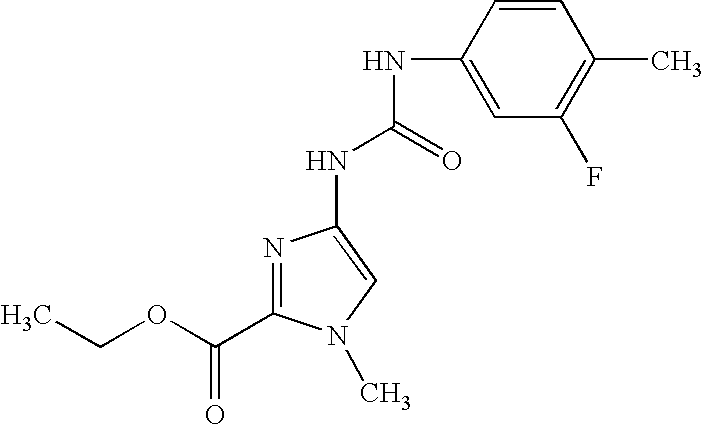


| LC-MS | |||||||
| re- | Prepara- | ||||||
| tention | tion in | ||||||
| Ex- | MS | time | analogy | Yield | |||
| am- | (EI) | [min] | to | [mg] | |||
| ple | Mol. | [M + | (meth- | Starting | Example | % of | |
| No. | Structure | mass | H]+ | od) | compound | No. | theory |
| 5 |
 |
522.82 | 522 | 2.85 (2) | Example 16A | 3 | 26 (50) |
| 6 |
 |
510.81 | 510 | 1.82 (2) | Example 16A | 3 | 22 (43) |
| 7 |
 |
460.75 | 460 | 2.29 (2) | Example 16A | 3 | 20 (43) |
| 8 |
 |
476.75 | 476 | 2.13 (2) | Example 16A | 3 | 2.7 (6) |
| 9 |
 |
460.75 | 460 | 2.35 (2) | Example 16A | 3 | 18 (39) |
| 10 |
 |
405.88 | 406 | 2.22 (2) | Example 12A | 3 | 33 (81) |
| 11 |
 |
455.95 | 456 | 2.35 (2) | Example 4A | 3 | 21 (46) |
| 12 |
 |
462.94 | 463 | 2.31 (2) | Example 4A | 3 | 21 (45) |
| 13 |
 |
467.95 | 468 | 2.12 (2) | Example 8A | 3 | 29(62) |
| 14 |
 |
459.94 | 460 | 2.13 (2) | Example 8A | 3 | 22 (48) |
| 15 |
 |
530.02 | 531 | 2.54 (2) | Example 14A | 3 | 19 (36) |
| 16 |
 |
522.01 | 523 | 2.53 (2) | Example 14A | 3 | 17 (33) |
| 17 |
 |
528.99 | 529 | 2.49 (2) | Example 14A | 3 | 16 (30) |
| 18 |
 |
518.83 | 518 | 2.57 (2) | Example 16A | 3 | 8 (15) |
| 19 |
 |
510.81 | 510 | 2.55 (2) | Example 16A | 3 | 28 (55) |
| 20 |
 |
524.84 | 524 | 1.84 (2) | Example 16A | 3 | 25 (48) |
| 21 |
 |
500.00 | 500 | 2.49 (2) | Example 10A | 3 | 21(42) |
| 22 |
 |
491.98 | 492 | 2.48 (2) | Example 10A | 3 | 15 (30) |
| 23 |
 |
498.97 | 499 | 2.45 (2) | Example 10A | 3 | 3.3 (7) |
| 24 |
 |
506.01 | 507 | 2.33 (2) | Example 10A | 3 | 26 (51) |
| 25 |
 |
477.99 | 478 | 2.52 (2) | Example 12A | 3 | 21 (44) |
| 26 |
 |
469.97 | 470 | 2.52 (2) | Example 12A | 3 | 24 (51) |
| 27 |
 |
476.96 | 477 | 2.47 (2) | Example 12A | 3 | 22 (46) |
| 28 |
 |
465.98 | 466 | 2.47 (2) | Example 6A | 3 | 26 (56) |
| 29 |
 |
457.96 | 458 | 2.47 (2) | Example 6A | 3 | 29 (63) |
| 30 |
 |
464.95 | 465 | 2.42 (2) | Example 6A | 3 | 13 (28) |
| 31 |
 |
477.01 | 478 | 1.78 (2) | Example 6A | 3 | 34 (71) |
| 32 |
 |
503.48 | 504 | 2.75 (2) | Example 5A | 3 | 11 (22) |
| 33 |
 |
505.50 | 506 | 1.93 (2) | Example 5A | 3 | 12 (24) |
| 34 |
 |
491.47 | 492 | 1.90 (2) | Example 5A | 3 | 11 (22) |
| 35 |
 |
441.41 | 442 | 2.22 (2) | Example 5A | 3 | 12 (27) |
| 36 |
 |
441.41 | 442 | 2.28 (2) | Example 5A | 3 | 12 (27) |
| 37 |
 |
507.47 | 508 | 2.54 (2) | Example 9A | 3 | 28 (55) |
| 38 |
 |
569.54 | 570 | 2.90 (1) | Example 15A | 3 | 28 (49) |
| 39 |
 |
493.44 | 494 | 2.38 (2) | Example 15A | 3 | 23 (47) |
| 40 |
 |
557.53 | 558 | 2.07 (2) | Example 15A | 3 | 25 (45) |
| 41 |
 |
507.47 | 508 | 2.45 (2) | Example 15A | 3 | 26 (51) |
| 42 |
 |
579.54 | 580 | 2.22 (1) | Example 15A | 3 | 33 (57) |
| 43 |
 |
558.34 | 558 | 2.97 (1) | Example 17A | 3 | 12 (21) |
| 44 |
 |
482.24 | 482 | 2.38 (2) | Example 17A | 3 | 22 (46) |
| 45 |
 |
546.34 | 546 | 2.09 (2) | Example 17A | 3 | 14 (26) |
| 46 |
 |
496.27 | 496 | 2.41 (2) | Example 17A | 3 | 11 (22) |
| 47 |
 |
496.27 | 496 | 2.46 (2) | Example 17A | 3 | 13 (26) |
| 48 |
 |
539.51 | 540 | 2.87 (1) | Example 11A | 3 | 21 (39) |
| 49 |
 |
463.41 | 464 | 2.32 (2) | Example 11A | 3 | 21 (45) |
| 50 |
 |
541.53 | 542 | 2.10 (2) | Example 11A | 3 | 14 (26) |
| 51 |
 |
527.51 | 528 | 2.07 (2) | Example 11A | 3 | 20 (38) |
| 52 |
 |
477.44 | 478 | 2.35 (2) | Example 11A | 3 | 21 (44) |
| 53 |
 |
477.44 | 478 | 2.40 (2) | Example 11A | 3 | 25 (52) |
| 54 |
 |
549.51 | 550 | 2.25 (2) | Example 11A | 3 | 34 (62) |
| 55 |
 |
517.51 | 518 | 2.93 (1) | Example 13A | 3 | 27 (52) |
| 56 |
 |
517.51 | 518 | 2.68 (2) | Example 13A | 3 | 30 (58) |
| 57 |
 |
441.41 | 442 | 2.34 (2) | Example 13A | 3 | 12 (27) |
| 58 |
 |
519.53 | 520 | 2.09 (2) | Example 13A | 3 | 22 (42) |
| 59 |
 |
505.50 | 506 | 1.99 (2) | Example 13A | 3 | 34 (67) |
| 60 |
 |
455.44 | 456 | 2.40 (1) | Example 13A | 3 | 38 (83) |
| 61 |
 |
455.44 | 456 | 2.46 (1) | Example 13A | 3 | 32 (70) |
| 62 |
 |
505.49 | 506 | 2.88 (1) | Example 7A | 3 | 23 (46) |
| 63 |
 |
429.40 | 430 | 2.32 (1) | Example 7A | 3 | 24 (56) |
| 64 |
 |
507.51 | 508 | 1.95 (1) | Example 7A | 3 | 23 (45) |
| 65 |
 |
493.49 | 494 | 1.91 (1) | Example 7A | 3 | 27 (55) |
| 66 |
 |
443.42 | 444 | 2.35 (1) | Example 7A | 3 | 20 (45) |
| 67 |
 |
443.42 | 444 | 2.41 (1) | Example 7A | 3 | 28 (63) |
| 68 |
 |
499.49 | 500 | 2.49 (1) | Example 5A | 3 | 13 (26) |
| 69 |
 |
491.47 | 492 | 2.49 (1) | Example 5A | 3 | 14 (28) |
| 70 |
 |
498.46 | 499 | 2.46 (1) | Example 5A | 3 | 11 (22) |
| 71 |
 |
505.50 | 506 | 2.34 (1) | Example 5A | 3 | 16 (32) |
| 72 |
 |
510.51 | 511 | 1.84 (1) | Example 5A | 3 | 13 (25) |
| 73 |
 |
503.48 | 504 | 2.26 (1) | Example 9A | 3 | 31 (62) |
| 74 |
 |
495.46 | 496 | 2.28 (1) | Example 9A | 3 | 30 (61) |
| 75 |
 |
502.45 | 503 | 2.25 (1) | Example 9A | 3 | 22 (44) |
| 76 |
 |
509.49 | 510 | 2.12 (1) | Example 9A | 3 | 27 (53) |
| 77 |
 |
500.48 | 501 | 2.38 (1) | Example 9A | 3 | 21 (42) |
| 78 |
 |
514.50 | 515 | 1.67 (1) | Example 9A | 3 | 34 (66) |
| 79 |
 |
537.49 | 538 | 2.42 (1) | Example 15A | 3 | 30 (56) |
| 80 |
 |
565.55 | 566 | 2.65 (1) | Example 15A | 3 | 11 (19) |
| 81 |
 |
557.53 | 558 | 2.64 (1) | Example 15A | 3 | 3.5 (6) |
| 82 |
 |
564.52 | 565 | 2.62 (1) | Example 15A | 3 | 5.2 (9) |
| 83 |
 |
526.30 | 526 | 2.43 (1) | Example 17A | 3 | 23 (44) |
| 84 |
 |
554.35 | 554 | 2.69 (1) | Example 17A | 3 | 22 (40) |
| 85 |
 |
546.34 | 546 | 2.67 (1) | Example 17A | 3 | 18 (33) |
| 86 |
 |
560.36 | 560 | 2.53 (1) | Example 17A | 3 | 29 (52) |
| 87 |
 |
523.30 | 523 | 2.40 (1) | Example 17A | 3 | 14 (27) |
| 88 |
 |
551.35 | 551 | 2.79 (1) | Example 17A | 3 | 26 (47) |
| 89 |
 |
565.38 | 565 | 1.96 (1) | Example 17A | 3 | 22 (39) |
| 90 |
 |
507.47 | 508 | 2.37 (1) | Example 11A | 3 | 19 (37) |
| 91 |
 |
535.52 | 536 | 2.61 (1) | Example 11A | 3 | 22 (41) |
| 92 |
 |
527.51 | 528 | 2.60 (1) | Example 11A | 3 | 10 (19) |
| 93 |
 |
534.49 | 535 | 2.57 (1) | Example 11A | 3 | 15 (28) |
| 94 |
 |
541.53 | 542 | 2.46 (1) | Example 11A | 3 | 23 (42) |
| 95 |
 |
546.55 | 547 | 1.94 (1) | Example 11A | 3 | 14 (26) |
| 96 |
 |
498.50 | 499 | 1.90 (1) | Example 13A | 3 | 19 (38) |
| 97 |
 |
485.46 | 486 | 2.39 (1) | Example 13A | 3 | 14 (29) |
| 98 |
 |
513.51 | 514 | 2.64 (1) | Example 13A | 3 | 31 (60) |
| 99 |
 |
505.50 | 506 | 2.64 (1) | Example 13A | 3 | 27 (53) |
| 100 |
 |
512.49 | 513 | 2.60 (1) | Example 13A | 3 | 10 (20) |
| 101 |
 |
519.53 | 520 | 2.49 (1) | Example 13A | 3 | 14 (27) |
| 102 |
 |
482.46 | 483 | 2.37 (1) | Example 13A | 3 | 5 (10) |
| 103 |
 |
501.50 | 502 | 2.59 (1) | Example 7A | 3 | 32 (64) |
| 104 |
 |
493.49 | 494 | 2.59 (1) | Example 7A | 3 | 27 (55) |
| 105 |
 |
500.48 | 501 | 2.55 (1) | Example 7A | 3 | 15 (30) |
| 106 |
 |
470.45 | 471 | 2.32 (1) | Example 7A | 3 | 19 (40) |
| 107 |
 |
473.02 | 473 | 2.00 (5) | Example 12A | 3 | 10 (21) |
| 108 |
 |
468.48 | 469 | 1.95 (5) | Example 5A | 3 | 4.1 (9) |
| 109 |
 |
504.51 | 505 | 2.03 (5) | Example 11A | 3 | 16 (32) |
| 110 |
 |
544.58 | 545 | 2.09 (5) | Example 11A | 3 | 17 (31) |
| 111 |
 |
530.55 | 531 | 2.11 (5) | Example 11A | 3 | 8 (15) |
| 112 |
 |
510.56 | 511 | 2.05 (5) | Example 7A | 3 | 18 (35) |
| 113 |
 |
438.92 | 439 | 1.97 (5) | Example 4A | 3 | 17.1 (85) |
| 114 |
 |
474.95 | 475 | 2.09 (1) | Example 10A | 3 | 19.5 (41) |
| 115 |
 |
452.94 | 453 | 2.15 (5) | Example 12A | 3 | 23.6 (52) |
| 116 |
 |
510.47 | 511 | 2.02 (4) | Example 11A | 3 | 32.1 (63) |
| 117 |
 |
504.98 | 505 | 2.18 (5) | Example 14A | 3 | 24 (48) |
| 118 |
 |
440.93 | 441 | 1.87 (4) | Example 6A | 3 | 26.5 (60) |
| 119 |
 |
474.44 | 475 | 2.03 (2) | Example 5A | 3 | 11 (20) |
| 120 |
 |
540.50 | 541 | 2.28 (5) | Example 15A | 3 | 4.2 (8) |
| 121 |
 |
476.46 | 477 | 2.15 (5) | Example 7A | 3 | 10.3 (22) |


| TABLE 2 | |||||
| LC-MS | Yield | ||||
| MS | Rt [min] | [mg] | |||
| Ex. No. | Structure | Mol. mass | (EI) [M + H]+ | (method) | (% of theory) |
| 129 |
 |
570.49 | 571 | 2.24 (2) | 10 (18) |
| 130 |
 |
586.53 | 587 | 2.32 (2) | 26 (44) |
| 131 |
 |
466.46 | 467 | 1.97 (2) | 4.2 (9) |
| 132 |
 |
482.50 | 483 | 2.06 (2) | 15 (31) |


| TABLE 3 | |||||
| MS (EI) | LC-MS | Yield | |||
| Ex. | Mol. | [M + | Rt [min] | [mg] | |
| No. | Structure | mass | H]+ | (method) | (% of theory) |
| 136 |
 |
628.52 | 629 | 2.22 (2) | 40 (32) |
| 137 |
 |
642.55 | 643 | 2.3 (2) | 46 (36) |
| 138 |
 |
644.57 | 645 | 2.38 (2) | 42 (33) |
| 139 |
 |
658.55 | 659 | 2.35 (2) | 15.2 (30) |
| 140 |
 |
644.57 | 645 | 2.34 (2) | 26.6 (21) |

| TABLE 4 | |||||
| LC-MS | Starting | ||||
| Rt | compound | ||||
| MS (EI) | [min] | Yield | |||
| Ex. | Mol. | [M + | (meth- | [mg] | |
| No. | Structure | mass | H]+ | od) | (% of theory) |
| 142 |
 |
610.03 | 611 | 2.27 (2) | Example 24A 31.9 (52) |
| 143 |
 |
629.51 | 630 | 2.35 (2) | Example 27A 5.7 (9) |
| 144 |
 |
645.55 | 646 | 2.35 (2) | Example 27A 31.9 (49) |
| 145 |
 |
645.55 | 646 | 2.43 (2) | Example 27A 5.4 (8) |


| TABLE 5 | |||||
| LC-MS | |||||
| Rt | |||||
| MS (EI) | [min] | Yield | |||
| Ex. | Mol. | [M + | (meth- | [mg] | |
| No. | Structure | mass | H]+ | od) | (% of theory) |
| 148 |
 |
564.99 | 529 | 1.71 (4) | 69 (73) |
| 149 |
 |
580.95 | 545 | 1.72 (4) | 34 (39) |
| 150 |
 |
583.56 | 584 | 2.54 (4) | 27 (31) |


| TABLE 6 | ||||||
| LC-MS | ||||||
| re- | ||||||
| tention | Yield | |||||
| Ex- | time | [mg] | ||||
| am- | MS (EI) | [min] | Synthesis of the | (% of | ||
| ple | Mol. | [M + | (meth- | amine starting | theo- | |
| No. | Structure | mass | H]+ | od) | compound | ry) |
| 154 |
 |
447.84 | 448 | 2.72 (5) | 125 (89) | |
| 155 |
 |
481.40 | 482 | 2.73 (4) | method of Soloshonok, Vadim A.; Ono, Taizo; J. Org. Chem.; 62; 10; 1997; 3030- 3031 | 68 (93) |
| 156 |
 |
424.38 | 425 | 2.38 (4) | 59 (90) | |
| 157 |
 |
511.42 | 512 | 2.63 (4) | 67 (84) | |
| 158 |
 |
510.47 | 511 | 2.13 (4) | method of Gehlen; Blankenstein; Justus Liebigs Ann. Chem.; 651; 1962; 137, 139. | 76 (99) |
| 159 |
 |
520.98 | 485 | 1.95 (2) | method of Yung, D. K. et al.; J. Pharm. Sci.; EN; 57; 1968; 2073-2080. | 76 (97) |
| 160 |
 |
471.48 | 472 | 2.73 (2) | 70 (99) | |
| 161 |
 |
512.49 | 513 | 2.47 (2) | method of Venuti, Michael C.; Alvarez, Robert; Bruno, John J.; Strosberg, Arthur M.; Gu, Leo; J. Med. Chem.; 31; 11; 1988; 2145-2152. | 80 (quant.) |
| 162 |
 |
518.97 | 483 | 1.56 (4) | 72 (92) | |
| 163 |
 |
495.52 | 496 | 2.75 (4) | 72 (97) | |
| 164 |
 |
548.99 | 513 | 1.57 (4) | 81 (98) | |
| 165 |
 |
480.49 | 481 | 2.67 (5) | 57 (79) | |
| 166 |
 |
438.41 | 439 | 2.47 (4) | 65 (98) | |
| 167 |
 |
495.42 | 496 | 2.86 (5) | method of Raasch, M. S.; J. Org. Chem.; EN; 27; 1962; 1406- 1409. | 65 (86) |
| 168 |
 |
467.37 | 468 | 2.79 (5) | 68 (97) | |
| 169 |
 |
547.45 | 548 | 3.05 (2) | 61 (84) | |
| 170 |
 |
480.45 | 481 | 2.39 (5) | method of Sun, Li; Liang, Chris; Shirazian, Sheri; Zhou, Yong; Miller, Todd; Cui, Jean; Fukuda, Juri Y.; Chu, Ji- Yu; Nematalla, Asaad; Wang, Xueyan; Chen, Hui; et al. J. Med. Chem.; 46; 7; 2003; 1116-1119. | 61 (84) |
| 171 |
 |
512.92 | 477 | 1.97 (5) | 71 (92) | |


| TABLE 7 | ||||||
| LC-MS | Yield | |||||
| MS | Rt | [mg] | ||||
| (ESI) | [min] | Starting | of | |||
| Ex. | Mol. | [M + | (meth- | com- | (% theo- | |
| No. | Structure | mass | H]+ | od) | pound | ry) |
| 174 |
 |
460.46 | 461 | 1.98 (4) | Ex- ample 30A | 38 (61) |
| 175 |
 |
489.49 | 490 | 2.67 (4) | Ex- ample 30A | 38 (57) |
| 176 |
 |
458.39 | 459 | 2.21 (2) | Ex- ample 29A | 51 (77) |
| 177 |
 |
463.41 | 464 | 2.59 (2) | Ex- ample 29A | 66 (95) |
| 178 |
 |
462.43 | 463 | 1.61 (4) | Ex- ample 29A | 75 (28) |
| 179 |
 |
478.43 | 479 | 2.42 (2) | Ex- ample 29A | 62 (89) |
| 180 |
 |
531.42 | 532 | 2.50 (2) | Ex- ample 29A | 72 (93) |
| 181 |
 |
504.51 | 505 | 2.15 (5) | Ex- ample 7A | 33 (13) |
| 182 |
 |
520.51 | 521 | 2.77 (2) | Ex- ample 7A | 45 (67) |
| 183 |
 |
573.49 | 574 | 2.82 (2) | Ex- ample 7A | 64 (86) |
| 184 |
 |
490.48 | 491 | 2.32 (5) | Ex- ample 7A | 20 (8) |
| TABLE 8 | ||||||
| HPLC | ||||||
| MS | Rt | Yield | ||||
| (ESI) | [min] | [mg] | ||||
| Ex. | Mol. | [M + | (meth- | Starting | (% of | |
| No. | Structure | mass | H]+ | od) | compound | theory) |
| 185 |
 |
531.49 | 532 | 4.96 (11) | Example 5A | 64 (29) |
| 186 |
 |
472.43 | 473 | 4.39 (11) | Example 31A | 23 (35) |
| 187 |
 |
487.51 | 488 | 4.83 (11) | Example 33A | 35 (52) |
| 188 |
 |
468.48 | 469 | 4.40 (11) | Example 5A | 13 (30) |
| 189 |
 |
502.50 | 503 | 4.54 (11) | Example 5A | 20 (38) |
| 190 |
 |
470.50 | 471 | 4.51 (11) | Example 7A | 12 (28) |
| 191 |
 |
504.52 | 505 | 4.71 (11) | Example 7A | 20 (38) |
| 192 |
 |
482.49 | 483 | 4.46 (11) | Example 33A | 49 (79) |
| 193 |
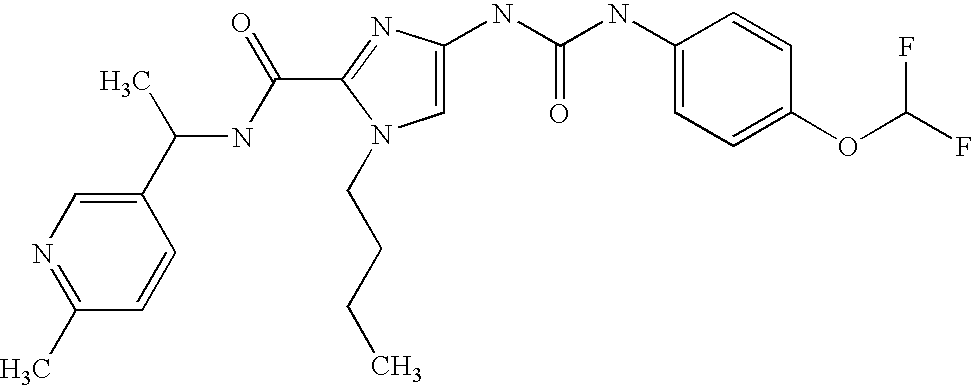 |
486.53 | 487 | 4.23 (11) | Example 33A | 26 (59) |
| 194 |
 |
571.49 | 572 | 4.62 (11) | Example 5A | 42 (81) |
- CC50 (NHDF)=substance concentration in μM at which no visible cytostatic effects on the cells are evident by comparison with the untreated cell control;
- EC50 (HCMV)=substance concentration in VM which inhibits the CPE (cytopathic effect) by 50% compared with the untreated virus control;
- SI (selectivity index)=CC50 (NHDF)/EC50 (HCMV).
| TABLE A | |||||
| NHDF | HCMV | ||||
| Example- | CC50 | EC50 | SI | ||
| Nr. | [nM] | [nM] | HCMV | ||
| 2 | 94 000 | 0.5 | 188 000 | ||
| 3 | 25 000 | 3.0 | 8333 | ||
| 11 | 25 000 | 1.0 | 25 000 | ||
| 25 | 6250 | 1.0 | 6250 | ||
| 32 | 3130 | 1.0 | 3130 | ||
| 124 | 9400 | 1.4 | 6714 | ||
| 139 | 4700 | 2.8 | 1679 | ||
| 152 | 31 000 | 1.9 | 16 316 | ||
Claims (7)


X1—R3 (III),


R1—H (V),


OCN—R5 (VI),

Applications Claiming Priority (4)
| Application Number | Priority Date | Filing Date | Title |
|---|---|---|---|
| DE102004015007 | 2004-03-26 | ||
| DE102004015007A DE102004015007A1 (en) | 2004-03-26 | 2004-03-26 | Substituted imidazoles |
| DE102004015007.9 | 2004-03-26 | ||
| PCT/EP2005/002571 WO2005092865A1 (en) | 2004-03-26 | 2005-03-11 | Antiviral 4-aminocarbonylamino-substituted imidazole compound |
Publications (2)
| Publication Number | Publication Date |
|---|---|
| US20080004275A1 US20080004275A1 (en) | 2008-01-03 |
| US7767704B2 true US7767704B2 (en) | 2010-08-03 |
Family
ID=34962326
Family Applications (1)
| Application Number | Title | Priority Date | Filing Date |
|---|---|---|---|
| US10/594,343 Expired - Fee Related US7767704B2 (en) | 2004-03-26 | 2005-03-11 | Antiviral 4-aminocarbonylamino-substituted imidazole compounds |
Country Status (8)
| Country | Link |
|---|---|
| US (1) | US7767704B2 (en) |
| EP (1) | EP1732901B1 (en) |
| JP (1) | JP4772034B2 (en) |
| AT (1) | ATE531698T1 (en) |
| CA (1) | CA2561066C (en) |
| DE (1) | DE102004015007A1 (en) |
| ES (1) | ES2373666T3 (en) |
| WO (1) | WO2005092865A1 (en) |
Families Citing this family (3)
| Publication number | Priority date | Publication date | Assignee | Title |
|---|---|---|---|---|
| DE102004015007A1 (en) | 2004-03-26 | 2005-10-13 | Bayer Healthcare Ag | Substituted imidazoles |
| MX2007005730A (en) * | 2004-11-11 | 2007-10-04 | Achillion Pharmaceuticals Inc | System and method using enhanced authorization data to reduce travel-related transaction fraud. |
| DE102005008183A1 (en) | 2005-02-23 | 2006-08-31 | Bayer Healthcare Ag | New heterocyclylamide-substituted imidazole compounds useful to treat or prevent viral infections |
Citations (7)
| Publication number | Priority date | Publication date | Assignee | Title |
|---|---|---|---|---|
| WO1998052558A1 (en) | 1997-05-23 | 1998-11-26 | Bayer Corporation | INHIBITION OF p38 KINASE ACTIVITY BY ARYL UREAS |
| WO1999023091A1 (en) | 1997-11-03 | 1999-05-14 | Boehringer Ingelheim Pharmaceuticals, Inc. | Aromatic heterocyclic compounds as anti-inflammatory agents |
| WO2000034261A2 (en) | 1998-12-09 | 2000-06-15 | American Home Products Corporation | Heterocyclic carboxamide-containing thiourea inhibitors of herpes viruses containing a substituted phenylenediamine group |
| WO2000042043A1 (en) | 1999-01-11 | 2000-07-20 | The Regents Of The University Of Michigan | PYRROLO[2,3-d]PYRIMIDINES AS ANTIVIRAL AGENTS |
| CA2508788A1 (en) | 2002-12-09 | 2004-06-24 | Bayer Healthcare Ag | 3-pyrrolyl urea derivatives and their use as antiviral agents |
| WO2005092865A1 (en) | 2004-03-26 | 2005-10-06 | Bayer Healthcare Ag | Antiviral 4-aminocarbonylamino-substituted imidazole compound |
| WO2006089664A2 (en) | 2005-02-23 | 2006-08-31 | Aicuris Gmbh & Co. Kg | Heterocyclylamide-substituted imidazoles |
Family Cites Families (1)
| Publication number | Priority date | Publication date | Assignee | Title |
|---|---|---|---|---|
| US5514781A (en) * | 1994-04-11 | 1996-05-07 | Bayer Corporation | Use of azoles as virucidal agents in solutions of biologically active proteins |
-
2004
- 2004-03-26 DE DE102004015007A patent/DE102004015007A1/en not_active Ceased
-
2005
- 2005-03-11 CA CA2561066A patent/CA2561066C/en not_active Expired - Fee Related
- 2005-03-11 ES ES05715944T patent/ES2373666T3/en not_active Expired - Lifetime
- 2005-03-11 AT AT05715944T patent/ATE531698T1/en active
- 2005-03-11 US US10/594,343 patent/US7767704B2/en not_active Expired - Fee Related
- 2005-03-11 JP JP2007504294A patent/JP4772034B2/en not_active Expired - Fee Related
- 2005-03-11 EP EP05715944A patent/EP1732901B1/en not_active Expired - Lifetime
- 2005-03-11 WO PCT/EP2005/002571 patent/WO2005092865A1/en not_active Ceased
Patent Citations (9)
| Publication number | Priority date | Publication date | Assignee | Title |
|---|---|---|---|---|
| WO1998052558A1 (en) | 1997-05-23 | 1998-11-26 | Bayer Corporation | INHIBITION OF p38 KINASE ACTIVITY BY ARYL UREAS |
| WO1999023091A1 (en) | 1997-11-03 | 1999-05-14 | Boehringer Ingelheim Pharmaceuticals, Inc. | Aromatic heterocyclic compounds as anti-inflammatory agents |
| WO2000034261A2 (en) | 1998-12-09 | 2000-06-15 | American Home Products Corporation | Heterocyclic carboxamide-containing thiourea inhibitors of herpes viruses containing a substituted phenylenediamine group |
| WO2000042043A1 (en) | 1999-01-11 | 2000-07-20 | The Regents Of The University Of Michigan | PYRROLO[2,3-d]PYRIMIDINES AS ANTIVIRAL AGENTS |
| CA2508788A1 (en) | 2002-12-09 | 2004-06-24 | Bayer Healthcare Ag | 3-pyrrolyl urea derivatives and their use as antiviral agents |
| WO2004052852A1 (en) | 2002-12-09 | 2004-06-24 | Bayer Healthcare Ag | 3-pyrrolyl urea derivatives and their use as antiviral agents |
| WO2005092865A1 (en) | 2004-03-26 | 2005-10-06 | Bayer Healthcare Ag | Antiviral 4-aminocarbonylamino-substituted imidazole compound |
| WO2006089664A2 (en) | 2005-02-23 | 2006-08-31 | Aicuris Gmbh & Co. Kg | Heterocyclylamide-substituted imidazoles |
| US20080176859A1 (en) | 2005-02-23 | 2008-07-24 | Holger Zimmermann | Heterocyclyamide-substituted imidazoles |
Non-Patent Citations (9)
| Title |
|---|
| "HIV-AIDS." Retrieved online via Internet [Mar. 25, 2009], URL: http://www.mayoclinic.com/health/hiv-aids/DS00005. * |
| Chaimbault et al., Pharmacy and Pharmacology Communications (1999) 5(3):211-215. |
| Chong et al., Abstracts of 39th Interscience Conference on Antimicrobial Agents and Chemotherapy, 1999, p. 441. |
| Cinatl Jr. et al., FEMS Microbiology Reviews (2004) 28:59-77. |
| English translation of the International Preliminary Report on Patentability for PCT/EP2006/001325, mailed Sep. 20, 2007, 8 pages. |
| Kraemer et al., Cancer Research (1983) 43:4822-4827. |
| Morissette et al. Advanced Drug Delivery Reviews 2004, 56, 275-300. * |
| PCT Patent No. WO 2005/092865, International Publication Date: Oct. 6, 2005 (English abstract only). |
| Vippagunta et al., abstract, Vippagunta, Sudha R. "Crystalline Solids." Advanced Drug Delivery Reviews 48(2001): 3-26. * |
Also Published As
| Publication number | Publication date |
|---|---|
| ES2373666T3 (en) | 2012-02-07 |
| JP4772034B2 (en) | 2011-09-14 |
| CA2561066A1 (en) | 2005-10-06 |
| WO2005092865A1 (en) | 2005-10-06 |
| JP2007530471A (en) | 2007-11-01 |
| CA2561066C (en) | 2013-05-28 |
| ATE531698T1 (en) | 2011-11-15 |
| EP1732901B1 (en) | 2011-11-02 |
| EP1732901A1 (en) | 2006-12-20 |
| US20080004275A1 (en) | 2008-01-03 |
| DE102004015007A1 (en) | 2005-10-13 |
Similar Documents
| Publication | Publication Date | Title |
|---|---|---|
| US7919489B2 (en) | Heterocyclyamide-substituted imidazoles | |
| US20100179174A1 (en) | Substituted azaquinazolines having an antiviral action | |
| US7977349B2 (en) | Substituted quinolones III | |
| US20080004275A1 (en) | Antiviral 4-Aminocarbonylamino-Substituted Imidazole Compounds | |
| US8410090B2 (en) | Heterocyclylamide-substituted thiazoles, pyrroles and thiophenes | |
| HK1110857B (en) | Heterocyclylamide-substituted imidazoles |
Legal Events
| Date | Code | Title | Description |
|---|---|---|---|
| AS | Assignment |
Owner name: BAYER HEALTHCARE AG, GERMANY Free format text: ASSIGNMENT OF ASSIGNORS INTEREST;ASSIGNORS:ZIMMERMANN, HOLGER;BRUCKNER, DAVID;HEIMBACH, DIRK;AND OTHERS;REEL/FRAME:019575/0376;SIGNING DATES FROM 20060823 TO 20061013 Owner name: BAYER HEALTHCARE AG, GERMANY Free format text: ASSIGNMENT OF ASSIGNORS INTEREST;ASSIGNORS:ZIMMERMANN, HOLGER;BRUCKNER, DAVID;HEIMBACH, DIRK;AND OTHERS;SIGNING DATES FROM 20060823 TO 20061013;REEL/FRAME:019575/0376 |
|
| AS | Assignment |
Owner name: AICURIS GMBH & CO. KG, GERMANY Free format text: ASSIGNMENT OF ASSIGNORS INTEREST;ASSIGNOR:BAYER HEALTHCARE AG;REEL/FRAME:022047/0075 Effective date: 20081030 |
|
| STCF | Information on status: patent grant |
Free format text: PATENTED CASE |
|
| FEPP | Fee payment procedure |
Free format text: PAYOR NUMBER ASSIGNED (ORIGINAL EVENT CODE: ASPN); ENTITY STATUS OF PATENT OWNER: LARGE ENTITY |
|
| FPAY | Fee payment |
Year of fee payment: 4 |
|
| MAFP | Maintenance fee payment |
Free format text: PAYMENT OF MAINTENANCE FEE, 8TH YEAR, LARGE ENTITY (ORIGINAL EVENT CODE: M1552) Year of fee payment: 8 |
|
| FEPP | Fee payment procedure |
Free format text: MAINTENANCE FEE REMINDER MAILED (ORIGINAL EVENT CODE: REM.); ENTITY STATUS OF PATENT OWNER: LARGE ENTITY |
|
| LAPS | Lapse for failure to pay maintenance fees |
Free format text: PATENT EXPIRED FOR FAILURE TO PAY MAINTENANCE FEES (ORIGINAL EVENT CODE: EXP.); ENTITY STATUS OF PATENT OWNER: LARGE ENTITY |
|
| STCH | Information on status: patent discontinuation |
Free format text: PATENT EXPIRED DUE TO NONPAYMENT OF MAINTENANCE FEES UNDER 37 CFR 1.362 |
|
| FP | Lapsed due to failure to pay maintenance fee |
Effective date: 20220803 |