US7763740B2 - Method for the production of mumbaistatin derivatives - Google Patents
Method for the production of mumbaistatin derivatives Download PDFInfo
- Publication number
- US7763740B2 US7763740B2 US12/250,705 US25070508A US7763740B2 US 7763740 B2 US7763740 B2 US 7763740B2 US 25070508 A US25070508 A US 25070508A US 7763740 B2 US7763740 B2 US 7763740B2
- Authority
- US
- United States
- Prior art keywords
- compound
- alkyl
- formula
- independently
- vii
- Prior art date
- Legal status (The legal status is an assumption and is not a legal conclusion. Google has not performed a legal analysis and makes no representation as to the accuracy of the status listed.)
- Expired - Fee Related
Links
- 0 *c(cc1C(c2c3c(*)ccc2)=O)cc(C2OCCCO2)c1C3=O Chemical compound *c(cc1C(c2c3c(*)ccc2)=O)cc(C2OCCCO2)c1C3=O 0.000 description 7
- JMBLPUYERKGCLZ-UHFFFAOYSA-N CC.CC(=O)C1=C(C)C2=C(C=C1C)C(=O)C1=CC=CC=C1C2=O Chemical compound CC.CC(=O)C1=C(C)C2=C(C=C1C)C(=O)C1=CC=CC=C1C2=O JMBLPUYERKGCLZ-UHFFFAOYSA-N 0.000 description 3
- KFCYNMGOBFVLJG-UHFFFAOYSA-N CC.CC.CC(=O)C1=C(CC2=C(C(=O)CCC(C)CC(=O)O)C=CC=C2)C2=C(C=C1C)C(=O)C1=CC=CC=C1C2=O Chemical compound CC.CC.CC(=O)C1=C(CC2=C(C(=O)CCC(C)CC(=O)O)C=CC=C2)C2=C(C=C1C)C(=O)C1=CC=CC=C1C2=O KFCYNMGOBFVLJG-UHFFFAOYSA-N 0.000 description 3
- IMFPYCQDMPMNAR-UHFFFAOYSA-N CC.CC.CC(=O)C1=C(CC2=C(C(O)CCC(C)CCO)C=CC=C2)C2=C(C=C1C)C(=O)C1=CC=CC=C1C2=O Chemical compound CC.CC.CC(=O)C1=C(CC2=C(C(O)CCC(C)CCO)C=CC=C2)C2=C(C=C1C)C(=O)C1=CC=CC=C1C2=O IMFPYCQDMPMNAR-UHFFFAOYSA-N 0.000 description 3
- LITHHZXBEVHXCI-UHFFFAOYSA-N CC.CC.CC(=O)C1=C(CC2=C(CO)C=CC=C2)C2=C(C=C1C)C(=O)C1=CC=CC=C1C2=O Chemical compound CC.CC.CC(=O)C1=C(CC2=C(CO)C=CC=C2)C2=C(C=C1C)C(=O)C1=CC=CC=C1C2=O LITHHZXBEVHXCI-UHFFFAOYSA-N 0.000 description 3
- IFXPYVCISYUJPW-UHFFFAOYSA-N CC.CC.CC(=O)CC(C)CCC(=O)C1=C(C(=O)C2=C(C(C)=O)C(C)=CC3=C2C(=O)C2=CC=CC=C2C3=O)C=CC=C1 Chemical compound CC.CC.CC(=O)CC(C)CCC(=O)C1=C(C(=O)C2=C(C(C)=O)C(C)=CC3=C2C(=O)C2=CC=CC=C2C3=O)C=CC=C1 IFXPYVCISYUJPW-UHFFFAOYSA-N 0.000 description 3
- HJLMJLXOMGRWMV-UHFFFAOYSA-N CC.CC.CCC1=C(C(=O)OCC2=CC=CC=C2C)C(C)=CC2=C1C(=O)C1=CC=CC=C1C2=O Chemical compound CC.CC.CCC1=C(C(=O)OCC2=CC=CC=C2C)C(C)=CC2=C1C(=O)C1=CC=CC=C1C2=O HJLMJLXOMGRWMV-UHFFFAOYSA-N 0.000 description 3
- AJPZGQVNFVRCBP-UHFFFAOYSA-N CC.CC.[H]C(=C)C1=C(CC2=C(C(C)=O)C(C)=CC3=C2C(=O)C2=CC=CC=C2C3=O)C=CC=C1 Chemical compound CC.CC.[H]C(=C)C1=C(CC2=C(C(C)=O)C(C)=CC3=C2C(=O)C2=CC=CC=C2C3=O)C=CC=C1 AJPZGQVNFVRCBP-UHFFFAOYSA-N 0.000 description 3
- NQJDCFGZRKQIER-UHFFFAOYSA-N CC.CC.[H]C(=O)C1=C(CC2=C(C(C)=O)C(C)=CC3=C2C(=O)C2=CC=CC=C2C3=O)C=CC=C1 Chemical compound CC.CC.[H]C(=O)C1=C(CC2=C(C(C)=O)C(C)=CC3=C2C(=O)C2=CC=CC=C2C3=O)C=CC=C1 NQJDCFGZRKQIER-UHFFFAOYSA-N 0.000 description 3
- BFIIVGVTCPIGMY-UHFFFAOYSA-N CC.CCC1=C(C(C)=O)C(C)=CC2=C1C(=O)C1=CC=CC=C1C2=O Chemical compound CC.CCC1=C(C(C)=O)C(C)=CC2=C1C(=O)C1=CC=CC=C1C2=O BFIIVGVTCPIGMY-UHFFFAOYSA-N 0.000 description 3
- GLCWKMVUYKGINM-UHFFFAOYSA-N C#CC(C)CCOC Chemical compound C#CC(C)CCOC GLCWKMVUYKGINM-UHFFFAOYSA-N 0.000 description 2
- XQQGHMBALNEQIE-UHFFFAOYSA-N C=C(C)C(C(C)=O)=C(C)C Chemical compound C=C(C)C(C(C)=O)=C(C)C XQQGHMBALNEQIE-UHFFFAOYSA-N 0.000 description 2
- WUDRDQHLPONGGN-UHFFFAOYSA-N CC.CC(=O)C1=C(CC2=C(C(=O)CCC(C)CC(=O)O)C=CC=C2C)C2=C(C=C1C)C(=O)C1=CC=CC=C1C2=O Chemical compound CC.CC(=O)C1=C(CC2=C(C(=O)CCC(C)CC(=O)O)C=CC=C2C)C2=C(C=C1C)C(=O)C1=CC=CC=C1C2=O WUDRDQHLPONGGN-UHFFFAOYSA-N 0.000 description 2
- UIGOBDTUKSJMPE-UHFFFAOYSA-N CC.CC.COCCC(C)C#CC(O)C1=C(CC2=C(C(C)=O)C(C)=CC3=C2C(=O)C2=CC=CC=C2C3=O)C=CC=C1 Chemical compound CC.CC.COCCC(C)C#CC(O)C1=C(CC2=C(C(C)=O)C(C)=CC3=C2C(=O)C2=CC=CC=C2C3=O)C=CC=C1 UIGOBDTUKSJMPE-UHFFFAOYSA-N 0.000 description 2
- POEFLUDPWZFRRC-UHFFFAOYSA-N CC.CC1=C(CO)C=CC=C1 Chemical compound CC.CC1=C(CO)C=CC=C1 POEFLUDPWZFRRC-UHFFFAOYSA-N 0.000 description 2
- ZDJPEIMZAACQJW-UHFFFAOYSA-N CC.O=C1C=C([Y])C(=O)C2=CC=CC=C12 Chemical compound CC.O=C1C=C([Y])C(=O)C2=CC=CC=C12 ZDJPEIMZAACQJW-UHFFFAOYSA-N 0.000 description 2
- LSJMTVDSTNPLFJ-UHFFFAOYSA-N CC.[H]C(=C)C1=C(C)C=CC=C1 Chemical compound CC.[H]C(=C)C1=C(C)C=CC=C1 LSJMTVDSTNPLFJ-UHFFFAOYSA-N 0.000 description 2
- DHWUPNRWCNEDAA-UHFFFAOYSA-N C#CC(CCO[Si](C)(C)C(C)(C)C)OCOC Chemical compound C#CC(CCO[Si](C)(C)C(C)(C)C)OCOC DHWUPNRWCNEDAA-UHFFFAOYSA-N 0.000 description 1
- FZRCJGZEADULEQ-UHFFFAOYSA-N C#CCCCO[Si](C)(C)C(C)(C)C Chemical compound C#CCCCO[Si](C)(C)C(C)(C)C FZRCJGZEADULEQ-UHFFFAOYSA-N 0.000 description 1
- AZTRJJJSVCJNDZ-ZRDIBKRKSA-N C=C(O[Si](C)(C)C)/C(C)=C(/C)O[Si](C)(C)C Chemical compound C=C(O[Si](C)(C)C)/C(C)=C(/C)O[Si](C)(C)C AZTRJJJSVCJNDZ-ZRDIBKRKSA-N 0.000 description 1
- JDCDAPVTTDSPGV-UHFFFAOYSA-N C=C1OCC2=C(CC3=C1C(C)=CC1=C3C(=O)C3=CC=CC=C3C1=O)C(C)=CC=C2.CC Chemical compound C=C1OCC2=C(CC3=C1C(C)=CC1=C3C(=O)C3=CC=CC=C3C1=O)C(C)=CC=C2.CC JDCDAPVTTDSPGV-UHFFFAOYSA-N 0.000 description 1
- WFSBVGIOLAWYFE-UHFFFAOYSA-N CC#CC(C)CCOC Chemical compound CC#CC(C)CCOC WFSBVGIOLAWYFE-UHFFFAOYSA-N 0.000 description 1
- KCLFJYFMMQVKEK-UHFFFAOYSA-N CC.CC(=O)C1=C(CC2=C(C(O)CCC(C)CCO)C=CC=C2C)C2=C(C=C1C)C(=O)C1=CC=CC=C1C2=O Chemical compound CC.CC(=O)C1=C(CC2=C(C(O)CCC(C)CCO)C=CC=C2C)C2=C(C=C1C)C(=O)C1=CC=CC=C1C2=O KCLFJYFMMQVKEK-UHFFFAOYSA-N 0.000 description 1
- NWPXNVFBXXTWKV-UHFFFAOYSA-N CC.CC(=O)C1=C(CC2=C(CO)C=CC=C2C)C2=C(C=C1C)C(=O)C1=CC=CC=C1C2=O Chemical compound CC.CC(=O)C1=C(CC2=C(CO)C=CC=C2C)C2=C(C=C1C)C(=O)C1=CC=CC=C1C2=O NWPXNVFBXXTWKV-UHFFFAOYSA-N 0.000 description 1
- OUWUPCQSSMPWCG-UHFFFAOYSA-N CC.CCC1=C(C(=O)OCC2=C(C)C=CC=C2C)C(C)=CC2=C1C(=O)C1=CC=CC=C1C2=O Chemical compound CC.CCC1=C(C(=O)OCC2=C(C)C=CC=C2C)C(C)=CC2=C1C(=O)C1=CC=CC=C1C2=O OUWUPCQSSMPWCG-UHFFFAOYSA-N 0.000 description 1
- NNVFGYXRPVECKY-UHFFFAOYSA-N CC.[H]C(=C)C1=C(CC2=C(C(C)=O)C(C)=CC3=C2C(=O)C2=CC=CC=C2C3=O)C(C)=CC=C1 Chemical compound CC.[H]C(=C)C1=C(CC2=C(C(C)=O)C(C)=CC3=C2C(=O)C2=CC=CC=C2C3=O)C(C)=CC=C1 NNVFGYXRPVECKY-UHFFFAOYSA-N 0.000 description 1
- XQOIJPSCRPFIAC-UHFFFAOYSA-N CC.[H]C(=O)C1=C(CC2=C(C(C)=O)C(C)=CC3=C2C(=O)C2=CC=CC=C2C3=O)C(C)=CC=C1 Chemical compound CC.[H]C(=O)C1=C(CC2=C(C(C)=O)C(C)=CC3=C2C(=O)C2=CC=CC=C2C3=O)C(C)=CC=C1 XQOIJPSCRPFIAC-UHFFFAOYSA-N 0.000 description 1
- MORODKYQOOXZDD-UHFFFAOYSA-N CC1=C(C(=O)C2=C3C(=O)OC(C)(C)OC3=CC3=C2C(=O)C2=C(C)C=CC=C2C3=O)C=CC=C1.COC1=CC=C(O)C2=C(OC)C=CC=C12 Chemical compound CC1=C(C(=O)C2=C3C(=O)OC(C)(C)OC3=CC3=C2C(=O)C2=C(C)C=CC=C2C3=O)C=CC=C1.COC1=CC=C(O)C2=C(OC)C=CC=C12 MORODKYQOOXZDD-UHFFFAOYSA-N 0.000 description 1
- UEJHDXSIWFCZPT-UHFFFAOYSA-N CC1=C(C)C2=C(C=C1O)C(=O)C1=CC=CC(O)=C1C2=O Chemical compound CC1=C(C)C2=C(C=C1O)C(=O)C1=CC=CC(O)=C1C2=O UEJHDXSIWFCZPT-UHFFFAOYSA-N 0.000 description 1
- DFNSUJPKIAFERW-UHFFFAOYSA-N CC1=C(C)C2=C(C=C1O)C(=O)C1=CC=CC=C1C2=O Chemical compound CC1=C(C)C2=C(C=C1O)C(=O)C1=CC=CC=C1C2=O DFNSUJPKIAFERW-UHFFFAOYSA-N 0.000 description 1
- CDULTHOHDRLARJ-UHFFFAOYSA-N CCCC[Sn](CCCC)(CCCC)C1=C(OC)C=CC=C1CO Chemical compound CCCC[Sn](CCCC)(CCCC)C1=C(OC)C=CC=C1CO CDULTHOHDRLARJ-UHFFFAOYSA-N 0.000 description 1
- YJTFIMYPSUTKRI-UHFFFAOYSA-N COC1=C2C(=O)C3=C(C=C(O)C=C3C(=O)C3=C(C(=O)CCCCC(=O)O)C=CC=C3O)C(=O)C2=CC=C1.COCOC1=CC2=C(C(=O)C3=C(OCOC)C=CC=C3C2=O)C(C2OCCCO2)=C1 Chemical compound COC1=C2C(=O)C3=C(C=C(O)C=C3C(=O)C3=C(C(=O)CCCCC(=O)O)C=CC=C3O)C(=O)C2=CC=C1.COCOC1=CC2=C(C(=O)C3=C(OCOC)C=CC=C3C2=O)C(C2OCCCO2)=C1 YJTFIMYPSUTKRI-UHFFFAOYSA-N 0.000 description 1
- LYTKPQUSMFWUGM-UHFFFAOYSA-N COC1=CC2=C(C(=O)C3=C(OC)C=CC=C3C2=O)C(C)=C1C Chemical compound COC1=CC2=C(C(=O)C3=C(OC)C=CC=C3C2=O)C(C)=C1C LYTKPQUSMFWUGM-UHFFFAOYSA-N 0.000 description 1
- KXCVBXBXCHEPCS-UHFFFAOYSA-N COC1=CC2=C(C(=O)C3=C(OC)C=CC=C3C2=O)C(CBr)=C1C Chemical compound COC1=CC2=C(C(=O)C3=C(OC)C=CC=C3C2=O)C(CBr)=C1C KXCVBXBXCHEPCS-UHFFFAOYSA-N 0.000 description 1
- GRDBFZVBALTZKF-UHFFFAOYSA-N COC1=CC2=C(C(=O)C3=CC=CC=C3C2=O)C(C)=C1C Chemical compound COC1=CC2=C(C(=O)C3=CC=CC=C3C2=O)C(C)=C1C GRDBFZVBALTZKF-UHFFFAOYSA-N 0.000 description 1
- ZDRVREXUVQAQFP-UHFFFAOYSA-N COC1=CC2=C(C(=O)C3=CC=CC=C3C2=O)C(CBr)=C1C Chemical compound COC1=CC2=C(C(=O)C3=CC=CC=C3C2=O)C(CBr)=C1C ZDRVREXUVQAQFP-UHFFFAOYSA-N 0.000 description 1
- JNGLQXNGDHHNSX-UHFFFAOYSA-N COC1=CC2=C(C(=O)C3=CC=CC=C3C2=O)C(CC2=C(C(=O)CCCCC(=O)O)C=CC=C2OC)=C1C Chemical compound COC1=CC2=C(C(=O)C3=CC=CC=C3C2=O)C(CC2=C(C(=O)CCCCC(=O)O)C=CC=C2OC)=C1C JNGLQXNGDHHNSX-UHFFFAOYSA-N 0.000 description 1
- SAMPJMQNEXCLLG-UHFFFAOYSA-N COC1=CC2=C(C(=O)C3=CC=CC=C3C2=O)C(CC2=C(C(=O)CCCCCO[Si](C)(C)C(C)(C)C)C=CC=C2OC)=C1C Chemical compound COC1=CC2=C(C(=O)C3=CC=CC=C3C2=O)C(CC2=C(C(=O)CCCCCO[Si](C)(C)C(C)(C)C)C=CC=C2OC)=C1C SAMPJMQNEXCLLG-UHFFFAOYSA-N 0.000 description 1
- NNZPYSJFQPMENE-UHFFFAOYSA-N COC1=CC2=C(C(=O)C3=CC=CC=C3C2=O)C(CC2=C(C(O)C#CCCCO[Si](C)(C)C(C)(C)C)C=CC=C2OC)=C1C Chemical compound COC1=CC2=C(C(=O)C3=CC=CC=C3C2=O)C(CC2=C(C(O)C#CCCCO[Si](C)(C)C(C)(C)C)C=CC=C2OC)=C1C NNZPYSJFQPMENE-UHFFFAOYSA-N 0.000 description 1
- HJQLGTNEWQMTJV-UHFFFAOYSA-N COC1=CC2=C(C(=O)C3=CC=CC=C3C2=O)C(CC2=C(C(O)CCCCCO[Si](C)(C)C(C)(C)C)C=CC=C2OC)=C1C Chemical compound COC1=CC2=C(C(=O)C3=CC=CC=C3C2=O)C(CC2=C(C(O)CCCCCO[Si](C)(C)C(C)(C)C)C=CC=C2OC)=C1C HJQLGTNEWQMTJV-UHFFFAOYSA-N 0.000 description 1
- GZIHQAJEKNIHPT-UHFFFAOYSA-N COC1=CC2=C(C(=O)C3=CC=CC=C3C2=O)C(CC2=C(C=O)C=CC=C2OC)=C1C Chemical compound COC1=CC2=C(C(=O)C3=CC=CC=C3C2=O)C(CC2=C(C=O)C=CC=C2OC)=C1C GZIHQAJEKNIHPT-UHFFFAOYSA-N 0.000 description 1
- YWFUOLNTVHUFIM-UHFFFAOYSA-N COC1=CC2=C(C(=O)C3=CC=CC=C3C2=O)C(CC2=C(CO)C=CC=C2OC)=C1C Chemical compound COC1=CC2=C(C(=O)C3=CC=CC=C3C2=O)C(CC2=C(CO)C=CC=C2OC)=C1C YWFUOLNTVHUFIM-UHFFFAOYSA-N 0.000 description 1
- NDQCWRICQGWFDO-UHFFFAOYSA-N COC[O-]C(C#CC(O)C1=C(CC2=C(C)C(OC)=CC3=C2C(=O)C2=CC=CC=C2C3=O)C(OC)=CC=C1)CCO[Si](C)(C)C(C)(C)C Chemical compound COC[O-]C(C#CC(O)C1=C(CC2=C(C)C(OC)=CC3=C2C(=O)C2=CC=CC=C2C3=O)C(OC)=CC=C1)CCO[Si](C)(C)C(C)(C)C NDQCWRICQGWFDO-UHFFFAOYSA-N 0.000 description 1
- XCENUVJGBHYTDY-UHFFFAOYSA-N COc1cccc(C(c2cc(O)cc(C(c(c(O)ccc3)c3C(CCCCC(O)=O)=O)=O)c22)=O)c1C2=O Chemical compound COc1cccc(C(c2cc(O)cc(C(c(c(O)ccc3)c3C(CCCCC(O)=O)=O)=O)c22)=O)c1C2=O XCENUVJGBHYTDY-UHFFFAOYSA-N 0.000 description 1
- QZBRPMFPDKYGPU-UHFFFAOYSA-N NC(=O)C1=C(C(=O)C2=C(C3(O)CCC(CC(=O)O)O3)C=CC=C2O)C2=C(C=C1O)C(=O)C1=CC=CC(O)=C1C2=O.O=C(O)CC(O)CCC(=O)C1=C(C(=O)C2=C(C(=O)O)C(O)=CC3=C2C(=O)C2=C(O)C=CC=C2C3=O)C(O)=CC=C1.O=C(O)CC(O)CCC1(O)OC2(OC(=O)C3=C2C2=C(C=C3O)C(=O)C3=CC=CC(O)=C3C2=O)C2=C(O)C=CC=C21.O=C(O)CC1CCC2(O1)OC1(OC(=O)C3=C1C1=C(C=C3O)C(=O)C3=CC=CC(O)=C3C1=O)C1=C(O)C=CC=C12 Chemical compound NC(=O)C1=C(C(=O)C2=C(C3(O)CCC(CC(=O)O)O3)C=CC=C2O)C2=C(C=C1O)C(=O)C1=CC=CC(O)=C1C2=O.O=C(O)CC(O)CCC(=O)C1=C(C(=O)C2=C(C(=O)O)C(O)=CC3=C2C(=O)C2=C(O)C=CC=C2C3=O)C(O)=CC=C1.O=C(O)CC(O)CCC1(O)OC2(OC(=O)C3=C2C2=C(C=C3O)C(=O)C3=CC=CC(O)=C3C2=O)C2=C(O)C=CC=C21.O=C(O)CC1CCC2(O1)OC1(OC(=O)C3=C1C1=C(C=C3O)C(=O)C3=CC=CC(O)=C3C1=O)C1=C(O)C=CC=C12 QZBRPMFPDKYGPU-UHFFFAOYSA-N 0.000 description 1
Classifications
-
- C—CHEMISTRY; METALLURGY
- C07—ORGANIC CHEMISTRY
- C07C—ACYCLIC OR CARBOCYCLIC COMPOUNDS
- C07C65/00—Compounds having carboxyl groups bound to carbon atoms of six—membered aromatic rings and containing any of the groups OH, O—metal, —CHO, keto, ether, groups, groups, or groups
- C07C65/32—Compounds having carboxyl groups bound to carbon atoms of six—membered aromatic rings and containing any of the groups OH, O—metal, —CHO, keto, ether, groups, groups, or groups containing keto groups
- C07C65/40—Compounds having carboxyl groups bound to carbon atoms of six—membered aromatic rings and containing any of the groups OH, O—metal, —CHO, keto, ether, groups, groups, or groups containing keto groups containing singly bound oxygen-containing groups
-
- C—CHEMISTRY; METALLURGY
- C07—ORGANIC CHEMISTRY
- C07C—ACYCLIC OR CARBOCYCLIC COMPOUNDS
- C07C67/00—Preparation of carboxylic acid esters
- C07C67/30—Preparation of carboxylic acid esters by modifying the acid moiety of the ester, such modification not being an introduction of an ester group
- C07C67/333—Preparation of carboxylic acid esters by modifying the acid moiety of the ester, such modification not being an introduction of an ester group by isomerisation; by change of size of the carbon skeleton
- C07C67/343—Preparation of carboxylic acid esters by modifying the acid moiety of the ester, such modification not being an introduction of an ester group by isomerisation; by change of size of the carbon skeleton by increase in the number of carbon atoms
-
- C—CHEMISTRY; METALLURGY
- C07—ORGANIC CHEMISTRY
- C07C—ACYCLIC OR CARBOCYCLIC COMPOUNDS
- C07C15/00—Cyclic hydrocarbons containing only six-membered aromatic rings as cyclic parts
- C07C15/20—Polycyclic condensed hydrocarbons
- C07C15/27—Polycyclic condensed hydrocarbons containing three rings
- C07C15/28—Anthracenes
-
- C—CHEMISTRY; METALLURGY
- C07—ORGANIC CHEMISTRY
- C07C—ACYCLIC OR CARBOCYCLIC COMPOUNDS
- C07C65/00—Compounds having carboxyl groups bound to carbon atoms of six—membered aromatic rings and containing any of the groups OH, O—metal, —CHO, keto, ether, groups, groups, or groups
- C07C65/01—Compounds having carboxyl groups bound to carbon atoms of six—membered aromatic rings and containing any of the groups OH, O—metal, —CHO, keto, ether, groups, groups, or groups containing hydroxy or O-metal groups
- C07C65/17—Compounds having carboxyl groups bound to carbon atoms of six—membered aromatic rings and containing any of the groups OH, O—metal, —CHO, keto, ether, groups, groups, or groups containing hydroxy or O-metal groups containing rings other than six-membered aromatic rings
-
- C—CHEMISTRY; METALLURGY
- C07—ORGANIC CHEMISTRY
- C07C—ACYCLIC OR CARBOCYCLIC COMPOUNDS
- C07C67/00—Preparation of carboxylic acid esters
- C07C67/30—Preparation of carboxylic acid esters by modifying the acid moiety of the ester, such modification not being an introduction of an ester group
- C07C67/307—Preparation of carboxylic acid esters by modifying the acid moiety of the ester, such modification not being an introduction of an ester group by introduction of halogen; by substitution of halogen atoms by other halogen atoms
-
- C—CHEMISTRY; METALLURGY
- C07—ORGANIC CHEMISTRY
- C07C—ACYCLIC OR CARBOCYCLIC COMPOUNDS
- C07C67/00—Preparation of carboxylic acid esters
- C07C67/30—Preparation of carboxylic acid esters by modifying the acid moiety of the ester, such modification not being an introduction of an ester group
- C07C67/31—Preparation of carboxylic acid esters by modifying the acid moiety of the ester, such modification not being an introduction of an ester group by introduction of functional groups containing oxygen only in singly bound form
-
- C—CHEMISTRY; METALLURGY
- C07—ORGANIC CHEMISTRY
- C07C—ACYCLIC OR CARBOCYCLIC COMPOUNDS
- C07C67/00—Preparation of carboxylic acid esters
- C07C67/30—Preparation of carboxylic acid esters by modifying the acid moiety of the ester, such modification not being an introduction of an ester group
- C07C67/313—Preparation of carboxylic acid esters by modifying the acid moiety of the ester, such modification not being an introduction of an ester group by introduction of doubly bound oxygen containing functional groups, e.g. carboxyl groups
-
- C—CHEMISTRY; METALLURGY
- C07—ORGANIC CHEMISTRY
- C07C—ACYCLIC OR CARBOCYCLIC COMPOUNDS
- C07C69/00—Esters of carboxylic acids; Esters of carbonic or haloformic acids
- C07C69/95—Esters of quinone carboxylic acids
-
- C—CHEMISTRY; METALLURGY
- C07—ORGANIC CHEMISTRY
- C07D—HETEROCYCLIC COMPOUNDS
- C07D313/00—Heterocyclic compounds containing rings of more than six members having one oxygen atom as the only ring hetero atom
- C07D313/16—Eight-membered rings
- C07D313/20—Eight-membered rings condensed with carbocyclic rings or ring systems
-
- C—CHEMISTRY; METALLURGY
- C09—DYES; PAINTS; POLISHES; NATURAL RESINS; ADHESIVES; COMPOSITIONS NOT OTHERWISE PROVIDED FOR; APPLICATIONS OF MATERIALS NOT OTHERWISE PROVIDED FOR
- C09B—ORGANIC DYES OR CLOSELY-RELATED COMPOUNDS FOR PRODUCING DYES, e.g. PIGMENTS; MORDANTS; LAKES
- C09B1/00—Dyes with anthracene nucleus not condensed with any other ring
- C09B1/02—Hydroxy-anthraquinones; Ethers or esters thereof
-
- C—CHEMISTRY; METALLURGY
- C09—DYES; PAINTS; POLISHES; NATURAL RESINS; ADHESIVES; COMPOSITIONS NOT OTHERWISE PROVIDED FOR; APPLICATIONS OF MATERIALS NOT OTHERWISE PROVIDED FOR
- C09B—ORGANIC DYES OR CLOSELY-RELATED COMPOUNDS FOR PRODUCING DYES, e.g. PIGMENTS; MORDANTS; LAKES
- C09B5/00—Dyes with an anthracene nucleus condensed with one or more heterocyclic rings with or without carbocyclic rings
- C09B5/002—Dyes with an anthracene nucleus condensed with one or more heterocyclic rings with or without carbocyclic rings the heterocyclic rings being condensed in peri position and in 1-2 or 2-3 position
- C09B5/004—Dyes with an anthracene nucleus condensed with one or more heterocyclic rings with or without carbocyclic rings the heterocyclic rings being condensed in peri position and in 1-2 or 2-3 position only O-containing hetero rings
-
- C—CHEMISTRY; METALLURGY
- C07—ORGANIC CHEMISTRY
- C07C—ACYCLIC OR CARBOCYCLIC COMPOUNDS
- C07C2603/00—Systems containing at least three condensed rings
- C07C2603/02—Ortho- or ortho- and peri-condensed systems
- C07C2603/04—Ortho- or ortho- and peri-condensed systems containing three rings
- C07C2603/22—Ortho- or ortho- and peri-condensed systems containing three rings containing only six-membered rings
- C07C2603/24—Anthracenes; Hydrogenated anthracenes
Definitions
- the present invention relates to processes for preparing mumbaistatin and mumbaistatin derivatives, and to the intermediates used in these processes.
- Mumbaistatin is an aromatic diketo derivative which, as glucose 6-phosphatase translocase inhibitor, can be used in the treatment of diabetes mellitus.
- Mumbaistatin (A) can be isolated from the microorganism DSM11641 (Vertesy et al., WO99/67408 and J. Antibiot. 2001, 54, 354-363).
- WO01/30736 describes the mumbaistatin derivatives (B)-(D) and esters and ethers thereof.
- Mumbaistatin is present in an equilibrium of an open form (A) and a hemiacetal form (B) and, depending on the pH, can be converted into the compounds (B) and (D).
- anthraquinone skeleton is constructed by a multi-step aldol condensation of a diene intermediate prepared by a Lewis acid-catalyzed Michael addition, and the total yield starting from the naphthyl derivative (F) is from 2.8 to 14.1%.
- the present invention relates to a process for preparing mumbaistatin derivatives of the formula (I) or salts thereof,
- R1 and R2 independently of one another are H, (C 1 -C 6 )-alkyl or benzyl, R3, R4 and R5 independently of one another are OH, O—(C 1 -C 6 )-alkyl, O-benzyl or O-acyl,
- R6 is OH, halogen, (C 1 -C 6 )-alkyl, O—(C 1 -C 6 )-alkyl, phenyl, benzyl, O-phenyl, O-benzyl, O-acyl,
- X1 and X2 independently of one another are O, NH, N(C 1 -C 6 )-alkyl or S, and m, n, q and r independently of one another are 0 or 1,
- step (1) a compound of the formula (II)
- Y is a leaving group selected from the group consisting of Hal, OTs, OTf and OMs, and is preferably chlorine or bromine, is reacted with a compound of the formula (III),
- X is an electron-pushing group, for example [(C 1 -C 6 )-alkyl] 3 silyloxy, preferably [methyl] 3 silyloxy, and R′ is (C 1 -C 6 )-alkyl or [(C 1 -C 6 )-alkyl] 3 silyl, in a [2+4]cycloaddition and subsequently reacted with a suitable acid to give a compound of the formula (IV),
- R′′ ⁇ H or (C 1 -C 6 )-alkyl
- step (3.1) the compound (V) is reacted with an organometallic compound (VI)
- M is Sn[(C 1 -C 6 )-alkyl] 3 ⁇ , B(OH) 2 , B(OR) 2 , BF 3 ⁇ , ZnHal or MgHal and (OR) 2 is [O—(C 1 -C 6 )-alkyl] 2 or a 1,2-vicinal diol, for example pinacol, catechol, where a boronic ester derived from the vicinal diol is formed, with transition metal catalysis, preferably with Pd, Ni or Fe catalysis, to give a compound of the formula (VII),
- step (3.2) the compound (V) is reacted with an organometallic compound (VI′)
- M and R6 are as defined for compound (VI) and Z is O—(C 1 -C 6 )-alkylene-O, preferably O—(CH 2 —CH 2 )—O, with transition metal catalysis, preferably with Pd, Ni or Fe catalysis, to give a compound of the formula (VII′),
- the compound (VI) is esterified with a compound of the formula (V) in which X2R2 is OH, to give a compound of the formula (VII′′),
- the compound (VII′′′) is converted into a compound of the formula (VIII) by hydrolysis under basic or under acidic conditions, preferably under basic conditions, the benzyl alcohol formed is then oxidized to the aldehyde and the benzoic acid function formed is optionally esterified or amidated,
- step (4) the compound (VIII) is reacted with a compound of the formula (IX)
- step (5) the compound (X) is, with hydrogenation of the triple bond to a single bond and removal of the [(C 1 -C 6 )-alkyl] 3 Si group, converted into a compound of the formula (XI),
- step (6) the compound (XI) is oxidized to a compound of the formula (XII),
- step (8) the compound obtained in step (7) is optionally converted into a compound of the formula (I) in which X1 is NH, N(C 1 -C 6 )-alkyl or S and R1 is (C 1 -C 6 )-alkyl or benzyl, or a salt thereof.
- the OH functions at R3, R4, R5 and/or R6, if present, are preferably temporarily provided with a suitable protective group, for example with a methyl, methoxymethyl, benzyl or p-methoxybenzyl group.
- esters or carboxylic acids after customary activation, for example with thionyl chloride, in the presence of a base with nucleophiles (for example NH 2 (C 1 -C 6 )-alkyl, NH 2 -benzyl, NH[(C 1 -C 6 )-alkyl] 2 , NH[(C 1 -C 6 )-alkyl][benzyl], [(C 1 -C 6 )-alkyl]-SH, benzyl-SH).
- nucleophiles for example NH 2 (C 1 -C 6 )-alkyl, NH 2 -benzyl, NH[(C 1 -C 6 )-alkyl] 2 , NH[(C 1 -C 6 )-alkyl][benzyl], [(C 1 -C 6 )-alkyl]-SH, benzyl-SH.
- halogen and ‘Hal’ means fluorine, chlorine, bromine or iodine, preferably chlorine or bromine.
- (C 1 -C 6 )-alkyl means a straight-chain or branched (C 1 -C 6 )-alkyl group which is optionally substituted by 1, 2, 3 or 4 substituents, where the substituents are selected from the group consisting of OH, (C 1 -C 4 )-alkyl, (C 1 -C 4 )-alkoxy, (C 1 -C 4 )-alkylthio, carbamoyl, carboxyl, trifluoromethyl, cyano, nitro, amino, (C 1 -C 4 )-alkylamino, di((C 1 -C 4 )-alkyl)amino, amidino, phenyl, O-phenyl, O-benzyl, NH-phenyl, NH-benzyl or halogen, -phenyl-(C 1 -C 4 )-alkyl, -phenyl-O—(C 1 -C 4 )-
- ‘(C 1 -C 6 )-alkyl’ is, for example, methyl, ethyl, n-propyl, isopropyl, n-butyl, isobutyl, tert-butyl, methoxymethyl, benzyl or p-methoxybenzyl.
- acyl means —C(O)—(C 1 -C 6 )-alkyl, for example acetyl or propanoyl; —C(O)—(C 6 -C 10 )-aryl or —C(O)—(C 1 -C 4 )-alkylene-(C 6 -C 10 )-aryl, where (C 6 -C 10 )-aryl means an aromatic group which contains 6 to 10 carbon atoms, for example phenyl or tolyl; or —C(O)—(C 5 -C 6 )-heteroaryl, where (C 5 -C 6 )-heteroaryl means a 5-6-membered ring having 1, 2, 3 or 4 heteroatoms, for example pyridyl, furyl, pyrrolyl, thienyl, thiazolyl or oxazolyl.
- a salt of the compound of the formula (I) contains as cation for example an inorganic metal ion or an ammonium ion.
- cation means in particular a pharmaceutically acceptable alkali metal or alkaline earth metal ion, for example sodium, potassium, calcium or magnesium, furthermore NH 4 + , a (C 1 -C 6 )-alkyl-alkylated ammonium ion, such as, for example, tetraethylammonium, diethanolammonium, morpholinonium or benzylammonium, or protonated forms of procaine, L-arginine or L-lysine.
- a preferred compound of the formula (I) is a compound of the formula (I-A)
- R1 to R6, X1, X2, m and n independently of one another have the general or preferred meaning mentioned above.
- Step (1) consists of two experimentally separate partial reactions, a [4+2]-cycloaddition and a subsequent aromatization (via elimination).
- X2R2 in the compound (III) is a group which can be eliminated later in sequence under mild conditions using, for example, TMS-OTf, for example O-tert-butyl.
- Compounds of type (II) can be prepared by processes known from the literature (Rapoport et al., J. Org. Chem. 1979, 44(13), 2153-2158; Cameron et al., Aust. J. Chem. 1981, 34, 1513-1522).
- the [4+2]-cycloaddition step to give compounds of type (IV) is carried out by heating the components (II) and (III) for a period of 1 to 48 h, preferably 2-24 h, at a temperature of 80-180° C. without solvent or in a suitable inert solvent or in a mixture of inert solvents, for example in aliphatic, alicyclic or aromatic hydrocarbon, for example toluene, xylene or benzene.
- Step (1) is, if appropriate, carried out in the presence of a Lewis acid, for example TiCl 4 , Ti(i-Pr—O) 4 , Ti(i-Pr—O) 2 Cl 2 , AlCl 3 or Sc(OTf) 3 .
- step (1) can be carried out using a microwave reactor; also possible is the use of ionic liquids as reaction medium. If side-reactions do occur, these may be suppressed by using additives, for example organic or inorganic bases, proton sponges or free-radical scavengers, using, for example, alkali metal carbonates.
- the aromatization of the primary [2+4]-cycloaddition product is then carried out by adding a suitable acid, for example silica gel, and stirring at 15-70° C. for 0.5 to 24 hours.
- a suitable acid for example silica gel
- the solvent of the first partial step is replaced by water and a water-miscible organic solvent, for example THF.
- the group R′ is [(C 1 -C 6 )-alkyl] 3 silyl, it can be removed under the acid reaction conditions.
- Suitable for this purpose are dilute aqueous inorganic or organic acids, for example hydrochloric acid, sulfuric acid, acetic acid or p-toluene sulfonic acid.
- Particularly suitable is silica gel, which, if appropriate, is treated with one of these acids beforehand.
- step (2) initially the optional etherification or esterification of the OH group of (IV) is carried out by processes known per se to the person skilled in the art, for example by reaction with a (C 1 -C 6 )-alkyl halide, preferably methyl iodide, benzyl halide or an activated carboxylic acid derivative, for example an acyl chloride or anhydride, in the presence of an organic or inorganic base, for example potassium carbonate, in a suitable polar organic solvent, for example acetone, DMSO or DMF, at a temperature of 0-80° C. and reaction times of 0.5-12 h.
- a (C 1 -C 6 )-alkyl halide preferably methyl iodide, benzyl halide or an activated carboxylic acid derivative, for example an acyl chloride or anhydride
- an organic or inorganic base for example potassium carbonate
- a suitable polar organic solvent for example acetone, DMSO or
- the further conversion into (V) is carried out by free-radical halogenation of the methyl group under photochemical and/or thermal reaction conditions known per se to the person skilled in the art, where in the latter case a free-radical initiator is used.
- Hal in the compound (V) is preferably bromine.
- the reaction is carried out, for example, by 5 to 24 hours of irradiation with light of a suitable spectral composition (for example sunlight or lamps with a relatively high UV fraction) of formula (IV) and N-bromosuccinimide in an inert solvent, for example a perhalogenated hydrocarbon, preferably carbon tetrachloride.
- a free-radical initiator preferably dibenzoyl peroxide or azo-bis-isobutyronitrile (AIBN) are added at certain intervals (for example 15-180 min).
- Step (3.1) is carried out by methods generally known per se to the person skilled in the art for transition metal-catalyzed cross coupling reactions (Nobre & Monteiro, Tetrahedron Lett. 2004, 45 8225-8228; Phopase et al., Tetrahedron Lett. 2004, 45, 6959-6962); for example, the compound (V) is reacted with an organometallic compound of type (VI) in which, if appropriate, the OH function is provided with a suitable protective group, in a temperature range of 0-150° C., preferably 5-40° C., and a reaction time of 1-72 h.
- Suitable protective groups are, for example, [(C 1 -C 6 )-alkyl] 3 silyi], (C 1 -C 6 )-alkanoyl or acetal Z, where in the case of Z in the preparation of (VI′) initially an oxidation is carried out by known methods, followed by acetalization.
- the OH function is protected with a [(C 1 -C 6 )-alkyl] 3 silyl] group, such as triethylsilyl, tri(isopropyl)silyl or a tert-butyldimethylsilyl group.
- the coupling reaction can be carried out in a microwave reactor, where the reaction temperature is in a range of 15-300° C.
- Step (3.1) is carried out in one or more inert solvents, for example nonpolar aliphatic, alicyclic or aromatic hydrocarbons, such as, for example, toluene, xylene, benzene, compounds of weak polarity, such as, for example, THF or dibutyl ether, or polar compounds, such as, for example, NMP, DMF or DMSO, preferably THF and/or NMP, preferably under an atmosphere of inert gas.
- inert solvents for example nonpolar aliphatic, alicyclic or aromatic hydrocarbons, such as, for example, toluene, xylene, benzene, compounds of weak polarity, such as, for example, THF or dibutyl ether, or polar compounds, such as, for example, NMP, DMF or DMSO, preferably THF and/or NMP, preferably under an atmosphere of inert gas.
- step (3.1) after the coupling reaction, the benzylic alcohol is oxidized using methods known per se to the person skilled in the art, for example by Dess-Martin oxidation using Dess-Martin periodinane in DCM as solvent, or preferably under the conditions of a Swern oxidation (reagents: DMSO, for example oxalyl chloride, triethylamine; inert solvent: DCM; temperature range: from ⁇ 78° C. to 40° C.; reaction time: 1-24 h).
- DMSO for example oxalyl chloride, triethylamine
- inert solvent DCM
- temperature range from ⁇ 78° C. to 40° C.
- reaction time 1-24 h
- step (3.2) the coupling step can be carried out analogously to step (3.1), where a compound of the formula (VI′) is employed which contains a protected aldehyde function Z ⁇ O—(C 1 -C 6 )-alkylene-O, preferably O—(CH 2 —CH 2 )—O.
- the protective group Z is treated in a suitable aqueous solvent, preferably a mixture of water and a polar organic solvent, for example acetone, at a temperature of 0-100° C., over a period of 0.5-48 h, with a suitable acid, for example PTS or, preferably, PPTS, where the acetal function is cleaved to the benzylic aldehyde.
- a suitable aqueous solvent preferably a mixture of water and a polar organic solvent, for example acetone
- the coupling step is carried out in an entropically favored intramolecular manner, where initially the coupling partners are esterified under conditions known per se with one another to give a compound of the formula (VII′′), for example using a Mitsunobu-like esterification of (VI) with a compound (V) in which X2R2 is OH.
- a reagent combination consisting of an azodicarboxylic diester, for example diethylazodicarboxylate (DEAD) or diisopropyl azodicarboxylate (DIAD), and a phosphine, for example triphenylphosphine, tributylphosphine or diphenyl(2-pyridyl)phosphine.
- DEAD diethylazodicarboxylate
- DIAD diisopropyl azodicarboxylate
- phosphine for example triphenylphosphine, tributylphosphine or diphenyl(2-pyridyl)phosphine.
- THF inert solvent
- the hydrolysis of the compounds (VII′′′) after the coupling is carried out under basic or under acidic conditions, preferably under basic conditions, with preference using aqueous NaOH or KOH solution.
- the benzyl alcohol formed in this manner is oxidized to the aldehyde by methods known per se to the person skilled in the art, for example by oxidizing via a Swern oxidation or a Dess-Martin periodinane oxidation.
- the benzoic acid function formed on the intermediate is esterified or amidated by methods known per se to the person skilled in the art by reacting, after activation of the benzoic acid function, for example with thionyl chloride, with the appropriate nucleophile (for example HO(C 1 -C 6 )-alkyl, NH 2 (C 1 -C 6 )-alkyl, NH 2 -benzyl, NH[(C 1 -C 6 )-alkyl] 2 , NH[(C 1 -C 6 )-alkyl][benzyl], [(C 1 -C 6 )-alkyl]-SH, benzyl-SH).
- nucleophile for example HO(C 1 -C 6 )-alkyl, NH 2 (C 1 -C 6 )-alkyl, NH 2 -benzyl, NH[(C 1 -C 6 )-alkyl] 2 , NH[(C 1 -C 6
- the coupling reaction is carried out in the presence of a suitable transition metal compound as catalyst or catalyst precursor, with Pd, Ni or Fe compounds being preferred, and where furthermore substoichiometric amounts are used.
- Suitable ligands for the transition metal compounds are, for example, alkylated or arylated phosphorus, nitrogen or arsenic compounds, and also N-heterocyclic carbenes, which may be mono- or bidentate ligands.
- Suitable ligands are, for example, P(Ph) 3 , P(cyclohexyl) 3 , P(2-furyl) 3 , AsPh 3 , dppe, dppp, dppf, dba, P(tert-bu) 3 or ibiox7, preferably AsPh 3 or dba.
- a preferred Pd catalyst is Pd 2 (dba) 3 .
- certain reaction-promoting additives such as CsF, LiCl or copper (I)halides, preferably copper(I)iodide, may be added to the reaction mixture.
- Step (4) is carried out by reacting the compound (VIII) at a temperature of from ⁇ 78° C. to 25° C., preferably from ⁇ 60° C. to ⁇ 20° C., with an organometallic compound (IX′),
- M′ equals K, Na, Li, Ag, Cu, ZrCp 2 Hal, CeCl 2 , or Ti[O(C 1 -C 6 )-alkyl] 3 , preferably ZrCp 2 Cl or Ti(i-Pr—O) 3 , and which can be obtained from the compound (IX) by deprotonation, preferably using an organometallic compound (for example butyllithium), and subsequent reaction with the appropriate metal reagent, for example ZrCp 2 Cl 2 or, preferably, ClTi(i-Pr—O) 3 in an inert solvent, preferably an ether, for example THF, and in a temperature range of from ⁇ 30° C. to 20° C. over a period of 2-60 minutes.
- organometallic compound for example butyllithium
- the appropriate metal reagent for example ZrCp 2 Cl 2 or, preferably, ClTi(i-Pr—O) 3 in an inert solvent, preferably an ether, for example THF
- step (5) the compound (X) is hydrogenated under homogeneous catalysis or heterogeneous catalysis using methods known per se to the person skilled in the art, where the compound (X) or the desilylated compound (IX) vide infra is reacted under an atmosphere of hydrogen gas at pressures of from 1-50 bar at a reaction time of 15 minutes to 72 h and a temperature range of 15-80° C. in a suitable solvent in the presence of a catalyst which is preferably present in substoichiometric amounts, preferably a finely divided transition metal, for example Pd, or a transition metal complex, for example Wilkinson catalyst.
- Suitable solvents are preferably polar aprotic solvents, for example ethyl acetate.
- Step (5) furthermore comprises the removal of the terminal [(C 1 -C 6 )-alkyl] 3 Si group, exposing the terminal alcohol function of the compound (XI), by methods known per se to the person skilled in the art, where the compound (X) or the hydrogenated compound (IX) is reacted, for example, with a fluorine-containing reagent, for example TBAF or HF/pyridine, in a suitable solvent, for example a mixture of water and THF, over a period of from 30 minutes to 4 d and at a reaction temperature of from ⁇ 40° C. to 70° C.
- a fluorine-containing reagent for example TBAF or HF/pyridine
- step (5) The partial steps of step (5) can be carried out in any order.
- step (6) the compound (XI) is oxidized by methods known per se to the person skilled in the art to give a compound (XII); this reaction can be carried out, for example, under the typical conditions of a “Jones oxidation” (mediated by Cr(VI)), where Jones reagent (chromium trioxide/sulfuric acid) is added to the compound (XI) in a suitable solvent, preferably a mixture of acetone and water, in a temperature range of from ⁇ 40° C. to 60° C., and the mixture is stirred for a period of from 10 minutes to 24 h.
- a suitable solvent preferably a mixture of acetone and water
- Suitable oxidation methods are the reaction with potassium permanganate, if appropriate catalyzed by a Lewis acid (Lai & Lee, Tetrahedron 2002, 58, 9879), the treatment with a Ru(III) salt/metal periodate mixture or a treatment with an RuCl 3 / t BuOOH mixture.
- step (7) the compound (XI) or the compound (XII) is converted into a compound of the formula (I), for example by reaction with potassium permanganate, if appropriate catalyzed by a Lewis acid, or oxidation using a trifluorinated 1,1-dimethyldioxirane, or by using molecular oxygen in the presence of a catalyst, for example activated carbon (Kawabata & Hayashi, Tetrahedron Lett.
- a catalyst for example activated carbon
- step (8) the compound obtained in step (7) is, under conditions known per se to the person skilled in the art, if appropriate either converted into a salt by reaction with a suitable base, for example with NaOH or KOH, or the acid function formed on the intermediate is, by methods known per se to the person skilled in the art, esterified or amidated by reacting with the appropriate nucleophile (NH 2 (C 1 -C 6 )-alkyl, NH 2 -benzyl, NH[(C 1 -C 6 )-alkyl] 2 , NH[(C 1 -C 6 )-alkyl][benzyl], [(C 1 -C 6 )-alkyl]-SH, benzyl-SH) following activation of the acid function, for example with thionyl chloride.
- a suitable base for example with NaOH or KOH
- the present invention furthermore relates to intermediates in the process described above for preparing mumbaistatin derivatives of the formula (I), in particular to the intermediates of the formulae (IV), (V), (VII), (VII′), (VII′′), (VII′′′), (VIII), (IX), (X), (XI) and (XII), where preference is given to compounds of the formulae (VII), (VII′), (VII′′), (VII′′′), (VIII), (IX), (X), (XI) and (XII) which carry the R6 substituent ortho to the benzophenone methylene bridge.
- a compound of the formula (IV) where X2R2 is OH or O—(C 1 -C 6 )-alkyl, R4 is OH or O—(C 1 -C 6 )-alkyl, and n and q independently of one another are 0 or 1.
- X2 is O
- R2 is H or (C 1 -C 6 )-alkyl
- R4 and R5 are O—(C 1 -C 6 )-alkyl
- n is 0 or 1
- q is 1
- Hal bromine.
- X2R2 is OH or O—(C 1 -C 6 )-alkyl, and furthermore R4, R5 and R6 independently of one another are OH or O—(C 1 -C 6 )-alkyl, and n, q and r independently of one another are 0 or 1.
- X2R2 is OH, furthermore R4, R5 and R6 are O—(C 1 -C 6 )-alkyl, n is 0 or 1, and q and r are 1.
- Z is preferably O—(CH 2 —CH 2 )—O.
- R4, R5 and R6 independently of one another are OH or O—(C 1 -C 6 )-alkyl, Hal is chlorine, bromine or iodine, and n, q and r independently of one another are 0 or 1.
- R4, R5 and R6 are O—(C 1 -C 6 )-alkyl, Hal is chlorine or bromine, n is 0 or 1, and q and r are 1.
- R4, R5 and R6 independently of one another are OH or O—(C 1 -C 6 )-alkyl, and n, q and r independently of one another are 0 or 1.
- R4, R5 and R6 are O—(C 1 -C 6 )-alkyl, n is 0 or 1, and q and r are 1.
- a compound (VIII) or (VIII-A) where X2 is O, R2 is H or (C 1 -C 6 )-alkyl, R4, R5 and R6 independently of one another are OH or O—(C 1 -C 6 )-alkyl, and n, q and r independently of one another are 0 or 1.
- the compound of the formula (IX) can be used in racemic form or as an enantiomer, for example as the (R)- or as the (S)-form.
- the product band which has an intensive yellow color and is easy to isolate, was collected separately, and, after removal of the solvent, it was possible to isolate 3.8 g (10.9 mmol, 45%) of the brown tert-butyl 3,8-dihydroxy-1-methyl-9,10-dioxo-9,10-dihydroanthracene-2-carboxylate which still contained small amounts of impurities; however, these could be removed completely in the next synthesis step.
- tert-butyl 1-(2′-formyl-6′-methoxybenzyl)-3-methoxy-9,10-dioxo-9,10-dihydroanthracene-2-carboxylate was reacted with tert-butyl-(3-methoxymethoxypent-4-ynyloxy)dimethylsilane.
Landscapes
- Chemical & Material Sciences (AREA)
- Organic Chemistry (AREA)
- Organic Low-Molecular-Weight Compounds And Preparation Thereof (AREA)
- Low-Molecular Organic Synthesis Reactions Using Catalysts (AREA)
Abstract

Description


and where the anthraquinone skeleton is constructed by a multi-step aldol condensation of a diene intermediate prepared by a Lewis acid-catalyzed Michael addition, and the total yield starting from the naphthyl derivative (F) is from 2.8 to 14.1%.

where the anthraquinone skeleton (H) was prepared via an aryne/phthalide anellation and the total yield starting from commercially available 3-hydroxybenzaldehyde is 3.7%.

where

in which Y is a leaving group selected from the group consisting of Hal, OTs, OTf and OMs, and is preferably chlorine or bromine, is reacted with a compound of the formula (III),

in which X is an electron-pushing group, for example [(C1-C6)-alkyl]3silyloxy, preferably [methyl]3silyloxy, and R′ is (C1-C6)-alkyl or [(C1-C6)-alkyl]3silyl, in a [2+4]cycloaddition and subsequently reacted with a suitable acid to give a compound of the formula (IV),

where R″═H or (C1-C6)-alkyl,

in step (3.1) the compound (V) is reacted with an organometallic compound (VI)

in which M is Sn[(C1-C6)-alkyl]3 −, B(OH)2, B(OR)2, BF3 −, ZnHal or MgHal and (OR)2 is [O—(C1-C6)-alkyl]2 or a 1,2-vicinal diol, for example pinacol, catechol, where a boronic ester derived from the vicinal diol is formed, with transition metal catalysis, preferably with Pd, Ni or Fe catalysis, to give a compound of the formula (VII),
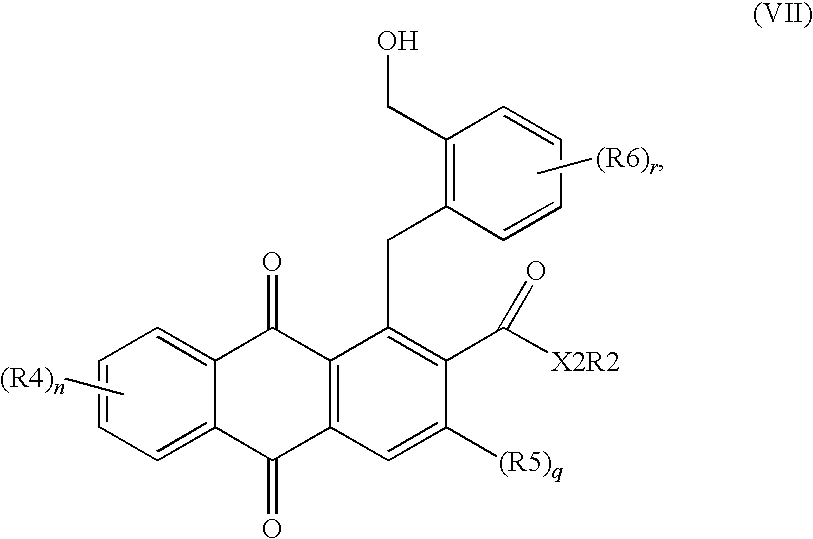
followed by oxidation of the compound (VII) to a compound (VIII),

or alternatively, in a step (3.2), the compound (V) is reacted with an organometallic compound (VI′)

where M and R6 are as defined for compound (VI) and Z is O—(C1-C6)-alkylene-O, preferably O—(CH2—CH2)—O, with transition metal catalysis, preferably with Pd, Ni or Fe catalysis, to give a compound of the formula (VII′),

and the compound (VII′) is then, by a reaction with a suitable acid, hydrolyzed to give a compound (VIII),

and the compound (VII″) is then, with transition metal catalysis, preferably with Pd, Ni or Fe catalysis, converted into a compound of the formula (VII′″),

and the compound (VII′″) is converted into a compound of the formula (VIII) by hydrolysis under basic or under acidic conditions, preferably under basic conditions, the benzyl alcohol formed is then oxidized to the aldehyde and the benzoic acid function formed is optionally esterified or amidated,

to give a compound of the formula (X),

in step (5) the compound (X) is, with hydrogenation of the triple bond to a single bond and removal of the [(C1-C6)-alkyl]3Si group, converted into a compound of the formula (XI),

in step (6) the compound (XI) is oxidized to a compound of the formula (XII),

in step (7) the compound (XI) or the compound (XII) is oxidized to a compound of the formula (I) in which X1R1=OH, and

- R1 and R2 are preferably independently of one another H or (C1-C6)-alkyl, particularly preferably H or (C1-C4)-alkyl.
- R2 is particularly preferably H.
- R3 is preferably OH.
- R4, R5 and R6 are preferably independently of one another OH or —O—(C1-C6)-alkyl.
- X1 and X2 are preferably O.
- m is preferably 0.
- q is preferably 1.
- r is preferably 1.
- X1R1 is OH or O—(C1-C6)-alkyl,
- X2R2 is OH,
- R3 is OH,
- R4 is OH or O—(C1-C6)-alkyl,
- R5 is OH or O—(C1-C6)-alkyl,
- R6 is OH or O—(C1-C6)-alkyl, and
- m and n independently of one another are 0 or 1.

in which M′ equals K, Na, Li, Ag, Cu, ZrCp2Hal, CeCl2, or Ti[O(C1-C6)-alkyl]3, preferably ZrCp2Cl or Ti(i-Pr—O)3, and which can be obtained from the compound (IX) by deprotonation, preferably using an organometallic compound (for example butyllithium), and subsequent reaction with the appropriate metal reagent, for example ZrCp2Cl2 or, preferably, ClTi(i-Pr—O)3 in an inert solvent, preferably an ether, for example THF, and in a temperature range of from −30° C. to 20° C. over a period of 2-60 minutes.

| Ac | acetyl | ||
| Bu | butyl | ||
| dba | dibenzylidene acetone | ||
| DCM | dichloromethane | ||
| dppe | 1,2-bis(diphenylphosphino)ethane | ||
| dppf | 1,1′-bis(diphenylphosphino)ferrocene | ||
| dppp | 1,3-bis(diphenylphosphino)propane | ||
| EA | ethyl acetate | ||
| eq. | equivalent | ||
| MOM | methoxymethyl | ||
| m.p. | melting point | ||
| Ms | mesyl | ||
| MTBE | methyl tert-butyl ether | ||
| MW | molecular weight | ||
| PTS | para-toluenesulfonic acid | ||
| PPTS | pyridinium para-toluenesulfonate | ||
| Rf | retention factor | ||
| TBAF | tetrabutylammonium fluoride | ||
| TBS | tert-butyldimethylsilyl | ||
| Tf | trifluoromethanesulfonyl | ||
| THF | tetrahydrofuran | ||
| TLC | thin-layer chromatogram | ||
| TMS | trimethylsilyl | ||
| Ts | tosyl | ||
The reaction steps mentioned above and the reactions described below are carried out exposed to air or under protective gas, preferably under protective gas.


Claims (41)


Applications Claiming Priority (4)
| Application Number | Priority Date | Filing Date | Title |
|---|---|---|---|
| DE102006018475 | 2006-04-19 | ||
| DE102006018475A DE102006018475A1 (en) | 2006-04-19 | 2006-04-19 | Process for the preparation of Mumbaistatin derivatives |
| DE102006018475.0 | 2006-04-19 | ||
| PCT/EP2007/002869 WO2007121822A1 (en) | 2006-04-19 | 2007-03-30 | Method for the production of mumbaistatin derivatives |
Related Parent Applications (1)
| Application Number | Title | Priority Date | Filing Date |
|---|---|---|---|
| PCT/EP2007/002869 Continuation WO2007121822A1 (en) | 2006-04-19 | 2007-03-30 | Method for the production of mumbaistatin derivatives |
Publications (2)
| Publication Number | Publication Date |
|---|---|
| US20090156836A1 US20090156836A1 (en) | 2009-06-18 |
| US7763740B2 true US7763740B2 (en) | 2010-07-27 |
Family
ID=38190776
Family Applications (1)
| Application Number | Title | Priority Date | Filing Date |
|---|---|---|---|
| US12/250,705 Expired - Fee Related US7763740B2 (en) | 2006-04-19 | 2008-10-14 | Method for the production of mumbaistatin derivatives |
Country Status (7)
| Country | Link |
|---|---|
| US (1) | US7763740B2 (en) |
| EP (1) | EP2010474A1 (en) |
| JP (1) | JP2009534324A (en) |
| KR (1) | KR20080114807A (en) |
| CN (1) | CN101421222A (en) |
| DE (1) | DE102006018475A1 (en) |
| WO (1) | WO2007121822A1 (en) |
Family Cites Families (1)
| Publication number | Priority date | Publication date | Assignee | Title |
|---|---|---|---|---|
| GB2332428A (en) * | 1997-12-12 | 1999-06-23 | John Henry Paul Tyman | Synthesis of 1-methyl-7-(1rs,2r,3s,4s,5s)-2,3,4,5,6-pentabenzyloxy-1-hydroxyhexyl-3,5,8-trihydroxyanthra-9,10-quinone-2-carboxylic acid and intermediates |
-
2006
- 2006-04-19 DE DE102006018475A patent/DE102006018475A1/en not_active Withdrawn
-
2007
- 2007-03-30 KR KR1020087025368A patent/KR20080114807A/en not_active Withdrawn
- 2007-03-30 EP EP07723811A patent/EP2010474A1/en not_active Withdrawn
- 2007-03-30 CN CNA2007800135238A patent/CN101421222A/en active Pending
- 2007-03-30 JP JP2009505737A patent/JP2009534324A/en not_active Abandoned
- 2007-03-30 WO PCT/EP2007/002869 patent/WO2007121822A1/en not_active Ceased
-
2008
- 2008-10-14 US US12/250,705 patent/US7763740B2/en not_active Expired - Fee Related
Non-Patent Citations (8)
| Title |
|---|
| Bingham, S. J., et. al., The Synthesis of Kermesic Acid and Isokermesic Acid Derivatives and of Related Dihydroxyanthraquinones, Journal of the Chemical Society, Perkin Transactions 1: Organic and Bio-Organic Chemistry, vol. 24, pp. 3637-3642, (abstract) (1997). |
| Carreras et al. Journal of the American Chemical Society (1996), 118(21), 5158-5159. * |
| Diederichs XP-002440795, URL: http://www.meind.de/search.py?recid=260156. * |
| Diederichs, J., et. al., Synthesis of Natural Chinoid Substances: A New Way to the 2′-Dialkyl-Mumbaistatin, (2005) No pp. given Avail.: Metadata on Internet Documents, Order No. 260156 From: Metadata Internet Doc. [Ger. Diss.] (2005), (D1031-4), No. pp. given URL: http://www/meind.de/search.py?recid=260156 (abstract). |
| Diederichs, J., et. al., Synthesis of Natural Chinoid Substances: A New Way to the 2'-Dialkyl-Mumbaistatin, (2005) No pp. given Avail.: Metadata on Internet Documents, Order No. 260156 From: Metadata Internet Doc. [Ger. Diss.] (2005), (D1031-4), No. pp. given URL: http://www/meind.de/search.py?recid=260156 (abstract). |
| Kaiser, F., et. al., Studies Towards the Total Synthesis of Mumbaistatin: Synthesis of Highly Substituted Benzophenone and Anthraquinone Building Blocks, Tetrahedron, vol. 59, (2003) pp. 3201-3217. |
| Uno et al. Chemistry Letters (2000), (9), 1014-1015. * |
| Uno et al.STN Accession No. 2000:651052; Document No. 133:335111, Abstract of Chemistry Letters (2000), (9), 1014-1015. * |
Also Published As
| Publication number | Publication date |
|---|---|
| DE102006018475A1 (en) | 2007-10-25 |
| CN101421222A (en) | 2009-04-29 |
| US20090156836A1 (en) | 2009-06-18 |
| EP2010474A1 (en) | 2009-01-07 |
| JP2009534324A (en) | 2009-09-24 |
| KR20080114807A (en) | 2008-12-31 |
| WO2007121822A1 (en) | 2007-11-01 |
Similar Documents
| Publication | Publication Date | Title |
|---|---|---|
| Brown et al. | Chiral Synthesis via Organoboranes. 39. A Facile Synthesis of. gamma.-Substituted-. gamma.-butyrolactones in Exceptionally High Enantiomeric Purity | |
| Roush et al. | Application of the steric directing group strategy to the stereoselective synthesis of the octahydronaphthalene substructure of kijanolide and tetronolide | |
| JPH0459306B2 (en) | ||
| WO2020031179A1 (en) | Methods for synthesis of cannabinoid compounds | |
| Hauser et al. | Anthra [1, 2-b] pyran antibiotics: total synthesis of O-methylkidamycinone | |
| Heinzman et al. | Regiospecific synthesis of bromojuglone derivatives | |
| Boger et al. | Studies of the total synthesis of fredericamycin A. Preparation of key partial structures and development of an intermolecular alkyne-chromium carbene complex benzannulation cyclization approach to the ABCD (E) ring system | |
| Mandal et al. | Studies toward the syntheses of functionally substituted. gamma.-butyrolactones and spiro-. gamma.-butyrolactones and their reaction with strong acids: a novel route to. alpha.-pyrones | |
| US11407704B2 (en) | Process of vitamin K2 derivatives preparation | |
| Findlay et al. | Total synthesis of the ravidomycin aglycone (defucogilvocarcin V) | |
| US20090156836A1 (en) | Method for the production of mumbaistatin derivatives | |
| Jägel et al. | A concise route to the C3–C23 fragment of the macrolide palmerolide A | |
| TWI710550B (en) | Process for the preparation of lubiprostone and intermediates thereof | |
| Smith III et al. | Jatrophone analogs: synthesis of cis-and trans-normethyljatropholactones | |
| Bates et al. | Total synthesis of the cholesterol biosynthesis inhibitor 1233A via a (π-allyl) tricarbonyliron lactone complex | |
| Bachu et al. | Synthesis of a C8 oxygenated pyranonaphthoquinone: a useful precursor to dimeric pyranonaphthoquinones | |
| Yamauchi et al. | Preparation of methyl 2-arylpropanoates by the reaction of 2-hydroxypropiophenone dimethyl acetals with sulfuryl chloride in the presence of an amide or a weak base. | |
| Yue et al. | Synthesis of 2, 3-dimethoxy-5-iodobenzoic acid | |
| Yu et al. | An improved convergent strategy for the synthesis of oligoprenols | |
| CN102753513A (en) | Process for the preparation of aryl and heteroaryl acetic acid derivatives | |
| HK1130770A (en) | Method for the production of mumbaistatin derivatives | |
| Gesson et al. | Total synthesis of 11-deoxydaunomycinone | |
| JP2001226306A (en) | Method for producing 2(3)-cyclopentadecen-1-one | |
| Mäkelä et al. | Development of a novel hapten for radioimmunoassay of the lignan, enterolactone in plasma (Serum). Total synthesis of (±)-trans-5-carboxymethoxyenterolactone and several analogues | |
| Moreno-Mañas et al. | Diels-Alder Reactions of 1, 1-Disubstituted 3, 4-Dimethylene-cyclopentanes. Preparation of Indanes and Diazaindanes |
Legal Events
| Date | Code | Title | Description |
|---|---|---|---|
| AS | Assignment |
Owner name: SANOFI-AVENTIS, FRANCE Free format text: ASSIGNMENT OF ASSIGNORS INTEREST;ASSIGNORS:SCHWINK, LOTHAR;SCHMALZ, HANS-GUNTHER;VELDER, JANNA;AND OTHERS;REEL/FRAME:022250/0205;SIGNING DATES FROM 20090105 TO 20090116 Owner name: SANOFI-AVENTIS, FRANCE Free format text: ASSIGNMENT OF ASSIGNORS INTEREST;ASSIGNORS:SCHWINK, LOTHAR;SCHMALZ, HANS-GUNTHER;VELDER, JANNA;AND OTHERS;SIGNING DATES FROM 20090105 TO 20090116;REEL/FRAME:022250/0205 |
|
| FEPP | Fee payment procedure |
Free format text: PAYOR NUMBER ASSIGNED (ORIGINAL EVENT CODE: ASPN); ENTITY STATUS OF PATENT OWNER: LARGE ENTITY |
|
| REMI | Maintenance fee reminder mailed | ||
| LAPS | Lapse for failure to pay maintenance fees | ||
| STCH | Information on status: patent discontinuation |
Free format text: PATENT EXPIRED DUE TO NONPAYMENT OF MAINTENANCE FEES UNDER 37 CFR 1.362 |
|
| STCH | Information on status: patent discontinuation |
Free format text: PATENT EXPIRED DUE TO NONPAYMENT OF MAINTENANCE FEES UNDER 37 CFR 1.362 |
|
| FP | Lapsed due to failure to pay maintenance fee |
Effective date: 20140727 |