US7759490B2 - Phosphorescent Osmium (II) complexes and uses thereof - Google Patents
Phosphorescent Osmium (II) complexes and uses thereof Download PDFInfo
- Publication number
- US7759490B2 US7759490B2 US12/216,833 US21683308A US7759490B2 US 7759490 B2 US7759490 B2 US 7759490B2 US 21683308 A US21683308 A US 21683308A US 7759490 B2 US7759490 B2 US 7759490B2
- Authority
- US
- United States
- Prior art keywords
- compound
- group
- ligand
- pph
- mmol
- Prior art date
- Legal status (The legal status is an assumption and is not a legal conclusion. Google has not performed a legal analysis and makes no representation as to the accuracy of the status listed.)
- Active
Links
- 0 **12(*)(N3C=C([1*])C([2*])=C3C3=N1C=CC=C3)N1C=C([1*])C([2*])=C1C1=N2C=CC=C1.[3*]C.[3*]C.[4*]C.[4*]C Chemical compound **12(*)(N3C=C([1*])C([2*])=C3C3=N1C=CC=C3)N1C=C([1*])C([2*])=C1C1=N2C=CC=C1.[3*]C.[3*]C.[4*]C.[4*]C 0.000 description 14
- FUDGKGFFHGOEKX-VIOUERSGSA-N C.C/C=C\C=C/C Chemical compound C.C/C=C\C=C/C FUDGKGFFHGOEKX-VIOUERSGSA-N 0.000 description 3
- YLZRJLINSAAICH-UHFFFAOYSA-P C.CC1=NN2C(=C1)C1=N(C=CC3=C1C=CC=C3)[Ru]21([PH](C)(C2=CC=CC=C2)C2=CC=CC=C2)([PH](C)(C2=CC=CC=C2)C2=CC=CC=C2)N2N=C(F)C=C2C2=N1C=CC1=C2C=CC=C1.CFF Chemical compound C.CC1=NN2C(=C1)C1=N(C=CC3=C1C=CC=C3)[Ru]21([PH](C)(C2=CC=CC=C2)C2=CC=CC=C2)([PH](C)(C2=CC=CC=C2)C2=CC=CC=C2)N2N=C(F)C=C2C2=N1C=CC1=C2C=CC=C1.CFF YLZRJLINSAAICH-UHFFFAOYSA-P 0.000 description 1
- NIHCBVIGICDEQL-LOYNDDMJSA-O C.CC1=NN2C(=C1)C1=N(C=CC3=C1C=CC=C3)[Ru]213(C[PH](C2=CC=CC=C2)(C2=CC=CC=C2)C=C[PH]1(C1=CC=CC=C1)C1=CC=CC=C1)N1N=C(C)C=C1C1=N3C=CC2=C1C=CC=C2 Chemical compound C.CC1=NN2C(=C1)C1=N(C=CC3=C1C=CC=C3)[Ru]213(C[PH](C2=CC=CC=C2)(C2=CC=CC=C2)C=C[PH]1(C1=CC=CC=C1)C1=CC=CC=C1)N1N=C(C)C=C1C1=N3C=CC2=C1C=CC=C2 NIHCBVIGICDEQL-LOYNDDMJSA-O 0.000 description 1
- FIRQQZPUXJBFSH-CSVSGXLVSA-P C.CC1=NN2C(=C1)C1=N(C=CC=C1)[Os]213(N2N=C(F)C=C2C2=N1C=CC=C2)[PH](C1=CC=CC=C1)(C1=CC=CC=C1)C=C[PH]3(C1=CC=CC=C1)C1=CC=CC=C1.CFF Chemical compound C.CC1=NN2C(=C1)C1=N(C=CC=C1)[Os]213(N2N=C(F)C=C2C2=N1C=CC=C2)[PH](C1=CC=CC=C1)(C1=CC=CC=C1)C=C[PH]3(C1=CC=CC=C1)C1=CC=CC=C1.CFF FIRQQZPUXJBFSH-CSVSGXLVSA-P 0.000 description 1
- PXKUPXHJJFMWIV-UHFFFAOYSA-S C1=CC=C(C2=CC=CC=C2)C=C1.C1=CC=C(C2=CC=CC=C2)C=C1.C1=CC=C(C2=CC=CC=C2)C=C1.C1=CC=C(C2=CC=CC=C2)C=C1.CP[Os]12([PH](C)(C3=CC=CC=C3)C3=CC=CC=C3)(N3N=C(C)N=C3C3=N1C=CC=C3)N1N=C(C)N=C1C1=N2C=CC=C1.CP[Os]12([PH](C)(C3=CC=CC=C3)C3=CC=CC=C3)(N3N=C(C)N=C3C3=N1C=CC=C3)N1N=C(C)N=C1C1=N2C=CC=C1.CP[Os]12([PH](C)(C3=CC=CC=C3)C3=CC=CC=C3)(N3N=C(C4=CC=CC=C4)C=C3C3=N1C=CC=C3)N1N=C(C3=CC=CC=C3)C=C1C1=N2C=CC=C1.CP[Os]12([PH](C)(C3=CC=CC=C3)C3=CC=CC=C3)(N3N=C(FC(F)F)N=C3C3=N1C=CC=C3)N1N=C(C(F)(F)F)N=C1C1=N2C=CC=C1.C[PH](C)(C1=CC=CC=C1)[Os]12(C)(N3N=C(FC(F)F)N=C3C3=N1C=CC=C3)N1N=C(C(F)(F)F)N=C1C1=N2C=CC=C1 Chemical compound C1=CC=C(C2=CC=CC=C2)C=C1.C1=CC=C(C2=CC=CC=C2)C=C1.C1=CC=C(C2=CC=CC=C2)C=C1.C1=CC=C(C2=CC=CC=C2)C=C1.CP[Os]12([PH](C)(C3=CC=CC=C3)C3=CC=CC=C3)(N3N=C(C)N=C3C3=N1C=CC=C3)N1N=C(C)N=C1C1=N2C=CC=C1.CP[Os]12([PH](C)(C3=CC=CC=C3)C3=CC=CC=C3)(N3N=C(C)N=C3C3=N1C=CC=C3)N1N=C(C)N=C1C1=N2C=CC=C1.CP[Os]12([PH](C)(C3=CC=CC=C3)C3=CC=CC=C3)(N3N=C(C4=CC=CC=C4)C=C3C3=N1C=CC=C3)N1N=C(C3=CC=CC=C3)C=C1C1=N2C=CC=C1.CP[Os]12([PH](C)(C3=CC=CC=C3)C3=CC=CC=C3)(N3N=C(FC(F)F)N=C3C3=N1C=CC=C3)N1N=C(C(F)(F)F)N=C1C1=N2C=CC=C1.C[PH](C)(C1=CC=CC=C1)[Os]12(C)(N3N=C(FC(F)F)N=C3C3=N1C=CC=C3)N1N=C(C(F)(F)F)N=C1C1=N2C=CC=C1 PXKUPXHJJFMWIV-UHFFFAOYSA-S 0.000 description 1
- ZRTAPYAUJYZWLQ-UHFFFAOYSA-U C1=CC=C(C2=CC=CC=C2)C=C1.C1=CC=C(C2=CC=CC=C2)C=C1.C1=CC=C(C2=NN3C(=C2)C2=N(C=CC=C2)[Os]32([PH](C3=CC=CC=C3)(C3=CC=CC=C3)C3=CC=CC=C3)([PH](C3=CC=CC=C3)(C3=CC=CC=C3)C3=CC=CC=C3)N3N=C(C4=CC=CC=C4)C=C3C3=N2C=CC=C3)C=C1.CC1=NN2C(=C1)C1=N(C=CC=C1)[Os]21([PH](C2=CC=CC=C2)(C2=CC=CC=C2)C2=CC=CC=C2)([PH](C2=CC=CC=C2)(C2=CC=CC=C2)C2=CC=CC=C2)N2N=C(C)C=C2C2=N1C=CC=C2.CFF.CP[Os]12([PH](C)(C3=CC=CC=C3)C3=CC=CC=C3)(N3N=C(C(F)(F)F)C=C3C3=N1C=CC=C3)N1N=C(C(F)(F)F)C=C1C1=N2C=CC=C1.CP[Os]12([PH](C)(C3=CC=CC=C3)C3=CC=CC=C3)(N3N=C(C)C=C3C3=N1C=CC=C3)N1N=C(C)C=C1C1=N2C=CC=C1.C[PH](C)(C1=CC=CC=C1)[Os]12(C)(N3N=C(F)C=C3C3=N1C=CC=C3)N1N=C(FC(F)F)C=C1C1=N2C=CC=C1 Chemical compound C1=CC=C(C2=CC=CC=C2)C=C1.C1=CC=C(C2=CC=CC=C2)C=C1.C1=CC=C(C2=NN3C(=C2)C2=N(C=CC=C2)[Os]32([PH](C3=CC=CC=C3)(C3=CC=CC=C3)C3=CC=CC=C3)([PH](C3=CC=CC=C3)(C3=CC=CC=C3)C3=CC=CC=C3)N3N=C(C4=CC=CC=C4)C=C3C3=N2C=CC=C3)C=C1.CC1=NN2C(=C1)C1=N(C=CC=C1)[Os]21([PH](C2=CC=CC=C2)(C2=CC=CC=C2)C2=CC=CC=C2)([PH](C2=CC=CC=C2)(C2=CC=CC=C2)C2=CC=CC=C2)N2N=C(C)C=C2C2=N1C=CC=C2.CFF.CP[Os]12([PH](C)(C3=CC=CC=C3)C3=CC=CC=C3)(N3N=C(C(F)(F)F)C=C3C3=N1C=CC=C3)N1N=C(C(F)(F)F)C=C1C1=N2C=CC=C1.CP[Os]12([PH](C)(C3=CC=CC=C3)C3=CC=CC=C3)(N3N=C(C)C=C3C3=N1C=CC=C3)N1N=C(C)C=C1C1=N2C=CC=C1.C[PH](C)(C1=CC=CC=C1)[Os]12(C)(N3N=C(F)C=C3C3=N1C=CC=C3)N1N=C(FC(F)F)C=C1C1=N2C=CC=C1 ZRTAPYAUJYZWLQ-UHFFFAOYSA-U 0.000 description 1
- HYTNNOCXRPSMGX-UHFFFAOYSA-P C1=CC=C(C2=CC=CC=C2)C=C1.CC1=NN2C(=N1)C1=N(C=CC=C1)[Os]21(C)([PH](C)(C)C2=CC=CC=C2)N2N=C(C#CC(F)(F)(F)(F)(F)(F)F)N=C2C2=N1C=CC=C2.CP[Os]12([PH](C)(C3=CC=CC=C3)C3=CC=CC=C3)(N3N=C(C)N=C3C3=N1C=CC=C3)N1N=C(C#CC(F)(F)(F)(F)(F)(F)F)N=C1C1=N2C=CC=C1 Chemical compound C1=CC=C(C2=CC=CC=C2)C=C1.CC1=NN2C(=N1)C1=N(C=CC=C1)[Os]21(C)([PH](C)(C)C2=CC=CC=C2)N2N=C(C#CC(F)(F)(F)(F)(F)(F)F)N=C2C2=N1C=CC=C2.CP[Os]12([PH](C)(C3=CC=CC=C3)C3=CC=CC=C3)(N3N=C(C)N=C3C3=N1C=CC=C3)N1N=C(C#CC(F)(F)(F)(F)(F)(F)F)N=C1C1=N2C=CC=C1 HYTNNOCXRPSMGX-UHFFFAOYSA-P 0.000 description 1
- IAIVROSRRZWJKD-UHFFFAOYSA-N CC1=CC2=N(C=C1)[Os+2]1([C-]=O)([C-]=O)(N3N=C(FC(F)F)C=C23)N2N=C(FC(F)F)C=C2C2=N1C=CC(C)=C2.CC1=NN2C(=N1)C1=N(C=CC=C1)[Os+2]21([C-]=O)([C-]=O)N2N=C(C)N=C2C2=N1C=CC=C2.O=[C-][Os+2]12([C-]=O)(N3N=C(FC(F)F)C=C3C3=N1C=CC=C3)N1N=C(FC(F)F)C=C1C1=N2C=CC=C1.O=[C-][Os+2]12([C-]=O)(N3N=C(FC(F)F)N=C3C3=N1C=CC=C3)N1N=C(FC(F)F)N=C1C1=N2C=CC=C1 Chemical compound CC1=CC2=N(C=C1)[Os+2]1([C-]=O)([C-]=O)(N3N=C(FC(F)F)C=C23)N2N=C(FC(F)F)C=C2C2=N1C=CC(C)=C2.CC1=NN2C(=N1)C1=N(C=CC=C1)[Os+2]21([C-]=O)([C-]=O)N2N=C(C)N=C2C2=N1C=CC=C2.O=[C-][Os+2]12([C-]=O)(N3N=C(FC(F)F)C=C3C3=N1C=CC=C3)N1N=C(FC(F)F)C=C1C1=N2C=CC=C1.O=[C-][Os+2]12([C-]=O)(N3N=C(FC(F)F)N=C3C3=N1C=CC=C3)N1N=C(FC(F)F)N=C1C1=N2C=CC=C1 IAIVROSRRZWJKD-UHFFFAOYSA-N 0.000 description 1
Images


Classifications
-
- C—CHEMISTRY; METALLURGY
- C07—ORGANIC CHEMISTRY
- C07F—ACYCLIC, CARBOCYCLIC OR HETEROCYCLIC COMPOUNDS CONTAINING ELEMENTS OTHER THAN CARBON, HYDROGEN, HALOGEN, OXYGEN, NITROGEN, SULFUR, SELENIUM OR TELLURIUM
- C07F15/00—Compounds containing elements of Groups 8, 9, 10 or 18 of the Periodic Table
- C07F15/0006—Compounds containing elements of Groups 8, 9, 10 or 18 of the Periodic Table compounds of the platinum group
- C07F15/002—Osmium compounds
-
- C—CHEMISTRY; METALLURGY
- C09—DYES; PAINTS; POLISHES; NATURAL RESINS; ADHESIVES; COMPOSITIONS NOT OTHERWISE PROVIDED FOR; APPLICATIONS OF MATERIALS NOT OTHERWISE PROVIDED FOR
- C09K—MATERIALS FOR MISCELLANEOUS APPLICATIONS, NOT PROVIDED FOR ELSEWHERE
- C09K11/00—Luminescent materials, e.g. electroluminescent or chemiluminescent
- C09K11/06—Luminescent materials, e.g. electroluminescent or chemiluminescent containing organic luminescent materials
-
- H—ELECTRICITY
- H05—ELECTRIC TECHNIQUES NOT OTHERWISE PROVIDED FOR
- H05B—ELECTRIC HEATING; ELECTRIC LIGHT SOURCES NOT OTHERWISE PROVIDED FOR; CIRCUIT ARRANGEMENTS FOR ELECTRIC LIGHT SOURCES, IN GENERAL
- H05B33/00—Electroluminescent light sources
- H05B33/12—Light sources with substantially two-dimensional [2D] radiating surfaces
- H05B33/14—Light sources with substantially two-dimensional [2D] radiating surfaces characterised by the chemical or physical composition or the arrangement of the electroluminescent material, or by the simultaneous addition of the electroluminescent material in or onto the light source
-
- H—ELECTRICITY
- H10—SEMICONDUCTOR DEVICES; ELECTRIC SOLID-STATE DEVICES NOT OTHERWISE PROVIDED FOR
- H10K—ORGANIC ELECTRIC SOLID-STATE DEVICES
- H10K85/00—Organic materials used in the body or electrodes of devices covered by this subclass
- H10K85/30—Coordination compounds
- H10K85/341—Transition metal complexes, e.g. Ru(II)polypyridine complexes
- H10K85/348—Transition metal complexes, e.g. Ru(II)polypyridine complexes comprising osmium
-
- C—CHEMISTRY; METALLURGY
- C09—DYES; PAINTS; POLISHES; NATURAL RESINS; ADHESIVES; COMPOSITIONS NOT OTHERWISE PROVIDED FOR; APPLICATIONS OF MATERIALS NOT OTHERWISE PROVIDED FOR
- C09K—MATERIALS FOR MISCELLANEOUS APPLICATIONS, NOT PROVIDED FOR ELSEWHERE
- C09K2211/00—Chemical nature of organic luminescent or tenebrescent compounds
- C09K2211/10—Non-macromolecular compounds
- C09K2211/1018—Heterocyclic compounds
- C09K2211/1025—Heterocyclic compounds characterised by ligands
- C09K2211/1029—Heterocyclic compounds characterised by ligands containing one nitrogen atom as the heteroatom
-
- C—CHEMISTRY; METALLURGY
- C09—DYES; PAINTS; POLISHES; NATURAL RESINS; ADHESIVES; COMPOSITIONS NOT OTHERWISE PROVIDED FOR; APPLICATIONS OF MATERIALS NOT OTHERWISE PROVIDED FOR
- C09K—MATERIALS FOR MISCELLANEOUS APPLICATIONS, NOT PROVIDED FOR ELSEWHERE
- C09K2211/00—Chemical nature of organic luminescent or tenebrescent compounds
- C09K2211/10—Non-macromolecular compounds
- C09K2211/1018—Heterocyclic compounds
- C09K2211/1025—Heterocyclic compounds characterised by ligands
- C09K2211/1044—Heterocyclic compounds characterised by ligands containing two nitrogen atoms as heteroatoms
-
- C—CHEMISTRY; METALLURGY
- C09—DYES; PAINTS; POLISHES; NATURAL RESINS; ADHESIVES; COMPOSITIONS NOT OTHERWISE PROVIDED FOR; APPLICATIONS OF MATERIALS NOT OTHERWISE PROVIDED FOR
- C09K—MATERIALS FOR MISCELLANEOUS APPLICATIONS, NOT PROVIDED FOR ELSEWHERE
- C09K2211/00—Chemical nature of organic luminescent or tenebrescent compounds
- C09K2211/10—Non-macromolecular compounds
- C09K2211/1018—Heterocyclic compounds
- C09K2211/1025—Heterocyclic compounds characterised by ligands
- C09K2211/1059—Heterocyclic compounds characterised by ligands containing three nitrogen atoms as heteroatoms
-
- C—CHEMISTRY; METALLURGY
- C09—DYES; PAINTS; POLISHES; NATURAL RESINS; ADHESIVES; COMPOSITIONS NOT OTHERWISE PROVIDED FOR; APPLICATIONS OF MATERIALS NOT OTHERWISE PROVIDED FOR
- C09K—MATERIALS FOR MISCELLANEOUS APPLICATIONS, NOT PROVIDED FOR ELSEWHERE
- C09K2211/00—Chemical nature of organic luminescent or tenebrescent compounds
- C09K2211/18—Metal complexes
- C09K2211/185—Metal complexes of the platinum group, i.e. Os, Ir, Pt, Ru, Rh or Pd
-
- H—ELECTRICITY
- H10—SEMICONDUCTOR DEVICES; ELECTRIC SOLID-STATE DEVICES NOT OTHERWISE PROVIDED FOR
- H10K—ORGANIC ELECTRIC SOLID-STATE DEVICES
- H10K2101/00—Properties of the organic materials covered by group H10K85/00
- H10K2101/10—Triplet emission
-
- H—ELECTRICITY
- H10—SEMICONDUCTOR DEVICES; ELECTRIC SOLID-STATE DEVICES NOT OTHERWISE PROVIDED FOR
- H10K—ORGANIC ELECTRIC SOLID-STATE DEVICES
- H10K50/00—Organic light-emitting devices
- H10K50/10—OLEDs or polymer light-emitting diodes [PLED]
- H10K50/11—OLEDs or polymer light-emitting diodes [PLED] characterised by the electroluminescent [EL] layers
-
- H—ELECTRICITY
- H10—SEMICONDUCTOR DEVICES; ELECTRIC SOLID-STATE DEVICES NOT OTHERWISE PROVIDED FOR
- H10K—ORGANIC ELECTRIC SOLID-STATE DEVICES
- H10K85/00—Organic materials used in the body or electrodes of devices covered by this subclass
- H10K85/10—Organic polymers or oligomers
- H10K85/141—Organic polymers or oligomers comprising aliphatic or olefinic chains, e.g. poly N-vinylcarbazol, PVC or PTFE
- H10K85/146—Organic polymers or oligomers comprising aliphatic or olefinic chains, e.g. poly N-vinylcarbazol, PVC or PTFE poly N-vinylcarbazol; Derivatives thereof
-
- H—ELECTRICITY
- H10—SEMICONDUCTOR DEVICES; ELECTRIC SOLID-STATE DEVICES NOT OTHERWISE PROVIDED FOR
- H10K—ORGANIC ELECTRIC SOLID-STATE DEVICES
- H10K85/00—Organic materials used in the body or electrodes of devices covered by this subclass
- H10K85/30—Coordination compounds
- H10K85/321—Metal complexes comprising a group IIIA element, e.g. Tris (8-hydroxyquinoline) gallium [Gaq3]
- H10K85/324—Metal complexes comprising a group IIIA element, e.g. Tris (8-hydroxyquinoline) gallium [Gaq3] comprising aluminium, e.g. Alq3
-
- H—ELECTRICITY
- H10—SEMICONDUCTOR DEVICES; ELECTRIC SOLID-STATE DEVICES NOT OTHERWISE PROVIDED FOR
- H10K—ORGANIC ELECTRIC SOLID-STATE DEVICES
- H10K85/00—Organic materials used in the body or electrodes of devices covered by this subclass
- H10K85/60—Organic compounds having low molecular weight
- H10K85/631—Amine compounds having at least two aryl rest on at least one amine-nitrogen atom, e.g. triphenylamine
-
- H—ELECTRICITY
- H10—SEMICONDUCTOR DEVICES; ELECTRIC SOLID-STATE DEVICES NOT OTHERWISE PROVIDED FOR
- H10K—ORGANIC ELECTRIC SOLID-STATE DEVICES
- H10K85/00—Organic materials used in the body or electrodes of devices covered by this subclass
- H10K85/60—Organic compounds having low molecular weight
- H10K85/649—Aromatic compounds comprising a hetero atom
Definitions
- the invention relates to phosphorescent compounds and uses thereof.
- OLEDs organic light emitting diodes
- PLEDs polymer light emitting diodes
- Organometallic complexes containing the third-row transition metal elements such as Os(II), Ir(III) and Pt(II) are crucial materials for this attempt.
- the strong spin-orbit coupling induced by these heavy metal ions promotes an efficient intersystem crossing from the singlet to the triplet state, which then facilitates high internal quantum efficiencies ( ⁇ int ) for the OLED devices by using both singlet and triplet excitons.
- ⁇ int internal quantum efficiencies
- numerous attempts have been made to exploit third-row transition metal complexes as dopant emitters for OLED fabrication, among which quite a few Pt(II) and Ir(III) metal complexes have been reported to exhibit highly efficient OLED and PLED device performances.
- the ligand sphere of the OS(II) atom consists of two anionic chelating ligands such as 3-trifluoromethyl-5-(2-pyridyl)pyrazolate (fppz ⁇ ), 3-trifluoromethyl-5-(2-pyridyl) triazolate (bptz ⁇ ), or even (2-pyridyl) tetrazolate (pyN4 ⁇ ) ligand that can neutralize and balance the 2+ charge located at the Os(II) center, and with two donor ligands such as carbonyl, pyridine, bipyridine, arsine, phosphine, and isocyanide ligands to complete the required octahedral coordination arrangement; [Tung, Y.-L. et al., Organometallics 2004, 23, 3745].
- two anionic chelating ligands such as 3-trifluoromethyl-5-(2-pyridyl)pyrazolate (fppz
- Os(II) compound having phosphorescent properties, and uses thereof.
- the invention provides octahedral Os (II) and Ru(II) complexes of structures I and II:
- A is Os or Ru
- the anionic chelating chromophores N ⁇ N which are formed by connecting one pentagonal ring structure containing at least two nitrogen atoms to a hexagonal pyridine type of fragment via a direct carbon-carbon linkage.
- L stands for a neutral donor ligand; the typical example includes carbonyl, pyridine, phosphine, arsine and isocyanide; two neutral L's can also combine to produce the so-called chelating ligand such as 2,2′-bipyridine, 1,10-phenanthroline and N-heterocyclic carbene (NHC) ligand, or bidentate phosphorous ligands such as 1,2-bis(diphenylphosphino)ethane, 1,2-bis(diphenylphosphino)benzene.
- chelating ligand such as 2,2′-bipyridine, 1,10-phenanthroline and N-heterocyclic carbene (NHC) ligand, or bidentate phosphorous ligands such as 1,2-bis(diphenylphosphino)ethane, 1,2-bis(diphenylphosphino)benzene.
- L can occupy either cis or trans orientation.
- the preferred structure contains both the hexagonal fragment of N ⁇ N as well as its pentagonal fragment located at the trans position respect to their counterparts of the second N ⁇ N chromophore.
- the preferred structure When L occupies the cis position, the preferred structure consists of the pentagonal unit of N ⁇ N chromophores residing opposite to the L.
- X 1 , X 2 and X 3 independently are C or N;
- R 1 is H, C1-C8 alkyl, C1-C8 substituted phenyl or C1-C4 perfluoroalkyl,
- R 2 is H, F or cyano substituent
- X 4 is either C or N
- X 4 may locate at any position of the hexagonal ring, when X 4 is N and R 3 and R 4 are not linked to X 4 ,
- R 3 is H, methyl or C1-C3 small alkyl
- R 4 is H, methyl or C1-C3 small alkyl
- R 3 and R 4 together form an additional conjugated unit with structure
- OLEDs comprising compounds of structure I.
- an Organic Light Emitting Diode OLED
- a Polymer Light Emitting Diode PLED
- active material an Osmium(II) complexes described in structure I.
- an Organic Light Emitting Diode OLED
- a Polymer Light Emitting Diode PLED
- active material an Osmium(II) complexes described in structure I and with the possible ligands defined therein.
- the second active material can be any other suitable electroluminescent material, (e.g. Alq3, derivatives of polyfluorene or oligofluorene, derivatives of polycarbazole or oligocarbazole, derivatives of poly(p-phenylenevinylene or oligo(phenylenevinylene), derivateis of poly(p-phenylene) or oligo(p-phenylene, and etc.).
- the second active material will in some instances emit at a different wavelength than the Os(II) compound. (e.g. Alq3, PPV and other polyfluorene derivatives, etc.
- the second active material can be an electron transport emitter, a hole transport emitter, or a bipolar emitter.
- an OLED comprising a hole transport layer, an electron transport layer, and wherein at least one of said hole transport layer and said electron transport layer comprises either alone or in combination as active material such as Osmium(II) complexes described by structure I.
- an OLED as described above, further comprising a carrier promotion layer, such as a hole injection layer (HIJL) or an electron injection layer (EIJL) adjacent at least one of said electron transport layer and said hole transport layer.
- a carrier promotion layer such as a hole injection layer (HIJL) or an electron injection layer (EIJL) adjacent at least one of said electron transport layer and said hole transport layer.
- an OLED as described above, wherein said hole promotion is [Poly (ethylene dioxythiophene: polystryrene sulfonate)] (PEDOT-PSS).
- FIG. 1 is a depiction of a prior art small-molecule light-emitting diode.
- FIG. 2 is a depiction of a prior art polymer light-emitting diode.
- FIG. 3 is a depiction of prior art ionic Os complex based phosphorescent dye doped polymer light-emitting diode.
- FIG. 4 shows an embodiment of the invention where an OLED is formed using Os(II) complexes of formula (4) doped PVK thin film as hole transport and emissive layer.
- the diode consists of an indium tin oxide transparent conductive anode on a glass substrate, Os(II) complex doped PVK as hole transport and emissive layer, Bu-PBD as hole blocking/electron transport layer, a LiF layer as electron injecting layer and an aluminum cathode.
- FIG. 5 is a series of graphical depictions of the electroluminescence spectra, the current-voltage and luminescence-voltage, efficiency-voltage characteristics of the embodiment of FIG. 4 .
- FIG. 6 shows an embodiment of the invention where an OLED is formed using Os(II) complexes of formula (4) doped PVK thin film as hole transport and emissive layer.
- the diode consists of an indium tin oxide transparent conductive anode on a glass substrate, Os(II) complex doped PVK as hole transport and emissive layer, a F-TBB layer as hole blocking layer, a AlQ 3 layer as electron transport layer, a LiF layer as electron injecting layer and an aluminum cathode.
- FIG. 7 is a pair of graphical depictions of the luminescence-voltage, efficiency-voltage characteristics of the embodiment of FIG. 6 .
- FIG. 8 is a depiction of a generic normal fashion OLED/PLED device configuration.
- FIG. 9 is a depiction of a generic “reverse” structured OLED/PLED device configuration.
- FIG. 10 is an ORTEP diagram of Os1.
- FIG. 11 is an UV-vis absorption and normalized PL emission spectra of complexes Os1 (squares), Os2 (triangles), and Os3 (circles) in CH 2 Cl 2 at room temperature.
- the present invention is directed to Os(II) emissive molecules useful to display luminance when an electric voltage is applied to an OLED or PLED device in which they are employed, and to structures, and correlative molecules of the structures, that optimize the emission intensity and wavelength of the light emitting devices.
- this series of Os(II) molecules may produce emission which appears as either one of three primary colors of visible light; i.e. blue, green and red.
- the ligands (2-pyridyl)pyrazole, (2-pyridyl) triazole and even (2-pyridyl) tetrazole can react with Os 3 (CO) 12 to afford Os(II) metal complexes 1.
- the carbonyl ligands always adopt the cis geometry, and the trans-position to the CO ligands can be occupied by the anionic pyrazolate, triazolate or tetrazolate group.
- the related Os(II) complexes of type 2 possess the CO ligands at the coordinative trans-position to the 2-pyridyl fragments can also be isolated as the co-products of lower yields.
- the hydrocarbon substituent R 1 can be methyl, methoxyl, dimethylamino, trifluoromethyl, t-butyl and phenyl group
- second R 3 can be methyl, methoxyl or any other organic functional groups so that tuning of the emission color can be successfully achieved.
- R 3 group on the 2-pyridyl fragment there is not restriction to the relative position of R 3 group on the 2-pyridyl fragment, as it can be located at all four possible positions of the 2-pyridyl fragment.
- the hydrogen atom of the ligated pyrazolate fragments in 1a and 2a can be replaced by other small alkyl or aryl substituents, halide or pseudohalide group such as fluoride, chloride or even cyano functional group.
- the emission spectrum of these complexes shows the intra-ligand ⁇ * absorption band with distinct vibronic feature in the range 450 ⁇ 510 nm in both solid and fluid state. As a result, they could be served as the blue or cyanide blue phosphorescent emitters for various OLED applications. Fine adjustment of the emission color can be achieved by ligand functionalization. For example, substituting of R 1 group at the pyrazolate or triazolate fragment with certain strong electron withdrawing group would stabilize the HOMO of the chelating ligand. It would bring about the intra-ligand ⁇ * charge transfer transitions with higher energy, as can be seen from the hypsochromic shift in the 3 ⁇ * phosphorescence spectra for this series of complexes.
- the carbonyl ligands of complexes 1 and 2 can be replaced by a bidentate diamine or diimine ligand (N ⁇ N), such as ethylenediamine, tetramethylethylenediamine, 2,2′-bipyridine, 1,10-phenanthroline, 2-(2′-pyridyl)benzoxazole and their alkyl or aryl substituted derivatives, to afford complexes of type 3.
- a bidentate diamine or diimine ligand such as ethylenediamine, tetramethylethylenediamine, 2,2′-bipyridine, 1,10-phenanthroline, 2-(2′-pyridyl)benzoxazole and their alkyl or aryl substituted derivatives, to afford complexes of type 3.
- These Os(II) complexes will retain the octahedral coordination arrangement with the nitrogen atoms occupying the original positions of the cis-CO ligands in both complexes 1
- complexes 1 and 2 upon treatment of complexes 1 and 2 with Me 3 NO to remove the carbonyl ligands, followed by addition of donor ligand P such as phosphine, phosphite or arsine, the complexes of types 4 can be obtained in good yields.
- donor ligand P such as phosphine, phosphite or arsine
- the complexes of types 4 can be obtained in good yields.
- the cis-carbonyl arrangement has changed to the trans-donor ligand disposition during the substitution reaction.
- These complexes possess two (2-pyridyl)pyrazolate, triazolate or tetrazolate ligands located at the mutual planar position, and their emission is centered in the lower energy range of 610 ⁇ 660 nm, depending on the substituents R 1 and R 3 and the phosphine donor ligand P employed. This structural property has been unambiguously confirmed by the single crystal X-ray structural determination studies;
- the donor ligand P can be the phosphine ligand such as: PPh 3 , PPh 2 Me, PPhMe 2 and PMe 3 , the phosphite ligand such as: P(OPh) 3 and P(OMe) 3 , or even the arsine ligand such as AsPh 3 and AsMe 3 .
- the PPh 3 derivatives tend to be less stable upon dissolution in organic solvents, compared with the Os(II) complexes possessing the slightly smaller and more electron donating phosphine ligands such as PPh 2 Me and PPhMe 2 .
- the emission wavelength is proportional to their relative donor strength; i.e. higher the donor strength, longer the emission wavelength.
- the Os(II) metal complexes may also contain structures represented by any one of the formula 5. It is notable that the phosphorous atoms of the bidentate phosphine chelates preferably reside at the cis-disposition around the Os(II) metal center, which differs greatly from that depicted in the previous molecular formula 4, and the additional R 5 represents the alkyl and aryl substituents required for the diphosphine chelates employed. OLED and PLED devices fabricated using these Os(II) complexes would exhibit advantages such as good luminescence efficiency and good durability.
- the emission wavelength of complexes 5 would be more blue shifted compared with the diimine analogues 3, as the phosphorus atom appears to be a better ⁇ -acid compared with the nitrogen donor atom of diimine ligands.
- other monoanionic chelating ligands may also be used in this invention to synthesize the Os(II) metal complexes showing the desired structural formula 1 ⁇ 5. Specific examples are illustrated below, using (2-pyridyl)pyrazolate ligand as reference to illustrate our basic design principle.
- the new heterocyclic fragment may consist of 2-pyrazine, 2-pyrimidine, 3-pyridazine, 2-quinoline and 1-isoquinoline molecule. Connecting these heterocyclic fragment to the above mentioned pyrazolate, triazolate or tetrazolate anionic fragment would produce an expended series of new chelating ligands that are equally suitable for synthesizing the required Os(II) emitters. Additional of an extra nitrogen atom to the backbone of 2-pyridyl fragment, e.g.
- the prior art device shown in FIG. 1 consists of a transparent Indium Tin Oxide (ITO) anode on a glass substrate, an aromatic diamine as the hole transport layer, an AlQ 3 (8-hydroxyquinoline aluminum) electron transport and emitter layer, and a Mg:Ag alloy cathode.
- ITO Indium Tin Oxide
- AlQ 3 8-hydroxyquinoline aluminum
- Mg:Ag alloy cathode When a sufficiently positive voltage is applied between the anode and the cathode, holes are injected from the anode, electrons are injected from the cathode and they recombine radiatively in the AlQ 3 emissive layer, producing light that is seen through the transparent anode and hole transport layer.
- the prior art device shown in FIG. 2 consists of a transparent ITO anode on a glass substrate, a thin PPV (poly(p-phenylenevinylene)) layer, and an Al cathode.
- a sufficiently high positive voltage is applied between the anode and the cathode, holes are injected from the anode, electrons are injected from the cathode and they recombine radiatively in the PPV emissive layer, producing light that is seen through the transparent anode.
- the prior art device shown in FIG. 3 consists of a transparent ITO anode on a glass substrate, a BTPD-PFCB hole transport layer, an ionic Os(II) compound doped PF-TPA-OXD emissive layer, and a Ca/Ag cathode. Under a positive bias voltage, efficient electroluminescent emission was observed. In this device count ions were present with the Os compound.
- FIG. 4 In this embodiment of the invention, shown in FIG. 4 , three double-layer organic light emitting diodes were fabricated using commercial ITO-coated (120 nm) glass substrates with a sheet resistance of 15 ohm/ ⁇ (Applied Films Corp.).
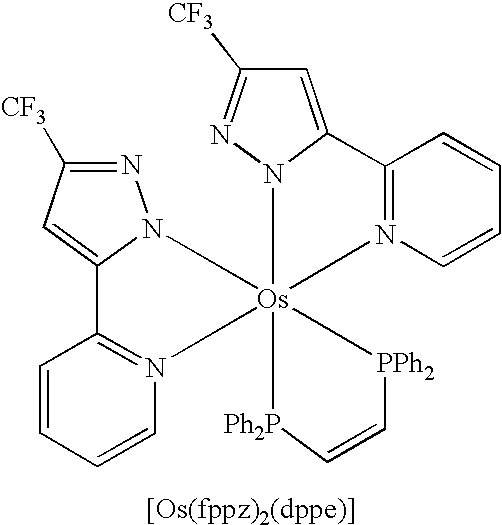
- the device structure consisted of an Os complex doped PVK layer as the hole-transport and emissive layer (Os(II) complexes Os1: Os(fppz) 2 (PPh 2 Me) 2 , Os2: Os(fppz) 2 (PPhMe 2 ) 2 , and Os3: Os(bptz) 2 (PPh 2 Me) 2 were chosen to be used in three separate devices), spin-coated from its chloroform solution (0.6 mg: 6 mg/ml) at 1500 rpm for 60′′. The thickness of the resulting films was measured on a Dektak surface profilometer, and found to be around 60 nm.
- the device fabrication was completed by the evaporation of LiF (1 nm) and aluminum cathode (150 nm).
- the electroluminescence spectra, luminance-voltage, efficiency-voltage characteristics of the three devices are shown in FIG. 5 and Table 3.
- the diodes emit red light with emission peaks in the range of 626 to 658 nm. No excimer or exciplex emission was observed.
- a THREE-layer organic light emitting diode was fabricated using commercial ITO-coated (120 nm) glass substrates with a sheet resistance of 15 ohm/ ⁇ (Applied Films Corp.).
- the device structure consisted of an Os complex doped PVK layer as the hole-transport and emissive layer (three compounds shown in formula (I) were used in three separate device), spin-coated from its chloroform solution (0.6 mg: 6 mg/ml) at 1500 rpm for 60′′. The thickness of the resulting films was measured on a Dektak surface profilometer, and found to be around 60 nm.
- F-TBB 1,3,5-tris(4′-fluoro-biphenyl-4-yl)benzene
- the luminance-voltage, efficiency-voltage characteristics of the three devices are shown in FIG. 7 and Table 4.
- the electroluminescence spectra of the diodes were identical to those of shown in FIG. 5 . No excimer or exciplex emission was observed. Since PBD is a relatively low crystallization temperature, it is not an ideal candidate for use as hole blocking/electron transport layer, in this example it was replaced by a new hole blocking layer F-TBB (Ref. on F-TBB: K. Okumoto et al. Chem. Mater. 15, 699 (2003)). The device performance has been improved, especially for Os1 based devices.
- the cathode can be any high conductivity and low work function materials
- electron transport layer (ETL) and electron injecting layer (EIJL) can be a single ETL
- hole transport layer (HTL) and hole injecting layer (HIJL) can be a single HTL.
- the anode can be any high conductivity and high work function materials.
- Os compound doped emissive layer can also function as a EL/HTL layer or a EL/ETL layer.
- a device can be fabricated in a normal fashion (transparent or semitransparent anode on a transparent substrate) or a reversed structure (transparent or semitransparent cathode on a transparent substrate).
- the mentioned EIJL, ETL, HTL, HIJL as well as the EL host material can be small molecules, oganometallic compounds, oligomers or polymers.
- Os(II) complexes can involve the exploitation of recently explored blue-emitting Os complex [Os(fppz) 2 (CO) 2 ] (Wu, P.-C et al. Organometallics, 2003, 22, 4938 or its relevant analogue [Os(fptz) 2 (CO)] 2 as the starting material. Alternatively, for example, see examples 5 ⁇ 14 and Examples 20 ⁇ 22).
- a desired synthesis was first initiated by the treatment of Me 3 NO to eliminate the coordinated CO ligands, followed by addition of phosphine ligands.
- the Os atom of complex Os1 is located at the crystallographic center of inversion.
- the molecular frame reveals an octahedral configuration where two chelating fppz ligands establish a nearly planar OsN 4 basal arrangement, together with two PPh 2 Me ligands located at the axial dispositions.
- the measured Os-N (pz) distances of 2.073(2) ⁇ in Os1 are slightly shorter than the respect Os-N (py) bonds of 2.090(2) ⁇ ; both lengths fall in the range expected for a typical N ⁇ Os(II) dative bond.
- the absorption and luminescence spectra of complexes Os1-Os3 in CH 2 Cl 2 are shown in FIG. 11 .
- the strong absorption bands at the UV region are assigned to the spin-allowed 1 ⁇ - ⁇ * transition of the fppz (or fptz) ligands, owing to their spectral similarity to the free fppz (or fptz) anion.
- the next lower energy absorption can be ascribed to a typical spin-allowed metal to ligand charge transfer ( 1 MLCT) transition, while two absorption bands extending into the visible region are associated with the spin-orbit coupling enhanced 3 ⁇ * and 3 MLCT transition.
- complex Os1 bearing the PPh 2 Me group reveals a ⁇ 15 nm hypsochromic shift in ⁇ max and can qualitatively be rationalized by a decrease of Os(II) d-orbital energy level due to a stronger electron withdrawing strength of an additional phenyl substitution.
- Table 1 lists the corresponding photophysical data for the studied complexes in both solution and solid phases. The observed lifetimes of ca. 0.6-0.9 ⁇ s in degassed CH 2 Cl 2 are considerably shorter than that of most reported red emitting Ir(III) complexes.
- the emission maximum for these osmium phosphors shifts to the red possibly due to molecular packing, and the lifetime falls within the range of 0.4-0.6 ⁇ s (Table 1).
- the emission quantum efficiency of Os1-Os3 lies within the range 0.19-0.50 in CH 2 Cl 2 and 0.1-0.3 in the solid state. The results correlate well with unusually large extinction coefficients measured for the 3 MLCT bands and thus are very desirable for OLED related applications.
- the electroluminescence (EL) spectra of OLEDs based on Os1 ⁇ Os3 are shown in FIG. 5 a .
- the energy transfer from host material PVK to the Os(II) emitters is very efficient, as supported by the lack of PVK emission in the EL spectra.
- the EL spectra remained unchanged over a wide rage of bias voltages.
- the OLEDs with Os1 reached maximum efficiency ( ⁇ max ) of 4.0 cd/A at a driving voltage of 13 V with a luminance of 412 cd/m 2 .
- ⁇ max of Os2 reached 3.0 cd/A at 21 V with a luminance of 615 cd/m 2
- those of Os3 were 1.0 cd/A at 20 V and 271 cd/m 2
- ⁇ max and maximum luminance of Os3 appeared to be lower (Table 1), quantum efficiencies and optical power output of these three compounds are similar, considering the fact that the normalized photopic vision functions V( ⁇ ) at 630, 640, and 660 nm are 0.265, 0.175 and 0.061 respectively.
- the turn-on voltages can be significantly reduced by using either a host material with better charge carrier transport properties or a lower work-function cathode, such as Ca or Mg:Ag alloy.
- the invention provides the synthesis of highly efficient red-emitting Os(II) complexes.
- Os(II) emitters with ionic character in which the hole and electron injection may be strongly coupled with respect to the counter ions, this new series of complexes are discrete neutral molecules, and thus the anionic fppz (or fptz) ligands are securely attached to the Os(II) center.
- This unique property may contribute to a more efficient energy transfer and carrier trapping, rendering advantages to the overall device efficiency for Os1 ⁇ Os3 described above.
- Reactions were performed under nitrogen. Solvents were distilled from appropriate drying agent prior to use. Commercially available reagents were used without further purification unless otherwise stated. Reactions were monitored by TLC with Merck pre-coated glass plates (0.20 mm with fluorescent indicator UV 254 ). Compounds were visualized with UV light irradiation at 254 nm and 365 nm. Flash column chromatography was carried out using silica gel from Merck (230-400 mesh). Mass spectra were obtained on a JEOL SX-102A instrument operating in electron impact (EI) mode or fast atom bombardment (FAB) mode. 1 H and 13 C NMR spectra were recorded on Varian Mercury-400 or INOVA-500 instruments; chemical shifts are quoted with respect to the internal standard tetramethylsilane for 1 H and 13 C NMR data.
- EI electron impact
- FAB fast atom bombardment
- Spectroscopic and Dynamic Measurements Steady-state absorption and emission spectra were recorded by a Hitachi (U-3310) spectrophotometer and an Edinburgh (FS920) fluorimeter, respectively. Both wavelength-dependent excitation and emission response of the fluorimeter have been calibrated. A configuration of front-face excitation was used to measure the emission of the solid sample, in which the cell was made by assembling two edge-polished quartz plates with various Teflon spacers. A combination of appropriate filters was used to avoid the interference from the scattering light.
- Lifetime studies were performed by an Edinburgh FL 900 photon-counting system with a hydrogen-filled/or a nitrogen lamp as the excitation source. Data were analyzed using the nonlinear least squares procedure in combination with an iterative convolution method. The emission decays were analyzed by the sum of exponential functions, which allows partial removal of the instrument time broadening and consequently renders a temporal resolution of ⁇ 200 ps.
- Os(II) compounds having phosphorescent properties, and uses thereof.
- E 1/2 ox stands for the half-wave oxidation (p-doping) potential vs an Ag quasi-reference.
- E HOMO E 1/2 ox + 4.49 eV.
- E HOMO optical energy gap (S 0 ⁇ 1 MLCT).
Landscapes
- Chemical & Material Sciences (AREA)
- Organic Chemistry (AREA)
- Engineering & Computer Science (AREA)
- Materials Engineering (AREA)
- Crystallography & Structural Chemistry (AREA)
- Inorganic Chemistry (AREA)
- Electroluminescent Light Sources (AREA)
- Plural Heterocyclic Compounds (AREA)
- Pyridine Compounds (AREA)
Abstract

-
- wherein A is Os or Ru
-
- X,1 X2 and X3 independently are C or N;
- when X2 is N, R1 is omitted,
- when X3 is N, R2 is omitted,
- R1 is H, C1-C8 alkyl, C1-C8 substituted phenyl or C1-C4 perfluoroalkyl,
- R2 is H, F or cyano substituent,
- X4 is either C or N;
- X4 may locate at any position of the hexagonal ring, when X4 is N and R3 and R4 are not linked to X4,
R3 is H, methyl or C1-C3 small alkyl, R4 is H, methyl or C1-C3 small alkyl, or R3 and R4 together form an additional conjugated unit with structure

Description




| TABLE 1 |
| Photochemical properties of Os(II) carbonyl complexes.a |
| Φ | τ | ||||
| λmax (nm)b | λmax em (nm) | (%)c | (μs) | ||
| Os(fppz)2(CO)2 | 254, 311 | 430, 457, 480 | 14.0 | 18.3 |
| Os(fmpz)2(CO)2 | 254, 306 | 428, 455, 480 | 4.1 | 6.3 |
| Os(fptz)2(CO)2 | 243, 307 | 420, 446, 468 | 23.3 | 2.88 |
| Os(bptz)2(CO)2 | 250, 333 | 455, 480, 507 | 47.1 | 39.9 |
| aAll sample solutions were degassed and the spectra recorded in CH3CN at room temperature. | ||||
| bThe dominant absorption band at spectral regions of 225~280 nm, is ascribed to the local 1ππ* transition of pyridine and/or triazolate (or pyrazole). The broad, structureless band maximized at 306~333 nm is attributed to a pyrazole or triazolate-to-pyridine intra-ligand ππ* transition, no visible absorption could be resolved in the region of 380~700 nm, suggesting that all MLCT transitions are hidden in the UV region of the strong intra-ligand ππ* transitions. | ||||
| cQuinine sulfate with an emulsion yield of Φ~0.57 in 0l.1M H2SO4 served as the standard to calculate the emission quantum yield. Sample solutions were degassed by three freeze-pump-thaw cycles. | ||||
| TABLE 2 |
| Photochemical properties of Os(II) phosphine complexes.a |
| λmax em | |||||
| λmax (nm) (ε, M−1cm−1)b | (nm) | Φ (%)c | τ (ns) | ||
| Os(fppz)2(PPh2Me)2 | 402 (14900), 453 (2600), 535 | 620 | 43.4 | 831 |
| (1600) | ||||
| Os(fppz)2(PPhMe2)2 | 408 (14600), 460 (2100), 547 | 637 | 25.6 | 661 |
| (1400) | ||||
| Os(bppz)2(PPh3)2 | 408 (10600), 466 (3000), 572 | 647 | 0.3 | |
| (1300) | ||||
| Os(bppz)2(PPh2Me)2 | 408 (13600), 467 (3100), 576 | 666 | 2.5 | 214 |
| (1500) | ||||
| Os(pppz)2(PPh3)2 | 406 (17500), 450 (3500), 542 | 650 | 0.1 | |
| (1900) | ||||
| Os(pppz)2(PPh2Me)2 | 412 (10500), 471 (2400), 575 | 654 | 0.9 | |
| (1000) | ||||
| Os(fptz)2(PPh2Me)2 | 403 (15600), 450 (2400), | 618 | 55.4 | 1021 |
| 537 (1400) | ||||
| Os(fptz)2(PPhMe2)2 | 408 (16000), 461 (2000), | 635 | 12.3 | 782 |
| 547 (1400) | ||||
| Os(bptz)2(PPh2Me)2 | 405 (16800), 467 (2900), 559 | 650 | 13.3 | 608 |
| (1500) | ||||
| Os(mptz)2(PPh2Me)2 | 408 (10700), 465 (2500), 580 | 664 | 2.3 | 218 |
| (1200) | ||||
| Os(hptz)2(PPh2Me)2 | 401 (15000), 451 (2300), 532 | 616 | 63.7 | 1094 |
| (1400) | ||||
| Os(hptz)2(PPhMe2)2 | 407 (20000), 460 (2500), 546 | 633 | 29.2 | 834 |
| (1700) | ||||
| aAll sample solutions were degassed and the spectra recorded in CH3CN at room temperature. | ||||
| bThese absorption bands were due to the 1ππ*, 1MLCT and the combination of 3ππ* and 3MLCT transitions, respectively. | ||||
| c4-(Dicyanomethylene)-2-methyl-6-(p-dimethylaminostyryl)-4H-pyran (DCM, assuming a yield of 0.44 in methanol) was used as a reference to determined fluorescence quantum yields. Sample solutions were degassed by three freeze-pump-thaw cycles. | ||||
| TABLE 3 |
| Some electroluminescent characteristics of the embodiment of FIG. 4. |
| V @ 1 cd/m2 | Max. Efficiency | ||||
| (V) | Lmax (cd/m2) | (cd/A) | λmax (nm) | ||
| Os1 | 5.5 | 3300 | ~3.5 | 626 |
| Os2 | 8.5 | 2100 | ~3.0 | 640 |
| Os3 | 8.5 | 775 | ~1.0 | 658 |
| TABLE 4 |
| Some electroluminescent characteristics of the embodiment of FIG. 6. |
| V @ 1 cd/m2 | Max. Efficiency | ||||
| (V) | Lmax (cd/m2) | (cd/A) | λmax (nm) | ||
| Os1 | 8.5 | 4500 | ~7.0 | 626 |
| Os2 | 9.0 | 2448 | ~3.5 | 640 |
| Os3 | 9.5 | 1000 | ~1.3 | 658 |
| TABLE 5 |
| Photophysical and electrochemical properties of Os1~Os3. |
| Com- | λabs a nm | λem a | ET b | E1/2 ox | EHOMO | ELUMO | ||
| plex | (log ε) | nm | Φa | τa ns | eV | mVc | eVd | eVe |
| Os1 | 405 (4.2) | 620 | 0.5 | 855 | 2.00 | 231 | 4.72 | 2.15 |
| 454 (3.4) | ||||||||
| 542 (3.1) | ||||||||
| Os2 | 411 (4.2) | 631 | 0.19 | 725 | 1.97 | 157 | 4.65 | 2.13 |
| 456 (3.4) | ||||||||
| 553 (3.2) | ||||||||
| Os3 | 406 (4.1) | 648 | 0.25 | 634 | 1.92 | 176 | 4.67 | 2.18 |
| 466 (3.3) | ||||||||
| 560 (3.0) | ||||||||
| aMeasured in degassed CH2CI2 solutions at room temperature. | ||||||||
| bThe triplet energy was estimated from the phosphorescence peak. | ||||||||
| cE1/2 ox stands for the half-wave oxidation (p-doping) potential vs an Ag quasi-reference. | ||||||||
| dEstimated from E1/2 ox by using an empirical equation EHOMO = E1/2 ox + 4.49 eV. | ||||||||
| eEstimated from EHOMO and optical energy gap (S0 → 1MLCT). | ||||||||
| TABLE 6 |
| OLED device performance of Os(II) complexes doped into the PVK |
| host. |
| Doping | Turn-on | ηLE at 1.0 | ηLE at 100 | Maxium | |
| level | voltage | EL peak | mA/cm2 | mA/cm2 | luminance |
| (wt %) | (V)a | (nm) | (cd/A) | (cd/A) | (cd/m2) |
| Os1 |
| 1 | 9 | 616 | 2.1 | 1.8 | 2400 (20 V) |
| 5 | 10 | 620 | 2.1 | 1.9 | 2800 (20 V) |
| 10 | 9 | 626 | 6.5 | 3.8 | 4235 (28 V) |
| 15 | 9 | 626 | 1.0 | 1.2 | 2150 (24.5 V) |
| Os2 |
| 1 | 8 | 628 | 1.0 | 0.7 | 891 (18 V) |
| 5 | 12 | 636 | 1.1 | 1.0 | 1581 (23.5 V) |
| 10 | 9 | 640 | 2.8 | 2.1 | 2475 (32 V) |
| 15 | 9 | 640 | 0.9 | 0.8 | 1350 (24 V) |
| Os3 |
| 1 | 9 | 392b | 0.6 | 0.3 | 373 (19 V) |
| 5 | 14 | 660 | 0.4 | 0.4 | 845 (25 V) |
| 10 | 9 | 660 | 1.2 | 0.7 | 1000 (31 V) |
| 15 | 10 | 662 | 0.3 | 0.4 | 805 (26 V) |
| aVoltage required to achieve a luminance of 1 cd/m2. | |||||
| bThe EL emission from PVK became dominant in the device with 1.0 wt % Os(II) complex Os3 | |||||


Claims (32)


Priority Applications (1)
| Application Number | Priority Date | Filing Date | Title |
|---|---|---|---|
| US12/216,833 US7759490B2 (en) | 2003-11-07 | 2008-07-11 | Phosphorescent Osmium (II) complexes and uses thereof |
Applications Claiming Priority (6)
| Application Number | Priority Date | Filing Date | Title |
|---|---|---|---|
| CA2448718 | 2003-11-07 | ||
| CA2,448,718 | 2003-11-07 | ||
| CA002448718A CA2448718A1 (en) | 2003-11-07 | 2003-11-07 | Phosphorescent osmium (ii) complexes and uses thereof |
| US10/981,755 US20050137400A1 (en) | 2003-11-07 | 2004-11-05 | Phosphorescent Osmium (II) complexes and uses thereof |
| US11/437,860 US20070001166A1 (en) | 2003-11-07 | 2006-05-22 | Phosphorescent Osmium (II) complexes and uses thereof |
| US12/216,833 US7759490B2 (en) | 2003-11-07 | 2008-07-11 | Phosphorescent Osmium (II) complexes and uses thereof |
Related Parent Applications (1)
| Application Number | Title | Priority Date | Filing Date |
|---|---|---|---|
| US11/437,860 Continuation US20070001166A1 (en) | 2003-11-07 | 2006-05-22 | Phosphorescent Osmium (II) complexes and uses thereof |
Publications (2)
| Publication Number | Publication Date |
|---|---|
| US20090058281A1 US20090058281A1 (en) | 2009-03-05 |
| US7759490B2 true US7759490B2 (en) | 2010-07-20 |
Family
ID=34558322
Family Applications (3)
| Application Number | Title | Priority Date | Filing Date |
|---|---|---|---|
| US10/981,755 Abandoned US20050137400A1 (en) | 2003-11-07 | 2004-11-05 | Phosphorescent Osmium (II) complexes and uses thereof |
| US11/437,860 Abandoned US20070001166A1 (en) | 2003-11-07 | 2006-05-22 | Phosphorescent Osmium (II) complexes and uses thereof |
| US12/216,833 Active US7759490B2 (en) | 2003-11-07 | 2008-07-11 | Phosphorescent Osmium (II) complexes and uses thereof |
Family Applications Before (2)
| Application Number | Title | Priority Date | Filing Date |
|---|---|---|---|
| US10/981,755 Abandoned US20050137400A1 (en) | 2003-11-07 | 2004-11-05 | Phosphorescent Osmium (II) complexes and uses thereof |
| US11/437,860 Abandoned US20070001166A1 (en) | 2003-11-07 | 2006-05-22 | Phosphorescent Osmium (II) complexes and uses thereof |
Country Status (3)
| Country | Link |
|---|---|
| US (3) | US20050137400A1 (en) |
| CA (1) | CA2448718A1 (en) |
| TW (1) | TWI338033B (en) |
Cited By (5)
| Publication number | Priority date | Publication date | Assignee | Title |
|---|---|---|---|---|
| US20090209756A1 (en) * | 2006-12-29 | 2009-08-20 | National Tsing Hua University | Emissive transition-metal complexes with both carbon-phosphorus ancillary and chromophoric chelates, synthetic method of preparing the same and phosphorescent organic light emitting diode thereof |
| US20140209880A1 (en) * | 2013-01-30 | 2014-07-31 | Samsung Display Co., Ltd. | Organic light-emitting diode |
| US9373798B2 (en) | 2012-09-07 | 2016-06-21 | Samsung Display Co., Ltd. | Organometallic compound and organic light-emitting device including the same |
| US9595683B2 (en) | 2012-10-29 | 2017-03-14 | Samsung Display Co., Ltd. | Organometallic compounds and organic light emitting devices including the same |
| US9799839B2 (en) | 2012-12-27 | 2017-10-24 | Samsung Diplay Co., Ltd. | Organometallic compound and organic light-emitting diode comprising the same |
Families Citing this family (20)
| Publication number | Priority date | Publication date | Assignee | Title |
|---|---|---|---|---|
| DE102005022903A1 (en) | 2005-05-18 | 2006-11-23 | Merck Patent Gmbh | Solutions of organic semiconductors |
| DE102006017485B4 (en) | 2006-04-13 | 2014-06-05 | Merck Patent Gmbh | Biphenyl-Metal Complexes - Monomers and Oligomers Triplet emitters for OLED applications |
| US8492158B2 (en) * | 2008-03-31 | 2013-07-23 | Applied Biosystems, Llc | Electrochemical labels derived from siderophores |
| DE102008033929A1 (en) * | 2008-07-18 | 2010-01-21 | Siemens Aktiengesellschaft | Phosphorescent metal complex compound, process for the preparation thereof and radiation-emitting component |
| DE102009022117A1 (en) * | 2009-05-20 | 2010-11-25 | Siemens Aktiengesellschaft | Material for a hole transport layer with p-doping |
| GB0921201D0 (en) * | 2009-12-03 | 2010-01-20 | Univ Muenster Wilhelms | IR(III) and RU(II) complexes containing pyridine-triazole ligands and the luminescence enhancement upon substitution with cyclodextrin |
| TWI428343B (en) * | 2010-05-14 | 2014-03-01 | Nat Univ Tsing Hua | Thiocyanate-free ru(ii) sensitizers and dye-sensitized solar cells |
| CN102277007B (en) * | 2010-06-08 | 2013-09-11 | 国立清华大学 | Photosensitizer without Thiocyanate Ligand and Sensitized Dye Solar Cells |
| US10069090B2 (en) | 2012-11-20 | 2018-09-04 | Universal Display Corporation | Organic electroluminescent materials and devices |
| TWI453210B (en) * | 2013-04-24 | 2014-09-21 | Nat Univ Tsing Hua | Six-coordinated ruthenium complex |
| KR102201319B1 (en) | 2014-01-14 | 2021-01-11 | 삼성전자주식회사 | Condensed cyclic compound and organic light emitting device including the same |
| EP2907815B1 (en) | 2014-02-12 | 2023-12-06 | Samsung Electronics Co., Ltd. | Condensed cyclic compound and organic light-emitting device including the same |
| US9748504B2 (en) * | 2014-03-25 | 2017-08-29 | Universal Display Corporation | Organic electroluminescent materials and devices |
| KR102201318B1 (en) | 2014-05-12 | 2021-01-11 | 삼성전자주식회사 | Organometallic compound and organic light emitting device including the same |
| CN104078581B (en) * | 2014-07-03 | 2016-08-17 | 中国科学院福建物质结构研究所 | One class organic electroluminescence device luminescent layer and its production and use |
| US9929361B2 (en) * | 2015-02-16 | 2018-03-27 | Universal Display Corporation | Organic electroluminescent materials and devices |
| KR102395784B1 (en) | 2017-03-27 | 2022-05-10 | 삼성전자주식회사 | Organometallic compound and organic light emitting device including the same |
| KR102736295B1 (en) | 2019-07-23 | 2024-11-29 | 삼성전자주식회사 | Organometallic compound and organic light emitting device including the same |
| US12486295B2 (en) | 2020-09-14 | 2025-12-02 | Universal Display Corporation | Organic electroluminescent materials and devices |
| KR102803737B1 (en) * | 2021-04-19 | 2025-05-13 | 주식회사 아이센스 | Electrochemical biosensor, or sensing membrane for electrochemical biosensor containing transition metal complex or oxidation-reduction polymer |
Citations (1)
| Publication number | Priority date | Publication date | Assignee | Title |
|---|---|---|---|---|
| US6911677B2 (en) | 2001-02-01 | 2005-06-28 | Fuji Photo Film Co., Ltd. | Transition metal complex and light-emitting device |
-
2003
- 2003-11-07 CA CA002448718A patent/CA2448718A1/en not_active Abandoned
-
2004
- 2004-11-04 TW TW093133671A patent/TWI338033B/en not_active IP Right Cessation
- 2004-11-05 US US10/981,755 patent/US20050137400A1/en not_active Abandoned
-
2006
- 2006-05-22 US US11/437,860 patent/US20070001166A1/en not_active Abandoned
-
2008
- 2008-07-11 US US12/216,833 patent/US7759490B2/en active Active
Patent Citations (1)
| Publication number | Priority date | Publication date | Assignee | Title |
|---|---|---|---|---|
| US6911677B2 (en) | 2001-02-01 | 2005-06-28 | Fuji Photo Film Co., Ltd. | Transition metal complex and light-emitting device |
Non-Patent Citations (6)
| Title |
|---|
| Baldo, M.A. et al., Highly efficient phosphorescent emission from organic electroluminescent devices, Nature, vol. 395, Sep. 1998, p. 151. |
| Brooks, Jason, Synthesis and Characterization of Phosphorescent Cyclometalated Platinum Complexes, Inroganic Chemistry, vol. 41, No. 12, 2002, pp. 3055-3066. |
| Carlson, Brenden et al., Divalent Osmium Complexes: Synthesis, Characterization, Strong Red Phosphorescence, . . . , J.Am. Soc. 2002, 124, pp. 14162-14174. |
| Lamansky, Sergey et al., Highly Phosphorescent Bis-Cyclometalated Iridium Complexes: Synthesis, . . . J. Am. Chem. Soc. 2001, 123, pp. 4304-4312. |
| Tung, Yung-Liang, Highly Efficient Red Phosphorescent Osmium(II) Complexes for OLED Applications, Organometallics 2004, vol. 23, No. 15, 2004, pp. 3745-3748. |
| Wu,P. et al.: Synthesis and charaterization of metal complexes possessing the 5-(2-pyridyl) pyrazolate ligands. Organometallics, vol. 22, pp. 4938-4946,2003. |
Cited By (9)
| Publication number | Priority date | Publication date | Assignee | Title |
|---|---|---|---|---|
| US20090209756A1 (en) * | 2006-12-29 | 2009-08-20 | National Tsing Hua University | Emissive transition-metal complexes with both carbon-phosphorus ancillary and chromophoric chelates, synthetic method of preparing the same and phosphorescent organic light emitting diode thereof |
| US8288543B2 (en) * | 2006-12-29 | 2012-10-16 | National Tsing Hua University | Emissive transition-metal complexes with both carbon-phosphorus ancillary and chromophoric chelates, synthetic method of preparing the same and phosphorescent organic light emitting diode thereof |
| US8557988B2 (en) | 2006-12-29 | 2013-10-15 | National Tsing Hua University | Emissive transition-metal complexes with both carbon-phosphorus ancillary and chromophoric chelates, synthetic method of preparing the same and phosphorescent organic light emitting diode thereof |
| US9373798B2 (en) | 2012-09-07 | 2016-06-21 | Samsung Display Co., Ltd. | Organometallic compound and organic light-emitting device including the same |
| US9997728B2 (en) | 2012-09-07 | 2018-06-12 | Samsung Display Co., Ltd. | Organometallic compound and organic light-emitting device including the same |
| US9595683B2 (en) | 2012-10-29 | 2017-03-14 | Samsung Display Co., Ltd. | Organometallic compounds and organic light emitting devices including the same |
| US9799839B2 (en) | 2012-12-27 | 2017-10-24 | Samsung Diplay Co., Ltd. | Organometallic compound and organic light-emitting diode comprising the same |
| US20140209880A1 (en) * | 2013-01-30 | 2014-07-31 | Samsung Display Co., Ltd. | Organic light-emitting diode |
| US9691992B2 (en) * | 2013-01-30 | 2017-06-27 | Samsung Displey Co., Ltd. | Organic light-emitting diode |
Also Published As
| Publication number | Publication date |
|---|---|
| CA2448718A1 (en) | 2005-05-07 |
| TWI338033B (en) | 2011-03-01 |
| US20090058281A1 (en) | 2009-03-05 |
| US20050137400A1 (en) | 2005-06-23 |
| TW200530371A (en) | 2005-09-16 |
| US20070001166A1 (en) | 2007-01-04 |
Similar Documents
| Publication | Publication Date | Title |
|---|---|---|
| US7759490B2 (en) | Phosphorescent Osmium (II) complexes and uses thereof | |
| Ho et al. | Phosphorescence Color Tuning by Ligand, and Substituent Effects of Multifunctional Iridium (III) Cyclometalates with 9‐Arylcarbazole Moieties | |
| Wong et al. | Amorphous Diphenylaminofluorene‐Functionalized Iridium Complexes for High‐Efficiency Electrophosphorescent Light‐Emitting Diodes | |
| Ho et al. | Red‐light‐emitting iridium complexes with hole‐transporting 9‐arylcarbazole moieties for electrophosphorescence efficiency/color purity trade‐off optimization | |
| Wu et al. | Tuning the emission and morphology of cyclometalated iridium complexes and their applications to organic light-emitting diodes | |
| JP6533204B2 (en) | Heteroleptic iridium carbene complex and light emitting device using the same | |
| US7002013B1 (en) | Pt complexes as phosphorescent emitters in the fabrication of organic light emitting diodes | |
| JP4343838B2 (en) | Organic light emitting materials and devices | |
| Zhang et al. | New phosphorescent platinum (II) Schiff base complexes for PHOLED applications | |
| US8808878B2 (en) | Compound and use thereof | |
| Zhou et al. | New platinum (II) complexes as triplet emitters for high-efficiency monochromatic pure orange electroluminescent devices | |
| Park et al. | Synthesis, characterization of the phenylquinoline-based on iridium (III) complexes for solution processable phosphorescent organic light-emitting diodes | |
| US8372977B2 (en) | Luminescent gold(III) compounds containing bidentate ligand for organic light-emitting devices and their preparation | |
| US7868170B2 (en) | Platinum complex and organic light-emitting device using the same | |
| US20170222164A1 (en) | Luminescent Tetradentate Gold(III) Compounds for Organic Light-Emitting Devices and Their Preparation | |
| Rai et al. | Substituent effect on the electroluminescence efficiency of amidinate-ligated bis (pyridylphenyl) iridium (III) complexes | |
| Zhang et al. | Improving the performance of phosphorescent polymer light-emitting diodes using morphology-stable carbazole-based iridium complexes | |
| Giridhar et al. | A systematic identification of efficiency enrichment between thiazole and benzothiazole based yellow iridium (III) complexes | |
| JP5766707B2 (en) | Ion-pairing flexible salts based on organometallic complexes and their application in organic light-emitting diodes | |
| Zhu et al. | Synthesis of new iridium complexes and their electrophosphorescent properties in polymer light-emitting diodes | |
| US7652136B2 (en) | Diarylaminofluorene-based organometallic phosphors and organic light-emitting devices made with such compounds | |
| Jiang et al. | Carbazole/phenylpyridine hybrid compound as dual role of efficient host and ligand of iridium complex: Well matching of host-dopant for solution-processed green phosphorescent OLEDs | |
| Mitsumori et al. | Synthesis, properties, and LED performance of highly luminescent metal complexes containing indolizino [3, 4, 5-ab] isoindoles | |
| Yu et al. | Synthesis, photo-and electro-luminescence of red-emitting Ir (III) complexes with 2-(1-naphthyl) benzothiazole and carrier transporting group-functionalized picolinate ligands | |
| Lee et al. | Cyclometalated iridium (III) complexes with 5-acetyl-2-phenypyridine derived ligands for red phosphorescent OLEDs |
Legal Events
| Date | Code | Title | Description |
|---|---|---|---|
| AS | Assignment |
Owner name: NATIONAL TSING HUA UNIVERSITY, TAIWAN Free format text: ASSIGNMENT OF ASSIGNORS INTEREST;ASSIGNOR:CHOU, PI--TAI;REEL/FRAME:022007/0686 Effective date: 20081120 |
|
| AS | Assignment |
Owner name: NATIONAL TSING HUA UNIVERSITY,TAIWAN Free format text: ASSIGNMENT OF ASSIGNORS INTEREST;ASSIGNORS:CHI, YUN;TUNG, YUNG-LIANG;REEL/FRAME:024497/0527 Effective date: 20041101 Owner name: NATIONAL RESEARCH COUNCIL OF CANADA,CANADA Free format text: ASSIGNMENT OF ASSIGNORS INTEREST;ASSIGNOR:TAO, YE;REEL/FRAME:024497/0580 Effective date: 20031107 Owner name: NATIONAL RESEARCH COUNCIL OF CANADA,CANADA Free format text: ASSIGNMENT OF ASSIGNORS INTEREST;ASSIGNOR:CARTY, ARTHUR J.;REEL/FRAME:024497/0586 Effective date: 20041025 Owner name: NATIONAL TSING HUA UNIVERSITY, TAIWAN Free format text: ASSIGNMENT OF ASSIGNORS INTEREST;ASSIGNORS:CHI, YUN;TUNG, YUNG-LIANG;REEL/FRAME:024497/0527 Effective date: 20041101 Owner name: NATIONAL RESEARCH COUNCIL OF CANADA, CANADA Free format text: ASSIGNMENT OF ASSIGNORS INTEREST;ASSIGNOR:TAO, YE;REEL/FRAME:024497/0580 Effective date: 20031107 Owner name: NATIONAL RESEARCH COUNCIL OF CANADA, CANADA Free format text: ASSIGNMENT OF ASSIGNORS INTEREST;ASSIGNOR:CARTY, ARTHUR J.;REEL/FRAME:024497/0586 Effective date: 20041025 |
|
| STCF | Information on status: patent grant |
Free format text: PATENTED CASE |
|
| AS | Assignment |
Owner name: NATIONAL RESEARCH COUNCIL OF CANADA, CANADA Free format text: CORRECTIVE ASSIGNMENT TO CORRECT THE EXECUTION DATE AND ASSIGNEE'S POSTAL CODE ON THE RECORDATION COVER SHEET PREVIOUSLY RECORDED ON REEL 024497 FRAME 0580. ASSIGNOR(S) HEREBY CONFIRMS THE SALE AND ASSIGNMENT OF THE FULL AND EXCLUSIVE RIGHT TO THE INVENTION IN THE UNITED STATES OF AMERICA;ASSIGNOR:TAO, YE;REEL/FRAME:027608/0984 Effective date: 20041103 |
|
| AS | Assignment |
Owner name: NATIONAL TSING HUA UNIVERSITY, TAIWAN Free format text: ASSIGNMENT OF ASSIGNORS INTEREST;ASSIGNOR:NATIONAL RESEARCH COUNCIL OF CANADA;REEL/FRAME:031336/0441 Effective date: 20130507 Owner name: KAITUOZHE INTELLECTUAL PROPERTY MANAGEMENT CONSULT Free format text: ASSIGNMENT OF ASSIGNORS INTEREST;ASSIGNOR:NATIONAL TSING HUA UNIVERSITY;REEL/FRAME:031337/0131 Effective date: 20131002 |
|
| FEPP | Fee payment procedure |
Free format text: PAT HOLDER CLAIMS SMALL ENTITY STATUS, ENTITY STATUS SET TO SMALL (ORIGINAL EVENT CODE: LTOS); ENTITY STATUS OF PATENT OWNER: SMALL ENTITY |
|
| REFU | Refund |
Free format text: REFUND - PAYMENT OF MAINTENANCE FEE, 4TH YEAR, LARGE ENTITY (ORIGINAL EVENT CODE: R1551); ENTITY STATUS OF PATENT OWNER: SMALL ENTITY |
|
| FEPP | Fee payment procedure |
Free format text: PAYOR NUMBER ASSIGNED (ORIGINAL EVENT CODE: ASPN); ENTITY STATUS OF PATENT OWNER: SMALL ENTITY |
|
| FPAY | Fee payment |
Year of fee payment: 4 |
|
| AS | Assignment |
Owner name: CARLYLE TECHNOLOGY INNOVATION, LLC, DISTRICT OF CO Free format text: ASSIGNMENT OF ASSIGNORS INTEREST;ASSIGNOR:KAITUOZHE INTELLECTUAL PROPERTY MANAGEMENT CONSULTANTS LIMITED;REEL/FRAME:032666/0049 Effective date: 20140226 |
|
| MAFP | Maintenance fee payment |
Free format text: PAYMENT OF MAINTENANCE FEE, 8TH YR, SMALL ENTITY (ORIGINAL EVENT CODE: M2552) Year of fee payment: 8 |
|
| AS | Assignment |
Owner name: SAMSUNG DISPLAY CO., LTD., KOREA, REPUBLIC OF Free format text: ASSIGNMENT OF ASSIGNORS INTEREST;ASSIGNOR:CARLYLE TECHNOLOGY INNOVATION, LLC;REEL/FRAME:055378/0517 Effective date: 20200923 |
|
| MAFP | Maintenance fee payment |
Free format text: PAYMENT OF MAINTENANCE FEE, 12TH YR, SMALL ENTITY (ORIGINAL EVENT CODE: M2553); ENTITY STATUS OF PATENT OWNER: SMALL ENTITY Year of fee payment: 12 |
|
| FEPP | Fee payment procedure |
Free format text: ENTITY STATUS SET TO UNDISCOUNTED (ORIGINAL EVENT CODE: BIG.); ENTITY STATUS OF PATENT OWNER: LARGE ENTITY |