US7759291B2 - Pyrazole compounds and use thereof - Google Patents
Pyrazole compounds and use thereof Download PDFInfo
- Publication number
- US7759291B2 US7759291B2 US10/585,639 US58563905A US7759291B2 US 7759291 B2 US7759291 B2 US 7759291B2 US 58563905 A US58563905 A US 58563905A US 7759291 B2 US7759291 B2 US 7759291B2
- Authority
- US
- United States
- Prior art keywords
- group
- formula
- och
- reaction
- compound
- Prior art date
- Legal status (The legal status is an assumption and is not a legal conclusion. Google has not performed a legal analysis and makes no representation as to the accuracy of the status listed.)
- Expired - Fee Related, expires
Links
- 0 CC.CC.[1*]C1=NN([2*])C(OC2=CC=C(CC3=CC=C(OCC=C)C=C3)C=C2)=C1[3*] Chemical compound CC.CC.[1*]C1=NN([2*])C(OC2=CC=C(CC3=CC=C(OCC=C)C=C3)C=C2)=C1[3*] 0.000 description 43
- SDEZALNRYQMPGR-UHFFFAOYSA-N CCOC(=O)C1=C(OC2=CC=C(OC3=CC=C(O)C=C3)C=C2)N(C)N=C1C Chemical compound CCOC(=O)C1=C(OC2=CC=C(OC3=CC=C(O)C=C3)C=C2)N(C)N=C1C SDEZALNRYQMPGR-UHFFFAOYSA-N 0.000 description 3
- PXXPRZDODXMIRA-UHFFFAOYSA-N C=CCOC1=CC=C(OC2=CC=C(OC3=C(C)C(C)=NN3C)C=C2)C=C1 Chemical compound C=CCOC1=CC=C(OC2=CC=C(OC3=C(C)C(C)=NN3C)C=C2)C=C1 PXXPRZDODXMIRA-UHFFFAOYSA-N 0.000 description 2
- IQOALSQSZWVOHL-UHFFFAOYSA-N CC.CC.OC1=CC=C(CC2=CC=C(O)C=C2)C=C1 Chemical compound CC.CC.OC1=CC=C(CC2=CC=C(O)C=C2)C=C1 IQOALSQSZWVOHL-UHFFFAOYSA-N 0.000 description 2
- MGTNMGKEIAOIPE-UHFFFAOYSA-N CC.CC1=CC=C(O)C=C1 Chemical compound CC.CC1=CC=C(O)C=C1 MGTNMGKEIAOIPE-UHFFFAOYSA-N 0.000 description 2
- SLFRFIMKEKOMIW-UHFFFAOYSA-N CC.OC1=CC=C(S)C=C1 Chemical compound CC.OC1=CC=C(S)C=C1 SLFRFIMKEKOMIW-UHFFFAOYSA-N 0.000 description 2
- URBXGPWGYXUIPM-WAYWQWQTSA-N CC/C=C\C1=C(OC2=CC=C(OC3=CC=C(O)C=C3)C=C2)N(C)N=C1C Chemical compound CC/C=C\C1=C(OC2=CC=C(OC3=CC=C(O)C=C3)C=C2)N(C)N=C1C URBXGPWGYXUIPM-WAYWQWQTSA-N 0.000 description 2
- UZLDHCYPLDRIBF-UHFFFAOYSA-N CC1=NN(C)C(OC2=CC=C(CC3=CC=C(O)C=C3)C=C2)=C1C=O Chemical compound CC1=NN(C)C(OC2=CC=C(CC3=CC=C(O)C=C3)C=C2)=C1C=O UZLDHCYPLDRIBF-UHFFFAOYSA-N 0.000 description 2
- NICPVQPZUUVPCM-UHFFFAOYSA-N CC1=NN(C)C(OC2=CC=C(OC3=CC=C(O)C=C3)C=C2)=C1Br Chemical compound CC1=NN(C)C(OC2=CC=C(OC3=CC=C(O)C=C3)C=C2)=C1Br NICPVQPZUUVPCM-UHFFFAOYSA-N 0.000 description 2
- IBOKYEIVLKGCEV-UHFFFAOYSA-N CC1=NN(C)C(OC2=CC=C(OC3=CC=C(O)C=C3)C=C2)=C1C Chemical compound CC1=NN(C)C(OC2=CC=C(OC3=CC=C(O)C=C3)C=C2)=C1C IBOKYEIVLKGCEV-UHFFFAOYSA-N 0.000 description 2
- DMUPUSXKWHSCIY-UHFFFAOYSA-N CC1=NN(C)C(OC2=CC=C(OC3=CC=C(O)C=C3)C=C2)=C1Cl Chemical compound CC1=NN(C)C(OC2=CC=C(OC3=CC=C(O)C=C3)C=C2)=C1Cl DMUPUSXKWHSCIY-UHFFFAOYSA-N 0.000 description 2
- LJOJCUMVLQVLOK-UHFFFAOYSA-N CC1=NN(C)C(OC2=CC=C(OC3=CC=C(O)C=C3)C=C2)=C1I Chemical compound CC1=NN(C)C(OC2=CC=C(OC3=CC=C(O)C=C3)C=C2)=C1I LJOJCUMVLQVLOK-UHFFFAOYSA-N 0.000 description 2
- LLWNNAACCXAFMQ-UHFFFAOYSA-N CC1=NN(C)C(OC2=CC=C(SC3=CC=C(O)C=C3)C=C2)=C1C=O Chemical compound CC1=NN(C)C(OC2=CC=C(SC3=CC=C(O)C=C3)C=C2)=C1C=O LLWNNAACCXAFMQ-UHFFFAOYSA-N 0.000 description 2
- WVAVQEUJAOLBBN-UHFFFAOYSA-N CCC1=NN(C)C(OC2=CC=C(OC3=CC=C(O)C=C3)C=C2)=C1C=O Chemical compound CCC1=NN(C)C(OC2=CC=C(OC3=CC=C(O)C=C3)C=C2)=C1C=O WVAVQEUJAOLBBN-UHFFFAOYSA-N 0.000 description 2
- FEYWWVCPVYCNNL-UHFFFAOYSA-N CCCC1=C(OC2=CC=C(OC3=CC=C(O)C=C3)C=C2)N(C)N=C1C Chemical compound CCCC1=C(OC2=CC=C(OC3=CC=C(O)C=C3)C=C2)N(C)N=C1C FEYWWVCPVYCNNL-UHFFFAOYSA-N 0.000 description 2
- WXEFDLGARKMZHG-UHFFFAOYSA-N CN1N=C(C(F)(F)F)C(C=O)=C1OC1=CC=C(OC2=CC=C(O)C=C2)C=C1 Chemical compound CN1N=C(C(F)(F)F)C(C=O)=C1OC1=CC=C(OC2=CC=C(O)C=C2)C=C1 WXEFDLGARKMZHG-UHFFFAOYSA-N 0.000 description 2
- JXIGQECJNMTCTR-UHFFFAOYSA-N [H]C1=C(OC2=CC=C(OC3=CC=C(O)C=C3)C=C2)N(C)N=C1C Chemical compound [H]C1=C(OC2=CC=C(OC3=CC=C(O)C=C3)C=C2)N(C)N=C1C JXIGQECJNMTCTR-UHFFFAOYSA-N 0.000 description 2
- JOHUHLOLTWBFAB-UHFFFAOYSA-N C#CC1=C(OC2=CC=C(OC3=CC=C(OCC=C(Cl)Cl)C=C3)C=C2)N(C)N=C1C Chemical compound C#CC1=C(OC2=CC=C(OC3=CC=C(OCC=C(Cl)Cl)C=C3)C=C2)N(C)N=C1C JOHUHLOLTWBFAB-UHFFFAOYSA-N 0.000 description 1
- FGECLLHNFVAHEA-PLNGDYQASA-N C/C=C\C1=C(OC2=CC=C(OC3=CC=C(O)C=C3)C=C2)N(C)N=C1C Chemical compound C/C=C\C1=C(OC2=CC=C(OC3=CC=C(O)C=C3)C=C2)N(C)N=C1C FGECLLHNFVAHEA-PLNGDYQASA-N 0.000 description 1
- PFUKUIMNLBGANY-PLNGDYQASA-N C/C=C\C1=C(OC2=CC=C(OC3=CC=C(O4=C(=C(Cl)Cl)C4)C=C3)C=C2)N(C)N=C1C Chemical compound C/C=C\C1=C(OC2=CC=C(OC3=CC=C(O4=C(=C(Cl)Cl)C4)C=C3)C=C2)N(C)N=C1C PFUKUIMNLBGANY-PLNGDYQASA-N 0.000 description 1
- VAJFSHILUQICBY-UHFFFAOYSA-N C=C(C)C1=C(OC2=CC=C(OC3=CC=C(O)C=C3)C=C2)N(C)N=C1C Chemical compound C=C(C)C1=C(OC2=CC=C(OC3=CC=C(O)C=C3)C=C2)N(C)N=C1C VAJFSHILUQICBY-UHFFFAOYSA-N 0.000 description 1
- ZPENUZUJICROSM-UHFFFAOYSA-N C=C(C)C1=C(OC2=CC=C(OC3=CC=C(O4=C(=C(Cl)Cl)C4)C=C3)C=C2)N(C)N=C1C Chemical compound C=C(C)C1=C(OC2=CC=C(OC3=CC=C(O4=C(=C(Cl)Cl)C4)C=C3)C=C2)N(C)N=C1C ZPENUZUJICROSM-UHFFFAOYSA-N 0.000 description 1
- UZPWADKZOADYLQ-UHFFFAOYSA-N CC#CC1=C(OC2=CC=C(OC3=CC=C(OCC=C(Cl)Cl)C=C3)C=C2)N(C)N=C1C Chemical compound CC#CC1=C(OC2=CC=C(OC3=CC=C(OCC=C(Cl)Cl)C=C3)C=C2)N(C)N=C1C UZPWADKZOADYLQ-UHFFFAOYSA-N 0.000 description 1
- AWMOCFKBFXDWMU-UHFFFAOYSA-N CC(=O)C1=C(Cl)N(C)N=C1C Chemical compound CC(=O)C1=C(Cl)N(C)N=C1C AWMOCFKBFXDWMU-UHFFFAOYSA-N 0.000 description 1
- SVQUNFSOQVVANF-UHFFFAOYSA-N CC(=O)C1=C(OC2=CC=C(O)C=C2)N(C)N=C1C.CC1=CC=C(O)C=C1 Chemical compound CC(=O)C1=C(OC2=CC=C(O)C=C2)N(C)N=C1C.CC1=CC=C(O)C=C1 SVQUNFSOQVVANF-UHFFFAOYSA-N 0.000 description 1
- SZKSYZBWLSFUJT-UHFFFAOYSA-N CC(=O)C1=C(OC2=CC=C(OC3=CC=C(O)C=C3)C=C2)N(C)N=C1C Chemical compound CC(=O)C1=C(OC2=CC=C(OC3=CC=C(O)C=C3)C=C2)N(C)N=C1C SZKSYZBWLSFUJT-UHFFFAOYSA-N 0.000 description 1
- FUNHGLFQFMFLIT-UHFFFAOYSA-N CC(=O)C1=C(OC2=CC=C(OC3=CC=C(O4=C(=C(Cl)Cl)C4)C=C3)C=C2)N(C)N=C1C Chemical compound CC(=O)C1=C(OC2=CC=C(OC3=CC=C(O4=C(=C(Cl)Cl)C4)C=C3)C=C2)N(C)N=C1C FUNHGLFQFMFLIT-UHFFFAOYSA-N 0.000 description 1
- SJYDMOQVJOAIQH-UHFFFAOYSA-N CC(=O)C1=C(OC2=CC=C(OC3=CC=C(OCC=C(Cl)Cl)C=C3)C=C2)N(C)N=C1C Chemical compound CC(=O)C1=C(OC2=CC=C(OC3=CC=C(OCC=C(Cl)Cl)C=C3)C=C2)N(C)N=C1C SJYDMOQVJOAIQH-UHFFFAOYSA-N 0.000 description 1
- PCKAPLNPOOKDHT-UHFFFAOYSA-N CC(C)=CC1=C(OC2=CC=C(OC3=CC=C(O)C=C3)C=C2)N(C)N=C1C Chemical compound CC(C)=CC1=C(OC2=CC=C(OC3=CC=C(O)C=C3)C=C2)N(C)N=C1C PCKAPLNPOOKDHT-UHFFFAOYSA-N 0.000 description 1
- SUVLTJROVKXWMV-UHFFFAOYSA-N CC(C)=CC1=C(OC2=CC=C(OC3=CC=C(O4=C(=C(Cl)Cl)C4)C=C3)C=C2)N(C)N=C1C Chemical compound CC(C)=CC1=C(OC2=CC=C(OC3=CC=C(O4=C(=C(Cl)Cl)C4)C=C3)C=C2)N(C)N=C1C SUVLTJROVKXWMV-UHFFFAOYSA-N 0.000 description 1
- ILRGIEIXEMLBLN-UHFFFAOYSA-N CC.CC.CC1=CC=C(OC2=CC=C(O)C=C2)C=C1 Chemical compound CC.CC.CC1=CC=C(OC2=CC=C(O)C=C2)C=C1 ILRGIEIXEMLBLN-UHFFFAOYSA-N 0.000 description 1
- UBZGHXOZESKREA-UHFFFAOYSA-N CC.CC.CC1=CC=C(SC2=CC=C(O)C=C2)C=C1 Chemical compound CC.CC.CC1=CC=C(SC2=CC=C(O)C=C2)C=C1 UBZGHXOZESKREA-UHFFFAOYSA-N 0.000 description 1
- MPZUENLVOQNLAS-UHFFFAOYSA-N CC.CC.OC1=CC=C(OC2=CC=C(O)C=C2)C=C1 Chemical compound CC.CC.OC1=CC=C(OC2=CC=C(O)C=C2)C=C1 MPZUENLVOQNLAS-UHFFFAOYSA-N 0.000 description 1
- IUZGEVSVMMPLOB-UHFFFAOYSA-N CC.CC.OC1=CC=C(SC2=CC=C(O)C=C2)C=C1 Chemical compound CC.CC.OC1=CC=C(SC2=CC=C(O)C=C2)C=C1 IUZGEVSVMMPLOB-UHFFFAOYSA-N 0.000 description 1
- VMKMJIPFQPZUOR-UHFFFAOYSA-N CC.CC1=CC=C(B(O)O)C=C1 Chemical compound CC.CC1=CC=C(B(O)O)C=C1 VMKMJIPFQPZUOR-UHFFFAOYSA-N 0.000 description 1
- DHAYQKNYTOMPGY-UHFFFAOYSA-N CC.CC1=CC=C(C)C=C1 Chemical compound CC.CC1=CC=C(C)C=C1 DHAYQKNYTOMPGY-UHFFFAOYSA-N 0.000 description 1
- UUUUFXFRMUUYPQ-UHFFFAOYSA-N CC.OC1=CC=C(O)C=C1 Chemical compound CC.OC1=CC=C(O)C=C1 UUUUFXFRMUUYPQ-UHFFFAOYSA-N 0.000 description 1
- RPHYLOMQFAGWCD-UHFFFAOYSA-N CC.[H]C1=CC=C(O)C=C1 Chemical compound CC.[H]C1=CC=C(O)C=C1 RPHYLOMQFAGWCD-UHFFFAOYSA-N 0.000 description 1
- OTCDYWINLOKQJH-WAYWQWQTSA-N CC/C=C\C1=C(OC2=CC=C(OC3=CC=C(OCC=C(Cl)Cl)C=C3)C=C2)N(C)N=C1C Chemical compound CC/C=C\C1=C(OC2=CC=C(OC3=CC=C(OCC=C(Cl)Cl)C=C3)C=C2)N(C)N=C1C OTCDYWINLOKQJH-WAYWQWQTSA-N 0.000 description 1
- AYKZVJOJFKOCEH-UHFFFAOYSA-N CC1=C(OC2=CC=C(O)C=C2)N(C)N=C1C(F)(F)F.CC1=CC=C(O)C=C1 Chemical compound CC1=C(OC2=CC=C(O)C=C2)N(C)N=C1C(F)(F)F.CC1=CC=C(O)C=C1 AYKZVJOJFKOCEH-UHFFFAOYSA-N 0.000 description 1
- WGIYHIWJJAXTNZ-UHFFFAOYSA-N CC1=C(OC2=CC=C(O)C=C2)N(C)N=C1C(F)(F)F.CC1=CC=C(OCC=C(Cl)Cl)C=C1 Chemical compound CC1=C(OC2=CC=C(O)C=C2)N(C)N=C1C(F)(F)F.CC1=CC=C(OCC=C(Cl)Cl)C=C1 WGIYHIWJJAXTNZ-UHFFFAOYSA-N 0.000 description 1
- BMFYEIGIAOYXCD-UHFFFAOYSA-N CC1=C(OC2=CC=C(OC3=CC=C(O)C=C3)C=C2)N(C)N=C1C(F)(F)F Chemical compound CC1=C(OC2=CC=C(OC3=CC=C(O)C=C3)C=C2)N(C)N=C1C(F)(F)F BMFYEIGIAOYXCD-UHFFFAOYSA-N 0.000 description 1
- SZFSKRFKARXYGD-UHFFFAOYSA-N CC1=CC=C(O)C=C1.CC1=CC=C(OC2=C(C)C(C)=NN2C)C=C1 Chemical compound CC1=CC=C(O)C=C1.CC1=CC=C(OC2=C(C)C(C)=NN2C)C=C1 SZFSKRFKARXYGD-UHFFFAOYSA-N 0.000 description 1
- ZTJZEYUMBLBVKJ-UHFFFAOYSA-N CC1=CC=C(O)C=C1.CC1=NN(C)C(OC2=CC=C(O)C=C2)=C1C=O Chemical compound CC1=CC=C(O)C=C1.CC1=NN(C)C(OC2=CC=C(O)C=C2)=C1C=O ZTJZEYUMBLBVKJ-UHFFFAOYSA-N 0.000 description 1
- HYTASAJFFYAQGQ-UHFFFAOYSA-N CC1=CC=C(O)C=C1.CC1=NN(C)C(OC2=CC=C(S)C=C2)=C1C Chemical compound CC1=CC=C(O)C=C1.CC1=NN(C)C(OC2=CC=C(S)C=C2)=C1C HYTASAJFFYAQGQ-UHFFFAOYSA-N 0.000 description 1
- UTELGKJAFUFCAC-UHFFFAOYSA-N CC1=CC=C(O)C=C1.CCC1=NN(C)C(OC2=CC=C(O)C=C2)=C1C Chemical compound CC1=CC=C(O)C=C1.CCC1=NN(C)C(OC2=CC=C(O)C=C2)=C1C UTELGKJAFUFCAC-UHFFFAOYSA-N 0.000 description 1
- SEONGDRPAQZCBT-UHFFFAOYSA-N CC1=CC=C(O2=C(=C(Cl)Cl)C2)C=C1.CC1=CC=C(OC2=C(C)C(C)=NN2C)C=C1 Chemical compound CC1=CC=C(O2=C(=C(Cl)Cl)C2)C=C1.CC1=CC=C(OC2=C(C)C(C)=NN2C)C=C1 SEONGDRPAQZCBT-UHFFFAOYSA-N 0.000 description 1
- GGSWZFQUAJRWJJ-UHFFFAOYSA-N CC1=CC=C(O2=C(=C(Cl)Cl)C2)C=C1.CCC1=NN(C)C(OC2=CC=C(O)C=C2)=C1C Chemical compound CC1=CC=C(O2=C(=C(Cl)Cl)C2)C=C1.CCC1=NN(C)C(OC2=CC=C(O)C=C2)=C1C GGSWZFQUAJRWJJ-UHFFFAOYSA-N 0.000 description 1
- AOWFIRGFONRNFD-UHFFFAOYSA-N CC1=CC=C(OCC=C(Cl)Cl)C=C1.CC1=NN(C)C(OC2=CC=C(S)C=C2)=C1C Chemical compound CC1=CC=C(OCC=C(Cl)Cl)C=C1.CC1=NN(C)C(OC2=CC=C(S)C=C2)=C1C AOWFIRGFONRNFD-UHFFFAOYSA-N 0.000 description 1
- SZRSMNYUEXXEBL-UHFFFAOYSA-N CC1=NN(C)C(Cl)=C1C=O Chemical compound CC1=NN(C)C(Cl)=C1C=O SZRSMNYUEXXEBL-UHFFFAOYSA-N 0.000 description 1
- JAQRBIGCVMZTNK-UHFFFAOYSA-N CC1=NN(C)C(OC2=CC=C(CC3=CC=C(O)C=C3)C=C2)=C1C Chemical compound CC1=NN(C)C(OC2=CC=C(CC3=CC=C(O)C=C3)C=C2)=C1C JAQRBIGCVMZTNK-UHFFFAOYSA-N 0.000 description 1
- SBMPIKCUBDQKLZ-UHBFCERESA-N CC1=NN(C)C(OC2=CC=C(OC3=CC=C(C(F)(F)F)C=C3)C=C2)=C1/C=N\OCC1=CC=CC=C1 Chemical compound CC1=NN(C)C(OC2=CC=C(OC3=CC=C(C(F)(F)F)C=C3)C=C2)=C1/C=N\OCC1=CC=CC=C1 SBMPIKCUBDQKLZ-UHBFCERESA-N 0.000 description 1
- BHSCWIAUVZTDTB-UHFFFAOYSA-N CC1=NN(C)C(OC2=CC=C(OC3=CC=C(C(F)(F)F)C=C3)C=C2)=C1C=O Chemical compound CC1=NN(C)C(OC2=CC=C(OC3=CC=C(C(F)(F)F)C=C3)C=C2)=C1C=O BHSCWIAUVZTDTB-UHFFFAOYSA-N 0.000 description 1
- KYJVLMMDTYKZMJ-UHFFFAOYSA-N CC1=NN(C)C(OC2=CC=C(OC3=CC=C(O)C=C3)C=C2)=C1C(=O)O Chemical compound CC1=NN(C)C(OC2=CC=C(OC3=CC=C(O)C=C3)C=C2)=C1C(=O)O KYJVLMMDTYKZMJ-UHFFFAOYSA-N 0.000 description 1
- YEFFSLQHHRUDIG-UHFFFAOYSA-N CC1=NN(C)C(OC2=CC=C(OC3=CC=C(O)C=C3)C=C2)=C1C=O Chemical compound CC1=NN(C)C(OC2=CC=C(OC3=CC=C(O)C=C3)C=C2)=C1C=O YEFFSLQHHRUDIG-UHFFFAOYSA-N 0.000 description 1
- AKESGYLVRYEOID-UHFFFAOYSA-N CC1=NN(C)C(OC2=CC=C(OC3=CC=C(O4=C(=C(C)C)C4)C=C3)C=C2)=C1C Chemical compound CC1=NN(C)C(OC2=CC=C(OC3=CC=C(O4=C(=C(C)C)C4)C=C3)C=C2)=C1C AKESGYLVRYEOID-UHFFFAOYSA-N 0.000 description 1
- UPADUBKVFUJMBL-UHFFFAOYSA-N CC1=NN(C)C(OC2=CC=C(OC3=CC=C(O4=C(=C(C)Cl)C4)C=C3)C=C2)=C1C Chemical compound CC1=NN(C)C(OC2=CC=C(OC3=CC=C(O4=C(=C(C)Cl)C4)C=C3)C=C2)=C1C UPADUBKVFUJMBL-UHFFFAOYSA-N 0.000 description 1
- ISLIVABKJSDADV-UHFFFAOYSA-N CC1=NN(C)C(OC2=CC=C(OC3=CC=C(O4=C(=C(Cl)Cl)C4)C=C3)C=C2)=C1Br Chemical compound CC1=NN(C)C(OC2=CC=C(OC3=CC=C(O4=C(=C(Cl)Cl)C4)C=C3)C=C2)=C1Br ISLIVABKJSDADV-UHFFFAOYSA-N 0.000 description 1
- YMJRZWOFRMQHLR-UHFFFAOYSA-N CC1=NN(C)C(OC2=CC=C(OC3=CC=C(O4=C(=C(Cl)Cl)C4)C=C3)C=C2)=C1C#N Chemical compound CC1=NN(C)C(OC2=CC=C(OC3=CC=C(O4=C(=C(Cl)Cl)C4)C=C3)C=C2)=C1C#N YMJRZWOFRMQHLR-UHFFFAOYSA-N 0.000 description 1
- ASMQCHOKGFYALU-UHFFFAOYSA-N CC1=NN(C)C(OC2=CC=C(OC3=CC=C(O4=C(=C(Cl)Cl)C4)C=C3)C=C2)=C1C(F)F Chemical compound CC1=NN(C)C(OC2=CC=C(OC3=CC=C(O4=C(=C(Cl)Cl)C4)C=C3)C=C2)=C1C(F)F ASMQCHOKGFYALU-UHFFFAOYSA-N 0.000 description 1
- YABBHPWJIMMWQC-UHFFFAOYSA-N CC1=NN(C)C(OC2=CC=C(OC3=CC=C(O4=C(=C(Cl)Cl)C4)C=C3)C=C2)=C1C=O Chemical compound CC1=NN(C)C(OC2=CC=C(OC3=CC=C(O4=C(=C(Cl)Cl)C4)C=C3)C=C2)=C1C=O YABBHPWJIMMWQC-UHFFFAOYSA-N 0.000 description 1
- AQMNSIVQJRIUQN-UHFFFAOYSA-N CC1=NN(C)C(OC2=CC=C(OC3=CC=C(O4=C(=C(Cl)Cl)C4)C=C3)C=C2)=C1I Chemical compound CC1=NN(C)C(OC2=CC=C(OC3=CC=C(O4=C(=C(Cl)Cl)C4)C=C3)C=C2)=C1I AQMNSIVQJRIUQN-UHFFFAOYSA-N 0.000 description 1
- WXDKSMYXOWXMJS-UHFFFAOYSA-N CC1=NN(C)C(OC2=CC=C(OC3=CC=C(OCC=C(Cl)Cl)C=C3)C=C2)=C1C Chemical compound CC1=NN(C)C(OC2=CC=C(OC3=CC=C(OCC=C(Cl)Cl)C=C3)C=C2)=C1C WXDKSMYXOWXMJS-UHFFFAOYSA-N 0.000 description 1
- IDLPUHFLMHJZPP-UHFFFAOYSA-N CC1=NN(C)C(OC2=CC=C(OC3=CC=C(OCC=C(Cl)Cl)C=C3)C=C2)=C1C(=O)O1=C(=C(Cl)Cl)C1 Chemical compound CC1=NN(C)C(OC2=CC=C(OC3=CC=C(OCC=C(Cl)Cl)C=C3)C=C2)=C1C(=O)O1=C(=C(Cl)Cl)C1 IDLPUHFLMHJZPP-UHFFFAOYSA-N 0.000 description 1
- OIEXGTONVPWMNO-UHFFFAOYSA-N CC1=NN(C)C(OC2=CC=C(OC3=CC=C(OCC=C(Cl)Cl)C=C3)C=C2)=C1C=NO Chemical compound CC1=NN(C)C(OC2=CC=C(OC3=CC=C(OCC=C(Cl)Cl)C=C3)C=C2)=C1C=NO OIEXGTONVPWMNO-UHFFFAOYSA-N 0.000 description 1
- UGACIVDUPGQOAA-UHFFFAOYSA-N CC1=NN(C)C(OC2=CC=C(OC3=CC=C(OCC=C(Cl)Cl)C=C3)C=C2)=C1CO Chemical compound CC1=NN(C)C(OC2=CC=C(OC3=CC=C(OCC=C(Cl)Cl)C=C3)C=C2)=C1CO UGACIVDUPGQOAA-UHFFFAOYSA-N 0.000 description 1
- PMVXAITZUFQKLF-UHFFFAOYSA-N CC1=NN(C)C(OC2=CC=C(OC3=CC=C(OCC=C(Cl)Cl)C=C3)C=C2)=C1Cl Chemical compound CC1=NN(C)C(OC2=CC=C(OC3=CC=C(OCC=C(Cl)Cl)C=C3)C=C2)=C1Cl PMVXAITZUFQKLF-UHFFFAOYSA-N 0.000 description 1
- QVHJRZCPYZKATP-UHFFFAOYSA-N CC1=NN(C)C(OC2=CC=C(SC3=CC=C(O)C=C3)C=C2)=C1C Chemical compound CC1=NN(C)C(OC2=CC=C(SC3=CC=C(O)C=C3)C=C2)=C1C QVHJRZCPYZKATP-UHFFFAOYSA-N 0.000 description 1
- CYCNZYZZFGLDDP-UHFFFAOYSA-N CCC1=C(OC2=CC=C(OC3=CC=C(O)C=C3)C=C2)N(C)N=C1C Chemical compound CCC1=C(OC2=CC=C(OC3=CC=C(O)C=C3)C=C2)N(C)N=C1C CYCNZYZZFGLDDP-UHFFFAOYSA-N 0.000 description 1
- DJIYIZIPSRHYSH-UHFFFAOYSA-N CCC1=C(OC2=CC=C(OC3=CC=C(O4=C(=C(Cl)Cl)C4)C=C3)C=C2)N(C)N=C1C Chemical compound CCC1=C(OC2=CC=C(OC3=CC=C(O4=C(=C(Cl)Cl)C4)C=C3)C=C2)N(C)N=C1C DJIYIZIPSRHYSH-UHFFFAOYSA-N 0.000 description 1
- LUCGECGIPOLQDJ-UHFFFAOYSA-N CCC1=NN(C)C(Cl)=C1C=O Chemical compound CCC1=NN(C)C(Cl)=C1C=O LUCGECGIPOLQDJ-UHFFFAOYSA-N 0.000 description 1
- WPYFVXGLBMBSFF-UHFFFAOYSA-N CCC1=NN(C)C(OC2=CC=C(OC3=CC=C(O)C=C3)C=C2)=C1C Chemical compound CCC1=NN(C)C(OC2=CC=C(OC3=CC=C(O)C=C3)C=C2)=C1C WPYFVXGLBMBSFF-UHFFFAOYSA-N 0.000 description 1
- KLWAYSOBPSLQAT-UHFFFAOYSA-N CCCC1=C(OC2=CC=C(OC3=CC=C(OCC=C(Cl)Cl)C=C3)C=C2)N(C)N=C1C Chemical compound CCCC1=C(OC2=CC=C(OC3=CC=C(OCC=C(Cl)Cl)C=C3)C=C2)N(C)N=C1C KLWAYSOBPSLQAT-UHFFFAOYSA-N 0.000 description 1
- RFGXMEKCOSBZKT-UHFFFAOYSA-N CCOC(=O)C1=C(Cl)N(C)N=C1C Chemical compound CCOC(=O)C1=C(Cl)N(C)N=C1C RFGXMEKCOSBZKT-UHFFFAOYSA-N 0.000 description 1
- JRYUKAOHESTIQA-UHFFFAOYSA-N CCOC(=O)C1=C(OC2=CC=C(OC3=CC=C(OCC=C(Cl)Cl)C=C3)C=C2)N(C)N=C1C Chemical compound CCOC(=O)C1=C(OC2=CC=C(OC3=CC=C(OCC=C(Cl)Cl)C=C3)C=C2)N(C)N=C1C JRYUKAOHESTIQA-UHFFFAOYSA-N 0.000 description 1
- MFIKVWKDPYAHNE-UHFFFAOYSA-N CCOCC1=C(OC2=CC=C(OC3=CC=C(O4=C(=C(Cl)Cl)C4)C=C3)C=C2)N(C)N=C1C Chemical compound CCOCC1=C(OC2=CC=C(OC3=CC=C(O4=C(=C(Cl)Cl)C4)C=C3)C=C2)N(C)N=C1C MFIKVWKDPYAHNE-UHFFFAOYSA-N 0.000 description 1
- KYEACNNYFNZCST-UHFFFAOYSA-N CN1C(=O)CCC1=O Chemical compound CN1C(=O)CCC1=O KYEACNNYFNZCST-UHFFFAOYSA-N 0.000 description 1
- PZOZNOVIRZSNHJ-UHFFFAOYSA-N CN1N=C(C(F)(F)F)C(C=O)=C1Cl Chemical compound CN1N=C(C(F)(F)F)C(C=O)=C1Cl PZOZNOVIRZSNHJ-UHFFFAOYSA-N 0.000 description 1
- XNOCNVHHKDUYDH-UHFFFAOYSA-N COC(=O)C1=C(Cl)N(C)N=C1C Chemical compound COC(=O)C1=C(Cl)N(C)N=C1C XNOCNVHHKDUYDH-UHFFFAOYSA-N 0.000 description 1
- VKZTYYPCTUZUHT-UHFFFAOYSA-N COC(=O)C1=C(OC2=CC=C(OC3=CC=C(O)C=C3)C=C2)N(C)N=C1C Chemical compound COC(=O)C1=C(OC2=CC=C(OC3=CC=C(O)C=C3)C=C2)N(C)N=C1C VKZTYYPCTUZUHT-UHFFFAOYSA-N 0.000 description 1
- JJDAFSKTVZGSEM-UHFFFAOYSA-N COC(=O)C1=C(OC2=CC=C(OC3=CC=C(O4=C(=C(Cl)Cl)C4)C=C3)C=C2)N(C)N=C1C Chemical compound COC(=O)C1=C(OC2=CC=C(OC3=CC=C(O4=C(=C(Cl)Cl)C4)C=C3)C=C2)N(C)N=C1C JJDAFSKTVZGSEM-UHFFFAOYSA-N 0.000 description 1
- BHXCKOBKXPVHQN-UHFFFAOYSA-N COCC1=C(OC2=CC=C(OC3=CC=C(OCC=C(Cl)Cl)C=C3)C=C2)N(C)N=C1C Chemical compound COCC1=C(OC2=CC=C(OC3=CC=C(OCC=C(Cl)Cl)C=C3)C=C2)N(C)N=C1C BHXCKOBKXPVHQN-UHFFFAOYSA-N 0.000 description 1
- NZGQHKSLKRFZFL-UHFFFAOYSA-N OC1=CC=C(OC2=CC=C(O)C=C2)C=C1 Chemical compound OC1=CC=C(OC2=CC=C(O)C=C2)C=C1 NZGQHKSLKRFZFL-UHFFFAOYSA-N 0.000 description 1
- VWGKEVWFBOUAND-UHFFFAOYSA-N OC1=CC=C(SC2=CC=C(O)C=C2)C=C1 Chemical compound OC1=CC=C(SC2=CC=C(O)C=C2)C=C1 VWGKEVWFBOUAND-UHFFFAOYSA-N 0.000 description 1
- QGLGPMBQSDVKSH-UHFFFAOYSA-N [H]C(=C)C1=C(OC2=CC=C(OC3=CC=C(O)C=C3)C=C2)N(C)N=C1C Chemical compound [H]C(=C)C1=C(OC2=CC=C(OC3=CC=C(O)C=C3)C=C2)N(C)N=C1C QGLGPMBQSDVKSH-UHFFFAOYSA-N 0.000 description 1
- VIHYSOUUUFGYCH-UHFFFAOYSA-N [H]C(=C)C1=C(OC2=CC=C(OC3=CC=C(O4=C(=C(Cl)Cl)C4)C=C3)C=C2)N(C)N=C1C Chemical compound [H]C(=C)C1=C(OC2=CC=C(OC3=CC=C(O4=C(=C(Cl)Cl)C4)C=C3)C=C2)N(C)N=C1C VIHYSOUUUFGYCH-UHFFFAOYSA-N 0.000 description 1
- HRYGRVQJGMLNJF-UHFFFAOYSA-N [H]C(=C)C1=C(OC2=CC=C(OC3=CC=C(O4=C(=CCl)C4)C=C3)C=C2)N(C)N=C1C Chemical compound [H]C(=C)C1=C(OC2=CC=C(OC3=CC=C(O4=C(=CCl)C4)C=C3)C=C2)N(C)N=C1C HRYGRVQJGMLNJF-UHFFFAOYSA-N 0.000 description 1
- LWMVYDKTFGDDLR-UHFFFAOYSA-N [H]C1=C(OC2=CC=C(OC3=CC=C(O4=C(=C(Cl)Cl)C4)C=C3)C=C2)N(C)N=C1C Chemical compound [H]C1=C(OC2=CC=C(OC3=CC=C(O4=C(=C(Cl)Cl)C4)C=C3)C=C2)N(C)N=C1C LWMVYDKTFGDDLR-UHFFFAOYSA-N 0.000 description 1
Classifications
-
- C—CHEMISTRY; METALLURGY
- C07—ORGANIC CHEMISTRY
- C07D—HETEROCYCLIC COMPOUNDS
- C07D231/00—Heterocyclic compounds containing 1,2-diazole or hydrogenated 1,2-diazole rings
- C07D231/02—Heterocyclic compounds containing 1,2-diazole or hydrogenated 1,2-diazole rings not condensed with other rings
- C07D231/10—Heterocyclic compounds containing 1,2-diazole or hydrogenated 1,2-diazole rings not condensed with other rings having two or three double bonds between ring members or between ring members and non-ring members
- C07D231/14—Heterocyclic compounds containing 1,2-diazole or hydrogenated 1,2-diazole rings not condensed with other rings having two or three double bonds between ring members or between ring members and non-ring members with hetero atoms or with carbon atoms having three bonds to hetero atoms with at the most one bond to halogen, e.g. ester or nitrile radicals, directly attached to ring carbon atoms
- C07D231/18—One oxygen or sulfur atom
- C07D231/20—One oxygen atom attached in position 3 or 5
-
- A—HUMAN NECESSITIES
- A01—AGRICULTURE; FORESTRY; ANIMAL HUSBANDRY; HUNTING; TRAPPING; FISHING
- A01N—PRESERVATION OF BODIES OF HUMANS OR ANIMALS OR PLANTS OR PARTS THEREOF; BIOCIDES, e.g. AS DISINFECTANTS, AS PESTICIDES OR AS HERBICIDES; PEST REPELLANTS OR ATTRACTANTS; PLANT GROWTH REGULATORS
- A01N43/00—Biocides, pest repellants or attractants, or plant growth regulators containing heterocyclic compounds
- A01N43/48—Biocides, pest repellants or attractants, or plant growth regulators containing heterocyclic compounds having rings with two nitrogen atoms as the only ring hetero atoms
- A01N43/56—1,2-Diazoles; Hydrogenated 1,2-diazoles
Definitions
- the present invention relates to pyrazole compounds, their use, and intermediate compounds.
- the present invention provides a pyrazole compound of formula (a) (hereinafter, referred as the compound of the present invention):
- the present invention also provides a compound of formula (b) (hereinafter, referred as the intermediate compound of the present invention):
- a C2 to C6 in “a C2 to C6 alkoxycarbonyl group” or the like means the total number of carbon atoms which constitutes the substituent.
- the C1 to C4 alkyl group represented by R 1 and R 2 includes a methyl group, an ethyl group, a propyl group, anisopropyl group, a butyl group, an isobutyl group, a sec-butyl group and a tert-butyl group.
- the C1 to C6 alkyl group represented by R 3 and R 8 includes, for example, a methyl group, an ethyl group, a propyl group, an isopropyl group, a butyl group, an isobutyl group, a sec-butyl group, a pentyl group, an isopentyl group, a neopentyl group, a 1-methylbutyl group, a 2-methylbutyl group, a 1,2-dimethylpropyl group and a hexyl group;
- the compound of the present invention can be produced by the following method such as Production Method 1 to Production Method 8.
- R 1 represents a hydrogen atom, a C1 to C4 alkyl group or a trifluoromethyl group
- the reaction is carried out in the presence of a base usually in a solvent.
- solvents used for the reaction include ketones such as acetone, methyl ethyl ketone and so on; aromatic hydrocarbons such as benzene, toluene, xylene and so on; aliphatic hydrocarbons such as hexane, heptane and so on; ethers such as diethyl ether, tetrahydrofuran, 1,4-dioxane, 1,2-dimethoxyethane, 1,2-diethoxyethane and so on; halogenated hydrocarbons such as chlorobenzene, dichlorobenzene and so on; amides such as N,N-dimethylformamide, N,N-diethylacetamide and so on; nitrites such as acetonitrile and so on; dimethylsulfoxide; and the mixture thereof.
- ketones such as acetone, methyl ethyl ketone and so on
- aromatic hydrocarbons such as benzene, toluen
- Examples of the bases used for the reaction include inorganic bases such as hydroxides of alkali metal or alkaline earth metal (sodium hydroxide, potassium hydroxide, calcium hydroxide and so on), hydrides of alkali metal or alkaline earth metal (sodium hydride, potassium hydride, calcium hydride and so on), carbonates of alkali metal or alkaline earth metal (sodium carbonate, potassium carbonate and so on); and organic bases such as triethylamine and so on.
- inorganic bases such as hydroxides of alkali metal or alkaline earth metal (sodium hydroxide, potassium hydroxide, calcium hydroxide and so on), hydrides of alkali metal or alkaline earth metal (sodium hydride, potassium hydride, calcium hydride and so on), carbonates of alkali metal or alkaline earth metal (sodium carbonate, potassium carbonate and so on); and organic bases such as triethylamine and so on.
- the amount of the reagents to be used in the reaction is usually 1 to 3 moles of the compound shown by the formula (c) and 1 to 3 moles of the base based on one mole of the compound shown by the formula (b-x).
- the reaction temperature is usually in the range of ⁇ 78 to 150° C., and the reaction period is usually in the range of 0.1 to 24 hours.
- the compound of the present invention can be isolated, for example, by subjecting the reaction mixture to post-treatment, such as the reaction mixture is poured into water, extracted with an organic solvent, the organic layer is dried and concentrated and the like.
- the isolated compound of the present invention can be purified by a technique such as chromatography, recrystallization and the like.
- R 1 , R 2 , R 4 , R 5 , R 6 , R 7 , Q, m and n have the same meaning as described above; can be produced by dehydration reaction of the compound shown by the formula (e):
- R 1 , R 2 , R 4 , R 5 , R 6 , R 7 , Q, m and n have the same meaning as described above.
- the reaction is carried out in the presence of a dehydration agent, and without a solvent or in a solvent.
- solvents used for the reaction include ketones such as acetone, methyl ethyl ketone and so on; aromatic hydrocarbons such as benzene, toluene, xylene and so on; aliphatic hydrocarbons such as hexane, heptane and so on; ethers such as diethyl ether, tetrahydrofuran, 1,4-dioxane, 1,2-dimethoxyethane, 1,2-diethoxyethane and so on; halogenated hydrocarbons such as chlorobenzene, dichlorobenzene and so on; amides such as N,N-dimethylformamide, N,N-diethylacetamide and so on; nitrites such as acetonitrile and so on; dimethylsulfoxide; and the mixture thereof.
- ketones such as acetone, methyl ethyl ketone and so on
- aromatic hydrocarbons such as benzene, toluen
- Examples of the dehydration agents used for the reaction include acid anhydrides such as acetic anhydride and so on.
- the amount of the dehydration agent to be used in the reaction is usually 1 mole to excess amount based on one mole of the compound shown by the formula (e). In case of excess amount of dehydration agent based on the compound shown by the formula (e), a solvent may be needless.
- the reaction temperature is usually in the range of ⁇ 78 to 150° C., and the reaction period is usually in the range of 0.1 to 24 hours.
- the compound shown by the formula (d) can be isolated, for example, by subjecting the reaction mixture to ordinary post-treatment, such as the reaction mixture is poured into water, extracted with an organic solvent, the organic layer is dried and concentrated and the like.
- the isolated compound shown by the formula (d) can be purified by a technique such as chromatography, recrystallization and the like.
- R 3 is a group of the formula CHR 9 OH wherein R 9 is a hydrogen atom or a C1 to C4 alkyl group.
- R 1 , R 2 , R 4 , R 5 , R 6 , R 7 , R 9 , Q, m and n have the same meaning as described above; can be produced by reduction reaction of the compound shown by the formula (g):
- R 1 , R 2 , R 4 , R 5 , R 6 , R 7 , R 9 , Q, m and n have the same meaning as described above.
- the reaction is carried out in the presence of a reductant usually in a solvent.
- reductants used for the reaction examples include sodium borohydride and so on.
- solvents used for the reaction include organic solvents selected from alcohols such as methanol, ethanol and so on; aromatic hydrocarbons such as benzene, toluene, xylene and so on; aliphatic hydrocarbons such as hexane, heptane and so on; ethers such as diethyl ether, tetrahydrofuran, 1,4-dioxane, 1,2-dimethoxyethane, 1,2-diethoxyethane and so on; halogenated hydrocarbons such as dichloromethane, chloroform, 1,2-dichloroethane, chlorobenzene, dichlorobenzene and so on; the mixture thereof; and the mixture of water and an organic solvent described above.
- alcohols such as methanol, ethanol and so on
- aromatic hydrocarbons such as benzene, toluene, xylene and so on
- aliphatic hydrocarbons such as hexane, heptane and so
- the reaction temperature is usually in the range of ⁇ 78 to 150° C., and the reaction period is usually in the range of 0.1 to 24 hours.
- the amount of the reductant to be used in the reaction is, although it is various depend on the reductant to be used, usually 0.25 to 3 moles based on one mole of the compound shown by the formula (g).
- the compound shown by the formula (f) can be isolated, for example, by subjecting the reaction mixture to post-treatment, such as the reaction mixture is poured into water, extracted with an organic solvent, the organic layer is dried and concentrated and the like.
- the isolated compound shown by the formula (f) can be purified by a technique such as chromatography, recrystallization and the like.
- R 3 is a group of the formula CHR 9 OR 10 wherein R 9 is the same meaning as described above, R 10 is a C1 to C5 alkyl group.
- R 1 , R 2 , R 4 , R 5 , R 6 , R 7 , R 9 , R 10 , Q, m and n have the same meaning as described above; can be produced by the reaction of the compound shown by the formula (g) with the compound shown by the formula R 10 OH wherein R 10 have the same meaning as described above; in the presence of an acid and reductant.
- the reaction is carried out in a solvent or without a solvent.
- solvents used for the reaction include organic solvents selected from aromatic hydrocarbons such as benzene, toluene, xylene and so on; aliphatic hydrocarbons such as hexane, heptane and so on; ethers such as diethyl ether, tetrahydrofuran, 1,4-dioxane, 1,2-dimethoxyethane, 1,2-diethoxyethane and so on; halogenated hydrocarbons such as dichloromethane, chloroform, 1,2-dichloroethane, chlorobenzene, dichlorobenzene and so on; the mixture thereof; and an mixture of water and the organic solvent described above.
- aromatic hydrocarbons such as benzene, toluene, xylene and so on
- aliphatic hydrocarbons such as hexane, heptane and so on
- ethers such as diethyl ether, tetrahydrofuran, 1,4-di
- Examples of the reductant used for the reaction include sodium borohydride and triethylsilane.
- Examples of the acid used for the reaction include inorganic acid such as hydrochloric acid, sulfuric acid and so on; organic acid such as acetic acid, trifluoroacetic acid and so on.
- the amount of reagents to be used in the reaction is usually 1 mole to excess amount of the reductant and 1 mole to excess amount of the alcohol compound shown by the formula R 10 OH based on one mole of the compound shown by the formula (g)
- the reaction temperature is usually in the range of ⁇ 78 to 150° C., and the reaction period is usually in the range of 0.1 to 24 hours.
- the compound shown by the formula (h) can be isolated, for example, by subjecting the reaction mixture to post-treatment, such as the reaction mixture is poured into water, extracted with an organic solvent, the organic layer is dried and concentrated and the like.
- the isolated compound shown by the formula (h) can be purified by a technique such as chromatography, recrystallization and the like.
- R 3 is a group of the formula R 9 C ⁇ C(R 12 )(R 13 ) wherein R 9 is the same meaning as described above, each R 12 and R 13 is a hydrogen atom or an alkyl group.
- R 1 , R 2 , R 4 , R 5 , R 6 , R 7 , R 9 , R 10 , R 12 , R 13 , Q, m and n have the same meaning as described above; can be produced by the reaction of the compound shown by the formula (g) with phosphorus ylide compound shown by the formula (p) (R 12 )(R 13 )C ⁇ P(C 6 H 5 ) 3 (p) wherein R 12 and R 13 have the same meaning as described above.
- the reaction is usually carried out in a solvent.
- solvents used for the reaction include ethers such as diethyl ether, tetrahydrofuran, 1,4-dioxane, 1,2-dimethoxyethane, 1,2-diethoxyethane and so on; halogenated hydrocarbons such as chlorobenzene, dichlorobenzene and so on; amides such as N,N-dimethylformaide, N,N-dimethylacetamide; nitriles such as acetnitrile; dimethylsulfoxide and the mixture thereof.
- ethers such as diethyl ether, tetrahydrofuran, 1,4-dioxane, 1,2-dimethoxyethane, 1,2-diethoxyethane and so on
- halogenated hydrocarbons such as chlorobenzene, dichlorobenzene and so on
- amides such as N,N-dimethylformaide, N,N-dimethylacetamide
- nitriles such as ace
- the amount of the phosphorus ylide compound shown by the formula (p) to be used in the reaction is usually 1 to 3 moles based on one mole of the compound shown by the formula (g).
- the reaction temperature is usually in the range of ⁇ 78 to 150° C., and the reaction period is usually in the range of 0.1 to 24 hours.
- the compound shown by the formula (k) can be isolated, for example, by subjecting the reaction mixture to post-treatment, such as the reaction mixture is poured into water, extracted with an organic solvent, the organic layer is dried and concentrated and the like.
- the isolated compound shown by the formula (k) can be purified by a technique such as chromatography, recrystallization and the like.
- the phosphorus ylide compound by the formula (p) tan be produced by the reaction of the compound shown by the formula (r) (R 12 )(R 13 )CHP(C 6 H 5 ) 3 Z (r) wherein R 12 and R 13 have the same meaning as described above, Z represents a halogen atom such as a iodine atom or a bromine atom; with a base.
- the reaction is usually carried out in a solvent.
- solvents used for the reaction include ethers such as diethyl ether, tetrahydrofuran, 1,4-dioxane, 1,2-dimethoxyethane, 1,2-diethoxyethane and so on; halogenated hydrocarbons such as chlorobenzene, dichlorobenzene and so on; amides such as N,N-dimethylformaide, N,N-dimethylacetamide; nitriles such as acetnitrile; dimethylsulfoxide and the mixture thereof.
- ethers such as diethyl ether, tetrahydrofuran, 1,4-dioxane, 1,2-dimethoxyethane, 1,2-diethoxyethane and so on
- halogenated hydrocarbons such as chlorobenzene, dichlorobenzene and so on
- amides such as N,N-dimethylformaide, N,N-dimethylacetamide
- nitriles such as ace
- Example of the bases used for the reaction include hydrides of alkali metal such as sodium hydride and so on; organoalkaline metal compound such as n-butyllithium and so on.
- the amount of the base to be used in the reaction is usually 1 to 3 moles based on one mole of the compound shown by the formula (r).
- the reaction temperature is usually in the range of ⁇ 78 to 150° C., and the reaction period is usually in the range of 0.1 to 24 hours.
- the produced phosphorus ylide compound can be used to the reaction of Production Method 5 without isolation and purification.
- R 3 is a group of the formula C ⁇ CR 9 wherein R 9 is the same meaning as described above.
- R 1 , R 2 , R 4 , R 5 , R 6 , R 7 , R 9 , Q, m and n have the same meaning as described above; can be produced by the reaction of the compound shown by the formula (g) with lithium salt of trimethylsilyldiazomethane.
- the reaction is usually carried out in a solvent.
- solvents used for the reaction include aromatic hydrocarbons such as benzene, toluene, xylene and so on; aliphatic hydrocarbons such as hexane, heptane and so on; ethers such as diethyl ether, tetrahydrofuran, 1,4-dioxane, 1,2-dimethoxyethane, 1,2-diethoxyethane and so on; and the mixture thereof.
- the amount of the lithium salt of trimethylsilyldiazomethane to be used in the reaction is usually 1 to 3 moles based on one mole of the compound shown by the formula (g).
- the reaction temperature is usually in the range of ⁇ 78 to 150° C., and the reaction period is usually in the range of 0.1 to 24 hours.
- the compound shown by the formula (q) can be isolated, for example, by subjecting the reaction mixture to post-treatment, such as the reaction mixture is poured into water, extracted with an organic solvent, the organic layer is dried and concentrated and the like.
- the isolated compound shown by the formula (q) can be purified by a technique such as chromatography, recrystallization and the like.
- R 3 is a group of the formula CF 2 R 9 wherein R 9 is the same meaning as described above.
- R 1 , R 2 R 4 , R 5 , R 6 , R 7 , R 9 , Q, m and n have the same meaning as described above; can be produced by the reaction of the compound shown by the formula (g) with fluorination reagent agent such as (dimethylamino)sulfur trifluoride.
- fluorination reagent agent such as (dimethylamino)sulfur trifluoride.
- the reaction is usually carried out in a solvent.
- solvents used for the reaction include aromatic hydrocarbons such as benzene, toluene, xylene and so on; aliphatic hydrocarbons such as hexane, heptane and so on; ethers such as diethyl ether, tetrahydrofuran, 1,4-dioxane, 1,2-dimethoxyethane, 1,2-diethoxyethane and so on; halogenated hydrocarbons such as dichloromethane, chloroform, 1,2-dichloroethane, chlorobenzene, dichlorobenzene and so on; nitriles such as acetonitrile and so on; and the mixture thereof.
- aromatic hydrocarbons such as benzene, toluene, xylene and so on
- aliphatic hydrocarbons such as hexane, heptane and so on
- ethers such as diethyl ether, tetrahydrofuran, 1,4-d
- the amount of the fluorinating reagent to be used in the reaction is usually 1 to 3 moles based on one mole of the compound shown by the formula (g).
- the reaction temperature is usually in the range of ⁇ 78 to 150° C., and the reaction period is usually in the range of 0.1 to 24 hours.
- the compound shown by the formula (z) can be isolated, for example, by subjecting the reaction mixture to post-treatment, such as the reaction mixture is poured into water, extracted with an organic solvent, the organic layer is dried and concentrated and the like.
- the isolated compound shown by the formula (z) can be purified by a technique such as chromatography, recrystallization and the like.
- R 3 is a group of the formula COOCH 2 CH ⁇ C(R 6 )(R 7 ) wherein R 6 and R 7 is the same meaning as described above.
- R 1 , R 2 , R 4 , R 5 , m and n have the same meaning as described above; with a compound shown by the formula (c) in the presence of a base.
- the reaction is carried out in the presence of a base usually in a solvent.
- solvents used for the reaction include ketones such as acetone, methyl ethyl ketone and so on; aromatic hydrocarbons such as benzene, toluene, xylene and so on; aliphatic hydrocarbons such as hexane, heptane and so on; ethers such as diethyl ether, tetrahydrofuran, 1,4-dioxane, 1,2-dimethoxyethane, 1,2-diethoxyethane and so on; halogenated hydrocarbons such as chlorobenzene, dichlorobenzene and so on; amides such as N,N-dimethylformamide, N,N-diethylacetamide and so on; nitrites such as acetonitrile and so on; dimethylsulfoxide; and the mixture thereof.
- ketones such as acetone, methyl ethyl ketone and so on
- aromatic hydrocarbons such as benzene, toluen
- bases used for the reaction include inorganic bases such as hydroxides of alkali metal or alkaline earth metal (sodium hydroxide, potassium hydroxide, calcium hydroxide and so on), carbonates of alkali metal or alkaline earth metal (sodium carbonate, potassium carbonate and so on); and organic bases such as triethylamine and so on.
- inorganic bases such as hydroxides of alkali metal or alkaline earth metal (sodium hydroxide, potassium hydroxide, calcium hydroxide and so on), carbonates of alkali metal or alkaline earth metal (sodium carbonate, potassium carbonate and so on)
- organic bases such as triethylamine and so on.
- the amount of the reagents to be used in the reaction is usually 2 to 4 moles of the compound shown by the formula (c) and 2 to 5 moles of the base based on one mole of the compound shown by the formula (ab).
- the reaction temperature is usually in the range of ⁇ 78 to 150° C., and the reaction period is usually in the range of 0.1 to 24 hours.
- the compound shown by the formula (aa) can be isolated, for example, by subjecting the reaction mixture to post-treatment, such as the reaction mixture is poured into water, extracted with an organic solvent, the organic layer is dried and concentrated and the like.
- the isolated compound shown by the formula (aa) can be purified by a technique such as chromatography, recrystallization and the like.
- the intermediate compound of the present invention shown by the formula (b) can be produced, for example, by the reaction of the compound shown by the formula (s):
- R 4 , R 5 , Q, m and n have the same meaning as described above.
- the reaction is carried out in the presence of a base usually in a solvent.
- solvents used for the reaction include aromatic hydrocarbons such as toluene, xylene and so on; aliphatic hydrocarbons such as hexane, heptane and so on; ethers such as diethyl ether, tetrahydrofuran, 1,4-dioxane, 1,2-dimethoxyethane, 1,2-diethoxyethane and so on; amides such as N,N-dimethylformamide, N,N-diethylacetamide and so on; dimethylsulfoxide; and the mixture thereof.
- aromatic hydrocarbons such as toluene, xylene and so on
- aliphatic hydrocarbons such as hexane, heptane and so on
- ethers such as diethyl ether, tetrahydrofuran, 1,4-dioxane, 1,2-dimethoxyethane, 1,2-diethoxyethane and so on
- amides such as N,
- Examples of the bases used for the reaction include inorganic bases such as hydroxides of alkali metal or alkaline earth metal (sodium hydroxide, potassium hydroxide, calcium hydroxide and so on), hydrides of alkali metal or alkaline earth metal (sodium hydride, potassium hydride, calcium hydride and so on), carbonates of alkali metal or alkaline earth metal (sodium carbonate, potassium carbonate and so on); and organic bases such as triethylamine and so on.
- inorganic bases such as hydroxides of alkali metal or alkaline earth metal (sodium hydroxide, potassium hydroxide, calcium hydroxide and so on), hydrides of alkali metal or alkaline earth metal (sodium hydride, potassium hydride, calcium hydride and so on), carbonates of alkali metal or alkaline earth metal (sodium carbonate, potassium carbonate and so on); and organic bases such as triethylamine and so on.
- the amount of the reagents to be used in the reaction is usually 0.5 to 3 moles of the compound shown by the formula (t) and 1 to 3 moles of the base based on one mole of the compound shown by the formula (s).
- the reaction temperature is usually in the range of ⁇ 78 to 150° C., and the reaction period is usually in the range of 0.1 to 24 hours.
- the reaction may be carried out in the presence of a catalyst such as copper or copper(I) chloride, if necessary.
- a catalyst such as copper or copper(I) chloride.
- the amount of the catalyst to be used in the reaction is 0.01 to 0.2 moles based on one mole of the compound shown by the formula (s).
- the intermediate compound of the present invention shown by the formula (b) can be isolated, for example, by subjecting the reaction mixture to post-treatment, such as the reaction mixture is poured into water, extracted with an organic solvent, the organic layer is dried and concentrated and the like.
- the isolated intermediate compound of the present invention shown by the formula (b) can be purified by a technique such as chromatography, recrystallization and the like.
- the intermediate compound of the present invention shown by the formula (b) can be produced by protecting one of the two phenolic hydroxy group in the compound shown by the formula (t) with an appropriate protecting group (such as benzyl, tert-butyldimethylsilyl and methoxymethyl), subjecting with the reaction described above, and removing the protecting group.
- an appropriate protecting group such as benzyl, tert-butyldimethylsilyl and methoxymethyl
- R 1 , R 2 , R 4 , R 5 , R 9 , R 12 , R 13 , Q, m and n have the same meaning as described above; can be produced by the reaction of the compound shown by the formula (u)
- R 1 , R 2 , R 4 , R 5 , R 9 , Q, m and n have the same meaning as described above; with phosphorus ylide compound shown by the formula (p).
- the reaction is usually carried out in a solvent.
- solvents used for the reaction include ethers such as diethyl ether, tetrahydrofuran, 1,4-dioxane, 1,2-dimethoxyethane, 1,2-diethoxyethane and so on; halogenated hydrocarbons such as chlorobenzene, dichlorobenzene and so on; amides such as N,N-dimethylformaide, N,N-dimethylacetamide; nitriles such as acetnitrile; dimethylsulfoxide and the mixture thereof.
- ethers such as diethyl ether, tetrahydrofuran, 1,4-dioxane, 1,2-dimethoxyethane, 1,2-diethoxyethane and so on
- halogenated hydrocarbons such as chlorobenzene, dichlorobenzene and so on
- amides such as N,N-dimethylformaide, N,N-dimethylacetamide
- nitriles such as ace
- the amount of the phosphorus ylide compound shown by the formula (p) to be used in the reaction is usually 2 to 4 moles based on one mole of the compound shown by the formula (u).
- the reaction temperature is usually in the range of ⁇ 78 to 150° C., and the reaction period is usually in the range of 0.1 to 24 hours.
- the compound shown by the formula (b-1) can be isolated, for example, by subjecting the reaction mixture to post-treatment, such as the reaction mixture is poured into water, extracted with an organic solvent, the organic layer is dried and concentrated and the like.
- the isolated compound shown by the formula (b-1) can be purified by a technique such as chromatography, recrystallization and the like.
- R 1 , R 2 R 4 , R 5 , R 9 , R 12 , R 13 , Q, m and n have the same meaning as described above; can be produced by the catalytic hydrogenation of the compound shown by the formula (b-1) in the presence of transition metal catalyst such as palladium-carbon.
- the reaction is usually carried out in a solvent.
- solvents used for the reaction include ketones such as acetone, methyl ethyl ketone, and so on; alcohols such as methanol, ethanol and so on; aromatic hydrocarbons such as benzene, toluene, xylene and so on; aliphatic hydrocarbons such as hexane, heptane and so on; ethers such as diethyl ether, tetrahydrofuran, 1,4-dioxane, 1,2-dimethoxyethane, 1,2-diethoxyethane and so on; halogenated hydrocarbons such as chlorobenzene, dichlorobenzene and so on; amides such as N,N-dimethylformaide, N,N-dimethylacetamide; nitrites such as acetnitrile; dimethylsulfoxide and the mixture thereof.
- ketones such as acetone, methyl ethyl ketone, and so on
- alcohols such as m
- the amount of the transition metal catalyst to be used in the reaction is usually 0.01 to 0.2 moles based on one mole of the compound shown by the formula (b-1).
- the reaction temperature is usually in the range of ⁇ 78 to 150° C., and the reaction period is usually in the range of 0.1 to 24 hours.
- the compound shown by the formula (b-2) can be isolated, for example, by subjecting the reaction mixture to post-treatment, such as the reaction mixture is filtered, filtrate is dried and concentrated and the like.
- the isolated compound shown by the formula (b-2) can be purified by a technique such as chromatography, recrystallization and the like.
- R 1 , R 2 , R 4 , R 5 , R 9 , Q, m and n have the same meaning as described above; can be produced by the reaction of the compound shown by the formula (u) with lithium salt of lithium salt of trimethylsilyldiazomethane.
- the reaction is usually carried out in a solvent.
- solvents used for the reaction include aromatic hydrocarbons such as benzene, toluene, xylene and so on; aliphatic hydrocarbons such as hexane, heptane and so on; ethers such as diethyl ether, tetrahydrofuran, 1,4-dioxane, 1,2-dimethoxyethane, 1,2-diethoxyethane and so on; and the mixture thereof.
- the amount of the lithium salt of trimethylsilyldiazomethane to be used in the reaction is usually 2 to 4 moles based on one mole of the compound shown by the formula (u).
- the reaction temperature is usually in the range of ⁇ 78 to 150° C., and the reaction period is usually in the range of 0.1 to 24 hours.
- the compound shown by the formula (b-3) can be isolated, for example, by subjecting the reaction mixture to post-treatment, such as the reaction mixture is poured into water, extracted with an organic solvent, the organic layer is dried and concentrated and the like.
- the isolated compound shown by the formula (b-3) can be purified by a technique such as chromatography, recrystallization and the like.
- R 1 , R 2 , R 4 , R 5 , Q, m and n have the same meaning as described above; can be produced by the hydrolysis reaction of the compound shown by the formula (w)
- R 14 represents a protective group of carboxyl group such as a methyl group or an ethyl group; in the presence of a base.
- the reaction is carried out in the presence water and usually in a solvent.
- solvents used for the reaction include ketones such as acetone, methyl ethyl ketone, and so on; aromatic hydrocarbons such as benzene, toluene, xylene and so on; aliphatic hydrocarbons such as hexane, heptane and so on; ethers such as diethyl ether, tetrahydrofuran, 1,4-dioxane, 1,2-dimethoxyethane, 1,2-diethoxyethane and so on; halogenated hydrocarbons such as chlorobenzene, dichlorobenzene and so on; amides such as N,N-dimethylformaide, N,N-dimethylacetamide; nitriles such as acetnitrile; dimethylsulfoxide and the mixture thereof.
- ketones such as acetone, methyl ethyl ketone, and so on
- aromatic hydrocarbons such as benzene, toluene, xy
- bases used for the reaction include inorganic bases such as hydroxides of alkali metal or alkaline earth metal (sodium hydroxide, potassium hydroxide, calcium hydroxide and so on), carbonates of alkali metal or alkaline earth metal (for example sodium carbonate, potassium carbonate and so on); and organic bases such as triethylamine and so on.
- inorganic bases such as hydroxides of alkali metal or alkaline earth metal (sodium hydroxide, potassium hydroxide, calcium hydroxide and so on), carbonates of alkali metal or alkaline earth metal (for example sodium carbonate, potassium carbonate and so on); and organic bases such as triethylamine and so on.
- the amount of the base to be used in the reaction is usually 1 to 3 moles based on one mole of the compound shown by the formula (w).
- the reaction temperature is usually in the range of ⁇ 78 to 150° C., and the reaction period is usually in the range of 0.1 to 24 hours.
- the compound shown by the formula (b-4) can be isolated, for example, by subjecting the reaction mixture to post-treatment, such as the reaction mixture is poured into water, acidified by adding an acid (for example hydrochloric acid, sulfuric acid and so on), extracted with an organic solvent, the organic layer is dried and concentrated and the like.
- the isolated compound shown by the formula (b-4) can be purified by a technique such as chromatography, recrystallization and the like.
- R 1 , R 2 , R 4 , R 5 , R 9 , Q, m and n have the same meaning as described above; can be produced by reduction reaction of the compound shown by the formula (u) with hydrazine in the presence of a base.
- the reaction is usually carried out in a solvent.
- solvents used for the reaction include aromatic hydrocarbons such as benzene, toluene, xylene and so on; aliphatic hydrocarbons such as hexane, heptane and so on; alcohols such as methanol, ethanol, ethylene glycol, diethylene glycol and so on, ethers such as diethyl ether, tetrahydrofuran, 1,4-dioxane, 1,2-dimethoxyethane, 1,2-diethoxyethane and so on; halogenated hydrocarbons such as chlorobenzene, dichlorobenzene and so on; amides such as N,N-dimethylformaide, N,N-dimethylacetamide; nitriles such as acetnitrile; dimethylsulfoxide and the mixture thereof.
- aromatic hydrocarbons such as benzene, toluene, xylene and so on
- aliphatic hydrocarbons such as hexane, h
- Examples of the bases used for the reaction include inorganic bases such as hydroxides of alkali metal or alkaline earth metal (sodium hydroxide, potassium hydroxide, calcium hydroxide and so on), alkoxides of alkali metal such as sodium ethoxide; hydrides of alkali metal or alkaline earth metal (sodium hydride, potassium hydride, calcium hydride and so on), carbonates of alkali metal or alkaline earth metal (sodium carbonate, potassium carbonate and so on); and organic bases such as triethylamine and so on.
- inorganic bases such as hydroxides of alkali metal or alkaline earth metal (sodium hydroxide, potassium hydroxide, calcium hydroxide and so on), alkoxides of alkali metal such as sodium ethoxide; hydrides of alkali metal or alkaline earth metal (sodium hydride, potassium hydride, calcium hydride and so on), carbonates of alkali metal or alkaline
- the amount of the reagents to be used in the reaction is usually 2 to 4 moles of the base and 1 to 3 moles of hydrazine based on one mole of the compound shown by the formula (u).
- the reaction temperature is usually in the range of 0 to 250° C., and the reaction period is usually in the range of 0.1 to 24 hours.
- the compound shown by the formula (b-5) can be isolated, for example, by subjecting the reaction mixture to post-treatment, such as the reaction mixture is poured into water, extracted with an organic solvent, the organic layer is dried and concentrated and the like.
- the isolated compound shown by the formula (b-5) can be purified by a technique such as chromatography, recrystallization and the like.
- R 1 , R 2 , R 4 , R 5 , m and n have the same meaning as described above; can be produced by decarboxylate reaction of the compound shown by the formula (b-4).
- reaction is carried out without a solvent or in a solvent, and in the presence of an acid or a base, if necessary.
- solvents used for the reaction include organic solvents selected from ketones such as acetone, methyl ethyl ketone, and so on; aromatic hydrocarbons such as benzene, toluene, xylene and so on; aliphatic hydrocarbons such as hexane, heptane and so on; alcohols such as methanol, ethanol and so on; ethers such as diethyl ether, tetrahydrofuran, 1,4-dioxane, 1,2-dimethoxyethane, 1,2-diethoxyethane and so on; halogenated hydrocarbons such as chlorobenzene, dichlorobenzene and so on; amides such as N,N-dimethylformaide, N,N-dimethylacetamide; nitriles such as acetnitrile; dimethylsulfoxide; acid anhydride such as acetic anhydride; the mixture thereof; and the mixture of water and an organic solvent described above.
- acids used for the reaction examples include inorganic acids such as hydrochloric acid, sulfuric acid and so on.
- bases used for the reaction include inorganic bases such as hydroxides of alkali metal or alkaline earth metal (sodium hydroxide, potassium hydroxide, calcium hydroxide and so on), carbonates of alkali metal or alkaline earth metal (sodium carbonate, potassium carbonate and so on); and organic bases such as triethylamine, quinoline and so on.
- inorganic bases such as hydroxides of alkali metal or alkaline earth metal (sodium hydroxide, potassium hydroxide, calcium hydroxide and so on), carbonates of alkali metal or alkaline earth metal (sodium carbonate, potassium carbonate and so on); and organic bases such as triethylamine, quinoline and so on.
- the amount of the reagents to be used in the reaction is usually 1 mole to excess amount of the acid or 1 mole to excess amount of the base based on one mole of the compound shown by the formula (b-4).
- the reaction temperature is usually in the range of 0 to 250° C., and the reaction period is usually in the range of 0.1 to 24 hours.
- the reaction may be carried out in the presence of a catalyst such as copper or copper(I) chloride, if necessary.
- a catalyst such as copper or copper(I) chloride, if necessary.
- the amount of catalyst to be used in the reaction is 0.01 to 0.1 moles based on one mole of the compound shown by the formula (b-4).
- the compound shown by the formula (b-6) can be isolated, for example, by subjecting the reaction mixture to post-treatment, such as the reaction mixture is poured into water, acidified by adding an acid (for example hydrochloric acid, sulfuric acid and so on), extracted with an organic solvent, the organic layer is dried and concentrated and the like.
- the isolated compound shown by the formula (b-6) can be purified by a technique such as chromatography, recrystallization and the like.
- X represents a halogen atom such as chlorine atom, bromine atom and iodine atom; can be produced by the reaction of the compound shown by the formula (b-6) with the N-halo succinimide compound shown by the formula (y):
- the reaction is usually carried out in a solvent.
- solvents used for the reaction include aliphatic hydrocarbons such as hexane, heptane and so on; ethers such as diethyl ether, tetrahydrofuran, 1,4-dioxane, 1,2-dimethoxyethane, 1,2-diethoxyethane and so on; halogenated hydrocarbons such as chlorobenzene, dichlorobenzene and so on; amides such as N,N-dimethylformaide, N,N-dimethylacetamide; nitriles such as acetnitrile; dimethylsulfoxide; and the mixture thereof.
- aliphatic hydrocarbons such as hexane, heptane and so on
- ethers such as diethyl ether, tetrahydrofuran, 1,4-dioxane, 1,2-dimethoxyethane, 1,2-diethoxyethane and so on
- halogenated hydrocarbons such as chlorobenz
- the amount of the N-halo succinimide compound to be used in the reaction is usually 1 to 3 moles based on one mole of the compound shown by the formula (b-6).
- the reaction temperature is usually in the range of ⁇ 78 to 150° C., and the reaction period is usually in the range of 0.1 to 24 hours.
- the compound shown by the formula (b-7) can be isolated, for example, by subjecting the reaction mixture to post-treatment, such as the reaction mixture is poured into water, extracted with an organic solvent, the organic layer is dried and concentrated and the like.
- the isolated compound shown by the formula (b-7) can be purified by a technique such as chromatography, recrystallization and the like.
- the compound shown by the formula (e) can be produced by the reaction of the compound shown by the formula (g) in which R 9 is a hydrogen atom with hydroxylamine or its salt (for example hydrocloric acid salt).
- the reaction is carried out in the presence of a base usually in a solvent.
- the reaction temperature is usually in the range of ⁇ 78 to 150° C., and the reaction period is in the range of 0.1 to 24 hours.
- solvents used for the reaction include alcohols such as methanol, ethanol and so on; aromatic hydrocarbons such as benzene, toluene, xylene and so on; aliphatic hydrocarbons such as hexane, heptane and so on; ethers such as diethyl ether, tetrahydrofuran, 1,4-dioxane, 1,2-dimethoxyethane, 1,2-diethoxyethane and so on; chlorinated hydrocarbons such as dichloromethane, chloroform, 1,2-dichloroethane, chlorobenzene, dichlorobenzene and so on; amides such as N,N-dimethylformamide, N,N-diethylacetamide and so on; nitrites such as acetonitrile and so on; dimethylsulfoxide; water and the mixture thereof.
- alcohols such as methanol, ethanol and so on
- aromatic hydrocarbons such as benzene,
- bases used for the reaction include inorganic bases such as hydrides of alkali metal or alkaline earth metal (sodium hydride, potassium hydride, calcium hydride and so on), sodium carbonate, potassium carbonate and so on; and organic bases such as triethylamine, pyridine and so on.
- inorganic bases such as hydrides of alkali metal or alkaline earth metal (sodium hydride, potassium hydride, calcium hydride and so on), sodium carbonate, potassium carbonate and so on
- organic bases such as triethylamine, pyridine and so on.
- the compound shown by the formula (e) can be isolated, for example, by subjecting the reaction mixture to post-treatment, such as the reaction mixture is poured into water, extracted with an organic solvent, the organic layer is dried and concentrated and the like.
- the isolated compound shown by the formula (e) can be purified by a technique such as chromatography, recrystallization and the like.
- the compound shown by the formula (g) can be produced by the reaction of the compound shown by the formula (u) with the compound shown by the formula (c).
- the reaction is carried out in the presence of a base usually in a solvent.
- solvents used for the reaction include ketones such as acetone, methyl ethyl ketone and so on; aromatic hydrocarbons such as benzene, toluene, xylene and so on; aliphatic hydrocarbons such as hexane, heptane and so on; ethers such as diethyl ether, tetrahydrofuran, 1,4-dioxane, 1,2-dimethoxyethane, 1,2-diethoxyethane and so on; halogenated hydrocarbons such as chlorobenzene, dichlorobenzene and so on; amides such as N,N-dimethylformamide, N,N-diethylacetamide and so on; nitrites such as acetonitrile and so on; dimethylsulfoxide; and the mixture thereof.
- ketones such as acetone, methyl ethyl ketone and so on
- aromatic hydrocarbons such as benzene, toluen
- bases used for the reaction include inorganic bases such as hydroxides of alkali metal or alkaline earth metal (sodium hydroxide, potassium hydroxide, calcium hydroxide and so on), carbonates of alkali metal or alkaline earth metal (sodium carbonate, potassium carbonate and so on); and organic bases such as triethylamine and so on.
- inorganic bases such as hydroxides of alkali metal or alkaline earth metal (sodium hydroxide, potassium hydroxide, calcium hydroxide and so on), carbonates of alkali metal or alkaline earth metal (sodium carbonate, potassium carbonate and so on)
- organic bases such as triethylamine and so on.
- the amount of the reagents to be used in the reaction is usually 1 to 3 moles of the compound shown by the formula (c) and 1 to 3 moles of the base based on one mole of the compound shown by the formula (u).
- the reaction temperature is usually in the range of ⁇ 78 to 150° C., and the reaction period is usually in the range of 0.1 to 24 hours.
- the compound shown by the formula (g) can be isolated, for example, by subjecting the reaction mixture to post-treatment, such as the reaction mixture is poured into water, extracted with an organic solvent, the organic layer is dried and concentrated and the like.
- the isolated compound shown by the formula (g) can be purified by a technique such as chromatography, recrystallization and the like.
- the compound shown by the formula (u) can be produced by the reaction of the compound shown by the formula (ad):
- R 1 , R 2 and R 9 have the same meaning as described above; with the compound shown by the formula (t).
- the reaction is carried out in the presence of a base usually in a solvent.
- solvents used for the reaction include aromatic hydrocarbons such as toluene, xylene and so on; aliphatic hydrocarbons such as hexane, heptane and so on; ethers such as diethyl ether, tetrahydrofuran, 1,4-dioxane, 1,2-dimethoxyethane, 1,2-diethoxyethane and so on; amides such as N,N-dimethylformamide, N,N-diethylacetamide and so on; dimethylsulfoxide; and the mixture thereof.
- aromatic hydrocarbons such as toluene, xylene and so on
- aliphatic hydrocarbons such as hexane, heptane and so on
- ethers such as diethyl ether, tetrahydrofuran, 1,4-dioxane, 1,2-dimethoxyethane, 1,2-diethoxyethane and so on
- amides such as N,
- Examples of the bases used for the reaction include inorganic bases such as hydroxides of alkali metal or alkaline earth metal (sodium hydroxide, potassium hydroxide, calcium hydroxide and so on), hydrides of alkali metal or alkaline earth metal (sodium hydride, potassium hydride, calcium hydride and so on), carbonates of alkali metal or alkaline earth metal (sodium carbonate, potassium carbonate and so on); and organic bases such as triethylamine and so on.
- inorganic bases such as hydroxides of alkali metal or alkaline earth metal (sodium hydroxide, potassium hydroxide, calcium hydroxide and so on), hydrides of alkali metal or alkaline earth metal (sodium hydride, potassium hydride, calcium hydride and so on), carbonates of alkali metal or alkaline earth metal (sodium carbonate, potassium carbonate and so on); and organic bases such as triethylamine and so on.
- the amount of the reagents to be used in the reaction is usually 0.5 to 3 moles of the compound shown by the formula (t) and 1 to 3 moles of the base based on one mole of the compound shown by the formula (ad).
- the reaction temperature is usually in the range of ⁇ 78 to 150° C., and the reaction period is usually in the range of 0.1 to 24 hours.
- the reaction may be carried out in the presence of a catalyst such as copper or copper(I) chloride, if necessary.
- a catalyst such as copper or copper(I) chloride, if necessary.
- the amount of the catalyst to be used in the reaction is 0.01 to 0.2 moles based on one mole of the compound shown by the formula (ad).
- the compound shown by the formula (u) can be isolated, for example, by subjecting the reaction mixture to post-treatment, such as the reaction mixture is poured into water, extracted with an organic solvent, the organic layer is dried and concentrated and the like.
- the isolated compound shown by the formula (u) can be purified by a technique such as chromatography, recrystallization and the like.
- the compound shown by the formula (u) can be produced by protecting one of the two phenolic hydroxy group in the compound shown by the formula (t) with an appropriate protecting group (such as benzyl, tert-butyldimethylsilyl and methoxymethyl), subjecting with the reaction described above, and removing the protecting group.
- an appropriate protecting group such as benzyl, tert-butyldimethylsilyl and methoxymethyl
- the compound shown by the formula (w) can be produced by the reaction of the compound shown by the formula (ae):
- R 1 , R 2 and R 14 have the same meaning as described above; with the compound shown by the formula (t).
- the reaction is carried out in the presence of a base usually in a solvent.
- solvents used for the reaction include aromatic hydrocarbons such as toluene, xylene and so on; aliphatic hydrocarbons such as hexane, heptane and so on; ethers such as diethyl ether, tetrahydrofuran, 1,4-dioxane, 1,2-dimethoxyethane, 1,2-diethoxyethane and so on; amides such as N,N-dimethylformamide, N,N-diethylacetamide and so on; dimethylsulfoxide; and the mixture thereof.
- aromatic hydrocarbons such as toluene, xylene and so on
- aliphatic hydrocarbons such as hexane, heptane and so on
- ethers such as diethyl ether, tetrahydrofuran, 1,4-dioxane, 1,2-dimethoxyethane, 1,2-diethoxyethane and so on
- amides such as N,
- Examples of the bases used for the reaction include inorganic bases such as hydroxides of alkali metal or alkaline earth metal (sodium hydroxide, potassium hydroxide, calcium hydroxide and so on), hydrides of alkali metal or alkaline earth metal (sodium hydride, potassium hydride, calcium hydride and so on), carbonates of alkali metal or alkaline earth metal (sodium carbonate, potassium carbonate and so on); and organic bases such as triethylamine and so on.
- inorganic bases such as hydroxides of alkali metal or alkaline earth metal (sodium hydroxide, potassium hydroxide, calcium hydroxide and so on), hydrides of alkali metal or alkaline earth metal (sodium hydride, potassium hydride, calcium hydride and so on), carbonates of alkali metal or alkaline earth metal (sodium carbonate, potassium carbonate and so on); and organic bases such as triethylamine and so on.
- the amount of the reagents to be used in the reaction is usually 0.5 to 3 moles of the compound shown by the formula (t) and 1 to 3 moles of the base based on one mole of the compound shown by the formula (ae).
- the reaction temperature is usually in the range of ⁇ 78 to 150° C., and the reaction period is usually in the range of 0.1 to 24 hours.
- the reaction may be carried out in the presence of a catalyst such as copper or copper(I) chloride, if necessary.
- a catalyst such as copper or copper(I) chloride.
- the amount of the catalyst to be used in the reaction is 0.01 to 0.2 moles based on one mole of the compound shown by the formula (ae).
- the compound shown by the formula (w) can be isolated, for example, by subjecting the reaction mixture to post-treatment, such as the reaction mixture is poured into water, extracted with an organic solvent, the organic layer is dried and concentrated and the like.
- the isolated compound shown by the formula (w) can be purified by a technique such as chromatography, recrystallization and the like.
- the compound shown by the formula (w) can be produced by protecting one of the two phenolic hydroxy group in the compound shown by the formula (t) with an appropriate protecting group (such as benzyl, tert-butyldimethylsilyl and methoxymethyl), subjecting with the reaction described above, and removing the protecting group.
- an appropriate protecting group such as benzyl, tert-butyldimethylsilyl and methoxymethyl
- R 4 , R 5 , m and n have the same meaning as described above; can be produced, for example, by deprotection of the protecting group of the compound shown by the formula (tt-1):
- L 1 represents a protective group (benzyl group, tert-buthyldimethylsilyl group, methyoxymethyl group, and the like).
- the condition of depretection of the protecting group of the compound shown by the formula (tt-1) can be adopted known depretection condition for each protecting group.
- the compound shown by the formula (tt-1) can be produced, for example, by the reaction of the compound shown by the formula (s-1):
- L 2 represents a halogen atom (chlorine atom, bromine atom, iodine atom, and the like).
- the reaction is carried out in the presence of a base usually in a solvent.
- solvents used for the reaction include ketones such as acetone, methylethylketone and so on; ethers such as diethyl ether, tetrahydrofuran, 1,4-dioxane, 1,2-dimethoxyethane, 1,2-diethoxyethane and so on; amides such as N,N-dimethylformamide, N,N-diethylacetamide and so on; dimethylsulfoxide; and the mixture thereof.
- ketones such as acetone, methylethylketone and so on
- ethers such as diethyl ether, tetrahydrofuran, 1,4-dioxane, 1,2-dimethoxyethane, 1,2-diethoxyethane and so on
- amides such as N,N-dimethylformamide, N,N-diethylacetamide and so on
- dimethylsulfoxide and the mixture thereof.
- bases used for the reaction examples include inorganic bases such as hydroxides of alkali metal or alkaline earth metal (sodium hydroxide, potassium hydroxide, calcium hydroxide and so on), carbonates of alkali metal or alkaline earth metal (sodium carbonate, potassium carbonate, cesium carbonete and so on); and organic bases such as triethylamine and so on.
- inorganic bases such as hydroxides of alkali metal or alkaline earth metal (sodium hydroxide, potassium hydroxide, calcium hydroxide and so on)
- carbonates of alkali metal or alkaline earth metal sodium carbonate, potassium carbonate, cesium carbonete and so on
- organic bases such as triethylamine and so on.
- the amount of the reagents to be used in the reaction is usually 1 to 3 moles of the compound shown by formula (s-2) and 1 to 3 moles of the base based on one mole of the compound of the formula (s-1).
- the reaction temperature is usually in the range of ⁇ 78 to 150° C., and the reaction period is usually in the range of 0.1 to 24 hours.
- the reaction may be carried out in the presence of a catalyst such as copper, copper (I) chloride and so on, if necessary.
- a catalyst such as copper, copper (I) chloride and so on, if necessary.
- the amount of the catalyst to be used in the reaction is 0.01 to 0.2 moles based on one mole of the compound shown by the formula (s-1).
- the compound shown by the formula (tt-1) can be isolated, for example, by subjecting the reaction mixture to post-treatment, such as the reaction mixture is poured into water, extracted with an organic solvent, the organic layer is dried and concentrated and the like.
- the isolated compound shown by the formula (tt-1) can be purified by a technique such as chromatography, recrystallization and the like.
- the compound shown by the formula (tt-1) can also be produced by the reaction of the compound shown by the formula (s-1) and the compound shown by the formula (s-4):
- R 5 , n and L 1 have the same meaning as described above.
- the reaction is carried out in the presence of copper acetate and a organic base, usually in a solvent.
- solvents used for the reaction include halogenated hydrocarbons such as dichloromethane, chloroform, 1,2-dichloroethane and so on.
- organic bases used for the reaction examples include pyridine derivatives such as pyridine and so on, tertiary amines such as triethylamine and so on.
- the amount of the reagents to be used in the reaction is usually 1 to 3 moles of the compound of formula (s-4), 1 to 3 moles s of copper acetate and 1 mole to excess amount of the organic base based on one mole of the compound shown by the formula (s-1)
- the reaction temperature is usually in the range of ⁇ 78 to 150° C., and the reaction period is usually in the range of 0.1 to 24 hours.
- the reaction may be carried out in the presence of a molecular seives, if necessary.
- the compound shown by the formula (tt-1) can be isolated, for example, by subjecting the reaction mixture to post-treatment, such as the reaction mixture is poured into water, extracted with an organic solvent, the organic layer is dried and concentrated and the like.
- the isolated compound shown by the formula (tt-1) can be purified by a technique such as chromatography, recrystallization and the like.
- R 4 , R 5 , m and n have the same meaning as described above; can be produced, for example, by the reaction of the compound shown by the formula (s-5):
- R 5 , n and L 2 have the same meaning as described above.
- the reaction is carried out in the presence of a base usually in a solvent.
- solvents used for the reaction include ketones such as acetone, methylethylketone and so on; ethers such as diethyl ether, tetrahydrofuran, 1,4-dioxane, 1,2-dimethoxyethane, 1,2-diethoxyethane and so on; amides such as N,N-dimethylformamide, N,N-diethylacetamide and so on; and the mixture thereof.
- bases used for the reaction include inorganic bases such as hydroxides of alkali metal or alkaline earth metal (sodium hydroxide, potassium hydroxide, calcium hydroxide and so on), carbonates of alkali metal or alkaline earth metal (sodium carbonate, potassium carbonate, cesium carbonete and so on) and so on.
- inorganic bases such as hydroxides of alkali metal or alkaline earth metal (sodium hydroxide, potassium hydroxide, calcium hydroxide and so on), carbonates of alkali metal or alkaline earth metal (sodium carbonate, potassium carbonate, cesium carbonete and so on) and so on.
- the amount of the reagents to be used in the reaction is usually 1 to 3 moles of the compound of formula (s-6) and 1 to 3 moles of the base based on one mole of the compound shown by the formula (s-5).
- the reaction temperature is usually in the range of ⁇ 78 to 150° C., and the reaction period is usually in the range of 0.1 to 24 hours.
- the reaction may be carried out in the presence of a catalyst such as copper, copper (I) chloride and so on, if necessary.
- a catalyst such as copper, copper (I) chloride and so on, if necessary.
- the amount of the catalyst to be used in the reaction is 0.01 to 0.2 moles based on one mole of the compound shown by the formula (s-5).
- the compound shown by the formula (t-2) can be isolated, for example, by subjecting the reaction mixture to post-treatment, such as the reaction mixture is poured into water, extracted with an organic solvent, the organic layer is dried and concentrated and the like.
- the isolated compound shown by the formula (t-2) can be purified by a technique such as chromatography, recrystallization and the like.
- the compound shown by the formula (t-2) can also be produced by deprotection of the protective group of the compound shown by the formula (tt-2):
- R 4 , R 5 , m, n and L 1 have the same meaning as described above.
- the condition of depretection of the protecting group of the compound shown by the formula (tt-2) can be adopted known depretection condition for the each protecting group.
- the condition of deprorection of the protecting group of the compound shown by the formula (tt-2) can be adopted known deprotection condition for each compound.
- the compound shown by the formula. (tt-2) can be produced, for example, by the reaction of the compound shown by the formula (s-7):
- R 4 and m have the same meaning as described above; and the compound shown by the formula (s-2).
- the reaction is carried out in the presence of a base usually in a solvent.
- solvents used for the reaction include ketones such as acetone, methylethylketone and so on; ethers such as diethyl ether, tetrahydrofuran, 1,4-dioxane, 1,2-dimethoxyethane, 1,2-diethoxyethane and so on; amides such as N,N-dimethylformamide, N,N-diethylacetamide and so on; dimethylsulfoxide; and the mixture thereof.
- ketones such as acetone, methylethylketone and so on
- ethers such as diethyl ether, tetrahydrofuran, 1,4-dioxane, 1,2-dimethoxyethane, 1,2-diethoxyethane and so on
- amides such as N,N-dimethylformamide, N,N-diethylacetamide and so on
- dimethylsulfoxide and the mixture thereof.
- bases used for the reaction examples include inorganic bases such as hydroxides of alkali metal or alkaline earth metal (sodium hydroxide, potassium hydroxide, calcium hydroxide and so on), carbonates of alkali metal or alkaline earth metal (sodium carbonate, potassium carbonate, cesium carbonete and so on); and organic bases such as triethylamine and so on.
- inorganic bases such as hydroxides of alkali metal or alkaline earth metal (sodium hydroxide, potassium hydroxide, calcium hydroxide and so on)
- carbonates of alkali metal or alkaline earth metal sodium carbonate, potassium carbonate, cesium carbonete and so on
- organic bases such as triethylamine and so on.
- the amount of the reagents to be used in the reaction is usually 1 to 3 moles of the compound shown by the formula (s-2) and 1 to 3 moles of the base based on one mole of the compound shown by the formula (s-7).
- the reaction temperature is usually in the range of ⁇ 78 to 150° C., and the reaction period is usually in the range of 0.1 to 24 hours.
- the reaction may be carried out in the presence of a catalyst such as copper, copper (I) chloride and so on, if necessary.
- a catalyst such as copper, copper (I) chloride and so on, if necessary.
- the amount of the catalyst to be used in the reaction is 0.01 to 0.2 moles based on one mole of the compound shown by the formula (s-7).
- the compound shown by the formula (tt-2) can be isolated, for example, by subjecting the reaction mixture to post-treatment, such as the reaction mixture is poured into water, extracted with an organic solvent, the organic layer is dried and concentrated and the like.
- the isolated compound shown by the formula (tt-2) can be purified by a technique such as chromatography, recrystallization and the like.
- Q 1 represents a C1-C5 alkylidene group
- R 5 and n have the same meaning as described above.
- the reaction is carried out in the presence of an acid, in a solvent or without a solvent.
- solvents used for the reaction include ethers such as diethyl ether, tetrahydrofuran, 1,4-dioxane, 1,2-dimethoxyethane, 1,2-diethoxyethane and so on; halogenated hydrocarbons such as dichlorometane, chloroform, 1,2-dichloroethane and so on; and the mixture thereof.
- acids used for the reaction include sulfric acid, phosphoric acid, aluminium chloride, boron trifluoride diethyl etherate and so on.
- the amount of the reagents to be used in the reaction is usually 1 to 3 moles of the compound shown by the formula (s-10) and 1 mole to excess amount of the base based on one mole shown by the compound of the formula (s-9).
- the reaction temperature is usually in the range of ⁇ 7.8 to 150° C., and the reaction period is usually in the range of 0.1 to 24 hours.
- the compound shown by the formula (t-3) can be isolated, for example, by subjecting the reaction mixture to post-treatment, such as the reaction mixture is poured into water, extracted with an organic solvent, the organic layer is dried and concentrated and the like.
- the isolated compound shown by the formula (t-3) can be purified by a technique such as chromatography, recrystallization and the like.
- R 1 , R 2 and R 3 in the formula (I) to (XC) is any one of the combination described in Table 1 to 50.
- R 1 R 2 R 3 CH 3 CH 3 H CH 3 CH 3 CH 3 CH 3 CH 3 CH 3 CH 2 CH 3 CH 3 CH 3 CH 3 CH 2 CH 2 CH 3 CH 3 CH 3 CH(CH 3 ) 2 CH 3 CH 3 CH 2 CH 2 CH 3 CH 3 CH 3 CH(CH 3 )CH 2 CH 3 CH 3 CH 3 CH 2 CH(CH 3 ) 2 CH 3 CH 3 CH 2 CH 2 CH 2 CH 3 CH 3 CH 3 CH 2 CH(CH 3 ) 2 CH 3 CH 3 CH(CH 3 )CH 2 CH 3 CH 3 CH 3 CH(CH 3 )CH 2 CH 3 CH 3 CH 3 CH(CH 3 )CH(CH 3 ) 2 CH 3 CH 3 CH 3 CH(CH 3 )CH(CH 3 ) 2 CH 3 CH 3 CH 3 CH(CH 3 )CH(CH 3 ) 2 CH 3 CH 3 CH 3 CH 3 CH(CH 3 )CH(CH 3 ) 2 CH 3 CH 3 CH 3 CH 3 CH(CH 3 )CH(CH 3 ) 2 CH 3 CH 3 CH 3 CH 3 CH(CH 3 )CH(CH
- R 1 R 2 R 3 CH 3 CH 3 CH 2 CH 2 CH 2 CH 2 CH 2 CH 2 Cl CH 3 CH 3 CH 2 CH 2 CH 2 CH 2 CH 2 CH 2 Br CH 3 CH 3 CH ⁇ CH 2 CH 3 CH 3 CH ⁇ CHCH 3 CH 3 CH 3 C(CH 3 ) ⁇ CH 2 CH 3 CH 3 CH ⁇ CHCH 2 CH 3 CH 3 CH 3 CH 2 CH ⁇ CHCH 3 CH 3 CH 3 CH 2 CH ⁇ CH 2 CH 3 CH 3 C(CH 3 ) ⁇ CHCH 3 CH 3 CH 3 CH(CH 3 )CH ⁇ CH 2 CH 3 CH 3 CH ⁇ C(CH 3 ) 2 CH 3 CH 3 CH 2 C(CH 3 ) ⁇ CH 2 CH 3 CH 3 C(CH 2 CH 3 ) ⁇ CH 2 CH 3 CH 3 CH 3 CH ⁇ CHCH 2 CH 2 CH 3 CH 3 CH 3 C(CH 3 ) ⁇ CHCH 2 CH 3 CH 3 CH 3 CH 3 CH(CH 3 )CH ⁇ CHCH 3 CH 3 CH 3 CH(CH 3 )CH 2 CH ⁇ CH 2 CH 3 CH 3 CH ⁇ C
- R 1 R 2 R 3 CH 3 CH 2 CH 3 H CH 3 CH 2 CH 3 CH 3 CH 3 CH 2 CH 3 CH 3 CH 2 CH 3 CH 3 CH 2 CH 3 CH 3 CH 2 CH 3 CH 3 CH 2 CH 3 CH 3 CH(CH 3 ) 2 CH 3 CH 2 CH 3 CH 2 CH 3 CH 3 CH(CH 3 ) 2 CH 3 CH 2 CH 3 CH 2 CH 3 CH(CH 3 ) 2 CH 3 CH 2 CH 3 CH 2 CH 3 CH 2 CH(CH 3 ) 2 CH 3 CH 2 CH 3 CH 2 CH 3 CH 2 CH 3 CH 2 CH 3 CH 2 CH(CH 3 ) 2 CH 3 CH 3 CH(CH 3 )CH 2 CH 3 CH 3 CH 3 CH(CH 3 )CH 2 CH 3 CH 3 CH 3 CH(CH 3 )CH(CH 3 ) 2 CH 3 CH 3 CH 3 CH 3 CH(CH 3 )CH(CH 3 ) 2 CH 3 CH 3 CH 3 CH 3 CH(CH 3 )CH(CH 3 ) 2 CH 3 CH 3 CH 3 CH 3 CH(CH 3 )CH(CH 3 ) 2 CH 3 CH 2
- R 1 R 2 R 3 CH 3 CH 2 CH 3 CH 2 CH 2 CH 2 CH 2 CH 2 Cl CH 3 CH 2 CH 3 CH 2 CH 2 CH 2 CH 2 CH 2 Br CH 3 CH 2 CH 3 CH ⁇ CH 2 CH 3 CH 2 CH ⁇ CH 2 CH 3 CH 2 CH 3 CH ⁇ CHCH 3 CH 3 CH 2 CH 3 C(CH 3 ) ⁇ CH 2 CH 3 CH 2 CH 3 CH ⁇ CHCH 2 CH 3 CH 3 CH 2 CH 3 CH 2 CH ⁇ CHCH 3 CH 3 CH 2 CH 3 C(CH 3 ) ⁇ CHCH 3 CH 3 CH 2 CH 3 CH(CH 3 )CH ⁇ CH 2 CH 3 CH 2 CH 3 CH ⁇ C(CH 3 ) 2 CH 3 CH 3 CH 3 CH 2 C(CH 3 ) ⁇ CH 2 CH 3 CH 2 CH 3 C(CH 3 ) ⁇ CH 2 CH 3 CH 3 CH 3 C(CH 2 CH 3 ) ⁇ CH 2 CH 3 CH 3 CH 3 C(CH 2 CH 3 ) ⁇ CH 2 CH 3 CH 3 CH 3 CH ⁇ CHCH 2 CH 3 CH 3 CH 3 C(CH 3 ) ⁇ CH 2 CH 3 CH 3 CH
- R 1 R 2 R 3 CH 3 CH(CH 3 ) 2 H CH 3 CH(CH 3 ) 2 CH 3 CH 3 CH(CH 3 ) 2 CH 2 CH 3 CH 3 CH(CH 3 ) 2 CH 2 CH 2 CH 3 CH 3 CH(CH 3 ) 2 CH(CH 3 ) 2 CH 3 CH(CH 3 ) 2 CH(CH 3 ) 2 CH 3 CH(CH 3 ) 2 CH(CH 3 )CH 2 CH 3 CH 3 CH(CH 3 ) 2 CH 2 CH(CH 3 ) 2 CH 3 CH(CH 3 ) 2 CH 2 CH(CH 3 ) 2 CH 3 CH(CH 3 ) 2 CH 2 CH 2 CH(CH 3 ) 2 CH 3 CH(CH 3 ) 2 CH(CH 3 )CH 2 CH 2 CH 3 CH 3 CH(CH 3 ) 2 CH(CH 3 )CH 2 CH 2 CH 3 CH 3 CH(CH 3 ) 2 CH(CH 3 )CH 2 CH 3 CH 3 CH(CH 3 ) 2 CH(CH 3 )CH 2 CH 3 CH 3 CH(CH 3 ) 2 CH(CH
- R 1 R 2 R 3 CH 3 CH(CH 3 ) 2 CH 2 CH 2 CH 2 CH 2 CH 2 CH 2 Cl CH 3 CH(CH 3 ) 2 CH 2 CH 2 CH 2 CH 2 CH 2 CH 2 Br CH 3 CH(CH 3 ) 2 CH ⁇ CH 2 CH 3 CH(CH 3 ) 2 CH 2 CH ⁇ CH 2 CH 3 CH(CH 3 ) 2 CH ⁇ CHCH 3 CH 3 CH(CH 3 ) 2 C(CH 3 ) ⁇ CH 2 CH 3 CH(CH 3 ) 2 CH ⁇ CHCH 2 CH 3 CH 3 CH(CH 3 ) 2 CH 2 CH ⁇ CHCH 3 CH 3 CH(CH 3 ) 2 C(CH 3 ) ⁇ CHCH 3 CH 3 CH(CH 3 ) 2 CH(CH 3 )CH ⁇ CH 2 CH 3 CH(CH 3 ) 2 CH ⁇ C(CH 3 ) 2 CH 3 CH(CH 3 ) 2 CH 2 C(CH 3 ) ⁇ CH 2 CH 3 CH(CH 3 ) 2 C(CH 3 ) ⁇ CH 2 CH 3 CH(CH 3 ) 2 C(CH 3 ) ⁇ CH 2
- R 1 R 2 R 3 CH 3 CH(CH 3 ) 2 CH 2 CH ⁇ CHBr CH 3 CH(CH 3 ) 2 CH 2 CBr ⁇ CHBr CH 3 CH(CH 3 ) 2 CH 2 CH ⁇ CBr 2 CH 3 CH(CH 3 ) 2 CH 2 CH ⁇ C(CH 3 )Cl CH 3 CH(CH 3 ) 2 CH 2 CH ⁇ C(CF 3 )Cl CH 3 CH(CH 3 ) 2 CH 2 CH ⁇ C(CH 3 )Br CH 3 CH(CH 3 ) 2 CH 2 CH ⁇ C(CF 3 )Br CH 3 CH(CH 3 ) 2 CH ⁇ CHCF 3 CH 3 CH(CH 3 ) 2 CH ⁇ CHCH 2 CF 3 CH 3 CH(CH 3 ) 2 CH 2 CH ⁇ CHCH 2 CF 3 CH 3 CH(CH 3 ) 2 C ⁇ CH CH 3 CH(CH 3 ) 2 C ⁇ CCH 3 CH 3 CH(CH 3 ) 2 CH 2 C ⁇ CH CH 3 CH(CH 3 ) 2 C ⁇ CCH 2 CH 3 CH 3 CH(CH 3
- R 1 R 2 R 3 CH 3 CH(CH 3 ) 2 CH 2 CH 2 CH 2 CH 2 CH 2 OH CH 3 CH(CH 3 ) 2 CH 2 OCH 3 CH 3 CH(CH 3 ) 2 CH 2 OCH 2 CH 3 CH 3 CH(CH 3 ) 2 CH 2 OCH 2 CH 2 CH 3 CH 3 CH(CH 3 ) 2 CH 2 OCH(CH 3 ) 2 CH 3 CH(CH 3 ) 2 CH 2 OCH 2 CH 2 CH 2 CH 3 CH 3 CH(CH 3 ) 2 CH 2 OCH 2 CH 2 CH 2 CH 2 CH 3 CH 3 CH(CH 3 ) 2 CH 2 CH 2 OCH 3 CH 3 CH(CH 3 ) 2 CH 2 CH 2 OCH 2 CH 3 CH 3 CH(CH 3 ) 2 CH 2 CH 2 OCH 2 CH 3 CH 3 CH(CH 3 ) 2 CH 2 CH 2 OCH 2 CH 3 CH 3 CH(CH 3 ) 2 CH 2 CH 2 OCH 2 CH 3 CH 3 CH(CH 3 ) 2 CH 2 CH 2 OCH 2 CH 3 CH 3 CH(CH 3 ) 2 CH 2
- R 1 R 2 R 3 CH 3 C(CH 3 ) 3 H CH 3 C(CH 3 ) 3 CH 3 CH 3 C(CH 3 ) 3 CH 2 CH 3 CH 3 C(CH 3 ) 3 CH 2 CH 2 CH 3 CH 3 C(CH 3 ) 3 CH(CH 3 ) 2 CH 3 C(CH 3 ) 3 CH 2 CH 2 CH 2 CH 3 CH 3 C(CH 3 ) 3 CH(CH 3 )CH 2 CH 3 CH 3 C(CH 3 ) 3 CH 2 CH(CH 3 ) 2 CH 3 C(CH 3 ) 3 CH 2 CH(CH 3 ) 2 CH 3 C(CH 3 ) 3 CH 2 CH 2 CH(CH 3 ) 2 CH 3 C(CH 3 ) 3 CH(CH 3 )CH 2 CH 2 CH 3 CH 3 C(CH 3 ) 3 CH(CH 3 )CH 2 CH 2 CH 3 CH 3 C(CH 3 ) 3 CH(CH 3 )CH 2 CH 3 CH 3 C(CH 3 ) 3 CH(CH 3 )CH 2 CH 3 CH 3 C(CH 3 ) 3 CH(
- R 1 R 2 R 3 CH 3 C(CH 3 ) 3 CH 2 CH 2 CH 2 CH 2 CH 2 CH 2 Cl CH 3 C(CH 3 ) 3 CH 2 CH 2 CH 2 CH 2 CH 2 CH 2 Br CH 3 C(CH 3 ) 3 CH ⁇ CH 2 CH 3 C(CH 3 ) 3 CH ⁇ CHCH 3 CH 3 C(CH 3 ) 3 C(CH 3 ) ⁇ CH 2 CH 3 C(CH 3 ) 3 CH ⁇ CHCH 2 CH 3 CH 3 C(CH 3 ) 3 CH 2 CH ⁇ CHCH 3 CH 3 C(CH 3 ) 3 CH 2 CH ⁇ CHCH 3 CH 3 C(CH 3 ) 3 CH 2 CH ⁇ CH 2 CH 3 C(CH 3 ) 3 C(CH 3 ) ⁇ CHCH 3 CH 3 C(CH 3 ) 3 CH(CH 3 )CH ⁇ CH 2 CH 3 C(CH 3 ) 3 CH(CH 3 )CH ⁇ CH 2 CH 3 C(CH 3 ) 3 CH ⁇ C(CH 3 ) 2 CH 3 C(CH 3 ) ⁇ CH 2 CH 3 C(CH 3 ) 3 CH
- R 1 R 2 R 3 CH 3 C(CH 3 ) 3 CH 2 CH ⁇ CHBr CH 3 C(CH 3 ) 3 CH 2 CBr ⁇ CHBr CH 3 C(CH 3 ) 3 CH 2 CH ⁇ CBr 2 CH 3 C(CH 3 ) 3 CH 2 CH ⁇ C(CH 3 )Cl CH 3 C(CH 3 ) 3 CH 2 CH ⁇ C(CF 3 )Cl CH 3 C(CH 3 ) 3 CH 2 CH ⁇ C(CH 3 )Br CH 3 C(CH 3 ) 3 CH 2 CH ⁇ C(CF 3 )Br CH 3 C(CH 3 ) 3 CH ⁇ CHCF 3 CH 3 C(CH 3 ) 3 CH ⁇ CHCH 2 CF 3 CH 3 C(CH 3 ) 3 CH 2 CH ⁇ CHCH 2 CF 3 CH 3 C(CH 3 ) 3 C ⁇ CH CH 3 C(CH 3 ) 3 C ⁇ CCH 3 CH 3 C(CH 3 ) 3 CH 2 C ⁇ CH CH 3 C(CH 3 ) 3 C ⁇ CCH 2 CH 3 CH 3 C(CH 3
- R 1 R 2 R 3 CH 3 C(CH 3 ) 3 CH 2 CH 2 CH 2 CH 2 CH 2 OH CH 3 C(CH 3 ) 3 CH 2 OCH 3 CH 3 C(CH 3 ) 3 CH 2 OCH 2 CH 3 CH 3 C(CH 3 ) 3 CH 2 OCH 2 CH 2 CH 3 CH 3 C(CH 3 ) 3 CH 2 OCH(CH 3 ) 2 CH 3 C(CH 3 ) 3 CH 2 OCH 2 CH 2 CH 2 CH 3 CH 3 C(CH 3 ) 3 CH 2 OCH 2 CH 2 CH 2 CH 2 CH 3 CH 3 C(CH 3 ) 3 CH 2 CH 2 OCH 3 CH 3 C(CH 3 ) 3 CH 2 CH 2 OCH 2 CH 3 CH 3 C(CH 3 ) 3 CH 2 CH 2 OCH 2 CH 3 CH 3 C(CH 3 ) 3 CH 2 CH 2 OCH 2 CH 3 CH 3 C(CH 3 ) 3 CH 2 CH 2 OCH 2 CH 3 CH 3 C(CH 3 ) 3 CH 2 CH 2 OCH 2 CH 3 CH 3 C(CH 3 ) 3 CH 2 CH
- R 1 R 2 R 3 CH 2 CH 3 CH 3 H CH 2 CH 3 CH 3 CH 3 CH 2 CH 3 CH 3 CH 2 CH 3 CH 3 CH 2 CH 3 CH 3 CH 2 CH 3 CH 3 CH(CH 3 ) 2 CH 2 CH 3 CH 3 CH 3 CH 2 CH 3 CH 3 CH(CH 3 ) 2 CH 2 CH 3 CH 3 CH 3 CH(CH 3 ) 2 CH 2 CH 3 CH 3 CH 3 CH 2 CH(CH 3 ) 2 CH 2 CH 3 CH 3 CH 3 CH 2 CH(CH 3 ) 2 CH 2 CH 3 CH 3 CH 3 CH 2 CH(CH 3 ) 2 CH 2 CH 3 CH 3 CH(CH 3 )CH 2 CH 3 CH 3 CH 3 CH(CH 3 )CH 2 CH 3 CH 2 CH 3 CH 3 CH(CH 3 )CH(CH 3 ) 2 CH 2 CH 3 CH 3 CH 3 CH(CH 3 )CH(CH 3 ) 2 CH 2 CH 3 CH 3 CH 3 CH(CH 3 )CH(CH 3 ) 2 CH 2 CH 3 CH 3 CH 3 CH(CH 3 )CH(CH 3 ) 2 CH 2 CH
- R 1 R 2 R 3 CH 2 CH 3 CH 3 CH 2 CH 2 CH 2 CH 2 CH 2 CH 2 Cl CH 2 CH 3 CH 3 CH 2 CH 2 CH 2 CH 2 CH 2 Br CH 2 CH 3 CH 3 CH ⁇ CH 2 CH 2 CH 3 CH 3 CH ⁇ CHCH 3 CH 2 CH 3 CH 3 C(CH 3 ) ⁇ CH 2 CH 2 CH 3 CH 3 CH ⁇ CHCH 2 CH 3 CH 2 CH 3 CH 3 CH 2 CH ⁇ CHCH 3 CH 2 CH 3 CH 3 C(CH 3 ) ⁇ CHCH 3 CH 2 CH 3 CH 3 CH(CH 3 )CH ⁇ CH 2 CH 2 CH 3 CH 3 CH ⁇ C(CH 3 ) 2 CH 2 CH 3 CH 3 CH 2 C(CH 3 ) ⁇ CH 2 CH 2 CH 3 CH 3 C(CH 3 ) ⁇ CH 2 CH 2 CH 3 CH 3 C(CH 3 ) ⁇ CH 2 CH 2 CH 3 CH 3 C(CH 3 ) ⁇ CH 2 CH 2 CH 3 CH 3 C(CH 3 ) ⁇ CH 2 CH 2 CH 3 CH 3 C(CH 2 CH 3 ) ⁇ CH 2 CH 2 CH 3 CH 3 C(CH
- R 1 R 2 R 3 CH 2 CH 3 CH 3 CH 2 CH ⁇ CHBr CH 2 CH 3 CH 3 CH 2 CBr ⁇ CHBr CH 2 CH 3 CH 3 CH 2 CH ⁇ CBr 2 CH 2 CH 3 CH 3 CH 2 CH ⁇ C(CH 3 )Cl CH 2 CH 3 CH 3 CH 2 CH ⁇ C(CH 3 )Br CH 2 CH 3 CH 3 CH 2 CH ⁇ C(CF 3 )Br CH 2 CH 3 CH 3 CH ⁇ CHCF 3 CH 2 CH 3 CH 3 CH ⁇ CHCH 2 CF 3 CH 2 CH 3 CH 3 CH ⁇ CHCH 2 CF 3 CH 2 CH 3 CH 3 CH 3 C ⁇ CH CH 2 CH 3 CH 3 C ⁇ CCH 3 CH 2 CH 3 CH 3 CH 3 C ⁇ CCH 2 CH 3 CH 3 CH 3 CH 3 CH 2 C ⁇ CCH 3 CH 2 CH 3 CH 3 CH 3 CH(CH 3 )C ⁇ CH CH 2 CH 3 CH 3 CH 3
- R 1 R 2 R 3 CH 2 CH 3 CH 3 CH 2 CH 2 CH 2 CH 2 CH 2 OH CH 2 CH 3 CH 3 CH 2 OCH 3 CH 2 CH 3 CH 3 CH 2 OCH 2 CH 3 CH 2 CH 3 CH 3 CH 2 OCH 2 CH 2 CH 3 CH 2 CH 3 CH 3 CH 2 OCH(CH 3 ) 2 CH 2 CH 3 CH 3 CH 2 OCH 2 CH 2 CH 3 CH 2 CH 3 CH 3 CH 2 OCH(CH 3 ) 2 CH 2 CH 3 CH 3 CH 2 OCH 2 CH 2 CH 2 CH 3 CH 3 CH 3 CH 2 CH 2 OCH 3 CH 2 CH 3 CH 3 CH 3 CH 2 CH 2 OCH 2 CH 3 CH 3 CH 3 CH 2 CH 2 OCH 2 CH 3 CH 3 CH 3 CH 2 CH 2 OCH(CH 3 ) 2 CH 2 CH 3 CH 3 CH 2 CH 2 OCH 3 CH 3 CH 3 CH 3 CH 3 CH 2 CH 2 OCH 3 CH 2 CH 3 CH 3 CH 3 CH 2 CH 2 OCH(CH 3 ) 2 CH 2 CH 3 CH 3 CH 2 CH 2 OCH 3 CH 2 CH 3 CH 3 CH 3 CH
- R 1 R 2 R 3 CH 2 CH 3 CH 2 CH 3 CH 2 CH 2 CH 2 CH 2 CH 2 CH 2 Cl CH 2 CH 3 CH 2 CH 3 CH 2 CH 2 CH 2 CH 2 CH 2 Br CH 2 CH 3 CH 2 CH 3 CH ⁇ CH 2 CH 2 CH 3 CH 2 CH 3 CH ⁇ CHCH 3 CH 2 CH 3 CH 2 CH 3 C(CH 3 ) ⁇ CH 2 CH 2 CH 3 CH 2 CH 3 CH ⁇ CHCH 2 CH 3 CH 2 CH 3 CH 2 CH 3 CH 2 CH ⁇ CHCH 3 CH 2 CH 3 CH 2 CH 3 C(CH 3 ) ⁇ CHCH 3 CH 2 CH 3 CH 2 CH 3 CH(CH 3 )CH ⁇ CH 2 CH 2 CH 3 CH 2 CH 3 CH ⁇ C(CH 3 ) 2 CH 2 CH 3 CH 3 CH 3 CH 2 C(CH 3 ) ⁇ CH 2 CH 2 CH 3 CH 3 CH 3 C(CH 3 ) ⁇ CH 2 CH 2 CH 3 CH 3 CH 3 C(CH 3 ) ⁇ CH 2 CH 2 CH 3 CH 3 C(CH 3 ) ⁇ CH 2 CH 2 CH 3 CH 3 C(CH 3 ) ⁇ CH 2
- R 1 R 2 R 3 CH 2 CH 3 CH 2 CH 3 CH 2 CH ⁇ CHBr CH 2 CH 3 CH 2 CH 3 CH 2 CBr ⁇ CHBr CH 2 CH 3 CH 2 CH 3 CH 2 CH ⁇ CBr 2 CH 2 CH 3 CH 2 CH ⁇ C(CH 3 )Cl CH 2 CH 3 CH 2 CH 3 CH 2 CH ⁇ C(CF 3 )Br CH 2 CH 3 CH 2 CH 3 CH 2 CH ⁇ C(CF 3 )Br CH 2 CH 3 CH 3 CH ⁇ CHCF 3 CH 2 CH 3 CH 3 CH ⁇ CHCH 2 CF 3 CH 2 CH 3 CH 3 CH ⁇ CHCH 2 CF 3 CH 2 CH 3 CH 3 CH ⁇ CHCH 2 CF 3 CH 2 CH 3 CH 3 CH 3 C ⁇ CH CH 2 CH 3 CH 2 CH 3 C ⁇ CCH 3 CH 2 CH 3 CH 3 CH 3 CH 2 C ⁇ CH CH 2 CH 3 CH 3 CH 3 C ⁇ CCH 2 CH 3 CH 3 CH 3 CH 3 CH 2 C ⁇ CCH 3 CH 2 CH 3 CH 3 CH 3 CH 2 C ⁇ CCH 3 CH 2 CH 3 CH 3 CH 3 CH 2 C
- R 1 R 2 R 3 CH 2 CH 3 CH(CH 3 ) 2 H CH 2 CH 3 CH(CH 3 ) 2 CH 3 CH 2 CH 3 CH(CH 3 ) 2 CH 2 CH 3 CH 2 CH 3 CH(CH 3 ) 2 CH(CH 3 ) 2 CH 2 CH 3 CH(CH 3 ) 2 CH(CH 3 ) 2 CH 2 CH 3 CH(CH 3 ) 2 CH(CH 3 ) 2 CH 2 CH 3 CH(CH 3 ) 2 CH(CH 3 )CH 2 CH 3 CH 2 CH 3 CH(CH 3 ) 2 CH 2 CH 3 CH(CH 3 ) 2 CH 2 CH 3 CH(CH 3 ) 2 CH 2 CH 2 CH 3 CH(CH 3 ) 2 CH 2 CH 2 CH 3 CH(CH 3 ) 2 CH 2 CH 2 CH(CH 3 ) 2 CH(CH 3 )CH 2 CH 2 CH 3 CH 2 CH(CH 3 ) 2 CH(CH 3 )CH 2 CH 2 CH 3 CH 2 CH 3 CH(CH 3 ) 2 CH(CH 3 )CH 2 CH 2 CH 3 CH 2 CH(CH 3
- R 1 R 2 R 3 CH 2 CH 3 CH(CH 3 ) 2 CH 2 CH 2 CH 2 CH 2 CH 2 CH 2 Cl CH 2 CH 3 CH(CH 3 ) 2 CH 2 CH 2 CH 2 CH 2 CH 2 CH 2 Br CH 2 CH 3 CH(CH 3 ) 2 CH ⁇ CH 2 CH 2 CH 3 CH(CH 3 ) 2 CH ⁇ CHCH 3 CH 2 CH 3 CH(CH 3 ) 2 C(CH 3 ) ⁇ CH 2 CH 2 CH 3 CH(CH 3 ) 2 CH ⁇ CHCH 2 CH 3 CH 2 CH 3 CH(CH 3 ) 2 CH 2 CH ⁇ CHCH 3 CH 2 CH 3 CH(CH 3 ) 2 CH 2 CH ⁇ CHCH 3 CH 2 CH 3 CH(CH 3 ) 2 CH 2 CH ⁇ CH 2 CH 2 CH 3 CH(CH 3 ) 2 C(CH 3 ) ⁇ CHCH 3 CH 2 CH 3 CH(CH 3 ) 2 CH(CH 3 )CH ⁇ CH 2 CH 2 CH 3 CH(CH 3 ) 2 CH ⁇ C(CH 3 ) 2 CH 2 CH 3 CH(CH 3 ) 2 CH 2
- R 1 R 2 R 3 CH 2 CH 3 CH(CH 3 ) 2 CH 2 CH ⁇ CHBr CH 2 CH 3 CH(CH 3 ) 2 CH 2 CBr ⁇ CHBr CH 2 CH 3 CH(CH 3 ) 2 CH 2 CH ⁇ CBr 2 CH 2 CH 3 CH(CH 3 ) 2 CH 2 CH ⁇ C(CH 3 )Cl CH 2 CH 3 CH(CH 3 ) 2 CH 2 CH ⁇ C(CF 3 )Cl CH 2 CH 3 CH(CH 3 ) 2 CH 2 CH ⁇ C(CH 3 )Br CH 2 CH 3 CH(CH 3 ) 2 CH 2 CH ⁇ C(CF 3 )Br CH 2 CH 3 CH(CH 3 ) 2 CH ⁇ CHCF 3 CH 2 CH 3 CH(CH 3 ) 2 CH ⁇ CHCH 2 CF 3 CH 2 CH 3 CH(CH 3 ) 2 CH ⁇ CHCH 2 CF 3 CH 2 CH 3 CH(CH 3 ) 2 C ⁇ CH CH 2 CH 3 CH(CH 3 ) 2 C ⁇ CCH 3 CH 2 CH 3 CH(CH 3 ) 2 C ⁇ CCH
- R 1 R 2 R 3 CH 2 CH 3 CH(CH 3 ) 2 CH 2 CH 2 CH 2 CH 2 CH 2 OH CH 2 CH 3 CH(CH 3 ) 2 CH 2 OCH 3 CH 2 CH 3 CH(CH 3 ) 2 CH 2 OCH 2 CH 3 CH 2 CH 3 CH(CH 3 ) 2 CH 2 OCH 2 CH 2 CH 3 CH(CH 3 ) 2 CH 2 OCH(CH 3 ) 2 CH 2 CH 3 CH(CH 3 ) 2 CH 2 OCH 2 CH 2 CH 2 CH 3 CH 2 CH 3 CH(CH 3 ) 2 CH 2 OCH 2 CH 2 CH 2 CH 2 CH 3 CH 2 CH 3 CH(CH 3 ) 2 CH 2 CH 2 OCH 3 CH 2 CH 3 CH(CH 3 ) 2 CH 2 CH 2 OCH 2 CH 3 CH 3 CH(CH 3 ) 2 CH 2 CH 2 OCH 2 CH 3 CH 3 CH(CH 3 ) 2 CH 2 CH 2 OCH 2 CH 3 CH 3 CH(CH 3 ) 2 CH 2 CH 2 OCH 2 CH 3 CH 3 CH(CH 3 ) 2 CH 2 CH 2 OCH 2
- R 1 R 2 R 3 CH 2 CH 3 C(CH 3 ) 3 H CH 2 CH 3 C(CH 3 ) 3 CH 3 CH 2 CH 3 C(CH 3 ) 3 CH 2 CH 3 CH 2 CH 3 C(CH 3 ) 3 CH 2 CH 2 CH 3 CH 2 CH 3 C(CH 3 ) 3 CH(CH 3 ) 2 CH 2 CH 3 C(CH 3 ) 3 CH(CH 3 ) 2 CH 2 CH 3 C(CH 3 ) 3 CH(CH 3 )CH 2 CH 3 CH 2 CH 3 C(CH 3 ) 3 CH(CH 3 )CH 2 CH 3 CH 2 CH 3 C(CH 3 ) 3 CH 2 CH 2 CH 2 CH 3 CH 2 CH 3 C(CH 3 ) 3 CH 2 CH 2 CH(CH 3 ) 2 CH 2 CH 3 C(CH 3 ) 3 CH 2 CH 2 CH(CH 3 ) 2 CH 2 CH 3 C(CH 3 ) 3 CH(CH 3 )CH 2 CH 2 CH 3 CH 2 CH 3 C(CH 3 ) 3 CH(CH 3 )CH 2 CH 3 CH 3 C(CH 3
- R 1 R 2 R 3 CH 2 CH 3 C(CH 3 ) 3 CH 2 CH 2 CH 2 CH 2 CH 2 CH 2 Cl CH 2 CH 3 C(CH 3 ) 3 CH 2 CH 2 CH 2 CH 2 CH 2 CH 2 Br CH 2 CH 3 C(CH 3 ) 3 CH ⁇ CH 2 CH 2 CH 3 C(CH 3 ) 3 CH ⁇ CHCH 3 CH 2 CH 3 C(CH 3 ) 3 CH ⁇ CHCH 3 CH 2 CH 3 C(CH 3 ) 3 C(CH 3 ) ⁇ CH 2 CH 2 CH 3 C(CH 3 ) 3 CH ⁇ CHCH 2 CH 3 CH 2 CH 3 C(CH 3 ) 3 CH 2 CH ⁇ CHCH 3 CH 2 CH 3 C(CH 3 ) 3 CH 2 CH ⁇ CHCH 3 CH 2 CH 3 C(CH 3 ) 3 CH 2 CH ⁇ CH 2 CH 2 CH 3 C(CH 3 ) 3 C(CH 3 ) ⁇ CHCH 3 CH 2 CH 3 C(CH 3 ) 3 CH(CH 3 )CH ⁇ CH 2 CH 2 CH 3 C(CH 3 ) 3 CH(CH 3 )CH ⁇ CH
- R 1 R 2 R 3 CH 2 CH 3 C(CH 3 ) 3 CH 2 CH ⁇ CHBr CH 2 CH 3 C(CH 3 ) 3 CH 2 CBr ⁇ CHBr CH 2 CH 3 C(CH 3 ) 3 CH 2 CH ⁇ CBr 2 CH 2 CH 3 C(CH 3 ) 3 CH 2 CH ⁇ C(CH 3 )Cl CH 2 CH 3 C(CH 3 ) 3 CH 2 CH ⁇ C(CF 3 )Cl CH 2 CH 3 C(CH 3 ) 3 CH 2 CH ⁇ C(CH 3 )Br CH 2 CH 3 C(CH 3 ) 3 CH 2 CH ⁇ C(CF 3 )Br CH 2 CH 3 C(CH 3 ) 3 CH ⁇ CHCF 3 CH 2 CH 3 C(CH 3 ) 3 CH ⁇ CHCH 2 CF 3 CH 2 CH 3 C(CH 3 ) 3 CH ⁇ CHCH 2 CF 3 CH 2 CH 3 C(CH 3 ) 3 CH ⁇ CHCH 2 CF 3 CH 2 CH 3 C(CH 3 ) 3 CH ⁇ CHCH 2 CF 3 CH 2 CH 3 C(CH
- R 1 R 2 R 3 CH 2 CH 3 C(CH 3 ) 3 CH 2 CH 2 CH 2 CH 2 CH 2 OH CH 2 CH 3 C(CH 3 ) 3 CH 2 OCH 3 CH 2 CH 3 C(CH 3 ) 3 CH 2 OCH 2 CH 3 CH 2 CH 3 C(CH 3 ) 3 CH 2 OCH 2 CH 2 CH 3 CH 2 CH 3 C(CH 3 ) 3 CH 2 OCH(CH 3 ) 2 CH 2 CH 3 C(CH 3 ) 3 CH 2 OCH 2 CH 2 CH 2 CH 3 CH 2 CH 3 C(CH 3 ) 3 CH 2 OCH 2 CH 2 CH 2 CH 2 CH 3 CH 2 CH 3 C(CH 3 ) 3 CH 2 CH 2 OCH 3 CH 2 CH 3 C(CH 3 ) 3 CH 2 CH 2 OCH 3 CH 2 CH 3 C(CH 3 ) 3 CH 2 CH 2 OCH 2 CH 3 CH 2 CH 3 C(CH 3 ) 3 CH 2 CH 2 OCH 2 CH 3 CH 2 CH 3 C(CH 3 ) 3 CH 2 CH 2 OCH 2 CH 3 CH 2 CH 3 C(CH 3
- R 1 R 2 R 3 CF 3 CH 3 H CF 3 CH 3 CH 3 CF 3 CH 3 CH 2 CH 3 CF 3 CH 3 CH 2 CH 2 CH 3 CF 3 CH 3 CH(CH 3 ) 2 CF 3 CH 3 CH 2 CH 2 CH 2 CH 3 CF 3 CH 3 CH(CH 3 )CH 2 CH 3 CF 3 CH 3 CH 2 CH(CH 3 ) 2 CF 3 CH 3 CH 2 CH(CH 3 ) 2 CF 3 CH 3 CH 2 CH 2 CH 2 CH 2 CH 3 CF 3 CH 3 CH 2 CH(CH 3 ) 2 CF 3 CH 3 CH(CH 3 )CH 2 CH 3 CF 3 CH 3 CH(CH 3 )CH(CH 3 ) 2 CF 3 CH 3 CH 2 CH(CH 3 )CH(CH 3 ) 2 CF 3 CH 3 CH 2 CH(CH 3 )CH(CH 3 ) 2 CF 3 CH 3 CH 2 CH(CH 3 )CH(CH 3 ) 2 CF 3 CH 3 CH 2 CH(CH 3 )CH(CH 3 ) 2 CF 3 CH 3
- R 1 R 2 R 3 CF 3 CH 3 CH 2 CH 2 CH 2 CH 2 CH 2 Cl CF 3 CH 3 CH 2 CH 2 CH 2 CH 2 CH 2 CH 2 Br CF 3 CH 3 CH ⁇ CH 2 CF 3 CH 3 CH 2 CH ⁇ CH 2 CF 3 CH 3 CH ⁇ CHCH 3 CF 3 CH 3 C(CH 3 ) ⁇ CH 2 CF 3 CH 3 CH ⁇ CHCH 2 CH 3 CF 3 CH 3 CH 2 CH ⁇ CHCH 3 CF 3 CH 3 C(CH 3 ) ⁇ CHCH 3 CF 3 CH 3 CH(CH 3 )CH ⁇ CH 2 CF 3 CH 3 CH ⁇ C(CH 3 ) 2 CF 3 CH 3 CH 2 C(CH 3 ) ⁇ CH 2 CF 3 CH 3 C(CH 2 CH 3 ) ⁇ CH 2 CF 3 CH 3 CH ⁇ CHCH 2 CH 2 CH 3 CF 3 CH 3 C(CH 3 ) ⁇ CH 2 CH 3 CH 3 CH ⁇ CHCH 2 CH 2 CH 3 CF 3 CH 3 C(CH 3 ) ⁇ CH 2 CH 3 CF 3 CH 3 CH ⁇ CHCH 2 CH 2 CH
- R 1 R 2 R 3 CF 3 CH 3 CH 2 CH ⁇ CHBr CF 3 CH 3 CH 2 CBr ⁇ CHBr CF 3 CH 3 CH 2 CH ⁇ CBr 2 CF 3 CH 3 CH 2 CH ⁇ C(CH 3 )Cl CF 3 CH 3 CH 2 CH ⁇ C(CF 3 )Br CF 3 CH 3 CH 2 CH ⁇ C(CF 3 )Br CF 3 CH 3 CH ⁇ CHCF 3 CF 3 CH 3 CH ⁇ CHCH 2 CF 3 CF 3 CH 3 CH 2 CH ⁇ CHCH 2 CF 3 CF 3 CH 3 C ⁇ CH CF 3 CH 3 C ⁇ CCH 3 CF 3 CH 3 CH 2 C ⁇ CH CF 3 CH 3 C ⁇ CCH 2 CH 3 CF 3 CH 3 CH 2 C ⁇ CCH 3 CF 3 CH 3 CH 2 C ⁇ CCH 3 CF 3 CH 3 CH 2 C ⁇ CCH 3 CF 3 CH 3 CH 2 C ⁇ CCH 3 CF 3 CH 3 CH 2 C ⁇ CCH 3 CF 3 CH 3 CH 2 C ⁇ CCH 3 CF 3 CH 3 CH 3 CH
- R 1 R 2 R 3 CF 3 CH 3 CH 2 CH 2 CH 2 CH 2 CH 2 OH CF 3 CH 3 CH 2 OCH 3 CF 3 CH 3 CH 2 OCH 2 CH 3 CF 3 CH 3 CH 2 OCH 2 CH 2 CH 3 CF 3 CH 3 CH 2 OCH(CH 3 ) 2 CF 3 CH 3 CH 2 OCH 2 CH 2 CH 2 CH 3 CF 3 CH 3 CH 2 OCH 2 CH 2 CH 2 CH 3 CF 3 CH 3 CH 2 CH 2 OCH 3 CF 3 CH 3 CH 2 CH 2 OCH 2 CH 3 CF 3 CH 3 CH 2 CH 2 OCH 2 CH 2 CH 3 CF 3 CH 3 CH 2 CH 2 OCH(CH 3 ) 2 CF 3 CH 3 CH 2 CH 2 OCH 3 CF 3 CH 3 C( ⁇ O)OCH 3 CF 3 CH 3 C( ⁇ O)OCH 2 CH 3 CF 3 CH 3 C( ⁇ O)OCH(CH 3 ) 2 CF 3 CH 3 C( ⁇ O)OCH(CH 3 ) 2 CF 3 CH 3 C( ⁇ O)OCH(
- R 1 R 2 R 3 CF 3 CH 2 CH 3 H CF 3 CH 2 CH 3 CH 3 CF 3 CH 2 CH 3 CH 2 CH 3 CF 3 CH 2 CH 3 CH 2 CH 2 CH 3 CF 3 CH 2 CH 3 CH(CH 3 ) 2 CF 3 CH 2 CH 3 CH 2 CH 2 CH 3 CF 3 CH 2 CH 3 CH(CH 3 ) 2 CF 3 CH 2 CH 3 CH 2 CH(CH 3 ) 2 CF 3 CH 2 CH 3 CH 2 CH(CH 3 ) 2 CF 3 CH 2 CH 3 CH 2 CH(CH 3 ) 2 CF 3 CH 2 CH 3 CH(CH 3 )CH 2 CH 2 CH 3 CF 3 CH 2 CH 3 CH(CH 3 )CH 2 CH 3 CF 3 CH 2 CH 3 CH(CH 3 )CH 2 CH 3 CF 3 CH 2 CH 3 CH(CH 3 )CH(CH 3 ) 2 CF 3 CH 2 CH 3 CH(CH 3 )CH(CH 3 ) 2 CF 3 CH 2 CH 3 CH(CH 3 )CH(CH 3 ) 2 CF 3 CH 2
- R 1 R 2 R 3 CF 3 CH 2 CH 3 CH 2 CH 2 CH 2 CH 2 CH 2 Cl CF 3 CH 2 CH 3 CH 2 CH 2 CH 2 CH 2 CH 2 Br CF 3 CH 2 CH 3 CH ⁇ CH 2 CF 3 CH 2 CH 3 CH ⁇ CHCH 3 CF 3 CH 2 CH 3 C(CH 3 ) ⁇ CH 2 CF 3 CH 2 CH 3 CH ⁇ CHCH 2 CH 3 CF 3 CH 2 CH 3 CH 2 CH ⁇ CHCH 3 CF 3 CH 2 CH 3 C(CH 3 ) ⁇ CHCH 3 CF 3 CH 2 CH 3 CH(CH 3 )CH ⁇ CH 2 CF 3 CH 2 CH 3 CH ⁇ C(CH 3 ) 2 CF 3 CH 2 CH 3 CH 2 C(CH 3 ) ⁇ CH 2 CF 3 CH 2 CH 3 C(CH 2 CH 3 ) ⁇ CH 2 CF 3 CH 2 CH 3 C(CH 2 CH 3 ) ⁇ CH 2 CF 3 CH 2 CH 3 C(CH 2 CH 3 ) ⁇ CH 2 CF 3 CH 2 CH 3 C(CH 2 CH 3 ) ⁇ CH 2 CF 3 CH 2
- R 1 R 2 R 3 CF 3 CH 2 CH 3 CH 2 CH ⁇ CHBr CF 3 CH 2 CH 3 CH 2 CBr ⁇ CHBr CF 3 CH 2 CH 3 CH 2 CH ⁇ CBr 2 CF 3 CH 2 CH 3 CH 2 CH ⁇ C(CH 3 )Cl CF 3 CH 2 CH 3 CH 2 CH ⁇ C(CF 3 )Cl CF 3 CH 2 CH 3 CH 2 CH ⁇ C(CH 3 )Br CF 3 CH 2 CH 3 CH ⁇ C(CF 3 )Br CF 3 CH 2 CH 3 CH ⁇ CHCF 3 CF 3 CH 2 CH 3 CH ⁇ CHCH 2 CF 3 CF 3 CH 2 CH 3 CH ⁇ CHCH 2 CF 3 CF 3 CH 2 CH 3 C ⁇ CH CF 3 CH 2 CH 3 C ⁇ CCH 3 CF 3 CH 2 CH 3 CH 2 C ⁇ CH CF 3 CH 2 CH 3 C ⁇ CCH 2 CH 3 CF 3 CH 2 CH 3 CH 2 C ⁇ CCH 3 CF 3 CH 2 CH 3 CH 2 C ⁇ CCH 3 CF 3 CH 2 CH 3 CH 2 C ⁇
- R 1 R 2 R 3 CF 3 CH 2 CH 3 CH 2 CH 2 CH 2 CH 2 CH 2 OH CF 3 CH 2 CH 3 CH 2 OCH 3 CF 3 CH 2 CH 3 CH 2 OCH 2 CH 2 CH 3 CF 3 CH 2 CH 3 CH 2 OCH 2 CH 2 CH 3 CF 3 CH 2 CH 3 CH 2 OCH(CH 3 ) 2 CF 3 CH 2 CH 3 CH 2 OCH 2 CH 2 CH 2 CH 3 CF 3 CH 2 CH 3 CH 2 OCH 2 CH 2 CH 2 CH 3 CF 3 CH 2 CH 3 CH 2 CH 3 CH 2 CH 2 OCH 3 CF 3 CH 2 CH 3 CH 2 CH 2 OCH 2 CH 3 CF 3 CH 2 CH 3 CH 2 CH 2 OCH 2 CH 3 CF 3 CH 2 CH 3 CH 2 CH 2 OCH 2 CH 3 CF 3 CH 2 CH 3 CH 2 CH 2 OCH(CH 3 ) 2 CF 3 CH 2 CH 3 CH 2 CH 2 OCH 3 CF 3 CH 2 CH 3 CH 2 CH 2 OCH(CH 3 ) 2 CF 3 CH 2 CH 3 CH 2 CH 2 OCH 3
- R 1 R 2 R 3 CF 3 CH(CH 3 ) 2 H CF 3 CH(CH 3 ) 2 CH 3 CF 3 CH(CH 3 ) 2 CH 2 CH 3 CF 3 CH(CH 3 ) 2 CH(CH 3 ) 2 CF 3 CH(CH 3 ) 2 CH(CH 3 ) 2 CF 3 CH(CH 3 ) 2 CH 2 CH 2 CH 2 CH 3 CF 3 CH(CH 3 ) 2 CH(CH 3 )CH 2 CH 3 CF 3 CH(CH 3 ) 2 CH(CH 3 ) 2 CH 2 CH(CH 3 ) 2 CF 3 CH(CH 3 ) 2 CH 2 CH 2 CH 2 CH 3 CF 3 CH(CH 3 ) 2 CH 2 CH 2 CH(CH 3 ) 2 CF 3 CH(CH 3 ) 2 CH(CH 3 )CH 2 CH 2 CH 3 CF 3 CH(CH 3 ) 2 CH(CH 3 )CH 2 CH 2 CH 3 CF 3 CH(CH 3 ) 2 CH(CH 3 )CH 2 CH 2 CH 3 CF 3 CH(CH 3
- R 1 R 2 R 3 CF 3 CH(CH 3 ) 2 CH 2 CH 2 CH 2 CH 2 CH 2 CH 2 Cl CF 3 CH(CH 3 ) 2 CH 2 CH 2 CH 2 CH 2 CH 2 CH 2 Br CF 3 CH(CH 3 ) 2 CH ⁇ CH 2 CF 3 CH(CH 3 ) 2 CH ⁇ CHCH 3 CF 3 CH(CH 3 ) 2 C(CH 3 ) ⁇ CH 2 CF 3 CH(CH 3 ) 2 CH ⁇ CHCH 2 CH 3 CF 3 CH(CH 3 ) 2 CH 2 CH ⁇ CHCH 3 CF 3 CH(CH 3 ) 2 CH 2 CH ⁇ CHCH 3 CF 3 CH(CH 3 ) 2 C(CH 3 ) ⁇ CHCH 3 CF 3 CH(CH 3 ) 2 CH(CH 3 )CH ⁇ CH 2 CF 3 CH(CH 3 ) 2 CH(CH 3 )CH ⁇ CH 2 CF 3 CH(CH 3 ) 2 CH(CH 3 )CH ⁇ CH 2 CF 3 CH(CH 3 ) 2 CH ⁇ C(CH 3 ) 2 CF 3 CH
- R 1 R 2 R 3 CF 3 CH(CH 3 ) 2 CH 2 CH ⁇ CHBr CF 3 CH(CH 3 ) 2 CH 2 CBr ⁇ CHBr CF 3 CH(CH 3 ) 2 CH 2 CH ⁇ CBr 2 CF 3 CH(CH 3 ) 2 CH 2 CH ⁇ C(CH 3 )Cl CF 3 CH(CH 3 ) 2 CH 2 CH ⁇ C(CF 3 )Cl CF 3 CH(CH 3 ) 2 CH 2 CH ⁇ C(CH 3 )Br CF 3 CH(CH 3 ) 2 CH 2 CH ⁇ C(CF 3 )Br CF 3 CH(CH 3 ) 2 CH ⁇ CHCF 3 CF 3 CH(CH 3 ) 2 CH ⁇ CHCH 2 CF 3 CF 3 CH(CH 3 ) 2 CH ⁇ CHCH 2 CF 3 CF 3 CH(CH 3 ) 2 CH ⁇ CHCH 2 CF 3 CF 3 CH(CH 3 ) 2 CH 2 CH ⁇ CHCH 2 CF 3 CF 3 CH(CH 3 ) 2 C ⁇ CH CF 3 CH
- R 1 R 2 R 3 CF 3 CH(CH 3 ) 2 CH 2 CH 2 CH 2 CH 2 CH 2 OH CF 3 CH(CH 3 ) 2 CH 2 OCH 3 CF 3 CH(CH 3 ) 2 CH 2 OCH 2 CH 3 CF 3 CH(CH 3 ) 2 CH 2 OCH 2 CH 2 CH 3 CF 3 CH(CH 3 ) 2 CH 2 OCH(CH 3 ) 2 CF 3 CH(CH 3 ) 2 CH 2 OCH 2 CH 2 CH 2 CH 3 CF 3 CH(CH 3 ) 2 CH 2 OCH 2 CH 2 CH 2 CH 2 CH 3 CF 3 CH(CH 3 ) 2 CH 2 CH 2 OCH 3 CF 3 CH(CH 3 ) 2 CH 2 CH 2 OCH 2 CH 3 CF 3 CH(CH 3 ) 2 CH 2 CH 2 OCH 2 CH 3 CF 3 CH(CH 3 ) 2 CH 2 CH 2 OCH 2 CH 3 CF 3 CH(CH 3 ) 2 CH 2 CH 2 OCH 2 CH 3 CF 3 CH(CH 3 ) 2 CH 2 CH 2 OCH 2 CH
- R 1 R 2 R 3 CF 3 C(CH 3 ) 3 H CF 3 C(CH 3 ) 3 CH 3 CF 3 C(CH 3 ) 3 CH 2 CH 3 CF 3 C(CH 3 ) 3 CH 2 CH 2 CH 3 CF 3 C(CH 3 ) 3 CH(CH 3 ) 2 CF 3 C(CH 3 ) 3 CH 2 CH 2 CH 2 CH 3 CF 3 C(CH 3 ) 3 CH(CH 3 )CH 2 CH 3 CF 3 C(CH 3 ) 3 CH 2 CH(CH 3 ) 2 CF 3 C(CH 3 ) 3 CH 2 CH(CH 3 ) 2 CF 3 C(CH 3 ) 3 CH 2 CH 2 CH(CH 3 ) 2 CF 3 C(CH 3 ) 3 CH(CH 3 )CH 2 CH 2 CH 3 CF 3 C(CH 3 ) 3 CH(CH 3 )CH 2 CH 2 CH 3 CF 3 C(CH 3 ) 3 CH(CH 3 )CH 2 CH 2 CH 3 CF 3 C(CH 3 ) 3 CH(CH 3
- R 1 R 2 R 3 CF 3 C(CH 3 ) 3 CH 2 CH 2 CH 2 CH 2 CH 2 CH 2 Cl CF 3 C(CH 3 ) 3 CH 2 CH 2 CH 2 CH 2 CH 2 CH 2 Br CF 3 C(CH 3 ) 3 CH ⁇ CH 2 CF 3 C(CH 3 ) 3 CH 2 CH ⁇ CH 2 CF 3 C(CH 3 ) 3 CH ⁇ CHCH 3 CF 3 C(CH 3 ) 3 C(CH 3 ) ⁇ CH 2 CF 3 C(CH 3 ) 3 CH ⁇ CHCH 2 CH 3 CF 3 C(CH 3 ) 3 CH 2 CH ⁇ CHCH 3 CF 3 C(CH 3 ) 3 CH 2 CH ⁇ CH 2 CF 3 C(CH 3 ) 3 C(CH 3 ) 3 CH(CH 3 )CH ⁇ CH 2 CF 3 C(CH 3 ) 3 CH(CH 3 )CH ⁇ CH 2 CF 3 C(CH 3 ) 3 CH(CH 3 )CH ⁇ CH 2 CF 3 C(CH 3 ) 3 CH(CH 3 )CH ⁇ CH 2
- R 1 R 2 R 3 CF 3 C(CH 3 ) 3 CH 2 CH ⁇ CHBr CF 3 C(CH 3 ) 3 CH 2 CBr ⁇ CHBr CF 3 C(CH 3 ) 3 CH 2 CH ⁇ CBr 2 CF 3 C(CH 3 ) 3 CH 2 CH ⁇ C(CH 3 )Cl CF 3 C(CH 3 ) 3 CH 2 CH ⁇ C(CF 3 )Cl CF 3 C(CH 3 ) 3 CH 2 CH ⁇ C(CH 3 )Br CF 3 C(CH 3 ) 3 CH 2 CH ⁇ C(CF 3 )Br CF 3 C(CH 3 ) 3 CH ⁇ CHCF 3 CF 3 C(CH 3 ) 3 CH ⁇ CHCH 2 CF 3 CF 3 C(CH 3 ) 3 CH 2 CH ⁇ CHCH 2 CF 3 CF 3 C(CH 3 ) 3 C(CH 3 ) 3 CH 2 CH ⁇ CHCH 2 CF 3 CF 3 C(CH 3 ) 3 C ⁇ CCH 3 CF 3 C(CH 3 ) 3 CH
- R 1 R 2 R 3 CF 3 C(CH 3 ) 3 CH 2 CH 2 CH 2 CH 2 CH 2 OH CF 3 C(CH 3 ) 3 CH 2 OCH 2 CH 3 CF 3 C(CH 3 ) 3 CH 2 OCH 2 CH 3 CF 3 C(CH 3 ) 3 CH 2 OCH 2 CH 2 CH 3 CF 3 C(CH 3 ) 3 CH 2 OCH(CH 3 ) 2 CF 3 C(CH 3 ) 3 CH 2 OCH 2 CH 2 CH 2 CH 3 CF 3 C(CH 3 ) 3 CH 2 OCH 2 CH 2 CH 2 CH 2 CH 3 CF 3 C(CH 3 ) 3 CH 2 CH 2 OCH 3 CF 3 C(CH 3 ) 3 CH 2 CH 2 OCH 2 CH 3 CF 3 C(CH 3 ) 3 CH 2 CH 2 OCH 2 CH 3 CF 3 C(CH 3 ) 3 CH 2 CH 2 OCH 2 CH 3 CF 3 C(CH 3 ) 3 CH 2 CH 2 OCH 2 CH 3 CF 3 C(CH 3 ) 3 CH 2 CH 2 OCH
- the noxious arthropod pests against which the compound of the present invention has activity may include noxious insect pests and noxious acarina pests, and concreatly:
- Delphacidae such as Laodelphax striatellus, Nilaparvata lugens, Sogatella furcifera and the like,
- Deltocephalidae such as Nephotettix cincticeps, Nephotettix virescens and the like
- Aphididae such as Aphis gossypii, Myzus persicae and the like,
- Pentatomidae such as Nezara antennata, Riptortus clavetus and the like,
- Aleyrodidae such as Trialeurodes vaporariorum, Bemisia argentifolli and the like,
- Coccidae such as Aonidiella aurantii, Comstockaspis perniciosa, Unaspis citri, Ceroplastes rubens, Icerya purchasi and the like,
- Noctuidae such as Spodoptera litura, Pseudaletia separata, Thoricoplusia spp., Heliothis spp., Helicoverpa spp. and the like,
- Pieridae such as Pieris rapae and the like
- Tortricidae such as Adoxophyes spp. (ex. Adoxophyes orana fasciata ), Grapholita molesta, Cydia pomonella and the like,
- Carposimidae such as Carposina niponensis and the like
- Lymantriidae such as Lymantria spp., Euproctis spp., and the like
- Yponomeutidae such as Plutella xylostella and the like
- Gelechiidae such as Pectinophora gossypiella and the like
- Arctiidae such as Hyphantria cunea and the like
- Tineidae such as Tinea translucens, Tineola bisselliella and the like;
- Calicidae such as Culex pipiens pallens, Culex tritaeniorhynchus, Culex quinquefasciatus and the like,
- Aedes spp. such as Aedes aegypti, Aedes albopictus and the like,
- Anopheles such as Anopheles sinensis and the like,
- Muscidae such as Musca domestica, Muscina stabulans and the like
- Anthomyiidae such as Delia platura, Delia antiqua and the like,
- Diabrotica spp. such as Diabrotica virgifera virgifera, Diabrotica undecimpunctata howardi and the like,
- Scarabaeidae such as Anomala cuprea, Anomala rufocuprea and the like
- Curculionidae such as Sitophilus zeamais, Lissorhoptrus oryzophilus, Callosobruchuys Kunststoffensis and the like,
- Tenebrionidae such as Tenebrio molitor, Tribolium castaneum and the like
- Chrysomelidae such as Oulema oryzae, Aulacophora femoralis, Phyllotreta striolata, Leptinotarsa decemlineata and the like,
- Epilachna spp. such as Epilachna vigintioctopunctata and the like,
- Thysanoptera
- Thrips palmi Thrips tabaci, Frankliniella occidentalis and the like;
- Formicidae such as Monomorium pharaonis , Vespidae, bethylid wasp, Tenthredinidae such as Athalia japonica , and the like;
- Ctenocephalides felis Ctenocephalides canis, Pulex irritans, Xenopsylla cheopis , and the like;
- Tetranychidae such as Tetranychus urticae, Panonychus citri, Oligonychus spp., and the like,
- Eriophyidae such as Aculops pelekassi and the like,
- Tarsonemidae such as Polyphagotarsonemus latus , and the like
- Ixodidae such as Haemaphysalis longicornis, Haemaphysalis flava, Dermacentor taiwanicus, Ixodes ovatus, Ixodes persulcatus, Boophilus microplus, Rhipicephalus sanguineus , and the like,
- Epidermoptidae such as Dermatophagoides farinae, Dermatophagoides ptrenyssnus , and the like,
- Cheyletidae such as Cheyletus eruditus, Cheyletus malaccensis, Cheyletus moorei , and the like,
- the noxious arthropod controlling composition of the present invention contains the compound of the present invention and an inert carrier.
- an inert carrier such as a solid carrier, a liquid carrier, a gaseous carrier and/or bait for poison bait, and if necessary, adding a surfactant and other adjuvant for formulation.
- the formulation includes, for example, an emulsifiable concentrate, an oil solution, a dust, a granule, a wettable powder, a flowable, a microcapsule, an aerosol, a smoking pesticide, a poison bait, regious preparation and the like. These formulations can be converted to use into a poison bait, a sheet.
- the compound of the present invention is usually contained in an amount of 0.01% to 95% by weight.
- the solid carrier for formulation includes, for example, a fine power and a granule of clays (e.g., kaolin clay, diatomite, bentonite, Fubasami clay, acid clay, etc.), synthetic hydrated silicon oxide, talc, ceramic, other inorganic minerals (e.g., sericite, quartz, sulfur, activated carbon, calcium carbonate, hydrated silica) or chemical fertilizers (e.g., ammonium sulfate, ammonium phosphate, ammonium nitrate, ammonium chloride, urea).
- clays e.g., kaolin clay, diatomite, bentonite, Fubasami clay, acid clay, etc.
- synthetic hydrated silicon oxide talc
- ceramic other inorganic minerals
- other inorganic minerals e.g., sericite, quartz, sulfur, activated carbon, calcium carbonate, hydrated silica
- chemical fertilizers e.g., ammonium sulfate, ammoni
- the liquid carrier for formulation includes, for example, water, alcohols (e.g., methanol, ethanol, isopropyl alcohol, butanol, hexanol, benzyl alcohol, ethylene glycol, propylene glycol, phenoxyethanol), ketones (e.g., acetone, methyl ethyl ketone, cyclohexanone), aromatic hydrocarbons (e.g., toluene, xylene, ethylbenzene, dodecylbenzene, phenylxylylethane, methylnaphthalene), aliphatic hydrocarbons (e.g., hexane, cyclohexane, kerosine, light oil), esters (e.g., ethyl acetate, butyl acetate, isopropyl mylistate, ethyl oleate, diisopropyl adipate, diisobutyl a
- the gaseous carrier for formulation includes, for example, fluorocarbons, butane gas, liquefied petroleum gas (LPG), dimethyl ether, and carbon dioxide.
- the surfactant for formulation includes, for example, non-ionic surfactant, such as polyoxyethylene alkyl ether, polyoxyethylene alkylaryl ether, polyethyleneglycol fatty acid ester; anionic surfactant, such as alkylsulfonic acid salts, alkylbenzenesulfonic acid salts, alkylsurfic acid salts.
- non-ionic surfactant such as polyoxyethylene alkyl ether, polyoxyethylene alkylaryl ether, polyethyleneglycol fatty acid ester
- anionic surfactant such as alkylsulfonic acid salts, alkylbenzenesulfonic acid salts, alkylsurfic acid salts.
- the other adjuvant for formulation includes, for example, binders, dispersants and stabilizers, and specifically for example, casein, gelatin, polysaccharides (e.g., starch, gum arabic, cellulose derivatives, alginic acid), lignin derivatives, bentonite, sugars, synthetic water-soluble polymers (e.g., polyvinyl alcohol, polyvinylpyrrolidone, polyacrylic acid), PAP (isopropyl acid phosphate), BHT (2,6-di-t-butyl-4-methylphenol), BHA (a mixture of 2-t-butyl-4-methoxyphenol and 3-t-butyl-4-methoxyphenol).
- binders e.g., dispersants and stabilizers
- casein e.g., gelatin, polysaccharides (e.g., starch, gum arabic, cellulose derivatives, alginic acid), lignin derivatives, bentonite, sugars, synthetic water-
- the method for controlling noxious arthropod pests of the present invention is applying the compound of the present invention to pests directly and/or habitats of pests (e.g., plant, soil, indoor, in-body of animals, and so on).
- pests e.g., plant, soil, indoor, in-body of animals, and so on.
- the compound of the present invention is usually used as an active ingredient of the noxious arthropod pests controlling composition.
- the application amount is usually 0.01 to 10,000 g, preferablly 1 to 10,000 g, as an active ingredient per 10,000 m 2 .
- the noxious arthropod pests controlling compositions of the present invention are formulated to the emulsifiable concentrates, wettable powders and flowables, they are usually applied after dilution with water to have an active ingredient concentration of 0.01 to 10,000 ppm, while dusts and granules are usually applied as such.
- These preparations and the dilution of the preparation may be sprayed directly to the plant to be protected from pests. The pests living in a soil can be controlled by treating the soil with these preparations.
- the reginous preparations of sheets or strip form can be applied by a method such as winding around plants, stretching in the vicinity of plants and laying on the soil surface at the plant bottom.
- the application amount is usually 0.01 to 1,000 mg as the compound of the present invention per 1 m 2 in case of application for plane surface, and 0.01 to 500 mg as the compound of the present invention per 1 m 3 in case of application for open space.
- the noxious arthropod pests controlling composition of the present invention are formulated to the emulsifiable concentrate, wettable powders and flowables, they are usually applied after dilution with water to have an active ingredient concentration of 0.01 to 100,000 ppm, preferablly 0.1 to 1,000 ppm, while oil solutions, aerosols, smoking pesticides and poison baits are usually applied as such.
- the noxious arthropod pests controlling composition of the present invention can contain other noxious arthropod pests controlling agents, nematocides, acaricides, fungicides, herbicides, plant growth regulators, synergists, fertilizers, soil conditioners, animal feeds, and the like.
- the active ingredients of noxious arthropod pests controlling agents, nematocides, and/or acaricides include, for example, organophosphorus compounds such as Fenitrothion, Fenthion, Pyridaphenthion, Diazinon, Chlorpyriphos, Chlorpyriphos-methyl, Acephate, Methidathion, Disulfoton, DDVP, Sulprofos, Cyanophos, Dioxabenzofos, Dimethoate, Phenthoate, Malathion, Trichlorfon, Azinphos-methyl, Monocrotophos and Ethion; carbamate compounds such as BPMC, Benfuracarb, Propoxur, Carbosulfan, Carbaril, Methomyl, Ethiofencarb, Aldicarb, Oxamyl, Fenothiocarb, Thiodicarb, and Alanycarb; pyrethroid compounds such as Etofenprox, Fenvalerate, Es
- the compound which was used to produce the compound of the present invention describes the reference production examples. Some of these reference production examples are also the production example of the intermediate compound of the present invention.
- the compound shown by the formula (vi) was dissolved to 15 ml of methanol, to the solution was added 20 mg of 10% palladium-carbon, and then the mixture was stirred vigorously under hydrogen atmosphere at room temperature for six hours. After that, ethyl acetate was added to the reaction mixture, and was filtered. Filtrate was concentrated under reduced pressure to obtain 790 mg of the compound shown by the formula (x).
- Parts represent parts by weight.
- each of the present invention compounds (1) to (30) is added to a mixture containing 4 parts of sodium laurylsulfate, 2 parts of calcium lignin sulfonate, 20 parts of synthetic hydrated silicone oxide fine powder, and 54 parts of diatomaceous earth, followed by well stirring and mixing, to give 20% wettable powder for each compound.
- each of the present invention compounds (1) to (30) are added 1 part of synthetic hydrated silicon oxide fine powder, 2 parts of calcium lignin sulfonate, 30 parts of bentonite, and 65 parts of kaolin clay, followed by well stirring and mixing, and an appropriate amount of water is added to this mixture, followed by further stirring, granulation with a granulator, and air drying, to give 2% granule for each compound.
- each of the present invention compounds (1) to (30) is dissolved in an appropriate amount of acetone, and parts of synthetic hydrated silicon oxide fine powder, 0.3 part of PAP, and 93.7 parts of Fubasami clay are well stirring and mixing, and acetone is removed by evaporation from the mixture, to give 1% dust for each compound.
- each of the present invention compounds (1) to (30) is dissolved in a mixture of 5 parts of xylene and 5 parts of trichloroethane, and the resulting solution is mixed with 89.9 parts of deodorized kerosine to give 0.1% oil solution.
- Controlling Rate 100 ⁇ 1 ⁇ (a number of lived Tetranychus urticae in the treatment)/(a number of lived Tetranychus urticae in the non-treatment) ⁇
- the rate of dead pests was 90% or more.
- the rate of dead pests was less than 80%.
- the compound of the present invention is useful to control pests.
Landscapes
- Life Sciences & Earth Sciences (AREA)
- Organic Chemistry (AREA)
- Chemical & Material Sciences (AREA)
- Dentistry (AREA)
- Health & Medical Sciences (AREA)
- Engineering & Computer Science (AREA)
- Plant Pathology (AREA)
- General Health & Medical Sciences (AREA)
- Wood Science & Technology (AREA)
- Zoology (AREA)
- Environmental Sciences (AREA)
- Pest Control & Pesticides (AREA)
- Agronomy & Crop Science (AREA)
- Agricultural Chemicals And Associated Chemicals (AREA)
- Plural Heterocyclic Compounds (AREA)
Abstract

Description

wherein,
- R1 represents a hydrogen atom, a C1 to C4 alkyl group or a trifluoromethyl group,
- R2 represents a C1 to C4 alkyl group,
- R3 represents a hydrogen atom, a C1 to C6 alkyl group, a C1 to C6 haloalkyl group, a C2 to C6 alkenyl group, a C2 to C6 haloalkenyl group, a C2 to C6 alkynyl group, a C2 to C6 haloalkynyl group, a C1 to C5 hydroxyalkyl group, a C2 to C6 alkoxyalkyl group, a C2 to C6 alkoxycarbonyl group, a C4 to C6 alkenyloxycarbonyl group, a C4 to C6 haloalkenyloxycarbonyl group, a halogen atom or a cyano group,
- R4 represents a halogen atom, a C1 to C3 alkyl group, a C1 to C3 alkoxy group, a C1 to C3 haloalkyl group or a C1 to C3-haloalkoxy group,
- m represents an integer of 0 to 4 and when m is an integer of 2 to 4, each of R4s may be the same or different,
- R5 represents a halogen atom, a C1 to C3 alkyl group, a C1 to C3 alkoxy group, a C1 to C3 haloalkyl group or a C1 to C3 haloalkoxy group,
- n represents an integer of 0 to 4 and when n is an integer of 2 to 4, each of R5s may be the same or different,
- each of R6 and R7 may be the same or different and represents a hydrogen atom, a halogen atom or a methyl group,
- Q represents an oxygen atom, a sulfur atom or a C1 to C5 alkylidene group;
- a noxious arthropod pests controlling composition comprising the compound of the present invention as an active ingredient and an inert carrier; and a method for controlling noxious arthropod pests comprising applying an effective amount of the compound of the present invention to noxious arthropod pests or habitat noxious arthropod pests.

wherein,
- R1 represents a hydrogen atom, a C1 to C4 alkyl group or a trifluoromethyl group,
- R2 represents a C1 to C4 alkyl group,
- R8 represents a hydrogen atom, a C1 to C6 alkyl group, a C1 to C6 haloalkyl group, a C2 to C6 alkenyl group, a C2 to C6 haloalkenyl group, a C2 to C6 alkynyl group, a C2 to C6 haloalkynyl group, a C1 to C5 hydroxyalkyl group, a C2 to C6 alkoxyalkyl group, a C2 to C6 alkoxycarbonyl group, a C4 to C6 alkenyloxycarbonyl group, a C4 to C6 haloalkenyloxycarbonyl group, a carboxyl group, a halogen atom or a cyano group,
- R4 represents a halogen atom, a C1 to C3 alkyl group, a C1 to C3 alkoxy group, a C1 to C3 haloalkyl group or a C1 to C3 haloalkoxy group,
- m represents an integer of 0 to 4 and when m is an integer of 2 to 4, each of R4s may be the same or different,
- R5 represents a halogen atom, a C1 to C3 alkyl group, a C1 to C3 alkoxy group, a C1 to C3 haloalkyl group or a C1 to C3 haloalkoxy group,
- n represents an integer of 0 to 4 and when n is an integer of 2 to 4, each of R5s may be the same or different,
- Q represents an oxygen atom, a sulfur atom or a C1 to C5 alkylidene group;
which is useful as an intermediate of the compound of the present invention.
- the C1 to C6 haloalkyl group includes, for example, a fluoromethyl group, a difluoromethyl group, a trifluoromethyl group, a 2-fluoroethyl group, a 2,2,2-trifluoroethyl group, a 3-fluoropropyl group, a 3,3,3-trifluoropropyl group, a 4-fluorobutyl group, a 4,4,4-trifluorobutyl group, a 5,5,5-trifluoropentyl group, a 2-chloroethyl group, a 1,2-dichloroethyl group, a 2-bromoethyl group, a 1,2-dibromoethyl group, a 3-chloropropyl group, a 2,3-dichloropropyl group, a 3-bromopropyl group, a 2,3-dibromopropyl group, a 4-chlorobutyl group, a 4-bromobutyl group, a 5-choloropentyl group, a 5-bromopentyl group, a 6-cholorohexyl group and a 6-bromohexyl group;
- the C2 to C6 alkenyl group includes, for example, a vinyl group, an allyl group, a 1-propenyl group, an isopropenyl group, a 1-butenyl group, a 2-butenyl group, a 3-butenyl group, a 1-methyl-1-propenyl group, a 1-methyl-2-propenyl group, a 2-methyl-1-propenyl group, a 2-methyl-2-propenyl group, an isobutenyl group, a 1-pentenyl group, a 1-methyl-1-butenyl group, a 1-methyl-2-butenyl group, a 1-methyl-3-butenyl group, a 2-methyl-1-butenyl group, a 2-methyl-2-butenyl group, a 2-methyl-3-butenyl group, a 3-methyl-1-butenyl group, a 3-methyl-2-butenyl group, a 3-methyl-3-butenyl group, a 1,2-dimethyl-1-propenyl group and a 1-hexenyl group;
- the C2 to C6 haloalkenyl group includes, for example, a 2-chlorovinyl group, a 2,2-dichlorovinyl group, a 2-chloro-1-propenyl group, a 3-chloro-2-propenyl group, a 2,3-dichloro-2-propenyl group, a 3,3-dichloro-2-propenyl group, a 2-bromovinyl group, a 2,2-dibromovinyl group, a 2-bromo-1-propenyl group, a 3-bromo-2-propenyl group, a 3,3-dibromo-2-propenyl group, a 2,3-dichloro-2-propenyl group, a 3-chloro-2-butenyl group, a 3-chloro-4,4,4-trifuluoro-2-butenyl group, a 3-bromo-2-butenyl group, a 3,3,3-trifluoro-1-propenyl group, a 4,4,4-trifluoro-1-butenyl group and a 5,5,5-trifluoro-2-pentenyl group;
- the C2 to C6 alkynyl group includes, for example, an ethynyl group, a 1-propynyl group, a 2-propynyl group, a 1-butynyl group, a 2-butynyl group, a 3-butynyl group, a 1-methyl-2-propynyl group, a 1-pentynyl group, a 2-pentynyl group, a 3-pentynyl group, a 4-pentynyl group and a 4-hexynyl group;
- the C2 to C6 haloalkynyl group includes, for example, a 2-chloroethynyl group, a 3-chloro-2-propynyl group, a 4-chloro-3-butynyl group, a 5-chloro-4-pentynyl group, a 6-choloro-5-hexynyl group, a 2-bromoethynyl group, a 3-bromo-2-propynyl group, a 4-bromo-3-butynyl group, a 5-bromo-4-pentynyl group and a 6-bromo-5-hexynyl group;
- the C1 to C5 hydroxyalkyl group includes, for example, a hydroxymethyl group, a 1-hydroxyethyl group, a 3-hydroxypropyl group, a 2-hydroxyethyl group, a 4-hydroxybuthyl group and a 5-hydroxypentyl group;
- the C2 to C6 alkoxyalkyl group includes, for example, a methoxymethyl group, an ethoxymethyl group, a propoxymethyl group, an isopropoxymethyl group, a buthoxymethyl group, a penthyloxymethyl group, a 1-methoxyethyl group, a 2-methoxyethyl group, a 2-ethoxyethyl group, a 2-propoxyethyl group, a 2-isopropoxyethyl group and a 3-ethoxypropyl group;
- the C2 to C6 alkoxycarbonyl group includes, for example, a methoxycarbonyl group, an ethoxycarbonyl group, a propoxycarbonyl group, an isopropoxycarbonyl group, a butoxycarbonyl group and a tert-butoxycarbonyl group;
- the C4 to C6 alkenyoxycarbonyl group includes, for example, a 2-propenyloxycarbonyl group, a 1-methyl-2-propenyloxycarbonyl group, a 2-methyl-2-propenyloxycarbonyl group, a 2-butenyloxycarbonyl group, a 1-methyl-2-butenyloxycarbonyl group, a 2-methyl-2-butenyloxycarbonyl group and a 3-methyl-2-butenyloxycarbony group;
- the C4 to C6 haloalkenyoxycarbonyl group includes, for example, a 3-chloro-2-propenyloxycarbonyl group, a 3,3-dichloro-2-propenyloxycarbonyl group, a 3-chloro-2-butenyloxycarbonyl group, a 3-bromo-2-propenyloxycarbonyl group, a 3,3-dibromo-2-propenyloxycarbonyl group and a 3-bromo-2-butenyloxycarbonyl group;
- the halogen atom includes a fluorine atom, a chlorine atom, a bromine atom and an iodine atom.
- The halogen atom represented by R4 and R5 includes a fluorine atom, a chlorine atom, a bromine atom and an iodine atom;
- the C1 to C3 alkyl group includes a methyl group, an ethyl group, a propyl group and an isopropyl group;
- the C1 to C3 alkoxy group includes a methoxy group, an ethoxy group, a propoxy group and an isopropoxy group;
- the C1 to C3 haloalkyl group includes a trifluoromethyl group, a 2-fluoroethyl group, a 2,2,2-trifluoroethyl group, a 3,3,3-trifluoropropyl group, a 2-chloroethyl group and a 3-bromopropyl group;
- the C1 to C3 haloalkoxy group includes a trifluoromethoxy group, a 2,2,2-trifluoroethoxy group and a 3,3,3-trifluoropropoxy group.
- The halogen atom represented by R6 includes a fluorine atom, a chlorine atom, a bromine atom and an iodine atom.
- The halogen atom represented by R7 includes a fluorine atom, a chlorine atom, a bromine atom and an iodine atom.
- The C1 to C5 alkylidene group represented by Q includes, for example, a methylene group, an ethylene group, a propylidene group, a buthylidene group, a butane-2-ylidene group, a pentane-2-ylidene group and a pentane-3-ylidene group.
- the pyrazole compound wherein R1 is a methyl group or an ethyl group in the formula (a);
- the pyrazole compound wherein R1 is a methyl group or a trifluoromethyl group in the formula (a);
- the pyrazole compound wherein R1 is a methyl group in the formula (a);
- the pyrazole compound wherein R2 is a methyl group in the formula (a);
- the pyrazole compound wherein R3 is a hydrogen atom or a cyano group in the formula (a);
- the pyrazole compound wherein R3 is a C1 to C6 alkyl group, a C2 to C6 alkenyl group or a C2 to C6 alkynyl group in the formula (a);
- the pyrazole compound wherein R3 is a C1 to C6 haloalkyl group, a C2 to C6 haloalkenyl group or a C2 to C6 haloalkynyl group in the formula (a);
- the pyrazole compound wherein R3 is a C1 to C6 alkyl group, a C1 to C6 haloalkyl group or a C2 to C6 alkoxycarbonyl group in the formula (a);
- the pyrazole compound wherein R3 is a C2 to C6 alkenyl group, a C2 to C6 haloalkenyl group, a C4 to C6 alkenyloxycarbonyl group or a C4 to C6 haloalkenyloxycarbonyl group in the formula (a);
- the pyrazole compound wherein R3 is a C1 to C5 hydroxyalkyl group or a C2 to C6 alkoxyalkyl group in the formula (a);
- the pyrazole compound wherein R3 is a C4 to C6 alkenyloxycarbonyl group or a C4 to C6 haloalkenyloxycarbonyl group in the formula (a);
- the pyrazole compound wherein m is an integer 0 in the formula (a);
- the pyrazole compound wherein n is an integer 0 in the formula (a)
- the pyrazole compound wherein R6 is a chlorine atom in the formula (a);
- the pyrazole compound wherein R6 and R7 are chlorine atoms in the formula (a);
- the pyrazole compound wherein R3 is a C1 to C6 alkyl group, a C1 to C6 haloalkyl group, a C2 to C6 alkenyl group or a C2 to C6 alkynyl group in the formula (a);
- the pyrazole compound wherein R3 is a halogen atom in the formula (a);
- the pyrazole compound wherein R1 is a C1 to C4 alkyl group or a trifluoromethyl group in the formula (a);
- the pyrazole compound wherein R1 is a C1 to C4 alkyl group or a trifluoromethyl group, and R3 is a C1 to C6 alkyl group, a C1 to C6 haloalkyl group, a C2 to C6 alkenyl group or a C2 to C6 alkynyl group in the formula (a);
- the pyrazole compound wherein R1 is a C1 to C4 alkyl group or a trifluoromethyl group, and R3 is a halogen atom in the formula (a);
- the pyrazole compound wherein R1 is a hydrogen atom in the formula (a);
- the pyrazole compound wherein R1 is a hydrogen atom, R3 is a C1 to C6 alkyl group, a C1 to C6 haloalkyl group, a C2 to C6 alkenyl group or a C2 to C6 alkynyl group in the formula (a);
- the pyrazole compound wherein R1 is a halogen atom, and R3 is a halogen atom in the formula (a);
- the pyrazole compound wherein Q is an oxygen atom in the formula (a);
- the pyrazole compound wherein R3 is a C1 to C6 alkyl group, a C1 to C6 haloalkyl group, a C2 to C6 alkenyl group or a C2 to C6 alkynyl group, and Q is an oxygen atom in the formula (a);
- the pyrazole compound wherein R3 is a halogen atom, and Q is an oxygen atom in the formula (a);
- the pyrazole compound wherein R1 is a C1 to C4 alkyl group or a trifluoromethyl group, and Q is an oxygen atom in the formula (a);
- the pyrazole compound wherein R1 is a C1 to C4 alkyl group or a trifluoromethyl group, and R3 is a C1 to C6 alkyl group, a C1 to C6 haloalkyl group, a C2 to C6 alkenyl group or a C2 to C6 alkynyl group, and Q is an oxygen atom in the formula (a);
- the pyrazole compound wherein R1 is a C1 to C4 alkyl group or a trifluoromethyl group, and R3 is a halogen atom, and Q is an oxygen atom in the formula (a);
- the pyrazole compound wherein R1 is a hydrogen atom, and Q is an oxygen atom in the formula (a);
- the pyrazole compound wherein R1 is a hydrogen atom, R3 is a C1 to C6 alkyl group, a C1 to C6 haloalkyl group, a C2 to C6 alkenyl group or a C2 to C6 alkynyl group, and Q is an oxygen atom in the formula (a);
- the pyrazole compound wherein R1 is a halogen atom, R3 is a halogen atom, and Q is an oxygen atom in the formula (a);
- the pyrazole compound wherein Q is a sulfur atom or a C1 to C5 alkylidene group in the formula (a);
- the pyrazole compound wherein R3 is a C1 to C6 alkyl group, a C1 to C6 haloalkyl group, a C2 to C6 alkenyl group or a C2 to C6 alkynyl group, and Q is a sulfur atom or a C1 to C5 alkylidene group in the formula (a);
- the pyrazole compound wherein R3 is a halogen atom, and Q is a sulfur atom or a C1 to C5 alkylidene group in the formula (a);
- the pyrazole compound wherein R1 is a C1 to C4 alkyl group or a trifluoromethyl group, and Q is a sulfur atom or a C1 to C5 alkylidene group in the formula (a);
- the pyrazole compound wherein R1 is a C1 to C4 alkyl group or a trifluoromethyl group, and R3 is a C1 to C6 alkyl group, a C1 to C6 haloalkyl group, a C2 to C6 alkenyl group or a C2 to C6 alkynyl group, and Q is a sulfur atom or a C1 to C5 alkylidene group in the formula (a);
- the pyrazole compound wherein R1 is a C1 to C4 alkyl group or a trifluoromethyl group, and R3 is a halogen atom, and Q is a sulfur atom or a C1 to C5 alkylidene group in the formula (a);
- the pyrazole compound wherein R1 is a hydrogen atom, and Q is a sulfur atom or a C1 to C5 alkylidene group in the formula (a);
- the pyrazole compound wherein R1 is a hydrogen atom, R3 is a C1 to C6 alkyl group, a C1 to C6 haloalkyl group, a C2 to C6 alkenyl group or a C2 to C6 alkynyl group, and Q is a sulfur atom or a C1 to C5 alkylidene group in the formula (a);
- the pyrazole compound wherein R1 is a halogen atom, R3 is a halogen atom, and Q is a sulfur atom or a C1 to C5 alkylidene group in the formula (a);
- the pyrazole compound wherein R1 is a methyl group or an ethyl group and R2 is a methyl group in the formula (a);
- the pyrazole compound wherein R1 is a methyl group or a trifluoromethyl group and R2 is a methyl group in the formula (a);
- the pyrazole compound wherein R1 is a methyl group and R2 is a methyl group in the formula (a);
- the pyrazole compound wherein R1 is a methyl group or an ethyl group and R6 is a chlorine atom in the formula (a);
- the pyrazole compound wherein R1 is a methyl group or a trifluoromethyl group and R6 is a chlorine atom in the formula (a);
- the pyrazole compound wherein R1 is a methyl group and R6 is a chlorine atom in the formula (a);
- the pyrazole compound wherein R1 is a methyl group or an ethyl group and R6 and R7 are chlorine atoms in the formula (a);
- the pyrazole compound wherein R1 is a methyl group or a trifluoromethyl group and R6 and R7 are chlorine atoms in the formula (a);
- the pyrazole compound wherein R1 is a methyl group and R6 and R7 are chlorine atoms in the formula (a);
- the pyrazole compound wherein R1 is a methyl group or an ethyl group and Q is an oxygen atom in the formula (a);
- the pyrazole compound wherein R1 is a methyl group or a trifluoromethyl group and Q is an oxygen atom in the formula (a);
- the pyrazole compound wherein R1 is a methyl group and Q is an oxygen atom in the formula (a);
- the pyrazole compound wherein R1 is a methyl group or an ethyl group, R2 is a methyl group, and R6 is a chlorine atom in the formula (a);
- the pyrazole compound wherein R1 is a methyl group or a trifluoromethyl group, R2 is a methyl group, and R6 is a chlorine atom in the formula (a);
- the pyrazole compound wherein R1 is a methyl group, R2 is a methyl group, and R6 is a chlorine atom in the formula (a);
- the pyrazole compound wherein R1 is a methyl group or an ethyl group, R2 is a methyl group, and R6 and R7 are chlorine atoms in the formula (a);
- the pyrazole compound wherein R1 is a methyl group or a trifluoromethyl group, R2 is a methyl group, and R6 and R7 are chlorine atoms in the formula (a);
- the pyrazole compound wherein R1 is a methyl group, R2 is a methyl group, and R6 and R7 are chlorine atoms in the formula (a);
- the pyrazole compound wherein R1 is a methyl group or an ethyl group, R2 is a methyl group, and Q is an oxygen atom in the formula (a);
- the pyrazole compound wherein R1 is a methyl group or a trifluoromethyl group, R2 is a methyl group, and Q is an oxygen atom in the formula (a);
- the pyrazole compound wherein R1 is a methyl group, R2 is a methyl group, and Q is an oxygen atom in the formula (a);
- the pyrazole compound wherein R1 is a methyl group or an ethyl group, R2 is a methyl group, m is an integer 0 and n is an integer 0 in the formula (a);
- the pyrazole compound wherein R1 is a methyl group or a trifluoromethyl group, R2 is a methyl group, m is an integer 0 and n is an integer 0 in the formula (a);
- the pyrazole compound wherein R1 is a methyl group, R2 is a methyl group, m is an integer 0 and n is an integer 0 in the formula (a);
- the pyrazole compound wherein R1 is a methyl group or an ethyl group, R2 is a methyl group, m is an integer 0, n is an integer 0 and R6 is a chlorine atom in the formula (a);
- the pyrazole compound wherein R1 is a methyl group or a trifluoromethyl group, R2 is a methyl group, m is an integer 0, n is an integer 0 and R6 is a chlorine atom in the formula (a);
- the pyrazole compound wherein R1 is a methyl group, R2 is a methyl group, m is an integer 0, n is an integer 0 and R6 is a chlorine atom in the formula (a);
- the pyrazole compound wherein R1 is a methyl group or an ethyl group, R2is a methyl group, m is an integer 0, n is an integer 0 and Q is an oxygen atom in the formula (a);
- the pyrazole compound wherein R1 is a methyl group or a trifluoromethyl group, R2 is a methyl group, m is an integer 0, n is an integer 0 and Q is an oxygen atom in the formula (a);
- the pyrazole compound wherein R1 is a methyl group, R2 is a methyl group, m is an integer 0, n is an integer 0 and Q is an oxygen atom in the formula (a);
- the pyrazole compound where in m is an integer 0 and n is an integer 0 in the formula (a);
- the pyrazole compound wherein m is an integer 0, n is an integer 0 and R6 is a chlorine atom in the formula (a);
- the pyrazole compound wherein m is an integer 0, n is an integer 0 and R6 and R7 are chlorine atoms in the formula (a);
- the pyrazole compound wherein m is an integer 0, n is an integer 0 and Q is an oxygen atom in the formula (a);
- the pyrazole compound wherein R1 is a C1 to C4 alkyl group or a trifluoromethyl group, R3 is a hydrogen atom, a C1 to C6 alkyl group, a C1 to C6 haloalkyl group, a C2 to C6 alkenyl group, a C2 to C6 haloalkenyl group, a C2 to C6 alkynyl group, a C2 to C6 haloalkynyl group, a C1 to C5 hydroxyalkyl group, a C2 to C6 alkoxyalkyl group, a C2 to C6 alkoxycarbonyl group, a C4 to C6 alkenyloxycarbonyl group, a C4 to C6 haloalkenyloxycarbonyl group or a cyano group and Q is an oxygen atom in the formula (a);
- the pyrazole compound wherein R1 is a methyl group or an ethyl group, R3 is a hydrogen atom, a C1 to C6 alkyl group, a C1 to C6 haloalkyl group, a C2 to C6 alkenyl group, a C2 to C6 haloalkenyl group, a C2 to C6 alkynyl group, a C2 to C6 haloalkynyl group, a C1 to C5 hydroxyalkyl group, a C2 to C6 alkoxyalkyl group, a C2 to C6 alkoxycarbonyl group, a C4 to C6 alkenyloxycarbonyl group, a C4 to C6 haloalkenyloxycarbonyl group or a cyano group and Q is an oxygen atom in the formula (a);
- the pyrazole compound wherein R1 is a methyl group or a trifloromethyl group, R3 is a hydrogen atom, a C1 to C6 alkyl group, a C1 to C6 haloalkyl group, a C2 to C6 alkenyl group, a C2 to C6 haloalkenyl group, a C2 to C6 alkynyl group, a C2 to C6 haloalkynyl group, a C1 to C5 hydroxyalkyl group, a C2 to C6 alkoxyalkyl group, a C2 to C6 alkoxycarbonyl group, a C4 to C6 alkenyloxycarbonyl group, a C4 to C6 haloalkenyloxycarbonyl group or a cyano group and Q is an oxygen atom in the formula (a);
- the pyrazole compound wherein R1 is a methyl group, R3 is a hydrogen atom, a C1 to C6 alkyl group, a C1 to C6 haloalkyl group, a C2 to C6 alkenyl group, a C2 to C6 haloalkenyl group, a C2 to C6 alkynyl group, a C2 to C6 haloalkynyl group, a C1 to C5 hydroxyalkyl group, a C2 to C6 alkoxyalkyl group, a C2 to C6 alkoxycarbonyl group, a C4 to C6 alkenyloxycarbonyl group, a C4 to C6 haloalkenyloxycarbonyl group or a cyano group and Q is an oxygen atom in the formula (a);
- the pyrazole compound wherein R1 is a methyl group or an ethyl group, R3is a C1 to C6 alkyl group, a C1 to C6 haloalkyl group, a C2 to C6 alkenyl group, a C2 to C6 alkynyl group and Q is an oxygen atom in the formula (a);
- the pyrazole compound wherein R1 is a methyl group or a trifluoromethyl group, R3 is a C1 to C6 alkyl group, a C1 to C6 haloalkyl group, a C2 to C6 alkenyl group, a C2 to C6 alkynyl group and Q is an oxygen atom in the formula (a);
- the pyrazole compound wherein R1 is a methyl group, R3 is a C1 to C6 alkyl group, a C1 to C6 haloalkyl group, a C2 to C6 alkenyl group, a C2 to C6 alkynyl group and Q is an oxygen atom in the formula (a);
- the pyrazole compound wherein R1 is a C1 to C4 alkyl group or a trifluoromethyl group, R3 is a C1 to C6 alkyl group, a C1 to C6 haloalkyl group, a C2 to C6 alkenyl group, a C2 to C6 alkynyl group and Q is an oxygen atom in the formula (a);
- the pyrazole compound wherein R1 is a C1 to C4 alkyl group or a trifluoromethyl group, R2 is a methyl group, R3 is a hydrogen atom, a C1 to C6 alkyl group, a C1 to C6 haloalkyl group, a C2 to C6 alkenyl group, a C2 to C6 haloalkenyl group, a C2 to C6 alkynyl group, a C2 to C6 haloalkynyl group, a C1 to C5 hydroxyalkyl group, a C2 to C6 alkoxyalkyl group, a C2 to C6 alkoxycarbonyl group, a C4 to C6 alkenyloxycarbonyl group, a C4 to C6 haloalkenyloxycarbonyl group or a cyano group and Q is an oxygen atom in the formula (a);
- the pyrazole compound wherein R1 is a C1 to C4 alkyl group or a trifluoromethyl group, R3 is a hydrogen atom, a C1 to C6 alkyl group, a C1 to C6 haloalkyl group, a C2 to C6 alkenyl group, a C2 to C6 haloalkenyl group, a C2 to C6 alkynyl group, a C2 to C6 haloalkynyl group, a C1 to C5 hydroxyalkyl group, a C2 to C6 alkoxyalkyl group, a C2 to C6 alkoxycarbonyl group, a C4 to C6 alkenyloxycarbonyl group, a C4 to C6 haloalkenyloxycarbonyl group or a cyano group, m is an integer 0, n is an integer 0 and Q is an oxygen atom in the formula (a);
- the pyrazole compound wherein R1 is a C1 to C4 alkyl group or a trifluoromethyl group, R3 is a hydrogen atom, a C1 to C6 alkyl group, a C1 to C6 haloalkyl group, a C2 to C6 alkenyl group, a C2 to C6 haloalkenyl group, a C2 to C6 alkynyl group, a C2 to C6 haloalkynyl group, a C1 to C5 hydroxyalkyl group, a C2 to C6 alkoxyalkyl group, a C2 to C6 alkoxycarbonyl group, a C4 to C6 alkenyloxycarbonyl group, a C4 to C6 haloalkenyloxycarbonyl group or a cyano group, R6 is a chlorine atom and Q is an oxygen atom in the formula (a);
- the pyrazole compound wherein R1 is a C1 to C4 alkyl group or a trifluoromethyl group, R3 is a hydrogen atom, a C1 to C6 alkyl group, a C1 to C6 haloalkyl group, a C2 to C6 alkenyl group, a C2 to C6 haloalkenyl group, a C2 to C6 alkynyl group, a C2, to C6 haloalkynyl group, a C1 to C5 hydroxyalkyl group, a C2 to C6 alkoxyalkyl group, a C2 to C6 alkoxycarbonyl group, a C4 to C6 alkenyloxycarbonyl group, a C4 to C6 haloalkenyloxycarbonyl group or a cyano group, R6 is a chlorine atom, R7 is a chlorine atom and Q is an oxygen atom in the formula (a);
- the pyrazole compound wherein R1 is a C1 to C4 alkyl group or a trifluoromethyl group, R3 is a hydrogen atom, a C1 to C6 alkyl group, a C1 to C6 haloalkyl group, a C2 to C6 alkenyl group, a C2 to C6 haloalkenyl group, a C2 to C6 alkynyl group, a C2 to C6 haloalkynyl group, a C1 to C5 hydroxyalkyl group, a C2 to C6 alkoxyalkyl group, a C2 to C6 alkoxycarbonyl group, a C4 to C6 alkenyloxycarbonyl group, a C4 to C6 haloalkenyloxycarbonyl group or a cyano group, m is an integer 0, n is an integer 0, R6 is a chlorine atom, R7 is a chlorine atom and Q is an oxygen atom in the formula (a);
- the pyrazole compound wherein R1 is a methyl group, R3 is a C1 to C6 alkyl group, a C1 to C6 haloalkyl group, a C2 to C6 alkenyl group or a C2 to C6 alkynyl group, m is an integer 0, n is an integer 0 and Q is an oxygen atom in the formula (a); the pyrazole compound wherein R1 is a methyl group, R3 is a C1 to C6 alkyl group, a C1 to C6 haloalkyl group, a C2 to C6 alkenyl group or a C2 to C6 alkynyl group, R6 is a chlorine atom, R7 is a chlorine atom and Q is an oxygen atom in the formula (a);
- the pyrazole compound wherein R1 is a methyl group, R3 is a C1 to C6 alkyl group, a C1 to C6 haloalkyl group, a C2 to C6 alkenyl group or a C2 to C6 alkynyl group, m is an integer 0, n is an integer 0, R6 is a chlorine atom, R7 is a chlorine atom and Q is an oxygen atom in the formula (a).
- the compound wherein R8 is a hydrogen atom, a C1 to C6 alkyl group, a C1 to C6 haloalkyl group, a C2 to C6 alkenyl group, a C2 to C6 haloalkenyl group, a C2 to C6 alkynyl group, a C2 to C6 haloalkynyl group, a C1 to C5 hydroxyalkyl group, a C2 to C6 alkoxyalkyl group, a C2 to C6 alkoxycarbonyl group, a C4 to C6 alkenyloxycarbonyl group, a C4 to C6 haloalkenyloxycarbonyl group or a cyano group in the formula (b);
- the compound wherein R8 is a C1 to C6 alkyl group, a C2 to C6 alkenyl group or a C2 to C6 alkynyl group in the formula (b);
- the compound wherein R8 is a C1 to C6 haloalkyl group, a C2 to C6 haloalkenyl group or a C2 to C6 haloalkynyl group in the formula (b);
- the compound wherein R8 is a C1 to C6 alkyl group, a C1 to C6 haloalkyl group or a C2 to C6 alkoxycarbonyl group in the formula (b);
- the compound wherein R8 is a C2 to C6 alkenyl group, a C2 to C6 haloalkenyl group, a C4 to C6 alkenyloxycarbonyl group or a C4 to C6 haloalkenyloxycarbonyl group in the formula (b);
- the compound wherein R8 is a carbxyl group in the formula (b);
- the compound wherein Q is an oxygen atom in the formula (b);
- the compound wherein R1 is a C1 to C4 alkyl group or a trifluoromethyl group, R8 is a hydrogen atom, a C1 to C6 alkyl group, a C1 to C6 haloalkyl group, a C2 to C6 alkenyl group, a C2 to C6 haloalkenyl group, a C2 to C6 alkynyl group, a C2 to C6 haloalkynyl group, a C1 to C5 hydroxyalkyl group, a C2 to C6 alkoxyalkyl group, a C2 to C6 alkoxycarbonyl group, a C4 to C6 alkenyloxycarbonyl group, a C4 to C6 haloalkenyloxycarbonyl group a carboxyl group or a cyano group and Q is an oxygen atom in the formula (b);
- the compound wherein R1 is a C1 to C4 alkyl group or a trifluoromethyl group, R8 is a hydrogen atom, a C1 to C6 alkyl group, a C1 to C6 haloalkyl group, a C2 to C6 alkenyl group, a C2 to C6 haloalkenyl group, a C2 to C6 alkynyl group, a C2 to C6 haloalkynyl group, a C1 to C5 hydroxyalkyl group, a C2 to C6 alkoxyalkyl group, a C2 to C6 alkoxycarbonyl group, a C4 to C6 alkenyloxycarbonyl group, a C4 to C6 haloalkenyloxycarbonyl group or a cyano group and Q is an oxygen atom in the formula (b);
- the compound wherein R1 is a C1 to C4 alkyl group or a trifluoromethyl group, R8 is a carboxyl group and Q is an oxygen atom in the formula (b);
- the compound wherein R1 is a C1 to C4 alkyl group or a trifluoromethyl group, R8 is a C1 to C6 alkyl group, a C2 to C6 alkenyl group or a C2 to C6 alkynyl group and Q is an oxygen atom in the formula (b);
- the compound wherein R1 is a C1 to C4 alkyl group or a trifluoromethyl group, R8 is C1 to C6 haloalkyl group, C2 to C6 haloalkenyl group or a C2 to C6 haloalkynyl group and Q is an oxygen atom in the formula (b);
- the compound wherein R1 is a C1 to C4 alkyl group or a trifluoromethyl group, R8 is a C1 to C6 alkyl group, a C1 to C6 haloalkyl group or a C2 to C6 alkoxycarbonyl group and Q is an oxygen atom in the formula (b);
- the compound wherein R1 is a C1 to C4 alkyl group or a trifluoromethyl group, R8 is a C2 to C6 alkenyl group, a C2 to C6 haloalkenyl group, a C4 to C6 alkenyloxycarbonyl group or a C4 to C6 haloalkenyloxycarbonyl group and Q is an oxygen atom in the formula (b).

wherein R1 represents a hydrogen atom, a C1 to C4 alkyl group or a trifluoromethyl group,
- R2 represents a C1 to C4 alkyl group,
- R3 represents a hydrogen atom, a C1 to C6 alkyl group, a C1 to C6 haloalkyl group, a C2 to C6 alkenyl group, a C2 to C6 haloalkenyl group, a C2 to C6 alkynyl group, a C2 to C6 haloalkynyl group, a C1 to C5 hydroxyalkyl group, a C2 to C6 alkoxyalkyl group, a C2 to C6 alkoxycarbonyl group, a C4 to C6 alkenyloxycarbonyl group, a C4 to C6 haloalkenyloxycarbonyl group, a halogen atom or a cyano group,
- R4 represents a halogen atom, a C1 to C3 alkyl group, a C1 to C3 alkoxy group, a C1 to C3 haloalkyl group or a C1 to C3 haloalkoxy group,
- m represents an integer of 0 to 4 and when m is an integer of 2 to 4, each of R4s may be the same or different,
- R5 represents a halogen atom, a C1 to C3 alkyl group, a C1 to C3 alkoxy group, a C1 to C3 haloalkyl group or a C1 to C3 haloalkoxy group,
- n represents an integer of 0 to 4 and when n is an integer of 2 to 4, each of R5s may be the same or different;
- and the compound shown by the formula (c)
L-CH2CH═C(R6)(R7) (c)
wherein each of R6 and R7 maybe the same or different and represents a hydrogen atom, a halogen atom or a methyl group, and L represents a halogen atom (such as a chlorine atom or bromine atom), methanesulfonyloxy group, benzensulfonyloxy group or toluenesulfonyloxy group.

wherein R1, R2, R4, R5, R6, R7, Q, m and n have the same meaning as described above;
can be produced by dehydration reaction of the compound shown by the formula (e):

wherein R1, R2, R4, R5, R6, R7, Q, m and n have the same meaning as described above.
CHR9OH
wherein R9 is a hydrogen atom or a C1 to C4 alkyl group.

wherein R1, R2, R4, R5, R6, R7, R9, Q, m and n have the same meaning as described above;
can be produced by reduction reaction of the compound shown by the formula (g):

wherein R1, R2, R4, R5, R6, R7, R9, Q, m and n have the same meaning as described above.
CHR9OR10
wherein R9 is the same meaning as described above, R10 is a C1 to C5 alkyl group.

wherein R1, R2, R4, R5, R6, R7, R9, R10, Q, m and n have the same meaning as described above;
can be produced by the reaction of the compound shown by the formula (g) with the compound shown by the formula
R10OH
wherein R10 have the same meaning as described above;
in the presence of an acid and reductant.
R10OH
based on one mole of the compound shown by the formula (g)
R9C═C(R12)(R13)
wherein R9 is the same meaning as described above, each R12 and R13 is a hydrogen atom or an alkyl group.

wherein R1, R2, R4, R5, R6, R7, R9, R10, R12, R13, Q, m and n have the same meaning as described above;
can be produced by the reaction of the compound shown by the formula (g) with phosphorus ylide compound shown by the formula (p)
(R12)(R13)C═P(C6H5)3 (p)
wherein R12 and R13 have the same meaning as described above.
(R12)(R13)CHP(C6H5)3Z (r)
wherein R12 and R13 have the same meaning as described above, Z represents a halogen atom such as a iodine atom or a bromine atom;
with a base.
C≡CR9
wherein R9 is the same meaning as described above.

wherein R1, R2, R4, R5, R6, R7, R9, Q, m and n have the same meaning as described above;
can be produced by the reaction of the compound shown by the formula (g) with lithium salt of trimethylsilyldiazomethane.
CF2R9
wherein R9 is the same meaning as described above.

wherein R1, R2R4, R5, R6, R7, R9, Q, m and n have the same meaning as described above;
can be produced by the reaction of the compound shown by the formula (g) with fluorination reagent agent such as (dimethylamino)sulfur trifluoride.
COOCH2CH═C(R6)(R7)
wherein R6 and R7 is the same meaning as described above.

wherein R1, R2, R4, R5, R6, R7, m and n have the same meaning as described above,
can be produced by the reaction of the compound shown by the formula (ab)

wherein R1, R2, R4, R5, m and n have the same meaning as described above;
with a compound shown by the formula (c) in the presence of a base.

wherein R1, R2 and R8 have the same meaning as described above; with the compound shown by the formula (t):

wherein R4, R5, Q, m and n have the same meaning as described above.

wherein R1, R2, R4, R5, R9, R12, R13, Q, m and n have the same meaning as described above;
can be produced by the reaction of the compound shown by the formula (u)

wherein R1, R2, R4, R5, R9, Q, m and n have the same meaning as described above;
with phosphorus ylide compound shown by the formula (p).

wherein R1, R2R4, R5, R9, R12, R13, Q, m and n have the same meaning as described above;
can be produced by the catalytic hydrogenation of the compound shown by the formula (b-1) in the presence of transition metal catalyst such as palladium-carbon.

wherein R1, R2, R4, R5, R9, Q, m and n have the same meaning as described above;
can be produced by the reaction of the compound shown by the formula (u) with lithium salt of lithium salt of trimethylsilyldiazomethane.

wherein R1, R2, R4, R5, Q, m and n have the same meaning as described above;
can be produced by the hydrolysis reaction of the compound shown by the formula (w)

wherein R1, R2, R4, R5, Q, m and n have the same meaning as described above, R14 represents a protective group of carboxyl group such as a methyl group or an ethyl group;
in the presence of a base.

wherein R1, R2, R4, R5, R9, Q, m and n have the same meaning as described above;
can be produced by reduction reaction of the compound shown by the formula (u) with hydrazine in the presence of a base.

wherein R1, R2, R4, R5, m and n have the same meaning as described above;
can be produced by decarboxylate reaction of the compound shown by the formula (b-4).

wherein R1, R2, R4, R5, m and n have the same meaning as described above, X represents a halogen atom such as chlorine atom, bromine atom and iodine atom;
can be produced by the reaction of the compound shown by the formula (b-6) with the N-halo succinimide compound shown by the formula (y):

wherein X have the same meaning as described above.

wherein R1, R2 and R9 have the same meaning as described above; with the compound shown by the formula (t).

wherein R1, R2 and R14 have the same meaning as described above;
with the compound shown by the formula (t).

wherein R4, R5, m and n have the same meaning as described above;
can be produced, for example, by deprotection of the protecting group of the compound shown by the formula (tt-1):

wherein R4, R5, m and n have the same meaning as described above, L1 represents a protective group (benzyl group, tert-buthyldimethylsilyl group, methyoxymethyl group, and the like).
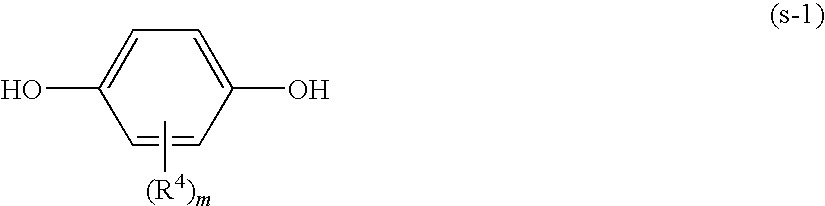
wherein R4 and m have the same meaning as described above;
and the compound shown by the formula (s-2):

wherein R5, n and L1 have the same meaning as described above, L2 represents a halogen atom (chlorine atom, bromine atom, iodine atom, and the like).

wherein R5, n and L1 have the same meaning as described above.

wherein R4, R5, m and n have the same meaning as described above; can be produced, for example, by the reaction of the compound shown by the formula (s-5):

wherein R4 and m have the same meaning as described above; and the compound shown by the formula (s-6):

wherein R5, n and L2 have the same meaning as described above.

wherein R4, R5, m, n and L1 have the same meaning as described above.

wherein R4 and m have the same meaning as described above;
and the compound shown by the formula (s-2).

wherein R4, R5, m and n have the same meaning as described above, Q1 represents a C1-C5 alkylidene group;
can be produced, for example, by the reaction of the compound shown by the formula (s-9):

wherein R4, m and Q2 have the same meaning as described above;
and the compound shown by the formula (s-10):

wherein R5 and n have the same meaning as described above.


| TABLE 1 | ||||
| R1 | R2 | R3 | ||
| CH3 | CH3 | H | ||
| CH3 | CH3 | CH3 | ||
| CH3 | CH3 | CH2CH3 | ||
| CH3 | CH3 | CH2CH2CH3 | ||
| CH3 | CH3 | CH(CH3)2 | ||
| CH3 | CH3 | CH2CH2CH2CH3 | ||
| CH3 | CH3 | CH(CH3)CH2CH3 | ||
| CH3 | CH3 | CH2CH(CH3)2 | ||
| CH3 | CH3 | CH2CH2CH2CH2CH3 | ||
| CH3 | CH3 | CH2CH2CH(CH3)2 | ||
| CH3 | CH3 | CH(CH3)CH2CH2CH3 | ||
| CH3 | CH3 | CH2CH(CH3)CH2CH3 | ||
| CH3 | CH3 | CH(CH3)CH(CH3)2 | ||
| CH3 | CH3 | CH2CH2CH2CH2CH2CH3 | ||
| CH3 | CH3 | CH2F | ||
| CH3 | CH3 | CF3 | ||
| CH3 | CH3 | CH2CH2F | ||
| CH3 | CH3 | CH2CF3 | ||
| CH3 | CH3 | CH2CH2CH2F | ||
| CH3 | CH3 | CH2CH2CF3 | ||
| CH3 | CH3 | CH2CH2CH2CH2F | ||
| CH3 | CH3 | CH2CH2CH2CF3 | ||
| CH3 | CH3 | CH2CH2CH2CH2CF3 | ||
| CH3 | CH3 | CH2CH2Cl | ||
| CH3 | CH3 | CHClCH2Cl | ||
| CH3 | CH3 | CH2CH2Br | ||
| CH3 | CH3 | CHBrCH2Br | ||
| CH3 | CH3 | CH2CH2CH2Cl | ||
| CH3 | CH3 | CH2CHClCH2Cl | ||
| CH3 | CH3 | CH2CH2CH2Br | ||
| CH3 | CH3 | CH2CHBrCH2Br | ||
| CH3 | CH3 | CH2CH2CH2CH2Cl | ||
| CH3 | CH3 | CH2CH2CH2CH2Br | ||
| CH3 | CH3 | CH2CH2CH2CH2CH2Cl | ||
| CH3 | CH3 | CH2CH2CH2CH2CH2Br | ||
| TABLE 2 | ||||
| R1 | R2 | R3 | ||
| CH3 | CH3 | CH2CH2CH2CH2CH2CH2Cl | ||
| CH3 | CH3 | CH2CH2CH2CH2CH2CH2Br | ||
| CH3 | CH3 | CH═CH2 | ||
| CH3 | CH3 | CH2CH═CH2 | ||
| CH3 | CH3 | CH═CHCH3 | ||
| CH3 | CH3 | C(CH3)═CH2 | ||
| CH3 | CH3 | CH═CHCH2CH3 | ||
| CH3 | CH3 | CH2CH═CHCH3 | ||
| CH3 | CH3 | CH2CH2CH═CH2 | ||
| CH3 | CH3 | C(CH3)═CHCH3 | ||
| CH3 | CH3 | CH(CH3)CH═CH2 | ||
| CH3 | CH3 | CH═C(CH3)2 | ||
| CH3 | CH3 | CH2C(CH3)═CH2 | ||
| CH3 | CH3 | C(CH2CH3)═CH2 | ||
| CH3 | CH3 | CH═CHCH2CH2CH3 | ||
| CH3 | CH3 | C(CH3)═CHCH2CH3 | ||
| CH3 | CH3 | CH(CH3)CH═CHCH3 | ||
| CH3 | CH3 | CH(CH3)CH2CH═CH2 | ||
| CH3 | CH3 | CH═C(CH3)CH2CH3 | ||
| CH3 | CH3 | CH2C(CH3)═CHCH3 | ||
| CH3 | CH3 | CH2CH(CH3)CH═CH2 | ||
| CH3 | CH3 | CH═CHCH(CH3)2 | ||
| CH3 | CH3 | CH2CH═C(CH3)2 | ||
| CH3 | CH3 | CH2CH2C(CH2)═CH2 | ||
| CH3 | CH3 | CH2CH═C(CH3)2 | ||
| CH3 | CH3 | CH═CHCH2CH2CH2CH3 | ||
| CH3 | CH3 | CH═CHCl | ||
| CH3 | CH3 | CH═CCl2 | ||
| CH3 | CH3 | CH═C(CH3)Cl | ||
| CH3 | CH3 | CH2CH═CHCl | ||
| CH3 | CH3 | CH2CCl═CHCl | ||
| CH3 | CH3 | CH2CH═CCl2 | ||
| CH3 | CH3 | CH═CHBr | ||
| CH3 | CH3 | CH═CBr2 | ||
| CH3 | CH3 | CH═C(CH3)Br | ||
| TABLE 3 | ||||
| R1 | R2 | R3 | ||
| CH3 | CH3 | CH2CH═CHBr | ||
| CH3 | CH3 | CH2CBr═CHBr | ||
| CH3 | CH3 | CH2CH═CBr2 | ||
| CH3 | CH3 | CH2CH═C(CH3)Cl | ||
| CH3 | CH3 | CH2CH═C(CF3)Cl | ||
| CH3 | CH3 | CH2CH═C(CH3)Br | ||
| CH3 | CH3 | CH2CH═C(CF3)Br | ||
| CH3 | CH3 | CH═CHCF3 | ||
| CH3 | CH3 | CH═CHCH2CF3 | ||
| CH3 | CH3 | CH2CH═CHCH2CF3 | ||
| CH3 | CH3 | C≡CH | ||
| CH3 | CH3 | C≡CCH3 | ||
| CH3 | CH3 | CH2C≡CH | ||
| CH3 | CH3 | C≡CCH2CH3 | ||
| CH3 | CH3 | CH2C≡CCH3 | ||
| CH3 | CH3 | CH2CH2C≡CH | ||
| CH3 | CH3 | CH(CH3)C≡CH | ||
| CH3 | CH3 | C≡CCH2CH2CH3 | ||
| CH3 | CH3 | CH2C≡CCH2CH3 | ||
| CH3 | CH3 | CH2CH2C≡CCH3 | ||
| CH3 | CH3 | CH2CH2CH2C≡CH | ||
| CH3 | CH3 | CH2CH2CH2C≡CCH3 | ||
| CH3 | CH3 | C≡CCl | ||
| CH3 | CH3 | CH2C≡CCl | ||
| CH3 | CH3 | CH2CH2C≡CCl | ||
| CH3 | CH3 | CH2CH2CH2C≡CCl | ||
| CH3 | CH3 | C≡CBr | ||
| CH3 | CH3 | CH2C≡CBr | ||
| CH3 | CH3 | CH2CH2C≡CBr | ||
| CH3 | CH3 | CH2CH2CH2C≡CBr | ||
| CH3 | CH3 | CH2CH2CH2CH2C≡CCl | ||
| CH3 | CH3 | CH2OH | ||
| CH3 | CH3 | CH2CH2OH | ||
| CH3 | CH3 | CH2CH2CH2OH | ||
| CH3 | CH3 | CH2CH2CH2CH2OH | ||
| TABLE 4 | ||||
| R1 | R2 | R3 | ||
| CH3 | CH3 | CH2CH2CH2CH2CH2OH | ||
| CH3 | CH3 | CH2OCH3 | ||
| CH3 | CH3 | CH2OCH2CH3 | ||
| CH3 | CH3 | CH2OCH2CH2CH3 | ||
| CH3 | CH3 | CH2OCH(CH3)2 | ||
| CH3 | CH3 | CH2OCH2CH2CH2CH3 | ||
| CH3 | CH3 | CH2OCH2CH2CH2CH2CH3 | ||
| CH3 | CH3 | CH2CH2OCH3 | ||
| CH3 | CH3 | CH2CH2OCH2CH3 | ||
| CH3 | CH3 | CH2CH2OCH2CH2CH3 | ||
| CH3 | CH3 | CH2CH2OCH(CH3)2 | ||
| CH3 | CH3 | CH2CH2CH2OCH3 | ||
| CH3 | CH3 | C(═O)OCH3 | ||
| CH3 | CH3 | C(═O)OCH2CH3 | ||
| CH3 | CH3 | C(═O)OCH2CH2CH3 | ||
| CH3 | CH3 | C(═O)OCH(CH3)2 | ||
| CH3 | CH3 | C(═O)OCH2CH2CH2CH3 | ||
| CH3 | CH3 | C(═O)OCH2CH═CH2 | ||
| CH3 | CH3 | C(═O)OCH(CH3)CH═CH2 | ||
| CH3 | CH3 | C(═O)OCH(CH3)C(CH3)═CH2 | ||
| CH3 | CH3 | C(═O)OCH2CH═CHCH3 | ||
| CH3 | CH3 | C(═O)OCH(CH3)CH═CHCH3 | ||
| CH3 | CH3 | C(═O)OCH2CH═C(CH3)2 | ||
| CH3 | CH3 | C(═O)OCH2CH═CHCl | ||
| CH3 | CH3 | C(═O)OCH2CH═CCl2 | ||
| CH3 | CH3 | C(═O)OCH2CH═CCl(CH3) | ||
| CH3 | CH3 | C(═O)OCH2CH═CHBr | ||
| CH3 | CH3 | C(═O)OCH2CH═CBr2 | ||
| CH3 | CH3 | C(═O)OCH2CH═CBr(CH3) | ||
| TABLE 5 | ||||
| R1 | R2 | R3 | ||
| CH3 | CH2CH3 | H | ||
| CH3 | CH2CH3 | CH3 | ||
| CH3 | CH2CH3 | CH2CH3 | ||
| CH3 | CH2CH3 | CH2CH2CH3 | ||
| CH3 | CH2CH3 | CH(CH3)2 | ||
| CH3 | CH2CH3 | CH2CH2CH2CH3 | ||
| CH3 | CH2CH3 | CH(CH3)CH2CH3 | ||
| CH3 | CH2CH3 | CH2CH(CH3)2 | ||
| CH3 | CH2CH3 | CH2CH2CH2CH2CH3 | ||
| CH3 | CH2CH3 | CH2CH2CH(CH3)2 | ||
| CH3 | CH2CH3 | CH(CH3)CH2CH2CH3 | ||
| CH3 | CH2CH3 | CH2CH(CH3)CH2CH3 | ||
| CH3 | CH2CH3 | CH(CH3)CH(CH3)2 | ||
| CH3 | CH2CH3 | CH2CH2CH2CH2CH2CH3 | ||
| CH3 | CH2CH3 | CH2F | ||
| CH3 | CH2CH3 | CF3 | ||
| CH3 | CH2CH3 | CH2CH2F | ||
| CH3 | CH2CH3 | CH2CF3 | ||
| CH3 | CH2CH3 | CH2CH2CH2F | ||
| CH3 | CH2CH3 | CH2CH2CF3 | ||
| CH3 | CH2CH3 | CH2CH2CH2CH2F | ||
| CH3 | CH2CH3 | CH2CH2CH2CF3 | ||
| CH3 | CH2CH3 | CH2CH2CH2CH2CF3 | ||
| CH3 | CH2CH3 | CH2CH2Cl | ||
| CH3 | CH2CH3 | CHClCH2Cl | ||
| CH3 | CH2CH3 | CH2CH2Br | ||
| CH3 | CH2CH3 | CHBrCH2Br | ||
| CH3 | CH2CH3 | CH2CH2CH2Cl | ||
| CH3 | CH2CH3 | CH2CHClCH2Cl | ||
| CH3 | CH2CH3 | CH2CH2CH2Br | ||
| CH3 | CH2CH3 | CH2CHBrCH2Br | ||
| CH3 | CH2CH3 | CH2CH2CH2CH2Cl | ||
| CH3 | CH2CH3 | CH2CH2CH2CH2Br | ||
| CH3 | CH2CH3 | CH2CH2CH2CH2CH2Cl | ||
| CH3 | CH2CH3 | CH2CH2CH2CH2CH2Br | ||
| TABLE 6 | ||||
| R1 | R2 | R3 | ||
| CH3 | CH2CH3 | CH2CH2CH2CH2CH2CH2Cl | ||
| CH3 | CH2CH3 | CH2CH2CH2CH2CH2CH2Br | ||
| CH3 | CH2CH3 | CH═CH2 | ||
| CH3 | CH2CH3 | CH2CH═CH2 | ||
| CH3 | CH2CH3 | CH═CHCH3 | ||
| CH3 | CH2CH3 | C(CH3)═CH2 | ||
| CH3 | CH2CH3 | CH═CHCH2CH3 | ||
| CH3 | CH2CH3 | CH2CH═CHCH3 | ||
| CH3 | CH2CH3 | CH2CH2CH═CH2 | ||
| CH3 | CH2CH3 | C(CH3)═CHCH3 | ||
| CH3 | CH2CH3 | CH(CH3)CH═CH2 | ||
| CH3 | CH2CH3 | CH═C(CH3)2 | ||
| CH3 | CH2CH3 | CH2C(CH3)═CH2 | ||
| CH3 | CH2CH3 | C(CH2CH3)═CH2 | ||
| CH3 | CH2CH3 | CH═CHCH2CH2CH3 | ||
| CH3 | CH2CH3 | C(CH3)═CHCH2CH3 | ||
| CH3 | CH2CH3 | CH(CH3)CH═CHCH3 | ||
| CH3 | CH2CH3 | CH(CH3)CH2CH═CH2 | ||
| CH3 | CH2CH3 | CH═C(CH3)CH2CH3 | ||
| CH3 | CH2CH3 | CH2C(CH3)═CHCH3 | ||
| CH3 | CH2CH3 | CH2CH(CH3)CH═CH2 | ||
| CH3 | CH2CH3 | CH═CHCH(CH3)2 | ||
| CH3 | CH2CH3 | CH2CH═C(CH3)2 | ||
| CH3 | CH2CH3 | CH2CH2C(CH2)═CH2 | ||
| CH3 | CH2CH3 | CH2CH═C(CH3)2 | ||
| CH3 | CH2CH3 | CH═CHCH2CH2CH2CH3 | ||
| CH3 | CH2CH3 | CH═CHCl | ||
| CH3 | CH2CH3 | CH═CCl2 | ||
| CH3 | CH2CH3 | CH═C(CH3)Cl | ||
| CH3 | CH2CH3 | CH2CH═CHCl | ||
| CH3 | CH2CH3 | CH2CCl═CHCl | ||
| CH3 | CH2CH3 | CH2CH═CCl2 | ||
| CH3 | CH2CH3 | CH═CHBr | ||
| CH3 | CH2CH3 | CH═CBr2 | ||
| CH3 | CH2CH3 | CH═C(CH3)Br | ||
| TABLE 7 | ||||
| R1 | R2 | R3 | ||
| CH3 | CH2CH3 | CH2CH═CHBr | ||
| CH3 | CH2CH3 | CH2CBr═CHBr | ||
| CH3 | CH2CH3 | CH2CH═CBr2 | ||
| CH3 | CH2CH3 | CH2CH═C(CH3)Cl | ||
| CH3 | CH2CH3 | CH2CH═C(CF3)Cl | ||
| CH3 | CH2CH3 | CH2CH═C(CH3)Br | ||
| CH3 | CH2CH3 | CH2CH═C(CF3)Br | ||
| CH3 | CH2CH3 | CH═CHCF3 | ||
| CH3 | CH2CH3 | CH═CHCH2CF3 | ||
| CH3 | CH2CH3 | CH2CH═CHCH2CF3 | ||
| CH3 | CH2CH3 | C≡CH | ||
| CH3 | CH2CH3 | C≡CCH3 | ||
| CH3 | CH2CH3 | CH2C≡CH | ||
| CH3 | CH2CH3 | C≡CCH2CH3 | ||
| CH3 | CH2CH3 | CH2C≡CCH3 | ||
| CH3 | CH2CH3 | CH2CH2C≡CH | ||
| CH3 | CH2CH3 | CH(CH3)C≡CH | ||
| CH3 | CH2CH3 | C≡CCH2CH2CH3 | ||
| CH3 | CH2CH3 | CH2C≡CCH2CH3 | ||
| CH3 | CH2CH3 | CH2CH2C≡CCH3 | ||
| CH3 | CH2CH3 | CH2CH2CH2C≡CH | ||
| CH3 | CH2CH3 | CH2CH2CH2C≡CCH3 | ||
| CH3 | CH2CH3 | C≡CCl | ||
| CH3 | CH2CH3 | CH2C≡CCl | ||
| CH3 | CH2CH3 | CH2CH2C≡CCl | ||
| CH3 | CH2CH3 | CH2CH2CH2C≡CCl | ||
| CH3 | CH2CH3 | C≡CBr | ||
| CH3 | CH2CH3 | CH2C≡CBr | ||
| CH3 | CH2CH3 | CH2CH2C≡CBr | ||
| CH3 | CH2CH3 | CH2CH2CH2C≡CBr | ||
| CH3 | CH2CH3 | CH2CH2CH2CH2C≡CCl | ||
| CH3 | CH2CH3 | CH2OH | ||
| CH3 | CH2CH3 | CH2CH2OH | ||
| CH3 | CH2CH3 | CH2CH2CH2OH | ||
| CH3 | CH2CH3 | CH2CH2CH2CH2OH | ||
| TABLE 8 | ||||
| R1 | R2 | R3 | ||
| CH3 | CH2CH3 | CH2CH2CH2CH2CH2OH | ||
| CH3 | CH2CH3 | CH2OCH3 | ||
| CH3 | CH2CH3 | CH2OCH2CH3 | ||
| CH3 | CH2CH3 | CH2OCH2CH2CH3 | ||
| CH3 | CH2CH3 | CH2OCH(CH3)2 | ||
| CH3 | CH2CH3 | CH2OCH2CH2CH2CH3 | ||
| CH3 | CH2CH3 | CH2OCH2CH2CH2CH2CH3 | ||
| CH3 | CH2CH3 | CH2CH2OCH3 | ||
| CH3 | CH2CH3 | CH2CH2OCH2CH3 | ||
| CH3 | CH2CH3 | CH2CH2OCH2CH2CH3 | ||
| CH3 | CH2CH3 | CH2CH2OCH(CH3)2 | ||
| CH3 | CH2CH3 | CH2CH2CH2OCH3 | ||
| CH3 | CH2CH3 | C(═O)OCH3 | ||
| CH3 | CH2CH3 | C(═O)OCH2CH3 | ||
| CH3 | CH2CH3 | C(═O)OCH2CH2CH3 | ||
| CH3 | CH2CH3 | C(═O)OCH(CH3)2 | ||
| CH3 | CH2CH3 | C(═O)OCH2CH2CH2CH3 | ||
| CH3 | CH2CH3 | C(═O)OCH2CH═CH2 | ||
| CH3 | CH2CH3 | C(═O)OCH(CH3)CH═CH2 | ||
| CH3 | CH2CH3 | C(═O)OCH(CH3)C(CH3)═CH2 | ||
| CH3 | CH2CH3 | C(═O)OCH2CH═CHCH3 | ||
| CH3 | CH2CH3 | C(═O)OCH(CH3)CH═CHCH3 | ||
| CH3 | CH2CH3 | C(═O)OCH2CH═C(CH3)2 | ||
| CH3 | CH2CH3 | C(═O)OCH2CH═CHCl | ||
| CH3 | CH2CH3 | C(═O)OCH2CH═CCl2 | ||
| CH3 | CH2CH3 | C(═O)OCH2CH═CCl(CH3) | ||
| CH3 | CH2CH3 | C(═O)OCH2CH═CHBr | ||
| CH3 | CH2CH3 | C(═O)OCH2CH═CBr2 | ||
| CH3 | CH2CH3 | C(═O)OCH2CH═CBr(CH3) | ||
| TABLE 9 | ||||
| R1 | R2 | R3 | ||
| CH3 | CH(CH3)2 | H | ||
| CH3 | CH(CH3)2 | CH3 | ||
| CH3 | CH(CH3)2 | CH2CH3 | ||
| CH3 | CH(CH3)2 | CH2CH2CH3 | ||
| CH3 | CH(CH3)2 | CH(CH3)2 | ||
| CH3 | CH(CH3)2 | CH2CH2CH2CH3 | ||
| CH3 | CH(CH3)2 | CH(CH3)CH2CH3 | ||
| CH3 | CH(CH3)2 | CH2CH(CH3)2 | ||
| CH3 | CH(CH3)2 | CH2CH2CH2CH2CH3 | ||
| CH3 | CH(CH3)2 | CH2CH2CH(CH3)2 | ||
| CH3 | CH(CH3)2 | CH(CH3)CH2CH2CH3 | ||
| CH3 | CH(CH3)2 | CH2CH(CH3)CH2CH3 | ||
| CH3 | CH(CH3)2 | CH(CH3)CH(CH3)2 | ||
| CH3 | CH(CH3)2 | CH2CH2CH2CH2CH2CH3 | ||
| CH3 | CH(CH3)2 | CH2F | ||
| CH3 | CH(CH3)2 | CF3 | ||
| CH3 | CH(CH3)2 | CH2CH2F | ||
| CH3 | CH(CH3)2 | CH2CF3 | ||
| CH3 | CH(CH3)2 | CH2CH2CH2F | ||
| CH3 | CH(CH3)2 | CH2CH2CF3 | ||
| CH3 | CH(CH3)2 | CH2CH2CH2CH2F | ||
| CH3 | CH(CH3)2 | CH2CH2CH2CF3 | ||
| CH3 | CH(CH3)2 | CH2CH2CH2CH2CF3 | ||
| CH3 | CH(CH3)2 | CH2CH2Cl | ||
| CH3 | CH(CH3)2 | CHClCH2Cl | ||
| CH3 | CH(CH3)2 | CH2CH2Br | ||
| CH3 | CH(CH3)2 | CHBrCH2Br | ||
| CH3 | CH(CH3)2 | CH2CH2CH2Cl | ||
| CH3 | CH(CH3)2 | CH2CHClCH2Cl | ||
| CH3 | CH(CH3)2 | CH2CH2CH2Br | ||
| CH3 | CH(CH3)2 | CH2CHBrCH2Br | ||
| CH3 | CH(CH3)2 | CH2CH2CH2CH2Cl | ||
| CH3 | CH(CH3)2 | CH2CH2CH2CH2Br | ||
| CH3 | CH(CH3)2 | CH2CH2CH2CH2CH2Cl | ||
| CH3 | CH(CH3)2 | CH2CH2CH2CH2CH2Br | ||
| TABLE 10 | ||||
| R1 | R2 | R3 | ||
| CH3 | CH(CH3)2 | CH2CH2CH2CH2CH2CH2Cl | ||
| CH3 | CH(CH3)2 | CH2CH2CH2CH2CH2CH2Br | ||
| CH3 | CH(CH3)2 | CH═CH2 | ||
| CH3 | CH(CH3)2 | CH2CH═CH2 | ||
| CH3 | CH(CH3)2 | CH═CHCH3 | ||
| CH3 | CH(CH3)2 | C(CH3)═CH2 | ||
| CH3 | CH(CH3)2 | CH═CHCH2CH3 | ||
| CH3 | CH(CH3)2 | CH2CH═CHCH3 | ||
| CH3 | CH(CH3)2 | CH2CH2CH═CH2 | ||
| CH3 | CH(CH3)2 | C(CH3)═CHCH3 | ||
| CH3 | CH(CH3)2 | CH(CH3)CH═CH2 | ||
| CH3 | CH(CH3)2 | CH═C(CH3)2 | ||
| CH3 | CH(CH3)2 | CH2C(CH3)═CH2 | ||
| CH3 | CH(CH3)2 | C(CH2CH3)═CH2 | ||
| CH3 | CH(CH3)2 | CH═CHCH2CH2CH3 | ||
| CH3 | CH(CH3)2 | C(CH3)═CHCH2CH3 | ||
| CH3 | CH(CH3)2 | CH(CH3)CH═CHCH3 | ||
| CH3 | CH(CH3)2 | CH(CH3)CH2CH═CH2 | ||
| CH3 | CH(CH3)2 | CH═C(CH3)CH2CH3 | ||
| CH3 | CH(CH3)2 | CH2C(CH3)═CHCH3 | ||
| CH3 | CH(CH3)2 | CH2CH(CH3)CH═CH2 | ||
| CH3 | CH(CH3)2 | CH═CHCH(CH3)2 | ||
| CH3 | CH(CH3)2 | CH2CH═C(CH3)2 | ||
| CH3 | CH(CH3)2 | CH2CH2C(CH2)═CH2 | ||
| CH3 | CH(CH3)2 | CH2CH═C(CH3)2 | ||
| CH3 | CH(CH3)2 | CH═CHCH2CH2CH2CH3 | ||
| CH3 | CH(CH3)2 | CH═CHCl | ||
| CH3 | CH(CH3)2 | CH═CCl2 | ||
| CH3 | CH(CH3)2 | CH═C(CH3)Cl | ||
| CH3 | CH(CH3)2 | CH2CH═CHCl | ||
| CH3 | CH(CH3)2 | CH2CCl═CHCl | ||
| CH3 | CH(CH3)2 | CH2CH═CCl2 | ||
| CH3 | CH(CH3)2 | CH═CHBr | ||
| CH3 | CH(CH3)2 | CH═CBr2 | ||
| CH3 | CH(CH3)2 | CH═C(CH3)Br | ||
| TABLE 11 | ||||
| R1 | R2 | R3 | ||
| CH3 | CH(CH3)2 | CH2CH═CHBr | ||
| CH3 | CH(CH3)2 | CH2CBr═CHBr | ||
| CH3 | CH(CH3)2 | CH2CH═CBr2 | ||
| CH3 | CH(CH3)2 | CH2CH═C(CH3)Cl | ||
| CH3 | CH(CH3)2 | CH2CH═C(CF3)Cl | ||
| CH3 | CH(CH3)2 | CH2CH═C(CH3)Br | ||
| CH3 | CH(CH3)2 | CH2CH═C(CF3)Br | ||
| CH3 | CH(CH3)2 | CH═CHCF3 | ||
| CH3 | CH(CH3)2 | CH═CHCH2CF3 | ||
| CH3 | CH(CH3)2 | CH2CH═CHCH2CF3 | ||
| CH3 | CH(CH3)2 | C≡CH | ||
| CH3 | CH(CH3)2 | C≡CCH3 | ||
| CH3 | CH(CH3)2 | CH2C≡CH | ||
| CH3 | CH(CH3)2 | C≡CCH2CH3 | ||
| CH3 | CH(CH3)2 | CH2C≡CCH3 | ||
| CH3 | CH(CH3)2 | CH2CH2C≡CH | ||
| CH3 | CH(CH3)2 | CH(CH3)C≡CH | ||
| CH3 | CH(CH3)2 | C≡CCH2CH2CH3 | ||
| CH3 | CH(CH3)2 | CH2C≡CCH2CH3 | ||
| CH3 | CH(CH3)2 | CH2CH2C≡CCH3 | ||
| CH3 | CH(CH3)2 | CH2CH2CH2C≡CH | ||
| CH3 | CH(CH3)2 | CH2CH2CH2C≡CCH3 | ||
| CH3 | CH(CH3)2 | C≡CCl | ||
| CH3 | CH(CH3)2 | CH2C≡CCl | ||
| CH3 | CH(CH3)2 | CH2CH2C≡CCl | ||
| CH3 | CH(CH3)2 | CH2CH2CH2C≡CCl | ||
| CH3 | CH(CH3)2 | C≡CBr | ||
| CH3 | CH(CH3)2 | CH2C≡CBr | ||
| CH3 | CH(CH3)2 | CH2CH2C≡CBr | ||
| CH3 | CH(CH3)2 | CH2CH2CH2C≡CBr | ||
| CH3 | CH(CH3)2 | CH2CH2CH2CH2C≡CCl | ||
| CH3 | CH(CH3)2 | CH2OH | ||
| CH3 | CH(CH3)2 | CH2CH2OH | ||
| CH3 | CH(CH3)2 | CH2CH2CH2OH | ||
| CH3 | CH(CH3)2 | CH2CH2CH2CH2OH | ||
| TABLE 12 | ||||
| R1 | R2 | R3 | ||
| CH3 | CH(CH3)2 | CH2CH2CH2CH2CH2OH | ||
| CH3 | CH(CH3)2 | CH2OCH3 | ||
| CH3 | CH(CH3)2 | CH2OCH2CH3 | ||
| CH3 | CH(CH3)2 | CH2OCH2CH2CH3 | ||
| CH3 | CH(CH3)2 | CH2OCH(CH3)2 | ||
| CH3 | CH(CH3)2 | CH2OCH2CH2CH2CH3 | ||
| CH3 | CH(CH3)2 | CH2OCH2CH2CH2CH2CH3 | ||
| CH3 | CH(CH3)2 | CH2CH2OCH3 | ||
| CH3 | CH(CH3)2 | CH2CH2OCH2CH3 | ||
| CH3 | CH(CH3)2 | CH2CH2OCH2CH2CH3 | ||
| CH3 | CH(CH3)2 | CH2CH2OCH(CH3)2 | ||
| CH3 | CH(CH3)2 | CH2CH2CH2OCH3 | ||
| CH3 | CH(CH3)2 | C(═O)OCH3 | ||
| CH3 | CH(CH3)2 | C(═O)OCH2CH3 | ||
| CH3 | CH(CH3)2 | C(═O)OCH2CH2CH3 | ||
| CH3 | CH(CH3)2 | C(═O)OCH(CH3)2 | ||
| CH3 | CH(CH3)2 | C(═O)OCH2CH2CH2CH3 | ||
| CH3 | CH(CH3)2 | C(═O)OCH2CH═CH2 | ||
| CH3 | CH(CH3)2 | C(═O)OCH(CH3)CH═CH2 | ||
| CH3 | CH(CH3)2 | C(═O)OCH(CH3)C(CH3)═CH2 | ||
| CH3 | CH(CH3)2 | C(═O)OCH2CH═CHCH3 | ||
| CH3 | CH(CH3)2 | C(═O)OCH(CH3)CH═CHCH3 | ||
| CH3 | CH(CH3)2 | C(═O)OCH2CH═C(CH3)2 | ||
| CH3 | CH(CH3)2 | C(═O)OCH2CH═CHCl | ||
| CH3 | CH(CH3)2 | C(═O)OCH2CH═CCl2 | ||
| CH3 | CH(CH3)2 | C(═O)OCH2CH═CCl(CH3) | ||
| CH3 | CH(CH3)2 | C(═O)OCH2CH═CHBr | ||
| CH3 | CH(CH3)2 | C(═O)OCH2CH═CBr2 | ||
| CH3 | CH(CH3)2 | C(═O)OCH2CH═CBr(CH3) | ||
| TABLE 13 | ||||
| R1 | R2 | R3 | ||
| CH3 | C(CH3)3 | H | ||
| CH3 | C(CH3)3 | CH3 | ||
| CH3 | C(CH3)3 | CH2CH3 | ||
| CH3 | C(CH3)3 | CH2CH2CH3 | ||
| CH3 | C(CH3)3 | CH(CH3)2 | ||
| CH3 | C(CH3)3 | CH2CH2CH2CH3 | ||
| CH3 | C(CH3)3 | CH(CH3)CH2CH3 | ||
| CH3 | C(CH3)3 | CH2CH(CH3)2 | ||
| CH3 | C(CH3)3 | CH2CH2CH2CH2CH3 | ||
| CH3 | C(CH3)3 | CH2CH2CH(CH3)2 | ||
| CH3 | C(CH3)3 | CH(CH3)CH2CH2CH3 | ||
| CH3 | C(CH3)3 | CH2CH(CH3)CH2CH3 | ||
| CH3 | C(CH3)3 | CH(CH3)CH(CH3)2 | ||
| CH3 | C(CH3)3 | CH2CH2CH2CH2CH2CH3 | ||
| CH3 | C(CH3)3 | CH2F | ||
| CH3 | C(CH3)3 | CF3 | ||
| CH3 | C(CH3)3 | CH2CH2F | ||
| CH3 | C(CH3)3 | CH2CF3 | ||
| CH3 | C(CH3)3 | CH2CH2CH2F | ||
| CH3 | C(CH3)3 | CH2CH2CF3 | ||
| CH3 | C(CH3)3 | CH2CH2CH2CH2F | ||
| CH3 | C(CH3)3 | CH2CH2CH2CF3 | ||
| CH3 | C(CH3)3 | CH2CH2CH2CH2CF3 | ||
| CH3 | C(CH3)3 | CH2CH2Cl | ||
| CH3 | C(CH3)3 | CHClCH2Cl | ||
| CH3 | C(CH3)3 | CH2CH2Br | ||
| CH3 | C(CH3)3 | CHBrCH2Br | ||
| CH3 | C(CH3)3 | CH2CH2CH2Cl | ||
| CH3 | C(CH3)3 | CH2CHClCH2Cl | ||
| CH3 | C(CH3)3 | CH2CH2CH2Br | ||
| CH3 | C(CH3)3 | CH2CHBrCH2Br | ||
| CH3 | C(CH3)3 | CH2CH2CH2CH2Cl | ||
| CH3 | C(CH3)3 | CH2CH2CH2CH2Br | ||
| CH3 | C(CH3)3 | CH2CH2CH2CH2CH2Cl | ||
| CH3 | C(CH3)3 | CH2CH2CH2CH2CH2Br | ||
| TABLE 14 | ||||
| R1 | R2 | R3 | ||
| CH3 | C(CH3)3 | CH2CH2CH2CH2CH2CH2Cl | ||
| CH3 | C(CH3)3 | CH2CH2CH2CH2CH2CH2Br | ||
| CH3 | C(CH3)3 | CH═CH2 | ||
| CH3 | C(CH3)3 | CH2CH═CH2 | ||
| CH3 | C(CH3)3 | CH═CHCH3 | ||
| CH3 | C(CH3)3 | C(CH3)═CH2 | ||
| CH3 | C(CH3)3 | CH═CHCH2CH3 | ||
| CH3 | C(CH3)3 | CH2CH═CHCH3 | ||
| CH3 | C(CH3)3 | CH2CH2CH═CH2 | ||
| CH3 | C(CH3)3 | C(CH3)═CHCH3 | ||
| CH3 | C(CH3)3 | CH(CH3)CH═CH2 | ||
| CH3 | C(CH3)3 | CH═C(CH3)2 | ||
| CH3 | C(CH3)3 | CH2C(CH3)═CH2 | ||
| CH3 | C(CH3)3 | C(CH2CH3)═CH2 | ||
| CH3 | C(CH3)3 | CH═CHCH2CH2CH3 | ||
| CH3 | C(CH3)3 | C(CH3)═CHCH2CH3 | ||
| CH3 | C(CH3)3 | CH(CH3)CH═CHCH3 | ||
| CH3 | C(CH3)3 | CH(CH3)CH2CH═CH2 | ||
| CH3 | C(CH3)3 | CH═C(CH3)CH2CH3 | ||
| CH3 | C(CH3)3 | CH2C(CH3)═CHCH3 | ||
| CH3 | C(CH3)3 | CH2CH(CH3)CH═CH2 | ||
| CH3 | C(CH3)3 | CH═CHCH(CH3)2 | ||
| CH3 | C(CH3)3 | CH2CH═C(CH3)2 | ||
| CH3 | C(CH3)3 | CH2CH2C(CH2)═CH2 | ||
| CH3 | C(CH3)3 | CH2CH═C(CH3)2 | ||
| CH3 | C(CH3)3 | CH═CHCH2CH2CH2CH3 | ||
| CH3 | C(CH3)3 | CH═CHCl | ||
| CH3 | C(CH3)3 | CH═CCl2 | ||
| CH3 | C(CH3)3 | CH═C(CH3)Cl | ||
| CH3 | C(CH3)3 | CH2CH═CHCl | ||
| CH3 | C(CH3)3 | CH2CCl═CHCl | ||
| CH3 | C(CH3)3 | CH2CH═CCl2 | ||
| CH3 | C(CH3)3 | CH═CHBr | ||
| CH3 | C(CH3)3 | CH═CBr2 | ||
| CH3 | C(CH3)3 | CH═C(CH3)Br | ||
| TABLE 15 | ||||
| R1 | R2 | R3 | ||
| CH3 | C(CH3)3 | CH2CH═CHBr | ||
| CH3 | C(CH3)3 | CH2CBr═CHBr | ||
| CH3 | C(CH3)3 | CH2CH═CBr2 | ||
| CH3 | C(CH3)3 | CH2CH═C(CH3)Cl | ||
| CH3 | C(CH3)3 | CH2CH═C(CF3)Cl | ||
| CH3 | C(CH3)3 | CH2CH═C(CH3)Br | ||
| CH3 | C(CH3)3 | CH2CH═C(CF3)Br | ||
| CH3 | C(CH3)3 | CH═CHCF3 | ||
| CH3 | C(CH3)3 | CH═CHCH2CF3 | ||
| CH3 | C(CH3)3 | CH2CH═CHCH2CF3 | ||
| CH3 | C(CH3)3 | C≡CH | ||
| CH3 | C(CH3)3 | C≡CCH3 | ||
| CH3 | C(CH3)3 | CH2C≡CH | ||
| CH3 | C(CH3)3 | C≡CCH2CH3 | ||
| CH3 | C(CH3)3 | CH2C≡CCH3 | ||
| CH3 | C(CH3)3 | CH2CH2C≡CH | ||
| CH3 | C(CH3)3 | CH(CH3)C≡CH | ||
| CH3 | C(CH3)3 | C≡CCH2CH2CH3 | ||
| CH3 | C(CH3)3 | CH2C≡CCH2CH3 | ||
| CH3 | C(CH3)3 | CH2CH2C≡CCH3 | ||
| CH3 | C(CH3)3 | CH2CH2CH2C≡CH | ||
| CH3 | C(CH3)3 | CH2CH2CH2C≡CCH3 | ||
| CH3 | C(CH3)3 | C≡CCl | ||
| CH3 | C(CH3)3 | CH2C≡CCl | ||
| CH3 | C(CH3)3 | CH2CH2C≡CCl | ||
| CH3 | C(CH3)3 | CH2CH2CH2C≡CCl | ||
| CH3 | C(CH3)3 | C≡CBr | ||
| CH3 | C(CH3)3 | CH2C≡CBr | ||
| CH3 | C(CH3)3 | CH2CH2C≡CBr | ||
| CH3 | C(CH3)3 | CH2CH2CH2C≡CBr | ||
| CH3 | C(CH3)3 | CH2CH2CH2CH2C≡CCl | ||
| CH3 | C(CH3)3 | CH2OH | ||
| CH3 | C(CH3)3 | CH2CH2OH | ||
| CH3 | C(CH3)3 | CH2CH2CH2OH | ||
| CH3 | C(CH3)3 | CH2CH2CH2CH2OH | ||
| TABLE 16 | ||||
| R1 | R2 | R3 | ||
| CH3 | C(CH3)3 | CH2CH2CH2CH2CH2OH | ||
| CH3 | C(CH3)3 | CH2OCH3 | ||
| CH3 | C(CH3)3 | CH2OCH2CH3 | ||
| CH3 | C(CH3)3 | CH2OCH2CH2CH3 | ||
| CH3 | C(CH3)3 | CH2OCH(CH3)2 | ||
| CH3 | C(CH3)3 | CH2OCH2CH2CH2CH3 | ||
| CH3 | C(CH3)3 | CH2OCH2CH2CH2CH2CH3 | ||
| CH3 | C(CH3)3 | CH2CH2OCH3 | ||
| CH3 | C(CH3)3 | CH2CH2OCH2CH3 | ||
| CH3 | C(CH3)3 | CH2CH2OCH2CH2CH3 | ||
| CH3 | C(CH3)3 | CH2CH2OCH(CH3)2 | ||
| CH3 | C(CH3)3 | CH2CH2CH2OCH3 | ||
| CH3 | C(CH3)3 | C(═O)OCH3 | ||
| CH3 | C(CH3)3 | C(═O)OCH2CH3 | ||
| CH3 | C(CH3)3 | C(═O)OCH2CH2CH3 | ||
| CH3 | C(CH3)3 | C(═O)OCH(CH3)2 | ||
| CH3 | C(CH3)3 | C(═O)OCH2CH2CH2CH3 | ||
| CH3 | C(CH3)3 | C(═O)OCH2CH═CH2 | ||
| CH3 | C(CH3)3 | C(═O)OCH(CH3)CH═CH2 | ||
| CH3 | C(CH3)3 | C(═O)OCH(CH3)C(CH3)═CH2 | ||
| CH3 | C(CH3)3 | C(═O)OCH2CH═CHCH3 | ||
| CH3 | C(CH3)3 | C(═O)OCH(CH3)CH═CHCH3 | ||
| CH3 | C(CH3)3 | C(═O)OCH2CH═C(CH3)2 | ||
| CH3 | C(CH3)3 | C(═O)OCH2CH═CHCl | ||
| CH3 | C(CH3)3 | C(═O)OCH2CH═CCl2 | ||
| CH3 | C(CH3)3 | C(═O)OCH2CH═CCl(CH3) | ||
| CH3 | C(CH3)3 | C(═O)OCH2CH═CHBr | ||
| CH3 | C(CH3)3 | C(═O)OCH2CH═CBr2 | ||
| CH3 | C(CH3)3 | C(═O)OCH2CH═CBr(CH3) | ||
| TABLE 17 | ||||
| R1 | R2 | R3 | ||
| CH2CH3 | CH3 | H | ||
| CH2CH3 | CH3 | CH3 | ||
| CH2CH3 | CH3 | CH2CH3 | ||
| CH2CH3 | CH3 | CH2CH2CH3 | ||
| CH2CH3 | CH3 | CH(CH3)2 | ||
| CH2CH3 | CH3 | CH2CH2CH2CH3 | ||
| CH2CH3 | CH3 | CH(CH3)CH2CH3 | ||
| CH2CH3 | CH3 | CH2CH(CH3)2 | ||
| CH2CH3 | CH3 | CH2CH2CH2CH2CH3 | ||
| CH2CH3 | CH3 | CH2CH2CH(CH3)2 | ||
| CH2CH3 | CH3 | CH(CH3)CH2CH2CH3 | ||
| CH2CH3 | CH3 | CH2CH(CH3)CH2CH3 | ||
| CH2CH3 | CH3 | CH(CH3)CH(CH3)2 | ||
| CH2CH3 | CH3 | CH2CH2CH2CH2CH2CH3 | ||
| CH2CH3 | CH3 | CH2F | ||
| CH2CH3 | CH3 | CF3 | ||
| CH2CH3 | CH3 | CH2CH2F | ||
| CH2CH3 | CH3 | CH2CF3 | ||
| CH2CH3 | CH3 | CH2CH2CH2F | ||
| CH2CH3 | CH3 | CH2CH2CF3 | ||
| CH2CH3 | CH3 | CH2CH2CH2CH2F | ||
| CH2CH3 | CH3 | CH2CH2CH2CF3 | ||
| CH2CH3 | CH3 | CH2CH2CH2CH2CF3 | ||
| CH2CH3 | CH3 | CH2CH2Cl | ||
| CH2CH3 | CH3 | CHClCH2Cl | ||
| CH2CH3 | CH3 | CH2CH2Br | ||
| CH2CH3 | CH3 | CHBrCH2Br | ||
| CH2CH3 | CH3 | CH2CH2CH2Cl | ||
| CH2CH3 | CH3 | CH2CHClCH2Cl | ||
| CH2CH3 | CH3 | CH2CH2CH2Br | ||
| CH2CH3 | CH3 | CH2CHBrCH2Br | ||
| CH2CH3 | CH3 | CH2CH2CH2CH2Cl | ||
| CH2CH3 | CH3 | CH2CH2CH2CH2Br | ||
| CH2CH3 | CH3 | CH2CH2CH2CH2CH2Cl | ||
| CH2CH3 | CH3 | CH2CH2CH2CH2CH2Br | ||
| TABLE 18 | ||||
| R1 | R2 | R3 | ||
| CH2CH3 | CH3 | CH2CH2CH2CH2CH2CH2Cl | ||
| CH2CH3 | CH3 | CH2CH2CH2CH2CH2CH2Br | ||
| CH2CH3 | CH3 | CH═CH2 | ||
| CH2CH3 | CH3 | CH2CH═CH2 | ||
| CH2CH3 | CH3 | CH═CHCH3 | ||
| CH2CH3 | CH3 | C(CH3)═CH2 | ||
| CH2CH3 | CH3 | CH═CHCH2CH3 | ||
| CH2CH3 | CH3 | CH2CH═CHCH3 | ||
| CH2CH3 | CH3 | CH2CH2CH═CH2 | ||
| CH2CH3 | CH3 | C(CH3)═CHCH3 | ||
| CH2CH3 | CH3 | CH(CH3)CH═CH2 | ||
| CH2CH3 | CH3 | CH═C(CH3)2 | ||
| CH2CH3 | CH3 | CH2C(CH3)═CH2 | ||
| CH2CH3 | CH3 | C(CH2CH3)═CH2 | ||
| CH2CH3 | CH3 | CH═CHCH2CH2CH3 | ||
| CH2CH3 | CH3 | C(CH3)═CHCH2CH3 | ||
| CH2CH3 | CH3 | CH(CH3)CH═CHCH3 | ||
| CH2CH3 | CH3 | CH(CH3)CH2CH═CH2 | ||
| CH2CH3 | CH3 | CH═C(CH3)CH2CH3 | ||
| CH2CH3 | CH3 | CH2C(CH3)═CHCH3 | ||
| CH2CH3 | CH3 | CH2CH(CH3)CH═CH2 | ||
| CH2CH3 | CH3 | CH═CHCH(CH3)2 | ||
| CH2CH3 | CH3 | CH2CH═C(CH3)2 | ||
| CH2CH3 | CH3 | CH2CH2C(CH2)═CH2 | ||
| CH2CH3 | CH3 | CH2CH═C(CH3)2 | ||
| CH2CH3 | CH3 | CH═CHCH2CH2CH2CH3 | ||
| CH2CH3 | CH3 | CH═CHCl | ||
| CH2CH3 | CH3 | CH═CCl2 | ||
| CH2CH3 | CH3 | CH═C(CH3)Cl | ||
| CH2CH3 | CH3 | CH2CH═CHCl | ||
| CH2CH3 | CH3 | CH2CCl═CHCl | ||
| CH2CH3 | CH3 | CH2CH═CCl2 | ||
| CH2CH3 | CH3 | CH═CHBr | ||
| CH2CH3 | CH3 | CH═CBr2 | ||
| CH2CH3 | CH3 | CH═C(CH3)Br | ||
| TABLE 19 | ||||
| R1 | R2 | R3 | ||
| CH2CH3 | CH3 | CH2CH═CHBr | ||
| CH2CH3 | CH3 | CH2CBr═CHBr | ||
| CH2CH3 | CH3 | CH2CH═CBr2 | ||
| CH2CH3 | CH3 | CH2CH═C(CH3)Cl | ||
| CH2CH3 | CH3 | CH2CH═C(CF3)Cl | ||
| CH2CH3 | CH3 | CH2CH═C(CH3)Br | ||
| CH2CH3 | CH3 | CH2CH═C(CF3)Br | ||
| CH2CH3 | CH3 | CH═CHCF3 | ||
| CH2CH3 | CH3 | CH═CHCH2CF3 | ||
| CH2CH3 | CH3 | CH2CH═CHCH2CF3 | ||
| CH2CH3 | CH3 | C≡CH | ||
| CH2CH3 | CH3 | C≡CCH3 | ||
| CH2CH3 | CH3 | CH2C≡CH | ||
| CH2CH3 | CH3 | C≡CCH2CH3 | ||
| CH2CH3 | CH3 | CH2C≡CCH3 | ||
| CH2CH3 | CH3 | CH2CH2C≡CH | ||
| CH2CH3 | CH3 | CH(CH3)C≡CH | ||
| CH2CH3 | CH3 | C≡CCH2CH2CH3 | ||
| CH2CH3 | CH3 | CH2C≡CCH2CH3 | ||
| CH2CH3 | CH3 | CH2CH2C≡CCH3 | ||
| CH2CH3 | CH3 | CH2CH2CH2C≡CH | ||
| CH2CH3 | CH3 | CH2CH2CH2C≡CCH3 | ||
| CH2CH3 | CH3 | C≡CCl | ||
| CH2CH3 | CH3 | CH2C≡CCl | ||
| CH2CH3 | CH3 | CH2CH2C≡CCl | ||
| CH2CH3 | CH3 | CH2CH2CH2C≡CCl | ||
| CH2CH3 | CH3 | C≡CBr | ||
| CH2CH3 | CH3 | CH2C≡CBr | ||
| CH2CH3 | CH3 | CH2CH2C≡CBr | ||
| CH2CH3 | CH3 | CH2CH2CH2C≡CBr | ||
| CH2CH3 | CH3 | CH2CH2CH2CH2C≡CCl | ||
| CH2CH3 | CH3 | CH2OH | ||
| CH2CH3 | CH3 | CH2CH2OH | ||
| CH2CH3 | CH3 | CH2CH2CH2OH | ||
| CH2CH3 | CH3 | CH2CH2CH2CH2OH | ||
| TABLE 20 | ||||
| R1 | R2 | R3 | ||
| CH2CH3 | CH3 | CH2CH2CH2CH2CH2OH | ||
| CH2CH3 | CH3 | CH2OCH3 | ||
| CH2CH3 | CH3 | CH2OCH2CH3 | ||
| CH2CH3 | CH3 | CH2OCH2CH2CH3 | ||
| CH2CH3 | CH3 | CH2OCH(CH3)2 | ||
| CH2CH3 | CH3 | CH2OCH2CH2CH2CH3 | ||
| CH2CH3 | CH3 | CH2OCH2CH2CH2CH2CH3 | ||
| CH2CH3 | CH3 | CH2CH2OCH3 | ||
| CH2CH3 | CH3 | CH2CH2OCH2CH3 | ||
| CH2CH3 | CH3 | CH2CH2OCH2CH2CH3 | ||
| CH2CH3 | CH3 | CH2CH2OCH(CH3)2 | ||
| CH2CH3 | CH3 | CH2CH2CH2OCH3 | ||
| CH2CH3 | CH3 | C(═O)OCH3 | ||
| CH2CH3 | CH3 | C(═O)OCH2CH3 | ||
| CH2CH3 | CH3 | C(═O)OCH2CH2CH3 | ||
| CH2CH3 | CH3 | C(═O)OCH(CH3)2 | ||
| CH2CH3 | CH3 | C(═O)OCH2CH2CH2CH3 | ||
| CH2CH3 | CH3 | C(═O)OCH2CH═CH2 | ||
| CH2CH3 | CH3 | C(═O)OCH(CH3)CH═CH2 | ||
| CH2CH3 | CH3 | C(═O)OCH(CH3)C(CH3)═CH2 | ||
| CH2CH3 | CH3 | C(═O)OCH2CH═CHCH3 | ||
| CH2CH3 | CH3 | C(═O)OCH(CH3)CH═CHCH3 | ||
| CH2CH3 | CH3 | C(═O)OCH2CH═C(CH3)2 | ||
| CH2CH3 | CH3 | C(═O)OCH2CH═CHCl | ||
| CH2CH3 | CH3 | C(═O)OCH2CH═CCl2 | ||
| CH2CH3 | CH3 | C(═O)OCH2CH═CCl(CH3) | ||
| CH2CH3 | CH3 | C(═O)OCH2CH═CHBr | ||
| CH2CH3 | CH3 | C(═O)OCH2CH═CBr2 | ||
| CH2CH3 | CH3 | C(═O)OCH2CH═CBr(CH3) | ||
| TABLE 21 | ||||
| R1 | R2 | R3 | ||
| CH2CH3 | CH2CH3 | H | ||
| CH2CH3 | CH2CH3 | CH3 | ||
| CH2CH3 | CH2CH3 | CH2CH3 | ||
| CH2CH3 | CH2CH3 | CH2CH2CH3 | ||
| CH2CH3 | CH2CH3 | CH(CH3)2 | ||
| CH2CH3 | CH2CH3 | CH2CH2CH2CH3 | ||
| CH2CH3 | CH2CH3 | CH(CH3)CH2CH3 | ||
| CH2CH3 | CH2CH3 | CH2CH(CH3)2 | ||
| CH2CH3 | CH2CH3 | CH2CH2CH2CH2CH3 | ||
| CH2CH3 | CH2CH3 | CH2CH2CH(CH3)2 | ||
| CH2CH3 | CH2CH3 | CH(CH3)CH2CH2CH3 | ||
| CH2CH3 | CH2CH3 | CH2CH(CH3)CH2CH3 | ||
| CH2CH3 | CH2CH3 | CH(CH3)CH(CH3)2 | ||
| CH2CH3 | CH2CH3 | CH2CH2CH2CH2CH2CH3 | ||
| CH2CH3 | CH2CH3 | CH2F | ||
| CH2CH3 | CH2CH3 | CF3 | ||
| CH2CH3 | CH2CH3 | CH2CH2F | ||
| CH2CH3 | CH2CH3 | CH2CF3 | ||
| CH2CH3 | CH2CH3 | CH2CH2CH2F | ||
| CH2CH3 | CH2CH3 | CH2CH2CF3 | ||
| CH2CH3 | CH2CH3 | CH2CH2CH2CH2F | ||
| CH2CH3 | CH2CH3 | CH2CH2CH2CF3 | ||
| CH2CH3 | CH2CH3 | CH2CH2CH2CH2CF3 | ||
| CH2CH3 | CH2CH3 | CH2CH2Cl | ||
| CH2CH3 | CH2CH3 | CHClCH2Cl | ||
| CH2CH3 | CH2CH3 | CH2CH2Br | ||
| CH2CH3 | CH2CH3 | CHBrCH2Br | ||
| CH2CH3 | CH2CH3 | CH2CH2CH2Cl | ||
| CH2CH3 | CH2CH3 | CH2CHClCH2Cl | ||
| CH2CH3 | CH2CH3 | CH2CH2CH2Br | ||
| CH2CH3 | CH2CH3 | CH2CHBrCH2Br | ||
| CH2CH3 | CH2CH3 | CH2CH2CH2CH2Cl | ||
| CH2CH3 | CH2CH3 | CH2CH2CH2CH2Br | ||
| CH2CH3 | CH2CH3 | CH2CH2CH2CH2CH2Cl | ||
| CH2CH3 | CH2CH3 | CH2CH2CH2CH2CH2Br | ||
| TABLE 22 | ||||
| R1 | R2 | R3 | ||
| CH2CH3 | CH2CH3 | CH2CH2CH2CH2CH2CH2Cl | ||
| CH2CH3 | CH2CH3 | CH2CH2CH2CH2CH2CH2Br | ||
| CH2CH3 | CH2CH3 | CH═CH2 | ||
| CH2CH3 | CH2CH3 | CH2CH═CH2 | ||
| CH2CH3 | CH2CH3 | CH═CHCH3 | ||
| CH2CH3 | CH2CH3 | C(CH3)═CH2 | ||
| CH2CH3 | CH2CH3 | CH═CHCH2CH3 | ||
| CH2CH3 | CH2CH3 | CH2CH═CHCH3 | ||
| CH2CH3 | CH2CH3 | CH2CH2CH═CH2 | ||
| CH2CH3 | CH2CH3 | C(CH3)═CHCH3 | ||
| CH2CH3 | CH2CH3 | CH(CH3)CH═CH2 | ||
| CH2CH3 | CH2CH3 | CH═C(CH3)2 | ||
| CH2CH3 | CH2CH3 | CH2C(CH3)═CH2 | ||
| CH2CH3 | CH2CH3 | C(CH2CH3)═CH2 | ||
| CH2CH3 | CH2CH3 | CH═CHCH2CH2CH3 | ||
| CH2CH3 | CH2CH3 | C(CH3)═CHCH2CH3 | ||
| CH2CH3 | CH2CH3 | CH(CH3)CH═CHCH3 | ||
| CH2CH3 | CH2CH3 | CH(CH3)CH2CH═CH2 | ||
| CH2CH3 | CH2CH3 | CH═C(CH3)CH2CH3 | ||
| CH2CH3 | CH2CH3 | CH2C(CH3)═CHCH3 | ||
| CH2CH3 | CH2CH3 | CH2CH(CH3)CH═CH2 | ||
| CH2CH3 | CH2CH3 | CH═CHCH(CH3)2 | ||
| CH2CH3 | CH2CH3 | CH2CH═C(CH3)2 | ||
| CH2CH3 | CH2CH3 | CH2CH2C(CH2)═CH2 | ||
| CH2CH3 | CH2CH3 | CH2CH═C(CH3)2 | ||
| CH2CH3 | CH2CH3 | CH═CHCH2CH2CH2CH3 | ||
| CH2CH3 | CH2CH3 | CH═CHCl | ||
| CH2CH3 | CH2CH3 | CH═CCl2 | ||
| CH2CH3 | CH2CH3 | CH═C(CH3)Cl | ||
| CH2CH3 | CH2CH3 | CH2CH═CHCl | ||
| CH2CH3 | CH2CH3 | CH2CCl═CHCl | ||
| CH2CH3 | CH2CH3 | CH2CH═CCl2 | ||
| CH2CH3 | CH2CH3 | CH═CHBr | ||
| CH2CH3 | CH2CH3 | CH═CBr2 | ||
| CH2CH3 | CH2CH3 | CH═C(CH3)Br | ||
| TABLE 23 | ||||
| R1 | R2 | R3 | ||
| CH2CH3 | CH2CH3 | CH2CH═CHBr | ||
| CH2CH3 | CH2CH3 | CH2CBr═CHBr | ||
| CH2CH3 | CH2CH3 | CH2CH═CBr2 | ||
| CH2CH3 | CH2CH3 | CH2CH═C(CH3)Cl | ||
| CH2CH3 | CH2CH3 | CH2CH═C(CF3)Cl | ||
| CH2CH3 | CH2CH3 | CH2CH═C(CH3)Br | ||
| CH2CH3 | CH2CH3 | CH2CH═C(CF3)Br | ||
| CH2CH3 | CH2CH3 | CH═CHCF3 | ||
| CH2CH3 | CH2CH3 | CH═CHCH2CF3 | ||
| CH2CH3 | CH2CH3 | CH2CH═CHCH2CF3 | ||
| CH2CH3 | CH2CH3 | C≡CH | ||
| CH2CH3 | CH2CH3 | C≡CCH3 | ||
| CH2CH3 | CH2CH3 | CH2C≡CH | ||
| CH2CH3 | CH2CH3 | C≡CCH2CH3 | ||
| CH2CH3 | CH2CH3 | CH2C≡CCH3 | ||
| CH2CH3 | CH2CH3 | CH2CH2C≡CH | ||
| CH2CH3 | CH2CH3 | CH(CH3)C≡CH | ||
| CH2CH3 | CH2CH3 | C≡CCH2CH2CH3 | ||
| CH2CH3 | CH2CH3 | CH2C≡CCH2CH3 | ||
| CH2CH3 | CH2CH3 | CH2CH2C≡CCH3 | ||
| CH2CH3 | CH2CH3 | CH2CH2CH2C≡CH | ||
| CH2CH3 | CH2CH3 | CH2CH2CH2C≡CCH3 | ||
| CH2CH3 | CH2CH3 | C≡CCl | ||
| CH2CH3 | CH2CH3 | CH2C≡CCl | ||
| CH2CH3 | CH2CH3 | CH2CH2C≡CCl | ||
| CH2CH3 | CH2CH3 | CH2CH2CH2C≡CCl | ||
| CH2CH3 | CH2CH3 | C≡CBr | ||
| CH2CH3 | CH2CH3 | CH2C≡CBr | ||
| CH2CH3 | CH2CH3 | CH2CH2C≡CBr | ||
| CH2CH3 | CH2CH3 | CH2CH2CH2C≡CBr | ||
| CH2CH3 | CH2CH3 | CH2CH2CH2CH2C≡CCl | ||
| CH2CH3 | CH2CH3 | CH2OH | ||
| CH2CH3 | CH2CH3 | CH2CH2OH | ||
| CH2CH3 | CH2CH3 | CH2CH2CH2OH | ||
| CH2CH3 | CH2CH3 | CH2CH2CH2CH2OH | ||
| TABLE 24 | ||||
| R1 | R2 | R3 | ||
| CH2CH3 | CH2CH3 | CH2CH2CH2CH2CH2OH | ||
| CH2CH3 | CH2CH3 | CH2OCH3 | ||
| CH2CH3 | CH2CH3 | CH2OCH2CH3 | ||
| CH2CH3 | CH2CH3 | CH2OCH2CH2CH3 | ||
| CH2CH3 | CH2CH3 | CH2OCH(CH3)2 | ||
| CH2CH3 | CH2CH3 | CH2OCH2CH2CH2CH3 | ||
| CH2CH3 | CH2CH3 | CH2OCH2CH2CH2CH2CH3 | ||
| CH2CH3 | CH2CH3 | CH2CH2OCH3 | ||
| CH2CH3 | CH2CH3 | CH2CH2OCH2CH3 | ||
| CH2CH3 | CH2CH3 | CH2CH2OCH2CH2CH3 | ||
| CH2CH3 | CH2CH3 | CH2CH2OCH(CH3)2 | ||
| CH2CH3 | CH2CH3 | CH2CH2CH2OCH3 | ||
| CH2CH3 | CH2CH3 | C(═O)OCH3 | ||
| CH2CH3 | CH2CH3 | C(═O)OCH2CH3 | ||
| CH2CH3 | CH2CH3 | C(═O)OCH2CH2CH3 | ||
| CH2CH3 | CH2CH3 | C(═O)OCH(CH3)2 | ||
| CH2CH3 | CH2CH3 | C(═O)OCH2CH2CH2CH3 | ||
| CH2CH3 | CH2CH3 | C(═O)OCH2CH═CH2 | ||
| CH2CH3 | CH2CH3 | C(═O)OCH(CH3)CH═CH2 | ||
| CH2CH3 | CH2CH3 | C(═O)OCH(CH3)C(CH3)═CH2 | ||
| CH2CH3 | CH2CH3 | C(═O)OCH2CH═CHCH3 | ||
| CH2CH3 | CH2CH3 | C(═O)OCH(CH3)CH═CHCH3 | ||
| CH2CH3 | CH2CH3 | C(═O)OCH2CH═C(CH3)2 | ||
| CH2CH3 | CH2CH3 | C(═O)OCH2CH═CHCl | ||
| CH2CH3 | CH2CH3 | C(═O)OCH2CH═CCl2 | ||
| CH2CH3 | CH2CH3 | C(═O)OCH2CH═CCl(CH3) | ||
| CH2CH3 | CH2CH3 | C(═O)OCH2CH═CHBr | ||
| CH2CH3 | CH2CH3 | C(═O)OCH2CH═CBr2 | ||
| CH2CH3 | CH2CH3 | C(═O)OCH2CH═CBr(CH3) | ||
| TABLE 25 | ||||
| R1 | R2 | R3 | ||
| CH2CH3 | CH(CH3)2 | H | ||
| CH2CH3 | CH(CH3)2 | CH3 | ||
| CH2CH3 | CH(CH3)2 | CH2CH3 | ||
| CH2CH3 | CH(CH3)2 | CH2CH2CH3 | ||
| CH2CH3 | CH(CH3)2 | CH(CH3)2 | ||
| CH2CH3 | CH(CH3)2 | CH2CH2CH2CH3 | ||
| CH2CH3 | CH(CH3)2 | CH(CH3)CH2CH3 | ||
| CH2CH3 | CH(CH3)2 | CH2CH(CH3)2 | ||
| CH2CH3 | CH(CH3)2 | CH2CH2CH2CH2CH3 | ||
| CH2CH3 | CH(CH3)2 | CH2CH2CH(CH3)2 | ||
| CH2CH3 | CH(CH3)2 | CH(CH3)CH2CH2CH3 | ||
| CH2CH3 | CH(CH3)2 | CH2CH(CH3)CH2CH3 | ||
| CH2CH3 | CH(CH3)2 | CH(CH3)CH(CH3)2 | ||
| CH2CH3 | CH(CH3)2 | CH2CH2CH2CH2CH2CH3 | ||
| CH2CH3 | CH(CH3)2 | CH2F | ||
| CH2CH3 | CH(CH3)2 | CF3 | ||
| CH2CH3 | CH(CH3)2 | CH2CH2F | ||
| CH2CH3 | CH(CH3)2 | CH2CF3 | ||
| CH2CH3 | CH(CH3)2 | CH2CH2CH2F | ||
| CH2CH3 | CH(CH3)2 | CH2CH2CF3 | ||
| CH2CH3 | CH(CH3)2 | CH2CH2CH2CH2F | ||
| CH2CH3 | CH(CH3)2 | CH2CH2CH2CF3 | ||
| CH2CH3 | CH(CH3)2 | CH2CH2CH2CH2CF3 | ||
| CH2CH3 | CH(CH3)2 | CH2CH2Cl | ||
| CH2CH3 | CH(CH3)2 | CHClCH2Cl | ||
| CH2CH3 | CH(CH3)2 | CH2CH2Br | ||
| CH2CH3 | CH(CH3)2 | CHBrCH2Br | ||
| CH2CH3 | CH(CH3)2 | CH2CH2CH2Cl | ||
| CH2CH3 | CH(CH3)2 | CH2CHClCH2Cl | ||
| CH2CH3 | CH(CH3)2 | CH2CH2CH2Br | ||
| CH2CH3 | CH(CH3)2 | CH2CHBrCH2Br | ||
| CH2CH3 | CH(CH3)2 | CH2CH2CH2CH2Cl | ||
| CH2CH3 | CH(CH3)2 | CH2CH2CH2CH2Br | ||
| CH2CH3 | CH(CH3)2 | CH2CH2CH2CH2CH2Cl | ||
| CH2CH3 | CH(CH3)2 | CH2CH2CH2CH2CH2Br | ||
| TABLE 26 | ||||
| R1 | R2 | R3 | ||
| CH2CH3 | CH(CH3)2 | CH2CH2CH2CH2CH2CH2Cl | ||
| CH2CH3 | CH(CH3)2 | CH2CH2CH2CH2CH2CH2Br | ||
| CH2CH3 | CH(CH3)2 | CH═CH2 | ||
| CH2CH3 | CH(CH3)2 | CH2CH═CH2 | ||
| CH2CH3 | CH(CH3)2 | CH═CHCH3 | ||
| CH2CH3 | CH(CH3)2 | C(CH3)═CH2 | ||
| CH2CH3 | CH(CH3)2 | CH═CHCH2CH3 | ||
| CH2CH3 | CH(CH3)2 | CH2CH═CHCH3 | ||
| CH2CH3 | CH(CH3)2 | CH2CH2CH═CH2 | ||
| CH2CH3 | CH(CH3)2 | C(CH3)═CHCH3 | ||
| CH2CH3 | CH(CH3)2 | CH(CH3)CH═CH2 | ||
| CH2CH3 | CH(CH3)2 | CH═C(CH3)2 | ||
| CH2CH3 | CH(CH3)2 | CH2C(CH3)═CH2 | ||
| CH2CH3 | CH(CH3)2 | C(CH2CH3)═CH2 | ||
| CH2CH3 | CH(CH3)2 | CH═CHCH2CH2CH3 | ||
| CH2CH3 | CH(CH3)2 | C(CH3)═CHCH2CH3 | ||
| CH2CH3 | CH(CH3)2 | CH(CH3)CH═CHCH3 | ||
| CH2CH3 | CH(CH3)2 | CH(CH3)CH2CH═CH2 | ||
| CH2CH3 | CH(CH3)2 | CH═C(CH3)CH2CH3 | ||
| CH2CH3 | CH(CH3)2 | CH2C(CH3)═CHCH3 | ||
| CH2CH3 | CH(CH3)2 | CH2CH(CH3)CH═CH2 | ||
| CH2CH3 | CH(CH3)2 | CH═CHCH(CH3)2 | ||
| CH2CH3 | CH(CH3)2 | CH2CH═C(CH3)2 | ||
| CH2CH3 | CH(CH3)2 | CH2CH2C(CH2)═CH2 | ||
| CH2CH3 | CH(CH3)2 | CH2CH═C(CH3)2 | ||
| CH2CH3 | CH(CH3)2 | CH═CHCH2CH2CH2CH3 | ||
| CH2CH3 | CH(CH3)2 | CH═CHCl | ||
| CH2CH3 | CH(CH3)2 | CH═CCl2 | ||
| CH2CH3 | CH(CH3)2 | CH═C(CH3)Cl | ||
| CH2CH3 | CH(CH3)2 | CH2CH═CHCl | ||
| CH2CH3 | CH(CH3)2 | CH2CCl═CHCl | ||
| CH2CH3 | CH(CH3)2 | CH2CH═CCl2 | ||
| CH2CH3 | CH(CH3)2 | CH═CHBr | ||
| CH2CH3 | CH(CH3)2 | CH═CBr2 | ||
| CH2CH3 | CH(CH3)2 | CH═C(CH3)Br | ||
| TABLE 27 | ||||
| R1 | R2 | R3 | ||
| CH2CH3 | CH(CH3)2 | CH2CH═CHBr | ||
| CH2CH3 | CH(CH3)2 | CH2CBr═CHBr | ||
| CH2CH3 | CH(CH3)2 | CH2CH═CBr2 | ||
| CH2CH3 | CH(CH3)2 | CH2CH═C(CH3)Cl | ||
| CH2CH3 | CH(CH3)2 | CH2CH═C(CF3)Cl | ||
| CH2CH3 | CH(CH3)2 | CH2CH═C(CH3)Br | ||
| CH2CH3 | CH(CH3)2 | CH2CH═C(CF3)Br | ||
| CH2CH3 | CH(CH3)2 | CH═CHCF3 | ||
| CH2CH3 | CH(CH3)2 | CH═CHCH2CF3 | ||
| CH2CH3 | CH(CH3)2 | CH2CH═CHCH2CF3 | ||
| CH2CH3 | CH(CH3)2 | C≡CH | ||
| CH2CH3 | CH(CH3)2 | C≡CCH3 | ||
| CH2CH3 | CH(CH3)2 | CH2C≡CH | ||
| CH2CH3 | CH(CH3)2 | C≡CCH2CH3 | ||
| CH2CH3 | CH(CH3)2 | CH2C≡CCH3 | ||
| CH2CH3 | CH(CH3)2 | CH2CH2C≡CH | ||
| CH2CH3 | CH(CH3)2 | CH(CH3)C≡CH | ||
| CH2CH3 | CH(CH3)2 | C≡CCH2CH2CH3 | ||
| CH2CH3 | CH(CH3)2 | CH2C≡CCH2CH3 | ||
| CH2CH3 | CH(CH3)2 | CH2CH2C≡CCH3 | ||
| CH2CH3 | CH(CH3)2 | CH2CH2CH2C≡CH | ||
| CH2CH3 | CH(CH3)2 | CH2CH2CH2C≡CCH3 | ||
| CH2CH3 | CH(CH3)2 | C≡CCl | ||
| CH2CH3 | CH(CH3)2 | CH2C≡CCl | ||
| CH2CH3 | CH(CH3)2 | CH2CH2C≡CCl | ||
| CH2CH3 | CH(CH3)2 | CH2CH2CH2C≡CCl | ||
| CH2CH3 | CH(CH3)2 | C≡CBr | ||
| CH2CH3 | CH(CH3)2 | CH2C≡CBr | ||
| CH2CH3 | CH(CH3)2 | CH2CH2C≡CBr | ||
| CH2CH3 | CH(CH3)2 | CH2CH2CH2C≡CBr | ||
| CH2CH3 | CH(CH3)2 | CH2CH2CH2CH2C≡CCl | ||
| CH2CH3 | CH(CH3)2 | CH2OH | ||
| CH2CH3 | CH(CH3)2 | CH2CH2OH | ||
| CH2CH3 | CH(CH3)2 | CH2CH2CH2OH | ||
| CH2CH3 | CH(CH3)2 | CH2CH2CH2CH2OH | ||
| TABLE 28 | ||||
| R1 | R2 | R3 | ||
| CH2CH3 | CH(CH3)2 | CH2CH2CH2CH2CH2OH | ||
| CH2CH3 | CH(CH3)2 | CH2OCH3 | ||
| CH2CH3 | CH(CH3)2 | CH2OCH2CH3 | ||
| CH2CH3 | CH(CH3)2 | CH2OCH2CH2CH3 | ||
| CH2CH3 | CH(CH3)2 | CH2OCH(CH3)2 | ||
| CH2CH3 | CH(CH3)2 | CH2OCH2CH2CH2CH3 | ||
| CH2CH3 | CH(CH3)2 | CH2OCH2CH2CH2CH2CH3 | ||
| CH2CH3 | CH(CH3)2 | CH2CH2OCH3 | ||
| CH2CH3 | CH(CH3)2 | CH2CH2OCH2CH3 | ||
| CH2CH3 | CH(CH3)2 | CH2CH2OCH2CH2CH3 | ||
| CH2CH3 | CH(CH3)2 | CH2CH2OCH(CH3)2 | ||
| CH2CH3 | CH(CH3)2 | CH2CH2CH2OCH3 | ||
| CH2CH3 | CH(CH3)2 | C(═O)OCH3 | ||
| CH2CH3 | CH(CH3)2 | C(═O)OCH2CH3 | ||
| CH2CH3 | CH(CH3)2 | C(═O)OCH2CH2CH3 | ||
| CH2CH3 | CH(CH3)2 | C(═O)OCH(CH3)2 | ||
| CH2CH3 | CH(CH3)2 | C(═O)OCH2CH2CH2CH3 | ||
| CH2CH3 | CH(CH3)2 | C(═O)OCH2CH═CH2 | ||
| CH2CH3 | CH(CH3)2 | C(═O)OCH(CH3)CH═CH2 | ||
| CH2CH3 | CH(CH3)2 | C(═O)OCH(CH3)C(CH3)═CH2 | ||
| CH2CH3 | CH(CH3)2 | C(═O)OCH2CH═CHCH3 | ||
| CH2CH3 | CH(CH3)2 | C(═O)OCH(CH3)CH═CHCH3 | ||
| CH2CH3 | CH(CH3)2 | C(═O)OCH2CH═C(CH3)2 | ||
| CH2CH3 | CH(CH3)2 | C(═O)OCH2CH═CHCl | ||
| CH2CH3 | CH(CH3)2 | C(═O)OCH2CH═CCl2 | ||
| CH2CH3 | CH(CH3)2 | C(═O)OCH2CH═CCl(CH3) | ||
| CH2CH3 | CH(CH3)2 | C(═O)OCH2CH═CHBr | ||
| CH2CH3 | CH(CH3)2 | C(═O)OCH2CH═CBr2 | ||
| CH2CH3 | CH(CH3)2 | C(═O)OCH2CH═CBr(CH3) | ||
| TABLE 29 | ||||
| R1 | R2 | R3 | ||
| CH2CH3 | C(CH3)3 | H | ||
| CH2CH3 | C(CH3)3 | CH3 | ||
| CH2CH3 | C(CH3)3 | CH2CH3 | ||
| CH2CH3 | C(CH3)3 | CH2CH2CH3 | ||
| CH2CH3 | C(CH3)3 | CH(CH3)2 | ||
| CH2CH3 | C(CH3)3 | CH2CH2CH2CH3 | ||
| CH2CH3 | C(CH3)3 | CH(CH3)CH2CH3 | ||
| CH2CH3 | C(CH3)3 | CH2CH(CH3)2 | ||
| CH2CH3 | C(CH3)3 | CH2CH2CH2CH2CH3 | ||
| CH2CH3 | C(CH3)3 | CH2CH2CH(CH3)2 | ||
| CH2CH3 | C(CH3)3 | CH(CH3)CH2CH2CH3 | ||
| CH2CH3 | C(CH3)3 | CH2CH(CH3)CH2CH3 | ||
| CH2CH3 | C(CH3)3 | CH(CH3)CH(CH3)2 | ||
| CH2CH3 | C(CH3)3 | CH2CH2CH2CH2CH2CH3 | ||
| CH2CH3 | C(CH3)3 | CH2F | ||
| CH2CH3 | C(CH3)3 | CF3 | ||
| CH2CH3 | C(CH3)3 | CH2CH2F | ||
| CH2CH3 | C(CH3)3 | CH2CF3 | ||
| CH2CH3 | C(CH3)3 | CH2CH2CH2F | ||
| CH2CH3 | C(CH3)3 | CH2CH2CF3 | ||
| CH2CH3 | C(CH3)3 | CH2CH2CH2CH2F | ||
| CH2CH3 | C(CH3)3 | CH2CH2CH2CF3 | ||
| CH2CH3 | C(CH3)3 | CH2CH2CH2CH2CF3 | ||
| CH2CH3 | C(CH3)3 | CH2CH2Cl | ||
| CH2CH3 | C(CH3)3 | CHClCH2Cl | ||
| CH2CH3 | C(CH3)3 | CH2CH2Br | ||
| CH2CH3 | C(CH3)3 | CHBrCH2Br | ||
| CH2CH3 | C(CH3)3 | CH2CH2CH2Cl | ||
| CH2CH3 | C(CH3)3 | CH2CHClCH2Cl | ||
| CH2CH3 | C(CH3)3 | CH2CH2CH2Br | ||
| CH2CH3 | C(CH3)3 | CH2CHBrCH2Br | ||
| CH2CH3 | C(CH3)3 | CH2CH2CH2CH2Cl | ||
| CH2CH3 | C(CH3)3 | CH2CH2CH2CH2Br | ||
| CH2CH3 | C(CH3)3 | CH2CH2CH2CH2CH2Cl | ||
| CH2CH3 | C(CH3)3 | CH2CH2CH2CH2CH2Br | ||
| TABLE 30 | ||||
| R1 | R2 | R3 | ||
| CH2CH3 | C(CH3)3 | CH2CH2CH2CH2CH2CH2Cl | ||
| CH2CH3 | C(CH3)3 | CH2CH2CH2CH2CH2CH2Br | ||
| CH2CH3 | C(CH3)3 | CH═CH2 | ||
| CH2CH3 | C(CH3)3 | CH2CH═CH2 | ||
| CH2CH3 | C(CH3)3 | CH═CHCH3 | ||
| CH2CH3 | C(CH3)3 | C(CH3)═CH2 | ||
| CH2CH3 | C(CH3)3 | CH═CHCH2CH3 | ||
| CH2CH3 | C(CH3)3 | CH2CH═CHCH3 | ||
| CH2CH3 | C(CH3)3 | CH2CH2CH═CH2 | ||
| CH2CH3 | C(CH3)3 | C(CH3)═CHCH3 | ||
| CH2CH3 | C(CH3)3 | CH(CH3)CH═CH2 | ||
| CH2CH3 | C(CH3)3 | CH═C(CH3)2 | ||
| CH2CH3 | C(CH3)3 | CH2C(CH3)═CH2 | ||
| CH2CH3 | C(CH3)3 | C(CH2CH3)═CH2 | ||
| CH2CH3 | C(CH3)3 | CH═CHCH2CH2CH3 | ||
| CH2CH3 | C(CH3)3 | C(CH3)═CHCH2CH3 | ||
| CH2CH3 | C(CH3)3 | CH(CH3)CH═CHCH3 | ||
| CH2CH3 | C(CH3)3 | CH(CH3)CH2CH═CH2 | ||
| CH2CH3 | C(CH3)3 | CH═C(CH3)CH2CH3 | ||
| CH2CH3 | C(CH3)3 | CH2C(CH3)═CHCH3 | ||
| CH2CH3 | C(CH3)3 | CH2CH(CH3)CH═CH2 | ||
| CH2CH3 | C(CH3)3 | CH═CHCH(CH3)2 | ||
| CH2CH3 | C(CH3)3 | CH2CH═C(CH3)2 | ||
| CH2CH3 | C(CH3)3 | CH2CH2C(CH2)═CH2 | ||
| CH2CH3 | C(CH3)3 | CH2CH═C(CH3)2 | ||
| CH2CH3 | C(CH3)3 | CH═CHCH2CH2CH2CH3 | ||
| CH2CH3 | C(CH3)3 | CH═CHCl | ||
| CH2CH3 | C(CH3)3 | CH═CCl2 | ||
| CH2CH3 | C(CH3)3 | CH═C(CH3)Cl | ||
| CH2CH3 | C(CH3)3 | CH2CH═CHCl | ||
| CH2CH3 | C(CH3)3 | CH2CCl═CHCl | ||
| CH2CH3 | C(CH3)3 | CH2CH═CCl2 | ||
| CH2CH3 | C(CH3)3 | CH═CHBr | ||
| CH2CH3 | C(CH3)3 | CH═CBr2 | ||
| CH2CH3 | C(CH3)3 | CH═C(CH3)Br | ||
| TABLE 31 | ||||
| R1 | R2 | R3 | ||
| CH2CH3 | C(CH3)3 | CH2CH═CHBr | ||
| CH2CH3 | C(CH3)3 | CH2CBr═CHBr | ||
| CH2CH3 | C(CH3)3 | CH2CH═CBr2 | ||
| CH2CH3 | C(CH3)3 | CH2CH═C(CH3)Cl | ||
| CH2CH3 | C(CH3)3 | CH2CH═C(CF3)Cl | ||
| CH2CH3 | C(CH3)3 | CH2CH═C(CH3)Br | ||
| CH2CH3 | C(CH3)3 | CH2CH═C(CF3)Br | ||
| CH2CH3 | C(CH3)3 | CH═CHCF3 | ||
| CH2CH3 | C(CH3)3 | CH═CHCH2CF3 | ||
| CH2CH3 | C(CH3)3 | CH2CH═CHCH2CF3 | ||
| CH2CH3 | C(CH3)3 | C≡CH | ||
| CH2CH3 | C(CH3)3 | C≡CCH3 | ||
| CH2CH3 | C(CH3)3 | CH2C≡CH | ||
| CH2CH3 | C(CH3)3 | C≡CCH2CH3 | ||
| CH2CH3 | C(CH3)3 | CH2C≡CCH3 | ||
| CH2CH3 | C(CH3)3 | CH2CH2C≡CH | ||
| CH2CH3 | C(CH3)3 | CH(CH3)C≡CH | ||
| CH2CH3 | C(CH3)3 | C≡CCH2CH2CH3 | ||
| CH2CH3 | C(CH3)3 | CH2C≡CCH2CH3 | ||
| CH2CH3 | C(CH3)3 | CH2CH2C≡CCH3 | ||
| CH2CH3 | C(CH3)3 | CH2CH2CH2C≡CH | ||
| CH2CH3 | C(CH3)3 | CH2CH2CH2C≡CCH3 | ||
| CH2CH3 | C(CH3)3 | C≡CCl | ||
| CH2CH3 | C(CH3)3 | CH2C≡CCl | ||
| CH2CH3 | C(CH3)3 | CH2CH2C≡CCl | ||
| CH2CH3 | C(CH3)3 | CH2CH2CH2C≡CCl | ||
| CH2CH3 | C(CH3)3 | C≡CBr | ||
| CH2CH3 | C(CH3)3 | CH2C≡CBr | ||
| CH2CH3 | C(CH3)3 | CH2CH2C≡CBr | ||
| CH2CH3 | C(CH3)3 | CH2CH2CH2C≡CBr | ||
| CH2CH3 | C(CH3)3 | CH2CH2CH2CH2C≡CCl | ||
| CH2CH3 | C(CH3)3 | CH2OH | ||
| CH2CH3 | C(CH3)3 | CH2CH2OH | ||
| CH2CH3 | C(CH3)3 | CH2CH2CH2OH | ||
| CH2CH3 | C(CH3)3 | CH2CH2CH2CH2OH | ||
| TABLE 32 | ||||
| R1 | R2 | R3 | ||
| CH2CH3 | C(CH3)3 | CH2CH2CH2CH2CH2OH | ||
| CH2CH3 | C(CH3)3 | CH2OCH3 | ||
| CH2CH3 | C(CH3)3 | CH2OCH2CH3 | ||
| CH2CH3 | C(CH3)3 | CH2OCH2CH2CH3 | ||
| CH2CH3 | C(CH3)3 | CH2OCH(CH3)2 | ||
| CH2CH3 | C(CH3)3 | CH2OCH2CH2CH2CH3 | ||
| CH2CH3 | C(CH3)3 | CH2OCH2CH2CH2CH2CH3 | ||
| CH2CH3 | C(CH3)3 | CH2CH2OCH3 | ||
| CH2CH3 | C(CH3)3 | CH2CH2OCH2CH3 | ||
| CH2CH3 | C(CH3)3 | CH2CH2OCH2CH2CH3 | ||
| CH2CH3 | C(CH3)3 | CH2CH2OCH(CH3)2 | ||
| CH2CH3 | C(CH3)3 | CH2CH2CH2OCH3 | ||
| CH2CH3 | C(CH3)3 | C(═O)OCH3 | ||
| CH2CH3 | C(CH3)3 | C(═O)OCH2CH3 | ||
| CH2CH3 | C(CH3)3 | C(═O)OCH2CH2CH3 | ||
| CH2CH3 | C(CH3)3 | C(═O)OCH(CH3)2 | ||
| CH2CH3 | C(CH3)3 | C(═O)OCH2CH2CH2CH3 | ||
| CH2CH3 | C(CH3)3 | C(═O)OCH2CH═CH2 | ||
| CH2CH3 | C(CH3)3 | C(═O)OCH(CH3)CH═CH2 | ||
| CH2CH3 | C(CH3)3 | C(═O)OCH(CH3)C(CH3)═CH2 | ||
| CH2CH3 | C(CH3)3 | C(═O)OCH2CH═CHCH3 | ||
| CH2CH3 | C(CH3)3 | C(═O)OCH(CH3)CH═CHCH3 | ||
| CH2CH3 | C(CH3)3 | C(═O)OCH2CH═C(CH3)2 | ||
| CH2CH3 | C(CH3)3 | C(═O)OCH2CH═CHCl | ||
| CH2CH3 | C(CH3)3 | C(═O)OCH2CH═CCl2 | ||
| CH2CH3 | C(CH3)3 | C(═O)OCH2CH═CCl(CH3) | ||
| CH2CH3 | C(CH3)3 | C(═O)OCH2CH═CHBr | ||
| CH2CH3 | C(CH3)3 | C(═O)OCH2CH═CBr2 | ||
| CH2CH3 | C(CH3)3 | C(═O)OCH2CH═CBr(CH3) | ||
| TABLE 33 | ||||
| R1 | R2 | R3 | ||
| CF3 | CH3 | H | ||
| CF3 | CH3 | CH3 | ||
| CF3 | CH3 | CH2CH3 | ||
| CF3 | CH3 | CH2CH2CH3 | ||
| CF3 | CH3 | CH(CH3)2 | ||
| CF3 | CH3 | CH2CH2CH2CH3 | ||
| CF3 | CH3 | CH(CH3)CH2CH3 | ||
| CF3 | CH3 | CH2CH(CH3)2 | ||
| CF3 | CH3 | CH2CH2CH2CH2CH3 | ||
| CF3 | CH3 | CH2CH2CH(CH3)2 | ||
| CF3 | CH3 | CH(CH3)CH2CH2CH3 | ||
| CF3 | CH3 | CH2CH(CH3)CH2CH3 | ||
| CF3 | CH3 | CH(CH3)CH(CH3)2 | ||
| CF3 | CH3 | CH2CH2CH2CH2CH2CH3 | ||
| CF3 | CH3 | CH2F | ||
| CF3 | CH3 | CF3 | ||
| CF3 | CH3 | CH2CH2F | ||
| CF3 | CH3 | CH2CF3 | ||
| CF3 | CH3 | CH2CH2CH2F | ||
| CF3 | CH3 | CH2CH2CF3 | ||
| CF3 | CH3 | CH2CH2CH2CH2F | ||
| CF3 | CH3 | CH2CH2CH2CF3 | ||
| CF3 | CH3 | CH2CH2CH2CH2CF3 | ||
| CF3 | CH3 | CH2CH2Cl | ||
| CF3 | CH3 | CHClCH2Cl | ||
| CF3 | CH3 | CH2CH2Br | ||
| CF3 | CH3 | CHBrCH2Br | ||
| CF3 | CH3 | CH2CH2CH2Cl | ||
| CF3 | CH3 | CH2CHClCH2Cl | ||
| CF3 | CH3 | CH2CH2CH2Br | ||
| CF3 | CH3 | CH2CHBrCH2Br | ||
| CF3 | CH3 | CH2CH2CH2CH2Cl | ||
| CF3 | CH3 | CH2CH2CH2CH2Br | ||
| CF3 | CH3 | CH2CH2CH2CH2CH2Cl | ||
| CF3 | CH3 | CH2CH2CH2CH2CH2Br | ||
| TABLE 34 | ||||
| R1 | R2 | R3 | ||
| CF3 | CH3 | CH2CH2CH2CH2CH2CH2Cl | ||
| CF3 | CH3 | CH2CH2CH2CH2CH2CH2Br | ||
| CF3 | CH3 | CH═CH2 | ||
| CF3 | CH3 | CH2CH═CH2 | ||
| CF3 | CH3 | CH═CHCH3 | ||
| CF3 | CH3 | C(CH3)═CH2 | ||
| CF3 | CH3 | CH═CHCH2CH3 | ||
| CF3 | CH3 | CH2CH═CHCH3 | ||
| CF3 | CH3 | CH2CH2CH═CH2 | ||
| CF3 | CH3 | C(CH3)═CHCH3 | ||
| CF3 | CH3 | CH(CH3)CH═CH2 | ||
| CF3 | CH3 | CH═C(CH3)2 | ||
| CF3 | CH3 | CH2C(CH3)═CH2 | ||
| CF3 | CH3 | C(CH2CH3)═CH2 | ||
| CF3 | CH3 | CH═CHCH2CH2CH3 | ||
| CF3 | CH3 | C(CH3)═CHCH2CH3 | ||
| CF3 | CH3 | CH(CH3)CH═CHCH3 | ||
| CF3 | CH3 | CH(CH3)CH2CH═CH2 | ||
| CF3 | CH3 | CH═C(CH3)CH2CH3 | ||
| CF3 | CH3 | CH2C(CH3)═CHCH3 | ||
| CF3 | CH3 | CH2CH(CH3)CH═CH2 | ||
| CF3 | CH3 | CH═CHCH(CH3)2 | ||
| CF3 | CH3 | CH2CH═C(CH3)2 | ||
| CF3 | CH3 | CH2CH2C(CH2)═CH2 | ||
| CF3 | CH3 | CH2CH═C(CH3)2 | ||
| CF3 | CH3 | CH═CHCH2CH2CH2CH3 | ||
| CF3 | CH3 | CH═CHCl | ||
| CF3 | CH3 | CH═CCl2 | ||
| CF3 | CH3 | CH═C(CH3)Cl | ||
| CF3 | CH3 | CH2CH═CHCl | ||
| CF3 | CH3 | CH2CCl═CHCl | ||
| CF3 | CH3 | CH2CH═CCl2 | ||
| CF3 | CH3 | CH═CHBr | ||
| CF3 | CH3 | CH═CBr2 | ||
| CF3 | CH3 | CH═C(CH3)Br | ||
| TABLE 35 | ||||
| R1 | R2 | R3 | ||
| CF3 | CH3 | CH2CH═CHBr | ||
| CF3 | CH3 | CH2CBr═CHBr | ||
| CF3 | CH3 | CH2CH═CBr2 | ||
| CF3 | CH3 | CH2CH═C(CH3)Cl | ||
| CF3 | CH3 | CH2CH═C(CF3)Cl | ||
| CF3 | CH3 | CH2CH═C(CH3)Br | ||
| CF3 | CH3 | CH2CH═C(CF3)Br | ||
| CF3 | CH3 | CH═CHCF3 | ||
| CF3 | CH3 | CH═CHCH2CF3 | ||
| CF3 | CH3 | CH2CH═CHCH2CF3 | ||
| CF3 | CH3 | C≡CH | ||
| CF3 | CH3 | C≡CCH3 | ||
| CF3 | CH3 | CH2C≡CH | ||
| CF3 | CH3 | C≡CCH2CH3 | ||
| CF3 | CH3 | CH2C≡CCH3 | ||
| CF3 | CH3 | CH2CH2C≡CH | ||
| CF3 | CH3 | CH(CH3)C≡CH | ||
| CF3 | CH3 | C≡CCH2CH2CH3 | ||
| CF3 | CH3 | CH2C≡CCH2CH3 | ||
| CF3 | CH3 | CH2CH2C≡CCH3 | ||
| CF3 | CH3 | CH2CH2CH2C≡CH | ||
| CF3 | CH3 | CH2CH2CH2C≡CCH3 | ||
| CF3 | CH3 | C≡CCl | ||
| CF3 | CH3 | CH2C≡CCl | ||
| CF3 | CH3 | CH2CH2C≡CCl | ||
| CF3 | CH3 | CH2CH2CH2C≡CCl | ||
| CF3 | CH3 | C≡CBr | ||
| CF3 | CH3 | CH2C≡CBr | ||
| CF3 | CH3 | CH2CH2C≡CBr | ||
| CF3 | CH3 | CH2CH2CH2C≡CBr | ||
| CF3 | CH3 | CH2CH2CH2CH2C≡CCl | ||
| CF3 | CH3 | CH2OH | ||
| CF3 | CH3 | CH2CH2OH | ||
| CF3 | CH3 | CH2CH2CH2OH | ||
| CF3 | CH3 | CH2CH2CH2CH2OH | ||
| TABLE 36 | ||||
| R1 | R2 | R3 | ||
| CF3 | CH3 | CH2CH2CH2CH2CH2OH | ||
| CF3 | CH3 | CH2OCH3 | ||
| CF3 | CH3 | CH2OCH2CH3 | ||
| CF3 | CH3 | CH2OCH2CH2CH3 | ||
| CF3 | CH3 | CH2OCH(CH3)2 | ||
| CF3 | CH3 | CH2OCH2CH2CH2CH3 | ||
| CF3 | CH3 | CH2OCH2CH2CH2CH2CH3 | ||
| CF3 | CH3 | CH2CH2OCH3 | ||
| CF3 | CH3 | CH2CH2OCH2CH3 | ||
| CF3 | CH3 | CH2CH2OCH2CH2CH3 | ||
| CF3 | CH3 | CH2CH2OCH(CH3)2 | ||
| CF3 | CH3 | CH2CH2CH2OCH3 | ||
| CF3 | CH3 | C(═O)OCH3 | ||
| CF3 | CH3 | C(═O)OCH2CH3 | ||
| CF3 | CH3 | C(═O)OCH2CH2CH3 | ||
| CF3 | CH3 | C(═O)OCH(CH3)2 | ||
| CF3 | CH3 | C(═O)OCH2CH2CH2CH3 | ||
| CF3 | CH3 | C(═O)OCH2CH═CH2 | ||
| CF3 | CH3 | C(═O)OCH(CH3)CH═CH2 | ||
| CF3 | CH3 | C(═O)OCH(CH3)C(CH3)═CH2 | ||
| CF3 | CH3 | C(═O)OCH2CH═CHCH3 | ||
| CF3 | CH3 | C(═O)OCH(CH3)CH═CHCH3 | ||
| CF3 | CH3 | C(═O)OCH2CH═C(CH3)2 | ||
| CF3 | CH3 | C(═O)OCH2CH═CHCl | ||
| CF3 | CH3 | C(═O)OCH2CH═CCl2 | ||
| CF3 | CH3 | C(═O)OCH2CH═CCl(CH3) | ||
| CF3 | CH3 | C(═O)OCH2CH═CHBr | ||
| CF3 | CH3 | C(═O)OCH2CH═CBr2 | ||
| CF3 | CH3 | C(═O)OCH2CH═CBr(CH3) | ||
| TABLE 37 | ||||
| R1 | R2 | R3 | ||
| CF3 | CH2CH3 | H | ||
| CF3 | CH2CH3 | CH3 | ||
| CF3 | CH2CH3 | CH2CH3 | ||
| CF3 | CH2CH3 | CH2CH2CH3 | ||
| CF3 | CH2CH3 | CH(CH3)2 | ||
| CF3 | CH2CH3 | CH2CH2CH2CH3 | ||
| CF3 | CH2CH3 | CH(CH3)CH2CH3 | ||
| CF3 | CH2CH3 | CH2CH(CH3)2 | ||
| CF3 | CH2CH3 | CH2CH2CH2CH2CH3 | ||
| CF3 | CH2CH3 | CH2CH2CH(CH3)2 | ||
| CF3 | CH2CH3 | CH(CH3)CH2CH2CH3 | ||
| CF3 | CH2CH3 | CH2CH(CH3)CH2CH3 | ||
| CF3 | CH2CH3 | CH(CH3)CH(CH3)2 | ||
| CF3 | CH2CH3 | CH2CH2CH2CH2CH2CH3 | ||
| CF3 | CH2CH3 | CH2F | ||
| CF3 | CH2CH3 | CF3 | ||
| CF3 | CH2CH3 | CH2CH2F | ||
| CF3 | CH2CH3 | CH2CF3 | ||
| CF3 | CH2CH3 | CH2CH2CH2F | ||
| CF3 | CH2CH3 | CH2CH2CF3 | ||
| CF3 | CH2CH3 | CH2CH2CH2CH2F | ||
| CF3 | CH2CH3 | CH2CH2CH2CF3 | ||
| CF3 | CH2CH3 | CH2CH2CH2CH2CF3 | ||
| CF3 | CH2CH3 | CH2CH2Cl | ||
| CF3 | CH2CH3 | CHClCH2Cl | ||
| CF3 | CH2CH3 | CH2CH2Br | ||
| CF3 | CH2CH3 | CHBrCH2Br | ||
| CF3 | CH2CH3 | CH2CH2CH2Cl | ||
| CF3 | CH2CH3 | CH2CHClCH2Cl | ||
| CF3 | CH2CH3 | CH2CH2CH2Br | ||
| CF3 | CH2CH3 | CH2CHBrCH2Br | ||
| CF3 | CH2CH3 | CH2CH2CH2CH2Cl | ||
| CF3 | CH2CH3 | CH2CH2CH2CH2Br | ||
| CF3 | CH2CH3 | CH2CH2CH2CH2CH2Cl | ||
| CF3 | CH2CH3 | CH2CH2CH2CH2CH2Br | ||
| TABLE 38 | ||||
| R1 | R2 | R3 | ||
| CF3 | CH2CH3 | CH2CH2CH2CH2CH2CH2Cl | ||
| CF3 | CH2CH3 | CH2CH2CH2CH2CH2CH2Br | ||
| CF3 | CH2CH3 | CH═CH2 | ||
| CF3 | CH2CH3 | CH2CH═CH2 | ||
| CF3 | CH2CH3 | CH═CHCH3 | ||
| CF3 | CH2CH3 | C(CH3)═CH2 | ||
| CF3 | CH2CH3 | CH═CHCH2CH3 | ||
| CF3 | CH2CH3 | CH2CH═CHCH3 | ||
| CF3 | CH2CH3 | CH2CH2CH═CH2 | ||
| CF3 | CH2CH3 | C(CH3)═CHCH3 | ||
| CF3 | CH2CH3 | CH(CH3)CH═CH2 | ||
| CF3 | CH2CH3 | CH═C(CH3)2 | ||
| CF3 | CH2CH3 | CH2C(CH3)═CH2 | ||
| CF3 | CH2CH3 | C(CH2CH3)═CH2 | ||
| CF3 | CH2CH3 | CH═CHCH2CH2CH3 | ||
| CF3 | CH2CH3 | C(CH3)═CHCH2CH3 | ||
| CF3 | CH2CH3 | CH(CH3)CH═CHCH3 | ||
| CF3 | CH2CH3 | CH(CH3)CH2CH═CH2 | ||
| CF3 | CH2CH3 | CH═C(CH3)CH2CH3 | ||
| CF3 | CH2CH3 | CH2C(CH3)═CHCH3 | ||
| CF3 | CH2CH3 | CH2CH(CH3)CH═CH2 | ||
| CF3 | CH2CH3 | CH═CHCH(CH3)2 | ||
| CF3 | CH2CH3 | CH2CH═C(CH3)2 | ||
| CF3 | CH2CH3 | CH2CH2C(CH2)═CH2 | ||
| CF3 | CH2CH3 | CH2CH═C(CH3)2 | ||
| CF3 | CH2CH3 | CH═CHCH2CH2CH2CH3 | ||
| CF3 | CH2CH3 | CH═CHCl | ||
| CF3 | CH2CH3 | CH═CCl2 | ||
| CF3 | CH2CH3 | CH═C(CH3)Cl | ||
| CF3 | CH2CH3 | CH2CH═CHCl | ||
| CF3 | CH2CH3 | CH2CCl═CHCl | ||
| CF3 | CH2CH3 | CH2CH═CCl2 | ||
| CF3 | CH2CH3 | CH═CHBr | ||
| CF3 | CH2CH3 | CH═CBr2 | ||
| CF3 | CH2CH3 | CH═C(CH3)Br | ||
| TABLE 39 | ||||
| R1 | R2 | R3 | ||
| CF3 | CH2CH3 | CH2CH═CHBr | ||
| CF3 | CH2CH3 | CH2CBr═CHBr | ||
| CF3 | CH2CH3 | CH2CH═CBr2 | ||
| CF3 | CH2CH3 | CH2CH═C(CH3)Cl | ||
| CF3 | CH2CH3 | CH2CH═C(CF3)Cl | ||
| CF3 | CH2CH3 | CH2CH═C(CH3)Br | ||
| CF3 | CH2CH3 | CH2CH═C(CF3)Br | ||
| CF3 | CH2CH3 | CH═CHCF3 | ||
| CF3 | CH2CH3 | CH═CHCH2CF3 | ||
| CF3 | CH2CH3 | CH2CH═CHCH2CF3 | ||
| CF3 | CH2CH3 | C≡CH | ||
| CF3 | CH2CH3 | C≡CCH3 | ||
| CF3 | CH2CH3 | CH2C≡CH | ||
| CF3 | CH2CH3 | C≡CCH2CH3 | ||
| CF3 | CH2CH3 | CH2C≡CCH3 | ||
| CF3 | CH2CH3 | CH2CH2C≡CH | ||
| CF3 | CH2CH3 | CH(CH3)C≡CH | ||
| CF3 | CH2CH3 | C≡CCH2CH2CH3 | ||
| CF3 | CH2CH3 | CH2C≡CCH2CH3 | ||
| CF3 | CH2CH3 | CH2CH2C≡CCH3 | ||
| CF3 | CH2CH3 | CH2CH2CH2C≡CH | ||
| CF3 | CH2CH3 | CH2CH2CH2C≡CCH3 | ||
| CF3 | CH2CH3 | C≡CCl | ||
| CF3 | CH2CH3 | CH2C≡CCl | ||
| CF3 | CH2CH3 | CH2CH2C≡CCl | ||
| CF3 | CH2CH3 | CH2CH2CH2C≡CCl | ||
| CF3 | CH2CH3 | C≡CBr | ||
| CF3 | CH2CH3 | CH2C≡CBr | ||
| CF3 | CH2CH3 | CH2CH2C≡CBr | ||
| CF3 | CH2CH3 | CH2CH2CH2C≡CBr | ||
| CF3 | CH2CH3 | CH2CH2CH2CH2C≡CCl | ||
| CF3 | CH2CH3 | CH2OH | ||
| CF3 | CH2CH3 | CH2CH2OH | ||
| CF3 | CH2CH3 | CH2CH2CH2OH | ||
| CF3 | CH2CH3 | CH2CH2CH2CH2OH | ||
| TABLE 40 | ||||
| R1 | R2 | R3 | ||
| CF3 | CH2CH3 | CH2CH2CH2CH2CH2OH | ||
| CF3 | CH2CH3 | CH2OCH3 | ||
| CF3 | CH2CH3 | CH2OCH2CH3 | ||
| CF3 | CH2CH3 | CH2OCH2CH2CH3 | ||
| CF3 | CH2CH3 | CH2OCH(CH3)2 | ||
| CF3 | CH2CH3 | CH2OCH2CH2CH2CH3 | ||
| CF3 | CH2CH3 | CH2OCH2CH2CH2CH2CH3 | ||
| CF3 | CH2CH3 | CH2CH2OCH3 | ||
| CF3 | CH2CH3 | CH2CH2OCH2CH3 | ||
| CF3 | CH2CH3 | CH2CH2OCH2CH2CH3 | ||
| CF3 | CH2CH3 | CH2CH2OCH(CH3)2 | ||
| CF3 | CH2CH3 | CH2CH2CH2OCH3 | ||
| CF3 | CH2CH3 | C(═O)OCH3 | ||
| CF3 | CH2CH3 | C(═O)OCH2CH3 | ||
| CF3 | CH2CH3 | C(═O)OCH2CH2CH3 | ||
| CF3 | CH2CH3 | C(═O)OCH(CH3)2 | ||
| CF3 | CH2CH3 | C(═O)OCH2CH2CH2CH3 | ||
| CF3 | CH2CH3 | C(═O)OCH2CH═CH2 | ||
| CF3 | CH2CH3 | C(═O)OCH(CH3)CH═CH2 | ||
| CF3 | CH2CH3 | C(═O)OCH(CH3)C(CH3)═CH2 | ||
| CF3 | CH2CH3 | C(═O)OCH2CH═CHCH3 | ||
| CF3 | CH2CH3 | C(═O)OCH(CH3)CH═CHCH3 | ||
| CF3 | CH2CH3 | C(═O)OCH2CH═C(CH3)2 | ||
| CF3 | CH2CH3 | C(═O)OCH2CH═CHCl | ||
| CF3 | CH2CH3 | C(═O)OCH2CH═CCl2 | ||
| CF3 | CH2CH3 | C(═O)OCH2CH═CCl(CH3) | ||
| CF3 | CH2CH3 | C(═O)OCH2CH═CHBr | ||
| CF3 | CH2CH3 | C(═O)OCH2CH═CBr2 | ||
| CF3 | CH2CH3 | C(═O)OCH2CH═CBr(CH3) | ||
| TABLE 41 | ||||
| R1 | R2 | R3 | ||
| CF3 | CH(CH3)2 | H | ||
| CF3 | CH(CH3)2 | CH3 | ||
| CF3 | CH(CH3)2 | CH2CH3 | ||
| CF3 | CH(CH3)2 | CH2CH2CH3 | ||
| CF3 | CH(CH3)2 | CH(CH3)2 | ||
| CF3 | CH(CH3)2 | CH2CH2CH2CH3 | ||
| CF3 | CH(CH3)2 | CH(CH3)CH2CH3 | ||
| CF3 | CH(CH3)2 | CH2CH(CH3)2 | ||
| CF3 | CH(CH3)2 | CH2CH2CH2CH2CH3 | ||
| CF3 | CH(CH3)2 | CH2CH2CH(CH3)2 | ||
| CF3 | CH(CH3)2 | CH(CH3)CH2CH2CH3 | ||
| CF3 | CH(CH3)2 | CH2CH(CH3)CH2CH3 | ||
| CF3 | CH(CH3)2 | CH(CH3)CH(CH3)2 | ||
| CF3 | CH(CH3)2 | CH2CH2CH2CH2CH2CH3 | ||
| CF3 | CH(CH3)2 | CH2F | ||
| CF3 | CH(CH3)2 | CF3 | ||
| CF3 | CH(CH3)2 | CH2CH2F | ||
| CF3 | CH(CH3)2 | CH2CF3 | ||
| CF3 | CH(CH3)2 | CH2CH2CH2F | ||
| CF3 | CH(CH3)2 | CH2CH2CF3 | ||
| CF3 | CH(CH3)2 | CH2CH2CH2CH2F | ||
| CF3 | CH(CH3)2 | CH2CH2CH2CF3 | ||
| CF3 | CH(CH3)2 | CH2CH2CH2CH2CF3 | ||
| CF3 | CH(CH3)2 | CH2CH2Cl | ||
| CF3 | CH(CH3)2 | CHClCH2Cl | ||
| CF3 | CH(CH3)2 | CH2CH2Br | ||
| CF3 | CH(CH3)2 | CHBrCH2Br | ||
| CF3 | CH(CH3)2 | CH2CH2CH2Cl | ||
| CF3 | CH(CH3)2 | CH2CHClCH2Cl | ||
| CF3 | CH(CH3)2 | CH2CH2CH2Br | ||
| CF3 | CH(CH3)2 | CH2CHBrCH2Br | ||
| CF3 | CH(CH3)2 | CH2CH2CH2CH2Cl | ||
| CF3 | CH(CH3)2 | CH2CH2CH2CH2Br | ||
| CF3 | CH(CH3)2 | CH2CH2CH2CH2CH2Cl | ||
| CF3 | CH(CH3)2 | CH2CH2CH2CH2CH2Br | ||
| TABLE 42 | ||||
| R1 | R2 | R3 | ||
| CF3 | CH(CH3)2 | CH2CH2CH2CH2CH2CH2Cl | ||
| CF3 | CH(CH3)2 | CH2CH2CH2CH2CH2CH2Br | ||
| CF3 | CH(CH3)2 | CH═CH2 | ||
| CF3 | CH(CH3)2 | CH2CH═CH2 | ||
| CF3 | CH(CH3)2 | CH═CHCH3 | ||
| CF3 | CH(CH3)2 | C(CH3)═CH2 | ||
| CF3 | CH(CH3)2 | CH═CHCH2CH3 | ||
| CF3 | CH(CH3)2 | CH2CH═CHCH3 | ||
| CF3 | CH(CH3)2 | CH2CH2CH═CH2 | ||
| CF3 | CH(CH3)2 | C(CH3)═CHCH3 | ||
| CF3 | CH(CH3)2 | CH(CH3)CH═CH2 | ||
| CF3 | CH(CH3)2 | CH═C(CH3)2 | ||
| CF3 | CH(CH3)2 | CH2C(CH3)═CH2 | ||
| CF3 | CH(CH3)2 | C(CH2CH3)═CH2 | ||
| CF3 | CH(CH3)2 | CH═CHCH2CH2CH3 | ||
| CF3 | CH(CH3)2 | C(CH3)═CHCH2CH3 | ||
| CF3 | CH(CH3)2 | CH(CH3)CH═CHCH3 | ||
| CF3 | CH(CH3)2 | CH(CH3)CH2CH═CH2 | ||
| CF3 | CH(CH3)2 | CH═C(CH3)CH2CH3 | ||
| CF3 | CH(CH3)2 | CH2C(CH3)═CHCH3 | ||
| CF3 | CH(CH3)2 | CH2CH(CH3)CH═CH2 | ||
| CF3 | CH(CH3)2 | CH═CHCH(CH3)2 | ||
| CF3 | CH(CH3)2 | CH2CH═C(CH3)2 | ||
| CF3 | CH(CH3)2 | CH2CH2C(CH2)═CH2 | ||
| CF3 | CH(CH3)2 | CH2CH═C(CH3)2 | ||
| CF3 | CH(CH3)2 | CH═CHCH2CH2CH2CH3 | ||
| CF3 | CH(CH3)2 | CH═CHCl | ||
| CF3 | CH(CH3)2 | CH═CCl2 | ||
| CF3 | CH(CH3)2 | CH═C(CH3)Cl | ||
| CF3 | CH(CH3)2 | CH2CH═CHCl | ||
| CF3 | CH(CH3)2 | CH2CCl═CHCl | ||
| CF3 | CH(CH3)2 | CH2CH═CCl2 | ||
| CF3 | CH(CH3)2 | CH═CHBr | ||
| CF3 | CH(CH3)2 | CH═CBr2 | ||
| CF3 | CH(CH3)2 | CH═C(CH3)Br | ||
| TABLE 43 | ||||
| R1 | R2 | R3 | ||
| CF3 | CH(CH3)2 | CH2CH═CHBr | ||
| CF3 | CH(CH3)2 | CH2CBr═CHBr | ||
| CF3 | CH(CH3)2 | CH2CH═CBr2 | ||
| CF3 | CH(CH3)2 | CH2CH═C(CH3)Cl | ||
| CF3 | CH(CH3)2 | CH2CH═C(CF3)Cl | ||
| CF3 | CH(CH3)2 | CH2CH═C(CH3)Br | ||
| CF3 | CH(CH3)2 | CH2CH═C(CF3)Br | ||
| CF3 | CH(CH3)2 | CH═CHCF3 | ||
| CF3 | CH(CH3)2 | CH═CHCH2CF3 | ||
| CF3 | CH(CH3)2 | CH2CH═CHCH2CF3 | ||
| CF3 | CH(CH3)2 | C≡CH | ||
| CF3 | CH(CH3)2 | C≡CCH3 | ||
| CF3 | CH(CH3)2 | CH2C≡CH | ||
| CF3 | CH(CH3)2 | C≡CCH2CH3 | ||
| CF3 | CH(CH3)2 | CH2C≡CCH3 | ||
| CF3 | CH(CH3)2 | CH2CH2C≡CH | ||
| CF3 | CH(CH3)2 | CH(CH3)C≡CH | ||
| CF3 | CH(CH3)2 | C≡CCH2CH2CH3 | ||
| CF3 | CH(CH3)2 | CH2C≡CCH2CH3 | ||
| CF3 | CH(CH3)2 | CH2CH2C≡CCH3 | ||
| CF3 | CH(CH3)2 | CH2CH2CH2C≡CH | ||
| CF3 | CH(CH3)2 | CH2CH2CH2C≡CCH3 | ||
| CF3 | CH(CH3)2 | C≡CCl | ||
| CF3 | CH(CH3)2 | CH2C≡CCl | ||
| CF3 | CH(CH3)2 | CH2CH2C≡CCl | ||
| CF3 | CH(CH3)2 | CH2CH2CH2C≡CCl | ||
| CF3 | CH(CH3)2 | C≡CBr | ||
| CF3 | CH(CH3)2 | CH2C≡CBr | ||
| CF3 | CH(CH3)2 | CH2CH2C≡CBr | ||
| CF3 | CH(CH3)2 | CH2CH2CH2C≡CBr | ||
| CF3 | CH(CH3)2 | CH2CH2CH2CH2C≡CCl | ||
| CF3 | CH(CH3)2 | CH2OH | ||
| CF3 | CH(CH3)2 | CH2CH2OH | ||
| CF3 | CH(CH3)2 | CH2CH2CH2OH | ||
| CF3 | CH(CH3)2 | CH2CH2CH2CH2OH | ||
| TABLE 44 | ||||
| R1 | R2 | R3 | ||
| CF3 | CH(CH3)2 | CH2CH2CH2CH2CH2OH | ||
| CF3 | CH(CH3)2 | CH2OCH3 | ||
| CF3 | CH(CH3)2 | CH2OCH2CH3 | ||
| CF3 | CH(CH3)2 | CH2OCH2CH2CH3 | ||
| CF3 | CH(CH3)2 | CH2OCH(CH3)2 | ||
| CF3 | CH(CH3)2 | CH2OCH2CH2CH2CH3 | ||
| CF3 | CH(CH3)2 | CH2OCH2CH2CH2CH2CH3 | ||
| CF3 | CH(CH3)2 | CH2CH2OCH3 | ||
| CF3 | CH(CH3)2 | CH2CH2OCH2CH3 | ||
| CF3 | CH(CH3)2 | CH2CH2OCH2CH2CH3 | ||
| CF3 | CH(CH3)2 | CH2CH2OCH(CH3)2 | ||
| CF3 | CH(CH3)2 | CH2CH2CH2OCH3 | ||
| CF3 | CH(CH3)2 | C(═O)OCH3 | ||
| CF3 | CH(CH3)2 | C(═O)OCH2CH3 | ||
| CF3 | CH(CH3)2 | C(═O)OCH2CH2CH3 | ||
| CF3 | CH(CH3)2 | C(═O)OCH(CH3)2 | ||
| CF3 | CH(CH3)2 | C(═O)OCH2CH2CH2CH3 | ||
| CF3 | CH(CH3)2 | C(═O)OCH2CH═CH2 | ||
| CF3 | CH(CH3)2 | C(═O)OCH(CH3)CH═CH2 | ||
| CF3 | CH(CH3)2 | C(═O)OCH(CH3)C(CH3)═CH2 | ||
| CF3 | CH(CH3)2 | C(═O)OCH2CH═CHCH3 | ||
| CF3 | CH(CH3)2 | C(═O)OCH(CH3)CH═CHCH3 | ||
| CF3 | CH(CH3)2 | C(═O)OCH2CH═C(CH3)2 | ||
| CF3 | CH(CH3)2 | C(═O)OCH2CH═CHCl | ||
| CF3 | CH(CH3)2 | C(═O)OCH2CH═CCl2 | ||
| CF3 | CH(CH3)2 | C(═O)OCH2CH═CCl(CH3) | ||
| CF3 | CH(CH3)2 | C(═O)OCH2CH═CHBr | ||
| CF3 | CH(CH3)2 | C(═O)OCH2CH═CBr2 | ||
| CF3 | CH(CH3)2 | C(═O)OCH2CH═CBr(CH3) | ||
| TABLE 45 | ||||
| R1 | R2 | R3 | ||
| CF3 | C(CH3)3 | H | ||
| CF3 | C(CH3)3 | CH3 | ||
| CF3 | C(CH3)3 | CH2CH3 | ||
| CF3 | C(CH3)3 | CH2CH2CH3 | ||
| CF3 | C(CH3)3 | CH(CH3)2 | ||
| CF3 | C(CH3)3 | CH2CH2CH2CH3 | ||
| CF3 | C(CH3)3 | CH(CH3)CH2CH3 | ||
| CF3 | C(CH3)3 | CH2CH(CH3)2 | ||
| CF3 | C(CH3)3 | CH2CH2CH2CH2CH3 | ||
| CF3 | C(CH3)3 | CH2CH2CH(CH3)2 | ||
| CF3 | C(CH3)3 | CH(CH3)CH2CH2CH3 | ||
| CF3 | C(CH3)3 | CH2CH(CH3)CH2CH3 | ||
| CF3 | C(CH3)3 | CH(CH3)CH(CH3)2 | ||
| CF3 | C(CH3)3 | CH2CH2CH2CH2CH2CH3 | ||
| CF3 | C(CH3)3 | CH2F | ||
| CF3 | C(CH3)3 | CF3 | ||
| CF3 | C(CH3)3 | CH2CH2F | ||
| CF3 | C(CH3)3 | CH2CF3 | ||
| CF3 | C(CH3)3 | CH2CH2CH2F | ||
| CF3 | C(CH3)3 | CH2CH2CF3 | ||
| CF3 | C(CH3)3 | CH2CH2CH2CH2F | ||
| CF3 | C(CH3)3 | CH2CH2CH2CF3 | ||
| CF3 | C(CH3)3 | CH2CH2CH2CH2CF3 | ||
| CF3 | C(CH3)3 | CH2CH2Cl | ||
| CF3 | C(CH3)3 | CHClCH2Cl | ||
| CF3 | C(CH3)3 | CH2CH2Br | ||
| CF3 | C(CH3)3 | CHBrCH2Br | ||
| CF3 | C(CH3)3 | CH2CH2CH2Cl | ||
| CF3 | C(CH3)3 | CH2CHClCH2Cl | ||
| CF3 | C(CH3)3 | CH2CH2CH2Br | ||
| CF3 | C(CH3)3 | CH2CHBrCH2Br | ||
| CF3 | C(CH3)3 | CH2CH2CH2CH2Cl | ||
| CF3 | C(CH3)3 | CH2CH2CH2CH2Br | ||
| CF3 | C(CH3)3 | CH2CH2CH2CH2CH2Cl | ||
| CF3 | C(CH3)3 | CH2CH2CH2CH2CH2Br | ||
| TABLE 46 | ||||
| R1 | R2 | R3 | ||
| CF3 | C(CH3)3 | CH2CH2CH2CH2CH2CH2Cl | ||
| CF3 | C(CH3)3 | CH2CH2CH2CH2CH2CH2Br | ||
| CF3 | C(CH3)3 | CH═CH2 | ||
| CF3 | C(CH3)3 | CH2CH═CH2 | ||
| CF3 | C(CH3)3 | CH═CHCH3 | ||
| CF3 | C(CH3)3 | C(CH3)═CH2 | ||
| CF3 | C(CH3)3 | CH═CHCH2CH3 | ||
| CF3 | C(CH3)3 | CH2CH═CHCH3 | ||
| CF3 | C(CH3)3 | CH2CH2CH═CH2 | ||
| CF3 | C(CH3)3 | C(CH3)═CHCH3 | ||
| CF3 | C(CH3)3 | CH(CH3)CH═CH2 | ||
| CF3 | C(CH3)3 | CH═C(CH3)2 | ||
| CF3 | C(CH3)3 | CH2C(CH3)═CH2 | ||
| CF3 | C(CH3)3 | C(CH2CH3)═CH2 | ||
| CF3 | C(CH3)3 | CH═CHCH2CH2CH3 | ||
| CF3 | C(CH3)3 | C(CH3)═CHCH2CH3 | ||
| CF3 | C(CH3)3 | CH(CH3)CH═CHCH3 | ||
| CF3 | C(CH3)3 | CH(CH3)CH2CH═CH2 | ||
| CF3 | C(CH3)3 | CH═C(CH3)CH2CH3 | ||
| CF3 | C(CH3)3 | CH2C(CH3)═CHCH3 | ||
| CF3 | C(CH3)3 | CH2CH(CH3)CH═CH2 | ||
| CF3 | C(CH3)3 | CH═CHCH(CH3)2 | ||
| CF3 | C(CH3)3 | CH2CH═C(CH3)2 | ||
| CF3 | C(CH3)3 | CH2CH2C(CH2)═CH2 | ||
| CF3 | C(CH3)3 | CH2CH═C(CH3)2 | ||
| CF3 | C(CH3)3 | CH═CHCH2CH2CH2CH3 | ||
| CF3 | C(CH3)3 | CH═CHCl | ||
| CF3 | C(CH3)3 | CH═CCl2 | ||
| CF3 | C(CH3)3 | CH═C(CH3)Cl | ||
| CF3 | C(CH3)3 | CH2CH═CHCl | ||
| CF3 | C(CH3)3 | CH2CCl═CHCl | ||
| CF3 | C(CH3)3 | CH2CH═CCl2 | ||
| CF3 | C(CH3)3 | CH═CHBr | ||
| CF3 | C(CH3)3 | CH═CBr2 | ||
| CF3 | C(CH3)3 | CH═C(CH3)Br | ||
| TABLE 47 | ||||
| R1 | R2 | R3 | ||
| CF3 | C(CH3)3 | CH2CH═CHBr | ||
| CF3 | C(CH3)3 | CH2CBr═CHBr | ||
| CF3 | C(CH3)3 | CH2CH═CBr2 | ||
| CF3 | C(CH3)3 | CH2CH═C(CH3)Cl | ||
| CF3 | C(CH3)3 | CH2CH═C(CF3)Cl | ||
| CF3 | C(CH3)3 | CH2CH═C(CH3)Br | ||
| CF3 | C(CH3)3 | CH2CH═C(CF3)Br | ||
| CF3 | C(CH3)3 | CH═CHCF3 | ||
| CF3 | C(CH3)3 | CH═CHCH2CF3 | ||
| CF3 | C(CH3)3 | CH2CH═CHCH2CF3 | ||
| CF3 | C(CH3)3 | C≡CH | ||
| CF3 | C(CH3)3 | C≡CCH3 | ||
| CF3 | C(CH3)3 | CH2C≡CH | ||
| CF3 | C(CH3)3 | C≡CCH2CH3 | ||
| CF3 | C(CH3)3 | CH2C≡CCH3 | ||
| CF3 | C(CH3)3 | CH2CH2C≡CH | ||
| CF3 | C(CH3)3 | CH(CH3)C≡CH | ||
| CF3 | C(CH3)3 | C≡CCH2CH2CH3 | ||
| CF3 | C(CH3)3 | CH2C≡CCH2CH3 | ||
| CF3 | C(CH3)3 | CH2CH2C≡CCH3 | ||
| CF3 | C(CH3)3 | CH2CH2CH2C≡CH | ||
| CF3 | C(CH3)3 | CH2CH2CH2C≡CCH3 | ||
| CF3 | C(CH3)3 | C≡CCl | ||
| CF3 | C(CH3)3 | CH2C≡CCl | ||
| CF3 | C(CH3)3 | CH2CH2C≡CCl | ||
| CF3 | C(CH3)3 | CH2CH2CH2C≡CCl | ||
| CF3 | C(CH3)3 | C≡CBr | ||
| CF3 | C(CH3)3 | CH2C≡CBr | ||
| CF3 | C(CH3)3 | CH2CH2C≡CBr | ||
| CF3 | C(CH3)3 | CH2CH2CH2C≡CBr | ||
| CF3 | C(CH3)3 | CH2CH2CH2CH2C≡CCl | ||
| CF3 | C(CH3)3 | CH2OH | ||
| CF3 | C(CH3)3 | CH2CH2OH | ||
| CF3 | C(CH3)3 | CH2CH2CH2OH | ||
| CF3 | C(CH3)3 | CH2CH2CH2CH2OH | ||
| TABLE 48 | ||||
| R1 | R2 | R3 | ||
| CF3 | C(CH3)3 | CH2CH2CH2CH2CH2OH | ||
| CF3 | C(CH3)3 | CH2OCH3 | ||
| CF3 | C(CH3)3 | CH2OCH2CH3 | ||
| CF3 | C(CH3)3 | CH2OCH2CH2CH3 | ||
| CF3 | C(CH3)3 | CH2OCH(CH3)2 | ||
| CF3 | C(CH3)3 | CH2OCH2CH2CH2CH3 | ||
| CF3 | C(CH3)3 | CH2OCH2CH2CH2CH2CH3 | ||
| CF3 | C(CH3)3 | CH2CH2OCH3 | ||
| CF3 | C(CH3)3 | CH2CH2OCH2CH3 | ||
| CF3 | C(CH3)3 | CH2CH2OCH2CH2CH3 | ||
| CF3 | C(CH3)3 | CH2CH2OCH(CH3)2 | ||
| CF3 | C(CH3)3 | CH2CH2CH2OCH3 | ||
| CF3 | C(CH3)3 | C(═O)OCH3 | ||
| CF3 | C(CH3)3 | C(═O)OCH2CH3 | ||
| CF3 | C(CH3)3 | C(═O)OCH2CH2CH3 | ||
| CF3 | C(CH3)3 | C(═O)OCH(CH3)2 | ||
| CF3 | C(CH3)3 | C(═O)OCH2CH2CH2CH3 | ||
| CF3 | C(CH3)3 | C(═O)OCH2CH═CH2 | ||
| CF3 | C(CH3)3 | C(═O)OCH(CH3)CH═CH2 | ||
| CF3 | C(CH3)3 | C(═O)OCH(CH3)C(CH3)═CH2 | ||
| CF3 | C(CH3)3 | C(50 O)OCH2CH═CHCH3 | ||
| CF3 | C(CH3)3 | C(═O)OCH(CH3)CH═CHCH3 | ||
| CF3 | C(CH3)3 | C(═O)OCH2CH═C(CH3)2 | ||
| CF3 | C(CH3)3 | C(═O)OCH2CH═CHCl | ||
| CF3 | C(CH3)3 | C(═O)OCH2CH═CCl2 | ||
| CF3 | C(CH3)3 | C(═O)OCH2CH═CCl(CH3) | ||
| CF3 | C(CH3)3 | C(═O)OCH2CH═CHBr | ||
| CF3 | C(CH3)3 | C(═O)OCH2CH═CBr2 | ||
| CF3 | C(CH3)3 | C(═O)OCH2CH═CBr(CH3) | ||
| TABLE 49 | ||||
| R1 | R2 | R3 | ||
| CH2CH2CH3 | CH3 | H | ||
| CH2CH2CH3 | CH3 | CH3 | ||
| CH2CH2CH3 | CH3 | CH2CH3 | ||
| CH2CH2CH3 | CH3 | CH2CH2CH3 | ||
| CH2CH2CH3 | CH3 | CH═CH2 | ||
| CH2CH2CH3 | CH3 | CH2CH═CH2 | ||
| CH2CH2CH3 | CH3 | CH═CHCH3 | ||
| CH2CH2CH3 | CH3 | C(CH3)═CH2 | ||
| CH2CH2CH3 | CH3 | CH═CHBr | ||
| CH2CH2CH3 | CH3 | CH═CCl2 | ||
| CH2CH2CH3 | CH3 | CH═CHBr | ||
| CH2CH2CH3 | CH3 | CH═CBr2 | ||
| CH2CH2CH3 | CH3 | C≡CH | ||
| CH2CH2CH3 | CH3 | C≡CCH3 | ||
| CH2CH2CH3 | CH3 | CH2C≡CH | ||
| CH2CH2CH3 | CH3 | C≡CCl | ||
| CH2CH2CH3 | CH3 | C≡CBr | ||
| CH2CH2CH3 | CH3 | CH2OH | ||
| CH2CH2CH3 | CH3 | CH2CH2OH | ||
| CH2CH2CH3 | CH3 | CH2OCH3 | ||
| CH2CH2CH3 | CH3 | CH2OCH2CH3 | ||
| CH2CH2CH3 | CH3 | C(═O)OCH3 | ||
| CH2CH2CH3 | CH3 | C(═O)OCH2CH3 | ||
| CH2CH2CH3 | CH3 | C(═O)OCH2CH═CCl2 | ||
| CH2CH2CH3 | CH3 | C(═O)OCH2CH═CBr2 | ||
| TABLE 50 | ||||
| R1 | R2 | R3 | ||
| CH2CH2CH2CH3 | CH3 | H | ||
| CH2CH2CH2CH3 | CH3 | CH3 | ||
| CH2CH2CH2CH3 | CH3 | CH2CH3 | ||
| CH2CH2CH2CH3 | CH3 | CH2CH2CH3 | ||
| CH2CH2CH2CH3 | CH3 | CH═CH2 | ||
| CH2CH2CH2CH3 | CH3 | CH2CH═CH2 | ||
| CH2CH2CH2CH3 | CH3 | CH═CHCH3 | ||
| CH2CH2CH2CH3 | CH3 | C(CH3)═CH2 | ||
| CH2CH2CH2CH3 | CH3 | CH═CHBr | ||
| CH2CH2CH2CH3 | CH3 | CH═CCl2 | ||
| CH2CH2CH2CH3 | CH3 | CH═CHBr | ||
| CH2CH2CH2CH3 | CH3 | CH═CBr2 | ||
| CH2CH2CH2CH3 | CH3 | C≡CH | ||
| CH2CH2CH2CH3 | CH3 | C≡CCH3 | ||
| CH2CH2CH2CH3 | CH3 | CH2C≡CH | ||
| CH2CH2CH2CH3 | CH3 | C≡CCl | ||
| CH2CH2CH2CH3 | CH3 | C≡CBr | ||
| CH2CH2CH2CH3 | CH3 | CH2OH | ||
| CH2CH2CH2CH3 | CH3 | CH2CH2OH | ||
| CH2CH2CH2CH3 | CH3 | CH2OCH3 | ||
| CH2CH2CH2CH3 | CH3 | CH2OCH2CH3 | ||
| CH2CH2CH2CH3 | CH3 | C(═O)OCH3 | ||
| CH2CH2CH2CH3 | CH3 | C(═O)OCH2CH3 | ||
| CH2CH2CH2CH3 | CH3 | C(═O)OCH2CH═CCl2 | ||
| CH2CH2CH2CH3 | CH3 | C(═O)OCH2CH═CBr2 | ||

was dissolved in 5 ml of acetic anhydride, and the mixture was refluxed for one hour. After that, the reaction mixture which was cooled to room temperature was concentrated under reduced pressure, added water, and extracted with ethyl acetate. The organic layer was successively washed with water and saturated brine, dried over magnesium sulfate, and concentrated under reduced pressure. The residue was subjected to silica gel column chromatography to obtain 125 mg of the compound shown by the formula (1):

(hereinafter, referred as the present invention compound (1)).

was dissolved in 3 ml of ethanol, 10 mg of sodium borohydride was added to the mixture, and the mixture was refluxed for one hour. After that, the reaction mixture which was cooled to room temperature was concentrated under reduced pressure, added water and 10% hydrochloric acid, and extracted with ethyl acetate. The organic layer was successively washed with water and saturated brine, dried over magnesium sulfate, and concentrated under reduced pressure. The residue was subjected to silica gel column chromatography to obtain 110 mg of the compound shown by the formula (2):

(hereinafter, referred as the present invention compound (2)).

(hereinafter, referred as the present invention compound (3)).

(hereinafter, referred as the present invention compound (4)).

was dissolved in 2 ml of N,N-dimethylformamide, 60 mg of potassium carbonate and 60 mg of 1,1,3-trichloropropene were added to the mixture, and the mixture was stirred at room temperature for ten hours. After that, the reaction mixture was added to dilute hydrochloric acid, and extracted with ethyl acetate. The organic layer was successively washed with water and saturated brine, dried over magnesium sulfate, and concentrated under reduced pressure. The residue was subjected to silica gel column chromatography to obtain 120 mg of the compound shown by the formula (5):

(hereinafter, referred as the present invention compound (5)).

was dissolved in 2 ml of N,N-dimethylformamide, 110 mg of potassium carbonate and 70 mg of 1,1,3-trichloropropene were added to the mixture, and the mixture was stirred at room temperature for ten hours. After that, the reaction mixture was added to dilute hydrochloric acid, and extracted with ethyl acetate. The organic layer was successively washed with water and saturated brine, dried over magnesium sulfate, and concentrated under reduced pressure. The residue was subjected to silica gel column chromatography to obtain 100 mg of the compound shown by the formula (6):

(hereinafter, referred as the present invention compound (6)).

was dissolved in 2 ml of N,N-dimethylformamide, 100 mg of potassium carbonate and 100 mg of 1,1,3-trichloropropene were added to the mixture, and the mixture was stirred at room temperature for ten hours. After that, the reaction mixture was added to dilute hydrochloric acid, and extracted with ethyl acetate. The organic layer was successively washed with water and saturated brine, dried over magnesium sulfate, and concentrated under reduced pressure. The residue was subjected to silica gel column chromatography to obtain 260 mg of the compound shown by the formula (7):

(hereinafter, referred as the present invention compound (7)).

was dissolved in 30 ml of N,N-dimethylformamide, 1.4 g of potassium carbonate and 1.4 g of 1,1,3-trichloropropene were added to the mixture, and the mixture was stirred at room temperature for ten hours. After that, the reaction mixture was added to dilute hydrochloric acid, and extracted with ethyl acetate. The organic layer was successively washed with water and saturated brine, dried over magnesium sulfate, and concentrated under reduced pressure. The residue was subjected to silica gel column chromatography to obtain 3.5 g of the compound shown by the formula (8):

(hereinafter, referred as the present invention compound (8))

was dissolved in 1 ml of N,N-dimethylformamide, 60 mg of potassium carbonate and 60 mg of 1,1,3-trichloropropene were added to the mixture, and the mixture was stirred at room temperature for ten hours. After that, the reaction mixture was added to dilute hydrochloric acid, and extracted with ethyl acetate. The organic layer was successively washed with water and saturated brine, dried over magnesium sulfate, and concentrated under reduced pressure. The residue was subjected to silica gel column chromatography to obtain 120 mg of the compound shown by the formula (9):

as a mixture of geometric isomers (hereinafter, referred as the present invention compound (9)).

instead of the compound shown by the formula (vii), and 70 mg of potassium carbonate and 80 mg of 1,1,3-trichloropropene, according to the similar method described in Production Example 9 was obtained 160 mg of the compound shown by the formula (10):

as a mixture of geometric isomers (hereinafter, referred as the present invention compound (10)).

instead of the compound shown by the formula (vii), and 50 mg of potassium carbonate and 60 mg of 1,1,3-trichloropropene, according to the similar method described in Production Example 9 was obtained 90 mg of the compound shown by the formula (11):

(hereinafter, referred as the present invention compound (11)).

instead of the compound shown by the formula (vii), and 70 mg of potassium carbonate and 70 mg of 1,1,3-trichloropropene, according to the similar method described in Production Example 9 was obtained 160 mg of the compound shown by the formula (12):

(hereinafter, referred as the present invention compound (12)).

instead of the compound shown by the formula (vii), and 90 mg of potassium carbonate and 100 mg of 1,1,3-trichloropropene, according to the similar method described in Production Example 9 was obtained 210 mg of the compound shown by the formula (13):

(hereinafter, referred as the present invention compound (13)).

as a mixture of geometric isomers (hereinafter, referred as the present invention compound (14)).

(hereinafter, referred as the present invention compound (15)).

was dissolved in 2 ml of N,N-dimethylformamide, 100 mg of potassium carbonate and 100 mg of 1,1,3-trichloropropene were added to the mixture, and the mixture was stirred at room temperature for ten hours. After that, the reaction mixture was added to dilute hydrochloric acid, and extracted with ethyl acetate. The organic layer was successively washed with water and saturated brine, dried over magnesium sulfate, and concentrated under reduced pressure. The residue was subjected to silica gel column chromatography to obtain 220 mg of the compound shown by the formula (16):

(hereinafter, referred as the present invention compound (16))

was added to the mixture at −78° C. with stirring, and the mixture was warmed to 0° C. over 30 minutes with stirring, and stirred for two hours at 0° C. After that, saturated aqueous solution of ammonium chloride was added to the reaction mixture, and extracted with ethyl acetate. The organic layer was successively washed with diluted hydrochloric acid, water and saturated brine; dried over magnesium sulfate; and concentrated under reduced pressure. The residue was subjected to silica gel column chromatography to obtain 40 mg of the compound shown by the formula (17):

(hereinafter, referred as the present invention compound (17)).

was dissolved in 2 ml of N,N-dimethylformamide, 60 mg of potassium carbonate and 60 mg of 1,1,3-trichloropropene were added to the mixture, and the mixture was stirred at room temperature for ten hours. After that, the reaction mixture was added to dilute hydrochloric acid, and extracted with ethyl acetate. The organic layer was successively washed with water and saturated brine, dried over magnesium sulfate, and concentrated under reduced pressure. The residue was subjected to silica gel column chromatography to obtain 130 mg of the compound shown by the formula (18):

(hereinafter, referred as the present invention compound (18))

instead of the compound shown by the formula (xvi), and 90 mg of potassium carbonate, 90 mg of 1,1,3-trichloropropene and 2 ml of N,N-dimethylformamide, according to the similar method described in Production Example 18 was obtained 260 mg of the compound shown by the formula (19):

(hereinafter, referred as the present invention compound (19)).

instead of the compound shown by the formula (xvi), and 200 mg of potassium carbonate, 210 mg of 1,1,3-trichloropropene and 5 ml of N,N-dimethylformamide, according to the similar method described in Production Example 18 was obtained 490 mg of the compound shown by the formula (20):

(hereinafter, referred as the present invention compound (20)).

instead of the compound shown by the formula (xvi), and 70 mg of potassium carbonate, 70 mg of 1,1,3-trichloropropene and 2 ml of N,N-dimethylformamide, according to the similar method described in Production Example 18 was obtained 140 mg of the compound shown by the formula (21):

(hereinafter, referred as the present invention compound (21)).

instead of the compound shown by the formula (xvi), and 50 mg of potassium carbonate, 50 mg of 1,1,3-trichloropropene and 2 ml of N,N-dimethylformamide according to the similar method described in Production Example 18 was obtained 130 mg of the compound shown by the formula (22):

(hereinafter, referred as the present invention compound (22)).

(hereinafter, referred as the present invention compound (23)).

as a mixture of geometric isomers (hereinafter, referred as the present invention compound (24)).

(hereinafter, referred as the present invention compound (25)).

(hereinafter, referred as the present invention compound (26))

was dissolved in 2 ml of N,N-dimethylformamide, 100 mg of potassium carbonate and 100 mg of 1,1,3-trichloropropene were added to the mixture, and the mixture was stirred at room temperature for ten hours. After that, the reaction mixture was added to dilute hydrochloric acid, and extracted with ethyl acetate. The organic layer was successively washed with water and saturated brine, dried over magnesium sulfate, and concentrated under reduced pressure. The residue was subjected to silica gel column chromatography to obtain 200 mg of the compound shown by the formula (27):

(hereinafter, referred as the present invention compound (27)).

was dissolved in 2 ml of N,N-dimethylformamide, 70 mg of potassium carbonate and 70 mg of 1,1,3-trichloropropene were added to the mixture, and the mixture was stirred at room temperature for ten hours. After that, the reaction mixture was added to dilute hydrochloric acid, and extracted with ethyl acetate. The organic layer was successively washed with water and saturated brine, dried over magnesium sulfate, and concentrated under reduced pressure. The residue was subjected to silica gel column chromatography to obtain 170 mg of the compound shown by the formula (28):

(hereinafter, referred as the present invention compound (28)).

was dissolved in 2 ml of N,N-dimethylformamide, 70 mg of potassium carbonate and 70 mg of 1,1,3-trichloropropene were added to the mixture, and the mixture was stirred at room temperature for ten hours. After that, the reaction mixture was added to dilute hydrochloric acid, and extracted with ethyl acetate. The organic layer was successively washed with water and saturated brine, dried over magnesium sulfate, and concentrated under reduced pressure. The residue was subjected to silica gel column chromatography to obtain 160 mg of the compound shown by the formula (29):

(hereinafter, referred as the present invention compound (29)).

was dissolved in 2 ml of N,N-dimethylformamide, 80 mg of potassium carbonate and 80 mg of 1,1,3-trichloropropene were added to the mixture, and the mixture was stirred at room temperature for ten hours. After that, the reaction mixture was added to dilute hydrochloric acid, and extracted with ethyl acetate. The organic layer was successively washed with water and saturated brine, dried over magnesium sulfate, and concentrated under reduced pressure. The residue was subjected to silica gel column chromatography to obtain 160 mg of the compound shown by the formula (30):

(hereinafter, referred as the present invention compound (30)).

was dissolved in 3 ml of N,N-dimethylformamide, 100 mg of potassium carbonate and 100 mg of 1,1,3-trichloropropene were added to the mixture, and the mixture was stirred at 70° c. for one hour. After that, water and 10% hydrochloric acid were added to the reaction mixture which was cooled to room temperature, and extracted with ethyl acetate. The organic layer was successively washed with water and saturated brine, dried over magnesium sulfate, and concentrated under reduced pressure. The residue was subjected to silica gel column chromatography to obtain 190 mg of the compound shown by the formula (ii).

was dissolved in 5 ml of N,N-dimethylformamide, 120 mg of sodium hydride (60% in oil) ice-cooling under ice cooling, and was stirred at room temperature for ten minutes. After that, to the said mixture was added 3 ml of N,N-dimethylformamide solution of 230 mg of 5-chloro-1,3-dimethyl-1H-pyrazole-4-carbaldehyde shown by the formula:

over ten minutes at 70° C., and then the mixture was stirred at 70° C. for two hours. After that, water and 10% hydrochloric acid were added to the reaction mixture which was cooled to room temperature, and extracted with ethyl acetate. The organic layer was successively washed with water and saturated brine, dried over magnesium sulfate, and concentrated under reduced pressure. The residue was subjected to silica gel column chromatography to obtain 260 mg of the compound shown by the formula (xii).

over thirty minutes at 70° C., and then the mixture was stirred at 70° C. for ten hours. After that, saturated aqueous solution of ammonium chloride was added to the reaction mixture which was cooled to room temperature, and extracted with ethyl acetate. The organic layer was successively washed with diluted hydrochloric acid, water and saturated brine, dried over magnesium sulfate, and concentrated under reduced pressure. The residue was subjected to silica gel column chromatography to obtain 0.19 g of the compound shown by the formula (iii).

over thirty minutes at 70° C., and then the mixture was stirred at 70° C. for ten hours. After that, saturated aqueous solution of ammonium chloride was added to the reaction mixture which was cooled to room temperature, and extracted with ethyl acetate. The organic layer was successively washed with diluted hydrochloric acid, water and saturated brine, dried over magnesium sulfate, and concentrated under reduced pressure. The residue was subjected to silica gel column chromatography to obtain 0.85 g of the compound shown by the formula (v).

was added to the mixture, and then refluxed for four hours. After that, saturated aqueous solution of ammonium chloride was added to the reaction mixture which was cooled to room temperature, and extracted with ethyl acetate. The organic layer was successively washed with diluted hydrochloric acid, water and saturated brine, dried over magnesium sulfate, and concentrated under reduced pressure. The residue was subjected to silica gel column chromatography to obtain 180 mg of the compound shown by the formula (xi).

over fifteen minutes at 70° C., and then the mixture was stirred at 70° C. for six hours. After that, diluted hydrochloric acid was added to the reaction mixture which was cooled to room temperature, and extracted with ethyl acetate. The organic layer was successively washed with diluted hydrochloric acid, water and saturated brine, dried over magnesium sulfate, and concentrated under reduced pressure. The residue was subjected to silica gel column chromatography to obtain 340 mg of the compound shown by the formula (xiii).

was dissolved to 30 ml of di (ethylene glycol), 0.51 g of hydrazine hydrate and 1.1 g of potassium hydroxide were added, and then stirred at 80° C. for one hour, and at 180° C. for one hour. After that, the reaction mixture which was cooled to room temperature was acidified by adding diluted hydrochloric acid, and extracted by ethyl acetate. The organic layer was successively washed with water and saturated brine, dried over magnesium sulfate, and concentrated under reduced pressure. The residue was subjected to silica gel column chromatography to obtain 1.9 g of the compound shown by the formula (xiv).


was dissolved in 2 ml of N,N-dimethylformamide, 150 mg of potassium carbonate and 140 mg of 1,1,3-trichloropropene were added to the mixture, and the mixture was stirred at room temperature for ten hours. After that, diluted hydrochloric acid was added to the reaction mixture, and extracted with ethyl acetate. The organic layer was successively washed with water and saturated brine, dried over magnesium sulfate, and concentrated under reduced pressure. The residue was subjected to silica gel column chromatography to obtain 350 mg of the compound shown by the formula (xv).


was suspended to 15 ml of toluene. The suspension was dissolved at 80° C., 12 ml of aqueous solution of sodium hydroxide (1 mole/L) was added to the solution, and the mixture refluxed for two hours. After that the reaction mixture was cooled to room temperature, standed and separated to two phase. To the aqueous layer, 10 ml of water was added, and then 15 ml of concentrated hydrochloric acid was added. 15 ml of toluene was added to the mixture and refluxed for seven hours. The mixture was cooled to room temperature, and extracted with ethyl acetate. The organic layer was successively washed with water and saturated brine, dried over magnesium sulfate, and concentrated under reduced pressure. The residue was subjected to silica gel column chromatography to obtain 1.1 g of the compound shown by the formula (xvi).


was dissolved 10 ml of ethyl acetate, to the solution was added 140 mg of 10% palladium-carbon, and then the mixture was stirred vigorously under hydrogen atmosphere at room temperature for five hours. After that ethyl acetate was added to the reaction mixture, and was filtered. Filtrate was concentrated under reduced pressure. The residue was subjected to silica gel column chromatography to obtain 690 mg of the compound shown by the formula (xviii).


was dissolved to 5 ml of di (ethylene glycol), 90 mg of hydrazine hydrate and 150 mg of potassium hydroxide were added, and then stirred at 80° C. for ten minutes, and at 180° C. for one hour. After that the reaction mixture was acidified by adding diluted hydrochloric acid, and extracted by ethyl acetate. The organic layer was successively washed with water and saturated brine, dried over magnesium sulfate, and concentrated under reduced pressure. The residue was subjected to silica gel column chromatography to obtain 340 mg of the compound shown by the formula (xxi).


was dissolved to 5 ml of di (ethylene glycol), 130 mg of hydrazine hydrate and 160 mg of potassium hydroxide were added, and then stirred at 80° C. for ten minutes, and at 180° C. for one hour. After that the reaction mixture was acidified by adding diluted hydrochloric acid, and extracted by ethyl acetate. The organic layer was successively washed with water and saturated brine, dried over magnesium sulfate, and concentrated under reduced pressure. The residue was subjected to silica gel column chromatography to obtain 140 mg of the compound shown by the formula (xxii).


was dissolved to 5 ml of di (ethylene glycol), 60 mg of hydrazine hydrate and 70 mg of potassium hydroxide were added, and then stirred at 80° C. for one hour, and at 180° C. for one hour. After that the reaction mixture was acidified by adding diluted hydrochloric acid, and extracted by ethyl acetate. The organic layer was successively washed with water and saturated brine, dried over magnesium sulfate, and concentrated under reduced pressure. The residue was subjected to silica gel column chromatography to obtain 130 mg of the compound shown by the formula (xxiii).


was dissolved to 5 ml of di (ethylene glycol), 60-mg of hydrazine hydrate and 70 mg of potassium hydroxide were added, and then stirred at 80° C. for one hour, and at 180° C. for one hour. After that the reaction mixture was acidified by adding diluted hydrochloric acid, and extracted by ethyl acetate. The organic layer was successively washed with water and saturated brine, dried over magnesium sulfate, and concentrated under reduced pressure. The residue was subjected to silica gel column chromatography to obtain 150 mg of the compound shown by the formula (xxiv).


over ten minutes at 70° C., and then the mixture was stirred at 70° C. for two hours. After that, water and 10% hydrochloric acid were added to the reaction mixture which was cooled to room temperature, and extracted with ethyl acetate. The organic layer was successively washed with water and saturated brine, dried over magnesium sulfate, and concentrated under reduced pressure. The residue was subjected to silica gel column chromatography to obtain 460 mg of the compound shown by the formula (xxv).


over ten minutes at 70° C., and then the mixture was stirred at 70° C. for two hours. After that, water and 10% hydrochloric acid were added to the reaction mixture which was cooled to room temperature, and extracted with ethyl acetate. The organic layer was successively washed with water and saturated brine, dried over magnesium sulfate, and concentrated under reduced pressure. The residue was subjected to silica gel column chromatography to obtain 440 mg of the compound shown by the formula (xxvi).


was added at room temperature, and then the mixture stirred at 70° C. for one hour. After that, to the said mixture was added 5 ml of N,N-dimethylformamide solution of 1.0 g of 5-chloro-1,3-dimethyl-1H-pyrazole-4-carbaldehyde
over ten minutes at 70° C., and then the mixture was stirred at 70° C. for eight hours. After that, aqueous solution of saturated ammonium chloride was added to the reaction mixture which was cooled to room temperature, and extracted with ethyl acetate. The organic layer was successively washed with diluted hydrochloric acid, water and saturated brine, dried over magnesium sulfate, and concentrated under reduced pressure. The residue was subjected to silica gel column chromatography to obtain 1.8 g of the compound shown by the formula (xxvii).


Controlling Rate=100×{1−(a number of lived Tetranychus urticae in the treatment)/(a number of lived Tetranychus urticae in the non-treatment)}

which is disclosed as the Compound No. 189 in the Japan Laid-Open Patent specification sho 63-183564A, p. 21.

and the comparative compound (b) described below respectively, was diluted with water so that the concentration of the present invention compound or the comparative compound came to 200 ppm.

which is disclosed as the Compound No. 23 in the Japan Laid-Open Patent specification sho 62-53970A, p. 3.
Claims (15)


Applications Claiming Priority (5)
| Application Number | Priority Date | Filing Date | Title |
|---|---|---|---|
| JP2004-029041 | 2004-02-05 | ||
| JP2004029041 | 2004-02-05 | ||
| JP2004-274835 | 2004-09-22 | ||
| JP2004274835 | 2004-09-22 | ||
| PCT/JP2005/001309 WO2005075433A1 (en) | 2004-02-05 | 2005-01-25 | Pyrazole compounds and use thereof in noxious arthropod pests controlling composition |
Publications (2)
| Publication Number | Publication Date |
|---|---|
| US20090192208A1 US20090192208A1 (en) | 2009-07-30 |
| US7759291B2 true US7759291B2 (en) | 2010-07-20 |
Family
ID=34840145
Family Applications (1)
| Application Number | Title | Priority Date | Filing Date |
|---|---|---|---|
| US10/585,639 Expired - Fee Related US7759291B2 (en) | 2004-02-05 | 2005-01-25 | Pyrazole compounds and use thereof |
Country Status (9)
| Country | Link |
|---|---|
| US (1) | US7759291B2 (en) |
| EP (1) | EP1711471B1 (en) |
| KR (1) | KR101115859B1 (en) |
| AT (1) | ATE461922T1 (en) |
| BR (1) | BRPI0507418A (en) |
| DE (1) | DE602005020114D1 (en) |
| ES (1) | ES2341554T3 (en) |
| TW (1) | TWI344340B (en) |
| WO (1) | WO2005075433A1 (en) |
Families Citing this family (1)
| Publication number | Priority date | Publication date | Assignee | Title |
|---|---|---|---|---|
| CN101747276B (en) | 2008-11-28 | 2011-09-07 | 中国中化股份有限公司 | Ether compound with nitrogenous quinary alloy and application thereof |
Citations (7)
| Publication number | Priority date | Publication date | Assignee | Title |
|---|---|---|---|---|
| JPS6253970A (en) | 1985-09-03 | 1987-03-09 | Nippon Nohyaku Co Ltd | Pyrazole derivative and production thereof |
| JPS63183564A (en) | 1985-12-27 | 1988-07-28 | Nippon Nohyaku Co Ltd | Pyrazoleoxime derivative, its preparation and use thereof |
| US4843068A (en) | 1985-12-27 | 1989-06-27 | Nihon Nohyaku Co., Ltd. | Pyrazole oxime derivatives and compositions |
| EP0376598A2 (en) | 1988-12-27 | 1990-07-04 | Sumitomo Chemical Company, Limited | Pyrazole compounds, and their production and use |
| EP0648729A1 (en) | 1993-10-19 | 1995-04-19 | Sumitomo Chemical Company Limited | Dihalopropene compound, insecticide/acaricide containing said dihalopropene compound as active ingredient and intermediate compound for use in production of said dihalopropene compound |
| US20040142820A1 (en) | 2003-01-07 | 2004-07-22 | Wolfgang Ebenbeck | Pyrazolylarylalkines |
| WO2004085405A1 (en) | 2003-03-25 | 2004-10-07 | Sumitomo Chemical Company, Limited | Pyrazole compound |
-
2005
- 2005-01-21 TW TW094101905A patent/TWI344340B/en not_active IP Right Cessation
- 2005-01-25 ES ES05704305T patent/ES2341554T3/en not_active Expired - Lifetime
- 2005-01-25 AT AT05704305T patent/ATE461922T1/en not_active IP Right Cessation
- 2005-01-25 WO PCT/JP2005/001309 patent/WO2005075433A1/en not_active Ceased
- 2005-01-25 KR KR1020067015157A patent/KR101115859B1/en not_active Expired - Fee Related
- 2005-01-25 BR BRPI0507418-5A patent/BRPI0507418A/en not_active Application Discontinuation
- 2005-01-25 DE DE602005020114T patent/DE602005020114D1/en not_active Expired - Lifetime
- 2005-01-25 US US10/585,639 patent/US7759291B2/en not_active Expired - Fee Related
- 2005-01-25 EP EP05704305A patent/EP1711471B1/en not_active Expired - Lifetime
Patent Citations (8)
| Publication number | Priority date | Publication date | Assignee | Title |
|---|---|---|---|---|
| JPS6253970A (en) | 1985-09-03 | 1987-03-09 | Nippon Nohyaku Co Ltd | Pyrazole derivative and production thereof |
| JPS63183564A (en) | 1985-12-27 | 1988-07-28 | Nippon Nohyaku Co Ltd | Pyrazoleoxime derivative, its preparation and use thereof |
| US4843068A (en) | 1985-12-27 | 1989-06-27 | Nihon Nohyaku Co., Ltd. | Pyrazole oxime derivatives and compositions |
| EP0376598A2 (en) | 1988-12-27 | 1990-07-04 | Sumitomo Chemical Company, Limited | Pyrazole compounds, and their production and use |
| EP0648729A1 (en) | 1993-10-19 | 1995-04-19 | Sumitomo Chemical Company Limited | Dihalopropene compound, insecticide/acaricide containing said dihalopropene compound as active ingredient and intermediate compound for use in production of said dihalopropene compound |
| US20040142820A1 (en) | 2003-01-07 | 2004-07-22 | Wolfgang Ebenbeck | Pyrazolylarylalkines |
| WO2004085405A1 (en) | 2003-03-25 | 2004-10-07 | Sumitomo Chemical Company, Limited | Pyrazole compound |
| US20060142367A1 (en) | 2003-03-25 | 2006-06-29 | Masaya Hashizume | Pyrazole compound |
Also Published As
| Publication number | Publication date |
|---|---|
| DE602005020114D1 (en) | 2010-05-06 |
| TWI344340B (en) | 2011-07-01 |
| EP1711471A1 (en) | 2006-10-18 |
| KR20060130632A (en) | 2006-12-19 |
| BRPI0507418A (en) | 2007-12-18 |
| ES2341554T3 (en) | 2010-06-22 |
| EP1711471B1 (en) | 2010-03-24 |
| WO2005075433A1 (en) | 2005-08-18 |
| KR101115859B1 (en) | 2012-04-12 |
| TW200529754A (en) | 2005-09-16 |
| ATE461922T1 (en) | 2010-04-15 |
| US20090192208A1 (en) | 2009-07-30 |
Similar Documents
| Publication | Publication Date | Title |
|---|---|---|
| US7541374B2 (en) | Malononitrile compounds and use thereof | |
| US7973028B2 (en) | Pyrimidine compound and pests controlling composition containing the same | |
| US7223769B2 (en) | Pyrimidine compounds and their use as pesticides | |
| EP1555259B1 (en) | Malononitrile compounds as pesticides | |
| EP1711471B1 (en) | Pyrazole compounds and use thereof in noxious arthropod pests controlling composition | |
| US7442801B2 (en) | Pyrazole compound | |
| CN100516048C (en) | Pyrazole compound and its use for composition for controlling harmful arthropod | |
| JP4982950B2 (en) | Pyrazole compounds and their intermediates, and their use for controlling harmful arthropods | |
| EP3346834B1 (en) | Substituted methylenedioxybenzyl compounds and their use as synergists | |
| US20190037843A1 (en) | Substituted 2,3-dihydrobenzofuran compounds and their use as synergists | |
| JP2006089396A (en) | Pyrazole compound and its use for controlling harmful arthropods, and its production intermediate | |
| JP2006117640A (en) | Pyrazole compounds and production intermediates thereof, and their use for controlling harmful arthropods |
Legal Events
| Date | Code | Title | Description |
|---|---|---|---|
| AS | Assignment |
Owner name: SUMITOMO CHEMICAL COMPANY, LIMITED, JAPAN Free format text: ASSIGNMENT OF ASSIGNORS INTEREST;ASSIGNORS:TAKYO, HAYATO;HASHIZUME, MASAYA;SAKAMOTO, NORIYASU;REEL/FRAME:018112/0059;SIGNING DATES FROM 20060615 TO 20060619 Owner name: SUMITOMO CHEMICAL COMPANY, LIMITED, JAPAN Free format text: ASSIGNMENT OF ASSIGNORS INTEREST;ASSIGNORS:TAKYO, HAYATO;HASHIZUME, MASAYA;SAKAMOTO, NORIYASU;SIGNING DATES FROM 20060615 TO 20060619;REEL/FRAME:018112/0059 |
|
| FPAY | Fee payment |
Year of fee payment: 4 |
|
| FEPP | Fee payment procedure |
Free format text: MAINTENANCE FEE REMINDER MAILED (ORIGINAL EVENT CODE: REM.) |
|
| LAPS | Lapse for failure to pay maintenance fees |
Free format text: PATENT EXPIRED FOR FAILURE TO PAY MAINTENANCE FEES (ORIGINAL EVENT CODE: EXP.); ENTITY STATUS OF PATENT OWNER: LARGE ENTITY |
|
| STCH | Information on status: patent discontinuation |
Free format text: PATENT EXPIRED DUE TO NONPAYMENT OF MAINTENANCE FEES UNDER 37 CFR 1.362 |
|
| FP | Lapsed due to failure to pay maintenance fee |
Effective date: 20180720 |