US7754895B2 - Process for the synthesis of progesterone receptor modulators - Google Patents
Process for the synthesis of progesterone receptor modulators Download PDFInfo
- Publication number
- US7754895B2 US7754895B2 US11/494,425 US49442506A US7754895B2 US 7754895 B2 US7754895 B2 US 7754895B2 US 49442506 A US49442506 A US 49442506A US 7754895 B2 US7754895 B2 US 7754895B2
- Authority
- US
- United States
- Prior art keywords
- substituted
- alkyl
- group
- aryl
- cycloalkyl
- Prior art date
- Legal status (The legal status is an assumption and is not a legal conclusion. Google has not performed a legal analysis and makes no representation as to the accuracy of the status listed.)
- Expired - Fee Related, expires
Links
- 0 [1*]N1C(=C)Cc2c([2*])c([3*])c([4*])c([5*])c21 Chemical compound [1*]N1C(=C)Cc2c([2*])c([3*])c([4*])c([5*])c21 0.000 description 37
- HOFQQYLTMIBXTE-UHFFFAOYSA-N Nc1c(CC(NN)=O)cccc1F Chemical compound Nc1c(CC(NN)=O)cccc1F HOFQQYLTMIBXTE-UHFFFAOYSA-N 0.000 description 4
- GBGJOIBBKZECHP-UHFFFAOYSA-N CC(=O)CC1=CC=CC(F)=C1N Chemical compound CC(=O)CC1=CC=CC(F)=C1N GBGJOIBBKZECHP-UHFFFAOYSA-N 0.000 description 3
- GVGFWTMGGOBBMT-UHFFFAOYSA-N BrBr.C.CC1(C)C(=O)NC2=C(F)C=C(Br)C=C21.CC1(C)C(=O)NC2=C(F)C=CC=C21.CI.O=C1CC2=CC=CC(F)=C2N1.O=C1NC2=C(F)C=CC=C2C1=O.[C-]#[N+]C1=CC=C(B2OCCNCCO2)N1C.[C-]#[N+]C1=CC=C(C2=CC(F)=C3NC(=O)C(C)(C)C3=C2)N1C Chemical compound BrBr.C.CC1(C)C(=O)NC2=C(F)C=C(Br)C=C21.CC1(C)C(=O)NC2=C(F)C=CC=C21.CI.O=C1CC2=CC=CC(F)=C2N1.O=C1NC2=C(F)C=CC=C2C1=O.[C-]#[N+]C1=CC=C(B2OCCNCCO2)N1C.[C-]#[N+]C1=CC=C(C2=CC(F)=C3NC(=O)C(C)(C)C3=C2)N1C GVGFWTMGGOBBMT-UHFFFAOYSA-N 0.000 description 1
- WRDGRQSILKUOLL-UHFFFAOYSA-N CC.CCC(=O)N(C)C.CCC(=O)N(C)C Chemical compound CC.CCC(=O)N(C)C.CCC(=O)N(C)C WRDGRQSILKUOLL-UHFFFAOYSA-N 0.000 description 1
- RBYRTEBSHHDCRE-UHFFFAOYSA-N NNC(=O)CC1=CC=CC(F)=C1N.O=C1CC2=CC=CC(F)=C2N1 Chemical compound NNC(=O)CC1=CC=CC(F)=C1N.O=C1CC2=CC=CC(F)=C2N1 RBYRTEBSHHDCRE-UHFFFAOYSA-N 0.000 description 1
Classifications
-
- C—CHEMISTRY; METALLURGY
- C07—ORGANIC CHEMISTRY
- C07D—HETEROCYCLIC COMPOUNDS
- C07D209/00—Heterocyclic compounds containing five-membered rings, condensed with other rings, with one nitrogen atom as the only ring hetero atom
- C07D209/02—Heterocyclic compounds containing five-membered rings, condensed with other rings, with one nitrogen atom as the only ring hetero atom condensed with one carbocyclic ring
- C07D209/04—Indoles; Hydrogenated indoles
- C07D209/30—Indoles; Hydrogenated indoles with hetero atoms or with carbon atoms having three bonds to hetero atoms with at the most one bond to halogen, directly attached to carbon atoms of the hetero ring
- C07D209/32—Oxygen atoms
- C07D209/34—Oxygen atoms in position 2
Definitions
- the present invention relates to improved processes for preparing oxindoles and related amide containing compounds, and to useful intermediates thereof.
- Another method of preparing 2-oxindoles utilizes a weak base such as sodium acetate as the catalyst, but the process includes boiling off a high boiling point solvent such as dimethylformamide (DMF), which is not practical in a large-scale synthesis (U.S. Pat. No. 5,973,165 and Japanese Patent Publication No. 2000239253).
- a weak base such as sodium acetate
- DMF dimethylformamide
- a further route utilizes a catalyst such as diazabicyclooctane, diazabicycloundecene, ethyldiisopropylamine, or combinations thereof as the catalyst, but the yields are only moderate and the purification is complicated (Schwendinger et al., International Patent Publication No. 2001047884).
- a catalyst such as diazabicyclooctane, diazabicycloundecene, ethyldiisopropylamine, or combinations thereof as the catalyst, but the yields are only moderate and the purification is complicated (Schwendinger et al., International Patent Publication No. 2001047884).
- processes for preparing 2-oxindoles including (a) combining an isatin and ethylene glycol; (b) reacting the solution of step (a) with aqueous hydrazine; and (c) isolating the 2-oxindole.
- processes are provided for preparing 7-fluoro-2-oxindole, including reacting an acid with a compound of the structure:
- methods are provided for preventing or minimizing N-alkylation of linear or cyclic amide compounds.
- methods are provided for preventing or minimizing N-alkylation of oxindoles.
- 2-oxindoles can be prepared using inexpensive reagents, and simple purifications. These yields are also obtained in the preparation of 2-oxindoles on a large scale. See, Scheme 1.
- the 2-oxindoles prepared can be utilized to prepare other 2-oxindole related compounds including alkylated 2-oxindoles, brominated 2-oxindoles, and 2-oxindoles coupled with other compounds, e.g. 2-oxindoles coupled with aryl and heteroaryl compounds, among others. See, Scheme 2.
- oxindoles can be prepared as described herein and includes 2-oxindoles, and in one embodiment 2-oxindoles of the structure:
- R 1 is selected from among H, C 1 to C 6 alkyl, substituted C 1 to C 6 alkyl, C 2 to C 6 alkenyl, substituted C 2 to C 6 alkenyl, C 2 to C 6 alkynyl, substituted C 2 to C 6 alkynyl, C 3 to C 8 cycloalkyl, substituted C 3 to C 8 cycloalkyl, aryl, substituted aryl, heterocycle, substituted heterocycle, heteroaryl, and substituted heteroaryl;
- R 2 , R 3 , R 4 , and R 5 are independently selected from among hydrogen, halogen, C 1 to C 6 alkyl, substituted C 1 to C 6 alkyl, C 3 to C 8 cycloalkyl, substituted C 3 to C 8 cycloalkyl, aryl, substituted aryl, heterocycle, substituted heterocycle, heteroaryl, substituted heteroaryl, OR 6 , N(R 7 ) 2 , CON(R 7 ) 2 , SO
- alkyl is used herein to refer to both straight- and branched-chain saturated aliphatic hydrocarbon groups.
- an alkyl group has 1 to about 8 carbon atoms.
- an alkyl group has about 1 to about 6 carbon atoms (i.e., C 1 , C 2 , C 3 , C 4 , C 5 or C 6 ).
- an alkyl group has 1 to about 4 carbon atoms (i.e., C 1 , C 2 , C 3 , C 4 ).
- cycloalkyl is used herein to refer to cyclic, saturated aliphatic hydrocarbon groups.
- a cycloalkyl group has 3 to about 8 carbon atoms.
- a cycloalkyl group has about 3 to about 6 carbon atoms (i.e., C 3 , C 4 , C 5 or C 6 ).
- alkenyl is used herein to refer to both straight- and branched-chain alkyl groups with at least one carbon-carbon double bond. In one embodiment, an alkenyl group contains 2 to about 8 carbon atoms. In another embodiment, an alkenyl group contains 2 to about 6 carbon atoms.
- alkynyl is used herein to refer to both straight- and branched-chain alkyl groups with at least one carbon-carbon triple bond.
- an alkynyl group has 2 to about 8 carbon atoms.
- an alkynyl group has 2 to about 6 carbon atoms.
- an alkynyl group has 1 or 2 carbon-carbon triple bonds and 3 to about 8, or in another embodiment 3 to about 6, carbon atoms.
- substituted alkyl refers to alkyl, alkenyl, alkynyl, and cycloalkyl groups, respectively, having one or more substituents including, without limitation, halogen, CN, OH, NO 2 , amino, aryl, heterocyclic, substituted aryl, substituted heterocyclic, alkoxy, aryloxy, alkoxy, alkylcarbonyl, alkylcarboxy, alkylamino, or arylthio. These substituents may be attached to any carbon of an alkyl, alkenyl, alkynyl or cycloalkyl group provided that the attachment constitutes a stable chemical moiety.
- acyl refers to a carbonyl substituent, i.e., a C(O)(R) group where R is a straight- or branched-chain saturated aliphatic hydrocarbon group including, without limitation, alkyl, alkenyl, and alkynyl groups. In one embodiment, the R groups have 1 to about 8 carbon atoms. In another embodiment, the R groups have 1 to about 6 carbon atoms.
- substituted acyl refers to an acyl group which is substituted with 1 or more groups including halogen, CN, OH, and NO 2 .
- aryl is used herein to refer to an aromatic carbocyclic system, e.g. of 6-14 carbon atoms, which can include a single ring or multiple aromatic rings fused or linked together such that at least one part of the fused or linked rings forms the conjugated aromatic system.
- the aryl groups include, but are not limited to, phenyl, naphthyl, biphenyl, anthryl, tetrahydronaphthyl, phenanthryl, indene, benzonaphthyl, and fluorenyl.
- substituted aryl refers to an aryl group which is substituted with one or more substituents including halogen, CN, OH, NO 2 , amino, alkyl, cycloalkyl, alkenyl, alkynyl, alkoxy, aryloxy, alkyloxy, alkylcarbonyl, alkylcarboxy, alkylamino, and arylthio.
- a substituted aryl group is substituted with 1 to about 4 substituents.
- heterocycle and “heterocyclic” as used herein can be used interchangeably to refer to a stable, saturated or partially unsaturated 3- to 9-membered monocyclic or multicyclic heterocyclic ring.
- the heterocyclic ring has in its backbone carbon atoms and one or more heteroatoms including nitrogen, oxygen, and sulfur atoms.
- the heterocyclic ring contains from 1 to 4 heteroatoms in the backbone of the ring.
- the nitrogen and sulfur atoms may be oxidized.
- heterocycle and “heterocyclic” also refers to any multicyclic ring in which any of the above defined heterocyclic rings is fused to an aryl ring, e.g., of 6 to 14 carbon atoms.
- the heterocyclic ring may be attached at any heteroatom or carbon atom provided the resultant structure is chemically stable.
- the heterocyclic ring includes multicyclic systems having 1 to 5 rings.
- heterocyclic groups include, without limitation, oxygen-containing rings, nitrogen-containing rings, sulfur-containing rings, mixed heteroatom-containing rings, fused heteroatom containing rings, and combinations thereof.
- heterocyclic groups include, without limitation, tetrahydrofuranyl, piperidinyl, 2-oxopiperidinyl, pyrrolidinyl, morpholinyl, thiamorpholinyl, thiamorpholinyl sulfoxide, pyranyl, pyronyl, dioxinyl, piperazinyl, dithiolyl, oxathiolyl, dioxazolyl, oxathiazolyl, oxazinyl, oxathiazinyl, benzopyranyl, benzoxazinyl and xanthenyl.
- heteroaryl refers to a stable, aromatic 5- to 14-membered monocyclic or multicyclic heteroatom-containing ring.
- the heteroaryl ring has in its backbone carbon atoms and one or more heteroatoms including nitrogen, oxygen, and sulfur atoms.
- the heteroaryl ring contains from 1 to about 4 heteroatoms in the backbone of the ring.
- the nitrogen or sulfur atoms can be oxidized.
- heteroaryl also refers to multicyclic rings in which a heteroaromatic ring is fused to an aryl ring.
- the heteroaromatic ring can be attached to the aryl ring through a heteroatom or carbon atom provided the resultant heterocyclic ring structure is chemically stable.
- the heteroaryl ring includes multicyclic systems having 1 to 5 rings.
- heteroaryl groups include, without limitation, oxygen-containing rings, nitrogen-containing rings, sulfur-containing rings, mixed heteroatom-containing rings, fused heteroatom containing rings, and combinations thereof.
- heteroaryl groups include, without limitation, furyl, pyrrolyl, pyrazolyl, imidazolyl, triazolyl, pyridyl, pyridazinyl, pyrimidinyl, pyrazinyl, azepinyl, triazinyl, thienyl, oxazolyl, thiazolyl, oxadiazolyl, oxatriazolyl, oxepinyl, thiepinyl, diazepinyl, benzofuranyl, thionapthene, indolyl, benzazolyl, purindinyl, pyranopyrrolyl, isoindazolyl, indoxazinyl, benzoxazolyl, quinolin
- substituted heterocycle and “substituted heteroaryl” as used herein refers to a heterocycle or heteroaryl group having one or more substituents including halogen, CN, OH, NO 2 , amino, alkyl, cycloalkyl, alkenyl, alkynyl, alkoxy, aryloxy, alkyloxy, alkylcarbonyl, alkylcarboxy, alkylamino, and arylthio.
- a substituted heterocycle or heteroaryl group may have 1, 2, 3, or 4 substituents.
- arylthio refers to the S(aryl) group, where the point of attachment is through the sulfur-atom, and the aryl group can be substituted as noted above.
- alkoxy is used herein to refer to the O(alkyl) group, where the point of attachment is through the oxygen atom and the alkyl group can be substituted as noted above.
- aryloxy is used herein to refer to the O(aryl) group, where the point of attachment is through the oxygen atom and the alkyl group can be substituted as noted above.
- alkylcarbonyl is used herein to refer to the C(O)(alkyl) group, where the point of attachment is through the carbon atom of the carbonyl moiety and the alkyl group can be substituted as noted above.
- alkylcarboxy is used herein to refer to the C(O)O(alkyl) group, where the point of attachment is through the carbon atom of the carboxy moiety and the alkyl group can be substituted as noted above.
- alkylamino refers to both secondary and tertiary amines where the point of attachment is through the nitrogen atom and the alkyl groups can be substituted as noted above.
- the alkyl groups can be the same or different.
- halogen refers to Cl, Br, F, or I.
- the compounds described herein can contain one or more asymmetric centers and can thus give rise to optical isomers and diastereomers. While shown without respect to stereochemistry, the compounds can include optical isomers and diastereomers; racemic and resolved enantiomerically pure R and S stereoisomers; other mixtures of the R and S stereoisomers; and pharmaceutically acceptable salts thereof.
- the compounds described herein can also encompass tautomeric forms of the structures provided herein characterized by the bioactivity of the drawn structures. Further, the compounds described herein can be used in the form of salts derived from pharmaceutically or physiologically acceptable acids or bases.
- Pharmaceutically acceptable salts can be formed from organic and inorganic acids, for example, acetic, propionic, lactic, citric, tartaric, succinic, fumaric, maleic, malonic, mandelic, malic, phthalic, hydrochloric, hydrobromic, phosphoric, nitric, sulfuric, methanesulfonic, naphthalenesulfonic, benzenesulfonic, toluenesulfonic, camphorsulfonic, and similarly known acceptable acids.
- organic and inorganic acids for example, acetic, propionic, lactic, citric, tartaric, succinic, fumaric, maleic, malonic, mandelic, malic, phthalic, hydrochloric, hydrobromic, phosphoric, nitric, sulfuric, methanesulfonic, naphthalenesulfonic, benzenesulfonic, toluenesulfonic, camphorsulfonic,
- Salts may also be formed from inorganic bases, desirably alkali metal salts, for example, sodium, lithium, or potassium, and organic bases, such as ammonium, mono-, di-, and trimethylammonium, mono-, di- and triethylammonium, mono-, di- and tripropyl-ammonium (iso and normal), ethyldimethylammonium, benzyldimethylammonium, cyclohexylammonium, benzylammonium, dibenzylammonium, piperidinium, morpholinium, pyrrolidinium, piperazinium, 1-methylpiperidinium, 4-ethylmorpholinium, 1-isopropylpyrrolidinium, 1,4-dimethylpiperazinium, 1-n-butyl piperidinium, 2-methylpiperidinium, 1-ethyl-2-methylpiperidinium, mono-, di- and triethanolammonium, ethyl diethanolammoni
- Physiologically acceptable alkali salts and alkaline earth metal salts can include, without limitation, sodium, potassium, calcium and magnesium salts.
- esters can be in the form of esters, carbamates and other conventional “pro-drug” forms, which, when administered in such form, convert to the active moiety in vivo.
- the prodrugs are esters. See, e.g., B. Testa and J. Caldwell, “Prodrugs Revisited: The “Ad Hoc” Approach as a Complement to Ligand Design”, Medicinal Research Reviews, 16(3):233-241, ed., John Wiley & Sons (1996).
- the compounds discussed herein also encompass “metabolites” which are unique products formed by processing the compounds described herein by the cell or patient. In one embodiment, metabolites are formed in vivo.
- the first step in the process of preparing the 2-oxindoles includes combining an isatin and ethylene glycol.
- the 2-oxindole dissolves in the ethylene glycol.
- the 2-oxindole does not dissolve in the ethylene glycol.
- the isatin is a compound of the structure:
- R 1 to R 5 are defined above.
- the isatin is 7-fluoroisatin.
- the amount of ethylene glycol that is combined with the isatin can readily be determined by one of skill in the art. However, in one embodiment the ratio of ethylene glycol to isatin is about 2 to about 10 mL of ethylene glycol to about 1 gram of isatin. In one embodiment, the ratio of ethylene glycol to isatin is about 2 mL of ethylene glycol to about 1 gram of isatin. In another embodiment, the ratio of ethylene glycol to isatin is about 5 mL of ethylene glycol to about 1 gram of isatin.
- the 2-oxindole is reduced using aqueous hydrazine, typically an excess of hydrazine.
- the ratio of hydrazine to isatin is about 1.5 to 3 equivalents of hydrazine to about 1 equivalent of isatin, and in a further embodiment about 2 equivalents of hydrazine to about 1 equivalent of isatin.
- the reaction to form the 2-oxindole is typically completed in about 4 to about 8 hours.
- the reduction reaction is not so limited and may be longer or shorter than the noted time period.
- the reaction temperature is between about 110 to about 140° C., and in a further embodiment is about 120° C.
- the 2-oxindole can be isolated and purified using techniques known to those of skill in the art including extraction, filtration, distillation, chromatography, and crystallization, among others.
- the particular route of isolating and purifying the 2-oxindole should not be considered a limitation.
- the 2-oxindole is precipitated using water and is isolated by filtration. The typical yield of this step is about 81 to 86%.
- impurities can be formed. Typically, impurities of the following structure are formed:
- R 1 to R 5 are defined above.
- an impurity of the following structure is formed:
- inorganic acids can be utilized for this purpose and include hydrochloric acid, hydrobromic acid, sulfuric acid, nitric acid, phosphoric acid, and perchloric acid, among others.
- the impurity is converted to 7-fluoro-2-oxinole according to Scheme 4.
- the 2-oxindole can be alkylated at the 3-position to form a compound of the following structure:
- R 1 to R 5 are defined above, R 9 is C 1 to C 6 alkyl or C 1 to C 6 substituted alkyl; and R 10 is H, C 1 to C 6 alkyl, C 1 to C 6 substituted alkyl, or CF 3 .
- N-alkylation at the 1-position occurs in addition to alkylation at the 3-position to produce a di- or tri-alkylated compound instead of a mono- or di-alkylated compound.
- Robertson J. Med. Chem. (1986), 29(10):1832-40
- Winfred J. Org. Chem. (2000), 65(24):8317-8325. Therefore, a method to eliminate or reduce N-alkylation to predominantly afford the 2-oxindole alkylated at the 3-position is provided.
- N-alkylation can be prevented or very efficiently inhibited when the reaction is performed at low temperatures, as described in detail below. See, Scheme 5.
- N-alkylation was reduced to a 98:2 or greater ratio of dialkylation:trialkylation resulting in at least a 98:2 ratio of dialkylated 2-oxindole to trialkylated 2-oxindole.
- a 98:2 ratio of dialkylation:trialkylation occurred during alkylation resulting in a 98:2 ratio of dialkylated 2-oxindole to trialkylated 2-oxindole.
- a 98:1 ratio of dialkylation:trialkylation occurred during alkylation resulting in a 98:1 ratio of dialkylated 2-oxindole to trialkylated 2-oxindole.
- Alkylation of the 2-oxindole is typically performed using an alkyl halide.
- the alkylation is performed in the presence of a copper halide or a copper halide adduct and a base.
- the copper halide or copper halide adduct is utilized at an amount of about 0.05 to about 1 equivalents with respect to the 2-oxindole, in a further embodiment at an amount of about 0.1 equivalent.
- the copper halide is CuI, CuBr, or CuCl and the copper halide adduct is CuBr.(CH 3 ) 2 S.
- the base is in one embodiment a butoxide, in a further embodiment potassium or sodium t-butoxide, and in still a further embodiment potassium t-butoxide.
- An excess of the base is utilized in an amount of about 3 to about 6 equivalents, and more desirably about 5 equivalents.
- the alkylation can be performed in a variety of solvents which can readily be selected by one of skill in the art.
- the solvent is an ether, in a further embodiment is tetrahydrofuran (THF) or dimethoxyethane (DME), and in still a further embodiment is THF.
- the temperature at which the alkylation is performed is critical to prevention or inhibition of N-alkylation and thereby formation of the trialkylated by-product. If a temperature of higher than about 15° C. is utilized, a significant amount of N-alkylation occurs, thereby producing the trialkylated by-product. In one embodiment, a temperature of about 0 to about 15° C. and in a further embodiment about 6 to about 12° C. is maintained during alkylation.
- the alkyl halide can be any carbon length halide, e.g., a C 1 to C 8 alkyl halide, such as methyl, ethyl, propyl, and butyl iodide, and in a further embodiment is methyl iodide.
- the alkyl halide is utilized in excess.
- an excess of greater than about 2 equivalents of the alkylating agent to the 2-oxindole in yet a further embodiment about 2 to about 2.5 equivalents, and in still a further embodiment about 2.2 equivalents is utilized.
- the alkylated 2-oxindole can be isolated and purified using techniques known to those of skill in the art including extraction, filtration, distillation, chromatography, and crystallization, among others.
- the particular route of isolating and purifying the 2-oxindole should not be considered a limitation.
- the alkylated 2-oxindole is isolated by quenching the alkylation, in a further embodiment with ammonium chloride; extracting the alkylated 2-oxindole, in a further embodiment using a solvent with a polarity similar to t-butyl methyl ether, in still a further embodiment using t-butyl methyl ether; removing the solvent using a technique such as distillation; and removing residual water from the product, in a further embodiment through the use of acetic acid.
- the alkylated 2-oxindole is generally stored in about 5 to about 8 parts (g/mL) acetic acid.
- bromine is slowly added to the alkylated 2-oxindole at room temperature in a solvent that does not react with bromine.
- the bromination step is performed in acetic acid or dichloromethane, among others.
- acetic acid or dichloromethane among others.
- One of skill in the art would readily be able to determine a suitable solvent to utilize in the bromination step.
- the reaction is quenched, typically using aqueous sodium bisulfite, among others, and the crude compound is isolated and dried using techniques known to those of skill in the art.
- the brominated compound is collected using filtration.
- the crude compound can be further purified by dissolution in ethyl acetate and filtering through a pad of silica gel. The purified brominated compound is then precipitated using heptane.
- the brominated 2-oxindole can then be coupled with a coupling reagent to prepare 4-, 5-, 6-, or 7-substituted oxindoles.
- a coupling reagent to prepare 4-, 5-, 6-, or 7-substituted oxindoles.
- the procedure set forth in US Patent Application Publication No. US-2005-0272702-A1 (Wilk, et al.), published Dec. 8, 2005 is utilized to couple the brominated 2-oxindole with a coupling reagent.
- the brominated 2-oxindole is coupled at the 5-position.
- the brominated 2-oxindole is typically coupled with alkyl, aryl, or heteroaryl coupling reagents, and in one embodiment with aryl and heteroaryl coupling reagents.
- the coupling is performed in the presence of a palladium (Pd) catalyst, in one embodiment a Pd(0) catalyst, using at least a 1% mol equivalent of the Pd catalyst as compared to the brominated 2-oxindole and with a weak base.
- a palladium (Pd) catalyst in one embodiment a Pd(0) catalyst, using at least a 1% mol equivalent of the Pd catalyst as compared to the brominated 2-oxindole and with a weak base.
- Dichloro bis(triphenylphosphine) palladium (II) is the preferred catalyst since the coupling can be performed at a reduced temperature.
- the brominated 2-oxindole is coupled with an optionally substituted cyanopyrrole.
- the brominated 2-oxindole is coupled with [1,3,6,2]dioxazaborcan-2-yl-1-methyl-1H-pyrrole-2-carbonitrile.
- the coupling can be performed using any solvent, which can readily be determined by one of skill in the art.
- solvents such as THF or 1,2-dimethoxyethane can be utilized, optionally with water, e.g., about 1 to about 5 parts of water.
- the coupling is performed at a temperature of about 55 to about 82° C., and in a further embodiment about 65° C.
- the weak base can also be selected by one of skill in the art and is typically sodium or potassium carbonate. An equimolar or slight excess of the base is typically utilized and is in one embodiment about 1.0 to about 1.5 equivalents, and in a further embodiment about 1.2 equivalents.
- the coupling is generally complete in about 2 to about 3 hours, however, the reaction is not so limited and may take less or more time to complete.
- the coupled 2-oxindole is then isolated using techniques known to those of skill in the art. Alternatively, the coupled 2-oxindole is retained in the solution. In one embodiment, the coupling is quenched using about 10 parts of brine and the organic phase is separated.
- any palladium complex that is soluble in the solution is removed by recrystallization as described below.
- the organic layer is refluxed with the cysteine for about 1 hour, filtered through a charcoal and a Celite® reagent pad, the filtrate is concentrated using techniques known to those of skill in the art, and the solvent is replaced with about 6 to about 7 parts of ethanol, typically using distillation.
- the coupled compound is then crystallized, the solid isolated using techniques known to those of skill in the art such as filtration, the collected solid washed with ethanol, and the washed solid dried at about 45 to about 55° C. under vacuum to give the final compound.
- a process for preparing a 2-oxindole including (a) combining about 2 mL ethylene glycol:about 1 g of an isatin of the structure:
- R 1 is selected from among H, C 1 to C 6 alkyl, substituted C 1 to C 6 alkyl, C 2 to C 6 alkenyl, substituted C 2 to C 6 alkenyl, C 2 to C 6 alkynyl, substituted C 2 to C 6 alkynyl, C 3 to C 8 cycloalkyl, substituted C 3 to C 8 cycloalkyl, aryl, substituted aryl, heterocycle, substituted heterocycle, heteroaryl, and substituted heteroaryl;
- R 2 , R 3 , R 4 , and R 5 are independently selected from among H, halogen, C 1 , to C 6 alkyl, C 1 , to C 6 substituted alkyl, C 3 to C 8 cycloalkyl, substituted C 3 to C 8 cycloalkyl, aryl, substituted aryl, heterocycle, substituted heterocycle, heteroaryl, substituted heteroaryl, OR 6 , N(R 7 ) 2 , CON(R 7 )
- R 1 to R 5 are defined above.
- a process for preparing an aryl substituted 2-oxindole including (a) combining about 2 mL ethylene glycol:about 1 g of an isatin of the structure:
- step (b) reacting the solution of step (a) with about 2 equivalents of aqueous hydrazine to form a 2-oxindole of the structure:
- R 9 is C 1 to C 6 alkyl or C 1 to C 6 substituted alkyl
- R 10 is H, C 1 to C 6 alkyl, C 1 to C 6 substituted alkyl, or CF 3 ;
- R 1 -R 5 are as defined above; or a pharmaceutically acceptable salt, tautomer, metabolite or prodrug thereof.
- the process includes reacting an inorganic acid and a compound of the following structure:
- a process for preparing 5-(7-Fluoro-3,3-dimethyl-2-oxo-2,3-dihydro-1H-indol-5-yl)-1-methyl-1H-pyrrole-2-carbonitrile including reacting 7-fluoro-1H-indole-2,3-dione and aqueous hydrazine in ethylene glycol to form the 2-oxindole; alkylating the 2-oxindole at the 3-position; brominating the alkylated 2-oxindole; reacting the brominated 2-oxindole with 5-[1,3,6,2]dioxazaborocan-2-yl-1-methyl-1H-pyrrole-2-carbonitrile, sodium carbonate, and PdCl 2 (PPh 3 ) 2 ; removing residual PdCl 2 (PPh 3 ) 2 or a by-product thereof using N-acetyl-L-cysteine; and isolating 5-(7-Fluoro-3,3
- a process for preparing 5-(7-fluoro-3,3-dimethyl-2-oxo-2,3-dihydro-1H-indol-5-yl)-1-methyl-1H-pyrrole-2-carbonitrile, including reacting 7-fluoro-1H-indole-2,3-dione and aqueous hydrazine in ethylene glycol to form the 2-oxindole; brominating the 2-oxindole; reacting the 2-oxindole with 5-[1,3,6,2]dioxazaborocan-2-yl-1-methyl-1H-pyrrole-2-carbonitrile, sodium carbonate, and PdCl 2 (PPh 3 ) 2 ; removing residual PdCl 2 (PPh 3 ) 2 or a by-product thereof using N-acetyl-L-cysteine; and isolating 5-(7-Fluoro-3,3-dimethyl-2-oxo-2,3-di
- a process for preparing 7-fluoro-2-oxindole including reacting an inorganic acid with a compound of the following structure:
- a method for preventing or minimizing N-alkylation of an oxindole including alkylating the oxindole with an alkyl halide in the presence of a copper halide or CuBr.Me 2 S at a temperature less than about 15° C.
- the copper halide is copper iodide, copper bromide, or copper chloride.
- the method provides less than about 2% of N-alkylation.
- Alkylation of compounds containing amide groups can be quite complicated when the N-atom of the amide group is unprotected.
- the N-atom is alkylated as well as the carbon-atom to form a tri-alkylated product. This is particularly a problem when the N-atom of the amide is substituted with an H-atom or a group that is easily displaced with the alkyl group, i.e., the N-atom is unprotected.
- a method is thus provided to eliminate or reduce N-alkylation of the amide to predominantly afford a product whereby the carbon-atom adjacent to the carbonyl group is alkylated.
- the alkylation described herein can be performed on compounds containing an amide group, whereby the alkylation occurs at the carbon atom that is directly adjacent to the carbonyl group.
- the alkylation is performed on linear amides.
- the alkylation is performed on cyclic amides. See, Scheme 7.
- methods are provided for preventing or reducing N-alkylation of cyclic compounds containing amide functional groups, whereby one or more points of the amide group is bound to another unreactive group. Also provided is minimizing or preventing alkylation of 2-pyrrolidone, 1,4-oxazin-2-ones, 1,4-benzoxazin-2-ones, indol-2-one, and quinolin-2-one compounds by preventing or minimizing N-alkylation. For example, N-alkylation can be prevented or minimized when alkylating the compounds of the following structures:
- the alkylation is performed using CuX (X is I, Br, Cl) or the CuBr.Me 2 S complex in the presence of an alkyl halide at low temperatures.
- N-alkylation is reduced to a 98:2 or greater ratio of dialkylation:trialkylation resulting in at least a 98:2 ratio of dialkylated 2-oxindole to trialkylated product.
- the alkylation is performed in the presence of a copper halide or a copper halide adduct and a base.
- the alkyl halide can be any carbon length halide, such as methyl, ethyl, propyl, and butyl iodide, and in one embodiment is methyl iodide.
- the alkyl halide is utilized in excess. In a further embodiment, an excess of greater than about 2 equivalents of the alkylating agent to the unalkylated reagent, about 2 to about 2.5 equivalents, or about 2.2 equivalents is utilized.
- the copper halide or copper halide adduct is utilized at an amount of about 0.05 to about 1 equivalents to the unalkylated starting material, and in one embodiment about 0.1 equivalent.
- the copper halide is CuI, CuBr, or CuCl and the copper halide adduct is CuBr.(CH 3 ) 2 S.
- the base is a butoxide, in a further embodiment potassium or sodium t-butoxide, and in still another embodiment potassium t-butoxide. An excess of the base is utilized in an amount of about 3 to about 6 equivalents, and in one embodiment about 5 equivalents.
- the alkylation can be performed in a variety of solvents which can readily be selected by one of skill in the art.
- the solvent is an ether, in a further embodiment tetrahydrofuran (THF) or dimethoxyethane (DME), and in still a further embodiment THF.
- the temperature at which the alkylation is performed is critical to prevention or inhibition of N-alkylation and thereby formation of the trialkylated by-product. If a temperature of higher than about 15° C. is utilized, a significant amount of N-alkylation occurs, thereby producing the trialkylated by-product. In one embodiment, a temperature of about 0 to about 15° C. or in a further embodiment about 6 to about 12° C. is maintained during alkylation. In another embodiment, the method provides less than about 2% of N-alkylation.
Landscapes
- Chemical & Material Sciences (AREA)
- Organic Chemistry (AREA)
- Indole Compounds (AREA)
- Pharmaceuticals Containing Other Organic And Inorganic Compounds (AREA)
- Steroid Compounds (AREA)
Abstract

Description


is provided.


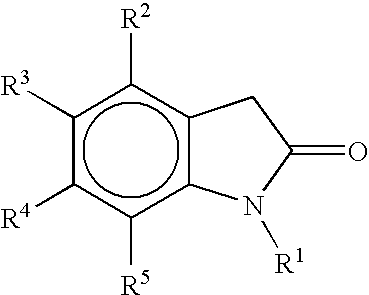
wherein, R1 is selected from among H, C1 to C6 alkyl, substituted C1 to C6 alkyl, C2 to C6 alkenyl, substituted C2 to C6 alkenyl, C2 to C6 alkynyl, substituted C2 to C6 alkynyl, C3 to C8 cycloalkyl, substituted C3 to C8 cycloalkyl, aryl, substituted aryl, heterocycle, substituted heterocycle, heteroaryl, and substituted heteroaryl; R2, R3, R4, and R5 are independently selected from among hydrogen, halogen, C1 to C6 alkyl, substituted C1 to C6 alkyl, C3 to C8 cycloalkyl, substituted C3 to C8 cycloalkyl, aryl, substituted aryl, heterocycle, substituted heterocycle, heteroaryl, substituted heteroaryl, OR6, N(R7)2, CON(R7)2, SO2N(R7)2, and COOH; or R2 and R3; R3 and R4; R4 and R5; or R5 and R1 are fused to form (i) a 3 to 9 membered carbon-based saturated or unsaturated ring; or (ii) a 3 to 9 membered heterocyclic ring containing in its backbone one to three heteroatoms selected from among O, S and N; wherein rings (i)-(ii) are optionally substituted by 1 to 3 groups selected from among C1 to C6 alkyl, substituted C1, to C6 alkyl, halogen, C1 to C6 alkoxy, substituted C1, to C6 alkoxy, and N(R8)2; R6 is selected from between C1 to C6 alkyl or substituted C1 to C6 alkyl; R7 is selected from among H, C1, to C6 alkyl, substituted C1 to C6 alkyl, and CF3; and R8 is selected from among C1, to C6 alkyl, C1, to C6 substituted alkyl, C1, to C6 alkoxy, and substituted C1, to C6 alkoxy.

wherein, R1 to R5 are defined above. In one embodiment, the isatin is 7-fluoroisatin.

wherein, R1 to R5 are defined above. In one embodiment, an impurity of the following structure is formed:


wherein, R1 to R5 are defined above, R9 is C1 to C6 alkyl or C1 to C6 substituted alkyl; and R10 is H, C1 to C6 alkyl, C1 to C6 substituted alkyl, or CF3.


wherein, R1 is selected from among H, C1 to C6 alkyl, substituted C1 to C6 alkyl, C2 to C6 alkenyl, substituted C2 to C6 alkenyl, C2 to C6 alkynyl, substituted C2 to C6 alkynyl, C3 to C8 cycloalkyl, substituted C3 to C8 cycloalkyl, aryl, substituted aryl, heterocycle, substituted heterocycle, heteroaryl, and substituted heteroaryl; R2, R3, R4, and R5 are independently selected from among H, halogen, C1, to C6 alkyl, C1, to C6 substituted alkyl, C3 to C8 cycloalkyl, substituted C3 to C8 cycloalkyl, aryl, substituted aryl, heterocycle, substituted heterocycle, heteroaryl, substituted heteroaryl, OR6, N(R7)2, CON(R7)2, SO2N(R7)2, and COOH; or R2 and R3; R3 and R4; R4 and R5; or R5 and R1 are fused to form (i) a 3 to 9 membered carbon-based saturated or unsaturated ring; or (ii) a 3 to 9 membered heterocyclic ring containing in its backbone one to three heteroatoms selected from the group consisting of O, S and N; wherein rings (i)-(ii) are optionally substituted by 1 to 3 groups selected from among C1 to C6 alkyl, substituted C1, to C6 alkyl, halogen, C1, to C6 alkoxy, substituted C1, to C6 alkoxy, and N(R8)2; R6 is selected from between C1, to C6 alkyl and C1, to C6 substituted alkyl; R7 is selected from among H, C1, to C6 alkyl, C1, to C6 substituted alkyl, and CF3; and R8 is selected from among C1 to C6 alkyl, C1 to C6 substituted alkyl, C1 to C6 alkoxy, and substituted C1 to C6 alkoxy; (b) reacting the solution of step (a) with about 2 equivalents of aqueous hydrazine; and (c) isolating the 2-oxindole of the structure:

wherein, R1 to R5 are defined above.

wherein R1-R5 are as defined above; (b) reacting the solution of step (a) with about 2 equivalents of aqueous hydrazine to form a 2-oxindole of the structure:

(c) alkylating the 2-oxindole with an alkyl halide in the presence of a copper halide or a copper halide adduct to form an alkylated 2-oxindole of the structure:

wherein, R9 is C1 to C6 alkyl or C1 to C6 substituted alkyl; and R10 is H, C1 to C6 alkyl, C1 to C6 substituted alkyl, or CF3; (d) brominating the alkylated 2-oxindole; (e) coupling the brominated 2-oxindole with an aryl compound in the presence of a palladium catalyst; and (f) reducing the content of palladium or palladium compounds in the product of step (e) using N-acetyl-L-cysteine.

wherein R1-R5 are as defined above; or a pharmaceutically acceptable salt, tautomer, metabolite or prodrug thereof. The process includes reacting an inorganic acid and a compound of the following structure:

or a pharmaceutically acceptable salt, tautomer, metabolite or prodrug thereof.


-
- A is CH, CH2, CR10, or C(R10)2 or N, with the proviso that when A is N, the bond attached thereto is unsaturated;
- R9 is attached at any position on the ring and is aryl, substituted aryl, heterocycle, substituted heterocycle, heteroaryl, substituted heteroaryl, alkyl, or substituted alkyl, with the proviso that R9 is not attached to the C-atom adjacent to the carbonyl;
- R10 is aryl, substituted aryl, heterocycle, substituted heterocycle, heteroaryl, substituted heteroaryl, alkyl, or substituted alkyl; R10 may be bound to an A;
- R9 or R10 is an optionally substituted unsaturated or saturated ring fused to the -A-A-A-A-moiety, with the proviso that R9, R10, and the ring substituents are not alkylated; and
- m, n, and q are, independently, 1 to 5.
Claims (34)


Priority Applications (1)
| Application Number | Priority Date | Filing Date | Title |
|---|---|---|---|
| US11/494,425 US7754895B2 (en) | 2005-07-29 | 2006-07-27 | Process for the synthesis of progesterone receptor modulators |
Applications Claiming Priority (2)
| Application Number | Priority Date | Filing Date | Title |
|---|---|---|---|
| US70401005P | 2005-07-29 | 2005-07-29 | |
| US11/494,425 US7754895B2 (en) | 2005-07-29 | 2006-07-27 | Process for the synthesis of progesterone receptor modulators |
Publications (2)
| Publication Number | Publication Date |
|---|---|
| US20070027327A1 US20070027327A1 (en) | 2007-02-01 |
| US7754895B2 true US7754895B2 (en) | 2010-07-13 |
Family
ID=37430943
Family Applications (1)
| Application Number | Title | Priority Date | Filing Date |
|---|---|---|---|
| US11/494,425 Expired - Fee Related US7754895B2 (en) | 2005-07-29 | 2006-07-27 | Process for the synthesis of progesterone receptor modulators |
Country Status (6)
| Country | Link |
|---|---|
| US (1) | US7754895B2 (en) |
| AR (1) | AR054876A1 (en) |
| GT (1) | GT200600334A (en) |
| PE (1) | PE20070220A1 (en) |
| TW (1) | TW200740771A (en) |
| WO (1) | WO2007016355A2 (en) |
Cited By (1)
| Publication number | Priority date | Publication date | Assignee | Title |
|---|---|---|---|---|
| US20110178311A1 (en) * | 2006-03-07 | 2011-07-21 | Wyeth Llc | Purification of Progesterone Receptor Modulators |
Families Citing this family (8)
| Publication number | Priority date | Publication date | Assignee | Title |
|---|---|---|---|---|
| US20080051585A1 (en) * | 2006-08-17 | 2008-02-28 | Wyeth | Process for the preparation of indolin-2-one derivatives useful as PR modulators |
| US20080319204A1 (en) * | 2007-06-25 | 2008-12-25 | Wyeth | Process for the synthesis of progesterone receptor modulators |
| US8013203B2 (en) * | 2007-07-23 | 2011-09-06 | The Board Of Trustees Of The University Of Illinois | System for controlling the reactivity of boronic acids |
| JP5654572B2 (en) | 2009-05-15 | 2015-01-14 | ノバルティス アーゲー | Benzoxazolone derivatives as aldosterone synthase inhibitors |
| EP2430011A1 (en) | 2009-05-15 | 2012-03-21 | Novartis AG | 5-pyridin-3-yl-1,3-dihydro-indol-2-on derivatives and their use as modulators of aldosterone synthase and/or cyp11b1 |
| KR20120100709A (en) | 2010-01-15 | 2012-09-12 | 이데미쓰 고산 가부시키가이샤 | Organic electroluminescent element |
| US8557980B2 (en) | 2010-02-18 | 2013-10-15 | The Board Of Trustees Of The University Of Illinois | Methods for forming protected organoboronic acids |
| CN110003077B (en) * | 2018-01-04 | 2022-03-15 | 南京农业大学 | A kind of butyryl hydrazide compound containing pyrrolidinedione and aniline group, preparation method and application |
Citations (12)
| Publication number | Priority date | Publication date | Assignee | Title |
|---|---|---|---|---|
| US5973165A (en) | 1999-03-17 | 1999-10-26 | Sinon Corporation | Process for preparing 2-oxindole |
| JP2000239253A (en) | 1999-01-16 | 2000-09-05 | Xingnong Co Ltd | Production of 2-oxyindole |
| WO2001047884A1 (en) | 1999-12-27 | 2001-07-05 | Dsm Fine Chemicals Austria Nfg Gmbh & Cokg | Method for producing oxindoles |
| US20040186160A1 (en) | 2002-12-13 | 2004-09-23 | Sugen, Inc. | Hexahydro-cyclohepta-pyrrole oxindole as potent kinase inhibitors |
| US20050239779A1 (en) | 2004-04-27 | 2005-10-27 | Wyeth | Cyanopyrrole-containing cyclic carbamate and thiocarbamate biaryls and methods for preparing the same |
| US20050250766A1 (en) | 2004-04-27 | 2005-11-10 | Wyeth | Purification of progesterone receptor modulators |
| US20050272702A1 (en) | 2004-04-27 | 2005-12-08 | Wyeth | Coupling process for generating reactive boron-containing derivatives of N-substituted pyrrole-2-carbonitriles to produce biaryls |
| US20060030717A1 (en) | 2004-08-09 | 2006-02-09 | Wyeth | Progesterone receptor modulators comprising pyrrole-oxindole derivatives and uses thereof |
| US20060030615A1 (en) | 2004-08-09 | 2006-02-09 | Wyeth | Progesterone receptor modulators comprising pyrrole-oxindole derivatives and uses thereof |
| US20060142355A1 (en) * | 2004-10-12 | 2006-06-29 | Decode Chemistry, Inc. | Carboxylic acid peri-substituted bicyclics for occlusive artery disease |
| US20060247441A1 (en) | 2005-04-29 | 2006-11-02 | Wyeth | Process for preparing 3,3-disubstituted oxindoles and thio-oxindoles |
| US20060247442A1 (en) | 2005-04-29 | 2006-11-02 | Wyeth | Process for preparing isatins with control of side-product formation |
-
2006
- 2006-07-26 PE PE2006000913A patent/PE20070220A1/en not_active Application Discontinuation
- 2006-07-27 GT GT200600334A patent/GT200600334A/en unknown
- 2006-07-27 US US11/494,425 patent/US7754895B2/en not_active Expired - Fee Related
- 2006-07-27 WO PCT/US2006/029446 patent/WO2007016355A2/en not_active Ceased
- 2006-07-27 AR ARP060103255A patent/AR054876A1/en not_active Application Discontinuation
- 2006-07-27 TW TW095127522A patent/TW200740771A/en unknown
Patent Citations (12)
| Publication number | Priority date | Publication date | Assignee | Title |
|---|---|---|---|---|
| JP2000239253A (en) | 1999-01-16 | 2000-09-05 | Xingnong Co Ltd | Production of 2-oxyindole |
| US5973165A (en) | 1999-03-17 | 1999-10-26 | Sinon Corporation | Process for preparing 2-oxindole |
| WO2001047884A1 (en) | 1999-12-27 | 2001-07-05 | Dsm Fine Chemicals Austria Nfg Gmbh & Cokg | Method for producing oxindoles |
| US20040186160A1 (en) | 2002-12-13 | 2004-09-23 | Sugen, Inc. | Hexahydro-cyclohepta-pyrrole oxindole as potent kinase inhibitors |
| US20050239779A1 (en) | 2004-04-27 | 2005-10-27 | Wyeth | Cyanopyrrole-containing cyclic carbamate and thiocarbamate biaryls and methods for preparing the same |
| US20050250766A1 (en) | 2004-04-27 | 2005-11-10 | Wyeth | Purification of progesterone receptor modulators |
| US20050272702A1 (en) | 2004-04-27 | 2005-12-08 | Wyeth | Coupling process for generating reactive boron-containing derivatives of N-substituted pyrrole-2-carbonitriles to produce biaryls |
| US20060030717A1 (en) | 2004-08-09 | 2006-02-09 | Wyeth | Progesterone receptor modulators comprising pyrrole-oxindole derivatives and uses thereof |
| US20060030615A1 (en) | 2004-08-09 | 2006-02-09 | Wyeth | Progesterone receptor modulators comprising pyrrole-oxindole derivatives and uses thereof |
| US20060142355A1 (en) * | 2004-10-12 | 2006-06-29 | Decode Chemistry, Inc. | Carboxylic acid peri-substituted bicyclics for occlusive artery disease |
| US20060247441A1 (en) | 2005-04-29 | 2006-11-02 | Wyeth | Process for preparing 3,3-disubstituted oxindoles and thio-oxindoles |
| US20060247442A1 (en) | 2005-04-29 | 2006-11-02 | Wyeth | Process for preparing isatins with control of side-product formation |
Non-Patent Citations (17)
| Title |
|---|
| Adams, J., et al., Mapping the Kinase Domain of Janus Kinase 3, Bioorganic & Medicinal Chemistry Letters, 2003, pp. 3105-3110, vol. 13. |
| Beyersbergen Van Henegouwen, W., et al., First Total Synthesis of ent-Gelsedine via a Novel Iodide-Promoted Allen N-Acyliminium Ion Cyclization, J. Org. Chem., Oct. 27, 2000, pp. 8317-8325, vol. 65(24). |
| Crestini, C., et al., A New Efficient and Mild Synthesis of 2-Oxindoles by One-Pot Wolff-Kishner Like Reduction of Isatin Derivatives, Synthetic Communications, 1994, pp. 2835-2841, vol. 24(20). |
| Ettmayer, Peter, Medicinal Chemistry, Lessons Learned from Marketed and Investigational Prodrugs, 47(10) (2004) 2394-2404. * |
| Fensome et al., "New progesterone receptor antagonists: 3,3-disubstituted-5-aryloxindoles", Bioorg. Med. Chem. Lett., 12:3487-3490 (Dec. 2, 2002). |
| Kwon, Younggil. Handbook of Essential Pharmacokinetics, Pharmacodynamics and Drug Metabolism for Industrial Scientists. Jun. 24, 2001. p. 213, paragraph 3. * |
| Moody, C., et al., Dirhodium(II) tetraacetate catalyzed reactions of diazo thioamides: isolation and cycloaddition of anhydro-4-hydroxy-1,3-thiazolium hydroxides . . . , Org. Biomol. Chem., Jul. 9, 2003, pp. 2716-2722, vol. 1. |
| Quintana, R., et al., Monomolecular films of compounds with potential dermophilic and prophylactic properties. Esters of dihydroxyacetone, Canadian Journal of Chemistry, 1969, pp. 853-856, vol. 47. |
| Robertson, D., et al., Dihydropyridazinone Cardiotonics: The Discovery and Inotropic Activity of 1,3-Dihydro-3,3-dimethy1-5-(1,4,5,6-tetrahydro-6-oxo-3-pyridazinyl)-2H-indol-2-one, J. Med. Chem., 1986, pp. 1832-1840, vol. 29. |
| Soledade et al., "Concise synthesis of the cruciferous phytoalexins brassilexin, sinalexin, wasalexins and analogues: expanding the scope of the Vilsmeier formulation", J. Org. Chem., 70:1828-1834 (Feb. 2, 2005). |
| Soriano, D., et al., Example of the Wolff-Kishner Reduction Procedure Suitable for an Undergraduate Organic Lab Experiment, J. Chem. Edu., 1993, p. 332, vol. 70(4). |
| Stella, Valentino J, Expert Opinion of Therapeutic Patents, Prodrugs as therapeutics, 2004 14(3): 277-280. * |
| Testa, Bernard, Biochemical Pharmacology, Prodrug Research: futile or fertile? 68 (2004) 2097-2106. * |
| Wenkert, E., et al., Raney Nickel-induced Alkylation Reactions, Acta Chemica Scandinavia, Series B: Organic Chemistry and Biochemistry, 1982, pp. 348-350, v. B36(5). |
| Wilk et al., "A practical large-scale preparation of 5′-bromospiro(cyclohexane-1,3′-[3H]indol-2′-(1′H)-one", Org. Prep. Proced. Int., 37(3):283-285 (Jun. 2005). |
| Wilk et al., "A practical large-scale preparation of 5'-bromospiro(cyclohexane-1,3'-[3H]indol-2'-(1'H)-one", Org. Prep. Proced. Int., 37(3):283-285 (Jun. 2005). |
| Wolff et al. (Burger's Medicinal Chemistry, 5th Ed., vol. 1, pp. 975-977, 1994). * |
Cited By (1)
| Publication number | Priority date | Publication date | Assignee | Title |
|---|---|---|---|---|
| US20110178311A1 (en) * | 2006-03-07 | 2011-07-21 | Wyeth Llc | Purification of Progesterone Receptor Modulators |
Also Published As
| Publication number | Publication date |
|---|---|
| US20070027327A1 (en) | 2007-02-01 |
| PE20070220A1 (en) | 2007-03-19 |
| WO2007016355A3 (en) | 2007-06-28 |
| TW200740771A (en) | 2007-11-01 |
| WO2007016355A2 (en) | 2007-02-08 |
| AR054876A1 (en) | 2007-07-25 |
| GT200600334A (en) | 2007-03-14 |
Similar Documents
| Publication | Publication Date | Title |
|---|---|---|
| JP5680469B2 (en) | Synthesis of amines and intermediates for their synthesis | |
| JP4634560B2 (en) | Process for producing optically active indoline derivative and production intermediate thereof | |
| US8129523B2 (en) | Coupling process for generating reactive boron-containing derivatives of N-substituted pyrrole-2-carbonitriles to produce biaryls | |
| JP2012020997A (en) | Method for producing 3-alkanoylindole and 3-alkylindole | |
| EP0610134A1 (en) | Indole, indazole and benzisoxazole derivatives as 5-HT1-like agonists | |
| JP2012184243A (en) | Process for preparing 2,3-disubstituted indoles | |
| US20070027327A1 (en) | Process for the synthesis of progesterone receptor modulators | |
| Chen et al. | A highly diastereoselective Friedel–Crafts reaction of indoles with isatin-derived N-sulfinyl ketimines towards the efficient synthesis of chiral tetrasubstituted 3-indolyl-3-aminooxindoles | |
| Halland et al. | A general and mild domino approach to substituted 1-aminoindoles | |
| JP5607805B2 (en) | Optically active cyclic alcohol compound and process for producing the same | |
| US5919946A (en) | Synthesis of indolylmaleimides | |
| CS220310B2 (en) | Method of preparing 5-aroyl-1-alkylpyrrol-2-acetic acid derivatives | |
| US5859261A (en) | Synthesis of indolylmaleimides | |
| US6326501B1 (en) | Methylation of indole compounds using dimethyl carbonate | |
| US20080319204A1 (en) | Process for the synthesis of progesterone receptor modulators | |
| JP6148351B2 (en) | Asymmetric synthesis of substituted pyrrolidine-2-carboxamides | |
| CN101102999A (en) | Process for preparing substituted indoles | |
| CA2322346C (en) | Process for the preparation of 3-acyl-indoles | |
| CN102775391B (en) | Method for preparing migraine resistant medicine Almotriptan | |
| JPS6159305B2 (en) | ||
| JP2004285025A (en) | Method for producing 3- (substituted methyl) indole derivative | |
| KR20220143094A (en) | Method for preparing chiral benzodiazepinone derivatives | |
| JP2008001611A (en) | Method for producing 3r-aminopyrrolidine derivative | |
| JP2001328993A (en) | Optically active phosphine compound |
Legal Events
| Date | Code | Title | Description |
|---|---|---|---|
| AS | Assignment |
Owner name: WYETH, NEW JERSEY Free format text: ASSIGNMENT OF ASSIGNORS INTEREST;ASSIGNORS:WU, YANZHONG;WILK, BOGDAN KAZIMIERZ;SHI, XINXU;AND OTHERS;SIGNING DATES FROM 20050920 TO 20060821;REEL/FRAME:018357/0766 Owner name: WYETH, NEW JERSEY Free format text: ASSIGNMENT OF ASSIGNORS INTEREST;ASSIGNORS:WU, YANZHONG;WILK, BOGDAN KAZIMIERZ;SHI, XINXU;AND OTHERS;REEL/FRAME:018357/0766;SIGNING DATES FROM 20050920 TO 20060821 |
|
| AS | Assignment |
Owner name: WYETH LLC,NEW JERSEY Free format text: CHANGE OF NAME;ASSIGNOR:WYETH;REEL/FRAME:024335/0190 Effective date: 20091109 Owner name: WYETH LLC, NEW JERSEY Free format text: CHANGE OF NAME;ASSIGNOR:WYETH;REEL/FRAME:024335/0190 Effective date: 20091109 |
|
| REMI | Maintenance fee reminder mailed | ||
| LAPS | Lapse for failure to pay maintenance fees | ||
| STCH | Information on status: patent discontinuation |
Free format text: PATENT EXPIRED DUE TO NONPAYMENT OF MAINTENANCE FEES UNDER 37 CFR 1.362 |
|
| STCH | Information on status: patent discontinuation |
Free format text: PATENT EXPIRED DUE TO NONPAYMENT OF MAINTENANCE FEES UNDER 37 CFR 1.362 |
|
| FP | Lapsed due to failure to pay maintenance fee |
Effective date: 20140713 |