US7752149B2 - Method and apparatus for determining the variable dependency - Google Patents
Method and apparatus for determining the variable dependency Download PDFInfo
- Publication number
- US7752149B2 US7752149B2 US12/244,111 US24411108A US7752149B2 US 7752149 B2 US7752149 B2 US 7752149B2 US 24411108 A US24411108 A US 24411108A US 7752149 B2 US7752149 B2 US 7752149B2
- Authority
- US
- United States
- Prior art keywords
- variable
- dependency
- variables
- probability
- optimal
- Prior art date
- Legal status (The legal status is an assumption and is not a legal conclusion. Google has not performed a legal analysis and makes no representation as to the accuracy of the status listed.)
- Expired - Fee Related, expires
Links
Images



Classifications
-
- G—PHYSICS
- G06—COMPUTING OR CALCULATING; COUNTING
- G06N—COMPUTING ARRANGEMENTS BASED ON SPECIFIC COMPUTATIONAL MODELS
- G06N7/00—Computing arrangements based on specific mathematical models
- G06N7/01—Probabilistic graphical models, e.g. probabilistic networks
-
- G—PHYSICS
- G06—COMPUTING OR CALCULATING; COUNTING
- G06F—ELECTRIC DIGITAL DATA PROCESSING
- G06F18/00—Pattern recognition
- G06F18/20—Analysing
- G06F18/24—Classification techniques
- G06F18/24765—Rule-based classification
-
- G—PHYSICS
- G06—COMPUTING OR CALCULATING; COUNTING
- G06F—ELECTRIC DIGITAL DATA PROCESSING
- G06F18/00—Pattern recognition
- G06F18/20—Analysing
- G06F18/29—Graphical models, e.g. Bayesian networks
-
- H—ELECTRICITY
- H04—ELECTRIC COMMUNICATION TECHNIQUE
- H04M—TELEPHONIC COMMUNICATION
- H04M3/00—Automatic or semi-automatic exchanges
- H04M3/42—Systems providing special services or facilities to subscribers
- H04M3/42017—Customized ring-back tones
Definitions
- the present invention relates to the technical field of data processing, in particular, to a method and an apparatus for determining variable dependency.
- the discovery and analysis of rules in data have been widely used in computer vision, speech recognition, biological computing, risk analysis, therapeutic treatment solution finding, forecasting, information retrieval, and intelligent systems, so as to carry discovery, decision optimization, and forecasting regularly.
- the Probabilistic Graphical Model is one of the most important and widely used models to discover dependency among multiple variables, and it is also referred to as Bayesian Network, Belief Network, or Probabilistic Independence Network.
- a Bayesian Network is a Directed Acyclic Graph (DAG), in which the nodes represent the variables in the domain, and the edges represent direct conditional probabilities between variables.
- FIG. 1 is a schematic diagram of a Bayesian Network, where the nodes X 1 , X 2 , X 3 , X 4 and X 5 represent 5 variables, and an edge exists between variable X 1 and X 2 , between X 1 and X 3 , and between X 2 and X 4 .
- the parent-child relationship between the nodes can be determined with the direction of the edge; for example, if the edge points from X i to X j , then X i is referred to as the parent of X j , and X j is referred to as a child of X i ; it can be seen that X 1 is the parent of X 2 , and X 2 is a child of X 1 .
- X i is referred to as an ancestor of X j
- X j is referred to as a descendent of X i ; it can be seen that a path exists from X 1 to X 5 , and therefore X 1 is an ancestor of X 5 , and X 5 is a descendent of X 1 .
- P(X 1 , . . . , X n ) is the joint probability in Bayesian Network B
- X 1 , . . . , Xn are n nodes in Bayesian Network B
- PaB(X i ) is the parent set of node X i in Bayesian Network B.
- a Bayesian Network that represents variable dependency can be constructed with the records of variables mainly through two steps: producing Bayesian Networks, and selecting a Bayesian Network or discovering the feature.
- Producing Bayesian Networks is a mechanism that produces Bayesian Networks with the records of existing variables; selecting a Bayesian Network is to select the optimal Bayesian Network or an equivalent class of the optimal Bayesian Network as the Bayesian Network to be used finally from the produced Bayesian Networks; discovering the feature is to find out the community or feature among the produced Bayesian Networks, according to certain criteria.
- a feature discovery is usually used in the cases in which the records of variables are not enough; in such cases, usually multiple different Bayesian Networks have higher joint probabilities and it is not unreasonable to select one of the Bayesian Networks to describe the dependency among the variables; instead, the dependency among the variables should be described with the community or feature among the Bayesian Networks that have higher joint probabilities, i.e.:
- D) represents the result-feature probability of all Bayesian Networks that are produced
- D) represents the conditional probability of B to D
- D represents the records of variables
- B represents the Bayesian Networks that are produced
- f represents the feature, such as a specific edge, a specified path, or Markov Blanket feature, etc.
- f represents the feature, such as a specific edge, a specified path, or Markov Blanket feature, etc.
- FIG. 2 is a flow diagram of producing a Bayesian Network in the prior art. As shown in FIG. 2 , the steps are as follows:
- Step 201 The records of the variables are obtained.
- Step 202 Supposing that each variable maps to a node in the Bayesian Network, a sequential relationship for the nodes is arbitrarily determined.
- nodes before the node are referred to as preceding nodes, for example, in Bayesian Network A, because node X 5 points to node X 2 and node X 2 points to node X 3 , nodes X 5 and X 2 are preceding nodes for node X 3 .
- Step 203 The parent set with higher probabilities is selected for each node, in accordance with the determined node sequence and the records of the variables.
- the parent set of the first node can be set to a null set ⁇ .
- the parent set can be selected for the second node and subsequent nodes in the node sequence.
- the probabilities that the node takes its preceding nodes and null set as its first parent node are calculated, and the preceding node or null set corresponding to the highest probability is selected as the first parent node of the node.
- the first parent node is null set, it indicates the parent set of the node is a null set, and therefore it is unnecessary to perform the subsequent steps.
- the probabilities that the node takes its preceding nodes as its second parent node are calculated, the probabilities that are higher than the probability that the node gives the first parent node are selected from the calculated probabilities, and the preceding node corresponding to the highest probability among the selected probabilities is taken as the second parent node of the node.
- the probabilities that the node takes its preceding nodes as its third parent node are calculated, the probabilities that are higher than the probabilities that the node gives the selected first and second parent nodes are selected from the probabilities obtained in calculation, and the preceding node corresponding to the highest probability among the selected probabilities is taken as the third parent node of the node.
- the node If all the probabilities obtained in the calculation are lower than the probabilities that the node gives the selected first and second parent nodes, it indicates the parent set of the node only contains two parent nodes, i.e. the first parent node selected in step A and the second parent node selected in step B; in that case, it is unnecessary to perform the subsequent steps.
- Subsequent parent nodes for the node are selected in the same way.
- the parent set of node X 1 can be selected as follows:
- Step 1 The first parent node is added for node X 1 , i.e. preceding node X 2 or X 4 , or a null set.
- Step 2 The probability that node X 1 takes node X 2 as its parent node, the probability that node X 1 takes node X 4 as its parent node, and the probability that node X 1 takes null set as its parent node are calculated, and the node with the highest probability is taken as the first parent node of node X 1 .
- node X 4 is selected as the first parent node of node X 1 .
- Step 3 The second parent node is added for node X 1 , i.e. the preceding node X 2 .
- Step 4 The probabilities that node X 1 takes node X 4 and node X 2 as its parent nodes are calculated.
- Step 204 A Bayesian Network is constructed in accordance with the parent sets selected for the variables.
- Step 205 It is judged whether the criterion for stopping the loop is met now; if the criteria are met, Step 207 is performed; otherwise, Step 206 is performed.
- the criterion for stopping the loop can be: the Bayesian Network has been established for a duration longer than the predefined duration, or the joint probability of the current Bayesian Network is equal to the predefined joint probability, or the result-feature probability of the current Bayesian Network is lower than the predefined result-feature probability, etc.
- Step 206 The weights of the edges in all of the retained Bayesian Networks are determined, and thereby the new node sequence is determined, and then the process returns to Step 203 .
- Step 207 The conditional probability distribution of the node in the retained Bayesian Networks is determined, i.e. the probabilities that the node gives the current preceding nodes of the node are calculated.
- the method described above has a drawback, i.e. it is very difficult to produce the optimal Bayesian Network that is based on the node sequence, because: if the produced Bayesian Network contains wrong edge information, the resulting new node sequence tends to be misled by the wrong edge information, and thereby it will take much longer time to find the globally optimal Bayesian Network.
- the present invention provides a method and an apparatus for determining variable dependency, so as to accelerate the process of finding the globally optimal variable dependency.
- a method for determining variable dependency includes:
- Step C judging whether a criterion for stopping a loop is met; if the criterion is met, determining an optimal variable dependency from all variable dependencies stored; otherwise, returning to Step A to re-select partial variables.
- An apparatus for establishing variable dependency includes:
- a superior variable set determining module configured to re-select a superior variable set for each of partial variables with the variable records from external input and a current variable dependency, and output a mapping relationship between each of the partial variables and the selected superior variable set;
- variable dependency establishing module configured to determine an initial variable dependency, update a current variable dependency stored locally in accordance with the mapping relationship between each variable and the superior variable set selected for the variable that is sent from the superior variable set determining module, and then output the updated variable dependency;
- variable dependency judging module configured to judge whether to accept the variable dependency that is sent from the variable dependency establishing module; if the variable dependency is acceptable and no termination instruction is received, output the variable dependency to the superior variable set determining module, the variable dependency establishing module, and an optimal variable dependency determining module; if the variable dependency is acceptable and a termination instruction is received, output the variable dependency only to an optimal variable dependency determining module;
- a termination judging module configured to judge whether the termination criterion is met; if the termination criterion is met, send a termination instruction to the variable dependency judging module and the optimal variable dependency determining module;
- the optimal variable dependency determining module configured to determine an optimal variable dependency from all of the variable dependencies that from the variable dependency judging module, after a termination instruction is received from the termination judging module.
- variable dependency is determined in advance arbitrarily; partial variables are selected from the new variable dependency, and legitimate superior variable sets are re-selected for each of the partial variables, and the new variable dependency is retained only if it meets the criterion of acceptance; when the termination criterion for establishing variable dependency is met, the optimal variable dependency is determined from all variable dependencies. Because the existing variable dependency is not taken as a reference when the new variable dependency is created, the new variable dependency is not misled by the existing variable dependency, and the time for finding the globally optimal variable dependency can be shortened.
- FIG. 1 is a schematic diagram of a Bayesian Network
- FIG. 2 is a flow diagram of establishing a Bayesian Network in the prior art
- FIG. 3 is a flow diagram of the method for establishing variable dependency provided in the present invention.
- FIG. 4 is a flow diagram of embodiment 1 of the method for establishing a Bayesian Network in the present invention.
- FIG. 5 is a flow diagram of embodiment 2 of the method for establishing a Bayesian Network in the present invention.
- FIG. 6 is a schematic diagram of the Bayesian Network in the method for establishing a Bayesian Network in the present invention.
- FIG. 7 is a schematic diagram of the apparatus for establishing a Bayesian Network in the present invention.
- FIG. 8 is a flow diagram of determining the type of the new variable data input with a Bayesian Network in the present invention.
- FIG. 9 is a schematic diagram of the Bayesian Network for non-spam emails in an embodiment of determining the type of the new variable data input with a Bayesian Network in the present invention.
- FIG. 10 is a schematic diagram of the Bayesian Network for spam emails in an embodiment of determining the type of the new variable data input with a Bayesian Network in the present invention
- FIG. 11 is a schematic diagram of the apparatus for determining the type of the new variable data input with a Bayesian Network in the present invention.
- FIG. 12 is a flow diagram of determining whether the new variable data input is normal with a Bayesian Network in the present invention.
- FIG. 13 is a schematic diagram of the Bayesian Network for gene expression data in an embodiment of determining whether the new variable data input is normal with a Bayesian Network in the present invention
- FIG. 14 is a schematic diagram of the apparatus for determining whether the new variable data input is normal with a Bayesian Network in the present invention
- FIG. 15 is a flow diagram of determining whether the new variable data input pertains to a specific type with a Bayesian Network in the present invention
- FIG. 16 is a schematic diagram of the apparatus for determining whether the new variable data input pertains to a specific type with a Bayesian Network in the present invention
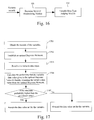
- FIG. 17 is a flow diagram of forecasting the values of variables that are not inputted with a Bayesian Network and the data input of partial variables in the present invention.
- FIG. 18 is a schematic diagram of the Bayesian Network of user services in the method for forecasting the values of variables that are not inputted with a Bayesian Network and the data input of partial variables in the present invention.
- FIG. 19 is a schematic diagram of the apparatus for forecasting the values of variables that are not inputted with a Bayesian Network in the present invention.
- variables mentioned in the present invention refer to events or objects, attributes of events, or attributes of objects under certain conditions, such as multiple features of a specific event abstracted from a specific environment within a specific time range.
- the embodiment provided in the present invention is to: first, preliminarily determine a variable dependency among all variables preliminarily, select a variable subset from the current variable dependency, and then re-select a parent variable set for each of the variables in the subset with an importance sampling method or the highest probability selection method, and thereby produce new variable dependencies.
- FIG. 3 is a flow diagram of the method for determining variable dependency provided in the present invention. As shown in FIG. 3 , the steps are as follows:
- Step 301 The records of the variables are obtained, and the parent-child relationship among the variables arbitrarily is determined, and thereby a variable dependency preliminarily is preliminarily determined.
- Step 302 Partial variables are selected from the variables, the parent variables of the partial variables deleted from the current variable dependency, and a sequence of the partial variables arbitrarily is determined.
- the partial variables can be selected arbitrarily or selected under predefined rules; the number of the partial variables can be one or more than one.
- Step 303 Legitimate parent variable sets are selected for each of the partial variables, in the determined sequence of the partial variables.
- Step 304 It is judged whether the current variable dependency is acceptable; if the current variable dependency is acceptable, Step 305 is performed; otherwise, Step 306 is performed.
- Step 305 The variable dependency is retained and taken as the current variable dependency, and then the process goes to Step 307 .
- Step 306 The variable dependency is discarded, and the last variable dependency is taken as the current variable dependency.
- Step 307 It is judged whether the criterion for stopping the loop is met; if the criterion is met, the optimal variable dependency is determined in accordance with the retained variable dependencies; otherwise, the process returns to Step 302 .
- the result-feature probabilities of the retained variable dependencies can be calculated, and then the optimal variable dependency can be determined in accordance with the result-feature probabilities; or, the joint probability of the retained variable dependencies can be calculated, and the variable dependency with the highest joint probability can be determined as the optimal variable dependency.
- the number of the optimal variable dependency can be one or more than one.
- variable dependency can be represented with a Bayesian Network
- process of determining the variable dependency includes a process of establishing the variable dependency and a process of applying the variable dependency.
- present invention will be further detailed in an example of establishing and applying a Bayesian Network.
- FIG. 4 is a flow diagram of embodiment 1 of the method for establishing a Bayesian Network in the present invention; as shown in FIG. 4 , the steps are as follows:
- Step 401 The records of the variables are obtained.
- Step 402 Each variable is set to correspond to a node, the parent-child relationship among the nodes arbitrarily is determined, and then a Bayesian Network B 0 preliminarily is preliminarily constructed in accordance with the parent-child relationship among the nodes arbitrarily.
- Step 403 A node set A is selected in the current Bayesian Network B i (i is an integer and i ⁇ 0) arbitrarily, and the parent nodes in node sets A from B are deleted, to thereby obtain a Bayesian Network B ic .
- Step 404 A sequence is determined for the nodes in node set A arbitrarily.
- Step 405 Legitimate parent sets are selected for each node in node set A.
- a legitimate parent set is a node set, which, when added to the Bayesian Network B ic , makes the Bayesian Network B ic form a Directed Acyclic Graph (DAG).
- a legitimate parent set can be a null set.
- Step 406 The probabilities that each node in node set A gives the legitimate parent sets selected for the node are calculated from the records of the variables corresponding to the nodes.
- X i is the current node
- Pa(X i ) j is the j th parent set selected for current node X i (j is an integer and 1 ⁇ j ⁇ M)
- P(Pa(X i ) j ) is the probability that the current node X gives the parent set Pa(X i ) j
- f(x) is a monotone increasing function in the first quadrant
- x Pa(X i ) j or Pa(X i ) k
- M is the total number of parent sets selected for the current node X i in step 405
- k is an integer.
- P(Pa(X i ) j ) can also be represented with the following expression:
- Pa(X i ) j ) is the conditional probability of node X i to node Pa(X i ) j
- Pa(X i ) k ) is the conditional probability of node X i to node Pa(X i ) k
- T is a rational number; or:
- Step 407 The parent set is selected for each node with an importance sampling method, in accordance with the probabilities that the nodes gives the legitimate parent sets selected for the nodes.
- the importance sampling method is to: perform sampling randomly, but focus on sampling points with higher probabilities.
- the exact parent set of the node can be determined by producing a random number and then determining in accordance with the range of the random number.
- Step 408 The parent sets determined for the nodes in node set A are added into the original Bayesian Network B ic , to obtain Bayesian Network B it .
- Step 409 It is judged whether the obtained Bayesian Network B it meets the criterion of acceptance; if the Bayesian Network meets the criterion of acceptance, Step 410 is performed; otherwise, Step 411 is performed.
- Method 1 the Metropolis-hasting method based on Markov Chain Monte Carlo (MCMC), a simplified expression of the method is as follows:
- a ⁇ ( B i , B it ) min ⁇ ( 1 , f ⁇ ( P ⁇ ( B it ⁇ D ) ) ⁇ Q ⁇ ( B i ⁇ B it ) f ⁇ ( P ⁇ ( B i ⁇ D ) ) ⁇ Q ⁇ ( B it ⁇ B i ) ) ( 6 )
- A(B i , B it ) is the probability of acceptance
- D) is the conditional probability of B it to D;
- D) is the conditional probability of B i to D;
- B i ) is the proposal probability of B it to B i ;
- B it ) is the proposal probability of B i to B it ;
- D is the record of the variable.
- a ⁇ ( B i , B it ) min ⁇ ( 1 , f ⁇ ( P ⁇ ( B it ⁇ D ) ) f ⁇ ( P ⁇ ( B i ⁇ D ) ) ( 7 )
- A(B i , B it ) is within the predefined range, B it is acceptable; otherwise, B it shall be discarded.
- Method 2 the temperature probability method in the simulated annealing process.
- Method 3 It is judged whether the joint probability of the obtained Bayesian Network is higher than the predefined probability.
- Step 412 It is judged whether the criterion for stopping the loop is met; if the criterion is met, Step 414 is performed; otherwise, Step 413 is performed.
- the criterion for stopping the loop can be: the Bayesian Network has been constructed for a duration longer than the predefined duration, or the joint probability of the current Bayesian Network is equal to the predefined joint probability, or the result-feature probability of the current Bayesian Network is lower than the predefined result-feature probability, or the joint probabilities of the Bayesian Networks obtained in the predefined duration do not exhibit an increasing trend, or the joint probabilities of the Bayesian Networks obtained in the predefined duration are lower than the predefined value, or the result-feature probabilities of the Bayesian Networks obtained in the predefined duration do not exhibit an increasing trend, etc.
- Step 414 The optimal Bayesian Network is determined from all Bayesian Networks retained.
- the result-feature probabilities of all Bayesian Networks retained can be calculated, and then the optimal Bayesian Network can be determined in accordance with the result-feature probabilities; or, the joint probabilities of the Bayesian Network retained can be calculated, and the Bayesian Network with the highest joint probability can be determined as the optimal Bayesian Network.
- the optimal Bayesian Network can be determined as any of the Bayesian Networks or any combination of the Bayesian Networks.
- FIG. 5 is a flow diagram of embodiment 2 of the method for establishing a Bayesian Network in the present invention; as shown in FIG. 5 , the steps are as follows:
- Step 501 The records of the variables are obtained.
- Step 502 Each variable is set to correspond to a node, and all parent sets are selected for each of the nodes.
- the parent sets selected for each node can be legitimate parent sets or illegitimate parent sets.
- Step 503 The probabilities that each node gives the parent sets selected for the node are calculated, all parent sets with probability higher than the predefined value are retained, and the parent sets kept for each node in top-to-bottom probability sequence are saved.
- Step 504 The parent-child relationship among the nodes arbitrarily is determined, and then a Bayesian Network B 0 is preliminarily constructed in accordance with the parent-child relationship among the nodes arbitrarily.
- Step 505 A node set A is selected from the current Bayesian Network B i (i is an integer and i ⁇ 0), and the parent nodes of the nodes in node set A are deleted from B i , to thereby obtain a Bayesian Network B ic .
- Step 506 A sequence is determined for the nodes in node set A arbitrarily.
- Step 507 A legitimate parent set with the highest probability selected for each node in node set A in sequence, in accordance with the parent sets kept for each node in Step 503 .
- node X in node set A first, take the first parent set (i.e., the parent set with the highest probability) from the parent sets kept for node X i in Step 503 ; if a Directed Acyclic Graph (DAG) can be obtained after the parent set is added to B ic , then take the first parent set as the parent set of node X i ; otherwise, take the second parent set from the parent sets kept for node X i in Step 503 ; if a Directed Acyclic Graph (DAG) can be obtained after the parent set is added to B ic , then take the second parent set as the parent set of node X i ; otherwise, take the third parent set from the parent sets kept for node X i in Step 503 , and so on.
- DAG Directed Acyclic Graph
- the method for selecting the parent set for a node described in Step 507 is the highest probability selection method.
- Step 508 The parent sets determined for the nodes in node set A are added to the original Bayesian Network B ic , to thereby obtain a Bayesian Network B it .
- Step 509 It is judged whether the obtained Bayesian Network B it meets the criterion of acceptance; if the obtained Bayesian Network meets the criterion, Step 510 is performed; otherwise, Step 511 is performed.
- Step 512 It is judged whether the criterion for stopping the loop is met; if the criterion is met, Step 514 is performed; otherwise, Step 513 is performed.
- Step 514 The optimal Bayesian Network is determined from all Bayesian Networks retained.
- B 0 is the Bayesian Network that is produced preliminarily for variable set X
- B i is the i th Bayesian Network that is produced for variable set X and accepted
- B it is a new Bayesian Network produced from Bayesian Network B i .
- Step 01 A Bayesian Network B 0 is preliminarily constructed for variable set X.
- Step 02 Supposing that the current Bayesian Network B i is the Bayesian Network shown in FIG. 6 , where the parent set of X 1 is ⁇ X 3 ⁇ , the parent set of X 2 is ⁇ X 4 ⁇ , the parent set of X 3 is ⁇ X 4 ⁇ , . . . , the parent set of X 6 is ⁇ X 8 ,X 9 ⁇ , . . . , and the parent set of X 9 is ⁇ X 1 ⁇ .
- Step 03 A node set is selected from B i arbitrarily, and new parent sets are selected for the nodes in the node set to produce a new Bayesian Network B it through the following steps:
- a node is selected arbitrarily from the nodes X 1 , X 3 , X 4 , X 5 , X 8 and X 9 that have a descendent set, and a subset is selected arbitrarily from the descendent set of the node.
- Step 1 The parent sets of node X 1 , X 8 and X 6 are deleted from the current Bayesian Network B i , to thereby obtain Bayesian Network B ic , the sequence of the three nodes is determined, and it is supposed that a node set ⁇ X 1 ,X 8 ,X 6 ⁇ is obtained.
- Step 2 New legitimate parent sets are selected for X 1 .
- Step 3 The probabilities that the node X 1 gives the parent sets in ⁇ (X 1 ) are calculated in sequence.
- the probability that the node X 1 gives the parent set ⁇ X 6 ,X 8 ⁇ , i.e., the probability P( ⁇ X 6 ,X 8 ⁇ ) of selecting ⁇ X 6 ,X 8 ⁇ as the parent set of X 1 is:
- P ⁇ ( ⁇ X 6 , X 8 ⁇ ) f ⁇ ( P ⁇ ( X 1 ⁇ ⁇ X 6 , X 8 ⁇ ) ) f ⁇ ( P ⁇ ( X 1 ⁇ ⁇ X 6 , X 8 ⁇ ) ) + f ⁇ ( P ⁇ ( X 1 ⁇ ⁇ X 3 ⁇ ) ) + f ⁇ ( P ⁇ ( X 1 ⁇ ⁇ X 3 , X 8 ⁇ ) ) + f ⁇ ( P ⁇ ( X 1 ) )
- ⁇ X 6 , X 8 ⁇ ) is the conditional probability of X 1 to
- P ⁇ ( ⁇ X 3 ⁇ ) f ⁇ ( P ⁇ ( X 1 ⁇ ⁇ X 3 ⁇ ) ) f ⁇ ( P ⁇ ( X 1 ⁇ ⁇ X 6 , X 8 ⁇ ) ) + f ⁇ ( P ⁇ ( X 1 ⁇ ⁇ X 3 ⁇ ) ) + f ⁇ ( P ⁇ ( X 1 ⁇ ⁇ X 3 , X 8 ⁇ ) ) + f ⁇ ( P ⁇ ( X 1 ) ) and so on.
- Step 4 The parent set of node X 1 with the importance sampling method is determined in accordance with the probabilities that the node X 1 gives the parent sets P( ⁇ X 6 ,X 8 ⁇ ), P( ⁇ X 3 ⁇ ), P( ⁇ X 3 ,X 8 ⁇ ) and P( ⁇ ) in ⁇ (X 1 ).
- a random number in [0, 1] range can be produced, if the random number is in [0, 0.2] range, ⁇ X 6 ,X 8 ⁇ is selected as the parent node of node X 1 ; if the random number is in [0.2, 0.4] range, ⁇ X 3 ⁇ is selected as the parent set of node X 1 ; if the random number is in [0.4, 0.7] range, ⁇ X 3 ,X 8 ⁇ is selected as the parent set of node X 1 ; if the random number is in [0.7, 1.0] range, ⁇ is selected as the parent set of the node X 1 .
- Step 5 New legitimate parent sets are selected for node X 8 .
- ⁇ (X 8 ) ⁇ X 6 ⁇ , ⁇ X 1 ⁇ , ⁇ X 1 ,X 6 ⁇ , ⁇ .
- Step 6 The probabilities that the node X 8 gives the parent sets in ⁇ (X 8 ) are calculated, and the parent set of node X 8 is determined with the importance sampling method.
- the processes are identical to the processes for selecting the parent set for X 8 .
- Step 7 The parent set of X 6 is determined.
- the processes are identical to the processes for selecting the parent set for X 1 or X 8 .
- FIG. 7 is a schematic diagram of the apparatus for establishing a Bayesian Network in the present invention. As shown in FIG. 7 , the apparatus mainly includes: a parent set determining module 71 , a Bayesian Network establishing module 72 , a Bayesian Network judging module 73 , a termination judging module 74 , and an optimal Bayesian Network determining module 75 .
- the parent set determining module 71 is configured to receive the variable records from the external input, receive the initial Bayesian Network sent from the Bayesian Network establishing module 72 and the intermediate Bayesian Network sent from the Bayesian Network judging module 73 , and, after receiving an indication that indicates the last Bayesian Network is valid from the Bayesian Network judging module 73 , take the last retained Bayesian Network as the current Bayesian Network; select partial nodes from the current Bayesian Network, and re-select parent sets for the partial nodes with importance sampling method or the highest probability selection method with the variable records, and output the mapping relationship between the nodes and the parent sets re-selected for the nodes to the Bayesian Network establishing module 72 .
- the Bayesian Network establishing module 72 is configured to determine the initial Bayesian Network and receive the intermediate Bayesian Network sent from the Bayesian Network judging module 73 , delete the parent sets of the nodes sent from the parent set determining module 71 from the current Bayesian Network in accordance with the mapping relationship between the nodes and the parent sets re-selected for the nodes from the parent set determining module 71 , add the parent sets re-selected for the nodes from the parent set determining module 71 , and then output the obtained Bayesian Network to the Bayesian Network judging module 73 .
- the Bayesian Network judging module 73 is configured to judge whether to accept the Bayesian Network sent from the Bayesian Network establishing module 72 in accordance with the criterion for acceptance of Bayesian Network stored locally; if the Bayesian Network judging module 73 decides to accept the Bayesian Network and receives no termination instruction from the termination judging module 74 , it will output the Bayesian Network to the parent set determining module 71 , the Bayesian Network establishing module 72 , and the optimal Bayesian Network determining module 75 ; if the Bayesian Network judging module 73 decides to accept the Bayesian Network and receives a termination instruction from the termination judging module 74 , it will output the Bayesian Network only to the Bayesian Network determining module 75 ; if the Bayesian Network judging module 73 decides to reject the Bayesian Network and receive no termination instruction from the termination judging module 74 , it sends an indication that indicates the current Bayesian Network is valid to the parent set determining module 71 .
- the termination judging module 74 is configured to judge whether the criterion for terminating the Bayesian Network establishing process is met now, if the criterion is met, it sends a termination instruction to the Bayesian Network judging module 73 and the optimal Bayesian Network determining module 75 .
- the optimal Bayesian Network determining module 75 is configured to receive and retain the Bayesian Network sent from the Bayesian Network judging module 73 , and, after receiving a termination instruction from the termination judging module 74 , determine the optimal Bayesian Network from all Bayesian Networks stored locally.
- the parent set determining module 71 described above can also be referred to as a parent variable set determining module or superior variable set determining module;
- the Bayesian Network establishing module 72 described above can also be referred to as a variable dependency establishing module;
- the Bayesian Network judging module 73 described above can also be referred to as a variable dependency judging module;
- the optimal Bayesian Network determining module 75 described above can also be referred to as an optimal variable dependency determining module.
- Bayesian Network are mainly used to:
- FIG. 8 is a flow diagram of determining the type of the new variable data input with a Bayesian Network in the present invention. As shown in FIG. 8 , the steps are as follows:
- Step 801 The mapping relationship between variable records and variable types is obtained.
- Step 802 A corresponding optimal Bayesian Network is established for each type of variables, in accordance with the variable records.
- Step 803 Variable data input is received.
- Step 804 The probabilities that the variable data input gives the optimal Bayesian Networks thereby obtaining the variable data from the Bayesian Networks, are calculated.
- Step 805 All probabilities obtained in Step 804 are compared, and the type corresponding to the highest probability among the probabilities are taken as the type of the variable data input.
- Table 2 shows 4 groups of variable records extracted from the 4 non-spam emails: number of occurrence of “Meditation,” number of occurrence of “Roaming,” number of occurrence of “Busy,” and number of occurrence of “Weekend”;
- Table 3 shows 4 groups of records extracted from the 4 spam emails: number of occurrence of “Meditation,” number of occurrence of “Roaming,” number of occurrence of “Busy,” and number of occurrence of “Weekend.”
- the nodes meditation, Roaming, Busy, and Weekend shown in FIG. 10 represent the number of occurrence of “Meditation,” the number of occurrence of “Roaming,” the number of occurrence of “Busy,” and the number of occurrence of “Weekend,” respectively.
- FIG. 11 is a schematic diagram of the apparatus for determining the type of the new variable data input with a Bayesian Network in the present invention. As shown in FIG. 11 , the apparatus mainly includes:
- a Bayesian Network determining module 111 configured to receive the variable records from the external input, establish an optimal Bayesian Network for each type of the variables, and output the mapping relationship between variable types and optimal Bayesian Networks to a variable data type judging module 112 ;
- the Bayesian Network determining module 111 here is the apparatus shown in FIG. 7 , where the module that receives the variable records is the parent set determining module 71 shown in FIG. 7 , and the module that outputs the mapping relationship between variable types and optimal Bayesian Networks is the optimal Bayesian Network determining module 75 shown in FIG. 7 ;
- the Bayesian Network determining module 111 here is also referred to as a variable dependency determining module.
- variable data type judging module 112 configured to receive the variable data from the external input and the mapping relationship between variable types and optimal Bayesian Networks from the Bayesian Network determining module 111 , calculate probabilities that the variable data gives the optimal Bayesian Networks thereby obtaining the variable data, and take the type corresponding to the highest probability as the type of the variable data input.
- FIG. 12 is a flow diagram of determining whether the new variable data input is normal with a Bayesian Network in the present invention. As shown in FIG. 12 , the steps are as follows:
- Step 1201 The records of the variables are obtained.
- Step 1202 An optimal Bayesian Network is obtained in accordance with the variable records.
- Step 1203 Variable data input is received.
- Step 1204 The probabilities that the variable data input gives the optimal Bayesian Network thereby obtaining the variable data from the Bayesian Network, is calculated.
- Step 1205 It is judged whether the probability obtained in Step 1204 is higher than the predefined value; if the probability is higher than the predefined value, the variable data input is normal; otherwise, the variable data input is abnormal.
- FIG. 14 is a schematic diagram of the apparatus for determining whether the new variable data input is normal with a Bayesian Network in the present invention. As shown in FIG. 14 , the apparatus mainly includes:
- a Bayesian Network determining module 141 configured to receive the variable records, establish an optimal Bayesian Network in accordance with the variable records, and output the optimal Bayesian Network to a variable data normal/abnormal judging module 142 ;
- the Bayesian Network determining module 141 here being the apparatus shown in FIG. 7 , where the module that receives the variable records is the parent set determining module 71 shown in FIG. 7 , and the module that outputs the optimal Bayesian Networks is the optimal Bayesian Network determining module 75 shown in FIG. 7 ;
- the Bayesian Network determining module 141 here is also referred to as a variable dependency determining module.
- variable data normal/abnormal judging module 142 configured to receive the variable data from the external input and the optimal Bayesian Network from the Bayesian Network determining module 141 , calculate the probability that the variable data input gives the optimal Bayesian Network thereby obtaining the variable data, and judge whether the probability obtained in the calculation is higher than the predefined value; if the probability obtained in the calculation is higher than the predefined value, decide the variable data input is normal; otherwise decide the variable data input is abnormal.
- FIG. 15 is a flow diagram of determining whether the new variable data input pertains to a specific type with a Bayesian Network in the present invention. As shown in FIG. 15 , the steps are as follows:
- Steps 1501 - 1504 are identical to Steps 1201 - 1204 .
- Step 1505 It is judged whether the probability obtained in Step 1504 is higher than the predefined value; if the probability is higher than the predefined value, the variable data input pertains to the type corresponding to the optimal Bayesian Network; otherwise, the variable data input does not pertain to the type corresponding to the optimal Bayesian Network.
- FIG. 16 is a schematic diagram of the apparatus for determining whether the new variable data input pertains to a specific type with a Bayesian Network in the present invention. As shown in FIG. 16 , the apparatus mainly includes:
- a Bayesian Network determining module 161 configured to receive the variable records, establish an optimal Bayesian Network in accordance with the variable records, and output the optimal Bayesian Network to a variable data type judging module 162 ;
- the Bayesian Network determining module 161 here being identical to the Bayesian Network determining module 141 shown in FIG. 14 , and being also referred to as a variable dependency determining module;
- variable data type judging module 162 configured to receive the variable data from the external input and the optimal Bayesian Network from the Bayesian Network determining module 161 , calculate the probability that the variable data input gives the optimal Bayesian Network thereby obtaining the variable data, and judges whether the probability obtained in the calculation is higher than the predefined value; if the probability is higher than the predefined value, decide the variable data input pertains to the type corresponding to the optimal Bayesian Network; otherwise, decide the variable data input does not pertain to the type corresponding to the optimal Bayesian Network.
- FIG. 17 is a flow diagram of forecasting the data values of variables that are not inputted with a Bayesian Network and partial data input in the present invention; as shown in FIG. 17 , the steps are as follows:
- Steps 1701 - 1703 are identical to steps 1201 - 1203 .
- Step 1704 A data value is set for the variable without data input.
- Step 1705 The probability that the data value set for the variable gives the optimal Bayesian Network thereby obtaining the data value of the variable from the Bayesian Network, is calculated.
- Step 1706 It is judged whether the probability obtained in Step 1705 is higher than the predefined value; if the probability is higher than the predefined value, the data value set for the variable is accepted; otherwise, the data value set for the variable is discarded.
- FIG. 19 is a schematic diagram of the apparatus for forecasting the data values of variables that are not inputted with a Bayesian Network in the present invention. As shown in FIG. 19 , the apparatus mainly includes:
- a Bayesian Network determining module 191 configured to receive the variable records, establish an optimal Bayesian Network in accordance with the variable records, and output the optimal Bayesian Network to a variable data forecasting module 192 ;
- the Bayesian Network determining module 191 here being identical to the Bayesian Network determining module 141 shown in FIG. 14 , and being also referred to as a variable dependency determining module;
- a variable data forecasting module 192 configured to receive the variable data from the external input and the optimal Bayesian Network from the Bayesian Network determining module 191 , determine a data value for the variable that is included in the optimal Bayesian Network but without any data input, calculate the probability that the variable data gives the optimal Bayesian Network thereby obtaining the variable data from the optimal Bayesian Network, and judge whether the probability obtained in the calculation is higher than the predefined value; if the probability is higher than the predefined value, accept the data value set for the variable; otherwise reject the data value set for the variable.
Landscapes
- Engineering & Computer Science (AREA)
- Theoretical Computer Science (AREA)
- Physics & Mathematics (AREA)
- Data Mining & Analysis (AREA)
- General Physics & Mathematics (AREA)
- Artificial Intelligence (AREA)
- General Engineering & Computer Science (AREA)
- Evolutionary Computation (AREA)
- Bioinformatics & Cheminformatics (AREA)
- Life Sciences & Earth Sciences (AREA)
- Evolutionary Biology (AREA)
- Computer Vision & Pattern Recognition (AREA)
- Bioinformatics & Computational Biology (AREA)
- Software Systems (AREA)
- Mathematical Physics (AREA)
- Mathematical Analysis (AREA)
- Algebra (AREA)
- Computational Mathematics (AREA)
- Probability & Statistics with Applications (AREA)
- Computing Systems (AREA)
- Pure & Applied Mathematics (AREA)
- Mathematical Optimization (AREA)
- Management, Administration, Business Operations System, And Electronic Commerce (AREA)
- Data Exchanges In Wide-Area Networks (AREA)
Abstract
Description
where P(X1, . . . , Xn) is the joint probability in Bayesian Network B, X1, . . . , Xn are n nodes in Bayesian Network B, and PaB(Xi) is the parent set of node Xi in Bayesian Network B. For example, the joint probability in the Bayesian Network shown in
P(X 1 ,X 2 ,X 3 ,X 4 ,X 5)=P(X 5 |X 4)*P(X 4 |X 2 ,X 3)*P(X 3 |X 1)*P(X 2 |X 1)*P(X 1)
where P(f|D) represents the result-feature probability of all Bayesian Networks that are produced; P(B|D) represents the conditional probability of B to D, D represents the records of variables, B represents the Bayesian Networks that are produced, and f represents the feature, such as a specific edge, a specified path, or Markov Blanket feature, etc.; if f exists in B, then δ(Bf)=1; if f does not exist in B, then δ(Bf)=0.
where PaBi (Xi) is the parent set of node Xi in Bi, PaBi (Xik) is the parent set of node Xik in Bi.
where Xi is the current node, Pa(Xi) j is the jth parent set selected for current node Xi (j is an integer and 1≦j≦M), P(Pa(Xi)j) is the probability that the current node X gives the parent set Pa(Xi)j, f(x) is a monotone increasing function in the first quadrant, and x=Pa(Xi)j or Pa(Xi)k, M is the total number of parent sets selected for the current node Xi in
P(Pa(Xi)j) can also be represented with the following expression:
where P(Xi|Pa(Xi)j) is the conditional probability of node Xi to node Pa(Xi)j, P(Xi|Pa(Xi)k) is the conditional probability of node Xi to node Pa(Xi)k, and T is a rational number; or:
where C is a rational number.
where A(Bi, Bit) is the probability of acceptance; f(x) is a monotone increasing function in the first quadrant, and x=P(Bit|D) or P(Bi|D); P(Bit|D) is the conditional probability of Bit to D; P(Bi|D) is the conditional probability of Bi to D; Q(Bit|Bi) is the proposal probability of Bit to Bi; Q(Bi|Bit) is the proposal probability of Bi to Bit; D is the record of the variable.
is removed, then the expression can be further simplified as:
| TABLE 1 |
| Nodes and Descendent Sets of Nodes |
| Node | Descendent Set | ||
| X1 | X8, X9, X6 | ||
| X2 | φ | ||
| X3 | X1, X8, X9, X6 | ||
| X4 | X2, X3, X5, X1, X7, X9, X8, X6 | ||
| X5 | φ | ||
| X6 | φ | ||
| X7 | φ | ||
| X8 | X6 | ||
| X9 | X6 | ||
where f(x) is a monotone increasing function in the first quadrant, x=P(X1|{X6,X8}) or P(X1|{X3}) or P(X1|{X3,X8}) or P(X1); P(X1|{X6, X8}) is the conditional probability of X1 to {X6, X8}, and P(X1|{X3}) and P(X1|{X3,X8}) have similar meanings as above; P(X1) is the probability of X1.
and so on.
| TABLE 2 |
| Variable Records of Non-Spam Emails |
| Variable |
| Number of | Number of | Number of | Number of | |
| Occurrence | Occurrence | Occurrence | Occurrence | |
| Variable | of | of | of | of |
| Record | “Meditation” | “Roaming” | “Busy” | “Weekend” |
| Record Group | 2 | 0 | 5 | 3 |
| 1 | ||||
| |
1 | 1 | 0 | 1 |
| 2 | ||||
| Record Group | 0 | 0 | 4 | 2 |
| 3 | ||||
| |
1 | 1 | 3 | 0 |
| 4 | ||||
| TABLE 3 |
| Record Data of Spam Emails |
| Variable |
| Number of | Number of | Number of | Number of | |
| Occurrence | Occurrence | Occurrence | Occurrence | |
| Variable | of | of | of | of |
| Record | “Meditation” | “Roaming” | “Busy” | “Weekend” |
| |
1 | 0 | 1 | 0 |
| 1 | ||||
| Record Group | 2 | 0 | 0 | 2 |
| 2 | ||||
| Record Group | 0 | 0 | 1 | 0 |
| 3 | ||||
| |
1 | 1 | 0 | 0 |
| 4 | ||||
| TABLE 4 |
| Data Sheet of Variable Record vs. Services |
| Variable |
| Whether color | Whether short | Whether | Whether | Whether | Whether | |
| ring back tone | message | IPTV | navigation | Podcast | Jest | |
| Variable | service is | service is | service is | service is | service is | service is |
| Record Data | used | used | used | used | used | used |
| |
1 | 1 | 0 | 0 | 1 | 1 |
| Record group 2 | 0 | 1 | 1 | 0 | 0 | 1 |
| Record group 3 | 1 | 1 | 0 | 1 | 1 | 1 |
| Record group 4 | 1 | 1 | 0 | 0 | 0 | 0 |
| Record group 5 | 0 | 0 | 0 | 1 | 1 | 1 |
P=P(Jest service=1|Short Message service=1, Navigation service=1);
Claims (21)
Applications Claiming Priority (4)
| Application Number | Priority Date | Filing Date | Title |
|---|---|---|---|
| CNB2006100720493A CN100442288C (en) | 2006-04-04 | 2006-04-04 | A Method of Determining Correlation Between Variables |
| CN200610072049 | 2006-04-04 | ||
| CN200610072049.3 | 2006-04-04 | ||
| PCT/CN2007/000354 WO2007112639A1 (en) | 2006-04-04 | 2007-02-01 | Method and apparatus for determining the correlativity of variables |
Related Parent Applications (1)
| Application Number | Title | Priority Date | Filing Date |
|---|---|---|---|
| PCT/CN2007/000354 Continuation WO2007112639A1 (en) | 2006-04-04 | 2007-02-01 | Method and apparatus for determining the correlativity of variables |
Publications (2)
| Publication Number | Publication Date |
|---|---|
| US20090144210A1 US20090144210A1 (en) | 2009-06-04 |
| US7752149B2 true US7752149B2 (en) | 2010-07-06 |
Family
ID=38165799
Family Applications (1)
| Application Number | Title | Priority Date | Filing Date |
|---|---|---|---|
| US12/244,111 Expired - Fee Related US7752149B2 (en) | 2006-04-04 | 2008-10-02 | Method and apparatus for determining the variable dependency |
Country Status (3)
| Country | Link |
|---|---|
| US (1) | US7752149B2 (en) |
| CN (1) | CN100442288C (en) |
| WO (1) | WO2007112639A1 (en) |
Families Citing this family (5)
| Publication number | Priority date | Publication date | Assignee | Title |
|---|---|---|---|---|
| CN103487410B (en) * | 2013-09-01 | 2015-11-18 | 西北大学 | Based on the Laser-induced Breakdown Spectroscopy Variable Selection of Models Sets cluster analysis |
| CN104765958B (en) * | 2015-03-27 | 2017-07-21 | 西南科技大学 | A kind of cognition wireless based on continuous state space is electrically accessed problem New Algorithm model |
| CN105704031B (en) * | 2015-12-30 | 2019-05-17 | 东软集团股份有限公司 | A kind of data transmission path determination and device |
| CN105701511B (en) * | 2016-01-14 | 2019-04-02 | 河南科技大学 | A kind of Adaptive spectra clustering method extracting network node community attributes |
| WO2022180815A1 (en) * | 2021-02-26 | 2022-09-01 | 富士通株式会社 | Information processing program, information processing method, and information processing device |
Citations (5)
| Publication number | Priority date | Publication date | Assignee | Title |
|---|---|---|---|---|
| US6185516B1 (en) * | 1990-03-06 | 2001-02-06 | Lucent Technologies Inc. | Automata-theoretic verification of systems |
| US6502082B1 (en) * | 1999-06-01 | 2002-12-31 | Microsoft Corp | Modality fusion for object tracking with training system and method |
| JP2004220236A (en) | 2003-01-14 | 2004-08-05 | Nippon Telegr & Teleph Corp <Ntt> | Data analysis method, apparatus, program, and recording medium recording the program |
| JP2005107748A (en) | 2003-09-29 | 2005-04-21 | National Institute Of Advanced Industrial & Technology | Model creation device, information analysis device, model creation method, information analysis method, and program |
| WO2005124580A1 (en) | 2004-06-15 | 2005-12-29 | The University Of Melbourne | A threat assessment system and process |
Family Cites Families (3)
| Publication number | Priority date | Publication date | Assignee | Title |
|---|---|---|---|---|
| SG77163A1 (en) * | 1998-03-06 | 2000-12-19 | John Francis Chong | A method of implementing an acyclic directed graph structure using a relational database |
| GB9805260D0 (en) * | 1998-03-13 | 1998-05-06 | Ncr Int Inc | Method and apparatus to model the variables of a data set |
| CN1327376C (en) * | 2004-04-08 | 2007-07-18 | 上海交通大学 | Soft measuring meter moduling method based on supporting vector machine |
-
2006
- 2006-04-04 CN CNB2006100720493A patent/CN100442288C/en not_active Expired - Fee Related
-
2007
- 2007-02-01 WO PCT/CN2007/000354 patent/WO2007112639A1/en not_active Ceased
-
2008
- 2008-10-02 US US12/244,111 patent/US7752149B2/en not_active Expired - Fee Related
Patent Citations (5)
| Publication number | Priority date | Publication date | Assignee | Title |
|---|---|---|---|---|
| US6185516B1 (en) * | 1990-03-06 | 2001-02-06 | Lucent Technologies Inc. | Automata-theoretic verification of systems |
| US6502082B1 (en) * | 1999-06-01 | 2002-12-31 | Microsoft Corp | Modality fusion for object tracking with training system and method |
| JP2004220236A (en) | 2003-01-14 | 2004-08-05 | Nippon Telegr & Teleph Corp <Ntt> | Data analysis method, apparatus, program, and recording medium recording the program |
| JP2005107748A (en) | 2003-09-29 | 2005-04-21 | National Institute Of Advanced Industrial & Technology | Model creation device, information analysis device, model creation method, information analysis method, and program |
| WO2005124580A1 (en) | 2004-06-15 | 2005-12-29 | The University Of Melbourne | A threat assessment system and process |
Also Published As
| Publication number | Publication date |
|---|---|
| US20090144210A1 (en) | 2009-06-04 |
| CN100442288C (en) | 2008-12-10 |
| CN1983260A (en) | 2007-06-20 |
| WO2007112639A1 (en) | 2007-10-11 |
Similar Documents
| Publication | Publication Date | Title |
|---|---|---|
| Lee et al. | Beyond random walk and metropolis-hastings samplers: why you should not backtrack for unbiased graph sampling | |
| US20080097994A1 (en) | Method of extracting community and system for the same | |
| US7752149B2 (en) | Method and apparatus for determining the variable dependency | |
| US9661084B2 (en) | Method and system for sampling online communication networks | |
| CN108470251B (en) | Community division quality evaluation method and system based on average mutual information | |
| CN108334953A (en) | One kind being based on the newer social networks degree of belief learning method of weight | |
| CN107103053A (en) | Complex network community discovery method based on overlapping nodes | |
| Liu et al. | Finding densest lasting subgraphs in dynamic graphs: A stochastic approach | |
| US8140539B1 (en) | Systems, devices, and/or methods for determining dataset estimators | |
| Masanet et al. | Perfect sampling of stochastic matching models with reneging | |
| CN114722305A (en) | Social network influence blocking maximization method based on community structure | |
| JP7539649B2 (en) | USER SELECTION DEVICE, USER SELECTION METHOD, AND PROGRAM | |
| Gaudio et al. | Sharp exact recovery threshold for two-community Euclidean random graphs | |
| CN118916637A (en) | Social network key node selection method, system and storage medium based on influence attenuation | |
| CN114218500B (en) | User mining method, system, device and storage medium | |
| CN114465893B (en) | Propagation network reconstruction method, device, equipment and storage medium | |
| Andreou et al. | Opinion dynamics on non-sparse networks with community structure | |
| He et al. | Modeling the co-diffusion of competing memes in online social networks | |
| Zhang et al. | A mean-field approximation-based linearization framework for network reconstruction from binary time series | |
| CN116091259A (en) | Method for determining social network information transmission burst threshold value and application thereof | |
| Wang et al. | Cascading bandits: optimizing recommendation frequency in delayed feedback environments | |
| Montero-Hernandez et al. | Intervals of causal effects for learning causal graphical models | |
| CN119514176B (en) | An Influence Blocking Maximization Algorithm Based on Overlapping Interest Community Detection | |
| CN112541548A (en) | Relational network generation method and device, computer equipment and storage medium | |
| Stokes et al. | Star sampling with and without replacement |
Legal Events
| Date | Code | Title | Description |
|---|---|---|---|
| AS | Assignment |
Owner name: HUAWEI TECHNOLOGIES CO., LTD., CHINA Free format text: ASSIGNMENT OF ASSIGNORS INTEREST;ASSIGNOR:YE, FUJUN;REEL/FRAME:022274/0631 Effective date: 20090208 |
|
| STCF | Information on status: patent grant |
Free format text: PATENTED CASE |
|
| FPAY | Fee payment |
Year of fee payment: 4 |
|
| MAFP | Maintenance fee payment |
Free format text: PAYMENT OF MAINTENANCE FEE, 8TH YEAR, LARGE ENTITY (ORIGINAL EVENT CODE: M1552) Year of fee payment: 8 |
|
| FEPP | Fee payment procedure |
Free format text: MAINTENANCE FEE REMINDER MAILED (ORIGINAL EVENT CODE: REM.); ENTITY STATUS OF PATENT OWNER: LARGE ENTITY |
|
| LAPS | Lapse for failure to pay maintenance fees |
Free format text: PATENT EXPIRED FOR FAILURE TO PAY MAINTENANCE FEES (ORIGINAL EVENT CODE: EXP.); ENTITY STATUS OF PATENT OWNER: LARGE ENTITY |
|
| STCH | Information on status: patent discontinuation |
Free format text: PATENT EXPIRED DUE TO NONPAYMENT OF MAINTENANCE FEES UNDER 37 CFR 1.362 |
|
| FP | Lapsed due to failure to pay maintenance fee |
Effective date: 20220706 |