US7749994B2 - Pentacyclic kinase inhibitors - Google Patents
Pentacyclic kinase inhibitors Download PDFInfo
- Publication number
- US7749994B2 US7749994B2 US11/503,405 US50340506A US7749994B2 US 7749994 B2 US7749994 B2 US 7749994B2 US 50340506 A US50340506 A US 50340506A US 7749994 B2 US7749994 B2 US 7749994B2
- Authority
- US
- United States
- Prior art keywords
- compound
- alkyl
- reaction
- added
- give
- Prior art date
- Legal status (The legal status is an assumption and is not a legal conclusion. Google has not performed a legal analysis and makes no representation as to the accuracy of the status listed.)
- Expired - Fee Related, expires
Links
- 0 CC.[1*]C1=C2C[Y]CC3=C(C2=NN1[Rb])N([RaH])C1=C(C)C=CC([2*])=C31 Chemical compound CC.[1*]C1=C2C[Y]CC3=C(C2=NN1[Rb])N([RaH])C1=C(C)C=CC([2*])=C31 0.000 description 17
- QVHQRWYIWGOQOD-UHFFFAOYSA-N CCOC(=O)C(C)N1C(=O)C(C)(C)C2=C1C=C1C(=C2)NC2=C1CCCC1=C(C)NN=C12 Chemical compound CCOC(=O)C(C)N1C(=O)C(C)(C)C2=C1C=C1C(=C2)NC2=C1CCCC1=C(C)NN=C12 QVHQRWYIWGOQOD-UHFFFAOYSA-N 0.000 description 4
- GTVPWMSIPYJSBU-UHFFFAOYSA-N CC1(C)C(=O)N(C2=CC(C(F)(F)F)=CC(C(F)(F)F)=C2)C2=C1C=C1NC3=C(CCCC4=CNN=C43)C1=C2.CC1(C)C(=O)N(C2=CC=CC=N2)C2=C1C=C1NC3=C(CCCC4=CNN=C43)C1=C2.CC1(C)C(=O)N(C2=CC=CS2)C2=C1C=C1NC3=C(CCCC4=CNN=C43)C1=C2.CC1(C)C(=O)N(C2=CN=CC=C2)C2=C1C=C1NC3=C(CCCC4=CNN=C43)C1=C2.CC1(C)C(=O)N(C2=CN=CC=N2)C2=C1C=C1NC3=C(CCCC4=CNN=C43)C1=C2.COC(=O)C1=CC(C(=O)OC)=CC(N2C(=O)C(C)(C)C3=C2C=C2C(=C3)NC3=C2CCCC2=CNN=C23)=C1 Chemical compound CC1(C)C(=O)N(C2=CC(C(F)(F)F)=CC(C(F)(F)F)=C2)C2=C1C=C1NC3=C(CCCC4=CNN=C43)C1=C2.CC1(C)C(=O)N(C2=CC=CC=N2)C2=C1C=C1NC3=C(CCCC4=CNN=C43)C1=C2.CC1(C)C(=O)N(C2=CC=CS2)C2=C1C=C1NC3=C(CCCC4=CNN=C43)C1=C2.CC1(C)C(=O)N(C2=CN=CC=C2)C2=C1C=C1NC3=C(CCCC4=CNN=C43)C1=C2.CC1(C)C(=O)N(C2=CN=CC=N2)C2=C1C=C1NC3=C(CCCC4=CNN=C43)C1=C2.COC(=O)C1=CC(C(=O)OC)=CC(N2C(=O)C(C)(C)C3=C2C=C2C(=C3)NC3=C2CCCC2=CNN=C23)=C1 GTVPWMSIPYJSBU-UHFFFAOYSA-N 0.000 description 2
- GYIFIHOVARLNDV-UHFFFAOYSA-N CC1=C2CCCC3=C(NC4=CC5=C(C=C43)N(CC(C)C)C(=O)C5(C)C)C2=NN1 Chemical compound CC1=C2CCCC3=C(NC4=CC5=C(C=C43)N(CC(C)C)C(=O)C5(C)C)C2=NN1 GYIFIHOVARLNDV-UHFFFAOYSA-N 0.000 description 2
- CDCYMOHPVJTRSB-UHFFFAOYSA-N CCN1C(=O)C(C)(C)C2=C1C=C1C(=C2)NC2=C1CCCC1=CNN=C12.CCN1CC(C)(C)C2=C1C=C1C(=C2)NC2=C1CCCC1=CNN=C12 Chemical compound CCN1C(=O)C(C)(C)C2=C1C=C1C(=C2)NC2=C1CCCC1=CNN=C12.CCN1CC(C)(C)C2=C1C=C1C(=C2)NC2=C1CCCC1=CNN=C12 CDCYMOHPVJTRSB-UHFFFAOYSA-N 0.000 description 2
- AIKYPNCKLBHVGM-UHFFFAOYSA-N COCC1(COC)C(=O)N(C)C2=CC3=C(C=C21)NC1=C3CCCC2=CNN=C21 Chemical compound COCC1(COC)C(=O)N(C)C2=CC3=C(C=C21)NC1=C3CCCC2=CNN=C21 AIKYPNCKLBHVGM-UHFFFAOYSA-N 0.000 description 2
- AGEZXYOZHKGVCM-UHFFFAOYSA-N BrCC1=CC=CC=C1 Chemical compound BrCC1=CC=CC=C1 AGEZXYOZHKGVCM-UHFFFAOYSA-N 0.000 description 1
- WXCVKWJIXPSJSK-UQZARSOPSA-N BrCC1=CC=CC=C1.C.C.CC(=O)O.CC1(C)C(=O)N(CC2=CC=CC=C2)C2=CC=C(N)C=C21.CC1(C)C(=O)N(CC2=CC=CC=C2)C2=CC=C(N/N=C3\CCCCCC3=O)C=C21.CC1(C)C(=O)N(CC2=CC=CC=C2)C2=CC=C([N+](=O)O)C=C21.CC1(C)C(=O)NC2=CC=C([N+](=O)O)C=C21.O=COO[Cs].[CsH].[H]/C(O)=C1\CCCCCC1=O Chemical compound BrCC1=CC=CC=C1.C.C.CC(=O)O.CC1(C)C(=O)N(CC2=CC=CC=C2)C2=CC=C(N)C=C21.CC1(C)C(=O)N(CC2=CC=CC=C2)C2=CC=C(N/N=C3\CCCCCC3=O)C=C21.CC1(C)C(=O)N(CC2=CC=CC=C2)C2=CC=C([N+](=O)O)C=C21.CC1(C)C(=O)NC2=CC=C([N+](=O)O)C=C21.O=COO[Cs].[CsH].[H]/C(O)=C1\CCCCCC1=O WXCVKWJIXPSJSK-UQZARSOPSA-N 0.000 description 1
- YNCSIVMZHXFBPW-UHFFFAOYSA-M BrCC1=CC=CC=C1.C.C.CC(C)(C)OC(=O)OC(=O)OC(C)(C)C.CC1(C)C(=O)N(C(CC2=CC=CC=C2)C(=O)O)C2=C1C=C1NC3=C(CCCC4=CNN=C43)C1=C2.CC1(C)C(=O)NC2=C1C=C([N+](=O)[O-])C=C2.CCOC(=O)C(Br)C(=O)OCC.CCOC(=O)C(C(=O)OCC)N1C(=O)C(C)(C)C2=C1C=C1C(=C2)N(C(=O)OC(C)(C)C)C2=C1CCCCC2=O.CCOC(=O)C(C(=O)OCC)N1C(=O)C(C)(C)C2=C1C=C1C(=C2)NC2=C1CCCCC2=O.CCOC(=O)C(C(=O)OCC)N1C(=O)C(C)(C)C2=C1C=CC([N+](=O)[O-])=C2.CCOC(=O)C(CC1=CC=CC=C1)(C(=O)OCC)N1C(=O)C(C)(C)C2=C1C=C1C(=C2)N(C(=O)OC(C)(C)C)C2=C1CCCCC2=O.CCOC(=O)C(CC1=CC=CC=C1)(C(=O)OCC)N1C(=O)C(C)(C)C2=C1C=C1C(=C2)NC2=C1CCCC1=CNN=C12.NN.O[Na] Chemical compound BrCC1=CC=CC=C1.C.C.CC(C)(C)OC(=O)OC(=O)OC(C)(C)C.CC1(C)C(=O)N(C(CC2=CC=CC=C2)C(=O)O)C2=C1C=C1NC3=C(CCCC4=CNN=C43)C1=C2.CC1(C)C(=O)NC2=C1C=C([N+](=O)[O-])C=C2.CCOC(=O)C(Br)C(=O)OCC.CCOC(=O)C(C(=O)OCC)N1C(=O)C(C)(C)C2=C1C=C1C(=C2)N(C(=O)OC(C)(C)C)C2=C1CCCCC2=O.CCOC(=O)C(C(=O)OCC)N1C(=O)C(C)(C)C2=C1C=C1C(=C2)NC2=C1CCCCC2=O.CCOC(=O)C(C(=O)OCC)N1C(=O)C(C)(C)C2=C1C=CC([N+](=O)[O-])=C2.CCOC(=O)C(CC1=CC=CC=C1)(C(=O)OCC)N1C(=O)C(C)(C)C2=C1C=C1C(=C2)N(C(=O)OC(C)(C)C)C2=C1CCCCC2=O.CCOC(=O)C(CC1=CC=CC=C1)(C(=O)OCC)N1C(=O)C(C)(C)C2=C1C=C1C(=C2)NC2=C1CCCC1=CNN=C12.NN.O[Na] YNCSIVMZHXFBPW-UHFFFAOYSA-M 0.000 description 1
- AEILLAXRDHDKDY-UHFFFAOYSA-N BrCC1CC1 Chemical compound BrCC1CC1 AEILLAXRDHDKDY-UHFFFAOYSA-N 0.000 description 1
- GCWWVZXBLZUCSK-UHFFFAOYSA-N BrCC1CCCO1.CCC1(CC)C(=O)N(CC2CCCO2)C2=C1C=C([N+](=O)[O-])C=C2.CCC1(CC)C(=O)N(CC2CCCO2)C2=C1C=C1NC3=C(CCCC4=CNN=C43)C1=C2.CCC1(CC)C(=O)NC2=C1C=C([N+](=O)[O-])C=C2 Chemical compound BrCC1CCCO1.CCC1(CC)C(=O)N(CC2CCCO2)C2=C1C=C([N+](=O)[O-])C=C2.CCC1(CC)C(=O)N(CC2CCCO2)C2=C1C=C1NC3=C(CCCC4=CNN=C43)C1=C2.CCC1(CC)C(=O)NC2=C1C=C([N+](=O)[O-])C=C2 GCWWVZXBLZUCSK-UHFFFAOYSA-N 0.000 description 1
- SAVGSSSLZPLNLG-UHFFFAOYSA-N BrCCN1CCCC1 Chemical compound BrCCN1CCCC1 SAVGSSSLZPLNLG-UHFFFAOYSA-N 0.000 description 1
- WFGOAFSZAIDVAA-UHFFFAOYSA-N BrCCN1CCOCC1.CCCC1(CCC)C(=O)NC2=C1C=C1NC3=C(CCCC4=CN(COCC[Si](C)(C)C)N=C43)C1=C2.COCCC1(CCOC)C(=O)N(CCN2CCOCC2)C2=C1C=C1NC3=C(CCCC4=CN(COCC[Si](C)(C)C)N=C43)C1=C2.COCCC1(CCOC)C(=O)N(CCN2CCOCC2)C2=C1C=C1NC3=C(CCCC4=CNN=C43)C1=C2 Chemical compound BrCCN1CCOCC1.CCCC1(CCC)C(=O)NC2=C1C=C1NC3=C(CCCC4=CN(COCC[Si](C)(C)C)N=C43)C1=C2.COCCC1(CCOC)C(=O)N(CCN2CCOCC2)C2=C1C=C1NC3=C(CCCC4=CN(COCC[Si](C)(C)C)N=C43)C1=C2.COCCC1(CCOC)C(=O)N(CCN2CCOCC2)C2=C1C=C1NC3=C(CCCC4=CNN=C43)C1=C2 WFGOAFSZAIDVAA-UHFFFAOYSA-N 0.000 description 1
- ORJXYKWTLRGKTJ-UHFFFAOYSA-N BrCCOC1=CC=CC=C1.CCC1(CC)C(=O)N(CCOC2=CC=CC=C2)C2=C1C=C([N+](=O)[O-])C=C2.CCC1(CC)C(=O)N(CCOC2=CC=CC=C2)C2=C1C=C1NC3=C(CCCC4=CNN=C43)C1=C2.CCC1(CC)C(=O)NC2=C1C=C([N+](=O)[O-])C=C2 Chemical compound BrCCOC1=CC=CC=C1.CCC1(CC)C(=O)N(CCOC2=CC=CC=C2)C2=C1C=C([N+](=O)[O-])C=C2.CCC1(CC)C(=O)N(CCOC2=CC=CC=C2)C2=C1C=C1NC3=C(CCCC4=CNN=C43)C1=C2.CCC1(CC)C(=O)NC2=C1C=C([N+](=O)[O-])C=C2 ORJXYKWTLRGKTJ-UHFFFAOYSA-N 0.000 description 1
- PMOXFABTJOGGOY-UHFFFAOYSA-N BrCCOCC1=CC=CC=C1.CCC1(CC)C(=O)N(CCOCC2=CC=CC=C2)C2=C1C=C([N+](=O)[O-])C=C2.CCC1(CC)C(=O)N(CCOCC2=CC=CC=C2)C2=C1C=C1NC3=C(CCCC4=CNN=C43)C1=C2.CCC1(CC)C(=O)NC2=C1C=C([N+](=O)[O-])C=C2 Chemical compound BrCCOCC1=CC=CC=C1.CCC1(CC)C(=O)N(CCOCC2=CC=CC=C2)C2=C1C=C([N+](=O)[O-])C=C2.CCC1(CC)C(=O)N(CCOCC2=CC=CC=C2)C2=C1C=C1NC3=C(CCCC4=CNN=C43)C1=C2.CCC1(CC)C(=O)NC2=C1C=C([N+](=O)[O-])C=C2 PMOXFABTJOGGOY-UHFFFAOYSA-N 0.000 description 1
- GCFCWFBRRLMUSG-UHFFFAOYSA-N C.C.C.C.C=CCC1(CC=C)C(=O)N(CC)C2=C1C=C1NC3=C(CCCC4=CNN=C43)C1=C2.CC(C)N1C(=O)C(C)(C)C2=C1C=C1C(=C2)NC2=C1CCCC1=C(C(F)F)NN=C12.CCC1=C2CCCC3=C(NC4=CC5=C(C=C43)N(C(C)C)C(=O)C5(C)C)C2=NN1.CCCC1(CCC)C(=O)N(CC)C2=C1C=C1NC3=C(CCCC4=CNN=C43)C1=C2.CCN1C(=O)C(CCCO)(CCCO)C2=C1C=C1C(=C2)NC2=C1CCCC1=CNN=C12.CCN1C(=O)C2(CC=CC2)C2=C1C=C1C(=C2)NC2=C1CCCC1=CNN=C12.CCN1C(=O)C2(CCCC2)C2=C1C=C1C(=C2)NC2=C1CCCC1=CNN=C12 Chemical compound C.C.C.C.C=CCC1(CC=C)C(=O)N(CC)C2=C1C=C1NC3=C(CCCC4=CNN=C43)C1=C2.CC(C)N1C(=O)C(C)(C)C2=C1C=C1C(=C2)NC2=C1CCCC1=C(C(F)F)NN=C12.CCC1=C2CCCC3=C(NC4=CC5=C(C=C43)N(C(C)C)C(=O)C5(C)C)C2=NN1.CCCC1(CCC)C(=O)N(CC)C2=C1C=C1NC3=C(CCCC4=CNN=C43)C1=C2.CCN1C(=O)C(CCCO)(CCCO)C2=C1C=C1C(=C2)NC2=C1CCCC1=CNN=C12.CCN1C(=O)C2(CC=CC2)C2=C1C=C1C(=C2)NC2=C1CCCC1=CNN=C12.CCN1C(=O)C2(CCCC2)C2=C1C=C1C(=C2)NC2=C1CCCC1=CNN=C12 GCFCWFBRRLMUSG-UHFFFAOYSA-N 0.000 description 1
- LNKDZZPFSTXERT-WIDNPJAUSA-O C.C.C.CC(C)N1C(=O)N(C(C)C)C2=C1C=C1NC3=C(CCCCC3=O)C1=C2.CC(C)N1C(=O)N(C(C)C)C2=C1C=CC(N/N=C1\CCCCCC1=O)=C2.CC(C)N1C(=O)N(C(C)C)C2=CC(N)=CC=C21.CC(C)N1C(=O)N(C(C)C)C2=CC([N+](=O)O)=CC=C21.O=C1NC2=CC=C([N+](=O)O)C=C2N1.[H]/C(O)=C1\CCCCCC1=O Chemical compound C.C.C.CC(C)N1C(=O)N(C(C)C)C2=C1C=C1NC3=C(CCCCC3=O)C1=C2.CC(C)N1C(=O)N(C(C)C)C2=C1C=CC(N/N=C1\CCCCCC1=O)=C2.CC(C)N1C(=O)N(C(C)C)C2=CC(N)=CC=C21.CC(C)N1C(=O)N(C(C)C)C2=CC([N+](=O)O)=CC=C21.O=C1NC2=CC=C([N+](=O)O)C=C2N1.[H]/C(O)=C1\CCCCCC1=O LNKDZZPFSTXERT-WIDNPJAUSA-O 0.000 description 1
- JXHJZMPJUYUVKQ-ZCZFRXSOSA-M C.C.CC(=O)ClO.CC(=O)O[Na].CCN1C(=O)C(CC)(CC)C2=C1C=C1C(=C2)NC2=C1CCCC(C(C)=O)C2=O.CCN1C(=O)C(CC)(CC)C2=C1C=C1C(=C2)NC2=C1CCCC1=C(C)NN=C12.CCN1C(=O)C(CC)(CC)C2=C1C=C1C(=C2)NC2=C1CCCCC2=O.CCN1C(=O)C(CC)(CC)C2=C1C=CC(N/N=C1\CCCCCC1=O)=C2.CCO.N=N.O=C1CCCCC/C1=C\O.[HH] Chemical compound C.C.CC(=O)ClO.CC(=O)O[Na].CCN1C(=O)C(CC)(CC)C2=C1C=C1C(=C2)NC2=C1CCCC(C(C)=O)C2=O.CCN1C(=O)C(CC)(CC)C2=C1C=C1C(=C2)NC2=C1CCCC1=C(C)NN=C12.CCN1C(=O)C(CC)(CC)C2=C1C=C1C(=C2)NC2=C1CCCCC2=O.CCN1C(=O)C(CC)(CC)C2=C1C=CC(N/N=C1\CCCCCC1=O)=C2.CCO.N=N.O=C1CCCCC/C1=C\O.[HH] JXHJZMPJUYUVKQ-ZCZFRXSOSA-M 0.000 description 1
- MWVWTKXGIHOZGZ-HRZACTMBSA-M C.C.CC(=O)OC(C)=O.CC(=O)O[Na].CCN1C(=O)C(C)(C)C2=C1C=C1C(=C2)NC2=C1CCCC(C(C)=O)C2=O.CCN1C(=O)C(C)(C)C2=C1C=C1C(=C2)NC2=C1CCCC1=C(C)NN=C12.CCN1C(=O)C(C)(C)C2=C1C=C1C(=C2)NC2=C1CCCCC2=O.CCN1C(=O)C(C)(C)C2=C1C=CC(N#N)=C2.CCN1C(=O)C(C)(C)C2=C1C=CC(N)=C2.CCN1C(=O)C(C)(C)C2=C1C=CC(N/N=C1\CCCCCC1=O)=C2.CCO.N=N.O.O=C1CCCCC/C1=C\O.[HH] Chemical compound C.C.CC(=O)OC(C)=O.CC(=O)O[Na].CCN1C(=O)C(C)(C)C2=C1C=C1C(=C2)NC2=C1CCCC(C(C)=O)C2=O.CCN1C(=O)C(C)(C)C2=C1C=C1C(=C2)NC2=C1CCCC1=C(C)NN=C12.CCN1C(=O)C(C)(C)C2=C1C=C1C(=C2)NC2=C1CCCCC2=O.CCN1C(=O)C(C)(C)C2=C1C=CC(N#N)=C2.CCN1C(=O)C(C)(C)C2=C1C=CC(N)=C2.CCN1C(=O)C(C)(C)C2=C1C=CC(N/N=C1\CCCCCC1=O)=C2.CCO.N=N.O.O=C1CCCCC/C1=C\O.[HH] MWVWTKXGIHOZGZ-HRZACTMBSA-M 0.000 description 1
- PMGDOUHJECFPOF-NLBSEJQKSA-N C.C.CC1(C)C(=O)NC2=CC=C([N+](=O)O)C=C21.COC(=O)C(C)Br.COC(=O)C(C)N1C(=O)C(C)(C)C2=CC(N)=CC=C21.COC(=O)C(C)N1C(=O)C(C)(C)C2=CC(N/N=C3\CCCCCC3=O)=CC=C21.COC(=O)C(C)N1C(=O)C(C)(C)C2=CC([N+](=O)O)=CC=C21.COC(=O)C(C)N1C(=O)C(C)(C)C2=CC3=C(C=C21)C1=C(N3)C(=O)CCCC1.O=COO[Cs].[CsH].[H]/C(O)=C1\CCCCCC1=O Chemical compound C.C.CC1(C)C(=O)NC2=CC=C([N+](=O)O)C=C21.COC(=O)C(C)Br.COC(=O)C(C)N1C(=O)C(C)(C)C2=CC(N)=CC=C21.COC(=O)C(C)N1C(=O)C(C)(C)C2=CC(N/N=C3\CCCCCC3=O)=CC=C21.COC(=O)C(C)N1C(=O)C(C)(C)C2=CC([N+](=O)O)=CC=C21.COC(=O)C(C)N1C(=O)C(C)(C)C2=CC3=C(C=C21)C1=C(N3)C(=O)CCCC1.O=COO[Cs].[CsH].[H]/C(O)=C1\CCCCCC1=O PMGDOUHJECFPOF-NLBSEJQKSA-N 0.000 description 1
- JCPMVFCYJMDUFD-LTCWNEGRSA-N C.C.CCN1C(=O)C(CO)(CO)C2=CC3=C(C=C21)C1=C(N3)C2=NNC=C2CCC1.CCN1C(=O)C(COCC2=CC=CC=C2)(COCC2=CC=CC=C2)C2=CC(N)=CC=C21.CCN1C(=O)C(COCC2=CC=CC=C2)(COCC2=CC=CC=C2)C2=CC([N+](=O)[O-])=CC=C21.CCN1C(=O)C(COCC2=CC=CC=C2)(COCC2=CC=CC=C2)C2=CC3=C(C=C21)C1=C(N3)C(=O)CCCC1.CCN1C(=O)C(COCC2=CC=CC=C2)(COCC2=CC=CC=C2)C2=CC3=C(C=C21)C1=C(N3)C2=NNC=C2CCC1.CCN1C(=O)CC2=CC([N+](=O)[O-])=CC=C21.O=C1CCCCC/C1=C\O Chemical compound C.C.CCN1C(=O)C(CO)(CO)C2=CC3=C(C=C21)C1=C(N3)C2=NNC=C2CCC1.CCN1C(=O)C(COCC2=CC=CC=C2)(COCC2=CC=CC=C2)C2=CC(N)=CC=C21.CCN1C(=O)C(COCC2=CC=CC=C2)(COCC2=CC=CC=C2)C2=CC([N+](=O)[O-])=CC=C21.CCN1C(=O)C(COCC2=CC=CC=C2)(COCC2=CC=CC=C2)C2=CC3=C(C=C21)C1=C(N3)C(=O)CCCC1.CCN1C(=O)C(COCC2=CC=CC=C2)(COCC2=CC=CC=C2)C2=CC3=C(C=C21)C1=C(N3)C2=NNC=C2CCC1.CCN1C(=O)CC2=CC([N+](=O)[O-])=CC=C21.O=C1CCCCC/C1=C\O JCPMVFCYJMDUFD-LTCWNEGRSA-N 0.000 description 1
- PYDBMXFVNJTRPJ-YQRXXDBWSA-N C.C.CN1C(=O)N(C)C2=C1C=C1NC3=C(CCCCC3=O)C1=C2.CN1C(=O)N(C)C2=C1C=CC(N/N=C1\CCCCCC1=O)=C2.CN1C(=O)N(C)C2=CC(N)=CC=C21.[H]/C(O)=C1\CCCCCC1=O Chemical compound C.C.CN1C(=O)N(C)C2=C1C=C1NC3=C(CCCCC3=O)C1=C2.CN1C(=O)N(C)C2=C1C=CC(N/N=C1\CCCCCC1=O)=C2.CN1C(=O)N(C)C2=CC(N)=CC=C21.[H]/C(O)=C1\CCCCCC1=O PYDBMXFVNJTRPJ-YQRXXDBWSA-N 0.000 description 1
- KQZWMPHTUMQIRL-DNDQBIBYSA-N C.C1CCOC1.C=CCBr.C=CCN1C(=O)C(C)(C)C2=CC(N)=CC=C21.C=CCN1C(=O)C(C)(C)C2=CC(N/N=C3\CCCCCC3=O)=CC=C21.C=CCN1C(=O)C(C)(C)C2=CC([N+](=O)O)=CC=C21.C=CCN1C(=O)C(C)(C)C2=CC3=C(C=C21)C1=C(N3)C(=O)CCCC1.CC(=O)O.CC1(C)C(=O)NC2=CC=C([N+](=O)O)C=C21.CCCN1C(=O)C(C)(C)C2=CC3=C(C=C21)C1=C(N3)C2=NNC(C)=C2CCC1.CCO.O=COO[Cs].O=S(=O)=S(=O)=O.[CsH].[H]/C(O)=C1\CCCCCC1=O.[Na][Na] Chemical compound C.C1CCOC1.C=CCBr.C=CCN1C(=O)C(C)(C)C2=CC(N)=CC=C21.C=CCN1C(=O)C(C)(C)C2=CC(N/N=C3\CCCCCC3=O)=CC=C21.C=CCN1C(=O)C(C)(C)C2=CC([N+](=O)O)=CC=C21.C=CCN1C(=O)C(C)(C)C2=CC3=C(C=C21)C1=C(N3)C(=O)CCCC1.CC(=O)O.CC1(C)C(=O)NC2=CC=C([N+](=O)O)C=C21.CCCN1C(=O)C(C)(C)C2=CC3=C(C=C21)C1=C(N3)C2=NNC(C)=C2CCC1.CCO.O=COO[Cs].O=S(=O)=S(=O)=O.[CsH].[H]/C(O)=C1\CCCCCC1=O.[Na][Na] KQZWMPHTUMQIRL-DNDQBIBYSA-N 0.000 description 1
- AJPXEEBQBZNAMT-UHFFFAOYSA-N C.C1COCCN1.CC1(C)C(=O)N(CCCN2CCOCC2)C2=C1C=C1NC3=C(CCCC4=CN(COCC[Si](C)(C)C)N=C43)C1=C2.CC1(C)C(=O)N(CCCN2CCOCC2)C2=C1C=C1NC3=C(CCCC4=CNN=C43)C1=C2.CC1(C)C(=O)N(CCCO)C2=C1C=C1NC3=C(CCCC4=CN(COCC[Si](C)(C)C)N=C43)C1=C2.CC1=CC=C(S(=O)(=O)OCCCN2C(=O)C(C)(C)C3=C2C=C2C(=C3)NC3=C2CCCC2=CN(COCC[Si](C)(C)C)N=C23)C=C1 Chemical compound C.C1COCCN1.CC1(C)C(=O)N(CCCN2CCOCC2)C2=C1C=C1NC3=C(CCCC4=CN(COCC[Si](C)(C)C)N=C43)C1=C2.CC1(C)C(=O)N(CCCN2CCOCC2)C2=C1C=C1NC3=C(CCCC4=CNN=C43)C1=C2.CC1(C)C(=O)N(CCCO)C2=C1C=C1NC3=C(CCCC4=CN(COCC[Si](C)(C)C)N=C43)C1=C2.CC1=CC=C(S(=O)(=O)OCCCN2C(=O)C(C)(C)C3=C2C=C2C(=C3)NC3=C2CCCC2=CN(COCC[Si](C)(C)C)N=C23)C=C1 AJPXEEBQBZNAMT-UHFFFAOYSA-N 0.000 description 1
- LTNPDLYHUQXSDA-UHFFFAOYSA-M C.C=CCBr.C=CCN1C(=O)C(C)(C)C2=C1C=C1C(=C2)NC2=C1CCCC1=CN(COCC[Si](C)(C)C)N=C12.C=CCN1C(=O)C(C)(C)C2=C1C=C1C(=C2)NC2=C1CCCC1=CNN=C12.C=CCN1C(=O)C(C)(C)C2=C1C=CC([N+](=O)[O-])=C2.CC1(C)C(=O)NC2=C1C=C([N+](=O)[O-])C=C2.CC1(C)C(=O)NC2=C1C=C1NC3=C(CCCC4=CN(COCC[Si](C)(C)C)N=C43)C1=C2.CC1(C)C(=O)NC2=C1C=C1NC3=C(CCCC4=CNN=C43)C1=C2.O=COO[Cs].[CsH] Chemical compound C.C=CCBr.C=CCN1C(=O)C(C)(C)C2=C1C=C1C(=C2)NC2=C1CCCC1=CN(COCC[Si](C)(C)C)N=C12.C=CCN1C(=O)C(C)(C)C2=C1C=C1C(=C2)NC2=C1CCCC1=CNN=C12.C=CCN1C(=O)C(C)(C)C2=C1C=CC([N+](=O)[O-])=C2.CC1(C)C(=O)NC2=C1C=C([N+](=O)[O-])C=C2.CC1(C)C(=O)NC2=C1C=C1NC3=C(CCCC4=CN(COCC[Si](C)(C)C)N=C43)C1=C2.CC1(C)C(=O)NC2=C1C=C1NC3=C(CCCC4=CNN=C43)C1=C2.O=COO[Cs].[CsH] LTNPDLYHUQXSDA-UHFFFAOYSA-M 0.000 description 1
- UHAOZSWSWRNNJZ-AXEPENIZSA-N C.C=CCBr.C=CCN1C(=O)C(CCC)(CCC)C2=C1C=CC(N)=C2.C=CCN1C(=O)C(CCC)(CCC)C2=C1C=CC([N+](=O)[O-])=C2.C=CCN1C(=O)C(CCC)(CCC)C2=C1C=CC=C2.CC(=O)N1C(=O)CC2=C1C=CC=C2.CCCC1(CCC)C(=O)N(C(C)=O)C2=C1C=CC=C2.CCCC1(CCC)C(=O)NC2=C1C=CC=C2.CCCI.O=C1CCCCC/C1=C\O Chemical compound C.C=CCBr.C=CCN1C(=O)C(CCC)(CCC)C2=C1C=CC(N)=C2.C=CCN1C(=O)C(CCC)(CCC)C2=C1C=CC([N+](=O)[O-])=C2.C=CCN1C(=O)C(CCC)(CCC)C2=C1C=CC=C2.CC(=O)N1C(=O)CC2=C1C=CC=C2.CCCC1(CCC)C(=O)N(C(C)=O)C2=C1C=CC=C2.CCCC1(CCC)C(=O)NC2=C1C=CC=C2.CCCI.O=C1CCCCC/C1=C\O UHAOZSWSWRNNJZ-AXEPENIZSA-N 0.000 description 1
- WGHPEILRIJBDAS-UHFFFAOYSA-N C.C=CCC1(CC=C)C(=O)N(CC)C2=C1C=C1NC3=C(CCCC4=CNN=C43)C1=C2.CCN1C(=O)C(CCCO)(CCCO)C2=C1C=C1C(=C2)NC2=C1CCCC1=CNN=C12 Chemical compound C.C=CCC1(CC=C)C(=O)N(CC)C2=C1C=C1NC3=C(CCCC4=CNN=C43)C1=C2.CCN1C(=O)C(CCCO)(CCCO)C2=C1C=C1C(=C2)NC2=C1CCCC1=CNN=C12 WGHPEILRIJBDAS-UHFFFAOYSA-N 0.000 description 1
- BNBWQCFBUFHWEB-UHFFFAOYSA-N C.C=CCN1C(=O)C(CC)(CC)C2=CC3=C(C=C21)C1=C(N3)C2=NN(COCC[Si](C)(C)C)C=C2CCC1.C=CCN1C(=O)C(CC)(CC)C2=CC3=C(C=C21)C1=C(N3)C2=NNC=C2CCC1.CCC1(CC)C(=O)N(C2=CC=CC=N2)C2=CC3=C(C=C21)NC1=C3CCCC2=CN(COCC[Si](C)(C)C)N=C21.CCC1(CC)C(=O)N(C2=CC=CC=N2)C2=CC3=C(C=C21)NC1=C3CCCC2=CNN=C21.CCC1(CC)C(=O)NC2=CC3=C(C=C21)NC1=C3CCCC2=CN(COCC[Si](C)(C)C)N=C21.IC1=CC=CC=N1 Chemical compound C.C=CCN1C(=O)C(CC)(CC)C2=CC3=C(C=C21)C1=C(N3)C2=NN(COCC[Si](C)(C)C)C=C2CCC1.C=CCN1C(=O)C(CC)(CC)C2=CC3=C(C=C21)C1=C(N3)C2=NNC=C2CCC1.CCC1(CC)C(=O)N(C2=CC=CC=N2)C2=CC3=C(C=C21)NC1=C3CCCC2=CN(COCC[Si](C)(C)C)N=C21.CCC1(CC)C(=O)N(C2=CC=CC=N2)C2=CC3=C(C=C21)NC1=C3CCCC2=CNN=C21.CCC1(CC)C(=O)NC2=CC3=C(C=C21)NC1=C3CCCC2=CN(COCC[Si](C)(C)C)N=C21.IC1=CC=CC=N1 BNBWQCFBUFHWEB-UHFFFAOYSA-N 0.000 description 1
- IRCYJDWZGGZKGU-UHFFFAOYSA-N C.C=CCN1C(=O)C(CC)(CC)C2=CC3=C(C=C21)C1=C(N3)C2=NN(COCC[Si](C)(C)C)C=C2CCC1.CCC1(CC)C(=O)N(CC(O)CO)C2=CC3=C(C=C21)NC1=C3CCCC2=CN(COCC[Si](C)(C)C)N=C21.CCC1(CC)C(=O)N(CC(O)CO)C2=CC3=C(C=C21)NC1=C3CCCC2=CNN=C21 Chemical compound C.C=CCN1C(=O)C(CC)(CC)C2=CC3=C(C=C21)C1=C(N3)C2=NN(COCC[Si](C)(C)C)C=C2CCC1.CCC1(CC)C(=O)N(CC(O)CO)C2=CC3=C(C=C21)NC1=C3CCCC2=CN(COCC[Si](C)(C)C)N=C21.CCC1(CC)C(=O)N(CC(O)CO)C2=CC3=C(C=C21)NC1=C3CCCC2=CNN=C21 IRCYJDWZGGZKGU-UHFFFAOYSA-N 0.000 description 1
- SCIWHFJSELUWGJ-IQNJLVSTSA-L C.CC(=O)C1CCCC2=C(NC3=CC4=C(C=C32)N(C)C(=O)C4(C)C)C1=O.CC(=O)OC(C)=O.CC(=O)O[Na].CC1(C)C(=O)NC2=C1C=C([N+](=O)[O-])C=C2.CCO.CCO.CN1C(=O)C(C)(C)C2=C1C=C1C(=C2)NC2=C1CCCCC2=O.CN1C(=O)C(C)(C)C2=C1C=CC(N#N)=C2.CN1C(=O)C(C)(C)C2=C1C=CC(N)=C2.CN1C(=O)C(C)(C)C2=C1C=CC(N/N=C1\CCCCCC1=O)=C2.CN1C(=O)C(C)(C)C2=C1C=CC([N+](=O)[O-])=C2.N=N.O.O=C1CCCCC/C1=C\O.[Cl-].[HH] Chemical compound C.CC(=O)C1CCCC2=C(NC3=CC4=C(C=C32)N(C)C(=O)C4(C)C)C1=O.CC(=O)OC(C)=O.CC(=O)O[Na].CC1(C)C(=O)NC2=C1C=C([N+](=O)[O-])C=C2.CCO.CCO.CN1C(=O)C(C)(C)C2=C1C=C1C(=C2)NC2=C1CCCCC2=O.CN1C(=O)C(C)(C)C2=C1C=CC(N#N)=C2.CN1C(=O)C(C)(C)C2=C1C=CC(N)=C2.CN1C(=O)C(C)(C)C2=C1C=CC(N/N=C1\CCCCCC1=O)=C2.CN1C(=O)C(C)(C)C2=C1C=CC([N+](=O)[O-])=C2.N=N.O.O=C1CCCCC/C1=C\O.[Cl-].[HH] SCIWHFJSELUWGJ-IQNJLVSTSA-L 0.000 description 1
- CYVXFISSAHXHEC-UHFFFAOYSA-N C.CC(=O)CBr.CC(=O)CN1C(=O)C(C)(C)C2=C1C=C1C(=C2)NC2=C1CCCC1=CN(COCC[Si](C)(C)C)N=C12.CC(O)CN1C(=O)C(C)(C)C2=C1C=C1C(=C2)NC2=C1CCCC1=CN(COCC[Si](C)(C)C)N=C12.CC(O)CN1C(=O)C(C)(C)C2=C1C=C1C(=C2)NC2=C1CCCC1=CNN=C12.CC1(C)C(=O)NC2=C1C=C1NC3=C(CCCC4=CN(COCC[Si](C)(C)C)N=C43)C1=C2 Chemical compound C.CC(=O)CBr.CC(=O)CN1C(=O)C(C)(C)C2=C1C=C1C(=C2)NC2=C1CCCC1=CN(COCC[Si](C)(C)C)N=C12.CC(O)CN1C(=O)C(C)(C)C2=C1C=C1C(=C2)NC2=C1CCCC1=CN(COCC[Si](C)(C)C)N=C12.CC(O)CN1C(=O)C(C)(C)C2=C1C=C1C(=C2)NC2=C1CCCC1=CNN=C12.CC1(C)C(=O)NC2=C1C=C1NC3=C(CCCC4=CN(COCC[Si](C)(C)C)N=C43)C1=C2 CYVXFISSAHXHEC-UHFFFAOYSA-N 0.000 description 1
- JZWOHKBYHZUIHW-MXKANENSSA-N C.CC(=O)O.CC(C)CCI.CCC1(CC)C(=O)N(CCC(C)C)C2=CC=C(N)C=C21.CCC1(CC)C(=O)N(CCC(C)C)C2=CC=C(N/N=C3\CCCCCC3=O)C=C21.CCC1(CC)C(=O)N(CCC(C)C)C2=CC=C([N+](=O)O)C=C21.CCC1(CC)C(=O)NC2=CC=C([N+](=O)O)C=C21.O=COO[Cs].[CsH].[H]/C(O)=C1\CCCCCC1=O Chemical compound C.CC(=O)O.CC(C)CCI.CCC1(CC)C(=O)N(CCC(C)C)C2=CC=C(N)C=C21.CCC1(CC)C(=O)N(CCC(C)C)C2=CC=C(N/N=C3\CCCCCC3=O)C=C21.CCC1(CC)C(=O)N(CCC(C)C)C2=CC=C([N+](=O)O)C=C21.CCC1(CC)C(=O)NC2=CC=C([N+](=O)O)C=C21.O=COO[Cs].[CsH].[H]/C(O)=C1\CCCCCC1=O JZWOHKBYHZUIHW-MXKANENSSA-N 0.000 description 1
- RXZWIQNMIDNHNC-QOMZMGFNSA-N C.CC(=O)O.CC1(C)C(=O)NC2=CC=C([N+](=O)O)C=C21.CCOC(=O)CCBr.CCOC(=O)CCN1C(=O)C(C)(C)C2=CC(N)=CC=C21.CCOC(=O)CCN1C(=O)C(C)(C)C2=CC(N/N=C3\CCCCCC3=O)=CC=C21.CCOC(=O)CCN1C(=O)C(C)(C)C2=CC([N+](=O)O)=CC=C21.O=COO[Cs].[CsH].[H]/C(O)=C1\CCCCCC1=O Chemical compound C.CC(=O)O.CC1(C)C(=O)NC2=CC=C([N+](=O)O)C=C21.CCOC(=O)CCBr.CCOC(=O)CCN1C(=O)C(C)(C)C2=CC(N)=CC=C21.CCOC(=O)CCN1C(=O)C(C)(C)C2=CC(N/N=C3\CCCCCC3=O)=CC=C21.CCOC(=O)CCN1C(=O)C(C)(C)C2=CC([N+](=O)O)=CC=C21.O=COO[Cs].[CsH].[H]/C(O)=C1\CCCCCC1=O RXZWIQNMIDNHNC-QOMZMGFNSA-N 0.000 description 1
- TWVNFMXDNWZPNH-UHFFFAOYSA-N C.CC(C(=O)O)N1C(=O)C(C)(C)C2=CC3=C(C=C21)C1=C(N3)C(=O)CCCC1.CC(C(=O)O)N1C(=O)C(C)(C)C2=CC3=C(C=C21)C1=C(N3)C2=NNC=C2CCC1.CCO.CCOC(=O)C(C)N1C(=O)C(C)(C)C2=CC3=C(C=C21)C1=C(N3)C2=NNC=C2CCC1 Chemical compound C.CC(C(=O)O)N1C(=O)C(C)(C)C2=CC3=C(C=C21)C1=C(N3)C(=O)CCCC1.CC(C(=O)O)N1C(=O)C(C)(C)C2=CC3=C(C=C21)C1=C(N3)C2=NNC=C2CCC1.CCO.CCOC(=O)C(C)N1C(=O)C(C)(C)C2=CC3=C(C=C21)C1=C(N3)C2=NNC=C2CCC1 TWVNFMXDNWZPNH-UHFFFAOYSA-N 0.000 description 1
- KIRKNAPZZCBHSU-UHFFFAOYSA-M C.CC(C)(O)CN1C(=O)C(C)(C)C2=C1C=C1C(=C2)NC2=C1CCCC1=CN(COCC[Si](C)(C)C)N=C12.CC(C)(O)CN1C(=O)C(C)(C)C2=C1C=C1C(=C2)NC2=C1CCCC1=CNN=C12.CC1(C)C(=O)NC2=C1C=C1NC3=C(CCCC4=CN(COCC[Si](C)(C)C)N=C43)C1=C2.CCOC(=O)CN1C(=O)C(C)(C)C2=C1C=C1C(=C2)NC2=C1CCCC1=CN(COCC[Si](C)(C)C)N=C12.C[Mg]Cl Chemical compound C.CC(C)(O)CN1C(=O)C(C)(C)C2=C1C=C1C(=C2)NC2=C1CCCC1=CN(COCC[Si](C)(C)C)N=C12.CC(C)(O)CN1C(=O)C(C)(C)C2=C1C=C1C(=C2)NC2=C1CCCC1=CNN=C12.CC1(C)C(=O)NC2=C1C=C1NC3=C(CCCC4=CN(COCC[Si](C)(C)C)N=C43)C1=C2.CCOC(=O)CN1C(=O)C(C)(C)C2=C1C=C1C(=C2)NC2=C1CCCC1=CN(COCC[Si](C)(C)C)N=C12.C[Mg]Cl KIRKNAPZZCBHSU-UHFFFAOYSA-M 0.000 description 1
- KDIGPDLKXVUSCJ-SFRZVQOQSA-M C.CC(C)CI.CCOC(=O)CC1(CC(=O)OCC)C(=O)N(CC(C)C)C2=CC=C(N)C=C21.CCOC(=O)CC1(CC(=O)OCC)C(=O)N(CC(C)C)C2=CC=C([N+](=O)O)C=C21.CCOC(=O)CC1(CC(=O)OCC)C(=O)N(CC(C)C)C2=CC=C([N+](=O)O)C=C21.CCOC(=O)CC1(CC(=O)OCC)C(=O)NC2=CC=CC=C21.O=COO[Cs].O=[N+]([O-])O.[CsH].[Fe].[H]/C(O)=C1\CCCCCC1=O Chemical compound C.CC(C)CI.CCOC(=O)CC1(CC(=O)OCC)C(=O)N(CC(C)C)C2=CC=C(N)C=C21.CCOC(=O)CC1(CC(=O)OCC)C(=O)N(CC(C)C)C2=CC=C([N+](=O)O)C=C21.CCOC(=O)CC1(CC(=O)OCC)C(=O)N(CC(C)C)C2=CC=C([N+](=O)O)C=C21.CCOC(=O)CC1(CC(=O)OCC)C(=O)NC2=CC=CC=C21.O=COO[Cs].O=[N+]([O-])O.[CsH].[Fe].[H]/C(O)=C1\CCCCCC1=O KDIGPDLKXVUSCJ-SFRZVQOQSA-M 0.000 description 1
- HPMZOHWUQDQZSS-UHFFFAOYSA-N C.CC(C)N1C(=O)C(C)(C)C2=C1C=C1C(=C2)NC2=C1CCCC1=C(C(F)(F)F)NN=C12.COCCN1C(=O)C2(CCCC2)C2=C1C=C1C(=C2)NC2=C1CCCC1=CNN=C12.O=C(CN1C(=O)C2(CCCC2)C2=C1C=C1C(=C2)NC2=C1CCCC1=CNN=C12)N1CCOCC1.O=C(CN1C(=O)C2(CCCC2)C2=C1C=C1C(=C2)NC2=C1CCCC1=CNN=C12)NC1CC1.O=C1N(CCCO)C2=C(C=C3NC4=C(CCCC5=CNN=C54)C3=C2)C12CCCC2.O=C1N(CCO)C2=C(C=C3NC4=C(CCCC5=CNN=C54)C3=C2)C12CCCC2 Chemical compound C.CC(C)N1C(=O)C(C)(C)C2=C1C=C1C(=C2)NC2=C1CCCC1=C(C(F)(F)F)NN=C12.COCCN1C(=O)C2(CCCC2)C2=C1C=C1C(=C2)NC2=C1CCCC1=CNN=C12.O=C(CN1C(=O)C2(CCCC2)C2=C1C=C1C(=C2)NC2=C1CCCC1=CNN=C12)N1CCOCC1.O=C(CN1C(=O)C2(CCCC2)C2=C1C=C1C(=C2)NC2=C1CCCC1=CNN=C12)NC1CC1.O=C1N(CCCO)C2=C(C=C3NC4=C(CCCC5=CNN=C54)C3=C2)C12CCCC2.O=C1N(CCO)C2=C(C=C3NC4=C(CCCC5=CNN=C54)C3=C2)C12CCCC2 HPMZOHWUQDQZSS-UHFFFAOYSA-N 0.000 description 1
- LDIMAIAVEYIRLJ-UHFFFAOYSA-N C.CC(C)N1C(=O)N(C(C)C)C2=C1C=C1NC3=C(CCCCC3=O)C1=C2.CC1=C2CCCC3=C(NC4=CC5=C(C=C43)N(C(C)C)C(=O)N5C(C)C)C2=NN1 Chemical compound C.CC(C)N1C(=O)N(C(C)C)C2=C1C=C1NC3=C(CCCCC3=O)C1=C2.CC1=C2CCCC3=C(NC4=CC5=C(C=C43)N(C(C)C)C(=O)N5C(C)C)C2=NN1 LDIMAIAVEYIRLJ-UHFFFAOYSA-N 0.000 description 1
- WNJHLWIEERUUAD-JWFOGEBZSA-N C.CC1(C)C(=O)N(CC(=O)O)C2=C1C=C1NC3=C(CCCCC3=O)C1=C2.COC(=O)CN1C(=O)C(C)(C)C2=C1C=CC(N/N=C1\CCCCCC1=O)=C2.COC(=O)CN1C(=O)C(C)(C)C2=CC(N)=CC=C21.[H]/C(O)=C1\CCCCCC1=O Chemical compound C.CC1(C)C(=O)N(CC(=O)O)C2=C1C=C1NC3=C(CCCCC3=O)C1=C2.COC(=O)CN1C(=O)C(C)(C)C2=C1C=CC(N/N=C1\CCCCCC1=O)=C2.COC(=O)CN1C(=O)C(C)(C)C2=CC(N)=CC=C21.[H]/C(O)=C1\CCCCCC1=O WNJHLWIEERUUAD-JWFOGEBZSA-N 0.000 description 1
- YJZLFUOJERDYHX-UHFFFAOYSA-N C.CC1(C)C(=O)N(CCO)C2=C1C=C1NC3=C(CCCC4=CN(COCC[Si](C)(C)C)N=C43)C1=C2.CC1(C)C(=O)N(CCO)C2=C1C=C1NC3=C(CCCC4=CNN=C43)C1=C2.CC1(C)C(=O)NC2=C1C=C1NC3=C(CCCC4=CN(COCC[Si](C)(C)C)N=C43)C1=C2.CCOC(=O)CN1C(=O)C(C)(C)C2=C1C=C1C(=C2)NC2=C1CCCC1=CN(COCC[Si](C)(C)C)N=C12 Chemical compound C.CC1(C)C(=O)N(CCO)C2=C1C=C1NC3=C(CCCC4=CN(COCC[Si](C)(C)C)N=C43)C1=C2.CC1(C)C(=O)N(CCO)C2=C1C=C1NC3=C(CCCC4=CNN=C43)C1=C2.CC1(C)C(=O)NC2=C1C=C1NC3=C(CCCC4=CN(COCC[Si](C)(C)C)N=C43)C1=C2.CCOC(=O)CN1C(=O)C(C)(C)C2=C1C=C1C(=C2)NC2=C1CCCC1=CN(COCC[Si](C)(C)C)N=C12 YJZLFUOJERDYHX-UHFFFAOYSA-N 0.000 description 1
- RAUDTMVQUKIXLB-UHFFFAOYSA-M C.CCC1(CC)C(=O)N(C)C2=CC3=C(C=C21)NC1=C3CCCC2=CN(COCC[Si](C)(C)C)N=C21.CCC1(CC)C(=O)N(C)C2=CC3=C(C=C21)NC1=C3CCCC2=CNN=C21.CCC1(CC)C(=O)NC2=CC3=C(C=C21)NC1=C3CCCC2=CN(COCC[Si](C)(C)C)N=C21.CI.O=COO[Cs].[CsH] Chemical compound C.CCC1(CC)C(=O)N(C)C2=CC3=C(C=C21)NC1=C3CCCC2=CN(COCC[Si](C)(C)C)N=C21.CCC1(CC)C(=O)N(C)C2=CC3=C(C=C21)NC1=C3CCCC2=CNN=C21.CCC1(CC)C(=O)NC2=CC3=C(C=C21)NC1=C3CCCC2=CN(COCC[Si](C)(C)C)N=C21.CI.O=COO[Cs].[CsH] RAUDTMVQUKIXLB-UHFFFAOYSA-M 0.000 description 1
- ONQQNVBNVIRJSC-UHFFFAOYSA-N C.CCC1(CC)C(=O)N(C2=CN=CC=N2)C2=CC3=C(C=C21)NC1=C3CCCC2=CN(COCC[Si](C)(C)C)N=C21.CCC1(CC)C(=O)N(C2=CN=CC=N2)C2=CC3=C(C=C21)NC1=C3CCCC2=CNN=C21.CCC1(CC)C(=O)NC2=CC3=C(C=C21)NC1=C3CCCC2=CN(COCC[Si](C)(C)C)N=C21.IC1=CN=CC=N1 Chemical compound C.CCC1(CC)C(=O)N(C2=CN=CC=N2)C2=CC3=C(C=C21)NC1=C3CCCC2=CN(COCC[Si](C)(C)C)N=C21.CCC1(CC)C(=O)N(C2=CN=CC=N2)C2=CC3=C(C=C21)NC1=C3CCCC2=CNN=C21.CCC1(CC)C(=O)NC2=CC3=C(C=C21)NC1=C3CCCC2=CN(COCC[Si](C)(C)C)N=C21.IC1=CN=CC=N1 ONQQNVBNVIRJSC-UHFFFAOYSA-N 0.000 description 1
- IPIWSACJIQFCBZ-UHFFFAOYSA-M C.CCC1(CC)C(=O)N(CC(=O)N2CCCC2)C2=CC3=C(C=C21)NC1=C3CCCC2=CN(COCC[Si](C)(C)C)N=C21.CCC1(CC)C(=O)N(CC(=O)N2CCCC2)C2=CC3=C(C=C21)NC1=C3CCCC2=CNN=C21.CCC1(CC)C(=O)NC2=CC3=C(C=C21)NC1=C3CCCC2=CN(COCC[Si](C)(C)C)N=C21.O=C(CCl)C1CCCC1.O=COO[Cs].[CsH] Chemical compound C.CCC1(CC)C(=O)N(CC(=O)N2CCCC2)C2=CC3=C(C=C21)NC1=C3CCCC2=CN(COCC[Si](C)(C)C)N=C21.CCC1(CC)C(=O)N(CC(=O)N2CCCC2)C2=CC3=C(C=C21)NC1=C3CCCC2=CNN=C21.CCC1(CC)C(=O)NC2=CC3=C(C=C21)NC1=C3CCCC2=CN(COCC[Si](C)(C)C)N=C21.O=C(CCl)C1CCCC1.O=COO[Cs].[CsH] IPIWSACJIQFCBZ-UHFFFAOYSA-M 0.000 description 1
- BPFJAENGNNOIES-UHFFFAOYSA-M C.CCC1(CC)C(=O)N(CC(=O)N2CCCCC2)C2=CC3=C(C=C21)NC1=C3CCCC2=CN(COCC[Si](C)(C)C)N=C21.CCC1(CC)C(=O)N(CC(=O)N2CCCCC2)C2=CC3=C(C=C21)NC1=C3CCCC2=CNN=C21.CCC1(CC)C(=O)NC2=CC3=C(C=C21)NC1=C3CCCC2=CN(COCC[Si](C)(C)C)N=C21.O=C(CCl)N1CCCCC1.O=COO[Cs].[CsH] Chemical compound C.CCC1(CC)C(=O)N(CC(=O)N2CCCCC2)C2=CC3=C(C=C21)NC1=C3CCCC2=CN(COCC[Si](C)(C)C)N=C21.CCC1(CC)C(=O)N(CC(=O)N2CCCCC2)C2=CC3=C(C=C21)NC1=C3CCCC2=CNN=C21.CCC1(CC)C(=O)NC2=CC3=C(C=C21)NC1=C3CCCC2=CN(COCC[Si](C)(C)C)N=C21.O=C(CCl)N1CCCCC1.O=COO[Cs].[CsH] BPFJAENGNNOIES-UHFFFAOYSA-M 0.000 description 1
- TWULHNIYPQKKLZ-UHFFFAOYSA-M C.CCC1(CC)C(=O)N(CC(=O)N2CCOCC2)C2=CC3=C(C=C21)NC1=C3CCCC2=CN(COCC[Si](C)(C)C)N=C21.CCC1(CC)C(=O)N(CC(=O)N2CCOCC2)C2=CC3=C(C=C21)NC1=C3CCCC2=CNN=C21.CCC1(CC)C(=O)NC2=CC3=C(C=C21)NC1=C3CCCC2=CN(COCC[Si](C)(C)C)N=C21.O=C(CCl)N1CCOCC1.O=COO[Cs].[CsH] Chemical compound C.CCC1(CC)C(=O)N(CC(=O)N2CCOCC2)C2=CC3=C(C=C21)NC1=C3CCCC2=CN(COCC[Si](C)(C)C)N=C21.CCC1(CC)C(=O)N(CC(=O)N2CCOCC2)C2=CC3=C(C=C21)NC1=C3CCCC2=CNN=C21.CCC1(CC)C(=O)NC2=CC3=C(C=C21)NC1=C3CCCC2=CN(COCC[Si](C)(C)C)N=C21.O=C(CCl)N1CCOCC1.O=COO[Cs].[CsH] TWULHNIYPQKKLZ-UHFFFAOYSA-M 0.000 description 1
- SCDGXLGBSKUKAA-UHFFFAOYSA-N C.CCOC(=O)C1CCN(C(=O)OCC)CCC1=O.CCOC(=O)N1CCC(=O)CC1 Chemical compound C.CCOC(=O)C1CCN(C(=O)OCC)CCC1=O.CCOC(=O)N1CCC(=O)CC1 SCDGXLGBSKUKAA-UHFFFAOYSA-N 0.000 description 1
- PAQYOHKXAMOOJW-UHFFFAOYSA-N C.CCOC(=O)C1CCSCCC1=O.O=C1CCSCC1 Chemical compound C.CCOC(=O)C1CCSCCC1=O.O=C1CCSCC1 PAQYOHKXAMOOJW-UHFFFAOYSA-N 0.000 description 1
- NZEAEQUYZNXHBK-UHFFFAOYSA-N C1CCOC1.C=CCN1C(=O)C(CC)(CC)C2=CC3=C(C=C21)C1=C(N3)C2=NN(COCC[Si](C)(C)C)C=C2CCC1.CCC1(CC)C(=O)N(CCCO)C2=CC3=C(C=C21)NC1=C3CCCC2=CN(COCC[Si](C)(C)C)N=C21.CCC1(CC)C(=O)N(CCCO)C2=CC3=C(C=C21)NC1=C3CCCC2=CNN=C21 Chemical compound C1CCOC1.C=CCN1C(=O)C(CC)(CC)C2=CC3=C(C=C21)C1=C(N3)C2=NN(COCC[Si](C)(C)C)C=C2CCC1.CCC1(CC)C(=O)N(CCCO)C2=CC3=C(C=C21)NC1=C3CCCC2=CN(COCC[Si](C)(C)C)N=C21.CCC1(CC)C(=O)N(CCCO)C2=CC3=C(C=C21)NC1=C3CCCC2=CNN=C21 NZEAEQUYZNXHBK-UHFFFAOYSA-N 0.000 description 1
- NBPZQWVNTZPHDM-NDJLIQIVSA-N C1CCOC1.CC1(C)C(=O)NC2=C1C=C([N+](=O)[O-])C=C2.CC1(C)CN(CC(=O)C2=CC=CC=C2)C2=C1C=C(N)C=C2.CC1(C)CN(CC(=O)C2=CC=CC=C2)C2=C1C=C([N+](=O)[O-])C=C2.CC1(C)CN(CC(=O)C2=CC=CC=C2)C2=C1C=C1NC3=C(CCCCC3=O)C1=C2.CC1(C)CNC2=C1C=C([N+](=O)[O-])C=C2.CN(C)/C=C1/CCCC2=C(NC3=CC4=C(C=C32)N(CC(=O)C2=CC=CC=C2)CC4(C)C)C1=O.CNC1=CC2=C(C=C1)N(CC(=O)C1=CC=CC=C1)CC2(C)C.N=C1CCCCCC1=O.O=C1CCCCC/C1=C\O Chemical compound C1CCOC1.CC1(C)C(=O)NC2=C1C=C([N+](=O)[O-])C=C2.CC1(C)CN(CC(=O)C2=CC=CC=C2)C2=C1C=C(N)C=C2.CC1(C)CN(CC(=O)C2=CC=CC=C2)C2=C1C=C([N+](=O)[O-])C=C2.CC1(C)CN(CC(=O)C2=CC=CC=C2)C2=C1C=C1NC3=C(CCCCC3=O)C1=C2.CC1(C)CNC2=C1C=C([N+](=O)[O-])C=C2.CN(C)/C=C1/CCCC2=C(NC3=CC4=C(C=C32)N(CC(=O)C2=CC=CC=C2)CC4(C)C)C1=O.CNC1=CC2=C(C=C1)N(CC(=O)C1=CC=CC=C1)CC2(C)C.N=C1CCCCCC1=O.O=C1CCCCC/C1=C\O NBPZQWVNTZPHDM-NDJLIQIVSA-N 0.000 description 1
- SORDZFDPASQARC-UHFFFAOYSA-N C1CCOC1.CCCC1(CCOS(=O)(=O)C2=CC=C(C)C=C2)C(=O)N(CC)C2=C1C=C1NC3=C(CCCC4=CN(COCC[Si](C)(C)C)N=C43)C1=C2.CCN1C(=O)C(CCO)(CCO)C2=C1C=C1C(=C2)NC2=C1CCCC1=CN(COCC[Si](C)(C)C)N=C12.CCN1C(=O)C2(CCOCC2)C2=C1C=C1C(=C2)NC2=C1CCCC1=CN(COCC[Si](C)(C)C)N=C12.CCN1C(=O)C2(CCOCC2)C2=C1C=C1C(=C2)NC2=C1CCCC1=CNN=C12.ClCCl Chemical compound C1CCOC1.CCCC1(CCOS(=O)(=O)C2=CC=C(C)C=C2)C(=O)N(CC)C2=C1C=C1NC3=C(CCCC4=CN(COCC[Si](C)(C)C)N=C43)C1=C2.CCN1C(=O)C(CCO)(CCO)C2=C1C=C1C(=C2)NC2=C1CCCC1=CN(COCC[Si](C)(C)C)N=C12.CCN1C(=O)C2(CCOCC2)C2=C1C=C1C(=C2)NC2=C1CCCC1=CN(COCC[Si](C)(C)C)N=C12.CCN1C(=O)C2(CCOCC2)C2=C1C=C1C(=C2)NC2=C1CCCC1=CNN=C12.ClCCl SORDZFDPASQARC-UHFFFAOYSA-N 0.000 description 1
- NDVCDMMJIQLEEL-UHFFFAOYSA-N C1CCOC1.CCN1C(=O)C(CCOS(C)(=O)=O)(CCOS(C)(=O)=O)C2=C1C=C1C(=C2)NC2=C1CCCC1=CN(COCC[Si](C)(C)C)N=C12.CCN1C(=O)C2(CCN(C)CC2)C2=C1C=C1C(=C2)NC2=C1CCCC1=CN(COCC[Si](C)(C)C)N=C12.CCN1C(=O)C2(CCN(C)CC2)C2=C1C=C1C(=C2)NC2=C1CCCC1=CNN=C12 Chemical compound C1CCOC1.CCN1C(=O)C(CCOS(C)(=O)=O)(CCOS(C)(=O)=O)C2=C1C=C1C(=C2)NC2=C1CCCC1=CN(COCC[Si](C)(C)C)N=C12.CCN1C(=O)C2(CCN(C)CC2)C2=C1C=C1C(=C2)NC2=C1CCCC1=CN(COCC[Si](C)(C)C)N=C12.CCN1C(=O)C2(CCN(C)CC2)C2=C1C=C1C(=C2)NC2=C1CCCC1=CNN=C12 NDVCDMMJIQLEEL-UHFFFAOYSA-N 0.000 description 1
- AWSKLQLJECCMSL-UHFFFAOYSA-N C1CCOC1.CCN1C(=O)C(CCOS(C)(=O)=O)(CCOS(C)(=O)=O)C2=C1C=C1C(=C2)NC2=C1CCCC1=CN(COCC[Si](C)(C)C)N=C12.CCN1C(=O)C2(CCN(C3CC3)CC2)C2=C1C=C1C(=C2)NC2=C1CCCC1=CN(COCC[Si](C)(C)C)N=C12.CCN1C(=O)C2(CCN(C3CC3)CC2)C2=C1C=C1C(=C2)NC2=C1CCCC1=CNN=C12.CCO Chemical compound C1CCOC1.CCN1C(=O)C(CCOS(C)(=O)=O)(CCOS(C)(=O)=O)C2=C1C=C1C(=C2)NC2=C1CCCC1=CN(COCC[Si](C)(C)C)N=C12.CCN1C(=O)C2(CCN(C3CC3)CC2)C2=C1C=C1C(=C2)NC2=C1CCCC1=CN(COCC[Si](C)(C)C)N=C12.CCN1C(=O)C2(CCN(C3CC3)CC2)C2=C1C=C1C(=C2)NC2=C1CCCC1=CNN=C12.CCO AWSKLQLJECCMSL-UHFFFAOYSA-N 0.000 description 1
- PMZLSUIZZXPMHR-UHFFFAOYSA-N C1CCOC1.CCN1C(=O)C(CCOS(C)(=O)=O)(CCOS(C)(=O)=O)C2=C1C=C1C(=C2)NC2=C1CCCC1=CN(COCC[Si](C)(C)C)N=C12.CCN1C(=O)C2(CCN(OC)CC2)C2=C1C=C1C(=C2)NC2=C1CCCC1=CN(COCC[Si](C)(C)C)N=C12.CCN1C(=O)C2(CCN(OC)CC2)C2=C1C=C1C(=C2)NC2=C1CCCC1=CNN=C12.CCO Chemical compound C1CCOC1.CCN1C(=O)C(CCOS(C)(=O)=O)(CCOS(C)(=O)=O)C2=C1C=C1C(=C2)NC2=C1CCCC1=CN(COCC[Si](C)(C)C)N=C12.CCN1C(=O)C2(CCN(OC)CC2)C2=C1C=C1C(=C2)NC2=C1CCCC1=CN(COCC[Si](C)(C)C)N=C12.CCN1C(=O)C2(CCN(OC)CC2)C2=C1C=C1C(=C2)NC2=C1CCCC1=CNN=C12.CCO PMZLSUIZZXPMHR-UHFFFAOYSA-N 0.000 description 1
- XBOBVBNTURFMLK-UHFFFAOYSA-N C1CCOC1.CCOC(=O)CN1C(=O)C2(CCCC2)C2=C1C=C1C(=C2)NC2=C1CCCC1=CN(COCC[Si](C)(C)C)N=C12.C[Si](C)(C)CCOCN1C=C2CCCC3=C(NC4=CC5=C(C=C43)NC(=O)C53CCCC3)C2=N1.O=C1N(CCO)C2=C(C=C3NC4=C(CCCC5=CNN=C54)C3=C2)C12CCCC2.O=C1N(CCO)C2=C(C=C3NC4=C(CCCC5=CNN=C54)C3=C2)C12CCCC2 Chemical compound C1CCOC1.CCOC(=O)CN1C(=O)C2(CCCC2)C2=C1C=C1C(=C2)NC2=C1CCCC1=CN(COCC[Si](C)(C)C)N=C12.C[Si](C)(C)CCOCN1C=C2CCCC3=C(NC4=CC5=C(C=C43)NC(=O)C53CCCC3)C2=N1.O=C1N(CCO)C2=C(C=C3NC4=C(CCCC5=CNN=C54)C3=C2)C12CCCC2.O=C1N(CCO)C2=C(C=C3NC4=C(CCCC5=CNN=C54)C3=C2)C12CCCC2 XBOBVBNTURFMLK-UHFFFAOYSA-N 0.000 description 1
- DYCSLNOTHRWISH-UHFFFAOYSA-N C1CCOC1.COCCN1C(=O)C2(CCCC2)C2=C1C=C1C(=C2)NC2=C1CCCC1=CN(COCC[Si](C)(C)C)N=C12.COCCN1C(=O)C2(CCCC2)C2=C1C=C1C(=C2)NC2=C1CCCC1=CNN=C12 Chemical compound C1CCOC1.COCCN1C(=O)C2(CCCC2)C2=C1C=C1C(=C2)NC2=C1CCCC1=CN(COCC[Si](C)(C)C)N=C12.COCCN1C(=O)C2(CCCC2)C2=C1C=C1C(=C2)NC2=C1CCCC1=CNN=C12 DYCSLNOTHRWISH-UHFFFAOYSA-N 0.000 description 1
- AOMVCCWICIZXIN-UHFFFAOYSA-O C=C(CBr)OC.COC(=O)CN1C(=O)C(C)(C)C2=CC([N+](=O)OC)=CC=C21.CO[N+](=O)C1=CC=C2NC(=O)C(C)(C)C2=C1.[NaH] Chemical compound C=C(CBr)OC.COC(=O)CN1C(=O)C(C)(C)C2=CC([N+](=O)OC)=CC=C21.CO[N+](=O)C1=CC=C2NC(=O)C(C)(C)C2=C1.[NaH] AOMVCCWICIZXIN-UHFFFAOYSA-O 0.000 description 1
- VORKUOZVANOFPI-IIKULMRWSA-L C=C1C2=C(CCCC1C(C)=O)C1=CC3=C(C=C1N2)SC=N3.CC(=O)O[Na].CC1=C2CCCC3=C(NC4=CC5=C(C=C43)N=CS5)C2=NN1.N#NC1=CC2=C(C=C1)N=CS2.NC1=CC2=C(C=C1)N=CS2.O.O=C1CCCCC/C1=C\O.O=C1CCCCC/C1=N\NC1=CC2=C(C=C1)N=CS2.O=C1CCCCC2=C1NC1=CC3=C(C=C12)N=CS3.[Cl-] Chemical compound C=C1C2=C(CCCC1C(C)=O)C1=CC3=C(C=C1N2)SC=N3.CC(=O)O[Na].CC1=C2CCCC3=C(NC4=CC5=C(C=C43)N=CS5)C2=NN1.N#NC1=CC2=C(C=C1)N=CS2.NC1=CC2=C(C=C1)N=CS2.O.O=C1CCCCC/C1=C\O.O=C1CCCCC/C1=N\NC1=CC2=C(C=C1)N=CS2.O=C1CCCCC2=C1NC1=CC3=C(C=C12)N=CS3.[Cl-] VORKUOZVANOFPI-IIKULMRWSA-L 0.000 description 1
- BHELZAPQIKSEDF-UHFFFAOYSA-N C=CCBr Chemical compound C=CCBr BHELZAPQIKSEDF-UHFFFAOYSA-N 0.000 description 1
- DWBUENUDMPDPJO-SQOODWCTSA-N C=CCBr.C=CCN1C(=O)C(CC(=O)OCC)(CC(=O)OCC)C2=CC(N)=CC=C21.C=CCN1C(=O)C(CC(=O)OCC)(CC(=O)OCC)C2=CC([N+](=O)O)=CC=C21.CC(=O)N1C(=O)CC2=CC=CC=C21.CCOC(=O)CC1(CC(=O)OCC)C(=O)NC2=CC=C([N+](=O)O)C=C21.CCOC(=O)CC1(CC(=O)OCC)C(=O)NC2=CC=CC=C21.CCOC(=O)CCl.O=COO[Cs].O=[N+]([O-])O.[CsH].[Fe].[H]/C(O)=C1\CCCCCC1=O Chemical compound C=CCBr.C=CCN1C(=O)C(CC(=O)OCC)(CC(=O)OCC)C2=CC(N)=CC=C21.C=CCN1C(=O)C(CC(=O)OCC)(CC(=O)OCC)C2=CC([N+](=O)O)=CC=C21.CC(=O)N1C(=O)CC2=CC=CC=C21.CCOC(=O)CC1(CC(=O)OCC)C(=O)NC2=CC=C([N+](=O)O)C=C21.CCOC(=O)CC1(CC(=O)OCC)C(=O)NC2=CC=CC=C21.CCOC(=O)CCl.O=COO[Cs].O=[N+]([O-])O.[CsH].[Fe].[H]/C(O)=C1\CCCCCC1=O DWBUENUDMPDPJO-SQOODWCTSA-N 0.000 description 1
- XOLURUVSTQXFIU-VLRPDTIASA-N C=CCBr.C=CCN1C(=O)C(CC)(CC)C2=CC(N)=CC=C21.C=CCN1C(=O)C(CC)(CC)C2=CC(N/N=C3\CCCCCC3=O)=CC=C21.C=CCN1C(=O)C(CC)(CC)C2=CC([N+](=O)O)=CC=C21.CC(=O)O.CCC1(CC)C(=O)NC2=CC=C([N+](=O)O)C=C21.O=COO[Cs].[CsH].[H]/C(O)=C1\CCCCCC1=O.[Zn] Chemical compound C=CCBr.C=CCN1C(=O)C(CC)(CC)C2=CC(N)=CC=C21.C=CCN1C(=O)C(CC)(CC)C2=CC(N/N=C3\CCCCCC3=O)=CC=C21.C=CCN1C(=O)C(CC)(CC)C2=CC([N+](=O)O)=CC=C21.CC(=O)O.CCC1(CC)C(=O)NC2=CC=C([N+](=O)O)C=C21.O=COO[Cs].[CsH].[H]/C(O)=C1\CCCCCC1=O.[Zn] XOLURUVSTQXFIU-VLRPDTIASA-N 0.000 description 1
- OODMPIHHDGROQY-UHFFFAOYSA-M C=CCBr.C=CCN1C(=O)C(CCOC)(CCOC)C2=C1C=CC=C2.CC(=O)N1C(=O)CC2=C1C=CC=C2.CO.COCCBr.COCCC1(CCOC)C(=O)N(C(C)=O)C2=C1C=CC=C2.COCCC1(CCOC)C(=O)N(CC(=O)NC2CC2)C2=C1C=C1NC3=C(CCCC4=CN(COCC[Si](C)(C)C)N=C43)C1=C2.COCCC1(CCOC)C(=O)NC2=C1C=C1NC3=C(CCCC4=CN(COCC[Si](C)(C)C)N=C43)C1=C2.COCCC1(CCOC)C(=O)NC2=C1C=CC=C2.O=C(CCl)NC1CC1.O=COO[K].[KH] Chemical compound C=CCBr.C=CCN1C(=O)C(CCOC)(CCOC)C2=C1C=CC=C2.CC(=O)N1C(=O)CC2=C1C=CC=C2.CO.COCCBr.COCCC1(CCOC)C(=O)N(C(C)=O)C2=C1C=CC=C2.COCCC1(CCOC)C(=O)N(CC(=O)NC2CC2)C2=C1C=C1NC3=C(CCCC4=CN(COCC[Si](C)(C)C)N=C43)C1=C2.COCCC1(CCOC)C(=O)NC2=C1C=C1NC3=C(CCCC4=CN(COCC[Si](C)(C)C)N=C43)C1=C2.COCCC1(CCOC)C(=O)NC2=C1C=CC=C2.O=C(CCl)NC1CC1.O=COO[K].[KH] OODMPIHHDGROQY-UHFFFAOYSA-M 0.000 description 1
- DAXMFTVSYCQFCR-UHFFFAOYSA-N C=CCC1(CC=C)C(=O)N(CC)C2=C1C=C1NC3=C(CCCC4=CN(COCC[Si](C)(C)C)N=C43)C1=C2.C=CCC1(CC=C)C(=O)N(CC)C2=C1C=C1NC3=C(CCCC4=CNN=C43)C1=C2.CCN1C(=O)C2(CC=CC2)C2=C1C=C1C(=C2)NC2=C1CCCC1=CN(COCC[Si](C)(C)C)N=C12.CCN1C(=O)C2(CC=CC2)C2=C1C=C1C(=C2)NC2=C1CCCC1=CNN=C12.ClCCl.ClCCl Chemical compound C=CCC1(CC=C)C(=O)N(CC)C2=C1C=C1NC3=C(CCCC4=CN(COCC[Si](C)(C)C)N=C43)C1=C2.C=CCC1(CC=C)C(=O)N(CC)C2=C1C=C1NC3=C(CCCC4=CNN=C43)C1=C2.CCN1C(=O)C2(CC=CC2)C2=C1C=C1C(=C2)NC2=C1CCCC1=CN(COCC[Si](C)(C)C)N=C12.CCN1C(=O)C2(CC=CC2)C2=C1C=C1C(=C2)NC2=C1CCCC1=CNN=C12.ClCCl.ClCCl DAXMFTVSYCQFCR-UHFFFAOYSA-N 0.000 description 1
- YNFPOHOFYDKQEX-UHFFFAOYSA-N C=CCC1(CC=C)C(=O)N(CC)C2=C1C=C1NC3=C(CCCC4=CNN=C43)C1=C2 Chemical compound C=CCC1(CC=C)C(=O)N(CC)C2=C1C=C1NC3=C(CCCC4=CNN=C43)C1=C2 YNFPOHOFYDKQEX-UHFFFAOYSA-N 0.000 description 1
- QXAKXYXSRKWORN-UHFFFAOYSA-N C=CCC1(CC=C)C(=O)N(CC)C2=C1C=C1NC3=C(CCCC4=CNN=C43)C1=C2.CCCC1(CCC)C(=O)N(CC)C2=C1C=C1NC3=C(CCCC4=CNN=C43)C1=C2.CCO Chemical compound C=CCC1(CC=C)C(=O)N(CC)C2=C1C=C1NC3=C(CCCC4=CNN=C43)C1=C2.CCCC1(CCC)C(=O)N(CC)C2=C1C=C1NC3=C(CCCC4=CNN=C43)C1=C2.CCO QXAKXYXSRKWORN-UHFFFAOYSA-N 0.000 description 1
- OLXFYACMESYFOX-FLHXBUKRSA-N C=CCC1(CC=C)C(=O)N(CC)C2=C1C=C1NC3=C(CCCCC3=O)C1=C2.C=CCC1(CC=C)C(=O)N(CC)C2=CC=C(N)C=C21.C=CCC1(CC=C)C(=O)N(CC)C2=CC=C(N/N=C3/CCCCCC3=O)C=C21.C=CCC1(CC=C)C(=O)N(CC)C2=CC=C([N+](=O)[O-])C=C21.CCN(C(=O)CCl)C1=CC=C([N+](=O)[O-])C=C1.CCN1C(=O)CC2=C1C=CC([N+](=O)[O-])=C2.CCNC1=CC=C([N+](=O)[O-])C=C1.COC(OC)N(C)C.NN.O.O=C(Cl)CCl.O=C1CCCCC/C1=C\O.[Zn] Chemical compound C=CCC1(CC=C)C(=O)N(CC)C2=C1C=C1NC3=C(CCCCC3=O)C1=C2.C=CCC1(CC=C)C(=O)N(CC)C2=CC=C(N)C=C21.C=CCC1(CC=C)C(=O)N(CC)C2=CC=C(N/N=C3/CCCCCC3=O)C=C21.C=CCC1(CC=C)C(=O)N(CC)C2=CC=C([N+](=O)[O-])C=C21.CCN(C(=O)CCl)C1=CC=C([N+](=O)[O-])C=C1.CCN1C(=O)CC2=C1C=CC([N+](=O)[O-])=C2.CCNC1=CC=C([N+](=O)[O-])C=C1.COC(OC)N(C)C.NN.O.O=C(Cl)CCl.O=C1CCCCC/C1=C\O.[Zn] OLXFYACMESYFOX-FLHXBUKRSA-N 0.000 description 1
- FIHSPIHNZDPKCF-UHFFFAOYSA-N C=CCN1C(=O)C(C)(C)C2=C/C3=C(\C=C/21)C1=C(N3)C2=NNC(C)=C2CCC1.CC1=C2CCCC3=C(NC4=C3/C=C3C(=C/4)\C(C)(C)C(=O)N\3C(C)C)C2=NN1.CC1=C2CCCC3=C(NC4=CC5=C(C=C43)C(=O)NS5(=O)=O)C2=NN1.CC1=C2CCCC3=C(NC4=CC5=C(C=C43)N(C)C(=O)N5)C2=NN1.CC1=C2CCCC3=C(NC4=CC5=C(C=C43)N(CC(N)=O)C(=O)C5(C)C)C2=NN1.CC1=C2CCCC3=C(NC4=CC5=C(C=C43)NC(=O)N5C)C2=NN1.CC1=C2CCCC3=C(NC4=CC5=C(C=C43)S(=O)(=O)NC5=O)C2=NN1.CCN1C(=S)C(C)(C)C2=C1C=C1C(=C2)NC2=C1CCCC1=C(C)NN=C12 Chemical compound C=CCN1C(=O)C(C)(C)C2=C/C3=C(\C=C/21)C1=C(N3)C2=NNC(C)=C2CCC1.CC1=C2CCCC3=C(NC4=C3/C=C3C(=C/4)\C(C)(C)C(=O)N\3C(C)C)C2=NN1.CC1=C2CCCC3=C(NC4=CC5=C(C=C43)C(=O)NS5(=O)=O)C2=NN1.CC1=C2CCCC3=C(NC4=CC5=C(C=C43)N(C)C(=O)N5)C2=NN1.CC1=C2CCCC3=C(NC4=CC5=C(C=C43)N(CC(N)=O)C(=O)C5(C)C)C2=NN1.CC1=C2CCCC3=C(NC4=CC5=C(C=C43)NC(=O)N5C)C2=NN1.CC1=C2CCCC3=C(NC4=CC5=C(C=C43)S(=O)(=O)NC5=O)C2=NN1.CCN1C(=S)C(C)(C)C2=C1C=C1C(=C2)NC2=C1CCCC1=C(C)NN=C12 FIHSPIHNZDPKCF-UHFFFAOYSA-N 0.000 description 1
- HECRYTQWFMTJKN-UHFFFAOYSA-N C=CCN1C(=O)C(C)(C)C2=C/C3=C(\C=C/21)C1=C(N3)C2=NNC(C)=C2CCC1.CC1=C2CCCC3=C(NC4=CC5=C(C=C43)N(CC(=O)NC(C)C)C(=O)C5(C)C)C2=NN1.CC1=C2CCCC3=C(NC4=CC5=C(C=C43)N(CC(=O)O)C(=O)C5(C)C)C2=NN1.CC1=C2CCCC3=C(NC4=CC5=C(C=C43)N(CC(N)=O)C(=O)C5(C)C)C2=NN1.CC1=C2CCCC3=C(NC4=CC5=C(C=C43)N(CCO)C(=O)C5(C)C)C2=NN1.CCOC(=O)CN1C(=O)C(C)(C)C2=C1C=C1C(=C2)NC2=C1CCCC1=C(C)NN=C12 Chemical compound C=CCN1C(=O)C(C)(C)C2=C/C3=C(\C=C/21)C1=C(N3)C2=NNC(C)=C2CCC1.CC1=C2CCCC3=C(NC4=CC5=C(C=C43)N(CC(=O)NC(C)C)C(=O)C5(C)C)C2=NN1.CC1=C2CCCC3=C(NC4=CC5=C(C=C43)N(CC(=O)O)C(=O)C5(C)C)C2=NN1.CC1=C2CCCC3=C(NC4=CC5=C(C=C43)N(CC(N)=O)C(=O)C5(C)C)C2=NN1.CC1=C2CCCC3=C(NC4=CC5=C(C=C43)N(CCO)C(=O)C5(C)C)C2=NN1.CCOC(=O)CN1C(=O)C(C)(C)C2=C1C=C1C(=C2)NC2=C1CCCC1=C(C)NN=C12 HECRYTQWFMTJKN-UHFFFAOYSA-N 0.000 description 1
- BBFOYNHGIPQCHJ-QINXOZADSA-N C=CCN1C(=O)C(C)(C)C2=C1C=C1C(=C2)NC2=C1CCCC1=CN(COCC[Si](C)(C)C)N=C12.CC1(C)C(=O)N(CC(O)CO)C2=C1C=C1NC3=C(CCCC4=CN(COCC[Si](C)(C)C)N=C43)C1=C2.CC1(C)C(=O)N(CC(O)CO)C2=C1C=C1NC3=C(CCCC4=CNN=C43)C1=C2.CC1(C)C(=O)N(CC(O)CO)C2=C1C=C1NC3=C(CCCC4CNNC34)C1=C2.CC1(C)C(=O)N(C[C@H](O)CO)C2=C1C=C1NC3=C(CCCC4=CNN=C43)C1=C2 Chemical compound C=CCN1C(=O)C(C)(C)C2=C1C=C1C(=C2)NC2=C1CCCC1=CN(COCC[Si](C)(C)C)N=C12.CC1(C)C(=O)N(CC(O)CO)C2=C1C=C1NC3=C(CCCC4=CN(COCC[Si](C)(C)C)N=C43)C1=C2.CC1(C)C(=O)N(CC(O)CO)C2=C1C=C1NC3=C(CCCC4=CNN=C43)C1=C2.CC1(C)C(=O)N(CC(O)CO)C2=C1C=C1NC3=C(CCCC4CNNC34)C1=C2.CC1(C)C(=O)N(C[C@H](O)CO)C2=C1C=C1NC3=C(CCCC4=CNN=C43)C1=C2 BBFOYNHGIPQCHJ-QINXOZADSA-N 0.000 description 1
- DNANGOYTVUXMJL-UHFFFAOYSA-N C=CCN1C(=O)C(C)(C)C2=C1C=C1C(=C2)NC2=C1CCCC1=CN(COCC[Si](C)(C)C)N=C12.CC1(C)C(=O)N(CCCO)C2=C1C=C1NC3=C(CCCC4=CN(COCC[Si](C)(C)C)N=C43)C1=C2.CC1(C)C(=O)N(CCCO)C2=C1C=C1NC3=C(CCCC4=CNN=C43)C1=C2 Chemical compound C=CCN1C(=O)C(C)(C)C2=C1C=C1C(=C2)NC2=C1CCCC1=CN(COCC[Si](C)(C)C)N=C12.CC1(C)C(=O)N(CCCO)C2=C1C=C1NC3=C(CCCC4=CN(COCC[Si](C)(C)C)N=C43)C1=C2.CC1(C)C(=O)N(CCCO)C2=C1C=C1NC3=C(CCCC4=CNN=C43)C1=C2 DNANGOYTVUXMJL-UHFFFAOYSA-N 0.000 description 1
- RAOLGDFVSJFDEU-UHFFFAOYSA-N C=CCN1C(=O)C(C)(C)C2=C1C=C1C(=C2)NC2=C1CCCC1=CNN=C12.CC1(C)C(=O)NC2=C1C=C1NC3=C(CCCC4=CNN=C43)C1=C2.CC1(C)CN(CCN2CCOCC2)C2=C1C=C1NC3=C(CCCC4=CNN=C43)C1=C2.CC1=C2CCCC3=C(NC4=CC5=C(C=C43)N(C(C)C)CC5(C)C)C2=NN1.CC1=C2CCCC3=C(NC4=CC5=C(C=C43)N(CCN3CCOCC3)CC5(C)C)C2=NN1.CCCC1(CCC)C(=O)N(CC(=O)N2CCCC2)C2=C1C=C1NC3=C(CCCC4=CNN=C43)C1=C2.CCN1CC(C)(C)C2=C1C=C1C(=C2)NC2=C1CCCC1=C(C)NN=C12 Chemical compound C=CCN1C(=O)C(C)(C)C2=C1C=C1C(=C2)NC2=C1CCCC1=CNN=C12.CC1(C)C(=O)NC2=C1C=C1NC3=C(CCCC4=CNN=C43)C1=C2.CC1(C)CN(CCN2CCOCC2)C2=C1C=C1NC3=C(CCCC4=CNN=C43)C1=C2.CC1=C2CCCC3=C(NC4=CC5=C(C=C43)N(C(C)C)CC5(C)C)C2=NN1.CC1=C2CCCC3=C(NC4=CC5=C(C=C43)N(CCN3CCOCC3)CC5(C)C)C2=NN1.CCCC1(CCC)C(=O)N(CC(=O)N2CCCC2)C2=C1C=C1NC3=C(CCCC4=CNN=C43)C1=C2.CCN1CC(C)(C)C2=C1C=C1C(=C2)NC2=C1CCCC1=C(C)NN=C12 RAOLGDFVSJFDEU-UHFFFAOYSA-N 0.000 description 1
- PUHBRBUPEFNKNP-UHFFFAOYSA-N C=CCN1C(=O)C(C)(C)C2=CC3=C(C=C21)C1=C(N3)C2=NNC(C)=C2CCC1 Chemical compound C=CCN1C(=O)C(C)(C)C2=CC3=C(C=C21)C1=C(N3)C2=NNC(C)=C2CCC1 PUHBRBUPEFNKNP-UHFFFAOYSA-N 0.000 description 1
- MDZHIJJURMNNIQ-PVHIJGOGSA-N C=CCN1C(=O)C(CC(=O)OCC)(CC(=O)OCC)C2=CC(N/N=C3\CCCCCC3=O)=CC=C21.C=CCN1C(=O)C(CC(=O)OCC)(CC(=O)OCC)C2=CC3=C(C=C21)C1=C(N3)C(=O)CCCC1.C=CCN1C(=O)C(CC(=O)OCC)(CC(=O)OCC)C2=CC3=C(C=C21)C1=C(N3)C2=NN(COCC[Si](C)(C)C)C=C2CCC1.C=CCN1C(=O)C(CC(=O)OCC)(CC(=O)OCC)C2=CC3=C(C=C21)C1=C(N3)C2=NNC=C2CCC1.CC(=O)O.CCO Chemical compound C=CCN1C(=O)C(CC(=O)OCC)(CC(=O)OCC)C2=CC(N/N=C3\CCCCCC3=O)=CC=C21.C=CCN1C(=O)C(CC(=O)OCC)(CC(=O)OCC)C2=CC3=C(C=C21)C1=C(N3)C(=O)CCCC1.C=CCN1C(=O)C(CC(=O)OCC)(CC(=O)OCC)C2=CC3=C(C=C21)C1=C(N3)C2=NN(COCC[Si](C)(C)C)C=C2CCC1.C=CCN1C(=O)C(CC(=O)OCC)(CC(=O)OCC)C2=CC3=C(C=C21)C1=C(N3)C2=NNC=C2CCC1.CC(=O)O.CCO MDZHIJJURMNNIQ-PVHIJGOGSA-N 0.000 description 1
- QFCVMMWTKLOQKH-UHFFFAOYSA-N C=CCN1C(=O)C(CC)(CC)C2=CC3=C(C=C21)C1=C(N3)C(=O)CCCC1.C=CCN1C(=O)C(CC)(CC)C2=CC3=C(C=C21)C1=C(N3)C2=NNC=C2CCC1.CCO Chemical compound C=CCN1C(=O)C(CC)(CC)C2=CC3=C(C=C21)C1=C(N3)C(=O)CCCC1.C=CCN1C(=O)C(CC)(CC)C2=CC3=C(C=C21)C1=C(N3)C2=NNC=C2CCC1.CCO QFCVMMWTKLOQKH-UHFFFAOYSA-N 0.000 description 1
- KOAGMNVTJCMZJB-UHFFFAOYSA-N C=CCN1C(=O)C(CC)(CC)C2=CC3=C(C=C21)C1=C(N3)C2=NNC=C2CCC1.CCC1(CC)C(=O)N(C(C)C)C2=CC3=C(C=C21)NC1=C3CCCC2=CNN=C21.CCC1(CC)C(=O)N(C2=CC=CC=N2)C2=CC3=C(C=C21)NC1=C3CCCC2=CNN=C21.CCC1(CC)CN(C(C)C)C2=CC3=C(C=C21)NC1=C3CCCC2=CNN=C21.CCCN1C(=O)C(C)(C)C2=CC3=C(C=C21)C1=C(N3)C2=NNC(C)=C2CCC1.CCN1C(=O)C(CC)(CC)C2=CC3=C(C=C21)C1=C(N3)C2=NNC=C2CCC1.CN1C2=C(C=C3C(=C2)C(C)(C)C(=O)N3CC(C)(C)C)C2=C1C1=NNC=C1CCC2 Chemical compound C=CCN1C(=O)C(CC)(CC)C2=CC3=C(C=C21)C1=C(N3)C2=NNC=C2CCC1.CCC1(CC)C(=O)N(C(C)C)C2=CC3=C(C=C21)NC1=C3CCCC2=CNN=C21.CCC1(CC)C(=O)N(C2=CC=CC=N2)C2=CC3=C(C=C21)NC1=C3CCCC2=CNN=C21.CCC1(CC)CN(C(C)C)C2=CC3=C(C=C21)NC1=C3CCCC2=CNN=C21.CCCN1C(=O)C(C)(C)C2=CC3=C(C=C21)C1=C(N3)C2=NNC(C)=C2CCC1.CCN1C(=O)C(CC)(CC)C2=CC3=C(C=C21)C1=C(N3)C2=NNC=C2CCC1.CN1C2=C(C=C3C(=C2)C(C)(C)C(=O)N3CC(C)(C)C)C2=C1C1=NNC=C1CCC2 KOAGMNVTJCMZJB-UHFFFAOYSA-N 0.000 description 1
- BEYMCHVEIQKKBZ-QQIOVQKWSA-N C=CCN1C(=O)C(CCC)(CCC)C2=C1C=C1C(=C2)NC2=C1CCC/C(=C\N(C)C)C2=O.C=CCN1C(=O)C(CCC)(CCC)C2=C1C=C1C(=C2)NC2=C1CCCC1=CN(COCC[Si](C)(C)C)N=C12.C=CCN1C(=O)C(CCC)(CCC)C2=C1C=C1C(=C2)NC2=C1CCCC1=CNN=C12.C=CCN1C(=O)C(CCC)(CCC)C2=C1C=C1C(=C2)NC2=C1CCCCC2=O.C=CCN1C(=O)C(CCC)(CCC)C2=C1C=CC(N/N=C1\CCCCCC1=O)=C2.COC(OC)N(C)C Chemical compound C=CCN1C(=O)C(CCC)(CCC)C2=C1C=C1C(=C2)NC2=C1CCC/C(=C\N(C)C)C2=O.C=CCN1C(=O)C(CCC)(CCC)C2=C1C=C1C(=C2)NC2=C1CCCC1=CN(COCC[Si](C)(C)C)N=C12.C=CCN1C(=O)C(CCC)(CCC)C2=C1C=C1C(=C2)NC2=C1CCCC1=CNN=C12.C=CCN1C(=O)C(CCC)(CCC)C2=C1C=C1C(=C2)NC2=C1CCCCC2=O.C=CCN1C(=O)C(CCC)(CCC)C2=C1C=CC(N/N=C1\CCCCCC1=O)=C2.COC(OC)N(C)C BEYMCHVEIQKKBZ-QQIOVQKWSA-N 0.000 description 1
- QTLOBFVRXJWUPR-UHFFFAOYSA-N C=CCN1C(=O)C(CCOC)(CCOC)C2=C1C=C1C(=C2)NC2=C1CCCC1=CN(COCC[Si](C)(C)C)N=C12.COCCC1(CCOC)C(=O)N(CCCO)C2=C1C=C1NC3=C(CCCC4=CN(COCC[Si](C)(C)C)N=C43)C1=C2.COCCC1(CCOC)C(=O)N(CCCO)C2=C1C=C1NC3=C(CCCC4=CNN=C43)C1=C2 Chemical compound C=CCN1C(=O)C(CCOC)(CCOC)C2=C1C=C1C(=C2)NC2=C1CCCC1=CN(COCC[Si](C)(C)C)N=C12.COCCC1(CCOC)C(=O)N(CCCO)C2=C1C=C1NC3=C(CCCC4=CN(COCC[Si](C)(C)C)N=C43)C1=C2.COCCC1(CCOC)C(=O)N(CCCO)C2=C1C=C1NC3=C(CCCC4=CNN=C43)C1=C2 QTLOBFVRXJWUPR-UHFFFAOYSA-N 0.000 description 1
- DNRBZYQFVSGDQW-UHFFFAOYSA-N C=CCN1C(=O)C2(CCCC2)C2=C1C=C1C(=C2)NC2=C1CCCC1=CNN=C12.C=CCN1C(=O)C2(CCCC2)C2=CC(N)=CC=C21.C=CCN1C(=O)C2(CCCC2)C2=CC([N+](=O)[O-])=CC=C21.C=CCN1C(=O)C2(CCCC2)C2=CC=CC=C21.CC(=O)N1C(=O)CC2=CC=CC=C21.CC(=O)O.C[Si](C)(C)CCOCN1C=C2CCCC3=C(NC4=CC5=C(C=C43)NC(=O)C53CCCC3)C2=N1.O=[N+]([O-])O.[Zn] Chemical compound C=CCN1C(=O)C2(CCCC2)C2=C1C=C1C(=C2)NC2=C1CCCC1=CNN=C12.C=CCN1C(=O)C2(CCCC2)C2=CC(N)=CC=C21.C=CCN1C(=O)C2(CCCC2)C2=CC([N+](=O)[O-])=CC=C21.C=CCN1C(=O)C2(CCCC2)C2=CC=CC=C21.CC(=O)N1C(=O)CC2=CC=CC=C21.CC(=O)O.C[Si](C)(C)CCOCN1C=C2CCCC3=C(NC4=CC5=C(C=C43)NC(=O)C53CCCC3)C2=N1.O=[N+]([O-])O.[Zn] DNRBZYQFVSGDQW-UHFFFAOYSA-N 0.000 description 1
- UIZAOVNBLLJDLV-UHFFFAOYSA-N C=CCN1C(=O)C2(CCCC2)C2=C1C=C1C(=C2)NC2=C1CCCC1=CNN=C12.O=C1N(CCCO)C2=C(C=C3NC4=C(CCCC5=CNN=C54)C3=C2)C12CCCC2 Chemical compound C=CCN1C(=O)C2(CCCC2)C2=C1C=C1C(=C2)NC2=C1CCCC1=CNN=C12.O=C1N(CCCO)C2=C(C=C3NC4=C(CCCC5=CNN=C54)C3=C2)C12CCCC2 UIZAOVNBLLJDLV-UHFFFAOYSA-N 0.000 description 1
- MKJBRFWCSYKADG-UHFFFAOYSA-N CBr.CCCC1(CCC)C(=O)N(C)C2=C1C=C1NC3=C(CCCC4=CN(COCC[Si](C)(C)C)N=C43)C1=C2.CCCC1(CCC)C(=O)N(C)C2=C1C=C1NC3=C(CCCC4=CNN=C43)C1=C2.CCCC1(CCC)C(=O)NC2=C1C=C1NC3=C(CCCC4=CN(COCC[Si](C)(C)C)N=C43)C1=C2 Chemical compound CBr.CCCC1(CCC)C(=O)N(C)C2=C1C=C1NC3=C(CCCC4=CN(COCC[Si](C)(C)C)N=C43)C1=C2.CCCC1(CCC)C(=O)N(C)C2=C1C=C1NC3=C(CCCC4=CNN=C43)C1=C2.CCCC1(CCC)C(=O)NC2=C1C=C1NC3=C(CCCC4=CN(COCC[Si](C)(C)C)N=C43)C1=C2 MKJBRFWCSYKADG-UHFFFAOYSA-N 0.000 description 1
- UMYWYCGZUALAHS-UHFFFAOYSA-N CC#CCN1C(=O)C(C)(C)C2=C1C=C1C(=C2)NC2=C1CCCC1=CNN=C12.CC(C(=O)NC1CC1)N1C(=O)C(C)(C)C2=C1C=C1C(=C2)NC2=C1CCCC1=CNN=C12.CC1(C)C(=O)N(CC(=O)N2CCCC2)C2=C1C=C1NC3=C(CCCC4=CNN=C43)C1=C2.CC1(C)C(=O)N(CC(=O)NC2CCC2)C2=C1C=C1NC3=C(CCCC4=CNN=C43)C1=C2.CCC#CCN1C(=O)C(C)(C)C2=C1C=C1C(=C2)NC2=C1CCCC1=CNN=C12 Chemical compound CC#CCN1C(=O)C(C)(C)C2=C1C=C1C(=C2)NC2=C1CCCC1=CNN=C12.CC(C(=O)NC1CC1)N1C(=O)C(C)(C)C2=C1C=C1C(=C2)NC2=C1CCCC1=CNN=C12.CC1(C)C(=O)N(CC(=O)N2CCCC2)C2=C1C=C1NC3=C(CCCC4=CNN=C43)C1=C2.CC1(C)C(=O)N(CC(=O)NC2CCC2)C2=C1C=C1NC3=C(CCCC4=CNN=C43)C1=C2.CCC#CCN1C(=O)C(C)(C)C2=C1C=C1C(=C2)NC2=C1CCCC1=CNN=C12 UMYWYCGZUALAHS-UHFFFAOYSA-N 0.000 description 1
- VXXOWJDMPJZLPB-DYWLQACDSA-N CC#CCN1C(=O)C(C)(C)C2=C1C=C1C(=C2)NC2=C1CCCC1=CNN=C12.CC1(C)C(=O)N(CC(=O)N2CCCC2)C2=C1C=C1NC3=C(CCCC4=CNN=C43)C1=C2.CC1(C)C(=O)N(CC(=O)N2CCCCC2)C2=C1C=C1NC3=C(CCCC4=CNN=C43)C1=C2.CC1(C)C(=O)N(CC(=O)NC2CCC2)C2=C1C=C1NC3=C(CCCC4=CNN=C43)C1=C2.CCC#CCN1C(=O)C(C)(C)C2=C1C=C1C(=C2)NC2=C1CCCC1=CNN=C12.C[C@@H](C(=O)NC1CC1)N1C(=O)C(C)(C)C2=C1C=C1C(=C2)NC2=C1CCCC1=CNN=C12 Chemical compound CC#CCN1C(=O)C(C)(C)C2=C1C=C1C(=C2)NC2=C1CCCC1=CNN=C12.CC1(C)C(=O)N(CC(=O)N2CCCC2)C2=C1C=C1NC3=C(CCCC4=CNN=C43)C1=C2.CC1(C)C(=O)N(CC(=O)N2CCCCC2)C2=C1C=C1NC3=C(CCCC4=CNN=C43)C1=C2.CC1(C)C(=O)N(CC(=O)NC2CCC2)C2=C1C=C1NC3=C(CCCC4=CNN=C43)C1=C2.CCC#CCN1C(=O)C(C)(C)C2=C1C=C1C(=C2)NC2=C1CCCC1=CNN=C12.C[C@@H](C(=O)NC1CC1)N1C(=O)C(C)(C)C2=C1C=C1C(=C2)NC2=C1CCCC1=CNN=C12 VXXOWJDMPJZLPB-DYWLQACDSA-N 0.000 description 1
- XQFFRNBEMGPMDG-FDSPMWFKSA-N CC(=O)/N=C/CCN1C(=O)C(C)(C)C2=CC3=C(C=C21)C1=C(N3)C2=NNC=C2CCC1.CC1(C)C(=O)N(CCOS(C)(=O)=O)C2=CC3=C(C=C21)NC1=C3CCCC2=CNN=C21.CNCCN1C(=O)C(C)(C)C2=CC3=C(C=C21)C1=C(N3)C2=NNC=C2CCC1 Chemical compound CC(=O)/N=C/CCN1C(=O)C(C)(C)C2=CC3=C(C=C21)C1=C(N3)C2=NNC=C2CCC1.CC1(C)C(=O)N(CCOS(C)(=O)=O)C2=CC3=C(C=C21)NC1=C3CCCC2=CNN=C21.CNCCN1C(=O)C(C)(C)C2=CC3=C(C=C21)C1=C(N3)C2=NNC=C2CCC1 XQFFRNBEMGPMDG-FDSPMWFKSA-N 0.000 description 1
- OIHFUXUKOBFDNT-KSOYOMTHSA-L CC(=O)C1CCCC2=C(NC3=CC4=C(C=C32)C(C)(C)C(=O)N4)C1=O.CC(=O)OC(C)=O.CC(=O)O[Na].CC1(C)C(=O)NC2=C1C=C1C(=C2)NC2=C1CCCCC2=O.CC1(C)C(=O)NC2=C1C=CC(N#[NH+])=C2.CC1(C)C(=O)NC2=C1C=CC(N)=C2.CC1(C)C(=O)NC2=C1C=CC(N/N=C1\CCCCCC1=O)=C2.CC1=C2CCCC3=C(NC4=CC5=C(C=C43)C(C)(C)C(=O)N5)C2=NN1.CCO.N=N.O.O=C1CCCCC/C1=C\O.[Cl-].[HH] Chemical compound CC(=O)C1CCCC2=C(NC3=CC4=C(C=C32)C(C)(C)C(=O)N4)C1=O.CC(=O)OC(C)=O.CC(=O)O[Na].CC1(C)C(=O)NC2=C1C=C1C(=C2)NC2=C1CCCCC2=O.CC1(C)C(=O)NC2=C1C=CC(N#[NH+])=C2.CC1(C)C(=O)NC2=C1C=CC(N)=C2.CC1(C)C(=O)NC2=C1C=CC(N/N=C1\CCCCCC1=O)=C2.CC1=C2CCCC3=C(NC4=CC5=C(C=C43)C(C)(C)C(=O)N5)C2=NN1.CCO.N=N.O.O=C1CCCCC/C1=C\O.[Cl-].[HH] OIHFUXUKOBFDNT-KSOYOMTHSA-L 0.000 description 1
- KLDWZZLJGUPHID-UHFFFAOYSA-N CC(=O)C1CCCC2=C(NC3=CC4=C(C=C32)N(C(C)C)C(=O)C4(C)C)C1=O.CC1=C2CCC/C3=C(/NC4=CC5=C(C=C43)N(C(C)C)C(=O)C5(C)C)C2=NN1.CCO.N=N.[HH] Chemical compound CC(=O)C1CCCC2=C(NC3=CC4=C(C=C32)N(C(C)C)C(=O)C4(C)C)C1=O.CC1=C2CCC/C3=C(/NC4=CC5=C(C=C43)N(C(C)C)C(=O)C5(C)C)C2=NN1.CCO.N=N.[HH] KLDWZZLJGUPHID-UHFFFAOYSA-N 0.000 description 1
- CKCMBEJQZVEMHG-DWEVGRKBSA-M CC(=O)C1CCCC2=C(NC3=CC4=C(C=C32)NC(=O)C4(C)C)C1=O.CC(=O)OC(C)=O.CC(=O)O[Na].CC1(C)C(=O)NC2=C1C=C(N#N)C=C2.CC1(C)C(=O)NC2=C1C=C(N)C=C2.CC1(C)C(=O)NC2=C1C=C(N/N=C1\CCCCCC1=O)C=C2.CC1(C)C(=O)NC2=C1C=C1NC3=C(CCCCC3=O)C1=C2.CC1=C2CCCC3=C(NC4=CC5=C(C=C43)NC(=O)C5(C)C)C2=NN1.CCO.N=N.O.O=C1CCCCC/C1=C\O.[HH] Chemical compound CC(=O)C1CCCC2=C(NC3=CC4=C(C=C32)NC(=O)C4(C)C)C1=O.CC(=O)OC(C)=O.CC(=O)O[Na].CC1(C)C(=O)NC2=C1C=C(N#N)C=C2.CC1(C)C(=O)NC2=C1C=C(N)C=C2.CC1(C)C(=O)NC2=C1C=C(N/N=C1\CCCCCC1=O)C=C2.CC1(C)C(=O)NC2=C1C=C1NC3=C(CCCCC3=O)C1=C2.CC1=C2CCCC3=C(NC4=CC5=C(C=C43)NC(=O)C5(C)C)C2=NN1.CCO.N=N.O.O=C1CCCCC/C1=C\O.[HH] CKCMBEJQZVEMHG-DWEVGRKBSA-M 0.000 description 1
- AWLPJEUYWRPJAU-HIOCHJRLSA-L CC(=O)C1CCCC2=C(NC3=CC4=C(C=C32)NN=C4)C1=O.CC(=O)O[Na].CC1=C2CCCC3=C(NC4=CC5=C(C=C43)NN=C5)C2=NN1.N#NC1=CC2=C(C=C1)NN=C2.NC1=CC2=C(C=C1)NN=C2.O.O=C1CCCCC/C1=C\O.O=C1CCCCC/C1=N\NC1=CC2=C(C=C1)NN=C2.O=C1CCCCC2=C1NC1=CC3=C(C=C12)NN=C3.[Cl-] Chemical compound CC(=O)C1CCCC2=C(NC3=CC4=C(C=C32)NN=C4)C1=O.CC(=O)O[Na].CC1=C2CCCC3=C(NC4=CC5=C(C=C43)NN=C5)C2=NN1.N#NC1=CC2=C(C=C1)NN=C2.NC1=CC2=C(C=C1)NN=C2.O.O=C1CCCCC/C1=C\O.O=C1CCCCC/C1=N\NC1=CC2=C(C=C1)NN=C2.O=C1CCCCC2=C1NC1=CC3=C(C=C12)NN=C3.[Cl-] AWLPJEUYWRPJAU-HIOCHJRLSA-L 0.000 description 1
- YYYCIWNKZPYSJO-UHFFFAOYSA-N CC(=O)N(C)CCN1C(=O)C(C)(C)C2=CC3=C(C=C21)C1=C(N3)C2=NNC=C2CCC1.CC1(C)C(=O)N(CCNS(C)(=O)=O)C2=CC3=C(C=C21)NC1=C3CCCC2=CNN=C21.CCCC1(CCC)C(=O)N(CC(=O)N2CCOCC2)C2=C1C=C1NC3=C(CCCC4=CNN=C43)C1=C2.CCN1CC(C)(C)C2=C1C=C1C(=C2)NC2=C1CCCC1=CNN=C12.CCN1CCC(N2C(=O)C(C)(C)C3=CC4=C(C=C32)C2=C(N4)C3=NNC=C3CCC2)CC1.CN1CCC(N2C(=O)C(C)(C)C3=CC4=C(C=C32)C2=C(N4)C3=NNC=C3CCC2)CC1 Chemical compound CC(=O)N(C)CCN1C(=O)C(C)(C)C2=CC3=C(C=C21)C1=C(N3)C2=NNC=C2CCC1.CC1(C)C(=O)N(CCNS(C)(=O)=O)C2=CC3=C(C=C21)NC1=C3CCCC2=CNN=C21.CCCC1(CCC)C(=O)N(CC(=O)N2CCOCC2)C2=C1C=C1NC3=C(CCCC4=CNN=C43)C1=C2.CCN1CC(C)(C)C2=C1C=C1C(=C2)NC2=C1CCCC1=CNN=C12.CCN1CCC(N2C(=O)C(C)(C)C3=CC4=C(C=C32)C2=C(N4)C3=NNC=C3CCC2)CC1.CN1CCC(N2C(=O)C(C)(C)C3=CC4=C(C=C32)C2=C(N4)C3=NNC=C3CCC2)CC1 YYYCIWNKZPYSJO-UHFFFAOYSA-N 0.000 description 1
- UHTDAIQCPQAZQX-LTCWNEGRSA-N CC(=O)N1C(=O)CC2=C1C=CC=C2.CC(C)CI.COCCBr.COCCC1(CCOC)C(=O)N(C(C)=O)C2=C1C=CC=C2.COCCC1(CCOC)C(=O)N(CC(C)C)C2=C1C=C(N)C=C2.COCCC1(CCOC)C(=O)N(CC(C)C)C2=C1C=C([N+](=O)[O-])C=C2.COCCC1(CCOC)C(=O)NC2=C1C=C([N+](=O)[O-])C=C2.COCCC1(CCOC)C(=O)NC2=C1C=CC=C2.O=C1CCCCC/C1=C\O.O=S(=O)(O)O Chemical compound CC(=O)N1C(=O)CC2=C1C=CC=C2.CC(C)CI.COCCBr.COCCC1(CCOC)C(=O)N(C(C)=O)C2=C1C=CC=C2.COCCC1(CCOC)C(=O)N(CC(C)C)C2=C1C=C(N)C=C2.COCCC1(CCOC)C(=O)N(CC(C)C)C2=C1C=C([N+](=O)[O-])C=C2.COCCC1(CCOC)C(=O)NC2=C1C=C([N+](=O)[O-])C=C2.COCCC1(CCOC)C(=O)NC2=C1C=CC=C2.O=C1CCCCC/C1=C\O.O=S(=O)(O)O UHTDAIQCPQAZQX-LTCWNEGRSA-N 0.000 description 1
- BUODXFQPQHTWFU-UHFFFAOYSA-M CC(=O)N1C(=O)CC2=C1C=CC=C2.CCC1(CC)C(=O)N(C(C)=O)C2=C1C=CC=C2.CCC1(CC)C(=O)NC2=C1C=C([N+](=O)[O-])C=C2.CCC1(CC)C(=O)NC2=C1C=CC=C2.CCN1C(=O)C(CC)(CC)C2=C1C=CC(N#N)=C2.CCN1C(=O)C(CC)(CC)C2=C1C=CC(N)=C2.CCN1C(=O)C(CC)(CC)C2=C1C=CC([N+](=O)[O-])=C2.CCO.O.[Cl-] Chemical compound CC(=O)N1C(=O)CC2=C1C=CC=C2.CCC1(CC)C(=O)N(C(C)=O)C2=C1C=CC=C2.CCC1(CC)C(=O)NC2=C1C=C([N+](=O)[O-])C=C2.CCC1(CC)C(=O)NC2=C1C=CC=C2.CCN1C(=O)C(CC)(CC)C2=C1C=CC(N#N)=C2.CCN1C(=O)C(CC)(CC)C2=C1C=CC(N)=C2.CCN1C(=O)C(CC)(CC)C2=C1C=CC([N+](=O)[O-])=C2.CCO.O.[Cl-] BUODXFQPQHTWFU-UHFFFAOYSA-M 0.000 description 1
- DWHGOGQWPUXWHY-ZEBUWUJGSA-N CC(=O)N1C(=O)CC2=C1C=CC=C2.CCCI.CCCN1C(=O)C(CCC)(CCC)C2=C1C=C1C(=C2)NC2=C1CCCCC2=O.CCCN1C(=O)C(CCC)(CCC)C2=C1C=CC(N)=C2.CCCN1C(=O)C(CCC)(CCC)C2=C1C=CC(N/N=C1\CCCCCC1=O)=C2.CCCN1C(=O)C(CCC)(CCC)C2=C1C=CC([N+](=O)[O-])=C2.CCCN1C(=O)C(CCC)(CCC)C2=C1C=CC=C2.O=C1CCCCC/C1=C\O Chemical compound CC(=O)N1C(=O)CC2=C1C=CC=C2.CCCI.CCCN1C(=O)C(CCC)(CCC)C2=C1C=C1C(=C2)NC2=C1CCCCC2=O.CCCN1C(=O)C(CCC)(CCC)C2=C1C=CC(N)=C2.CCCN1C(=O)C(CCC)(CCC)C2=C1C=CC(N/N=C1\CCCCCC1=O)=C2.CCCN1C(=O)C(CCC)(CCC)C2=C1C=CC([N+](=O)[O-])=C2.CCCN1C(=O)C(CCC)(CCC)C2=C1C=CC=C2.O=C1CCCCC/C1=C\O DWHGOGQWPUXWHY-ZEBUWUJGSA-N 0.000 description 1
- MRKZWZNYWSGEFM-OVIQUBLKSA-M CC(=O)N1C(=O)CC2=C1C=CC=C2.CCN1C(=O)C(COC)(COC)C2=C1C=CC(/N=N/C1CCCCCC1=O)=C2.CCN1C(=O)C(COC)(COC)C2=C1C=CC(N#N)=C2.CCN1C(=O)C(COC)(COC)C2=C1C=CC(N)=C2.CCN1C(=O)C(COC)(COC)C2=C1C=CC([N+](=O)[O-])=C2.CO.COCC1(COC)C(=O)NC2=C1C=C([N+](=O)[O-])C=C2.COCC1(COC)C(=O)NC2=C1C=CC=C2.O.O=C1CCCCC/C1=C\O.[Cl-] Chemical compound CC(=O)N1C(=O)CC2=C1C=CC=C2.CCN1C(=O)C(COC)(COC)C2=C1C=CC(/N=N/C1CCCCCC1=O)=C2.CCN1C(=O)C(COC)(COC)C2=C1C=CC(N#N)=C2.CCN1C(=O)C(COC)(COC)C2=C1C=CC(N)=C2.CCN1C(=O)C(COC)(COC)C2=C1C=CC([N+](=O)[O-])=C2.CO.COCC1(COC)C(=O)NC2=C1C=C([N+](=O)[O-])C=C2.COCC1(COC)C(=O)NC2=C1C=CC=C2.O.O=C1CCCCC/C1=C\O.[Cl-] MRKZWZNYWSGEFM-OVIQUBLKSA-M 0.000 description 1
- NARHBAFKVWICSL-UHFFFAOYSA-N CC(=O)N1CC(C)(C)C2=C1C=C1C(=C2)NC2=C1CCCC1=CNN=C12.CC(C)N1C(=O)C(F)(F)C2=C1C=C1C(=C2)NC2=C1CCCC1=CNN=C12.CC(C)N1CC(C)(C)C2=C1C=C1C(=C2)NC2=C1CCCC1=CNN=C12.CC1(C)CN(S(C)(=O)=O)C2=C1C=C1NC3=C(CCCC4=CNN=C43)C1=C2.CCN1C(=O)C(C)(C)OC2=C1C=C1C(=C2)NC2=C1CCCC1=C(C)NN=C12.CCN1C(=O)COC2=C1C=C1C(=C2)NC2=C1CCCC1=C(C)NN=C12.CCN1C2=C(C=C3NC4=C(CCCC5=C(C)NN=C54)C3=C2)C(C)(C)S1(=O)=O.CCN1C2=C(C=C3NC4=C(CCCC5=C(C)NN=C54)C3=C2)C(CC)(CC)S1(=O)=O Chemical compound CC(=O)N1CC(C)(C)C2=C1C=C1C(=C2)NC2=C1CCCC1=CNN=C12.CC(C)N1C(=O)C(F)(F)C2=C1C=C1C(=C2)NC2=C1CCCC1=CNN=C12.CC(C)N1CC(C)(C)C2=C1C=C1C(=C2)NC2=C1CCCC1=CNN=C12.CC1(C)CN(S(C)(=O)=O)C2=C1C=C1NC3=C(CCCC4=CNN=C43)C1=C2.CCN1C(=O)C(C)(C)OC2=C1C=C1C(=C2)NC2=C1CCCC1=C(C)NN=C12.CCN1C(=O)COC2=C1C=C1C(=C2)NC2=C1CCCC1=C(C)NN=C12.CCN1C2=C(C=C3NC4=C(CCCC5=C(C)NN=C54)C3=C2)C(C)(C)S1(=O)=O.CCN1C2=C(C=C3NC4=C(CCCC5=C(C)NN=C54)C3=C2)C(CC)(CC)S1(=O)=O NARHBAFKVWICSL-UHFFFAOYSA-N 0.000 description 1
- NXZYHDYVKHXGDP-UHFFFAOYSA-N CC(=O)N1CC(C)(C)C2=CC(N)=CC=C21.CC(=O)N1CC(C)(C)C2=CC([N+](=O)[O-])=CC=C21.CC(=O)N1CC(C)(C)C2=CC3=C(C=C21)C1=C(N3)C2=NNC=C2CCC1.CC1(C)C(=O)NC2=CC=C([N+](=O)[O-])C=C21.CC1(C)CNC2=CC=C([N+](=O)[O-])C=C21 Chemical compound CC(=O)N1CC(C)(C)C2=CC(N)=CC=C21.CC(=O)N1CC(C)(C)C2=CC([N+](=O)[O-])=CC=C21.CC(=O)N1CC(C)(C)C2=CC3=C(C=C21)C1=C(N3)C2=NNC=C2CCC1.CC1(C)C(=O)NC2=CC=C([N+](=O)[O-])C=C21.CC1(C)CNC2=CC=C([N+](=O)[O-])C=C21 NXZYHDYVKHXGDP-UHFFFAOYSA-N 0.000 description 1
- SHWIZGOMDXIRDE-YBLOTTLMSA-L CC(=O)NC1=CC(NC(C)=O)=CC(N2C(=O)C(C)(C)C3=C2C=C2C(=C3)NC3=C2CCCC2=CN(COCC[Si](C)(C)C)N=C23)=C1.CC(=O)NC1=CC(NC(C)=O)=CC(N2C(=O)C(C)(C)C3=C2C=C2C(=C3)NC3=C2CCCC2=CNN=C23)=C1.CC(=O)OC(C)=O.CC1(C)C(=O)N(C2=CC(N)=CC(N)=C2)C2=C1C=C1NC3=C(CCCC4=CN(COCC[Si](C)(C)C)N=C43)C1=C2.CC1(C)C(=O)N(C2=CC([N+](=O)[O-])=CC([N+](=O)[O-])=C2)C2=C1C=C1NC3=C(CCCC4=CN(COCC[Si](C)(C)C)N=C43)C1=C2.CC1(C)C(=O)NC2=C1C=C1NC3=C(CCCC4=CN(COCC[Si](C)(C)C)N=C43)C1=C2.CO.Cl[Sn]Cl.N[C@H]1CCCC[C@@H]1N Chemical compound CC(=O)NC1=CC(NC(C)=O)=CC(N2C(=O)C(C)(C)C3=C2C=C2C(=C3)NC3=C2CCCC2=CN(COCC[Si](C)(C)C)N=C23)=C1.CC(=O)NC1=CC(NC(C)=O)=CC(N2C(=O)C(C)(C)C3=C2C=C2C(=C3)NC3=C2CCCC2=CNN=C23)=C1.CC(=O)OC(C)=O.CC1(C)C(=O)N(C2=CC(N)=CC(N)=C2)C2=C1C=C1NC3=C(CCCC4=CN(COCC[Si](C)(C)C)N=C43)C1=C2.CC1(C)C(=O)N(C2=CC([N+](=O)[O-])=CC([N+](=O)[O-])=C2)C2=C1C=C1NC3=C(CCCC4=CN(COCC[Si](C)(C)C)N=C43)C1=C2.CC1(C)C(=O)NC2=C1C=C1NC3=C(CCCC4=CN(COCC[Si](C)(C)C)N=C43)C1=C2.CO.Cl[Sn]Cl.N[C@H]1CCCC[C@@H]1N SHWIZGOMDXIRDE-YBLOTTLMSA-L 0.000 description 1
- TZEHKIFSOFXCTD-UHFFFAOYSA-N CC(=O)NC1=CC(NC(C)=O)=CC(N2C(=O)C(C)(C)C3=C2C=C2C(=C3)NC3=C2CCCC2=CNN=C23)=C1.CC(=O)NC1=CC=CC(N2C(=O)C(C)(C)C3=C2C=C2C(=C3)NC3=C2CCCC2=CNN=C23)=C1.CC1(C)C(=O)N(C2=CN=CN=C2)C2=C1C=C1NC3=C(CCCC4=CNN=C43)C1=C2.CC1(C)C(=O)N(C2=NNC3=C2C=CC([N+](=O)[O-])=C3)C2=C1C=C1NC3=C(CCCC4=CNN=C43)C1=C2.CCN1C=C(N2C(=O)C(C)(C)C3=C2C=C2C(=C3)NC3=C2CCCC2=CNN=C23)C=N1.COC1=CN=CC(N2C(=O)C(C)(C)C3=C2C=C2C(=C3)NC3=C2CCCC2=CNN=C23)=C1 Chemical compound CC(=O)NC1=CC(NC(C)=O)=CC(N2C(=O)C(C)(C)C3=C2C=C2C(=C3)NC3=C2CCCC2=CNN=C23)=C1.CC(=O)NC1=CC=CC(N2C(=O)C(C)(C)C3=C2C=C2C(=C3)NC3=C2CCCC2=CNN=C23)=C1.CC1(C)C(=O)N(C2=CN=CN=C2)C2=C1C=C1NC3=C(CCCC4=CNN=C43)C1=C2.CC1(C)C(=O)N(C2=NNC3=C2C=CC([N+](=O)[O-])=C3)C2=C1C=C1NC3=C(CCCC4=CNN=C43)C1=C2.CCN1C=C(N2C(=O)C(C)(C)C3=C2C=C2C(=C3)NC3=C2CCCC2=CNN=C23)C=N1.COC1=CN=CC(N2C(=O)C(C)(C)C3=C2C=C2C(=C3)NC3=C2CCCC2=CNN=C23)=C1 TZEHKIFSOFXCTD-UHFFFAOYSA-N 0.000 description 1
- XXHOHJTVFUJJMT-UHFFFAOYSA-N CC(=O)NC1=CC=CC(Br)=C1 Chemical compound CC(=O)NC1=CC=CC(Br)=C1 XXHOHJTVFUJJMT-UHFFFAOYSA-N 0.000 description 1
- BBWLGYHIILCIGT-UHFFFAOYSA-N CC(=O)NC1=CC=CC(N2C(=O)C(C)(C)C3=C2C=C2C(=C3)NC3=C2CCCC2=C(C)NN=C23)=C1 Chemical compound CC(=O)NC1=CC=CC(N2C(=O)C(C)(C)C3=C2C=C2C(=C3)NC3=C2CCCC2=C(C)NN=C23)=C1 BBWLGYHIILCIGT-UHFFFAOYSA-N 0.000 description 1
- NKSPFBSTKQHLEX-UHFFFAOYSA-N CC(=O)NC1=CC=CC(N2C(=O)C(C)(C)C3=C2C=C2C(=C3)NC3=C2CCCC2=C(C)NN=C23)=C1.CC1=C2CCCC3=C(NC4=C3/C=C3C(=C/4)\C(C)(C)C(=O)N\3CCN3CCCC3)C2=NN1.CCN1C(=O)C(C)(C)C2=C1C=C1C(=C2)NC2=C1CCC1=CNN=C12.CCN1CC(C)(C)C2=C1C=C1C(=C2)NC2=C1CCCC1=CNN=C12.CCOC(=O)C(C)N1C(=O)C(C)(C)C2=C1C=C1C(=C2)NC2=C1CCCC1=C(C)NN=C12.CCOC(=O)C(C)N1C(=O)C(C)(C)C2=C1C=C1C(=C2)NC2=C1CCCC1=C(C)NN=C12 Chemical compound CC(=O)NC1=CC=CC(N2C(=O)C(C)(C)C3=C2C=C2C(=C3)NC3=C2CCCC2=C(C)NN=C23)=C1.CC1=C2CCCC3=C(NC4=C3/C=C3C(=C/4)\C(C)(C)C(=O)N\3CCN3CCCC3)C2=NN1.CCN1C(=O)C(C)(C)C2=C1C=C1C(=C2)NC2=C1CCC1=CNN=C12.CCN1CC(C)(C)C2=C1C=C1C(=C2)NC2=C1CCCC1=CNN=C12.CCOC(=O)C(C)N1C(=O)C(C)(C)C2=C1C=C1C(=C2)NC2=C1CCCC1=C(C)NN=C12.CCOC(=O)C(C)N1C(=O)C(C)(C)C2=C1C=C1C(=C2)NC2=C1CCCC1=C(C)NN=C12 NKSPFBSTKQHLEX-UHFFFAOYSA-N 0.000 description 1
- JNBIOHUITCIJSK-JRRINAIXSA-N CC(=O)NC1=CC=CC(N2C(=O)C(C)(C)C3=C2C=C2C(=C3)NC3=C2CCCC2=CNN=C23)=C1.CC(=O)NC1=CC=CC(N2C(=O)C(C)(C)C3=C2C=CC([N+](=O)[O-])=C3)=C1.CC(=O)OC(C)=O.CC1(C)C(=O)N(C2=CC(N)=CC=C2)C2=C1C=C([N+](=O)[O-])C=C2.CC1(C)C(=O)NC2=C1C=C([N+](=O)[O-])C=C2.NC1=CC=CC(I)=C1.NC1CCCC[C@@H]1N Chemical compound CC(=O)NC1=CC=CC(N2C(=O)C(C)(C)C3=C2C=C2C(=C3)NC3=C2CCCC2=CNN=C23)=C1.CC(=O)NC1=CC=CC(N2C(=O)C(C)(C)C3=C2C=CC([N+](=O)[O-])=C3)=C1.CC(=O)OC(C)=O.CC1(C)C(=O)N(C2=CC(N)=CC=C2)C2=C1C=C([N+](=O)[O-])C=C2.CC1(C)C(=O)NC2=C1C=C([N+](=O)[O-])C=C2.NC1=CC=CC(I)=C1.NC1CCCC[C@@H]1N JNBIOHUITCIJSK-JRRINAIXSA-N 0.000 description 1
- BCVNWZJNQMSUMZ-UHFFFAOYSA-N CC(=O)NCC(O)CN1C(=O)C(C)(C)C2=C1C=C1C(=C2)NC2=C1CCCC1=CN(COCC[Si](C)(C)C)N=C12.CC(=O)NCC(O)CN1C(=O)C(C)(C)C2=C1C=C1C(=C2)NC2=C1CCCC1=CNN=C12.CC(=O)OC(C)=O.CC1(C)C(=O)N(CC(O)CN)C2=C1C=C1NC3=C(CCCC4=CN(COCC[Si](C)(C)C)N=C43)C1=C2.CC1(C)C(=O)N(CC(O)CO)C2=C1C=C1NC3=C(CCCC4=CN(COCC[Si](C)(C)C)N=C43)C1=C2.CC1=CC=C(S(=O)(=O)OCC(O)CN2C(=O)C(C)(C)C3=C2C=C2C(=C3)NC3=C2CCCC2=CN(COCC[Si](C)(C)C)N=C23)C=C1.CO.[NH2-] Chemical compound CC(=O)NCC(O)CN1C(=O)C(C)(C)C2=C1C=C1C(=C2)NC2=C1CCCC1=CN(COCC[Si](C)(C)C)N=C12.CC(=O)NCC(O)CN1C(=O)C(C)(C)C2=C1C=C1C(=C2)NC2=C1CCCC1=CNN=C12.CC(=O)OC(C)=O.CC1(C)C(=O)N(CC(O)CN)C2=C1C=C1NC3=C(CCCC4=CN(COCC[Si](C)(C)C)N=C43)C1=C2.CC1(C)C(=O)N(CC(O)CO)C2=C1C=C1NC3=C(CCCC4=CN(COCC[Si](C)(C)C)N=C43)C1=C2.CC1=CC=C(S(=O)(=O)OCC(O)CN2C(=O)C(C)(C)C3=C2C=C2C(=C3)NC3=C2CCCC2=CN(COCC[Si](C)(C)C)N=C23)C=C1.CO.[NH2-] BCVNWZJNQMSUMZ-UHFFFAOYSA-N 0.000 description 1
- OZNUBHUVNYADFQ-UHFFFAOYSA-N CC(=O)NCC(O)CN1C(=O)C(C)(C)C2=C1C=C1C(=C2)NC2=C1CCCC1=CNN=C12.CC(C)(O)CN1C(=O)C(C)(C)C2=C1C=C1C(=C2)NC2=C1CCCC1=CNN=C12.CC(O)CN1C(=O)C(C)(C)C2=C1C=C1C(=C2)NC2=C1CCCC1=CNN=C12.CC1(C)C(=O)N(CCO)C2=C1C=C1NC3=C(CCCC4=CNN=C43)C1=C2.CC1(C)CN(CC(=O)N2CCOCC2)C2=C1C=C1NC3=C(CCCC4=CNN=C43)C1=C2.CC1(C)CN(CC(O)CO)C2=C1C=C1NC3=C(CCCC4=CNN=C43)C1=C2.CC1(C)CNC2=C1C=C1NC3=C(CCCC4=CNN=C43)C1=C2 Chemical compound CC(=O)NCC(O)CN1C(=O)C(C)(C)C2=C1C=C1C(=C2)NC2=C1CCCC1=CNN=C12.CC(C)(O)CN1C(=O)C(C)(C)C2=C1C=C1C(=C2)NC2=C1CCCC1=CNN=C12.CC(O)CN1C(=O)C(C)(C)C2=C1C=C1C(=C2)NC2=C1CCCC1=CNN=C12.CC1(C)C(=O)N(CCO)C2=C1C=C1NC3=C(CCCC4=CNN=C43)C1=C2.CC1(C)CN(CC(=O)N2CCOCC2)C2=C1C=C1NC3=C(CCCC4=CNN=C43)C1=C2.CC1(C)CN(CC(O)CO)C2=C1C=C1NC3=C(CCCC4=CNN=C43)C1=C2.CC1(C)CNC2=C1C=C1NC3=C(CCCC4=CNN=C43)C1=C2 OZNUBHUVNYADFQ-UHFFFAOYSA-N 0.000 description 1
- AEFFOOHYSJVALN-OXSLVZDFSA-O CC(=O)O.CC(C)(C)CI.CC(C)(C)CN1C(=O)C(C)(C)C2=CC(N)=CC=C21.CC(C)(C)CN1C(=O)C(C)(C)C2=CC(N/N=C3\CCCCCC3=O)=CC=C21.CC(C)(C)CN1C(=O)C(C)(C)C2=CC([N+](=O)O)=CC=C21.CC1(C)C(=O)NC2=CC=C([N+](=O)O)C=C21.[H]/C(O)=C1\CCCCCC1=O Chemical compound CC(=O)O.CC(C)(C)CI.CC(C)(C)CN1C(=O)C(C)(C)C2=CC(N)=CC=C21.CC(C)(C)CN1C(=O)C(C)(C)C2=CC(N/N=C3\CCCCCC3=O)=CC=C21.CC(C)(C)CN1C(=O)C(C)(C)C2=CC([N+](=O)O)=CC=C21.CC1(C)C(=O)NC2=CC=C([N+](=O)O)C=C21.[H]/C(O)=C1\CCCCCC1=O AEFFOOHYSJVALN-OXSLVZDFSA-O 0.000 description 1
- RGBTWNACPAJGMG-CXJHPEQPSA-N CC(=O)O.CC(C)CN1C(=O)C(CCO)(CCO)C2=CC3=C(C=C21)C1=C(N3)C2=NNC=C2CCC1.CCO.CCOC(=O)CC1(CC(=O)OCC)C(=O)N(CC(C)C)C2=CC3=C(C=C21)NC1=C3CCCC2=CNN=C21.CCOC(=O)CC1(CC(=O)OCC)C(=O)N(CC(C)C)C2=CC3=C(C=C21)NC1=C3CCCCC1=O.CCOC(=O)CC1(CC(=O)OCC)C(=O)N(CC(C)C)C2=CC=C(N/N=C3\CCCCCC3=O)C=C21 Chemical compound CC(=O)O.CC(C)CN1C(=O)C(CCO)(CCO)C2=CC3=C(C=C21)C1=C(N3)C2=NNC=C2CCC1.CCO.CCOC(=O)CC1(CC(=O)OCC)C(=O)N(CC(C)C)C2=CC3=C(C=C21)NC1=C3CCCC2=CNN=C21.CCOC(=O)CC1(CC(=O)OCC)C(=O)N(CC(C)C)C2=CC3=C(C=C21)NC1=C3CCCCC1=O.CCOC(=O)CC1(CC(=O)OCC)C(=O)N(CC(C)C)C2=CC=C(N/N=C3\CCCCCC3=O)C=C21 RGBTWNACPAJGMG-CXJHPEQPSA-N 0.000 description 1
- QQOZUASYIITRAA-UMAJRIEQSA-N CC(=O)O.CC(C)N1C(=O)C(CCO)(CCO)C2=CC3=C(C=C21)C1=C(N3)C2=NNC=C2CCC1.CCO.CCOC(=O)CC1(CC(=O)OCC)C(=O)N(C(C)C)C2=CC3=C(C=C21)NC1=C3CCCC2=CNN=C21.CCOC(=O)CC1(CC(=O)OCC)C(=O)N(C(C)C)C2=CC3=C(C=C21)NC1=C3CCCCC1=O.CCOC(=O)CC1(CC(=O)OCC)C(=O)N(C(C)C)C2=CC=C(N/N=C3\CCCCCC3=O)C=C21 Chemical compound CC(=O)O.CC(C)N1C(=O)C(CCO)(CCO)C2=CC3=C(C=C21)C1=C(N3)C2=NNC=C2CCC1.CCO.CCOC(=O)CC1(CC(=O)OCC)C(=O)N(C(C)C)C2=CC3=C(C=C21)NC1=C3CCCC2=CNN=C21.CCOC(=O)CC1(CC(=O)OCC)C(=O)N(C(C)C)C2=CC3=C(C=C21)NC1=C3CCCCC1=O.CCOC(=O)CC1(CC(=O)OCC)C(=O)N(C(C)C)C2=CC=C(N/N=C3\CCCCCC3=O)C=C21 QQOZUASYIITRAA-UMAJRIEQSA-N 0.000 description 1
- WQLUDBXXIBALNZ-DXYZQDQZSA-N CC(=O)O.CC1(C)C(=O)N(CC2=C(Cl)C=CC=C2)C2=CC=C(N)C=C21.CC1(C)C(=O)N(CC2=C(Cl)C=CC=C2)C2=CC=C(N/N=C3\CCCCCC3=O)C=C21.CC1(C)C(=O)N(CC2=C(Cl)C=CC=C2)C2=CC=C([N+](=O)O)C=C21.CC1(C)C(=O)NC2=CC=C([N+](=O)O)C=C21.ClC1=CC=CC=C1CBr.O=COO[Cs].O=S(=O)=S(=O)=O.[CsH].[H]/C(O)=C1\CCCCCC1=O.[Na][Na] Chemical compound CC(=O)O.CC1(C)C(=O)N(CC2=C(Cl)C=CC=C2)C2=CC=C(N)C=C21.CC1(C)C(=O)N(CC2=C(Cl)C=CC=C2)C2=CC=C(N/N=C3\CCCCCC3=O)C=C21.CC1(C)C(=O)N(CC2=C(Cl)C=CC=C2)C2=CC=C([N+](=O)O)C=C21.CC1(C)C(=O)NC2=CC=C([N+](=O)O)C=C21.ClC1=CC=CC=C1CBr.O=COO[Cs].O=S(=O)=S(=O)=O.[CsH].[H]/C(O)=C1\CCCCCC1=O.[Na][Na] WQLUDBXXIBALNZ-DXYZQDQZSA-N 0.000 description 1
- XEEZZZSKHWKYAK-LHCLPXIRSA-N CC(=O)O.CC1(C)C(=O)N(CC2=CC=C(S(C)(=O)=O)C=C2)C2=CC=C(N)C=C21.CC1(C)C(=O)N(CC2=CC=C(S(C)(=O)=O)C=C2)C2=CC=C(N/N=C3\CCCCCC3=O)C=C21.CC1(C)C(=O)N(CC2=CC=C(S(C)(=O)=O)C=C2)C2=CC=C([N+](=O)O)C=C21.CC1(C)C(=O)NC2=CC=C([N+](=O)O)C=C21.CS(=O)(=O)C1=CC=C(CCl)C=C1.O=COO[Cs].O=S(=O)=S(=O)=O.[CsH].[H]/C(O)=C1\CCCCCC1=O.[Na][Na] Chemical compound CC(=O)O.CC1(C)C(=O)N(CC2=CC=C(S(C)(=O)=O)C=C2)C2=CC=C(N)C=C21.CC1(C)C(=O)N(CC2=CC=C(S(C)(=O)=O)C=C2)C2=CC=C(N/N=C3\CCCCCC3=O)C=C21.CC1(C)C(=O)N(CC2=CC=C(S(C)(=O)=O)C=C2)C2=CC=C([N+](=O)O)C=C21.CC1(C)C(=O)NC2=CC=C([N+](=O)O)C=C21.CS(=O)(=O)C1=CC=C(CCl)C=C1.O=COO[Cs].O=S(=O)=S(=O)=O.[CsH].[H]/C(O)=C1\CCCCCC1=O.[Na][Na] XEEZZZSKHWKYAK-LHCLPXIRSA-N 0.000 description 1
- MAGBISJTMVFQTK-UHFFFAOYSA-N CC(=O)O.CCN1C(=O)C(COC)(COC)C2=C1C=C1C(=C2)NC2C(=O)CCCCC12.CCN1C(=O)C(COC)(COC)C2=C1C=C1C(=C2)NC2C3=NNC=C3CCCC12.Cl Chemical compound CC(=O)O.CCN1C(=O)C(COC)(COC)C2=C1C=C1C(=C2)NC2C(=O)CCCCC12.CCN1C(=O)C(COC)(COC)C2=C1C=C1C(=C2)NC2C3=NNC=C3CCCC12.Cl MAGBISJTMVFQTK-UHFFFAOYSA-N 0.000 description 1
- UJTJGJPIJBCHGR-WNQBGNEESA-L CC(=O)OC(C)=O.CC(=O)O[Na].CC(C)N1C(=O)C(C)(C)C2=C1C=C1C(=C2)NC2=C1CCCCC2=O.CC(C)N1C(=O)C(C)(C)C2=C1C=CC(N#N)=C2.CC(C)N1C(=O)C(C)(C)C2=C1C=CC(N)=C2.CC(C)N1C(=O)C(C)(C)C2=C1C=CC(N/N=C1\CCCCCC1=O)=C2.CC(C)N1C(=O)C(C)(C)C2=C1C=CC([N+](=O)[O-])=C2.CC1(C)C(=O)NC2=C1C=C([N+](=O)[O-])C=C2.CCO.O.O=C1CCCCC/C1=C\O.[Cl-] Chemical compound CC(=O)OC(C)=O.CC(=O)O[Na].CC(C)N1C(=O)C(C)(C)C2=C1C=C1C(=C2)NC2=C1CCCCC2=O.CC(C)N1C(=O)C(C)(C)C2=C1C=CC(N#N)=C2.CC(C)N1C(=O)C(C)(C)C2=C1C=CC(N)=C2.CC(C)N1C(=O)C(C)(C)C2=C1C=CC(N/N=C1\CCCCCC1=O)=C2.CC(C)N1C(=O)C(C)(C)C2=C1C=CC([N+](=O)[O-])=C2.CC1(C)C(=O)NC2=C1C=C([N+](=O)[O-])C=C2.CCO.O.O=C1CCCCC/C1=C\O.[Cl-] UJTJGJPIJBCHGR-WNQBGNEESA-L 0.000 description 1
- UZPRVHVONVJNTO-FDWFVHEHSA-L CC(=O)O[Na].CC1(C)C(=O)NC2=C1C=C([N+](=O)[O-])C=C2.CCO.COCCOCCBr.COCCOCCN1C(=O)C(C)(C)C2=C1C=C1C(=C2)NC2=C1CCCCC2=O.COCCOCCN1C(=O)C(C)(C)C2=C1C=CC(N#N)=C2.COCCOCCN1C(=O)C(C)(C)C2=C1C=CC(N)=C2.COCCOCCN1C(=O)C(C)(C)C2=C1C=CC(N/N=C1\CCCCCC1=O)=C2.COCCOCCN1C(=O)C(C)(C)C2=C1C=CC([N+](=O)[O-])=C2.O.O=C1CCCCC/C1=C\O.[Cl-].[NaH] Chemical compound CC(=O)O[Na].CC1(C)C(=O)NC2=C1C=C([N+](=O)[O-])C=C2.CCO.COCCOCCBr.COCCOCCN1C(=O)C(C)(C)C2=C1C=C1C(=C2)NC2=C1CCCCC2=O.COCCOCCN1C(=O)C(C)(C)C2=C1C=CC(N#N)=C2.COCCOCCN1C(=O)C(C)(C)C2=C1C=CC(N)=C2.COCCOCCN1C(=O)C(C)(C)C2=C1C=CC(N/N=C1\CCCCCC1=O)=C2.COCCOCCN1C(=O)C(C)(C)C2=C1C=CC([N+](=O)[O-])=C2.O.O=C1CCCCC/C1=C\O.[Cl-].[NaH] UZPRVHVONVJNTO-FDWFVHEHSA-L 0.000 description 1
- MRITUHBFODFNOX-UHFFFAOYSA-N CC(C(=O)O)N1C(=O)C(C)(C)C2=CC3=C(C=C21)C1=C(N3)C(=O)CCCC1.CC1=C2CCCC3=C(NC4=C3C=C3C(=C4)C(C)(C)C(=O)N3C(C)C(=O)O)C2=NN1.CCO.CCOC(=O)C(C)N1C(=O)C(C)(C)C2=CC3=C(C=C21)C1=C(N3)C2=NNC(C)=C2CCC1.N=N.[HH] Chemical compound CC(C(=O)O)N1C(=O)C(C)(C)C2=CC3=C(C=C21)C1=C(N3)C(=O)CCCC1.CC1=C2CCCC3=C(NC4=C3C=C3C(=C4)C(C)(C)C(=O)N3C(C)C(=O)O)C2=NN1.CCO.CCOC(=O)C(C)N1C(=O)C(C)(C)C2=CC3=C(C=C21)C1=C(N3)C2=NNC(C)=C2CCC1.N=N.[HH] MRITUHBFODFNOX-UHFFFAOYSA-N 0.000 description 1
- ALQAAFUUNWJZEI-UHFFFAOYSA-N CC(C)(C)CN1C(=O)C(C)(C)C2=CC3=C(C=C21)C1=C(N3)C(=O)CCCC1.CC(C)(C)CN1C(=O)C(C)(C)C2=CC3=C(C=C21)C1=C(N3)C2=NNC=C2CCC1.CCO.CN1C2=C(C=C3C(=C2)C(C)(C)C(=O)N3CC(C)(C)C)C2=C1C1=NNC=C1CCC2 Chemical compound CC(C)(C)CN1C(=O)C(C)(C)C2=CC3=C(C=C21)C1=C(N3)C(=O)CCCC1.CC(C)(C)CN1C(=O)C(C)(C)C2=CC3=C(C=C21)C1=C(N3)C2=NNC=C2CCC1.CCO.CN1C2=C(C=C3C(=C2)C(C)(C)C(=O)N3CC(C)(C)C)C2=C1C1=NNC=C1CCC2 ALQAAFUUNWJZEI-UHFFFAOYSA-N 0.000 description 1
- PJGSJTAIWBHVHY-UHFFFAOYSA-N CC(C)(C)CN1C(=O)C(C)(C)C2=CC3=C(C=C21)C1=C(N3)C2=NNC=C2CCC1.CC(C)N1C(=O)N(C(C)C)C2=C1C=C1NC3=C(CCCC4=CNN=C43)C1=C2.CC1=C2CCCC3=C(NC4=CC5=C(C=C43)N(C(C)C)C(=O)N5C(C)C)C2=NN1.CCN1C(=O)N(CC)C2=C1C=C1NC3=C(CCCC4=CNN=C43)C1=C2.CCOC(=O)C(C)N1C(=O)C(C)(C)C2=CC3=C(C=C21)C1=C(N3)C2=NNC(C)=C2CCC1.CCOC(=O)C(C)N1C(=O)C(C)(C)C2=CC3=C(C=C21)C1=C(N3)C2=NNC=C2CCC1 Chemical compound CC(C)(C)CN1C(=O)C(C)(C)C2=CC3=C(C=C21)C1=C(N3)C2=NNC=C2CCC1.CC(C)N1C(=O)N(C(C)C)C2=C1C=C1NC3=C(CCCC4=CNN=C43)C1=C2.CC1=C2CCCC3=C(NC4=CC5=C(C=C43)N(C(C)C)C(=O)N5C(C)C)C2=NN1.CCN1C(=O)N(CC)C2=C1C=C1NC3=C(CCCC4=CNN=C43)C1=C2.CCOC(=O)C(C)N1C(=O)C(C)(C)C2=CC3=C(C=C21)C1=C(N3)C2=NNC(C)=C2CCC1.CCOC(=O)C(C)N1C(=O)C(C)(C)C2=CC3=C(C=C21)C1=C(N3)C2=NNC=C2CCC1 PJGSJTAIWBHVHY-UHFFFAOYSA-N 0.000 description 1
- NXVJULOZAUTQFA-UHFFFAOYSA-N CC(C)(C)NC(=O)CN1C(=O)C(C)(C)C2=C1C=C1C(=C2)NC2=C1CCCC1=CNN=C12.CC(C)NC(=O)CN1C(=O)C(C)(C)C2=C1C=C1C(=C2)NC2=C1CCCC1=CNN=C12.CC1(C)C(=O)N(CC(=O)N2CCCCC2)C2=C1C=C1NC3=C(CCCC4=CNN=C43)C1=C2.CC1(C)C(=O)N(CC(=O)NC2CC2)C2=C1C=C1NC3=C(CCCC4=CNN=C43)C1=C2.COCCOCCN1C(=O)C(C)(C)C2=C1C=C1C(=C2)NC2=C1CCCC1=CNN=C12 Chemical compound CC(C)(C)NC(=O)CN1C(=O)C(C)(C)C2=C1C=C1C(=C2)NC2=C1CCCC1=CNN=C12.CC(C)NC(=O)CN1C(=O)C(C)(C)C2=C1C=C1C(=C2)NC2=C1CCCC1=CNN=C12.CC1(C)C(=O)N(CC(=O)N2CCCCC2)C2=C1C=C1NC3=C(CCCC4=CNN=C43)C1=C2.CC1(C)C(=O)N(CC(=O)NC2CC2)C2=C1C=C1NC3=C(CCCC4=CNN=C43)C1=C2.COCCOCCN1C(=O)C(C)(C)C2=C1C=C1C(=C2)NC2=C1CCCC1=CNN=C12 NXVJULOZAUTQFA-UHFFFAOYSA-N 0.000 description 1
- BUNQCOMVUUGBTC-UHFFFAOYSA-N CC(C)(C)NC(=O)CN1C(=O)C(C)(C)C2=C1C=C1C(=C2)NC2=C1CCCC1=CNN=C12.CC(C)NC(=O)CN1C(=O)C(C)(C)C2=C1C=C1C(=C2)NC2=C1CCCC1=CNN=C12.CC1(C)C(=O)N(CC(=O)N2CCSCC2)C2=C1C=C1NC3=C(CCCC4=CNN=C43)C1=C2.CC1(C)C(=O)N(CC(=O)NC2CC2)C2=C1C=C1NC3=C(CCCC4=CNN=C43)C1=C2.CN1C(=O)C(C)(C)C2=C1C=C1C(=C2)NC2=C1CCCC1=CNN=C12.COCCOCCN1C(=O)C(C)(C)C2=C1C=C1C(=C2)NC2=C1CCCC1=CNN=C12 Chemical compound CC(C)(C)NC(=O)CN1C(=O)C(C)(C)C2=C1C=C1C(=C2)NC2=C1CCCC1=CNN=C12.CC(C)NC(=O)CN1C(=O)C(C)(C)C2=C1C=C1C(=C2)NC2=C1CCCC1=CNN=C12.CC1(C)C(=O)N(CC(=O)N2CCSCC2)C2=C1C=C1NC3=C(CCCC4=CNN=C43)C1=C2.CC1(C)C(=O)N(CC(=O)NC2CC2)C2=C1C=C1NC3=C(CCCC4=CNN=C43)C1=C2.CN1C(=O)C(C)(C)C2=C1C=C1C(=C2)NC2=C1CCCC1=CNN=C12.COCCOCCN1C(=O)C(C)(C)C2=C1C=C1C(=C2)NC2=C1CCCC1=CNN=C12 BUNQCOMVUUGBTC-UHFFFAOYSA-N 0.000 description 1
- JGDOUBAIUYJIKN-TZJNWQDOSA-N CC(C)(C)OC(=O)N1CCC(O)CC1.CC1(C)C(=O)NC2=CC=C(N)C=C21.CC1(C)C(=O)NC2=CC=C([N+](=O)[O-])C=C21.CC1(C)C(=O)NC2=CC=C([N+](=O)[O-])C=C21.CC1(C)C(=O)NC2=CC=C([N+](=O)[O-])C=C21.CC1(C)C(=O)NC2=CC=C([N+](=O)[O-])C=C21.CC1CCN(C(=O)OC(C)(C)C)CC1.CC1CCN(S(C)(=O)=O)CC1.CC1CCN(S(C)(=O)=O)CC1.CC1CCNCC1.O=C1CCCCC/C1=C\O Chemical compound CC(C)(C)OC(=O)N1CCC(O)CC1.CC1(C)C(=O)NC2=CC=C(N)C=C21.CC1(C)C(=O)NC2=CC=C([N+](=O)[O-])C=C21.CC1(C)C(=O)NC2=CC=C([N+](=O)[O-])C=C21.CC1(C)C(=O)NC2=CC=C([N+](=O)[O-])C=C21.CC1(C)C(=O)NC2=CC=C([N+](=O)[O-])C=C21.CC1CCN(C(=O)OC(C)(C)C)CC1.CC1CCN(S(C)(=O)=O)CC1.CC1CCN(S(C)(=O)=O)CC1.CC1CCNCC1.O=C1CCCCC/C1=C\O JGDOUBAIUYJIKN-TZJNWQDOSA-N 0.000 description 1
- FSOXBVRXVOAMOW-UHFFFAOYSA-N CC(C)(C)OC(=O)OC(=O)OC(C)(C)C.CC1(C)CN(C(=O)N2CCCC2)C2=C1C=C1NC3=C(CCCC4=CNN=C43)C1=C2.CC1(C)CN(CC(=O)C2=CC=CC=C2)C2=C1C=C1NC3=C(CCCC4=CNN=C43)C1=C2.CCO.CN1C=C2CCCC3=C(C2=N1)N(C)C1=CC2=C(C=C13)N(C(=O)N1CCCC1)CC2(C)C.CN1C=C2CCCC3=C(C2=N1)N(C)C1=CC2=C(C=C13)N(CC(=O)C1=CC=CC=C1)CC2(C)C.CN1C=C2CCCC3=C(C2=N1)N(C)C1=CC2=C(C=C13)NCC2(C)C.Cl.Cl.O=C(Cl)N1CCCC1 Chemical compound CC(C)(C)OC(=O)OC(=O)OC(C)(C)C.CC1(C)CN(C(=O)N2CCCC2)C2=C1C=C1NC3=C(CCCC4=CNN=C43)C1=C2.CC1(C)CN(CC(=O)C2=CC=CC=C2)C2=C1C=C1NC3=C(CCCC4=CNN=C43)C1=C2.CCO.CN1C=C2CCCC3=C(C2=N1)N(C)C1=CC2=C(C=C13)N(C(=O)N1CCCC1)CC2(C)C.CN1C=C2CCCC3=C(C2=N1)N(C)C1=CC2=C(C=C13)N(CC(=O)C1=CC=CC=C1)CC2(C)C.CN1C=C2CCCC3=C(C2=N1)N(C)C1=CC2=C(C=C13)NCC2(C)C.Cl.Cl.O=C(Cl)N1CCCC1 FSOXBVRXVOAMOW-UHFFFAOYSA-N 0.000 description 1
- WHOVIBOEGWIZTI-UHFFFAOYSA-N CC(C)(C)ON=O.CC1(C)C(=O)N(CC(=O)NC2CCCC2)C2=C1C=C1NC3=C(CCCC4=CNN=C43)C1=C2.CC1(C)C(=O)N(CC(=O)NN)C2=C1C=C1NC3=C(CCCC4=CNN=C43)C1=C2.NC1CCCC1 Chemical compound CC(C)(C)ON=O.CC1(C)C(=O)N(CC(=O)NC2CCCC2)C2=C1C=C1NC3=C(CCCC4=CNN=C43)C1=C2.CC1(C)C(=O)N(CC(=O)NN)C2=C1C=C1NC3=C(CCCC4=CNN=C43)C1=C2.NC1CCCC1 WHOVIBOEGWIZTI-UHFFFAOYSA-N 0.000 description 1
- ZICIBROWCYDKKJ-UHFFFAOYSA-N CC(C)(c(cc1[nH]c(-c2n[nH]cc2CCC2)c2c1c1)c1N1C)C1=O Chemical compound CC(C)(c(cc1[nH]c(-c2n[nH]cc2CCC2)c2c1c1)c1N1C)C1=O ZICIBROWCYDKKJ-UHFFFAOYSA-N 0.000 description 1
- XSXMBPPXBPUXBJ-UHFFFAOYSA-N CC(C)(c(cc1[nH]c(-c2n[nH]cc2CCC2)c2c1c1)c1N1CC(N2CCSCC2)=O)C1=O Chemical compound CC(C)(c(cc1[nH]c(-c2n[nH]cc2CCC2)c2c1c1)c1N1CC(N2CCSCC2)=O)C1=O XSXMBPPXBPUXBJ-UHFFFAOYSA-N 0.000 description 1
- NAMYKGVDVNBCFQ-UHFFFAOYSA-N CC(C)Br Chemical compound CC(C)Br NAMYKGVDVNBCFQ-UHFFFAOYSA-N 0.000 description 1
- OXCHLBAJZQRYNH-UHFFFAOYSA-N CC(C)C(=O)N1CC(C)(C)C2=C1C=C1C(=C2)NC2=C1CCCC1=CNN=C12.CC1(C)C(=O)N(CCN2CCOCC2)C2=C1C=C1NC3=C(CCCC4=CNN=C43)C1=C2.CC1(C)CN(S(=O)(=O)C2=CC(F)=CC(F)=C2)C2=C1C=C1NC3=C(CCCC4=CNN=C43)C1=C2.CC1(C)CN(S(=O)(=O)C2=CC=C(C(F)(F)F)C=C2)C2=C1C=C1NC3=C(CCCC4=CNN=C43)C1=C2.CC1=C2CCCC3=C(NC4=CC5=C(C=C43)N(CCN3CCOCC3)C(=O)C5(C)C)C2=NN1.COC1=C(OC)C=C(C(=O)N2C(=O)C(C)(C)C3=C2C=C2C(=C3)NC3=C2CCCC2=CNN=C23)C=C1 Chemical compound CC(C)C(=O)N1CC(C)(C)C2=C1C=C1C(=C2)NC2=C1CCCC1=CNN=C12.CC1(C)C(=O)N(CCN2CCOCC2)C2=C1C=C1NC3=C(CCCC4=CNN=C43)C1=C2.CC1(C)CN(S(=O)(=O)C2=CC(F)=CC(F)=C2)C2=C1C=C1NC3=C(CCCC4=CNN=C43)C1=C2.CC1(C)CN(S(=O)(=O)C2=CC=C(C(F)(F)F)C=C2)C2=C1C=C1NC3=C(CCCC4=CNN=C43)C1=C2.CC1=C2CCCC3=C(NC4=CC5=C(C=C43)N(CCN3CCOCC3)C(=O)C5(C)C)C2=NN1.COC1=C(OC)C=C(C(=O)N2C(=O)C(C)(C)C3=C2C=C2C(=C3)NC3=C2CCCC2=CNN=C23)C=C1 OXCHLBAJZQRYNH-UHFFFAOYSA-N 0.000 description 1
- KEYCAXNJIALWAF-UHFFFAOYSA-N CC(C)C(=O)N1CC(C)(C)C2=C1C=C1C(=C2)NC2=C1CCCC1=CNN=C12.CC1(C)CN(C(=O)C2=CC=C(F)C=C2)C2=C1C=C1NC3=C(CCCC4=CNN=C43)C1=C2.CC1(C)CN(C(=O)C2CC2)C2=C1C=C1NC3=C(CCCC4=CNN=C43)C1=C2.CC1(C)CN(C(=O)C2CCCC2)C2=C1C=C1NC3=C(CCCC4=CNN=C43)C1=C2.CC1(C)CN(C(=O)N2CCOCC2)C2=C1C=C1NC3=C(CCCC4=CNN=C43)C1=C2.CC1(C)CN(S(=O)(=O)C2=CC=C(F)C=C2)C2=C1C=C1NC3=C(CCCC4=CNN=C43)C1=C2.COC(=O)N1CC(C)(C)C2=C1C=C1C(=C2)NC2=C1CCCC1=CNN=C12 Chemical compound CC(C)C(=O)N1CC(C)(C)C2=C1C=C1C(=C2)NC2=C1CCCC1=CNN=C12.CC1(C)CN(C(=O)C2=CC=C(F)C=C2)C2=C1C=C1NC3=C(CCCC4=CNN=C43)C1=C2.CC1(C)CN(C(=O)C2CC2)C2=C1C=C1NC3=C(CCCC4=CNN=C43)C1=C2.CC1(C)CN(C(=O)C2CCCC2)C2=C1C=C1NC3=C(CCCC4=CNN=C43)C1=C2.CC1(C)CN(C(=O)N2CCOCC2)C2=C1C=C1NC3=C(CCCC4=CNN=C43)C1=C2.CC1(C)CN(S(=O)(=O)C2=CC=C(F)C=C2)C2=C1C=C1NC3=C(CCCC4=CNN=C43)C1=C2.COC(=O)N1CC(C)(C)C2=C1C=C1C(=C2)NC2=C1CCCC1=CNN=C12 KEYCAXNJIALWAF-UHFFFAOYSA-N 0.000 description 1
- HLVFKOKELQSXIQ-UHFFFAOYSA-N CC(C)CBr Chemical compound CC(C)CBr HLVFKOKELQSXIQ-UHFFFAOYSA-N 0.000 description 1
- JFFCRGWFTMMBQH-UHFFFAOYSA-N CC(C)CBr.CCC1(CC)C(=O)N(CC(C)C)C2=C1C=C([N+](=O)[O-])C=C2.CCC1(CC)C(=O)N(CC(C)C)C2=C1C=C1NC3=C(CCCC4=CNN=C43)C1=C2.CCC1(CC)C(=O)NC2=C1C=C([N+](=O)[O-])C=C2 Chemical compound CC(C)CBr.CCC1(CC)C(=O)N(CC(C)C)C2=C1C=C([N+](=O)[O-])C=C2.CCC1(CC)C(=O)N(CC(C)C)C2=C1C=C1NC3=C(CCCC4=CNN=C43)C1=C2.CCC1(CC)C(=O)NC2=C1C=C([N+](=O)[O-])C=C2 JFFCRGWFTMMBQH-UHFFFAOYSA-N 0.000 description 1
- WVZLRRJHLJINBC-UHFFFAOYSA-N CC(C)CN1C(=O)C(CCO)(CCO)C2=CC3=C(C=C21)C1=C(N3)C2=NNC=C2CCC1.CC(C)N1C(=O)C(CCO)(CCO)C2=CC3=C(C=C21)C1=C(N3)C2=NNC=C2CCC1.CCC1(CC)C(=O)N(C2=CC=CN=C2)C2=CC3=C(C=C21)NC1=C3CCCC2=CNN=C21.CCCN1C(=O)C(CCO)(CCO)C2=CC3=C(C=C21)C1=C(N3)C2=NNC=C2CCC1.O=C(CN1C(=O)C(CCO)(CCO)C2=CC3=C(C=C21)C1=C(N3)C2=NNC=C2CCC1)NC1CC1 Chemical compound CC(C)CN1C(=O)C(CCO)(CCO)C2=CC3=C(C=C21)C1=C(N3)C2=NNC=C2CCC1.CC(C)N1C(=O)C(CCO)(CCO)C2=CC3=C(C=C21)C1=C(N3)C2=NNC=C2CCC1.CCC1(CC)C(=O)N(C2=CC=CN=C2)C2=CC3=C(C=C21)NC1=C3CCCC2=CNN=C21.CCCN1C(=O)C(CCO)(CCO)C2=CC3=C(C=C21)C1=C(N3)C2=NNC=C2CCC1.O=C(CN1C(=O)C(CCO)(CCO)C2=CC3=C(C=C21)C1=C(N3)C2=NNC=C2CCC1)NC1CC1 WVZLRRJHLJINBC-UHFFFAOYSA-N 0.000 description 1
- BIWLPEQZDNEQDC-PISKCTJDSA-M CC(C)I.CCOC(=O)CC1(CC(=O)OCC)C(=O)N(C(C)C)C2=CC=C(N)C=C21.CCOC(=O)CC1(CC(=O)OCC)C(=O)N(C(C)C)C2=CC=C([N+](=O)O)C=C21.CCOC(=O)CC1(CC(=O)OCC)C(=O)N(C(C)C)C2=CC=C([N+](=O)O)C=C21.CCOC(=O)CC1(CC(=O)OCC)C(=O)NC2=CC=CC=C21.O=COO[Cs].O=[N+]([O-])O.[CsH].[Fe].[H]/C(O)=C1\CCCCCC1=O Chemical compound CC(C)I.CCOC(=O)CC1(CC(=O)OCC)C(=O)N(C(C)C)C2=CC=C(N)C=C21.CCOC(=O)CC1(CC(=O)OCC)C(=O)N(C(C)C)C2=CC=C([N+](=O)O)C=C21.CCOC(=O)CC1(CC(=O)OCC)C(=O)N(C(C)C)C2=CC=C([N+](=O)O)C=C21.CCOC(=O)CC1(CC(=O)OCC)C(=O)NC2=CC=CC=C21.O=COO[Cs].O=[N+]([O-])O.[CsH].[Fe].[H]/C(O)=C1\CCCCCC1=O BIWLPEQZDNEQDC-PISKCTJDSA-M 0.000 description 1
- FLBIWIJAAXNCOR-UHFFFAOYSA-N CC(C)N(C(C(C)(C)c1c2)=O)c1cc1c2[nH]c2c1CCCCC2=O Chemical compound CC(C)N(C(C(C)(C)c1c2)=O)c1cc1c2[nH]c2c1CCCCC2=O FLBIWIJAAXNCOR-UHFFFAOYSA-N 0.000 description 1
- DBVMNHZXRRWGHS-UHFFFAOYSA-N CC(C)N.CC1=C2CCCC3=C(NC4=CC5=C(C=C43)N(CC(=O)NC(C)C)C(=O)C5(C)C)C2=NN1.CCOC(=O)CN1C(=O)C(C)(C)C2=C1C=C1C(=C2)NC2=C1CCCC1=C(C)NN=C12.C[Al](C)C Chemical compound CC(C)N.CC1=C2CCCC3=C(NC4=CC5=C(C=C43)N(CC(=O)NC(C)C)C(=O)C5(C)C)C2=NN1.CCOC(=O)CN1C(=O)C(C)(C)C2=C1C=C1C(=C2)NC2=C1CCCC1=C(C)NN=C12.C[Al](C)C DBVMNHZXRRWGHS-UHFFFAOYSA-N 0.000 description 1
- LKRTYZQCOVXVCK-ULXIJDGJSA-N CC(C)N1C(=O)C(C)(C)C2=C1C=C1C(=C2)NC2=C1CCC/C(=C\O)C2=O.CC(C)N1C(=O)C(C)(C)C2=C1C=C1C(=C2)NC2=C1CCCC1=CNN=C12.CC(C)N1C(=O)C(C)(C)C2=C1C=C1C(=C2)NC2=C1CCCCC2=O.CCO.N=N.[HH] Chemical compound CC(C)N1C(=O)C(C)(C)C2=C1C=C1C(=C2)NC2=C1CCC/C(=C\O)C2=O.CC(C)N1C(=O)C(C)(C)C2=C1C=C1C(=C2)NC2=C1CCCC1=CNN=C12.CC(C)N1C(=O)C(C)(C)C2=C1C=C1C(=C2)NC2=C1CCCCC2=O.CCO.N=N.[HH] LKRTYZQCOVXVCK-ULXIJDGJSA-N 0.000 description 1
- SUNZBVGBWLLJNA-UHFFFAOYSA-N CC(C)N1C(=O)C(C)(C)C2=C1C=C1C(=C2)NC2=C1CCCC1=C(C(F)(F)F)NN=C12.CC(C)N1C(=O)C(C)(C)C2=C1C=C1C(=C2)NC2=C1CCCC1C2=NNC1(O)C(F)(F)F.CC(C)N1C(=O)C(C)(C)C2=C1C=C1C(=C2)NC2=C1CCCCC2=O.CC1=CC=C(S(=O)(=O)O)C=C1 Chemical compound CC(C)N1C(=O)C(C)(C)C2=C1C=C1C(=C2)NC2=C1CCCC1=C(C(F)(F)F)NN=C12.CC(C)N1C(=O)C(C)(C)C2=C1C=C1C(=C2)NC2=C1CCCC1C2=NNC1(O)C(F)(F)F.CC(C)N1C(=O)C(C)(C)C2=C1C=C1C(=C2)NC2=C1CCCCC2=O.CC1=CC=C(S(=O)(=O)O)C=C1 SUNZBVGBWLLJNA-UHFFFAOYSA-N 0.000 description 1
- TXQSOBRGNQLLMP-UHFFFAOYSA-N CC(C)N1C(=O)C(C)(C)C2=C1C=C1C(=C2)NC2=C1CCCC1=C(C(F)F)NN=C12.CC(C)N1C(=O)C(C)(C)C2=C1C=C1C(=C2)NC2=C1CCCCC2=O Chemical compound CC(C)N1C(=O)C(C)(C)C2=C1C=C1C(=C2)NC2=C1CCCC1=C(C(F)F)NN=C12.CC(C)N1C(=O)C(C)(C)C2=C1C=C1C(=C2)NC2=C1CCCCC2=O TXQSOBRGNQLLMP-UHFFFAOYSA-N 0.000 description 1
- FSOUAPQJGMWEAV-UHFFFAOYSA-N CC(C)N1C(=O)C(C)(C)C2=C1C=C1C(=C2)NC2=C1CCCC1=CNN=C12.CC(C)N1CC(C)(C)C2=C1C=C1C(=C2)NC2=C1CCCC1=CNN=C12 Chemical compound CC(C)N1C(=O)C(C)(C)C2=C1C=C1C(=C2)NC2=C1CCCC1=CNN=C12.CC(C)N1CC(C)(C)C2=C1C=C1C(=C2)NC2=C1CCCC1=CNN=C12 FSOUAPQJGMWEAV-UHFFFAOYSA-N 0.000 description 1
- KSXMBOTUCKINQI-UHFFFAOYSA-N CC(C)N1C(=O)C(C)(C)C2=C1C=C1C(=C2)NC2=C1CCCC1=CNN=C12.CC1=C2CCCC3=C(NC4=CC5=C(C=C43)N(CC(C)C)C(=O)C5(C)C)C2=NN1.CCC1(CC)C(=O)N(CCOC)C2=C1C=C1NC3=C(CCCC4=CNN=C43)C1=C2.CCN1C(=O)C(C)(C)C2=C1C=C1C(=C2)NC2=C1CCCC1=C(C)NN=C12.CCN1C(=O)C(C)(C)C2=C1C=C1C(=C2)NC2=C1CCCC1=CNN=C12.CCN1C2=C(C=C3NC4=C(CCCC5=C(C)NN=C54)C3=C2)C(C)(C)S1(=O)=O.COCCOCCN1C(=O)C(C)(C)C2=C1C=C1C(=C2)NC2=C1CCCC1=C(C)NN=C12 Chemical compound CC(C)N1C(=O)C(C)(C)C2=C1C=C1C(=C2)NC2=C1CCCC1=CNN=C12.CC1=C2CCCC3=C(NC4=CC5=C(C=C43)N(CC(C)C)C(=O)C5(C)C)C2=NN1.CCC1(CC)C(=O)N(CCOC)C2=C1C=C1NC3=C(CCCC4=CNN=C43)C1=C2.CCN1C(=O)C(C)(C)C2=C1C=C1C(=C2)NC2=C1CCCC1=C(C)NN=C12.CCN1C(=O)C(C)(C)C2=C1C=C1C(=C2)NC2=C1CCCC1=CNN=C12.CCN1C2=C(C=C3NC4=C(CCCC5=C(C)NN=C54)C3=C2)C(C)(C)S1(=O)=O.COCCOCCN1C(=O)C(C)(C)C2=C1C=C1C(=C2)NC2=C1CCCC1=C(C)NN=C12 KSXMBOTUCKINQI-UHFFFAOYSA-N 0.000 description 1
- REVCZTQDIDKIBZ-UHFFFAOYSA-N CC(C)N1C(=O)C(C)(C)C2=C1C=C1C(=C2)NC2=C1CCCCC2=O.CCC1=C2CCCC3=C(NC4=CC5=C(C=C43)N(C(C)C)C(=O)C5(C)C)C2=NN1 Chemical compound CC(C)N1C(=O)C(C)(C)C2=C1C=C1C(=C2)NC2=C1CCCCC2=O.CCC1=C2CCCC3=C(NC4=CC5=C(C=C43)N(C(C)C)C(=O)C5(C)C)C2=NN1 REVCZTQDIDKIBZ-UHFFFAOYSA-N 0.000 description 1
- BUGUBOLVHZMJEY-BGTOOQRSSA-N CC(C)N1C(=O)C(F)(F)C2=C1C=C1C(=C2)NC2=C1CCCC1=CNN=C12.CC(C)N1C(=O)C(F)(F)C2=C1C=C1C(=C2)NC2=C1CCCCC2=O.CC(C)N1C(=O)C(F)(F)C2=CC(N)=CC=C21.CC(C)N1C(=O)C(F)(F)C2=CC(N/N=C3/CCCCCC3=O)=CC=C21.CC(C)N1C(=O)C(F)(F)C2=CC([N+](=O)[O-])=CC=C21.COC(OC)N(C)C.ClCCl.NN.O.O=C1CCCCC/C1=C/O.O=C1NC2=CC=C([N+](=O)[O-])C=C2C1(F)F.O=C1NC2=CC=C([N+](=O)[O-])C=C2C1=O Chemical compound CC(C)N1C(=O)C(F)(F)C2=C1C=C1C(=C2)NC2=C1CCCC1=CNN=C12.CC(C)N1C(=O)C(F)(F)C2=C1C=C1C(=C2)NC2=C1CCCCC2=O.CC(C)N1C(=O)C(F)(F)C2=CC(N)=CC=C21.CC(C)N1C(=O)C(F)(F)C2=CC(N/N=C3/CCCCCC3=O)=CC=C21.CC(C)N1C(=O)C(F)(F)C2=CC([N+](=O)[O-])=CC=C21.COC(OC)N(C)C.ClCCl.NN.O.O=C1CCCCC/C1=C/O.O=C1NC2=CC=C([N+](=O)[O-])C=C2C1(F)F.O=C1NC2=CC=C([N+](=O)[O-])C=C2C1=O BUGUBOLVHZMJEY-BGTOOQRSSA-N 0.000 description 1
- QGGPMYIHEZVNCV-UHFFFAOYSA-N CC(C)N1C(=O)N(C(C)C)C2=C1C=C1NC3=C(CCCC4=CNN=C43)C1=C2 Chemical compound CC(C)N1C(=O)N(C(C)C)C2=C1C=C1NC3=C(CCCC4=CNN=C43)C1=C2 QGGPMYIHEZVNCV-UHFFFAOYSA-N 0.000 description 1
- ZLDCRYWMEQJDGW-UHFFFAOYSA-N CC(C)NC(=O)CBr Chemical compound CC(C)NC(=O)CBr ZLDCRYWMEQJDGW-UHFFFAOYSA-N 0.000 description 1
- VVCPPTSKTKPTAN-WOLFEELPSA-N CC1(C)C(=O)N(C(CC2=CC=CC=C2)C(=O)O)C2=C1C=C1NC3=C(CCCC4=CNN=C43)C1=C2.CC1(C)C(=O)N(C2C(=O)NNC2=O)C2=C1C=C1NC3=C(CCCC4=CNN=C43)C1=C2.CC1(C)C(=O)N(CC(=O)NC2CCCC2)C2=C1C=C1NC3=C(CCCC4=CNN=C43)C1=C2.CC1(C)C(=O)N(CC(=O)NN)C2=C1C=C1NC3=C(CCCC4=CNN=C43)C1=C2.CC1(C)C(=O)N(CC(O)CN)C2=C1C=C1NC3=C(CCCC4=CNN=C43)C1=C2.COC(=O)[C@@H](CC1=CC=CC=C1)N1C(=O)C(C)(C)C2=C1C=C1C(=C2)NC2=C1CCCC1=CNN=C12.COC(=O)[C@H](CC1=CC=CC=C1)N1C(=O)C(C)(C)C2=C1C=C1C(=C2)NC2=C1CCCC1=CNN=C12 Chemical compound CC1(C)C(=O)N(C(CC2=CC=CC=C2)C(=O)O)C2=C1C=C1NC3=C(CCCC4=CNN=C43)C1=C2.CC1(C)C(=O)N(C2C(=O)NNC2=O)C2=C1C=C1NC3=C(CCCC4=CNN=C43)C1=C2.CC1(C)C(=O)N(CC(=O)NC2CCCC2)C2=C1C=C1NC3=C(CCCC4=CNN=C43)C1=C2.CC1(C)C(=O)N(CC(=O)NN)C2=C1C=C1NC3=C(CCCC4=CNN=C43)C1=C2.CC1(C)C(=O)N(CC(O)CN)C2=C1C=C1NC3=C(CCCC4=CNN=C43)C1=C2.COC(=O)[C@@H](CC1=CC=CC=C1)N1C(=O)C(C)(C)C2=C1C=C1C(=C2)NC2=C1CCCC1=CNN=C12.COC(=O)[C@H](CC1=CC=CC=C1)N1C(=O)C(C)(C)C2=C1C=C1C(=C2)NC2=C1CCCC1=CNN=C12 VVCPPTSKTKPTAN-WOLFEELPSA-N 0.000 description 1
- XCCUYPCBGOZLKI-IFUPQEAVSA-N CC1(C)C(=O)N(C(CC2=CC=CC=C2)C(=O)O)C2=C1C=C1NC3=C(CCCC4=CNN=C43)C1=C2.COC(=O)C(CC1=CC=CC=C1)N1C(=O)C(C)(C)C2=C1C=C1C(=C2)NC2=C1CCCC1=CNN=C12.COC(=O)[C@H](CC1=CC=CC=C1)N1C(=O)C(C)(C)C2=C1C=C1C(=C2)NC2=C1CCCC1=CNN=C12 Chemical compound CC1(C)C(=O)N(C(CC2=CC=CC=C2)C(=O)O)C2=C1C=C1NC3=C(CCCC4=CNN=C43)C1=C2.COC(=O)C(CC1=CC=CC=C1)N1C(=O)C(C)(C)C2=C1C=C1C(=C2)NC2=C1CCCC1=CNN=C12.COC(=O)[C@H](CC1=CC=CC=C1)N1C(=O)C(C)(C)C2=C1C=C1C(=C2)NC2=C1CCCC1=CNN=C12 XCCUYPCBGOZLKI-IFUPQEAVSA-N 0.000 description 1
- CVNVSINCRANPMM-UHFFFAOYSA-N CC1(C)C(=O)N(C2=CN=CN=C2)C2=C1C=C1NC3=C(CCCC4=CNN=C43)C1=C2.CC1(C)C(=O)N(C2=NNC3=C2C=CC([N+](=O)[O-])=C3)C2=C1C=C1NC3=C(CCCC4=CNN=C43)C1=C2.CCN1C=C(N2C(=O)C(C)(C)C3=C2C=C2C(=C3)NC3=C2CCCC2=CNN=C23)C=N1.COC1=CN=CC(N2C(=O)C(C)(C)C3=C2C=C2C(=C3)NC3=C2CCCC2=CNN=C23)=C1 Chemical compound CC1(C)C(=O)N(C2=CN=CN=C2)C2=C1C=C1NC3=C(CCCC4=CNN=C43)C1=C2.CC1(C)C(=O)N(C2=NNC3=C2C=CC([N+](=O)[O-])=C3)C2=C1C=C1NC3=C(CCCC4=CNN=C43)C1=C2.CCN1C=C(N2C(=O)C(C)(C)C3=C2C=C2C(=C3)NC3=C2CCCC2=CNN=C23)C=N1.COC1=CN=CC(N2C(=O)C(C)(C)C3=C2C=C2C(=C3)NC3=C2CCCC2=CNN=C23)=C1 CVNVSINCRANPMM-UHFFFAOYSA-N 0.000 description 1
- CBPWQZLAQGPOQR-UHFFFAOYSA-N CC1(C)C(=O)N(C2CCN(S(C)(=O)=O)CC2)C2=CC3=C(C=C21)NC1=C3CCCC2=CNN=C21.CC1(C)C(=O)N(CCN=[Ac])C2=CC3=C(C=C21)NC1=C3CCCC2=CNN=C21.CCN1C(=O)C(CO)(CO)C2=CC3=C(C=C21)C1=C(N3)C2=NNC=C2CCC1.CCN1C(=O)C2(CCN(C)CC2)C2=C1C=C1C(=C2)NC2=C1CCCC1=CNN=C12.CCN1C(=O)C2(CCN(C3CC3)CC2)C2=C1C=C1C(=C2)NC2=C1CCCC1=CNN=C12.CCN1C(=O)C2(CCN(OC)CC2)C2=C1C=C1C(=C2)NC2=C1CCCC1=CNN=C12 Chemical compound CC1(C)C(=O)N(C2CCN(S(C)(=O)=O)CC2)C2=CC3=C(C=C21)NC1=C3CCCC2=CNN=C21.CC1(C)C(=O)N(CCN=[Ac])C2=CC3=C(C=C21)NC1=C3CCCC2=CNN=C21.CCN1C(=O)C(CO)(CO)C2=CC3=C(C=C21)C1=C(N3)C2=NNC=C2CCC1.CCN1C(=O)C2(CCN(C)CC2)C2=C1C=C1C(=C2)NC2=C1CCCC1=CNN=C12.CCN1C(=O)C2(CCN(C3CC3)CC2)C2=C1C=C1C(=C2)NC2=C1CCCC1=CNN=C12.CCN1C(=O)C2(CCN(OC)CC2)C2=C1C=C1C(=C2)NC2=C1CCCC1=CNN=C12 CBPWQZLAQGPOQR-UHFFFAOYSA-N 0.000 description 1
- XHAGXWYBNPKXKX-UHFFFAOYSA-N CC1(C)C(=O)N(C2CCNCC2)C2=CC=C([N+](=O)[O-])C=C21.CCN1CCC(N2C(=O)C(C)(C)C3=CC(N)=CC=C32)CC1.CCN1CCC(N2C(=O)C(C)(C)C3=CC([N+](=O)[O-])=CC=C32)CC1.CCN1CCC(N2C(=O)C(C)(C)C3=CC4=C(C=C32)C2=C(N4)C(=O)CCCC2)CC1.CCN1CCC(N2C(=O)C(C)(C)C3=CC4=C(C=C32)C2=C(N4)C3=NNC=C3CCC2)CC1 Chemical compound CC1(C)C(=O)N(C2CCNCC2)C2=CC=C([N+](=O)[O-])C=C21.CCN1CCC(N2C(=O)C(C)(C)C3=CC(N)=CC=C32)CC1.CCN1CCC(N2C(=O)C(C)(C)C3=CC([N+](=O)[O-])=CC=C32)CC1.CCN1CCC(N2C(=O)C(C)(C)C3=CC4=C(C=C32)C2=C(N4)C(=O)CCCC2)CC1.CCN1CCC(N2C(=O)C(C)(C)C3=CC4=C(C=C32)C2=C(N4)C3=NNC=C3CCC2)CC1 XHAGXWYBNPKXKX-UHFFFAOYSA-N 0.000 description 1
- XOFNGFDAZHHNSD-UHFFFAOYSA-N CC1(C)C(=O)N(C2CCNCC2)C2=CC=C([N+](=O)[O-])C=C21.CN1CCC(N2C(=O)C(C)(C)C3=CC(N)=CC=C32)CC1.CN1CCC(N2C(=O)C(C)(C)C3=CC([N+](=O)[O-])=CC=C32)CC1.CN1CCC(N2C(=O)C(C)(C)C3=CC4=C(C=C32)C2=C(N4)C(=O)CCCC2)CC1.CN1CCC(N2C(=O)C(C)(C)C3=CC4=C(C=C32)C2=C(N4)C3=NNC=C3CCC2)CC1 Chemical compound CC1(C)C(=O)N(C2CCNCC2)C2=CC=C([N+](=O)[O-])C=C21.CN1CCC(N2C(=O)C(C)(C)C3=CC(N)=CC=C32)CC1.CN1CCC(N2C(=O)C(C)(C)C3=CC([N+](=O)[O-])=CC=C32)CC1.CN1CCC(N2C(=O)C(C)(C)C3=CC4=C(C=C32)C2=C(N4)C(=O)CCCC2)CC1.CN1CCC(N2C(=O)C(C)(C)C3=CC4=C(C=C32)C2=C(N4)C3=NNC=C3CCC2)CC1 XOFNGFDAZHHNSD-UHFFFAOYSA-N 0.000 description 1
- KJVHVFXMZQPBQA-UHFFFAOYSA-N CC1(C)C(=O)N(CC(=O)N2CCSCC2)C2=C1C=C1NC3=C(CCCC4=CNN=C43)C1=C2.CN1C(=O)C(C)(C)C2=C1C=C1C(=C2)NC2=C1CCCC1=CNN=C12 Chemical compound CC1(C)C(=O)N(CC(=O)N2CCSCC2)C2=C1C=C1NC3=C(CCCC4=CNN=C43)C1=C2.CN1C(=O)C(C)(C)C2=C1C=C1C(=C2)NC2=C1CCCC1=CNN=C12 KJVHVFXMZQPBQA-UHFFFAOYSA-N 0.000 description 1
- LGGNBDLBWGTLOF-UHFFFAOYSA-N CC1(C)C(=O)N(CC(=O)NN)C2=C1C=C1NC3=C(CCCC4=CNN=C43)C1=C2.CC1(C)C(=O)NC2=C1C=C([N+](=O)[O-])C=C2.CCOC(=O)CBr.CCOC(=O)CN1C(=O)C(C)(C)C2=C1C=CC([N+](=O)[O-])=C2 Chemical compound CC1(C)C(=O)N(CC(=O)NN)C2=C1C=C1NC3=C(CCCC4=CNN=C43)C1=C2.CC1(C)C(=O)NC2=C1C=C([N+](=O)[O-])C=C2.CCOC(=O)CBr.CCOC(=O)CN1C(=O)C(C)(C)C2=C1C=CC([N+](=O)[O-])=C2 LGGNBDLBWGTLOF-UHFFFAOYSA-N 0.000 description 1
- DBNWAEFKIJWGBW-UHFFFAOYSA-N CC1(C)C(=O)N(CC(=O)O)C2=C1C=C1NC3=C(CCCCC3=O)C1=C2.CC1=C2CCCC3=C(NC4=CC5=C(C=C43)N(CC(=O)O)C(=O)C5(C)C)C2=NN1.CCO.CCOC(=O)CN1C(=O)C(C)(C)C2=C1C=C1C(=C2)NC2=C1CCCC1=C(C)NN=C12 Chemical compound CC1(C)C(=O)N(CC(=O)O)C2=C1C=C1NC3=C(CCCCC3=O)C1=C2.CC1=C2CCCC3=C(NC4=CC5=C(C=C43)N(CC(=O)O)C(=O)C5(C)C)C2=NN1.CCO.CCOC(=O)CN1C(=O)C(C)(C)C2=C1C=C1C(=C2)NC2=C1CCCC1=C(C)NN=C12 DBNWAEFKIJWGBW-UHFFFAOYSA-N 0.000 description 1
- AASKWSFBNUDDTC-UHFFFAOYSA-N CC1(C)C(=O)N(CC(F)(F)F)C2=C1C=C1NC3=C(CCCC4=CNN=C43)C1=C2.CCOC(=O)C(C(=O)OCC)N1C(=O)C(C)(C)C2=C1C=C1C(=C2)NC2=C1CCCC1=CNN=C12.CCS(=O)CCN1C(=O)C(C)(C)C2=C1C=C1C(=C2)NC2=C1CCCC1=CNN=C12.CCSCCN1C(=O)C(C)(C)C2=C1C=C1C(=C2)NC2=C1CCCC1=CNN=C12.CN1CCCC1CCN1C(=O)C(C)(C)C2=C1C=C1C(=C2)NC2=C1CCCC1=CNN=C12.CS(=O)CCN1C(=O)C(C)(C)C2=C1C=C1C(=C2)NC2=C1CCCC1=CNN=C12.CSCCN1C(=O)C(C)(C)C2=C1C=C1C(=C2)NC2=C1CCCC1=CNN=C12 Chemical compound CC1(C)C(=O)N(CC(F)(F)F)C2=C1C=C1NC3=C(CCCC4=CNN=C43)C1=C2.CCOC(=O)C(C(=O)OCC)N1C(=O)C(C)(C)C2=C1C=C1C(=C2)NC2=C1CCCC1=CNN=C12.CCS(=O)CCN1C(=O)C(C)(C)C2=C1C=C1C(=C2)NC2=C1CCCC1=CNN=C12.CCSCCN1C(=O)C(C)(C)C2=C1C=C1C(=C2)NC2=C1CCCC1=CNN=C12.CN1CCCC1CCN1C(=O)C(C)(C)C2=C1C=C1C(=C2)NC2=C1CCCC1=CNN=C12.CS(=O)CCN1C(=O)C(C)(C)C2=C1C=C1C(=C2)NC2=C1CCCC1=CNN=C12.CSCCN1C(=O)C(C)(C)C2=C1C=C1C(=C2)NC2=C1CCCC1=CNN=C12 AASKWSFBNUDDTC-UHFFFAOYSA-N 0.000 description 1
- FTYNKNSGVOOXOW-UHFFFAOYSA-N CC1(C)C(=O)N(CC(F)(F)F)C2=C1C=C1NC3=C(CCCC4=CNN=C43)C1=C2.CCS(=O)CCN1C(=O)C(C)(C)C2=C1C=C1C(=C2)NC2=C1CCCC1=CNN=C12.CCSCCN1C(=O)C(C)(C)C2=C1C=C1C(=C2)NC2=C1CCCC1=CNN=C12.CN1CCCC1CCN1C(=O)C(C)(C)C2=C1C=C1C(=C2)NC2=C1CCCC1=CNN=C12.CS(=O)CCN1C(=O)C(C)(C)C2=C1C=C1C(=C2)NC2=C1CCCC1=CNN=C12.CSCCN1C(=O)C(C)(C)C2=C1C=C1C(=C2)NC2=C1CCCC1=CNN=C12 Chemical compound CC1(C)C(=O)N(CC(F)(F)F)C2=C1C=C1NC3=C(CCCC4=CNN=C43)C1=C2.CCS(=O)CCN1C(=O)C(C)(C)C2=C1C=C1C(=C2)NC2=C1CCCC1=CNN=C12.CCSCCN1C(=O)C(C)(C)C2=C1C=C1C(=C2)NC2=C1CCCC1=CNN=C12.CN1CCCC1CCN1C(=O)C(C)(C)C2=C1C=C1C(=C2)NC2=C1CCCC1=CNN=C12.CS(=O)CCN1C(=O)C(C)(C)C2=C1C=C1C(=C2)NC2=C1CCCC1=CNN=C12.CSCCN1C(=O)C(C)(C)C2=C1C=C1C(=C2)NC2=C1CCCC1=CNN=C12 FTYNKNSGVOOXOW-UHFFFAOYSA-N 0.000 description 1
- JTZGLPKBQRFTSS-UHFFFAOYSA-N CC1(C)C(=O)N(CC(O)CN)C2=C1C=C1NC3=C(CCCC4=CN(COCC[Si](C)(C)C)N=C43)C1=C2.CC1(C)C(=O)N(CC(O)CN)C2=C1C=C1NC3=C(CCCC4=CNN=C43)C1=C2.CC1(C)C(=O)N(CC(O)CO)C2=C1C=C1NC3=C(CCCC4=CN(COCC[Si](C)(C)C)N=C43)C1=C2.CC1=CC=C(S(=O)(=O)OCC(O)CN2C(=O)C(C)(C)C3=C2C=C2C(=C3)NC3=C2CCCC2=CN(COCC[Si](C)(C)C)N=C23)C=C1.CN Chemical compound CC1(C)C(=O)N(CC(O)CN)C2=C1C=C1NC3=C(CCCC4=CN(COCC[Si](C)(C)C)N=C43)C1=C2.CC1(C)C(=O)N(CC(O)CN)C2=C1C=C1NC3=C(CCCC4=CNN=C43)C1=C2.CC1(C)C(=O)N(CC(O)CO)C2=C1C=C1NC3=C(CCCC4=CN(COCC[Si](C)(C)C)N=C43)C1=C2.CC1=CC=C(S(=O)(=O)OCC(O)CN2C(=O)C(C)(C)C3=C2C=C2C(=C3)NC3=C2CCCC2=CN(COCC[Si](C)(C)C)N=C23)C=C1.CN JTZGLPKBQRFTSS-UHFFFAOYSA-N 0.000 description 1
- NZAVQFHWYZDRDY-UVQBNWQRSA-N CC1(C)C(=O)N(CC(O)CO)C2=C1C=C1NC3=C(CCCC4=CNN=C43)C1=C2.CC1(C)C(=O)N(CCCN2CCOCC2)C2=C1C=C1NC3=C(CCCC4=CNN=C43)C1=C2.CC1(C)C(=O)N(CCCO)C2=C1C=C1NC3=C(CCCC4=CNN=C43)C1=C2.CC1(C)C(=O)N(C[C@@H](O)CO)C2=C1C=C1NC3=C(CCCC4=CNN=C43)C1=C2.CC1(C)C(=O)N(C[C@H](O)CO)C2=C1C=C1NC3=C(CCCC4=CNN=C43)C1=C2.[C-]#[N+]C1=CC=C(N2C(=O)C(C)(C)C3=C2C=C2C(=C3)NC3=C2CCCC2=CNN=C23)C=C1 Chemical compound CC1(C)C(=O)N(CC(O)CO)C2=C1C=C1NC3=C(CCCC4=CNN=C43)C1=C2.CC1(C)C(=O)N(CCCN2CCOCC2)C2=C1C=C1NC3=C(CCCC4=CNN=C43)C1=C2.CC1(C)C(=O)N(CCCO)C2=C1C=C1NC3=C(CCCC4=CNN=C43)C1=C2.CC1(C)C(=O)N(C[C@@H](O)CO)C2=C1C=C1NC3=C(CCCC4=CNN=C43)C1=C2.CC1(C)C(=O)N(C[C@H](O)CO)C2=C1C=C1NC3=C(CCCC4=CNN=C43)C1=C2.[C-]#[N+]C1=CC=C(N2C(=O)C(C)(C)C3=C2C=C2C(=C3)NC3=C2CCCC2=CNN=C23)C=C1 NZAVQFHWYZDRDY-UVQBNWQRSA-N 0.000 description 1
- XNWKORFKPGZHBU-UHFFFAOYSA-N CC1(C)C(=O)N(CC2=C(Cl)C=CC=C2)C2=CC3=C(C=C21)NC1=C3CCCC2=CNN=C21.CC1(C)C(=O)N(CC2=C(Cl)C=CC=C2)C2=CC3=C(C=C21)NC1=C3CCCCC1=O Chemical compound CC1(C)C(=O)N(CC2=C(Cl)C=CC=C2)C2=CC3=C(C=C21)NC1=C3CCCC2=CNN=C21.CC1(C)C(=O)N(CC2=C(Cl)C=CC=C2)C2=CC3=C(C=C21)NC1=C3CCCCC1=O XNWKORFKPGZHBU-UHFFFAOYSA-N 0.000 description 1
- YAKJLYDDLMTPTO-UHFFFAOYSA-N CC1(C)C(=O)N(CC2=C(Cl)C=CC=C2)C2=CC3=C(C=C21)NC1=C3CCCC2=CNN=C21.CC1(C)C(=O)N(CC2=CC=C(S(C)(=O)=O)C=C2)C2=CC3=C(C=C21)NC1=C3CCCC2=CNN=C21.CC1=C2CCCC3=C(NC4=C3C=C3C(=C4)C(C)(C)C(=O)N3CC3=C(Cl)C=CC=C3)C2=NN1.CC1=C2CCCC3=C(NC4=C3C=C3C(=C4)C(C)(C)C(=O)N3CC3=CC=CC=C3)C2=NN1.CC1=C2CCCC3=C(NC4=C3C=C3C(=C4)C(C)(C)C(=O)N3CCC(=O)O)C2=NN1.COCCC1(CCOC)C(=O)N(CC(C)C)C2=C1C=C1NC3=C(CCCC4=CNN=C43)C1=C2 Chemical compound CC1(C)C(=O)N(CC2=C(Cl)C=CC=C2)C2=CC3=C(C=C21)NC1=C3CCCC2=CNN=C21.CC1(C)C(=O)N(CC2=CC=C(S(C)(=O)=O)C=C2)C2=CC3=C(C=C21)NC1=C3CCCC2=CNN=C21.CC1=C2CCCC3=C(NC4=C3C=C3C(=C4)C(C)(C)C(=O)N3CC3=C(Cl)C=CC=C3)C2=NN1.CC1=C2CCCC3=C(NC4=C3C=C3C(=C4)C(C)(C)C(=O)N3CC3=CC=CC=C3)C2=NN1.CC1=C2CCCC3=C(NC4=C3C=C3C(=C4)C(C)(C)C(=O)N3CCC(=O)O)C2=NN1.COCCC1(CCOC)C(=O)N(CC(C)C)C2=C1C=C1NC3=C(CCCC4=CNN=C43)C1=C2 YAKJLYDDLMTPTO-UHFFFAOYSA-N 0.000 description 1
- GOZNKMSFSCTDCJ-UHFFFAOYSA-N CC1(C)C(=O)N(CC2=C(Cl)C=CC=C2)C2=CC3=C(C=C21)NC1=C3CCCCC1=O.CC1=C2CCCC3=C(NC4=C3C=C3C(=C4)C(C)(C)C(=O)N3CC3=C(Cl)C=CC=C3)C2=NN1 Chemical compound CC1(C)C(=O)N(CC2=C(Cl)C=CC=C2)C2=CC3=C(C=C21)NC1=C3CCCCC1=O.CC1=C2CCCC3=C(NC4=C3C=C3C(=C4)C(C)(C)C(=O)N3CC3=C(Cl)C=CC=C3)C2=NN1 GOZNKMSFSCTDCJ-UHFFFAOYSA-N 0.000 description 1
- WMMROIPJVFNEAD-UHFFFAOYSA-N CC1(C)C(=O)N(CC2=CC=C(S(C)(=O)=O)C=C2)C2=CC3=C(C=C21)NC1=C3CCCC2=CNN=C21.CC1(C)C(=O)N(CC2=CC=C(S(C)(=O)=O)C=C2)C2=CC3=C(C=C21)NC1=C3CCCCC1=O Chemical compound CC1(C)C(=O)N(CC2=CC=C(S(C)(=O)=O)C=C2)C2=CC3=C(C=C21)NC1=C3CCCC2=CNN=C21.CC1(C)C(=O)N(CC2=CC=C(S(C)(=O)=O)C=C2)C2=CC3=C(C=C21)NC1=C3CCCCC1=O WMMROIPJVFNEAD-UHFFFAOYSA-N 0.000 description 1
- ZXGYXSGWMCCMGA-UHFFFAOYSA-N CC1(C)C(=O)N(CC2=CC=CC=C2)C2=CC3=C(C=C21)NC1=C3CCCCC1=O.CC1=C2CCCC3=C(NC4=C3C=C3C(=C4)C(C)(C)C(=O)N3CC3=CC=CC=C3)C2=NN1 Chemical compound CC1(C)C(=O)N(CC2=CC=CC=C2)C2=CC3=C(C=C21)NC1=C3CCCCC1=O.CC1=C2CCCC3=C(NC4=C3C=C3C(=C4)C(C)(C)C(=O)N3CC3=CC=CC=C3)C2=NN1 ZXGYXSGWMCCMGA-UHFFFAOYSA-N 0.000 description 1
- HYSDRHIFTCYUEY-UHFFFAOYSA-N CC1(C)C(=O)N(CCC(=O)O)C2=CC3=C(C=C21)NC1=C3CCCCC1=O.CC1=C2CCCC3=C(NC4=C3C=C3C(=C4)C(C)(C)C(=O)N3CCC(=O)O)C2=NN1.N=N.[HH] Chemical compound CC1(C)C(=O)N(CCC(=O)O)C2=CC3=C(C=C21)NC1=C3CCCCC1=O.CC1=C2CCCC3=C(NC4=C3C=C3C(=C4)C(C)(C)C(=O)N3CCC(=O)O)C2=NN1.N=N.[HH] HYSDRHIFTCYUEY-UHFFFAOYSA-N 0.000 description 1
- VCUMVFLWUOGXCR-UHFFFAOYSA-N CC1(C)C(=O)N(CCN)C2=CC3=C(C=C21)NC1=C3CCCC2=CNN=C21.CC1(C)C(=O)N(CCN=[Ac])C2=CC3=C(C=C21)NC1=C3CCCC2=CNN=C21.CC1(C)C(=O)N(CCO)C2=CC3=C(C=C21)NC1=C3CCCC2=CNN=C21.CC1(C)C(=O)N(CCOS(C)(=O)=O)C2=CC3=C(C=C21)NC1=C3CCCC2=CNN=C21 Chemical compound CC1(C)C(=O)N(CCN)C2=CC3=C(C=C21)NC1=C3CCCC2=CNN=C21.CC1(C)C(=O)N(CCN=[Ac])C2=CC3=C(C=C21)NC1=C3CCCC2=CNN=C21.CC1(C)C(=O)N(CCO)C2=CC3=C(C=C21)NC1=C3CCCC2=CNN=C21.CC1(C)C(=O)N(CCOS(C)(=O)=O)C2=CC3=C(C=C21)NC1=C3CCCC2=CNN=C21 VCUMVFLWUOGXCR-UHFFFAOYSA-N 0.000 description 1
- QUCIAGYDRVBTKU-UHFFFAOYSA-N CC1(C)C(=O)N(CCN)C2=CC3=C(C=C21)NC1=C3CCCC2=CNN=C21.CC1(C)C(=O)N(CCNS(C)(=O)=O)C2=CC3=C(C=C21)NC1=C3CCCC2=CNN=C21 Chemical compound CC1(C)C(=O)N(CCN)C2=CC3=C(C=C21)NC1=C3CCCC2=CNN=C21.CC1(C)C(=O)N(CCNS(C)(=O)=O)C2=CC3=C(C=C21)NC1=C3CCCC2=CNN=C21 QUCIAGYDRVBTKU-UHFFFAOYSA-N 0.000 description 1
- KDKFEGNAWJMWFF-UHFFFAOYSA-N CC1(C)C(=O)N(CCN2CCOCC2)C2=C1C=C([N+](=O)[O-])C=C2.CC1(C)C(=O)N(CCN2CCOCC2)C2=C1C=C1NC3=C(CCCC4=CNN=C43)C1=C2.CC1(C)C(=O)NC2=C1C=C([N+](=O)[O-])C=C2.CC1=C2CCCC3=C(NC4=CC5=C(C=C43)N(CCN3CCOCC3)C(=O)C5(C)C)C2=NN1.OCCN1CCOCC1 Chemical compound CC1(C)C(=O)N(CCN2CCOCC2)C2=C1C=C([N+](=O)[O-])C=C2.CC1(C)C(=O)N(CCN2CCOCC2)C2=C1C=C1NC3=C(CCCC4=CNN=C43)C1=C2.CC1(C)C(=O)NC2=C1C=C([N+](=O)[O-])C=C2.CC1=C2CCCC3=C(NC4=CC5=C(C=C43)N(CCN3CCOCC3)C(=O)C5(C)C)C2=NN1.OCCN1CCOCC1 KDKFEGNAWJMWFF-UHFFFAOYSA-N 0.000 description 1
- TUTFXSLAIDOKIO-UHFFFAOYSA-N CC1(C)C(=O)N(CCN2CCOCC2)C2=C1C=C1NC3=C(CCCC4=CNN=C43)C1=C2.CC1(C)CN(CCN2CCOCC2)C2=C1C=C1NC3=C(CCCC4=CNN=C43)C1=C2 Chemical compound CC1(C)C(=O)N(CCN2CCOCC2)C2=C1C=C1NC3=C(CCCC4=CNN=C43)C1=C2.CC1(C)CN(CCN2CCOCC2)C2=C1C=C1NC3=C(CCCC4=CNN=C43)C1=C2 TUTFXSLAIDOKIO-UHFFFAOYSA-N 0.000 description 1
- ALALYAVANIHISE-UHFFFAOYSA-N CC1(C)C(=O)NC2=C1C=C([N+](=O)[O-])C=C2.CC1(C)C(=O)NC2=C1C=CC=C2.CCN1C(=O)C(C)(C)C2=C1C=CC(N)=C2.CCN1C(=O)C(C)(C)C2=C1C=CC([N+](=O)[O-])=C2.CCO.O=S(=O)(O)O.O=[N+]([O-])O Chemical compound CC1(C)C(=O)NC2=C1C=C([N+](=O)[O-])C=C2.CC1(C)C(=O)NC2=C1C=CC=C2.CCN1C(=O)C(C)(C)C2=C1C=CC(N)=C2.CCN1C(=O)C(C)(C)C2=C1C=CC([N+](=O)[O-])=C2.CCO.O=S(=O)(O)O.O=[N+]([O-])O ALALYAVANIHISE-UHFFFAOYSA-N 0.000 description 1
- BKWBASLHKWFUKX-UHFFFAOYSA-N CC1(C)C(=O)NC2=C1C=C1NC3=C(CCCC4=CN(COCC[Si](C)(C)C)N=C43)C1=C2.CC1(C)CN(CC(=O)N2CCOCC2)C2=C1C=C1NC3=C(CCCC4=CN(COCC[Si](C)(C)C)N=C43)C1=C2.CC1(C)CN(CC(=O)N2CCOCC2)C2=C1C=C1NC3=C(CCCC4=CNN=C43)C1=C2.CC1(C)CNC2=C1C=C1NC3=C(CCCC4=CN(COCC[Si](C)(C)C)N=C43)C1=C2.[AlH3].[LiH] Chemical compound CC1(C)C(=O)NC2=C1C=C1NC3=C(CCCC4=CN(COCC[Si](C)(C)C)N=C43)C1=C2.CC1(C)CN(CC(=O)N2CCOCC2)C2=C1C=C1NC3=C(CCCC4=CN(COCC[Si](C)(C)C)N=C43)C1=C2.CC1(C)CN(CC(=O)N2CCOCC2)C2=C1C=C1NC3=C(CCCC4=CNN=C43)C1=C2.CC1(C)CNC2=C1C=C1NC3=C(CCCC4=CN(COCC[Si](C)(C)C)N=C43)C1=C2.[AlH3].[LiH] BKWBASLHKWFUKX-UHFFFAOYSA-N 0.000 description 1
- JUGCOOCYYBMDPY-UHFFFAOYSA-N CC1(C)C(=O)NC2=C1C=C1NC3=C(CCCC4=CN(COCC[Si](C)(C)C)N=C43)C1=C2.CC1(C)CN(CC(O)CO)C2=C1C=C1NC3=C(CCCC4=CN(COCC[Si](C)(C)C)N=C43)C1=C2.CC1(C)CN(CC(O)CO)C2=C1C=C1NC3=C(CCCC4=CNN=C43)C1=C2.CC1(C)CNC2=C1C=C1NC3=C(CCCC4=CN(COCC[Si](C)(C)C)N=C43)C1=C2.[AlH3].[LiH] Chemical compound CC1(C)C(=O)NC2=C1C=C1NC3=C(CCCC4=CN(COCC[Si](C)(C)C)N=C43)C1=C2.CC1(C)CN(CC(O)CO)C2=C1C=C1NC3=C(CCCC4=CN(COCC[Si](C)(C)C)N=C43)C1=C2.CC1(C)CN(CC(O)CO)C2=C1C=C1NC3=C(CCCC4=CNN=C43)C1=C2.CC1(C)CNC2=C1C=C1NC3=C(CCCC4=CN(COCC[Si](C)(C)C)N=C43)C1=C2.[AlH3].[LiH] JUGCOOCYYBMDPY-UHFFFAOYSA-N 0.000 description 1
- JDKZGAGPANYUNG-UHFFFAOYSA-N CC1(C)C(=O)NC2=C1C=C1NC3=C(CCCC4=CN(COCC[Si](C)(C)C)N=C43)C1=C2.CC1(C)CNC2=C1C=C1NC3=C(CCCC4=CN(COCC[Si](C)(C)C)N=C43)C1=C2.CC1(C)CNC2=C1C=C1NC3=C(CCCC4=CNN=C43)C1=C2.[AlH3].[LiH] Chemical compound CC1(C)C(=O)NC2=C1C=C1NC3=C(CCCC4=CN(COCC[Si](C)(C)C)N=C43)C1=C2.CC1(C)CNC2=C1C=C1NC3=C(CCCC4=CN(COCC[Si](C)(C)C)N=C43)C1=C2.CC1(C)CNC2=C1C=C1NC3=C(CCCC4=CNN=C43)C1=C2.[AlH3].[LiH] JDKZGAGPANYUNG-UHFFFAOYSA-N 0.000 description 1
- PMLPBIDOWSCHSL-UHFFFAOYSA-M CC1(C)C(=O)NC2=C1C=C1NC3=C(CCCC4=CN(COCC[Si](C)(C)C)N=C43)C1=C2.CCOC(=O)C(Br)C(=O)OCC.CCOC(=O)C(C(=O)OCC)N1C(=O)C(C)(C)C2=C1C=C1C(=C2)NC2=C1CCCC1=CN(COCC[Si](C)(C)C)N=C12.CCOC(=O)C(C(=O)OCC)N1C(=O)C(C)(C)C2=C1C=C1C(=C2)NC2=C1CCCC1=CNN=C12.O=COO[Cs].[CsH] Chemical compound CC1(C)C(=O)NC2=C1C=C1NC3=C(CCCC4=CN(COCC[Si](C)(C)C)N=C43)C1=C2.CCOC(=O)C(Br)C(=O)OCC.CCOC(=O)C(C(=O)OCC)N1C(=O)C(C)(C)C2=C1C=C1C(=C2)NC2=C1CCCC1=CN(COCC[Si](C)(C)C)N=C12.CCOC(=O)C(C(=O)OCC)N1C(=O)C(C)(C)C2=C1C=C1C(=C2)NC2=C1CCCC1=CNN=C12.O=COO[Cs].[CsH] PMLPBIDOWSCHSL-UHFFFAOYSA-M 0.000 description 1
- DUZRZLQJAAYBIB-UHFFFAOYSA-N CC1(C)C(=O)NC2=C1C=C1NC3=C(CCCC4=CN(COCC[Si](C)(C)C)N=C43)C1=C2.CCOC(=O)C1=CSC(N2C(=O)C(C)(C)C3=C2C=C2C(=C3)NC3=C2CCCC2=CNN=C23)=N1 Chemical compound CC1(C)C(=O)NC2=C1C=C1NC3=C(CCCC4=CN(COCC[Si](C)(C)C)N=C43)C1=C2.CCOC(=O)C1=CSC(N2C(=O)C(C)(C)C3=C2C=C2C(=C3)NC3=C2CCCC2=CNN=C23)=N1 DUZRZLQJAAYBIB-UHFFFAOYSA-N 0.000 description 1
- KXBZDPHYDCVLQX-IWNVBRDXSA-N CC1(C)C(=O)NC2=C1C=C1NC3=C(CCCC4=CN(COCC[Si](C)(C)C)N=C43)C1=C2.N[C@H]1CCCC[C@@H]1N.[C-]#[N+]C1=CC=C(I)C=C1.[C-]#[N+]C1=CC=C(N2C(=O)C(C)(C)C3=C2C=C2C(=C3)NC3=C2CCCC2=CN(COCC[Si](C)(C)C)N=C23)C=C1.[C-]#[N+]C1=CC=C(N2C(=O)C(C)(C)C3=C2C=C2C(=C3)NC3=C2CCCC2=CNN=C23)C=C1 Chemical compound CC1(C)C(=O)NC2=C1C=C1NC3=C(CCCC4=CN(COCC[Si](C)(C)C)N=C43)C1=C2.N[C@H]1CCCC[C@@H]1N.[C-]#[N+]C1=CC=C(I)C=C1.[C-]#[N+]C1=CC=C(N2C(=O)C(C)(C)C3=C2C=C2C(=C3)NC3=C2CCCC2=CN(COCC[Si](C)(C)C)N=C23)C=C1.[C-]#[N+]C1=CC=C(N2C(=O)C(C)(C)C3=C2C=C2C(=C3)NC3=C2CCCC2=CNN=C23)C=C1 KXBZDPHYDCVLQX-IWNVBRDXSA-N 0.000 description 1
- OAWVEHABVQQIRQ-UHFFFAOYSA-N CC1(C)C(=O)NC2=CC3=C(C=C21)NC1=C3CCCC2=CNN=C21.CC1(C)C(=O)NC2=CC3=C(C=C21)NC1=C3CCCCC1=O.CC1CCN(S(C)(=O)=O)CC1.CC1CCN(S(C)(=O)=O)CC1 Chemical compound CC1(C)C(=O)NC2=CC3=C(C=C21)NC1=C3CCCC2=CNN=C21.CC1(C)C(=O)NC2=CC3=C(C=C21)NC1=C3CCCCC1=O.CC1CCN(S(C)(=O)=O)CC1.CC1CCN(S(C)(=O)=O)CC1 OAWVEHABVQQIRQ-UHFFFAOYSA-N 0.000 description 1
- WZJBBSJRSGRXIU-UHFFFAOYSA-N CC1(C)CN(C(=O)C2=CC=C(F)C=C2)C2=C1C=C1NC3=C(CCCC4=CNN=C43)C1=C2.CC1(C)CN(C(=O)C2CC2)C2=C1C=C1NC3=C(CCCC4=CNN=C43)C1=C2.CC1(C)CN(C(=O)C2CCCC2)C2=C1C=C1NC3=C(CCCC4=CNN=C43)C1=C2.CC1(C)CN(C(=O)N2CCCC2)C2=C1C=C1NC3=C(CCCC4=CNN=C43)C1=C2.CC1(C)CN(C(=O)N2CCOCC2)C2=C1C=C1NC3=C(CCCC4=CNN=C43)C1=C2.CC1(C)CN(S(=O)(=O)C2=CC=C(F)C=C2)C2=C1C=C1NC3=C(CCCC4=CNN=C43)C1=C2.COC(=O)N1CC(C)(C)C2=C1C=C1C(=C2)NC2=C1CCCC1=CNN=C12 Chemical compound CC1(C)CN(C(=O)C2=CC=C(F)C=C2)C2=C1C=C1NC3=C(CCCC4=CNN=C43)C1=C2.CC1(C)CN(C(=O)C2CC2)C2=C1C=C1NC3=C(CCCC4=CNN=C43)C1=C2.CC1(C)CN(C(=O)C2CCCC2)C2=C1C=C1NC3=C(CCCC4=CNN=C43)C1=C2.CC1(C)CN(C(=O)N2CCCC2)C2=C1C=C1NC3=C(CCCC4=CNN=C43)C1=C2.CC1(C)CN(C(=O)N2CCOCC2)C2=C1C=C1NC3=C(CCCC4=CNN=C43)C1=C2.CC1(C)CN(S(=O)(=O)C2=CC=C(F)C=C2)C2=C1C=C1NC3=C(CCCC4=CNN=C43)C1=C2.COC(=O)N1CC(C)(C)C2=C1C=C1C(=C2)NC2=C1CCCC1=CNN=C12 WZJBBSJRSGRXIU-UHFFFAOYSA-N 0.000 description 1
- QJMYNVMSHVICBI-UHFFFAOYSA-N CC1(C)CN(S(=O)(=O)C2=CC(F)=CC(F)=C2)C2=C1C=C1NC3=C(CCCC4=CNN=C43)C1=C2.CC1(C)CN(S(=O)(=O)C2=CC=C(C(F)(F)F)C=C2)C2=C1C=C1NC3=C(CCCC4=CNN=C43)C1=C2.COC1=C(OC)C=C(C(=O)N2CC(C)(C)C3=C2C=C2C(=C3)NC3=C2CCCC2=CNN=C23)C=C1 Chemical compound CC1(C)CN(S(=O)(=O)C2=CC(F)=CC(F)=C2)C2=C1C=C1NC3=C(CCCC4=CNN=C43)C1=C2.CC1(C)CN(S(=O)(=O)C2=CC=C(C(F)(F)F)C=C2)C2=C1C=C1NC3=C(CCCC4=CNN=C43)C1=C2.COC1=C(OC)C=C(C(=O)N2CC(C)(C)C3=C2C=C2C(=C3)NC3=C2CCCC2=CNN=C23)C=C1 QJMYNVMSHVICBI-UHFFFAOYSA-N 0.000 description 1
- ZTXBWZVQCWLUKX-UHFFFAOYSA-N CC1(C)CN(S(C)(=O)=O)C2=C1C=C1NC3=C(CCCC4=CNN=C43)C1=C2.CC1(C)CN(S(C)(=O)=O)C2=C1C=C1NC3=C(CCCCC3=O)C1=C2.CC1(C)CN(S(C)(=O)=O)C2=CC=C(N)C=C21.CC1(C)CN(S(C)(=O)=O)C2=CC=C([N+](=O)[O-])C=C21.CC1(C)CNC2=CC=C([N+](=O)[O-])C=C21 Chemical compound CC1(C)CN(S(C)(=O)=O)C2=C1C=C1NC3=C(CCCC4=CNN=C43)C1=C2.CC1(C)CN(S(C)(=O)=O)C2=C1C=C1NC3=C(CCCCC3=O)C1=C2.CC1(C)CN(S(C)(=O)=O)C2=CC=C(N)C=C21.CC1(C)CN(S(C)(=O)=O)C2=CC=C([N+](=O)[O-])C=C21.CC1(C)CNC2=CC=C([N+](=O)[O-])C=C21 ZTXBWZVQCWLUKX-UHFFFAOYSA-N 0.000 description 1
- GTTKZWRDCUTAMM-UHFFFAOYSA-N CC1=C2CCC=C3=C(NC4=C3/C=C3C(=C/4)\C(C)(C)C(=O)N\3C(C)C)C2=NN1.CC1=C2CCCC3=C(NC4=C3/C=C3C(=C/4)\C(C)(C)C(=O)N\3C)C2=NN1.CC1=C2CCCC3=C(NC4=C3/C=C3C(=C/4)\C(C)(C)C(=O)N\3CC(C)C)C2=NN1.CC1=C2CCCC3=C(NC4=C3/C=C3C(=C/4)\C(C)(C)C(=O)N\3CC3CC3)C2=NN1.CCCN1C(=O)C(C)(C)C2=C1C=C1C(=C2)NC2=C1CCCC1=C(C)NN=C12.O=C1N(CCN2CCOCC2)C2=CC3=C(C=C2C1(CCO)CCO)NC1=C3CCCC2=CNN=C21 Chemical compound CC1=C2CCC=C3=C(NC4=C3/C=C3C(=C/4)\C(C)(C)C(=O)N\3C(C)C)C2=NN1.CC1=C2CCCC3=C(NC4=C3/C=C3C(=C/4)\C(C)(C)C(=O)N\3C)C2=NN1.CC1=C2CCCC3=C(NC4=C3/C=C3C(=C/4)\C(C)(C)C(=O)N\3CC(C)C)C2=NN1.CC1=C2CCCC3=C(NC4=C3/C=C3C(=C/4)\C(C)(C)C(=O)N\3CC3CC3)C2=NN1.CCCN1C(=O)C(C)(C)C2=C1C=C1C(=C2)NC2=C1CCCC1=C(C)NN=C12.O=C1N(CCN2CCOCC2)C2=CC3=C(C=C2C1(CCO)CCO)NC1=C3CCCC2=CNN=C21 GTTKZWRDCUTAMM-UHFFFAOYSA-N 0.000 description 1
- SHLRNDBHDRXCLJ-UHFFFAOYSA-N CC1=C2CCCC3=C(NC4=C3/C=C3/N=CS/C3=C/4)C2=NN1.CC1=C2CCCC3=C(NC4=C3/C=C3/NN=C/C3=C/4)C2=NN1.CC1=C2CCCC3=C(NC4=CC5=C(C=C43)N(CC(=O)NC(C)C)C(=O)C5(C)C)C2=NN1.CCCN1C(=O)C(C)(C)C2=C1C=C1C(=C2)NC2=C1CCCC1=C(C)NN=C12.CCN1C(=O)N(CC)C2=C1C=C1NC3=C(CCCC4=C(C)NN=C43)C1=C2.CCN1C(=O)NC2=C1C=C1C(=C2)NC2=C1CCCC1=C(C)NN=C12.CCN1C(=O)NC2=C1C=C1NC3=C(CCCC4=C(C)NN=C43)C1=C2 Chemical compound CC1=C2CCCC3=C(NC4=C3/C=C3/N=CS/C3=C/4)C2=NN1.CC1=C2CCCC3=C(NC4=C3/C=C3/NN=C/C3=C/4)C2=NN1.CC1=C2CCCC3=C(NC4=CC5=C(C=C43)N(CC(=O)NC(C)C)C(=O)C5(C)C)C2=NN1.CCCN1C(=O)C(C)(C)C2=C1C=C1C(=C2)NC2=C1CCCC1=C(C)NN=C12.CCN1C(=O)N(CC)C2=C1C=C1NC3=C(CCCC4=C(C)NN=C43)C1=C2.CCN1C(=O)NC2=C1C=C1C(=C2)NC2=C1CCCC1=C(C)NN=C12.CCN1C(=O)NC2=C1C=C1NC3=C(CCCC4=C(C)NN=C43)C1=C2 SHLRNDBHDRXCLJ-UHFFFAOYSA-N 0.000 description 1
- GLEMDKWKJHIUPS-UHFFFAOYSA-N CC1=C2CCCC3=C(NC4=C3/C=C3C(=C/4)\C(C)(C)C(=O)N\3CC#N)C2=NN1.CC1=C2CCCC3=C(NC4=CC5=C(C=C43)N(CC3=CC=CC=C3)C(=O)C5(C)C)C2=NN1.CC1=C2CCCC3=C(NC4=CC5=C(C=C43)N(CC3=CC=CC=C3Cl)C(=O)C5(C)C)C2=NN1.CC1=C2CCCC3=C(NC4=CC5=C(C=C43)N(CCC(=O)O)C(=O)C5(C)C)C2=NN1.CCN(CC)CCN1C(=O)C(C)(C)C2=C/C3=C(\C=C/21)C1=C(N3)C2=NNC(C)=C2CCC1.COCCOCCN1C(=O)C(C)(C)C2=C/C3=C(\C=C/21)C1=C(N3)C2=NNC(C)=C2CCC1 Chemical compound CC1=C2CCCC3=C(NC4=C3/C=C3C(=C/4)\C(C)(C)C(=O)N\3CC#N)C2=NN1.CC1=C2CCCC3=C(NC4=CC5=C(C=C43)N(CC3=CC=CC=C3)C(=O)C5(C)C)C2=NN1.CC1=C2CCCC3=C(NC4=CC5=C(C=C43)N(CC3=CC=CC=C3Cl)C(=O)C5(C)C)C2=NN1.CC1=C2CCCC3=C(NC4=CC5=C(C=C43)N(CCC(=O)O)C(=O)C5(C)C)C2=NN1.CCN(CC)CCN1C(=O)C(C)(C)C2=C/C3=C(\C=C/21)C1=C(N3)C2=NNC(C)=C2CCC1.COCCOCCN1C(=O)C(C)(C)C2=C/C3=C(\C=C/21)C1=C(N3)C2=NNC(C)=C2CCC1 GLEMDKWKJHIUPS-UHFFFAOYSA-N 0.000 description 1
- CJJKYXGVMJTDGV-UHFFFAOYSA-N CC1=C2CCCC3=C(NC4=C3/C=C3C(=C/4)\C=NN\3C)C2=NN1.CC1=C2CCCC3=C(NC4=CC5=C(C=C43)N(C)C(=O)N5C)C2=NN1.CC1=C2CCCC3=C(NC4=CC5=C(C=C43)N(CC(=O)O)C(=O)C5(C)C)C2=NN1.CC1=C2CCCC3=C(NC4=CC5=C(C=C43)SC=N5)C2=NN1.CC1=C2CCCC3=C(NC4=CC5=C(C=NN5)C=C43)C2=NN1.CC1=C2CCCC3=C(NC4=CC5=C(C=NN5C)C=C43)C2=NN1.CCN1C2=CC3=C(C=C2C2=C1C1=NNC(C)=C1CCC2)NC(=O)C3(C)C.CCOC(=O)CN1C(=O)C(C)(C)C2=C1C=C1C(=C2)NC2=C1CCCC1=C(C)NN=C12 Chemical compound CC1=C2CCCC3=C(NC4=C3/C=C3C(=C/4)\C=NN\3C)C2=NN1.CC1=C2CCCC3=C(NC4=CC5=C(C=C43)N(C)C(=O)N5C)C2=NN1.CC1=C2CCCC3=C(NC4=CC5=C(C=C43)N(CC(=O)O)C(=O)C5(C)C)C2=NN1.CC1=C2CCCC3=C(NC4=CC5=C(C=C43)SC=N5)C2=NN1.CC1=C2CCCC3=C(NC4=CC5=C(C=NN5)C=C43)C2=NN1.CC1=C2CCCC3=C(NC4=CC5=C(C=NN5C)C=C43)C2=NN1.CCN1C2=CC3=C(C=C2C2=C1C1=NNC(C)=C1CCC2)NC(=O)C3(C)C.CCOC(=O)CN1C(=O)C(C)(C)C2=C1C=C1C(=C2)NC2=C1CCCC1=C(C)NN=C12 CJJKYXGVMJTDGV-UHFFFAOYSA-N 0.000 description 1
- LJUPHVIJVQKJBW-UHFFFAOYSA-N CC1=C2CCCC3=C(NC4=C3C=C3C(=C4)C(C)(C)C(=O)N3C(C)C)C2=NN1 Chemical compound CC1=C2CCCC3=C(NC4=C3C=C3C(=C4)C(C)(C)C(=O)N3C(C)C)C2=NN1 LJUPHVIJVQKJBW-UHFFFAOYSA-N 0.000 description 1
- WWJFLVLJCFSZSS-UHFFFAOYSA-N CC1=C2CCCC3=C(NC4=C3C=C3C(=C4)C(C)(C)C(=O)N3C)C2=NN1 Chemical compound CC1=C2CCCC3=C(NC4=C3C=C3C(=C4)C(C)(C)C(=O)N3C)C2=NN1 WWJFLVLJCFSZSS-UHFFFAOYSA-N 0.000 description 1
- VLGJZXRIKAQBMB-UHFFFAOYSA-N CC1=C2CCCC3=C(NC4=C3C=C3C(=C4)C(C)(C)C(=O)N3CC#N)C2=NN1 Chemical compound CC1=C2CCCC3=C(NC4=C3C=C3C(=C4)C(C)(C)C(=O)N3CC#N)C2=NN1 VLGJZXRIKAQBMB-UHFFFAOYSA-N 0.000 description 1
- OZKASRJBZBIXHT-UHFFFAOYSA-N CC1=C2CCCC3=C(NC4=C3C=C3C(=C4)C(C)(C)C(=O)N3CC3CC3)C2=NN1 Chemical compound CC1=C2CCCC3=C(NC4=C3C=C3C(=C4)C(C)(C)C(=O)N3CC3CC3)C2=NN1 OZKASRJBZBIXHT-UHFFFAOYSA-N 0.000 description 1
- QFLRAHKVVMMVIK-UHFFFAOYSA-N CC1=C2CCCC3=C(NC4=C3C=C3C(=C4)C(C)(C)C(=O)N3CCN3CCCC3)C2=NN1 Chemical compound CC1=C2CCCC3=C(NC4=C3C=C3C(=C4)C(C)(C)C(=O)N3CCN3CCCC3)C2=NN1 QFLRAHKVVMMVIK-UHFFFAOYSA-N 0.000 description 1
- BNOGTARJTYAWFL-UHFFFAOYSA-N CC1=C2CCCC3=C(NC4=CC5=C(C=C43)C(C)(C)C(=O)N5)C2=NN1.CC1=C2CCCC3=C(NC4=CC5=C(C=C43)N(C)C(=O)C(=O)N5C)C2=NN1.CC1=C2CCCC3=C(NC4=CC5=C(C=C43)N(C)CC(=O)N5C)C2=NN1.CC1=C2CCCC3=C(NC4=CC5=C(C=C43)NCC(=O)N5)C2=NN1.CC1=C2CCCC3=C(NC4=CC5=C(C=C43)OCC(=O)N5C)C2=NN1.CC1=C2CCCC3=C(NC4=CC5=C(C=C43)OCCO5)C2=NN1.CC1=C2CCCC3=C(NC4=CC5=C(C=C43)OCO5)C2=NN1.CC1=C2CCCC3=C(NC4=CC5=C(C=C43)SCC(=O)N5C)C2=NN1.CC1=C2CCCC3=C(NC4=CC5=C(C=CN5)C=C43)C2=NN1 Chemical compound CC1=C2CCCC3=C(NC4=CC5=C(C=C43)C(C)(C)C(=O)N5)C2=NN1.CC1=C2CCCC3=C(NC4=CC5=C(C=C43)N(C)C(=O)C(=O)N5C)C2=NN1.CC1=C2CCCC3=C(NC4=CC5=C(C=C43)N(C)CC(=O)N5C)C2=NN1.CC1=C2CCCC3=C(NC4=CC5=C(C=C43)NCC(=O)N5)C2=NN1.CC1=C2CCCC3=C(NC4=CC5=C(C=C43)OCC(=O)N5C)C2=NN1.CC1=C2CCCC3=C(NC4=CC5=C(C=C43)OCCO5)C2=NN1.CC1=C2CCCC3=C(NC4=CC5=C(C=C43)OCO5)C2=NN1.CC1=C2CCCC3=C(NC4=CC5=C(C=C43)SCC(=O)N5C)C2=NN1.CC1=C2CCCC3=C(NC4=CC5=C(C=CN5)C=C43)C2=NN1 BNOGTARJTYAWFL-UHFFFAOYSA-N 0.000 description 1
- FJVMRQUNFOVSHX-UHFFFAOYSA-N CC1=C2CCCC3=C(NC4=CC5=C(C=C43)C(C)(C)C(=O)N5)C2=NN1.CCC1(CC)C(=O)N(CC(C)C)C2=C1C=C1NC3=C(CCCC4=CNN=C43)C1=C2.CCC1(CC)C(=O)N(CCOC2=CC=CC=C2)C2=C1C=C1NC3=C(CCCC4=CNN=C43)C1=C2.CCCC1(CCC)C(=O)N(CCN2CCOCC2)C2=C1C=C1NC3=C(CCCC4=CNN=C43)C1=C2.CCCN1C(=O)C(CCC)(CCC)C2=C1C=C1C(=C2)NC2=C1CCCC1=CNN=C12.CCCN1CC(CCC)(CCC)C2=C1C=C1C(=C2)NC2=C1CCCC1=CNN=C12 Chemical compound CC1=C2CCCC3=C(NC4=CC5=C(C=C43)C(C)(C)C(=O)N5)C2=NN1.CCC1(CC)C(=O)N(CC(C)C)C2=C1C=C1NC3=C(CCCC4=CNN=C43)C1=C2.CCC1(CC)C(=O)N(CCOC2=CC=CC=C2)C2=C1C=C1NC3=C(CCCC4=CNN=C43)C1=C2.CCCC1(CCC)C(=O)N(CCN2CCOCC2)C2=C1C=C1NC3=C(CCCC4=CNN=C43)C1=C2.CCCN1C(=O)C(CCC)(CCC)C2=C1C=C1C(=C2)NC2=C1CCCC1=CNN=C12.CCCN1CC(CCC)(CCC)C2=C1C=C1C(=C2)NC2=C1CCCC1=CNN=C12 FJVMRQUNFOVSHX-UHFFFAOYSA-N 0.000 description 1
- CREYZWCJOXPBTN-UHFFFAOYSA-N CC1=C2CCCC3=C(NC4=CC5=C(C=C43)C(C)(C)N(C)C(=O)N5C)C2=NN1.CC1=C2CCCC3=C(NC4=CC5=C(C=C43)C(C)(C)OC(=O)N5C)C2=NN1.CC1=C2CCCC3=C(NC4=CC5=C(C=C43)N(C3=CC(C(=O)O)=CC=C3)C(=O)C5)C2=NN1.CC1=C2CCCC3=C(NC4=CC5=C(C=C43)N(C3=CC(C(N)=O)=CC=C3)C(=O)C5)C2=NN1.CC1=C2CCCC3=C(NC4=CC5=C(C=C43)N(C3=CC(O)=CC=C3)C(=O)C5)C2=NN1.CC1=C2CCCC3=C(NC4=CC5=C(C=C43)S(=O)(=O)CC(=O)N5C)C2=NN1.CCN1C(=O)C(CC)(CC)C2=C1C=C1C(=C2)NC2=C1CCCC1=C(C)NN=C12 Chemical compound CC1=C2CCCC3=C(NC4=CC5=C(C=C43)C(C)(C)N(C)C(=O)N5C)C2=NN1.CC1=C2CCCC3=C(NC4=CC5=C(C=C43)C(C)(C)OC(=O)N5C)C2=NN1.CC1=C2CCCC3=C(NC4=CC5=C(C=C43)N(C3=CC(C(=O)O)=CC=C3)C(=O)C5)C2=NN1.CC1=C2CCCC3=C(NC4=CC5=C(C=C43)N(C3=CC(C(N)=O)=CC=C3)C(=O)C5)C2=NN1.CC1=C2CCCC3=C(NC4=CC5=C(C=C43)N(C3=CC(O)=CC=C3)C(=O)C5)C2=NN1.CC1=C2CCCC3=C(NC4=CC5=C(C=C43)S(=O)(=O)CC(=O)N5C)C2=NN1.CCN1C(=O)C(CC)(CC)C2=C1C=C1C(=C2)NC2=C1CCCC1=C(C)NN=C12 CREYZWCJOXPBTN-UHFFFAOYSA-N 0.000 description 1
- LBNCKUKOZJATPD-UHFFFAOYSA-N CC1=C2CCCC3=C(NC4=CC5=C(C=C43)N(C(C)C)C(=O)C5(C)C)C2=NN1.CC1=C2CCCC3=C(NC4=CC5=C(C=C43)N(C(C)C)CC5(C)C)C2=NN1.CC1=C2CCCC3=C(NC4=CC5=C(C=C43)N(CCN3CCOCC3)C(=O)C5(C)C)C2=NN1.CC1=C2CCCC3=C(NC4=CC5=C(C=C43)N(CCN3CCOCC3)CC5(C)C)C2=NN1.CCN1C(=O)C(C)(C)C2=C1C=C1C(=C2)NC2=C1CCCC1=C(C)NN=C12.CCN1CC(C)(C)C2=C1C=C1C(=C2)NC2=C1CCCC1=C(C)NN=C12 Chemical compound CC1=C2CCCC3=C(NC4=CC5=C(C=C43)N(C(C)C)C(=O)C5(C)C)C2=NN1.CC1=C2CCCC3=C(NC4=CC5=C(C=C43)N(C(C)C)CC5(C)C)C2=NN1.CC1=C2CCCC3=C(NC4=CC5=C(C=C43)N(CCN3CCOCC3)C(=O)C5(C)C)C2=NN1.CC1=C2CCCC3=C(NC4=CC5=C(C=C43)N(CCN3CCOCC3)CC5(C)C)C2=NN1.CCN1C(=O)C(C)(C)C2=C1C=C1C(=C2)NC2=C1CCCC1=C(C)NN=C12.CCN1CC(C)(C)C2=C1C=C1C(=C2)NC2=C1CCCC1=C(C)NN=C12 LBNCKUKOZJATPD-UHFFFAOYSA-N 0.000 description 1
- LXJMIDPNTWQFFU-UHFFFAOYSA-N CC1=C2CCCC3=C(NC4=CC5=C(C=C43)N(C)C(=O)N5C)C2=NN1.CN1C(=O)N(C)C2=C1C=C1NC3=C(CCCCC3=O)C1=C2 Chemical compound CC1=C2CCCC3=C(NC4=CC5=C(C=C43)N(C)C(=O)N5C)C2=NN1.CN1C(=O)N(C)C2=C1C=C1NC3=C(CCCCC3=O)C1=C2 LXJMIDPNTWQFFU-UHFFFAOYSA-N 0.000 description 1
- DVXZAMABLMVWSB-UHFFFAOYSA-N CC1=C2CCCC3=C(NC4=CC5=C(C=C43)N(C)C(=S)C5(C)C)C2=NN1.CCN1C(=O)C(C)(C)C2=C1C=C1C(=C2)NC2=C1CCCC1=C(C)NN=C12 Chemical compound CC1=C2CCCC3=C(NC4=CC5=C(C=C43)N(C)C(=S)C5(C)C)C2=NN1.CCN1C(=O)C(C)(C)C2=C1C=C1C(=C2)NC2=C1CCCC1=C(C)NN=C12 DVXZAMABLMVWSB-UHFFFAOYSA-N 0.000 description 1
- JJOBVGRXPRFCDQ-UHFFFAOYSA-N CC1=C2CCCC3=C(NC4=CC5=C(C=C43)N(C)C=C5)C2=NN1.CC1=C2CCCC3=C(NC4=CC5=C(C=C43)NC(=O)C(=O)N5)C2=NN1.CC1=C2CCCC3=C(NC4=CC5=C(C=C43)NC(=O)C5(C)C)C2=NN1.CC1=C2CCCC3=C(NC4=CC5=C(C=C43)NC=C5)C2=NN1.CC1=C2CCCC3=C(NC4=CC5=C(C=CN5C)C=C43)C2=NN1.CCN1C(=O)C(C)(C)C2=C1C=C1C(=C2)NC2=C1CCCC1=C(C)NN=C12.CCN1C(=O)C(C)(C)C2=C1C=C1NC3=C(CCCC4=C(C)NN=C43)C1=C2.CCN1C(=O)OC2=C1C=C1C(=C2)NC2=C1CCCC1=C(C)NN=C12.CCN1N=C2C(=C1C)CCCC1=C2NC2=CC3=C(C=C21)NC(=O)C3(C)C Chemical compound CC1=C2CCCC3=C(NC4=CC5=C(C=C43)N(C)C=C5)C2=NN1.CC1=C2CCCC3=C(NC4=CC5=C(C=C43)NC(=O)C(=O)N5)C2=NN1.CC1=C2CCCC3=C(NC4=CC5=C(C=C43)NC(=O)C5(C)C)C2=NN1.CC1=C2CCCC3=C(NC4=CC5=C(C=C43)NC=C5)C2=NN1.CC1=C2CCCC3=C(NC4=CC5=C(C=CN5C)C=C43)C2=NN1.CCN1C(=O)C(C)(C)C2=C1C=C1C(=C2)NC2=C1CCCC1=C(C)NN=C12.CCN1C(=O)C(C)(C)C2=C1C=C1NC3=C(CCCC4=C(C)NN=C43)C1=C2.CCN1C(=O)OC2=C1C=C1C(=C2)NC2=C1CCCC1=C(C)NN=C12.CCN1N=C2C(=C1C)CCCC1=C2NC2=CC3=C(C=C21)NC(=O)C3(C)C JJOBVGRXPRFCDQ-UHFFFAOYSA-N 0.000 description 1
- YAUWCXBQTINONZ-UHFFFAOYSA-N CC1=C2CCCC3=C(NC4=CC5=C(C=C43)N(CC(=O)NC(C)C)C(=O)C5(C)C)C2=NN1 Chemical compound CC1=C2CCCC3=C(NC4=CC5=C(C=C43)N(CC(=O)NC(C)C)C(=O)C5(C)C)C2=NN1 YAUWCXBQTINONZ-UHFFFAOYSA-N 0.000 description 1
- LIEREVCTLINSNQ-UHFFFAOYSA-N CC1=C2CCCC3=C(NC4=CC5=C(C=C43)N(CC(=O)O)C(=O)C5(C)C)C2=NN1 Chemical compound CC1=C2CCCC3=C(NC4=CC5=C(C=C43)N(CC(=O)O)C(=O)C5(C)C)C2=NN1 LIEREVCTLINSNQ-UHFFFAOYSA-N 0.000 description 1
- XGIBCBGUDXPLRD-UHFFFAOYSA-N CC1=C2CCCC3=C(NC4=CC5=C(C=C43)N(CC(N)=O)C(=O)C5(C)C)C2=NN1 Chemical compound CC1=C2CCCC3=C(NC4=CC5=C(C=C43)N(CC(N)=O)C(=O)C5(C)C)C2=NN1 XGIBCBGUDXPLRD-UHFFFAOYSA-N 0.000 description 1
- PEFSCVFLQGVDBN-UHFFFAOYSA-N CC1=C2CCCC3=C(NC4=CC5=C(C=C43)N(CC(N)=O)C(=O)C5(C)C)C2=NN1.CCOC(=O)CN1C(=O)C(C)(C)C2=C1C=C1C(=C2)NC2=C1CCCC1=C(C)NN=C12 Chemical compound CC1=C2CCCC3=C(NC4=CC5=C(C=C43)N(CC(N)=O)C(=O)C5(C)C)C2=NN1.CCOC(=O)CN1C(=O)C(C)(C)C2=C1C=C1C(=C2)NC2=C1CCCC1=C(C)NN=C12 PEFSCVFLQGVDBN-UHFFFAOYSA-N 0.000 description 1
- IXKTXBKPXLUMRX-UHFFFAOYSA-N CC1=C2CCCC3=C(NC4=CC5=C(C=C43)N(CC3=CC=CC=C3)C(=O)C5(C)C)C2=NN1 Chemical compound CC1=C2CCCC3=C(NC4=CC5=C(C=C43)N(CC3=CC=CC=C3)C(=O)C5(C)C)C2=NN1 IXKTXBKPXLUMRX-UHFFFAOYSA-N 0.000 description 1
- OCGINSKVGQMNAS-UHFFFAOYSA-N CC1=C2CCCC3=C(NC4=CC5=C(C=C43)N(CC3=CC=CC=C3Cl)C(=O)C5(C)C)C2=NN1 Chemical compound CC1=C2CCCC3=C(NC4=CC5=C(C=C43)N(CC3=CC=CC=C3Cl)C(=O)C5(C)C)C2=NN1 OCGINSKVGQMNAS-UHFFFAOYSA-N 0.000 description 1
- ODJNRDPILZQZAP-UHFFFAOYSA-N CC1=C2CCCC3=C(NC4=CC5=C(C=C43)N(CCC(=O)O)C(=O)C5(C)C)C2=NN1 Chemical compound CC1=C2CCCC3=C(NC4=CC5=C(C=C43)N(CCC(=O)O)C(=O)C5(C)C)C2=NN1 ODJNRDPILZQZAP-UHFFFAOYSA-N 0.000 description 1
- HHOVMTFPJNZUGQ-UHFFFAOYSA-N CC1=C2CCCC3=C(NC4=CC5=C(C=C43)N(CCO)C(=O)C5(C)C)C2=NN1 Chemical compound CC1=C2CCCC3=C(NC4=CC5=C(C=C43)N(CCO)C(=O)C5(C)C)C2=NN1 HHOVMTFPJNZUGQ-UHFFFAOYSA-N 0.000 description 1
- LVCKYLSDVIUXGT-ZDVMJTBYSA-N CC1=C2CCCC3=C(NC4=CC5=C(C=C43)OCCO5)C2=NN1.N#[N+]C1=CC2=C(C=C1)OCCO2.N=N.NC1=CC2=C(C=C1)OCCO2.O=C1CCCCC/C1=C/O.O=C1CCCCC/C1=N\NC1=CC2=C(C=C1)OCCO2.O=C1CCCCC2=C1NC1=CC3=C(C=C12)OCCO3.[HH] Chemical compound CC1=C2CCCC3=C(NC4=CC5=C(C=C43)OCCO5)C2=NN1.N#[N+]C1=CC2=C(C=C1)OCCO2.N=N.NC1=CC2=C(C=C1)OCCO2.O=C1CCCCC/C1=C/O.O=C1CCCCC/C1=N\NC1=CC2=C(C=C1)OCCO2.O=C1CCCCC2=C1NC1=CC3=C(C=C12)OCCO3.[HH] LVCKYLSDVIUXGT-ZDVMJTBYSA-N 0.000 description 1
- PQWVSTKMSMVNRJ-AKNFPWJHSA-N CC1=C2CCCC3=C(NC4=CC5=C(C=C43)OCO5)C2=NN1.N#[N+]C1=CC2=C(C=C1)OCO2.N=N.NC1=CC2=C(C=C1)OCO2.O=C1CCCCC/C1=C/O.O=C1CCCCC/C1=N\NC1=CC2=C(C=C1)OCO2.O=C1CCCCC2=C1NC1=CC3=C(C=C12)OCO3.[HH] Chemical compound CC1=C2CCCC3=C(NC4=CC5=C(C=C43)OCO5)C2=NN1.N#[N+]C1=CC2=C(C=C1)OCO2.N=N.NC1=CC2=C(C=C1)OCO2.O=C1CCCCC/C1=C/O.O=C1CCCCC/C1=N\NC1=CC2=C(C=C1)OCO2.O=C1CCCCC2=C1NC1=CC3=C(C=C12)OCO3.[HH] PQWVSTKMSMVNRJ-AKNFPWJHSA-N 0.000 description 1
- XXDMFBHKBQSOIU-UHFFFAOYSA-N CCC1(CC)C(=O)N(C(C)C)C2=CC3=C(C=C21)NC1=C3CCCC2=CNN=C21.CCC1(CC)CN(C(C)C)C2=CC3=C(C=C21)NC1=C3CCCC2=CNN=C21 Chemical compound CCC1(CC)C(=O)N(C(C)C)C2=CC3=C(C=C21)NC1=C3CCCC2=CNN=C21.CCC1(CC)CN(C(C)C)C2=CC3=C(C=C21)NC1=C3CCCC2=CNN=C21 XXDMFBHKBQSOIU-UHFFFAOYSA-N 0.000 description 1
- FCDULNHZQDETDF-UHFFFAOYSA-N CCC1(CC)C(=O)N(C)C2=CC3=C(C=C21)NC1=C3CCCC2=CNN=C21.CCC1(CC)C(=O)N(C2=CN=CC=N2)C2=CC3=C(C=C21)NC1=C3CCCC2=CNN=C21.CCC1(CC)C(=O)N(CC(=O)N2CCCCC2)C2=CC3=C(C=C21)NC1=C3CCCC2=CNN=C21.CCC1(CC)C(=O)N(CC(=O)N2CCOCC2)C2=CC3=C(C=C21)NC1=C3CCCC2=CNN=C21.CCC1(CC)C(=O)N(CC(O)CO)C2=CC3=C(C=C21)NC1=C3CCCC2=CNN=C21 Chemical compound CCC1(CC)C(=O)N(C)C2=CC3=C(C=C21)NC1=C3CCCC2=CNN=C21.CCC1(CC)C(=O)N(C2=CN=CC=N2)C2=CC3=C(C=C21)NC1=C3CCCC2=CNN=C21.CCC1(CC)C(=O)N(CC(=O)N2CCCCC2)C2=CC3=C(C=C21)NC1=C3CCCC2=CNN=C21.CCC1(CC)C(=O)N(CC(=O)N2CCOCC2)C2=CC3=C(C=C21)NC1=C3CCCC2=CNN=C21.CCC1(CC)C(=O)N(CC(O)CO)C2=CC3=C(C=C21)NC1=C3CCCC2=CNN=C21 FCDULNHZQDETDF-UHFFFAOYSA-N 0.000 description 1
- KHNIQIDWVWJRIW-UHFFFAOYSA-N CCC1(CC)C(=O)N(C2=CC=CN=C2)C2=CC3=C(C=C21)NC1=C3CCC/C2=C/N(COCC[Si](C)(C)C)/N=C\12.CCC1(CC)C(=O)N(C2=CC=CN=C2)C2=CC3=C(C=C21)NC1=C3CCC/C2=C/N/N=C\12.CCC1(CC)C(=O)NC2=CC3=C(C=C21)NC1=C3CCC/C2=C/N(COCC[Si](C)(C)C)/N=C\12.IC1=CC=CN=C1 Chemical compound CCC1(CC)C(=O)N(C2=CC=CN=C2)C2=CC3=C(C=C21)NC1=C3CCC/C2=C/N(COCC[Si](C)(C)C)/N=C\12.CCC1(CC)C(=O)N(C2=CC=CN=C2)C2=CC3=C(C=C21)NC1=C3CCC/C2=C/N/N=C\12.CCC1(CC)C(=O)NC2=CC3=C(C=C21)NC1=C3CCC/C2=C/N(COCC[Si](C)(C)C)/N=C\12.IC1=CC=CN=C1 KHNIQIDWVWJRIW-UHFFFAOYSA-N 0.000 description 1
- QWZLCKQDPKVHOQ-UHFFFAOYSA-N CCC1(CC)C(=O)N(CC(=O)N2CCCC2)C2=CC3=C(C=C21)NC1=C3CCCC2=CNN=C21.CCC1(CC)C(=O)N(CC(=O)NC2CC2)C2=CC3=C(C=C21)NC1=C3CCCC2=CNN=C21.CCC1(CC)C(=O)N(CCC(C)C)C2=CC3=C(C=C21)NC1=C3CCCC2=CNN=C21.CCC1(CC)C(=O)N(CCCO)C2=CC3=C(C=C21)NC1=C3CCCC2=CNN=C21.CCC1(CC)C(=O)N(CCOCCOC)C2=CC3=C(C=C21)NC1=C3CCCC2=CNN=C21 Chemical compound CCC1(CC)C(=O)N(CC(=O)N2CCCC2)C2=CC3=C(C=C21)NC1=C3CCCC2=CNN=C21.CCC1(CC)C(=O)N(CC(=O)NC2CC2)C2=CC3=C(C=C21)NC1=C3CCCC2=CNN=C21.CCC1(CC)C(=O)N(CCC(C)C)C2=CC3=C(C=C21)NC1=C3CCCC2=CNN=C21.CCC1(CC)C(=O)N(CCCO)C2=CC3=C(C=C21)NC1=C3CCCC2=CNN=C21.CCC1(CC)C(=O)N(CCOCCOC)C2=CC3=C(C=C21)NC1=C3CCCC2=CNN=C21 QWZLCKQDPKVHOQ-UHFFFAOYSA-N 0.000 description 1
- AIVCBSYTTMYJJZ-UHFFFAOYSA-N CCC1(CC)C(=O)N(CC(=O)NC2CC2)C2=CC3=C(C=C21)NC1=C3CCCC2=CN(COCC[Si](C)(C)C)N=C21.CCC1(CC)C(=O)N(CC(=O)NC2CC2)C2=CC3=C(C=C21)NC1=C3CCCC2=CNN=C21.CCC1(CC)C(=[OH+])NC2=CC3=C(C=C21)NC1=C3CCCC2=CN(COCC[Si](C)(C)C)N=C21.O=C(CCl)NC1CC1.O=COO[Cs].[CsH] Chemical compound CCC1(CC)C(=O)N(CC(=O)NC2CC2)C2=CC3=C(C=C21)NC1=C3CCCC2=CN(COCC[Si](C)(C)C)N=C21.CCC1(CC)C(=O)N(CC(=O)NC2CC2)C2=CC3=C(C=C21)NC1=C3CCCC2=CNN=C21.CCC1(CC)C(=[OH+])NC2=CC3=C(C=C21)NC1=C3CCCC2=CN(COCC[Si](C)(C)C)N=C21.O=C(CCl)NC1CC1.O=COO[Cs].[CsH] AIVCBSYTTMYJJZ-UHFFFAOYSA-N 0.000 description 1
- AIVODCWBNRHAHF-UHFFFAOYSA-N CCC1(CC)C(=O)N(CC2CCCO2)C2=C1C=C1NC3=C(CCCC4=CNN=C43)C1=C2.CCC1(CC)C(=O)N(CCOCC2=CC=CC=C2)C2=C1C=C1NC3=C(CCCC4=CNN=C43)C1=C2.CCCC1(CCC)C(=O)N(C)C2=C1C=C1NC3=C(CCCC4=CNN=C43)C1=C2.CCCC1(CCC)C(=O)N(CCOC)C2=C1C=C1NC3=C(CCCC4=CNN=C43)C1=C2.CCCC1(CCC)C(=O)N(CCOCCOC)C2=C1C=C1NC3=C(CCCC4=CNN=C43)C1=C2 Chemical compound CCC1(CC)C(=O)N(CC2CCCO2)C2=C1C=C1NC3=C(CCCC4=CNN=C43)C1=C2.CCC1(CC)C(=O)N(CCOCC2=CC=CC=C2)C2=C1C=C1NC3=C(CCCC4=CNN=C43)C1=C2.CCCC1(CCC)C(=O)N(C)C2=C1C=C1NC3=C(CCCC4=CNN=C43)C1=C2.CCCC1(CCC)C(=O)N(CCOC)C2=C1C=C1NC3=C(CCCC4=CNN=C43)C1=C2.CCCC1(CCC)C(=O)N(CCOCCOC)C2=C1C=C1NC3=C(CCCC4=CNN=C43)C1=C2 AIVODCWBNRHAHF-UHFFFAOYSA-N 0.000 description 1
- KRUQWHISZDKEIC-UHFFFAOYSA-N CCC1(CC)C(=O)N(CCC(C)C)C2=CC3=C(C=C21)NC1=C3CCC/C2=C/N/N=C\12.CCC1(CC)C(=O)N(CCC(C)C)C2=CC3=C(C=C21)NC1=C3CCCCC1=O.CCO Chemical compound CCC1(CC)C(=O)N(CCC(C)C)C2=CC3=C(C=C21)NC1=C3CCC/C2=C/N/N=C\12.CCC1(CC)C(=O)N(CCC(C)C)C2=CC3=C(C=C21)NC1=C3CCCCC1=O.CCO KRUQWHISZDKEIC-UHFFFAOYSA-N 0.000 description 1
- FXXBBMPQRYAUOX-UHFFFAOYSA-N CCC1(CC)C(=O)N(CCN2CCOCC2)C2=C1C=C([N+](=O)[O-])C=C2.CCC1(CC)C(=O)N(CCN2CCOCC2)C2=C1C=C1NC3=C(CCCC4=C(C)NN=C43)C1=C2.CCC1(CC)C(=O)N(CCN2CCOCC2)C2=C1C=C1NC3=C(CCCC4=CNN=C43)C1=C2.CCC1(CC)C(=O)NC2=C1C=C([N+](=O)[O-])C=C2.OCCN1CCOCC1 Chemical compound CCC1(CC)C(=O)N(CCN2CCOCC2)C2=C1C=C([N+](=O)[O-])C=C2.CCC1(CC)C(=O)N(CCN2CCOCC2)C2=C1C=C1NC3=C(CCCC4=C(C)NN=C43)C1=C2.CCC1(CC)C(=O)N(CCN2CCOCC2)C2=C1C=C1NC3=C(CCCC4=CNN=C43)C1=C2.CCC1(CC)C(=O)NC2=C1C=C([N+](=O)[O-])C=C2.OCCN1CCOCC1 FXXBBMPQRYAUOX-UHFFFAOYSA-N 0.000 description 1
- HNCHULUQSRXYSL-UHFFFAOYSA-N CCC1(CC)C(=O)N(CCN2CCOCC2)C2=C1C=C1NC3=C(CCCC4=C(C)NN=C43)C1=C2.CCC1(CC)C(=O)N(CCN2CCOCC2)C2=C1C=C1NC3=C(CCCC4=CNN=C43)C1=C2.CCN1C(=O)C(COC)(COC)C2=C1C=C1C(=C2)NC2C(=O)CCCCC12.COCC1(COC)C(=O)N(CCN2CCOCC2)C2=CC3=C(C=C21)NC1=C3CCCC2=CNN=C21.COCCN1C(=O)C(COC)(COC)C2=CC3=C(C=C21)C1=C(N3)C2=NNC=C2CCC1 Chemical compound CCC1(CC)C(=O)N(CCN2CCOCC2)C2=C1C=C1NC3=C(CCCC4=C(C)NN=C43)C1=C2.CCC1(CC)C(=O)N(CCN2CCOCC2)C2=C1C=C1NC3=C(CCCC4=CNN=C43)C1=C2.CCN1C(=O)C(COC)(COC)C2=C1C=C1C(=C2)NC2C(=O)CCCCC12.COCC1(COC)C(=O)N(CCN2CCOCC2)C2=CC3=C(C=C21)NC1=C3CCCC2=CNN=C21.COCCN1C(=O)C(COC)(COC)C2=CC3=C(C=C21)C1=C(N3)C2=NNC=C2CCC1 HNCHULUQSRXYSL-UHFFFAOYSA-N 0.000 description 1
- OGXUUFGCYLTHAF-BVZACMPCSA-N CCC1(CC)C(=O)N(CCOC)C2=C1C=C(N)C=C2.CCC1(CC)C(=O)N(CCOC)C2=C1C=C(N/N=C1\CCCCCC1=O)C=C2.CCC1(CC)C(=O)N(CCOC)C2=C1C=C([N+](=O)[O-])C=C2.CCC1(CC)C(=O)N(CCOC)C2=C1C=C1NC3=C(CCCCC3=O)C1=C2.CCC1(CC)C(=O)NC2=C1C=C([N+](=O)[O-])C=C2.CO.COCCBr.O=C1CCCCC/C1=C\O.[H]C(=O)OCC Chemical compound CCC1(CC)C(=O)N(CCOC)C2=C1C=C(N)C=C2.CCC1(CC)C(=O)N(CCOC)C2=C1C=C(N/N=C1\CCCCCC1=O)C=C2.CCC1(CC)C(=O)N(CCOC)C2=C1C=C([N+](=O)[O-])C=C2.CCC1(CC)C(=O)N(CCOC)C2=C1C=C1NC3=C(CCCCC3=O)C1=C2.CCC1(CC)C(=O)NC2=C1C=C([N+](=O)[O-])C=C2.CO.COCCBr.O=C1CCCCC/C1=C\O.[H]C(=O)OCC OGXUUFGCYLTHAF-BVZACMPCSA-N 0.000 description 1
- KLQSQYLLQJESQW-SLTJUJPSSA-N CCC1(CC)C(=O)N(CCOC)C2=C1C=C1NC3=C(CCC/C(=C\O)C3=O)C1=C2.CCC1(CC)C(=O)N(CCOC)C2=C1C=C1NC3=C(CCCC4=CNN=C43)C1=C2 Chemical compound CCC1(CC)C(=O)N(CCOC)C2=C1C=C1NC3=C(CCC/C(=C\O)C3=O)C1=C2.CCC1(CC)C(=O)N(CCOC)C2=C1C=C1NC3=C(CCCC4=CNN=C43)C1=C2 KLQSQYLLQJESQW-SLTJUJPSSA-N 0.000 description 1
- COTGPMZCLBJWAP-UHFFFAOYSA-M CCC1(CC)C(=O)N(CCOCCOC)C2=CC3=C(C=C21)NC1=C3CCC/C2=C/N(COCC[Si](C)(C)C)/N=C\12.CCC1(CC)C(=O)N(CCOCCOC)C2=CC3=C(C=C21)NC1=C3CCC/C2=C/N/N=C\12.CCC1(CC)C(=O)NC2=CC3=C(C=C21)NC1=C3CCC/C2=C/N(COCC[Si](C)(C)C)/N=C\12.COCCOCCCl.O=COO[Cs].[CsH] Chemical compound CCC1(CC)C(=O)N(CCOCCOC)C2=CC3=C(C=C21)NC1=C3CCC/C2=C/N(COCC[Si](C)(C)C)/N=C\12.CCC1(CC)C(=O)N(CCOCCOC)C2=CC3=C(C=C21)NC1=C3CCC/C2=C/N/N=C\12.CCC1(CC)C(=O)NC2=CC3=C(C=C21)NC1=C3CCC/C2=C/N(COCC[Si](C)(C)C)/N=C\12.COCCOCCCl.O=COO[Cs].[CsH] COTGPMZCLBJWAP-UHFFFAOYSA-M 0.000 description 1
- CFUIIZKEKGQEBO-LAUNFVPJSA-N CCC1C2=C(C=CC([N+](=O)[O-])=C2)N(CC)S1(=O)=O.CCN1C2=C(C=C(N)C=C2)C(C)(C)S1(=O)=O.CCN1C2=C(C=C(N/N=C3/CCCCCC3=O)C=C2)C(C)(C)S1(=O)=O.CCN1C2=C(C=C([N+](=O)[O-])C=C2)C(C)(C)S1(=O)=O.CCN1C2=C(C=C([N+](=O)[O-])C=C2)CS1(=O)=O.CCN1C2=C(C=C([N+](=O)[O-])C=C2)CS1(=O)=O.CCN1C2=C(C=C3NC4=C(CCCCC4=O)C3=C2)C(C)(C)S1(=O)=O.CCO.CO.NN.O.O=C1CCCCC/C1=C\O.O=[N+]([O-])C1=CC2=C(C=C1)NS(=O)(=O)C2 Chemical compound CCC1C2=C(C=CC([N+](=O)[O-])=C2)N(CC)S1(=O)=O.CCN1C2=C(C=C(N)C=C2)C(C)(C)S1(=O)=O.CCN1C2=C(C=C(N/N=C3/CCCCCC3=O)C=C2)C(C)(C)S1(=O)=O.CCN1C2=C(C=C([N+](=O)[O-])C=C2)C(C)(C)S1(=O)=O.CCN1C2=C(C=C([N+](=O)[O-])C=C2)CS1(=O)=O.CCN1C2=C(C=C([N+](=O)[O-])C=C2)CS1(=O)=O.CCN1C2=C(C=C3NC4=C(CCCCC4=O)C3=C2)C(C)(C)S1(=O)=O.CCO.CO.NN.O.O=C1CCCCC/C1=C\O.O=[N+]([O-])C1=CC2=C(C=C1)NS(=O)(=O)C2 CFUIIZKEKGQEBO-LAUNFVPJSA-N 0.000 description 1
- HBVVXBIFAZPQPQ-UHFFFAOYSA-N CCC1C2=C(C=CC([N+](=O)[O-])=C2)N(CC)S1(=O)=O.CCN1C2=C(C=C([N+](=O)[O-])C=C2)C(CC)(CC)S1(=O)=O.CCN1C2=C(C=C3NC4=C(CCCC5=C(C)NN=C54)C3=C2)C(CC)(CC)S1(=O)=O Chemical compound CCC1C2=C(C=CC([N+](=O)[O-])=C2)N(CC)S1(=O)=O.CCN1C2=C(C=C([N+](=O)[O-])C=C2)C(CC)(CC)S1(=O)=O.CCN1C2=C(C=C3NC4=C(CCCC5=C(C)NN=C54)C3=C2)C(CC)(CC)S1(=O)=O HBVVXBIFAZPQPQ-UHFFFAOYSA-N 0.000 description 1
- CYNYIHKIEHGYOZ-UHFFFAOYSA-N CCCBr Chemical compound CCCBr CYNYIHKIEHGYOZ-UHFFFAOYSA-N 0.000 description 1
- QAICORGSXGFATL-UHFFFAOYSA-M CCCC(=O)CC1(CC(=O)OCC)C(=O)N(CCN2CCOCC2)C2=CC3=C(C=C21)NC1=C3CCC/C2=C/N(COCC[Si](C)(C)C)/N=C\12.CCOC(=O)CC1(CC(=O)OCC)C(=O)NC2=CC3=C(C=C21)NC1=C3CCC/C2=C/N(COCC[Si](C)(C)C)/N=C\12.C[Si](C)(C)CCOCN1/C=C2/CCCC3=C(NC4=C3C=C3C(=C4)C(CCO)(CCO)C(=O)N3CCN3CCOCC3)/C2=N/1.ClCCN1CCOCC1.O=C1N(CCN2CCOCC2)C2=CC3=C(C=C2C1(CCO)CCO)NC1=C3CCC/C2=C/N/N=C\12.O=COO[Cs].[CsH] Chemical compound CCCC(=O)CC1(CC(=O)OCC)C(=O)N(CCN2CCOCC2)C2=CC3=C(C=C21)NC1=C3CCC/C2=C/N(COCC[Si](C)(C)C)/N=C\12.CCOC(=O)CC1(CC(=O)OCC)C(=O)NC2=CC3=C(C=C21)NC1=C3CCC/C2=C/N(COCC[Si](C)(C)C)/N=C\12.C[Si](C)(C)CCOCN1/C=C2/CCCC3=C(NC4=C3C=C3C(=C4)C(CCO)(CCO)C(=O)N3CCN3CCOCC3)/C2=N/1.ClCCN1CCOCC1.O=C1N(CCN2CCOCC2)C2=CC3=C(C=C2C1(CCO)CCO)NC1=C3CCC/C2=C/N/N=C\12.O=COO[Cs].[CsH] QAICORGSXGFATL-UHFFFAOYSA-M 0.000 description 1
- UOUOPCXMIBASBT-UHFFFAOYSA-N CCCC1(CCC)C(=O)N(C2=CN=CC=N2)C2=C1C=C1NC3=C(CCCC4=CN(COCC[Si](C)(C)C)N=C43)C1=C2.CCCC1(CCC)C(=O)N(C2=CN=CC=N2)C2=C1C=C1NC3=C(CCCC4=CNN=C43)C1=C2.CCCC1(CCC)C(=O)NC2=C1C=C1NC3=C(CCCC4=CN(COCC[Si](C)(C)C)N=C43)C1=C2.IC1=NC=CN=C1 Chemical compound CCCC1(CCC)C(=O)N(C2=CN=CC=N2)C2=C1C=C1NC3=C(CCCC4=CN(COCC[Si](C)(C)C)N=C43)C1=C2.CCCC1(CCC)C(=O)N(C2=CN=CC=N2)C2=C1C=C1NC3=C(CCCC4=CNN=C43)C1=C2.CCCC1(CCC)C(=O)NC2=C1C=C1NC3=C(CCCC4=CN(COCC[Si](C)(C)C)N=C43)C1=C2.IC1=NC=CN=C1 UOUOPCXMIBASBT-UHFFFAOYSA-N 0.000 description 1
- NZGIUJJVVSPNLQ-UHFFFAOYSA-N CCCC1(CCC)C(=O)N(C2=CN=CC=N2)C2=C1C=C1NC3=C(CCCC4=CNN=C43)C1=C2.CCCC1(CCC)C(=O)N(CC(=O)O)C2=C1C=C1NC3=C(CCCC4=CNN=C43)C1=C2.CCCC1(CCC)C(=O)N(CC(=O)OCC)C2=C1C=C1NC3=C(CCCC4=CNN=C43)C1=C2.CCCC1(CCC)C(=O)N(CCO)C2=C1C=C1NC3=C(CCCC4=CNN=C43)C1=C2.CCCC1(CCC)C(=O)NC2=C1C=C1NC3=C(CCCC4=CNN=C43)C1=C2 Chemical compound CCCC1(CCC)C(=O)N(C2=CN=CC=N2)C2=C1C=C1NC3=C(CCCC4=CNN=C43)C1=C2.CCCC1(CCC)C(=O)N(CC(=O)O)C2=C1C=C1NC3=C(CCCC4=CNN=C43)C1=C2.CCCC1(CCC)C(=O)N(CC(=O)OCC)C2=C1C=C1NC3=C(CCCC4=CNN=C43)C1=C2.CCCC1(CCC)C(=O)N(CCO)C2=C1C=C1NC3=C(CCCC4=CNN=C43)C1=C2.CCCC1(CCC)C(=O)NC2=C1C=C1NC3=C(CCCC4=CNN=C43)C1=C2 NZGIUJJVVSPNLQ-UHFFFAOYSA-N 0.000 description 1
- CBPFGDKEVJHEPD-UHFFFAOYSA-N CCCC1(CCC)C(=O)N(CC(=O)N2CCCC2)C2=C1C=C1NC3=C(CCCC4=CN(COCC[Si](C)(C)C)N=C43)C1=C2.CCCC1(CCC)C(=O)N(CC(=O)N2CCCC2)C2=C1C=C1NC3=C(CCCC4=CNN=C43)C1=C2.CCCC1(CCC)C(=O)NC2=C1C=C1NC3=C(CCCC4=CN(COCC[Si](C)(C)C)N=C43)C1=C2.O=C(CCl)N1CCCC1 Chemical compound CCCC1(CCC)C(=O)N(CC(=O)N2CCCC2)C2=C1C=C1NC3=C(CCCC4=CN(COCC[Si](C)(C)C)N=C43)C1=C2.CCCC1(CCC)C(=O)N(CC(=O)N2CCCC2)C2=C1C=C1NC3=C(CCCC4=CNN=C43)C1=C2.CCCC1(CCC)C(=O)NC2=C1C=C1NC3=C(CCCC4=CN(COCC[Si](C)(C)C)N=C43)C1=C2.O=C(CCl)N1CCCC1 CBPFGDKEVJHEPD-UHFFFAOYSA-N 0.000 description 1
- KEKOOMHDGAKGLN-UHFFFAOYSA-N CCCC1(CCC)C(=O)N(CC(=O)N2CCOCC2)C2=C1C=C1NC3=C(CCCC4=CN(COCC[Si](C)(C)C)N=C43)C1=C2.CCCC1(CCC)C(=O)N(CC(=O)N2CCOCC2)C2=C1C=C1NC3=C(CCCC4=CNN=C43)C1=C2.CCCC1(CCC)C(=O)NC2=C1C=C1NC3=C(CCCC4=CN(COCC[Si](C)(C)C)N=C43)C1=C2.O=C(CCl)N1CCOCC1 Chemical compound CCCC1(CCC)C(=O)N(CC(=O)N2CCOCC2)C2=C1C=C1NC3=C(CCCC4=CN(COCC[Si](C)(C)C)N=C43)C1=C2.CCCC1(CCC)C(=O)N(CC(=O)N2CCOCC2)C2=C1C=C1NC3=C(CCCC4=CNN=C43)C1=C2.CCCC1(CCC)C(=O)NC2=C1C=C1NC3=C(CCCC4=CN(COCC[Si](C)(C)C)N=C43)C1=C2.O=C(CCl)N1CCOCC1 KEKOOMHDGAKGLN-UHFFFAOYSA-N 0.000 description 1
- BZLNKHISURWRIR-UHFFFAOYSA-N CCCC1(CCC)C(=O)N(CC(=O)O)C2=C1C=C1NC3=C(CCCC4=CNN=C43)C1=C2.CCCC1(CCC)C(=O)N(CC(=O)OCC)C2=C1C=C1NC3=C(CCCC4=CN(COCC[Si](C)(C)C)N=C43)C1=C2.CCCC1(CCC)C(=O)N(CC(=O)OCC)C2=C1C=C1NC3=C(CCCC4=CNN=C43)C1=C2.CCCC1(CCC)C(=O)NC2=C1C=C1NC3=C(CCCC4=CN(COCC[Si](C)(C)C)N=C43)C1=C2.CCOC(=O)CCl Chemical compound CCCC1(CCC)C(=O)N(CC(=O)O)C2=C1C=C1NC3=C(CCCC4=CNN=C43)C1=C2.CCCC1(CCC)C(=O)N(CC(=O)OCC)C2=C1C=C1NC3=C(CCCC4=CN(COCC[Si](C)(C)C)N=C43)C1=C2.CCCC1(CCC)C(=O)N(CC(=O)OCC)C2=C1C=C1NC3=C(CCCC4=CNN=C43)C1=C2.CCCC1(CCC)C(=O)NC2=C1C=C1NC3=C(CCCC4=CN(COCC[Si](C)(C)C)N=C43)C1=C2.CCOC(=O)CCl BZLNKHISURWRIR-UHFFFAOYSA-N 0.000 description 1
- UELSMFOTBYEPKE-UHFFFAOYSA-N CCCC1(CCC)C(=O)N(CC(=O)OCC)C2=C1C=C1NC3=C(CCCC4=CN(COCC[Si](C)(C)C)N=C43)C1=C2.CCCC1(CCC)C(=O)N(CCO)C2=C1C=C1NC3=C(CCCC4=CN(COCC[Si](C)(C)C)N=C43)C1=C2.CCCC1(CCC)C(=O)N(CCO)C2=C1C=C1NC3=C(CCCC4=CNN=C43)C1=C2.CCCC1(CCC)C(=O)NC2=C1C=C1NC3=C(CCCC4=CN(COCC[Si](C)(C)C)N=C43)C1=C2.CCOC(=O)CCl Chemical compound CCCC1(CCC)C(=O)N(CC(=O)OCC)C2=C1C=C1NC3=C(CCCC4=CN(COCC[Si](C)(C)C)N=C43)C1=C2.CCCC1(CCC)C(=O)N(CCO)C2=C1C=C1NC3=C(CCCC4=CN(COCC[Si](C)(C)C)N=C43)C1=C2.CCCC1(CCC)C(=O)N(CCO)C2=C1C=C1NC3=C(CCCC4=CNN=C43)C1=C2.CCCC1(CCC)C(=O)NC2=C1C=C1NC3=C(CCCC4=CN(COCC[Si](C)(C)C)N=C43)C1=C2.CCOC(=O)CCl UELSMFOTBYEPKE-UHFFFAOYSA-N 0.000 description 1
- MJTXPAIBNBTFKZ-UHFFFAOYSA-N CCCC1(CCC)C(=O)N(CCN2CCOCC2)C2=C1C=C1NC3=C(CCCC4=CN(COCC[Si](C)(C)C)N=C43)C1=C2.CCCC1(CCC)C(=O)N(CCN2CCOCC2)C2=C1C=C1NC3=C(CCCC4=CNN=C43)C1=C2.CCCC1(CCC)C(=O)NC2=C1C=C1NC3=C(CCCC4=CN(COCC[Si](C)(C)C)N=C43)C1=C2.ClCCN1CCOCC1 Chemical compound CCCC1(CCC)C(=O)N(CCN2CCOCC2)C2=C1C=C1NC3=C(CCCC4=CN(COCC[Si](C)(C)C)N=C43)C1=C2.CCCC1(CCC)C(=O)N(CCN2CCOCC2)C2=C1C=C1NC3=C(CCCC4=CNN=C43)C1=C2.CCCC1(CCC)C(=O)NC2=C1C=C1NC3=C(CCCC4=CN(COCC[Si](C)(C)C)N=C43)C1=C2.ClCCN1CCOCC1 MJTXPAIBNBTFKZ-UHFFFAOYSA-N 0.000 description 1
- UZWLVIZBXDOIGP-UHFFFAOYSA-N CCCC1(CCC)C(=O)N(CCOC)C2=C1C=C1NC3=C(CCCC4=CN(COCC[Si](C)(C)C)N=C43)C1=C2.CCCC1(CCC)C(=O)N(CCOC)C2=C1C=C1NC3=C(CCCC4=CNN=C43)C1=C2.CCCC1(CCC)C(=O)NC2=C1C=C1NC3=C(CCCC4=CN(COCC[Si](C)(C)C)N=C43)C1=C2.COCCBr Chemical compound CCCC1(CCC)C(=O)N(CCOC)C2=C1C=C1NC3=C(CCCC4=CN(COCC[Si](C)(C)C)N=C43)C1=C2.CCCC1(CCC)C(=O)N(CCOC)C2=C1C=C1NC3=C(CCCC4=CNN=C43)C1=C2.CCCC1(CCC)C(=O)NC2=C1C=C1NC3=C(CCCC4=CN(COCC[Si](C)(C)C)N=C43)C1=C2.COCCBr UZWLVIZBXDOIGP-UHFFFAOYSA-N 0.000 description 1
- BZPYTQQSCJLOBO-UHFFFAOYSA-N CCCC1(CCC)C(=O)N(CCOCCOC)C2=C1C=C1NC3=C(CCCC4=CN(COCC[Si](C)(C)C)N=C43)C1=C2.CCCC1(CCC)C(=O)N(CCOCCOC)C2=C1C=C1NC3=C(CCCC4=CNN=C43)C1=C2.CCCC1(CCC)C(=O)NC2=C1C=C1NC3=C(CCCC4=CN(COCC[Si](C)(C)C)N=C43)C1=C2.COCCOCCCBr Chemical compound CCCC1(CCC)C(=O)N(CCOCCOC)C2=C1C=C1NC3=C(CCCC4=CN(COCC[Si](C)(C)C)N=C43)C1=C2.CCCC1(CCC)C(=O)N(CCOCCOC)C2=C1C=C1NC3=C(CCCC4=CNN=C43)C1=C2.CCCC1(CCC)C(=O)NC2=C1C=C1NC3=C(CCCC4=CN(COCC[Si](C)(C)C)N=C43)C1=C2.COCCOCCCBr BZPYTQQSCJLOBO-UHFFFAOYSA-N 0.000 description 1
- JRQUJWIGUFNOBP-UHFFFAOYSA-N CCCC1(CCC)C(=O)N(CCS(C)=O)C2=C1C=C1NC3=C(CCCC4=CNN=C43)C1=C2.CCCC1(CCC)C(=O)N(CCS(C)=O)C2=C1C=C1NC3=C(CCCC4=CNN=C43)C1=C2.CCCC1(CCC)C(=O)N(CCSC)C2=C1C=C1NC3=C(CCCC4=CN(COCC[Si](C)(C)C)N=C43)C1=C2.CCCC1(CCC)C(=O)NC2=C1C=C1NC3=C(CCCC4=CN(COCC[Si](C)(C)C)N=C43)C1=C2.CSCCCl Chemical compound CCCC1(CCC)C(=O)N(CCS(C)=O)C2=C1C=C1NC3=C(CCCC4=CNN=C43)C1=C2.CCCC1(CCC)C(=O)N(CCS(C)=O)C2=C1C=C1NC3=C(CCCC4=CNN=C43)C1=C2.CCCC1(CCC)C(=O)N(CCSC)C2=C1C=C1NC3=C(CCCC4=CN(COCC[Si](C)(C)C)N=C43)C1=C2.CCCC1(CCC)C(=O)NC2=C1C=C1NC3=C(CCCC4=CN(COCC[Si](C)(C)C)N=C43)C1=C2.CSCCCl JRQUJWIGUFNOBP-UHFFFAOYSA-N 0.000 description 1
- WGRSPXXXCJUAJG-UHFFFAOYSA-N CCCC1(CCC)C(=O)N(CCS(C)=O)C2=C1C=C1NC3=C(CCCC4=CNN=C43)C1=C2.COCCC1(CCOC)C(=O)N(C2=CN=CC=C2)C2=C1C=C1NC3=C(CCCC4=CNN=C43)C1=C2.COCCC1(CCOC)C(=O)N(CC(=O)NC2CC2)C2=C1C=C1NC3=C(CCCC4=CNN=C43)C1=C2.COCCC1(CCOC)C(=O)N(CCCO)C2=C1C=C1NC3=C(CCCC4=CNN=C43)C1=C2.COCCC1(CCOC)C(=O)N(CCN2CCOCC2)C2=C1C=C1NC3=C(CCCC4=CNN=C43)C1=C2 Chemical compound CCCC1(CCC)C(=O)N(CCS(C)=O)C2=C1C=C1NC3=C(CCCC4=CNN=C43)C1=C2.COCCC1(CCOC)C(=O)N(C2=CN=CC=C2)C2=C1C=C1NC3=C(CCCC4=CNN=C43)C1=C2.COCCC1(CCOC)C(=O)N(CC(=O)NC2CC2)C2=C1C=C1NC3=C(CCCC4=CNN=C43)C1=C2.COCCC1(CCOC)C(=O)N(CCCO)C2=C1C=C1NC3=C(CCCC4=CNN=C43)C1=C2.COCCC1(CCOC)C(=O)N(CCN2CCOCC2)C2=C1C=C1NC3=C(CCCC4=CNN=C43)C1=C2 WGRSPXXXCJUAJG-UHFFFAOYSA-N 0.000 description 1
- YXTCLGSEKRXQGG-UHFFFAOYSA-N CCCC1(CCC)C(=O)NC2=C1C=C1NC3=C(CCCC4=CN(COCC[Si](C)(C)C)N=C43)C1=C2.CCCC1(CCC)C(=O)NC2=C1C=C1NC3=C(CCCC4=CNN=C43)C1=C2 Chemical compound CCCC1(CCC)C(=O)NC2=C1C=C1NC3=C(CCCC4=CN(COCC[Si](C)(C)C)N=C43)C1=C2.CCCC1(CCC)C(=O)NC2=C1C=C1NC3=C(CCCC4=CNN=C43)C1=C2 YXTCLGSEKRXQGG-UHFFFAOYSA-N 0.000 description 1
- DNFMUDMSYXYZSQ-UHFFFAOYSA-N CCCC1(CCOS(C)(=O)=O)C(=O)N(CC)C2=C1C=C1NC3=C(CCCC4=CN(COCC[Si](C)(C)C)N=C43)C1=C2.CCN1C(=O)C(CCO)(CCO)C2=C1C=C1C(=C2)NC2=C1CCCC1=CN(COCC[Si](C)(C)C)N=C12.CCN1C(=O)C2(CCN(C3CC3)CC2)C2=C1C=C1C(=C2)NC2=C1CCCC1=CN(COCC[Si](C)(C)C)N=C12.CCN1C(=O)C2(CCN(C3CC3)CC2)C2=C1C=C1C(=C2)NC2=C1CCCC1=CNN=C12.CCO.CCOC(=O)CC1(CC(=O)OCC)C(=O)N(CC)C2=C1C=C1NC3=C(CCCC4=CN(COCC[Si](C)(C)C)N=C43)C1=C2.CCOC(=O)CC1(CC(=O)OCC)C(=O)N(CC)C2=C1C=C1NC3=C(CCCC4=CNN=C43)C1=C2.ClCCl.ClCCl Chemical compound CCCC1(CCOS(C)(=O)=O)C(=O)N(CC)C2=C1C=C1NC3=C(CCCC4=CN(COCC[Si](C)(C)C)N=C43)C1=C2.CCN1C(=O)C(CCO)(CCO)C2=C1C=C1C(=C2)NC2=C1CCCC1=CN(COCC[Si](C)(C)C)N=C12.CCN1C(=O)C2(CCN(C3CC3)CC2)C2=C1C=C1C(=C2)NC2=C1CCCC1=CN(COCC[Si](C)(C)C)N=C12.CCN1C(=O)C2(CCN(C3CC3)CC2)C2=C1C=C1C(=C2)NC2=C1CCCC1=CNN=C12.CCO.CCOC(=O)CC1(CC(=O)OCC)C(=O)N(CC)C2=C1C=C1NC3=C(CCCC4=CN(COCC[Si](C)(C)C)N=C43)C1=C2.CCOC(=O)CC1(CC(=O)OCC)C(=O)N(CC)C2=C1C=C1NC3=C(CCCC4=CNN=C43)C1=C2.ClCCl.ClCCl DNFMUDMSYXYZSQ-UHFFFAOYSA-N 0.000 description 1
- FOIYPXSDGKVNDV-UHFFFAOYSA-N CCCN1C(=O)C(C)(C)C2=C1C=C1C(=C2)NC2=C1CCCC1=C(C)NN=C12 Chemical compound CCCN1C(=O)C(C)(C)C2=C1C=C1C(=C2)NC2=C1CCCC1=C(C)NN=C12 FOIYPXSDGKVNDV-UHFFFAOYSA-N 0.000 description 1
- JDMZBILBNMXGQX-UHFFFAOYSA-N CCCN1C(=O)C(CC(=O)OCC)(CC(=O)OCC)C2=CC3=C(C=C21)C1=C(N3)C2=N/N(COCC[Si](C)(C)C)/C=C\2CCC1.CCCN1C(=O)C(CCO)(CCO)C2=CC3=C(C=C21)C1=C(N3)C2=N/N(COCC[Si](C)(C)C)/C=C\2CCC1.CCCN1C(=O)C(CCO)(CCO)C2=CC3=C(C=C21)C1=C(N3)C2=N/N/C=C\2CCC1 Chemical compound CCCN1C(=O)C(CC(=O)OCC)(CC(=O)OCC)C2=CC3=C(C=C21)C1=C(N3)C2=N/N(COCC[Si](C)(C)C)/C=C\2CCC1.CCCN1C(=O)C(CCO)(CCO)C2=CC3=C(C=C21)C1=C(N3)C2=N/N(COCC[Si](C)(C)C)/C=C\2CCC1.CCCN1C(=O)C(CCO)(CCO)C2=CC3=C(C=C21)C1=C(N3)C2=N/N/C=C\2CCC1 JDMZBILBNMXGQX-UHFFFAOYSA-N 0.000 description 1
- DYIVKXQEQACYLJ-UHFFFAOYSA-M CCCN1C(=O)C(CC(=O)OCC)(CC(=O)OCC)C2=CC3=C(C=C21)C1=C(N3)C2=NN(COCC[Si](C)(C)C)C=C2CCC1.CCOC(=O)CC1(CC(=O)OCC)C(=O)N(CC(=O)NC2CC2)C2=CC3=C(C=C21)NC1=C3CCCC2=CN(COCC[Si](C)(C)C)N=C21.CCOC(=O)CC1(CC(=O)OCC)C(=O)NC2=CC3=C(C=C21)NC1=C3CCCC2=CN(COCC[Si](C)(C)C)N=C21.C[Si](C)(C)CCOCN1C=C2CCCC3=C(NC4=C3C=C3C(=C4)C(CCO)(CCO)C(=O)N3CC(=O)NC3CC3)C2=N1.O=C(CCl)NC1CC1.O=C(CN1C(=O)C(CCO)(CCO)C2=CC3=C(C=C21)C1=C(N3)C2=NNC=C2CCC1)NC1CC1.O=COO[Cs].[CsH] Chemical compound CCCN1C(=O)C(CC(=O)OCC)(CC(=O)OCC)C2=CC3=C(C=C21)C1=C(N3)C2=NN(COCC[Si](C)(C)C)C=C2CCC1.CCOC(=O)CC1(CC(=O)OCC)C(=O)N(CC(=O)NC2CC2)C2=CC3=C(C=C21)NC1=C3CCCC2=CN(COCC[Si](C)(C)C)N=C21.CCOC(=O)CC1(CC(=O)OCC)C(=O)NC2=CC3=C(C=C21)NC1=C3CCCC2=CN(COCC[Si](C)(C)C)N=C21.C[Si](C)(C)CCOCN1C=C2CCCC3=C(NC4=C3C=C3C(=C4)C(CCO)(CCO)C(=O)N3CC(=O)NC3CC3)C2=N1.O=C(CCl)NC1CC1.O=C(CN1C(=O)C(CCO)(CCO)C2=CC3=C(C=C21)C1=C(N3)C2=NNC=C2CCC1)NC1CC1.O=COO[Cs].[CsH] DYIVKXQEQACYLJ-UHFFFAOYSA-M 0.000 description 1
- VHDFZRCXKIKFKW-BHQMWIIGSA-N CCCN1C(=O)C(CCC)(CCC)C2=C1C=C1C(=C2)NC2=C1CCC/C(=C\O)C2=O.CCCN1C(=O)C(CCC)(CCC)C2=C1C=C1C(=C2)NC2=C1CCCC1=CNN=C12.CCCN1CC(CCC)(CCC)C2=C1C=C1C(=C2)NC2=C1CCCC1=CNN=C12 Chemical compound CCCN1C(=O)C(CCC)(CCC)C2=C1C=C1C(=C2)NC2=C1CCC/C(=C\O)C2=O.CCCN1C(=O)C(CCC)(CCC)C2=C1C=C1C(=C2)NC2=C1CCCC1=CNN=C12.CCCN1CC(CCC)(CCC)C2=C1C=C1C(=C2)NC2=C1CCCC1=CNN=C12 VHDFZRCXKIKFKW-BHQMWIIGSA-N 0.000 description 1
- DRCGTRLZJCYZQL-IMAPWHRDSA-N CCI.CCN1C(=O)COC2=C1C=C1C(=C2)NC2=C1CCCC1=C(C)NN=C12.CCN1C(=O)COC2=C1C=C1C(=C2)NC2=C1CCCCC2=O.CCN1C(=O)COC2=C1C=CC(N)=C2.CCN1C(=O)COC2=C1C=CC(N/N=C1/CCCCCC1=O)=C2.CCN1C(=O)COC2=C1C=CC([N+](=O)[O-])=C2.CCO.CO.NC1=C(O)C=C([N+](=O)[O-])C=C1.NN.O.O=C(Cl)CCl.O=C1CCCCC/C1=C\O.O=C1COC2=C(C=CC([N+](=O)[O-])=C2)N1 Chemical compound CCI.CCN1C(=O)COC2=C1C=C1C(=C2)NC2=C1CCCC1=C(C)NN=C12.CCN1C(=O)COC2=C1C=C1C(=C2)NC2=C1CCCCC2=O.CCN1C(=O)COC2=C1C=CC(N)=C2.CCN1C(=O)COC2=C1C=CC(N/N=C1/CCCCCC1=O)=C2.CCN1C(=O)COC2=C1C=CC([N+](=O)[O-])=C2.CCO.CO.NC1=C(O)C=C([N+](=O)[O-])C=C1.NN.O.O=C(Cl)CCl.O=C1CCCCC/C1=C\O.O=C1COC2=C(C=CC([N+](=O)[O-])=C2)N1 DRCGTRLZJCYZQL-IMAPWHRDSA-N 0.000 description 1
- WRYDGMWSKBGVHS-UHFFFAOYSA-N CCN(CC)CCBr Chemical compound CCN(CC)CCBr WRYDGMWSKBGVHS-UHFFFAOYSA-N 0.000 description 1
- CFYDCHQHDWAXKU-UHFFFAOYSA-N CCN(CC)CCN1C(=O)C(C)(C)C2=CC3=C(C=C21)C1=C(N3)C2=NNC(C)=C2CCC1 Chemical compound CCN(CC)CCN1C(=O)C(C)(C)C2=CC3=C(C=C21)C1=C(N3)C2=NNC(C)=C2CCC1 CFYDCHQHDWAXKU-UHFFFAOYSA-N 0.000 description 1
- HHJCCAOYIPNQQM-GTEIWNRQSA-N CCN1C(=O)C(C)(C)C2=C1C=C1C(=C2)NC2=C1CC/C(=C\O)C2=O.CCN1C(=O)C(C)(C)C2=C1C=C1C(=C2)NC2=C1CCC1=CNN=C12.CCN1C(=O)C(C)(C)C2=C1C=C1C(=C2)NC2=C1CCCC2=O.CCN1C(=O)C(C)(C)C2=C1C=CC(N)=C2.CCN1C(=O)C(C)(C)C2=C1C=CC(N/N=C1\CCCCC1=O)=C2.CCO.N=N.O=C1CCCC/C1=C\O.[HH].[H]C(=O)OCC Chemical compound CCN1C(=O)C(C)(C)C2=C1C=C1C(=C2)NC2=C1CC/C(=C\O)C2=O.CCN1C(=O)C(C)(C)C2=C1C=C1C(=C2)NC2=C1CCC1=CNN=C12.CCN1C(=O)C(C)(C)C2=C1C=C1C(=C2)NC2=C1CCCC2=O.CCN1C(=O)C(C)(C)C2=C1C=CC(N)=C2.CCN1C(=O)C(C)(C)C2=C1C=CC(N/N=C1\CCCCC1=O)=C2.CCO.N=N.O=C1CCCC/C1=C\O.[HH].[H]C(=O)OCC HHJCCAOYIPNQQM-GTEIWNRQSA-N 0.000 description 1
- LDNJDMODADLYEF-RMUFJAKESA-N CCN1C(=O)C(C)(C)C2=C1C=C1C(=C2)NC2=C1CCC/C(=C\N(C)C)C2=O.CCN1C(=O)C(C)(C)C2=C1C=C1C(=C2)NC2=C1CCCC1=CNN=C12.CCN1C(=O)C(C)(C)C2=C1C=C1C(=C2)NC2=C1CCCCC2=O.COC(OC)N(C)C Chemical compound CCN1C(=O)C(C)(C)C2=C1C=C1C(=C2)NC2=C1CCC/C(=C\N(C)C)C2=O.CCN1C(=O)C(C)(C)C2=C1C=C1C(=C2)NC2=C1CCCC1=CNN=C12.CCN1C(=O)C(C)(C)C2=C1C=C1C(=C2)NC2=C1CCCCC2=O.COC(OC)N(C)C LDNJDMODADLYEF-RMUFJAKESA-N 0.000 description 1
- IESQZNQDORVJLB-UHFFFAOYSA-N CCN1C(=O)C(C)(C)OC2=C1C=C1C(=C2)NC2=C1CCCC1=C(C)NN=C12.NC1=C(O)C=C([N+](=O)[O-])C=C1 Chemical compound CCN1C(=O)C(C)(C)OC2=C1C=C1C(=C2)NC2=C1CCCC1=C(C)NN=C12.NC1=C(O)C=C([N+](=O)[O-])C=C1 IESQZNQDORVJLB-UHFFFAOYSA-N 0.000 description 1
- HNQUEPFJGICUAC-WUNOALGBSA-N CCN1C(=O)C(C)(C)[C@@H](C)[C@H]1C.CCN1C(=O)O[C@@H](C)[C@H]1C.C[C@@H]1C(=O)NS(=O)(=O)[C@@H]1C.C[C@@H]1C=CN(C)[C@@H]1C.C[C@@H]1C=NN[C@@H]1C.C[C@@H]1N=CS[C@@H]1C.C[C@@H]1NC(=O)C(=O)N[C@@H]1C.C[C@@H]1NC(=O)C(C)(C)[C@@H]1C.C[C@@H]1NC(=O)N(C)[C@@H]1C.C[C@@H]1NN=C[C@@H]1C.C[C@@H]1OCCO[C@@H]1C.C[C@@H]1OCO[C@@H]1C.C[C@@H]1SC=N[C@@H]1C.C[C@@H]1[C@H](C)C(C)(C)C(=O)N1C.C[C@@H]1[C@H](C)C(C)(C)C(=S)N1C.C[C@H]1C(=O)NS(=O)(=O)[C@H]1C.C[C@H]1C=CN(C)[C@H]1C.C[C@H]1C=CN[C@H]1C.C[C@H]1NC(=O)C(C)(C)[C@H]1C.C[C@H]1[C@@H](C)C(C)(C)N(C)C(=O)N1C.C[C@H]1[C@@H](C)C(C)(C)OC(=O)N1C.C[C@H]1[C@@H](C)N(C)CC(=O)N1C.C[C@H]1[C@@H](C)OCC(=O)N1C.C[C@H]1[C@@H](C)S(=O)(=O)CC(=O)N1C.C[C@H]1[C@@H](C)SCC(=O)N1C Chemical compound CCN1C(=O)C(C)(C)[C@@H](C)[C@H]1C.CCN1C(=O)O[C@@H](C)[C@H]1C.C[C@@H]1C(=O)NS(=O)(=O)[C@@H]1C.C[C@@H]1C=CN(C)[C@@H]1C.C[C@@H]1C=NN[C@@H]1C.C[C@@H]1N=CS[C@@H]1C.C[C@@H]1NC(=O)C(=O)N[C@@H]1C.C[C@@H]1NC(=O)C(C)(C)[C@@H]1C.C[C@@H]1NC(=O)N(C)[C@@H]1C.C[C@@H]1NN=C[C@@H]1C.C[C@@H]1OCCO[C@@H]1C.C[C@@H]1OCO[C@@H]1C.C[C@@H]1SC=N[C@@H]1C.C[C@@H]1[C@H](C)C(C)(C)C(=O)N1C.C[C@@H]1[C@H](C)C(C)(C)C(=S)N1C.C[C@H]1C(=O)NS(=O)(=O)[C@H]1C.C[C@H]1C=CN(C)[C@H]1C.C[C@H]1C=CN[C@H]1C.C[C@H]1NC(=O)C(C)(C)[C@H]1C.C[C@H]1[C@@H](C)C(C)(C)N(C)C(=O)N1C.C[C@H]1[C@@H](C)C(C)(C)OC(=O)N1C.C[C@H]1[C@@H](C)N(C)CC(=O)N1C.C[C@H]1[C@@H](C)OCC(=O)N1C.C[C@H]1[C@@H](C)S(=O)(=O)CC(=O)N1C.C[C@H]1[C@@H](C)SCC(=O)N1C HNQUEPFJGICUAC-WUNOALGBSA-N 0.000 description 1
- BILPZZUOBYHEDY-UHFFFAOYSA-N CCN1C(=O)C(CC)(CC)C2=CC3=C(C=C21)C1=C(N3)C(=O)CCCC1.CCN1C(=O)C(CC)(CC)C2=CC3=C(C=C21)C1=C(N3)C2=NNC=C2CCC1.CCO Chemical compound CCN1C(=O)C(CC)(CC)C2=CC3=C(C=C21)C1=C(N3)C(=O)CCCC1.CCN1C(=O)C(CC)(CC)C2=CC3=C(C=C21)C1=C(N3)C2=NNC=C2CCC1.CCO BILPZZUOBYHEDY-UHFFFAOYSA-N 0.000 description 1
- DVEGUJROZZHRAR-UHFFFAOYSA-N CCN1C(=O)C(CCO)(CCO)C2=C1C=C1C(=C2)NC2=C1CCCC1=CN(COCC[Si](C)(C)C)N=C12.CCN1C(=O)C2(CCN(CC3=CC=CC=C3)CC2)C2=C1C=C1C(=C2)NC2=C1CCCC1=CN(COCC[Si](C)(C)C)N=C12.CCN1C(=O)C2(CCN(CC3=CC=CC=C3)CC2)C2=C1C=C1C(=C2)NC2=C1CCCC1=CNN=C12 Chemical compound CCN1C(=O)C(CCO)(CCO)C2=C1C=C1C(=C2)NC2=C1CCCC1=CN(COCC[Si](C)(C)C)N=C12.CCN1C(=O)C2(CCN(CC3=CC=CC=C3)CC2)C2=C1C=C1C(=C2)NC2=C1CCCC1=CN(COCC[Si](C)(C)C)N=C12.CCN1C(=O)C2(CCN(CC3=CC=CC=C3)CC2)C2=C1C=C1C(=C2)NC2=C1CCCC1=CNN=C12 DVEGUJROZZHRAR-UHFFFAOYSA-N 0.000 description 1
- IPVAFLSBFVZPBX-UHFFFAOYSA-N CCN1C(=O)C(CCO)(CCO)C2=C1C=C1C(=C2)NC2=C1CCCC1=CNN=C12.CCN1C(=O)C2(CCN(C3CC3)CC2)C2=C1C=C1C(=C2)NC2=C1CCCC1=CNN=C12.CCOC(=O)C1=CSC(N2C(=O)C(C)(C)C3=C2C=C2C(=C3)NC3=C2CCCC2=CNN=C23)=N1.CCOC(=O)CC1(CC(=O)OCC)C(=O)N(CC)C2=C1C=C1NC3=C(CCCC4=CNN=C43)C1=C2.O=C1N(C2=CC=CC=N2)C2=C(C=C3NC4=C(CCCC5=CNN=C54)C3=C2)C12CCCC2.O=C1N(C2=CC=CN=C2)C2=C(C=C3NC4=C(CCCC5=CNN=C54)C3=C2)C12CCCC2 Chemical compound CCN1C(=O)C(CCO)(CCO)C2=C1C=C1C(=C2)NC2=C1CCCC1=CNN=C12.CCN1C(=O)C2(CCN(C3CC3)CC2)C2=C1C=C1C(=C2)NC2=C1CCCC1=CNN=C12.CCOC(=O)C1=CSC(N2C(=O)C(C)(C)C3=C2C=C2C(=C3)NC3=C2CCCC2=CNN=C23)=N1.CCOC(=O)CC1(CC(=O)OCC)C(=O)N(CC)C2=C1C=C1NC3=C(CCCC4=CNN=C43)C1=C2.O=C1N(C2=CC=CC=N2)C2=C(C=C3NC4=C(CCCC5=CNN=C54)C3=C2)C12CCCC2.O=C1N(C2=CC=CN=C2)C2=C(C=C3NC4=C(CCCC5=CNN=C54)C3=C2)C12CCCC2 IPVAFLSBFVZPBX-UHFFFAOYSA-N 0.000 description 1
- SIVALJJWBLRMPJ-UHFFFAOYSA-N CCN1C(=O)C(CCO)(CCO)C2=C1C=C1C(=C2)NC2=C1CCCC1=CNN=C12.CCOC(=O)CC1(CC(=O)OCC)C(=O)N(CC)C2=C1C=C1NC3=C(CCCC4=CNN=C43)C1=C2 Chemical compound CCN1C(=O)C(CCO)(CCO)C2=C1C=C1C(=C2)NC2=C1CCCC1=CNN=C12.CCOC(=O)CC1(CC(=O)OCC)C(=O)N(CC)C2=C1C=C1NC3=C(CCCC4=CNN=C43)C1=C2 SIVALJJWBLRMPJ-UHFFFAOYSA-N 0.000 description 1
- QHTOOCMPHKOARZ-UHFFFAOYSA-N CCN1C(=O)C(CCOS(C)(=O)=O)(CCOS(C)(=O)=O)C2=C1C=C1C(=C2)NC2=C1CCCC1=CN(COCC[Si](C)(C)C)N=C12.CCN1C(=O)C2(CCSCC2)C2=C1C=C1C(=C2)NC2=C1CCCC1=CN(COCC[Si](C)(C)C)N=C12.CCN1C(=O)C2(CCSCC2)C2=C1C=C1C(=C2)NC2=C1CCCC1=CNN=C12.S.[Na][Na] Chemical compound CCN1C(=O)C(CCOS(C)(=O)=O)(CCOS(C)(=O)=O)C2=C1C=C1C(=C2)NC2=C1CCCC1=CN(COCC[Si](C)(C)C)N=C12.CCN1C(=O)C2(CCSCC2)C2=C1C=C1C(=C2)NC2=C1CCCC1=CN(COCC[Si](C)(C)C)N=C12.CCN1C(=O)C2(CCSCC2)C2=C1C=C1C(=C2)NC2=C1CCCC1=CNN=C12.S.[Na][Na] QHTOOCMPHKOARZ-UHFFFAOYSA-N 0.000 description 1
- XCFYQFRTVRHRSV-UHFFFAOYSA-N CCN1C(=O)C2(CC=CC2)C2=C1C=C1C(=C2)NC2=C1CCCC1=CNN=C12.CCN1C(=O)C2(CCCC2)C2=C1C=C1C(=C2)NC2=C1CCCC1=CNN=C12 Chemical compound CCN1C(=O)C2(CC=CC2)C2=C1C=C1C(=C2)NC2=C1CCCC1=CNN=C12.CCN1C(=O)C2(CCCC2)C2=C1C=C1C(=C2)NC2=C1CCCC1=CNN=C12 XCFYQFRTVRHRSV-UHFFFAOYSA-N 0.000 description 1
- CPPCXPYMMSSUMI-UHFFFAOYSA-N CCN1C(=O)C2(CCCCC2)C2=C1C=C1C(=C2)NC2=C1CCCC1=CNN=C12.CCN1C(=O)C2(CCCCC2)C2=C1C=CC(N)=C2.CCN1C(=O)C2(CCCCC2)C2=C1C=CC([N+](=O)[O-])=C2.CCN1C(=O)CC2=C1C=CC([N+](=O)[O-])=C2.ICCCCCI Chemical compound CCN1C(=O)C2(CCCCC2)C2=C1C=C1C(=C2)NC2=C1CCCC1=CNN=C12.CCN1C(=O)C2(CCCCC2)C2=C1C=CC(N)=C2.CCN1C(=O)C2(CCCCC2)C2=C1C=CC([N+](=O)[O-])=C2.CCN1C(=O)CC2=C1C=CC([N+](=O)[O-])=C2.ICCCCCI CPPCXPYMMSSUMI-UHFFFAOYSA-N 0.000 description 1
- FHLRYJPDVAIIPI-UHFFFAOYSA-N CCN1C(=O)C2(CCCCC2)C2=C1C=C1C(=C2)NC2=C1CCCC1=CNN=C12.CCN1C(=O)C2(CCN(CC3=CC=CC=C3)CC2)C2=C1C=C1C(=C2)NC2=C1CCCC1=CNN=C12.CCN1C(=O)C2(CCNCC2)C2=C1C=C1C(=C2)NC2=C1CCCC1=CNN=C12.CCN1C(=O)C2(CCOCC2)C2=C1C=C1C(=C2)NC2=C1CCCC1=CNN=C12.CCN1C(=O)C2(CCS(=O)CC2)C2=C1C=C1C(=C2)NC2=C1CCCC1=CNN=C12.CCN1C(=O)C2(CCSCC2)C2=C1C=C1C(=C2)NC2=C1CCCC1=CNN=C12 Chemical compound CCN1C(=O)C2(CCCCC2)C2=C1C=C1C(=C2)NC2=C1CCCC1=CNN=C12.CCN1C(=O)C2(CCN(CC3=CC=CC=C3)CC2)C2=C1C=C1C(=C2)NC2=C1CCCC1=CNN=C12.CCN1C(=O)C2(CCNCC2)C2=C1C=C1C(=C2)NC2=C1CCCC1=CNN=C12.CCN1C(=O)C2(CCOCC2)C2=C1C=C1C(=C2)NC2=C1CCCC1=CNN=C12.CCN1C(=O)C2(CCS(=O)CC2)C2=C1C=C1C(=C2)NC2=C1CCCC1=CNN=C12.CCN1C(=O)C2(CCSCC2)C2=C1C=C1C(=C2)NC2=C1CCCC1=CNN=C12 FHLRYJPDVAIIPI-UHFFFAOYSA-N 0.000 description 1
- LIJLUIFVEMXZFP-UHFFFAOYSA-N CCN1C(=O)C2(CCN(CC3=CC=CC=C3)CC2)C2=C1C=C1C(=C2)NC2=C1CCCC1=CNN=C12.CCN1C(=O)C2(CCNCC2)C2=C1C=C1C(=C2)NC2=C1CCCC1=CNN=C12 Chemical compound CCN1C(=O)C2(CCN(CC3=CC=CC=C3)CC2)C2=C1C=C1C(=C2)NC2=C1CCCC1=CNN=C12.CCN1C(=O)C2(CCNCC2)C2=C1C=C1C(=C2)NC2=C1CCCC1=CNN=C12 LIJLUIFVEMXZFP-UHFFFAOYSA-N 0.000 description 1
- GHFPNPSAGSRCMR-UHFFFAOYSA-N CCN1C(=O)C2(CC[SH](O)CC2)C2=C1C=C1C(=C2)NC2=C1CCCC1=CNN=C12 Chemical compound CCN1C(=O)C2(CC[SH](O)CC2)C2=C1C=C1C(=C2)NC2=C1CCCC1=CNN=C12 GHFPNPSAGSRCMR-UHFFFAOYSA-N 0.000 description 1
- IHVKXFDBXMTRFT-XUFJZUICSA-N CCN1C(=O)CC2=C1C=CC([N+](=O)[O-])=C2.CCOC(=O)CBr.CCOC(=O)CC1(CC(=O)OCC)C(=O)N(CC)C2=C1C=C(N)C=C2.CCOC(=O)CC1(CC(=O)OCC)C(=O)N(CC)C2=C1C=C(N/N=C1/CCCCCC1=O)C=C2.CCOC(=O)CC1(CC(=O)OCC)C(=O)N(CC)C2=C1C=C([N+](=O)[O-])C=C2.CCOC(=O)CC1(CC(=O)OCC)C(=O)N(CC)C2=C1C=C1NC3=C(CCCC4=CNN=C43)C1=C2.CCOC(=O)CC1(CC(=O)OCC)C(=O)N(CC)C2=C1C=C1NC3=C(CCCCC3=O)C1=C2.COC(OC)N(C)C.NN.O.O=C1CCCCC/C1=C/O Chemical compound CCN1C(=O)CC2=C1C=CC([N+](=O)[O-])=C2.CCOC(=O)CBr.CCOC(=O)CC1(CC(=O)OCC)C(=O)N(CC)C2=C1C=C(N)C=C2.CCOC(=O)CC1(CC(=O)OCC)C(=O)N(CC)C2=C1C=C(N/N=C1/CCCCCC1=O)C=C2.CCOC(=O)CC1(CC(=O)OCC)C(=O)N(CC)C2=C1C=C([N+](=O)[O-])C=C2.CCOC(=O)CC1(CC(=O)OCC)C(=O)N(CC)C2=C1C=C1NC3=C(CCCC4=CNN=C43)C1=C2.CCOC(=O)CC1(CC(=O)OCC)C(=O)N(CC)C2=C1C=C1NC3=C(CCCCC3=O)C1=C2.COC(OC)N(C)C.NN.O.O=C1CCCCC/C1=C/O IHVKXFDBXMTRFT-XUFJZUICSA-N 0.000 description 1
- WMBYSGXSCXAPLF-DDUBKOCTSA-O CCN1C(=O)N(CC)C2=C1C=C1NC3=C(CCCC4=CNN=C43)C1=C2.CCN1C(=O)N(CC)C2=C1C=C1NC3=C(CCCCC3=O)C1=C2.CCN1C(=O)N(CC)C2=C1C=CC(N/N=C1\CCCCCC1=O)=C2.CCN1C(=O)N(CC)C2=CC(N)=CC=C21.CCN1C(=O)N(CC)C2=CC([N+](=O)O)=CC=C21.O=C1NC2=CC=C([N+](=O)O)C=C2N1.[H]/C(O)=C1\CCCCCC1=O Chemical compound CCN1C(=O)N(CC)C2=C1C=C1NC3=C(CCCC4=CNN=C43)C1=C2.CCN1C(=O)N(CC)C2=C1C=C1NC3=C(CCCCC3=O)C1=C2.CCN1C(=O)N(CC)C2=C1C=CC(N/N=C1\CCCCCC1=O)=C2.CCN1C(=O)N(CC)C2=CC(N)=CC=C21.CCN1C(=O)N(CC)C2=CC([N+](=O)O)=CC=C21.O=C1NC2=CC=C([N+](=O)O)C=C2N1.[H]/C(O)=C1\CCCCCC1=O WMBYSGXSCXAPLF-DDUBKOCTSA-O 0.000 description 1
- HENKEUDIUYOGNI-MCSHLGAUSA-N CCN1C(=O)OC2=C1C=C1C(=C2)NC2=C1CCCC1=C(C)NN=C12.CCN1C(=O)OC2=C1C=C1C(=C2)NC2=C1CCCCC2=O.CCN1C(=O)OC2=C1C=CC(N)=C2.CCN1C(=O)OC2=C1C=CC(N/N=C1\CCCCCC1=O)=C2.CCN1C(=O)OC2=C1C=CC([N+]#N)=C2.CCN1C(=O)OC2=C1C=CC([N+](=O)[O-])=C2.N=N.NC1=C(O)C=C([N+](=O)[O-])C=C1.O=C(Cl)Cl.O=C1CCCCC/C1=C/O.O=C1NC2=C(C=C([N+](=O)[O-])C=C2)O1.[HH] Chemical compound CCN1C(=O)OC2=C1C=C1C(=C2)NC2=C1CCCC1=C(C)NN=C12.CCN1C(=O)OC2=C1C=C1C(=C2)NC2=C1CCCCC2=O.CCN1C(=O)OC2=C1C=CC(N)=C2.CCN1C(=O)OC2=C1C=CC(N/N=C1\CCCCCC1=O)=C2.CCN1C(=O)OC2=C1C=CC([N+]#N)=C2.CCN1C(=O)OC2=C1C=CC([N+](=O)[O-])=C2.N=N.NC1=C(O)C=C([N+](=O)[O-])C=C1.O=C(Cl)Cl.O=C1CCCCC/C1=C/O.O=C1NC2=C(C=C([N+](=O)[O-])C=C2)O1.[HH] HENKEUDIUYOGNI-MCSHLGAUSA-N 0.000 description 1
- UGZOOMHAIFAFMA-UHFFFAOYSA-N CCN1C2=C(C=C3NC4=C(CCCC5=C(C)NN=C54)C3=C2)C(C)(C)S1(=O)=O Chemical compound CCN1C2=C(C=C3NC4=C(CCCC5=C(C)NN=C54)C3=C2)C(C)(C)S1(=O)=O UGZOOMHAIFAFMA-UHFFFAOYSA-N 0.000 description 1
- ARFLASKVLJTEJD-UHFFFAOYSA-N CCOC(=O)C(C)Br Chemical compound CCOC(=O)C(C)Br ARFLASKVLJTEJD-UHFFFAOYSA-N 0.000 description 1
- JEAVBVKAYUCPAQ-UHFFFAOYSA-N CCOC(=O)C(C)Cl Chemical compound CCOC(=O)C(C)Cl JEAVBVKAYUCPAQ-UHFFFAOYSA-N 0.000 description 1
- PQJJJMRNHATNKG-UHFFFAOYSA-N CCOC(=O)CBr Chemical compound CCOC(=O)CBr PQJJJMRNHATNKG-UHFFFAOYSA-N 0.000 description 1
- YJJSYTPDEHNFPT-UHFFFAOYSA-N CCOC(=O)CN1C(=O)C(C)(C)C2=C1C=C1C(=C2)NC2=C1CCCC1=C(C)NN=C12 Chemical compound CCOC(=O)CN1C(=O)C(C)(C)C2=C1C=C1C(=C2)NC2=C1CCCC1=C(C)NN=C12 YJJSYTPDEHNFPT-UHFFFAOYSA-N 0.000 description 1
- WLRLUZBFDVTZOV-UHFFFAOYSA-N CCc1c(CCCc(c2c3)c-4[nH]c2cc(C2(C)C)c3N(C(C)C)C2=O)c-4n[nH]1 Chemical compound CCc1c(CCCc(c2c3)c-4[nH]c2cc(C2(C)C)c3N(C(C)C)C2=O)c-4n[nH]1 WLRLUZBFDVTZOV-UHFFFAOYSA-N 0.000 description 1
- INQOMBQAUSQDDS-UHFFFAOYSA-N CI Chemical compound CI INQOMBQAUSQDDS-UHFFFAOYSA-N 0.000 description 1
- USWDUWZJYLQRRS-UHFFFAOYSA-N CN1C(=O)N(C)C2=CC(N)=CC=C21.CO[N+](=O)C1=CC=C2C(=C1)N(C)C(=O)N2C Chemical compound CN1C(=O)N(C)C2=CC(N)=CC=C21.CO[N+](=O)C1=CC=C2C(=C1)N(C)C(=O)N2C USWDUWZJYLQRRS-UHFFFAOYSA-N 0.000 description 1
- LIYUASGGFCLHEN-UHFFFAOYSA-N COC(=O)CN1C(=O)C(C)(C)C2=CC(N)=CC=C21.COC(=O)CN1C(=O)C(C)(C)C2=CC([N+](=O)OC)=CC=C21 Chemical compound COC(=O)CN1C(=O)C(C)(C)C2=CC(N)=CC=C21.COC(=O)CN1C(=O)C(C)(C)C2=CC([N+](=O)OC)=CC=C21 LIYUASGGFCLHEN-UHFFFAOYSA-N 0.000 description 1
- NCGFPRZZYHUAGM-ZWSOHNDTSA-N COC(OC)N(C)C.COCCC1(CCOC)C(=O)N(CC(C)C)C2=C1C=C(N/N=C1\CCCCCC1=O)C=C2.COCCC1(CCOC)C(=O)N(CC(C)C)C2=C1C=C1NC3=C(CCC/C(=C\N(C)C)C3=O)C1=C2.COCCC1(CCOC)C(=O)N(CC(C)C)C2=C1C=C1NC3=C(CCCC4=CNN=C43)C1=C2.COCCC1(CCOC)C(=O)N(CC(C)C)C2=C1C=C1NC3=C(CCCCC3=O)C1=C2 Chemical compound COC(OC)N(C)C.COCCC1(CCOC)C(=O)N(CC(C)C)C2=C1C=C(N/N=C1\CCCCCC1=O)C=C2.COCCC1(CCOC)C(=O)N(CC(C)C)C2=C1C=C1NC3=C(CCC/C(=C\N(C)C)C3=O)C1=C2.COCCC1(CCOC)C(=O)N(CC(C)C)C2=C1C=C1NC3=C(CCCC4=CNN=C43)C1=C2.COCCC1(CCOC)C(=O)N(CC(C)C)C2=C1C=C1NC3=C(CCCCC3=O)C1=C2 NCGFPRZZYHUAGM-ZWSOHNDTSA-N 0.000 description 1
- OMGPBKSCBYHEBC-UHFFFAOYSA-N COCC1(COC)C(=O)N(CC(=O)N2CCOCC2)C2=CC3=C(C=C21)NC1=C3CCCC2=CNN=C21 Chemical compound COCC1(COC)C(=O)N(CC(=O)N2CCOCC2)C2=CC3=C(C=C21)NC1=C3CCCC2=CNN=C21 OMGPBKSCBYHEBC-UHFFFAOYSA-N 0.000 description 1
- AGJJZXDNGFXRGK-UHFFFAOYSA-N COCC1(COC)C(=O)N(CC(=O)N2CCOCC2)C2=CC3=C(C=C21)NC1=C3CCCC2=CNN=C21.COCC1(COC)C(=O)N(CC(=O)NC2CC2)C2=CC3=C(C=C21)NC1=C3CCCC2=CNN=C21.COCC1(COC)C(=O)N(CC(C)C)C2=CC3=C(C=C21)NC1=C3CCCC2=CNN=C21.COCC1(COC)C(=O)N(CCCO)C2=CC3=C(C=C21)NC1=C3CCCC2=CNN=C21.COCCOCCN1C(=O)C(COC)(COC)C2=CC3=C(C=C21)C1=C(N3)C2=NNC=C2CCC1 Chemical compound COCC1(COC)C(=O)N(CC(=O)N2CCOCC2)C2=CC3=C(C=C21)NC1=C3CCCC2=CNN=C21.COCC1(COC)C(=O)N(CC(=O)NC2CC2)C2=CC3=C(C=C21)NC1=C3CCCC2=CNN=C21.COCC1(COC)C(=O)N(CC(C)C)C2=CC3=C(C=C21)NC1=C3CCCC2=CNN=C21.COCC1(COC)C(=O)N(CCCO)C2=CC3=C(C=C21)NC1=C3CCCC2=CNN=C21.COCCOCCN1C(=O)C(COC)(COC)C2=CC3=C(C=C21)C1=C(N3)C2=NNC=C2CCC1 AGJJZXDNGFXRGK-UHFFFAOYSA-N 0.000 description 1
- YMDWAGSPLCLXIW-UHFFFAOYSA-N COCC1(COC)C(=O)N(CC(=O)NC2CC2)C2=CC3=C(C=C21)NC1=C3CCCC2=CNN=C21 Chemical compound COCC1(COC)C(=O)N(CC(=O)NC2CC2)C2=CC3=C(C=C21)NC1=C3CCCC2=CNN=C21 YMDWAGSPLCLXIW-UHFFFAOYSA-N 0.000 description 1
- RYOWMGWYJLDHDA-UHFFFAOYSA-N COCC1(COC)C(=O)N(CC(C)C)C2=CC3=C(C=C21)NC1=C3CCCC2=CNN=C21 Chemical compound COCC1(COC)C(=O)N(CC(C)C)C2=CC3=C(C=C21)NC1=C3CCCC2=CNN=C21 RYOWMGWYJLDHDA-UHFFFAOYSA-N 0.000 description 1
- YIWTUBQVLXXHLE-UHFFFAOYSA-N COCC1(COC)C(=O)N(CCCO)C2=CC3=C(C=C21)NC1=C3CCCC2=CNN=C21 Chemical compound COCC1(COC)C(=O)N(CCCO)C2=CC3=C(C=C21)NC1=C3CCCC2=CNN=C21 YIWTUBQVLXXHLE-UHFFFAOYSA-N 0.000 description 1
- VGAFFBSEOBGYBA-UHFFFAOYSA-N COCC1(COC)C(=O)N(CCN2CCOCC2)C2=CC3=C(C=C21)NC1=C3CCCC2=CNN=C21 Chemical compound COCC1(COC)C(=O)N(CCN2CCOCC2)C2=CC3=C(C=C21)NC1=C3CCCC2=CNN=C21 VGAFFBSEOBGYBA-UHFFFAOYSA-N 0.000 description 1
- HMKDJQPRECTIDV-SFGHUIBFSA-N COCCC1(CCOC)C(=O)N(C2=CN=CC=C2)C2=C1C=C1NC3=C(CCCC4=CN(COCC[Si](C)(C)C)N=C43)C1=C2.COCCC1(CCOC)C(=O)N(C2=CN=CC=C2)C2=C1C=C1NC3=C(CCCC4=CNN=C43)C1=C2.COCCC1(CCOC)C(=O)NC2=C1C=C1NC3=C(CCCC4=CN(COCC[Si](C)(C)C)N=C43)C1=C2.IC1=CC=CN=C1.N[C@H]1CCCC[C@@H]1N Chemical compound COCCC1(CCOC)C(=O)N(C2=CN=CC=C2)C2=C1C=C1NC3=C(CCCC4=CN(COCC[Si](C)(C)C)N=C43)C1=C2.COCCC1(CCOC)C(=O)N(C2=CN=CC=C2)C2=C1C=C1NC3=C(CCCC4=CNN=C43)C1=C2.COCCC1(CCOC)C(=O)NC2=C1C=C1NC3=C(CCCC4=CN(COCC[Si](C)(C)C)N=C43)C1=C2.IC1=CC=CN=C1.N[C@H]1CCCC[C@@H]1N HMKDJQPRECTIDV-SFGHUIBFSA-N 0.000 description 1
- OTSZWPFIYVHGOZ-UHFFFAOYSA-N COCCC1(CCOC)C(=O)N(CC(=O)NC2CC2)C2=C1C=C1NC3=C(CCCC4=CNN=C43)C1=C2 Chemical compound COCCC1(CCOC)C(=O)N(CC(=O)NC2CC2)C2=C1C=C1NC3=C(CCCC4=CNN=C43)C1=C2 OTSZWPFIYVHGOZ-UHFFFAOYSA-N 0.000 description 1
- BIZSJOVVPAUJDK-UHFFFAOYSA-N COCCN1C(=O)C(COC)(COC)C2=CC3=C(C=C21)C1=C(N3)C2=NNC=C2CCC1 Chemical compound COCCN1C(=O)C(COC)(COC)C2=CC3=C(C=C21)C1=C(N3)C2=NNC=C2CCC1 BIZSJOVVPAUJDK-UHFFFAOYSA-N 0.000 description 1
- HUXJXNSHCKHFIL-UHFFFAOYSA-N COCCOCCBr Chemical compound COCCOCCBr HUXJXNSHCKHFIL-UHFFFAOYSA-N 0.000 description 1
- FPXXEUKTWJJDMT-UHFFFAOYSA-N COCCOCCN1C(=O)C(C)(C)C2=C1C=C1C(=C2)NC2=C1CCCC(C(C)=O)C2=O.COCCOCCN1C(=O)C(C)(C)C2=C1C=C1C(=C2)NC2=C1CCCC1=C(C)NN=C12 Chemical compound COCCOCCN1C(=O)C(C)(C)C2=C1C=C1C(=C2)NC2=C1CCCC(C(C)=O)C2=O.COCCOCCN1C(=O)C(C)(C)C2=C1C=C1C(=C2)NC2=C1CCCC1=C(C)NN=C12 FPXXEUKTWJJDMT-UHFFFAOYSA-N 0.000 description 1
- SNAWXDOQBONVKS-UHFFFAOYSA-N COCCOCCN1C(=O)C(C)(C)C2=CC3=C(C=C21)C1=C(N3)C2=NNC(C)=C2CCC1 Chemical compound COCCOCCN1C(=O)C(C)(C)C2=CC3=C(C=C21)C1=C(N3)C2=NNC(C)=C2CCC1 SNAWXDOQBONVKS-UHFFFAOYSA-N 0.000 description 1
- PUJUWNYHSKXOIJ-UHFFFAOYSA-N COCCOCCN1C(=O)C(COC)(COC)C2=CC3=C(C=C21)C1=C(N3)C2=NNC=C2CCC1 Chemical compound COCCOCCN1C(=O)C(COC)(COC)C2=CC3=C(C=C21)C1=C(N3)C2=NNC=C2CCC1 PUJUWNYHSKXOIJ-UHFFFAOYSA-N 0.000 description 1
- XVZJAAHIYHIIDE-UHFFFAOYSA-O CO[N+](=O)C1=CC=C2C(=C1)N(C)C(=O)N2C.CO[N+](=O)C1=CC=C2NC(=O)NC2=C1 Chemical compound CO[N+](=O)C1=CC=C2C(=C1)N(C)C(=O)N2C.CO[N+](=O)C1=CC=C2NC(=O)NC2=C1 XVZJAAHIYHIIDE-UHFFFAOYSA-O 0.000 description 1
- LINNBBYFPXREFZ-UHFFFAOYSA-N C[Si](C)(C)CCOCN1C=C2CCCC3=C(NC4=CC5=C(C=C43)NC(=O)C53CCCC3)C2=N1.O=C(CN1C(=O)C2(CCCC2)C2=C1C=C1C(=C2)NC2=C1CCCC1=CNN=C12)N1CCOCC1 Chemical compound C[Si](C)(C)CCOCN1C=C2CCCC3=C(NC4=CC5=C(C=C43)NC(=O)C53CCCC3)C2=N1.O=C(CN1C(=O)C2(CCCC2)C2=C1C=C1C(=C2)NC2=C1CCCC1=CNN=C12)N1CCOCC1 LINNBBYFPXREFZ-UHFFFAOYSA-N 0.000 description 1
- ADFGXKFKPOLXMZ-UHFFFAOYSA-N C[Si](C)(C)CCOCN1C=C2CCCC3=C(NC4=CC5=C(C=C43)NC(=O)C53CCCC3)C2=N1.O=C(CN1C(=O)C2(CCCC2)C2=C1C=C1C(=C2)NC2=C1CCCC1=CNN=C12)NC1CC1 Chemical compound C[Si](C)(C)CCOCN1C=C2CCCC3=C(NC4=CC5=C(C=C43)NC(=O)C53CCCC3)C2=N1.O=C(CN1C(=O)C2(CCCC2)C2=C1C=C1C(=C2)NC2=C1CCCC1=CNN=C12)NC1CC1 ADFGXKFKPOLXMZ-UHFFFAOYSA-N 0.000 description 1
- VONOHGNDXCNIQW-UHFFFAOYSA-N C[Si](C)(C)CCOCN1C=C2CCCC3=C(NC4=CC5=C(C=C43)NC(=O)C53CCCC3)C2=N1.O=C1N(C2=CC=CC=N2)C2=C(C=C3NC4=C(CCCC5=CNN=C54)C3=C2)C12CCCC2 Chemical compound C[Si](C)(C)CCOCN1C=C2CCCC3=C(NC4=CC5=C(C=C43)NC(=O)C53CCCC3)C2=N1.O=C1N(C2=CC=CC=N2)C2=C(C=C3NC4=C(CCCC5=CNN=C54)C3=C2)C12CCCC2 VONOHGNDXCNIQW-UHFFFAOYSA-N 0.000 description 1
- RPRLSOIEWSKTGP-UHFFFAOYSA-N C[Si](C)(C)CCOCN1C=C2CCCC3=C(NC4=CC5=C(C=C43)NC(=O)C53CCCC3)C2=N1.O=C1N(C2=CC=CN=C2)C2=C(C=C3NC4=C(CCCC5=CNN=C54)C3=C2)C12CCCC2 Chemical compound C[Si](C)(C)CCOCN1C=C2CCCC3=C(NC4=CC5=C(C=C43)NC(=O)C53CCCC3)C2=N1.O=C1N(C2=CC=CN=C2)C2=C(C=C3NC4=C(CCCC5=CNN=C54)C3=C2)C12CCCC2 RPRLSOIEWSKTGP-UHFFFAOYSA-N 0.000 description 1
- PURSZYWBIQIANP-UHFFFAOYSA-N ClC1=CC=CC=C1CBr Chemical compound ClC1=CC=CC=C1CBr PURSZYWBIQIANP-UHFFFAOYSA-N 0.000 description 1
- REXUYBKPWIPONM-UHFFFAOYSA-N N#CCBr Chemical compound N#CCBr REXUYBKPWIPONM-UHFFFAOYSA-N 0.000 description 1
- JUIKUQOUMZUFQT-UHFFFAOYSA-N NC(=O)CBr Chemical compound NC(=O)CBr JUIKUQOUMZUFQT-UHFFFAOYSA-N 0.000 description 1
- KDPAWGWELVVRCH-UHFFFAOYSA-N O=C(O)CBr Chemical compound O=C(O)CBr KDPAWGWELVVRCH-UHFFFAOYSA-N 0.000 description 1
- DHXNZYCXMFBMHE-UHFFFAOYSA-N O=C(O)CCBr Chemical compound O=C(O)CCBr DHXNZYCXMFBMHE-UHFFFAOYSA-N 0.000 description 1
- LDLCZOVUSADOIV-UHFFFAOYSA-N OCCBr Chemical compound OCCBr LDLCZOVUSADOIV-UHFFFAOYSA-N 0.000 description 1
Classifications
-
- C—CHEMISTRY; METALLURGY
- C07—ORGANIC CHEMISTRY
- C07D—HETEROCYCLIC COMPOUNDS
- C07D487/00—Heterocyclic compounds containing nitrogen atoms as the only ring hetero atoms in the condensed system, not provided for by groups C07D451/00 - C07D477/00
- C07D487/12—Heterocyclic compounds containing nitrogen atoms as the only ring hetero atoms in the condensed system, not provided for by groups C07D451/00 - C07D477/00 in which the condensed system contains three hetero rings
- C07D487/14—Ortho-condensed systems
-
- C—CHEMISTRY; METALLURGY
- C07—ORGANIC CHEMISTRY
- C07D—HETEROCYCLIC COMPOUNDS
- C07D487/00—Heterocyclic compounds containing nitrogen atoms as the only ring hetero atoms in the condensed system, not provided for by groups C07D451/00 - C07D477/00
- C07D487/02—Heterocyclic compounds containing nitrogen atoms as the only ring hetero atoms in the condensed system, not provided for by groups C07D451/00 - C07D477/00 in which the condensed system contains two hetero rings
- C07D487/04—Ortho-condensed systems
-
- A—HUMAN NECESSITIES
- A61—MEDICAL OR VETERINARY SCIENCE; HYGIENE
- A61K—PREPARATIONS FOR MEDICAL, DENTAL OR TOILETRY PURPOSES
- A61K31/00—Medicinal preparations containing organic active ingredients
- A61K31/33—Heterocyclic compounds
- A61K31/395—Heterocyclic compounds having nitrogen as a ring hetero atom, e.g. guanethidine or rifamycins
- A61K31/41—Heterocyclic compounds having nitrogen as a ring hetero atom, e.g. guanethidine or rifamycins having five-membered rings with two or more ring hetero atoms, at least one of which being nitrogen, e.g. tetrazole
- A61K31/415—1,2-Diazoles
- A61K31/4155—1,2-Diazoles non condensed and containing further heterocyclic rings
-
- A—HUMAN NECESSITIES
- A61—MEDICAL OR VETERINARY SCIENCE; HYGIENE
- A61P—SPECIFIC THERAPEUTIC ACTIVITY OF CHEMICAL COMPOUNDS OR MEDICINAL PREPARATIONS
- A61P35/00—Antineoplastic agents
-
- A—HUMAN NECESSITIES
- A61—MEDICAL OR VETERINARY SCIENCE; HYGIENE
- A61P—SPECIFIC THERAPEUTIC ACTIVITY OF CHEMICAL COMPOUNDS OR MEDICINAL PREPARATIONS
- A61P43/00—Drugs for specific purposes, not provided for in groups A61P1/00-A61P41/00
-
- C—CHEMISTRY; METALLURGY
- C07—ORGANIC CHEMISTRY
- C07D—HETEROCYCLIC COMPOUNDS
- C07D491/00—Heterocyclic compounds containing in the condensed ring system both one or more rings having oxygen atoms as the only ring hetero atoms and one or more rings having nitrogen atoms as the only ring hetero atoms, not provided for by groups C07D451/00 - C07D459/00, C07D463/00, C07D477/00 or C07D489/00
- C07D491/02—Heterocyclic compounds containing in the condensed ring system both one or more rings having oxygen atoms as the only ring hetero atoms and one or more rings having nitrogen atoms as the only ring hetero atoms, not provided for by groups C07D451/00 - C07D459/00, C07D463/00, C07D477/00 or C07D489/00 in which the condensed system contains two hetero rings
- C07D491/04—Ortho-condensed systems
Definitions
- the present invention relates to organic compounds useful for therapy and/or prophylaxis in a mammal, and in particular to inhibitors of kinases useful for treating cancers.
- Protein kinases which are involved in a majority of cellular signaling pathways affecting cell proliferation, migration, differentiation, and metabolism.
- Kinases function by removing a phosphate group from ATP and phosphorylating hydroxyl groups on serine, threonine and tyrosine amino acid residues of proteins in response to a stimulus such as environmental and chemical stress signals (e.g. osmotic shock, heat shock, ultraviolet radiation, bacterial endotoxin), cytokines (e.g., interleukin-1 and tumor necrosis factor alpha), and growth factors (e.g. granulocyte macrophage-colony-stimulating factor, transforming growth factor, fibroblast growth factor).
- environmental and chemical stress signals e.g. osmotic shock, heat shock, ultraviolet radiation, bacterial endotoxin
- cytokines e.g., interleukin-1 and tumor necrosis factor alpha
- growth factors e.g. granulocyte macrophage-colony
- Aurora kinase is a family serine/threonine kinases that are essential for cell proliferation.
- the three known mammalian family members, Aurora-A (also referred to as Aurora-2, Aur-2, STK-15), Aurora-B (also referred to as Aurora-1, Aur-1 and STK-12) and Aurora-C (also referred to as STK-13), are highly homologous proteins responsible for chromosome segregation, mitotic spindle function and cytokinesis.
- Aurora kinase expression is low or undetectable in resting cells, with expression and activity peaking during the G2 and mitotic phases in cycling cells.
- proposed substrates for Aurora kinase include histone H3, a protein involved in chromosome condensation, and CENP-A, myosin II regulatory light chain, I protein phosphatase 1, TPX2, all of which are required for cell division.
- Aurora-A plays a role in the cell cycle by controlling the accurate segregation of chromosomes during mitosis and misregulation thereof can lead to cellular proliferation and other abnormalities.
- Aurora kinases have been reported to be overexpressed in a wide range of human tumours. Elevated expression of Aurora-A has been detected in over 50% of colorectal, ovarian and gastric cancers, and in 94% of invasive duct adenocarcinomas of the breast. Amplification and/or overexpression of Aurora-A have also been reported in renal, cervical, neuroblastoma, melanoma, lymphoma, bladder, pancreatic and prostate tumours and is associated with aggressive clinical behaviour. For example, amplification of the aurora-A locus (20ql 3) correlates with poor prognosis for patients with node-negative breast cancer (Isola, J. J., et al. American Journal of Pathology 147:905, 1995).
- Aurora-B is highly expressed in multiple human tumour cell lines, including colon, breast, lung, melanoma, kidney, ovary, pancreas, CNS, gastric tract and leukemias (Tatsuka et al 1998 58, 4811-4816; Katayama et al., Gene 244:1). Also, levels of Aurora-B enzyme have been shown to increase as a function of Duke's stage in primary colorectal cancers (Katayama, H. et al. Journal of the National Cancer Institute 91:1160, 1999).
- Aurora-C which is normally only found in testis, is also overexpressed in a high percentage of primary colorectal cancers and in a variety of tumour cell lines including cervical adenocarinoma and breast carcinoma cells (Kimura, M., et al., Journal of Biological Chemistry 274:7334, 1999; Takahashi, T., et al., Jpn. J. Cancer Res. 91:1007-1014, 2000).
- novel inhibitors of Auora kinases having the general formula (I)
- compositions comprising compounds of formula I and a carrier, diluent or excipient.
- a method for inhibiting the signalling of Aurora kinases in a cell comprising contacting said Aurora protein with a compound of formula I.
- a method for treating a disease or condition in a mammal associated with the signalling of Aurora kinasaes comprising administering to said mammal an effective amount of a compound of formula I.
- Acyl means a carbonyl containing substituent represented by the formula —C(O)—R in which R is H, alkyl, a carbocycle, a heterocycle, carbocycle-substituted alkyl or heterocycle-substituted alkyl wherein the alkyl, alkoxy, carbocycle and heterocycle are as defined herein.
- Acyl groups include alkanoyl (e.g. acetyl), aroyl (e.g. benzoyl), and heteroaroyl.
- Alkyl means a branched or unbranched, saturated or unsaturated (i.e. alkenyl, alkynyl) aliphatic hydrocarbon group, having up to 12 carbon atoms unless otherwise specified.
- alkylamino saturated or unsaturated (i.e. alkenyl, alkynyl) aliphatic hydrocarbon group, having up to 12 carbon atoms unless otherwise specified.
- alkylamino the alkyl portion may be a saturated hydrocarbon chain, however also includes unsaturated hydrocarbon carbon chains such as “alkenylamino” and “alkynylamino”.
- alkyl groups are methyl, ethyl, n-propyl, isopropyl, n-butyl, iso-butyl, sec-butyl, tert-butyl, n-pentyl, 2-methylbutyl, 2,2-dimethylpropyl, n-hexyl, 2-methylpentyl, 2,2-dimethylbutyl, n-heptyl, 3-heptyl, 2-methylhexyl, and the like.
- lower alkyl C 1 -C 4 alkyl and “alkyl of 1 to 4 carbon atoms” are synonymous and used interchangeably to mean methyl, ethyl, 1-propyl, isopropyl, cyclopropyl, 1-butyl, sec-butyl or t-butyl.
- substituted, alkyl groups may contain one, for example two, three or four substituents which may be the same or different.
- substituents are, unless otherwise defined, halogen, amino, hydroxyl, protected hydroxyl, mercapto, carboxyl, alkoxy, nitro, cyano, amidino, guanidino, urea, sulfonyl, sulfinyl, aminosulfonyl, alkylsulfonylamino, arylsulfonylamino, aminocarbonyl, acylamino, alkoxy, acyl, acyloxy, a carbocycle, a heterocycle.
- Examples of the above substituted alkyl groups include, but are not limited to; cyanomethyl, nitromethyl, hydroxymethyl, trityloxymethyl, propionyloxymethyl, aminomethyl, carboxymethyl, carboxyethyl, carboxypropyl, alkyloxycarbonylmethyl, allyloxycarbonylaminomethyl, carbamoyloxymethyl, methoxymethyl, ethoxymethyl, t-butoxymethyl, acetoxymethyl, chloromethyl, bromomethyl, iodomethyl, trifluoromethyl, 6-hydroxyhexyl, 2,4-dichloro(n-butyl), 2-amino(iso-propyl), 2-carbamoyloxyethyl and the like.
- the alkyl group may also be substituted with a carbocycle group.
- Examples include cyclopropylmethyl, cyclobutylmethyl, cyclopentylmethyl, and cyclohexylmethyl groups, as well as the corresponding -ethyl, -propyl, -butyl, -pentyl, -hexyl groups, etc.
- Substituted alkyls include substituted methyls e.g. a methyl group substituted by the same substituents as the “substituted C n -C m alkyl” group.
- Examples of the substituted methyl group include groups such as hydroxymethyl, protected hydroxymethyl (e.g. tetrahydropyranyloxymethyl), acetoxymethyl, carbamoyloxymethyl, trifluoromethyl, chloromethyl, carboxymethyl, bromomethyl and iodomethyl.
- Amidine means the group —C(NH)—NHR wherein R is H, alkyl (e.g. methyl, ethyl, propyl), a carbocycle (e.g. cyclohexyl, phenyl), a heterocycle (e.g. piperidinyl, piperizinyl, pyridinyl) or aralkyl (e.g. benzyl).
- R is H, alkyl (e.g. methyl, ethyl, propyl), a carbocycle (e.g. cyclohexyl, phenyl), a heterocycle (e.g. piperidinyl, piperizinyl, pyridinyl) or aralkyl (e.g. benzyl).
- a particular amidine is the group —NH—C(NH)—NH 2 .
- Amino means primary (i.e. —NH 2 ), secondary (i.e. —NRH) and tertiary (i.e. —NRR) amines wherein R is H, alkyl (e.g. methyl, ethyl, propyl), a carbocycle (e.g. cyclohexyl, phenyl), a heterocycle (e.g. piperidinyl, piperizinyl, pyridinyl) or aralkyl (e.g. benzyl) or two R groups together with the nitrogen atom from which they depend form a heterocycle.
- alkyl e.g. methyl, ethyl, propyl
- a carbocycle e.g. cyclohexyl, phenyl
- a heterocycle e.g. piperidinyl, piperizinyl, pyridinyl
- aralkyl e.g. benzyl
- Particular secondary and tertiary amines are alkylamine, dialkylamine, arylamine, diarylamine, aralkylamine and diaralkylamine wherein the alkyl is as herein defined and optionally substituted.
- Particular secondary and tertiary amines are methylamine, ethylamine, propylamine, isopropylamine, phenylamine, benzylamine dimethylamine, diethylamine, dipropylamine and disopropylamine.
- “Amino-protecting group” refers to a derivative of the groups commonly employed to block or protect an amino group while reactions are carried out on other functional groups on the compound.
- protecting groups include carbamates, amides, alkyl and aryl groups, imines, as well as many N-heteroatom derivatives which can be removed to regenerate the desired amine group.
- Particular amino protecting groups are Boc, Fmoc and Cbz. Further examples of these groups are found in T. W. Greene and P. G. M. Wuts, “Protective Groups in Organic Synthesis”, 2 nd ed., John Wiley & Sons, Inc., New York, N.Y., 1991, chapter 7; E.
- protected amino refers to an amino group substituted with one of the above amino-protecting groups.
- Aryl when used alone or as part of another term means a carbocyclic aromatic group whether or not fused having the number of carbon atoms designated or if no number is designated, up to 14 carbon atoms.
- Particular aryl groups are phenyl, naphthyl, biphenyl, phenanthrenyl, naphthacenyl, and the like (see e.g. Lang's Handbook of Chemistry (Dean, J. A., ed) 13 th ed. Table 7-2 [1985]).
- a particular aryl is phenyl.
- Substituted phenyl or substituted aryl denotes a phenyl group or aryl group substituted with one, two, three, four or five, for example 1-2, 1-3 or 1-4 substituents chosen, unless otherwise specified, from halogen (F, Cl, Br, I), hydroxy, protected hydroxy, cyano, nitro, alkyl (for example C 1 -C 6 alkyl), alkoxy (for example C 1 -C 6 alkoxy), benzyloxy, carboxyl, protected carboxyl, carboxymethyl, protected carboxymethyl, hydroxymethyl, protected hydroxymethyl, aminomethyl, protected aminomethyl, trifluoromethyl, alkylsulfonylamino, alkylsulfonylaminoalkyl, arylsulfonylamino, arylsulonylaminoalkyl, heterocyclylsulfonylamino, heterocyclylsulfonyl-aminoalkyl, heterocycl
- substituted phenyl includes but is not limited to a mono- or di(halo)phenyl group such as 2-chlorophenyl, 2-bromophenyl, 4-chlorophenyl, 2,6-dichlorophenyl, 2,5-dichlorophenyl, 3,4-dichlorophenyl, 3-chlorophenyl, 3-bromophenyl, 4-bromophenyl, 3,4-dibromophenyl, 3-chloro-4-fluorophenyl, 2-fluorophenyl and the like; a mono- or di(hydroxy)phenyl group such as 4-hydroxyphenyl, 3-hydroxyphenyl, 2,4-dihydroxyphenyl, the protected-hydroxy derivatives thereof and the like; a nitrophenyl
- substituted phenyl represents disubstituted phenyl groups where the substituents are different, for example, 3-methyl-4-hydroxyphenyl, 3-chloro-4-hydroxyphenyl, 2-methoxy-4-bromophenyl, 4-ethyl-2-hydroxyphenyl, 3-hydroxy-4-nitrophenyl, 2-hydroxy-4-chlorophenyl, and the like, as well as trisubstituted phenyl groups where the substituents are different, for example 3-methoxy-4-benzyloxy-6-methyl sulfonylamino, 3-methoxy-4-benzyloxy-6-phenyl sulfonylamino, and tetrasubstituted phenyl groups where the substituents are different such as 3-methoxy-4-benzyloxy-5-methyl-6-phenyl sulfonylamino.
- Particular substituted phenyl groups include the 2-chlorophenyl, 2-aminophenyl, 2-bromophenyl, 3-methoxyphenyl, 3-ethoxy-phenyl, 4-benzyloxyphenyl, 4-methoxyphenyl, 3-ethoxy-4-benzyloxyphenyl, 3,4-diethoxyphenyl, 3-methoxy-4-benzyloxyphenyl, 3-methoxy-4-(1-chloromethyl)benzyloxy-phenyl, 3-methoxy-4-(1-chloromethyl)benzyloxy-6-methyl sulfonyl aminophenyl groups.
- Fused aryl rings may also be substituted with any, for example 1, 2 or 3, of the substituents specified herein in the same manner as substituted alkyl groups.
- Carbamoyl means an aminocarbonyl containing substituent represented by the formula —C(O)N(R) 2 in which R is H, hydroxyl, alkoxy, alkyl, a carbocycle, a heterocycle, carbocycle-substituted alkyl or alkoxy, or heterocycle-substituted alkyl or alkoxy wherein the alkyl, alkoxy, carbocycle and heterocycle are as herein defined.
- R groups together with the nitrogen atom from which they depend may form a heterocycle.
- Carbamoyl groups include alkylaminocarbonyl (e.g.
- arylaminocarbonyl e.g. phenylaminocarbonyl
- aralkylaminocarbonyl e.g. benzoylaminocarbonyl
- a heterocycleaminocarbonyl e.g. piperizinylaminocarbonyl
- a heteroarylaminocarbonyl e.g. pyridylaminocarbonyl
- Carbocyclyl “carbocyclylic”, “carbocycle” and “carbocyclo” alone and when used as a moiety in a complex group such as a carbocycloalkyl group, refers to a mono-, bi-, or tricyclic aliphatic ring having 3 to 14 carbon atoms, for example 3 to 7 carbon atoms, which may be saturated or unsaturated, aromatic or non-aromatic.
- Particular saturated carbocyclic groups are cyclopropyl, cyclobutyl, cyclopentyl and cyclohexyl groups.
- a particular saturated carbocycle is cyclopropyl.
- Another particular saturated carbocycle is cyclohexyl.
- Particular unsaturated carbocycles are aromatic e.g. aryl groups as previously defined, for example phenyl.
- the terms “substituted carbocyclyl”, “carbocycle” and “carbocyclo” mean these groups substituted by the same substituents as the “substituted alkyl” group.
- Carboxy-protecting group also referred to as a “carboxyl-protecting group” as used herein refers to one of the ester derivatives of the carboxylic acid group commonly employed to block or protect the carboxylic acid group while reactions are carried out on other functional groups on the compound.
- carboxylic acid protecting groups include 4-nitrobenzyl, 4-methoxybenzyl, 3,4-dimethoxybenzyl, 2,4-dimethoxybenzyl, 2,4,6-trimethoxybenzyl, 2,4,6-trimethylbenzyl, pentamethylbenzyl, 3,4-methylenedioxybenzyl, benzhydryl, 4,4′-dimethoxybenzhydryl, 2,2′,4,4′-tetramethoxybenzhydryl, alkyl such as t-butyl or t-amyl, trityl, 4-methoxytrityl, 4,4′-dimethoxytrityl, 4,4′,4′′-trimethoxytrityl, 2-phenylprop-2-yl, trimethylsilyl, t-butyldimethylsilyl, phenacyl, 2,2,2-trichloroethyl, beta-(trimethylsilyl)ethyl, beta-(di(n)-
- carboxy-protecting group employed is not critical so long as the derivatized carboxylic acid is stable to the condition of subsequent reaction(s) on other positions of the molecule and can be removed at the appropriate point without disrupting the remainder of the molecule.
- it is important not to subject a carboxy-protected molecule to strong nucleophilic bases, such as lithium hydroxide or NaOH, or reductive conditions employing highly activated metal hydrides such as LiAlH 4 . (Such harsh removal conditions are also to be avoided when removing amino-protecting groups and hydroxy-protecting groups, discussed below.)
- Particular carboxylic acid protecting groups are the alkyl (e.g.
- protected carboxy refers to a carboxy group substituted with one of the above carboxy-protecting groups.
- “Guanidine” denotes the group —NH—C(NH)—NHR wherein R is H, alkyl (e.g. methyl, ethyl, propyl), a carbocycle (e.g. cyclohexyl, phenyl), a heterocycle (e.g. piperidinyl, piperizinyl, pyridinyl) or aralkyl (e.g. benzyl).
- R is H, alkyl (e.g. methyl, ethyl, propyl), a carbocycle (e.g. cyclohexyl, phenyl), a heterocycle (e.g. piperidinyl, piperizinyl, pyridinyl) or aralkyl (e.g. benzyl).
- a particular guanidine is the group —NH—C(NH)—NH 2 .
- “Hydroxy-protecting group” refers to a derivative of the hydroxy group commonly employed to block or protect the hydroxy group while reactions are carried out on other functional groups on the compound.
- protecting groups include tetrahydropyranyloxy, benzoyl, acetoxy, carbamoyloxy, benzyl, and silylethers (e.g. TBS, TBDPS) groups. Further examples of these groups are found in T. W. Greene and P. G. M. Wuts, “Protective Groups in Organic Synthesis”, 2 nd ed., John Wiley & Sons, Inc., New York, N.Y., 1991, chapters 2-3; E.
- protected hydroxy refers to a hydroxy group substituted with one of the above hydroxy-protecting groups.
- Heterocyclic group “heterocyclic”, “heterocycle”, “heterocyclyl”, or “heterocyclo” alone and when used as a moiety in a complex group such as a heterocycloalkyl group, are used interchangeably and refer to any mono-, bi-, or tricyclic, saturated or unsaturated, aromatic (heteroaryl) or non-aromatic ring having the number of atoms designated, generally from 5 to about 14 ring atoms, where the ring atoms are carbon and at least one heteroatom (nitrogen, sulfur or oxygen), for example 1 to 4 heteroatoms.
- a 5-membered ring has 0 to 2 double bonds and 6- or 7-membered ring has 0 to 3 double bonds and the nitrogen or sulfur heteroatoms may optionally be oxidized (e.g. SO, SO 2 ), and any nitrogen heteroatom may optionally be quaternized.
- non-aromatic heterocycles are morpholinyl (morpholino), pyrrolidinyl, oxiranyl, oxetanyl, tetrahydrofuranyl, 2,3-dihydrofuranyl, 2H-pyranyl, tetrahydropyranyl, thiiranyl, thietanyl, tetrahydrothietanyl, aziridinyl, azetidinyl, 1-methyl-2-pyrrolyl, piperazinyl and piperidinyl.
- a “heterocycloalkyl” group is a heterocycle group as defined above covalently bonded to an alkyl group as defined above.
- Particular 5-membered heterocycles containing a sulfur or oxygen atom and one to three nitrogen atoms are thiazolyl, in particular thiazol-2-yl and thiazol-2-yl N-oxide, thiadiazolyl, in particular 1,3,4-thiadiazol-5-yl and 1,2,4-thiadiazol-5-yl, oxazolyl, for example oxazol-2-yl, and oxadiazolyl, such as 1,3,4-oxadiazol-5-yl, and 1,2,4-oxadiazol-5-yl.
- Particular 5-membered ring heterocycles containing 2 to 4 nitrogen atoms include imidazolyl, such as imidazol-2-yl; triazolyl, such as 1,3,4-triazol-5-yl; 1,2,3-triazol-5-yl, 1,2,4-triazol-5-yl, and tetrazolyl, such as 1H-tetrazol-5-yl.
- Particular benzo-fused 5-membered heterocycles are benzoxazol-2-yl, benzthiazol-2-yl and benzimidazol-2-yl.
- Particular 6-membered heterocycles contain one to three nitrogen atoms and optionally a sulfur or oxygen atom, for example pyridyl, such as pyrid-2-yl, pyrid-3-yl, and pyrid-4-yl; pyrimidyl, such as pyrimid-2-yl and pyrimid-4-yl; triazinyl, such as 1,3,4-triazin-2-yl and 1,3,5-triazin-4-yl; pyridazinyl, in particular pyridazin-3-yl, and pyrazinyl.
- pyridyl such as pyrid-2-yl, pyrid-3-yl, and pyrid-4-yl
- pyrimidyl such as pyrimid-2-yl and pyrimid-4-yl
- triazinyl such as 1,3,4-triazin-2-yl and 1,3,5-triazin-4-yl
- pyridine N-oxides and pyridazine N-oxides and the pyridyl, pyrimid-2-yl, pyrimid-4-yl, pyridazinyl and the 1,3,4-triazin-2-yl groups are a particular group.
- Substituents for “optionally substituted heterocycles”, and further examples of the 5- and 6-membered ring systems discussed above can be found in W. Druckheimer et al., U.S. Pat. No. 4,278,793.
- such optionally substituted heterocycle groups are substituted with hydroxyl, alkyl, alkoxy, acyl, halogen, mercapto, carbonyl, carboxyl, acyl, halo-substituted alkyl, amino, cyano, nitro, amidino and guanidino.
- optionally substituted is meant that the heterocycle may be substituted with one or more of the same or different substituents specified.
- other groups defined herein that are “optionally substituted” may be substituted with one or more of the specified substituents that may be the same or different.
- a group substituted with a substituents referred to in the alternative means the group may be substituted with one or more of the same or different substituent).
- Heteroaryl alone and when used as a moiety in a complex group such as a heteroaralkyl group, refers to any mono-, bi-, or tricyclic aromatic ring system having the number of atoms designated where at least one ring is a 5-, 6- or 7-membered ring containing from one to four heteroatoms selected from the group nitrogen, oxygen, and sulfur, and in a particular embodiment at least one heteroatom is nitrogen ( Lang's Handbook of Chemistry , supra). Included in the definition are any bicyclic groups where any of the above heteroaryl rings are fused to a benzene ring. Particular heteroaryls incorporate a nitrogen or oxygen heteroatom.
- heteroaryl whether substituted or unsubstituted groups denoted by the term “heteroaryl”: thienyl, furyl, imidazolyl, pyrazolyl, thiazolyl, isothiazolyl, oxazolyl, isoxazolyl, triazolyl, thiadiazolyl, oxadiazolyl, tetrazolyl, thiatriazolyl, oxatriazolyl, pyridyl, pyrimidyl, pyrazinyl, pyridazinyl, thiazinyl, oxazinyl, triazinyl, thiadiazinyl, oxadiazinyl, dithiazinyl, dioxazinyl, oxathiazinyl, tetrazinyl, thiatriazinyl, oxatriazinyl, dithiadiazinyl
- a particular “heteroaryl” is: 1,3-thiazol-2-yl, 4-(carboxymethyl)-5-methyl-1,3-thiazol-2-yl, 4-(carboxymethyl)-5-methyl-1,3-thiazol-2-yl sodium salt, 1,2,4-thiadiazol-5-yl, 3-methyl-1,2,4-thiadiazol-5-yl, 1,3,4-triazol-5-yl, 2-methyl-1,3,4-triazol-5-yl, 2-hydroxy-1,3,4-triazol-5-yl, 2-carboxy-4-methyl-1,3,4-triazol-5-yl sodium salt, 2-carboxy-4-methyl-1,3,4-triazol-5-yl, 1,3-oxazol-2-yl, 1,3,4-oxadiazol-5-yl, 2-methyl-1,3,4-oxadiazol-5-yl, 2-(hydroxymethyl)-1,3,4-oxadiazol-5-yl, 1,2,4-oxadiazol-5-yl, 1,3,
- heteroaryl includes; 4-(carboxymethyl)-5-methyl-1,3-thiazol-2-yl, 4-(carboxymethyl)-5-methyl-1,3-thiazol-2-yl sodium salt, 1,3,4-triazol-5-yl, 2-methyl-1,3,4-triazol-5-yl, 1H-tetrazol-5-yl, 1-methyl-1H-tetrazol-5-yl, 1-(1-(dimethylamino)eth-2-yl)-1H-tetrazol-5-yl, 1-(carboxymethyl)-1H-tetrazol-5-yl, 1-(carboxymethyl)-1H-tetrazol-5-yl sodium salt, 1-(methylsulfonic acid)-1H-tetrazol-5-yl, 1-(methylsulfonic acid)-1H-tetrazol-5-yl sodium salt, 1,2,3-triazol-5-yl, 1,4,5,6-tetrahydro-5,6-di
- “Inhibitor” means a compound which reduces or prevents the phosphorylation of Aurora kinases or which reduces or prevents the signalling of Aurora kinase.
- “inhibitor” means a compound which arrests cells in the G2 phase of the cell cycle.
- “Pharmaceutically acceptable salts” include both acid and base addition salts.
- “Pharmaceutically acceptable acid addition salt” refers to those salts which retain the biological effectiveness and properties of the free bases and which are not biologically or otherwise undesirable, formed with inorganic acids such as hydrochloric acid, hydrobromic acid, sulfuric acid, nitric acid, carbonic acid, phosphoric acid and the like, and organic acids may be selected from aliphatic, cycloaliphatic, aromatic, araliphatic, heterocyclic, carboxylic, and sulfonic classes of organic acids such as formic acid, acetic acid, propionic acid, glycolic acid, gluconic acid, lactic acid, pyruvic acid, oxalic acid, malic acid, maleic acid, maloneic acid, succinic acid, fumaric acid, tartaric acid, citric acid, aspartic acid, ascorbic acid, glutamic acid, anthranilic acid, benzoic acid, cinnamic acid
- “Pharmaceutically acceptable base addition salts” include those derived from inorganic bases such as sodium, potassium, lithium, ammonium, calcium, magnesium, iron, zinc, copper, manganese, aluminum salts and the like. Particularly base addition salts are the ammonium, potassium, sodium, calcium and magnesium salts.
- Salts derived from pharmaceutically acceptable organic nontoxic bases includes salts of primary, secondary, and tertiary amines, substituted amines including naturally occurring substituted amines, cyclic amines and basic ion exchange resins, such as isopropylamine, trimethylamine, diethylamine, triethylamine, tripropylamine, ethanolamine, 2-diethylaminoethanol, trimethamine, dicyclohexylamine, lysine, arginine, histidine, caffeine, procaine, hydrabamine, choline, betaine, ethylenediamine, glucosamine, methylglucamine, theobromine, purines, piperizine, piperidine, N-ethylpiperidine, polyamine resins and the like.
- Particularly organic non-toxic bases are isopropylamine, diethylamine, ethanolamine, trimethamine, dicyclohexylamine, choline, and caffeine.
- “Sulfinyl” means a —SO—R group wherein R is alkyl, carbocycle, heterocycle, carbocycloalkyl or heterocycloalkyl.
- Particular sulfinyl groups are alkylsulfinyl (i.e. —SO-alkyl), for example methylsulfinyl; arylsulfinyl (i.e. —SO-aryl) for example phenylsulfinyl; aralkylsulfinyl, for example benzylsulfinyl.
- “Sulfonyl” means a —SO 2 —R group wherein R is alkyl, carbocycle, heterocycle, carbocycloalkyl or heterocycloalkyl.
- Particular sulfonyl groups are alkylsulfonyl (i.e. —SO 2 -alkyl), for example methylsulfonyl; arylsulfonyl, for example phenylsulfonyl; aralkylsulfonyl, for example benzylsulfonyl.
- the present invention provides novel compounds having the general formula I:
- Ring A is a 5, 6 or 7 member ring carbocycle or heterocycle which is substituted with 0 to 10 R 3 substituents. It will be understood that substitutions on ring A and any other group herein are as permitted by valency.
- ring A is a 5-7 member carbocycle.
- ring A is a 5-7 member heterocycle.
- the ring A heterocycle contains 1 to 4 heteroatoms selected from N, O, S, SO and SO 2 .
- ring A is substituted with 0 to 5 R 3 substituents.
- ring A is substituted with 1 to 3 R 3 substituents.
- ring A is a nitrogen containing 5-member ring.
- ring A is a pyrrolidine, oxazolidine, dioxolane, dioxane, imidazolidine, pyrrazole, thiazole, thiazolidine, isothiazole or isothiazolidine ring.
- R 4 , R 4′ and R 6 are defined herein.
- the dashed lines represent bonds from the benzene ring to which ring A is fused.
- ring A is selected from the group consisting of:
- R 4 , R 4′ and R 6 are defined herein.
- the dashed lines represent bonds from the benzene ring to which ring A is fused.
- ring A is selected from the group consisting of:
- R 4 , R 4′ and R 6 are defined herein.
- the dashed lines represent bonds from the benzene ring to which ring A is fused.
- ring A is selected from the group consisting of:
- R 4 , R 4′ and R 6 are defined herein.
- the dashed lines represent bonds from the benzene ring to which ring A is fused.
- X, Y and Z are independently absent, CR 4 R 4′ , NR 5 , S, SO, SO 2 or O; wherein at least one of X, Y and Z is not absent; or X and Y together are CR 4 ⁇ CR 4 ; or Y and Z together are CR 4 ⁇ CR 4 ;
- X is CR 4 R 4′
- Y is S and Z is CR 4 R 4′
- X is CR 4 R 4′
- Y is NR 5
- Z is CR 4 R 4′
- X is S, Y is CR 4 R 4′ , and Z is CR 4 R 4′ .
- X, Y and Z are each CR 4 R 4′ .
- Ra and Rb are independently H or a protecting group.
- Ra and Rb are both the same or different acid labile amino protecting group.
- Ra and Rb are the same or different acyloxy group, for example —OC(O)R wherein R is alkyl, aryl or aralkyl.
- R is alkyl, for example, methyl, ethyl, propyl, butyl, t-butyl (i.e. forming a t-Boc group).
- Ra and Rb are both t-Boc).
- Ra and Rb are both H.
- R c is H, hydroxyl, halogen, alkyl, haloalkyl. In an embodiment R c is methyl. In an embodiment R c is F. In an embodiment R c is CF 3 . In a particular embodiment R c is H.
- R 1 is H, hydroxyl, halogen, amino, or is alkyl, acyl, alkoxy or alkylthio optionally substituted with hydroxyl, halogen, carbonyl, thiocarbonyl, amino, carboxyl and alkoxy.
- carbonyl and thiocarbonyl as used in R 1 and other groups as a separate substituent will be understood to mean the groups ⁇ O and ⁇ S respectively whereas used in conjunction with another group means —C(O)— (e.g. alkoxycarbonyl means —C(O)—O-alkyl).
- alkylthio means the thioether group —S-alkyl.
- R 1 is hydroxyalkyl, alkylthio, alkoxycarbonyl or aminocarbonyl.
- R 1 is H.
- R 1 is alkyl.
- R 1 is methyl.
- R 2 is H, halogen, hydroxyl, mercapto, amino, alkyl, a carbocycle or a heterocycle, wherein said alkyl, carbocycle and heterocycle are optionally substituted with halogen, hydroxyl, mercapto, amino, carboxyl, alkyl, a carbocycle or a heterocycle and wherein one or more CH 2 groups of an alkyl group is optionally replaced with —O—, —S—, —S(O)—, —S(O) 2 —, —N(R 5 )—, —C(O)—, —C(S)—, —C(O)—NR 5 —, —NR 5 —C(O)—, —SO 2 —NR 5 —, —NR 5 —SO 2 —, —NR 5 —C(O)—NR 5 —, —C(O)—O— or —O—C(O)—.
- a CH 2 group may be replaced at any position along an alkyl chain (or a CH group of an alkenyl chain) including a terminal CH 2 group in which case the replacing group is attached to the preceding carbon atom and a following hydrogen.
- CH 2 groups in a propyl substituent may be replaced with —O— in the following different ways: —O—CH 2 —CH 3 , —CH 2 —O—CH 3 or —CH 2 —CH 2 —O—H. It will be understood that replacement of a CH 2 group in R 2 and any other group herein will be as permitted by valency. It is also understood that “an alkyl group” refers to any alkyl group in the definition of R 2 .
- R 2 is H, or an optionally substituted alkyl, carbocycle or heterocycle wherein the substituents are halogen, hydroxyl, amino and mercapto and wherein one or more CH 2 groups of said alkyl group is optionally replaced with —O—, —S—, —S(O)—, —S(O) 2 —, —N(R 5 )—, —C(O)—, —C(S)—, —C(O)—NR 5 —, —NR 5 —C(O)—, —SO 2 —NR 5 —, —NR 5 —SO 2 —, —NR 5 —C(O)—NR 5 —, —C(O)—O— or —O—C(O)—.
- R 2 is an optionally substituted carbocycle or heterocycle. In a particular embodiment R 2 is an optionally substituted aryl or heteroaryl ring. In a particular embodiment R 2 is H or alkyl wherein one more CH 2 groups of said alkyl moiety is optionally replaced with —O—, —S—, —S(O)—, —S(O) 2 —, —N(R 5 )—, —C(O)—, —C(S)—, —C(O)—NR 5 —, —NR 5 —C(O)—, —SO 2 —NR 5 —, —NR 5 —SO 2 —, —NR 5 —C(O)—NR 5 —, —C(O)—O— or —O—C(O)—. In a particular embodiment R 2 is an optionally substituted aryl such as phenyl. In a particular embodiment R 2 is H.
- R 3 is hydroxyl, mercapto, halogen, amino, nitro, cyano, carbonyl, thiocarbonyl, alkyl, a carbocycle or a heterocycle, or two R 3 groups together form a carbocycle or a heterocycle; wherein said alkyl, carbocycles and heterocycles are optionally substituted with halogen, hydroxyl, mercapto, carboxyl, carbonyl, thiocarbonyl, amino, nitro, cyano, alkyl, haloalkyl, a carbocycle or a heterocycle and wherein one or more CH 2 groups of an alkyl group is optionally replaced with —O—, —S—, —S(O)—, —S(O) 2 —, —N(R 5 )—, —C(O)—, —C(O)—NR 5 —, —NR 5 —C(O)—, —SO 2 —NR 5 —, —NR 5
- R 3 is hydroxyl, halogen, amino, carbonyl, thiocarbonyl, alkyl, a carbocycle or a heterocycle, or two R 3 groups together form a carbocycle or a heterocycle; wherein said alkyl, carbocycles and heterocycles are optionally substituted with halogen, hydroxyl, carboxyl, amino, alkyl, a carbocycle or a heterocycle and wherein one or more CH 2 groups of an alkyl group is optionally replaced with —O—, —S—, —S(O)—, —S(O) 2 —, —N(R 5 )—, —C(O)—, —C(O)—NR 5 —, —NR 5 —C(O)—, —SO 2 —NR 5 —, —NR 5 —SO 2 —, —NR 5 —C(O)—NR 5 —, —C(O)—O— or —O—C(O)—
- a CH 2 group may be replaced at any position along an alkyl chain including a terminal CH 2 group in which case the replacing group is attached to the preceding carbon atom and a following hydrogen.
- CH 2 groups in a propyl substituent may be replaced with —O— in the following different ways: —O—CH 2 —CH 3 , —CH 2 —O—CH 3 or —CH 2 —CH 2 —O—H.
- an alkyl group refers to any alkyl group in the definition of R 3 .
- R 3 is alkyl, carbonyl or thiocarbonyl wherein said alkyl is optionally substituted with halogen, hydroxyl, amino, a carbocycle or a heterocycle and wherein one or more CH 2 groups of an alkyl group is optionally replaced with —O—, —S—, —S(O)—, —S(O) 2 —, —N(R 5 )—, —C(O)—, —C(O)—NR 5 —, —NR 5 —C(O)—, —SO 2 —NR 5 —, —NR 5 —SO 2 —, —NR 5 —C(O)—NR 5 —, —C(O)—O— or —O—C(O)—.
- R 3 is alkyl wherein one or more CH 2 groups of an alkyl group is optionally replaced with —O—, —S—, —S(O)—, —S(O) 2 —, —N(R 5 )—, —C(O)—, —C(O)—NR 5 —, —NR 5 —C(O)—, —SO 2 —NR 5 —, —NR 5 —SO 2 —, —NR 5 —C(O)—NR 5 —, —C(O)—O— or —O—C(O)—.
- R 3 is alkyl optionally substituted with carbonyl, thiocarbonyl, amino, hydroxyl, carboxyl or aminocarbonyl.
- R 3 is carbonyl.
- R 3 is thiocarbonyl.
- R 3 is methyl.
- R 3 is ethyl.
- R 3 is allyl.
- R 3 is isopropyl.
- R 3 is propyl.
- R 3 is ethyloxycarbonylmethyl.
- R 3 is carboxymethyl.
- two R 3 groups together form a carbocycle or a heterocycle.
- two R 3 groups form a spiro carbocycle or heterocycle.
- R 4 and R 4 ′ are independently H, hydroxyl, halogen, amino, carbonyl, thiocarbonyl, alkyl, a carbocycle or a heterocycle, or R 4 and R 4′ together form a carbocycle or heterocycle, wherein said alkyl, carbocycles and heterocycles are optionally substituted with halogen, hydroxyl, carboxyl, amino, alkyl, a carbocycle or a heterocycle and wherein one or more CH 2 groups of an alkyl group is optionally replaced with —O—, —S—, —S(O)—, —S(O) 2 —, —N(R 5 )—, —C(O)—, —C(O)—NR 5 —, —NR 5 —C(O)—, —SO 2 —NR 5 —, —NR 5 —SO 2 —, —NR 5 —C(O)—NR 5 —, —C(O)—O— or —
- a CH 2 group may be replaced at any position along an alkyl chain including a terminal CH 2 group in which case the replacing group is attached to the preceding carbon atom and a following hydrogen.
- CH 2 groups in a propyl substitutent may be replaced with —O— in the following different ways: —O—CH 2 —CH 3 , —CH 2 —O—CH 3 or —CH 2 —CH 2 —O—H.
- an alkyl group refers to any alkyl group in the definition of R 4 .
- R 4 and R 4′ are independently H, or an optionally substituted alkyl, carbocycle or heterocycle wherein the substituents are halogen, hydroxyl, amino and mercapto and wherein one or more CH 2 groups of said alkyl group is optionally replaced with —O—, —S—, —S(O)—, —S(O) 2 —, —N(R 5 )—, —C(O)—, —C(S)—, —C(O)—NR 5 —, —NR 5 —C(O)—, —SO 2 —NR 5 —, —NR 5 —SO 2 —, —NR 5 —C(O)—NR 5 —, —C(O)—O— or —O—C(O)—.
- R 4 and R 4′ are independently an optionally substituted carbocycle or heterocycle. In a particular embodiment R 4 and R 4′ are independently an optionally substituted aryl or heteroaryl ring. In a particular embodiment R 4 and R 4′ are independently H or alkyl wherein one more CH 2 groups of said alkyl moiety is optionally replaced with —O—, —S—, —S(O)—, —S(O) 2 —, —N(R 5 )—, —C(O)—, —C(S)—, —C(O)—NR 5 —, —NR 5 —C(O)—, —SO 2 —, —NR 5 —, —NR 5 —SO 2 —, —NR 5 —C(O)—NR 5 —, —C(O)—O— or —O—C(O)—. In a particular embodiment R 4 and R 4′ are independently alkyl such as methyl. In a particular embodiment
- R 5 is H, alkyl, a carbocycle or a heterocycle wherein one or more CH 2 or CH groups of said alkyl is optionally replaced with —O—, —S—, —S(O)—, —S(O) 2 —, —NH—, or —C(O)—; and said alkyl, carbocycle and heterocycle is optionally substituted with hydroxyl, alkoxy, acyl, halogen, mercapto, carbonyl, carboxyl, acyl, halo-substituted alkyl, amino, cyano nitro, amidino, guanidino an optionally substituted carbocycle or an optionally substituted heterocycle.
- R 5 is H or alkyl.
- R 5 is H.
- R 5 is alkyl, for example methyl, ethyl or propyl.
- R 6 is alkyl, a carbocycle or a heterocycle, wherein said alkyl, carbocycle and heterocycle are optionally substituted with halogen, hydroxyl, mercapto, carboxyl, carbonyl, thiocarbonyl, amino, nitro, cyano, substituted or unsubstituted alkyl, a substituted or unsubstituted carbocycle or heterocycle and wherein one or more CH 2 groups of an alkyl group is optionally replaced with —O—, —S—, —S(O)—, —S(O) 2 —, —N(R 5 )—, —C(O)—, —C(O)—NR 5 —, —NR 5 —C(O)—, —SO 2 —NR 5 —, —NR 5 —SO 2 —, —NR 5 —C(O)—NR 5 —, —C(O)—O— or —O—C(O)—.
- Substituents for said substituted alkyl, carbocycle and heterocycle are halogen, hydroxyl, mercapto, carboxyl, carbonyl, thiocarbonyl, amino, nitro, cyano, alkyl and haloalkyl.
- R 6 is R 3 .
- R 6 is alkyl, a carbocycle or a heterocycle, wherein said alkyl, carbocycle and heterocycle are optionally substituted with halogen, hydroxyl, carboxyl, amino, alkyl, a carbocycle or a heterocycle and wherein one or more CH 2 groups of an alkyl group is optionally replaced with —O—, —S—, —S(O)—, —S(O) 2 —, —N(R 5 )—, —C(O)—, —C(O)—NR 5 —, —NR 5 —C(O)—, —SO 2 —NR 5 —, —NR 5 —SO 2 —, —NR 5 —C(O)—NR 5 —, —C(O)—O— or —O—C(O)—.
- R 6 is alkyl optionally substituted with halogen, hydroxyl, amino, a carbocycle or a heterocycle and wherein one or more CH 2 groups of an alkyl group is optionally replaced with —O—, —S—, —S(O)—, —S(O) 2 —, —N(R 5 )—, —C(O)—, —C(O)—NR 5 —, —NR 5 —C(O)—, —SO 2 —NR 5 —, —NR 5 —SO 2 —, —NR 5 —C(O)—NR 5 —, —C(O)—O— or —O—C(O)—.
- a CH 2 group may be replaced at any position along an alkyl chain including a terminal CH 2 group in which case the replacing group is attached to the preceding carbon atom and a following hydrogen.
- the terminal CH 2 group of an ethyl —CH 2 —CH 3 alkyl chain may be replaced with —C(O)—O— to give the group —CH 2 —C(O)—O—H.
- R 6 is alkyl wherein one or more CH 2 groups of an alkyl group is optionally replaced with —O—, —S—, —S(O)—, —S(O) 2 —, —N(R 5 )—, —C(O)—, —C(O)—NR 5 —, —NR 5 —C(O)—, —SO 2 —NR 5 —, —NR 5 —SO 2 —, —NR 5 —C(O)—NR 5 —, —C(O)—O— or —O—C(O)—.
- R 6 is alkyl optionally substituted with carbonyl, thiocarbonyl, amino, hydroxyl, carboxyl or aminocarbonyl.
- R 6 is alkyl; allyl substituted with hydroxyl, carboxyl, sulfinyl, sulfonyl, carbamoyl, cycloalkylcarboxamide, aminocarboxamide, a carbocycle or a heterocycle wherein said carbocycle and heterocycle is optionally substituted with carbonyl, carbamoyl, aryl, aryl substituted with carboxyl or alkoxycarbonyl; heteroaryl; heteroaryl substituted with acylamino; a non-aromatic heterocycle, a non-aromatic heterocycle substituted with sulfonyl; an ester of the formula -alkylene-C(O)—O—R 7 wherein R 7 is H, amino, alkyl, a carbocycle or aryl.
- the carbamoyl group or substituent of R 6 has the formula —C(O)N(R 8 ) 2 wherein R 8 is H, amino, alkyl, a carbocycle, a heterocycle or both R 8 groups together form a heterocycle with the nitrogen atom from with they depend.
- R 6 is methyl.
- R 6 is ethyl.
- R 6 is allyl.
- R 6 is isopropyl.
- R 6 is propyl.
- R 6 is ethyloxycarbonylmethyl.
- R 6 is carboxymethyl.
- R 6 is H.
- n is 0 to 10. In an embodiment 0 to 5. In an embodiment m is 1 to 5. In an embodiment m is 2 to 5. In an embodiment m is 3 to 5.
- R a , R b , R 1 , R 2 , R 6 and n are as described herein and Q is H 2 , NR 6 , O or S; W is CR 4 R 4′ , NR 6 , O, S, SO or SO 2 .
- Q is NR 6 , O or S. In an embodiment Q is O or S. In a particular embodiment Q is O. In another embodiment Q is S. In another particular embodiment Q is H 2 (i.e. two hydrogen atoms attached to the carbon atom). In a particular embodiment Q is NR 6 in which R 6 is defined herein. In a particular embodiment Q is NR 6 and R 6 is H. In another embodiment R 6 is alkyl. In a particular embodiment R 6 is methyl.
- W is CR 4 R 4′ , NR 5 , O, S, SO or SO 2 .
- W is O.
- W is S.
- W is NR 6 .
- R 6 is H or alkyl.
- R 6 is H.
- R 6 is methyl.
- R 6 is ethyl.
- W is CR 4 R 4′ and R 4 and R 4′ , are as herein defined.
- R 4 and R 4′ are both H.
- R 4 and R 4′ are both alkyl.
- R 4 and R 4′ are both methyl.
- R 4 and R 4′ together form a carbocycle or heterocycle (spiro) that is optionally substituted with alkyl.
- Q is O or H 2 ;
- R a and R b are both H;
- R 1 is H or alkyl;
- R 2 is H;
- W is CR 4 R 4′ wherein R 4 and R 4′ are both alkyl optionally substituted with hydroxy, alkoxyl or alkoxycarbonyl; or R 4 and R 4′ together form a carbocycle or a heterocycle optionally substituted with cycloalkyl aralkyl;
- R 6 is selected from the group consisting of H; alkyl optionally substituted with halogen, hydroxyl, amino, cyano, carboxyl, alkoxy, alkoxyalkoxy, alkylthio, sulfinyl, sulfonyl, acylamino, carbamoyl, aminocarbamoyl, alkoxycarbonyl, a heterocycle, aryl (optionally substituted with halogen, carboxyl, alkoxy, alkoxycarbonyl, a hetero
- Q is O; R a and R b are both H; R 2 is H; R 1 is H; W is CR 4 R 4′ and R 4 and R 4′ are both methyl; R 6 is selected from the group consisting of H; alkyl optionally substituted with halogen, hydroxyl, amino, carboxyl, alkoxy, alkoxyalkoxy, alkylthio, sulfinyl, sulfonyl, acylamino, carbamoyl, aminocarbamoyl, alkoxycarbonyl, a heterocycle, aryl (optionally substituted with halogen, carboxyl, alkoxy, alkoxycarbonyl, acylamino or sulfonyl), heteroaryl (substituted with alkyl, alkoxy, alkoxycarbonyl, carbonyl, nitro or cyano); and a heterocycle substituted with sulfonyl.
- Q is O; R a and R b are both H; R 2 is H; R 1 is Me; W is CR 4 R 4′ and R 4 and R 4′ are both methyl; R 6 is selected from the group consisting of H; alkyl optionally substituted with hydroxyl, amino, carboxyl, alkoxycarbonyl, carbamoyl, alkoxyalkoxy, cyano, aryl (optionally substituted with halogen); and aryl substituted with acylamino.
- Q is O; R a and R b are both H; R 2 is H; R 1 is H; W is CR 4 R 4′ and R 4 and R 4′ , are both ethyl; R 6 is selected from the group consisting of alkyl (optionally substituted with hydroxyl, alkoxy, alkoxyalkoxy, aryloxy, aralkoxy, carbamoyl, sulfinyl or a heterocycle); and heteroaryl.
- Q is O; R a and R b are both H; R 2 is H; R 1 is Me; W is CR 4 R 4′ and R 4 and R 4′ are both ethyl; R 6 is selected from the group consisting of alkyl optionally substituted with a heterocycle.
- Q is O; R a and R b are both H; R 2 is H; R 1 is H; W is CR 4 R 4′ and R 4 and R 4′ are both propyl; R 6 is selected from the group consisting of H; alkyl optionally substituted with hydroxyl, carboxyl, alkoxy, alkoxyalkoxy, alkoxycarbonyl, carbamoyl, sulfinyl or a heterocycle; and a heterocycle.
- Q is O; R a and R b are both H; R 2 is H; R 1 is H; W is CR 4 R 4′ and R 4 and R 4′ are both methoxymethyl; R 6 is selected from the group consisting of alkyl optionally substituted with hydroxyl, alkoxy, alkoxyalkoxy, carbamoyl or a heterocycle; and a heterocycle.
- Q is O; R a and R b are both H; R 2 is H; R 1 is H; W is CR 4 R 4′ and R 4 and R 4′ are both methoxyethyl; R 6 is selected from the group consisting of alkyl optionally substituted with hydroxy, carbamoyl or a heterocycle; and a heterocycle.
- Q is O; R a and R b are both H; R 2 is H; R 1 is H; W is CR 4 R 4′ and R 4 and R 4′ together for a cyclopentyl ring; R 6 is selected from the group consisting of alkyl optionally substituted with hydroxyl, alkoxy or carbamoyl; and a heterocycle.
- Compounds of the invention may contain one or more asymmetric carbon atoms. Accordingly, the compounds may exist as diastereomers, enantiomers or mixtures thereof.
- the syntheses of the compounds may employ racemates, diastereomers or enantiomers as starting materials or as intermediates. Diastereomeric compounds may be separated by chromatographic or crystallization methods. Similarly, enantiomeric mixtures may be separated using the same techniques or others known in the art.
- Each of the asymmetric carbon atoms may be in the R or S configuration and both of these configurations are within the scope of the invention.
- prodrugs of the compounds described herein include known amino-protecting and carboxy-protecting groups which are released, for example hydrolyzed, to yield the parent compound under physiologic conditions.
- a particular class of prodrugs are compounds in which a nitrogen atom in an amino, amidino, aminoalkyleneamino, iminoalkyleneamino or guanidino group is substituted with a hydroxy (OH) group, an alkylcarbonyl (—CO—R) group, an alkoxycarbonyl (—CO—OR), an acyloxyalkyl-alkoxycarbonyl (—CO—O—R—O—CO—R) group where R is a monovalent or divalent group and as defined above or a group having the formula —C(O)—O—CP1P2-haloalkyl, where P1 and P2 are the same or different and are H, lower alkyl, lower alkoxy, cyano, halo lower alkyl or
- the nitrogen atom is one of the nitrogen atoms of the amidino group of the compounds of the invention.
- These prodrug compounds are prepared reacting the compounds of the invention described above with an activated acyl compound to bond a nitrogen atom in the compound of the invention to the carbonyl of the activated acyl compound.
- Suitable activated carbonyl compounds contain a good leaving group bonded to the carbonyl carbon and include acyl halides, acyl amines, acyl pyridinium salts, acyl alkoxides, in particular acyl phenoxides such as p-nitrophenoxy acyl, dinitrophenoxy acyl, fluorophenoxy acyl, and difluorophenoxy acyl.
- the reactions are generally exothermic and are carried out in inert solvents at reduced temperatures such as ⁇ 78 to about 50 C.
- the reactions are usually also carried out in the presence of an inorganic base such as potassium carbonate or sodium bicarbonate, or an organic base such as an amine, including pyridine, triethylamine, etc.
- diazonium salt b is formed by reacting aromatic amine a with sodium nitrite under acidic conditions.
- the diazonium salt is then coupled to enol c via a Japp-Klingemann reaction to give hydrazone d which undergoes Fischer indole cyclization under acidic conditions to form compound e.
- Compound e is subsequently reacted with base and the desired R 1 -containing electrophile to form beta-ketone compound f which is reacted with hydrazine to form the pyrazole-containing final compound of formula I.
- Suitable R 1 -containing electrophiles are anhydrides (R 1 —CO) 2 O), nitrites R 1 —CO—CN and acid halides R 1 —CO—X.
- the compounds of the invention inhibit Aurora kinase signalling, in particular the phosphorylation of Aurora kinases. Accordingly, the compounds of the invention are useful for inhibiting all diseases associated with the abherant signalling, overexpression and/or amplification of Aurora kinases. Alternatively, compounds of the invention are useful for arresting cells in the G2 phase of the cell cycle. More specifically, the compounds can be used for the treatment of cancers associated with abherant signalling, amplification and/or overexpression of Aurora kinases.
- cancer types include neuroblastoma, intestine carcinoma such as rectum carcinoma, colon carcinoma, familiary adenomatous polyposis carcinoma and hereditary non-polyposis colorectal cancer, esophageal carcinoma, labial carcinoma, larynx carcinoma, hypopharynx carcinoma, tong carcinoma, salivary gland carcinoma, gastric carcinoma, adenocarcinoma, medullary thyroidea carcinoma, papillary thyroidea carcinoma, renal carcinoma, kidney parenchym carcinoma, ovarian carcinoma, cervix carcinoma, uterine corpus carcinoma, endometrium carcinoma, chorion carcinoma, pancreatic carcinoma, prostate carcinoma, testis carcinoma, breast carcinoma, urinary carcinoma, melanoma, brain tumors such as glioblastoma, astrocytoma, meningioma, medulloblastoma and peripheral neuroectodermal tumors, Hodgkin lymphoma, non-Hodgkin lymphoma, Burkitt lymphoma
- compounds of the invention are useful ofr treating colorectal, ovarian, gastric, breast (such as invasive duct adenocarcinomas thereof), renal, cervical, melanoma, lymphoma, bladder, pancreatic, prostate, lung, CNS (such as neuroblastoma), cervical and leukemic cancers.
- Suitable cytostatic chemotherapy compounds include, but are not limited to (i) antimetabolites, such as cytarabine, fludarabine, 5-fluoro-2′-deoxyuiridine, gemcitabine, hydroxyurea or methotrexate; (ii) DNA-fragmenting agents, such as bleomycin, (iii) DNA-crosslinking agents, such as chlorambucil, cisplatin, cyclophosphamide or nitrogen mustard; (iv) intercalating agents such as adriamycin (doxorubicin) or mitoxantrone; (v) protein synthesis inhibitors, such as L-asparaginase, cycloheximide, puromycin or diphtheria toxin; (Vi) topoisomerase I poisons, such as camptothecin or topotecan; (vii) topo
- antimetabolites such as cytarabine, fludarabine, 5-fluoro-2′-deoxyuir
- compounds of the present invention are coadministered with a cytostatic compound selected from the group consisting of cisplatin, doxorubicin, taxol, taxotere and mitomycin C.
- a cytostatic compound selected from the group consisting of cisplatin, doxorubicin, taxol, taxotere and mitomycin C.
- the cytostatic compound is doxorubicin.
- ligands to death receptors include death receptor ligands such as tumor necrosis factor a (TNF- ⁇ ), tumor necrosis factor ⁇ (TNF- ⁇ , lymphotoxin- ⁇ ), LT- ⁇ (lymphotoxin- ⁇ ), TRAIL (Apo2L, DR4 ligand), CD95 (Fas, APO-1) ligand, TRAMP (DR3, Apo-3) ligand, DR6 ligand as well as fragments and derivatives of any of said ligands.
- the death receptor ligand is TNF- ⁇ .
- the death receptor ligand is Apo2L/TRAIL.
- death receptors agonists comprise agonistic antibodies to death receptors such as anti-CD95 antibody, anti-TRAIL-R1 (DR4) antibody, anti-TRAIL-R2 (DR5) antibody, anti-TRAIL-R3 antibody, anti-TRAIL-R4 antibody, anti-DR6 antibody, anti-TNF-R1 antibody and anti-TRAMP (DR3) antibody as well as fragments and derivatives of any of said antibodies.
- the compounds of the present invention can be also used in combination with radiation therapy.
- radiation therapy refers to the use of electromagnetic or particulate radiation in the treatment of neoplasia. Radiation therapy is based on the principle that high-dose radiation delivered to a target area will result in the death of reproducing cells in both tumor and normal tissues.
- the radiation dosage regimen is generally defined in terms of radiation absorbed dose (rad), time and fractionation, and must be carefully defined by the oncologist.
- the amount of radiation a patient receives will depend on various consideration but the two most important considerations are the location of the tumor in relation to other critical structures or organs of the body, and the extent to which the tumor has spread.
- radiotherapeutic agents are provided in, but not limited to, radiation therapy and is known in the art (Hellman, Principles of Radiation Therapy, Cancer, in Principles I and Practice of Oncology, 24875 (Devita et al., 4th ed., vol 1, 1993).
- Recent advances in radiation therapy include three-dimensional conformal external beam radiation, intensity modulated radiation therapy (IMRT), stereotactic radiosurgery and brachytherapy (interstitial radiation therapy), the latter placing the source of radiation directly into the tumor as implanted “seeds”.
- IMRT intensity modulated radiation therapy
- stereotactic radiosurgery stereotactic radiosurgery
- brachytherapy interstitial radiation therapy
- Ionizing radiation with beta-emitting radionuclides is considered the most useful for radiotherapeutic applications because of the moderate linear energy transfer (LET) of the ionizing particle (electron) and its intermediate range (typically several millimeters in tissue).
- LET linear energy transfer
- Gamma rays deliver dosage at lower levels over much greater distances.
- Alpha particles represent the other extreme, they deliver very high LET dosage, but have an extremely limited range and must, therefore, be in intimate contact with the cells of the tissue to be treated.
- alpha emitters are generally heavy metals, which limits the possible chemistry and presents undue hazards from leakage of radionuclide from the area to be treated. Depending on the tumor to be treated all kinds of emitters are conceivable within the scope of the present invention.
- the present invention encompasses types of non-ionizing radiation like e.g. ultraviolet (UV) radiation, high energy visible light, microwave radiation (hyperthermia therapy), infrared (IR) radiation and lasers.
- UV radiation is applied.
- the invention also provides pharmaceutical compositions or medicaments containing the compounds of the invention and a therapeutically inert carrier, diluent or excipient, as well as methods of using the compounds of the invention to prepare such compositions and medicaments.
- the compounds of formula I used in the methods of the invention are formulated by mixing at ambient temperature at the appropriate pH, and at the desired degree of purity, with physiologically acceptable carriers, i.e., carriers that are non-toxic to recipients at the dosages and concentrations employed into a galenical administration form.
- physiologically acceptable carriers i.e., carriers that are non-toxic to recipients at the dosages and concentrations employed into a galenical administration form.
- the pH of the formulation depends mainly on the particular use and the concentration of compound, but may range anywhere from about 3 to about 8.
- Formulation in an acetate buffer at pH 5 is a suitable embodiment.
- the inhibitory compound for use herein is sterile. The compound ordinarily will be stored as a solid composition, although lyophilized formulations or a
- composition of the invention will be formulated, dosed, and administered in a fashion consistent with good medical practice.
- Factors for consideration in this context include the particular disorder being treated, the particular mammal being treated, the clinical condition of the individual patient, the cause of the disorder, the site of delivery of the agent, the method of administration, the scheduling of administration, and other factors known to medical practitioners.
- the “effective amount” of the compound to be administered will be governed by such considerations, and is the minimum amount necessary to inhibit Aurora kinase signalling. Such amount may be below the amount that is toxic to normal cells, or the mammal as a whole.
- “effective amount” of a compound of the invention may be the amount necessary to inhibit the proliferation of cancer cells or the amount required to inhibit the growth of tumours.
- the initial pharmaceutically effective amount of the compound of the invention administered parenterally per dose will be in the range of about 0.01-1000 mg/kg, for example about 0.1 to 100 mg/kg of patient body weight per day, with the typical initial range of compound used being 0.3 to 50 mg/kg/day.
- Oral unit dosage forms, such as tablets and capsules, may contain from about 0.5 to about 1000 mg of the compound of the invention.
- the compound of the invention may be administered by any suitable means, including oral, topical, transdermal, parenteral, subcutaneous, intraperitoneal, intrapulmonary, and intranasal, and, if desired for local treatment, intralesional administration.
- Parenteral infusions include intramuscular, intravenous, intraarterial, intraperitoneal, or subcutaneous administration.
- An example of a suitable oral dosage form is a tablet containing about 25 mg, 50 mg, 100 mg, 250 mg, or 500 mg of the compound of the invention compounded with about 90-30 mg anhydrous lactose, about 5-40 mg sodium croscarmellose, about 5-30 mg polyvinylpyrrolidone (PVP) K30, and about 1-10 mg magnesium stearate.
- PVP polyvinylpyrrolidone
- the powdered ingredients are first mixed together and then mixed with a solution of the PVP.
- the resulting composition can be dried, granulated, mixed with the magnesium stearate and compressed to tablet form using conventional equipment.
- An aerosol formulation can be prepared by dissolving the compound, for example 5-400 mg, of the invention in a suitable buffer solution, e.g. a phosphate buffer, adding a tonicifier, e.g. a salt such sodium chloride, if desired.
- the solution is typically filtered, e.g. using a 0.2 micron filter, to remove impurities and contaminants.
- aqueous phase was acidified with 10% aqueous citric acid and the product extracted into ethyl acetate, washed with water, brine, dried over sodium sulfate and concentrated to give 23.37 g of f as an orange oil used in the preparation of compound g.
- the diazotized solution was added to the cycloheptanone mixture and let stir 4 hours followed by addition of 350 mL 1 M HCl to the solution which was then extracted with EtOAc, washed with EtOAc with brine, dried over MgSO 4 and concentrated in vacuo and flashed using 0 to 100% EtOAc in Hexanes.
- the purified hydrazone was dissolved in 50 mL of 10% conc. HCl in AcOH and heated to 80 C and let stir ON. Solvents were removed in vacuo and flashed 0 to 100% in EtOAc in Hexanes to give 0.28 g of the tetracycle (14% yield).
- Compound 31 was prepared using similar procedures as those for preparing compound 32 (example 2).
- Starting amine a (460 mg) was prepared by reducing the corresponding nitro compound with Pd catalyst and was then treated with sodium nitrate to give diazonium compound b which in turn was coupled to 2-(hydroxymethylene)cycloheptanone c to give 690 mg of the hydrazone d.
- Fischer indole synthesis with hydrazone d in acid gave 510 mg of indole e which was reacted with acetic anhydride and then hydrazine to give 130 mg of compound 31.
- 6-aminobenzothiazole a (2.25 g) was dissolved in 40 ml of water and 3.13 ml of 37% HCl then cooled on an ice water bath. A solution of sodium nitrite (1.04 g) in 10 ml of water was added over 5 minutes. This diazonium salt b solution was then added to a suspension of compound c (2.1 g) and sodium acetate (5.5 g) in 80 ml of water and 20 ml of methanol. The resultant yellow precipitate was stirred for 1.5 hours then partitioned between ethyl acetate and water. The organic phase was washed with water, brine, dried, filtered and concentrated to give 4.47 g of compound d which was used without purification.
- 5-Aminoindazole a (2.0 g) was dissolved in 30 ml of water and 1.9 ml of 37% HCl and cooled on an ice water bath. A solution of sodium nitrite (1.04 g) in 10 ml of water was added dropwise over 5 min and the reaction stirred an additional 10 minutes. This diazonium b solution was then added to a stirred suspension of compound c (2.10 g) and sodium acetate (5.54 g) in 100 ml of water. The resultant yellow suspension was stirred for 2 hours then partitioned between ethyl acetate and brine. The organic phase was filtered through a small amount of silica and concentrated to give 1.84 g of crude d.
- Nitro compound c (661 mg, 3.18 mmol) was reduced under 1 atmosphere of hydrogen in a suspension of 10% Pd/C catalyst (1 g) in methanol (7 ml) with stirring for 18 hours. The catalyst was removed by filtration and evaporation of the solvent gave amine d (530 mg) which was used directly in the next reaction.
- a cold (0° C.) solution of d and hydrochloric acid (0.4 ml) in H 2 O (10 ml) was added an aqueous solution of sodium nitrite (0.25 g, 3.6 mmol, 0.6 M), dropwise over 5 minutes.
- Compound 36 was prepared according to procedures analogous to those in example 15.
- Compound 35 was prepared using analogous procedures as in example 15.
- N-acetyloxindole a (16.17 g) was dissolved in 200 ml of DMF. To this solution was added 51.03 g K 2 CO 3 and 22.62 g of ethyl chloroacetate b and the reaction was stirred under N 2 for 24 hours at which time 100 ml EtOH was added and the reaction stirred for 12 hours more by which time the reaction was completed by TLC. This reaction mixture was diluted with 1 M HCl, extracted with EtOAc, washed with brine, dried over MgSO 4 , concentrated under vacuum, and flashed on the ISCO (EtOAc/hexanes) to give compound c.
- a racemic mixture of compound 121 (21 mg) was separated by chiral HPLC to give 10 mg of compound 122 and 10 mg of compound 123.
- Compound b was prepared from compound a in a similar manner to the applicable procedures in example 62. To a suspension of compound b (80 mg) and NaBH 4 (55 mg) in THF (2 mL) at 50 C was added MeOH (0.2 mL) dropwise. The mixture was heated at 50 C overnight. After cooled to rt, the mixture was diluted with saturated NH 4 Cl solution and stirred for 1 h. Organic solvents were evaporated under vacuum. The remaining contents were partitioned between EtOAc and water. The organic layer was separated and washed with saturated NaHCO 3 and brine, dried (Na 2 SO 4 ). The crude compound c was mixed with TBAF (0.44 mL, 1.0 M in THF) and THF (1.5 mL).
- the crude compound b was mixed with TBAF (0.7 mL, 1.0 M in THF) and THF (1.6 mL). The mixture was heated at 60 C for 15 h before diluted with EtOAc and washed with water (2 ⁇ ). The EtOAc solution was concentrated and purified with reverse-phase chromatography to afford compound 59 mg of the TFA salt of compound 205.
- the crude compound b was combined with 3 M NaOH (2 mL) and dioxane (2 mL). The mixture was heated at 60 C for 20 h. More 3 M NaOH (2 mL) was added. The mixture was heated at 80 C for 24 h. Solvents were evaporated under vacuum. The residue was partitioned between CH 2 Cl 2 /isopropanol (4:1) and water. The organic layer was separated and washed with water and concentrated.
- the crude compound c was mixed with TBAF (2 mL, 1.0 M in THF) and THF (2 mL). The mixture was heated at 60 C overnight. After diluted with EtOAc, the mixture was washed with water (2 ⁇ ) and brine, and dried (Na 2 SO 4 ). The crude was purified with reverse-phase chromatography to give compound 208 as TFA salt (17 mg).
- the crude compound b was mixed with TBAF (0.28 mL, 1.0 M in THF) and THF (0.66 mL) and heated at 60 C for 16 h. More TBAF (0.7 mL, 1.0 M in THF) was added, and the mixture was heated at 60 C for 16 h. The contents were concentrated. The residue was partitioned between EtOAc and water. The EtOAc layer was separated and washed with dilute NaOH solution, and concentrated. The crude was purified with reverse-phase chromatography to give compound 211 as TFA salt (44 mg).
- Nitrolactam a (206 mg, 0.999 mmol) was added into a round bottom flask under an atmosphere of nitrogen, followed by tetrahydrofuran (5 mL, 60 mmol). The mixture was cooled to ⁇ 78° C. and lithium hexamethyldisilazide (0.35 g, 2.1 mmol) was added dropwise to give a deep red solution. The mixture was stirred at ⁇ 78° C. for 15 minutes. The freshly filtered benzyl chloromethyl ether (620 mg, 2.4 mmol) was added dropwise at ⁇ 78° C. The mixture was stirred at ⁇ 78° C. for 30 minutes and allowed to warm to at 23° C. overnight. The mixture was diluted with 20 ml sat.
- Nitrolactam b was added into a round bottom flask under an atmosphere of nitrogen, followed by acetic acid (4 mL, 60 mmol) and ethyl acetate. Then iron (130 mg, 2.3 mmol) was added in one portion to give a light yellow suspension. The mixture was heated to 70° C. for 2 hours. Monitoring the reaction by LCMS showed complete conversion. The mixture was diluted with 20 ml ethyl acetate and was filtered through Celite. The filtrate was concentrated via rotavap, and purified via column chromatography (0-80% ethyl acetate/hexanes) to give pure amine compound c (120 mg).
- Amine compound c was added into a Round bottom flask under an atmosphere of nitrogen, followed by acetonitrile and water. The mixture was cooled to 0° C. and 0.013 ml conc. HCl was added dropwise, followed by sodium nitrite (2.0 ml mg, 0.29 mmol) was added in one portion to give a deep red solution. The mixture was stirred at 0° C. for 30 min. Into a round bottom flask was charged 60 mg of the enol (E)-2-(hydroxymethylene)cycloheptanone, 240 mg sodium acetate and 0.5 ml water, 0.5 ml ethanol.
- the resulting pale yellow suspension was cooled at 0° C., and the diazo mixture was added dropwise over 5 min, to give an orange suspension.
- the mixture was stirred at 0° C. for 30 min and then warmed to 23° C. for 1 hour.
- the mixture was diluted with 10 ml of water and extracted with 10 ml ethyl acetate. The organics were dried over Na 2 SO 4 and concentrated via rotavap.
- the resulting yellow oil was dissolved in 6 ml acetic acid followed by 0.01 ml conc. HCl. The mixture was heated at 70° C. for 1 hour when monitoring the reaction with LCMS showed complete conversion.
- the resulting pale yellow suspension was cooled at 0° C., and the diazo mixture was added dropwise over 5 min, to give an orange suspension.
- the mixture was stirred at 0° C. for 30 min. and warmed to at 23° C. for 1 hour.
- the mixture was diluted with 20 ml of water, and extracted with 2 ⁇ 20 ml EtOAc give crude hydrazone.
- the crude hydrazone was dissolved in 4.0 ml acetic acid, followed by 40 ⁇ l conc. HCl.
- the mixture was heated to 70° C. for 1 hour when monitoring the reaction with LCMS showed complete conversion.
- the mixture was concentrated via rotavap, dissolved in 10 ml ethyl acetate and was washed with 10 ml sat.
- the resulting pale yellow suspension was cooled to 0° C., and the diazo mixture was added dropwise over 5 min, to give an orange suspension.
- the mixture was stirred at 0° C. for 30 min, warmed to at 23° C. for 1 hour.
- the mixture was diluted with 20 ml of water, and extracted with 2 ⁇ 20 ml EtOAc to give crude hydrazone.
- the crude hydrazone was dissolved in 10.0 ml acetic acid, followed by 0.1 ml conc. HCl.
- the mixture was heated at 70° C. for 1 hour when monitoring the reaction with LCMS showed complete conversion.
- the mixture was concentrated via rotavap, dissolved in 10 ml ethyl acetate, and washed with 10 ml sat.
- Amine compound c was added to a round bottom flask under an atmosphere of nitrogen, followed by acetonitrile and water. The mixture was cooled to 0° C. and 75 ⁇ l 12 N HCl was added dropwise followed by sodium nitrite (41.2 mg, 0.597 mmol) in 1.0 ml of dH 2 O added in one portion to give a deep red solution. The mixture was stirred at 0° C. for 30 min. Into a round bottom flask was charged 167 mg of enol (E)-2-(hydroxymethylene)cycloheptanone, 488 mg sodium acetate, 1.0 ml water and 1.0 ml ethanol.
- the resulting pale yellow suspension was cooled at 0° C., and the diazo mixture was added dropwise over 5 min, to give an orange suspension.
- the mixture was stirred at 0° C. for 30 min and warmed to 23° C. for 1 hour.
- the mixture was diluted with 20 ml of water and extracted with 2 ⁇ 20 ml EtOAc to give crude hydrazone.
- the crude hydrazone was dissolved in 10.0 ml acetic acid followed by 0.1 ml conc. HCl.
- the mixture was heated to 70° C. for 1 hour when monitoring the reaction with LCMS showed complete conversion.
- the mixture was concentrated via rotavap, dissolved in 10 ml ethyl acetate and washed with 10 ml sat. brine.
- Compound 237 (10 mg) was prepared using the procedures described in example 140 and alkylating with 1-(2-methoxyethoxy)-3-bromopropane.
- Compound 238 (14 mg) was prepared using the procedures described in example 140 and alkylating with bromomethane.
- a microwave reaction vessel was charged with compound a (105 mg, 0.2 mmol), CuI (19 mg, 0.1 mmol), K 3 PO 4 (85 mg, 0.4 mmol), 3-iodopyridine (82 mg, 0.4 mmol) and dioxane/NMP (4 mL/0.8 mL). After degassing for 15 min with a stream of N 2 , trans-1,2-cyclohexanediamine (23 mg, 0.2 mmol) was added and the vessel was sealed. The reaction was then heated at 140° C. for 35 min. under microwave conditions. After cooling to room temperature the mixture was filtered through celite and washed with EtOAc. The organic phase was washed with sat. NH 4 Cl, dried over Na 2 SO 4 and concentrated. The residue was subjected to flash chromatography (silica gel, EtOAc/hexane) to afford 140 mg of compound b in 78% yield.
Landscapes
- Chemical & Material Sciences (AREA)
- Organic Chemistry (AREA)
- Health & Medical Sciences (AREA)
- Life Sciences & Earth Sciences (AREA)
- Veterinary Medicine (AREA)
- Public Health (AREA)
- General Health & Medical Sciences (AREA)
- Medicinal Chemistry (AREA)
- Animal Behavior & Ethology (AREA)
- Pharmacology & Pharmacy (AREA)
- General Chemical & Material Sciences (AREA)
- Nuclear Medicine, Radiotherapy & Molecular Imaging (AREA)
- Chemical Kinetics & Catalysis (AREA)
- Engineering & Computer Science (AREA)
- Bioinformatics & Cheminformatics (AREA)
- Epidemiology (AREA)
- Pharmaceuticals Containing Other Organic And Inorganic Compounds (AREA)
- Heterocyclic Carbon Compounds Containing A Hetero Ring Having Oxygen Or Sulfur (AREA)
- Nitrogen Condensed Heterocyclic Rings (AREA)
- Plural Heterocyclic Compounds (AREA)
- Nitrogen And Oxygen Or Sulfur-Condensed Heterocyclic Ring Systems (AREA)
Abstract

wherein A, X, Y, Z, Ra, Rb, Rc, R1, R2, R3 and m are defined herein.
Description

wherein
- ring A is a 5, 6 or 7 member ring carbocycle or heterocycle;
- X, Y and Z are independently absent, CR4R4′, NR5, S, SO, SO2 or O; wherein at least one of X, Y and Z is not absent; or X and Y together are CR4═CR4; or Y and Z together are CR4═CR4;
- Ra and Rb are independently H or a protecting group;
- Rc is H, hydroxyl, halogen, alkyl, haloalkyl;
- R1 is H, hydroxyl, halogen, amino, or is alkyl, acyl, alkoxy or alkylthio optionally substituted with hydroxyl, halogen, carbonyl, thiocarbonyl, amino, carboxyl and alkoxy;
- R2 is H, halogen, hydroxyl, mercapto, amino, alkyl, a carbocycle or a heterocycle, wherein said alkyl, carbocycle and heterocycle are optionally substituted with halogen, hydroxyl, mercapto, amino, carboxyl, alkyl, a carbocycle or a heterocycle and wherein one or more CH2 groups of an alkyl group is optionally replaced with —O—, —S—, —S(O)—, —S(O)2—, —N(R5)—, —C(O)—, —C(S)—, —C(O)—NR5—, —NR5—C(O)—, —SO2—NR5—, —NR5—SO2—, —NR5—C(O)—NR5—, —C(O)—O— or —O—C(O)—;
- R3 is hydroxyl, mercapto, halogen, amino, nitro, cyano, carbonyl, thiocarbonyl, alkyl, a carbocycle or a heterocycle, or two R3 groups together form a carbocycle or a heterocycle; wherein said alkyl, carbocycles and heterocycles are optionally substituted with halogen, hydroxyl, mercapto, carboxyl, carbonyl, thiocarbonyl, amino, nitro, cyano, alkyl, haloalkyl, a carbocycle or a heterocycle and wherein one or more CH2 groups of an alkyl group is optionally replaced with —O—, —S—, —S(O)—, —S(O)2—, —N(R5)—, —C(O)—, —C(O)—NR5—, —NR5—C(O)—, —SO2—NR5—, —NR5—SO2—, —NR5—C(O)—NR5—, —C(O)—O— or —O—C(O)—;
- R4 and R4′ are independently H, hydroxyl, halogen, amino, carbonyl, thiocarbonyl, alkyl, a carbocycle or a heterocycle, or R4 and R4′ together form a carbocycle or heterocycle, wherein said alkyl, carbocycles and heterocycles are optionally substituted with halogen, hydroxyl, carboxyl, amino, alkyl, a carbocycle or a heterocycle and wherein one or more CH2 groups of an alkyl group is optionally replaced with —O—, —S—, —S(O)—, —S(O)2—, —N(R5)—, —C(O)—, —C(O)—NR5—, —NR5—C(O)—, —SO2—NR5—, —NR5—SO2—, —NR5—C(O)—NR5—, —C(O)—O— or —O—C(O)—;
- R5 is H, alkyl, a carbocycle or a heterocycle wherein one or more CH2 or CH groups of said alkyl is optionally replaced with —O—, —S—, —S(O)—, —S(O)2—, —N—H—, or —C(O)—; and said alkyl, carbocycle and heterocycle is optionally substituted with hydroxyl, alkoxy, acyl, halogen, mercapto, carbonyl, carboxyl, acyl, halo-substituted alkyl, amino, cyano nitro, amidino, guanidino an optionally substituted carbocycle or an optionally substituted heterocycle;
- m is 0 to 10;
and salts and solvates thereof.

wherein ring A, and X, Y, Z, Ra, Rb, R1, R2, R3, m and n are as described herein.

wherein R4, R4′ and R6 are defined herein. The dashed lines represent bonds from the benzene ring to which ring A is fused.

wherein R4, R4′ and R6 are defined herein. The dashed lines represent bonds from the benzene ring to which ring A is fused.

wherein R4, R4′ and R6 are defined herein. The dashed lines represent bonds from the benzene ring to which ring A is fused.
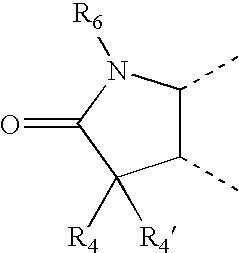
wherein R4, R4′ and R6 are defined herein. The dashed lines represent bonds from the benzene ring to which ring A is fused.


wherein Ra, Rb, R1, R2, R6 and n are as described herein and Q is H2, NR6, O or S; W is CR4R4′, NR6, O, S, SO or SO2.


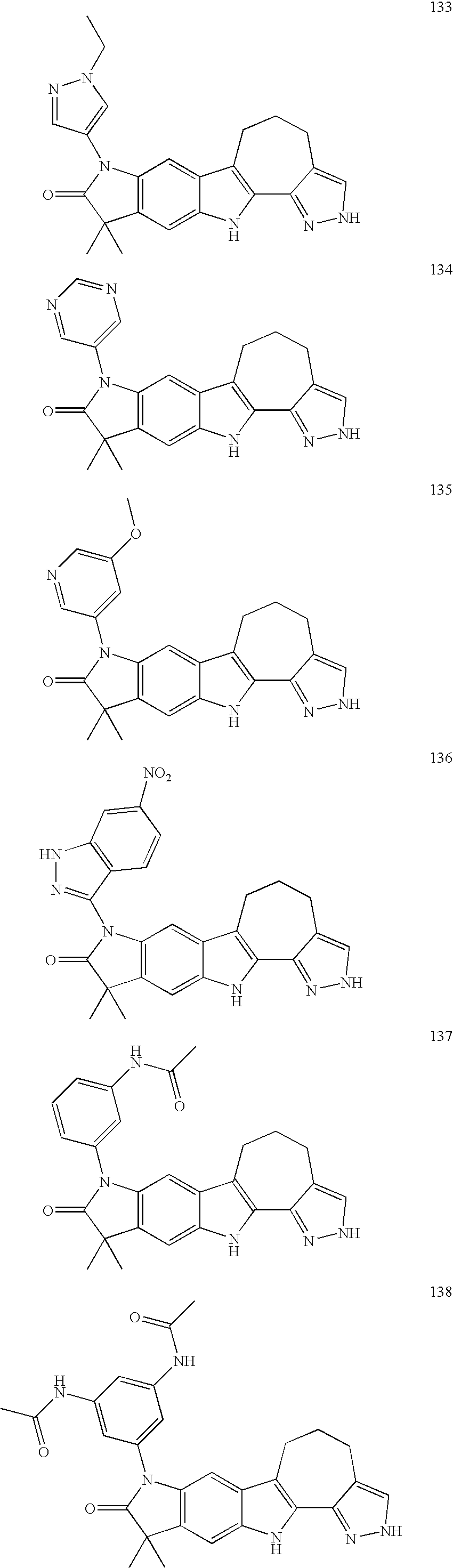


Synthesis


wherein Q, W, R1, R2, and R6 are as defined herein. Starting compound a is nitrated by reacting with nitric acid and sulfuric acid to give b. The R3 substituent is introduced by reacting b with halo-substituted R6 and NaH to give c which is subsequently reduced, for example with palladium catalyst to give amine d. Amine d is then coupled is then coupled to enol e via a Japp-Klingemann reaction to give hydrazone f which undergoes Fischer indole cyclization under acidic conditions to form compound g. Compound g is then reacted with the desired anhydride or formate for R1 in weak base such as LHMDS (lithium hexamethyldisylazide) to give compound h which is subsequently reacted with hydrazine to give the final compound.

- ACN: acetonitrile;
- 9-BBN: 9-borabicyclo[3.3.1]nonane;
- Chg: cyclohexylglycine;
- DCM: dichloromethane;
- DEAD: diethylazodicarboxylate;
- DIBAH: diisobutyl aluminum hydride;
- DIPEA: diisopropylethylamine;
- DMAP: 4-dimethylaminopyridine;
- DME: 1,2-dimethoxyethane;
- DMF: dimethylformamide;
- DMSO: dimethylsulfoxide;
- EDC: 1-ethyl-3-(3-dimethylaminopropyl)carbodiimide;
- EEDQ: 2-ethoxy-1-ethoxycarbonyl-1,2-dihydroquinoline;
- LCMS: liquid chromatography mass spectrometry;
- LHMDS: lithium hexamethyldisylazide;
- HATU: O-(7-Azobenzotriazol-1-yl)-1,1,3,3-tetramethyluronium hexafluorophosphate;
- HOBt: N-Hydroxybenzotriazole;
- HBTU: 2-(1H-Benzotriazol-1-yl)-1,1,3,3-tetramethyluronium hexafluorophosphate;
- HPLC: high performance liquid chromatography;
- NBS: N-bromosuccinamide;
- NMO: N-methylmorpholine N-oxide;
- SEM-Cl: 2-(trimethylsilyl)ethoxymethyl chloride;
- TASF: tris(dimethylamino)sulfonium difluorotrimethylsilicate;
- TBAF: tetrabutylammonium fluoride;
- TEBA: triethylbenzylammonium chloride;
- TEA: triethylamine;
- TFA: trifluoroacetate;
- THF: tetrahydrofuran;
- TMS-Cl: chlorotrimethylsilane;


| compound | ||
| no. | alkyl halide | |
| 91 |
 |
 |
| 92 |
 |
 |
| 93 |
 |
 |
| 94 |
 |
 |
| 95 |
 |
 |
| 96 |
 |
 |
| 97 |
 |
 |
| 98 |
 |
 |
| 99 |
 |
 |
| 100 |
 |
 |
| 101 |
 |
 |
| 102 |
 |
 |
| 103 |
 |
 |
| 104 |
 |
 |
| 105 |
 |
 |
| 106 |
 |
 |
| 107 |
 |
 |
| 108 |
 |
 |
| 109 |
 |
 |
| 110 |
 |
 |
| 111 |
 |
 |


-
- 8 mg of compound 127;
- 16 mg of compound 128;
- 11 mg of compound 129;
- 9 mg of compound 130;
- 78 mg of compound 131;
- 22 mg of compound 132;
- 25 mg of compound 133;
- 23 mg of compound 134;
- 29 mg of compound 135; and
- 12 mg of compound 136.


-
- 12 mg of compound 140;
- 9 mg of compound 141;
- 1 mg of compound 142;
- 6 mg of compound 143;
- 15 mg of compound 144;
- 1 mg of compound 145;
- 52 mg of compound 146;
- 54 mg of compound 147;
- 25 mg of compound 148;
- 15 mg of compound 149;
- 11 mg of compound 150;
- 12 mg of compound 151;
- 15 mg of compound 152;
- 11 mg of compound 153;
- 65 mg of compound 154;
- 24 mg of compound 155;
- 40 mg of compound 156;
- 38 mg of compound 157;
- 28 mg of compound 158;
- 6 mg of compound 159;
- 20 mg of compound 160;
- 47 mg of compound 161;
- 5 mg of compound 162; and
- 26 mg of compound 163.


Claims (17)


Priority Applications (1)
| Application Number | Priority Date | Filing Date | Title |
|---|---|---|---|
| US11/503,405 US7749994B2 (en) | 2005-08-12 | 2006-08-14 | Pentacyclic kinase inhibitors |
Applications Claiming Priority (2)
| Application Number | Priority Date | Filing Date | Title |
|---|---|---|---|
| US70790205P | 2005-08-12 | 2005-08-12 | |
| US11/503,405 US7749994B2 (en) | 2005-08-12 | 2006-08-14 | Pentacyclic kinase inhibitors |
Publications (2)
| Publication Number | Publication Date |
|---|---|
| US20070037791A1 US20070037791A1 (en) | 2007-02-15 |
| US7749994B2 true US7749994B2 (en) | 2010-07-06 |
Family
ID=37607426
Family Applications (1)
| Application Number | Title | Priority Date | Filing Date |
|---|---|---|---|
| US11/503,405 Expired - Fee Related US7749994B2 (en) | 2005-08-12 | 2006-08-14 | Pentacyclic kinase inhibitors |
Country Status (14)
| Country | Link |
|---|---|
| US (1) | US7749994B2 (en) |
| EP (1) | EP1919920B1 (en) |
| JP (1) | JP2009504680A (en) |
| KR (1) | KR20080035691A (en) |
| CN (1) | CN101287737A (en) |
| AT (1) | ATE509933T1 (en) |
| AU (1) | AU2006279659A1 (en) |
| BR (1) | BRPI0615141A2 (en) |
| CA (1) | CA2619276A1 (en) |
| IL (1) | IL189296A0 (en) |
| NO (1) | NO20081292L (en) |
| RU (1) | RU2008108903A (en) |
| WO (1) | WO2007022102A2 (en) |
| ZA (1) | ZA200801332B (en) |
Families Citing this family (9)
| Publication number | Priority date | Publication date | Assignee | Title |
|---|---|---|---|---|
| BRPI0907122B8 (en) | 2008-01-11 | 2021-05-25 | Albany Molecular Res Inc | substituted pyridoindoles (1-azinone) compounds, pharmaceutical composition comprising said compounds, and uses thereof |
| US9073925B2 (en) * | 2009-07-01 | 2015-07-07 | Albany Molecular Research, Inc. | Azinone-substituted azabicycloalkane-indole and azabicycloalkane-pyrrolo-pyridine MCH-1 antagonists, methods of making, and use thereof |
| US8637501B2 (en) * | 2009-07-01 | 2014-01-28 | Albany Molecular Research, Inc. | Azinone-substituted azepino[b]indole and pyrido-pyrrolo-azepine MCH-1 antagonists, methods of making, and use thereof |
| WO2011003012A1 (en) * | 2009-07-01 | 2011-01-06 | Albany Molecular Research, Inc. | Azinone-substituted azapolycycle mch-1 antagonists, methods of making, and use thereof |
| WO2011003007A1 (en) * | 2009-07-01 | 2011-01-06 | Albany Molecular Research, Inc. | Azabicycloalkane-indole and azabicycloalkane-pyrrolo-pyridine mch-1 antagonists, methods of making, and use thereof |
| WO2012088038A2 (en) | 2010-12-21 | 2012-06-28 | Albany Molecular Research, Inc. | Piperazinone-substituted tetrahydro-carboline mch-1 antagonists, methods of making, and uses thereof |
| WO2012088124A2 (en) | 2010-12-21 | 2012-06-28 | Albany Molecular Research, Inc. | Tetrahydro-azacarboline mch-1 antagonists, methods of making, and uses thereof |
| EP2887804B1 (en) | 2012-05-22 | 2021-01-27 | Trustees of Dartmouth College | Cycloalkanyl[b]indoles useful as glp-1 modulators |
| WO2017162661A1 (en) | 2016-03-22 | 2017-09-28 | Bayer Pharma Aktiengesellschaft | 1h-benzo[de]isoquinoline-1,3(2h)-diones |
Citations (2)
| Publication number | Priority date | Publication date | Assignee | Title |
|---|---|---|---|---|
| WO2005005414A2 (en) | 2003-07-08 | 2005-01-20 | Pharmacia Italia S.P.A. | Pyrazolyl-indole derivatives active as kinase inhibitors, process for their preparation and pharmaceutical compositions comprising them |
| WO2006133885A1 (en) | 2005-06-15 | 2006-12-21 | F. Hoffmann-La Roche Ag | Tricyclic fused indole derivatives and their use as aurora kinase inhibitors |
-
2006
- 2006-08-14 CN CNA200680037951XA patent/CN101287737A/en active Pending
- 2006-08-14 JP JP2008526286A patent/JP2009504680A/en active Pending
- 2006-08-14 CA CA002619276A patent/CA2619276A1/en not_active Abandoned
- 2006-08-14 AT AT06813425T patent/ATE509933T1/en not_active IP Right Cessation
- 2006-08-14 BR BRPI0615141-8A patent/BRPI0615141A2/en not_active IP Right Cessation
- 2006-08-14 KR KR1020087005941A patent/KR20080035691A/en not_active Withdrawn
- 2006-08-14 AU AU2006279659A patent/AU2006279659A1/en not_active Abandoned
- 2006-08-14 WO PCT/US2006/031682 patent/WO2007022102A2/en not_active Ceased
- 2006-08-14 RU RU2008108903/04A patent/RU2008108903A/en not_active Application Discontinuation
- 2006-08-14 US US11/503,405 patent/US7749994B2/en not_active Expired - Fee Related
- 2006-08-14 EP EP06813425A patent/EP1919920B1/en active Active
-
2008
- 2008-02-05 IL IL189296A patent/IL189296A0/en unknown
- 2008-02-07 ZA ZA200801332A patent/ZA200801332B/en unknown
- 2008-03-11 NO NO20081292A patent/NO20081292L/en not_active Application Discontinuation
Patent Citations (2)
| Publication number | Priority date | Publication date | Assignee | Title |
|---|---|---|---|---|
| WO2005005414A2 (en) | 2003-07-08 | 2005-01-20 | Pharmacia Italia S.P.A. | Pyrazolyl-indole derivatives active as kinase inhibitors, process for their preparation and pharmaceutical compositions comprising them |
| WO2006133885A1 (en) | 2005-06-15 | 2006-12-21 | F. Hoffmann-La Roche Ag | Tricyclic fused indole derivatives and their use as aurora kinase inhibitors |
Non-Patent Citations (1)
| Title |
|---|
| Sausville et al ( Cancer Research, 2006, vol. 66, pp. 3351-3354). * |
Also Published As
| Publication number | Publication date |
|---|---|
| CN101287737A (en) | 2008-10-15 |
| CA2619276A1 (en) | 2007-02-22 |
| WO2007022102A3 (en) | 2007-05-10 |
| IL189296A0 (en) | 2008-06-05 |
| WO2007022102A2 (en) | 2007-02-22 |
| ATE509933T1 (en) | 2011-06-15 |
| JP2009504680A (en) | 2009-02-05 |
| ZA200801332B (en) | 2009-10-28 |
| KR20080035691A (en) | 2008-04-23 |
| BRPI0615141A2 (en) | 2009-07-14 |
| US20070037791A1 (en) | 2007-02-15 |
| AU2006279659A1 (en) | 2007-02-22 |
| EP1919920B1 (en) | 2011-05-18 |
| NO20081292L (en) | 2008-05-13 |
| EP1919920A2 (en) | 2008-05-14 |
| RU2008108903A (en) | 2009-09-20 |
Similar Documents
| Publication | Publication Date | Title |
|---|---|---|
| US20080318989A1 (en) | Pyrimidine Kinase Inhibitors | |
| US20100144732A1 (en) | Pyrimidine kinase inhibitors | |
| US9040706B2 (en) | Pyrrolidine inhibitors of IAP | |
| US8063218B2 (en) | Imidazopyridine inhibitors of IAP | |
| US8247557B2 (en) | IAP inhibitors | |
| US8907092B2 (en) | Inhibitors of IAP | |
| US20110218211A1 (en) | Azaindole inhibitors of iap | |
| US20090131407A1 (en) | Tetracyclic kinase inhibitors | |
| US20110046066A1 (en) | Inhibitors of iap | |
| US20070037791A1 (en) | Pentacyclic kinase inhibitors | |
| WO2006105386A1 (en) | Cdk2 inhibitors | |
| MX2008001902A (en) | Pentacyclic kinase inhibitors |
Legal Events
| Date | Code | Title | Description |
|---|---|---|---|
| AS | Assignment |
Owner name: F. HOFFMANN-LA ROCHE, AG (EX-US), SWITZERLAND Free format text: ASSIGNMENT OF ASSIGNORS INTEREST;ASSIGNORS:RAWSON, THOMAS E.;SAFINA, BRIAN;DOTSON, JENNAFER;AND OTHERS;SIGNING DATES FROM 20060913 TO 20061018;REEL/FRAME:018478/0053 Owner name: HOFFMAN-LAROCHE, INC. (US ONLY), NEW JERSEY Free format text: ASSIGNMENT OF ASSIGNORS INTEREST;ASSIGNORS:RAWSON, THOMAS E.;SAFINA, BRIAN;DOTSON, JENNAFER;AND OTHERS;SIGNING DATES FROM 20060913 TO 20061018;REEL/FRAME:018478/0053 Owner name: GENENTECH, INC., CALIFORNIA Free format text: ASSIGNMENT OF ASSIGNORS INTEREST;ASSIGNORS:RAWSON, THOMAS E.;SAFINA, BRIAN;DOTSON, JENNAFER;AND OTHERS;SIGNING DATES FROM 20060913 TO 20061018;REEL/FRAME:018478/0053 |
|
| AS | Assignment |
Owner name: GENENTECH INC., CALIFORNIA Free format text: ASSIGNMENT OF ASSIGNORS INTEREST;ASSIGNORS:RAWSON, THOMAS E.;SAFINA, BRIAN;DOTSON, JENNAFER;AND OTHERS;REEL/FRAME:022419/0971;SIGNING DATES FROM 20080903 TO 20081020 Owner name: HOFFMAN-LAROCHE, INC. (US ONLY), NEW JERSEY Free format text: ASSIGNMENT OF ASSIGNORS INTEREST;ASSIGNORS:RAWSON, THOMAS E.;SAFINA, BRIAN;DOTSON, JENNAFER;AND OTHERS;REEL/FRAME:022419/0971;SIGNING DATES FROM 20080903 TO 20081020 Owner name: F. HOFFMAN-LA ROCHE, AG (EX-US), SWITZERLAND Free format text: ASSIGNMENT OF ASSIGNORS INTEREST;ASSIGNORS:RAWSON, THOMAS E.;SAFINA, BRIAN;DOTSON, JENNAFER;AND OTHERS;REEL/FRAME:022419/0971;SIGNING DATES FROM 20080903 TO 20081020 Owner name: GENENTECH INC., CALIFORNIA Free format text: ASSIGNMENT OF ASSIGNORS INTEREST;ASSIGNORS:RAWSON, THOMAS E.;SAFINA, BRIAN;DOTSON, JENNAFER;AND OTHERS;SIGNING DATES FROM 20080903 TO 20081020;REEL/FRAME:022419/0971 Owner name: HOFFMAN-LAROCHE, INC. (US ONLY), NEW JERSEY Free format text: ASSIGNMENT OF ASSIGNORS INTEREST;ASSIGNORS:RAWSON, THOMAS E.;SAFINA, BRIAN;DOTSON, JENNAFER;AND OTHERS;SIGNING DATES FROM 20080903 TO 20081020;REEL/FRAME:022419/0971 Owner name: F. HOFFMAN-LA ROCHE, AG (EX-US), SWITZERLAND Free format text: ASSIGNMENT OF ASSIGNORS INTEREST;ASSIGNORS:RAWSON, THOMAS E.;SAFINA, BRIAN;DOTSON, JENNAFER;AND OTHERS;SIGNING DATES FROM 20080903 TO 20081020;REEL/FRAME:022419/0971 |
|
| CC | Certificate of correction | ||
| AS | Assignment |
Owner name: GENETECH, INC., CALIFORNIA Free format text: CORRECTIVE ASSIGNMENT TO CORRECT THE APPLICATION SERIAL NO. FROM 11/503,406 TO 11/503,405 PREVIOUSLY RECORDED ON REEL 018478 FRAME 0053. ASSIGNOR(S) HEREBY CONFIRMS THE CORRECT APPLICATION SERIAL NO. IS 11/503,405;ASSIGNORS:RAWSON, THOMAS E.;SAFINA, BRIAN;DOTSON, JENNAFER;AND OTHERS;SIGNING DATES FROM 20060913 TO 20061018;REEL/FRAME:029410/0228 Owner name: HOFFMAN-LAROUCHE, INC., NEW JERSEY Free format text: CORRECTIVE ASSIGNMENT TO CORRECT THE APPLICATION SERIAL NO. FROM 11/503,406 TO 11/503,405 PREVIOUSLY RECORDED ON REEL 018478 FRAME 0053. ASSIGNOR(S) HEREBY CONFIRMS THE CORRECT APPLICATION SERIAL NO. IS 11/503,405;ASSIGNORS:RAWSON, THOMAS E.;SAFINA, BRIAN;DOTSON, JENNAFER;AND OTHERS;SIGNING DATES FROM 20060913 TO 20061018;REEL/FRAME:029410/0228 |
|
| REMI | Maintenance fee reminder mailed | ||
| LAPS | Lapse for failure to pay maintenance fees | ||
| STCH | Information on status: patent discontinuation |
Free format text: PATENT EXPIRED DUE TO NONPAYMENT OF MAINTENANCE FEES UNDER 37 CFR 1.362 |
|
| STCH | Information on status: patent discontinuation |
Free format text: PATENT EXPIRED DUE TO NONPAYMENT OF MAINTENANCE FEES UNDER 37 CFR 1.362 |
|
| FP | Lapsed due to failure to pay maintenance fee |
Effective date: 20140706 |