US7745633B1 - Tetrazole based linear polymers - Google Patents

Tetrazole based linear polymers Download PDF

Info

Publication number
US7745633B1
US7745633B1 US12/332,221 US33222108A US7745633B1 US 7745633 B1 US7745633 B1 US 7745633B1 US 33222108 A US33222108 A US 33222108A US 7745633 B1 US7745633 B1 US 7745633B1
Authority
US
United States
Prior art keywords
tetrazole
diol
group
polymer
oligoethers
Prior art date
Legal status (The legal status is an assumption and is not a legal conclusion. Google has not performed a legal analysis and makes no representation as to the accuracy of the status listed.)
Expired - Fee Related
Application number
US12/332,221
Inventor
David J. Irvin
Mark H. Mason
Current Assignee (The listed assignees may be inaccurate. Google has not performed a legal analysis and makes no representation or warranty as to the accuracy of the list.)
US Department of Navy
Original Assignee
US Department of Navy
Priority date (The priority date is an assumption and is not a legal conclusion. Google has not performed a legal analysis and makes no representation as to the accuracy of the date listed.)
Filing date
Publication date
Application filed by US Department of Navy filed Critical US Department of Navy
Priority to US12/332,221 priority Critical patent/US7745633B1/en
Assigned to UNITED STATES OF AMERICA AS REPRESENTED BY THE SECRETARY OF THE NAVY reassignment UNITED STATES OF AMERICA AS REPRESENTED BY THE SECRETARY OF THE NAVY ASSIGNMENT OF ASSIGNORS INTEREST (SEE DOCUMENT FOR DETAILS). Assignors: MASON, MARK H., DR., IRVIN, DAVID J.
Application granted granted Critical
Publication of US7745633B1 publication Critical patent/US7745633B1/en
Anticipated expiration legal-status Critical
Expired - Fee Related legal-status Critical Current

Links

Classifications

    • CCHEMISTRY; METALLURGY
    • C08ORGANIC MACROMOLECULAR COMPOUNDS; THEIR PREPARATION OR CHEMICAL WORKING-UP; COMPOSITIONS BASED THEREON
    • C08GMACROMOLECULAR COMPOUNDS OBTAINED OTHERWISE THAN BY REACTIONS ONLY INVOLVING UNSATURATED CARBON-TO-CARBON BONDS
    • C08G18/00Polymeric products of isocyanates or isothiocyanates
    • C08G18/06Polymeric products of isocyanates or isothiocyanates with compounds having active hydrogen
    • C08G18/28Polymeric products of isocyanates or isothiocyanates with compounds having active hydrogen characterised by the compounds used containing active hydrogen
    • C08G18/30Low-molecular-weight compounds
    • C08G18/38Low-molecular-weight compounds having heteroatoms other than oxygen
    • C08G18/3819Low-molecular-weight compounds having heteroatoms other than oxygen having nitrogen
    • C08G18/3842Low-molecular-weight compounds having heteroatoms other than oxygen having nitrogen containing heterocyclic rings having at least one nitrogen atom in the ring

Definitions

  • propellants explosives are comprised of a polymeric binder that holds one or more energetic solids in a plastic matrix.
  • the polymeric binder serves many roles in these materials. Initially the polymer can aid in processing. In fact, the properties of the polymer will significantly affect how a material is processed, whether it is cast or pressed or extruded. Furthermore, the polymer mechanically holds all the ingredients together, serving as a structural element literally binding together the final material. This role is especially critical in rocket propellants, because cracks and voids in the propellant will lead to motor grain failure, often with catastrophic results.
  • the binder serves many safety functions.
  • the binder physically coats the energetic solids in these materials, this provides a physical buffer to minimize the physical and chemical interaction of reactive solids with each other. This generally lowers the electrostatic discharge, impact, and friction sensitivity of the final material.
  • the binder also serves as a fuel when the hydrocarbon polymer is combusted by the oxidizer. However, the binder generally diminishes the performance (detonation pressure and velocity) of most explosives. To improve the performance of explosives with significant binder content, and to increase the energy density of propellants energetic polymers are needed.
  • While there are energetic binders available polyglycidyl nitrate (PGN), polyglycidyl azide (GAP), azidomethyl-methyl-oxetane (AMMO), bis((azido-methyl)oxetane) (BAMMO), nitratomethyl-methyloxetane (NMMO), etc.
  • PPN polyglycidyl nitrate
  • GAP polyglycidyl azide
  • AMMO azidomethyl-methyl-oxetane
  • BAMMO bis((azido-methyl)oxetane)
  • NMMO nitratomethyl-methyloxetane
  • Tetrazole compounds have application in many fields including, but not limited to, chemistry, ligands, metabolically stable surrogate for a carboxylic acid group, and material sciences including explosives and propellants and air bag gas generators.
  • Embodiments of the present invention generally relate to a polymer having the structure (I) comprising: wherein “p” is a value of about 5 to 10,000; wherein “X” comprises at least
  • “p” of the linear isocyanate polymer is about 5 to about 1,000.
  • all embodiments of the present invention include any combinations of “R”, “X” and “Y”, the following are examples of some genus and species embodiments.
  • the “R”, “X” and “Y” of the linear polyisocyanate polymers (I), (V), and (VII), include any combination thereof:
  • Yet other embodiments of the present invention include a polymer having the structure (V) comprising: wherein “p” is a value of about 5 to about 10,000; wherein “n” is a value of 2 to 9;
  • X comprises at least one group of alkyls, aryls, and oligoethers
  • R comprises at least one group of alkyls, aryls, and oligoethers, wherein “R” is chemically bonded to N 1 or N 2 position
  • Y comprises at least one group of alkyls, aryls, and oligoethers.
  • Still yet other embodiments of the present invention include a polymer having the structure (V) comprising: an effective amount of tetrazole polyol having the structure (VI)
  • X comprises at least one group of alkyls, aryls, and oligoethers, wherein “n” is 2 to 9, wherein “p” is about 5 to about 10,000, wherein “Y” comprises at least one group of alkyls, aryls, and oligoethers, wherein “R” comprises at least one group of alkyls, aryls, and oligoethers, wherein “R” is chemically bonded to N 1 or N 2 position of the linear polyisocyanate polymer (V).
  • Further embodiments of the present invention include combining at least one catalyst and filler together with the tetrazole polyol (VI) and the isocyanate resin (III).
  • the alkylated tetrazole polyol includes tri-alkylated tetrazole polyol.
  • the alkylated tetrazole polyol includes tetra-alkylated tetrazole polyol.
  • the arylated tetrazole polyol includes tri-arylated tetrazole polyol.
  • the arylated tetrazole polyol includes tetra-arylated tetrazole polyol.
  • “p” of the linear polymers are about 5 to about 1,000.
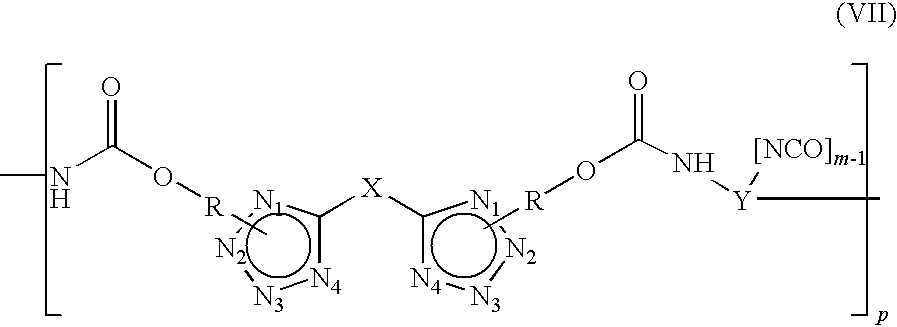
  • Embodiments of the present invention include a polymer having the structure (VII) comprising: wherein “p” is a value of about 5 to about 10,000; wherein “m” is a value of 2 to 9;
  • X comprises at least one group of alkyls, aryls, and oligoethers
  • R comprises at least one group of alkyls, aryls, and oligoethers, wherein “R” is chemically bonded to N 1 or N 2 position
  • Y comprises at least one group of alkyls, aryls, and oligoethers.
  • inventions include a process for preparation of a polymer having the structure (VII) comprising: an effective amount of tetrazole diol having the
  • VII structure (VII), wherein “X” comprises at least one group of alkyls, aryls, and oligoethers, wherein “Y” comprises at least one group of alkyls, aryls, and oligoethers, wherein “m” is 2 to 9, wherein “p” is about 5 to about 10,000, wherein “R” comprises at least one group of alkyls, aryls, and oligoethers, wherein “R” is on N 1 or N 2 of position the linear polyisocyanate polymer (VII).
  • the arylated tetrazole diol includes di-alkylated tetrazole.
  • the arylated tetrazole diol includes di-arylated tetrazole diol or an oligoether tethered diol.
  • “p” of the linear polymers are about 5 to about 1,000.

Landscapes

  • Chemical & Material Sciences (AREA)
  • Health & Medical Sciences (AREA)
  • Chemical Kinetics & Catalysis (AREA)
  • Medicinal Chemistry (AREA)
  • Polymers & Plastics (AREA)
  • Organic Chemistry (AREA)
  • Polyurethanes Or Polyureas (AREA)

Abstract

A linear isocyanate polymer produced by utilizing an effective amount of tetrazole diol or tetrazole polyol, reacting with an effective amount isocyanate resin, and cooling to room temperature producing a linear polyisocyanate polymer.

Description

This is a divisional of U.S. patent application Ser. No. 11/151,192, filed May 27, 2005, now U.S. Pat. No. 7,557,220.
STATEMENT REGARDING FEDERALLY SPONSORED RESEARCH OR DEVELOPMENT
The invention described herein may be manufactured and used by or for the government of the United States of America for governmental purposes without the payment of any royalties thereon or therefor.
BACKGROUND OF THE INVENTION
There is a need for novel energetic binders to increase the performance of pyrotechnics, gun propellants, rocket propellants, air-bag gas generator propellants, and explosives. Depending on the application, these materials are typically 3-25% binder by mass. Therefore, improvements to the energy content, mechanical properties, or insensitive munitions properties of the polymeric binder can have significant affects on the performance of the energetic material in question.
In general many pyrotechnics, propellants, explosives are comprised of a polymeric binder that holds one or more energetic solids in a plastic matrix. The polymeric binder serves many roles in these materials. Initially the polymer can aid in processing. In fact, the properties of the polymer will significantly affect how a material is processed, whether it is cast or pressed or extruded. Furthermore, the polymer mechanically holds all the ingredients together, serving as a structural element literally binding together the final material. This role is especially critical in rocket propellants, because cracks and voids in the propellant will lead to motor grain failure, often with catastrophic results. The binder serves many safety functions. The binder physically coats the energetic solids in these materials, this provides a physical buffer to minimize the physical and chemical interaction of reactive solids with each other. This generally lowers the electrostatic discharge, impact, and friction sensitivity of the final material. In some materials, especially rocket propellants, the binder also serves as a fuel when the hydrocarbon polymer is combusted by the oxidizer. However, the binder generally diminishes the performance (detonation pressure and velocity) of most explosives. To improve the performance of explosives with significant binder content, and to increase the energy density of propellants energetic polymers are needed.
While there are energetic binders available (polyglycidyl nitrate (PGN), polyglycidyl azide (GAP), azidomethyl-methyl-oxetane (AMMO), bis((azido-methyl)oxetane) (BAMMO), nitratomethyl-methyloxetane (NMMO), etc.) the safety benefits of increasing binder content are lost because these materials contain either organic azides or nitrate esters (or both). These functional groups are chemically unstable, easily ignited, and generally create reactive fragments on aging. In fact, propellants that utilize nitrate esters generally require expensive monitoring programs throughout their life cycle to insure both adequate safety properties and performance as the propellant ages. The cost of such monitoring is often cited as one reason most modern explosives do not to use nitrate esters as binder materials. Furthermore, the energetic groups are pendant moieties attached to the polymer, but not incorporated into the polymer backbone. This impairs the physical properties of these polymers and causes the formulator to need a higher weight percent of binder in order to achieve adequate coating. In short, there is a need for improved energetic binders to address safety, performance, aging, and processing requirements.
While tetrazoles are somewhat less energetic than azides or nitrates, the bis-alkyltetrazoles of interest are more thermally stable and substantially less chemically reactive. Higher percentages of these binders could be used without anticipating negative safety consequences. Furthermore, the energetic functionality is built into the polymer backbone, minimizing the total moles of pendant atoms. This is anticipated to yield a binder with superior physical properties. A dihydroxy-terminated bis-tetrazole (2,2 Bis((2-ethanol)-1 or 2H-tetrazole)-propane or BETP) has been synthesized on the multigram scale. Initial differential scanning calorimetery (DSC) analysis shows this pre-polymer has promise as an energetic cured urethane binder for explosives and propellants and gas generators.
U.S. Pat. No. 5,053,086 issued on Oct. 1, 1991 to Henry, et al., which teaches gas generating compositions containing energetic high nitrogen such as ammonium 5-nitraminotetrazole and 5,5′-bitetrazole. This work yielded polymeric binders that are too rigid and “glassy” for the intended application. The chemical structure of the present invention polymers builds more flexibility into the backbone, yielding improved elastomers. Further research by Demko teaches the addition of sodium azide to nitriles to give 1H-tetrazoles in water with zinc salts as catalysts. (Demko, Z. P.; Sharpless, K. B. “Preparation of 5-substituted 1H-tetrazoles from nitriles in water.” J. Org. Chem. 2001, 66, 7945). This step is only one method to obtain the tetrazole intermediate. Further reaction is necessary to produce the alcohol-based monomers. The addition of the alkyl alcohol is two fold: first, the short alkyl chain adds flexibility, solubility; second, the alcohol group allows for the production of stable polyurethanes. Polymerization of the tetrazole would produce the less stable polyurea.
Tetrazole compounds have application in many fields including, but not limited to, chemistry, ligands, metabolically stable surrogate for a carboxylic acid group, and material sciences including explosives and propellants and air bag gas generators.
It is to be understood that the foregoing general description and the following detailed description are exemplary and explanatory only and are not to be viewed as being restrictive of the present invention, as claimed. Further advantages of this invention will be apparent after a review of the following detailed description of the disclosed embodiments and in the appended claims.
DETAILED DESCRIPTION OF THE INVENTION
Embodiments of the present invention generally relate to a polymer having the structure (I) comprising: wherein “p” is a value of about 5 to 10,000; wherein “X” comprises at least
Figure US07745633-20100629-C00001
one group of alkyls, aryls, and oligoethers; wherein “R” comprises at least one group of alkyls, aryls, and oligoethers, wherein “R” is chemically bonded to N1 or N2 position; and wherein “Y” comprises at least one group of alkyls, aryls, and oligoethers.
Further embodiments of the present invention include a polymer having the structure (I) comprising: an effective amount of tetrazole diol having the structure (II)
Figure US07745633-20100629-C00002

reacting with an effective amount isocyanate resin at a temperature in the range of about 50° C. to about 150° C. for a time period in the range of about 1 to 24 hours, wherein “X” comprises at least one group of alkyls, aryls, and oligoethers, wherein “R” comprises at least one group of alkyls, aryls, and oligoethers, wherein “R” is chemically bonded to N1 or N2 position;
Figure US07745633-20100629-C00003

wherein the isocyanate resin having the structure (III),
OCN—Y—NCO  (III)
wherein “Y” comprises at least one group of alkyls, aryls, and oligoethers, cooling to room temperature producing a linear polyisocyanate polymer; and the linear polyisocyanate polymer having the structure (I), wherein “X” comprises at least one group of alkyls, aryls, and oligoethers, wherein “Y” comprises at least one group of alkyls, aryls, and oligoethers, wherein “p” is about 5 to about 10,000, wherein “R” comprises at least one group of alkyls, aryls, and oligoethers, wherein “R” is chemically bonded to N1 or N2 positioned of the linear polyisocyanate polymer (I).
In other embodiments, “p” of the linear isocyanate polymer is about 5 to about 1,000. Although all embodiments of the present invention include any combinations of “R”, “X” and “Y”, the following are examples of some genus and species embodiments. The “R”, “X” and “Y” of the linear polyisocyanate polymers (I), (V), and (VII), include any combination thereof:
R X Y
Figure US07745633-20100629-C00004
—(CH2)—
Figure US07745633-20100629-C00005
Figure US07745633-20100629-C00006
—(CH2)—
Figure US07745633-20100629-C00007
Figure US07745633-20100629-C00008
—(CH2)—
Figure US07745633-20100629-C00009
Figure US07745633-20100629-C00010
—(CH2)—
Figure US07745633-20100629-C00011
Figure US07745633-20100629-C00012
—(CH2)—
Figure US07745633-20100629-C00013
Figure US07745633-20100629-C00014
—(CH2)—
Figure US07745633-20100629-C00015
Figure US07745633-20100629-C00016
—(CH2)—
Figure US07745633-20100629-C00017
Figure US07745633-20100629-C00018
—(CH2)—
Figure US07745633-20100629-C00019
Figure US07745633-20100629-C00020
—(CH2)—
Figure US07745633-20100629-C00021
Figure US07745633-20100629-C00022
Figure US07745633-20100629-C00023
Figure US07745633-20100629-C00024
Figure US07745633-20100629-C00025
Figure US07745633-20100629-C00026
Figure US07745633-20100629-C00027
Figure US07745633-20100629-C00028
Figure US07745633-20100629-C00029
Figure US07745633-20100629-C00030
Figure US07745633-20100629-C00031
Figure US07745633-20100629-C00032
Figure US07745633-20100629-C00033
Figure US07745633-20100629-C00034
Figure US07745633-20100629-C00035
Figure US07745633-20100629-C00036
Figure US07745633-20100629-C00037
Figure US07745633-20100629-C00038
Figure US07745633-20100629-C00039
Figure US07745633-20100629-C00040
Figure US07745633-20100629-C00041
Figure US07745633-20100629-C00042
Figure US07745633-20100629-C00043
Figure US07745633-20100629-C00044
Figure US07745633-20100629-C00045
Figure US07745633-20100629-C00046
Figure US07745633-20100629-C00047
Figure US07745633-20100629-C00048
Figure US07745633-20100629-C00049
Figure US07745633-20100629-C00050
Figure US07745633-20100629-C00051
Figure US07745633-20100629-C00052
Figure US07745633-20100629-C00053
Figure US07745633-20100629-C00054
Figure US07745633-20100629-C00055
Figure US07745633-20100629-C00056
Figure US07745633-20100629-C00057
Figure US07745633-20100629-C00058
Figure US07745633-20100629-C00059
Figure US07745633-20100629-C00060
Figure US07745633-20100629-C00061
Figure US07745633-20100629-C00062
Figure US07745633-20100629-C00063
Figure US07745633-20100629-C00064
Figure US07745633-20100629-C00065
Figure US07745633-20100629-C00066
Figure US07745633-20100629-C00067
Figure US07745633-20100629-C00068
Figure US07745633-20100629-C00069
Figure US07745633-20100629-C00070
Figure US07745633-20100629-C00071
Figure US07745633-20100629-C00072
Figure US07745633-20100629-C00073
Figure US07745633-20100629-C00074
Figure US07745633-20100629-C00075
Yet other embodiments of the present invention include a polymer having the structure (V) comprising: wherein “p” is a value of about 5 to about 10,000; wherein “n” is a value of 2 to 9;
Figure US07745633-20100629-C00076
wherein “X” comprises at least one group of alkyls, aryls, and oligoethers; wherein “R” comprises at least one group of alkyls, aryls, and oligoethers, wherein “R” is chemically bonded to N1 or N2 position; and wherein “Y” comprises at least one group of alkyls, aryls, and oligoethers.
Still yet other embodiments of the present invention include a polymer having the structure (V) comprising: an effective amount of tetrazole polyol having the structure (VI)
Figure US07745633-20100629-C00077
reacting with isocyanate resin at a temperature in the range of about 50° C. to about 100° C. for a time period in the range of about 1 to about 48 hours, wherein “X” of the tetrazole polyol comprises at least one group of alkyls, aryls, and oligoethers, wherein “n” is 2 to 9, wherein “R” comprises at least one group of alkyls, aryls, and oligoethers, wherein “R” is chemically bonded to N1 or N2 position;
Figure US07745633-20100629-C00078
wherein the isocyanate resin having the structure (III), wherein “Y” comprises at least one group of alkyls, aryls, and oligoethers, cooling to room temperature producing a linear polyisocyanate polymer; and said linear polyisocyanate polymer having the structure (V),
OCN—Y—NCO  (III),
wherein “X” comprises at least one group of alkyls, aryls, and oligoethers, wherein “n” is 2 to 9, wherein “p” is about 5 to about 10,000, wherein “Y” comprises at least one group of alkyls, aryls, and oligoethers, wherein “R” comprises at least one group of alkyls, aryls, and oligoethers, wherein “R” is chemically bonded to N1 or N2 position of the linear polyisocyanate polymer (V).
Further embodiments of the present invention include combining at least one catalyst and filler together with the tetrazole polyol (VI) and the isocyanate resin (III). When tetrazole polyol is alkylated tetrazole polyol, the alkylated tetrazole polyol includes tri-alkylated tetrazole polyol. When tetrazole polyol is alkylated tetrazole polyol, the alkylated tetrazole polyol includes tetra-alkylated tetrazole polyol. When tetrazole polyol is arylated tetrazole polyol, the arylated tetrazole polyol includes tri-arylated tetrazole polyol. When tetrazole polyol is arylated tetrazole polyol, the arylated tetrazole polyol includes tetra-arylated tetrazole polyol. In other embodiments, “p” of the linear polymers are about 5 to about 1,000.
Embodiments of the present invention include a polymer having the structure (VII) comprising: wherein “p” is a value of about 5 to about 10,000; wherein “m” is a value of 2 to 9;
Figure US07745633-20100629-C00079
wherein “X” comprises at least one group of alkyls, aryls, and oligoethers; wherein “R” comprises at least one group of alkyls, aryls, and oligoethers, wherein “R” is chemically bonded to N1 or N2 position; and wherein “Y” comprises at least one group of alkyls, aryls, and oligoethers.
Other embodiments of the present invention include a process for preparation of a polymer having the structure (VII) comprising: an effective amount of tetrazole diol having the
Figure US07745633-20100629-C00080
structure (II) reacting with isocyanate resin at a temperature in the range of about 50° C. to about 100° C. for a time period in the range of about 1 to about 48 hours, wherein “X” of the tetrazole diol comprises at least one group of alkyls, aryls, and oligoethers, wherein “R” comprises at least one group of alkyls, aryls, and oligoethers, wherein “R” is chemically bonded to N1 or N2 position; wherein the isocyanate resin having the structure (VIII), wherein “Y” comprises at
Figure US07745633-20100629-C00081
least one group of alkyls, aryls, and oligoethers, wherein “m” is 2-9, cooling to room temperature producing a linear polyisocyanate polymer; and the linear polyisocyanate polymer having the
Figure US07745633-20100629-C00082
structure (VII), wherein “X” comprises at least one group of alkyls, aryls, and oligoethers, wherein “Y” comprises at least one group of alkyls, aryls, and oligoethers, wherein “m” is 2 to 9, wherein “p” is about 5 to about 10,000, wherein “R” comprises at least one group of alkyls, aryls, and oligoethers, wherein “R” is on N1 or N2 of position the linear polyisocyanate polymer (VII).
When tetrazole diol is alkylated tetrazole diol, the arylated tetrazole diol includes di-alkylated tetrazole. When tetrazole diol is arylated tetrazole diol, the arylated tetrazole diol includes di-arylated tetrazole diol or an oligoether tethered diol. In other embodiments, “p” of the linear polymers are about 5 to about 1,000.
Experimental Results Tetrafunctional Tetrazole with Trifunctional Isocyanate
In a glass vial equipped with a stir bar, tetra tetrazole (500 mg), tri functional isocyanate (Tolunate LV) (500 mg), and triphenyl bismith catalyst (50 mg) were combined and stirred at 60° C. for 12 hours, to yield an off-white rubbery foam. The solid was analyzed by DSC.
While the invention has been described, disclosed, illustrated and shown in various terms of certain embodiments or modifications which it has presumed in practice, the scope of the invention is not intended to be, nor should it be deemed to be, limited thereby and such other modifications or embodiments as may be suggested by the teachings herein are particularly reserved especially as they fall within the breadth and scope of the claims here appended.

Claims (5)

1. A process for preparation of a polymer of structure (VII) comprising:
reacting an isocyanate resin with an effective amount of tetrazole diol of structure (II),
Figure US07745633-20100629-C00083
wherein “X” is an alkyl, aryl, or oligoether group, wherein “R” is an alkyl, aryl, or oligoether group, wherein “R” is chemically bonded to N1 or N2, at a temperature from about 50° C. to about 100° C. from about 1 hour to about 48 hours;
wherein said isocyanate resin is of structure (VIII), wherein “Y” is an alkyl, aryl, or oligoether group, wherein “m” is 2-9,
Figure US07745633-20100629-C00084
cooling to room temperature; and,
extracting a linear polyisocyanate polymer of structure (VII)
Figure US07745633-20100629-C00085
wherein “X” is an alkyl, aryl, or oligoether group, wherein “Y” is an alkyl, aryl, or oligoether group, wherein “m” is 2 to 9, wherein “p” is 5 to 10,000, wherein “R” is an alkyl, aryl, or oligoether group, wherein “R” is chemically bonded to N1 or N2 of said polymer of structure (VII).
2. The polymer of structure (VII) according to claim 1, wherein “R”, “X” and “Y” include any combination thereof:
Figure US07745633-20100629-C00086
R X Y
Figure US07745633-20100629-C00087
—(CH2)—
Figure US07745633-20100629-C00088
Figure US07745633-20100629-C00089
—(CH2)—
Figure US07745633-20100629-C00090
Figure US07745633-20100629-C00091
—(CH2)—
Figure US07745633-20100629-C00092
Figure US07745633-20100629-C00093
—(CH2)—
Figure US07745633-20100629-C00094
Figure US07745633-20100629-C00095
—(CH2)—
Figure US07745633-20100629-C00096
Figure US07745633-20100629-C00097
—(CH2)—
Figure US07745633-20100629-C00098
Figure US07745633-20100629-C00099
—(CH2)—
Figure US07745633-20100629-C00100
Figure US07745633-20100629-C00101
—(CH2)—
Figure US07745633-20100629-C00102
Figure US07745633-20100629-C00103
—(CH2)—
Figure US07745633-20100629-C00104
Figure US07745633-20100629-C00105
Figure US07745633-20100629-C00106
Figure US07745633-20100629-C00107
Figure US07745633-20100629-C00108
Figure US07745633-20100629-C00109
Figure US07745633-20100629-C00110
Figure US07745633-20100629-C00111
Figure US07745633-20100629-C00112
Figure US07745633-20100629-C00113
Figure US07745633-20100629-C00114
Figure US07745633-20100629-C00115
Figure US07745633-20100629-C00116
Figure US07745633-20100629-C00117
Figure US07745633-20100629-C00118
Figure US07745633-20100629-C00119
Figure US07745633-20100629-C00120
Figure US07745633-20100629-C00121
Figure US07745633-20100629-C00122
Figure US07745633-20100629-C00123
Figure US07745633-20100629-C00124
Figure US07745633-20100629-C00125
Figure US07745633-20100629-C00126
Figure US07745633-20100629-C00127
Figure US07745633-20100629-C00128
Figure US07745633-20100629-C00129
Figure US07745633-20100629-C00130
Figure US07745633-20100629-C00131
Figure US07745633-20100629-C00132
Figure US07745633-20100629-C00133
Figure US07745633-20100629-C00134
Figure US07745633-20100629-C00135
Figure US07745633-20100629-C00136
Figure US07745633-20100629-C00137
Figure US07745633-20100629-C00138
Figure US07745633-20100629-C00139
Figure US07745633-20100629-C00140
Figure US07745633-20100629-C00141
Figure US07745633-20100629-C00142
Figure US07745633-20100629-C00143
Figure US07745633-20100629-C00144
Figure US07745633-20100629-C00145
Figure US07745633-20100629-C00146
Figure US07745633-20100629-C00147
Figure US07745633-20100629-C00148
Figure US07745633-20100629-C00149
Figure US07745633-20100629-C00150
Figure US07745633-20100629-C00151
Figure US07745633-20100629-C00152
Figure US07745633-20100629-C00153
Figure US07745633-20100629-C00154
Figure US07745633-20100629-C00155
Figure US07745633-20100629-C00156
Figure US07745633-20100629-C00157
Figure US07745633-20100629-C00158
3. The process according to claim 1, wherein said tetrazole diol is oligoether tetrazole diol or di-oligoether tetrazole diol.
4. The process according to claim 1, wherein said tetrazole diol is alkylated tetrazole diol or di-alkylated tetrazole diol.
5. The process according to claim 1, wherein said tetrazole diol is arylated tetrazole diol or di-arylated tetrazole diol.
US12/332,221 2005-05-27 2008-12-10 Tetrazole based linear polymers Expired - Fee Related US7745633B1 (en)

Priority Applications (1)

Application Number Priority Date Filing Date Title
US12/332,221 US7745633B1 (en) 2005-05-27 2008-12-10 Tetrazole based linear polymers

Applications Claiming Priority (2)

Application Number Priority Date Filing Date Title
US11/151,192 US7557220B1 (en) 2005-05-27 2005-05-27 Tetrazole based linear polymers
US12/332,221 US7745633B1 (en) 2005-05-27 2008-12-10 Tetrazole based linear polymers

Related Parent Applications (1)

Application Number Title Priority Date Filing Date
US11/151,192 Division US7557220B1 (en) 2005-05-27 2005-05-27 Tetrazole based linear polymers

Publications (1)

Publication Number Publication Date
US7745633B1 true US7745633B1 (en) 2010-06-29

Family

ID=40810999

Family Applications (2)

Application Number Title Priority Date Filing Date
US11/151,192 Active 2026-10-09 US7557220B1 (en) 2005-05-27 2005-05-27 Tetrazole based linear polymers
US12/332,221 Expired - Fee Related US7745633B1 (en) 2005-05-27 2008-12-10 Tetrazole based linear polymers

Family Applications Before (1)

Application Number Title Priority Date Filing Date
US11/151,192 Active 2026-10-09 US7557220B1 (en) 2005-05-27 2005-05-27 Tetrazole based linear polymers

Country Status (1)

Country Link
US (2) US7557220B1 (en)

Families Citing this family (1)

* Cited by examiner, † Cited by third party
Publication number Priority date Publication date Assignee Title
US9045380B1 (en) * 2007-10-31 2015-06-02 Tk Holdings Inc. Gas generating compositions

Citations (2)

* Cited by examiner, † Cited by third party
Publication number Priority date Publication date Assignee Title
US4358327A (en) * 1980-10-14 1982-11-09 The United States Of America As Represented By The Secretary Of The Navy Gas generant propellants
US7446208B1 (en) * 2005-05-27 2008-11-04 The United States Of America As Represented By The Secretary Of The Navy Process for making tetrazole based linear polymers

Family Cites Families (1)

* Cited by examiner, † Cited by third party
Publication number Priority date Publication date Assignee Title
US5053086A (en) * 1985-03-15 1991-10-01 The United States Of America As Represented By The Secretary Of The Navy Gas generant compositions containing energetic high nitrogen binders

Patent Citations (2)

* Cited by examiner, † Cited by third party
Publication number Priority date Publication date Assignee Title
US4358327A (en) * 1980-10-14 1982-11-09 The United States Of America As Represented By The Secretary Of The Navy Gas generant propellants
US7446208B1 (en) * 2005-05-27 2008-11-04 The United States Of America As Represented By The Secretary Of The Navy Process for making tetrazole based linear polymers

Also Published As

Publication number Publication date
US7557220B1 (en) 2009-07-07

Similar Documents

Publication Publication Date Title
Yadav et al. Research advances in bonding agents for composite propellants
Menke et al. Formulation and properties of ADN/GAP propellants
CN105198681B (en) A kind of room temperature curing type cleaning solid propellant
US6600002B2 (en) Chain-extended poly(bis-azidomethyloxetane), and combustible cartridge cases and ammunition comprising the same
US6238499B1 (en) Solid rocket propellant
US20120227875A1 (en) Insensitive propellant composition
US6562159B2 (en) Insensitive melt cast explosive compositions containing energetic thermoplastic elastomers
Eymann et al. Energetic Nitrogen‐Rich Polymers with a Tetrazene‐Based Backbone
US7745633B1 (en) Tetrazole based linear polymers
US8053582B1 (en) Process for making tetrazole based cross-linked polymers
US7446208B1 (en) Process for making tetrazole based linear polymers
US5872328A (en) Ferrocene derivatives
US20090088506A1 (en) Synthesis of energetic thermoplastic elastomers containing both polyoxirane and polyoxetane blocks
US6632378B1 (en) Nitrate ester plasticized energetic compositions, method of making and rocket motor assemblies containing the same
US5747603A (en) Polymers used in elastomeric binders for high-energy compositions
KR101101218B1 (en) BPA / nitramine-based high energy propellant composition with excellent mechanical properties
JP5391585B2 (en) Propellant and manufacturing method thereof
US4747891A (en) Solid propellant containing an aziridinyl bonding agent
US6730181B1 (en) Process for making stable cured poly(glycidyl nitrate)
US7396938B1 (en) Process for making multifunctional tetrazole polyols to produce tetrazole based polymers
US6508894B1 (en) Insensitive propellant formulations containing energetic thermoplastic elastomers
US7402679B1 (en) One-pot process for making multifunctional tetrazole polyols to produce tetrazole based polymers
US7528257B1 (en) Process for making di-functional tetrazole diols to produce tetrazole base polymers
US20020020477A1 (en) Reduced energy binder for energetic compositions
US7544811B1 (en) Di- and multifunctional monomers for producing tetrazole based polymers

Legal Events

Date Code Title Description
AS Assignment

Owner name: UNITED STATES OF AMERICA AS REPRESENTED BY THE SEC

Free format text: ASSIGNMENT OF ASSIGNORS INTEREST;ASSIGNORS:IRVIN, DAVID J.;MASON, MARK H., DR.;SIGNING DATES FROM 20050527 TO 20080527;REEL/FRAME:021957/0715

STCF Information on status: patent grant

Free format text: PATENTED CASE

FPAY Fee payment

Year of fee payment: 4

FEPP Fee payment procedure

Free format text: MAINTENANCE FEE REMINDER MAILED (ORIGINAL EVENT CODE: REM.)

LAPS Lapse for failure to pay maintenance fees

Free format text: PATENT EXPIRED FOR FAILURE TO PAY MAINTENANCE FEES (ORIGINAL EVENT CODE: EXP.); ENTITY STATUS OF PATENT OWNER: LARGE ENTITY

STCH Information on status: patent discontinuation

Free format text: PATENT EXPIRED DUE TO NONPAYMENT OF MAINTENANCE FEES UNDER 37 CFR 1.362

FP Lapsed due to failure to pay maintenance fee

Effective date: 20220629