US7737182B2 - Pharmaceuticals for xerosis - Google Patents
Pharmaceuticals for xerosis Download PDFInfo
- Publication number
- US7737182B2 US7737182B2 US11/049,641 US4964105A US7737182B2 US 7737182 B2 US7737182 B2 US 7737182B2 US 4964105 A US4964105 A US 4964105A US 7737182 B2 US7737182 B2 US 7737182B2
- Authority
- US
- United States
- Prior art keywords
- group
- formula
- compound
- prostaglandin
- cyc6
- Prior art date
- Legal status (The legal status is an assumption and is not a legal conclusion. Google has not performed a legal analysis and makes no representation as to the accuracy of the status listed.)
- Expired - Fee Related, expires
Links
- LRVMNOLFLWLLBF-UHFFFAOYSA-N CCC1C(C)CC(C)C1[Y]CC(C)(C)O Chemical compound CCC1C(C)CC(C)C1[Y]CC(C)(C)O LRVMNOLFLWLLBF-UHFFFAOYSA-N 0.000 description 5
- 0 [1*][C@@H]1[C@@H](C#C[C@@H](O)C2CCCCC2)[C@H](O)C[C@H]1Cl Chemical compound [1*][C@@H]1[C@@H](C#C[C@@H](O)C2CCCCC2)[C@H](O)C[C@H]1Cl 0.000 description 4
- KNSJUEPORNIWQC-FVVUREQNSA-N O=C(O)CSCCCC[C@@H]1[C@@H](C#C[C@@H](O)C2CCCCC2)[C@H](O)C[C@H]1Cl Chemical compound O=C(O)CSCCCC[C@@H]1[C@@H](C#C[C@@H](O)C2CCCCC2)[C@H](O)C[C@H]1Cl KNSJUEPORNIWQC-FVVUREQNSA-N 0.000 description 3
- OFZYBEBWCZBCPM-UHFFFAOYSA-N CC1(C)CCC1 Chemical compound CC1(C)CCC1 OFZYBEBWCZBCPM-UHFFFAOYSA-N 0.000 description 2
- QZUDWZWNENJIBZ-LASHMREHSA-N CCSCCCC[C@@H]1[C@@H](C#C[C@@H](O)C2CCCCC2)[C@H](O)C[C@H]1Cl Chemical compound CCSCCCC[C@@H]1[C@@H](C#C[C@@H](O)C2CCCCC2)[C@H](O)C[C@H]1Cl QZUDWZWNENJIBZ-LASHMREHSA-N 0.000 description 1
- NPDXQSKNUDQFQF-LASHMREHSA-N COC(=O)CSCCCC[C@@H]1[C@@H](C#C[C@@H](O)C2CCCCC2)[C@H](O)C[C@H]1Cl Chemical compound COC(=O)CSCCCC[C@@H]1[C@@H](C#C[C@@H](O)C2CCCCC2)[C@H](O)C[C@H]1Cl NPDXQSKNUDQFQF-LASHMREHSA-N 0.000 description 1
- GZJGJCVNRFGBRG-LASHMREHSA-N O=C(O)C#CCCCC[C@@H]1[C@@H](C#C[C@@H](O)C2CCCCC2)[C@H](O)C[C@H]1Cl Chemical compound O=C(O)C#CCCCC[C@@H]1[C@@H](C#C[C@@H](O)C2CCCCC2)[C@H](O)C[C@H]1Cl GZJGJCVNRFGBRG-LASHMREHSA-N 0.000 description 1
- OUKHVZJMKBUXFN-FVVUREQNSA-N O=C(O)CCCCSC[C@@H]1[C@@H](C#C[C@@H](O)C2CCCCC2)[C@H](O)C[C@H]1Cl Chemical compound O=C(O)CCCCSC[C@@H]1[C@@H](C#C[C@@H](O)C2CCCCC2)[C@H](O)C[C@H]1Cl OUKHVZJMKBUXFN-FVVUREQNSA-N 0.000 description 1
- HYUKYJQFKLRMSD-SCPOYDFHSA-N O=C(O)COC/C=C\C[C@H]1[C@H](Cl)C[C@@H](O)[C@@H]1/C=C/[C@@H](O)C1CCCCC1.O=C(O)COC/C=C\C[C@H]1[C@H](Cl)C[C@@H](O)[C@@H]1CC[C@@H](O)C1CCCCC1.O=C(O)CSCCCC[C@H]1[C@H](Cl)C[C@@H](O)[C@@H]1/C=C/[C@@H](O)C1CCCCC1 Chemical compound O=C(O)COC/C=C\C[C@H]1[C@H](Cl)C[C@@H](O)[C@@H]1/C=C/[C@@H](O)C1CCCCC1.O=C(O)COC/C=C\C[C@H]1[C@H](Cl)C[C@@H](O)[C@@H]1CC[C@@H](O)C1CCCCC1.O=C(O)CSCCCC[C@H]1[C@H](Cl)C[C@@H](O)[C@@H]1/C=C/[C@@H](O)C1CCCCC1 HYUKYJQFKLRMSD-SCPOYDFHSA-N 0.000 description 1
- SRLGVUPSCLDROV-DUQPFJRNSA-N O=C(O)CSCCSC[C@@H]1[C@@H](C#C[C@@H](O)C2CCCCC2)[C@H](O)C[C@H]1Cl Chemical compound O=C(O)CSCCSC[C@@H]1[C@@H](C#C[C@@H](O)C2CCCCC2)[C@H](O)C[C@H]1Cl SRLGVUPSCLDROV-DUQPFJRNSA-N 0.000 description 1
Images



Classifications
-
- A—HUMAN NECESSITIES
- A61—MEDICAL OR VETERINARY SCIENCE; HYGIENE
- A61K—PREPARATIONS FOR MEDICAL, DENTAL OR TOILETRY PURPOSES
- A61K31/00—Medicinal preparations containing organic active ingredients
- A61K31/557—Eicosanoids, e.g. leukotrienes or prostaglandins
-
- A—HUMAN NECESSITIES
- A61—MEDICAL OR VETERINARY SCIENCE; HYGIENE
- A61K—PREPARATIONS FOR MEDICAL, DENTAL OR TOILETRY PURPOSES
- A61K31/00—Medicinal preparations containing organic active ingredients
- A61K31/557—Eicosanoids, e.g. leukotrienes or prostaglandins
- A61K31/5575—Eicosanoids, e.g. leukotrienes or prostaglandins having a cyclopentane, e.g. prostaglandin E2, prostaglandin F2-alpha
-
- A—HUMAN NECESSITIES
- A61—MEDICAL OR VETERINARY SCIENCE; HYGIENE
- A61P—SPECIFIC THERAPEUTIC ACTIVITY OF CHEMICAL COMPOUNDS OR MEDICINAL PREPARATIONS
- A61P17/00—Drugs for dermatological disorders
-
- A—HUMAN NECESSITIES
- A61—MEDICAL OR VETERINARY SCIENCE; HYGIENE
- A61P—SPECIFIC THERAPEUTIC ACTIVITY OF CHEMICAL COMPOUNDS OR MEDICINAL PREPARATIONS
- A61P17/00—Drugs for dermatological disorders
- A61P17/04—Antipruritics
Definitions
- This invention relates to methods and pharmaceutical preparations for preventing or treating pruritic symptoms (the pharmaceutical preparations are hereunder sometimes referred to as antipruritics), in particular, to antipruritic methods and antipruritics effective in eliminating the itch sensation due to atopic symptoms. More particularly, the invention relates to methods and pharmaceutical preparations for preventing or treating xerosis (the pharmaceutical preparations are hereunder sometimes referred to as pharmaceutical preparations against xerosis), and even more particularly to methods and pharmaceutical preparations effective in eliminating skin damage due to diminished water content of the stratum corneum, decreased lipid between horny cells, etc.
- compositions conventionally used to treat those cases of chronic dermatitis include steroids for external application, antihistamines, antiallergics and humectants.
- steroids for external application, antihistamines, antiallergics and humectants.
- the use of steroids is restricted for the strong side effects they may cause, and no completely satisfactory therapeutic efficacy has been obtained from antihistamines, antiallergics, humectants, etc.
- diseases that are ameliorated temporarily in symptoms by those drugs will occasionally recur, showing inadequacy in their therapeutic efficacy.
- Prostaglandins have been considered to be a prurigenic component (J. Am. Acad. Dermatol. 47, 28-32, 2002) but it was recently reported that a prostaglandin receptor agonist is useful as an antipruritic agent against the itch from atopic dermatitis (see WO03/070252).
- many of the substances that act on prostaglandin receptors in general often act not only on a specific receptor but also on other receptors. Therefore, if they act not only on the receptor which should develop the intended pharmaceutical efficacy but also on other receptors, there is the risk of an unwanted physiological reaction of manifesting itself as a side effect or reduced action.
- prostaglandin D2 acts as an agonist not only on the prostaglandin receptors but also on a thromboxane (TP) receptor and it has the possibility of inducing potent vasoconstriction and platelet aggregation which are TP receptor agonistic actions (The Journal of Pharmacology And Experimental Therapeutics (2003), 305, 347-352, Br. J. Pharmacol. (1989), 96, 688-692). In the presence of such side effects, the utility of a particular prostaglandin receptor agonist as an antipruritic agent is limited.
- TP thromboxane
- An object, therefore, of the present invention is to provide methods and pharmaceutical preparations that depend on a new mechanism of action for preventing or treating pruritic symptoms, in particular, atopic symptoms.
- a specific object of the present invention is to provide highly safe and efficacious methods and pharmaceutical preparations that can prevent or treat the onset of xerosis which is a dermal disease that is accompanied by cutaneous anaphylaxis of obscure etiology, itch sensation or scratching behavior that result from reduced lipid between horny cells of the skin and diminished water content of the stratum corneum.
- the present inventors made an investigation adopting the method of assessment to be described later and found that certain kinds of prostaglandins had an outstanding antipruritic effect and were particularly effective in controlling the itch sensation accompanying atopic symptoms.
- the present inventors studied various drugs that could effectively reduce the transpiration of water content from the skin and found that a prostaglandin D (DP) receptor selective agonist could effectively control excessive dryness of the skin, thus proving effective in preventing or treating conditions such as diminished water content of the stratum corneum.
- DP prostaglandin D
- a method for preventing or treating xerosis which comprises applying a prostaglandin D receptor selective agonist to a mammal, as well as a pharmaceutical preparation for preventing or treating xerosis which contains a prostaglandin D receptor selective agonist as an active ingredient.
- the “prostaglandin D receptor selective agonist” is a substance that has weak action on non-prostaglandin receptors such as a thromboxane (TP) receptor but which act as a strong agonist on a prostaglandin D receptor, in particular, among various prostaglandin receptors. Specifically, it is a compound that has less than 10 nM of IC 50 in the action of inhibiting ADP-induced human platelet aggregation as a prostaglandin D receptor agonistic action [the Born method (Nature, vol. 194, p. 927, 1962)] and at least 10 ⁇ M of IC 50 in the human TP antagonistic action [the method described in J. Pharmacol. Exp. Ther., vol. 245, pp. 786-792, 1988].
- Examples of the prostaglandin D receptor selective agonist are prostaglandins, in particular, compounds of formula [1] set forth below.
- a method for preventing or treating pruritic symptoms comprising applying to a mammal a prostaglandin derivative represented by formula [1]
- X 1 and X 2 which are different from each other represent a hydrogen atom, a halogen atom or a hydroxyl group
- Y is an ethylene group, a vinylene group or an ethynylene group
- Z is the formula (CH 2 ) k A(CH 2 ) h B(CH 2 ) q , (CH 2 ) k A(CH 2 ) r A′(CH 2 ) t , (CH 2 ) k B(CH 2 ) h B′(CH 2 ) q or (CH 2 ) k-1 B′(CH 2 ) q-1 A′
- k is an integer of 1 to 4
- h is an integer of 0 to 4
- q is an integer 1 to 4
- r is an integer of 0 to 4
- t is an integer of 0 to 2
- a and A′ which may be the same or different represent an ethylene group, a vinylene group or an ethynylene group
- W 4 is a C 1-10 alkyl group, a C 2-10 alkenyl group, a C 2-10 alkynyl group or a C 1-5 alkyl group substituted by C 3-10 cycloalkyl group(s);
- v is an integer of 0 to 4;
- W 3 is a hydrogen atom or a methyl group, or W 3 when taken together with W 2 and the adjacent carbon atom forms a C 3-10 cycloalkyl group;
- m is 0 or 1, a pharmaceutically acceptable salt thereof or a hydrate thereof, as well as a pharmaceutical preparation to be used in the method for prevention or treatment.
- a method for preventing or treating pruritic symptoms comprising applying to a mammal a prostaglandin derivative represented by formula [1], provided that 7-[(1R,2R,3R,5R)-5-chloro-2-[(1E,3S)-3-cyclohexyl-3-hydroxy-1-propenyl]-3-hydroxycyclopentyl]-(5Z)-5-heptenoic acid is excluded, a pharmaceutically acceptable salt thereof or a hydrate thereof, as well as a pharmaceutical preparation to be used in the method for prevention or treatment.
- the present invention may have the following embodiments for the prostaglandin derivative represented by formula [1], pharmaceutically acceptable salts thereof or hydrates thereof.
- W 4 is a C 1-10 alkyl group, a C 2-10 alkenyl group, a C 2-10 alkynyl group or a C 1-5 alkyl group substituted by C 3-10 cycloalkyl group(s); v is an integer of 0 to 4; W 3 is a hydrogen atom or a methyl group, a pharmaceutically acceptable salt thereof or a hydrate thereof.
- R 1 is any one group selected from the group represented by —(CH 2 ) 4 —S—CH 2 —CO 2 H, the group represented by —(CH 2 ) 4 —S—CH 2 —CO 2 CH 3 , the group represented by —(CH 2 ) 4 —C ⁇ CO 2 H, the group represented by —CH 2 —S—(CH 2 ) 2 —S—CH 2 —CO 2 H, and the group represented by —CH 2 —S—(CH 2 ) 4 —CO 2 H].
- a compound represented by formula 3 A compound represented by formula
- FIG. 1 shows the results with dermatitic symptoms (dermatitis scores) as observed at 4 weeks after drug administration, in which Non refers to no treatment, EtOH ethanol, FK506 tacrolimus, and * means a significant difference at p ⁇ 0.05 from the vehicle administered group.
- FIG. 2 shows the results of a test for suppressing spontaneous itch-evoked scratching behavior by administering compound No. 3.
- FIG. 3 shows the results of a test for suppressing spontaneous itch-evoked scratching behavior by administering compound No. 11.
- FIG. 4 shows the results of a test for suppressing spontaneous itch-evoked scratching behavior by administering compound No. 12.
- FIG. 5 is a set of graphs showing the changes with aging in the contents of various prostaglandins in the mouse skin, with each vertical axis plotting the contents of various prostaglandins and each horizontal axis plotting the age of each mouse in weeks; * and ** mean significant differences at p ⁇ 0.05 and p ⁇ 0.01 from the value in the 5-week-old mice.
- FIG. 6 is a graph showing the suppressive action of compound No. 7 and PGD 2 on ADP-induced human platelet aggregation and the antagonistic action of BW A868C, with each value representing the mean ⁇ standard error for 6 cases; ### means a significant difference at p ⁇ 0.001 (paired t-test) from the value in the control group; ** and *** mean significant differences at p ⁇ 0.01 and p ⁇ 0.001 from the value in the vehicle group (Dunnett test of two-dimensional layout).
- FIG. 7 is a graph showing the transepidermal water loss from mice coated with various drugs, with the vertical axis plotting the transepidermal water loss and the horizontal axis plotting the type of drug; ## means a significant difference at p ⁇ 0.01 from the normal group; * and ** mean significant differences at p ⁇ 0.05 and p ⁇ 0.01 from the control group.
- FIG. 8 is a graph showing the transepidermal water loss from mice coated with various drugs, with the vertical axis plotting the transepidermal water loss and the horizontal axis plotting the type of drug; ## means a significant difference at p ⁇ 0.01 from the normal group; * and ** mean significant differences at p ⁇ 0.05 and p ⁇ 0.01 from the control group.
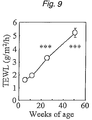
- FIG. 9 is a graph showing the changes with aging in the transepidermal water loss from mice coated with various drugs, with the vertical axis plotting the transepidermal water loss and the horizontal axis plotting the age of mice; *** means a significant difference at p ⁇ 0.001 from the 6-week mice.
- FIG. 10 is a graph showing the transepidermal water loss from mice coated with various drugs, with the vertical axis plotting the transepidermal water loss and the horizontal axis plotting the type of drug; * means a significant difference at p ⁇ 0.05 from the control group.
- the inventors assessed the antipruritic effect of various pharmaceutical preparations on itch-evoked but spontaneous scratching behavior by measuring the itch-evoked scratching behavior of NC/Nga mice that would spontaneously develop an atopic dermatitis-like skin disease.
- the present inventors studied the mechanism of action in itching and excessive dryness of the skin; as a result, they found that NC/Nga mice which would develop dermatitis spontaneously did not experience substantial changes with aging in the contents of prostaglandins PGE 2 , PGF 2 ⁇ , and PGI 2 in the skin tissue but experienced a significant drop in the PGD 2 content with aging. These results suggest the possibility that in the NC/Nga mice which will develop dermatitis spontaneously, the decreased in vivo PGD 2 content associated with aging may trigger itching and excessive dryness of the skin. In other words, the endogenous PGD 2 content has the physiological action of maintaining the skin's barrier function and the supply of exogenous stable PGD 2 derivatives would contribute to preventing or treating the onset of xerosis.
- One embodiment of the present invention is characterized by a method for preventing or treating xerosis which comprises applying the prostaglandin D receptor selective agonist to a mammal, as well as a pharmaceutical preparation for preventing or treating xerosis which comprises the prostaglandin D receptor selective agonist as an active ingredient.
- the prostaglandin D receptor selective agonist are prostaglandins, in particular, compounds of formula [1] set forth below.
- Another embodiment of the present invention is characterized by a method for preventing or treating pruritic symptoms (including atopic symptoms), in particular, xerosis which comprises applying to a mammal the prostaglandin derivative represented by formula [1], a pharmaceutically acceptable salt thereof or a hydrate thereof, as well as a pharmaceutical preparation to be used in the method for prevention or treatment.
- prostaglandin derivatives represented by formula [1] pharmaceutically acceptable salts thereof or hydrates thereof which are to be used in the present invention are described below.
- the halogen atom means a fluorine atom, a chlorine atom, a bromine atom or an iodine atom.
- the vinylene group means a cis- or trans-vinylene group.
- the C 1-10 alkyloxy group represents linear or branched alkyloxy groups having 1 to 10 carbon atoms, which include, for example, a methoxy group, an ethoxy group, a propoxy group, an isopropoxy group, a butoxy group, a sec-butoxy group, a tert-butoxy group, a pentyloxy group, a tert-pentyloxy group, a 5-methylhexyloxy group, an octyloxy group, a decyloxy group, etc.
- Examples of the C 3-10 cycloalkyloxy group include a cyclopropyloxy group, a cyclobutyloxy group, a cyclopentyloxy group, a cyclohexyloxy group, a cycloheptyloxy group, a cyclononyloxy group, etc.
- aryloxy group examples include a phenoxy group, a bromophenoxy group, a chlorophenoxy group, a tolyloxy group, a cumenyloxy group, a methoxyphenoxy group, etc.
- arylalkyloxy group examples include a benzyloxy group, a bromobenzyloxy group, a chlorobenzyloxy group, a nitrobenzyloxy group, a dinitrobenzyloxy group, a methoxybenzyloxy group, a phenethyloxy group, a phenylpropyloxy group, a phenylpentyloxy group, etc.
- the C 1-10 alkyl group represents linear or branched alkyl groups having 1 to 10 carbon atoms, which include, for example, a methyl group, an ethyl group, a propyl group, an isopropyl group, a butyl group, a sec-butyl group, a tert-butyl group, a pentyl group, a tert-pentyl group, an isohexyl group, a heptyl group, an octyl group, a decyl group, etc.
- the C 2-10 alkenyl group means those linear or branched alkyl groups with 2 to 10 carbon atoms which have one or more double bonds in desired positions and they may be exemplified by a vinyl group, an allyl group, a 1-propenyl group, an isopropenyl group, a 3-butenyl group, a 1,3-butadienyl group, a 7-octenyl group, etc.
- the C 2-10 alkynyl group means those linear or branched alkyl groups with 2 to 10 carbon atoms which have one or more triple bonds in desired positions and may be exemplified by an ethynyl group, a 2-propynyl group, a 2-pentynyl group, a 4-octynyl group, etc.
- Examples of the C 3-10 cycloalkyl group include unsubstituted cycloalkyl groups such as a cyclopropyl group, a cyclobutyl group, a cyclopentyl group, a cyclohexyl group, a cycloheptyl group and a cyclononyl group, as well as those cycloalkyl groups having one or more substituents selected from among halogen atoms, C 1-10 alkyl groups, C 1-10 alkyloxy groups, etc.
- Examples of the C 1-5 alkyl group substituted by C 3-10 cycloalkyl group(s) include a cyclopropylmethyl group, a cyclobutylethyl group, a cyclopentylmethyl group, a cyclohexylmethyl group, a cycloheptylmethyl group, a cyclononylbutyl group, a 4-fluorocyclohexylmethyl group, etc.
- the pharmaceutically acceptable salt may be exemplified by salts with alkali metals such as sodium and potassium, salts with alkaline earth metals such as calcium and magnesium, and salts with ammonia, methylamine, dimethylamine, cyclopentylamine, benzylamine, piperidine, monoethanolamine, diethanolamine, monomethylmonoethanolamine, tromethamine, lysine, tris(hydroxymethyl)aminomethane, etc.
- alkali metals such as sodium and potassium
- alkaline earth metals such as calcium and magnesium
- salts with ammonia methylamine, dimethylamine, cyclopentylamine, benzylamine, piperidine, monoethanolamine, diethanolamine, monomethylmonoethanolamine, tromethamine, lysine, tris(hydroxymethyl)aminomethane, etc.
- prostaglandin derivatives which serve as the active ingredient in the present invention are known compounds disclosed in the following publications:
- X is an ⁇ - or ⁇ -substituted halogen atom
- Y is an ethylene group, a vinylene group or an ethynylene group
- R 1 is a C 3-10 cycloalkyl group, a C 3-10 cycloalkyl group substituted by C 1-4 linear or branched alkyl group(s), or a C 4-13 cycloalkylalkyl group
- R 2 is a group represented by CO 2 R 3 , wherein R 3 is a hydrogen atom, a C 1-4 linear or branched alkyl group or a C 2-4 linear or branched alkenyl group, n is an integer of 1 to 4, and p is 0, 1 or 2 can be produced by processes according to reaction schemes 1 and 2.
- TBS represents a tert-butyldimethylsilyl group
- Y′ represents an ethylene group or a vinylene group
- R 31 represents a C 1-4 alkyl group or a C 2-4 alkenyl group
- p1 represents 1 or 2
- Z′ represents a halogen atom
- X, Y, R 1 and n have the same meanings as defined above.
- a compound of formula (III′) is employed and reaction is performed at ⁇ 78 to 30° C.; in order to obtain a compound where Y is an ethynylene group, a compound of formula (III) is employed and reaction is performed at 0 to 30° C.
- the compound of formula (IV) is reacted with 1 to 6 equivalent amounts of a compound represented by formula (V) in an organic solvent (e.g. benzene, toluene, xylene, n-hexane, n-pentane or acetone) at ⁇ 78 to 100° C., optionally employing 0.05 to 2 equivalent amounts of a radical generator (e.g.
- a compound of formula (VI) can also be obtained by performing the reaction in an organic solvent (e.g. benzene, toluene, xylene, n-hexane, n-pentane or acetone) at ⁇ 78 to 100° C.
- an organic solvent e.g. benzene, toluene, xylene, n-hexane, n-pentane or acetone
- a base e.g. an organic amine such as triethylamine, diisopropylamine, pyridine or dimethylaniline, or a base resin such as polyvinylpyrrolidone, diisopropylaminomethyl-polystyrene or (piperidinomethyl)polystyrene.
- the compound of formula (VII) (or formula (VII′)) is mesylated or tosylated with, for example, 1 to 6 equivalent amounts of methanesulfonyl chloride or p-toluenesulfonyl chloride in a suitable solvent such as pyridine at ⁇ 20 to 40° C., optionally in the presence of 0.8 to 6 equivalent amounts of 4-dimethylaminopyridine, followed by chlorination with 1 to 16 equivalent amounts of tetra-n-butylammonium chloride to give a compound of formula (VIII) (or formula (VIII′)) (X is a chlorine atom).
- Bromination and fluorination can also be performed by ordinary methods.
- bromination can be obtained by reacting 1 to 10 equivalent amounts of carbon tetrabromide in acetonitrile in the presence of 1 to 10 equivalent amounts each of triphenylphosphine and pyridine.
- Fluorination may, for example, be obtained by reacting 5 to 20 equivalent amounts of diethylaminosulfur trifluoride (DAST) in methylene chloride.
- DAST diethylaminosulfur trifluoride
- the compound of formula (VIII) (or formula (VIII′)) is reacted with a base (e.g. an alkyl lithium such as n-butyllithium) at a temperature between ⁇ 78° C. and room temperature in a suitable inert organic solvent (e.g.
- a base e.g. an alkyl lithium such as n-butyllithium
- a PG derivative of formula (Ib) (or formula (Ib′)) claimed in the invention can be obtained.
- exemplary enzymes are those produced by microorganisms (e.g. enzymes produced by microorganisms of Candida sp. and Pseudomonas sp.) and those prepared from animal organs (e.g. enzymes prepared from swine liver and pancreas).
- lipase VII product of Sigma, derived from a microorganism of Candida sp.
- lipase AY product of Amano Pharmaceutical Co., Ltd., derived from a microorganism of Candida sp.
- lipase PS product of Amano Pharmaceutical Co., Ltd., derived from a microorganism of Pseudomonas sp.
- lipase MF product of Amano Pharmaceutical Co., Ltd., derived from a microorganism of Pseudomonas sp.
- PLE product of Sigma, prepared from swine liver
- lipase II product of Sigma, prepared from swine pancreas
- lipoprotein lipase product of Tokyo Kasei Kogyo Co., Ltd., prepared from swine pancreas.
- the amount of the enzyme to be used may be chosen as appropriate for its potency and the amount of its substrate [formula (Ia) (or formula (Ia′))] and the usual amount is 0.1 to 20 times the weight of the substrate.
- the reaction temperature is 25 to 50° C., preferably 30 to 40° C.
- a PG derivative of formula (Ib) (or formula (Ib′)) claimed in the invention may be obtained by hydrolyzing the compound of formula (Ia) (or formula (Ia′)) with a base in a solvent commonly employed in hydrolysis.
- bases that can be employed are lithium hydroxide and potassium carbonate, and exemplary solvents include acetonitrile, acetone, methanol, ethanol, water and mixtures thereof.
- a PG derivative of formula (Ib) (or formula (Ib′)) claimed in the invention can also be obtained by deprotecting the compound of formula (XI) (or formula (XI′)) as in (6) above.
- the antipruritics of the invention are not limited in any way but they are particularly effective against the atopy-evoked itching. From this viewpoint, the antipruritics of the invention encompass pharmaceutical preparations for preventing or treating atopic symptoms.
- pruritic symptoms means those symptoms which involve circumscribed or generalized itching and associated inflammations on the skin and mucous membranes. Examples include scabies, urticaria, eczema, xerosis (senile xeroderma and histotic eczema), psoriasis, dermal pruritus, and prurigo.
- atopic symptoms means those symptoms which involve atopy-evoked, circumscribed or generalized itching and associated inflammations on the skin and mucous membranes; in other words, the term refers to atopy-evoked pruritic symptoms (including nervous pruritus). Examples include atopic dermatitis and atopic conjunctivitis.
- atopic dermatitis refers to a disorder that involves itching eczema as a principal lesion which undergoes repeated exacerbation and remission; this is highly likely to develop in individuals predisposed to atopy.
- xerosis refers to a condition involving excessive dryness of the skin and typical examples include senile xeroderma and histotic eczema, as well as dry skin.
- the term “senile xeroderma” refers to a case of xerosis that occurs with aging from diminished lipid between horny cells and lowered water content of the stratum corneum.
- the prostaglandin D receptor selective agonist as the active ingredient in the invention is effective against xerosis, particularly against senile xeroderma.
- the antipruritics and pharmaceutical preparations against xerosis according to the invention can be administered either orally, parenterally or topically.
- the dose to be administered of the active ingredient in the antipruritics and pharmaceutical preparations against xerosis according to the invention can be adjusted as appropriate for the body weight of the patient, his or her age, sex, etc. Usually, the dosage is 1 ng to 10 mg, preferably 0.1 to 100 ⁇ g, per administration and one to several administrations are tolerated per day. Depending on such factors as age, sex and body weight, the pharmaceutical preparations against xerosis can typically be administered by applying appropriate doses of the preparations to the diseased area at concentrations of the active ingredient ranging from about 0.1 to about 0.0001%.
- the antipruritics and pharmaceutical preparations against xerosis according to the invention can be prepared as pharmaceutical compositions employing the active ingredient in combination with carriers (bases), vehicles and other additives that are employed in ordinary pharmaceutical formulation procedures.
- Exemplary carriers (bases) and vehicles for pharmaceutical formulation procedures include water, ethanol, lactose, microcrystalline cellulose, liquid paraffin, hydrogenated oils, beeswax, squalane, stearyl alcohol, ethylene glycol and others that are in common use.
- Exemplary additives are commonly employed ingredients including disintegrants (e.g. starch), binders (hydroxypropyl cellulose and low-substituted hydroxypropyl cellulose), lubricants (e.g. talc and glycerol stearate), antioxidants, gelling agents, solubilizers, solvent promoters, pH adjusting agents, preservatives (e.g. parabens), coating agents (e.g. gelatin and hydroxypropyl cellulose), coloring agents, flavoring/odorizing agents, skin color lightening agents (e.g. sodium ellagate), surfactants (e.g. sorbitan fatty acid esters), plasticizers, humectants (e.g. glycerin, propylene glycol, polyethylene glycol and hyaluronic acid), etc.
- disintegrants e.g. starch
- binders hydroxypropyl cellulose and low-substituted hydroxypropyl cellulose
- the antipruritics and pharmaceutical preparations against xerosis according to the invention can be administered in various dosage forms such as those for internal application, injections and those for external application (nasal drops and eye drops), as specifically exemplified by tablets, granules, powders, capsules, liquids, gels, plasters, ointments, creams, cataplasms and aerosols.
- the pharmaceutical preparations against xerosis according to the invention can typically incorporate not only the active ingredient but also the necessary base, gelling agent, solubilizer, solvent promoter, pH adjusting agent and any other pharmaceutically active ingredients.
- Dosage forms for external application are preferred for the antipruritics and pharmaceutical preparations against xerosis according to the invention because of the various advantages they have, such as direct applicability to the diseased area, ease of application and reduced possibility for vitiation by metabolism and the occurrence of systemic side effects.
- Dosage forms “for external application” include liquids for external application, aerosols, powders for external application, ointments, creams, gels, plasters, cataplasms, etc.
- the drug concentration (%) means w/v % (weight/volume %).
- a hundredth of a gram of compound No. 7 was weighed, dissolved in 20 g of glycerin and mixed with 80 g of white petrolatum uniformly to prepare 100 g of an ointment.
- An aerosol was prepared according to a recipe consisting of the following ingredients.
- NC/Nga mice each weighing about 30 g and manifesting atopic dermatitis were purchased from SLC and subjected to the following experiment.
- a magnet was buried in both hind paws of each mouse and by detecting its magnetism, the movement of the paws was measured with an itch measuring system (product of Neuroscience; when the mouse makes an action, the magnets move accordingly and a current flows through the coil; the moving magnets cause a change in the current, which is detected, measured and analyzed).
- itch measuring system product of Neuroscience
- the itch-evoked scratching behavior had a diurnal rhythm
- the diurnal rhythm of each individual animal was measured for 24 hours of the day before test and only after that, each of the test drugs dissolved in 100% ethanol was applied to the dorsal skin in a dose of 0.2 ml/mouse.
- the subsequent 24-hr itch-evoked scratching behavior was measured and the number of itch-evoked scratchings after drug administration was compared with the initial count.
- the experimental data was processed to calculate the percent itch suppression on the basis of the total 24-hr itch-evoked scratching counts before and after drug application.
- mice Four-week old SPF NC mice (male) were purchased from Japan SLC; right after their arrival, the SPF NC mice were kept together with dermatitis manifesting male NC mice (older than 20 weeks) for 2 weeks under the following conditions so as to induce itch-evoked scratching behavior.
- mice After 2-wk cohabitation, the purchased mice were taken out of the cage and transferred into another cage, where a group of 8 animals were kept for about 14 weeks. Immediately before the application of a drug, the mice were reshuffled so that the dermatitis scores would be equal among all cages and then kept, four animals per cage.
- Tacrolimus was purchased from Fujisawa Pharmaceutical Co., Ltd. for use in the experiment.
- Drug administration To the dorsal backs of the 20-wk NC mice that were induced to manifest dermatitis as the result of cohabitation with the spontaneous dermatitis manifesting NC mice, 100% ethanol, compound No. 7 (0.01%) dissolved in 100% ethanol or tacrolimus (0.1%) dissolved in 100% ethanol was applied from an Eppendorf pipette in 200- ⁇ l doses seven times a week for a period of 4 weeks. The non-treatment group was not given any treatment. Each test group consisted of 8 animals that were observed for any dermatitic symptoms. Dermatitis score: Dermatitic symptoms were observed and measured once a week.
- the groups administered with tacrolimus and compound No. 7 showed significant dermatitis score suppressing action compared to the vehicle group.
- NC/Nga mice each weighing about 30 g and manifesting atopic dermatitis were purchased from SLC and subjected to the following experiment.
- a magnet was buried in both hind paws of each mouse and by detecting its magnetism, the movement of the paws was measured with an itch measuring system (product of Neuroscience).
- itch measuring system product of Neuroscience
- those lasting 1.5 seconds or longer were considered itch-evoked and their number was counted continuously. Since the itch-evoked scratching behavior had a diurnal rhythm, the diurnal rhythm of each individual animal was measured for 24 hours of the day before test and only after that, compound No. 3 (0.1%), compound No. 11 (0.1%) or compound No.
- NC/Nga male mice (5, 10, 15 and 20 weeks old) were used in the test.
- endogenous prostaglandin (PG) indomethacin (10 mg/kg) was i.v. injected to suppress any additional endogenous PG production and 5 minutes later, the dorsal skin was sampled with a pair of scissors. A slice of skin was transferred into a tube and after adding 1 mL of PBS (containing 100 ⁇ M of indomethacin), the tissue was comminuted with a POLYTRON homogenizer. After adding 4 mL of acetone and subsequent standing for 5 minutes, the mixture was centrifuged at 3000 rpm for 10 minutes.
- PBS containing 100 ⁇ M of indomethacin
- the test was performed on purchased platelet-rich plasma (PRP) (6 ⁇ 10 8 platelets/mL) and platelet aggregation was measured based on the Born method (Nature, vol. 194, p. 927, 1962).
- PRP platelet-rich plasma
- 5 ⁇ L of an aggregation inducer [ADP (3 ⁇ M)] was added to induce platelet aggregation and a maximum percent aggregation (a maximum change in light transmittance that occurred within 5 minutes after the induction of platelet aggregation) was determined by an aggregometer.
- the percent suppression of aggregation by each test drug was calculated from the maximum percent aggregation by the test drug as relative to the maximum percent aggregation by ethanol instead of the test drug solution and IC 50 values were determined from the constructed dose-response curve. The results were: compound No. 7 had an IC 50 of 4.27 nM and PGD 2 had an IC 50 of 11 nM.
- a platelet aggregation measuring instrument (PAM-8C) was employed. To 274 ⁇ L of PRP, 1 ⁇ L of a 0.287-95.7 nM test drug solution in ethanol was added and the mixture was incubated at 37° C. for 3 minutes with stirring at 1000 rpm. After the incubation, 25 ⁇ L of ADP (3 ⁇ M) was added to induce platelet aggregation and a maximum percent aggregation for 5 minutes was measured.
- the percent suppression of aggregation by each test drug was calculated from the maximum percent aggregation by the test drug as relative to the maximum percent aggregation by ethanol instead of the test drug solution and IC 50 values were determined from the constructed dose-response curve.
- the prostaglandin D receptor selective antagonist used in the test was ((+/ ⁇ )-3-benzyl-5-(6-carboxyhexyl)-1-(2-cyclohexyl-2-hydroxyethylamino)-hydantoin) (hereunder designated BW A868C) (Sigma-Aldrich Japan K.K.)
- BW A868C was diluted with ethanol to final concentrations of 0.03 ⁇ mol/L, 0.1 ⁇ mol/L, 0.3 ⁇ mol/L, 1 ⁇ mol/L, 3 ⁇ mol/L and 10 ⁇ mol/L.
- Compound No. 7 and PGD 2 were diluted with ethanol to 287 nmol/L and 300 nmol/L, respectively, for subsequent use.
- the negative control was ethanol.
- Blood was taken from the cubital veins of human healthy males and sampled into a tube containing 3.13% sodium citrate.
- the blood sample was centrifuged at 1,000 rpm for 10 minutes at 20° C. to separate the supernatant (PRP, or platelet-rich plasma) and the residue was further centrifuged at 3,000 rpm for 10 minutes at 20° C. to separate the supernatant (PPP, or platelet-poor plasma).
- the platelet count of PRP was appropriately diluted with PPP to 30 ⁇ 10 4 platelets/ ⁇ L for subsequent use.
- Platelet aggregation was measured with a platelet aggregation measuring instrument (PAM-8C; MC MEDICAL Co., LTD.) by the Born method (Nature, vol. 194, p. 927, 1962).
- a portion (273 ⁇ L) of PRP (for the BW A868C groups, 1 ⁇ L of BW A868C was added at varying concentrations) was preincubated at 37° C. for 3 minutes with stirring at 1,000 rpm. After the preincubation, 1 ⁇ L of ethanol or a test substance (compound No. 7: final concentration at 95.7 nmol/L; PGD 2 : final concentration at 1000 nmol/L) was added and the mixture was incubated at 37° C. for 3 minutes with stirring at 1000 rpm. After the incubation, 25 ⁇ L of ADP (final concentration at 3 ⁇ mol/L) was added to induce platelet aggregation and a maximum percent aggregation for 5 minutes was measured.
- PAM-8C plate
- Compound No. 7 and PGD 2 showed a significant platelet aggregation suppressing action as compared with their respective control groups (ethanol).
- the platelet aggregation suppressing action of compound No. 7 was antagonized by the increasing concentration of BW A868C and significant antagonism was observed at 0.1 ⁇ mol/L or more of BW A868C.
- the platelet aggregation suppressing action of PGD 2 was also antagonized by the increasing concentration of BW A868C and significant antagonism was observed at 0.3 ⁇ mol/L or more of BW A868C.
- compound No. 7 showed 28% binding inhibition at a concentration of 10 ⁇ M and 7% inhibition at 1 ⁇ M.
- U44069 as the positive control drug had an IC 50 of 2.4 ⁇ M.
- the active ingredient of the present invention showed high selectivity for the prostaglandin D receptor.
- thromboxane (TP) receptor Since the active ingredient of the present invention had weak action on the thromboxane (TP) receptor, it was found to cause neither potent vasoconstriction nor platelet aggregation which are two side effects of the thromboxane (TP) receptor agonist.
- the solvent-applied control group which was subjected to barrier destruction saw a significant increase in TEWL compared to the normal group.
- the group coated with compound No. 7 saw a significant decrease in TEWL compared to the solvent-applied control group.
- the PGD 2 -, PGF 2 ⁇ - and PGE 1 -applied groups had no significant difference from the control group.
- the control group saw a significant increase in TEWL compared to the normal group.
- the group coated with compound No. 7, PGD 2 or PGE 1 saw a significant decrease in TEWL compared to the control group.
- the PGF 2 ⁇ -applied group had no significant difference from the control group.
- the active ingredient of the present invention has the action of preventing damage to the skin's barrier and that, therefore, the active ingredient of the present invention has a preventive action on a damaged skin barrier condition such as xerosis.
- a senile xeroderma model was established by the following method which could verify that the mouse also gets TEWL (an index of skin's barrier function) to increase with aging.
- mice BALB/c male mice (eight in each group) at ages of 6, 12, 24 and 50 weeks were shaven in a rostral dorsolateral area of 4 cm 2 (2 cm ⁇ 2 cm) with electric clippers and TEWL (an index of skin's barrier function) was measured with Tewameter (TM210 of Courage & Khazawa, Germany). The results are shown in FIG. 9 .
- TEWL or an index of skin's barrier increased in mice with aging, providing a verification of dermal disorder due to the destroyed skin function.
- TEWL at the same site was measured with Tewameter (TM210 of Courage & Khazawa, Germany) to evaluate the drug's action. The results are shown in FIG. 10 .
- the group coated with compound No. 7 saw a significant decrease in TEWL compared to the control group.
- the PGD 2 -applied group had no significant difference from the control group.
- the active ingredient of the present invention has the action of promoting restoration of the skin barrier and that, therefore, the active ingredient of the present invention has a treatment action on a damaged skin barrier condition such as senile xeroderma.
- the present invention successfully provides pharmaceutical preparations that can prevent or ameliorate various cases of dermatitis including atopic dermatitis, atopic conjunctivitis, scabies, urticaria and xerosis.
- the present invention has enabled providing highly safe and efficacious drugs for preventing or treating xerosis, thereby making it possible to prevent or treat dermatitis resulting from xerosis.
Landscapes
- Health & Medical Sciences (AREA)
- Animal Behavior & Ethology (AREA)
- Public Health (AREA)
- Veterinary Medicine (AREA)
- Chemical & Material Sciences (AREA)
- Life Sciences & Earth Sciences (AREA)
- General Health & Medical Sciences (AREA)
- Medicinal Chemistry (AREA)
- Pharmacology & Pharmacy (AREA)
- Epidemiology (AREA)
- Bioinformatics & Cheminformatics (AREA)
- Nuclear Medicine, Radiotherapy & Molecular Imaging (AREA)
- Organic Chemistry (AREA)
- Engineering & Computer Science (AREA)
- General Chemical & Material Sciences (AREA)
- Chemical Kinetics & Catalysis (AREA)
- Dermatology (AREA)
- Pharmaceuticals Containing Other Organic And Inorganic Compounds (AREA)
Abstract
Description

wherein X1 and X2 which are different from each other represent a hydrogen atom, a halogen atom or a hydroxyl group;
Y is an ethylene group, a vinylene group or an ethynylene group; Z is the formula
(CH2)kA(CH2)hB(CH2)q,
(CH2)kA(CH2)rA′(CH2)t,
(CH2)kB(CH2)hB′(CH2)q
or
(CH2)k-1B′(CH2)q-1A′
wherein k is an integer of 1 to 4, h is an integer of 0 to 4, q is an
A and A′ which may be the same or different represent an ethylene group, a vinylene group or an ethynylene group;
B and B′ which may be the same or different represent an oxygen atom or a group represented by the formula S(O)u wherein u is an integer of 0 to 2;
W1 is a hydroxyl group, a C1-10 alkyloxy group, a C3-10 cycloalkyloxy group, an aryloxy group or an arylalkyloxy group;
W2 is a C1-10 alkyl group, a C2-10 alkenyl group, a C2-10 alkynyl group, a C3-10 cycloalkyl group, a C1-5 alkyl group substituted by C3-10 cycloalkyl group(s), or a group represented by the formula

wherein W4 is a C1-10 alkyl group, a C2-10 alkenyl group, a C2-10 alkynyl group or a C1-5 alkyl group substituted by C3-10 cycloalkyl group(s); v is an integer of 0 to 4;
W3 is a hydrogen atom or a methyl group, or W3 when taken together with W2 and the adjacent carbon atom forms a C3-10 cycloalkyl group; m is 0 or 1, a pharmaceutically acceptable salt thereof or a hydrate thereof, as well as a pharmaceutical preparation to be used in the method for prevention or treatment.
(CH2)kA(CH2)hB(CH2)q
(wherein k is an integer of 1 to 4, h is an integer of 0 to 4, q is an
(2) Compound (1) above which is a prostaglandin derivative of formula [1] where Z is a group represented by the formula
(CH2)kA(CH2)hB(CH2)q
(wherein k, h and q are k+h+q=3), a pharmaceutically acceptable salt thereof or a hydrate thereof.
(3) A prostaglandin derivative of formula [1] where Z is a group represented by the formula
(CH2)kA(CH2)rA′(CH2)t
[wherein k is an integer of 1 to 4, r is an integer of 0 to 4, t is an
(4) Compound (3) above which is a prostaglandin derivative of formula [1] where Z is a group represented by the formula
(CH2)kA(CH2)rA′(CH2)t
(wherein k, r and t are k+r+t=2), a pharmaceutically acceptable salt thereof or a hydrate thereof.
(5) A prostaglandin derivative of formula [1] where Z is a group represented by the formula
(CH2)kB(CH2)hB′(CH2)q
[wherein k is an integer of 1 to 4, h is an integer of 0 to 4, q is an
(6) Compound (5) above which is a prostaglandin derivative of formula [1] where Z is a group represented by the formula
(CH2)kB(CH2)hB′(CH2)q
(wherein k, h and q are k+h+q=4), a pharmaceutically acceptable salt thereof or a hydrate thereof.
(7) A prostaglandin derivative of formula [1] where Z is a group represented by the formula
(CH2)k-1B′(CH2)q-1A′
[wherein k is an integer of 1 to 4, q is an integer of 1 to 4, A′ represents an ethylene group, a vinylene group or an ethynylene group, and B′ represents an oxygen atom or a group represented by the formula S(O)u wherein u is an integer of 0 to 2], a pharmaceutically acceptable salt thereof or a hydrate thereof.
(8) Compound (7) above which is a prostaglandin derivative of formula [1] where Z is a group represented by the formula
(CH2)k-1B′(CH2)q-1A′
(wherein k and q are k+q=5), a pharmaceutically acceptable salt thereof or a hydrate thereof.
(9) Compound of formula [1] or a compound according to any one of (1) to (8) above, which is a prostaglandin derivative of formula [1] where X1 is a halogen atom, X2 is a hydroxyl group and Y is an ethynylene group, a pharmaceutically acceptable salt thereof or a hydrate thereof.
(10) Compound of formula [1] or a compound according to any one of (1) to (8) above, which is a prostaglandin derivative of formula [1] where X1 is a halogen atom, X2 is a hydroxyl group and Y is a vinylene group, a pharmaceutically acceptable salt thereof or a hydrate thereof.
(11) Compound of formula [1] or a compound according to any one of (1) to (10), which is a prostaglandin derivative of formula [1] wherein W2 is a C1-10 alkyl group, a C2-10 alkenyl group, a C2-10 alkynyl group, a C3-10 cycloalkyl group, a C1-5 alkyl group substituted by C3-10 cycloalkyl group(s), or a group represented by the formula

wherein W4 is a C1-10 alkyl group, a C2-10 alkenyl group, a C2-10 alkynyl group or a C1-5 alkyl group substituted by C3-10 cycloalkyl group(s); v is an integer of 0 to 4; W3 is a hydrogen atom or a methyl group, a pharmaceutically acceptable salt thereof or a hydrate thereof.
(12) A compound represented by formula [A]

[wherein R1 is any one group selected from
the group represented by —(CH2)4—S—CH2—CO2H,
the group represented by —(CH2)4—S—CH2—CO2CH3,
the group represented by —(CH2)4—C≡CO2H,
the group represented by —CH2—S—(CH2)2—S—CH2—CO2H, and
the group represented by —CH2—S—(CH2)4—CO2H].
(13) A compound represented by formula

(which is hereunder referred to as compound No. 7).
-
- WO94/02457, WO94/08959, WO95/18101, WO99/61029, WO99/61419, WO01/19790, U.S. Pat. No. 5,807,892, JP 2-502009 A, JP 6-192218 A, JP 7-242622 A, JP 7-242623 A, JP 7-233144 A, JP 7-285929 A, JP 8-208599 A, JP 9-286775 A, JP 58-8059 A, JP 60-501813 A, JP 61-500787 A, JP 2000-95755 A, JP 2000-128858 A, JP 2000-273083 A, JP 2001-122786 A, JP 2001-89443 A, JP 2001-135944 A, and JP 2001-151749 A.

wherein X is an α- or β-substituted halogen atom, Y is an ethylene group, a vinylene group or an ethynylene group, R1 is a C3-10 cycloalkyl group, a C3-10 cycloalkyl group substituted by C1-4 linear or branched alkyl group(s), or a C4-13 cycloalkylalkyl group, R2 is a group represented by CO2R3, wherein R3 is a hydrogen atom, a C1-4 linear or branched alkyl group or a C2-4 linear or branched alkenyl group, n is an integer of 1 to 4, and p is 0, 1 or 2 can be produced by processes according to


(in the above reaction schemes, TBS represents a tert-butyldimethylsilyl group, Y′ represents an ethylene group or a vinylene group, R31 represents a C1-4 alkyl group or a C2-4 alkenyl group, p1 represents 1 or 2, Z′ represents a halogen atom, and X, Y, R1 and n have the same meanings as defined above.)
(2) The compound of formula (IV) is reacted with 1 to 6 equivalent amounts of a compound represented by formula (V) in an organic solvent (e.g. benzene, toluene, xylene, n-hexane, n-pentane or acetone) at −78 to 100° C., optionally employing 0.05 to 2 equivalent amounts of a radical generator (e.g. azobisisobutyronitrile, azobiscyclohexanecarbonitrile, benzoyl peroxide or triethylborane), further optionally employing 1 to 5 equivalent amounts of a radical reducing agent (e.g. tributyltin hydride, triphenyltin hydride, dibutyltin hydride or diphenyltin hydride), thereby giving a compound of formula (VI). In a certain case, a compound of formula (VI) can also be obtained by performing the reaction in an organic solvent (e.g. benzene, toluene, xylene, n-hexane, n-pentane or acetone) at −78 to 100° C. employing 0.05 to 2 equivalent amounts of a base (e.g. an organic amine such as triethylamine, diisopropylamine, pyridine or dimethylaniline, or a base resin such as polyvinylpyrrolidone, diisopropylaminomethyl-polystyrene or (piperidinomethyl)polystyrene).
(3) The compound of formula (VI) is reacted with 0.5 to 5 equivalent amounts of a reducing agent such as potassium borohydride, sodium borohydride, sodium cyanoborohydride, lithium tri-sec-butyl borohydride or diisobutylaluminum hydride-BHT (2,6-di-tert-butyl-p-cresol) in an organic solvent (e.g. tetrahydrofuran, diethyl ether, ethyl alcohol, methyl alcohol or toluene) at −78 to 40° C. to give compounds of formulas (VII) and (VII′). These compounds of formulas (VII) and (VII′) can be purified by a commonly employed separation technique such as column chromatography.
(4) The compound of formula (VII) (or formula (VII′)) is mesylated or tosylated with, for example, 1 to 6 equivalent amounts of methanesulfonyl chloride or p-toluenesulfonyl chloride in a suitable solvent such as pyridine at −20 to 40° C., optionally in the presence of 0.8 to 6 equivalent amounts of 4-dimethylaminopyridine, followed by chlorination with 1 to 16 equivalent amounts of tetra-n-butylammonium chloride to give a compound of formula (VIII) (or formula (VIII′)) (X is a chlorine atom). Bromination and fluorination can also be performed by ordinary methods. For example, bromination can be obtained by reacting 1 to 10 equivalent amounts of carbon tetrabromide in acetonitrile in the presence of 1 to 10 equivalent amounts each of triphenylphosphine and pyridine. Fluorination may, for example, be obtained by reacting 5 to 20 equivalent amounts of diethylaminosulfur trifluoride (DAST) in methylene chloride.
(5) The compound of formula (VIII) (or formula (VIII′)) is reacted with a base (e.g. an alkyl lithium such as n-butyllithium) at a temperature between −78° C. and room temperature in a suitable inert organic solvent (e.g. tetrahydrofuran or diethyl ether) and thereafter reacted with a compound of formula (IX) at −78 to 40° C. to give a compound of formula (Xa) (or formula (Xa′)); if the formula (IX) is replaced by carbon dioxide as the reactant, a compound of formula (XI) (or formula (XI′)) can be obtained.
(6) The compound of formula (Xa) (or formula (Xa′)) is freed of the hydroxyl protecting tert-butyldimethylsilyl group in methanol, ethanol, acetonitrile or a mixed solvent thereof or a mixture thereof with water under ordinary conditions employing hydrofluoric acid, pyridinium poly(hydrogenfluoride), hydrochloric acid, etc. so as to give a PG derivative of formula (Ia) (or formula (Ia′)) according to the present invention.
(7) By hydrolyzing the compound of formula (Ia) (or formula (Ia′)) through reaction with an enzyme in a buffer solution such as a phosphate buffer or a Tris-HCl buffer, optionally employing an organic solvent (a water-miscible one such as acetone, methanol or ethanol), a PG derivative of formula (Ib) (or formula (Ib′)) claimed in the invention can be obtained. Exemplary enzymes are those produced by microorganisms (e.g. enzymes produced by microorganisms of Candida sp. and Pseudomonas sp.) and those prepared from animal organs (e.g. enzymes prepared from swine liver and pancreas). To mention specific examples of commercial enzymes, they include lipase VII (product of Sigma, derived from a microorganism of Candida sp.), lipase AY (product of Amano Pharmaceutical Co., Ltd., derived from a microorganism of Candida sp.), lipase PS (product of Amano Pharmaceutical Co., Ltd., derived from a microorganism of Pseudomonas sp.), lipase MF (product of Amano Pharmaceutical Co., Ltd., derived from a microorganism of Pseudomonas sp.), PLE (product of Sigma, prepared from swine liver), lipase II (product of Sigma, prepared from swine pancreas), and lipoprotein lipase (product of Tokyo Kasei Kogyo Co., Ltd., prepared from swine pancreas).
(9) By hydrolyzing the compound of formula (Ic) (or formula (Ic′)) as in (7) above, a PG derivative of formula (Id) (or formula (Id′)) claimed in the invention is obtained. A PG derivative of formula (Id) (or formula (Id′)) claimed in the invention can also be obtained by oxidizing the formula (Ib) (or formula (Ib′)) as in (8) above.
| TABLE 1 | |
| [1] | |
 |
|
| Compound | 8- | 9- | 11- | 12- | ||||||||||||||
| No. | X1 | X2 | Y | A | B | m | k | h | q | u | W1 | W2 | W3 | position | position | position | position | OH |
| 1 | Cl | HO | CH2CH2 | Z-CH═CH | S | 0 | 1 | 1 | 1 | 0 | OMe | cyc6 | H | α | β | α | β | α |
| 2 | Cl | HO | CH2CH2 | Z-CH═CH | S | 0 | 1 | 1 | 1 | 0 | OH | cyc6 | H | α | β | α | β | α |
| 3 | Cl | HO | E-CH═CH | Z-CH═CH | O | 0 | 1 | 1 | 1 | OH | cyc6 | H | α | β | α | β | α | |
| 4 | Cl | HO | C≡C | Z-CH═CH | O | 0 | 1 | 1 | 1 | OtBu | cyc6 | H | α | β | α | β | α | |
| 5 | Cl | HO | C≡C | CH2CH2 | O | 0 | 1 | 1 | 1 | OtBu | cyc6 | H | α | β | α | β | α | |
| 6 | Cl | HO | C≡C | CH2CH2 | S | 0 | 1 | 1 | 1 | 0 | OMe | cyc6 | H | α | β | α | β | α |
| 7 | Cl | HO | C≡C | CH2CH2 | S | 0 | 1 | 1 | 1 | 0 | OH | cyc6 | H | α | β | α | β | α |
| 8 | Cl | HO | C≡C | Z-CH═CH | O | 0 | 1 | 1 | 1 | OH | cyc6 | H | α | β | α | β | α | |
| 9 | H | HO | C≡C | CH2CH2 | S | 0 | 1 | 1 | 1 | 0 | OH | cyc6 | H | α | α | β | α | |
| 10 | Cl | HO | C≡C | C≡C | O | 0 | 1 | 1 | 1 | OH | cyc6 | H | α | β | α | β | α | |
| 11 | Cl | HO | CH2CH2 | Z-CH═CH | O | 0 | 1 | 1 | 1 | OH | cyc6 | H | α | β | α | β | α | |
| 12 | Cl | HO | E-CH═CH | CH2CH2 | S | 0 | 1 | 1 | 1 | 0 | OH | cyc6 | H | α | β | α | β | α |
| E-CH═CH: trans-vinylene group | ||||||||||||||||||
| Z-CH═CH: cis-vinylene group | ||||||||||||||||||
| cyc6: cyclohexyl group | ||||||||||||||||||
| TABLE 2 | |
| [1] | |
 |
|
| 8- | 9- | 11- | 12- | ||||||||||||||
| Compound | posi- | posi- | posi- | posi- | |||||||||||||
| No. | X1 | X2 | Y | A | A′ | m | k | r | t | W1 | W2 | W3 | tion | tion | tion | tion | OH |
| 13 | Cl | HO | E-CH═CH | CH2CH2 | |
0 | 1 | 1 | 0 | OMe | cyc5m | H | α | α | α | β | α |
| 14 | Cl | HO | C≡C | CH2CH2 | |
0 | 1 | 2 | 0 | OH | cyc6 | H | α | β | α | β | α |
| 15 | Cl | HO | C≡C | CH2CH2 | |
0 | 1 | 1 | 0 | OH | cyc6 | H | α | β | α | β | α |
| 16 | Cl | HO | C≡C | CH2CH2 | E-CH═ |
0 | 1 | 1 | 0 | OMe | cyc6 | H | α | β | α | β | α |
| 17 | Cl | HO | C≡C | CH2CH2 | E-CH═ |
0 | 1 | 1 | 0 | OiPr | cyc6 | H | α | β | α | β | α |
| 18 | Cl | HO | C≡C | CH2CH2 | E-CH═ |
0 | 1 | 1 | 0 | OtBu | cyc6 | H | α | β | α | β | α |
| 19 | Cl | HO | C≡C | CH2CH2 | |
0 | 1 | 1 | 0 | OtBu | cyc6 | H | α | β | α | β | α |
| 20 | Cl | HO | C≡C | CH2CH2 | |
0 | 1 | 1 | 1 | OMe | Me-cyc6 | H | α | β | α | β | α |
| Z-CH═CH: cis-vinylene group | |||||||||||||||||
| E-CH═CH: trans-vinylene group | |||||||||||||||||
| cyc6: cyclohexyl group | |||||||||||||||||
| Me-cyc6: 2-methylcyclohexyl group | |||||||||||||||||
| cyc5m: cyclopentylmethyl group | |||||||||||||||||
| TABLE 3 | |
| [1] | |
 |
|
| Compound | 8- | 9- | 11- | 12- | ||||||||||||||
| No. | X1 | X2 | Y | B | B′ | m | k | h | q | u | W1 | W2 | W3 | position | position | position | position | OH |
| 21 | Cl | HO | C≡C | S | O | 0 | 1 | 2 | 1 | 0 | OMe | cyc6 | H | α | β | α | β | α |
| 22 | Cl | HO | C≡C | S | O | 0 | 1 | 2 | 1 | 0 | OH | cyc6 | H | α | β | α | β | α |
| 23 | Cl | HO | C≡C | S | S | 0 | 1 | 2 | 1 | 0 | OMe | cyc6 | H | α | β | α | β | α |
| 24 | Cl | HO | C≡C | S | S | 0 | 1 | 2 | 1 | 0 | OMe | cyc6 | H | α | α | α | β | α |
| 25 | Cl | HO | C≡C | S | S | 0 | 1 | 2 | 1 | 0 | OH | cyc6 | H | α | β | α | β | α |
| 26 | Cl | HO | C≡C | S | O | 0 | 1 | 2 | 1 | 0 | OMe | diF-cyc6 | H | α | β | α | β | α |
| 27 | Cl | HO | C≡C | S | O | 0 | 1 | 2 | 1 | 0 | OH | diF-cyc6 | H | α | β | α | β | α |
| 28 | Cl | HO | C≡C | S | O | 0 | 1 | 2 | 1 | 0 | OMe | CF3-cyc6 | H | α | β | α | β | α |
| 29 | Cl | HO | C≡C | S | O | 0 | 1 | 2 | 1 | 0 | OH | CF3-cyc6 | H | α | β | α | β | α |
| 30 | Cl | HO | C≡C | S | S | 0 | 1 | 3 | 1 | 0 | OMe | cyc6 | H | α | β | α | β | α |
| cyc6: cyclohexyl group | ||||||||||||||||||
| diF-cyc6: difluorocyclohexyl group | ||||||||||||||||||
| CF3-cyc6: 4-trifluoromethylcyclohexyl group | ||||||||||||||||||
| TABLE 4 | |
| [1] | |
 |
|
| Compound | 8- | 9- | 11- | 12- | ||||||||||||||
| No. | X1 | X2 | Y | A′ | B′ | m | k | q | u | W1 | W2 | W3 | position | position | position | position | OH | |
| 31 | Cl | HO | C≡ | CH2CH2 | S | 0 | 2 | 3 | 0 | OMe | cyc6 | H | α | β | α | β | α | |
| 32 | Cl | HO | C≡ | CH2CH2 | S | 0 | 2 | 3 | 0 | OH | cyc6 | H | α | β | α | β | α | |
| 33 | Cl | HO | E-CH═ | CH2CH2 | S | 0 | 1 | 4 | 0 | OMe | cyc6 | H | α | β | α | β | α | |
| 34 | Cl | HO | E-CH═ | CH2CH2 | S | 0 | 4 | 1 | 0 | OMe | cyc6 | H | α | β | α | β | α | |
| 35 | Cl | HO | E-CH═ | CH2CH2 | S | 0 | 3 | 2 | 0 | OMe | cyc6 | H | α | β | α | β | α | |
| 36 | Cl | HO | E-CH═ | CH2CH2 | S | 0 | 2 | 3 | 0 | OH | cyc6 | H | α | β | α | β | α | |
| 37 | Cl | HO | | CH2CH2 | S | 0 | 2 | 3 | 0 | OMe | cyc6 | H | α | β | α | β | α | |
| 38 | Cl | HO | | CH2CH2 | S | 0 | 2 | 3 | 0 | OH | cyc6 | H | α | β | α | β | α | |
| 39 | Cl | HO | C≡C | C≡ | S | 0 | 2 | 3 | 0 | OH | cyc6 | H | α | β | α | β | α | |
| 40 | Cl | HO | C≡ | CH2CH2 | S | 0 | 2 | 1 | 0 | OH | cyc6 | H | α | β | α | β | α | |
| E-CH═CH: trans-vinylene group | ||||||||||||||||||
| cyc6: cyclohexyl group | ||||||||||||||||||
| Compound No. 7 | 0.01 | g | ||
| White petrolatum | 80 | g | ||
| Glycerin | 20 | g | ||
| Compound No. 7 | 0.1 | | ||
| Ethanol | ||||
| 200 | ml | |||
| |
800 | ml | ||
| Compound No. 3 | 0.5 | g | ||
| Carbinoxamine maleate | 5 | g | ||
| Sodium ellagate | 5 | g | ||
| Sodium hyaluronate | 3 | g | ||
| Methyl paraben | 2 | g | ||
| Purified water | 218.5 | g | ||
| Liquid paraffin(#70) | 50 | g | ||
| Squalane | 100 | g | ||
| Cetostearyl alcohol | 60 | g | ||
| Beeswax | 20 | g | ||
| Glycerol monostearate | 15 | g | ||
| Sorbitan monolaurate | 20 | g | ||
| Propyl paraben | 1 | g | ||
| Compound No. 7 | 0.05 | g | ||
| Carbinoxamine maleate | 5 | g | ||
| Sodium ellagate | 5 | g | ||
| Sodium hyaluronate | 3 | g | ||
| Methyl paraben | 2 | g | ||
| Purified water | 218.5 | g | ||
| Liquid paraffin(#70) | 50 | g | ||
| Squalane | 100 | g | ||
| Cetostearyl alcohol | 60 | g | ||
| Beeswax | 20 | g | ||
| Glycerol monostearate | 15 | g | ||
| Sorbitan monolaurate | 20 | g | ||
| Propyl paraben | 1 | g | ||
| Compound No. 7 | 0.01 (W/V %) | ||
| |
3 | ||
| |
8 | ||
| |
10 | ||
| |
10 | ||
| |
5 | ||
| Dibutylhydroxytoluene | 0.1 | ||
| Diisopropanolamine | 0.2 | ||
| Purified water | 25 | ||
| Liquefied petroleum gas | q.s. to make 100 (W/V %) | ||
Percent itch suppression (%)=(itch-evoked scratching count before drug application−itch-evoked scratching count after drug application)×100/itch-evoked scratching count before drug application
(Results)
| TABLE 5 | |
| Compound No. 6 | |
 |
|
| Compound No. 7 | |
 |
|
| Compound No. 15 | |
 |
|
| Compound No. 25 | |
 |
|
| Compound No. 32 | |
 |
|
| Concentration | Inhibition | ||
| Compound | (%) | rate (%) | Efficacy |
| EtOH | 100 | 10.2 | |
| 6 | 0.0001 | 32.26 | * |
| 7 | 0.000001 | 43.26 | ** |
| 15 | 0.000001 | 34.61 | * |
| 25 | 0.00001 | 21.51 | * |
| 32 | 0.00001 | 41.76 | ** |
| *: P < 0.05, | |||
| **: P < 0.01 | |||
Dermatitis score: Dermatitic symptoms were observed and measured once a week.

1. Human Platelet Aggregation Suppressing Action
Suppression of ADP-Induced Aggregation of Human Platelets
Test Drug:
Claims (5)


Priority Applications (2)
| Application Number | Priority Date | Filing Date | Title |
|---|---|---|---|
| US11/049,641 US7737182B2 (en) | 2002-08-09 | 2005-02-04 | Pharmaceuticals for xerosis |
| US12/762,876 US20100204320A1 (en) | 2002-08-09 | 2010-04-19 | Pharmaceuticals for xerosis |
Applications Claiming Priority (9)
| Application Number | Priority Date | Filing Date | Title |
|---|---|---|---|
| JP2002/234011 | 2002-08-09 | ||
| JP234011/2002 | 2002-08-09 | ||
| JP2002234011 | 2002-08-09 | ||
| US10/493,693 US7718701B2 (en) | 2002-08-09 | 2003-08-07 | Antipruritic agent |
| PCT/JP2003/010051 WO2004014394A1 (en) | 2002-08-09 | 2003-08-07 | Antipruritic agent |
| JP2004031286 | 2004-02-06 | ||
| JP31286/2004 | 2004-02-06 | ||
| JP2004/031286 | 2004-02-06 | ||
| US11/049,641 US7737182B2 (en) | 2002-08-09 | 2005-02-04 | Pharmaceuticals for xerosis |
Related Parent Applications (3)
| Application Number | Title | Priority Date | Filing Date |
|---|---|---|---|
| US10493693 Continuation-In-Part | 2001-08-07 | ||
| US10/493,693 Continuation-In-Part US7718701B2 (en) | 2002-08-09 | 2003-08-07 | Antipruritic agent |
| PCT/JP2003/010051 Continuation-In-Part WO2004014394A1 (en) | 2002-08-09 | 2003-08-07 | Antipruritic agent |
Related Child Applications (1)
| Application Number | Title | Priority Date | Filing Date |
|---|---|---|---|
| US12/762,876 Division US20100204320A1 (en) | 2002-08-09 | 2010-04-19 | Pharmaceuticals for xerosis |
Publications (2)
| Publication Number | Publication Date |
|---|---|
| US20050192357A1 US20050192357A1 (en) | 2005-09-01 |
| US7737182B2 true US7737182B2 (en) | 2010-06-15 |
Family
ID=46303851
Family Applications (2)
| Application Number | Title | Priority Date | Filing Date |
|---|---|---|---|
| US11/049,641 Expired - Fee Related US7737182B2 (en) | 2002-08-09 | 2005-02-04 | Pharmaceuticals for xerosis |
| US12/762,876 Abandoned US20100204320A1 (en) | 2002-08-09 | 2010-04-19 | Pharmaceuticals for xerosis |
Family Applications After (1)
| Application Number | Title | Priority Date | Filing Date |
|---|---|---|---|
| US12/762,876 Abandoned US20100204320A1 (en) | 2002-08-09 | 2010-04-19 | Pharmaceuticals for xerosis |
Country Status (1)
| Country | Link |
|---|---|
| US (2) | US7737182B2 (en) |
Cited By (1)
| Publication number | Priority date | Publication date | Assignee | Title |
|---|---|---|---|---|
| US20100204320A1 (en) * | 2002-08-09 | 2010-08-12 | Taisho Pharmaceutical Co., Ltd. | Pharmaceuticals for xerosis |
Families Citing this family (14)
| Publication number | Priority date | Publication date | Assignee | Title |
|---|---|---|---|---|
| US20040266880A1 (en) * | 2002-02-22 | 2004-12-30 | Fumie Sato | Antipruritics |
| CA2465103C (en) * | 2002-08-09 | 2011-04-26 | Taisho Pharmaceutical Co., Ltd. | Use of a prostaglandin derivative as an anti-pruritic agent |
| US7888392B2 (en) * | 2005-02-14 | 2011-02-15 | Taisho Pharmaceutical Co., Ltd. | Ointment |
| CA2624141C (en) * | 2005-10-03 | 2014-07-08 | Nippon Shinyaku Co., Ltd. | Quinazoline derivative and pharmaceutical |
| GB0615016D0 (en) * | 2006-07-28 | 2006-09-06 | Flen Pharma N V | Use of polyethylene glycol in inflammation related topical disorders or diseases and wound healing |
| EP2055305A1 (en) * | 2006-08-11 | 2009-05-06 | Taisho Pharmaceutical Co. Ltd. | External preparation comprising prostaglandin derivative |
| US8044104B2 (en) * | 2007-06-29 | 2011-10-25 | Taisho Pharmaceutical Co., Ltd | Prostaglandin derivative-containing aqueous liquid preparation |
| US8569279B2 (en) | 2009-05-27 | 2013-10-29 | Sucampo Ag | Method for modulating claudin mediated functions |
| CN102448463A (en) * | 2009-05-27 | 2012-05-09 | 苏坎波公司 | Pharmaceutical compositions comprising prostaglandin derivatives for modulating tight junction protein-mediated functions and treating skin diseases |
| CN105940110A (en) | 2014-01-31 | 2016-09-14 | 菲克特生物科学股份有限公司 | Methods and products for nucleic acid production and delivery |
| WO2016131052A1 (en) | 2015-02-13 | 2016-08-18 | Factor Bioscience Inc. | Nucleic acid products and methods of administration thereof |
| IL308824A (en) | 2016-08-17 | 2024-01-01 | Factor Bioscience Inc | Nucleic acid products and methods of their administration |
| JP7699552B2 (en) | 2019-07-03 | 2025-06-27 | ファクター バイオサイエンス インコーポレイテッド | Cationic lipids and uses thereof |
| US10501404B1 (en) | 2019-07-30 | 2019-12-10 | Factor Bioscience Inc. | Cationic lipids and transfection methods |
Citations (50)
| Publication number | Priority date | Publication date | Assignee | Title |
|---|---|---|---|---|
| EP0069696A2 (en) | 1981-07-03 | 1983-01-12 | Schering Aktiengesellschaft | Derivatives of 9-fluoroprostaglandin, process for their preparation and their use as medicaments |
| WO1985000367A1 (en) | 1983-07-08 | 1985-01-31 | Schering Aktiengesellschaft | 11-halogene-prostane derivatives, process for obtaining them and utilization thereof as drugs |
| WO1985002841A1 (en) | 1983-12-22 | 1985-07-04 | Schering Aktiengesellschaft | 9-halogen-delta2-prostaglandine derivatives, preparation process and utilization thereof as drugs |
| WO1989000559A1 (en) | 1987-07-17 | 1989-01-26 | Schering Aktiengesellschaft Berlin Und Bergkamen | 9-halogen-(z)-prostaglandin derivatives, process for manufacturing them, and their use as drugs |
| EP0312601A1 (en) | 1987-04-30 | 1989-04-26 | Tokyo-Buhin Kogyo Co., Ltd. | Eddy current brake |
| US4983629A (en) | 1983-07-08 | 1991-01-08 | Schering Aktiengesellschaft | 11-haloprostane derivatives, processes for their preparation and their use as medicinal agents |
| US5059622A (en) * | 1989-08-29 | 1991-10-22 | Biosyn, Inc. | Method for reducing blood pressure levels in hypertensive persons |
| WO1993006831A1 (en) | 1991-10-11 | 1993-04-15 | Board Of Regents, The University Of Texas System | Use of misoprostol for the treatment of allergy |
| EP0652211A1 (en) | 1992-07-24 | 1995-05-10 | Taisho Pharmaceutical Co. Ltd | Prostaglandin derivative |
| EP0666256A1 (en) | 1992-10-20 | 1995-08-09 | Taisho Pharmaceutical Co. Ltd | Prostaglandine derivative |
| JPH07242622A (en) | 1994-03-07 | 1995-09-19 | Taisho Pharmaceut Co Ltd | Prostaglandin derivatives and uses thereof |
| JPH07285929A (en) | 1994-04-19 | 1995-10-31 | Taisho Pharmaceut Co Ltd | Prostaglandin derivative |
| WO1996016935A1 (en) | 1994-11-30 | 1996-06-06 | Taisho Pharmaceutical Co., Ltd. | Prostaglandin derivative |
| EP0737676A1 (en) | 1993-12-29 | 1996-10-16 | Taisho Pharmaceutical Co. Ltd | Prostaglandin derivative, salt thereof, and use thereof |
| US5591446A (en) | 1989-04-04 | 1997-01-07 | Beiersdorf, A.G. | Methods and agents for the prophylaxis of atopy |
| US5599838A (en) * | 1996-02-23 | 1997-02-04 | Taisho Pharmaceutical Co., Ltd. | Prostaglandin derivatives |
| JPH0971539A (en) | 1995-09-08 | 1997-03-18 | Mochida Pharmaceut Co Ltd | Topical antipruritic |
| JPH09169638A (en) | 1995-10-18 | 1997-06-30 | Sekisui Chem Co Ltd | Topical for the treatment of skin diseases |
| JPH09286775A (en) | 1996-04-24 | 1997-11-04 | Taisho Pharmaceut Co Ltd | Prostaglandin derivative |
| WO1997045114A1 (en) | 1996-05-30 | 1997-12-04 | Lysis Corporation | The treatment of vascular disease with prostaglandins via a sustained-release dermal patch |
| WO1998027971A1 (en) | 1996-12-23 | 1998-07-02 | Michael Albert Kamm | Pharmaceutical composition for treating fecal incontinence and anal itch |
| EP0860430A2 (en) | 1997-02-04 | 1998-08-26 | Ono Pharmaceutical Co., Ltd. | Omega-cycloalkyl-prostaglandin E2 derivatives |
| US5807892A (en) | 1994-09-30 | 1998-09-15 | Alcon Laboratories, Inc. | Use of certain prostaglandin analogues to treat glaucoma and ocular hypertension |
| JPH10316564A (en) | 1997-05-21 | 1998-12-02 | Sekisui Chem Co Ltd | Topical antipruritic agent |
| US5852050A (en) | 1992-02-07 | 1998-12-22 | Kaken Pharmaceutical Co., Ltd. | Preparation for treating wounds or hemorrhoids |
| JPH1180031A (en) | 1997-07-14 | 1999-03-23 | Sekisui Chem Co Ltd | External preparations and methods for enhancing transdermal or transmucosal absorption |
| US5891910A (en) | 1987-07-17 | 1999-04-06 | Schering Aktiengesellschaft | 9-halogen-(Z) prostaglandin derivatives, process for their production and their use as pharmaceutical agents |
| WO1999025358A1 (en) | 1997-11-19 | 1999-05-27 | Allergan Sales, Inc. | Cyclopentane heptan(ene)oic acid, 2-heteroarylalkenyl derivatives as therapeutic agents |
| JPH11199478A (en) | 1998-01-05 | 1999-07-27 | Hiroshi Nagoshi | Use of retinoid and prostaglandin d2 derivative as antiinflammatory agent |
| WO1999061419A1 (en) | 1998-05-25 | 1999-12-02 | Taisho Pharmaceutical Co., Ltd. | Prostaglandin derivative |
| WO1999062555A1 (en) | 1998-06-03 | 1999-12-09 | Shionogi & Co., Ltd. | Remedies for itching containing pgd2 antagonists |
| WO2000032190A1 (en) | 1998-11-27 | 2000-06-08 | Case Western Reserve University | Compositions and methods for the treatment of alzheimer's disease, central nervous system injury, and inflammatory diseases |
| JP2000273083A (en) | 1999-03-19 | 2000-10-03 | Taisho Pharmaceut Co Ltd | Prostaglandin derivatives |
| WO2001019790A1 (en) * | 1999-09-10 | 2001-03-22 | Taisho Pharmaceutical Co., Ltd. | Prostaglandin derivatives |
| WO2001019814A2 (en) | 1999-09-14 | 2001-03-22 | Merck Frosst Canada & Co. | Carboxylic acids and acylsulfonamides, compositions containing such compounds and methods of treatment |
| JP2001089443A (en) | 1999-07-19 | 2001-04-03 | Taisho Pharmaceut Co Ltd | Prostaglandin derivatives |
| JP2001122786A (en) | 1999-10-20 | 2001-05-08 | Taisho Pharmaceut Co Ltd | Sleep inducer |
| EP1097922A1 (en) | 1998-07-15 | 2001-05-09 | Ono Pharmaceutical Co., Ltd. | 5-thia-omega-substituted phenyl-prostaglandin e derivatives, process for producing the same and drugs containing the same as the active ingredient |
| JP2001151749A (en) | 1999-11-24 | 2001-06-05 | Taisho Pharmaceut Co Ltd | Prostaglandin derivatives |
| WO2001049661A1 (en) | 2000-01-05 | 2001-07-12 | Ono Pharmaceutical Co., Ltd. | 5-THIA-φ-(SUBSTITUTED PHENYL)-PROSTAGLANDIN E ALCOHOLS, PROCESS FOR PREPARING THE ALCOHOLS AND PHARMACEUTICAL PREPARATIONS CONTAINING THE SAME AS THE ACTIVE INGREDIENT |
| JP2001220355A (en) | 2000-02-07 | 2001-08-14 | Teijin Ltd | Mast cell activation inhibitor comprising PPARβ / δ and γ ligands |
| EP1170594A2 (en) | 2000-07-07 | 2002-01-09 | Pfizer Products Inc. | Methods for the identification of compounds useful for the treatment of disease states mediated by Prostaglandin D2 |
| WO2002016311A1 (en) | 2000-08-22 | 2002-02-28 | Ono Pharmaceutical Co., Ltd. | Carboxylic acid derivatives, process for producing the same and drugs containing the same as the active ingredient |
| WO2002020462A1 (en) | 2000-09-01 | 2002-03-14 | Ono Pharmaceutical Co., Ltd. | Benzoic acid derivatives and drugs containing the same as the active ingredient |
| WO2002045718A1 (en) | 2000-12-08 | 2002-06-13 | Institut Pasteur De Lille | Use of active compounds capable of modulating the intracellular pathway triggered by the dp receptor in langerhans cells |
| US6506789B2 (en) | 1998-06-03 | 2003-01-14 | Shionogi & Co., Ltd. | Methods for the treatment of itching comprising administering PGD2 receptor antagonist |
| WO2003070252A1 (en) | 2002-02-22 | 2003-08-28 | Taisho Pharmaceutical Co., Ltd. | Antipruritics |
| US6617353B1 (en) * | 1999-11-24 | 2003-09-09 | Taisho Pharmaceutical Co., Ltd. | Preparation for nasal administration |
| US20040266880A1 (en) | 2002-02-22 | 2004-12-30 | Fumie Sato | Antipruritics |
| US20050192357A1 (en) | 2002-08-09 | 2005-09-01 | Fumie Sato | Pharmaceuticals for xerosis |
Family Cites Families (1)
| Publication number | Priority date | Publication date | Assignee | Title |
|---|---|---|---|---|
| CA2465103C (en) * | 2002-08-09 | 2011-04-26 | Taisho Pharmaceutical Co., Ltd. | Use of a prostaglandin derivative as an anti-pruritic agent |
-
2005
- 2005-02-04 US US11/049,641 patent/US7737182B2/en not_active Expired - Fee Related
-
2010
- 2010-04-19 US US12/762,876 patent/US20100204320A1/en not_active Abandoned
Patent Citations (69)
| Publication number | Priority date | Publication date | Assignee | Title |
|---|---|---|---|---|
| US4454339A (en) | 1981-07-03 | 1984-06-12 | Schering Aktiengesellschaft | 9-Fluoroprostaglandin derivatives, and use as medicinal agents |
| EP0069696A2 (en) | 1981-07-03 | 1983-01-12 | Schering Aktiengesellschaft | Derivatives of 9-fluoroprostaglandin, process for their preparation and their use as medicaments |
| US4789685A (en) | 1981-07-03 | 1988-12-06 | Schering Aktiengesellschaft | 9-fluoroprostaglandin derivatives, their preparation and use as medicinal agents |
| US4870104A (en) | 1983-07-08 | 1989-09-26 | Schering Aktiengesellschaft | 11-haloprostane derivatives, processes for their preparation and their use as medicinal agents |
| WO1985000367A1 (en) | 1983-07-08 | 1985-01-31 | Schering Aktiengesellschaft | 11-halogene-prostane derivatives, process for obtaining them and utilization thereof as drugs |
| US4983629A (en) | 1983-07-08 | 1991-01-08 | Schering Aktiengesellschaft | 11-haloprostane derivatives, processes for their preparation and their use as medicinal agents |
| US4699920A (en) | 1983-12-22 | 1987-10-13 | Schering Aktiengesellschaft | 9-halo-2-prostaglandin derivatives, processes for the preparation thereof and use thereof as medicinal agents |
| WO1985002841A1 (en) | 1983-12-22 | 1985-07-04 | Schering Aktiengesellschaft | 9-halogen-delta2-prostaglandine derivatives, preparation process and utilization thereof as drugs |
| EP0312601A1 (en) | 1987-04-30 | 1989-04-26 | Tokyo-Buhin Kogyo Co., Ltd. | Eddy current brake |
| WO1989000559A1 (en) | 1987-07-17 | 1989-01-26 | Schering Aktiengesellschaft Berlin Und Bergkamen | 9-halogen-(z)-prostaglandin derivatives, process for manufacturing them, and their use as drugs |
| US6225347B1 (en) | 1987-07-17 | 2001-05-01 | Schering Aktiengesellschaft | 9-halogen-(Z)-prostaglandin derivatives, process for their production and their use as pharmaceutical agents |
| US5891910A (en) | 1987-07-17 | 1999-04-06 | Schering Aktiengesellschaft | 9-halogen-(Z) prostaglandin derivatives, process for their production and their use as pharmaceutical agents |
| US5591446A (en) | 1989-04-04 | 1997-01-07 | Beiersdorf, A.G. | Methods and agents for the prophylaxis of atopy |
| US5059622A (en) * | 1989-08-29 | 1991-10-22 | Biosyn, Inc. | Method for reducing blood pressure levels in hypertensive persons |
| WO1993006831A1 (en) | 1991-10-11 | 1993-04-15 | Board Of Regents, The University Of Texas System | Use of misoprostol for the treatment of allergy |
| US5852050A (en) | 1992-02-07 | 1998-12-22 | Kaken Pharmaceutical Co., Ltd. | Preparation for treating wounds or hemorrhoids |
| EP0652211A1 (en) | 1992-07-24 | 1995-05-10 | Taisho Pharmaceutical Co. Ltd | Prostaglandin derivative |
| US5491254A (en) * | 1992-07-24 | 1996-02-13 | Taisho Pharmaceutical Co., Ltd. | Prostaglandin derivatives |
| US5545666A (en) * | 1992-10-20 | 1996-08-13 | Taisho Pharmaceutical Co., Ltd. | Prostaglandin derivatives |
| EP0666256A1 (en) | 1992-10-20 | 1995-08-09 | Taisho Pharmaceutical Co. Ltd | Prostaglandine derivative |
| EP0737676A1 (en) | 1993-12-29 | 1996-10-16 | Taisho Pharmaceutical Co. Ltd | Prostaglandin derivative, salt thereof, and use thereof |
| JPH07242622A (en) | 1994-03-07 | 1995-09-19 | Taisho Pharmaceut Co Ltd | Prostaglandin derivatives and uses thereof |
| JPH07285929A (en) | 1994-04-19 | 1995-10-31 | Taisho Pharmaceut Co Ltd | Prostaglandin derivative |
| US5807892A (en) | 1994-09-30 | 1998-09-15 | Alcon Laboratories, Inc. | Use of certain prostaglandin analogues to treat glaucoma and ocular hypertension |
| WO1996016935A1 (en) | 1994-11-30 | 1996-06-06 | Taisho Pharmaceutical Co., Ltd. | Prostaglandin derivative |
| JPH0971539A (en) | 1995-09-08 | 1997-03-18 | Mochida Pharmaceut Co Ltd | Topical antipruritic |
| JPH09169638A (en) | 1995-10-18 | 1997-06-30 | Sekisui Chem Co Ltd | Topical for the treatment of skin diseases |
| US5599838A (en) * | 1996-02-23 | 1997-02-04 | Taisho Pharmaceutical Co., Ltd. | Prostaglandin derivatives |
| JPH09286775A (en) | 1996-04-24 | 1997-11-04 | Taisho Pharmaceut Co Ltd | Prostaglandin derivative |
| WO1997045114A1 (en) | 1996-05-30 | 1997-12-04 | Lysis Corporation | The treatment of vascular disease with prostaglandins via a sustained-release dermal patch |
| WO1998027971A1 (en) | 1996-12-23 | 1998-07-02 | Michael Albert Kamm | Pharmaceutical composition for treating fecal incontinence and anal itch |
| US6635678B1 (en) | 1996-12-23 | 2003-10-21 | S.L.A. Pharma Ag | Pharmaceutical composition for treating fecal incontinence |
| EP0860430A2 (en) | 1997-02-04 | 1998-08-26 | Ono Pharmaceutical Co., Ltd. | Omega-cycloalkyl-prostaglandin E2 derivatives |
| JPH10316564A (en) | 1997-05-21 | 1998-12-02 | Sekisui Chem Co Ltd | Topical antipruritic agent |
| JPH1180031A (en) | 1997-07-14 | 1999-03-23 | Sekisui Chem Co Ltd | External preparations and methods for enhancing transdermal or transmucosal absorption |
| WO1999025358A1 (en) | 1997-11-19 | 1999-05-27 | Allergan Sales, Inc. | Cyclopentane heptan(ene)oic acid, 2-heteroarylalkenyl derivatives as therapeutic agents |
| JPH11199478A (en) | 1998-01-05 | 1999-07-27 | Hiroshi Nagoshi | Use of retinoid and prostaglandin d2 derivative as antiinflammatory agent |
| WO1999061029A1 (en) | 1998-05-25 | 1999-12-02 | Taisho Pharmaceutical Co., Ltd. | Sleep inducing agent |
| US6395786B1 (en) * | 1998-05-25 | 2002-05-28 | Taisho Pharmaceutical Co., Ltd. | Sleep inducing agent |
| WO1999061419A1 (en) | 1998-05-25 | 1999-12-02 | Taisho Pharmaceutical Co., Ltd. | Prostaglandin derivative |
| EP1082961A1 (en) | 1998-05-25 | 2001-03-14 | Taisho Pharmaceutical Co., Ltd | Sleep inducing agent |
| EP1083168A1 (en) | 1998-05-25 | 2001-03-14 | Taisho Pharmaceutical Co., Ltd | Prostaglandin derivative |
| US6329539B1 (en) * | 1998-05-25 | 2001-12-11 | Taisho Pharmaceutical Co., Ltd. | Prostagladin derivatives |
| EP1084711A1 (en) | 1998-06-03 | 2001-03-21 | Shionogi & Co., Ltd. | Remedies for itching containing pgd 2? antagonists |
| US6506789B2 (en) | 1998-06-03 | 2003-01-14 | Shionogi & Co., Ltd. | Methods for the treatment of itching comprising administering PGD2 receptor antagonist |
| WO1999062555A1 (en) | 1998-06-03 | 1999-12-09 | Shionogi & Co., Ltd. | Remedies for itching containing pgd2 antagonists |
| EP1097922A1 (en) | 1998-07-15 | 2001-05-09 | Ono Pharmaceutical Co., Ltd. | 5-thia-omega-substituted phenyl-prostaglandin e derivatives, process for producing the same and drugs containing the same as the active ingredient |
| WO2000032190A1 (en) | 1998-11-27 | 2000-06-08 | Case Western Reserve University | Compositions and methods for the treatment of alzheimer's disease, central nervous system injury, and inflammatory diseases |
| JP2000273083A (en) | 1999-03-19 | 2000-10-03 | Taisho Pharmaceut Co Ltd | Prostaglandin derivatives |
| JP2001089443A (en) | 1999-07-19 | 2001-04-03 | Taisho Pharmaceut Co Ltd | Prostaglandin derivatives |
| WO2001019790A1 (en) * | 1999-09-10 | 2001-03-22 | Taisho Pharmaceutical Co., Ltd. | Prostaglandin derivatives |
| US6740772B1 (en) | 1999-09-10 | 2004-05-25 | Taisho Pharmaceutical Co., Ltd. | Prostaglandin derivatives |
| EP1211242A1 (en) | 1999-09-10 | 2002-06-05 | Taisho Pharmaceutical Co., Ltd | Prostaglandin derivatives |
| WO2001019814A2 (en) | 1999-09-14 | 2001-03-22 | Merck Frosst Canada & Co. | Carboxylic acids and acylsulfonamides, compositions containing such compounds and methods of treatment |
| JP2001122786A (en) | 1999-10-20 | 2001-05-08 | Taisho Pharmaceut Co Ltd | Sleep inducer |
| JP2001151749A (en) | 1999-11-24 | 2001-06-05 | Taisho Pharmaceut Co Ltd | Prostaglandin derivatives |
| US6617353B1 (en) * | 1999-11-24 | 2003-09-09 | Taisho Pharmaceutical Co., Ltd. | Preparation for nasal administration |
| WO2001049661A1 (en) | 2000-01-05 | 2001-07-12 | Ono Pharmaceutical Co., Ltd. | 5-THIA-φ-(SUBSTITUTED PHENYL)-PROSTAGLANDIN E ALCOHOLS, PROCESS FOR PREPARING THE ALCOHOLS AND PHARMACEUTICAL PREPARATIONS CONTAINING THE SAME AS THE ACTIVE INGREDIENT |
| EP1245562A1 (en) | 2000-01-05 | 2002-10-02 | Ono Pharmaceutical Co., Ltd. | 5-THIA-$g(v)-(SUBSTITUTED PHENYL)-PROSTAGLANDIN E ALCOHOLS, PROCESS FOR PREPARING THE ALCOHOLS AND PHARMACEUTICAL PREPARATIONS CONTAINING THE SAME AS THE ACTIVE INGREDIENT |
| JP2001220355A (en) | 2000-02-07 | 2001-08-14 | Teijin Ltd | Mast cell activation inhibitor comprising PPARβ / δ and γ ligands |
| EP1170594A2 (en) | 2000-07-07 | 2002-01-09 | Pfizer Products Inc. | Methods for the identification of compounds useful for the treatment of disease states mediated by Prostaglandin D2 |
| WO2002016311A1 (en) | 2000-08-22 | 2002-02-28 | Ono Pharmaceutical Co., Ltd. | Carboxylic acid derivatives, process for producing the same and drugs containing the same as the active ingredient |
| EP1314719A1 (en) | 2000-09-01 | 2003-05-28 | Ono Pharmaceutical Co., Ltd. | Benzoic acid derivatives and drugs containing the same as the active ingredient |
| WO2002020462A1 (en) | 2000-09-01 | 2002-03-14 | Ono Pharmaceutical Co., Ltd. | Benzoic acid derivatives and drugs containing the same as the active ingredient |
| WO2002045718A1 (en) | 2000-12-08 | 2002-06-13 | Institut Pasteur De Lille | Use of active compounds capable of modulating the intracellular pathway triggered by the dp receptor in langerhans cells |
| WO2003070252A1 (en) | 2002-02-22 | 2003-08-28 | Taisho Pharmaceutical Co., Ltd. | Antipruritics |
| EP1477170A1 (en) | 2002-02-22 | 2004-11-17 | Taisho Pharmaceutical Co., Ltd | Antipruritics |
| US20040266880A1 (en) | 2002-02-22 | 2004-12-30 | Fumie Sato | Antipruritics |
| US20050192357A1 (en) | 2002-08-09 | 2005-09-01 | Fumie Sato | Pharmaceuticals for xerosis |
Non-Patent Citations (35)
| Title |
|---|
| Amendment Under 37 C.F.R. � 1.111 filed May 27, 2008 in U.S. Appl. No. 10/493,693. |
| Amendment Under 37 C.F.R. � 1.111, filed Jan. 21, 2009 in U.S. Appl. No. 10/493,693. |
| Amendment Under 37 C.F.R. � 1.116 filed Apr. 15, 2008 in U.S. Appl. No. 10/492,948. |
| Amendment Under 37 C.F.R. § 1.111 filed May 27, 2008 in U.S. Appl. No. 10/493,693. |
| Amendment Under 37 C.F.R. § 1.111, filed Jan. 21, 2009 in U.S. Appl. No. 10/493,693. |
| Amendment Under 37 C.F.R. § 1.116 filed Apr. 15, 2008 in U.S. Appl. No. 10/492,948. |
| Amendment Under 37 C.F.R. §1.111 filed Oct. 24, 2007 in U.S. Appl. No. 10/492,948. |
| Amendment Under 37 C.F.R. �1.111 filed Oct. 24, 2007 in U.S. Appl. No. 10/492,948. |
| Amendment under 37 CFR 1.111 with attachment (Cell, vol. 83, 803-812 [1995]), an executed Rule 132 Declaration of N. Nagahata dated Oct. 27, 2009, and an executed Rule 132 Declaration of I. Arai dated Nov. 4, 2009, in U.S. Appl. No. 10/493,693, as filed on Nov. 9, 2009. |
| Amendment Under 37 CFR 1.111, filed Oct. 6, 2008, in U.S. Appl. No. 10/492,948. |
| Angeli, V., et. al., Role of the Parasite-derived Prostaglandin D2 in the Inhibition of Epidermal Langerhans Cell Migration during Schistosomiasis Infection, J. Ex. Med. vol. 193, No. 10, May 21, 2001, pp. 1135-1147. |
| Angelika Buske-Kirschbaum et al., "Pyschobiological Aspects of Atopic Dermatitis: An Overview", Psycotherapy and Psychosomatics, 2001:70:6-16. |
| Derek A. Willoughby, et al., "COX-1, COX-2, and COX-3 and the furture treatment of chronic inflammatory disease", The Lancet, vol. 355, pp. 646-648, Feb. 19, 2000. |
| Examiner's Interview Summary dated Nov. 10, 2009, issued in U.S. Appl. No. 10/493,693. |
| Final Office Action dated Dec. 16, 2008 in U.S. Appl. No. 10/492,948. |
| Final Office Action dated Jan. 15, 2008 in U.S. Appl. No. 10/492,948. |
| Grant et al., Advanced Drug Delivery Reviews, 2001, 48, 3-26. * |
| Hellhammer et al., Psychother. Psychosom, 2001, 7, 6-16. * |
| Lawrence S. Chan et al., "Expression of Interleukin-4 in the Epidermis of Transgenic Mice Results in a Pruritic Inflammatory Skin Disease: An Experimental Animal Model to Study Atopic Dermatitis", J. Invest. Dermatol., 2001, 117 pp. 977-983. |
| Mark Abramovitz, et al., 'The Utilization of Recombinant Prostanoid Receptors to Determine the Affinities and Selectivities of Prostaglandins and Related Analogs. |
| Merck Manual (http://www.merck.com/mmhe/sec18/ch203/ch203b.html#sb203-1, obtained online on Apr. 17, 2009). * |
| Merriam-Webster Online Dictionary, www.merriam-webster.com/dictionary/preventing, 2005. |
| Non-Final Office Action dated Aug. 18, 2008, in U.S. Appl. No. 10/493,693. |
| Non-Final Office Action dated Dec. 27, 2007 in U.S. Appl. No. 10/493,693. |
| Non-Final Office Action dated Jul. 24, 2007 in U.S. Appl. No. 10/492,948. |
| Non-Final Office Action dated May 14, 2009, in U.S. Appl. No. 10/493,693. |
| Non-Final Office Action dated May 5, 2208 in U.S. Appl. No. 10/492,498. |
| Olivry, T. et al., "Treatment of canine atopic dermatitis with misoprostol, a prostaglandin E1 analogue: An open study", Database EMBASE [Online] XP002440431, 1997. |
| Pons-Guiraud, JEADV, 2007, 21 (Suppl. 2) 1-4. * |
| Rosanna Marsella et al., "The ACVD task force on canine atopic dermatitis (XXII): nonsteroidal anti-inflammatory pharmacotherapy", Veterinary Immunology and Immunopathology, Sep. 20, 2001, vol. 81, No. 3-4, pp. 331-345. |
| Statement of Substance of Interview as filed in U.S. Appl. No. 10/493,693 on Nov. 24, 2009. |
| Sudha R. Vippagunta et al., "Crystalline Solids", Advanced Drug Delivery Reviews, (2001), 48, 3-26. |
| The Merck Manual, www.merck.com/mmhe/sec18/ch203/ch203c.html, 2006. |
| Willoughby et al., Lancet, 2000, 255, 646-648. * |
| Xu et al., J. Invest Dermatol., 2001, 117, 977-983. * |
Cited By (1)
| Publication number | Priority date | Publication date | Assignee | Title |
|---|---|---|---|---|
| US20100204320A1 (en) * | 2002-08-09 | 2010-08-12 | Taisho Pharmaceutical Co., Ltd. | Pharmaceuticals for xerosis |
Also Published As
| Publication number | Publication date |
|---|---|
| US20050192357A1 (en) | 2005-09-01 |
| US20100204320A1 (en) | 2010-08-12 |
Similar Documents
| Publication | Publication Date | Title |
|---|---|---|
| US20100204320A1 (en) | Pharmaceuticals for xerosis | |
| CN1107499C (en) | Nitric oxide donor compositions and methods for treating anal disorders | |
| US5087620A (en) | Controlled dermal penetration enhancement using imidazoles | |
| JP2010184903A (en) | External pharmaceutical composition | |
| US7718701B2 (en) | Antipruritic agent | |
| JP2003534298A (en) | New treatment for cough | |
| JPH039089B2 (en) | ||
| JP2023527358A (en) | Methods of treating pulmonary fibrosis | |
| AU2003207102B2 (en) | Antipruritics | |
| US4038417A (en) | Method for treatment of psoriasis | |
| JP2005139194A (en) | Antidiarrheal | |
| JP5382898B2 (en) | Dry skin treatment | |
| JP5460766B2 (en) | Pharmaceutical composition for external use | |
| JP2008069109A (en) | Pharmaceutical composition for external use | |
| WO1991018608A1 (en) | Use of platelet activating factor antagonists as anti-pruritic agents | |
| HK1076391B (en) | Antipruritic agent | |
| US20240252500A1 (en) | Treatment of chronic pruritic dermatoses | |
| RU2742879C1 (en) | Pharmaceutical composition for the treatment of psoriasis | |
| HK40129381A (en) | Treatment of chronic pruritic dermatoses | |
| TW202604468A (en) | Treatment of chronic pruritic dermatoses or uremic pruritus | |
| HK40129829A (en) | Treatment of uremic pruritus | |
| US20240252499A1 (en) | Treatment of uremic pruritus | |
| FR2469180A1 (en) | A MEDICAMENT BASED ON APOVINCAMINIC ACID DERIVATIVES FOR THE TREATMENT OF SKIN DISEASES ASSOCIATED WITH PATHOLOGICAL PROLIFERATION OF CELLS SUCH AS PSORIASIS | |
| WO2004043471A1 (en) | Antipruritic drug |
Legal Events
| Date | Code | Title | Description |
|---|---|---|---|
| AS | Assignment |
Owner name: TAISHO PHARMACEUTICAL CO., LTD., JAPAN Free format text: ASSIGNMENT OF ASSIGNORS INTEREST;ASSIGNORS:ARAI, IWAO;FUTAKI, NOBUKO;HASHIMOTO, YUKI;AND OTHERS;REEL/FRAME:016259/0548 Effective date: 20050126 Owner name: SATO, FUMIE, JAPAN Free format text: ASSIGNMENT OF ASSIGNORS INTEREST;ASSIGNORS:ARAI, IWAO;FUTAKI, NOBUKO;HASHIMOTO, YUKI;AND OTHERS;REEL/FRAME:016259/0548 Effective date: 20050126 Owner name: TAISHO PHARMACEUTICAL CO., LTD.,JAPAN Free format text: ASSIGNMENT OF ASSIGNORS INTEREST;ASSIGNORS:ARAI, IWAO;FUTAKI, NOBUKO;HASHIMOTO, YUKI;AND OTHERS;REEL/FRAME:016259/0548 Effective date: 20050126 Owner name: SATO, FUMIE,JAPAN Free format text: ASSIGNMENT OF ASSIGNORS INTEREST;ASSIGNORS:ARAI, IWAO;FUTAKI, NOBUKO;HASHIMOTO, YUKI;AND OTHERS;REEL/FRAME:016259/0548 Effective date: 20050126 |
|
| CC | Certificate of correction | ||
| REMI | Maintenance fee reminder mailed | ||
| LAPS | Lapse for failure to pay maintenance fees | ||
| STCH | Information on status: patent discontinuation |
Free format text: PATENT EXPIRED DUE TO NONPAYMENT OF MAINTENANCE FEES UNDER 37 CFR 1.362 |
|
| STCH | Information on status: patent discontinuation |
Free format text: PATENT EXPIRED DUE TO NONPAYMENT OF MAINTENANCE FEES UNDER 37 CFR 1.362 |
|
| FP | Lapsed due to failure to pay maintenance fee |
Effective date: 20140615 |
|
| FP | Lapsed due to failure to pay maintenance fee |
Effective date: 20180615 |