US7728024B2 - Metal salts of 2′-(1H-Tetrazol-5yl)-1.1′-biphenyl-4-carboxaldehyde - Google Patents
Metal salts of 2′-(1H-Tetrazol-5yl)-1.1′-biphenyl-4-carboxaldehyde Download PDFInfo
- Publication number
- US7728024B2 US7728024B2 US11/995,240 US99524006A US7728024B2 US 7728024 B2 US7728024 B2 US 7728024B2 US 99524006 A US99524006 A US 99524006A US 7728024 B2 US7728024 B2 US 7728024B2
- Authority
- US
- United States
- Prior art keywords
- formula
- salt
- cation
- alkyl
- compound
- Prior art date
- Legal status (The legal status is an assumption and is not a legal conclusion. Google has not performed a legal analysis and makes no representation as to the accuracy of the status listed.)
- Expired - Fee Related, expires
Links
- XHTACJDFTBDWHA-UHFFFAOYSA-N [H]C(=O)C1=CC=C(C2=CC=CC=C2C2=N[N-2]N=N2)C=C1 Chemical compound [H]C(=O)C1=CC=C(C2=CC=CC=C2C2=N[N-2]N=N2)C=C1 XHTACJDFTBDWHA-UHFFFAOYSA-N 0.000 description 4
- HQBRKMUDLIZVAS-UHFFFAOYSA-N [H]C(=O)C1=CC=C(C2=CC=CC=C2C2=NNN=N2)C=C1 Chemical compound [H]C(=O)C1=CC=C(C2=CC=CC=C2C2=NNN=N2)C=C1 HQBRKMUDLIZVAS-UHFFFAOYSA-N 0.000 description 3
- FNDNKJXHTMOHKZ-UHFFFAOYSA-N [H]C([H])(O)C1=CC=C(C2=CC=CC=C2C#N)C=C1 Chemical compound [H]C([H])(O)C1=CC=C(C2=CC=CC=C2C#N)C=C1 FNDNKJXHTMOHKZ-UHFFFAOYSA-N 0.000 description 3
- LQKJPBCCNFJUCX-LURJTMIESA-N CC(=O)[C@@H](N)C(C)C Chemical compound CC(=O)[C@@H](N)C(C)C LQKJPBCCNFJUCX-LURJTMIESA-N 0.000 description 2
- QCHSZEKRIMKTDQ-IBGZPJMESA-N CC(=O)[C@@H](NCC1=CC=C(C2=CC=CC=C2C2=NNN=N2)C=C1)C(C)C Chemical compound CC(=O)[C@@H](NCC1=CC=C(C2=CC=CC=C2C2=NNN=N2)C=C1)C(C)C QCHSZEKRIMKTDQ-IBGZPJMESA-N 0.000 description 2
- ACWBQPMHZXGDFX-QFIPXVFZSA-N CCCCC(=O)N(CC1=CC=C(C2=CC=CC=C2C2=NNN=N2)C=C1)[C@H](C(=O)O)C(C)C Chemical compound CCCCC(=O)N(CC1=CC=C(C2=CC=CC=C2C2=NNN=N2)C=C1)[C@H](C(=O)O)C(C)C ACWBQPMHZXGDFX-QFIPXVFZSA-N 0.000 description 2
- QQZOPKMRPOGIEB-UHFFFAOYSA-N CCCCC(C)=O Chemical compound CCCCC(C)=O QQZOPKMRPOGIEB-UHFFFAOYSA-N 0.000 description 2
- ZRQJTHPAIULYJV-UHFFFAOYSA-N [H]C([H])(O)C1=CC=C(C2=CC=CC=C2C2=NNN=N2)C=C1 Chemical compound [H]C([H])(O)C1=CC=C(C2=CC=CC=C2C2=NNN=N2)C=C1 ZRQJTHPAIULYJV-UHFFFAOYSA-N 0.000 description 2
- 0 *CCCCC=N Chemical compound *CCCCC=N 0.000 description 1
- QIRKDOFUAWLXFI-UHFFFAOYSA-N CC(C)CC1=CC=C(C2=CC=CC=C2C2=NNN=N2)C=C1 Chemical compound CC(C)CC1=CC=C(C2=CC=CC=C2C2=NNN=N2)C=C1 QIRKDOFUAWLXFI-UHFFFAOYSA-N 0.000 description 1
- NSXSCTCKWRSTHJ-KRWDZBQOSA-N CC(C)[C@@H](C(O)=O)NCc(cc1)ccc1-c1ccccc1-c1n[nH]nn1 Chemical compound CC(C)[C@@H](C(O)=O)NCc(cc1)ccc1-c1ccccc1-c1n[nH]nn1 NSXSCTCKWRSTHJ-KRWDZBQOSA-N 0.000 description 1
- QRPNLWHKTSNDOI-UHFFFAOYSA-N [H]C(=O)C1=CC=C(C2=CC=CC=C2C2=NNN=[N-]2)C=C1 Chemical compound [H]C(=O)C1=CC=C(C2=CC=CC=C2C2=NNN=[N-]2)C=C1 QRPNLWHKTSNDOI-UHFFFAOYSA-N 0.000 description 1
Classifications
-
- C—CHEMISTRY; METALLURGY
- C07—ORGANIC CHEMISTRY
- C07D—HETEROCYCLIC COMPOUNDS
- C07D257/00—Heterocyclic compounds containing rings having four nitrogen atoms as the only ring hetero atoms
- C07D257/02—Heterocyclic compounds containing rings having four nitrogen atoms as the only ring hetero atoms not condensed with other rings
- C07D257/04—Five-membered rings
-
- A—HUMAN NECESSITIES
- A61—MEDICAL OR VETERINARY SCIENCE; HYGIENE
- A61P—SPECIFIC THERAPEUTIC ACTIVITY OF CHEMICAL COMPOUNDS OR MEDICINAL PREPARATIONS
- A61P43/00—Drugs for specific purposes, not provided for in groups A61P1/00-A61P41/00
-
- A—HUMAN NECESSITIES
- A61—MEDICAL OR VETERINARY SCIENCE; HYGIENE
- A61P—SPECIFIC THERAPEUTIC ACTIVITY OF CHEMICAL COMPOUNDS OR MEDICINAL PREPARATIONS
- A61P9/00—Drugs for disorders of the cardiovascular system
-
- A—HUMAN NECESSITIES
- A61—MEDICAL OR VETERINARY SCIENCE; HYGIENE
- A61P—SPECIFIC THERAPEUTIC ACTIVITY OF CHEMICAL COMPOUNDS OR MEDICINAL PREPARATIONS
- A61P9/00—Drugs for disorders of the cardiovascular system
- A61P9/12—Antihypertensives
Definitions
- the invention relates to a method or process for the manufacture of blood pressure lowering agents, such as valsartan, novel intermediates as well as process steps in said synthesis.
- angiotensin converting enzyme catalyses the hydrolysis of the deca-peptide Angiotensin I to the octapeptide Angiotensin II.
- the latter contributes to a number of physiological mechanisms that lead to the elevation of blood pressure. Many of these mechanisms are initialized by the binding of Angiotensin II to the Angiotensin receptor AT 1 .
- a number of inhibitors of the binding of Angiotensin II to this receptor are known—for example valsartan, losartan, irbestan, candesartan cilexetil, tasosartan, telmisartan, eprosartan, zolasartan and saprisartan.
- angiotensin II receptor antagonists or more recently as angiotensin receptor blockers (ARBs).
- the waved line indicates the place of binding to the rest of the molecule (which may also be present in tautomeric form, either in equilibrium or totally, with the hydrogen at the tetrazolyl ring at the 1-instead of the 2-position of that ring; the same also is true for any compound mentioned below where such tautomerism is possible and will therefore not be mentioned specifically in any case).
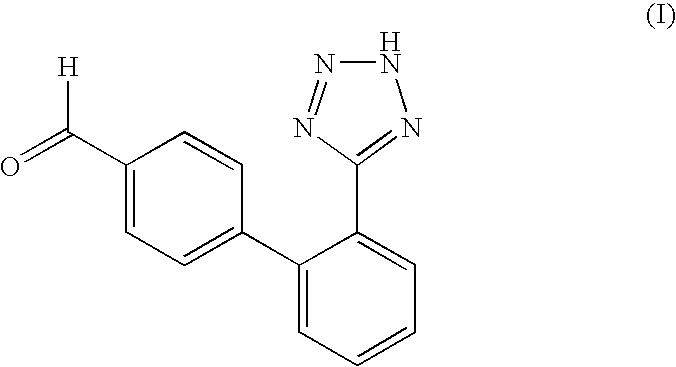
- PCT application WO 05/014602 A1 describes a process for the manufacture of intermediates useful in the synthesis of this common moiety and the final pharmaceutically active compounds, such as the ARBs mentioned above, e.g. valsartan. There, the synthesis of an aldehyde of the formula I,
- the crude product of the formula I obtainable after oxidation of the hydroxymethyl precursor to the aldehyde of the formula I is used in a subsequent reductive amination, for example, with L-valine.
- a problem to be solved by the present invention is to find a yet improved process and/or intermediates that allow for an improved process of manufacture of ARBs, especially valsartan, that is especially useful for manufacturing processes in an industrial scale.
- salts of the aldehyde of the formula I that much more conveniently allow to use the aldehyde in dry form. This allows an improved production in large industry scale and even better handling in this manufacturing process.
- the use of salts of the compound of the formula I makes it possible to manufacture pharmaceuticals comprising a pharmacophore of the formula A shown above by a process according to the invention which comprises the manufacture of an intermediate of the formula I as anion with a cation and thus in the form of a salt, especially of the formula IA shown below.
- Such salts are very stable, can be dried very conveniently and their use in dry form in the subsequent step allows for a very well defined process, leading to very low amounts of impurities such as starting materials in the subsequent intermediates and thus facilitating the use of these subsequent intermediates in the synthesis of the final products.
- the salts of an aldehyde of the formula I can be dried, handled, stored, transported, processed and/or reacted in large amounts. They allow for subsequent reactions, e.g. by reductive amination as described above and below, an improved yield and/or quality of the obtainable consecutive product, thus facilitating an economic and (as less byproducts and thus less waste and energy (e.g. for workup) are required) ecologically improved process design. Thus they contribute to a safe and advantageous process.
- the invention relates to a process or method for the manufacture of a salt of an aldehyde of the formula IA,
- aluminium cations indium cations and gallium cations
- a cation from other metals from the periodic table of elements such as molybdenum,
- ammonium ion, substituted ammonium cations such as mono-, di-, tri- or preferably tetrasubstituted ammonium cations where the substitutents are preferably organic moieties bound via a carbon atom and may, for example, be selected from alkyl, such as C 1 -C 20 -alkyl, aryl, such as mono-, bi- or tricyclic aryl with 6 to 20 ring atoms, aryl-alkyl, wherein aryl and alkyl are preferably as just defined, cycloalkyl, such as C 3 -C 12 -cycloalkyl, cycloalkyl-alkyl, wherein cycloalkyl and alkyl are preferably as just defined, heterocyclyl wherein heterocyclyl preferably is an unsaturated, partially saturated or fully saturated mono-, bi- or tricyclic ring having 3 to 20 ring atoms and at least one, preferably up to three, ring atom
- heterocycle e.g. an unsaturated, partially saturated or fully saturated mono-, bi- or tricyclic ring having 3 to 20 ring atoms wherein at least one, preferably up to three, ring atoms are hetero atoms independently selected from nitrogen, oxygen or sulfur, with the proviso that at least one ring nitrogen is present.
- a cation providing material can be any type of salt or a cation exchanger resin; preferred as a salt is a basic salt of a metal (especially one forming a cation [Kat] n+ as described as preferred above) or unsubstituted or substituted ammonium cation (especially as described for a cation [Kat] n+ as preferred above), especially an acid addition salt of a weak organic or inorganic acid, e.g. of a carbonic acid, a phosphate or especially a carbonate, or more preferably a hydroxide or alcoholate salt.
- a weak organic or inorganic acid e.g. of a carbonic acid, a phosphate or especially a carbonate, or more preferably a hydroxide or alcoholate salt.
- an aromatic, alicyclic, aromatic-aliphatic, alicyclic-aliphatic or preferably an aliphatic alcohol each of which may preferably have up to 20, more preferably up to 7 carbon atoms, e.g. the anion of an alkyl alcohol with up to 20, preferably up to seven carbon atoms, more preferably e.g. the anion of methanol or ethanol, are preferred.
- a cation providing material may also be a metal that is capable of reacting with the tetrazolyl proton, such as lithium, sodium or potassium, or a metal hydride, such as lithium hydride, sodium hydride, calcium hydride or aluminium hydride.
- a solution comprising a compound of the formula I as shown above and a cation providing material comprises at least one solvent, more preferably an organic solvent.
- the formation of the salt of the formula IA preferably takes place by dissolving a compound of the formula I and a cation forming material in one or more solvents or diluents that dissolve them, may take place at reduced, normal or elevated temperature, for example in a temperature range of from about ⁇ 100° C. to about 190° C., preferably from approximately ⁇ 80° C. to approximately 150° C., for example at from ⁇ 80 to ⁇ 60° C., at room temperature, at from ⁇ 20 to 40° C. or at reflux temperature, under vacuum, e.g. for concentrating the solution by removal of solvent, or and/or in an inert atmosphere, for example under an argon or nitrogen atmosphere.
- a cation forming material in addition to a dissociation of cation and anion a cation forming material may change partially or completely—for example, in an aqueous solution, addition of an alcoholate of a cation may result in the formation of the alcohol and hydroxyl anions.
- the solvent is chosen so that no such reaction takes place.
- the solvents may be selected include those mentioned specifically (e.g. in the Examples) or, for example, water, or preferably organic solvents, for example esters, such as lower alkyl-lower alkanoates, for example ethyl acetate, ethers, such as aliphatic ethers, for example diethyl ether, or cyclic ethers, for example tetrahydrofurane or dioxane, liquid aromatic hydrocarbons, such as toluene or xylene, nitriles, such as acetonitrile, halogenated hydro-carbons, e.g.
- esters such as lower alkyl-lower alkanoates, for example ethyl acetate
- ethers such as aliphatic ethers, for example diethyl ether, or cyclic ethers, for example tetrahydrofurane or dioxane
- liquid aromatic hydrocarbons such as toluene or x
- chlorobenzene methylene chloride, 1,2-dichloroethane or chloroform
- acid amides such as dimethylformamide or dimethyl acetamide
- cyclic linear or branched hydrocarbons, such as cyclohexane, hexane or isopentane, or preferably alcohols, such as methanol, ethanol or 1- or 2-propanol, or mixtures of two or more such solvents.
- alcohols such as methanol, ethanol or 1- or 2-propanol, or mixtures of two or more such solvents.
- solvents or solvent mixtures may also be used in working up.
- reaction to and formation of the salt may take place directly in the solution, resulting e.g. in the precipitation of a salt of the formula IA, and/or it may take place during the isolation, e.g. during evaporation or the like, or both (e.g. during concentration to a smaller volume).
- a salt of the formula can be carried out under reaction conditions that are known per se and may follow customary procedures and steps, e.g. selected from the group comprising but not limited to distribution (e.g. extraction), neutralization, crystallization, re-crystallization, digestion, chromatography, evaporation, drying, filtration, washing, centrifugation and the like. Most preferred are partial or complete evaporation of one or more solvents present, the addition of less polar solvents to a mixture with more polar solvents (e.g. the addition of an ether, such as diethyl ether or tert-butylmethyl ether, to an alcohol, such as methanol or ethanol), and/or crystallization (with or without addition of seed crystals).
- distribution e.g. extraction
- neutralization e.g. extraction
- crystallization e.g., re-crystallization
- digestion e.g. extraction
- chromatography e.g. the addition of less polar solvents to
- isolation steps e.g. in order to obtain a more pure salt of the formula IA.
- a first isolation step may be followed by re-crystallization from an appropriate solvent, e.g. an alcohol, such as isopropanol.
- the invention also relates to a salt of the formula IA as given above as such, or a tautomer thereof.
- formula IA The salt of a compound of the formula I is, in formula IA, mainly represented to display its stoichiometry and not intended to represent the structure in detail.
- formula IA does not exclude the possibility that different tautomeric forms of a compound of the formula are present (either in equilibrium or alone), such as a form with the formula IA*:
- a salt of the formula IA may further include trace amounts of customary impurities, in addition certain amounts of a solvent (preferably other than water) (bound as solvate and/or in other form), of the free compound of the formula I and/or the cation providing material may be present, e.g. up to 20%, preferably up to 5%. More preferably, the salt of the formula IA is isolated in substantially pure form.
- the invention also relates to the use of a salt of the formula IA in the process for the manufacture or a pharmaceutical, especially an ARB, most especially valsartan, as well as a corresponding process or method.
- reaction steps can be derived from the general description or from the examples in WO 2005/014602 which, in this regard, especially with regard to the manufacture of valsartan (either in the examples or in the general description) is incorporated by reference herewith.
- Rz 1 is hydrogen or a carboxy protecting group, under conditions of reductive amination
- Rz 1 is as defined for a compound of the formula IV, or a salt thereof, with a compound of the formula VI
- Rz 2 is an activating group
- valsartan (S)-3-methyl-2- ⁇ pentanoyl-[2′-(1H-tetrazol-5-yl)biphenyl-4-yl-methyl]-amino ⁇ -butyric acid
- a salt thereof e.g. an earth alkali metal salt, such as the magnesium or calcium salt, see US 2005/0101652 which is incorporated herein by reference especially with regard to the salt formation and the salts of valsartan
- the reductive amination under a) is carried out in the presence of a reducing agent.
- a suitable reducing agent is for example a borohydride or hydrogen or a hydrogen donor both in the presence of a hydrogenation catalyst, or a suitable selenide or silane.
- the reductive amination takes place in two steps via the corresponding aldimine (Schiff Base) and its subsequent reduction, and it is possible to form first the aldimine, isolate it and then reduce it to a compound of the formula V, or salt thereof, or to perform both the aldimine formation and the reduction without isolation of the aldimine.
- Suitable conditions and material e.g. reducing agents, such as those mentioned above, the corresponding reaction conditions, such as solvents and appropriate temperatures, as well as suitable protecting groups Rz 1 are preferably as described in WO 05/014602 which, in this regard, is incorporated herewith by reference.
- the acylation under b) preferably takes place in the presence of a suitable base.
- Suitable conditions and materials e.g. suitable bases, suitable reaction conditions, such as solvents and appropriate temperatures, as well as suitable activating groups Rz 2 are preferably as described in WO 05/014602 which, especially in this regard, is incorporated herewith by reference.
- (a) protecting group(s) may take place under conditions known in the art.
- the removal may take place as described in J. F. W. McOmie, “Protective Groups in Organic Chemistry”, Plenum Press, London and New York 1973, in T. W. Greene and P. G. M. Wuts, “Protective Groups in Organic Synthesis”, Third edition, Wiley, New York 1999, in “The Peptides”; Volume 3 (editors: E. Gross and J. Meienhofer), Academic Press, London and New York 1981, in “Methoden der organischen Chemie” ( Methods of Organic Chemistry ), Houben Weyl, 4th edition, Volume 15/I, Georg Thieme Verlag, Stuttgart 1974, in H.-D.
- An activating group Rz 2 may, for example, be an activating group that is used in the field of peptide chemistry, such as halo, e.g. chloro, fluoro or bromo, C 1 -C 7 -alkylthio, e.g.
- pyridylthio such as 2-pyridylthio
- imidazolyl such as 1-imidazolyl
- benzthiazolyl-oxy such as benzthiazolyl-2-oxy
- benzotriazolyl-oxy such as benzotriazolyl-1-oxy
- C 2 -C 8 -alkanoyloxy such as butyroyloxy or pivaloyloxy
- 2,5-dioxo-pyrrolidinyl-1-oxy the activation may also take place in situ using customary activation reagents in the presence of a free acid corresponding to the compound of the formula VI.
- a reaction according to the invention either leading to a salt of the formula IA or to a pharmaceutical, in addition comprises a reaction step that leads to a compound of the formula I which may then be isolated in crude form and/or directly reacted according to the invention forming and isolating a salt of the formula IA.
- a compound of the formula I may be obtained by oxidizing a hydroxymethyl compound of the formula II,
- a suitable oxidizing agent for example, an alkali metal (such as lithium, sodium or potassium) hypochlorite, a “TEMPO” or an analogue or an oxidizing agent selected from the group consisting of HNO 2 , HNO 3 or anhydrides thereof, and peroxidisulfates, in appropriate solvents and at appropriate temperatures, e.g. as described in WO 05/014602.
- a suitable oxidizing agent for example, an alkali metal (such as lithium, sodium or potassium) hypochlorite, a “TEMPO” or an analogue or an oxidizing agent selected from the group consisting of HNO 2 , HNO 3 or anhydrides thereof, and peroxidisulfates
- a salt of a compound of the formula II may be a salt of the corresponding anion with a metal cation [Kat] n+ as described for a salt of the formula IA.
- Such a salt of a compound of the formula II also forms an embodiment of the present invention. It can be manufactured analogously to a salt of a compound of the formula IA by methods such as those described above or below.
- a compound of the formula II can preferably be obtained by reacting a cyanide of the formula II,
- R 1 and R 2 represent, independently of each other, an organic residue, especially C 1 -C 8 -alkyl, such as methyl, ethyl, n-propyl, i-propyl, isobutyl, tert-butyl or n-octyl; C 3 -C 7 alkenyl, such as allyl or crotyl; C 3 -C 7 -cycloalkyl, such as cyclohexyl; phenyl-C 1 -C 4 -alkyl, such as benzyl or 2-phenethyl; phenyl-C 2 -C 5 -alkenyl, such as cinnamyl; C 3 -C 8 -cycloalkyl-C 1 -C 8 -alkyl, such as cyclopropylmethyl or cyclo-hexylmethyl; or phen
- R 1 , R 2 and M as well as preferred reaction conditions, such as molar ratios, solvents and reaction temperatures, can be derived from WO 05/014602, which, preferably in this regard, is incorporated herewith by reference.
- the formation of the tetrazole ring to obtain a compound of the formula II, or a salt thereof, and the oxidation to a compound of the formula I take place in sequence in one reaction vessel.
- lower is used for the description of moieties, e.g. “lower alkyl”, this is intended to mean that the corresponding moiety preferably has up to seven, more preferably up to four carbon atoms.
- Alkyl such as lower alkyl, C 1 -C 6 -alkyl or C 1 -C 7 alkyl, may be linear or branched one or more times.
- the invention preferably relates to the embodiments defined by the claims attached below which are therefore incorporated into the present description here by reference.
- more general expressions or reaction steps may be replaced, individually, in groups of two or more or all in each claim, by the more specific (e.g. preferred) expressions or reaction steps described in the description or subclaims, thus yielding more preferred embodiment of the respective invention embodiments.
- the suspension is diluted with 50 ml of TBME, cooled down to 0° C. and allowed to stir at this temperature for 4 h. After filtration, the filter cake is washed with cold TBME and dried under vacuum at 40° C. to give the title salt.
Landscapes
- Organic Chemistry (AREA)
- Chemical & Material Sciences (AREA)
- Health & Medical Sciences (AREA)
- Medicinal Chemistry (AREA)
- General Chemical & Material Sciences (AREA)
- Veterinary Medicine (AREA)
- Chemical Kinetics & Catalysis (AREA)
- Life Sciences & Earth Sciences (AREA)
- Pharmacology & Pharmacy (AREA)
- Nuclear Medicine, Radiotherapy & Molecular Imaging (AREA)
- Engineering & Computer Science (AREA)
- Bioinformatics & Cheminformatics (AREA)
- Public Health (AREA)
- Animal Behavior & Ethology (AREA)
- General Health & Medical Sciences (AREA)
- Heart & Thoracic Surgery (AREA)
- Cardiology (AREA)
- Pharmaceuticals Containing Other Organic And Inorganic Compounds (AREA)
- Organic Low-Molecular-Weight Compounds And Preparation Thereof (AREA)
- Plural Heterocyclic Compounds (AREA)
- Agricultural Chemicals And Associated Chemicals (AREA)
- Medicines Containing Material From Animals Or Micro-Organisms (AREA)
- Catalysts (AREA)
Abstract

or a tautomer thereof, wherein [kat]n+ is a cation and n is 1, 2, 3, 4, 5 or 6.
Description

where the waved line indicates the place of binding to the rest of the molecule (which may also be present in tautomeric form, either in equilibrium or totally, with the hydrogen at the tetrazolyl ring at the 1-instead of the 2-position of that ring; the same also is true for any compound mentioned below where such tautomerism is possible and will therefore not be mentioned specifically in any case).

is described which is further reacted to various pharmaceutically active substances such as the ARBs, e.g. valsartan, directly or via one or more further reaction steps and intermediates.

or a tautomer thereof, wherein [Kat]n+ is a cation and n is 1, 2, 3, 4, 5 or 6, preferably 1, 2 or 3, comprising forming and isolating said salt from a solution comprising a compound of the formula I as shown above and a cation providing material.


or a salt thereof to a compound of the formula I which may then, in the same reaction vessel or after isolation of the crude material, be reacted according to the present invention to a salt of the formula IA. The oxidation takes place in the presence of a suitable oxidizing agent, for example, an alkali metal (such as lithium, sodium or potassium) hypochlorite, a “TEMPO” or an analogue or an oxidizing agent selected from the group consisting of HNO2, HNO3 or anhydrides thereof, and peroxidisulfates, in appropriate solvents and at appropriate temperatures, e.g. as described in WO 05/014602. A salt of a compound of the formula II may be a salt of the corresponding anion with a metal cation [Kat]n+ as described for a salt of the formula IA. Such a salt of a compound of the formula II also forms an embodiment of the present invention. It can be manufactured analogously to a salt of a compound of the formula IA by methods such as those described above or below.

with an azide of the formula (R1)(R2)-M-N3 wherein R1 and R2 represent, independently of each other, an organic residue, especially C1-C8-alkyl, such as methyl, ethyl, n-propyl, i-propyl, isobutyl, tert-butyl or n-octyl; C3-C7alkenyl, such as allyl or crotyl; C3-C7-cycloalkyl, such as cyclohexyl; phenyl-C1-C4-alkyl, such as benzyl or 2-phenethyl; phenyl-C2-C5-alkenyl, such as cinnamyl; C3-C8-cycloalkyl-C1-C8-alkyl, such as cyclopropylmethyl or cyclo-hexylmethyl; or phenyl-C2-C5alkenyl; and M is boron or aluminium. This [2+3] cycloaddition yields a compound of the formula II, or a salt thereof which can also be formed from the free compound by analogous methods as those described for the formation of a salt of the formula IA.
Claims (14)



Applications Claiming Priority (3)
| Application Number | Priority Date | Filing Date | Title |
|---|---|---|---|
| GB0514206.2 | 2005-07-11 | ||
| GBGB0514206.2A GB0514206D0 (en) | 2005-07-11 | 2005-07-11 | Organic compounds |
| PCT/EP2006/006730 WO2007006531A1 (en) | 2005-07-11 | 2006-07-10 | Metal salts of 2 ' - ( 1h-tetraz0l-5-yl) -1 . 1 ' -biphenyl-4-carboxaldehyde |
Publications (2)
| Publication Number | Publication Date |
|---|---|
| US20080234490A1 US20080234490A1 (en) | 2008-09-25 |
| US7728024B2 true US7728024B2 (en) | 2010-06-01 |
Family
ID=34897057
Family Applications (1)
| Application Number | Title | Priority Date | Filing Date |
|---|---|---|---|
| US11/995,240 Expired - Fee Related US7728024B2 (en) | 2005-07-11 | 2006-07-10 | Metal salts of 2′-(1H-Tetrazol-5yl)-1.1′-biphenyl-4-carboxaldehyde |
Country Status (30)
| Country | Link |
|---|---|
| US (1) | US7728024B2 (en) |
| EP (1) | EP1912956B1 (en) |
| JP (1) | JP2009500434A (en) |
| KR (1) | KR20080030609A (en) |
| CN (2) | CN101208313A (en) |
| AR (1) | AR054823A1 (en) |
| AT (1) | ATE504577T1 (en) |
| AU (1) | AU2006268906B2 (en) |
| BR (1) | BRPI0613129A2 (en) |
| CA (1) | CA2614718A1 (en) |
| DE (1) | DE602006021187D1 (en) |
| EC (1) | ECSP088090A (en) |
| ES (1) | ES2363439T3 (en) |
| GB (1) | GB0514206D0 (en) |
| GT (1) | GT200600303A (en) |
| IL (1) | IL188190A0 (en) |
| MA (1) | MA29633B1 (en) |
| MX (1) | MX2008000465A (en) |
| MY (1) | MY143947A (en) |
| NO (1) | NO20080742L (en) |
| NZ (1) | NZ564548A (en) |
| PE (1) | PE20070248A1 (en) |
| PL (1) | PL1912956T3 (en) |
| PT (1) | PT1912956E (en) |
| RU (1) | RU2435761C2 (en) |
| SA (1) | SA06270220B1 (en) |
| TN (1) | TNSN08005A1 (en) |
| TW (1) | TW200745065A (en) |
| WO (1) | WO2007006531A1 (en) |
| ZA (1) | ZA200711023B (en) |
Families Citing this family (3)
| Publication number | Priority date | Publication date | Assignee | Title |
|---|---|---|---|---|
| WO2008004110A2 (en) | 2006-07-03 | 2008-01-10 | Aurobindo Pharma Limited | Process for the preparation of the angiotensin ii antagonist valsartan |
| US8492577B2 (en) | 2008-04-07 | 2013-07-23 | Hetero Research Foundation | Process for preparation of valsartan intermediate |
| CN103012301B (en) * | 2013-01-05 | 2015-06-17 | 江苏施美康药业股份有限公司 | Valsartan methyl ester alkali metal salt and preparation method thereof |
Citations (4)
| Publication number | Priority date | Publication date | Assignee | Title |
|---|---|---|---|---|
| US5371233A (en) * | 1991-12-30 | 1994-12-06 | Synthelabo | 2-(tetrazol-5-yl)-1,1'-biphenyl derivatives, their preparation and their use as synthetic intermediates |
| WO2004026847A1 (en) | 2002-09-23 | 2004-04-01 | Novartis Ag | Process for the manufacture of valsartan |
| WO2005014602A1 (en) | 2003-07-15 | 2005-02-17 | Novartis Ag | Process for the preparation of tetrazole derivatives from organo boron and organo aluminium azides |
| EP1533305A1 (en) | 2003-11-21 | 2005-05-25 | Dipharma S.p.A. | A process for the preparation of valsartan and intermediates thereof |
Family Cites Families (2)
| Publication number | Priority date | Publication date | Assignee | Title |
|---|---|---|---|---|
| JP4568400B2 (en) * | 2000-03-24 | 2010-10-27 | 株式会社日本ファインケム | Method for producing 5,5'-bi-1H-tetrazole diammonium salt using hydrated hydrazine and dicyan as raw materials |
| JP2007501770A (en) * | 2003-08-08 | 2007-02-01 | ディフアルマ ソシエタ ペル アチオニ | Method for producing phenyltetrazole derivative |
-
2005
- 2005-07-11 GB GBGB0514206.2A patent/GB0514206D0/en not_active Ceased
-
2006
- 2006-07-06 MY MYPI20063226A patent/MY143947A/en unknown
- 2006-07-07 PE PE2006000810A patent/PE20070248A1/en not_active Application Discontinuation
- 2006-07-07 AR ARP060102936A patent/AR054823A1/en not_active Application Discontinuation
- 2006-07-10 PT PT06754707T patent/PT1912956E/en unknown
- 2006-07-10 PL PL06754707T patent/PL1912956T3/en unknown
- 2006-07-10 TW TW095125125A patent/TW200745065A/en unknown
- 2006-07-10 ES ES06754707T patent/ES2363439T3/en active Active
- 2006-07-10 GT GT200600303A patent/GT200600303A/en unknown
- 2006-07-10 RU RU2008104526/04A patent/RU2435761C2/en not_active IP Right Cessation
- 2006-07-10 AU AU2006268906A patent/AU2006268906B2/en not_active Ceased
- 2006-07-10 KR KR1020087000723A patent/KR20080030609A/en not_active Ceased
- 2006-07-10 SA SA06270220A patent/SA06270220B1/en unknown
- 2006-07-10 BR BRPI0613129-8A patent/BRPI0613129A2/en not_active IP Right Cessation
- 2006-07-10 CA CA002614718A patent/CA2614718A1/en not_active Abandoned
- 2006-07-10 US US11/995,240 patent/US7728024B2/en not_active Expired - Fee Related
- 2006-07-10 EP EP06754707A patent/EP1912956B1/en active Active
- 2006-07-10 MX MX2008000465A patent/MX2008000465A/en active IP Right Grant
- 2006-07-10 AT AT06754707T patent/ATE504577T1/en active
- 2006-07-10 CN CNA2006800230702A patent/CN101208313A/en active Pending
- 2006-07-10 NZ NZ564548A patent/NZ564548A/en not_active IP Right Cessation
- 2006-07-10 JP JP2008520770A patent/JP2009500434A/en active Pending
- 2006-07-10 CN CNA2009100032514A patent/CN101468972A/en active Pending
- 2006-07-10 DE DE602006021187T patent/DE602006021187D1/en active Active
- 2006-07-10 WO PCT/EP2006/006730 patent/WO2007006531A1/en not_active Ceased
-
2007
- 2007-12-17 IL IL188190A patent/IL188190A0/en unknown
- 2007-12-19 ZA ZA200711023A patent/ZA200711023B/en unknown
-
2008
- 2008-01-10 EC EC2008008090A patent/ECSP088090A/en unknown
- 2008-01-10 TN TNP2008000005A patent/TNSN08005A1/en unknown
- 2008-01-16 MA MA30579A patent/MA29633B1/en unknown
- 2008-02-11 NO NO20080742A patent/NO20080742L/en not_active Application Discontinuation
Patent Citations (6)
| Publication number | Priority date | Publication date | Assignee | Title |
|---|---|---|---|---|
| US5371233A (en) * | 1991-12-30 | 1994-12-06 | Synthelabo | 2-(tetrazol-5-yl)-1,1'-biphenyl derivatives, their preparation and their use as synthetic intermediates |
| WO2004026847A1 (en) | 2002-09-23 | 2004-04-01 | Novartis Ag | Process for the manufacture of valsartan |
| EP1878729A1 (en) | 2002-09-23 | 2008-01-16 | Novartis AG | Intermediate for the manufacture of valsartan |
| WO2005014602A1 (en) | 2003-07-15 | 2005-02-17 | Novartis Ag | Process for the preparation of tetrazole derivatives from organo boron and organo aluminium azides |
| US20070043098A1 (en) * | 2003-07-15 | 2007-02-22 | Gottfried Sedelmeier | Process for the preparation of tetrazole derivatives from organo boron and organo aluminium azides |
| EP1533305A1 (en) | 2003-11-21 | 2005-05-25 | Dipharma S.p.A. | A process for the preparation of valsartan and intermediates thereof |
Also Published As
Similar Documents
| Publication | Publication Date | Title |
|---|---|---|
| US8592474B2 (en) | Process for the preparation or purification of olmesartan medoxomil | |
| KR20110015703A (en) | Manufacturing Method of Valsartan | |
| US20100036121A1 (en) | Process for preparing temozolomide | |
| CA2532175A1 (en) | Process for the preparation of tetrazole derivatives from organo boron and organo aluminium azides | |
| US20060287537A1 (en) | Method of removing the triphenylmethane protecting group | |
| BG107478A (en) | Process for the crystallization of losartan potassium | |
| US7728024B2 (en) | Metal salts of 2′-(1H-Tetrazol-5yl)-1.1′-biphenyl-4-carboxaldehyde | |
| CN110612291A (en) | Preparation of 2-([1,2,3]triazol-2-yl)-benzoic acid derivatives | |
| US20080076933A1 (en) | Process for making anastrozole | |
| US20090286990A1 (en) | Process for preparing irbesartan | |
| US6350880B1 (en) | Crystalline or crystallized acid addition salt of losartan and purification method of losartan | |
| WO2007133040A1 (en) | Method for preparing losartan | |
| US20080214637A1 (en) | Process for the Synthesis of Tetrazoles | |
| WO2010029457A2 (en) | An improved process for preparing losartan potassium | |
| US8129536B2 (en) | Method for the purification of lansoprazole | |
| HK1135379A (en) | Metal salts of 2'-(1h-tetraz0l-5-yl)-1.1'-biphenyl-4-carboxaldehyde | |
| SI21965A (en) | Preparation of tetrazole derivative | |
| US7473778B2 (en) | 3-(4-piperidinyl)-2,3,4,5-tetrahydro-1,3-benzodiazepin-2(1H)-one | |
| KR101009404B1 (en) | (S) -ene- (1-carboxy-2-methyl-pro-1-fil) -ene-pentanoyl-ene- [2 '-(1H-tetrazol-5-yl) biphenyl-4-yl -Purity preparation method of -methyl] amine compound | |
| US20080200687A1 (en) | Preparation of Terazole Derivatives | |
| KR101009383B1 (en) | High purity 2-butyl-3-[[2 '-(1H-tetrazol-5-yl) [1,1'-biphenyl] -4-yl] methyl] -1,3-diazaspiro [4.4 ] Method for producing non-1-en-4-one compound | |
| SI21964A (en) | Preparation of tetrazole derivative |
Legal Events
| Date | Code | Title | Description |
|---|---|---|---|
| AS | Assignment |
Owner name: NOVARTIS AG, SWITZERLAND Free format text: ASSIGNMENT OF ASSIGNORS INTEREST;ASSIGNORS:SEDELMEIER, GERHARD;GRIMLER, DOMINIQUE;REEL/FRAME:023408/0635 Effective date: 20060519 Owner name: NOVARTIS AG,SWITZERLAND Free format text: ASSIGNMENT OF ASSIGNORS INTEREST;ASSIGNORS:SEDELMEIER, GERHARD;GRIMLER, DOMINIQUE;REEL/FRAME:023408/0635 Effective date: 20060519 |
|
| AS | Assignment |
Owner name: NOVARTIS PHARMACEUTICALS CORPORATION, NEW JERSEY Free format text: ASSIGNMENT OF ASSIGNORS INTEREST;ASSIGNOR:NOVARTIS AG;REEL/FRAME:026002/0790 Effective date: 20110317 |
|
| REMI | Maintenance fee reminder mailed | ||
| LAPS | Lapse for failure to pay maintenance fees | ||
| STCH | Information on status: patent discontinuation |
Free format text: PATENT EXPIRED DUE TO NONPAYMENT OF MAINTENANCE FEES UNDER 37 CFR 1.362 |
|
| STCH | Information on status: patent discontinuation |
Free format text: PATENT EXPIRED DUE TO NONPAYMENT OF MAINTENANCE FEES UNDER 37 CFR 1.362 |
|
| FP | Lapsed due to failure to pay maintenance fee |
Effective date: 20140601 |