US7723349B2 - Aza spiro alkane derivatives as inhibitors of metalloproteases - Google Patents
Aza spiro alkane derivatives as inhibitors of metalloproteases Download PDFInfo
- Publication number
- US7723349B2 US7723349B2 US10/831,265 US83126504A US7723349B2 US 7723349 B2 US7723349 B2 US 7723349B2 US 83126504 A US83126504 A US 83126504A US 7723349 B2 US7723349 B2 US 7723349B2
- Authority
- US
- United States
- Prior art keywords
- carbonyl
- octane
- azaspiro
- hydroxy
- carboxamide
- Prior art date
- Legal status (The legal status is an assumption and is not a legal conclusion. Google has not performed a legal analysis and makes no representation as to the accuracy of the status listed.)
- Expired - Lifetime, expires
Links
- 0 *C.*C.*C1([1*])[Y]C2(*C1([2*])C([3*])=[2H])BC2.*C1([1*])[Y]C2(*C1([2*])C[U][V]CC)BC2.CC Chemical compound *C.*C.*C1([1*])[Y]C2(*C1([2*])C([3*])=[2H])BC2.*C1([1*])[Y]C2(*C1([2*])C[U][V]CC)BC2.CC 0.000 description 7
- ABNBCEOZVGRTMX-IRXDYDNUSA-N CC1=C(N2CCN(C(=O)[C@H]3CC4(CC[C@@H]3C(=O)O)CC4)CC2)C=CC([N+](=O)[O-])=C1 Chemical compound CC1=C(N2CCN(C(=O)[C@H]3CC4(CC[C@@H]3C(=O)O)CC4)CC2)C=CC([N+](=O)[O-])=C1 ABNBCEOZVGRTMX-IRXDYDNUSA-N 0.000 description 3
- LWKNTYGWOCCHBM-BSOSBYQFSA-N CC1=CC=C(C2CCN(C(=O)[C@H]3NCC4(CC4)C[C@@H]3C(=O)NO)C2)C=C1 Chemical compound CC1=CC=C(C2CCN(C(=O)[C@H]3NCC4(CC4)C[C@@H]3C(=O)NO)C2)C=C1 LWKNTYGWOCCHBM-BSOSBYQFSA-N 0.000 description 2
- DVEPXFOBFKPTCR-STCOUPBVSA-N O=C(NO)[C@H]1CC2(CC2)CN[C@@H]1C(=O)N1CC2CCC3=C(C=CC=C3)C2C1 Chemical compound O=C(NO)[C@H]1CC2(CC2)CN[C@@H]1C(=O)N1CC2CCC3=C(C=CC=C3)C2C1 DVEPXFOBFKPTCR-STCOUPBVSA-N 0.000 description 2
- OJJWKJSXMCTNQW-UNMCSNQZSA-N O=C(NO)[C@H]1CC2(CC2)CN[C@@H]1C(=O)N1CCC(C2=C3OC4=C(C=CC=C4)C3=CC=C2)CC1 Chemical compound O=C(NO)[C@H]1CC2(CC2)CN[C@@H]1C(=O)N1CCC(C2=C3OC4=C(C=CC=C4)C3=CC=C2)CC1 OJJWKJSXMCTNQW-UNMCSNQZSA-N 0.000 description 2
- PUZFWCFQOSXTHY-UHFFFAOYSA-N B.CC(=O)C1CCC2(CC2)CC1C(=O)NO Chemical compound B.CC(=O)C1CCC2(CC2)CC1C(=O)NO PUZFWCFQOSXTHY-UHFFFAOYSA-N 0.000 description 1
- AJUSJKVFJAUSGP-PIJCGBTFSA-L C.C.C.C.C=C1CC[C@H](C(=O)OCC)[C@@H](C(=O)OC(C)(C)C)C1.C=CC(=C)O[Si](C)(C)C.CC(=O)O[Pd]OC(C)=O.CC(=O)[C@H]1CCC2(CC2)C[C@@H]1C(=O)NO.CC(=O)[C@H]1CCC2(CC2)C[C@@H]1C(=O)OC(C)(C)C.CCOC(=O)[C@H]1CC=C(O[Si](C)(C)C)C[C@@H]1C(=O)OC(C)(C)C.CCOC(=O)[C@H]1CCC(=O)C[C@@H]1C(=O)OC(C)(C)C.CCOC(=O)[C@H]1CCC2(CC2)C[C@@H]1C(=O)OC(C)(C)C.C[Al](C)C.[CH2+]COC(=O)/C=C/C(=O)OC(C)(C)C Chemical compound C.C.C.C.C=C1CC[C@H](C(=O)OCC)[C@@H](C(=O)OC(C)(C)C)C1.C=CC(=C)O[Si](C)(C)C.CC(=O)O[Pd]OC(C)=O.CC(=O)[C@H]1CCC2(CC2)C[C@@H]1C(=O)NO.CC(=O)[C@H]1CCC2(CC2)C[C@@H]1C(=O)OC(C)(C)C.CCOC(=O)[C@H]1CC=C(O[Si](C)(C)C)C[C@@H]1C(=O)OC(C)(C)C.CCOC(=O)[C@H]1CCC(=O)C[C@@H]1C(=O)OC(C)(C)C.CCOC(=O)[C@H]1CCC2(CC2)C[C@@H]1C(=O)OC(C)(C)C.C[Al](C)C.[CH2+]COC(=O)/C=C/C(=O)OC(C)(C)C AJUSJKVFJAUSGP-PIJCGBTFSA-L 0.000 description 1
- CARMMPXYDBCIFU-OHFORJOQSA-L C.C.C=C(CCl)CCl.C=C(CCl)CN(CC1=CC=CC=C1)[C@@H](CC(=O)OC(C)(C)C)C(=O)OCC1=CC=CC=C1.C=C(CI)CN(CC1=CC=CC=C1)[C@@H](CC(=O)OC(C)(C)C)C(=O)OCC1=CC=CC=C1.C=C1C[C@H](C(=O)OC(C)(C)C)[C@@H](C(=O)OCC2=CC=CC=C2)N(C(=O)OCC2=CC=CC=C2)C1.C=C1C[C@H](C(=O)OC(C)(C)C)[C@@H](C(=O)OCC2=CC=CC=C2)N(CC2=CC=CC=C2)C1.CC(=O)O[Pd]OC(C)=O.CC(C)(C)OC(=O)C[C@H](N)C(=O)O.CC(C)(C)OC(=O)C[C@H](NCC1=CC=CC=C1)C(=O)OCC1=CC=CC=C1.CC(C)(C)OC(=O)[C@H]1CC2(CC2)CN(C(=O)OCC2=CC=CC=C2)[C@@H]1C(=O)OCC1=CC=CC=C1.O=C(Cl)OCC1=CC=CC=C1.[HH] Chemical compound C.C.C=C(CCl)CCl.C=C(CCl)CN(CC1=CC=CC=C1)[C@@H](CC(=O)OC(C)(C)C)C(=O)OCC1=CC=CC=C1.C=C(CI)CN(CC1=CC=CC=C1)[C@@H](CC(=O)OC(C)(C)C)C(=O)OCC1=CC=CC=C1.C=C1C[C@H](C(=O)OC(C)(C)C)[C@@H](C(=O)OCC2=CC=CC=C2)N(C(=O)OCC2=CC=CC=C2)C1.C=C1C[C@H](C(=O)OC(C)(C)C)[C@@H](C(=O)OCC2=CC=CC=C2)N(CC2=CC=CC=C2)C1.CC(=O)O[Pd]OC(C)=O.CC(C)(C)OC(=O)C[C@H](N)C(=O)O.CC(C)(C)OC(=O)C[C@H](NCC1=CC=CC=C1)C(=O)OCC1=CC=CC=C1.CC(C)(C)OC(=O)[C@H]1CC2(CC2)CN(C(=O)OCC2=CC=CC=C2)[C@@H]1C(=O)OCC1=CC=CC=C1.O=C(Cl)OCC1=CC=CC=C1.[HH] CARMMPXYDBCIFU-OHFORJOQSA-L 0.000 description 1
- QKJDKRRPGZDZGB-UHMCRWBNSA-N C.C.C=C.CC(=O)[C@H]1CC2(CCCCO2)CC[C@@H]1C(=O)NO.CC(=O)[C@H]1CCC2(CCCCO2)C[C@@H]1C(=O)NO.CCOC(=O)[C@H]1CCC(O)(CCCCO)C[C@@H]1C(=O)OC(C)(C)C.CCOC(=O)[C@H]1CCC(O)(CCCO)C[C@@H]1C(=O)OC(C)(C)C Chemical compound C.C.C=C.CC(=O)[C@H]1CC2(CCCCO2)CC[C@@H]1C(=O)NO.CC(=O)[C@H]1CCC2(CCCCO2)C[C@@H]1C(=O)NO.CCOC(=O)[C@H]1CCC(O)(CCCCO)C[C@@H]1C(=O)OC(C)(C)C.CCOC(=O)[C@H]1CCC(O)(CCCO)C[C@@H]1C(=O)OC(C)(C)C QKJDKRRPGZDZGB-UHMCRWBNSA-N 0.000 description 1
- ITBOQTZJLRAVEA-NMIHFBPUSA-N C.C.CC(=O)[C@H]1CC2(CC[C@@H]1C(=O)NO)CC2.CCOC(=O)[C@H]1CCC2(CC2)C[C@@H]1C(=O)OC(C)(C)C.CCOC(=O)[C@H]1CCC2(CC2)C[C@@H]1C(C)=O Chemical compound C.C.CC(=O)[C@H]1CC2(CC[C@@H]1C(=O)NO)CC2.CCOC(=O)[C@H]1CCC2(CC2)C[C@@H]1C(=O)OC(C)(C)C.CCOC(=O)[C@H]1CCC2(CC2)C[C@@H]1C(C)=O ITBOQTZJLRAVEA-NMIHFBPUSA-N 0.000 description 1
- FWUFAZUCNMMKAT-VZFHUHIWSA-N C.C=C1C[C@H](C(=O)OC(C)(C)C)[C@@H](C(=O)OCC2=CC=CC=C2)N(C(=O)OCC2=CC=CC=C2)C1.CC(C)(C)OC(=O)[C@H]1CC(=O)CN(C(=O)OCC2=CC=CC=C2)[C@@H]1C(=O)OCC1=CC=CC=C1 Chemical compound C.C=C1C[C@H](C(=O)OC(C)(C)C)[C@@H](C(=O)OCC2=CC=CC=C2)N(C(=O)OCC2=CC=CC=C2)C1.CC(C)(C)OC(=O)[C@H]1CC(=O)CN(C(=O)OCC2=CC=CC=C2)[C@@H]1C(=O)OCC1=CC=CC=C1 FWUFAZUCNMMKAT-VZFHUHIWSA-N 0.000 description 1
- LKGBVMOKKVEJOA-RYUDHWBXSA-N C=C1CC[C@H](C(=O)OCC)[C@@H](C(=O)OC(C)(C)C)C1 Chemical compound C=C1CC[C@H](C(=O)OCC)[C@@H](C(=O)OC(C)(C)C)C1 LKGBVMOKKVEJOA-RYUDHWBXSA-N 0.000 description 1
- KINJLVCXOOLHJX-IEOVAKBOSA-N CC(=O)C1CC2(CCC1C(=O)NO)CC2.[2HH] Chemical compound CC(=O)C1CC2(CCC1C(=O)NO)CC2.[2HH] KINJLVCXOOLHJX-IEOVAKBOSA-N 0.000 description 1
- GABKFOGVYZXJMH-PPUGPJQXSA-N CC(=O)[C@H]1CCC2(C[C@@H]1C(=O)NO)SCCS2.CC(=O)[C@H]1CCC2(C[C@@H]1C(=O)OC(C)(C)C)SCCS2.CC1=CC=C(S(=O)(=O)O)C=C1.CCOC(=O)[C@H]1CCC(=O)C[C@@H]1C(=O)OC(C)(C)C.CCOC(=O)[C@H]1CCC2(C[C@@H]1C(=O)OC(C)(C)C)SCCS2.SCCS Chemical compound CC(=O)[C@H]1CCC2(C[C@@H]1C(=O)NO)SCCS2.CC(=O)[C@H]1CCC2(C[C@@H]1C(=O)OC(C)(C)C)SCCS2.CC1=CC=C(S(=O)(=O)O)C=C1.CCOC(=O)[C@H]1CCC(=O)C[C@@H]1C(=O)OC(C)(C)C.CCOC(=O)[C@H]1CCC2(C[C@@H]1C(=O)OC(C)(C)C)SCCS2.SCCS GABKFOGVYZXJMH-PPUGPJQXSA-N 0.000 description 1
- QEKGBRLFKWRVKJ-UHFFFAOYSA-N CC(C)(C)OC(=O)N1CC=C(OS(=O)(=O)C(F)(F)F)CC1.CC(C)(C)OC(=O)N1CC=C([Ar])CC1.Cl.OB(O)[Ar].[Ar]C1=CCNCC1.[Ar]C1CCNCC1 Chemical compound CC(C)(C)OC(=O)N1CC=C(OS(=O)(=O)C(F)(F)F)CC1.CC(C)(C)OC(=O)N1CC=C([Ar])CC1.Cl.OB(O)[Ar].[Ar]C1=CCNCC1.[Ar]C1CCNCC1 QEKGBRLFKWRVKJ-UHFFFAOYSA-N 0.000 description 1
- NDERXQGHUGISAG-UHFFFAOYSA-N CC(C)(C)OC(N(CC1)CC=C1[AlH2])=O Chemical compound CC(C)(C)OC(N(CC1)CC=C1[AlH2])=O NDERXQGHUGISAG-UHFFFAOYSA-N 0.000 description 1
- IAXKVCUYRYEDNF-SFTDATJTSA-N CC(C)C1=C(C#N)C=CC(C2CCN(C(=O)[C@H]3NCC4(CC4)C[C@@H]3C(=O)NO)CC2)=C1 Chemical compound CC(C)C1=C(C#N)C=CC(C2CCN(C(=O)[C@H]3NCC4(CC4)C[C@@H]3C(=O)NO)CC2)=C1 IAXKVCUYRYEDNF-SFTDATJTSA-N 0.000 description 1
- RQZLREWLRJPXPE-IRXDYDNUSA-N CC1=C(N2CCN(C(=O)[C@H]3CC4(CC[C@@H]3C(=O)NO)CC4)CC2)C=CC([N+](=O)[O-])=C1 Chemical compound CC1=C(N2CCN(C(=O)[C@H]3CC4(CC[C@@H]3C(=O)NO)CC4)CC2)C=CC([N+](=O)[O-])=C1 RQZLREWLRJPXPE-IRXDYDNUSA-N 0.000 description 1
- LTBJBSGNZKJCSD-FPOVZHCZSA-N CC1=CC(C2=CCN(C(=O)[C@@H]3[C@@H](C(=O)NO)CC4(CC4)CN3C)CC2)=CC(C)=C1C#N Chemical compound CC1=CC(C2=CCN(C(=O)[C@@H]3[C@@H](C(=O)NO)CC4(CC4)CN3C)CC2)=CC(C)=C1C#N LTBJBSGNZKJCSD-FPOVZHCZSA-N 0.000 description 1
- IBFXUEJHWPQQKI-SFTDATJTSA-N CCC1=C(C#N)C=CC(C2=CCN(C(=O)[C@@H]3[C@@H](C(=O)NO)CC4(CC4)CN3C)CC2)=C1 Chemical compound CCC1=C(C#N)C=CC(C2=CCN(C(=O)[C@@H]3[C@@H](C(=O)NO)CC4(CC4)CN3C)CC2)=C1 IBFXUEJHWPQQKI-SFTDATJTSA-N 0.000 description 1
- PXFNDGDVJNLZHB-PXNSSMCTSA-N CCN1C=NC2=C1C=C(C1=CCN(C(=O)[C@H]3NCC4(CC4)C[C@@H]3C(=O)NO)CC1)C=C2 Chemical compound CCN1C=NC2=C1C=C(C1=CCN(C(=O)[C@H]3NCC4(CC4)C[C@@H]3C(=O)NO)CC1)C=C2 PXFNDGDVJNLZHB-PXNSSMCTSA-N 0.000 description 1
- DNCLYNCLSKXJKI-PXNSSMCTSA-N CCN1C=NC2=C1C=C(C1CCN(C(=O)[C@H]3NCC4(CC4)C[C@@H]3C(=O)NO)CC1)C=C2 Chemical compound CCN1C=NC2=C1C=C(C1CCN(C(=O)[C@H]3NCC4(CC4)C[C@@H]3C(=O)NO)CC1)C=C2 DNCLYNCLSKXJKI-PXNSSMCTSA-N 0.000 description 1
- SYLXNPCYSAJNOS-KBPBESRZSA-N CCOC(=O)[C@H]1CC=C(O[Si](C)(C)C)C[C@@H]1C(=O)OC(C)(C)C Chemical compound CCOC(=O)[C@H]1CC=C(O[Si](C)(C)C)C[C@@H]1C(=O)OC(C)(C)C SYLXNPCYSAJNOS-KBPBESRZSA-N 0.000 description 1
- BJAINHHUTSLTDJ-QWRGUYRKSA-N CCOC(=O)[C@H]1CCC(=O)C[C@@H]1C(=O)OC(C)(C)C Chemical compound CCOC(=O)[C@H]1CCC(=O)C[C@@H]1C(=O)OC(C)(C)C BJAINHHUTSLTDJ-QWRGUYRKSA-N 0.000 description 1
- KUKOKLMKQIFLIR-OALUTQOASA-N CCOC(=O)[C@H]1CCC2(CC2)C[C@@H]1C(=O)N1CCN(C2=C(C)C=C([N+](=O)[O-])C=C2)CC1 Chemical compound CCOC(=O)[C@H]1CCC2(CC2)C[C@@H]1C(=O)N1CCN(C2=C(C)C=C([N+](=O)[O-])C=C2)CC1 KUKOKLMKQIFLIR-OALUTQOASA-N 0.000 description 1
- FXEPXTBFELQBTG-IUCAKERBSA-N CCOC(=O)[C@H]1CCC2(CC2)C[C@@H]1C(=O)O Chemical compound CCOC(=O)[C@H]1CCC2(CC2)C[C@@H]1C(=O)O FXEPXTBFELQBTG-IUCAKERBSA-N 0.000 description 1
- UDFCCWIAHNBUMR-RYUDHWBXSA-N CCOC(=O)[C@H]1CCC2(CC2)C[C@@H]1C(=O)OC(C)(C)C Chemical compound CCOC(=O)[C@H]1CCC2(CC2)C[C@@H]1C(=O)OC(C)(C)C UDFCCWIAHNBUMR-RYUDHWBXSA-N 0.000 description 1
- BNIBIGVDTIWZOJ-LPHOPBHVSA-N CN1C2=C(C=CC=C2)C2=C1CN(C(=O)[C@@H]1[C@@H](C(=O)NO)CC3(CC3)CN1C)CC2 Chemical compound CN1C2=C(C=CC=C2)C2=C1CN(C(=O)[C@@H]1[C@@H](C(=O)NO)CC3(CC3)CN1C)CC2 BNIBIGVDTIWZOJ-LPHOPBHVSA-N 0.000 description 1
- NXIZZISCXRJDCG-YJBOKZPZSA-N CN1CC2(CC2)C[C@H](C(=O)NO)[C@H]1C(=O)N1CCC2=C(C1)NC1=C2C=CC=C1 Chemical compound CN1CC2(CC2)C[C@H](C(=O)NO)[C@H]1C(=O)N1CCC2=C(C1)NC1=C2C=CC=C1 NXIZZISCXRJDCG-YJBOKZPZSA-N 0.000 description 1
- OKQCWQUJMWPHNJ-RYRKJORJSA-N CN1CC2(CC2)C[C@H](C(=O)NO)[C@H]1C(=O)N1CCN2C3=C(C=CC=C3)C[C@@H]2C1 Chemical compound CN1CC2(CC2)C[C@H](C(=O)NO)[C@H]1C(=O)N1CCN2C3=C(C=CC=C3)C[C@@H]2C1 OKQCWQUJMWPHNJ-RYRKJORJSA-N 0.000 description 1
- XSBZVOWSMOYCKB-HKUYNNGSSA-N CN1N=CC2=C1C=CC(C1=CCN(C(=O)[C@H]3NCC4(CC4)C[C@@H]3C(=O)NO)CC1)=C2 Chemical compound CN1N=CC2=C1C=CC(C1=CCN(C(=O)[C@H]3NCC4(CC4)C[C@@H]3C(=O)NO)CC1)=C2 XSBZVOWSMOYCKB-HKUYNNGSSA-N 0.000 description 1
- LFLQPKBGGQZTHF-HKUYNNGSSA-N CN1N=CC2=C1C=CC(C1CCN(C(=O)[C@H]3NCC4(CC4)C[C@@H]3C(=O)NO)CC1)=C2 Chemical compound CN1N=CC2=C1C=CC(C1CCN(C(=O)[C@H]3NCC4(CC4)C[C@@H]3C(=O)NO)CC1)=C2 LFLQPKBGGQZTHF-HKUYNNGSSA-N 0.000 description 1
- WINKWOOQYMWFHE-PJGMDSASSA-N C[C@H]1CN(C(=O)[C@H]2NCC3(CC3)C[C@@H]2C(=O)NO)CC1C1=CC=CC=C1 Chemical compound C[C@H]1CN(C(=O)[C@H]2NCC3(CC3)C[C@@H]2C(=O)NO)CC1C1=CC=CC=C1 WINKWOOQYMWFHE-PJGMDSASSA-N 0.000 description 1
- YAEXSQZRFBLOHJ-UHFFFAOYSA-N C[V]C(=O)C1CC2(CC2)[Y]C1C(=O)NO Chemical compound C[V]C(=O)C1CC2(CC2)[Y]C1C(=O)NO YAEXSQZRFBLOHJ-UHFFFAOYSA-N 0.000 description 1
- ZMPZOWIAKRPTEQ-SFTDATJTSA-N O=C(NO)[C@H]1CC2(CC2)CN(C(=O)OC2CCOCC2)[C@@H]1C(=O)N1CCN(C2=CC=CC=C2)CC1 Chemical compound O=C(NO)[C@H]1CC2(CC2)CN(C(=O)OC2CCOCC2)[C@@H]1C(=O)N1CCN(C2=CC=CC=C2)CC1 ZMPZOWIAKRPTEQ-SFTDATJTSA-N 0.000 description 1
- MFQVUZAKGDWZGZ-PZJKJEQHSA-N O=C(NO)[C@H]1CC2(CC2)CN[C@@H]1C(=O)N1CC2CC3=C(C=CC=C3)C2C1 Chemical compound O=C(NO)[C@H]1CC2(CC2)CN[C@@H]1C(=O)N1CC2CC3=C(C=CC=C3)C2C1 MFQVUZAKGDWZGZ-PZJKJEQHSA-N 0.000 description 1
- MEOYYTAHWRZMBY-HOTGVXAUSA-N O=C(NO)[C@H]1CC2(CC2)CN[C@@H]1C(=O)N1CC=C(C2=CC=CN=C2)CC1 Chemical compound O=C(NO)[C@H]1CC2(CC2)CN[C@@H]1C(=O)N1CC=C(C2=CC=CN=C2)CC1 MEOYYTAHWRZMBY-HOTGVXAUSA-N 0.000 description 1
- RKXCIFZIGUVLEM-HKUYNNGSSA-N O=C(NO)[C@H]1CC2(CC2)CN[C@@H]1C(=O)N1CCC(C2=NC(C3=CC=CC=C3)=CS2)CC1 Chemical compound O=C(NO)[C@H]1CC2(CC2)CN[C@@H]1C(=O)N1CCC(C2=NC(C3=CC=CC=C3)=CS2)CC1 RKXCIFZIGUVLEM-HKUYNNGSSA-N 0.000 description 1
- HHWJYDRXRODHDO-ROUUACIJSA-N O=C(NO)[C@H]1CC2(CC2)CN[C@@H]1C(=O)N1CCC2(CC1)CC1=C(C=CC=C1)C2 Chemical compound O=C(NO)[C@H]1CC2(CC2)CN[C@@H]1C(=O)N1CCC2(CC1)CC1=C(C=CC=C1)C2 HHWJYDRXRODHDO-ROUUACIJSA-N 0.000 description 1
- IGNZREJKBQYROA-OALUTQOASA-N O=C(NO)[C@H]1CC2(CC2)CN[C@@H]1C(=O)N1CCC2=C(CCC3=C2C=CC=C3)C1 Chemical compound O=C(NO)[C@H]1CC2(CC2)CN[C@@H]1C(=O)N1CCC2=C(CCC3=C2C=CC=C3)C1 IGNZREJKBQYROA-OALUTQOASA-N 0.000 description 1
- CQZVZYTUQQRCIQ-FYOYPEGLSA-N O=C(NO)[C@H]1CC2(CC2)CN[C@@H]1C(=O)N1CCC2C3=C(C=CC=C3)CCC2C1 Chemical compound O=C(NO)[C@H]1CC2(CC2)CN[C@@H]1C(=O)N1CCC2C3=C(C=CC=C3)CCC2C1 CQZVZYTUQQRCIQ-FYOYPEGLSA-N 0.000 description 1
- RINLHBFSMHCDCB-ZWBSKUQPSA-N O=C(NO)[C@H]1CC2(CC2)CN[C@@H]1C(=O)N1CCN2C3=C(C=CC=C3)CC2C1 Chemical compound O=C(NO)[C@H]1CC2(CC2)CN[C@@H]1C(=O)N1CCN2C3=C(C=CC=C3)CC2C1 RINLHBFSMHCDCB-ZWBSKUQPSA-N 0.000 description 1
- PNVFYGPEGFSMIV-UHFFFAOYSA-N [AlH2]C1=CCNCC1 Chemical compound [AlH2]C1=CCNCC1 PNVFYGPEGFSMIV-UHFFFAOYSA-N 0.000 description 1
- GVOZLXFGWIJHNS-UHFFFAOYSA-N [AlH2]C1CCNCC1 Chemical compound [AlH2]C1CCNCC1 GVOZLXFGWIJHNS-UHFFFAOYSA-N 0.000 description 1
Classifications
-
- A—HUMAN NECESSITIES
- A61—MEDICAL OR VETERINARY SCIENCE; HYGIENE
- A61K—PREPARATIONS FOR MEDICAL, DENTAL OR TOILETRY PURPOSES
- A61K31/00—Medicinal preparations containing organic active ingredients
- A61K31/33—Heterocyclic compounds
- A61K31/395—Heterocyclic compounds having nitrogen as a ring hetero atom, e.g. guanethidine or rifamycins
- A61K31/495—Heterocyclic compounds having nitrogen as a ring hetero atom, e.g. guanethidine or rifamycins having six-membered rings with two or more nitrogen atoms as the only ring heteroatoms, e.g. piperazine or tetrazines
- A61K31/496—Non-condensed piperazines containing further heterocyclic rings, e.g. rifampin, thiothixene or sparfloxacin
-
- C—CHEMISTRY; METALLURGY
- C07—ORGANIC CHEMISTRY
- C07D—HETEROCYCLIC COMPOUNDS
- C07D491/00—Heterocyclic compounds containing in the condensed ring system both one or more rings having oxygen atoms as the only ring hetero atoms and one or more rings having nitrogen atoms as the only ring hetero atoms, not provided for by groups C07D451/00 - C07D459/00, C07D463/00, C07D477/00 or C07D489/00
- C07D491/02—Heterocyclic compounds containing in the condensed ring system both one or more rings having oxygen atoms as the only ring hetero atoms and one or more rings having nitrogen atoms as the only ring hetero atoms, not provided for by groups C07D451/00 - C07D459/00, C07D463/00, C07D477/00 or C07D489/00 in which the condensed system contains two hetero rings
- C07D491/10—Spiro-condensed systems
-
- A—HUMAN NECESSITIES
- A61—MEDICAL OR VETERINARY SCIENCE; HYGIENE
- A61K—PREPARATIONS FOR MEDICAL, DENTAL OR TOILETRY PURPOSES
- A61K31/00—Medicinal preparations containing organic active ingredients
- A61K31/33—Heterocyclic compounds
- A61K31/395—Heterocyclic compounds having nitrogen as a ring hetero atom, e.g. guanethidine or rifamycins
- A61K31/40—Heterocyclic compounds having nitrogen as a ring hetero atom, e.g. guanethidine or rifamycins having five-membered rings with one nitrogen as the only ring hetero atom, e.g. sulpiride, succinimide, tolmetin, buflomedil
-
- A—HUMAN NECESSITIES
- A61—MEDICAL OR VETERINARY SCIENCE; HYGIENE
- A61K—PREPARATIONS FOR MEDICAL, DENTAL OR TOILETRY PURPOSES
- A61K31/00—Medicinal preparations containing organic active ingredients
- A61K31/33—Heterocyclic compounds
- A61K31/395—Heterocyclic compounds having nitrogen as a ring hetero atom, e.g. guanethidine or rifamycins
- A61K31/435—Heterocyclic compounds having nitrogen as a ring hetero atom, e.g. guanethidine or rifamycins having six-membered rings with one nitrogen as the only ring hetero atom
- A61K31/44—Non condensed pyridines; Hydrogenated derivatives thereof
- A61K31/445—Non condensed piperidines, e.g. piperocaine
- A61K31/4523—Non condensed piperidines, e.g. piperocaine containing further heterocyclic ring systems
- A61K31/454—Non condensed piperidines, e.g. piperocaine containing further heterocyclic ring systems containing a five-membered ring with nitrogen as a ring hetero atom, e.g. pimozide, domperidone
-
- A—HUMAN NECESSITIES
- A61—MEDICAL OR VETERINARY SCIENCE; HYGIENE
- A61K—PREPARATIONS FOR MEDICAL, DENTAL OR TOILETRY PURPOSES
- A61K31/00—Medicinal preparations containing organic active ingredients
- A61K31/33—Heterocyclic compounds
- A61K31/395—Heterocyclic compounds having nitrogen as a ring hetero atom, e.g. guanethidine or rifamycins
- A61K31/435—Heterocyclic compounds having nitrogen as a ring hetero atom, e.g. guanethidine or rifamycins having six-membered rings with one nitrogen as the only ring hetero atom
- A61K31/44—Non condensed pyridines; Hydrogenated derivatives thereof
- A61K31/445—Non condensed piperidines, e.g. piperocaine
- A61K31/4523—Non condensed piperidines, e.g. piperocaine containing further heterocyclic ring systems
- A61K31/4545—Non condensed piperidines, e.g. piperocaine containing further heterocyclic ring systems containing a six-membered ring with nitrogen as a ring hetero atom, e.g. pipamperone, anabasine
-
- A—HUMAN NECESSITIES
- A61—MEDICAL OR VETERINARY SCIENCE; HYGIENE
- A61K—PREPARATIONS FOR MEDICAL, DENTAL OR TOILETRY PURPOSES
- A61K31/00—Medicinal preparations containing organic active ingredients
- A61K31/33—Heterocyclic compounds
- A61K31/395—Heterocyclic compounds having nitrogen as a ring hetero atom, e.g. guanethidine or rifamycins
- A61K31/435—Heterocyclic compounds having nitrogen as a ring hetero atom, e.g. guanethidine or rifamycins having six-membered rings with one nitrogen as the only ring hetero atom
- A61K31/47—Quinolines; Isoquinolines
- A61K31/4709—Non-condensed quinolines and containing further heterocyclic rings
-
- A—HUMAN NECESSITIES
- A61—MEDICAL OR VETERINARY SCIENCE; HYGIENE
- A61K—PREPARATIONS FOR MEDICAL, DENTAL OR TOILETRY PURPOSES
- A61K31/00—Medicinal preparations containing organic active ingredients
- A61K31/33—Heterocyclic compounds
- A61K31/395—Heterocyclic compounds having nitrogen as a ring hetero atom, e.g. guanethidine or rifamycins
- A61K31/435—Heterocyclic compounds having nitrogen as a ring hetero atom, e.g. guanethidine or rifamycins having six-membered rings with one nitrogen as the only ring hetero atom
- A61K31/47—Quinolines; Isoquinolines
- A61K31/472—Non-condensed isoquinolines, e.g. papaverine
- A61K31/4725—Non-condensed isoquinolines, e.g. papaverine containing further heterocyclic rings
-
- A—HUMAN NECESSITIES
- A61—MEDICAL OR VETERINARY SCIENCE; HYGIENE
- A61K—PREPARATIONS FOR MEDICAL, DENTAL OR TOILETRY PURPOSES
- A61K31/00—Medicinal preparations containing organic active ingredients
- A61K31/33—Heterocyclic compounds
- A61K31/395—Heterocyclic compounds having nitrogen as a ring hetero atom, e.g. guanethidine or rifamycins
- A61K31/495—Heterocyclic compounds having nitrogen as a ring hetero atom, e.g. guanethidine or rifamycins having six-membered rings with two or more nitrogen atoms as the only ring heteroatoms, e.g. piperazine or tetrazines
- A61K31/4985—Pyrazines or piperazines ortho- or peri-condensed with heterocyclic ring systems
-
- A—HUMAN NECESSITIES
- A61—MEDICAL OR VETERINARY SCIENCE; HYGIENE
- A61K—PREPARATIONS FOR MEDICAL, DENTAL OR TOILETRY PURPOSES
- A61K31/00—Medicinal preparations containing organic active ingredients
- A61K31/33—Heterocyclic compounds
- A61K31/395—Heterocyclic compounds having nitrogen as a ring hetero atom, e.g. guanethidine or rifamycins
- A61K31/55—Heterocyclic compounds having nitrogen as a ring hetero atom, e.g. guanethidine or rifamycins having seven-membered rings, e.g. azelastine, pentylenetetrazole
- A61K31/551—Heterocyclic compounds having nitrogen as a ring hetero atom, e.g. guanethidine or rifamycins having seven-membered rings, e.g. azelastine, pentylenetetrazole having two nitrogen atoms, e.g. dilazep
-
- A—HUMAN NECESSITIES
- A61—MEDICAL OR VETERINARY SCIENCE; HYGIENE
- A61P—SPECIFIC THERAPEUTIC ACTIVITY OF CHEMICAL COMPOUNDS OR MEDICINAL PREPARATIONS
- A61P1/00—Drugs for disorders of the alimentary tract or the digestive system
- A61P1/02—Stomatological preparations, e.g. drugs for caries, aphtae, periodontitis
-
- A—HUMAN NECESSITIES
- A61—MEDICAL OR VETERINARY SCIENCE; HYGIENE
- A61P—SPECIFIC THERAPEUTIC ACTIVITY OF CHEMICAL COMPOUNDS OR MEDICINAL PREPARATIONS
- A61P1/00—Drugs for disorders of the alimentary tract or the digestive system
- A61P1/04—Drugs for disorders of the alimentary tract or the digestive system for ulcers, gastritis or reflux esophagitis, e.g. antacids, inhibitors of acid secretion, mucosal protectants
-
- A—HUMAN NECESSITIES
- A61—MEDICAL OR VETERINARY SCIENCE; HYGIENE
- A61P—SPECIFIC THERAPEUTIC ACTIVITY OF CHEMICAL COMPOUNDS OR MEDICINAL PREPARATIONS
- A61P1/00—Drugs for disorders of the alimentary tract or the digestive system
- A61P1/16—Drugs for disorders of the alimentary tract or the digestive system for liver or gallbladder disorders, e.g. hepatoprotective agents, cholagogues, litholytics
-
- A—HUMAN NECESSITIES
- A61—MEDICAL OR VETERINARY SCIENCE; HYGIENE
- A61P—SPECIFIC THERAPEUTIC ACTIVITY OF CHEMICAL COMPOUNDS OR MEDICINAL PREPARATIONS
- A61P17/00—Drugs for dermatological disorders
-
- A—HUMAN NECESSITIES
- A61—MEDICAL OR VETERINARY SCIENCE; HYGIENE
- A61P—SPECIFIC THERAPEUTIC ACTIVITY OF CHEMICAL COMPOUNDS OR MEDICINAL PREPARATIONS
- A61P17/00—Drugs for dermatological disorders
- A61P17/02—Drugs for dermatological disorders for treating wounds, ulcers, burns, scars, keloids, or the like
-
- A—HUMAN NECESSITIES
- A61—MEDICAL OR VETERINARY SCIENCE; HYGIENE
- A61P—SPECIFIC THERAPEUTIC ACTIVITY OF CHEMICAL COMPOUNDS OR MEDICINAL PREPARATIONS
- A61P19/00—Drugs for skeletal disorders
- A61P19/02—Drugs for skeletal disorders for joint disorders, e.g. arthritis, arthrosis
-
- A—HUMAN NECESSITIES
- A61—MEDICAL OR VETERINARY SCIENCE; HYGIENE
- A61P—SPECIFIC THERAPEUTIC ACTIVITY OF CHEMICAL COMPOUNDS OR MEDICINAL PREPARATIONS
- A61P19/00—Drugs for skeletal disorders
- A61P19/08—Drugs for skeletal disorders for bone diseases, e.g. rachitism, Paget's disease
- A61P19/10—Drugs for skeletal disorders for bone diseases, e.g. rachitism, Paget's disease for osteoporosis
-
- A—HUMAN NECESSITIES
- A61—MEDICAL OR VETERINARY SCIENCE; HYGIENE
- A61P—SPECIFIC THERAPEUTIC ACTIVITY OF CHEMICAL COMPOUNDS OR MEDICINAL PREPARATIONS
- A61P21/00—Drugs for disorders of the muscular or neuromuscular system
- A61P21/02—Muscle relaxants, e.g. for tetanus or cramps
-
- A—HUMAN NECESSITIES
- A61—MEDICAL OR VETERINARY SCIENCE; HYGIENE
- A61P—SPECIFIC THERAPEUTIC ACTIVITY OF CHEMICAL COMPOUNDS OR MEDICINAL PREPARATIONS
- A61P21/00—Drugs for disorders of the muscular or neuromuscular system
- A61P21/04—Drugs for disorders of the muscular or neuromuscular system for myasthenia gravis
-
- A—HUMAN NECESSITIES
- A61—MEDICAL OR VETERINARY SCIENCE; HYGIENE
- A61P—SPECIFIC THERAPEUTIC ACTIVITY OF CHEMICAL COMPOUNDS OR MEDICINAL PREPARATIONS
- A61P25/00—Drugs for disorders of the nervous system
-
- A—HUMAN NECESSITIES
- A61—MEDICAL OR VETERINARY SCIENCE; HYGIENE
- A61P—SPECIFIC THERAPEUTIC ACTIVITY OF CHEMICAL COMPOUNDS OR MEDICINAL PREPARATIONS
- A61P25/00—Drugs for disorders of the nervous system
- A61P25/04—Centrally acting analgesics, e.g. opioids
-
- A—HUMAN NECESSITIES
- A61—MEDICAL OR VETERINARY SCIENCE; HYGIENE
- A61P—SPECIFIC THERAPEUTIC ACTIVITY OF CHEMICAL COMPOUNDS OR MEDICINAL PREPARATIONS
- A61P25/00—Drugs for disorders of the nervous system
- A61P25/14—Drugs for disorders of the nervous system for treating abnormal movements, e.g. chorea, dyskinesia
- A61P25/16—Anti-Parkinson drugs
-
- A—HUMAN NECESSITIES
- A61—MEDICAL OR VETERINARY SCIENCE; HYGIENE
- A61P—SPECIFIC THERAPEUTIC ACTIVITY OF CHEMICAL COMPOUNDS OR MEDICINAL PREPARATIONS
- A61P25/00—Drugs for disorders of the nervous system
- A61P25/28—Drugs for disorders of the nervous system for treating neurodegenerative disorders of the central nervous system, e.g. nootropic agents, cognition enhancers, drugs for treating Alzheimer's disease or other forms of dementia
-
- A—HUMAN NECESSITIES
- A61—MEDICAL OR VETERINARY SCIENCE; HYGIENE
- A61P—SPECIFIC THERAPEUTIC ACTIVITY OF CHEMICAL COMPOUNDS OR MEDICINAL PREPARATIONS
- A61P27/00—Drugs for disorders of the senses
- A61P27/02—Ophthalmic agents
-
- A—HUMAN NECESSITIES
- A61—MEDICAL OR VETERINARY SCIENCE; HYGIENE
- A61P—SPECIFIC THERAPEUTIC ACTIVITY OF CHEMICAL COMPOUNDS OR MEDICINAL PREPARATIONS
- A61P29/00—Non-central analgesic, antipyretic or antiinflammatory agents, e.g. antirheumatic agents; Non-steroidal antiinflammatory drugs [NSAID]
-
- A—HUMAN NECESSITIES
- A61—MEDICAL OR VETERINARY SCIENCE; HYGIENE
- A61P—SPECIFIC THERAPEUTIC ACTIVITY OF CHEMICAL COMPOUNDS OR MEDICINAL PREPARATIONS
- A61P3/00—Drugs for disorders of the metabolism
-
- A—HUMAN NECESSITIES
- A61—MEDICAL OR VETERINARY SCIENCE; HYGIENE
- A61P—SPECIFIC THERAPEUTIC ACTIVITY OF CHEMICAL COMPOUNDS OR MEDICINAL PREPARATIONS
- A61P3/00—Drugs for disorders of the metabolism
- A61P3/04—Anorexiants; Antiobesity agents
-
- A—HUMAN NECESSITIES
- A61—MEDICAL OR VETERINARY SCIENCE; HYGIENE
- A61P—SPECIFIC THERAPEUTIC ACTIVITY OF CHEMICAL COMPOUNDS OR MEDICINAL PREPARATIONS
- A61P3/00—Drugs for disorders of the metabolism
- A61P3/08—Drugs for disorders of the metabolism for glucose homeostasis
- A61P3/10—Drugs for disorders of the metabolism for glucose homeostasis for hyperglycaemia, e.g. antidiabetics
-
- A—HUMAN NECESSITIES
- A61—MEDICAL OR VETERINARY SCIENCE; HYGIENE
- A61P—SPECIFIC THERAPEUTIC ACTIVITY OF CHEMICAL COMPOUNDS OR MEDICINAL PREPARATIONS
- A61P31/00—Antiinfectives, i.e. antibiotics, antiseptics, chemotherapeutics
- A61P31/04—Antibacterial agents
-
- A—HUMAN NECESSITIES
- A61—MEDICAL OR VETERINARY SCIENCE; HYGIENE
- A61P—SPECIFIC THERAPEUTIC ACTIVITY OF CHEMICAL COMPOUNDS OR MEDICINAL PREPARATIONS
- A61P33/00—Antiparasitic agents
- A61P33/02—Antiprotozoals, e.g. for leishmaniasis, trichomoniasis, toxoplasmosis
- A61P33/06—Antimalarials
-
- A—HUMAN NECESSITIES
- A61—MEDICAL OR VETERINARY SCIENCE; HYGIENE
- A61P—SPECIFIC THERAPEUTIC ACTIVITY OF CHEMICAL COMPOUNDS OR MEDICINAL PREPARATIONS
- A61P35/00—Antineoplastic agents
-
- A—HUMAN NECESSITIES
- A61—MEDICAL OR VETERINARY SCIENCE; HYGIENE
- A61P—SPECIFIC THERAPEUTIC ACTIVITY OF CHEMICAL COMPOUNDS OR MEDICINAL PREPARATIONS
- A61P37/00—Drugs for immunological or allergic disorders
-
- A—HUMAN NECESSITIES
- A61—MEDICAL OR VETERINARY SCIENCE; HYGIENE
- A61P—SPECIFIC THERAPEUTIC ACTIVITY OF CHEMICAL COMPOUNDS OR MEDICINAL PREPARATIONS
- A61P37/00—Drugs for immunological or allergic disorders
- A61P37/02—Immunomodulators
- A61P37/06—Immunosuppressants, e.g. drugs for graft rejection
-
- A—HUMAN NECESSITIES
- A61—MEDICAL OR VETERINARY SCIENCE; HYGIENE
- A61P—SPECIFIC THERAPEUTIC ACTIVITY OF CHEMICAL COMPOUNDS OR MEDICINAL PREPARATIONS
- A61P37/00—Drugs for immunological or allergic disorders
- A61P37/08—Antiallergic agents
-
- A—HUMAN NECESSITIES
- A61—MEDICAL OR VETERINARY SCIENCE; HYGIENE
- A61P—SPECIFIC THERAPEUTIC ACTIVITY OF CHEMICAL COMPOUNDS OR MEDICINAL PREPARATIONS
- A61P43/00—Drugs for specific purposes, not provided for in groups A61P1/00-A61P41/00
-
- A—HUMAN NECESSITIES
- A61—MEDICAL OR VETERINARY SCIENCE; HYGIENE
- A61P—SPECIFIC THERAPEUTIC ACTIVITY OF CHEMICAL COMPOUNDS OR MEDICINAL PREPARATIONS
- A61P7/00—Drugs for disorders of the blood or the extracellular fluid
-
- A—HUMAN NECESSITIES
- A61—MEDICAL OR VETERINARY SCIENCE; HYGIENE
- A61P—SPECIFIC THERAPEUTIC ACTIVITY OF CHEMICAL COMPOUNDS OR MEDICINAL PREPARATIONS
- A61P9/00—Drugs for disorders of the cardiovascular system
-
- A—HUMAN NECESSITIES
- A61—MEDICAL OR VETERINARY SCIENCE; HYGIENE
- A61P—SPECIFIC THERAPEUTIC ACTIVITY OF CHEMICAL COMPOUNDS OR MEDICINAL PREPARATIONS
- A61P9/00—Drugs for disorders of the cardiovascular system
- A61P9/10—Drugs for disorders of the cardiovascular system for treating ischaemic or atherosclerotic diseases, e.g. antianginal drugs, coronary vasodilators, drugs for myocardial infarction, retinopathy, cerebrovascula insufficiency, renal arteriosclerosis
-
- C—CHEMISTRY; METALLURGY
- C07—ORGANIC CHEMISTRY
- C07D—HETEROCYCLIC COMPOUNDS
- C07D221/00—Heterocyclic compounds containing six-membered rings having one nitrogen atom as the only ring hetero atom, not provided for by groups C07D211/00 - C07D219/00
- C07D221/02—Heterocyclic compounds containing six-membered rings having one nitrogen atom as the only ring hetero atom, not provided for by groups C07D211/00 - C07D219/00 condensed with carbocyclic rings or ring systems
- C07D221/20—Spiro-condensed ring systems
-
- C—CHEMISTRY; METALLURGY
- C07—ORGANIC CHEMISTRY
- C07D—HETEROCYCLIC COMPOUNDS
- C07D401/00—Heterocyclic compounds containing two or more hetero rings, having nitrogen atoms as the only ring hetero atoms, at least one ring being a six-membered ring with only one nitrogen atom
- C07D401/02—Heterocyclic compounds containing two or more hetero rings, having nitrogen atoms as the only ring hetero atoms, at least one ring being a six-membered ring with only one nitrogen atom containing two hetero rings
- C07D401/06—Heterocyclic compounds containing two or more hetero rings, having nitrogen atoms as the only ring hetero atoms, at least one ring being a six-membered ring with only one nitrogen atom containing two hetero rings linked by a carbon chain containing only aliphatic carbon atoms
-
- C—CHEMISTRY; METALLURGY
- C07—ORGANIC CHEMISTRY
- C07D—HETEROCYCLIC COMPOUNDS
- C07D401/00—Heterocyclic compounds containing two or more hetero rings, having nitrogen atoms as the only ring hetero atoms, at least one ring being a six-membered ring with only one nitrogen atom
- C07D401/02—Heterocyclic compounds containing two or more hetero rings, having nitrogen atoms as the only ring hetero atoms, at least one ring being a six-membered ring with only one nitrogen atom containing two hetero rings
- C07D401/12—Heterocyclic compounds containing two or more hetero rings, having nitrogen atoms as the only ring hetero atoms, at least one ring being a six-membered ring with only one nitrogen atom containing two hetero rings linked by a chain containing hetero atoms as chain links
-
- C—CHEMISTRY; METALLURGY
- C07—ORGANIC CHEMISTRY
- C07D—HETEROCYCLIC COMPOUNDS
- C07D401/00—Heterocyclic compounds containing two or more hetero rings, having nitrogen atoms as the only ring hetero atoms, at least one ring being a six-membered ring with only one nitrogen atom
- C07D401/14—Heterocyclic compounds containing two or more hetero rings, having nitrogen atoms as the only ring hetero atoms, at least one ring being a six-membered ring with only one nitrogen atom containing three or more hetero rings
-
- C—CHEMISTRY; METALLURGY
- C07—ORGANIC CHEMISTRY
- C07D—HETEROCYCLIC COMPOUNDS
- C07D405/00—Heterocyclic compounds containing both one or more hetero rings having oxygen atoms as the only ring hetero atoms, and one or more rings having nitrogen as the only ring hetero atom
- C07D405/02—Heterocyclic compounds containing both one or more hetero rings having oxygen atoms as the only ring hetero atoms, and one or more rings having nitrogen as the only ring hetero atom containing two hetero rings
- C07D405/12—Heterocyclic compounds containing both one or more hetero rings having oxygen atoms as the only ring hetero atoms, and one or more rings having nitrogen as the only ring hetero atom containing two hetero rings linked by a chain containing hetero atoms as chain links
-
- C—CHEMISTRY; METALLURGY
- C07—ORGANIC CHEMISTRY
- C07D—HETEROCYCLIC COMPOUNDS
- C07D405/00—Heterocyclic compounds containing both one or more hetero rings having oxygen atoms as the only ring hetero atoms, and one or more rings having nitrogen as the only ring hetero atom
- C07D405/14—Heterocyclic compounds containing both one or more hetero rings having oxygen atoms as the only ring hetero atoms, and one or more rings having nitrogen as the only ring hetero atom containing three or more hetero rings
-
- C—CHEMISTRY; METALLURGY
- C07—ORGANIC CHEMISTRY
- C07D—HETEROCYCLIC COMPOUNDS
- C07D409/00—Heterocyclic compounds containing two or more hetero rings, at least one ring having sulfur atoms as the only ring hetero atoms
- C07D409/14—Heterocyclic compounds containing two or more hetero rings, at least one ring having sulfur atoms as the only ring hetero atoms containing three or more hetero rings
-
- C—CHEMISTRY; METALLURGY
- C07—ORGANIC CHEMISTRY
- C07D—HETEROCYCLIC COMPOUNDS
- C07D417/00—Heterocyclic compounds containing two or more hetero rings, at least one ring having nitrogen and sulfur atoms as the only ring hetero atoms, not provided for by group C07D415/00
- C07D417/14—Heterocyclic compounds containing two or more hetero rings, at least one ring having nitrogen and sulfur atoms as the only ring hetero atoms, not provided for by group C07D415/00 containing three or more hetero rings
-
- C—CHEMISTRY; METALLURGY
- C07—ORGANIC CHEMISTRY
- C07D—HETEROCYCLIC COMPOUNDS
- C07D471/00—Heterocyclic compounds containing nitrogen atoms as the only ring hetero atoms in the condensed system, at least one ring being a six-membered ring with one nitrogen atom, not provided for by groups C07D451/00 - C07D463/00
- C07D471/02—Heterocyclic compounds containing nitrogen atoms as the only ring hetero atoms in the condensed system, at least one ring being a six-membered ring with one nitrogen atom, not provided for by groups C07D451/00 - C07D463/00 in which the condensed system contains two hetero rings
- C07D471/04—Ortho-condensed systems
-
- C—CHEMISTRY; METALLURGY
- C07—ORGANIC CHEMISTRY
- C07D—HETEROCYCLIC COMPOUNDS
- C07D471/00—Heterocyclic compounds containing nitrogen atoms as the only ring hetero atoms in the condensed system, at least one ring being a six-membered ring with one nitrogen atom, not provided for by groups C07D451/00 - C07D463/00
- C07D471/02—Heterocyclic compounds containing nitrogen atoms as the only ring hetero atoms in the condensed system, at least one ring being a six-membered ring with one nitrogen atom, not provided for by groups C07D451/00 - C07D463/00 in which the condensed system contains two hetero rings
- C07D471/10—Spiro-condensed systems
-
- C—CHEMISTRY; METALLURGY
- C07—ORGANIC CHEMISTRY
- C07D—HETEROCYCLIC COMPOUNDS
- C07D487/00—Heterocyclic compounds containing nitrogen atoms as the only ring hetero atoms in the condensed system, not provided for by groups C07D451/00 - C07D477/00
- C07D487/02—Heterocyclic compounds containing nitrogen atoms as the only ring hetero atoms in the condensed system, not provided for by groups C07D451/00 - C07D477/00 in which the condensed system contains two hetero rings
- C07D487/04—Ortho-condensed systems
-
- C—CHEMISTRY; METALLURGY
- C07—ORGANIC CHEMISTRY
- C07D—HETEROCYCLIC COMPOUNDS
- C07D495/00—Heterocyclic compounds containing in the condensed system at least one hetero ring having sulfur atoms as the only ring hetero atoms
- C07D495/02—Heterocyclic compounds containing in the condensed system at least one hetero ring having sulfur atoms as the only ring hetero atoms in which the condensed system contains two hetero rings
- C07D495/04—Ortho-condensed systems
-
- C—CHEMISTRY; METALLURGY
- C07—ORGANIC CHEMISTRY
- C07D—HETEROCYCLIC COMPOUNDS
- C07D497/00—Heterocyclic compounds containing in the condensed system at least one hetero ring having oxygen and sulfur atoms as the only ring hetero atoms
- C07D497/02—Heterocyclic compounds containing in the condensed system at least one hetero ring having oxygen and sulfur atoms as the only ring hetero atoms in which the condensed system contains two hetero rings
- C07D497/10—Spiro-condensed systems
Definitions
- the present invention relates to aza spiro alkane compounds which are useful in treating diseases, pathologic conditions and disorders associated with metalloprotease activity, including activity of sheddases and adamalysins (ADAMs).
- ADAMs adamalysins
- ECM extracellular matrix
- connective tissue and basement membranes are effected by the metalloproteinases which are released from connective tissue and invading inflammatory cells.
- ECM extracellular matrix
- Excessive unregulated activity of these enzymes can result in undesirable tissue destruction and their activity is regulated at the transcription level, by controlled activation of the latent proenzyme and, after translation, by intracellular specific inhibitory factors such as TIMP (“Tissue Inhibitors of MetalloProteinase”) or by more general proteinase inhibitors such as ⁇ 2-macroglobulins.
- MPs metalloproteases
- MPs include Matrix-Metallo Proteases [MMPs], zinc metalloproteases, many of the membrane bound metalloproteases, TNF converting enzymes, angiotensin-converting enzymes (ACEs), disintegrins, including ADAMs (See Wolfsberg et al, 131 J. Cell Bio. 275-78 Oct. 25, 1995), and the enkephalinases.
- MMPs Matrix-Metallo Proteases
- ACEs angiotensin-converting enzymes
- ADAMs See Wolfsberg et al, 131 J. Cell Bio. 275-78 Oct. 25, 1995
- MPs include human skin fibroblast collagenase, human skin fibroblast gelatinase, human sputum collagenase, aggrecanse and gelatinase, and human stromelysin. Collagenase, stromelysin, aggrecanase and related enzymes are thought to be important in mediating the symptomatology of a
- Zinc proteases are subdivided according to the primary structure of their catalytic sites and include gluzincin, metzincin, inuzincin, carboxypeptidase, and DD carboxypeptidase subgroups (Hooper N M, 1994, FEBS Lett, 354:1-6). The metzincin subgroup is further divided into serralysins, astacins, matrixins, and adamalysins (Stocker W and Bode W, 1995, Curr Opin Struct Biol, 5:383-390).
- the matrixins include the matrix metalloproteases, or MMPs.
- MMPs constitute a family of structurally similar zinc-containing metalloproteases, which are involved in the remodeling and degradation of extracellular matrix proteins, both as part of normal physiological processes and in pathological conditions.
- Connective tissue, extracellular matrix constituents and basement membranes are the biological materials that provide rigidity, differentiation, attachment sites and, in some cases, elasticity to biological systems.
- Connective tissues components include, for example, collagen, elastin, proteoglycans, fibronectin and laminin that form the scaffold for all human tissues.
- connective tissue turnover and/or repair processes are controlled and in equilibrium.
- the loss of this balance for whatever reason, leads to a number of disease states.
- Inhibition of the enzymes responsible loss of equilibrium provides a control mechanism for this tissue decomposition and, therefore, a treatment for these diseases.
- the uncontrolled breakdown of connective tissue by metalloproteases is a feature of many pathological conditions.
- MMPs mediate the migration of inflammatory cells into tissues (Moscatelli D and Rifkin D B, 1988, Biochim Biophys Acta, 948: 67-85).
- MMPs can activate a variety of important non-matrix proteins, including cytokines, chemokines, integrins, and antimicrobial peptides (see Parks W C, 2002, J Clin Invest, 110:613-4). Many of the human MMPs are over expressed in human tumors and are associated with peritumor tissue degradation and metastasis formation.
- MMPs Another important function of certain MMPs is to activate various enzymes, including other MMPs, by cleaving the pro-domains from their protease domains.
- MMPs act to regulate the activities of other MMPs, so that over-production of one MMP may lead to excessive proteolysis of extracellular matrix by another.
- MMPs can cleave and thereby inactivate the endogenous inhibitors of other proteinases such as elastase (Winyard P G et al., 1991, FEBS Letts, 279: 91-94). Inhibitors of MMPs could thus influence the activity of other destructive proteinases by modifying the level of their endogenous inhibitors.
- MMPs should not be viewed solely as proteinases of ECM catabolism, but rather as extracellular processing enzymes involved in regulating cell-cell and cell-ECM signaling events.
- the adamalysins include the reprolysins, snake venom metalloproteases and the ADAMs.
- the ADAMs (a disintegrin and metalloprotease domain) are a family of type I transmembrane glycoproteins that are important in diverse biologic processes, such as cell adhesion and the proteolytic shedding of cell surface receptors. ADAM family members have been identified from mammalian and nonmammalian sources, including Xenopus, Drosophila , and Caenorhabditis elegans .
- ADAMs family has been implicated in the control of membrane fusion, cytokine, growth factor and growth factor receptor shedding, and cell migration, as well as processes such as muscle development, fertilization, neurogenesis, and cell fate determination. Loss of regulation can lead to disease and pathology. Pathologies such as infertility, inflammation and cancer have been shown to involve ADAMs family members. For a review, see Wolfsberg T G and White J M, 1998, ADAM metalloproteinases.
- ADAM metalloproteases include the TNF ⁇ -converting enzyme, TACE or ADAM17, that is currently an important target for antiinflammatory drugs (Moss M L et al., 2001, Drug Discov Today, 6:417-426 and Black R A, 2002, Int J Biochem Cell Biol, 34:1-5). Other members of the family are also likely to be good therapeutic targets.
- ADAM8 has been reported to be expressed almost exclusively in cells of the immune system, particularly B-cells, monocytes, eosinophils and granulocytes. ADAM8 therefore represents a therapeutic target for human immunological-based diseases.
- ADAM15 is found in human aortic smooth muscle and cultured umbilical vein endothelial cells.
- ADAM15 is not expressed in normal blood vessels, it has been detected in developing atherosclerotic lesions (Herren B et al., 1997, FASEB J, 11:173-180), and has also been shown to be upregulated in osteoarthritic versus normal human cartilage (Bohm B B et al., 1999, Arthritis Rheum, 42:1946-1950). Thus ADAM15 may play a role in atherosclerosis and cartilage degeneration diseases. The lymphocyte-specific expression of the ADAM28 suggests that it may have an important immunological function.
- CD23 the low affinity receptor for IgE
- ADAM type metalloprotease-dependent proteolytic release of soluble extracellular fragments which have been shown to cause upregulation of IgE production and induction of inflammatory cytokines (see Novak N et al, 2001, Curr Opin Immunol, 13:721-726 and Mayer R J et al., 2002, Inflamm Res, 51:85-90).
- Increased levels of soluble CD23 have been observed in allergic asthma, in chronic B-lymphocytic leukemia and in rheumatoid arthritis.
- ADAM metalloproteases also appear to be responsible for the release or shedding of soluble receptors (for example, CD30 and receptors for TNF), adhesion molecules (for example, L-selectin, ICAM-1, fibronectin), growth factors and cytokines (for example Fas ligand, TGF- ⁇ , EGF, HB-EGF, SCF IL-6, IL-1, TSH and M-CSF), and growth factor receptors (for example EGFR family members, such as Her-2 and Her-4, which have been implicated in the pathogenesis of different types of cancer (Yarden Y and Sliwkowski M X, 2001, Nature Reviews 2:127-137).
- soluble receptors for example, CD30 and receptors for TNF
- adhesion molecules for example, L-selectin, ICAM-1, fibronectin
- growth factors and cytokines for example Fas ligand, TGF- ⁇ , EGF, HB-EGF, SCF IL-6, IL-1, TSH
- Her-2 is over expressed in 25-30% of human breast cancers and is associated with an increased risk of relapse and death (Slamon D J et al, 1987, Science, 235:177-182).
- ADAM17 has recently been shown to be critical for the regulated shedding of Her-4 (Rio C et al, 2000, J Biol Chem, 275:10379-10387).
- the protease responsible for Her-2 cleavage, known as Her-2 sheddase is an unknown MMP that may also be a member of the ADAM family (Codony-Servat J et al, 1999, Cancer Res 59:1196-1201). Modulation of this activity might therefore have an important role in the modulation of human disease.
- Moss ML and Lambert M H, 2002, Essays Biochem, 38:141-153 For a review of the sheddase activity of ADAMs see Moss ML and Lambert M H, 2002, Essays Biochem, 38:141-153.
- ADAM-TS proteases have been identified as members of the ADAM family. These proteins are novel in that they contain unique thrombospondin (TS) type I motifs in addition to some of the structurally conserved domains of other ADAM family members.
- the ADAMTSs are also distinguished from the ADAMs by their lack of cysteine-rich, EGF-like, transmembrane, and cytoplasmic domains.
- ADAM-TS proteins have also been shown to be associated with a number of pathological or human disease states. For example, ADAMTS-1 is a tumor-selective gene expressed in colon tumor cells and is also an inflammation-associated protein.
- ADAMTS-1 A human ortholog of ADAMTS-1, known as METH-1, and the related protein METH-2 have been recently shown to have antiangiogenic activity, and these or other ADAMTS family members may play important roles in regulating vascular development.
- ADAMTS-2 has been implicated in the normal development of the skin.
- This enzyme was long known as procollagen N-proteinase, a proteinase that proteolytically removes amino peptides in the processing of type I and type II procollagens to collagens, and it was shown to be deficient in the skin of individuals with the inherited connective tissue disorder type VIIC Ehlers-Danros syndrome.
- ADAMTS-4 and ADAMTS-11 are known as aggrecanase-1 and -2 because of their ability to cleave specific sites in aggrecan, a proteoglycan that maintains the mechanical properties of cartilage. Progressive degradation and depletion of aggrecan has been implicated in degenerative joint diseases such as osteoarthritis and inflammatory joint diseases such as rheumatoid arthritis.
- ADAM-TS metalloproteases see Tang B L, 2001, Int J Biochem Cell Biol, 33:33-44 and Kaushal G P and S V Shah, 2000, J Clin Invest 105:1335-1337.
- the metalloproteases are one of the older classes of proteinases and are found in bacteria, fungi as well as in higher organisms. Many enzymes contain the sequence HEXXH, which provides two histidine ligands for the zinc whereas the third ligand is either a glutamic acid (thermolysin, neprilysin, alanyl aminopeptidase) or a histidine (astacin). Other families exhibit a distinct mode of binding of the Zn atom. Metalloproteases have therefore been isolated from a number of prokaryotic and eukaryotic sources. Acidic metalloproteases have been isolated from broad-banded copperhead and rattlesnake venoms.
- Neutral metalloproteases specifically those having optimal activity at neutral pH have, for example, been isolated from Aspergillus sojae .
- Alkaline metalloproteases for example, have been isolated from Pseudomonas aeruginosa and the insect pathogen Xenorhabdus luminescens . Inhibition of microbial metalloproteases may lead to growth inhibition and represent an antibiotic strategy. Inhibition of metalloproteases associated with snake venom or insect toxicity may also lead to new therapeutic strategies.
- Some examples where inhibition of metalloprotease activity would be of benefit include: a) osteoarthritis, b) rheumatic diseases and conditions such as autoimmune disease, rheumatoid arthritis, c) septic arthritis, d) cancer including tumor growth, tumor metastasis and angiogenesis, e) periodontal diseases, f) corneal, epidermal or gastric ulceration (ulcerative conditions can result in the cornea as the result of alkali burns or as a result of infection by Pseudomonas aeruginosa, Acanthamoeba , Herpes simplex and vaccinia viruses), g) proteinuria, h) various cardiovascular and pulmonary diseases such as atherosclerosis, thrombotic events, atheroma, hemodynamic shock, unstable angina, restenosis, heart failure, i) aneurysmal diseases including those of the aorta, heart or brain, j) birth control, k) dystrophobic epidermolysis bullo
- enterotoxin A resulting from Staphylococcus infection, meningococcal infection, and infections from Borrelia burgdorferi, Treponema pallidum , cytomegalovirus, influenza virus, Sendai virus, Theiler's encephalomyelitis virus, and the human immunodeficiency virus (HIV).
- Defective injury repair processes also occur. This can produce improper wound healing leading to weak repairs, adhesions and scarring. These latter defects can lead to disfigurement and/or permanent disabilities as with post-surgical adhesions.
- Matrix metalloprotease inhibitors are useful in treating diseases caused, at least in part, by breakdown of structural proteins. Though a variety of inhibitors have been prepared, there is a continuing need for potent matrix metalloprotease inhibitors useful in treating such diseases. Applicants have found that, surprisingly, the compounds of the present invention are potent metalloprotease inhibitors.
- the present invention provides a compound of Formula I or II:
- compositions comprising a compound of Formula I or II and a pharmaceutically acceptable carrier.
- the present invention further provides a method for treating a disease associated with unwanted metalloprotease activity.
- the present invention further provides a method for treating a disease modulated by a metalloprotease in a mammalian subject, wherein the disease is selected from the group consisting of arthritis, cancer, cardiovascular disorders, skin disorders, inflammation and allergic conditions.
- the present invention further provides a method for treating cancer, including but not limited to breast cancer, in a mammal.
- the present invention further provides a method of inhibiting pathological changes mediated by elevated levels of matrix metalloproteases in mammals comprising administering to said mammal in need thereof a therapeutically effective amount of a compound of the invention.
- the present invention further provides a method for treating a disease associated with unwanted TNF- ⁇ converting enzyme activity.
- the present invention further provides a method for treating a disease associated with unwanted matrix metalloprotease activity wherein said matix metalloprotease is selected from the group consisiting of MMP12, MMP14, MMP3, MMP2, and MMP9 in a mammalian subject.
- the present invention further provides a method for treating a disease associated with unwanted activity of Her-2 sheddase, growth factor sheddases, or cytokine sheddases in a mammalian subject.
- the present invention further provides a method for treating a disease associated with activity of Her-2 sheddase in a mammal.
- the present invention further provides a method for treating a disease associated with unwanted ADAM10, ADAM15, or ADAM17 activity in a mammalian subject.
- the instant invention provides, inter alia, compounds and pharmaceutical compositions of matter for treating pathological conditions which are associated with metalloprotease activity such as the rapid, unregulated breakdown of extracellular matrix tissue by MMPs including, but not limited to, MMP 12 and MMP 13.
- MMPs including, but not limited to, MMP 12 and MMP 13.
- Some of these conditions include rheumatoid arthritis, osteoarthritis, septic arthritis, corneal, epidermal or gastric ulceration; periodontal disease, proteinuria, coronary thrombosis associated with atherosclerotic plaque rupture and bone disease.
- the compounds of the invention are also useful for treating cancer including, for example, tumor metastasis and angiogenesis which also appears to be associated withe metalloprotease activity.
- the compounds of the invention are also inhibitors TNF ⁇ converting enzyme and sheddases including Her-2 sheddase and HB-EGF sheddase and other growth factor and cytokine sheddases.
- the present invention provides a compound of Formula I or II:
- A is CWOH, CWNHOH, CWNHOR 5 , N(OH)CHO, N(OH)CWR 6 , SH, SR 7 or hydantoinyl;
- B is (CH 2 ) n , (CH 2 ) n C ⁇ W, (CR d R f ) n NR 8 , NR 8 (CR d R f ) n , (CR d R f ) n O(CR d R f ) r , (CR d R f ) n S(CR d R f ) r , O(C ⁇ W)NR 8 , O, N, NR 8 , S(O) m , S, C(O)NR 8 (CR d R f ) n , C(O)(CR d R f ) n , or combinations thereof;
- G is (CH 2 ) n , (CH 2 ) n C ⁇ W, (CR d R f ) n NR 8 , NR 8 (CR d R f ) n , (CR d R f ) n (O(CR d R f ) r , (CR d R f ) n S(CR d R f ) r , O(C ⁇ W)NR 8 , O, N, NR 8 , S(O) m , S, C(O)NR 8 (CR d R f ) n , C(O)(CR d R f ) n or combinations thereof;
- D is oxygen or sulfur
- X is absent, (CH 2 ) j , C 1-10 alkylene substituted with 0 to 3 R a , C 2-10 alkenylene substituted with 0 to 2 R a , N, O, NR b , S(O) m , C ⁇ O, NR b C(O), NR b C(O)O, NR b C(O)NR b , or combinations thereof;
- Y is absent, (CH 2 ) j , C 1-10 alkylene substituted with 0 to 3 R a , C 2-10 alkenylene substituted with 0 to 2 R a , N, O, NR b , S(O) m , C ⁇ O, NR b C(O), NR b C(O)O, NR b C(O)NR b , C(O)O, OC(O), S(O) m NR b , NR b S(O) m , NR b S(O) m NR b , (CR d R f ) j NR b , NR b (CR d R f ) j , or combinations thereof;
- M is CO or S(O) i ;
- U is absent, C 1-10 alkylene substituted with 0 to 5 R a , C 2-10 alkenylene substituted with 0 to 2 R a , N, O, NR b , NR b C(O), NR b C(O)O, NR b C(O)NR b , NR b S(O) m , NR b S(O)NR b or combinations thereof;
- V is absent, H, C 3-13 carbocyclyl substituted with 0-5 R e or heterocyclyl substituted with 0-5 R e ;
- U′ is absent, C 1-10 alkylene substituted with 0 to 5 R a , C 2-10 alkenylene substituted with 0 to 2 R a , N, O, NR b S(O) m , C ⁇ O, NR b C(O), NR b C(O)O, NR b C(O)NR b , C(O)O, OC(O), S(O) m NR b , NR b S(O) m , NR b S(O)NR b or combinations thereof;
- V′ is H, C 1-8 alkyl, NR b R c , C 3-13 carbocyclyl substituted with 0-5 R e or heterocyclyl substituted with 0-5 R e ;
- R a and R e are each, independently, H, T, C 1-8 alkylene-T, C 2-8 alkenylene-T, C 2-6 alkynylene-T, C(O)NR a ′(CR b ′R c ′) r -T, C(O)O(CR b ′R c ′) r -T, S(O) p (CR b ′R c ′) r -T, (CR b ′R c ′) r —O—(CR b ′R c ′) r -T, OH, Cl, F, Br, I, CN, NO 2 , NR I R II , COR III , COOR IV , OR IV , CORN I R II , NR I CONR I R II , OCONR I R II , NR I COR II , SO 2 NR I R II , NR I SO 2 r II , NR I SO 2 NR
- R b and R c are each, independently, H, T, C 1-6 alkylene-T, C 2-8 alkenylene-T, C 2-6 alkynylene-T, C(O)NR a ′(CR c ′R b ′) r -T, C(O)O(CR b ′R c ′) r -T, C(O)(CR b ′R c ′) r -T, S(O) p (CR b ′R c ′) r -T, (CR c ′R b ′) r —O—(CR c ′R b ′) r -T, C(NR a ′R a ′)( ⁇ N—CN) or C(NR a ′R a ′)( ⁇ CHNO 2 );
- R d and R f are each, independently, H, C 1-6 alkyl, C 2-6 alkenyl, C 2-6 alkynyl, T, C 1-6 alkylene-T, C 2-8 alkenylene-T, C 2-6 alkynylene-T, C(O)NR a ′(CR c ′R b ′) r -T, C(O)O(CR b ′R c ′) r -T, S(O) p (CR b ′R c ′) r -T or (CR c ′R b ′) r —O—(CR c ′R b ′) r -T, OH, Cl, F, Br, I, CN, NO 2 , NR I R II , COR III , COOR IV , OR IV , CONR I R II , R I NCONR I R II , OCONR I R II , R I NCOR II , SO 2
- T is H, C 1-10 alkyl substituted with 0 to 5 R b ′; C 2-10 alkenyl substituted with 0 to 5 R b ′, C 2-10 alkynyl substituted with 0 to 5 R b ′, C 3-13 carbocyclyl substituted with 0-3 R b ′, heterocyclyl substituted with 0-5 R b ′;
- R a ′, R b ′ and R c ′ are each, independently, H, C 1-6 alkyl, C 2-6 alkenyl, C 2-6 alkynyl, OH, Cl, F, Br, I, CN, NO 2 , NR I R II , COR III , COOR IV , OR IV , CONR I R II , R I NCONR I R II , OCONR I R II , R I NCOR II , SO 2 NR I R II , NR I SO 2 R II , NR I SO 2 NR I R II , OSO 2 NR I R II , SO P R v , C 1-8 haloalkyl, carbocyclyl, heterocyclyl, carbocyclylalkyl, heterocyclylalkyl, carbocyclyloxy or heterocarbocyclyloxy, wherein each of said carbocyclyl, heterocyclyl, carbocyclylalkyl, heterocyclylalkyl, carb
- R 1 is hydrogen, C 1-6 alkyl, SR 10 , OR 10 or NR 11 R 12 ;
- R 2 is hydrogen, C 1-6 alkyl, SR 10 , OR 10 or NR 11 R 12 ;
- R 3 is:
- aryl optionally substituted with one or more substituents selected from halogen, C 1-6 alkyl, SR 13 , NR 11 R 12 , OR 13 , heterocyclyl, aryl, ⁇ S, ⁇ O, CN, NO 2 , NR ⁇ R ⁇ ′, COR ⁇ , R ⁇ NC(O)NR ⁇ R ⁇ ′, OC(O)NR ⁇ R ⁇ ′, C(O)OR ⁇ , C(O)NR ⁇ R ⁇ ′, or R ⁇ NC(O)O;
- heterocyclyl optionally substituted with one or more substituents selected from halogen, C 1-6 alkyl, SR 13 , NR 11 R 12 , OR 13 , heterocyclyl, aryl, ⁇ S, ⁇ O, CN, NO 2 , NR ⁇ R ⁇ ′, COR ⁇ , R ⁇ NC(O)NR ⁇ R ⁇ ′, OC(O)NR ⁇ R ⁇ ′, C(O)OR ⁇ , C(O)NR ⁇ R ⁇ ′, and R ⁇ NC(O)O;
- R 4 and R 5 are each, independently, H, halogen, T, C 1-6 alkylene-T, C 2-6 alkynylene-T, C(O)NR a ′(CR c ′R b ′) r -T, CO(CR b′ R c′ ) r -T, C(O)O(CR b ′R c ′) r -T, S(O) p (CR b ′R c ′) r -T, (CR c ′R b ′) r —O—(CR c ′R b ′) r -T, NR 11 R 12 , SR 18 or OR 18 ;
- R 4 ′ is H, halogen, T, C 1-6 alkylene-T, C 2-6 alkynylene-T, C(O)NR a ′(CR c ′R b ′) r -T, CO(CR b′ R c′ ) r -T, C(O)O(CR b ′R c ′) r -T, S(O) p (CR b ′R c ′) r -T, or (CR c ′R b ′) r —O—(CR c ′R b ′) r -T, NR 11 R 12 , SR 18 , or OR 18 ;
- R 5 ′ is H, halogen, T, C 1-6 alkylene-T, C 2-6 alkynylene-T, C(O)NR a ′(CR c ′R b ′) r -T, CO(CR b′ R c′ ) r -T, C(O)O(CR b ′R c ′) r -T, S(O) p (CR b ′R c ′) r -T, or (CR c ′R b ′) r —O—(CR c ′R b ′) r -T, NR 11 R 12 , SR 18 , or OR 18 ;
- R 4 ′ and R 5 ′ together with the atoms to which they are attached form a ring selected from C 3-13 carbocyclyl and 3-14 membered heterocyclyl;
- W is oxygen or sulfur
- R 6 and R 7 are each, independently, hydrogen, C 1-6 alkyl, C 2-8 alkenyl or C 2-8 alkynyl;
- R 8 is H, C 1-10 alkylene-T, C 2-10 alkenylene-T, and C 2-10 alkynylene-T,
- R 10 is H or C 1 -C 6 alkyl
- R 11 and R 12 are each, independently, hydrogen or C 1 -C 8 alkyl, or R 11 and R 12 together with the N atom to which they are attached form a 3-14 member heterocyclic ring;
- R 13 is C 1 -C 6 alkyl, C 1 -C 6 haloalkyl, C 3-13 carbocyclyl, carbocyclylalkyl, heterocyclyl, heterocyclylalkyl, each of which is optionally substituted by one or more halo, C 1-4 alkyl, C 1-4 alkoxy, C 1-4 haloalkyl, C 1-4 haloalkoxy, CN, NO 2 , OH, COOH, amino, alkylamino, or dialkylamino;
- R 14 and R 15 are each, independently, hydrogen, C 1-10 alkyl, C 3-13 carbocyclyl substituted with one or more heterocyclyl, or R 14 and R 15 together with the N atom to which they are attached form a 3-14 membered heterocyclic system;
- R 16 and R 17 are each, independently, hydrogen, C 1 -C 10 alkyl, C 3 -C 13 carbocyclyl, aryl, C 3 -C 13 carbocyclylalkyl or arylalkyl, wherein said C 1 -C 10 alkyl, C 3 -C 13 carbocyclyl, aryl, C 3-13 carbocyclylalkyl or arylalkyl are each optionally substituted with one or more halo, C 1-4 alkyl, C 1-4 haloalkyl, OR 17 ′, SR 17 ′, COOR 17 ′, amino, alkylamino, dialkylamino or heterocyclyl;
- R 16 and R 17 together with the N atom to which they are attached form a 3-14 membered heterocycle substituted with 0-5 R ⁇ or are substituted by one or more heterocyclyl, heterocyclylalkyl, C 3 -C 13 carbocyclyl or carbocyclylalkyl, wherein said heterocyclyl, heterocyclylalkyl, C 3 -C 13 carbocyclyl or carbocyclylalkyl are each optionally substituted by one or more R ⁇
- R 17 ′ is H, C 1-4 alkyl, C 1-4 haloalkyl, C 3-13 carbocyclyl, carbocyclylalkyl, heterocyclyl or heterocyclylalkyl, wherein said C 3-13 carbocyclyl, carbocyclylalkyl, heterocyclyl or heterocyclylalkyl are each optionally substituted by halo or C 1-4 alkyl;
- R 18 is C 1-6 alkyl
- R ⁇ is halogen, C 1-6 alkyl, C 2-8 alkyloxyalkyl, C 1-6 haloalkyl, SR 13 , NR 11 R 12 , OH, OR 13 , C 3-13 carbocyclyl, heterocyclyl, aryl, ⁇ S, ⁇ O, CN, NO 2 , NR ⁇ R ⁇ ′, COR ⁇ , NR ⁇ C(O)NR ⁇ R ⁇ ′, OC(O)NR ⁇ R ⁇ ′, C(O)NR ⁇ R ⁇ ′, C(O)OR ⁇ , NR ⁇ C(O)OR ⁇ or NR ⁇ C(O)R ⁇ , or two R ⁇ together with a carbon atom to which they are both attached form a C 3-13 carbocycle;
- R ⁇ , R ⁇ ′, R ⁇ , and R ⁇ ′ are each, independently, H, C 1-4 alkyl, phenyl or benzyl;
- R I and R II are each, independently, H, C 1-6 alkyl or C 3-13 carbocyclyl;
- R III and R IV are each, independently, H, C 1-6 alkyl, haloalkyl, carbocyclyl, heterocyclyl, carbocyclylalkyl or heterocyclylalkyl, wherein said carbocyclyl, heterocyclyl, carbocyclylalkyl or heterocyclylalkyl are each optionally substituted by one or more halo, C 1-4 alkyl or C 1-4 alkoxy;
- R V is C 1-6 alkyl, haloalkyl, carbocyclyl or heterocyclyl;
- j 1, 2, 3 or 4;
- i 0, 1 or 2;
- n 0, 1, 2, 3, 4, 5, 6, 7, 8, 9, 10, 11 or 12;
- n 0, 1 or 2;
- r 0, 1, 2, 3, 4 or 5.
- the spiro ring is preferably a stable chemical entity.
- NR 8 and NR b have no N—N or N—O bonds.
- A is CWNHOH, CWNHOR 5 , N(OH)CHO or N(OH)CWR 6 .
- A is CWNHOH or CWNHOR 5 .
- A is C(O)NHOH.
- B is (CH 2 ) n , (CH 2 ) n C ⁇ W, (CR d R f ) n NR 8 , NR 8 (CR d R f ) n , (CR d R f ) n O(CR d R f ) r , (CR d R f ) n S(CR d R f ) r , O(C ⁇ W)NR 8 , O, NR 8 , S(O) m , S, C(O)NR 8 (CR d R f ) n or C(O)(CR d R f ) n .
- B is (CH 2 ) n , (CH 2 ) n C ⁇ W, (CR d R f ) n NR 8 , NR 8 (CR d R f ) n , O(C ⁇ W)NR 8 , O, NR 8 , S(O) m , S, C(O)NR 8 (CR d R f ) n or C(O)(CR d R f ) n .
- B is (CH 2 ) n , (CH 2 ) n C ⁇ W, (CR d R f ) n NR 8 , NR 8 (CR d R f ) n , O(C ⁇ W)NR 8 , C(O)NR 8 (CR d R f ) n or C(O)(CR d R f ) n .
- B is (CH 2 ) n , (CH 2 ) n C ⁇ W, (CR d R f ) n NR 8 or NR 8 (CR d R f ) n .
- B is (CH 2 ) n .
- B is CH 2 .
- G is (CH 2 ) n , (CH 2 ) n C ⁇ W, (CR d R f ) n NR 8 , NR 8 (CR d R f ) n , (CR d R f ) n O(CR d R f ) r , (CR d R f ) n S(CR d R f ) r , O(C ⁇ W)NR 8 , O, NR 8 , S(O) m , S, C(O)NR 8 (CR d R f ) n , C(O)(CR d R f ) n .
- G is (CH 2 ) n , (CH 2 ) n C ⁇ W, (CR d R f ) n NR 8 , NR 8 (CR d R d ) n , O(C ⁇ W)NR 8 , O, NR 8 , S(O) m , S, C(O)NR 8 (CR d R f ) n or C(O)(CR d R f ) n .
- G is (CH 2 ) n , (CH 2 ) n C ⁇ W, (CR d R f ) n NR 8 , NR 8 (CR d R f ) n , O(C ⁇ W)NR 8 , C(O)NR 8 (CR d R f ) n or C(O)(CR d R f ) n .
- G is (CH 2 ) n , (CH 2 ) n C ⁇ W, (CR d R f ) n NR 8 , NR 8 (CR d R f ) n .
- G is (CH 2 ) n .
- G is CH 2 .
- B and G are both CH 2 .
- D is oxygen
- X is (CH 2 ) j , C 1-10 alkylene substituted with 0 to 3 R a , NR b , S(O) m , C ⁇ O, NR b C(O), NR b C(O)O, NR b C(O)NR b , C(O)O, OC(O), S(O) m NR b , NR b S(O) m , NR b S(O)NR b , or (CR d R f ) j NR b , NR b (CR d R f ) j .
- X is (CH 2 ) j , NR b , (CR d R f ) j NR b or NR b (CR d R f ) j .
- X is (CH 2 ) j , (CR d R f ) j NR b or NR b (CR d R f ) j .
- X is CH 2 NR b , CH 2 CH 2 or NR b CH 2 CH 2 .
- X is CH 2 NR b .
- Y is absent, (CH 2 ) j , C 1-10 alkylene substituted with 0 to 3 R a , NR b , S(O) m , C ⁇ O, NR b C(O), NR b C(O)O, NR b C(O)NR b , C(O)O, OC(O), S(O) m NR b , NR b S(O) m , NR b S(O)NR b , or (CR d R f ) j NR b , NR b (CR d R f ) j .
- Y is absent, (CH 2 ) j , NR b , (CR d R f ) j NR b or NR b (CR d R f ) j .
- Y is absent, (CH 2 ) j , (CR d R f ) j NR b or NR b (CR d R f ) j .
- Y is absent, CH 2 , CH 2 NR b , CH 2 CH 2 or NR b CH 2 CH 2 .
- Y is absent or CH 2 .
- Y is CH 2 .
- R 1 is H.
- R 2 is H.
- R 4 is H.
- R 4 ′ is H.
- R 5 ′ is H.
- R 3 is NR 16 R 17 .
- M is CO
- U is absent.
- V is heterocyclyl substituted with 0-5 R e .
- V is azetidin-1-yl, 2,5-dihydro-1H-pyrrol-1-yl, piperindin-1yl, piperazin-1-yl, pyrrolidin-1-yl, isoquinol-2-yl, pyridin-1-yl, 3,6-dihydropyridin-1-yl, 2,3-dihydroindol-1-yl, 1,3,4,9-tetrahydrocarbolin-2-yl, thieno[2,3-c]pyridin-6-yl, 3,4,10,10a-tetrahydro-1H-pyrazino[1,2-a]indol-2-yl, 1,2,4,4a,5,6-hexahydro-pyrazino[1,2-a]quinolin-3-yl, pyrazino[1,2-a]quinolin-3-yl, diazepan-1-yl, 1,4,5,6-tetrahydro-2H-benzo[f]
- U′ is absent, O or C 1-10 alkylene substituted with 0 to 5 R a .
- U′ is absent.
- V′ is C 3-13 carbocyclyl substituted with 0-5 R e or heterocyclyl substituted with 0-5 R e .
- V′ is C 3-13 carbocyclyl substituted with 0-5 R e .
- V′ is phenyl substituted with 0-5 R e .
- V′ is phenyl substituted with 0-5 T, C 1-8 alkylene-T, (CR b ′R c ′) r —O—(CR b ′R c ′) r -T, OH, Cl, F, Br, I, CN, NO 2 , OR IV , CONR I R II or NR I COR II .
- V′ is phenyl
- V′ is heterocyclyl substituted with 0-5 R e .
- V′ is thiazolyl, benzothiazolyl, thienyl, quinolinyl, pyridinyl, pyarazinyl, benzimidazolyl, indazolyl, 3,6-dihydropyridinyl, piperidinyl or 2,3-dihydro-benzofuran-5-yl.
- U′ is O or C 1-10 alkylene and V′ is C 3-13 carbocyclyl substituted with 0-5 R e or heterocyclyl substituted with 0-5 R e .
- M is CO
- U is absent
- V is heterocyclyl substituted with 0-5 R e
- U′ is absent
- V′ is C 3-13 carbocyclyl substituted with 0-5 R e or heterocyclyl substituted with 0-5 R e .
- M is CO
- U is absent
- V is absent
- U′ is absent
- V′ is NR b R c .
- R b and R c are each, independently, H, C 1-6 alkylene-T, C(O)NR a ′(CR c ′R b ′) r -T, C(O)O(CR b ′R c ′) r -T, C(O)(CR b ′R c ′) r -T, S(O) p (CR b ′R c ′) r -T, (CR c ′R b ′) r —O—(CR c ′R b ′) r -T, C(NR a ′R a ′)( ⁇ N—CN) or C(NR a ′R a ′)( ⁇ CHNO 2 ).
- R b and R c are each, independently, H, C 1-4 alkyl, C(O)NR a ′(CR c ′R b ′) r -T, C(O)O(CR b ′R c ′) r -T, S(O) p (CR b ′R b ′) r —O—(CR c ′R b ′) r -T, C(NR a ′R a ′)( ⁇ N—CN) or C(NR a ′R a ′)( ⁇ CHNO 2 ).
- R b is H, C 1-4 alkyl, C(O)(CR b ′R c ′) r -T, C(O)O(CR b ′R c ′) r -T, S(O) p (CR b ′R c ′) r -T or (CR c ′R b ′) r —O—(CR c ′R b ′) r -T.
- R b is H.
- R b is C 1-4 alkyl.
- R b is C(O)(CR b ′R c ′) r -T.
- R b is C(O)O(CR b ′R c ′) r -T.
- R b is S(O) p (CR b ′R c ′) r -T.
- R b is (CR c ′R b ′) r —O—(CR c ′R b ′) r -T.
- R c is H or C 1-4 alkyl.
- R e is H, T, C 1-8 alkylene-T, C(O)NR a ′(CR b ′R c ′) r -T, (CR b ′R c ′) r —O—(CR b ′R c ′) r -T, OH, Cl, F, Br, I, CN, NO 2 , OR IV , NR I R II , CONR I R II , NR I COR II , SO 2 NR I R II , C 1-8 haloalkyl, C 3-13 carbocyclyl, heterocyclyl, carbocyclylalkyl, or heterocyclylalkyl, wherein each of said carbocyclyl, heterocyclyl, carbocyclylalkyl, and heterocylcylalkyl groups is optionally substituted by one or more C 1-8 alkyl, alkoxy, halo, haloalkyl, haloalkoxy,
- R e is H, C 1-6 alkyl, OH, Cl, F, Br, I, CN, NO 2 , methoxy, ethoxy, n-propoxy, isopropoxy, phenoxy, benzyloxy, amino, (C 1-4 alkyl)amino, (C 2-8 )dialkylamino, C(O)O(C 1-4 alkyl), CONH 2 , CONH(C 1-4 alkyl), CON(C 1-4 alkyl) 2 , C 1-6 haloalkyl, phenyl, cyclopropyl, cyclobutyl, cyclopentyl, cyclohexyl, cycloheptyl, benzyl, or phenethyl.
- R 4 ′ is C(O)NR a ′(CR c ′R b ′) r -T, C(O)O(CR b ′R c ′) r -T or S(O) p (CR b ′R c ′) r -T.
- R 5 ′ is C(O)NR a ′(CR c ′R b ′) r -T, C(O)O(CR b ′R c ′) r -T or S(O) p (CR b ′R c ′) r -T.
- r is 0, 1 or 2.
- n 0, 1 or 2.
- j is 1 or 2.
- said compound has Formula II.
- the compound has Formula II wherein:
- A is CWNHOH
- B is (CH 2 ) n , (CH 2 ) n C ⁇ W, (CR d R f ) n NR 8 , NR 8 (CR d R f ) n , (CR d R f ) n O(CR d R f ) r , (CR d R f ) n S(CR d R f ) r , OC(O)NR 8 , O, NR 8 , S(O) m , S, C(O)NR 8 (CR d R f ) n or C(O)(CR d R f ) n ;
- G is (CH 2 ) n , (CH 2 ) n C ⁇ W, (CR d R f ) n NR 8 , NR 8 (CR d R f ) n , (CR d R f ) n O(CR d R f ) r , (CR d R f ) n S(CR d R f ) r , OC(O)NR 8 , O, NR 8 , S(O) m , S, C(O)NR 8 (CR d R f ) n or C(O)(CR d R f ) n ;
- X is absent, (CH 2 ) j , C 1-10 alkylene substituted with 0 to 3 R a , O, NR b , S(O) m , C ⁇ O, NR b C(O), NR b C(O)O, NR b C(O)NR b , C(O)O, OC(O), S(O) m NR b , NR b S(O) m , NR b S(O)NR b , (CR d R f ) j NR b or NR b (CR d R f ) j ;
- Y is absent, (CH 2 ) j , C 1-10 alkylene substituted with 0 to 3 R a , O, NR b , S(O) m , C ⁇ O, NR b C(O), NR b C(O)O, NR b C(O)NR b , C(O)O, OC(O), S(O) m NR b , NR b S(O) m , NR b S(O)NR b S(O)NR b S(O)NR b , (CR d R f ) j NR b or NR b (CR d R f ) j ;
- U is absent, C 1-10 alkylene substituted with 0 to 5 R a , O, NR b , S(O) m , C ⁇ O, NR b C(O), NR b C(O)O, NR b C(O)NR b , C(O)O, OC(O), S(O) m NR b , NR b S(O) m or NR b S(O)NR b ;
- V is absent, C 3-13 carbocyclyl substituted with 0-5 R e or heterocyclyl substituted with 0-5 R e or heterocyclyl substituted with 0-5 R e ;
- U′ is absent, C 1-10 alkylene substituted with 0 to 5 R a , O, NR b S(O) m , C ⁇ O, NR b C(O), NR b C(O)O, NR b C(O)NR b , C(O)O, OC(O), S(O) m NR b , NR b S(O) m , or NR b S(O)NR b ;
- V′ is H, C 1-8 alkyl, NR b R c , C 3-13 carbocyclyl substituted with 0-5 R e or heterocyclyl substituted with 0-5 R e ;
- R 1 is hydrogen
- R 2 is hydrogen
- R 3 is NR 16 R 17 ;
- R 4 ′ is H, C(O)NR a ′(CR c ′R b ′) r -T, C(O)O(CR b ′R c ′) r -T or S(O) p (CR b ′R c ′) r -T;
- R 5 ′ is H, C(O)NR a ′(CR c ′R b ′) r -T, C(O)O(CR b ′R c ′) r -T or S(O) p (CR b ′R c ′) r -T;
- W is oxygen
- the compound has Formula II wherein:
- A is C(O)NHOH
- B is (CH 2 ) n , (CH 2 ) n C ⁇ W, (CR d R f ) n NR 8 , NR 8 (CR d R f ) n , (CR d R f ) n O(CR d R f ) r , (CR d R f ) n S(CR d R f ) r , OC(O)NR 8 , O, NR 8 , S(O) m , S, C(O)NR 8 (CR d R f ) n or C(O)(CR d R f ) n ;
- G is (CH 2 ) n , (CH 2 ) n C ⁇ W, (CR d R f ) n NR 8 , NR 8 (CR d R f ) n , (CR d R f ) n O(CR d R f ) r , (CR d R f ) n S(CR d R f ) r , OC(O)NR 8 , O, NR 8 , S(O) m , S, C(O)NR 8 (CR d R f ) n or C(O)(CR d R f ) n ;
- Y is absent, (CH 2 ) j , NR b , (CR d R f ) j NR b or NR b (CR d R f ) j ;
- V is absent, C 3-13 carbocyclyl substituted with 0-5 R e or heterocyclyl substituted with 0-5 R e ;
- U′ is absent, C 1-10 alkylene substituted with 0 to 5 R a , O, NR b S(O) m , C ⁇ O, NR b C(O), NR b C(O)O, NR b C(O)NR b , C(O)O, OC(O), S(O) m NR b , NR b S(O) m , or NR b S(O)NR b ;
- V′ is H, C 1-8 alkyl, NR b R c , C 3-13 carbocyclyl substituted with 0-5 R e or heterocyclyl substituted with 0-5 R e ;
- R b and R c are each, independently, H, C(O)O(CR b ′R c ′) r -T or S(O) p (CR b ′R c ′) r -T;
- R d and R f are each, independently, H or C 1-6 alkyl
- R 1 is hydrogen
- R 2 is hydrogen
- R 3 is NR 16 R 17 ;
- R 4 ′ is H, C(O)NR a ′(CR c ′R b ′) r -T, C(O)O(CR b ′R c ′) r -T or S(O) p (CR b ′R c ′) r -T;
- R 5 ′ is H, C(O)NR a ′(CR c ′R b ′) r -T, C(O)O(CR b ′R c ′) r -T or S(O) p (CR b ′R c ′) r -T;
- the compound has Formula II wherein:
- A is C(O)NHOH
- B is (CH 2 ) n , (CH 2 ) n C ⁇ W, (CR d R f ) n NR 8 NR 8 (CR d R f ) n , (CR d R f ) n O(CR d R f ) r , (CR d R f ) n S(CR d R f ) r , OC(O)NR 8 , O, NR 8 , S(O) m , S, C(O)NR 8 (CR d R f ) n or C(O)(CR d R f ) n ;
- G is (CH 2 ) n , (CH 2 ) n C ⁇ W, (CR d R f ) n NR 8 , NR 8 (CR d R f ) n , (CE d R f ) n O(CR d R f ) r , (CR d R f ) n S(CR d R f ) r , OC(O)NR 8 , O, NR 8 , S(O) m , S, C(O)NR 8 (CR d R f ) n , or C(O)(CR d R f ) n ;
- X is absent, (CH 2 ) j , NR b , (CR d R f ) j NR b or NR b (CR d R f ) j ;
- Y is absent, (CH 2 ) j , NR b , (CR d R f ) j NR b or NR b (CR d R f ) j ;
- V′ is H, C 1-8 alkyl, NR b R c , C 3-13 carbocyclyl substituted with 0-5 R e or heterocyclyl substituted with 0-5 R e ;
- R b and R c are each, independently, H, C(O)O(CR b ′R c ′) r -T or S(O) p (CR b ′R c ′) r -T; C(O)(CR b ′R c ′) r -T, (CR c ′R b ′) r —O—(CR c ′R b ′) r -T, C(O)NR a ′(CR c ′R b ′) r -T, C(NR a ′R a ′)( ⁇ N—CN) or C(NR a ′R a ′)( ⁇ CHNO 2 );
- R d and R f are each, independently, H or C 1-6 alkyl
- R a ′ is H or C 1-6 alkyl
- R b ′ and R c ′ are each, independently, H, C 1-6 alkyl, OH, Cl, F, Br, I, CN, NO 2 , NR I R II , OR IV or haloalkyl;
- R 1 is hydrogen
- R 2 is hydrogen
- R 4 ′ is H, C(O)NR a ′(CR c ′R b ′) r -T, C(O)O(CR b ′R c ′) r -T or S(O) p (CR b ′R c ′) r -T;
- R 5 ′ is H, C(O)NR a ′(CR c ′R b ′) r -T, C(O)O(CR b ′R c ′) r -T or S(O) p (CR b ′R c ′) r -T;
- n 0, 1, 2, 3 or 4;
- r 0, 1 or 2.
- the compound has Formula II wherein:
- A is CONHOH
- B is (CH 2 ) n , (CH 2 ) n C ⁇ W, (CR d R f ) n NR 8 , NR 8 (CR d R f ) n , (CR d R f ) n O(CR d R f ) r , (CR d R f ) n S(CR d R f ) r , OC(O)NR 8 , O, NR 8 , S(O) m , S, C(O)NR 8 (CR d R f ) n or C(O)(CR d R f ) n ;
- G is (CH 2 ) n , (CH 2 ) n C ⁇ W, (CR d R f ) n NR 8 , NR 8 (CR d R f ) n O(CR d R f ) r , (CR d R f ) n S(CR d R f ) r , OC(O)NR 8 , O, NR 8 , S(O) m , S, C(O)NR 8 (CR d R f ) n or C(O)(CR d R f ) n ;
- X is absent, (CH 2 ) j CH 2 NR b or NR b CH 2 CH 2 ;
- Y is absent, (CH 2 ) j , CH 2 NR b or NR b CH 2 CH 2 ;
- V is heterocyclyl substituted with 0-5 R e ;
- U′ is absent, C 1-10 alkylene substituted with 0 to 5 R a , or 0;
- V′ is H, C 1-8 alkyl, NR b R c , C 3-13 carbocyclyl substituted with 0-5 R e or heterocyclyl substituted with 0-5 R e ;
- R b is H, C(O)O(CR b ′R c ′) r -T or S(O) p (CR b ′R c ′) r -T; C(O)(CR b ′R b ′) r —O—(CR c ′R b ′) r -T, C(O)NR a ′(CR c ′R b ′) r -T, C(NR a ′R a ′)( ⁇ N—CN) or C(NR a ′R a ′)( ⁇ CHNO 2 );
- R c is H, T, C 1-6 alkylene-T, C 2-8 alkenylene-T or C 2-6 alkynylene-T;
- R d and R f are each, independently, H or C 1-6 alkyl
- R a ′ is H or C 1-6 alkyl
- R b ′ and R c ′ are each, independently, H, C 1-6 alkyl, OH, Cl, F, Br, I, CN, NO 2 , NR I R II , OR IV or haloalkyl;
- R 1 is hydrogen
- R 2 is hydrogen
- R 4 ′ is H
- R 5 ′ is H
- n 0, 1, 2, 3 or 4;
- r 0, 1 or 2.
- the compound has Formula II wherein:
- A is CONHOH
- B is (CH 2 ) n , (CH 2 ) n C ⁇ W, (CR d R f ) n NR 8 or NR 8 (CR d R f );
- G is (CH 2 ) n , (CH 2 ) n C ⁇ W, (CR d R f ) n NR 8 or NR 8 (CR d R f ) n ;
- X is absent, (CH 2 ) j , CH 2 NR b or NR b CH 2 CH 2 ;
- Y is absent, (CH 2 ) j , CH 2 NR b or NR b CH 2 CH 2 ;
- V is heterocyclyl substituted with 0-5 R e ;
- U′ is absent, C 1-10 alkylene substituted with 0 to 5 R a , or O;
- V′ is H, C 1-8 alkyl, NR b R c , C 3-13 carbocyclyl substituted with 0-5 R e or heterocyclyl substituted with 0-5 R e ;
- R b is H, C(O)O(CR b ′R c ′) r -T or S(O) p (CR b ′R c ′) r -T; C(O)(CR b ′R c ′) r -T, (CR c ′R b ′) r —O—(CR c ′R b ′) r -T, C(O)NR a ′(CR c ′R b ′) r -T, C(NR a ′R a ′)( ⁇ N—CN) or C(NR a ′R a ′)( ⁇ CHNO 2 );
- R c is H, T, C 1-6 alkylene-T, C 2-8 alkenylene-T or C 2-6 alkynylene-T;
- R d and R f are each, independently, H or C 1-6 alkyl
- R a ′ is H or C 1-6 alkyl
- R b ′ and R c ′ are each, independently, H, C 1-6 alkyl, OH, Cl, F, Br, I, CN, NO 2 , NR I R II , OR IV or haloalkyl;
- R 2 is hydrogen
- R 4 ′ is H
- R 5 ′ is H
- n 0, 1, 2, 3 or 4;
- r 0, 1 or 2.
- the compound has Formula II wherein:
- A is CONHOH
- G is (CH 2 ) n ;
- X is absent, (CH 2 ) j , CH 2 NR b or NR b CH 2 CH 2 ;
- Y is absent, (CH 2 ) j , CH 2 NR b or NR b CH 2 CH 2 ;
- V is heterocyclyl substituted with 0-5 R e ;
- U′ is absent, C 1-10 alkylene substituted with 0 to 5 R a , or O;
- V′ is H, C 1-8 alkyl, NR b R c , C 3-13 carbocyclyl substituted with 0-5 R e or heterocyclyl substituted with 0-5 R e ;
- R b is H, C(O)O(CR b ′R c ′) r -T or S(O) p (CR b ′R c ′) r -T; C(O)(CR b ′R c ′) r -T, (CR c ′R b ′) r —O—(CR c ′R b ′) r -T, C(O)NR a ′(CR c ′R b ′) r -T, C(NR a ′R a ′)( ⁇ N—CN) or C(NR a ′R a ′)( ⁇ CHNO 2 );
- R c is H, T, C 1-6 alkylene-T, C 2-8 alkenylene-T or C 2-6 alkynylene-T;
- R a ′ is H or C 1-6 alkyl
- R b ′ and R c ′ are each, independently, H, C 1-6 alkyl, OH, Cl, F, Br, I, CN, NO 2 , NR I R II , OR IV or haloalkyl;
- R 1 is hydrogen
- R 2 is hydrogen
- R 4 ′ is H
- R 5 ′ is H
- n 0, 1, 2, 3 or 4;
- r 0, 1 or 2.
- the compound has Formula II wherein:
- A is CONHOH
- B is CH 2 ;
- G is CH 2 ;
- X is CH 2 NR b ;
- Y is (CH 2 ) j ;
- V is azetidin-1-yl, 2,5-dihydro-1H-pyrrol-1-yl, piperindin-1yl, piperazin-1-yl, pyrrolidin-1-yl, isoquinol-2-yl, pyridin-1-yl, 3,6-dihydropyridin-1-yl, 2,3-dihydroindol-1-yl, 1,3,4,9-tetrahydrocarbolin-2-yl, thieno[2,3-c]pyridin-6-yl, 3,4,10,10a-tetrahydro-1H-pyrazino[1,2-a]indol-2-yl, 1,2,4,4a,5,6-hexahydro-pyrazino[1,2-a]quinolin-3-yl, pyrazino[1,2-a]quinolin-3-yl, diazepan-1-yl, 1,4,5,6-tetrahydro-2H-benzo[f]isoquinol
- V′ is C 3-13 carbocyclyl substituted with 0-5 R e ;
- R b is H, C(O)O(CR b ′R c ′) r -T or C(O)(CR b ′R c ′) r -T;
- R a ′ is H or C 1-6 alkyl
- R b ′ and R c ′ are both H;
- R 1 is hydrogen
- R 2 is hydrogen
- R 4 ′ is H
- R 5 ′ is H
- r 0, 1 or 2.
- the compound has Formula II wherein:
- A is CONHOH
- B is CH 2 ;
- G is CH 2 ;
- X is CH 2 NR b ;
- Y is (CH 2 ) j ;
- V is piperindin-1yl, piperazin-1-yl, pyrrolidin-1-yl, pyridin-1-yl or 3,6-dihydropyridin-1-yl;
- V′ is C 3-13 aryl substituted with 0-5 R e ;
- R b is H, C(O)O(CR b ′R c ′) r -T or C(O)(CR b ′R c ′) r -T;
- R b ′ and R c ′ are both H;
- R 1 is hydrogen
- R 2 is hydrogen
- R 4 ′ is H
- R 5 ′ is H
- j 1 or 2;
- r 0, 1 or 2.
- the compound has Formula II wherein:
- A is CONHOH
- B is CH 2 ;
- G is CH 2 ;
- X is CH 2 NR b ;
- Y is (CH 2 ) j ;
- V is piperindin-1yl, piperazin-1-yl, pyrrolidin-1-yl, pyridin-1-yl or 3,6-dihydropyridin-1-yl;
- V′ is phenyl substituted with 0-3 R e ;
- R b is H, C(O)O(CR b ′R c ′) r -T or C(O)(CR b ′R c ′) r -T;
- R b ′ and R c ′ are both H;
- R 1 is hydrogen
- R 2 is hydrogen
- R 4 ′ is H
- R 5 ′ is H
- j 1 or 2;
- r 0, 1 or 2.
- substituents of compounds of the invention are disclosed in groups or in ranges. It is specifically intended that the invention include each and every individual subcombination of the members of such groups and ranges.
- C 1-6 alkyl is specifically intended to individually disclose methyl, ethyl, C 3 alkyl, C 4 alkyl, C 5 alkyl, and C 6 alkyl.
- each variable can be a different moiety selected from the Markush group defining the variable.
- the two R groups can represent different moieties selected from the Markush group defined for R.
- alkyl is meant to refer to a saturated hydrocarbon group which is straight-chained or branched.
- Example alkyl groups include methyl (Me), ethyl (Et), propyl (e.g., n-propyl and isopropyl), butyl (e.g., n-butyl, isobutyl, t-butyl), pentyl (e.g., n-pentyl, isopentyl, neopentyl), and the like.
- An alkyl group can contain from 1 to about 20, from 2 to about 20, from 1 to about 10, from 1 to about 8, from 1 to about 6, from 1 to about 4, or from 1 to about 3 carbon atoms.
- alkenyl refers to an alkyl group having one or more double carbon-carbon bonds.
- Example alkenyl groups include ethenyl, propenyl, cyclohexenyl, and the like.
- alkynyl refers to an alkyl group having one or more triple carbon-carbon bonds.
- Example alkynyl groups include ethynyl, propynyl, and the like.
- haloalkyl refers to an alkyl group having one or more halogen substituents.
- Example haloalkyl groups include CF 3 , C 2 F 5 , CHF 2 , CCl 3 , CHCl 2 , C 2 Cl 5 , and the like.
- An alkyl group in which all of the hydrogen atoms are replaced with halogen atoms can be referred to as “perhaloalkyl.”
- alkylene or “alkylenyl” refers to a bivalent alkyl group.
- An example alkylene group is methylene or ethylene.
- alkenylene or “alkenylenyl” refers to a bivalent alkenyl group.
- Carbocyclyl groups are saturated (i.e., containing no double or triple bonds) or unsaturated (i.e., containing one or more double or triple bonds) cyclic hydrocarbon moieties.
- Carbocyclyl groups can be mono- or polycyclic (e.g., having 2, 3 or 4 fused rings) or spirocyclic.
- Example carbocyclyl groups include cyclopropyl, cyclobutyl, cyclopentyl, cyclohexyl, cycloheptyl, cyclopentenyl, 1,3-cyclopentadienyl, cyclohexenyl, norbornyl, norpinyl, norcarnyl, adamantyl, phenyl, and the like.
- Carbocyclyl groups can be aromatic (e.g., “aryl”) or non-aromatic (e.g., “cycloalkyl”). In some embodiments, carbocyclyl groups can have from about 3 to about 30 carbon atoms, about 3 to about 20, about 3 to about 10, or about 3 to about 7 carbon atoms.
- aryl refers to an aromatic carbocyclyl group including monocyclic or polycyclic (e.g., having 2, 3 or 4 fused rings) aromatic hydrocarbons such as, for example, phenyl, naphthyl, anthracenyl, phenanthrenyl, indanyl, indenyl, and the like. In some embodiments, aryl groups have from 6 to about 20 carbon atoms.
- cycloalkyl refers to non-aromatic carbocyclyl groups including cyclized alkyl, alkenyl, and alkynyl groups. Cycloalkyl groups can include bi- or polycyclic (e.g., having 2, 3 or 4 fused rings) ring systems as well as spiro ring systems.
- Example cycloalkyl groups include cyclopropyl, cyclobutyl, cyclopentyl, cyclohexyl, cycloheptyl, cyclopentenyl, cyclohexenyl, cyclohexadienyl, cycloheptatrienyl, norbornyl, norpinyl, norcarnyl, adamantyl, and the like. Also included in the definition of cycloalkyl are moieties that have one or more aromatic rings fused (i.e., having a bond in common with) to the cycloalkyl ring, for example, benzo derivatives of pentane, pentene, hexane, and the like.
- heterocyclyl or “heterocycle” refers to a saturated or unsaturated carbocyclyl group wherein one or more of the ring-forming carbon atoms of the carbocyclyl group is replaced by a heteroatom such as O, S, or N.
- Heterocyclyl groups can be aromatic (e.g., “heteroaryl”) or non-aromatic (e.g., “heterocycloalkyl”).
- Heterocyclyl groups can also correspond to hydrogenated and partially hydrogenated heteroaryl groups.
- Heterocyclyl groups can be characterized as having 3-14 ring-forming atoms.
- heterocyclyl groups can contain, in addition to at least one heteroatom, from about 1 to about 20, about 2 to about 10, or about 2 to about 7 carbon atoms and can be attached through a carbon atom or heteroatom.
- the heteroatom can be oxidized (e.g., have an oxo or sulfindo substituent) or a nitrogen atom can be quaternized.
- heterocyclyl groups include morpholino, thiomorpholino, piperazinyl, tetrahydrofuranyl, tetrahydrothienyl, 2,3-dihydrobenzofuryl, 1,3-benzodioxole, benzo-1,4-dioxane, piperidinyl, pyrrolidinyl, isoxazolidinyl, isothiazolidinyl, pyrazolidinyl, oxazolidinyl, thiazolidinyl, imidazolidinyl, and the like, as well as any of the groups listed below for “heteroaryl” and “heterocycloalkyl.”
- heterocycles include pyrimidinyl, phenanthridinyl, phenanthrolinyl, phenazinyl, phenothiazinyl, phenoxathiinyl, phenoxazinyl, phthalazinyl, pipe
- heterocycles include azetidin-1-yl, 2,5-dihydro-1H-pyrrol-1-yl, piperindin-1yl, piperazin-1-yl, pyrrolidin-1-yl, isoquinol-2-yl, pyridin-1-yl, 3,6-dihydropyridin-1-yl, 2,3-dihydroindol-1-yl, 1,3,4,9-tetrahydrocarbolin-2-yl, thieno[2,3-c]pyridin-6-yl, 3,4,10,10a-tetrahydro-1H-pyrazino[1,2-a]indol-2-yl, 1,2,4,4a,5,6-hexahydro-pyrazino[1,2-a]quinolin-3-yl, pyrazino[1,2-a]quinolin-3-yl, diazepan-1-yl, 1,4,5,6-tetrahydro-2H-benzo[f]
- heteroaryl groups are aromatic heterocyclyl groups and include monocyclic and polycyclic (e.g., having 2, 3 or 4 fused rings) aromatic hydrocarbons that have at least one heteroatom ring member such as sulfur, oxygen, or nitrogen.
- Heteroaryl groups include, without limitation, pyridyl, pyrimidinyl, pyrazinyl, pyridazinyl, triazinyl, furyl, quinolyl, isoquinolyl, thienyl, imidazolyl, thiazolyl, indolyl, pyrryl, oxazolyl, benzofuryl, benzothienyl, benzthiazolyl, isoxazolyl, pyrazolyl, triazolyl, tetrazolyl, indazolyl, 1,2,4-thiadiazolyl, isothiazolyl, benzothienyl, purinyl, carbazolyl, benzimidazolyl, indolinyl, and the like.
- the heteroaryl group has from 1 to about 20 carbon atoms, and in further embodiments from about 3 to about 20 carbon atoms. In some embodiments, the heteroaryl group contains 3 to about 14, 3 to about 7, or 5 to 6 ring-forming atoms. In some embodiments, the heteroaryl group has 1 to about 4, 1 to about 3, or 1 to 2 heteroatoms.
- heterocycloalkyl refers to non-aromatic heterocyclyl groups including cyclized alkyl, alkenyl, and alkynyl groups where one or more of the ring-forming carbon atoms is replaced by a heteroatom such as an O, N, or S atom.
- Example heterocycloalkyl” groups include morpholino, thiomorpholino, piperazinyl, tetrahydrofuranyl, tetrahydrothienyl, 2,3-dihydrobenzofuryl, 1,3-benzodioxole, benzo-1,4-dioxane, piperidinyl, pyrrolidinyl, isoxazolidinyl, isothiazolidinyl, pyrazolidinyl, oxazolidinyl, thiazolidinyl, imidazolidinyl, and the like.
- heterocycloalkyl moieties that have one or more aromatic rings fused (i.e., having a bond in common with) to the nonaromatic heterocyclic ring, for example phthalimidyl, naphthalimidyl, and benzo derivatives of heterocycles such as indolene and isoindolene groups.
- the heterocycloalkyl group has from 1 to about 20 carbon atoms, and in further embodiments from about 3 to about 20 carbon atoms.
- the heterocycloalkyl group contains 3 to about 14, 3 to about 7, or 5 to 6 ring-forming atoms.
- the heterocycloalkyl group has 1 to about 4, 1 to about 3, or 1 to 2 heteroatoms. In some embodiments, the heterocycloalkyl group contains 0 to 3 double bonds. In some embodiments, the heterocycloalkyl group contains 0 to 2 triple bonds.
- halo or “halogen” includes fluoro, chloro, bromo, and iodo.
- alkoxy refers to an —O-alkyl group.
- Example alkoxy groups include methoxy, ethoxy, propoxy (e.g., n-propoxy and isopropoxy), t-butoxy, and the like.
- aryloxy refers to an —O-aryl group.
- An example aryloxy group is phenoxy.
- haloalkoxy refers to an —O-haloalkyl group.
- An example haloalkoxy group is OCF 3 .
- carbocyclylalkyl refers to an alkyl moiety substituted by a carbocyclyl group.
- Example carbocyclylalkyl groups include “aralkyl” (alkyl substituted by aryl (“arylalkyl”)) and “cycloalkylalkyl” (alkyl substituted by cycloalkyl).
- carbocyclylalkyl groups have from 4 to 24 carbon atoms.
- heterocyclylalkyl refers to an alkyl moiety substituted by a heterocarbocyclyl group.
- Example heterocarbocyclylalkyl groups include “heteroarylalkyl” (alkyl substituted by heteroaryl) and “heterocycloalkylalkyl” (alkyl substituted by heterocycloalkyl).
- heterocyclylalkyl groups have from 3 to 24 carbon atoms in addition to at least one ring-forming heteroatom.
- amino refers to an NH 2 group.
- Alkylamino refers to an amino group substituted by an alkyl group and “dialkylamino” refers to an amino group substituted by two alkyl groups.
- aminocarbonyl refers to CONH 2 .
- alkylaminocarbonyl refers to CONH(alkyl).
- alkylaminocarbonyl refers to CON(alkyl) 2 .
- carboxy alkyl ester refers to COO-alkyl
- Carboxy aryl ester refers to COO-aryl.
- hydroxy refers to OH
- mercapto refers to SH.
- sulfonyl refers to SO 2 .
- aminosulfonyl refers to SO 2 NH 2 .
- alkylaminosulfonyl refers to SO 2 NH(alkyl).
- dialkylaminosulfonyl refers to SO 2 N(alkyl) 2 .
- arylsulfonyl refers to SO 2 -aryl.
- arylsulfinyl refers to SO-aryl.
- alkylsulfonyl refers to SO 2 -alkyl.
- alkylsulfinyl refers to SO-alkyl
- the compounds provided in the above formula are meant to include pharmaceutically acceptable salts, prodrugs, enantiomers, diastereomers, racemic mixtures, crystalline forms, non-crystalline forms, amorphous forms, hydrates and solvates thereof.
- pharmaceutically acceptable salt is meant to refer to salts of the active compounds which are prepared with relatively nontoxic acids or bases, depending on the particular substituents found on the compounds described herein.
- base addition salts can be obtained by contacting the neutral form of such compounds with a sufficient amount of the desired base, either neat or in a suitable inert solvent.
- pharmaceutically acceptable base addition salts include sodium, potassium, calcium, ammonium, organic amino, or magnesium salt, or a similar salt.
- acid addition salts can be obtained by contacting the neutral form of such compounds with a sufficient amount of the desired acid, either neat or in a suitable inert solvent.
- Examples of pharmaceutically acceptable acid addition salts include those derived from inorganic acids like hydrochloric, hydrobromic, nitric, carbonic, phosphoric, partially neutralized phosphoric acids, sulfuric, partially neutralized sulfuric, hydroiodic, or phosphorous acids and the like, as well as the salts derived from relatively nontoxic organic acids like acetic, propionic, isobutyric, maleic, malonic, benzoic, succinic, suberic, fumaric, mandelic, phthalic, benzenesulfonic, p-tolylsulfonic, citric, tartaric, methanesulfonic, and the like.
- salts of amino acids such as arginate and the like, and salts of organic acids like glucuronic or galactunoric acids and the like.
- Certain specific compounds of the present invention may contain both basic and acidic functionalities that allow the compounds to be converted into either base or acid addition salts.
- the neutral forms of the compounds of the present invention may be regenerated by contacting the salt with a base or acid and isolating the parent compound in the conventional manner.
- the parent form of the compound differs from the various salt forms in certain physical properties, such as solubility in polar solvents, but otherwise the salts are equivalent to the parent form of the compound for the purposes of the present invention.
- Compounds of the invention can also include all isotopes of atoms occurring in the intermediates or final compounds.
- Isotopes include those atoms having the same atomic number but different mass numbers.
- isotopes of hydrogen include tritium and deuterium.
- Tautomeric forms can be in equilibrium or sterically locked into one form by appropriate substitution.
- Some of the compounds of the invention can exist in unsolvated forms as well as solvated forms, including hydrated forms.
- the solvated forms are equivalent to unsolvated forms and are intended to be encompassed within the scope of the present invention.
- Certain compounds of the present invention may exist in multiple crystalline or amorphous forms. In general, all physical forms are equivalent for the uses contemplated by the present invention and are intended to be within the scope of the present invention.
- the present invention provides compounds may be in a prodrug form.
- Prodrugs of the compounds described herein are those compounds that readily undergo chemical changes under physiological conditions to provide the compounds of the present invention.
- prodrugs can be converted to the compounds of the present invention by chemical or biochemical methods in an ex-vivo environment. For example, prodrugs can be slowly converted to the compounds of the present invention when placed in a transdermal patch reservoir with a suitable enzyme or chemical reagent.
- the present invention provides a compound selected from:
- Compounds of the invention further include:
- compounds of the invention include:
- novel compounds of the present invention can be prepared in a variety of ways known to one skilled in the art of organic synthesis.
- the compounds of the present invention can be synthesized using the methods as hereinafter described below, together with synthetic methods known in the art of synthetic organic chemistry or variations thereon as appreciated by those skilled in the art.
- the compounds of this invention can be prepared from readily available starting materials using the following general methods and procedures. It will be appreciated that where typical or preferred process conditions (i.e., reaction temperatures, times, mole ratios of reactants, solvents, pressures, etc.) are given, other process conditions can also be used unless otherwise stated. Optimum reaction conditions may vary with the particular reactants or solvent used, but such conditions can be determined by one skilled in the art by routine optimization procedures.
- spectroscopic means such as nuclear magnetic resonance spectroscopy (e.g., 1 H or 13 C) infrared spectroscopy, spectrophotometry (e.g., UV-visible), or mass spectrometry, or by chromatography such as high performance liquid chromatograpy (HPLC) or thin layer chromatography.
- HPLC high performance liquid chromatograpy
- Preparation of compounds can involve the protection and deprotection of various chemical groups.
- the need for protection and deprotection, and the selection of appropriate protecting groups can be readily determined by one skilled in the art.
- the chemistry of protecting groups can be found, for example, in Green, et al., Protective Groups in Organic Synthesis, 2d. Ed., Wiley & Sons, 1991, which is incorporated herein by reference in its entirety.
- Suitable solvents can be substantially nonreactive with the starting materials (reactants), the intermediates, or products at the temperatures at which the reactions are carried out, i.e., temperatures which can range from the solvent's freezing temperature to the solvent's boiling temperature.
- a given reaction can be carried out in one solvent or a mixture of more than one solvent.
- suitable solvents for a particular reaction step can be selected.
- novel compounds of this invention may be prepared using the reaction pathways and techniques as described below.
- a series of compounds of formula 12 are prepared by the methods outlined in Scheme 1 (where R1 and R2 of formulas 10-12 and R3 and R4 of formulas 11-12 correspond to appropriate substituents that would afford compounds of the invention).
- H-Asp(OtButyl)-OH was treated with benzyl bromide and DBU in toluene to afford compound 2, which was reacted with 3 to provide 4.
- the N-alkylated product was then treated with NaI in acetone to provide the corresponding iodide, which was cyclized using LiHMDS in THF to provide the desired product 6.
- the benzyl protecting group was switched to Cbz to afford compound 7.
- Cyclopropanation of 7 is accomplished by treating with diazomethane and Pd(OAc) 2 to provide the desired product 8.
- the Cbz and Bn groups of 8 were removed by hydrogenation to provide the acid 9.
- the resulting acid was coupled with amine using standard amide bond formation condition to provide 10.
- Reductive amination of 10 with aldehyde or ketone to give compound 11.
- the tert-butyl group was removed by treating with TFA in methylene chloride, followed by direct coupling with hydroxylamine to produce the final compound 12.
- the compounds of general structure 30 can be prepared using the procedure outlined in Scheme 5 (where R1 and R2 of formulas 30 and 32 correspond to appropriate substituents that would afford compounds of the invention).
- the ketone 24 was converted into the corresponding dithioketal 31.
- the ethyl ester group was hydrolyzed to the acid, followed by coupling with amine to provide the amide 32.
- compound 32 was converted into the final compound 30.
- a series of compounds of formulas 33 and 34 can be prepared following the synthesis outlined in Scheme 6 (where R1 and R2 of formulas 33 and 34 correspond to appropriate substituents that would afford compounds of the invention).
- Ketone 24 is treated with allyltrimethylsilane in the presence of TiCl 4 to give 35. Hydroboration followed by oxidation provide the primary alcohol 36. The primary alcohol was activated and cyclized to the corresponding tetrahydrofuran 37. Conversion of 37 to the amide and finally hydroxamic acid 33 or 34 proceeds through the same approach as previously described.
- a series of compounds of formula 38 or 39 are prepared following the sequence outlined in Scheme 7 (where R1 and R2 of formulas 38 and 39 correspond to appropriate substituents that would afford compounds of the invention).
- the primary alcohol 36 was oxidized and converted into olefin. Hydroboration and oxidation provide diol 40. Cyclization followed by a similar sequence as previously described gives 38 or 39.
- a series of compounds of formula 41 are prepared following the scheme outlined in Scheme 8 (where R1 and R2 of formula 41 correspond to appropriate substituents that would afford compounds of the invention).
- the olefin was treated with MCPBA to provide epoxide 42.
- the epoxide was treated with amine to provide the ring-opening product 43.
- the amino alcohol was then cyclized to the spiro carbarmate 44. Conversion of 44 to the amide and finally hydroxamic acid 41 proceeds through the same approach as previously described.
- the series of 4-aryl-1,2,3,6-tetrahydro-pyridine of formula 45 and 4-aryl-piperidine of fomula 46 can be prepared following Scheme 9.
- palladium catalyzed Suzuki coupling of 4-trifluoromethanesulfonyloxy-3,6-dihydro-2H-pyridine-1-carboxylic acid tert-butyl ester 47 with aryl boronic acid can afford compounds of formula 48 using standard procedures (e.g., Y. Deng, L. Gong, A Mi, H. Liu, Y. Jiang, Synthesis, 2003, 337-339).
- the Boc protecting group can be removed by treatment of the corresponding amine with TFA or HCl.
- 4-aryl-1,2,3,6-tetrahydro-pyridine can be converted to the corresponding 4-aryl-piperidine.
- Reagents and solvents used below can be obtained from commercial sources such as Aldrich Chemical Co. (Milwaukee, Wis., USA). Mass spectrometry results are reported as the ratio of mass over charge, followed by the relative abundance of each ion (in parentheses). In tables, a single m/e value is reported for the M+H (or, as noted, M ⁇ H) ion containing the most common atomic isotopes. Isotope patterns correspond to the expected formula in all cases.
- Step 1a Preparation of BnNH-L-Asp(O t butyl)-OBn
- Step 1b Preparation of 1-benzyl 4-tert-butyl(2S)-2- ⁇ benzyl[2-(chloromethyl)prop-2-en-1-yl]amino ⁇ succinate
- Step 1c The preparation of 1-benzyl 4-tert-butyl(2S)-2- ⁇ benzyl[2-(iodomethyl)prop-2-en- 1-yl]amino ⁇ succinate
- Diazald (5.0 g) in ethyl ether (50 mL) was added dropwise to a mixture of KOH (2.65 g), di(ethylene)ethyl ether (5 mL), water (4 mL) and ethyl ether (5 mL) at 60° C.
- the diazomethane formed was directly distilled into a reaction flask which contained a mixture of 1,2-dibenzyl 3-tert-butyl(2S,3S)-5-methylenepiperidine-1,2,3-tricarboxylate of step 1e (4.0 g) and palladium(II)acetate (50 mg) in ethyl ether (30 mL) at ⁇ 20° C.
- Step 1g Preparation of (6S,7S)-7-(tert-butoxycarbonyl)-5-azaspiro[2.5]octane-6-carboxylic acid
- Step 1h Preparation of Bn 2 N-L-Asp(O t Butyl)-OBn
- Step 1i Preparation of 4-benzyl 1-tert-butyl(3S)-2-allyl-3-(dibenzylamino)succinate
- Step 1j Preparation of 1-benzyl 4-tert-butyl(2S,3S)-2-(dibenzylamino)-3-(2,3-dihydroxypropyl)succinate
- Step 1k Preparation of 1-benzyl 4-tert-butyl(2S,3S)-2-(dibenzylamino)-3- ⁇ 2-hydroxy-3-[(methylsulfonyl)oxy]propyl ⁇ succinate.
- Triethylamine (620 mg) in methylene chloride (2.5 mL) was added. The mixture was allowed to warm to RT during a period of 2 h. The mixture was diluted with ethyl acetate (75 mL) and washed with brine (2 ⁇ 25 mL). The organic layer was dried over Na 2 SO 4 and concentrated under reduced pressure. The residue was flash chromatographed on silica gel column to afford 1,2-dibenzyl 3-tert-butyl (2S,3S)-5-oxopiperidine-1,2,3-tricarboxylate (570 mg). MS (ESI): 490.3 (M+Na + ); 368.2 (M+H + ⁇ COO(t-Bu)).
- Step 1o Preparation of 1,2-dibenzyl 3-tert-butyl(2S,3S)-5-methylenepiperidine-1,2,3-tricarboxylate
- Step 1p Preparation of tert-butyl(6S,7S)-5-methyl-6- ⁇ [4-(3-methylphenyl)piperazin-1-yl]carbonyl ⁇ -5-azaspiro[2.5]octane-7-carboxylate
- Step 1q Preparation of (6S,7S)-N-hydroxy-5-methyl-6- ⁇ [4-(3-methylphenyl)piperazin-1-yl]carbonyl ⁇ -5-azaspiro[2.5]octane-7-carboxamide
- step 1p The crude product from step 1p was dissolved in methylene chloride (3 mL). To the solution was added TFA (3 mL) followed by water (0.15 mL). The mixture was stirred at RT overnight and was concentrated under reduced pressure. The residue was dissolved in DMF (200 ⁇ L). To the solution was added BOP (45 mg) and hydroxylamine (21 mg).
Landscapes
- Health & Medical Sciences (AREA)
- Chemical & Material Sciences (AREA)
- Organic Chemistry (AREA)
- Veterinary Medicine (AREA)
- Public Health (AREA)
- General Health & Medical Sciences (AREA)
- Animal Behavior & Ethology (AREA)
- Life Sciences & Earth Sciences (AREA)
- Medicinal Chemistry (AREA)
- Pharmacology & Pharmacy (AREA)
- Chemical Kinetics & Catalysis (AREA)
- General Chemical & Material Sciences (AREA)
- Bioinformatics & Cheminformatics (AREA)
- Engineering & Computer Science (AREA)
- Nuclear Medicine, Radiotherapy & Molecular Imaging (AREA)
- Epidemiology (AREA)
- Neurology (AREA)
- Biomedical Technology (AREA)
- Neurosurgery (AREA)
- Physical Education & Sports Medicine (AREA)
- Diabetes (AREA)
- Immunology (AREA)
- Orthopedic Medicine & Surgery (AREA)
- Rheumatology (AREA)
- Hematology (AREA)
- Pain & Pain Management (AREA)
- Obesity (AREA)
- Tropical Medicine & Parasitology (AREA)
- Cardiology (AREA)
- Heart & Thoracic Surgery (AREA)
- Psychology (AREA)
- Dermatology (AREA)
- Endocrinology (AREA)
- Transplantation (AREA)
- Oncology (AREA)
- Ophthalmology & Optometry (AREA)
- Psychiatry (AREA)
- Child & Adolescent Psychology (AREA)
- Vascular Medicine (AREA)
- Emergency Medicine (AREA)
Abstract

enantiomer, diastereomer, prodrug, solvate, metabolite, or pharmaceutically acceptable salt thereof, wherein constituent variables are provided herein. The compounds of Formula I and II are modulators of metalloproteases and are useful in treating diseases associated with metalloprotease activity such as arthritis, cancer, cardiovascular disorders, skin disorders, inflammation and allergic conditions.
Description

or enantiomer, diastereomer, prodrug, solvate, metabolite, or pharmaceutically acceptable salt thereof, wherein constituent members are provided hereinbelow.

or enantiomer, diastereomer, prodrug, solvate, metabolite, or pharmaceutically acceptable salt thereof, wherein:
-
- M is CO;
- U is absent;
- V is absent, C3-13 carbocyclyl substituted with 0-5 Re or heterocyclyl substituted with 0-5 Re;
- U′ is absent, C1-10 alkylene substituted with 0 to 5 Ra, O, NRbS(O)m, C═O, NRbC(O), NRbC(O)O, NRbC(O)NRb, C(O)O, OC(O), S(O)mNRb, NRbS(O)m, or NRbS(O)NRb;
-
- R1 is hydrogen;
-
- B is (CH2)n;


Step 1. Preparation of methyl {[(2R)-2,3-dihydro-1H-indol-2-ylcarbonyl]amino}acetate.


Step 1. Preparation of tert-butyl(6S,7S)-6-((4-phenyl)piperazin-1-yl)carbonyl)-5-azaspiro(2,5)octane-7-carboxylate


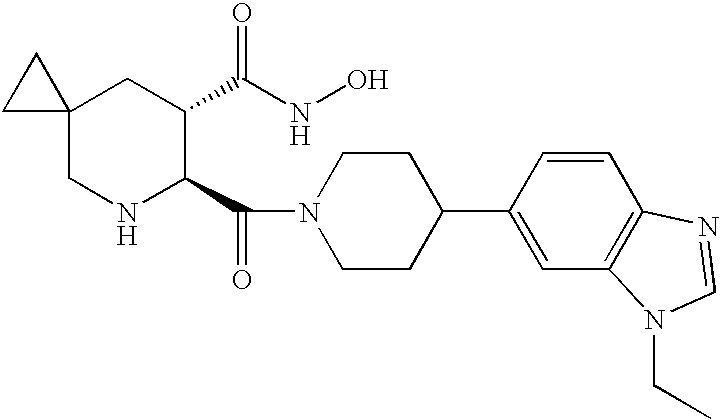

| TABLE 1 | |||
 |
 |
 |
 |
| Exp. | Core | NR″R′′′ | R′ | MS: M + H |
| 1 | A | 4-(3-methylphenyl)piperazin-1-yl | Me | 387.1 |
| 2 | A | 4-phenylpiperazin-1-yl | Me | 373.2 |
| 3 | A | 4-[3-(trifluoromethyl)phenyl]piperazin-1-yl | Me | 441 |
| 4 | A | 4-(2-methylphenyl)piperazin-1-yl | Me | 387.1 |
| 5 | A | 4-(4-Chlorophenyl)piperazin-1-yl | Me | 407.1 |
| 6 | A | 4-(2-methyl-4-nitrophenyl)piperazin-1-yl | Me | 432 |
| 7 | A | 4-phenylpiperidin-1-yl | Me | 372.2 |
| 8 | A | 4-hydroxy-4-phenylpiperidin-1-yl | Me | 388 |
| 9 | A | 4-phenyl-3,6-dihydropyridin-1(2H)-yl | Me | 370 |
| 11 | A | 4-quinolin-2-ylpiperazin-1-yl | Me | 424.3 |
| 12 | A | 4-(2,3-dichlorophenyl)piperazin-1-yl | Me | |
| 13 | A | 4-quinolin-4-ylpiperazin-1-yl | Me | 424.3 |
| 14 | A | 4-(2-methylquinolin-4-yl)piperazin-1-yl | Me | 438.4 |
| 15 | A | 4-(2-phenylethyl)piperazin-1-yl | Me | 401.3 |
| 16 | A | 4-pyridin-4-ylpiperidin-1-yl | Me | 373.3 |
| 17 | A | 4-(4-nitrophenyl)piperazin-1-yl | Me | 418.3 |
| 18 | A | 4-(2-methoxyphenyl)piperazin-1-yl | Me | 403 |
| 19 | A | 4-phenoxypiperidin-1-yl | Me | 388.3 |
| 20 | A | 3,4-dihydroisoquinolin-2(1H)-yl | Me | 344.3 |
| 21 | A | 4,7-dihydrothieno[2,3-c]pyridin-6(5H)-yl | Me | 350.2 |
| 22 | A | 3-benzylpyrrolidin-1-yl | Me | 372.3 |
| 23 | A | 4-pyridin-2-ylpiperazin-1-yl | Me | 374.2 |
| 24 | A | 4-(2-pyridin-4-ylethyl)piperidin-1-yl | Me | 401.3 |
| 25 | A | 4-[5-(trifluoromethyl)pyridin-2-yl]piperazin-1-yl | Me | 442.3 |
| 26 | A | 4-[3-(trifluoromethyl)pyridin-2-yl]piperazin-1-yl | Me | 442.3 |
| 27 | A | 1,4′-bipiperidin-1′-yl | Me | 379.3 |
| 28 | A | 4-(pyridin-2-ylmethyl)piperazin-1-yl | Me | 388.3 |
| 29 | A | 4-(pyridin-4-ylmethyl)piperazin-1-yl | Me | 388.3 |
| 30 | A | 4-(pyridin-3-ylmethyl)piperazin-1-yl | Me | 388.3 |
| 31 | A | 4-(2-methylphenyl)-3,6-dihydropyridin-1(2H)-yl | Me | 384.1 |
| 32 | A | 4-(3-methylphenyl)piperazin-1-yl | H | 373.1 |
| 33 | A | 1,3,4,9-tetrahydro-2H-β-carbolin-2-yl | Me | 383 |
| 34 | A | 9-methyl-1,3,4,9-tetrahydro-2H-β-carbolin-2-yl | Me | 396.9 |
| 35 | A | 4-(2-fluorophenyl)-3,6-dihydropyridin-1(2H)-yl | Me | 388 |
| 36 | A | 4-(2-chlorophenyl)-3,6-dihydropyridin-1(2H)-yl | Me | 404 |
| 37 | A | 4-(4-nitrophenyl)-3,6-dihydropyridin-1(2H)-yl | Me | 415.1 |
| 38 | A | 4-phenyl-3,6-dihydropyridin-1(2H)-yl | H | 356 |
| 39 | A | 4-(2-methyl-4-nitrophenyl)piperazin-1-yl | H | 418 |
| 40 | A | N-methyl-N′-(3-phenylpropyl)amino | Me | 360.1 |
| 41 | A | isobutylamino | Me | 284 |
| 42 | A | 4-(2-nitrophenyl)piperazin-1-yl | Me | 418 |
| 43 | A | N-methyl-N′-(isobutyl)amino | Me | 298 |
| 44 | A | (2-phenoxyethyl)-amino | Me | 348 |
| 45 | A | 2-(4-methoxyphenyl)ethylamino | Me | 362 |
| 46 | A | 4-phenylbutylamino | Me | 360 |
| 47 | A | 3-(2-oxopyrrolidin-1-yl)propylamino | Me | 353 |
| 48 | A | 3,4,10,10a-tetrahydropyrazino[1,2-a]indol-2(1H)-yl | H | 385 |
| 49 | D | 4-(2-methyl-4-nitrophenyl)piperazin-1-yl | 417.2 | |
| 50 | B | 4-(3-methylphenyl)piperazin-1-yl | 372.2 | |
| 51 | D | 4-phenyl-3,6-dihydropyridin-1(2H)-yl | 355 | |
| 52 | D | 4-(3-methylphenyl)piperazin-1-yl | 372 | |
| 53 | B | 4-phenyl-3,6-dihydropyridin-1(2H)-yl | 355 | |
| 54 | A | 3,4,10,10a-tetrahydropyrazino[1,2-a]indol-2(1H)-yl | H | 371.2 |
| 55 | A | 1,2,4,4a,5,6-hexahydro-3H-pyrazino[1,2-a]quinolin-3-yl | Me | 399.4 |
| 56 | A | 4-phenyl-3,6-dihydropyridin-1(2H)-yl | methoxycarbonyl | 414 |
| 57 | A | 4-phenyl-3,6-dihydropyridin-1(2H)-yl | benzyloxycarbonyl | 490 |
| 58 | A | 4-phenyl-3,6-dihydropyridin-1(2H)-yl | methylsulfonyl | 434 |
| 59 | A | 3-(3-methoxyphenyl)piperidin-1-yl | Me | 402.4 |
| 60 | A | 3-(2-phenylethyl)pyrrolidin-1-yl | Me | 386 |
| 61 | A | 4-(3-methoxyphenyl)piperidin-1-yl | Me | 402.4 |
| 62 | A | 4-[3-(aminocarbonyl)phenyl]-3,6-dihydropyridin-1(2H)-yl | H | 398.9 |
| 63 | A | 4-(2-methoxyphenyl)piperidin-1-yl | Me | 402.4 |
| 64 | A | 4-(3fFluoro-2-methylphenyl)piperazin-1-yl | H | 391.3 |
| 65 | A | 4-(2-methyl-3-nitrophenyl)piperazin-1-yl | H | 418.3 |
| 66 | A | 3′,6′-dihydro-3,4′-bipyridin-1′(2′H)-yl | H | 357.4 |
| 67 | A | N-(4-methoxyphenyl)-N′-methylamino | H | 334 |
| 68 | A | 4-(3-methoxyphenyl)piperazin-1-yl | Me | 403 |
| 69 | A | 4-(3-Chlorophenyl)piperazin-1-yl | Me | 407.3 |
| 70 | A | 4-Phenyl-[1,4]diazepan-1-yl | H | 373 |
| 71 | A | 3-methyl-4-(3-methylphenyl)piperazin-1-yl | H | 387 |
| 72 | A | 4-(3-methoxyphenyl)piperidin-1-yl | H | 388.4 |
| 73 | B | 3-phenylpyrrolidin-1-yl | 343.3 | |
| 74 | A | 4-isobutyrylpiperazin-1-yl | H | 353 |
| 75 | A | 4-(4-cyano-2-methylphenyl)-3,6-dihydropyridin-1(2H)-yl | H | 395 |
| 76 | A | 4-[(2-methylquinolin-4-yl)methoxy]phenylamino | Me | 475.4 |
| 77 | A | 4-[(2-methylquinolin-4-yl)methoxy]phenylamino | H | 461 |
| 78 | A | 4-(4-cyanophenyl)piperazin-1-yl | H | 384 |
| 79 | C | 4-phenylpiperidin-1-yl | H | 358 |
| 80 | A | 4-phenylpiperidin-1-yl | H | 358 |
| 81 | A | 4-phenylpiperazin-1-yl | H | 359 |
| 82 | A | 4-[3-(methoxymethyl)phenyl]piperidin-1-yl | H | 402 |
| 83 | A | 4-(3-methoxycarbonylphenyl)piperidin-1-yl | H | 416 |
| 84 | A | 3-cyclohexylpyrrolidin-1-yl | H | 350.4 |
| 85 | A | 4-(3-isopropylphenyl)-3,6-dihydropyridin-1(2H)-yl | H | 398.4 |
| 86 | A | 4-(3-Isopropylphenyl)piperidin-1-yl | H | 400.4 |
| 87 | A | 4-(4-propylphenyl)-3,6-dihydropyridin-1(2H)-yl | H | |
| 88 | A | 4-(4-ethylphenyl)-3,6-dihydropyridin-1(2H)-yl | H | 384.4 |
| 89 | A | 4-(4-ethylphenyl)piperidin-1-yl | H | 386 |
| 90 | A | 4-(4-cyano-2-methylphenyl)piperazin-1-yl | H | 398 |
| 91 | A | 4-(3-isopropoxyphenyl)-3,6-dihydropyridin-1(2H)-yl | H | 414.4 |
| 92 | A | 4-(3-methylphenyl)-3,6-dihydropyridin-1(2H)-yl | H | 370.3 |
| 93 | A | 4-(3-methylphenyl)piperazin-1-yl | H | 372.4 |
| 94 | A | 4-(4-tert-butylphenyl)piperazin-1-yl | H | 415.4 |
| 95 | A | 4-pyridin-4-ylpiperazin-1-yl | H | 360 |
| 96 | A | 3-benzylpiperidin-1-yl | H | 371.9 |
| 97 | A | 5-methoxy-2,3-dihydro-1H-indol-1-yl | H | 346.3 |
| 98 | A | 5-[(2-methylquinolin-4-yl)methoxy]-2,3-dihydro-1H-indol-1-yl | H | 487.4 |
| 99 | A | 5-[(2-methylquinolin-4-yl)methoxy]-2,3-dihydro-1H-indol-1-yl | Me | 501.4 |
| 100 | A | 5-(benzyloxy)-2,3-dihydro-1H-indol-1-yl | H | 422.3 |
| 101 | A | 1,3-dihydro-1′H-spiro[indene-2,4′-piperidin]-1′-yl | H | 384.4 |
| 102 | A | 4-(3-isopropoxyphenyl)piperidin-1-yl | H | 416.4 |
| 103 | A | 4-(2-methyl-4-methoxycarbonylphenyl)-3,6-dihydropyridin-1(2H)-yl | H | 427.9 |
| 104 | A | 4-(2-methyl-4-nitrophenyl)-3,6-dihydropyridin-1(2H)-yl | H | 414.8 |
| 105 | A | 4-(2-ethylphenyl)piperidin-1-yl | H | 385.9 |
| 106 | A | 4-(2-methyl-4-methoxycarbonylphenyl)piperidin-1-yl | H | 429.9 |
| 107 | A | 4-(2,3-dihydro-1-benzofuran-5-yl)-3,6-dihydropyridin-1(2H)-yl | Me | 412.2 |
| 108 | A | 4-(3-isopropylphenyl)-3,6-dihydropyridin-1(2H)-yl | Me | 412.2 |
| 109 | A | (3R)-3-phenylpyrrolidin-1-yl | H | 344.1 |
| 110 | A | (3S)-3-phenylpyrrolidin-1-yl | H | 344.1 |
| 112 | A | 3-[3-(trifluoromethyl)phenyl]pyrrolidin-1-yl | H | 412.1 |
| 113 | A | 3-(3-chlorophenyl)pyrrolidin-1-yl | H | 378.1 |
| 114 | A | 3-(3-fluorophenyl)pyrrolidin-1-yl | H | 362.1 |
| 115 | A | 3-(4-fluorophenyl)pyrrolidin-1-yl | H | 362.1 |
| 116 | A | 3-(4-chlorophenyl)pyrrolidin-1-yl | H | 378.1 |
| 117 | A | 3-[4-(trifluoromethyl)phenyl]pyrrolidin-1-yl | H | 412.1 |
| 118 | A | 3-(4-methoxyphenyl)pyrrolidin-1-yl | H | 374.1 |
| 119 | A | 3-(4-phenoxyphenyl)pyrrolidin-1-yl | H | 436.2 |
| 120 | A | 4-(3-methoxyphenyl)-3,6-dihydropyridin-1(2H)-yl | H | 386.1 |
| 121 | A | 4-(4-cyano-3-methylphenyl)-3,6-dihydropyridin-1(2H)-yl | H | 395.1 |
| 122 | A | 3-(3-methoxyphenyl)pyrrolidin-1-yl | H | 374.1 |
| 123 | A | 3-pyridin-4-ylpyrrolidin-1-yl | H | 345.2 |
| 124 | A | 4-(3,5-dimethylphenyl)-3,6-dihydropyridin-1(2H)-yl | H | 384.2 |
| 125 | A | 4-(3-trifluoromethoxyphenyl)-3,6-dihydropyridin-1(2H)-yl | H | 440.1 |
| 126 | A | 5-(methoxymethyl)-4-phenyl-3,6-dihydropyridin-1(2H)-yl | H | 400 |
| 127 | A | 1,4,5,6-tetrahydrobenzo[f]isoquinolin-3(2H)-yl | H | 381.9 |
| 129 | A | 4-(5-methoxy-2-methylphenyl)-3,6-dihydropyridin-1(2H)-yl | H | 400.2 |
| 130 | A | 4-(4-methoxy-2-methylphenyl)-3,6-dihydropyridin-1(2H)-yl | H | 400.2 |
| 131 | A | 4-cyano-4-phenylpiperidin-1-yl | H | 383.2 |
| 132 | A | 4-phenyl-3,6-dihydropyridin-1(2H)-yl | Ethoxycarbonyl | 426.1* |
| 133 | A | 4-phenyl-3,6-dihydropyridin-1(2H)-yl | Propionoxycarbonyl | 440.2* |
| 134 | A | 4-phenyl-3,6-dihydropyridin-1(2H)-yl | iso-propionoxycarbonyl | 440.2* |
| 135 | A | 4-phenyl-3,6-dihydropyridin-1(2H)-yl | iso-butoxycarbonyl | 454.2* |
| 136 | A | 5-methyl-4-phenyl-3,6-dihydropyridin-1(2H)-yl | H | 370 |
| 143 | A | 1,4,4a,5,6,10b-hexahydrobenzo[f]isoquinolin-3(2H)-yl | H | 384.2 |
| 144 | A | 4-(4-fluorophenyl)-3-hydroxypiperidin-1-yl | H | 392.1 |
| 145 | A | 3,3a,8,8a-tetrahydroindeno[1,2-c]pyrrol-2(1H)-yl | H | 356.1 |
| 146 | A | 4-(4-phenyl-1,3-thiazol-2-yl)piperidin-1-yl | H | 441.3 |
| 147 | A | 4-(4-tert-Butyl-1,3-thiazol-2-yl)piperidin-1-yl | H | 421.1 |
| 148 | A | 4-methyl-4-phenylpiperidin-1-yl | H | 372.2 |
| 149 | A | 4-(4-ethyl-1,3-thiazol-2-yl)piperidin-1-yl | H | 393.1 |
| 150 | A | 3-methyl-4-phenylpyrrolidine-1-yl | H | 358.2 |
| 151 | A | 4-(2-fluorophenyl)piperazin-1-yl | H | 377.2 |
| 152 | A | 4-(3,5-dimethylphenyl)-3,6-dihydropyridin-1(2H)-yl | Me | 398.1 |
| 153 | A | 4-phenylpiperazin-1-yl | tetrahydro-2H-pyran-4-oxycarbonyl | 487.1 |
| 154 | A | 4-phenylpiperazin-1-yl | ethoxycarbonyl | 431.2 |
| 155 | A | 4-phenylpiperazin-1-yl | methoxycarbonyl | 417.1 |
| 156 | A | 4-pyrazin-2-ylpiperazin-1-yl | H | 361.2 |
| 157 | A | 4-quinolin-2-ylpiperazin-1-yl | H | 410.1 |
| 158 | A | 3-(5,6,7,8-tetrahydronaphthalen-2-yl)pyrrolidin-1-yl | H | 398.2 |
| 159 | A | (3R)-3-phenylpyrrolidin-1-yl | Me | 358.1 |
| 160 | A | (3R)-3-phenylpyrrolidin-1-yl | methoxycarbonyl | 402.1 |
| 161 | A | 3-pyridin-3-ylpyrrolidin-1-yl | H | 345.1 |
| 162 | A | 3-pyridin-2-ylpyrrolidin-1-yl | H | 345.1 |
| 163 | A | 3-methyl-3-phenylpyrrolidine-1-yl | H | 358.2 |
| 164 | A | 3-phenylazetidin-1-yl | H | 330.3 |
| 165 | A | 3-methyl-3-phenylpyrrolidine-1-yl | Me | 372.4 |
| 166 | A | 3-phenylazetidin-1-yl | Me | 344.4 |
| 168 | A | 1,3,3a,4,5,9b-hexahydro-2H-benzo[e]isoindol-2-yl | H | 370.4 |
| 169 | A | 3-(2-naphthyl)pyrrolidin-1-yl | H | 394.4 |
| 170 | A | 4-(2-thienyl)-3,6-dihydropyridin-1(2H)-yI | H | 362.1 |
| 171 | A | 3-(3-thienyl)pyrrolidin-1-yl | H | 350.1 |
| 172 | A | 3-(2-thienyl)pyrrolidin-1-yl | H | 350.2 |
| 173 | A | 4-(2-thienyl)piperidin-1-yl | H | 364.1 |
| 174 | A | 3-(2-methylphenyl)pyrrolidin-1-yl | H | 358.2 |
| 175 | A | 3-(4-methylphenyl)pyrrolidin-1-yl | H | 358.2 |
| 176 | A | 4-phenyl-3,6-dihydropyridin-1(2H)-yl | Ac | |
| 177 | A | 4-(3-thienyl)-3,6-dihydropyridin-1(2H)-yl | H | 362.1 |
| 178 | A | 3-phenylpiperidin-1-yl | H | 358.2 |
| 179 | A | 4-(3-thienyl)piperidin-1-yl | H | 364.1 |
| 180 | A | 4-(3,5-dimethylphenyl)-3,6-dihydropyridin-1(2H)-yl | methoxycarbonyl | 442.2 |
| 181 | A | 4-(3,5-dimethylphenyl)-3,6-dihydropyridin-1(2H)-yl | methanesulfonyl | 462.1 |
| 182 | A | 4-(3,5-difluorophenyl)-3,6-dihydropyridin-1(2H)-yl | H | 392.2 |
| 183 | A | 4-(3,5-dichlorophenyl)-3,6-dihydropyridin-1(2H)-yl | H | 424.1 |
| 184 | A | 4-[3,5-bis(trifluoromethyl)phenyl]-3,6-dihydropyridin-1(2H)-yl | H | 492.1 |
| 185 | A | 4-phenylpiperazin-1-yl | methanesulfonyl | 437.2 |
| 186 | A | 4-phenylpiperazin-1-yl | formyl | 387.2 |
| 187 | A | 4-(3,5-difluorophenyl)piperidin-1-yl | H | 394.2 |
| 188 | A | 4-(2,5-dimethylphenyl)-3,6-dihydropyridin-1(2H)-yl | H | 384.1 |
| 189 | A | 4-(2,4,5-trimethylphenyl)-3,6-dihydropyridin-1(2H)-yl | H | 398.2 |
| 190 | A | 4-biphenyl-3-ylpiperidin-1-yl | H | 434.2 |
| 191 | A | 4-dibenzo[b,d]furan-4-ylpiperidin-1-yl | H | 448.2 |
| 192 | A | 4-(2,5-dimethylphenyl)piperidin-1-yl | H | 386.2 |
| 193 | A | 4-(2,4,5-trimethylphenyl)piperidin-1-yl | H | 400.2 |
| 194 | A | 4-(3-methoxycarbonyl-6-methylphenyl)-3,6-dihydropyridin-1(2H)-yl | H | 428.2 |
| 195 | A | 5-phenyl-2,3,4,7-tetrahydro-1H-azepin-1-yl | H | 370.2 |
| 196 | A | 4-[3-(dimethylamino)phenyl]-3,6-dihydropyridin-1(2H)-yl | H | 399.2 |
| 197 | A | 4-(3-methoxycarbonyl-6-methylphenyl)piperidin-1-yl | H | 430.2 |
| 198 | A | 5-phenylazepan-1-yl | H | 372.2 |
| 199 | A | 4-[3-(dimethylamino)phenyl]piperidin-1-yl | H | 401.2 |
| 200 | A | 4-(2-methylphenyl)-3,6-dihydropyridin-1(2H)-yl | H | 370.2 |
| 201 | A | 3-phenyl-2,5-dihydro-1H-pyrrol-1-yl | H | 342.1 |
| 202 | A | 4-(4-cyano-2-methylphenyl)piperidin-1-yl | H | 397.2 |
| 203 | A | 3,3-dimethyl-4-phenyl-3,6-dihydropyridin-1(2H)-yl | H | 384.1 |
| 204 | A | 3,3-dimethyl-4-phenylpiperidin-1-yl | H | 386.2 |
| 205 | A | 3-phenyl-2,5-dihydro-1H-pyrrol-1-yl | methanesulfonyl | 420.2 |
| 206 | A | 3-phenyl-2,5-dihydro-1H-pyrrol-1-yl | methoxycarbonyl | 400.2 |
| 207 | A | 3-phenyl-2,5-dihydro-1H-pyrrol-1-yl | Me | 356.2 |
| 208 | A | 4-(4-cyano-3-methylphenyl)piperidin-1-yl | H | 397.2 |
| 209 | A | 4-[3-(benzyloxy)phenyl]-3,6-dihydropyridin-1(2H)-yl | H | 462.2 |
| 210 | A | 4-[3-ethylphenyl]-3,6-dihydropyridin-1(2H)-yl | H | 384.1 |
| 211 | A | 4-[3-(ethyloxy)phenyl]-3,6-dihydropyridin-1(2H)-yl | H | 400.1 |
| 212 | A | 4-(3-ethylphenyl)piperidin-1-yl | H | 386.1 |
| 213 | A | 4-(3-ethoxyphenyl)piperidin-1-yl | H | 402.1 |
| 214 | A | 4-(3-cyclopropylphenyl)-3,6-dihydropyridin-1(2H)-yl | H | 396.2 |
| 215 | A | 4-(4-methoxy-3,5-dimethylphenyl)-3,6-dihydropyridin-1(2H)-yl | H | 414.2 |
| 216 | A | 4-(3,5-dimethyl-4-methoxyphenyl)piperidin-1-yl | H | 416.2 |
| 217 | A | 4-(4-cyano-3-ethylphenyl)-3,6-dihydropyridin-1(2H)-yl | H | 409.2 |
| 218 | A | 4-(4-cyano-3-ethylphenyl)piperidin-1-yl | H | 411.2 |
| 219 | A | 4-(4-cyano-3,5-dimethylphenyl)-3,6-dihydropyridin-1(2H)-yl | H | 409.2 |
| 220 | A | 4-(4-cyano-3,5-dimethylphenyl)piperidin-1-yl | H | 411.4 |
| 221 | A | 4-(1,3-benzothiazol-6-yl)-3,6-dihydropyridin-1(2H)-yl | H | 413.1 |
| 222 | A | 4-(1-methyl-1H-indazol-6-yl)-3,6-dihydropyridin-1(2H)-yl | H | 410.2 |
| 223 | A | 4-(1-methyl-1H-indazol-6-yl)piperidin-1-yl | H | 412.3 |
| 224 | A | 4-(4-cyano-3-isopropylphenyl)-3,6-dihydropyridin-1(2H)-yl | H | 423.2 |
| 225 | A | 4-(4-cyano-3-isopropylphenyl)piperidin-1-yl | H | 425.2 |
| 236 | A | 4-(4-cyano-3-ethylphenyl)-3,6-dihydropyridin-1(2H)-yl | Me | 423.2 |
| 237 | A | 4-(4-cyano-3,5-dimethylphenyl)-3,6-dihydropyridin-1(2H)-yl | Me | 423.2 |
| 238 | A | 4-(1-ethyl-1H-benzimidazol-6-yl)-3,6-dihydropyridin-1(2H)-yl | H | 424.3 |
| 239 | A | 4-(1-methyl-1H-indazol-5-yl)-3,6-dihydropyridin-1(2H)-yl | H | 410.2 |
| 240 | A | 4-(1-ethyl-1H-benzimidazol-6-yl)piperidin-1-yl | H | 426.2 |
| 241 | A | 4-(1-methyl-1H-indazol-5-yl)piperidin-1-yl | H | 412.2 |
| 242 | A | 4-(1-ethyl-1H-indazol-5-yl)-3,6-dihydropyridin-1(2H)-yl | H | 424.2 |
| 243 | A | 4-(1-ethyl-1H-benzimidazol-6-yl)piperidin-1-yl | tetrahydro-2H-pyran-4-oxycarbonyl | 554.3 |
| 244 | A | 4-(1-ethyl-1H-benzimidazol-6-yl)-3,6-dihydropyridin-1(2H)-yl | methoxycarbonyl | 482.2 |
| 245 | A | 4-(1-ethyl-1H-benzimidazol-6-yl)-3,6-dihydropyridin-1(2H)-yl | methanesulfonyl | 502.2 |
| 246 | A | 4-(1-ethyl-1H-benzimidazol-6-yl)piperidin-1-yl | methoxycarbonyl | 484.2 |
| 247 | A | 4-(1-ethyl-1H-benzimidazol-6-yl)piperidin-1-yl | methanesulfonyl | 504.2 |
| 248 | A | 4-(4-cyano-2-methylphenyl)piperidin-1-yl | methanesulfonyl | 476.2 |
| 249 | A | 4-(4-cyano-2-methylphenyl)piperazin-1-yl | methoxycarbonyl | 456.2 |
| 250 | A | 4-(1-ethyl-1H-benzimidazol-6-yl)piperazin-1-yl | H | 427.5 |
| 251 | A | 4-(1-ethyl-1H-benzimidazol-6-yl)piperazin-1-yl | methoxycarbonyl | 485.3 |
| 252 | A | 4-(1-ethyl-1H-benzimidazol-6-yl)piperazin-1-yl | methanesulfonyl | 505.2 |
| 253 | A | 4-(4-cyano-2-methylphenyl)piperazin-1-yl | tetrahydro-2H-pyran-4-oxycarbonyl | 526.3 |
| 254 | A | 4-(1-ethyl-1H-benzimidazol-6-yl)piperazin-1-yl | tetrahydro-2H-pyran-4-oxycarbonyl | |
| 255 | A | 3-methyl-4-phenylpiperidin-1-yl | H | 372.1 |
| 256 | A | 5-(aminocarbonyl)-4-phenyl-3,6-dihydropyridin-1(2H)-yl | H | |
| 257 | A | 4-(4-cyanophenyl)-5-methyl-3,6-dihydropyridin-1(2H)-yl | H | 395.2 |
| 258 | A | 4-(4-cyanophenyl)-3-methylpiperidin-1-yl | H | 397.1 |
| 259 | A | 5-methyl-4-(4-nitrophenyl)-3,6-dihydropyridin-1(2H)-yl | H | 415.2 |
| 260 | A | 5-methyl-4-(3-nitrophenyl)-3,6-dihydropyridin-1(2H)-yl | H | 415.1 |
| 262 | A | 4-dibenzo[b,d]furan-2-yl-3,6-dihydropyridin-1(2H)-yl | H | 446.1 |
| 263 | A | 4-dibenzo[b,d]furan-2-ylpiperidin-1-yl | H | 448.1 |
| 264 | A | 4-(3,3-dimethyl-2,3-dihydro-1-benzofuran-5-yl)-3,6-di- | H | 426.1 |
| hydropyridin-1(2H)-yl | ||||
| 265 | A | 4-(3,3-dimethyl-2,3-dihydro-1-benzofuran-5-yl)piperidin-1-yl | H | 428.1 |
| 266 | A | 3-phenyl-2,5-dihydro-1H-pyrrol-1-yl | iso-propionoxycarbonyl | 428.1 |
| 267 | A | 3-phenyl-2,5-dihydro-1H-pyrrol-1-yl | (3S)-tetrahydrofuran-3-oxycarbonyl | 456.1 |
| 268 | A | 3-phenyl-2,5-dihydro-1H-pyrrol-1-yl | cyclohexoxycarbonyl | 468.2 |
| 269 | A | 3-phenyl-2,5-dihydro-1H-pyrrol-1-yl | tetrahydro-2H-pyran-4-oxycarbonyl | 470.2 |
| 270 | B | 4-phenylpiperazin-1-yl | 358.2 | |
| 271 | B | (3R)-3-phenylpyrrolidin-1-yl | 343.3 | |
| 272 | B | 4-(2-methyl-4-nitrophenyl)piperazin-1-yl | 417.2 | |
| 273 | B | 4-phenyl-3,6-dihydropyridin-1(2H)-yl | 355.2 | |
| 274 | A | 4-phenylpiperazin-1-yl | (3S)-tetrahydrofuran-3-oxycarbonyl | 473.2 |
| 275 | A | 4-phenylpiperazin-1-yl | (3R)-tetrahydrofuran-3-oxycarbonyl | 473.2 |
| 276 | A | 4-phenylpiperazin-1-yl | 2-methoxyethoxycarbonyl | 461.1 |
| 277 | A | 4-phenylpiperazin-1-yl | phenylsulfonyl | 499.1 |
| 278 | A | 4-phenylpiperazin-1-yl | propionoxycarbonyl | 445.2 |
| 279 | A | 4-phenylpiperazin-1-yl | iso-propionoxycarbonyl | 445.2 |
| 280 | A | 4-(3,5-difluorophenyl)-3,6-dihydropyridin-1(2H)-yl | methoxycarbonyl | 450.2 |
| 281 | A | 4-(3,5-difluorophenyl)-3,6-dihydropyridin-1(2H)-yl | methanesulfonyl | 470.2 |
| 282 | A | 4-(4-isopropylphenyl)piperazin-1-yl | H | |
| 283 | A | 4-(3,5-difluorophenyl)piperidin-1-yl | methanesulfonyl | 472.1 |
| 284 | A | 4-(4,5-dimethyl-1,3-thiazol-2-yl)piperidin-1-yl | H | 393.1 |
| *M − H | ||||
Claims (15)

Priority Applications (6)
| Application Number | Priority Date | Filing Date | Title |
|---|---|---|---|
| US10/831,265 US7723349B2 (en) | 2003-04-24 | 2004-04-23 | Aza spiro alkane derivatives as inhibitors of metalloproteases |
| US12/327,313 US8039471B2 (en) | 2003-04-24 | 2008-12-03 | Aza spiro alkane derivatives as inhibitors of metalloproteases |
| US13/184,860 US8637497B2 (en) | 2003-04-24 | 2011-07-18 | AZA spiro alkane derivatives as inhibitors of metalloproteases |
| US14/092,351 US9403775B2 (en) | 2003-04-24 | 2013-11-27 | AZA spiro alkane derivatives as inhibitors of metalloproteases |
| US15/204,423 US9801877B2 (en) | 2003-04-24 | 2016-07-07 | AZA spiro alkane derivatives as inhibitors of metalloproteases |
| US15/719,949 US10226459B2 (en) | 2003-04-24 | 2017-09-29 | Aza spiro alkane derivatives as inhibitors of metalloproteases |
Applications Claiming Priority (3)
| Application Number | Priority Date | Filing Date | Title |
|---|---|---|---|
| US46615903P | 2003-04-24 | 2003-04-24 | |
| US53450104P | 2004-01-06 | 2004-01-06 | |
| US10/831,265 US7723349B2 (en) | 2003-04-24 | 2004-04-23 | Aza spiro alkane derivatives as inhibitors of metalloproteases |
Related Child Applications (2)
| Application Number | Title | Priority Date | Filing Date |
|---|---|---|---|
| US12/327,313 Division US8039471B2 (en) | 2003-04-24 | 2008-12-03 | Aza spiro alkane derivatives as inhibitors of metalloproteases |
| US12/327,313 Continuation US8039471B2 (en) | 2003-04-24 | 2008-12-03 | Aza spiro alkane derivatives as inhibitors of metalloproteases |
Publications (2)
| Publication Number | Publication Date |
|---|---|
| US20040259896A1 US20040259896A1 (en) | 2004-12-23 |
| US7723349B2 true US7723349B2 (en) | 2010-05-25 |
Family
ID=33423596
Family Applications (6)
| Application Number | Title | Priority Date | Filing Date |
|---|---|---|---|
| US10/831,265 Expired - Lifetime US7723349B2 (en) | 2003-04-24 | 2004-04-23 | Aza spiro alkane derivatives as inhibitors of metalloproteases |
| US12/327,313 Expired - Lifetime US8039471B2 (en) | 2003-04-24 | 2008-12-03 | Aza spiro alkane derivatives as inhibitors of metalloproteases |
| US13/184,860 Expired - Fee Related US8637497B2 (en) | 2003-04-24 | 2011-07-18 | AZA spiro alkane derivatives as inhibitors of metalloproteases |
| US14/092,351 Expired - Lifetime US9403775B2 (en) | 2003-04-24 | 2013-11-27 | AZA spiro alkane derivatives as inhibitors of metalloproteases |
| US15/204,423 Expired - Fee Related US9801877B2 (en) | 2003-04-24 | 2016-07-07 | AZA spiro alkane derivatives as inhibitors of metalloproteases |
| US15/719,949 Expired - Lifetime US10226459B2 (en) | 2003-04-24 | 2017-09-29 | Aza spiro alkane derivatives as inhibitors of metalloproteases |
Family Applications After (5)
| Application Number | Title | Priority Date | Filing Date |
|---|---|---|---|
| US12/327,313 Expired - Lifetime US8039471B2 (en) | 2003-04-24 | 2008-12-03 | Aza spiro alkane derivatives as inhibitors of metalloproteases |
| US13/184,860 Expired - Fee Related US8637497B2 (en) | 2003-04-24 | 2011-07-18 | AZA spiro alkane derivatives as inhibitors of metalloproteases |
| US14/092,351 Expired - Lifetime US9403775B2 (en) | 2003-04-24 | 2013-11-27 | AZA spiro alkane derivatives as inhibitors of metalloproteases |
| US15/204,423 Expired - Fee Related US9801877B2 (en) | 2003-04-24 | 2016-07-07 | AZA spiro alkane derivatives as inhibitors of metalloproteases |
| US15/719,949 Expired - Lifetime US10226459B2 (en) | 2003-04-24 | 2017-09-29 | Aza spiro alkane derivatives as inhibitors of metalloproteases |
Country Status (28)
| Country | Link |
|---|---|
| US (6) | US7723349B2 (en) |
| EP (3) | EP1622569B1 (en) |
| JP (2) | JP4841429B2 (en) |
| KR (1) | KR101120414B1 (en) |
| CN (1) | CN101880277A (en) |
| AU (2) | AU2004233863B2 (en) |
| BR (1) | BRPI0409686A (en) |
| CA (1) | CA2523426C (en) |
| CO (1) | CO5700719A2 (en) |
| CY (1) | CY1117221T1 (en) |
| DK (1) | DK1622569T3 (en) |
| EA (2) | EA009296B1 (en) |
| EC (1) | ECSP056118A (en) |
| ES (1) | ES2563304T3 (en) |
| GE (2) | GEP20094705B (en) |
| HR (1) | HRP20160180T1 (en) |
| HU (2) | HUE026904T2 (en) |
| IL (1) | IL171480A (en) |
| IS (1) | IS2974B (en) |
| MX (1) | MXPA05011423A (en) |
| NO (1) | NO332758B1 (en) |
| NZ (1) | NZ543102A (en) |
| PL (2) | PL1622569T3 (en) |
| PT (1) | PT1622569E (en) |
| RU (1) | RU2379303C2 (en) |
| SE (2) | SE529469C2 (en) |
| SI (1) | SI1622569T1 (en) |
| WO (1) | WO2004096139A2 (en) |
Cited By (7)
| Publication number | Priority date | Publication date | Assignee | Title |
|---|---|---|---|---|
| US20040247602A1 (en) * | 2003-04-04 | 2004-12-09 | Friedman Steven M. | Compositions, methods and kits relating to Her-2 cleavage |
| US20070280943A1 (en) * | 2006-06-05 | 2007-12-06 | Friedman Steven M | Sheddase inhibitors combined with cd30-binding immunotherapeutics for the treatment of cd30 positive diseases |
| US9403775B2 (en) | 2003-04-24 | 2016-08-02 | Incyte Corporation | AZA spiro alkane derivatives as inhibitors of metalloproteases |
| US10858373B2 (en) | 2017-01-23 | 2020-12-08 | Pfizer Inc. | Heterocyclic spiro compounds as MAGL inhibitors |
| US10874649B2 (en) * | 2016-06-17 | 2020-12-29 | Valo Early Discovery, Inc. | 2-spiro-5- and 6-hydroxamic acid indanes as HDAC inhibitors |
| US10988450B2 (en) | 2015-02-02 | 2021-04-27 | Valo Early Discovery, Inc. | 3-alkyl-4-amido-bicyclic [4,5,0] hydroxamic acids as HDAC inhibitors |
| US11702412B2 (en) | 2015-02-02 | 2023-07-18 | Valo Health, Inc. | Bicyclic [4,6,0] hydroxamic acids as HDAC inhibitors |
Families Citing this family (30)
| Publication number | Priority date | Publication date | Assignee | Title |
|---|---|---|---|---|
| EP2264030A1 (en) * | 2003-10-17 | 2010-12-22 | Incyte Corporation | Substituted cyclic hydroxamates as inhibitors of matrix metalloproteinases |
| TWI350168B (en) | 2004-05-07 | 2011-10-11 | Incyte Corp | Amido compounds and their use as pharmaceuticals |
| WO2005115389A2 (en) * | 2004-05-25 | 2005-12-08 | Pfizer Products Inc. | Specific ppar agonists for treating negative energy balance |
| WO2006086730A2 (en) * | 2005-02-09 | 2006-08-17 | Genentech, Inc. | Inhibiting her2 shedding with matrix metalloprotease antagonists |
| WO2007062093A2 (en) * | 2005-11-22 | 2007-05-31 | Incyte Corporation | Combination therapy for the treatment of cancer comprising a metalloprotease inhibitor |
| US7998959B2 (en) | 2006-01-12 | 2011-08-16 | Incyte Corporation | Modulators of 11-β hydroxyl steroid dehydrogenase type 1, pharmaceutical compositions thereof, and methods of using the same |
| EP1832585A1 (en) * | 2006-03-10 | 2007-09-12 | ORIDIS BIOMED Forschungs- und Entwicklungs GmbH | Thiazole-piperidine derivatives for treatment of hyperproliferative diseases |
| JP2010529080A (en) * | 2007-06-05 | 2010-08-26 | エヌエスエイビー、フィリアル アヴ ノイロサーチ スウェーデン エービー、スヴェーリエ | Novel disubstituted phenylpyrrolidines as modulators of cortical catecholaminergic neurotransmission |
| BRPI0911612A2 (en) | 2008-04-28 | 2015-12-15 | Revalesio Corp | compositions and methods for the treatment of multiple sclerosis. |
| US20100113664A1 (en) * | 2008-06-11 | 2010-05-06 | Ferro Corporation | Asymmetric Cyclic Diester Compounds |
| US20090312470A1 (en) * | 2008-06-11 | 2009-12-17 | Ferro Corporation | Asymmetric Cyclic Diester Compounds |
| EP2637679A4 (en) * | 2010-11-09 | 2015-09-23 | Univ Chicago | ROLE OF ADAM10 AND ITS RELEVANCE AT THE PATHOLOGICAL AND THERAPEUTIC LEVEL |
| CN103304634B (en) * | 2013-05-30 | 2015-04-29 | 温州芳植生物科技有限公司 | Matrix metalloproteinase-2 polypeptide inhibitor and application |
| CN103254290B (en) * | 2013-05-30 | 2014-09-03 | 南通广泰生化制品有限公司 | Matrix metal proteinase-2 polypeptide inhibitors and application thereof |
| WO2017117130A1 (en) | 2015-12-28 | 2017-07-06 | The United States Of America, As Represented By The Secretary, Department Of Health & Human Services | Methods for inhibiting human immunodeficiency virus (hiv) release from infected cells |
| MX2019002004A (en) | 2016-08-19 | 2019-10-09 | Whitehead Inst Biomedical Res | Methods of editing dna methylation. |
| WO2018049075A1 (en) | 2016-09-07 | 2018-03-15 | Flagship Pioneering, Inc. | Methods and compositions for modulating gene expression |
| WO2018111944A1 (en) | 2016-12-12 | 2018-06-21 | Whitehead Institute For Biomedical Research | Regulation of transcription through ctcf loop anchors |
| US11873496B2 (en) | 2017-01-09 | 2024-01-16 | Whitehead Institute For Biomedical Research | Methods of altering gene expression by perturbing transcription factor multimers that structure regulatory loops |
| AU2019234183B2 (en) | 2018-03-15 | 2025-12-18 | Biond Biologics Ltd. | Methods and compositions for decreasing soluble immune receptor CD28 |
| CN117263942A (en) | 2018-03-21 | 2023-12-22 | 传达治疗有限公司 | SHP2 phosphatase inhibitors and methods of use |
| US12138263B2 (en) | 2018-03-21 | 2024-11-12 | Relay Therapeutics, Inc. | Pyrazolo[3,4-b]pyrazine SHP2 phosphatase inhibitors and methods of use thereof |
| EP3938397A1 (en) | 2019-03-14 | 2022-01-19 | Biond Biologics Ltd. | Small shedding blocking agents |
| EP4034539A1 (en) | 2019-09-24 | 2022-08-03 | Relay Therapeutics, Inc. | Shp2 phosphatase inhibitors and methods of making and using the same |
| US12534458B2 (en) | 2019-11-05 | 2026-01-27 | Merck Sharp & Dohme Llc | Spiropiperidine allosteric modulators of nicotinic acetylcholine receptors |
| US12612459B2 (en) | 2019-12-02 | 2026-04-28 | Biond Biologics Ltd. | Methods of identifying agents that block MCD28 cleavage by MMPS |
| KR20220152555A (en) | 2020-03-12 | 2022-11-16 | 비온드 바이오로직스 엘티디 | Shading blocker with increased stability |
| CN118632691A (en) * | 2021-09-30 | 2024-09-10 | 纽约残疾人救助协会下属特种外科医院 | IRHOM2 inhibitors and uses thereof |
| WO2023243601A1 (en) | 2022-06-13 | 2023-12-21 | モジュラス株式会社 | Azacycloalkyl carbonyl cyclic amine compound |
| CN118251404B (en) * | 2022-10-18 | 2025-10-10 | 福建广生中霖生物科技有限公司 | Pharmaceutical intermediate and preparation method thereof |
Citations (94)
| Publication number | Priority date | Publication date | Assignee | Title |
|---|---|---|---|---|
| US4879315A (en) | 1982-03-30 | 1989-11-07 | The Board Of Regents For The University Of Oklahoma | Cyclopropyl analogs as anti-estrogenic, anti-tumor and female fertility agents |
| US4973593A (en) | 1987-08-04 | 1990-11-27 | Research Corporation Technologies, Inc. | Novel compounds for the treatment of hypertension |
| EP0456183A2 (en) | 1990-05-07 | 1991-11-13 | Shionogi Seiyaku Kabushiki Kaisha | Spiro dibenzosuberane derivatives |
| US5157034A (en) | 1991-02-27 | 1992-10-20 | Pfizer Inc. | Neuroleptic perhydro-1H-pyrido[1,2-a]pyrazines |
| US5182288A (en) | 1991-11-13 | 1993-01-26 | Ortho Pharmaceutical Corporation | Substituted n-biphenylyl lactams |
| EP0550025A1 (en) | 1991-12-31 | 1993-07-07 | Korea Research Institute Of Chemical Technology | Azaspiroheptanes and octanes and processes for their production |
| WO1993023040A1 (en) | 1992-05-20 | 1993-11-25 | Merck & Co., Inc. | 17-ethers and thioethers of 4-aza-steroids |
| WO1993023041A1 (en) | 1992-05-20 | 1993-11-25 | Merck & Co., Inc. | Ester derivatives of 4-aza-steroids |
| CA2114178A1 (en) | 1993-01-26 | 1994-07-27 | Gunter Linz | 5-membered heterocycles, processes for preparing them and pharmaceutical compositions containing these compounds |
| WO1994017038A1 (en) | 1993-01-21 | 1994-08-04 | Schering Corporation | Spirocycloalkyl-substituted azetidinones useful as hypocholesterolemic agents |
| JPH07300460A (en) | 1992-12-28 | 1995-11-14 | Korea Res Inst Chem Technol | Novel azaspiro derivative and method for producing the same |
| US5494919A (en) | 1993-11-09 | 1996-02-27 | Merck & Co., Inc. | 2-substituted piperidines, pyrrolidines and hexahydro-1H-azepines promote release of growth hormone |
| WO1996011924A1 (en) | 1994-10-13 | 1996-04-25 | Hoechst Schering Agrevo Gmbh | Substituted spiroalkylamino and spiroalkoxy-heterocycles, process for preparing the same and their use as pesticides and fungicides |
| WO1996031473A1 (en) | 1995-04-07 | 1996-10-10 | Novo Nordisk A/S | Novel heterocyclic compounds |
| WO1996031498A1 (en) | 1995-04-07 | 1996-10-10 | Novo Nordisk A/S | Novel heterocyclic compounds |
| WO1996031470A1 (en) | 1995-04-07 | 1996-10-10 | Novo Nordisk A/S | Novel heterocyclic compounds |
| WO1996031503A1 (en) | 1995-04-07 | 1996-10-10 | Novo Nordisk A/S | Novel heterocyclic compounds |
| WO1996031500A1 (en) | 1995-04-07 | 1996-10-10 | Novo Nordisk A/S | Novel heterocyclic compounds |
| WO1996031474A1 (en) | 1995-04-07 | 1996-10-10 | Novo Nordisk A/S | Novel heterocyclic compounds |
| WO1996033176A1 (en) | 1995-04-18 | 1996-10-24 | The Du Pont Merck Pharmaceutical Company | Novel hydroxamic acid and amino-carboxylate compounds as metalloprotease and tnf inhibitors |
| WO1998008850A1 (en) | 1996-08-28 | 1998-03-05 | The Procter & Gamble Company | Spirocyclic metalloprotease inhibitors |
| US5763471A (en) | 1994-04-07 | 1998-06-09 | Cemaf | Melatoninergic agonist spiro indolepyrrolidine! derivatives, process for their preparation and their use as medicinal products |
| WO1998051665A2 (en) | 1997-05-14 | 1998-11-19 | Dupont Pharmaceuticals Company | Novel macrocyclic compounds as metalloprotease inhibitors |
| WO1998057932A1 (en) | 1997-06-19 | 1998-12-23 | Astra Aktiebolag | New amidino derivatives and their use as thrombin inhibitors |
| US5872152A (en) | 1992-05-01 | 1999-02-16 | British Biotech Pharmaceuticals Limited | Use of MMP inhibitors |
| US5892112A (en) | 1990-11-21 | 1999-04-06 | Glycomed Incorporated | Process for preparing synthetic matrix metalloprotease inhibitors |
| EP0937459A2 (en) | 1998-01-29 | 1999-08-25 | Sumitomo Pharmaceuticals Company, Limited | Pharmaceutical compositions for the treatment of ischemic brain damage |
| US5945430A (en) | 1997-06-17 | 1999-08-31 | Schering Corporation | Aminooxyamide tricyclic inhibitors of farnesyl-protein transferase |
| US5968795A (en) | 1996-05-15 | 1999-10-19 | Bayer Corporation | Biaryl acetylenes as inhibitors of matrix metalloproteases |
| US5972925A (en) | 1995-09-19 | 1999-10-26 | Novo Nordisk A/S | Heterocyclic compounds |
| WO1999065867A1 (en) | 1998-06-17 | 1999-12-23 | Du Pont Pharmaceuticals Company | Cyclic hydroxamic acids as metalloproteinase inhibitors |
| WO2000008046A1 (en) | 1998-08-05 | 2000-02-17 | Menarini Ricerche S.P.A. | Monocyclic compounds having nk-2 antagonist action and compositions containing them |
| WO2000017158A1 (en) | 1998-09-18 | 2000-03-30 | Pentapharm Ag | Urokinase inhibitors |
| US6071901A (en) | 1994-01-04 | 2000-06-06 | Novo Nordisk A/S | Substituted dibenz[b,f]azepines and uses thereof |
| WO2000032193A1 (en) | 1998-12-02 | 2000-06-08 | Novo Nordisk A/S | Use of n-substituted azaheterocyclic compounds for the manufacture of a pharmaceutical composition for the treatment of indications related to angiogenesis |
| WO2000035453A1 (en) | 1998-12-18 | 2000-06-22 | Du Pont Pharmaceuticals Company | N-ureidoalkyl-piperidines as modulators of chemokine receptor activity |
| WO2000035876A1 (en) | 1998-12-18 | 2000-06-22 | Du Pont Pharmaceuticals Company | 2-substituted-4-nitrogen heterocycles as modulators of chemokine receptor activity |
| WO2000035451A1 (en) | 1998-12-18 | 2000-06-22 | Du Pont Pharmaceuticals Company | N-ureidoalkyl-piperidines as modulators of chemokine receptor activity |
| WO2000043383A1 (en) | 1999-01-20 | 2000-07-27 | Smithkline Beecham P.L.C. | Piperidinylquinolines as protein tyrosine kinase inhibitors |
| US6110913A (en) | 1994-01-04 | 2000-08-29 | Novo Nordisk A/S | N-substituted azaheterocyclic carboxylic acids and esters thereof |
| US6114300A (en) | 1997-10-29 | 2000-09-05 | Givaudan Roure (International) Sa | Spirocyclic compounds |
| WO2000055143A1 (en) | 1999-03-17 | 2000-09-21 | F. Hoffmann-La Roche Ag | Oxazolone derivatives and their use as alpha-1 adrenoreceptor modulators |
| WO2000075137A1 (en) | 1999-06-02 | 2000-12-14 | Janssen Pharmaceutica N.V. | Pyrrolidinyl, piperidinyl or homopiperidinyl substituted (benzodioxan, benzofuran or benzopyran) derivatives |
| WO2001000616A1 (en) | 1999-06-25 | 2001-01-04 | Mochida Pharmaceutical Co., Ltd. | Cholesterol biosynthesis inhibitors containing as the active ingredient aromatic compounds bearing cyclic amino groups |
| WO2001008669A2 (en) | 1999-07-30 | 2001-02-08 | University Of Bristol | Therapeutic agents for lymphoedema |
| US6235764B1 (en) | 1998-06-04 | 2001-05-22 | Pfizer Inc. | Isothiazole derivatives useful as anticancer agents |
| US6239148B1 (en) | 1994-01-04 | 2001-05-29 | Novo Nordisk A/S | N-substituted azaheterocyclic carboxylic acids and esters thereof |
| WO2001046166A2 (en) | 1999-12-20 | 2001-06-28 | Neuromed Technologies, Inc. | Partially saturated calcium channel blockers |
| US6268379B1 (en) | 1998-05-14 | 2001-07-31 | Dupont Pharmaceuticals Company | Substituted aryl hydroxamic acids as metalloproteinase inhibitors |
| WO2001058891A2 (en) | 2000-02-11 | 2001-08-16 | Vertex Pharmaceuticals Incorporated | Piperazine and piperidine derivatives for treatment or prevention of neuronal damage |
| WO2001070673A2 (en) | 2000-03-17 | 2001-09-27 | Bristol-Myers Squibb Pharma Company | CYCLIC β-AMINO ACID DERIVATIVES AS INHIBITORS OF MATRIX METALLOPROTEASES AND TNF-$g(a) |
| WO2001098306A1 (en) | 2000-06-22 | 2001-12-27 | Janssen Pharmaceutica N.V. | Compounds for treating impaired fundic relaxation |
| US6372754B1 (en) | 1999-02-09 | 2002-04-16 | Merck Sharp & Dohme Ltd. | Spirocyclic ketones and their use as tachykinin antagonists |
| US6387371B1 (en) | 1988-01-12 | 2002-05-14 | Genentech, Inc. | Monoclonal antibodies directed to the HER2 receptor |
| WO2002040481A2 (en) | 2000-11-20 | 2002-05-23 | Millennium Pharmaceuticals, Inc. | Adenine based inhibitors of adenylyl cyclase, pharmaceutical compositions and method of use thereof |
| US6414130B1 (en) | 1999-01-20 | 2002-07-02 | Oregon Health & Science University | HER-2 binding antagonists |
| WO2002055516A2 (en) | 2001-01-11 | 2002-07-18 | Bristol Myers Squibb Co | 1,1-DISUBSTITUTED CYCLIC INHIBITORS OF MATRIX METALLOPROTEASE AND TNF-$g(a) |
| WO2002055491A2 (en) | 2001-01-11 | 2002-07-18 | Bristol Myers Squibb Company P | 1,2-DISUBSTITUTED CYCLIC INHIBITORS OF MATRIX METALLORPROTEASES AND TNF-$g(a) |
| US6455472B1 (en) | 1998-11-11 | 2002-09-24 | Bayer Aktiengesellschaft | Phenyl-substituted cyclic enaminones |
| WO2002074754A1 (en) | 2001-03-21 | 2002-09-26 | Warner-Lambert Company Llc | New spirotricyclic derivatives and their use as phosphodiesterase-7 inhibitors |
| US6482838B2 (en) | 2000-03-03 | 2002-11-19 | Eisai Co., Ltd. | Methods for treating cognitive impairments caused by traumatic brain injuries |
| US6489352B2 (en) | 1998-05-26 | 2002-12-03 | Warner-Lambert Company | Conformationally constrained compounds as pharmaceutical agents |
| US20020182702A1 (en) | 1999-05-27 | 2002-12-05 | Ruben Steven M. | ADAM polynucleotides, polypeptides, and antibodies |
| WO2002096426A1 (en) | 2001-05-25 | 2002-12-05 | Bristol-Myers Squibb Company | Hydantion derivatives as inhibitors of matrix metalloproteinases |
| US6500847B2 (en) | 1996-05-15 | 2002-12-31 | Bayer Corporation | Inhibition of matrix metalloproteases by substitued biaryl oxobutyric acids |
| US6528538B1 (en) | 1998-07-17 | 2003-03-04 | Merck Patentgesellschaft | Cyclic compounds useful in the treatment of dyslipidaemia, atherosclerosis and diabetes, pharamaceutical compositions and preparation process |
| WO2003024456A1 (en) | 2001-09-20 | 2003-03-27 | Eisai Co., Ltd. | Methods for treating and preventing migraines |
| WO2003031431A1 (en) | 2001-10-09 | 2003-04-17 | Bristol-Myers Squibb Company | Cyclic sulfone derivatives as inhibitors of matrix metalloproteinases and/or tnf-$g(a) converting enzyme (tace) |
| WO2003032914A2 (en) | 2001-10-17 | 2003-04-24 | Eisai Co., Ltd. | Methods for treating substance abuse with cholinesterase inhibitors |
| WO2003051840A1 (en) | 2001-12-18 | 2003-06-26 | Schering Corporation | Pyrrolidine and piperidine derivates as nk1 antagonists |
| US6593344B1 (en) | 1997-12-17 | 2003-07-15 | Klinge Pharma Gmbh | Piperadinyl-substituted pyridylalkane, alkene and alkine carboxamides |
| WO2003063845A1 (en) | 2002-01-31 | 2003-08-07 | Warner-Lambert Company Llc | Alpha 2 delta ligands to treat tinnitus |
| US6608104B2 (en) | 2000-03-29 | 2003-08-19 | Pfizer Inc | Gem substituted hydroxamic acids |
| WO2003076430A1 (en) | 2002-03-13 | 2003-09-18 | Janssen Pharmaceutica N.V. | Amino-derivatives as novel inhibitors of histone deacetylase |
| WO2003091220A1 (en) | 2002-04-26 | 2003-11-06 | Schering Corporation | Muscarinic antagonists |
| WO2003092606A2 (en) | 2002-05-01 | 2003-11-13 | Eisai Co., Ltd. | Cholinesterase inhibitors to prevent injuries caused by chemicals |
| US6653312B1 (en) | 1998-09-23 | 2003-11-25 | Societe De Conseils De Recherches Et D'applications Scientifiques (S.C.R.A.S.) | Amidine derivatives, their preparation and application as medicines and pharmaceutical compositions containing same |
| US20040006073A1 (en) | 2002-06-27 | 2004-01-08 | Dooley David James | Method of treating attention deficit hyperactivity disorder |
| US20040034019A1 (en) | 2002-08-08 | 2004-02-19 | Ronald Tomlinson | Piperazine and piperidine derivatives |
| WO2004018453A1 (en) | 2002-08-23 | 2004-03-04 | Dainippon Pharmaceutical Co., Ltd. | Proline derivatives |
| WO2004024462A1 (en) | 2002-09-10 | 2004-03-25 | Olof Karlsson | Methods and envelopes for rational sealing of documents and inserts of different kinds in envelopes |
| US6713487B2 (en) | 2001-03-02 | 2004-03-30 | Bristol-Myers Squibb Co. | Compounds useful as modulators of melanocortin receptors and pharmaceutical compositions comprising same |
| US6727247B2 (en) | 2001-12-10 | 2004-04-27 | Hoffman-La Roche Inc. | Substituted benzothiazole amide derivatives |
| WO2004034963A2 (en) | 2002-05-17 | 2004-04-29 | Eisai Co., Ltd. | Methods and compositions using cholinesterase inhibitors |
| EP1415986A1 (en) | 2001-08-07 | 2004-05-06 | Banyu Pharmaceutical Co., Ltd. | Spiro compounds |
| WO2004037240A1 (en) | 2002-10-22 | 2004-05-06 | Abbott Laboratories | Spirocyclopropyl amides and acids and their therapeutic applications |
| WO2004043349A2 (en) | 2002-11-06 | 2004-05-27 | Bristol-Myers Squibb Company | Isoxazoline derivatives as inhibitors of matrix metalloproteinases and/or tnf-alpha converting enzyme |
| WO2004056353A2 (en) | 2002-12-20 | 2004-07-08 | Novartis Ag | Device and method for delivering mmp inhibitors |
| WO2004065361A2 (en) | 2003-01-22 | 2004-08-05 | Warner-Lambert Company Llc | Cyclopropyl beta-amino acid derivatives |
| WO2004089294A2 (en) | 2003-04-04 | 2004-10-21 | Incyte Corporation | Compositions, methods and kits relating to her-2 cleavage |
| WO2004104086A2 (en) | 2003-05-16 | 2004-12-02 | Arkema | Olefinic thermoplastic polymer compositions with fillers of nanometre scale in the form of masterbatches |
| US20050113344A1 (en) | 2003-10-17 | 2005-05-26 | Incyte Corporation | Substituted cyclic hydroxamates as inhibitors of matrix metalloproteinases |
| US20050250789A1 (en) | 2004-04-20 | 2005-11-10 | Burns David M | Hydroxamic acid derivatives as metalloprotease inhibitors |
| US20070117809A1 (en) | 2005-11-22 | 2007-05-24 | Fridman Jordan S | Combination therapy for the treatment of cancer |
Family Cites Families (10)
| Publication number | Priority date | Publication date | Assignee | Title |
|---|---|---|---|---|
| CH395967A (en) * | 1960-02-26 | 1965-07-31 | Hoffmann La Roche | Process for the preparation of racemic and optically active 2,3-dimercaptosuccinic acid |
| FR2376120A1 (en) * | 1976-12-30 | 1978-07-28 | Roussel Uclaf | PROCESS FOR PREPARING LOWER ALCOHYL ESTERS OF CIS OR TRANS 3-FORMYL ACIDS CYCLOPROPANE 1-CARBOXYLIC 2,2-DISUBSTITUDE RACEMIC |
| JPH03287562A (en) * | 1989-06-28 | 1991-12-18 | Shoichiro Ozaki | Myoinositol derivative, its production, phosphorylating agent and utilization thereof |
| EP0431197A4 (en) | 1989-06-28 | 1991-12-04 | Mitsui Toatsu Chemicals Inc. | Myoinositol derivative and method of production thereof, and phosphorylating agent and its use |
| SK282166B6 (en) * | 1992-12-11 | 2001-11-06 | Merck & Co., Inc. | SPIROPIPERIDINE DERIVATIVES, THE METHOD OF THEIR PRODUCTION AND THE PHARMACEUTICAL COMPOSITION WITH THEIR CONTENT |
| US5648505A (en) * | 1994-06-28 | 1997-07-15 | Xia; Zhi-Qiang | Method for the preparation of a novel C-ring precursor for taxoids and novel intermediates |
| EP1373199A4 (en) * | 2001-03-15 | 2004-04-07 | Bristol Myers Squibb Pharma Co | Spiro-cyclic beta-amino acid derivatives as inhibitors of matrix metalloproteinases and tnf-alpha converting enzyme (tage) |
| WO2004009592A1 (en) * | 2002-07-19 | 2004-01-29 | Sankyo Company, Limited | Bicyclic unsaturated tertiary amine compound |
| EP1622569B1 (en) * | 2003-04-24 | 2015-12-02 | Incyte Corporation | Aza spiro alkane derivatives as inhibitors of metallproteases |
| US7910108B2 (en) * | 2006-06-05 | 2011-03-22 | Incyte Corporation | Sheddase inhibitors combined with CD30-binding immunotherapeutics for the treatment of CD30 positive diseases |
-
2004
- 2004-04-23 EP EP04760368.3A patent/EP1622569B1/en not_active Expired - Lifetime
- 2004-04-23 GE GEAP200410008A patent/GEP20094705B/en unknown
- 2004-04-23 SI SI200432294T patent/SI1622569T1/en unknown
- 2004-04-23 GE GEAP20049076A patent/GEP20084393B/en unknown
- 2004-04-23 HR HRP20160180T patent/HRP20160180T1/en unknown
- 2004-04-23 AU AU2004233863A patent/AU2004233863B2/en not_active Expired
- 2004-04-23 RU RU2005136429/04A patent/RU2379303C2/en active
- 2004-04-23 BR BRPI0409686-0A patent/BRPI0409686A/en not_active Application Discontinuation
- 2004-04-23 CN CN2010101363894A patent/CN101880277A/en active Pending
- 2004-04-23 PL PL04760368T patent/PL1622569T3/en unknown
- 2004-04-23 PL PL380275A patent/PL217630B1/en unknown
- 2004-04-23 DK DK04760368.3T patent/DK1622569T3/en active
- 2004-04-23 EA EA200501658A patent/EA009296B1/en unknown
- 2004-04-23 EA EA200701782A patent/EA200701782A3/en unknown
- 2004-04-23 JP JP2006513288A patent/JP4841429B2/en not_active Expired - Lifetime
- 2004-04-23 KR KR1020057020165A patent/KR101120414B1/en not_active Expired - Lifetime
- 2004-04-23 CA CA2523426A patent/CA2523426C/en not_active Expired - Lifetime
- 2004-04-23 PT PT47603683T patent/PT1622569E/en unknown
- 2004-04-23 US US10/831,265 patent/US7723349B2/en not_active Expired - Lifetime
- 2004-04-23 HU HUE04760368A patent/HUE026904T2/en unknown
- 2004-04-23 MX MXPA05011423A patent/MXPA05011423A/en active IP Right Grant
- 2004-04-23 EP EP15181823.4A patent/EP3020402A1/en not_active Withdrawn
- 2004-04-23 NZ NZ543102A patent/NZ543102A/en not_active IP Right Cessation
- 2004-04-23 ES ES04760368.3T patent/ES2563304T3/en not_active Expired - Lifetime
- 2004-04-23 WO PCT/US2004/012672 patent/WO2004096139A2/en not_active Ceased
- 2004-04-23 HU HU0501182A patent/HUP0501182A3/en unknown
- 2004-04-23 EP EP12195747.6A patent/EP2617419A1/en not_active Withdrawn
-
2005
- 2005-10-19 CO CO05106414A patent/CO5700719A2/en active IP Right Grant
- 2005-10-19 IL IL171480A patent/IL171480A/en active IP Right Grant
- 2005-10-21 NO NO20054880A patent/NO332758B1/en unknown
- 2005-10-21 SE SE0502338A patent/SE529469C2/en not_active IP Right Cessation
- 2005-10-24 EC EC2005006118A patent/ECSP056118A/en unknown
- 2005-11-22 IS IS8140A patent/IS2974B/en unknown
-
2007
- 2007-06-26 SE SE0701538A patent/SE531352C8/en not_active IP Right Cessation
-
2008
- 2008-12-03 US US12/327,313 patent/US8039471B2/en not_active Expired - Lifetime
-
2010
- 2010-09-01 AU AU2010214762A patent/AU2010214762A1/en not_active Abandoned
-
2011
- 2011-06-15 JP JP2011133644A patent/JP2011236219A/en active Pending
- 2011-07-18 US US13/184,860 patent/US8637497B2/en not_active Expired - Fee Related
-
2013
- 2013-11-27 US US14/092,351 patent/US9403775B2/en not_active Expired - Lifetime
-
2016
- 2016-02-29 CY CY20161100165T patent/CY1117221T1/en unknown
- 2016-07-07 US US15/204,423 patent/US9801877B2/en not_active Expired - Fee Related
-
2017
- 2017-09-29 US US15/719,949 patent/US10226459B2/en not_active Expired - Lifetime
Patent Citations (99)
| Publication number | Priority date | Publication date | Assignee | Title |
|---|---|---|---|---|
| US4879315A (en) | 1982-03-30 | 1989-11-07 | The Board Of Regents For The University Of Oklahoma | Cyclopropyl analogs as anti-estrogenic, anti-tumor and female fertility agents |
| US4973593A (en) | 1987-08-04 | 1990-11-27 | Research Corporation Technologies, Inc. | Novel compounds for the treatment of hypertension |
| US6387371B1 (en) | 1988-01-12 | 2002-05-14 | Genentech, Inc. | Monoclonal antibodies directed to the HER2 receptor |
| EP0456183A2 (en) | 1990-05-07 | 1991-11-13 | Shionogi Seiyaku Kabushiki Kaisha | Spiro dibenzosuberane derivatives |
| US5892112A (en) | 1990-11-21 | 1999-04-06 | Glycomed Incorporated | Process for preparing synthetic matrix metalloprotease inhibitors |
| US5157034A (en) | 1991-02-27 | 1992-10-20 | Pfizer Inc. | Neuroleptic perhydro-1H-pyrido[1,2-a]pyrazines |
| US5182288A (en) | 1991-11-13 | 1993-01-26 | Ortho Pharmaceutical Corporation | Substituted n-biphenylyl lactams |
| EP0550025A1 (en) | 1991-12-31 | 1993-07-07 | Korea Research Institute Of Chemical Technology | Azaspiroheptanes and octanes and processes for their production |
| US5872152A (en) | 1992-05-01 | 1999-02-16 | British Biotech Pharmaceuticals Limited | Use of MMP inhibitors |
| US5610162A (en) | 1992-05-20 | 1997-03-11 | Merck & Co., Inc. | Ester derivatives of 4-aza-steroids |
| US5536727A (en) | 1992-05-20 | 1996-07-16 | Merck & Co., Inc. | 17-Ethers and thioethers of 4-aza-steroids |
| WO1993023040A1 (en) | 1992-05-20 | 1993-11-25 | Merck & Co., Inc. | 17-ethers and thioethers of 4-aza-steroids |
| WO1993023041A1 (en) | 1992-05-20 | 1993-11-25 | Merck & Co., Inc. | Ester derivatives of 4-aza-steroids |
| JPH07300460A (en) | 1992-12-28 | 1995-11-14 | Korea Res Inst Chem Technol | Novel azaspiro derivative and method for producing the same |
| WO1994017038A1 (en) | 1993-01-21 | 1994-08-04 | Schering Corporation | Spirocycloalkyl-substituted azetidinones useful as hypocholesterolemic agents |
| CA2114178A1 (en) | 1993-01-26 | 1994-07-27 | Gunter Linz | 5-membered heterocycles, processes for preparing them and pharmaceutical compositions containing these compounds |
| US5494919A (en) | 1993-11-09 | 1996-02-27 | Merck & Co., Inc. | 2-substituted piperidines, pyrrolidines and hexahydro-1H-azepines promote release of growth hormone |
| US6239148B1 (en) | 1994-01-04 | 2001-05-29 | Novo Nordisk A/S | N-substituted azaheterocyclic carboxylic acids and esters thereof |
| US6110913A (en) | 1994-01-04 | 2000-08-29 | Novo Nordisk A/S | N-substituted azaheterocyclic carboxylic acids and esters thereof |
| US6071901A (en) | 1994-01-04 | 2000-06-06 | Novo Nordisk A/S | Substituted dibenz[b,f]azepines and uses thereof |
| US5763471A (en) | 1994-04-07 | 1998-06-09 | Cemaf | Melatoninergic agonist spiro indolepyrrolidine! derivatives, process for their preparation and their use as medicinal products |
| WO1996011924A1 (en) | 1994-10-13 | 1996-04-25 | Hoechst Schering Agrevo Gmbh | Substituted spiroalkylamino and spiroalkoxy-heterocycles, process for preparing the same and their use as pesticides and fungicides |
| WO1996031473A1 (en) | 1995-04-07 | 1996-10-10 | Novo Nordisk A/S | Novel heterocyclic compounds |
| WO1996031474A1 (en) | 1995-04-07 | 1996-10-10 | Novo Nordisk A/S | Novel heterocyclic compounds |
| WO1996031500A1 (en) | 1995-04-07 | 1996-10-10 | Novo Nordisk A/S | Novel heterocyclic compounds |
| WO1996031503A1 (en) | 1995-04-07 | 1996-10-10 | Novo Nordisk A/S | Novel heterocyclic compounds |
| WO1996031470A1 (en) | 1995-04-07 | 1996-10-10 | Novo Nordisk A/S | Novel heterocyclic compounds |
| WO1996031498A1 (en) | 1995-04-07 | 1996-10-10 | Novo Nordisk A/S | Novel heterocyclic compounds |
| WO1996033176A1 (en) | 1995-04-18 | 1996-10-24 | The Du Pont Merck Pharmaceutical Company | Novel hydroxamic acid and amino-carboxylate compounds as metalloprotease and tnf inhibitors |
| US5972925A (en) | 1995-09-19 | 1999-10-26 | Novo Nordisk A/S | Heterocyclic compounds |
| US5968795A (en) | 1996-05-15 | 1999-10-19 | Bayer Corporation | Biaryl acetylenes as inhibitors of matrix metalloproteases |
| US6500847B2 (en) | 1996-05-15 | 2002-12-31 | Bayer Corporation | Inhibition of matrix metalloproteases by substitued biaryl oxobutyric acids |
| WO1998008850A1 (en) | 1996-08-28 | 1998-03-05 | The Procter & Gamble Company | Spirocyclic metalloprotease inhibitors |
| WO1998051665A2 (en) | 1997-05-14 | 1998-11-19 | Dupont Pharmaceuticals Company | Novel macrocyclic compounds as metalloprotease inhibitors |
| US5945430A (en) | 1997-06-17 | 1999-08-31 | Schering Corporation | Aminooxyamide tricyclic inhibitors of farnesyl-protein transferase |
| WO1998057932A1 (en) | 1997-06-19 | 1998-12-23 | Astra Aktiebolag | New amidino derivatives and their use as thrombin inhibitors |
| US6114300A (en) | 1997-10-29 | 2000-09-05 | Givaudan Roure (International) Sa | Spirocyclic compounds |
| US6593344B1 (en) | 1997-12-17 | 2003-07-15 | Klinge Pharma Gmbh | Piperadinyl-substituted pyridylalkane, alkene and alkine carboxamides |
| EP0937459A2 (en) | 1998-01-29 | 1999-08-25 | Sumitomo Pharmaceuticals Company, Limited | Pharmaceutical compositions for the treatment of ischemic brain damage |
| US6268379B1 (en) | 1998-05-14 | 2001-07-31 | Dupont Pharmaceuticals Company | Substituted aryl hydroxamic acids as metalloproteinase inhibitors |
| US6489352B2 (en) | 1998-05-26 | 2002-12-03 | Warner-Lambert Company | Conformationally constrained compounds as pharmaceutical agents |
| US6235764B1 (en) | 1998-06-04 | 2001-05-22 | Pfizer Inc. | Isothiazole derivatives useful as anticancer agents |
| US6858626B2 (en) | 1998-06-17 | 2005-02-22 | Bristol-Myers Squibb Pharma Company | Cyclic hydroxamic acid as metalloproteinase inhibitors |
| WO1999065867A1 (en) | 1998-06-17 | 1999-12-23 | Du Pont Pharmaceuticals Company | Cyclic hydroxamic acids as metalloproteinase inhibitors |
| US6429213B1 (en) | 1998-06-17 | 2002-08-06 | Bristol Myers Squibb Pharma Co | Cyclic hydroxamic acids as metalloproteinase inhibitors |
| US6528538B1 (en) | 1998-07-17 | 2003-03-04 | Merck Patentgesellschaft | Cyclic compounds useful in the treatment of dyslipidaemia, atherosclerosis and diabetes, pharamaceutical compositions and preparation process |
| WO2000008046A1 (en) | 1998-08-05 | 2000-02-17 | Menarini Ricerche S.P.A. | Monocyclic compounds having nk-2 antagonist action and compositions containing them |
| WO2000017158A1 (en) | 1998-09-18 | 2000-03-30 | Pentapharm Ag | Urokinase inhibitors |
| US6653312B1 (en) | 1998-09-23 | 2003-11-25 | Societe De Conseils De Recherches Et D'applications Scientifiques (S.C.R.A.S.) | Amidine derivatives, their preparation and application as medicines and pharmaceutical compositions containing same |
| US6455472B1 (en) | 1998-11-11 | 2002-09-24 | Bayer Aktiengesellschaft | Phenyl-substituted cyclic enaminones |
| WO2000032193A1 (en) | 1998-12-02 | 2000-06-08 | Novo Nordisk A/S | Use of n-substituted azaheterocyclic compounds for the manufacture of a pharmaceutical composition for the treatment of indications related to angiogenesis |
| WO2000035876A1 (en) | 1998-12-18 | 2000-06-22 | Du Pont Pharmaceuticals Company | 2-substituted-4-nitrogen heterocycles as modulators of chemokine receptor activity |
| WO2000035451A1 (en) | 1998-12-18 | 2000-06-22 | Du Pont Pharmaceuticals Company | N-ureidoalkyl-piperidines as modulators of chemokine receptor activity |
| WO2000035453A1 (en) | 1998-12-18 | 2000-06-22 | Du Pont Pharmaceuticals Company | N-ureidoalkyl-piperidines as modulators of chemokine receptor activity |
| US6414130B1 (en) | 1999-01-20 | 2002-07-02 | Oregon Health & Science University | HER-2 binding antagonists |
| WO2000043383A1 (en) | 1999-01-20 | 2000-07-27 | Smithkline Beecham P.L.C. | Piperidinylquinolines as protein tyrosine kinase inhibitors |
| US6372754B1 (en) | 1999-02-09 | 2002-04-16 | Merck Sharp & Dohme Ltd. | Spirocyclic ketones and their use as tachykinin antagonists |
| WO2000055143A1 (en) | 1999-03-17 | 2000-09-21 | F. Hoffmann-La Roche Ag | Oxazolone derivatives and their use as alpha-1 adrenoreceptor modulators |
| US20020182702A1 (en) | 1999-05-27 | 2002-12-05 | Ruben Steven M. | ADAM polynucleotides, polypeptides, and antibodies |
| WO2000075137A1 (en) | 1999-06-02 | 2000-12-14 | Janssen Pharmaceutica N.V. | Pyrrolidinyl, piperidinyl or homopiperidinyl substituted (benzodioxan, benzofuran or benzopyran) derivatives |
| WO2001000616A1 (en) | 1999-06-25 | 2001-01-04 | Mochida Pharmaceutical Co., Ltd. | Cholesterol biosynthesis inhibitors containing as the active ingredient aromatic compounds bearing cyclic amino groups |
| WO2001008669A2 (en) | 1999-07-30 | 2001-02-08 | University Of Bristol | Therapeutic agents for lymphoedema |
| WO2001046166A2 (en) | 1999-12-20 | 2001-06-28 | Neuromed Technologies, Inc. | Partially saturated calcium channel blockers |
| WO2001058891A2 (en) | 2000-02-11 | 2001-08-16 | Vertex Pharmaceuticals Incorporated | Piperazine and piperidine derivatives for treatment or prevention of neuronal damage |
| US6482838B2 (en) | 2000-03-03 | 2002-11-19 | Eisai Co., Ltd. | Methods for treating cognitive impairments caused by traumatic brain injuries |
| WO2001070673A2 (en) | 2000-03-17 | 2001-09-27 | Bristol-Myers Squibb Pharma Company | CYCLIC β-AMINO ACID DERIVATIVES AS INHIBITORS OF MATRIX METALLOPROTEASES AND TNF-$g(a) |
| US6608104B2 (en) | 2000-03-29 | 2003-08-19 | Pfizer Inc | Gem substituted hydroxamic acids |
| WO2001098306A1 (en) | 2000-06-22 | 2001-12-27 | Janssen Pharmaceutica N.V. | Compounds for treating impaired fundic relaxation |
| WO2002040481A2 (en) | 2000-11-20 | 2002-05-23 | Millennium Pharmaceuticals, Inc. | Adenine based inhibitors of adenylyl cyclase, pharmaceutical compositions and method of use thereof |
| WO2002055516A2 (en) | 2001-01-11 | 2002-07-18 | Bristol Myers Squibb Co | 1,1-DISUBSTITUTED CYCLIC INHIBITORS OF MATRIX METALLOPROTEASE AND TNF-$g(a) |
| WO2002055491A2 (en) | 2001-01-11 | 2002-07-18 | Bristol Myers Squibb Company P | 1,2-DISUBSTITUTED CYCLIC INHIBITORS OF MATRIX METALLORPROTEASES AND TNF-$g(a) |
| US6713487B2 (en) | 2001-03-02 | 2004-03-30 | Bristol-Myers Squibb Co. | Compounds useful as modulators of melanocortin receptors and pharmaceutical compositions comprising same |
| WO2002074754A1 (en) | 2001-03-21 | 2002-09-26 | Warner-Lambert Company Llc | New spirotricyclic derivatives and their use as phosphodiesterase-7 inhibitors |
| WO2002096426A1 (en) | 2001-05-25 | 2002-12-05 | Bristol-Myers Squibb Company | Hydantion derivatives as inhibitors of matrix metalloproteinases |
| EP1415986A1 (en) | 2001-08-07 | 2004-05-06 | Banyu Pharmaceutical Co., Ltd. | Spiro compounds |
| WO2003024456A1 (en) | 2001-09-20 | 2003-03-27 | Eisai Co., Ltd. | Methods for treating and preventing migraines |
| WO2003031431A1 (en) | 2001-10-09 | 2003-04-17 | Bristol-Myers Squibb Company | Cyclic sulfone derivatives as inhibitors of matrix metalloproteinases and/or tnf-$g(a) converting enzyme (tace) |
| WO2003032914A2 (en) | 2001-10-17 | 2003-04-24 | Eisai Co., Ltd. | Methods for treating substance abuse with cholinesterase inhibitors |
| US6727247B2 (en) | 2001-12-10 | 2004-04-27 | Hoffman-La Roche Inc. | Substituted benzothiazole amide derivatives |
| WO2003051840A1 (en) | 2001-12-18 | 2003-06-26 | Schering Corporation | Pyrrolidine and piperidine derivates as nk1 antagonists |
| WO2003063845A1 (en) | 2002-01-31 | 2003-08-07 | Warner-Lambert Company Llc | Alpha 2 delta ligands to treat tinnitus |
| WO2003076430A1 (en) | 2002-03-13 | 2003-09-18 | Janssen Pharmaceutica N.V. | Amino-derivatives as novel inhibitors of histone deacetylase |
| WO2003091220A1 (en) | 2002-04-26 | 2003-11-06 | Schering Corporation | Muscarinic antagonists |
| WO2003092606A2 (en) | 2002-05-01 | 2003-11-13 | Eisai Co., Ltd. | Cholinesterase inhibitors to prevent injuries caused by chemicals |
| WO2004034963A2 (en) | 2002-05-17 | 2004-04-29 | Eisai Co., Ltd. | Methods and compositions using cholinesterase inhibitors |
| US20040006073A1 (en) | 2002-06-27 | 2004-01-08 | Dooley David James | Method of treating attention deficit hyperactivity disorder |
| US20040034019A1 (en) | 2002-08-08 | 2004-02-19 | Ronald Tomlinson | Piperazine and piperidine derivatives |
| WO2004018453A1 (en) | 2002-08-23 | 2004-03-04 | Dainippon Pharmaceutical Co., Ltd. | Proline derivatives |
| WO2004024462A1 (en) | 2002-09-10 | 2004-03-25 | Olof Karlsson | Methods and envelopes for rational sealing of documents and inserts of different kinds in envelopes |
| WO2004037240A1 (en) | 2002-10-22 | 2004-05-06 | Abbott Laboratories | Spirocyclopropyl amides and acids and their therapeutic applications |
| WO2004043349A2 (en) | 2002-11-06 | 2004-05-27 | Bristol-Myers Squibb Company | Isoxazoline derivatives as inhibitors of matrix metalloproteinases and/or tnf-alpha converting enzyme |
| WO2004056353A2 (en) | 2002-12-20 | 2004-07-08 | Novartis Ag | Device and method for delivering mmp inhibitors |
| WO2004065361A2 (en) | 2003-01-22 | 2004-08-05 | Warner-Lambert Company Llc | Cyclopropyl beta-amino acid derivatives |
| WO2004089294A2 (en) | 2003-04-04 | 2004-10-21 | Incyte Corporation | Compositions, methods and kits relating to her-2 cleavage |
| US20040247602A1 (en) | 2003-04-04 | 2004-12-09 | Friedman Steven M. | Compositions, methods and kits relating to Her-2 cleavage |
| WO2004104086A2 (en) | 2003-05-16 | 2004-12-02 | Arkema | Olefinic thermoplastic polymer compositions with fillers of nanometre scale in the form of masterbatches |
| US20050113344A1 (en) | 2003-10-17 | 2005-05-26 | Incyte Corporation | Substituted cyclic hydroxamates as inhibitors of matrix metalloproteinases |
| US20050250789A1 (en) | 2004-04-20 | 2005-11-10 | Burns David M | Hydroxamic acid derivatives as metalloprotease inhibitors |
| US20070117809A1 (en) | 2005-11-22 | 2007-05-24 | Fridman Jordan S | Combination therapy for the treatment of cancer |
Non-Patent Citations (54)
| Title |
|---|
| Amendment and Reply to Office Action dated Nov. 19, 2007, filed in connection with U.S. Appl. No. 10/965,215. |
| Amendment dated Jan. 14, 2008 filed in connection with U.S. Appl. No. 10/965,215. |
| Amendment in Reply to Office Action dated Jan. 7, 2008 in connection with U.S. Appl. No. 10/817,718. |
| Amour et al., "The in vitro activity of ADAM-10 is inhibited by TIMP-1 and TIMP-3," FEBS Letters (2000) 473(3):275-279. |
| Arribas et al., "Protein ectodomain shedding," Chem Rev. (2002) 102(12):4627-4638. |
| Babine et al., "Molecular Recognition of Proteinminus signLigand Complexes: Applications to Drug Design," Chem. Rev. (1997) 97(5):1359-1472. |
| Baselga et al., "Mechanism of action of anti-HER2 monoclonal antibodies," Annals of Oncology (2001) 12(Suppl 1):S35-S41. |
| Baselga et al., "Mechanism of action of trastuzumab and scientific update," Seminars in Oncology (2001) 28(5 Suppl 16):4-11. |
| Baselga, et al. Phase II Study of weekly intravenous recombinant humanized anti-p185 Her2 monoclonal antibody in patients with HER2/neu-overexpressing metastic breast cancer. J. of Clin. Oncol. 14(3): 737-744, Mar. 1996. |
| Bruns, D. M. et al., Bioorganic & Medicinal Chemistry Letters 18 (2008) 560-564. |
| Carney et al., "Potential clinical utility of serum HER-2/neu oncoprotein concentrations in patients with breast cancer," Clinical Chemistry (2003) 49(10):1579-1598. |
| Chandler et al., "Matrix metalloproteinases degrade myelin basic protein," Neuroscience Lett. (1995) 201(3):223-226. |
| Chemical Encyclopedic Dictionary, I.L. Knunyants, ed. "Sovetskaya Entisiklopedia," Moscow, 1983, pp. 130-131 (terms Getianks-Hydrogenolysis). translated. |
| Codony-Servat et al., "Cleavage of the HER2 ectodomain is a pervanadate-activable process that is inhibited by the tissue inhibitor of metalloproteases-1 in breast cancer cells," Cancer Research (1999) 59(6):1196-1201. |
| Coussens et al., "Matrix metalloproteinase inhibitors and cancer: trials and tribulations," Science (2002) 295:2387-2392. |
| Final Office Action dated Sep. 25, 2007 in connection with U.S. Appl. No. 10/965,215. |
| Fridman, J. et al. "Preclinical characterization of INCB7839, a potent and selective inhibitor of ErbB ligand and HER2 receptor shedding: inhibition of ADAM10 and ADAM17 for the treatment of breast cancer," 30th Annual San Antonio Breast Cancer Symposium, Dec. 13-16, 2007. |
| Fridman, J.S. et al., "Selective Inhibition of ADAM Metalloproteases as a Novel Approach for Modulating ErbB pathways in Cancer", Clin Cancer res, 13, (6) pp. 1892-1901, 2007. |
| Infante, J. et al. "A multicenter phase Ib study of the safety, pharmacokinetics, biological activity and clinical efficacy of INCB7839, a potent and selective inhibitor of ADAM10 and ADAM17," 30th Annual San Antonio Breast Cancer Symposium, Dec. 13-16, 2007. |
| Kuipers et al., "N4-unsubstituted N1-arylpiperazines as high-affinity 5-HT1A receptor ligands," J. Med. Chem. (1995) 38(11):1942-1954. |
| Liu X. et al. "INCB3619, a Novel Potent and Selective ADAM Protease Inhibitor, Blocks HER-2 Extracellular Domain (ECD) Shedding and Enhances Antitumor Activities of Trastuzumab" Poster #B193, San Antonio Breast Cancer Symposium, Dec. 2005. |
| Liu, P.C.C. et al., "Identification of ADAM10 as a Major Source of HER2 Ectodomain Sheddase Activity in HER2 Overexpressing Breast Cancer Cells", Cancer Biology & Therapy, 5:6 pp. 657-664, 2006. |
| Liu, P.C.C. et al., Cancer Bio. Ther. 5(6):www.landesbioscience.com/journals/cbt/abstract.php?id=2708 (2006). |
| Liu, X. et al. "Selective inhibition of ADAM metalloproteases blocks Her-2 extracellular domain (ECD) cleavage and potentiates trastuzumab in blocking the growth of Her-2 overexpressing breast cancer cells" Poster/Abst #6051, 28th Annual San Antonio Breast Cancer Symposium, Dec. 8-11, 2005, San Antonio, TX. |
| Liu, X. et al., "Selective inhibition of ADAM metalloproteases blocks HER-2 extracellular domain (ECD) cleavage and potentiates the anti-tumor effects of trastuzumab", Cancer Biology & Therapy 5(6):648-656 (2006). |
| Liu, X. et al., "Selective Inhibition of ADAM Metalloproteases blocks HER-2 Extracellular Domain (ECD) Cleavage and Potentiates the Anti-Tumor Effects of Trastuzumab", Cancer Biology & Therapy, 5:6 pp. 648-655, 2006. |
| Molina et al., "NH(2)-terminal truncated HER-2 protein but not full-length receptor is associated with nodal metastasis in human breast cancer," Clinical Cancer Research (2002) 8(2)347-353. |
| Molina et al., "Trastuzumab (herceptin), a humanized anti-Her2 receptor monoclonal antibody, inhibits basal and activated Her2 ectodomain cleavage in breast cancer cells," Cancer Research (2001) 61(12):4744-4749. |
| Muller, A.J. and Scherle, P.A., "Targeting the Mechanisms of Tumoral Immune Tolerance with Small-molecule Inhibitors" Nature Reviews Cancer, 6, pp. 613-626, 2006. |
| Non-final Office Action dated Mar. 20, 2007 in connection with U.S. Appl. No. 10/965,215. |
| Notice of Allowance and Notice of Allowability dated Jan. 17, 2008 in connection with U.S. Appl. No. 10/965,215. |
| Office Action dated Apr. 8, 2008 in connection with U.S. Appl. No. 10/817,718. |
| Office Action dated Oct. 9, 2007 in connection with U.S. Appl. No. 10/817,718. |
| Office Action for corresponding Colombian Application No. 05-106.414, mailed Feb. 27, 2009, and based upon International Appl. No. PCT/US2004/012672, filed Apr. 23, 2004. |
| Official Action dated Feb. 20, 2008 in connection with Russian Pat. App. No. 2005136429/04(040664), three pages, translated. |
| Parikh, B. et al. "Development of a Sustained Release Formulation for a Novel Anti-Cancer Agent" Poster #T3378 (Nov. 2007). |
| Pharmaceutical Drugs (Guide for Physicians) Part I, 12th ed. M.S. Mashkovskiy, ed., "Meditsina," Moscow, 1993, p. 8. |
| Reply in Connection with a Request for Continued Examination dated Apr. 15, 2008 filed in connection with U.S. Appl. No. 10/965,215. |
| Response to Office Action of Mar. 20, 2007 dated Jul. 19, 2007 in connection with U.S. Appl. No. 10/965,215. |
| Rosendahl et al., "Identification and characterization of a pro-tumor necrosis factor-alpha-processing enzyme from the ADAM family of zinc metalloproteases," Biol. Chem. (1997) 272(39):24588-24593. |
| Saus et al., "The complete primary structure of human matrix metalloproteinase-3. Identity with stromelysin," J. Biol. Chem. (1988) 263(14):6742-6745. |
| Search Report from Eurasian Patent Office dated Jan. 30, 2008. |
| Shepherd, et al., Proceedings of the American Association of Cancer Research Annual Meeting 43: 1167 and 1168, Mar. 2002. |
| Templeton et al., "Cloning and characterization of human tumor cell interstitial collagenase," Cancer Research (1990) 50(17):5431-5437. |
| U.S. Appl. No. 60/460,678 filed Apr. 4, 2003. |
| Xue et al. CAS132:49888 (2 pages). |
| Xue et al., "Rational design, synthesis and structure-activity relationships of a cyclic succinate series of TNF-alpha converting enzyme inhibitors. Part 1: lead identification," Biorg Med. Chem. Lett. (2003) 13(24):4293-4297. |
| Xue et al., "Rational design, synthesis and structure-activity relationships of a cyclic succinate series of TNF-alpha converting enzyme inhibitors. Part 2: lead optimization," Biorg. Med. Chem. Lett. (2003) 13(24):4299-4304. |
| Yao, W. et al. Bioorganic & Medicinal Chemistry Letters 18 (2008) 159-163. |
| Yao, W. et al., "Discovery of Potent, Selective, and Orally Active Human Epidermal Growth Factor Receptor-2 Sheddase Inhibitor for the Treatment of Cancer", J. Med. Chem. 50, pp. 603-606, 2007. |
| Yoshiizumi et al., "Synthesis and structure-activity relationships of 5,6,7,8-tetrahydropyrido[3,4-b]pyrazine-based hydroxamic acids as HB-EGF shedding inhibitors," Biorg. Med. Chem. (2003) 11(3):433-450. |
| Zhou, B.B. et al., Expert Opin. Incestig. Drugs 14(6):591-606 (2005). |
| Zhou, Bin-Bing S. et al., "Targeting ADAM-mediated Ligand Cleavage to Inhibit HER3 and EGFR Pathways in Non-small Cell Lung Cancer", Cancer Cell, 10, pp. 39-50, 2006. |
| Zhuo, J. et al., Asymmetric Synthesis of Conformationally Constrained trans-2,3-Piperidine-Dicarboxylic Acid Derivatives, SYNLETT, No. 3, pp. 460-464, 2007. |
Cited By (21)
| Publication number | Priority date | Publication date | Assignee | Title |
|---|---|---|---|---|
| US20040247602A1 (en) * | 2003-04-04 | 2004-12-09 | Friedman Steven M. | Compositions, methods and kits relating to Her-2 cleavage |
| US8088737B2 (en) * | 2003-04-04 | 2012-01-03 | Incyte Corporation | Compositions, methods and kits relating to Her-2 cleavage |
| US9345677B2 (en) | 2003-04-04 | 2016-05-24 | Incyte Corporation | Compositions, methods and kits relating to HER-2 cleavage |
| US9403775B2 (en) | 2003-04-24 | 2016-08-02 | Incyte Corporation | AZA spiro alkane derivatives as inhibitors of metalloproteases |
| US20170035751A1 (en) * | 2003-04-24 | 2017-02-09 | Incyte Corporation | AZA Spiro Alkane Derivatives as Inhibitors of Metalloproteases |
| US9801877B2 (en) * | 2003-04-24 | 2017-10-31 | Incyte Corporation | AZA spiro alkane derivatives as inhibitors of metalloproteases |
| US10226459B2 (en) * | 2003-04-24 | 2019-03-12 | Incyte Holdings Corporation | Aza spiro alkane derivatives as inhibitors of metalloproteases |
| US20070280943A1 (en) * | 2006-06-05 | 2007-12-06 | Friedman Steven M | Sheddase inhibitors combined with cd30-binding immunotherapeutics for the treatment of cd30 positive diseases |
| US7910108B2 (en) | 2006-06-05 | 2011-03-22 | Incyte Corporation | Sheddase inhibitors combined with CD30-binding immunotherapeutics for the treatment of CD30 positive diseases |
| US11702412B2 (en) | 2015-02-02 | 2023-07-18 | Valo Health, Inc. | Bicyclic [4,6,0] hydroxamic acids as HDAC inhibitors |
| US10988450B2 (en) | 2015-02-02 | 2021-04-27 | Valo Early Discovery, Inc. | 3-alkyl-4-amido-bicyclic [4,5,0] hydroxamic acids as HDAC inhibitors |
| US11274084B2 (en) | 2015-02-02 | 2022-03-15 | Valo Health, Inc. | 3-aryl-4-amido-bicyclic [4,5,0] hydroxamic acids as HDAC inhibitors |
| US11274085B2 (en) | 2015-02-02 | 2022-03-15 | Valo Health, Inc. | 3-aryl-bicyclic [4,5,0] hydroxamic acids as HDAC inhibitors |
| US11279681B2 (en) | 2015-02-02 | 2022-03-22 | Valo Health, Inc. | 3-alkyl bicyclic [4,5,0] hydroxamic acids as HDAC inhibitors |
| US11891365B2 (en) | 2015-02-02 | 2024-02-06 | Valo Health, Inc. | 3-alkyl-4-amido-bicyclic [4,5,0] hydroxamic acids as HDAC inhibitors |
| US12264137B2 (en) | 2015-02-02 | 2025-04-01 | Valo Health, Inc. | 3-aryl-4-amido-bicyclic [4,5,0] hydroxamic acids as HDAC inhibitors |
| US12304904B2 (en) | 2015-02-02 | 2025-05-20 | Valo Health, Inc. | Bicyclic [4,6,0] hydroxamic acids as HDAC inhibitors |
| US10874649B2 (en) * | 2016-06-17 | 2020-12-29 | Valo Early Discovery, Inc. | 2-spiro-5- and 6-hydroxamic acid indanes as HDAC inhibitors |
| US11730721B2 (en) | 2016-06-17 | 2023-08-22 | Valo Health, Inc. | 2-spiro-5- and 6-hydroxamic acid indanes as HDAC inhibitors |
| US12213969B2 (en) | 2016-06-17 | 2025-02-04 | Valo Health, Inc. | 2-spiro-5- and 6-hydroxamic acid indanes as HDAC inhibitors |
| US10858373B2 (en) | 2017-01-23 | 2020-12-08 | Pfizer Inc. | Heterocyclic spiro compounds as MAGL inhibitors |
Also Published As
Similar Documents
| Publication | Publication Date | Title |
|---|---|---|
| US10226459B2 (en) | Aza spiro alkane derivatives as inhibitors of metalloproteases | |
| JP2006507248A (en) | Hydantoin derivatives and their use as TACE inhibitors | |
| US20050250789A1 (en) | Hydroxamic acid derivatives as metalloprotease inhibitors | |
| AU2004282189A1 (en) | Substituted cyclic hydroxamates as inhibitors of matrix metalloproteinases | |
| WO2003016248A2 (en) | Bicyclic hydroxamates as inhibitors of matrix metalloproteinases and/or tnf-$g(a) converting enzyme (tace) | |
| WO2002004416A2 (en) | Lactam metalloprotease inhibitors | |
| EP4255900A2 (en) | Enzyme inhibitors | |
| HK1086494B (en) | Aza spiro alkane derivatives as inhibitors of metallproteases | |
| ZA200509496B (en) | Aza spiro alkane derivatives as inhibitors of metalloproteases |
Legal Events
| Date | Code | Title | Description |
|---|---|---|---|
| AS | Assignment |
Owner name: INCYTE CORPORATION, DELAWARE Free format text: ASSIGNMENT OF ASSIGNORS INTEREST;ASSIGNORS:YAO, WENQING;ZHUO, JINCONG;XU, MEIZHONG;AND OTHERS;REEL/FRAME:015036/0688;SIGNING DATES FROM 20040727 TO 20040802 Owner name: INCYTE CORPORATION,DELAWARE Free format text: ASSIGNMENT OF ASSIGNORS INTEREST;ASSIGNORS:YAO, WENQING;ZHUO, JINCONG;XU, MEIZHONG;AND OTHERS;SIGNING DATES FROM 20040727 TO 20040802;REEL/FRAME:015036/0688 |
|
| STCF | Information on status: patent grant |
Free format text: PATENTED CASE |
|
| CC | Certificate of correction | ||
| FPAY | Fee payment |
Year of fee payment: 4 |
|
| AS | Assignment |
Owner name: INCYTE HOLDINGS CORPORATION, DELAWARE Free format text: ASSIGNMENT OF ASSIGNORS INTEREST;ASSIGNOR:INCYTE CORPORATION;REEL/FRAME:035970/0267 Effective date: 20150107 Owner name: INCYTE CORPORATION, DELAWARE Free format text: ASSIGNMENT OF ASSIGNORS INTEREST;ASSIGNOR:INCYTE CORPORATION;REEL/FRAME:035970/0267 Effective date: 20150107 |
|
| MAFP | Maintenance fee payment |
Free format text: PAYMENT OF MAINTENANCE FEE, 8TH YEAR, LARGE ENTITY (ORIGINAL EVENT CODE: M1552) Year of fee payment: 8 |
|
| MAFP | Maintenance fee payment |
Free format text: PAYMENT OF MAINTENANCE FEE, 12TH YEAR, LARGE ENTITY (ORIGINAL EVENT CODE: M1553); ENTITY STATUS OF PATENT OWNER: LARGE ENTITY Year of fee payment: 12 |