US7722748B2 - Apparatus for measuring electrochemical corrosion - Google Patents
Apparatus for measuring electrochemical corrosion Download PDFInfo
- Publication number
- US7722748B2 US7722748B2 US11/682,571 US68257107A US7722748B2 US 7722748 B2 US7722748 B2 US 7722748B2 US 68257107 A US68257107 A US 68257107A US 7722748 B2 US7722748 B2 US 7722748B2
- Authority
- US
- United States
- Prior art keywords
- sensor
- electrodes
- electrode
- corrosive environment
- diamond
- Prior art date
- Legal status (The legal status is an assumption and is not a legal conclusion. Google has not performed a legal analysis and makes no representation as to the accuracy of the status listed.)
- Active, expires
Links
Images




Classifications
-
- G—PHYSICS
- G01—MEASURING; TESTING
- G01N—INVESTIGATING OR ANALYSING MATERIALS BY DETERMINING THEIR CHEMICAL OR PHYSICAL PROPERTIES
- G01N17/00—Investigating resistance of materials to the weather, to corrosion, or to light
- G01N17/04—Corrosion probes
Definitions
- This disclosure relates to a corrosion resistant coating and in particular a corrosion resistant coating for use in combination with an array sensor for electrochemical corrosion monitoring.
- Corrosion may generally be understood as a deterioration of one or more essential properties of a material, such as physical or mechanical properties. Corrosion may be caused by various environmental factors such as reaction with oxidation, hydrolysis, and attack by acids or bases, etc. Corrosion may also be localized in one area, while the remaining area of the component remains relatively unaffected, causing phenomena such as pitting. Such localized corrosion may lead to premature failure of a given material in the component, making it desirable to assess localized corrosion of the material using both real-time and offline measurement systems.
- crevices may form in the sensors between the electrode and the sensor housing materials. Such crevices may cause changes in the size of the exposed surfaces of the electrodes and affect the corrosion rate calculations, employing Faraday's Law, as applied to the electrochemical kinetics that may be used in corrosion monitoring.
- An aspect of the present disclosure relates to an electrochemical sensor for a corrosive environment.
- the sensor may include a plurality of electrodes including a diamond like coating on at least a portion of the electrodes.
- the coating may have a thickness of greater than 10 nanometers.
- the electrodes may also include an exposed surface area (SA 1 ), without the coating. The exposed surface area may remain substantially constant after exposure to a corrosive environment.
- the method may include depositing a diamond like carbon coating on at least a portion of an electrode, wherein the coating has a thickness of greater than 10 nanometers.
- the electrode may have an exposed surface area (SA 1 ), which may remain substantially constant after exposure to a corrosive environment.
- FIG. 1 is a perspective view of an exemplary electrochemical corrosion sensor
- FIG. 2 is a perspective view of an electrode, as contemplated herein, positioned within a specimen holder.
- FIG. 3 is an illustration of an exemplary vacuum chamber.
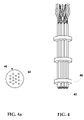
- FIG. 4 is a perspective view of a number of electrodes positioned within housing spacers.
- FIG. 4 a is a top view of an exemplary spacer.
- FIG. 5 is a top view of an exemplary experimental setup for testing electrodes.
- FIG. 5 a is a cross-sectional view of FIG. 5 illustrating the electrodes positioned in two slots.
- FIG. 6 is a plot of Impedance versus Frequency as measured by electrochemical impedance spectroscopy for coated and uncoated electrodes.
- FIG. 7 is a cross-sectional view of an exemplary test setup for measuring the localized corrosion rate of the sensors discussed herein.
- FIG. 8 is a plot of Localized Corrosion Rate versus Time for sensors containing coated and uncoated electrodes.
- the present invention relates to a corrosion resistant coating and in particular to a corrosion resistant coating that may be used in combination with a sensor for electrochemical corrosion monitoring.
- a corrosion resistant coating may be used in combination with a sensor for electrochemical corrosion monitoring.
- Such sensor may be suitable for use at elevated temperatures (e.g. at or above about 50° C.) in a corrosive environment.
- a corrosive environment may be understood herein as an environment wherein the pH is greater or lower than 7.0, and which may include one or more chemical compounds that may influence corrosions, such as an inorganic salt.
- the sensor may include one or more electrodes. When more than one electrode is present, the electrodes may be coupled in an array.
- An exemplary coupled multielectrode array sensor is illustrated in FIG. 1 .
- the sensor 110 may include a number of electrodes 112 at least partially surrounded by a housing 114 , wherein a portion of the electrodes 112 are exposed.
- each electrode 112 may be attached to an electrical connection 118 , which may provide communication between the electrodes and a monitoring system (not illustrated).
- An electrode may be understood as a conductive material, such as a wire.
- the electrode may have a length along a longitudinal axis and a cross-section generally perpendicular to the longitudinal axis.
- An exemplary electrode may be formed out of a material that exhibits similar corrosion characteristics as the component material to be modeled and therefore may be formed out of a material that is similar to the component to be modeled.
- the electrode materials may include various metal alloys, which may include various transition metals such as nickel, iron, chromium, molybdenum, manganese, tungsten, cobalt, vanadium, titanium, copper, zinc, etc.
- the metal alloys may also include various metalloids such as carbon, phosphorus, sulfur, silicon, boron, aluminum, etc.
- Exemplary metal alloys may include nickel based alloys, which may include at least approximately 45 atomic percent (at %) nickel, such as in the range of 45 to 99 at % including all values and increments therein, wherein no other element is present at an at % greater than 30, such as in the range of 30 to 1%, including all values and increments therein.
- Such nickel based alloys may also include chromium present in the range of about 10 to 30 at %, molybdenum present in the range of about 10 to 30 at % and W present in the range of about 1 to 10 at %.
- the alloys may also include iron present in the range of about 0 to 10 at %, cobalt present in the range of about 0 to 5 at %, manganese present in the range of about 0 to 2 at %, vanadium present in the range of about 0 to 2 at %, as well as carbon present in the range of about 0 to 0.5 at %, phosphorous present in the range of about 0 to 0.5 at %, sulfur present in the range of about 0 to 0.1 at %, or silicon present in the range of about 0 to 0.1 at %.
- exemplary alloy compositions may include (Ni 59 Cr 22 Mo 13 Fe 3 W 3 , Ni 60 Cr 21 Mo 12 W 3 ,) (Ni 57 Cr 14.5-16.5 Mo 15-17 W 3-4.5 C 0.01 Co 2.5 Fe 4-7 Mn 1 —P 0.025 S 0.01 Si 0.08 V 0.35 ,) (Ni 60 Cr 20.5 Mo 12-15 W 2-4 C 0.015 Co 2.5 Fe 2-3 Mn 0.5 P 0.02 —S 0.02 Si 0.08 V 0.35 ,) (Ni 56 Cr 22 —Mo 13 W 3 C 0.01 Co 2.5 Fe 3 Mn 0.5 Si 0.08 V 0.35 ,) (Ni 57 Cr 21.2 Mo 13.5 W 3 C 0.07 —Co 1.2 Fe 4 Mn 0.2 P 0.01 Si 0.04 V 0.17 ,) (Ni 56 Cr 22 Mo 13 W 3 C 0.01 Co 2.5 Fe 3 Mn 0.5 Si 0.08 V 0.35 .) Note that the alloys may contain about 5
- the electrodes may be coated with a corrosion resistant material.
- Exemplary corrosion resistant materials may include diamond like carbon coatings.
- Diamond like carbon (DLC) material may be understood as an amorphous carbon material or a hydrogenated amorphous carbon material that may be composed of a mixture of “sp 2 ” and “sp 3 ” bonded carbon.
- DLC coatings herein may also be understood to include those coatings that provide a Vickers Hardness (Hv) of greater than about 3000.
- the DLC coatings herein may include coatings with a Hv that falls in the range of 3000-12000, including all values and increments therein.
- DLC materials may include at least 50% carbon.
- the diamond like carbon material may be doped with various other materials, including metalloids or metals.
- the diamond like carbon coating may be deposited on the electrode surface via a number of deposition techniques, such as ion beam deposition. This may include direct and assisted techniques, pulsed laser deposition, plasma assisted chemical vapor deposition, or sputtering.
- the electrodes may be placed onto specimen holders as illustrated in FIG. 2 .
- the specimen holders 20 may include one or more pre-drilled holes 22 to retain the distal end of the electrode 24 .
- the electrodes 24 may then be inserted into a vacuum chamber 30 , as illustrated in FIG. 3 and placed onto a work table 32 in the chamber 30 .
- the chamber may include a first gas inlet 34 , a second gas inlet 36 , an optional third gas inlet 38 and a vacuum port 39 .
- the chamber Once placed into the chamber, the chamber may be sealed in a sufficient manner to draw a vacuum on the chamber.
- the chamber may be pumped down to a vacuum pressure of below 1 ⁇ 10 ⁇ 3 Torr or to 1 ⁇ 10 ⁇ 11 Torr, including all values and increments therein, such as 1 ⁇ 10 ⁇ 5 Torr.
- Ions may bombard the surface of the electrodes at a flow rate of 20 to 60 standard cubic centimeters per minute (sccm), including all increments and values therein, to clean the electrode surfaces. Cleaning may occur for a few seconds to a few hours, such as 10 seconds to 24 hours, including all values and increments therein, such as 1 hour.
- Exemplary ions utilized in cleaning may include those provided by argon, nitrogen or other relatively inert gasses. The ions may be fed through the first gas inlet 34 .
- An optional intermediate or bond layer may then be deposited which may include a non-metallic compound which may provide a bond layer in the form of a film which may improve the adhesion between the electrode and diamond like carbon material.
- the bond layer may ultimately include silicon or a silicon compound.
- Various precursors or source gasses may be used, such as silane gas (SiH 4 ), disilane gas, etc.
- the precursor may be fed into the vacuum chamber at a flow rate in the range of 10 to 50 sccm, including all values and increments therein, such as 25 sccm.
- the silicon precursor may be supplied through the optional third gas inlet 38 . Deposition may be completed in a few seconds to a few hours, including all values and increments therein, such as 30 seconds to 2 hours.
- the bond layer so formed may therefore include a layer of hydrogenated silicon (Si:H) and/or a hydrogenated silicon carbide (Si x C:H).
- Hydrocarbon precursors may include gasses which contain carbon and hydrogen atoms. Such gasses may include C 2 -C 4 alkenes, alkynes, C 3 -C 6 cycloalkanes and/or aromatic hydrocarbons. These gasses may therefore include ethylene, propylene, butylene and 1,3-butadiene, acetylene, 1-propyne, cyclopropane, cyclohexane, benzene, styrene, toluene and xylene. In addition, methane and other alkanes may be used as well.
- the source gas may flow through the second gas inlet 36 in vacuum chamber at a flow rate of 10 to 100 sccm, including all values and increments therein, such as 60 sccm.
- the coating process may be repeated one or more times to obtain a desired coating thickness.
- the DLC may therefore be present at a thickness of equal to or greater than about 10 nanometers (nm). Such thickness may also be in the range of about 10 nanometers to about 50 ⁇ m, including all values and increments therein.
- the coating may include one or more layers of DLC and, optionally, one or more bond layers. The various layers may be formed by varying or alternating the precursors fed through the vacuum chamber.
- the coating process may be manipulated such that the diamond like carbon coating is applied to only portions of the electrode.
- the specimen holder described above may include a mask or other device to prevent the coating of an exposed surface area which may then provide a contact surface of the electrode for corrosion measurements.
- the exposed surface area (SA 1 ) may be located on an end or tip of the electrode such that the cross-sectional surface at the tip may be exposed and the diamond like carbon coating is then provided along at least a portion of the longitudinal (side) surfaces of the electrode. It may then be appreciated that when such electrode is positioned within a corrosive environment, for a time period suitable for electrochemical corrosion testing (e.g., greater than about 10 hours) only the surface area (SA 1 ) of the electrode is exposed to the environment. The longitudinal surfaces remain unexposed and intact due to the diamond like carbon coating.
- the exposed contact surface of the electrode may be provided on the opposite end of the electrode from the exposed surface area (SA 1 ) of the electrode while the sides of the electrode may be isolated from the corrosive environment.
- the diamond like carbon coating provided along at least a portion of the longitudinal sides of the electrode may prevent the coated portions of the electrode from corroding in corrosive environments. Accordingly, corrosion may be substantially confined to only the exposed surface area (SA 1 ) at the tip of the electrode. In such a manner, the exposed surface area of the electrode, after exposure to a corrosive environment (SA 2 ), may remain relatively constant and may be only slightly greater than the exposed surface area (SA 1 ) prior to exposure to a corrosive environment.
- Such relatively constant surface area exposure may be such that it will ensure that the calculated localized corrosion rates (via, e.g., Faraday's Law noted above) will be relatively consistent and provide that such calculated corrosion rates will be consistent from actual determination of corrosion rates from comparative coupon testing (which measures actual weight loss). See, e.g., Handbook On Corrosion Testing And Evaluation , W. H. Ailor, Editor, J. Wiley (1971).
- the surface area (SA 2 ) after exposure of the electrode to a corrosive environment may be no more than about five percent greater than the surface area (SA 1 ) of the electrode prior to the corrosive environment.
- (SA 2 ) may be less than five percent greater than (SA 1 ), including all values and increments between, e.g. 0.1% and 5.0 %.
- the electrodes may also be mounted within the housing as generally illustrated in FIG. 1 .
- the housing may be of a unitary piece, having a plurality of openings defined therein to accommodate the electrodes, or the housing may be formed from a number of pieces that are assembled together.
- the electrodes 42 may be inserted into one or more holes 44 , or openings defined in spacers 40 illustrated in FIGS. 4 and 4 a . This assembly of electrodes and spacers may then be inserted into a hollow tube an affixed therein.
- the spacers and tube may include materials that are capable of maintaining the spacing of the electrodes at elevated temperatures, such as greater than or equal to about 50° C. in a corrosive environment (pH greater than or less than 7.0), which conditions herein may be understood as a service temperature. Accordingly, the materials may have a service temperature in the range of about 50° C. to 300° C., including all ranges and increments therein. In addition, the materials may provide insulation between the electrodes and may exhibit an electrical volume resistivity in the range of about 1 ⁇ 10 11 to 1 ⁇ 10 18 ohm-cm, including all values and ranges therein.
- Such materials may include, for example, polytetrafluoroethylene, polyvinylidene fluoride, and other fluorinated polymers (polymers containing C—F bonds), ultra high molecular weight polyethylene, epoxy, etc.
- the spacer and tube materials may be the same or different materials.
- the electrodes may be mounted into the sensor housing with a material that may similarly withstand the service temperature requirements noted above and maintain the electrodes in the sensor in a desired position.
- a thermoset polymer resin which may be understood as a polymer formed with crosslinking such that it will no longer indicate a defined melting point (Tm).
- the thermoset may also surround at least a portion or the entirety of the electrode and form an interface between the electrode and the housing.
- the thermoset resin may include resins such as epoxy resins formed from the diglycidyl ether of bisphenol A (DGEBPA), which may be cured with amine or acid compounds.
- DGEBPA diglycidyl ether of bisphenol A
- the electrodes may be mounted flush to the end of the housing and/or a spacer, such that only the cross-sectional ends of the electrodes are exposed.
- the impedance of the electrodes may be measured via electrochemical impedance spectroscopy, which may be understood as applying an AC potential over a range of frequencies to an electrochemical cell and measuring the current through the cell.
- electrochemical impedance spectroscopy may be understood as applying an AC potential over a range of frequencies to an electrochemical cell and measuring the current through the cell.
- the electrodes may be inserted into an acidic solution of 0.1M of NaCl having a temperature of about 25° C.
- the electrodes may exhibit an impedance of at least about 1 ⁇ 10 6 ohm at a frequency of less than or equal to about 1 Hz.
- the senor may be used to model or monitor a material of interest by placing the electrodes (formed from such material) in the same or a similar environment for which the material may be exposed.
- the sensor herein may be employed to specifically monitor corrosion of what is known as Alloy 22 which is also identified as UNS N06022 Nickel Superalloy.
- Alloy 22 which is also identified as UNS N06022 Nickel Superalloy.
- Such alloy contains the following elements in the indicated weight percents: C (0.07); Co (1.2); Cr (21.2); Fe (4); Mn (0.2); Mo (13.5); Ni (57); P (0.01); Si (0.04); V (0.17) and W (3).
- such alloy is employed as a nuclear waste packaging material in the above referenced corrosive environments thereby underscoring the importance of accurately monitoring its corrosion resistance.
- those materials herein that may also be monitored for corrosion may include materials employed in bridges, process vessels, process pipelines, or even packaging material.
- the electrode of a given material may be exposed to elevated temperatures above or about 70° C.
- the material may be exposed to one or more corrosive materials, such as water, oxygen, acids, bases, etc.
- the material may be exposed to salts or acidic salt mixtures such as NaCl, NaNO 3 , KNO 3 , HCl, HNO 3 or combinations thereof.
- FIGS. 5 and 5 a illustrate the test set up, wherein a coated and uncoated electrode, 52 and 54 respectively, are suspended in a salt solution 56 of 0.01 M NaCl at 25° C.
- FIG. 6 illustrates that the impedance for the coated electrode, (designated as Coated Wire), was approximately about 1 megaohm at frequencies lower than 1 Hz and 1.5 to 2 orders of magnitude higher than that of the uncoated electrode (designated as Uncoated Wire).
- a coupled multielectrode array sensor with nine DLC coated electrodes was fabricated. The electrode was flush mounted in the housing using epoxy such that the end surface of the electrode was exposed. A second coupled multielectrode array sensor with 16 uncoated electrodes flush-mounted in the same epoxy was also tested for comparison. Localized corrosion rates were measured using the uncoated sensor and the coated sensor in a saturated acidic NaCl—NaNO 3 —KNO 3 salt mixture at 150° C. for one week.
- FIG. 7 shows a diagram of the vessel used in the immersion test.
- the sensors 71 and 72 were placed into a bath 70 of the salt solution 73 , and solid salt mixture of the NaCl—NaNO 3 —KNO 3 74 .
- a thermocouple 75 was also inserted into the bath 70 to measure the bath temperature.
- a cover 76 was placed on the bath to retain the sensors and thermocouple and provide venting of the bath through a number of vent holes 77 .
- FIG. 8 demonstrates that the sensor including the coated electrodes (Coated Wire) exhibited a localized corrosion rate of approximately 0.43 ⁇ m/year. Whereas the sensor with the uncoated electrodes (Uncoated Wire) exhibited a localized corrosion rate of approximately 10-40 ⁇ m/year, two orders of magnitude higher than the coated electrodes.
- the uncoated electrode Upon inspection, the uncoated electrode was exposed to the salt solution at both the exposed end and side surfaces due to crevice formation between the electrode and the epoxy coating.
- the coated electrode was substantially free of crevice formation, i.e., less than 1.0 % of the surface area of the electrode sides, between the electrode and the epoxy coating.
Landscapes
- Life Sciences & Earth Sciences (AREA)
- Biodiversity & Conservation Biology (AREA)
- Ecology (AREA)
- Environmental & Geological Engineering (AREA)
- Environmental Sciences (AREA)
- Physics & Mathematics (AREA)
- Health & Medical Sciences (AREA)
- Chemical & Material Sciences (AREA)
- Analytical Chemistry (AREA)
- Biochemistry (AREA)
- General Health & Medical Sciences (AREA)
- General Physics & Mathematics (AREA)
- Immunology (AREA)
- Pathology (AREA)
- Testing Resistance To Weather, Investigating Materials By Mechanical Methods (AREA)
- Investigating Or Analyzing Materials By The Use Of Electric Means (AREA)
Abstract
Description
(SA 2)≦(1.05)·(SA 1).
Claims (18)
SA 2≦(1.05)·(SA 1)
SA 2≦(1.05)·(SA 1),
SA 2≦(1.05)·(SA 1).
Priority Applications (2)
| Application Number | Priority Date | Filing Date | Title |
|---|---|---|---|
| US11/682,571 US7722748B2 (en) | 2007-03-06 | 2007-03-06 | Apparatus for measuring electrochemical corrosion |
| PCT/US2008/055768 WO2008109589A1 (en) | 2007-03-06 | 2008-03-04 | Apparatus for measuring electrochemical corrosion |
Applications Claiming Priority (1)
| Application Number | Priority Date | Filing Date | Title |
|---|---|---|---|
| US11/682,571 US7722748B2 (en) | 2007-03-06 | 2007-03-06 | Apparatus for measuring electrochemical corrosion |
Publications (2)
| Publication Number | Publication Date |
|---|---|
| US20080217172A1 US20080217172A1 (en) | 2008-09-11 |
| US7722748B2 true US7722748B2 (en) | 2010-05-25 |
Family
ID=39738748
Family Applications (1)
| Application Number | Title | Priority Date | Filing Date |
|---|---|---|---|
| US11/682,571 Active 2028-05-01 US7722748B2 (en) | 2007-03-06 | 2007-03-06 | Apparatus for measuring electrochemical corrosion |
Country Status (2)
| Country | Link |
|---|---|
| US (1) | US7722748B2 (en) |
| WO (1) | WO2008109589A1 (en) |
Cited By (2)
| Publication number | Priority date | Publication date | Assignee | Title |
|---|---|---|---|---|
| US20110251721A1 (en) * | 2010-04-09 | 2011-10-13 | General Electric Company | System and method for online monitoring of molten salt corrosion |
| US9176108B2 (en) | 2012-07-26 | 2015-11-03 | Southwest Research Institute | Method and device for measuring corrosion metal loss |
Families Citing this family (9)
| Publication number | Priority date | Publication date | Assignee | Title |
|---|---|---|---|---|
| EP2350610A4 (en) * | 2008-11-03 | 2016-11-02 | Sikorsky Aircraft Corp | CORROSION DETECTOR SYSTEM |
| GB2479587A (en) * | 2010-04-16 | 2011-10-19 | Diamond Detectors Ltd | Diamond microelectrode |
| US8643389B2 (en) | 2011-01-06 | 2014-02-04 | General Electric Company | Corrosion sensor and method for manufacturing a corrosion sensor |
| US9297742B2 (en) | 2011-01-06 | 2016-03-29 | General Electric Company | Method for manufacturing a corrosion sensor |
| US8359728B2 (en) | 2011-01-06 | 2013-01-29 | General Electric Company | Method for manufacturing a corrosion sensor |
| FR2992063B1 (en) * | 2012-06-18 | 2014-07-18 | Commissariat Energie Atomique | DEVICE FOR MEASURING CORROSION IN A METAL STRUCTURE OR COMPRISING AT LEAST ONE METALLIC FRAME, USES AND METHOD THEREFOR |
| US10955375B2 (en) * | 2018-03-16 | 2021-03-23 | U.S. Department Of Energy | Multielectrode sensor for concentration and depth measurements in molten salt |
| CN110541129B (en) * | 2019-04-12 | 2021-02-26 | 中国科学院金属研究所 | Method for improving pitting corrosion resistance of aluminum-based amorphous alloy by adopting low-concentration corrosion inhibitor |
| CN113514388B (en) * | 2021-07-15 | 2023-01-06 | 帕孚(上海)电气设备有限公司 | Electrochemical corrosion sensor and preparation method thereof |
Citations (26)
| Publication number | Priority date | Publication date | Assignee | Title |
|---|---|---|---|---|
| US3772178A (en) | 1968-10-03 | 1973-11-13 | Petrolite Corp | Electrode for corrosion test |
| US4155354A (en) | 1976-03-29 | 1979-05-22 | Rasmussen Steen B | Disposable electromedical electrode and a set of such electrodes |
| US5019184A (en) * | 1989-04-14 | 1991-05-28 | Inco Alloys International, Inc. | Corrosion-resistant nickel-chromium-molybdenum alloys |
| US5455072A (en) | 1992-11-18 | 1995-10-03 | Bension; Rouvain M. | Initiation and bonding of diamond and other thin films |
| US5580431A (en) * | 1995-07-20 | 1996-12-03 | Associated Universities, Inc. | Composite wire microelectrode and method of making same |
| US5695832A (en) | 1993-07-07 | 1997-12-09 | Sanyo Electric Co., Ltd. | Method of forming a hard-carbon-film-coated substrate |
| US5712000A (en) | 1995-10-12 | 1998-01-27 | Hughes Aircraft Company | Large-scale, low pressure plasma-ion deposition of diamondlike carbon films |
| US5712559A (en) | 1995-08-08 | 1998-01-27 | Rohrback Cosasco Systems, Inc. | Cathodic protection reference cell and corrosion sensor |
| US5780119A (en) | 1996-03-20 | 1998-07-14 | Southwest Research Institute | Treatments to reduce friction and wear on metal alloy components |
| US5793042A (en) | 1996-09-30 | 1998-08-11 | Quick; Nathaniel R. | Infrared spectrophotometer accelerated corrosion-erosion analysis system |
| US5840427A (en) | 1996-05-21 | 1998-11-24 | Teledyne Industries Incorporated | Method for making corrosion resistant electrical components |
| US5880552A (en) | 1997-05-27 | 1999-03-09 | The United States Of America As Represented By The Secretary Of The Navy | Diamond or diamond like carbon coated chemical sensors and a method of making same |
| US5965217A (en) | 1996-10-08 | 1999-10-12 | Citizen Watch Co., Ltd. | Method of forming DLC films over inner surface of cylindrical member |
| US6320295B1 (en) | 1998-11-18 | 2001-11-20 | Mcgill Robert Andrew | Diamond or diamond like carbon coated chemical sensors and a method of making same |
| US6332363B1 (en) | 1996-09-06 | 2001-12-25 | Thermo Fast Uk Limited | Biosensor, method of forming and use |
| WO2002077615A2 (en) | 2001-03-27 | 2002-10-03 | Southwest Research Institute | Sensor array and method for electrochemical corrosion monitoring |
| US6531182B2 (en) | 1999-05-03 | 2003-03-11 | Guardian Industries Corp. | Method of making a coated article including DLC and FAS |
| US6592519B1 (en) | 2000-04-28 | 2003-07-15 | Medtronic, Inc. | Smart microfluidic device with universal coating |
| US6607642B1 (en) | 1999-08-17 | 2003-08-19 | DRäGERWERK AKTIENGESELLSCHAFT | Electrochemical gas sensor with diamond-like carbon electrodes |
| US20050246002A1 (en) | 2004-04-28 | 2005-11-03 | Gonzalo Martinez | Electrodes for sustained delivery of energy |
| US20050274628A1 (en) | 2004-04-09 | 2005-12-15 | Lietai Yang | Method for measuring localized corrosion rate with a multi-electrode array sensor |
| US7034553B2 (en) | 2003-12-05 | 2006-04-25 | Prodont, Inc. | Direct resistance measurement corrosion probe |
| US7180309B1 (en) | 2004-05-26 | 2007-02-20 | Corr Instruments, Llc. | Electronic system for multielectrode sensors and electrochemical devices |
| US7245132B1 (en) | 2006-07-12 | 2007-07-17 | Pepperl & Fuchs, Inc. | Intrinsically safe corrosion measurement and history logging field device |
| US7282928B1 (en) | 2006-07-13 | 2007-10-16 | Pepperl & Fuchs, Inc. | Corrosion measurement field device with improved LPF, HDA, and ECN capability |
| US7368050B2 (en) | 2004-03-26 | 2008-05-06 | Baker Hughes Incorporated | Quantitative transient analysis of localized corrosion |
-
2007
- 2007-03-06 US US11/682,571 patent/US7722748B2/en active Active
-
2008
- 2008-03-04 WO PCT/US2008/055768 patent/WO2008109589A1/en not_active Ceased
Patent Citations (30)
| Publication number | Priority date | Publication date | Assignee | Title |
|---|---|---|---|---|
| US3772178A (en) | 1968-10-03 | 1973-11-13 | Petrolite Corp | Electrode for corrosion test |
| US4155354A (en) | 1976-03-29 | 1979-05-22 | Rasmussen Steen B | Disposable electromedical electrode and a set of such electrodes |
| US5019184A (en) * | 1989-04-14 | 1991-05-28 | Inco Alloys International, Inc. | Corrosion-resistant nickel-chromium-molybdenum alloys |
| US5455072A (en) | 1992-11-18 | 1995-10-03 | Bension; Rouvain M. | Initiation and bonding of diamond and other thin films |
| US5695832A (en) | 1993-07-07 | 1997-12-09 | Sanyo Electric Co., Ltd. | Method of forming a hard-carbon-film-coated substrate |
| US5580431A (en) * | 1995-07-20 | 1996-12-03 | Associated Universities, Inc. | Composite wire microelectrode and method of making same |
| US5712559A (en) | 1995-08-08 | 1998-01-27 | Rohrback Cosasco Systems, Inc. | Cathodic protection reference cell and corrosion sensor |
| US5712000A (en) | 1995-10-12 | 1998-01-27 | Hughes Aircraft Company | Large-scale, low pressure plasma-ion deposition of diamondlike carbon films |
| US5780119A (en) | 1996-03-20 | 1998-07-14 | Southwest Research Institute | Treatments to reduce friction and wear on metal alloy components |
| US5840427A (en) | 1996-05-21 | 1998-11-24 | Teledyne Industries Incorporated | Method for making corrosion resistant electrical components |
| US6332363B1 (en) | 1996-09-06 | 2001-12-25 | Thermo Fast Uk Limited | Biosensor, method of forming and use |
| US5793042A (en) | 1996-09-30 | 1998-08-11 | Quick; Nathaniel R. | Infrared spectrophotometer accelerated corrosion-erosion analysis system |
| US5965217A (en) | 1996-10-08 | 1999-10-12 | Citizen Watch Co., Ltd. | Method of forming DLC films over inner surface of cylindrical member |
| US5880552A (en) | 1997-05-27 | 1999-03-09 | The United States Of America As Represented By The Secretary Of The Navy | Diamond or diamond like carbon coated chemical sensors and a method of making same |
| US6320295B1 (en) | 1998-11-18 | 2001-11-20 | Mcgill Robert Andrew | Diamond or diamond like carbon coated chemical sensors and a method of making same |
| US6531182B2 (en) | 1999-05-03 | 2003-03-11 | Guardian Industries Corp. | Method of making a coated article including DLC and FAS |
| US6607642B1 (en) | 1999-08-17 | 2003-08-19 | DRäGERWERK AKTIENGESELLSCHAFT | Electrochemical gas sensor with diamond-like carbon electrodes |
| US20030199741A1 (en) | 2000-04-28 | 2003-10-23 | Medtronic, Inc. | Method of manufacture of smart microfluidic medical device with universal coating |
| US6592519B1 (en) | 2000-04-28 | 2003-07-15 | Medtronic, Inc. | Smart microfluidic device with universal coating |
| WO2002077615A2 (en) | 2001-03-27 | 2002-10-03 | Southwest Research Institute | Sensor array and method for electrochemical corrosion monitoring |
| US6683463B2 (en) | 2001-03-27 | 2004-01-27 | Southwest Research Institute | Sensor array for electrochemical corrosion monitoring |
| US6987396B2 (en) | 2001-03-27 | 2006-01-17 | Southwest Research Institute | Sensor array for electrochemical corrosion monitoring |
| US7034553B2 (en) | 2003-12-05 | 2006-04-25 | Prodont, Inc. | Direct resistance measurement corrosion probe |
| US7368050B2 (en) | 2004-03-26 | 2008-05-06 | Baker Hughes Incorporated | Quantitative transient analysis of localized corrosion |
| US20050274628A1 (en) | 2004-04-09 | 2005-12-15 | Lietai Yang | Method for measuring localized corrosion rate with a multi-electrode array sensor |
| US7309414B2 (en) | 2004-04-09 | 2007-12-18 | Southwest Research Institute | Method for measuring localized corrosion rate with a multi-electrode array sensor |
| US20050246002A1 (en) | 2004-04-28 | 2005-11-03 | Gonzalo Martinez | Electrodes for sustained delivery of energy |
| US7180309B1 (en) | 2004-05-26 | 2007-02-20 | Corr Instruments, Llc. | Electronic system for multielectrode sensors and electrochemical devices |
| US7245132B1 (en) | 2006-07-12 | 2007-07-17 | Pepperl & Fuchs, Inc. | Intrinsically safe corrosion measurement and history logging field device |
| US7282928B1 (en) | 2006-07-13 | 2007-10-16 | Pepperl & Fuchs, Inc. | Corrosion measurement field device with improved LPF, HDA, and ECN capability |
Non-Patent Citations (16)
| Title |
|---|
| Anderko, A., "Validation of Localised Corrosion Model Using Real Time Corrosion Monitoring in a Chemical Plant," Corrosion Engineering, Science and Technology, 2005, 40(1):33-42, Maney, U.S.A. |
| Anderko, et al, "Validation of Localised Corrosion Model Using Real Time Corrosion Monitoring in a Chemical Plant," Corrosion Engineering, Science and Technology, 2005, vol. 40, No. 1 (10 pages). |
| Chiang, et al., "Monitoring Corrosion Behavior of a Cu-Cr-Nb Alloy by Multielectrode Sensors," Corrosion NACExpo 2006, 61st Annual Conference and Exposition, Paper No. 06676 (19 pages). |
| Chiang, K.T., et al., "Monitoring Corrosion Behavior of a Cu-Cr-Nb Allow by Multielectrode Sensors," Corrosion 2006, Paper 06676, pp. 06676/1-06676/19, NACE International, U.S.A. |
| Chinese Patent Office English language machine translation of CN 1548584 A, patent published Nov. 24, 2004. * |
| Derwent English language abstract of CN 1548584 A, patent published Nov. 24, 2004. * |
| International Search Report and Written Opinion dated Jun. 30, 2008 issued in related International Patent Application No. 11682571 (9 pages). |
| Lietai Yang, et al. Southwest Research Institute. IR&D. "Development of a Multielectrode Array Sensor for Monitoring Localized Corrosion, 20-9209". Inclusive Dates: Aug. 1, 2000-Current. htpp://www.swri.org/3pubs/IRD2001/20-9209.htm. Internet printout dated Jan. 31, 2007. 2pgs. |
| Southwest Research Institute® "Ion Surface Engineering". www.surfaceengineering.swri.com. Published in Apr. 2004. Surface Engineering Section, Mechanical and Materials Engineering Division, Southwest Research Institute, 6220 Culebra Road, P.O. Drawer 28510, San Antonio, Texas 78228-0510. Tel: (210) 522-6588. Fax: (210) 522-6220. 12pgs. |
| Sridhar, "Coupled Multielectrode Array Systems and Sensors for Real-Time Corrosion Monitoring-A Review," Corrosion NACExpo 2006, 61st Annual Conference and Exposition, Paper No. 06681 (46 pages). |
| Wall, "Applications of Multi-electrode Techniques to Aqueous and Atmospheric Corrosion Testing," Corrosion NACExpo 2006, 61st Annual Conference and Exposition, Paper No. 06672 (10 pages). |
| Wall, F.D., "Applications of Multi-Electrode Techniques to Aqueous and Atmospheric Corrosion Testing," Corrosion 2006, Paper 06672, pp. 06672/1-06672/10, NACE International, U.S.A. |
| Yang, et al., "Corrosion Behavior of Alloy 22 in Concentrated Nitrate and Chloride Salt Environments at Elevated Temperatures," NACE International Corrosion Conference and Expo 2007, paper No. 07580 (25 pages). |
| Yang, L., "Coupled Multielectrode Array Systems and Sensors for Real-Time Corrosion Monitoring-A Review," Corrosion 2006, Paper 06681, pp. 06681/1-06681/45, NACE International, U.S.A. |
| Yang, L., et al., "Corrosion Behavior of Allow 22 in Concentrated Nitrate and Chloride Salt Environments at Elevated Temperatures," Corrosion 2007 Conference & Expo, 2007, Paper 07580, pp. 07580/1-07580/19, NACE International, U.S.A. |
| Yang, Lietai. "Measurement of Corrosion in Saturated Solutions Under Salt Deposits Using Coupled Multielectrode Array Sensors." Corrosion, Paper No. 03426. 2003. * |
Cited By (3)
| Publication number | Priority date | Publication date | Assignee | Title |
|---|---|---|---|---|
| US20110251721A1 (en) * | 2010-04-09 | 2011-10-13 | General Electric Company | System and method for online monitoring of molten salt corrosion |
| US8224595B2 (en) * | 2010-04-09 | 2012-07-17 | General Electric Company | System and method for online monitoring of molten salt corrosion |
| US9176108B2 (en) | 2012-07-26 | 2015-11-03 | Southwest Research Institute | Method and device for measuring corrosion metal loss |
Also Published As
| Publication number | Publication date |
|---|---|
| WO2008109589A1 (en) | 2008-09-12 |
| US20080217172A1 (en) | 2008-09-11 |
Similar Documents
| Publication | Publication Date | Title |
|---|---|---|
| US20080217172A1 (en) | Apparatus For Measuring Electrochemical Corrosion | |
| Mišković-Stanković et al. | Electrochemical study of corrosion behavior of graphene coatings on copper and aluminum in a chloride solution | |
| Tang et al. | Direct growth of hexagonal boron nitride nanofilms on stainless steel for corrosion protection | |
| US6077418A (en) | Corrosion monitoring | |
| Sugimoto et al. | Corrosion Resistance of Artificial Passivation Films of Fe2 O 3‐Cr2 O 3‐NiO Formed by Metalorganic Chemical Vapor Deposition | |
| Mani et al. | Evaluation of the corrosion behavior of a TiN-coated 316L SS bipolar plate using dynamic electrochemical impedance spectroscopy | |
| Wu et al. | Corrosion protection of mild steel by one-step electrodeposition of superhydrophobic silica film | |
| US20150167131A1 (en) | Surface alloyed metals and methods for alloying surfaces | |
| Malik et al. | Electrochemical corrosion characteristics of hierarchical O-TiN coating on 304L steel substrate | |
| Kayali et al. | Investigation of wear and corrosion behaviour of AISI 316 L stainless steel coated by ESD surface modification | |
| JP2016197102A (en) | Method for designing corrosion sensor and method for forming corrosion sensor | |
| JP2025003611A (en) | Electrical Resistance Layer | |
| JP2016145744A (en) | Electrode sensor for trace component detection and manufacturing method thereof | |
| Chiang et al. | High-temperature electrochemical sensor for online corrosion monitoring | |
| JP6751924B2 (en) | Evaluation method of corrosion resistance and repair method of plated products | |
| JP5727569B2 (en) | Method for manufacturing DLC film-coated member and DLC film-coated member | |
| Abdulrazzaq et al. | Enhancement of low carbon steel corrosion resistance in acidic and saline media using superhydrophobic nanocomposite | |
| Kumar et al. | Effect of low surface energy material deposition on the wettability and corrosion resistance characteristics of a copper substrate | |
| JP2015114287A (en) | Protective film performance evaluation method and protective film performance evaluation apparatus | |
| Belarbi et al. | Corrosion Behavior of Zinc Cold Spray Coatings (ZnCr & ZnNb) in a Simulated Natural Gas Environment Containing H2O, CO2, and H2S | |
| Joo et al. | Corrosion resistance of tungsten carbide-based cermet coatings formed by sinter-brazing | |
| Emran et al. | Immersion time effects on the corrosion and passivation characterization of Ni–Cr glassy alloys in artificial seawater | |
| Grayeli-Korpi et al. | Influence of annealing temperature on corrosion inhibition and nanostructure of nitride Ni and Ni/Ti coatings on AISI stainless steel | |
| Syafira et al. | Effect of steel surface roughness on the performance of organic inhibitors in hydrochloric acid solution | |
| RU2148813C1 (en) | Process determining protective properties of polymer coats |
Legal Events
| Date | Code | Title | Description |
|---|---|---|---|
| AS | Assignment |
Owner name: SOUTHWEST RESEARCH INSTITUTE, TEXAS Free format text: ASSIGNMENT OF ASSIGNORS INTEREST;ASSIGNORS:CHIANG, KUANG-TSAN KENNETH;YANG, LIETAI;REEL/FRAME:019302/0352 Effective date: 20070323 Owner name: SOUTHWEST RESEARCH INSTITUTE,TEXAS Free format text: ASSIGNMENT OF ASSIGNORS INTEREST;ASSIGNORS:CHIANG, KUANG-TSAN KENNETH;YANG, LIETAI;REEL/FRAME:019302/0352 Effective date: 20070323 |
|
| FEPP | Fee payment procedure |
Free format text: PAYOR NUMBER ASSIGNED (ORIGINAL EVENT CODE: ASPN); ENTITY STATUS OF PATENT OWNER: SMALL ENTITY |
|
| STCF | Information on status: patent grant |
Free format text: PATENTED CASE |
|
| FPAY | Fee payment |
Year of fee payment: 4 |
|
| MAFP | Maintenance fee payment |
Free format text: PAYMENT OF MAINTENANCE FEE, 8TH YR, SMALL ENTITY (ORIGINAL EVENT CODE: M2552) Year of fee payment: 8 |
|
| MAFP | Maintenance fee payment |
Free format text: PAYMENT OF MAINTENANCE FEE, 12TH YR, SMALL ENTITY (ORIGINAL EVENT CODE: M2553); ENTITY STATUS OF PATENT OWNER: SMALL ENTITY Year of fee payment: 12 |