US7718841B2 - Extractive distillation - Google Patents
Extractive distillation Download PDFInfo
- Publication number
- US7718841B2 US7718841B2 US12/157,300 US15730008A US7718841B2 US 7718841 B2 US7718841 B2 US 7718841B2 US 15730008 A US15730008 A US 15730008A US 7718841 B2 US7718841 B2 US 7718841B2
- Authority
- US
- United States
- Prior art keywords
- stream
- solvent
- diolefin
- water
- ammonium carbonate
- Prior art date
- Legal status (The legal status is an assumption and is not a legal conclusion. Google has not performed a legal analysis and makes no representation as to the accuracy of the status listed.)
- Expired - Fee Related, expires
Links
Images


Classifications
-
- C—CHEMISTRY; METALLURGY
- C10—PETROLEUM, GAS OR COKE INDUSTRIES; TECHNICAL GASES CONTAINING CARBON MONOXIDE; FUELS; LUBRICANTS; PEAT
- C10G—CRACKING HYDROCARBON OILS; PRODUCTION OF LIQUID HYDROCARBON MIXTURES, e.g. BY DESTRUCTIVE HYDROGENATION, OLIGOMERISATION, POLYMERISATION; RECOVERY OF HYDROCARBON OILS FROM OIL-SHALE, OIL-SAND, OR GASES; REFINING MIXTURES MAINLY CONSISTING OF HYDROCARBONS; REFORMING OF NAPHTHA; MINERAL WAXES
- C10G7/00—Distillation of hydrocarbon oils
- C10G7/08—Azeotropic or extractive distillation
-
- C—CHEMISTRY; METALLURGY
- C07—ORGANIC CHEMISTRY
- C07C—ACYCLIC OR CARBOCYCLIC COMPOUNDS
- C07C7/00—Purification; Separation; Use of additives
- C07C7/04—Purification; Separation; Use of additives by distillation
- C07C7/05—Purification; Separation; Use of additives by distillation with the aid of auxiliary compounds
- C07C7/08—Purification; Separation; Use of additives by distillation with the aid of auxiliary compounds by extractive distillation
Definitions
- This invention relates to the solvent extraction of a diolefin from a mixture of hydrocarbons. More particularly, this invention relates to the extractive distillation of butadiene or isoprene from a mixture of hydrocarbons.
- Thermal cracking of hydrocarbons is a petrochemical process that is widely used to produce olefins such as ethylene, propylene, butenes, butadiene, and aromatics such as benzene, toluene, and xylenes.
- An olefin production plant is generally composed of a cracking unit and a hydrocarbons unit.
- a hydrocarbonaceous feedstock such as ethane, naphtha, gas oil, or other fractions of whole crude oil is mixed with steam which serves as a diluent to keep the hydrocarbon molecules separated.
- This mixture after preheating, is subjected to hydrocarbon thermal cracking using elevated temperatures (1,450 to 1,550 degrees Fahrenheit or F.) in a pyrolysis furnace (steam cracker or cracker). This thermal cracking is carried out without the aid of any catalyst.
- the cracked product effluent of the pyrolysis furnace contains hot, gaseous hydrocarbons of great variety (from 1 to 35 carbon atoms per molecule, or C1 to C35 inclusive, both saturated and unsaturated).
- This product contains aliphatics (alkanes and alkenes), alicyclics (cyclanes, cyclenes, and cyclodienes), aromatics, and molecular hydrogen (hydrogen).
- This furnace product is then subjected to further processing in the cracking unit to produce, as products of the olefin plant, various, separate and individual product streams such as hydrogen, ethylene, propylene, fuel oil, and pyrolysis gasoline. After the separation of these individual streams, the remaining cracked product contains essentially C4 hydrocarbons and heavier. This remainder is fed to a debutanizer wherein a crude C4 stream is separated as overhead while a crude C5 and heavier stream is removed as a bottoms product and further processed in a depentanizer.
- various, separate and individual product streams such as hydrogen, ethylene, propylene, fuel oil, and pyrolysis gasoline.
- the crude C4 stream can contain varying amounts of n-butane, isobutane, 1-butene, 2-butenes (both cis and trans isomers), isobutylene, acetylenes, and diolefins such as butadiene (1,2-, 1,3-., cis, and trans isomers), vinyl acetylene, and ethyl acetylene, all of which are known to boil within a narrow range, U.S. Pat. No. 3,436,438. Further, some of these compounds can form an azeotrope. Crude C4's are, therefore, known to be difficult to separate by simple thermal distillation.
- the crude C5 stream can contain isoprene, pentanes, pentenes, hexanes, hexenes, and aromatics such as benzene, toluene, and xylenes, and can also be difficult to separate by simple thermal distillation.
- the crude C4 and C5 streams are normally further processed in the hydrocarbons unit for the separation of other individual product streams such as butenes, butadiene, isoprene, benzene, toluene, and the like.
- the crude C4 stream after removal of acetylenes, normally goes to a butadiene extraction unit for, among other things, the separation and recovery of butadiene therefrom.
- the crude C5 stream is normally sent to an isoprene extraction unit for, among other things, the separation and recovery of isoprene therefrom.
- a dominating commercial process for separating butadiene from C4's or isoprene from C5's is known technically as “fractional extraction” but is more commonly referred to as “solvent extraction” or “extractive distillation.”
- this diolefin separation process employs the technique of altering the relative volatilities of various of the compounds to make easier the separation of those compounds by thermal fractional distillation. More specifically, this process employs an aprotic polar compound (solvent) that has a high complexing affinity toward the more polarizable butadiene or isoprene molecules than, and to the substantial exclusion of, the other olefins in the crude C4 or C5 streams.
- the primary equipment employed in the extractive distillation of butadiene or isoprene from a crude stream is an extractive distillation tower or series of towers followed by a diolefin thermal stripping tower and a separate solvent thermal stripping tower.
- extractive distillation tower or series of towers followed by a diolefin thermal stripping tower and a separate solvent thermal stripping tower.
- diolefin thermal stripping tower and a separate solvent thermal stripping tower.
- ammonium carbonate salt was not removed with any of the streams that are normally removed from the process.
- Ammonium carbonate was discovered to largely be kept captive in the process, thereby ultimately causing, again due to the process operating conditions, a buildup of that salt in certain ancillary equipment. Because this salt is corrosive and was never allowed to leave the process, the buildup of salt deposits continued in certain of the equipment to a catastrophic level, thereby causing premature corrosion in, and even failure of that equipment.
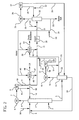
- FIG. 1 is a flow diagram of a typical commercial diolefin extraction process.
- FIG. 2 is the flow diagram of FIG. 1 modified pursuant to this invention.
- FIG. 1 shows an extractive distillation tower (column) 1 that receives, at a lower level along the height of the tower, crude C4 feed stream 2 , and, at an upper level of the tower, a lean solvent stream 3 .
- lean solvent means a solvent stream that contains little or no (essentially no) butadiene (or isoprene).
- Tower 1 can be a single tower as shown in FIG. 1 or two towers operating in series (not shown), as desired. In tower 1 , streams 2 and 3 are contacted at an elevated temperature with one another in counter current flow to allow the solvent in stream 3 to extract butadiene from stream 2 .
- a crude C4 stream 4 (first stream) containing little or no butadiene is removed overhead from tower 1 at a temperature of at least about 125 F, and passed to a tube and shell heat exchanger 6 .
- stream 4 is cooled to a temperature of less than about 100 F.
- Cooled stream 4 i.e., stream 7
- Drum 8 has operatively associated therewith, a water leg 10 which primarily collects water, but which can contain small, but significant, amounts of solvent and C4's, and from which is taken stream 11 (third stream).
- a bottoms solvent stream 5 (second stream) that is rich in butadiene, e.g., containing a substantial, if not major, amount of butadiene, is removed from the bottom of tower 1 .
- Tower 1 has a typical bottoms reboiler circuit for heating and returning a portion of stream 5 to the tower. This circuit is known in the art, and is not shown in FIG. 1 for sake of simplicity only.
- the normal operating temperature for the bottom of tower 1 is at least about 245 F.
- Butadiene rich stream 5 is fed to a thermal distillation tower 14 to strip butadiene from its associated solvent.
- An essentially butadiene free, cooled crude C4 stream 9 is removed from drum 8 and split to provide a reflux stream 12 that is returned to the interior of tower 1 , and a separate stream 13 that is passed to a water wash unit 47 .
- stream 13 is water washed with clean water stream 45 to produce a C4 raffinate product stream 48 that is removed from the process for further processing elsewhere.
- Water wash 47 also produces a separate stream 49 that is primarily a water stream, but can contain minor amounts (amounts that are worth the effort of reclaiming) of solvent and hydrocarbons (e.g., C4's and/or butadiene).
- Butadiene rich solvent stream 5 containing a substantial, if not major, amount of butadiene, is passed into butadiene stripper tower 14 (first thermal stripping tower) and therein heated to separate butadiene from its associated solvent.
- Tower 14 is operated at a temperature of at least about 278 F to form a bottoms stream 25 (fifth stream) that is essentially lean solvent suitable for return to lean solvent stream 3 and reuse in tower 1 to extract additional butadiene from fresh, incoming feed 2 .
- Butadiene rich overhead stream 15 (fourth stream) from tower 14 is passed to a heat exchanger 16 , like that of unit 6 .
- stream 15 is cooled to a temperature below about 100 F., and passed as cooled stream 17 to a reflux drum 18 wherein it is collected for water separation and for distribution purposes.
- Drum 18 has associated therewith a water leg 20 that operates in a manner similar to leg 10 in that it primarily collects water.
- water stream 21 (sixth stream) that is removed from that leg can contain small, but significant, amounts of solvent and butadiene, particularly solvent, that are worth the effort of reclaiming.
- Butadiene rich stream 19 is removed from drum 18 , passed in part as reflux stream 22 to tower 14 , and passed in part as stream 23 to a separate water wash unit 50 .
- stream 23 is contacted with clean water from line 46 .
- a washed crude butadiene stream 51 that can contain C5 and heavier materials is removed from the process as a product stream to be further treated elsewhere.
- Water stream 52 can contain hydrocarbons (e.g., butadiene) and solvent in minor amounts that are worth recovering.
- streams 21 , 49 , and 52 can be combined with stream 11 .
- Streams 11 , 21 , 49 , and/or 52 can be passed to, and combined in, collection tank 30 , and, then removed from tank 30 as single, combination stream 31 .
- Stream 31 is passed to a separate thermal distillation tower 32 (second thermal stripping tower) that is operated to thermally strip solvent plus any associated hydrocarbons (C4's+) from water.
- Tower 32 is operated with a bottoms temperature of at least about 250 F. to provide a clean (essentially hydrocarbon free) water stream 34 (eighth stream) that is used to provide wash water to streams 45 and/or 46 .
- tower 32 produces an overhead stream 33 (seventh stream) that can contain water, solvent, and one or more C4 and heavier hydrocarbons.
- Stream 33 is passed to a heat exchanger 35 , like that of unit 6 .
- stream 33 is cooled to a temperature of no more than about 120 F. to produce stream 36 .
- Cooled stream 36 can contain, for example, water, solvent, one or more C4 and heavier hydrocarbons, and is passed to a reflux drum 37 for collection and for distribution purposes.
- a reflux stream 38 is removed from drum 37 and returned to the interior of tower 32 .
- a separate stream 39 (ninth stream) is removed from drum 37 and returned to tower 14 for recovery of solvent and hydrocarbons that may be carried by that stream.
- each of towers 1 , 14 , and 32 was such that any ammonium carbonate salt formed from the fugitive ammonia and carbon dioxide present in these towers was dissociated by their operating, e.g., bottom, temperatures so that essentially all the ammonia and carbon dioxide present in each tower was passed out of the tower as vapor in its overhead stream, i.e., streams 4 , 15 , and 33 .
- the dissociation temperature of ammonium carbonate is not a precise temperature as would be found in the pristine environment of a chemical laboratory.
- this dissociation temperature varied widely depending on the location of the ammonium carbonate in the process of FIG. 2 .
- the dissociation temperature of ammonium carbonate was affected substantially by the presence or absence of other chemical constituents present at a particular location in the process of FIG. 2 .
- the dissociation temperature range to be used in the practice of this invention is from about 120 to about 140 F., the precise laboratory dissociation temperature of 136 F. notwithstanding. If one operated on the premise that ammonium carbonate dissociated essentially at 136 F., this invention would not have been discovered. For example, one skilled in the art would not have expected dissociated ammonium carbonate to be present at the 125 F. overhead temperature of tower 1 , but it was.
- towers 1 , 14 , and 32 conventionally operate at a temperature that promotes the dissociation of ammonium carbonate to ammonia and carbon dioxide vapor, any and all ammonia and carbon dioxide that reached the process in general, and these towers in particular, was preferentially forced into overhead streams 4 , 15 , and 33 , and, therefore, into their associated overhead heat exchangers 6 , 16 , and 33 .
- the fugitive ammonia and carbon dioxide can be present in feed 2 as it enters the process and/or can be generated in situ in the process.
- certain of the solvents such as acetonitrile can produce some ammonia under the operating conditions of the solvent extraction process itself.
- the fugitive carbon dioxide in the solvent extraction process can be converted 1) to a stable carbonate salt that will not dissociate at the operating, particularly the operating, temperatures of towers 1 , 14 , and 32 , and 2) to the substantial exclusion of the formation of ammonium carbonate.
- This stable carbonate salt that is not dissociated under the operating conditions of the process can then be removed from the process by way of a purge stream, thereby 1) freeing what would otherwise be perpetually captive ammonia and carbon dioxide, and 2) removing the fugitive carbon dioxide from the process itself.
- the fugitive ammonia vapor is thereby left as ammonia gas via vents on reflux drums 8 and 18 or in a separate purge stream as well.
- the stable salt of this invention can be formed by adding at least one base compound to at least one stream in the extractive distillation process in an amount sufficient to form the desired stable salt, to the essential (substantial) exclusion of the formation of the unstable ammonium carbonate salt.
- the stable carbonate salt of this invention can be formed by adding to the process at least one of sodium hydroxide or potassium hydroxide in an amount of from about 4 parts per million (ppm) to about 0.4 weight percent based on the total weight of the stream being treated.
- FIG. 2 shows the process of FIG. 1 modified pursuant to this invention.
- the base compound or compounds used to form the desired stable carbonate salt can, by way of example, be added to one or more or all of solvent stream 3 by way of conduit 50 , to feed stream 31 by way of conduit 51 , to reflux stream 38 by way of conduit 52 , to water stream 34 by way of conduit 53 , and to water stream 21 by way of conduit 54 .
- the compound(s) added to the process can be inserted into the process in streams and equipment other than that shown in FIG. 2 and still fall within the scope of this invention.
- the primary goal of this invention is to add such at least one base compound to one or more locations in the process in a aggregate (total) amount that is sufficient to prevent the formation of ammonium carbonate to any significant extent in the extractive distillation process as a whole.
- Extractive distillation processes and equipment configurations in various plants can vary from that shown in FIG. 2 so that it is impossible to specify all the points of introduction of the ammonium carbonate preventing base compound(s), or the total amount of such compound(s) that should be added to achieve the inventive results of this invention.
- one skilled in the art will readily be able to determine where and in what amount to inject the ammonium carbonate suppressing base compound(s) in a specific process to achieve the desired results of this invention.
- FIG. 2 also shows that the stable carbonate salt formed pursuant to this invention, and the carbon dioxide it ties up, can be removed from the extractive distillation process completely by way of a water purge stream 55 from bottoms stream 34 of tower 32 .
- Other removal sites can be used, and will be obvious to one skilled in the art.
- a process as shown in FIG. 2 was carried out in a commercial butadiene solvent extraction process.
- Feed stream 2 for extractive distillation tower 1 contained about 2 ppm ammonia and about 5 ppm carbon dioxide.
- Sodium hydroxide solution is contacted with feed stream 2 in the amount of about 4,000 ppm, based on the total weight of stream 2 .
Landscapes
- Chemical & Material Sciences (AREA)
- Organic Chemistry (AREA)
- Oil, Petroleum & Natural Gas (AREA)
- Engineering & Computer Science (AREA)
- Chemical Kinetics & Catalysis (AREA)
- General Chemical & Material Sciences (AREA)
- Analytical Chemistry (AREA)
- Water Supply & Treatment (AREA)
- Organic Low-Molecular-Weight Compounds And Preparation Thereof (AREA)
Abstract
Description
Claims (9)
Priority Applications (1)
| Application Number | Priority Date | Filing Date | Title |
|---|---|---|---|
| US12/157,300 US7718841B2 (en) | 2008-06-09 | 2008-06-09 | Extractive distillation |
Applications Claiming Priority (1)
| Application Number | Priority Date | Filing Date | Title |
|---|---|---|---|
| US12/157,300 US7718841B2 (en) | 2008-06-09 | 2008-06-09 | Extractive distillation |
Publications (2)
| Publication Number | Publication Date |
|---|---|
| US20090306450A1 US20090306450A1 (en) | 2009-12-10 |
| US7718841B2 true US7718841B2 (en) | 2010-05-18 |
Family
ID=41400914
Family Applications (1)
| Application Number | Title | Priority Date | Filing Date |
|---|---|---|---|
| US12/157,300 Expired - Fee Related US7718841B2 (en) | 2008-06-09 | 2008-06-09 | Extractive distillation |
Country Status (1)
| Country | Link |
|---|---|
| US (1) | US7718841B2 (en) |
Families Citing this family (1)
| Publication number | Priority date | Publication date | Assignee | Title |
|---|---|---|---|---|
| CN102344330A (en) * | 2010-08-03 | 2012-02-08 | 中国石油化工股份有限公司 | Mixed solvent for extractive distillation and separation of C4 |
Citations (3)
| Publication number | Priority date | Publication date | Assignee | Title |
|---|---|---|---|---|
| US2993841A (en) | 1959-09-25 | 1961-07-25 | Shell Oil Co | Extractive distillation with dimethylformamide |
| US3436438A (en) | 1965-12-30 | 1969-04-01 | Nippon Zeon Co | Process for the separation of conjugated diolefins |
| US4134795A (en) | 1978-04-05 | 1979-01-16 | The Goodyear Tire & Rubber Company | Acetylenes removal from diolefin streams by extractive distillation |
-
2008
- 2008-06-09 US US12/157,300 patent/US7718841B2/en not_active Expired - Fee Related
Patent Citations (3)
| Publication number | Priority date | Publication date | Assignee | Title |
|---|---|---|---|---|
| US2993841A (en) | 1959-09-25 | 1961-07-25 | Shell Oil Co | Extractive distillation with dimethylformamide |
| US3436438A (en) | 1965-12-30 | 1969-04-01 | Nippon Zeon Co | Process for the separation of conjugated diolefins |
| US4134795A (en) | 1978-04-05 | 1979-01-16 | The Goodyear Tire & Rubber Company | Acetylenes removal from diolefin streams by extractive distillation |
Also Published As
| Publication number | Publication date |
|---|---|
| US20090306450A1 (en) | 2009-12-10 |
Similar Documents
| Publication | Publication Date | Title |
|---|---|---|
| KR101788420B1 (en) | Butadiene extraction process | |
| CS209404B2 (en) | Method of aespeiring 1,3-butadien from the hydrocarbon mixtures | |
| US8222474B2 (en) | Fractional extraction of butadiene | |
| JP4589317B2 (en) | Separation method of crude C4 cut | |
| KR20090038844A (en) | Separation method of C4 fraction by extractive distillation using a selected solvent | |
| US10118876B2 (en) | Butadiene extraction process | |
| CN110198923B (en) | Method for obtaining pure 1, 3-butadiene | |
| EP0643679B1 (en) | Process for the removal of green oil from a hydrocarbon stream | |
| US10266463B2 (en) | Process for recovering isoprene from pyrolysis gasoline | |
| KR102014564B1 (en) | Method for providing a vaporous purified crude c4 fraction as a feed stream for an extractive distillation process using a selective solvent | |
| US20090306450A1 (en) | Extractive distillation | |
| US7348466B2 (en) | Solvent extraction | |
| US4002554A (en) | Process of minimizing or preventing fouling | |
| US7709693B2 (en) | Toluene production |
Legal Events
| Date | Code | Title | Description |
|---|---|---|---|
| AS | Assignment |
Owner name: EQUISTAR CHEMICALS, LP, TEXAS Free format text: ASSIGNMENT OF ASSIGNORS INTEREST;ASSIGNORS:BRIDGES, JOSEPH P.;HAYNAL, ROBERT J.;HOOD, JR., ALLEN DAVID;AND OTHERS;REEL/FRAME:021123/0983;SIGNING DATES FROM 20080529 TO 20080602 Owner name: EQUISTAR CHEMICALS, LP,TEXAS Free format text: ASSIGNMENT OF ASSIGNORS INTEREST;ASSIGNORS:BRIDGES, JOSEPH P.;HAYNAL, ROBERT J.;HOOD, JR., ALLEN DAVID;AND OTHERS;SIGNING DATES FROM 20080529 TO 20080602;REEL/FRAME:021123/0983 |
|
| AS | Assignment |
Owner name: CITIBANK, N.A., AS ADMINISTRATIVE AGENT AND COLLAT Free format text: SECURITY AGREEMENT;ASSIGNOR:EQUISTAR CHEMICALS, LP;REEL/FRAME:022678/0860 Effective date: 20090303 |
|
| XAS | Not any more in us assignment database |
Free format text: SECURITY AGREEMENT;ASSIGNOR:CITIBANK, N.A., AS ADMINISTRATIVE AGENT AND COLLATERAL AGENT;REEL/FRAME:022529/0087 |
|
| AS | Assignment |
Owner name: UBS AG, STAMFORD BRANCH, AS COLLATERAL AGENT,CONNE Free format text: SECURITY AGREEMENT;ASSIGNOR:EQUISTAR CHEMICALS, LP;REEL/FRAME:023449/0687 Effective date: 20090303 Owner name: UBS AG, STAMFORD BRANCH, AS COLLATERAL AGENT, CONN Free format text: SECURITY AGREEMENT;ASSIGNOR:EQUISTAR CHEMICALS, LP;REEL/FRAME:023449/0687 Effective date: 20090303 |
|
| AS | Assignment |
Owner name: EQUISTAR CHEMICALS, LP,TEXAS Free format text: RELEASE BY SECURED PARTY;ASSIGNOR:CITIBANK, N.A., AS COLLATERAL AGENT;REEL/FRAME:024329/0535 Effective date: 20100430 Owner name: EQUISTAR CHEMICALS, LP, TEXAS Free format text: RELEASE BY SECURED PARTY;ASSIGNOR:CITIBANK, N.A., AS COLLATERAL AGENT;REEL/FRAME:024329/0535 Effective date: 20100430 |
|
| AS | Assignment |
Owner name: EQUISTAR CHEMICALS, LP,TEXAS Free format text: RELEASE BY SECURED PARTY;ASSIGNOR:UBS AG, STAMFORD BRANCH, AS COLLATERAL AGENT;REEL/FRAME:024337/0186 Effective date: 20100430 Owner name: EQUISTAR CHEMICALS, LP, TEXAS Free format text: RELEASE BY SECURED PARTY;ASSIGNOR:UBS AG, STAMFORD BRANCH, AS COLLATERAL AGENT;REEL/FRAME:024337/0186 Effective date: 20100430 |
|
| AS | Assignment |
Owner name: DEUTSCHE BANK TRUST COMPANY AMERICAS, AS COLLATERA Free format text: SECURITY AGREEMENT;ASSIGNOR:EQUISTAR CHEMICALS, LP;REEL/FRAME:024342/0443 Effective date: 20100430 |
|
| AS | Assignment |
Owner name: UBS AG, STAMFORD BRANCH, AS COLLATERAL AGENT,CONNE Free format text: SECURITY AGREEMENT;ASSIGNOR:EQUISTAR CHEMICALS. LP;REEL/FRAME:024351/0001 Effective date: 20100430 Owner name: UBS AG, STAMFORD BRANCH, AS COLLATERAL AGENT, CONN Free format text: SECURITY AGREEMENT;ASSIGNOR:EQUISTAR CHEMICALS. LP;REEL/FRAME:024351/0001 Effective date: 20100430 |
|
| AS | Assignment |
Owner name: CITIBANK, N.A., AS ADMINISTRATIVE AGENT,NEW YORK Free format text: SECURITY AGREEMENT;ASSIGNOR:EQUISTAR CHEMICALS, LP;REEL/FRAME:024397/0861 Effective date: 20100430 Owner name: CITIBANK, N.A., AS ADMINISTRATIVE AGENT, NEW YORK Free format text: SECURITY AGREEMENT;ASSIGNOR:EQUISTAR CHEMICALS, LP;REEL/FRAME:024397/0861 Effective date: 20100430 |
|
| AS | Assignment |
Owner name: WELLS FARGO BANK, NATIONAL ASSOCIATION, AS COLLATE Free format text: SECURITY AGREEMENT;ASSIGNOR:EQUISTAR CHEMICALS, LP;REEL/FRAME:024402/0655 Effective date: 20100430 |
|
| REMI | Maintenance fee reminder mailed | ||
| AS | Assignment |
Owner name: EQUISTAR CHEMICALS, LP, TEXAS Free format text: RELEASE BY SECURED PARTY;ASSIGNOR:BANK OF AMERICA, N.A.;REEL/FRAME:032113/0730 Effective date: 20131016 Owner name: EQUISTAR CHEMICALS, LP, TEXAS Free format text: RELEASE BY SECURED PARTY;ASSIGNOR:CITIBANK, N.A.;REEL/FRAME:032113/0644 Effective date: 20131018 Owner name: BANK OF AMERICA, N.A., TEXAS Free format text: APPOINTMENT OF SUCCESSOR ADMINISTRATIVE AGENT;ASSIGNOR:UBS AG, STAMFORD BRANCH;REEL/FRAME:032112/0863 Effective date: 20110304 Owner name: EQUISTAR CHEMICALS, LP, TEXAS Free format text: RELEASE BY SECURED PARTY;ASSIGNOR:DEUTSCHE BANK TRUST COMPANY AMERICAS;REEL/FRAME:032113/0684 Effective date: 20131017 Owner name: EQUISTAR CHEMICALS, LP, TEXAS Free format text: RELEASE BY SECURED PARTY;ASSIGNOR:WELLS FARGO BANK, NATIONAL ASSOCIATION;REEL/FRAME:032112/0786 Effective date: 20131022 |
|
| LAPS | Lapse for failure to pay maintenance fees | ||
| STCH | Information on status: patent discontinuation |
Free format text: PATENT EXPIRED DUE TO NONPAYMENT OF MAINTENANCE FEES UNDER 37 CFR 1.362 |
|
| STCH | Information on status: patent discontinuation |
Free format text: PATENT EXPIRED DUE TO NONPAYMENT OF MAINTENANCE FEES UNDER 37 CFR 1.362 |
|
| FP | Lapsed due to failure to pay maintenance fee |
Effective date: 20140518 |